Cambridge IGCSE Development Studies 0453 — 2006 Oct/Nov Paper 1 · Variant 1
0453/11/O/N/06 · 60 marks · ≈68 min
The question paper and its mark scheme, free to read here and free to download. This is Cambridge’s own paper, exactly as it was sat.
Question paper8 pages
Mark scheme7 pages
Answers below. Sit the paper first if you are practising.
Paper as text
Question paper, page 1
This document consists of 8 printed pages. SP (SM/KS) T01626/5 © UCLES 2006 [Turn over UNIVERSITY OF CAMBRIDGE INTERNATIONAL EXAMINATIONS International General Certificate of Secondary Education DEVELOPMENT STUDIES 0453/01 Paper 1 October/November 2006 2 hours Additional Materials: Answer Booklet/Paper READ THESE INSTRUCTIONS FIRST If you have been given an Answer Booklet, follow the instructions on the front cover of the Booklet. Write your Centre number, candidate number and name on all the work you hand in. Write in dark blue or black pen. You may use a soft pencil for any diagrams, graphs or rough working. Do not use staples, paper clips, highlighters, glue or correction fluid. Answer any four questions. At the end of the examination, fasten all your work securely together. The number of marks is given in brackets [ ] at the end of each question or part question. www.XtremePapers.com
Question paper, page 2
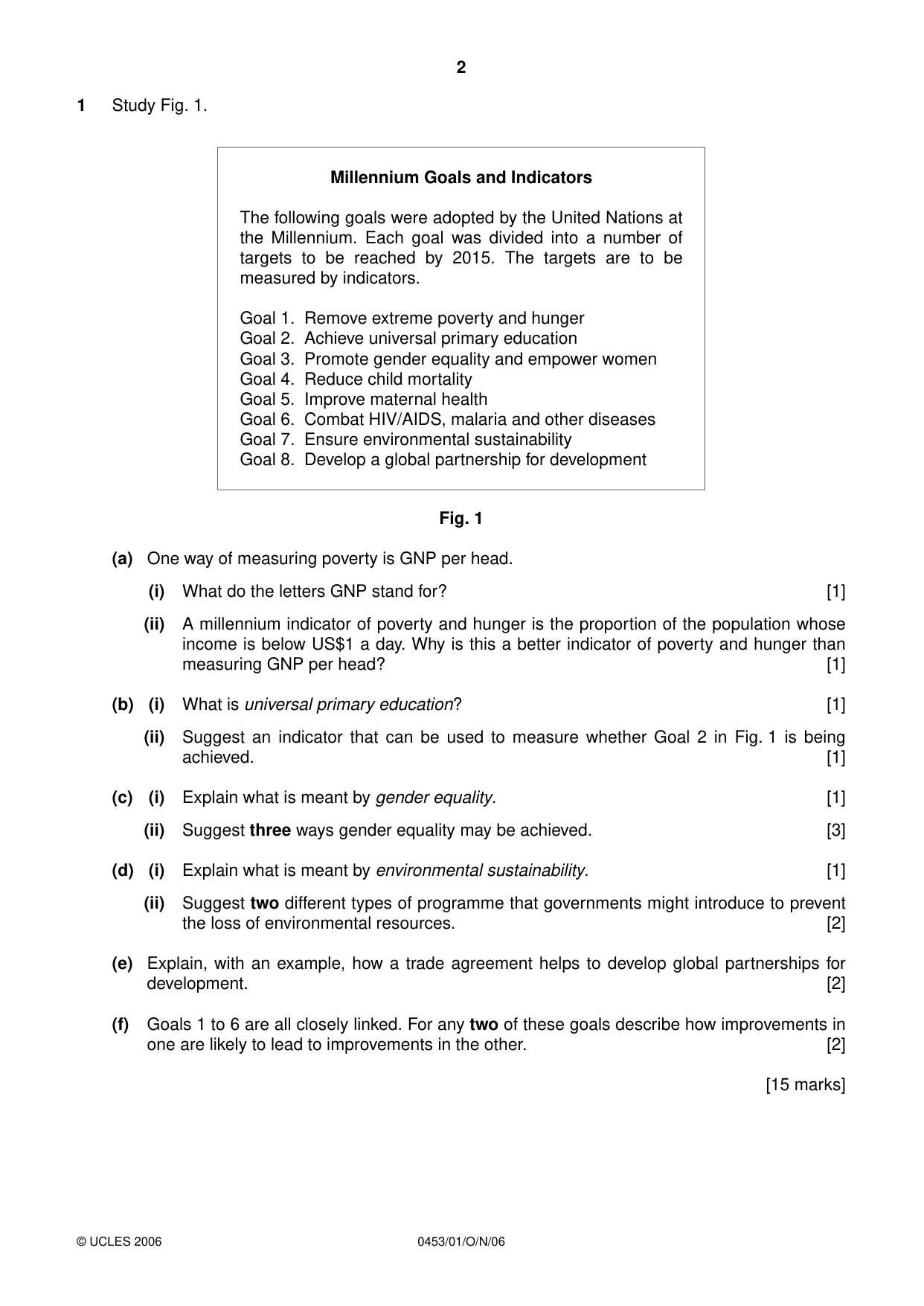
2 0453/01/O/N/06 © UCLES 2006 1 Study Fig. 1. Fig. 1 (a) One way of measuring poverty is GNP per head. (i) What do the letters GNP stand for? [1] (ii) A millennium indicator of poverty and hunger is the proportion of the population whose income is below US$1 a day. Why is this a better indicator of poverty and hunger than measuring GNP per head? [1] (b) (i) What is universal primary education? [1] (ii) Suggest an indicator that can be used to measure whether Goal 2 in Fig. 1 is being achieved. [1] (c) (i) Explain what is meant by gender equality. [1] (ii) Suggest three ways gender equality may be achieved. [3] (d) (i) Explain what is meant by environmental sustainability. [1] (ii) Suggest two different types of programme that governments might introduce to prevent the loss of environmental resources. [2] (e) Explain, with an example, how a trade agreement helps to develop global partnerships for development. [2] (f) Goals 1 to 6 are all closely linked. For any two of these goals describe how improvements in one are likely to lead to improvements in the other. [2] [15 marks] Millennium Goals and Indicators The following goals were adopted by the United Nations at the Millennium. Each goal was divided into a number of targets to be reached by 2015. The targets are to be measured by indicators. Goal 1. Remove extreme poverty and hunger Goal 2. Achieve universal primary education Goal 3. Promote gender equality and empower women Goal 4. Reduce child mortality Goal 5. Improve maternal health Goal 6. Combat HIV/AIDS, malaria and other diseases Goal 7. Ensure environmental sustainability Goal 8. Develop a global partnership for development
Question paper, page 3
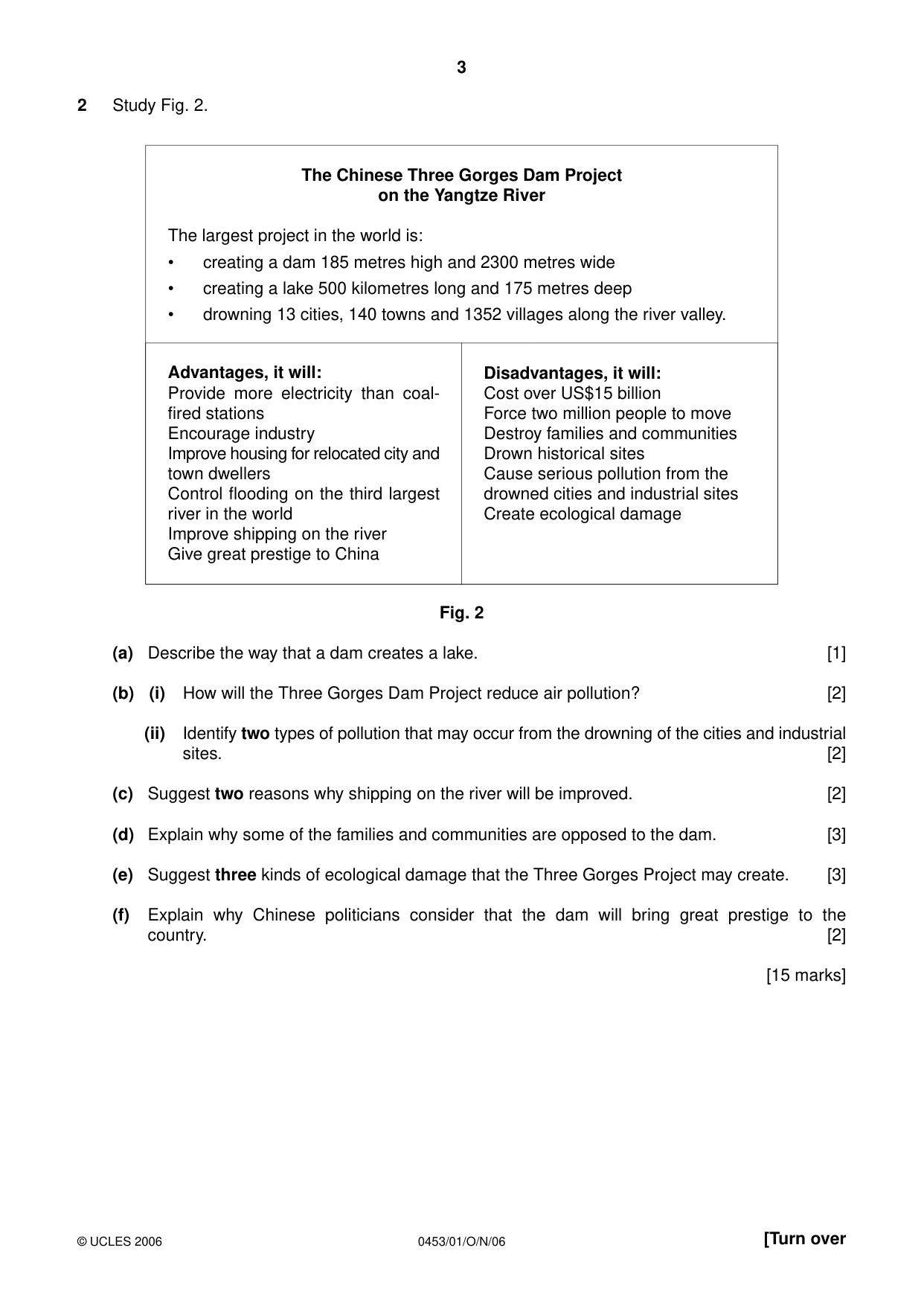
3 0453/01/O/N/06 © UCLES 2006 [Turn over 2 Study Fig. 2. Fig. 2 (a) Describe the way that a dam creates a lake. [1] (b) (i) How will the Three Gorges Dam Project reduce air pollution? [2] (ii) Identify two types of pollution that may occur from the drowning of the cities and industrial sites. [2] (c) Suggest two reasons why shipping on the river will be improved. [2] (d) Explain why some of the families and communities are opposed to the dam. [3] (e) Suggest three kinds of ecological damage that the Three Gorges Project may create. [3] (f) Explain why Chinese politicians consider that the dam will bring great prestige to the country. [2] [15 marks] The Chinese Three Gorges Dam Project on the Yangtze River The largest project in the world is: • creating a dam 185 metres high and 2300 metres wide • creating a lake 500 kilometres long and 175 metres deep • drowning 13 cities, 140 towns and 1352 villages along the river valley. Advantages, it will: Provide more electricity than coal- fired stations Encourage industry Improve housing for relocated city and town dwellers Control flooding on the third largest river in the world Improve shipping on the river Give great prestige to China Disadvantages, it will: Cost over US$15 billion Force two million people to move Destroy families and communities Drown historical sites Cause serious pollution from the drowned cities and industrial sites Create ecological damage
Question paper, page 4
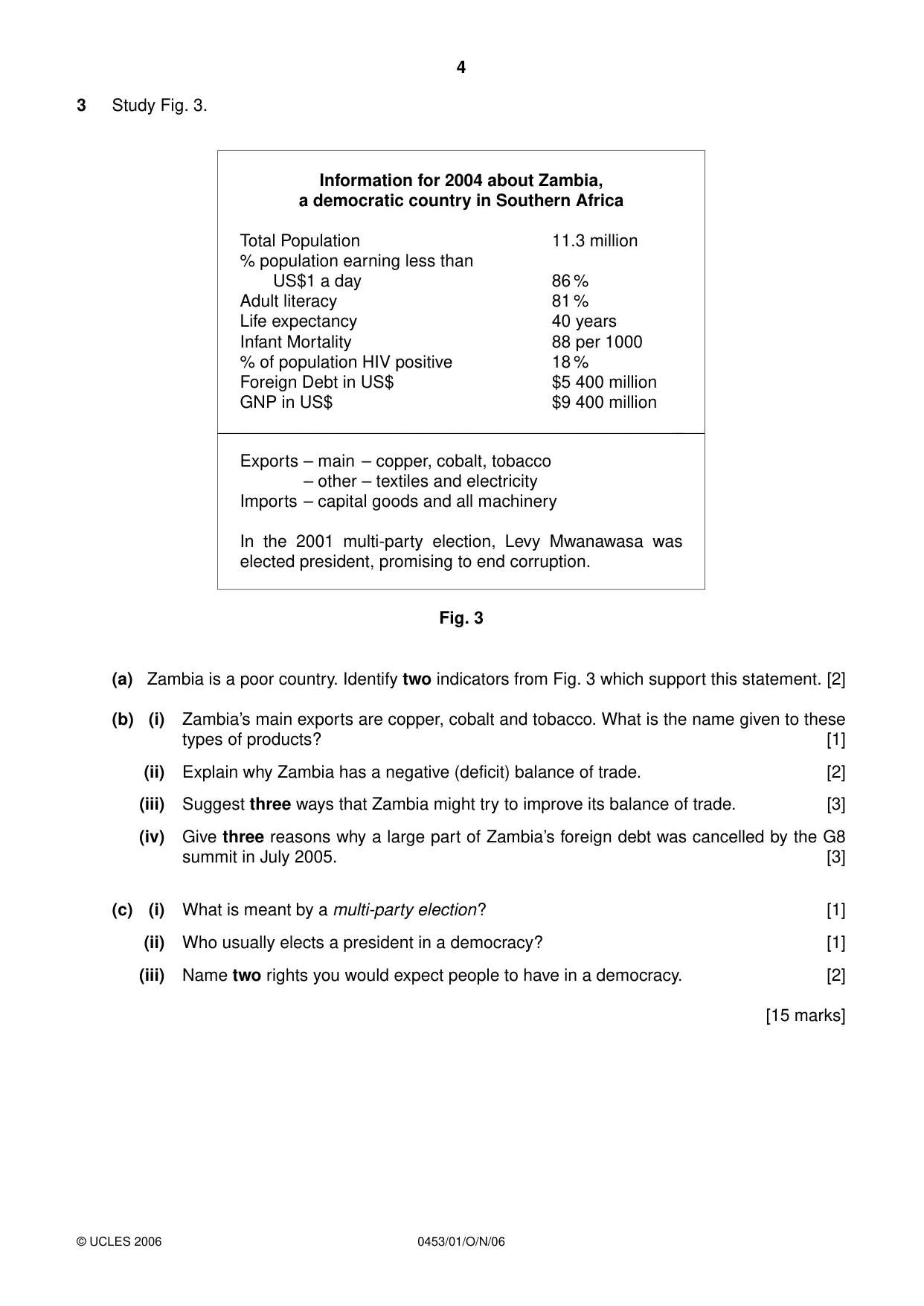
4 0453/01/O/N/06 © UCLES 2006 3 Study Fig. 3. Fig. 3 (a) Zambia is a poor country. Identify two indicators from Fig. 3 which support this statement. [2] (b) (i) Zambia’s main exports are copper, cobalt and tobacco. What is the name given to these types of products? [1] (ii) Explain why Zambia has a negative (deficit) balance of trade. [2] (iii) Suggest three ways that Zambia might try to improve its balance of trade. [3] (iv) Give three reasons why a large part of Zambia’s foreign debt was cancelled by the G8 summit in July 2005. [3] (c) (i) What is meant by a multi-party election? [1] (ii) Who usually elects a president in a democracy? [1] (iii) Name two rights you would expect people to have in a democracy. [2] [15 marks] Information for 2004 about Zambia, a democratic country in Southern Africa Total Population 11.3 million % population earning less than US$1 a day 86 % Adult literacy 81 % Life expectancy 40 years Infant Mortality 88 per 1000 % of population HIV positive 18 % Foreign Debt in US$ $5 400 million GNP in US$ $9 400 million ____________________________________________________ Exports – main – copper, cobalt, tobacco – other – textiles and electricity Imports – capital goods and all machinery In the 2001 multi-party election, Levy Mwanawasa was elected president, promising to end corruption.
Question paper, page 5
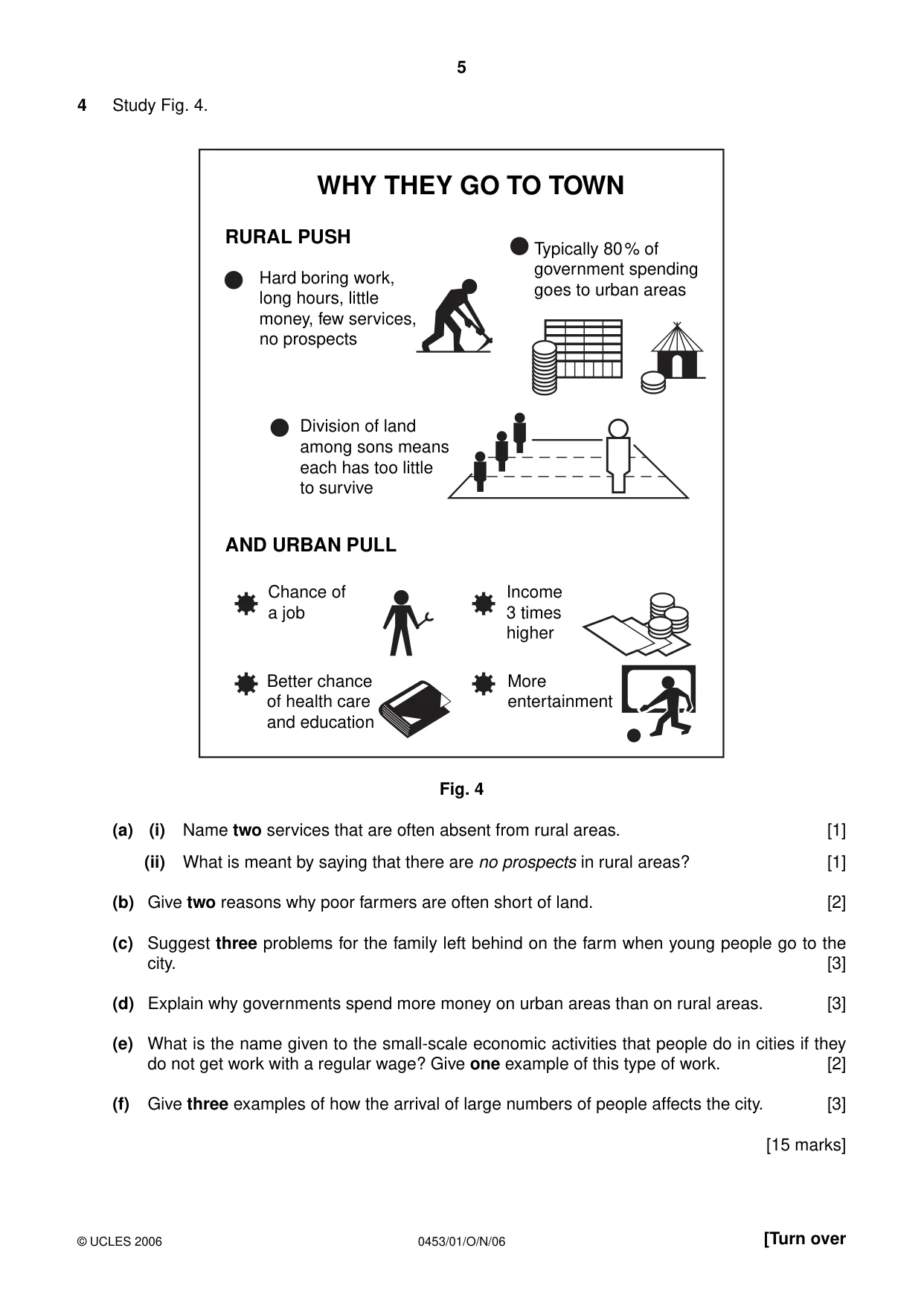
5 0453/01/O/N/06 © UCLES 2006 [Turn over 4 Study Fig. 4. Fig. 4 (a) (i) Name two services that are often absent from rural areas. [1] (ii) What is meant by saying that there are no prospects in rural areas? [1] (b) Give two reasons why poor farmers are often short of land. [2] (c) Suggest three problems for the family left behind on the farm when young people go to the city. [3] (d) Explain why governments spend more money on urban areas than on rural areas. [3] (e) What is the name given to the small-scale economic activities that people do in cities if they do not get work with a regular wage? Give one example of this type of work. [2] (f) Give three examples of how the arrival of large numbers of people affects the city. [3] [15 marks] WHY THEY GO TO TOWN RURAL PUSH AND URBAN PULL Hard boring work, long hours, little money, few services, no prospects Typically 80% of government spending goes to urban areas Division of land among sons means each has too little to survive Chance of a job Better chance of health care and education Income 3 times higher More entertainment
Question paper, page 6
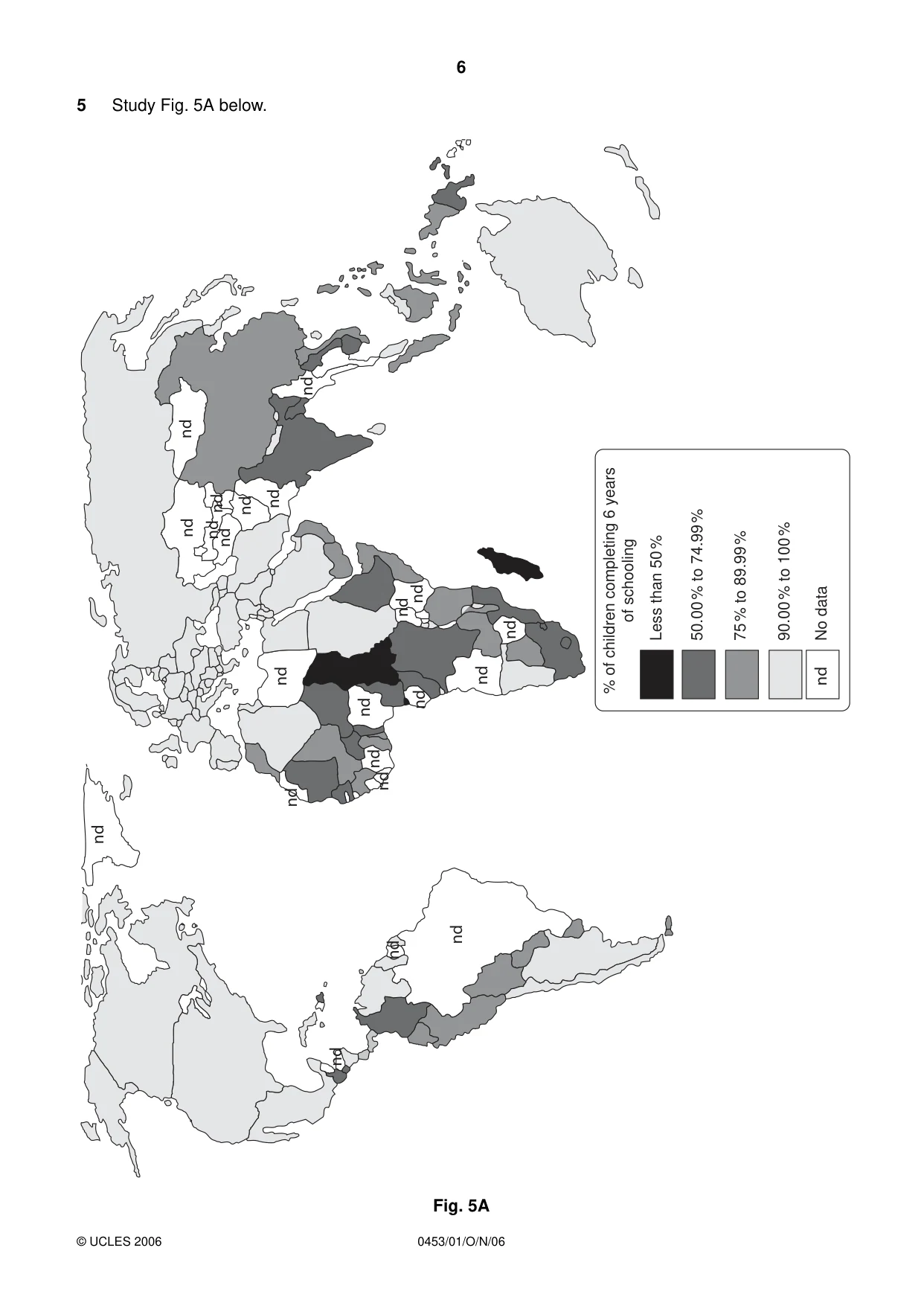
6 0453/01/O/N/06 © UCLES 2006 5 Study Fig. 5A below. Fig. 5A % of children completing 6 years of schooling Less than 50% 50.00% to 74.99% 75% to 89.99% 90.00% to 100% No data ND nd nd nd nd nd nd nd nd nd nd nd nd nd nd nd nd nd nd nd nd nd nd nd
Question paper, page 7
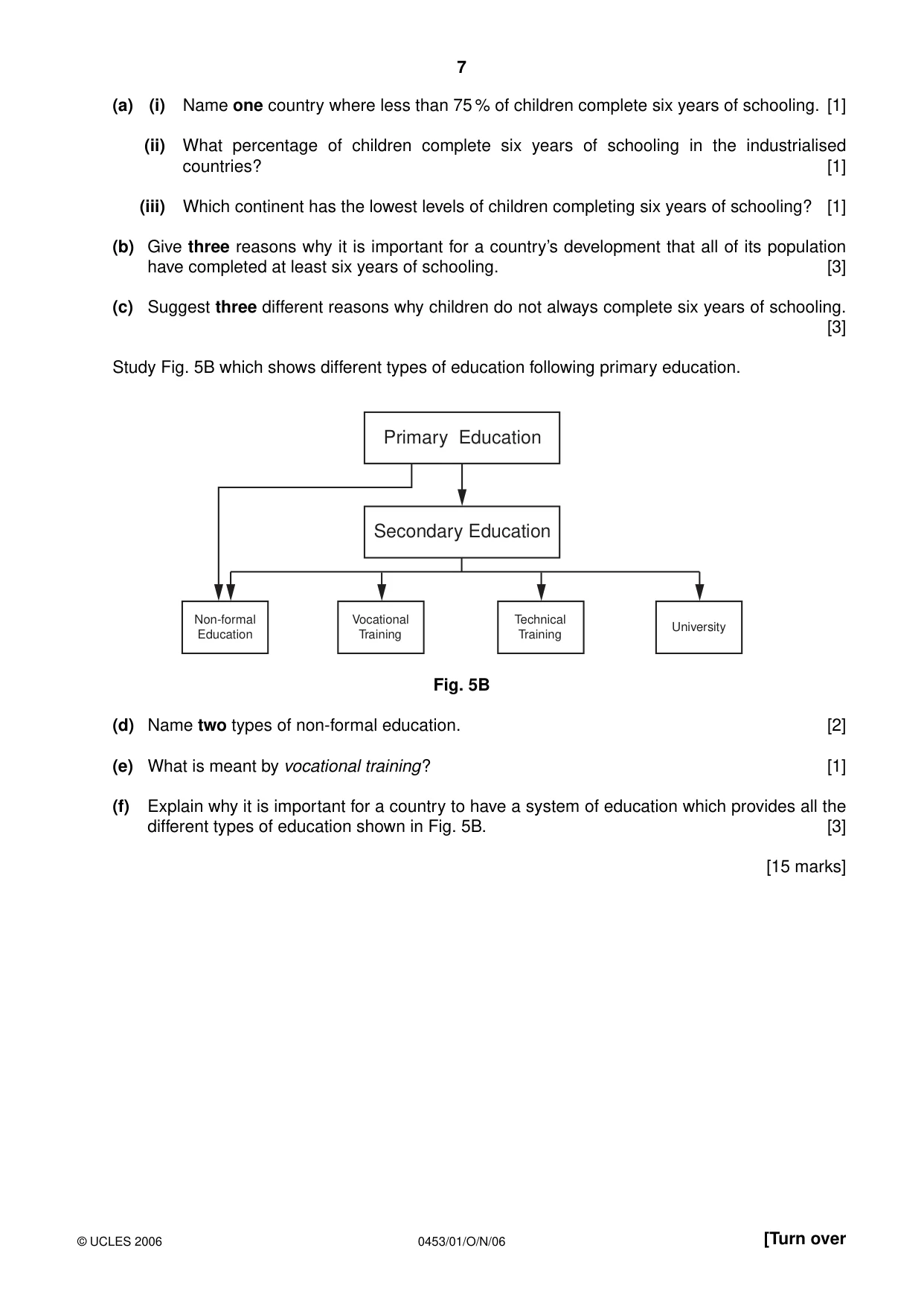
7 0453/01/O/N/06 © UCLES 2006 [Turn over (a) (i) Name one country where less than 75 % of children complete six years of schooling. [1] (ii) What percentage of children complete six years of schooling in the industrialised countries? [1] (iii) Which continent has the lowest levels of children completing six years of schooling? [1] (b) Give three reasons why it is important for a country’s development that all of its population have completed at least six years of schooling. [3] (c) Suggest three different reasons why children do not always complete six years of schooling. [3] Study Fig. 5B which shows different types of education following primary education. Fig. 5B (d) Name two types of non-formal education. [2] (e) What is meant by vocational training? [1] (f) Explain why it is important for a country to have a system of education which provides all the different types of education shown in Fig. 5B. [3] [15 marks] Primary Education Secondary Education Non-formal Education Vocational Training Technical Training University
Question paper, page 8
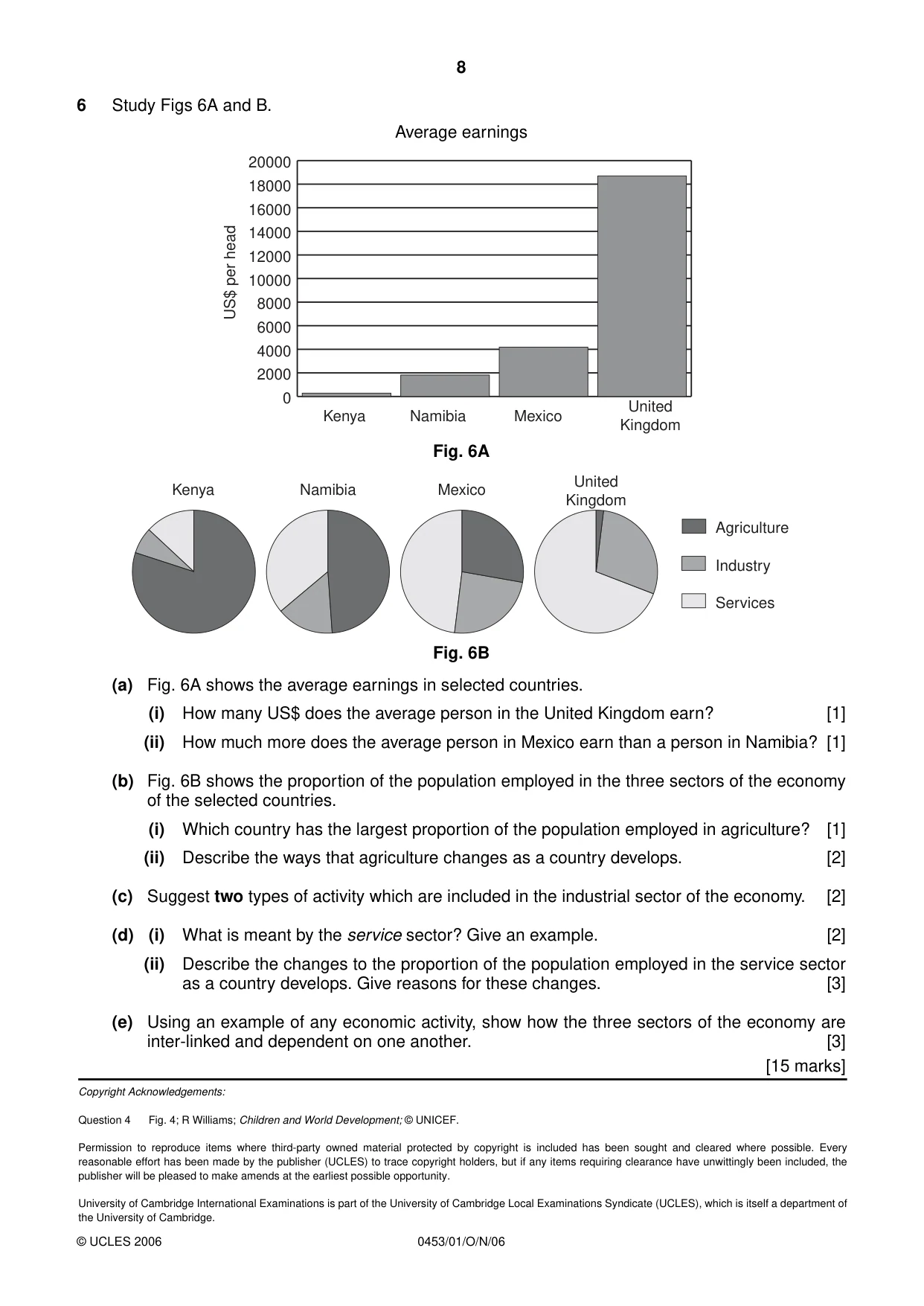
8 0453/01/O/N/06 © UCLES 2006 6 Study Figs 6A and B. Average earnings Fig. 6A Fig. 6B (a) Fig. 6A shows the average earnings in selected countries. (i) How many US$ does the average person in the United Kingdom earn? [1] (ii) How much more does the average person in Mexico earn than a person in Namibia? [1] (b) Fig. 6B shows the proportion of the population employed in the three sectors of the economy of the selected countries. (i) Which country has the largest proportion of the population employed in agriculture? [1] (ii) Describe the ways that agriculture changes as a country develops. [2] (c) Suggest two types of activity which are included in the industrial sector of the economy. [2] (d) (i) What is meant by the service sector? Give an example. [2] (ii) Describe the changes to the proportion of the population employed in the service sector as a country develops. Give reasons for these changes. [3] (e) Using an example of any economic activity, show how the three sectors of the economy are inter-linked and dependent on one another. [3] [15 marks] Services Industry Agriculture United Kingdom Mexico Namibia Kenya 0 2000 4000 6000 8000 10000 12000 14000 16000 18000 20000 United Kingdom Mexico Namibia Kenya US$ per head Copyright Acknowledgements: Question 4 Fig. 4; R Williams; Children and World Development; © UNICEF. Permission to reproduce items where third-party owned material protected by copyright is included has been sought and cleared where possible. Every reasonable effort has been made by the publisher (UCLES) to trace copyright holders, but if any items requiring clearance have unwittingly been included, the publisher will be pleased to make amends at the earliest possible opportunity. University of Cambridge International Examinations is part of the University of Cambridge Local Examinations Syndicate (UCLES), which is itself a department of the University of Cambridge.
Mark scheme, page 1
UNIVERSITY OF CAMBRIDGE INTERNATIONAL EXAMINATIONS International General Certificate of Secondary Education MARK SCHEME for the October/November 2006 question paper 0453 DEVELOPMENT STUDIES 0453/01 Paper 1, maximum raw mark 60 This mark scheme is published as an aid to teachers and students, to indicate the requirements of the examination. It shows the basis on which Examiners were instructed to award marks. It does not indicate the details of the discussions that took place at an Examiners’ meeting before marking began. All Examiners are instructed that alternative correct answers and unexpected approaches in candidates’ scripts must be given marks that fairly reflect the relevant knowledge and skills demonstrated. Mark schemes must be read in conjunction with the question papers and the report on the examination. The grade thresholds for various grades are published in the report on the examination for most IGCSE, GCE Advanced Level and Advanced Subsidiary Level syllabuses. • CIE will not enter into discussions or correspondence in connection with these mark schemes. CIE is publishing the mark schemes for the October/November 2006 question papers for most IGCSE, GCE Advanced Level and Advanced Subsidiary Level syllabuses and some Ordinary Level syllabuses. www.XtremePapers.com
Mark scheme, page 2
Page 2 Mark Scheme Syllabus Paper IGCSE - OCT/NOV 2006 0453 01 © UCLES 2006 1 (a) (i) Gross National Product allow Production [1] (ii) Because it shows the actual proportion / percentage of the population that is poor OR it is not an average. 1 MARK [1] (b) (i) Education for all children / everyone / worldwide [1] (ii) % of children attending school literacy rates 1 MARK [1] (c) (i) Equal rights / treatment for males / men and females / women [1] (ii) Three ways: Laws to enforce equality Quotas for women to enter jobs / professions / parliament etc. Changes in cultural attitudes Equal rights to ownership of land Means of making life easier for women etc. Equal right to education Give women the right to vote Government support for equal opportunities 3 MARKS [3] (d) (i) Conservation of resources / not damaging environment / meeting our needs without preventing future generations meeting theirs. [1] (ii) Two DIFFERENT types of programmes: Laws to prevent cutting down of trees / to make sure trees are replanted Quotas for fishing etc. Promotion of measures to prevent soil erosion Creation of National Parks / Forest Reserves Education on energy conservation / importance of biodiversity etc. Provision of alternative energy supplies Control of pollution etc. 2 MARKS [2] (e) Explanation of how a trade agreement helps to encourage global partnerships for development: Sharing expertise and research Abolish duties and taxes between countries Loosen border controls Provide loans Encouragement of economic growth etc. 2 MARKS [2] NO mark for just a description of trade rather than a trade agreement. NO mark for a named agreement, e.g. SADC, unless explained. (f) Any two goals 1 to 6 and their links described e.g. Goal 1 and Goal 4….reduction in poverty will mean people can afford better food, medical care and more hygienic living conditions. This will mean children will be healthier and so less will die. 2 MARKS [2] [Total: 15 marks]
Mark scheme, page 3
Page 3 Mark Scheme Syllabus Paper IGCSE - OCT/NOV 2006 0453 01 © UCLES 2006 2 (a) By holding back the river / storing the water behind it [1] (b) (i) Two points: Coal fired stations will not be necessary when there is HEP. HEP is cleaner / coal involves burning fossil fuels 2 MARKS [2] (ii) Two types of pollution: Seepage of poisonous chemicals from industrial sites Pollution from drowned rubbish dumps Build up of gases from rotting wood and vegetation Pollution from rotting drowned animals. Release of sewage NO mark for just air pollution, water pollution etc. 2 MARKS [2] (c) Two reasons: Water levels will be controlled / flood control Rapids and obstructions in the river will be removed Lake will be wider / deeper / shorter than river and easier to navigate Locks will be built round the dam. 2 MARKS [2] (d) Three reasons: They will lose their land They will lose their homes They will lose important cultural sites / ancestors burial grounds etc. Communities will be broken up The new houses may be expensive They may not want to move to / live in a town They may have to learn a new job They are concerned over environmental damage Concern over health problems caused by water pollution. 3 MARKS [3] NO mark for direct copy off Fig. 2. e.g. drowning historical sites etc. (e) Three kinds of ecological damage: (MAX 1 for list) Loss of / destruction of fish / aquatic life / birds / animals / plants Loss of / destruction of habitats Damage to food chains Disruption of ecosystems / changes in local climate Developed idea of water pollution downstream 3 MARKS [3] (f) Two points: A physical feat: because it shows that China has expert builders / engineers / technology etc. to undertake a huge architectural feat A human planning feat because it involves moving 2 million people A world sized marvel because it shows that China is able to undertake the largest project in the world which will be an attraction for tourists Project will bring industrial development Use of renewable energy supply 2 MARKS [2] [Total: 15 marks]
Mark scheme, page 4
Page 4 Mark Scheme Syllabus Paper IGCSE - OCT/NOV 2006 0453 01 © UCLES 2006 3 (a) Two indicators from Fig. 3: (Credit first two if list) % earning less than US$1 a day Adult literacy Life expectancy Infant Mortality Main exports are primary products NOT % HIV POSITIVE NOT FOREIGN DEBT NOT GNP [2] (b) (i) Primary products / raw materials. [1] (ii) The cost of imports exceeds the income from exports. It imports expensive capital goods and exports primary products which are of lower value. 2 MARKS [2] (iii) Three ways: Import quotas / tariffs Develop more import substitution industries Export more processed goods Develop export orientated industries / diversification of exports Devalue its currency. Encourage tourism Import quotas / tariffs could be worth 2 if both well developed. 3 MARKS [3] NO mark for import less / export more (iv)Three reasons: Country is poor / doesn’t earn enough to pay debt back Its debts were equal to over half its annual income / huge It had to pay so much interest on its large foreign debt To allow Zambia to pay for investment in infrastructure To free Zambia from dependence on developed countries To free Zambia from spiralling / increasing debt Allow ‘for humanitarian reasons’ 3 MARKS [3] NO credit for reference to development with no explanation (c) (i) An election in which there is more than one party. [1] (ii) The people. [1] (iii) Two rights: Equality before the law Freedom of association Right to fair trial Free press / free speech Right to vote Freedom of religion Right to education 2 MARKS [2] [Total: 15marks]
Mark scheme, page 5
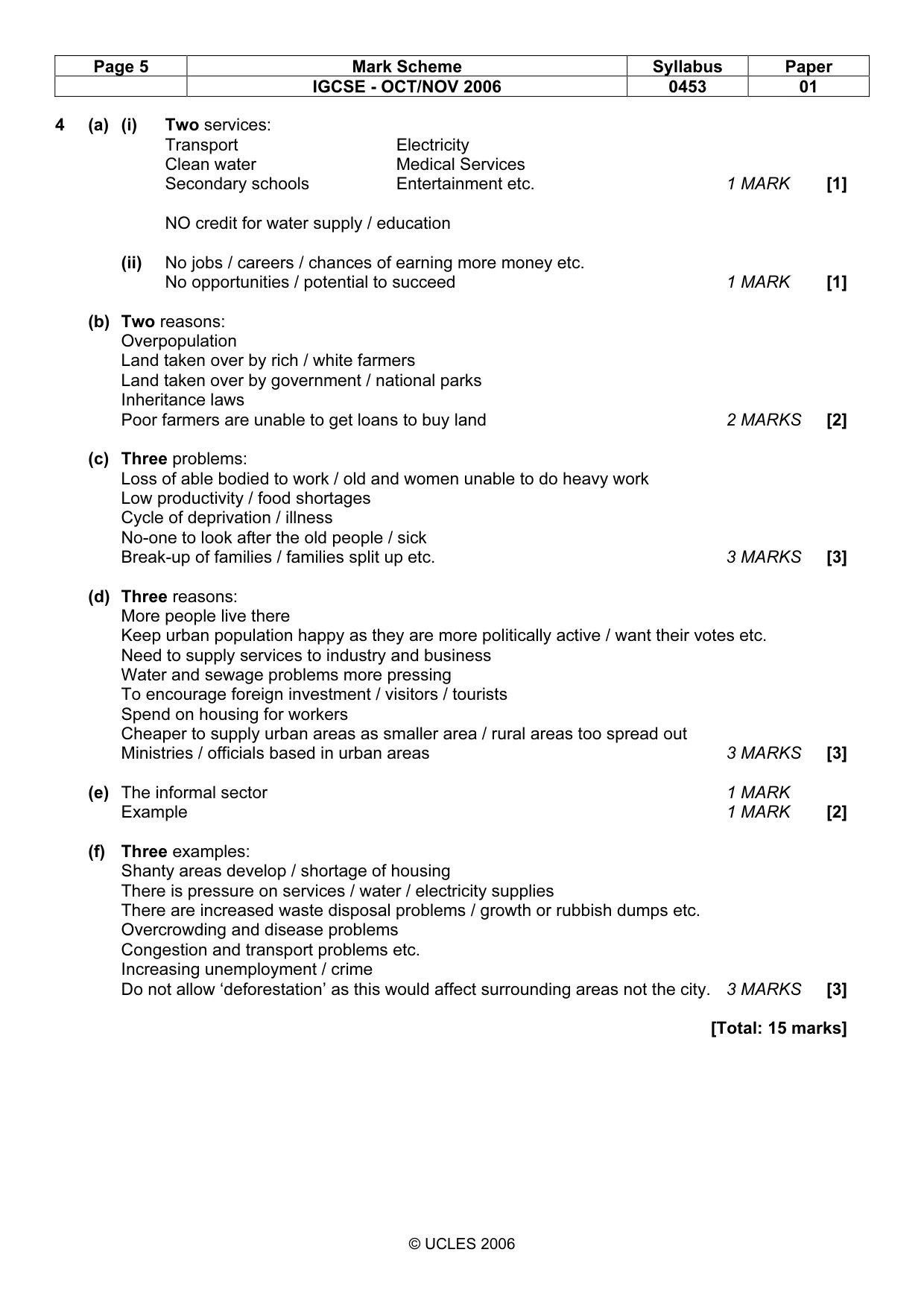
Page 5 Mark Scheme Syllabus Paper IGCSE - OCT/NOV 2006 0453 01 © UCLES 2006 4 (a) (i) Two services: Transport Electricity Clean water Medical Services Secondary schools Entertainment etc. 1 MARK [1] NO credit for water supply / education (ii) No jobs / careers / chances of earning more money etc. No opportunities / potential to succeed 1 MARK [1] (b) Two reasons: Overpopulation Land taken over by rich / white farmers Land taken over by government / national parks Inheritance laws Poor farmers are unable to get loans to buy land 2 MARKS [2] (c) Three problems: Loss of able bodied to work / old and women unable to do heavy work Low productivity / food shortages Cycle of deprivation / illness No-one to look after the old people / sick Break-up of families / families split up etc. 3 MARKS [3] (d) Three reasons: More people live there Keep urban population happy as they are more politically active / want their votes etc. Need to supply services to industry and business Water and sewage problems more pressing To encourage foreign investment / visitors / tourists Spend on housing for workers Cheaper to supply urban areas as smaller area / rural areas too spread out Ministries / officials based in urban areas 3 MARKS [3] (e) The informal sector 1 MARK Example 1 MARK [2] (f) Three examples: Shanty areas develop / shortage of housing There is pressure on services / water / electricity supplies There are increased waste disposal problems / growth or rubbish dumps etc. Overcrowding and disease problems Congestion and transport problems etc. Increasing unemployment / crime Do not allow ‘deforestation’ as this would affect surrounding areas not the city. 3 MARKS [3] [Total: 15 marks]
Mark scheme, page 6
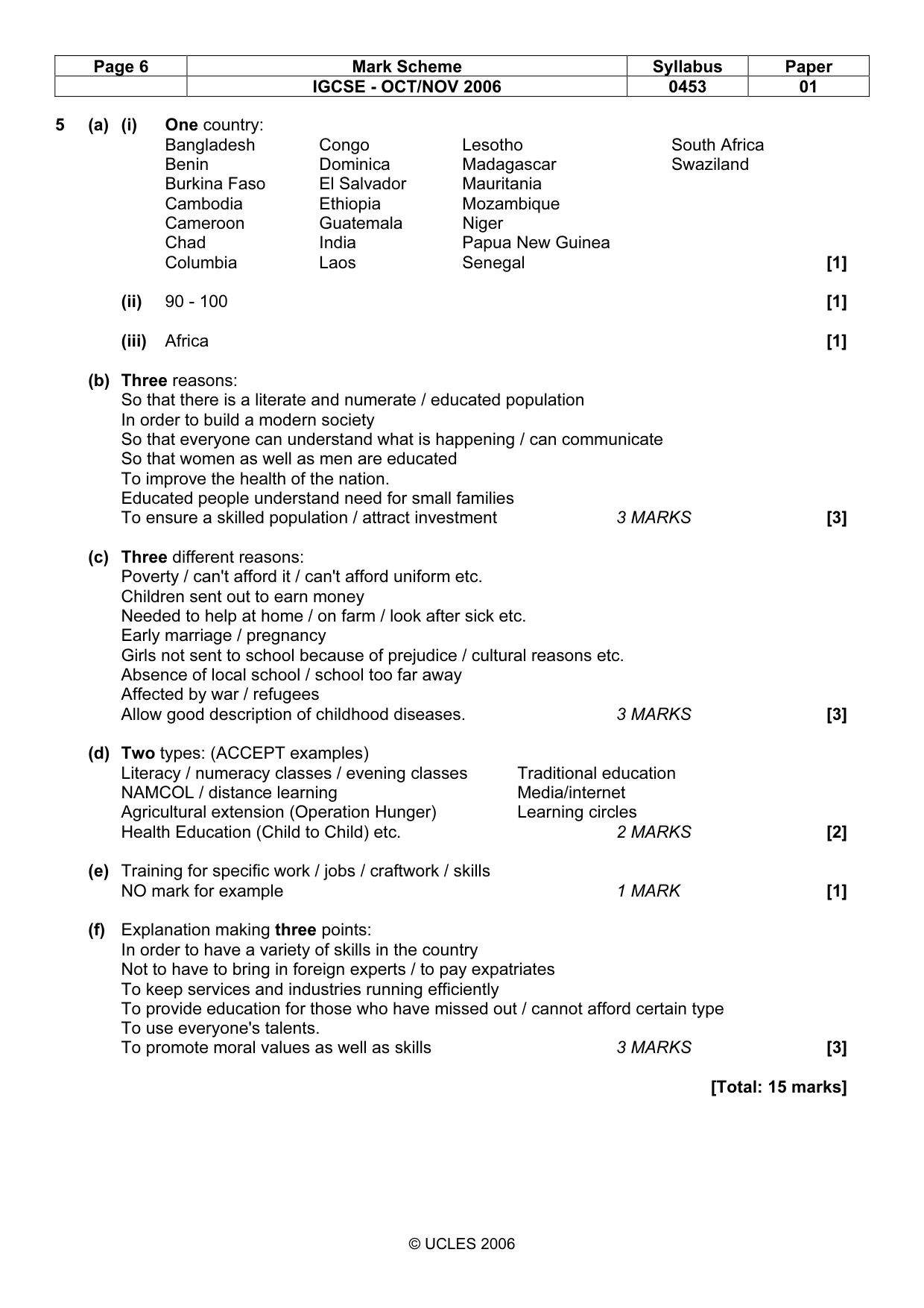
Page 6 Mark Scheme Syllabus Paper IGCSE - OCT/NOV 2006 0453 01 © UCLES 2006 5 (a) (i) One country: Bangladesh Congo Lesotho South Africa Benin Dominica Madagascar Swaziland Burkina Faso El Salvador Mauritania Cambodia Ethiopia Mozambique Cameroon Guatemala Niger Chad India Papua New Guinea Columbia Laos Senegal [1] (ii) 90 - 100 [1] (iii) Africa [1] (b) Three reasons: So that there is a literate and numerate / educated population In order to build a modern society So that everyone can understand what is happening / can communicate So that women as well as men are educated To improve the health of the nation. Educated people understand need for small families To ensure a skilled population / attract investment 3 MARKS [3] (c) Three different reasons: Poverty / can't afford it / can't afford uniform etc. Children sent out to earn money Needed to help at home / on farm / look after sick etc. Early marriage / pregnancy Girls not sent to school because of prejudice / cultural reasons etc. Absence of local school / school too far away Affected by war / refugees Allow good description of childhood diseases. 3 MARKS [3] (d) Two types: (ACCEPT examples) Literacy / numeracy classes / evening classes Traditional education NAMCOL / distance learning Media/internet Agricultural extension (Operation Hunger) Learning circles Health Education (Child to Child) etc. 2 MARKS [2] (e) Training for specific work / jobs / craftwork / skills NO mark for example 1 MARK [1] (f) Explanation making three points: In order to have a variety of skills in the country Not to have to bring in foreign experts / to pay expatriates To keep services and industries running efficiently To provide education for those who have missed out / cannot afford certain type To use everyone's talents. To promote moral values as well as skills 3 MARKS [3] [Total: 15 marks]
Mark scheme, page 7
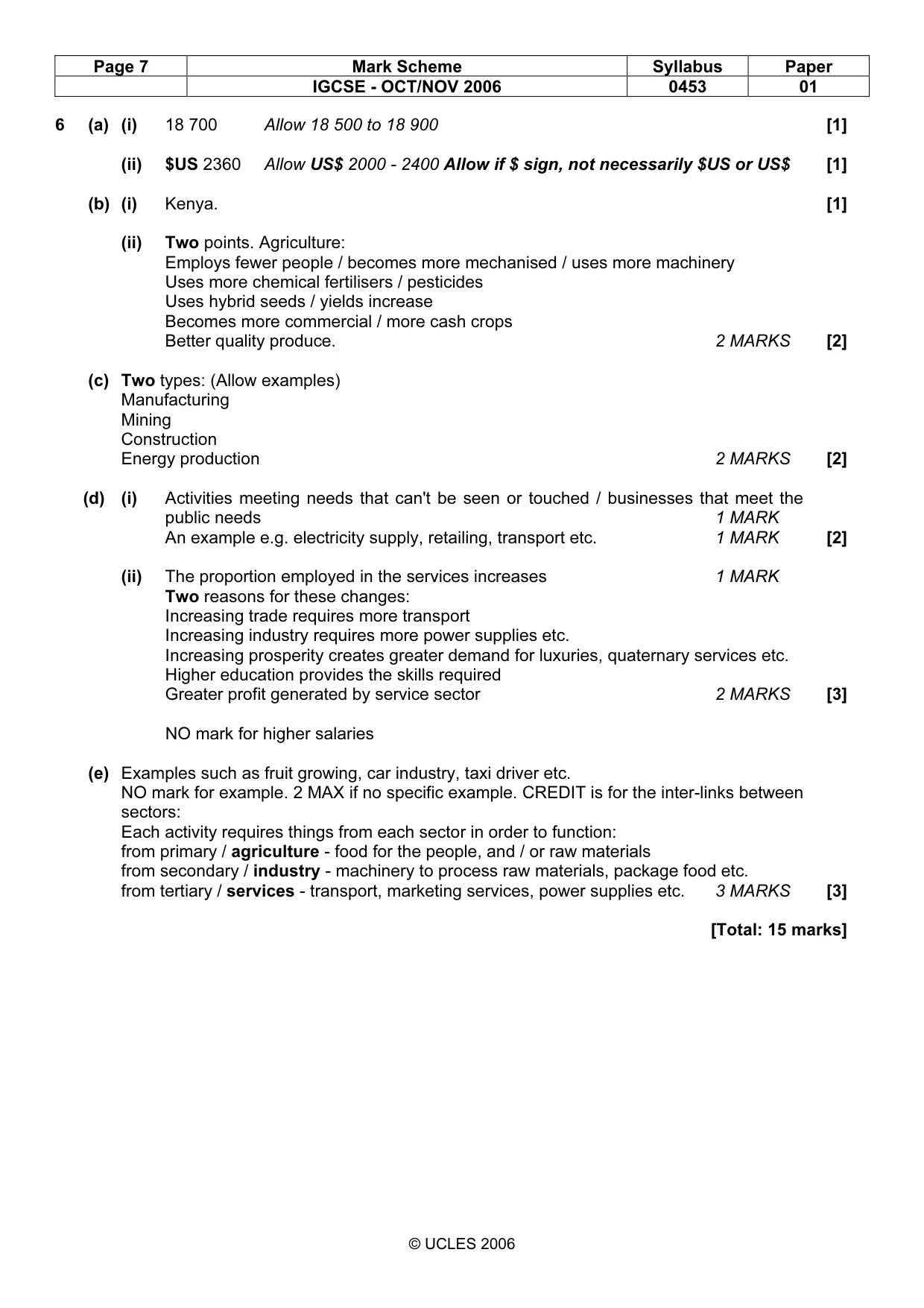
Page 7 Mark Scheme Syllabus Paper IGCSE - OCT/NOV 2006 0453 01 © UCLES 2006 6 (a) (i) 18 700 Allow 18 500 to 18 900 [1] (ii) $US 2360 Allow US$ 2000 - 2400 Allow if $ sign, not necessarily $US or US$ [1] (b) (i) Kenya. [1] (ii) Two points. Agriculture: Employs fewer people / becomes more mechanised / uses more machinery Uses more chemical fertilisers / pesticides Uses hybrid seeds / yields increase Becomes more commercial / more cash crops Better quality produce. 2 MARKS [2] (c) Two types: (Allow examples) Manufacturing Mining Construction Energy production 2 MARKS [2] (d) (i) Activities meeting needs that can't be seen or touched / businesses that meet the public needs 1 MARK An example e.g. electricity supply, retailing, transport etc. 1 MARK [2] (ii) The proportion employed in the services increases 1 MARK Two reasons for these changes: Increasing trade requires more transport Increasing industry requires more power supplies etc. Increasing prosperity creates greater demand for luxuries, quaternary services etc. Higher education provides the skills required Greater profit generated by service sector 2 MARKS [3] NO mark for higher salaries (e) Examples such as fruit growing, car industry, taxi driver etc. NO mark for example. 2 MAX if no specific example. CREDIT is for the inter-links between sectors: Each activity requires things from each sector in order to function: from primary / agriculture - food for the people, and / or raw materials from secondary / industry - machinery to process raw materials, package food etc. from tertiary / services - transport, marketing services, power supplies etc. 3 MARKS [3] [Total: 15 marks]
What you needed in this session
Cambridge’s own grade thresholds for 2006 Oct/Nov, Paper 1 · Variant 1. A higher threshold means an easier paper — the bar moves with how the cohort did.