Cambridge IGCSE Development Studies 0453 — 2003 Oct/Nov Paper 2 · Variant 1
0453/21/O/N/03
The question paper and its mark scheme, free to read here and free to download. This is Cambridge’s own paper, exactly as it was sat.
Question paper8 pages
Mark scheme
No mark scheme is in the library for this paper.
Paper as text
Question paper, page 1
This document consists of 8 printed pages. BR (CG) S41820/1 © CIE 2003 [Turn over CAMBRIDGE INTERNATIONAL EXAMINATIONS International General Certificate of Secondary Education DEVELOPMENT STUDIES 0453/02 Paper 2 October/November 2003 2 hours 15 minutes Additional Materials: Answer Booklet/Paper READ THESE INSTRUCTIONS FIRST If you have been given an Answer Booklet, follow the instructions on the front cover of the Booklet. Write your Centre number, candidate number and name on all the work you hand in. Write in dark blue or black pen on both sides of the paper. You may use a soft pencil for any diagrams, graphs or rough working. Do not use staples, paper clips, highlighters, glue or correction fluid. Answer both questions. At the end of the examination, fasten all your work securely together. The number of marks is given in brackets [ ] at the end of each question or part question. www.XtremePapers.com
Question paper, page 2
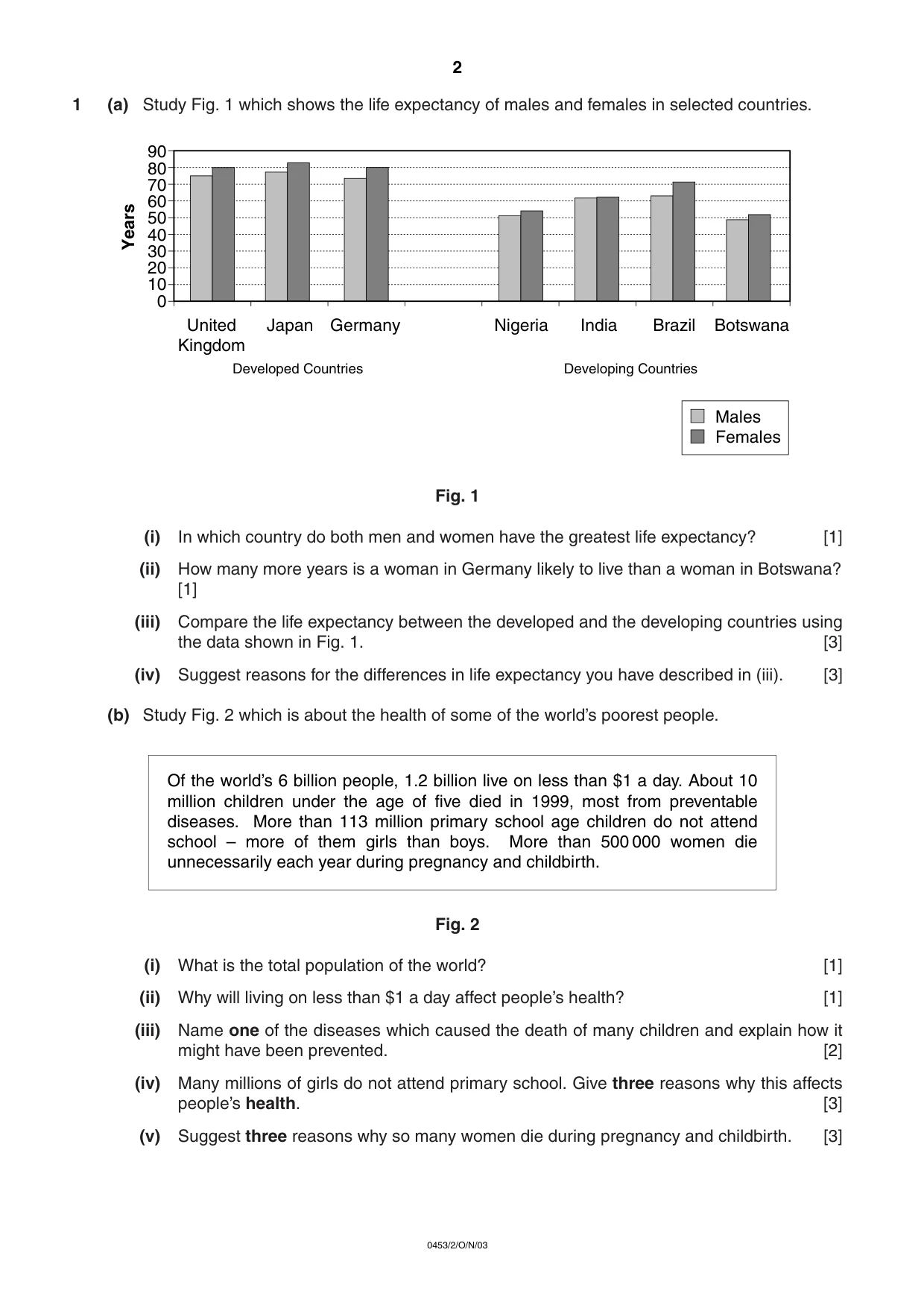
1 (a) Study Fig. 1 which shows the life expectancy of males and females in selected countries. Fig. 1 (i) In which country do both men and women have the greatest life expectancy? [1] (ii) How many more years is a woman in Germany likely to live than a woman in Botswana? [1] (iii) Compare the life expectancy between the developed and the developing countries using the data shown in Fig. 1. [3] (iv) Suggest reasons for the differences in life expectancy you have described in (iii). [3] (b) Study Fig. 2 which is about the health of some of the world’s poorest people. Fig. 2 (i) What is the total population of the world? [1] (ii) Why will living on less than $1 a day affect people’s health? [1] (iii) Name one of the diseases which caused the death of many children and explain how it might have been prevented. [2] (iv) Many millions of girls do not attend primary school. Give three reasons why this affects people’s health. [3] (v) Suggest three reasons why so many women die during pregnancy and childbirth. [3] 0 10 20 Years 30 40 50 United Kingdom Japan Germany Nigeria Females Males India Brazil Developing Countries Developed Countries Botswana 60 70 80 90 2 0453/2/O/N/03 Of the world’s 6 billion people, 1.2 billion live on less than $1 a day. About 10 million children under the age of five died in 1999, most from preventable diseases. More than 113 million primary school age children do not attend school – more of them girls than boys. More than 500 000 women die unnecessarily each year during pregnancy and childbirth.
Question paper, page 3
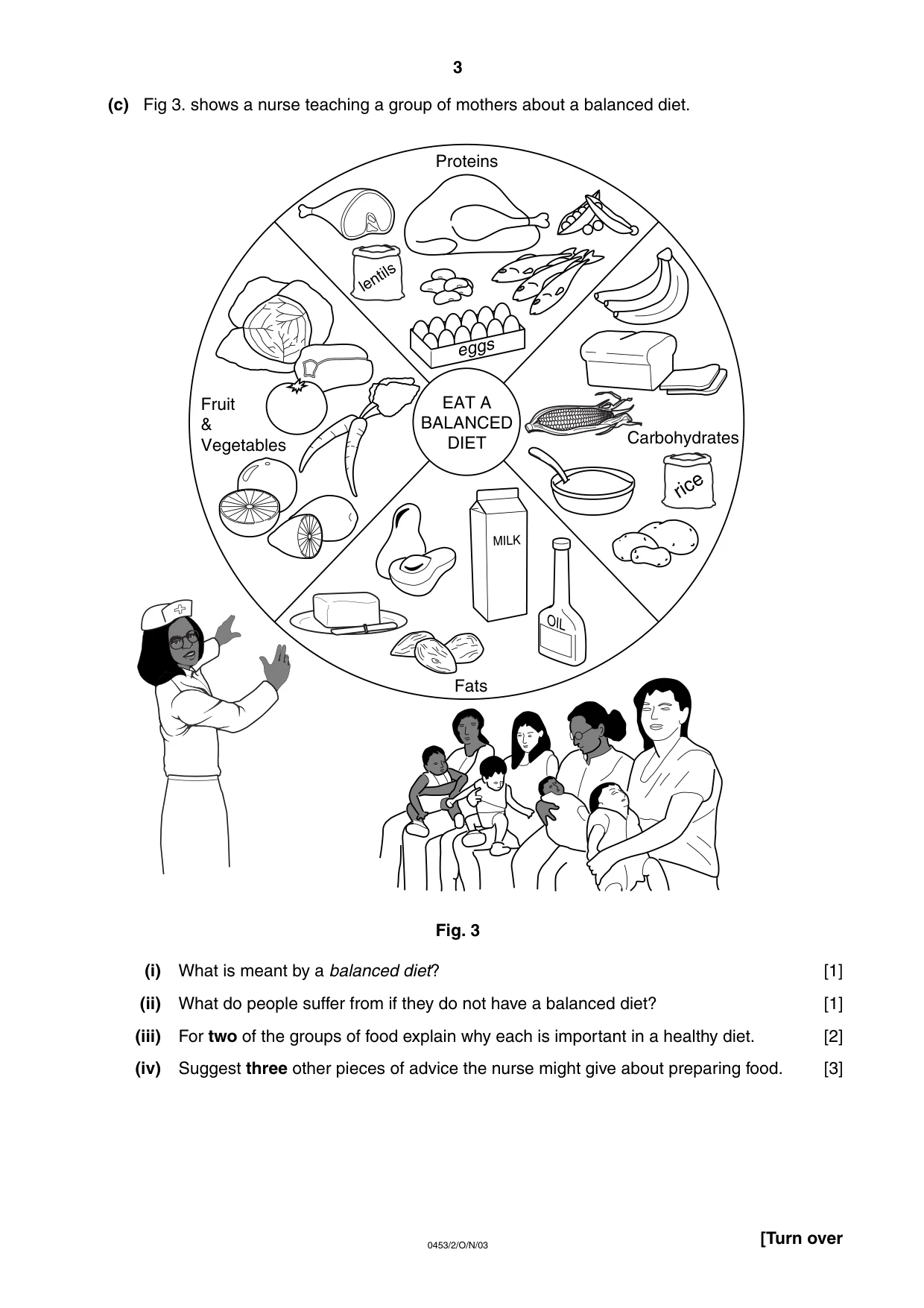
3 0453/2/O/N/03 (c) Fig 3. shows a nurse teaching a group of mothers about a balanced diet. Fig. 3 (i) What is meant by a balanced diet? [1] (ii) What do people suffer from if they do not have a balanced diet? [1] (iii) For two of the groups of food explain why each is important in a healthy diet. [2] (iv) Suggest three other pieces of advice the nurse might give about preparing food. [3] Fats Proteins Carbohydrates EAT A BALANCED DIET Fruit & Vegetables eggs MILK OIL rice lentils [Turn over
Question paper, page 4
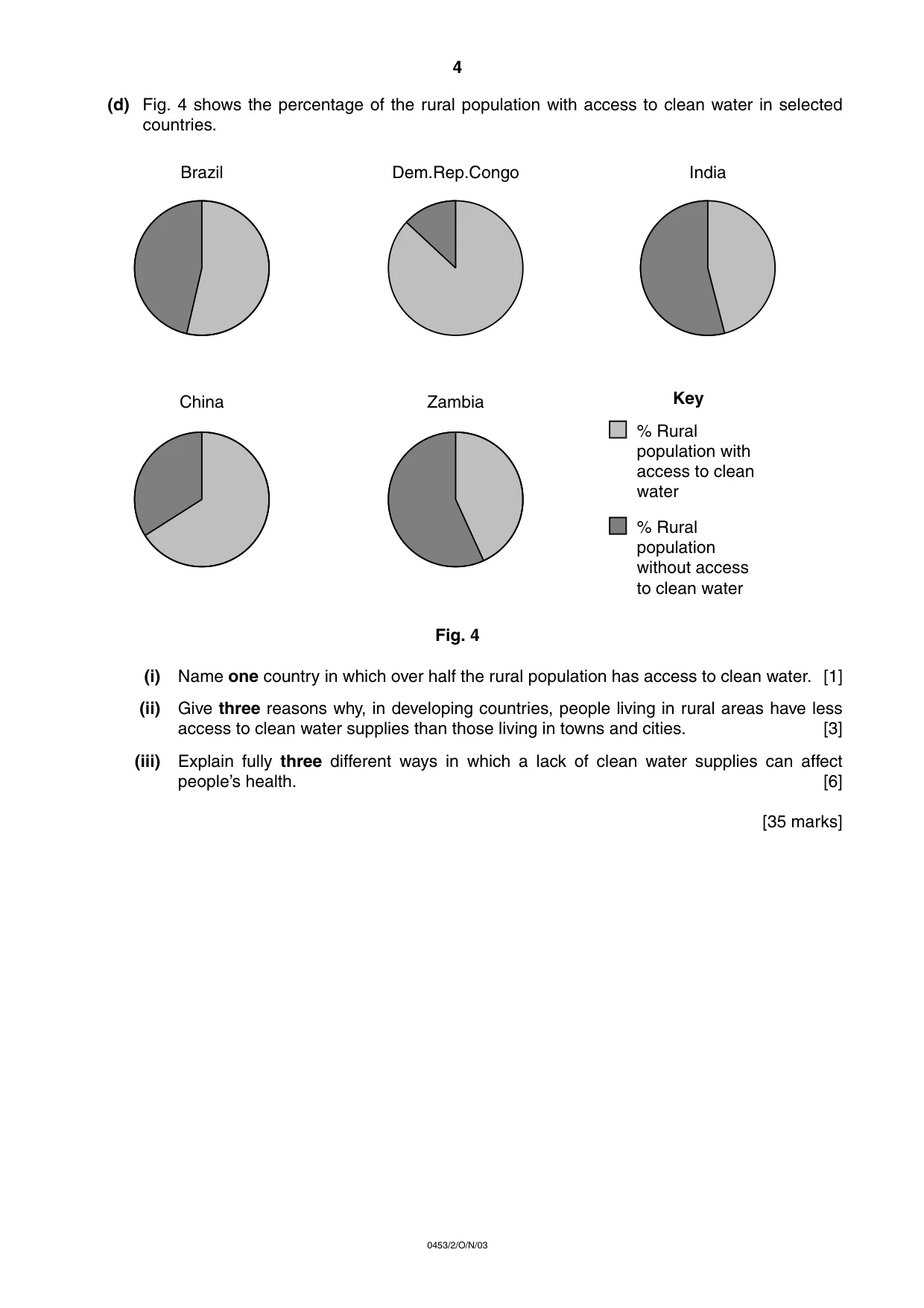
4 0453/2/O/N/03 (d) Fig. 4 shows the percentage of the rural population with access to clean water in selected countries. Fig. 4 (i) Name one country in which over half the rural population has access to clean water. [1] (ii) Give three reasons why, in developing countries, people living in rural areas have less access to clean water supplies than those living in towns and cities. [3] (iii) Explain fully three different ways in which a lack of clean water supplies can affect people’s health. [6] [35 marks] Brazil Dem.Rep.Congo India Zambia Key % Rural population with access to clean water China % Rural population without access to clean water
Question paper, page 5
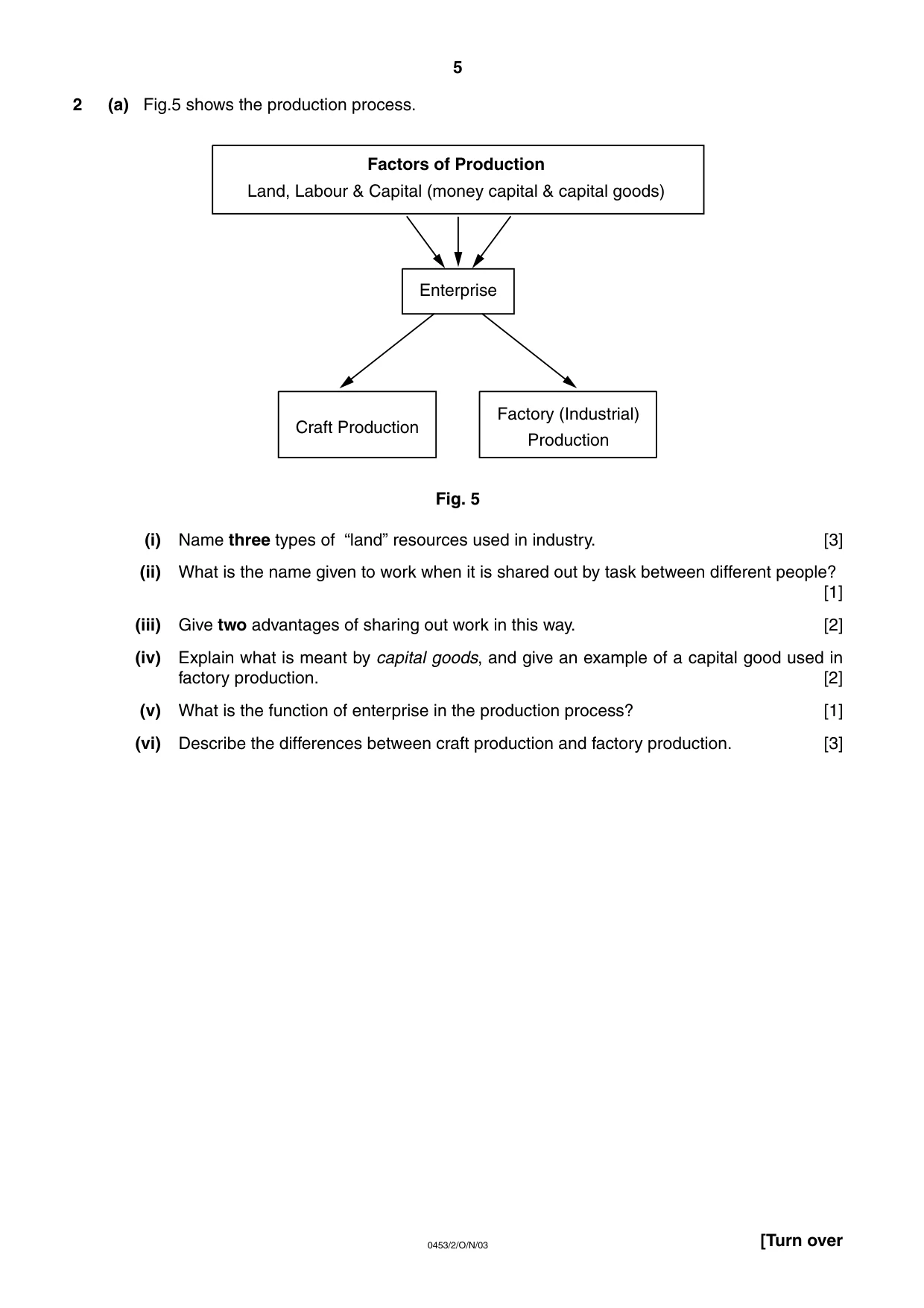
5 0453/2/O/N/03 [Turn over 2 (a) Fig.5 shows the production process. Fig. 5 (i) Name three types of “land” resources used in industry. [3] (ii) What is the name given to work when it is shared out by task between different people? [1] (iii) Give two advantages of sharing out work in this way. [2] (iv) Explain what is meant by capital goods, and give an example of a capital good used in factory production. [2] (v) What is the function of enterprise in the production process? [1] (vi) Describe the differences between craft production and factory production. [3] Factors of Production Land, Labour & Capital (money capital & capital goods) Enterprise Craft Production Factory (Industrial) Production
Question paper, page 6
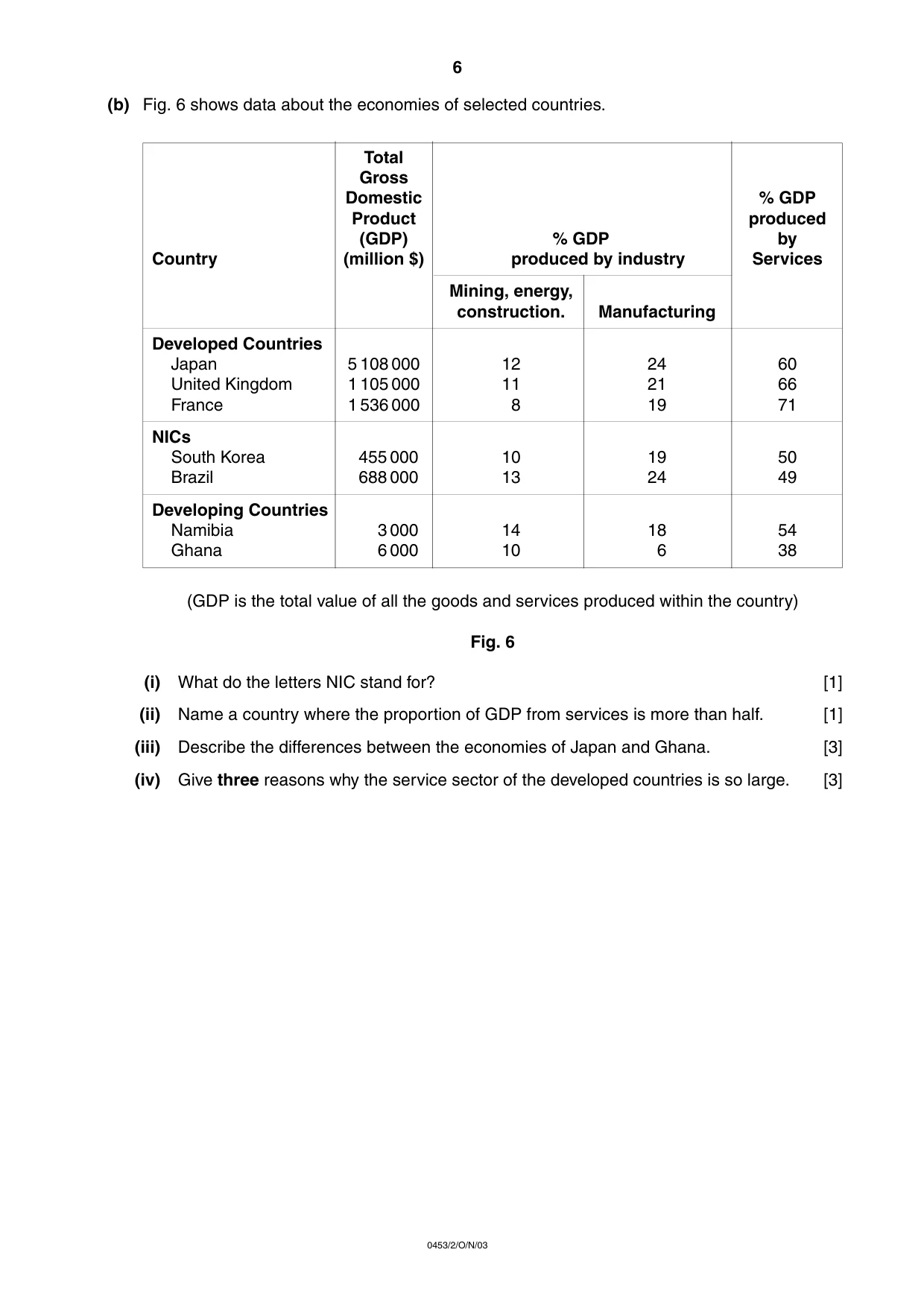
6 0453/2/O/N/03 (b) Fig. 6 shows data about the economies of selected countries. (GDP is the total value of all the goods and services produced within the country) Fig. 6 (i) What do the letters NIC stand for? [1] (ii) Name a country where the proportion of GDP from services is more than half. [1] (iii) Describe the differences between the economies of Japan and Ghana. [3] (iv) Give three reasons why the service sector of the developed countries is so large. [3] Total Gross Domestic % GDP Product produced (GDP) % GDP by Country (million $) produced by industry Services Mining, energy, construction. Manufacturing Developed Countries Japan 5 108 000 12 24 60 United Kingdom 1 105 000 11 21 66 France 1 536 000 8 19 71 NICs South Korea 455 000 10 19 50 Brazil 688 000 13 24 49 Developing Countries Namibia 3 000 14 18 54 Ghana 6 000 10 6 38
Question paper, page 7
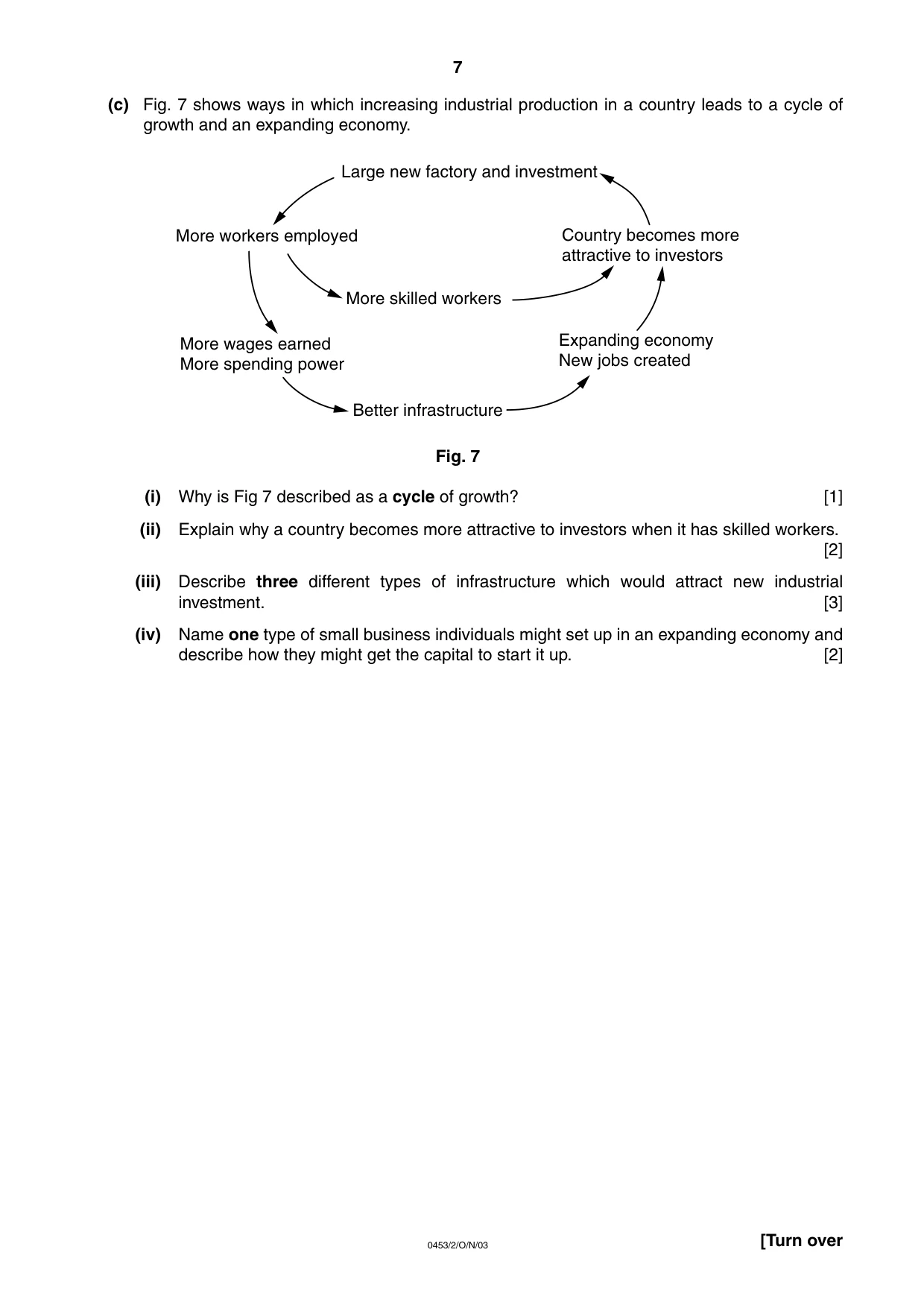
7 0453/2/O/N/03 [Turn over (c) Fig. 7 shows ways in which increasing industrial production in a country leads to a cycle of growth and an expanding economy. Fig. 7 (i) Why is Fig 7 described as a cycle of growth? [1] (ii) Explain why a country becomes more attractive to investors when it has skilled workers. [2] (iii) Describe three different types of infrastructure which would attract new industrial investment. [3] (iv) Name one type of small business individuals might set up in an expanding economy and describe how they might get the capital to start it up. [2] Large new factory and investment More workers employed More skilled workers Country becomes more attractive to investors Expanding economy New jobs created Better infrastructure More wages earned More spending power
Question paper, page 8
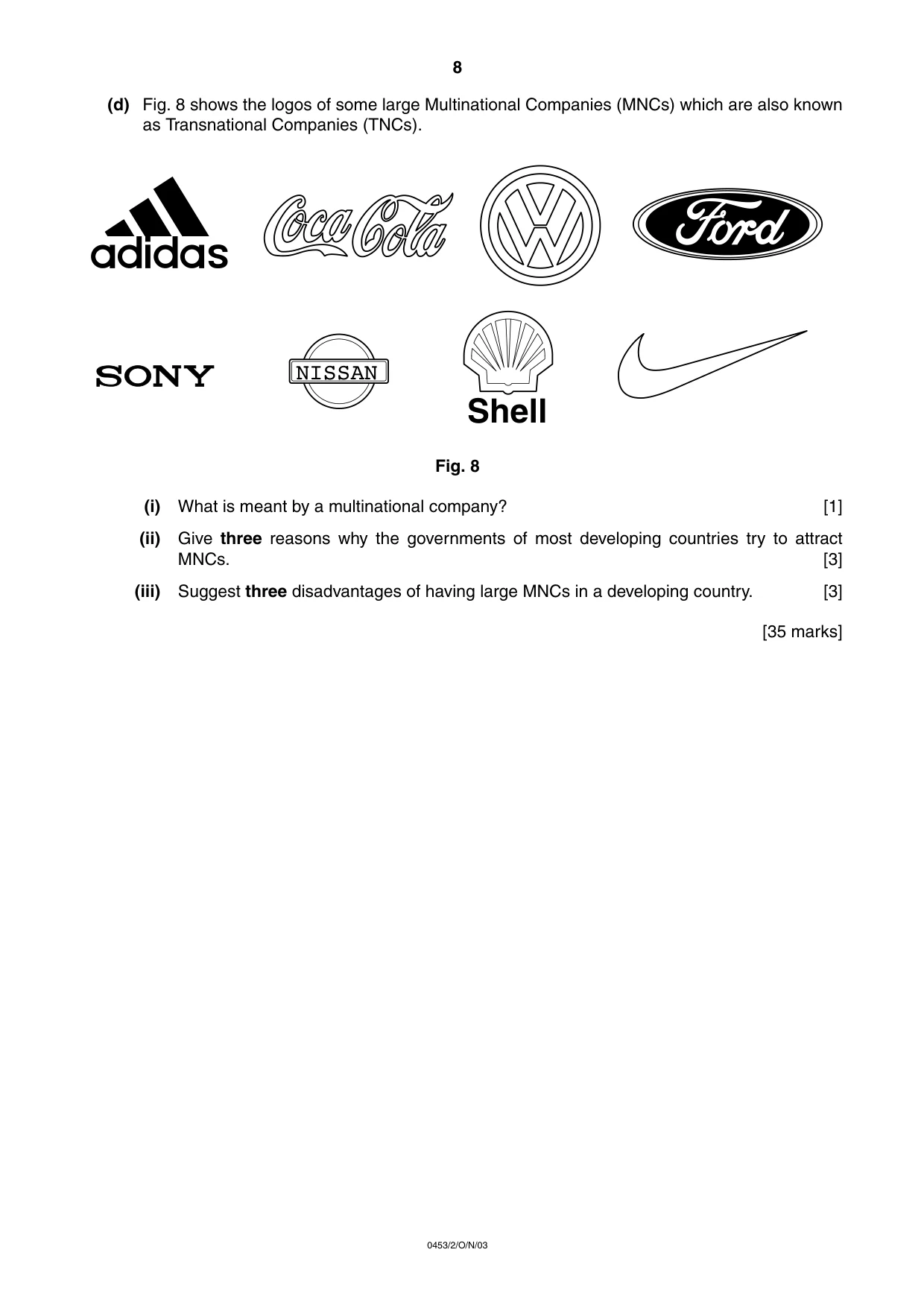
8 0453/2/O/N/03 (d) Fig. 8 shows the logos of some large Multinational Companies (MNCs) which are also known as Transnational Companies (TNCs). Fig. 8 (i) What is meant by a multinational company? [1] (ii) Give three reasons why the governments of most developing countries try to attract MNCs. [3] (iii) Suggest three disadvantages of having large MNCs in a developing country. [3] [35 marks] NISSAN Shell