Cambridge IGCSE Development Studies 0453 — 2003 Oct/Nov Paper 1 · Variant 1
0453/11/O/N/03
The question paper and its mark scheme, free to read here and free to download. This is Cambridge’s own paper, exactly as it was sat.
Question paper8 pages

Mark scheme
No mark scheme is in the library for this paper.
Paper as text
Question paper, page 1
This document consists of 7 printed pages and 1 blank page. SJF2623/PW S33357/4 © CIE 2003 [Turn over CAMBRIDGE INTERNATIONAL EXAMINATIONS International General Certificate of Secondary Education DEVELOPMENT STUDIES 0453/01 Paper 1 October/November 2003 2 hours Additional Materials: Answer Booklet/Paper READ THESE INSTRUCTIONS FIRST If you have been given an Answer Booklet, follow the instructions on the front cover of the Booklet. Write your Centre Number, candidate number and name on all the work you hand in. Write in dark blue or black pen on both sides of the paper. You may use a soft pencil for any diagrams, graphs or rough working. Do not use staples, paper clips, highlighters, glue or correction fluid. Answer any four questions. At the end of the examination, fasten all your work securely together. The number of marks is given in brackets [ ] at the end of each question or part question. www.XtremePapers.com
Question paper, page 2
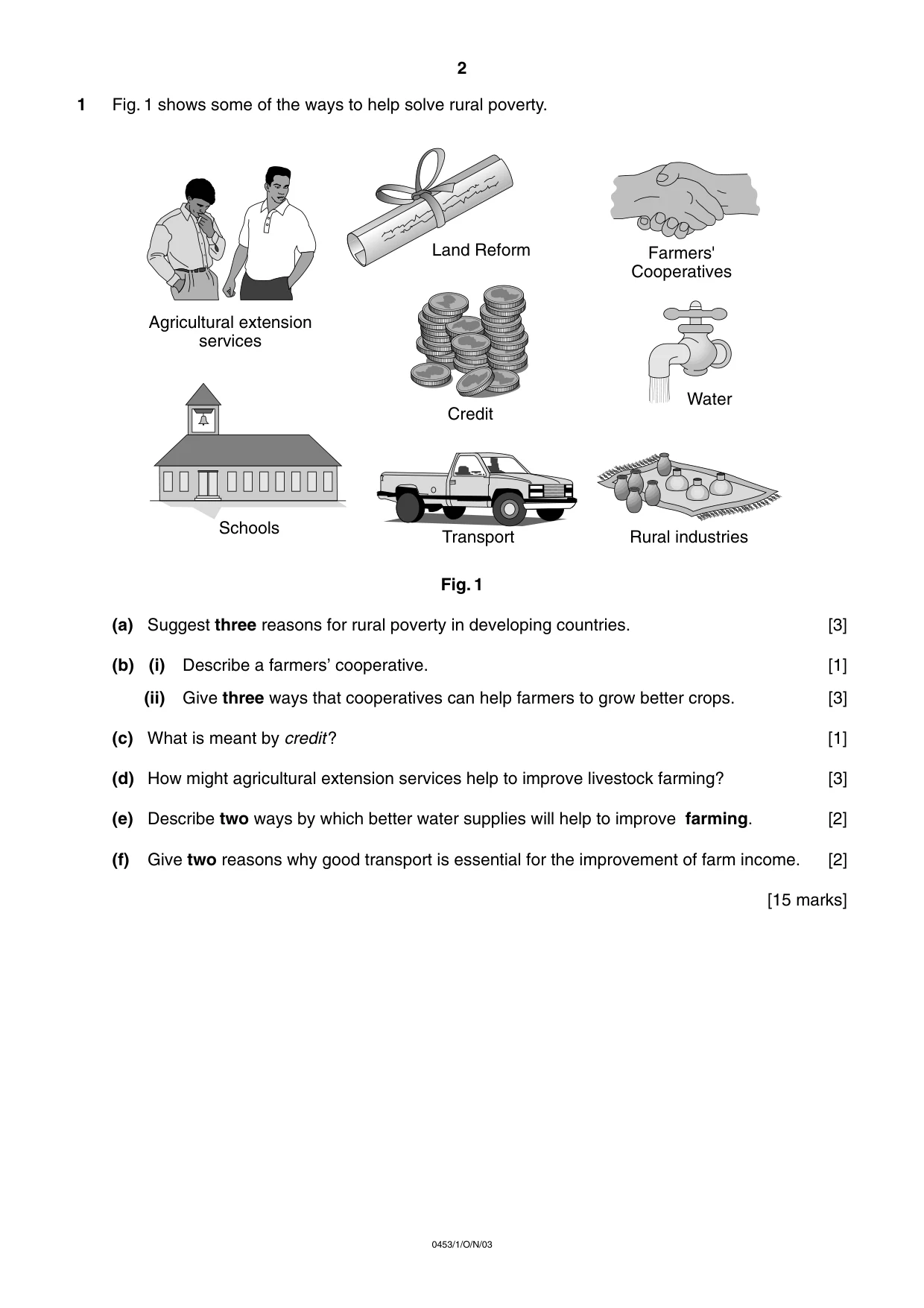
2 0453/1/O/N/03 1 Fig. 1 shows some of the ways to help solve rural poverty. Fig. 1 (a) Suggest three reasons for rural poverty in developing countries. [3] (b) (i) Describe a farmers’ cooperative. [1] (ii) Give three ways that cooperatives can help farmers to grow better crops. [3] (c) What is meant by credit? [1] (d) How might agricultural extension services help to improve livestock farming? [3] (e) Describe two ways by which better water supplies will help to improve farming. [2] (f) Give two reasons why good transport is essential for the improvement of farm income. [2] [15 marks] Land Reform Farmers' Cooperatives Credit Water Schools Transport Agricultural extension services Rural industries
Question paper, page 3
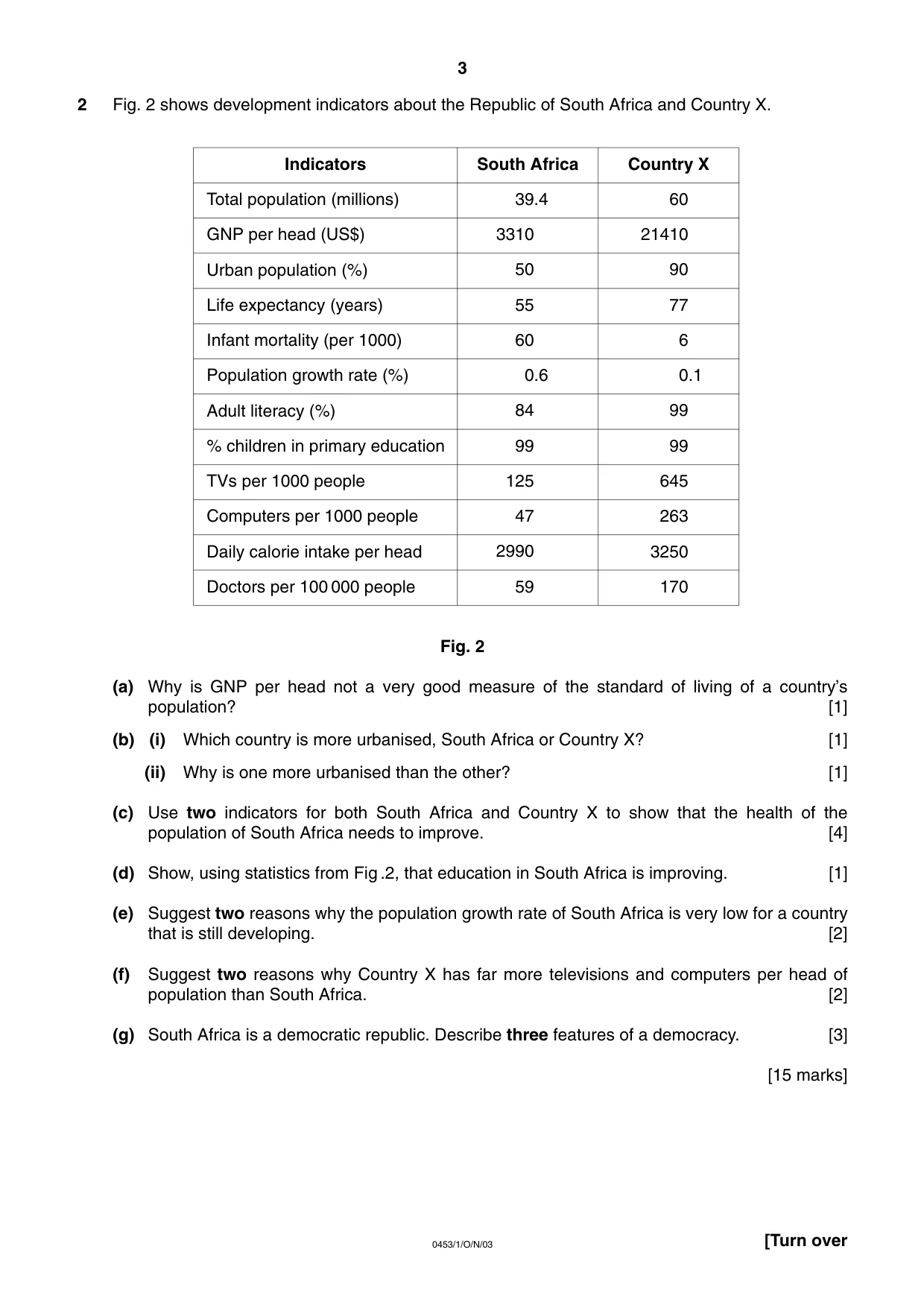
3 0453/1/O/N/03 [Turn over 2 Fig. 2 shows development indicators about the Republic of South Africa and Country X. Fig. 2 (a) Why is GNP per head not a very good measure of the standard of living of a country’s population? [1] (b) (i) Which country is more urbanised, South Africa or Country X? [1] (ii) Why is one more urbanised than the other? [1] (c) Use two indicators for both South Africa and Country X to show that the health of the population of South Africa needs to improve. [4] (d) Show, using statistics from Fig .2, that education in South Africa is improving. [1] (e) Suggest two reasons why the population growth rate of South Africa is very low for a country that is still developing. [2] (f) Suggest two reasons why Country X has far more televisions and computers per head of population than South Africa. [2] (g) South Africa is a democratic republic. Describe three features of a democracy. [3] [15 marks] Indicators South Africa 39.4 3310 50 55 60 0.6 84 99 125 47 2990 59 Country X 60 21410 90 77 6 0.1 99 99 645 263 3250 170 Total population (millions) GNP per head (US$) Urban population (%) Life expectancy (years) Infant mortality (per 1000) Population growth rate (%) Adult literacy (%) % children in primary education TVs per 1000 people Computers per 1000 people Daily calorie intake per head Doctors per 100 000 people
Question paper, page 4
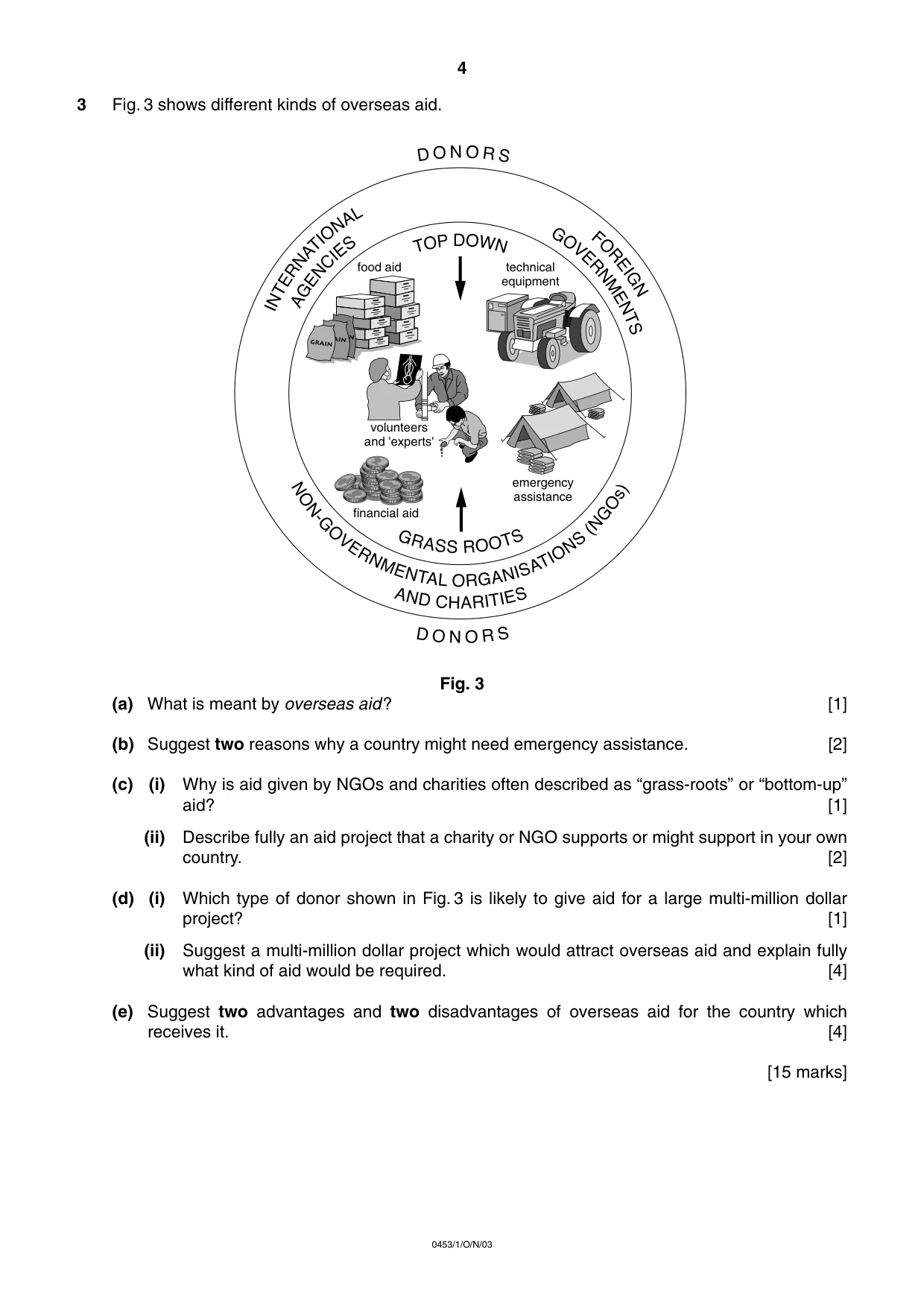
4 0453/1/O/N/03 3 Fig. 3 shows different kinds of overseas aid. Fig. 3 (a) What is meant by overseas aid? [1] (b) Suggest two reasons why a country might need emergency assistance. [2] (c) (i) Why is aid given by NGOs and charities often described as “grass-roots” or “bottom-up” aid? [1] (ii) Describe fully an aid project that a charity or NGO supports or might support in your own country. [2] (d) (i) Which type of donor shown in Fig. 3 is likely to give aid for a large multi-million dollar project? [1] (ii) Suggest a multi-million dollar project which would attract overseas aid and explain fully what kind of aid would be required. [4] (e) Suggest two advantages and two disadvantages of overseas aid for the country which receives it. [4] [15 marks] food aid financial aid technical equipment emergency assistance volunteers and 'experts'
Question paper, page 5
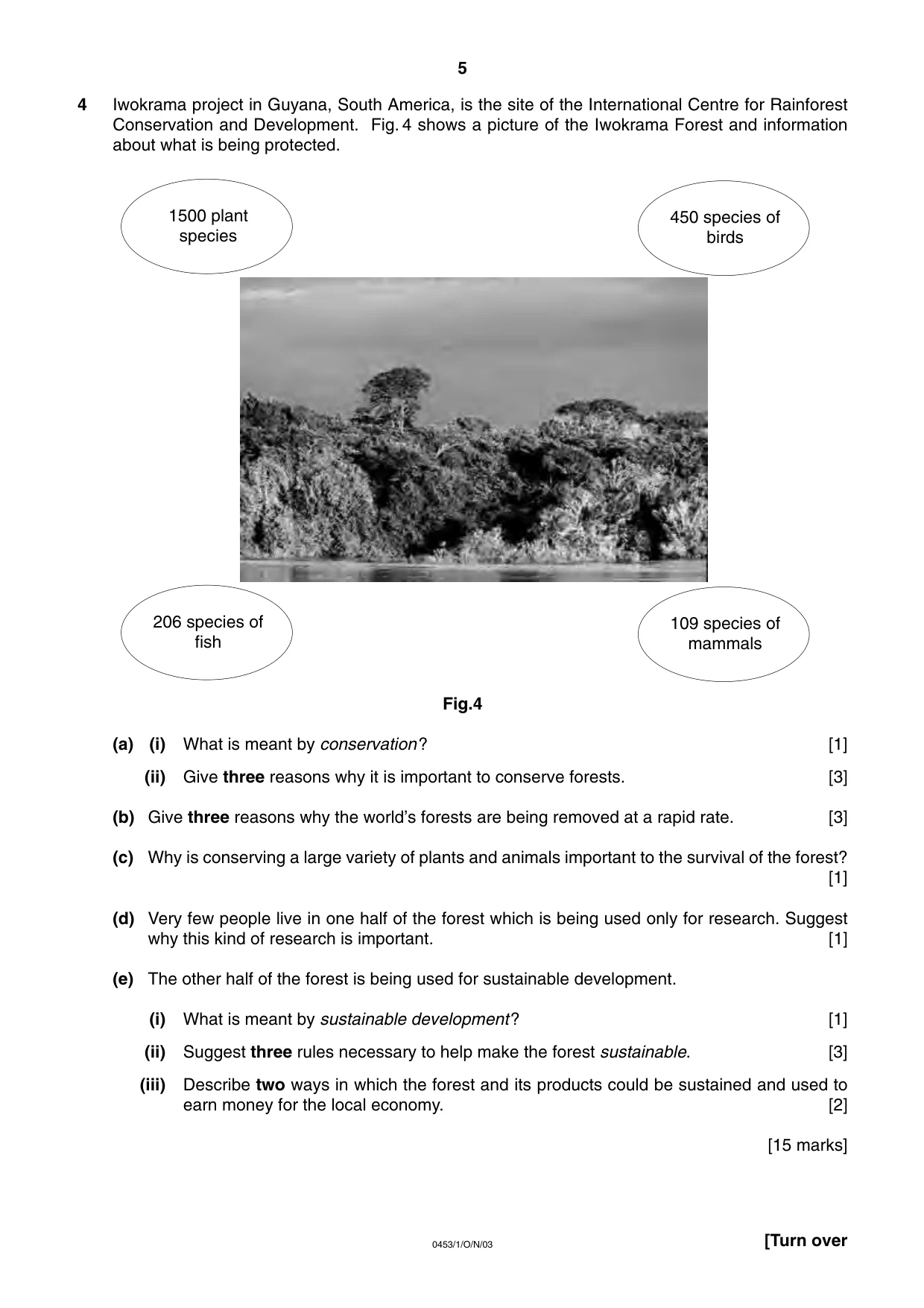
5 0453/1/O/N/03 [Turn over 4 Iwokrama project in Guyana, South America, is the site of the International Centre for Rainforest Conservation and Development. Fig. 4 shows a picture of the Iwokrama Forest and information about what is being protected. Fig.4 (a) (i) What is meant by conservation? [1] (ii) Give three reasons why it is important to conserve forests. [3] (b) Give three reasons why the world’s forests are being removed at a rapid rate. [3] (c) Why is conserving a large variety of plants and animals important to the survival of the forest? [1] (d) Very few people live in one half of the forest which is being used only for research. Suggest why this kind of research is important. [1] (e) The other half of the forest is being used for sustainable development. (i) What is meant by sustainable development? [1] (ii) Suggest three rules necessary to help make the forest sustainable. [3] (iii) Describe two ways in which the forest and its products could be sustained and used to earn money for the local economy. [2] [15 marks] 1500 plant species 450 species of birds 206 species of fish 109 species of mammals
Question paper, page 6
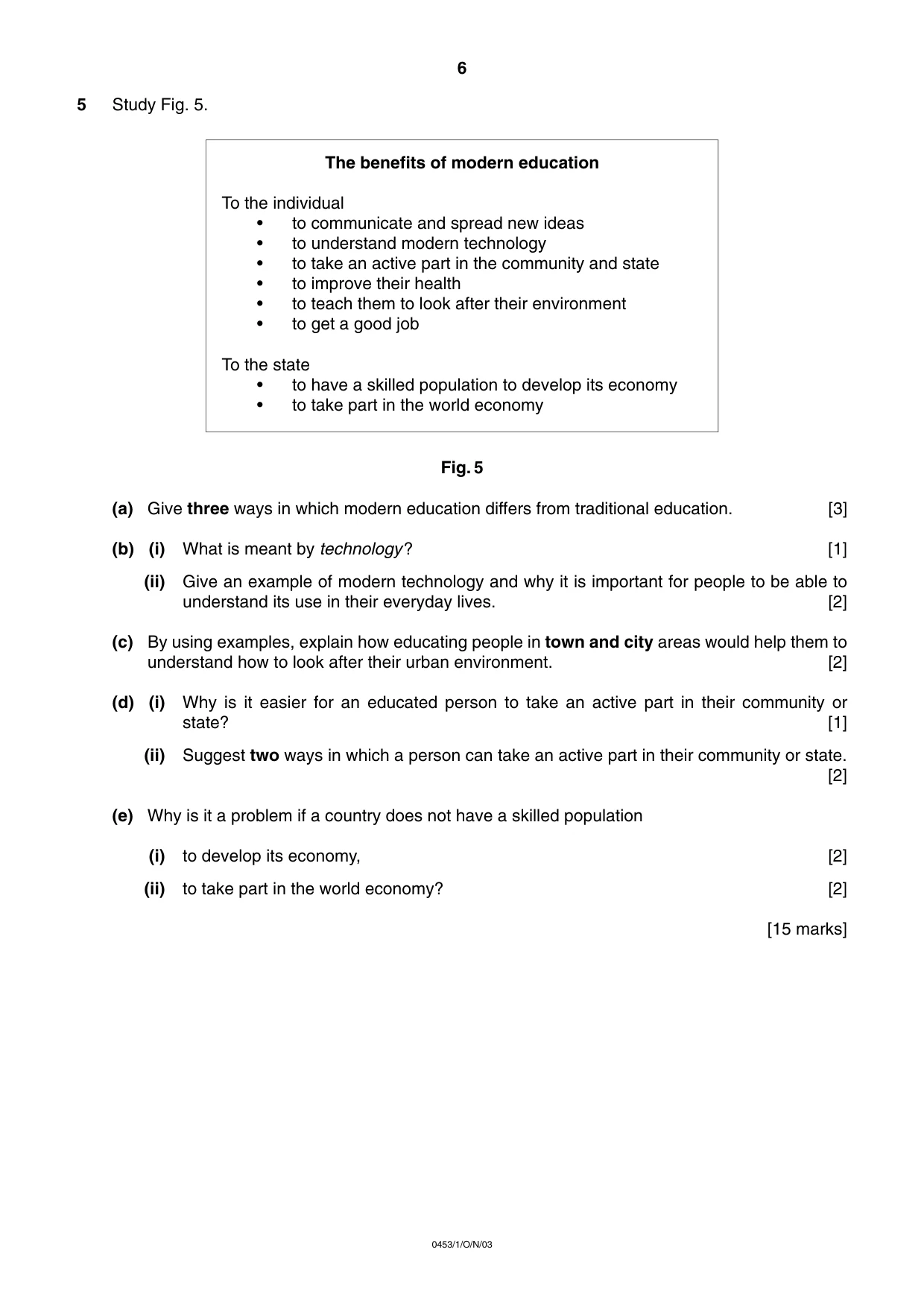
6 0453/1/O/N/03 5 Study Fig. 5. Fig. 5 (a) Give three ways in which modern education differs from traditional education. [3] (b) (i) What is meant by technology? [1] (ii) Give an example of modern technology and why it is important for people to be able to understand its use in their everyday lives. [2] (c) By using examples, explain how educating people in town and city areas would help them to understand how to look after their urban environment. [2] (d) (i) Why is it easier for an educated person to take an active part in their community or state? [1] (ii) Suggest two ways in which a person can take an active part in their community or state. [2] (e) Why is it a problem if a country does not have a skilled population (i) to develop its economy, [2] (ii) to take part in the world economy? [2] [15 marks] The benefits of modern education To the individual • to communicate and spread new ideas • to understand modern technology • to take an active part in the community and state • to improve their health • to teach them to look after their environment • to get a good job To the state • to have a skilled population to develop its economy • to take part in the world economy
Question paper, page 7
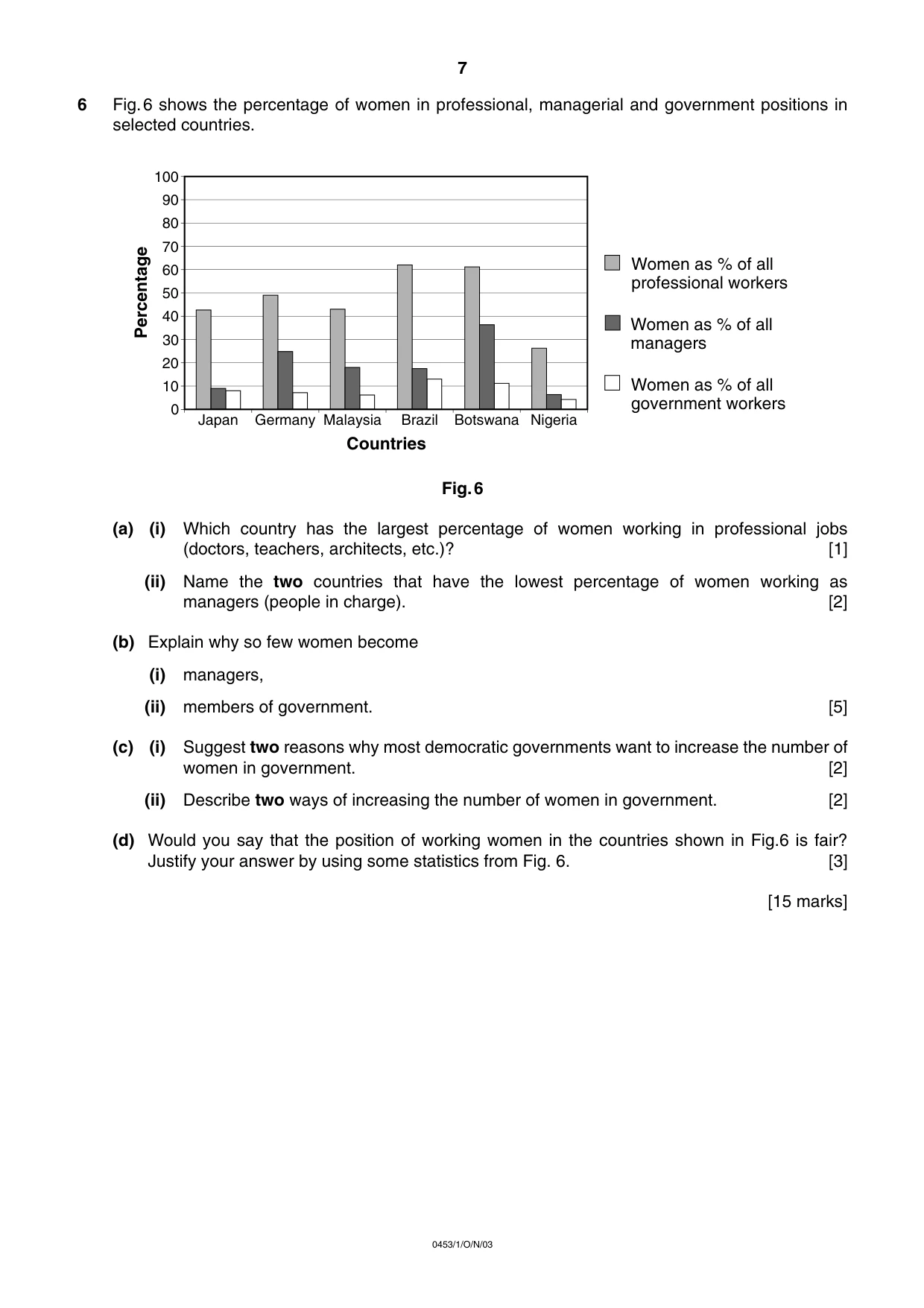
7 0453/1/O/N/03 6 Fig.6 shows the percentage of women in professional, managerial and government positions in selected countries. Fig.6 (a) (i) Which country has the largest percentage of women working in professional jobs (doctors, teachers, architects, etc.)? [1] (ii) Name the two countries that have the lowest percentage of women working as managers (people in charge). [2] (b) Explain why so few women become (i) managers, (ii) members of government. [5] (c) (i) Suggest two reasons why most democratic governments want to increase the number of women in government. [2] (ii) Describe two ways of increasing the number of women in government. [2] (d) Would you say that the position of working women in the countries shown in Fig.6 is fair? Justify your answer by using some statistics from Fig. 6. [3] [15 marks] Countries 0 50 100 Malaysia Nigeria Botswana Percentage Germany Japan Brazil 90 80 70 60 40 30 20 10 Women as % of all professional workers Women as % of all managers Women as % of all government workers
Question paper, page 8
8 0453/1/O/N/03 BLANK PAGE Copyright Acknowledgements: Question 14 © Foto Natura Cambridge International Examinations has made every effort to trace copyright holders, but if we have inadvertently overlooked any we will be pleased to make the necessary arrangements at the first opportunity/