Cambridge IGCSE Development Studies 0453 — 2002 Oct/Nov Paper 2 · Variant 1
0453/21/O/N/02
The question paper and its mark scheme, free to read here and free to download. This is Cambridge’s own paper, exactly as it was sat.
Question paper8 pages

Mark scheme6 pages
Answers below. Sit the paper first if you are practising.
Paper as text
Question paper, page 1
This question paper consists of 7 printed pages and 1 blank page. SJF2379/CG S18577/3 © UCLES 2002 [Turn over International General Certificate of Secondary Education CAMBRIDGE INTERNATIONAL EXAMINATIONS DEVELOPMENT STUDIES 0453/2 PAPER 2 OCTOBER/NOVEMBER SESSION 2002 2 hours 15 minutes Additional materials: Answer paper TIME 2 hours 15 minutes INSTRUCTIONS TO CANDIDATES Write your name, Centre number and candidate number in the spaces provided on the answer paper/answer booklet. Answer both questions. Write your answers on the separate answer paper provided. If you use more than one sheet of paper, fasten the sheets together. INFORMATION FOR CANDIDATES The number of marks is given in brackets [ ] at the end of each question or part question. www.XtremePapers.com
Question paper, page 2
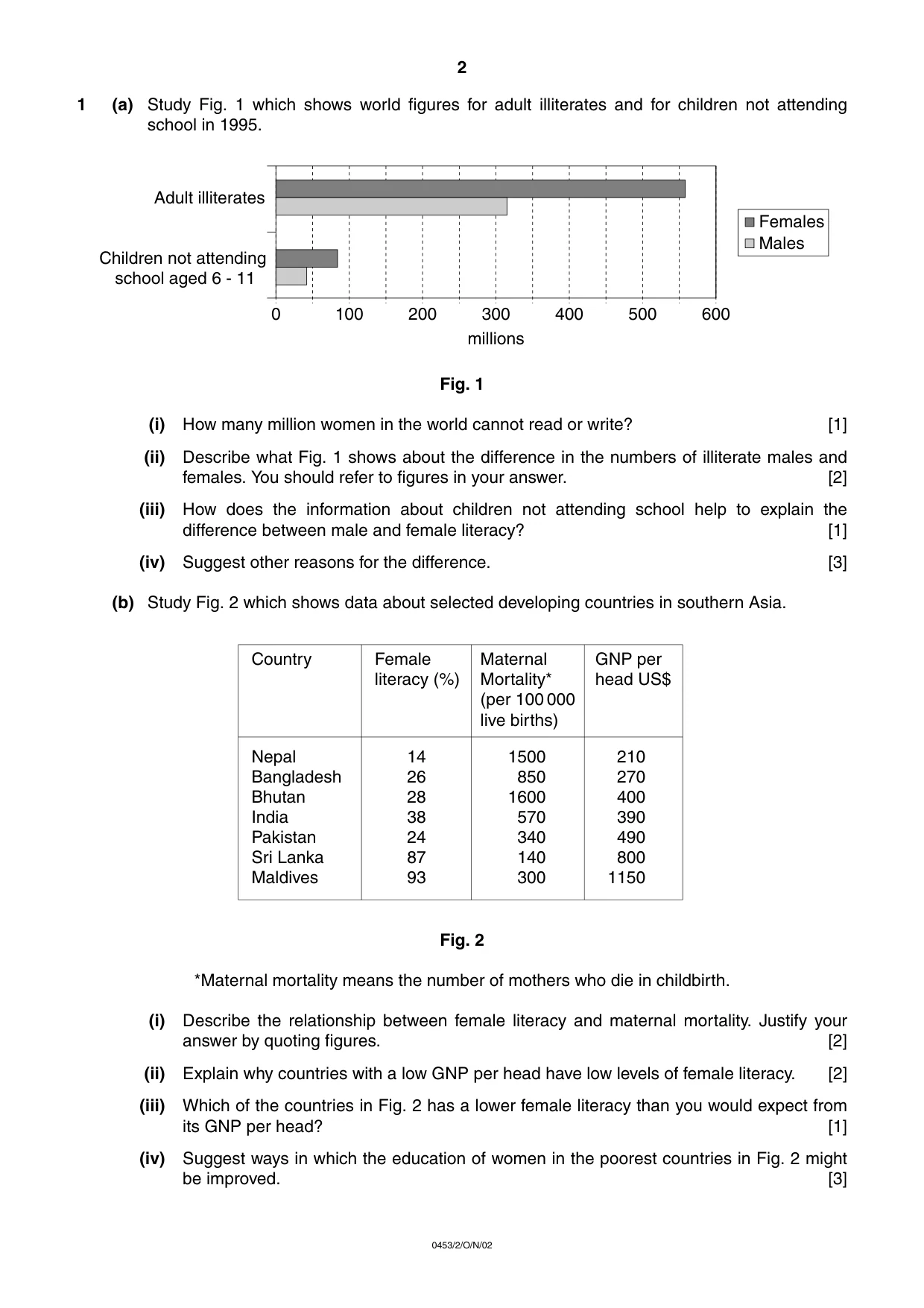
2 0453/2/O/N/02 1 (a) Study Fig. 1 which shows world figures for adult illiterates and for children not attending school in 1995. Fig. 1 (i) How many million women in the world cannot read or write? [1] (ii) Describe what Fig. 1 shows about the difference in the numbers of illiterate males and females. You should refer to figures in your answer. [2] (iii) How does the information about children not attending school help to explain the difference between male and female literacy? [1] (iv) Suggest other reasons for the difference. [3] (b) Study Fig. 2 which shows data about selected developing countries in southern Asia. Fig. 2 *Maternal mortality means the number of mothers who die in childbirth. (i) Describe the relationship between female literacy and maternal mortality. Justify your answer by quoting figures. [2] (ii) Explain why countries with a low GNP per head have low levels of female literacy. [2] (iii) Which of the countries in Fig. 2 has a lower female literacy than you would expect from its GNP per head? [1] (iv) Suggest ways in which the education of women in the poorest countries in Fig. 2 might be improved. [3] Adult illiterates 0 100 200 300 millions 400 500 600 Females Males Children not attending school aged 6 - 11 Country Nepal Bangladesh Bhutan India Pakistan Sri Lanka Maldives 14 26 28 38 24 87 93 1500 850 1600 570 340 140 300 210 270 400 390 490 800 1150 Female literacy (%) Maternal Mortality* (per 100 000 live births) GNP per head US$
Question paper, page 3
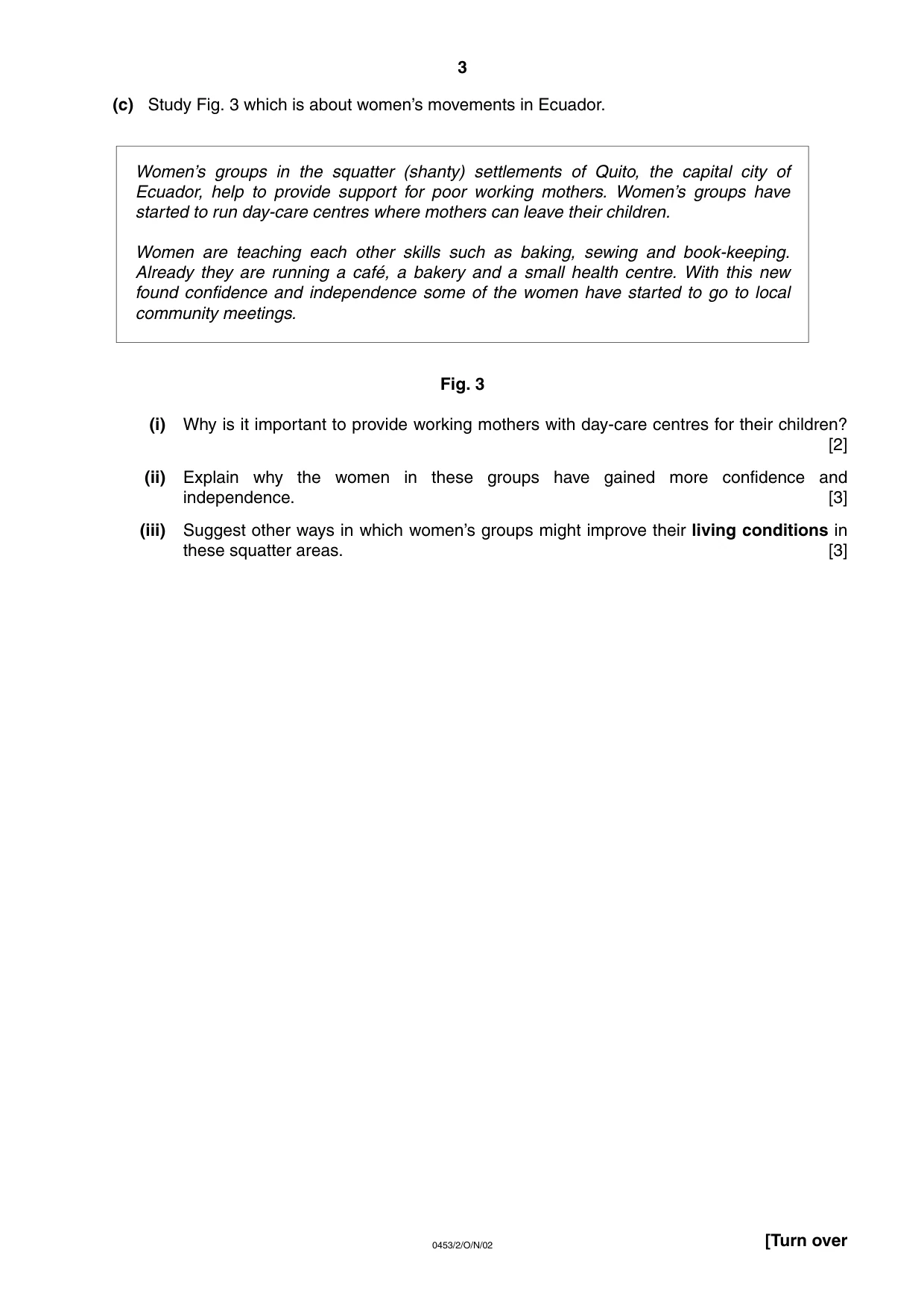
3 0453/2/O/N/02 [Turn over (c) Study Fig. 3 which is about women’s movements in Ecuador. Fig. 3 (i) Why is it important to provide working mothers with day-care centres for their children? [2] (ii) Explain why the women in these groups have gained more confidence and independence. [3] (iii) Suggest other ways in which women’s groups might improve their living conditions in these squatter areas. [3] Women’s groups in the squatter (shanty) settlements of Quito, the capital city of Ecuador, help to provide support for poor working mothers. Women’s groups have started to run day-care centres where mothers can leave their children. Women are teaching each other skills such as baking, sewing and book-keeping. Already they are running a café, a bakery and a small health centre. With this new found confidence and independence some of the women have started to go to local community meetings.
Question paper, page 4
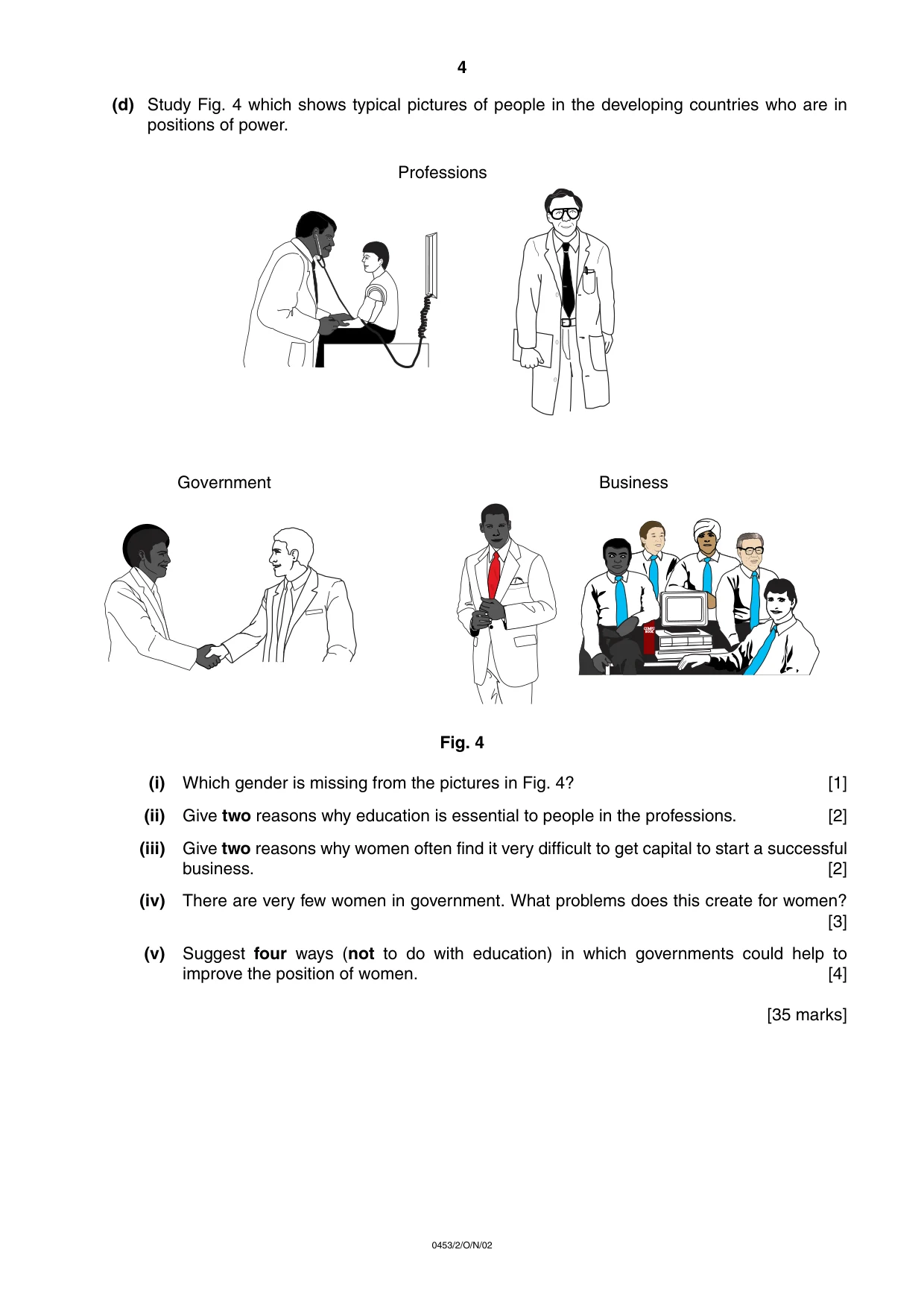
4 0453/2/O/N/02 (d) Study Fig. 4 which shows typical pictures of people in the developing countries who are in positions of power. Fig. 4 (i) Which gender is missing from the pictures in Fig. 4? [1] (ii) Give two reasons why education is essential to people in the professions. [2] (iii) Give two reasons why women often find it very difficult to get capital to start a successful business. [2] (iv) There are very few women in government. What problems does this create for women? [3] (v) Suggest four ways (not to do with education) in which governments could help to improve the position of women. [4] [35 marks] Professions Government Business
Question paper, page 5
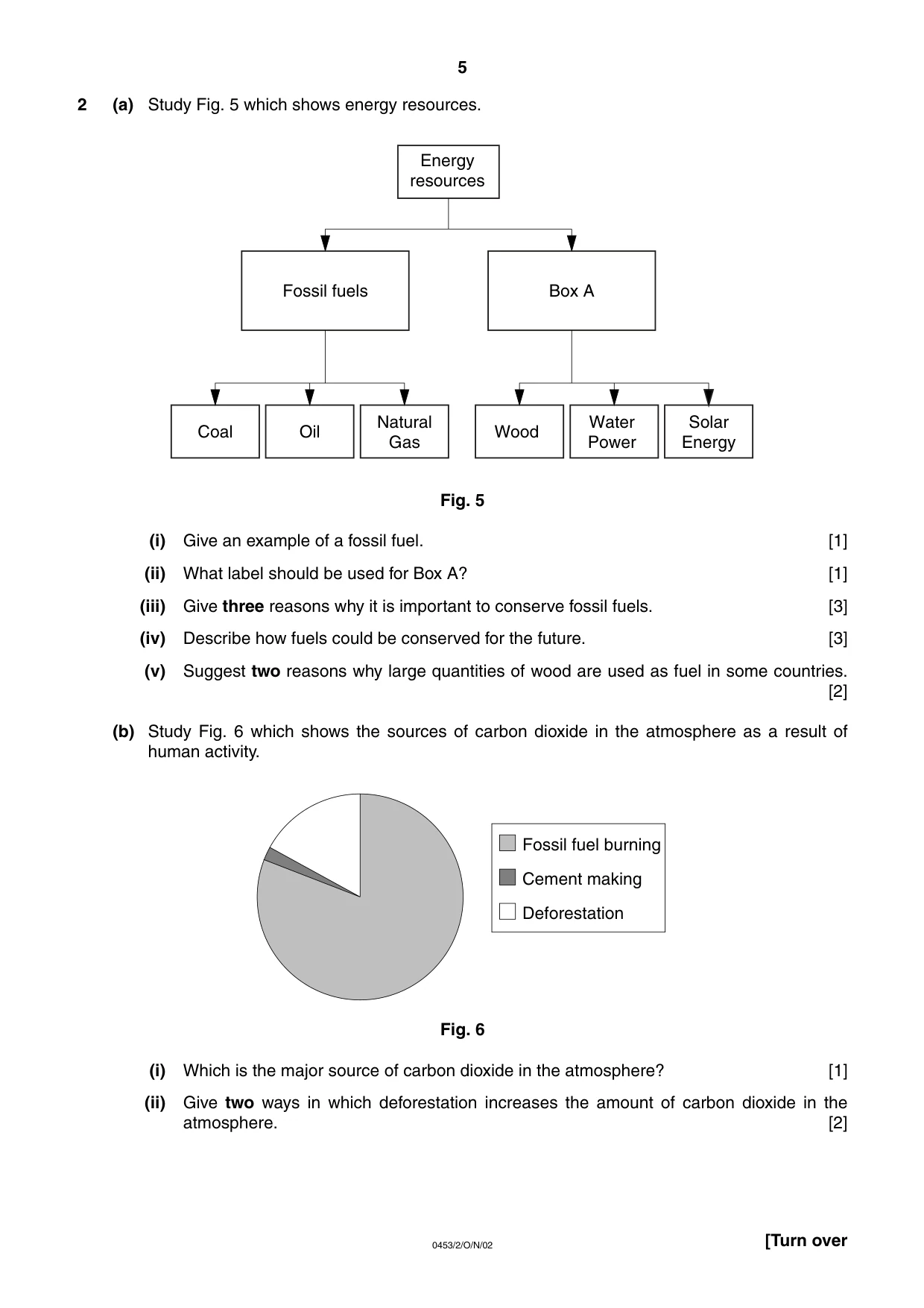
5 0453/2/O/N/02 [Turn over 2 (a) Study Fig. 5 which shows energy resources. Fig. 5 (i) Give an example of a fossil fuel. [1] (ii) What label should be used for Box A? [1] (iii) Give three reasons why it is important to conserve fossil fuels. [3] (iv) Describe how fuels could be conserved for the future. [3] (v) Suggest two reasons why large quantities of wood are used as fuel in some countries. [2] (b) Study Fig. 6 which shows the sources of carbon dioxide in the atmosphere as a result of human activity. Fig. 6 (i) Which is the major source of carbon dioxide in the atmosphere? [1] (ii) Give two ways in which deforestation increases the amount of carbon dioxide in the atmosphere. [2] Fossil fuel burning Deforestation Cement making Energy resources Fossil fuels Box A Wood Coal Oil Water Power Natural Gas Solar Energy
Question paper, page 6
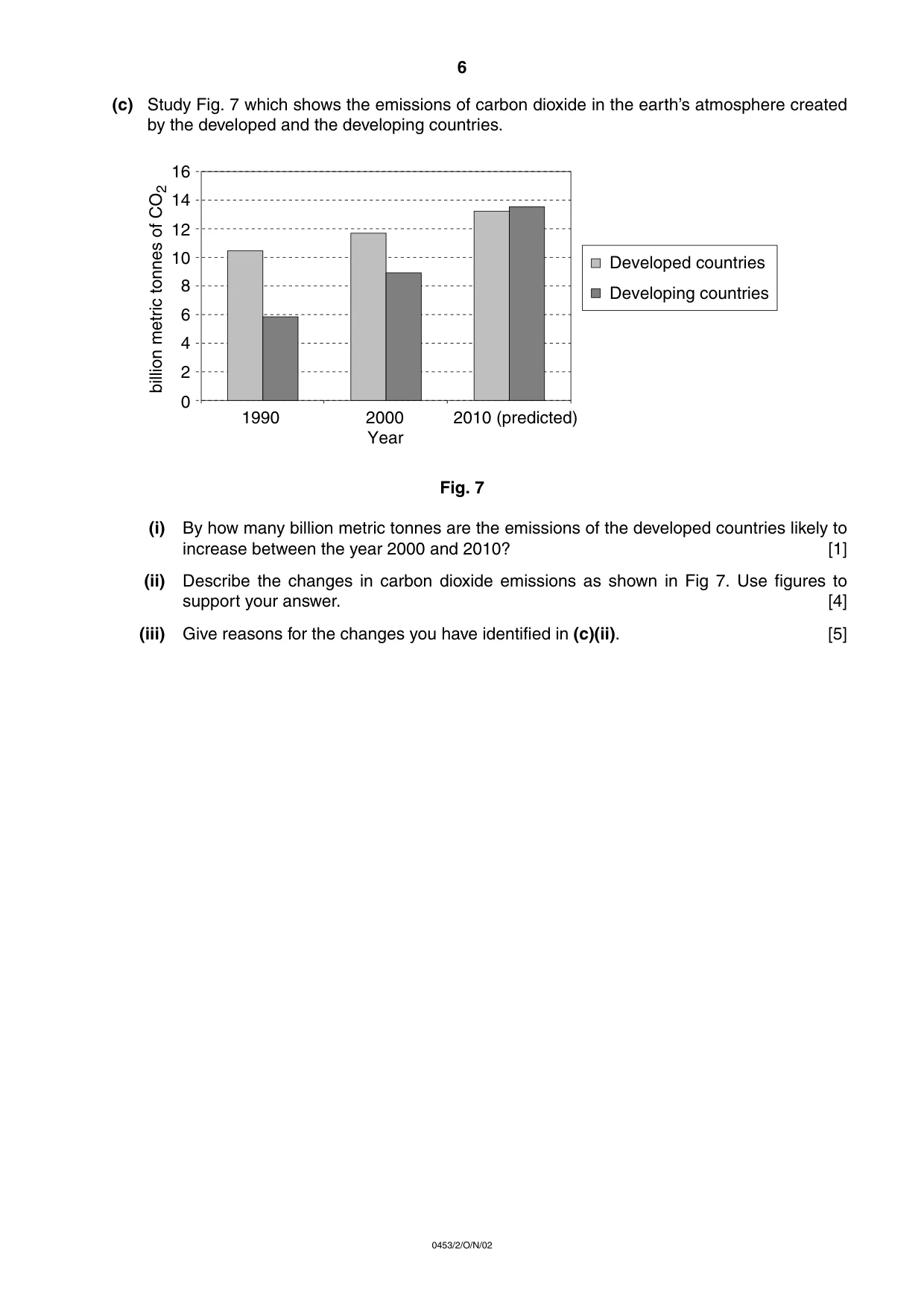
6 0453/2/O/N/02 (c) Study Fig. 7 which shows the emissions of carbon dioxide in the earth’s atmosphere created by the developed and the developing countries. Fig. 7 (i) By how many billion metric tonnes are the emissions of the developed countries likely to increase between the year 2000 and 2010? [1] (ii) Describe the changes in carbon dioxide emissions as shown in Fig 7. Use figures to support your answer. [4] (iii) Give reasons for the changes you have identified in (c)(ii). [5] 1990 billion metric tonnes of CO2 0 2 4 6 8 10 12 14 16 2000 Developed countries Developing countries Year 2010 (predicted)
Question paper, page 7
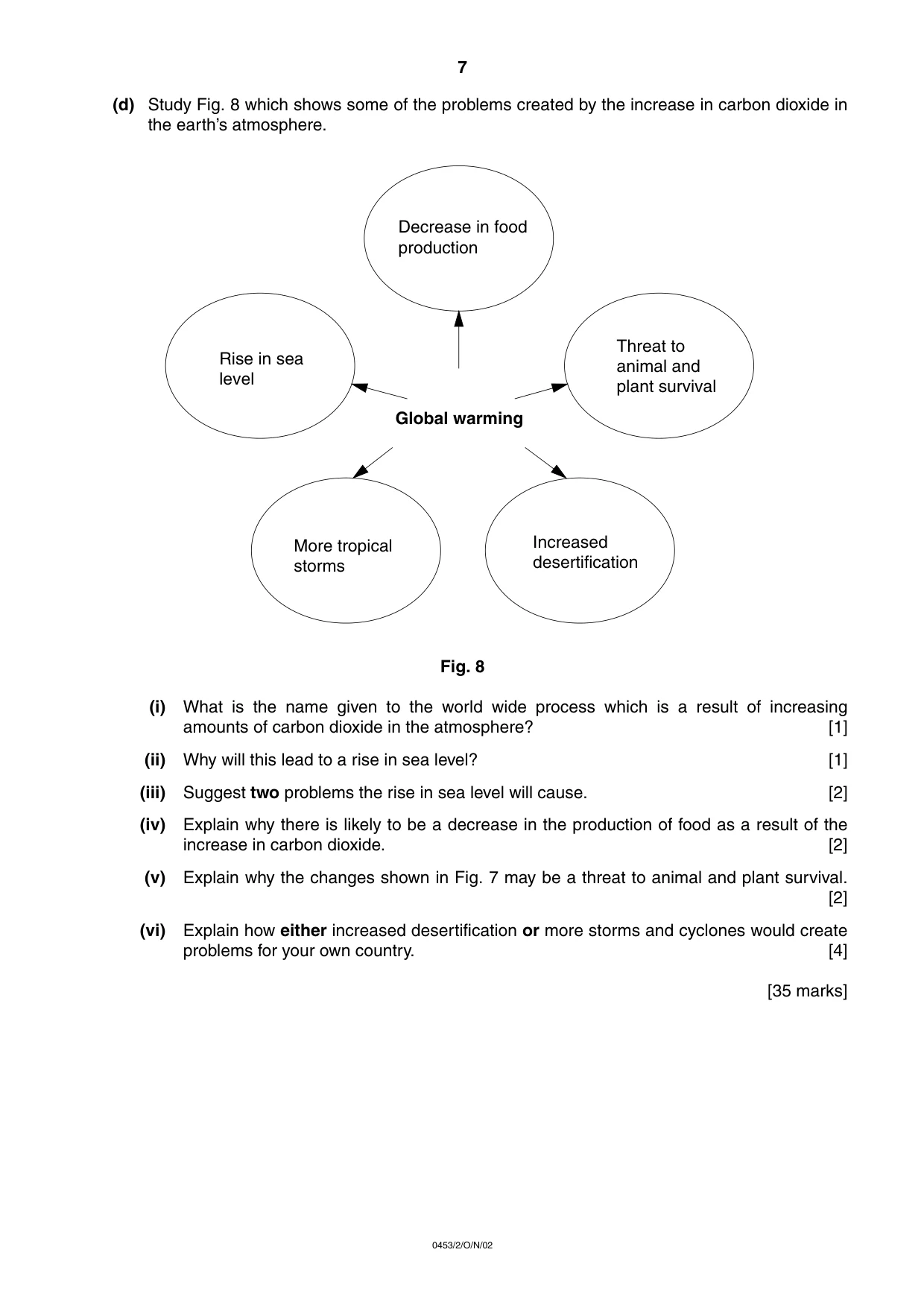
7 0453/2/O/N/02 (d) Study Fig. 8 which shows some of the problems created by the increase in carbon dioxide in the earth’s atmosphere. Fig. 8 (i) What is the name given to the world wide process which is a result of increasing amounts of carbon dioxide in the atmosphere? [1] (ii) Why will this lead to a rise in sea level? [1] (iii) Suggest two problems the rise in sea level will cause. [2] (iv) Explain why there is likely to be a decrease in the production of food as a result of the increase in carbon dioxide. [2] (v) Explain why the changes shown in Fig. 7 may be a threat to animal and plant survival. [2] (vi) Explain how either increased desertification or more storms and cyclones would create problems for your own country. [4] [35 marks] Global warming Decrease in food production Rise in sea level Threat to animal and plant survival Increased desertification More tropical storms
Mark scheme, page 1
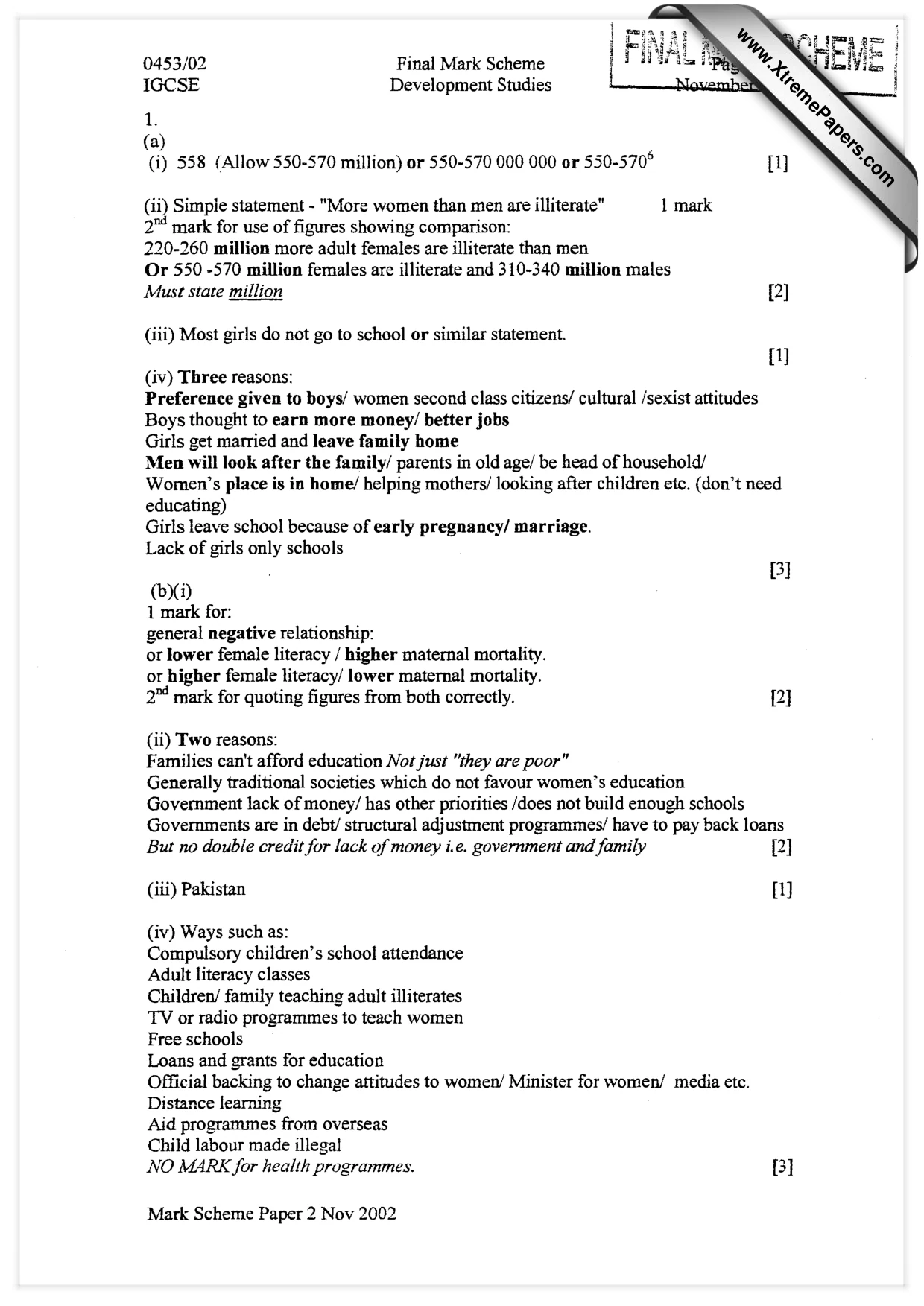
0453/02 Final Mark Scheme IGCSE Development Studies 1. (a) ; (i) 558 (Allow 550-570 million) or 550-570 000 000 or $50-570° (ii) Simpie statement - "More women than men are illiterate" 1 mark 2™* mark for use of figures showing comparison: 220-260 million more adult females are illiterate than men Or 550 -570 million females are illiterate and 310-340 million males Must state million [2] (iii) Most girls do not go to school or similar statement. t (iv) Three reasons: Preference given to boys/ women second class citizens/ cultural /sexist attitudes Boys thought to earn more money/ better jobs Girls get married and leave family home Men will look after the family/ parents in old age/ be head of household/ Women’s place is in home/ helping mothers/ looking after children etc. (don’t need educating) Girls leave school because of early pregnancy/ marriage. Lack of girls only schools 3] (bi) 1 mark for: general negative relationship: or lower female literacy / higher maternal mortality. or higher female literacy/ lower maternal mortality. 2™4 mark for quoting figures from both correctly. 22] (ii) Two reasons: Families can't afford education Not just "they are poor" Generally traditional societies which do not favour women’s education Government lack of money/ has other priorities /does not build enough schools Governments are in debt/ structural adjustment programmes/ have to pay back loans But no double credit for lack of money i.e. government and family [2] (iii) Pakistan 0] (iv) Ways such as: Compulsory children’s school attendance Adult literacy classes Children/ family teaching adult illiterates TV or radio programmes to teach women Free schools Loans and grants for education Official backing to change attitudes to women/ Minister for women/ media etc. Distance learning Aid programmes from overseas Child labour made illegal NO MARK for health programmes. [3] Mark Scheme Paper 2 Nov 2002
Mark scheme, page 2
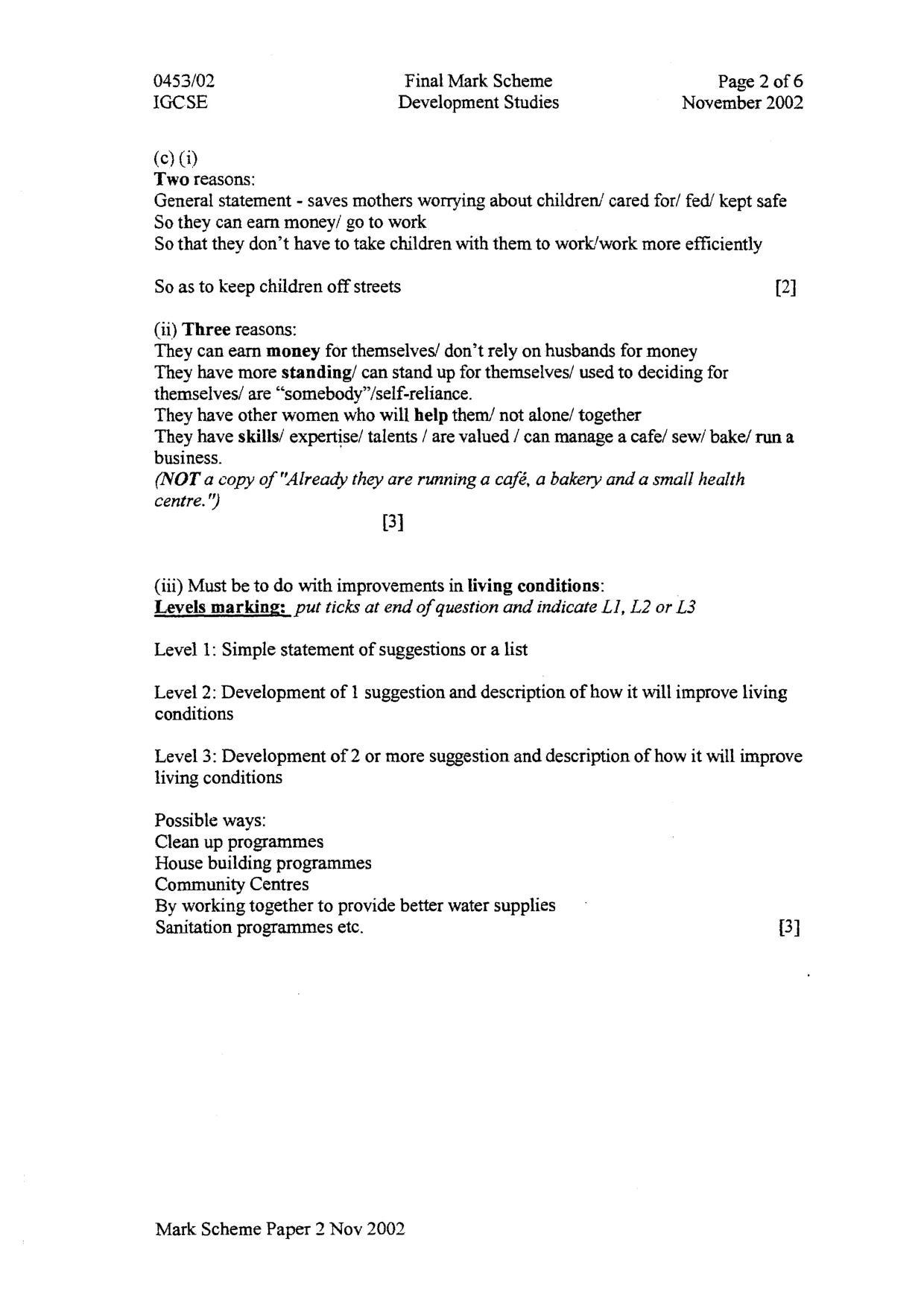
0453/02 Final Mark Scheme Page 2 of 6 IGCSE Development Studies November 2002 (c) Gi) Two reasons: General statement - saves mothers worrying about children/ cared for/ fed/ kept safe So they can earn money/ go to work So that they don’t have to take children with them to work/work more efficiently So as to keep children off streets [2] (ii) Three reasons: They can earn money for themselves/ don’t rely on husbands for money They have more standing/ can stand up for themselves/ used to deciding for themselves/ are “somebody”/self-reliance. They have other women who will help them/ not alone/ together They have skills/ expertise/ talents / are valued / can manage a cafe/ sew/ bake/ run a business. (NOT a copy of "Already they are running a café, a bakery and a small health centre.") [3] (iii) Must be to do with improvements in living conditions: Levels marking: put ticks at end of question and indicate LI, L2 or L3 Level 1: Simple statement of suggestions or a list Level 2: Development of 1 suggestion and description of how it will improve living conditions Level 3: Development of 2 or more suggestion and description of how it will improve living conditions Possible ways: Clean up programmes House building programmes Community Centres By working together to provide better water supplies Sanitation programmes etc. 3] Mark Scheme Paper 2 Nov 2002
Mark scheme, page 3
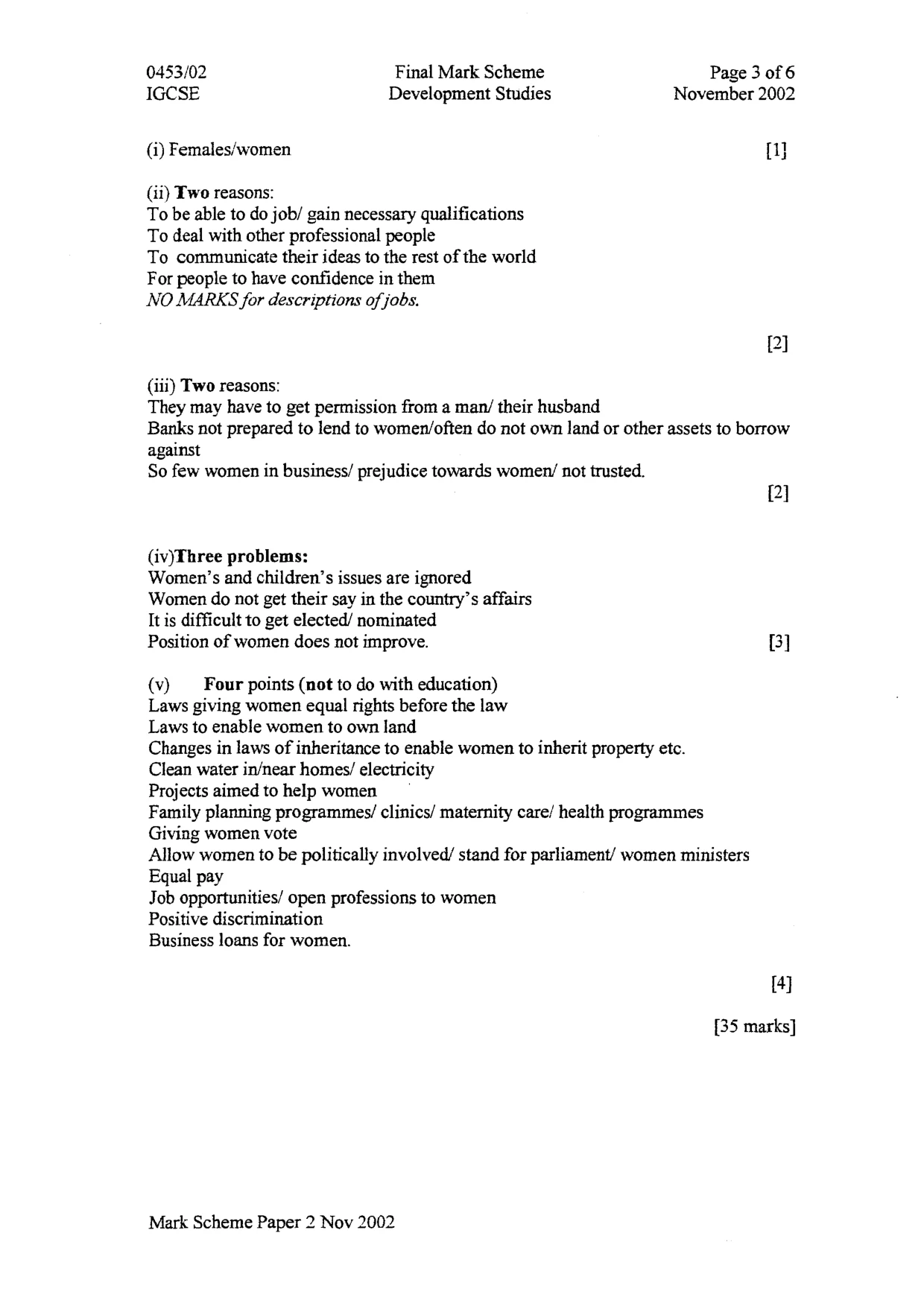
0453/02 Final Mark Scheme Page 3 of 6 IGCSE Development Studies November 2002 (i) Females/women {y (ii) Two reasons: To be able to do job/ gain necessary qualifications To deal with other professional people To communicate their ideas to the rest of the world For people to have confidence in them NO MARKS for descriptions of jobs. 2] (iii) Two reasons: They may have to get permission from a man/ their husband Banks not prepared to lend to women/often do not own land or other assets to borrow against So few women in business/ prejudice towards women/ not trusted. (2] (iv)Three problems: Women’s and children’s issues are ignored Women do not get their say in the country’s affairs It is difficult to get elected/ nominated Position of women does not improve. 3] (v) Four points (not to do with education) Laws giving women equal rights before the law Laws to enable women to own land Changes in laws of inheritance to enable women to inherit property etc. Clean water in/near homes/ electricity Projects aimed to help women Family planning programmey/ clinics/ maternity care/ health programmes Giving women vote Allow women to be politically involved/ stand for parliament/ women ministers Equal pay Job opportunities/ open professions to women Positive discrimination Business loans for women. (4] {35 marks] Mark Scheme Paper 2 Nov 2002
Mark scheme, page 4
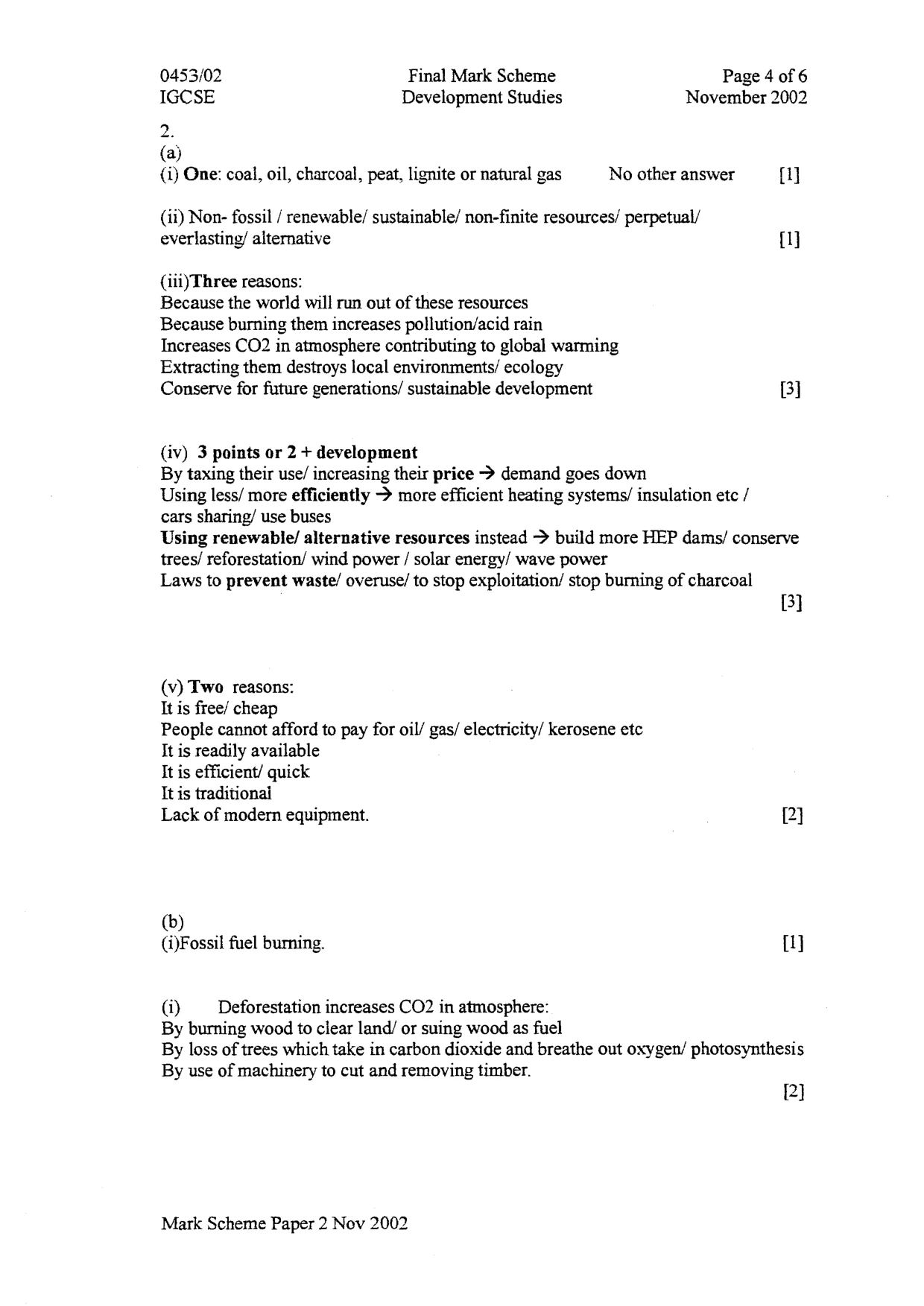
0453/02 Final Mark Scheme Page 4 of 6 IGCSE Development Studies November 2002 2. (a) {i) One: coal, oil, charcoal, peat, lignite or natural gas No other answer {] (ii) Non- fossil / renewable/ sustainable/ non-finite resources/ perpetual/ everlasting/ alternative {lj (iii) Three reasons: Because the world will run out of these resources Because burning them increases pollution/acid rain Increases CO2 in atmosphere contributing to global warming Extracting them destroys local environments/ ecology Conserve for future generations/ sustainable development 3] (iv) 3 points or 2 + development By taxing their use/ increasing their price > demand goes down Using less/ more efficiently > more efficient heating systems/ insulation etc / cars sharing/ use buses Using renewable/ alternative resources instead > build more HEP dams/ conserve trees/ reforestation/ wind power / solar energy/ wave power Laws to prevent waste/ overuse/ to stop exploitation/ stop burning of charcoal [3] (v) Two reasons: It is free/ cheap People cannot afford to pay for oil/ gas/ electricity/ kerosene etc It is readily available It is efficient/ quick It is traditional Lack of modern equipment. 22] b) (i)Fossil fuel burning. ia (i) Deforestation increases CO2 in atmosphere: By burning wood to clear land/ or suing wood as fuel By loss of trees which take in carbon dioxide and breathe out oxygen/ photosynthesis By use of machinery to cut and removing timber. RP] Mark Scheme Paper 2 Nov 2002
Mark scheme, page 5
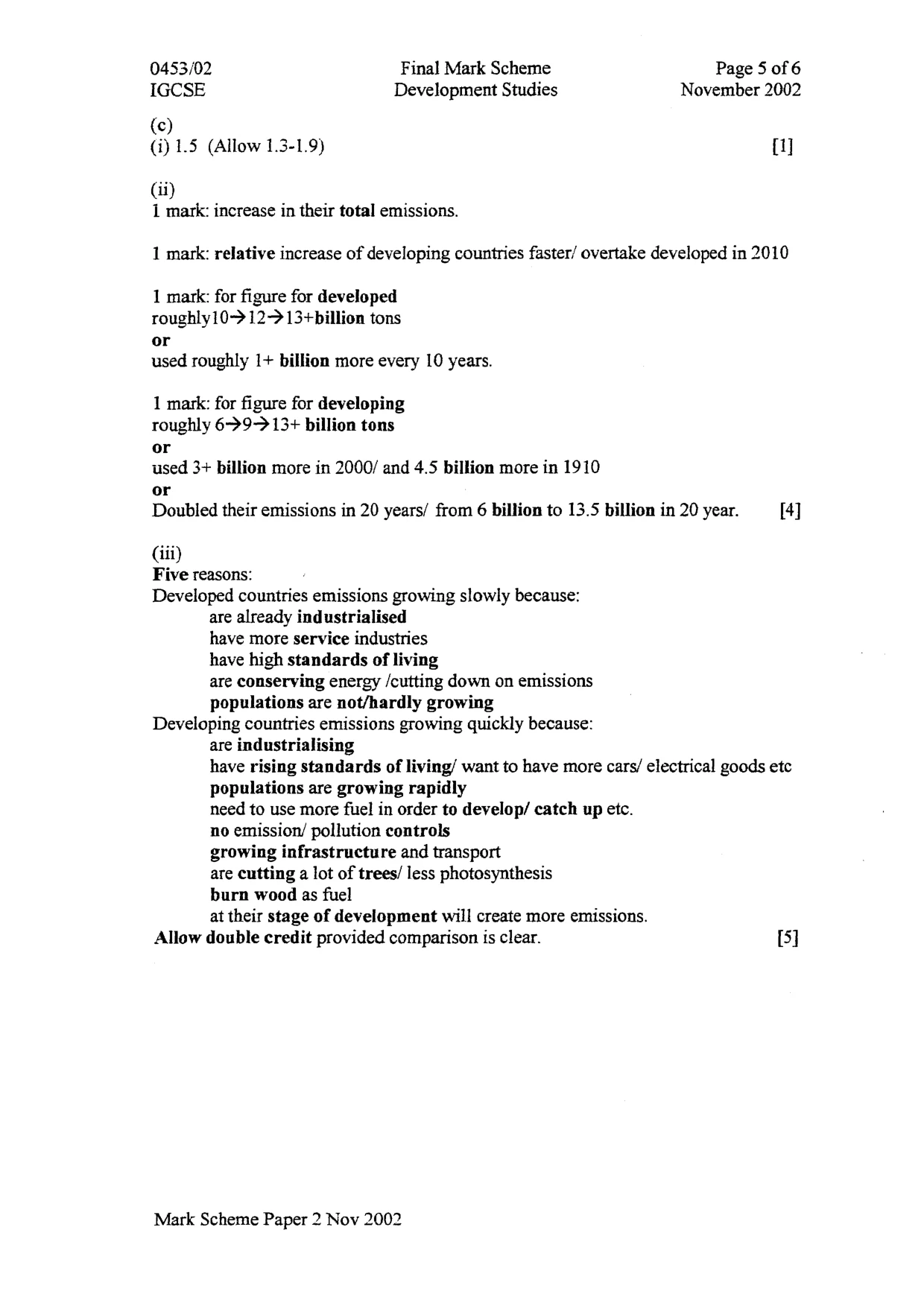
0453/02 Final Mark Scheme Page 5 of 6 IGCSE Development Studies November 2002 (c) (i) 1.5 (Allow 1.3-1.9) {1] Gi) 1 mark: increase in their total emissions. 1 mark: relative increase of developing countries faster/ overtake developed in 2010 1 mark: for figure for developed roughly10>12>13+billion tons or used roughly 1+ billion more every 10 years. 1 mark: for figure for developing roughly 6>9-> 13+ billion tons or used 3+ billion more in 2000/ and 4.5 billion more in 1910 or Doubled their emissions in 20 years/ from 6 billion to 13.5 billion in 20 year. [4] (iii) Five reasons: Developed countries emissions growing slowly because: are already industrialised have more service industries have high standards of living are conserving energy /cutting down on emissions populations are not/hardly growing Developing countries emissions growing quickly because: are industrialising have rising standards of living/ want to have more cars/ electrical goods etc populations are growing rapidly need to use more fuel in order to develop/ catch up etc. no emission/ pollution controls growing infrastructure and transport are cutting a lot of trees/ less photosynthesis burn wood as fuel at their stage of development will create more emissions. Allow double credit provided comparison is clear. [5] Mark Scheme Paper 2 Nov 2002
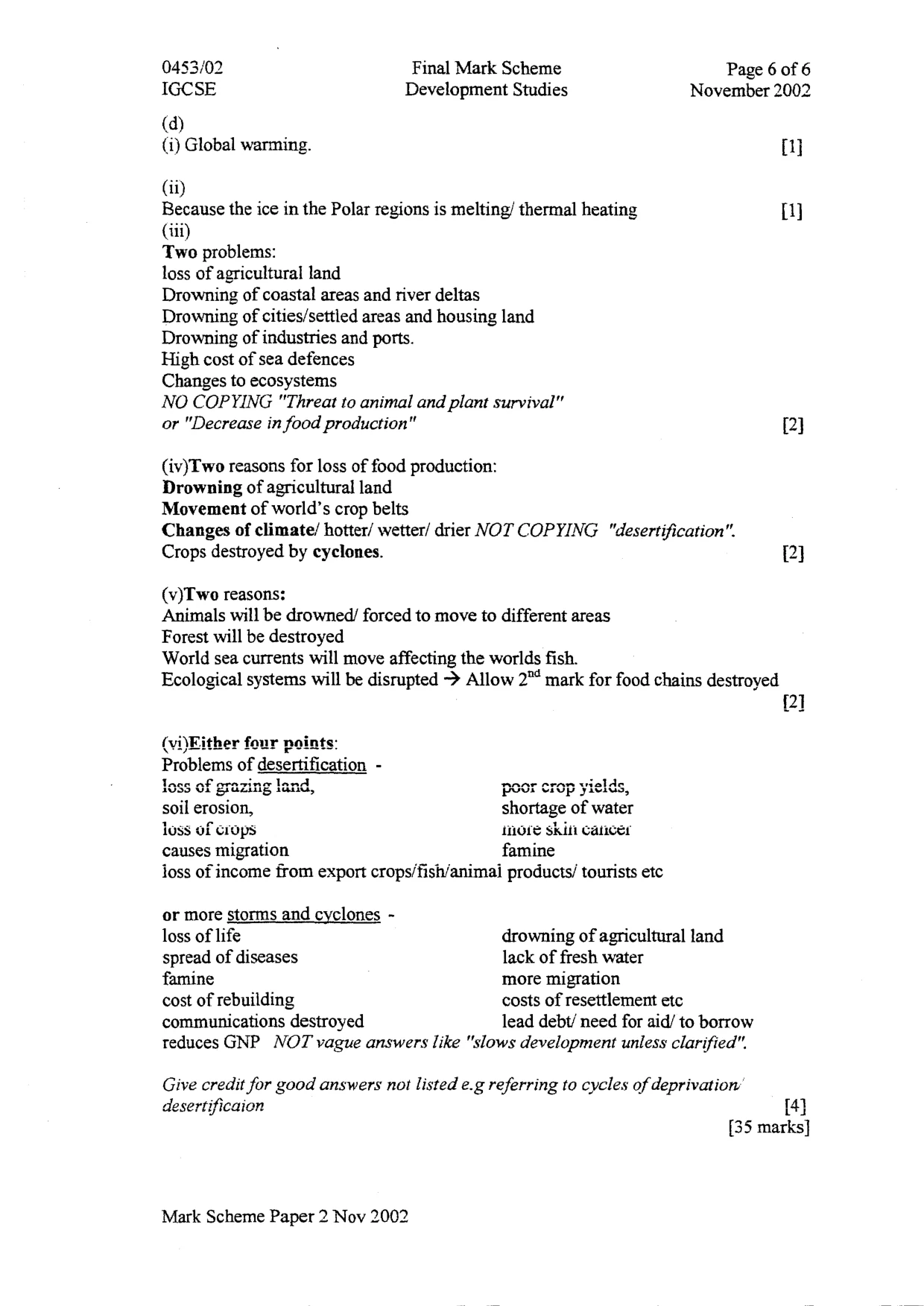
Mark scheme, page 6
0453/02 Final Mark Scheme Page 6 of 6 IGCSE Development Studies November 2002 (d) (i) Global warming. fi] (ii) Because the ice in the Polar regions is melting/ thermal heating eg} (iii) Two problems: loss of agricultural land Drowning of coastal areas and river deltas Drowning of cities/settied areas and housing land Drowning of industries and ports. High cost of sea defences Changes to ecosystems NO COPYING "Threat to animal and plant survival" or "Decrease in food production" 22] (iv)Two reasons for loss of food production: Drowning of agricultural land Movement of world’s crop belts Changes of climate/ hotter/ wetter/ drier NOT COPYING "desertification". Crops destroyed by cyclones. 2] (v)Two reasons: Animals will be drowned/ forced to move to different areas Forest will be destroyed World sea currents will move affecting the worlds fish. Ecological systems will be disrupted > Allow 2" mark for food chains destroyed {21 her four noi: r four points: (vi Problems of desertification - loss of grazing land, poor crop yields, soil erosion, shortage of water loss of crops more skin caticer causes migration famine joss of income from export crops/fish/animai products/ tourists etc or more storms and cyclones - loss of life drowning of agricultural land spread of diseases lack of fresh water famine more migration cost of rebuilding costs of resettlement etc communications destroyed lead debt/ need for aid/ to borrow teduces GNP NOT vague answers like "slows development unless clarified". Give credit for good answers not listed e.g referring to cycles of deprivation desertificaion [4] [85 marks] Mark Scheme Paper 2 Nov 2002