Cambridge IGCSE Development Studies 0453 — 2002 Oct/Nov Paper 1 · Variant 1
0453/11/O/N/02
The question paper and its mark scheme, free to read here and free to download. This is Cambridge’s own paper, exactly as it was sat.
Question paper8 pages

Mark scheme7 pages
Answers below. Sit the paper first if you are practising.
Paper as text
Question paper, page 1
This question paper consists of 7 printed pages and 1 blank page. SJF2421/OX S18576/1 © UCLES 2002 [Turn over International General Certificate of Secondary Education CAMBRIDGE INTERNATIONAL EXAMINATIONS DEVELOPMENT STUDIES 0453/1 PAPER 1 OCTOBER/NOVEMBER SESSION 2002 2 hours Additional materials: Answer paper TIME 2 hours INSTRUCTIONS TO CANDIDATES Write your name, Centre number and candidate number in the spaces provided on the answer paper/answer booklet. Answer any four questions. Write your answers on the separate answer paper provided. If you use more than one sheet of paper, fasten the sheets together. INFORMATION FOR CANDIDATES All questions in this paper carry equal marks. The number of marks is given in brackets [ ] at the end of each question or part question. www.XtremePapers.com
Question paper, page 2
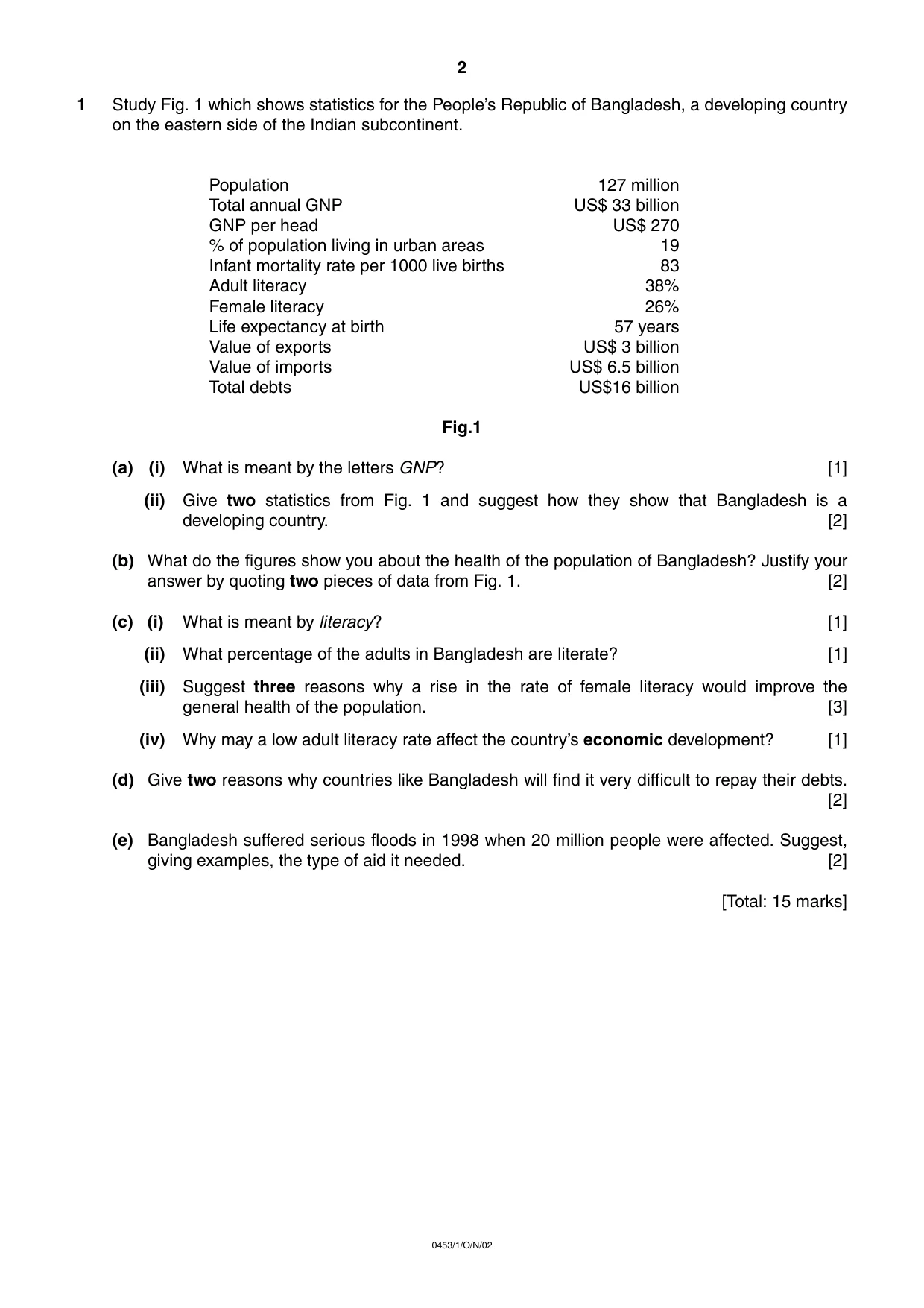
2 0453/1/O/N/02 1 Study Fig. 1 which shows statistics for the People’s Republic of Bangladesh, a developing country on the eastern side of the Indian subcontinent. Population 127 million Total annual GNP US$ 33 billion GNP per head US$ 270 % of population living in urban areas 19 Infant mortality rate per 1000 live births 83 Adult literacy 38% Female literacy 26% Life expectancy at birth 57 years Value of exports US$ 3 billion Value of imports US$ 6.5 billion Total debts US$16 billion Fig.1 (a) (i) What is meant by the letters GNP? [1] (ii) Give two statistics from Fig. 1 and suggest how they show that Bangladesh is a developing country. [2] (b) What do the figures show you about the health of the population of Bangladesh? Justify your answer by quoting two pieces of data from Fig. 1. [2] (c) (i) What is meant by literacy? [1] (ii) What percentage of the adults in Bangladesh are literate? [1] (iii) Suggest three reasons why a rise in the rate of female literacy would improve the general health of the population. [3] (iv) Why may a low adult literacy rate affect the country’s economic development? [1] (d) Give two reasons why countries like Bangladesh will find it very difficult to repay their debts. [2] (e) Bangladesh suffered serious floods in 1998 when 20 million people were affected. Suggest, giving examples, the type of aid it needed. [2] [Total: 15 marks]
Question paper, page 3
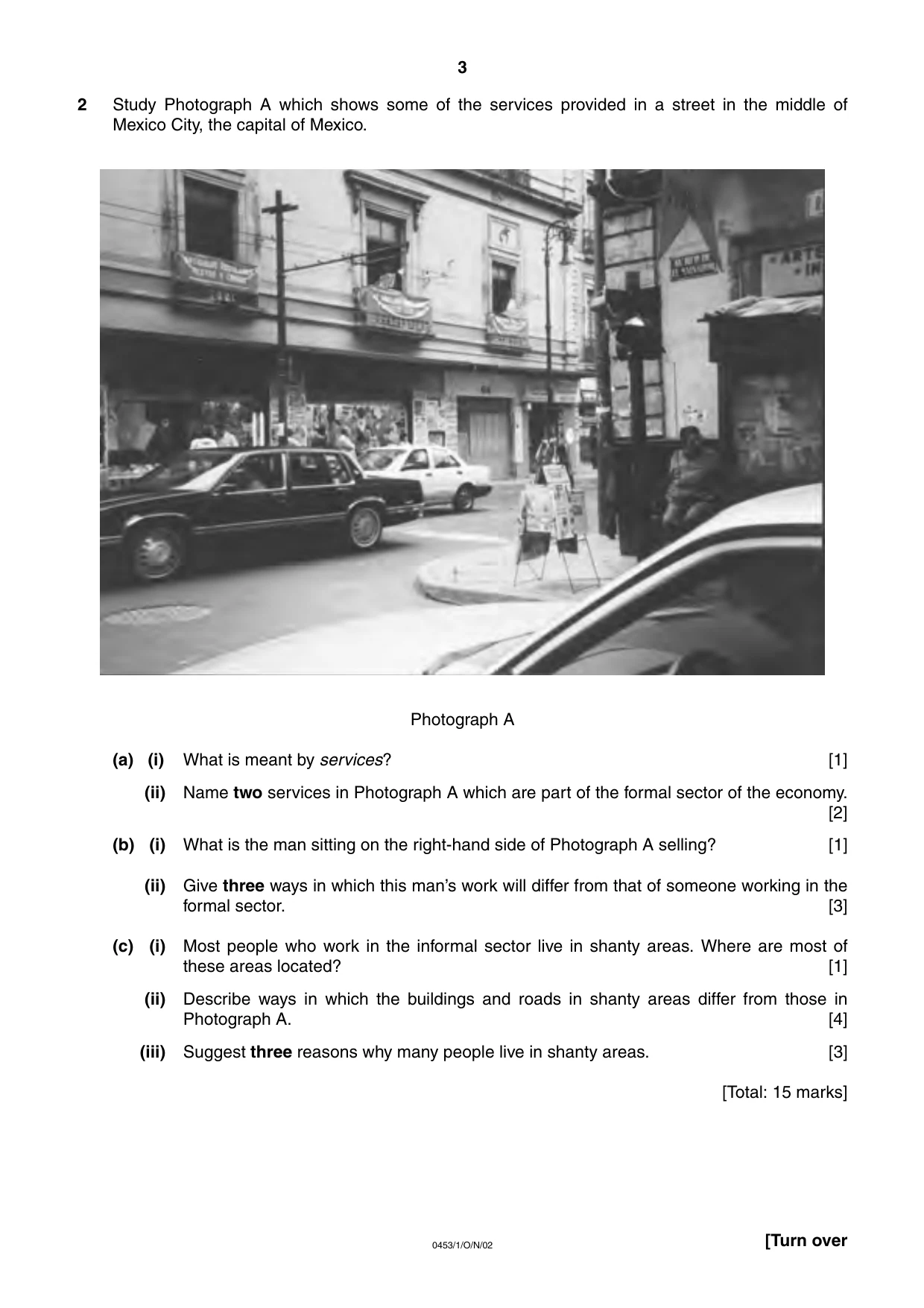
3 0453/1/O/N/02 [Turn over 2 Study Photograph A which shows some of the services provided in a street in the middle of Mexico City, the capital of Mexico. Photograph A (a) (i) What is meant by services? [1] (ii) Name two services in Photograph A which are part of the formal sector of the economy. [2] (b) (i) What is the man sitting on the right-hand side of Photograph A selling? [1] (ii) Give three ways in which this man’s work will differ from that of someone working in the formal sector. [3] (c) (i) Most people who work in the informal sector live in shanty areas. Where are most of these areas located? [1] (ii) Describe ways in which the buildings and roads in shanty areas differ from those in Photograph A. [4] (iii) Suggest three reasons why many people live in shanty areas. [3] [Total: 15 marks]
Question paper, page 4
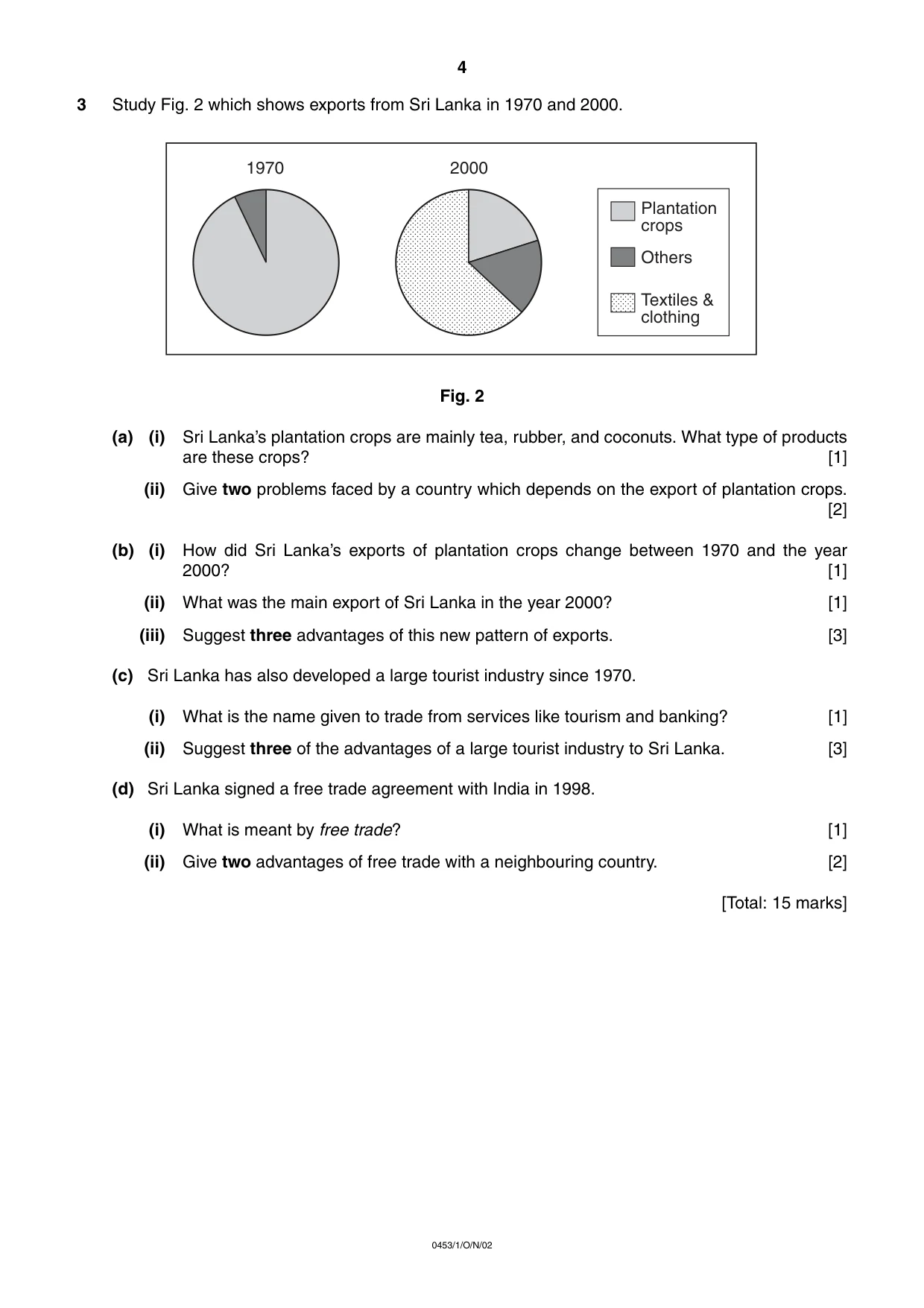
4 0453/1/O/N/02 3 Study Fig. 2 which shows exports from Sri Lanka in 1970 and 2000. Fig. 2 (a) (i) Sri Lanka’s plantation crops are mainly tea, rubber, and coconuts. What type of products are these crops? [1] (ii) Give two problems faced by a country which depends on the export of plantation crops. [2] (b) (i) How did Sri Lanka’s exports of plantation crops change between 1970 and the year 2000? [1] (ii) What was the main export of Sri Lanka in the year 2000? [1] (iii) Suggest three advantages of this new pattern of exports. [3] (c) Sri Lanka has also developed a large tourist industry since 1970. (i) What is the name given to trade from services like tourism and banking? [1] (ii) Suggest three of the advantages of a large tourist industry to Sri Lanka. [3] (d) Sri Lanka signed a free trade agreement with India in 1998. (i) What is meant by free trade? [1] (ii) Give two advantages of free trade with a neighbouring country. [2] [Total: 15 marks] 1970 2000 Plantation crops Others Textiles & clothing
Question paper, page 5
5 0453/1/O/N/02 [Turn over 4 Study Fig. 3 which is a map of the countries which the World Bank and the IMF identified as badly in debt. Fig. 3 (a) (i) What is meant by debt? [1] (ii) In which continent are most of the countries which are badly in debt? [1] (iii) Name one country where the debts are over $500 per head of population. [1] (b) Debts have to be paid back together with an extra amount of money. What is this extra amount called? [1] (c) Suggest two types of projects for which governments may have borrowed money. [2] (d) Debts have to be paid back in foreign currency. Suggest three reasons why some countries become very short of foreign currency. [3] (e) Countries that cannot pay off their debts often have to carry out a Structural Adjustment Programme (SAP) when they borrow money from the World Bank and the IMF. (i) Outline two of the aims of a SAP. [2] (ii) Describe two of the problems for the people of the countries carrying out SAPs. [2] (f) Why do many people think the debts of the poorest nations of the world should be cancelled? [2] [Total: 15 marks] 500–1500 1500–2500 127–500 $ debt per head of population Countries badly in debt
Question paper, page 6
6 0453/1/O/N/02 5 Study Fig. 4. Fig. 4 (a) Why do traditional farmers need government programmes? [1] (b) (i) What is meant by a co-operative? [1] (ii) Suggest three ways in which belonging to a co-operative can help a farmer. [3] (c) Using examples explain two ways in which projects can improve livestock farming. [4] (d) Give three reasons why projects are often designed to help women farmers. [3] (e) Describe either a self-help or a land reform programme and how it might assist in rural development. [3] [Total: 15 marks] Government programmes to help traditional farmers • Farmers’ co-operatives • Loans and credit schemes to farmers • Livestock projects • Projects to help women farmers • Crops for home market • Crops for export • Self-help programmes • Land reform
Question paper, page 7
7 0453/1/O/N/02 6 Study Fig. 5 which shows some of the needs of manufacturing industry. Fig. 5 (a) (i) Money is one meaning of capital. What is the other meaning? [1] (ii) Suggest three reasons why money capital is needed to set up a manufacturing industry. [3] (iii) Describe two ways by which a manufacturing industry may get its money capital. [2] (b) (i) What type of technology is used in a factory like that shown in Fig. 5? [1] (ii) From which parts of the world does most of this technology come? [1] (c) Explain how three different types of infrastructure are used to run a manufacturing industry. [3] (d) Give two reasons why governments often invite multinational companies to set up manufacturing industries in their countries. [2] (e) Suggest two reasons why it is difficult for a developing country to start to sell manufactured goods to foreign countries. [2] [Total: 15 marks] Capital Technology Infrastructure Markets
Mark scheme, page 1
CAMBRIDGE INTERNATIONAL EXAMINATIONS International General Certificate of Secondary Education MARK SCHEME FOR the November 2002 question papers 0453 DEVELOPMENT STUDIES 0453/1 Paper 1 (Written), maximum raw mark 60 0453/2 Paper 2 (Written), maximum raw mark 70 0453/4 Paper 4 (Alternative to Coursework), maximum raw mark 35 These mark schemes are published as an aid to teachers and students, to indicate the requirements of the examination. They show the basis on which Examiners were initially instructed to award marks. They do not indicate the details of the discussions that took place at an Examiners’ meeting before marking began. Any substantial changes to the mark scheme that arose from these discussions will be recorded in the published Report on the Examination. All Examiners are instructed that alternative correct answers and unexpected approaches in candidates’ scripts must be given marks that fairly reflect the relevant knowledge and _ skills demonstrated. Mark schemes must be read in conjunction with the question papers and the Report on the Examination. . CIE will not enter into discussions or correspondence in connection with these mark schemes. CIE is publishing the mark schemes for the November 2002 question papers for most IGCSE and GCE Advanced Subsidiary (AS) Level syllabuses. UNIVERSITY of CAMBRIDGE Local Examinations Syndicate
Mark scheme, page 2
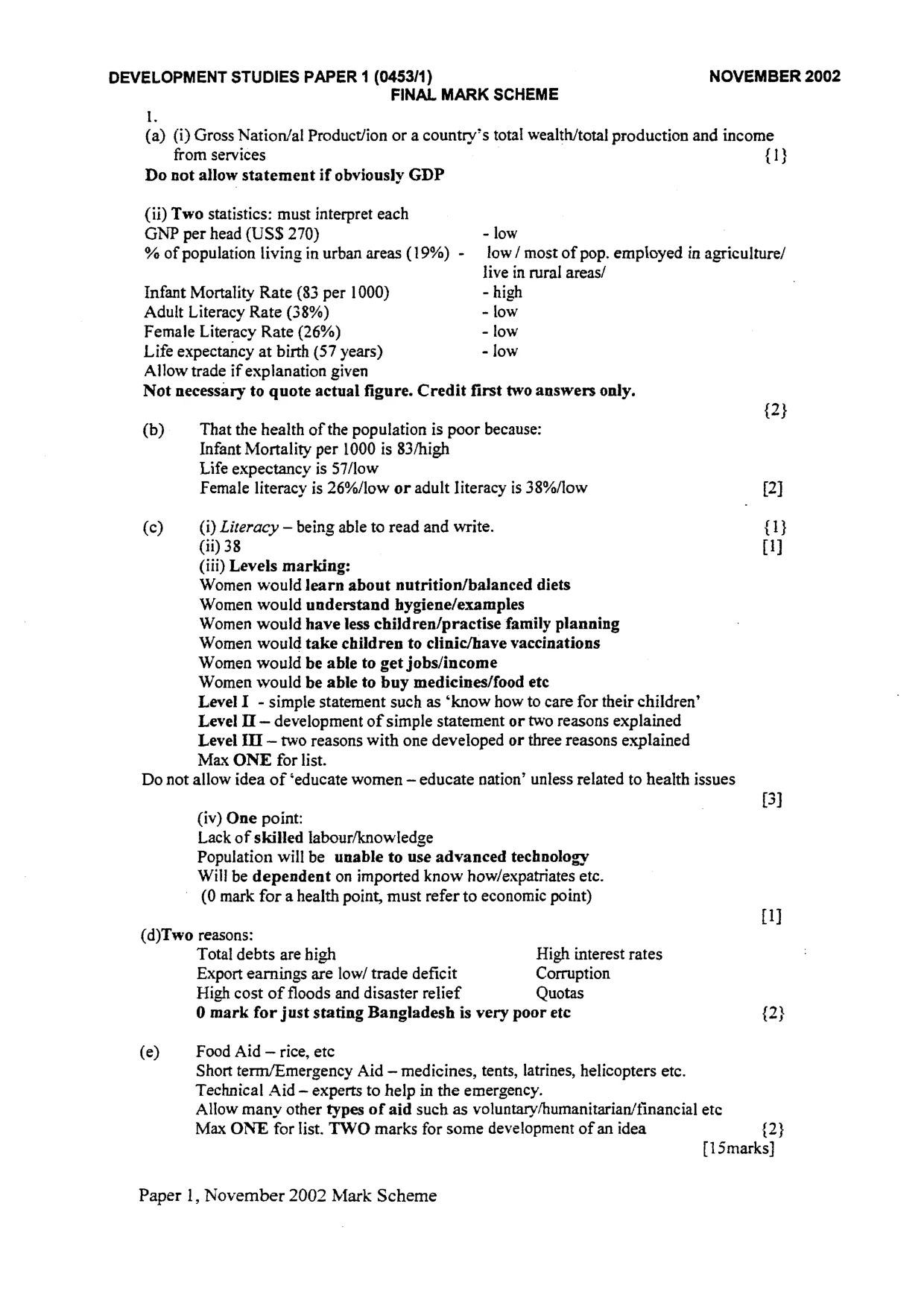
DEVELOPMENT STUDIES PAPER 1 (0453/1) NOVEMBER 2002 FINAL MARK SCHEME 1, (a) (i) Gross Nation/al Production or a country’s total wealth/total production and income from services {1} Do not allow statement if obviously GDP (ii) Two statistics: must interpret each GNP per head (US$ 270) - low % of population living in urban areas (19%) - low/ most of pop. employed in agriculture/ live in rural areas/ Infant Mortality Rate (83 per 1000) - high Adult Literacy Rate (38%) - low Female Literacy Rate (26%) - low Life expectancy at birth (57 years) - low Allow trade if explanation given Not necessary to quote actual figure. Credit first two answers only. {2} (b) That the health of the population is poor because: Infant Mortality per 1000 is 83/high Life expectancy is 57/low Female literacy is 26%/low or adult literacy is 38%/low [2] (c) (i) Literacy — being able to read and write. {1} (ii) 38 1] (iii) Levels marking: Women would learn about nutrition/balanced diets Women would understand hygiene/examples Women would have less children/practise family planning Women would take children to clinic/have vaccinations Women would be able to get jobs/income Women would be able to buy medicines/food etc Level I - simple statement such as ‘know how to care for their children’ Level II — development of simple statement or two reasons explained Level II — two reasons with one developed or three reasons explained Max ONE for list. Do not allow idea of ‘educate women — educate nation’ unless related to health issues (iv) One point: Lack of skilled labour/knowledge Population will be unable to use advanced technology Will be dependent on imported know how/expatriates etc. (0 mark for a health point, must refer to economic point) (1 (d)Two reasons: Total debts are high High interest rates Export earnings are low/ trade deficit Corruption High cost of floods and disaster relief Quotas 0 mark for just stating Bangladesh is very poor etc {2} (e) Food Aid — rice, etc Short term/Emergency Aid — medicines, tents, latrines, helicopters etc. Technical Aid — experts to help in the emergency. Allow many other types of aid such as voluntary/humanitarian/financial etc Max ONE for list. TWO marks for some development of an idea {2} [15marks] Paper 1, November 2002 Mark Scheme
Mark scheme, page 3
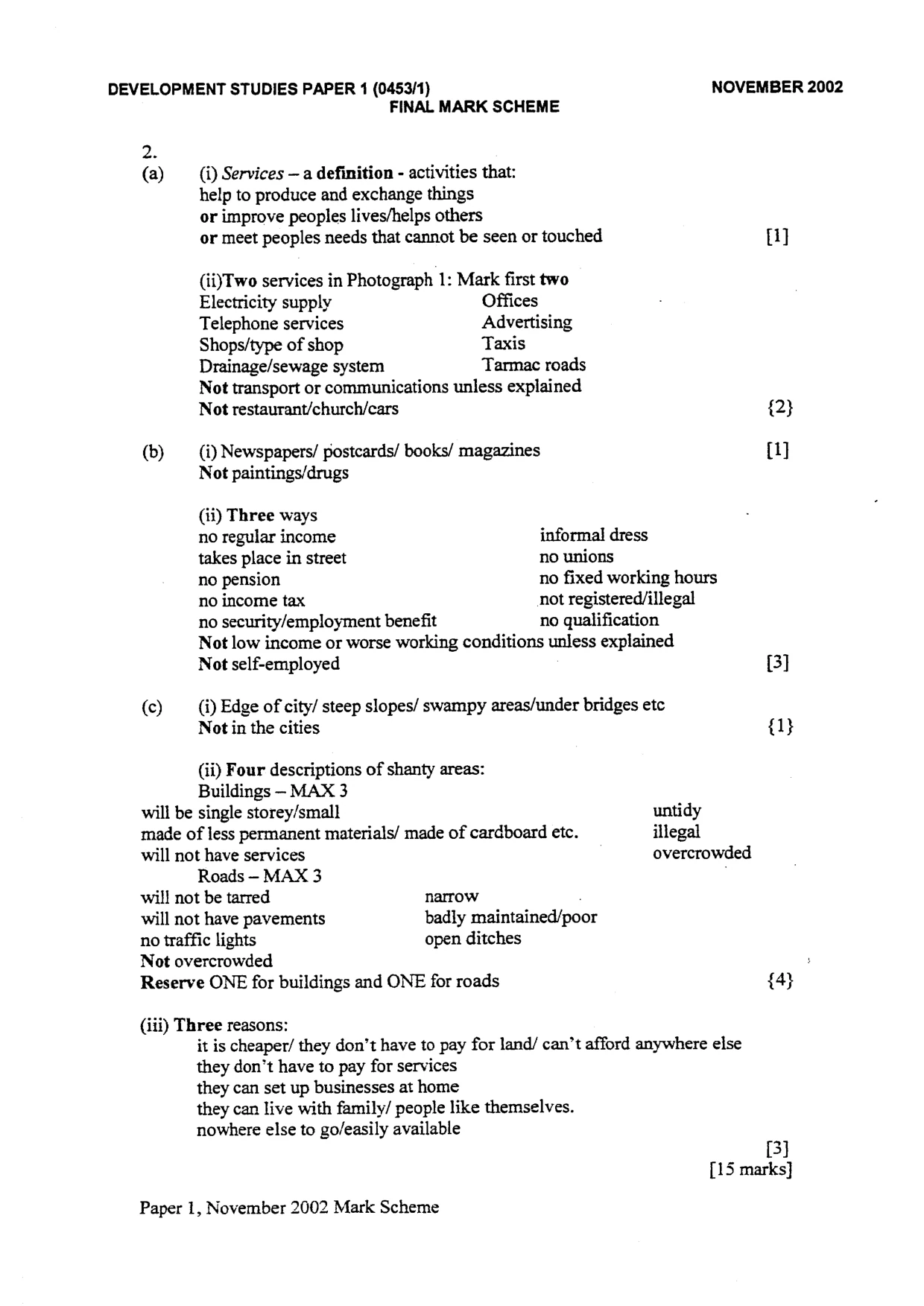
DEVELOPMENT STUDIES PAPER 1 (0453/1) NOVEMBER 2002 FINAL MARK SCHEME 2. (a) (i) Services — a definition - activities that: help to produce and exchange things or improve peoples lives/helps others or meet peoples needs that cannot be seen or touched fi] (ii) Two services in Photograph 1: Mark first two Electricity supply Offices Telephone services Advertising Shops/type of shop Taxis Drainage/sewage system Tarmac roads Not transport or communications unless explained Not restaurant/church/cars {2} (b) (i) Newspapers/ postcards/ books/ magazines {1] Not paintings/drugs (ii) Three ways no regular income informal dress takes place in street no unions no pension no fixed working hours no income tax not registered/illegal no security/employment benefit no qualification Not low income or worse working conditions unless explained Not self-employed B] (c) (i) Edge of city/ steep slopes/ swampy areas/under bridges etc Not in the cities {1} (ii) Four descriptions of shanty areas: Buildings - MAX 3 will be single storey/small untidy made of less permanent materials/ made of cardboard etc. illegal will not have services overcrowded Roads — MAX 3 : will not be tarred narrow . will not have pavements badly maintained/poor no traffic lights open ditches Not overcrowded Reserve ONE for buildings and ONE for roads {4} (iii) Three reasons: it is cheaper/ they don’t have to pay for land/ can’t afford anywhere else they don’t have to pay for services they can set up businesses at home they can live with family/ people like themselves. nowhere else to go/easily available [3] [15 marks] Paper 1, November 2002 Mark Scheme
Mark scheme, page 4
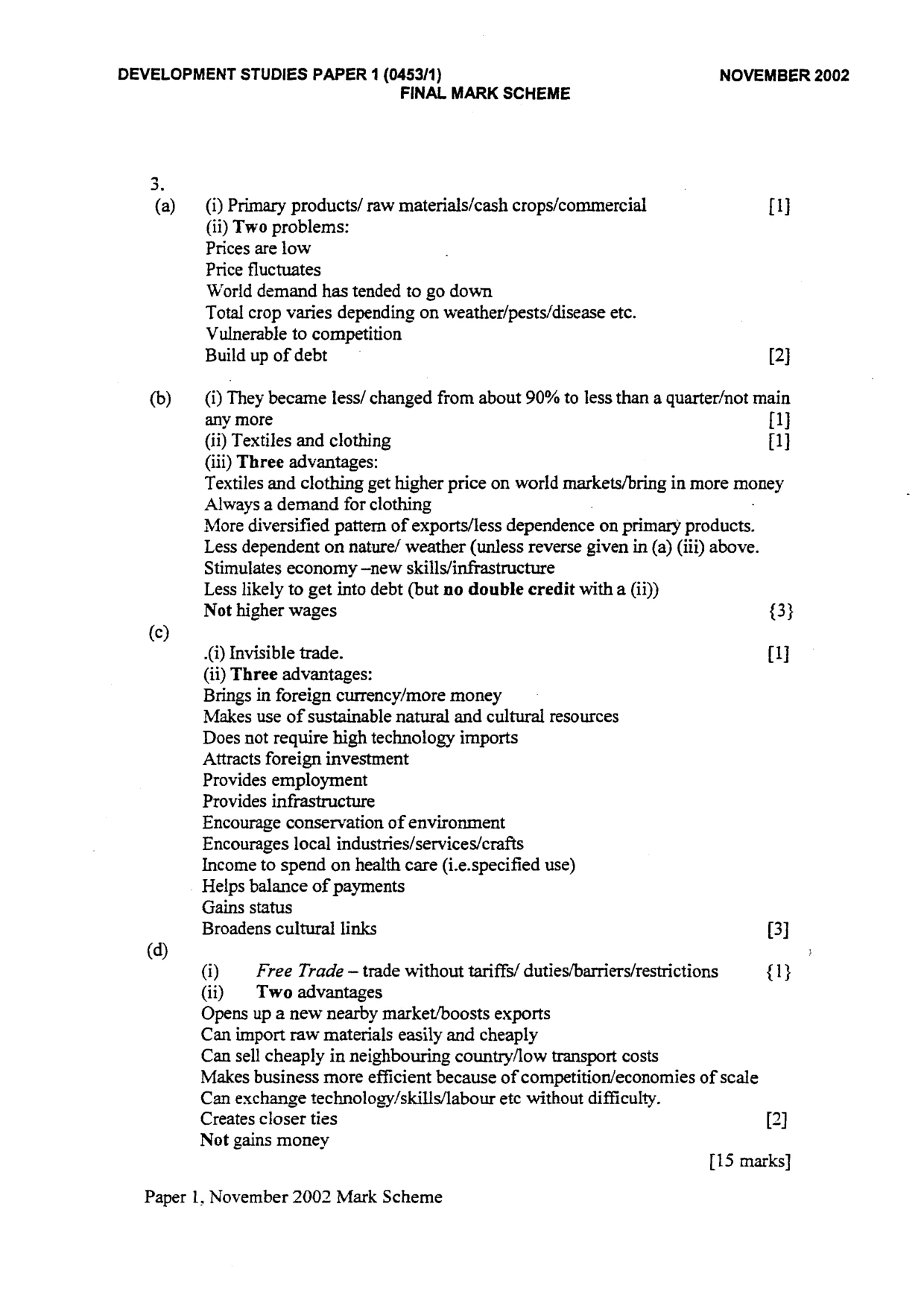
DEVELOPMENT STUDIES PAPER 1 (0453/1) NOVEMBER 2002 (a) (b) (©) @ FINAL MARK SCHEME (i) Primary products/ raw materials/cash crops/commercial {1] (ii) Two problems: Prices are low Price fluctuates World demand has tended to go down Total crop varies depending on weather/pests/disease etc. Vulnerable to competition Build up of debt [2] (i) They became less/ changed from about 90% to less than a quarter/not main any more [1] (ii) Textiles and clothing f1) (iii) Three advantages: Textiles and clothing get higher price on world markets/bring in more money Always a demand for clothing More diversified pattern of exports/less dependence on primary products. Less dependent on nature/ weather (unless reverse given in (a) (iii) above. Stimulates economy —new skills/infrastructure Less likely to get into debt (but no double credit with a (ii)) Not higher wages {3} -(i) Invisible trade. 1] (ii) Three advantages: Brings in foreign currency/more money Makes use of sustainable natural and cultural resources Does not require high technology imports Attracts foreign investment Provides employment Provides infrastructure Encourage conservation of environment Encourages local industries/services/crafts Income to spend on health care (i.e.specified use) Helps balance of payments Gains status Broadens cultural links (3] (i) Free Trade — trade without tariffs/ duties/barriers/restrictions {]} (ii) | Two advantages Opens up a new nearby market/boosts exports Can import raw materials easily and cheaply Can sell cheaply in neighbouring country/low transport costs Makes business more efficient because of competition/economies of scale Can exchange technology/skills/labour ete without difficulty. Creates closer ties (2] Not gains money [15 marks] Paper 1, November 2002 Mark Scheme
Mark scheme, page 5
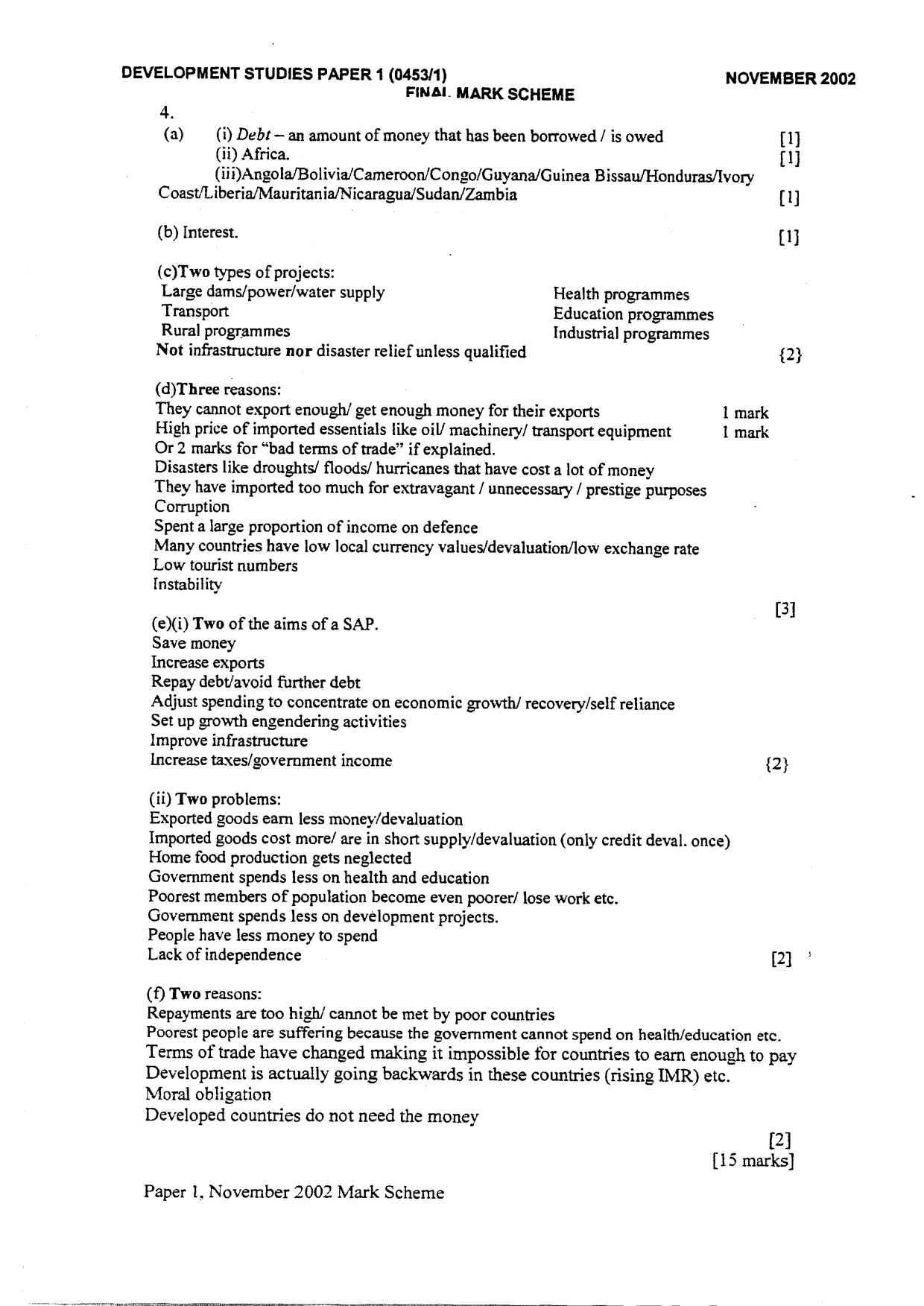
DEVELOPMENT STUDIES PAPER 1 (0453/1) NOVEMBER 2002 FINSI. MARK SCHEME 4. (a) (i) Debt — an amount of money that has been borrowed / is owed (y (ii) Africa. {1} (iii)Angola/Bolivia/Cameroon/Congo/Guyana/Guinea Bissau/Honduras/Ivory Coast/Liberia/Mauritania/Nicaragua/Sudan/Zambia {y (b) Interest. { (c)Two types of projects: Large dams/power/water supply Health programmes Transport Education programmes Rural programmes Industrial programmes Not infrastructure nor disaster relief unless qualified {2} (d)Three reasons: They cannot export enough/ get enough money for their exports 1 mark High price of imported essentials like oil/ machinery/ transport equipment 1 mark Or 2 marks for “bad terms of trade” if explained. Disasters like droughts/ floods/ hurricanes that have cost a lot of money They have imported too much for extravagant / unnecessary / prestige purposes Corruption Spent a large proportion of income on defence Many countries have low local currency values/devaluation/low exchange rate Low tourist numbers Instability 2] (e)(i) Two of the aims of a SAP. Save money Increase exports Repay debt/avoid further debt Adjust spending to concentrate on economic growth/ recovery/self reliance Set up growth engendering activities Improve infrastructure Increase taxes/government income {2} (ii) Two problems: Exported goods earn less money/devaluation Imported goods cost more/ are in short supply/devaluation (only credit deval. once) Home food production gets neglected Government spends less on health and education Poorest members of population become even poorer/ lose work etc. Government spends less on development projects. People have less money to spend Lack of independence [2] ° (f) Two reasons: Repayments are too high/ cannot be met by poor countries Poorest people are suffering because the government cannot spend on health/education etc. Terms of trade have changed making it impossible for countries to earn enough to pay Development is actually going backwards in these countries (rising IMR) etc. Moral obligation Developed countries do not need the money [2] {15 marks] Paper 1, November 2002 Mark Scheme
Mark scheme, page 6
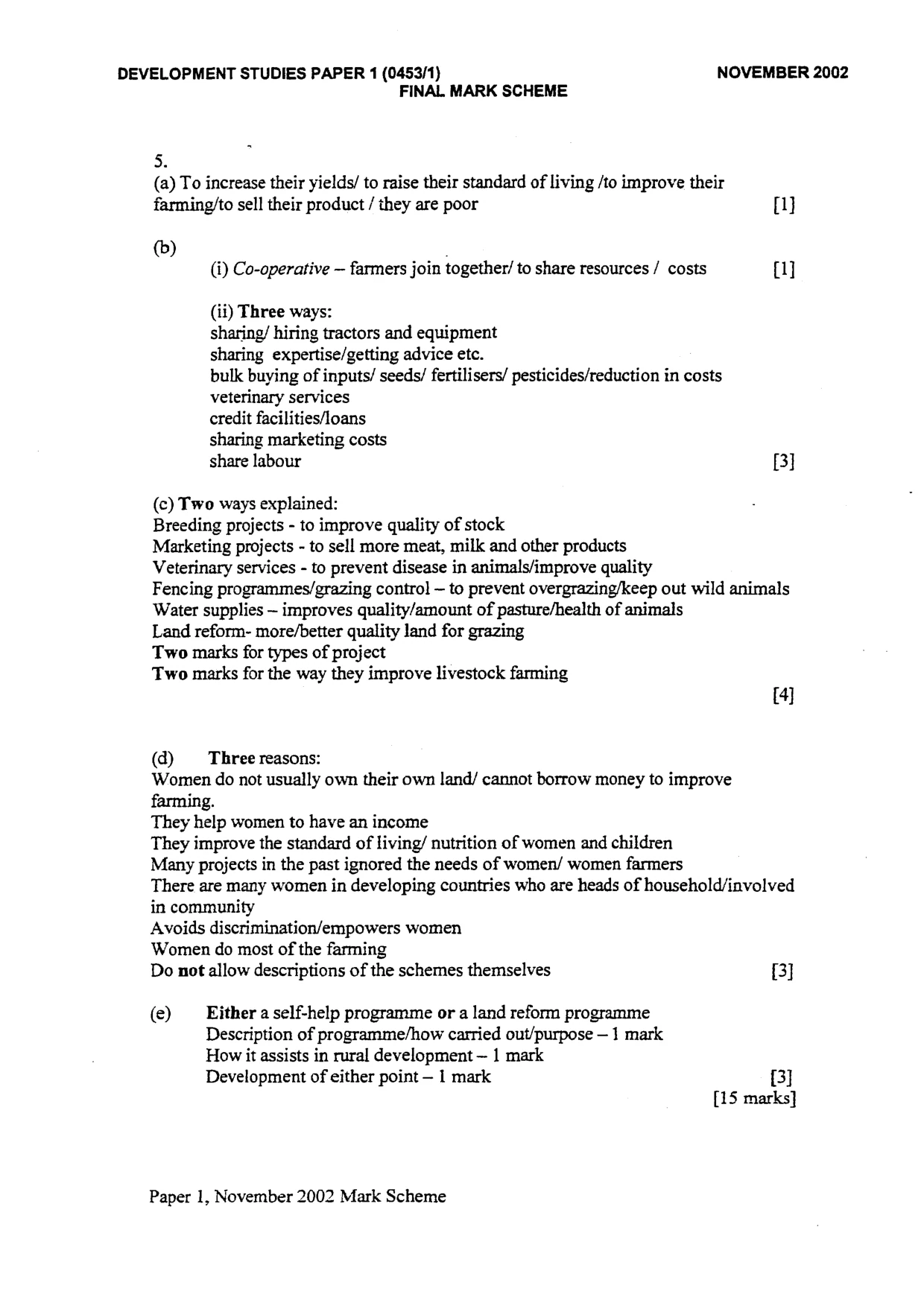
DEVELOPMENT STUDIES PAPER 1 (0453/1) NOVEMBER 2002 FINAL MARK SCHEME 5. (a) To increase their yields/ to raise their standard of living /to improve their farming/to sell their product / they are poor fi) (b) (i) Co-operative — farmers join together/ to share resources / costs 1] (ii) Three ways: sharing/ hiring tractors and equipment sharing expertise/getting advice etc. bulk buying of inputs/ seeds/ fertilisers/ pesticides/reduction in costs veterinary services credit facilities/loans sharing marketing costs share labour [3] (c) Two ways explained: Breeding projects - to improve quality of stock Marketing projects - to sell more meat, milk and other products Veterinary services - to prevent disease in animals/improve quality Fencing programmes/grazing control — to prevent overgrazing/keep out wild animals Water supplies — improves quality/amount of pasture/health of animals Land reform- more/better quality land for grazing Two marks for types of project Two marks for the way they improve livestock farming [4] (a) Three reasons: Women do not usually own their own land/ cannot borrow money to improve farming. They help women to have an income They improve the standard of living/ nutrition of women and children Many projects in the past ignored the needs of women/ women farmers There are many women in developing countries who are heads of household/involved in community Avoids discrimination/empowers women Women do most of the farming Do not allow descriptions of the schemes themselves {3] (e) Either a self-help programme or a land reform programme Description of programme/how carried out/purpose — 1 mark How it assists in rural development — 1 mark Development of either point — 1 mark {3] [15 marks] Paper 1, November 2002 Mark Scheme
Mark scheme, page 7
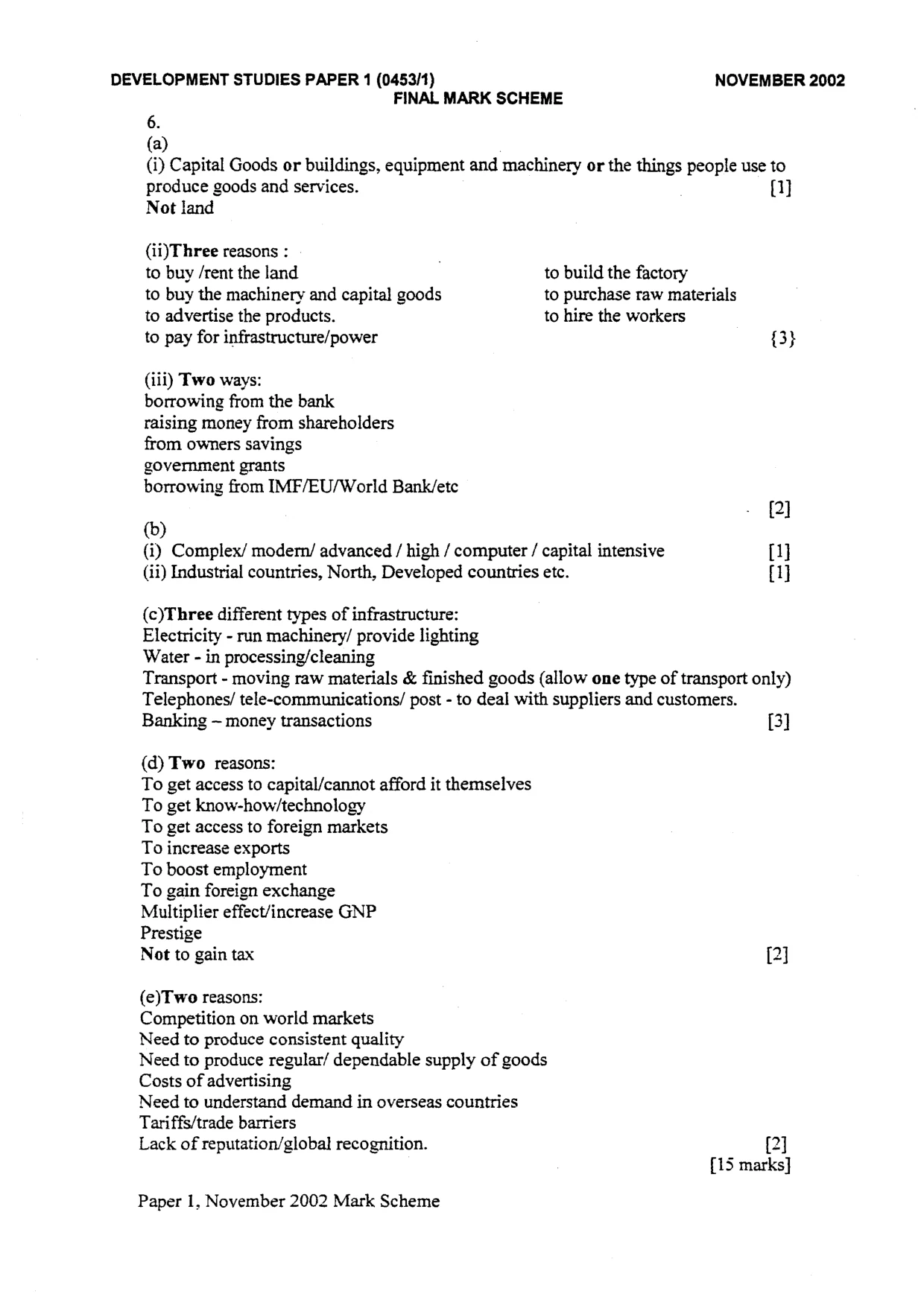
DEVELOPMENT STUDIES PAPER 1 (0453/1) NOVEMBER 2002 FINAL MARK SCHEME 6. (a) (i) Capital Goods or buildings, equipment and machinery or the things people use to produce goods and services. Not land (ii)Three reasons : to buy /rent the land to build the factory to buy the machinery and capital goods to purchase raw materials to advertise the products. to hire the workers to pay for infrastructure/power {3} (iii) Two ways: borrowing from the bank raising money from shareholders from owners savings government grants borrowing from IMF/EU/World Bank/etc (2) (b) (i) Complex/ modern/ advanced / high / computer / capital intensive (1) (ii) Industrial countries, North, Developed countries etc. {1] (c)Three different types of infrastructure: Electricity - run machinery/ provide lighting Water - in processing/cleaning Transport - moving raw materials & finished goods (allow one type of transport only) Telephones/ tele-communications/ post - to deal with suppliers and customers. Banking ~ money transactions [3] (d) Two reasons: To get access to capital/cannot afford it themselves To get know-how/technology To get access to foreign markets To increase exports To boost employment To gain foreign exchange Multiplier effect/increase GNP Prestige Not to gain tax [2] (e)Two reasons: Competition on world markets Need to produce consistent quality Need to produce regular/ dependable supply of goods Costs of advertising Need to understand demand in overseas countries Tariffs/trade barriers Lack of reputation/global recognition. (2] {15 marks] Paper 1, November 2002 Mark Scheme