Cambridge IGCSE Design and Technology 0445 — 2014 Oct/Nov Paper 3 · Variant 1
0445/31/O/N/14 · 50 marks · ≈56 min
The question paper and its mark scheme, free to read here and free to download. This is Cambridge’s own paper, exactly as it was sat.
Question paper20 pages



Mark scheme6 pages
Answers below. Sit the paper first if you are practising.
Paper as text
Question paper, page 1
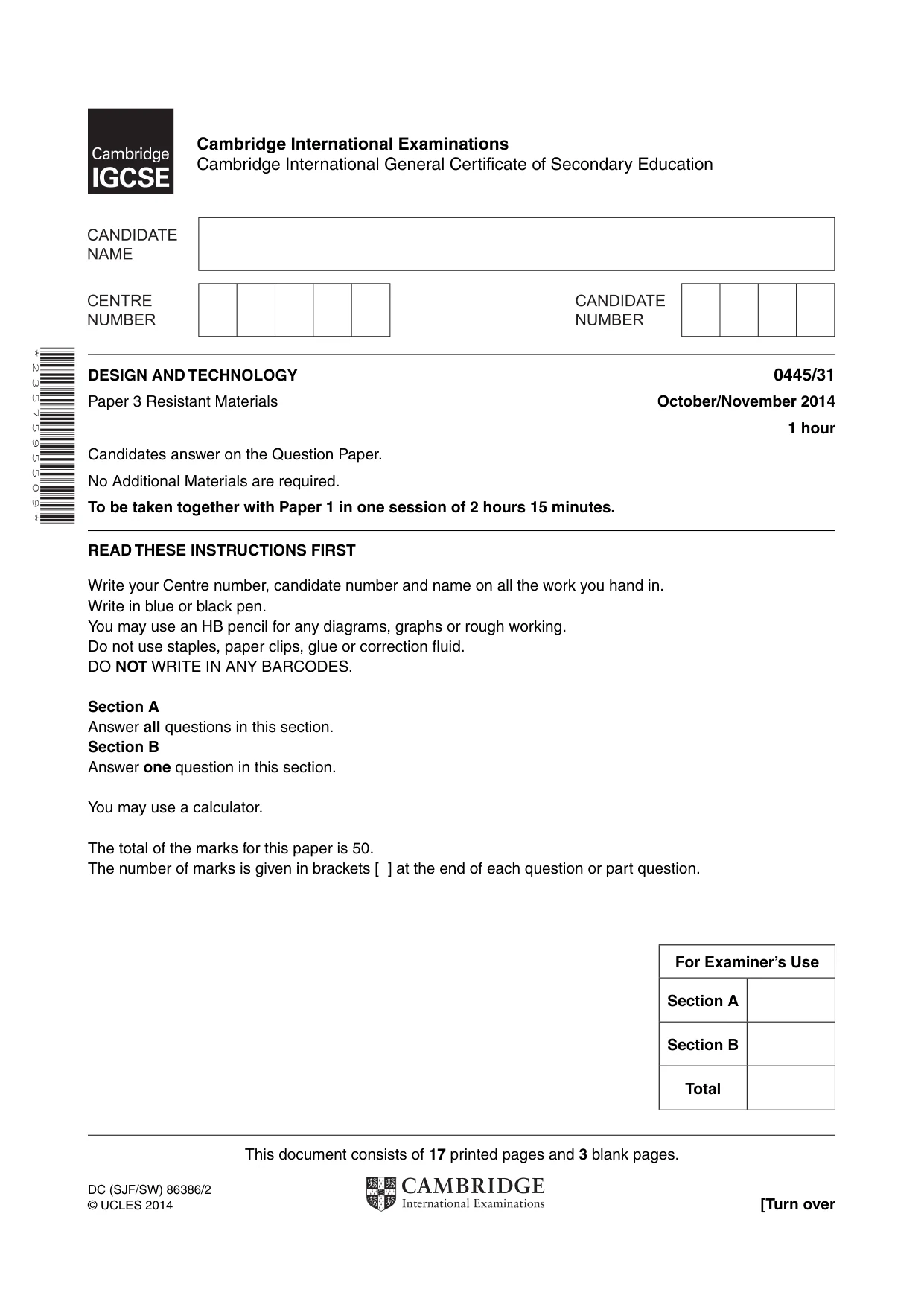
This document consists of 17 printed pages and 3 blank pages. DC (SJF/SW) 86386/2 © UCLES 2014 [Turn over Cambridge International Examinations Cambridge International General Certificate of Secondary Education * 2 3 5 7 5 9 5 5 0 9 * DESIGN AND TECHNOLOGY 0445/31 Paper 3 Resistant Materials October/November 2014 1 hour Candidates answer on the Question Paper. No Additional Materials are required. To be taken together with Paper 1 in one session of 2 hours 15 minutes. READ THESE INSTRUCTIONS FIRST Write your Centre number, candidate number and name on all the work you hand in. Write in blue or black pen. You may use an HB pencil for any diagrams, graphs or rough working. Do not use staples, paper clips, glue or correction fl uid. DO NOT WRITE IN ANY BARCODES. Section A Answer all questions in this section. Section B Answer one question in this section. You may use a calculator. The total of the marks for this paper is 50. The number of marks is given in brackets [ ] at the end of each question or part question. For Examiner’s Use Section A Section B Total
Question paper, page 2
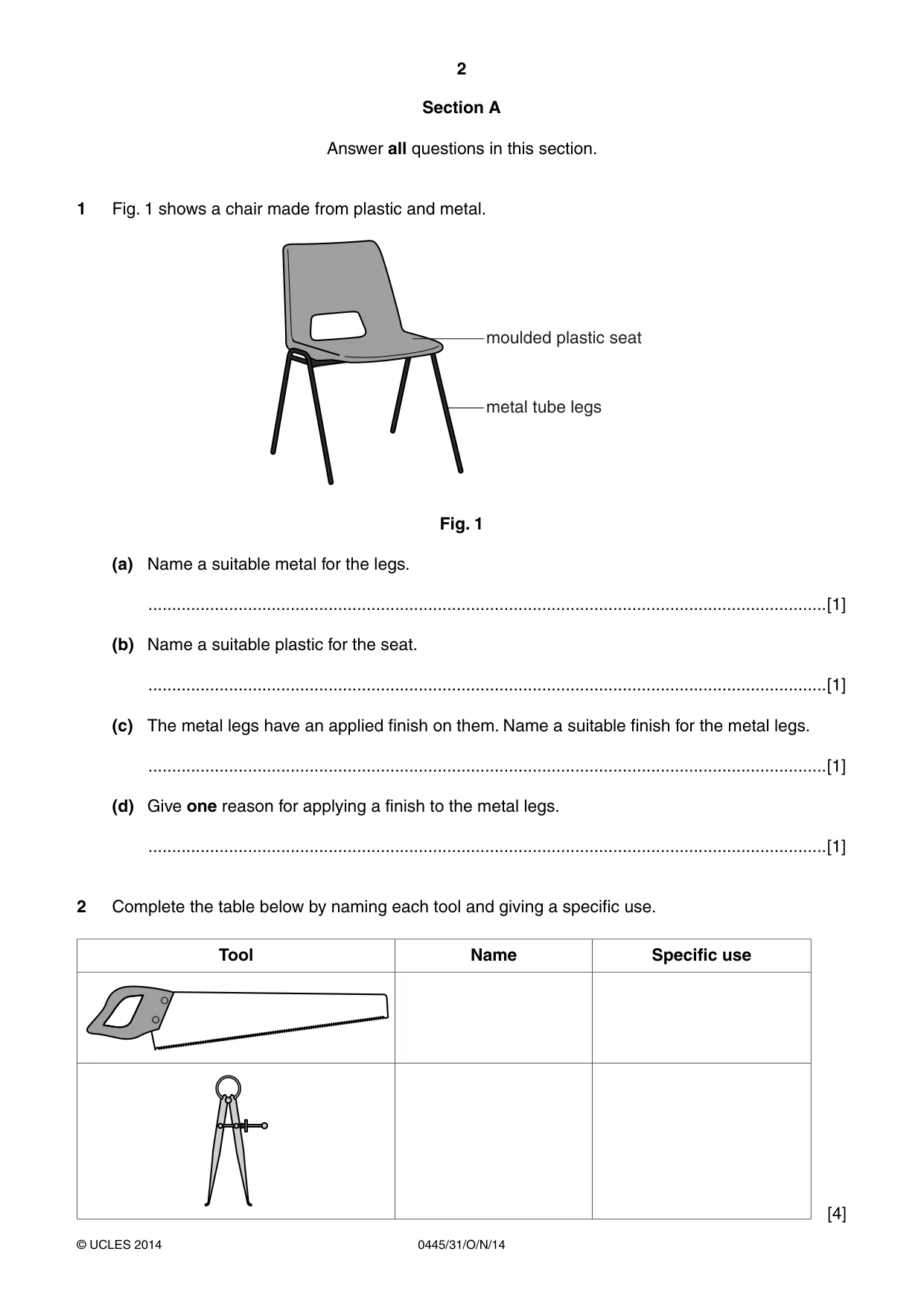
2 0445/31/O/N/14 © UCLES 2014 Section A Answer all questions in this section. 1 Fig. 1 shows a chair made from plastic and metal. moulded plastic seat metal tube legs Fig. 1 (a) Name a suitable metal for the legs. …[1] (b) Name a suitable plastic for the seat. …[1] (c) The metal legs have an applied finish on them. Name a suitable finish for the metal legs. …[1] (d) Give one reason for applying a finish to the metal legs. …[1] 2 Complete the table below by naming each tool and giving a specific use. Tool Name Specific use [4]
Question paper, page 3
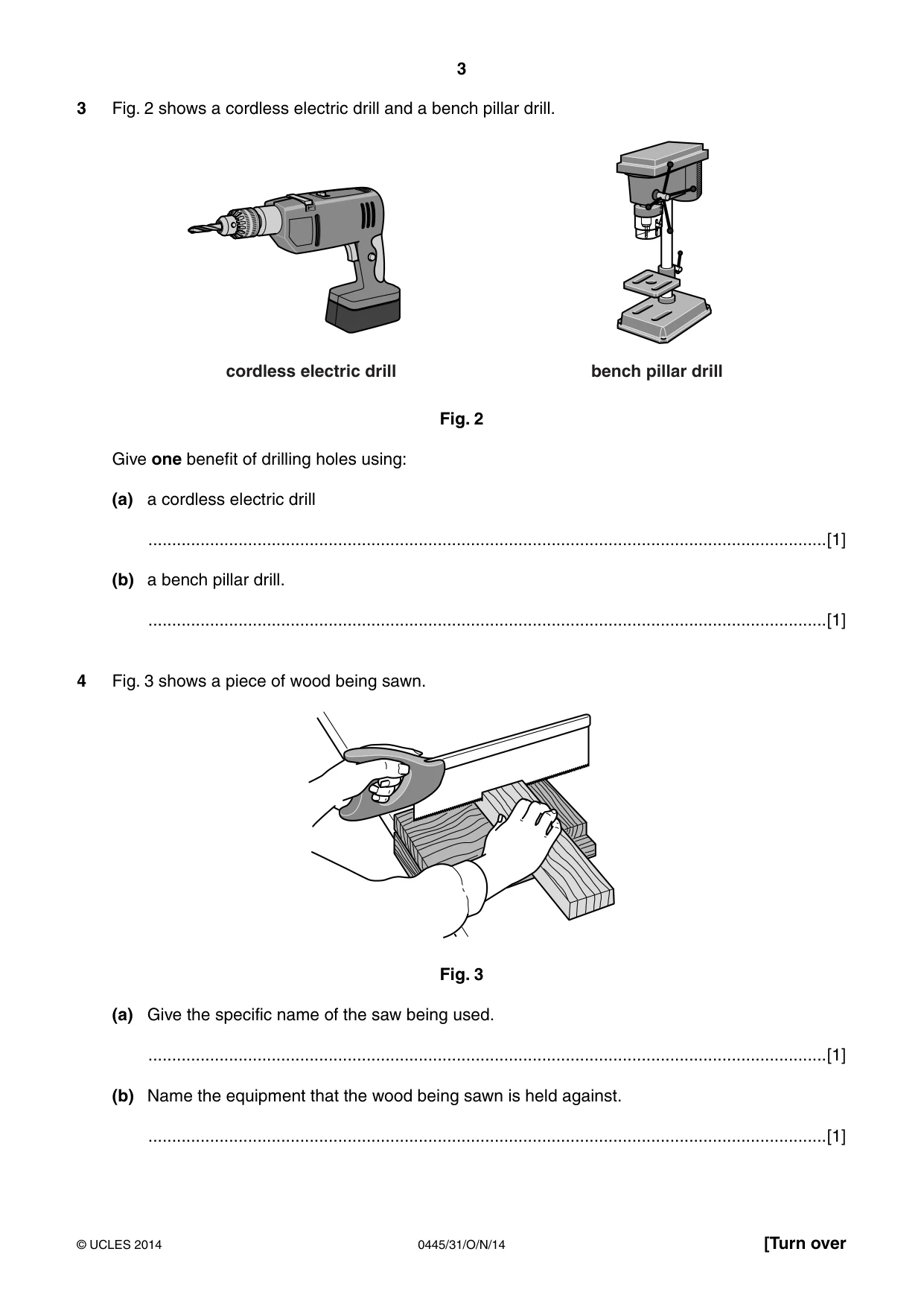
3 0445/31/O/N/14 © UCLES 2014 [Turn over 3 Fig. 2 shows a cordless electric drill and a bench pillar drill. cordless electric drill bench pillar drill Fig. 2 Give one benefit of drilling holes using: (a) a cordless electric drill …[1] (b) a bench pillar drill. …[1] 4 Fig. 3 shows a piece of wood being sawn. Fig. 3 (a) Give the specific name of the saw being used. …[1] (b) Name the equipment that the wood being sawn is held against. …[1]
Question paper, page 4
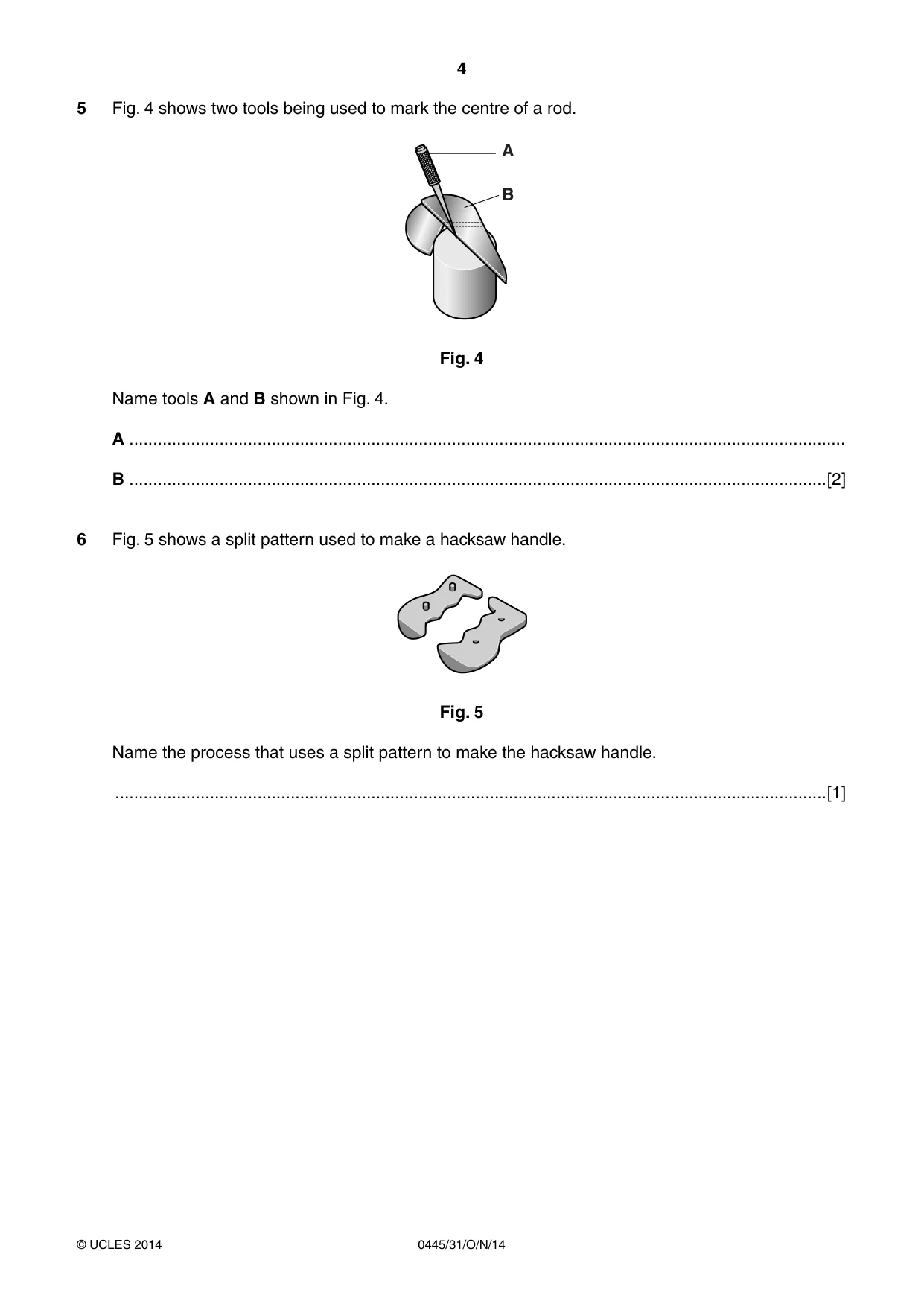
4 0445/31/O/N/14 © UCLES 2014 5 Fig. 4 shows two tools being used to mark the centre of a rod. B A Fig. 4 Name tools A and B shown in Fig. 4. A … B …[2] 6 Fig. 5 shows a split pattern used to make a hacksaw handle. Fig. 5 Name the process that uses a split pattern to make the hacksaw handle. …[1]
Question paper, page 5
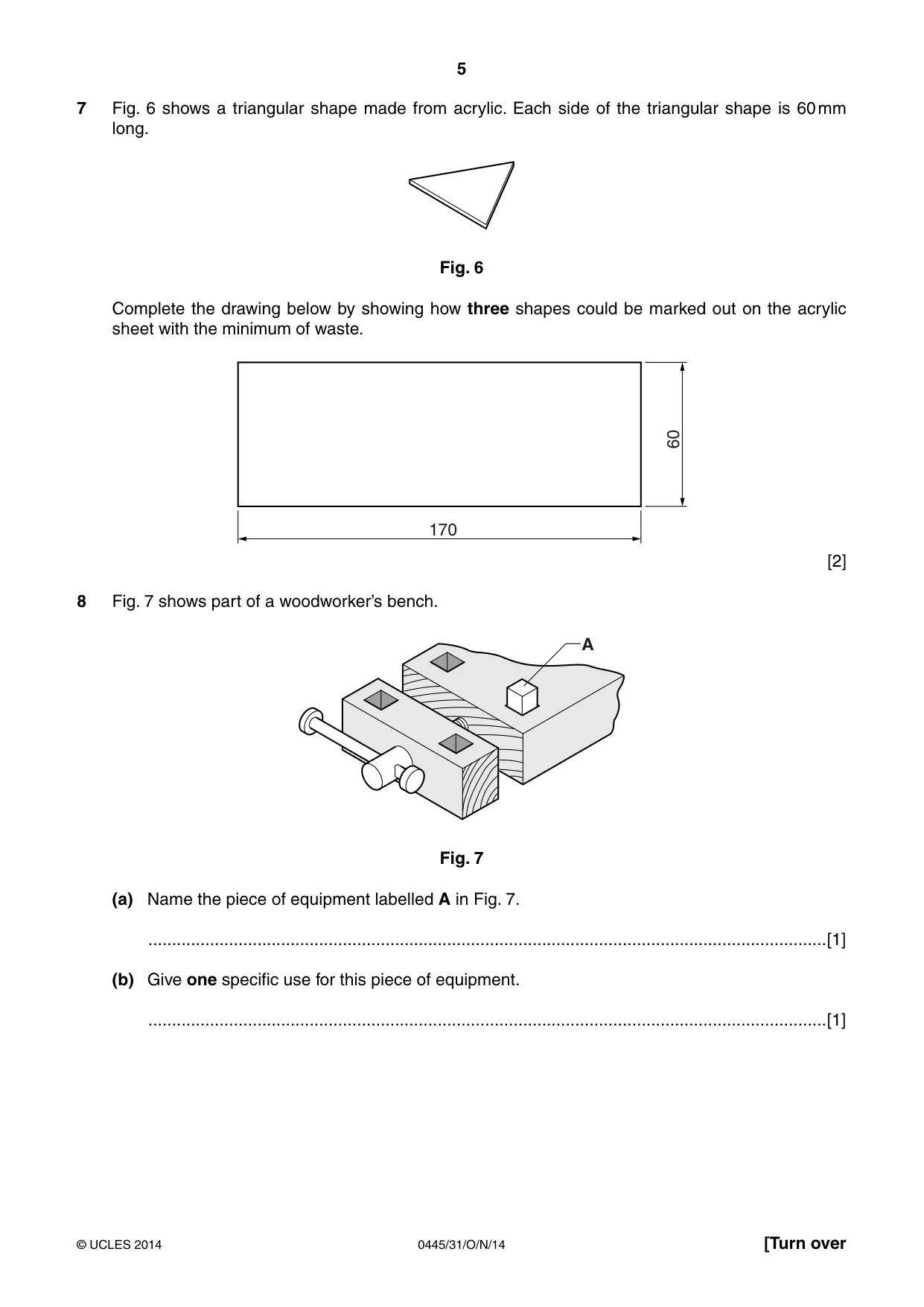
5 0445/31/O/N/14 © UCLES 2014 [Turn over 7 Fig. 6 shows a triangular shape made from acrylic. Each side of the triangular shape is 60 mm long. Fig. 6 Complete the drawing below by showing how three shapes could be marked out on the acrylic sheet with the minimum of waste. 60 170 [2] 8 Fig. 7 shows part of a woodworker’s bench. A Fig. 7 (a) Name the piece of equipment labelled A in Fig. 7. …[1] (b) Give one specific use for this piece of equipment. …[1]
Question paper, page 6
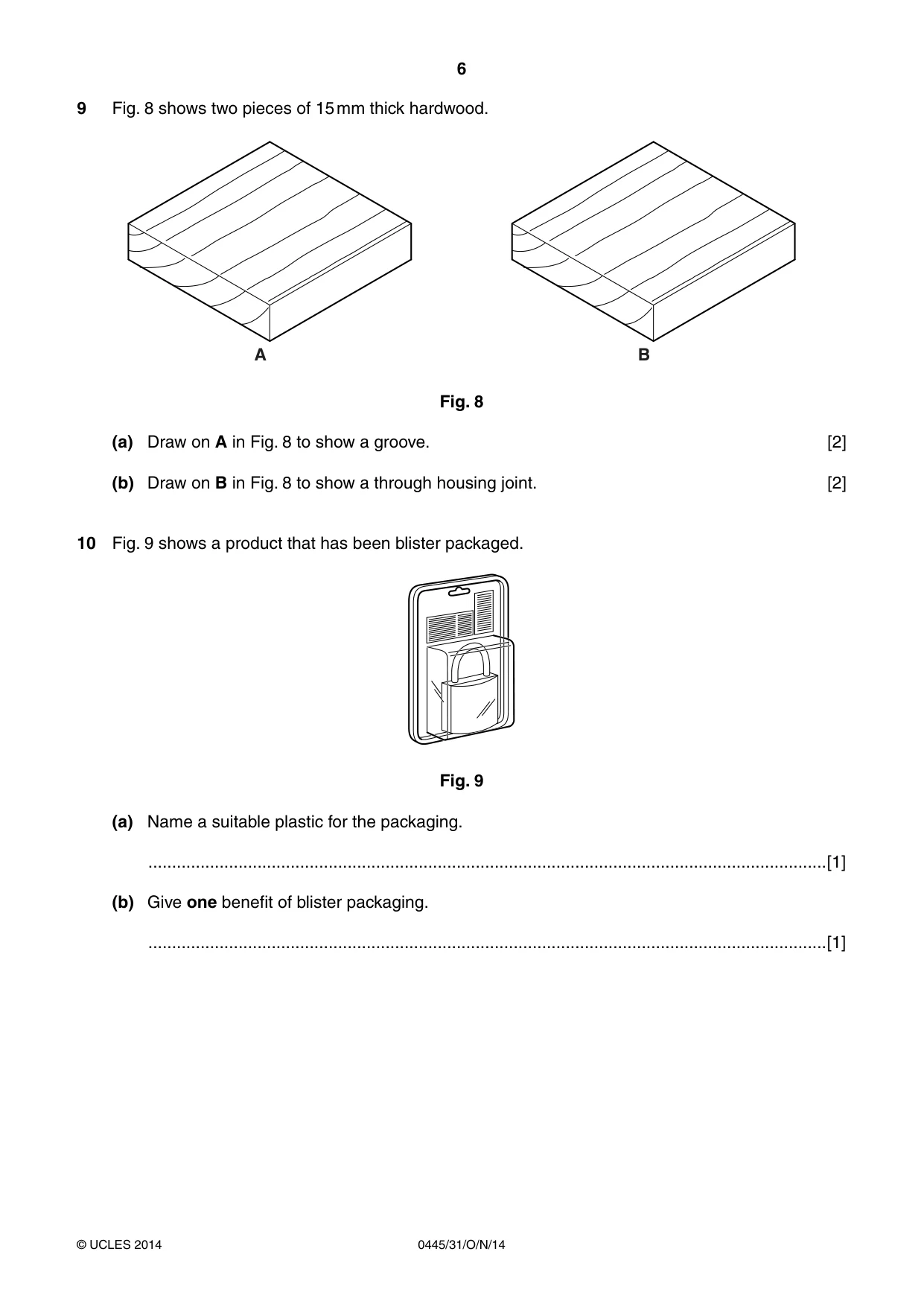
6 0445/31/O/N/14 © UCLES 2014 9 Fig. 8 shows two pieces of 15 mm thick hardwood. A B Fig. 8 (a) Draw on A in Fig. 8 to show a groove. [2] (b) Draw on B in Fig. 8 to show a through housing joint. [2] 10 Fig. 9 shows a product that has been blister packaged. Fig. 9 (a) Name a suitable plastic for the packaging. …[1] (b) Give one benefit of blister packaging. …[1]
Question paper, page 7
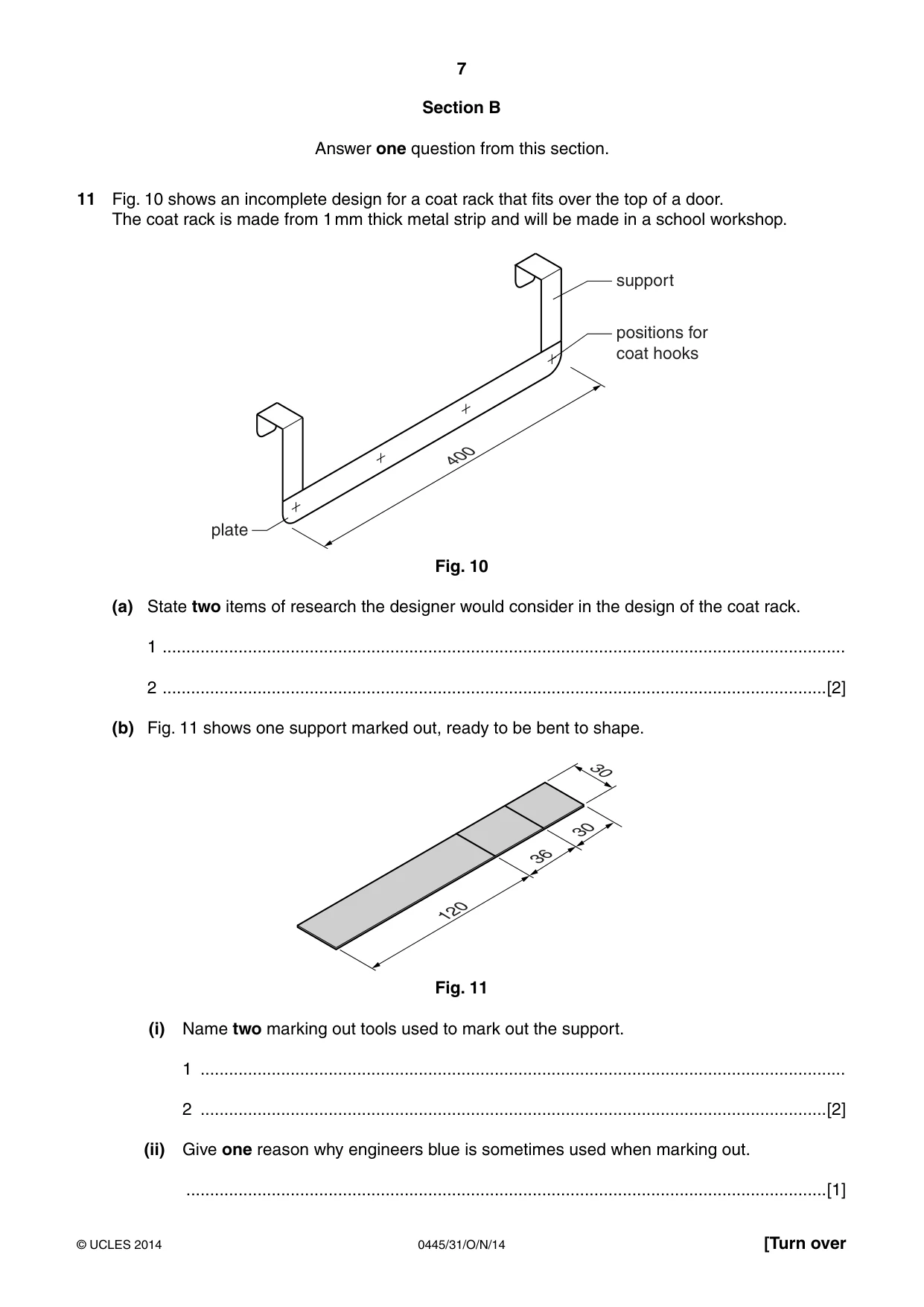
7 0445/31/O/N/14 © UCLES 2014 [Turn over Section B Answer one question from this section. 11 Fig. 10 shows an incomplete design for a coat rack that fits over the top of a door. The coat rack is made from 1 mm thick metal strip and will be made in a school workshop. 400 plate support positions for coat hooks Fig. 10 (a) State two items of research the designer would consider in the design of the coat rack. 1 … 2 …[2] (b) Fig. 11 shows one support marked out, ready to be bent to shape. 120 36 30 30 Fig. 11 (i) Name two marking out tools used to mark out the support. 1 … 2 …[2] (ii) Give one reason why engineers blue is sometimes used when marking out. …[1]
Question paper, page 8
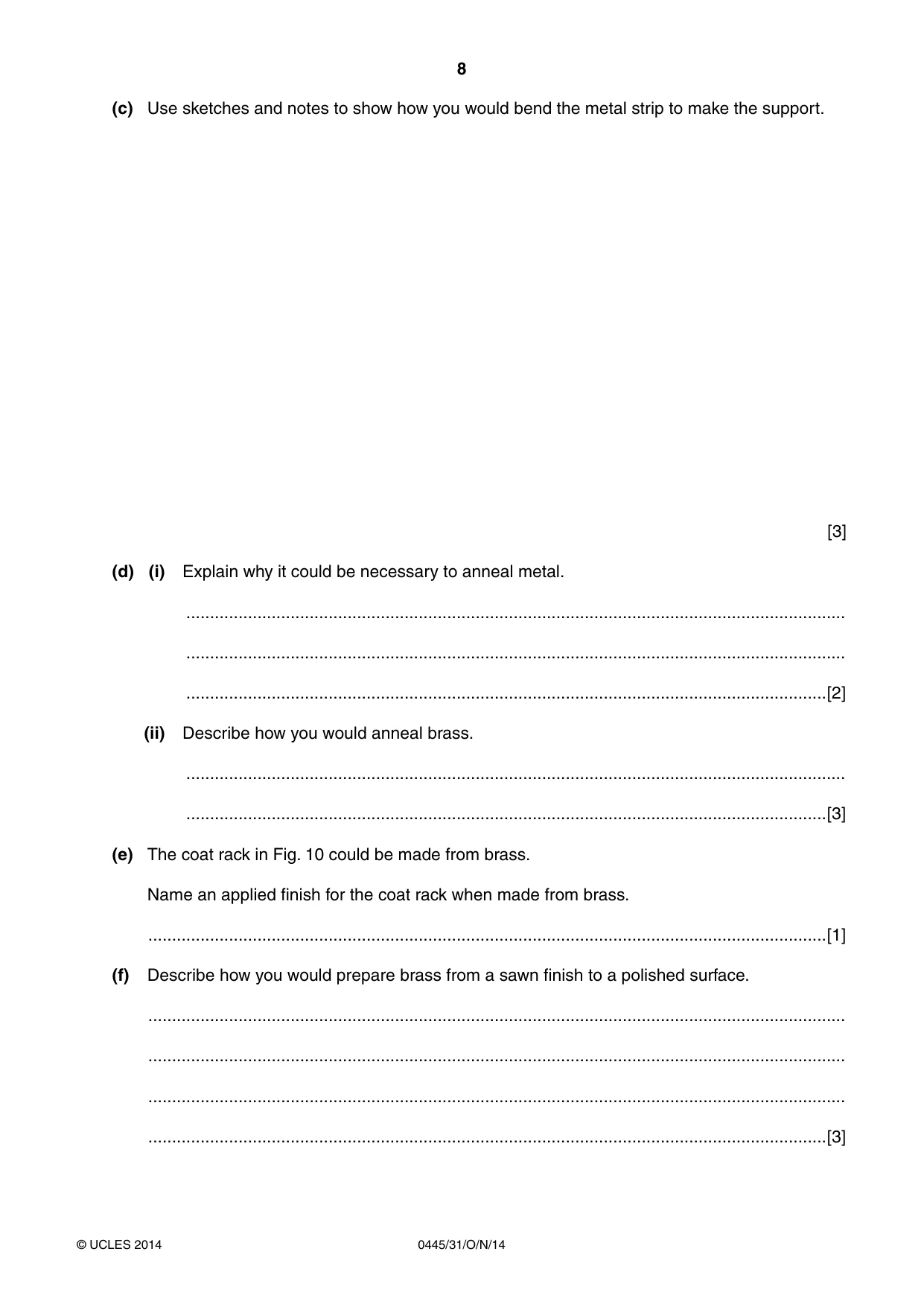
8 0445/31/O/N/14 © UCLES 2014 (c) Use sketches and notes to show how you would bend the metal strip to make the support. [3] (d) (i) Explain why it could be necessary to anneal metal. … … …[2] (ii) Describe how you would anneal brass. … …[3] (e) The coat rack in Fig. 10 could be made from brass. Name an applied finish for the coat rack when made from brass. …[1] (f) Describe how you would prepare brass from a sawn finish to a polished surface. … … … …[3]
Question paper, page 9
9 0445/31/O/N/14 © UCLES 2014 [Turn over (g) (i) The positions for four coat hooks are shown in Fig. 10. Use sketches and notes to show a design for a coat hook that could be joined to the plate. Include details of sizes and materials used. [3] (ii) Describe in detail the processes involved when joining the coat hook designed in (g)(i) permanently to the plate. The use of adhesive is not allowed. [5]
Question paper, page 10
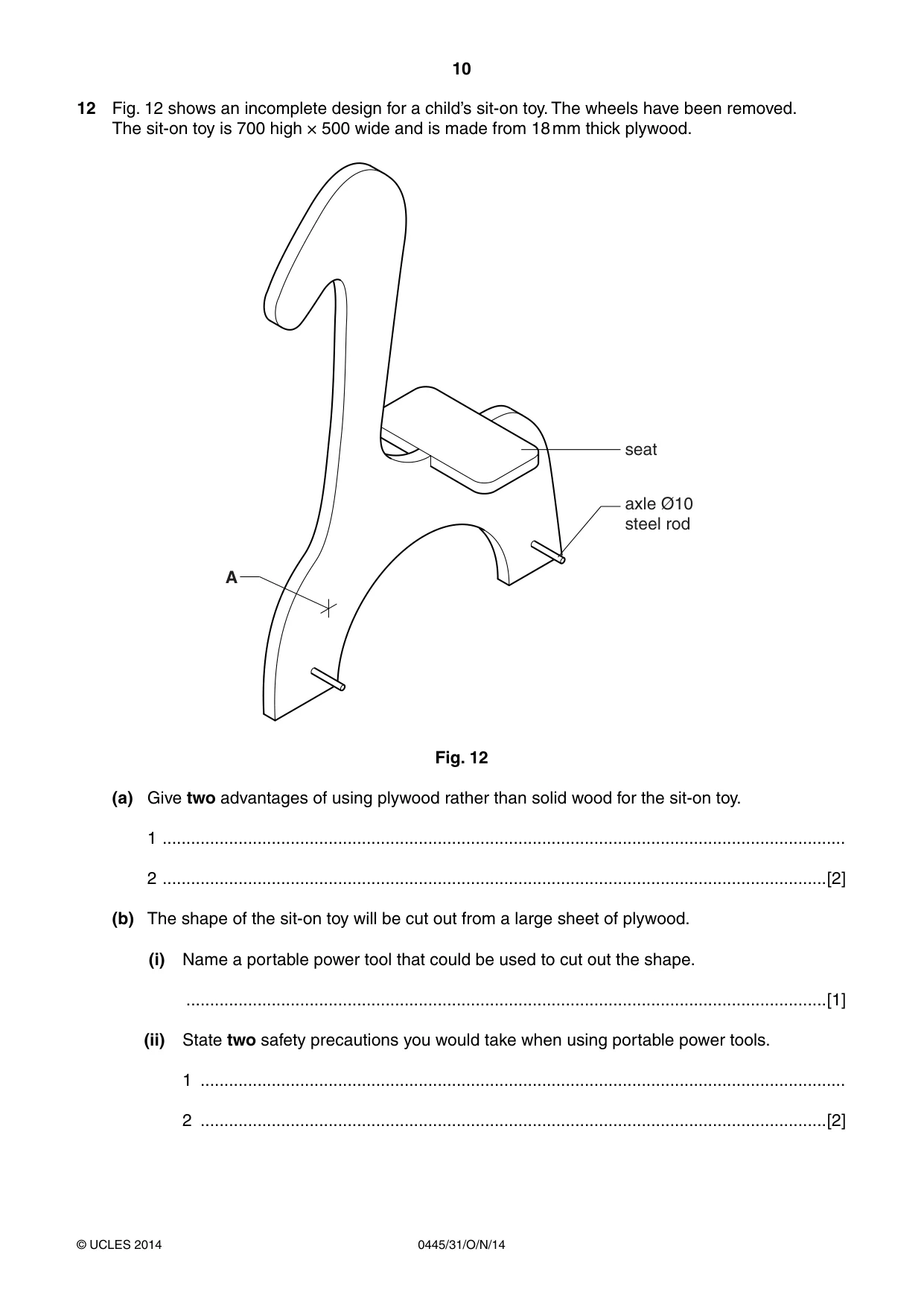
10 0445/31/O/N/14 © UCLES 2014 12 Fig. 12 shows an incomplete design for a child’s sit-on toy. The wheels have been removed. The sit-on toy is 700 high × 500 wide and is made from 18 mm thick plywood. seat axle Ø10 steel rod A Fig. 12 (a) Give two advantages of using plywood rather than solid wood for the sit-on toy. 1 … 2 …[2] (b) The shape of the sit-on toy will be cut out from a large sheet of plywood. (i) Name a portable power tool that could be used to cut out the shape. …[1] (ii) State two safety precautions you would take when using portable power tools. 1 … 2 …[2]
Question paper, page 11
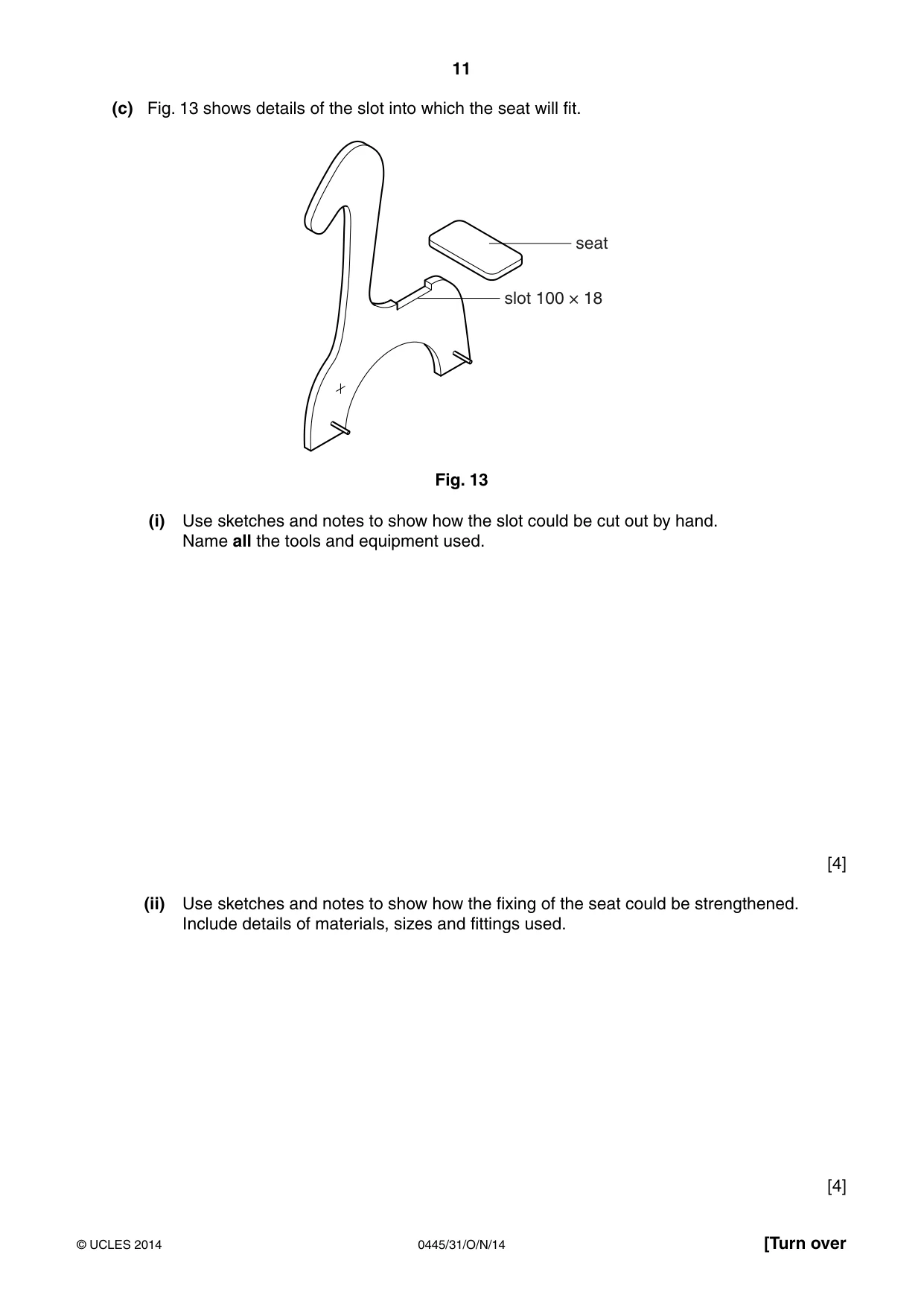
11 0445/31/O/N/14 © UCLES 2014 [Turn over (c) Fig. 13 shows details of the slot into which the seat will fit. seat slot 100 × 18 Fig. 13 (i) Use sketches and notes to show how the slot could be cut out by hand. Name all the tools and equipment used. [4] (ii) Use sketches and notes to show how the fixing of the seat could be strengthened. Include details of materials, sizes and fittings used. [4]
Question paper, page 12
12 0445/31/O/N/14 © UCLES 2014 (d) A foot rest is needed for the sit-on toy. The footrest is to be fitted at A in Fig. 12. Use sketches and notes to design a foot rest that could be adjusted and fixed at three different heights. Include details of materials, sizes and fittings. [5] (e) Explain how the designer has considered anthropometric data in the design of the sit-on toy. … … … …[2]
Question paper, page 13
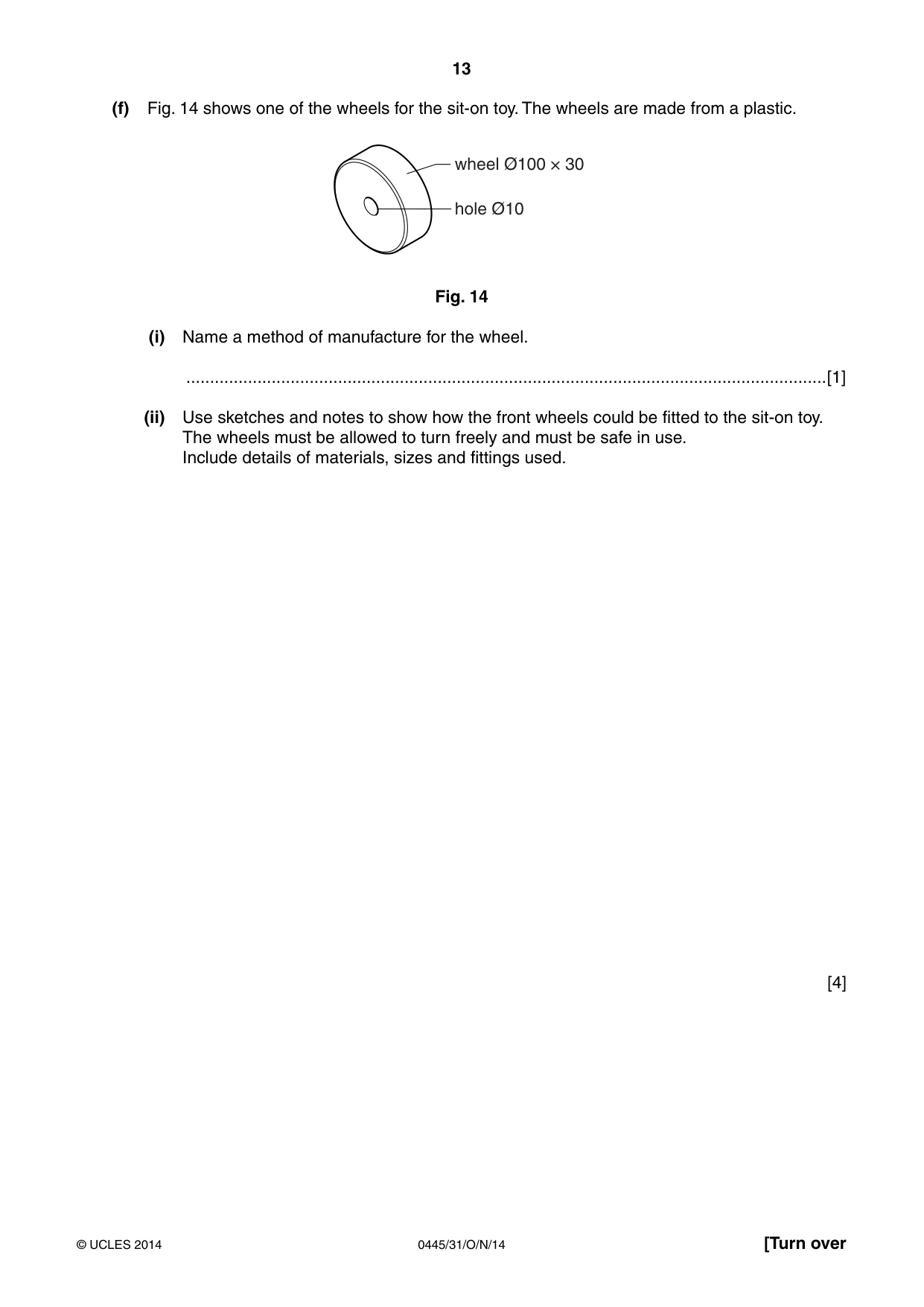
13 0445/31/O/N/14 © UCLES 2014 [Turn over (f) Fig. 14 shows one of the wheels for the sit-on toy. The wheels are made from a plastic. wheel Ø100 × 30 hole Ø10 Fig. 14 (i) Name a method of manufacture for the wheel. …[1] (ii) Use sketches and notes to show how the front wheels could be fitted to the sit-on toy. The wheels must be allowed to turn freely and must be safe in use. Include details of materials, sizes and fittings used. [4]
Question paper, page 14
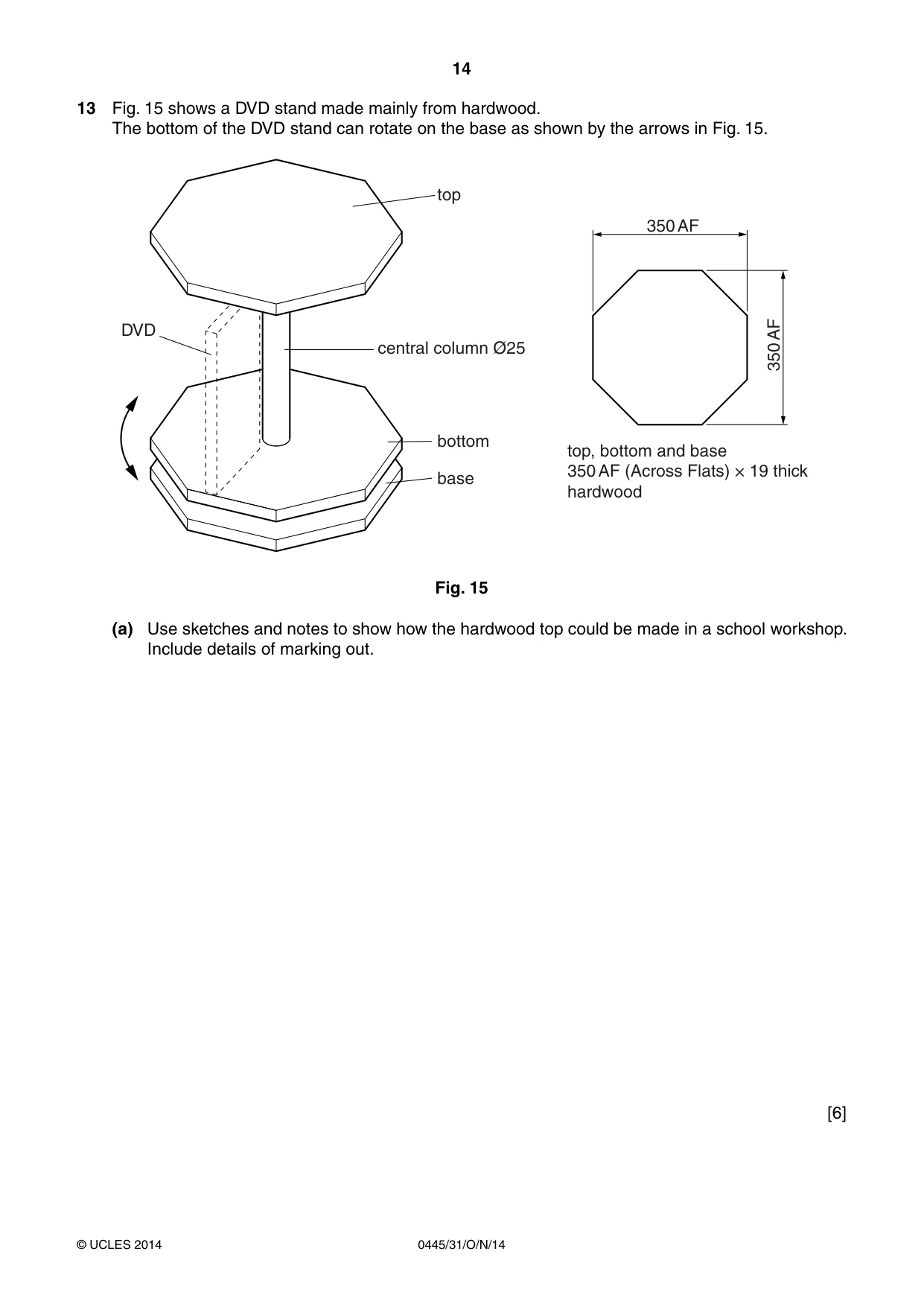
14 0445/31/O/N/14 © UCLES 2014 13 Fig. 15 shows a DVD stand made mainly from hardwood. The bottom of the DVD stand can rotate on the base as shown by the arrows in Fig. 15. top, bottom and base 350 AF (Across Flats) × 19 thick hardwood central column Ø25 DVD top bottom base 350 AF 350 AF Fig. 15 (a) Use sketches and notes to show how the hardwood top could be made in a school workshop. Include details of marking out. [6]
Question paper, page 15
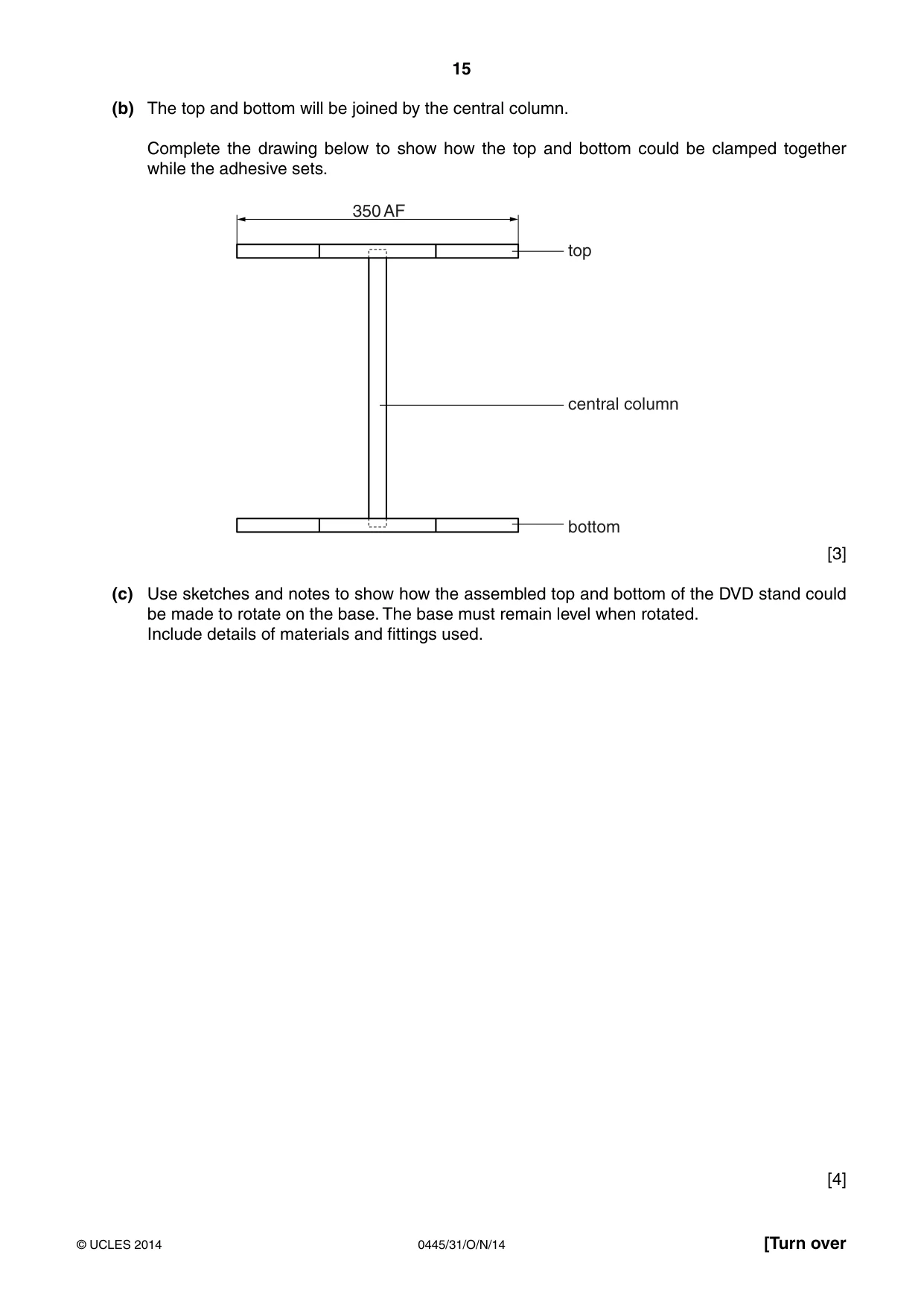
15 0445/31/O/N/14 © UCLES 2014 [Turn over (b) The top and bottom will be joined by the central column. Complete the drawing below to show how the top and bottom could be clamped together while the adhesive sets. top central column bottom 350 AF [3] (c) Use sketches and notes to show how the assembled top and bottom of the DVD stand could be made to rotate on the base. The base must remain level when rotated. Include details of materials and fittings used. [4]
Question paper, page 16
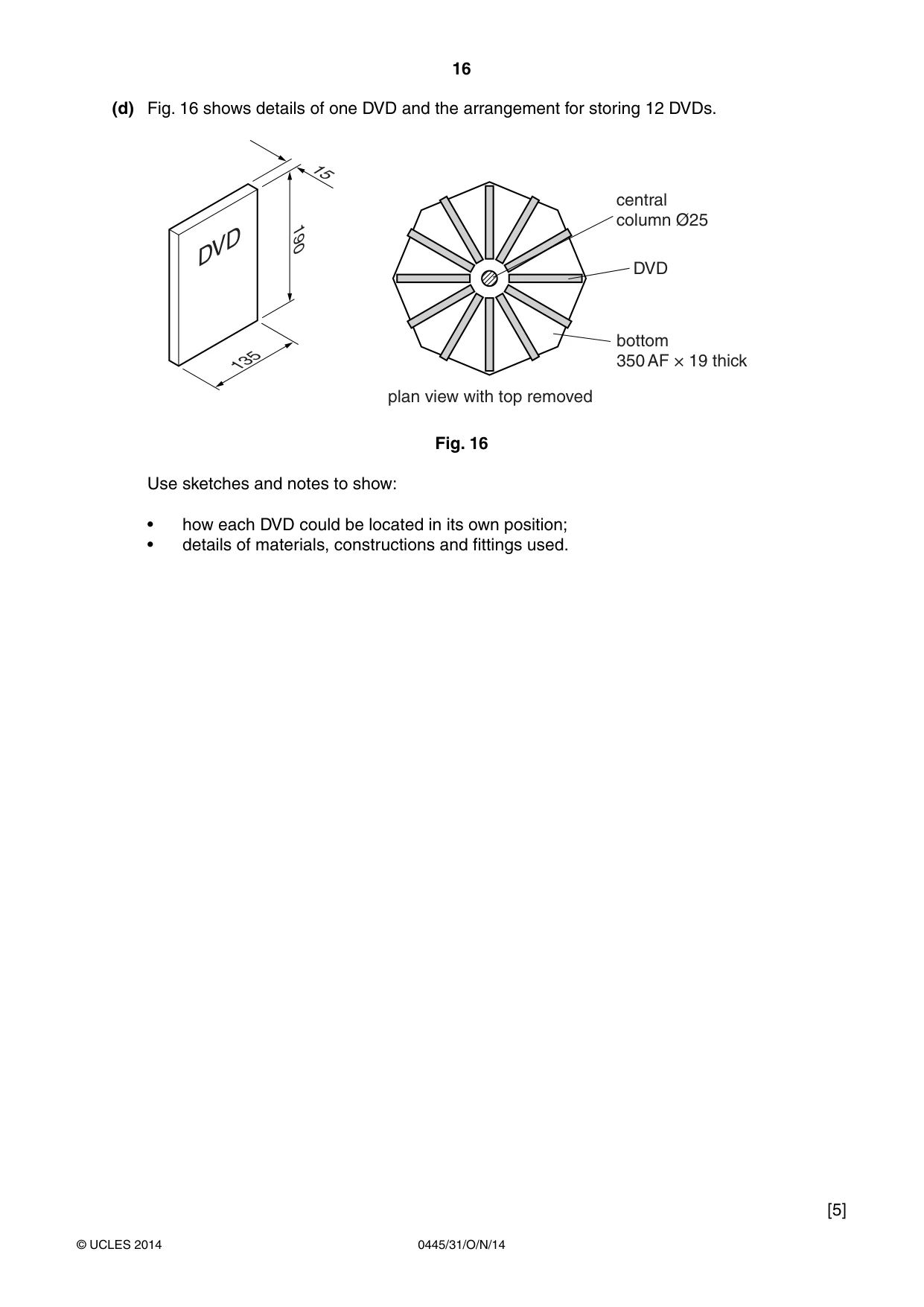
16 0445/31/O/N/14 © UCLES 2014 (d) Fig. 16 shows details of one DVD and the arrangement for storing 12 DVDs. bottom 350 AF × 19 thick plan view with top removed central column Ø25 DVD 135 190 DVD 15 Fig. 16 Use sketches and notes to show: • how each DVD could be located in its own position; • details of materials, constructions and fittings used. [5]
Question paper, page 17
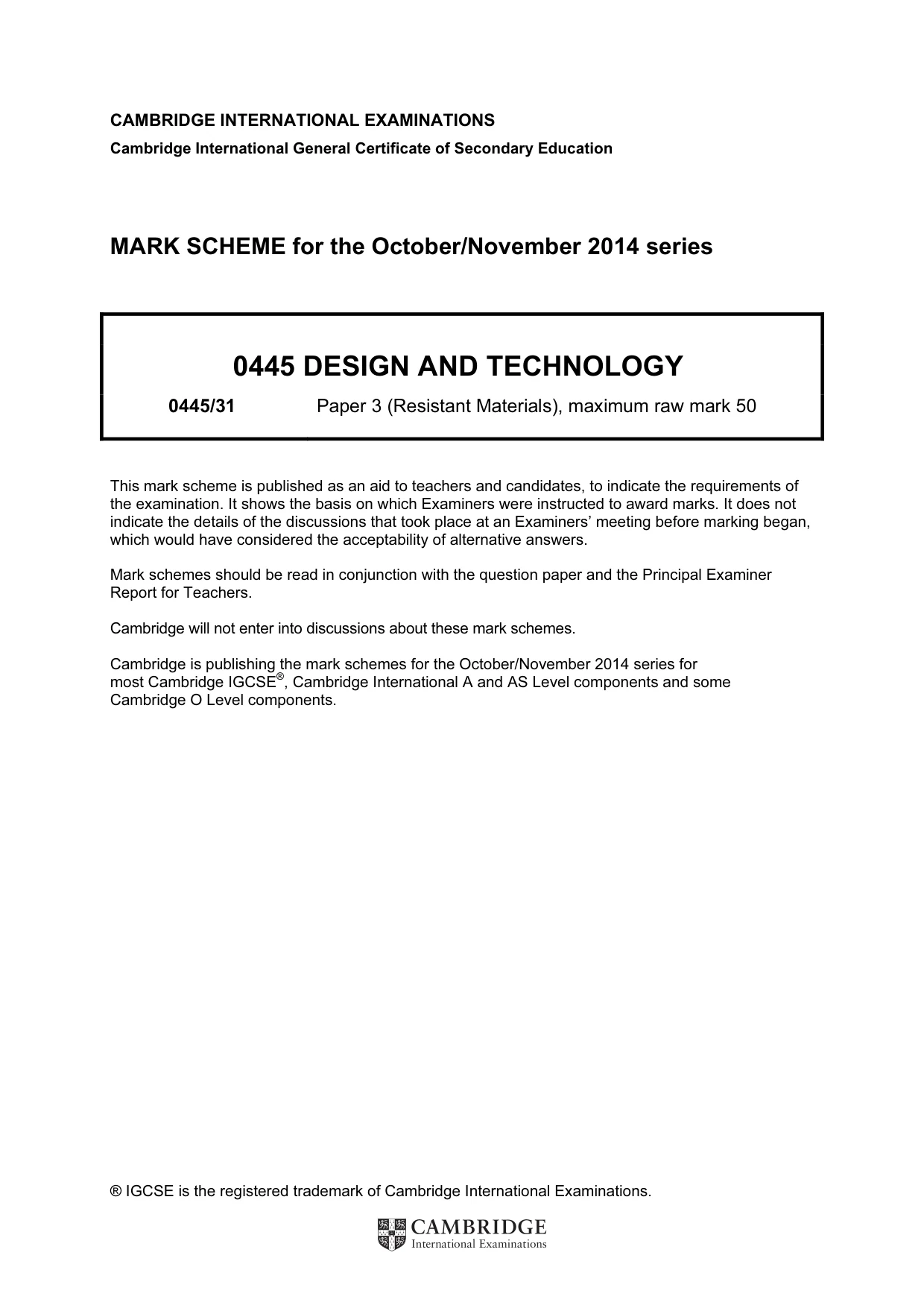
17 0445/31/O/N/14 © UCLES 2014 (e) (i) Name a suitable finish, other than varnish, for the DVD stand. …[1] (ii) Describe how the hardwood could be prepared to take your chosen finish. … … …[2] (f) Describe when the following could be used in the manufacture of the DVD stand: template … jig …[2] (g) Explain why the hardwood used to make the DVD stand would need to be seasoned. … … …[2]
Question paper, page 18
18 0445/31/O/N/14 © UCLES 2014 BLANK PAGE
Question paper, page 19
19 0445/31/O/N/14 © UCLES 2014 BLANK PAGE
Question paper, page 20
20 0445/31/O/N/14 © UCLES 2014 Permission to reproduce items where third-party owned material protected by copyright is included has been sought and cleared where possible. Every reasonable effort has been made by the publisher (UCLES) to trace copyright holders, but if any items requiring clearance have unwittingly been included, the publisher will be pleased to make amends at the earliest possible opportunity. Cambridge International Examinations is part of the Cambridge Assessment Group. Cambridge Assessment is the brand name of University of Cambridge Local Examinations Syndicate (UCLES), which is itself a department of the University of Cambridge. BLANK PAGE
Mark scheme, page 1
® IGCSE is the registered trademark of Cambridge International Examinations. CAMBRIDGE INTERNATIONAL EXAMINATIONS Cambridge International General Certificate of Secondary Education MARK SCHEME for the October/November 2014 series 0445 DESIGN AND TECHNOLOGY 0445/31 Paper 3 (Resistant Materials), maximum raw mark 50 This mark scheme is published as an aid to teachers and candidates, to indicate the requirements of the examination. It shows the basis on which Examiners were instructed to award marks. It does not indicate the details of the discussions that took place at an Examiners’ meeting before marking began, which would have considered the acceptability of alternative answers. Mark schemes should be read in conjunction with the question paper and the Principal Examiner Report for Teachers. Cambridge will not enter into discussions about these mark schemes. Cambridge is publishing the mark schemes for the October/November 2014 series for most Cambridge IGCSE®, Cambridge International A and AS Level components and some Cambridge O Level components.
Mark scheme, page 2
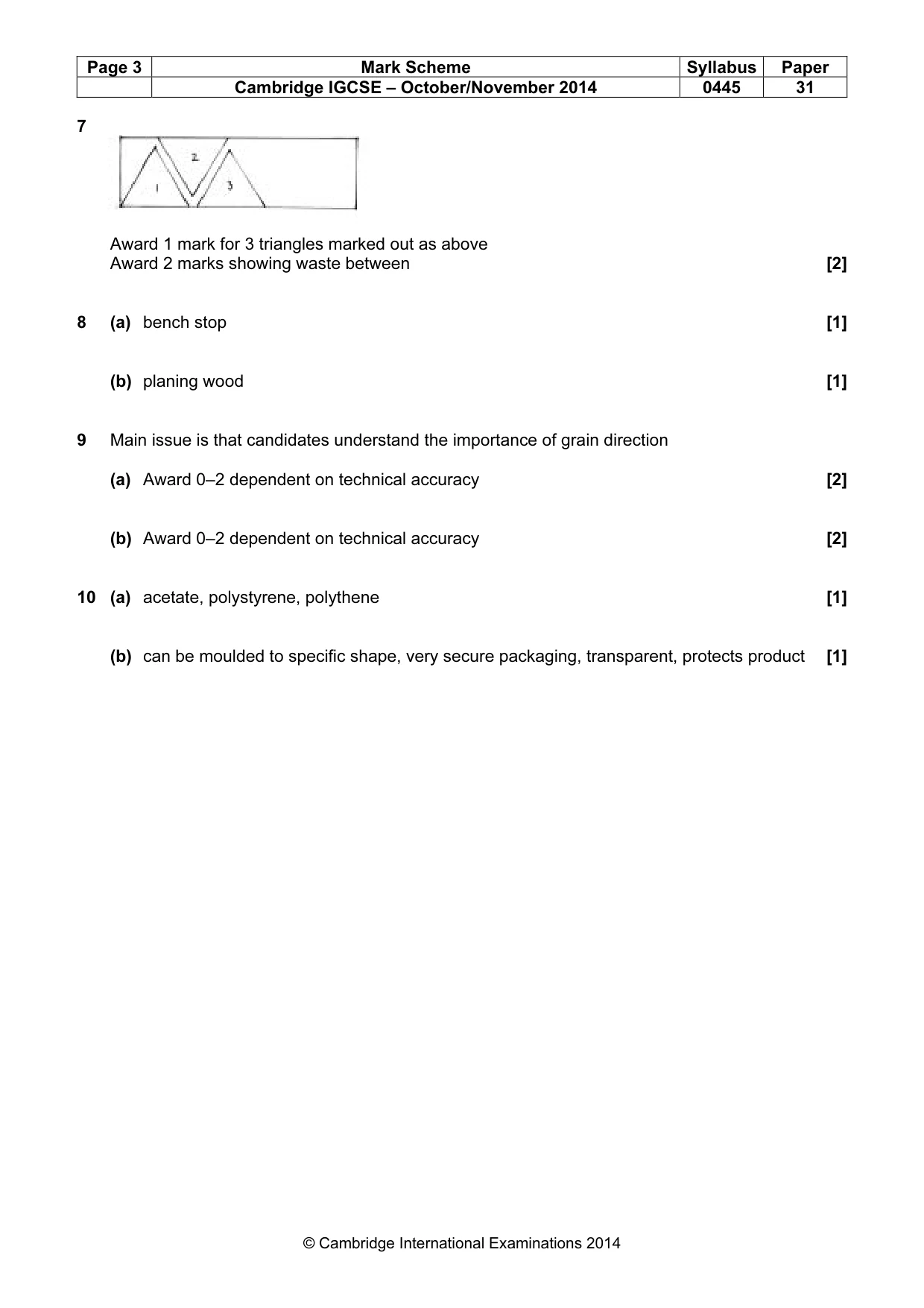
Page 2 Mark Scheme Syllabus Paper Cambridge IGCSE – October/November 2014 0445 31 © Cambridge International Examinations 2014 Section A 1 (a) aluminium, steel [1] (b) polypropylene [1] (c) paint, electroplating such as chrome, dip coated plastic, powder coating, anodised [1] (d) protect, make appearance more attractive [1] 2 Tool Name Specific use Rip, Cross-cut, Sheet, Hand, Panel saw Cutting wood, plastic, metal Inside calipers Measuring the internal diameter of tube 4 × 1 [4] 3 (a) benefit of cordless electric drill: versatile use in wide variety of situations, portable [1] (b) benefit of bench drill: guaranteed vertical drilling, more robust, stable, secure, more drilling power [1] 4 (a) tenon saw, dovetail saw [1] (b) bench hook or cutting board [1] 5 A scriber 1 B centre square 1 [2] 6 casting / sand casting [1]
Mark scheme, page 3
Page 3 Mark Scheme Syllabus Paper Cambridge IGCSE – October/November 2014 0445 31 © Cambridge International Examinations 2014 7 Award 1 mark for 3 triangles marked out as above Award 2 marks showing waste between [2] 8 (a) bench stop [1] (b) planing wood [1] 9 Main issue is that candidates understand the importance of grain direction (a) Award 0–2 dependent on technical accuracy [2] (b) Award 0–2 dependent on technical accuracy [2] 10 (a) acetate, polystyrene, polythene [1] (b) can be moulded to specific shape, very secure packaging, transparent, protects product [1]
Mark scheme, page 4
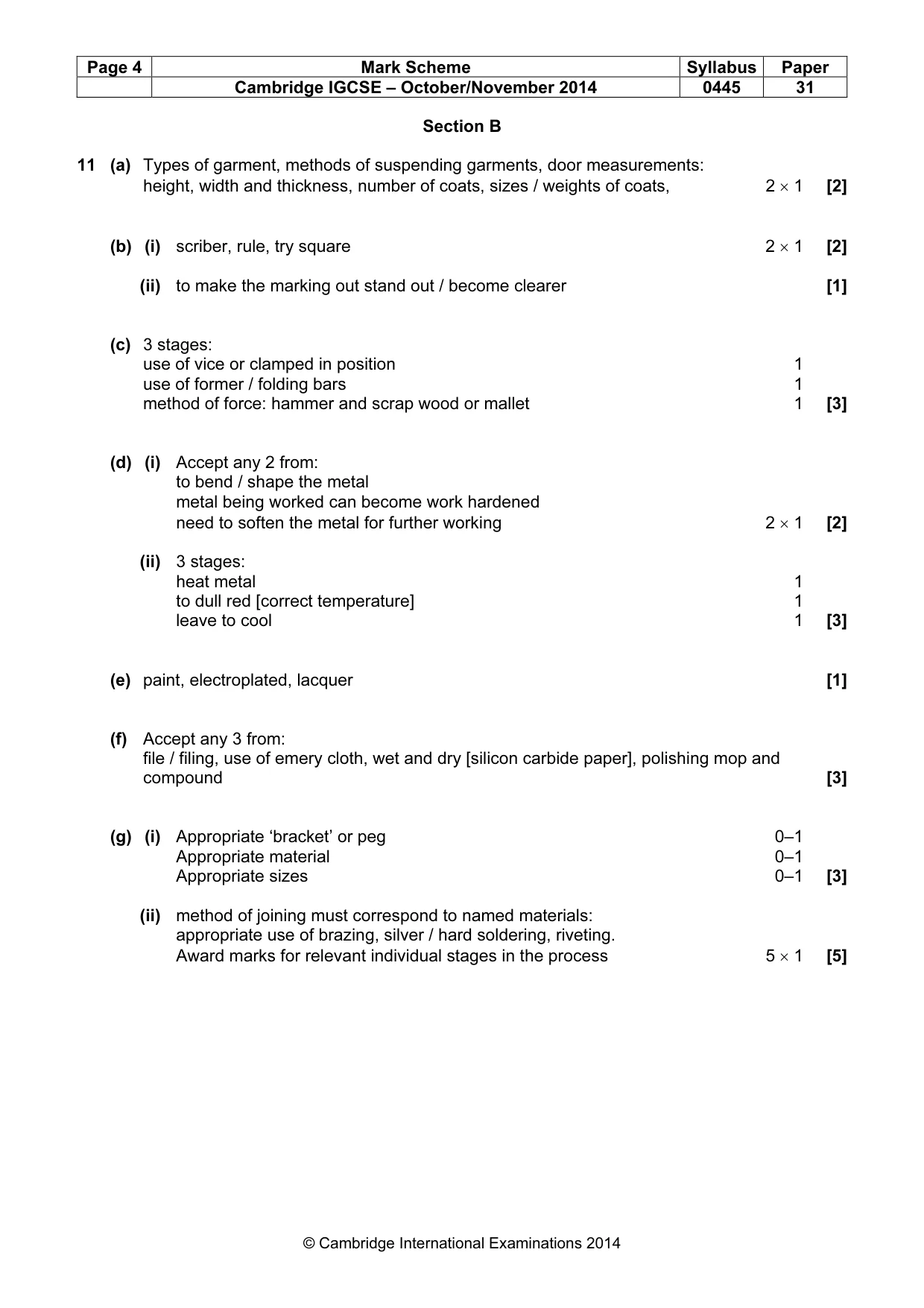
Page 4 Mark Scheme Syllabus Paper Cambridge IGCSE – October/November 2014 0445 31 © Cambridge International Examinations 2014 Section B 11 (a) Types of garment, methods of suspending garments, door measurements: height, width and thickness, number of coats, sizes / weights of coats, 2 × 1 [2] (b) (i) scriber, rule, try square 2 × 1 [2] (ii) to make the marking out stand out / become clearer [1] (c) 3 stages: use of vice or clamped in position 1 use of former / folding bars 1 method of force: hammer and scrap wood or mallet 1 [3] (d) (i) Accept any 2 from: to bend / shape the metal metal being worked can become work hardened need to soften the metal for further working 2 × 1 [2] (ii) 3 stages: heat metal 1 to dull red [correct temperature] 1 leave to cool 1 [3] (e) paint, electroplated, lacquer [1] (f) Accept any 3 from: file / filing, use of emery cloth, wet and dry [silicon carbide paper], polishing mop and compound [3] (g) (i) Appropriate ‘bracket’ or peg 0–1 Appropriate material 0–1 Appropriate sizes 0–1 [3] (ii) method of joining must correspond to named materials: appropriate use of brazing, silver / hard soldering, riveting. Award marks for relevant individual stages in the process 5 × 1 [5]
Mark scheme, page 5
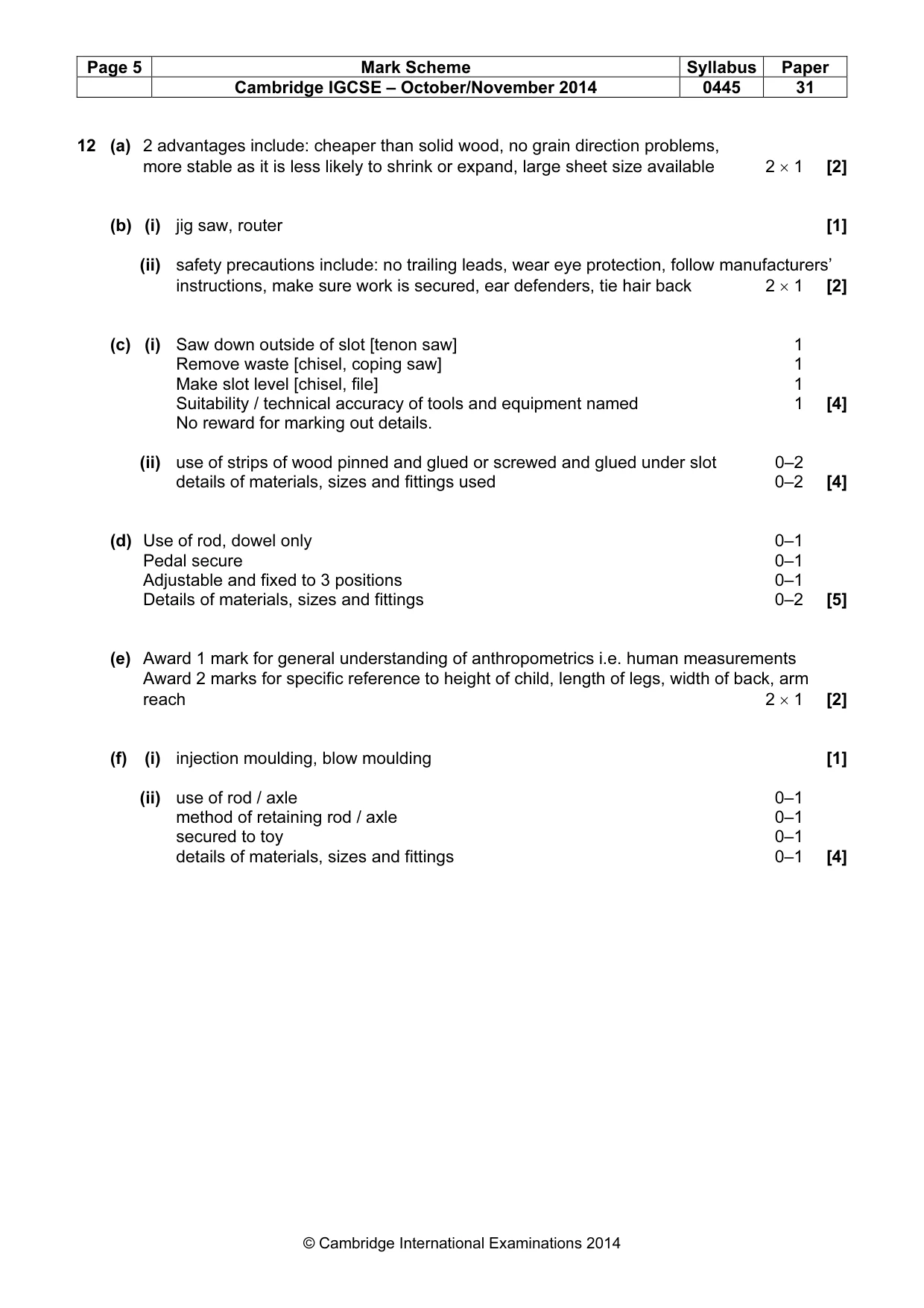
Page 5 Mark Scheme Syllabus Paper Cambridge IGCSE – October/November 2014 0445 31 © Cambridge International Examinations 2014 12 (a) 2 advantages include: cheaper than solid wood, no grain direction problems, more stable as it is less likely to shrink or expand, large sheet size available 2 × 1 [2] (b) (i) jig saw, router [1] (ii) safety precautions include: no trailing leads, wear eye protection, follow manufacturers’ instructions, make sure work is secured, ear defenders, tie hair back 2 × 1 [2] (c) (i) Saw down outside of slot [tenon saw] 1 Remove waste [chisel, coping saw] 1 Make slot level [chisel, file] 1 Suitability / technical accuracy of tools and equipment named 1 [4] No reward for marking out details. (ii) use of strips of wood pinned and glued or screwed and glued under slot 0–2 details of materials, sizes and fittings used 0–2 [4] (d) Use of rod, dowel only 0–1 Pedal secure 0–1 Adjustable and fixed to 3 positions 0–1 Details of materials, sizes and fittings 0–2 [5] (e) Award 1 mark for general understanding of anthropometrics i.e. human measurements Award 2 marks for specific reference to height of child, length of legs, width of back, arm reach 2 × 1 [2] (f) (i) injection moulding, blow moulding [1] (ii) use of rod / axle 0–1 method of retaining rod / axle 0–1 secured to toy 0–1 details of materials, sizes and fittings 0–1 [4]
Mark scheme, page 6
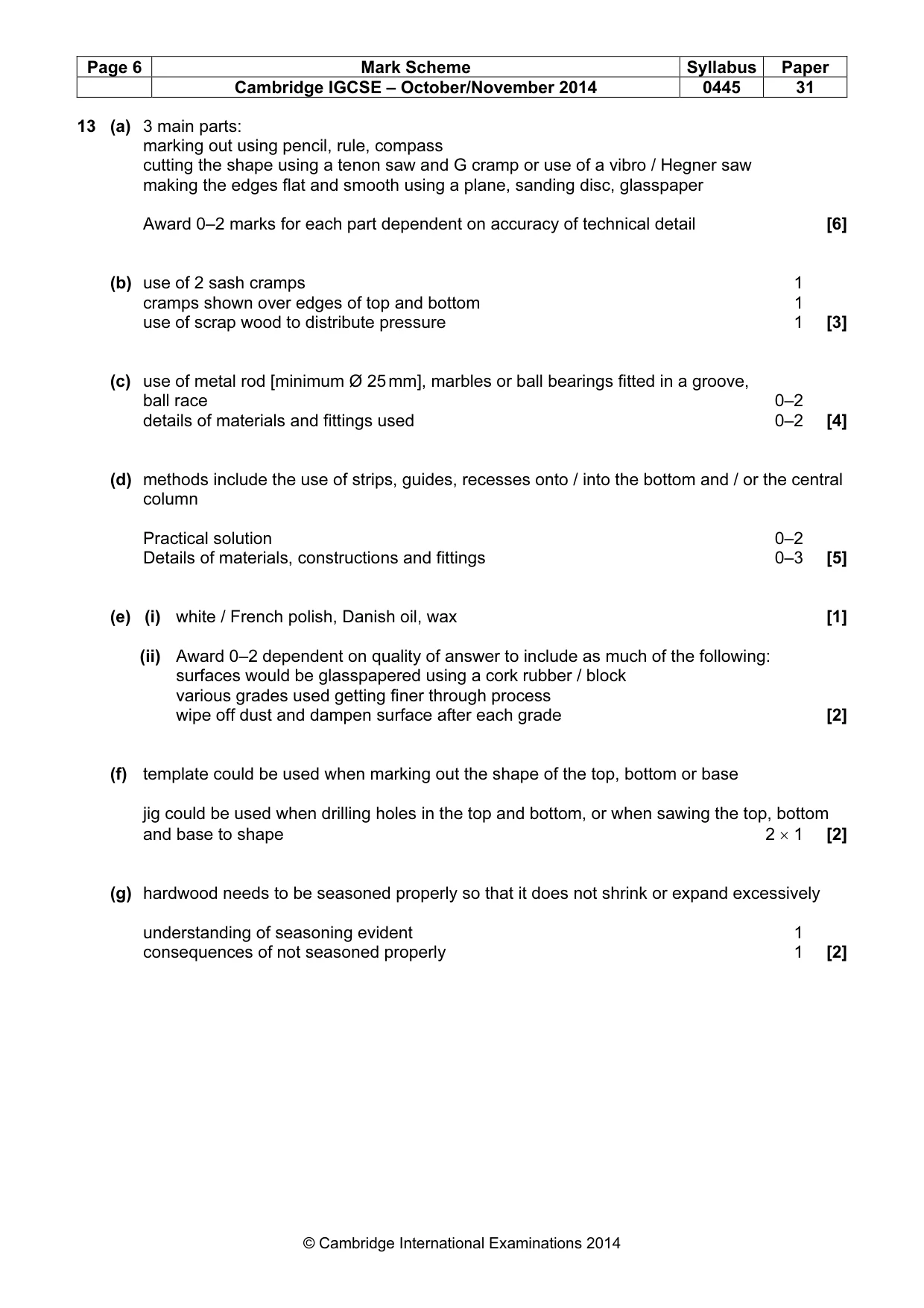
Page 6 Mark Scheme Syllabus Paper Cambridge IGCSE – October/November 2014 0445 31 © Cambridge International Examinations 2014 13 (a) 3 main parts: marking out using pencil, rule, compass cutting the shape using a tenon saw and G cramp or use of a vibro / Hegner saw making the edges flat and smooth using a plane, sanding disc, glasspaper Award 0–2 marks for each part dependent on accuracy of technical detail [6] (b) use of 2 sash cramps 1 cramps shown over edges of top and bottom 1 use of scrap wood to distribute pressure 1 [3] (c) use of metal rod [minimum Ø 25 mm], marbles or ball bearings fitted in a groove, ball race 0–2 details of materials and fittings used 0–2 [4] (d) methods include the use of strips, guides, recesses onto / into the bottom and / or the central column Practical solution 0–2 Details of materials, constructions and fittings 0–3 [5] (e) (i) white / French polish, Danish oil, wax [1] (ii) Award 0–2 dependent on quality of answer to include as much of the following: surfaces would be glasspapered using a cork rubber / block various grades used getting finer through process wipe off dust and dampen surface after each grade [2] (f) template could be used when marking out the shape of the top, bottom or base jig could be used when drilling holes in the top and bottom, or when sawing the top, bottom and base to shape 2 × 1 [2] (g) hardwood needs to be seasoned properly so that it does not shrink or expand excessively understanding of seasoning evident 1 consequences of not seasoned properly 1 [2]
What you needed in this session
Cambridge’s own grade thresholds for 2014 Oct/Nov, Paper 3 · Variant 1. A higher threshold means an easier paper — the bar moves with how the cohort did.