Cambridge IGCSE Design and Technology 0445 — 2013 May/June Paper 3 · Variant 1
0445/31/M/J/13 · 50 marks · ≈56 min
The question paper and its mark scheme, free to read here and free to download. This is Cambridge’s own paper, exactly as it was sat.
Question paper16 pages
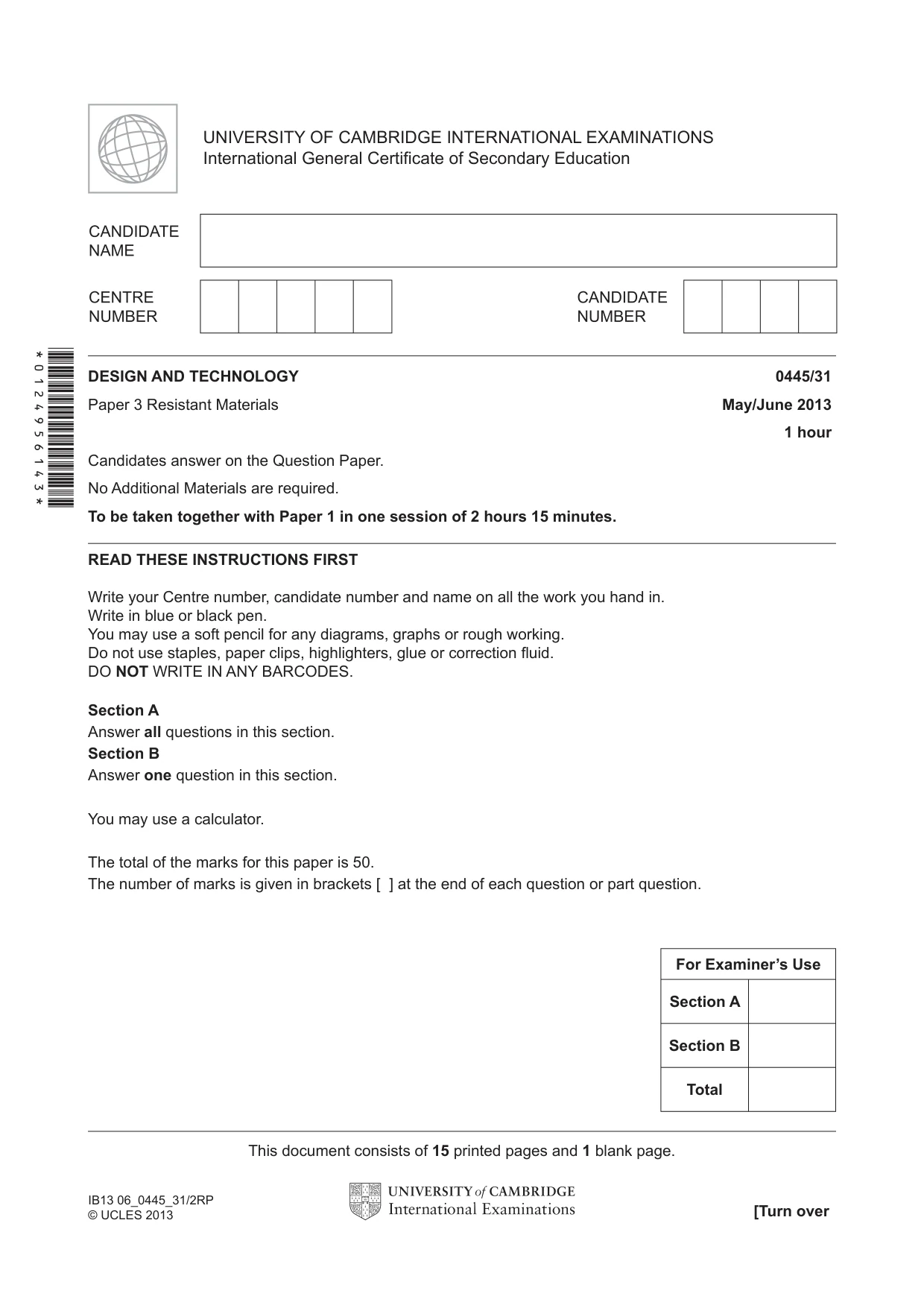
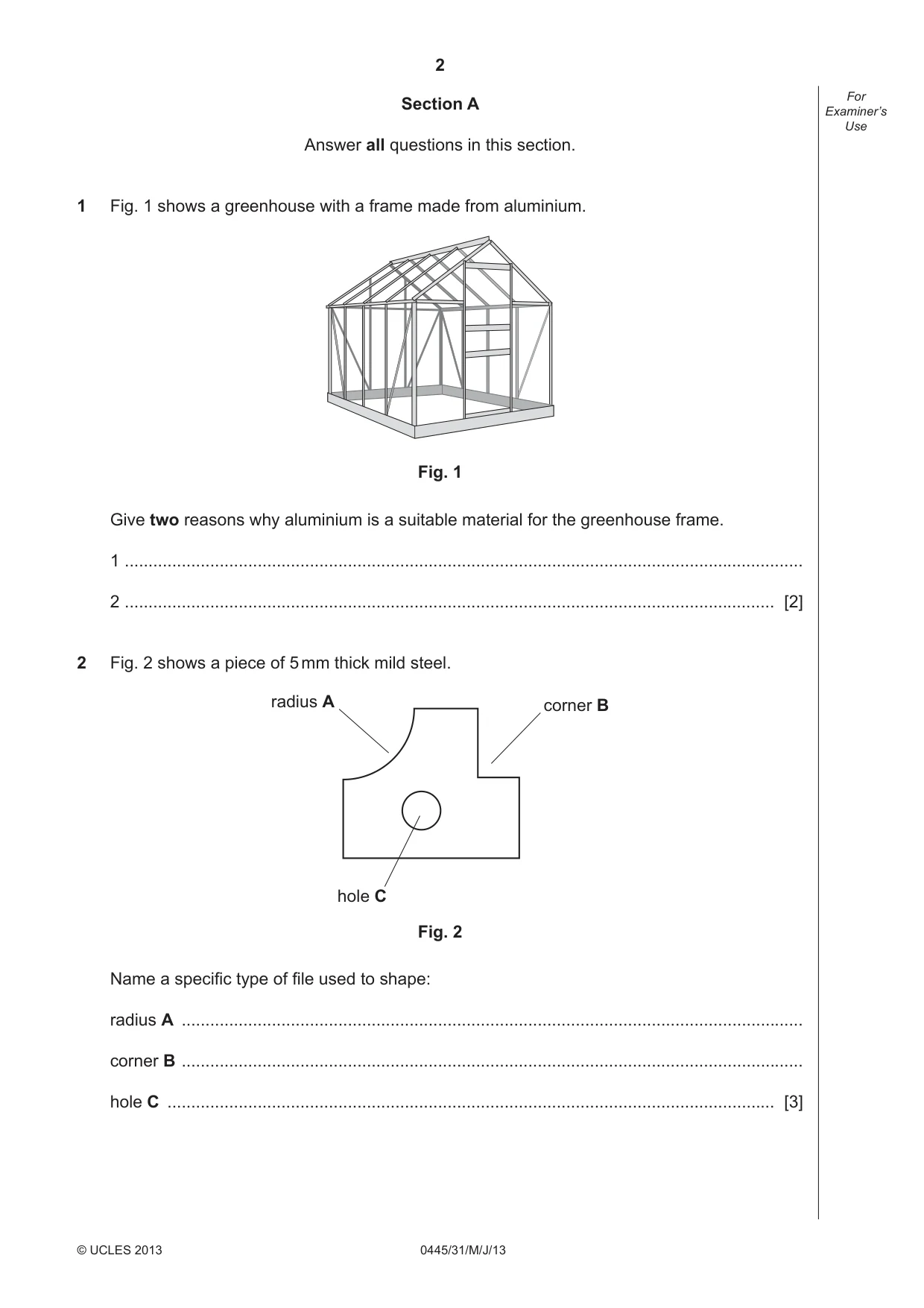
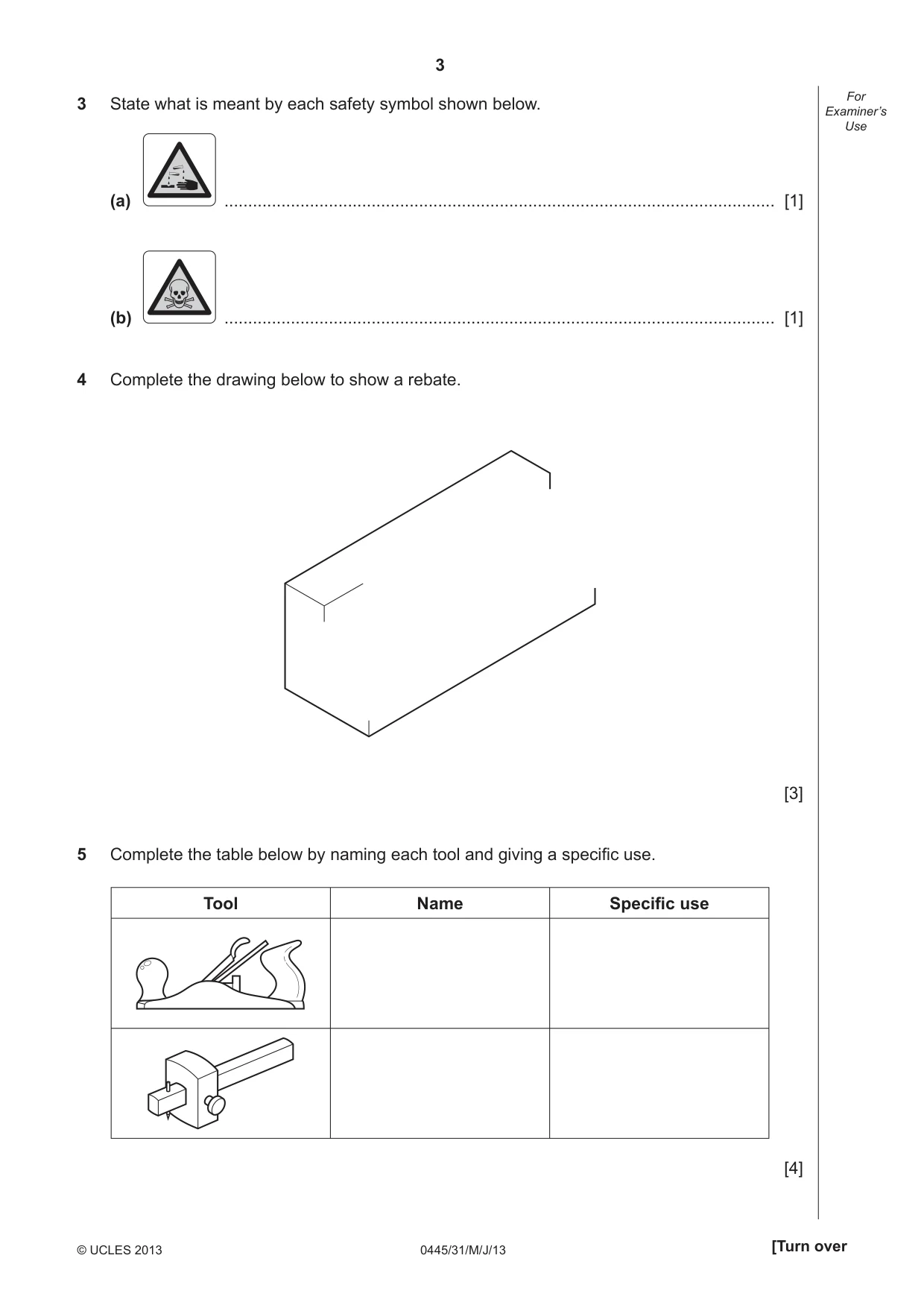
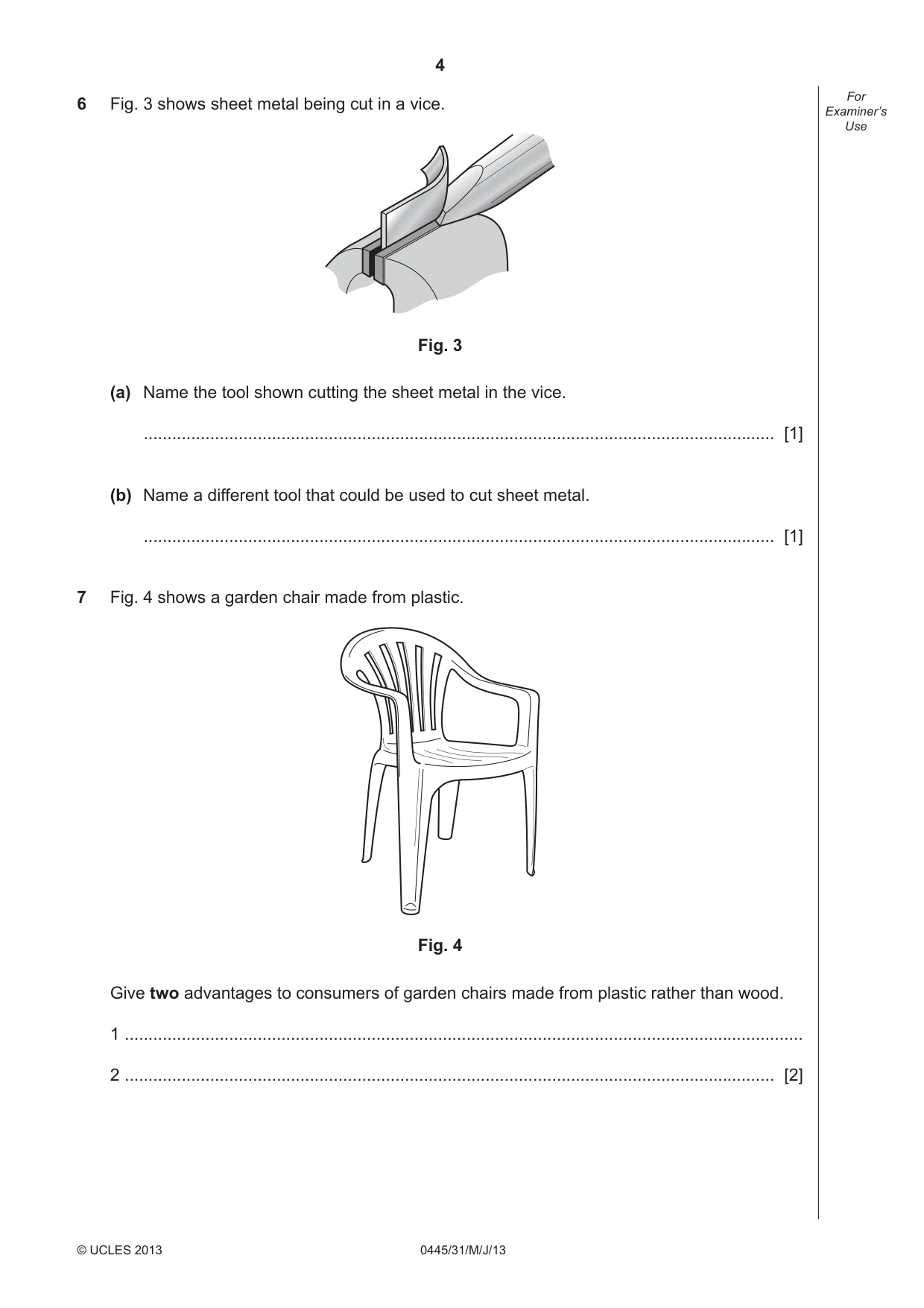
Mark scheme7 pages
Answers below. Sit the paper first if you are practising.
Paper as text
Question paper, page 1
READ THESE INSTRUCTIONS FIRST Write your Centre number, candidate number and name on all the work you hand in. Write in blue or black pen. You may use a soft pencil for any diagrams, graphs or rough working. Do not use staples, paper clips, highlighters, glue or correction fl uid. DO NOT WRITE IN ANY BARCODES. Section A Answer all questions in this section. Section B Answer one question in this section. You may use a calculator. The total of the marks for this paper is 50. The number of marks is given in brackets [ ] at the end of each question or part question. DESIGN AND TECHNOLOGY 0445/31 Paper 3 Resistant Materials May/June 2013 1 hour Candidates answer on the Question Paper. No Additional Materials are required. To be taken together with Paper 1 in one session of 2 hours 15 minutes. UNIVERSITY OF CAMBRIDGE INTERNATIONAL EXAMINATIONS International General Certifi cate of Secondary Education This document consists of 15 printed pages and 1 blank page. [Turn over IB13 06_0445_31/2RP © UCLES 2013 *0124956143* For Examiner’s Use Section A Section B Total
Question paper, page 2
2 0445/31/M/J/13 © UCLES 2013 For Examiner’s Use Section A Answer all questions in this section. 1 Fig. 1 shows a greenhouse with a frame made from aluminium. Fig. 1 Give two reasons why aluminium is a suitable material for the greenhouse frame. 1 … 2 … [2] 2 Fig. 2 shows a piece of 5 mm thick mild steel. corner B hole C radius A Fig. 2 Name a specifi c type of fi le used to shape: radius A … corner B … hole C … [3]
Question paper, page 3
3 0445/31/M/J/13 © UCLES 2013 [Turn over For Examiner’s Use 3 State what is meant by each safety symbol shown below. (a) … [1] (b) … [1] 4 Complete the drawing below to show a rebate. [3] 5 Complete the table below by naming each tool and giving a specifi c use. Tool Name Specifi c use [4]
Question paper, page 4
4 0445/31/M/J/13 © UCLES 2013 For Examiner’s Use 6 Fig. 3 shows sheet metal being cut in a vice. Fig. 3 (a) Name the tool shown cutting the sheet metal in the vice. … [1] (b) Name a different tool that could be used to cut sheet metal. … [1] 7 Fig. 4 shows a garden chair made from plastic. Fig. 4 Give two advantages to consumers of garden chairs made from plastic rather than wood. 1 … 2 … [2]
Question paper, page 5
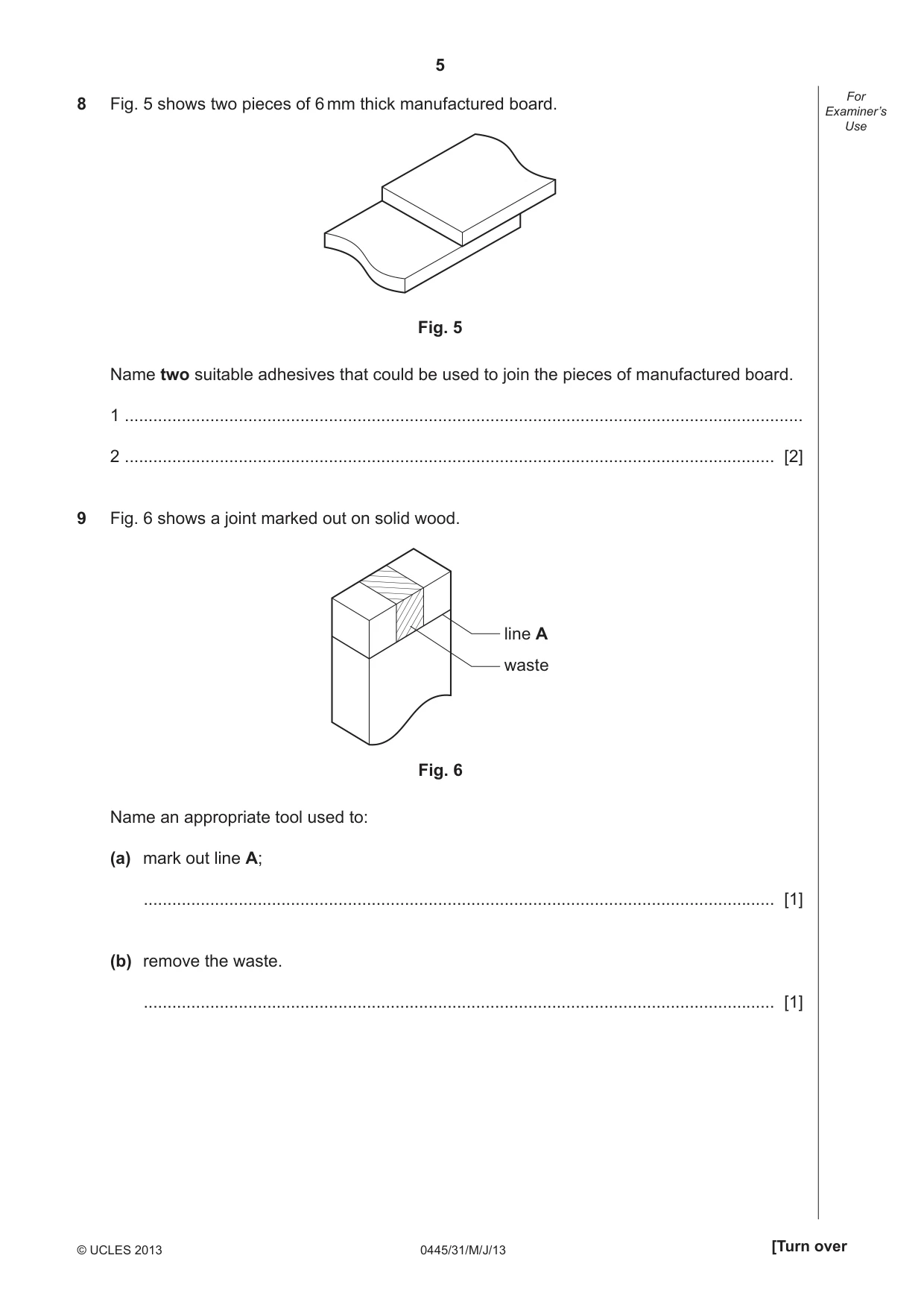
5 0445/31/M/J/13 © UCLES 2013 [Turn over For Examiner’s Use 8 Fig. 5 shows two pieces of 6 mm thick manufactured board. Fig. 5 Name two suitable adhesives that could be used to join the pieces of manufactured board. 1 … 2 … [2] 9 Fig. 6 shows a joint marked out on solid wood. line A waste Fig. 6 Name an appropriate tool used to: (a) mark out line A; … [1] (b) remove the waste. … [1]
Question paper, page 6
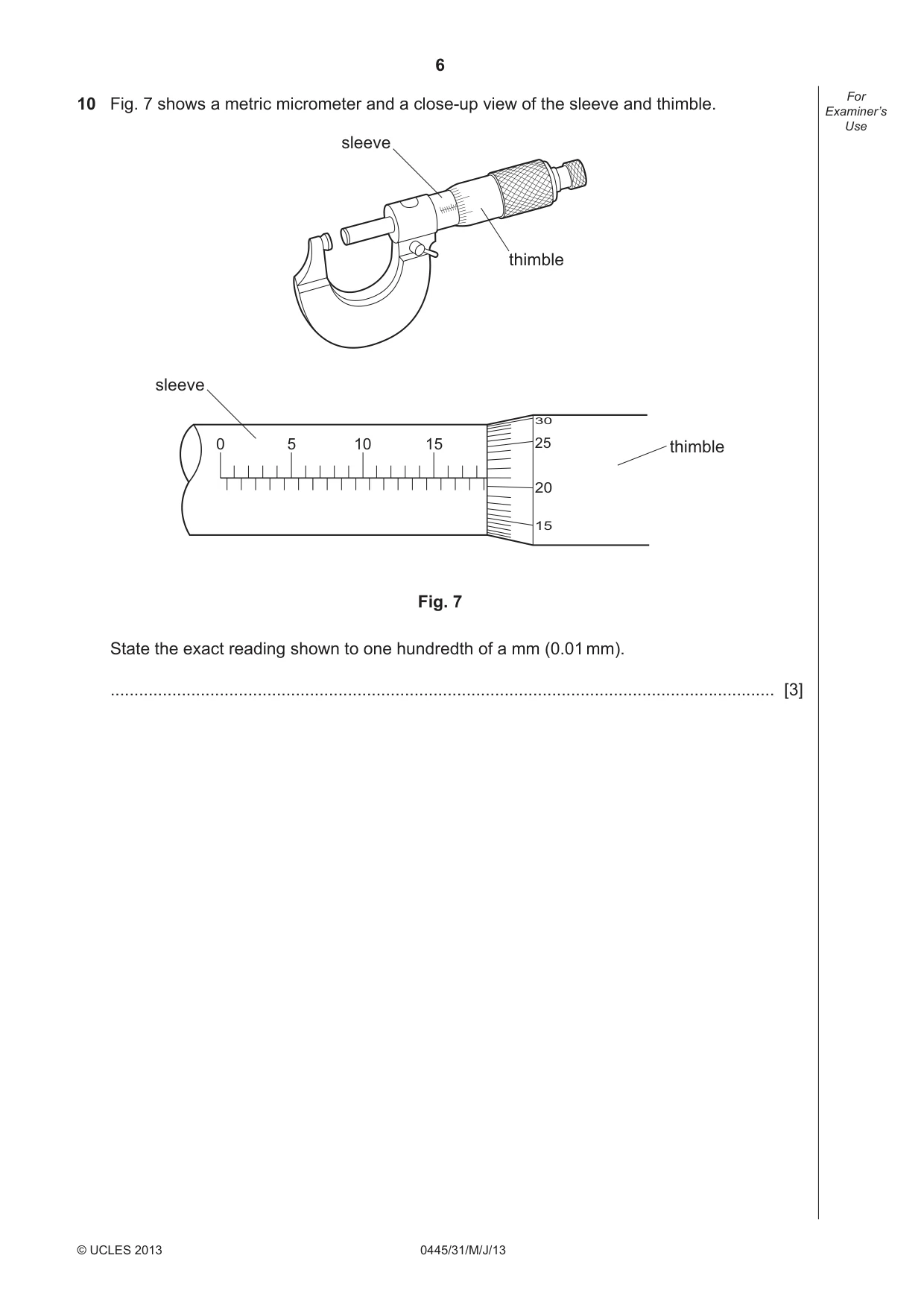
6 0445/31/M/J/13 © UCLES 2013 For Examiner’s Use 10 Fig. 7 shows a metric micrometer and a close-up view of the sleeve and thimble. sleeve 0 5 15 10 30 25 20 15 sleeve thimble thimble Fig. 7 State the exact reading shown to one hundredth of a mm (0.01 mm). … [3]
Question paper, page 7
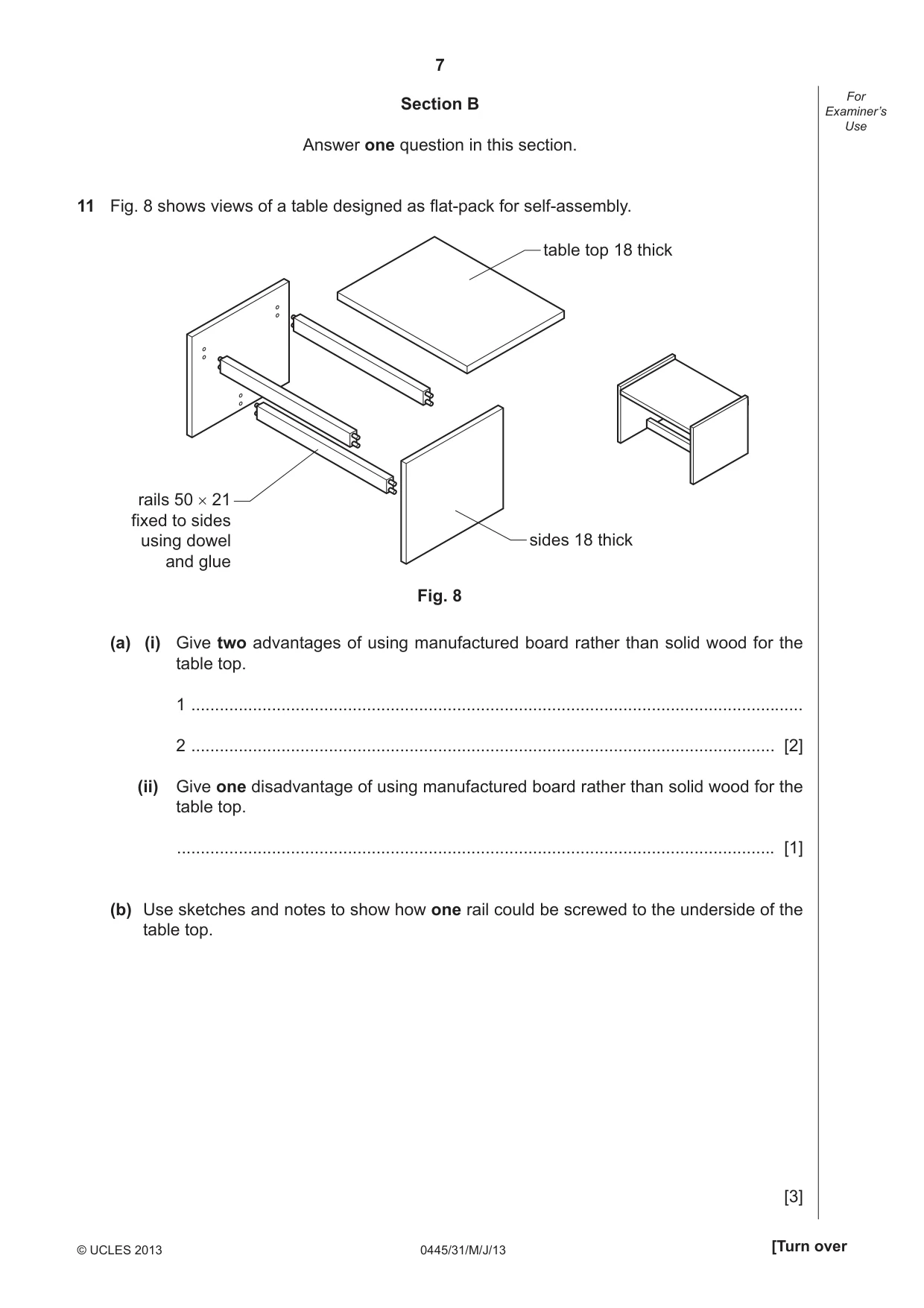
7 0445/31/M/J/13 © UCLES 2013 [Turn over For Examiner’s Use Section B Answer one question in this section. 11 Fig. 8 shows views of a table designed as fl at-pack for self-assembly. sides 18 thick table top 18 thick rails 50 × 21 fixed to sides using dowel and glue Fig. 8 (a) (i) Give two advantages of using manufactured board rather than solid wood for the table top. 1 … 2 … [2] (ii) Give one disadvantage of using manufactured board rather than solid wood for the table top. … [1] (b) Use sketches and notes to show how one rail could be screwed to the underside of the table top. [3]
Question paper, page 8
8 0445/31/M/J/13 © UCLES 2013 For Examiner’s Use (c) (i) Use sketches and notes to show how the holes in the rail and side could be marked out so that they line up accurately. [4] (ii) Use sketches and notes to show a permanent construction, other than a dowel joint, that could be used to fi x one rail to a side. Additional materials may be used. [4] (iii) Use sketches and notes to show how a KD (knock-down) fi tting could be used to join one rail to a side. [3]
Question paper, page 9
9 0445/31/M/J/13 © UCLES 2013 [Turn over For Examiner’s Use (d) Give two benefi ts of using an electric sander to prepare the surface of the table top to take a fi nish. 1 … 2 … [2] (e) Use sketches and notes to produce a set of instructions showing consumers how to assemble the parts of the table. [6]
Question paper, page 10
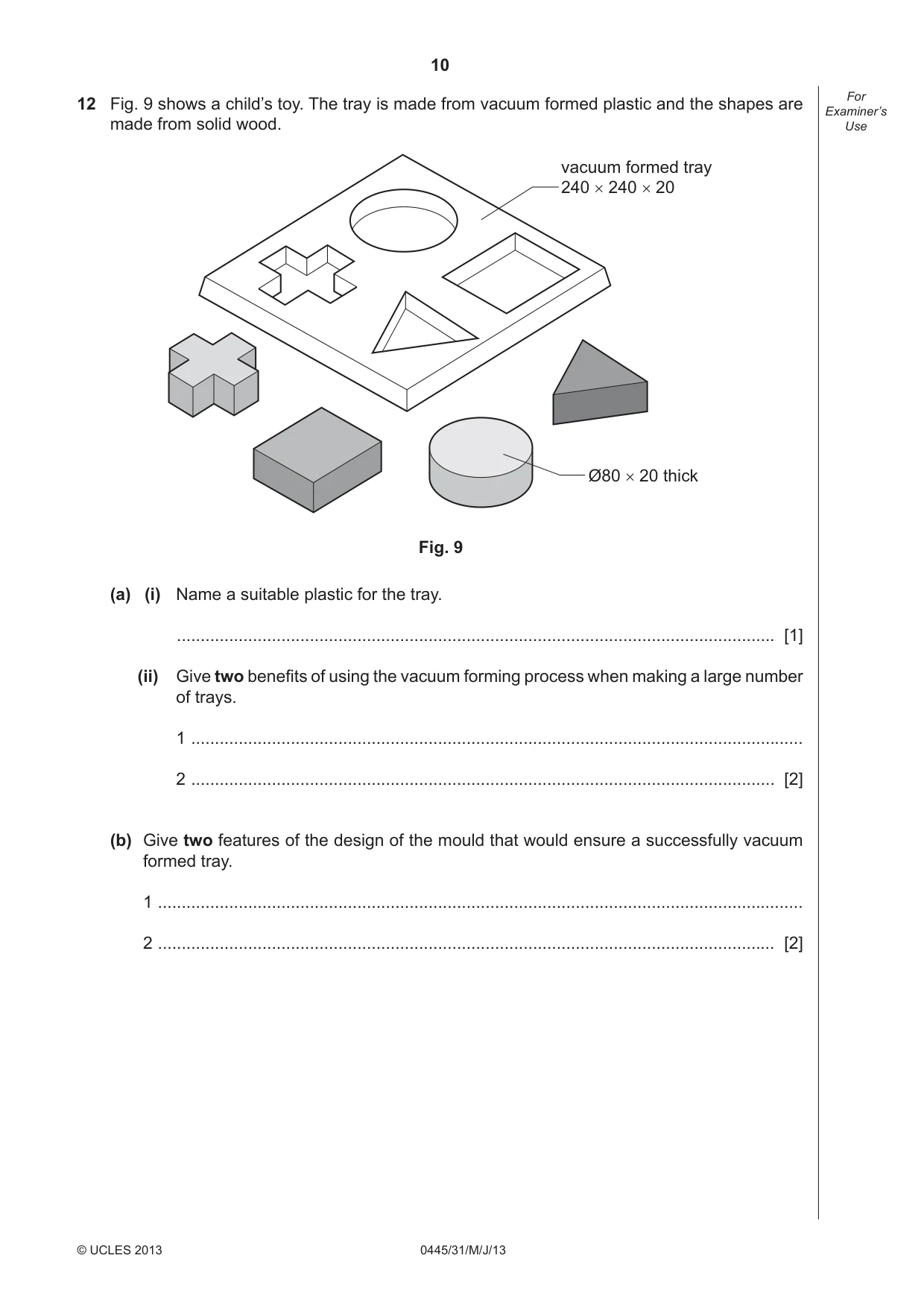
10 0445/31/M/J/13 © UCLES 2013 For Examiner’s Use 12 Fig. 9 shows a child’s toy. The tray is made from vacuum formed plastic and the shapes are made from solid wood. Ø80 × 20 thick vacuum formed tray 240 × 240 × 20 Fig. 9 (a) (i) Name a suitable plastic for the tray. … [1] (ii) Give two benefi ts of using the vacuum forming process when making a large number of trays. 1 … 2 … [2] (b) Give two features of the design of the mould that would ensure a successfully vacuum formed tray. 1 … 2 … [2]
Question paper, page 11
11 0445/31/M/J/13 © UCLES 2013 [Turn over For Examiner’s Use (c) Use sketches and notes to show how the tray could be vacuum formed. [8] (d) Give two ways in which the designer has made the toy suitable for use by children. 1 … 2 … [2]
Question paper, page 12
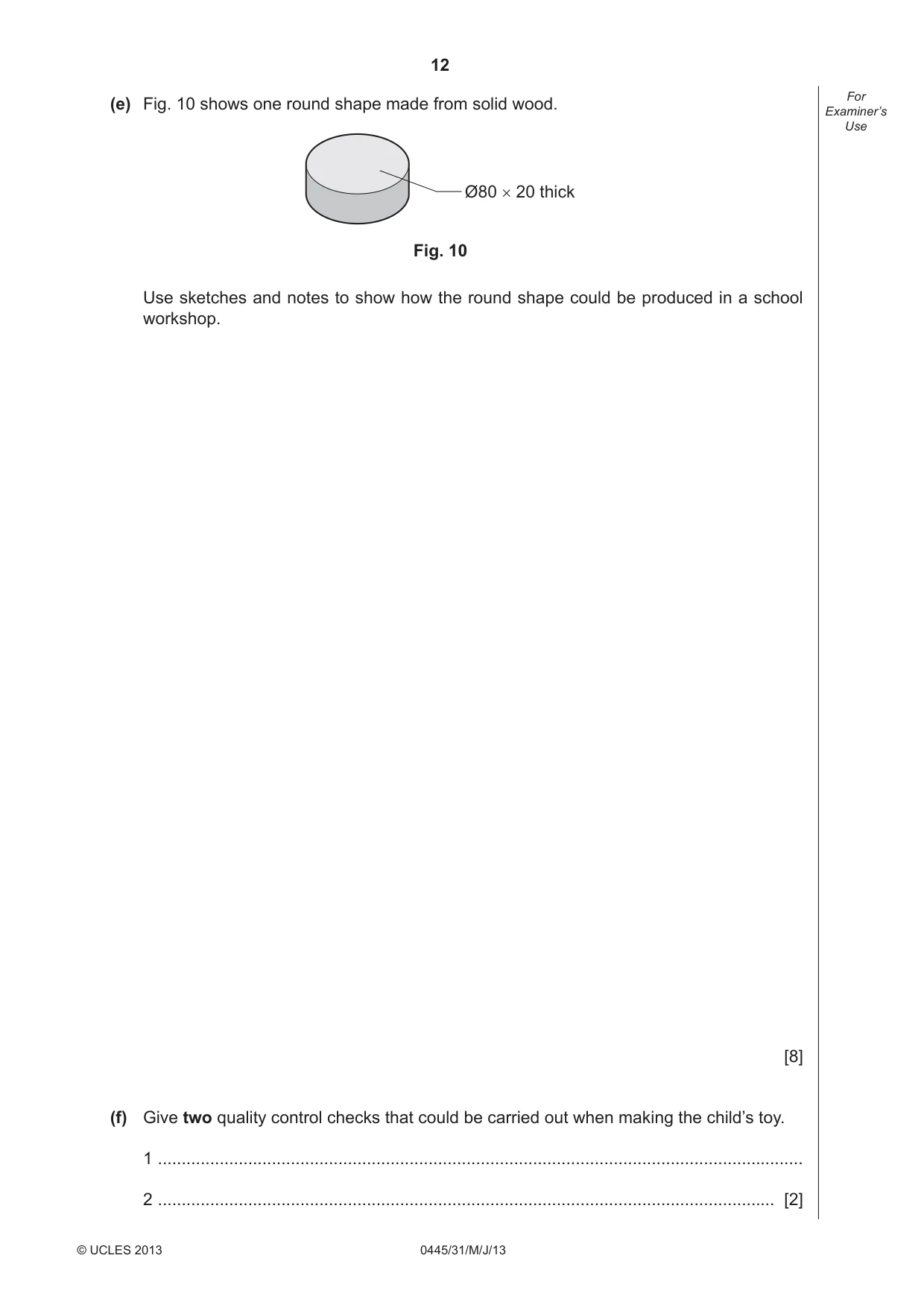
12 0445/31/M/J/13 © UCLES 2013 For Examiner’s Use (e) Fig. 10 shows one round shape made from solid wood. Ø80 × 20 thick Fig. 10 Use sketches and notes to show how the round shape could be produced in a school workshop. [8] (f) Give two quality control checks that could be carried out when making the child’s toy. 1 … 2 … [2]
Question paper, page 13
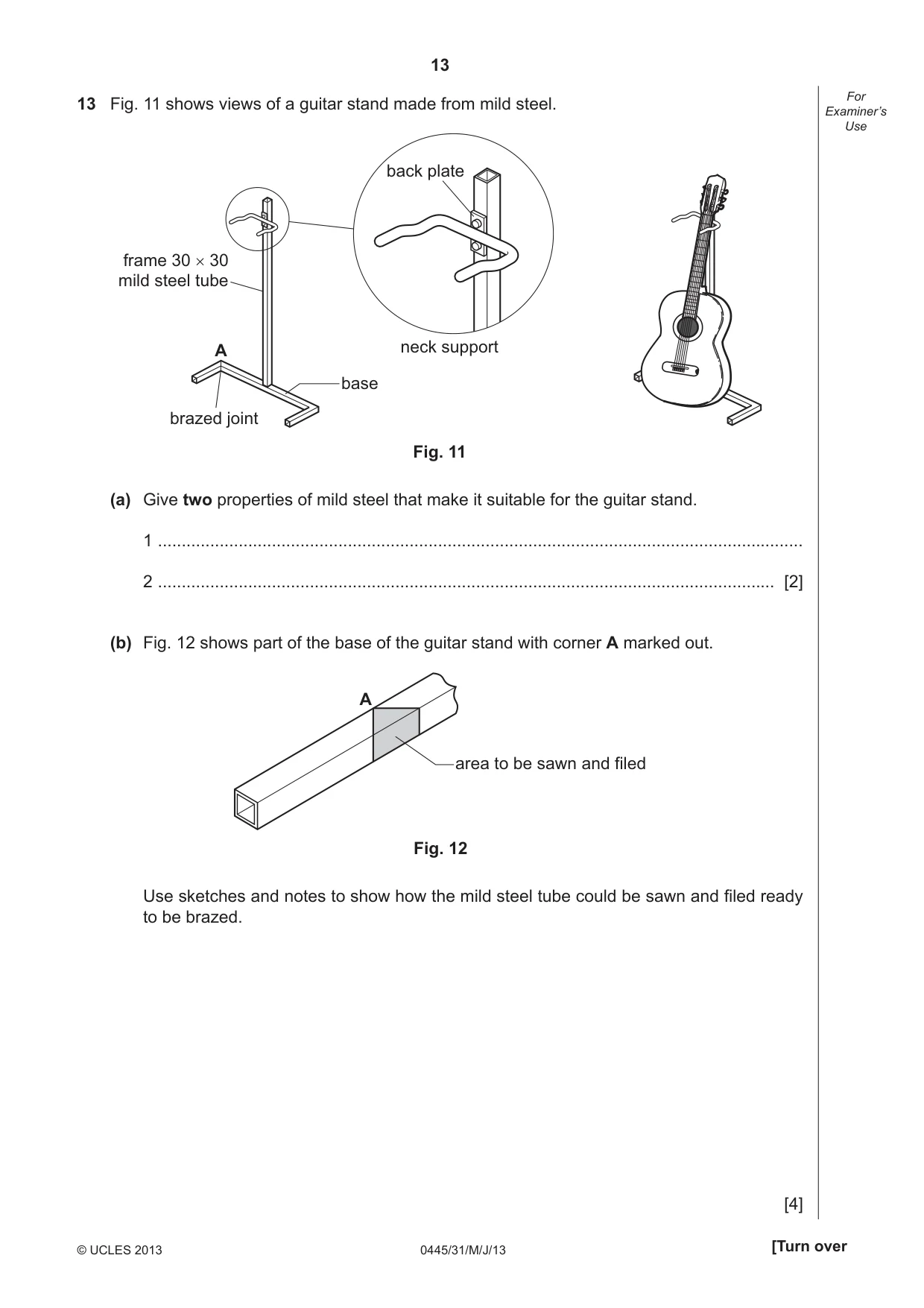
13 0445/31/M/J/13 © UCLES 2013 [Turn over For Examiner’s Use 13 Fig. 11 shows views of a guitar stand made from mild steel. A brazed joint base frame 30 × 30 mild steel tube back plate neck support Fig. 11 (a) Give two properties of mild steel that make it suitable for the guitar stand. 1 … 2 … [2] (b) Fig. 12 shows part of the base of the guitar stand with corner A marked out. area to be sawn and filed A Fig. 12 Use sketches and notes to show how the mild steel tube could be sawn and fi led ready to be brazed. [4]
Question paper, page 14
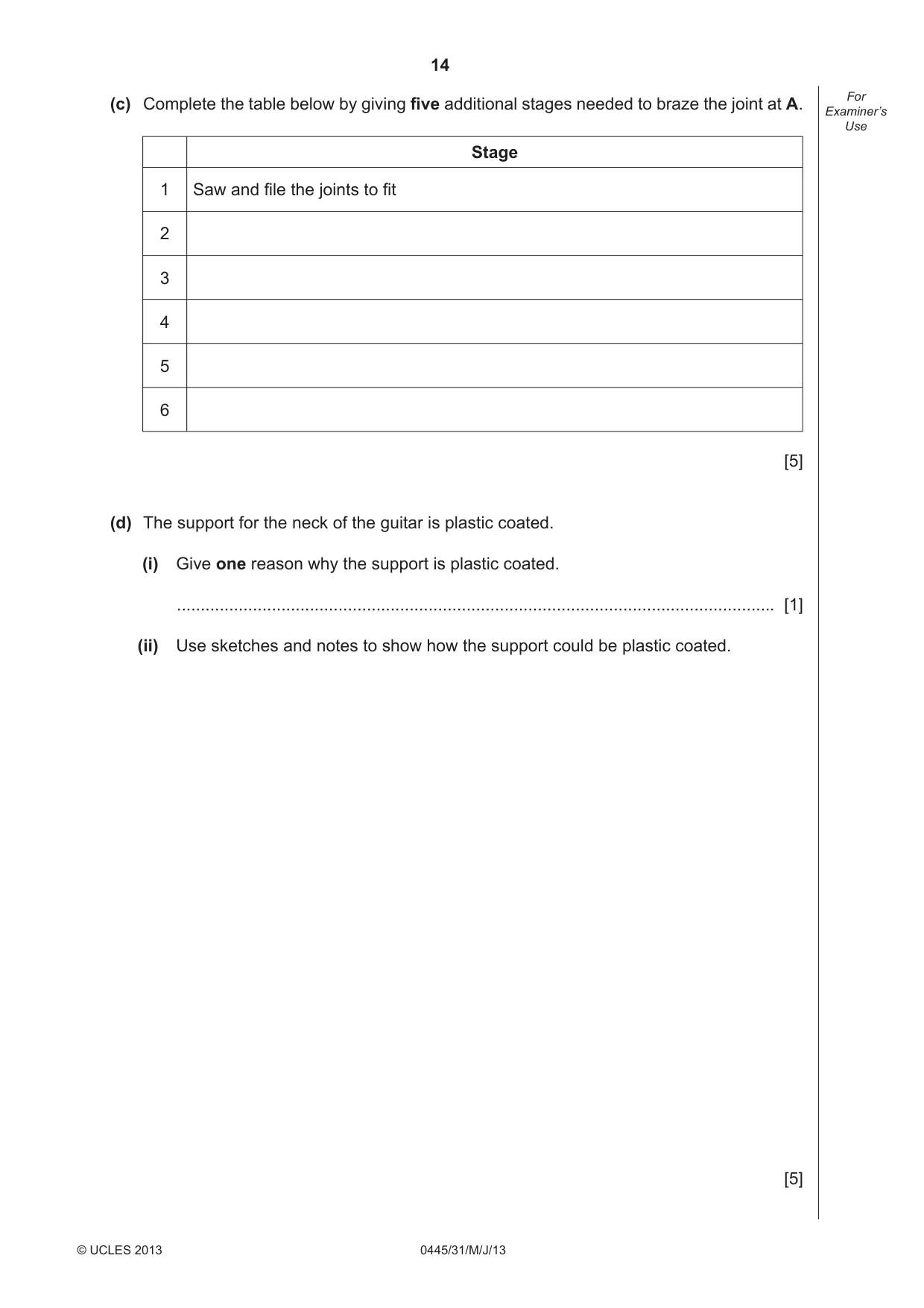
14 0445/31/M/J/13 © UCLES 2013 For Examiner’s Use (c) Complete the table below by giving fi ve additional stages needed to braze the joint at A. Stage 1 Saw and fi le the joints to fi t 2 3 4 5 6 [5] (d) The support for the neck of the guitar is plastic coated. (i) Give one reason why the support is plastic coated. … [1] (ii) Use sketches and notes to show how the support could be plastic coated. [5]
Question paper, page 15
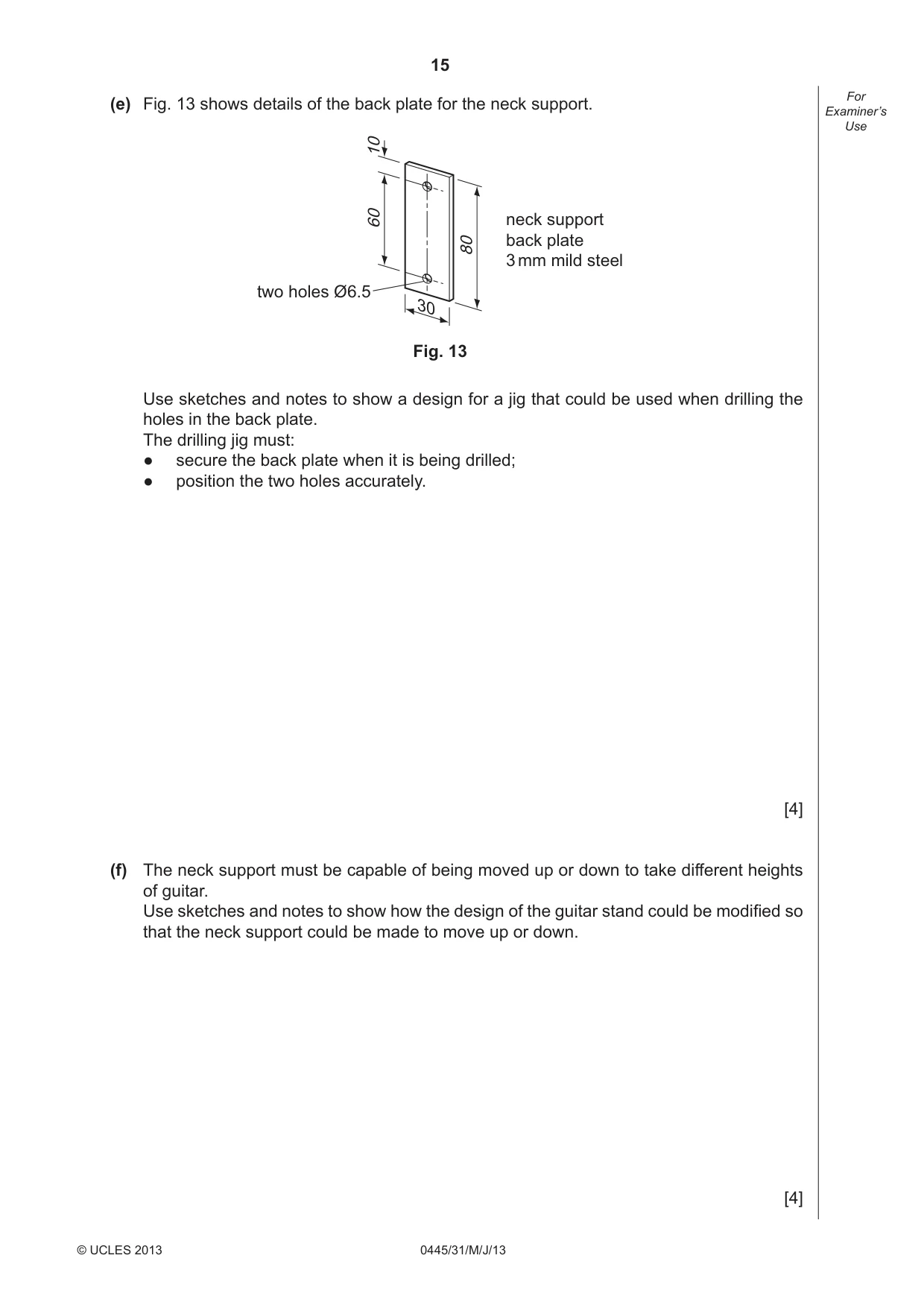
15 0445/31/M/J/13 © UCLES 2013 [Turn over For Examiner’s Use (e) Fig. 13 shows details of the back plate for the neck support. 60 80 10 30 two holes Ø6.5 neck support back plate 3 mm mild steel Fig. 13 Use sketches and notes to show a design for a jig that could be used when drilling the holes in the back plate. The drilling jig must: ● secure the back plate when it is being drilled; ● position the two holes accurately. [4] (f) The neck support must be capable of being moved up or down to take different heights of guitar. Use sketches and notes to show how the design of the guitar stand could be modifi ed so that the neck support could be made to move up or down. [4]
Question paper, page 16
16 0445/31/M/J/13 Permission to reproduce items where third-party owned material protected by copyright is included has been sought and cleared where possible. Every reasonable effort has been made by the publisher (UCLES) to trace copyright holders, but if any items requiring clearance have unwittingly been included the publisher will be pleased to make amends at the earliest possible opportunity. University of Cambridge International Examinations is part of the Cambridge Assessment Group. Cambridge Assessment is the brand name of University of Cambridge Local Examinations Syndicate (UCLES), which is itself a department of the University of Cambridge. BLANK PAGE © UCLES 2013
Mark scheme, page 1
CAMBRIDGE INTERNATIONAL EXAMINATIONS International General Certificate of Secondary Education MARK SCHEME for the May/June 2013 series 0445 DESIGN AND TECHNOLOGY 0445/31 Paper 3 (Resistant Materials), maximum raw mark 50 This mark scheme is published as an aid to teachers and candidates, to indicate the requirements of the examination. It shows the basis on which Examiners were instructed to award marks. It does not indicate the details of the discussions that took place at an Examiners’ meeting before marking began, which would have considered the acceptability of alternative answers. Mark schemes should be read in conjunction with the question paper and the Principal Examiner Report for Teachers. Cambridge will not enter into discussions about these mark schemes. Cambridge is publishing the mark schemes for the May/June 2013 series for most IGCSE, GCE Advanced Level and Advanced Subsidiary Level components and some Ordinary Level components.
Mark scheme, page 2
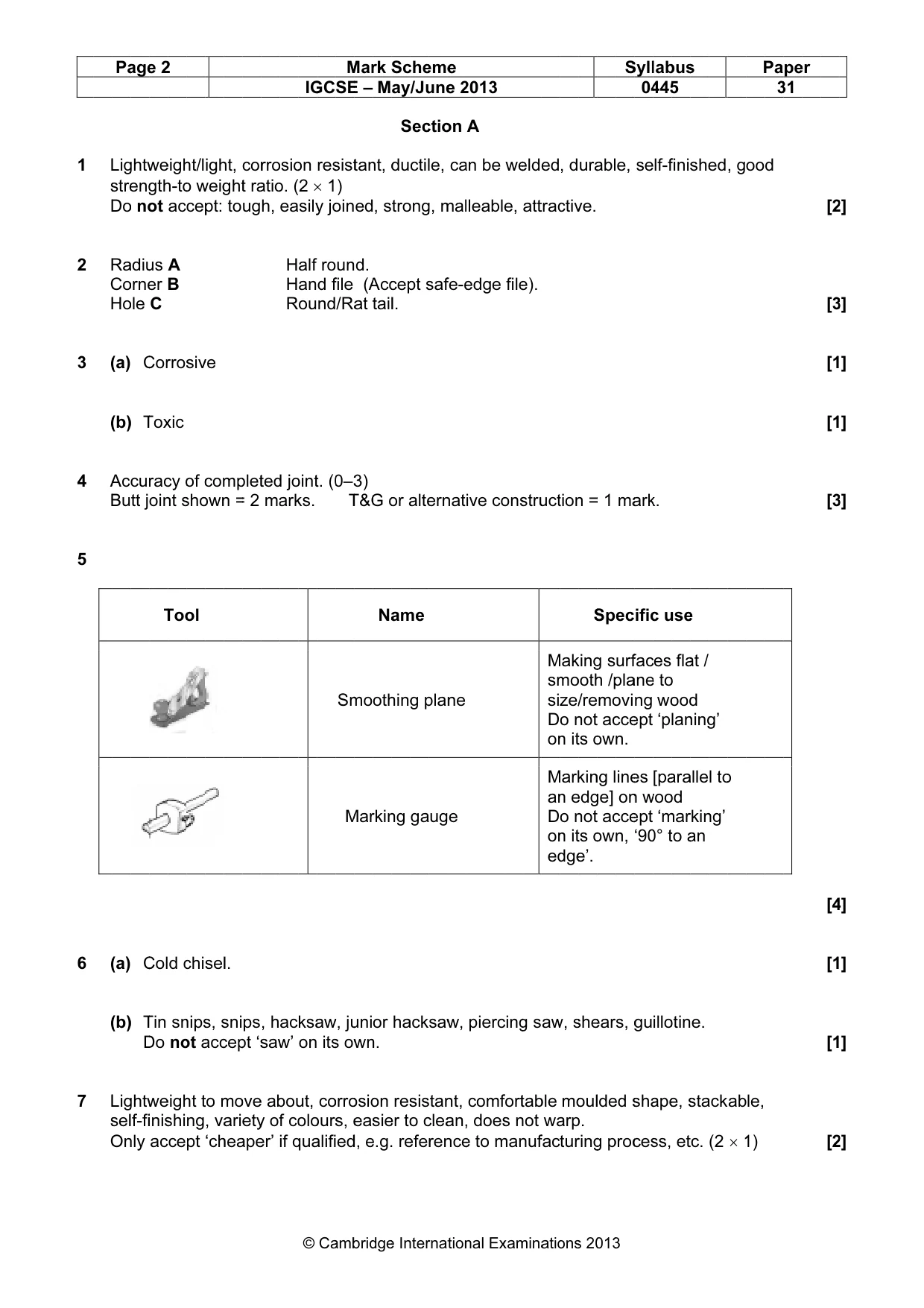
1 2 3 4 5 6 7 L s D R C H ( ( A B ( ( L s O Pa Lig stre Do Ra Co Ho (a) (b) Ac Bu (a) (b) Lig sel On age ghtw eng o no adiu orne ole C ) T cur tt j C ) T D ghtw lf-fi nly e 2 we gth ot us er C Cor Tox rac oin T Col Tin Do we inis ac 2 eigh h-to ac A B rros xic cy o nt s Too d c sn no eigh shi ce ht/l o w cep siv of c sho ol chi nips ot a ht t ng pt igh weig pt: ve com own sel s, s acc to m , va ‘ch ht, ght to mp n = l. sni cep mo arie hea cor t ra ug plet = 2 ps pt ‘s ove ety ape rro atio h, ted ma , h saw e ab y of er’ osio o. ( ea H H R d jo ark ac w’ bou f co if q IG © on 2 × sily alf an ou oint ks. ksa on ut, olo qua GC Ca res × 1 y jo ro d f nd t. (0 aw its co ours alifi M SE amb sist ) oin un file /Ra 0–3 T Sm M w, ju s ow orro s, e ed Mar E – brid tan ed d. (A at t 3) T&G mo Mar uni wn osio eas d, e rk S M dge nt, d , s Acc tail G o Na oth rkin or n. on sie e.g. Sc ay/ e In S du tro cep l. or a am hing ng ha res er to . re che /Ju nter Sec ctil ong pt s alte me g p ga ack sis o c efer eme une rnat ctio le, g, m saf ern plan ug saw tan clea ren e e 2 tion on ca mal fe-e nat ne e w, nt, an, nce 201 nal A an b lea edg ive pie co , do e to 13 Ex be abl ge e co erc mf oes o m xam we e, file ons cing fort s n man mina eld att e). stru g s tab not nuf atio ed trac uct M sm si D on M an D on ed aw ble wa fac ons , d ctiv tion Mak mo ze/ o n n it Mark n e o n n it dge w, s mo arp tur s 20 ura ve. n = S king ooth /re not ts o kin edg not ts o e’. she oul p. ring 013 abl = 1 Sp g s h /p mo t ac ow ng l ge] t ac ow ear lde g p S 3 e, ma ec urf pla ovi cce n. ine on cce n, s, g ed s proc Syll 04 se ark ific fac ane ng ept es n w ept ‘90 gu sha ces lab 445 lf-f k. c u ces e to wo ‘p [pa woo ‘m 0° t illo ape ss, bus 5 finis use fla o ood lan ara od mar to a otin e, s et s she e at / d ning alle rkin an e. sta tc. ed g’ l to ng’ ack (2 , g o ab × 1 P oo le, 1) Pa 3 d pe 31 er [2 [3 [1 [1 [3 [4 [1 [1 [2 2] 3] ] ] 3] 4] ] ] 2]
Mark scheme, page 3
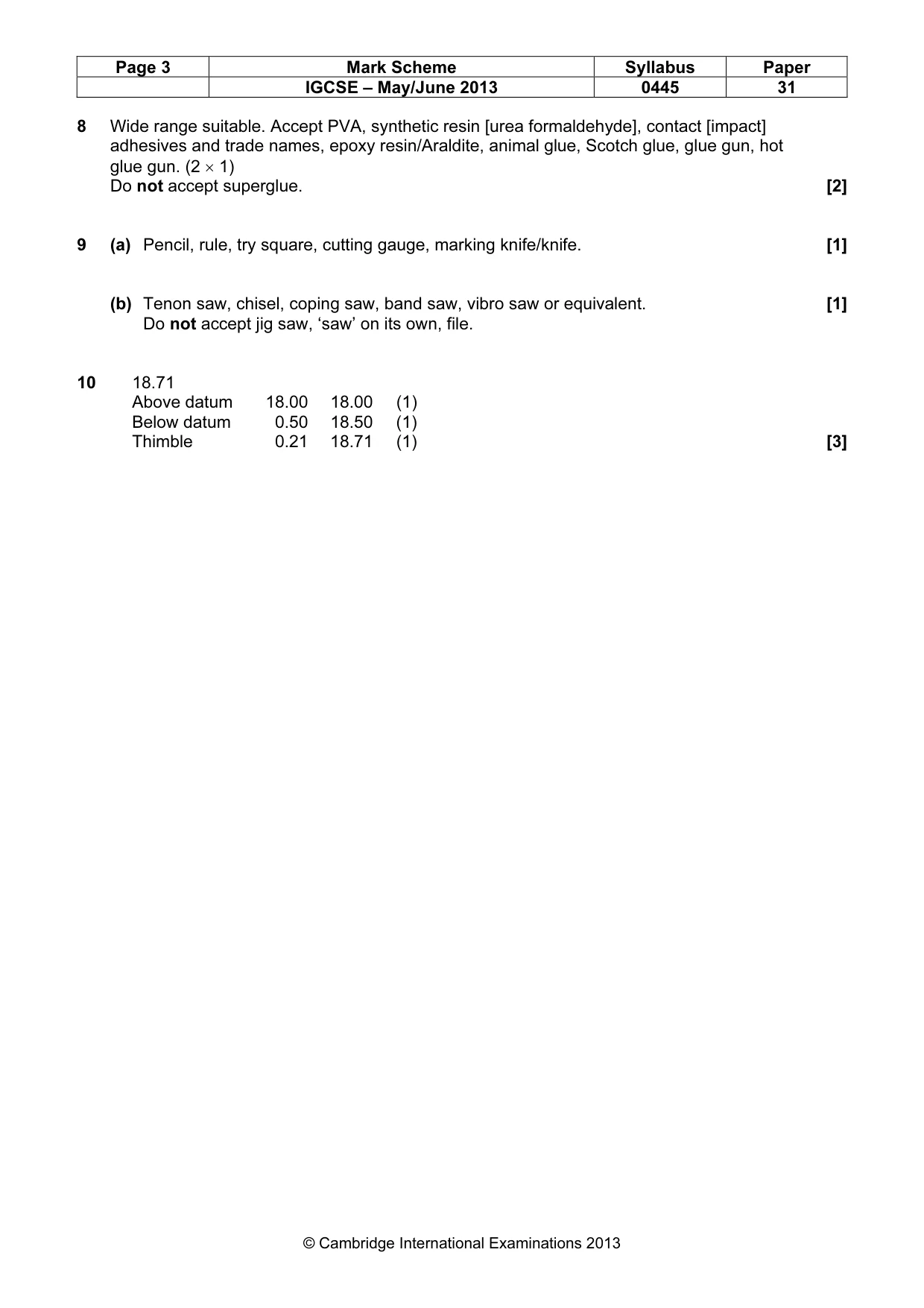
Page 3 Mark Scheme Syllabus Paper IGCSE – May/June 2013 0445 31 © Cambridge International Examinations 2013 8 Wide range suitable. Accept PVA, synthetic resin [urea formaldehyde], contact [impact] adhesives and trade names, epoxy resin/Araldite, animal glue, Scotch glue, glue gun, hot glue gun. (2 × 1) Do not accept superglue. [2] 9 (a) Pencil, rule, try square, cutting gauge, marking knife/knife. [1] (b) Tenon saw, chisel, coping saw, band saw, vibro saw or equivalent. [1] Do not accept jig saw, ‘saw’ on its own, file. 10 18.71 Above datum 18.00 18.00 (1) Below datum 0.50 18.50 (1) Thimble 0.21 18.71 (1) [3]
Mark scheme, page 4
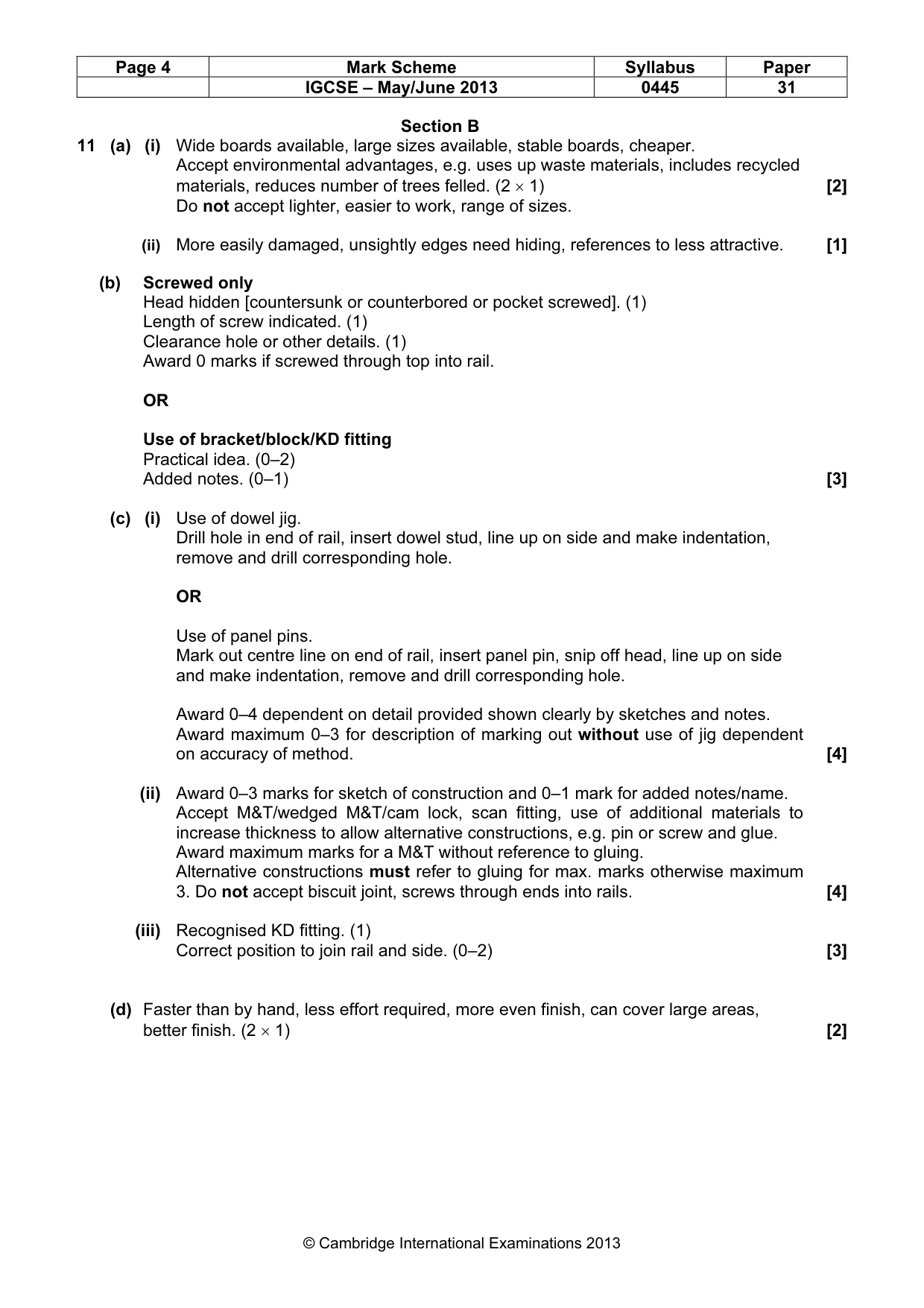
Page 4 Mark Scheme Syllabus Paper IGCSE – May/June 2013 0445 31 © Cambridge International Examinations 2013 Section B 11 (a) (i) Wide boards available, large sizes available, stable boards, cheaper. Accept environmental advantages, e.g. uses up waste materials, includes recycled materials, reduces number of trees felled. (2 × 1) [2] Do not accept lighter, easier to work, range of sizes. (ii) More easily damaged, unsightly edges need hiding, references to less attractive. [1] (b) Screwed only Head hidden [countersunk or counterbored or pocket screwed]. (1) Length of screw indicated. (1) Clearance hole or other details. (1) Award 0 marks if screwed through top into rail. OR Use of bracket/block/KD fitting Practical idea. (0–2) Added notes. (0–1) [3] (c) (i) Use of dowel jig. Drill hole in end of rail, insert dowel stud, line up on side and make indentation, remove and drill corresponding hole. OR Use of panel pins. Mark out centre line on end of rail, insert panel pin, snip off head, line up on side and make indentation, remove and drill corresponding hole. Award 0–4 dependent on detail provided shown clearly by sketches and notes. Award maximum 0–3 for description of marking out without use of jig dependent on accuracy of method. [4] (ii) Award 0–3 marks for sketch of construction and 0–1 mark for added notes/name. Accept M&T/wedged M&T/cam lock, scan fitting, use of additional materials to increase thickness to allow alternative constructions, e.g. pin or screw and glue. Award maximum marks for a M&T without reference to gluing. Alternative constructions must refer to gluing for max. marks otherwise maximum 3. Do not accept biscuit joint, screws through ends into rails. [4] (iii) Recognised KD fitting. (1) Correct position to join rail and side. (0–2) [3] (d) Faster than by hand, less effort required, more even finish, can cover large areas, better finish. (2 × 1) [2]
Mark scheme, page 5
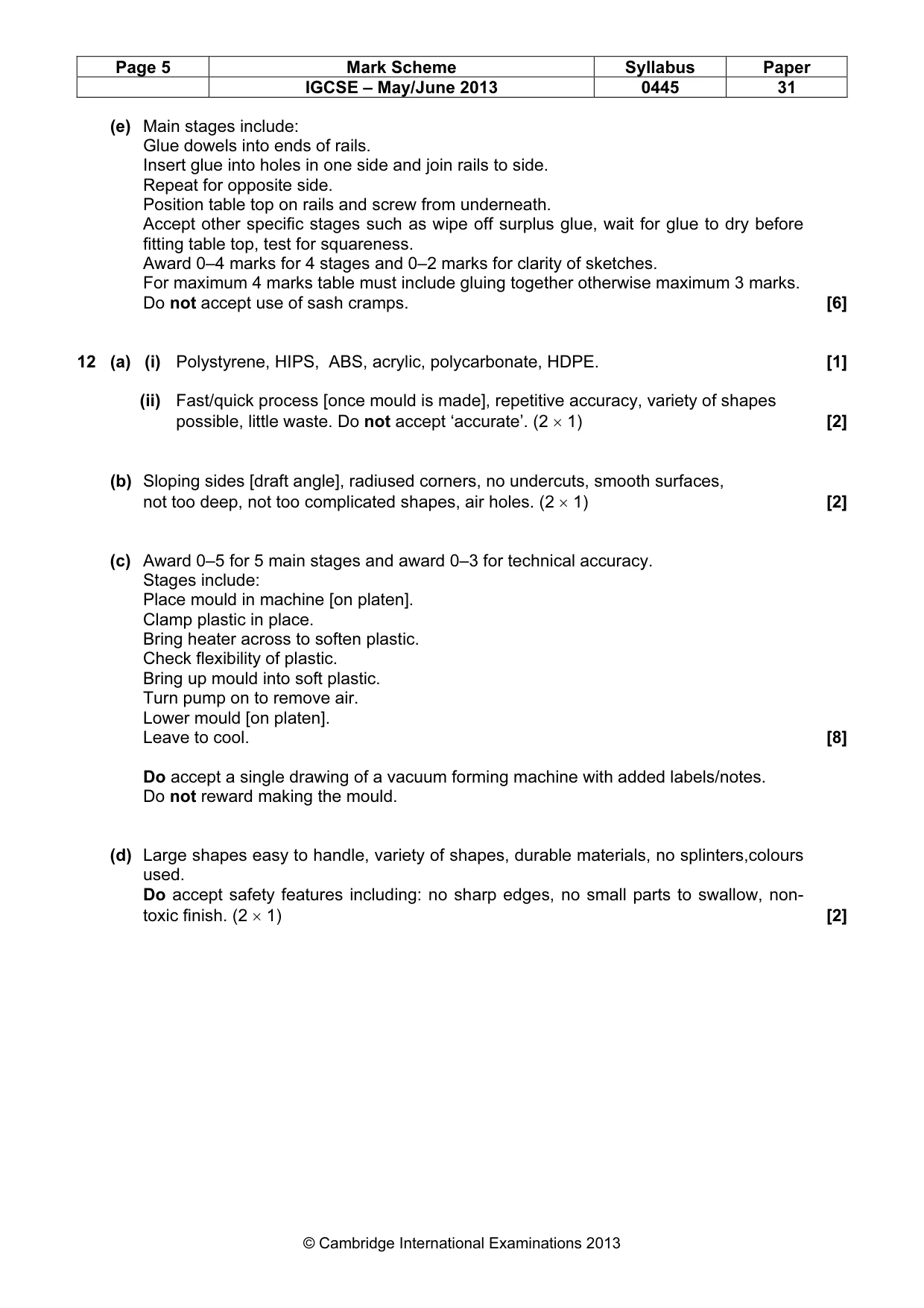
Page 5 Mark Scheme Syllabus Paper IGCSE – May/June 2013 0445 31 © Cambridge International Examinations 2013 (e) Main stages include: Glue dowels into ends of rails. Insert glue into holes in one side and join rails to side. Repeat for opposite side. Position table top on rails and screw from underneath. Accept other specific stages such as wipe off surplus glue, wait for glue to dry before fitting table top, test for squareness. Award 0–4 marks for 4 stages and 0–2 marks for clarity of sketches. For maximum 4 marks table must include gluing together otherwise maximum 3 marks. Do not accept use of sash cramps. [6] 12 (a) (i) Polystyrene, HIPS, ABS, acrylic, polycarbonate, HDPE. [1] (ii) Fast/quick process [once mould is made], repetitive accuracy, variety of shapes possible, little waste. Do not accept ‘accurate’. (2 × 1) [2] (b) Sloping sides [draft angle], radiused corners, no undercuts, smooth surfaces, not too deep, not too complicated shapes, air holes. (2 × 1) [2] (c) Award 0–5 for 5 main stages and award 0–3 for technical accuracy. Stages include: Place mould in machine [on platen]. Clamp plastic in place. Bring heater across to soften plastic. Check flexibility of plastic. Bring up mould into soft plastic. Turn pump on to remove air. Lower mould [on platen]. Leave to cool. [8] Do accept a single drawing of a vacuum forming machine with added labels/notes. Do not reward making the mould. (d) Large shapes easy to handle, variety of shapes, durable materials, no splinters,colours used. Do accept safety features including: no sharp edges, no small parts to swallow, non- toxic finish. (2 × 1) [2]
Mark scheme, page 6
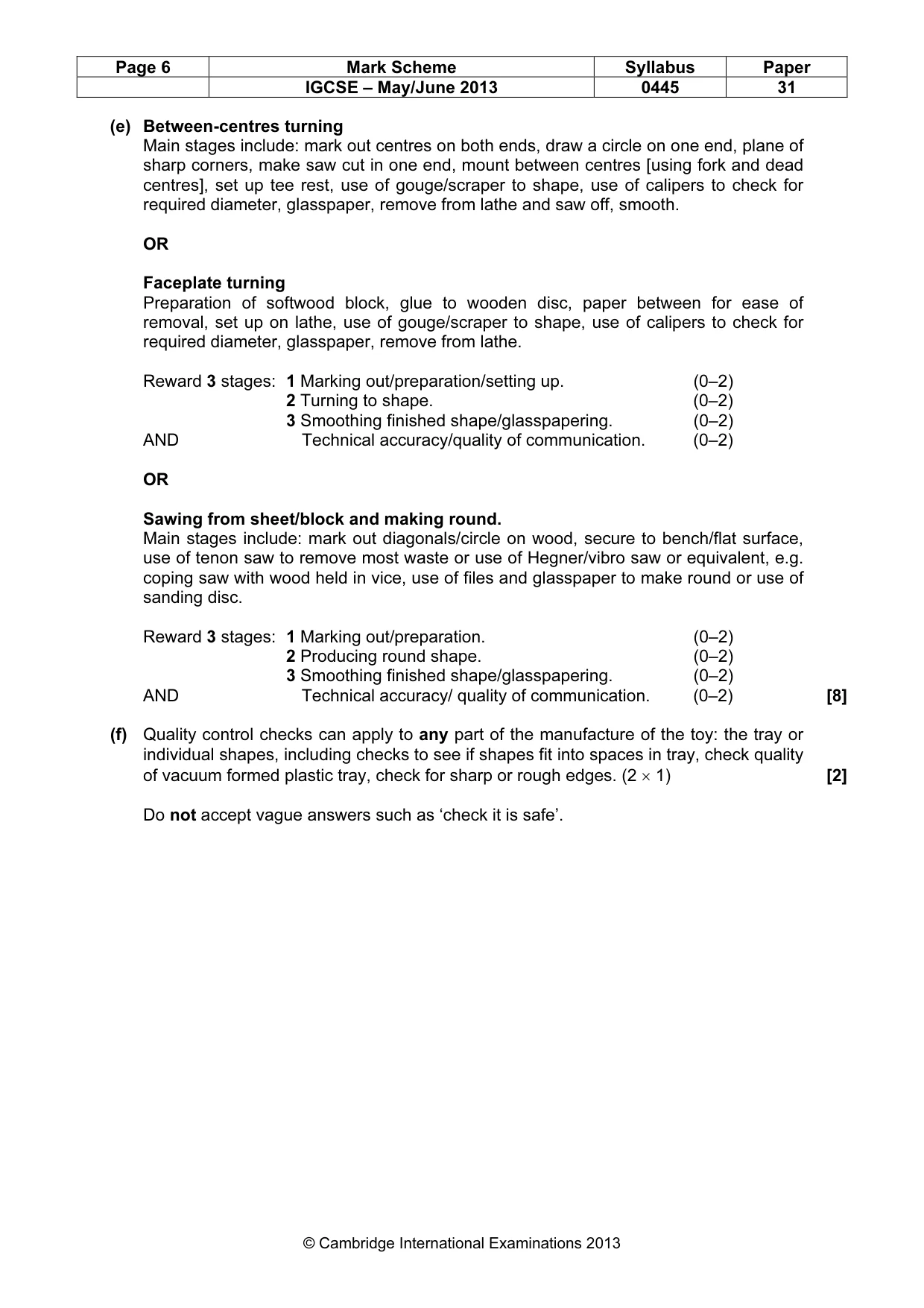
Page 6 Mark Scheme Syllabus Paper IGCSE – May/June 2013 0445 31 © Cambridge International Examinations 2013 (e) Between-centres turning Main stages include: mark out centres on both ends, draw a circle on one end, plane of sharp corners, make saw cut in one end, mount between centres [using fork and dead centres], set up tee rest, use of gouge/scraper to shape, use of calipers to check for required diameter, glasspaper, remove from lathe and saw off, smooth. OR Faceplate turning Preparation of softwood block, glue to wooden disc, paper between for ease of removal, set up on lathe, use of gouge/scraper to shape, use of calipers to check for required diameter, glasspaper, remove from lathe. Reward 3 stages: 1 Marking out/preparation/setting up. (0–2) 2 Turning to shape. (0–2) 3 Smoothing finished shape/glasspapering. (0–2) AND Technical accuracy/quality of communication. (0–2) OR Sawing from sheet/block and making round. Main stages include: mark out diagonals/circle on wood, secure to bench/flat surface, use of tenon saw to remove most waste or use of Hegner/vibro saw or equivalent, e.g. coping saw with wood held in vice, use of files and glasspaper to make round or use of sanding disc. Reward 3 stages: 1 Marking out/preparation. (0–2) 2 Producing round shape. (0–2) 3 Smoothing finished shape/glasspapering. (0–2) AND Technical accuracy/ quality of communication. (0–2) [8] (f) Quality control checks can apply to any part of the manufacture of the toy: the tray or individual shapes, including checks to see if shapes fit into spaces in tray, check quality of vacuum formed plastic tray, check for sharp or rough edges. (2 × 1) [2] Do not accept vague answers such as ‘check it is safe’.
Mark scheme, page 7
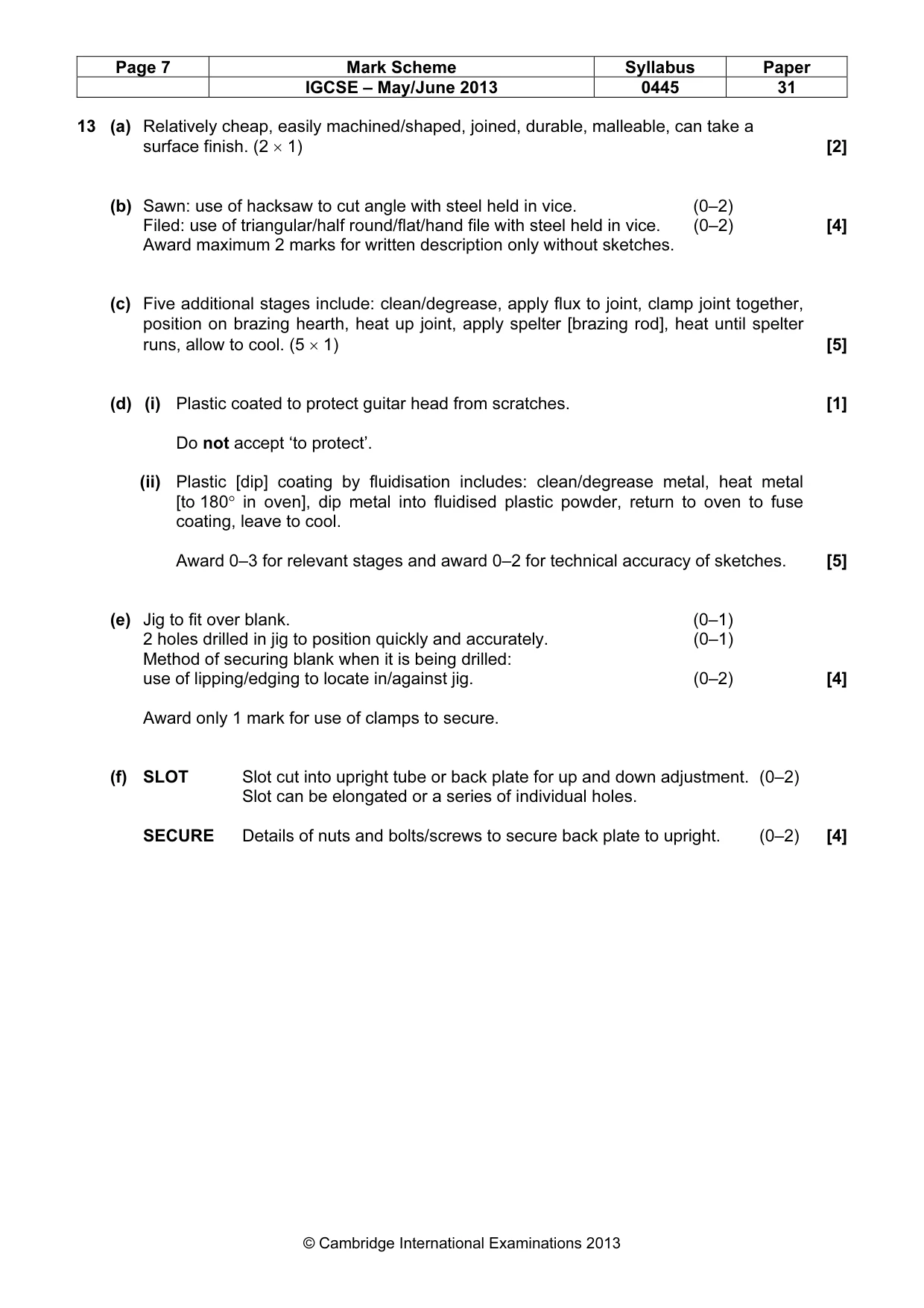
Page 7 Mark Scheme Syllabus Paper IGCSE – May/June 2013 0445 31 © Cambridge International Examinations 2013 13 (a) Relatively cheap, easily machined/shaped, joined, durable, malleable, can take a surface finish. (2 × 1) [2] (b) Sawn: use of hacksaw to cut angle with steel held in vice. (0–2) Filed: use of triangular/half round/flat/hand file with steel held in vice. (0–2) [4] Award maximum 2 marks for written description only without sketches. (c) Five additional stages include: clean/degrease, apply flux to joint, clamp joint together, position on brazing hearth, heat up joint, apply spelter [brazing rod], heat until spelter runs, allow to cool. (5 × 1) [5] (d) (i) Plastic coated to protect guitar head from scratches. [1] Do not accept ‘to protect’. (ii) Plastic [dip] coating by fluidisation includes: clean/degrease metal, heat metal [to 180° in oven], dip metal into fluidised plastic powder, return to oven to fuse coating, leave to cool. Award 0–3 for relevant stages and award 0–2 for technical accuracy of sketches. [5] (e) Jig to fit over blank. (0–1) 2 holes drilled in jig to position quickly and accurately. (0–1) Method of securing blank when it is being drilled: use of lipping/edging to locate in/against jig. (0–2) [4] Award only 1 mark for use of clamps to secure. (f) SLOT Slot cut into upright tube or back plate for up and down adjustment. (0–2) Slot can be elongated or a series of individual holes. SECURE Details of nuts and bolts/screws to secure back plate to upright. (0–2) [4]
What you needed in this session
Cambridge’s own grade thresholds for 2013 May/June, Paper 3 · Variant 1. A higher threshold means an easier paper — the bar moves with how the cohort did.