Cambridge IGCSE Design and Technology 0445 — 2013 May/June Paper 3 · Variant 3
0445/33/M/J/13 · 50 marks · ≈56 min
The question paper and its mark scheme, free to read here and free to download. This is Cambridge’s own paper, exactly as it was sat.
Question paper16 pages
Mark scheme5 pages
Answers below. Sit the paper first if you are practising.
Paper as text
Question paper, page 1
READ THESE INSTRUCTIONS FIRST Write your Centre number, candidate number and name on all the work you hand in. Write in blue or black pen. You may use a soft pencil for any diagrams, graphs or rough working. Do not use staples, paper clips, highlighters, glue or correction fl uid. DO NOT WRITE IN ANY BARCODES. Section A Answer all questions in this section. Section B Answer one question in this section. You may use a calculator. The total of the marks for this paper is 50. The number of marks is given in brackets [ ] at the end of each question or part question. DESIGN AND TECHNOLOGY 0445/33 Paper 3 Resistant Materials May/June 2013 1 hour Candidates answer on the Question Paper. No Additional Materials are required. To be taken together with Paper 1 in one session of 2 hours 15 minutes. UNIVERSITY OF CAMBRIDGE INTERNATIONAL EXAMINATIONS International General Certifi cate of Secondary Education This document consists of 15 printed pages and 1 blank page. [Turn over IB13 06_0445_33/2RP © UCLES 2013 *7345388429* For Examiner’s Use Section A Section B Total
Question paper, page 2
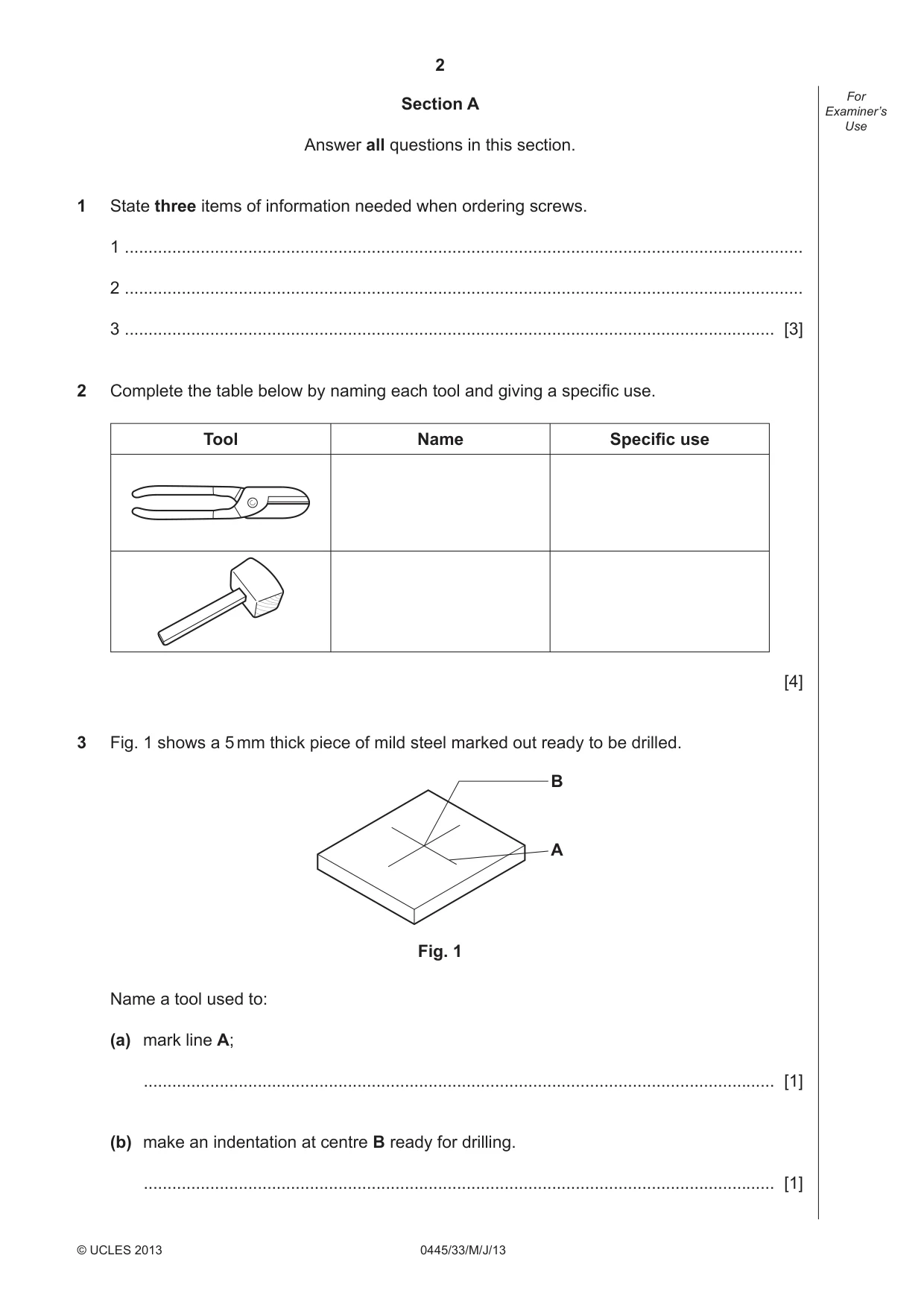
2 0445/33/M/J/13 © UCLES 2013 For Examiner’s Use Section A Answer all questions in this section. 1 State three items of information needed when ordering screws. 1 … 2 … 3 … [3] 2 Complete the table below by naming each tool and giving a specifi c use. Tool Name Specifi c use [4] 3 Fig. 1 shows a 5 mm thick piece of mild steel marked out ready to be drilled. B A Fig. 1 Name a tool used to: (a) mark line A; … [1] (b) make an indentation at centre B ready for drilling. … [1]
Question paper, page 3
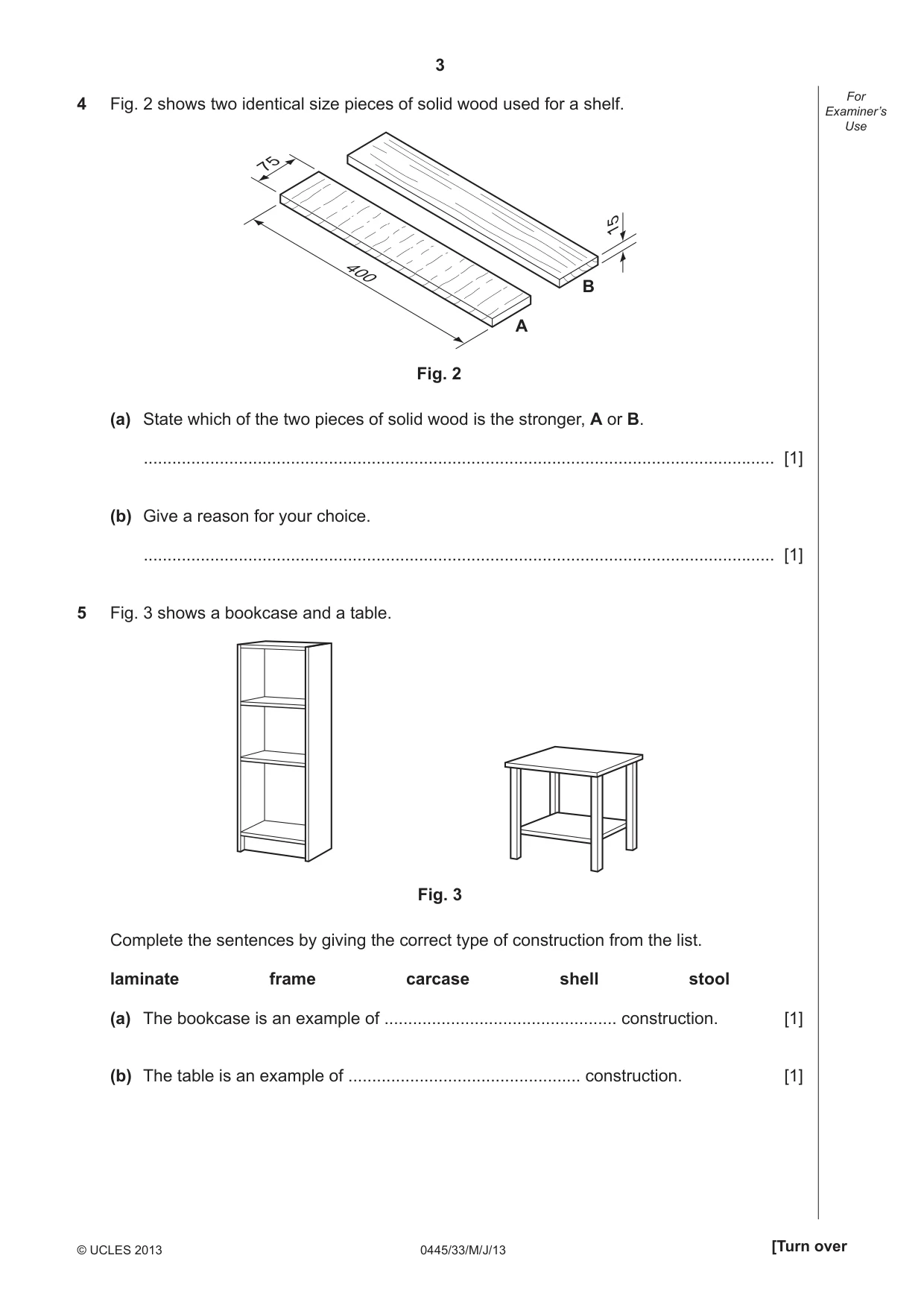
3 0445/33/M/J/13 © UCLES 2013 [Turn over For Examiner’s Use 4 Fig. 2 shows two identical size pieces of solid wood used for a shelf. 400 75 15 A B Fig. 2 (a) State which of the two pieces of solid wood is the stronger, A or B. … [1] (b) Give a reason for your choice. … [1] 5 Fig. 3 shows a bookcase and a table. Fig. 3 Complete the sentences by giving the correct type of construction from the list. laminate frame carcase shell stool (a) The bookcase is an example of … construction. [1] (b) The table is an example of … construction. [1]
Question paper, page 4
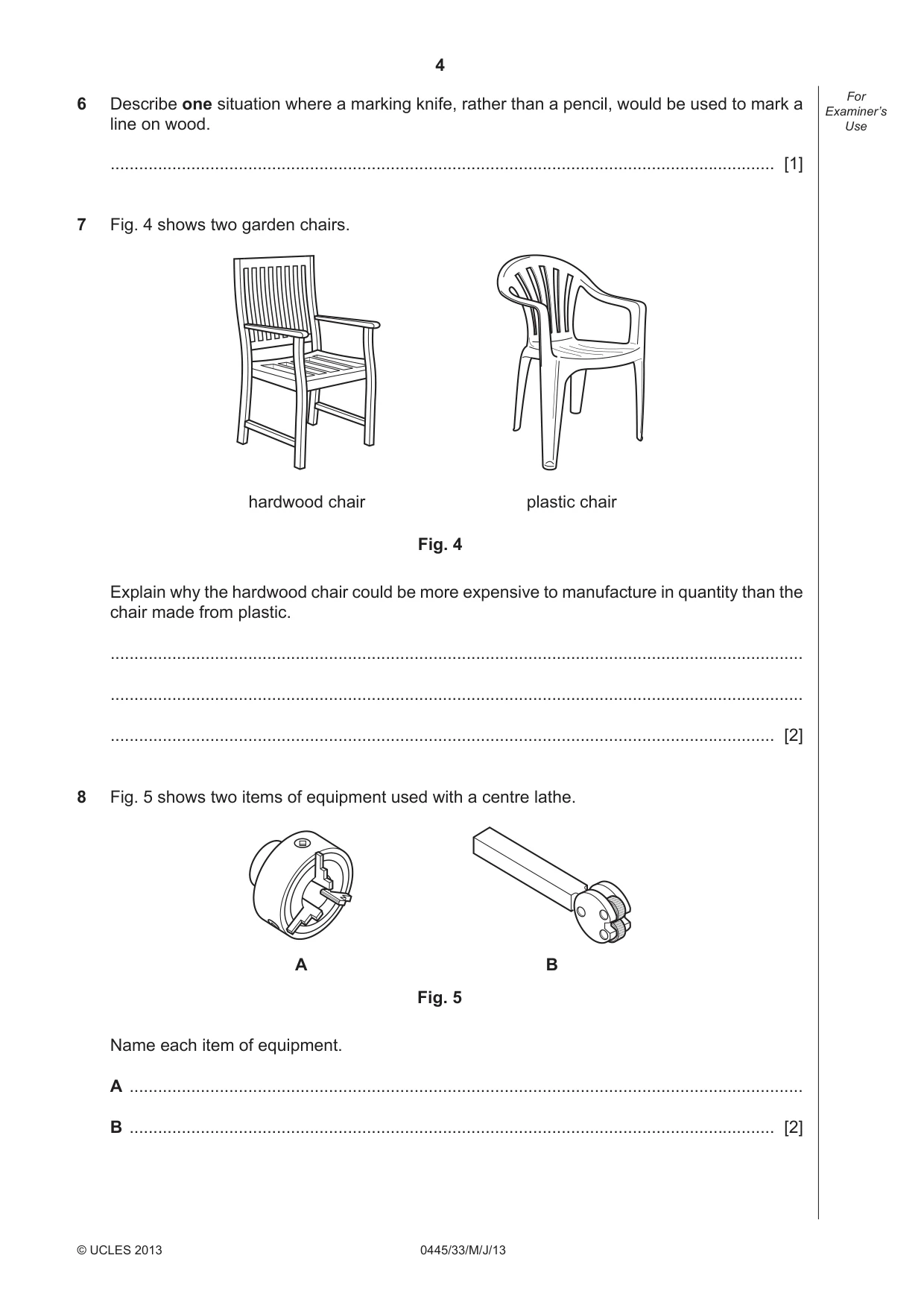
4 0445/33/M/J/13 © UCLES 2013 For Examiner’s Use 6 Describe one situation where a marking knife, rather than a pencil, would be used to mark a line on wood. … [1] 7 Fig. 4 shows two garden chairs. hardwood chair plastic chair Fig. 4 Explain why the hardwood chair could be more expensive to manufacture in quantity than the chair made from plastic. … … … [2] 8 Fig. 5 shows two items of equipment used with a centre lathe. A B Fig. 5 Name each item of equipment. A … B … [2]
Question paper, page 5
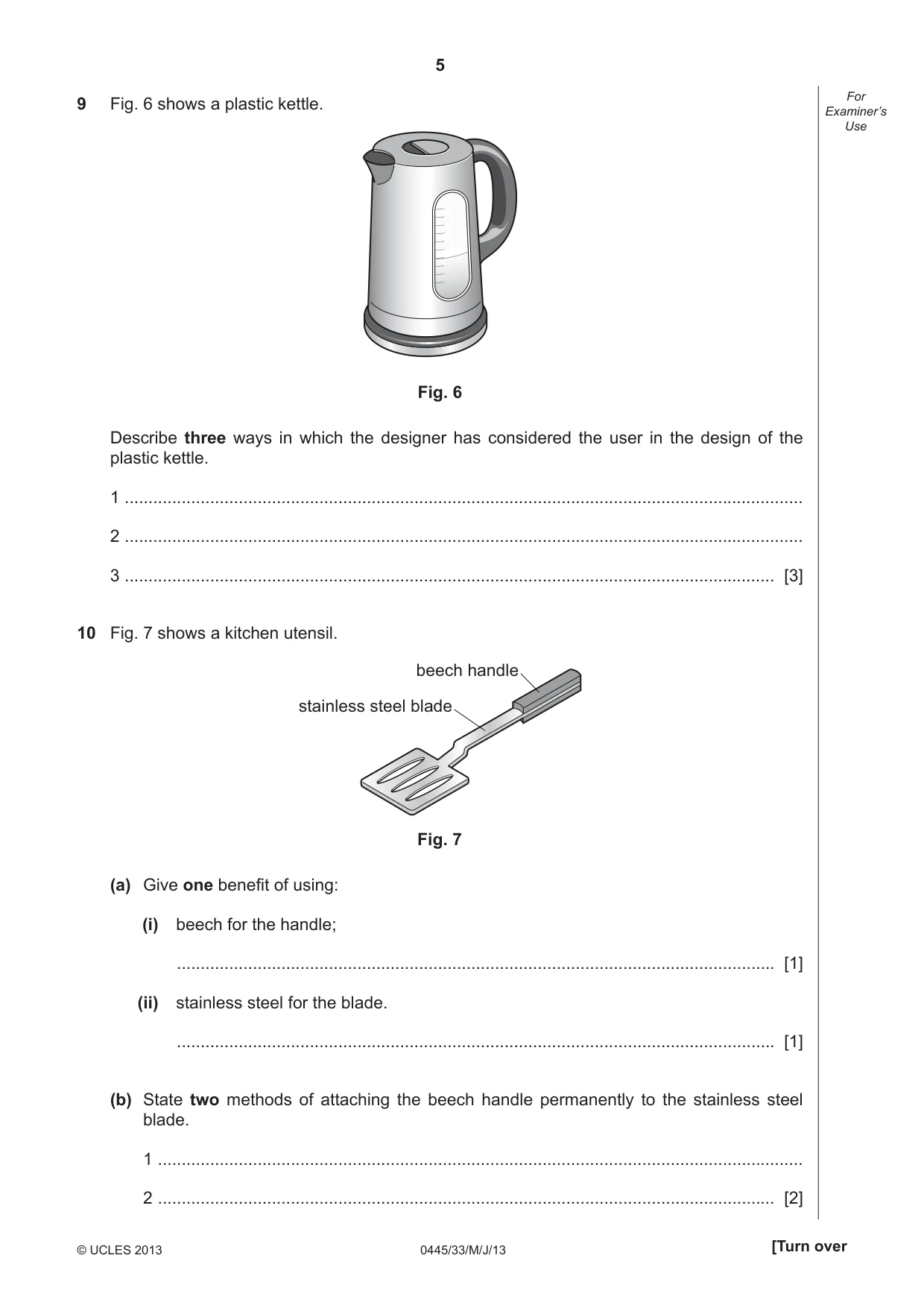
5 0445/33/M/J/13 © UCLES 2013 [Turn over For Examiner’s Use 9 Fig. 6 shows a plastic kettle. Fig. 6 Describe three ways in which the designer has considered the user in the design of the plastic kettle. 1 … 2 … 3 … [3] 10 Fig. 7 shows a kitchen utensil. beech handle stainless steel blade Fig. 7 (a) Give one benefi t of using: (i) beech for the handle; … [1] (ii) stainless steel for the blade. … [1] (b) State two methods of attaching the beech handle permanently to the stainless steel blade. 1 … 2 … [2]
Question paper, page 6
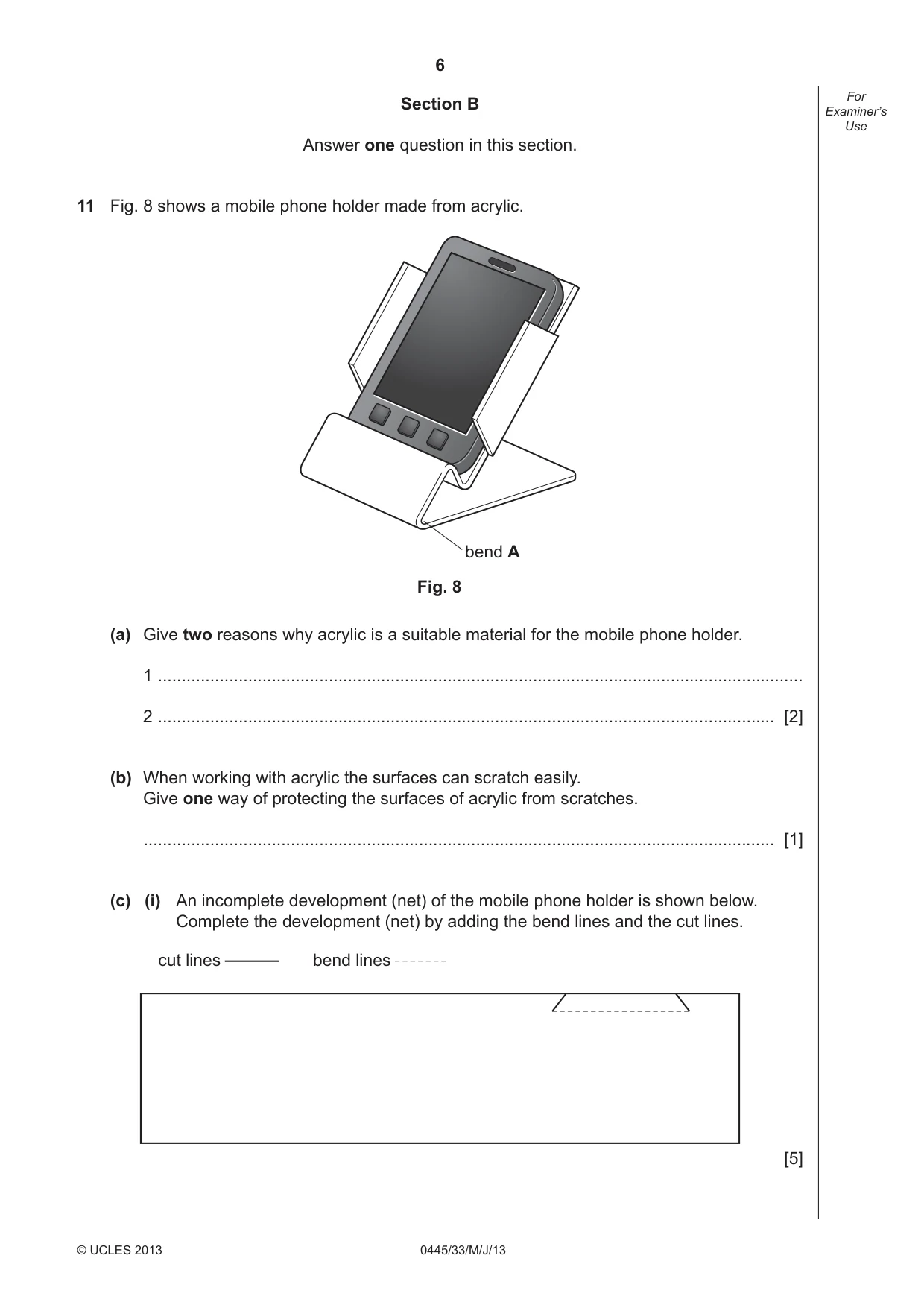
6 0445/33/M/J/13 © UCLES 2013 For Examiner’s Use Section B Answer one question in this section. 11 Fig. 8 shows a mobile phone holder made from acrylic. bend A Fig. 8 (a) Give two reasons why acrylic is a suitable material for the mobile phone holder. 1 … 2 … [2] (b) When working with acrylic the surfaces can scratch easily. Give one way of protecting the surfaces of acrylic from scratches. … [1] (c) (i) An incomplete development (net) of the mobile phone holder is shown below. Complete the development (net) by adding the bend lines and the cut lines. cut lines bend lines [5]
Question paper, page 7
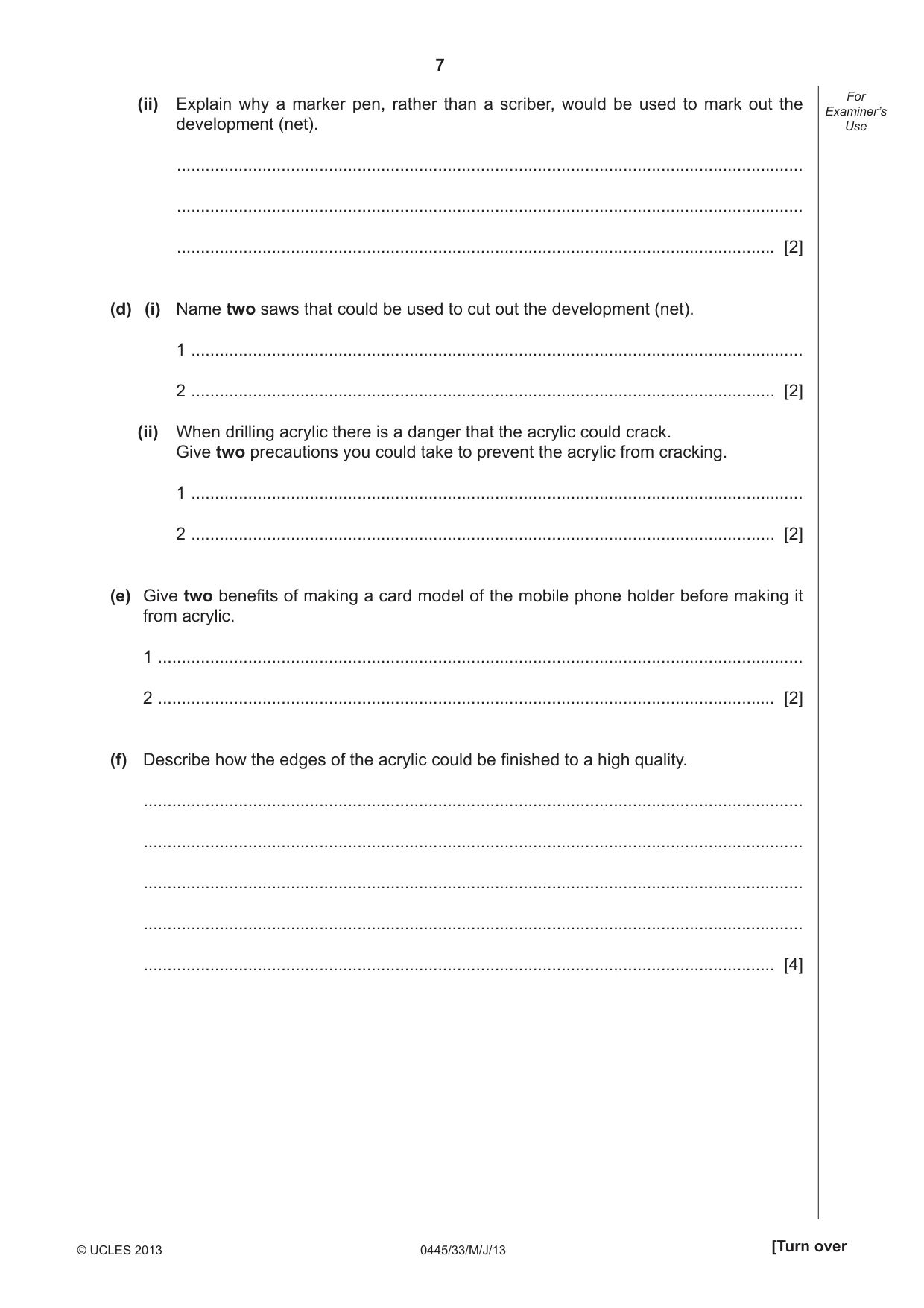
7 0445/33/M/J/13 © UCLES 2013 [Turn over For Examiner’s Use (ii) Explain why a marker pen, rather than a scriber, would be used to mark out the development (net). … … … [2] (d) (i) Name two saws that could be used to cut out the development (net). 1 … 2 … [2] (ii) When drilling acrylic there is a danger that the acrylic could crack. Give two precautions you could take to prevent the acrylic from cracking. 1 … 2 … [2] (e) Give two benefi ts of making a card model of the mobile phone holder before making it from acrylic. 1 … 2 … [2] (f) Describe how the edges of the acrylic could be fi nished to a high quality. … … … … … [4]
Question paper, page 8
8 0445/33/M/J/13 © UCLES 2013 For Examiner’s Use (g) Use sketches and notes to show how you would produce bend A in Fig. 8. [5]
Question paper, page 9
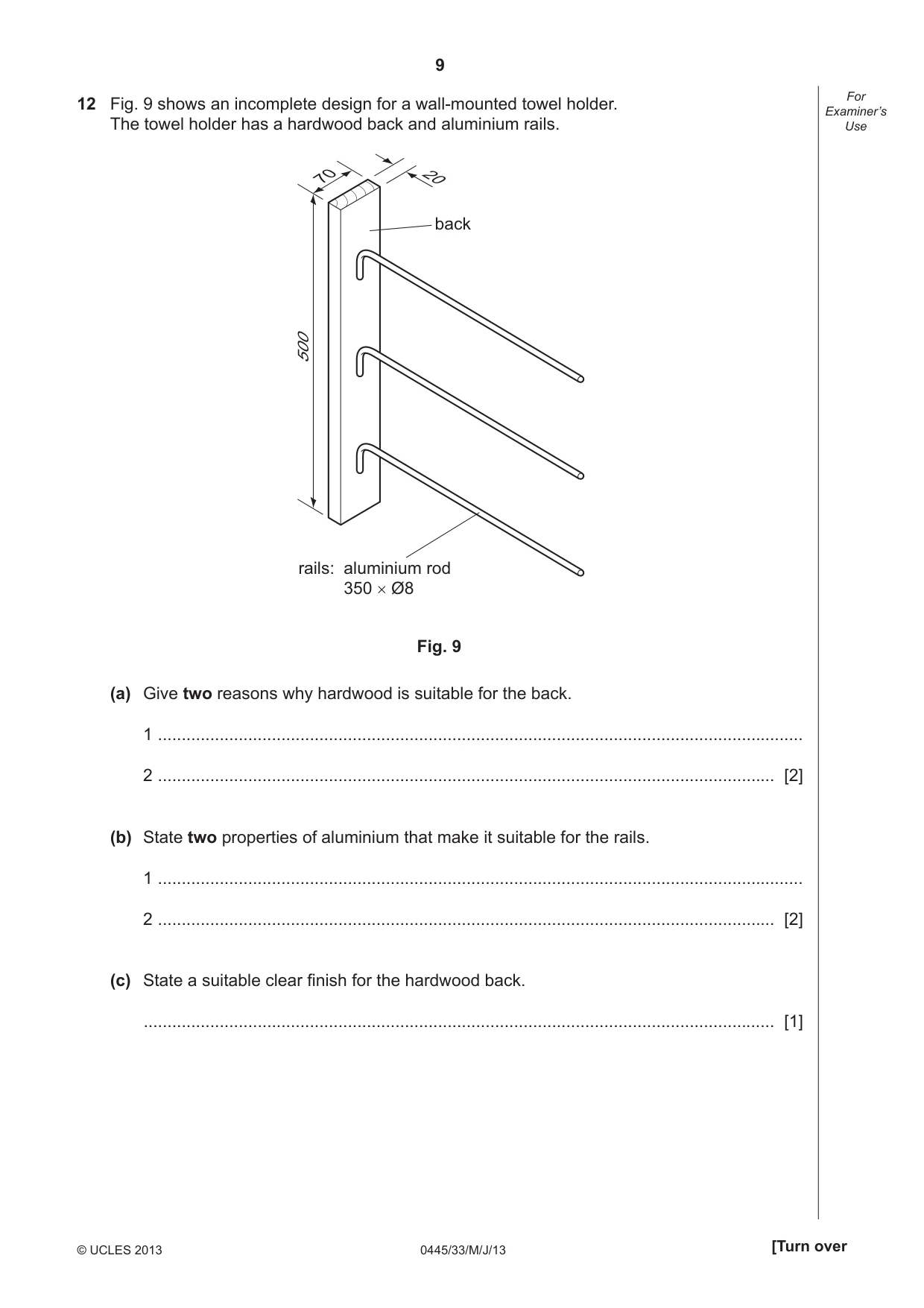
9 0445/33/M/J/13 © UCLES 2013 [Turn over For Examiner’s Use 12 Fig. 9 shows an incomplete design for a wall-mounted towel holder. The towel holder has a hardwood back and aluminium rails. rails: aluminium rod 350 × Ø8 20 500 70 back Fig. 9 (a) Give two reasons why hardwood is suitable for the back. 1 … 2 … [2] (b) State two properties of aluminium that make it suitable for the rails. 1 … 2 … [2] (c) State a suitable clear fi nish for the hardwood back. … [1]
Question paper, page 10
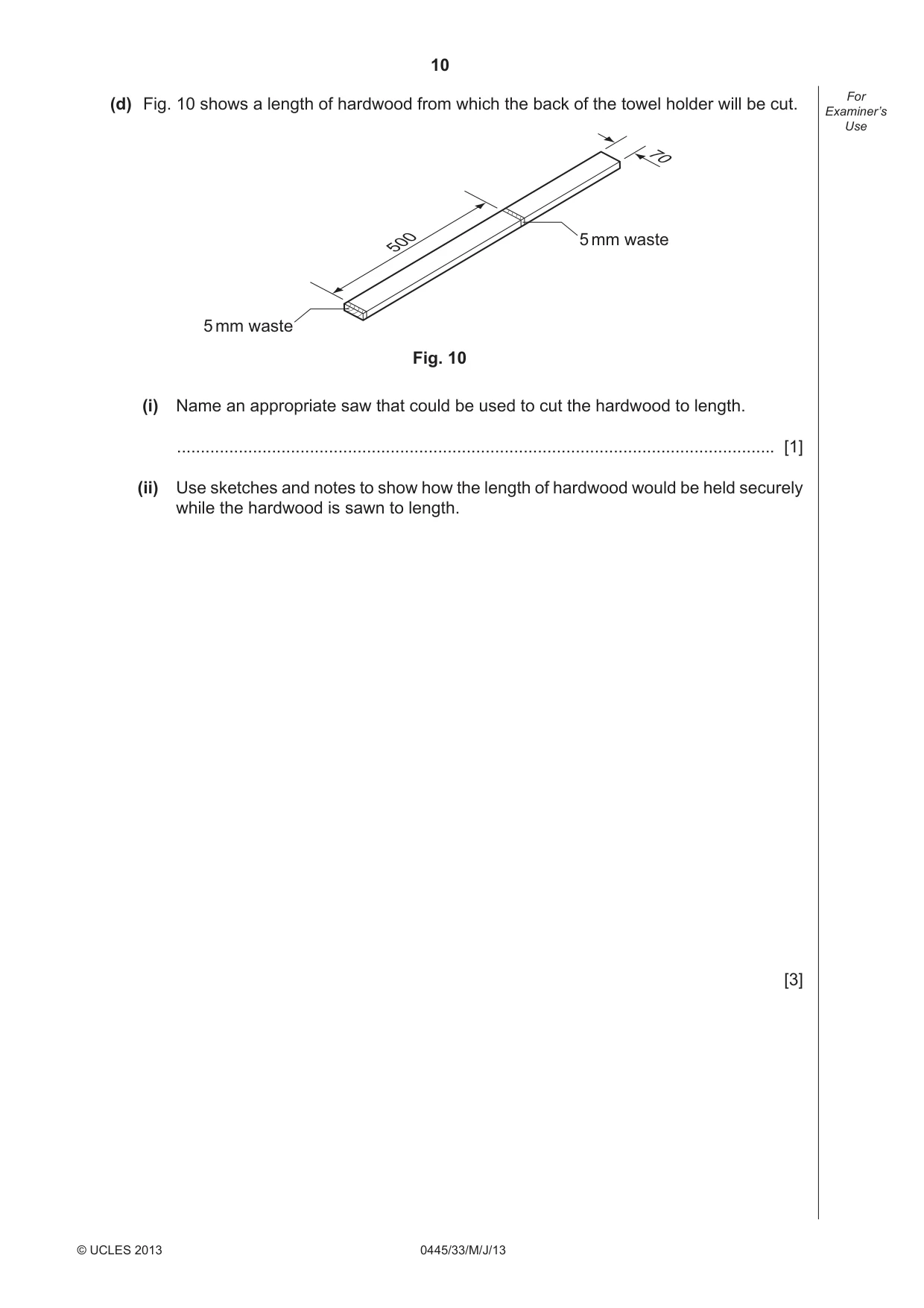
10 0445/33/M/J/13 © UCLES 2013 For Examiner’s Use (d) Fig. 10 shows a length of hardwood from which the back of the towel holder will be cut. 70 500 5 mm waste 5 mm waste Fig. 10 (i) Name an appropriate saw that could be used to cut the hardwood to length. … [1] (ii) Use sketches and notes to show how the length of hardwood would be held securely while the hardwood is sawn to length. [3]
Question paper, page 11
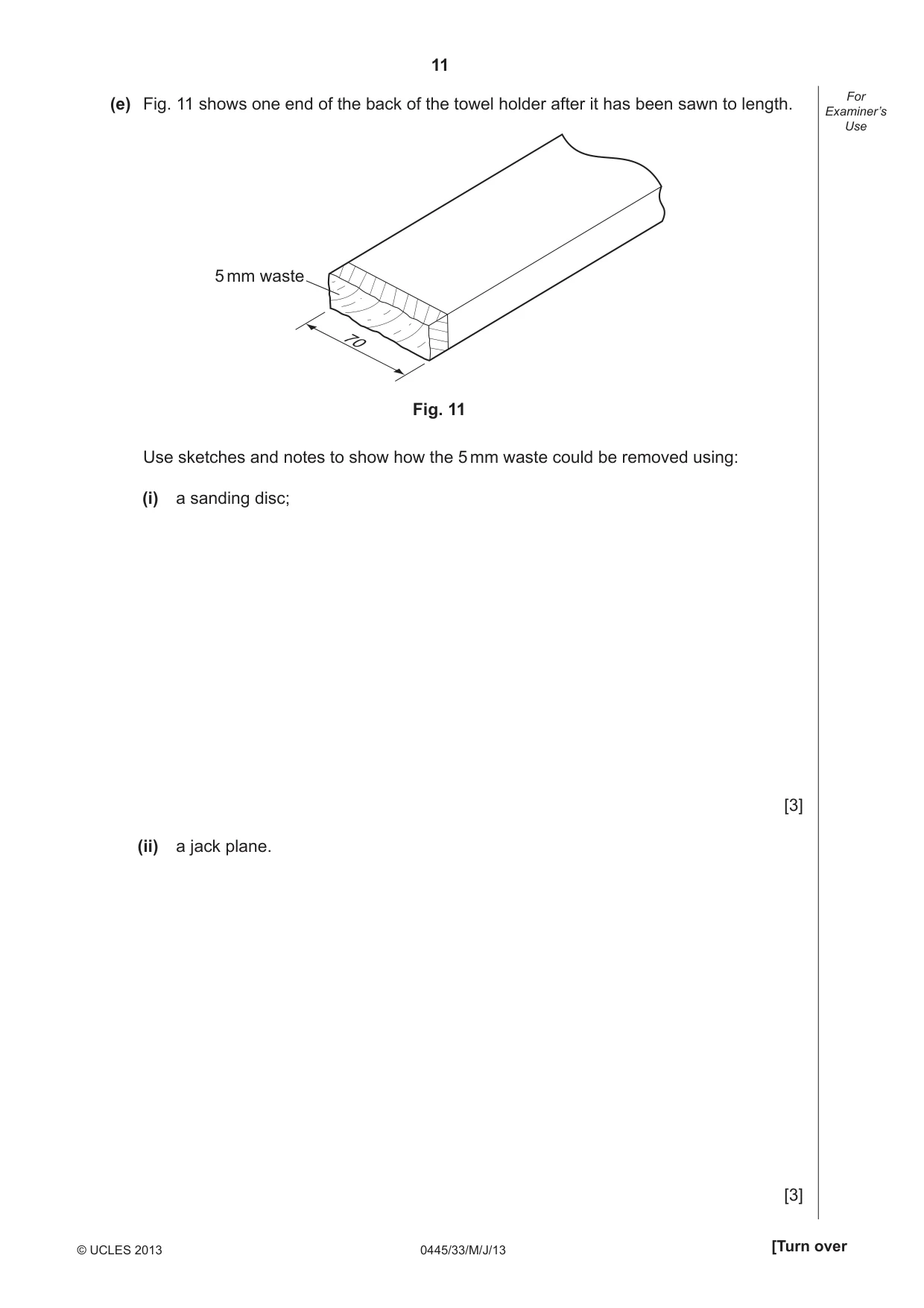
11 0445/33/M/J/13 © UCLES 2013 [Turn over For Examiner’s Use (e) Fig. 11 shows one end of the back of the towel holder after it has been sawn to length. 5 mm waste 70 Fig. 11 Use sketches and notes to show how the 5 mm waste could be removed using: (i) a sanding disc; [3] (ii) a jack plane. [3]
Question paper, page 12
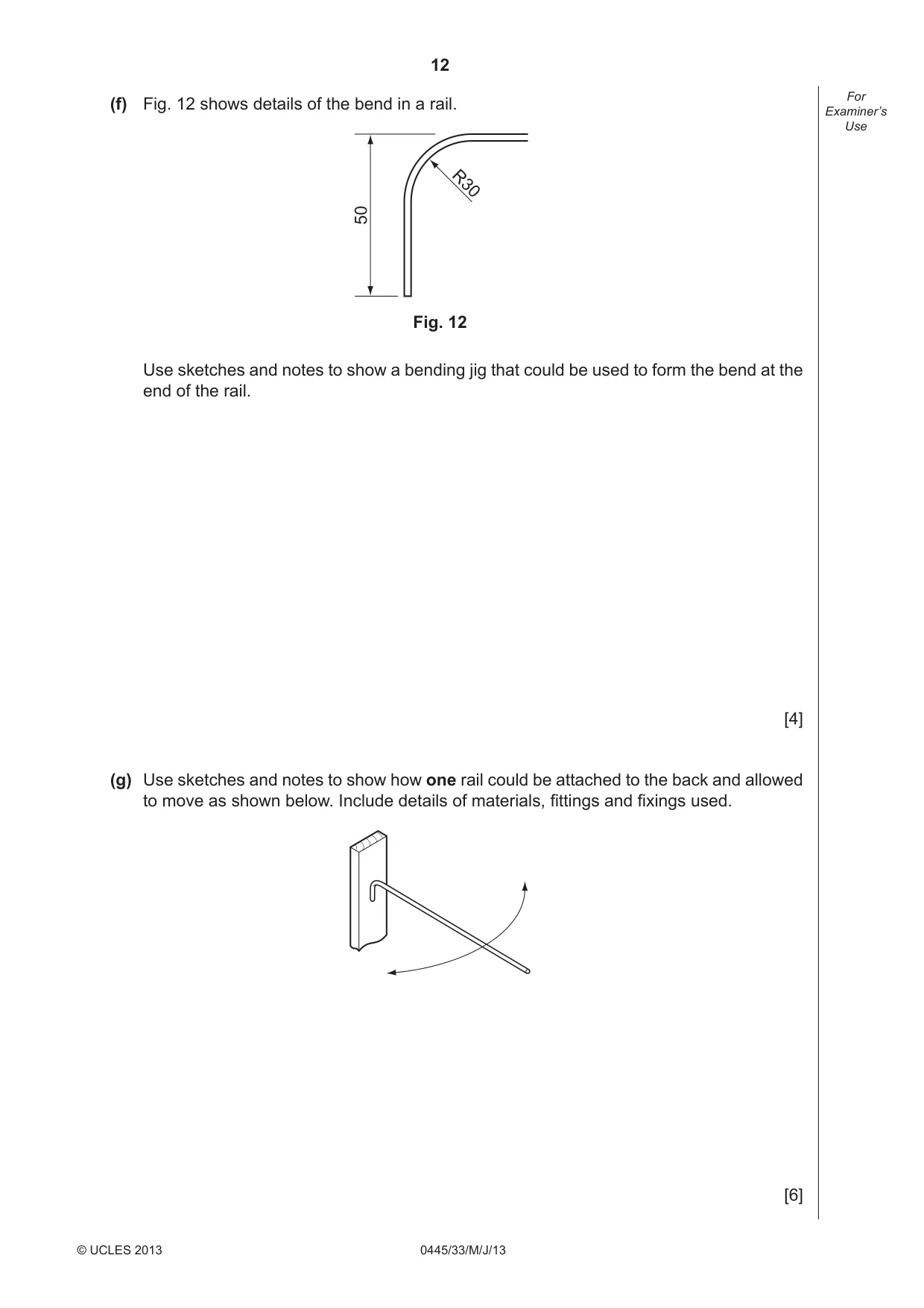
12 0445/33/M/J/13 © UCLES 2013 For Examiner’s Use (f) Fig. 12 shows details of the bend in a rail. R30 50 Fig. 12 Use sketches and notes to show a bending jig that could be used to form the bend at the end of the rail. [4] (g) Use sketches and notes to show how one rail could be attached to the back and allowed to move as shown below. Include details of materials, fi ttings and fi xings used. [6]
Question paper, page 13
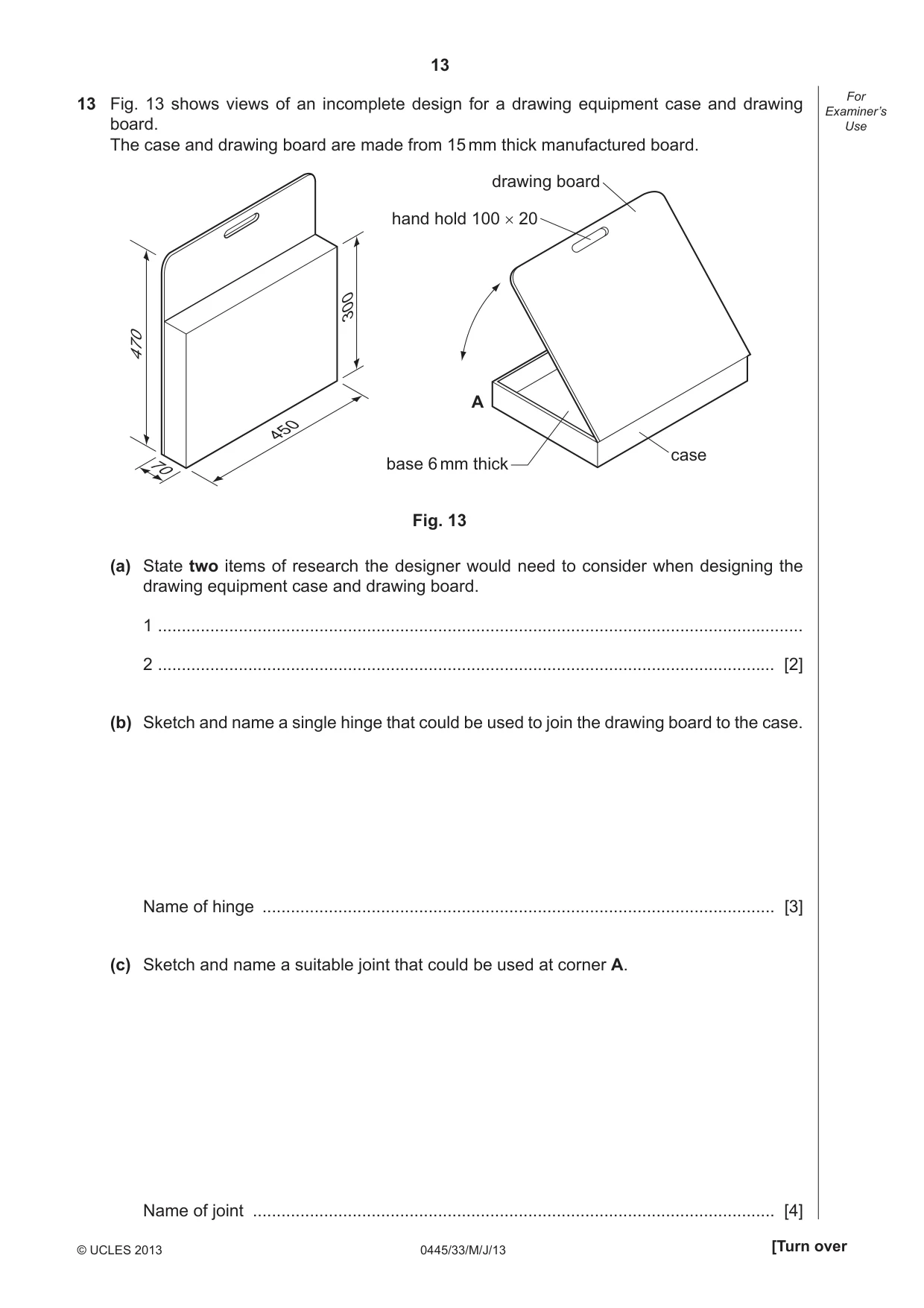
13 0445/33/M/J/13 © UCLES 2013 [Turn over For Examiner’s Use 13 Fig. 13 shows views of an incomplete design for a drawing equipment case and drawing board. The case and drawing board are made from 15 mm thick manufactured board. 70 470 450 300 base 6 mm thick A case hand hold 100 × 20 drawing board Fig. 13 (a) State two items of research the designer would need to consider when designing the drawing equipment case and drawing board. 1 … 2 … [2] (b) Sketch and name a single hinge that could be used to join the drawing board to the case. Name of hinge … [3] (c) Sketch and name a suitable joint that could be used at corner A. Name of joint … [4]
Question paper, page 14
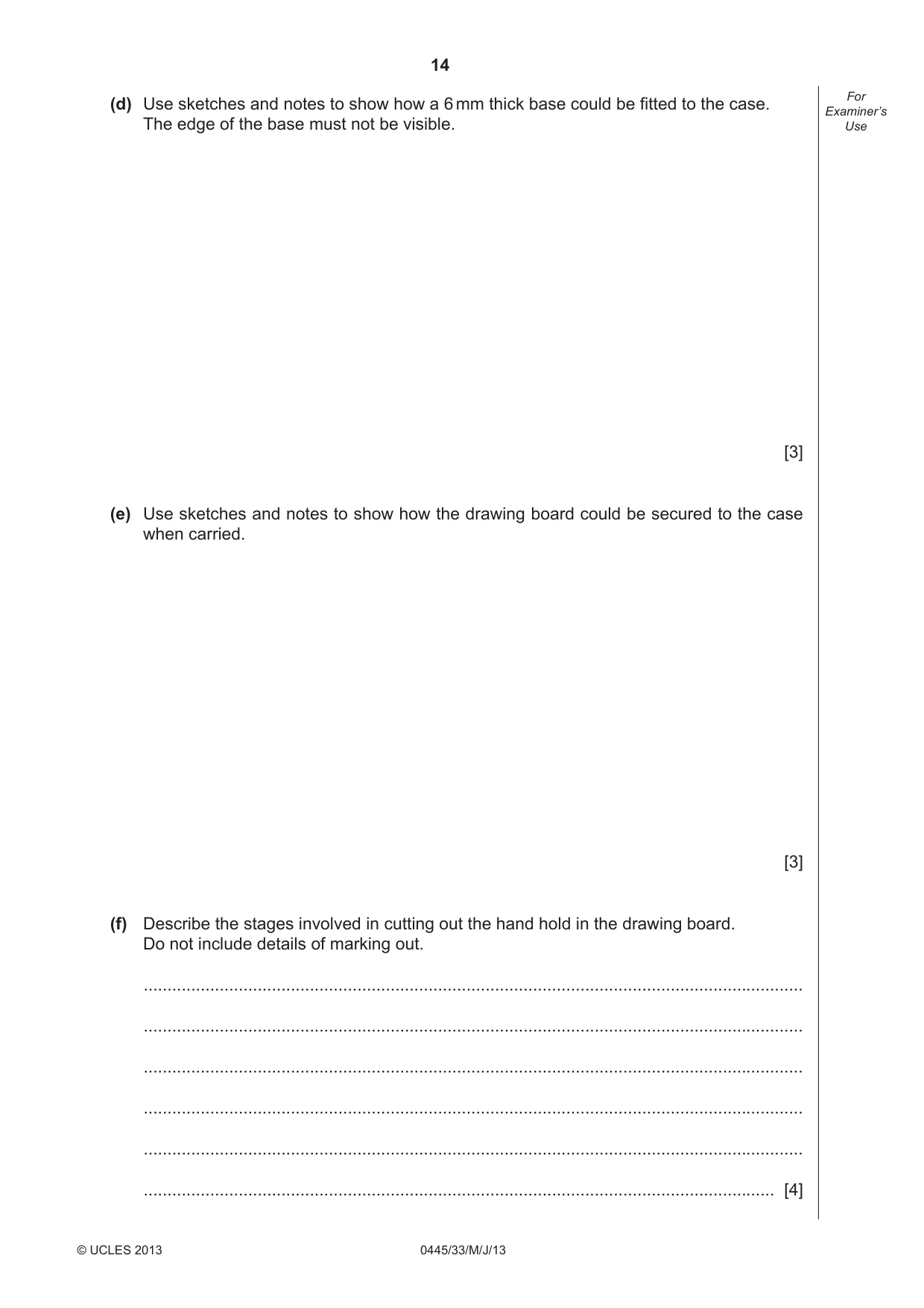
14 0445/33/M/J/13 © UCLES 2013 For Examiner’s Use (d) Use sketches and notes to show how a 6 mm thick base could be fi tted to the case. The edge of the base must not be visible. [3] (e) Use sketches and notes to show how the drawing board could be secured to the case when carried. [3] (f) Describe the stages involved in cutting out the hand hold in the drawing board. Do not include details of marking out. … … … … … … [4]
Question paper, page 15
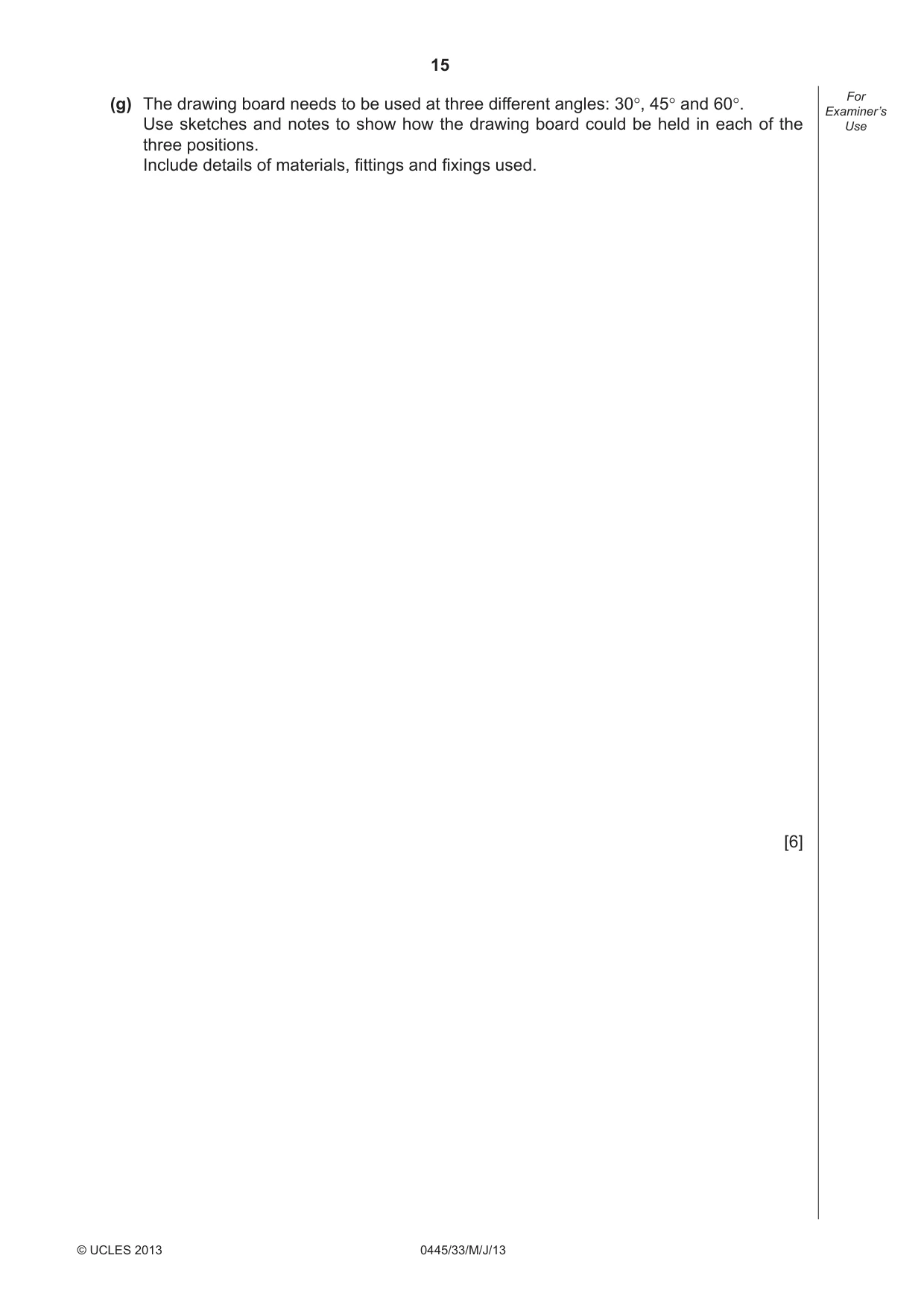
15 0445/33/M/J/13 © UCLES 2013 [Turn over For Examiner’s Use (g) The drawing board needs to be used at three different angles: 30°, 45° and 60°. Use sketches and notes to show how the drawing board could be held in each of the three positions. Include details of materials, fi ttings and fi xings used. [6]
Question paper, page 16
16 0445/33/M/J/13 Permission to reproduce items where third-party owned material protected by copyright is included has been sought and cleared where possible. Every reasonable effort has been made by the publisher (UCLES) to trace copyright holders, but if any items requiring clearance have unwittingly been included the publisher will be pleased to make amends at the earliest possible opportunity. University of Cambridge International Examinations is part of the Cambridge Assessment Group. Cambridge Assessment is the brand name of University of Cambridge Local Examinations Syndicate (UCLES), which is itself a department of the University of Cambridge. BLANK PAGE © UCLES 2013
Mark scheme, page 1
CAMBRIDGE INTERNATIONAL EXAMINATIONS International General Certificate of Secondary Education MARK SCHEME for the May/June 2013 series 0445 DESIGN AND TECHNOLOGY 0445/33 Paper 3 (Resistant Materials), maximum raw mark 50 This mark scheme is published as an aid to teachers and candidates, to indicate the requirements of the examination. It shows the basis on which Examiners were instructed to award marks. It does not indicate the details of the discussions that took place at an Examiners’ meeting before marking began, which would have considered the acceptability of alternative answers. Mark schemes should be read in conjunction with the question paper and the Principal Examiner Report for Teachers. Cambridge will not enter into discussions about these mark schemes. Cambridge is publishing the mark schemes for the May/June 2013 series for most IGCSE, GCE Advanced Level and Advanced Subsidiary Level components and some Ordinary Level components.
Mark scheme, page 2
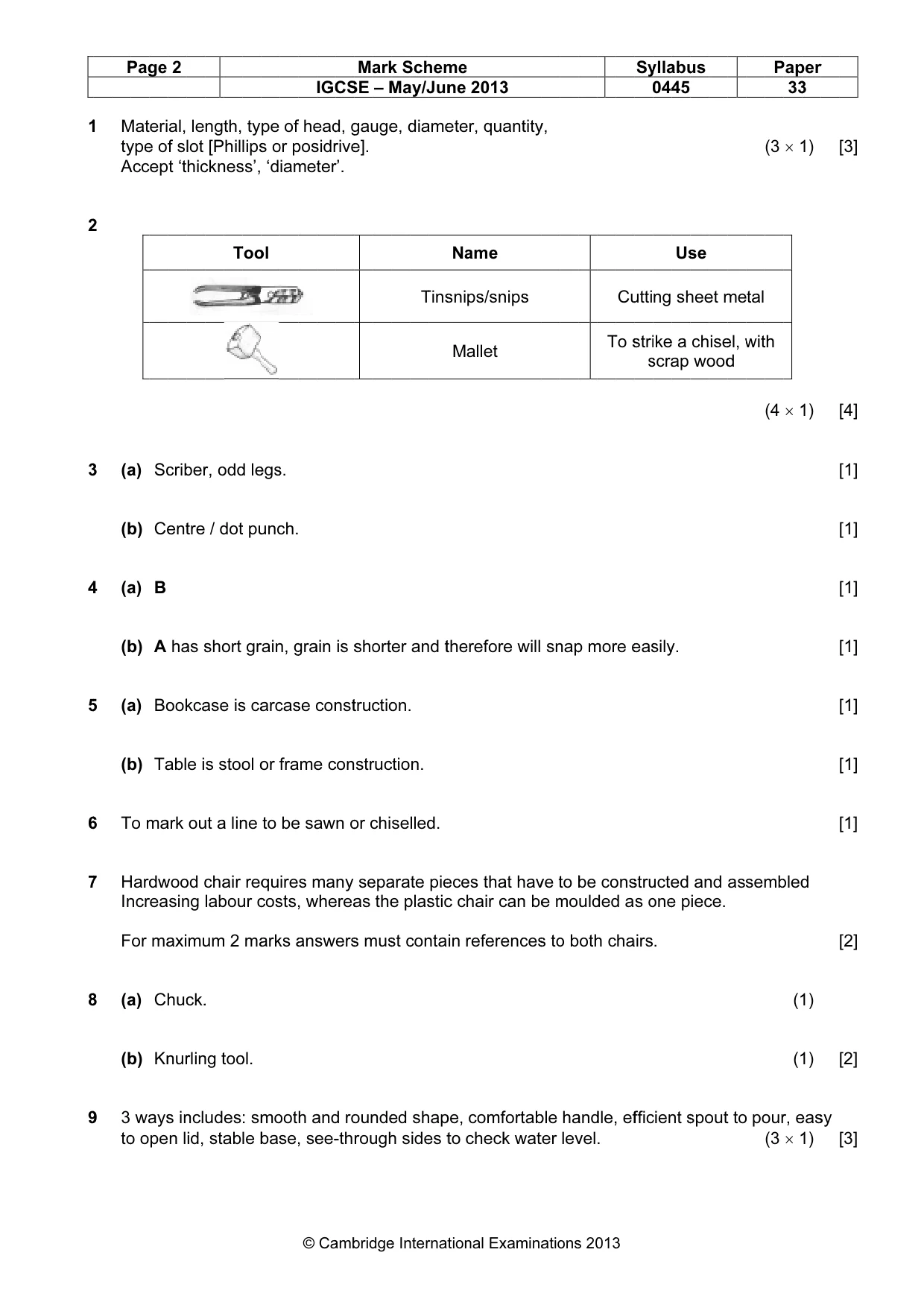
1 2 3 4 5 6 7 8 9 1 2 3 4 5 6 7 8 9 P M ty A (a (b (a (b (a (b T H In F (a (b 3 to Pag Mat ype Acc a) b) a) b) a) b) To m Hard ncr or a) b) wa o o ge teri e of ep Sc Ce B A Bo Ta ma dw rea ma Ch Kn ays pe 2 al, f s t ‘t crib ent ha ook abl ark woo sin axi huc nur s in n l le lot hic ber tre as s kca e i ou od c ng mu ck. rlin ncl id, ngt [P ckn r, o / d sho ase s s ut a cha lab um . ng t ud sta th, hil nes T odd dot ort e is stoo a lin air bou m 2 too es ab ty lips ss’, Too d le t pu gr s ca ol o ne req ur c ma ol. : sm le b pe s o ‘d ol egs unc rain arc or f to qu cos ark mo bas of or p iam s. ch. n, g cas fra be ire sts, ks a oot se, © f he pos met gra se c me e sa s m , w ans h a , se IGC Ca ead sidr ter ain con e c aw ma whe sw and ee- CS amb d, g rive r’. is s nst con n o ny erea ers d ro -th Ma SE brid gau e]. sho truc str or c se as s m oun rou ark – M dge uge ort ctio ruc chi epa the mus nde ugh k S Ma e In e, d er on. ctio se ara e p st c ed h s Sch ay/J nter dia T an n. lled te plas con sh ide hem Jun rnat ame Tins d t d. pie stic nta ap es t me ne tion ete Na sni M the ece c c in pe, to c e 20 nal er, q am ps/ alle eref es t ha ref co che 013 Ex qua me /sn et for tha ir c fere omf eck 3 xam ant nips e w at h can enc fort k w mina tity s will hav n be ces tab wat atio y, sn ve t e m s to ble ter ons nap to b mo o b ha lev s 20 p m be uld oth and vel 013 T mor co ded h c dle, . 3 Cu To s re e ons d a cha , ef Sy 0 utti stri s eas stru s o airs ffic ylla 044 ng ike scra sily ucte one . cien abu 45 Us sh e a ap y. ed e p nt s us se hee ch wo an iec spo et m ise ood nd ce. out me el, w d ass t to tal wit sem o po P (3 th (4 mb our (3 Pap 33 × 1 × 1 bled (1 (1 r, e × 1 per 3 1) 1) d 1) 1) eas 1) r sy [3] [4] [1] [1] [1] [1] [1] [1] [1] [2] [2] [3]
Mark scheme, page 3
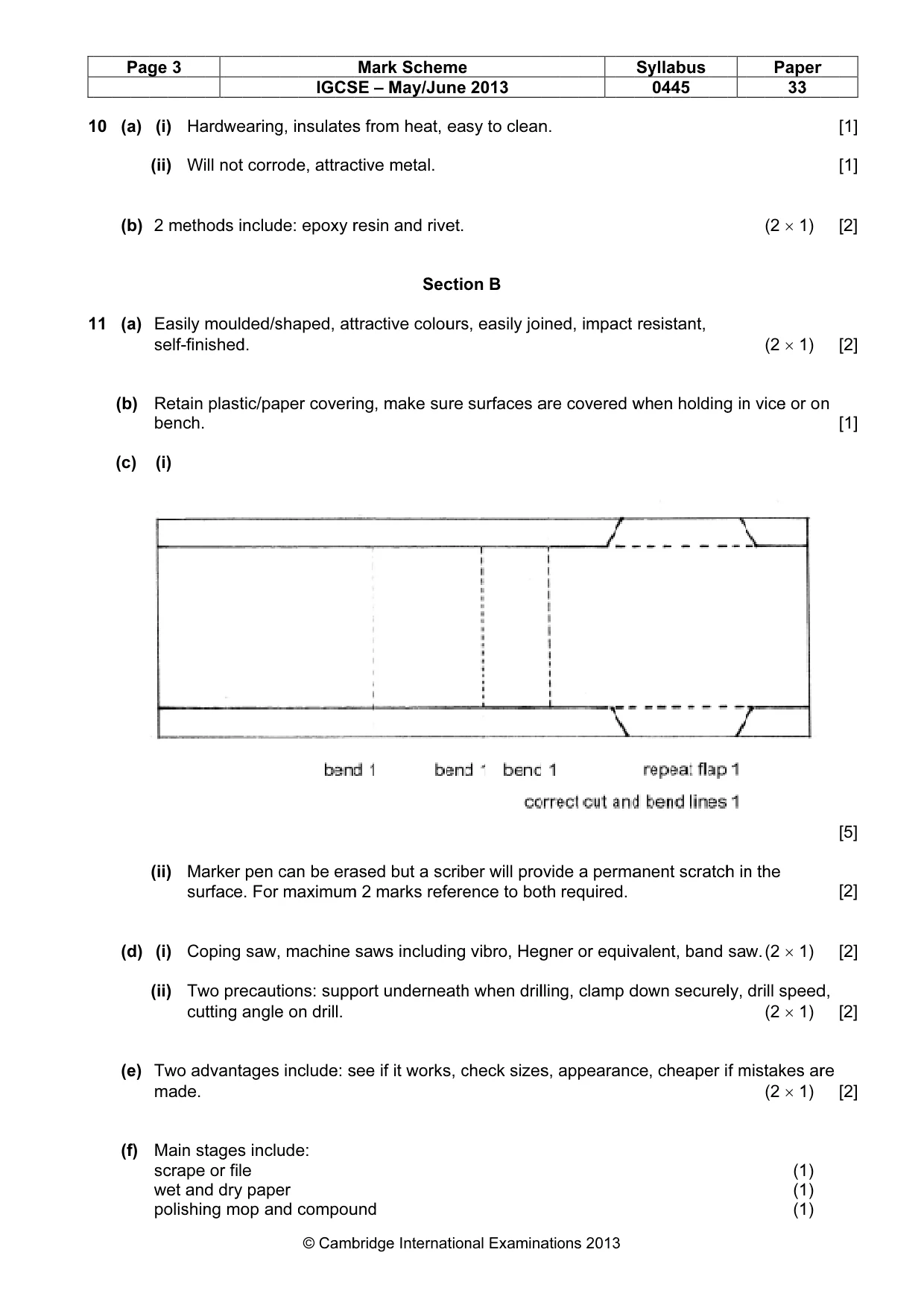
1 1 10 11 P (a (b (a (b (c (d (e (f Pag a) b) a) b) ) d) e) f) ge (i) (ii) 2 Ea se Re be (i) (ii) (i) (ii) Tw m M sc we po 3 ) ) me asi elf-f eta enc ) ) ) ) wo ad ain cra et a olis Ha Wi eth ly fin ain ch. Ma su Co Tw cu ad e. n st pe and shin ard ill n od mo ish pla ark rfa opin wo ttin dva tag or d d ng we not ds i ould hed ast ker ace ng pre ng ant ges r fil dry mo ear t co nc ded d. tic/ pe . F sa eca an ag s in e pa op ring orro lud d/s /pa en c For aw, aut gle es nclu ape an g, in ode de: sha pe can ma m tion e o inc ude er nd c © nsu e, a ep ape r c n b axi mac ns: n d clu e: com IGC Ca ula attr pox ed, cov be e imu chin su dril ude mp CS amb ates rac xy r att eri era um ne upp l. e: s pou Ma SE brid s fr ctiv res tra ng ase m 2 saw por see und ark – M dge rom ve m sin activ , m ed ma ws rt u e if d k S Ma e In m h me an ve mak but ark s in nd it w Sch ay/J nter hea etal nd r S co ke t a ks r nclu dern wo hem Jun rnat at, e l. rive Sec olou su sc refe udi nea rks me ne tion ea et. ctio urs re crib ere ng ath s, c e 20 nal sy on s, e su ber enc vib h w che 013 Ex to B eas rfa wi ce bro whe eck 3 xam cle sily ace ill p to o, H en d k siz mina ean jo es a pro bo Heg dril zes atio n. ine are ovid oth gne llin s, a ons ed, e co de req er g, app s 20 im ove a p qui or cla pea 013 mpa ere per ired eq am ara 3 act ed w rma d. uiv p d anc Sy 0 res wh ane vale dow ce, ylla 044 sis en ent ent wn ch abu 45 stan n ho t sc t, b se hea us nt, old cra ban ecu ape ing atch nd urel er i g in h in saw ly, f m n v n th w. dri mist P (2 (2 ice he (2 ill s (2 tak (2 Pap 33 × 1 × 1 e or × 1 spe × 1 kes × 1 (1 (1 (1 per 3 1) 1) r o 1) eed 1) s ar 1) 1) 1) 1) r n d, re [1] [1] [2] [2] [1] [5] [2] [2] [2] [2]
Mark scheme, page 4
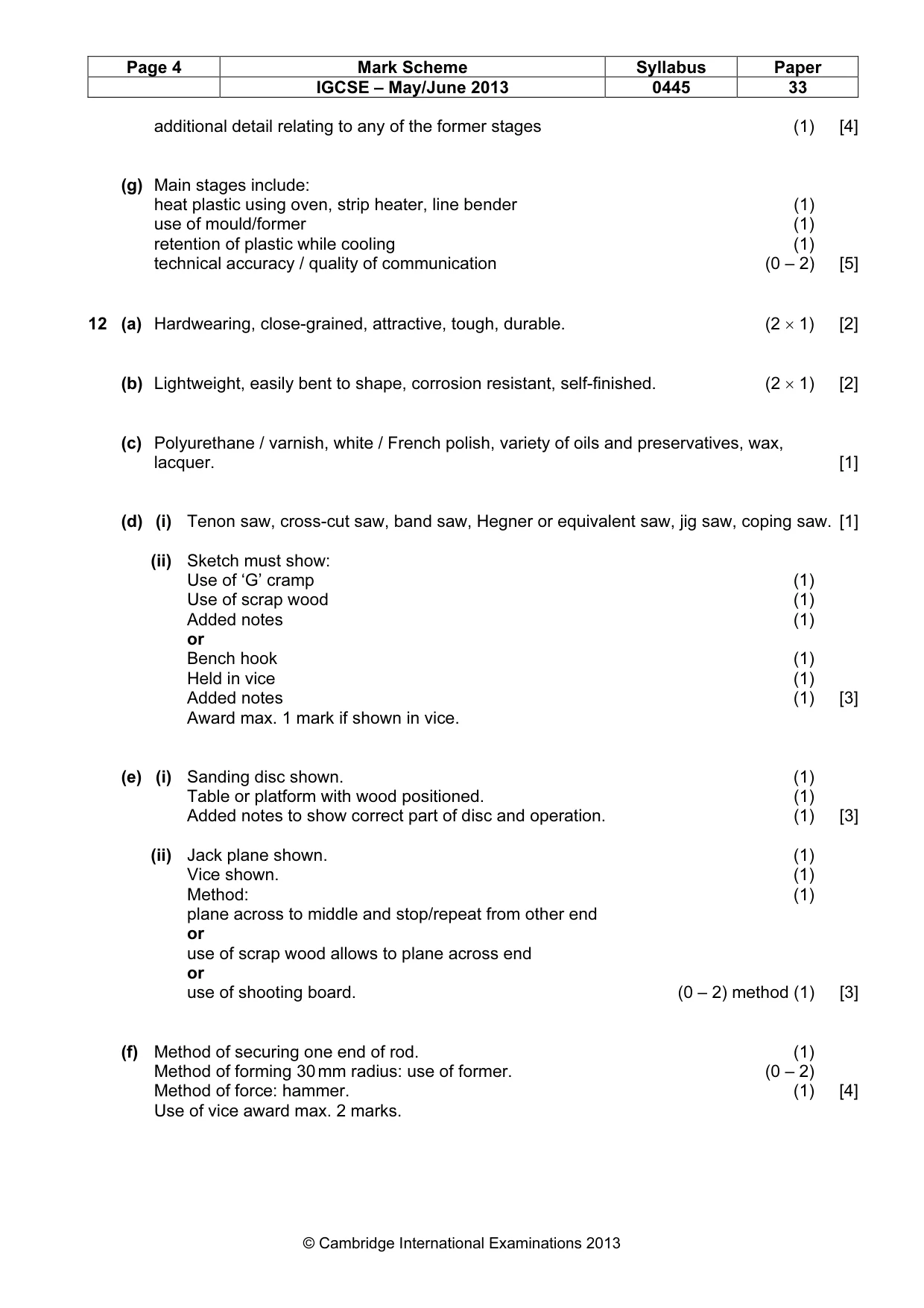
Page 4 Mark Scheme Syllabus Paper IGCSE – May/June 2013 0445 33 © Cambridge International Examinations 2013 additional detail relating to any of the former stages (1) [4] (g) Main stages include: heat plastic using oven, strip heater, line bender (1) use of mould/former (1) retention of plastic while cooling (1) technical accuracy / quality of communication (0 – 2) [5] 12 (a) Hardwearing, close-grained, attractive, tough, durable. (2 × 1) [2] (b) Lightweight, easily bent to shape, corrosion resistant, self-finished. (2 × 1) [2] (c) Polyurethane / varnish, white / French polish, variety of oils and preservatives, wax, lacquer. [1] (d) (i) Tenon saw, cross-cut saw, band saw, Hegner or equivalent saw, jig saw, coping saw. [1] (ii) Sketch must show: Use of ‘G’ cramp (1) Use of scrap wood (1) Added notes (1) or Bench hook (1) Held in vice (1) Added notes (1) [3] Award max. 1 mark if shown in vice. (e) (i) Sanding disc shown. (1) Table or platform with wood positioned. (1) Added notes to show correct part of disc and operation. (1) [3] (ii) Jack plane shown. (1) Vice shown. (1) Method: (1) plane across to middle and stop/repeat from other end or use of scrap wood allows to plane across end or use of shooting board. (0 – 2) method (1) [3] (f) Method of securing one end of rod. (1) Method of forming 30 mm radius: use of former. (0 – 2) Method of force: hammer. (1) [4] Use of vice award max. 2 marks.
Mark scheme, page 5
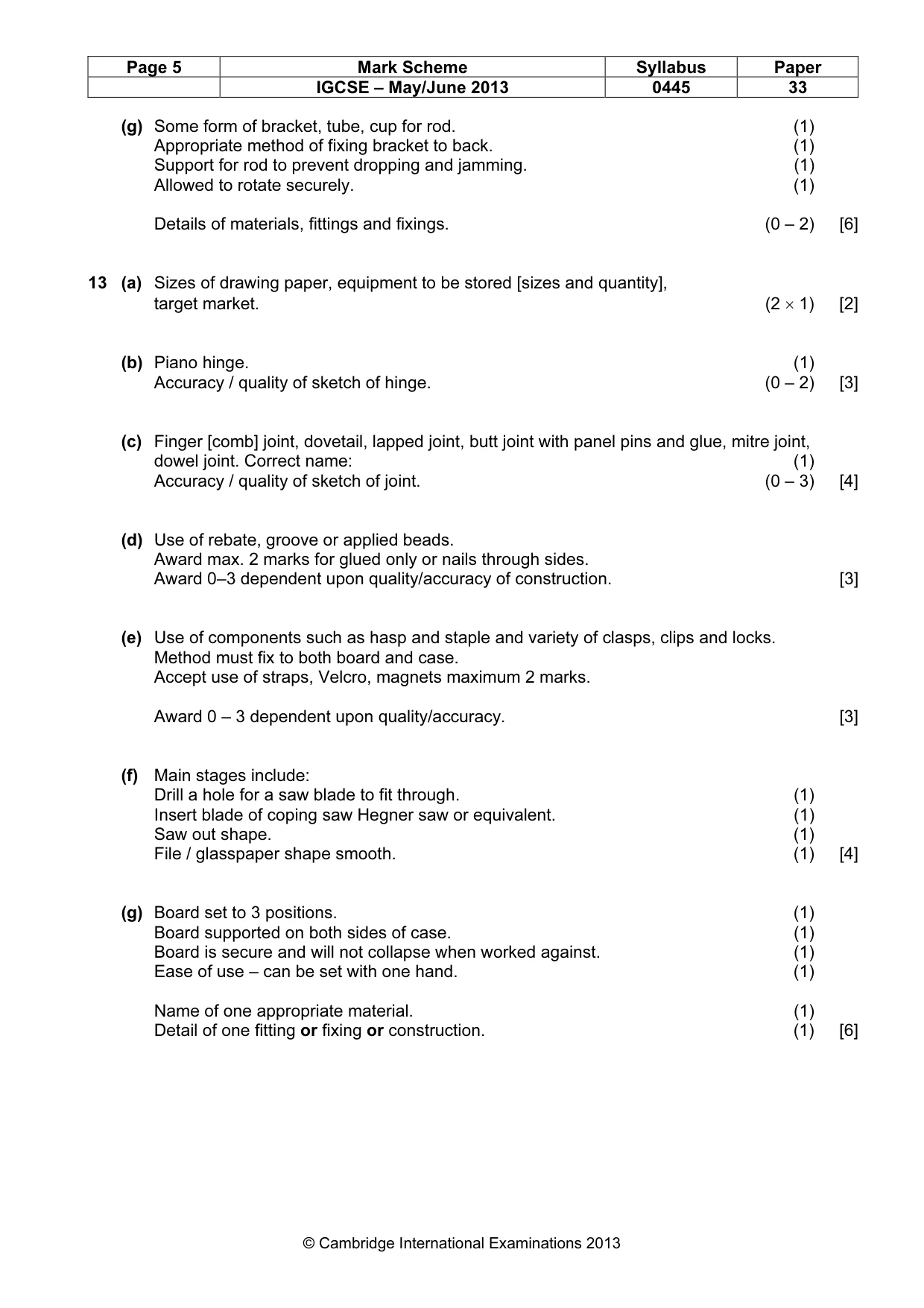
Page 5 Mark Scheme Syllabus Paper IGCSE – May/June 2013 0445 33 © Cambridge International Examinations 2013 (g) Some form of bracket, tube, cup for rod. (1) Appropriate method of fixing bracket to back. (1) Support for rod to prevent dropping and jamming. (1) Allowed to rotate securely. (1) Details of materials, fittings and fixings. (0 – 2) [6] 13 (a) Sizes of drawing paper, equipment to be stored [sizes and quantity], target market. (2 × 1) [2] (b) Piano hinge. (1) Accuracy / quality of sketch of hinge. (0 – 2) [3] (c) Finger [comb] joint, dovetail, lapped joint, butt joint with panel pins and glue, mitre joint, dowel joint. Correct name: (1) Accuracy / quality of sketch of joint. (0 – 3) [4] (d) Use of rebate, groove or applied beads. Award max. 2 marks for glued only or nails through sides. Award 0–3 dependent upon quality/accuracy of construction. [3] (e) Use of components such as hasp and staple and variety of clasps, clips and locks. Method must fix to both board and case. Accept use of straps, Velcro, magnets maximum 2 marks. Award 0 – 3 dependent upon quality/accuracy. [3] (f) Main stages include: Drill a hole for a saw blade to fit through. (1) Insert blade of coping saw Hegner saw or equivalent. (1) Saw out shape. (1) File / glasspaper shape smooth. (1) [4] (g) Board set to 3 positions. (1) Board supported on both sides of case. (1) Board is secure and will not collapse when worked against. (1) Ease of use – can be set with one hand. (1) Name of one appropriate material. (1) Detail of one fitting or fixing or construction. (1) [6]
What you needed in this session
Cambridge’s own grade thresholds for 2013 May/June, Paper 3 · Variant 3. A higher threshold means an easier paper — the bar moves with how the cohort did.