Cambridge IGCSE Design and Technology 0445 — 2010 May/June Paper 3 · Variant 1
0445/31/M/J/10 · 50 marks · ≈56 min
The question paper and its mark scheme, free to read here and free to download. This is Cambridge’s own paper, exactly as it was sat.
Question paper16 pages
Mark scheme5 pages
Answers below. Sit the paper first if you are practising.
Paper as text
Question paper, page 1
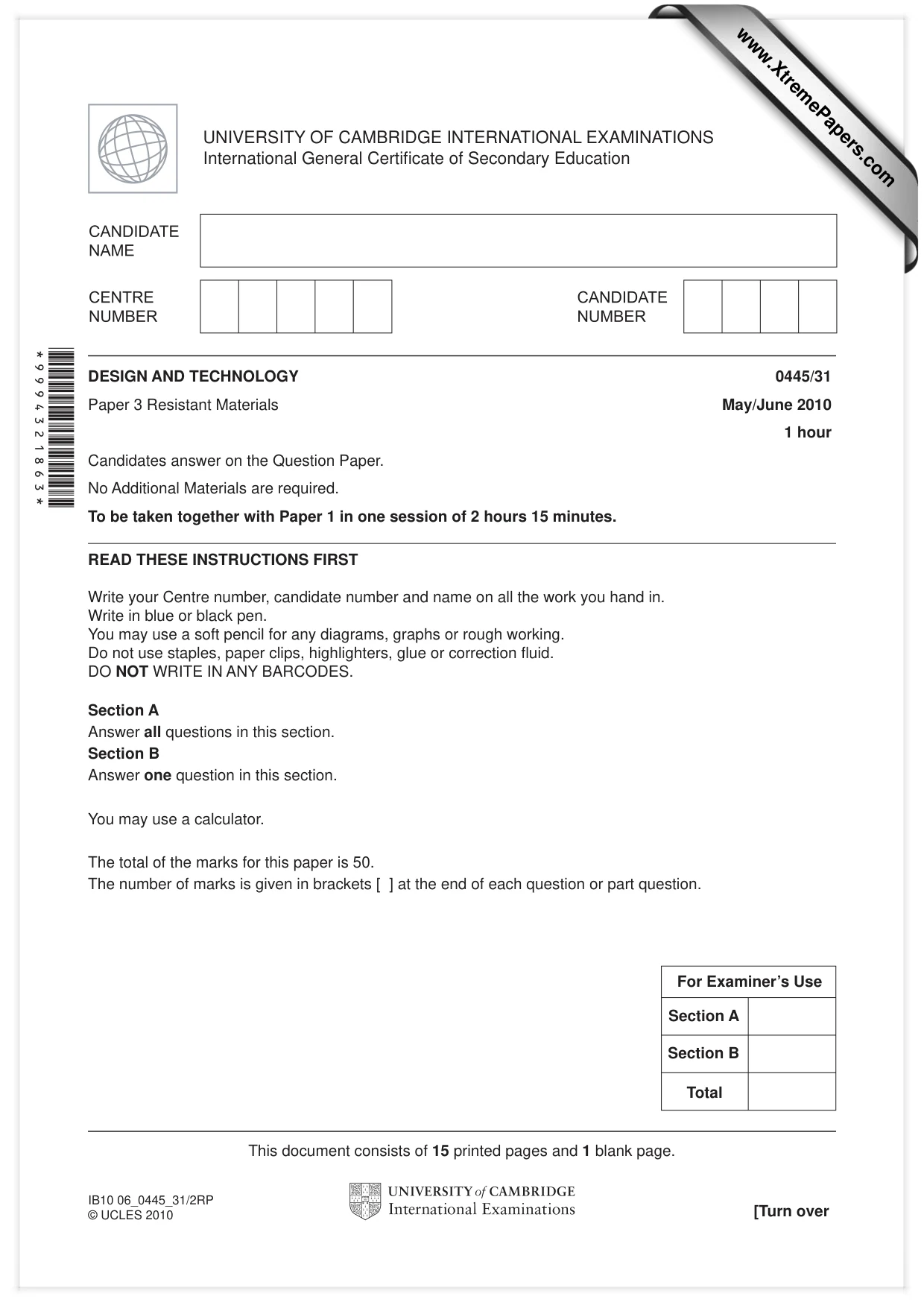
READ THESE INSTRUCTIONS FIRST Write your Centre number, candidate number and name on all the work you hand in. Write in blue or black pen. You may use a soft pencil for any diagrams, graphs or rough working. Do not use staples, paper clips, highlighters, glue or correction fl uid. DO NOT WRITE IN ANY BARCODES. Section A Answer all questions in this section. Section B Answer one question in this section. You may use a calculator. The total of the marks for this paper is 50. The number of marks is given in brackets [ ] at the end of each question or part question. DESIGN AND TECHNOLOGY 0445/31 Paper 3 Resistant Materials May/June 2010 1 hour Candidates answer on the Question Paper. No Additional Materials are required. To be taken together with Paper 1 in one session of 2 hours 15 minutes. UNIVERSITY OF CAMBRIDGE INTERNATIONAL EXAMINATIONS International General Certifi cate of Secondary Education This document consists of 15 printed pages and 1 blank page. [Turn over IB10 06_0445_31/2RP © UCLES 2010 *9994321863* For Examiner’s Use Total Section A Section B www.XtremePapers.com
Question paper, page 2
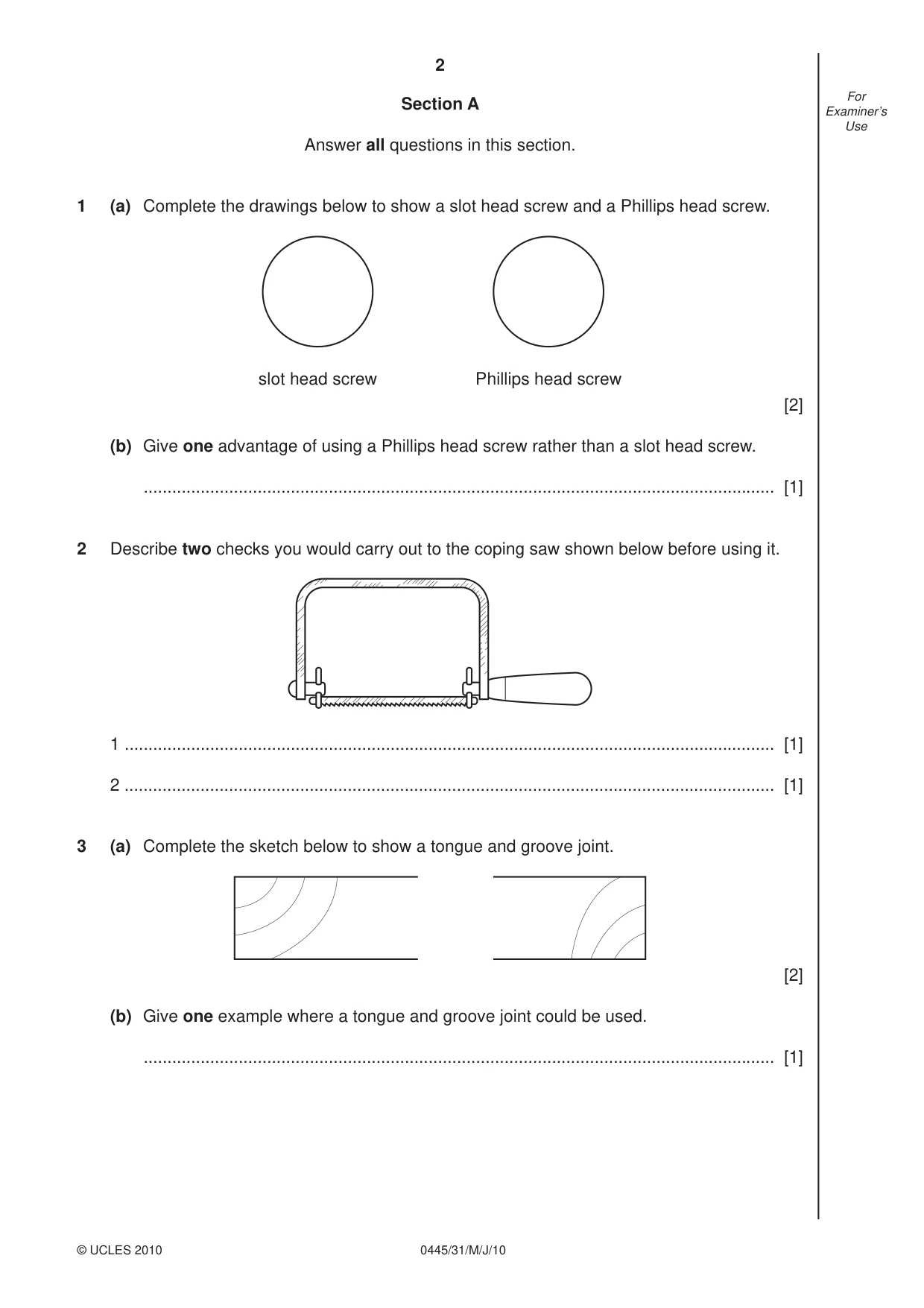
2 0445/31/M/J/10 © UCLES 2010 For Examiner’s Use Section A Answer all questions in this section. 1 (a) Complete the drawings below to show a slot head screw and a Phillips head screw. slot head screw Phillips head screw [2] (b) Give one advantage of using a Phillips head screw rather than a slot head screw. … [1] 2 Describe two checks you would carry out to the coping saw shown below before using it. 1 … [1] 2 … … [1] 3 (a) Complete the sketch below to show a tongue and groove joint. [2] (b) Give one example where a tongue and groove joint could be used. … [1]
Question paper, page 3
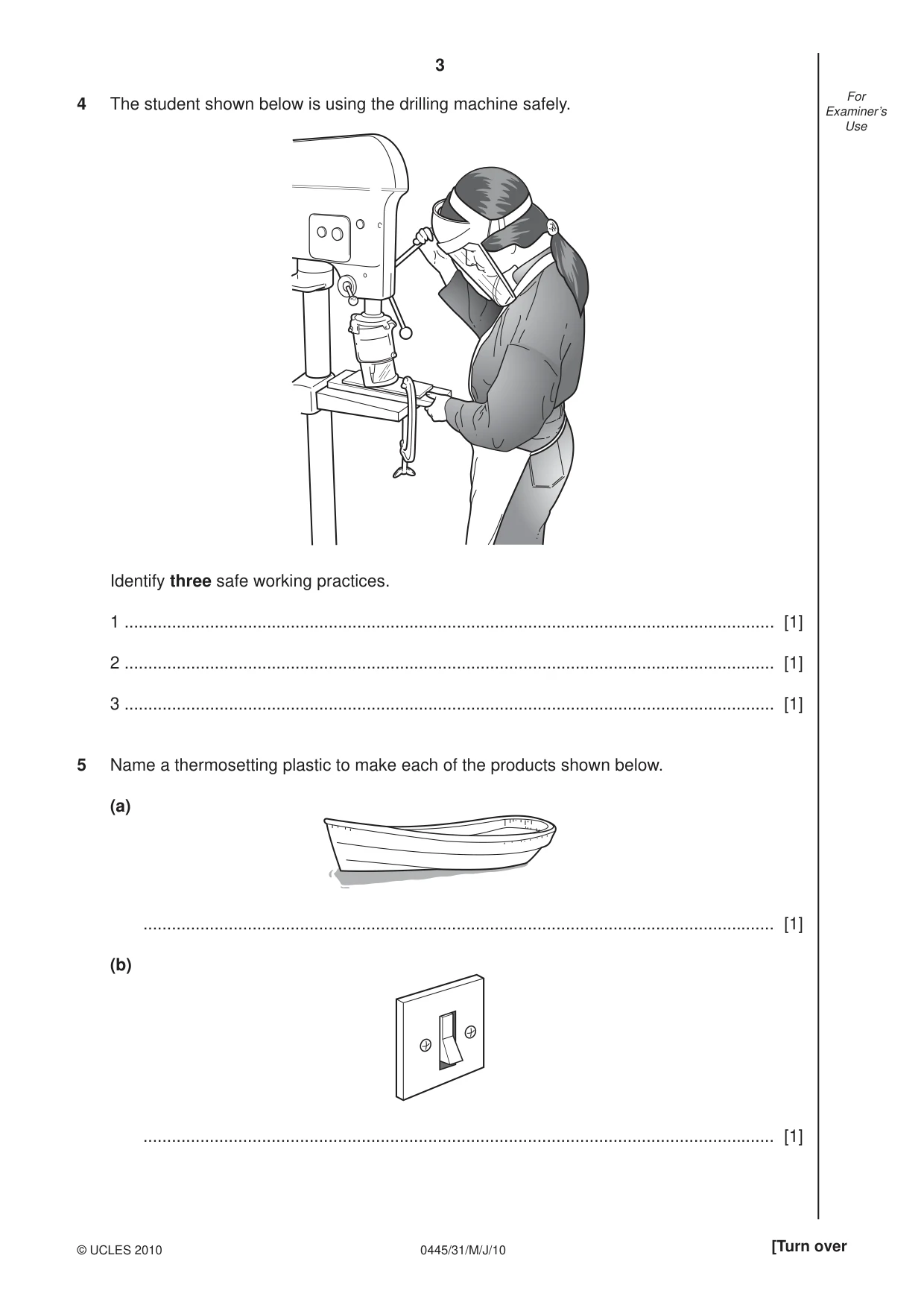
3 0445/31/M/J/10 © UCLES 2010 [Turn over For Examiner’s Use 4 The student shown below is using the drilling machine safely. Identify three safe working practices. 1 … . [1] 2 … [1] 3 … [1] 5 Name a thermosetting plastic to make each of the products shown below. (a) … [1] (b) … [1]
Question paper, page 4
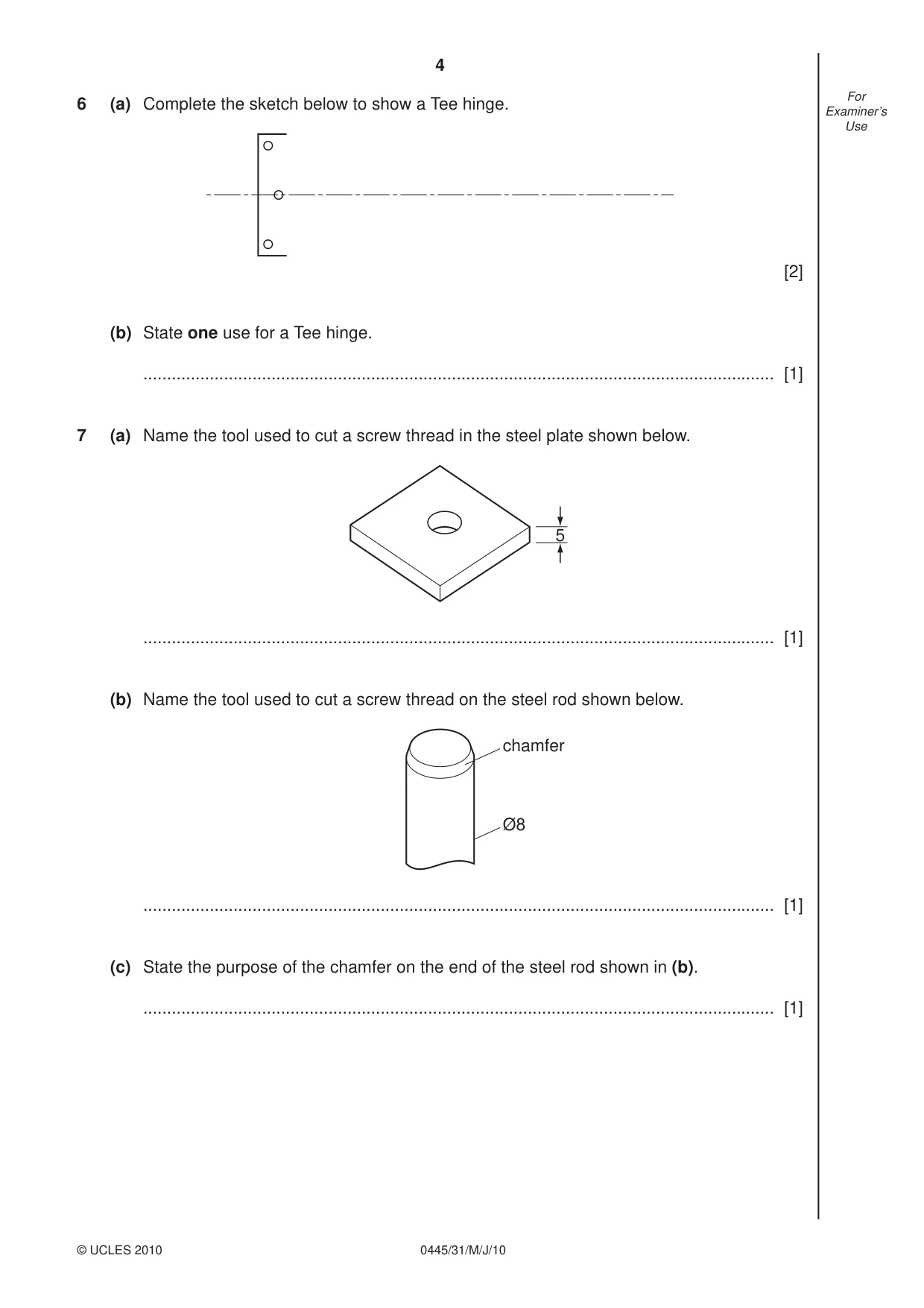
4 0445/31/M/J/10 © UCLES 2010 For Examiner’s Use 6 (a) Complete the sketch below to show a Tee hinge. [2] (b) State one use for a Tee hinge. … [1] 7 (a) Name the tool used to cut a screw thread in the steel plate shown below. 5 … [1] (b) Name the tool used to cut a screw thread on the steel rod shown below. chamfer Ø8 … [1] (c) State the purpose of the chamfer on the end of the steel rod shown in (b). … [1]
Question paper, page 5
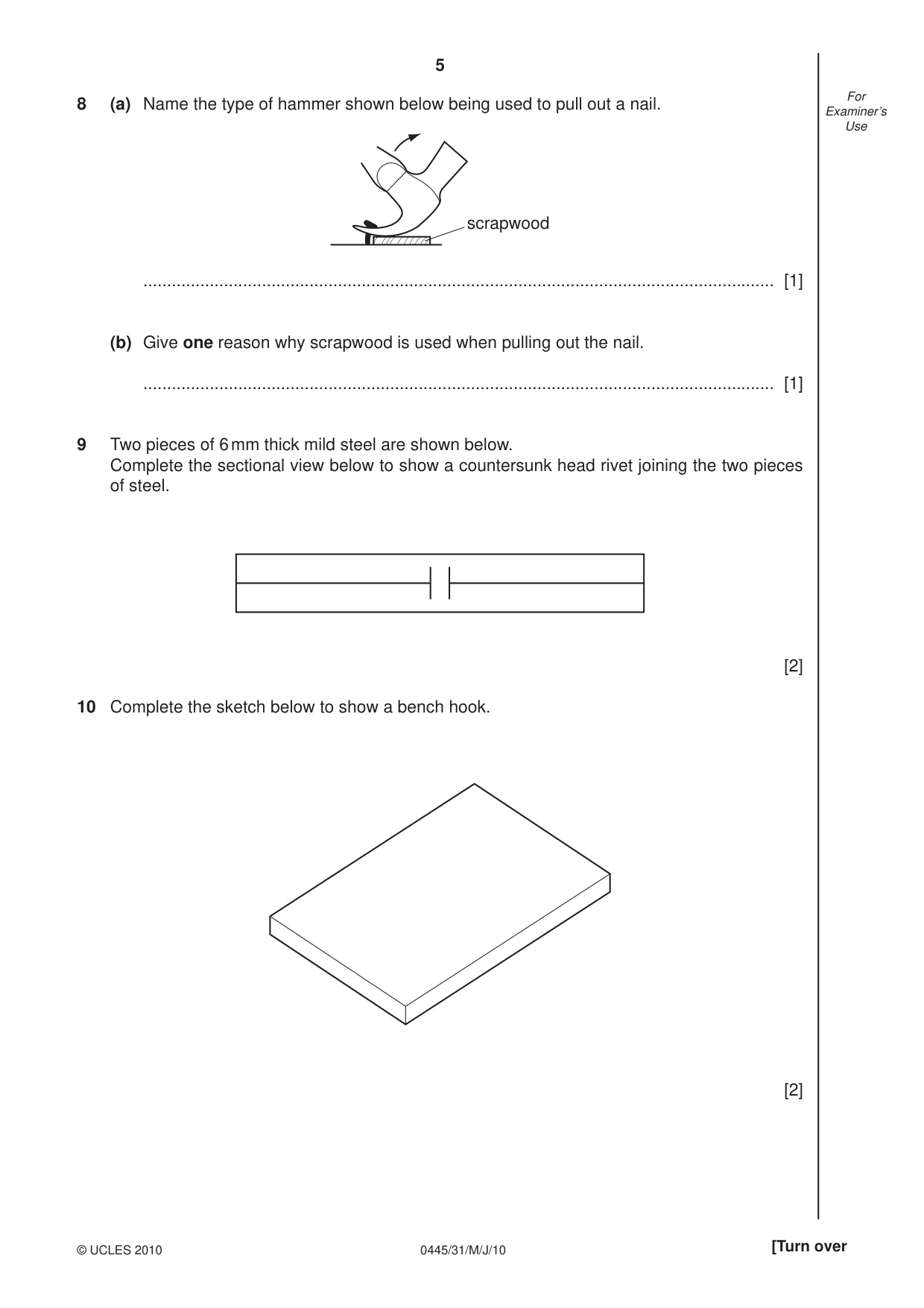
5 0445/31/M/J/10 © UCLES 2010 [Turn over For Examiner’s Use 8 (a) Name the type of hammer shown below being used to pull out a nail. scrapwood … [1] (b) Give one reason why scrapwood is used when pulling out the nail. … [1] 9 Two pieces of 6 mm thick mild steel are shown below. Complete the sectional view below to show a countersunk head rivet joining the two pieces of steel. [2] 10 Complete the sketch below to show a bench hook. [2]
Question paper, page 6
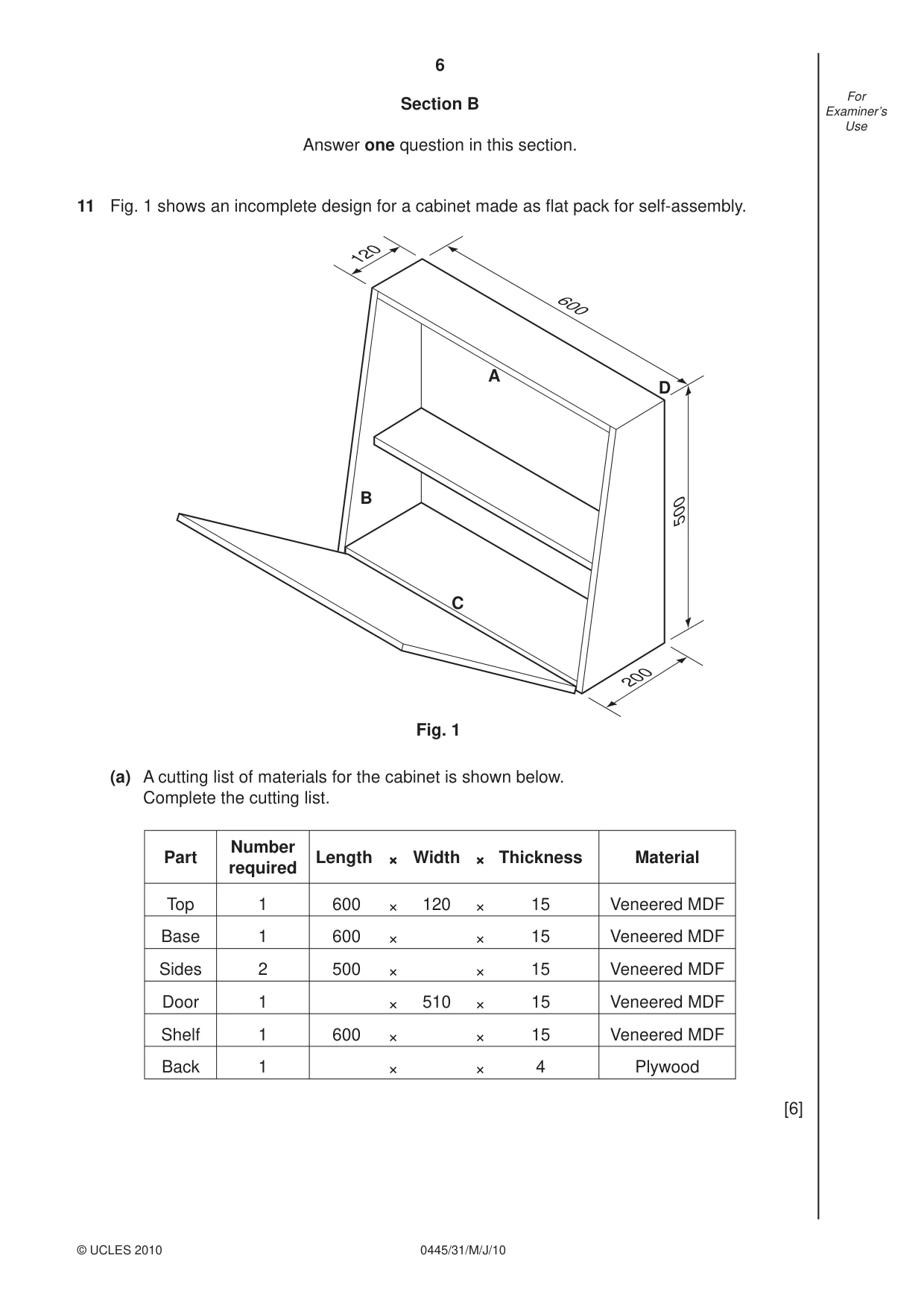
6 0445/31/M/J/10 © UCLES 2010 For Examiner’s Use Section B Answer one question in this section. 11 Fig. 1 shows an incomplete design for a cabinet made as fl at pack for self-assembly. 120 200 D A C B 600 500 Fig. 1 (a) A cutting list of materials for the cabinet is shown below. Complete the cutting list. Part Number required Length × Width × Thickness Material Top 1 600 × 120 × 15 Veneered MDF Base 1 600 × × 15 Veneered MDF Sides 2 500 × × 15 Veneered MDF Door 1 × 510 × 15 Veneered MDF Shelf 1 600 × × 15 Veneered MDF Back 1 × × 4 Plywood [6]
Question paper, page 7
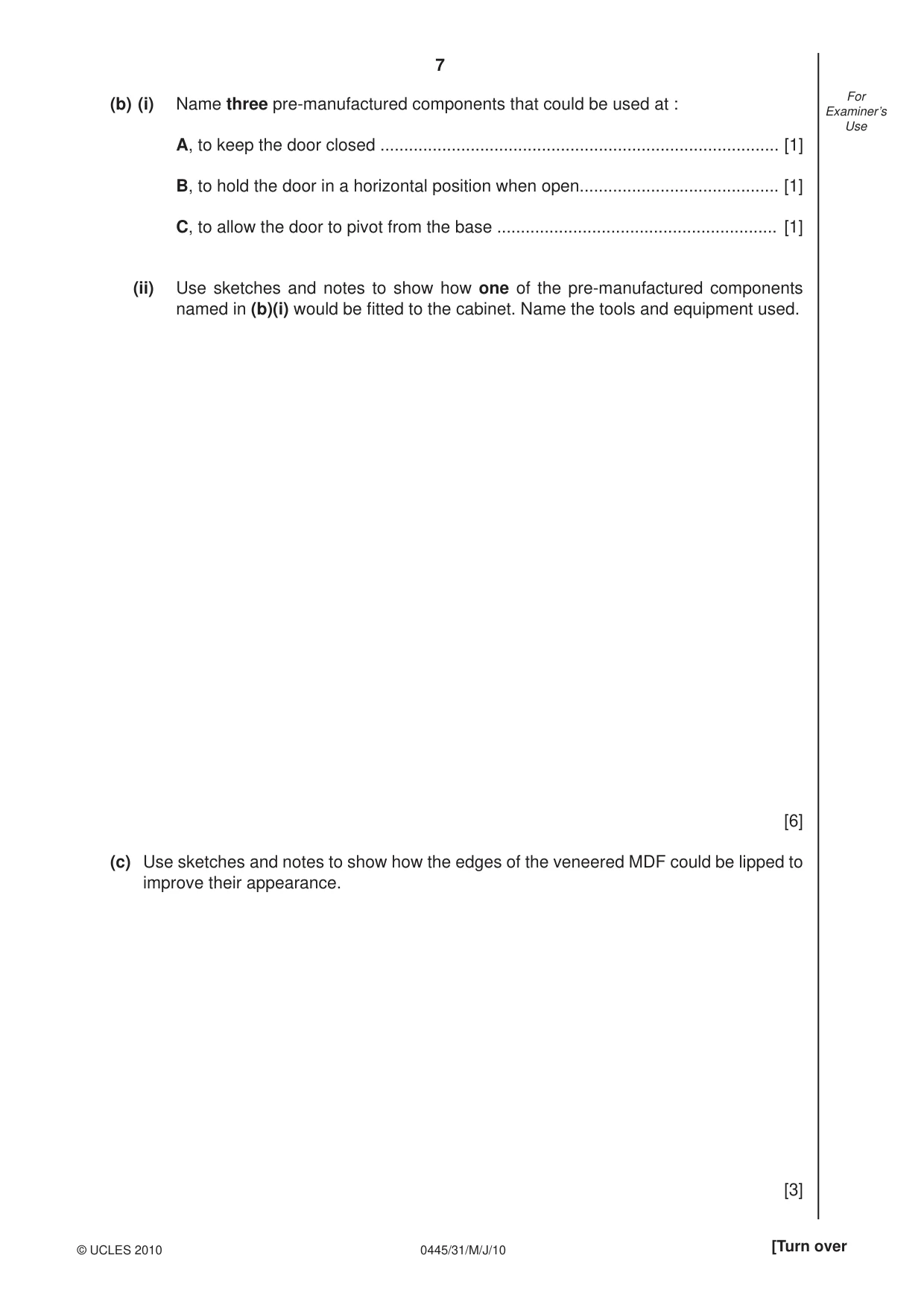
7 0445/31/M/J/10 © UCLES 2010 [Turn over For Examiner’s Use (b) (i) Name three pre-manufactured components that could be used at : A, to keep the door closed … [1] B, to hold the door in a horizontal position when open… [1] C, to allow the door to pivot from the base … [1] (ii) Use sketches and notes to show how one of the pre-manufactured components named in (b)(i) would be fi tted to the cabinet. Name the tools and equipment used. [6] (c) Use sketches and notes to show how the edges of the veneered MDF could be lipped to improve their appearance. [3]
Question paper, page 8
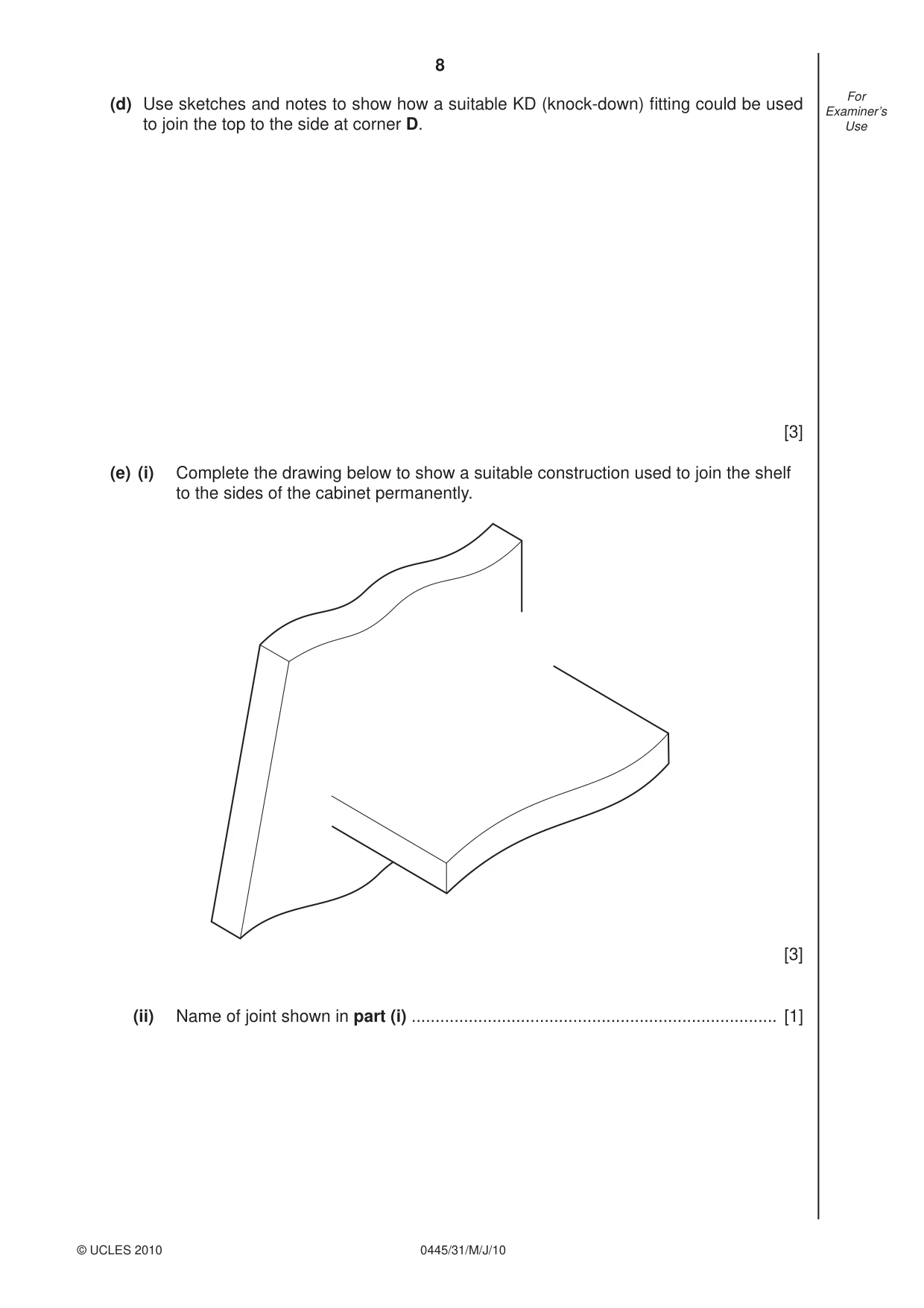
8 0445/31/M/J/10 © UCLES 2010 For Examiner’s Use (d) Use sketches and notes to show how a suitable KD (knock-down) fi tting could be used to join the top to the side at corner D. [3] (e) (i) Complete the drawing below to show a suitable construction used to join the shelf to the sides of the cabinet permanently. [3] (ii) Name of joint shown in part (i) … [1]
Question paper, page 9
9 0445/31/M/J/10 © UCLES 2010 [Turn over For Examiner’s Use Question 12 starts on the next page
Question paper, page 10
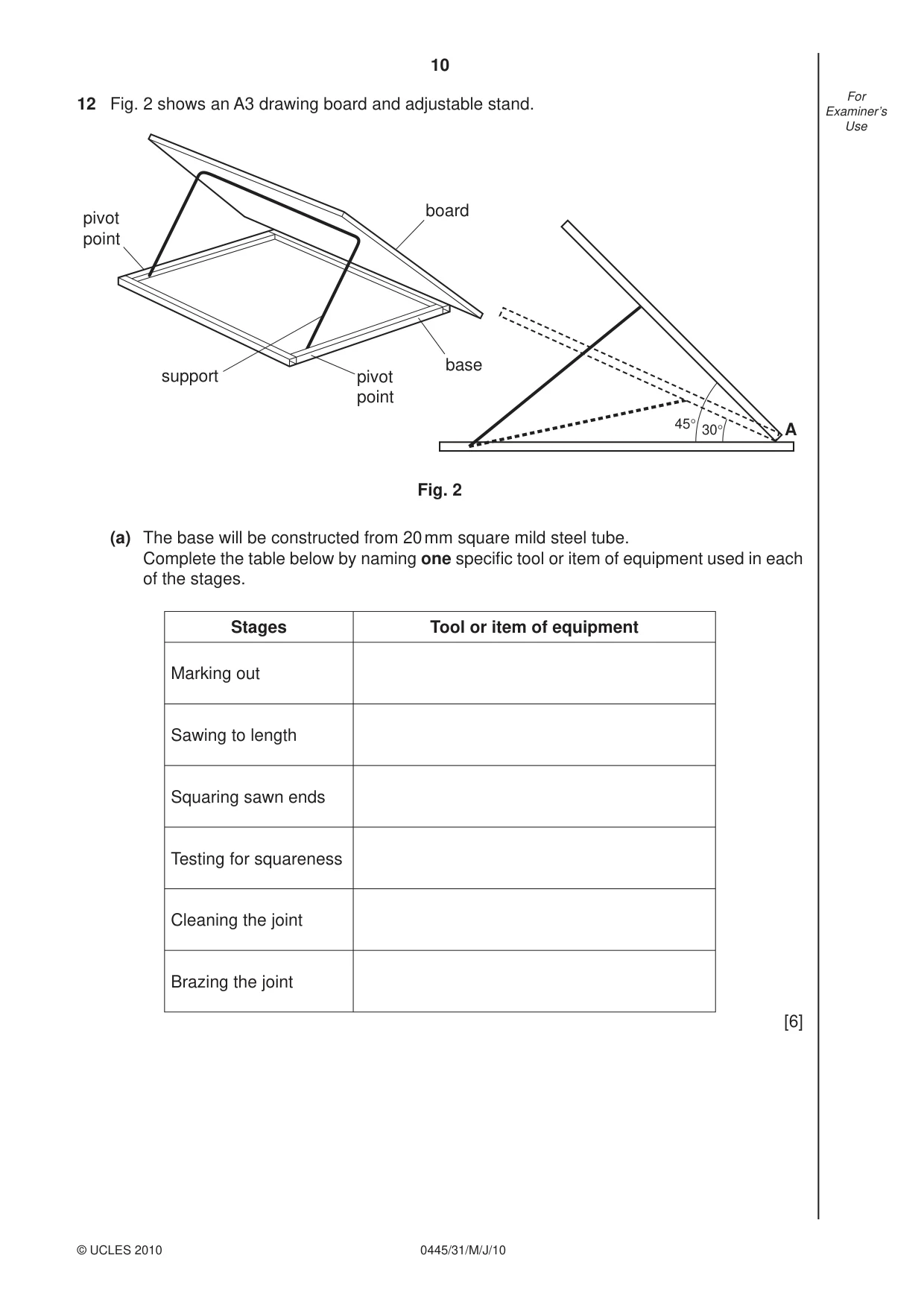
10 0445/31/M/J/10 © UCLES 2010 For Examiner’s Use 12 Fig. 2 shows an A3 drawing board and adjustable stand. A pivot point pivot point base board support Fig. 2 45° 30° (a) The base will be constructed from 20 mm square mild steel tube. Complete the table below by naming one specifi c tool or item of equipment used in each of the stages. Stages Tool or item of equipment Marking out Sawing to length Squaring sawn ends Testing for squareness Cleaning the joint Brazing the joint [6]
Question paper, page 11
11 0445/31/M/J/10 © UCLES 2010 [Turn over For Examiner’s Use (b) The board will pivot at point A. Use sketches and notes to show how the board could be held against the base at A and allowed to pivot. Include details of materials, fi ttings and fi xings used. [5] (c) The support will be made from Ø8 non-ferrous rod. (i) Name a suitable non-ferrous metal for the Ø8 rod. … [1] (ii) Give one advantage of using a non-ferrous metal rather than mild steel for the support. … [1] (iii) Use sketches and notes to show how the ends of the support are fi tted to the base and allowed to pivot. [2]
Question paper, page 12
12 0445/31/M/J/10 © UCLES 2010 For Examiner’s Use (iv) Use sketches and notes to show how the support would be made from a single length of Ø8 non-ferrous metal rod. [4] (d) Use sketches and notes to show how the support could hold the board at angles of 30° and 45°. Include details of materials, fi ttings and fi xings used. [6]
Question paper, page 13
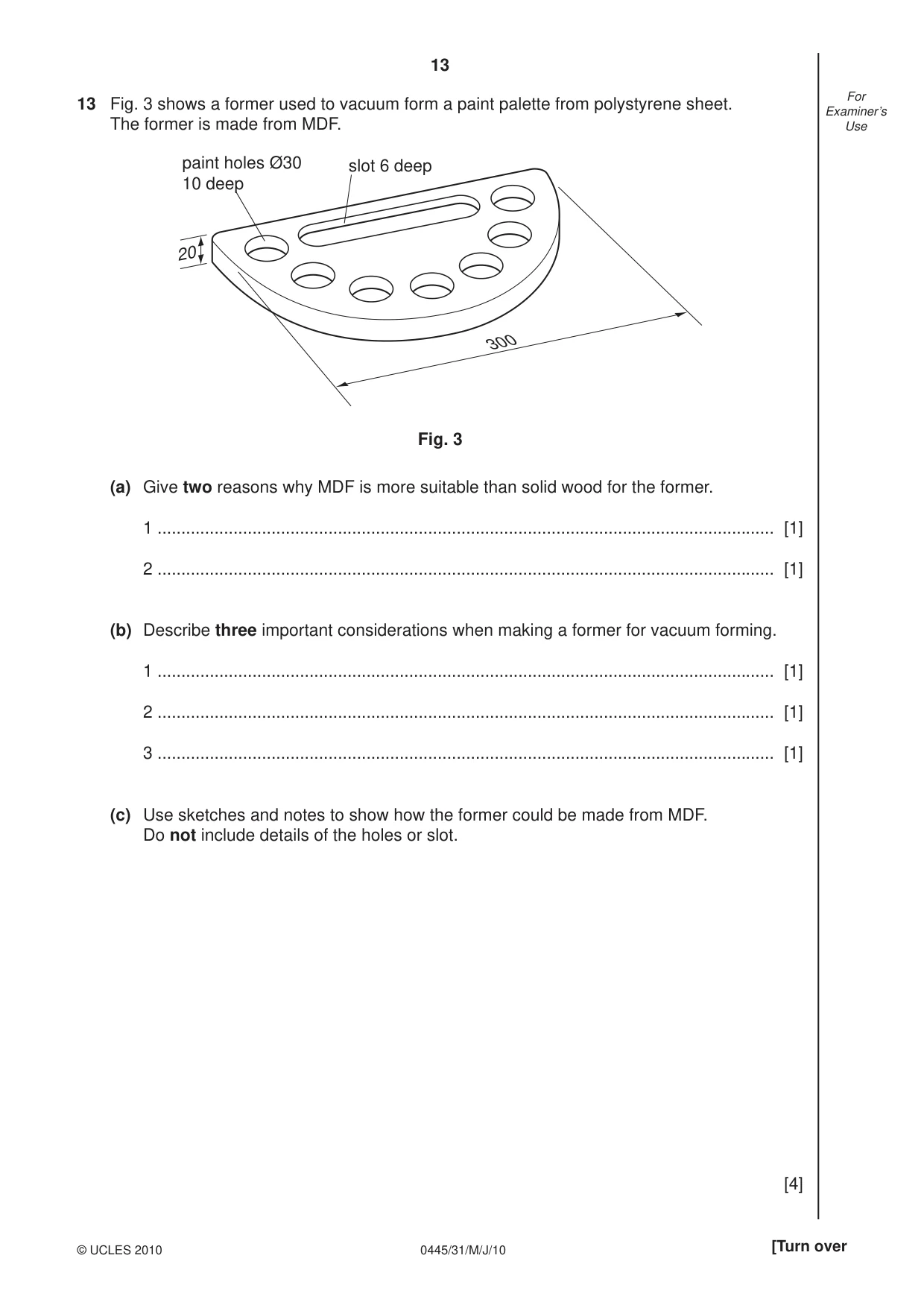
13 0445/31/M/J/10 © UCLES 2010 [Turn over For Examiner’s Use 13 Fig. 3 shows a former used to vacuum form a paint palette from polystyrene sheet. The former is made from MDF. paint holes Ø30 10 deep slot 6 deep 20 300 Fig. 3 (a) Give two reasons why MDF is more suitable than solid wood for the former. 1 … [1] 2 … [1] (b) Describe three important considerations when making a former for vacuum forming. 1 … [1] 2 … [1] 3 … [1] (c) Use sketches and notes to show how the former could be made from MDF. Do not include details of the holes or slot. [4]
Question paper, page 14
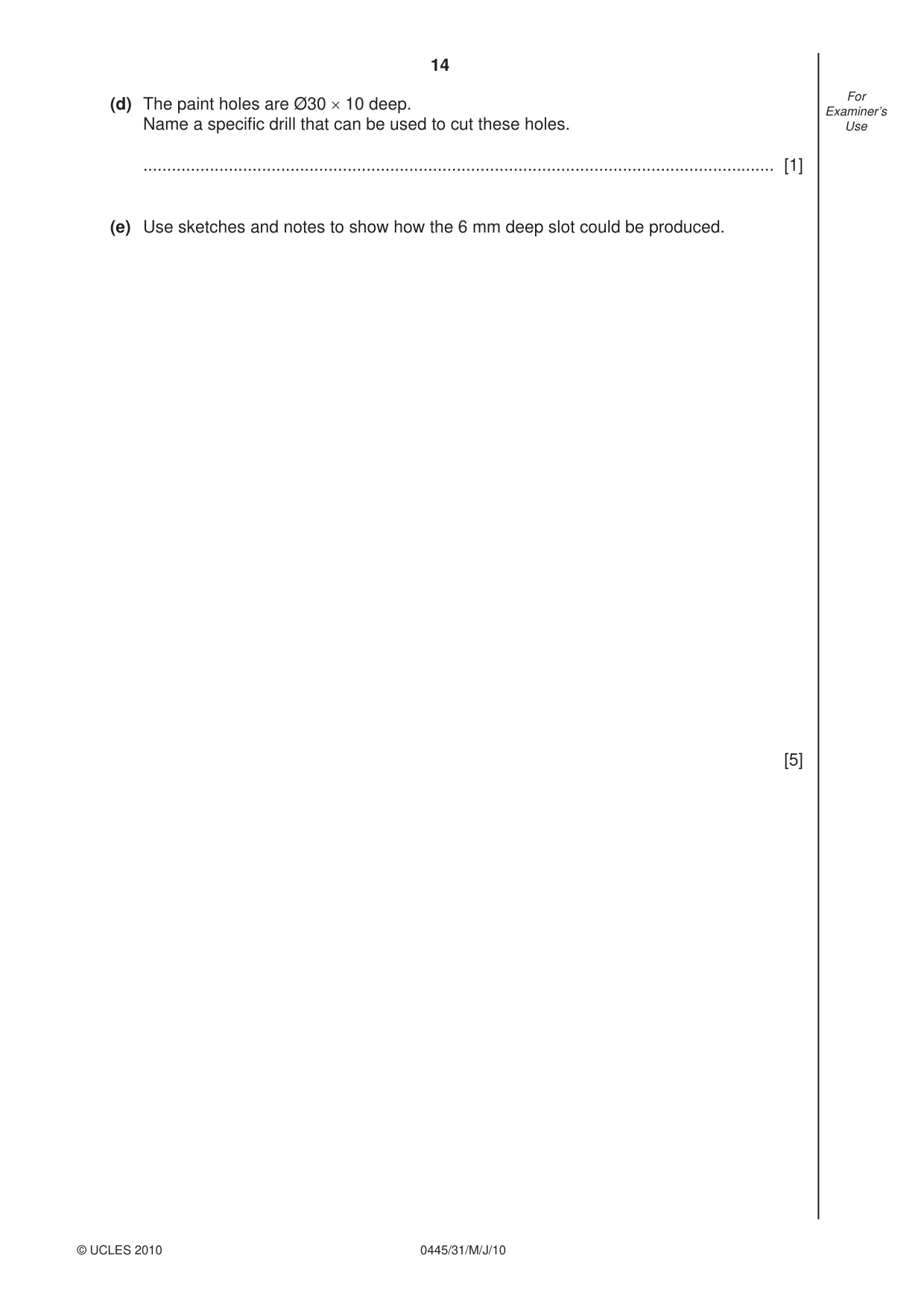
14 0445/31/M/J/10 © UCLES 2010 For Examiner’s Use (d) The paint holes are Ø30 × 10 deep. Name a specifi c drill that can be used to cut these holes. … [1] (e) Use sketches and notes to show how the 6 mm deep slot could be produced. [5]
Question paper, page 15
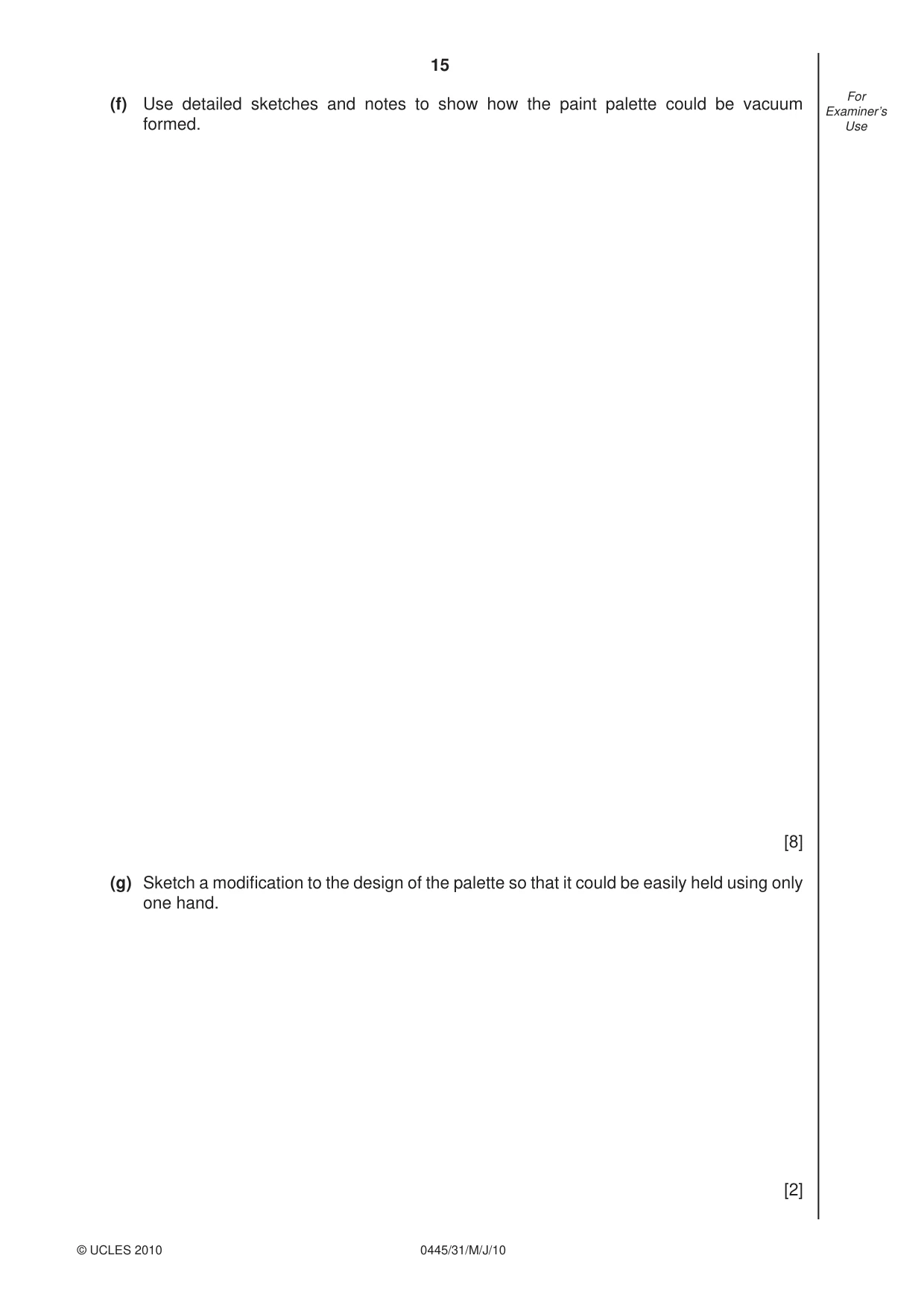
15 0445/31/M/J/10 © UCLES 2010 For Examiner’s Use (f) Use detailed sketches and notes to show how the paint palette could be vacuum formed. [8] (g) Sketch a modifi cation to the design of the palette so that it could be easily held using only one hand. [2]
Question paper, page 16
16 0445/31/M/J/10 Permission to reproduce items where third-party owned material protected by copyright is included has been sought and cleared where possible. Every reasonable effort has been made by the publisher (UCLES) to trace copyright holders, but if any items requiring clearance have unwittingly been included the publisher will be pleased to make amends at the earliest possible opportunity. University of Cambridge International Examinations is part of the Cambridge Assessment Group. Cambridge Assessment is the brand name of University of Cambridge Local Examinations Syndicate (UCLES), which is itself a department of the University of Cambridge. BLANK PAGE © UCLES 2010
Mark scheme, page 1
UNIVERSITY OF CAMBRIDGE INTERNATIONAL EXAMINATIONS International General Certificate of Secondary Education MARK SCHEME for the May/June 2010 question paper for the guidance of teachers 0445 DESIGN AND TECHNOLOGY 0445/31 Paper 31 (Resistant Materials), maximum raw mark 50 This mark scheme is published as an aid to teachers and candidates, to indicate the requirements of the examination. It shows the basis on which Examiners were instructed to award marks. It does not indicate the details of the discussions that took place at an Examiners’ meeting before marking began, which would have considered the acceptability of alternative answers. Mark schemes must be read in conjunction with the question papers and the report on the examination. • CIE will not enter into discussions or correspondence in connection with these mark schemes. CIE is publishing the mark schemes for the May/June 2010 question papers for most IGCSE, GCE Advanced Level and Advanced Subsidiary Level syllabuses and some Ordinary Level syllabuses. www.XtremePapers.com
Mark scheme, page 2
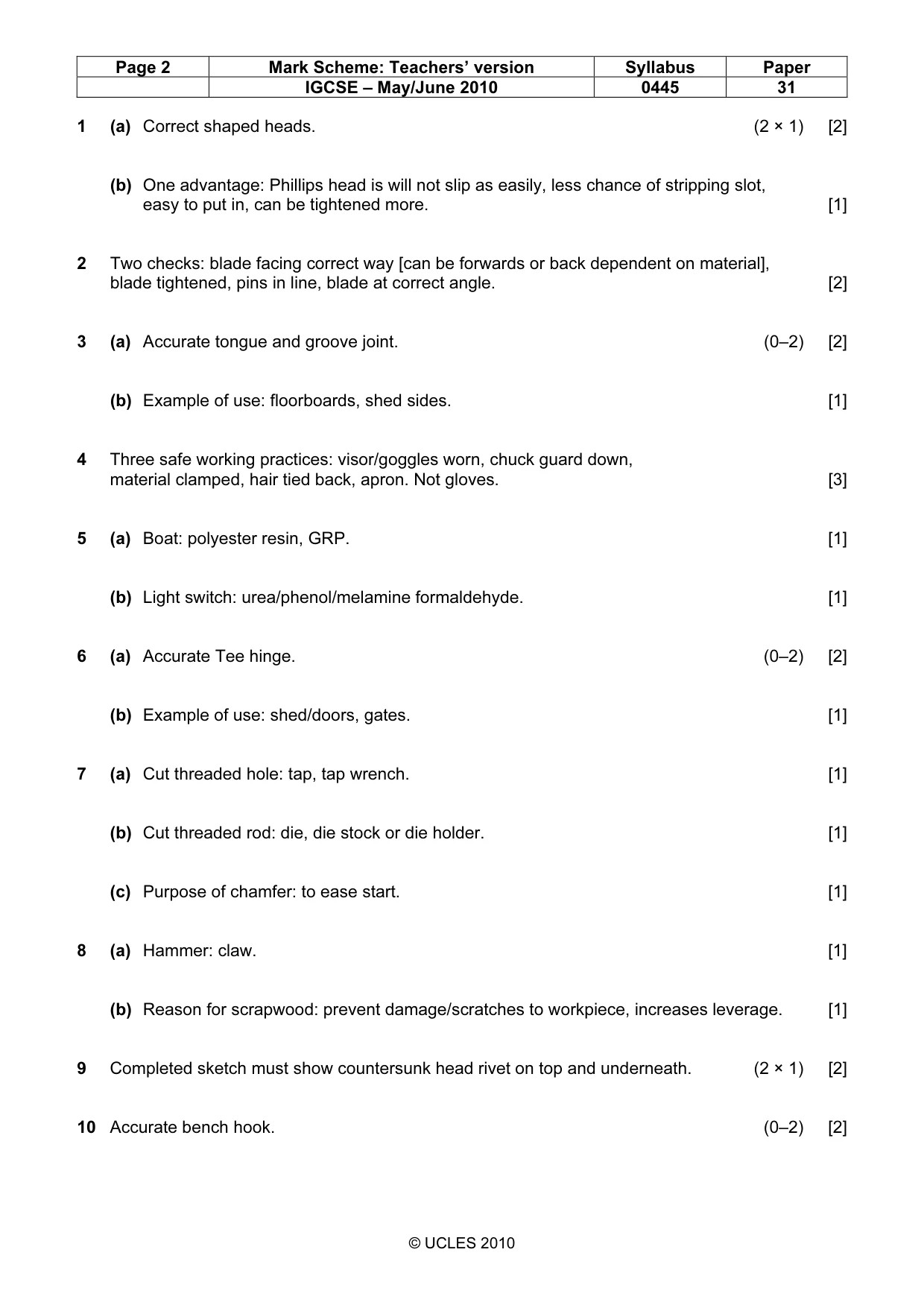
Page 2 Mark Scheme: Teachers’ version Syllabus Paper IGCSE – May/June 2010 0445 31 © UCLES 2010 1 (a) Correct shaped heads. (2 × 1) [2] (b) One advantage: Phillips head is will not slip as easily, less chance of stripping slot, easy to put in, can be tightened more. [1] 2 Two checks: blade facing correct way [can be forwards or back dependent on material], blade tightened, pins in line, blade at correct angle. [2] 3 (a) Accurate tongue and groove joint. (0–2) [2] (b) Example of use: floorboards, shed sides. [1] 4 Three safe working practices: visor/goggles worn, chuck guard down, material clamped, hair tied back, apron. Not gloves. [3] 5 (a) Boat: polyester resin, GRP. [1] (b) Light switch: urea/phenol/melamine formaldehyde. [1] 6 (a) Accurate Tee hinge. (0–2) [2] (b) Example of use: shed/doors, gates. [1] 7 (a) Cut threaded hole: tap, tap wrench. [1] (b) Cut threaded rod: die, die stock or die holder. [1] (c) Purpose of chamfer: to ease start. [1] 8 (a) Hammer: claw. [1] (b) Reason for scrapwood: prevent damage/scratches to workpiece, increases leverage. [1] 9 Completed sketch must show countersunk head rivet on top and underneath. (2 × 1) [2] 10 Accurate bench hook. (0–2) [2]
Mark scheme, page 3
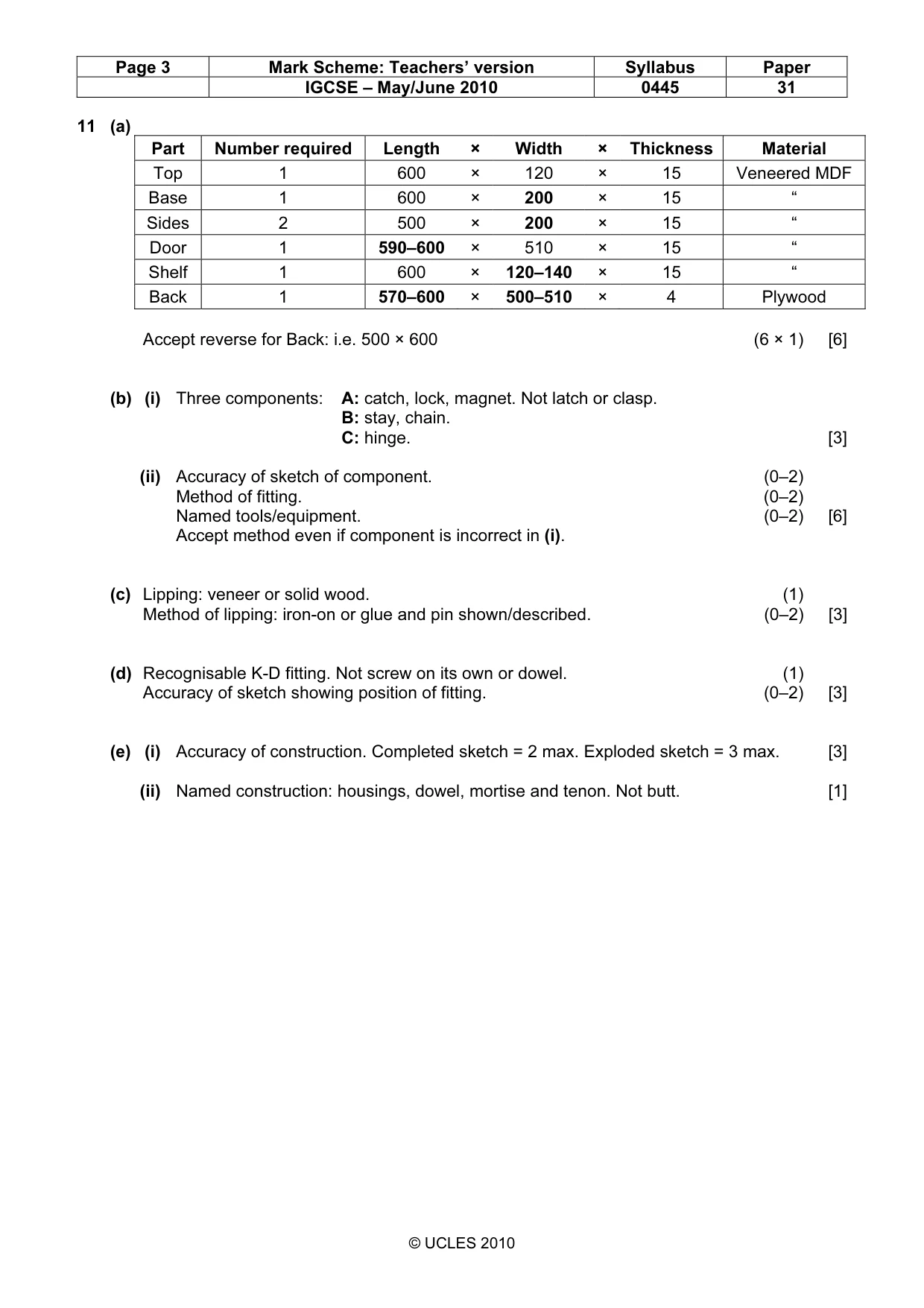
Page 3 Mark Scheme: Teachers’ version Syllabus Paper IGCSE – May/June 2010 0445 31 © UCLES 2010 11 (a) Part Number required Length × Width × Thickness Material Top 1 600 × 120 × 15 Veneered MDF Base 1 600 × 200 × 15 “ Sides 2 500 × 200 × 15 “ Door 1 590–600 × 510 × 15 “ Shelf 1 600 × 120–140 × 15 “ Back 1 570–600 × 500–510 × 4 Plywood Accept reverse for Back: i.e. 500 × 600 (6 × 1) [6] (b) (i) Three components: A: catch, lock, magnet. Not latch or clasp. B: stay, chain. C: hinge. [3] (ii) Accuracy of sketch of component. (0–2) Method of fitting. (0–2) Named tools/equipment. (0–2) [6] Accept method even if component is incorrect in (i). (c) Lipping: veneer or solid wood. (1) Method of lipping: iron-on or glue and pin shown/described. (0–2) [3] (d) Recognisable K-D fitting. Not screw on its own or dowel. (1) Accuracy of sketch showing position of fitting. (0–2) [3] (e) (i) Accuracy of construction. Completed sketch = 2 max. Exploded sketch = 3 max. [3] (ii) Named construction: housings, dowel, mortise and tenon. Not butt. [1]
Mark scheme, page 4
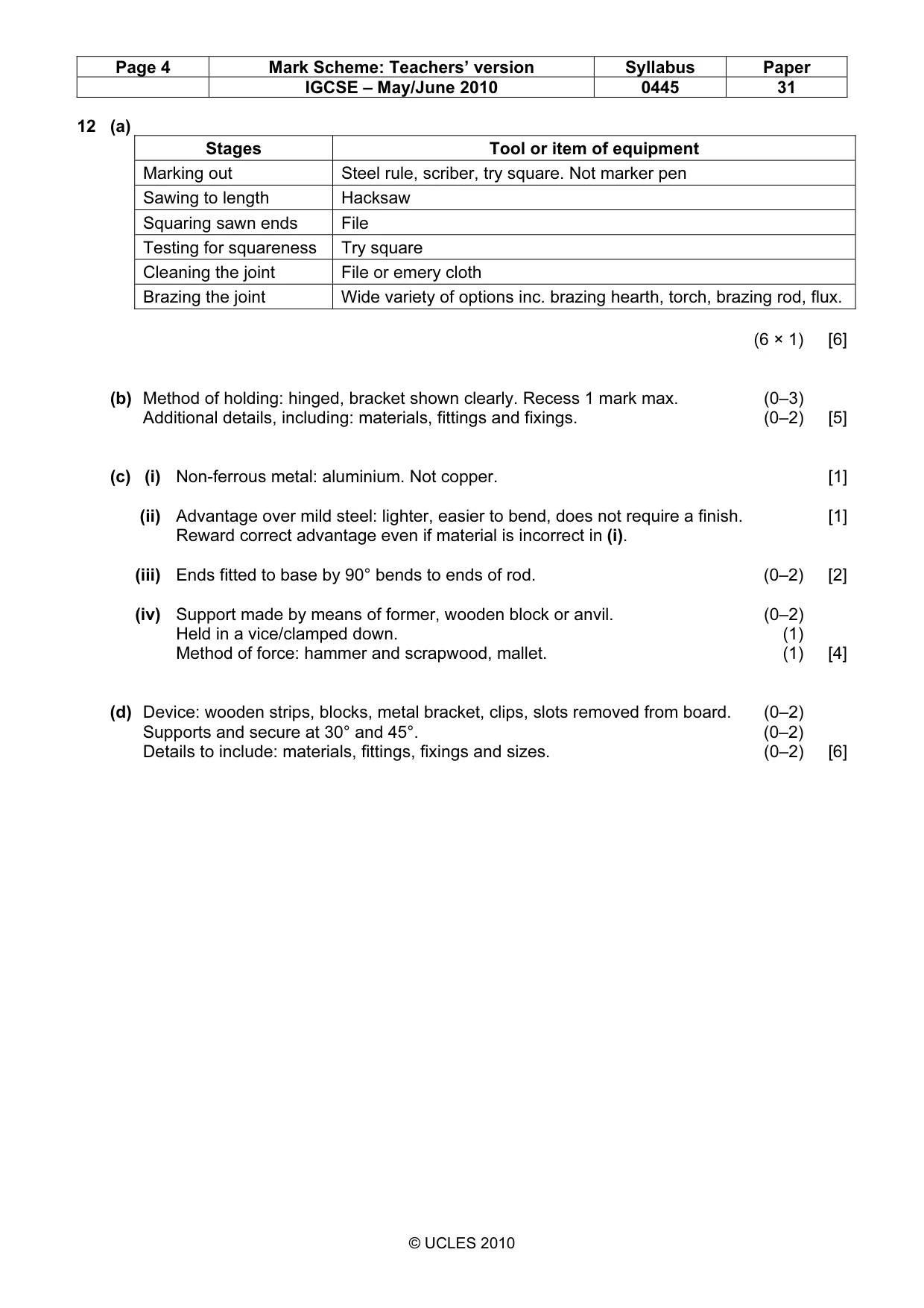
Page 4 Mark Scheme: Teachers’ version Syllabus Paper IGCSE – May/June 2010 0445 31 © UCLES 2010 12 (a) Stages Tool or item of equipment Marking out Steel rule, scriber, try square. Not marker pen Sawing to length Hacksaw Squaring sawn ends File Testing for squareness Try square Cleaning the joint File or emery cloth Brazing the joint Wide variety of options inc. brazing hearth, torch, brazing rod, flux. (6 × 1) [6] (b) Method of holding: hinged, bracket shown clearly. Recess 1 mark max. (0–3) Additional details, including: materials, fittings and fixings. (0–2) [5] (c) (i) Non-ferrous metal: aluminium. Not copper. [1] (ii) Advantage over mild steel: lighter, easier to bend, does not require a finish. [1] Reward correct advantage even if material is incorrect in (i). (iii) Ends fitted to base by 90° bends to ends of rod. (0–2) [2] (iv) Support made by means of former, wooden block or anvil. (0–2) Held in a vice/clamped down. (1) Method of force: hammer and scrapwood, mallet. (1) [4] (d) Device: wooden strips, blocks, metal bracket, clips, slots removed from board. (0–2) Supports and secure at 30° and 45°. (0–2) Details to include: materials, fittings, fixings and sizes. (0–2) [6]
Mark scheme, page 5
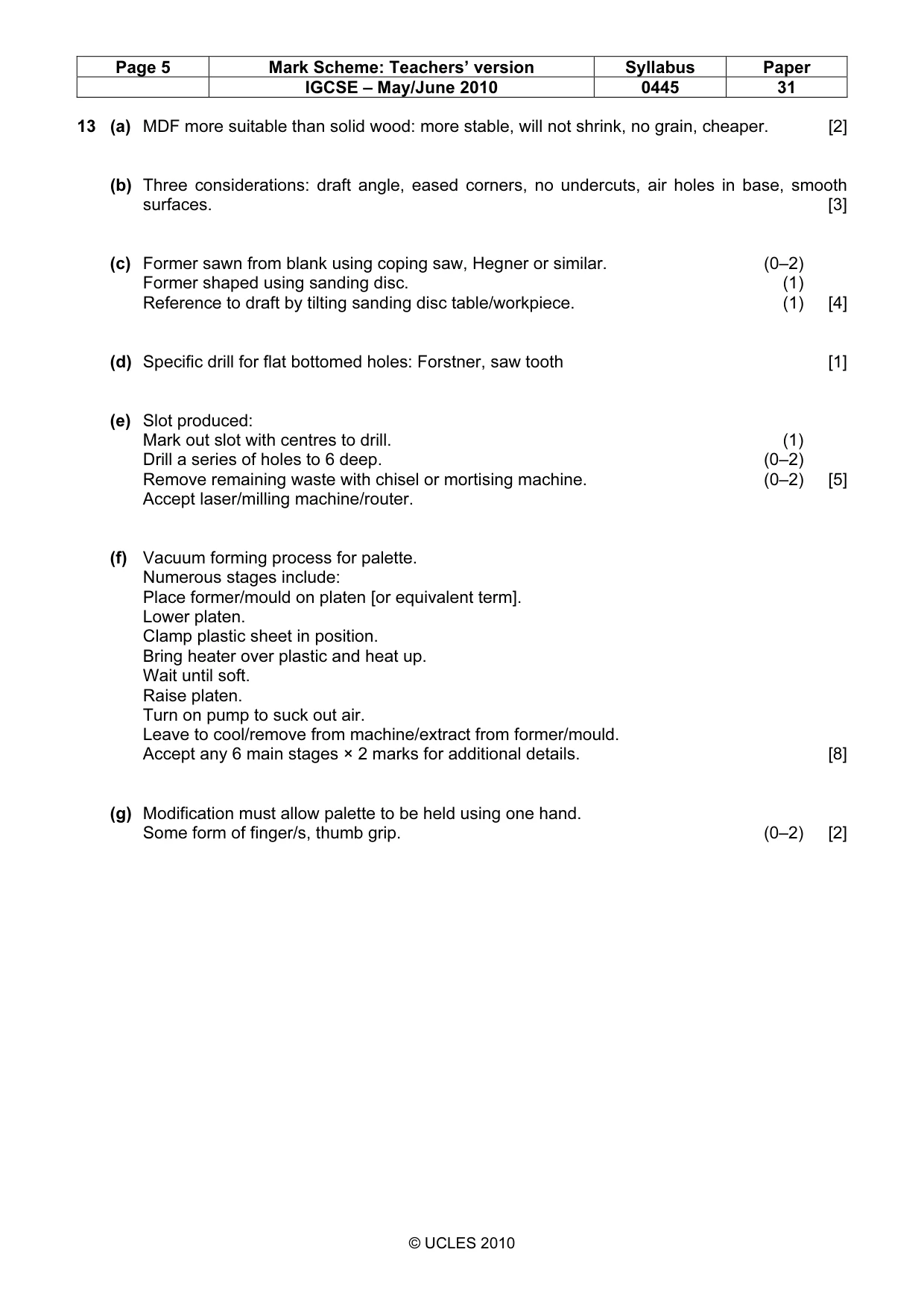
Page 5 Mark Scheme: Teachers’ version Syllabus Paper IGCSE – May/June 2010 0445 31 © UCLES 2010 13 (a) MDF more suitable than solid wood: more stable, will not shrink, no grain, cheaper. [2] (b) Three considerations: draft angle, eased corners, no undercuts, air holes in base, smooth surfaces. [3] (c) Former sawn from blank using coping saw, Hegner or similar. (0–2) Former shaped using sanding disc. (1) Reference to draft by tilting sanding disc table/workpiece. (1) [4] (d) Specific drill for flat bottomed holes: Forstner, saw tooth [1] (e) Slot produced: Mark out slot with centres to drill. (1) Drill a series of holes to 6 deep. (0–2) Remove remaining waste with chisel or mortising machine. (0–2) [5] Accept laser/milling machine/router. (f) Vacuum forming process for palette. Numerous stages include: Place former/mould on platen [or equivalent term]. Lower platen. Clamp plastic sheet in position. Bring heater over plastic and heat up. Wait until soft. Raise platen. Turn on pump to suck out air. Leave to cool/remove from machine/extract from former/mould. Accept any 6 main stages × 2 marks for additional details. [8] (g) Modification must allow palette to be held using one hand. Some form of finger/s, thumb grip. (0–2) [2]
What you needed in this session
Cambridge’s own grade thresholds for 2010 May/June, Paper 3 · Variant 1. A higher threshold means an easier paper — the bar moves with how the cohort did.