Cambridge IGCSE Design and Technology 0445 — 2010 May/June Paper 3 · Variant 3
0445/33/M/J/10 · 50 marks · ≈56 min
The question paper and its mark scheme, free to read here and free to download. This is Cambridge’s own paper, exactly as it was sat.
Question paper16 pages
Mark scheme4 pages
Answers below. Sit the paper first if you are practising.
Paper as text
Question paper, page 1
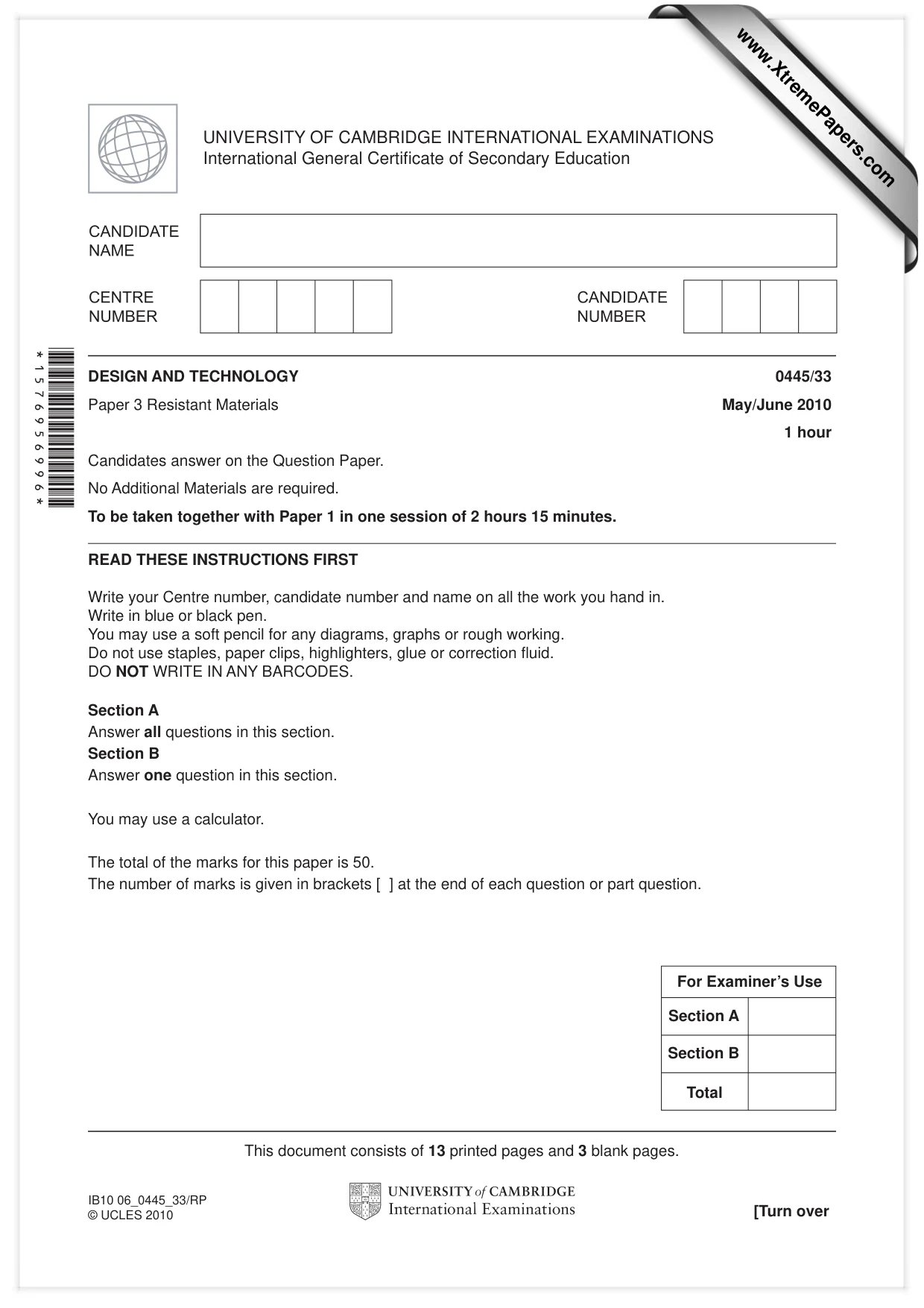
READ THESE INSTRUCTIONS FIRST Write your Centre number, candidate number and name on all the work you hand in. Write in blue or black pen. You may use a soft pencil for any diagrams, graphs or rough working. Do not use staples, paper clips, highlighters, glue or correction fl uid. DO NOT WRITE IN ANY BARCODES. Section A Answer all questions in this section. Section B Answer one question in this section. You may use a calculator. The total of the marks for this paper is 50. The number of marks is given in brackets [ ] at the end of each question or part question. DESIGN AND TECHNOLOGY 0445/33 Paper 3 Resistant Materials May/June 2010 1 hour Candidates answer on the Question Paper. No Additional Materials are required. To be taken together with Paper 1 in one session of 2 hours 15 minutes. UNIVERSITY OF CAMBRIDGE INTERNATIONAL EXAMINATIONS International General Certifi cate of Secondary Education This document consists of 13 printed pages and 3 blank pages. [Turn over IB10 06_0445_33/RP © UCLES 2010 *1576956996* For Examiner’s Use Total Section A Section B www.XtremePapers.com
Question paper, page 2
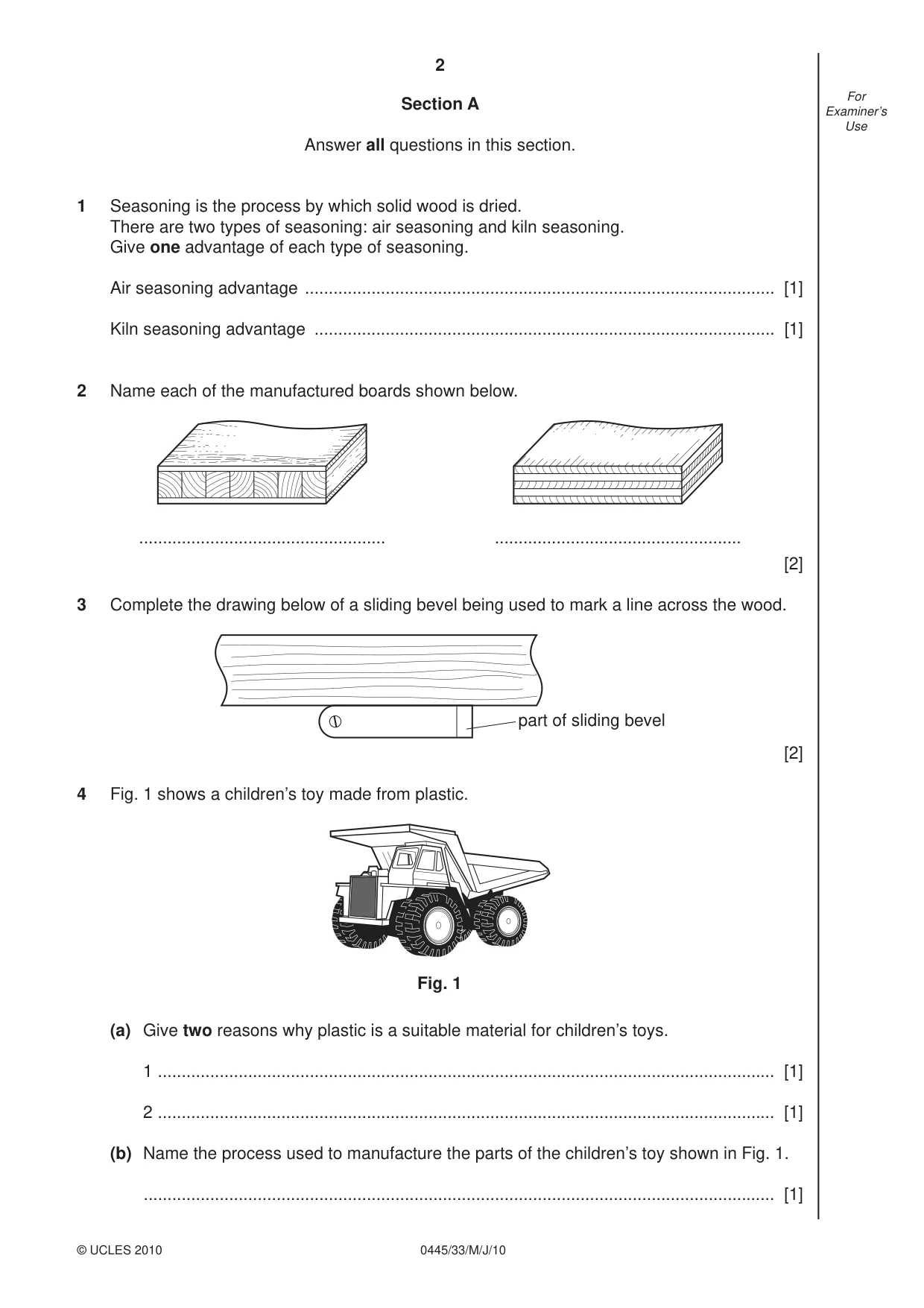
2 0445/33/M/J/10 © UCLES 2010 For Examiner’s Use Section A Answer all questions in this section. 1 Seasoning is the process by which solid wood is dried. There are two types of seasoning: air seasoning and kiln seasoning. Give one advantage of each type of seasoning. Air seasoning advantage … [1] Kiln seasoning advantage … [1] 2 Name each of the manufactured boards shown below. … … [2] 3 Complete the drawing below of a sliding bevel being used to mark a line across the wood. part of sliding bevel [2] 4 Fig. 1 shows a children’s toy made from plastic. Fig. 1 (a) Give two reasons why plastic is a suitable material for children’s toys. 1 … [1] 2 … [1] (b) Name the process used to manufacture the parts of the children’s toy shown in Fig. 1. … [1]
Question paper, page 3
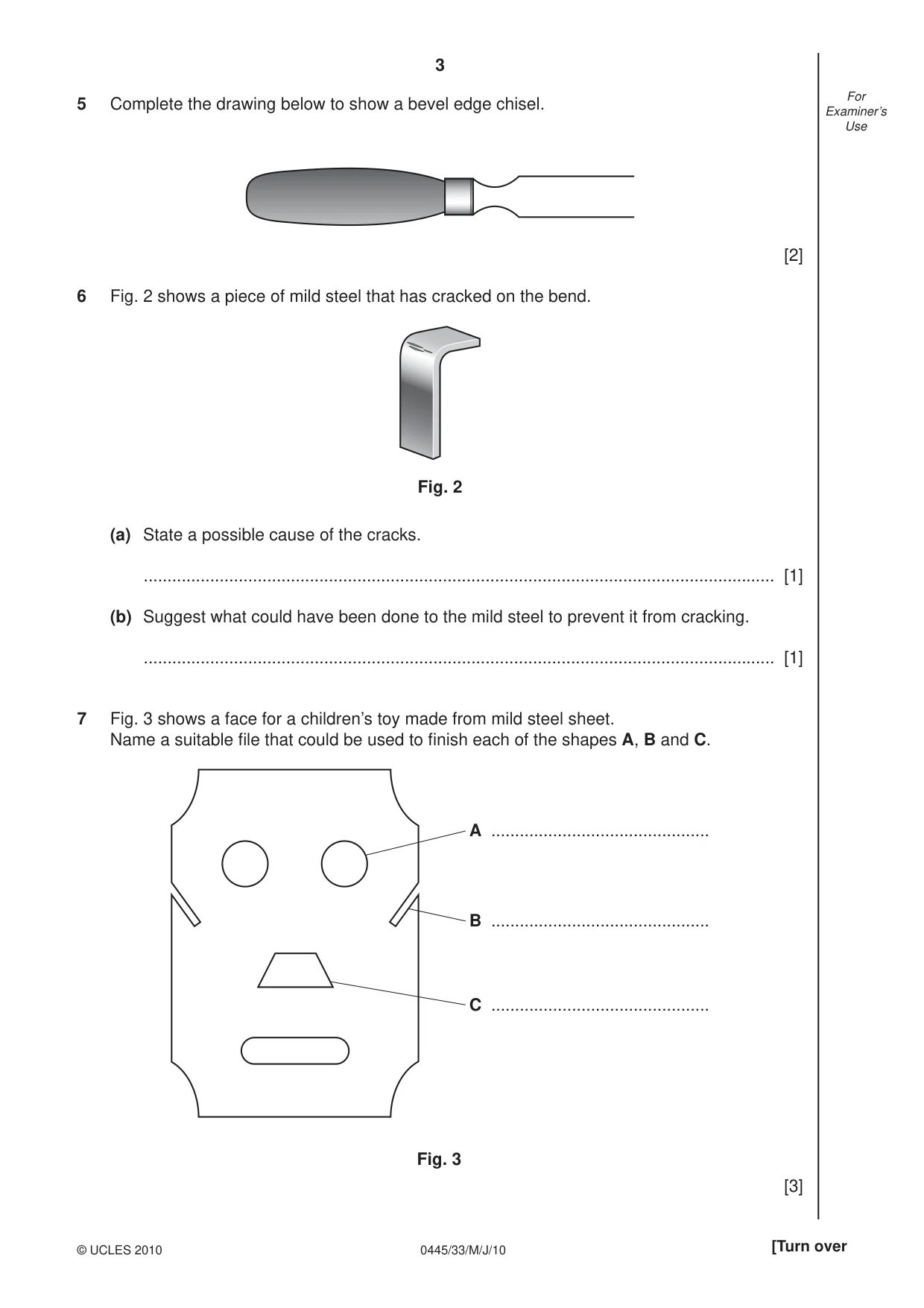
3 0445/33/M/J/10 © UCLES 2010 [Turn over For Examiner’s Use 5 Complete the drawing below to show a bevel edge chisel. [2] 6 Fig. 2 shows a piece of mild steel that has cracked on the bend. Fig. 2 (a) State a possible cause of the cracks. … [1] (b) Suggest what could have been done to the mild steel to prevent it from cracking. … [1] 7 Fig. 3 shows a face for a children’s toy made from mild steel sheet. Name a suitable fi le that could be used to fi nish each of the shapes A, B and C. A … B … C … Fig. 3 [3]
Question paper, page 4
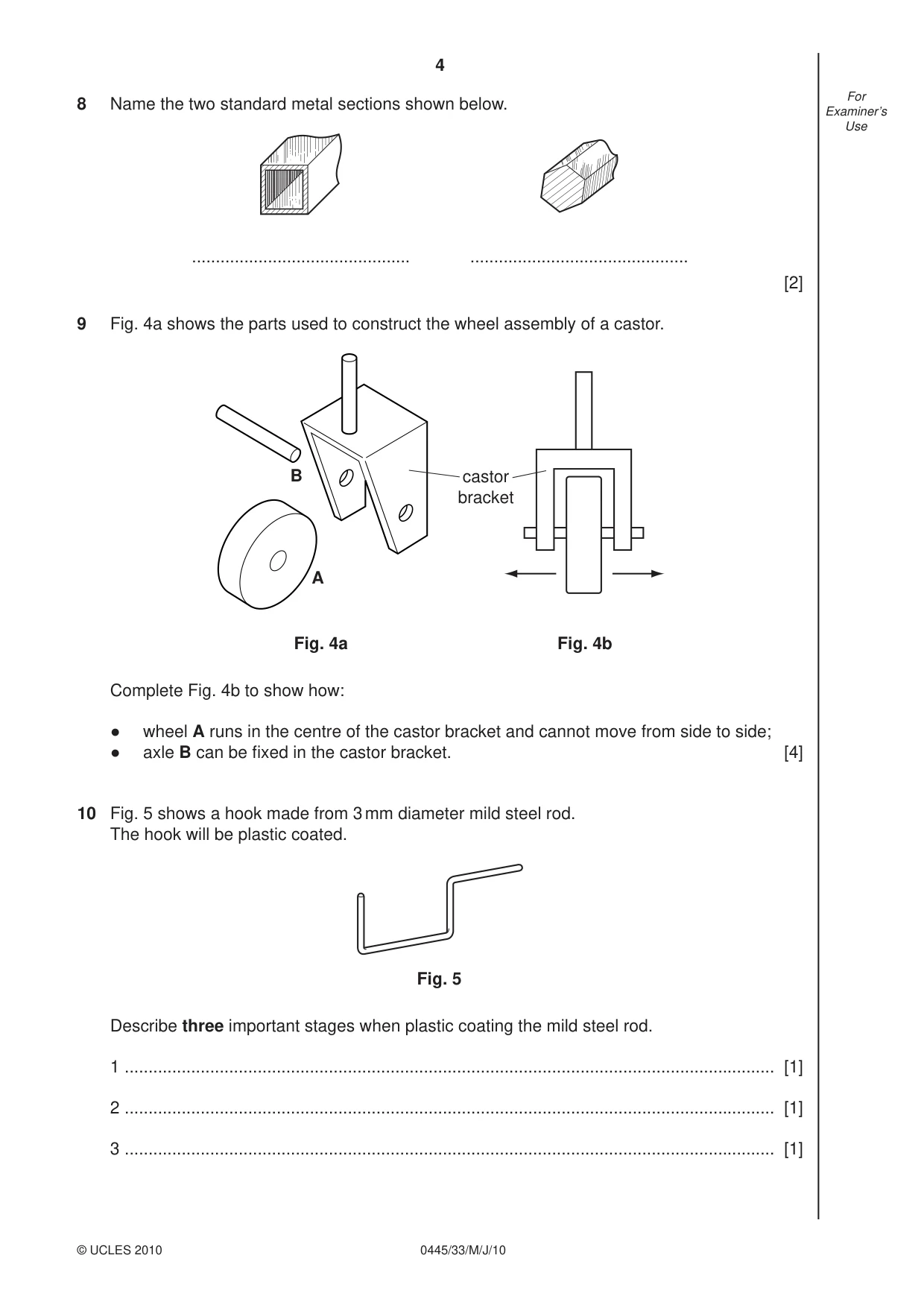
4 0445/33/M/J/10 © UCLES 2010 For Examiner’s Use 8 Name the two standard metal sections shown below. … … [2] 9 Fig. 4a shows the parts used to construct the wheel assembly of a castor. B A castor bracket Fig. 4a Fig. 4b Complete Fig. 4b to show how: ● wheel A runs in the centre of the castor bracket and cannot move from side to side; ● axle B can be fi xed in the castor bracket. [4] 10 Fig. 5 shows a hook made from 3 mm diameter mild steel rod. The hook will be plastic coated. Fig. 5 Describe three important stages when plastic coating the mild steel rod. 1 … [1] 2 … [1] 3 … [1]
Question paper, page 5
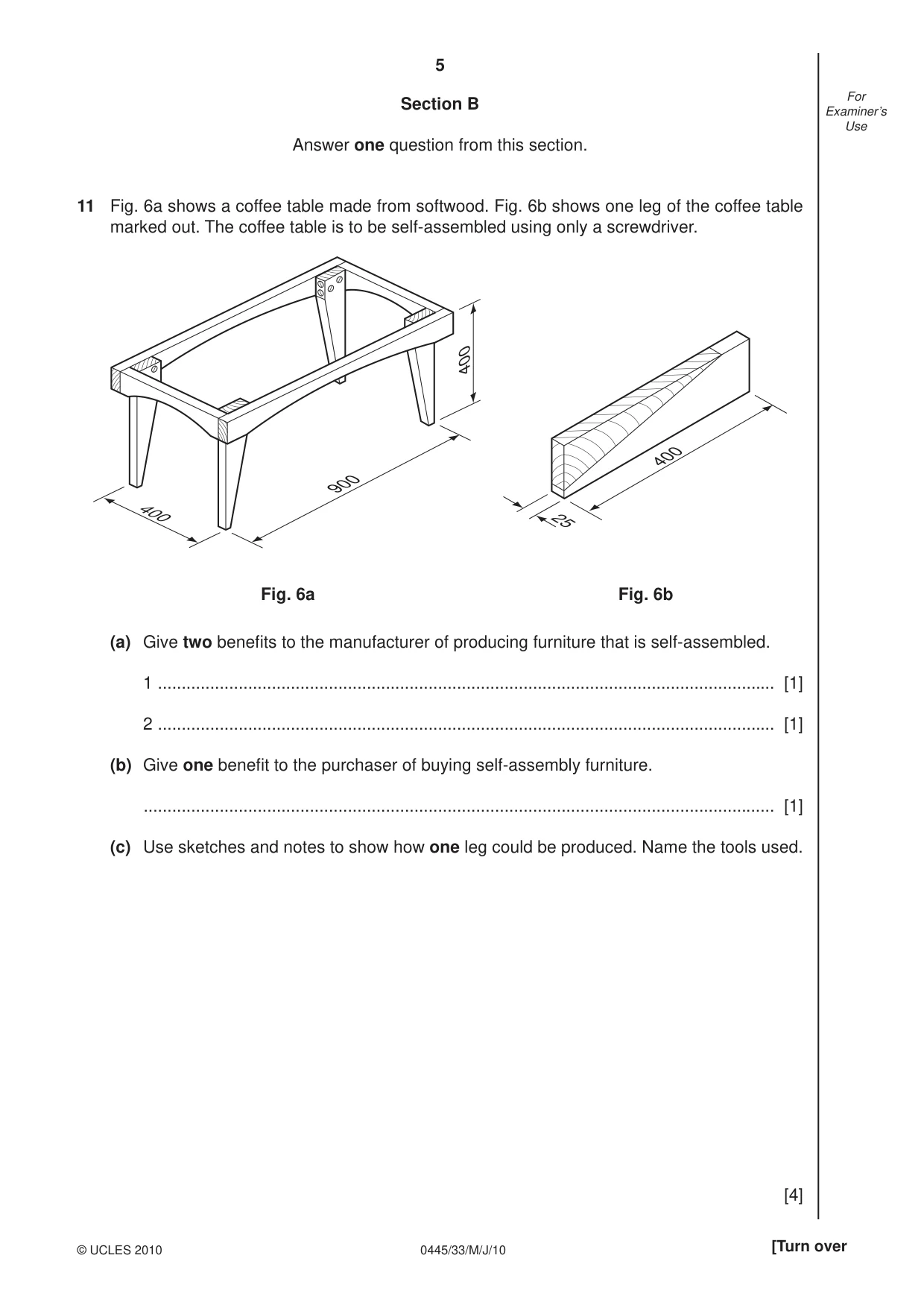
5 0445/33/M/J/10 © UCLES 2010 [Turn over For Examiner’s Use Section B Answer one question from this section. 11 Fig. 6a shows a coffee table made from softwood. Fig. 6b shows one leg of the coffee table marked out. The coffee table is to be self-assembled using only a screwdriver. 400 900 400 25 400 Fig. 6a Fig. 6b (a) Give two benefi ts to the manufacturer of producing furniture that is self-assembled. 1 … [1] 2 … [1] (b) Give one benefi t to the purchaser of buying self-assembly furniture. … [1] (c) Use sketches and notes to show how one leg could be produced. Name the tools used. [4]
Question paper, page 6
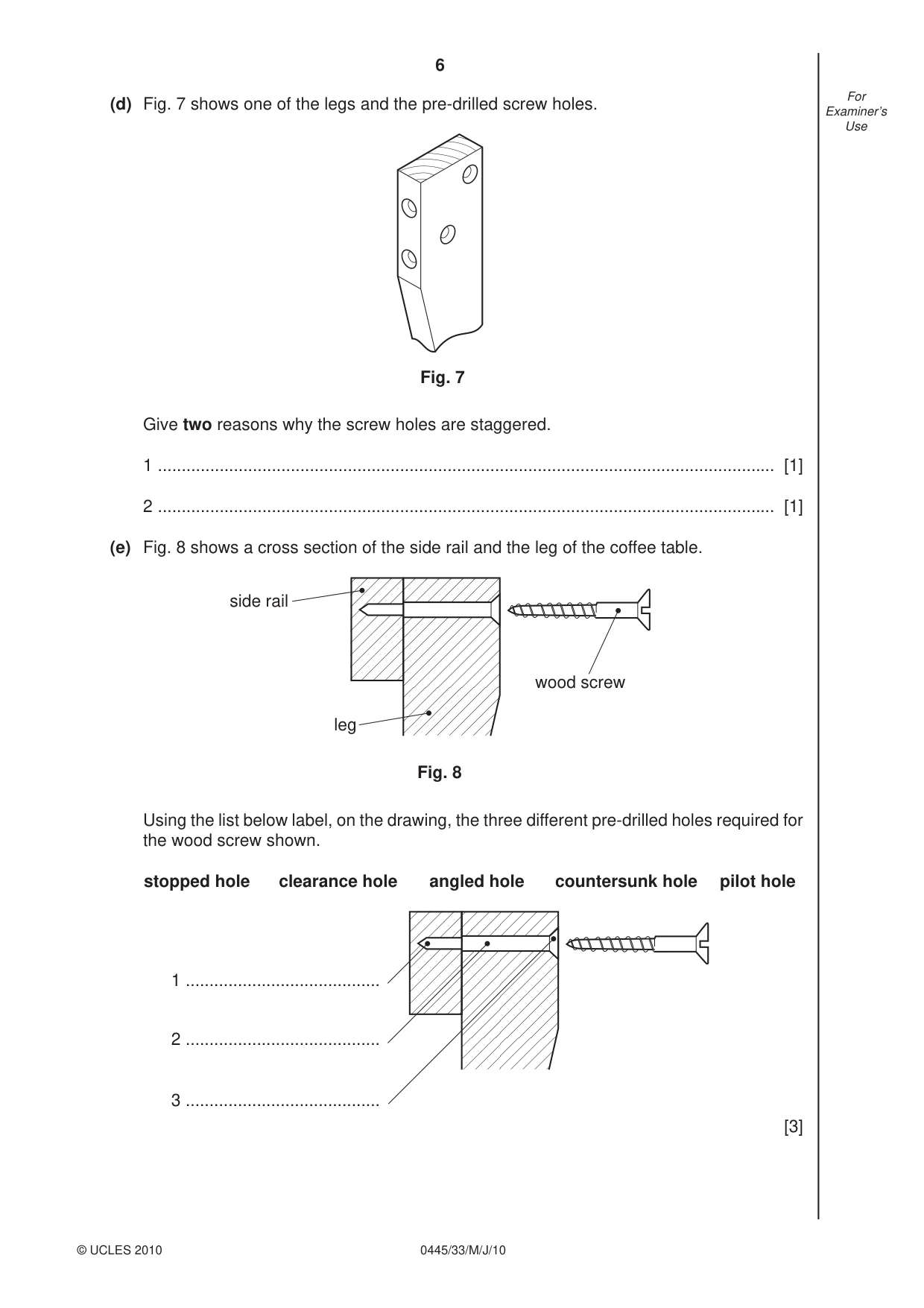
6 0445/33/M/J/10 © UCLES 2010 For Examiner’s Use (d) Fig. 7 shows one of the legs and the pre-drilled screw holes. Fig. 7 Give two reasons why the screw holes are staggered. 1 … [1] 2 … [1] (e) Fig. 8 shows a cross section of the side rail and the leg of the coffee table. side rail leg wood screw Fig. 8 Using the list below label, on the drawing, the three different pre-drilled holes required for the wood screw shown. stopped hole clearance hole angled hole countersunk hole pilot hole 1 … 2 … 3 … [3]
Question paper, page 7
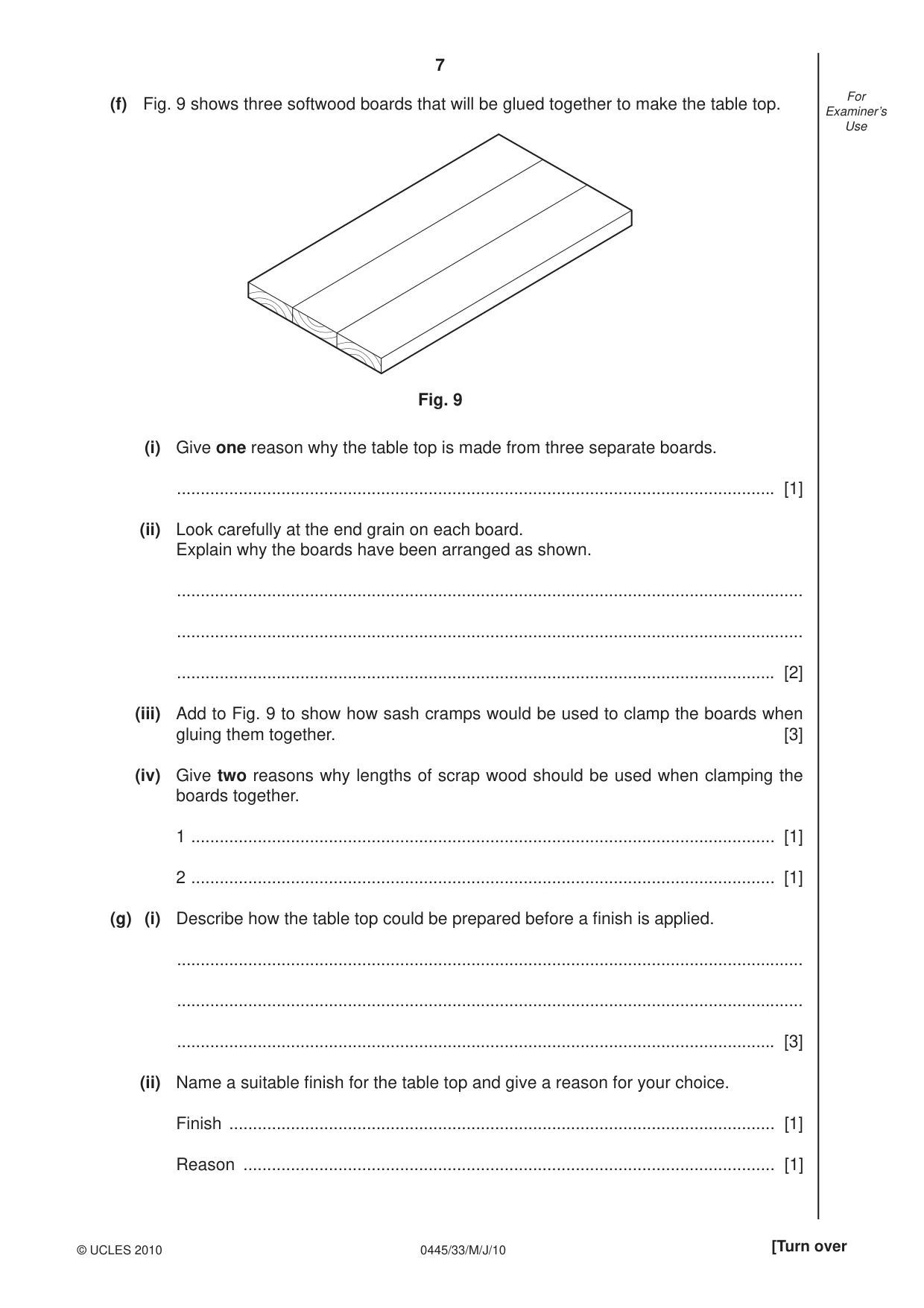
7 0445/33/M/J/10 © UCLES 2010 [Turn over For Examiner’s Use (f) Fig. 9 shows three softwood boards that will be glued together to make the table top. Fig. 9 (i) Give one reason why the table top is made from three separate boards. … [1] (ii) Look carefully at the end grain on each board. Explain why the boards have been arranged as shown. … … … [2] (iii) Add to Fig. 9 to show how sash cramps would be used to clamp the boards when gluing them together. [3] (iv) Give two reasons why lengths of scrap wood should be used when clamping the boards together. 1 … [1] 2 … [1] (g) (i) Describe how the table top could be prepared before a fi nish is applied. … … … [3] (ii) Name a suitable fi nish for the table top and give a reason for your choice. Finish … [1] Reason … [1]
Question paper, page 8
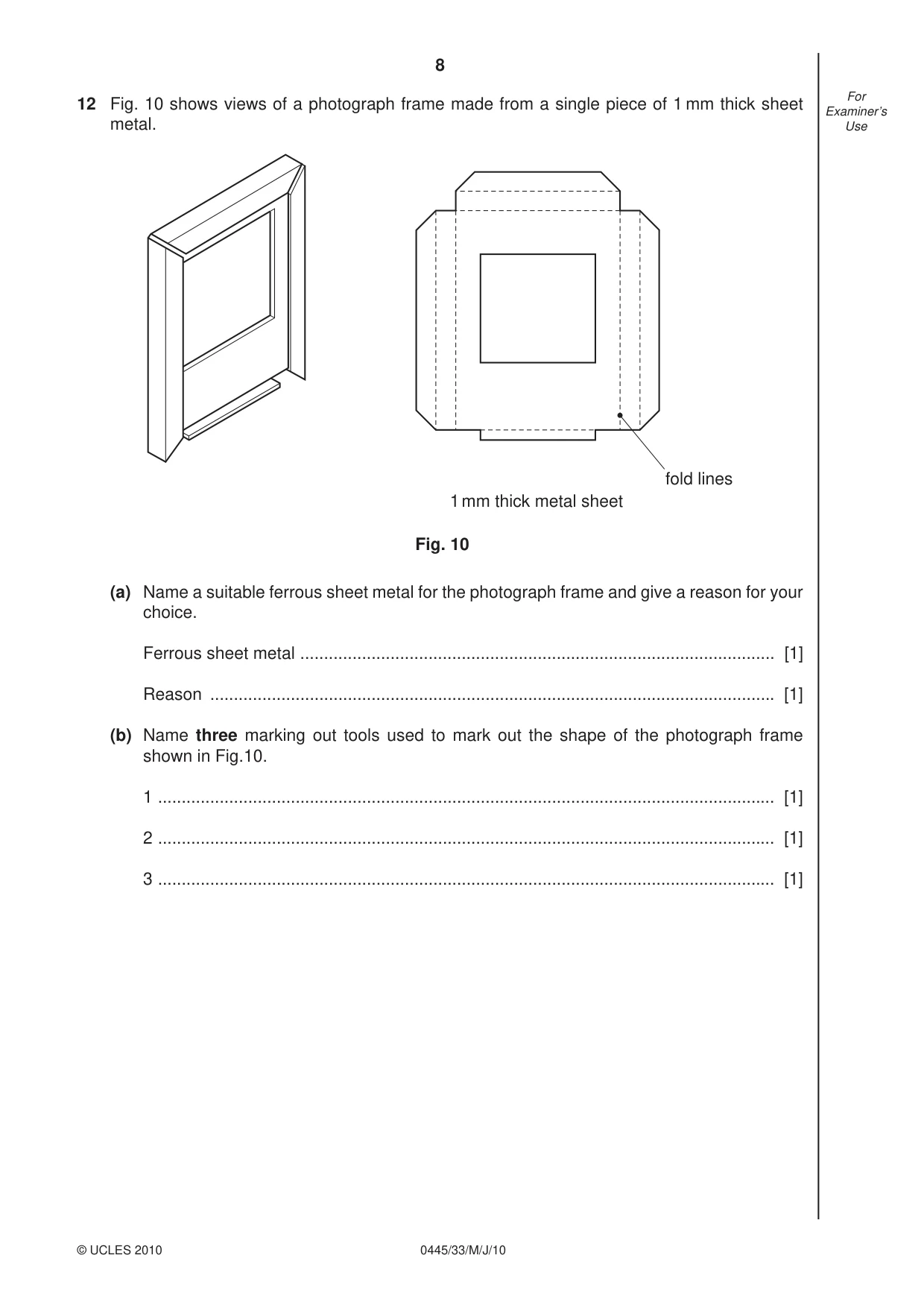
8 0445/33/M/J/10 © UCLES 2010 For Examiner’s Use 12 Fig. 10 shows views of a photograph frame made from a single piece of 1 mm thick sheet metal. 1 mm thick metal sheet fold lines Fig. 10 (a) Name a suitable ferrous sheet metal for the photograph frame and give a reason for your choice. Ferrous sheet metal … [1] Reason … [1] (b) Name three marking out tools used to mark out the shape of the photograph frame shown in Fig.10. 1 … [1] 2 … [1] 3 … [1]
Question paper, page 9
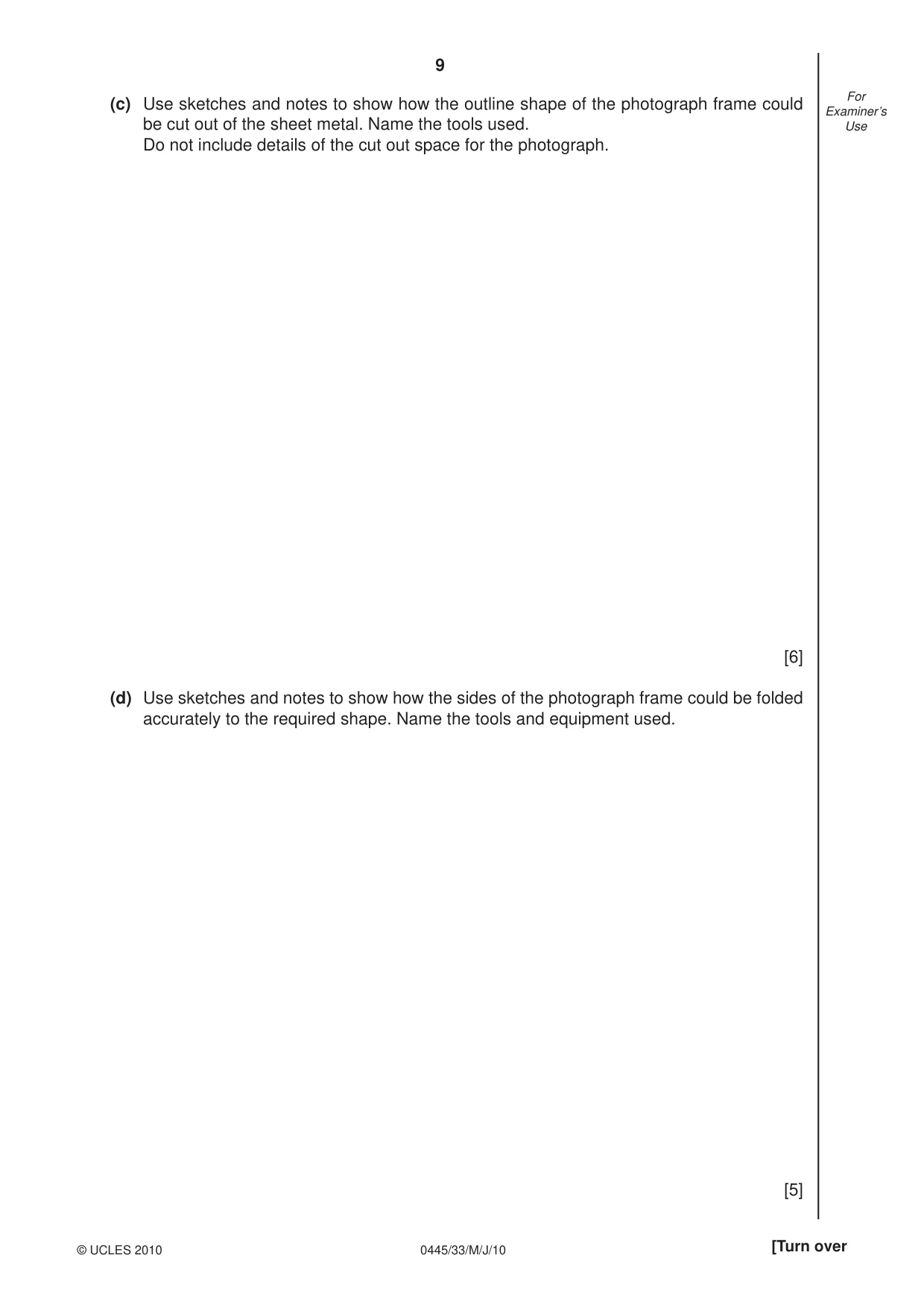
9 0445/33/M/J/10 © UCLES 2010 [Turn over For Examiner’s Use (c) Use sketches and notes to show how the outline shape of the photograph frame could be cut out of the sheet metal. Name the tools used. Do not include details of the cut out space for the photograph. [6] (d) Use sketches and notes to show how the sides of the photograph frame could be folded accurately to the required shape. Name the tools and equipment used. [5]
Question paper, page 10
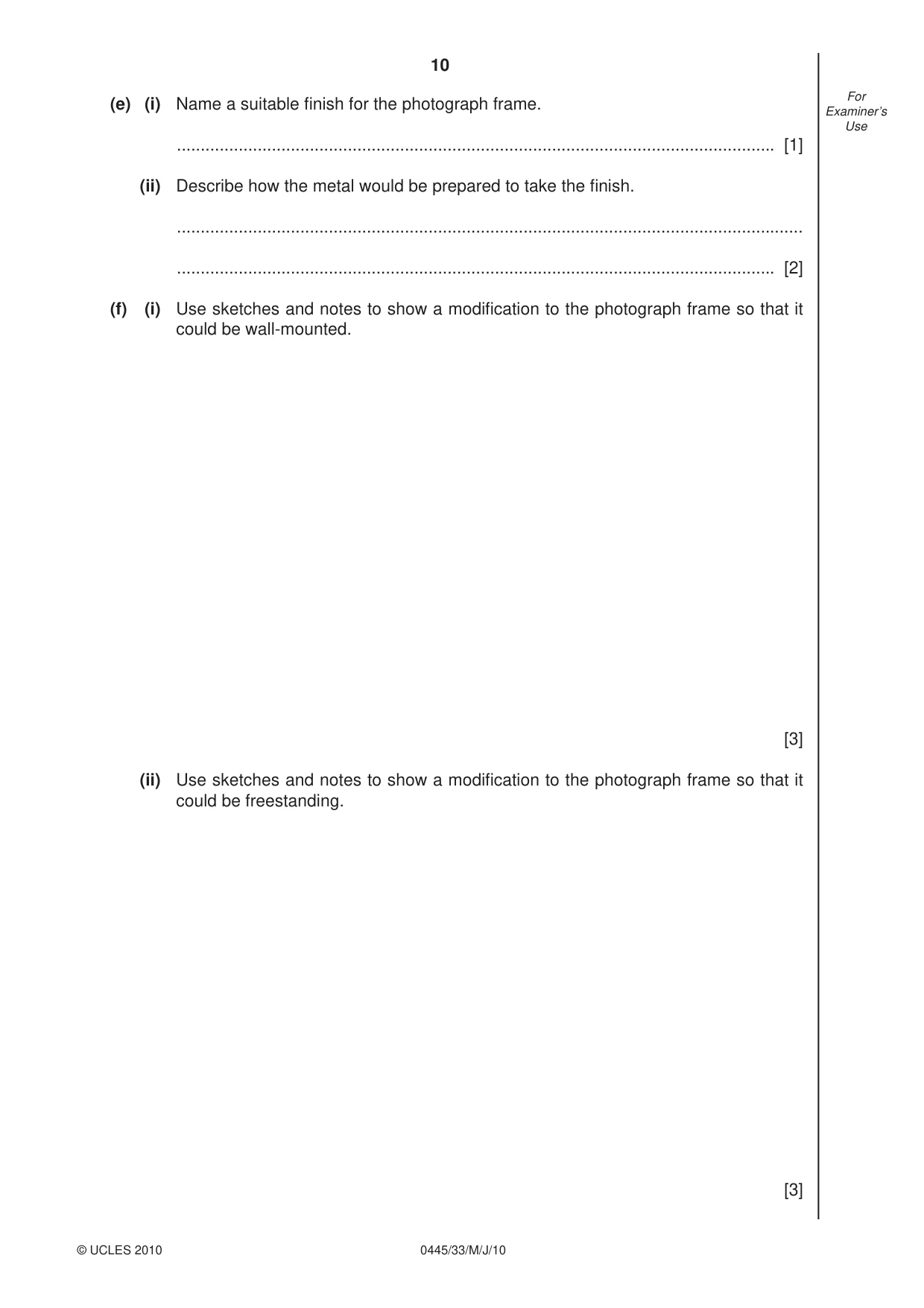
10 0445/33/M/J/10 © UCLES 2010 For Examiner’s Use (e) (i) Name a suitable fi nish for the photograph frame. … [1] (ii) Describe how the metal would be prepared to take the fi nish. … … [2] (f) (i) Use sketches and notes to show a modifi cation to the photograph frame so that it could be wall-mounted. [3] (ii) Use sketches and notes to show a modifi cation to the photograph frame so that it could be freestanding. [3]
Question paper, page 11
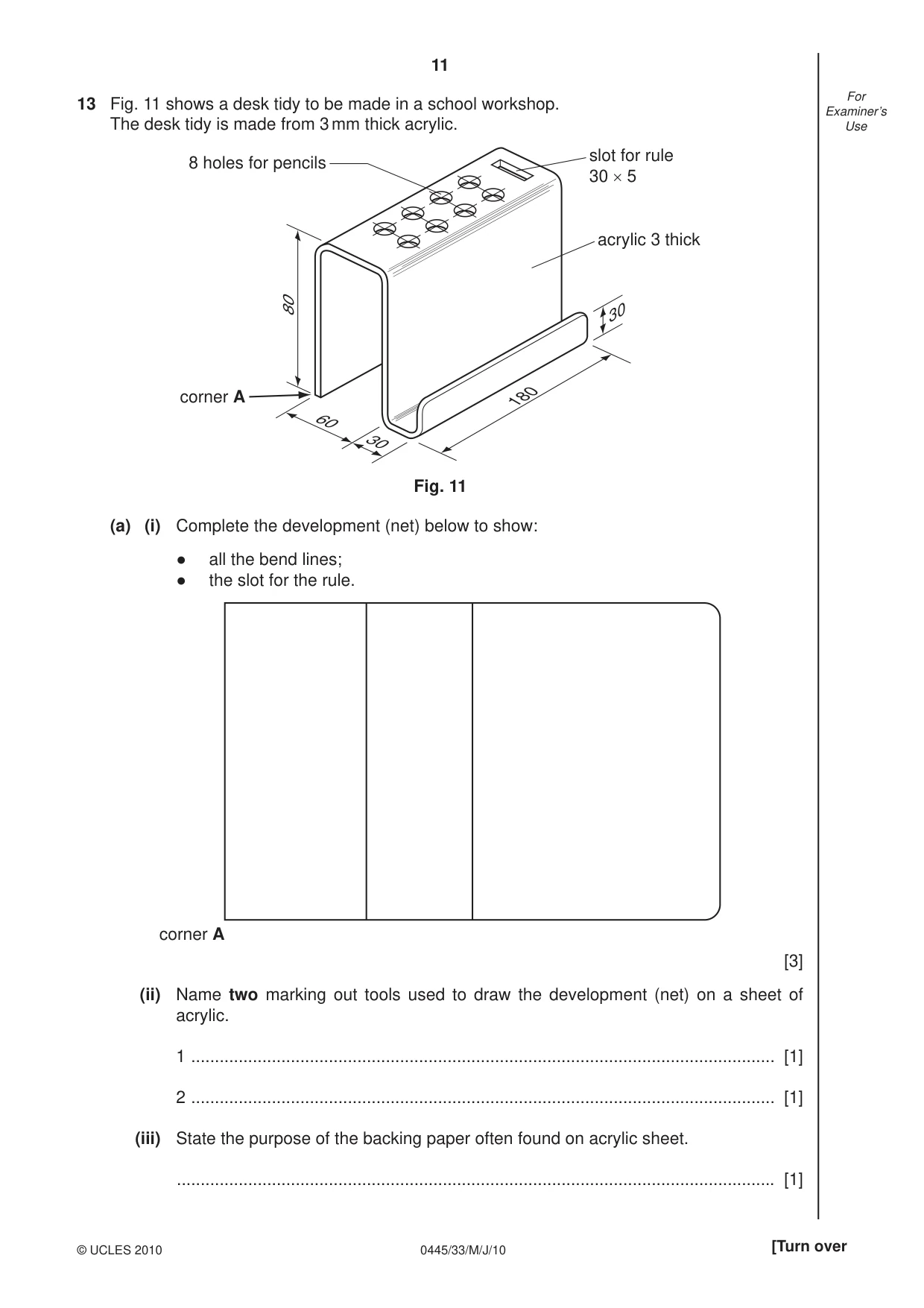
11 0445/33/M/J/10 © UCLES 2010 [Turn over For Examiner’s Use 13 Fig. 11 shows a desk tidy to be made in a school workshop. The desk tidy is made from 3 mm thick acrylic. 60 30 80 180 30 8 holes for pencils corner A slot for rule 30 × 5 acrylic 3 thick Fig. 11 (a) (i) Complete the development (net) below to show: ● all the bend lines; ● the slot for the rule. corner A [3] (ii) Name two marking out tools used to draw the development (net) on a sheet of acrylic. 1 … [1] 2 … [1] (iii) State the purpose of the backing paper often found on acrylic sheet. … [1]
Question paper, page 12
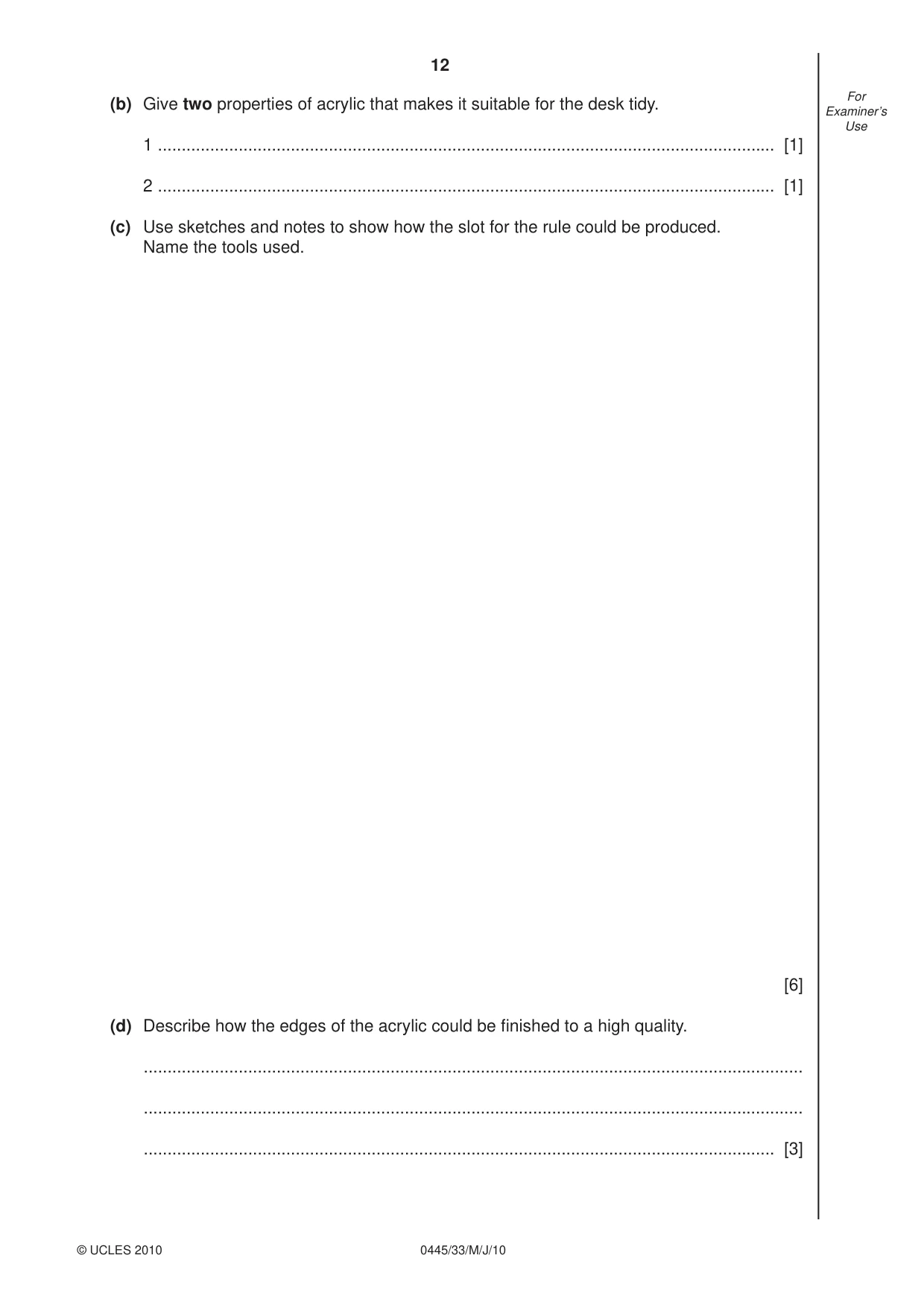
12 0445/33/M/J/10 © UCLES 2010 For Examiner’s Use (b) Give two properties of acrylic that makes it suitable for the desk tidy. 1 … [1] 2 … [1] (c) Use sketches and notes to show how the slot for the rule could be produced. Name the tools used. [6] (d) Describe how the edges of the acrylic could be fi nished to a high quality. … … … [3]
Question paper, page 13
13 0445/33/M/J/10 © UCLES 2010 For Examiner’s Use (e) Explain why it is important to clamp the acrylic sheet when drilling the holes. … … … [2] (f) Use detailed sketches and notes to show how the acrylic sheet could be bent to the shape of the desk tidy. [6]
Question paper, page 14
14 0445/33/M/J/10 © UCLES 2010 BLANK PAGE
Question paper, page 15
15 0445/33/M/J/10 © UCLES 2010 BLANK PAGE
Question paper, page 16
16 0445/33/M/J/10 Permission to reproduce items where third-party owned material protected by copyright is included has been sought and cleared where possible. Every reasonable effort has been made by the publisher (UCLES) to trace copyright holders, but if any items requiring clearance have unwittingly been included the publisher will be pleased to make amends at the earliest possible opportunity. University of Cambridge International Examinations is part of the Cambridge Assessment Group. Cambridge Assessment is the brand name of University of Cambridge Local Examinations Syndicate (UCLES), which is itself a department of the University of Cambridge. BLANK PAGE © UCLES 2010
Mark scheme, page 1
UNIVERSITY OF CAMBRIDGE INTERNATIONAL EXAMINATIONS International General Certificate of Secondary Education MARK SCHEME for the May/June 2010 question paper for the guidance of teachers 0445 DESIGN AND TECHNOLOGY 0445/33 Paper 33 (Resistant Materials), maximum raw mark 50 This mark scheme is published as an aid to teachers and candidates, to indicate the requirements of the examination. It shows the basis on which Examiners were instructed to award marks. It does not indicate the details of the discussions that took place at an Examiners’ meeting before marking began, which would have considered the acceptability of alternative answers. Mark schemes must be read in conjunction with the question papers and the report on the examination. • CIE will not enter into discussions or correspondence in connection with these mark schemes. CIE is publishing the mark schemes for the May/June 2010 question papers for most IGCSE, GCE Advanced Level and Advanced Subsidiary Level syllabuses and some Ordinary Level syllabuses. www.XtremePapers.com
Mark scheme, page 2
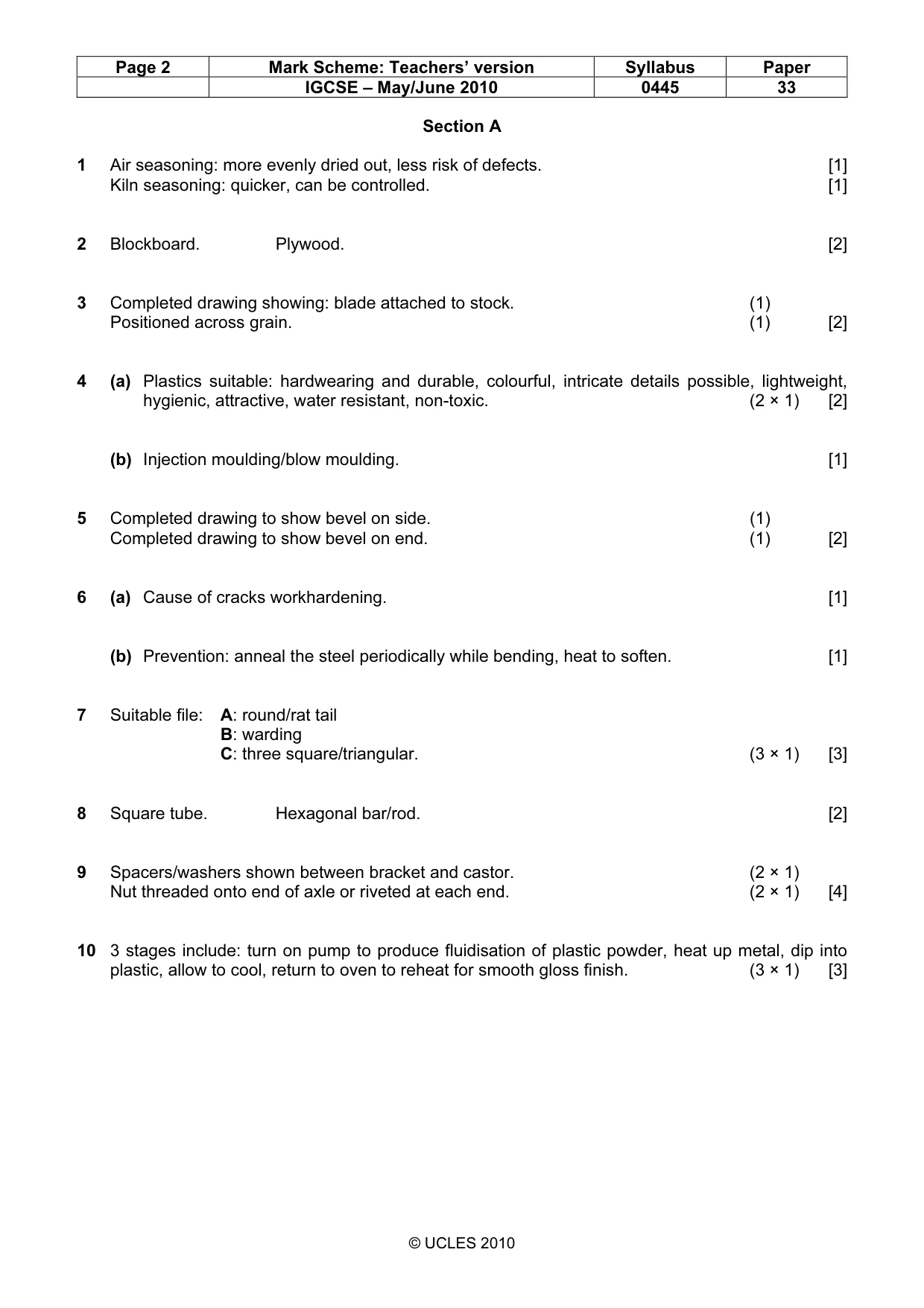
Page 2 Mark Scheme: Teachers’ version Syllabus Paper IGCSE – May/June 2010 0445 33 © UCLES 2010 Section A 1 Air seasoning: more evenly dried out, less risk of defects. [1] Kiln seasoning: quicker, can be controlled. [1] 2 Blockboard. Plywood. [2] 3 Completed drawing showing: blade attached to stock. (1) Positioned across grain. (1) [2] 4 (a) Plastics suitable: hardwearing and durable, colourful, intricate details possible, lightweight, hygienic, attractive, water resistant, non-toxic. (2 × 1) [2] (b) Injection moulding/blow moulding. [1] 5 Completed drawing to show bevel on side. (1) Completed drawing to show bevel on end. (1) [2] 6 (a) Cause of cracks workhardening. [1] (b) Prevention: anneal the steel periodically while bending, heat to soften. [1] 7 Suitable file: A: round/rat tail B: warding C: three square/triangular. (3 × 1) [3] 8 Square tube. Hexagonal bar/rod. [2] 9 Spacers/washers shown between bracket and castor. (2 × 1) Nut threaded onto end of axle or riveted at each end. (2 × 1) [4] 10 3 stages include: turn on pump to produce fluidisation of plastic powder, heat up metal, dip into plastic, allow to cool, return to oven to reheat for smooth gloss finish. (3 × 1) [3]
Mark scheme, page 3
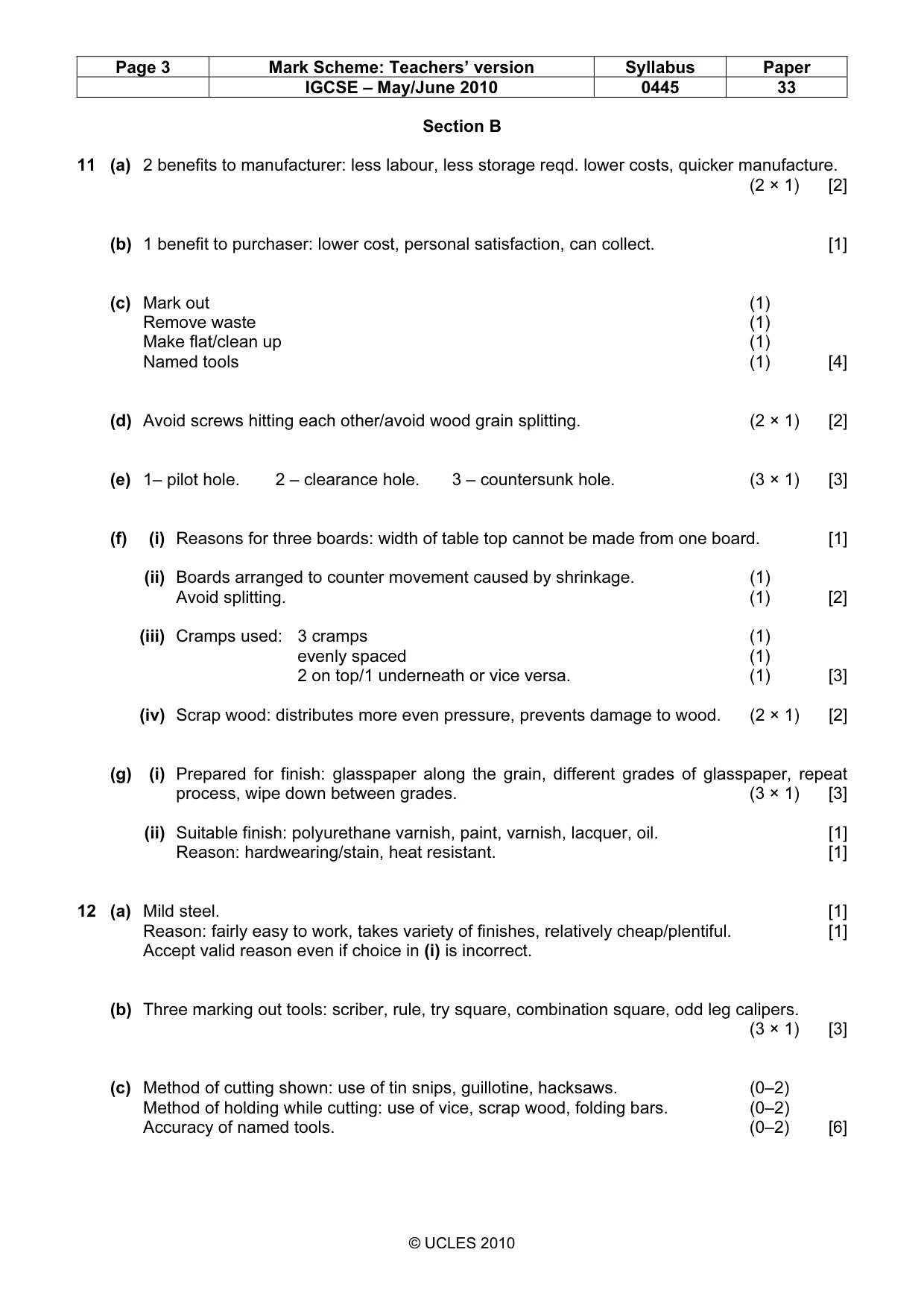
Page 3 Mark Scheme: Teachers’ version Syllabus Paper IGCSE – May/June 2010 0445 33 © UCLES 2010 Section B 11 (a) 2 benefits to manufacturer: less labour, less storage reqd. lower costs, quicker manufacture. (2 × 1) [2] (b) 1 benefit to purchaser: lower cost, personal satisfaction, can collect. [1] (c) Mark out (1) Remove waste (1) Make flat/clean up (1) Named tools (1) [4] (d) Avoid screws hitting each other/avoid wood grain splitting. (2 × 1) [2] (e) 1– pilot hole. 2 – clearance hole. 3 – countersunk hole. (3 × 1) [3] (f) (i) Reasons for three boards: width of table top cannot be made from one board. [1] (ii) Boards arranged to counter movement caused by shrinkage. (1) Avoid splitting. (1) [2] (iii) Cramps used: 3 cramps (1) evenly spaced (1) 2 on top/1 underneath or vice versa. (1) [3] (iv) Scrap wood: distributes more even pressure, prevents damage to wood. (2 × 1) [2] (g) (i) Prepared for finish: glasspaper along the grain, different grades of glasspaper, repeat process, wipe down between grades. (3 × 1) [3] (ii) Suitable finish: polyurethane varnish, paint, varnish, lacquer, oil. [1] Reason: hardwearing/stain, heat resistant. [1] 12 (a) Mild steel. [1] Reason: fairly easy to work, takes variety of finishes, relatively cheap/plentiful. [1] Accept valid reason even if choice in (i) is incorrect. (b) Three marking out tools: scriber, rule, try square, combination square, odd leg calipers. (3 × 1) [3] (c) Method of cutting shown: use of tin snips, guillotine, hacksaws. (0–2) Method of holding while cutting: use of vice, scrap wood, folding bars. (0–2) Accuracy of named tools. (0–2) [6]
Mark scheme, page 4
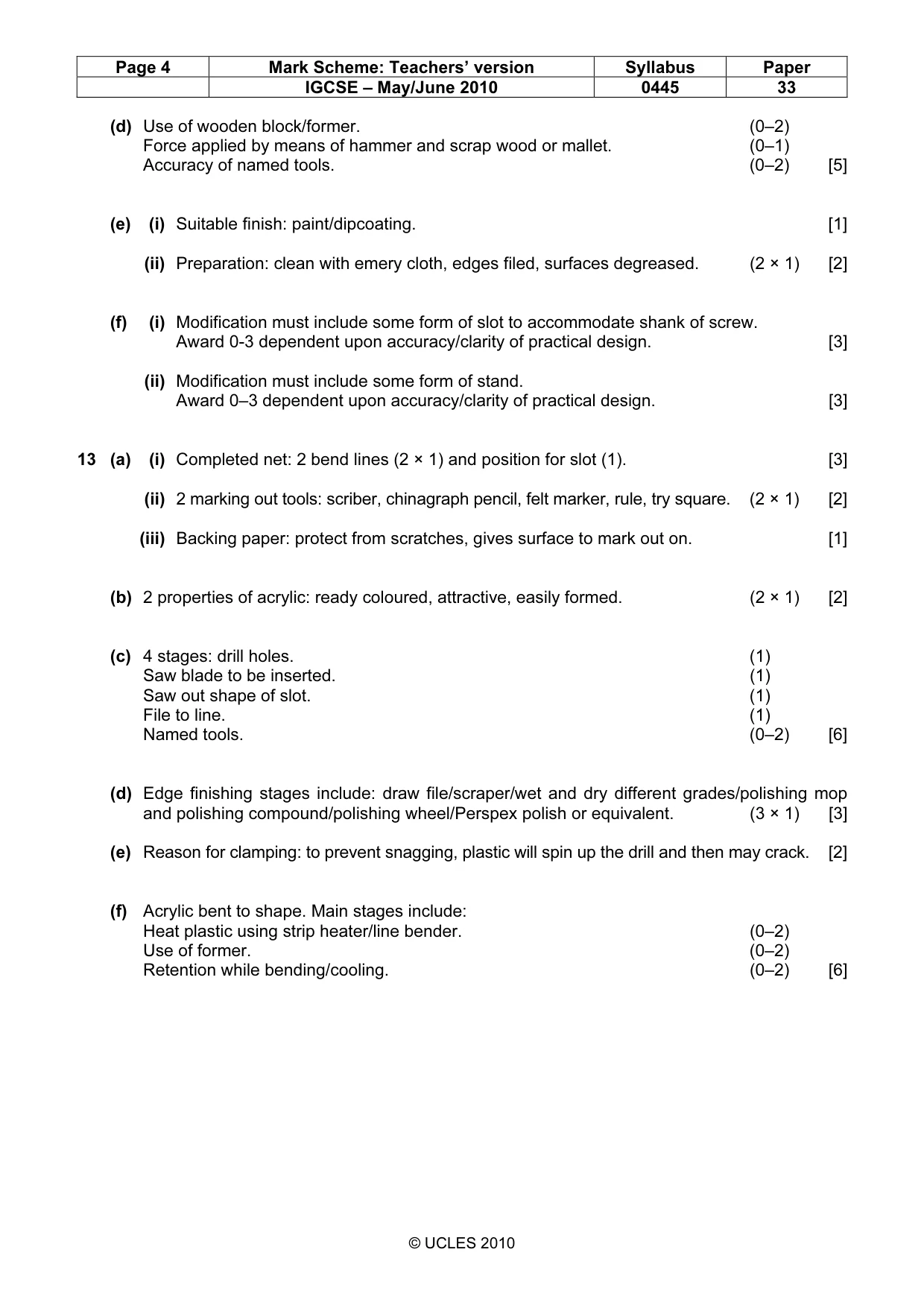
Page 4 Mark Scheme: Teachers’ version Syllabus Paper IGCSE – May/June 2010 0445 33 © UCLES 2010 (d) Use of wooden block/former. (0–2) Force applied by means of hammer and scrap wood or mallet. (0–1) Accuracy of named tools. (0–2) [5] (e) (i) Suitable finish: paint/dipcoating. [1] (ii) Preparation: clean with emery cloth, edges filed, surfaces degreased. (2 × 1) [2] (f) (i) Modification must include some form of slot to accommodate shank of screw. Award 0-3 dependent upon accuracy/clarity of practical design. [3] (ii) Modification must include some form of stand. Award 0–3 dependent upon accuracy/clarity of practical design. [3] 13 (a) (i) Completed net: 2 bend lines (2 × 1) and position for slot (1). [3] (ii) 2 marking out tools: scriber, chinagraph pencil, felt marker, rule, try square. (2 × 1) [2] (iii) Backing paper: protect from scratches, gives surface to mark out on. [1] (b) 2 properties of acrylic: ready coloured, attractive, easily formed. (2 × 1) [2] (c) 4 stages: drill holes. (1) Saw blade to be inserted. (1) Saw out shape of slot. (1) File to line. (1) Named tools. (0–2) [6] (d) Edge finishing stages include: draw file/scraper/wet and dry different grades/polishing mop and polishing compound/polishing wheel/Perspex polish or equivalent. (3 × 1) [3] (e) Reason for clamping: to prevent snagging, plastic will spin up the drill and then may crack. [2] (f) Acrylic bent to shape. Main stages include: Heat plastic using strip heater/line bender. (0–2) Use of former. (0–2) Retention while bending/cooling. (0–2) [6]
What you needed in this session
Cambridge’s own grade thresholds for 2010 May/June, Paper 3 · Variant 3. A higher threshold means an easier paper — the bar moves with how the cohort did.