Cambridge IGCSE Chemistry (9-1) 0971 — 2025 May/June Paper 3 · Variant 1
0971/31/M/J/25 · 8 questions · 80 marks · 75 min
The question paper and its mark scheme, free to read here and free to download. This is Cambridge’s own paper, exactly as it was sat.
Question paper20 pages


Mark scheme12 pages
Answers below. Sit the paper first if you are practising.
Questions as text
Q1 · A list of substances is shown
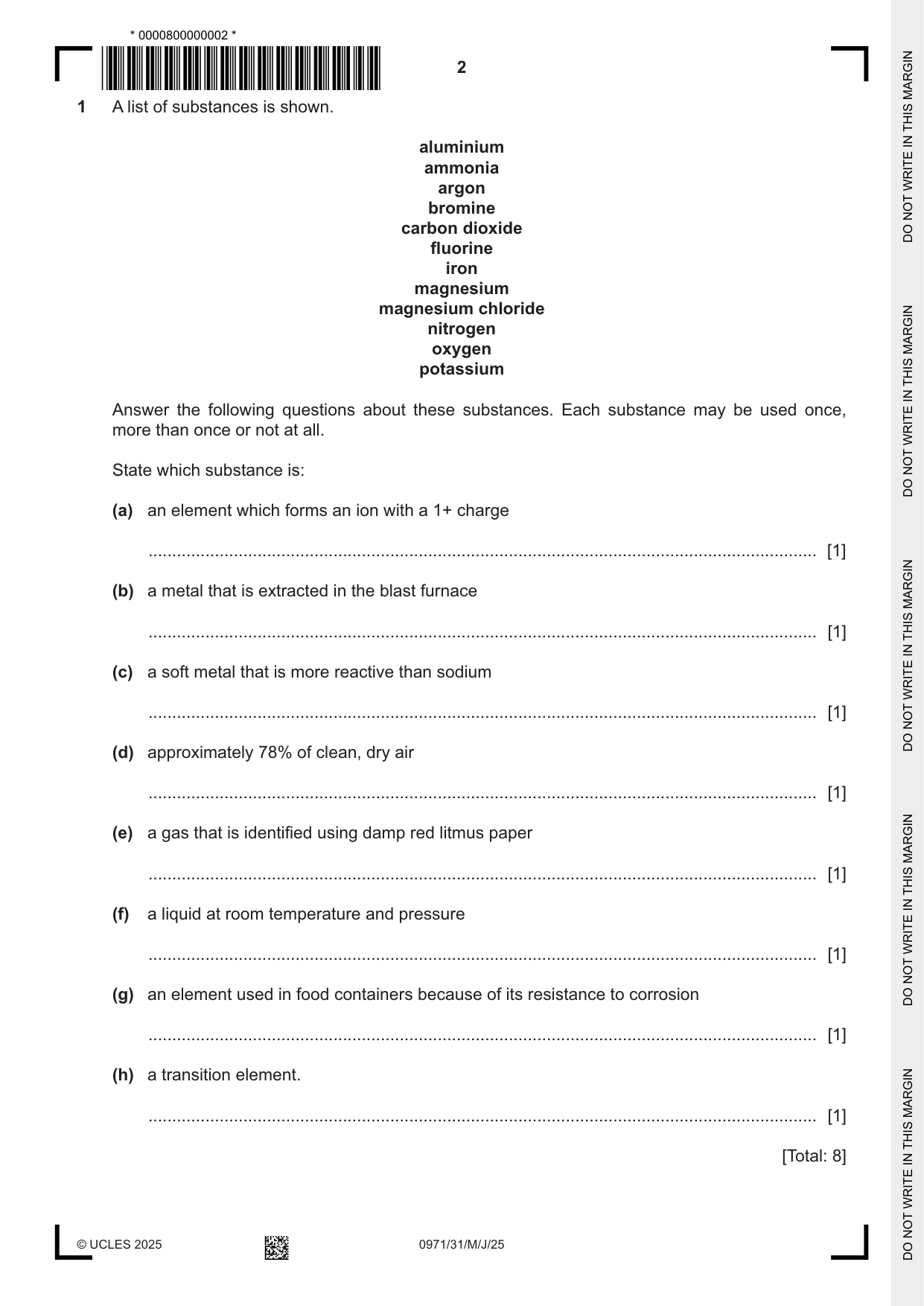
1 A list of substances is shown. aluminium ammonia argon bromine carbon dioxide fluorine iron magnesium magnesium chloride nitrogen oxygen potassium Answer the following questions about these substances. Each substance may be used once, more than once or not at all. State which substance is: (a) an element which forms an ion with a 1+ charge ............................................................................................................................................. [1] (b) a metal that is extracted in the blast furnace ............................................................................................................................................. [1] (c) a soft metal that is more reactive than sodium ............................................................................................................................................. [1] (d) approximately 78% of clean, dry air ............................................................................................................................................. [1] (e) a gas that is identified using damp red litmus paper ............................................................................................................................................. [1] (f) a liquid at room temperature and pressure ............................................................................................................................................. [1] (g) an element used in food containers because of its resistance to corrosion ............................................................................................................................................. [1] (h) a transition element. ............................................................................................................................................. [1] [Total: 8]
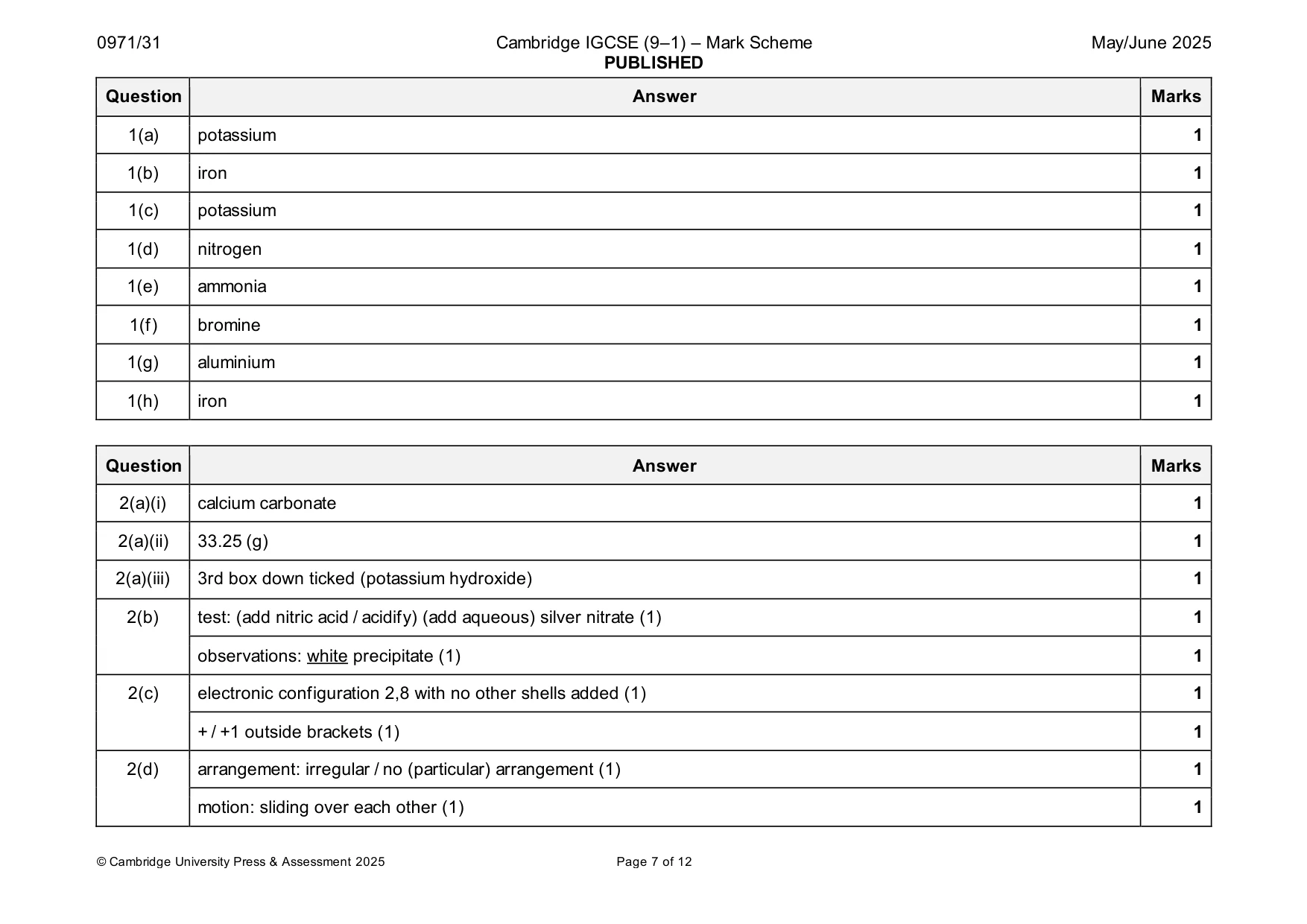
Mark scheme: Question Answer Marks 1(a) potassium 1 1(b) iron 1 1(c) potassium 1 1(d) nitrogen 1 1(e) ammonia 1 1(f) bromine 1 1(g) aluminium 1 1(h) iron 1
Q2 · This question is about sea water and the substances found in sea water
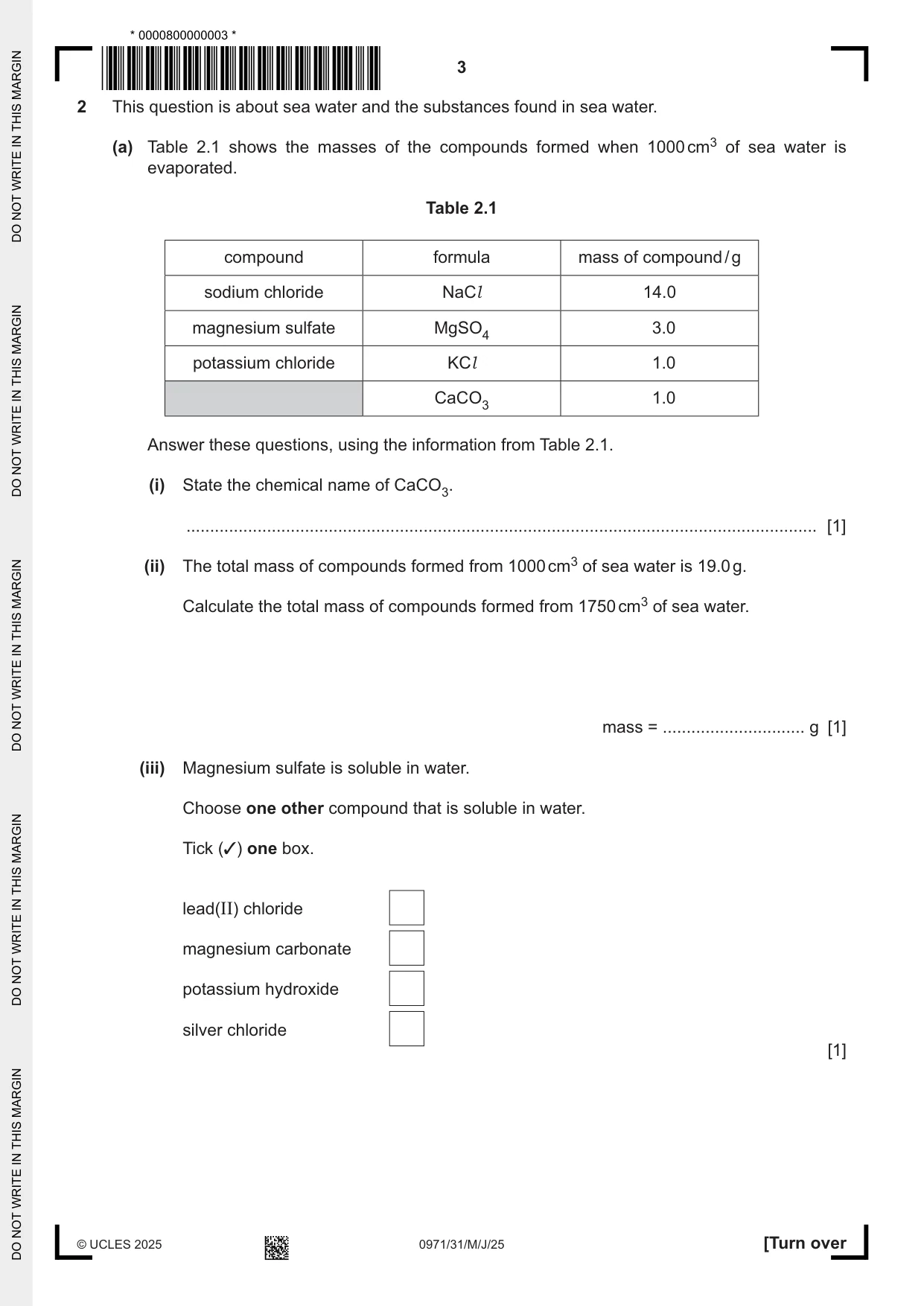
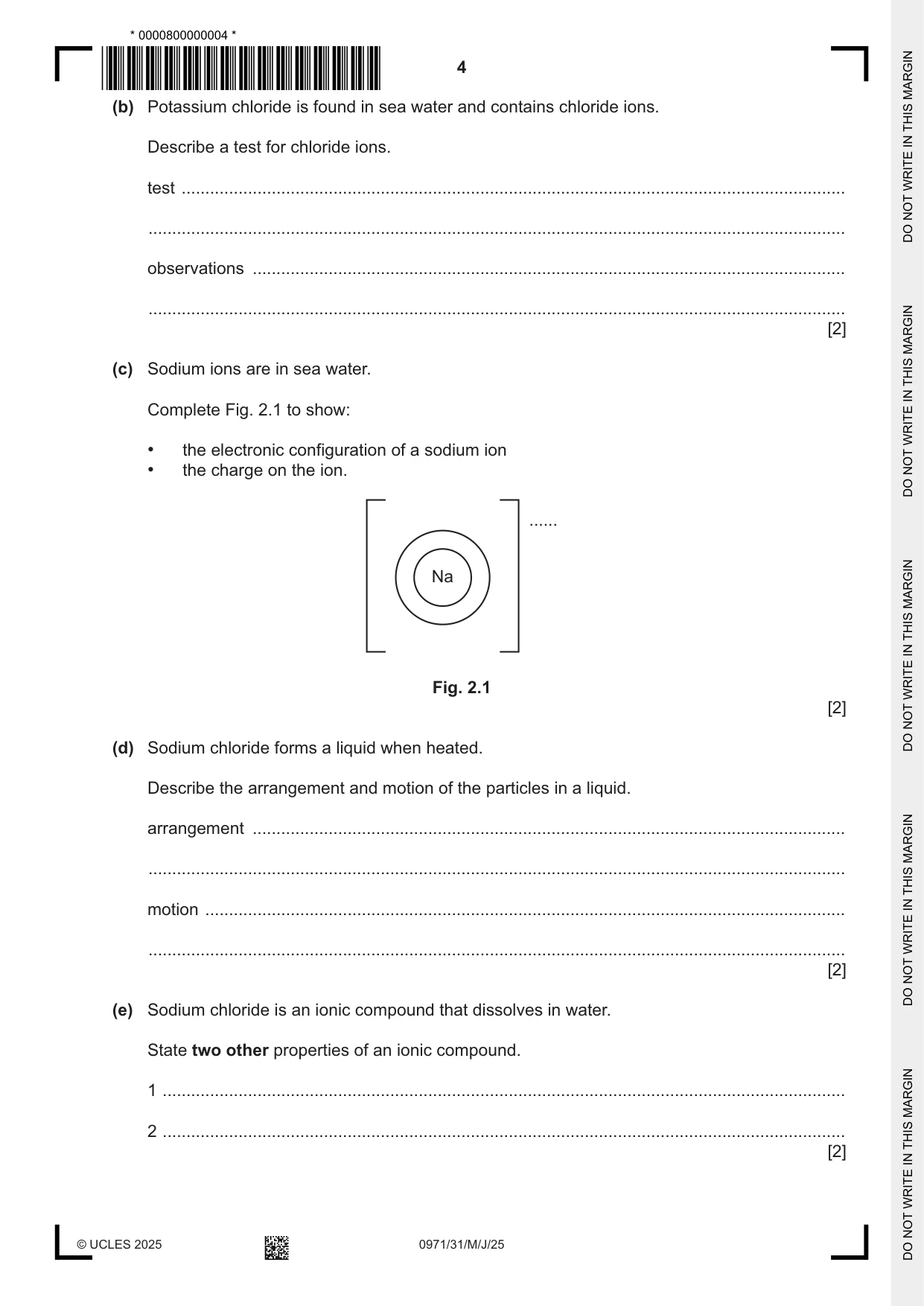
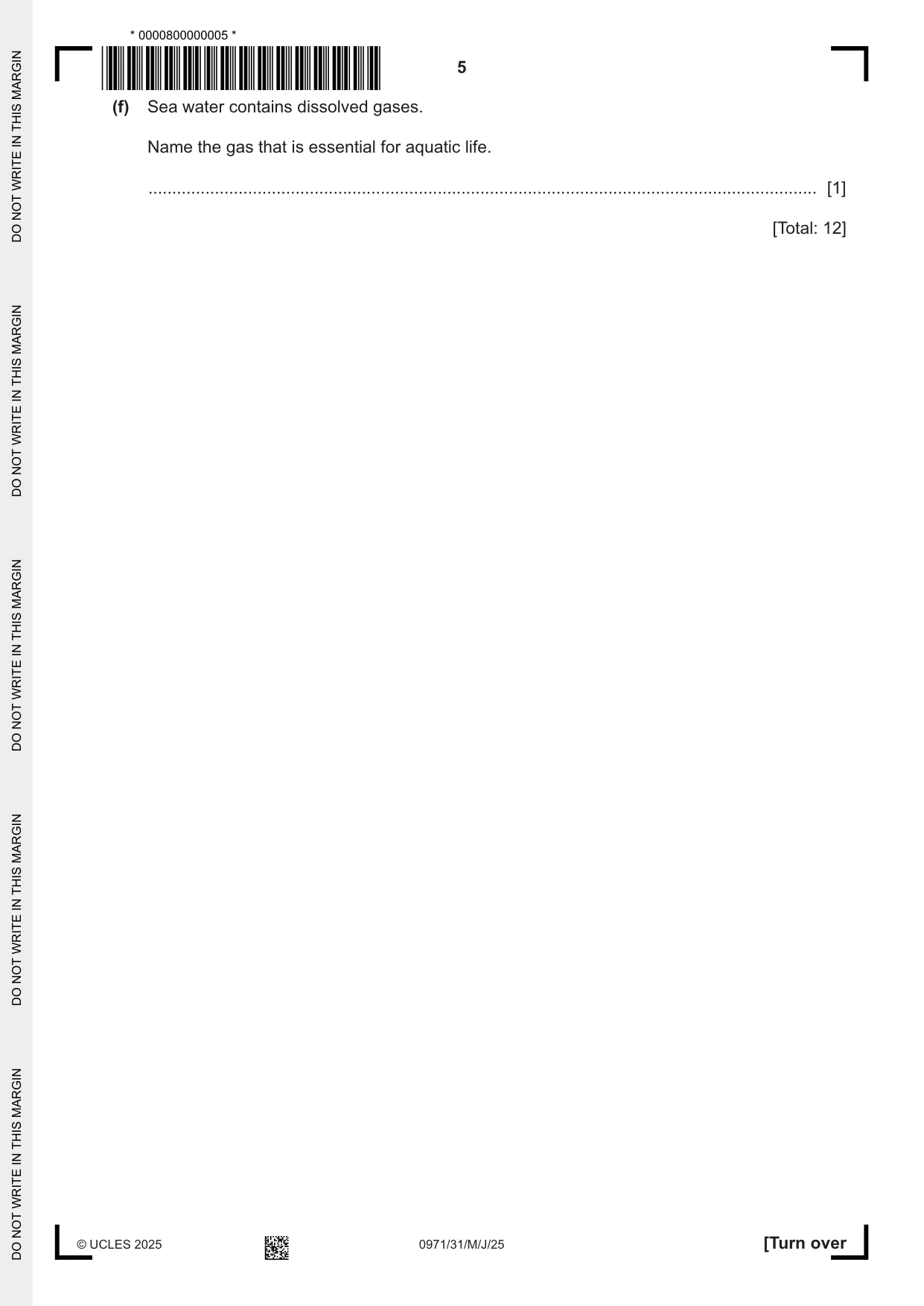
2 This question is about sea water and the substances found in sea water. (a) Table 2.1 shows the masses of the compounds formed when 1000 cm3 of sea water is evaporated. Table 2.1 compound formula mass of compound / g sodium chloride NaCl 14.0 magnesium sulfate MgSO4 3.0 potassium chloride KCl 1.0 CaCO3 1.0 Answer these questions, using the information from Table 2.1. (i) State the chemical name of CaCO3. ..................................................................................................................................... [1] (ii) The total mass of compounds formed from 1000 cm3 of sea water is 19.0 g. Calculate the total mass of compounds formed from 1750 cm3 of sea water. mass = .............................. g [1] (iii) Magnesium sulfate is soluble in water. Choose one other compound that is soluble in water. Tick (3) one box. lead(II) chloride magnesium carbonate potassium hydroxide silver chloride [1] (b) Potassium chloride is found in sea water and contains chloride ions. Describe a test for chloride ions. test ............................................................................................................................................ ................................................................................................................................................... observations ............................................................................................................................. ................................................................................................................................................... [2] (c) Sodium ions are in sea water. Complete Fig. 2.1 to show: • the electronic configuration of a sodium ion • the charge on the ion. ...... Na Fig. 2.1 [2] (d) Sodium chloride forms a liquid when heated. Describe the arrangement and motion of the particles in a liquid. arrangement ............................................................................................................................. ................................................................................................................................................... motion ....................................................................................................................................... ................................................................................................................................................... [2] (e) Sodium chloride is an ionic compound that dissolves in water. State two other properties of an ionic compound. 1 ................................................................................................................................................ 2 ................................................................................................................................................ [2] (f) Sea water contains dissolved gases. Name the gas that is essential for aquatic life. ............................................................................................................................................. [1] [Total: 12]
Mark scheme: 2(a)(i) calcium carbonate 1 2(a)(ii) 33.25 (g) 1 2(a)(iii) 3rd box down ticked (potassium hydroxide) 1 2(b) test: (add nitric acid / acidify) (add aqueous) silver nitrate (1) 1 observations: white precipitate (1) 1 2(c) electronic configuration 2,8 with no other shells added (1) 1 + / +1 outside brackets (1) 1 2(d) arrangement: irregular / no (particular) arrangement (1) 1 motion: sliding over each other (1) 1 2(e) high melting point 1 conducts electricity when molten / conducts electricity in aqueous solution 1 2(f) oxygen 1
More questions on Formulae, functional groups and terminology
Q3 · This question is about sulfur and its compounds
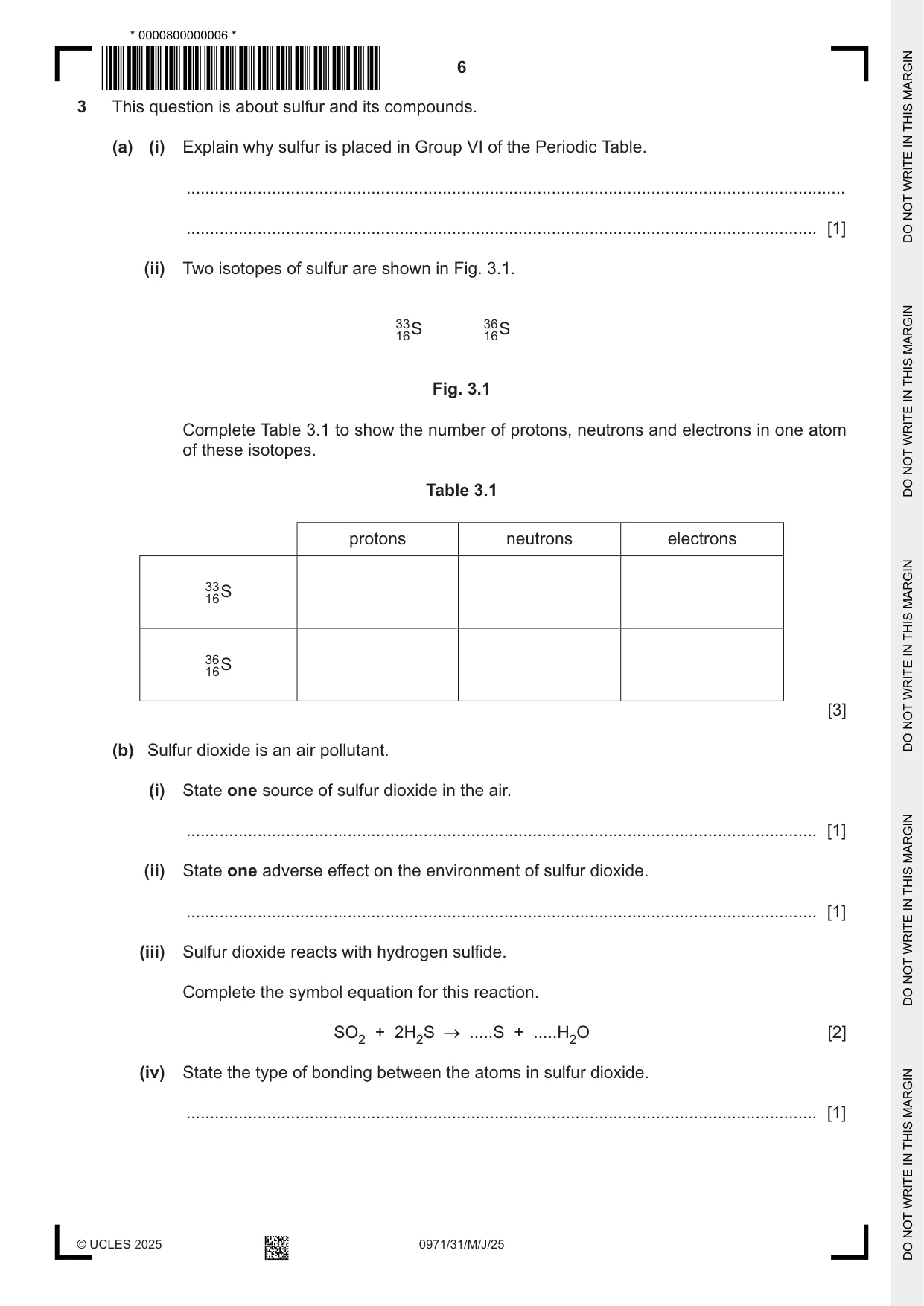
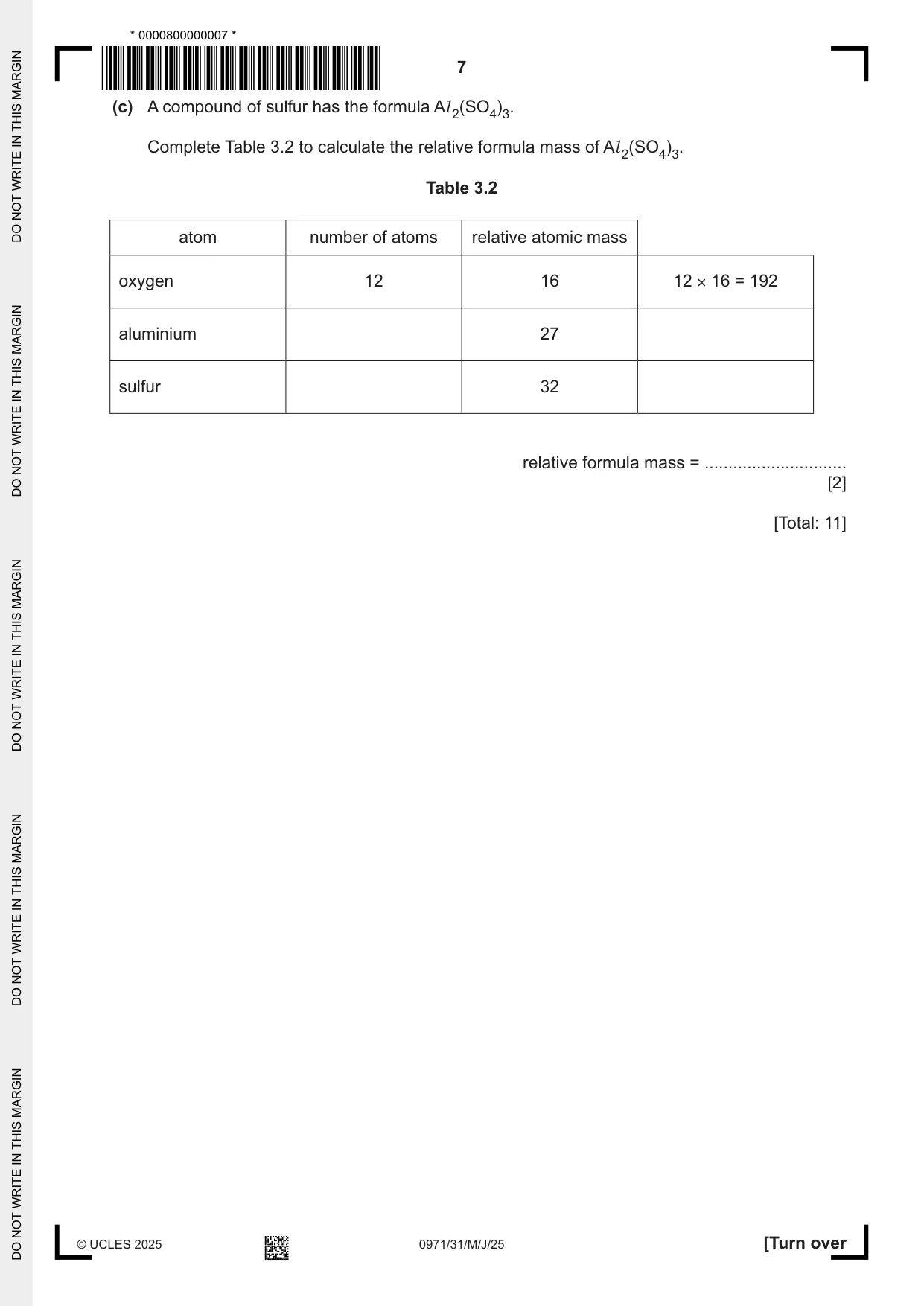
3 This question is about sulfur and its compounds. (a) (i) Explain why sulfur is placed in Group VI of the Periodic Table. ........................................................................................................................................... ..................................................................................................................................... [1] (ii) Two isotopes of sulfur are shown in Fig. 3.1. 3 3 3 6 1 6 S 1 6 S Fig. 3.1 Complete Table 3.1 to show the number of protons, neutrons and electrons in one atom of these isotopes. Table 3.1 protons neutrons electrons 3 3 1 6 S 3 6 1 6 S [3] (b) Sulfur dioxide is an air pollutant. (i) State one source of sulfur dioxide in the air. ..................................................................................................................................... [1] (ii) State one adverse effect on the environment of sulfur dioxide. ..................................................................................................................................... [1] (iii) Sulfur dioxide reacts with hydrogen sulfide. Complete the symbol equation for this reaction. SO2 + 2H2S .....S + .....H2O [2] (iv) State the type of bonding between the atoms in sulfur dioxide. ..................................................................................................................................... [1] (c) A compound of sulfur has the formula Al 2(SO4)3. Complete Table 3.2 to calculate the relative formula mass of Al 2(SO4)3. Table 3.2 atom number of atoms relative atomic mass oxygen 12 16 12 × 16 = 192 aluminium 27 sulfur 32 relative formula mass = .............................. [2] [Total: 11]
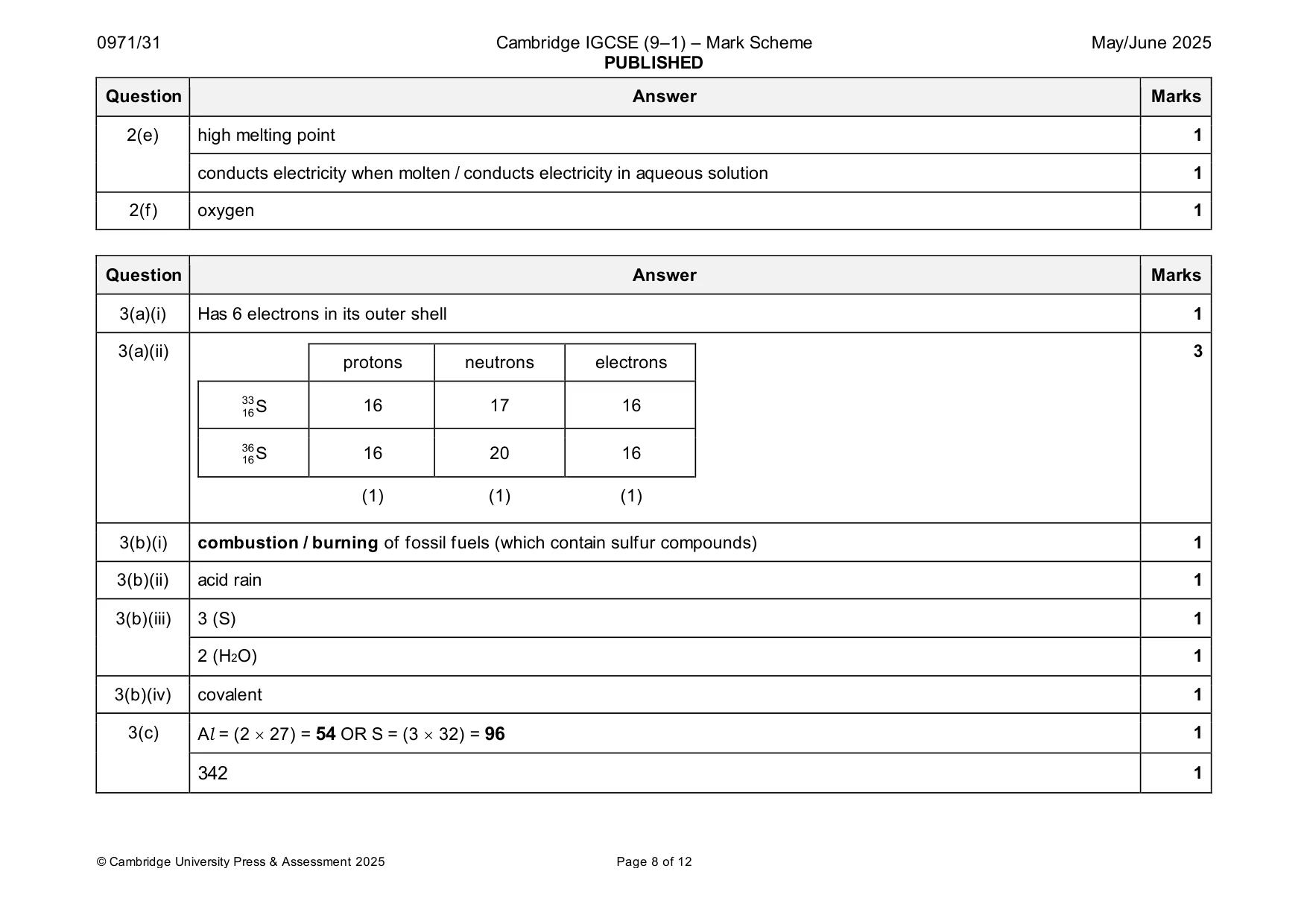
Mark scheme: 3(a)(i) Has 6 electrons in its outer shell 1 3(a)(ii) 3 protons neutrons electrons 3316S 16 17 16 3616S 16 20 16 (1) (1) (1) 3(b)(i) combustion / burning of fossil fuels (which contain sulfur compounds) 1 3(b)(ii) acid rain 1 3(b)(iii) 3 (S) 1 2 (H2O) 1 3(b)(iv) covalent 1 3(c) Al = (2 27) = 54 OR S = (3 32) = 96 1 342 1
Q4 · This question is about organic chemistry
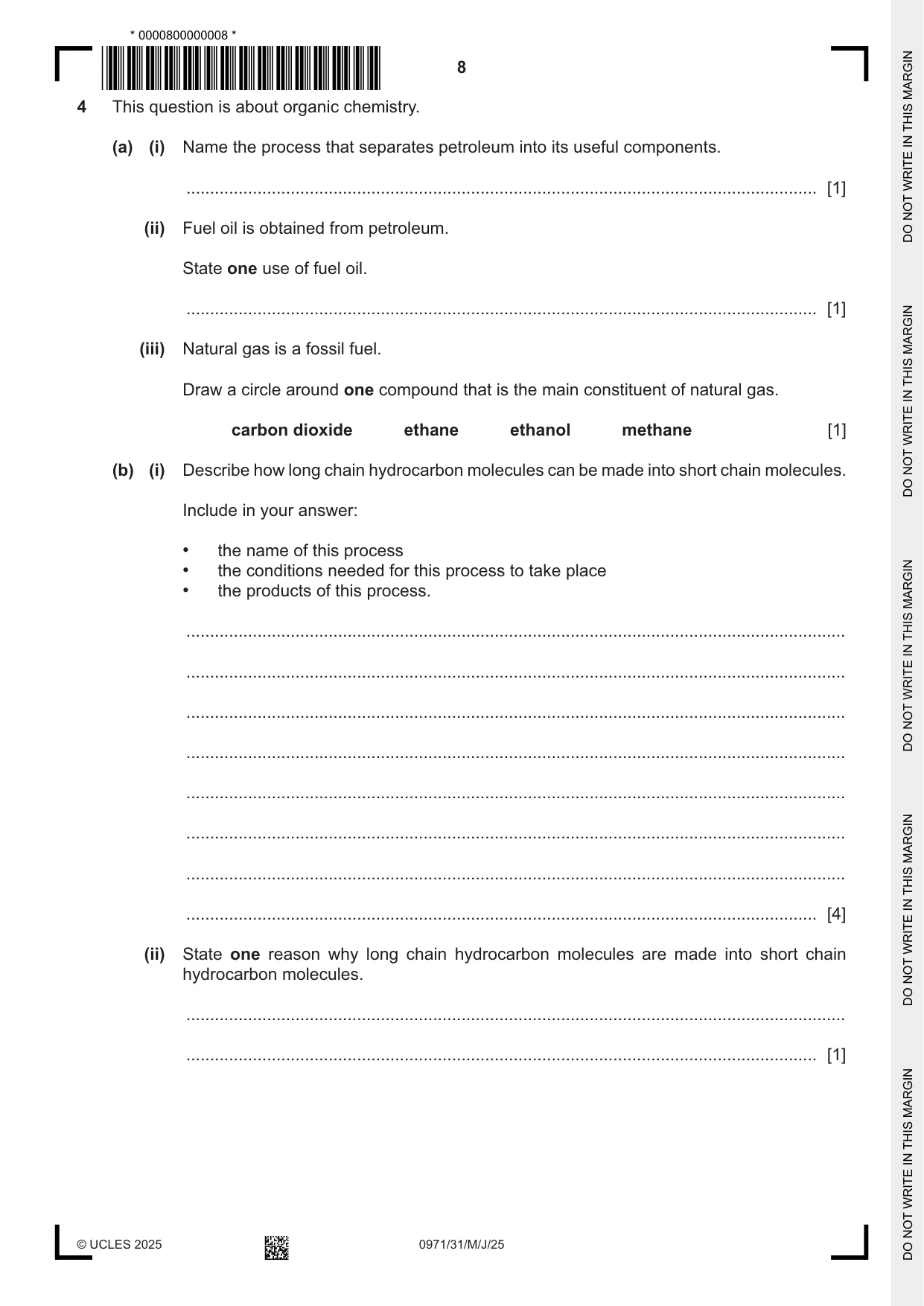
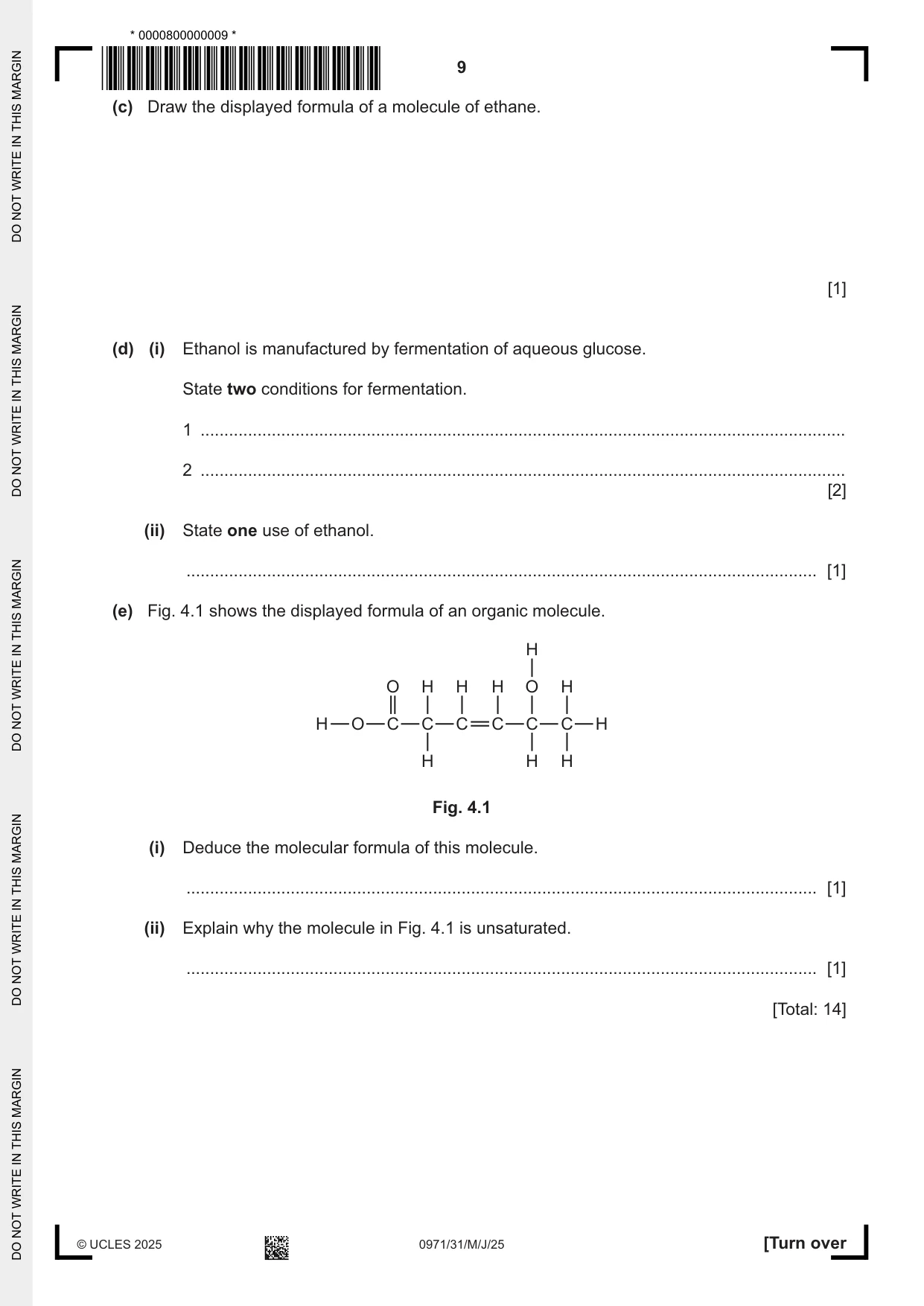
4 This question is about organic chemistry. (a) (i) Name the process that separates petroleum into its useful components. ..................................................................................................................................... [1] (ii) Fuel oil is obtained from petroleum. State one use of fuel oil. ..................................................................................................................................... [1] (iii) Natural gas is a fossil fuel. Draw a circle around one compound that is the main constituent of natural gas. carbon dioxide ethane ethanol methane [1] (b) (i) Describe how long chain hydrocarbon molecules can be made into short chain molecules. Include in your answer: • the name of this process • the conditions needed for this process to take place • the products of this process. ........................................................................................................................................... ........................................................................................................................................... ........................................................................................................................................... ........................................................................................................................................... ........................................................................................................................................... ........................................................................................................................................... ........................................................................................................................................... ..................................................................................................................................... [4] (ii) State one reason why long chain hydrocarbon molecules are made into short chain hydrocarbon molecules. ........................................................................................................................................... ..................................................................................................................................... [1] (c) Draw the displayed formula of a molecule of ethane. [1] (d) (i) Ethanol is manufactured by fermentation of aqueous glucose. State two conditions for fermentation. 1 ........................................................................................................................................ 2 ........................................................................................................................................ [2] (ii) State one use of ethanol. ..................................................................................................................................... [1] (e) Fig. 4.1 shows the displayed formula of an organic molecule. H O H H H O H H O C C C C C C H H H H Fig. 4.1 (i) Deduce the molecular formula of this molecule. ..................................................................................................................................... [1] (ii) Explain why the molecule in Fig. 4.1 is unsaturated. ..................................................................................................................................... [1] [Total: 14]
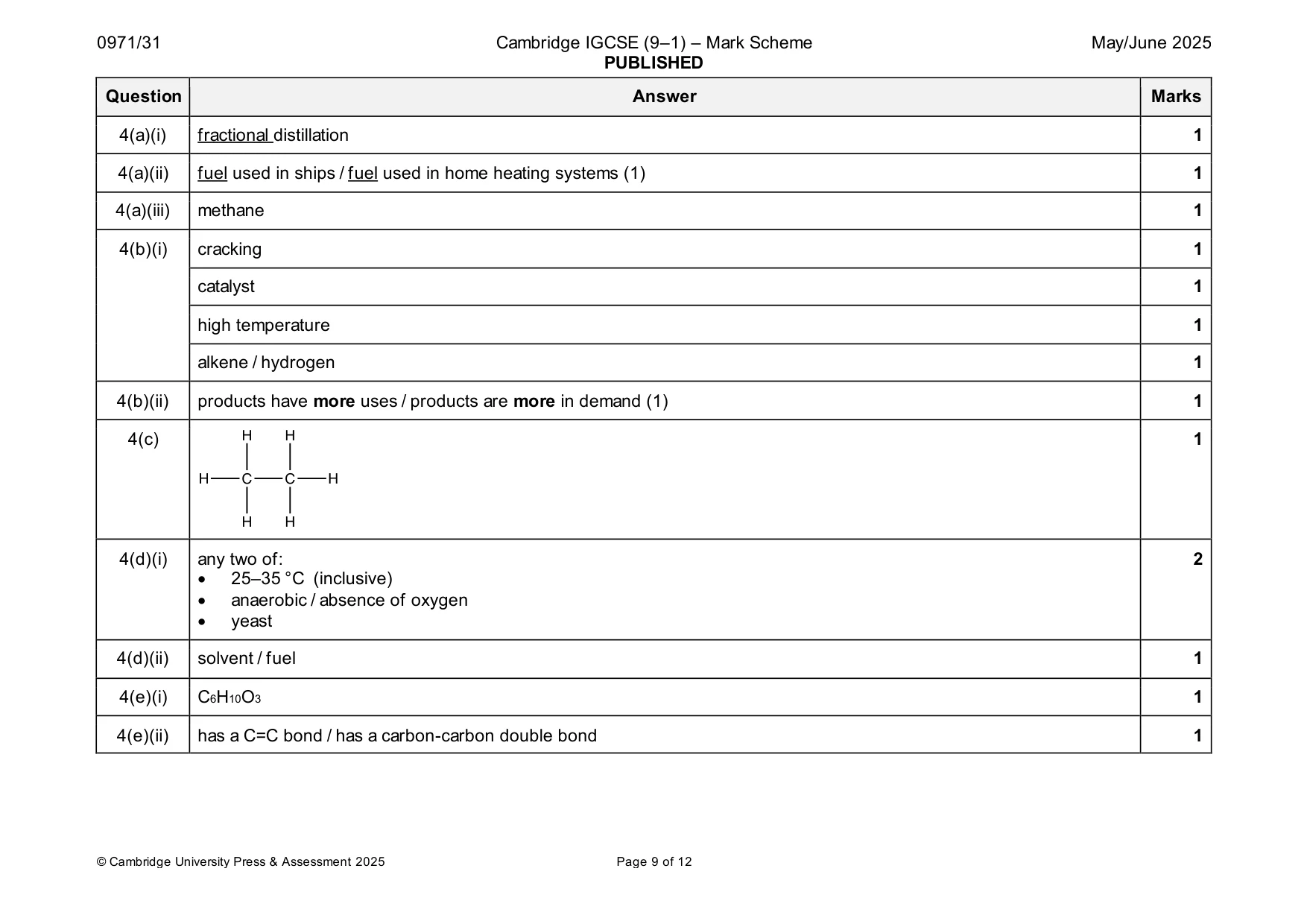
Mark scheme: 4(a)(i) fractional distillation 1 4(a)(ii) fuel used in ships / fuel used in home heating systems (1) 1 4(a)(iii) methane 1 4(b)(i) cracking 1 catalyst 1 high temperature 1 alkene / hydrogen 1 4(b)(ii) products have more uses / products are more in demand (1) 1 4(c) 1 4(d)(i) any two of: 2 • 25–35 °C (inclusive) • anaerobic / absence of oxygen • yeast 4(d)(ii) solvent / fuel 1 4(e)(i) C6H10O3 1 4(e)(ii) has a C=C bond / has a carbon-carbon double bond 1
Q5 · This question is about metals and their reactions
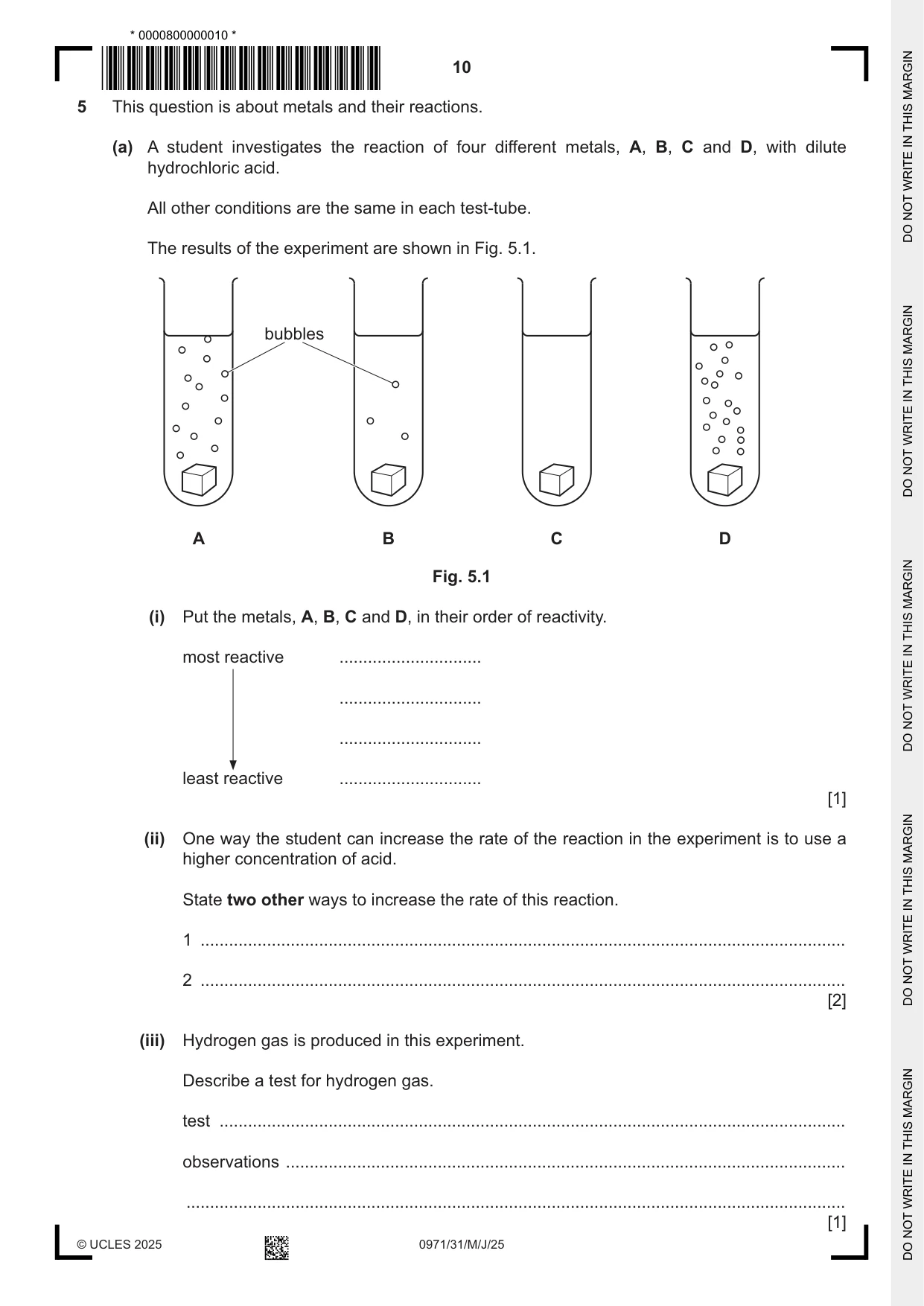
5 This question is about metals and their reactions. (a) A student investigates the reaction of four different metals, A, B, C and D, with dilute hydrochloric acid. All other conditions are the same in each test-tube. The results of the experiment are shown in Fig. 5.1. bubbles A B C D Fig. 5.1 (i) Put the metals, A, B, C and D, in their order of reactivity. most reactive .............................. .............................. .............................. least reactive .............................. [1] (ii) One way the student can increase the rate of the reaction in the experiment is to use a higher concentration of acid. State two other ways to increase the rate of this reaction. 1 ........................................................................................................................................ 2 ........................................................................................................................................ [2] (iii) Hydrogen gas is produced in this experiment. Describe a test for hydrogen gas. test .................................................................................................................................... observations ...................................................................................................................... ........................................................................................................................................... [1] (iv) State the formula of the ion that is present in all acids. ..................................................................................................................................... [1] (b) Stainless steel is an alloy. (i) State the meaning of the term alloy. ........................................................................................................................................... ..................................................................................................................................... [1] (ii) State one property of stainless steel that makes it suitable for cutlery. ..................................................................................................................................... [1] [Total: 7]
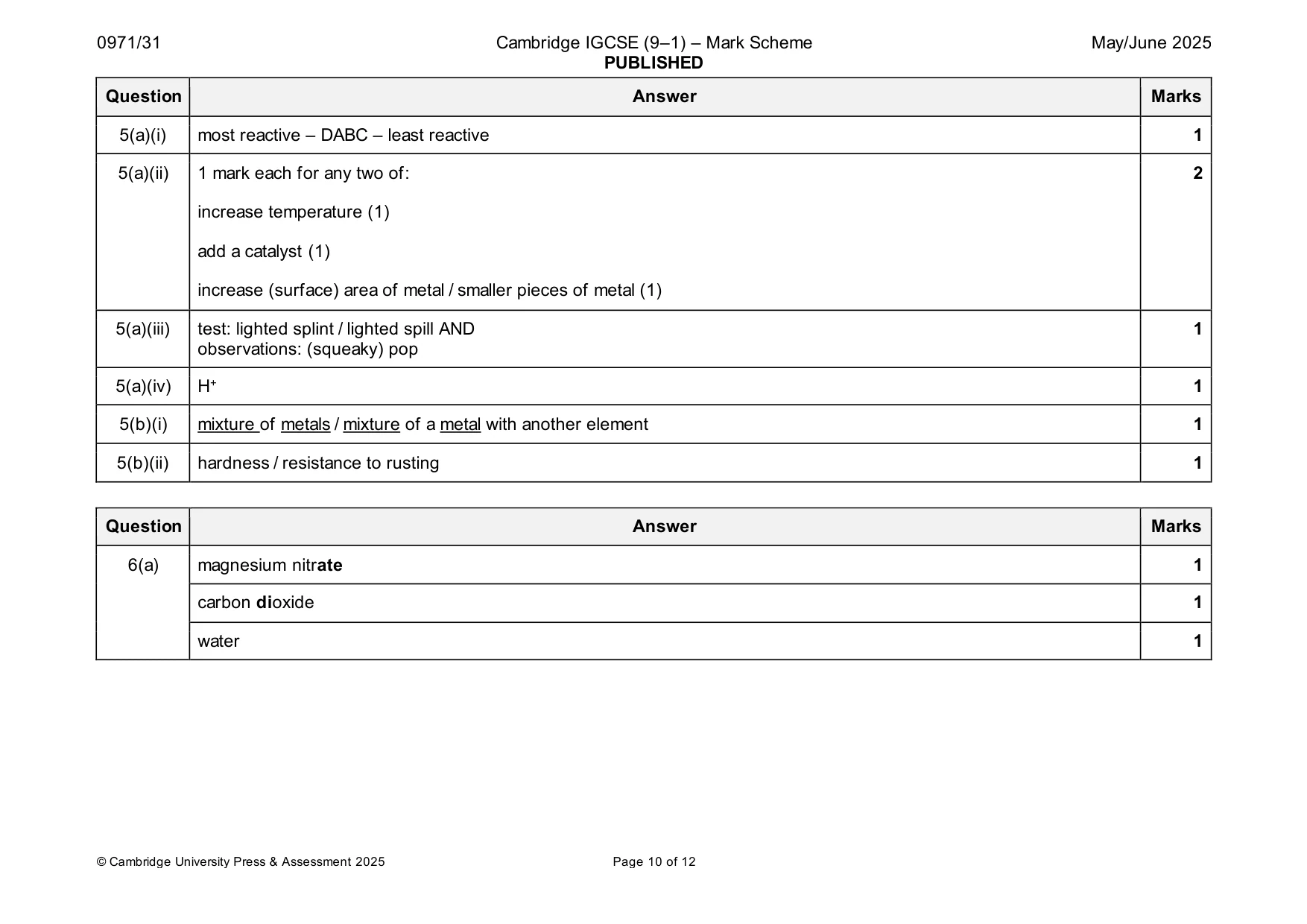
Mark scheme: 5(a)(i) most reactive – DABC – least reactive 1 5(a)(ii) 1 mark each for any two of: 2 increase temperature (1) add a catalyst (1) increase (surface) area of metal / smaller pieces of metal (1) 5(a)(iii) test: lighted splint / lighted spill AND 1 observations: (squeaky) pop 5(a)(iv) H+ 1 5(b)(i) mixture of metals / mixture of a metal with another element 1 5(b)(ii) hardness / resistance to rusting 1
Q6 · This question is about ionic and covalent compounds
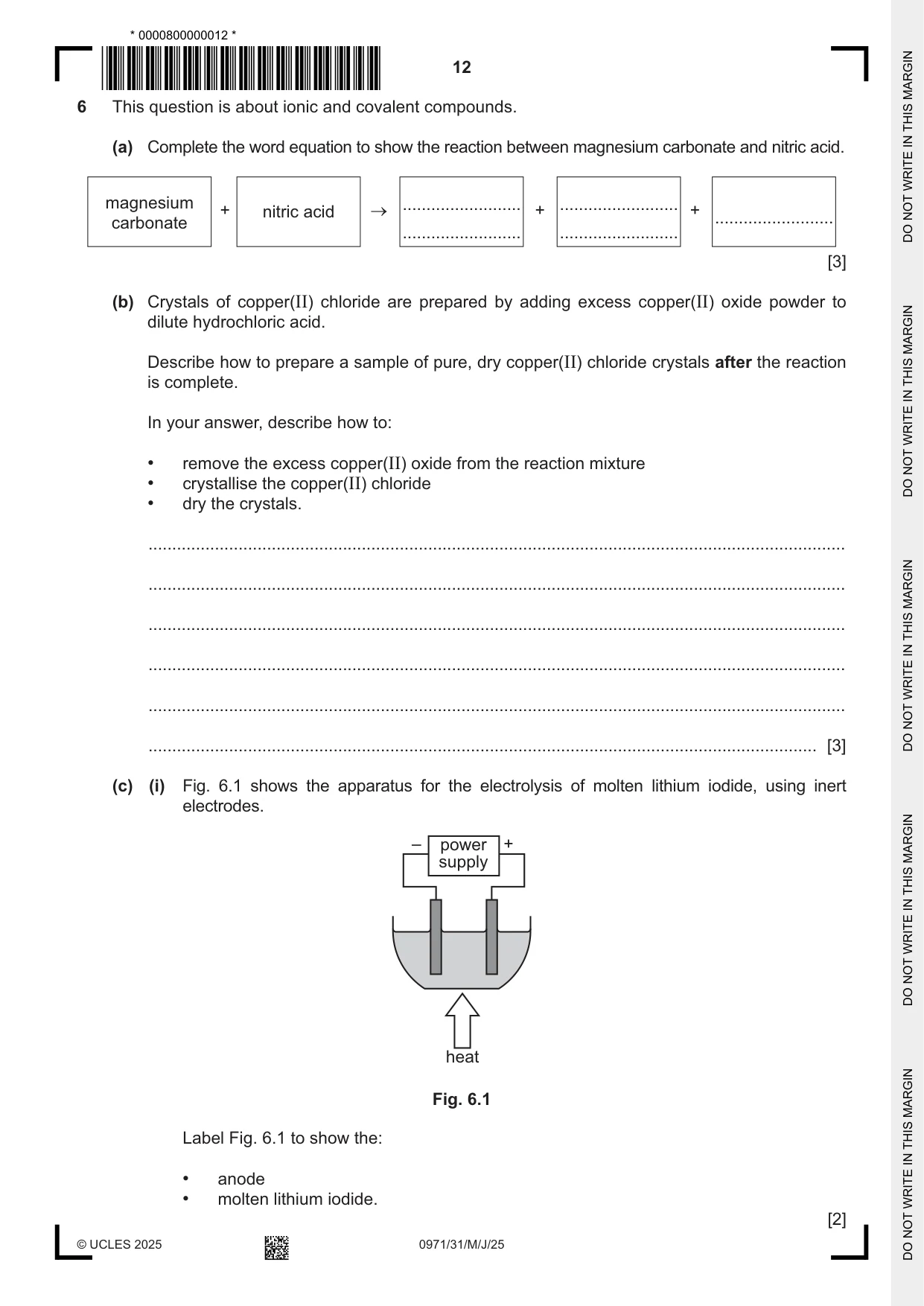
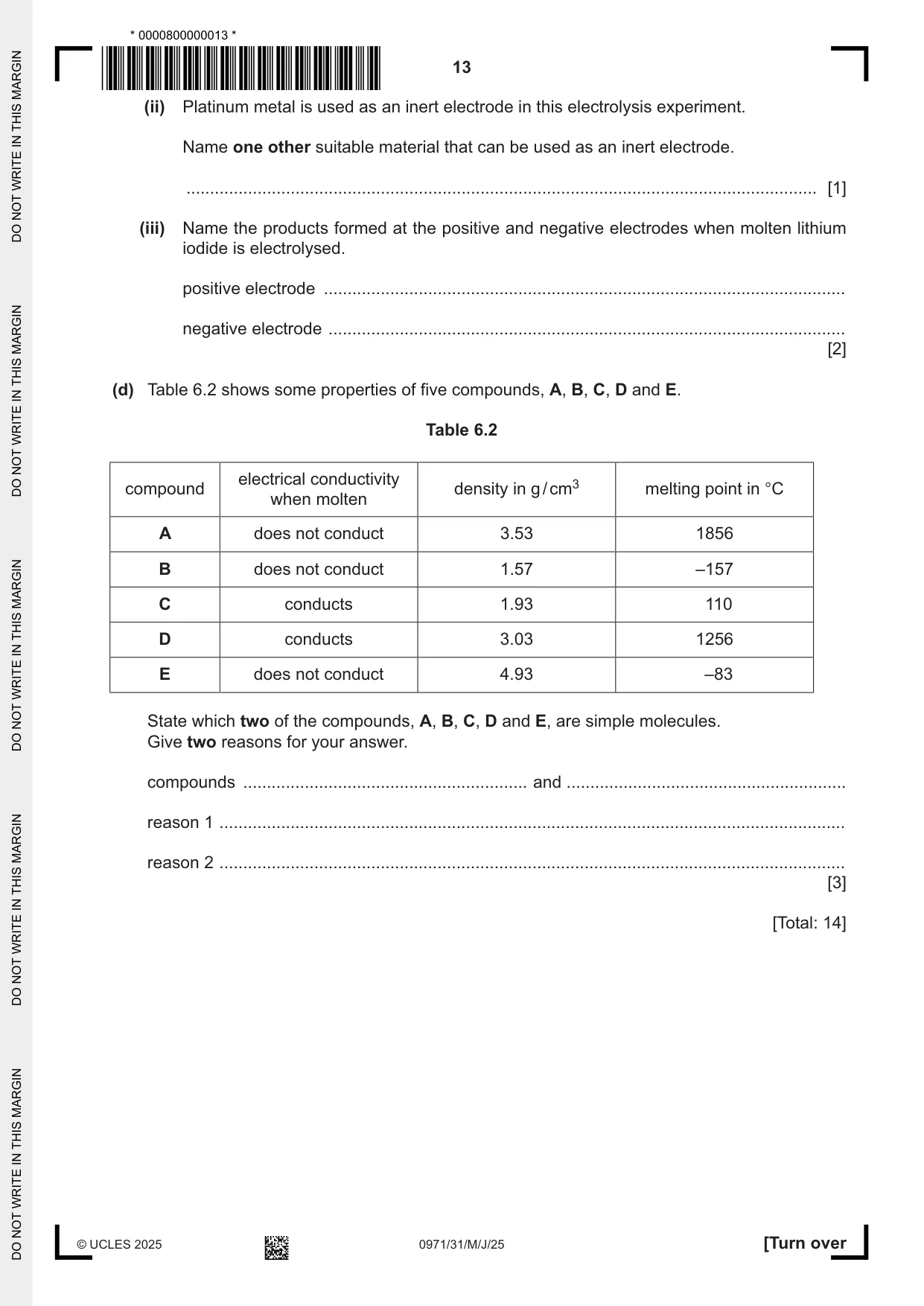
6 This question is about ionic and covalent compounds. (a) Complete the word equation to show the reaction between magnesium carbonate and nitric acid. magnesium ......................... ......................... + nitric acid + + ......................... carbonate ......................... ......................... [3] (b) Crystals of copper(II) chloride are prepared by adding excess copper(II) oxide powder to dilute hydrochloric acid. Describe how to prepare a sample of pure, dry copper(II) chloride crystals after the reaction is complete. In your answer, describe how to: • remove the excess copper(II) oxide from the reaction mixture • crystallise the copper(II) chloride • dry the crystals. ................................................................................................................................................... ................................................................................................................................................... ................................................................................................................................................... ................................................................................................................................................... ................................................................................................................................................... ............................................................................................................................................. [3] (c) (i) Fig. 6.1 shows the apparatus for the electrolysis of molten lithium iodide, using inert electrodes. – power + supply heat Fig. 6.1 Label Fig. 6.1 to show the: • anode • molten lithium iodide. [2] (ii) Platinum metal is used as an inert electrode in this electrolysis experiment. Name one other suitable material that can be used as an inert electrode. ..................................................................................................................................... [1] (iii) Name the products formed at the positive and negative electrodes when molten lithium iodide is electrolysed. positive electrode .............................................................................................................. negative electrode ............................................................................................................. [2] (d) Table 6.2 shows some properties of five compounds, A, B, C, D and E. Table 6.2 electrical conductivity compound density in g / cm3 melting point in °C when molten A does not conduct 3.53 1856 B does not conduct 1.57 –157 C conducts 1.93 110 D conducts 3.03 1256 E does not conduct 4.93 –83 State which two of the compounds, A, B, C, D and E, are simple molecules. Give two reasons for your answer. compounds ............................................................ and ........................................................... reason 1 .................................................................................................................................... reason 2 .................................................................................................................................... [3] [Total: 14]
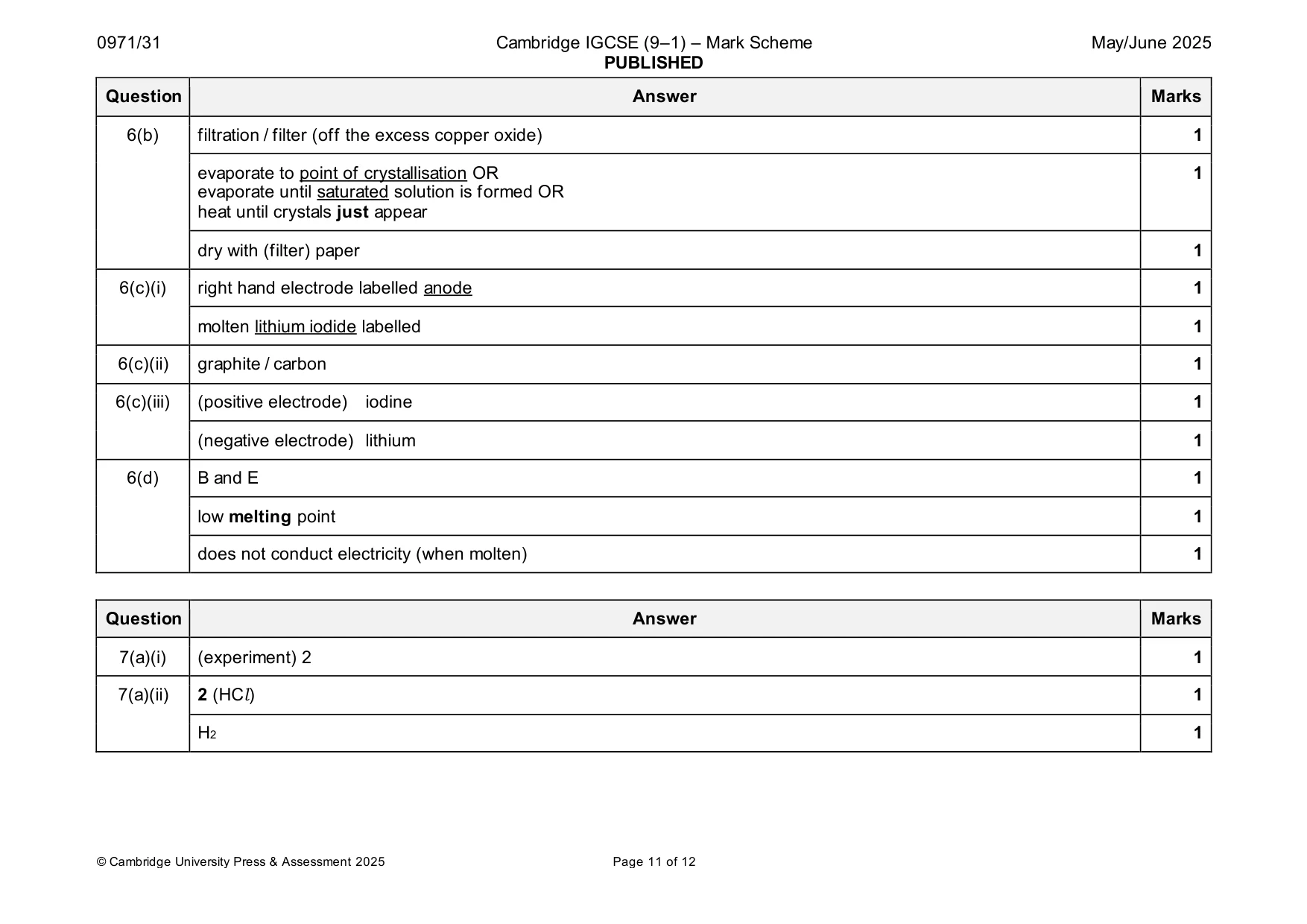
Mark scheme: 6(a) magnesium nitrate 1 carbon dioxide 1 water 1 6(b) filtration / filter (off the excess copper oxide) 1 evaporate to point of crystallisation OR 1 evaporate until saturated solution is formed OR heat until crystals just appear dry with (filter) paper 1 6(c)(i) right hand electrode labelled anode 1 molten lithium iodide labelled 1 6(c)(ii) graphite / carbon 1 6(c)(iii) (positive electrode) iodine 1 (negative electrode) lithium 1 6(d) B and E 1 low melting point 1 does not conduct electricity (when molten) 1
Q7 · This question is about energy changes in reactions
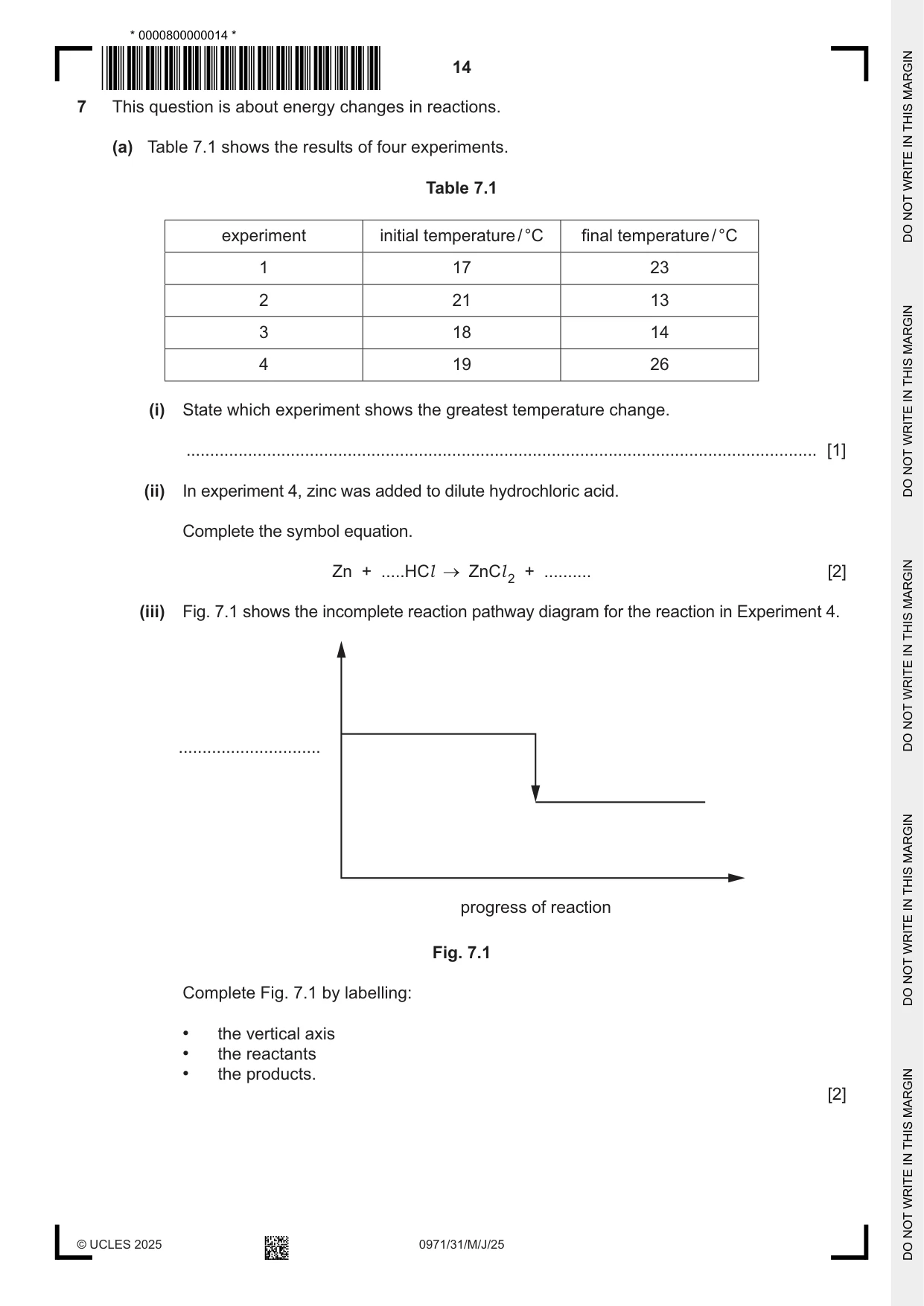
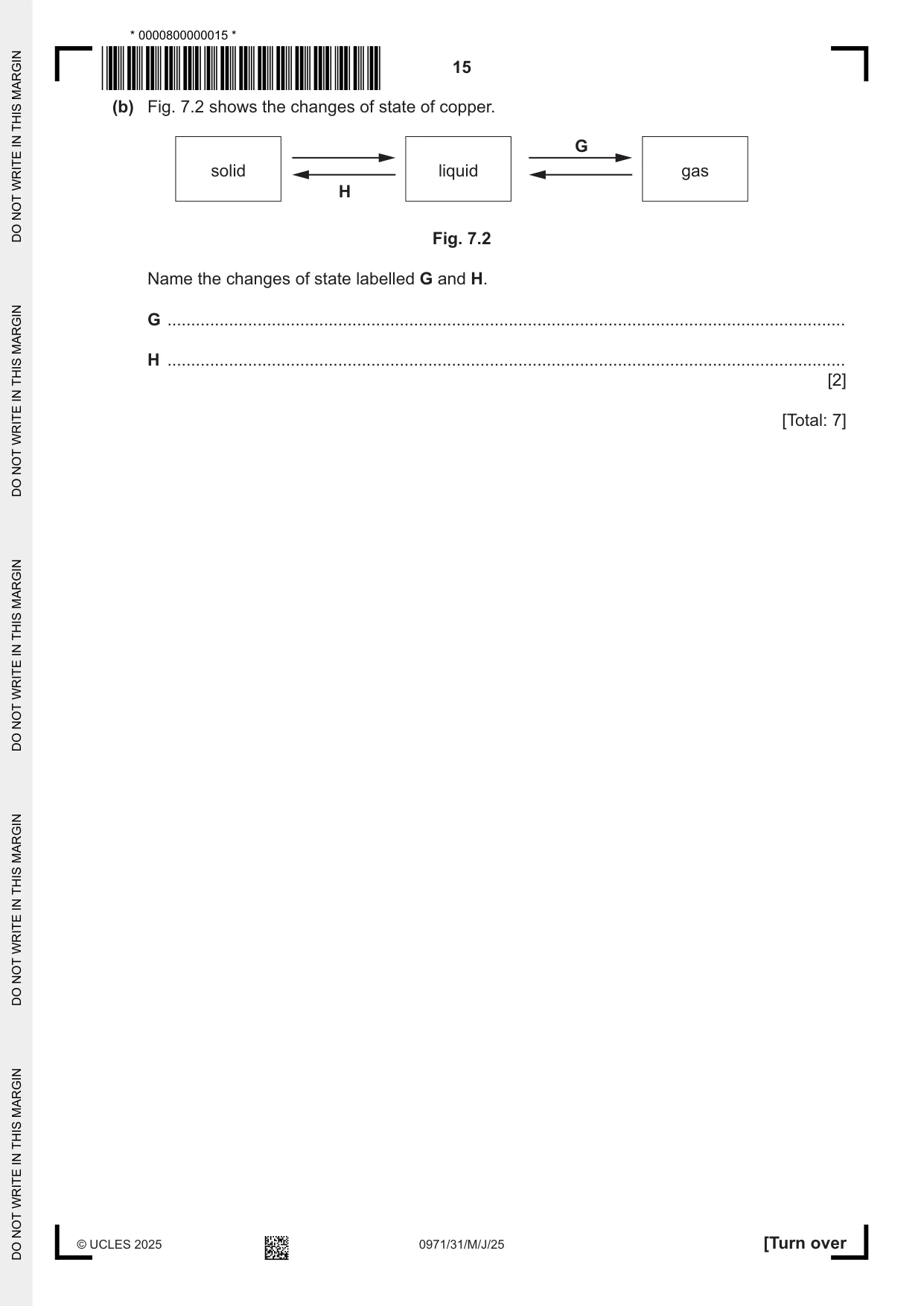
7 This question is about energy changes in reactions. (a) Table 7.1 shows the results of four experiments. Table 7.1 experiment initial temperature / °C final temperature / °C 1 17 23 2 21 13 3 18 14 4 19 26 (i) State which experiment shows the greatest temperature change. ..................................................................................................................................... [1] (ii) In experiment 4, zinc was added to dilute hydrochloric acid. Complete the symbol equation. Zn + .....HCl ZnCl + .......... [2] 2 (iii) Fig. 7.1 shows the incomplete reaction pathway diagram for the reaction in Experiment 4. .............................. progress of reaction Fig. 7.1 Complete Fig. 7.1 by labelling: • the vertical axis • the reactants • the products. [2] (b) Fig. 7.2 shows the changes of state of copper. G solid liquid gas H Fig. 7.2 Name the changes of state labelled G and H. G ............................................................................................................................................... H ............................................................................................................................................... [2] [Total: 7]
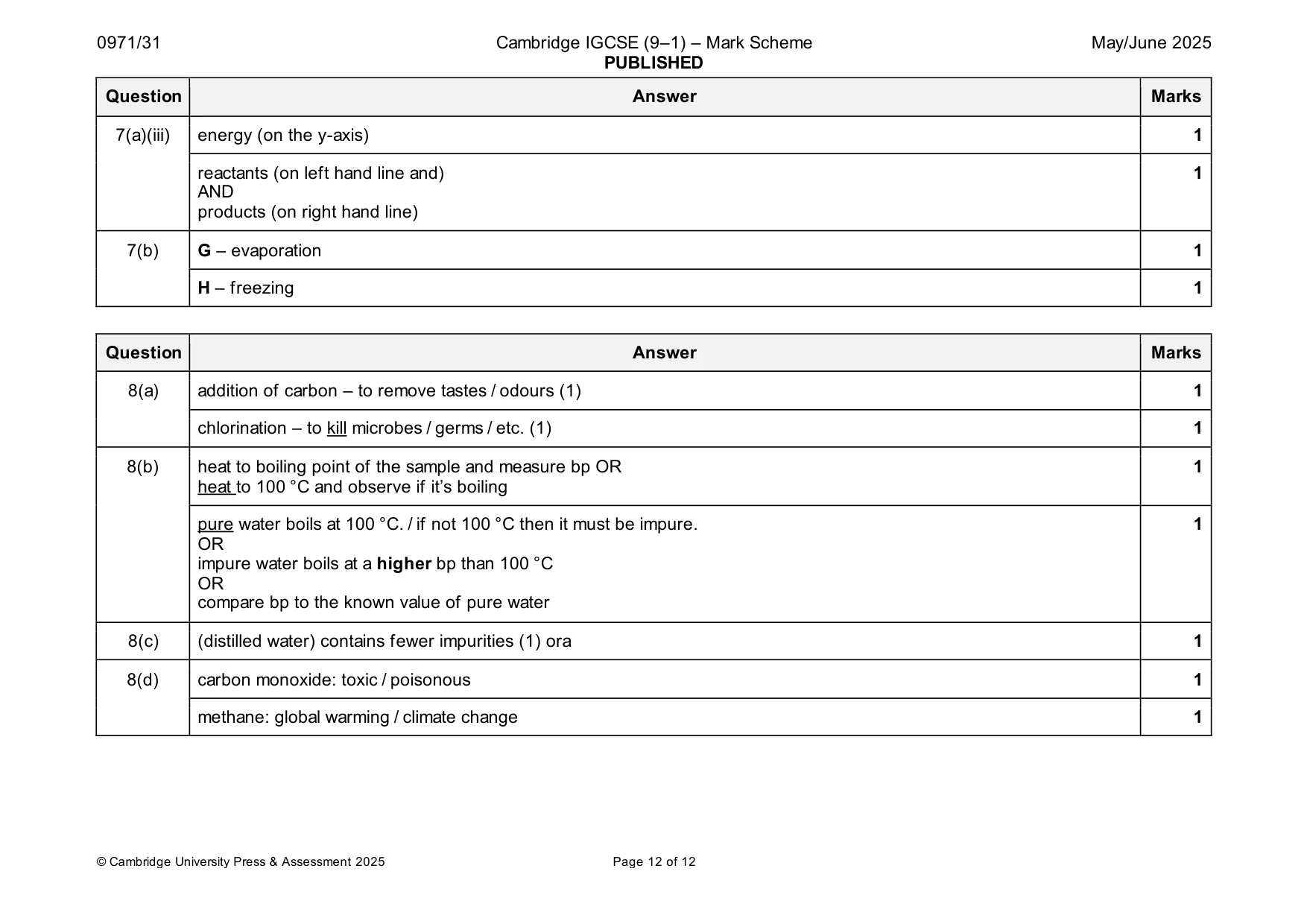
Mark scheme: 7(a)(i) (experiment) 2 1 7(a)(ii) 2 (HCl) 1 H2 1 7(a)(iii) energy (on the y-axis) 1 reactants (on left hand line and) 1 AND products (on right hand line) 7(b) G – evaporation 1 H – freezing 1
Q8 · This question is about water and air
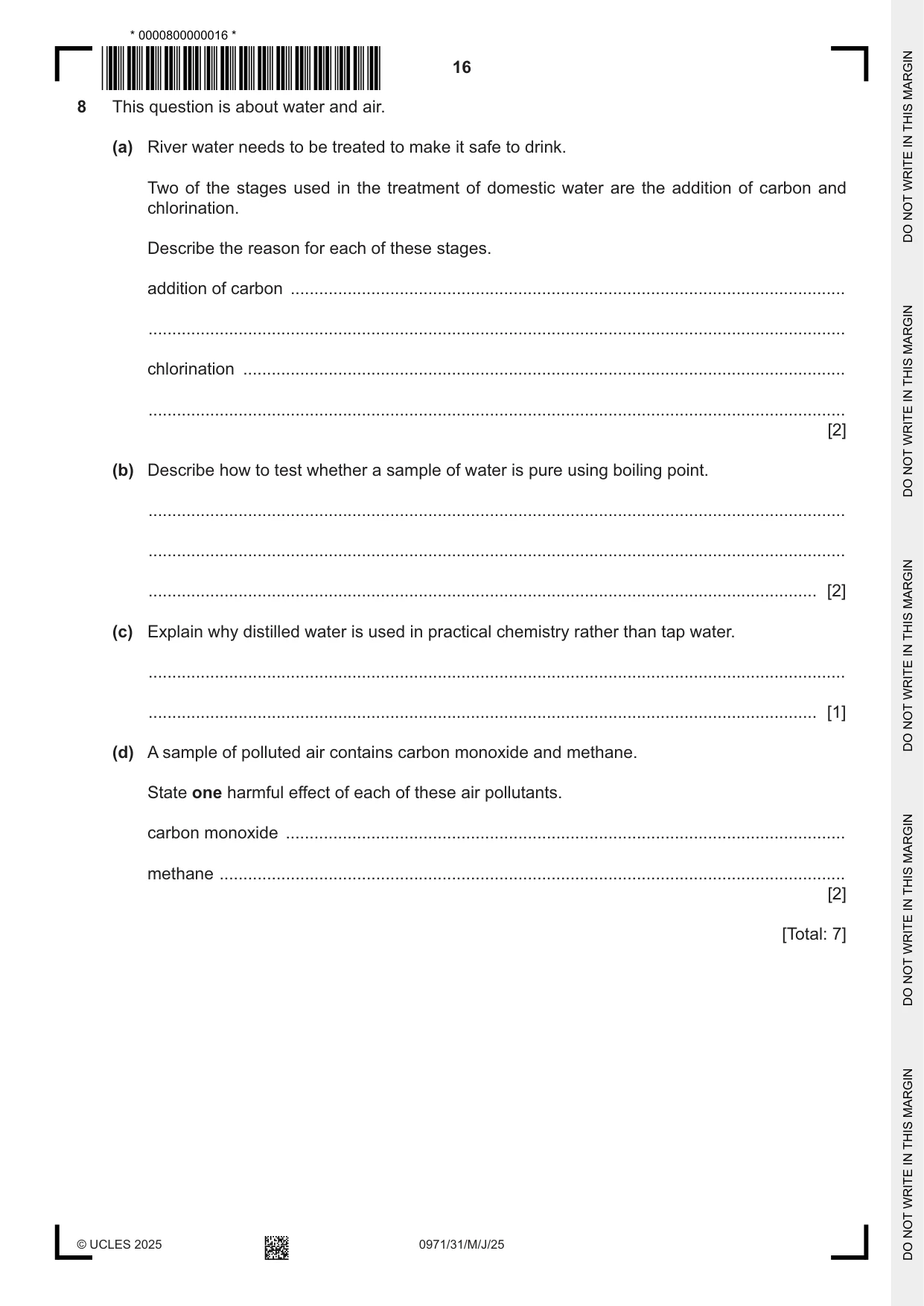
8 This question is about water and air. (a) River water needs to be treated to make it safe to drink. Two of the stages used in the treatment of domestic water are the addition of carbon and chlorination. Describe the reason for each of these stages. addition of carbon ..................................................................................................................... ................................................................................................................................................... chlorination ............................................................................................................................... ................................................................................................................................................... [2] (b) Describe how to test whether a sample of water is pure using boiling point. ................................................................................................................................................... ................................................................................................................................................... ............................................................................................................................................. [2] (c) Explain why distilled water is used in practical chemistry rather than tap water. ................................................................................................................................................... ............................................................................................................................................. [1] (d) A sample of polluted air contains carbon monoxide and methane. State one harmful effect of each of these air pollutants. carbon monoxide ...................................................................................................................... methane .................................................................................................................................... [2] [Total: 7]
Mark scheme: 8(a) addition of carbon – to remove tastes / odours (1) 1 chlorination – to kill microbes / germs / etc. (1) 1 8(b) heat to boiling point of the sample and measure bp OR 1 heat to 100 °C and observe if it’s boiling pure water boils at 100 °C. / if not 100 °C then it must be impure. 1 OR impure water boils at a higher bp than 100 °C OR compare bp to the known value of pure water 8(c) (distilled water) contains fewer impurities (1) ora 1 8(d) carbon monoxide: toxic / poisonous 1 methane: global warming / climate change 1
What was in this paper
The subtopics covered by these 8 questions, and how many questions each got. Open one in a new tab to see every Cambridge question on it.
What you needed in this session
Cambridge’s own grade thresholds for 2025 May/June, Paper 3 · Variant 1. A higher threshold means an easier paper — the bar moves with how the cohort did.