Cambridge IGCSE Chemistry (9-1) 0971 — 2019 May/June Paper 3 · Variant 1
0971/31/M/J/19 · 8 questions · 80 marks · ≈90 min
The question paper and its mark scheme, free to read here and free to download. This is Cambridge’s own paper, exactly as it was sat.
Question paper20 pages

Mark scheme10 pages
Answers below. Sit the paper first if you are practising.
Questions as text
Q1 · The diagrams show part of the structures of five substances, A, B, C, D and E
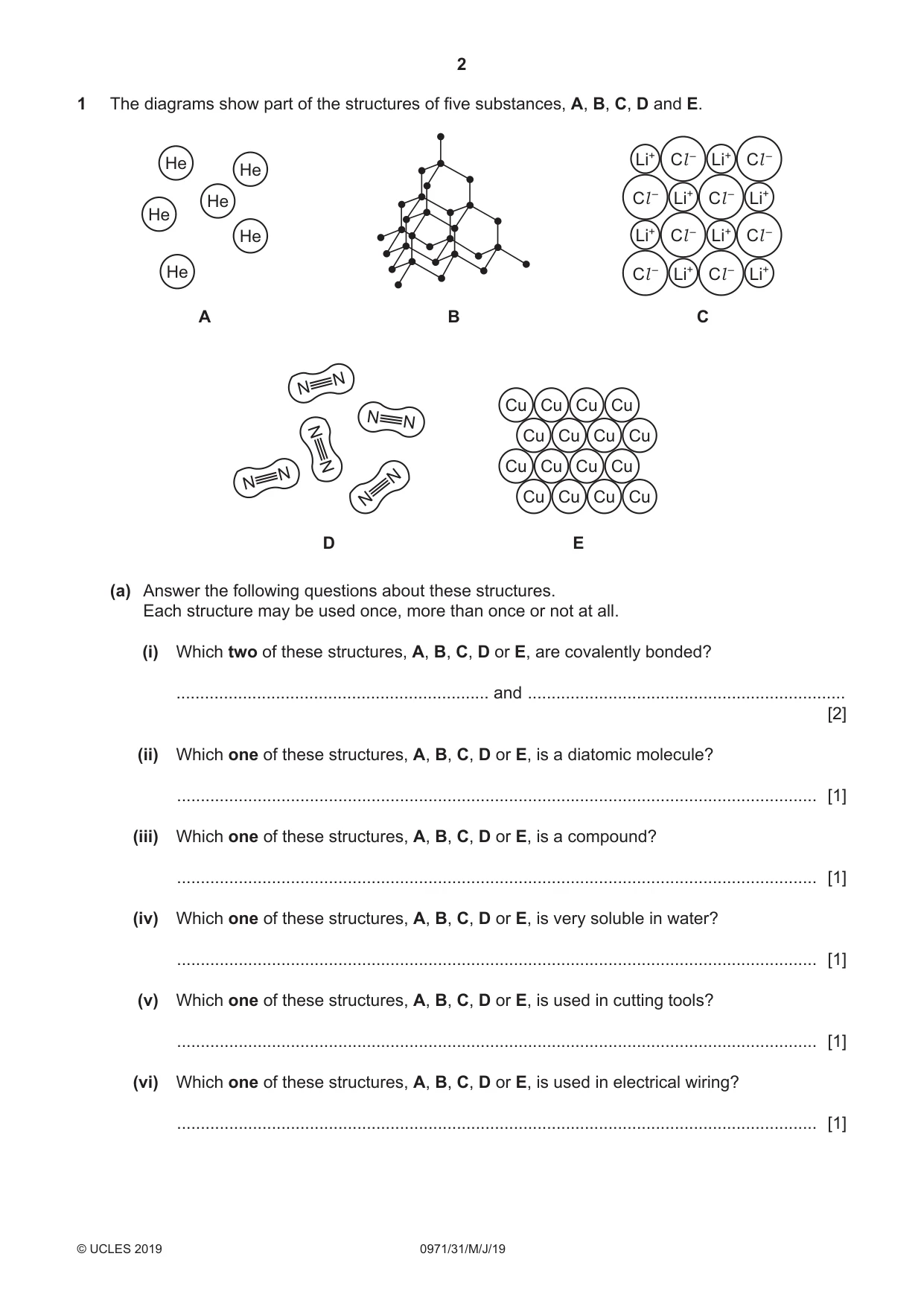
1 The diagrams show part of the structures of five substances, A, B, C, D and E. He Li+ Cl – Li+ Cl – He He Cl – Li+ Cl – Li+ He He Li+ Cl – Li+ Cl – He Cl – Li+ Cl – Li+ A B C N N Cu Cu Cu Cu N N N Cu Cu Cu Cu N Cu Cu Cu Cu N N N N Cu Cu Cu Cu D E (a) Answer the following questions about these structures. Each structure may be used once, more than once or not at all. (i) Which two of these structures, A, B, C, D or E, are covalently bonded? .................................................................. and ................................................................... [2] (ii) Which one of these structures, A, B, C, D or E, is a diatomic molecule? ....................................................................................................................................... [1] (iii) Which one of these structures, A, B, C, D or E, is a compound? ....................................................................................................................................... [1] (iv) Which one of these structures, A, B, C, D or E, is very soluble in water? ....................................................................................................................................... [1] (v) Which one of these structures, A, B, C, D or E, is used in cutting tools? ....................................................................................................................................... [1] (vi) Which one of these structures, A, B, C, D or E, is used in electrical wiring? ....................................................................................................................................... [1] (b) Substance B is an element. What is meant by the term element ? .................................................................................................................................................... .............................................................................................................................................. [1] [Total: 8]
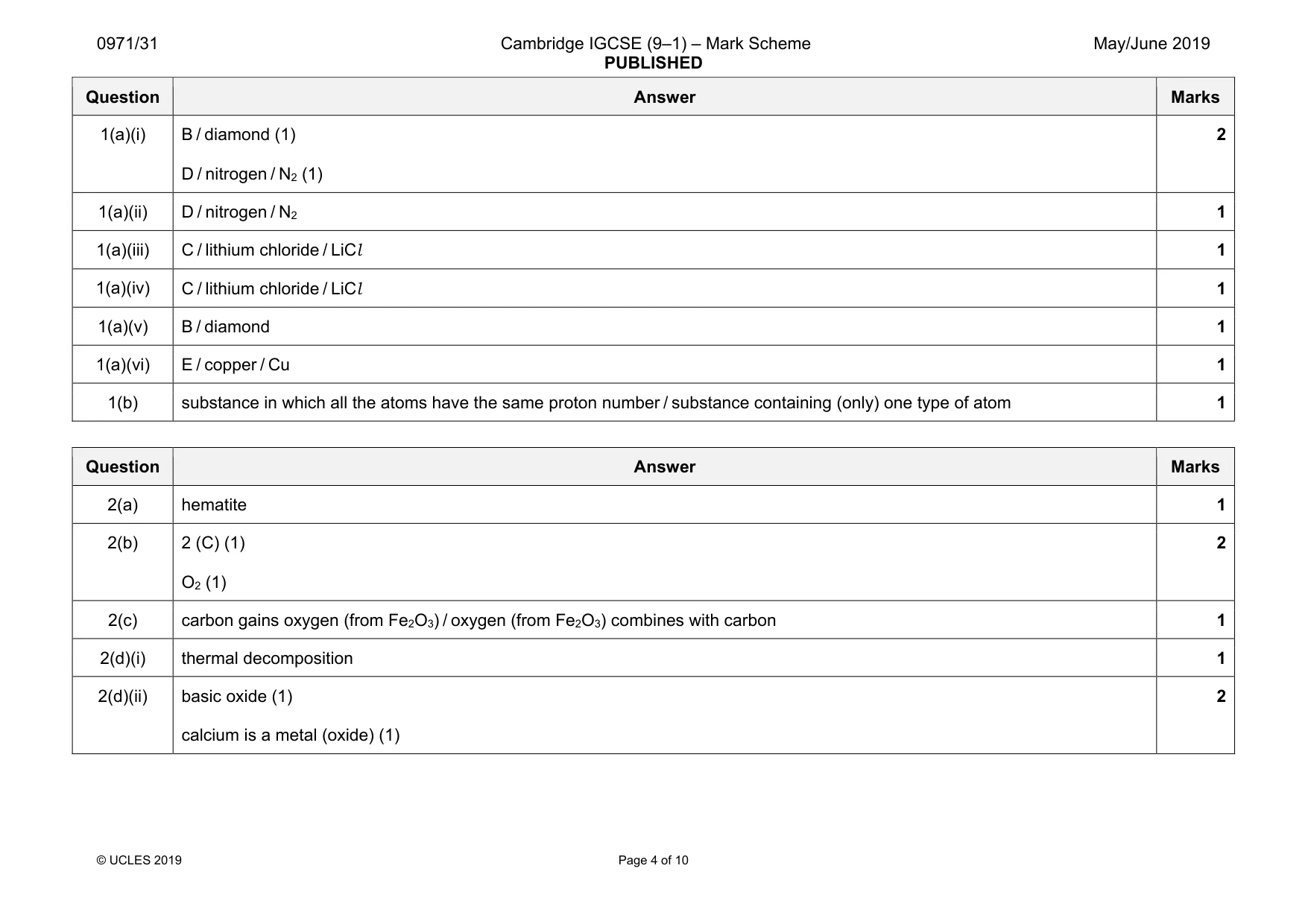
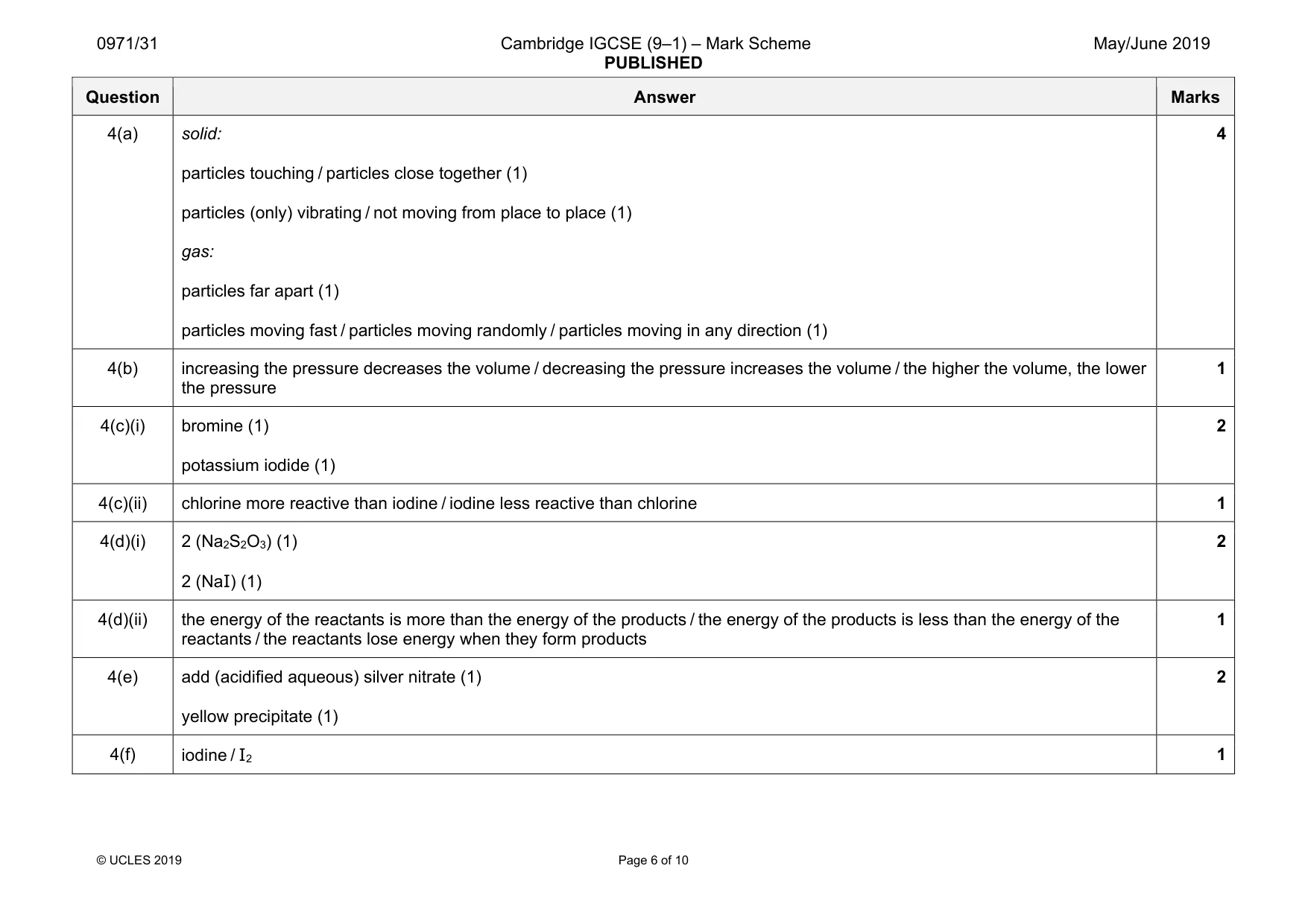
Mark scheme: 1(a)(i) B / diamond (1) D / nitrogen / N2 (1) 2 1(a)(ii) D / nitrogen / N2 1 1(a)(iii) C / lithium chloride / LiCl 1 1(a)(iv) C / lithium chloride / LiCl 1 1(a)(v) B / diamond 1 1(a)(vi) E / copper / Cu 1 1(b) substance in which all the atoms have the same proton number / substance containing (only) one type of atom 1
Q2 · This question is about iron and iron compounds
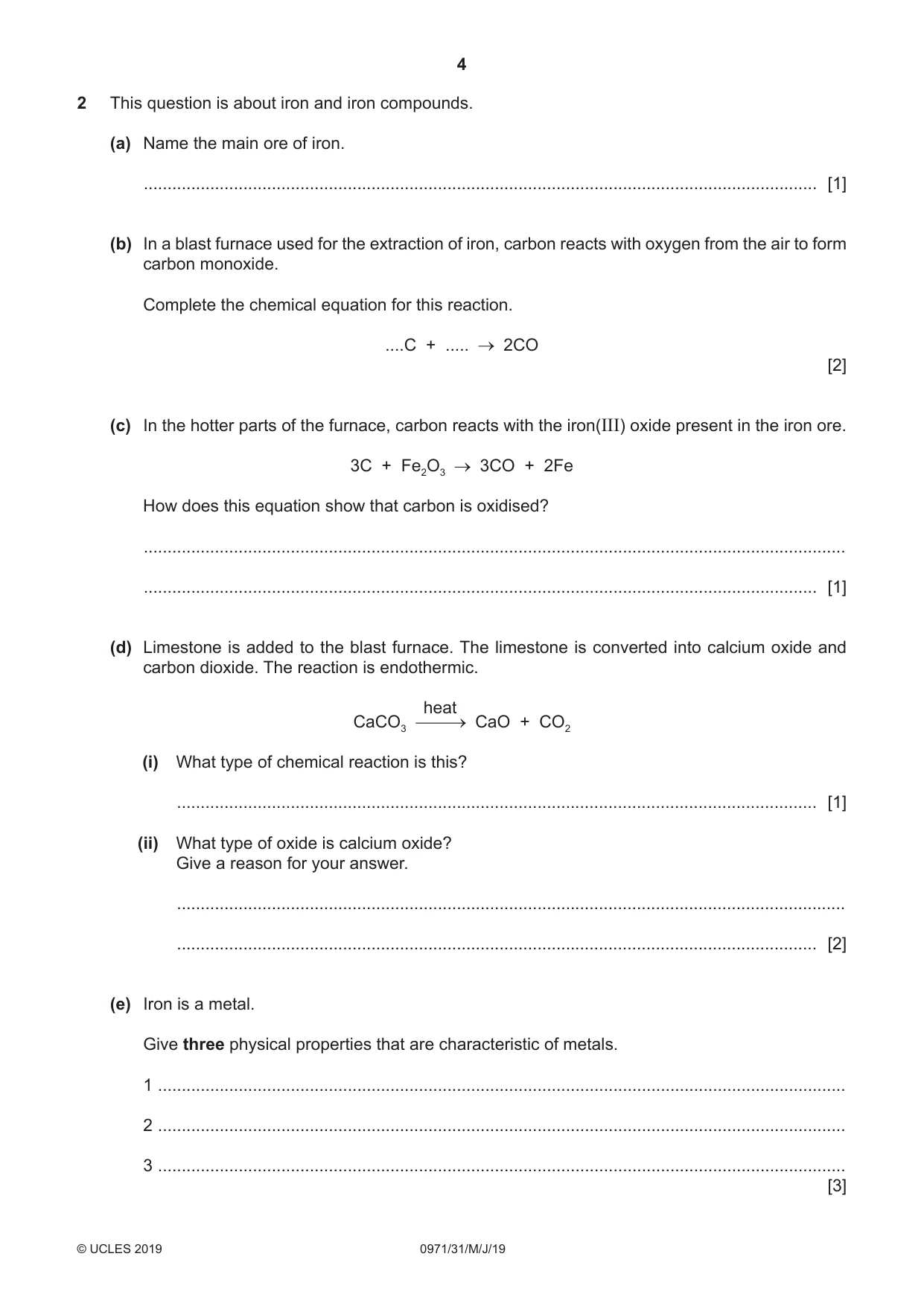
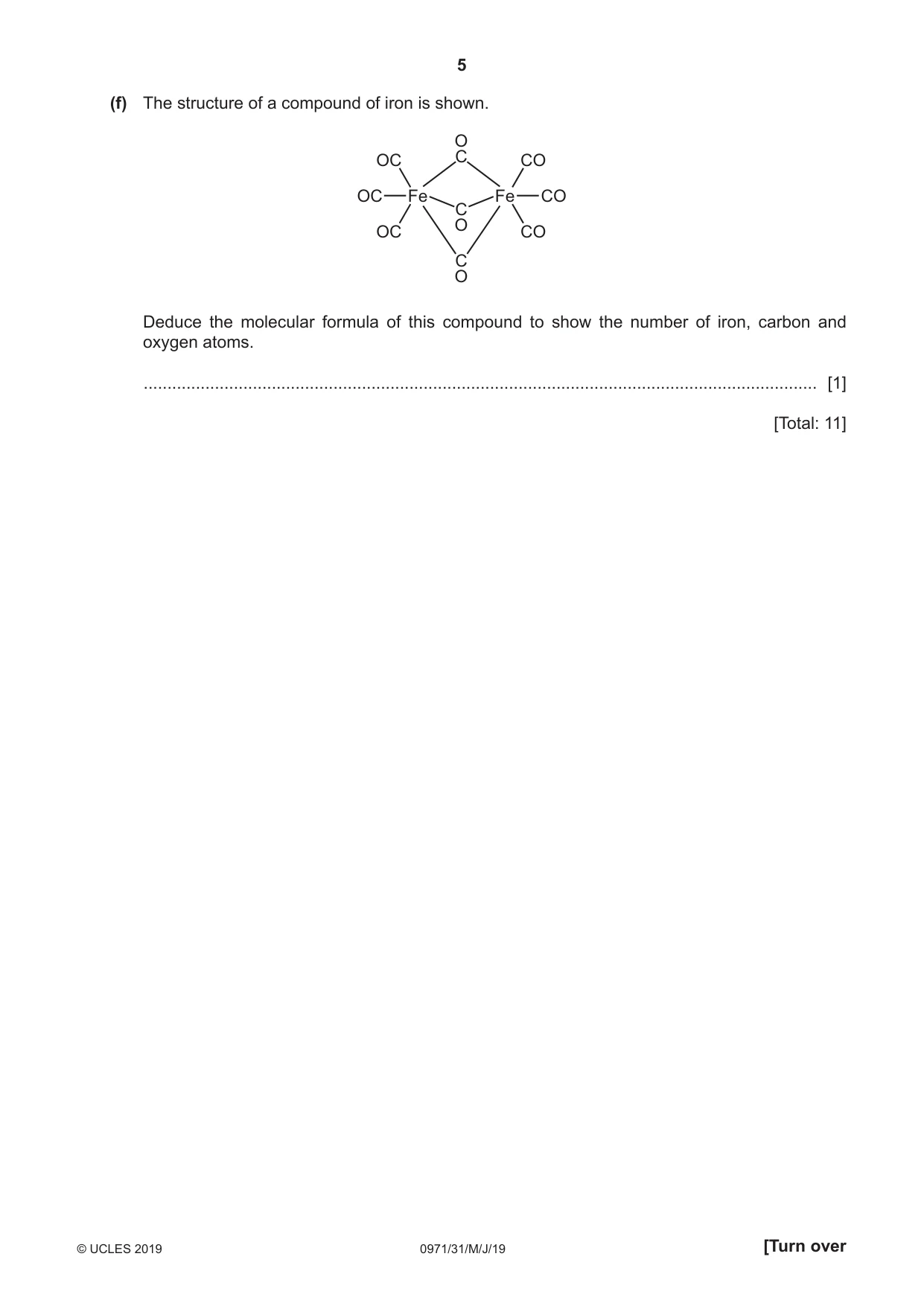
2 This question is about iron and iron compounds. (a) Name the main ore of iron. .............................................................................................................................................. [1] (b) In a blast furnace used for the extraction of iron, carbon reacts with oxygen from the air to form carbon monoxide. Complete the chemical equation for this reaction. ....C + ..... 2CO [2] (c) In the hotter parts of the furnace, carbon reacts with the iron(III) oxide present in the iron ore. 3C + Fe2O3 3CO + 2Fe How does this equation show that carbon is oxidised? .................................................................................................................................................... .............................................................................................................................................. [1] (d) Limestone is added to the blast furnace. The limestone is converted into calcium oxide and carbon dioxide. The reaction is endothermic. heat CaCO3 CaO + CO2 (i) What type of chemical reaction is this? ....................................................................................................................................... [1] (ii) What type of oxide is calcium oxide? Give a reason for your answer. ............................................................................................................................................. ....................................................................................................................................... [2] (e) Iron is a metal. Give three physical properties that are characteristic of metals. 1 ................................................................................................................................................. 2 ................................................................................................................................................. 3 ................................................................................................................................................. [3] (f) The structure of a compound of iron is shown. O OC C CO OC Fe Fe CO C O OC CO C O Deduce the molecular formula of this compound to show the number of iron, carbon and oxygen atoms. .............................................................................................................................................. [1] [Total: 11]
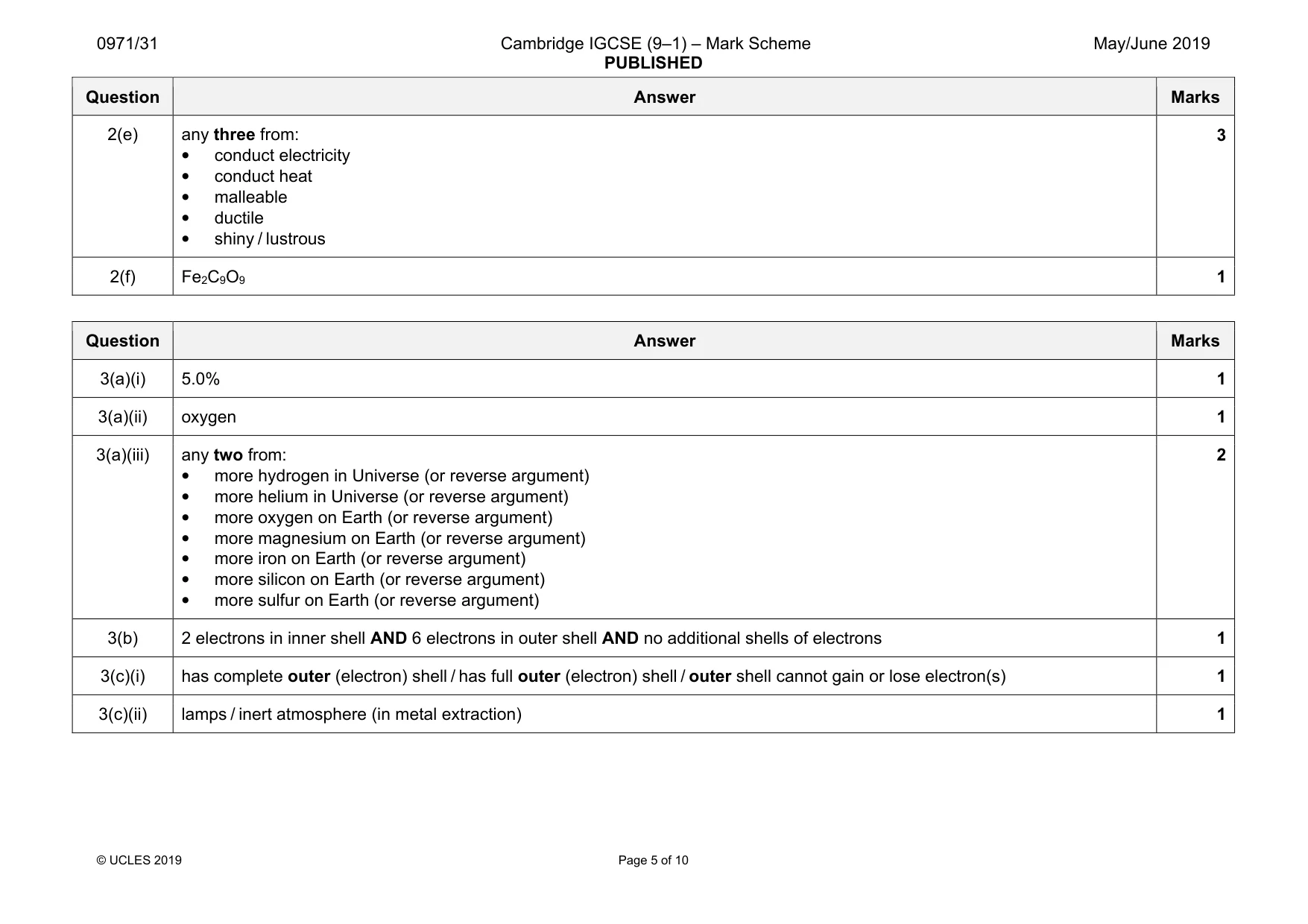
Mark scheme: 2(a) hematite 1 2(b) 2 (C) (1) O2 (1) 2 2(c) carbon gains oxygen (from Fe2O3) / oxygen (from Fe2O3) combines with carbon 1 2(d)(i) thermal decomposition 1 2(d)(ii) basic oxide (1) calcium is a metal (oxide) (1) 2 Question Answer Marks 2(e) any three from: • conduct electricity • conduct heat • malleable • ductile • shiny / lustrous 3 2(f) Fe2C9O9 1
Q3 · The table shows the percentage by mass of the elements on Earth and in the Universe
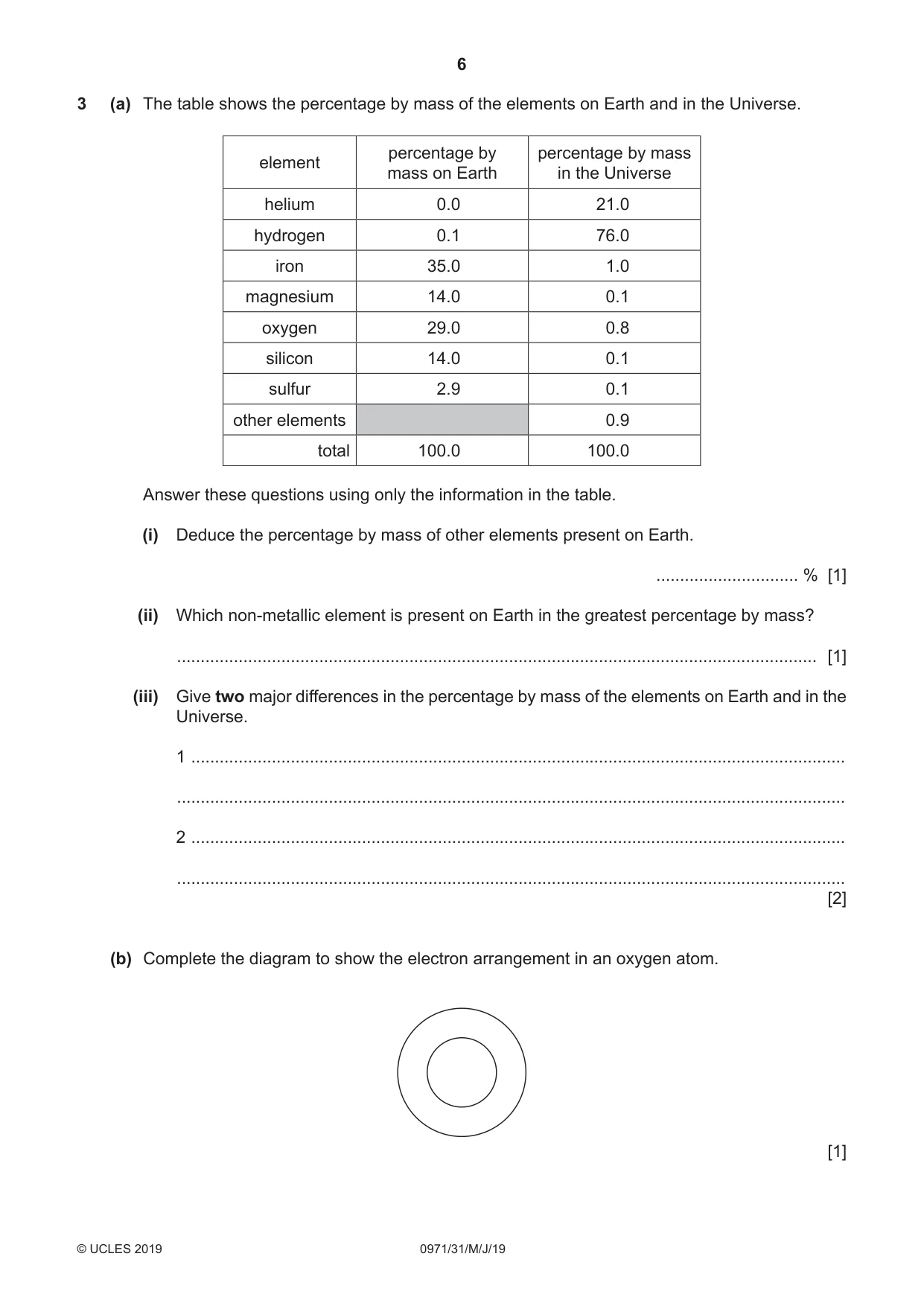
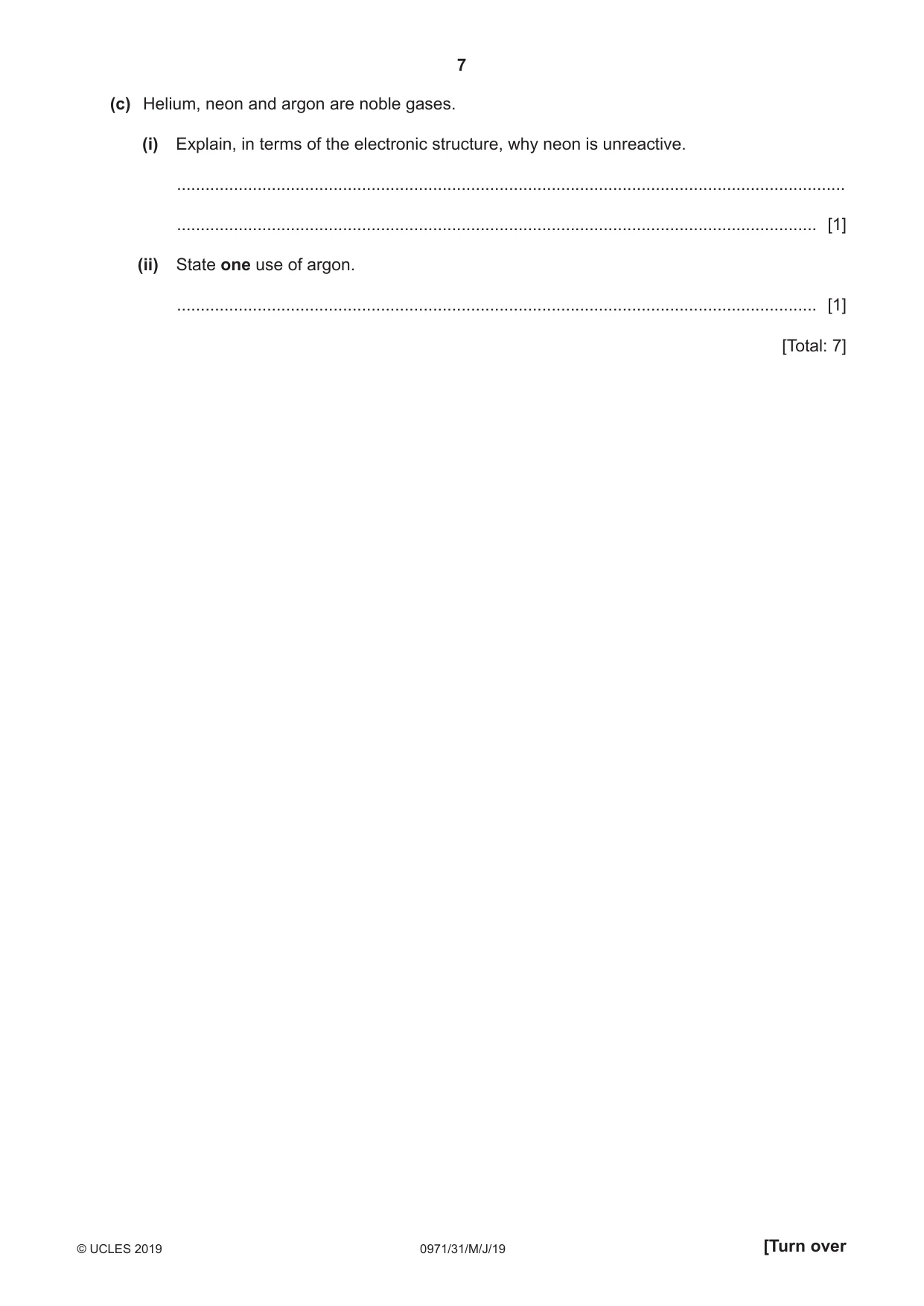
3 (a) The table shows the percentage by mass of the elements on Earth and in the Universe. percentage by percentage by mass element mass on Earth in the Universe helium 0.0 21.0 hydrogen 0.1 76.0 iron 35.0 1.0 magnesium 14.0 0.1 oxygen 29.0 0.8 silicon 14.0 0.1 sulfur 2.9 0.1 other elements 0.9 total 100.0 100.0 Answer these questions using only the information in the table. (i) Deduce the percentage by mass of other elements present on Earth. .............................. % [1] (ii) Which non-metallic element is present on Earth in the greatest percentage by mass? ....................................................................................................................................... [1] (iii) Give two major differences in the percentage by mass of the elements on Earth and in the Universe. 1 .......................................................................................................................................... ............................................................................................................................................. 2 .......................................................................................................................................... ............................................................................................................................................. [2] (b) Complete the diagram to show the electron arrangement in an oxygen atom. [1] (c) Helium, neon and argon are noble gases. (i) Explain, in terms of the electronic structure, why neon is unreactive. ............................................................................................................................................. ....................................................................................................................................... [1] (ii) State one use of argon. ....................................................................................................................................... [1] [Total: 7]
Mark scheme: 3(a)(i) 5.0% 1 3(a)(ii) oxygen 1 3(a)(iii) any two from: • more hydrogen in Universe (or reverse argument) • more helium in Universe (or reverse argument) • more oxygen on Earth (or reverse argument) • more magnesium on Earth (or reverse argument) • more iron on Earth (or reverse argument) • more silicon on Earth (or reverse argument) • more sulfur on Earth (or reverse argument) 2 3(b) 2 electrons in inner shell AND 6 electrons in outer shell AND no additional shells of electrons 1 3(c)(i) has complete outer (electron) shell / has full outer (electron) shell / outer shell cannot gain or lose electron(s) 1 3(c)(ii) lamps / inert atmosphere (in metal extraction) 1
Q4 · This question is about iodine and compounds of iodine
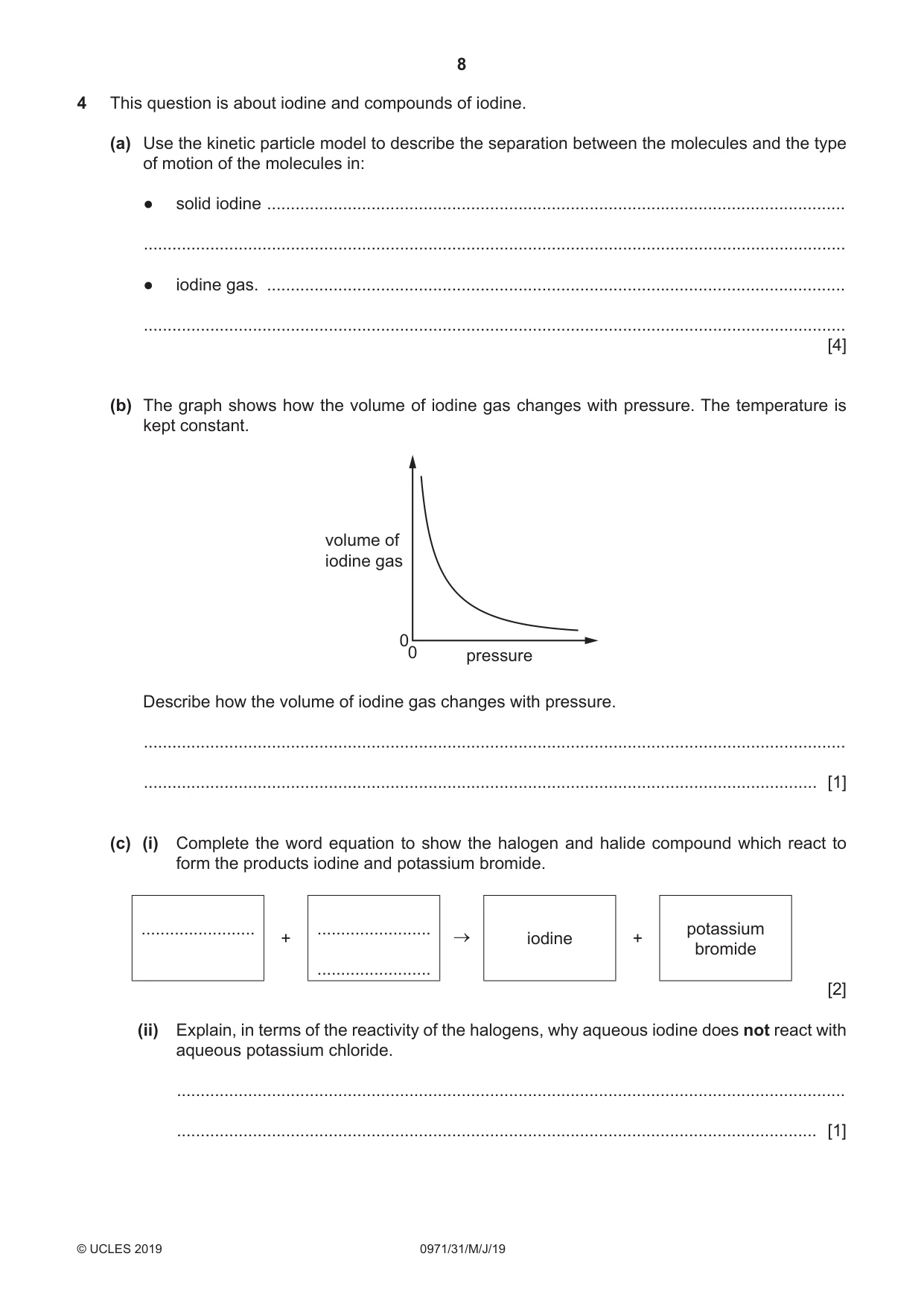
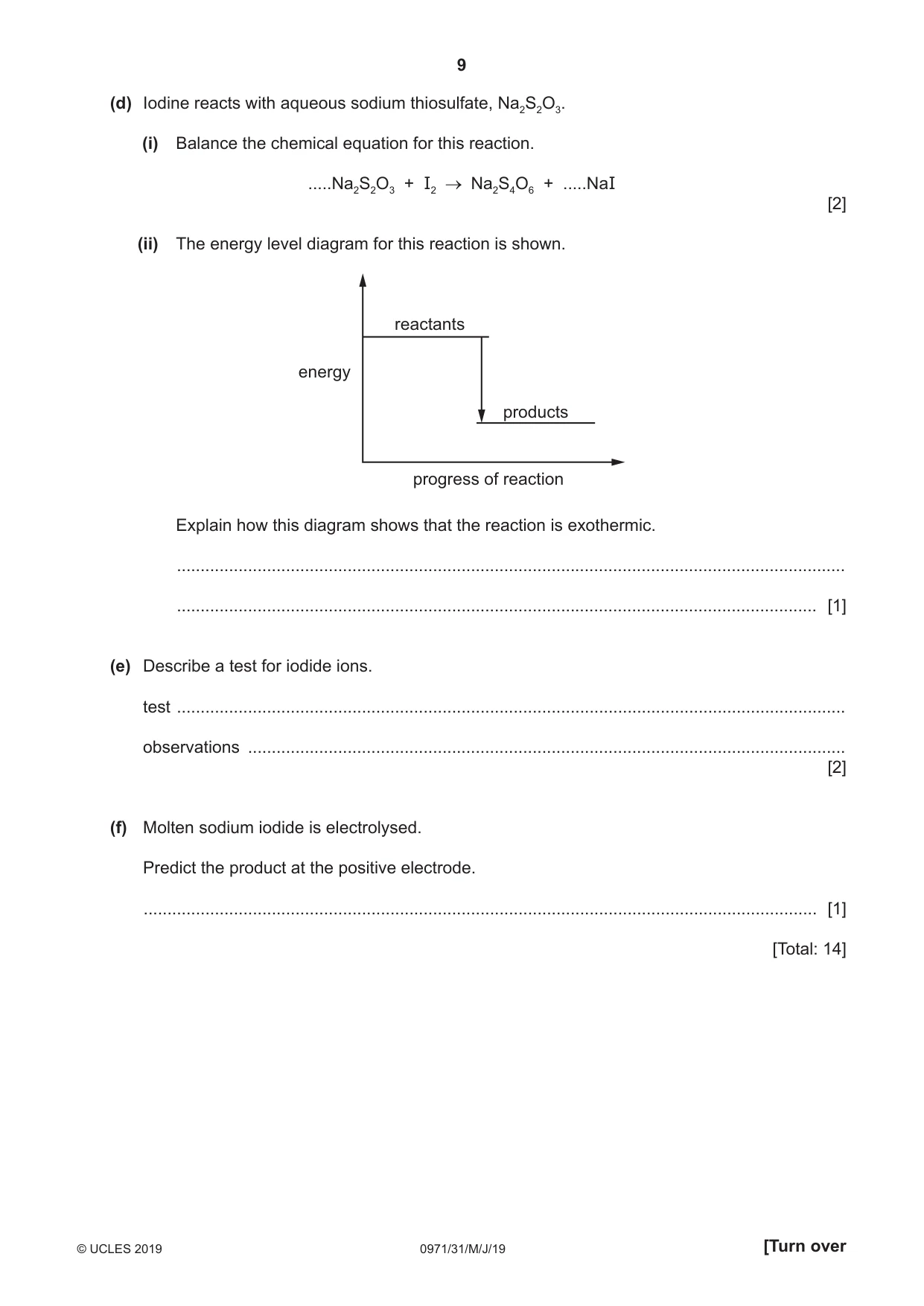
4 This question is about iodine and compounds of iodine. (a) Use the kinetic particle model to describe the separation between the molecules and the type of motion of the molecules in: ●● solid iodine .......................................................................................................................... .................................................................................................................................................... ●● iodine gas. ........................................................................................................................... .................................................................................................................................................... [4] (b) The graph shows how the volume of iodine gas changes with pressure. The temperature is kept constant. volume of iodine gas 00 pressure Describe how the volume of iodine gas changes with pressure. .................................................................................................................................................... .............................................................................................................................................. [1] (c) (i) Complete the word equation to show the halogen and halide compound which react to form the products iodine and potassium bromide. ........................ ........................ potassium + iodine + bromide ........................ [2] (ii) Explain, in terms of the reactivity of the halogens, why aqueous iodine does not react with aqueous potassium chloride. ............................................................................................................................................. ....................................................................................................................................... [1] (d) Iodine reacts with aqueous sodium thiosulfate, Na2S2O3. (i) Balance the chemical equation for this reaction. .....Na2S2O3 + I2 Na2S4O6 + .....NaI [2] (ii) The energy level diagram for this reaction is shown. reactants energy products progress of reaction Explain how this diagram shows that the reaction is exothermic. ............................................................................................................................................. ....................................................................................................................................... [1] (e) Describe a test for iodide ions. test ............................................................................................................................................. observations ............................................................................................................................... [2] (f) Molten sodium iodide is electrolysed. Predict the product at the positive electrode. .............................................................................................................................................. [1] [Total: 14]
Mark scheme: 4(a) solid: particles touching / particles close together (1) particles (only) vibrating / not moving from place to place (1) gas: particles far apart (1) particles moving fast / particles moving randomly / particles moving in any direction (1) 4 4(b) increasing the pressure decreases the volume / decreasing the pressure increases the volume / the higher the volume, the lower the pressure 1 4(c)(i) bromine (1) potassium iodide (1) 2 4(c)(ii) chlorine more reactive than iodine / iodine less reactive than chlorine 1 4(d)(i) 2 (Na2S2O3) (1) 2 (NaI) (1) 2 4(d)(ii) the energy of the reactants is more than the energy of the products / the energy of the products is less than the energy of the reactants / the reactants lose energy when they form products 1 4(e) add (acidified aqueous) silver nitrate (1) yellow precipitate (1) 2 4(f) iodine / I2 1
Q5 · Coal gas is made by heating coal in the absence of air
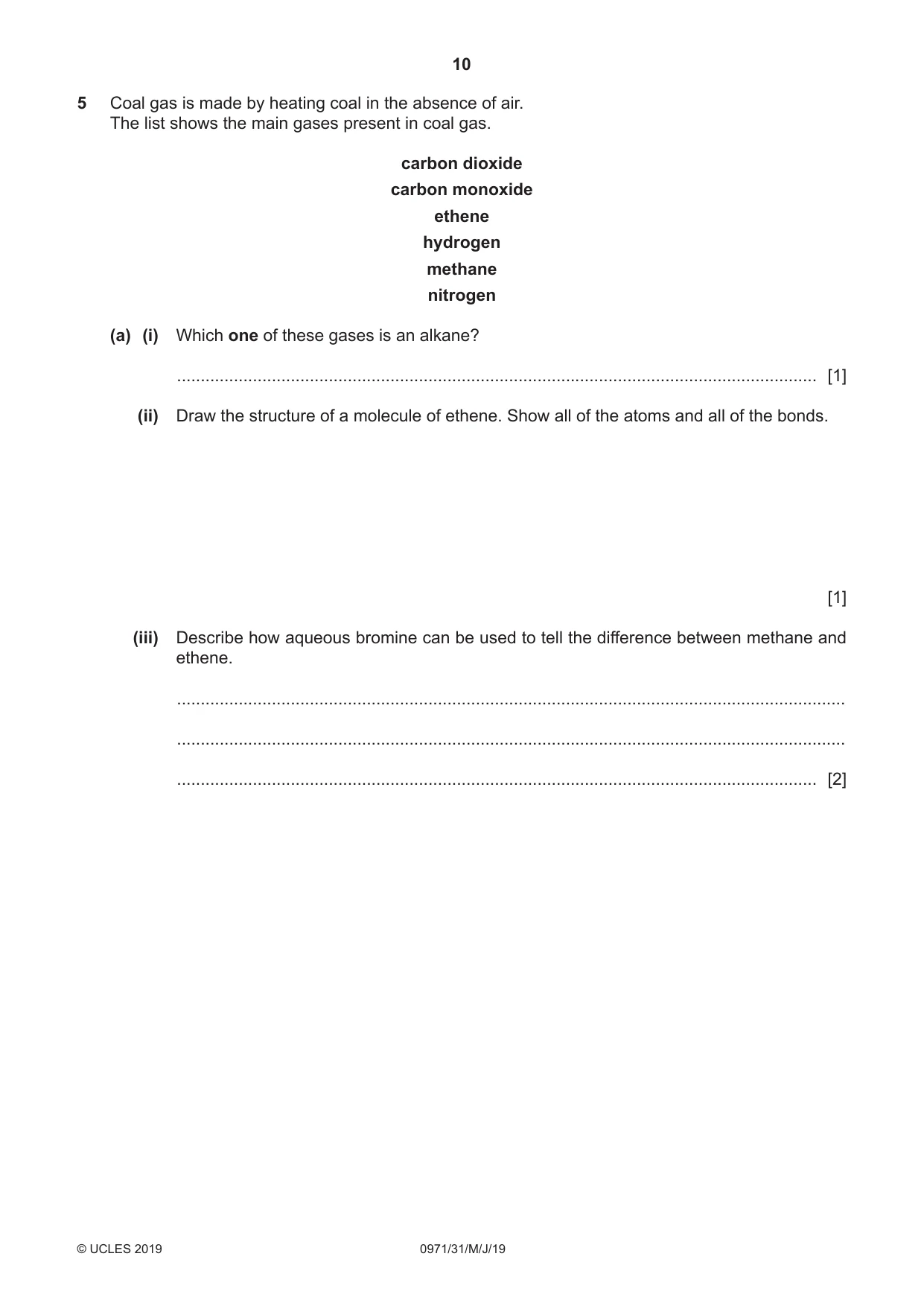
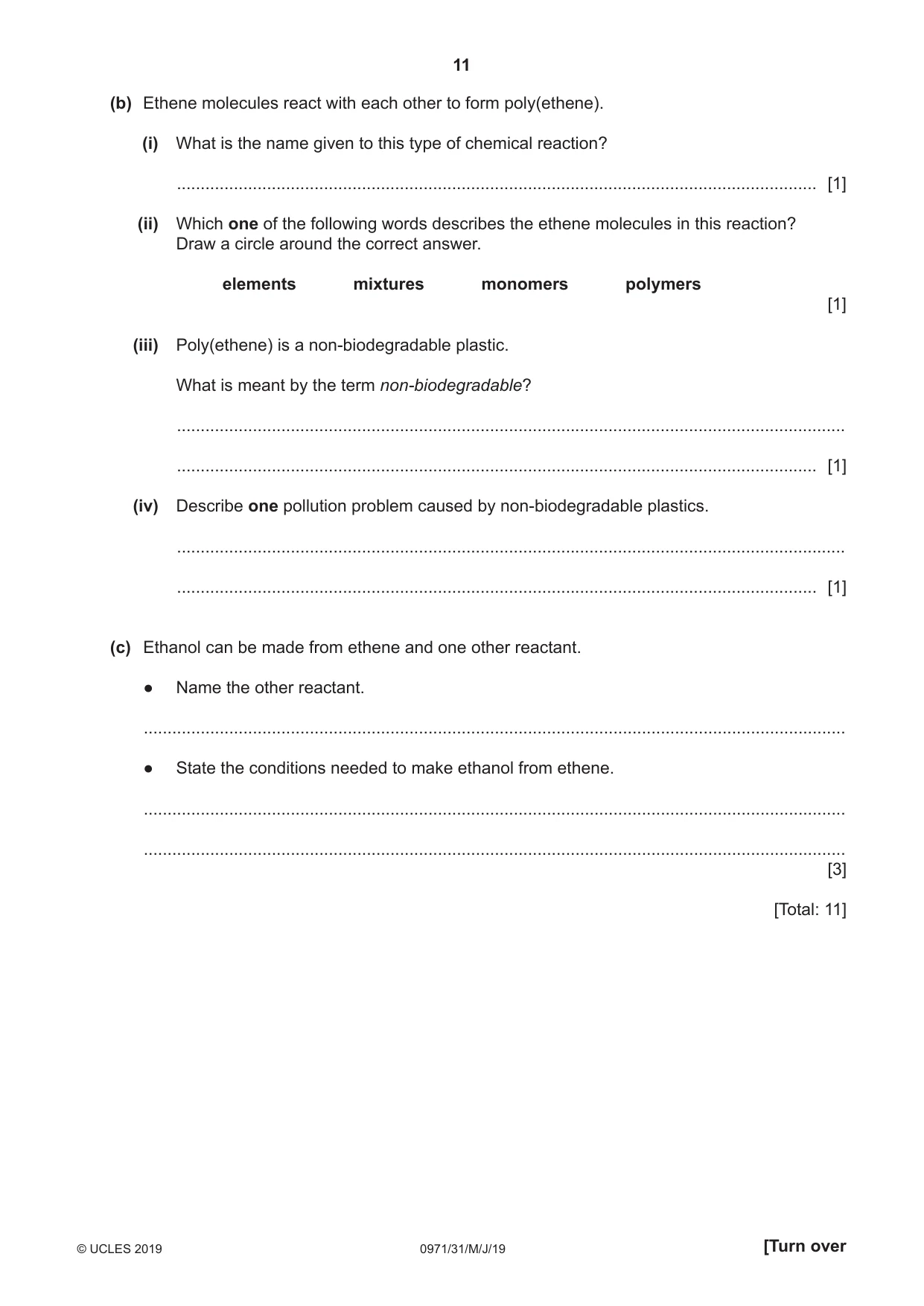
5 Coal gas is made by heating coal in the absence of air. The list shows the main gases present in coal gas. carbon dioxide carbon monoxide ethene hydrogen methane nitrogen (a) (i) Which one of these gases is an alkane? ....................................................................................................................................... [1] (ii) Draw the structure of a molecule of ethene. Show all of the atoms and all of the bonds. [1] (iii) Describe how aqueous bromine can be used to tell the difference between methane and ethene. ............................................................................................................................................. ............................................................................................................................................. ....................................................................................................................................... [2] (b) Ethene molecules react with each other to form poly(ethene). (i) What is the name given to this type of chemical reaction? ....................................................................................................................................... [1] (ii) Which one of the following words describes the ethene molecules in this reaction? Draw a circle around the correct answer. elements mixtures monomers polymers [1] (iii) Poly(ethene) is a non-biodegradable plastic. What is meant by the term non-biodegradable? ............................................................................................................................................. ....................................................................................................................................... [1] (iv) Describe one pollution problem caused by non-biodegradable plastics. ............................................................................................................................................. ....................................................................................................................................... [1] (c) Ethanol can be made from ethene and one other reactant. ●● Name the other reactant. .................................................................................................................................................... ●● State the conditions needed to make ethanol from ethene. .................................................................................................................................................... .................................................................................................................................................... [3] [Total: 11]
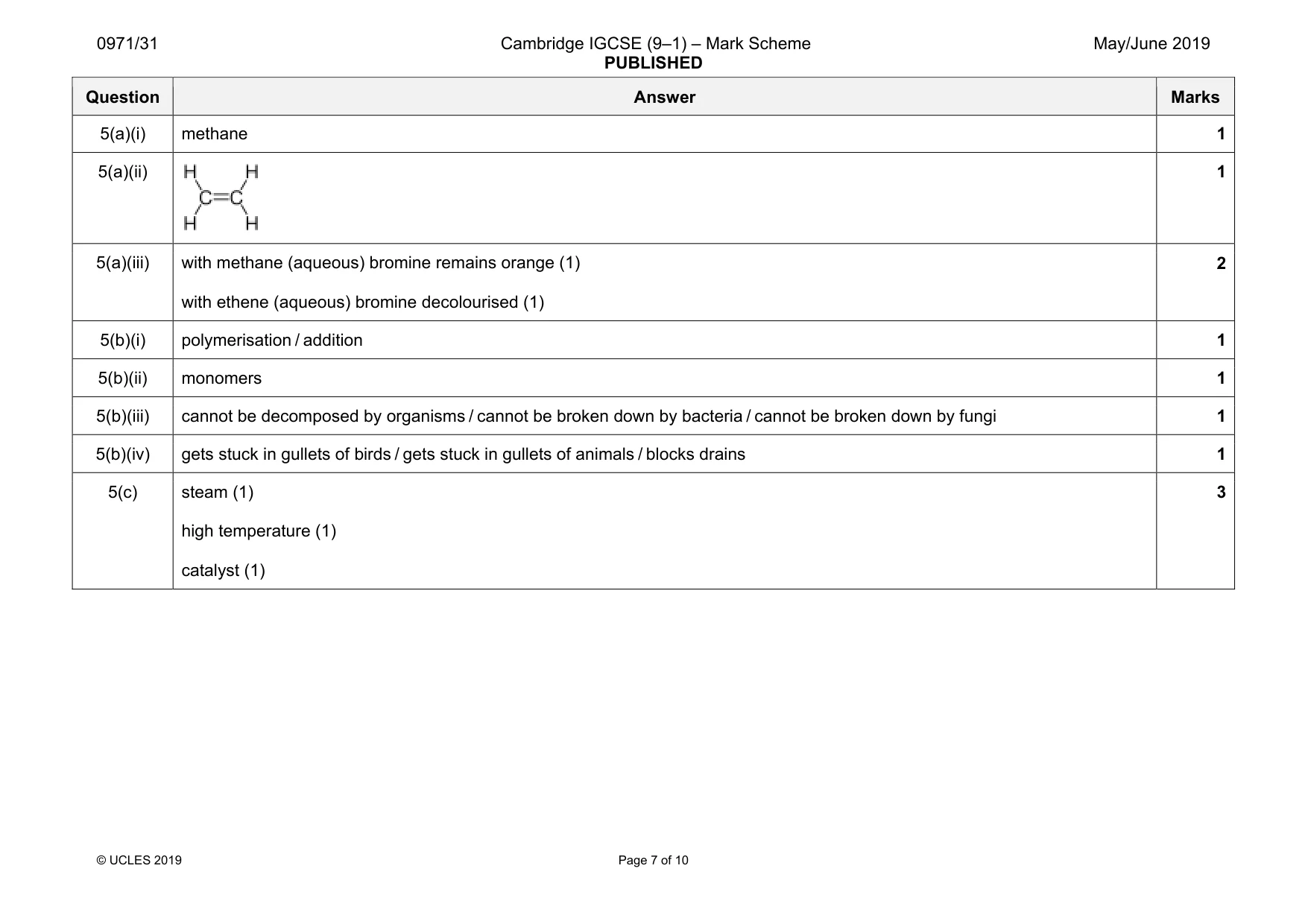
Mark scheme: 5(a)(i) methane 1 5(a)(ii) 1 5(a)(iii) with methane (aqueous) bromine remains orange (1) with ethene (aqueous) bromine decolourised (1) 2 5(b)(i) polymerisation / addition 1 5(b)(ii) monomers 1 5(b)(iii) cannot be decomposed by organisms / cannot be broken down by bacteria / cannot be broken down by fungi 1 5(b)(iv) gets stuck in gullets of birds / gets stuck in gullets of animals / blocks drains 1 5(c) steam (1) high temperature (1) catalyst (1) 3
Q6 · This question is about copper and copper compounds
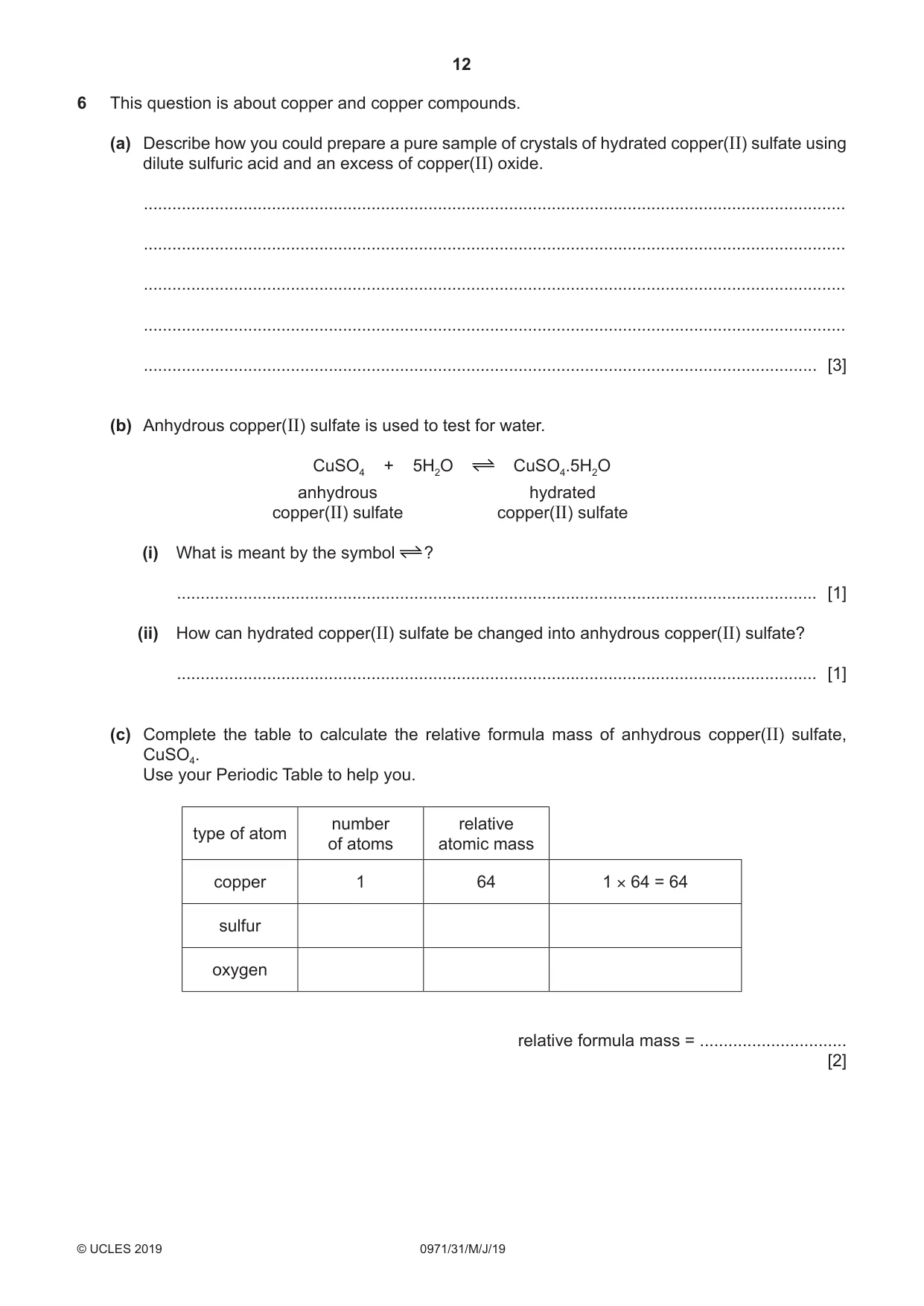
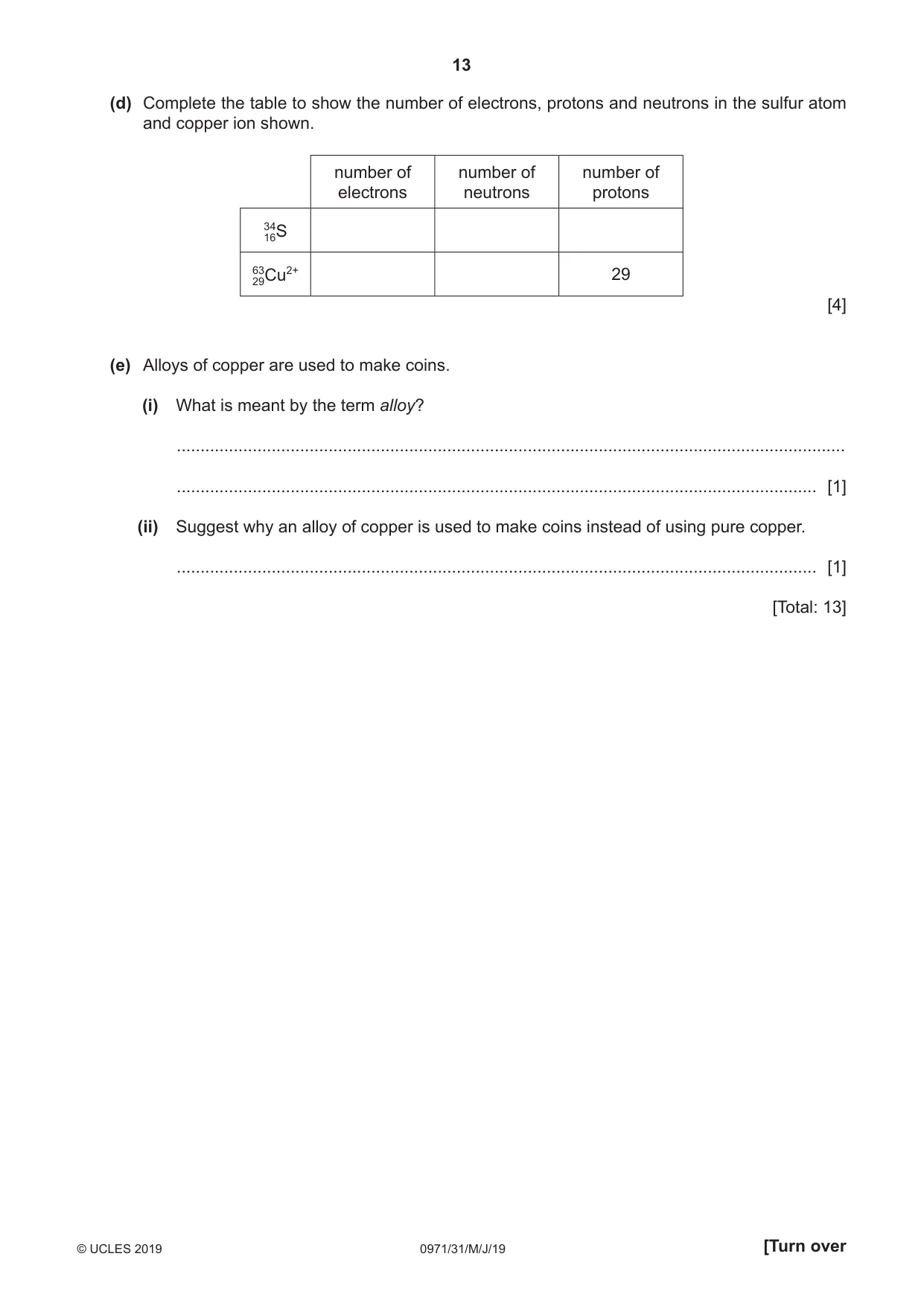
6 This question is about copper and copper compounds. (a) Describe how you could prepare a pure sample of crystals of hydrated copper(II) sulfate using dilute sulfuric acid and an excess of copper(II) oxide. .................................................................................................................................................... .................................................................................................................................................... .................................................................................................................................................... .................................................................................................................................................... .............................................................................................................................................. [3] (b) Anhydrous copper(II) sulfate is used to test for water. CuSO4 + 5H2O CuSO4.5H2O anhydrous hydrated copper(II) sulfate copper(II) sulfate (i) What is meant by the symbol ? ....................................................................................................................................... [1] (ii) How can hydrated copper(II) sulfate be changed into anhydrous copper(II) sulfate? ....................................................................................................................................... [1] (c) Complete the table to calculate the relative formula mass of anhydrous copper(II) sulfate, CuSO4. Use your Periodic Table to help you. number relative type of atom of atoms atomic mass copper 1 64 1 × 64 = 64 sulfur oxygen relative formula mass = ............................... [2] (d) Complete the table to show the number of electrons, protons and neutrons in the sulfur atom and copper ion shown. number of number of number of electrons neutrons protons 1634S 2963Cu2+ 29 [4] (e) Alloys of copper are used to make coins. (i) What is meant by the term alloy? ............................................................................................................................................. ....................................................................................................................................... [1] (ii) Suggest why an alloy of copper is used to make coins instead of using pure copper. ....................................................................................................................................... [1] [Total: 13]
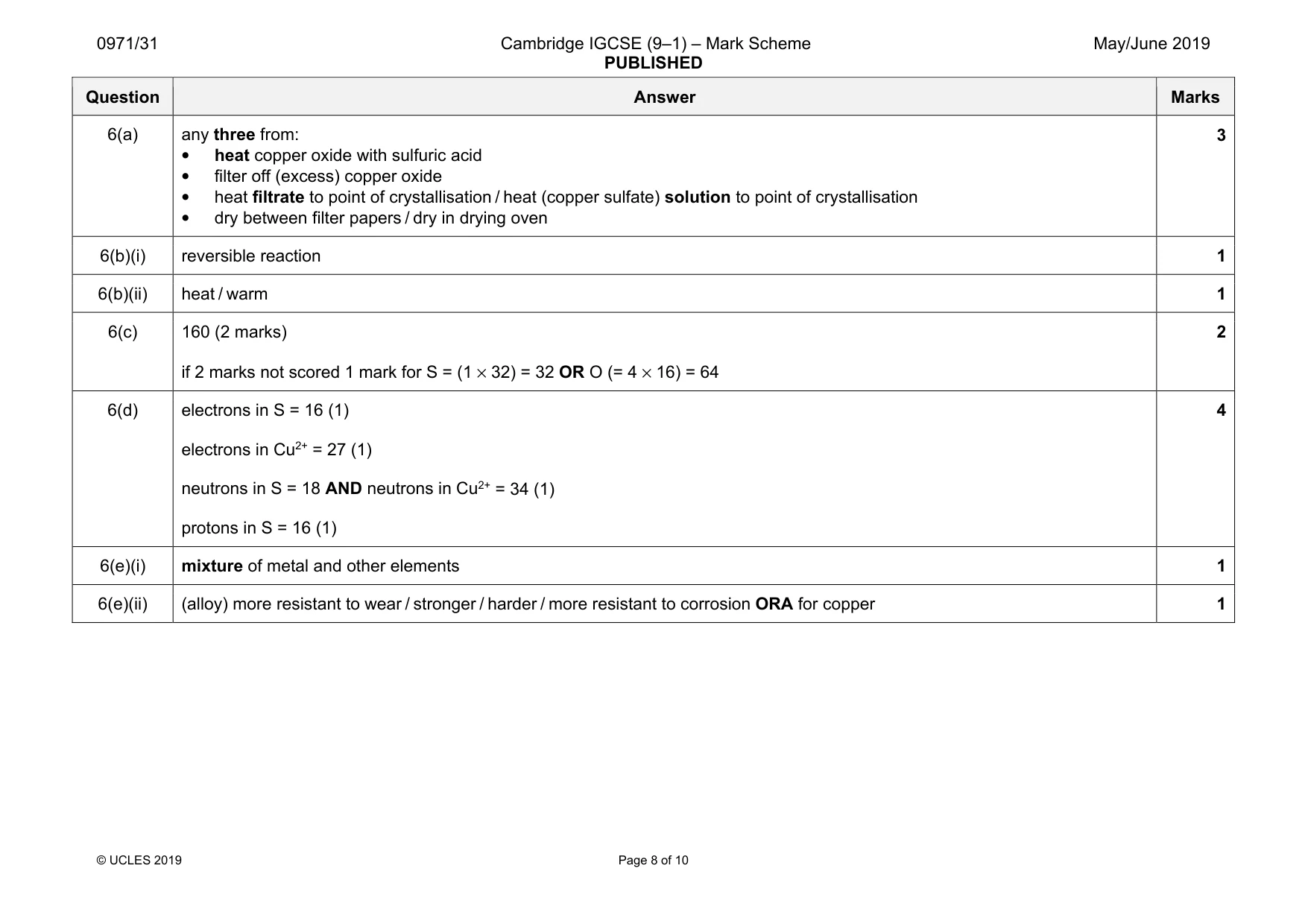
Mark scheme: 6(a) any three from: • heat copper oxide with sulfuric acid • filter off (excess) copper oxide • heat filtrate to point of crystallisation / heat (copper sulfate) solution to point of crystallisation • dry between filter papers / dry in drying oven 3 6(b)(i) reversible reaction 1 6(b)(ii) heat / warm 1 6(c) 160 (2 marks) if 2 marks not scored 1 mark for S = (1 × 32) = 32 OR O (= 4 × 16) = 64 2 6(d) electrons in S = 16 (1) electrons in Cu2+ = 27 (1) neutrons in S = 18 AND neutrons in Cu2+ = 34 (1) protons in S = 16 (1) 4 6(e)(i) mixture of metal and other elements 1 6(e)(ii) (alloy) more resistant to wear / stronger / harder / more resistant to corrosion ORA for copper 1
Q7 · A student investigates the rate of reaction of small pieces of calcium carbonate with an…
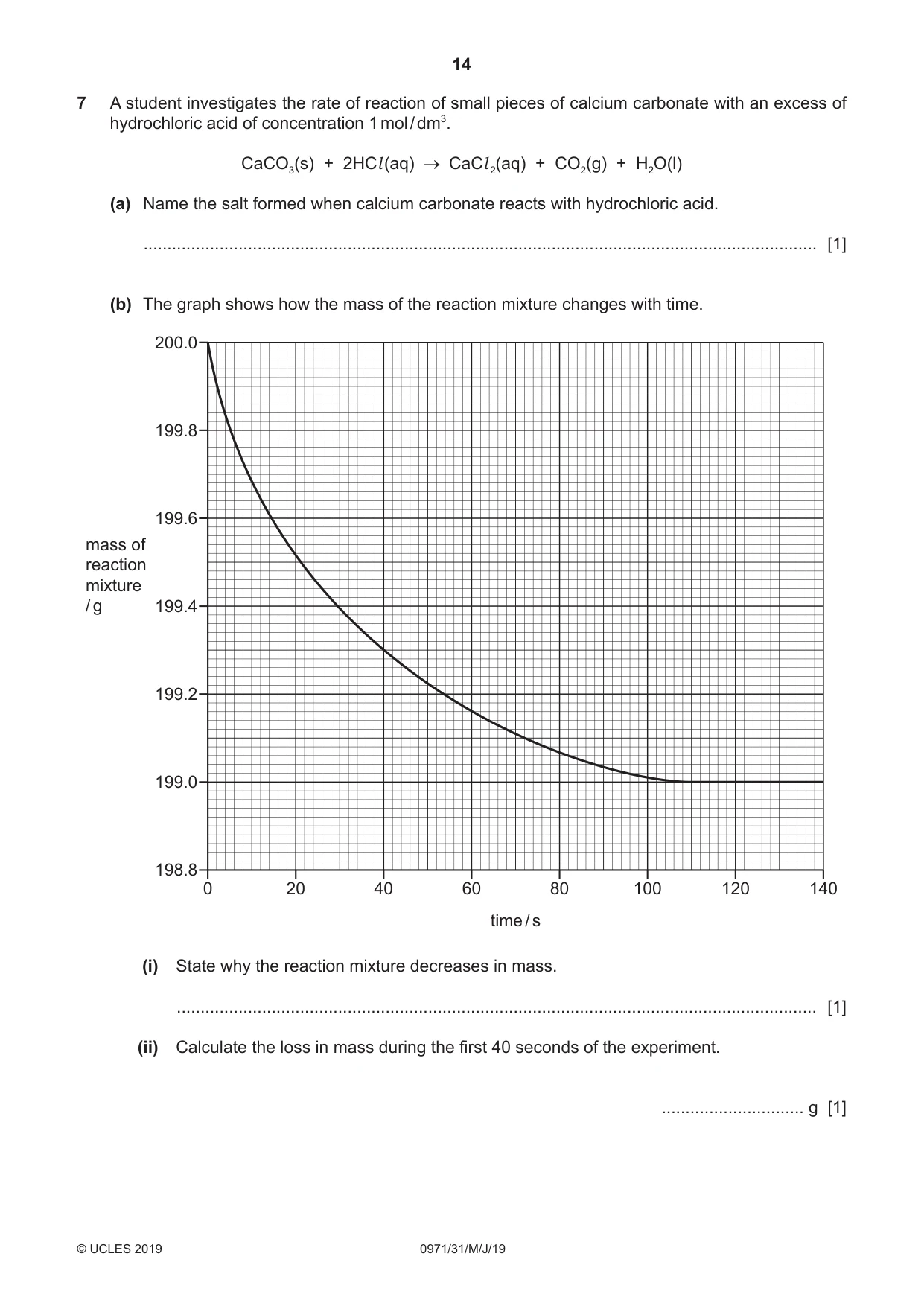
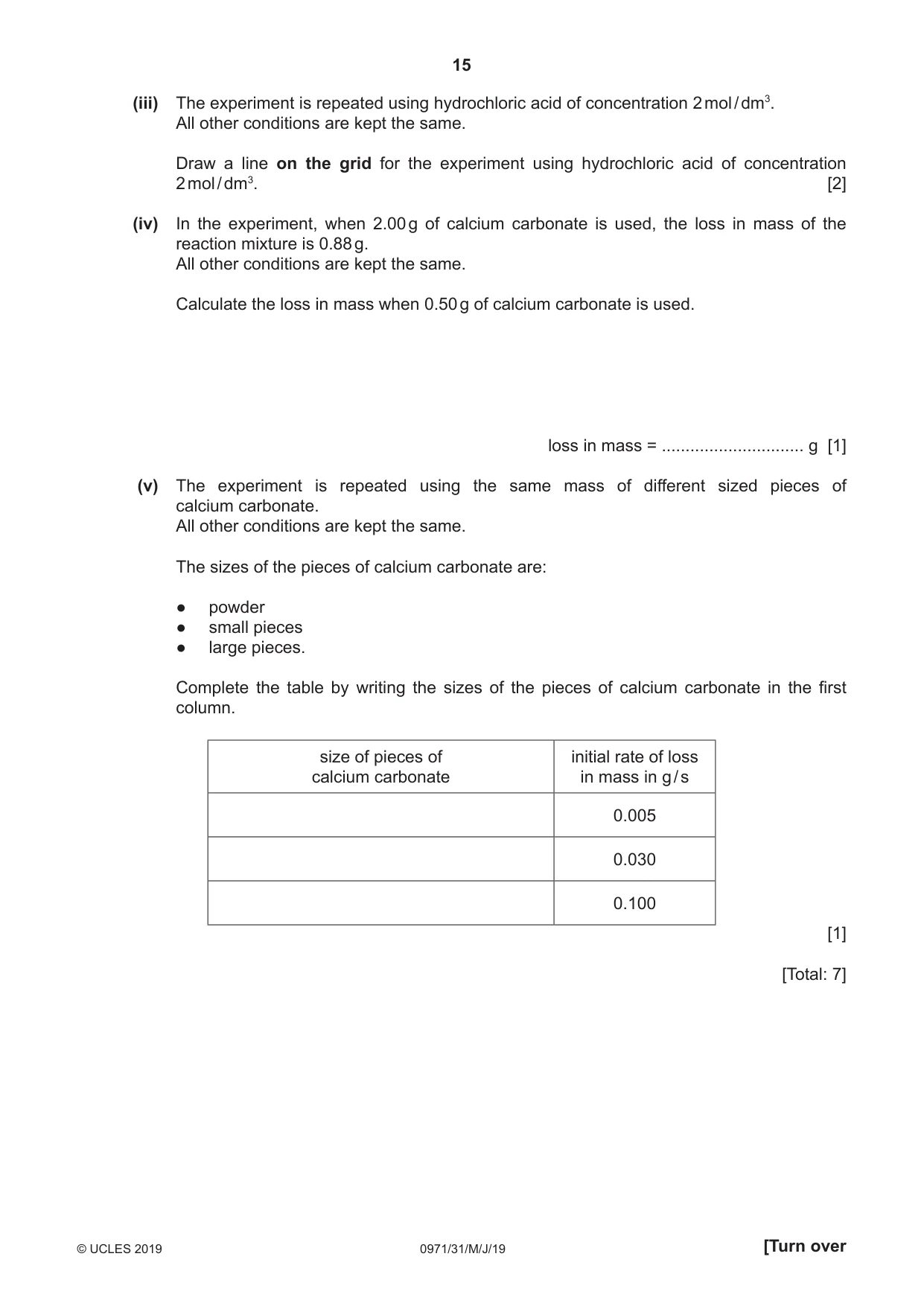
7 A student investigates the rate of reaction of small pieces of calcium carbonate with an excess of hydrochloric acid of concentration 1 mol / dm3. CaCO3(s) + 2HCl (aq) CaCl 2(aq) + CO2(g) + H2O(l) (a) Name the salt formed when calcium carbonate reacts with hydrochloric acid. .............................................................................................................................................. [1] (b) The graph shows how the mass of the reaction mixture changes with time. 200.0 199.8 199.6 mass of reaction mixture / g 199.4 199.2 199.0 198.8 0 20 40 60 80 100 120 140 time / s (i) State why the reaction mixture decreases in mass. ....................................................................................................................................... [1] (ii) Calculate the loss in mass during the first 40 seconds of the experiment. .............................. g [1] (iii) The experiment is repeated using hydrochloric acid of concentration 2 mol / dm3. All other conditions are kept the same. Draw a line on the grid for the experiment using hydrochloric acid of concentration 2 mol / dm3. [2] (iv) In the experiment, when 2.00 g of calcium carbonate is used, the loss in mass of the reaction mixture is 0.88 g. All other conditions are kept the same. Calculate the loss in mass when 0.50 g of calcium carbonate is used. loss in mass = .............................. g [1] (v) The experiment is repeated using the same mass of different sized pieces of calcium carbonate. All other conditions are kept the same. The sizes of the pieces of calcium carbonate are: ● powder ● small pieces ● large pieces. Complete the table by writing the sizes of the pieces of calcium carbonate in the first column. size of pieces of initial rate of loss calcium carbonate in mass in g / s 0.005 0.030 0.100 [1] [Total: 7]
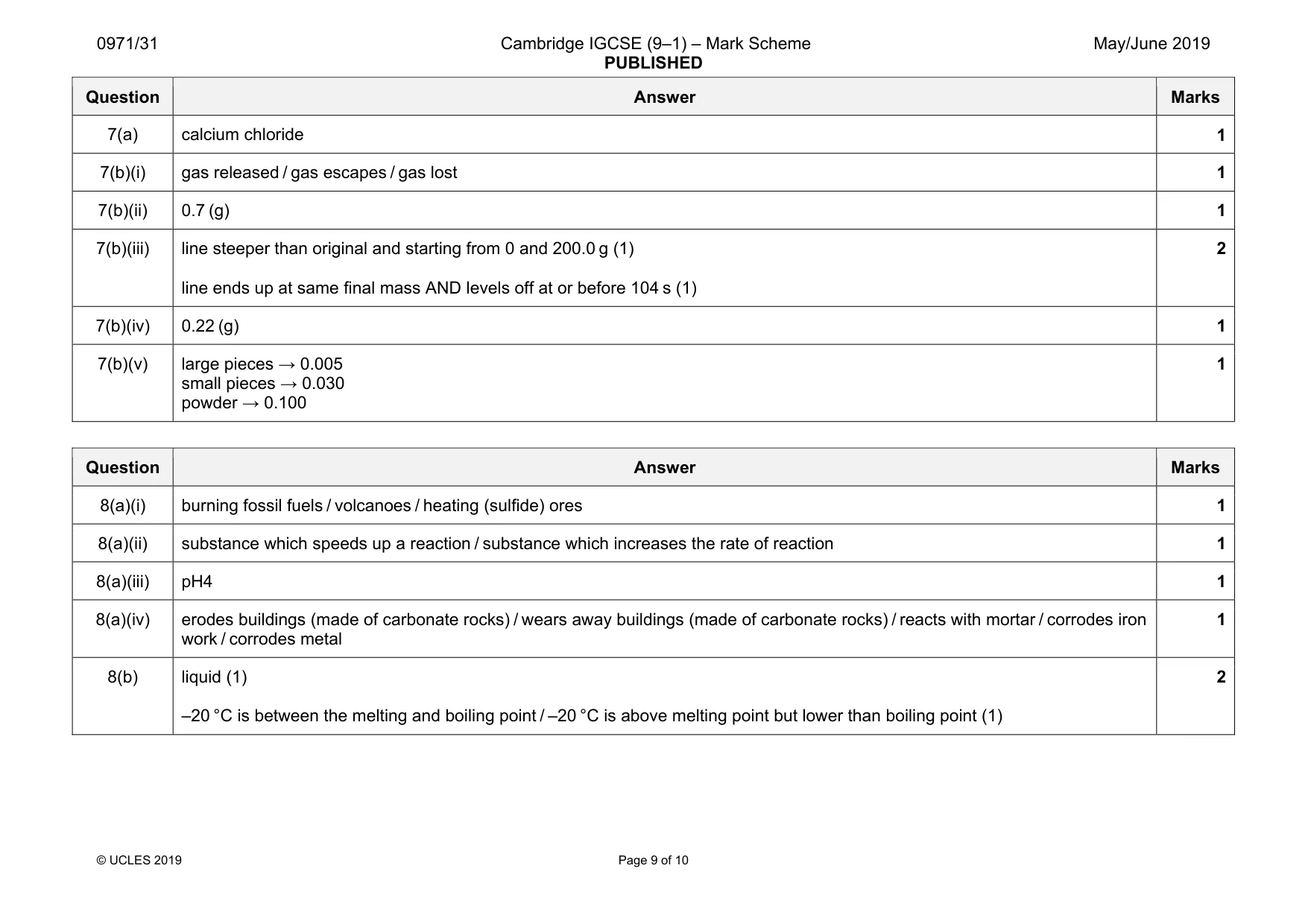
Mark scheme: 7(a) calcium chloride 1 7(b)(i) gas released / gas escapes / gas lost 1 7(b)(ii) 0.7 (g) 1 7(b)(iii) line steeper than original and starting from 0 and 200.0 g (1) line ends up at same final mass AND levels off at or before 104 s (1) 2 7(b)(iv) 0.22 (g) 1 7(b)(v) large pieces → 0.005 small pieces → 0.030 powder → 0.100 1
Q8 · Sulfur dioxide is a pollutant in the air
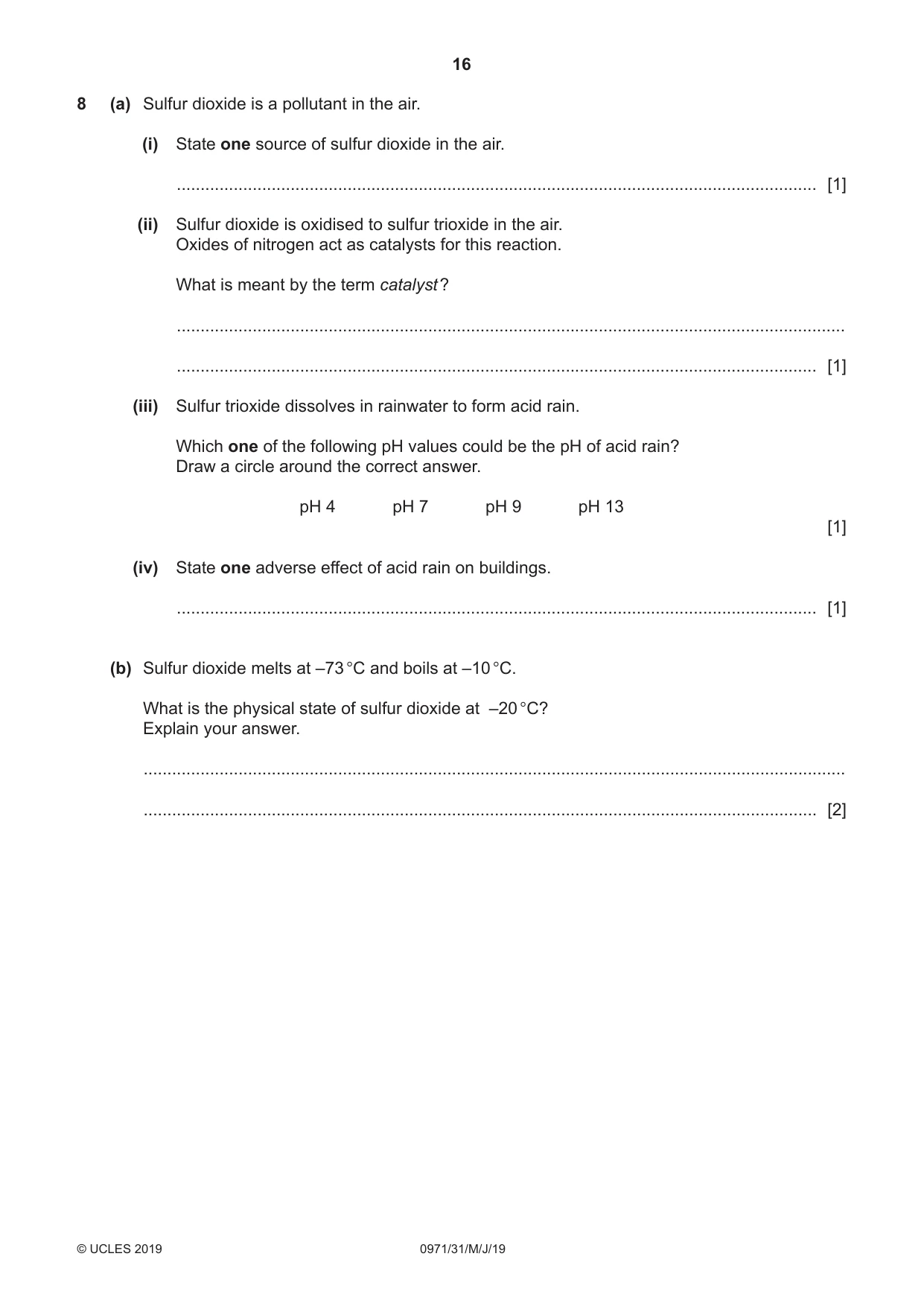
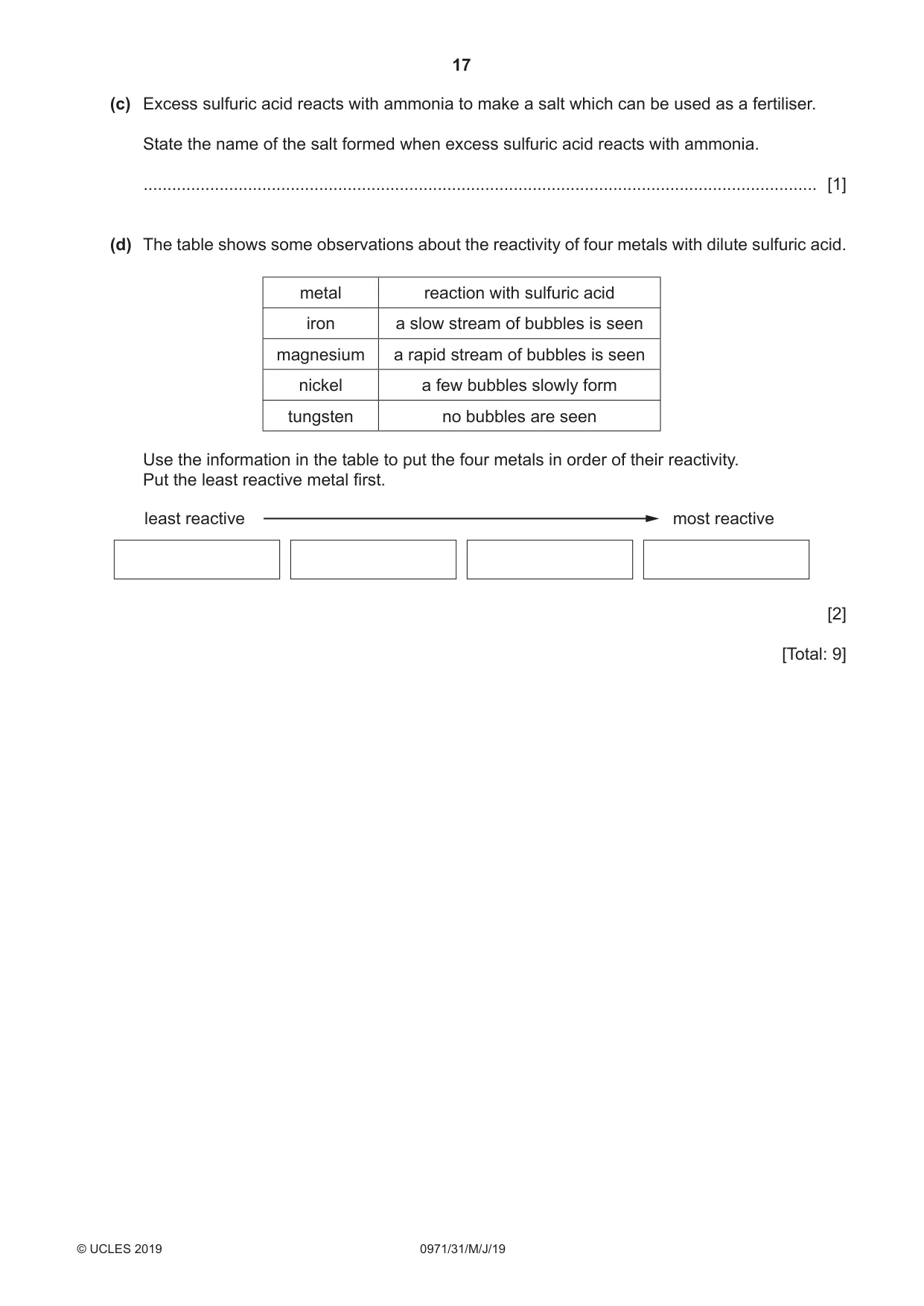
8 (a) Sulfur dioxide is a pollutant in the air. (i) State one source of sulfur dioxide in the air. ....................................................................................................................................... [1] (ii) Sulfur dioxide is oxidised to sulfur trioxide in the air. Oxides of nitrogen act as catalysts for this reaction. What is meant by the term catalyst ? ............................................................................................................................................. ....................................................................................................................................... [1] (iii) Sulfur trioxide dissolves in rainwater to form acid rain. Which one of the following pH values could be the pH of acid rain? Draw a circle around the correct answer. pH 4 pH 7 pH 9 pH 13 [1] (iv) State one adverse effect of acid rain on buildings. ....................................................................................................................................... [1] (b) Sulfur dioxide melts at –73 °C and boils at –10 °C. What is the physical state of sulfur dioxide at –20 °C? Explain your answer. .................................................................................................................................................... .............................................................................................................................................. [2] (c) Excess sulfuric acid reacts with ammonia to make a salt which can be used as a fertiliser. State the name of the salt formed when excess sulfuric acid reacts with ammonia. .............................................................................................................................................. [1] (d) The table shows some observations about the reactivity of four metals with dilute sulfuric acid. metal reaction with sulfuric acid iron a slow stream of bubbles is seen magnesium a rapid stream of bubbles is seen nickel a few bubbles slowly form tungsten no bubbles are seen Use the information in the table to put the four metals in order of their reactivity. Put the least reactive metal first. least reactive most reactive [2] [Total: 9]
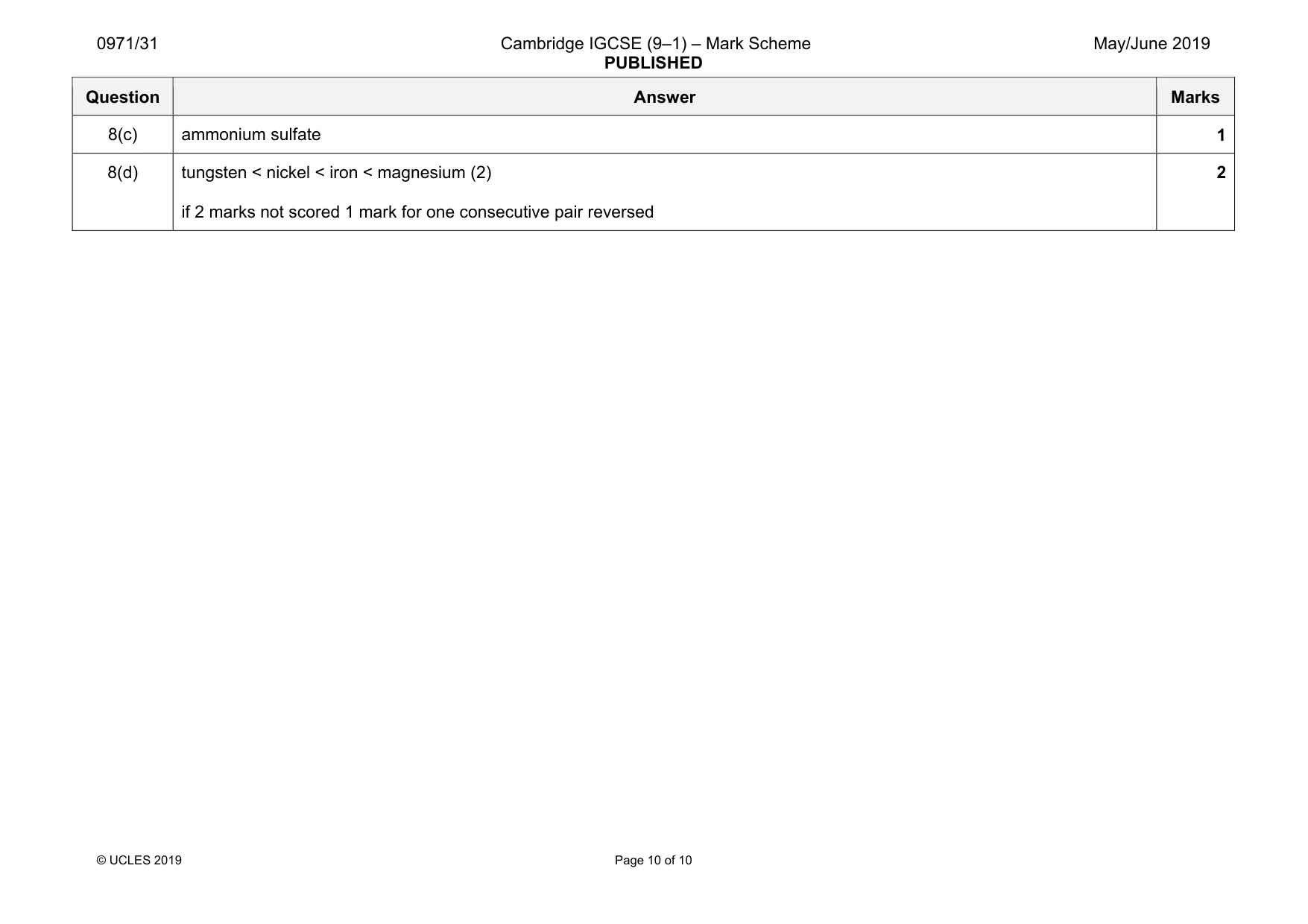
Mark scheme: 8(a)(i) burning fossil fuels / volcanoes / heating (sulfide) ores 1 8(a)(ii) substance which speeds up a reaction / substance which increases the rate of reaction 1 8(a)(iii) pH4 1 8(a)(iv) erodes buildings (made of carbonate rocks) / wears away buildings (made of carbonate rocks) / reacts with mortar / corrodes iron work / corrodes metal 1 8(b) liquid (1) –20 °C is between the melting and boiling point / –20 °C is above melting point but lower than boiling point (1) 2 Question Answer Marks 8(c) ammonium sulfate 1 8(d) tungsten < nickel < iron < magnesium (2) if 2 marks not scored 1 mark for one consecutive pair reversed 2
What was in this paper
The subtopics covered by these 8 questions, and how many questions each got. Open one in a new tab to see every Cambridge question on it.
What you needed in this session
Cambridge’s own grade thresholds for 2019 May/June, Paper 3 · Variant 1. A higher threshold means an easier paper — the bar moves with how the cohort did.