Cambridge IGCSE Chemistry (9-1) 0971 — 2020 May/June Paper 3 · Variant 1
0971/31/M/J/20 · 8 questions · 80 marks · ≈90 min
The question paper and its mark scheme, free to read here and free to download. This is Cambridge’s own paper, exactly as it was sat.
Question paper20 pages


Mark scheme10 pages
Answers below. Sit the paper first if you are practising.
Questions as text
Q1 · A list of symbols and formulae is shown
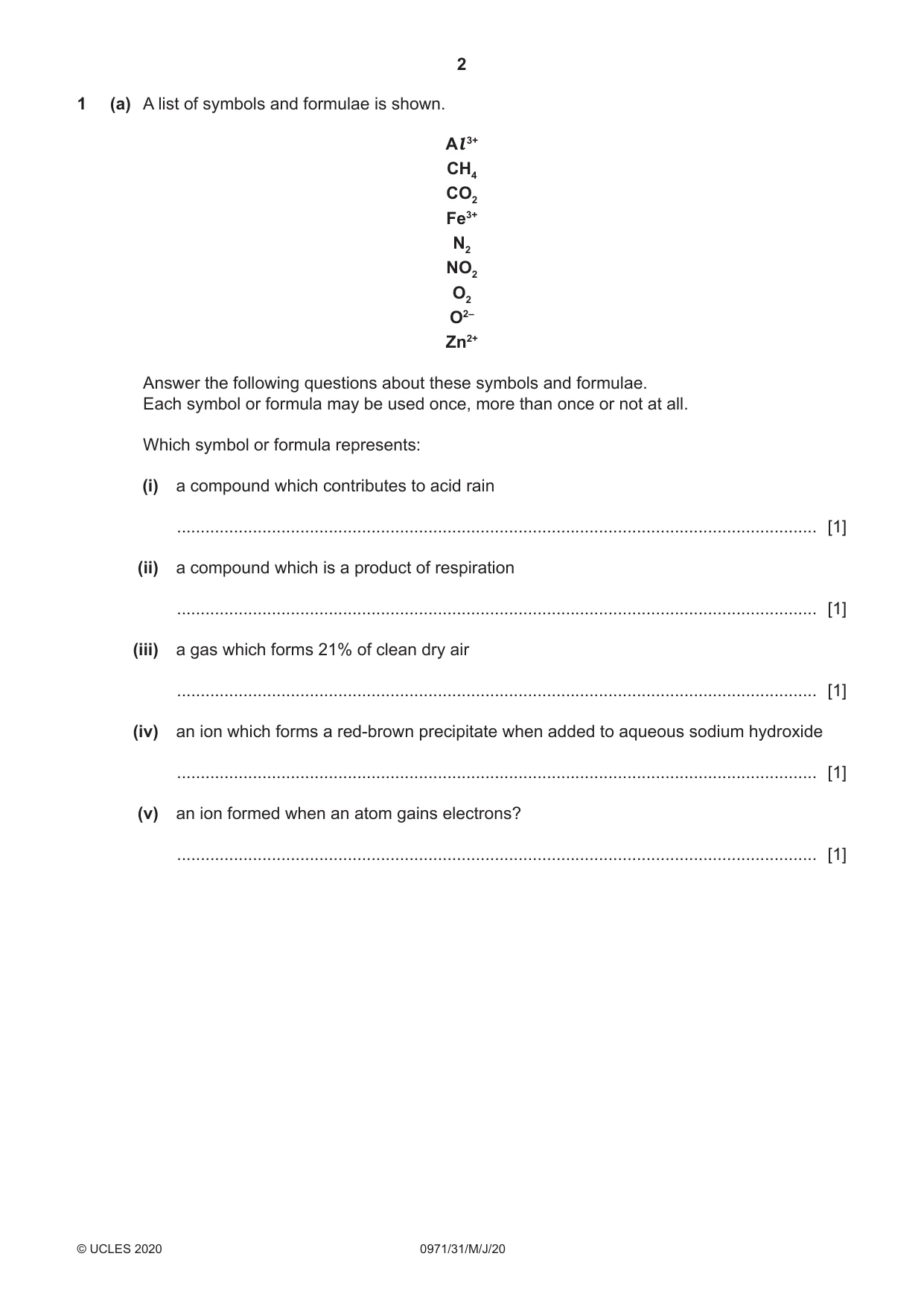
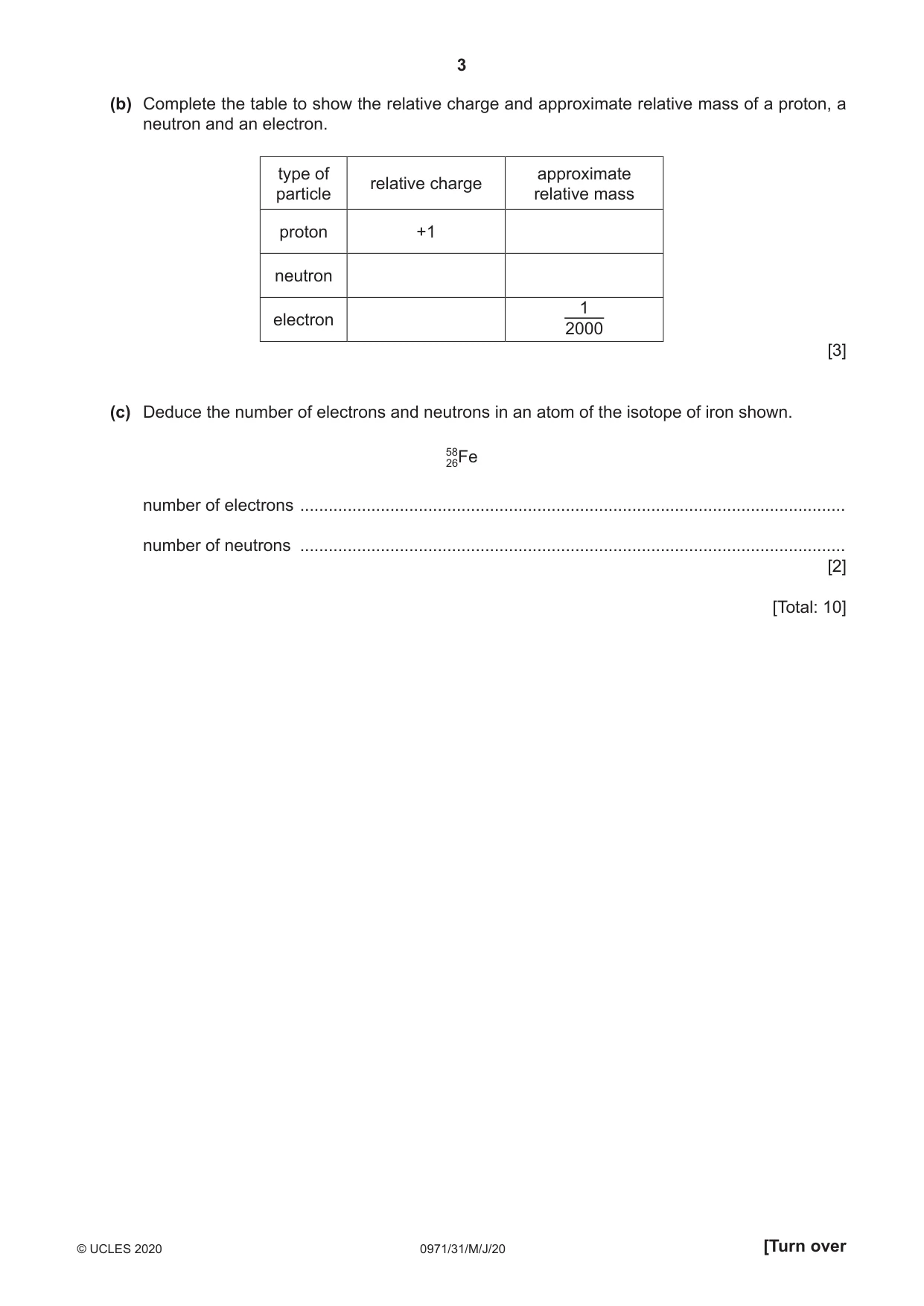
1 (a) A list of symbols and formulae is shown. Al 3+ CH4 CO2 Fe3+ N2 NO2 O2 O2– Zn2+ Answer the following questions about these symbols and formulae. Each symbol or formula may be used once, more than once or not at all. Which symbol or formula represents: (i) a compound which contributes to acid rain ....................................................................................................................................... [1] (ii) a compound which is a product of respiration ....................................................................................................................................... [1] (iii) a gas which forms 21% of clean dry air ....................................................................................................................................... [1] (iv) an ion which forms a red-brown precipitate when added to aqueous sodium hydroxide ....................................................................................................................................... [1] (v) an ion formed when an atom gains electrons? ....................................................................................................................................... [1] (b) Complete the table to show the relative charge and approximate relative mass of a proton, a neutron and an electron. type of approximate relative charge particle relative mass proton +1 neutron 1 electron 2000 [3] (c) Deduce the number of electrons and neutrons in an atom of the isotope of iron shown. 58Fe26 number of electrons ................................................................................................................... number of neutrons .................................................................................................................... [2] [Total: 10]
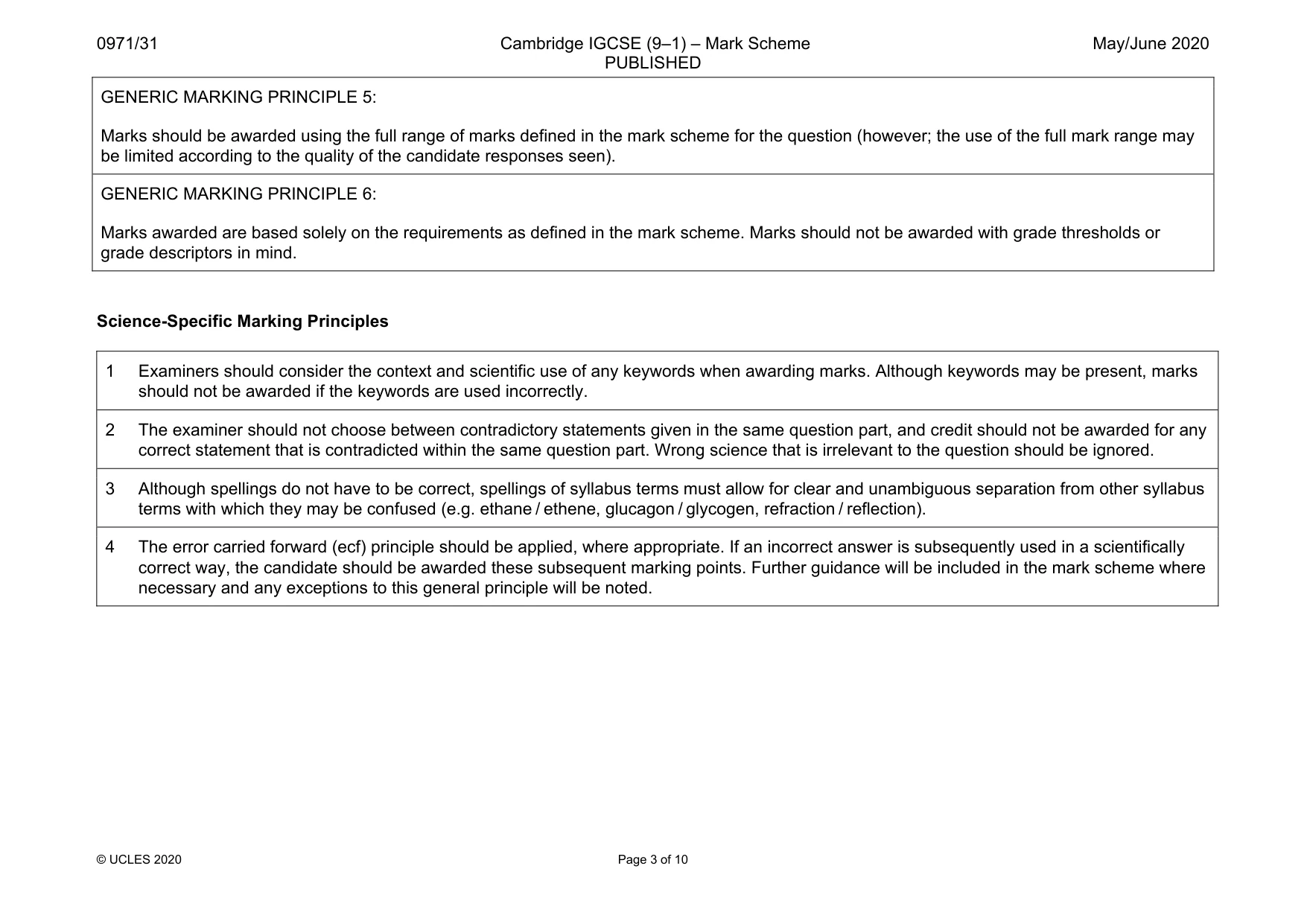
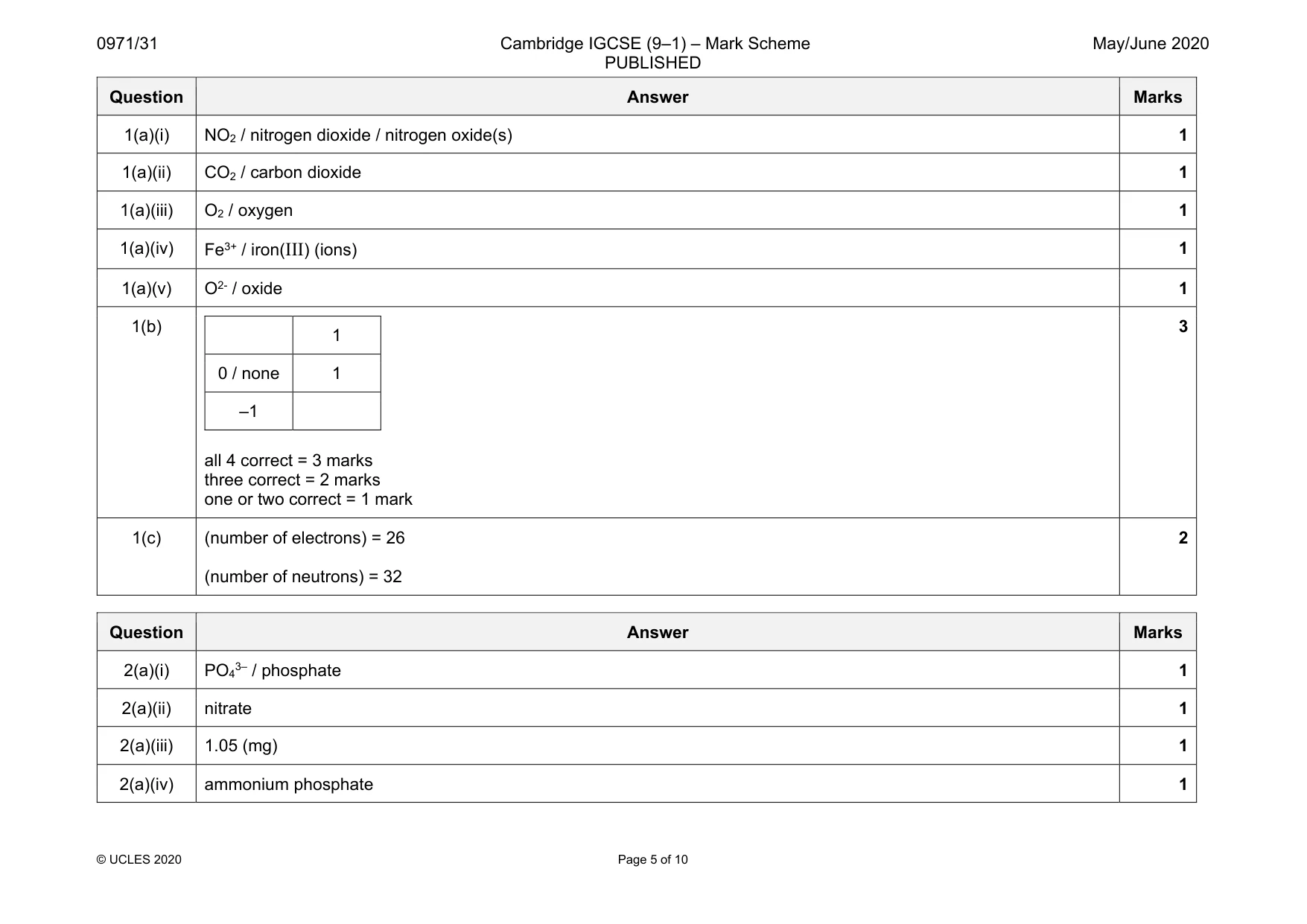
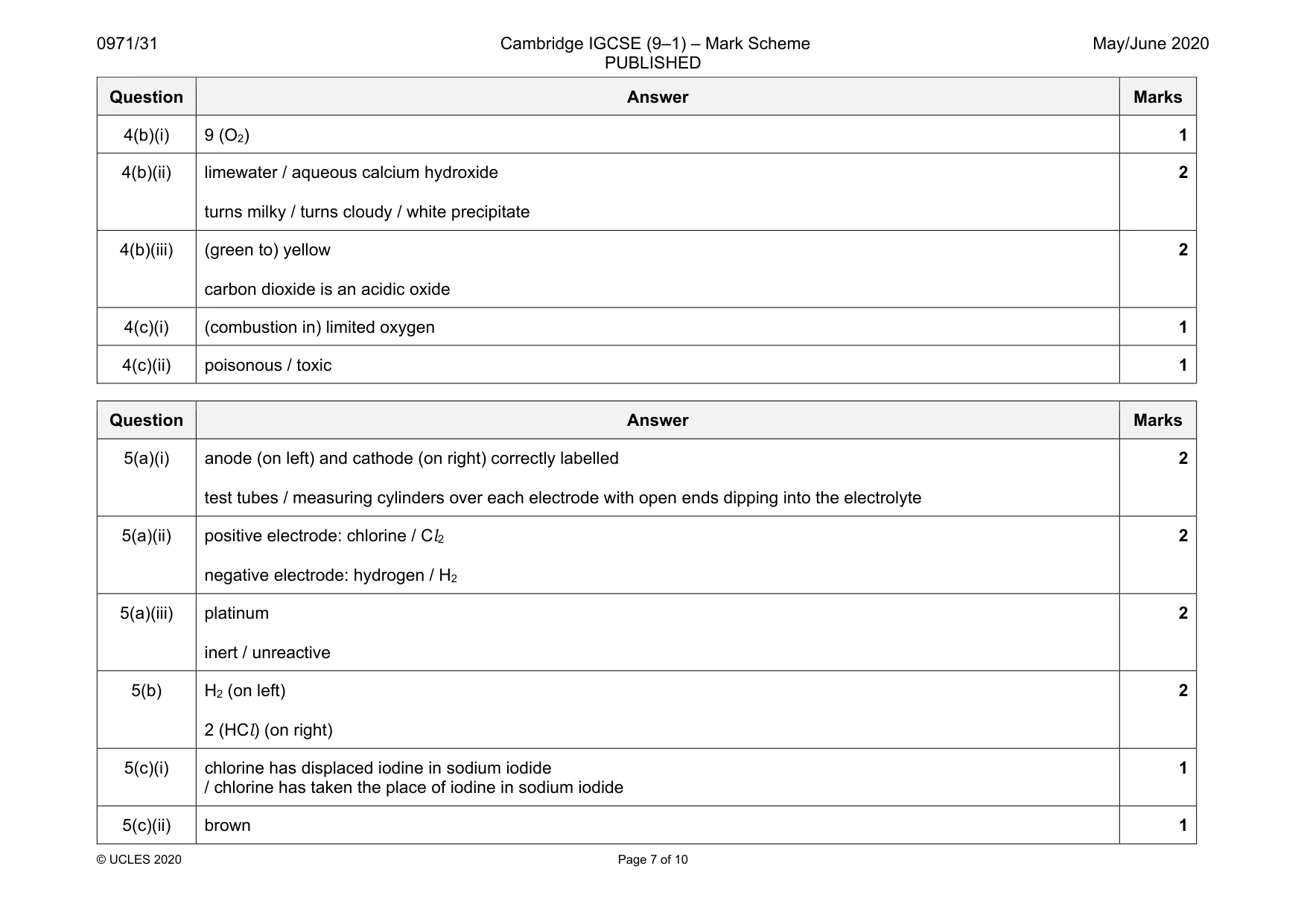
Mark scheme: 1(a)(i) NO2 / nitrogen dioxide / nitrogen oxide(s) 1 1(a)(ii) CO2 / carbon dioxide 1 1(a)(iii) O2 / oxygen 1 1(a)(iv) Fe3+ / iron(III) (ions) 1 1(a)(v) O2- / oxide 1 1(b) 1 0 / none 1 –1 all 4 correct = 3 marks three correct = 2 marks one or two correct = 1 mark 3 1(c) (number of electrons) = 26 (number of neutrons) = 32 2
Q2 · A solution is obtained by filtering a mixture of soil and water
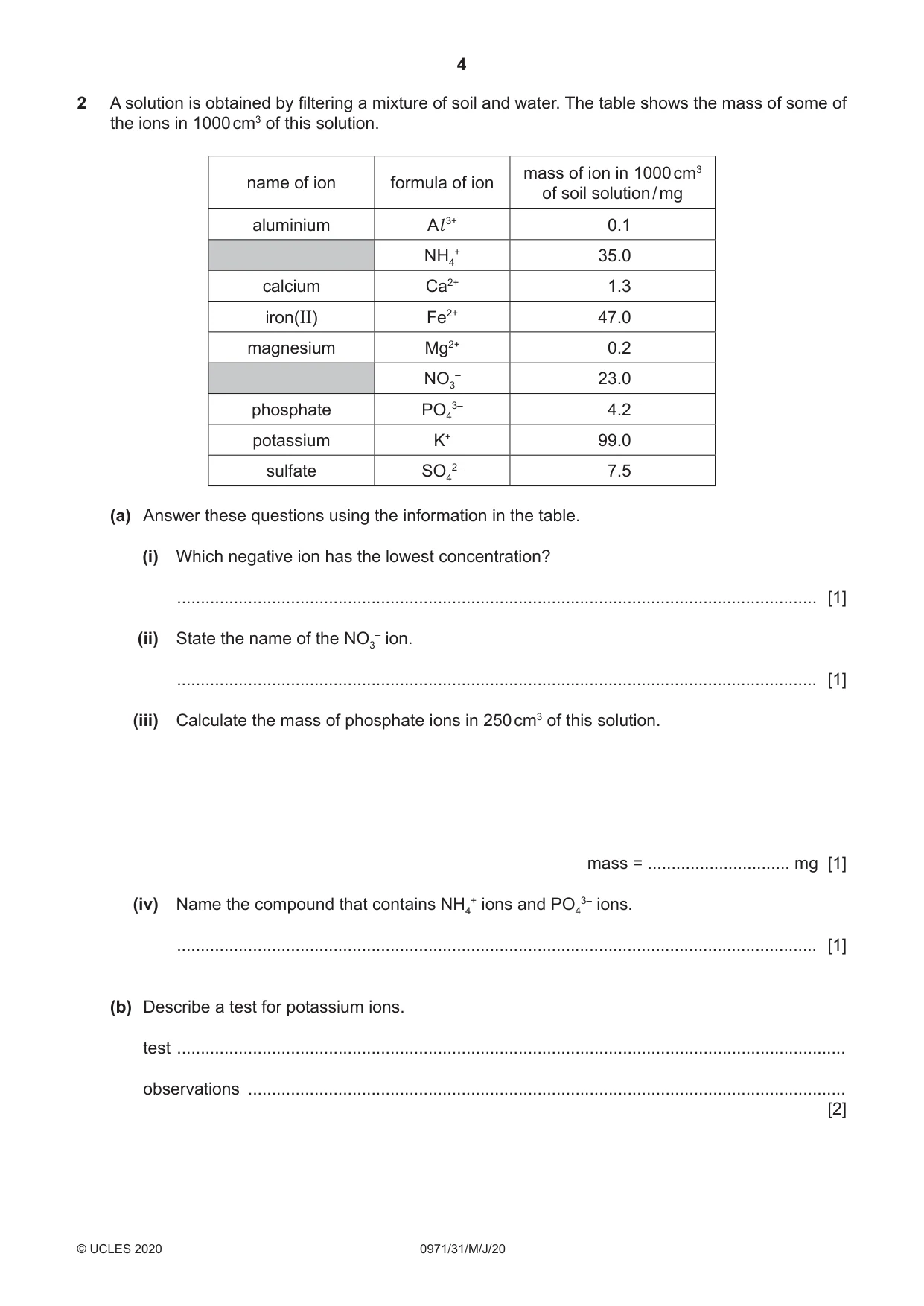
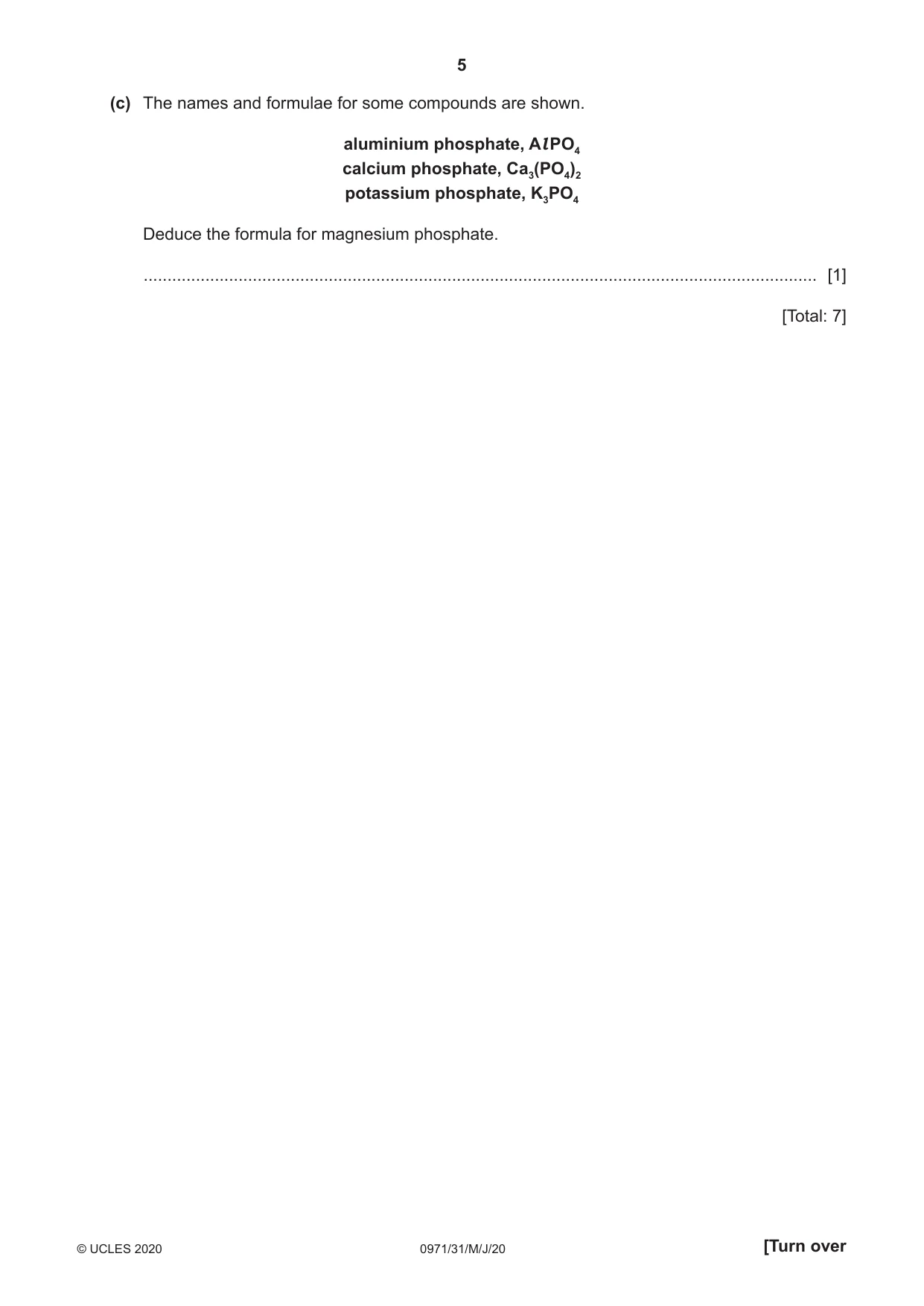
2 A solution is obtained by filtering a mixture of soil and water. The table shows the mass of some of the ions in 1000 cm3 of this solution. mass of ion in 1000 cm3 name of ion formula of ion of soil solution / mg aluminium Al 3+ 0.1 NH4+ 35.0 calcium Ca2+ 1.3 iron(II) Fe2+ 47.0 magnesium Mg2+ 0.2 NO3– 23.0 phosphate PO43– 4.2 potassium K+ 99.0 sulfate SO42– 7.5 (a) Answer these questions using the information in the table. (i) Which negative ion has the lowest concentration? ....................................................................................................................................... [1] (ii) State the name of the NO3– ion. ....................................................................................................................................... [1] (iii) Calculate the mass of phosphate ions in 250 cm3 of this solution. mass = .............................. mg [1] (iv) Name the compound that contains NH4+ ions and PO43– ions. ....................................................................................................................................... [1] (b) Describe a test for potassium ions. test ............................................................................................................................................. observations ............................................................................................................................... [2] (c) The names and formulae for some compounds are shown. aluminium phosphate, Al PO4 calcium phosphate, Ca3(PO4)2 potassium phosphate, K3PO4 Deduce the formula for magnesium phosphate. .............................................................................................................................................. [1] [Total: 7]
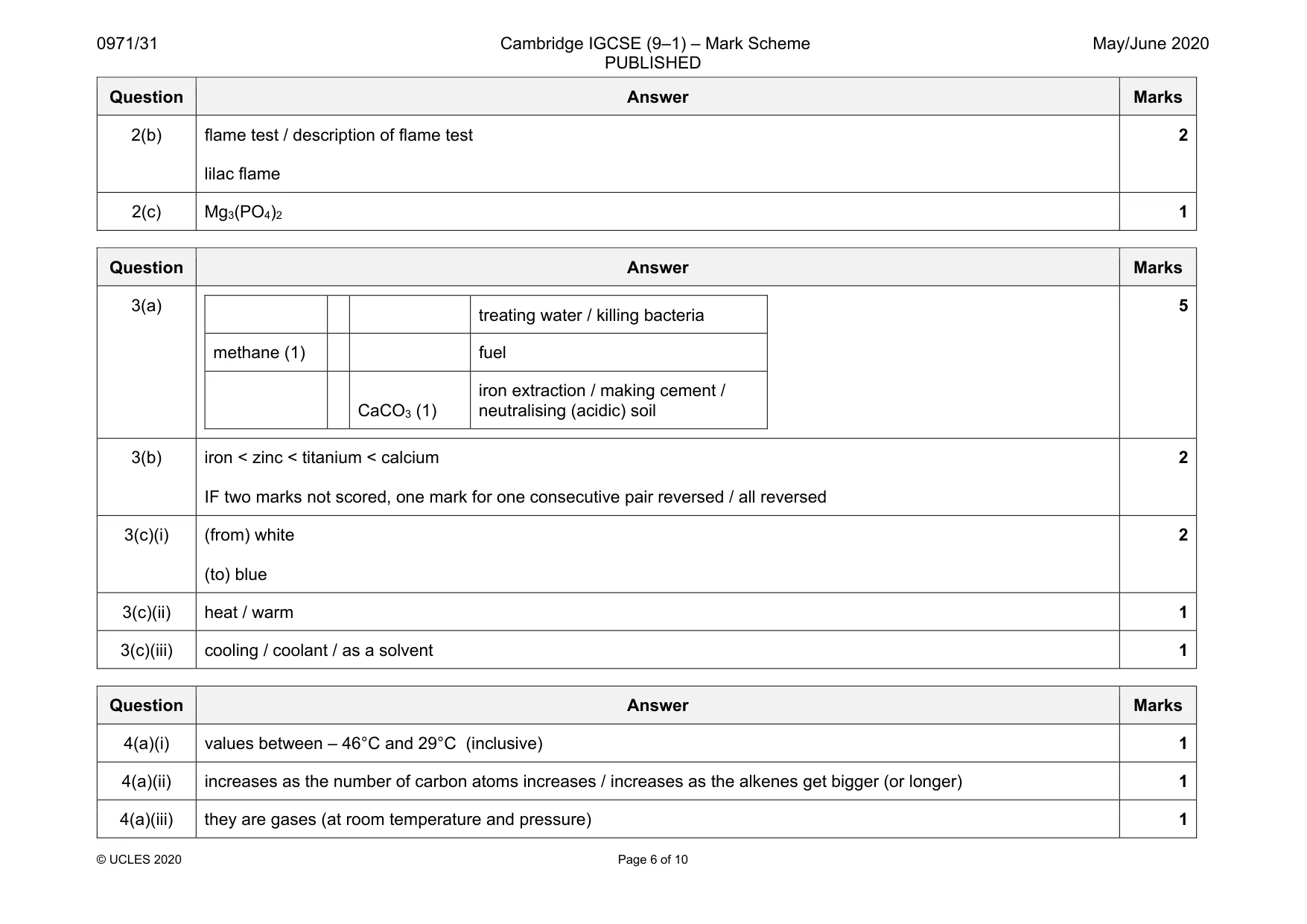
Mark scheme: 2(a)(i) PO43– / phosphate 1 2(a)(ii) nitrate 1 2(a)(iii) 1.05 (mg) 1 2(a)(iv) ammonium phosphate 1 Question Answer Marks 2(b) flame test / description of flame test lilac flame 2 2(c) Mg3(PO4)2 1
Q3 · Many compounds and elements have important uses
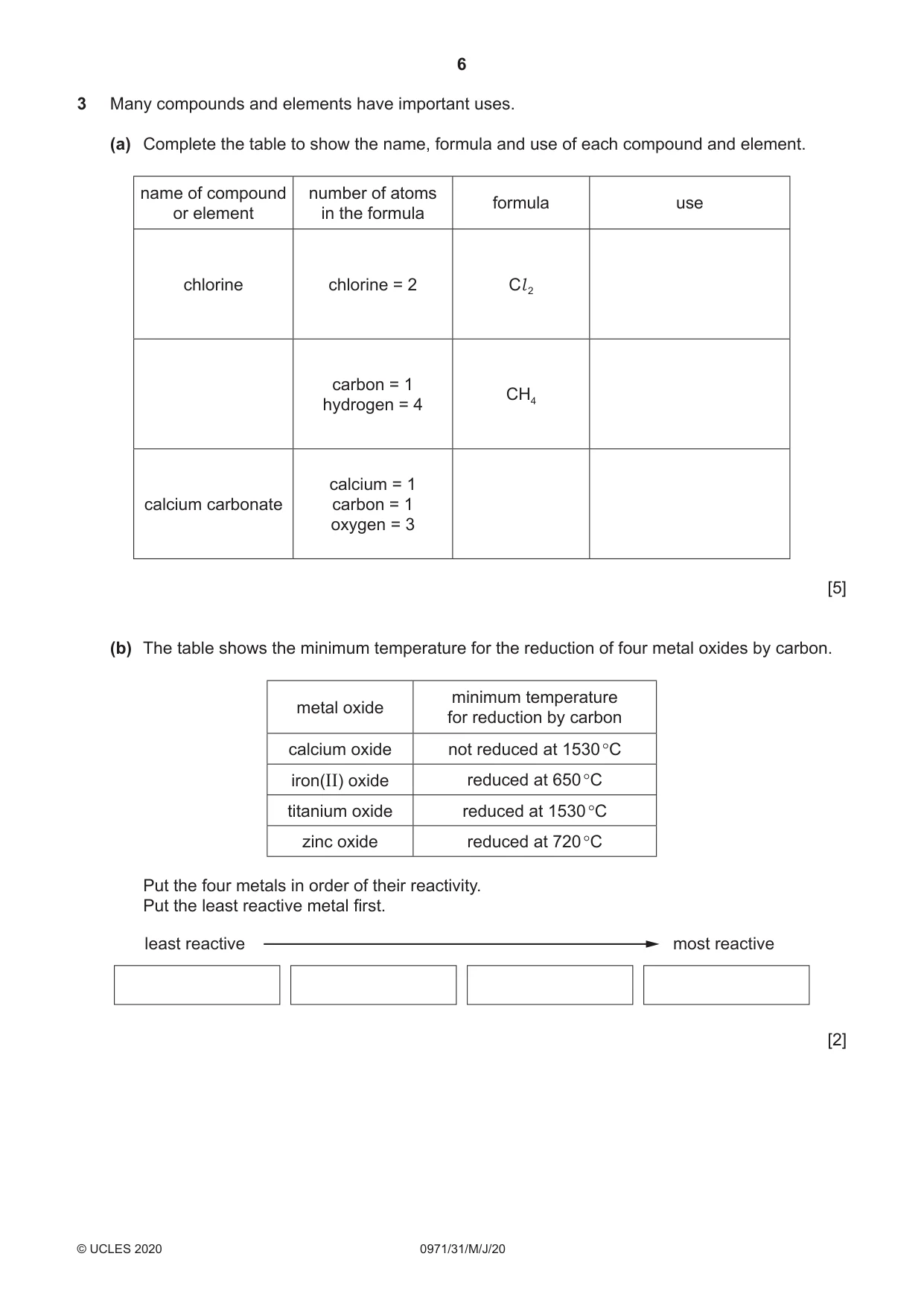
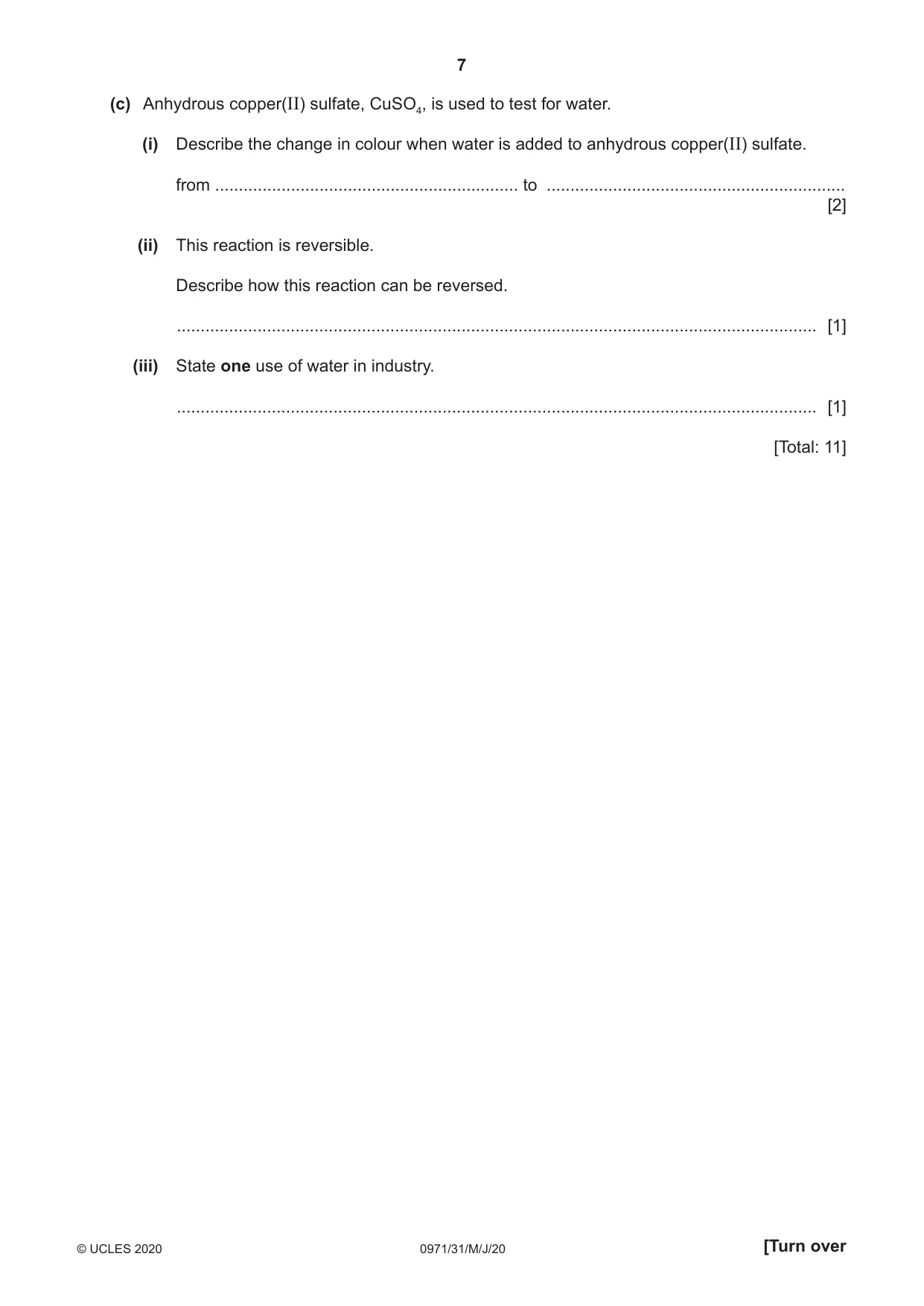
3 Many compounds and elements have important uses. (a) Complete the table to show the name, formula and use of each compound and element. name of compound number of atoms formula use or element in the formula chlorine chlorine = 2 Cl 2 carbon = 1 CH4 hydrogen = 4 calcium = 1 calcium carbonate carbon = 1 oxygen = 3 [5] (b) The table shows the minimum temperature for the reduction of four metal oxides by carbon. minimum temperature metal oxide for reduction by carbon calcium oxide not reduced at 1530 °C iron(II) oxide reduced at 650 °C titanium oxide reduced at 1530 °C zinc oxide reduced at 720 °C Put the four metals in order of their reactivity. Put the least reactive metal first. least reactive most reactive [2] (c) Anhydrous copper(II) sulfate, CuSO4, is used to test for water. (i) Describe the change in colour when water is added to anhydrous copper(II) sulfate. from ................................................................ to ................................................................ [2] (ii) This reaction is reversible. Describe how this reaction can be reversed. ....................................................................................................................................... [1] (iii) State one use of water in industry. ....................................................................................................................................... [1] [Total: 11]
Mark scheme: 3(a) treating water / killing bacteria methane (1) fuel CaCO3 (1) iron extraction / making cement / neutralising (acidic) soil 5 3(b) iron < zinc < titanium < calcium IF two marks not scored, one mark for one consecutive pair reversed / all reversed 2 3(c)(i) (from) white (to) blue 2 3(c)(ii) heat / warm 1 3(c)(iii) cooling / coolant / as a solvent 1
Q4 · The properties of five alkenes at room temperature are shown in the table
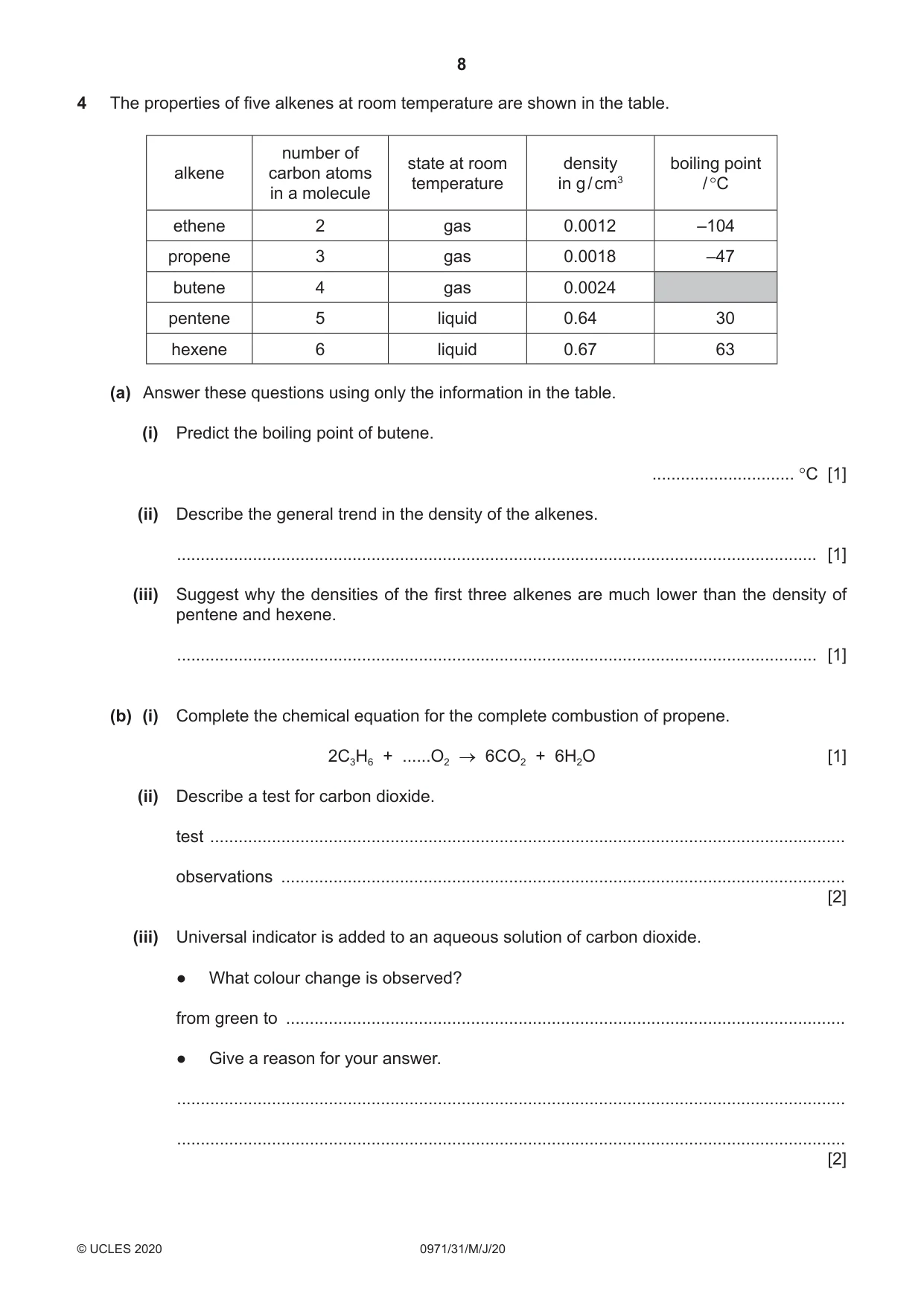
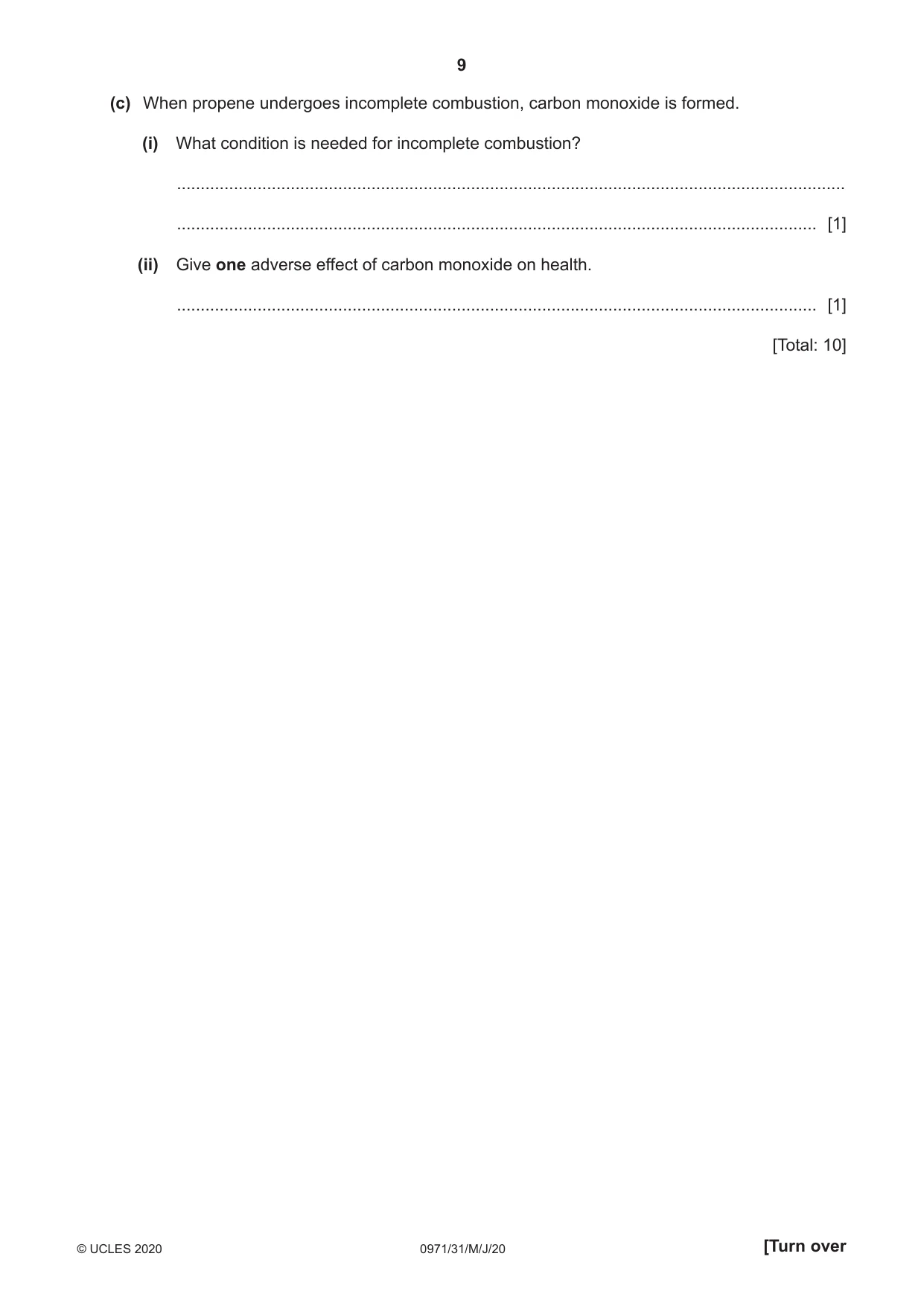
4 The properties of five alkenes at room temperature are shown in the table. number of state at room density boiling point alkene carbon atoms temperature in g / cm3 / °C in a molecule ethene 2 gas 0.0012 –104 propene 3 gas 0.0018 –47 butene 4 gas 0.0024 pentene 5 liquid 0.64 30 hexene 6 liquid 0.67 63 (a) Answer these questions using only the information in the table. (i) Predict the boiling point of butene. .............................. °C [1] (ii) Describe the general trend in the density of the alkenes. ....................................................................................................................................... [1] (iii) Suggest why the densities of the first three alkenes are much lower than the density of pentene and hexene. ....................................................................................................................................... [1] (b) (i) Complete the chemical equation for the complete combustion of propene. 2C3H6 + ......O2 → 6CO2 + 6H2O [1] (ii) Describe a test for carbon dioxide. test ...................................................................................................................................... observations ........................................................................................................................ [2] (iii) Universal indicator is added to an aqueous solution of carbon dioxide. ●● What colour change is observed? from green to ....................................................................................................................... ●● Give a reason for your answer. ............................................................................................................................................. ............................................................................................................................................. [2] (c) When propene undergoes incomplete combustion, carbon monoxide is formed. (i) What condition is needed for incomplete combustion? ............................................................................................................................................. ....................................................................................................................................... [1] (ii) Give one adverse effect of carbon monoxide on health. ....................................................................................................................................... [1] [Total: 10]
Mark scheme: 4(a)(i) values between – 46°C and 29°C (inclusive) 1 4(a)(ii) increases as the number of carbon atoms increases / increases as the alkenes get bigger (or longer) 1 4(a)(iii) they are gases (at room temperature and pressure) 1 Question Answer Marks 4(b)(i) 9 (O2) 1 4(b)(ii) limewater / aqueous calcium hydroxide turns milky / turns cloudy / white precipitate 2 4(b)(iii) (green to) yellow carbon dioxide is an acidic oxide 2 4(c)(i) (combustion in) limited oxygen 1 4(c)(ii) poisonous / toxic 1
Q5 · When concentrated hydrochloric acid is electrolysed, gases are produced at the electrodes
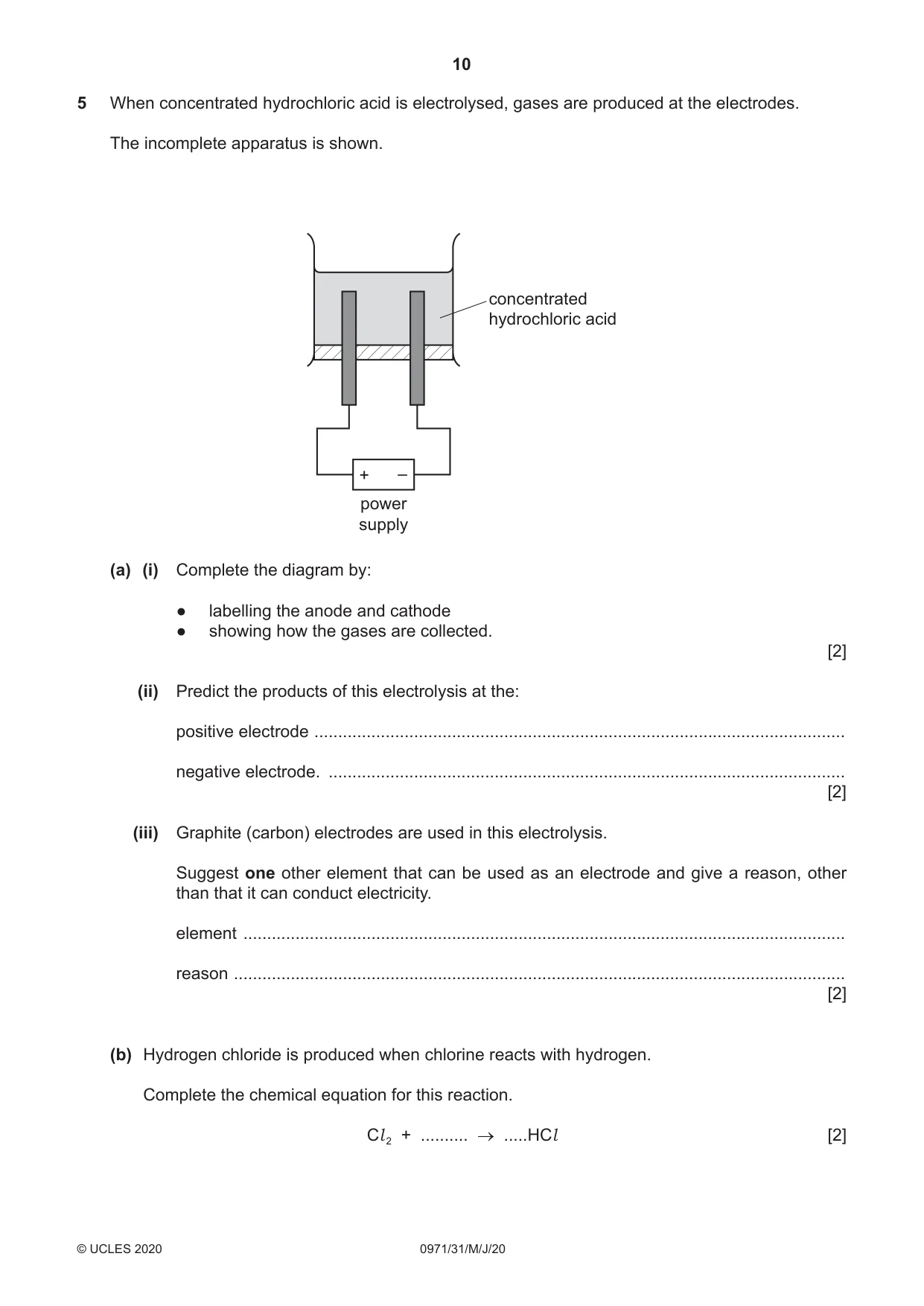
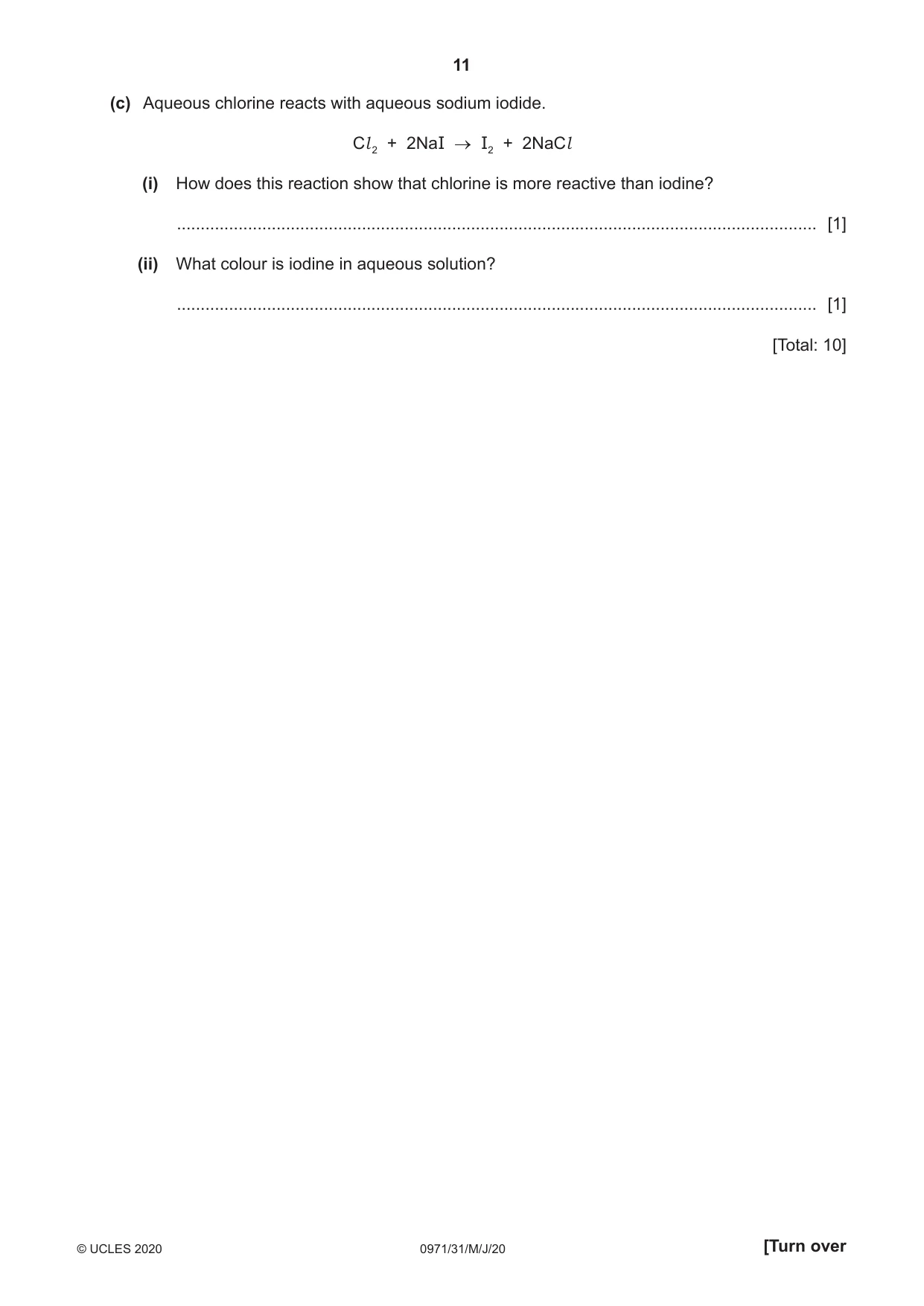
5 When concentrated hydrochloric acid is electrolysed, gases are produced at the electrodes. The incomplete apparatus is shown. concentrated hydrochloric acid + – power supply (a) (i) Complete the diagram by: ●● labelling the anode and cathode ●● showing how the gases are collected. [2] (ii) Predict the products of this electrolysis at the: positive electrode ................................................................................................................ negative electrode. .............................................................................................................. [2] (iii) Graphite (carbon) electrodes are used in this electrolysis. Suggest one other element that can be used as an electrode and give a reason, other than that it can conduct electricity. element ............................................................................................................................... reason ................................................................................................................................. [2] (b) Hydrogen chloride is produced when chlorine reacts with hydrogen. Complete the chemical equation for this reaction. Cl 2 + .......... → .....HCl [2] (c) Aqueous chlorine reacts with aqueous sodium iodide. Cl 2 + 2NaI → I2 + 2NaCl (i) How does this reaction show that chlorine is more reactive than iodine? ....................................................................................................................................... [1] (ii) What colour is iodine in aqueous solution? ....................................................................................................................................... [1] [Total: 10]
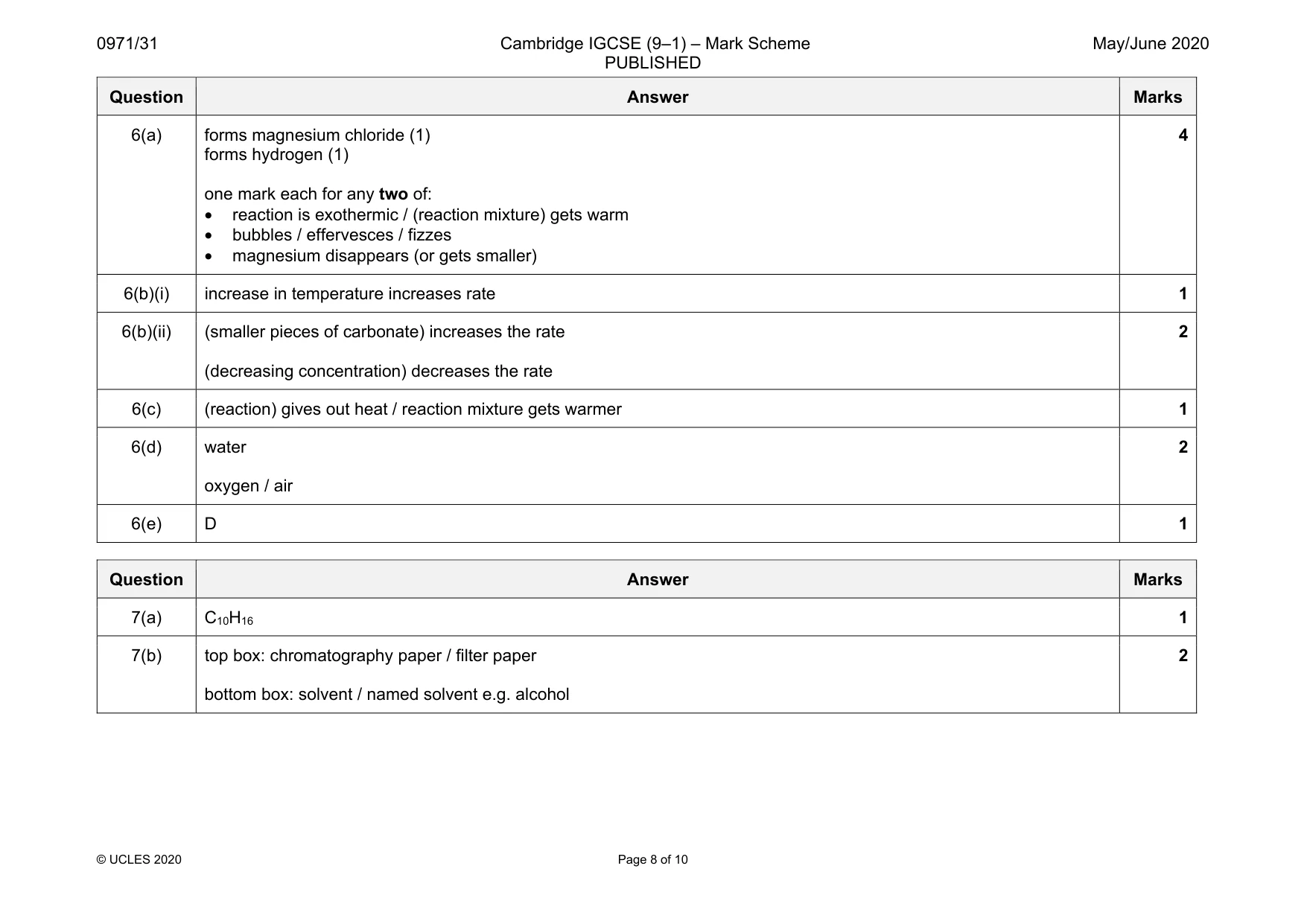
Mark scheme: 5(a)(i) anode (on left) and cathode (on right) correctly labelled test tubes / measuring cylinders over each electrode with open ends dipping into the electrolyte 2 5(a)(ii) positive electrode: chlorine / Cl2 negative electrode: hydrogen / H2 2 5(a)(iii) platinum inert / unreactive 2 5(b) H2 (on left) 2 (HCl) (on right) 2 5(c)(i) chlorine has displaced iodine in sodium iodide / chlorine has taken the place of iodine in sodium iodide 1 5(c)(ii) brown 1
Q6 · Acids have characteristic properties
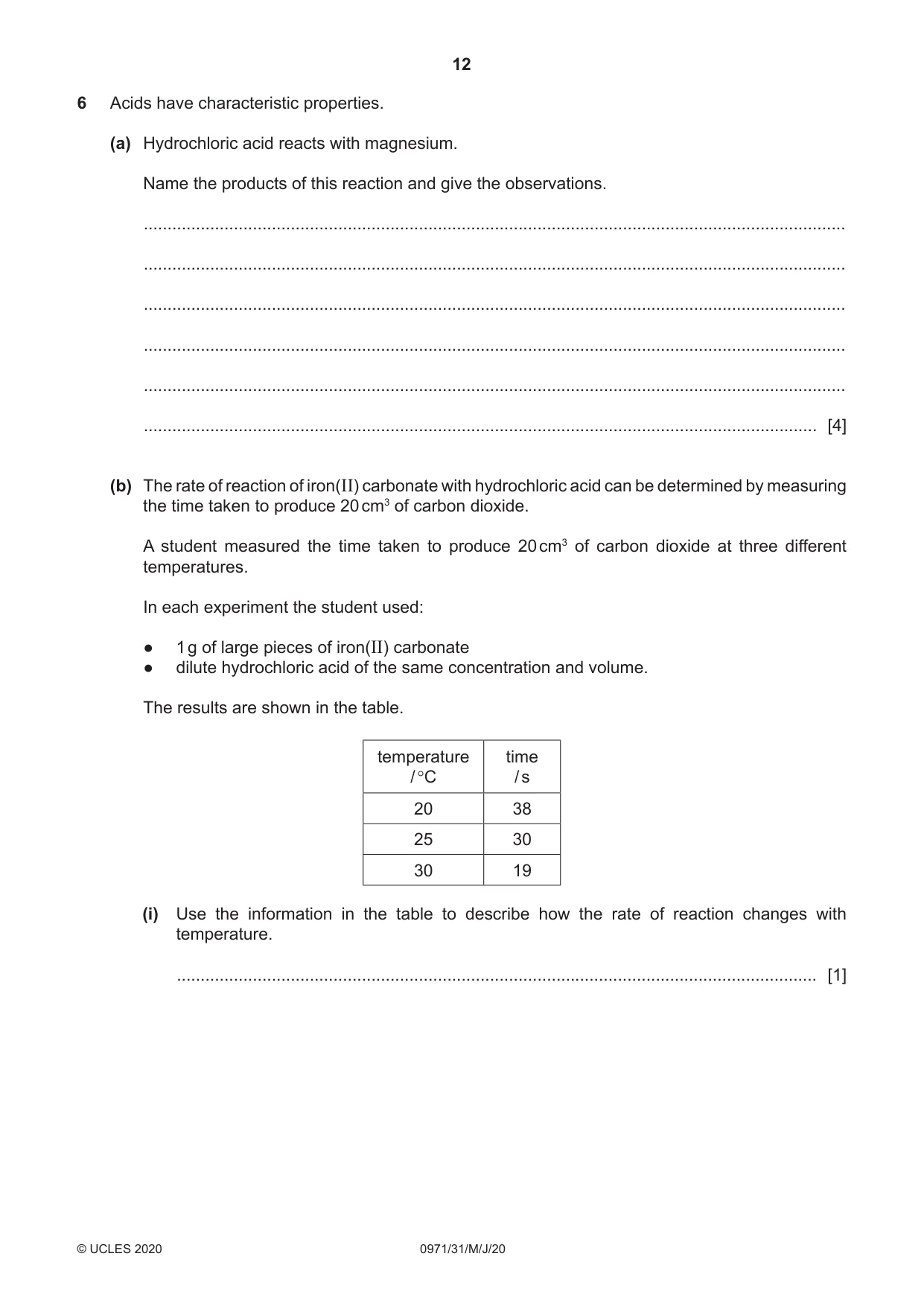
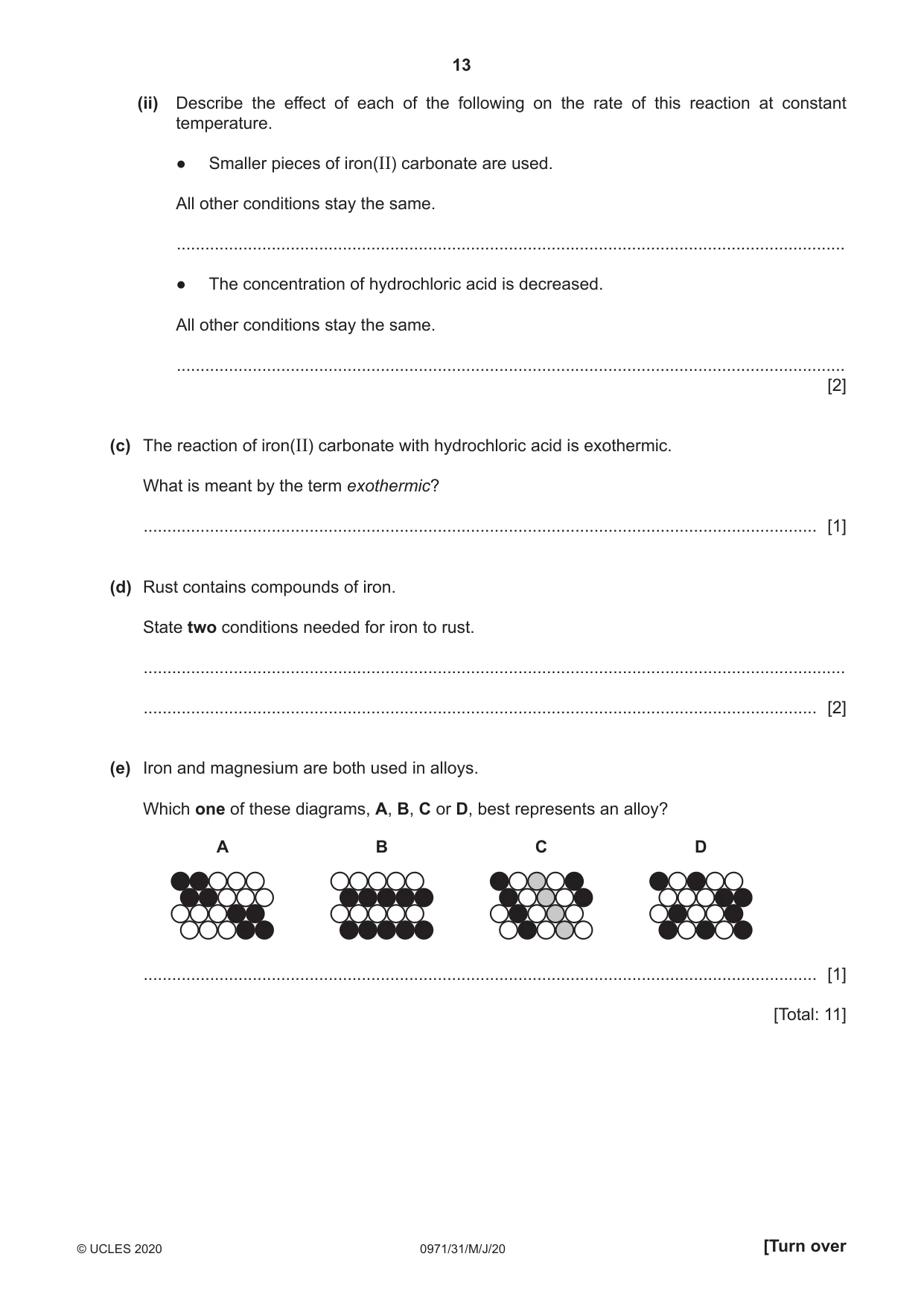
6 Acids have characteristic properties. (a) Hydrochloric acid reacts with magnesium. Name the products of this reaction and give the observations. .................................................................................................................................................... .................................................................................................................................................... .................................................................................................................................................... .................................................................................................................................................... .................................................................................................................................................... .............................................................................................................................................. [4] (b) The rate of reaction of iron(II) carbonate with hydrochloric acid can be determined by measuring the time taken to produce 20 cm3 of carbon dioxide. A student measured the time taken to produce 20 cm3 of carbon dioxide at three different temperatures. In each experiment the student used: ●● 1 g of large pieces of iron(II) carbonate ●● dilute hydrochloric acid of the same concentration and volume. The results are shown in the table. temperature time / °C / s 20 38 25 30 30 19 (i) Use the information in the table to describe how the rate of reaction changes with temperature. ....................................................................................................................................... [1] (ii) Describe the effect of each of the following on the rate of this reaction at constant temperature. ●● Smaller pieces of iron(II) carbonate are used. All other conditions stay the same. ............................................................................................................................................. ●● The concentration of hydrochloric acid is decreased. All other conditions stay the same. ............................................................................................................................................. [2] (c) The reaction of iron(II) carbonate with hydrochloric acid is exothermic. What is meant by the term exothermic? .............................................................................................................................................. [1] (d) Rust contains compounds of iron. State two conditions needed for iron to rust. .................................................................................................................................................... .............................................................................................................................................. [2] (e) Iron and magnesium are both used in alloys. Which one of these diagrams, A, B, C or D, best represents an alloy? A B C D .............................................................................................................................................. [1] [Total: 11]
Mark scheme: 6(a) forms magnesium chloride (1) forms hydrogen (1) one mark each for any two of: • reaction is exothermic / (reaction mixture) gets warm • bubbles / effervesces / fizzes • magnesium disappears (or gets smaller) 4 6(b)(i) increase in temperature increases rate 1 6(b)(ii) (smaller pieces of carbonate) increases the rate (decreasing concentration) decreases the rate 2 6(c) (reaction) gives out heat / reaction mixture gets warmer 1 6(d) water oxygen / air 2 6(e) D 1
More questions on The characteristic properties of acids and bases
Q7 · The structure of myrcene is shown
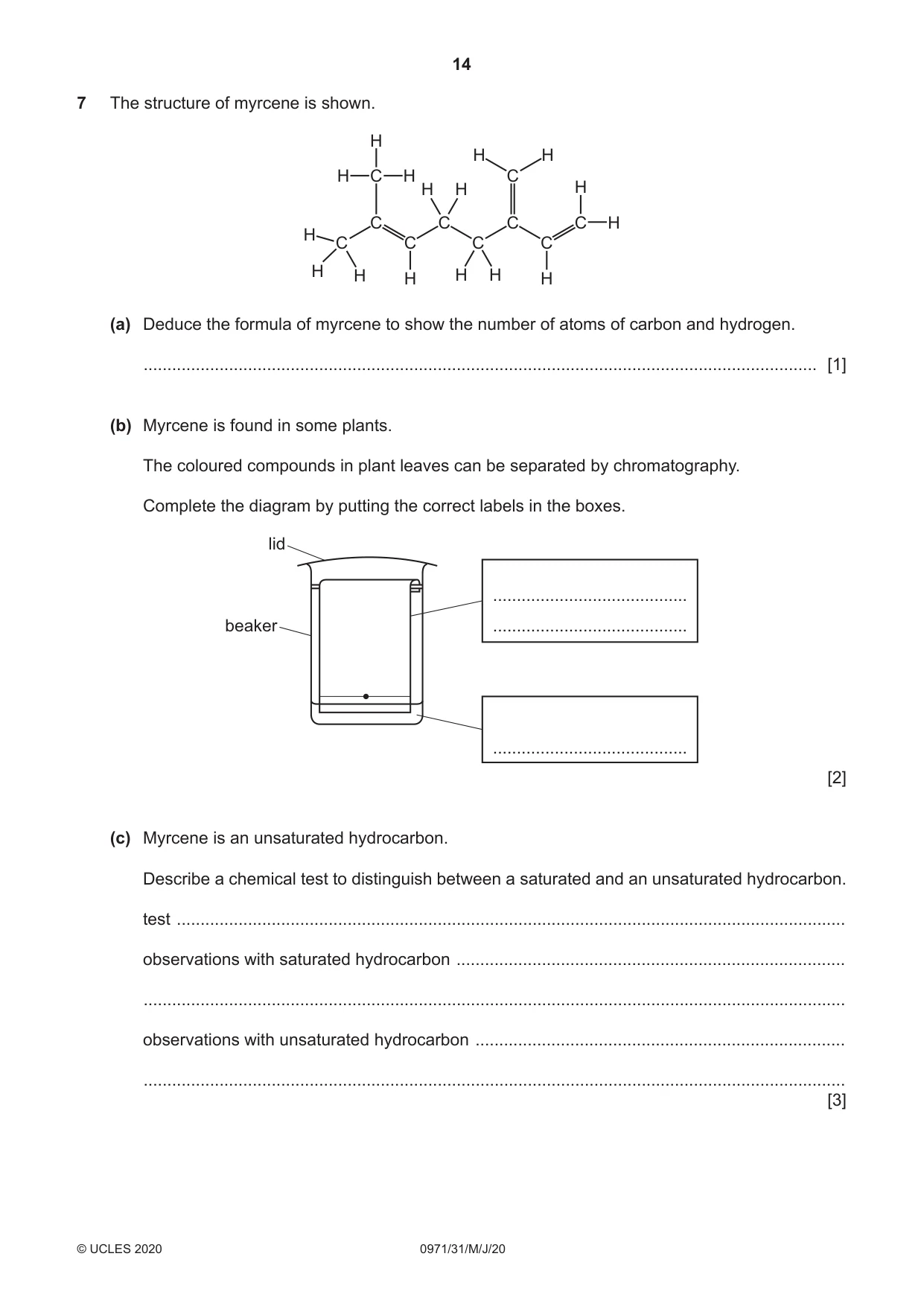
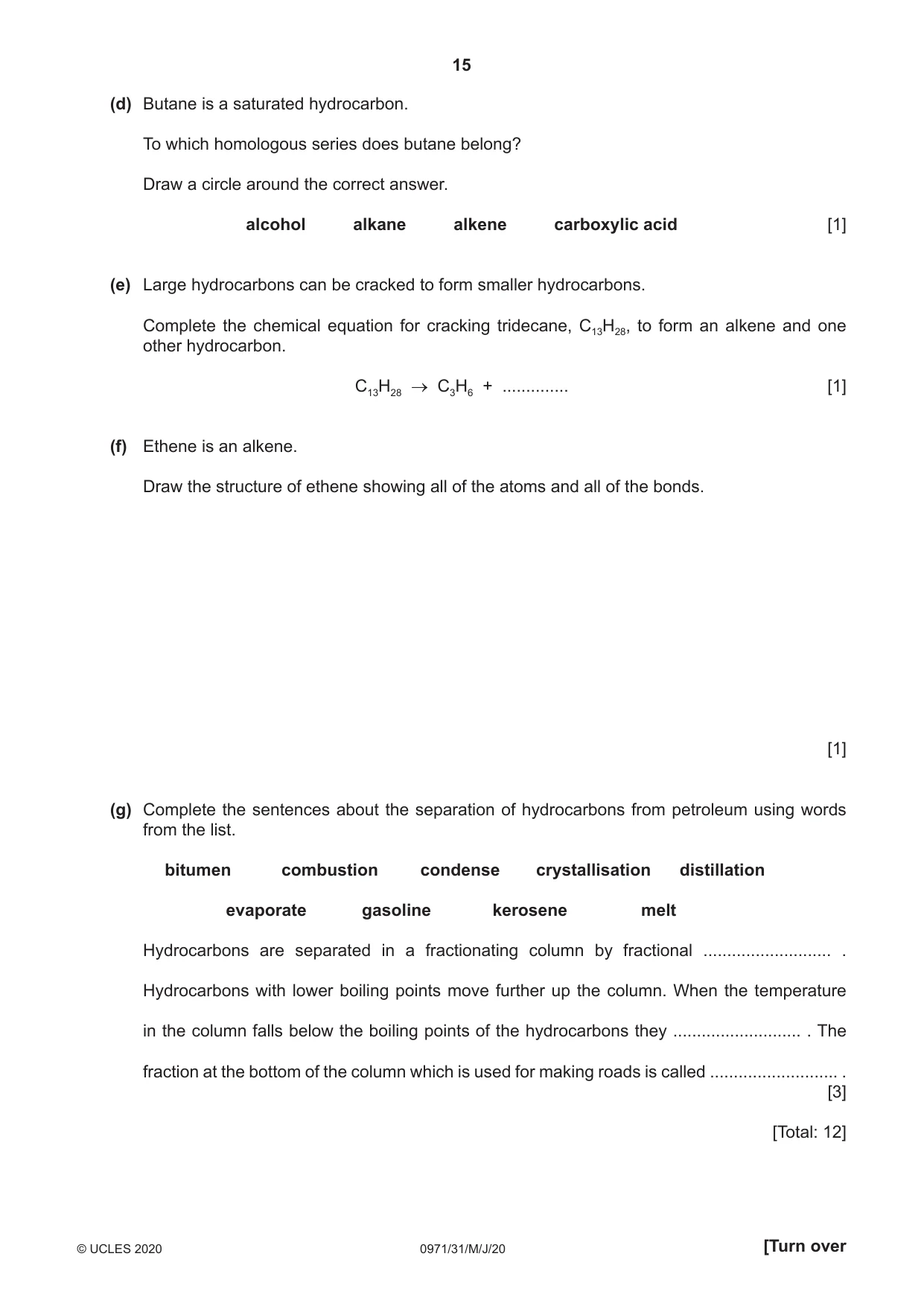
7 The structure of myrcene is shown. H H H H C H C H H H C C C C H H C C C C H H H H H H (a) Deduce the formula of myrcene to show the number of atoms of carbon and hydrogen. .............................................................................................................................................. [1] (b) Myrcene is found in some plants. The coloured compounds in plant leaves can be separated by chromatography. Complete the diagram by putting the correct labels in the boxes. lid ......................................... beaker ......................................... ......................................... [2] (c) Myrcene is an unsaturated hydrocarbon. Describe a chemical test to distinguish between a saturated and an unsaturated hydrocarbon. test ............................................................................................................................................. observations with saturated hydrocarbon .................................................................................. .................................................................................................................................................... observations with unsaturated hydrocarbon .............................................................................. .................................................................................................................................................... [3] (d) Butane is a saturated hydrocarbon. To which homologous series does butane belong? Draw a circle around the correct answer. alcohol alkane alkene carboxylic acid [1] (e) Large hydrocarbons can be cracked to form smaller hydrocarbons. Complete the chemical equation for cracking tridecane, C13H28, to form an alkene and one other hydrocarbon. C13H28 → C3H6 + .............. [1] (f) Ethene is an alkene. Draw the structure of ethene showing all of the atoms and all of the bonds. [1] (g) Complete the sentences about the separation of hydrocarbons from petroleum using words from the list. bitumen combustion condense crystallisation distillation evaporate gasoline kerosene melt Hydrocarbons are separated in a fractionating column by fractional ........................... . Hydrocarbons with lower boiling points move further up the column. When the temperature in the column falls below the boiling points of the hydrocarbons they ........................... . The fraction at the bottom of the column which is used for making roads is called ........................... . [3] [Total: 12]
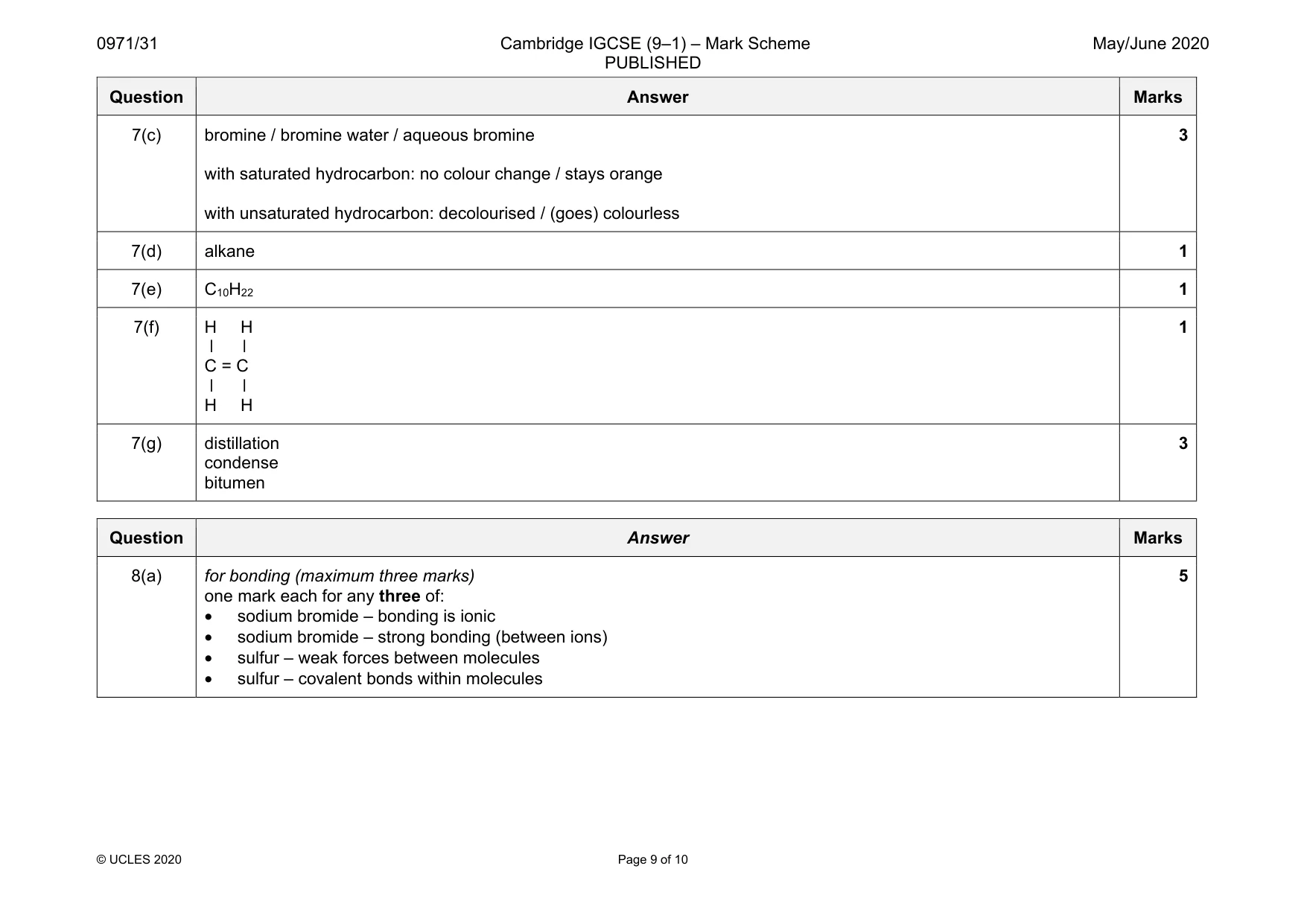
Mark scheme: 7(a) C10H16 1 7(b) top box: chromatography paper / filter paper bottom box: solvent / named solvent e.g. alcohol 2 Question Answer Marks 7(c) bromine / bromine water / aqueous bromine with saturated hydrocarbon: no colour change / stays orange with unsaturated hydrocarbon: decolourised / (goes) colourless 3 7(d) alkane 1 7(e) C10H22 1 7(f) H H ǀ ǀ C = C ǀ ǀ H H 1 7(g) distillation condense bitumen 3
Q8 · The diagram shows part of the structures of sodium bromide and sulfur
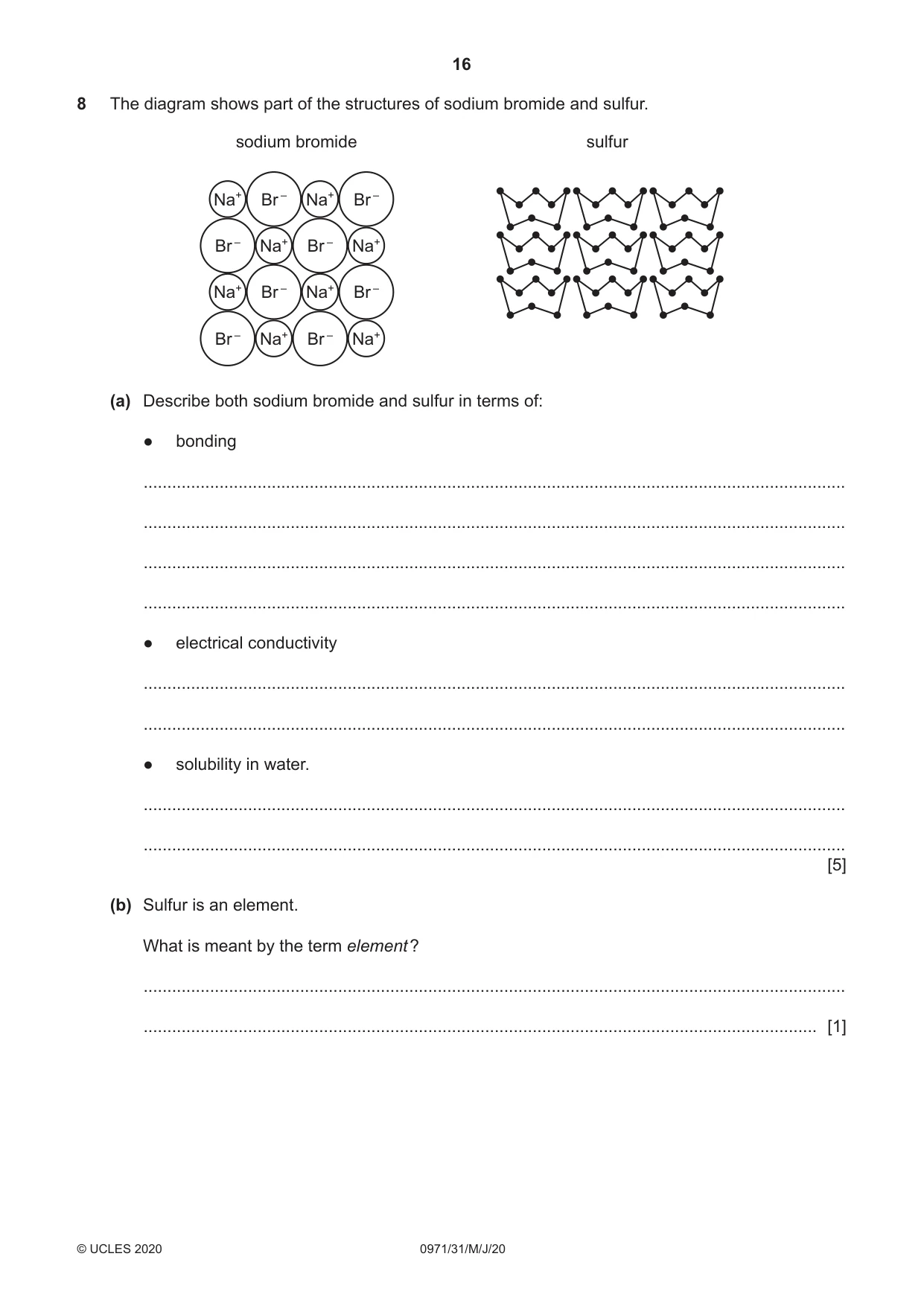
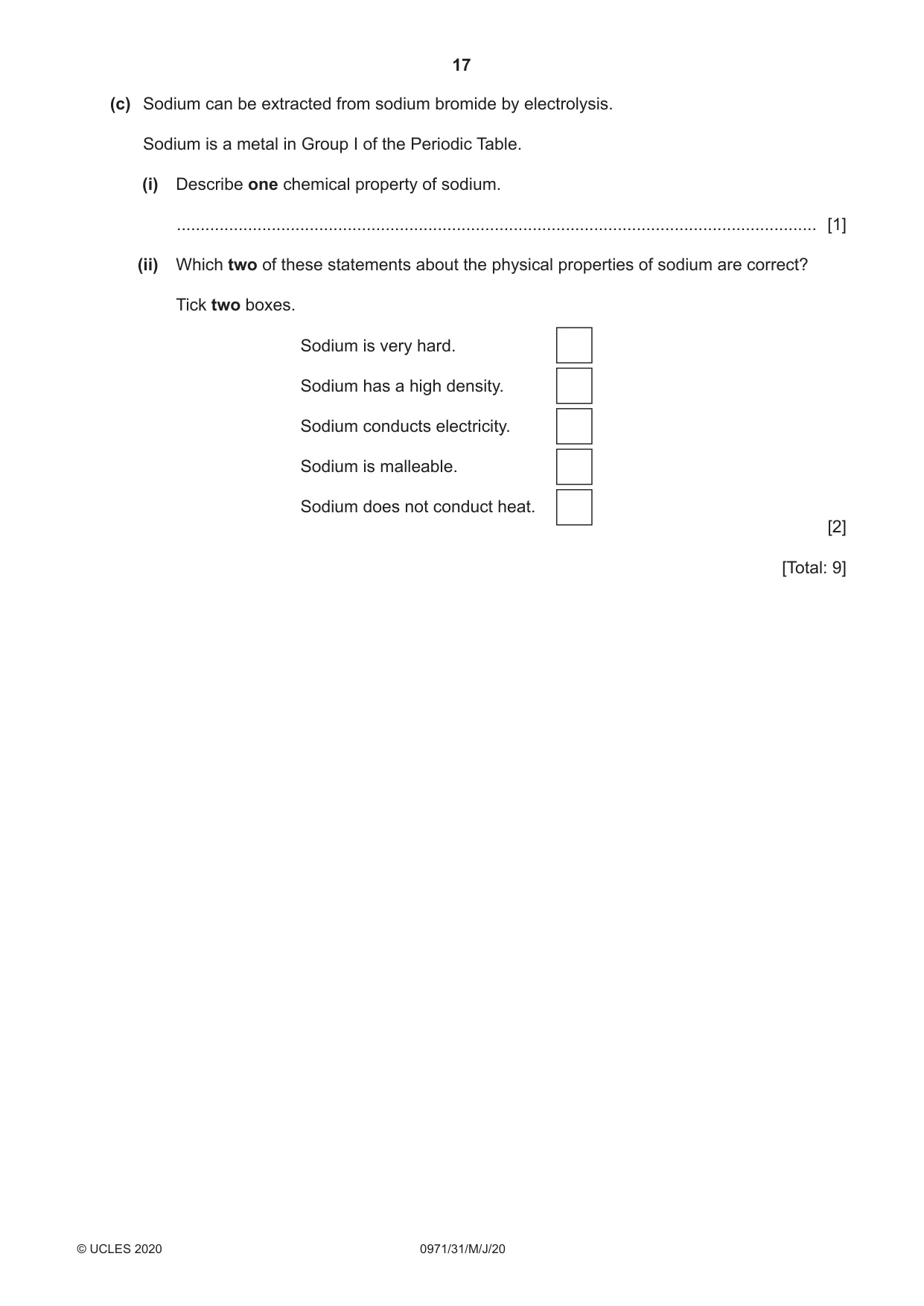
8 The diagram shows part of the structures of sodium bromide and sulfur. sodium bromide sulfur Na+ Br – Na+ Br – Br – Na+ Br – Na+ Na+ Br – Na+ Br – Br – Na+ Br – Na+ (a) Describe both sodium bromide and sulfur in terms of: ●● bonding .................................................................................................................................................... .................................................................................................................................................... .................................................................................................................................................... .................................................................................................................................................... ●● electrical conductivity .................................................................................................................................................... .................................................................................................................................................... ●● solubility in water. .................................................................................................................................................... .................................................................................................................................................... [5] (b) Sulfur is an element. What is meant by the term element ? .................................................................................................................................................... .............................................................................................................................................. [1] (c) Sodium can be extracted from sodium bromide by electrolysis. Sodium is a metal in Group I of the Periodic Table. (i) Describe one chemical property of sodium. ....................................................................................................................................... [1] (ii) Which two of these statements about the physical properties of sodium are correct? Tick two boxes. Sodium is very hard. Sodium has a high density. Sodium conducts electricity. Sodium is malleable. Sodium does not conduct heat. [2] [Total: 9]
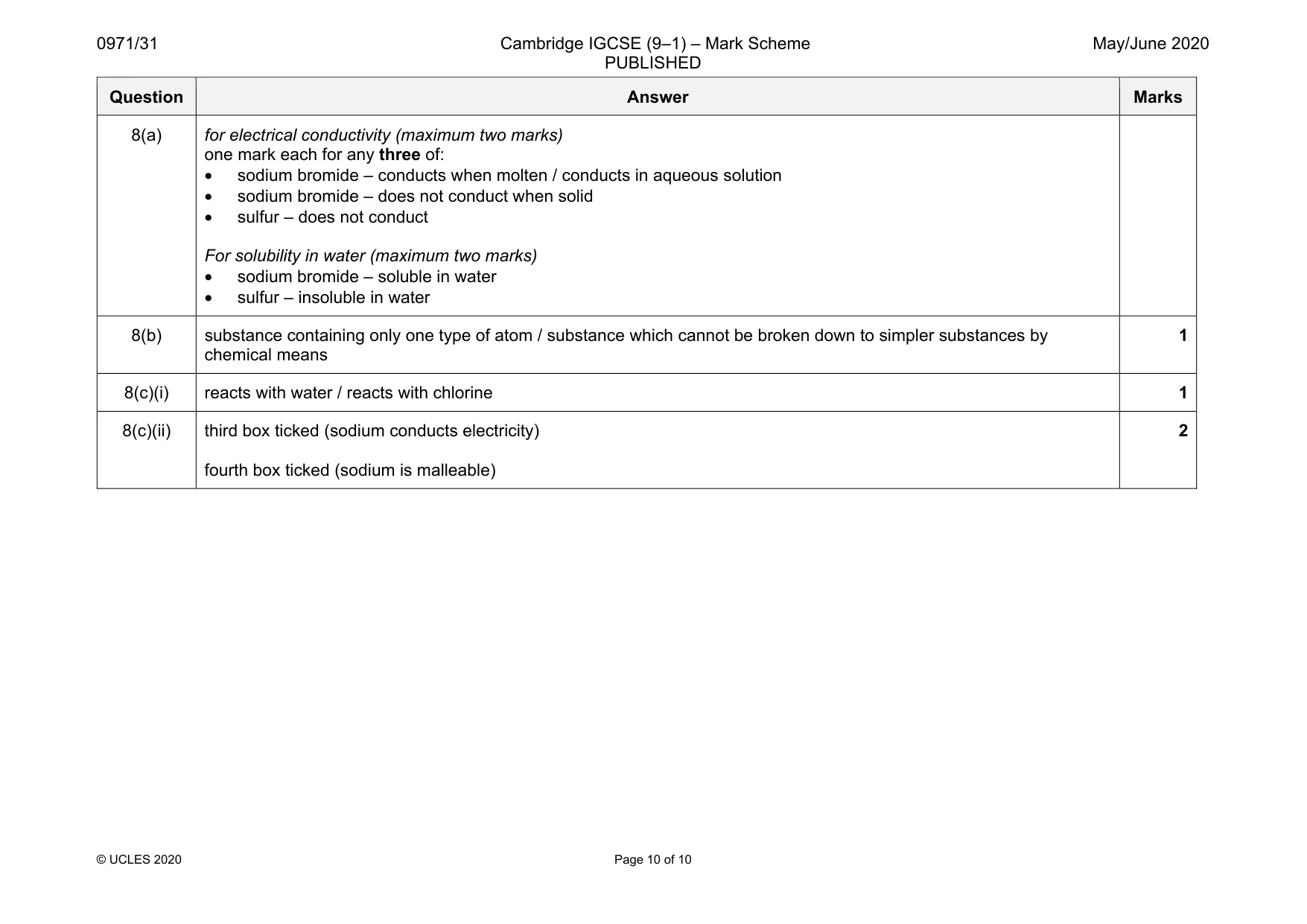
Mark scheme: 8(a) for bonding (maximum three marks) one mark each for any three of: • sodium bromide – bonding is ionic • sodium bromide – strong bonding (between ions) • sulfur – weak forces between molecules • sulfur – covalent bonds within molecules 5 Question Answer Marks 8(a) for electrical conductivity (maximum two marks) one mark each for any three of: • sodium bromide – conducts when molten / conducts in aqueous solution • sodium bromide – does not conduct when solid • sulfur – does not conduct For solubility in water (maximum two marks) • sodium bromide – soluble in water • sulfur – insoluble in water 8(b) substance containing only one type of atom / substance which cannot be broken down to simpler substances by chemical means 1 8(c)(i) reacts with water / reacts with chlorine 1 8(c)(ii) third box ticked (sodium conducts electricity) fourth box ticked (sodium is malleable) 2
What was in this paper
The subtopics covered by these 8 questions, and how many questions each got. Open one in a new tab to see every Cambridge question on it.