Cambridge IGCSE Chemistry (9-1) 0971 — 2024 May/June Paper 3 · Variant 1
0971/31/M/J/24 · 8 questions · 80 marks · 75 min
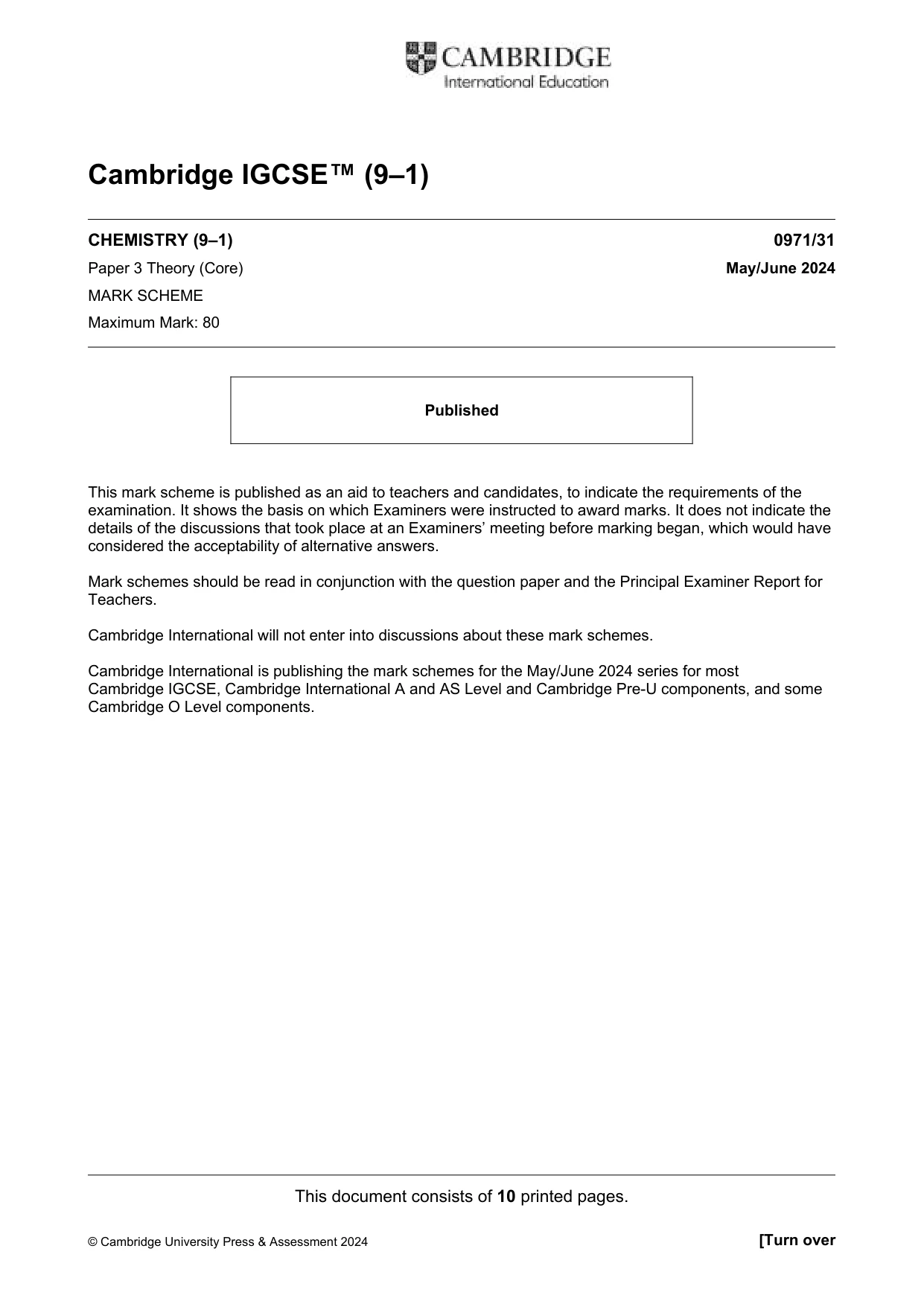
The question paper and its mark scheme, free to read here and free to download. This is Cambridge’s own paper, exactly as it was sat.
Question paper20 pages



Mark scheme10 pages
Answers below. Sit the paper first if you are practising.
Questions as text
Q1 · The structures of seven substances, A, B, C, D, E, F and G
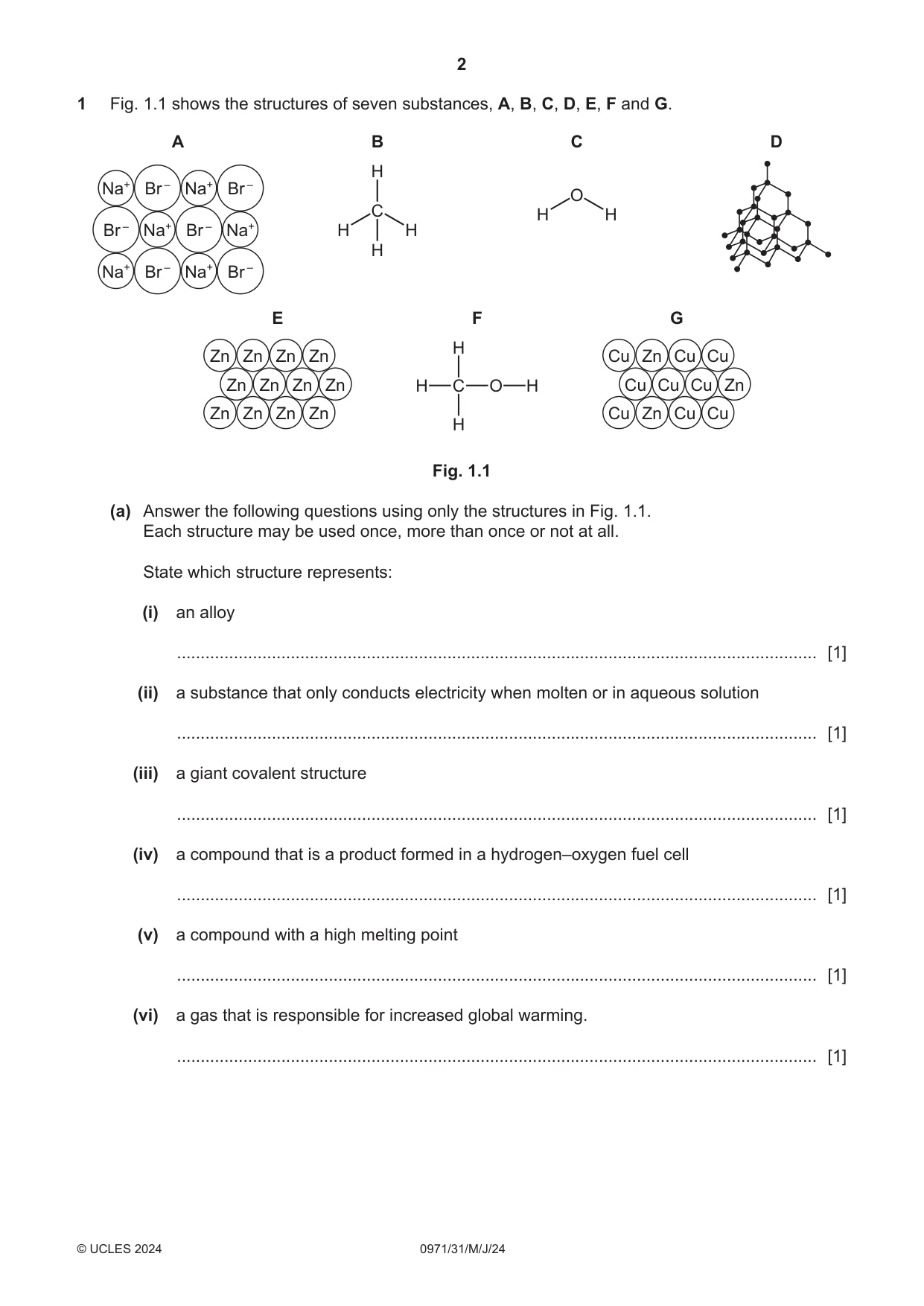
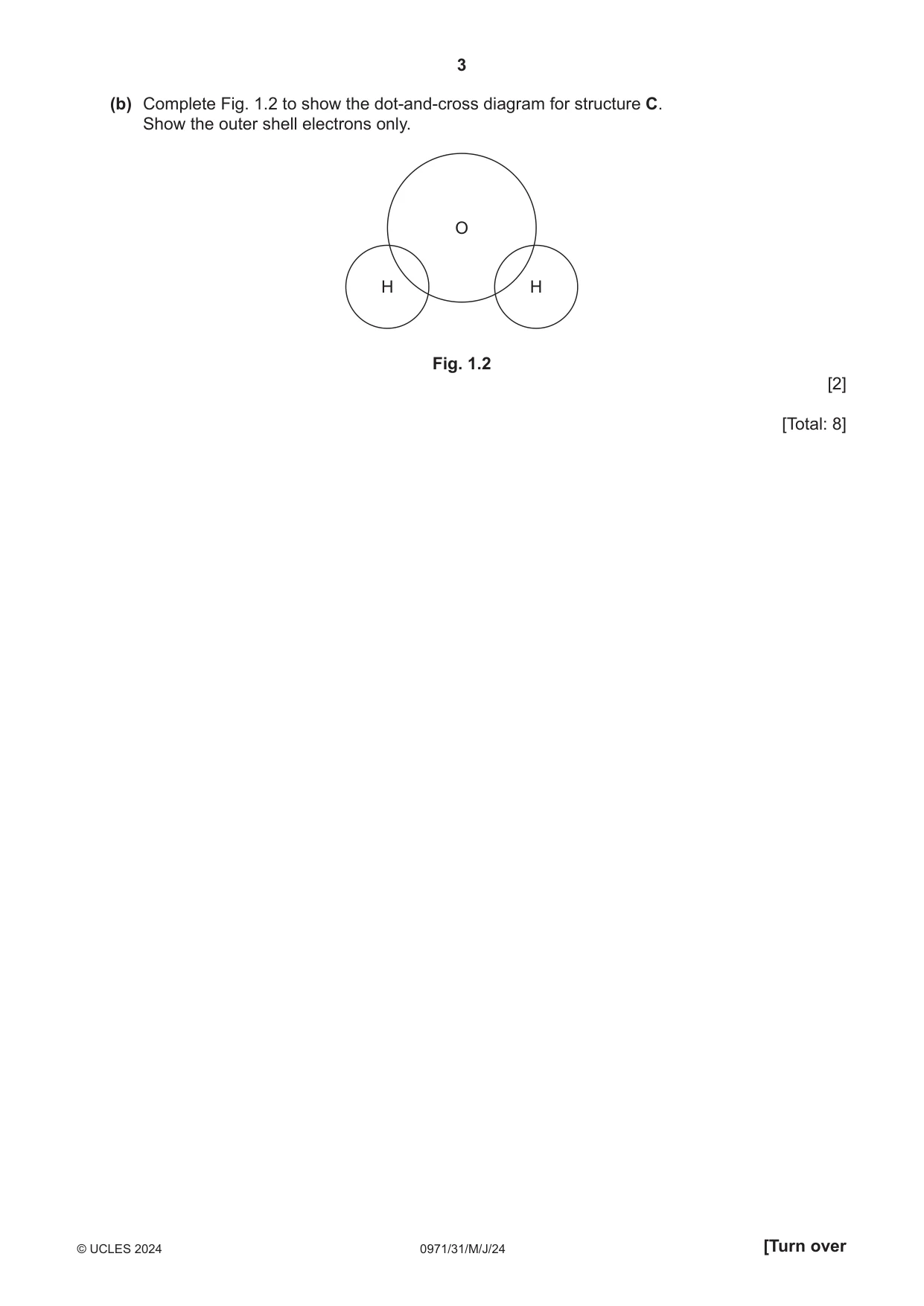
1 Fig. 1.1 shows the structures of seven substances, A, B, C, D, E, F and G. A B C D H Na+ Br – Na+ Br – O C H H Br – Na+ Br – Na+ H H H Na+ Br – Na+ Br – E F G H Zn Zn Zn Zn Cu Zn Cu Cu Zn Zn Zn Zn H C O H Cu Cu Cu Zn Zn Zn Zn Zn Cu Zn Cu Cu H Fig. 1.1 (a) Answer the following questions using only the structures in Fig. 1.1. Each structure may be used once, more than once or not at all. State which structure represents: (i) an alloy ....................................................................................................................................... [1] (ii) a substance that only conducts electricity when molten or in aqueous solution ....................................................................................................................................... [1] (iii) a giant covalent structure ....................................................................................................................................... [1] (iv) a compound that is a product formed in a hydrogen–oxygen fuel cell ....................................................................................................................................... [1] (v) a compound with a high melting point ....................................................................................................................................... [1] (vi) a gas that is responsible for increased global warming. ....................................................................................................................................... [1] (b) Complete Fig. 1.2 to show the dot-and-cross diagram for structure C. Show the outer shell electrons only. O H H Fig. 1.2 [2] [Total: 8]
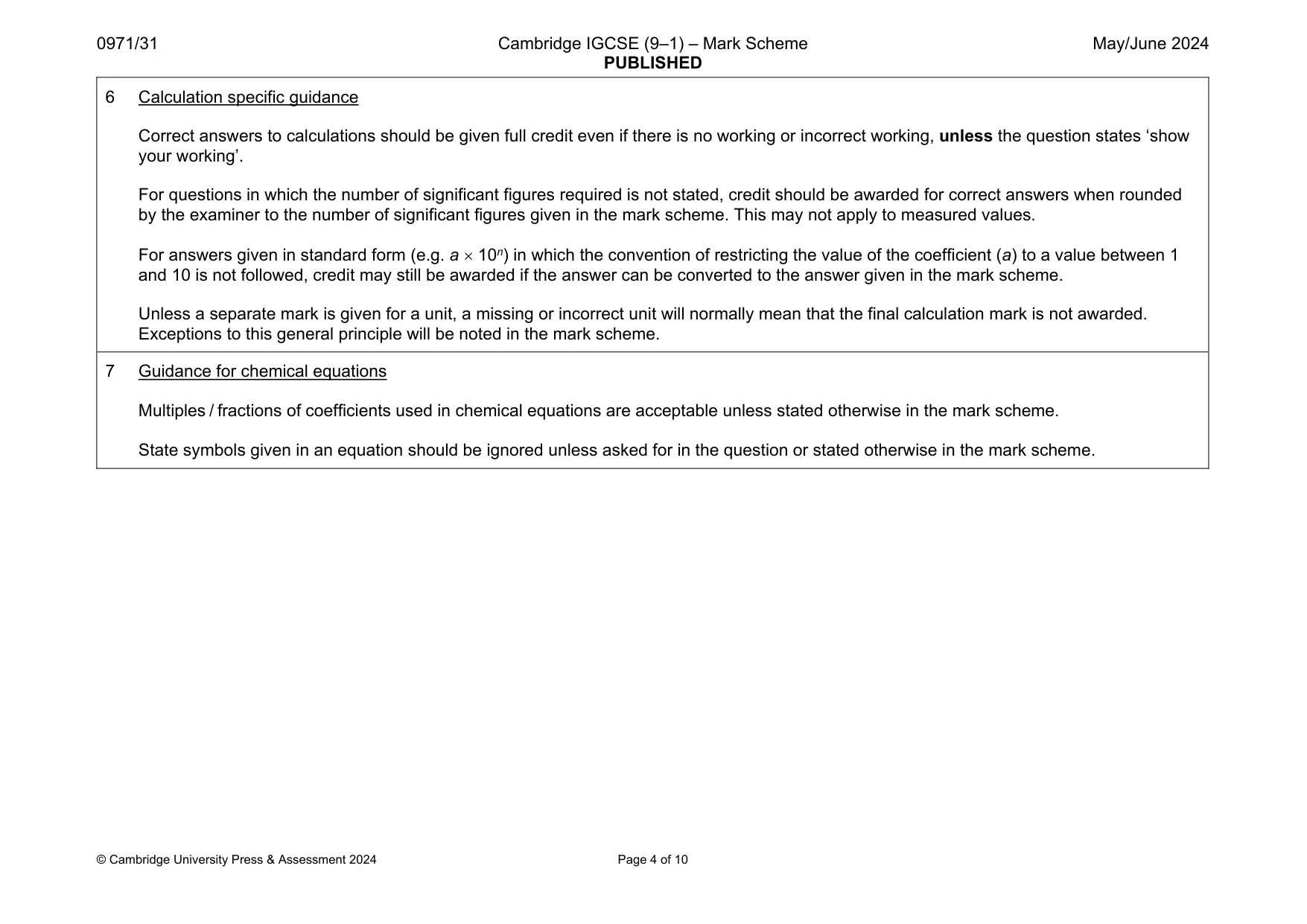
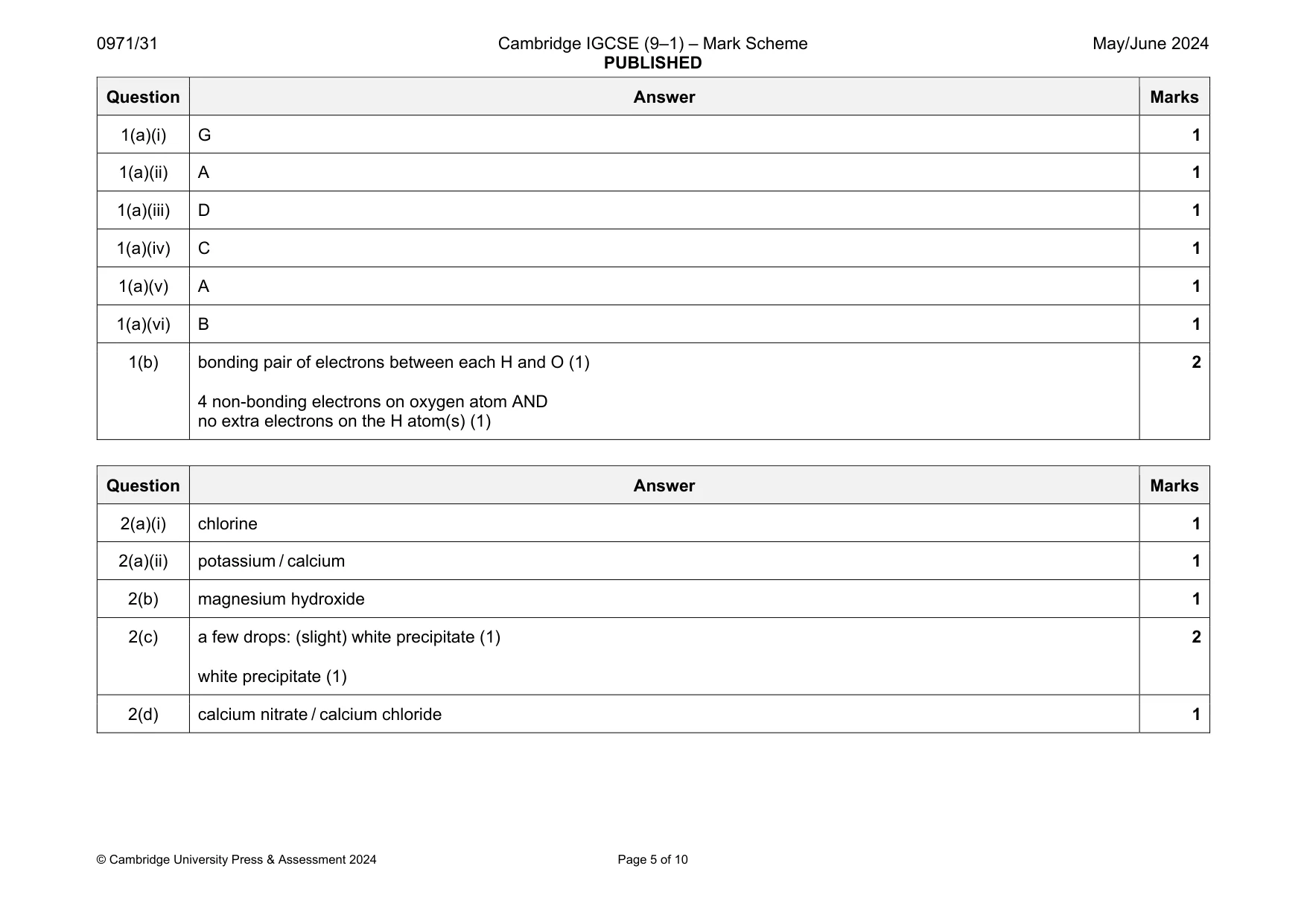
Mark scheme: 1(a)(i) G 1 1(a)(ii) A 1 1(a)(iii) D 1 1(a)(iv) C 1 1(a)(v) A 1 1(a)(vi) B 1 1(b) bonding pair of electrons between each H and O (1) 4 non-bonding electrons on oxygen atom AND no extra electrons on the H atom(s) (1) 2
Q2 · The percentages by mass of the elements present in the human body
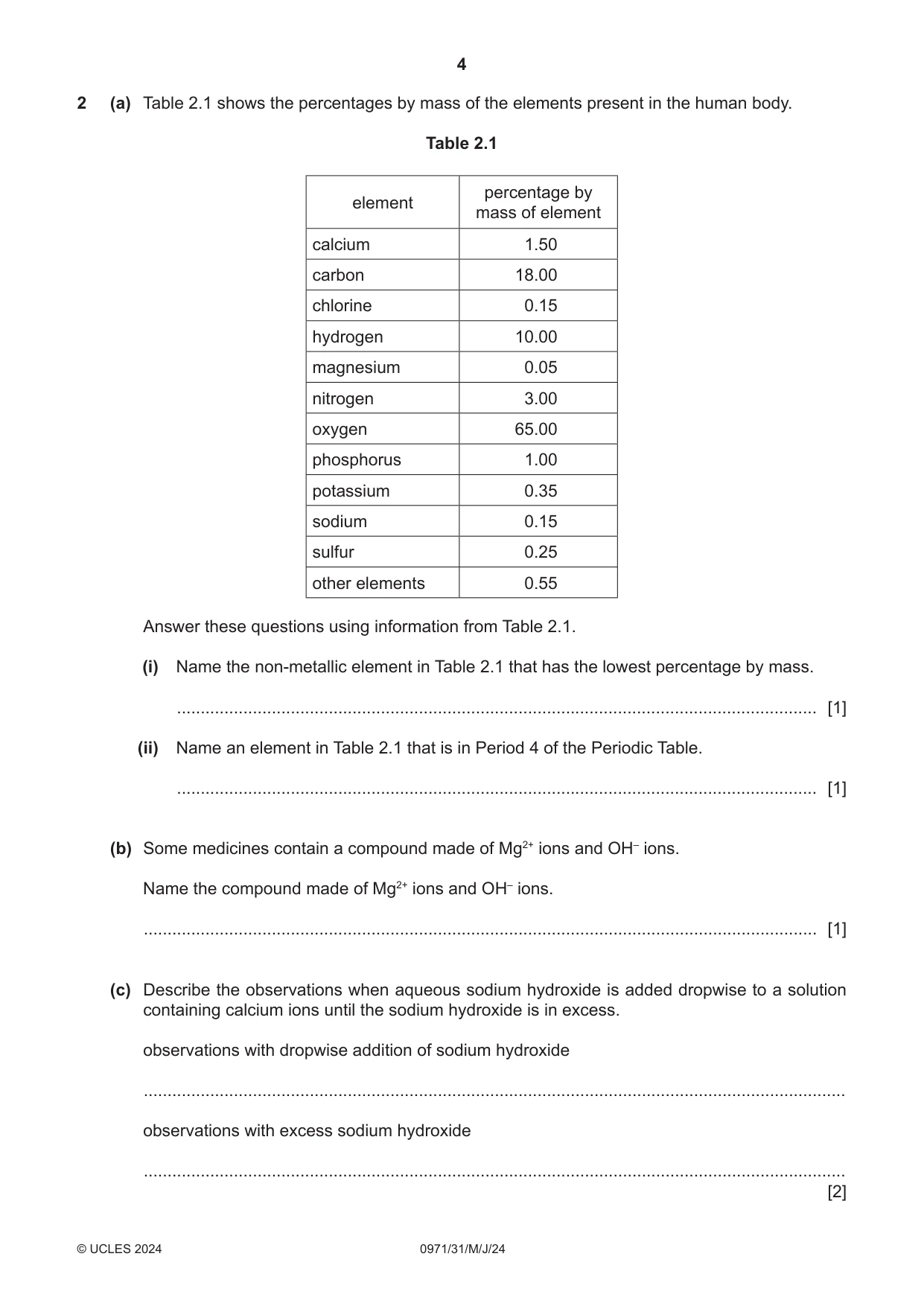
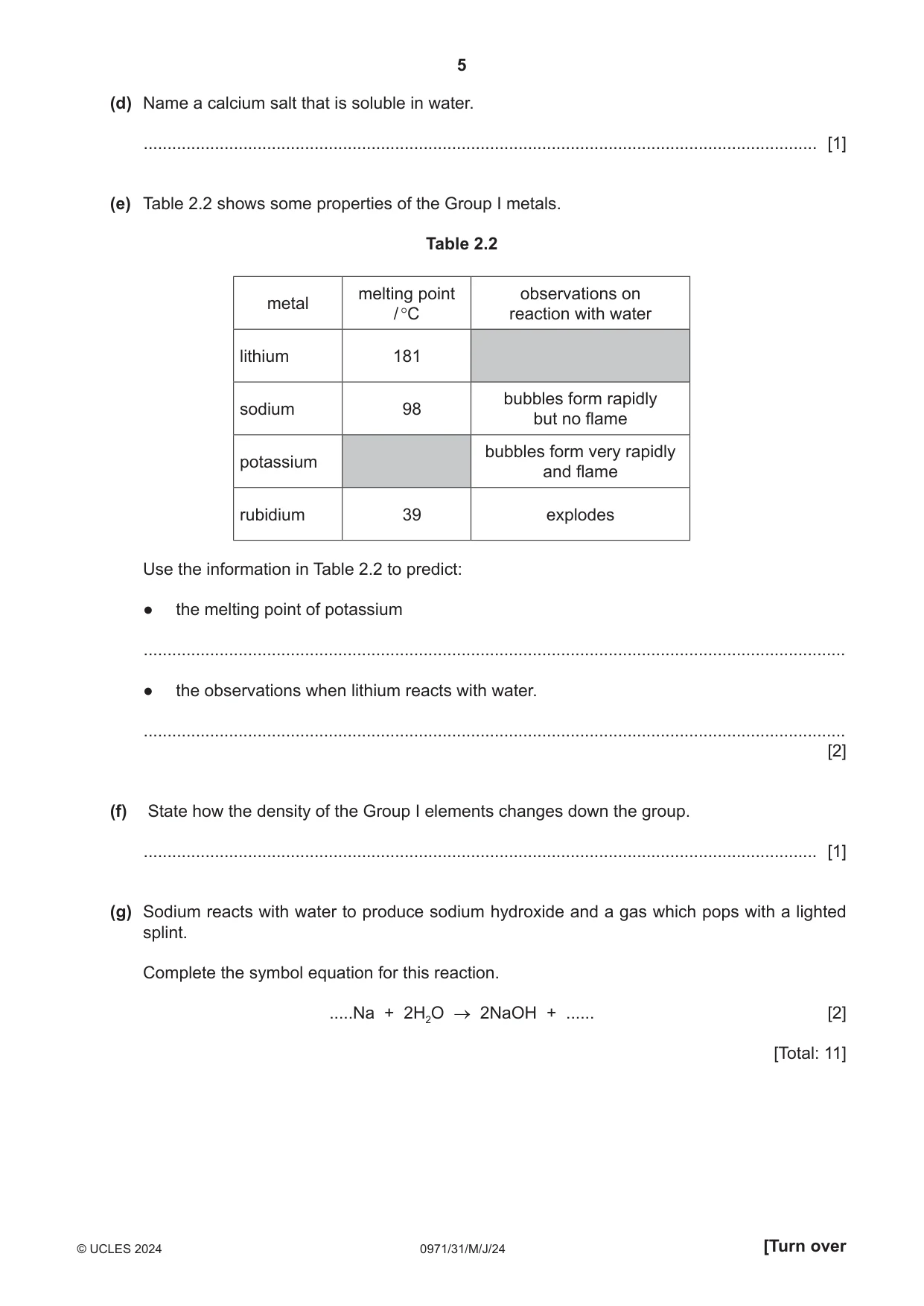
2 (a) Table 2.1 shows the percentages by mass of the elements present in the human body. Table 2.1 percentage by element mass of element calcium 1.50 carbon 18.00 chlorine 0.15 hydrogen 10.00 magnesium 0.05 nitrogen 3.00 oxygen 65.00 phosphorus 1.00 potassium 0.35 sodium 0.15 sulfur 0.25 other elements 0.55 Answer these questions using information from Table 2.1. (i) Name the non-metallic element in Table 2.1 that has the lowest percentage by mass. ....................................................................................................................................... [1] (ii) Name an element in Table 2.1 that is in Period 4 of the Periodic Table. ....................................................................................................................................... [1] (b) Some medicines contain a compound made of Mg2+ ions and OH– ions. Name the compound made of Mg2+ ions and OH– ions. .............................................................................................................................................. [1] (c) Describe the observations when aqueous sodium hydroxide is added dropwise to a solution containing calcium ions until the sodium hydroxide is in excess. observations with dropwise addition of sodium hydroxide .................................................................................................................................................... observations with excess sodium hydroxide .................................................................................................................................................... [2] (d) Name a calcium salt that is soluble in water. .............................................................................................................................................. [1] (e) Table 2.2 shows some properties of the Group I metals. Table 2.2 melting point observations on metal / °C reaction with water lithium 181 bubbles form rapidly sodium 98 but no flame bubbles form very rapidly potassium and flame rubidium 39 explodes Use the information in Table 2.2 to predict: ● the melting point of potassium .................................................................................................................................................... ● the observations when lithium reacts with water. .................................................................................................................................................... [2] (f) State how the density of the Group I elements changes down the group. .............................................................................................................................................. [1] (g) Sodium reacts with water to produce sodium hydroxide and a gas which pops with a lighted splint. Complete the symbol equation for this reaction. .....Na + 2H2O → 2NaOH + ...... [2] [Total: 11]
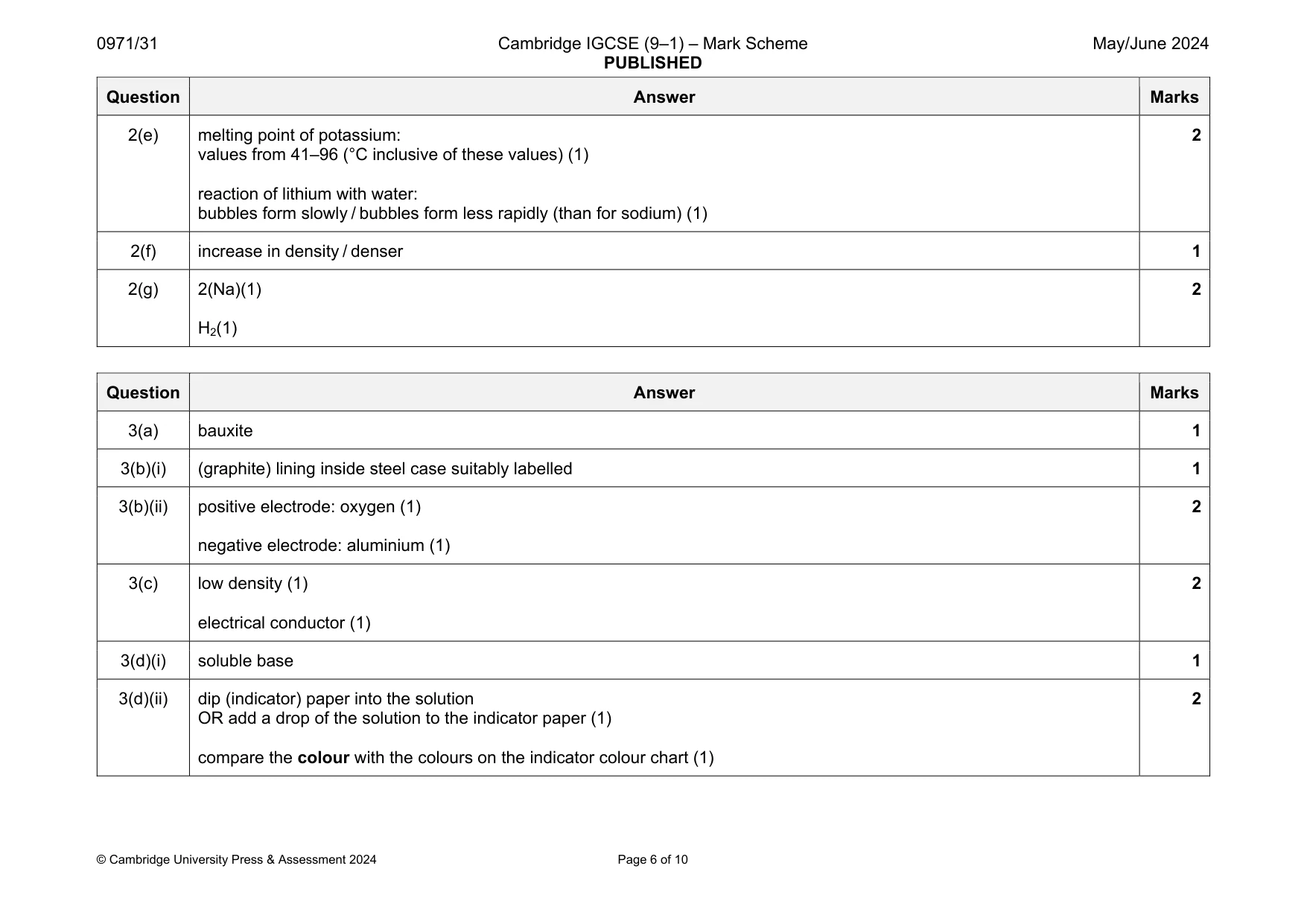
Mark scheme: 2(a)(i) chlorine 1 2(a)(ii) potassium / calcium 1 2(b) magnesium hydroxide 1 2(c) a few drops: (slight) white precipitate (1) white precipitate (1) 2 2(d) calcium nitrate / calcium chloride 1 Question Answer Marks 2(e) melting point of potassium: values from 41–96 (°C inclusive of these values) (1) reaction of lithium with water: bubbles form slowly / bubbles form less rapidly (than for sodium) (1) 2 2(f) increase in density / denser 1 2(g) 2(Na)(1) H2(1) 2
Q3 · Aluminium is extracted by electrolysis of its purified ore
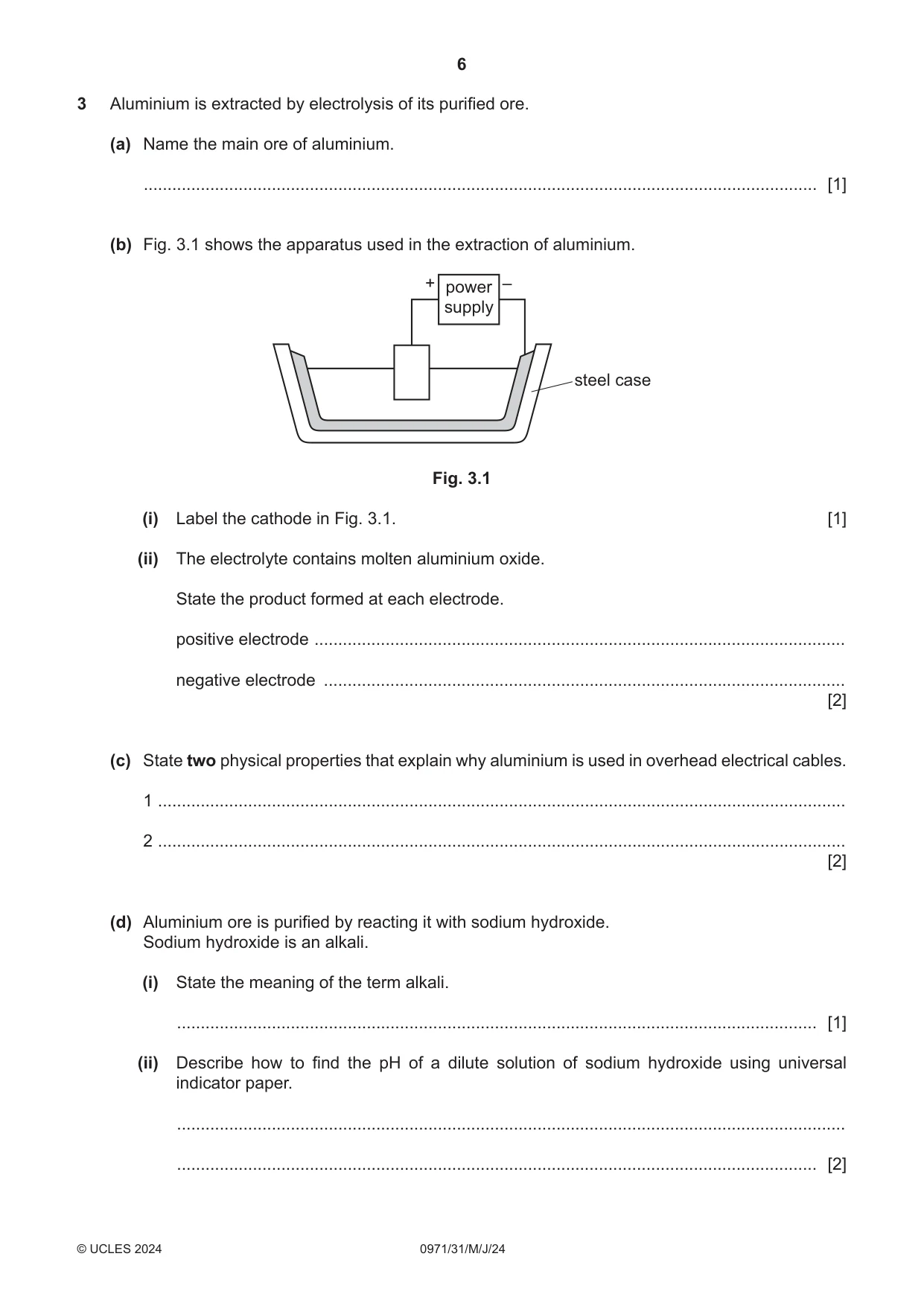
3 Aluminium is extracted by electrolysis of its purified ore. (a) Name the main ore of aluminium. .............................................................................................................................................. [1] (b) Fig. 3.1 shows the apparatus used in the extraction of aluminium. + power – supply steel case Fig. 3.1 (i) Label the cathode in Fig. 3.1. [1] (ii) The electrolyte contains molten aluminium oxide. State the product formed at each electrode. positive electrode ................................................................................................................ negative electrode ............................................................................................................... [2] (c) State two physical properties that explain why aluminium is used in overhead electrical cables. 1 ................................................................................................................................................. 2 ................................................................................................................................................. [2] (d) Aluminium ore is purified by reacting it with sodium hydroxide. Sodium hydroxide is an alkali. (i) State the meaning of the term alkali. ....................................................................................................................................... [1] (ii) Describe how to find the pH of a dilute solution of sodium hydroxide using universal indicator paper. ............................................................................................................................................. ....................................................................................................................................... [2] (iii) A dilute solution of sodium hydroxide is added to a solution of methyl orange in acid until the sodium hydroxide is in excess. State the colour change of the methyl orange. from ............................................................. to ������������������������������������������������������������ [2] [Total: 11]
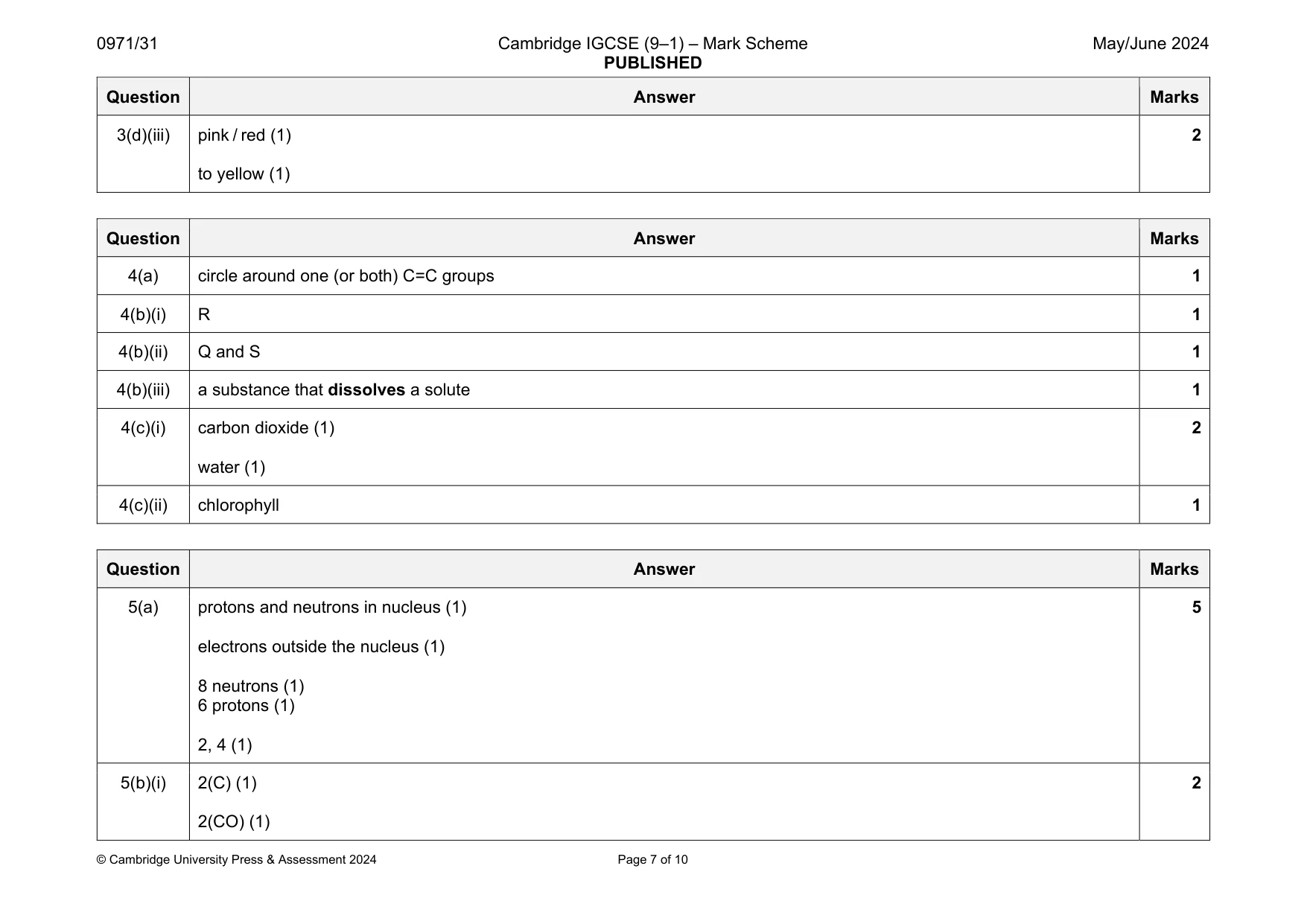
Mark scheme: 3(a) bauxite 1 3(b)(i) (graphite) lining inside steel case suitably labelled 1 3(b)(ii) positive electrode: oxygen (1) negative electrode: aluminium (1) 2 3(c) low density (1) electrical conductor (1) 2 3(d)(i) soluble base 1 3(d)(ii) dip (indicator) paper into the solution OR add a drop of the solution to the indicator paper (1) compare the colour with the colours on the indicator colour chart (1) 2 Question Answer Marks 3(d)(iii) pink / red (1) to yellow (1) 2
More questions on The characteristic properties of acids and bases
Q4 · The displayed formula of a compound extracted from a plant
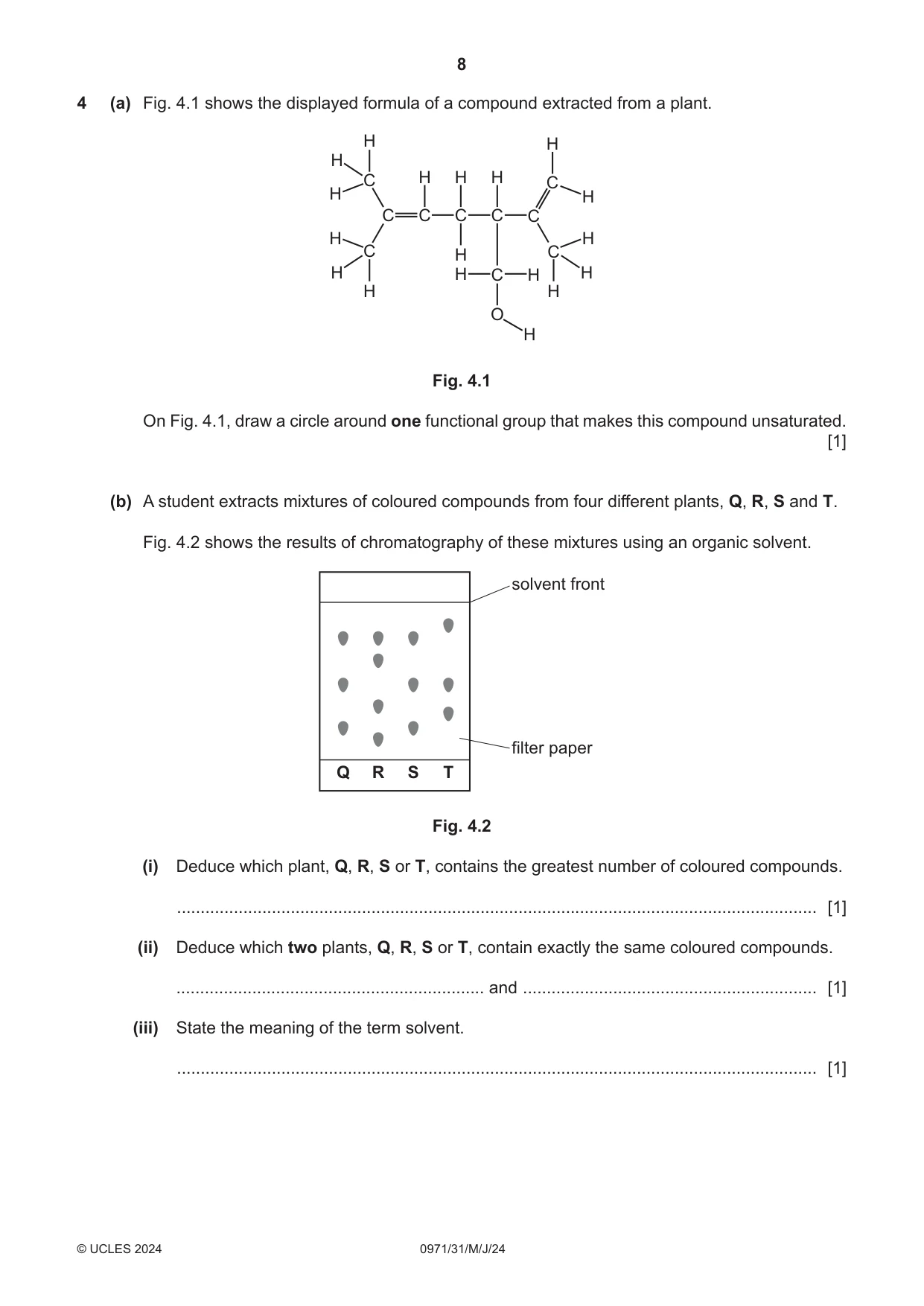
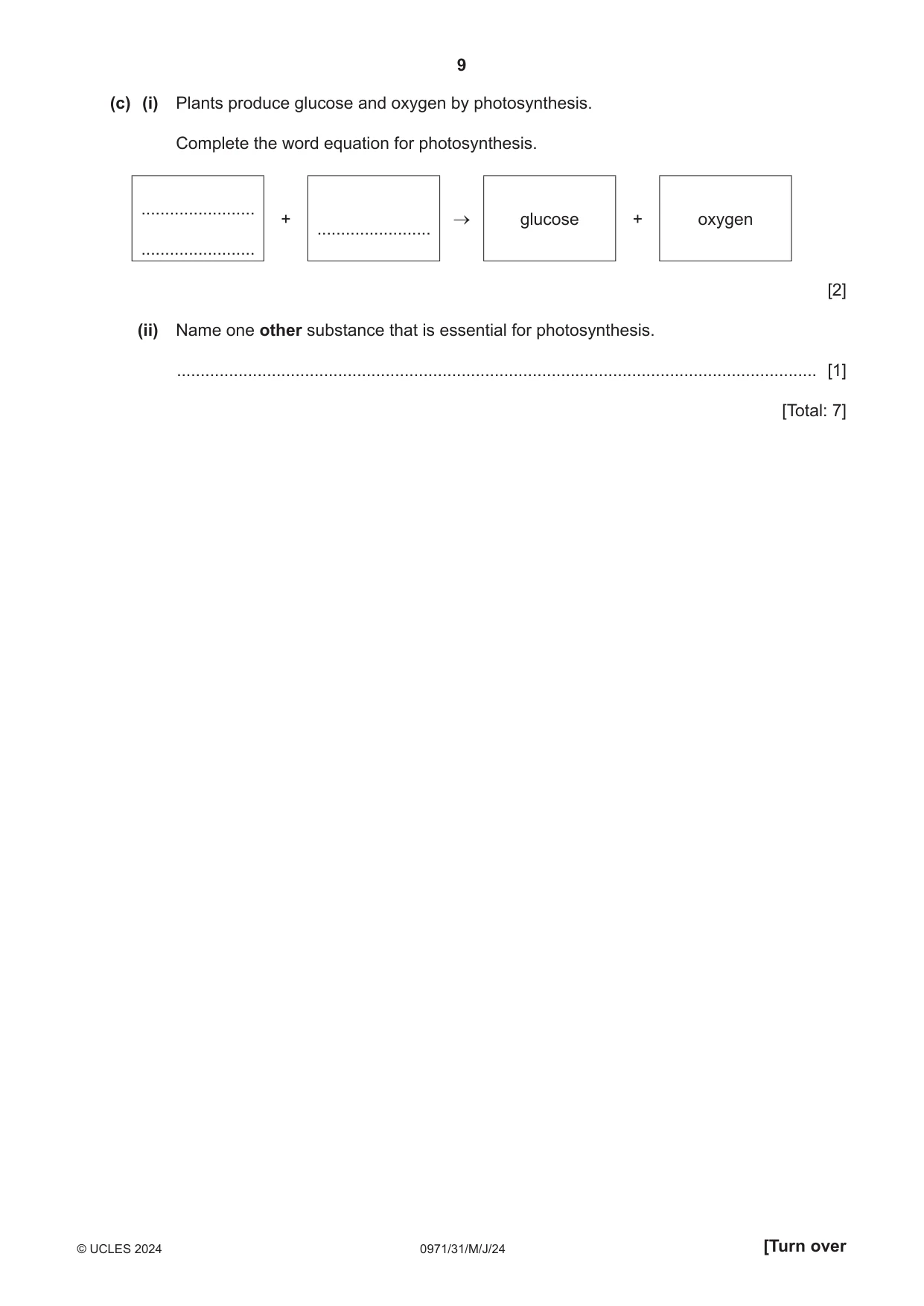
4 (a) Fig. 4.1 shows the displayed formula of a compound extracted from a plant. H H H C H H H C H H C C C C C H H C H C H H C H H H H O H Fig. 4.1 n Fig. 4.1, draw a circle around one functional group that makes this compound unsaturated. [1] (b) A student extracts mixtures of coloured compounds from four different plants, Q, R, S and T. Fig. 4.2 shows the results of chromatography of these mixtures using an organic solvent. solvent front filter paper Q R S T Fig. 4.2 (i) Deduce which plant, Q, R, S or T, contains the greatest number of coloured compounds. ....................................................................................................................................... [1] (ii) Deduce which two plants, Q, R, S or T, contain exactly the same coloured compounds. ................................................................. and �������������������������������������������������������������� [1] (iii) State the meaning of the term solvent. ....................................................................................................................................... [1] (c) (i) Plants produce glucose and oxygen by photosynthesis. Complete the word equation for photosynthesis. ........................ + → glucose + oxygen ........................ ........................ [2] (ii) Name one other substance that is essential for photosynthesis. ....................................................................................................................................... [1] [Total: 7]
Mark scheme: 4(a) circle around one (or both) C=C groups 1 4(b)(i) R 1 4(b)(ii) Q and S 1 4(b)(iii) a substance that dissolves a solute 1 4(c)(i) carbon dioxide (1) water (1) 2 4(c)(ii) chlorophyll 1
Q5 · An atom of carbon is represented by the symbol shown
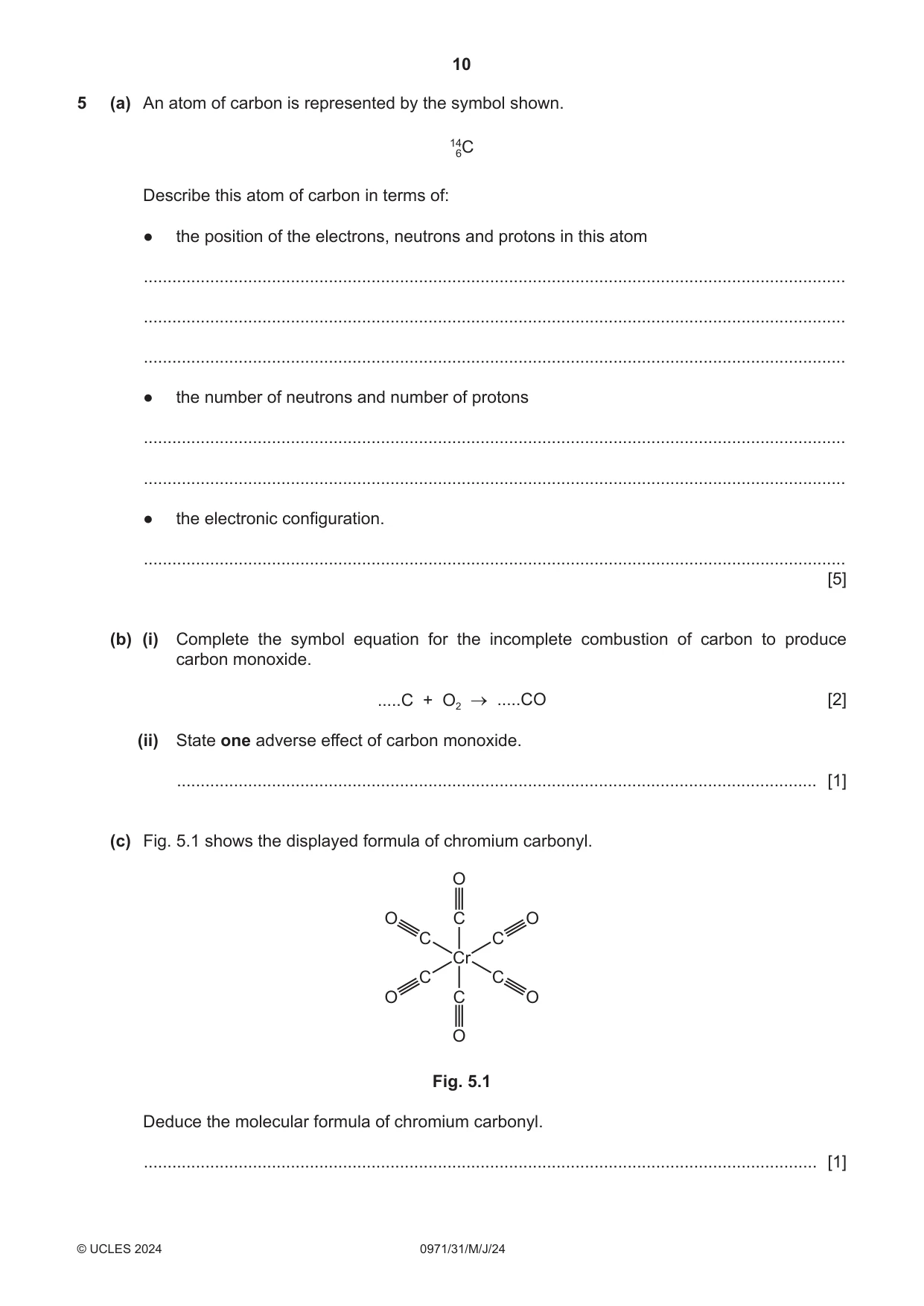
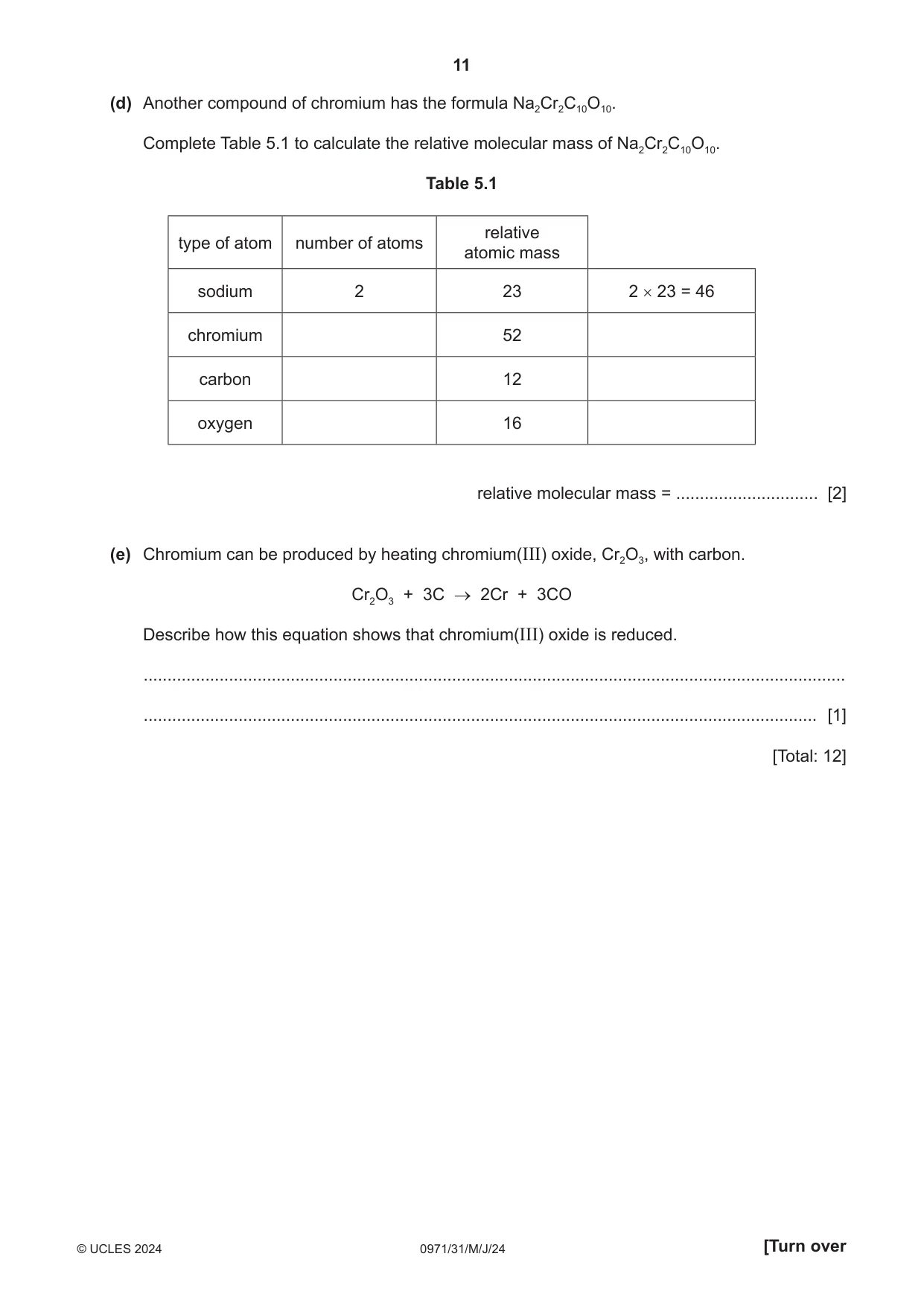
5 (a) An atom of carbon is represented by the symbol shown. 14C6 Describe this atom of carbon in terms of: ● the position of the electrons, neutrons and protons in this atom .................................................................................................................................................... .................................................................................................................................................... .................................................................................................................................................... ● the number of neutrons and number of protons .................................................................................................................................................... .................................................................................................................................................... ● the electronic configuration. .................................................................................................................................................... [5] (b) (i) Complete the symbol equation for the incomplete combustion of carbon to produce carbon monoxide. .....C + O2 → .....CO [2] (ii) State one adverse effect of carbon monoxide. ....................................................................................................................................... [1] (c) Fig. 5.1 shows the displayed formula of chromium carbonyl. O O C O C C Cr C C O C O O Fig. 5.1 Deduce the molecular formula of chromium carbonyl. .............................................................................................................................................. [1] (d) Another compound of chromium has the formula Na2Cr2C10O10. Complete Table 5.1 to calculate the relative molecular mass of Na2Cr2C10O10. Table 5.1 relative type of atom number of atoms atomic mass sodium 2 23 2 × 23 = 46 chromium 52 carbon 12 oxygen 16 relative molecular mass = .............................. [2] (e) Chromium can be produced by heating chromium(III) oxide, Cr2O3, with carbon. Cr2O3 + 3C → 2Cr + 3CO Describe how this equation shows that chromium(III) oxide is reduced. .................................................................................................................................................... .............................................................................................................................................. [1] [Total: 12]
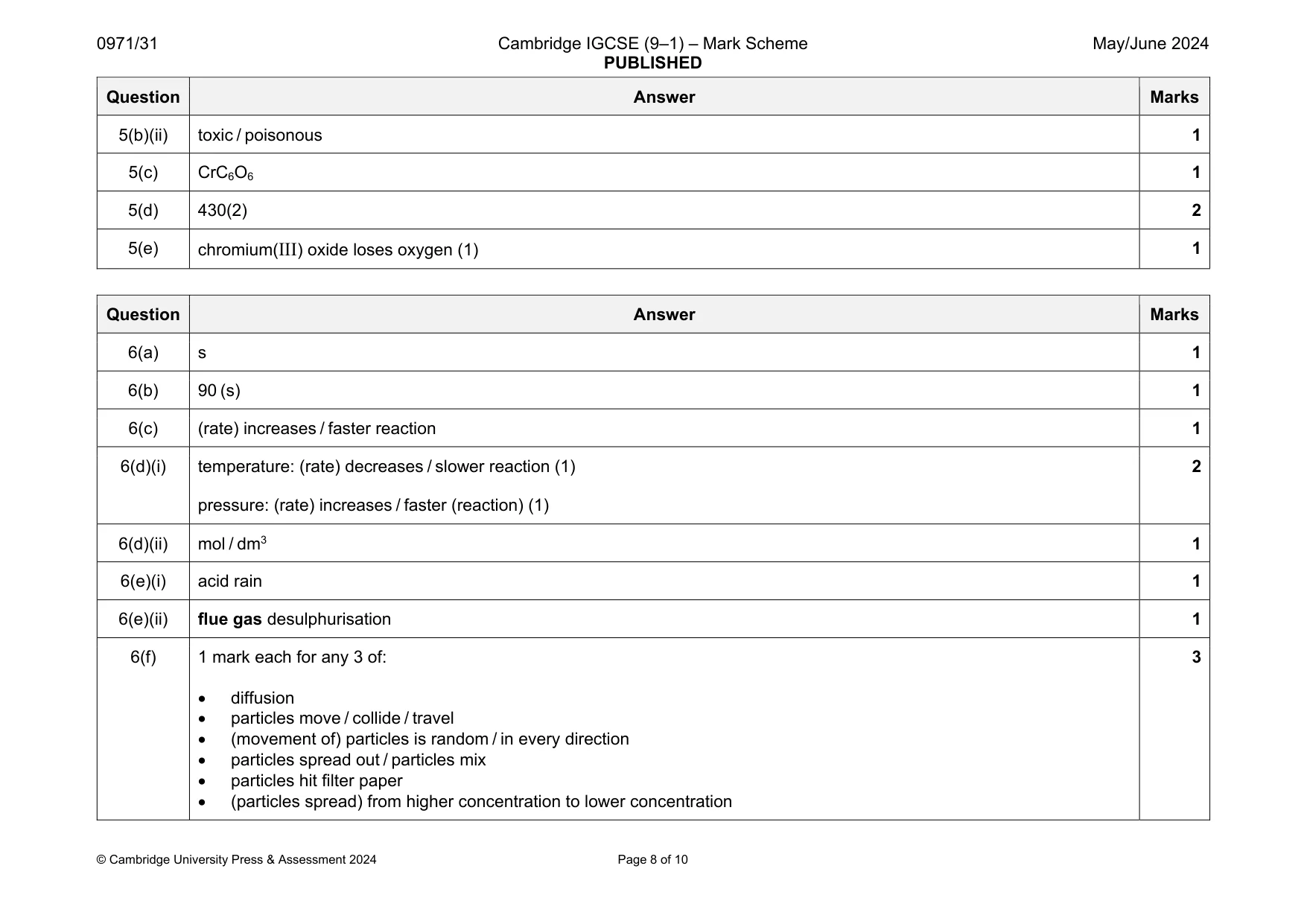
Mark scheme: 5(a) protons and neutrons in nucleus (1) electrons outside the nucleus (1) 8 neutrons (1) 6 protons (1) 2, 4 (1) 5(b)(i) 2(C) (1) 2(CO) (1) 2 Question Answer Marks 5(b)(ii) toxic / poisonous 1 5(c) CrC6O6 1 5(d) 430(2) 2 5(e) chromium(III) oxide loses oxygen (1) 1
Q6 · Large pieces of solid sulfur burn in excess oxygen to produce sulfur dioxide gas
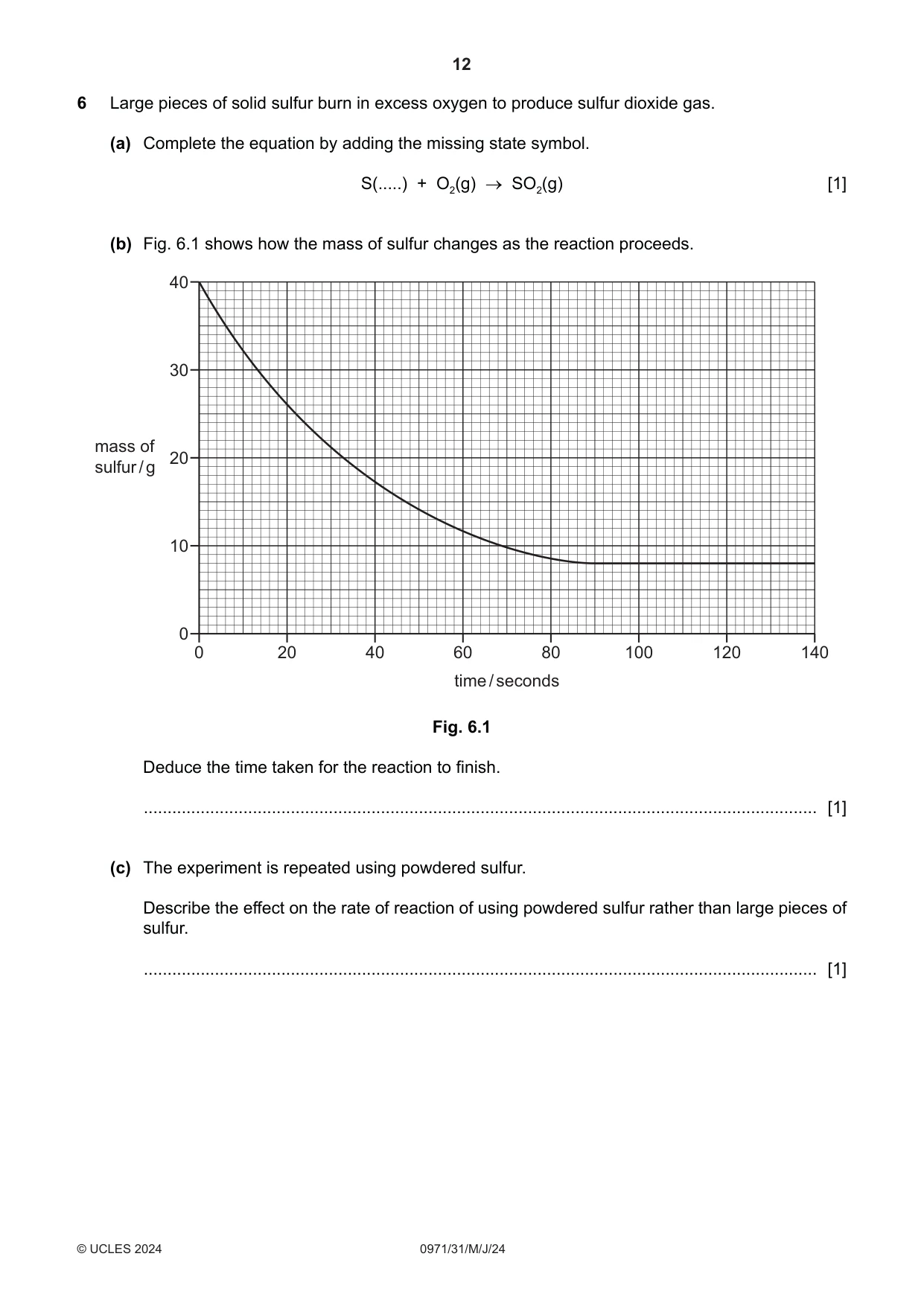
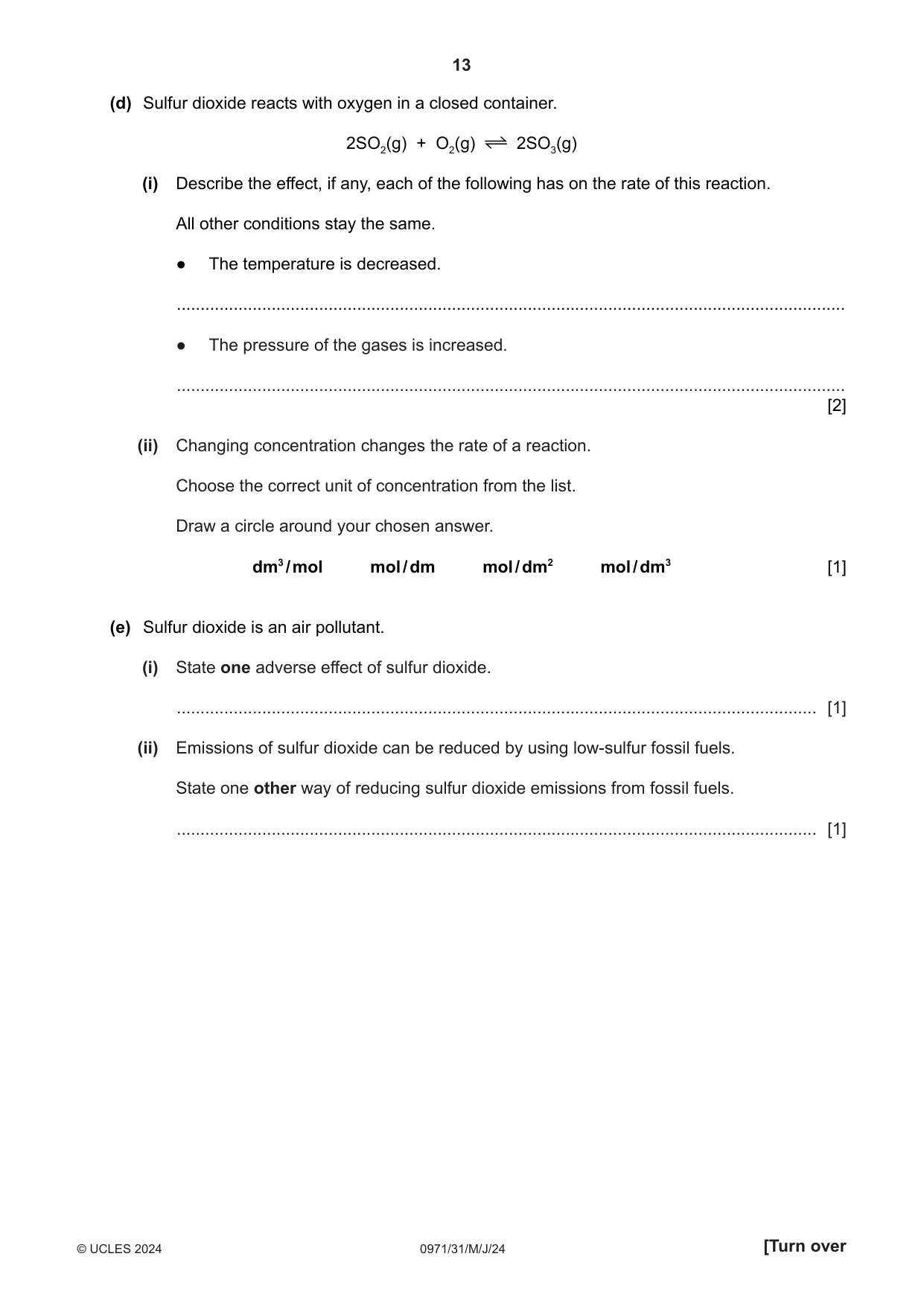
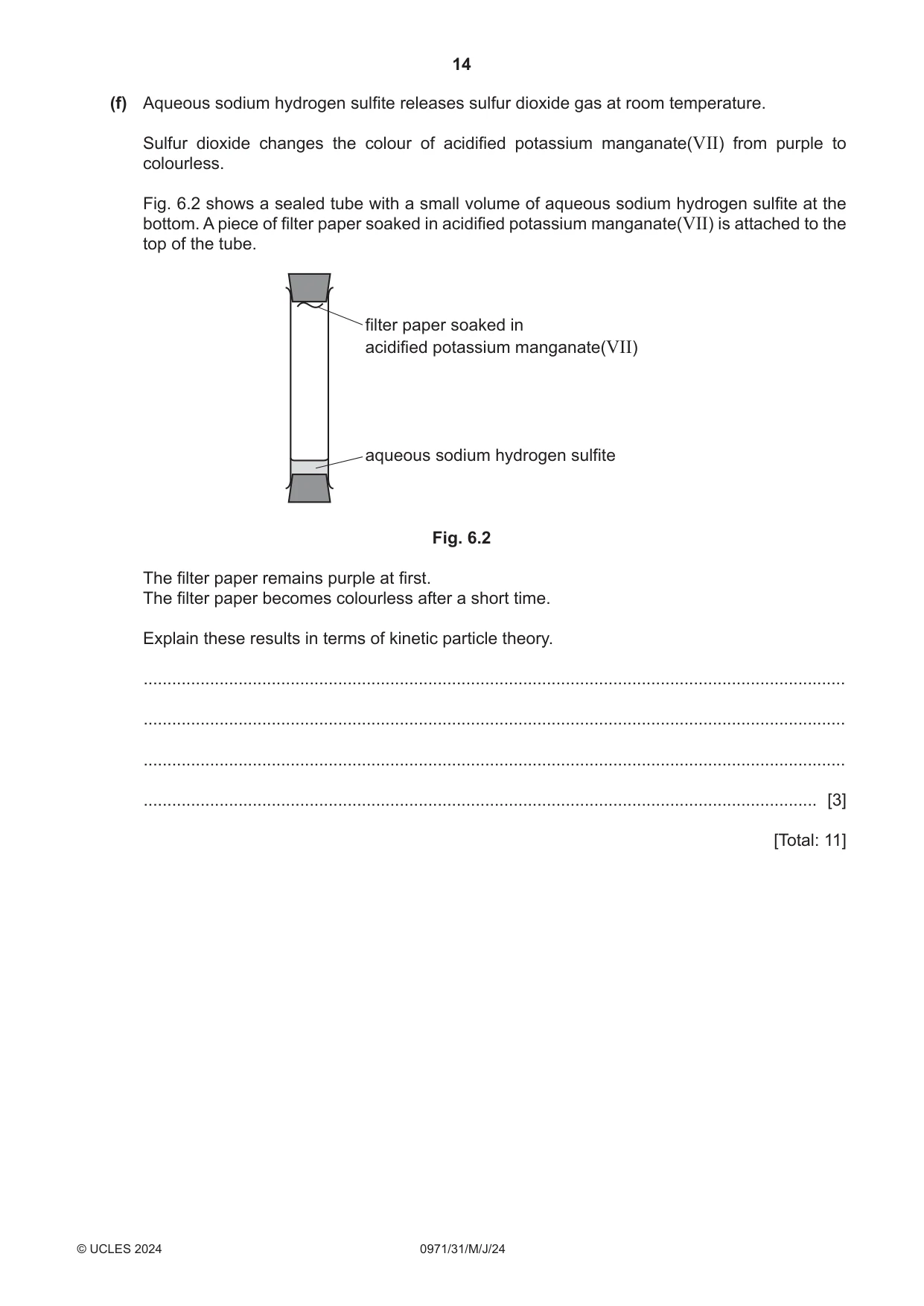
6 Large pieces of solid sulfur burn in excess oxygen to produce sulfur dioxide gas. (a) Complete the equation by adding the missing state symbol. S(.....) + O2(g) → SO2(g) [1] (b) Fig. 6.1 shows how the mass of sulfur changes as the reaction proceeds. 40 30 mass of 20 sulfur / g 10 0 0 20 40 60 80 100 120 140 time / seconds Fig. 6.1 Deduce the time taken for the reaction to finish. .............................................................................................................................................. [1] (c) The experiment is repeated using powdered sulfur. Describe the effect on the rate of reaction of using powdered sulfur rather than large pieces of sulfur. .............................................................................................................................................. [1] (d) Sulfur dioxide reacts with oxygen in a closed container. 2SO2(g) + O2(g) 2SO3(g) (i) Describe the effect, if any, each of the following has on the rate of this reaction. All other conditions stay the same. ● The temperature is decreased. ............................................................................................................................................. ● The pressure of the gases is increased. ............................................................................................................................................. [2] (ii) Changing concentration changes the rate of a reaction. Choose the correct unit of concentration from the list. Draw a circle around your chosen answer. dm3 / mol mol / dm mol / dm2 mol / dm3 [1] (e) Sulfur dioxide is an air pollutant. (i) State one adverse effect of sulfur dioxide. ....................................................................................................................................... [1] (ii) Emissions of sulfur dioxide can be reduced by using low-sulfur fossil fuels. State one other way of reducing sulfur dioxide emissions from fossil fuels. ....................................................................................................................................... [1] (f) Aqueous sodium hydrogen sulfite releases sulfur dioxide gas at room temperature. Sulfur dioxide changes the colour of acidified potassium manganate(VII) from purple to colourless. Fig. 6.2 shows a sealed tube with a small volume of aqueous sodium hydrogen sulfite at the bottom. A piece of filter paper soaked in acidified potassium manganate(VII) is attached to the top of the tube. filter paper soaked in acidified potassium manganate(VII) aqueous sodium hydrogen sulfite Fig. 6.2 The filter paper remains purple at first. The filter paper becomes colourless after a short time. Explain these results in terms of kinetic particle theory. .................................................................................................................................................... .................................................................................................................................................... .................................................................................................................................................... .............................................................................................................................................. [3] [Total: 11]
Mark scheme: 6(a) s 1 6(b) 90 (s) 1 6(c) (rate) increases / faster reaction 1 6(d)(i) temperature: (rate) decreases / slower reaction (1) pressure: (rate) increases / faster (reaction) (1) 2 6(d)(ii) mol / dm3 1 6(e)(i) acid rain 1 6(e)(ii) flue gas desulphurisation 1 6(f) 1 mark each for any 3 of: diffusion particles move / collide / travel (movement of) particles is random / in every direction particles spread out / particles mix particles hit filter paper (particles spread) from higher concentration to lower concentration 3
Q7 · Iron is a metal
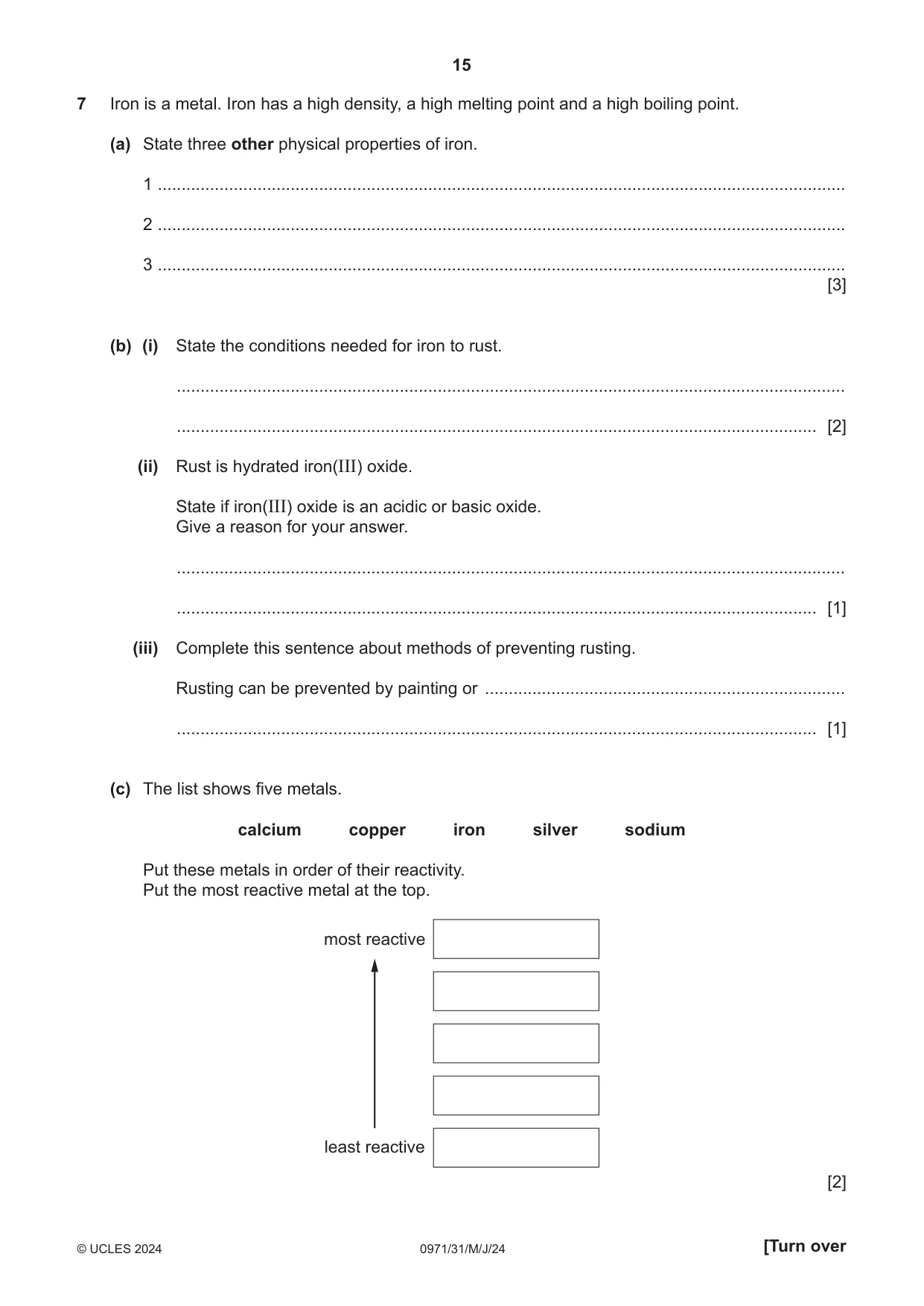
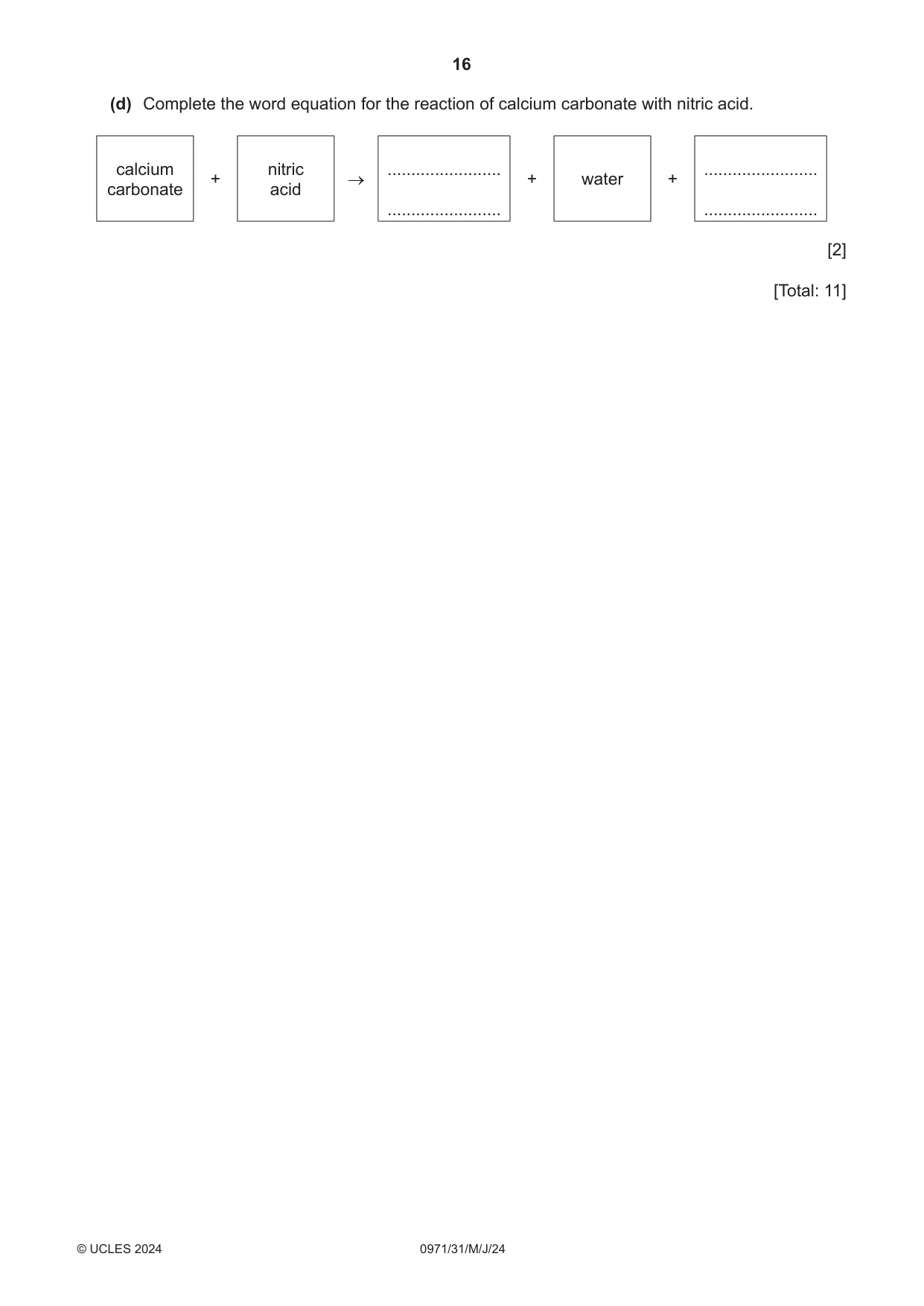
7 Iron is a metal. Iron has a high density, a high melting point and a high boiling point. (a) State three other physical properties of iron. 1 ................................................................................................................................................. 2 ................................................................................................................................................. 3 ................................................................................................................................................. [3] (b) (i) State the conditions needed for iron to rust. ............................................................................................................................................. ....................................................................................................................................... [2] (ii) Rust is hydrated iron(III) oxide. State if iron(III) oxide is an acidic or basic oxide. Give a reason for your answer. ............................................................................................................................................. ....................................................................................................................................... [1] (iii) Complete this sentence about methods of preventing rusting. Rusting can be prevented by painting or ............................................................................. ....................................................................................................................................... [1] (c) The list shows five metals. calcium copper iron silver sodium Put these metals in order of their reactivity. Put the most reactive metal at the top. most reactive least reactive [2] (d) Complete the word equation for the reaction of calcium carbonate with nitric acid. calcium nitric ........................ ........................ + → + water +carbonate acid ........................ ........................ [2] [Total: 11]
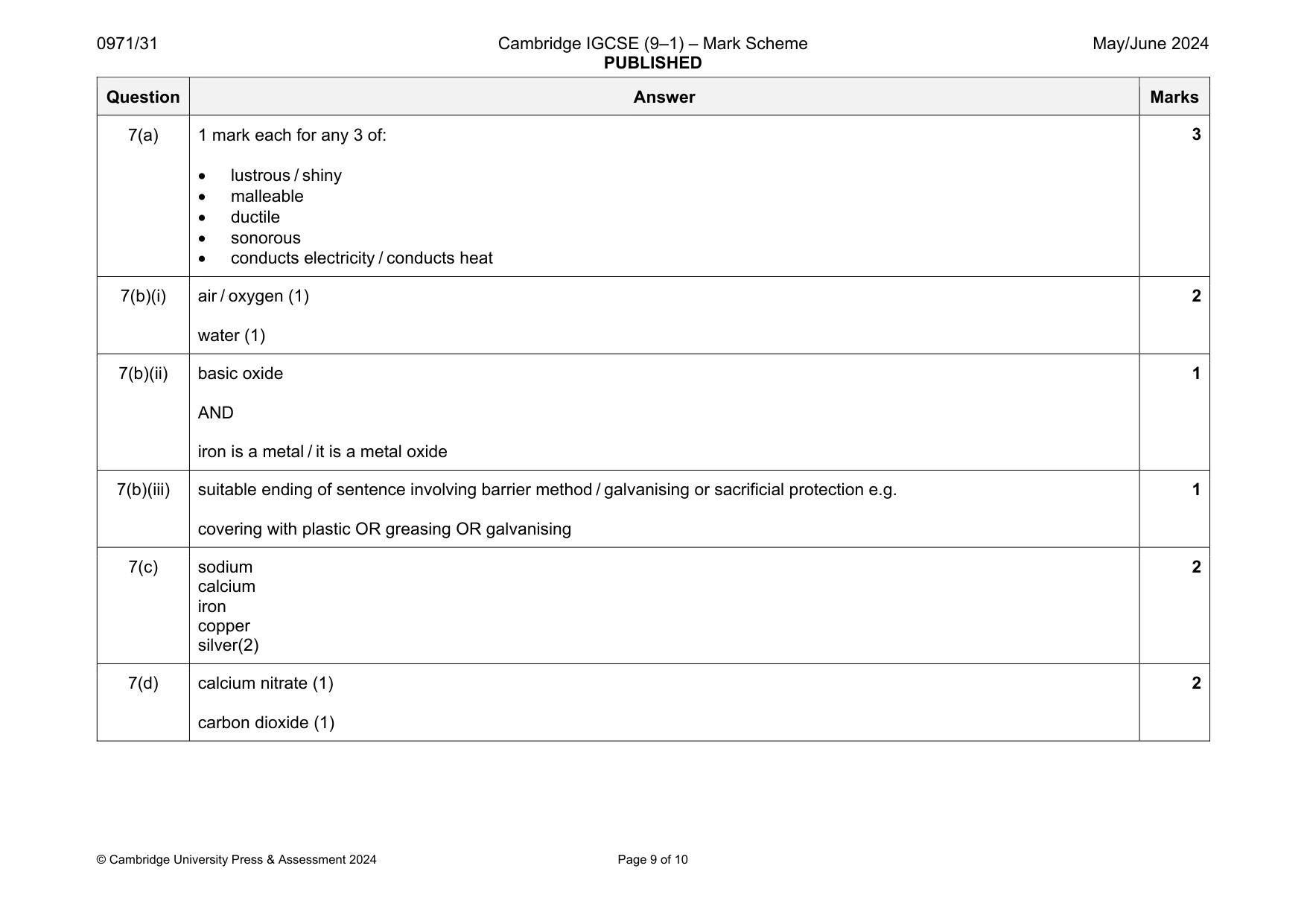
Mark scheme: 7(a) 1 mark each for any 3 of: lustrous / shiny malleable ductile sonorous conducts electricity / conducts heat 7(b)(i) air / oxygen (1) water (1) 2 7(b)(ii) basic oxide AND iron is a metal / it is a metal oxide 1 7(b)(iii) suitable ending of sentence involving barrier method / galvanising or sacrificial protection e.g. covering with plastic OR greasing OR galvanising 1 7(c) sodium calcium iron copper silver(2) 2 7(d) calcium nitrate (1) carbon dioxide (1) 2
Q8 · The displayed formulae of five organic compounds, V, W, X, Y and Z
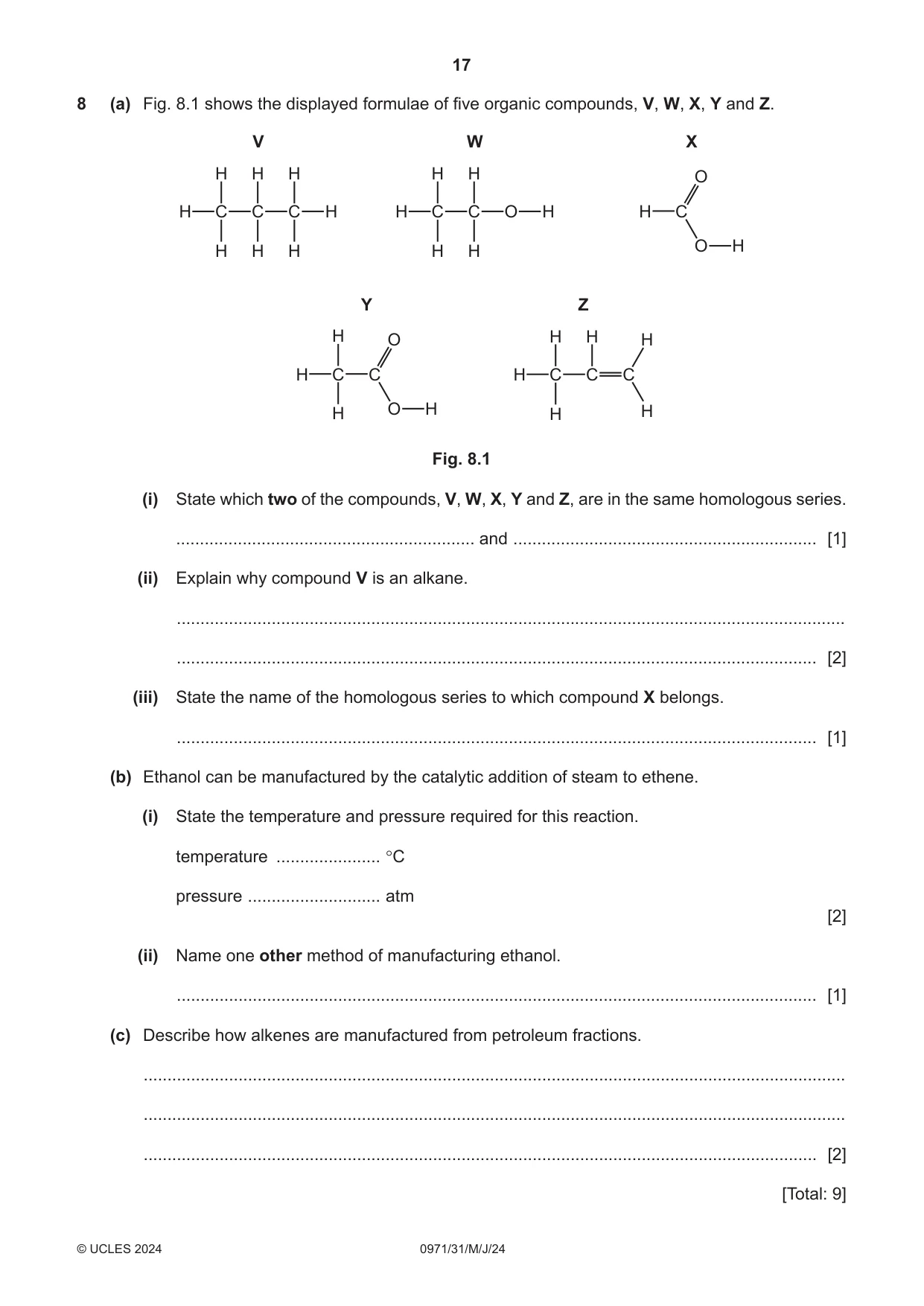
8 (a) Fig. 8.1 shows the displayed formulae of five organic compounds, V, W, X, Y and Z. V W X H H H H H O H C C C H H C C O H H C O H H H H H H Y Z H O H H H H C C H C C C H O H H H Fig. 8.1 (i) State which two of the compounds, V, W, X, Y and Z, are in the same homologous series. ............................................................... and ���������������������������������������������������������������� [1] (ii) Explain why compound V is an alkane. ............................................................................................................................................. ....................................................................................................................................... [2] (iii) State the name of the homologous series to which compound X belongs. ....................................................................................................................................... [1] (b) Ethanol can be manufactured by the catalytic addition of steam to ethene. (i) State the temperature and pressure required for this reaction. temperature ....................... °C pressure ............................ atm [2] (ii) Name one other method of manufacturing ethanol. ....................................................................................................................................... [1] (c) Describe how alkenes are manufactured from petroleum fractions. .................................................................................................................................................... .................................................................................................................................................... .............................................................................................................................................. [2] [Total: 9]
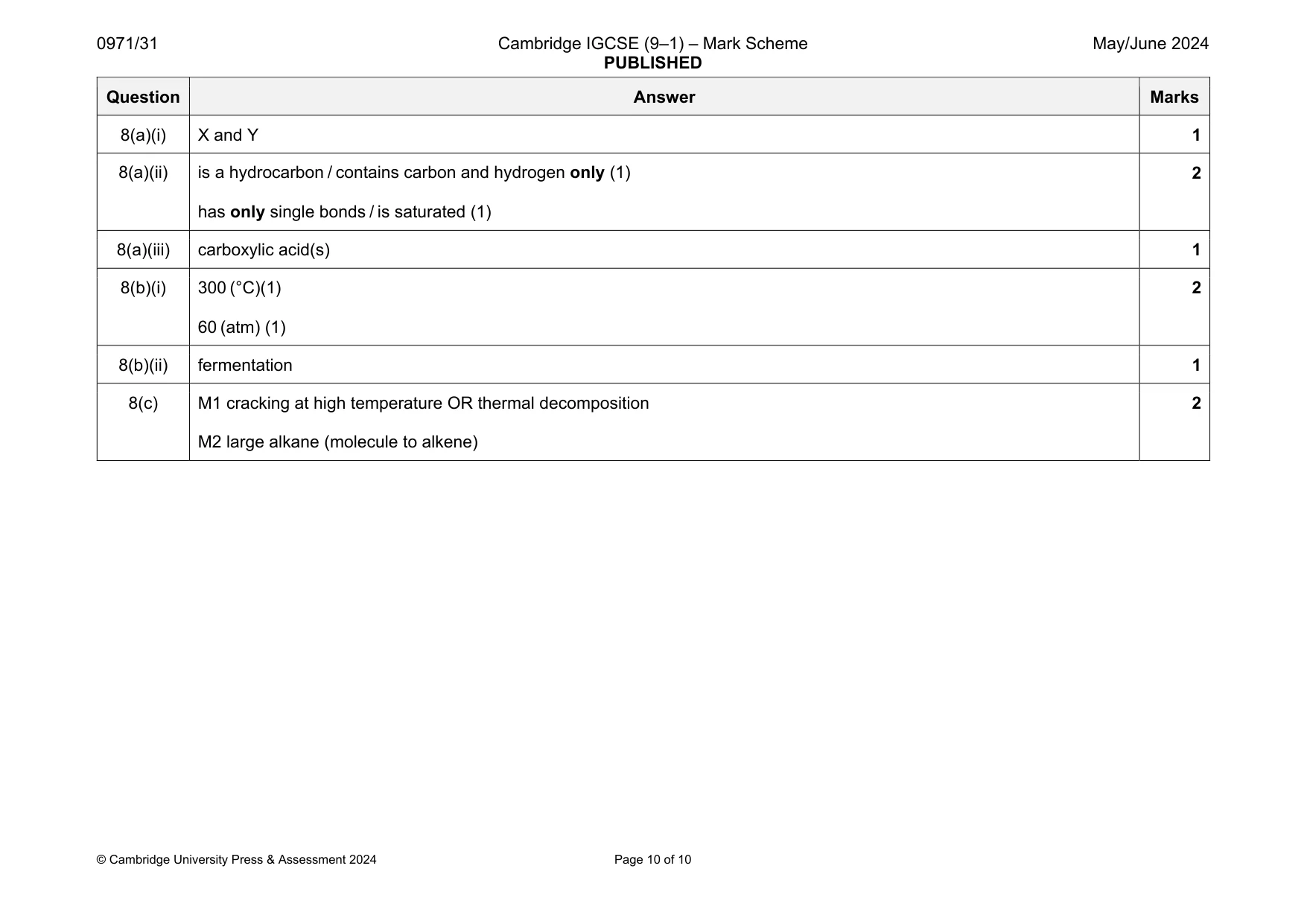
Mark scheme: 8(a)(i) X and Y 1 8(a)(ii) is a hydrocarbon / contains carbon and hydrogen only (1) has only single bonds / is saturated (1) 2 8(a)(iii) carboxylic acid(s) 1 8(b)(i) 300 (°C)(1) 60 (atm) (1) 2 8(b)(ii) fermentation 1 8(c) M1 cracking at high temperature OR thermal decomposition M2 large alkane (molecule to alkene) 2
More questions on Formulae, functional groups and terminology
What was in this paper
The subtopics covered by these 8 questions, and how many questions each got. Open one in a new tab to see every Cambridge question on it.
What you needed in this session
Cambridge’s own grade thresholds for 2024 May/June, Paper 3 · Variant 1. A higher threshold means an easier paper — the bar moves with how the cohort did.