Cambridge IGCSE Chemistry (9-1) 0971 — 2025 May/June Paper 3 · Variant 2
0971/32/M/J/25 · 8 questions · 80 marks · 75 min
The question paper and its mark scheme, free to read here and free to download. This is Cambridge’s own paper, exactly as it was sat.
Question paper20 pages



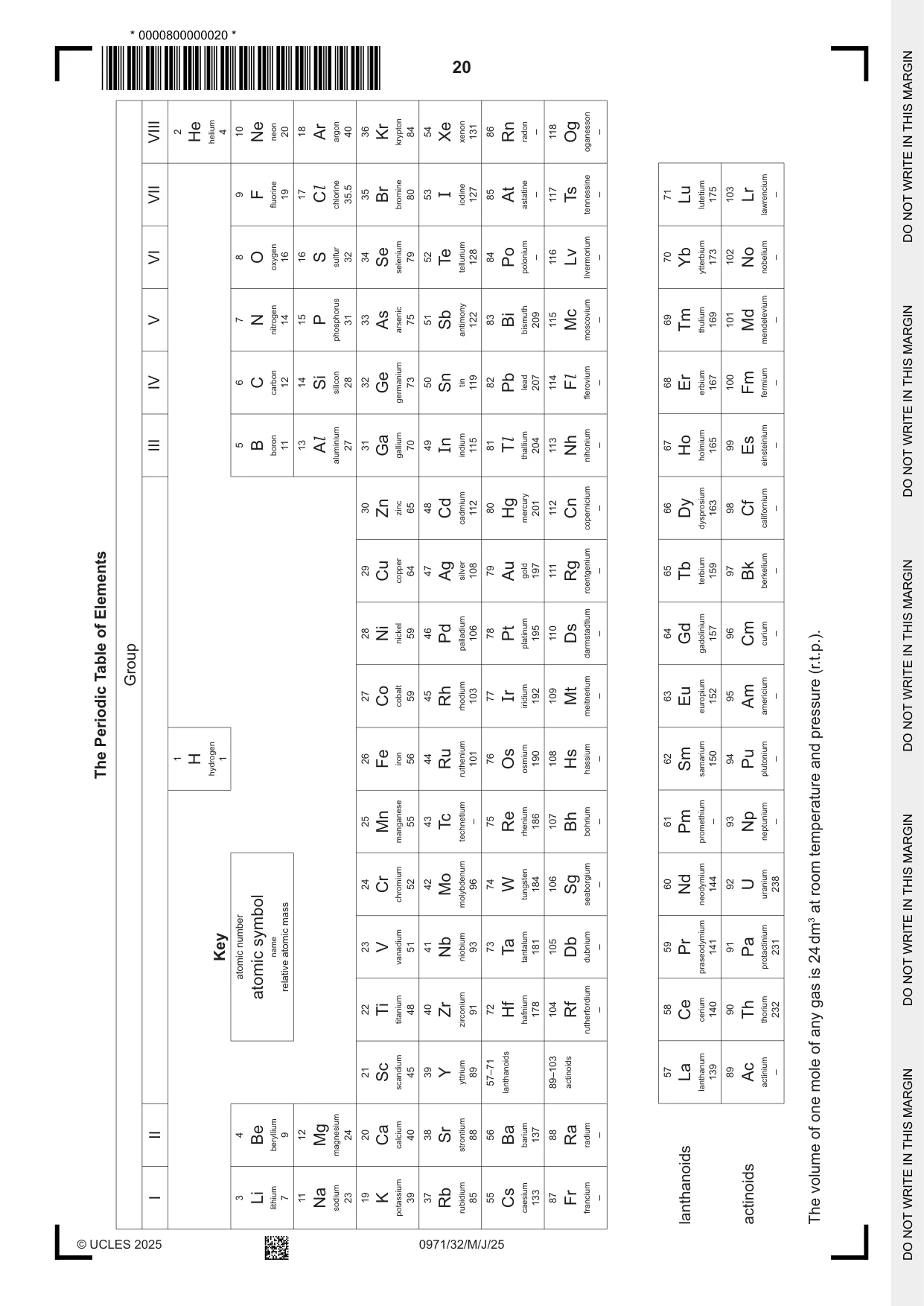
Mark scheme13 pages
Answers below. Sit the paper first if you are practising.
Questions as text
Q1 · A list of substances is shown
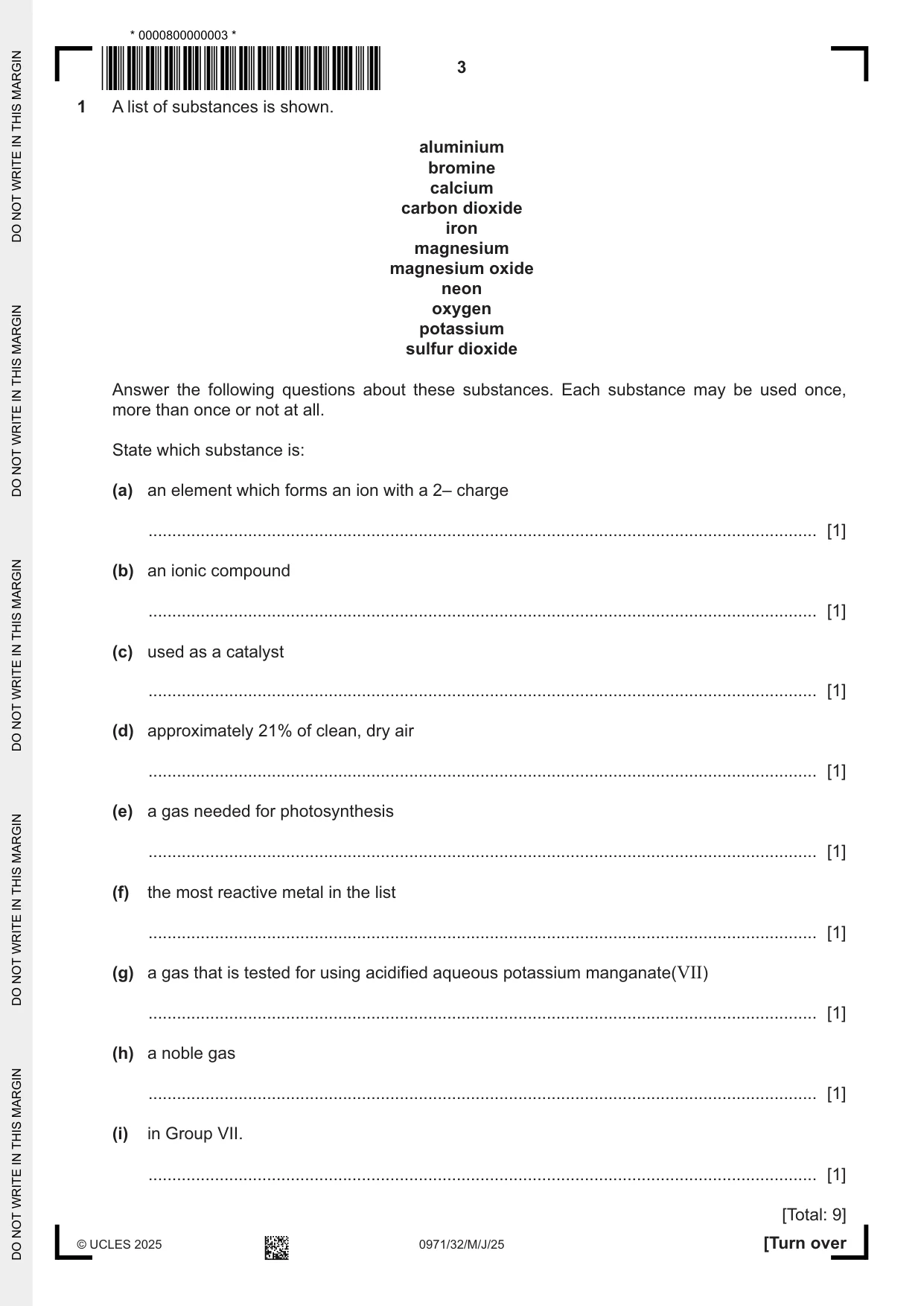
1 A list of substances is shown. aluminium bromine calcium carbon dioxide iron magnesium magnesium oxide neon oxygen potassium sulfur dioxide Answer the following questions about these substances. Each substance may be used once, more than once or not at all. State which substance is: (a) an element which forms an ion with a 2– charge ............................................................................................................................................. [1] (b) an ionic compound ............................................................................................................................................. [1] (c) used as a catalyst ............................................................................................................................................. [1] (d) approximately 21% of clean, dry air ............................................................................................................................................. [1] (e) a gas needed for photosynthesis ............................................................................................................................................. [1] (f) the most reactive metal in the list ............................................................................................................................................. [1] (g) a gas that is tested for using acidified aqueous potassium manganate(VII) ............................................................................................................................................. [1] (h) a noble gas ............................................................................................................................................. [1] (i) in Group VII. ............................................................................................................................................. [1] [Total: 9]
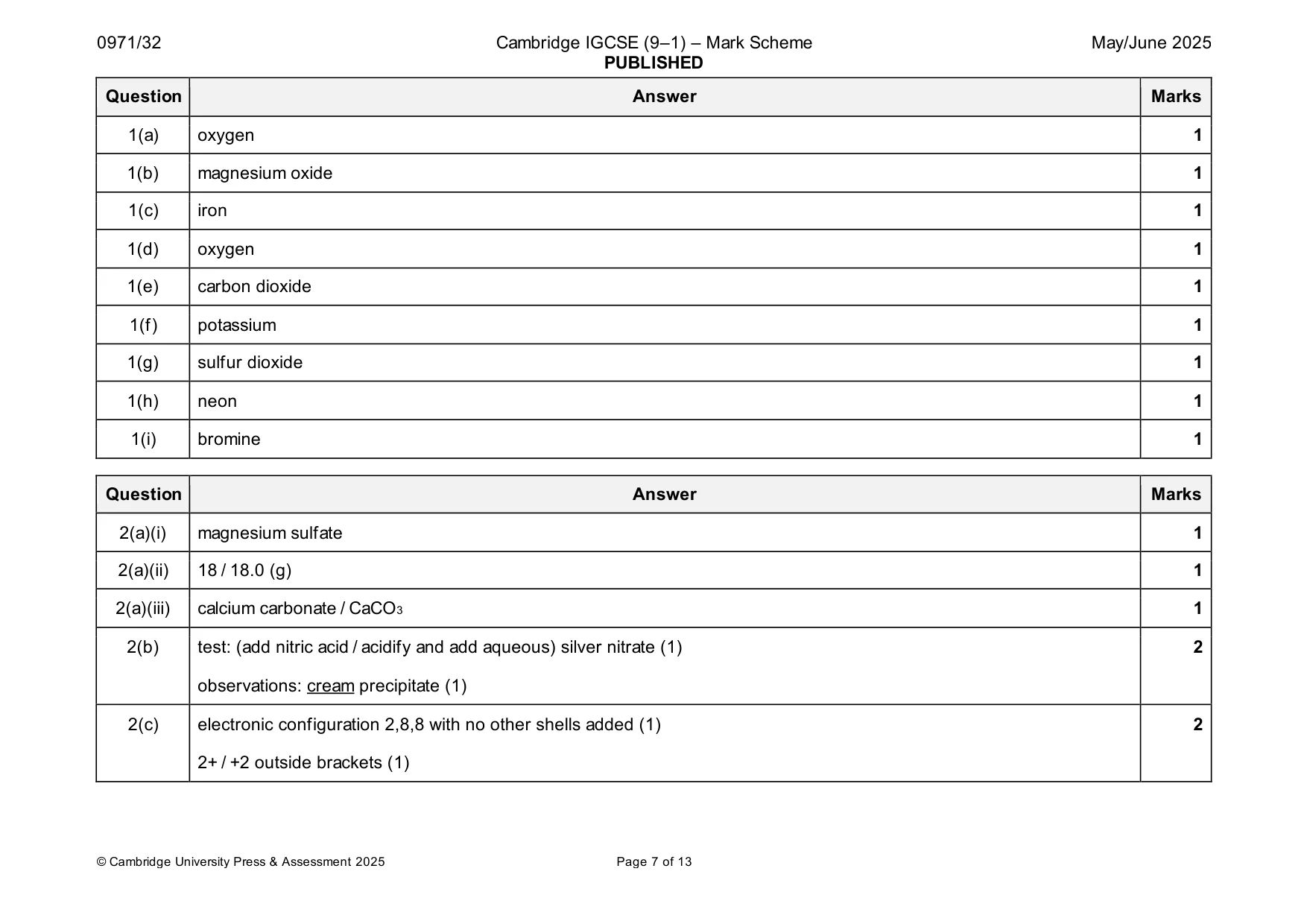
Mark scheme: Question Answer Marks 1(a) oxygen 1 1(b) magnesium oxide 1 1(c) iron 1 1(d) oxygen 1 1(e) carbon dioxide 1 1(f) potassium 1 1(g) sulfur dioxide 1 1(h) neon 1 1(i) bromine 1
Q2 · This question is about sea water and the substances found in sea water
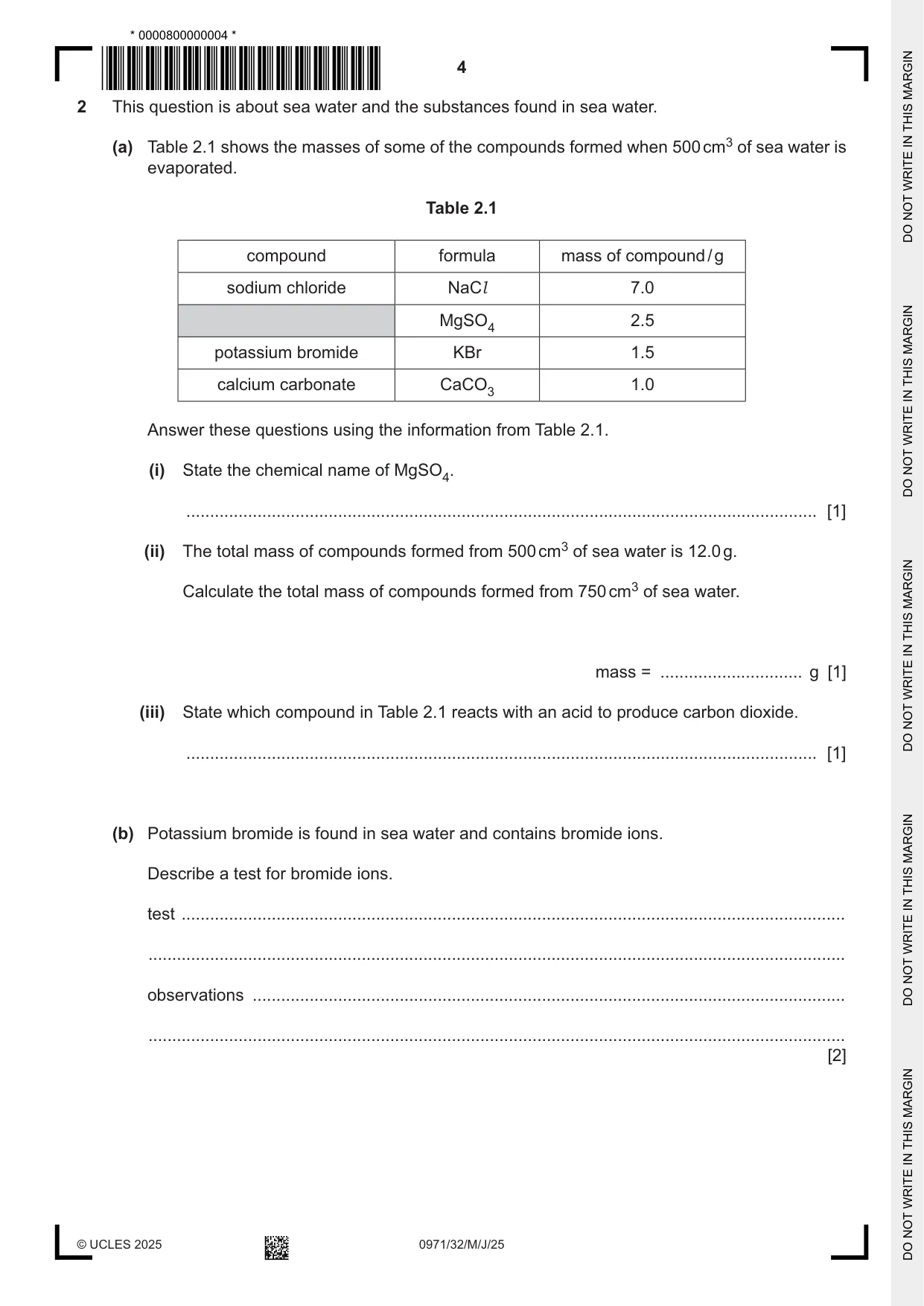
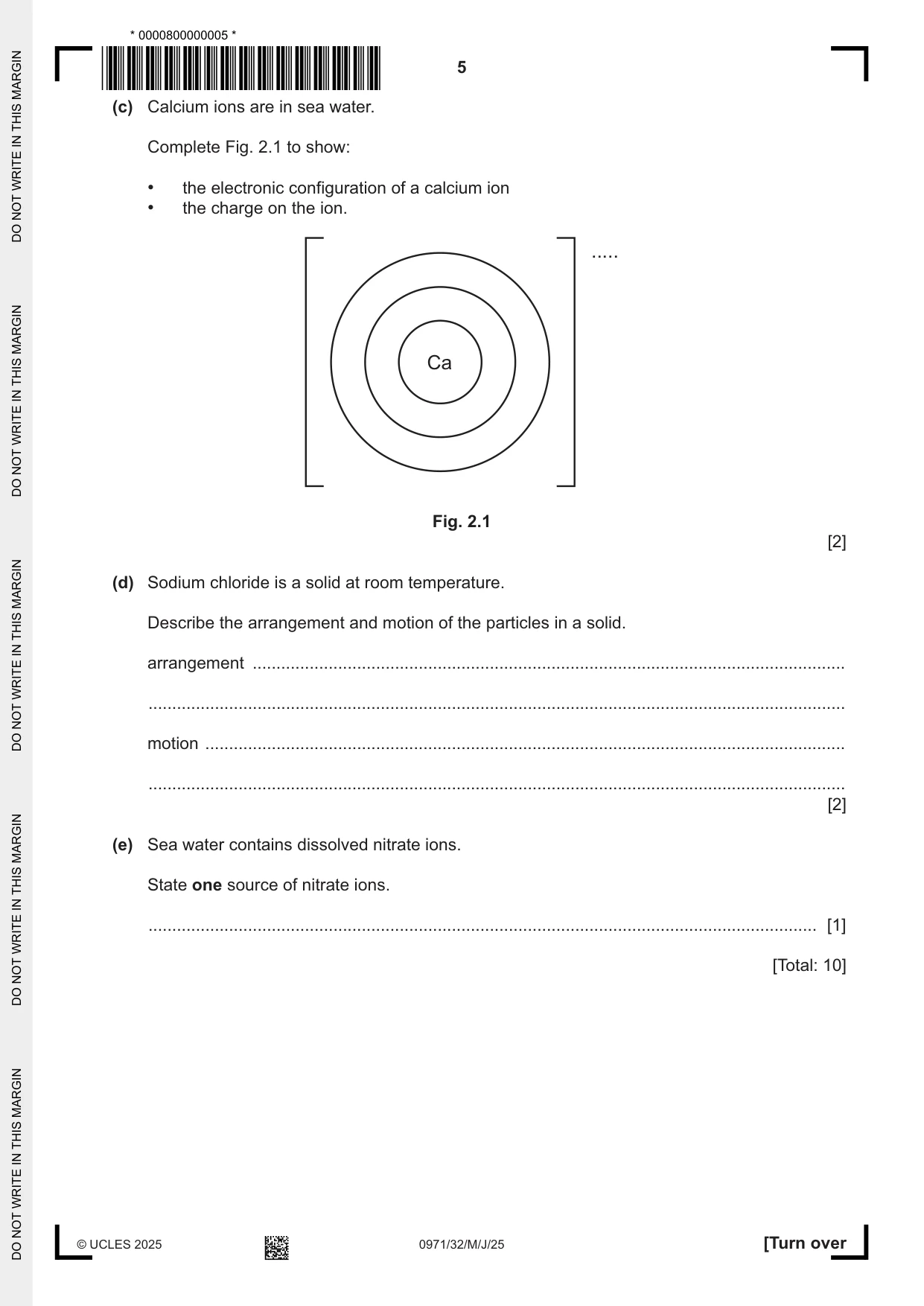
2 This question is about sea water and the substances found in sea water. (a) Table 2.1 shows the masses of some of the compounds formed when 500 cm3 of sea water is evaporated. Table 2.1 compound formula mass of compound / g sodium chloride NaCl 7.0 MgSO4 2.5 potassium bromide KBr 1.5 calcium carbonate CaCO3 1.0 Answer these questions using the information from Table 2.1. (i) State the chemical name of MgSO4. ..................................................................................................................................... [1] (ii) The total mass of compounds formed from 500 cm3 of sea water is 12.0 g. Calculate the total mass of compounds formed from 750 cm3 of sea water. mass = .............................. g [1] (iii) State which compound in Table 2.1 reacts with an acid to produce carbon dioxide. ..................................................................................................................................... [1] (b) Potassium bromide is found in sea water and contains bromide ions. Describe a test for bromide ions. test ............................................................................................................................................ ................................................................................................................................................... observations ............................................................................................................................. ................................................................................................................................................... [2] (c) Calcium ions are in sea water. Complete Fig. 2.1 to show: • the electronic configuration of a calcium ion • the charge on the ion. ..... Ca Fig. 2.1 [2] (d) Sodium chloride is a solid at room temperature. Describe the arrangement and motion of the particles in a solid. arrangement ............................................................................................................................. ................................................................................................................................................... motion ....................................................................................................................................... ................................................................................................................................................... [2] (e) Sea water contains dissolved nitrate ions. State one source of nitrate ions. ............................................................................................................................................. [1] [Total: 10]
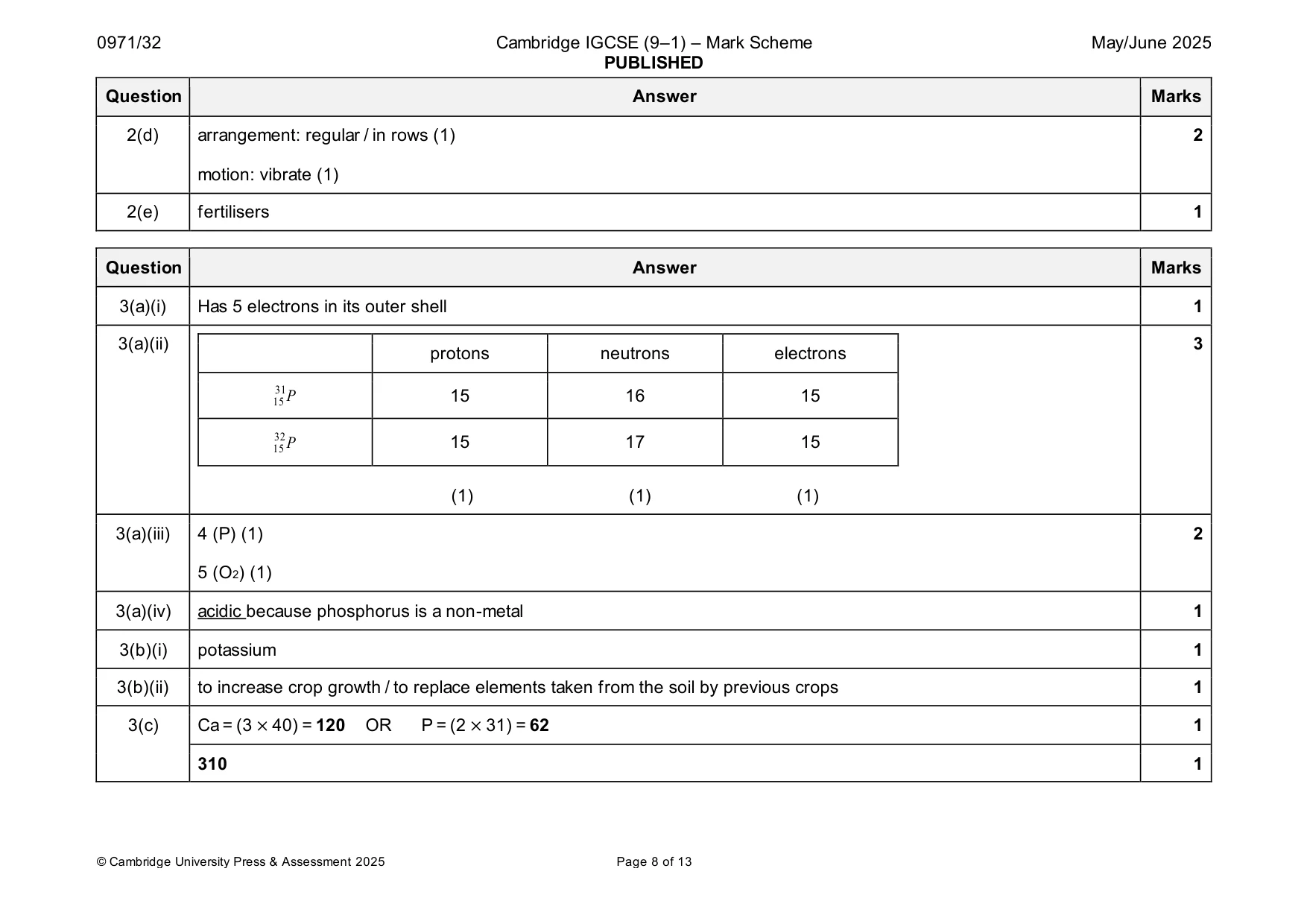
Mark scheme: 2(a)(i) magnesium sulfate 1 2(a)(ii) 18 / 18.0 (g) 1 2(a)(iii) calcium carbonate / CaCO3 1 2(b) test: (add nitric acid / acidify and add aqueous) silver nitrate (1) 2 observations: cream precipitate (1) 2(c) electronic configuration 2,8,8 with no other shells added (1) 2 2+ / +2 outside brackets (1) 2(d) arrangement: regular / in rows (1) 2 motion: vibrate (1) 2(e) fertilisers 1
More questions on Formulae, functional groups and terminology
Q3 · This question is about phosphorus and its compounds
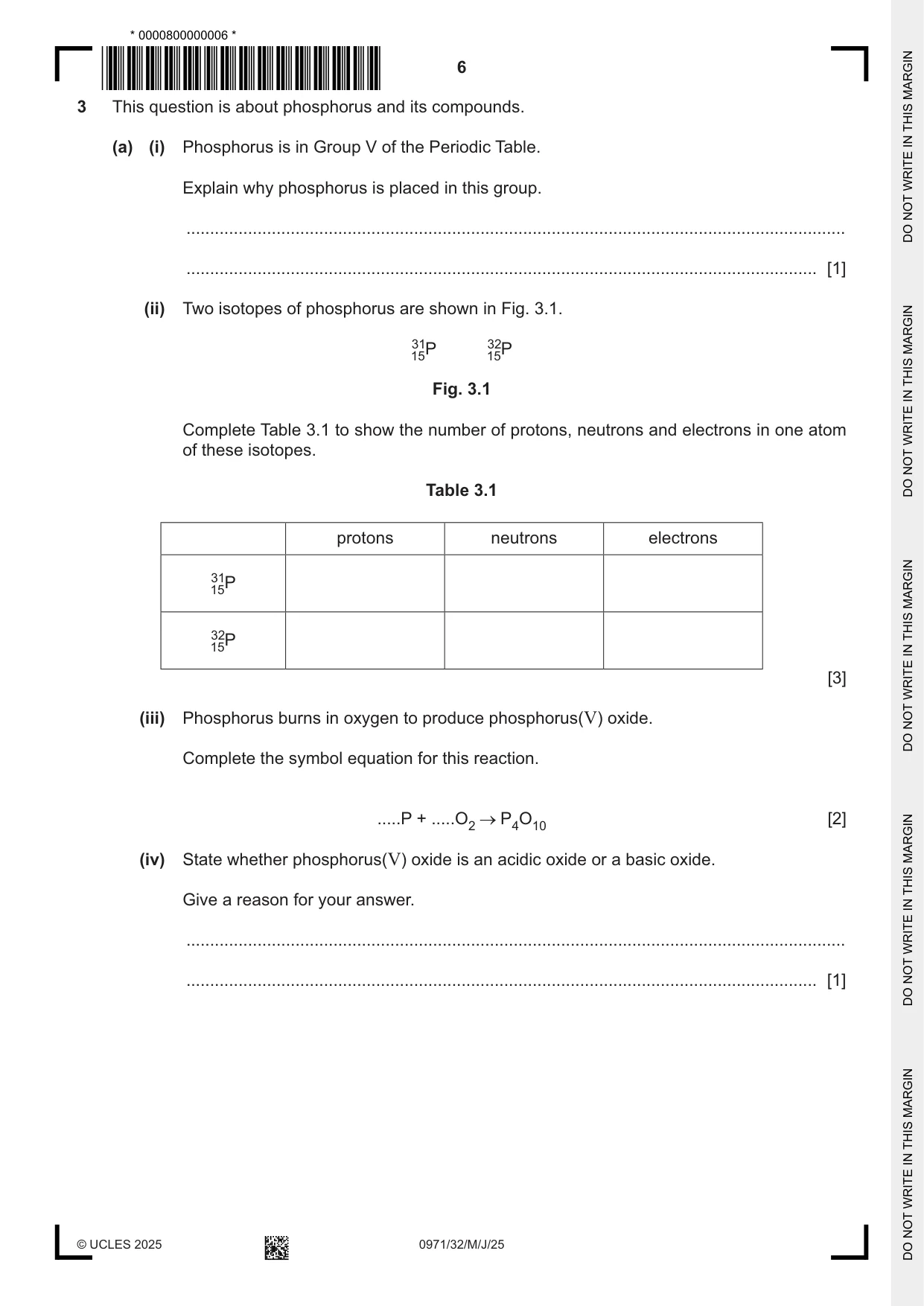
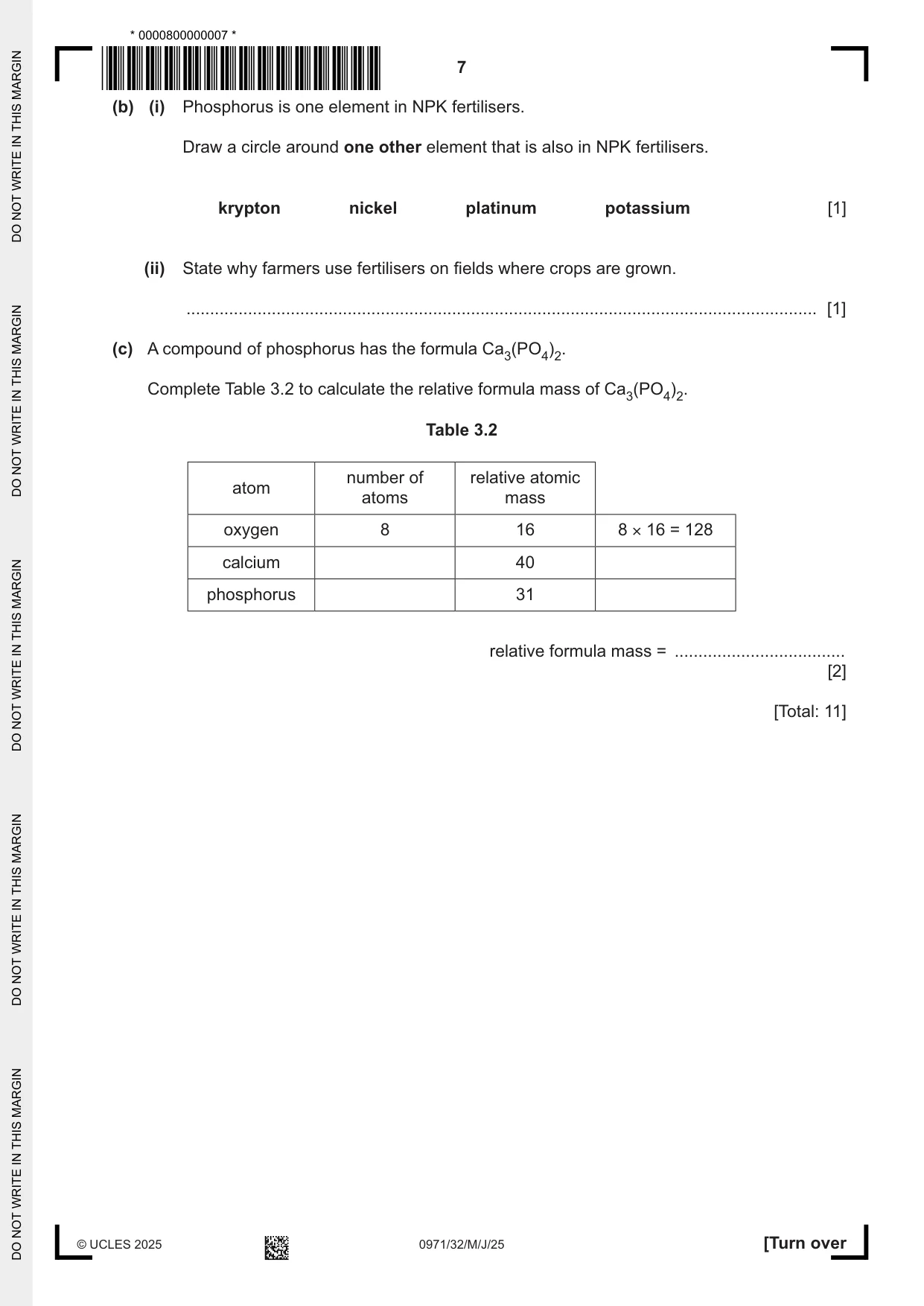
3 This question is about phosphorus and its compounds. (a) (i) Phosphorus is in Group V of the Periodic Table. Explain why phosphorus is placed in this group. ........................................................................................................................................... ..................................................................................................................................... [1] (ii) Two isotopes of phosphorus are shown in Fig. 3.1. 15P31 15P32 Fig. 3.1 Complete Table 3.1 to show the number of protons, neutrons and electrons in one atom of these isotopes. Table 3.1 protons neutrons electrons 15P31 15P32 [3] (iii) Phosphorus burns in oxygen to produce phosphorus(V) oxide. Complete the symbol equation for this reaction. .....P + .....O2 P4O10 [2] (iv) State whether phosphorus(V) oxide is an acidic oxide or a basic oxide. Give a reason for your answer. ........................................................................................................................................... ..................................................................................................................................... [1] (b) (i) Phosphorus is one element in NPK fertilisers. Draw a circle around one other element that is also in NPK fertilisers. krypton nickel platinum potassium [1] (ii) State why farmers use fertilisers on fields where crops are grown. ..................................................................................................................................... [1] (c) A compound of phosphorus has the formula Ca3(PO4)2. Complete Table 3.2 to calculate the relative formula mass of Ca3(PO4)2. Table 3.2 number of relative atomic atom atoms mass oxygen 8 16 8 × 16 = 128 calcium 40 phosphorus 31 relative formula mass = .................................... [2] [Total: 11]
Mark scheme: 3(a)(i) Has 5 electrons in its outer shell 1 3(a)(ii) 3 protons neutrons electrons 31 P 15 16 15 15 32 P 15 17 15 15 (1) (1) (1) 3(a)(iii) 4 (P) (1) 2 5 (O2) (1) 3(a)(iv) acidic because phosphorus is a non-metal 1 3(b)(i) potassium 1 3(b)(ii) to increase crop growth / to replace elements taken from the soil by previous crops 1 3(c) Ca = (3 × 40) = 120 OR P = (2 × 31) = 62 1 310 1
Q4 · This question is about organic chemistry
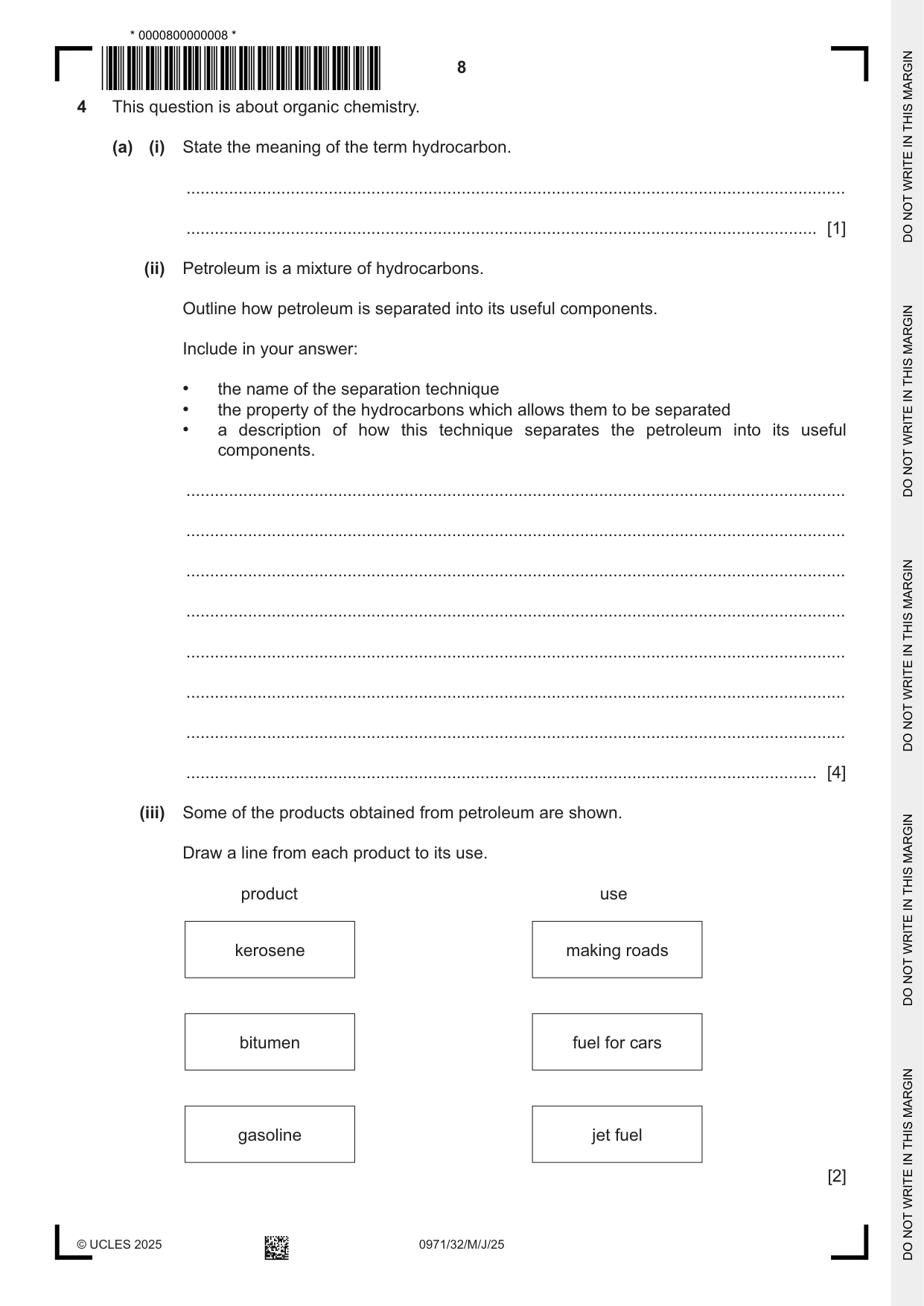
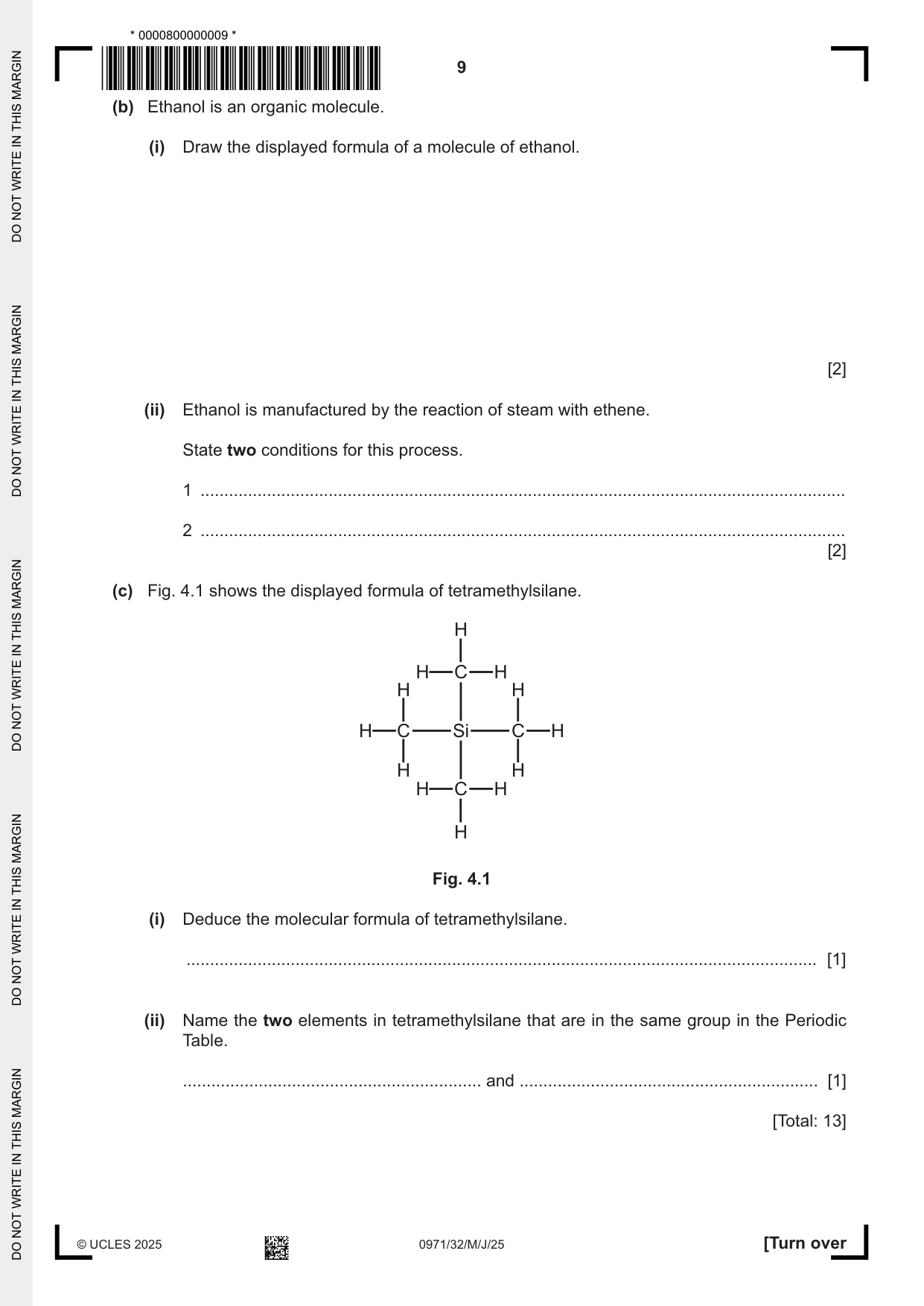
4 This question is about organic chemistry. (a) (i) State the meaning of the term hydrocarbon. ........................................................................................................................................... ..................................................................................................................................... [1] (ii) Petroleum is a mixture of hydrocarbons. Outline how petroleum is separated into its useful components. Include in your answer: • the name of the separation technique • the property of the hydrocarbons which allows them to be separated • a description of how this technique separates the petroleum into its useful components. ........................................................................................................................................... ........................................................................................................................................... ........................................................................................................................................... ........................................................................................................................................... ........................................................................................................................................... ........................................................................................................................................... ........................................................................................................................................... ..................................................................................................................................... [4] (iii) Some of the products obtained from petroleum are shown. Draw a line from each product to its use. product use kerosene making roads bitumen fuel for cars gasoline jet fuel [2] (b) Ethanol is an organic molecule. (i) Draw the displayed formula of a molecule of ethanol. [2] (ii) Ethanol is manufactured by the reaction of steam with ethene. State two conditions for this process. 1 ........................................................................................................................................ 2 ........................................................................................................................................ [2] (c) Fig. 4.1 shows the displayed formula of tetramethylsilane. H H C H H H H C Si C H H H H C H H Fig. 4.1 (i) Deduce the molecular formula of tetramethylsilane. ..................................................................................................................................... [1] (ii) Name the two elements in tetramethylsilane that are in the same group in the Periodic Table. ............................................................... and ............................................................... [1] [Total: 13]
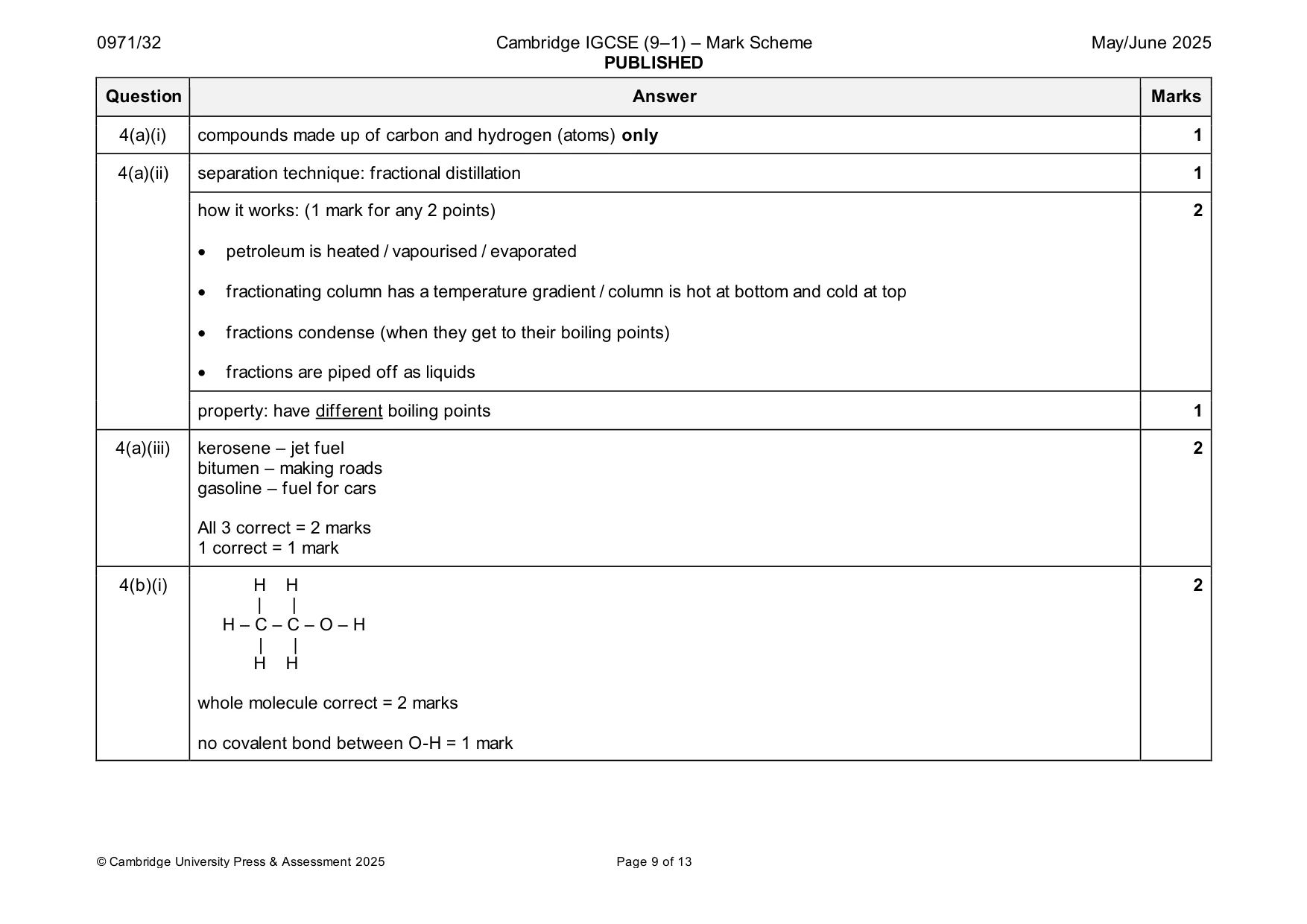
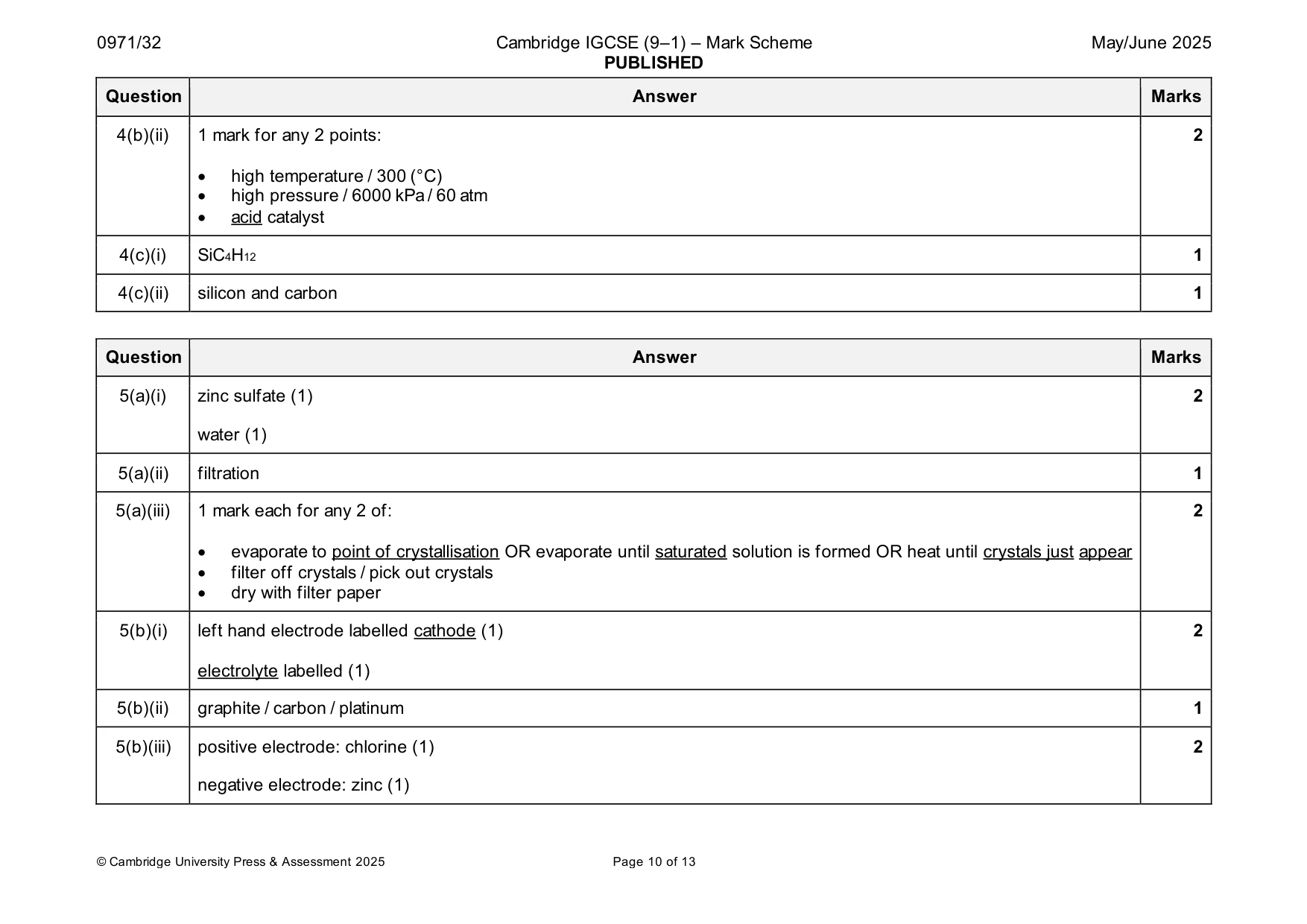
Mark scheme: 4(a)(i) compounds made up of carbon and hydrogen (atoms) only 1 4(a)(ii) separation technique: fractional distillation 1 how it works: (1 mark for any 2 points) 2 • petroleum is heated / vapourised / evaporated • fractionating column has a temperature gradient / column is hot at bottom and cold at top • fractions condense (when they get to their boiling points) • fractions are piped off as liquids property: have different boiling points 1 4(a)(iii) kerosene – jet fuel 2 bitumen – making roads gasoline – fuel for cars All 3 correct = 2 marks 1 correct = 1 mark 4(b)(i) H H 2 | | H – C – C – O – H | | H H whole molecule correct = 2 marks no covalent bond between O-H = 1 mark 4(b)(ii) 1 mark for any 2 points: 2 • high temperature / 300 (°C) • high pressure / 6000 kPa / 60 atm • acid catalyst 4(c)(i) SiC4H12 1 4(c)(ii) silicon and carbon 1
More questions on Formulae, functional groups and terminology
Q5 · This question is about zinc salts
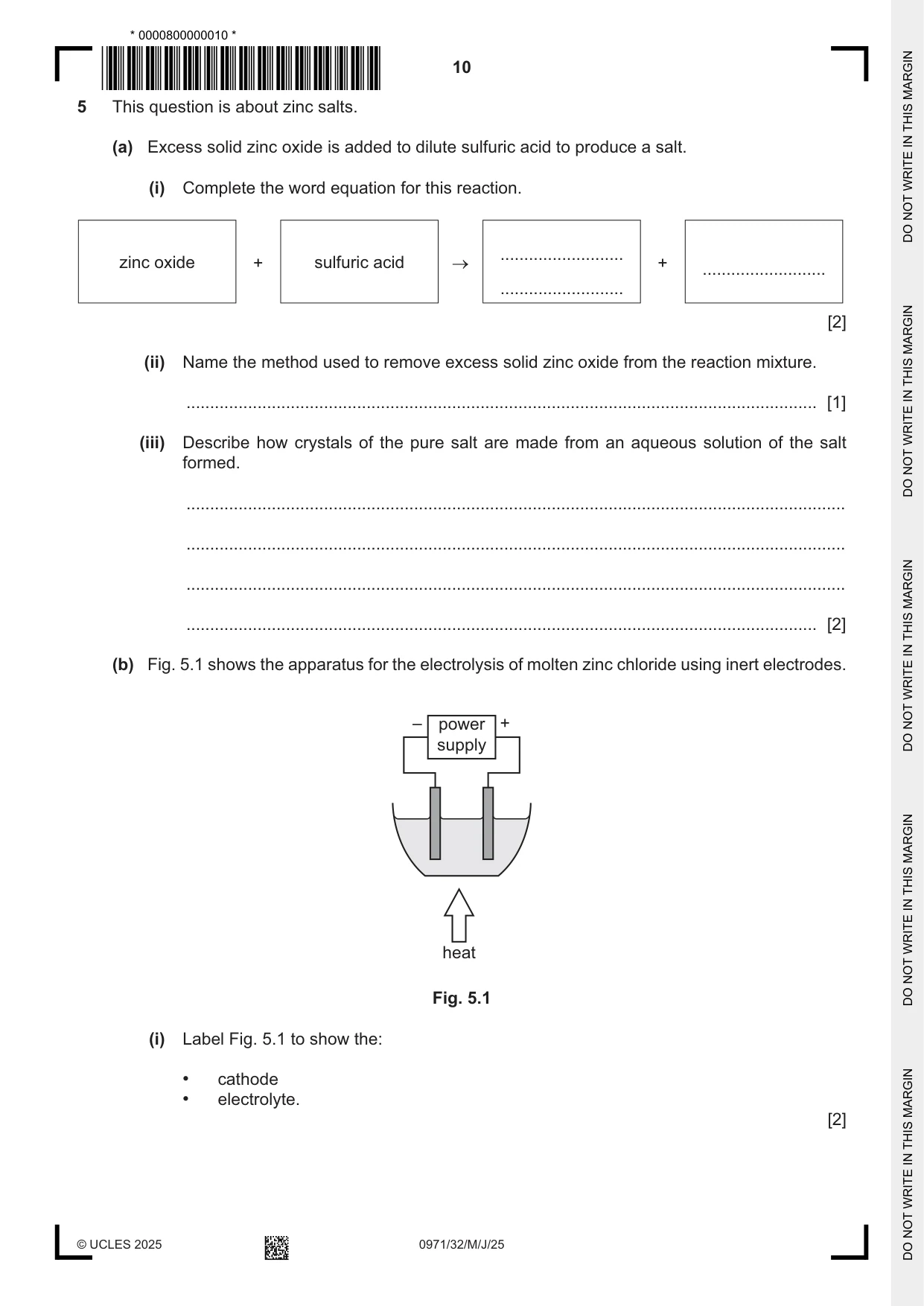
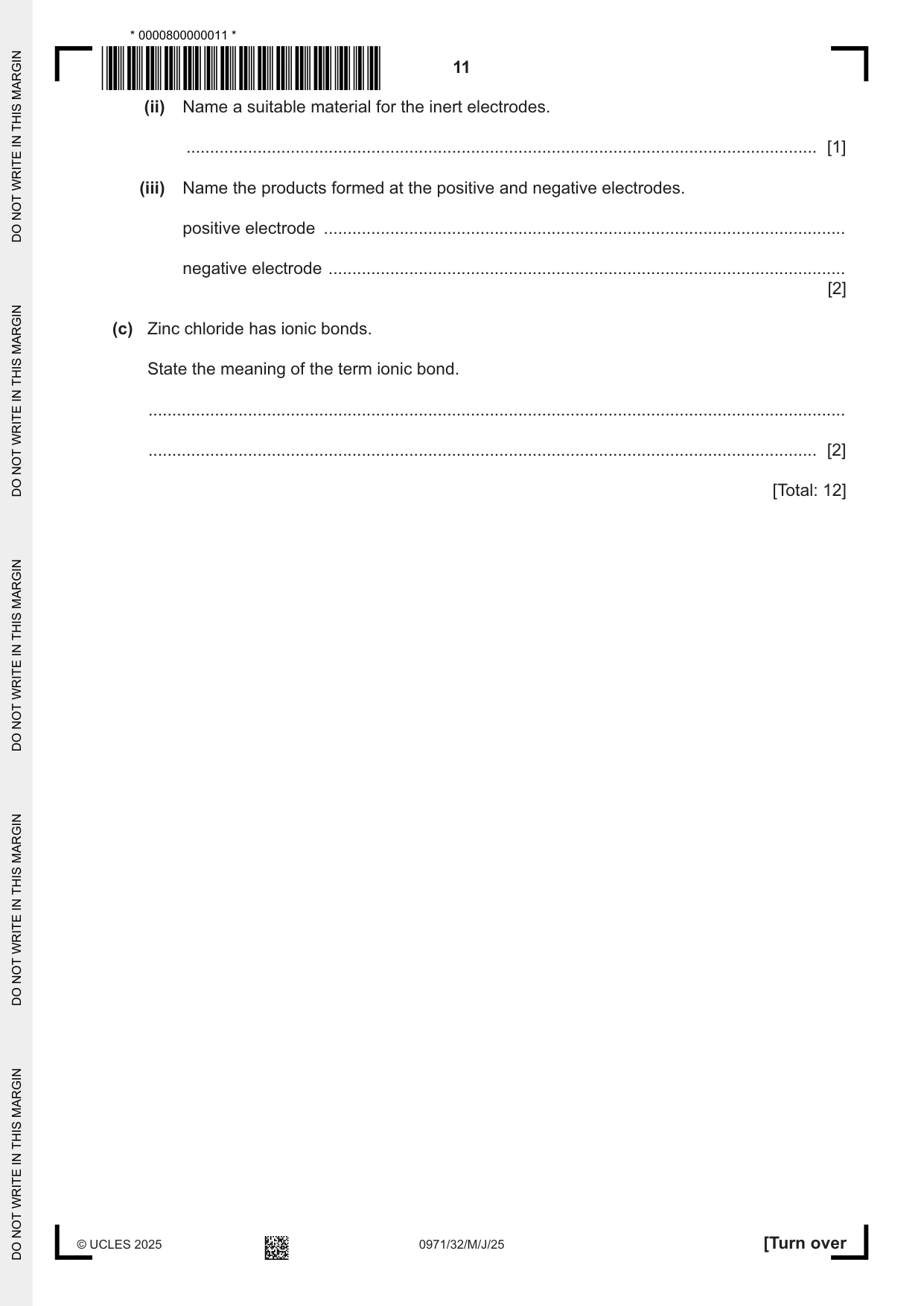
5 This question is about zinc salts. (a) Excess solid zinc oxide is added to dilute sulfuric acid to produce a salt. (i) Complete the word equation for this reaction. .......................... zinc oxide + sulfuric acid + .......................... .......................... [2] (ii) Name the method used to remove excess solid zinc oxide from the reaction mixture. ..................................................................................................................................... [1] (iii) Describe how crystals of the pure salt are made from an aqueous solution of the salt formed. ........................................................................................................................................... ........................................................................................................................................... ........................................................................................................................................... ..................................................................................................................................... [2] (b) Fig. 5.1 shows the apparatus for the electrolysis of molten zinc chloride using inert electrodes. – power + supply heat Fig. 5.1 (i) Label Fig. 5.1 to show the: • cathode • electrolyte. [2] (ii) Name a suitable material for the inert electrodes. ..................................................................................................................................... [1] (iii) Name the products formed at the positive and negative electrodes. positive electrode .............................................................................................................. negative electrode ............................................................................................................. [2] (c) Zinc chloride has ionic bonds. State the meaning of the term ionic bond. ................................................................................................................................................... ............................................................................................................................................. [2] [Total: 12]
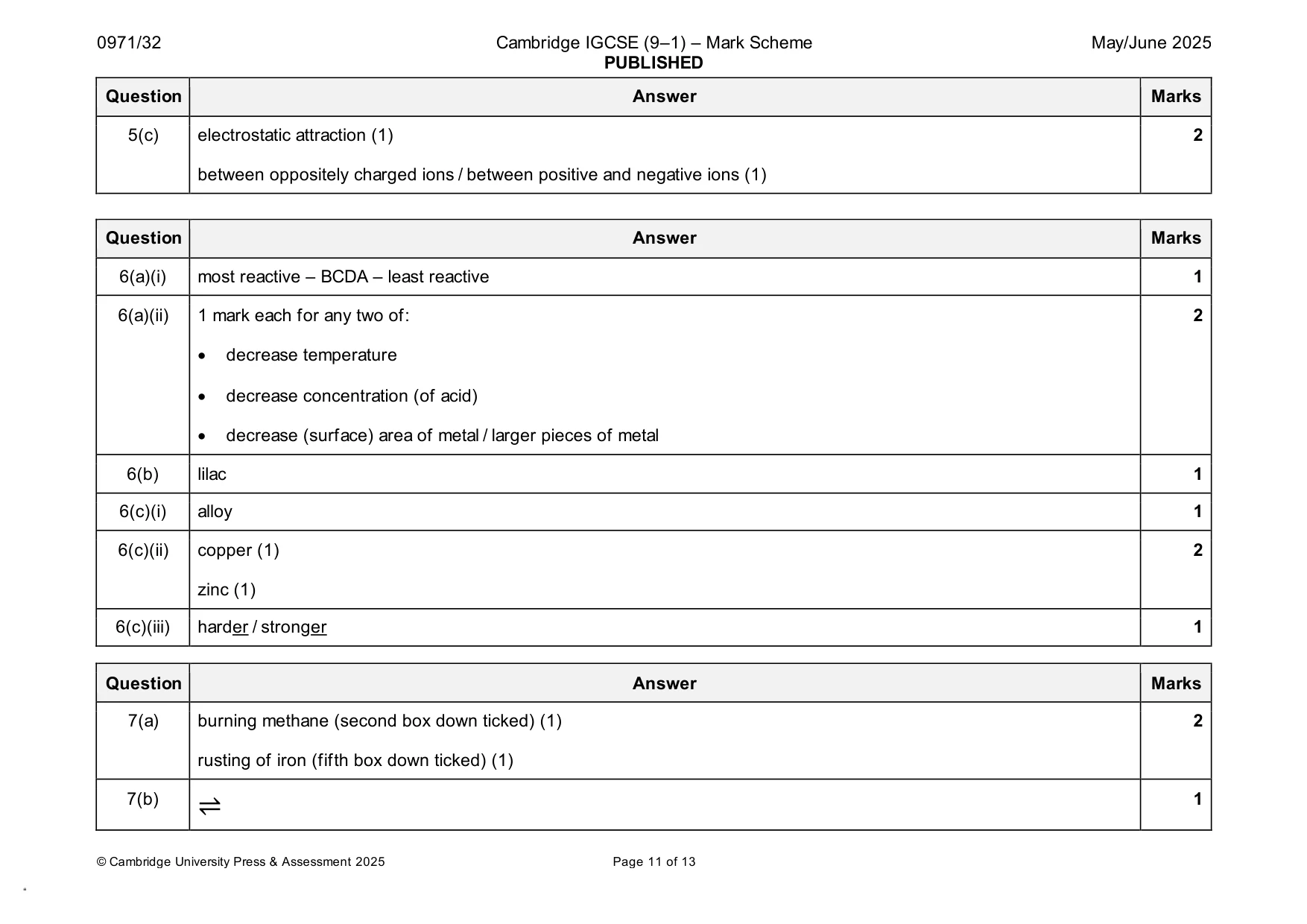
Mark scheme: 5(a)(i) zinc sulfate (1) 2 water (1) 5(a)(ii) filtration 1 5(a)(iii) 1 mark each for any 2 of: 2 • evaporate to point of crystallisation OR evaporate until saturated solution is formed OR heat until crystals just appear • filter off crystals / pick out crystals • dry with filter paper 5(b)(i) left hand electrode labelled cathode (1) 2 electrolyte labelled (1) 5(b)(ii) graphite / carbon / platinum 1 5(b)(iii) positive electrode: chlorine (1) 2 negative electrode: zinc (1) 5(c) electrostatic attraction (1) 2 between oppositely charged ions / between positive and negative ions (1)
Q6 · This question is about metals
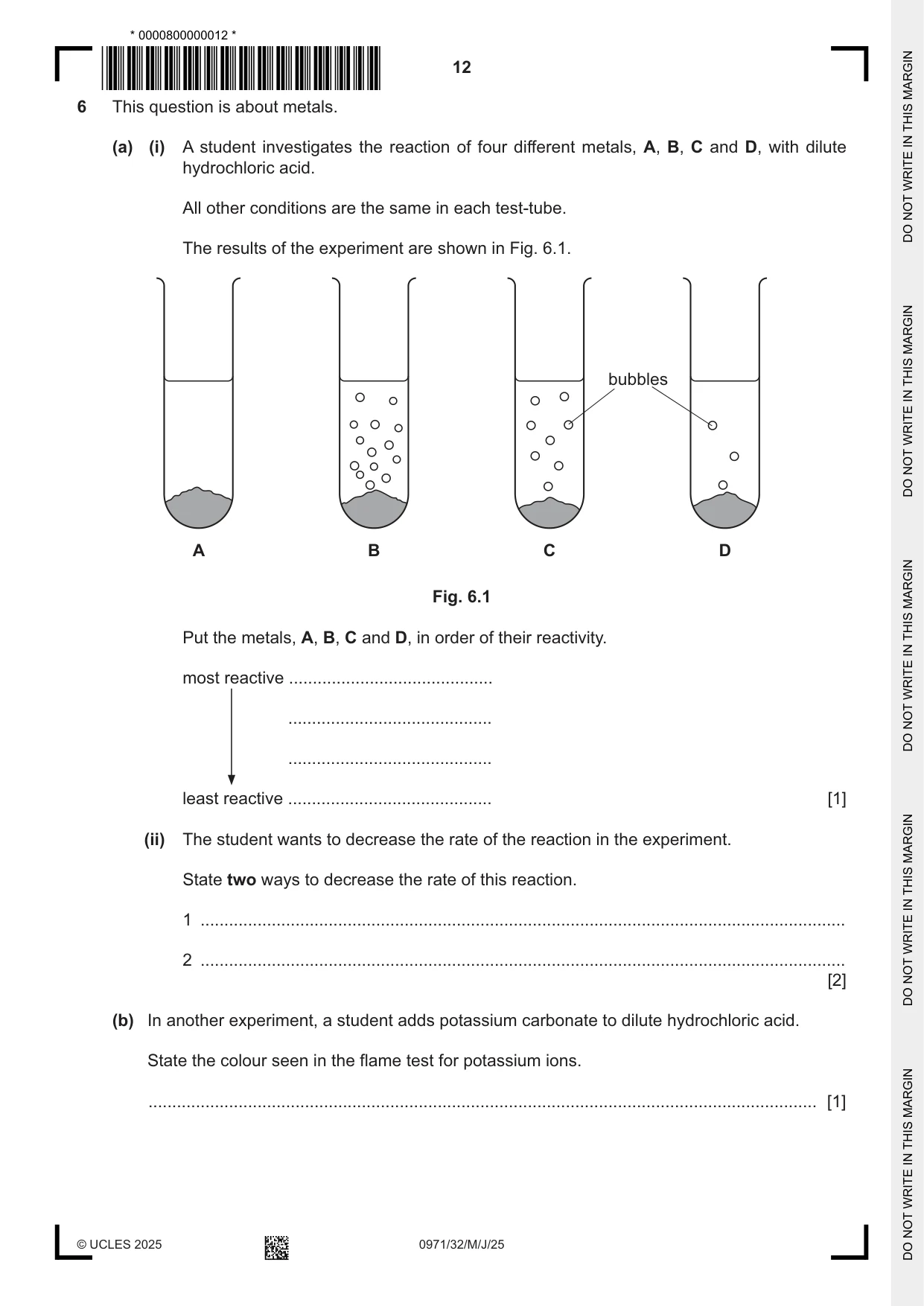
6 This question is about metals. (a) (i) A student investigates the reaction of four different metals, A, B, C and D, with dilute hydrochloric acid. All other conditions are the same in each test‑tube. The results of the experiment are shown in Fig. 6.1. bubbles A B C D Fig. 6.1 Put the metals, A, B, C and D, in order of their reactivity. most reactive ........................................... ........................................... ........................................... least reactive ........................................... [1] (ii) The student wants to decrease the rate of the reaction in the experiment. State two ways to decrease the rate of this reaction. 1 ........................................................................................................................................ 2 ........................................................................................................................................ [2] (b) In another experiment, a student adds potassium carbonate to dilute hydrochloric acid. State the colour seen in the flame test for potassium ions. ............................................................................................................................................. [1] (c) Brass is a mixture of two metals. (i) State the name given to a mixture of metals such as brass. ..................................................................................................................................... [1] (ii) Name the two metals in brass. ............................................................... and ............................................................... [2] (iii) Magnalium is a mixture of magnesium and aluminium. Suggest one property of magnalium that makes it more useful than pure magnesium metal. ..................................................................................................................................... [1] [Total: 8]
Mark scheme: 6(a)(i) most reactive – BCDA – least reactive 1 6(a)(ii) 1 mark each for any two of: 2 • decrease temperature • decrease concentration (of acid) • decrease (surface) area of metal / larger pieces of metal 6(b) lilac 1 6(c)(i) alloy 1 6(c)(ii) copper (1) 2 zinc (1) 6(c)(iii) harder / stronger 1
Q7 · Select two processes that show a chemical change
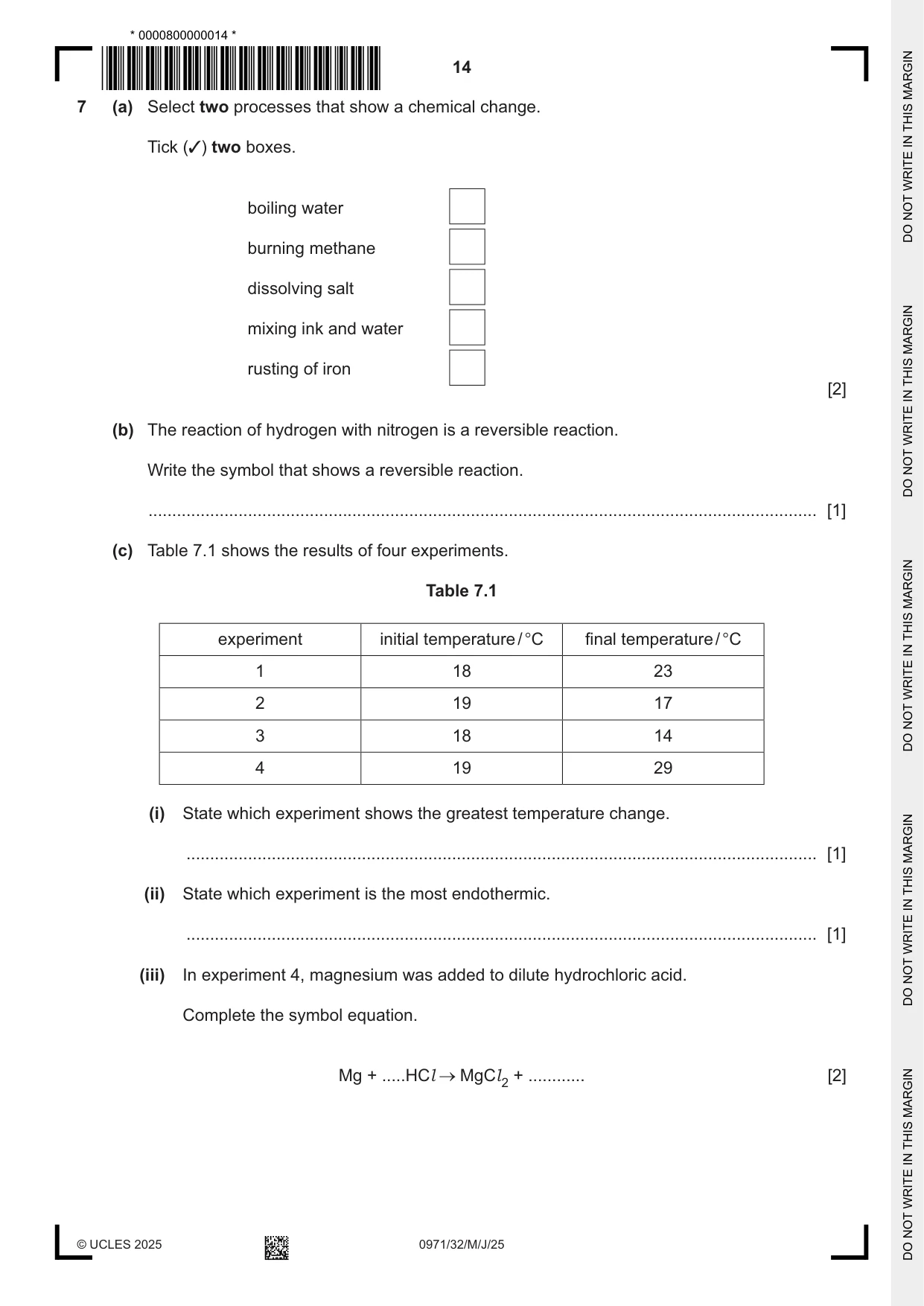
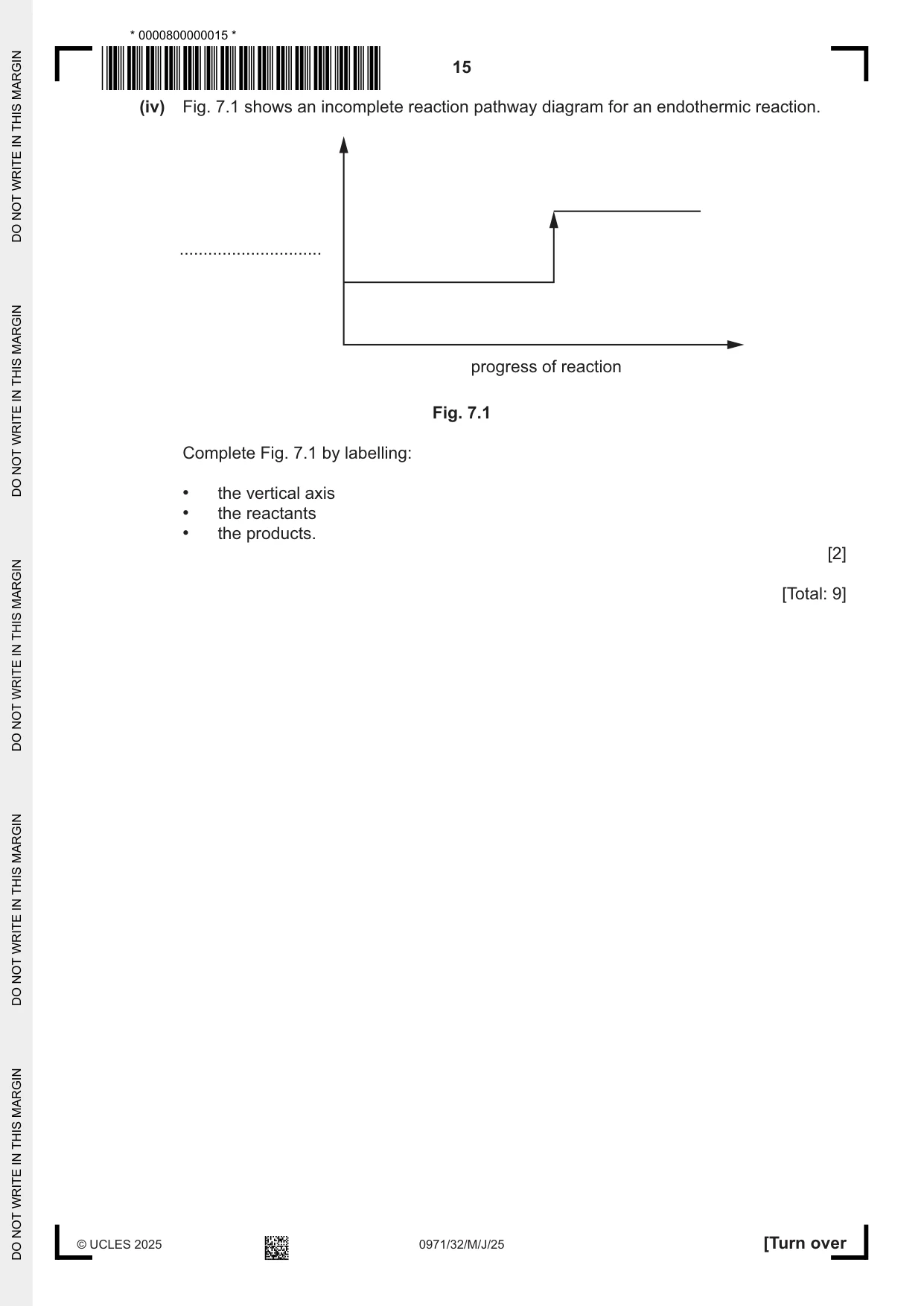
7 (a) Select two processes that show a chemical change. Tick (3) two boxes. boiling water burning methane dissolving salt mixing ink and water rusting of iron [2] (b) The reaction of hydrogen with nitrogen is a reversible reaction. Write the symbol that shows a reversible reaction. ............................................................................................................................................. [1] (c) Table 7.1 shows the results of four experiments. Table 7.1 experiment initial temperature / °C final temperature / °C 1 18 23 2 19 17 3 18 14 4 19 29 (i) State which experiment shows the greatest temperature change. ..................................................................................................................................... [1] (ii) State which experiment is the most endothermic. ..................................................................................................................................... [1] (iii) In experiment 4, magnesium was added to dilute hydrochloric acid. Complete the symbol equation. Mg + .....HCl MgCl + ............ [2] 2 (iv) Fig. 7.1 shows an incomplete reaction pathway diagram for an endothermic reaction. .............................. progress of reaction Fig. 7.1 Complete Fig. 7.1 by labelling: • the vertical axis • the reactants • the products. [2] [Total: 9]
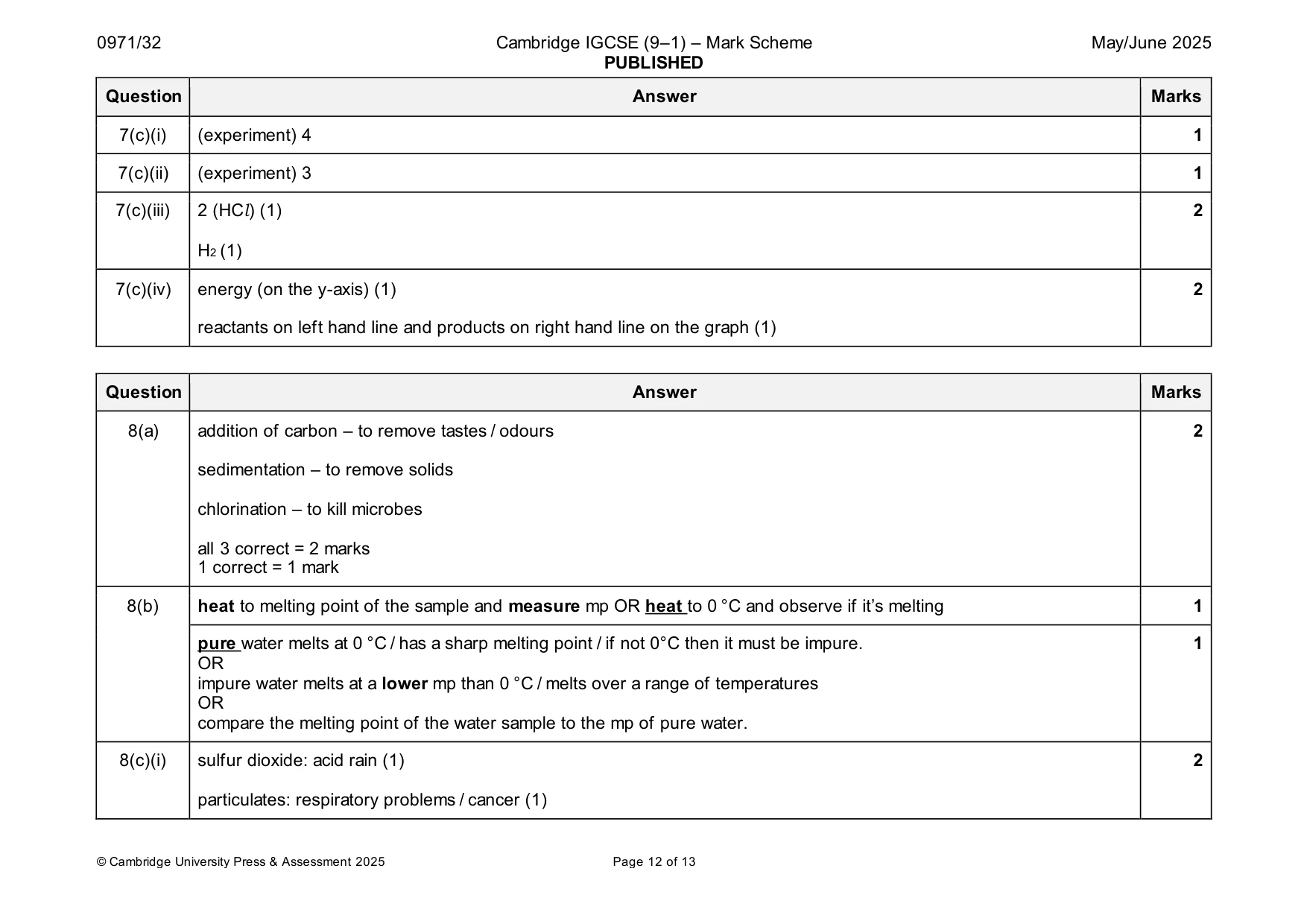
Mark scheme: 7(a) burning methane (second box down ticked) (1) 2 rusting of iron (fifth box down ticked) (1) 7(b) ⇌ 1 7(c)(i) (experiment) 4 1 7(c)(ii) (experiment) 3 1 7(c)(iii) 2 (HCl) (1) 2 H2 (1) 7(c)(iv) energy (on the y-axis) (1) 2 reactants on left hand line and products on right hand line on the graph (1)
Q8 · This question is about water and air
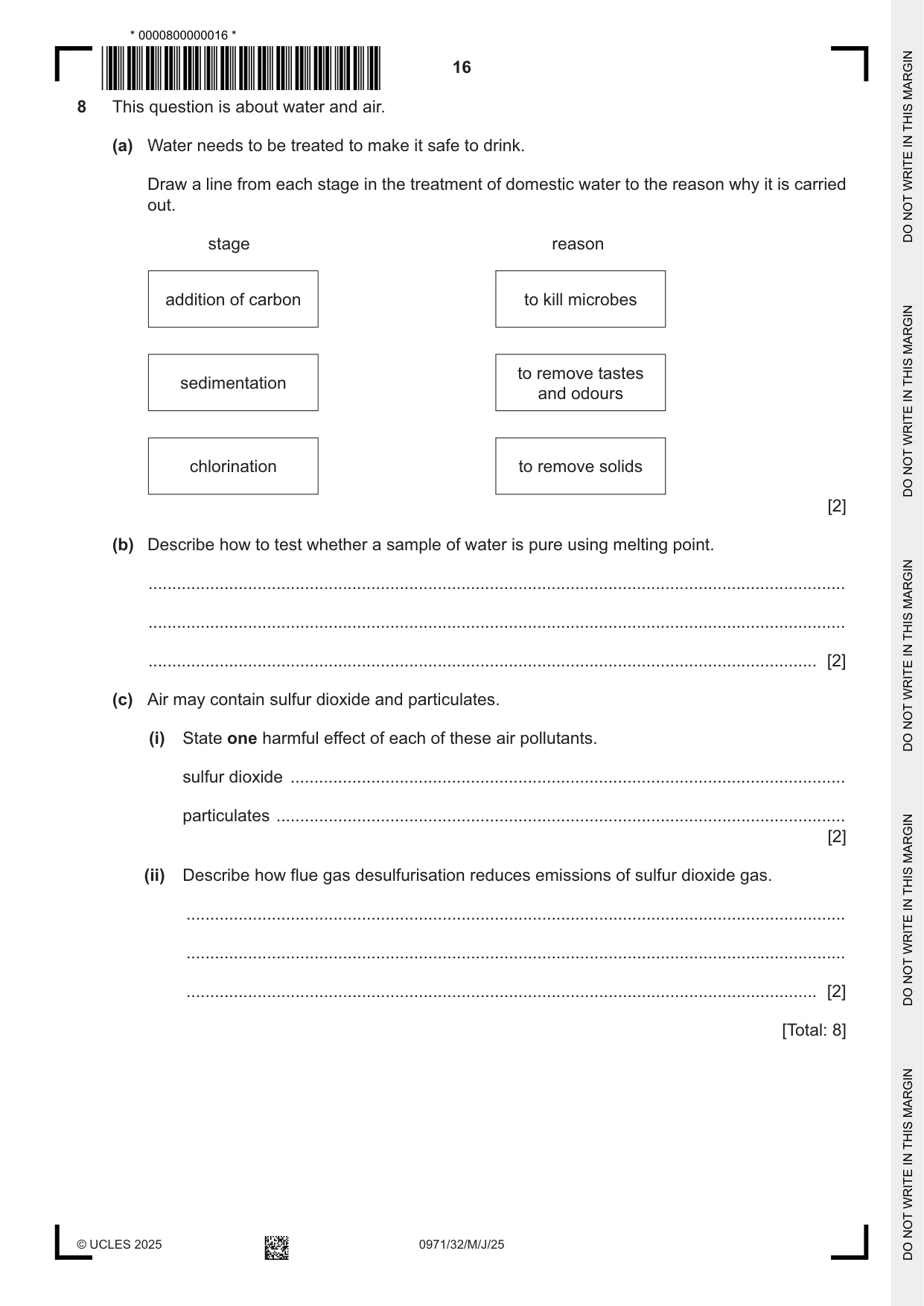
8 This question is about water and air. (a) Water needs to be treated to make it safe to drink. Draw a line from each stage in the treatment of domestic water to the reason why it is carried out. stage reason addition of carbon to kill microbes to remove tastes sedimentation and odours chlorination to remove solids [2] (b) Describe how to test whether a sample of water is pure using melting point. ................................................................................................................................................... ................................................................................................................................................... ............................................................................................................................................. [2] (c) Air may contain sulfur dioxide and particulates. (i) State one harmful effect of each of these air pollutants. sulfur dioxide ..................................................................................................................... particulates ........................................................................................................................ [2] (ii) Describe how flue gas desulfurisation reduces emissions of sulfur dioxide gas. ........................................................................................................................................... ........................................................................................................................................... ..................................................................................................................................... [2] [Total: 8]
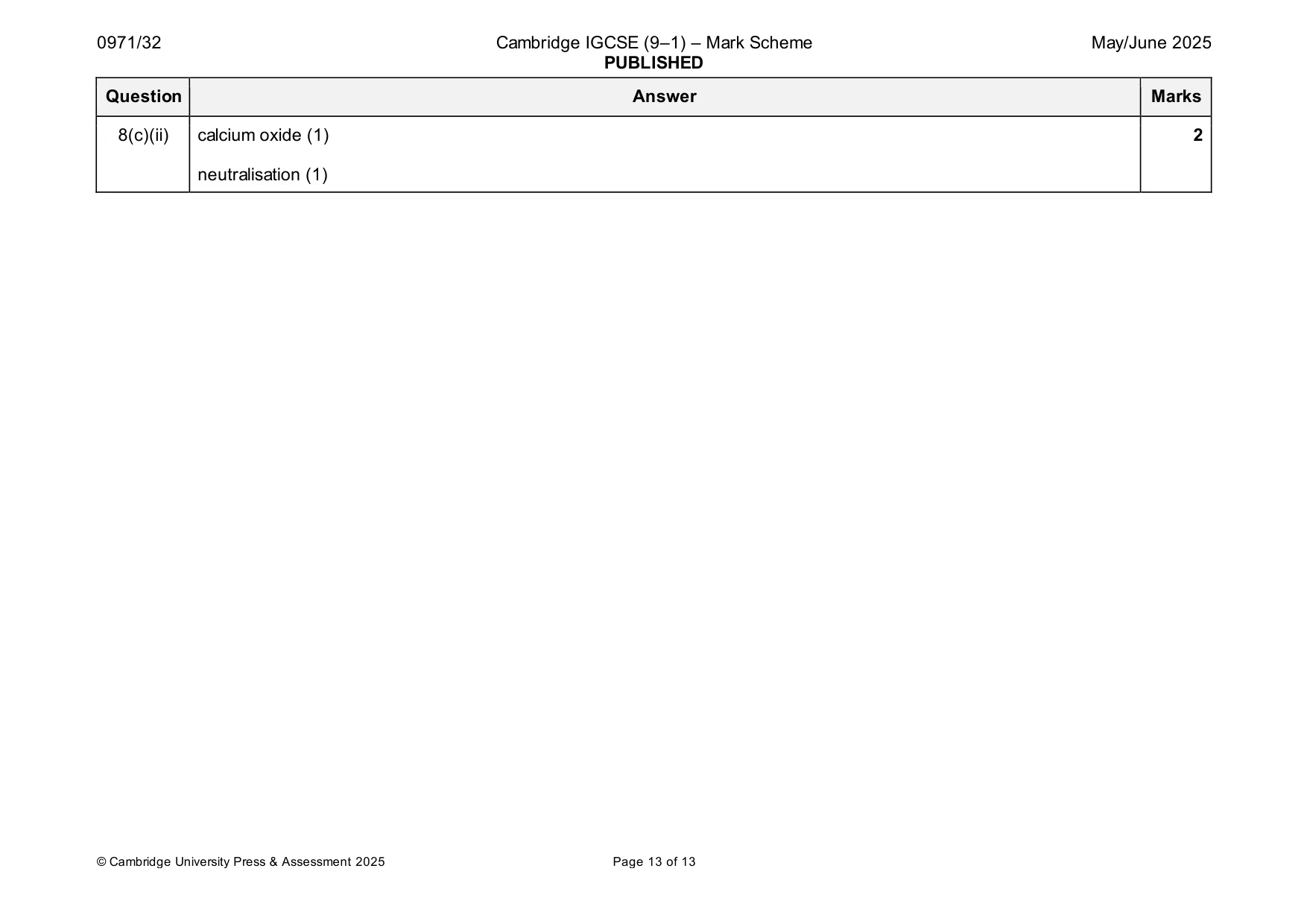
Mark scheme: 8(a) addition of carbon – to remove tastes / odours 2 sedimentation – to remove solids chlorination – to kill microbes all 3 correct = 2 marks 1 correct = 1 mark 8(b) heat to melting point of the sample and measure mp OR heat to 0 °C and observe if it’s melting 1 pure water melts at 0 °C / has a sharp melting point / if not 0°C then it must be impure. 1 OR impure water melts at a lower mp than 0 °C / melts over a range of temperatures OR compare the melting point of the water sample to the mp of pure water. 8(c)(i) sulfur dioxide: acid rain (1) 2 particulates: respiratory problems / cancer (1) 8(c)(ii) calcium oxide (1) 2 neutralisation (1)
What was in this paper
The subtopics covered by these 8 questions, and how many questions each got. Open one in a new tab to see every Cambridge question on it.
What you needed in this session
Cambridge’s own grade thresholds for 2025 May/June, Paper 3 · Variant 2. A higher threshold means an easier paper — the bar moves with how the cohort did.