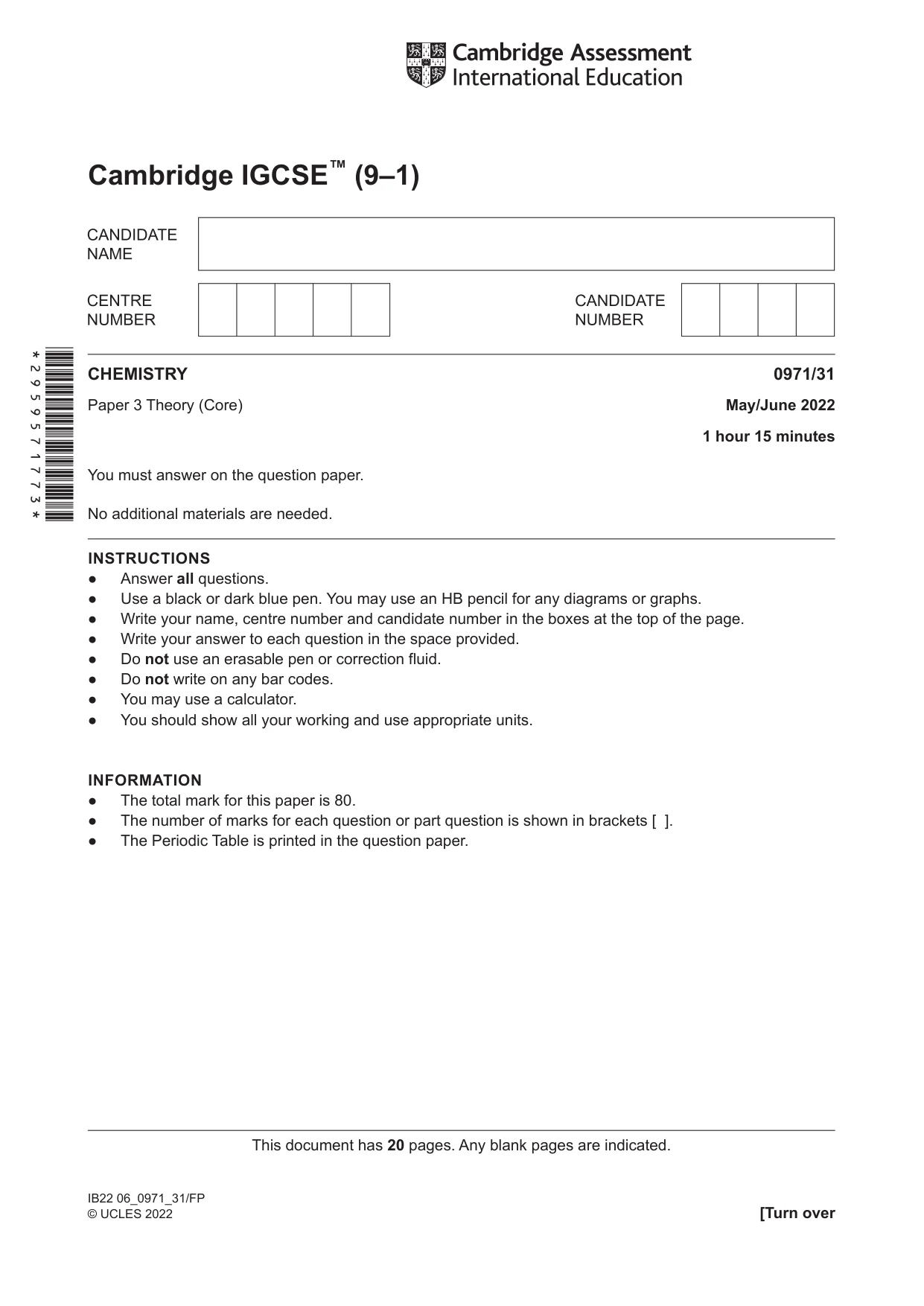
Cambridge IGCSE Chemistry (9-1) 0971 — 2022 May/June Paper 3 · Variant 1
0971/31/M/J/22 · 8 questions · 80 marks · ≈90 min
The question paper and its mark scheme, free to read here and free to download. This is Cambridge’s own paper, exactly as it was sat.
Question paper20 pages



Mark scheme10 pages
Answers below. Sit the paper first if you are practising.
Questions as text
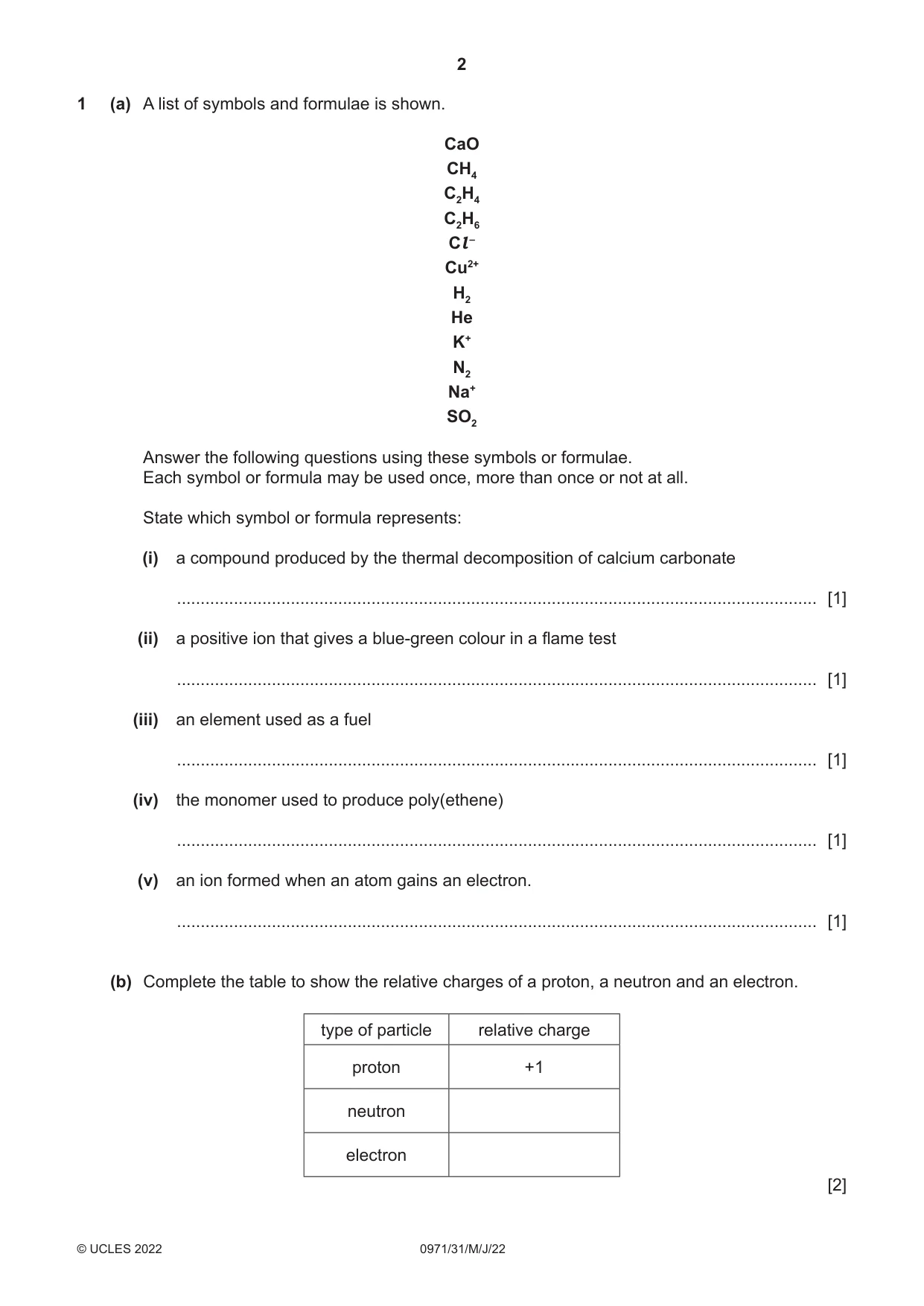
Q1 · A list of symbols and formulae is shown
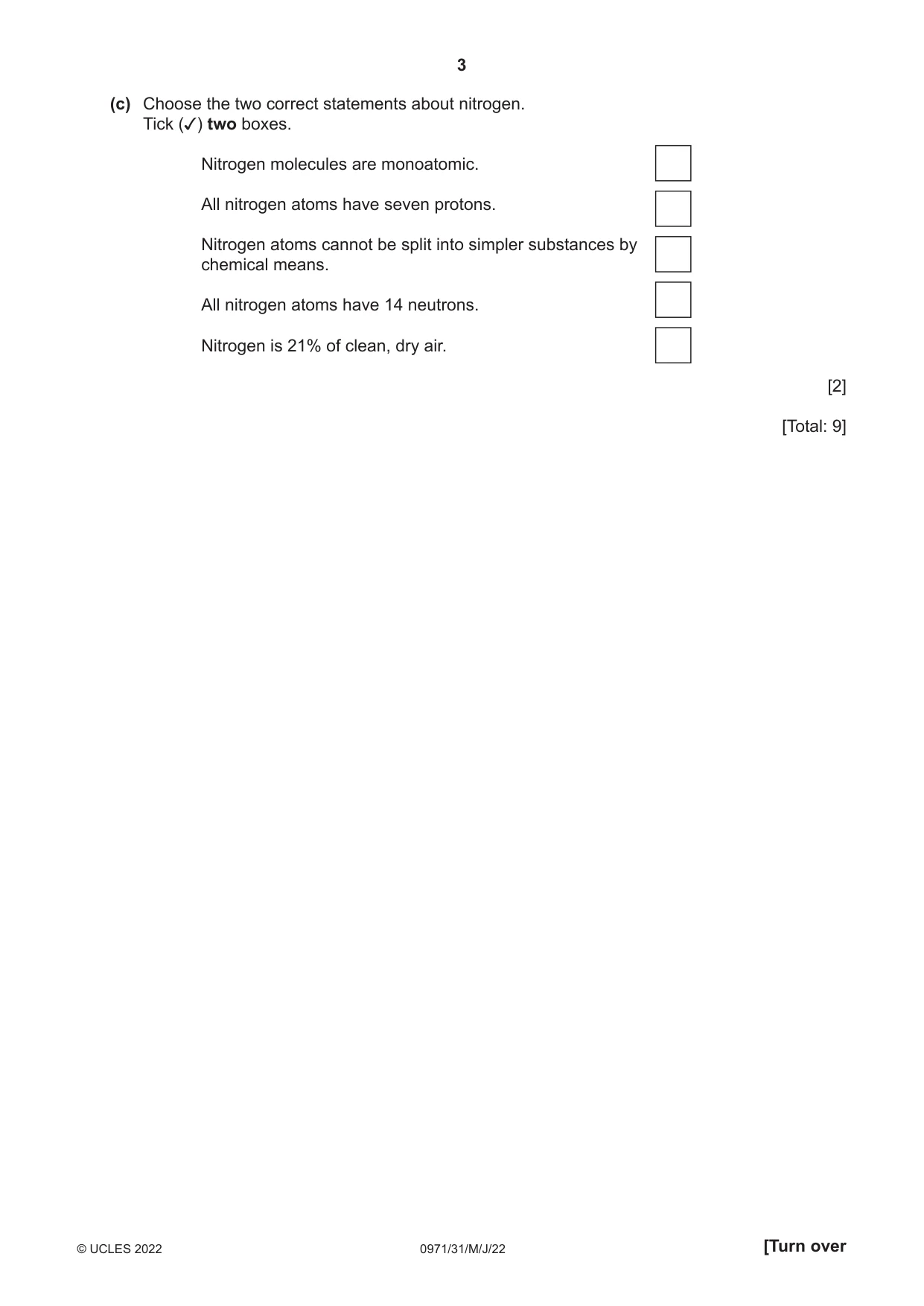
1 (a) A list of symbols and formulae is shown. CaO CH4 C2H4 C2H6 Cl – Cu2+ H2 He K+ N2 Na+ SO2 Answer the following questions using these symbols or formulae. Each symbol or formula may be used once, more than once or not at all. State which symbol or formula represents: (i) a compound produced by the thermal decomposition of calcium carbonate ....................................................................................................................................... [1] (ii) a positive ion that gives a blue-green colour in a flame test ....................................................................................................................................... [1] (iii) an element used as a fuel ....................................................................................................................................... [1] (iv) the monomer used to produce poly(ethene) ....................................................................................................................................... [1] (v) an ion formed when an atom gains an electron. ....................................................................................................................................... [1] (b) Complete the table to show the relative charges of a proton, a neutron and an electron. type of particle relative charge proton +1 neutron electron [2] (c) Choose the two correct statements about nitrogen. Tick (✓) two boxes. Nitrogen molecules are monoatomic. All nitrogen atoms have seven protons. Nitrogen atoms cannot be split into simpler substances by chemical means. All nitrogen atoms have 14 neutrons. Nitrogen is 21% of clean, dry air. [2] [Total: 9]
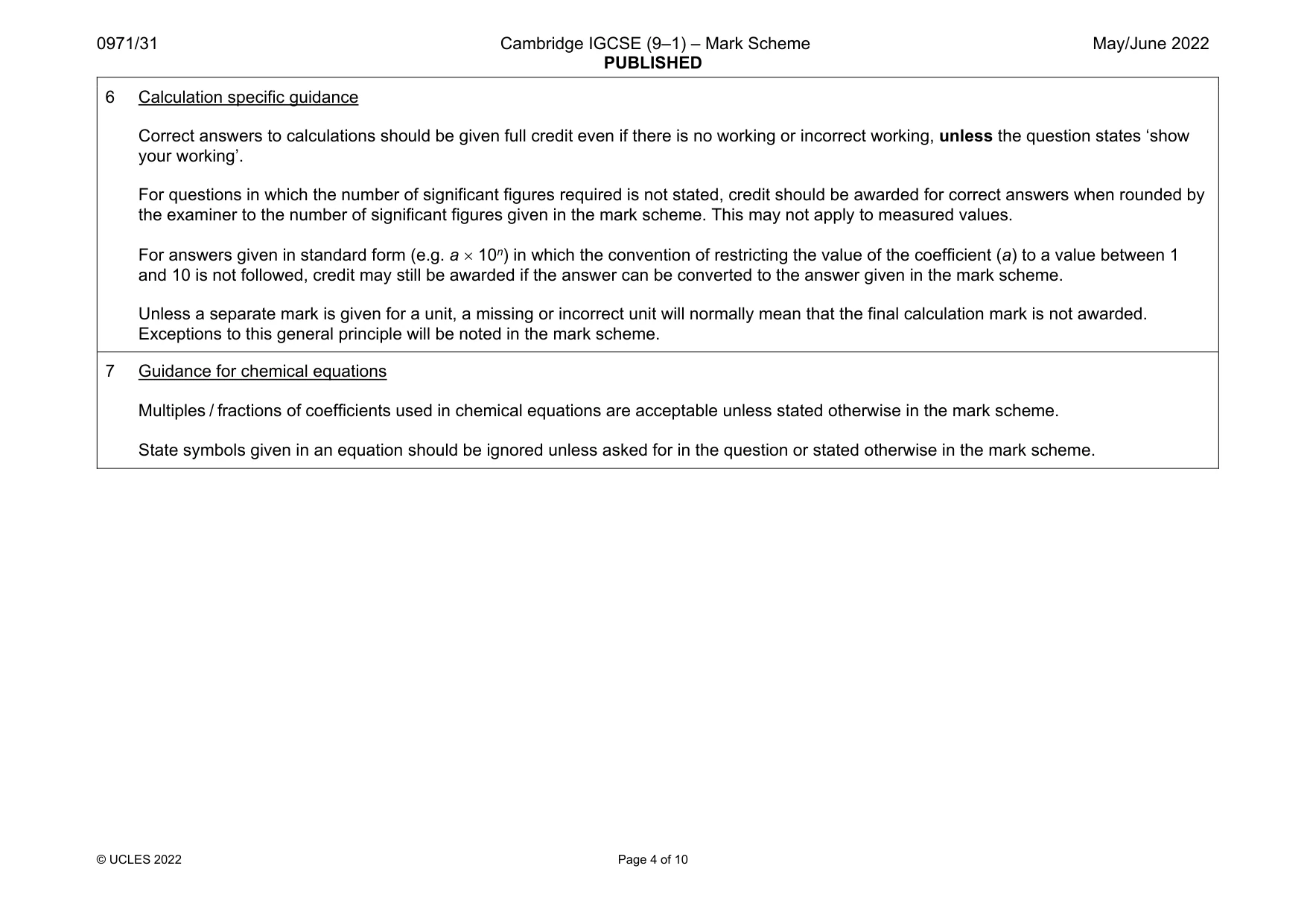
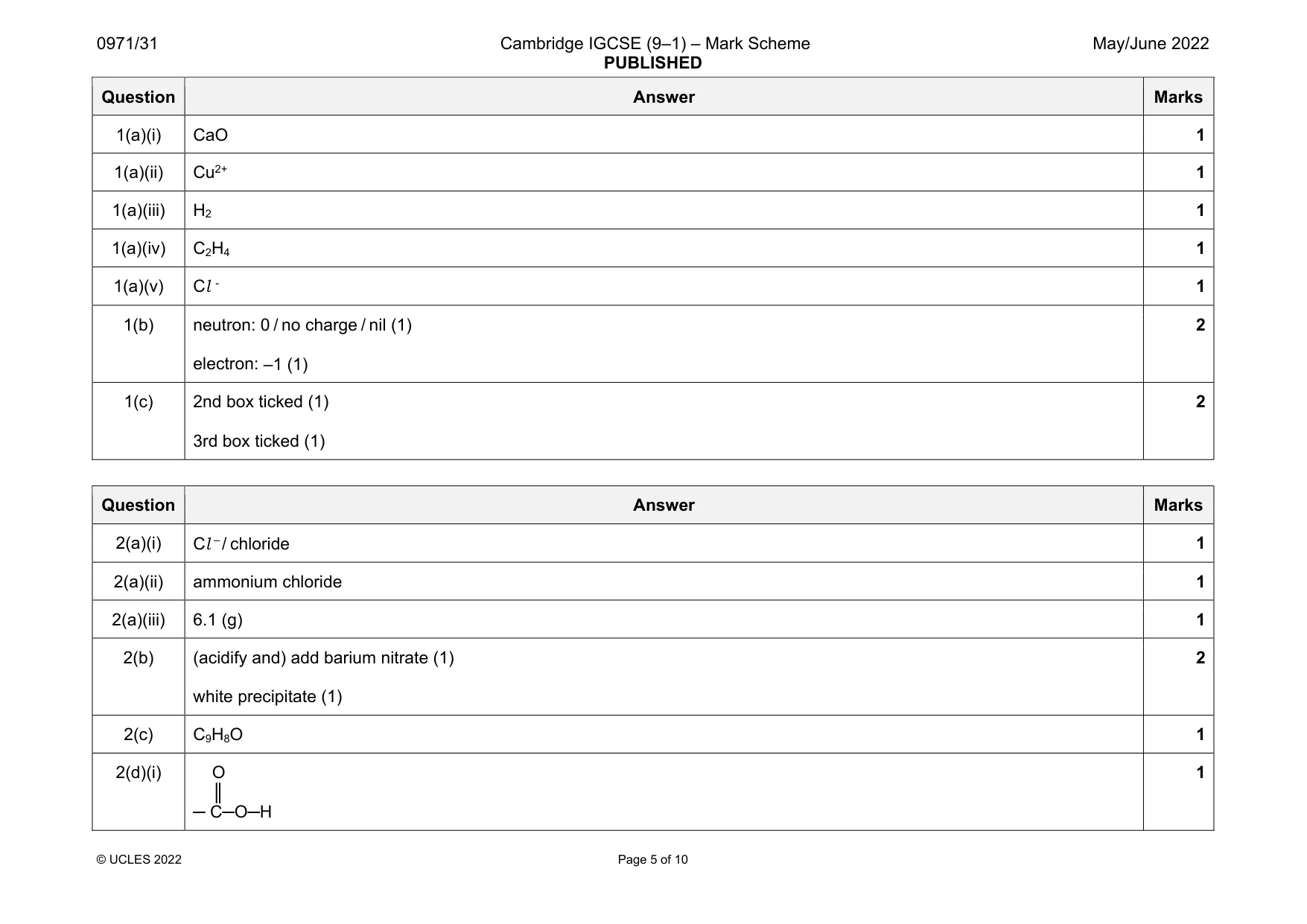
Mark scheme: 1(a)(i) CaO 1 1(a)(ii) Cu2+ 1 1(a)(iii) H2 1 1(a)(iv) C2H4 1 1(a)(v) Cl - 1 1(b) neutron: 0 / no charge / nil (1) electron: –1 (1) 2 1(c) 2nd box ticked (1) 3rd box ticked (1) 2
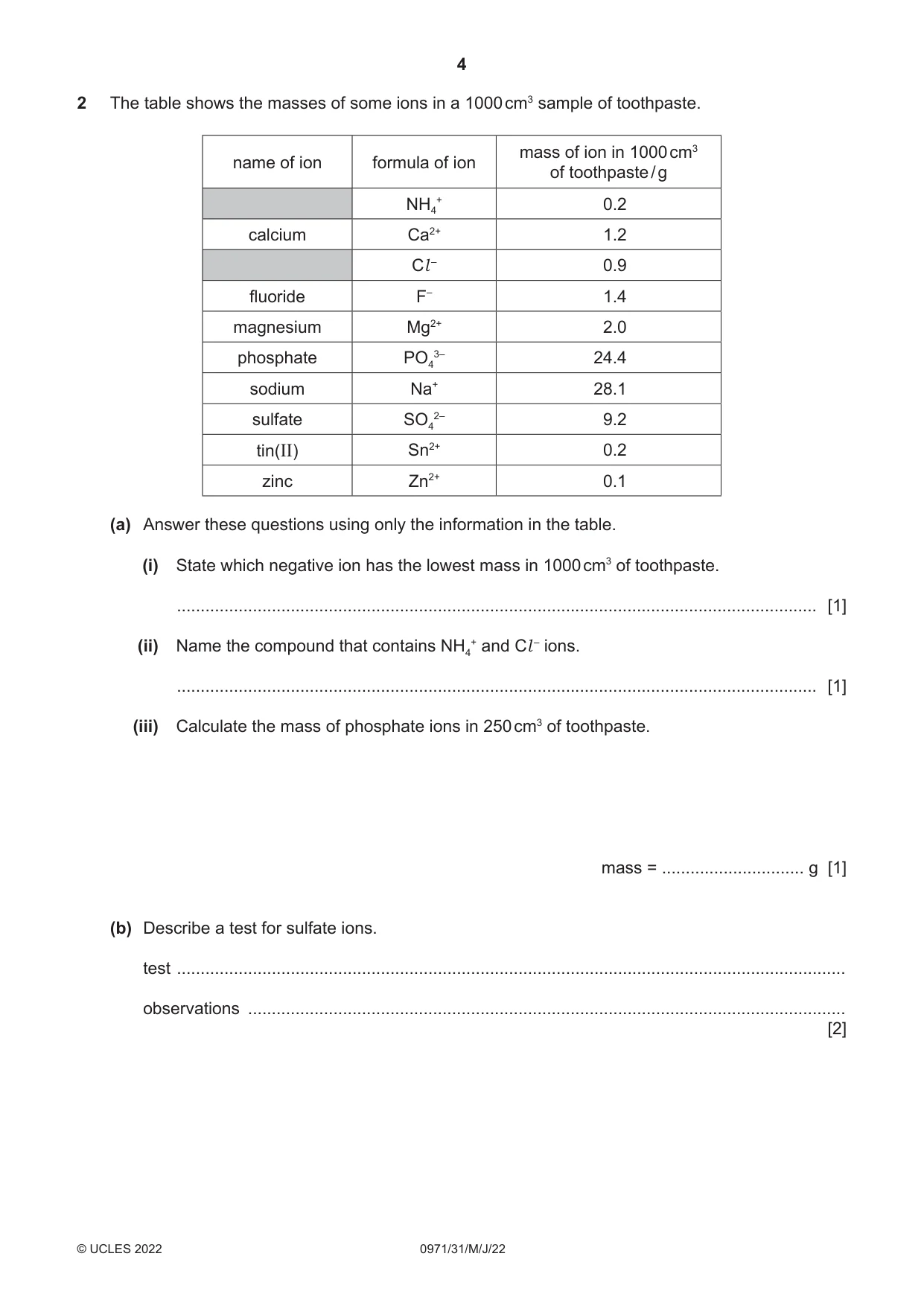
Q2 · The table shows the masses of some ions in a 1000 cm3 sample of toothpaste
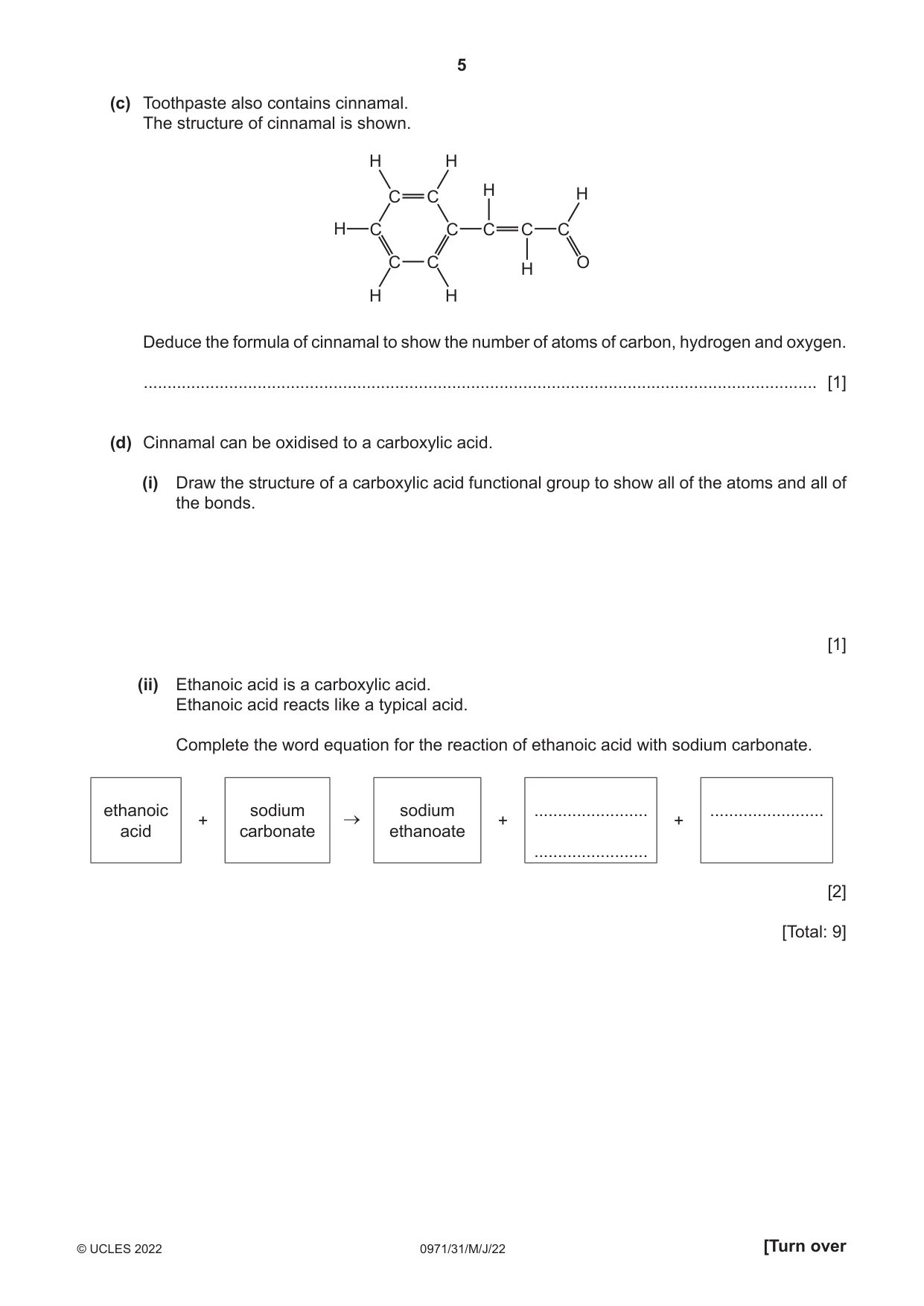
2 The table shows the masses of some ions in a 1000 cm3 sample of toothpaste. mass of ion in 1000 cm3 name of ion formula of ion of toothpaste / g NH4+ 0.2 calcium Ca2+ 1.2 Cl – 0.9 fluoride F– 1.4 magnesium Mg2+ 2.0 phosphate PO43– 24.4 sodium Na+ 28.1 sulfate SO42– 9.2 tin(II) Sn2+ 0.2 zinc Zn2+ 0.1 (a) Answer these questions using only the information in the table. (i) State which negative ion has the lowest mass in 1000 cm3 of toothpaste. ....................................................................................................................................... [1] (ii) Name the compound that contains NH4+ and Cl – ions. ....................................................................................................................................... [1] (iii) Calculate the mass of phosphate ions in 250 cm3 of toothpaste. mass = .............................. g [1] (b) Describe a test for sulfate ions. test ............................................................................................................................................. observations ............................................................................................................................... [2] (c) Toothpaste also contains cinnamal. The structure of cinnamal is shown. H H H H C C H C C C C C C C O H H H Deduce the formula of cinnamal to show the number of atoms of carbon, hydrogen and oxygen. .............................................................................................................................................. [1] (d) Cinnamal can be oxidised to a carboxylic acid. (i) Draw the structure of a carboxylic acid functional group to show all of the atoms and all of the bonds. [1] (ii) Ethanoic acid is a carboxylic acid. Ethanoic acid reacts like a typical acid. Complete the word equation for the reaction of ethanoic acid with sodium carbonate. ethanoic sodium sodium ........................ ........................ + + + acid carbonate ethanoate ........................ [2] [Total: 9]
Mark scheme: 2(a)(i) 2(a)(ii) ammonium chloride 1 2(a)(iii) 6.1 (g) 1 2(b) (acidify and) add barium nitrate (1) white precipitate (1) 2 2(c) C9H8O 1 2(d)(i) O ║ ─ C─O─H 1 Question Answer Marks 2(d)(ii) carbon dioxide (1) water (1) 2
Q3 · This question is about halogens and halogen compounds
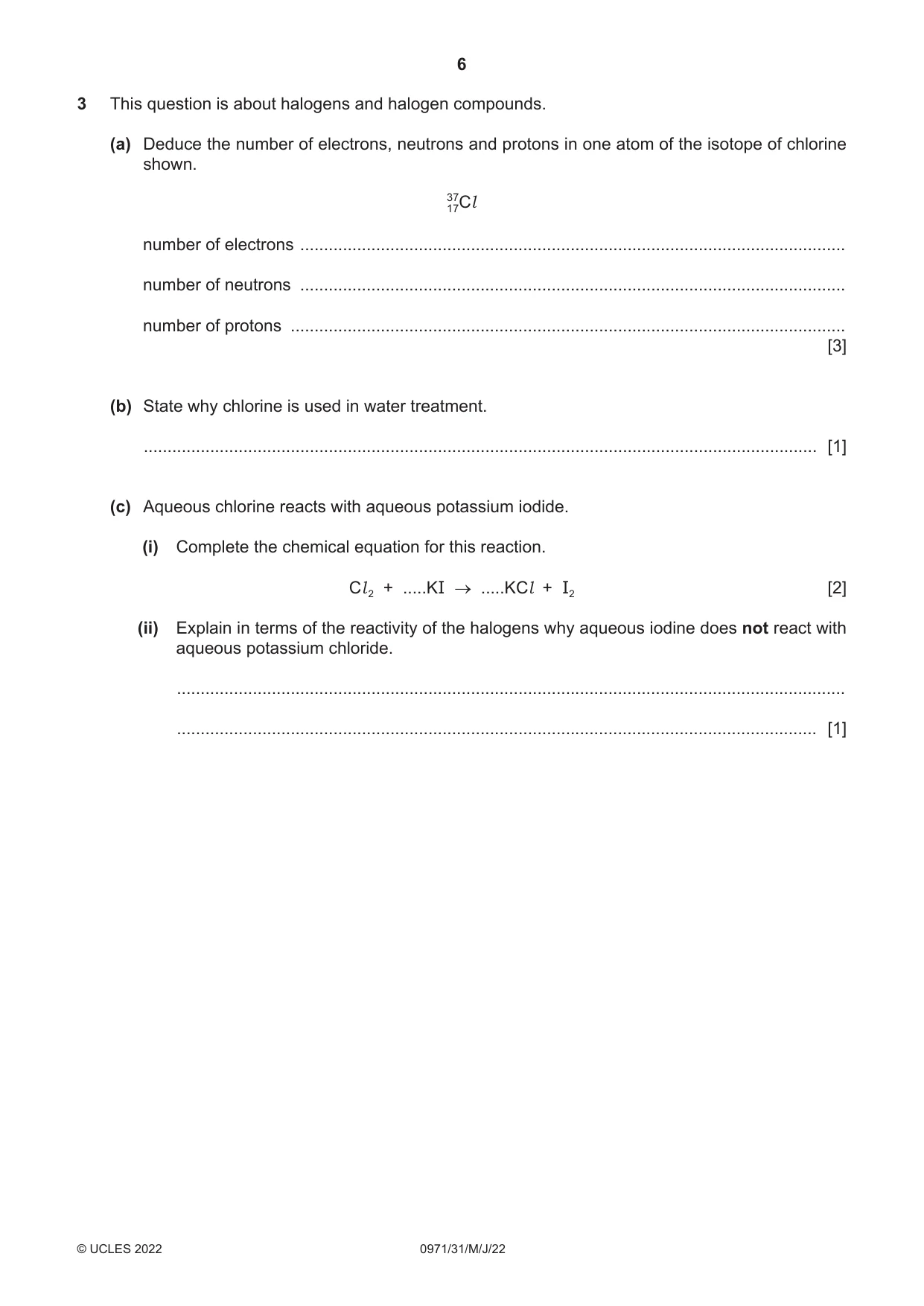
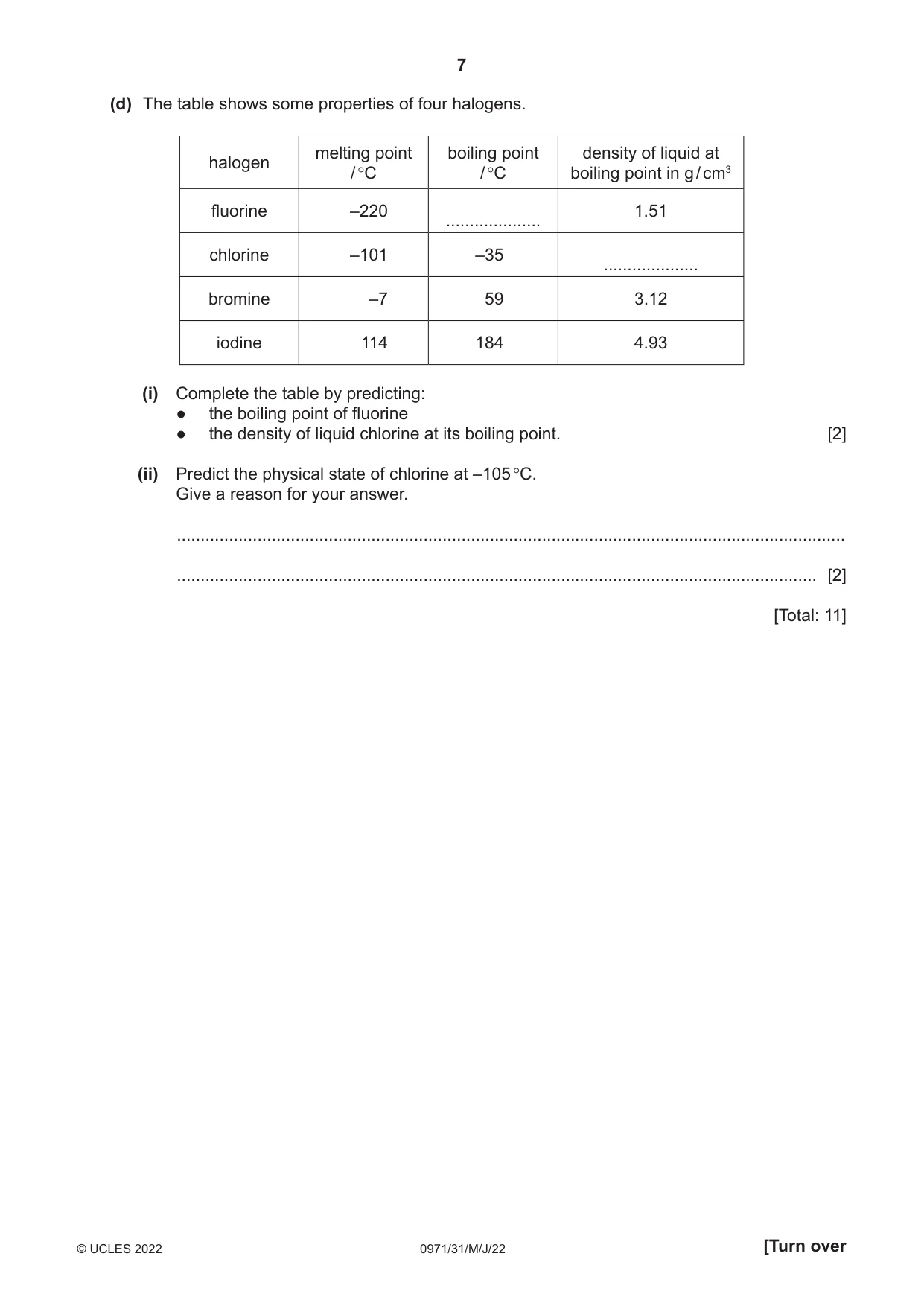
3 This question is about halogens and halogen compounds. (a) Deduce the number of electrons, neutrons and protons in one atom of the isotope of chlorine shown. 1737Cl number of electrons ................................................................................................................... number of neutrons .................................................................................................................... number of protons ...................................................................................................................... [3] (b) State why chlorine is used in water treatment. .............................................................................................................................................. [1] (c) Aqueous chlorine reacts with aqueous potassium iodide. (i) Complete the chemical equation for this reaction. Cl 2 + .....KI → .....KCl + I2 [2] (ii) Explain in terms of the reactivity of the halogens why aqueous iodine does not react with aqueous potassium chloride. ............................................................................................................................................. ....................................................................................................................................... [1] (d) The table shows some properties of four halogens. melting point boiling point density of liquid at halogen / °C / °C boiling point in g / cm3 fluorine –220 1.51 .................... chlorine –101 –35 .................... bromine –7 59 3.12 iodine 114 184 4.93 (i) Complete the table by predicting: ● the boiling point of fluorine ● the density of liquid chlorine at its boiling point. [2] (ii) Predict the physical state of chlorine at –105 °C. Give a reason for your answer. ............................................................................................................................................. ....................................................................................................................................... [2] [Total: 11]
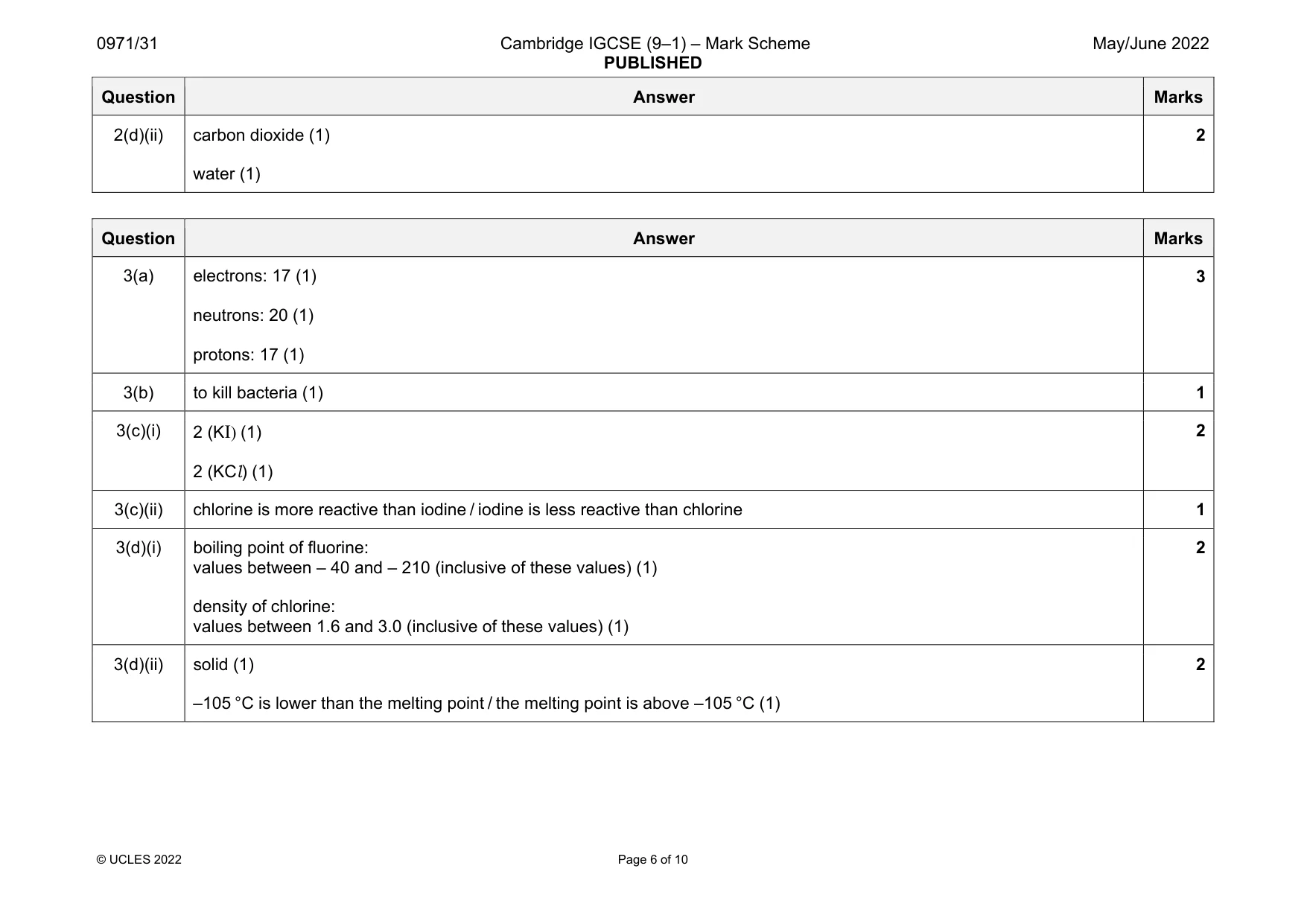
Mark scheme: 3(a) electrons: 17 (1) neutrons: 20 (1) protons: 17 (1) 3 3(b) to kill bacteria (1) 1 3(c)(i) 2 (KI) (1) 2 (KCl) (1) 2 3(c)(ii) chlorine is more reactive than iodine / iodine is less reactive than chlorine 1 3(d)(i) boiling point of fluorine: values between – 40 and – 210 (inclusive of these values) (1) density of chlorine: values between 1.6 and 3.0 (inclusive of these values) (1) 2 3(d)(ii) solid (1) –105 °C is lower than the melting point / the melting point is above –105 °C (1) 2
Q4 · This question is about acids and bases
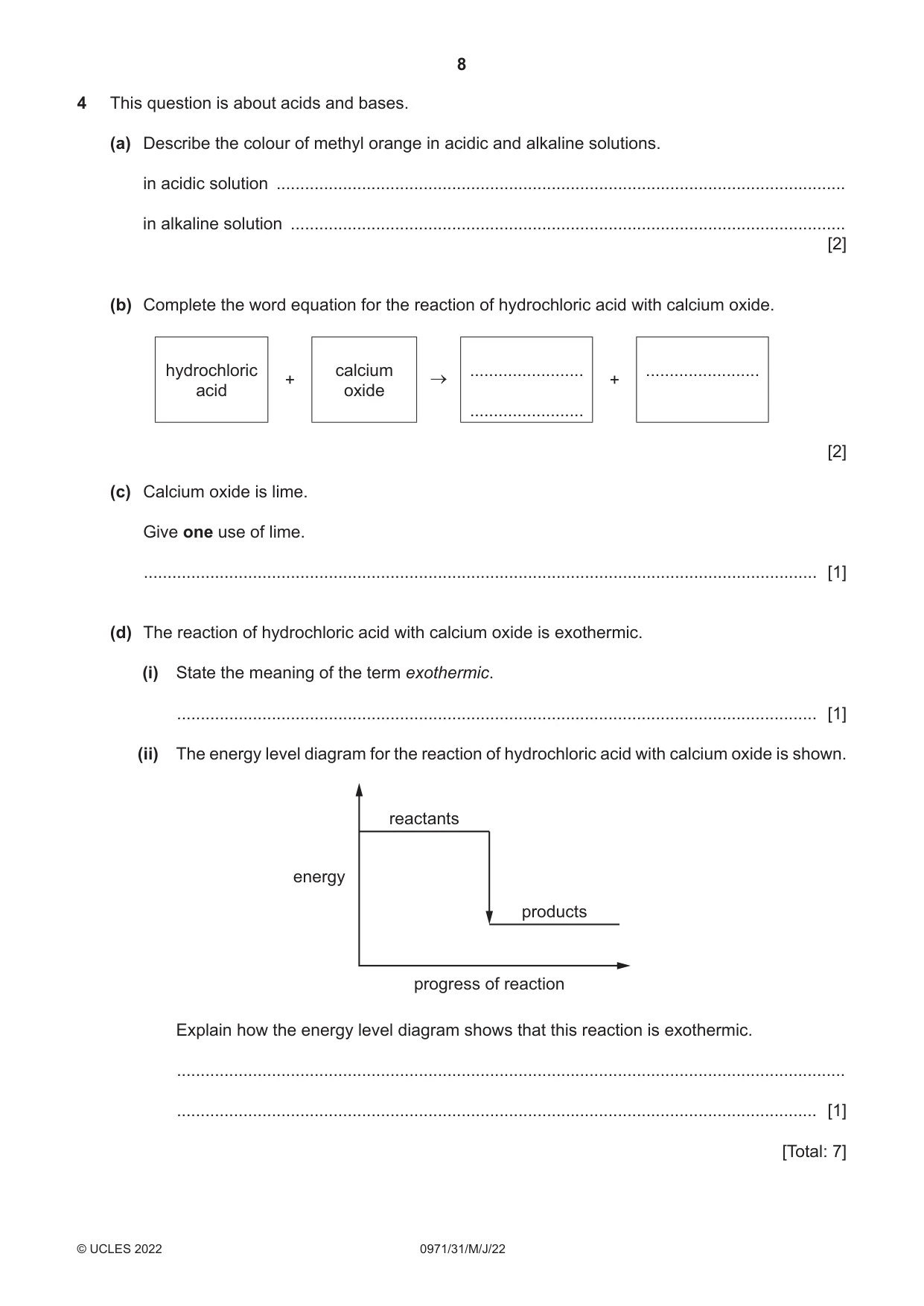
4 This question is about acids and bases. (a) Describe the colour of methyl orange in acidic and alkaline solutions. in acidic solution ......................................................................................................................... in alkaline solution ...................................................................................................................... [2] (b) Complete the word equation for the reaction of hydrochloric acid with calcium oxide. hydrochloric calcium ........................ ........................ + + acid oxide ........................ [2] (c) Calcium oxide is lime. Give one use of lime. .............................................................................................................................................. [1] (d) The reaction of hydrochloric acid with calcium oxide is exothermic. (i) State the meaning of the term exothermic. ....................................................................................................................................... [1] (ii) The energy level diagram for the reaction of hydrochloric acid with calcium oxide is shown. reactants energy products progress of reaction Explain how the energy level diagram shows that this reaction is exothermic. ............................................................................................................................................. ....................................................................................................................................... [1] [Total: 7]
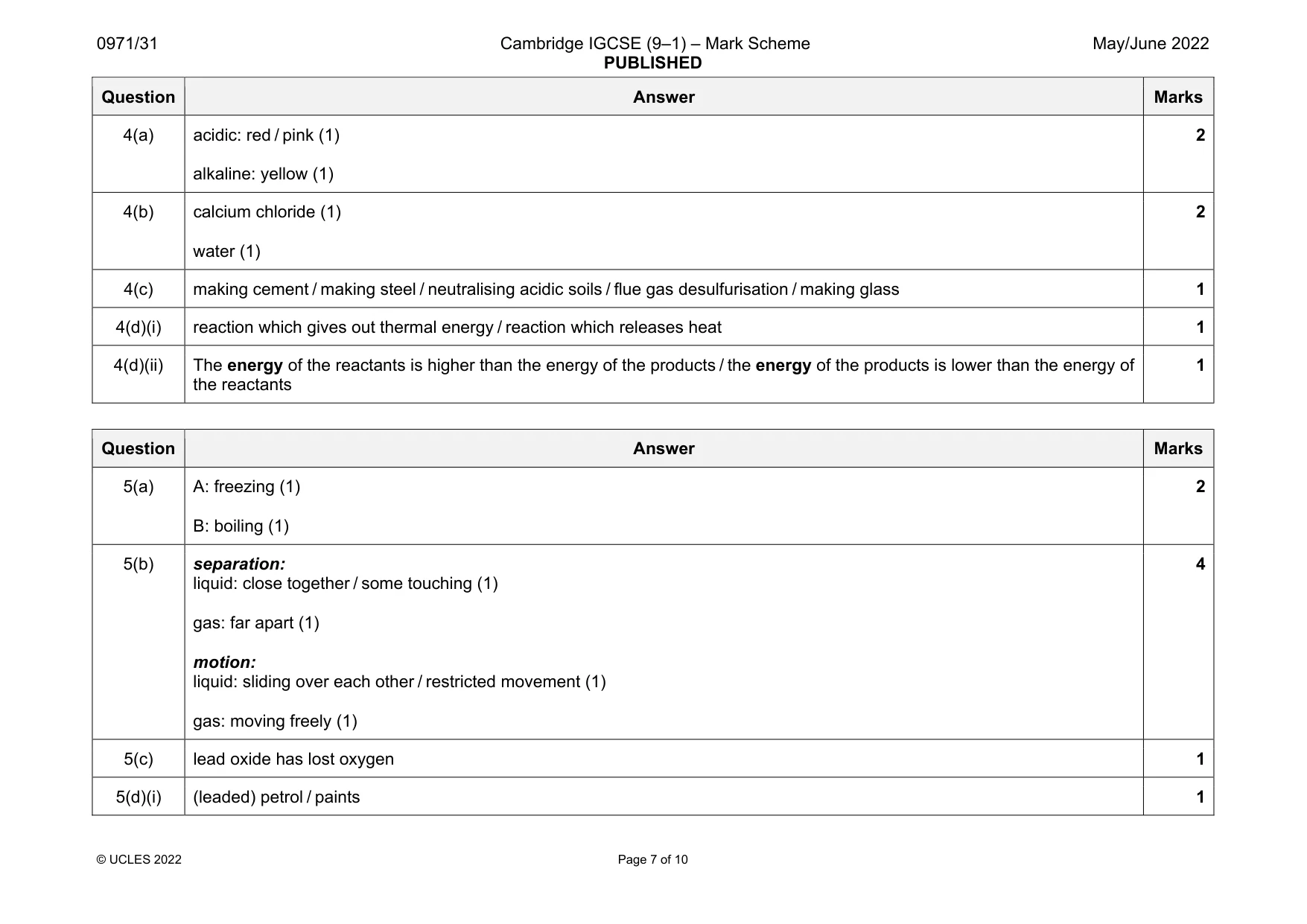
Mark scheme: 4(a) acidic: red / pink (1) alkaline: yellow (1) 2 4(b) calcium chloride (1) water (1) 2 4(c) making cement / making steel / neutralising acidic soils / flue gas desulfurisation / making glass 1 4(d)(i) reaction which gives out thermal energy / reaction which releases heat 1 4(d)(ii) The energy of the reactants is higher than the energy of the products / the energy of the products is lower than the energy of the reactants 1
More questions on The characteristic properties of acids and bases
Q5 · This question is about Group IV elements and their compounds
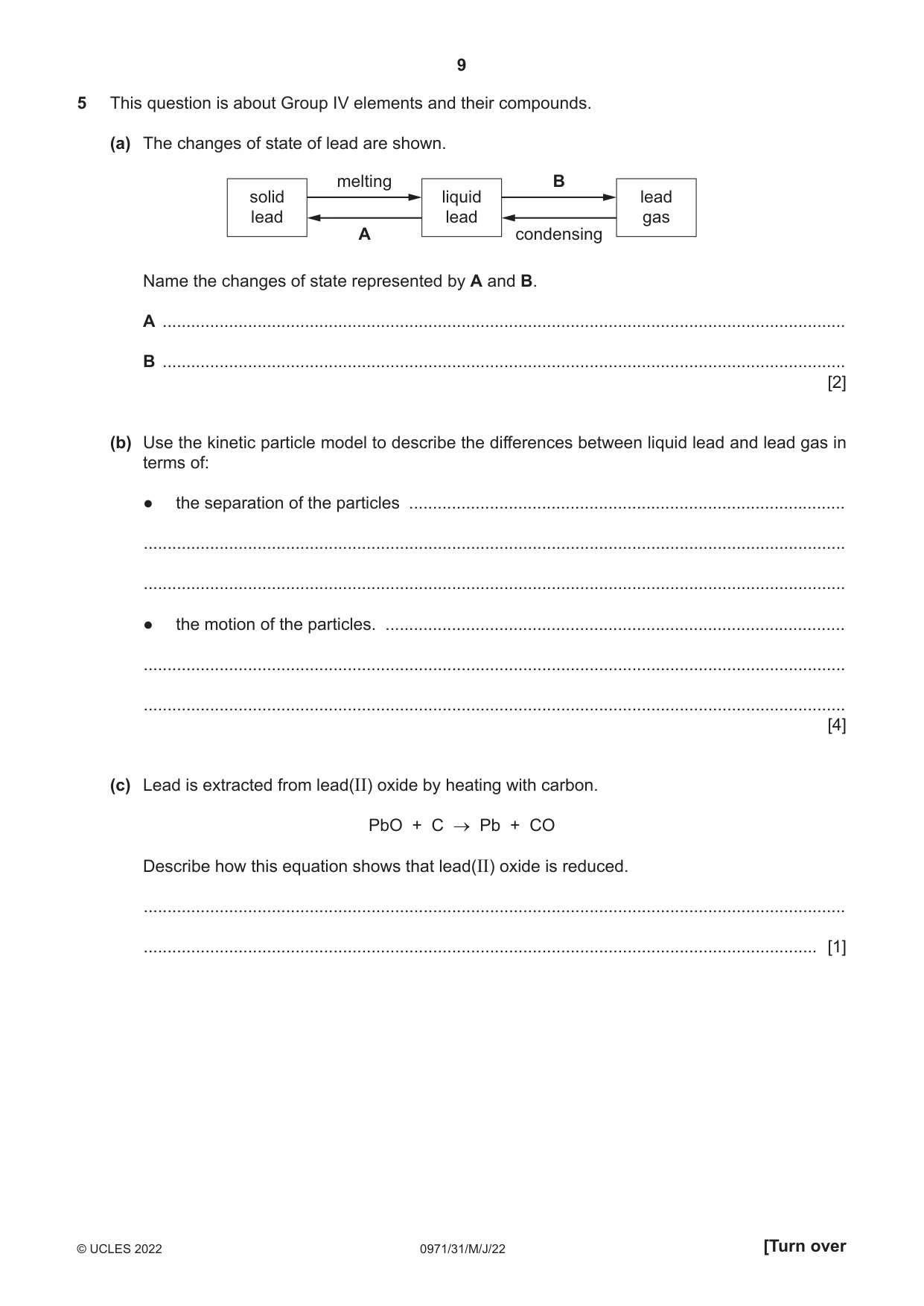
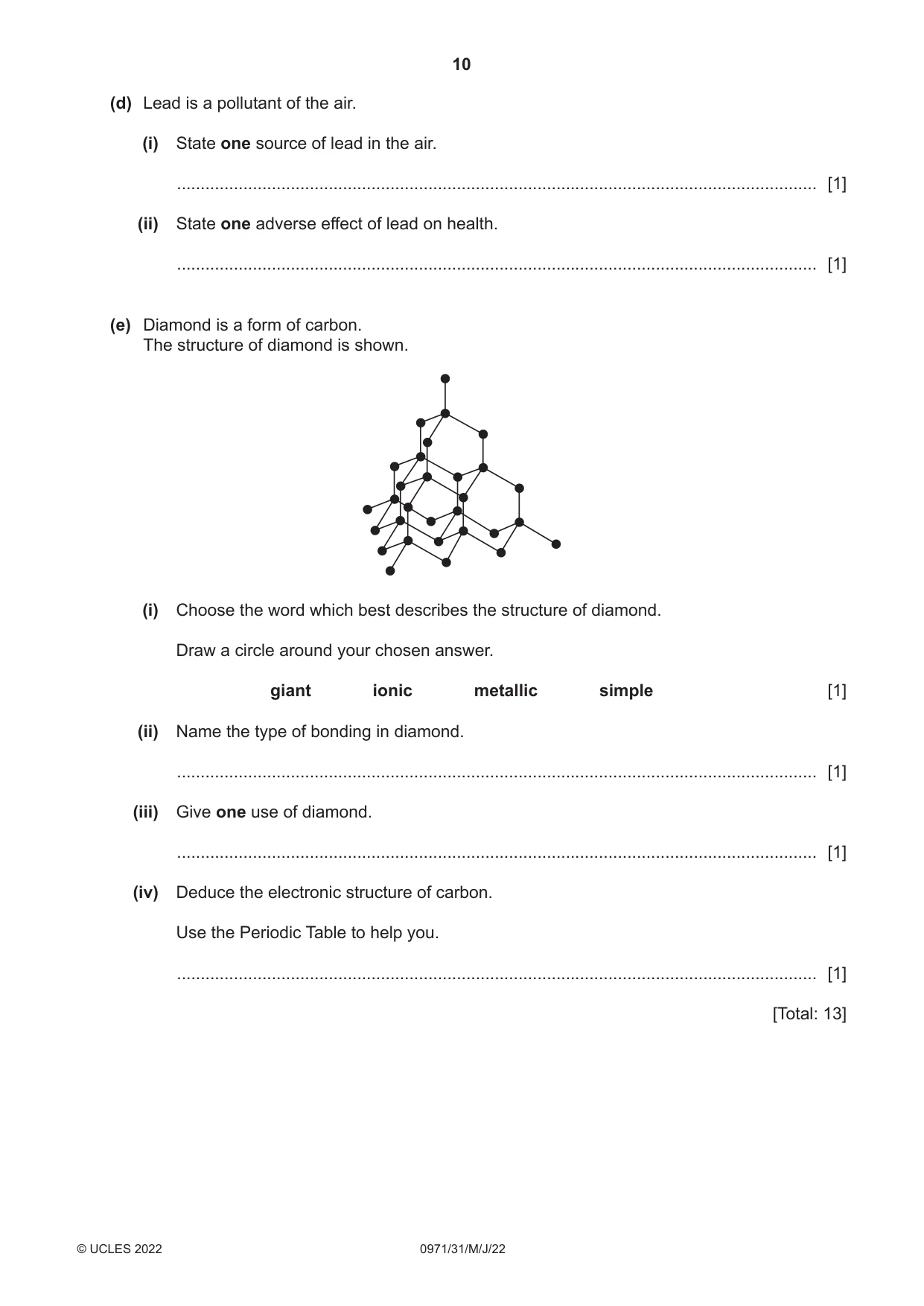
5 This question is about Group IV elements and their compounds. (a) The changes of state of lead are shown. melting B solid liquid lead lead lead gas A condensing Name the changes of state represented by A and B. A ................................................................................................................................................. B ................................................................................................................................................. [2] (b) Use the kinetic particle model to describe the differences between liquid lead and lead gas in terms of: ● the separation of the particles ............................................................................................. .................................................................................................................................................... .................................................................................................................................................... ● the motion of the particles. .................................................................................................. .................................................................................................................................................... .................................................................................................................................................... [4] (c) Lead is extracted from lead(II) oxide by heating with carbon. PbO + C → Pb + CO Describe how this equation shows that lead(II) oxide is reduced. .................................................................................................................................................... .............................................................................................................................................. [1] (d) Lead is a pollutant of the air. (i) State one source of lead in the air. ....................................................................................................................................... [1] (ii) State one adverse effect of lead on health. ....................................................................................................................................... [1] (e) Diamond is a form of carbon. The structure of diamond is shown. (i) Choose the word which best describes the structure of diamond. Draw a circle around your chosen answer. giant ionic metallic simple [1] (ii) Name the type of bonding in diamond. ....................................................................................................................................... [1] (iii) Give one use of diamond. ....................................................................................................................................... [1] (iv) Deduce the electronic structure of carbon. Use the Periodic Table to help you. ....................................................................................................................................... [1] [Total: 13]
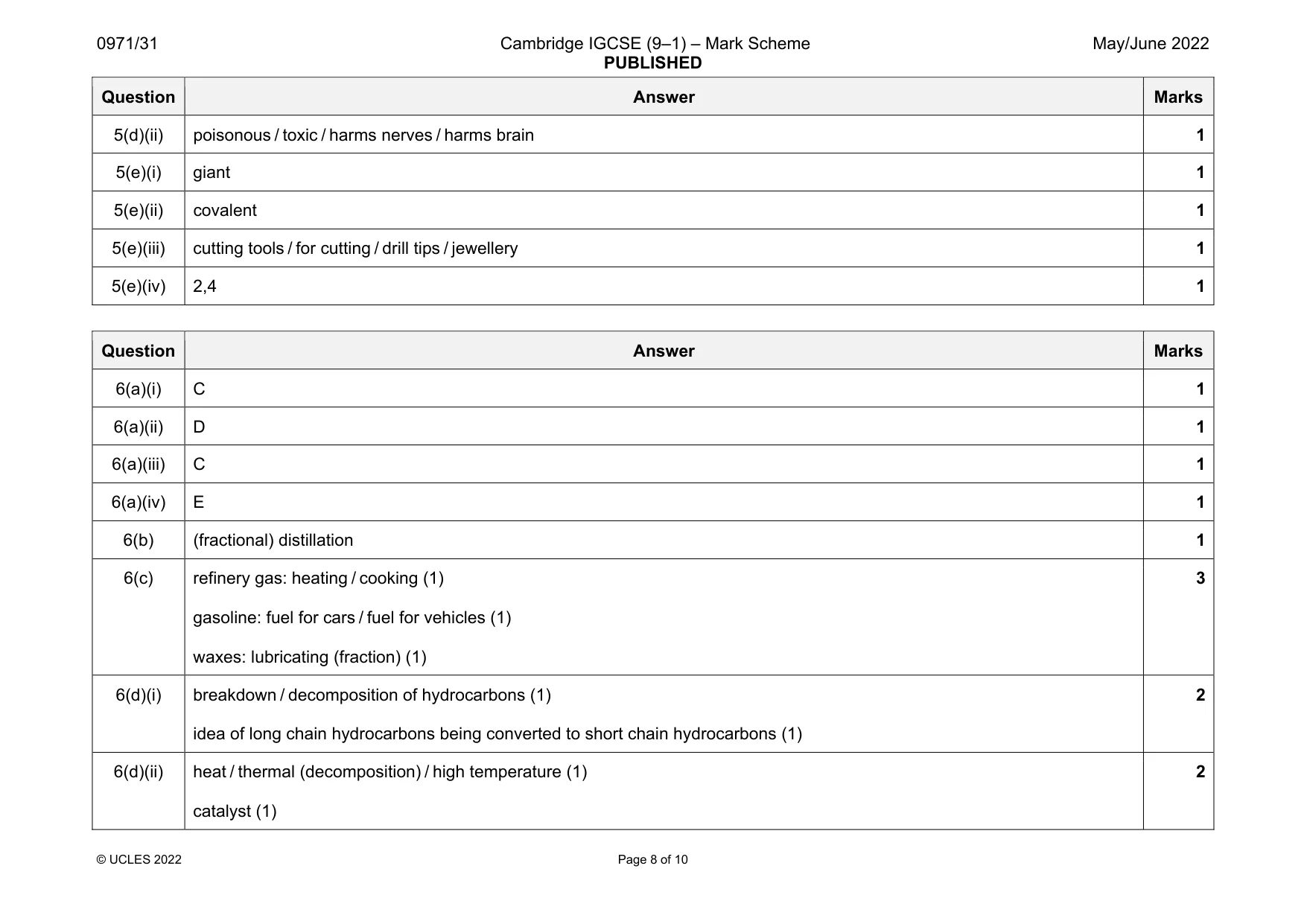
Mark scheme: 5(a) A: freezing (1) B: boiling (1) 2 5(b) separation: liquid: close together / some touching (1) gas: far apart (1) motion: liquid: sliding over each other / restricted movement (1) gas: moving freely (1) 4 5(c) lead oxide has lost oxygen 1 5(d)(i) (leaded) petrol / paints 1 Question Answer Marks 5(d)(ii) poisonous / toxic / harms nerves / harms brain 1 5(e)(i) giant 1 5(e)(ii) covalent 1 5(e)(iii) cutting tools / for cutting / drill tips / jewellery 1 5(e)(iv) 2,4 1
Q6 · The structures of four organic compounds, C, D, E and F, are shown
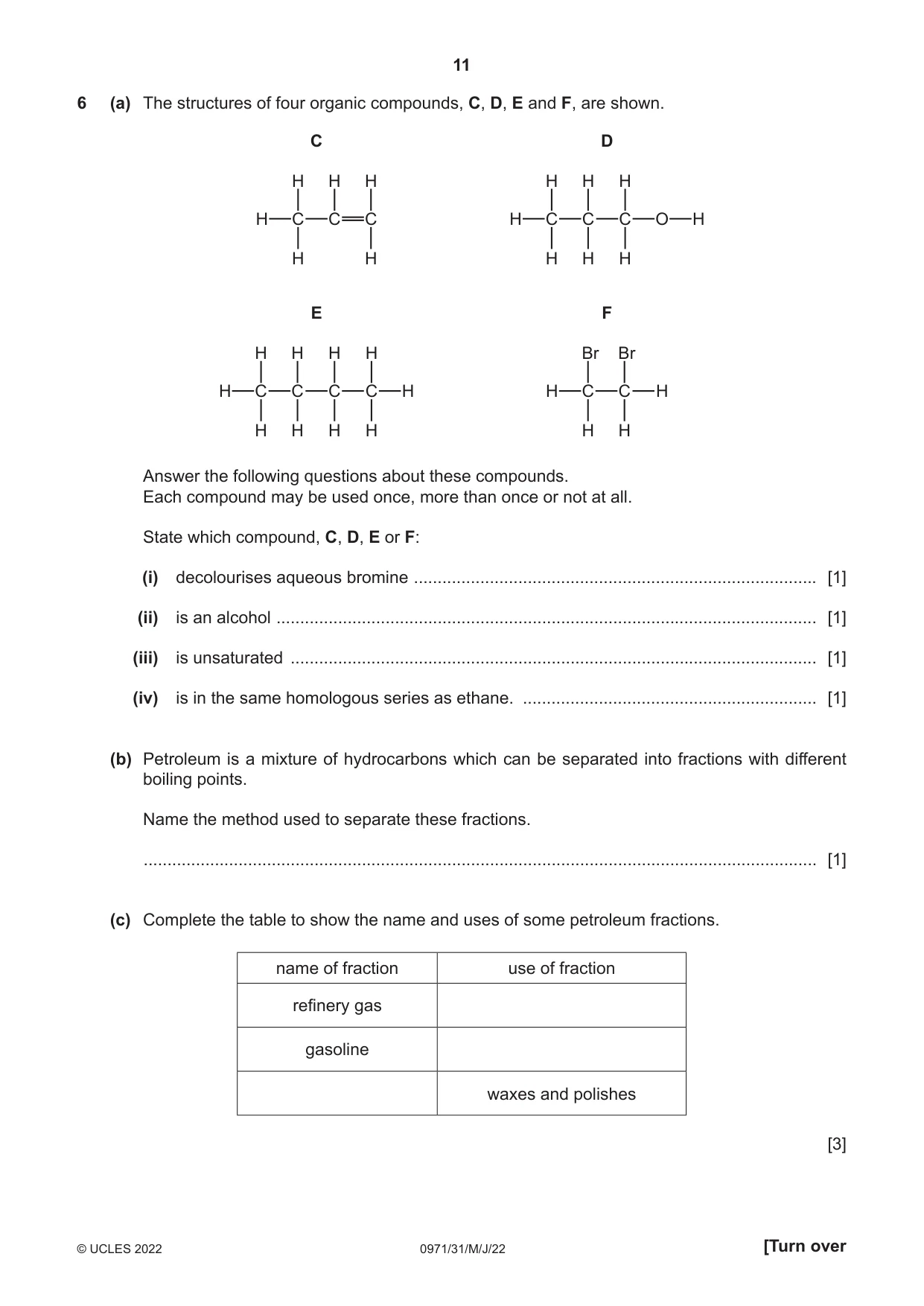
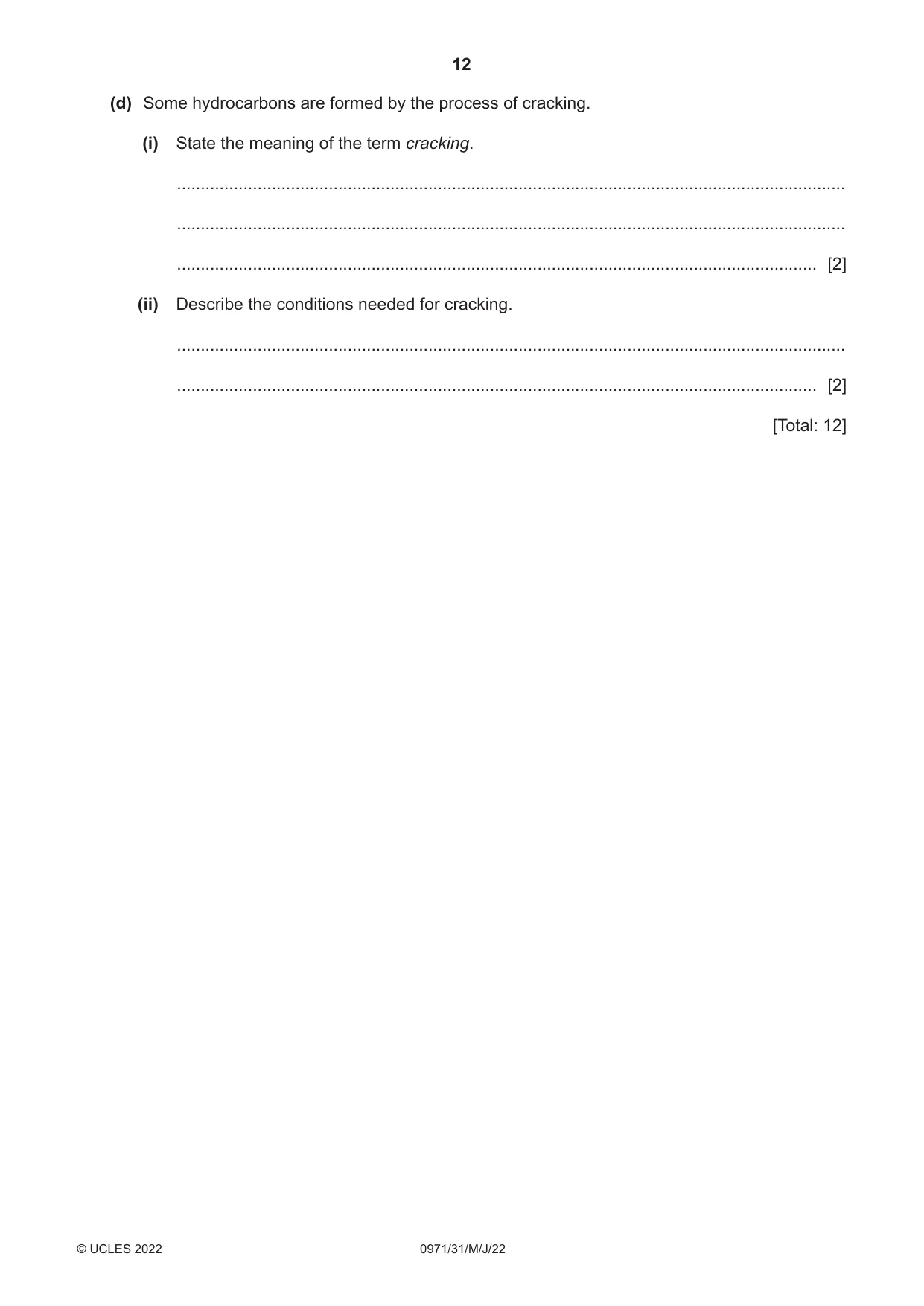
6 (a) The structures of four organic compounds, C, D, E and F, are shown. C D H H H H H H H C C C H C C C O H H H H H H E F H H H H Br Br H C C C C H H C C H H H H H H H Answer the following questions about these compounds. Each compound may be used once, more than once or not at all. State which compound, C, D, E or F: (i) decolourises aqueous bromine ������������������������������������������������������������������������������������� [1] (ii) is an alcohol ������������������������������������������������������������������������������������������������������������������ [1] (iii) is unsaturated ��������������������������������������������������������������������������������������������������������������� [1] (iv) is in the same homologous series as ethane. �������������������������������������������������������������� [1] (b) Petroleum is a mixture of hydrocarbons which can be separated into fractions with different boiling points. Name the method used to separate these fractions. .............................................................................................................................................. [1] (c) Complete the table to show the name and uses of some petroleum fractions. name of fraction use of fraction refinery gas gasoline waxes and polishes [3] (d) Some hydrocarbons are formed by the process of cracking. (i) State the meaning of the term cracking. ............................................................................................................................................. ............................................................................................................................................. ....................................................................................................................................... [2] (ii) Describe the conditions needed for cracking. ............................................................................................................................................. ....................................................................................................................................... [2] [Total: 12]
Mark scheme: 6(a)(i) C 1 6(a)(ii) D 1 6(a)(iii) C 1 6(a)(iv) E 1 6(b) (fractional) distillation 1 6(c) refinery gas: heating / cooking (1) gasoline: fuel for cars / fuel for vehicles (1) waxes: lubricating (fraction) (1) 3 6(d)(i) breakdown / decomposition of hydrocarbons (1) idea of long chain hydrocarbons being converted to short chain hydrocarbons (1) 2 6(d)(ii) heat / thermal (decomposition) / high temperature (1) catalyst (1) 2
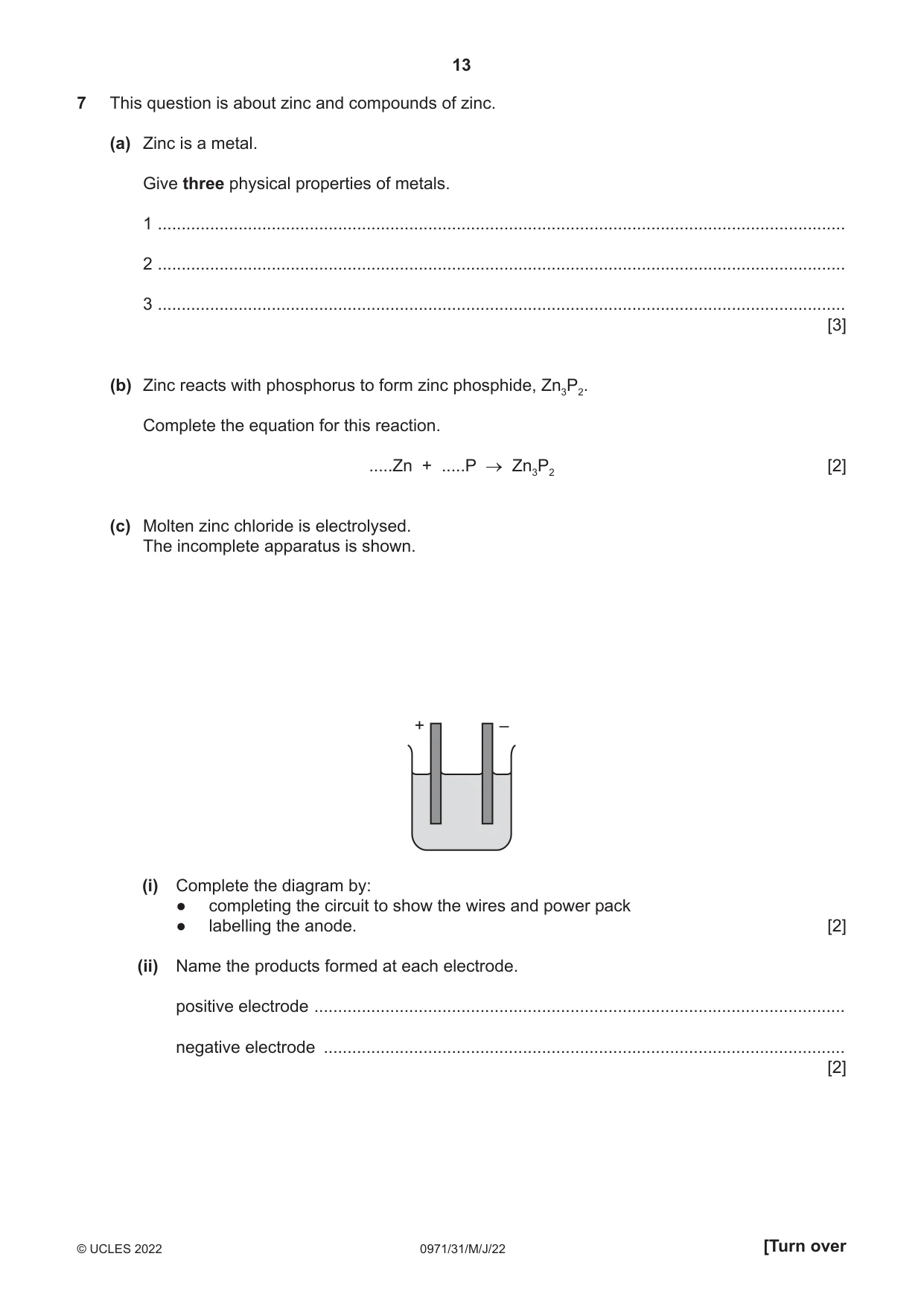
Q7 · This question is about zinc and compounds of zinc
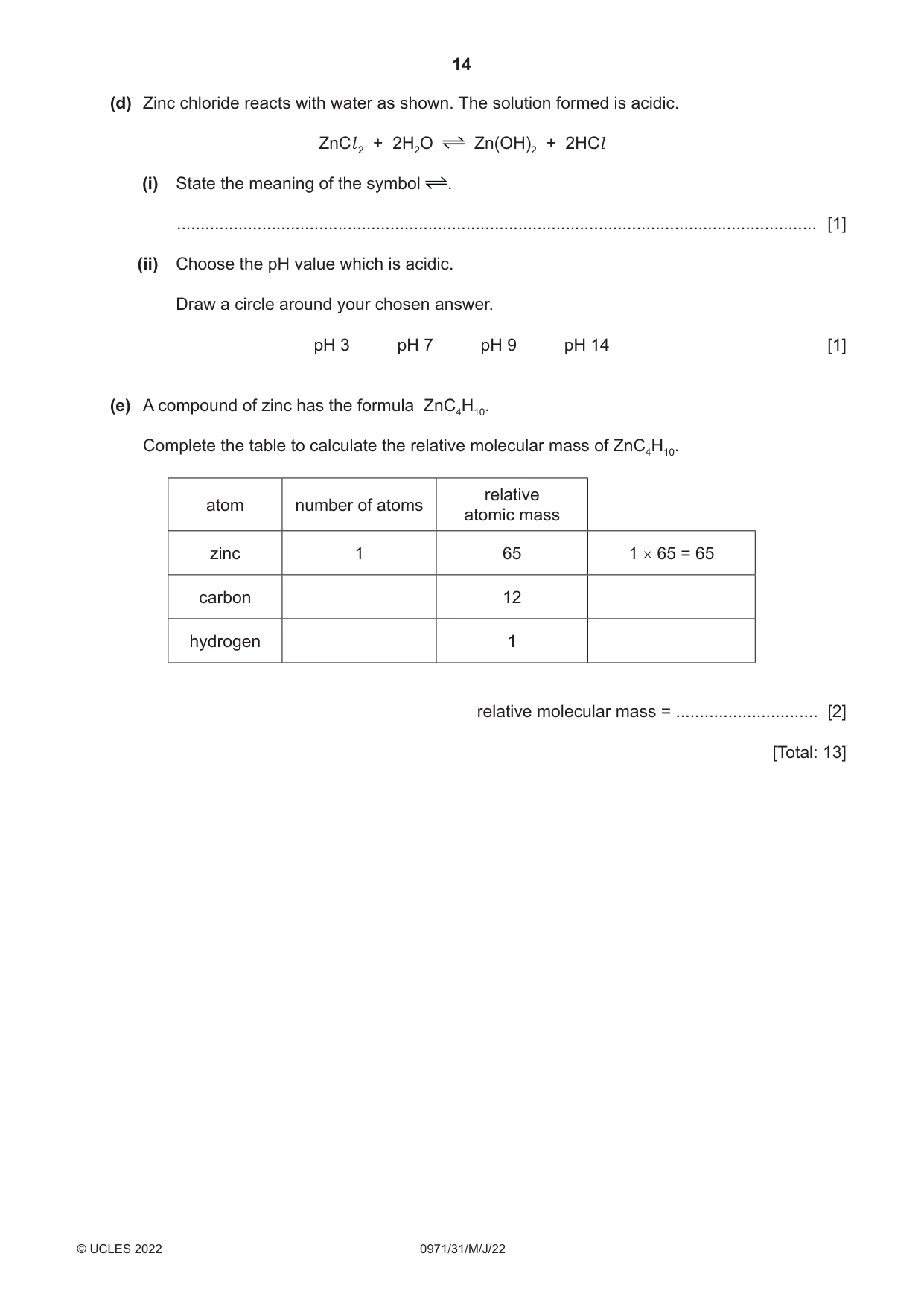
7 This question is about zinc and compounds of zinc. (a) Zinc is a metal. Give three physical properties of metals. 1 ................................................................................................................................................. 2 ................................................................................................................................................. 3 ................................................................................................................................................. [3] (b) Zinc reacts with phosphorus to form zinc phosphide, Zn3P2. Complete the equation for this reaction. .....Zn + .....P → Zn3P2 [2] (c) Molten zinc chloride is electrolysed. The incomplete apparatus is shown. + – (i) Complete the diagram by: ● completing the circuit to show the wires and power pack ● labelling the anode. [2] (ii) Name the products formed at each electrode. positive electrode ................................................................................................................ negative electrode ............................................................................................................... [2] (d) Zinc chloride reacts with water as shown. The solution formed is acidic. ZnCl 2 + 2H2O Zn(OH)2 + 2HCl (i) State the meaning of the symbol . ....................................................................................................................................... [1] (ii) Choose the pH value which is acidic. Draw a circle around your chosen answer. pH 3 pH 7 pH 9 pH 14 [1] (e) A compound of zinc has the formula ZnC4H10. Complete the table to calculate the relative molecular mass of ZnC4H10. relative atom number of atoms atomic mass zinc 1 65 1 × 65 = 65 carbon 12 hydrogen 1 relative molecular mass = .............................. [2] [Total: 13]
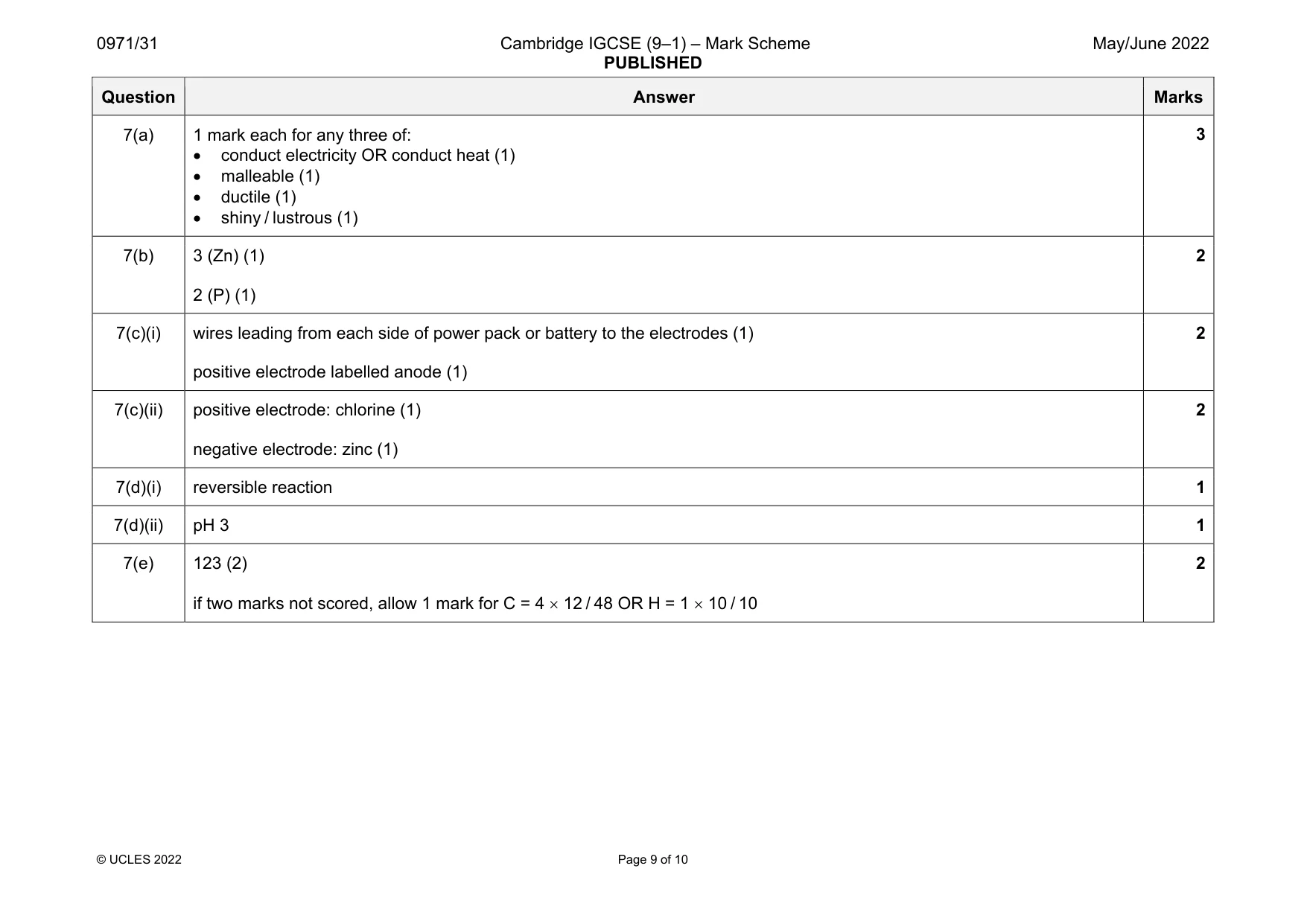
Mark scheme: 7(a) 1 mark each for any three of: conduct electricity OR conduct heat (1) malleable (1) ductile (1) shiny / lustrous (1) 7(b) 3 (Zn) (1) 2 (P) (1) 2 7(c)(i) wires leading from each side of power pack or battery to the electrodes (1) positive electrode labelled anode (1) 2 7(c)(ii) positive electrode: chlorine (1) negative electrode: zinc (1) 2 7(d)(i) reversible reaction 1 7(d)(ii) pH 3 1 7(e) 123 (2) if two marks not scored, allow 1 mark for C = 4 12 / 48 OR H = 1 10 / 10 2
Q8 · A student investigates the reaction of large pieces of copper(II) carbonate with dilute…
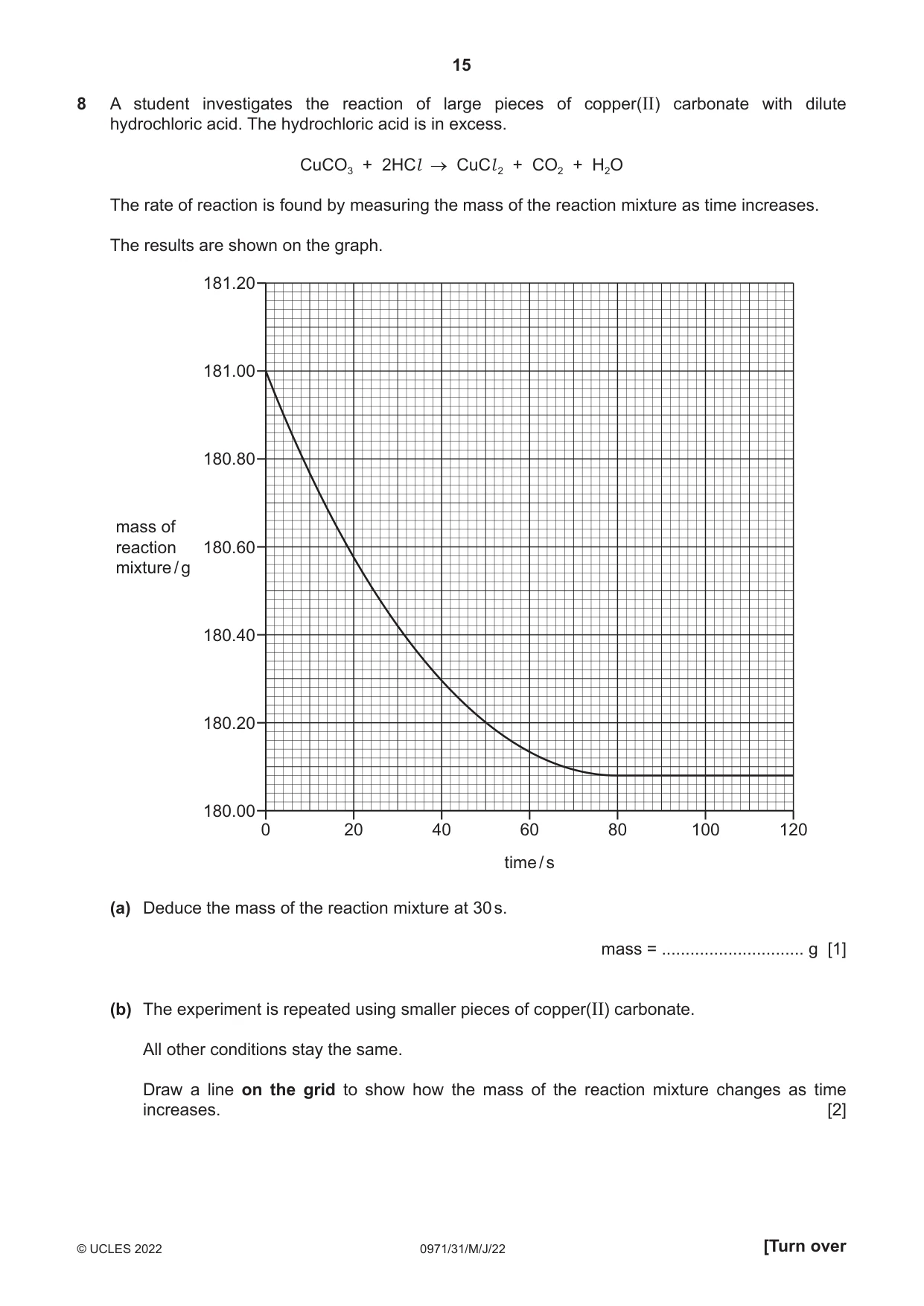
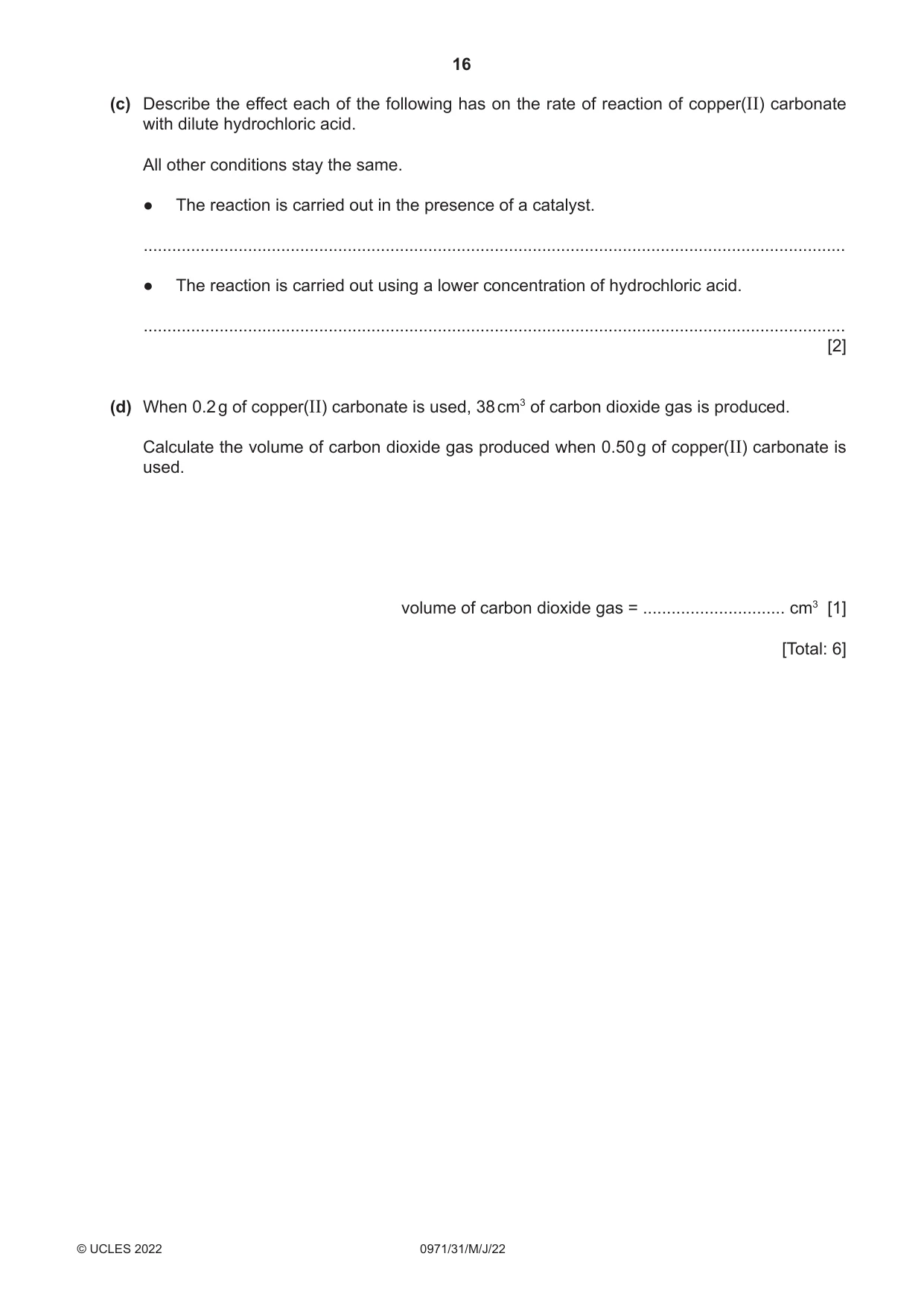
8 A student investigates the reaction of large pieces of copper(II) carbonate with dilute hydrochloric acid. The hydrochloric acid is in excess. CuCO3 + 2HCl → CuCl 2 + CO2 + H2O The rate of reaction is found by measuring the mass of the reaction mixture as time increases. The results are shown on the graph. 181.20 181.00 180.80 mass of reaction 180.60 mixture / g 180.40 180.20 180.00 0 20 40 60 80 100 120 time / s (a) Deduce the mass of the reaction mixture at 30 s. mass = .............................. g [1] (b) The experiment is repeated using smaller pieces of copper(II) carbonate. All other conditions stay the same. Draw a line on the grid to show how the mass of the reaction mixture changes as time increases. [2] (c) Describe the effect each of the following has on the rate of reaction of copper(II) carbonate with dilute hydrochloric acid. All other conditions stay the same. ● The reaction is carried out in the presence of a catalyst. .................................................................................................................................................... ● The reaction is carried out using a lower concentration of hydrochloric acid. .................................................................................................................................................... [2] (d) When 0.2 g of copper(II) carbonate is used, 38 cm3 of carbon dioxide gas is produced. Calculate the volume of carbon dioxide gas produced when 0.50 g of copper(II) carbonate is used. volume of carbon dioxide gas = .............................. cm3 [1] [Total: 6]
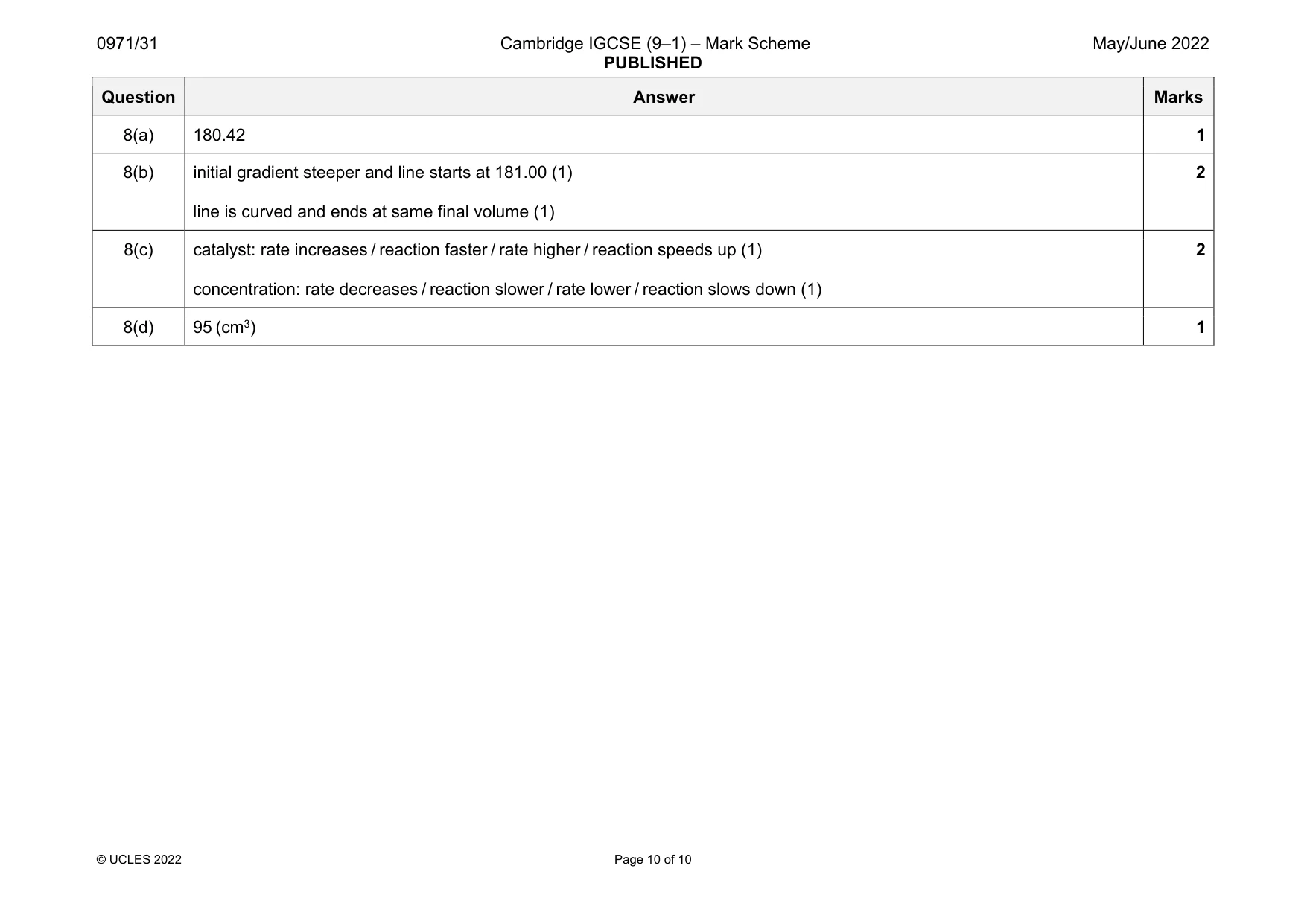
Mark scheme: 8(a) 180.42 1 8(b) initial gradient steeper and line starts at 181.00 (1) line is curved and ends at same final volume (1) 2 8(c) catalyst: rate increases / reaction faster / rate higher / reaction speeds up (1) concentration: rate decreases / reaction slower / rate lower / reaction slows down (1) 2 8(d) 95 (cm3) 1
What was in this paper
The subtopics covered by these 8 questions, and how many questions each got. Open one in a new tab to see every Cambridge question on it.
What you needed in this session
Cambridge’s own grade thresholds for 2022 May/June, Paper 3 · Variant 1. A higher threshold means an easier paper — the bar moves with how the cohort did.