Cambridge IGCSE Chemistry (9-1) 0971 — 2023 May/June Paper 3 · Variant 1
0971/31/M/J/23 · 8 questions · 80 marks · 75 min
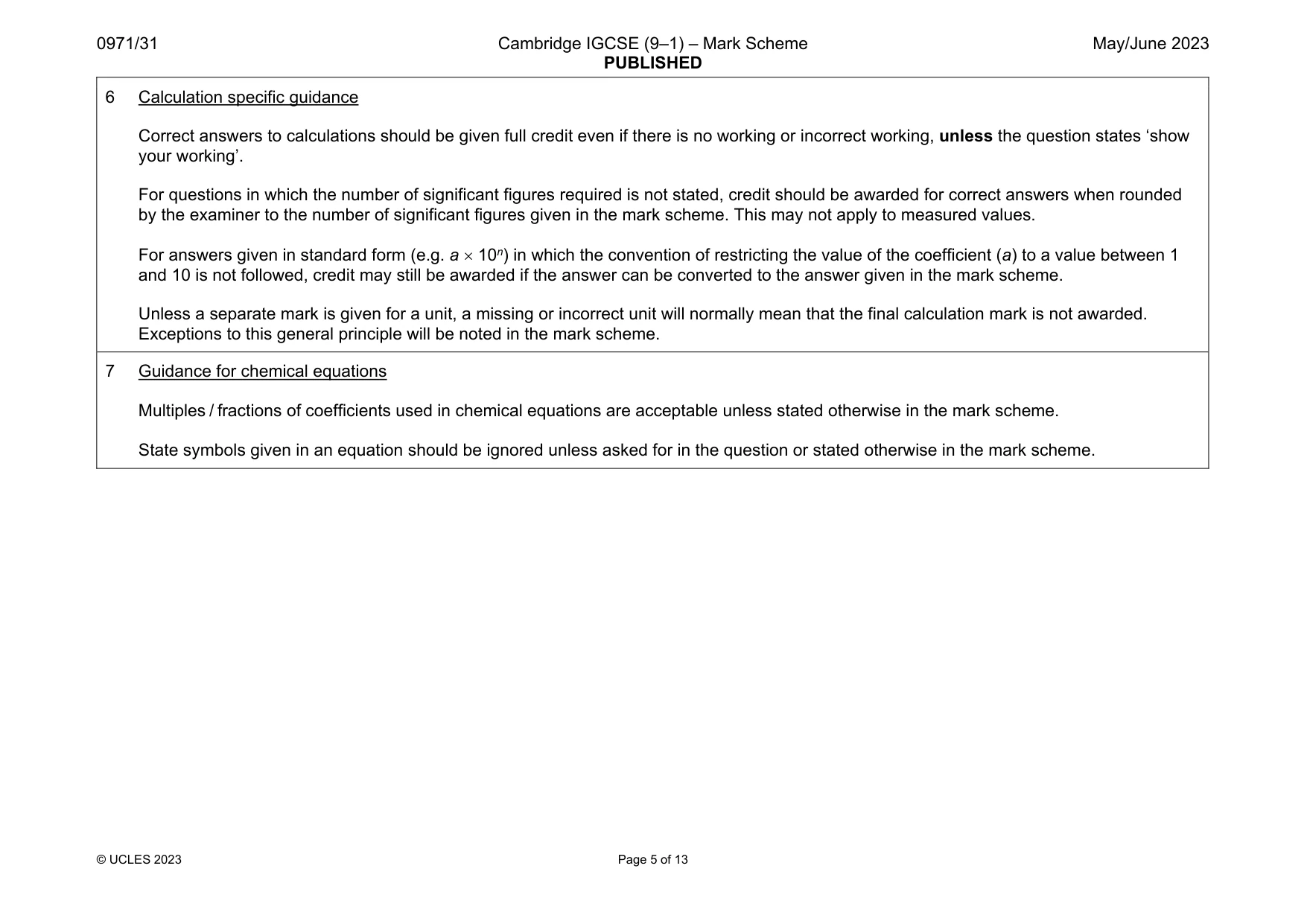
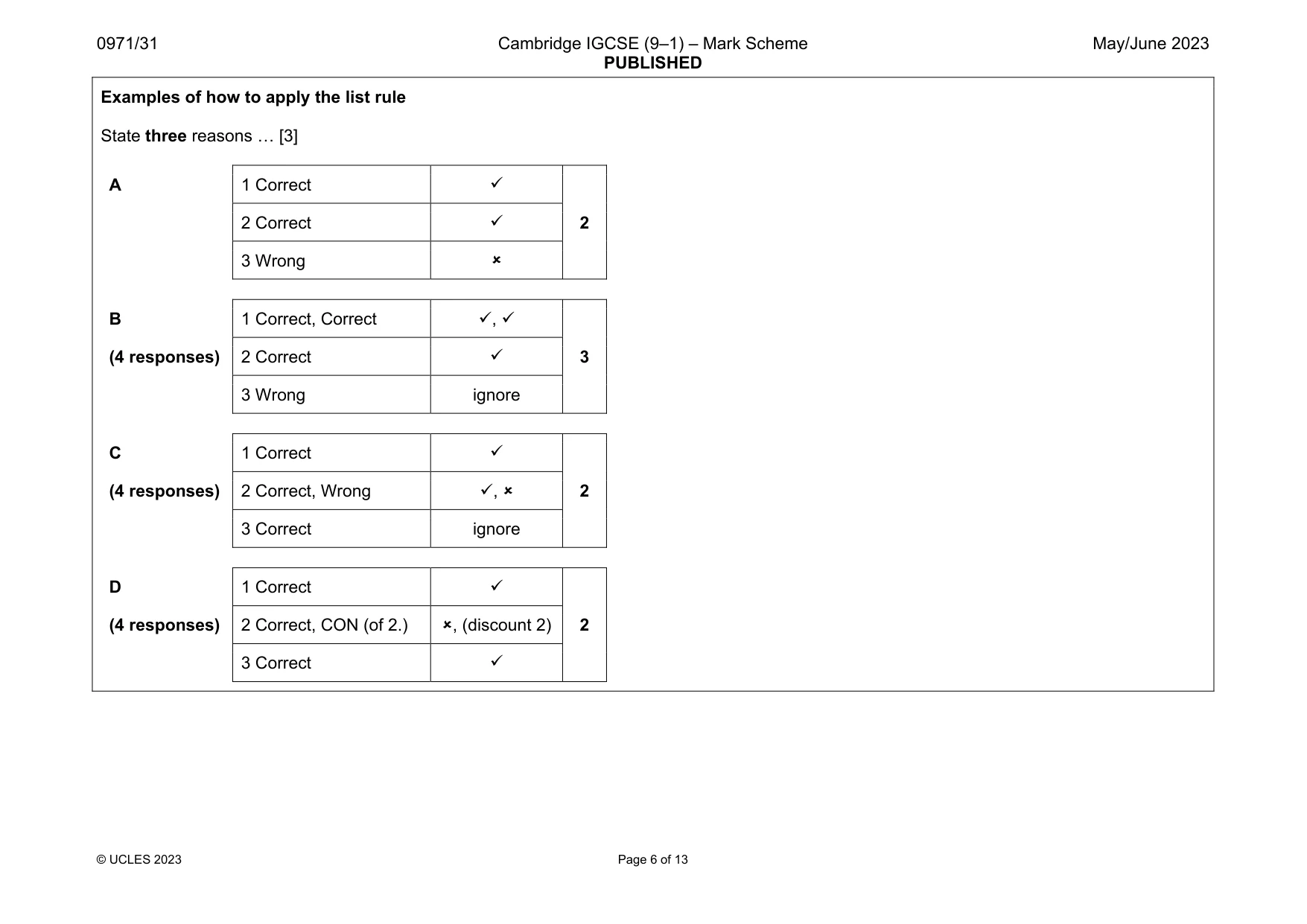
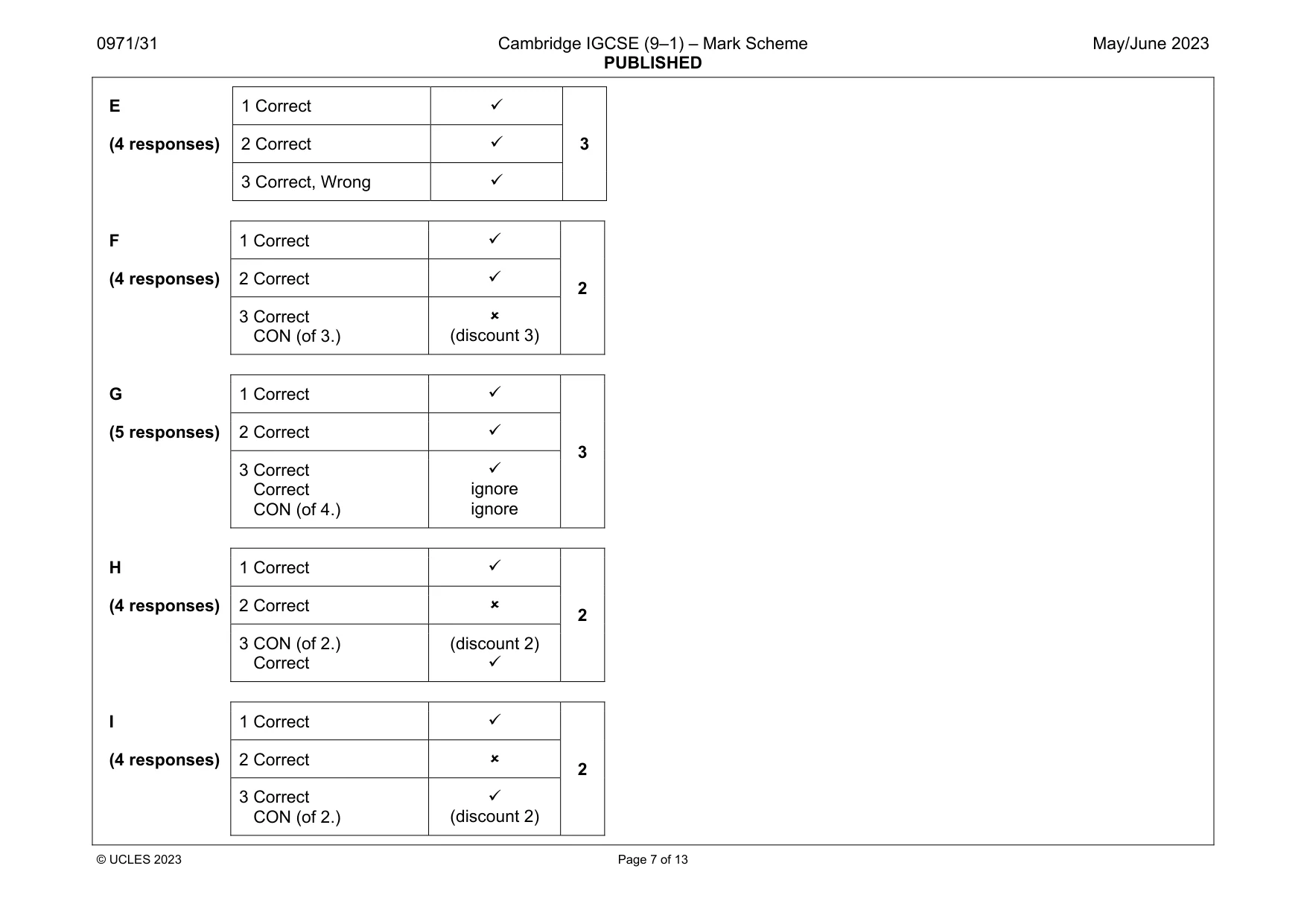
The question paper and its mark scheme, free to read here and free to download. This is Cambridge’s own paper, exactly as it was sat.
Question paper16 pages
Mark scheme13 pages
Answers below. Sit the paper first if you are practising.
Questions as text
Q1 · Part of the Periodic Table
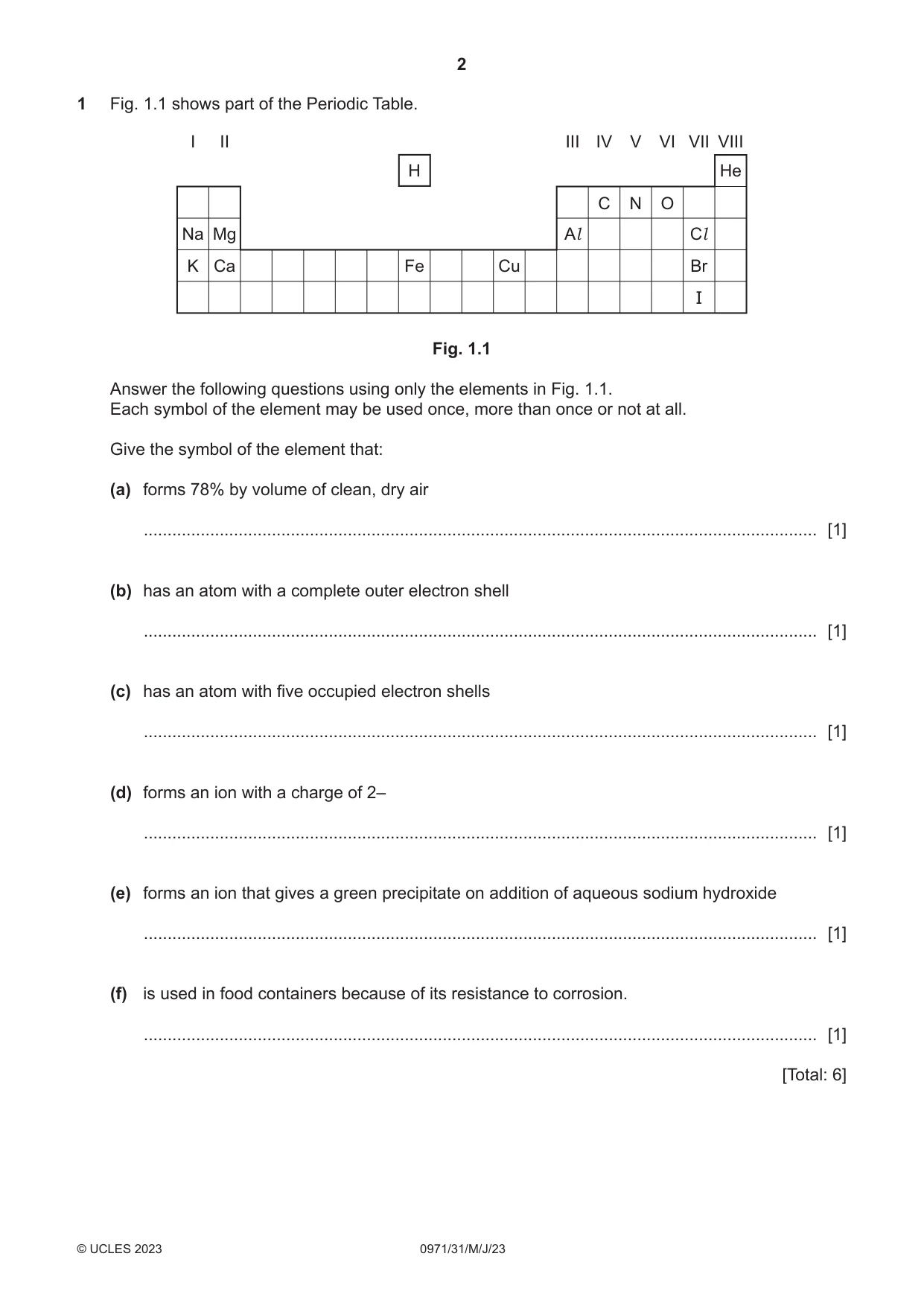
1 Fig. 1.1 shows part of the Periodic Table. I II III IV V VI VII VIII H He C N O Na Mg Al Cl K Ca Fe Cu Br I Fig. 1.1 Answer the following questions using only the elements in Fig. 1.1. Each symbol of the element may be used once, more than once or not at all. Give the symbol of the element that: (a) forms 78% by volume of clean, dry air .............................................................................................................................................. [1] (b) has an atom with a complete outer electron shell .............................................................................................................................................. [1] (c) has an atom with five occupied electron shells .............................................................................................................................................. [1] (d) forms an ion with a charge of 2– .............................................................................................................................................. [1] (e) forms an ion that gives a green precipitate on addition of aqueous sodium hydroxide .............................................................................................................................................. [1] (f) is used in food containers because of its resistance to corrosion. .............................................................................................................................................. [1] [Total: 6]
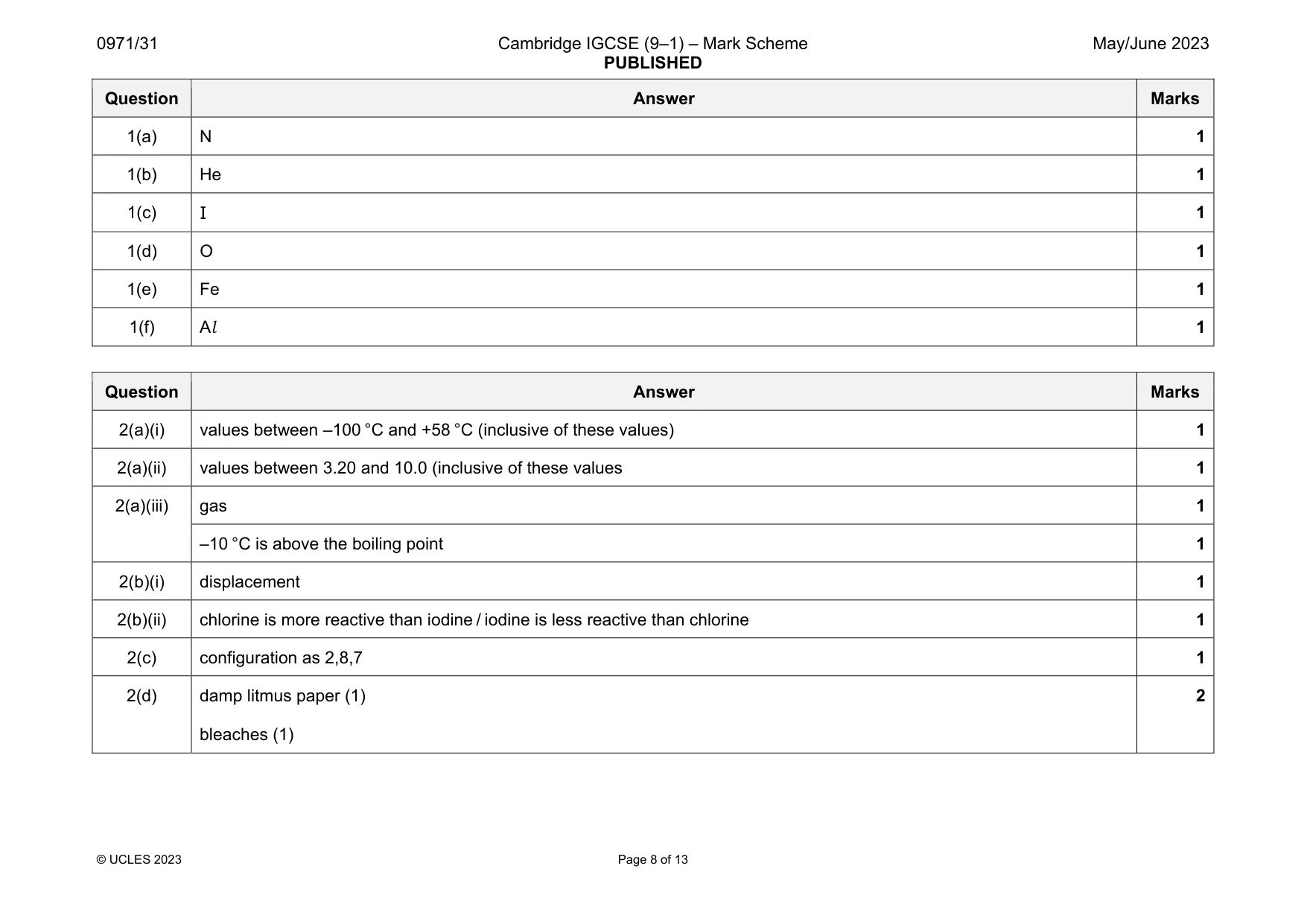
Mark scheme: 1(a) N 1 1(b) He 1 1(c) I 1 1(d) O 1 1(e) Fe 1 1(f) Al 1
Q2 · Some properties of the halogens
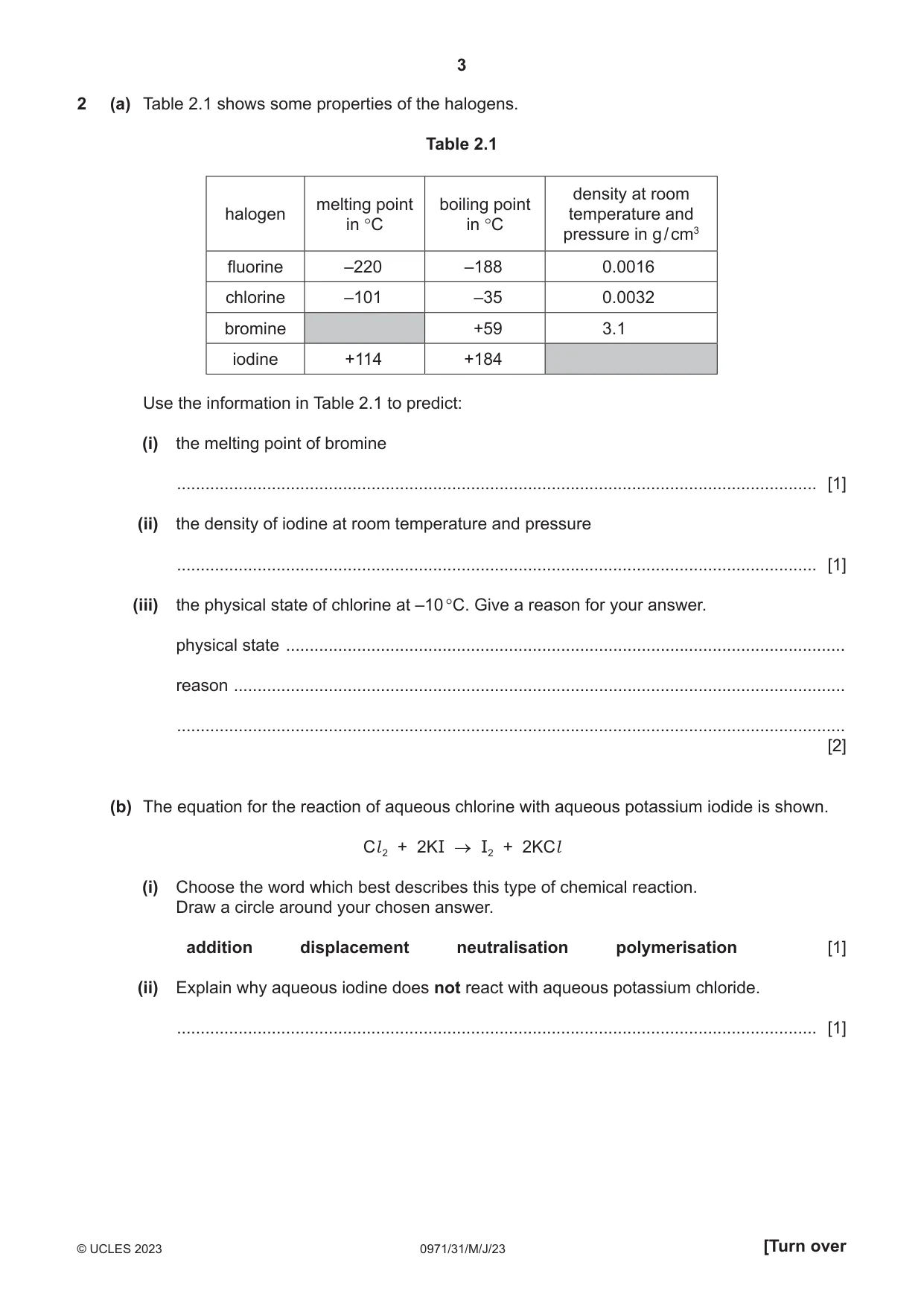
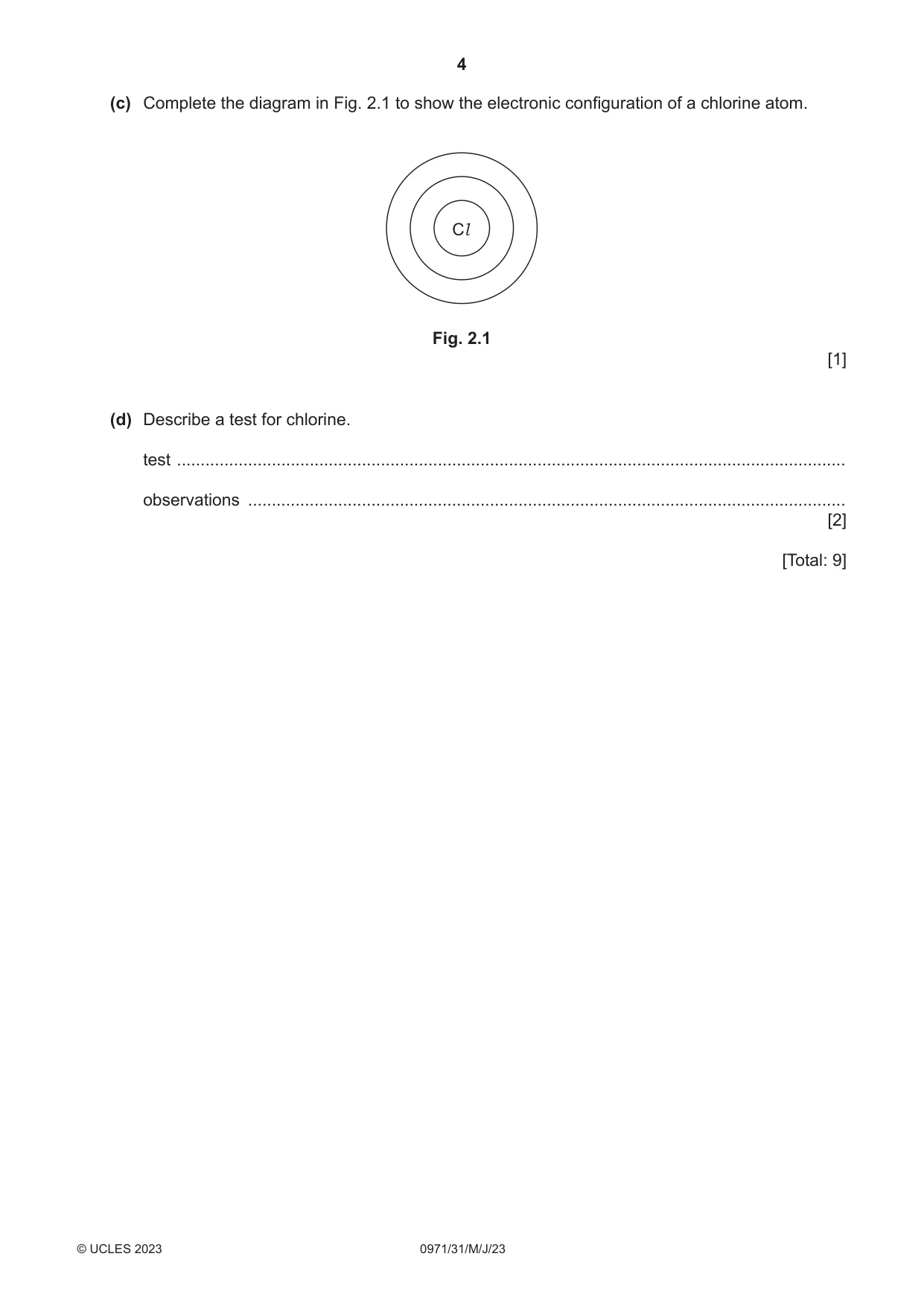
2 (a) Table 2.1 shows some properties of the halogens. Table 2.1 density at room melting point boiling point halogen temperature and in °C in °C pressure in g / cm3 fluorine –220 –188 0.0016 chlorine –101 –35 0.0032 bromine +59 3.1 iodine +114 +184 Use the information in Table 2.1 to predict: (i) the melting point of bromine (ii) the density of iodine at room temperature and pressure (iii) the physical state of chlorine at –10 °C. Give a reason for your answer. physical state ...................................................................................................................... reason ................................................................................................................................. ............................................................................................................................................. [2] (b) The equation for the reaction of aqueous chlorine with aqueous potassium iodide is shown. Cl 2 + 2KI → I2 + 2KCl (i) Choose the word which best describes this type of chemical reaction. Draw a circle around your chosen answer. addition displacement neutralisation polymerisation [1] (ii) Explain why aqueous iodine does not react with aqueous potassium chloride. ....................................................................................................................................... [1] (c) Complete the diagram in Fig. 2.1 to show the electronic configuration of a chlorine atom. Cl Fig. 2.1 [1] (d) Describe a test for chlorine. test ............................................................................................................................................. observations ............................................................................................................................... [2] [Total: 9]
Mark scheme: 2(a)(i) values between –100 °C and +58 °C (inclusive of these values) 1 2(a)(ii) values between 3.20 and 10.0 (inclusive of these values 1 2(a)(iii) gas 1 –10 °C is above the boiling point 1 2(b)(i) displacement 1 2(b)(ii) chlorine is more reactive than iodine / iodine is less reactive than chlorine 1 2(c) configuration as 2,8,7 1 2(d) damp litmus paper (1) bleaches (1) 2
Q3 · Water from natural sources contains dissolved gases
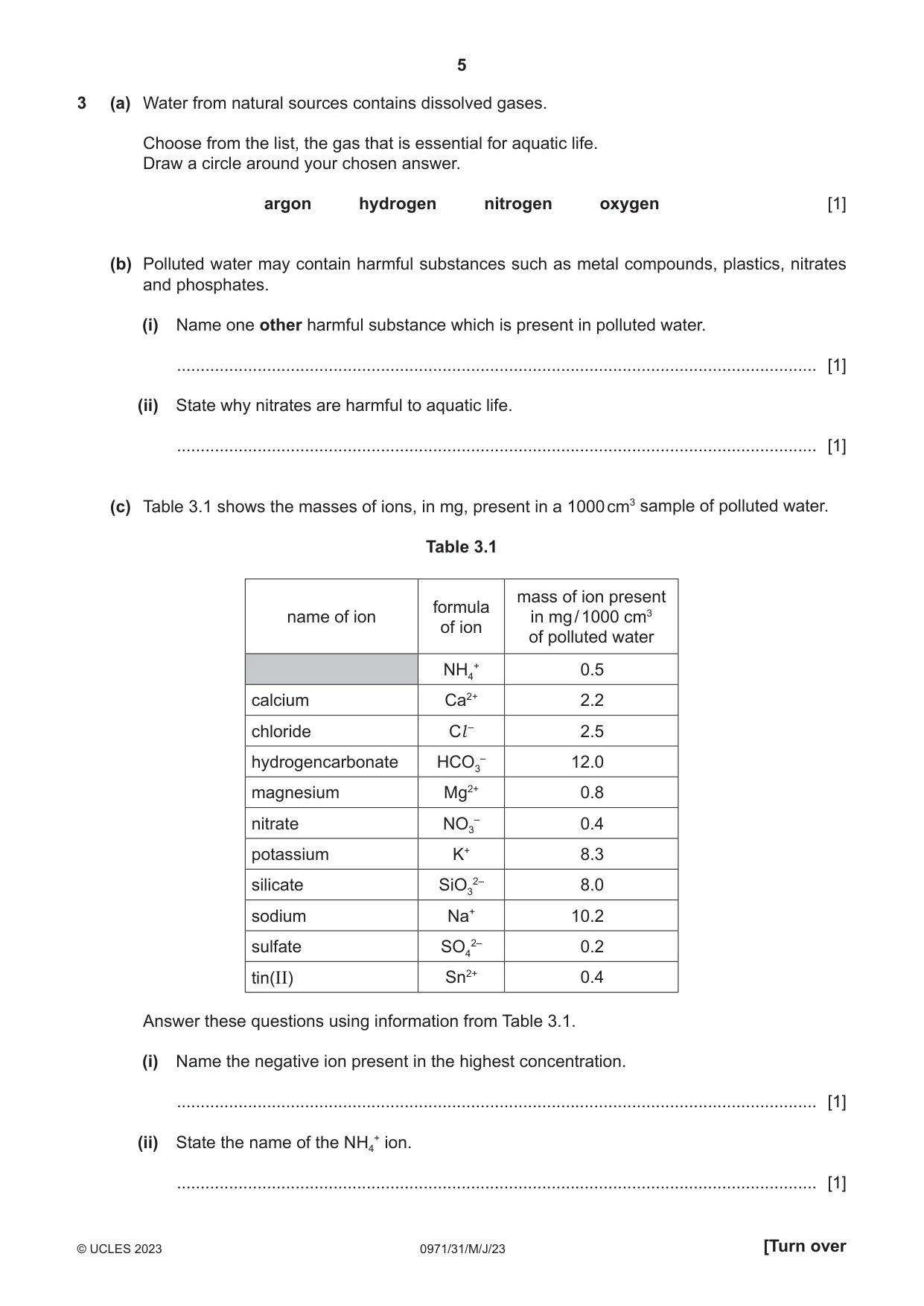
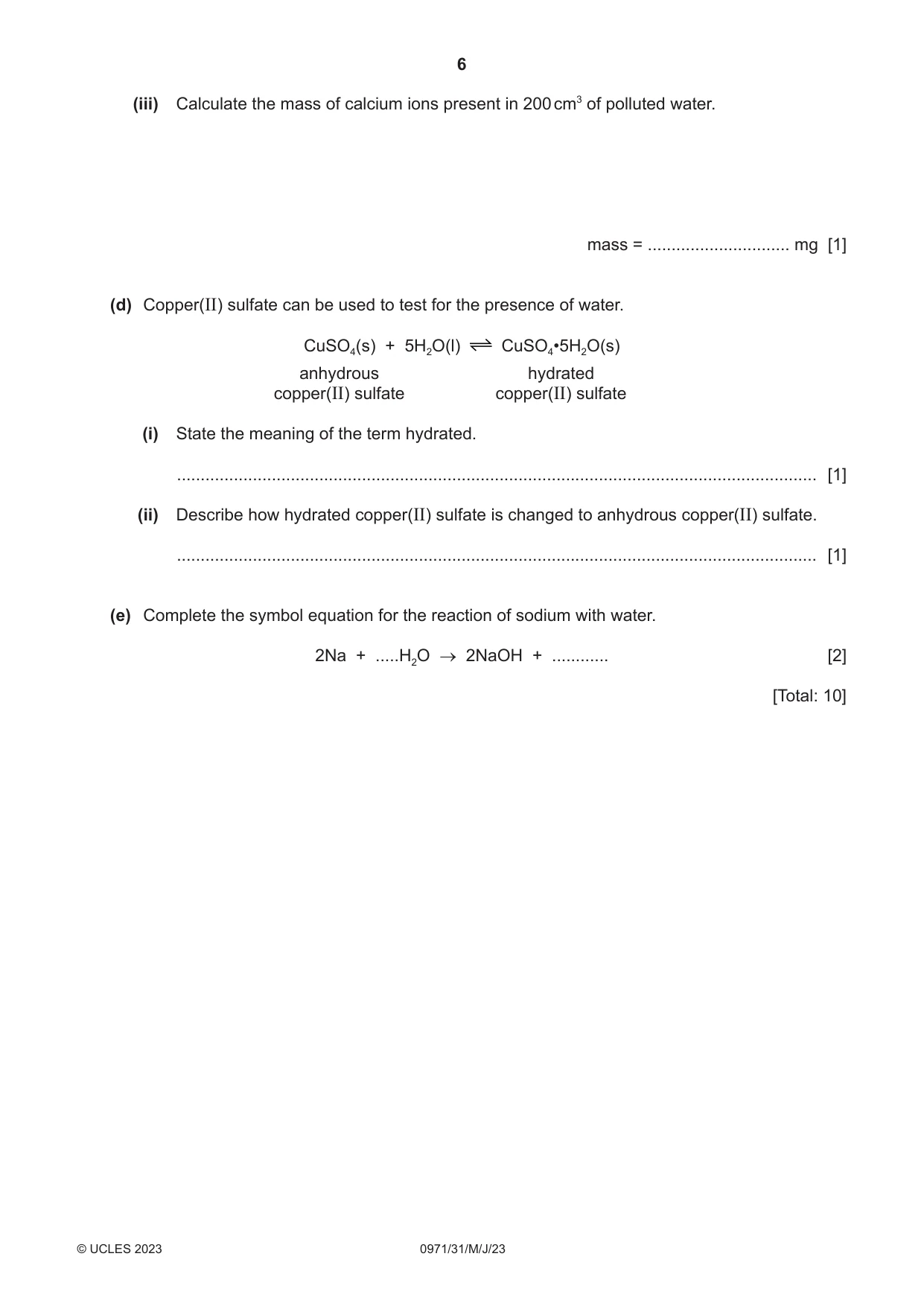
3 (a) Water from natural sources contains dissolved gases. Choose from the list, the gas that is essential for aquatic life. Draw a circle around your chosen answer. argon hydrogen nitrogen oxygen [1] (b) Polluted water may contain harmful substances such as metal compounds, plastics, nitrates and phosphates. (i) Name one other harmful substance which is present in polluted water. ....................................................................................................................................... [1] (ii) State why nitrates are harmful to aquatic life. ....................................................................................................................................... [1] (c) Table 3.1 shows the masses of ions, in mg, present in a 1000 cm3 sample of polluted water. Table 3.1 mass of ion present formula name of ion in mg / 1000 cm3 of ion of polluted water NH4+ 0.5 calcium Ca2+ 2.2 chloride Cl – 2.5 hydrogencarbonate HCO3– 12.0 magnesium Mg2+ 0.8 nitrate NO3– 0.4 potassium K+ 8.3 silicate SiO32– 8.0 sodium Na+ 10.2 sulfate SO42– 0.2 tin(II) Sn2+ 0.4 Answer these questions using information from Table 3.1. (i) Name the negative ion present in the highest concentration. ....................................................................................................................................... [1] (ii) State the name of the NH4+ ion. ....................................................................................................................................... [1] (iii) Calculate the mass of calcium ions present in 200 cm3 of polluted water. mass = .............................. mg [1] (d) Copper(II) sulfate can be used to test for the presence of water. CuSO4(s) + 5H2O(l) CuSO4•5H2O(s) anhydrous hydrated copper(II) sulfate copper(II) sulfate (i) State the meaning of the term hydrated. ....................................................................................................................................... [1] (ii) Describe how hydrated copper(II) sulfate is changed to anhydrous copper(II) sulfate. ....................................................................................................................................... [1] (e) Complete the symbol equation for the reaction of sodium with water. 2Na + .....H2O → 2NaOH + ............ [2] [Total: 10]
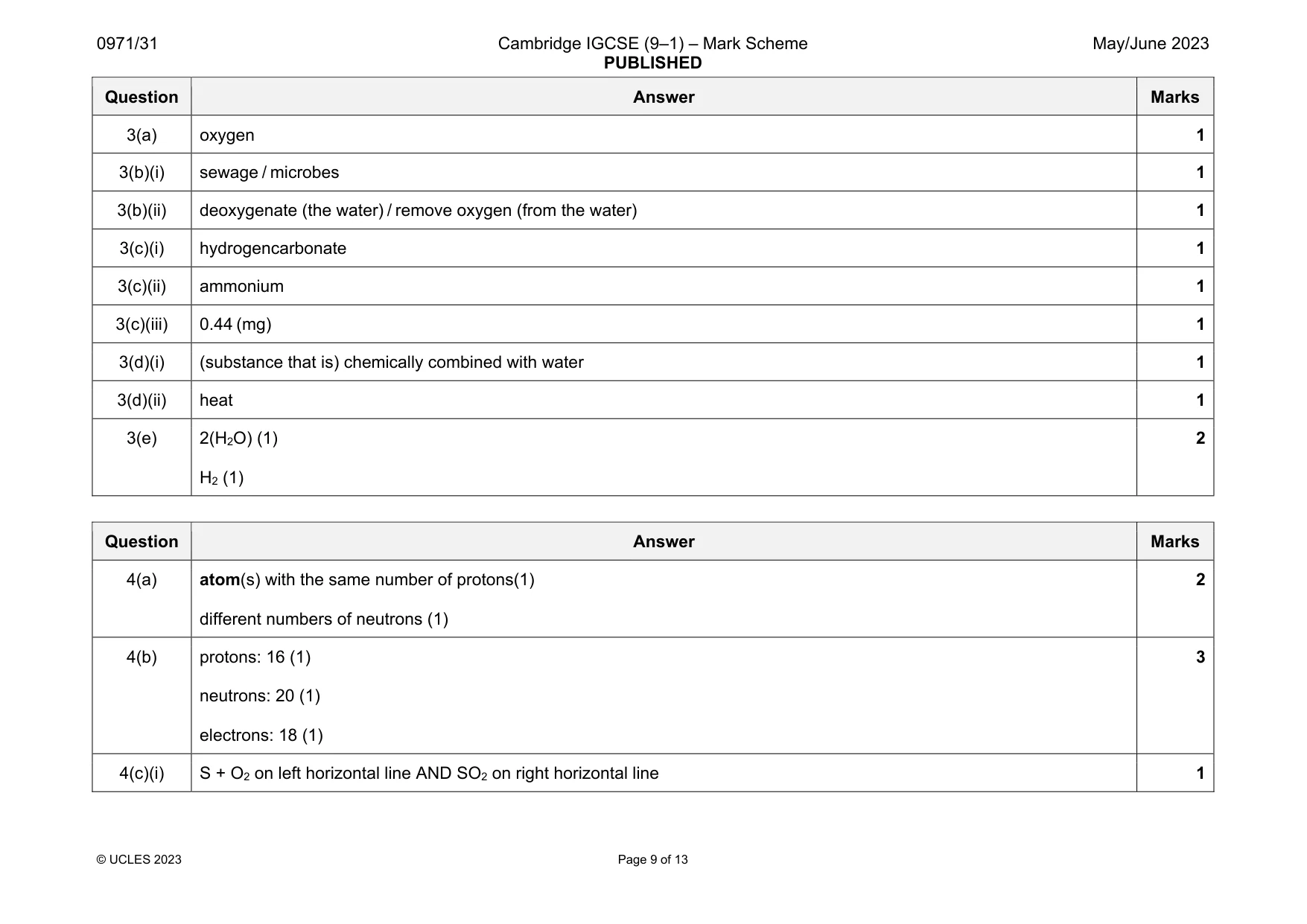
Mark scheme: 3(a) oxygen 1 3(b)(i) sewage / microbes 1 3(b)(ii) deoxygenate (the water) / remove oxygen (from the water) 1 3(c)(i) hydrogencarbonate 1 3(c)(ii) ammonium 1 3(c)(iii) 0.44 (mg) 1 3(d)(i) (substance that is) chemically combined with water 1 3(d)(ii) heat 1 3(e) 2(H2O) (1) H2 (1) 2
Q4 · This question is about sulfur and compounds of sulfur
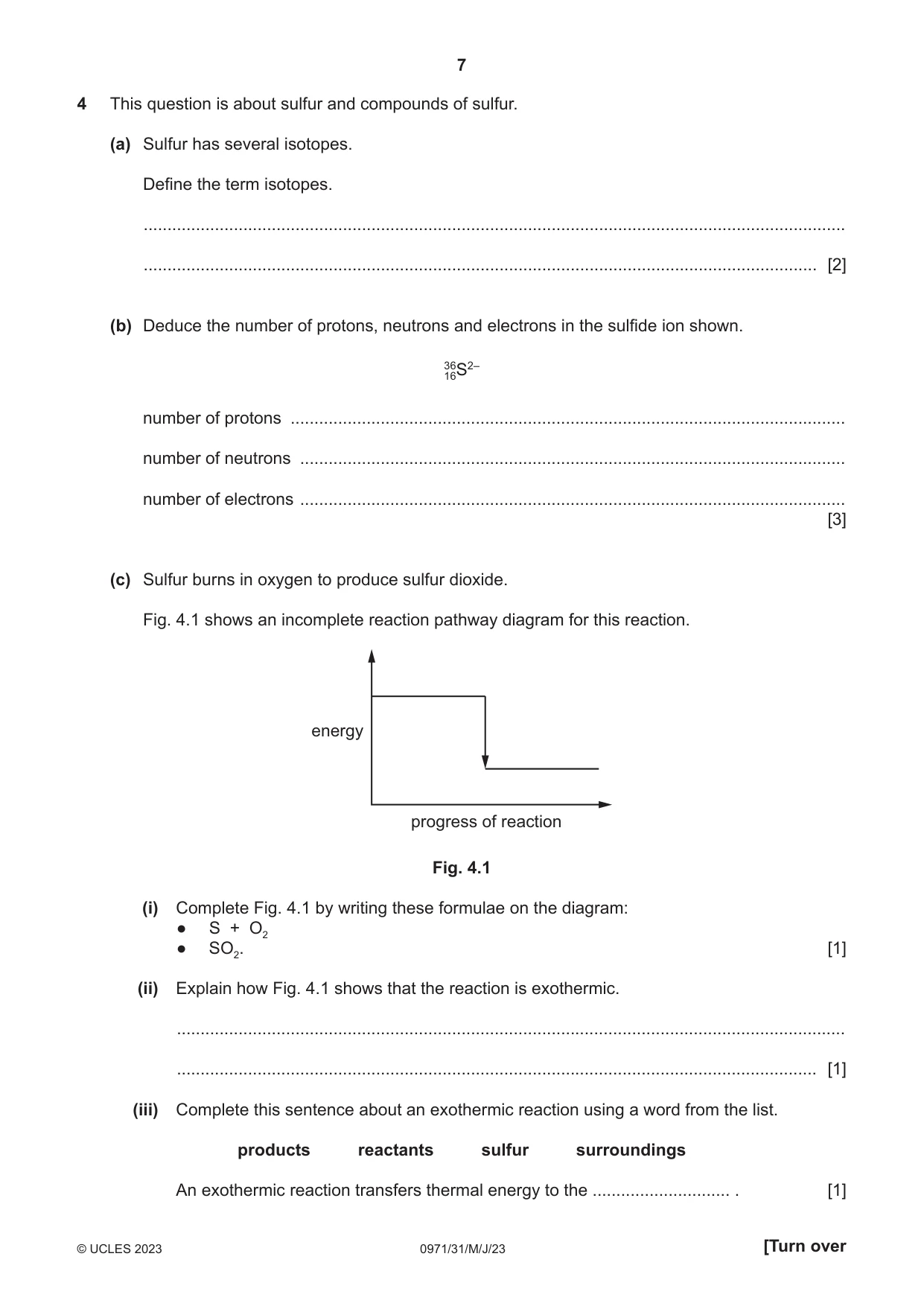
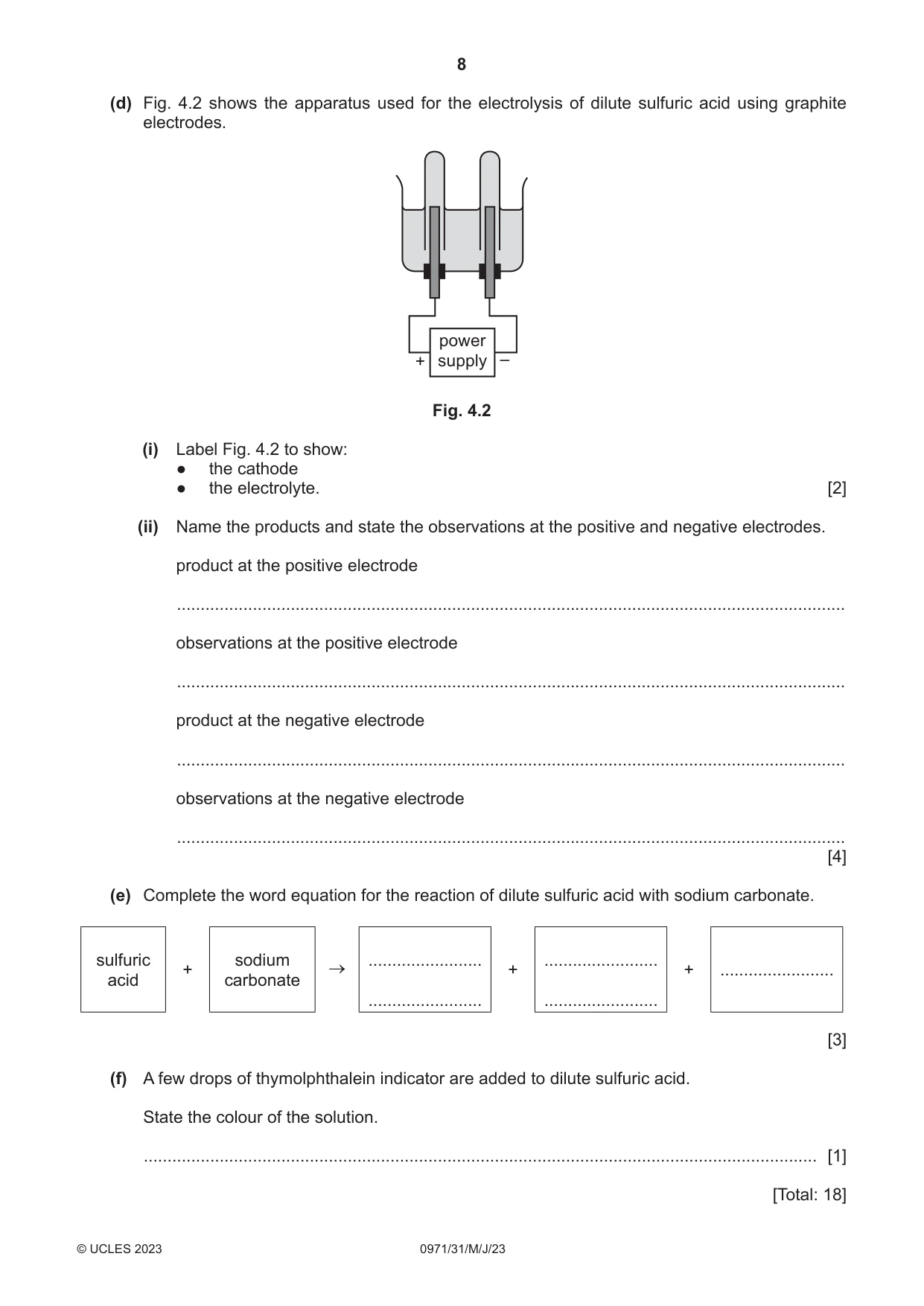
4 This question is about sulfur and compounds of sulfur. (a) Sulfur has several isotopes. Define the term isotopes. .................................................................................................................................................... .............................................................................................................................................. [2] (b) Deduce the number of protons, neutrons and electrons in the sulfide ion shown. 1636S2– number of protons ...................................................................................................................... number of neutrons .................................................................................................................... number of electrons ................................................................................................................... [3] (c) Sulfur burns in oxygen to produce sulfur dioxide. Fig. 4.1 shows an incomplete reaction pathway diagram for this reaction. energy progress of reaction Fig. 4.1 (i) Complete Fig. 4.1 by writing these formulae on the diagram: ● S + O2 ● SO2. [1] (ii) Explain how Fig. 4.1 shows that the reaction is exothermic. ............................................................................................................................................. ....................................................................................................................................... [1] (iii) Complete this sentence about an exothermic reaction using a word from the list. products reactants sulfur surroundings An exothermic reaction transfers thermal energy to the ............................. . [1] (d) Fig. 4.2 shows the apparatus used for the electrolysis of dilute sulfuric acid using graphite electrodes. power + supply – Fig. 4.2 (i) Label Fig. 4.2 to show: ● the cathode ● the electrolyte. [2] (ii) Name the products and state the observations at the positive and negative electrodes. product at the positive electrode ............................................................................................................................................. observations at the positive electrode ............................................................................................................................................. product at the negative electrode ............................................................................................................................................. observations at the negative electrode ............................................................................................................................................. [4] (e) Complete the word equation for the reaction of dilute sulfuric acid with sodium carbonate. sulfuric sodium ........................ ........................ + + + ........................ acid carbonate ........................ ........................ [3] (f) A few drops of thymolphthalein indicator are added to dilute sulfuric acid. State the colour of the solution. .............................................................................................................................................. [1] [Total: 18]
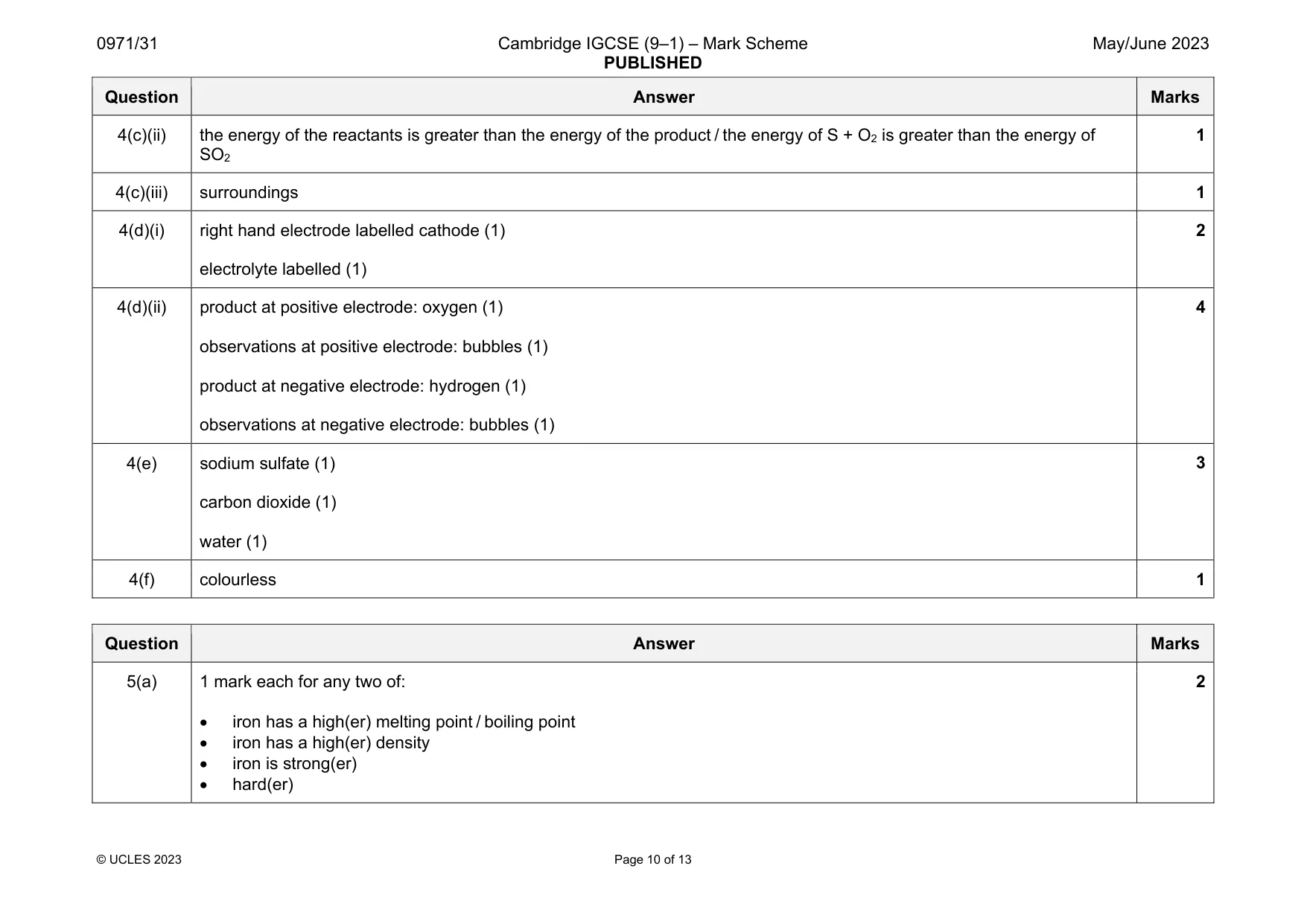
Mark scheme: 4(a) atom(s) with the same number of protons(1) different numbers of neutrons (1) 2 4(b) protons: 16 (1) neutrons: 20 (1) electrons: 18 (1) 3 4(c)(i) S + O2 on left horizontal line AND SO2 on right horizontal line 1 Question Answer Marks 4(c)(ii) the energy of the reactants is greater than the energy of the product / the energy of S + O2 is greater than the energy of SO2 1 4(c)(iii) surroundings 1 4(d)(i) right hand electrode labelled cathode (1) electrolyte labelled (1) 2 4(d)(ii) product at positive electrode: oxygen (1) observations at positive electrode: bubbles (1) product at negative electrode: hydrogen (1) observations at negative electrode: bubbles (1) 4 4(e) sodium sulfate (1) carbon dioxide (1) water (1) 3 4(f) colourless 1
Q5 · This question is about metals
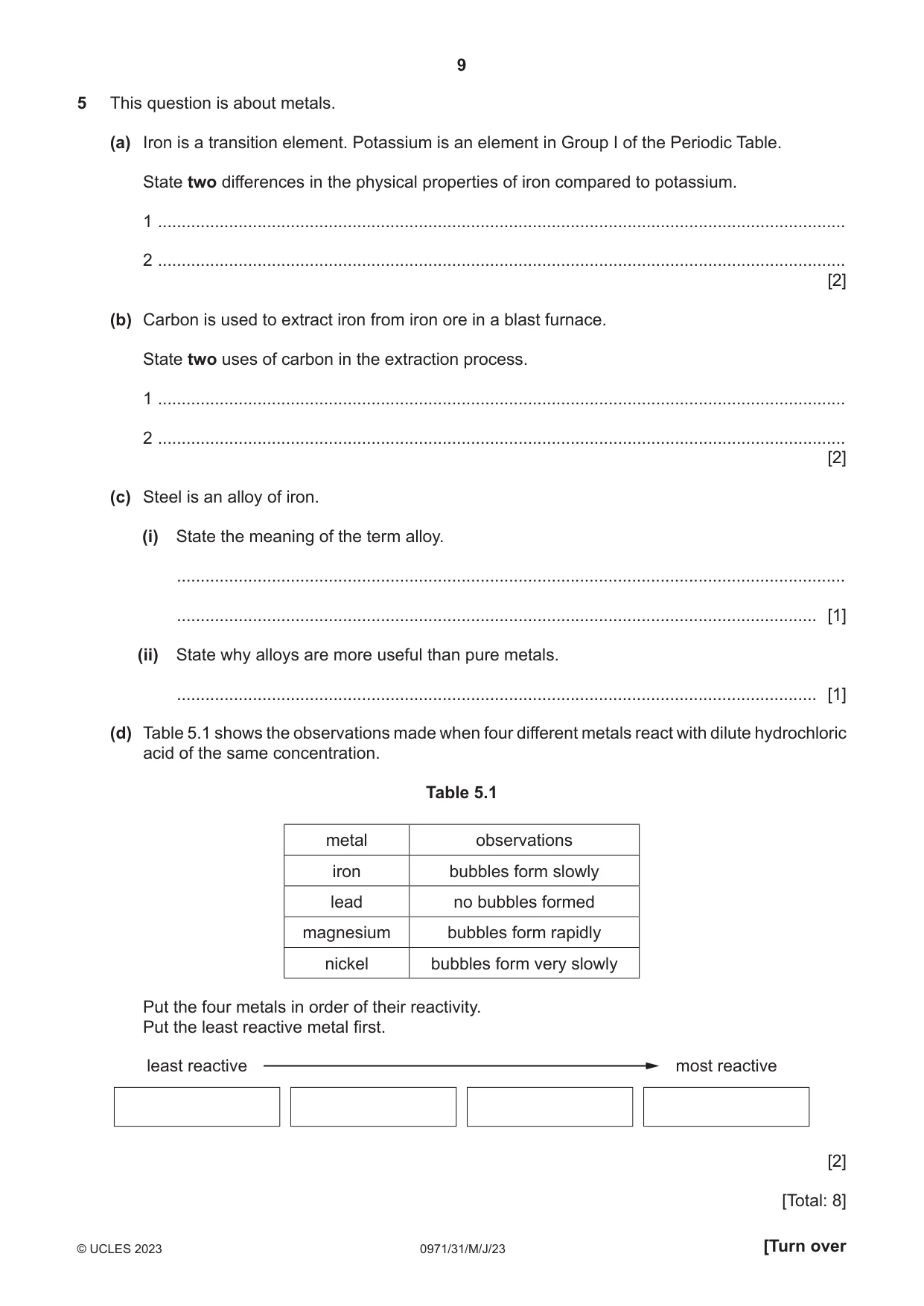
5 This question is about metals. (a) Iron is a transition element. Potassium is an element in Group I of the Periodic Table. State two differences in the physical properties of iron compared to potassium. 1 ................................................................................................................................................. 2 ................................................................................................................................................. [2] (b) Carbon is used to extract iron from iron ore in a blast furnace. State two uses of carbon in the extraction process. 1 ................................................................................................................................................. 2 ................................................................................................................................................. [2] (c) Steel is an alloy of iron. (i) State the meaning of the term alloy. ............................................................................................................................................. ....................................................................................................................................... [1] (ii) State why alloys are more useful than pure metals. ....................................................................................................................................... [1] (d) Table 5.1 shows the observations made when four different metals react with dilute hydrochloric acid of the same concentration. Table 5.1 metal observations iron bubbles form slowly lead no bubbles formed magnesium bubbles form rapidly nickel bubbles form very slowly Put the four metals in order of their reactivity. Put the least reactive metal first. least reactive most reactive [2] [Total: 8]
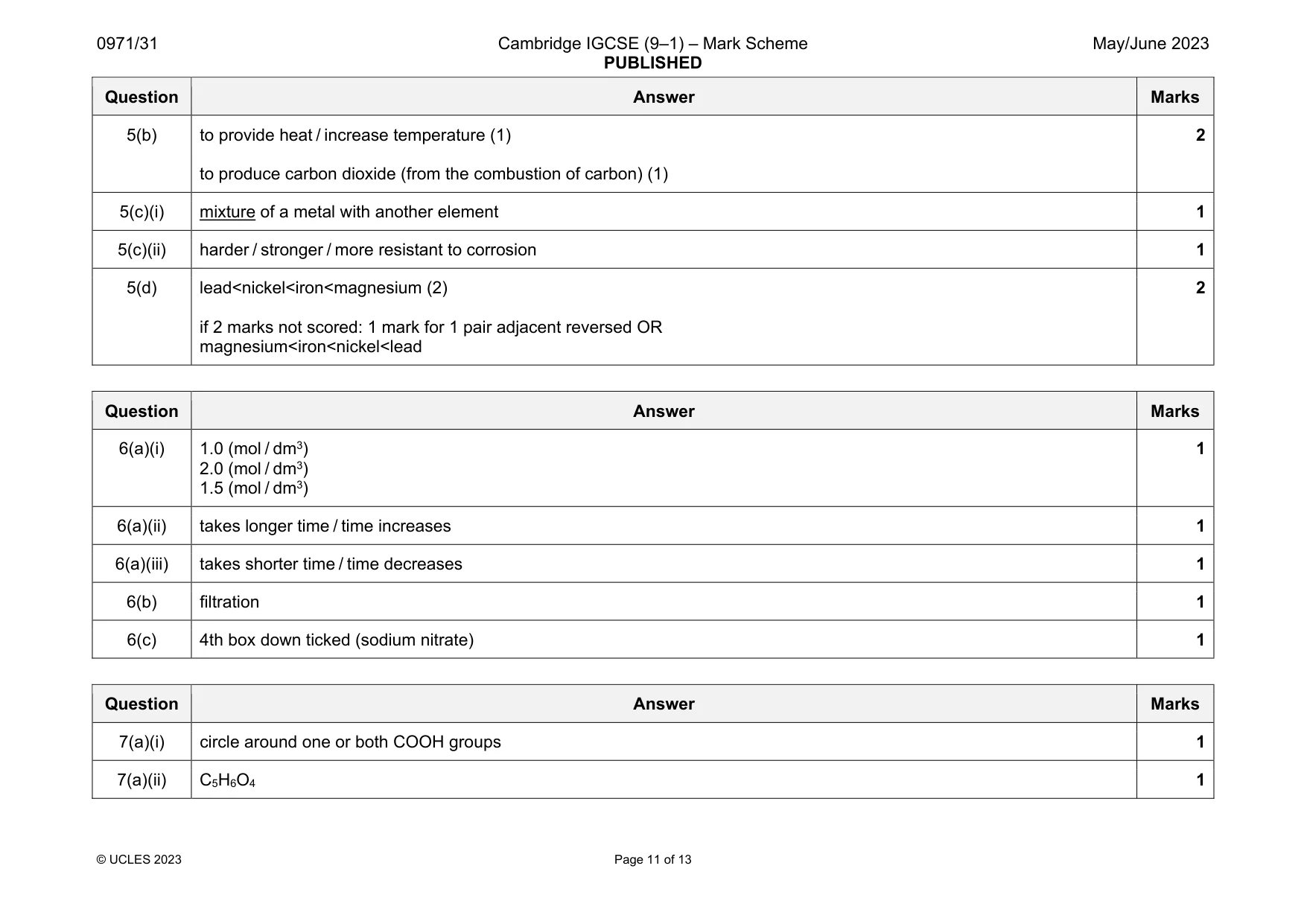
Mark scheme: 5(a) 1 mark each for any two of: iron has a high(er) melting point / boiling point iron has a high(er) density iron is strong(er) hard(er) 2 Question Answer Marks 5(b) to provide heat / increase temperature (1) to produce carbon dioxide (from the combustion of carbon) (1) 2 5(c)(i) mixture of a metal with another element 1 5(c)(ii) harder / stronger / more resistant to corrosion 1 5(d) lead<nickel<iron<magnesium (2) if 2 marks not scored: 1 mark for 1 pair adjacent reversed OR magnesium<iron<nickel<lead 2
Q6 · A student investigates the reaction of small pieces of zinc of the same mass and size…
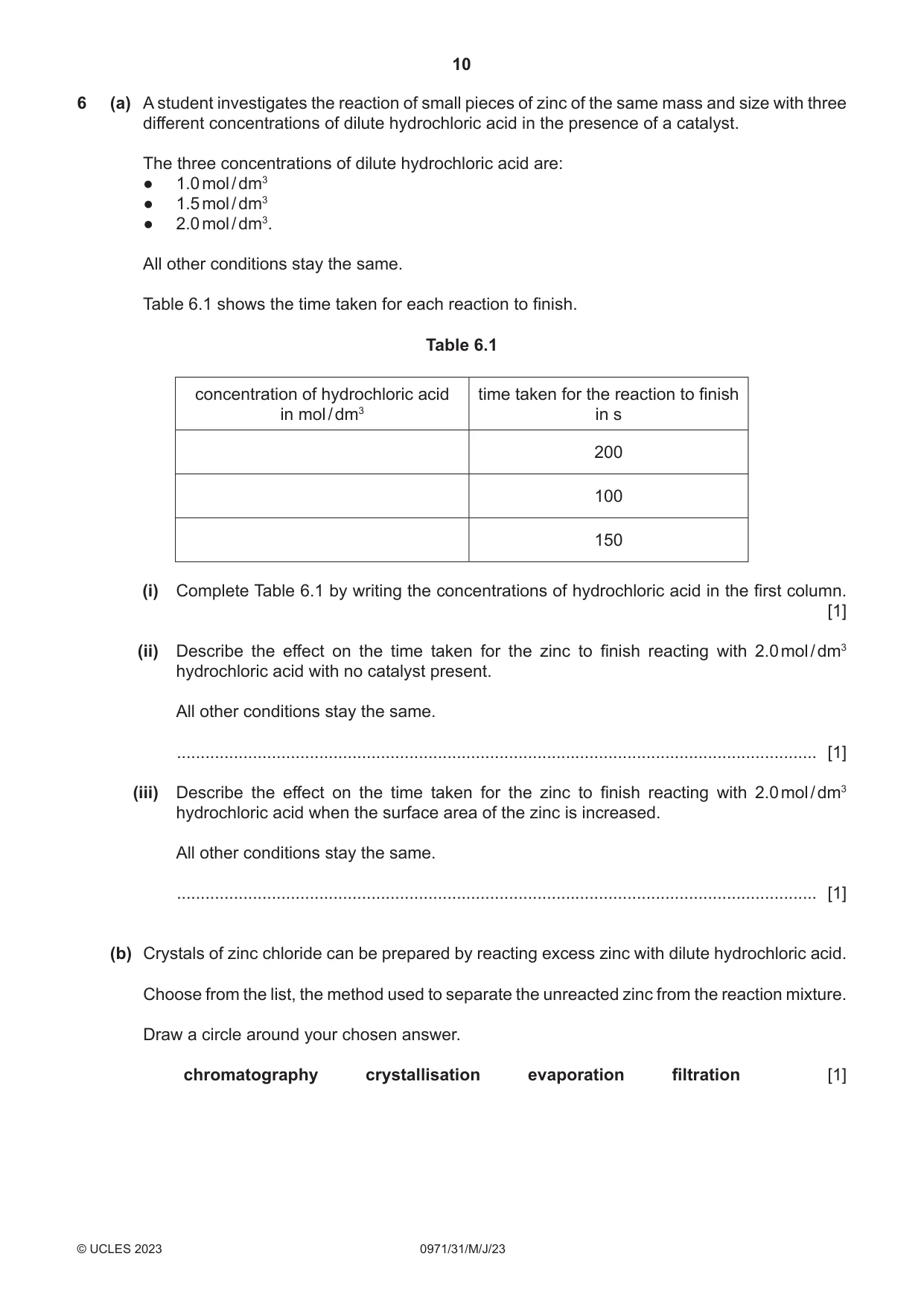
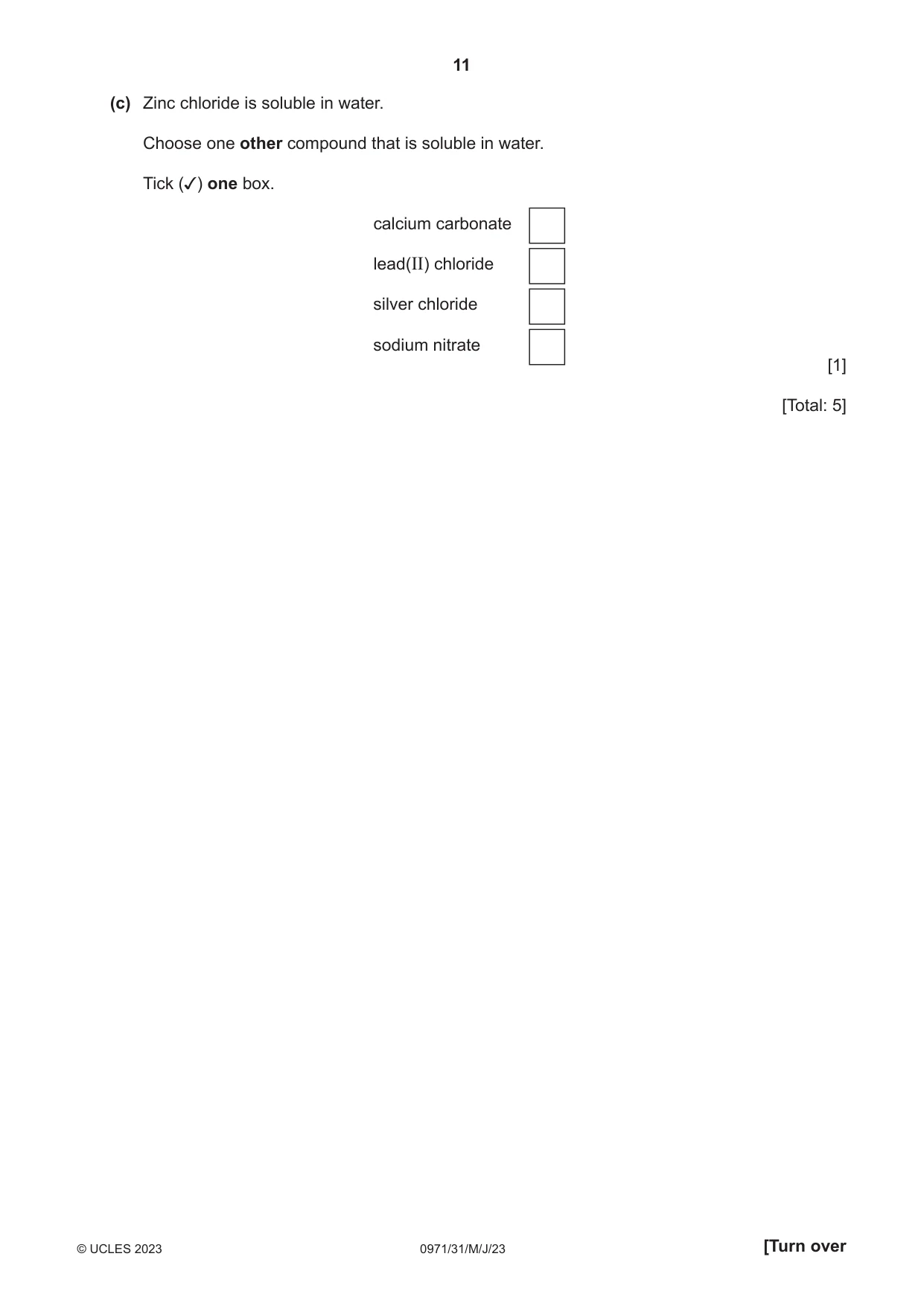
6 (a) A student investigates the reaction of small pieces of zinc of the same mass and size with three different concentrations of dilute hydrochloric acid in the presence of a catalyst. The three concentrations of dilute hydrochloric acid are: ● 1.0 mol / dm3 ● 1.5 mol / dm3 ● 2.0 mol / dm3. All other conditions stay the same. Table 6.1 shows the time taken for each reaction to finish. Table 6.1 concentration of hydrochloric acid time taken for the reaction to finish in mol / dm3 in s 200 100 150 (i) omplete Table 6.1 by writing the concentrations of hydrochloric acid in the first column. [1] (ii) Describe the effect on the time taken for the zinc to finish reacting with 2.0 mol / dm3 hydrochloric acid with no catalyst present. All other conditions stay the same. ....................................................................................................................................... [1] (iii) Describe the effect on the time taken for the zinc to finish reacting with 2.0 mol / dm3 hydrochloric acid when the surface area of the zinc is increased. All other conditions stay the same. ....................................................................................................................................... [1] (b) Crystals of zinc chloride can be prepared by reacting excess zinc with dilute hydrochloric acid. Choose from the list, the method used to separate the unreacted zinc from the reaction mixture. Draw a circle around your chosen answer. chromatography crystallisation evaporation filtration [1] (c) Zinc chloride is soluble in water. Choose one other compound that is soluble in water. Tick (✓) one box. calcium carbonate lead(II) chloride silver chloride sodium nitrate [1] [Total: 5]
Mark scheme: 6(a)(i) 1.0 (mol / dm3) 2.0 (mol / dm3) 1.5 (mol / dm3) 1 6(a)(ii) takes longer time / time increases 1 6(a)(iii) takes shorter time / time decreases 1 6(b) filtration 1 6(c) 4th box down ticked (sodium nitrate) 1
Q7 · The displayed formula of mesaconic acid
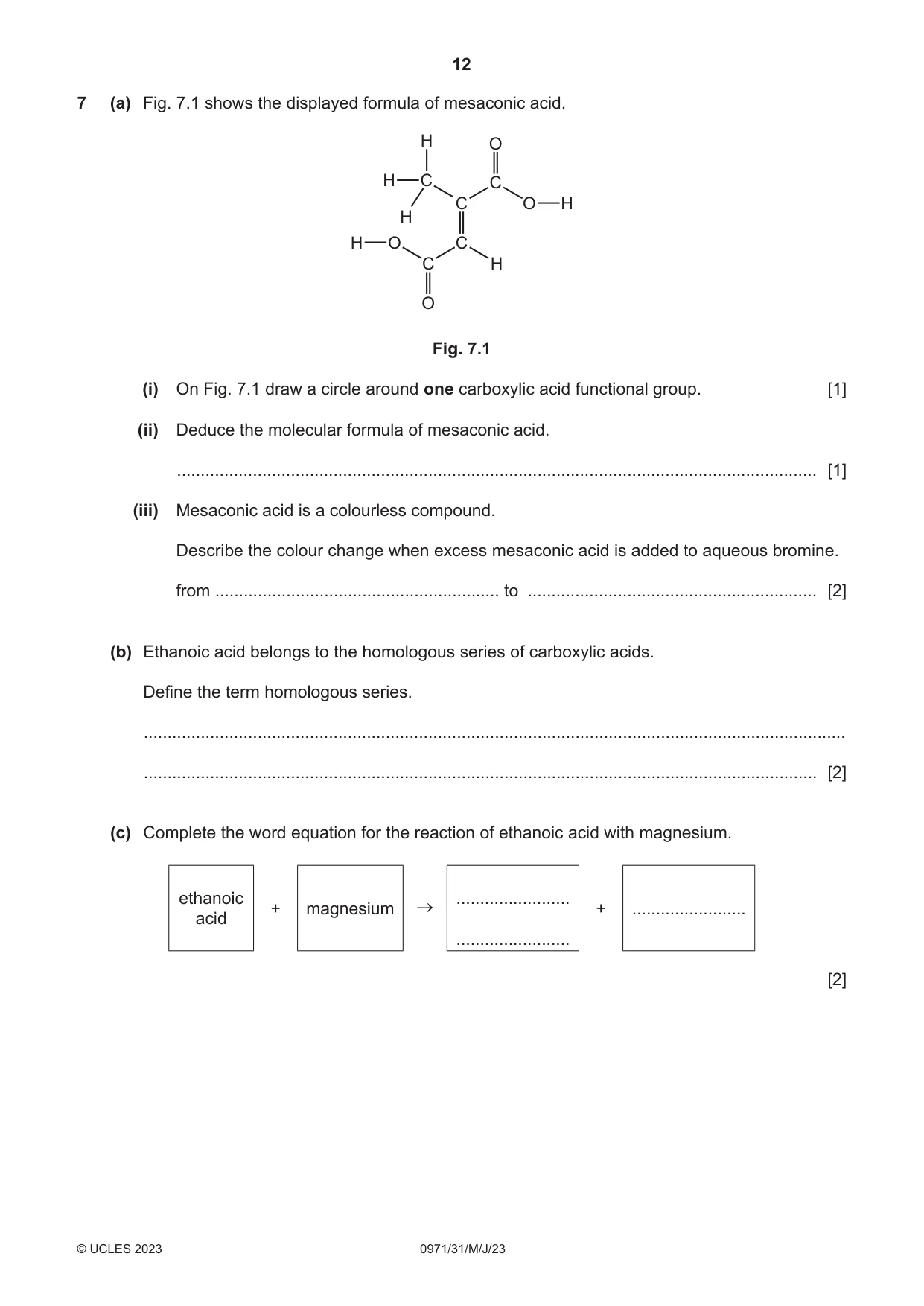
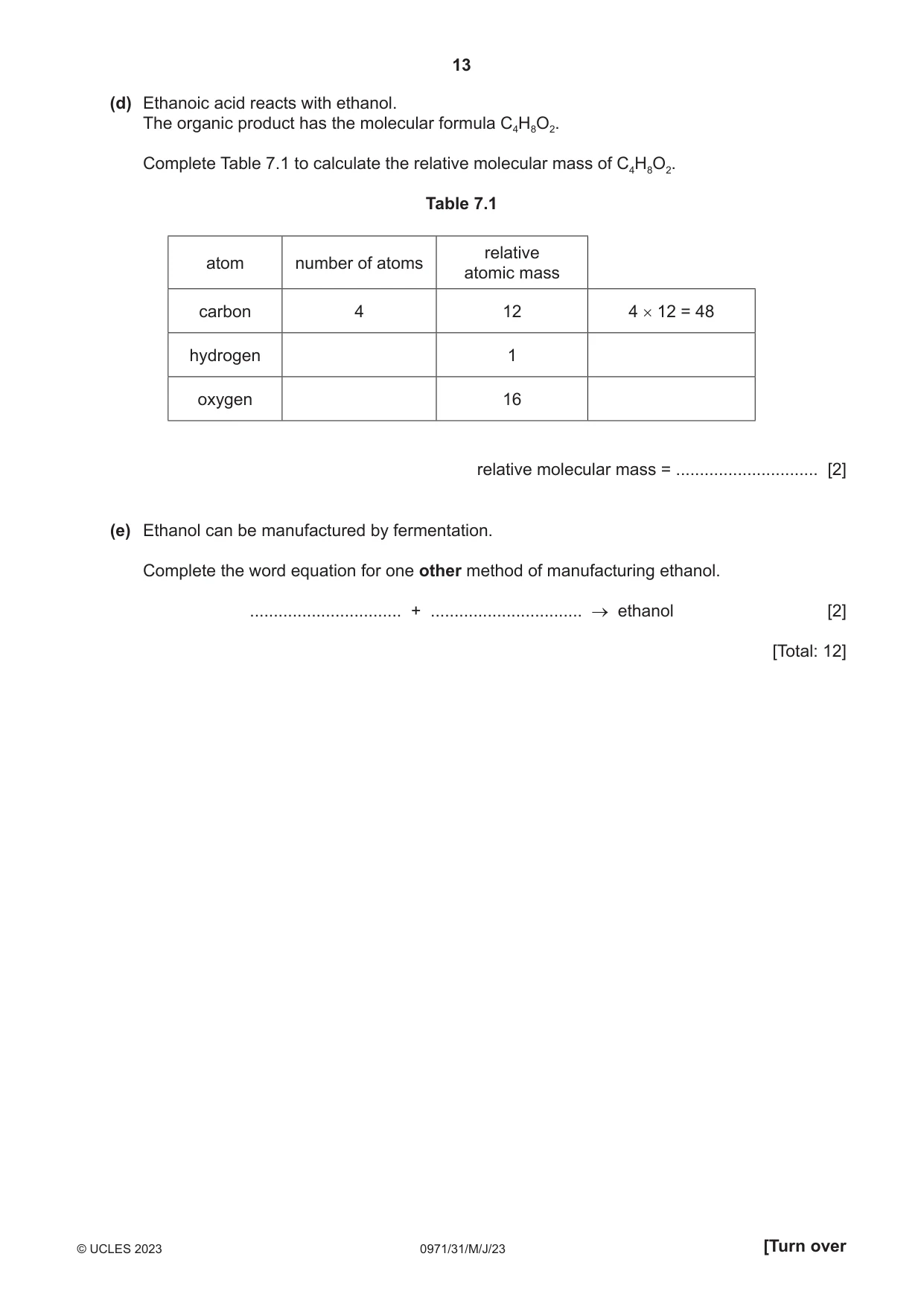
7 (a) Fig. 7.1 shows the displayed formula of mesaconic acid. H O H C C C O H H H O C C H O Fig. 7.1 (i) On Fig. 7.1 draw a circle around one carboxylic acid functional group. [1] (ii) Deduce the molecular formula of mesaconic acid. ....................................................................................................................................... [1] (iii) Mesaconic acid is a colourless compound. Describe the colour change when excess mesaconic acid is added to aqueous bromine. from ............................................................ to ������������������������������������������������������������� [2] (b) Ethanoic acid belongs to the homologous series of carboxylic acids. Define the term homologous series. .................................................................................................................................................... .............................................................................................................................................. [2] (c) Complete the word equation for the reaction of ethanoic acid with magnesium. ethanoic ........................ + magnesium + ........................ acid ........................ [2] (d) Ethanoic acid reacts with ethanol. The organic product has the molecular formula C4H8O2. Complete Table 7.1 to calculate the relative molecular mass of C4H8O2. Table 7.1 relative atom number of atoms atomic mass carbon 4 12 4 × 12 = 48 hydrogen 1 oxygen 16 relative molecular mass = .............................. [2] (e) Ethanol can be manufactured by fermentation. Complete the word equation for one other method of manufacturing ethanol. ................................ + ................................ → ethanol [2] [Total: 12]
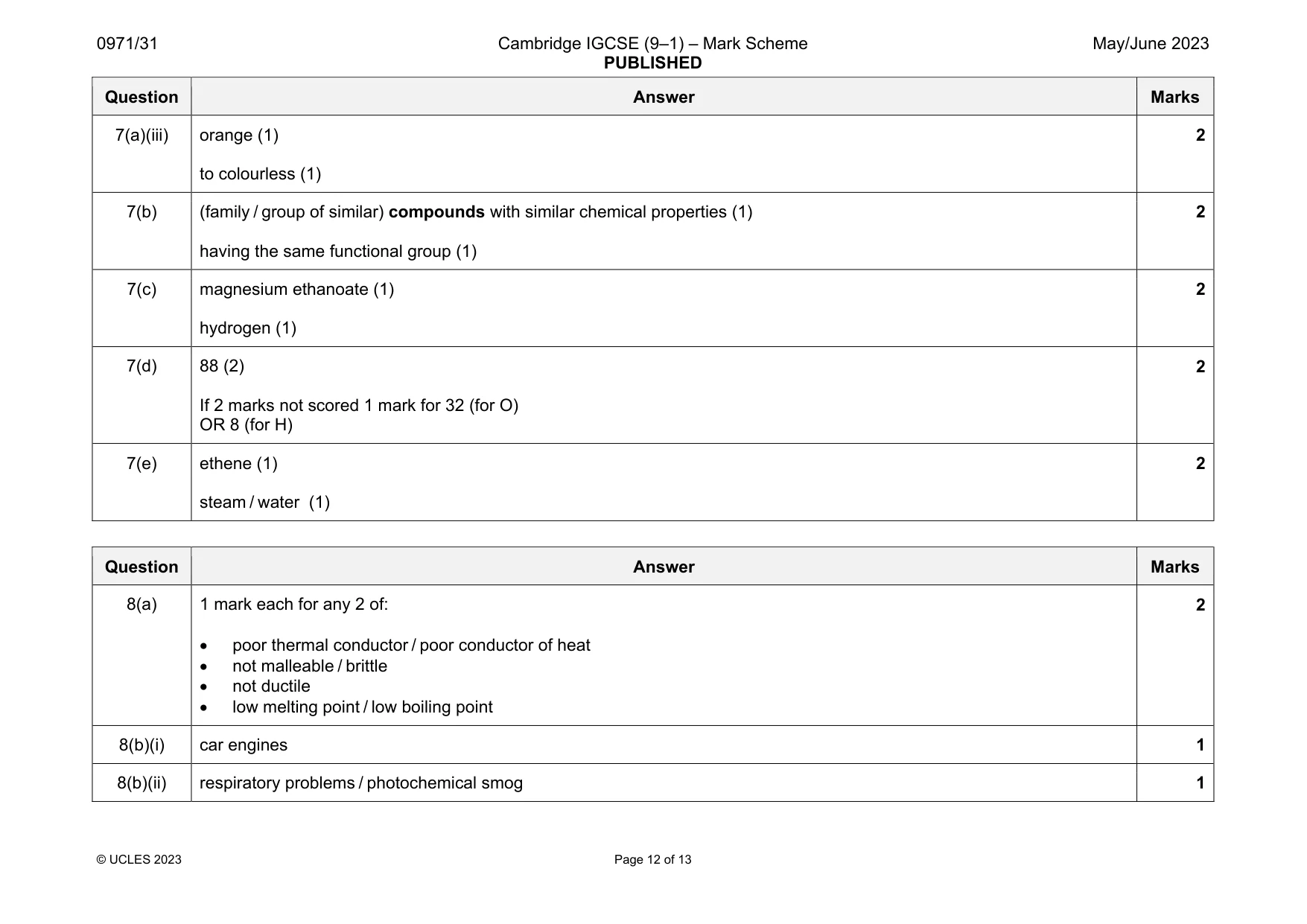
Mark scheme: 7(a)(i) circle around one or both COOH groups 1 7(a)(ii) C5H6O4 1 Question Answer Marks 7(a)(iii) orange (1) to colourless (1) 2 7(b) (family / group of similar) compounds with similar chemical properties (1) having the same functional group (1) 2 7(c) magnesium ethanoate (1) hydrogen (1) 2 7(d) 88 (2) If 2 marks not scored 1 mark for 32 (for O) OR 8 (for H) 2 7(e) ethene (1) steam / water (1) 2
More questions on Formulae, functional groups and terminology
Q8 · This question is about nitrogen and compounds of nitrogen
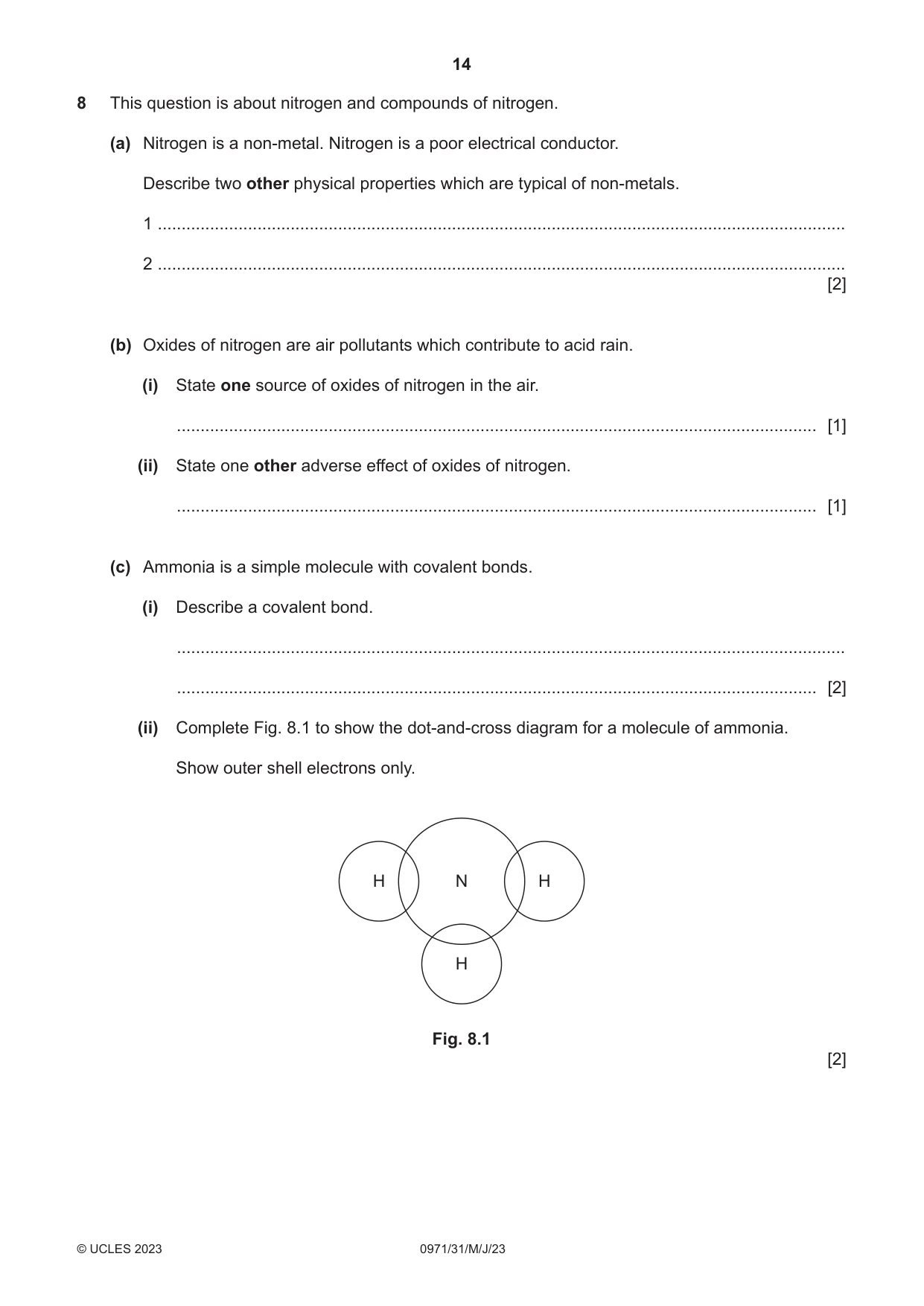
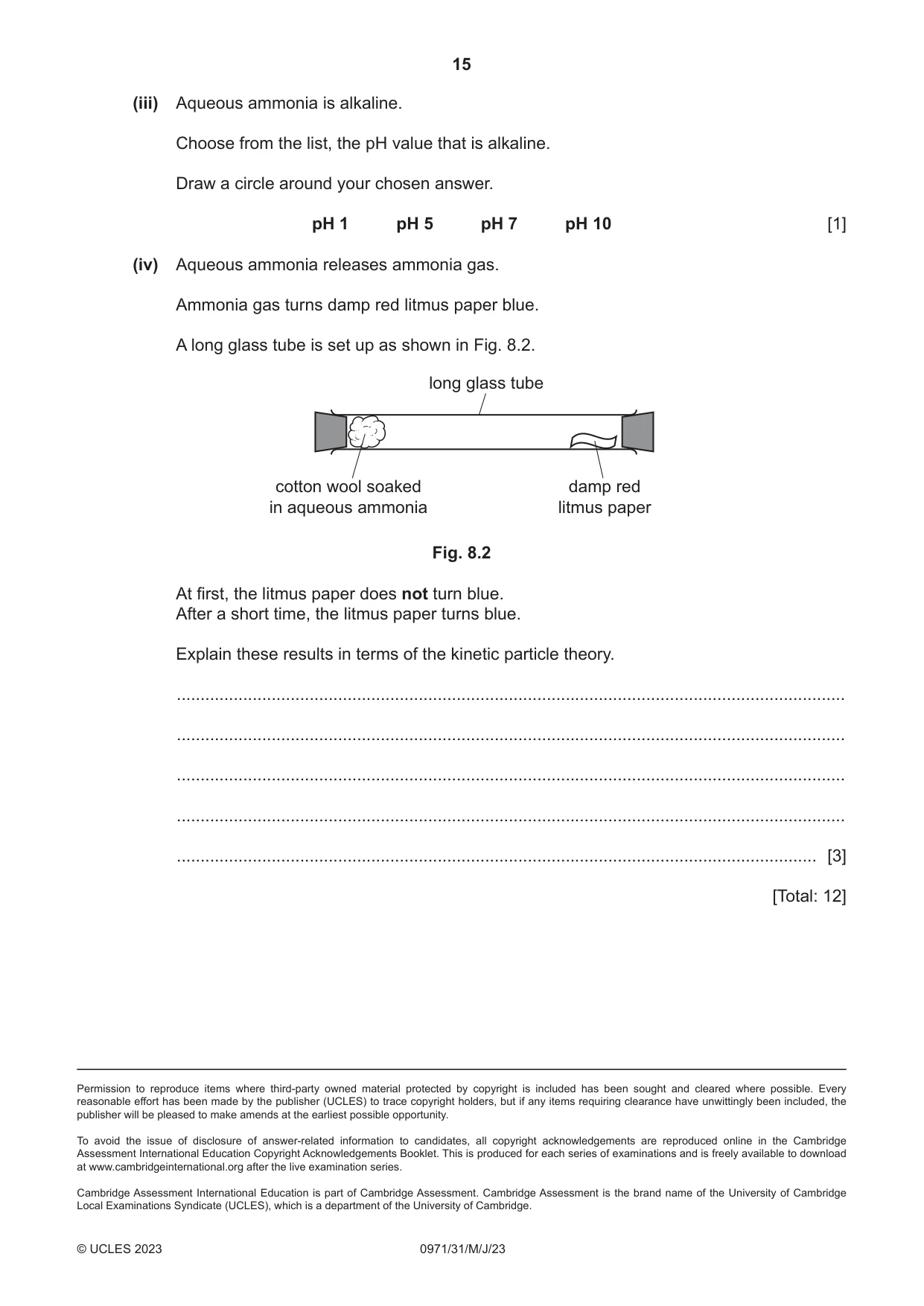
8 This question is about nitrogen and compounds of nitrogen. (a) Nitrogen is a non-metal. Nitrogen is a poor electrical conductor. Describe two other physical properties which are typical of non-metals. 1 ................................................................................................................................................. 2 ................................................................................................................................................. [2] (b) Oxides of nitrogen are air pollutants which contribute to acid rain. (i) State one source of oxides of nitrogen in the air. ....................................................................................................................................... [1] (ii) State one other adverse effect of oxides of nitrogen. ....................................................................................................................................... [1] (c) Ammonia is a simple molecule with covalent bonds. (i) Describe a covalent bond. ............................................................................................................................................. ....................................................................................................................................... [2] (ii) Complete Fig. 8.1 to show the dot-and-cross diagram for a molecule of ammonia. Show outer shell electrons only. H N H H Fig. 8.1 [2] (iii) Aqueous ammonia is alkaline. Choose from the list, the pH value that is alkaline. Draw a circle around your chosen answer. pH 1 pH 5 pH 7 pH 10 [1] (iv) Aqueous ammonia releases ammonia gas. Ammonia gas turns damp red litmus paper blue. A long glass tube is set up as shown in Fig. 8.2. long glass tube cotton wool soaked damp red in aqueous ammonia litmus paper Fig. 8.2 At first, the litmus paper does not turn blue. After a short time, the litmus paper turns blue. Explain these results in terms of the kinetic particle theory. ............................................................................................................................................. ............................................................................................................................................. ............................................................................................................................................. ............................................................................................................................................. ....................................................................................................................................... [3] [Total: 12]
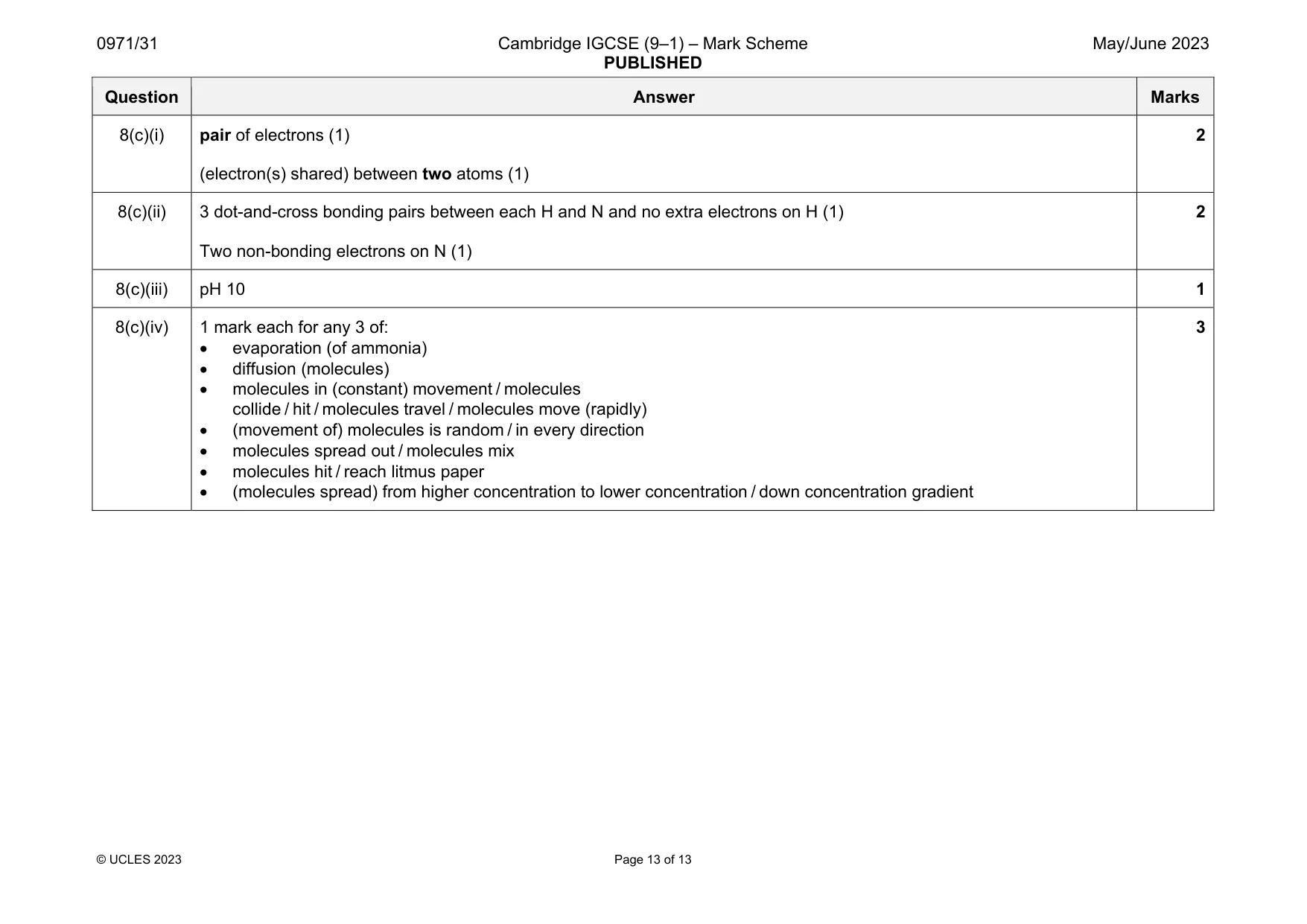
Mark scheme: 8(a) 1 mark each for any 2 of: poor thermal conductor / poor conductor of heat not malleable / brittle not ductile low melting point / low boiling point 2 8(b)(i) car engines 1 8(b)(ii) respiratory problems / photochemical smog 1 Question Answer Marks 8(c)(i) pair of electrons (1) (electron(s) shared) between two atoms (1) 2 8(c)(ii) 3 dot-and-cross bonding pairs between each H and N and no extra electrons on H (1) Two non-bonding electrons on N (1) 2 8(c)(iii) pH 10 1 8(c)(iv) 1 mark each for any 3 of: evaporation (of ammonia) diffusion (molecules) molecules in (constant) movement / molecules collide / hit / molecules travel / molecules move (rapidly) (movement of) molecules is random / in every direction molecules spread out / molecules mix molecules hit / reach litmus paper (molecules spread) from higher concentration to lower concentration / down concentration gradient 3
What was in this paper
The subtopics covered by these 8 questions, and how many questions each got. Open one in a new tab to see every Cambridge question on it.
What you needed in this session
Cambridge’s own grade thresholds for 2023 May/June, Paper 3 · Variant 1. A higher threshold means an easier paper — the bar moves with how the cohort did.