Cambridge IGCSE Chemistry (9-1) 0971 — 2024 May/June Paper 3 · Variant 2
0971/32/M/J/24 · 8 questions · 80 marks · 75 min
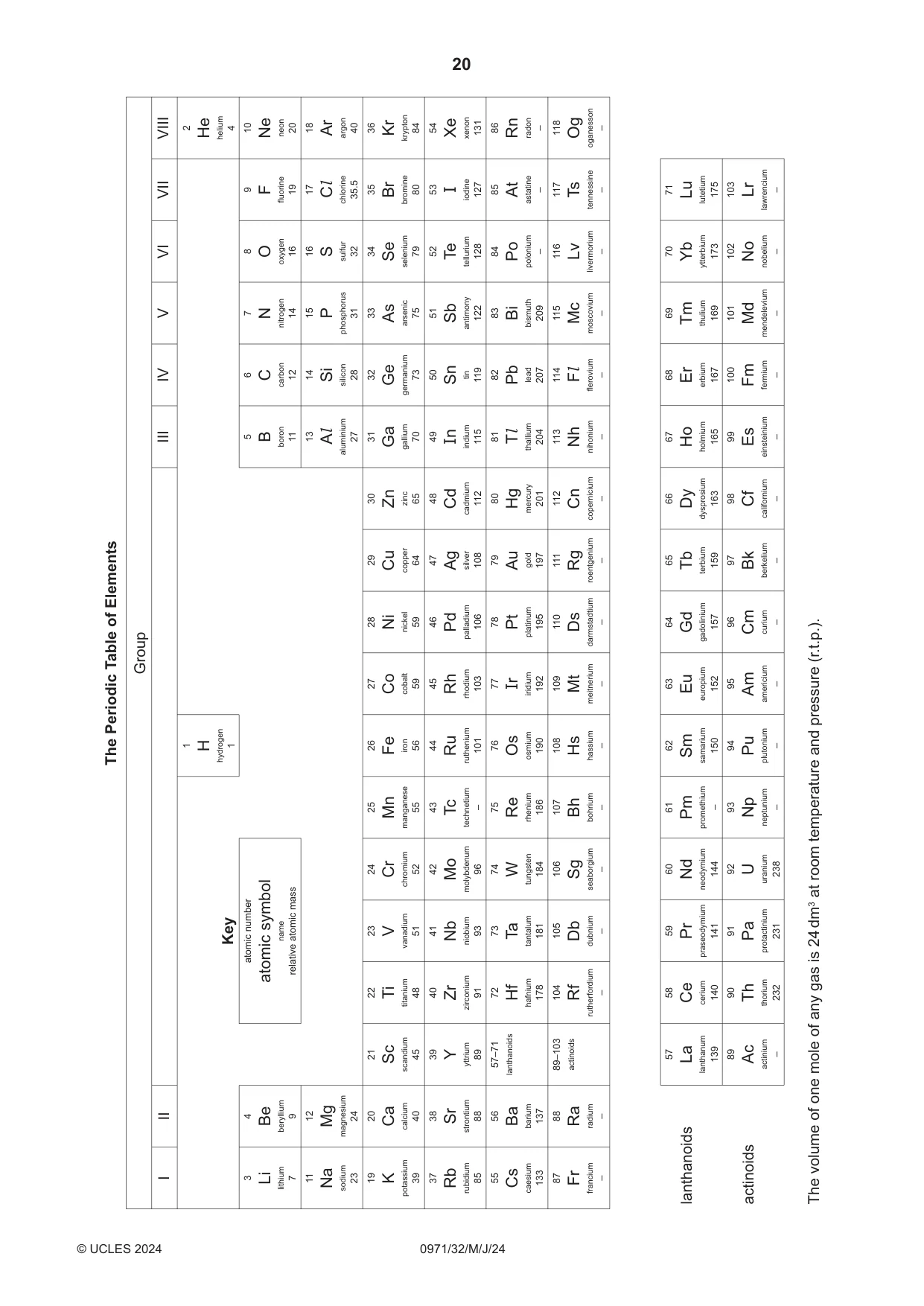
The question paper and its mark scheme, free to read here and free to download. This is Cambridge’s own paper, exactly as it was sat.
Question paper20 pages



Mark scheme10 pages
Answers below. Sit the paper first if you are practising.
Questions as text
Q1 · The structures of seven substances, A, B, C, D, E, F and G
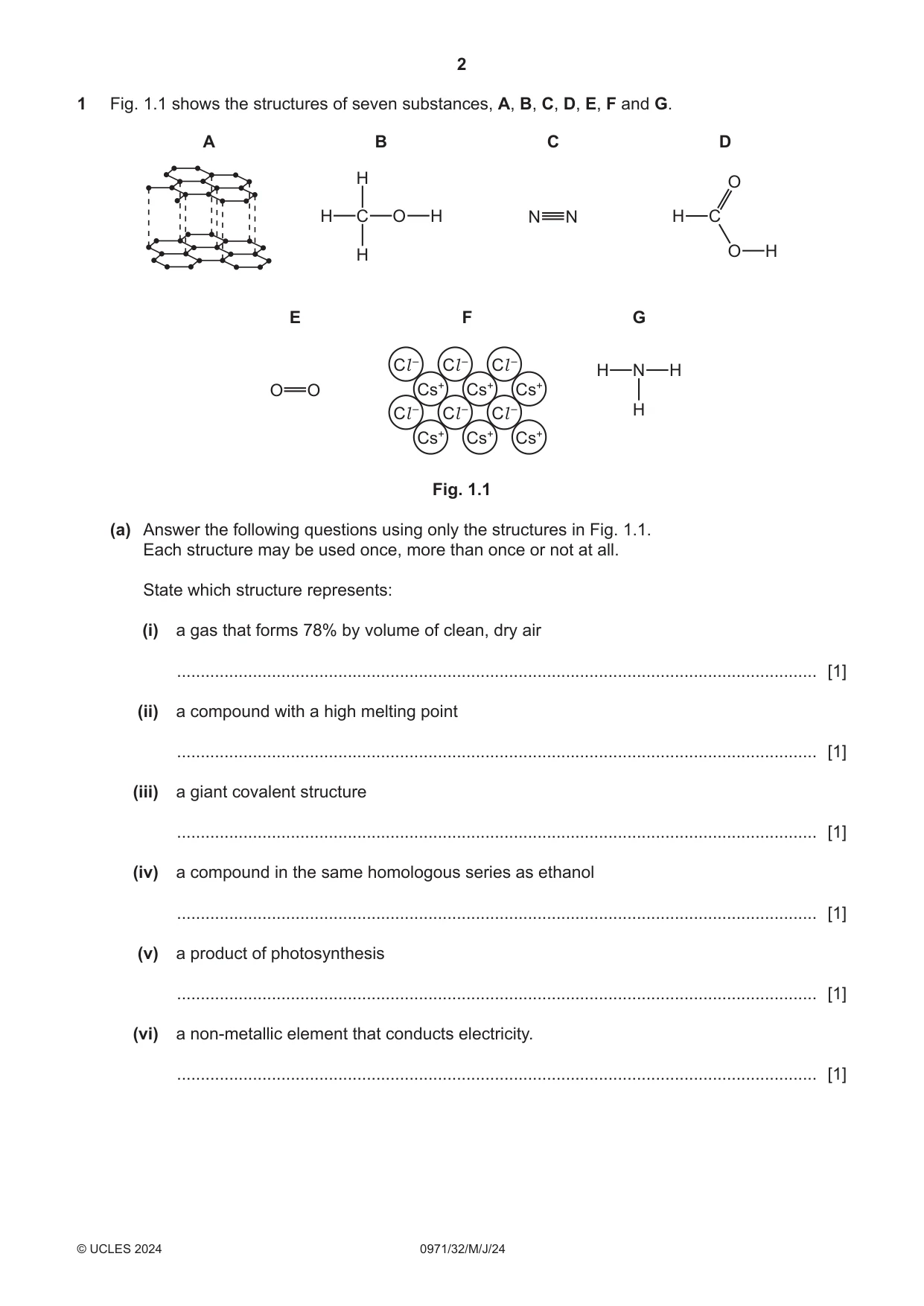
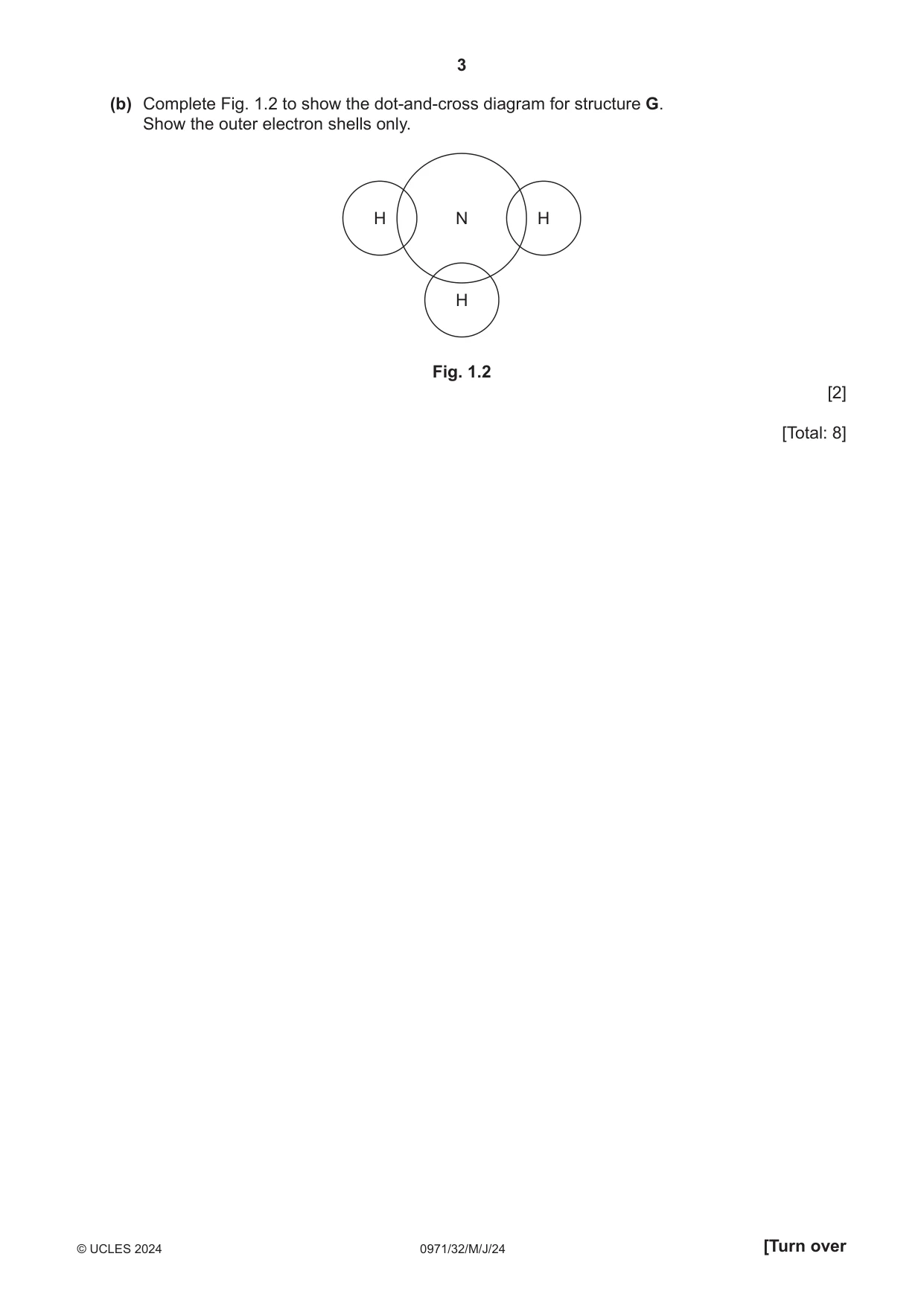
1 Fig. 1.1 shows the structures of seven substances, A, B, C, D, E, F and G. A B C D H O H C O H N N H C H O H E F G Cl – Cl – Cl – H N H O O Cs+ Cs+ Cs+ Cl – Cl – Cl – H Cs+ Cs+ Cs+ Fig. 1.1 (a) Answer the following questions using only the structures in Fig. 1.1. Each structure may be used once, more than once or not at all. State which structure represents: (i) a gas that forms 78% by volume of clean, dry air ....................................................................................................................................... [1] (ii) a compound with a high melting point ....................................................................................................................................... [1] (iii) a giant covalent structure ....................................................................................................................................... [1] (iv) a compound in the same homologous series as ethanol ....................................................................................................................................... [1] (v) a product of photosynthesis ....................................................................................................................................... [1] (vi) a non-metallic element that conducts electricity. ....................................................................................................................................... [1] (b) Complete Fig. 1.2 to show the dot-and-cross diagram for structure G. Show the outer electron shells only. H N H H Fig. 1.2 [2] [Total: 8]
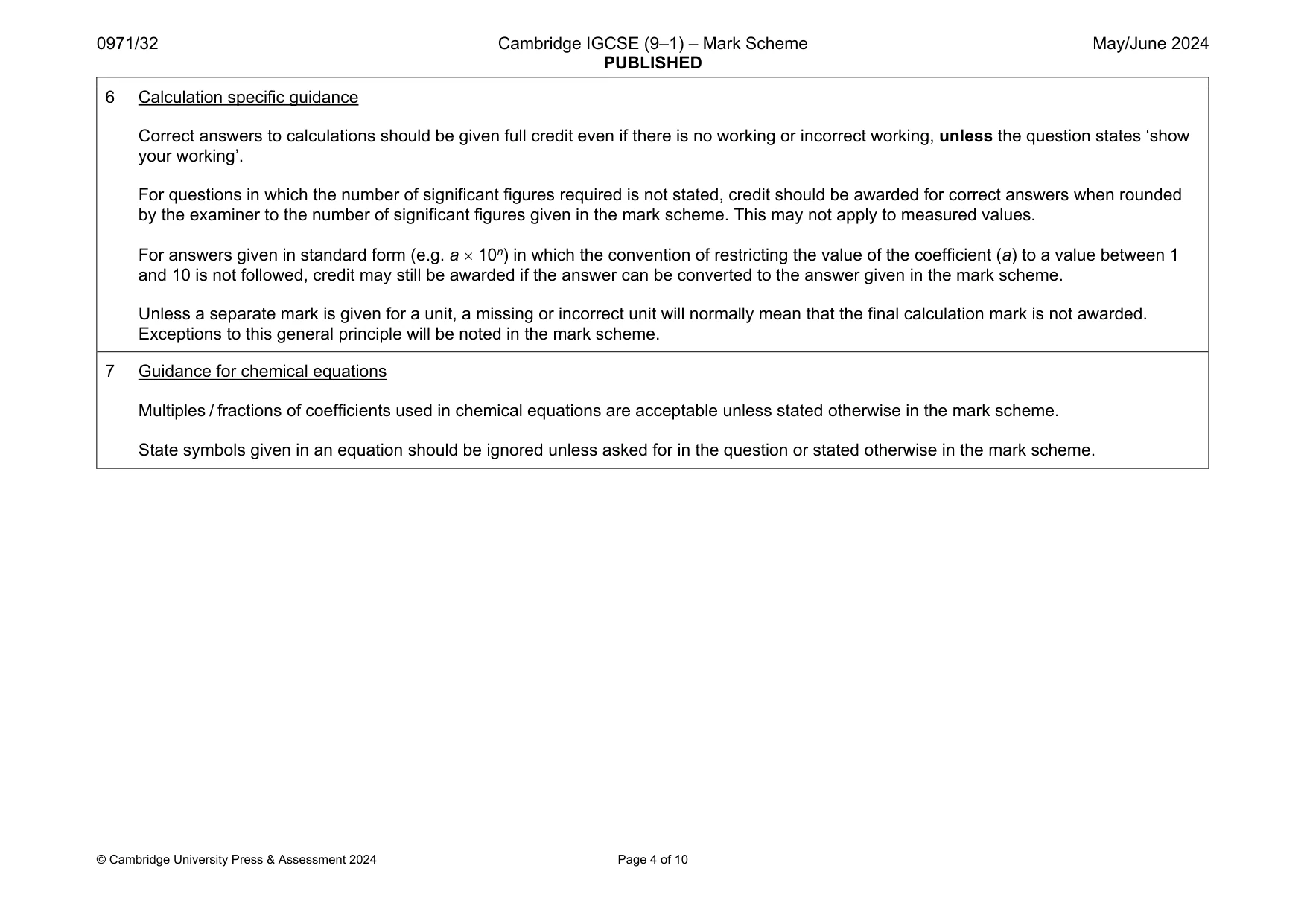
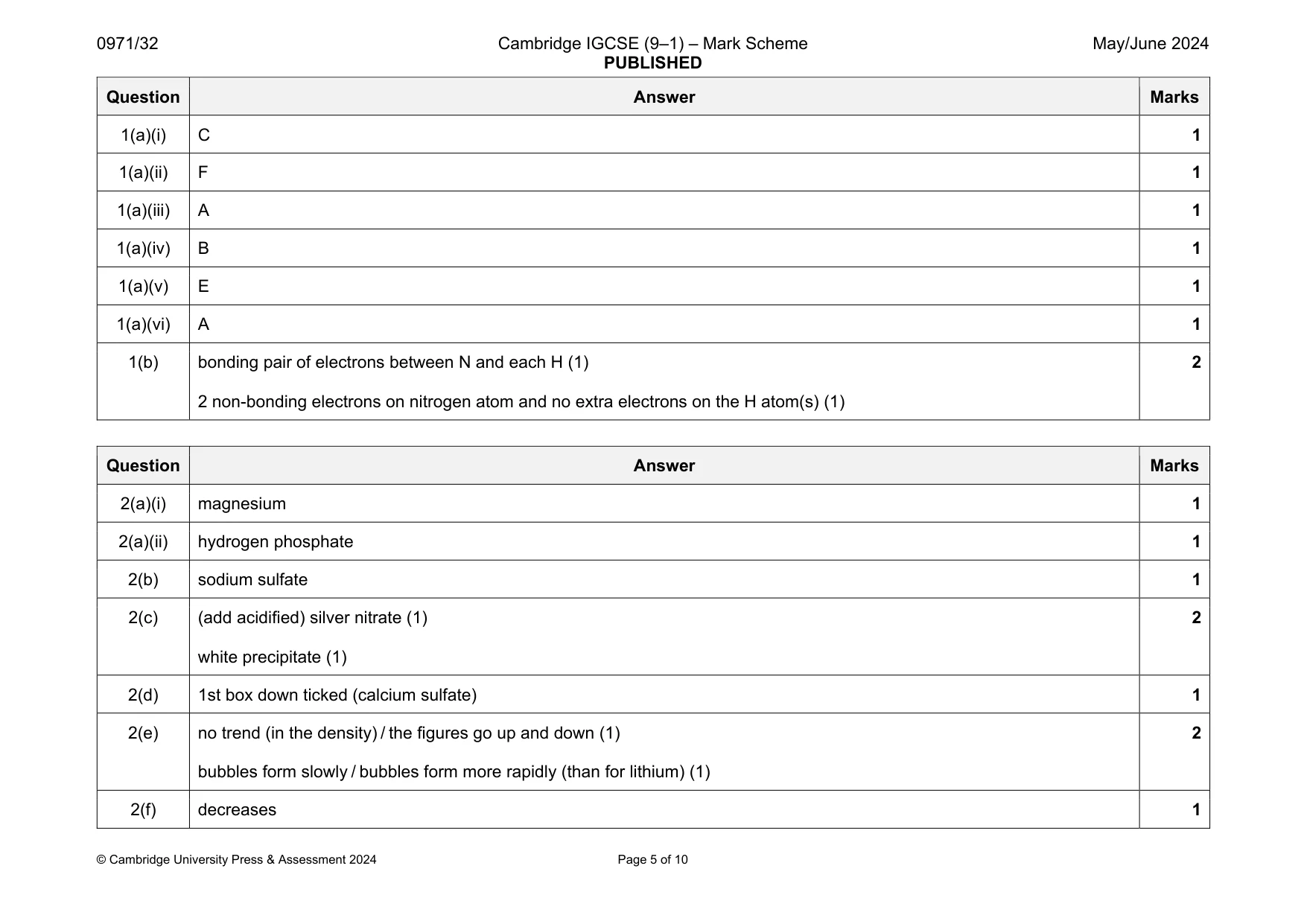
Mark scheme: 1(a)(i) C 1 1(a)(ii) F 1 1(a)(iii) A 1 1(a)(iv) B 1 1(a)(v) E 1 1(a)(vi) A 1 1(b) bonding pair of electrons between N and each H (1) 2 non-bonding electrons on nitrogen atom and no extra electrons on the H atom(s) (1) 2
Q2 · Blood plasma is the liquid part of blood
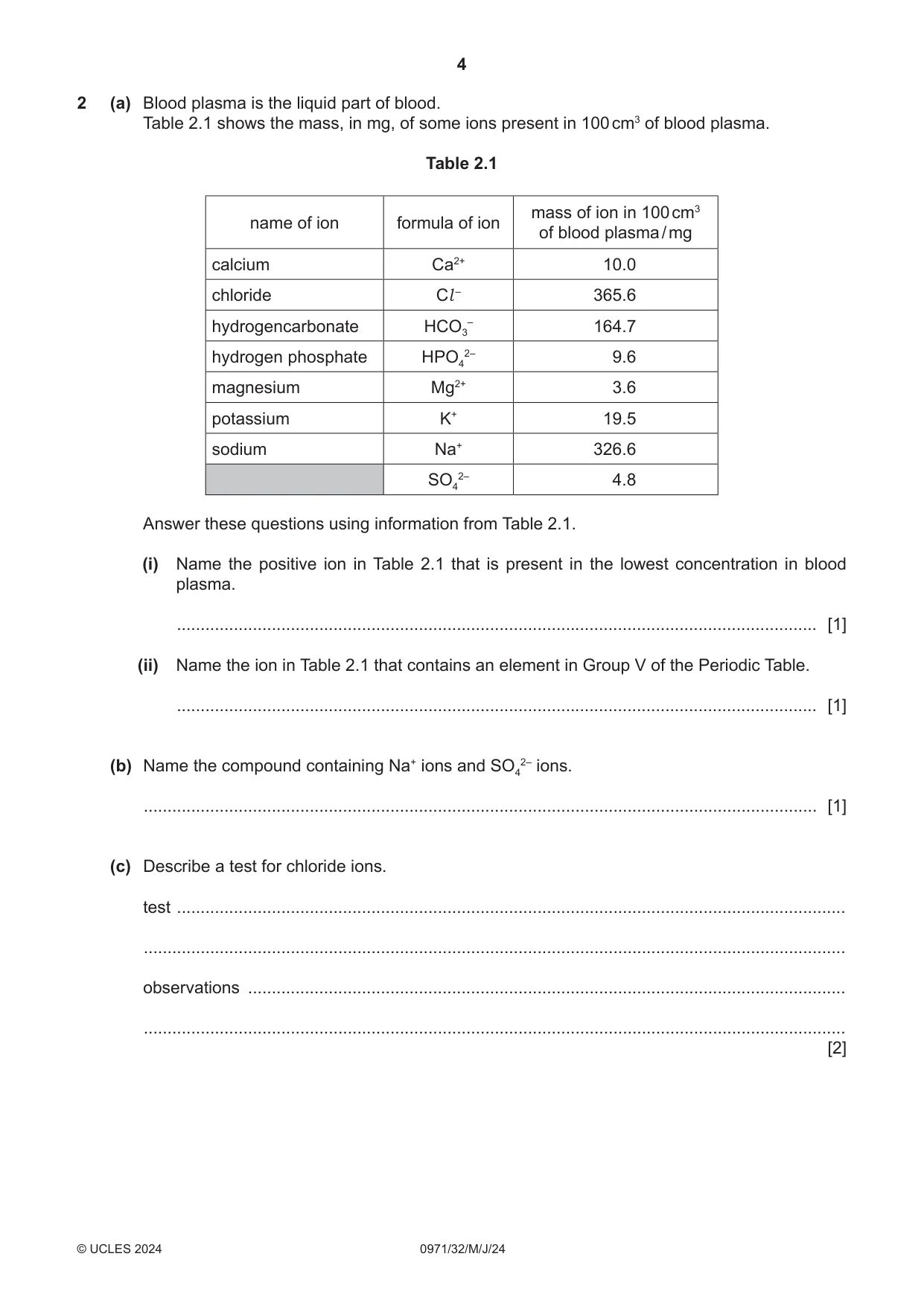
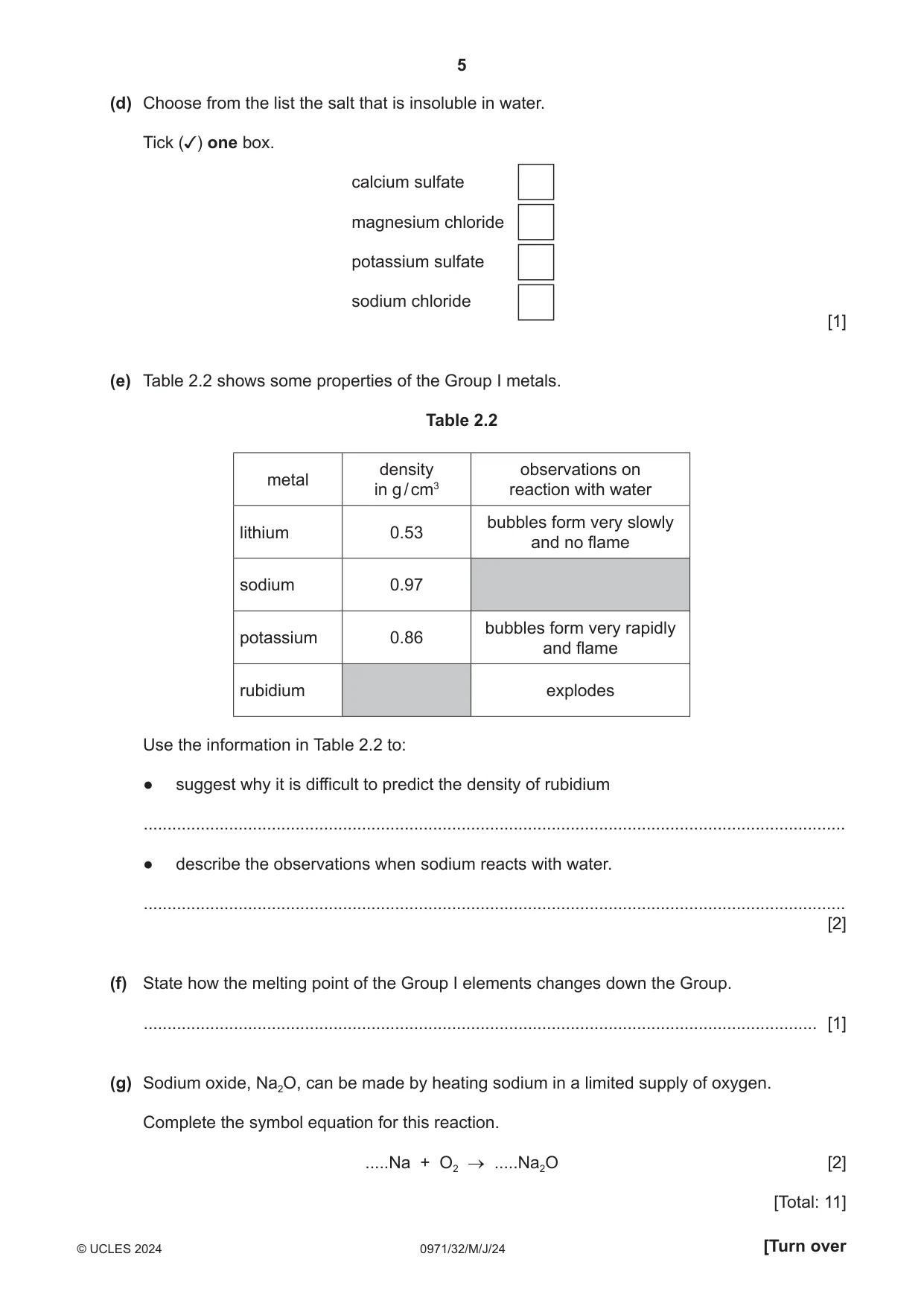
2 (a) Blood plasma is the liquid part of blood. Table 2.1 shows the mass, in mg, of some ions present in 100 cm3 of blood plasma. Table 2.1 mass of ion in 100 cm3 name of ion formula of ion of blood plasma / mg calcium Ca2+ 10.0 chloride Cl – 365.6 hydrogencarbonate HCO3– 164.7 hydrogen phosphate HPO42– 9.6 magnesium Mg2+ 3.6 potassium K+ 19.5 sodium Na+ 326.6 SO42– 4.8 Answer these questions using information from Table 2.1. (i) Name the positive ion in Table 2.1 that is present in the lowest concentration in blood plasma. ....................................................................................................................................... [1] (ii) Name the ion in Table 2.1 that contains an element in Group V of the Periodic Table. ....................................................................................................................................... [1] (b) Name the compound containing Na+ ions and SO42– ions. .............................................................................................................................................. [1] (c) Describe a test for chloride ions. test ............................................................................................................................................. .................................................................................................................................................... observations ............................................................................................................................... .................................................................................................................................................... [2] (d) Choose from the list the salt that is insoluble in water. Tick (✓) one box. calcium sulfate magnesium chloride potassium sulfate sodium chloride [1] (e) Table 2.2 shows some properties of the Group I metals. Table 2.2 density observations on metal in g / cm3 reaction with water bubbles form very slowly lithium 0.53 and no flame sodium 0.97 bubbles form very rapidly potassium 0.86 and flame rubidium explodes Use the information in Table 2.2 to: ● suggest why it is difficult to predict the density of rubidium .................................................................................................................................................... ● describe the observations when sodium reacts with water. .................................................................................................................................................... [2] (f) State how the melting point of the Group I elements changes down the Group. .............................................................................................................................................. [1] (g) Sodium oxide, Na2O, can be made by heating sodium in a limited supply of oxygen. Complete the symbol equation for this reaction. .....Na + O2 → .....Na2O [2] [Total: 11]
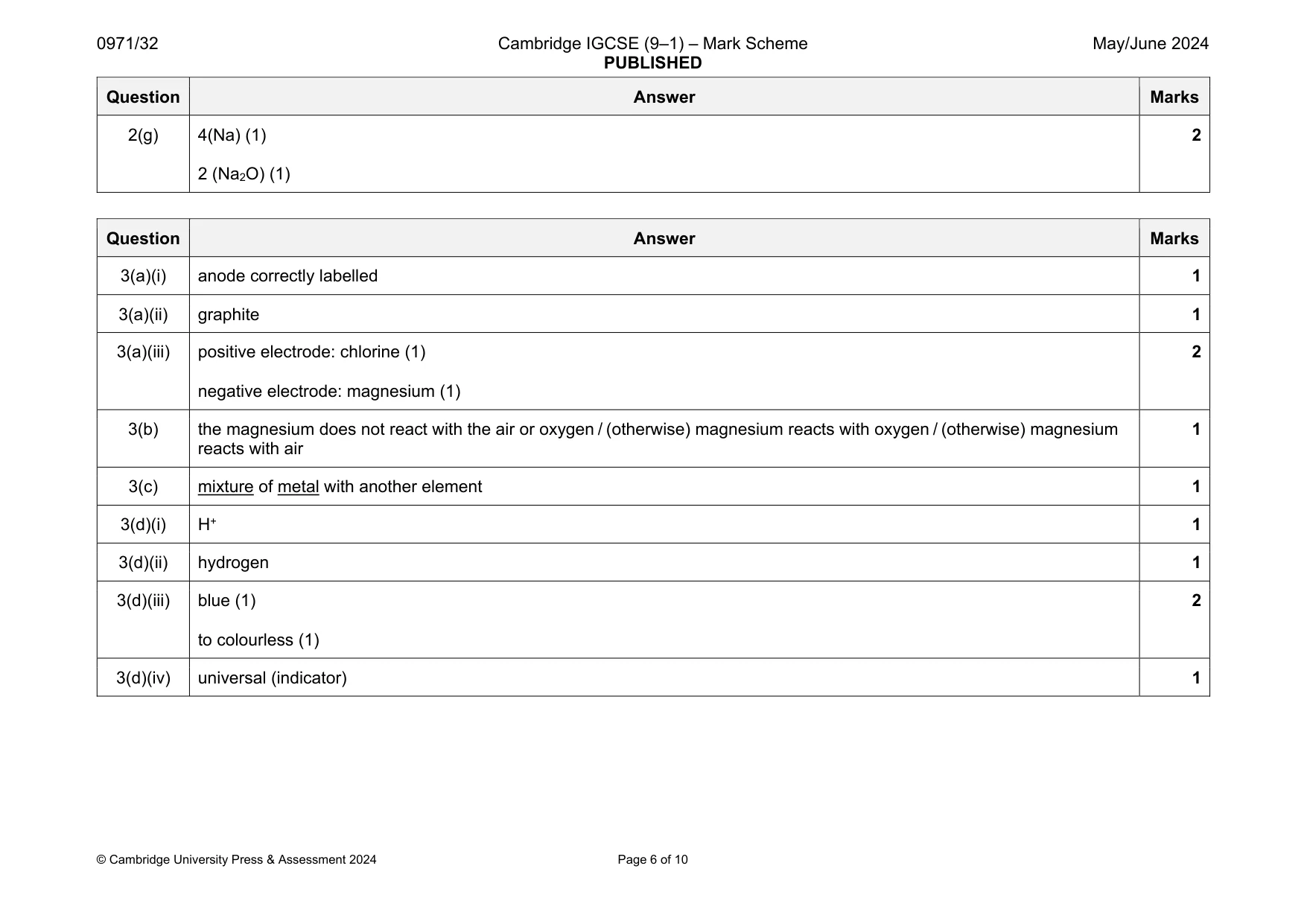
Mark scheme: 2(a)(i) magnesium 1 2(a)(ii) hydrogen phosphate 1 2(b) sodium sulfate 1 2(c) (add acidified) silver nitrate (1) white precipitate (1) 2 2(d) 1st box down ticked (calcium sulfate) 1 2(e) no trend (in the density) / the figures go up and down (1) bubbles form slowly / bubbles form more rapidly (than for lithium) (1) 2 2(f) decreases 1 Question Answer Marks 2(g) 4(Na) (1) 2 (Na2O) (1) 2
Q3 · The apparatus used to electrolyse molten magnesium chloride
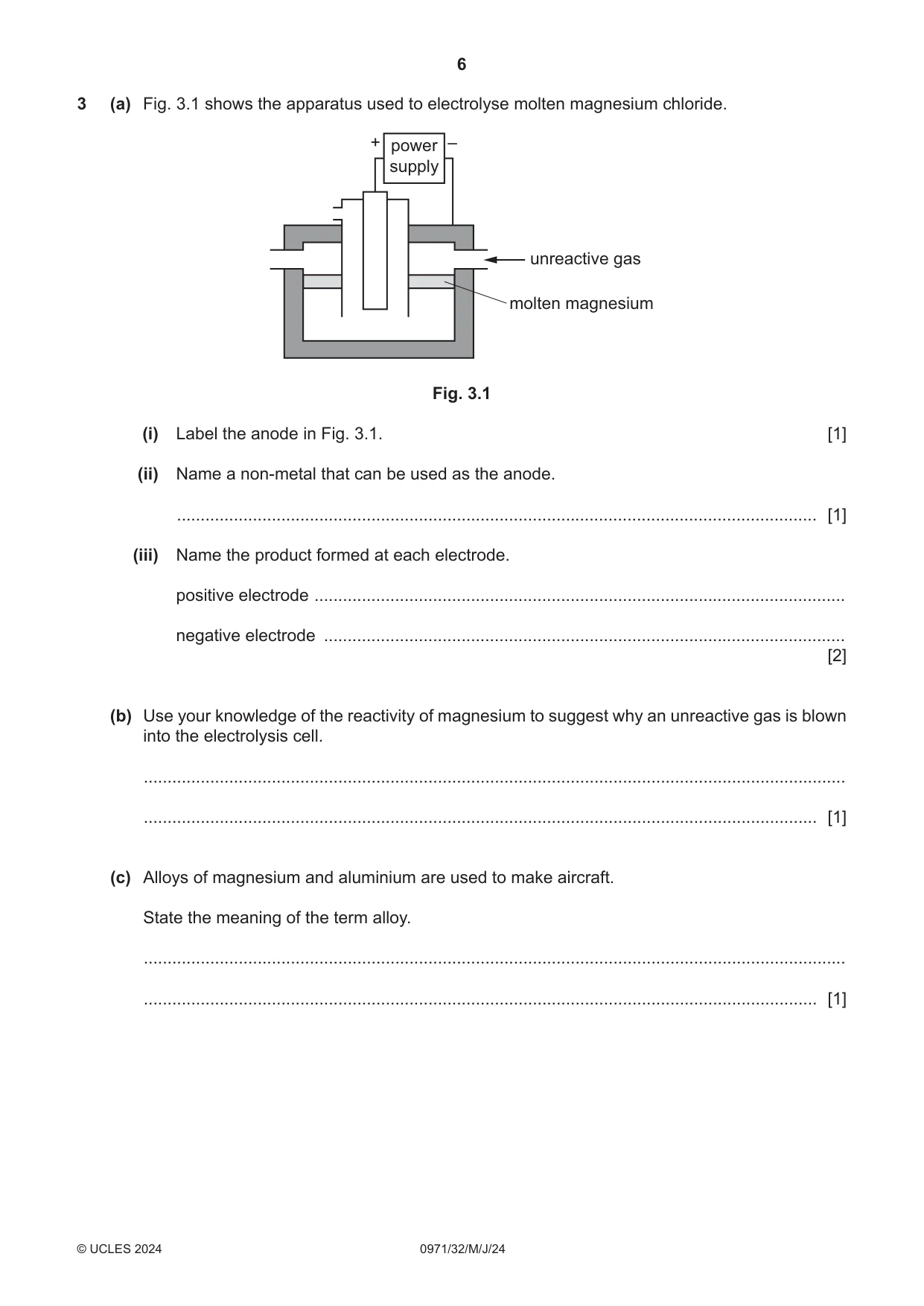
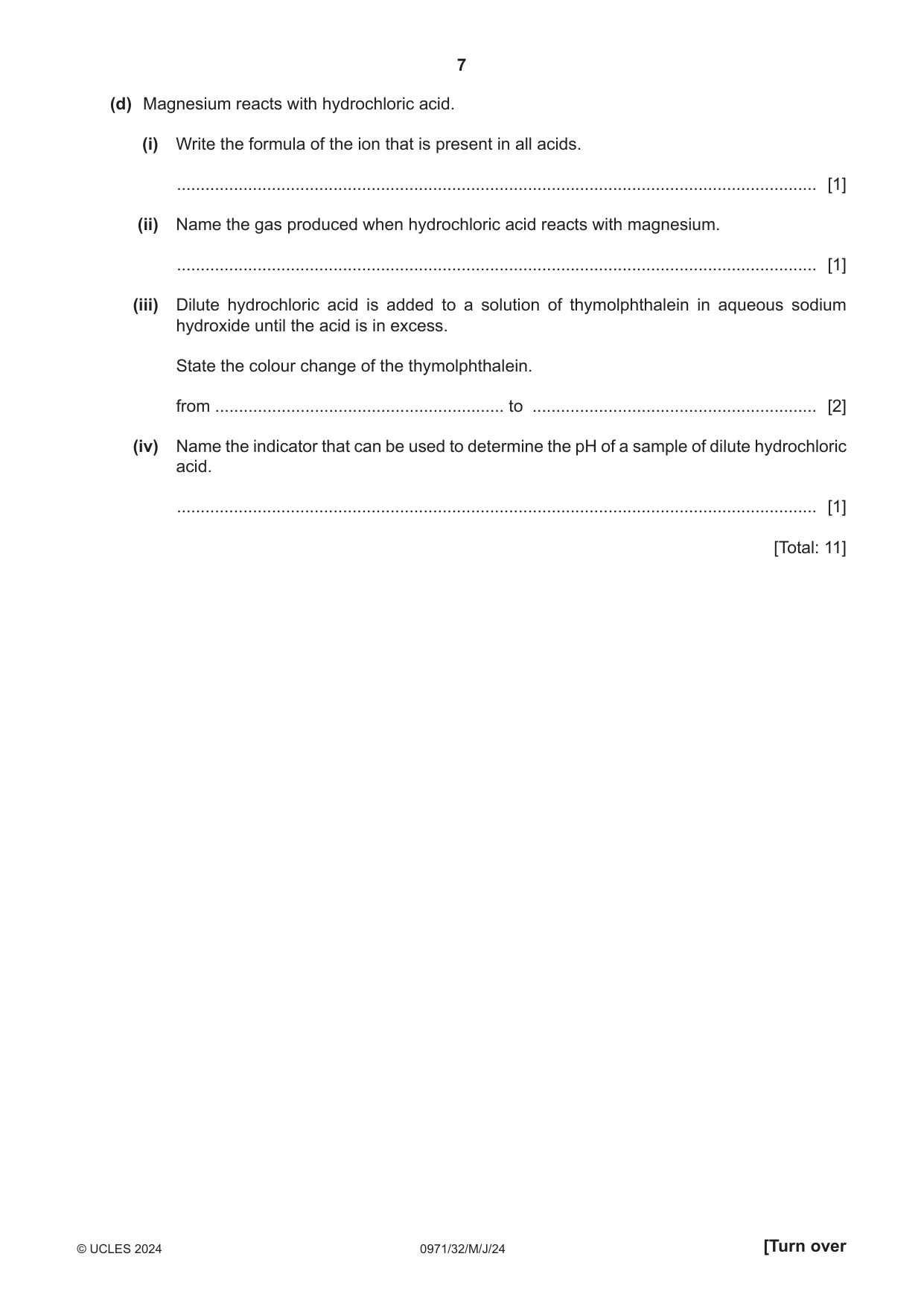
3 (a) Fig. 3.1 shows the apparatus used to electrolyse molten magnesium chloride. + power – supply unreactive gas molten magnesium Fig. 3.1 (i) Label the anode in Fig. 3.1. [1] (ii) Name a non-metal that can be used as the anode. ....................................................................................................................................... [1] (iii) Name the product formed at each electrode. positive electrode ................................................................................................................ negative electrode ............................................................................................................... [2] (b) Use your knowledge of the reactivity of magnesium to suggest why an unreactive gas is blown into the electrolysis cell. .................................................................................................................................................... .............................................................................................................................................. [1] (c) Alloys of magnesium and aluminium are used to make aircraft. State the meaning of the term alloy. .................................................................................................................................................... .............................................................................................................................................. [1] (d) Magnesium reacts with hydrochloric acid. (i) Write the formula of the ion that is present in all acids. ....................................................................................................................................... [1] (ii) Name the gas produced when hydrochloric acid reacts with magnesium. ....................................................................................................................................... [1] (iii) Dilute hydrochloric acid is added to a solution of thymolphthalein in aqueous sodium hydroxide until the acid is in excess. State the colour change of the thymolphthalein. from ............................................................. to ������������������������������������������������������������ [2] (iv) Name the indicator that can be used to determine the pH of a sample of dilute hydrochloric acid. ....................................................................................................................................... [1] [Total: 11]
Mark scheme: 3(a)(i) anode correctly labelled 1 3(a)(ii) graphite 1 3(a)(iii) positive electrode: chlorine (1) negative electrode: magnesium (1) 2 3(b) the magnesium does not react with the air or oxygen / (otherwise) magnesium reacts with oxygen / (otherwise) magnesium reacts with air 1 3(c) mixture of metal with another element 1 3(d)(i) H+ 1 3(d)(ii) hydrogen 1 3(d)(iii) blue (1) to colourless (1) 2 3(d)(iv) universal (indicator) 1
Q4 · Some plants produce ethene gas
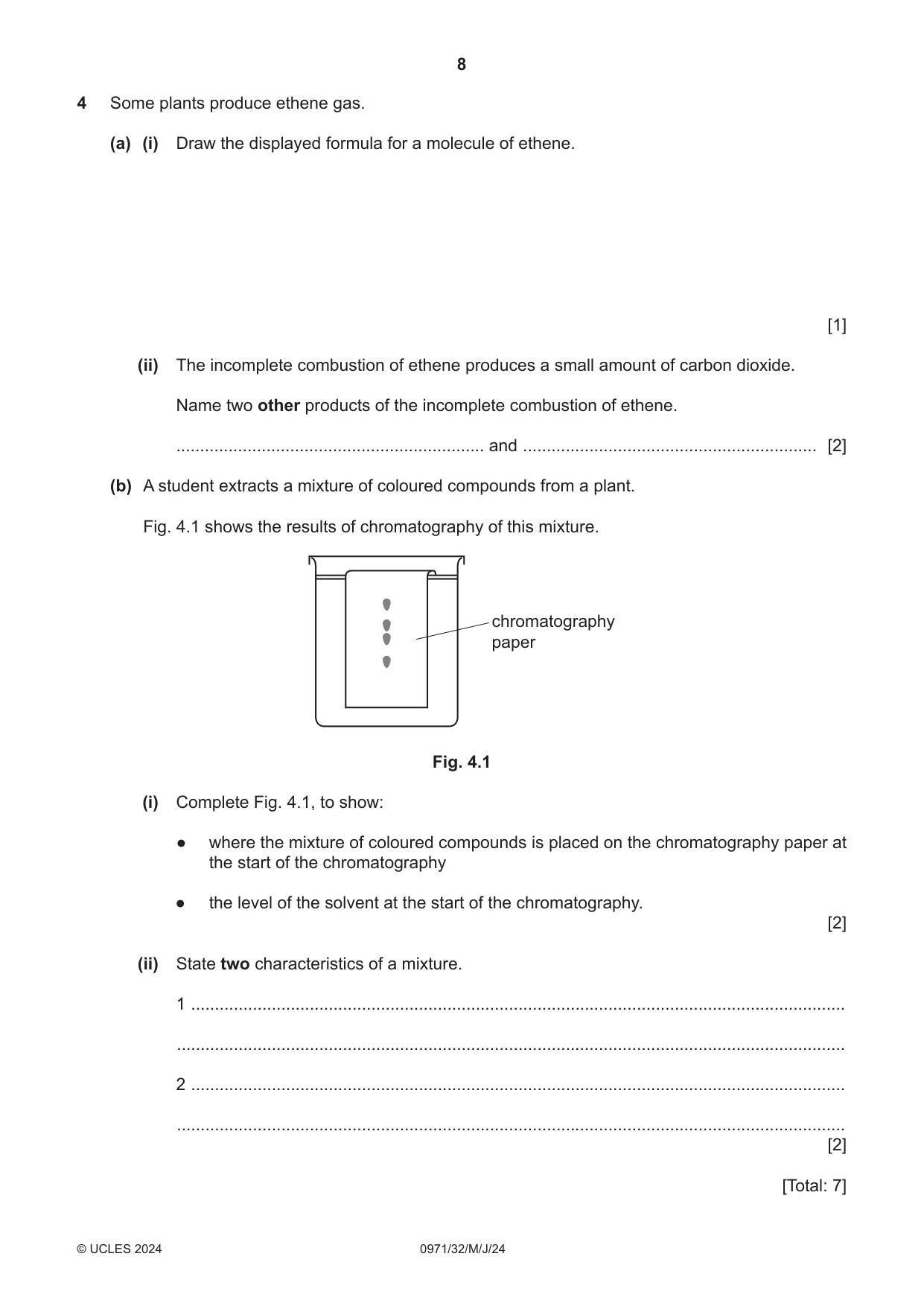
4 Some plants produce ethene gas. (a) (i) Draw the displayed formula for a molecule of ethene. [1] (ii) The incomplete combustion of ethene produces a small amount of carbon dioxide. Name two other products of the incomplete combustion of ethene. ................................................................. and �������������������������������������������������������������� [2] (b) A student extracts a mixture of coloured compounds from a plant. Fig. 4.1 shows the results of chromatography of this mixture. chromatography paper Fig. 4.1 (i) Complete Fig. 4.1, to show: ● where the mixture of coloured compounds is placed on the chromatography paper at the start of the chromatography ● the level of the solvent at the start of the chromatography. [2] (ii) State two characteristics of a mixture. 1 .......................................................................................................................................... ............................................................................................................................................. 2 .......................................................................................................................................... ............................................................................................................................................. [2] [Total: 7]
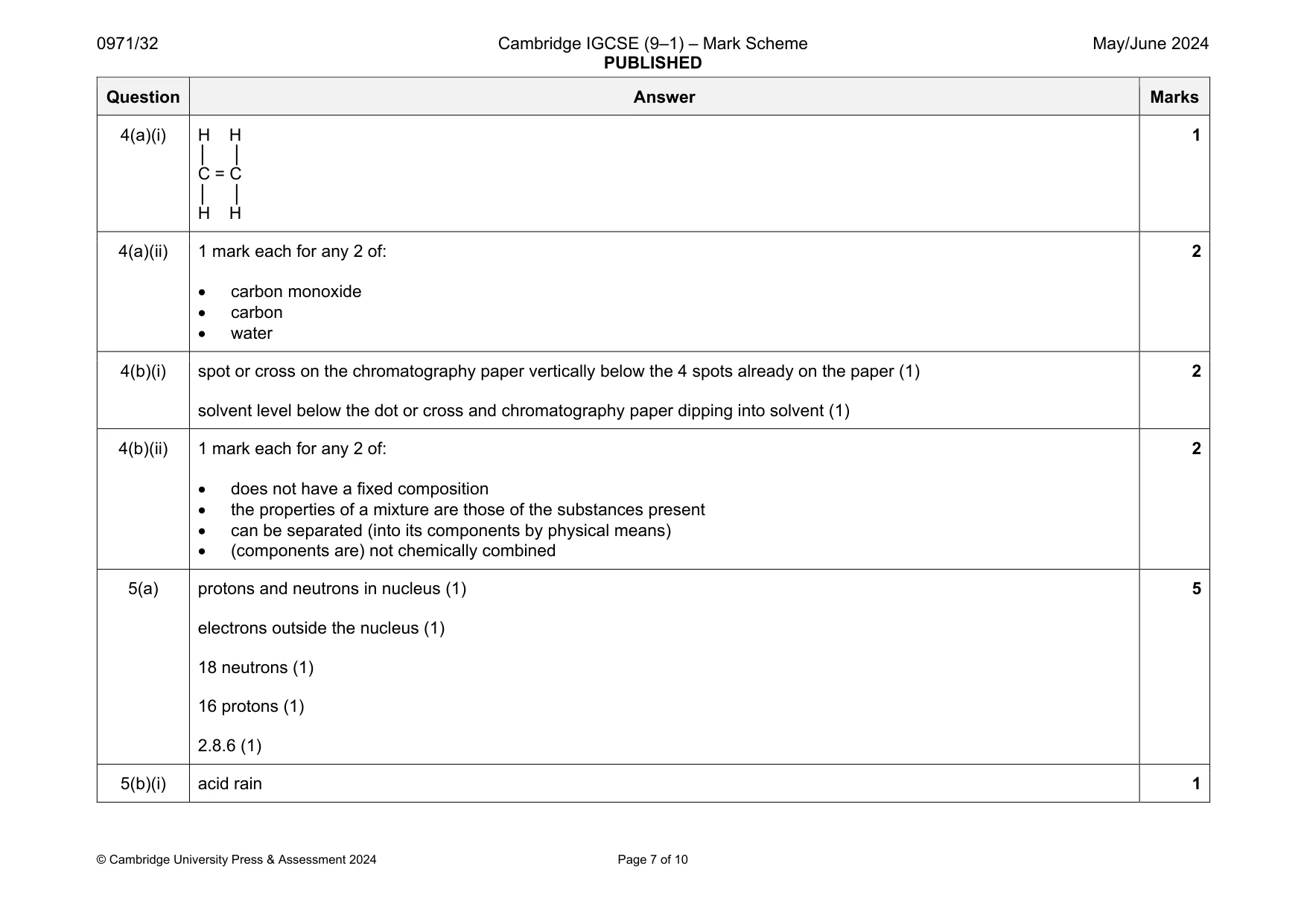
Mark scheme: 4(a)(i) H H │ │ C = C │ │ H H 1 4(a)(ii) 1 mark each for any 2 of: carbon monoxide carbon water 2 4(b)(i) spot or cross on the chromatography paper vertically below the 4 spots already on the paper (1) solvent level below the dot or cross and chromatography paper dipping into solvent (1) 2 4(b)(ii) 1 mark each for any 2 of: does not have a fixed composition the properties of a mixture are those of the substances present can be separated (into its components by physical means) (components are) not chemically combined 2 5
Q5 · An atom of sulfur is represented by the symbol shown
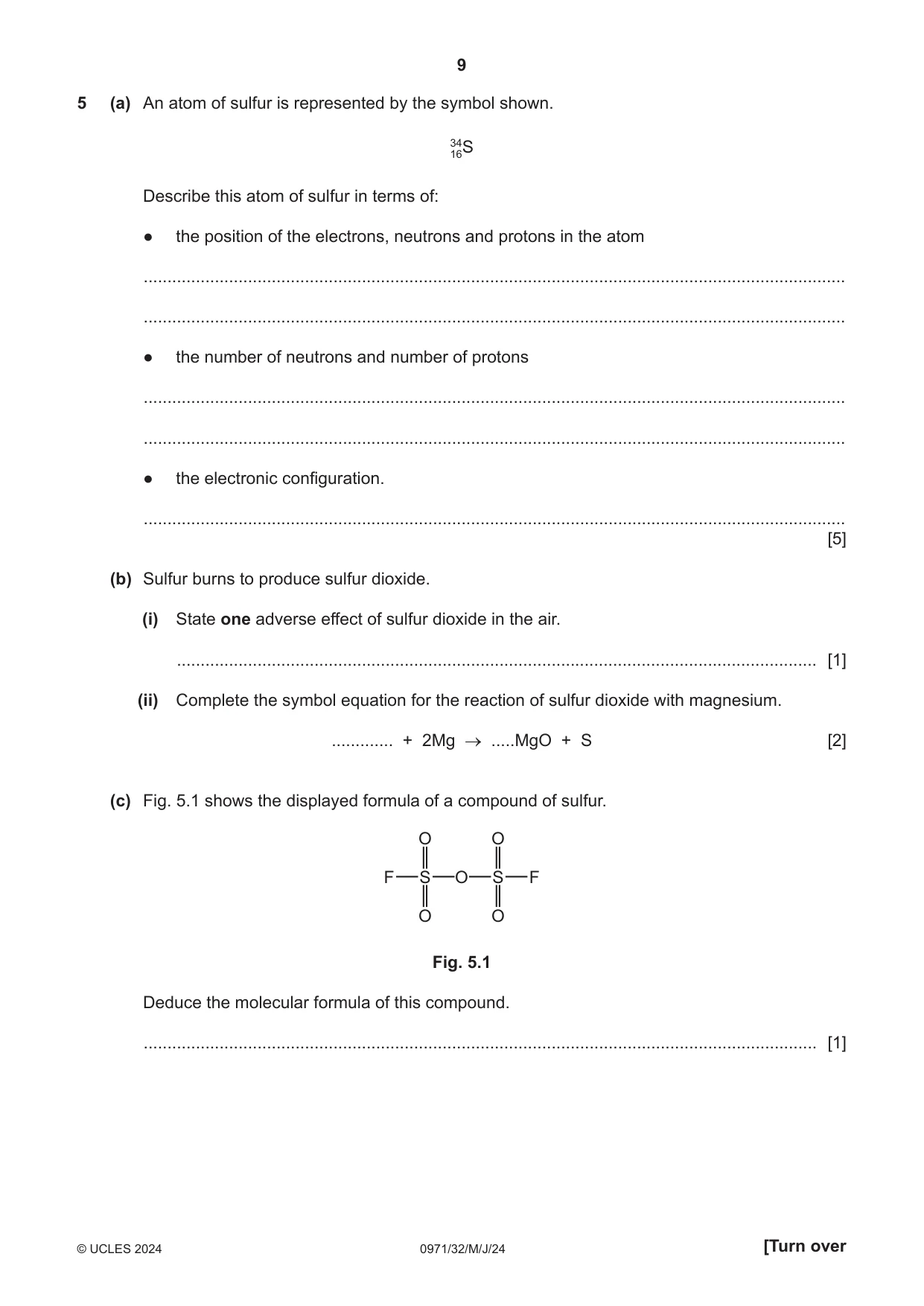
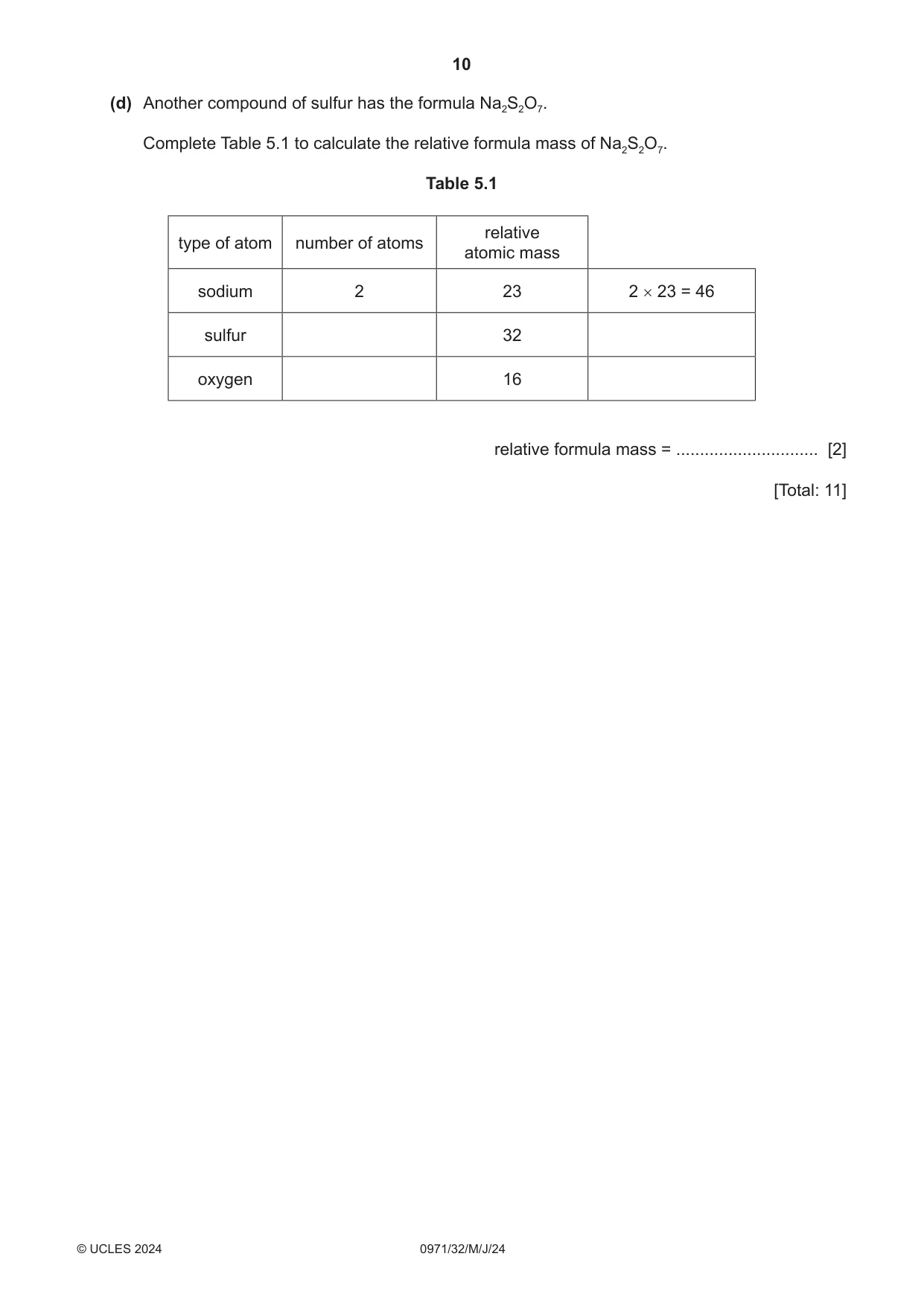
5 (a) An atom of sulfur is represented by the symbol shown. 1634S Describe this atom of sulfur in terms of: ● the position of the electrons, neutrons and protons in the atom .................................................................................................................................................... .................................................................................................................................................... ● the number of neutrons and number of protons .................................................................................................................................................... .................................................................................................................................................... ● the electronic configuration. .................................................................................................................................................... [5] (b) Sulfur burns to produce sulfur dioxide. (i) State one adverse effect of sulfur dioxide in the air. ....................................................................................................................................... [1] (ii) Complete the symbol equation for the reaction of sulfur dioxide with magnesium. ............. + 2Mg → .....MgO + S [2] (c) Fig. 5.1 shows the displayed formula of a compound of sulfur. O O F S O S F O O Fig. 5.1 Deduce the molecular formula of this compound. .............................................................................................................................................. [1] (d) Another compound of sulfur has the formula Na2S2O7. Complete Table 5.1 to calculate the relative formula mass of Na2S2O7. Table 5.1 relative type of atom number of atoms atomic mass sodium 2 23 2 × 23 = 46 sulfur 32 oxygen 16 relative formula mass = .............................. [2] [Total: 11]
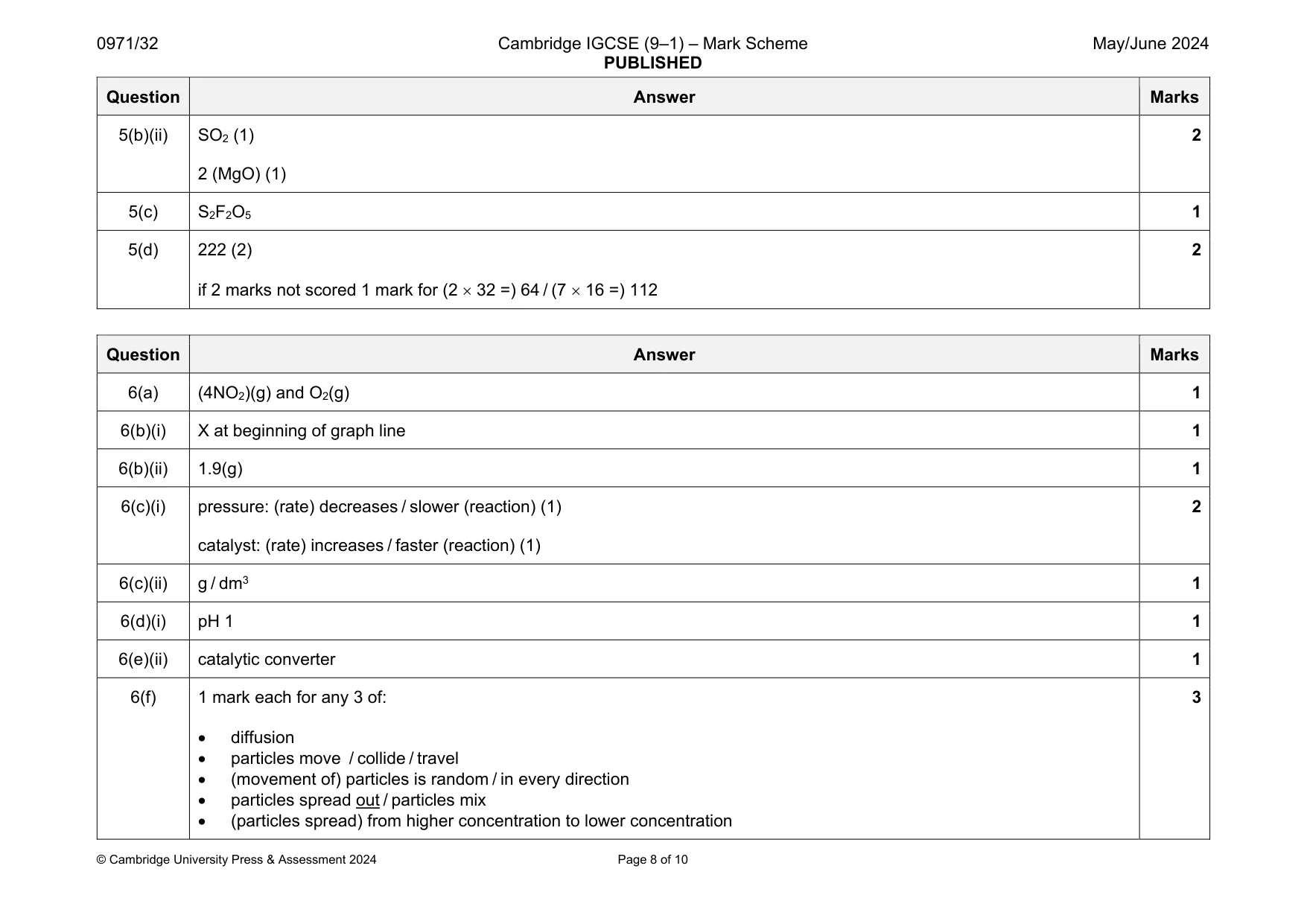
Mark scheme: 5(a) protons and neutrons in nucleus (1) electrons outside the nucleus (1) 18 neutrons (1) 16 protons (1) 2.8.6 (1) 5(b)(i) acid rain 1 Question Answer Marks 5(b)(ii) SO2 (1) 2 (MgO) (1) 2 5(c) S2F2O5 1 5(d) 222 (2) if 2 marks not scored 1 mark for (2 32 =) 64 / (7 16 =) 112 2
Q6 · Solid nitrogen pentoxide, N2O5, decomposes to produce nitrogen dioxide gas and oxygen gas
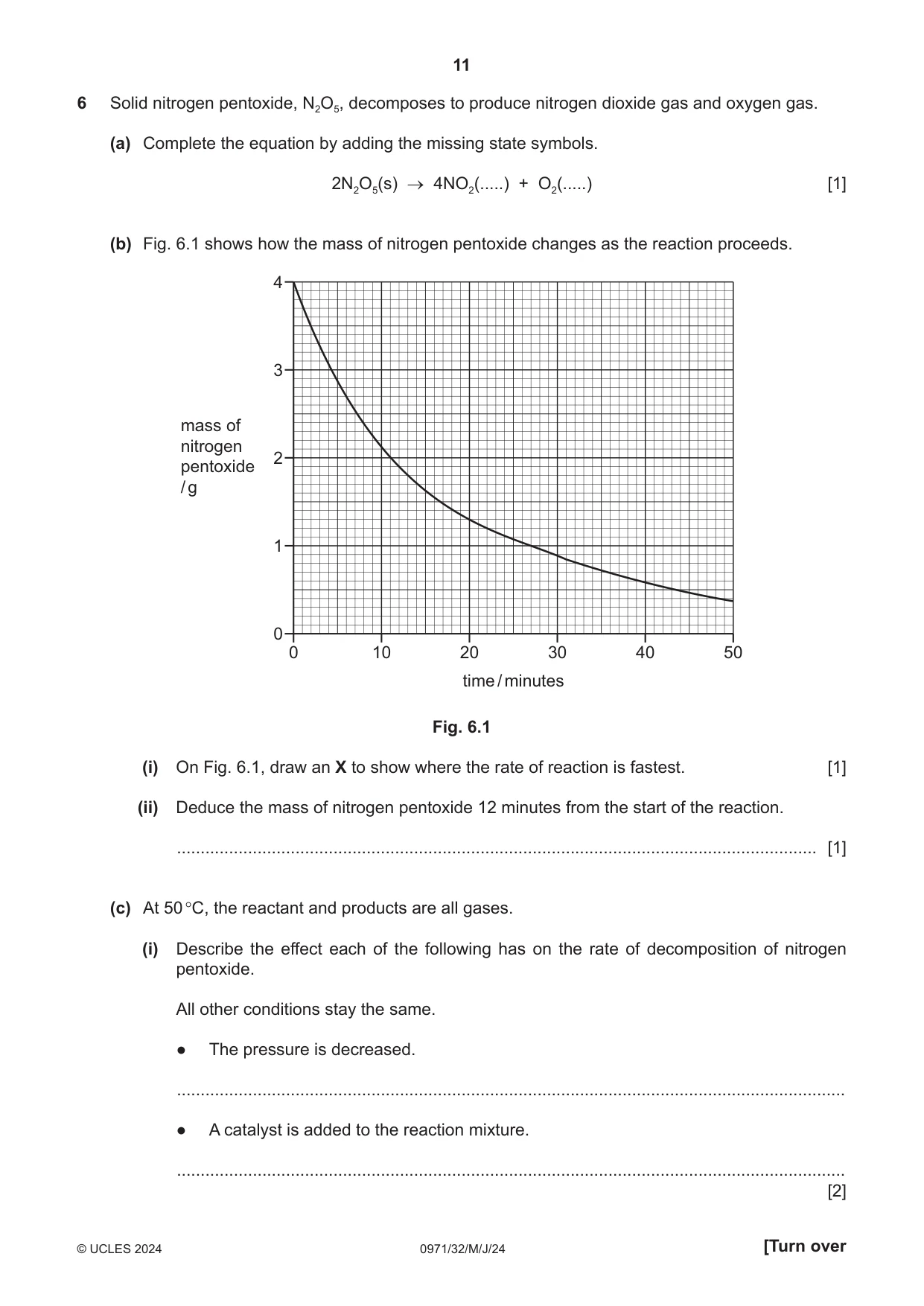
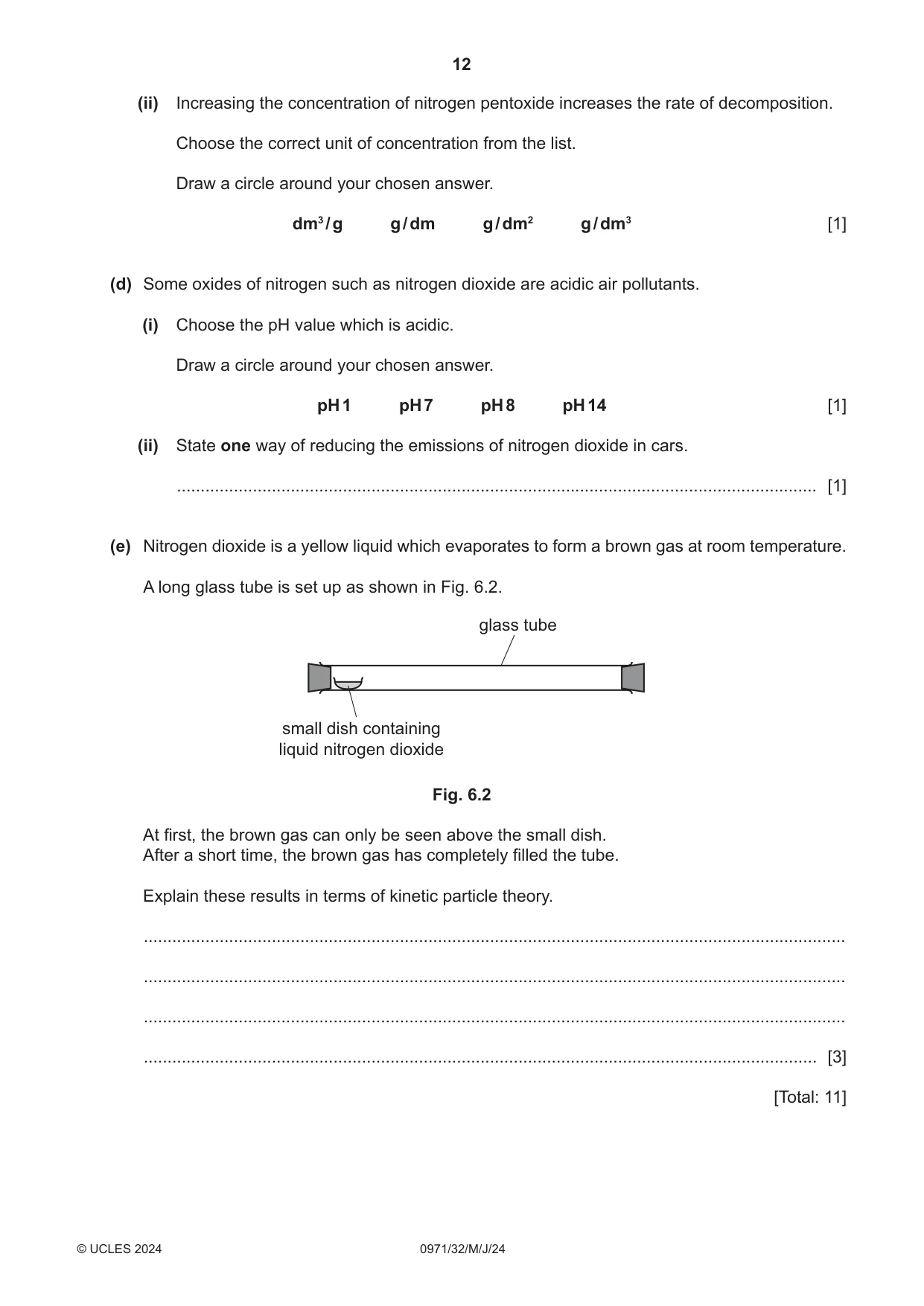
6 Solid nitrogen pentoxide, N2O5, decomposes to produce nitrogen dioxide gas and oxygen gas. (a) Complete the equation by adding the missing state symbols. 2N2O5(s) → 4NO2(.....) + O2(.....) [1] (b) Fig. 6.1 shows how the mass of nitrogen pentoxide changes as the reaction proceeds. 4 3 mass of nitrogen 2 pentoxide / g 1 0 0 10 20 30 40 50 time / minutes Fig. 6.1 (i) On Fig. 6.1, draw an X to show where the rate of reaction is fastest. [1] (ii) Deduce the mass of nitrogen pentoxide 12 minutes from the start of the reaction. ....................................................................................................................................... [1] (c) At 50 °C, the reactant and products are all gases. (i) Describe the effect each of the following has on the rate of decomposition of nitrogen pentoxide. All other conditions stay the same. ● The pressure is decreased. ............................................................................................................................................. ● A catalyst is added to the reaction mixture. ............................................................................................................................................. [2] (ii) Increasing the concentration of nitrogen pentoxide increases the rate of decomposition. Choose the correct unit of concentration from the list. Draw a circle around your chosen answer. dm3 / g g / dm g / dm2 g / dm3 [1] (d) Some oxides of nitrogen such as nitrogen dioxide are acidic air pollutants. (i) Choose the pH value which is acidic. Draw a circle around your chosen answer. pH 1 pH 7 pH 8 pH 14 [1] (ii) State one way of reducing the emissions of nitrogen dioxide in cars. ....................................................................................................................................... [1] (e) Nitrogen dioxide is a yellow liquid which evaporates to form a brown gas at room temperature. A long glass tube is set up as shown in Fig. 6.2. glass tube small dish containing liquid nitrogen dioxide Fig. 6.2 At first, the brown gas can only be seen above the small dish. After a short time, the brown gas has completely filled the tube. Explain these results in terms of kinetic particle theory. .................................................................................................................................................... .................................................................................................................................................... .................................................................................................................................................... .............................................................................................................................................. [3] [Total: 11]
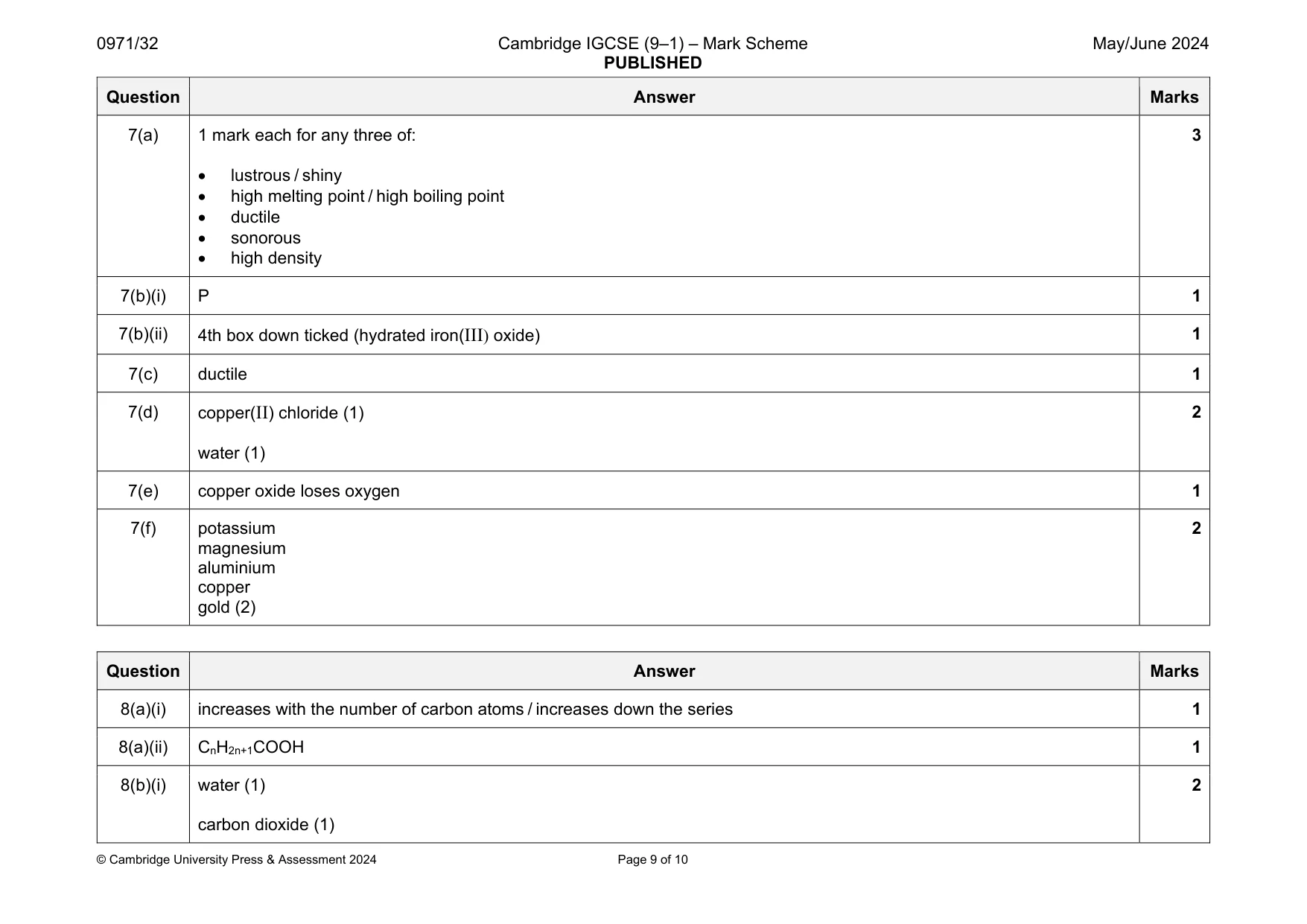
Mark scheme: 6(a) (4NO2)(g) and O2(g) 1 6(b)(i) X at beginning of graph line 1 6(b)(ii) 1.9(g) 1 6(c)(i) pressure: (rate) decreases / slower (reaction) (1) catalyst: (rate) increases / faster (reaction) (1) 2 6(c)(ii) g / dm3 1 6(d)(i) pH 1 1 6(e)(ii) catalytic converter 1 6(f) 1 mark each for any 3 of: diffusion particles move / collide / travel (movement of) particles is random / in every direction particles spread out / particles mix (particles spread) from higher concentration to lower concentration 3
Q7 · Iron and copper are transition elements
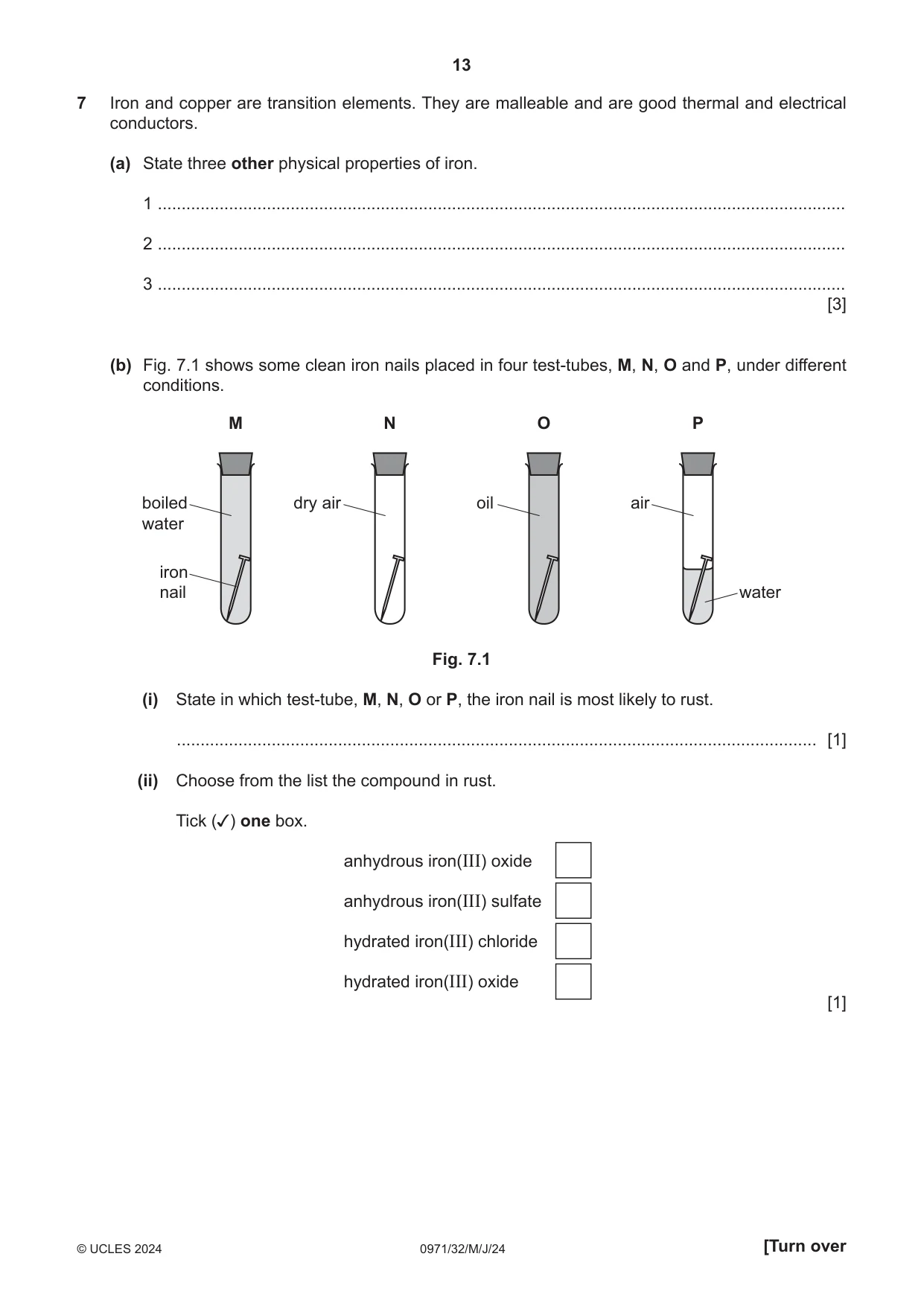
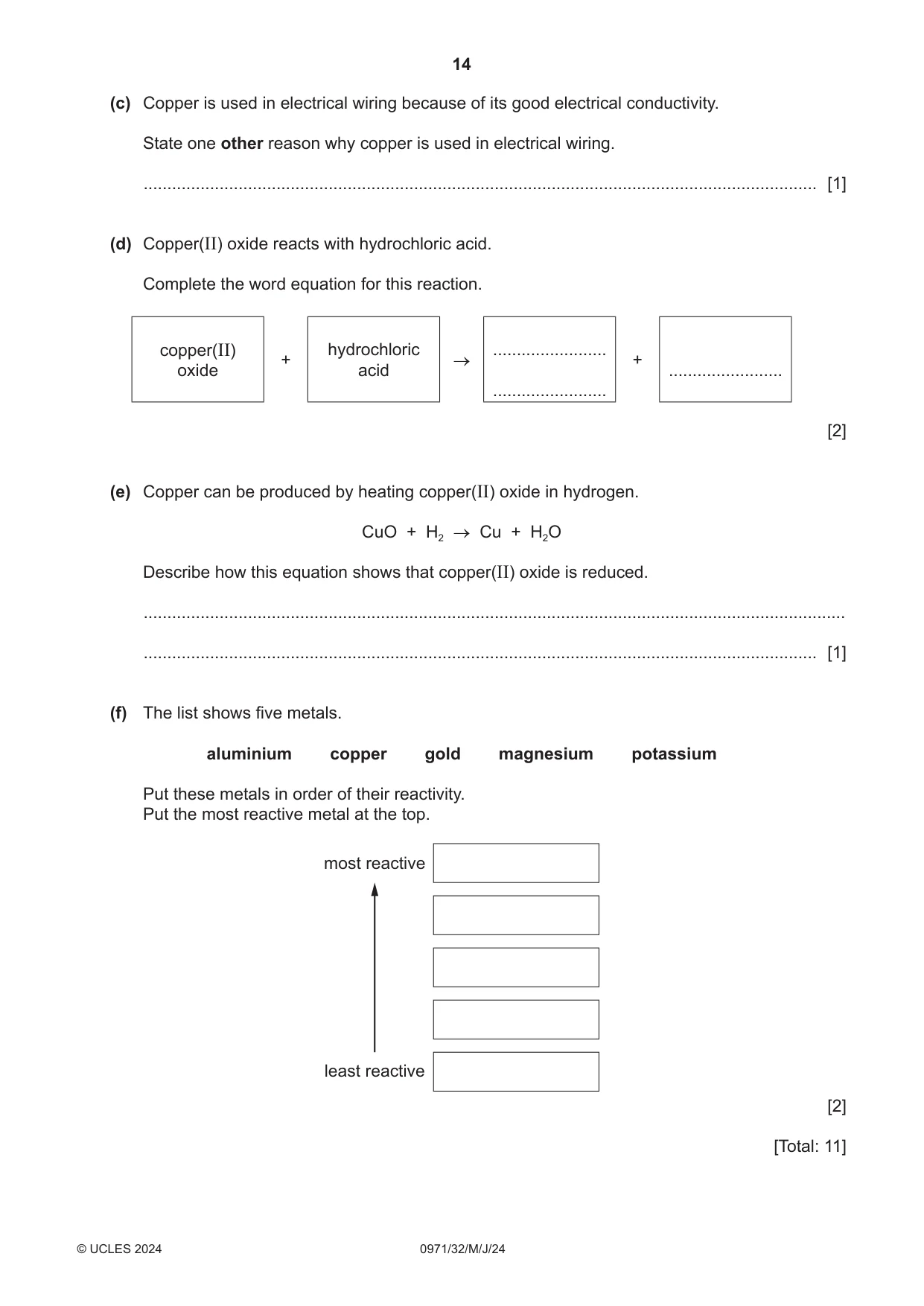
7 Iron and copper are transition elements. They are malleable and are good thermal and electrical conductors. (a) State three other physical properties of iron. 1 ................................................................................................................................................. 2 ................................................................................................................................................. 3 ................................................................................................................................................. [3] (b) Fig. 7.1 shows some clean iron nails placed in four test-tubes, M, N, O and P, under different conditions. M N O P boiled dry air oil air water iron nail water Fig. 7.1 (i) State in which test-tube, M, N, O or P, the iron nail is most likely to rust. ....................................................................................................................................... [1] (ii) Choose from the list the compound in rust. Tick (✓) one box. anhydrous iron(III) oxide anhydrous iron(III) sulfate hydrated iron(III) chloride hydrated iron(III) oxide [1] (c) Copper is used in electrical wiring because of its good electrical conductivity. State one other reason why copper is used in electrical wiring. .............................................................................................................................................. [1] (d) Copper(II) oxide reacts with hydrochloric acid. Complete the word equation for this reaction. copper(II) hydrochloric ........................ + → + oxide acid ........................ ........................ [2] (e) Copper can be produced by heating copper(II) oxide in hydrogen. CuO + H2 → Cu + H2O Describe how this equation shows that copper(II) oxide is reduced. .................................................................................................................................................... .............................................................................................................................................. [1] (f) The list shows five metals. aluminium copper gold magnesium potassium Put these metals in order of their reactivity. Put the most reactive metal at the top. most reactive least reactive [2] [Total: 11]
Mark scheme: 7(a) 1 mark each for any three of: lustrous / shiny high melting point / high boiling point ductile sonorous high density 3 7(b)(i) P 1 7(b)(ii) 4th box down ticked (hydrated iron(III) oxide) 1 7(c) ductile 1 7(d) copper(II) chloride (1) water (1) 2 7(e) copper oxide loses oxygen 1 7(f) potassium magnesium aluminium copper gold (2) 2
Q8 · This question is about carboxylic acids and alkanes
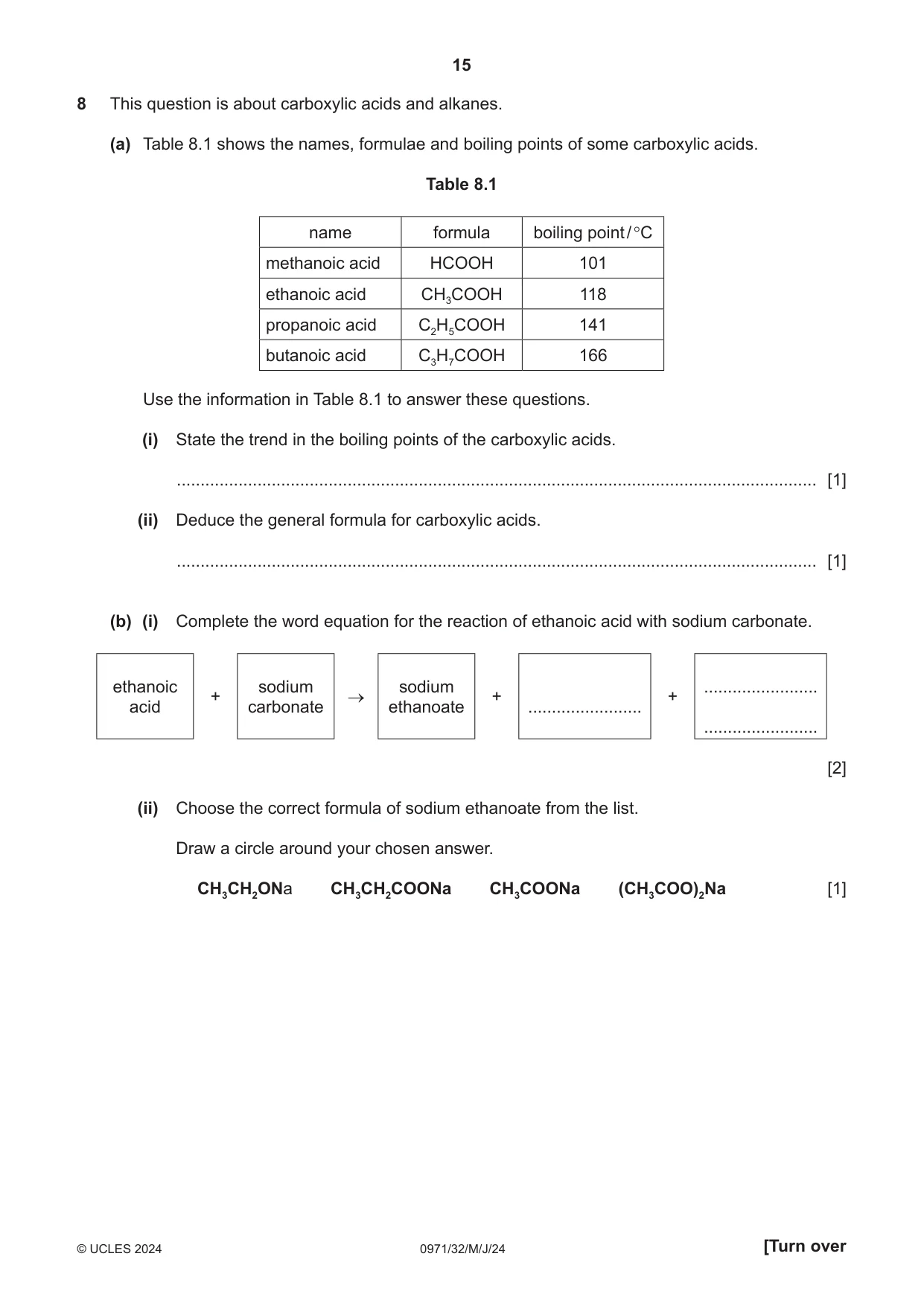
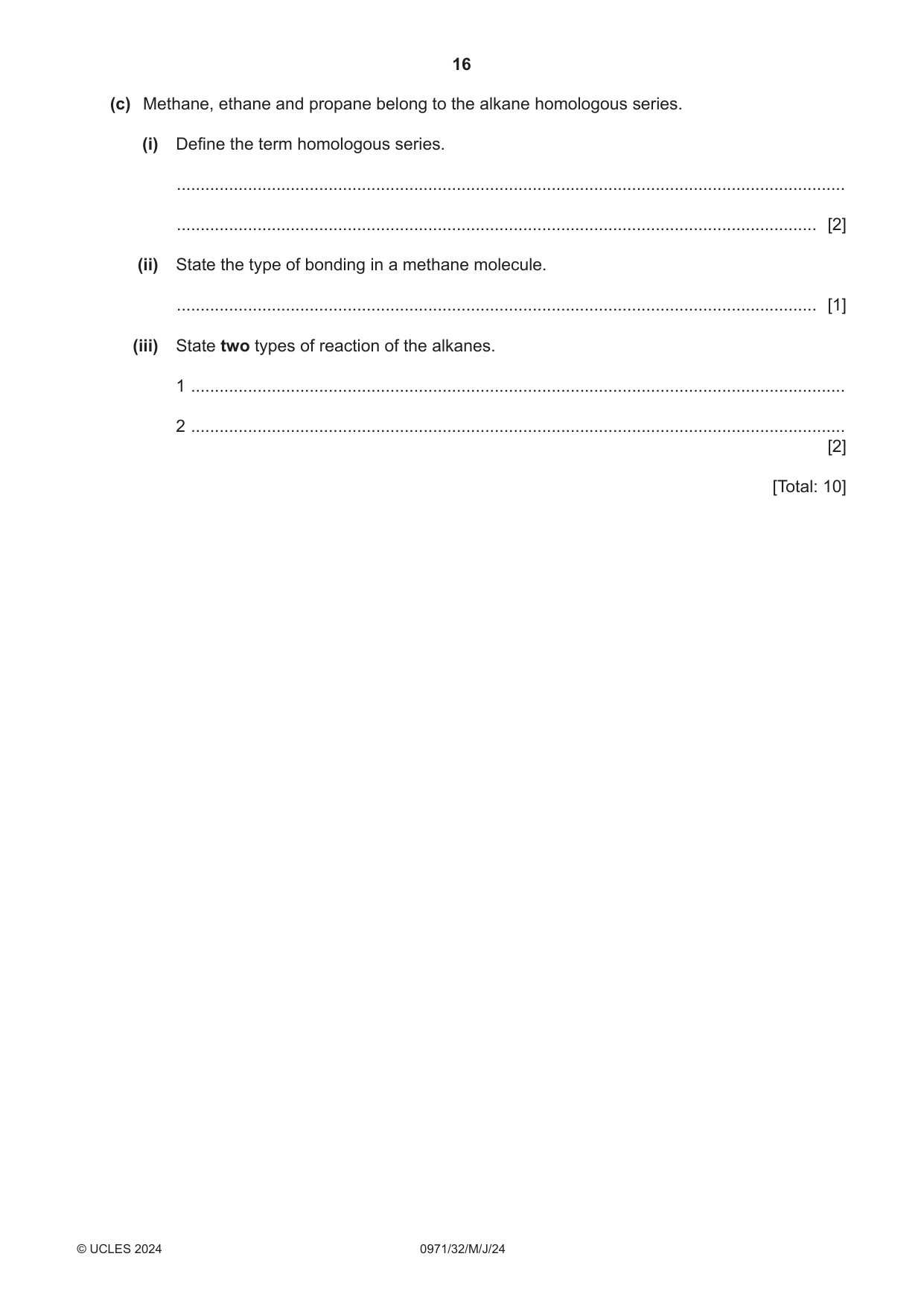
8 This question is about carboxylic acids and alkanes. (a) Table 8.1 shows the names, formulae and boiling points of some carboxylic acids. Table 8.1 name formula boiling point / °C methanoic acid HCOOH 101 ethanoic acid CH3COOH 118 propanoic acid C2H5COOH 141 butanoic acid C3H7COOH 166 Use the information in Table 8.1 to answer these questions. (i) State the trend in the boiling points of the carboxylic acids. ....................................................................................................................................... [1] (ii) Deduce the general formula for carboxylic acids. ....................................................................................................................................... [1] (b) (i) Complete the word equation for the reaction of ethanoic acid with sodium carbonate. ethanoic sodium sodium ........................ + → + + acid carbonate ethanoate ........................ ........................ [2] (ii) Choose the correct formula of sodium ethanoate from the list. Draw a circle around your chosen answer. CH3CH2ONa CH3CH2COONa CH3COONa (CH3COO)2Na [1] (c) Methane, ethane and propane belong to the alkane homologous series. (i) Define the term homologous series. ............................................................................................................................................. ....................................................................................................................................... [2] (ii) State the type of bonding in a methane molecule. ....................................................................................................................................... [1] (iii) State two types of reaction of the alkanes. 1 .......................................................................................................................................... 2 .......................................................................................................................................... [2] [Total: 10]
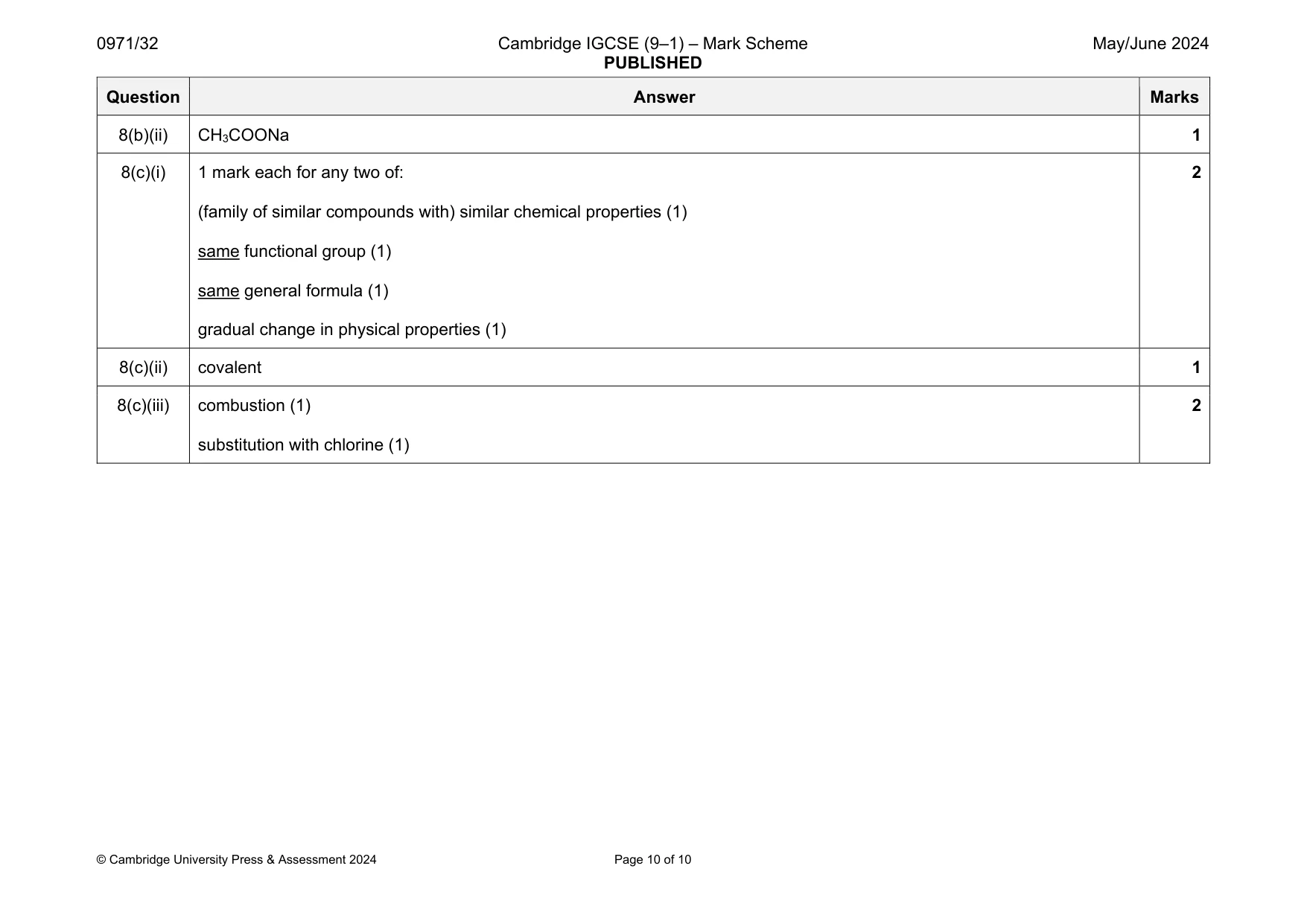
Mark scheme: 8(a)(i) increases with the number of carbon atoms / increases down the series 1 8(a)(ii) CnH2n+1COOH 1 8(b)(i) water (1) carbon dioxide (1) 2 Question Answer Marks 8(b)(ii) CH3COONa 1 8(c)(i) 1 mark each for any two of: (family of similar compounds with) similar chemical properties (1) same functional group (1) same general formula (1) gradual change in physical properties (1) 2 8(c)(ii) covalent 1 8(c)(iii) combustion (1) substitution with chlorine (1) 2
What was in this paper
The subtopics covered by these 8 questions, and how many questions each got. Open one in a new tab to see every Cambridge question on it.
What you needed in this session
Cambridge’s own grade thresholds for 2024 May/June, Paper 3 · Variant 2. A higher threshold means an easier paper — the bar moves with how the cohort did.