Cambridge IGCSE Chemistry (9-1) 0971 — 2022 Oct/Nov Paper 4 · Variant 2
0971/42/O/N/22 · 6 questions · 80 marks · ≈90 min
The question paper and its mark scheme, free to read here and free to download. This is Cambridge’s own paper, exactly as it was sat.
Question paper16 pages

Mark scheme10 pages
Answers below. Sit the paper first if you are practising.
Questions as text
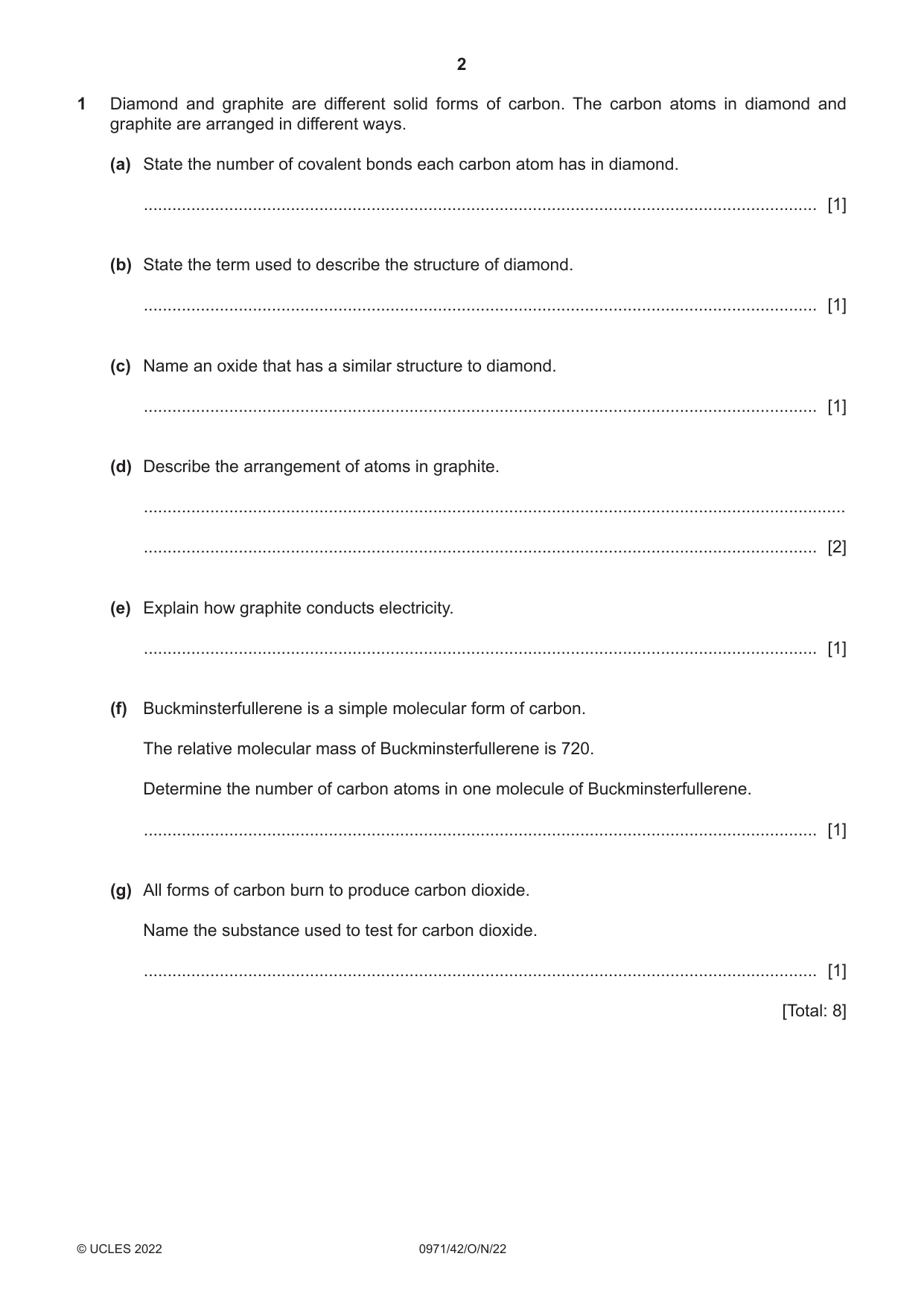
Q1 · Diamond and graphite are different solid forms of carbon
1 Diamond and graphite are different solid forms of carbon. The carbon atoms in diamond and graphite are arranged in different ways. (a) State the number of covalent bonds each carbon atom has in diamond. .............................................................................................................................................. [1] (b) State the term used to describe the structure of diamond. .............................................................................................................................................. [1] (c) Name an oxide that has a similar structure to diamond. .............................................................................................................................................. [1] (d) Describe the arrangement of atoms in graphite. .................................................................................................................................................... .............................................................................................................................................. [2] (e) Explain how graphite conducts electricity. .............................................................................................................................................. [1] (f) Buckminsterfullerene is a simple molecular form of carbon. The relative molecular mass of Buckminsterfullerene is 720. Determine the number of carbon atoms in one molecule of Buckminsterfullerene. .............................................................................................................................................. [1] (g) All forms of carbon burn to produce carbon dioxide. Name the substance used to test for carbon dioxide. .............................................................................................................................................. [1] [Total: 8]
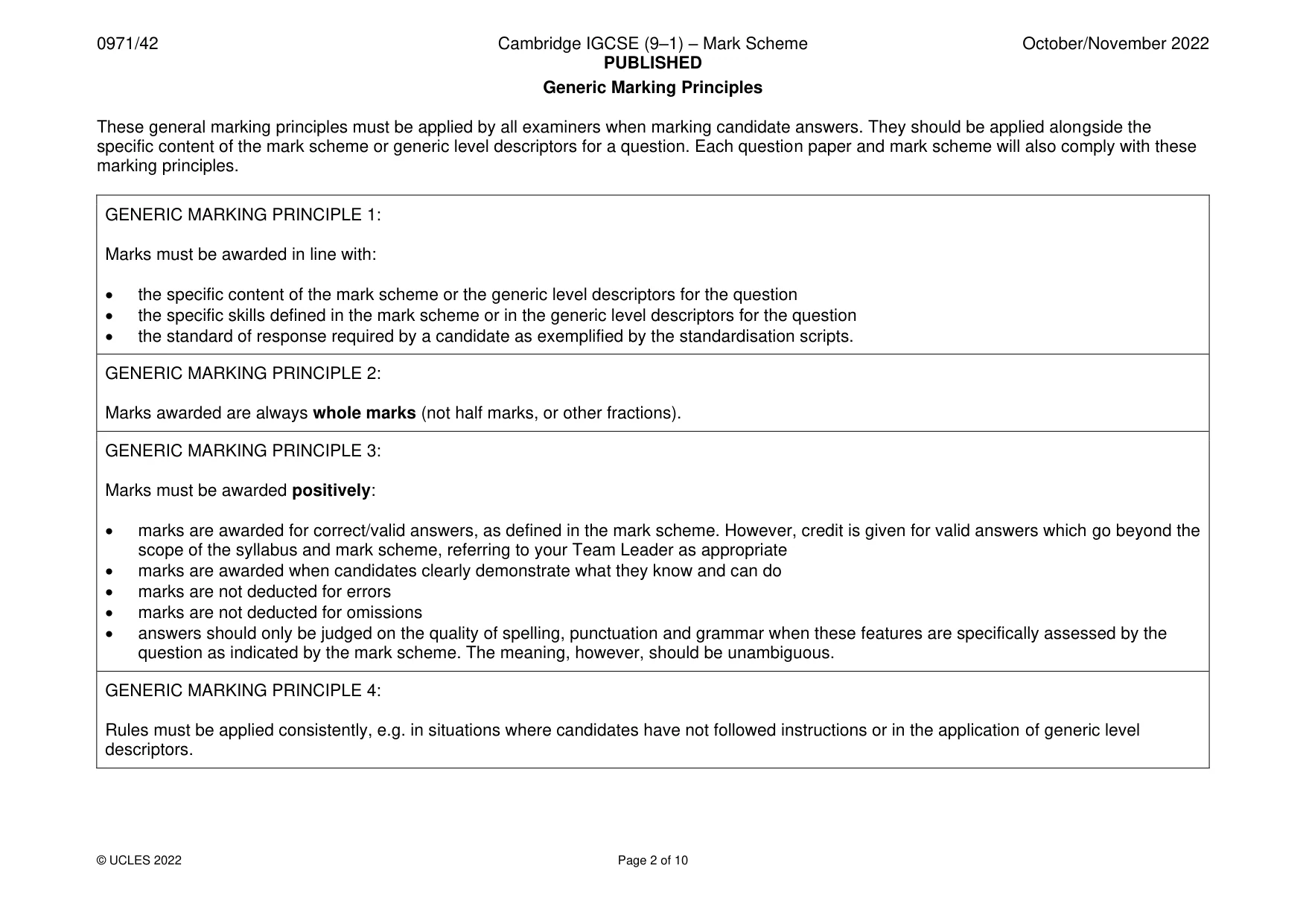
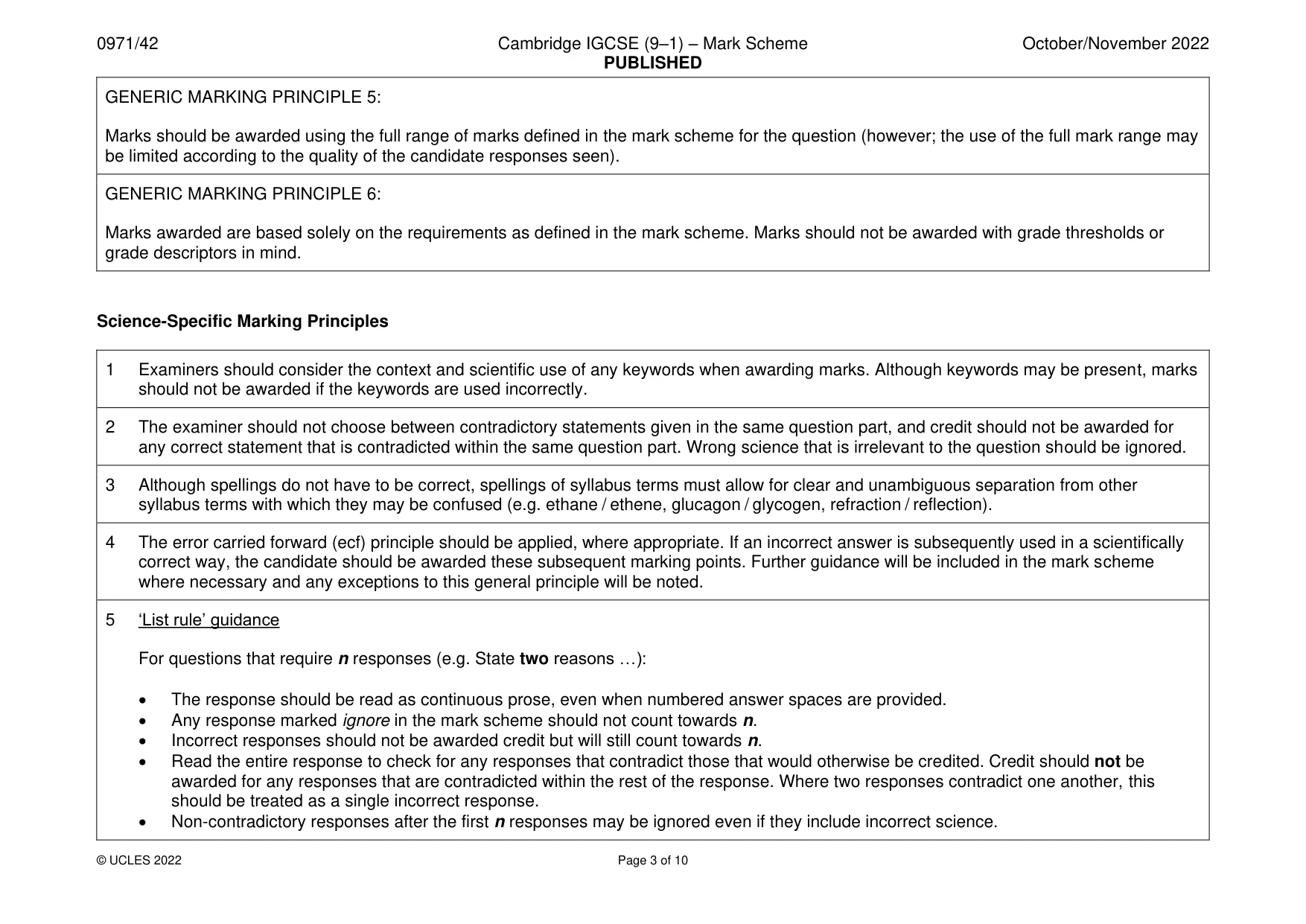
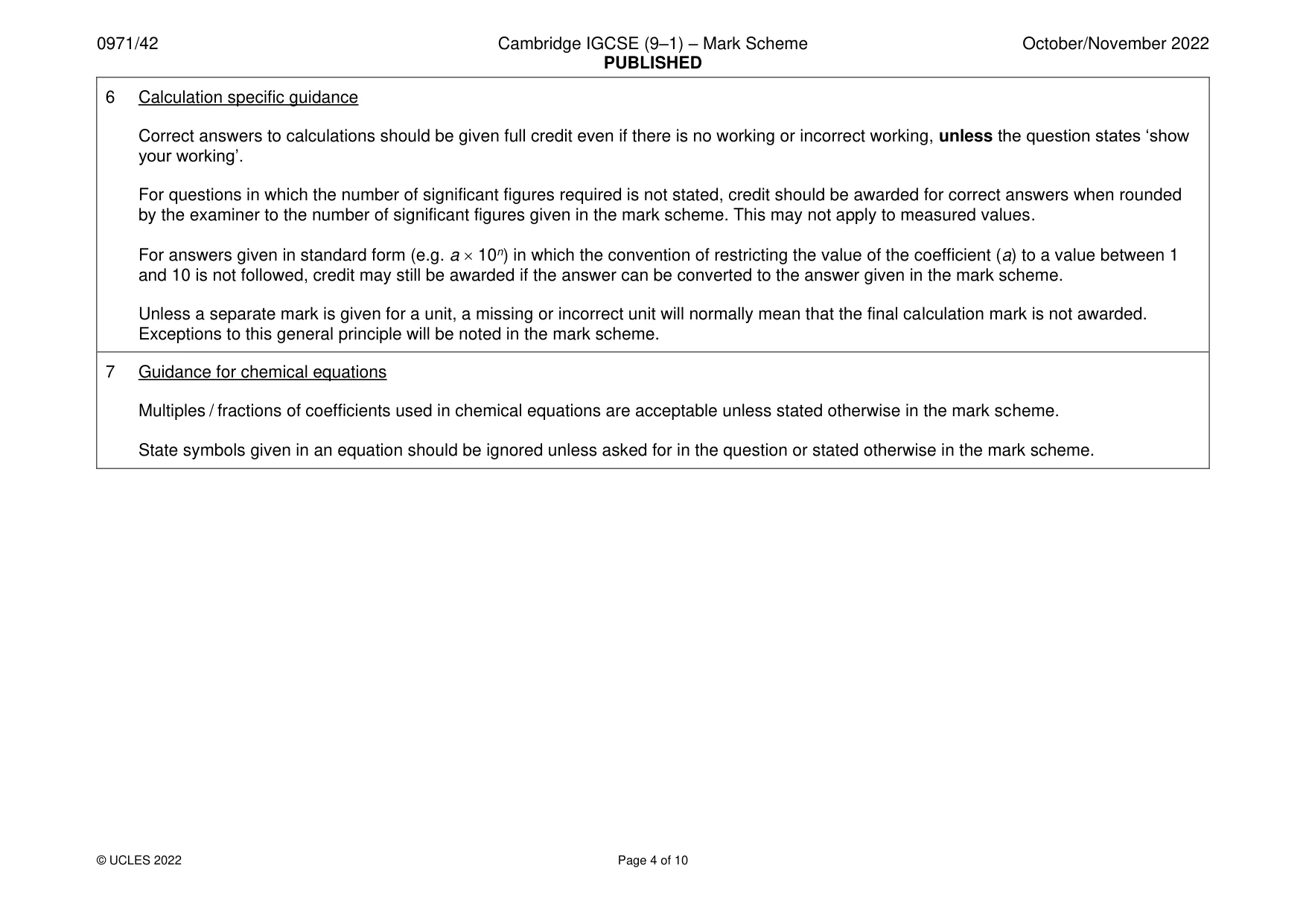
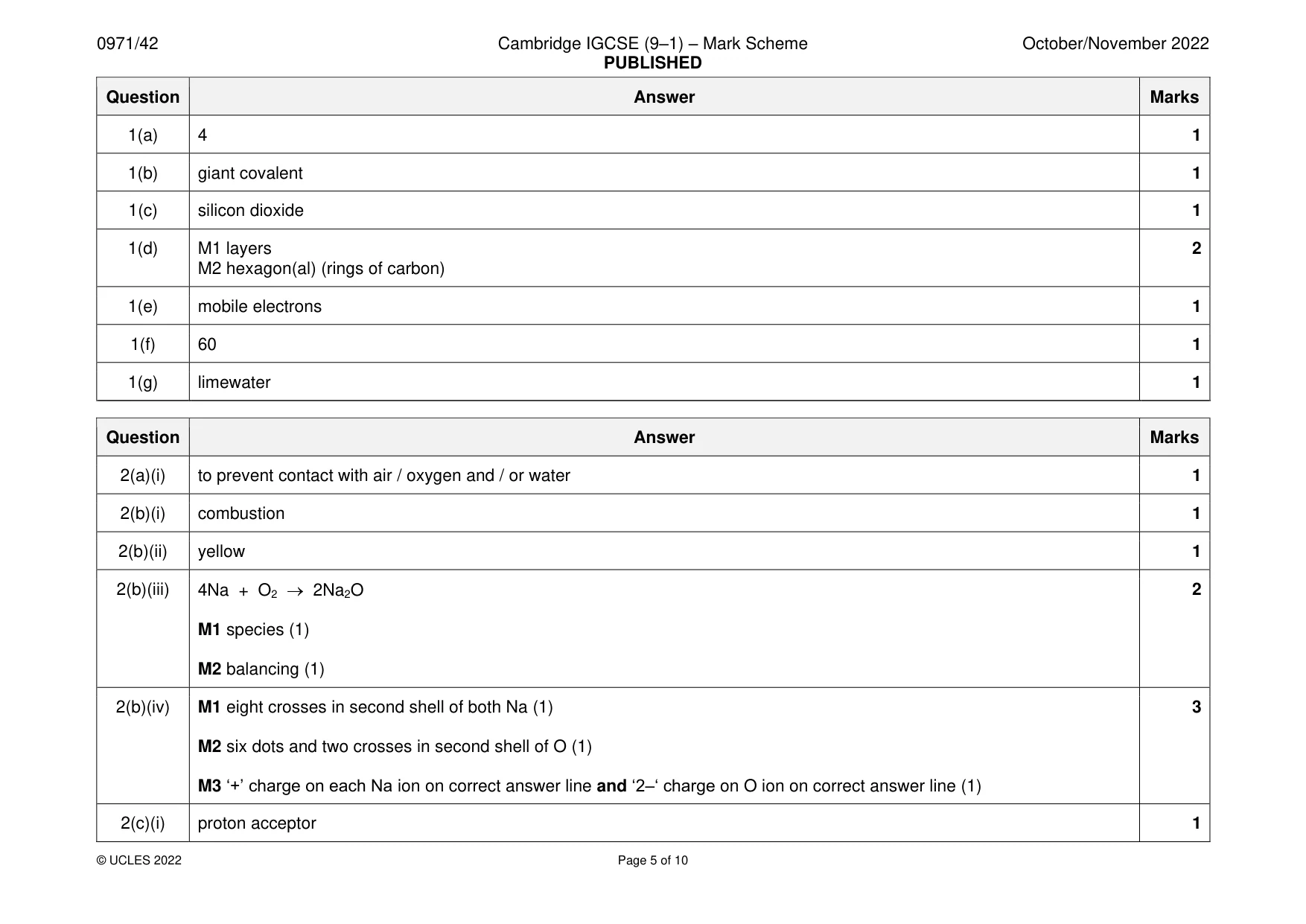
Mark scheme: Question Answer Marks 1(a) 4 1 1(b) giant covalent 1 1(c) silicon dioxide 1 1(d) M1 layers 2 M2 hexagon(al) (rings of carbon) 1(e) mobile electrons 1 1(f) 60 1 1(g) limewater 1
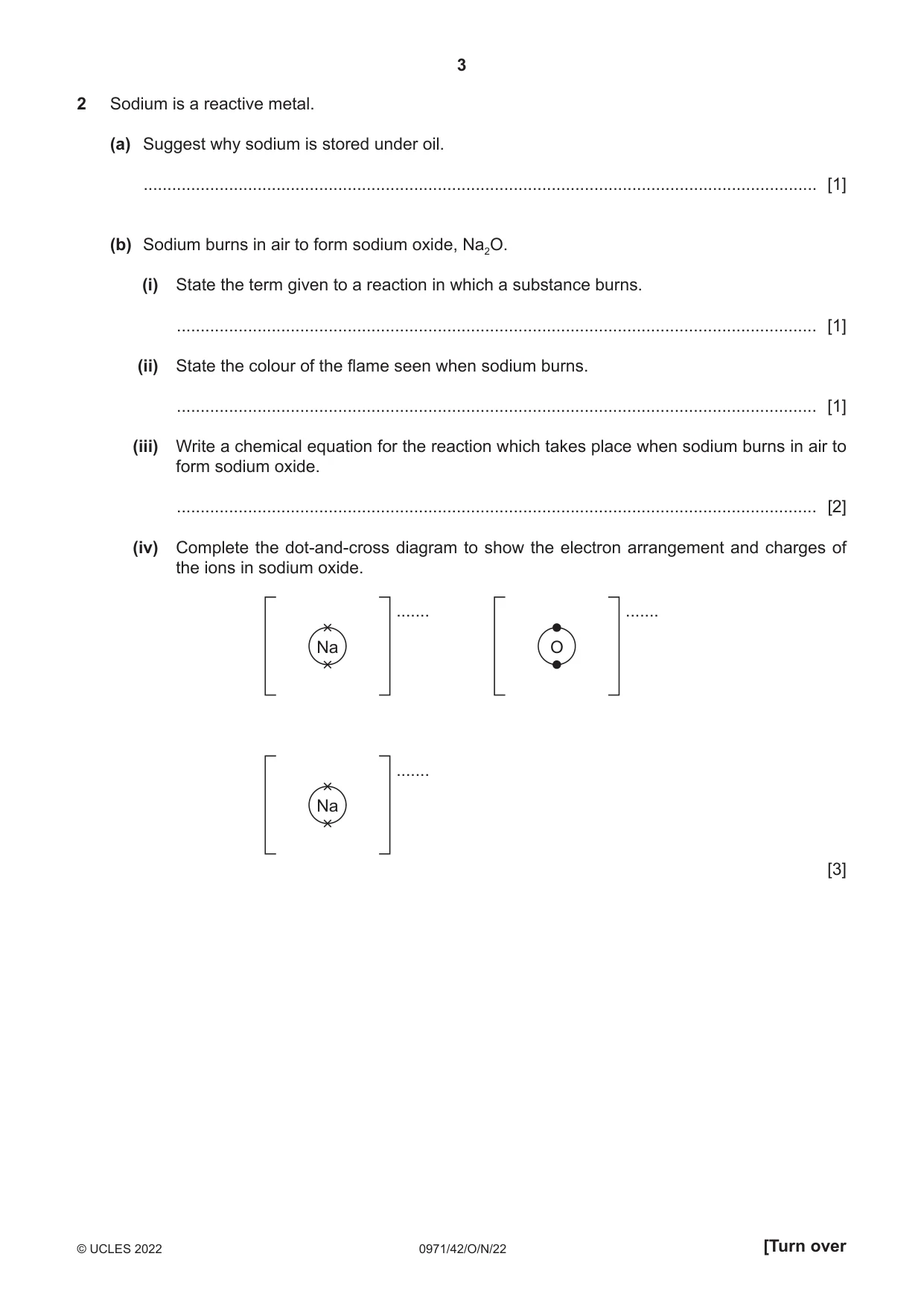
Q2 · Sodium is a reactive metal
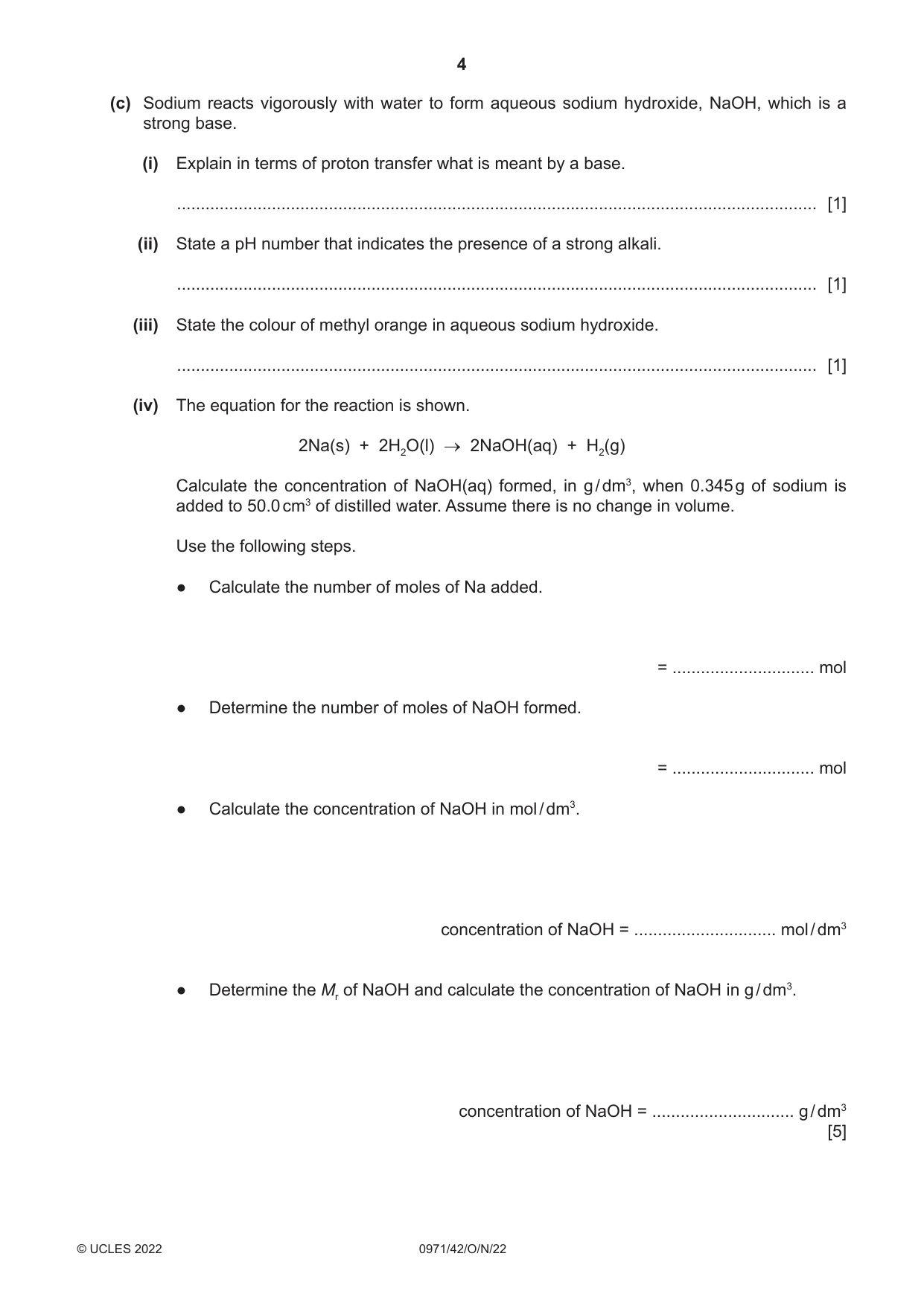
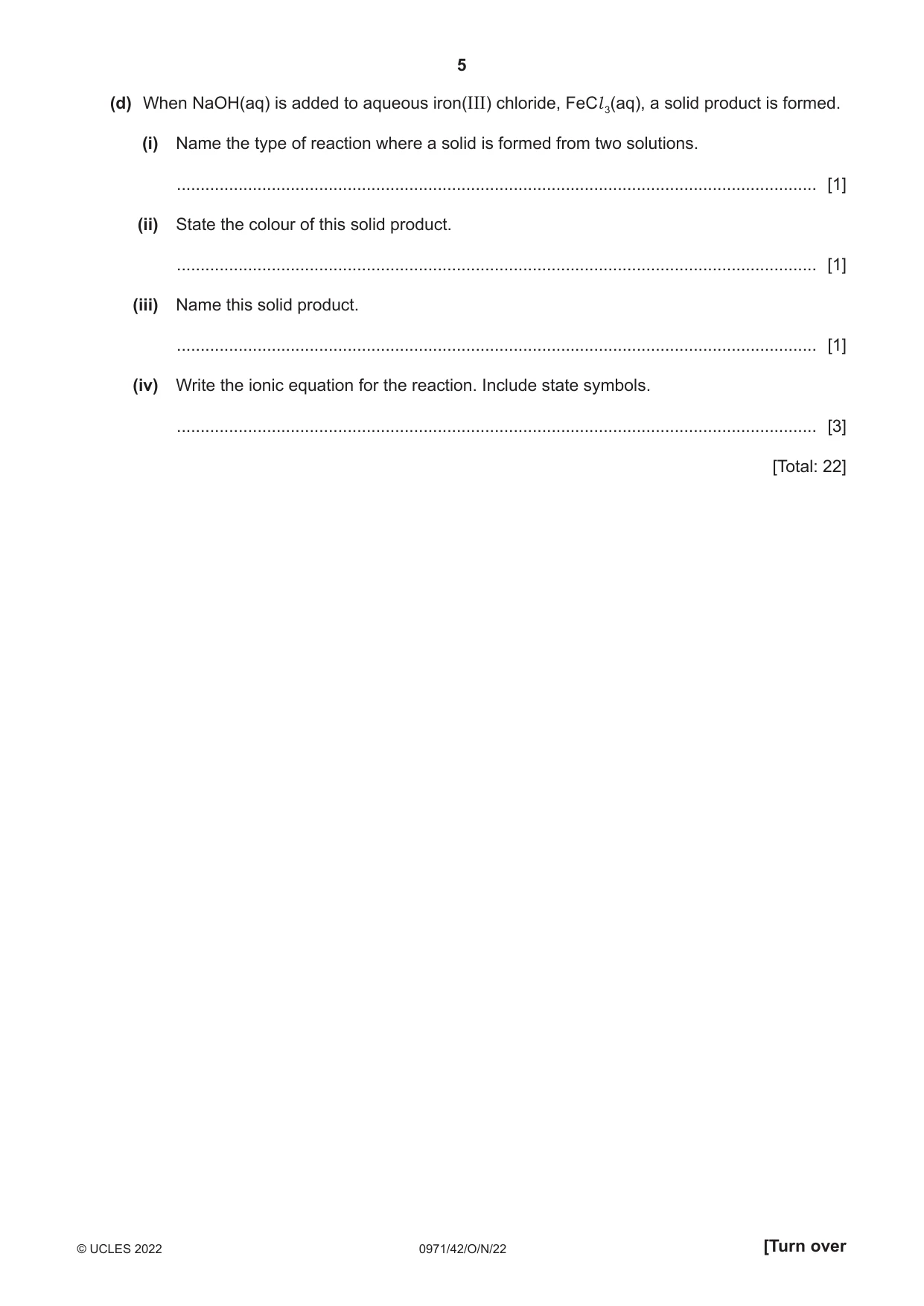
2 Sodium is a reactive metal. (a) Suggest why sodium is stored under oil. .............................................................................................................................................. [1] (b) Sodium burns in air to form sodium oxide, Na2O. (i) State the term given to a reaction in which a substance burns. ....................................................................................................................................... [1] (ii) State the colour of the flame seen when sodium burns. ....................................................................................................................................... [1] (iii) Write a chemical equation for the reaction which takes place when sodium burns in air to form sodium oxide. ....................................................................................................................................... [2] (iv) Complete the dot-and-cross diagram to show the electron arrangement and charges of the ions in sodium oxide. ....... ....... Na O ....... Na [3] (c) Sodium reacts vigorously with water to form aqueous sodium hydroxide, NaOH, which is a strong base. (i) Explain in terms of proton transfer what is meant by a base. ....................................................................................................................................... [1] (ii) State a pH number that indicates the presence of a strong alkali. ....................................................................................................................................... [1] (iii) State the colour of methyl orange in aqueous sodium hydroxide. ....................................................................................................................................... [1] (iv) The equation for the reaction is shown. 2Na(s) + 2H2O(l) → 2NaOH(aq) + H2(g) Calculate the concentration of NaOH(aq) formed, in g / dm3, when 0.345 g of sodium is added to 50.0 cm3 of distilled water. Assume there is no change in volume. Use the following steps. ● Calculate the number of moles of Na added. = .............................. mol ● Determine the number of moles of NaOH formed. = .............................. mol ● Calculate the concentration of NaOH in mol / dm3. concentration of NaOH = .............................. mol / dm3 ● Determine the Mr of NaOH and calculate the concentration of NaOH in g / dm3. concentration of NaOH = .............................. g / dm3 [5] (d) When NaOH(aq) is added to aqueous iron(III) chloride, FeCl 3(aq), a solid product is formed. (i) Name the type of reaction where a solid is formed from two solutions. ....................................................................................................................................... [1] (ii) State the colour of this solid product. ....................................................................................................................................... [1] (iii) Name this solid product. ....................................................................................................................................... [1] (iv) Write the ionic equation for the reaction. Include state symbols. ....................................................................................................................................... [3] [Total: 22]
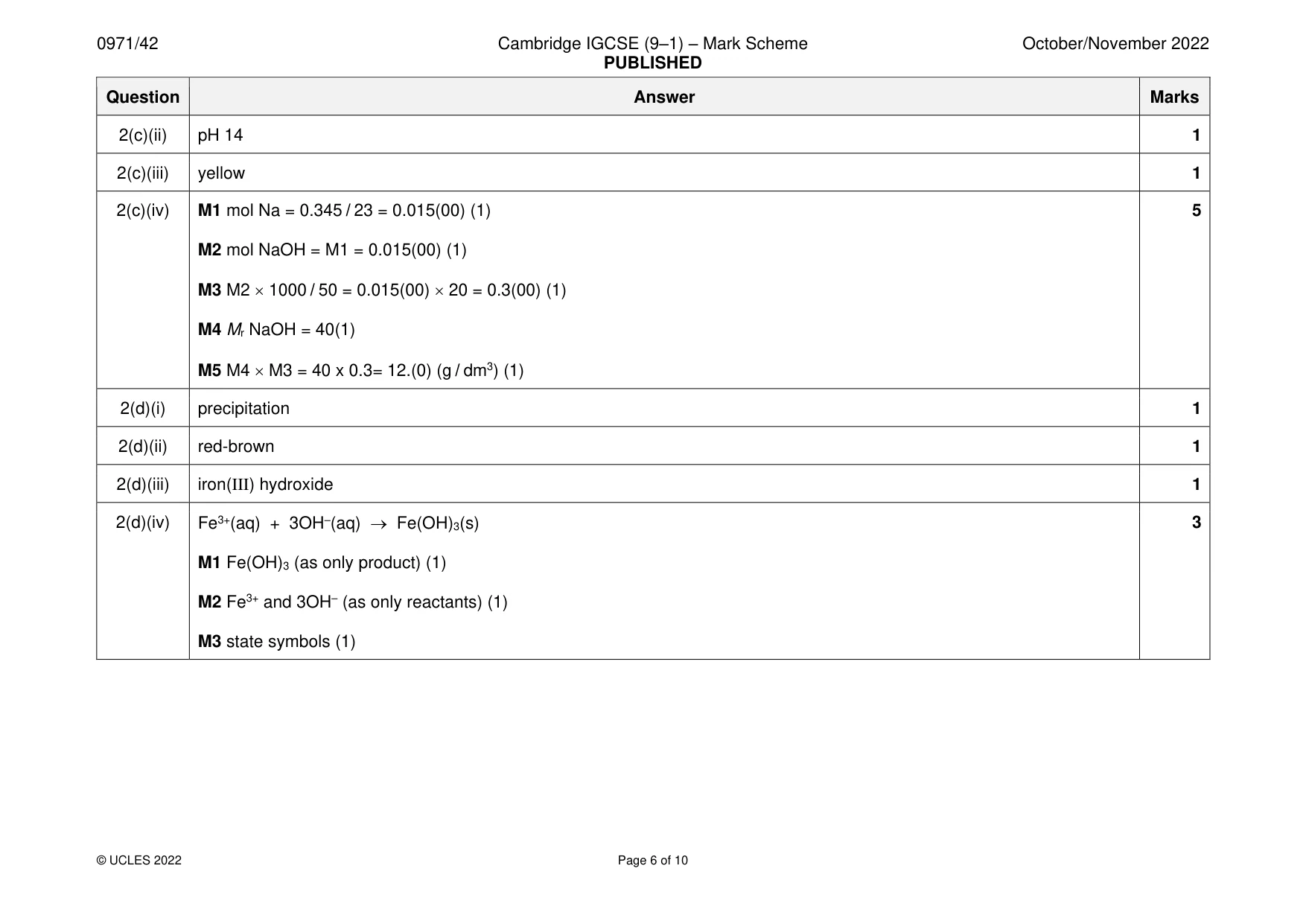
Mark scheme: 2(a)(i) to prevent contact with air / oxygen and / or water 1 2(b)(i) combustion 1 2(b)(ii) yellow 1 2(b)(iii) 4Na + O2 → 2Na2O 2 M1 species (1) M2 balancing (1) 2(b)(iv) M1 eight crosses in second shell of both Na (1) 3 M2 six dots and two crosses in second shell of O (1) M3 ‘+’ charge on each Na ion on correct answer line and ‘2–‘ charge on O ion on correct answer line (1) 2(c)(i) proton acceptor 1 2(c)(ii) pH 14 1 2(c)(iii) yellow 1 2(c)(iv) M1 mol Na = 0.345 / 23 = 0.015(00) (1) 5 M2 mol NaOH = M1 = 0.015(00) (1) M3 M2 1000 / 50 = 0.015(00) 20 = 0.3(00) (1) M4 Mr NaOH = 40(1) M5 M4 M3 = 40 x 0.3= 12.(0) (g / dm3) (1) 2(d)(i) precipitation 1 2(d)(ii) red-brown 1 2(d)(iii) iron(III) hydroxide 1 2(d)(iv) Fe3+(aq) + 3OH–(aq) → Fe(OH)3(s) 3 M1 Fe(OH)3 (as only product) (1) M2 Fe3+ and 3OH– (as only reactants) (1) M3 state symbols (1)
More questions on The characteristic properties of acids and bases
Q3 · Sulfuric acid is manufactured by an industrial process
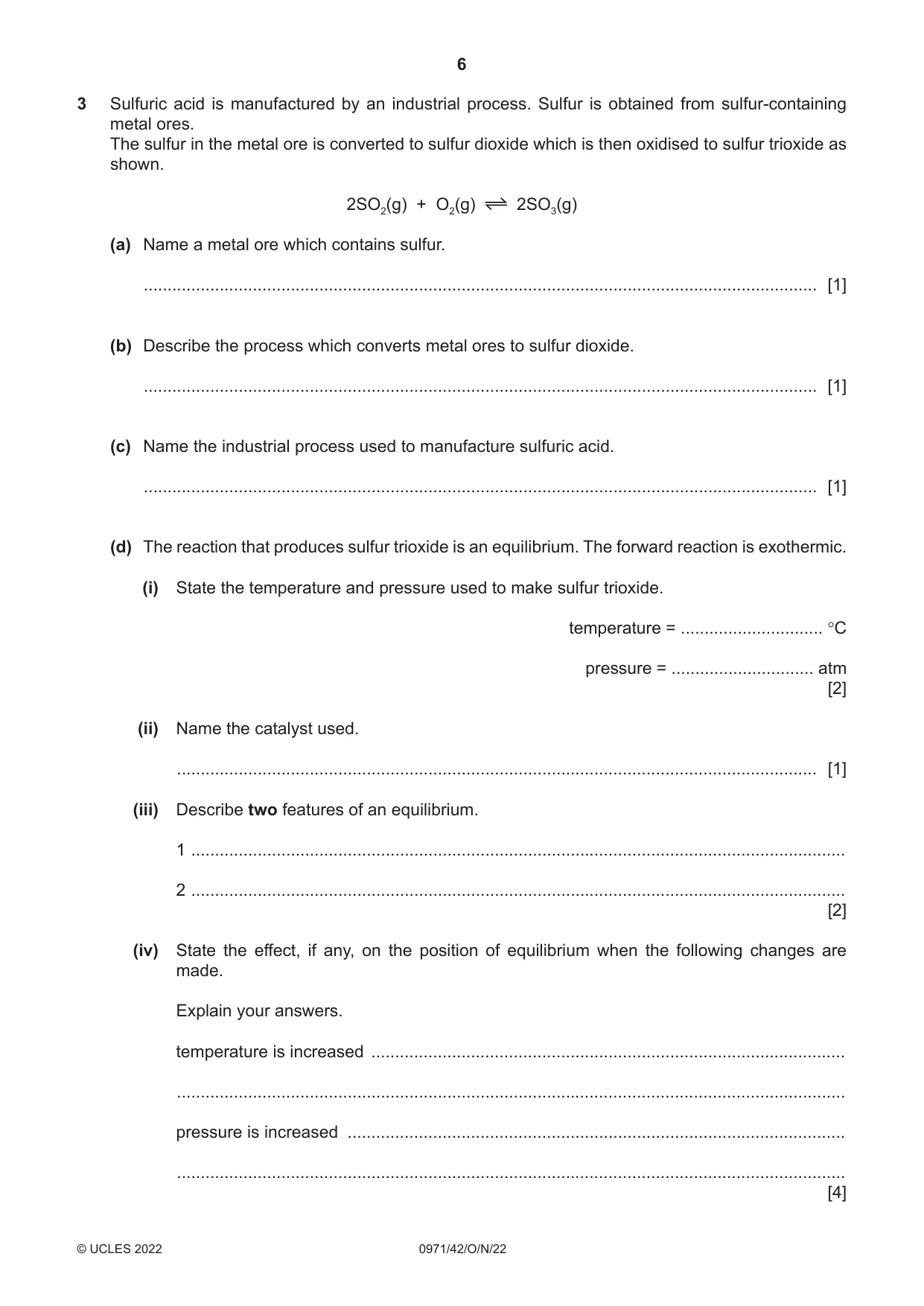
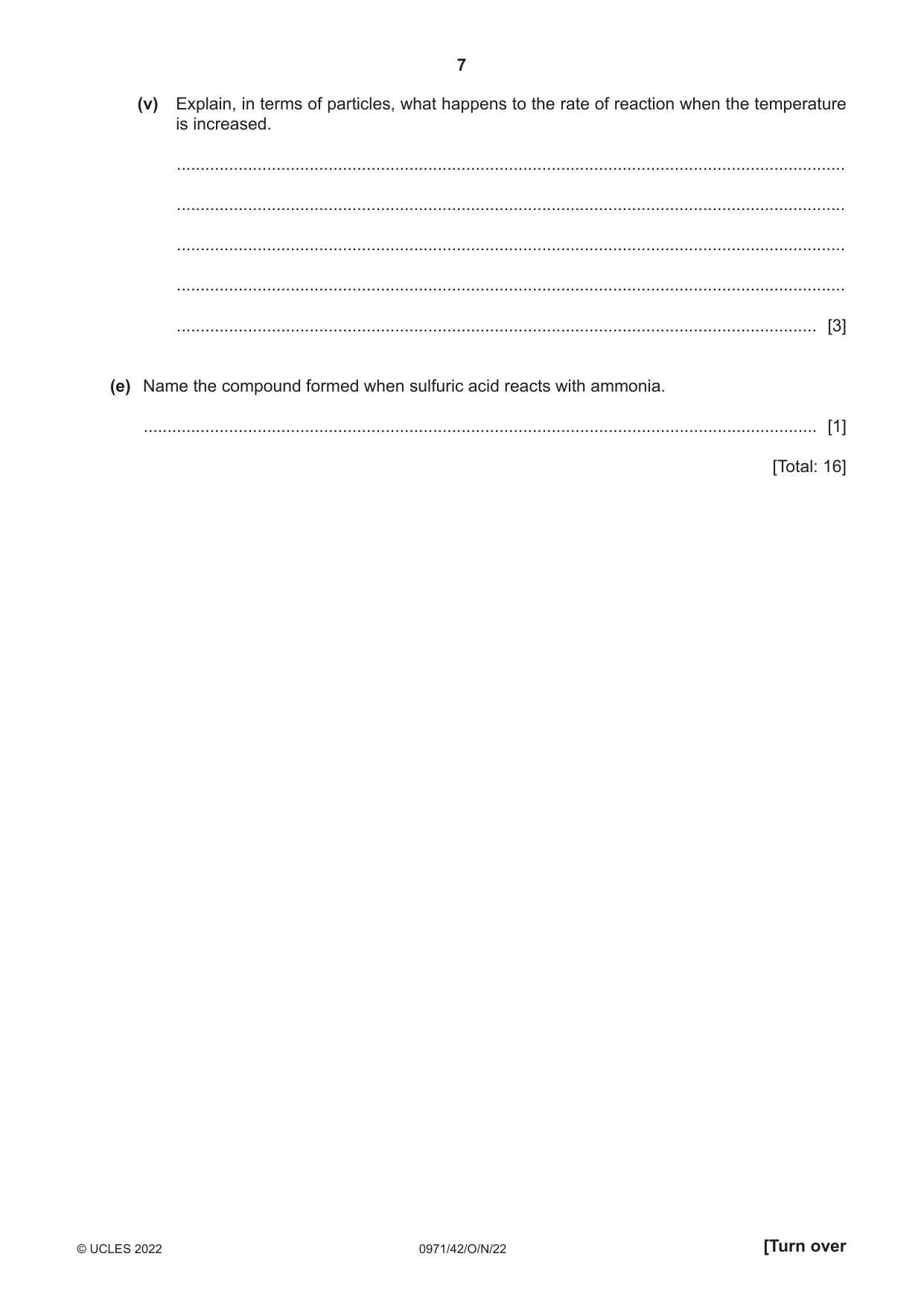
3 Sulfuric acid is manufactured by an industrial process. Sulfur is obtained from sulfur-containing metal ores. The sulfur in the metal ore is converted to sulfur dioxide which is then oxidised to sulfur trioxide as shown. 2SO2(g) + O2(g) 2SO3(g) (a) Name a metal ore which contains sulfur. .............................................................................................................................................. [1] (b) Describe the process which converts metal ores to sulfur dioxide. .............................................................................................................................................. [1] (c) Name the industrial process used to manufacture sulfuric acid. .............................................................................................................................................. [1] (d) The reaction that produces sulfur trioxide is an equilibrium. The forward reaction is exothermic. (i) State the temperature and pressure used to make sulfur trioxide. temperature = .............................. °C pressure = .............................. atm [2] (ii) Name the catalyst used. ....................................................................................................................................... [1] (iii) Describe two features of an equilibrium. 1 .......................................................................................................................................... 2 .......................................................................................................................................... [2] (iv) State the effect, if any, on the position of equilibrium when the following changes are made. Explain your answers. temperature is increased ..................................................................................................... ............................................................................................................................................. pressure is increased .......................................................................................................... ............................................................................................................................................. [4] (v) Explain, in terms of particles, what happens to the rate of reaction when the temperature is increased. ............................................................................................................................................. ............................................................................................................................................. ............................................................................................................................................. ............................................................................................................................................. ....................................................................................................................................... [3] (e) Name the compound formed when sulfuric acid reacts with ammonia. .............................................................................................................................................. [1] [Total: 16]
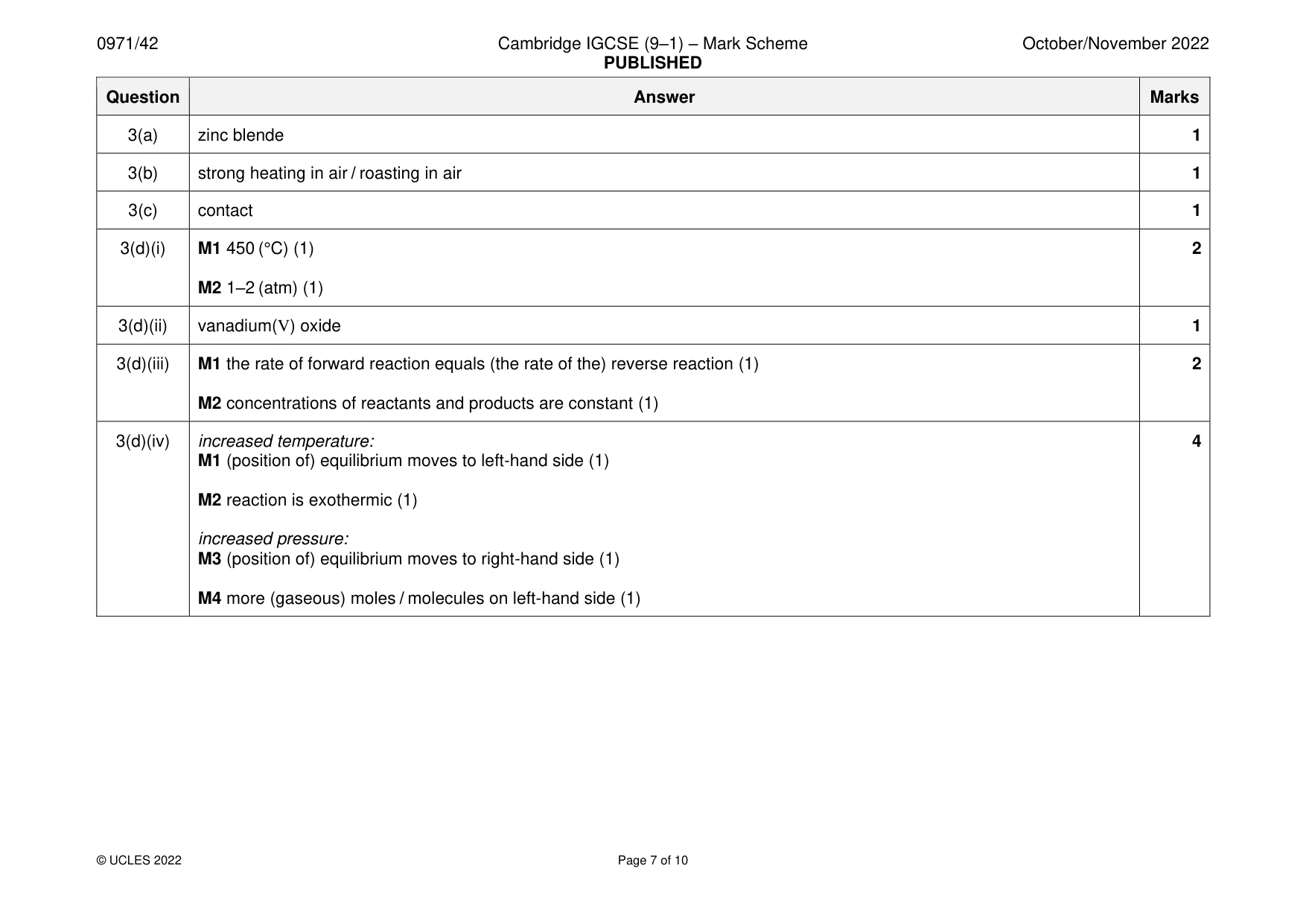
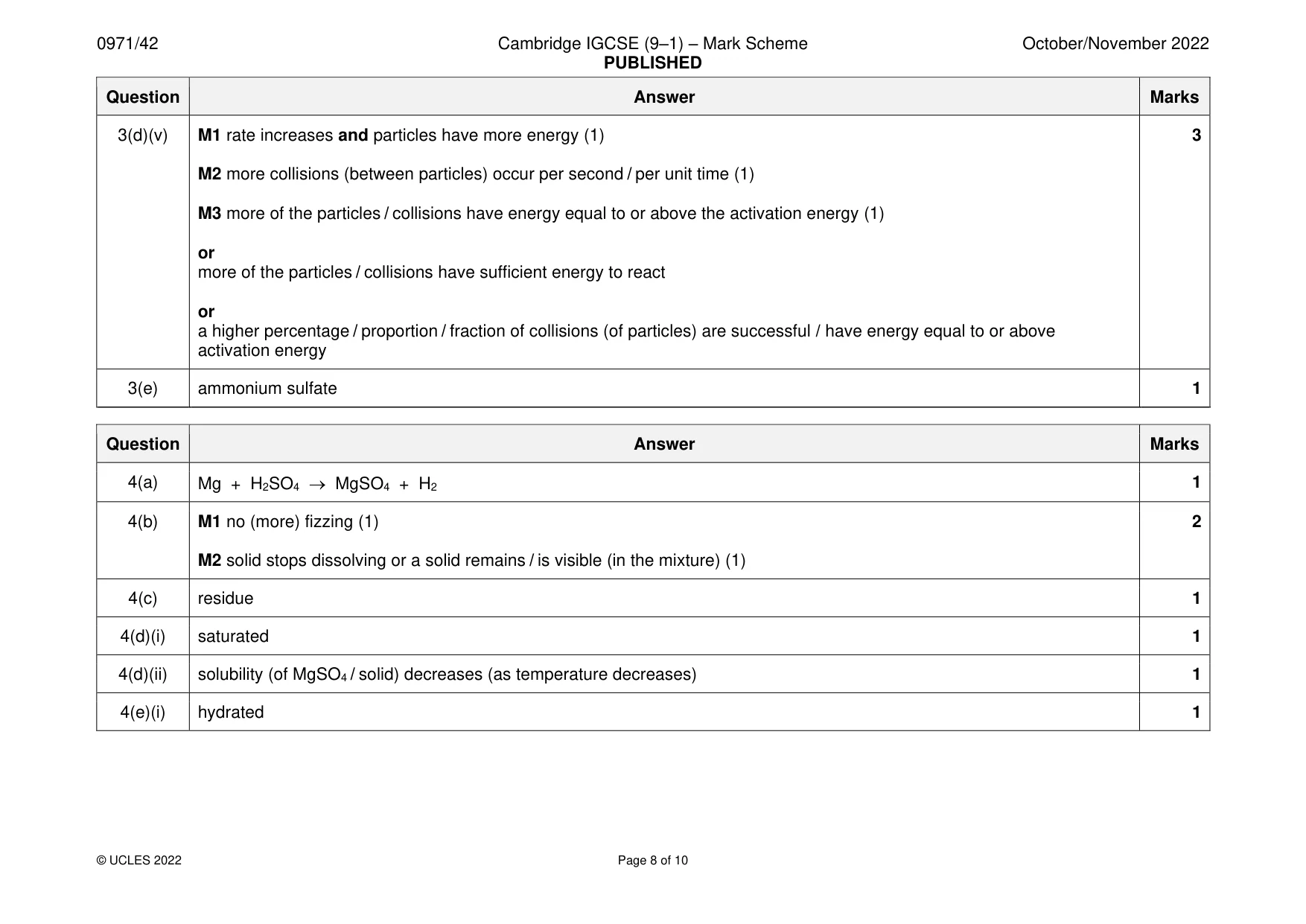
Mark scheme: 3(a) zinc blende 1 3(b) strong heating in air / roasting in air 1 3(c) contact 1 3(d)(i) M1 450 (°C) (1) 2 M2 1–2 (atm) (1) 3(d)(ii) vanadium(V) oxide 1 3(d)(iii) M1 the rate of forward reaction equals (the rate of the) reverse reaction (1) 2 M2 concentrations of reactants and products are constant (1) 3(d)(iv) increased temperature: 4 M1 (position of) equilibrium moves to left-hand side (1) M2 reaction is exothermic (1) increased pressure: M3 (position of) equilibrium moves to right-hand side (1) M4 more (gaseous) moles / molecules on left-hand side (1) 3(d)(v) M1 rate increases and particles have more energy (1) 3 M2 more collisions (between particles) occur per second / per unit time (1) M3 more of the particles / collisions have energy equal to or above the activation energy (1) or more of the particles / collisions have sufficient energy to react or a higher percentage / proportion / fraction of collisions (of particles) are successful / have energy equal to or above activation energy 3(e) ammonium sulfate 1
Q4 · A student prepares magnesium sulfate crystals, MgSO4, by adding excess magnesium to…
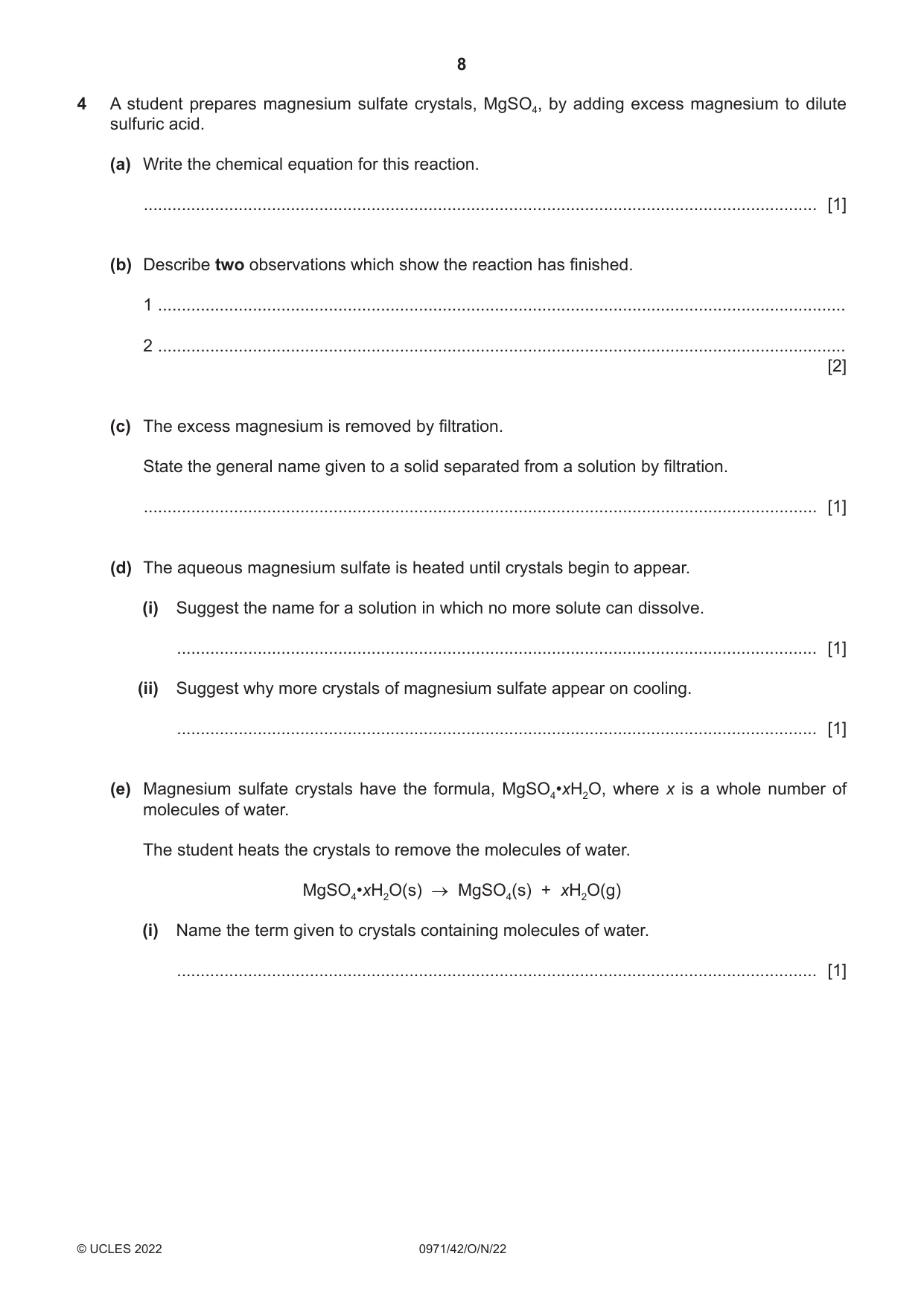
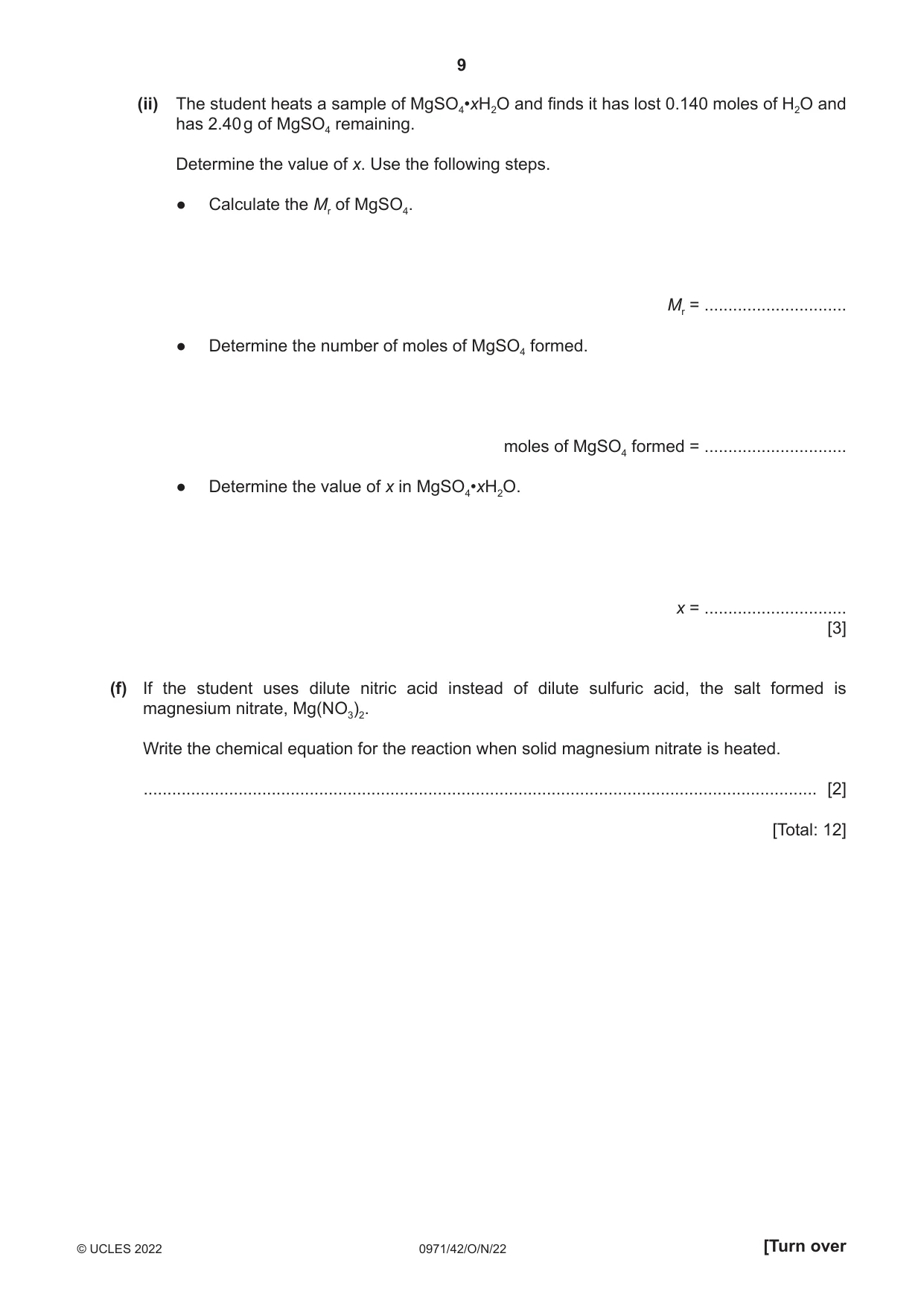
4 A student prepares magnesium sulfate crystals, MgSO4, by adding excess magnesium to dilute sulfuric acid. (a) Write the chemical equation for this reaction. .............................................................................................................................................. [1] (b) Describe two observations which show the reaction has finished. 1 ................................................................................................................................................. 2 ................................................................................................................................................. [2] (c) The excess magnesium is removed by filtration. State the general name given to a solid separated from a solution by filtration. .............................................................................................................................................. [1] (d) The aqueous magnesium sulfate is heated until crystals begin to appear. (i) Suggest the name for a solution in which no more solute can dissolve. ....................................................................................................................................... [1] (ii) Suggest why more crystals of magnesium sulfate appear on cooling. ....................................................................................................................................... [1] (e) Magnesium sulfate crystals have the formula, MgSO4•xH2O, where x is a whole number of molecules of water. The student heats the crystals to remove the molecules of water. MgSO4•xH2O(s) → MgSO4(s) + xH2O(g) (i) Name the term given to crystals containing molecules of water. ....................................................................................................................................... [1] (ii) The student heats a sample of MgSO4•xH2O and finds it has lost 0.140 moles of H2O and has 2.40 g of MgSO4 remaining. Determine the value of x. Use the following steps. ● Calculate the Mr of MgSO4. Mr = .............................. ● Determine the number of moles of MgSO4 formed. moles of MgSO4 formed = .............................. ● Determine the value of x in MgSO4•xH2O. x = .............................. [3] (f) If the student uses dilute nitric acid instead of dilute sulfuric acid, the salt formed is magnesium nitrate, Mg(NO3)2. Write the chemical equation for the reaction when solid magnesium nitrate is heated. .............................................................................................................................................. [2] [Total: 12]
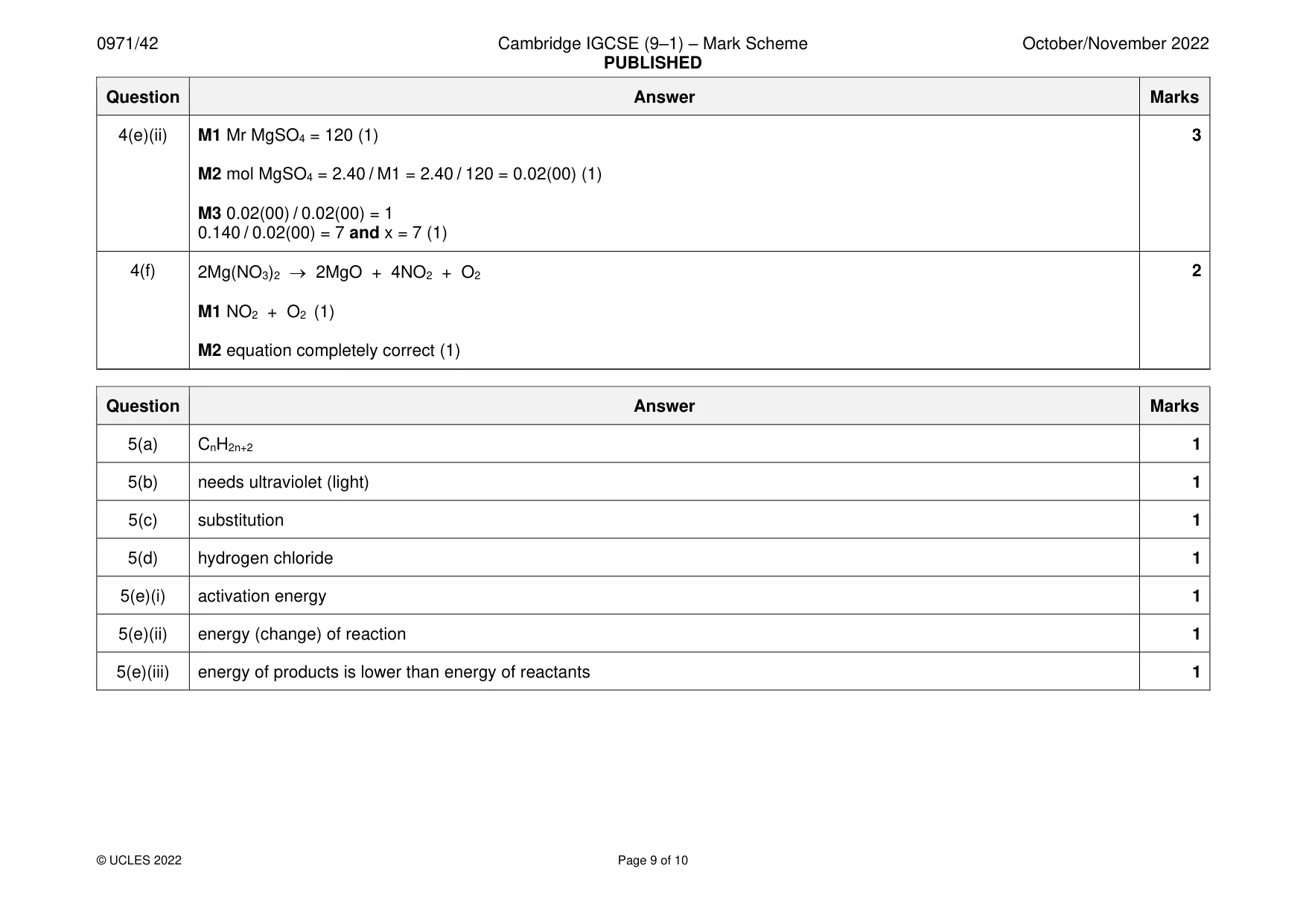
Mark scheme: 4(a) Mg + H2SO4 → MgSO4 + H2 1 4(b) M1 no (more) fizzing (1) 2 M2 solid stops dissolving or a solid remains / is visible (in the mixture) (1) 4(c) residue 1 4(d)(i) saturated 1 4(d)(ii) solubility (of MgSO4 / solid) decreases (as temperature decreases) 1 4(e)(i) hydrated 1 4(e)(ii) M1 Mr MgSO4 = 120 (1) 3 M2 mol MgSO4 = 2.40 / M1 = 2.40 / 120 = 0.02(00) (1) M3 0.02(00) / 0.02(00) = 1 0.140 / 0.02(00) = 7 and x = 7 (1) 4(f) 2Mg(NO3)2 → 2MgO + 4NO2 + O2 2 M1 NO2 + O2 (1) M2 equation completely correct (1)
Q5 · Ethane is an alkane which undergoes a photochemical reaction with chlorine as shown
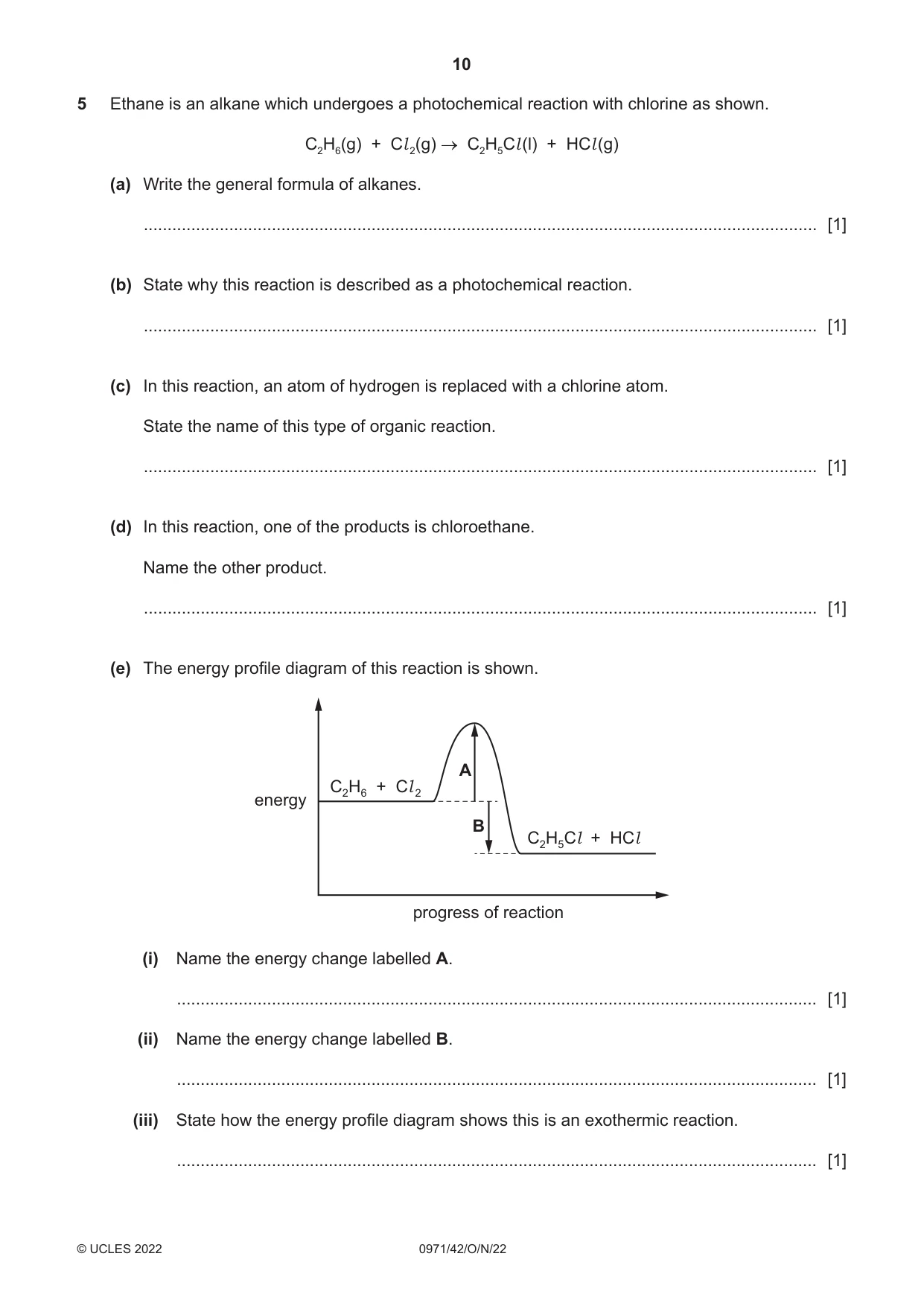
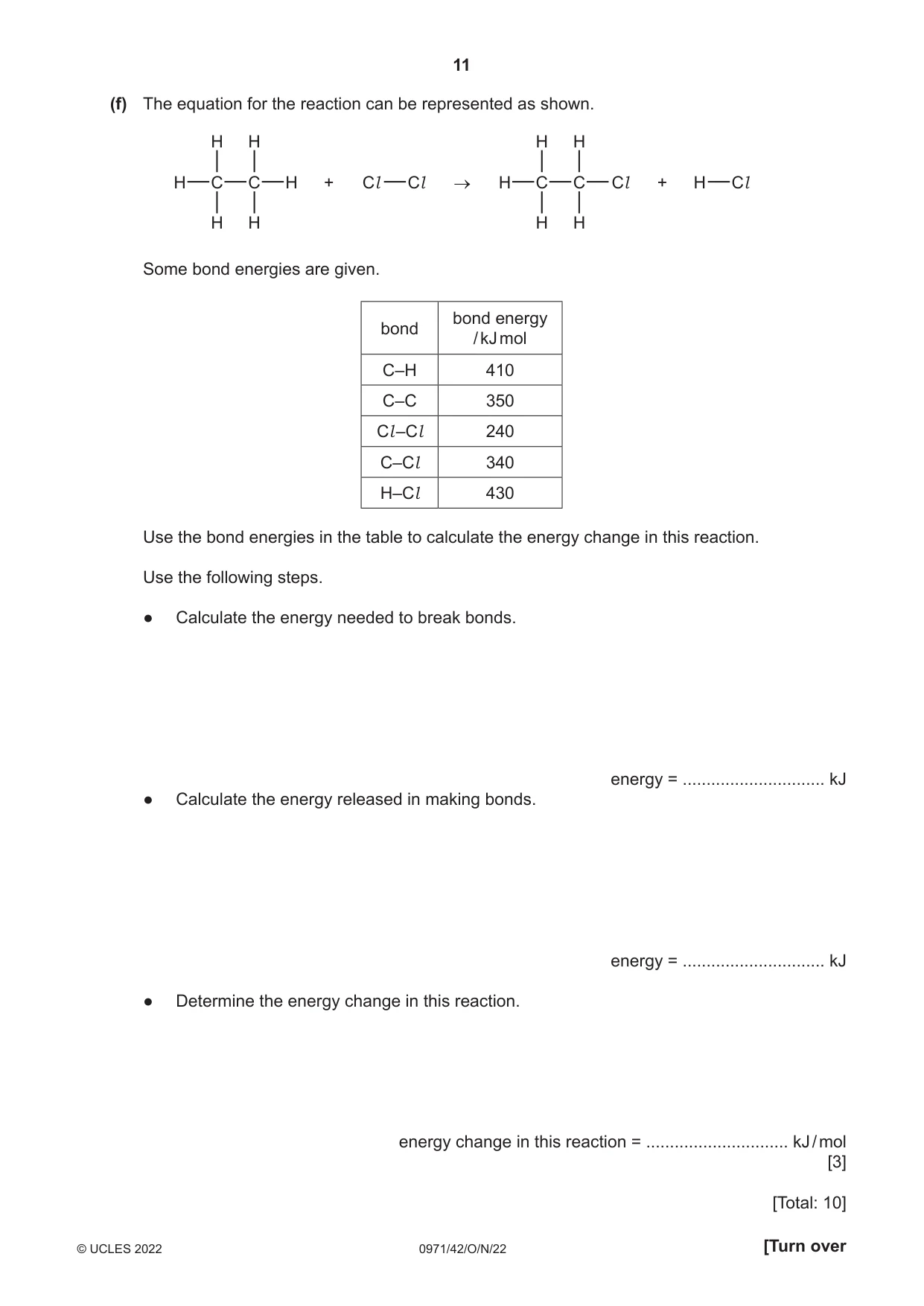
5 Ethane is an alkane which undergoes a photochemical reaction with chlorine as shown. C2H6(g) + Cl 2(g) → C2H5Cl (l) + HCl (g) (a) Write the general formula of alkanes. .............................................................................................................................................. [1] (b) State why this reaction is described as a photochemical reaction. .............................................................................................................................................. [1] (c) In this reaction, an atom of hydrogen is replaced with a chlorine atom. State the name of this type of organic reaction. .............................................................................................................................................. [1] (d) In this reaction, one of the products is chloroethane. Name the other product. .............................................................................................................................................. [1] (e) The energy profile diagram of this reaction is shown. A C2H6 + Cl 2 energy B C2H5Cl + HCl progress of reaction (i) Name the energy change labelled A. ....................................................................................................................................... [1] (ii) Name the energy change labelled B. ....................................................................................................................................... [1] (iii) State how the energy profile diagram shows this is an exothermic reaction. ....................................................................................................................................... [1] (f) The equation for the reaction can be represented as shown. H H H H H C C H + Cl Cl H C C Cl + H Cl H H H H Some bond energies are given. bond energy bond / kJ mol C–H 410 C–C 350 Cl –Cl 240 C–Cl 340 H–Cl 430 Use the bond energies in the table to calculate the energy change in this reaction. Use the following steps. ● Calculate the energy needed to break bonds. energy = .............................. kJ ● Calculate the energy released in making bonds. energy = .............................. kJ ● Determine the energy change in this reaction. energy change in this reaction = .............................. kJ / mol [3] [Total: 10]
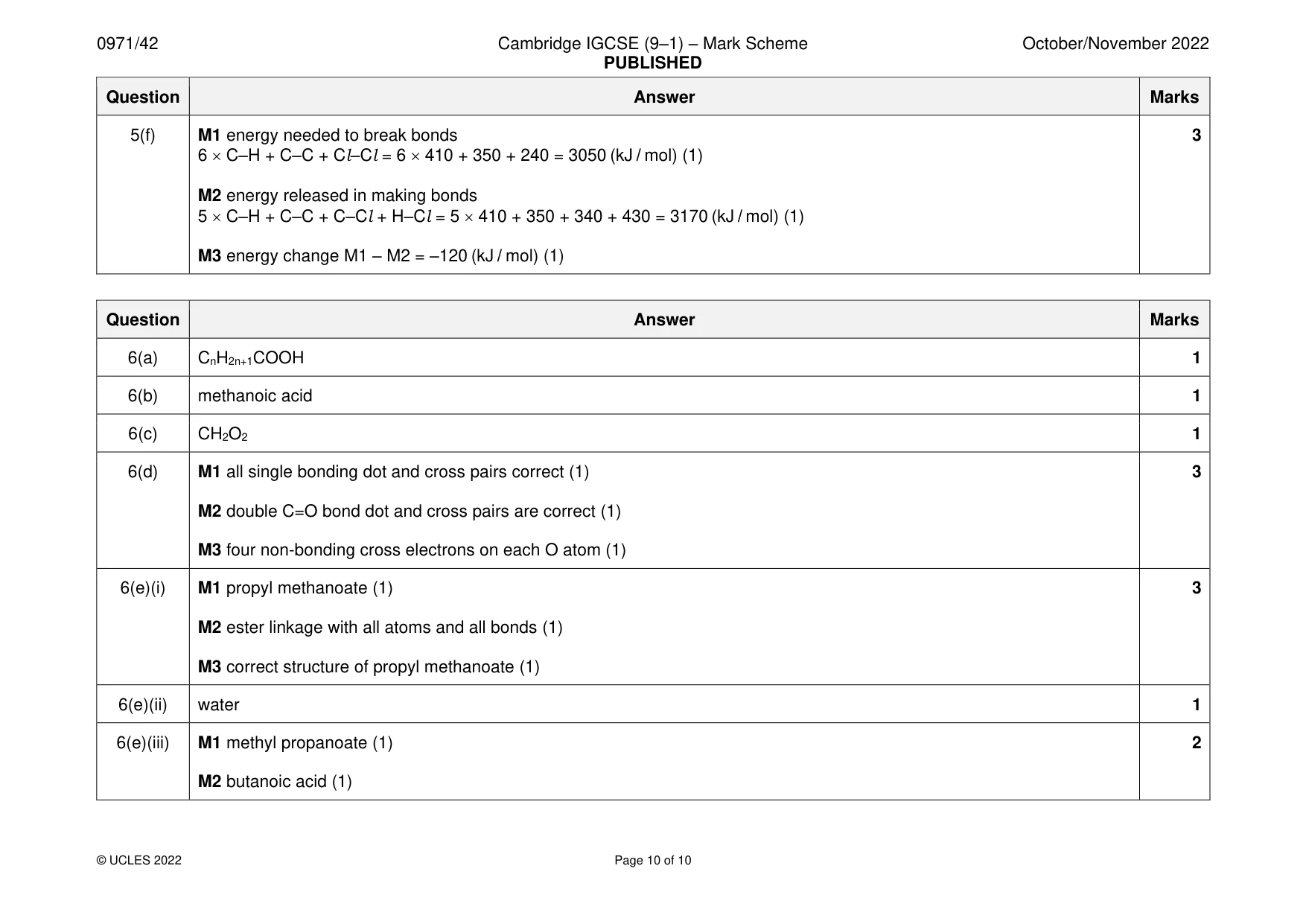
Mark scheme: 5(a) CnH2n+2 1 5(b) needs ultraviolet (light) 1 5(c) substitution 1 5(d) hydrogen chloride 1 5(e)(i) activation energy 1 5(e)(ii) energy (change) of reaction 1 5(e)(iii) energy of products is lower than energy of reactants 1 5(f) M1 energy needed to break bonds 3 6 C–H + C–C + Cl–Cl = 6 410 + 350 + 240 = 3050 (kJ / mol) (1) M2 energy released in making bonds 5 C–H + C–C + C–Cl + H–Cl = 5 410 + 350 + 340 + 430 = 3170 (kJ / mol) (1) M3 energy change M1 – M2 = –120 (kJ / mol) (1)
Q6 · A carboxylic acid Y has the structure shown
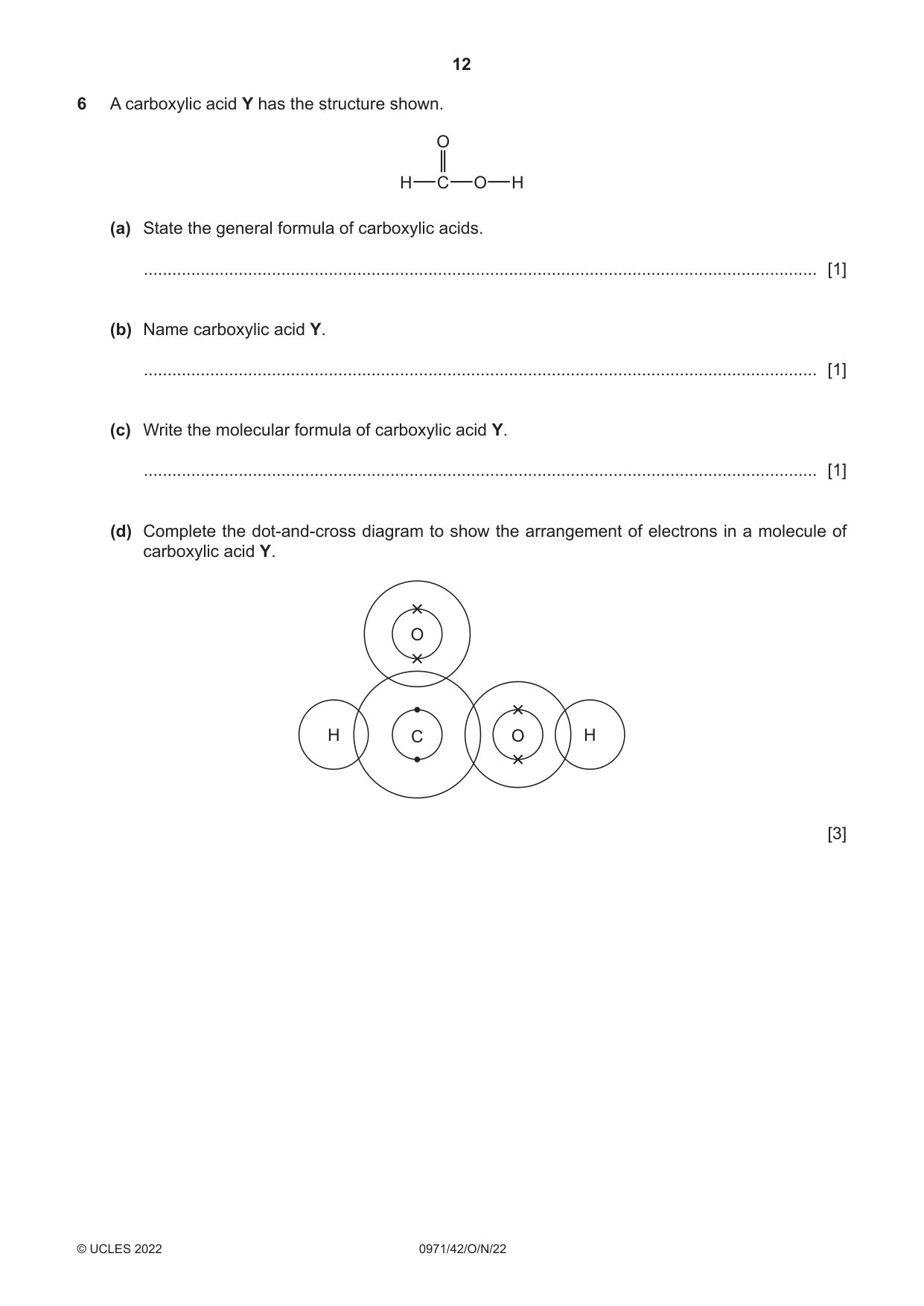
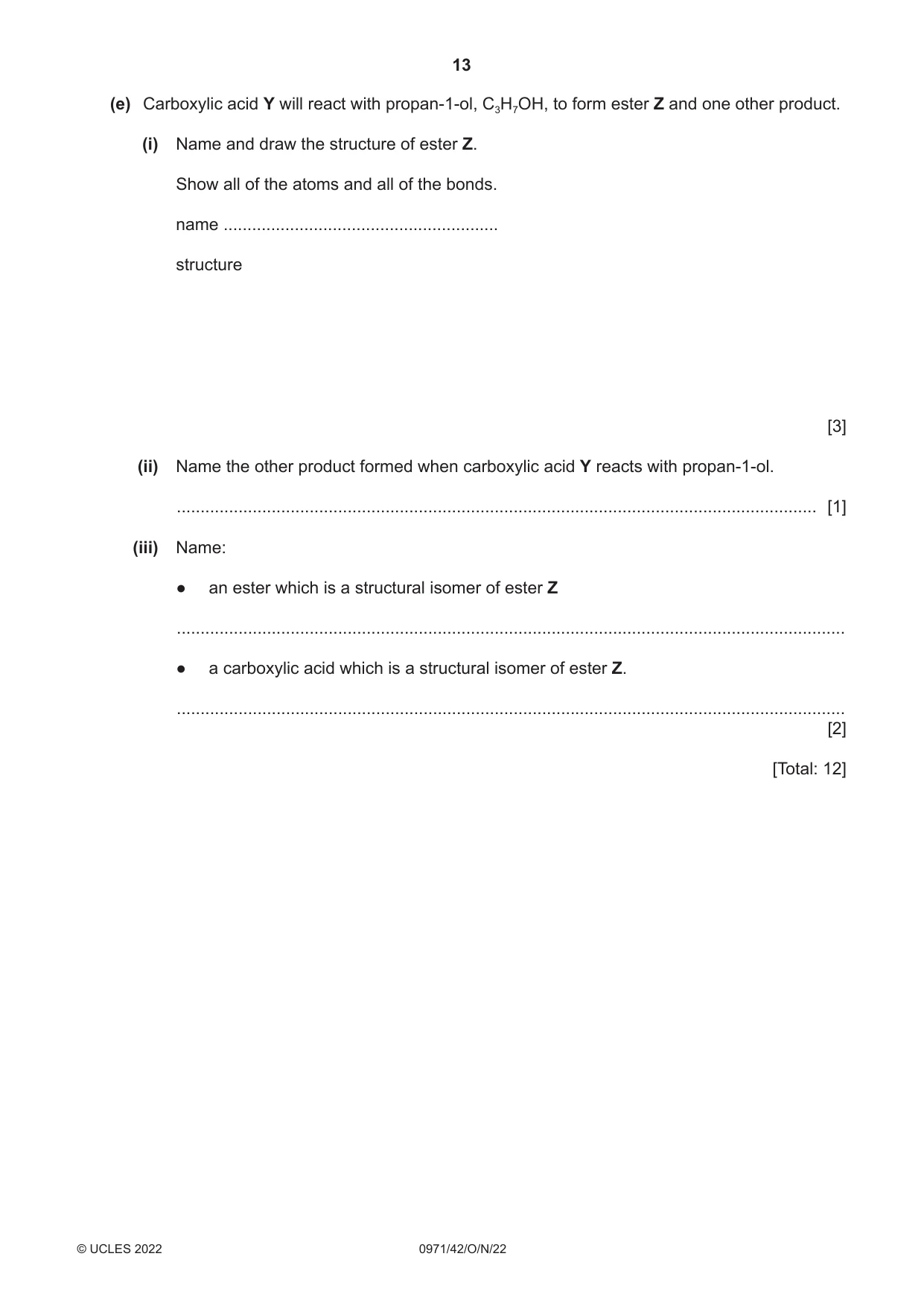
6 A carboxylic acid Y has the structure shown. O H C O H (a) State the general formula of carboxylic acids. .............................................................................................................................................. [1] (b) Name carboxylic acid Y. .............................................................................................................................................. [1] (c) Write the molecular formula of carboxylic acid Y. .............................................................................................................................................. [1] (d) Complete the dot-and-cross diagram to show the arrangement of electrons in a molecule of carboxylic acid Y. O H C O H [3] (e) Carboxylic acid Y will react with propan-1-ol, C3H7OH, to form ester Z and one other product. (i) Name and draw the structure of ester Z. Show all of the atoms and all of the bonds. name .......................................................... structure [3] (ii) Name the other product formed when carboxylic acid Y reacts with propan-1-ol. ....................................................................................................................................... [1] (iii) Name: ● an ester which is a structural isomer of ester Z ............................................................................................................................................. ● a carboxylic acid which is a structural isomer of ester Z. ............................................................................................................................................. [2] [Total: 12]
Mark scheme: 6(a) CnH2n+1COOH 1 6(b) methanoic acid 1 6(c) CH2O2 1 6(d) M1 all single bonding dot and cross pairs correct (1) 3 M2 double C=O bond dot and cross pairs are correct (1) M3 four non-bonding cross electrons on each O atom (1) 6(e)(i) M1 propyl methanoate (1) 3 M2 ester linkage with all atoms and all bonds (1) M3 correct structure of propyl methanoate (1) 6(e)(ii) water 1 6(e)(iii) M1 methyl propanoate (1) 2 M2 butanoic acid (1)
What was in this paper
The subtopics covered by these 6 questions, and how many questions each got. Open one in a new tab to see every Cambridge question on it.
What you needed in this session
Cambridge’s own grade thresholds for 2022 Oct/Nov, Paper 4 · Variant 2. A higher threshold means an easier paper — the bar moves with how the cohort did.