Cambridge IGCSE Chemistry (9-1) 0971 — 2021 Oct/Nov Paper 4 · Variant 2
0971/42/O/N/21 · 6 questions · 80 marks · ≈90 min
The question paper and its mark scheme, free to read here and free to download. This is Cambridge’s own paper, exactly as it was sat.
Question paper16 pages
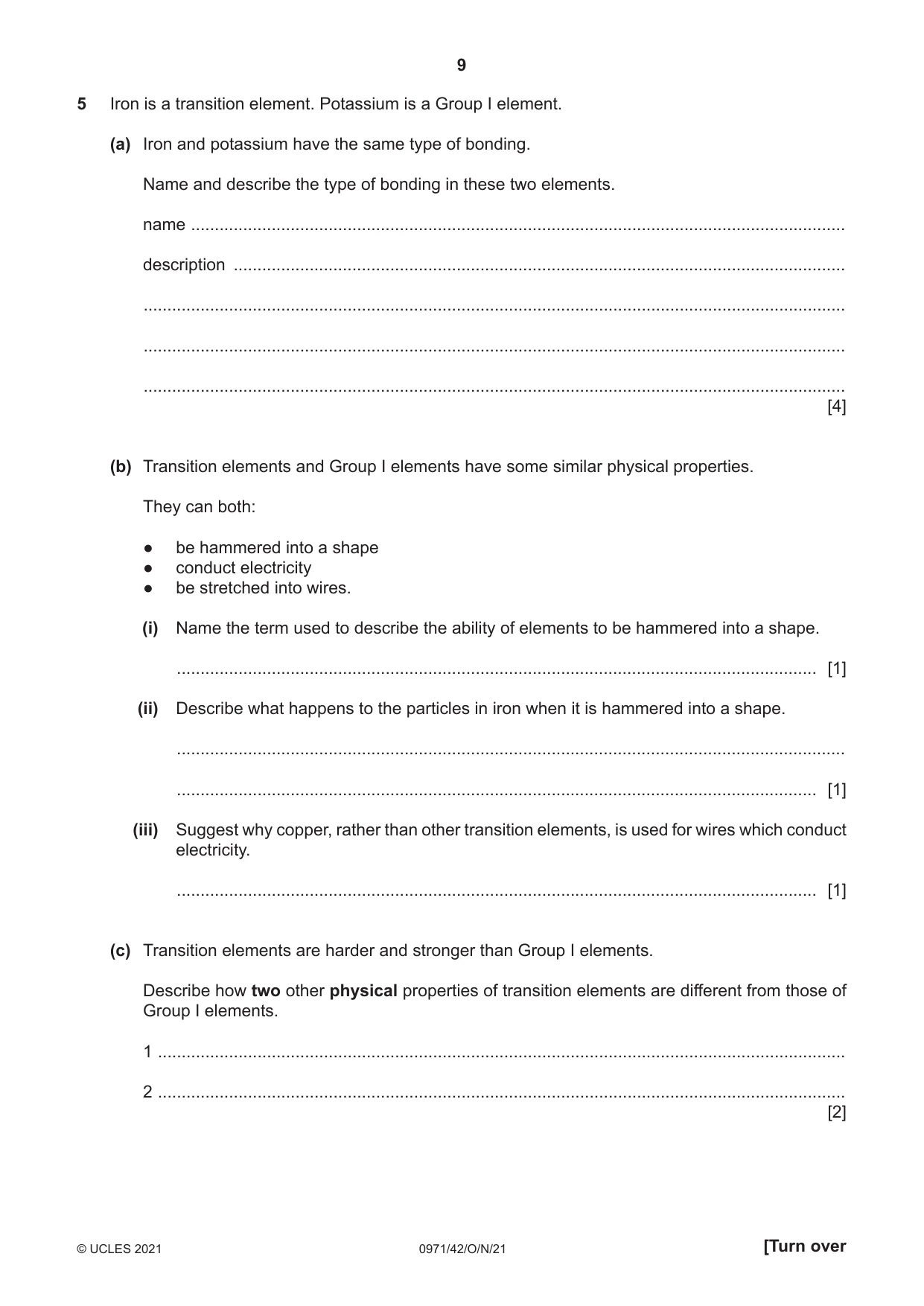
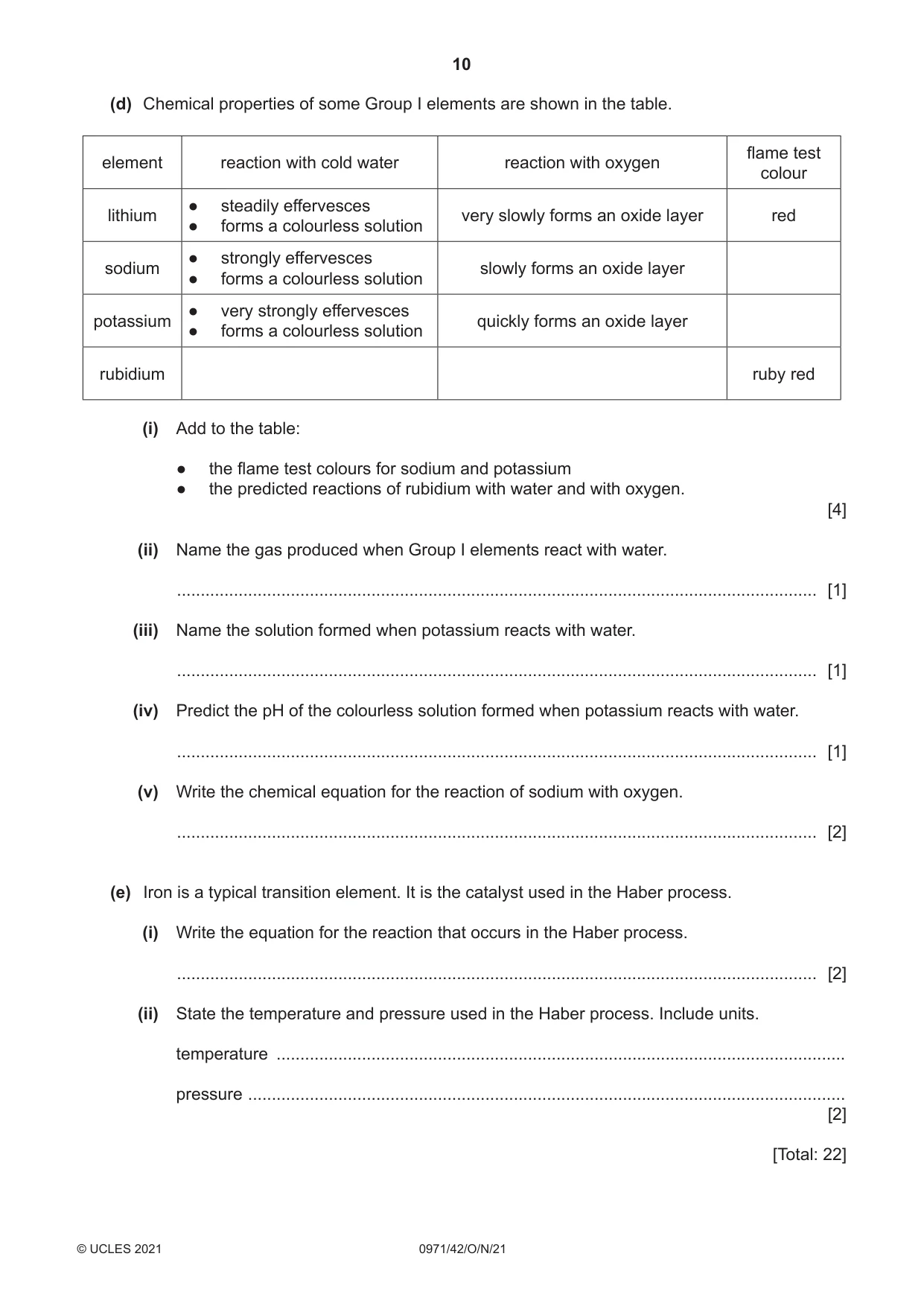
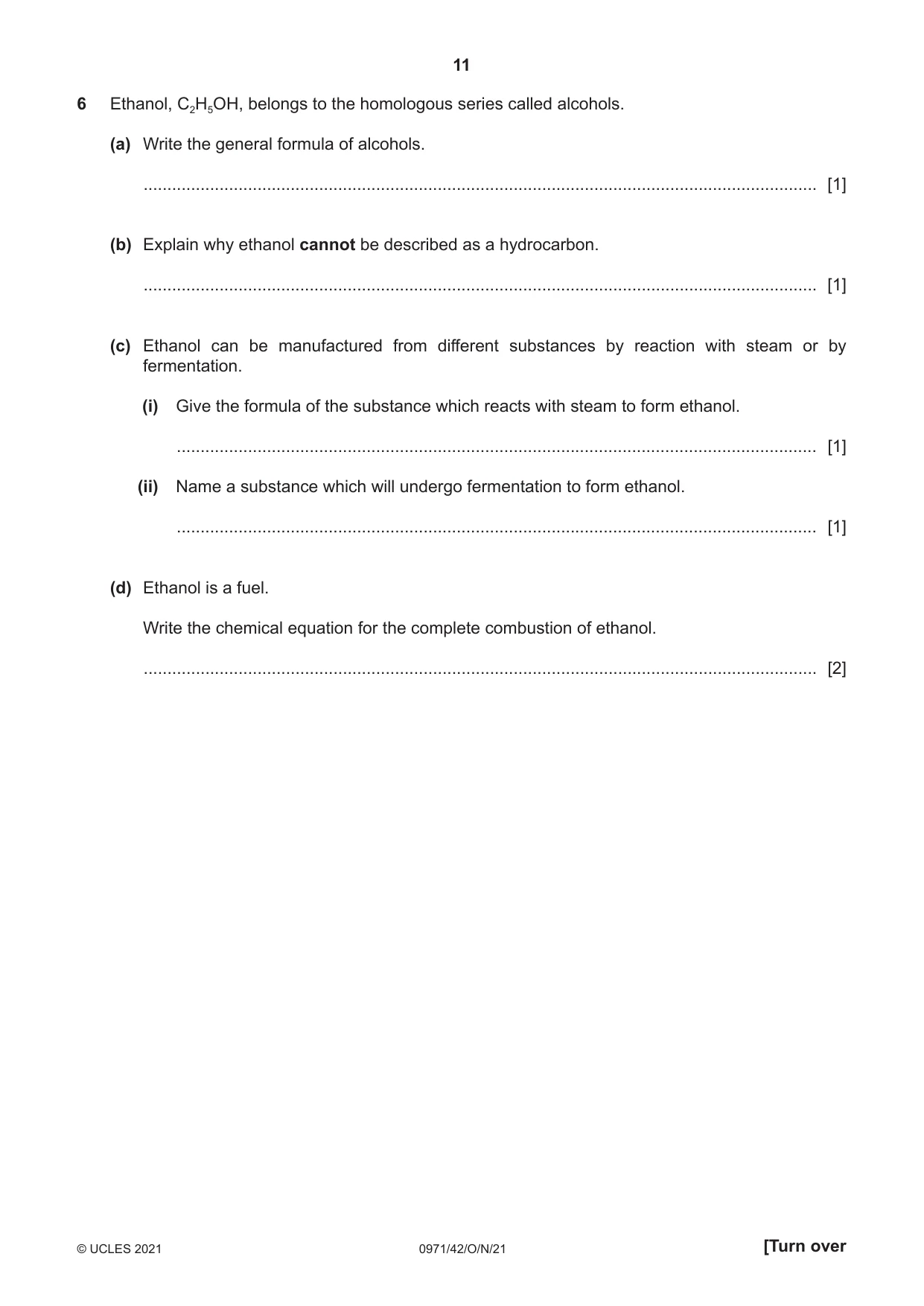
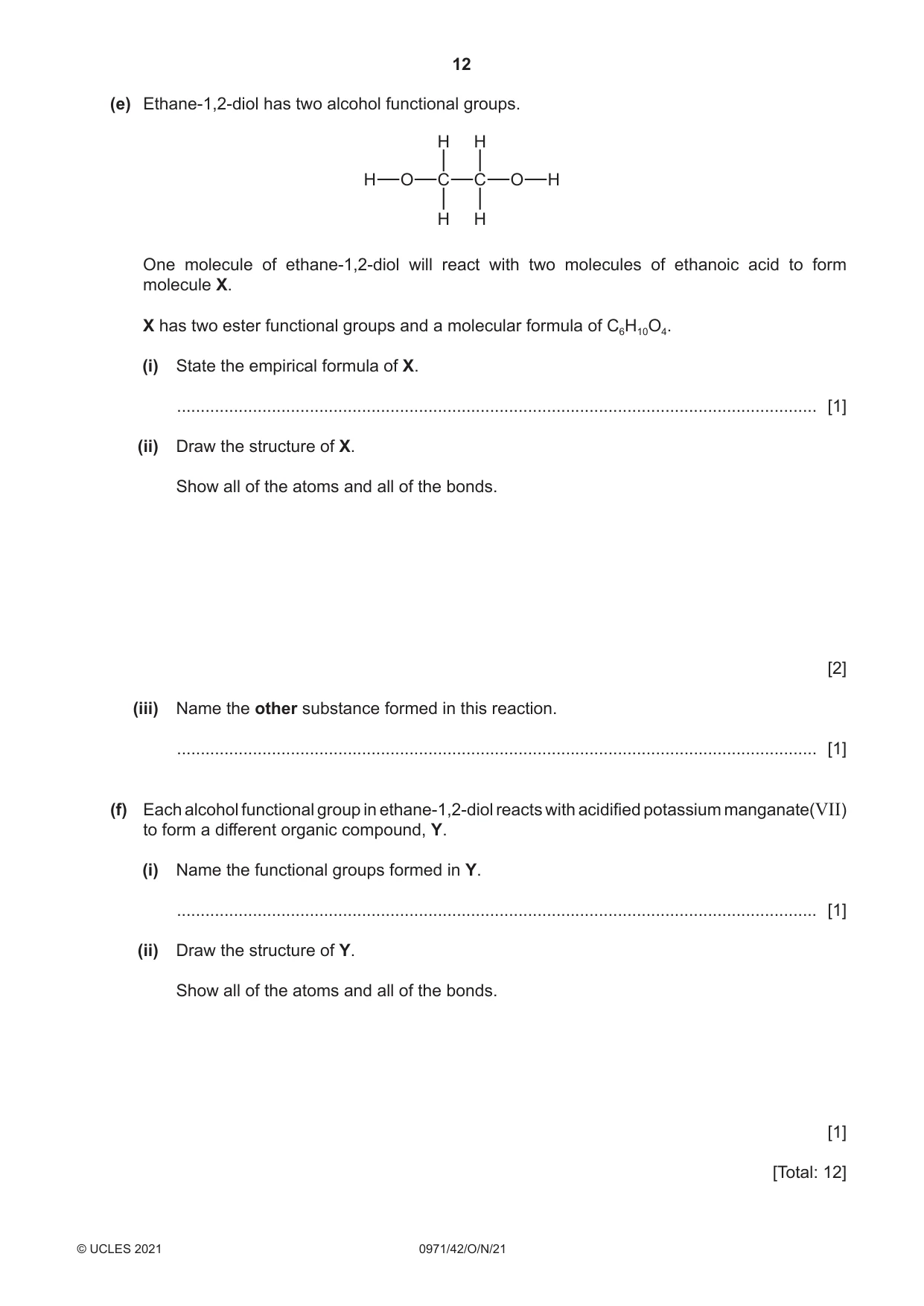


Mark scheme11 pages
Answers below. Sit the paper first if you are practising.
Questions as text
Q1 · This question is about states of matter
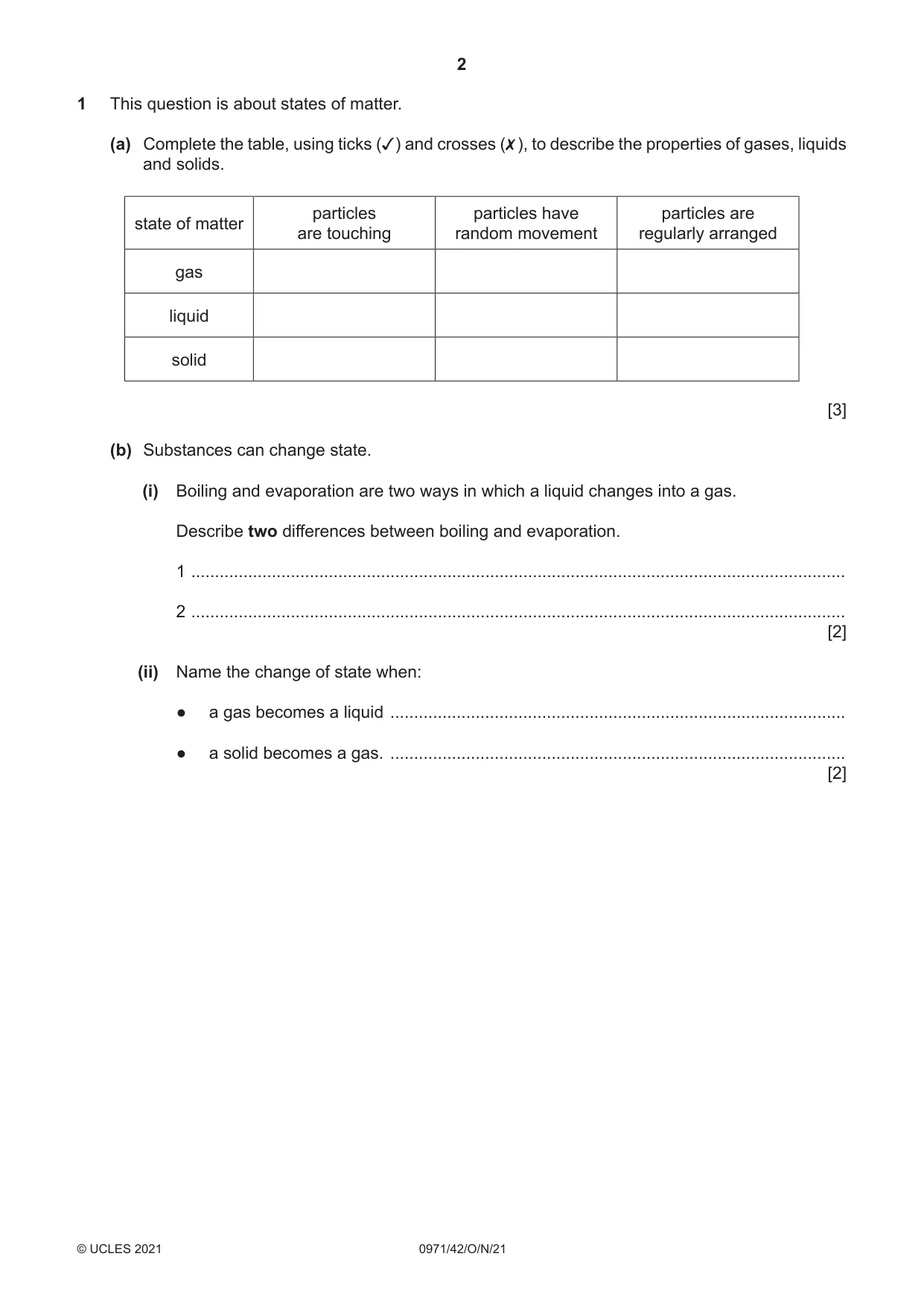
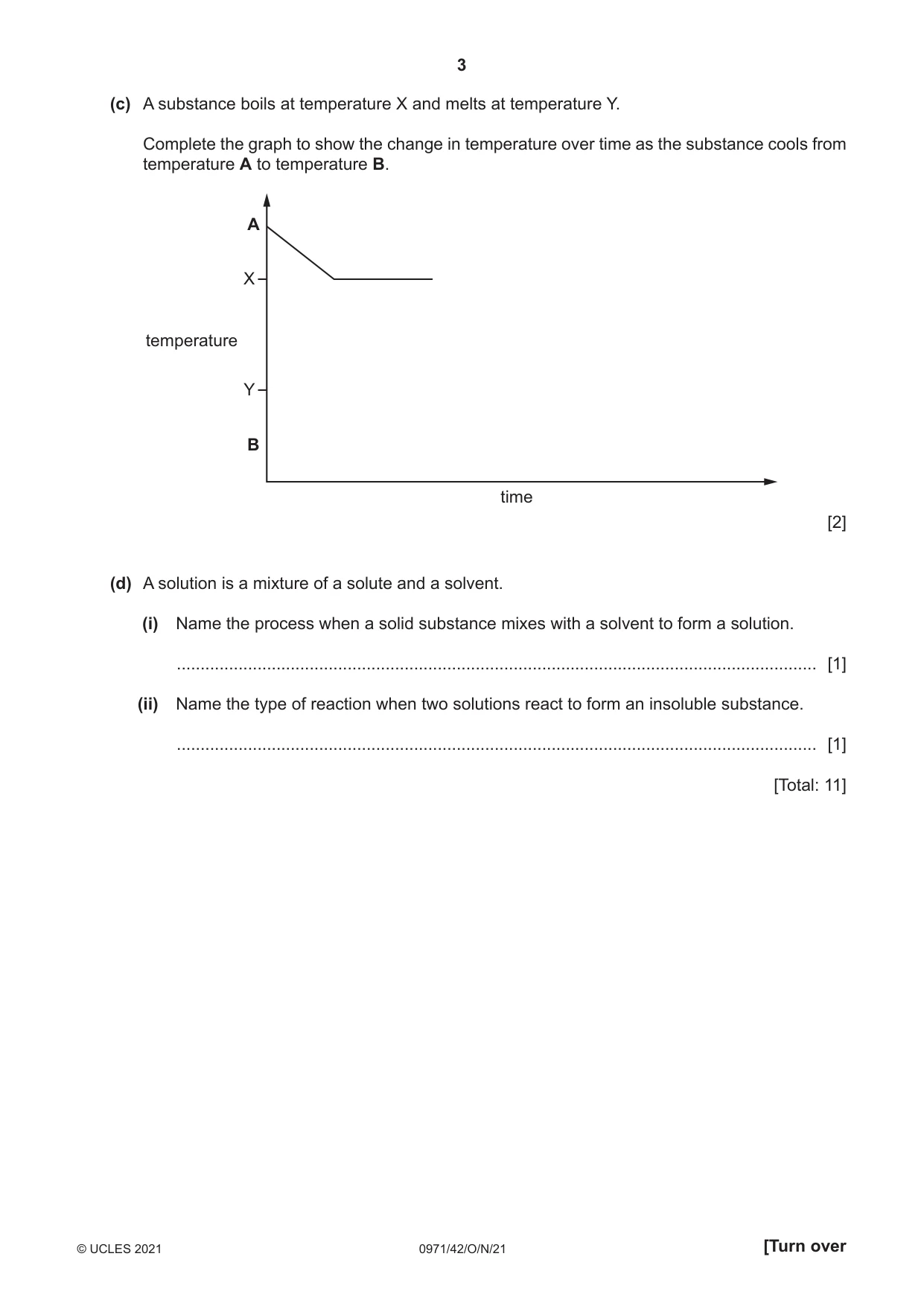
1 This question is about states of matter. (a) Complete the table, using ticks ( ) and crosses ( ), to describe the properties of gases, liquids and solids. particles particles have particles are state of matter are touching random movement regularly arranged gas liquid solid [3] (b) Substances can change state. (i) Boiling and evaporation are two ways in which a liquid changes into a gas. Describe two differences between boiling and evaporation. 1 .......................................................................................................................................... 2 .......................................................................................................................................... [2] (ii) Name the change of state when: ● a gas becomes a liquid ................................................................................................. ● a solid becomes a gas. ................................................................................................. [2] (c) A substance boils at temperature X and melts at temperature Y. Complete the graph to show the change in temperature over time as the substance cools from temperature A to temperature B. A X temperature Y B time [2] (d) A solution is a mixture of a solute and a solvent. (i) Name the process when a solid substance mixes with a solvent to form a solution. ....................................................................................................................................... [1] (ii) Name the type of reaction when two solutions react to form an insoluble substance. ....................................................................................................................................... [1] [Total: 11]
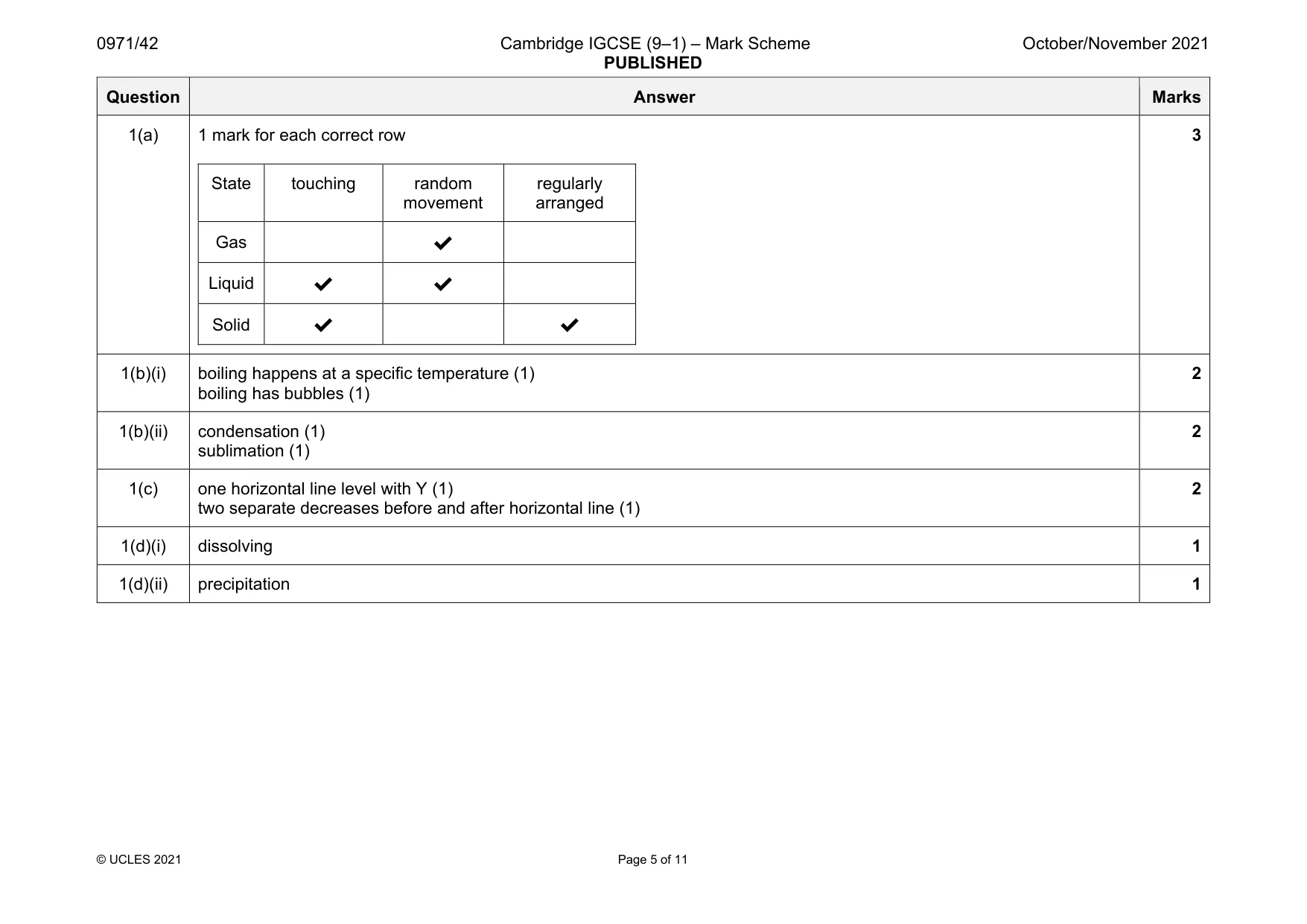
Mark scheme: 1(a) 1 mark for each correct row State touching random movement regularly arranged Gas ✔ Liquid ✔ ✔ Solid ✔ ✔ 3 1(b)(i) boiling happens at a specific temperature (1) boiling has bubbles (1) 2 1(b)(ii) condensation (1) sublimation (1) 2 1(c) one horizontal line level with Y (1) two separate decreases before and after horizontal line (1) 2 1(d)(i) dissolving 1 1(d)(ii) precipitation 1
Q2 · Acids are important laboratory chemicals
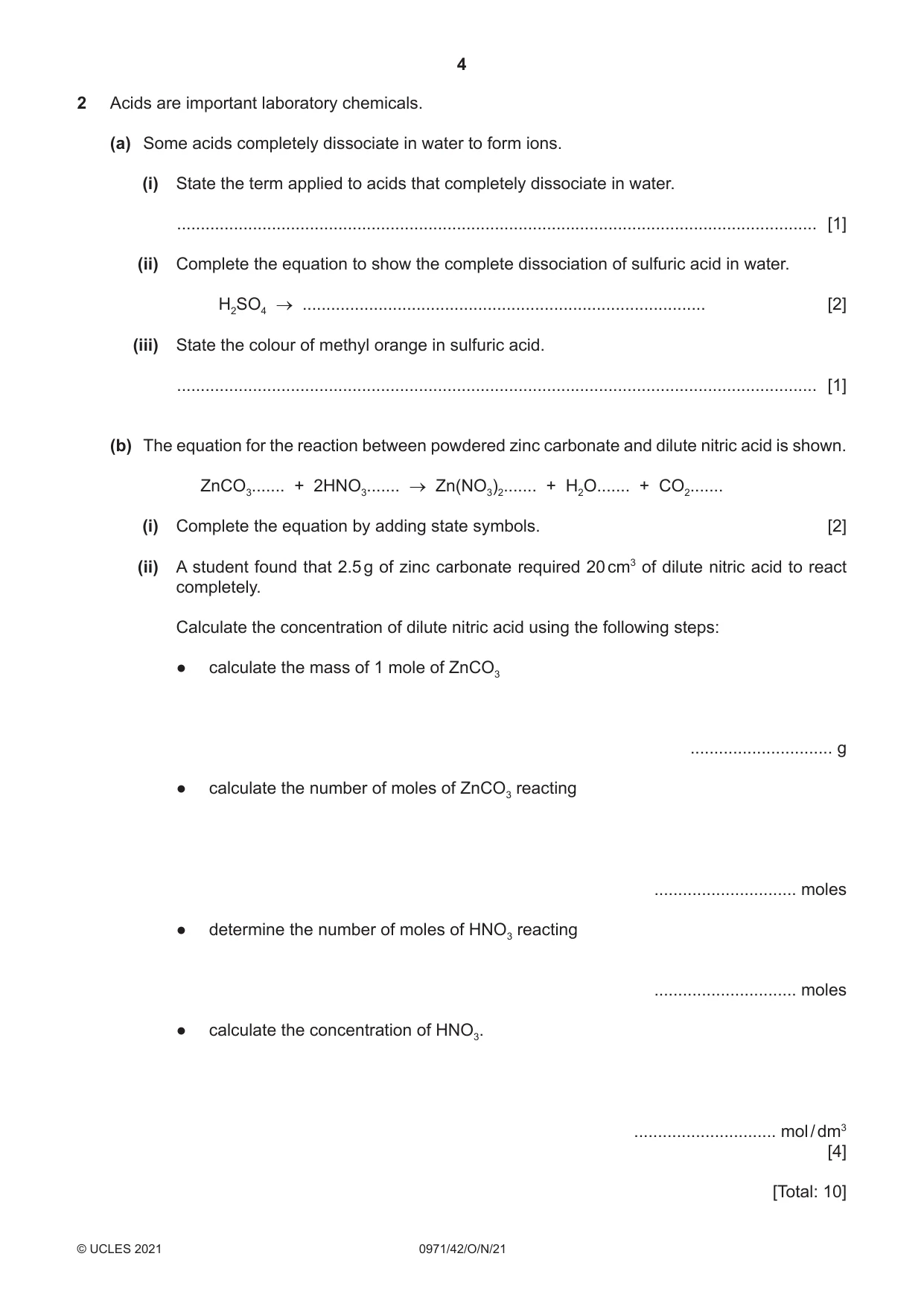
2 Acids are important laboratory chemicals. (a) Some acids completely dissociate in water to form ions. (i) State the term applied to acids that completely dissociate in water. ....................................................................................................................................... [1] (ii) Complete the equation to show the complete dissociation of sulfuric acid in water. H2SO4 → ..................................................................................... [2] (iii) State the colour of methyl orange in sulfuric acid. ....................................................................................................................................... [1] (b) The equation for the reaction between powdered zinc carbonate and dilute nitric acid is shown. ZnCO3....... + 2HNO3....... → Zn(NO3)2....... + H2O....... + CO2....... (i) Complete the equation by adding state symbols. [2] (ii) A student found that 2.5 g of zinc carbonate required 20 cm3 of dilute nitric acid to react completely. Calculate the concentration of dilute nitric acid using the following steps: ● calculate the mass of 1 mole of ZnCO3 .............................. g ● calculate the number of moles of ZnCO3 reacting .............................. moles ● determine the number of moles of HNO3 reacting .............................. moles ● calculate the concentration of HNO3. .............................. mol / dm3 [4] [Total: 10]
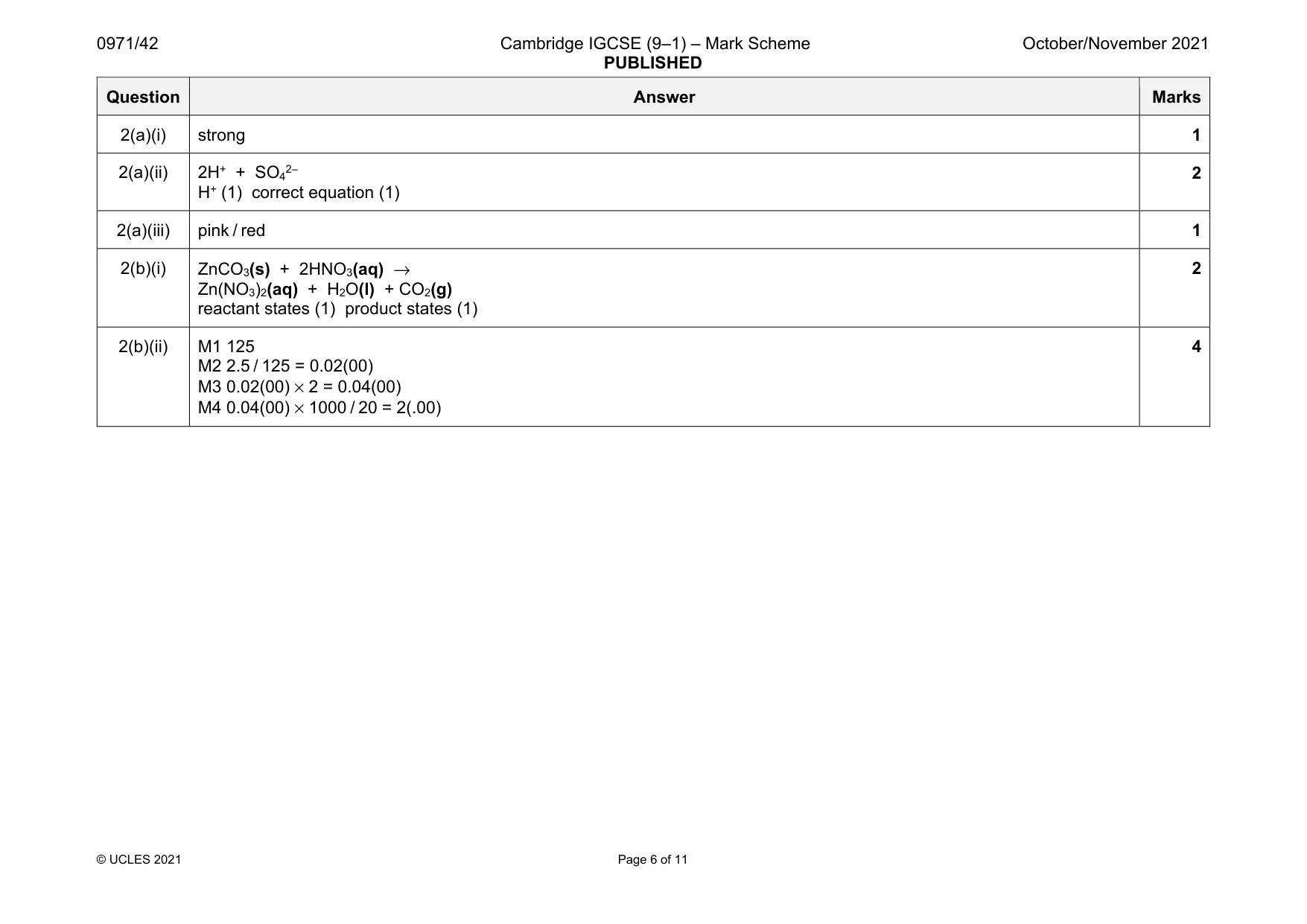
Mark scheme: 2(a)(i) strong 1 2(a)(ii) 2H+ + SO42– H+ (1) correct equation (1) 2 2(a)(iii) pink / red 1 2(b)(i) ZnCO3(s) + 2HNO3(aq) → Zn(NO3)2(aq) + H2O(l) + CO2(g) reactant states (1) product states (1) 2 2(b)(ii) M1 125 M2 2.5 / 125 = 0.02(00) M3 0.02(00) × 2 = 0.04(00) M4 0.04(00) × 1000 / 20 = 2(.00) 4
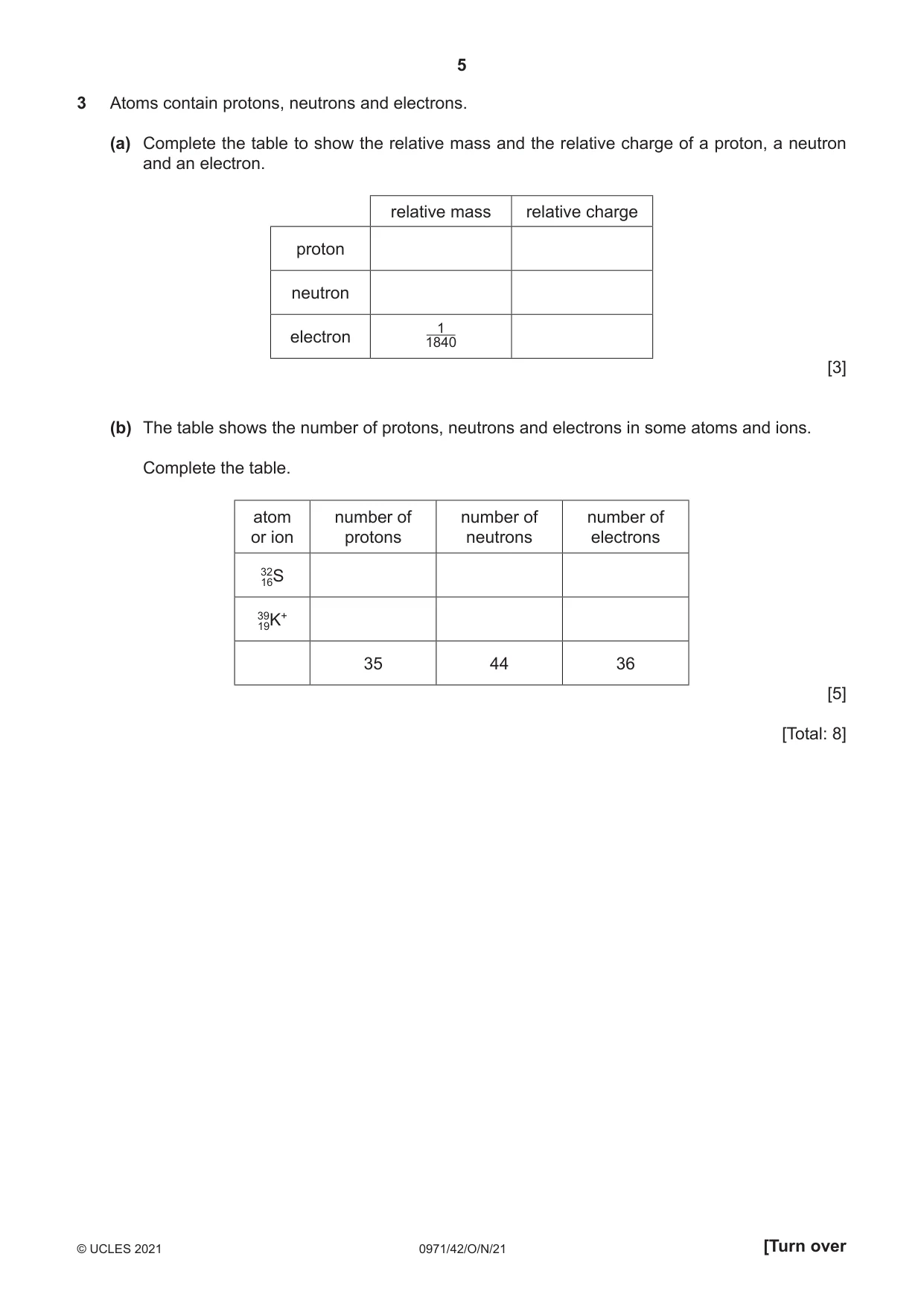
Q3 · Atoms contain protons, neutrons and electrons
3 Atoms contain protons, neutrons and electrons. (a) Complete the table to show the relative mass and the relative charge of a proton, a neutron and an electron. relative mass relative charge proton neutron 1 electron 1840 [3] (b) The table shows the number of protons, neutrons and electrons in some atoms and ions. Complete the table. atom number of number of number of or ion protons neutrons electrons 32S16 39K+19 35 44 36 [5] [Total: 8]
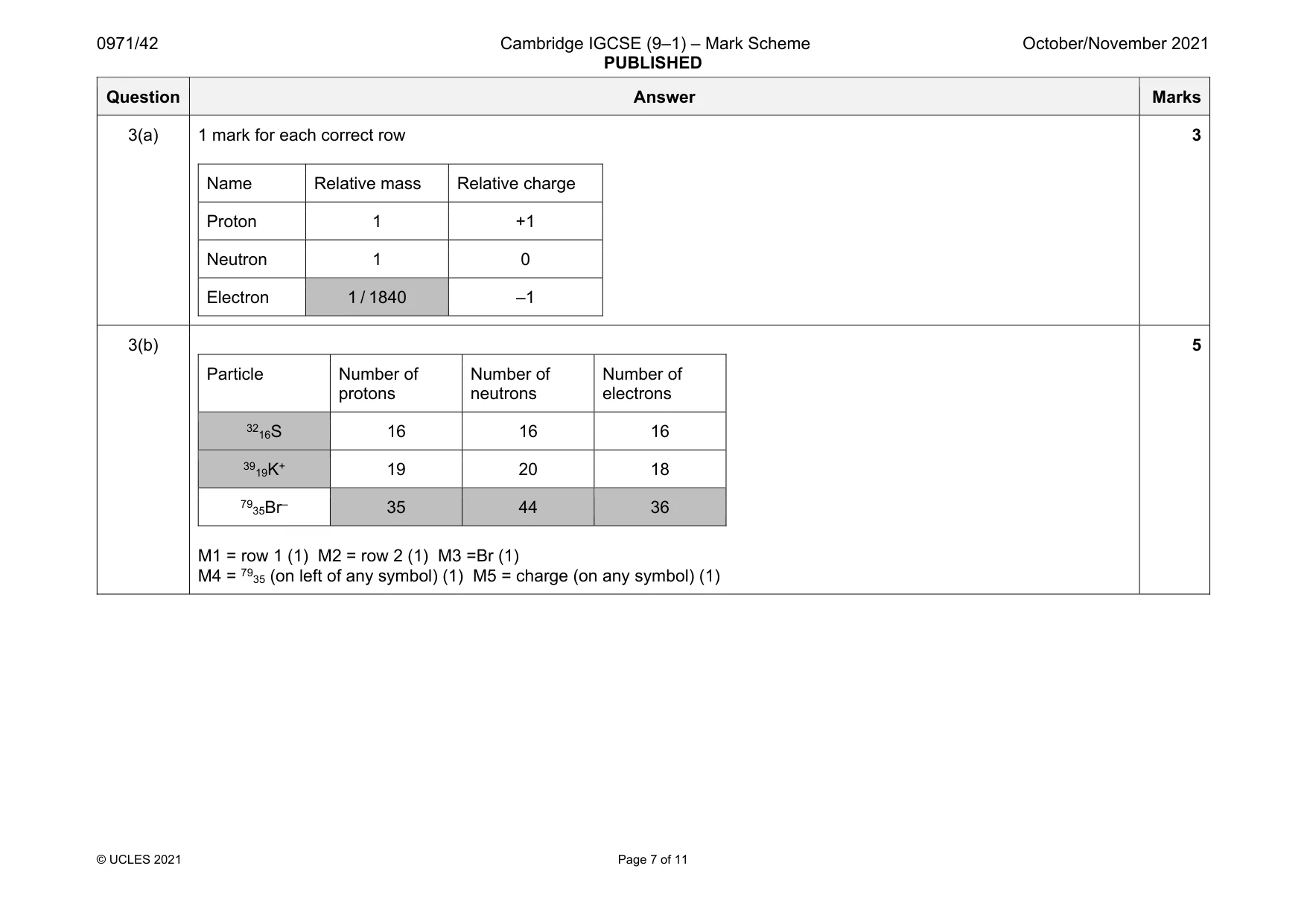
Mark scheme: 3(a) 1 mark for each correct row Name Relative mass Relative charge Proton 1 +1 Neutron 1 0 Electron 1 / 1840 –1 3 3(b) Particle Number of protons Number of neutrons Number of electrons 3216S 16 16 16 3919K+ 19 20 18 7935Br– 35 44 36 M1 = row 1 (1) M2 = row 2 (1) M3 =Br (1) M4 = 7935 (on left of any symbol) (1) M5 = charge (on any symbol) (1) 5
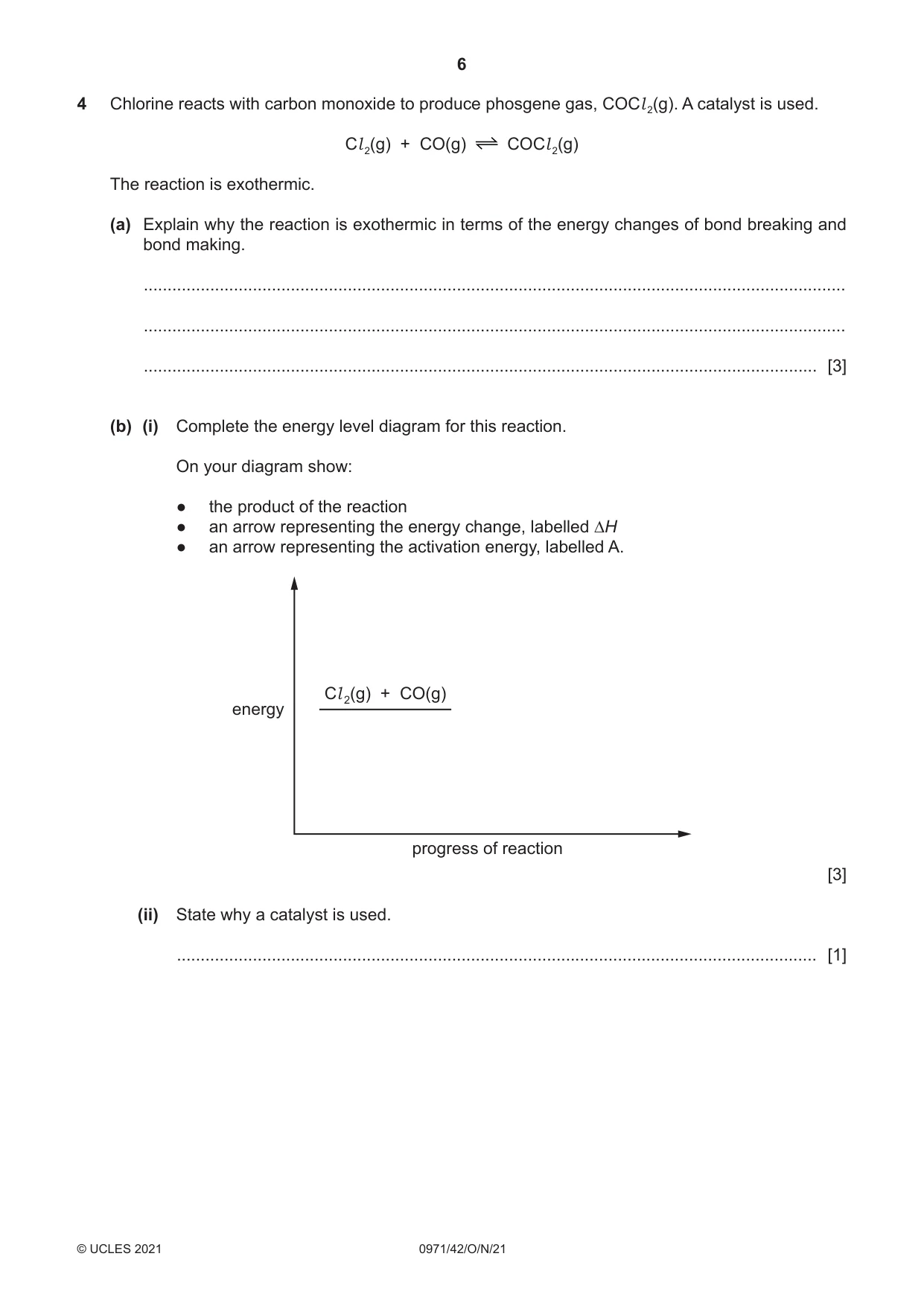
Q4 · Chlorine reacts with carbon monoxide to produce phosgene gas, COCl 2(g)
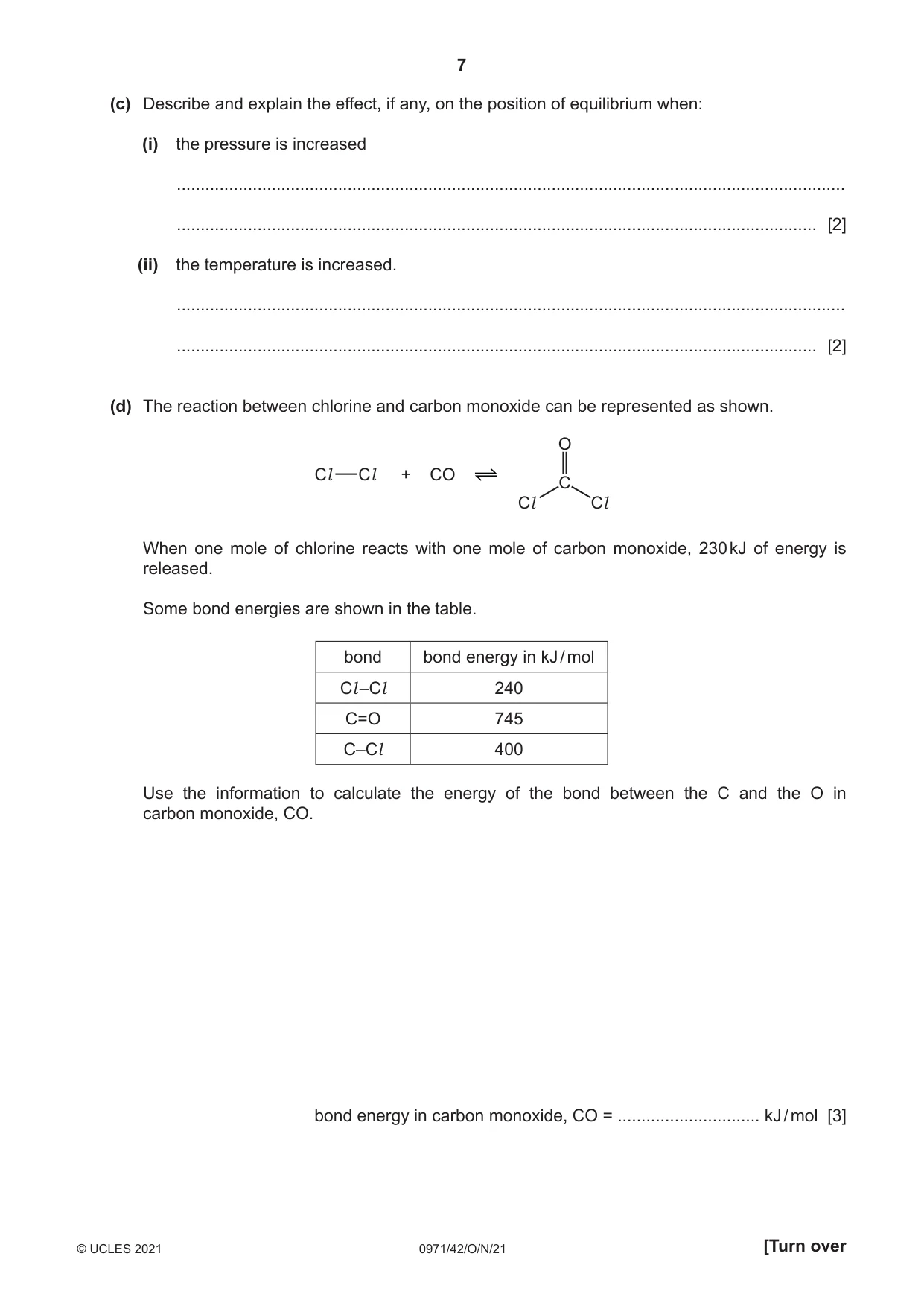
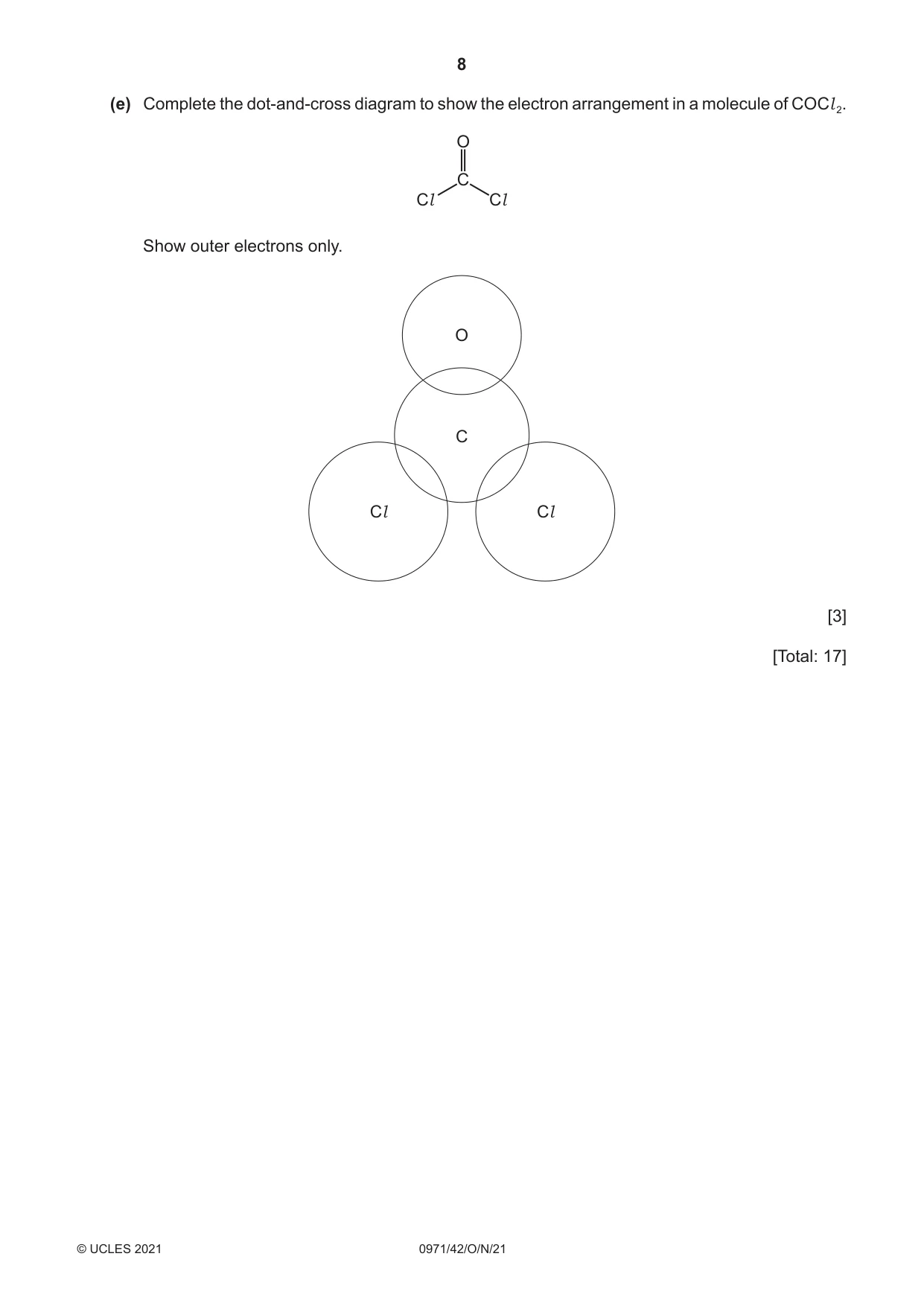
4 Chlorine reacts with carbon monoxide to produce phosgene gas, COCl 2(g). A catalyst is used. Cl 2(g) + CO(g) COCl 2(g) The reaction is exothermic. (a) Explain why the reaction is exothermic in terms of the energy changes of bond breaking and bond making. .................................................................................................................................................... .................................................................................................................................................... .............................................................................................................................................. [3] (b) (i) Complete the energy level diagram for this reaction. On your diagram show: ● the product of the reaction ● an arrow representing the energy change, labelled ∆H ● an arrow representing the activation energy, labelled A. Cl 2(g) + CO(g) energy progress of reaction [3] (ii) State why a catalyst is used. ....................................................................................................................................... [1] (c) Describe and explain the effect, if any, on the position of equilibrium when: (i) the pressure is increased ............................................................................................................................................. ....................................................................................................................................... [2] (ii) the temperature is increased. ............................................................................................................................................. ....................................................................................................................................... [2] (d) The reaction between chlorine and carbon monoxide can be represented as shown. O Cl Cl + CO C Cl Cl When one mole of chlorine reacts with one mole of carbon monoxide, 230 kJ of energy is released. Some bond energies are shown in the table. bond bond energy in kJ / mol Cl –Cl 240 C=O 745 C–Cl 400 Use the information to calculate the energy of the bond between the C and the O in carbon monoxide, CO. bond energy in carbon monoxide, CO = .............................. kJ / mol [3] (e) Complete the dot-and-cross diagram to show the electron arrangement in a molecule of COCl 2. O C Cl Cl Show outer electrons only. O C Cl Cl [3] [Total: 17]
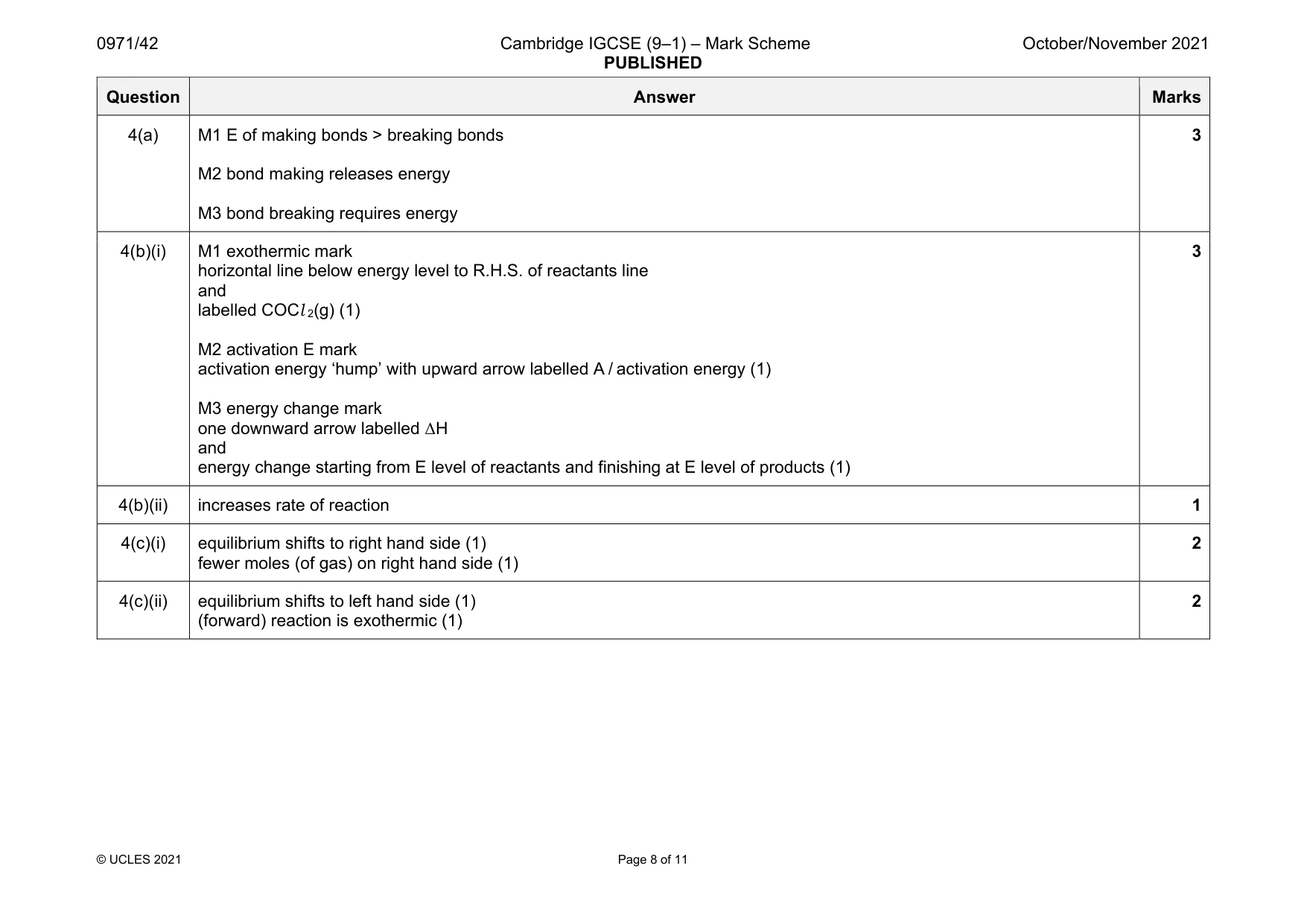
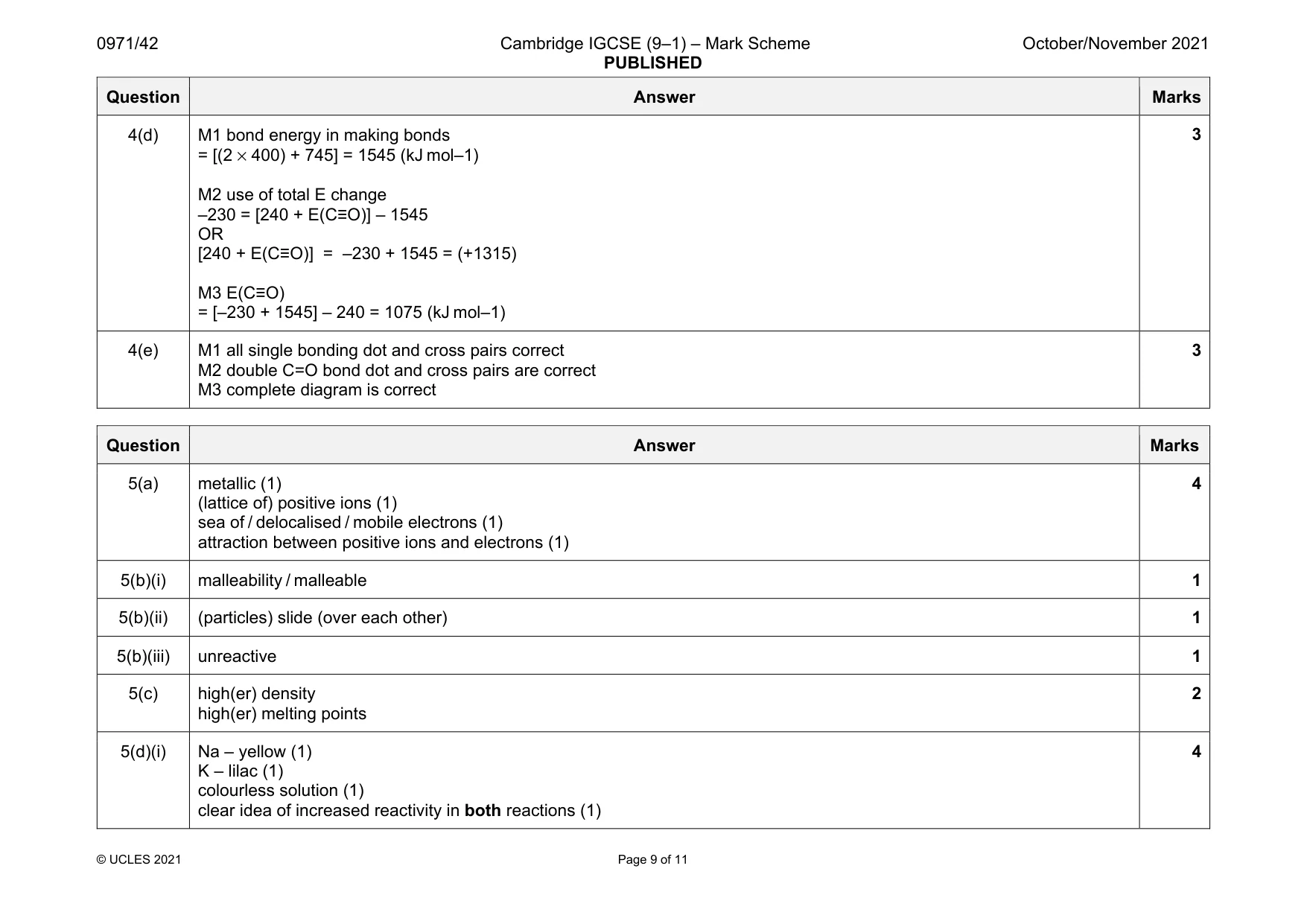
Mark scheme: 4(a) M1 E of making bonds > breaking bonds M2 bond making releases energy M3 bond breaking requires energy 3 4(b)(i) M1 exothermic mark horizontal line below energy level to R.H.S. of reactants line and labelled COCl 2(g) (1) M2 activation E mark activation energy ‘hump’ with upward arrow labelled A / activation energy (1) M3 energy change mark one downward arrow labelled ΔH and energy change starting from E level of reactants and finishing at E level of products (1) 3 4(b)(ii) increases rate of reaction 1 4(c)(i) equilibrium shifts to right hand side (1) fewer moles (of gas) on right hand side (1) 2 4(c)(ii) equilibrium shifts to left hand side (1) (forward) reaction is exothermic (1) 2 Question Answer Marks 4(d) M1 bond energy in making bonds = [(2 × 400) + 745] = 1545 (kJ mol–1) M2 use of total E change –230 = [240 + E(C≡O)] – 1545 OR [240 + E(C≡O)] = –230 + 1545 = (+1315) M3 E(C≡O) = [–230 + 1545] – 240 = 1075 (kJ mol–1) 3 4(e) M1 all single bonding dot and cross pairs correct M2 double C=O bond dot and cross pairs are correct M3 complete diagram is correct 3
Q5 · Iron is a transition element
5 Iron is a transition element. Potassium is a Group I element. (a) Iron and potassium have the same type of bonding. Name and describe the type of bonding in these two elements. name .......................................................................................................................................... description .................................................................................................................................. .................................................................................................................................................... .................................................................................................................................................... .................................................................................................................................................... [4] (b) Transition elements and Group I elements have some similar physical properties. They can both: ● be hammered into a shape ● conduct electricity ● be stretched into wires. (i) Name the term used to describe the ability of elements to be hammered into a shape. ....................................................................................................................................... [1] (ii) Describe what happens to the particles in iron when it is hammered into a shape. ............................................................................................................................................. ....................................................................................................................................... [1] (iii) Suggest why copper, rather than other transition elements, is used for wires which conduct electricity. ....................................................................................................................................... [1] (c) Transition elements are harder and stronger than Group I elements. Describe how two other physical properties of transition elements are different from those of Group I elements. 1 ................................................................................................................................................. 2 ................................................................................................................................................. [2] (d) Chemical properties of some Group I elements are shown in the table. flame test element reaction with cold water reaction with oxygen colour ● steadily effervesces lithium very slowly forms an oxide layer red ● forms a colourless solution ● strongly effervesces sodium slowly forms an oxide layer ● forms a colourless solution ● very strongly effervescespotassium quickly forms an oxide layer ● forms a colourless solution rubidium ruby red (i) Add to the table: ● the flame test colours for sodium and potassium ● the predicted reactions of rubidium with water and with oxygen. [4] (ii) Name the gas produced when Group I elements react with water. ....................................................................................................................................... [1] (iii) Name the solution formed when potassium reacts with water. ....................................................................................................................................... [1] (iv) Predict the pH of the colourless solution formed when potassium reacts with water. ....................................................................................................................................... [1] (v) Write the chemical equation for the reaction of sodium with oxygen. ....................................................................................................................................... [2] (e) Iron is a typical transition element. It is the catalyst used in the Haber process. (i) Write the equation for the reaction that occurs in the Haber process. ....................................................................................................................................... [2] (ii) State the temperature and pressure used in the Haber process. Include units. temperature ......................................................................................................................... pressure .............................................................................................................................. [2] [Total: 22]
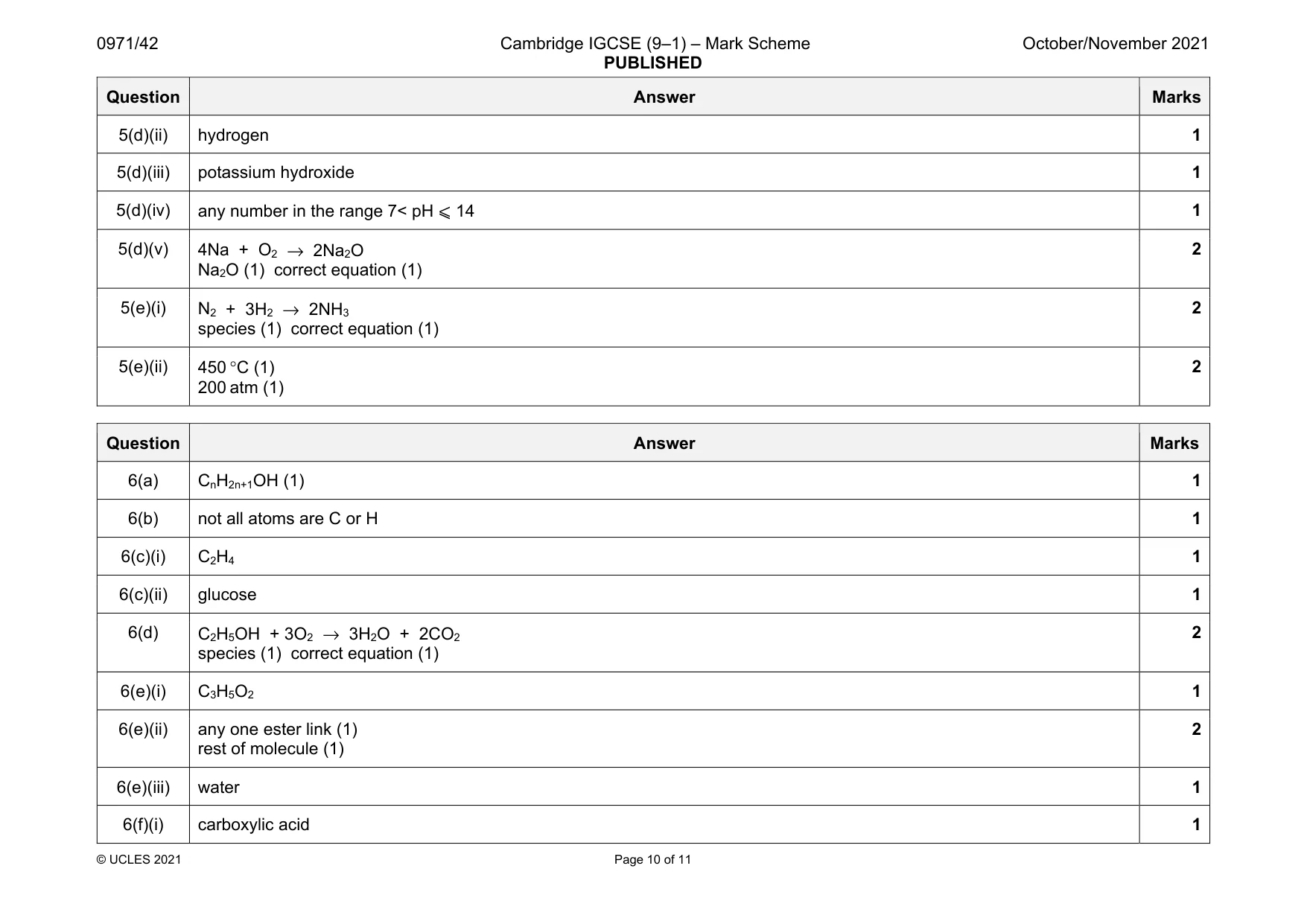
Mark scheme: 5(a) metallic (1) (lattice of) positive ions (1) sea of / delocalised / mobile electrons (1) attraction between positive ions and electrons (1) 5(b)(i) malleability / malleable 1 5(b)(ii) (particles) slide (over each other) 1 5(b)(iii) unreactive 1 5(c) high(er) density high(er) melting points 2 5(d)(i) Na – yellow (1) K – lilac (1) colourless solution (1) clear idea of increased reactivity in both reactions (1) 4 Question Answer Marks 5(d)(ii) hydrogen 1 5(d)(iii) potassium hydroxide 1 5(d)(iv) any number in the range 7< pH ⩽ 14 1 5(d)(v) 4Na + O2 → 2Na2O Na2O (1) correct equation (1) 2 5(e)(i) N2 + 3H2 → 2NH3 species (1) correct equation (1) 2 5(e)(ii) 450 °C (1) 200 atm (1) 2
Q6 · Ethanol, C2H5OH, belongs to the homologous series called alcohols
6 Ethanol, C2H5OH, belongs to the homologous series called alcohols. (a) Write the general formula of alcohols. .............................................................................................................................................. [1] (b) Explain why ethanol cannot be described as a hydrocarbon. .............................................................................................................................................. [1] (c) Ethanol can be manufactured from different substances by reaction with steam or by fermentation. (i) Give the formula of the substance which reacts with steam to form ethanol. ....................................................................................................................................... [1] (ii) Name a substance which will undergo fermentation to form ethanol. ....................................................................................................................................... [1] (d) Ethanol is a fuel. Write the chemical equation for the complete combustion of ethanol. .............................................................................................................................................. [2] (e) Ethane-1,2-diol has two alcohol functional groups. H H H O C C O H H H One molecule of ethane-1,2-diol will react with two molecules of ethanoic acid to form molecule X. X has two ester functional groups and a molecular formula of C6H10O4. (i) State the empirical formula of X. ....................................................................................................................................... [1] (ii) Draw the structure of X. Show all of the atoms and all of the bonds. [2] (iii) Name the other substance formed in this reaction. ....................................................................................................................................... [1] (f) Each alcohol functional group in ethane-1,2-diol reacts with acidified potassium manganate(VII) to form a different organic compound, Y. (i) Name the functional groups formed in Y. ....................................................................................................................................... [1] (ii) Draw the structure of Y. Show all of the atoms and all of the bonds. [1] [Total: 12]
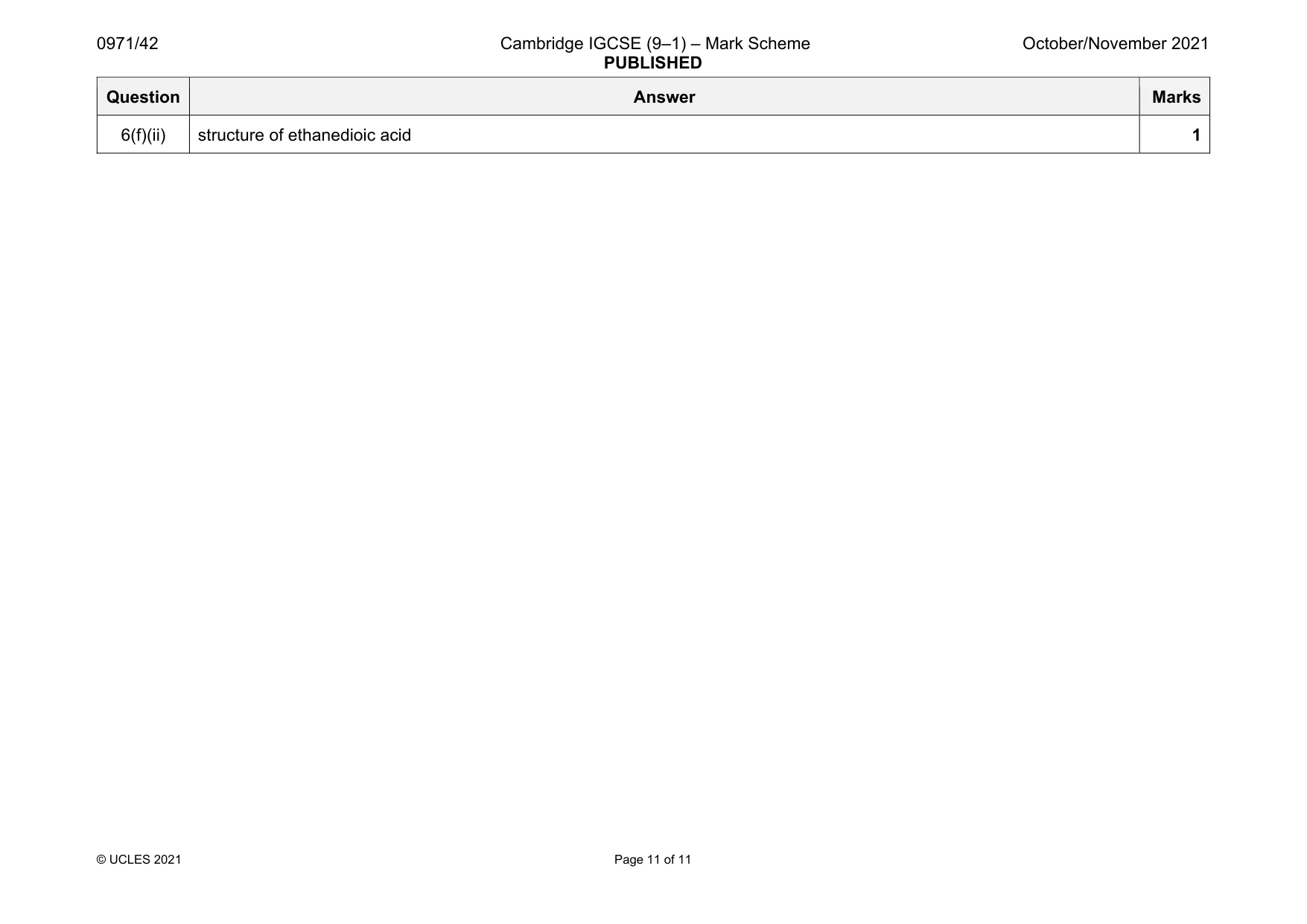
Mark scheme: 6(a) CnH2n+1OH (1) 1 6(b) not all atoms are C or H 1 6(c)(i) C2H4 1 6(c)(ii) glucose 1 6(d) C2H5OH + 3O2 → 3H2O + 2CO2 species (1) correct equation (1) 2 6(e)(i) C3H5O2 1 6(e)(ii) any one ester link (1) rest of molecule (1) 2 6(e)(iii) water 1 6(f)(i) carboxylic acid 1 Question Answer Marks 6(f)(ii) structure of ethanedioic acid 1
What was in this paper
The subtopics covered by these 6 questions, and how many questions each got. Open one in a new tab to see every Cambridge question on it.
What you needed in this session
Cambridge’s own grade thresholds for 2021 Oct/Nov, Paper 4 · Variant 2. A higher threshold means an easier paper — the bar moves with how the cohort did.