Cambridge IGCSE Chemistry (9-1) 0971 — 2020 Oct/Nov Paper 4 · Variant 2
0971/42/O/N/20 · 5 questions · 80 marks · ≈90 min
The question paper and its mark scheme, free to read here and free to download. This is Cambridge’s own paper, exactly as it was sat.
Question paper12 pages
Mark scheme9 pages
Answers below. Sit the paper first if you are practising.
Questions as text
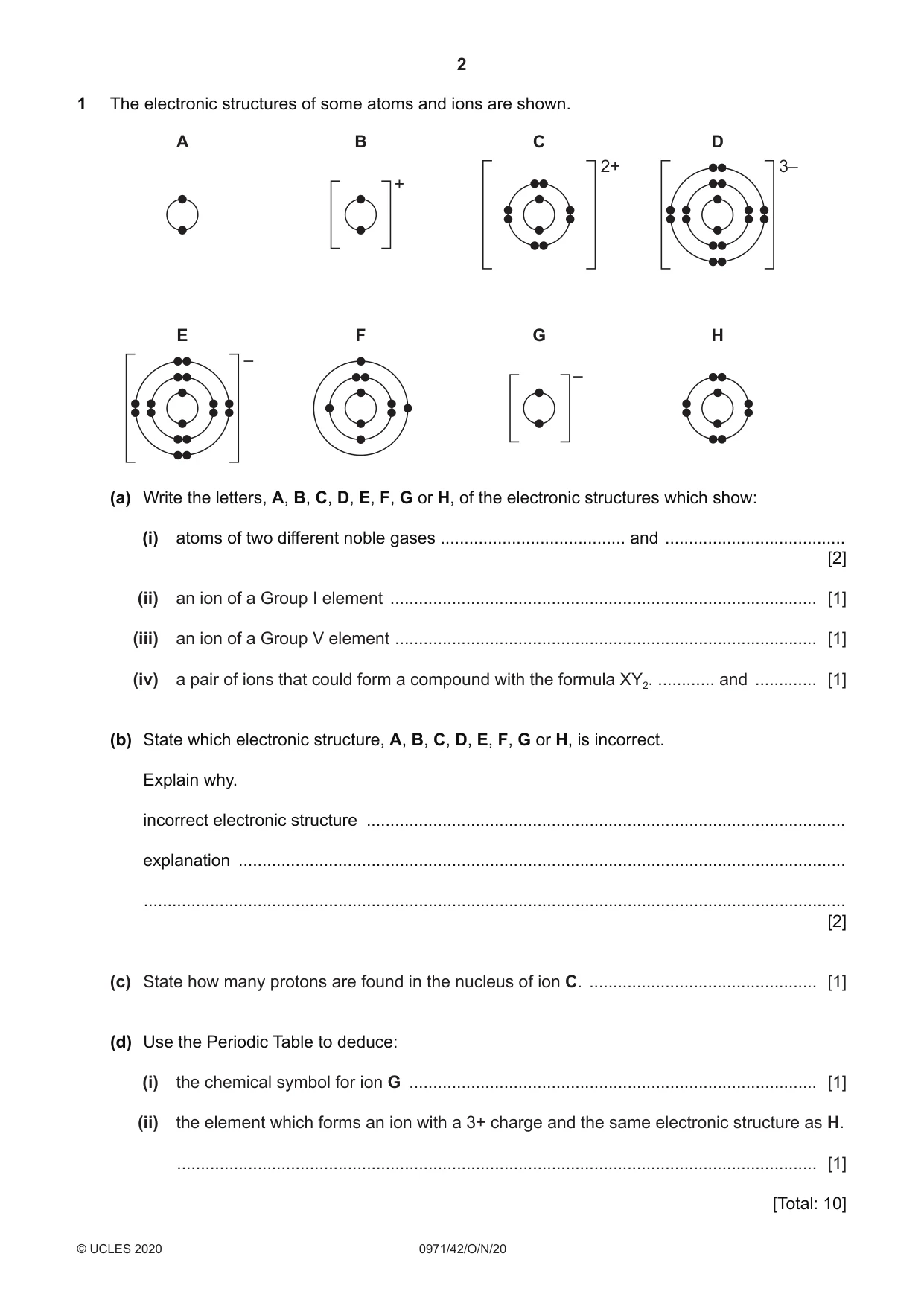
Q1 · The electronic structures of some atoms and ions are shown
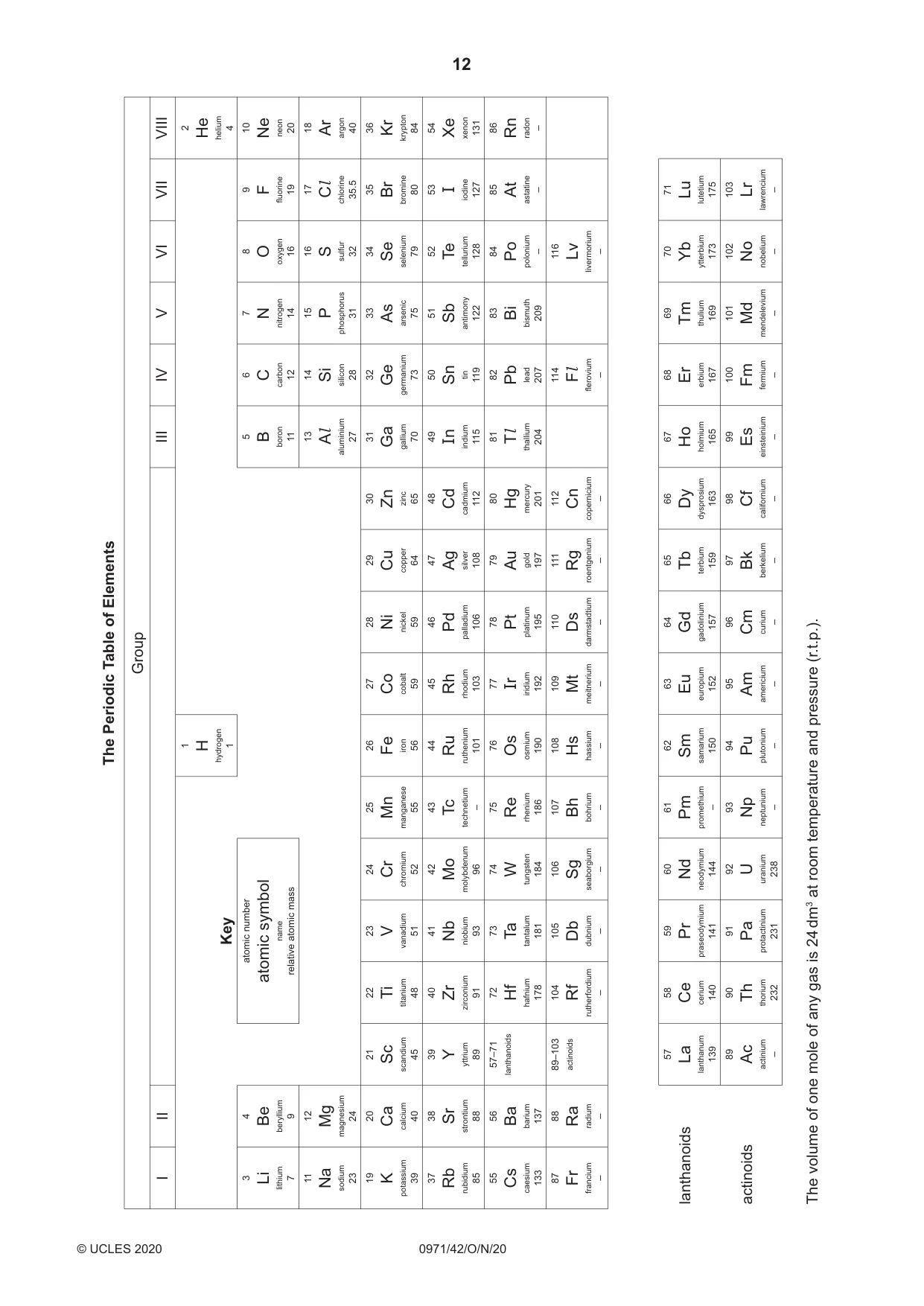
1 The electronic structures of some atoms and ions are shown. A B C D 2+ 3– + E F G H – – (a) Write the letters, A, B, C, D, E, F, G or H, of the electronic structures which show: (i) atoms of two different noble gases ....................................... and �������������������������������������� [2] (ii) an ion of a Group I element ........................................................................................... [1] (iii) an ion of a Group V element ......................................................................................... [1] (iv) a pair of ions that could form a compound with the formula XY2. ............ and .............. [1] (b) State which electronic structure, A, B, C, D, E, F, G or H, is incorrect. Explain why. incorrect electronic structure ����������������������������������������������������������������������������������������������������� explanation ................................................................................................................................. .................................................................................................................................................... [2] (c) State how many protons are found in the nucleus of ion C. ................................................. [1] (d) Use the Periodic Table to deduce: (i) the chemical symbol for ion G ....................................................................................... [1] (ii) the element which forms an ion with a 3+ charge and the same electronic structure as H. ....................................................................................................................................... [1] [Total: 10]
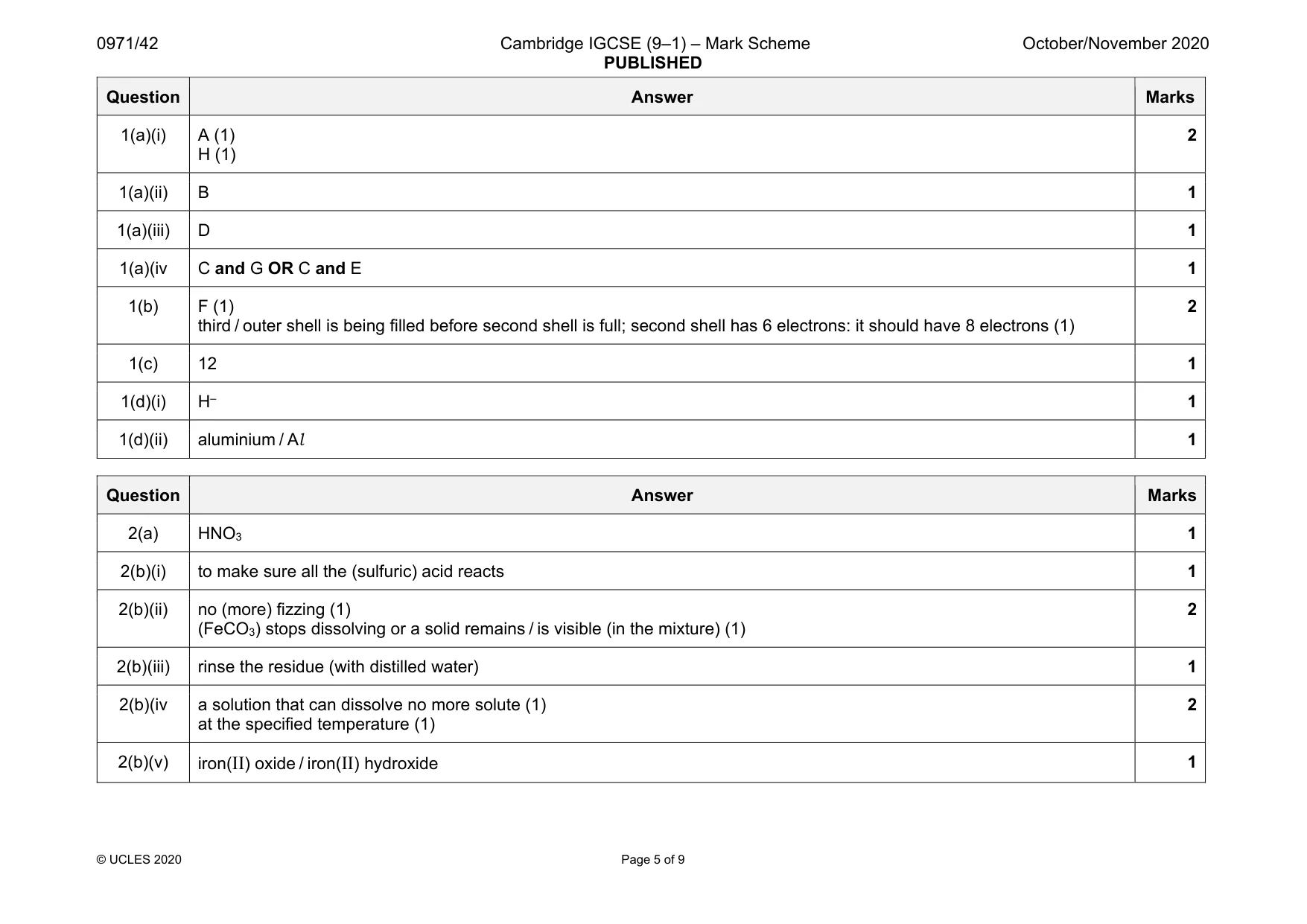
Mark scheme: 1(a)(i) A (1) H (1) 2 1(a)(ii) B 1 1(a)(iii) D 1 1(a)(iv C and G OR C and E 1 1(b) F (1) third / outer shell is being filled before second shell is full; second shell has 6 electrons: it should have 8 electrons (1) 2 1(c) 12 1 1(d)(i) H– 1 1(d)(ii) aluminium / Al 1
Q2 · Soluble salts can be made by adding a metal carbonate to a dilute acid
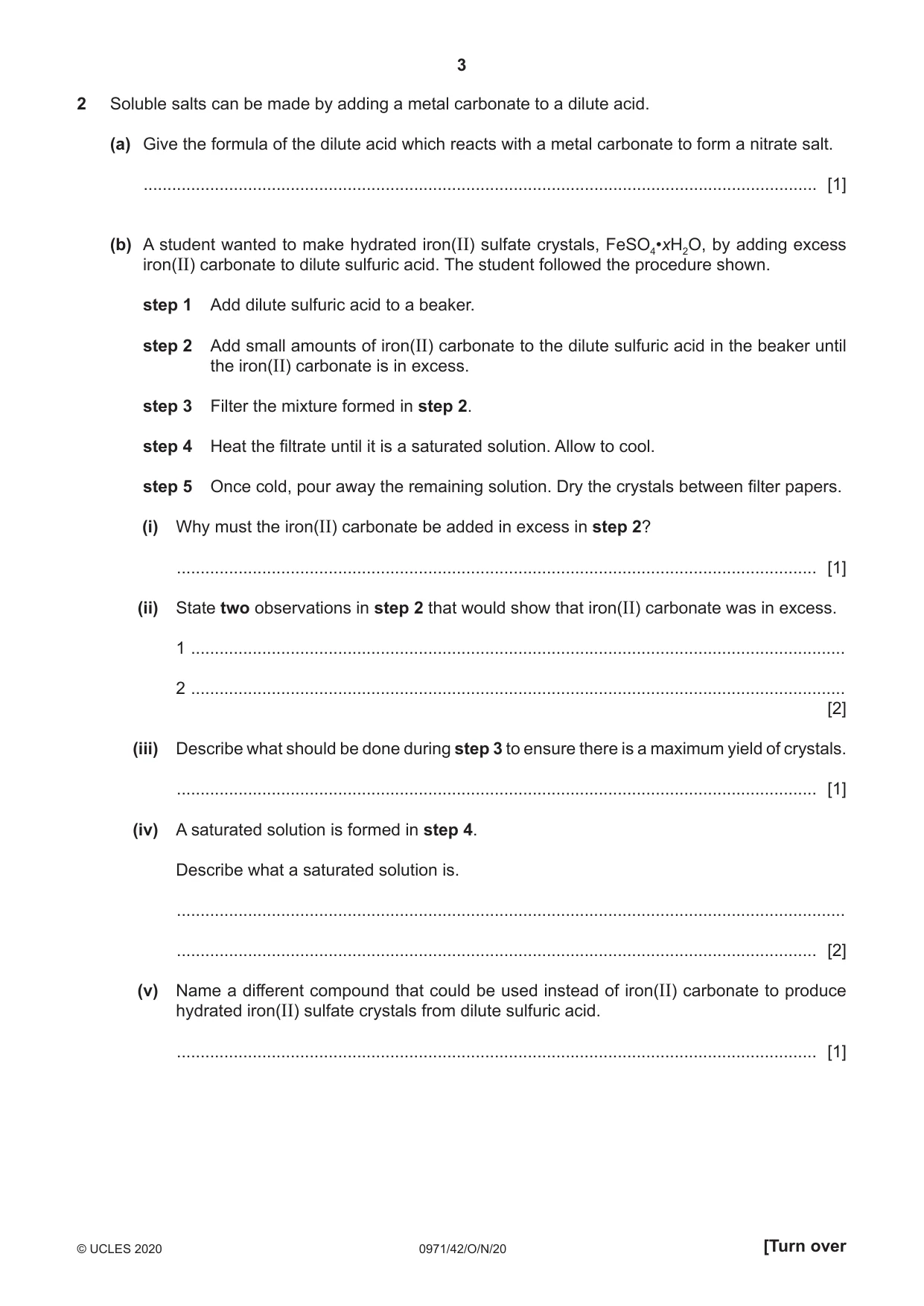
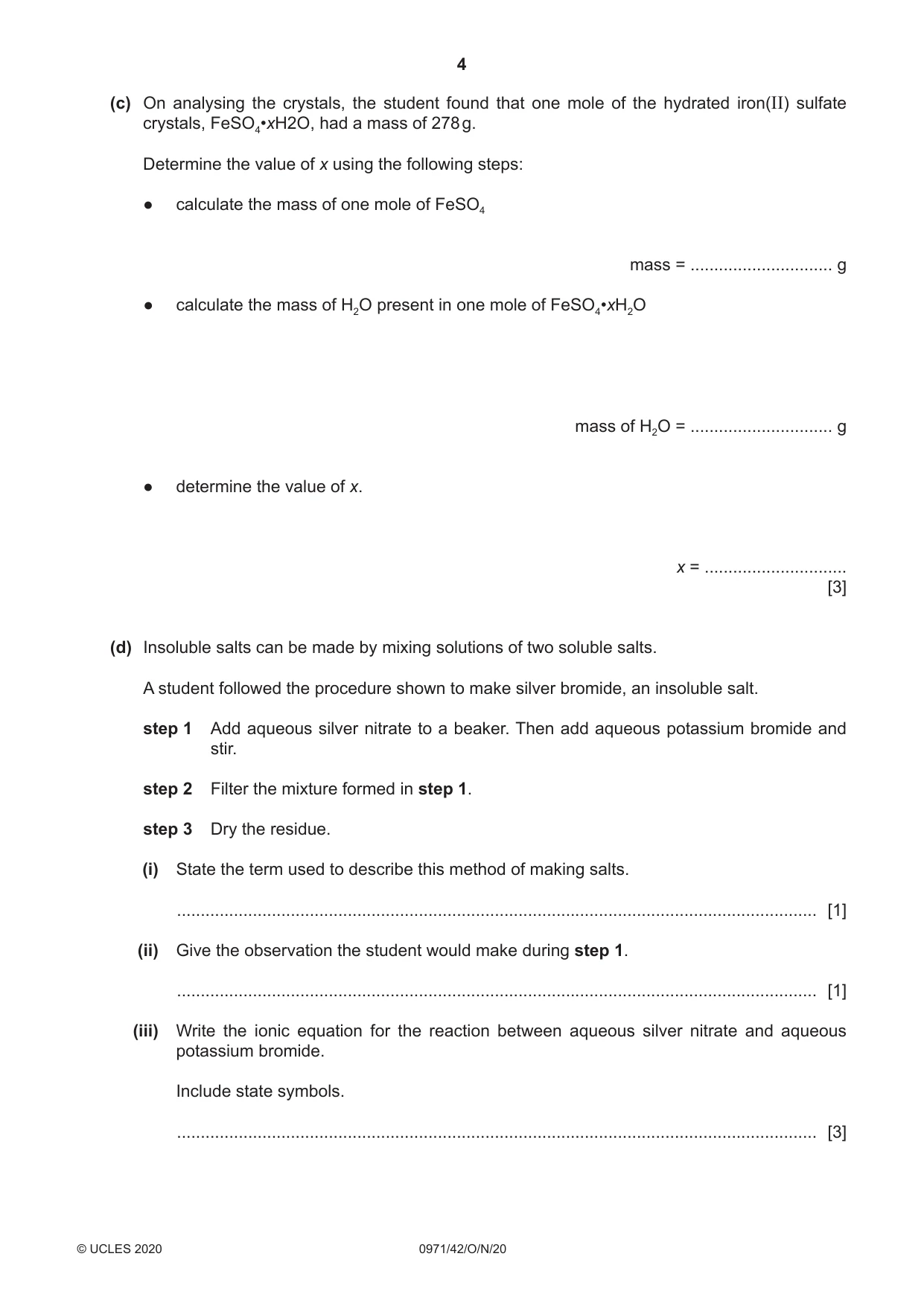
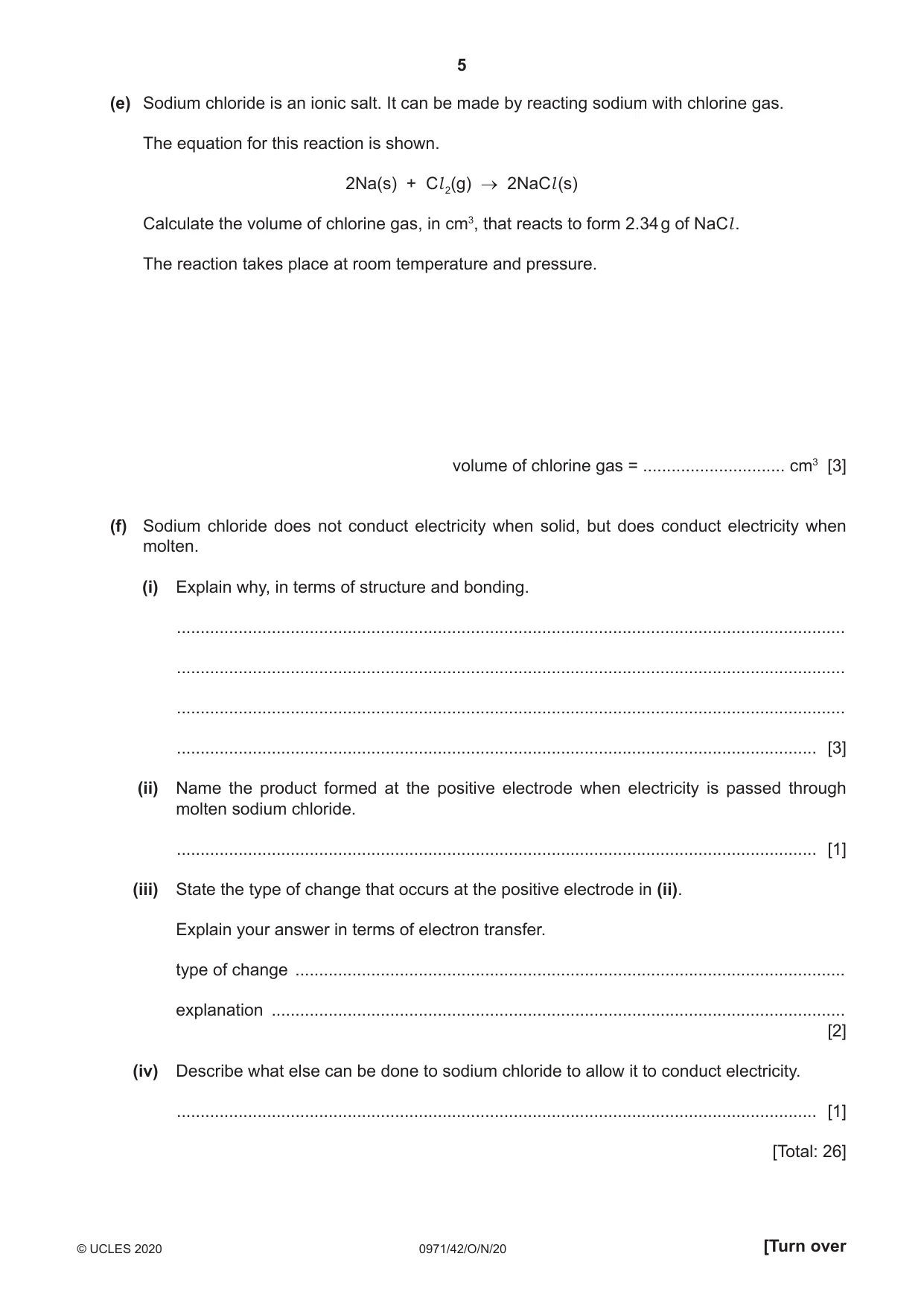
2 Soluble salts can be made by adding a metal carbonate to a dilute acid. (a) Give the formula of the dilute acid which reacts with a metal carbonate to form a nitrate salt. .............................................................................................................................................. [1] (b) A student wanted to make hydrated iron(II) sulfate crystals, FeSO4•xH2O, by adding excess iron(II) carbonate to dilute sulfuric acid. The student followed the procedure shown. step 1 Add dilute sulfuric acid to a beaker. step 2 Add small amounts of iron(II) carbonate to the dilute sulfuric acid in the beaker until the iron(II) carbonate is in excess. step 3 Filter the mixture formed in step 2. step 4 Heat the filtrate until it is a saturated solution. Allow to cool. step 5 Once cold, pour away the remaining solution. Dry the crystals between filter papers. (i) Why must the iron(II) carbonate be added in excess in step 2? ....................................................................................................................................... [1] (ii) State two observations in step 2 that would show that iron(II) carbonate was in excess. 1 .......................................................................................................................................... 2 .......................................................................................................................................... [2] (iii) Describe what should be done during step 3 to ensure there is a maximum yield of crystals. ....................................................................................................................................... [1] (iv) A saturated solution is formed in step 4. Describe what a saturated solution is. ............................................................................................................................................. ....................................................................................................................................... [2] (v) Name a different compound that could be used instead of iron(II) carbonate to produce hydrated iron(II) sulfate crystals from dilute sulfuric acid. ....................................................................................................................................... [1] (c) On analysing the crystals, the student found that one mole of the hydrated iron(II) sulfate crystals, FeSO4•xH2O, had a mass of 278 g. Determine the value of x using the following steps: ●● calculate the mass of one mole of FeSO4 mass = .............................. g ●● calculate the mass of H2O present in one mole of FeSO4•xH2O mass of H2O = .............................. g ●● determine the value of x. x = .............................. [3] (d) Insoluble salts can be made by mixing solutions of two soluble salts. A student followed the procedure shown to make silver bromide, an insoluble salt. step 1 Add aqueous silver nitrate to a beaker. Then add aqueous potassium bromide and stir. step 2 Filter the mixture formed in step 1. step 3 Dry the residue. (i) State the term used to describe this method of making salts. ....................................................................................................................................... [1] (ii) Give the observation the student would make during step 1. ....................................................................................................................................... [1] (iii) Write the ionic equation for the reaction between aqueous silver nitrate and aqueous potassium bromide. Include state symbols. ....................................................................................................................................... [3] (e) Sodium chloride is an ionic salt. It can be made by reacting sodium with chlorine gas. The equation for this reaction is shown. 2Na(s) + Cl 2(g) → 2NaCl (s) Calculate the volume of chlorine gas, in cm3, that reacts to form 2.34 g of NaCl . The reaction takes place at room temperature and pressure. volume of chlorine gas = .............................. cm3 [3] (f) Sodium chloride does not conduct electricity when solid, but does conduct electricity when molten. (i) Explain why, in terms of structure and bonding. ............................................................................................................................................. ............................................................................................................................................. ............................................................................................................................................. ....................................................................................................................................... [3] (ii) Name the product formed at the positive electrode when electricity is passed through molten sodium chloride. ....................................................................................................................................... [1] (iii) State the type of change that occurs at the positive electrode in (ii). Explain your answer in terms of electron transfer. type of change ..................................................................................................................... explanation .......................................................................................................................... [2] (iv) Describe what else can be done to sodium chloride to allow it to conduct electricity. ....................................................................................................................................... [1] [Total: 26]
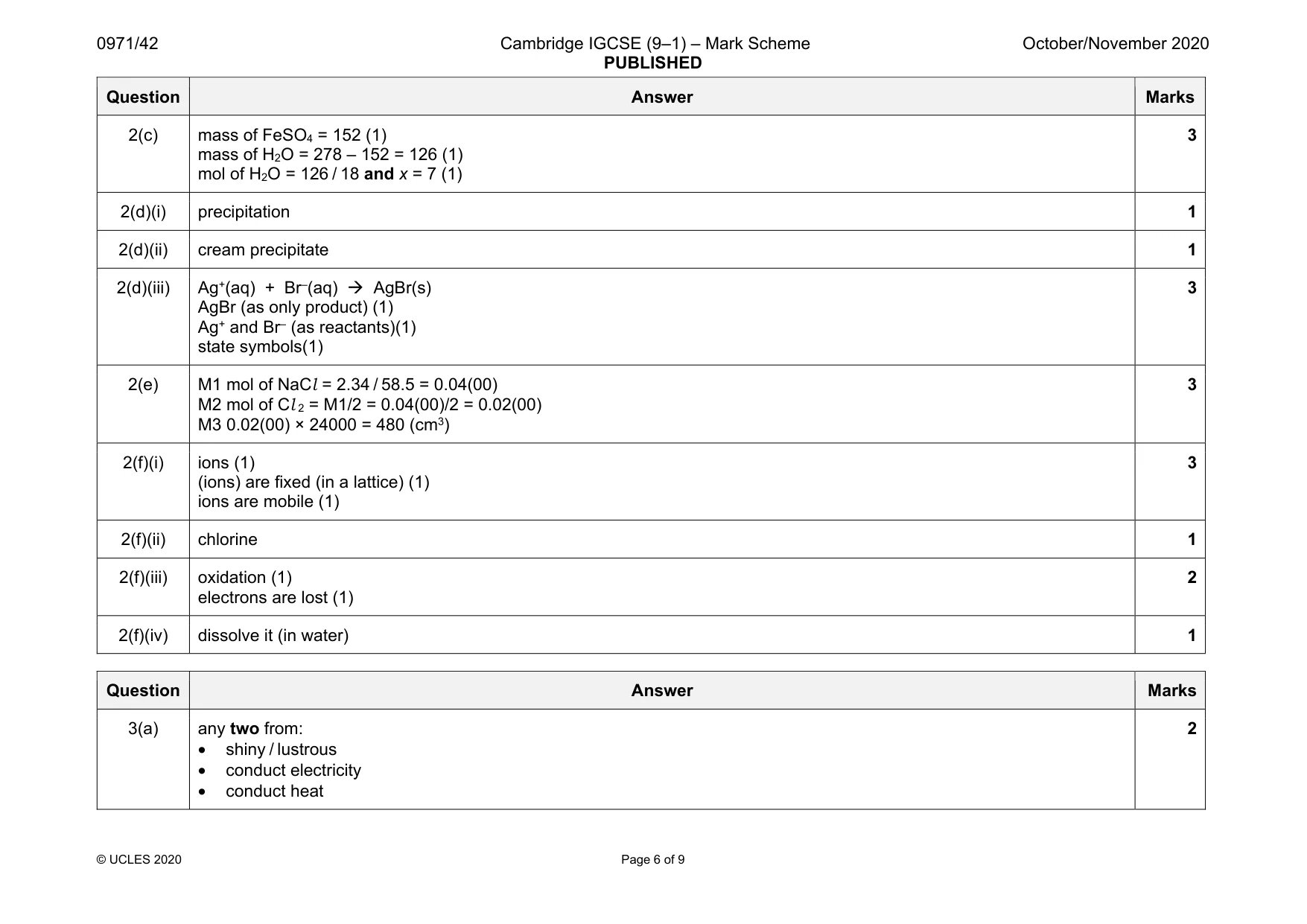
Mark scheme: 2(a) HNO3 1 2(b)(i) to make sure all the (sulfuric) acid reacts 1 2(b)(ii) no (more) fizzing (1) (FeCO3) stops dissolving or a solid remains / is visible (in the mixture) (1) 2 2(b)(iii) rinse the residue (with distilled water) 1 2(b)(iv a solution that can dissolve no more solute (1) at the specified temperature (1) 2 2(b)(v) iron(II) oxide / iron(II) hydroxide 1 Question Answer Marks 2(c) mass of FeSO4 = 152 (1) mass of H2O = 278 – 152 = 126 (1) mol of H2O = 126 / 18 and x = 7 (1) 3 2(d)(i) precipitation 1 2(d)(ii) cream precipitate 1 2(d)(iii) Ag+(aq) + Br–(aq) AgBr(s) AgBr (as only product) (1) Ag+ and Br– (as reactants)(1) state symbols(1) 3 2(e) M1 mol of NaCl = 2.34 / 58.5 = 0.04(00) M2 mol of Cl 2 = M1/2 = 0.04(00)/2 = 0.02(00) M3 0.02(00) × 24000 = 480 (cm3) 3 2(f)(i) ions (1) (ions) are fixed (in a lattice) (1) ions are mobile (1) 3 2(f)(ii) chlorine 1 2(f)(iii) oxidation (1) electrons are lost (1) 2 2(f)(iv) dissolve it (in water) 1
Q3 · Group I metals are very reactive
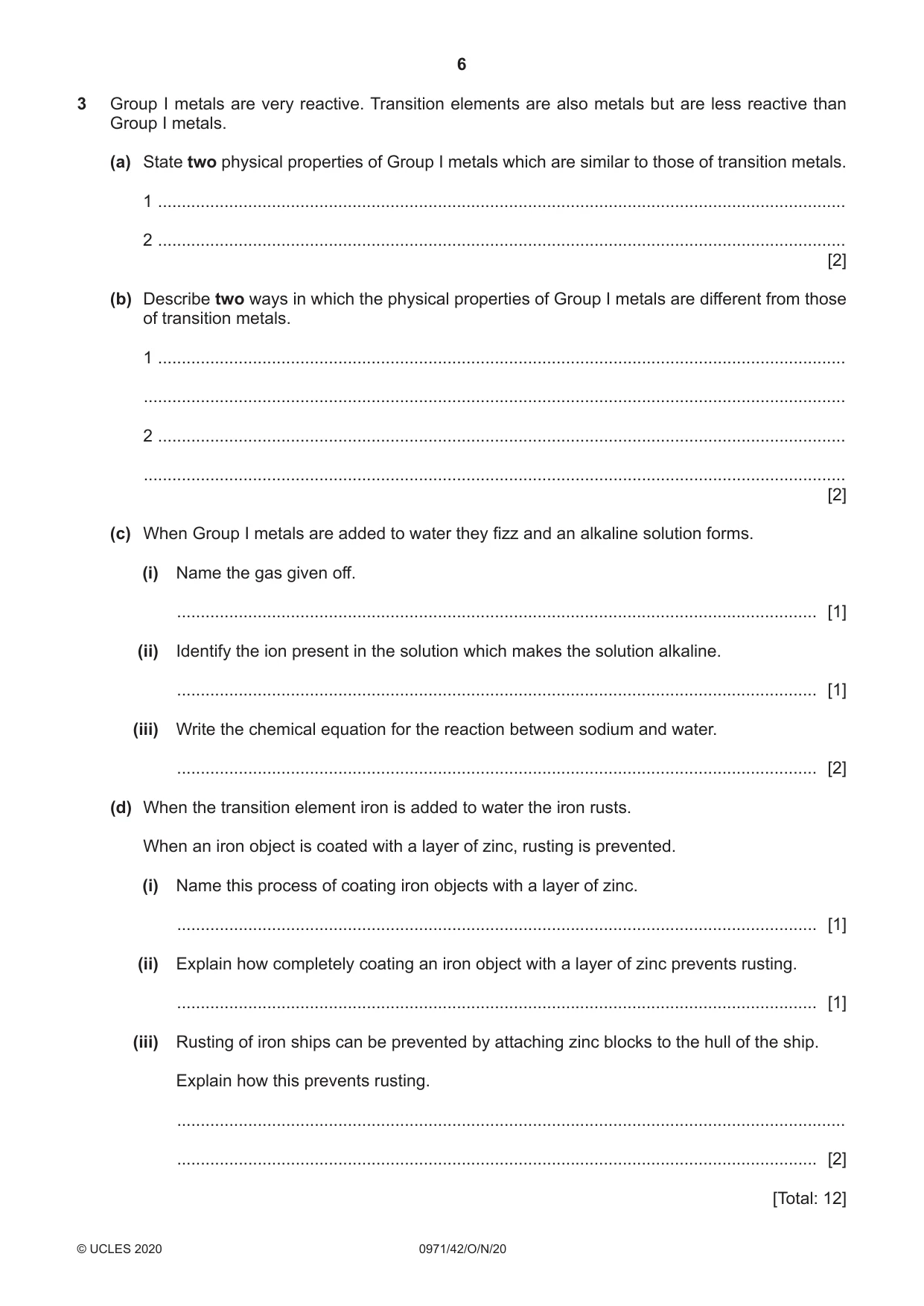
3 Group I metals are very reactive. Transition elements are also metals but are less reactive than Group I metals. (a) State two physical properties of Group I metals which are similar to those of transition metals. 1 ................................................................................................................................................. 2 ................................................................................................................................................. [2] (b) Describe two ways in which the physical properties of Group I metals are different from those of transition metals. 1 ................................................................................................................................................. .................................................................................................................................................... 2 ................................................................................................................................................. .................................................................................................................................................... [2] (c) When Group I metals are added to water they fizz and an alkaline solution forms. (i) Name the gas given off. ....................................................................................................................................... [1] (ii) Identify the ion present in the solution which makes the solution alkaline. ....................................................................................................................................... [1] (iii) Write the chemical equation for the reaction between sodium and water. ....................................................................................................................................... [2] (d) When the transition element iron is added to water the iron rusts. When an iron object is coated with a layer of zinc, rusting is prevented. (i) Name this process of coating iron objects with a layer of zinc. ....................................................................................................................................... [1] (ii) Explain how completely coating an iron object with a layer of zinc prevents rusting. ....................................................................................................................................... [1] (iii) Rusting of iron ships can be prevented by attaching zinc blocks to the hull of the ship. Explain how this prevents rusting. ............................................................................................................................................. ....................................................................................................................................... [2] [Total: 12]
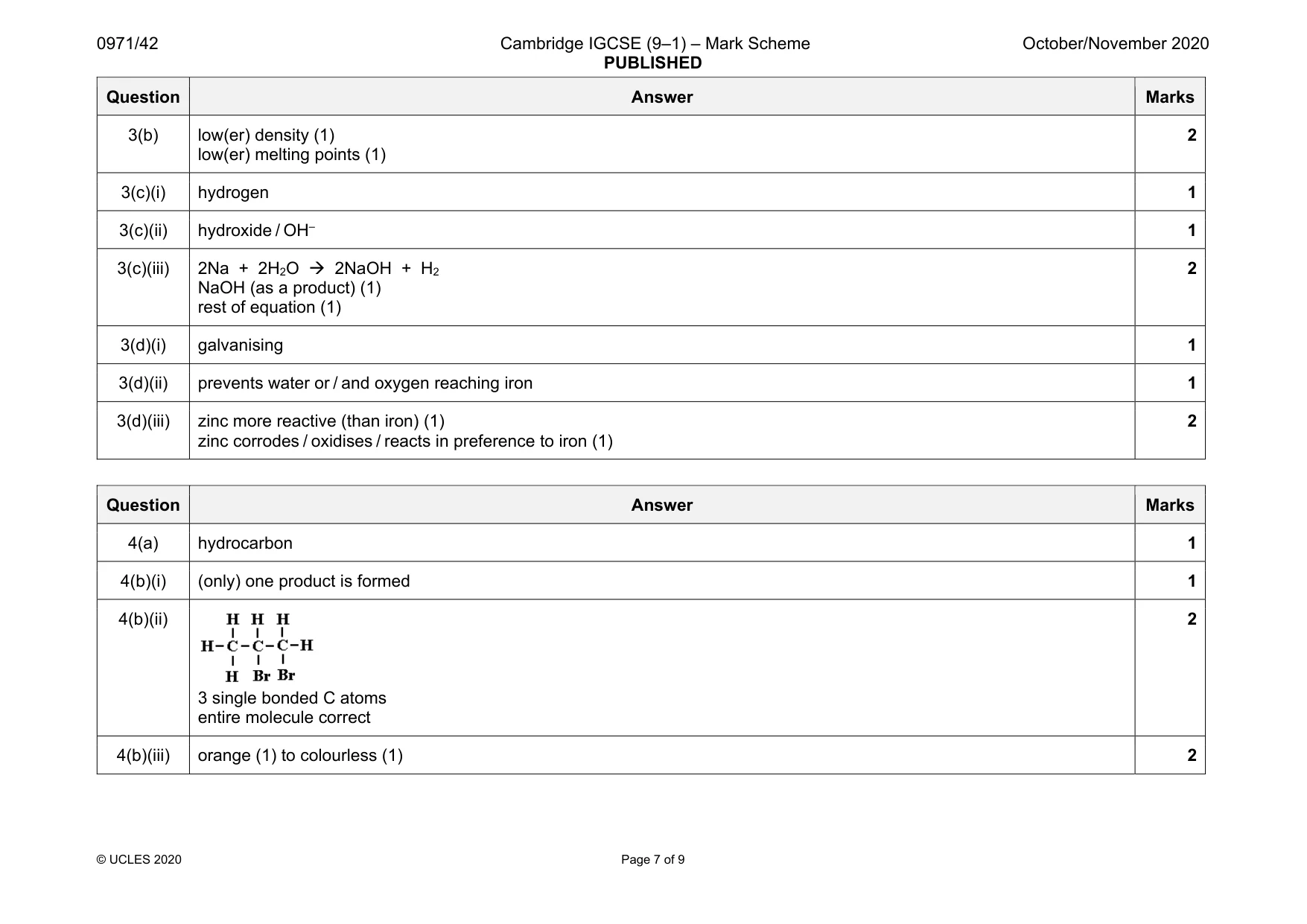
Mark scheme: 3(a) any two from: • shiny / lustrous • conduct electricity • conduct heat 2 Question Answer Marks 3(b) low(er) density (1) low(er) melting points (1) 2 3(c)(i) hydrogen 1 3(c)(ii) hydroxide / OH– 1 3(c)(iii) 2Na + 2H2O 2NaOH + H2 NaOH (as a product) (1) rest of equation (1) 2 3(d)(i) galvanising 1 3(d)(ii) prevents water or / and oxygen reaching iron 1 3(d)(iii) zinc more reactive (than iron) (1) zinc corrodes / oxidises / reacts in preference to iron (1) 2
Q4 · Alkenes and alkanes are homologous series of compounds containing carbon and hydrogen…
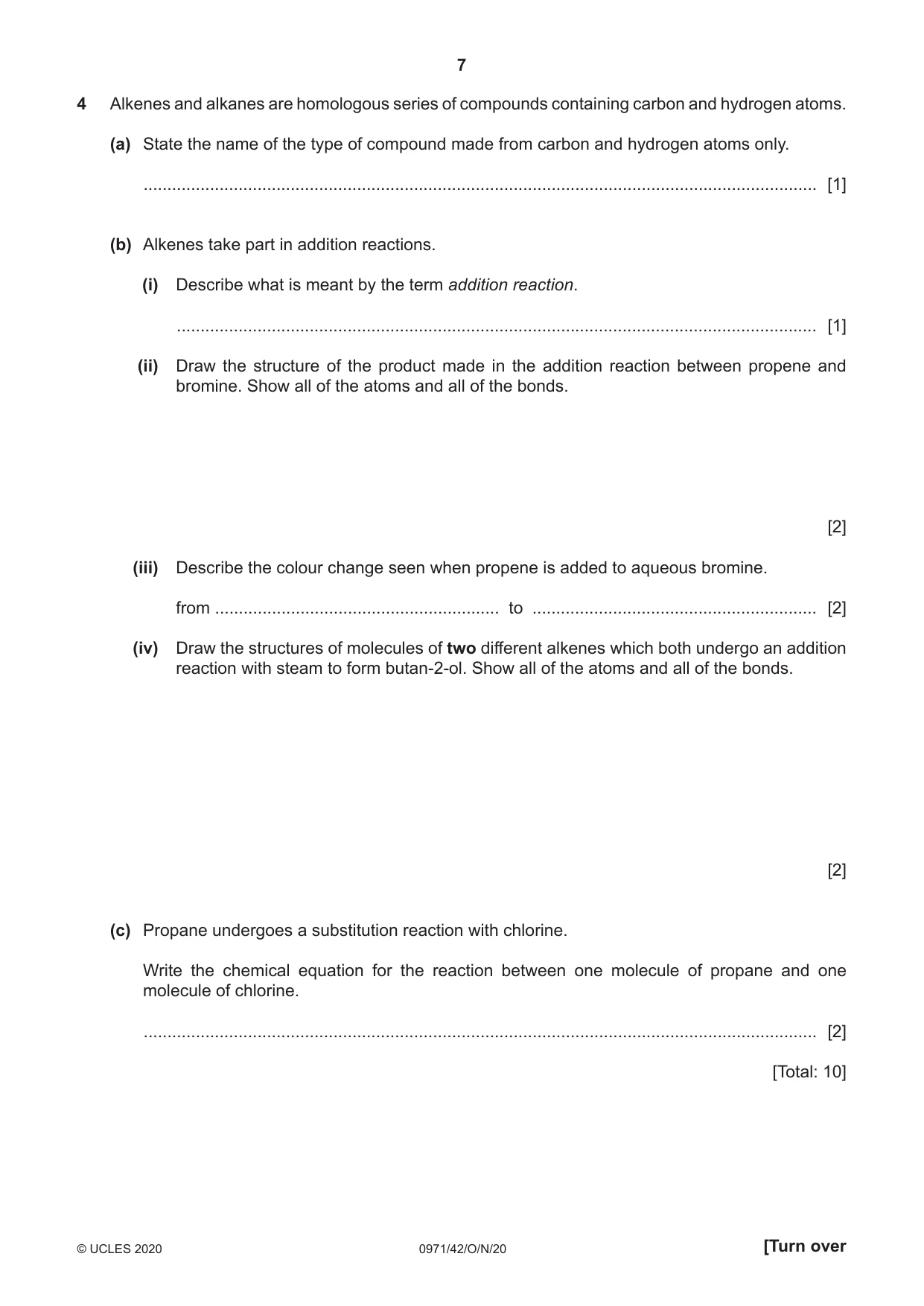
4 Alkenes and alkanes are homologous series of compounds containing carbon and hydrogen atoms. (a) State the name of the type of compound made from carbon and hydrogen atoms only. .............................................................................................................................................. [1] (b) Alkenes take part in addition reactions. (i) Describe what is meant by the term addition reaction. ....................................................................................................................................... [1] (ii) Draw the structure of the product made in the addition reaction between propene and bromine. Show all of the atoms and all of the bonds. [2] (iii) Describe the colour change seen when propene is added to aqueous bromine. from ............................................................ to ............................................................. [2] (iv) Draw the structures of molecules of two different alkenes which both undergo an addition reaction with steam to form butan-2-ol. Show all of the atoms and all of the bonds. [2] (c) Propane undergoes a substitution reaction with chlorine. Write the chemical equation for the reaction between one molecule of propane and one molecule of chlorine. .............................................................................................................................................. [2] [Total: 10]
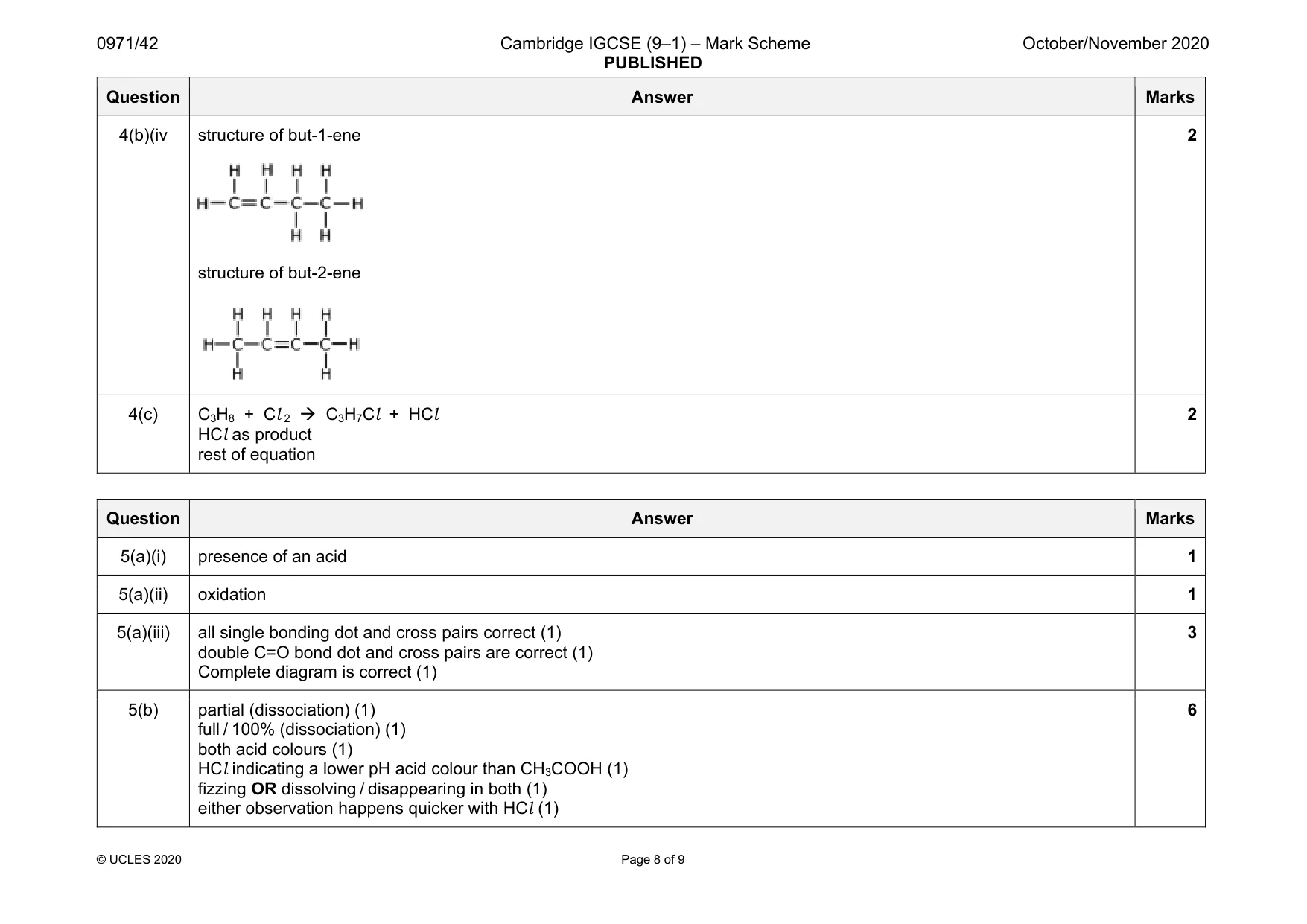
Mark scheme: 4(a) hydrocarbon 1 4(b)(i) (only) one product is formed 1 4(b)(ii) 3 single bonded C atoms entire molecule correct 2 4(b)(iii) orange (1) to colourless (1) 2 Question Answer Marks 4(b)(iv structure of but-1-ene structure of but-2-ene 2 4(c) C3H8 + Cl 2 C3H7Cl + HCl HCl as product rest of equation 2
Q5 · This question is about alcohols, carboxylic acids and esters
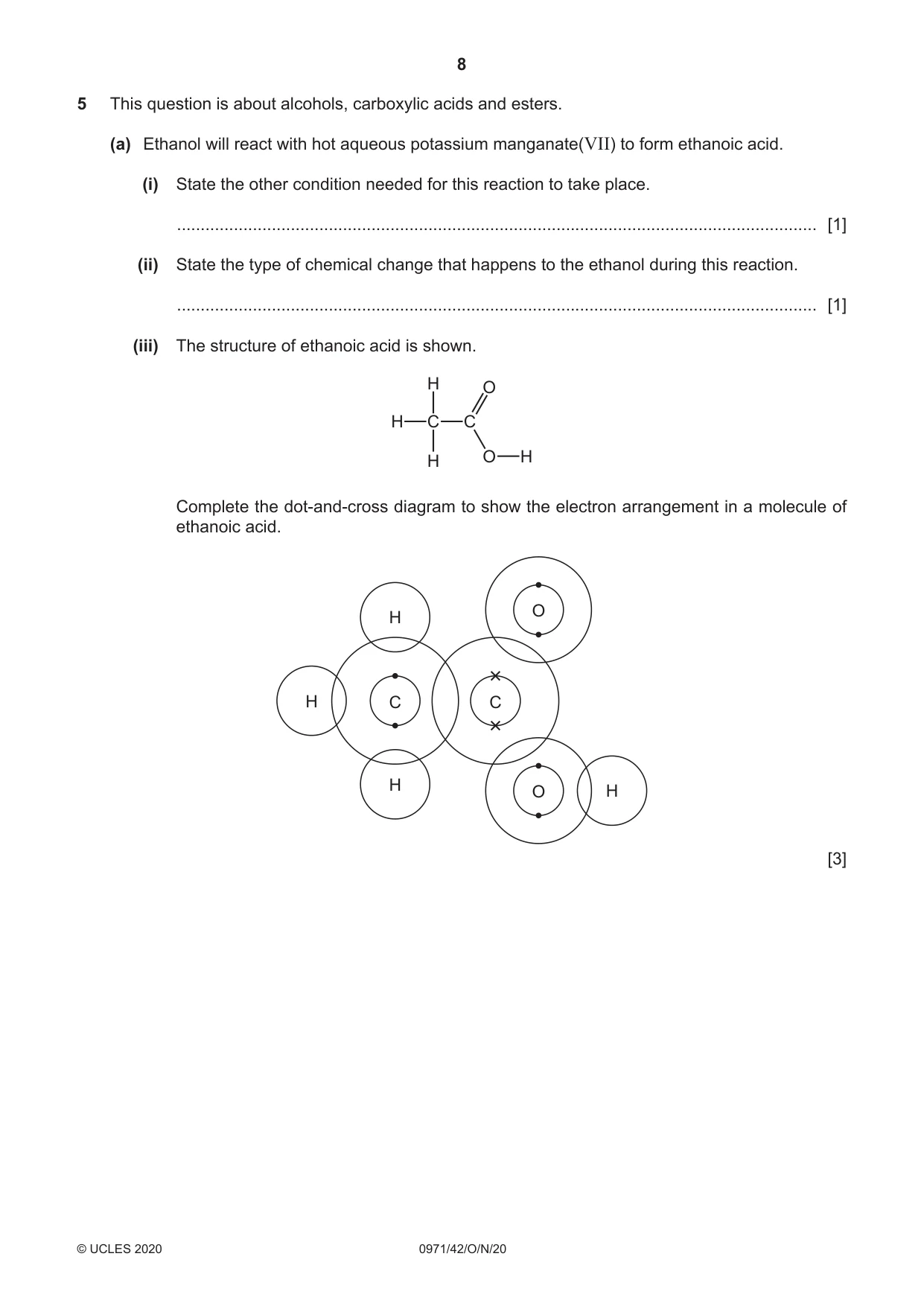
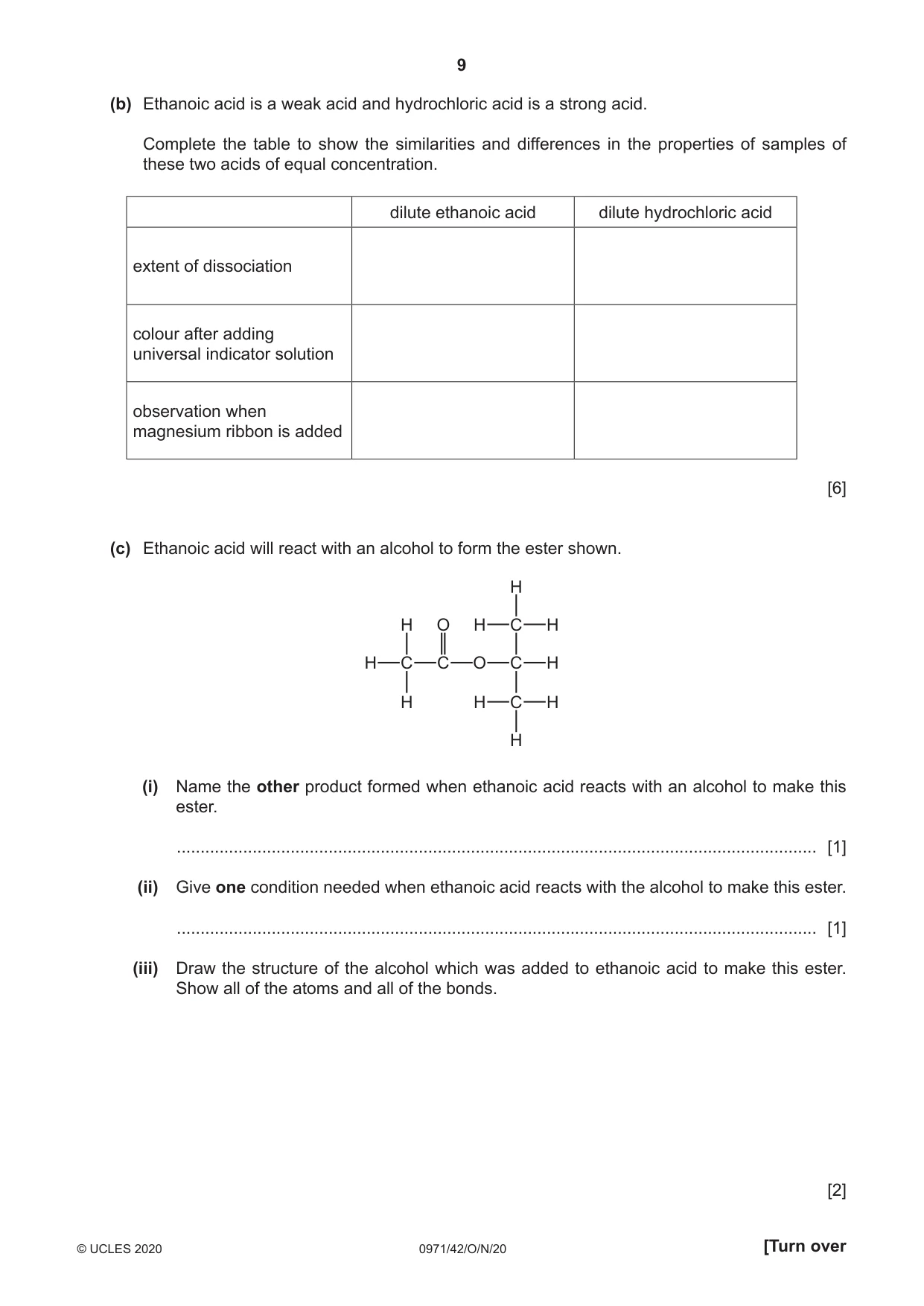
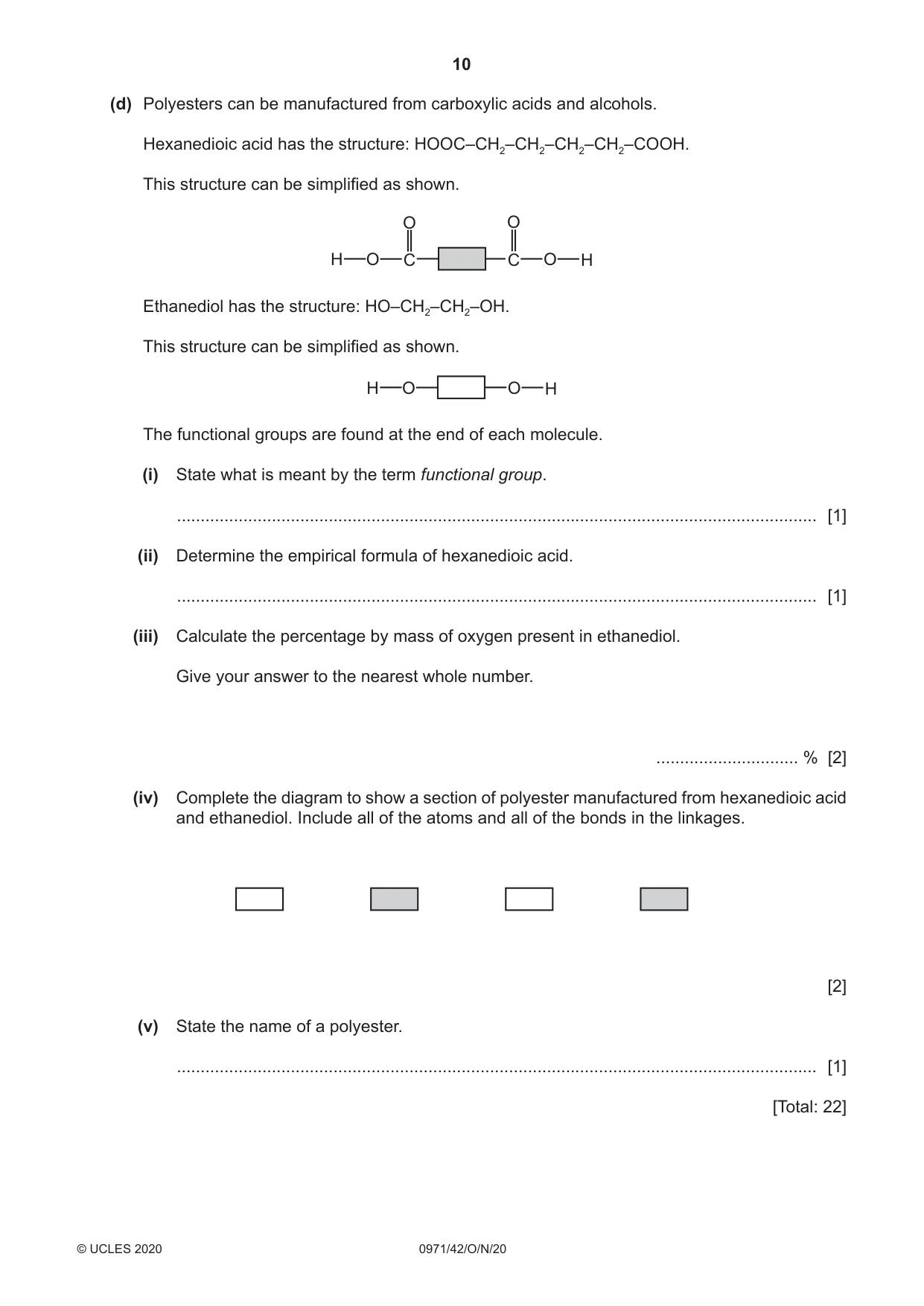
5 This question is about alcohols, carboxylic acids and esters. (a) Ethanol will react with hot aqueous potassium manganate(VII) to form ethanoic acid. (i) State the other condition needed for this reaction to take place. ....................................................................................................................................... [1] (ii) State the type of chemical change that happens to the ethanol during this reaction. ....................................................................................................................................... [1] (iii) The structure of ethanoic acid is shown. H O H C C H O H Complete the dot-and-cross diagram to show the electron arrangement in a molecule of ethanoic acid. O H H C C H O H [3] (b) Ethanoic acid is a weak acid and hydrochloric acid is a strong acid. Complete the table to show the similarities and differences in the properties of samples of these two acids of equal concentration. dilute ethanoic acid dilute hydrochloric acid extent of dissociation colour after adding universal indicator solution observation when magnesium ribbon is added [6] (c) Ethanoic acid will react with an alcohol to form the ester shown. H H O H C H H C C O C H H H C H H (i) Name the other product formed when ethanoic acid reacts with an alcohol to make this ester. ....................................................................................................................................... [1] (ii) Give one condition needed when ethanoic acid reacts with the alcohol to make this ester. ....................................................................................................................................... [1] (iii) Draw the structure of the alcohol which was added to ethanoic acid to make this ester. Show all of the atoms and all of the bonds. [2] (d) Polyesters can be manufactured from carboxylic acids and alcohols. Hexanedioic acid has the structure: HOOC–CH2–CH2–CH2–CH2–COOH. This structure can be simplified as shown. O O H O C C O H Ethanediol has the structure: HO–CH2–CH2–OH. This structure can be simplified as shown. H O O H The functional groups are found at the end of each molecule. (i) State what is meant by the term functional group. ....................................................................................................................................... [1] (ii) Determine the empirical formula of hexanedioic acid. ....................................................................................................................................... [1] (iii) Calculate the percentage by mass of oxygen present in ethanediol. Give your answer to the nearest whole number. .............................. % [2] (iv) Complete the diagram to show a section of polyester manufactured from hexanedioic acid and ethanediol. Include all of the atoms and all of the bonds in the linkages. [2] (v) State the name of a polyester. ....................................................................................................................................... [1] [Total: 22]
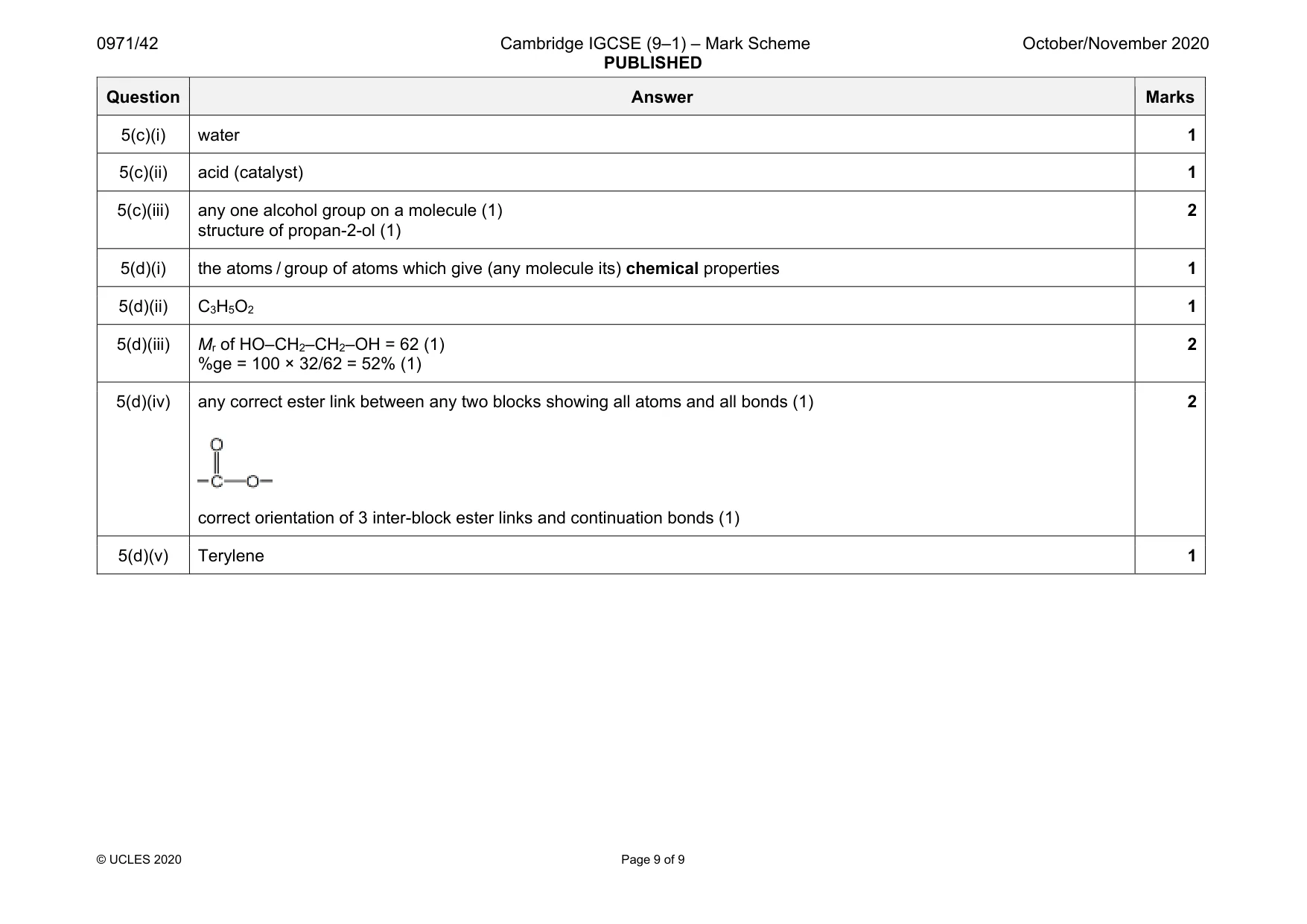
Mark scheme: 5(a)(i) presence of an acid 1 5(a)(ii) oxidation 1 5(a)(iii) all single bonding dot and cross pairs correct (1) double C=O bond dot and cross pairs are correct (1) Complete diagram is correct (1) 3 5(b) partial (dissociation) (1) full / 100% (dissociation) (1) both acid colours (1) HCl indicating a lower pH acid colour than CH3COOH (1) fizzing OR dissolving / disappearing in both (1) either observation happens quicker with HCl (1) 6 Question Answer Marks 5(c)(i) water 1 5(c)(ii) acid (catalyst) 1 5(c)(iii) any one alcohol group on a molecule (1) structure of propan-2-ol (1) 2 5(d)(i) the atoms / group of atoms which give (any molecule its) chemical properties 1 5(d)(ii) C3H5O2 1 5(d)(iii) Mr of HO–CH2–CH2–OH = 62 (1) %ge = 100 × 32/62 = 52% (1) 2 5(d)(iv) any correct ester link between any two blocks showing all atoms and all bonds (1) correct orientation of 3 inter-block ester links and continuation bonds (1) 2 5(d)(v) Terylene 1
More questions on Formulae, functional groups and terminology
What was in this paper
The subtopics covered by these 5 questions, and how many questions each got. Open one in a new tab to see every Cambridge question on it.
What you needed in this session
Cambridge’s own grade thresholds for 2020 Oct/Nov, Paper 4 · Variant 2. A higher threshold means an easier paper — the bar moves with how the cohort did.