Cambridge IGCSE Chemistry (9-1) 0971 — 2020 May/June Paper 3 · Variant 2
0971/32/M/J/20 · 8 questions · 80 marks · ≈90 min
The question paper and its mark scheme, free to read here and free to download. This is Cambridge’s own paper, exactly as it was sat.
Question paper20 pages


Mark scheme10 pages
Answers below. Sit the paper first if you are practising.
Questions as text
Q1 · A list of symbols and formulae is shown
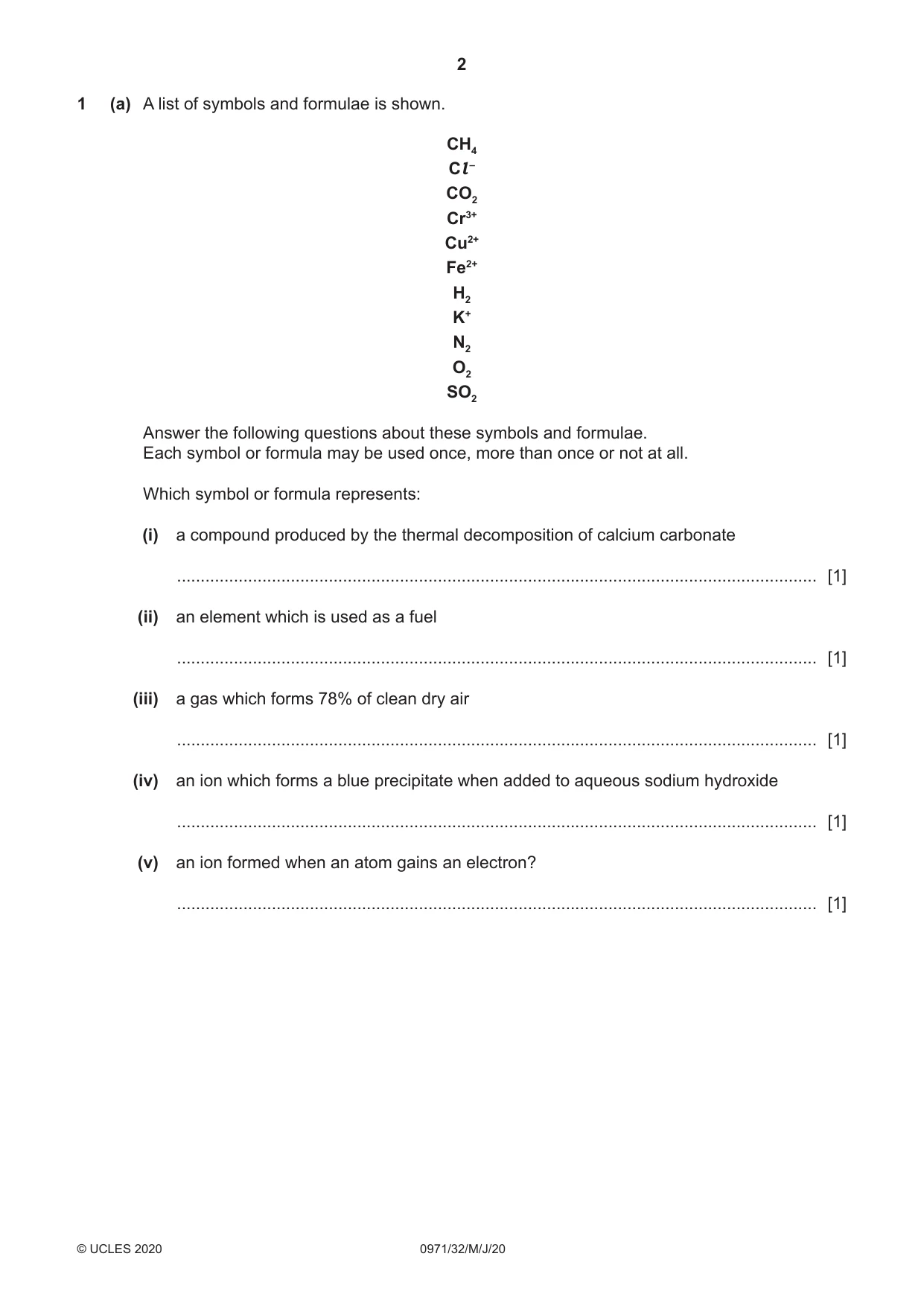
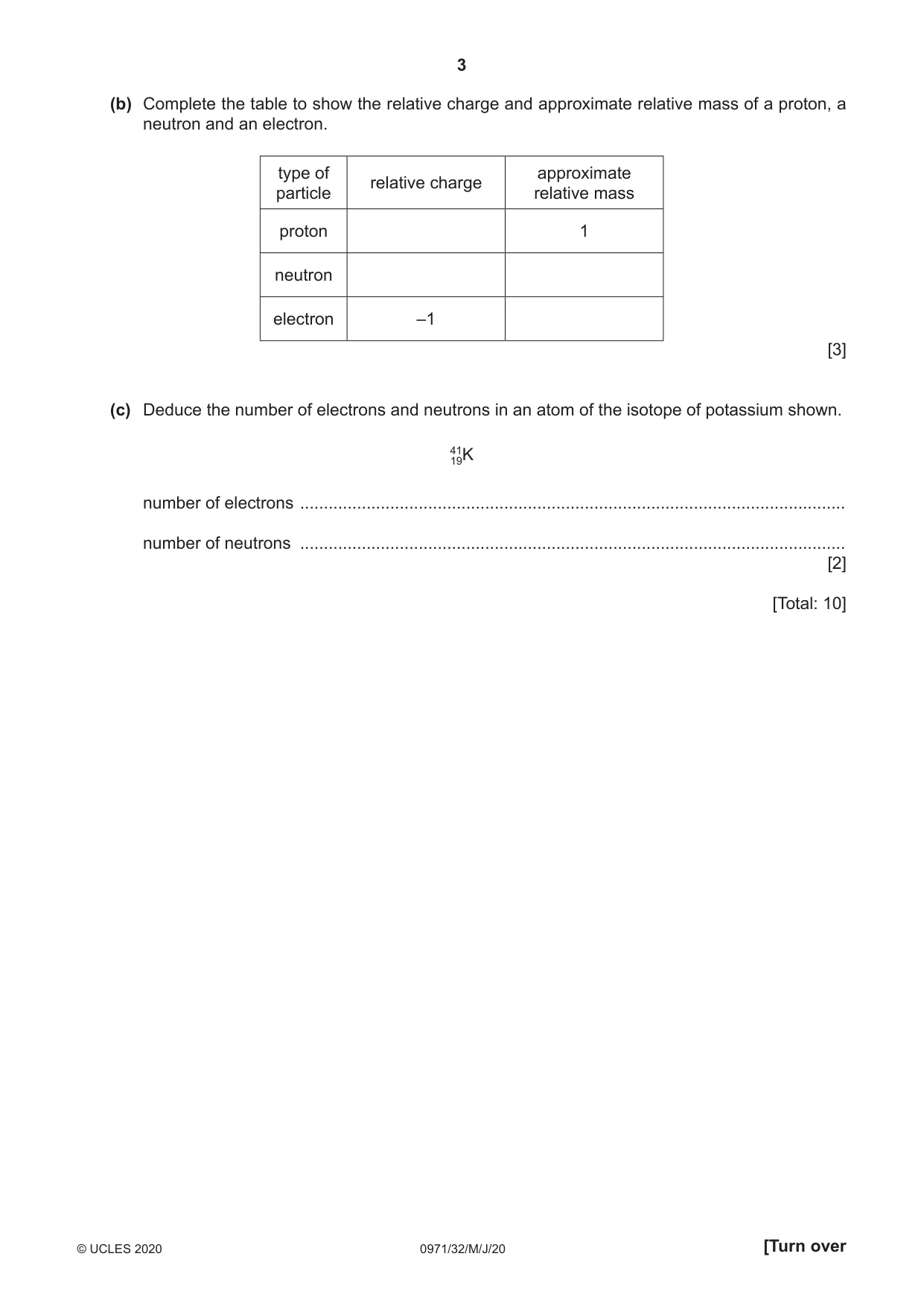
1 (a) A list of symbols and formulae is shown. CH4 Cl – CO2 Cr3+ Cu2+ Fe2+ H2 K+ N2 O2 SO2 Answer the following questions about these symbols and formulae. Each symbol or formula may be used once, more than once or not at all. Which symbol or formula represents: (i) a compound produced by the thermal decomposition of calcium carbonate ....................................................................................................................................... [1] (ii) an element which is used as a fuel ....................................................................................................................................... [1] (iii) a gas which forms 78% of clean dry air ....................................................................................................................................... [1] (iv) an ion which forms a blue precipitate when added to aqueous sodium hydroxide ....................................................................................................................................... [1] (v) an ion formed when an atom gains an electron? ....................................................................................................................................... [1] (b) Complete the table to show the relative charge and approximate relative mass of a proton, a neutron and an electron. type of approximate relative charge particle relative mass proton 1 neutron electron –1 [3] (c) Deduce the number of electrons and neutrons in an atom of the isotope of potassium shown. 41K19 number of electrons ................................................................................................................... number of neutrons .................................................................................................................... [2] [Total: 10]
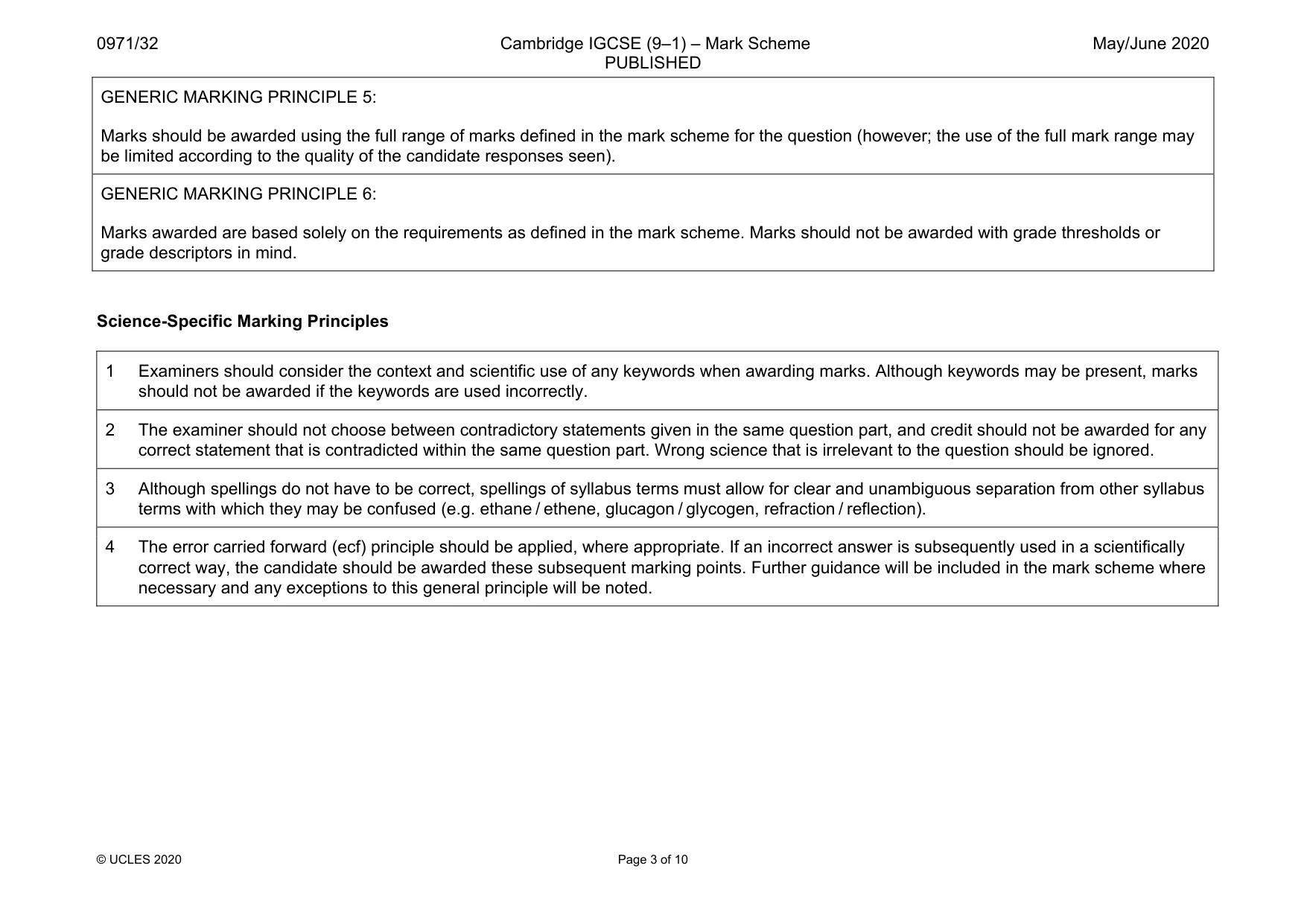
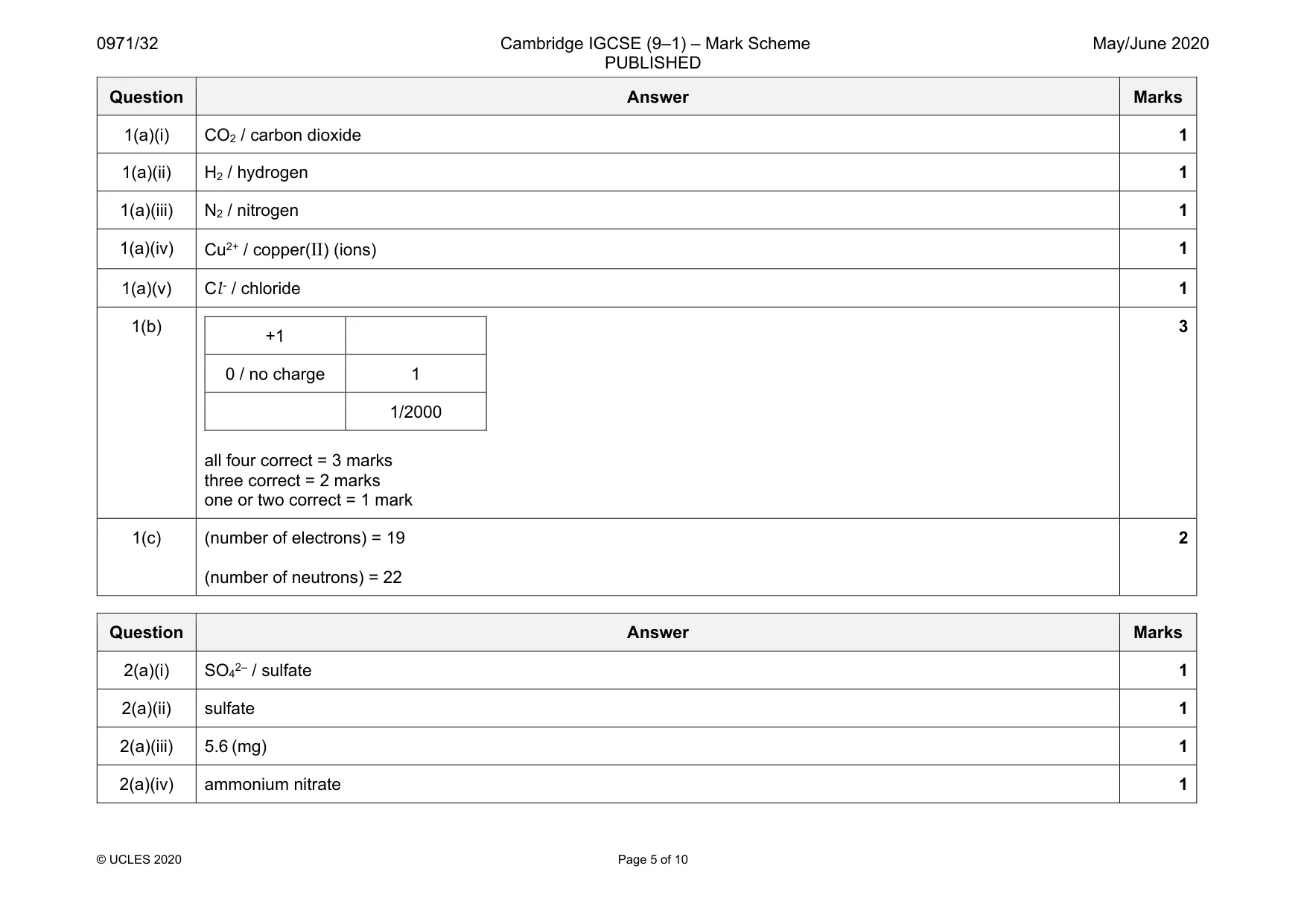
Mark scheme: 1(a)(i) CO2 / carbon dioxide 1 1(a)(ii) H2 / hydrogen 1 1(a)(iii) N2 / nitrogen 1 1(a)(iv) Cu2+ / copper(II) (ions) 1 1(a)(v) Cl - / chloride 1 1(b) +1 0 / no charge 1 1/2000 all four correct = 3 marks three correct = 2 marks one or two correct = 1 mark 3 1(c) (number of electrons) = 19 (number of neutrons) = 22 2
Q2 · A solution is obtained by filtering a mixture of soil and water
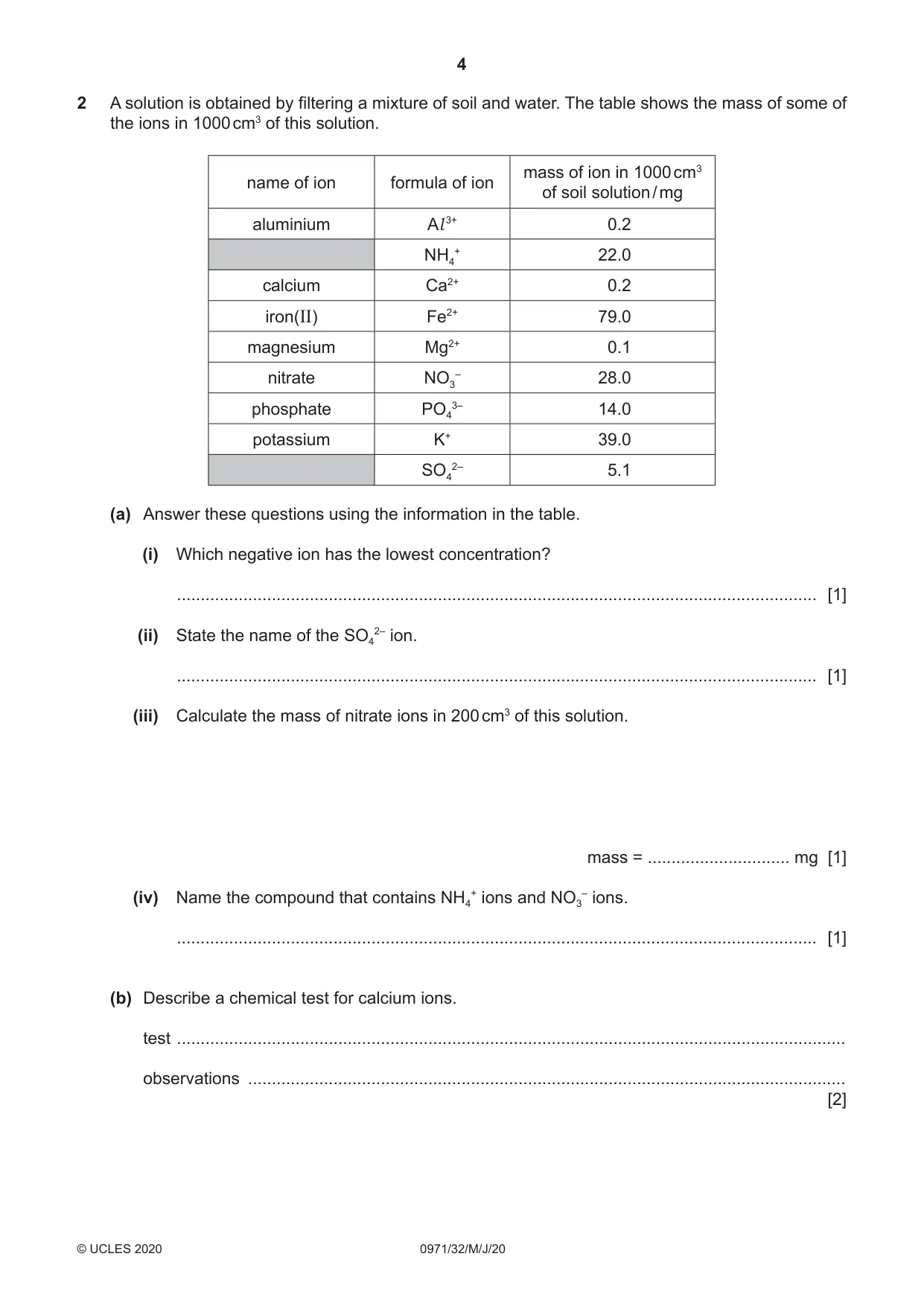
2 A solution is obtained by filtering a mixture of soil and water. The table shows the mass of some of the ions in 1000 cm3 of this solution. mass of ion in 1000 cm3 name of ion formula of ion of soil solution / mg aluminium Al 3+ 0.2 NH4+ 22.0 calcium Ca2+ 0.2 iron(II) Fe2+ 79.0 magnesium Mg2+ 0.1 nitrate NO3– 28.0 phosphate PO43– 14.0 potassium K+ 39.0 SO42– 5.1 (a) Answer these questions using the information in the table. (i) Which negative ion has the lowest concentration? ....................................................................................................................................... [1] (ii) State the name of the SO42– ion. ....................................................................................................................................... [1] (iii) Calculate the mass of nitrate ions in 200 cm3 of this solution. mass = .............................. mg [1] (iv) Name the compound that contains NH4+ ions and NO3– ions. ....................................................................................................................................... [1] (b) Describe a chemical test for calcium ions. test ............................................................................................................................................. observations ............................................................................................................................... [2] (c) The names and formulae for some compounds are shown. aluminium nitrate, Al (NO3)3 magnesium nitrate, Mg(NO3)2 sodium nitrate, NaNO3 Deduce the formula for calcium nitrate. .............................................................................................................................................. [1] [Total: 7]
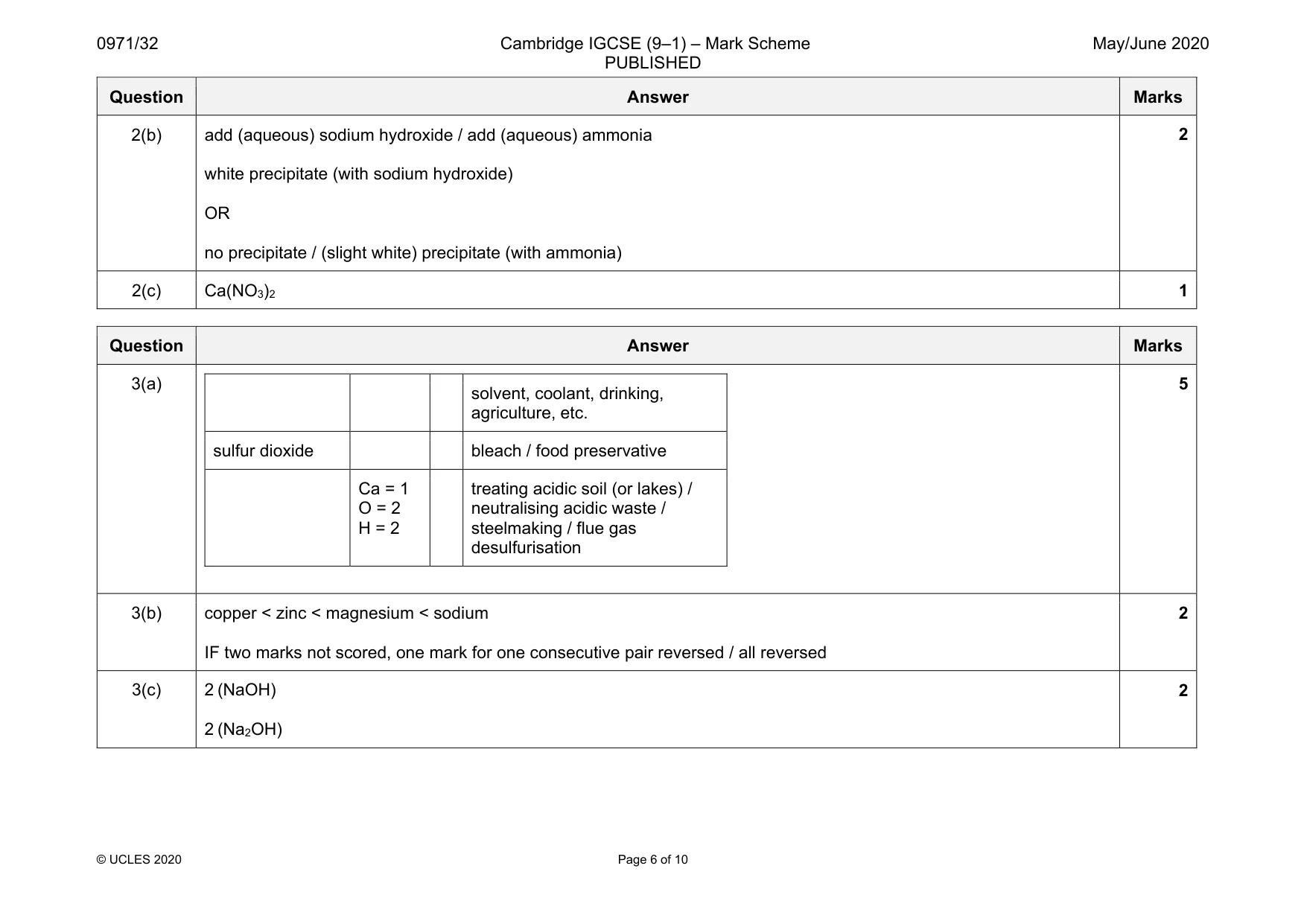
Mark scheme: 2(a)(i) SO42– / sulfate 1 2(a)(ii) sulfate 1 2(a)(iii) 5.6 (mg) 1 2(a)(iv) ammonium nitrate 1 Question Answer Marks 2(b) add (aqueous) sodium hydroxide / add (aqueous) ammonia white precipitate (with sodium hydroxide) OR no precipitate / (slight white) precipitate (with ammonia) 2 2(c) Ca(NO3)2 1
Q3 · Many compounds have important uses
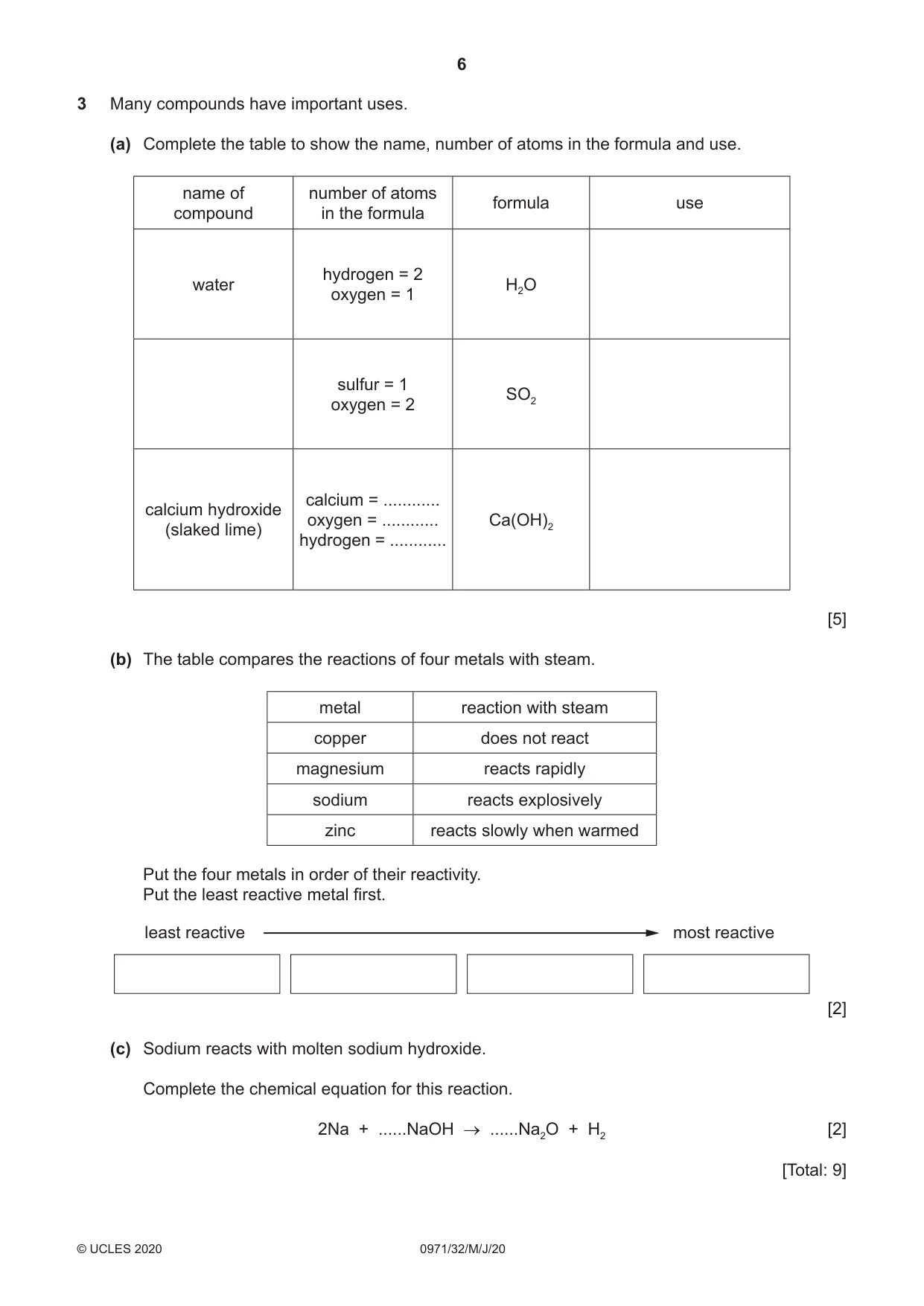
3 Many compounds have important uses. (a) Complete the table to show the name, number of atoms in the formula and use. name of number of atoms formula use compound in the formula hydrogen = 2 water H2O oxygen = 1 sulfur = 1 SO2 oxygen = 2 calcium = ............ calcium hydroxide oxygen = ............ Ca(OH)2 (slaked lime) hydrogen = ............ [5] (b) The table compares the reactions of four metals with steam. metal reaction with steam copper does not react magnesium reacts rapidly sodium reacts explosively zinc reacts slowly when warmed Put the four metals in order of their reactivity. Put the least reactive metal first. least reactive most reactive [2] (c) Sodium reacts with molten sodium hydroxide. Complete the chemical equation for this reaction. 2Na + ......NaOH → ......Na2O + H2 [2] [Total: 9]
Mark scheme: 3(a) solvent, coolant, drinking, agriculture, etc. sulfur dioxide bleach / food preservative Ca = 1 O = 2 H = 2 treating acidic soil (or lakes) / neutralising acidic waste / steelmaking / flue gas desulfurisation 5 3(b) copper < zinc < magnesium < sodium IF two marks not scored, one mark for one consecutive pair reversed / all reversed 2 3(c) 2 (NaOH) 2 (Na2OH) 2
Q4 · The properties of the first four Group I elements are shown in the table
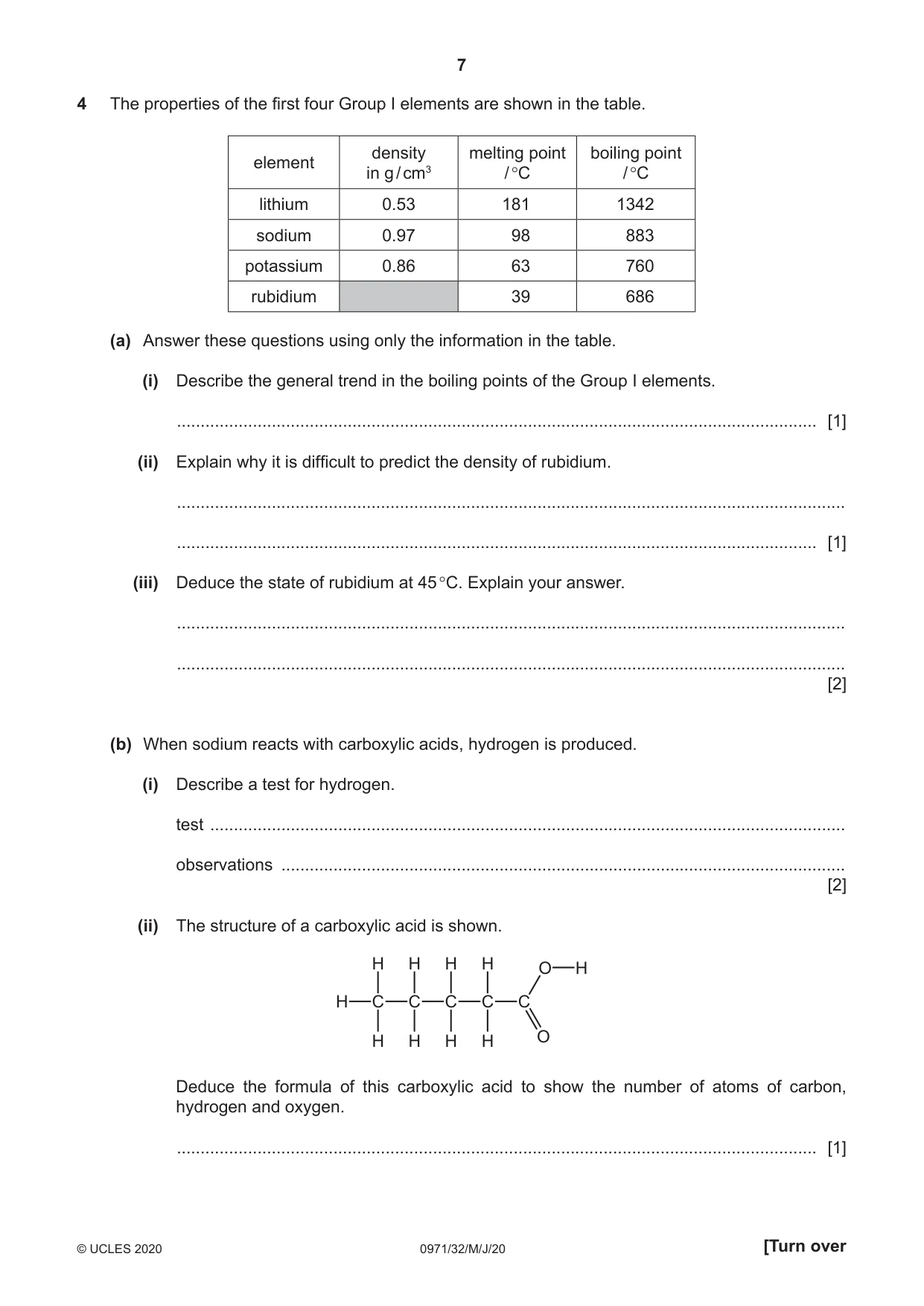
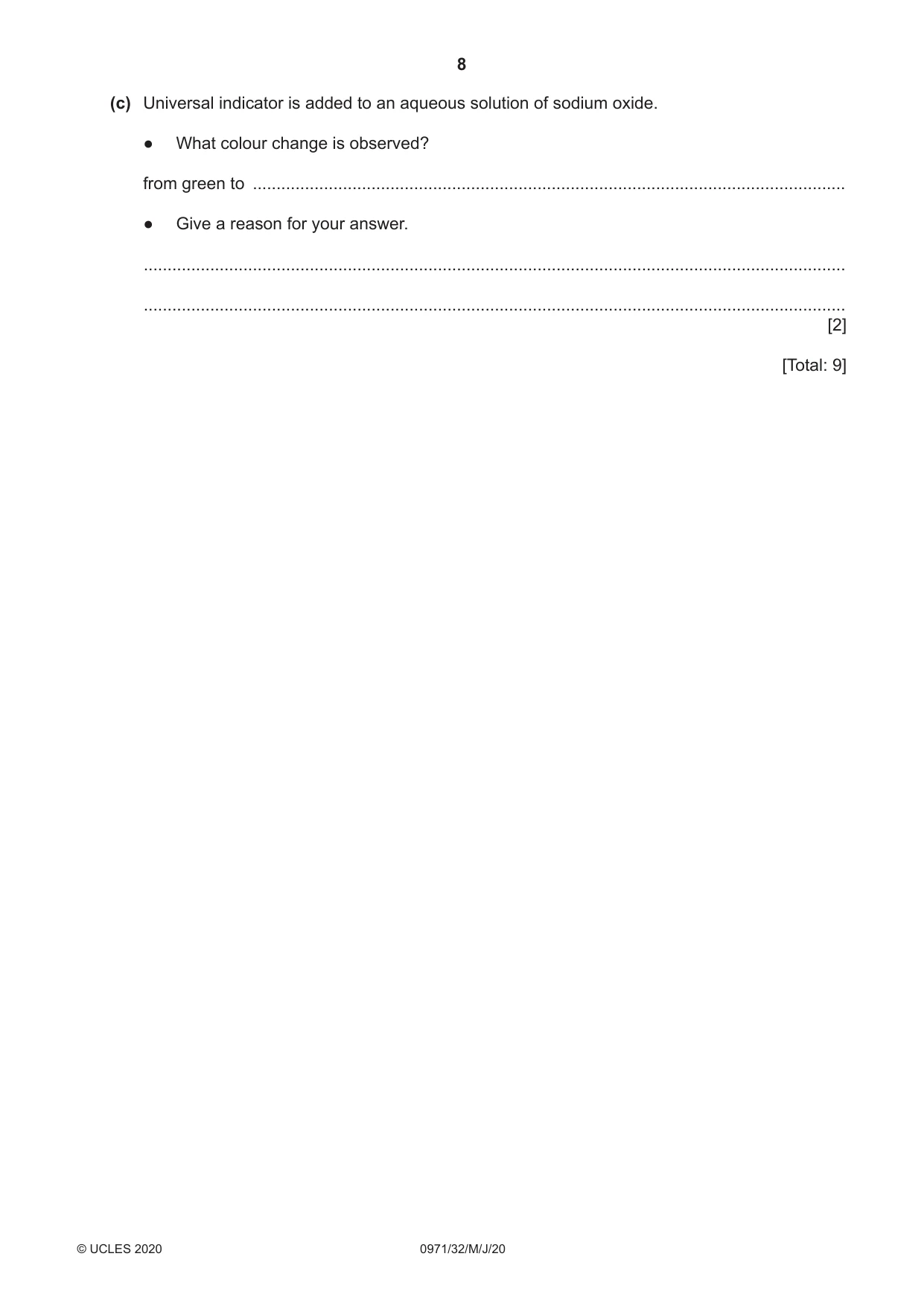
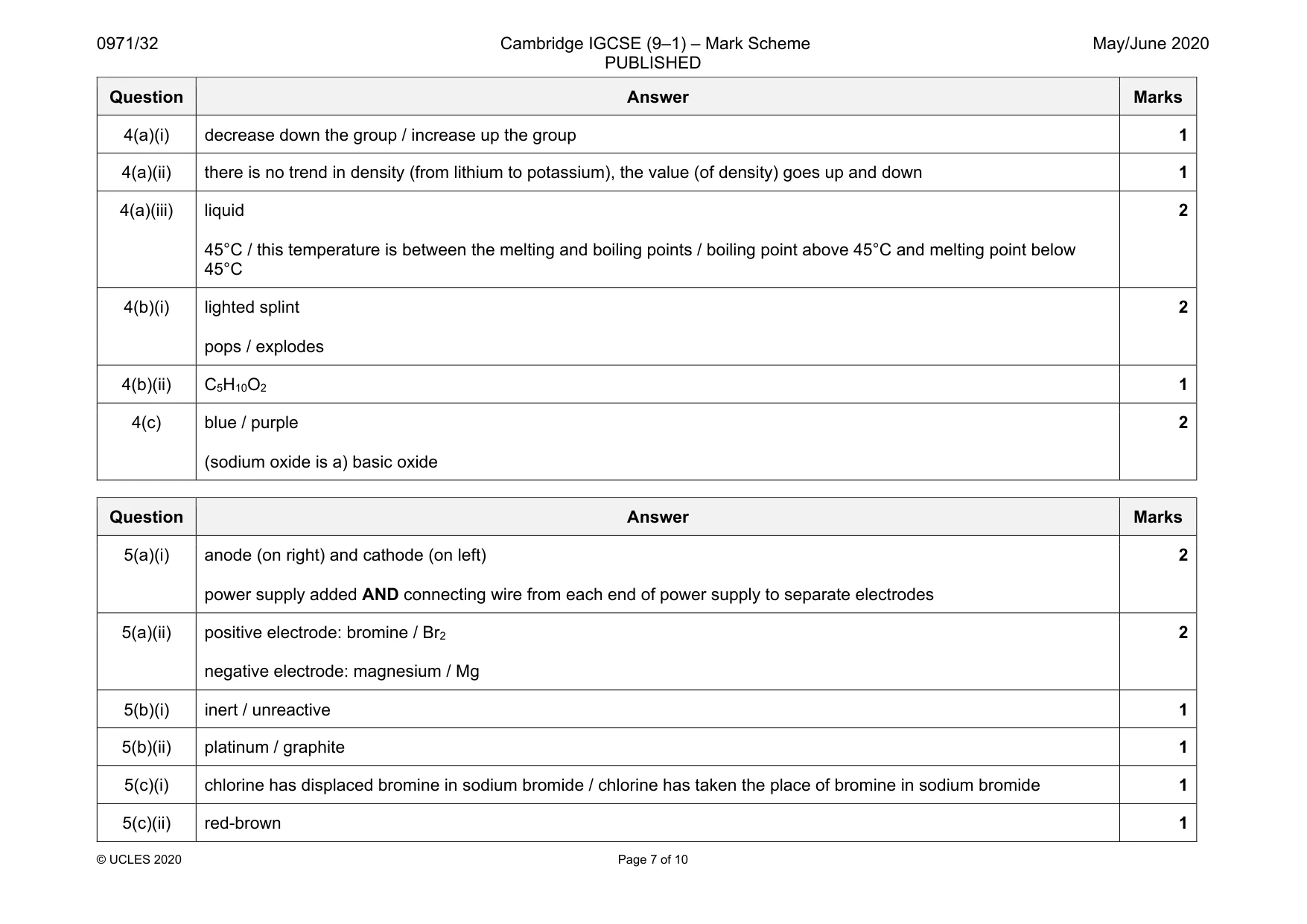
4 The properties of the first four Group I elements are shown in the table. density melting point boiling point element in g / cm3 / °C / °C lithium 0.53 181 1342 sodium 0.97 98 883 potassium 0.86 63 760 rubidium 39 686 (a) Answer these questions using only the information in the table. (i) Describe the general trend in the boiling points of the Group I elements. ....................................................................................................................................... [1] (ii) Explain why it is difficult to predict the density of rubidium. ............................................................................................................................................. ....................................................................................................................................... [1] (iii) Deduce the state of rubidium at 45 °C. Explain your answer. ............................................................................................................................................. ............................................................................................................................................. [2] (b) When sodium reacts with carboxylic acids, hydrogen is produced. (i) Describe a test for hydrogen. test ...................................................................................................................................... observations ........................................................................................................................ [2] (ii) The structure of a carboxylic acid is shown. H H H H O H H C C C C C H H H H O Deduce the formula of this carboxylic acid to show the number of atoms of carbon, hydrogen and oxygen. ....................................................................................................................................... [1] (c) Universal indicator is added to an aqueous solution of sodium oxide. ●● What colour change is observed? from green to .............................................................................................................................. ●● Give a reason for your answer. .................................................................................................................................................... .................................................................................................................................................... [2] [Total: 9]
Mark scheme: 4(a)(i) decrease down the group / increase up the group 1 4(a)(ii) there is no trend in density (from lithium to potassium), the value (of density) goes up and down 1 4(a)(iii) liquid 45°C / this temperature is between the melting and boiling points / boiling point above 45°C and melting point below 45°C 2 4(b)(i) lighted splint pops / explodes 2 4(b)(ii) C5H10O2 1 4(c) blue / purple (sodium oxide is a) basic oxide 2
Q5 · Molten magnesium bromide is electrolysed
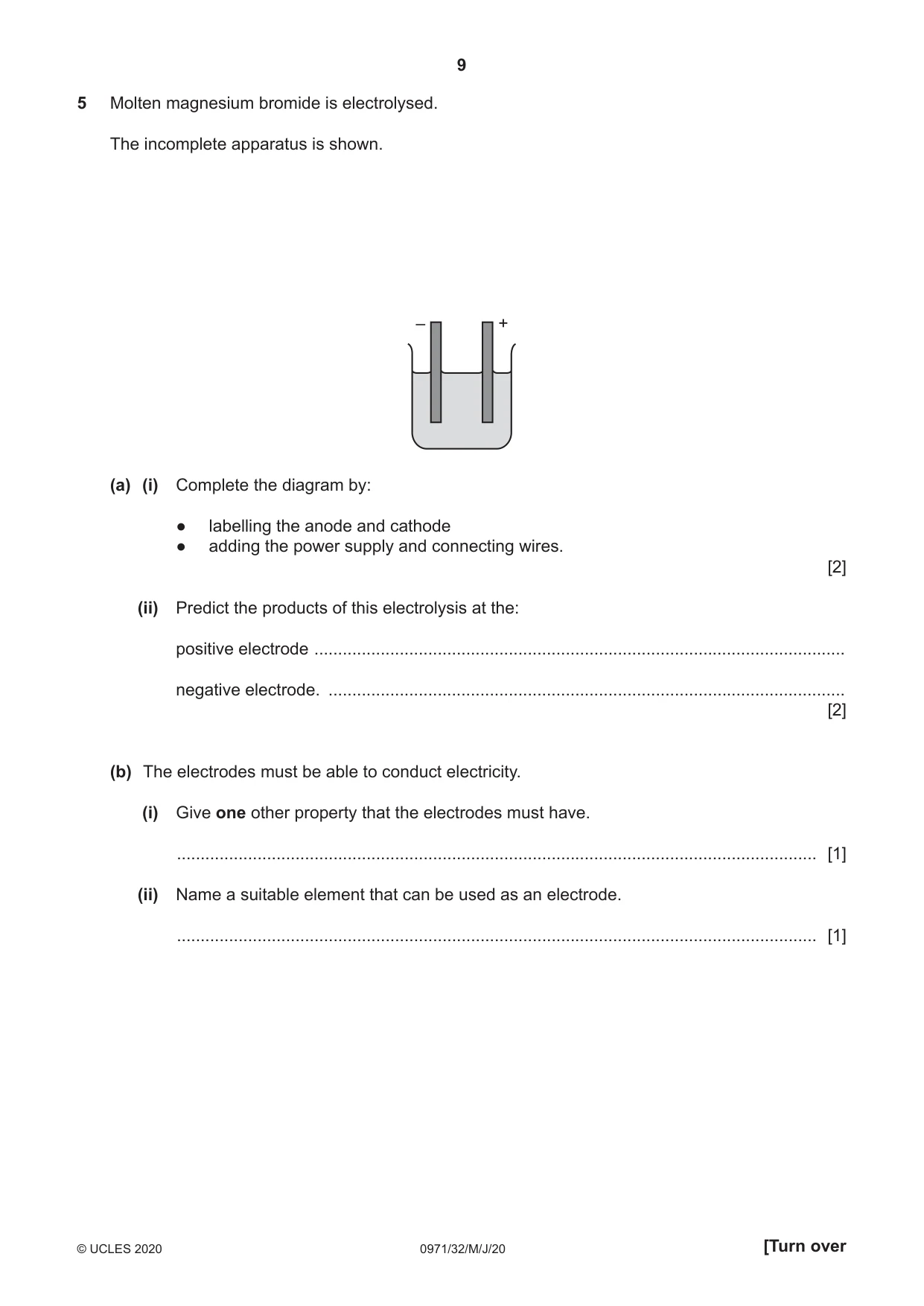
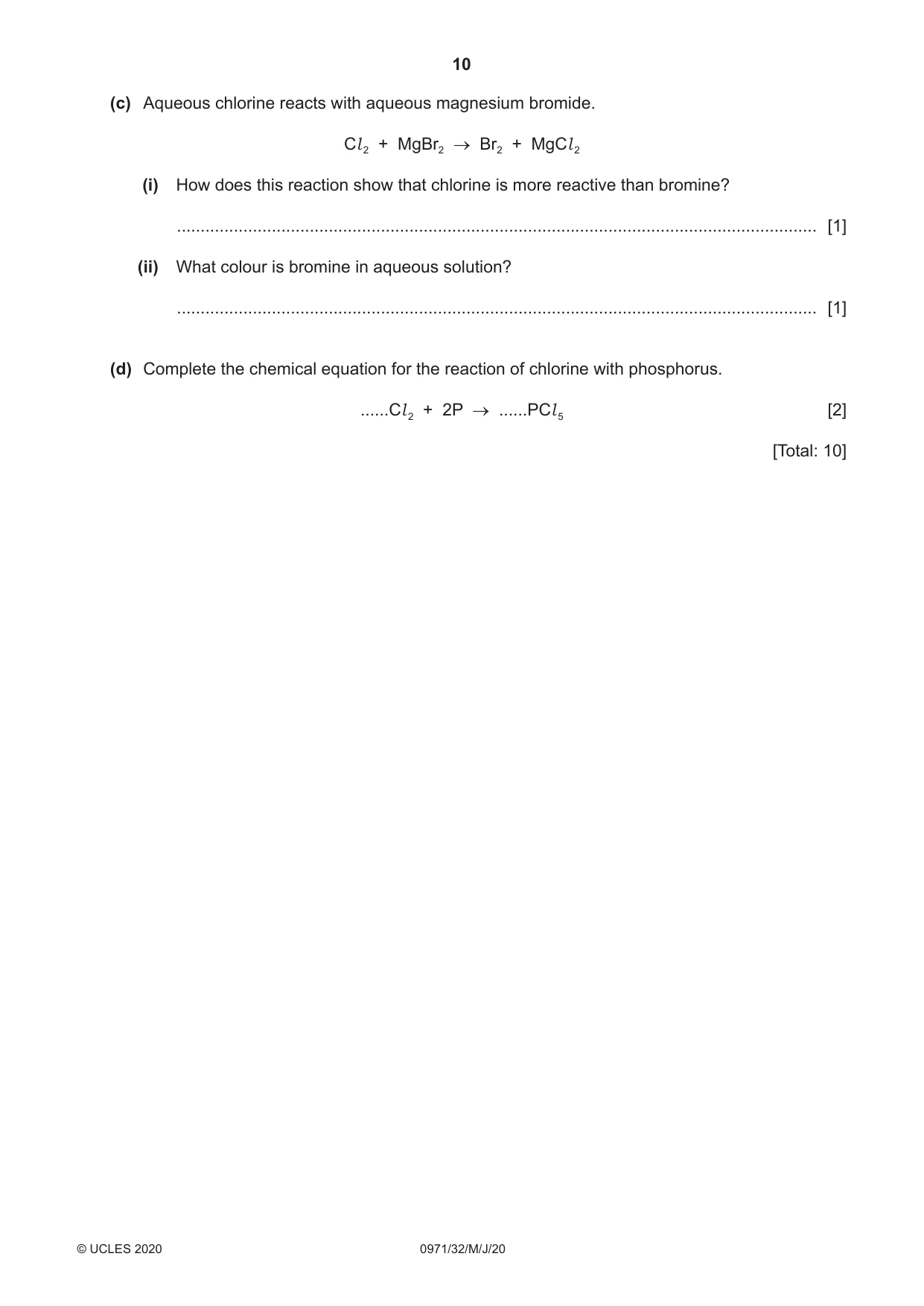
5 Molten magnesium bromide is electrolysed. The incomplete apparatus is shown. – + (a) (i) Complete the diagram by: ●● labelling the anode and cathode ●● adding the power supply and connecting wires. [2] (ii) Predict the products of this electrolysis at the: positive electrode ................................................................................................................ negative electrode. .............................................................................................................. [2] (b) The electrodes must be able to conduct electricity. (i) Give one other property that the electrodes must have. ....................................................................................................................................... [1] (ii) Name a suitable element that can be used as an electrode. ....................................................................................................................................... [1] (c) Aqueous chlorine reacts with aqueous magnesium bromide. Cl 2 + MgBr2 → Br2 + MgCl 2 (i) How does this reaction show that chlorine is more reactive than bromine? ....................................................................................................................................... [1] (ii) What colour is bromine in aqueous solution? ....................................................................................................................................... [1] (d) Complete the chemical equation for the reaction of chlorine with phosphorus. ......Cl 2 + 2P → ......PCl 5 [2] [Total: 10]
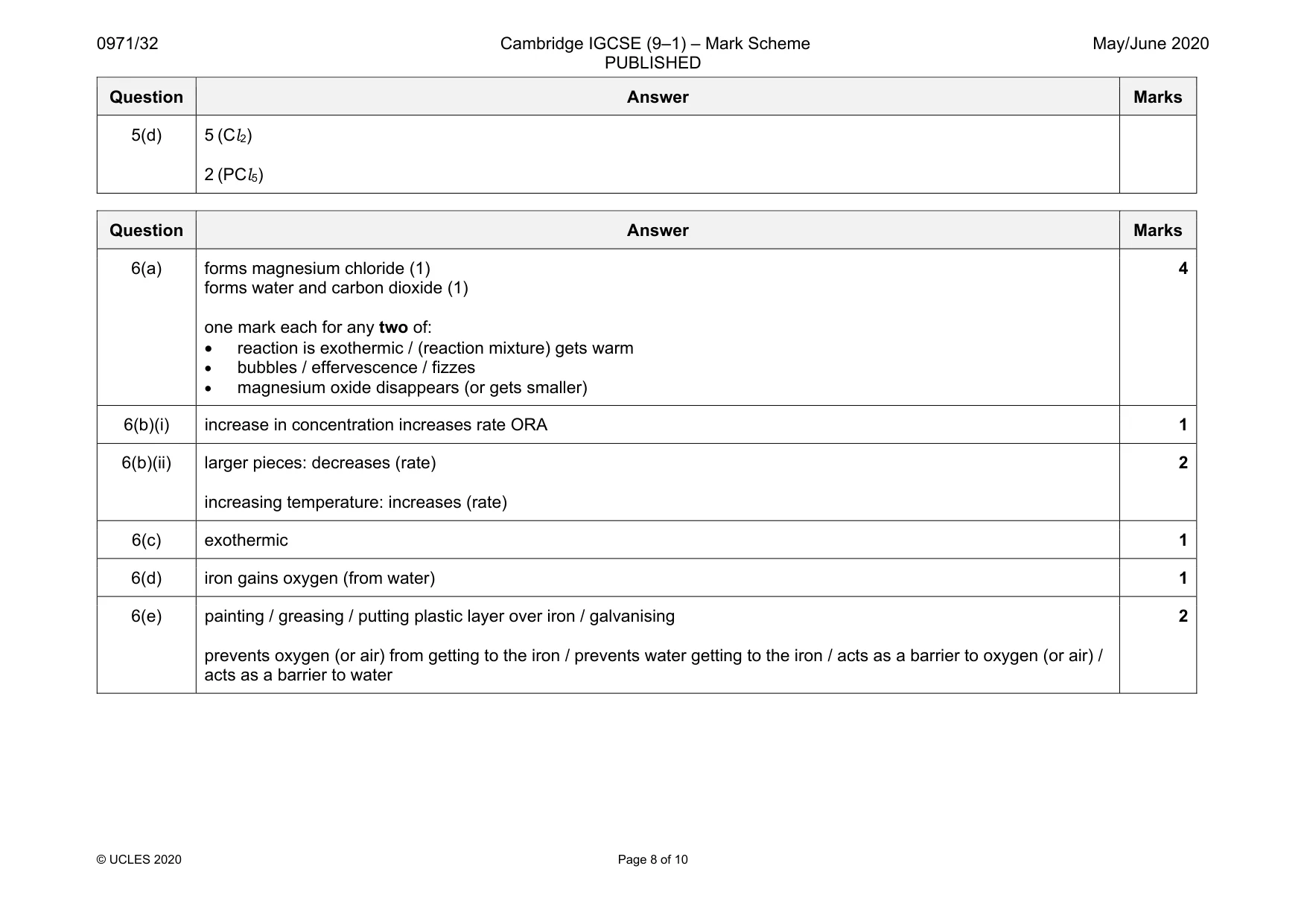
Mark scheme: 5(a)(i) anode (on right) and cathode (on left) power supply added AND connecting wire from each end of power supply to separate electrodes 2 5(a)(ii) positive electrode: bromine / Br2 negative electrode: magnesium / Mg 2 5(b)(i) inert / unreactive 1 5(b)(ii) platinum / graphite 1 5(c)(i) chlorine has displaced bromine in sodium bromide / chlorine has taken the place of bromine in sodium bromide 1 5(c)(ii) red-brown 1 Question Answer Marks 5(d) 5 (Cl2) 2 (PCl5)
Q6 · Acids have characteristic properties
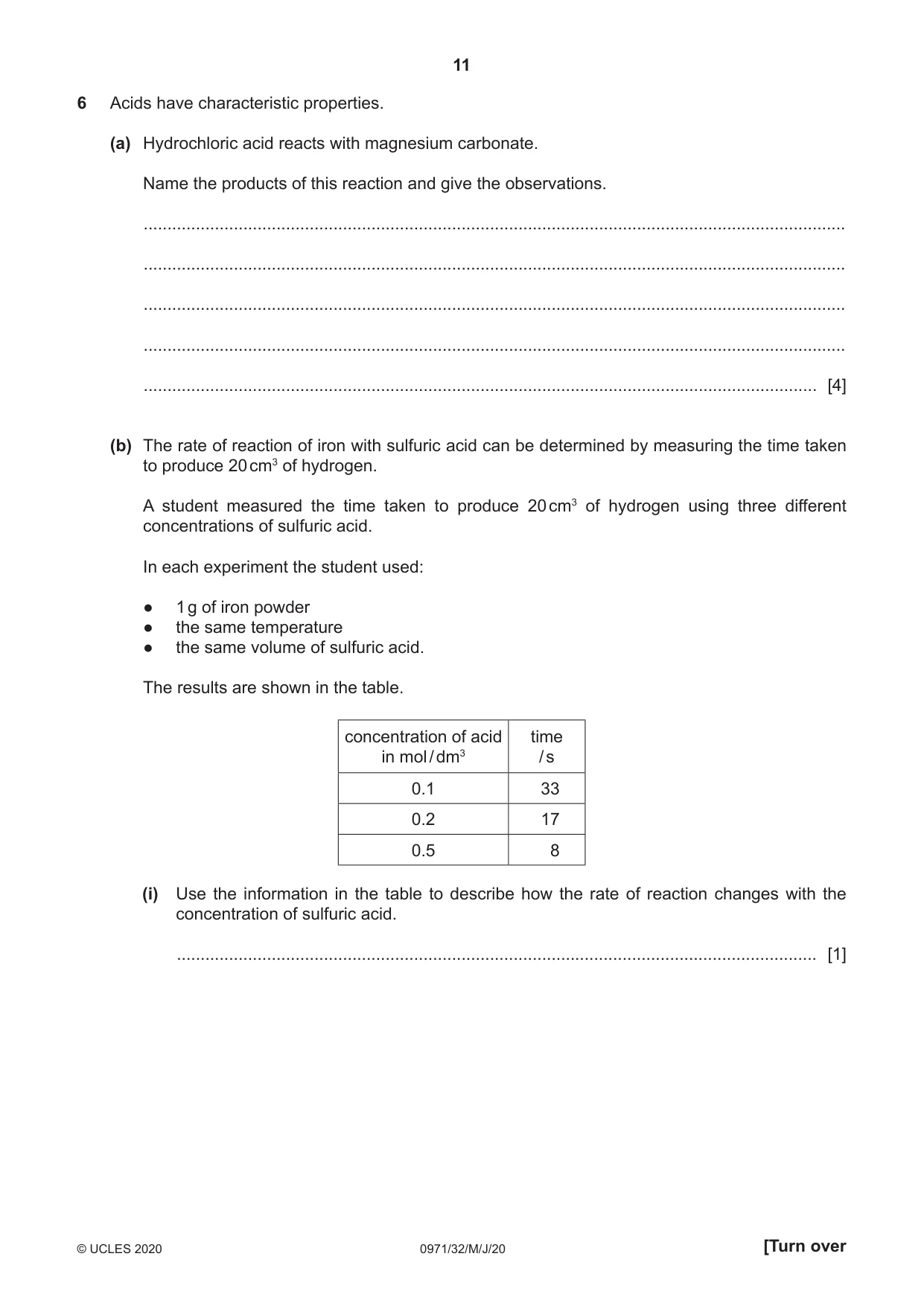
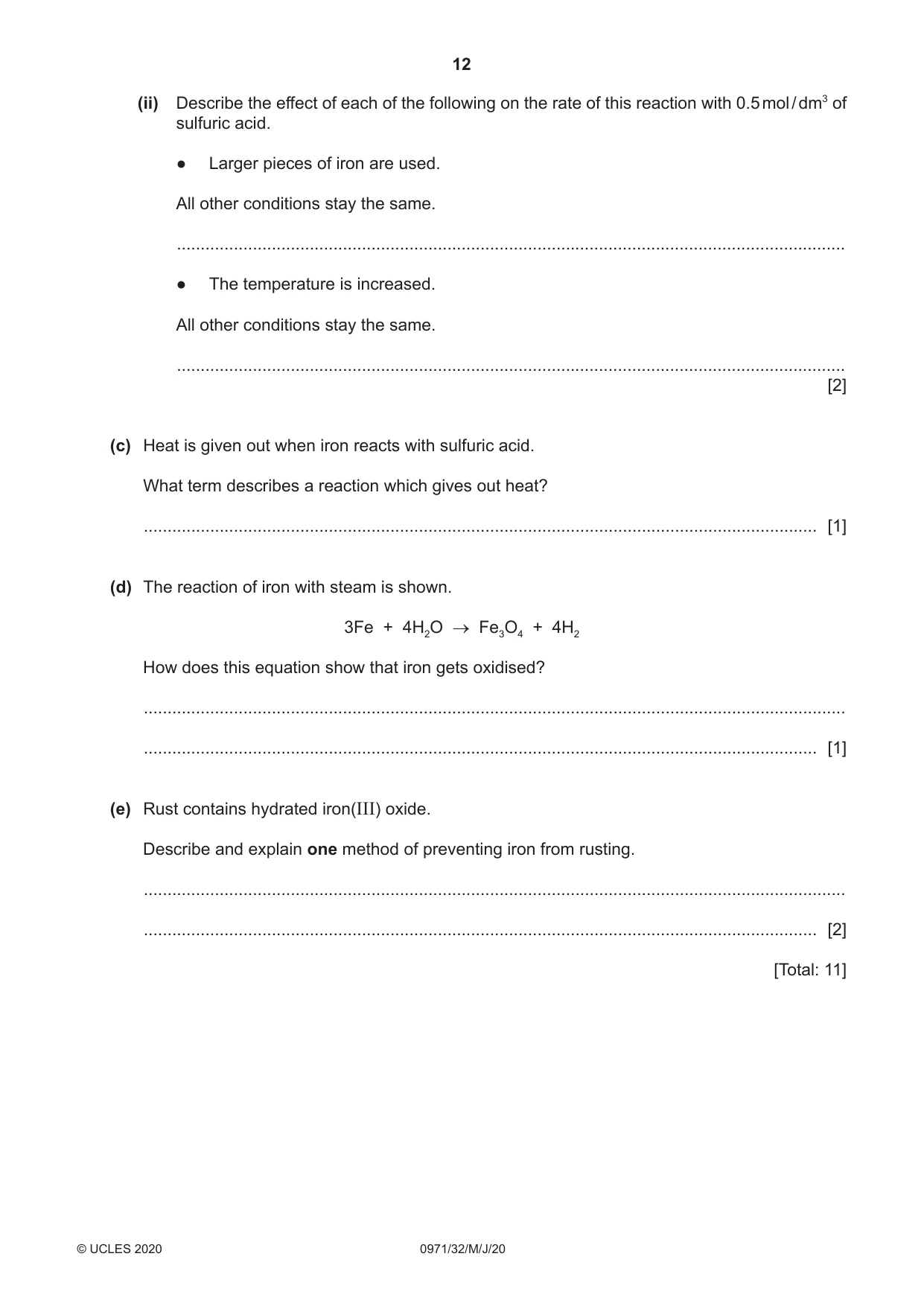
6 Acids have characteristic properties. (a) Hydrochloric acid reacts with magnesium carbonate. Name the products of this reaction and give the observations. .................................................................................................................................................... .................................................................................................................................................... .................................................................................................................................................... .................................................................................................................................................... .............................................................................................................................................. [4] (b) The rate of reaction of iron with sulfuric acid can be determined by measuring the time taken to produce 20 cm3 of hydrogen. A student measured the time taken to produce 20 cm3 of hydrogen using three different concentrations of sulfuric acid. In each experiment the student used: ●● 1 g of iron powder ●● the same temperature ●● the same volume of sulfuric acid. The results are shown in the table. concentration of acid time in mol / dm3 / s 0.1 33 0.2 17 0.5 8 (i) Use the information in the table to describe how the rate of reaction changes with the concentration of sulfuric acid. ....................................................................................................................................... [1] (ii) Describe the effect of each of the following on the rate of this reaction with 0.5 mol / dm3 of sulfuric acid. ●● Larger pieces of iron are used. All other conditions stay the same. ............................................................................................................................................. ●● The temperature is increased. All other conditions stay the same. ............................................................................................................................................. [2] (c) Heat is given out when iron reacts with sulfuric acid. What term describes a reaction which gives out heat? .............................................................................................................................................. [1] (d) The reaction of iron with steam is shown. 3Fe + 4H2O → Fe3O4 + 4H2 How does this equation show that iron gets oxidised? .................................................................................................................................................... .............................................................................................................................................. [1] (e) Rust contains hydrated iron(III) oxide. Describe and explain one method of preventing iron from rusting. .................................................................................................................................................... .............................................................................................................................................. [2] [Total: 11]
Mark scheme: 6(a) forms magnesium chloride (1) forms water and carbon dioxide (1) one mark each for any two of: • reaction is exothermic / (reaction mixture) gets warm • bubbles / effervescence / fizzes • magnesium oxide disappears (or gets smaller) 4 6(b)(i) increase in concentration increases rate ORA 1 6(b)(ii) larger pieces: decreases (rate) increasing temperature: increases (rate) 2 6(c) exothermic 1 6(d) iron gains oxygen (from water) 1 6(e) painting / greasing / putting plastic layer over iron / galvanising prevents oxygen (or air) from getting to the iron / prevents water getting to the iron / acts as a barrier to oxygen (or air) / acts as a barrier to water 2
Q7 · The structure of nerol is shown
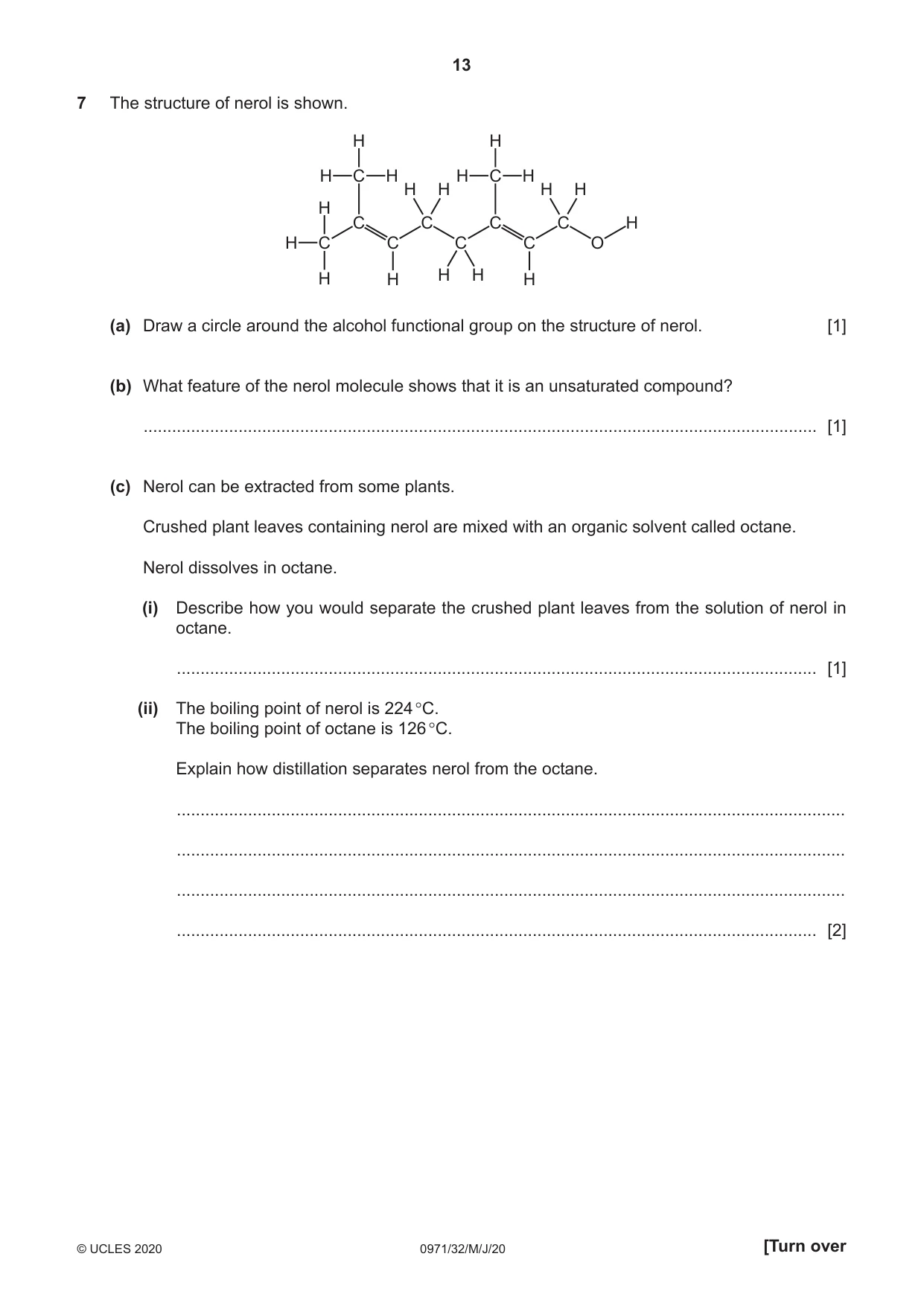
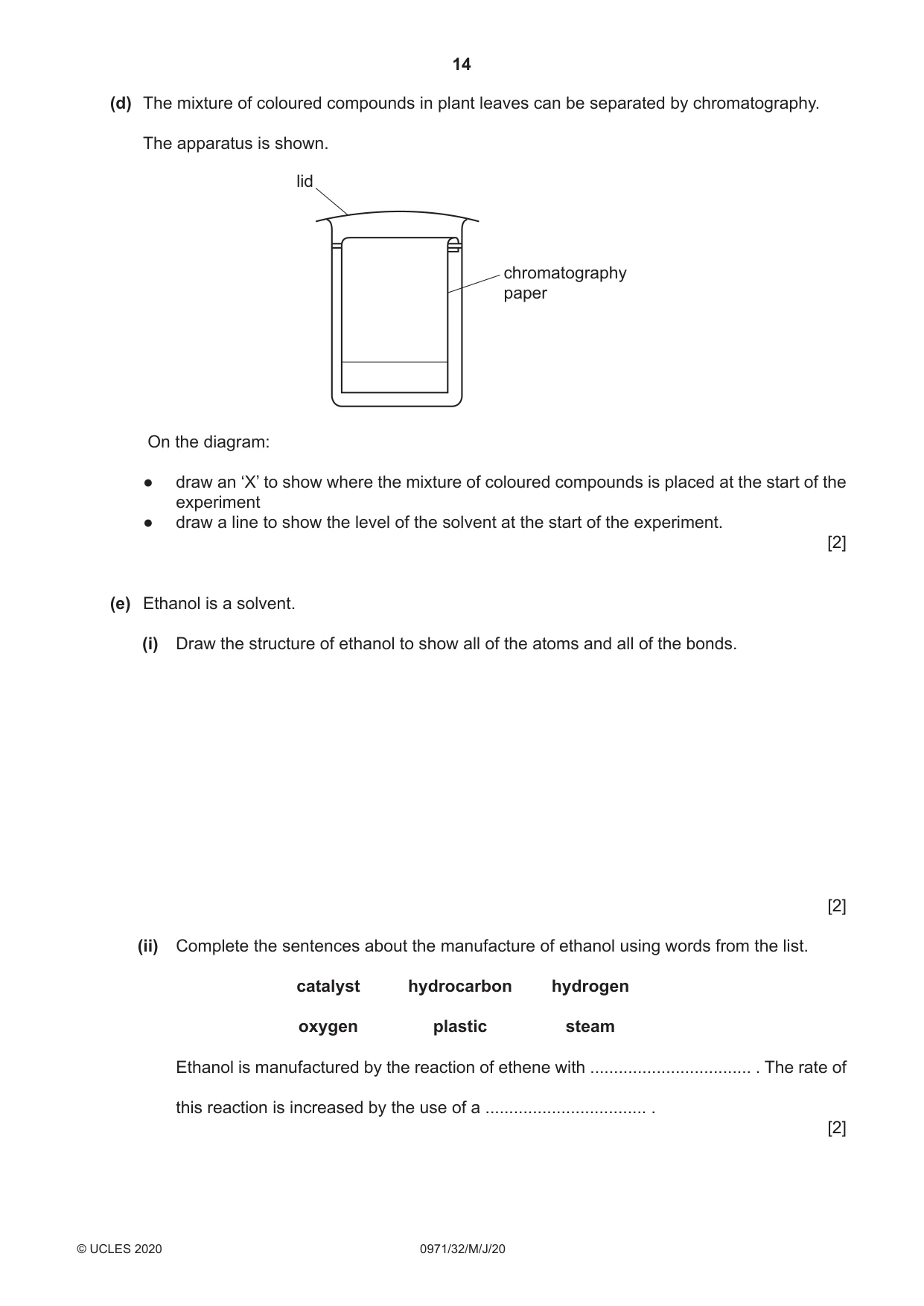
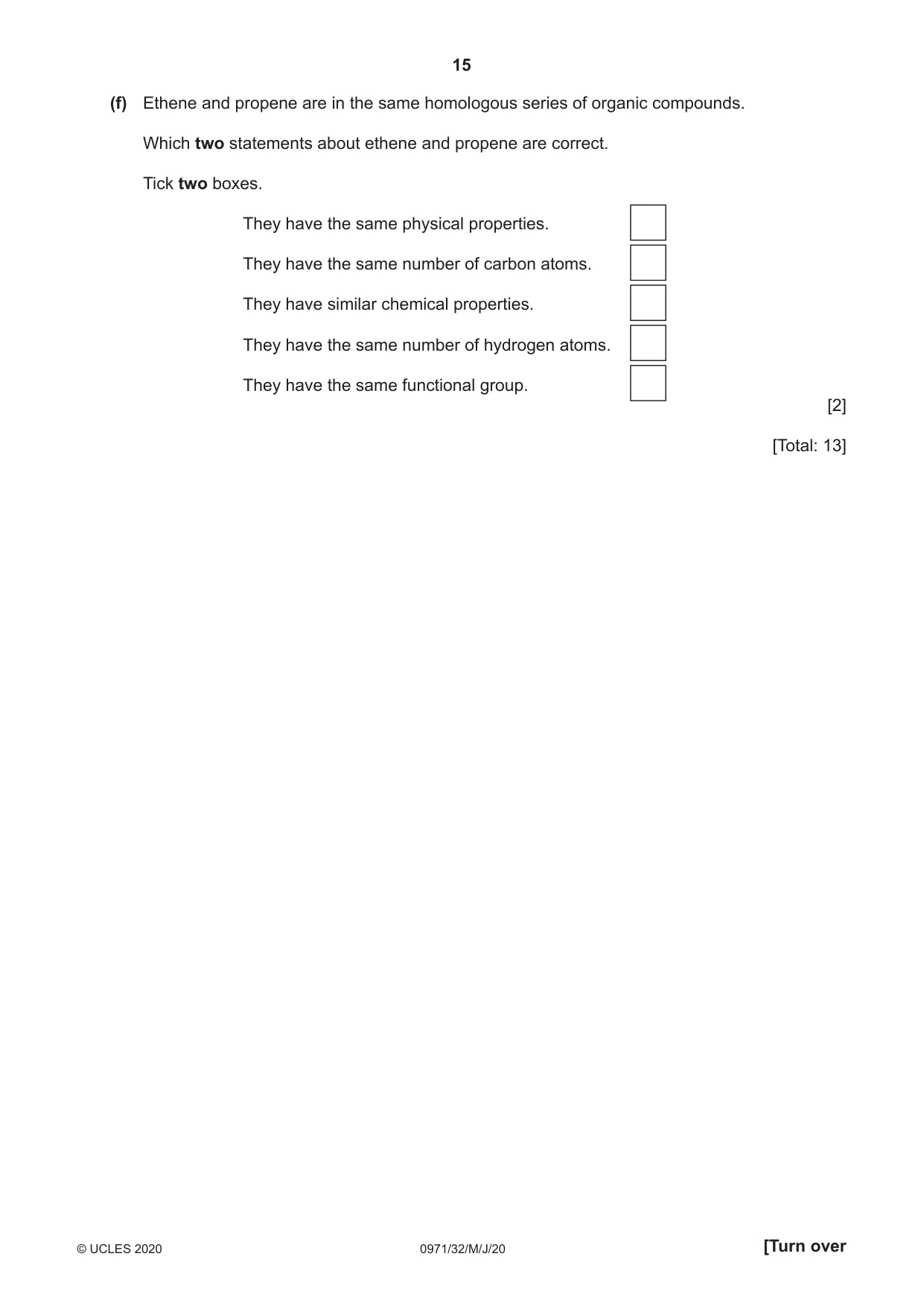
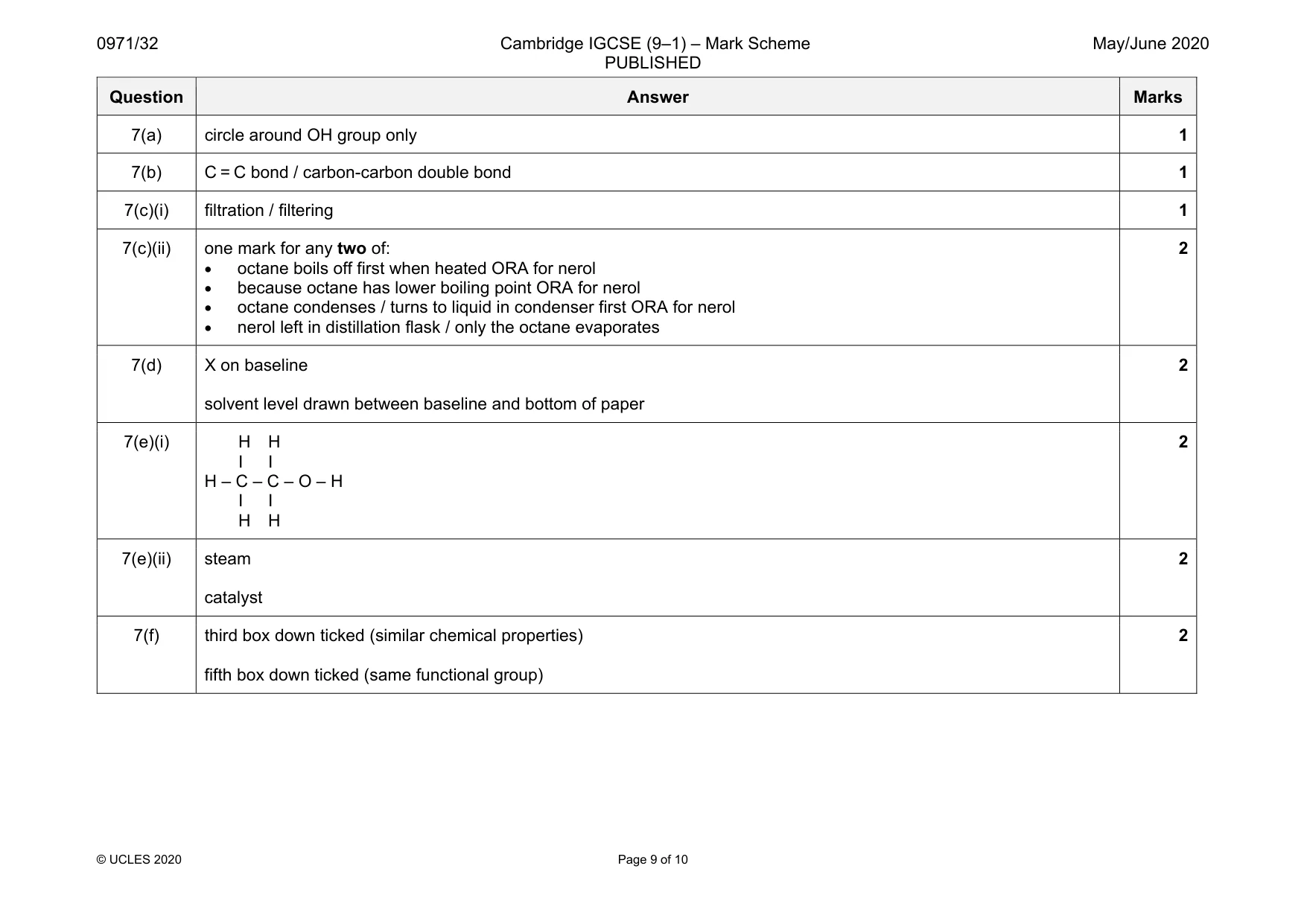
7 The structure of nerol is shown. H H H C H H C H H H H H H C C C C H H C C C C O H H H H H (a) Draw a circle around the alcohol functional group on the structure of nerol. [1] (b) What feature of the nerol molecule shows that it is an unsaturated compound? .............................................................................................................................................. [1] (c) Nerol can be extracted from some plants. Crushed plant leaves containing nerol are mixed with an organic solvent called octane. Nerol dissolves in octane. (i) Describe how you would separate the crushed plant leaves from the solution of nerol in octane. ....................................................................................................................................... [1] (ii) The boiling point of nerol is 224 °C. The boiling point of octane is 126 °C. Explain how distillation separates nerol from the octane. ............................................................................................................................................. ............................................................................................................................................. ............................................................................................................................................. ....................................................................................................................................... [2] (d) The mixture of coloured compounds in plant leaves can be separated by chromatography. The apparatus is shown. lid chromatography paper On the diagram: ●● draw an ‘X’ to show where the mixture of coloured compounds is placed at the start of the experiment ●● draw a line to show the level of the solvent at the start of the experiment. [2] (e) Ethanol is a solvent. (i) Draw the structure of ethanol to show all of the atoms and all of the bonds. [2] (ii) Complete the sentences about the manufacture of ethanol using words from the list. catalyst hydrocarbon hydrogen oxygen plastic steam Ethanol is manufactured by the reaction of ethene with .................................. . The rate of this reaction is increased by the use of a .................................. . [2] (f) Ethene and propene are in the same homologous series of organic compounds. Which two statements about ethene and propene are correct. Tick two boxes. They have the same physical properties. They have the same number of carbon atoms. They have similar chemical properties. They have the same number of hydrogen atoms. They have the same functional group. [2] [Total: 13]
Mark scheme: 7(a) circle around OH group only 1 7(b) C = C bond / carbon-carbon double bond 1 7(c)(i) filtration / filtering 1 7(c)(ii) one mark for any two of: • octane boils off first when heated ORA for nerol • because octane has lower boiling point ORA for nerol • octane condenses / turns to liquid in condenser first ORA for nerol • nerol left in distillation flask / only the octane evaporates 2 7(d) X on baseline solvent level drawn between baseline and bottom of paper 2 7(e)(i) H H I I H – C – C – O – H I I H H 2 7(e)(ii) steam catalyst 2 7(f) third box down ticked (similar chemical properties) fifth box down ticked (same functional group) 2
Q8 · The diagram shows part of the structures of caesium chloride and carbon dioxide
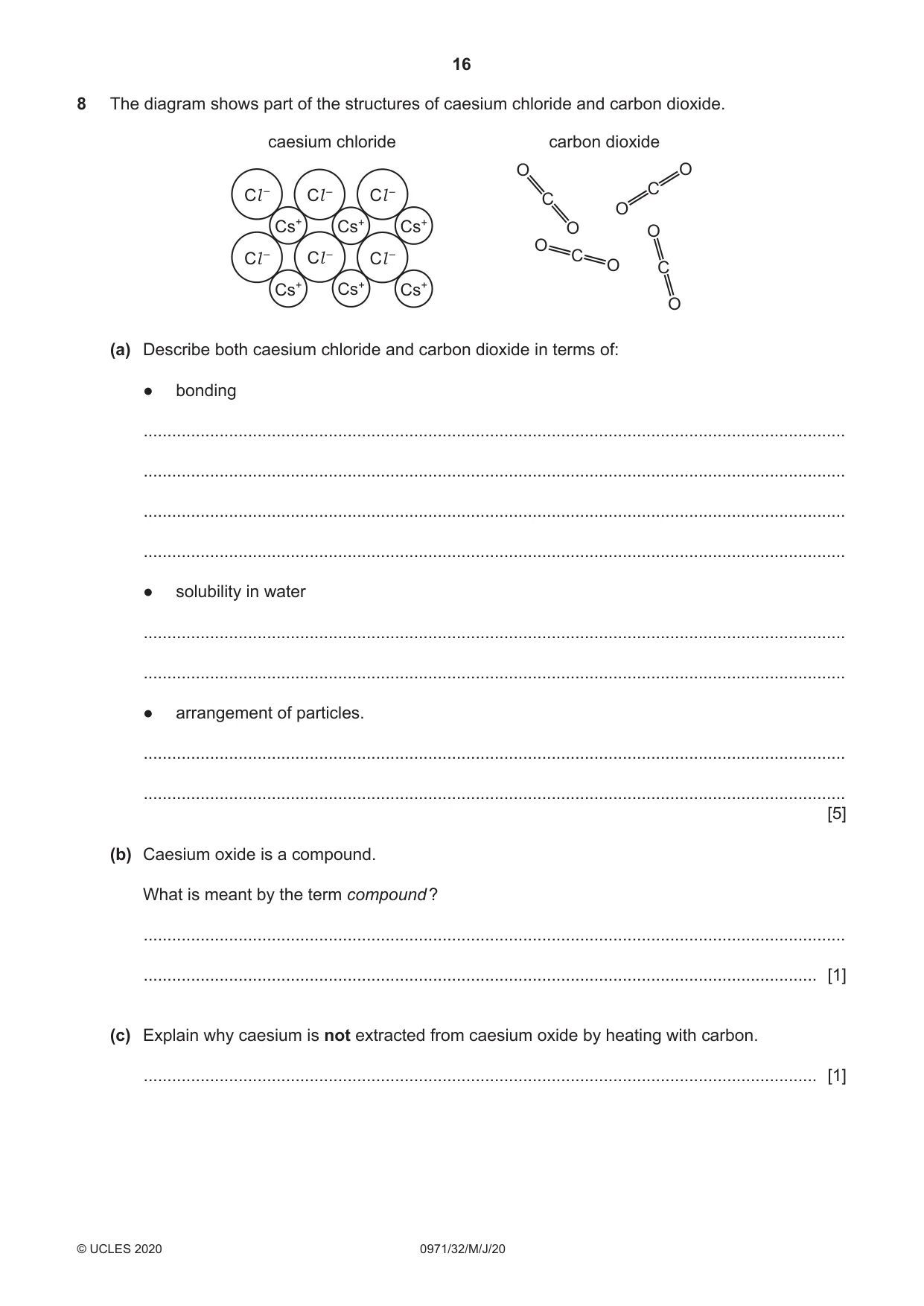
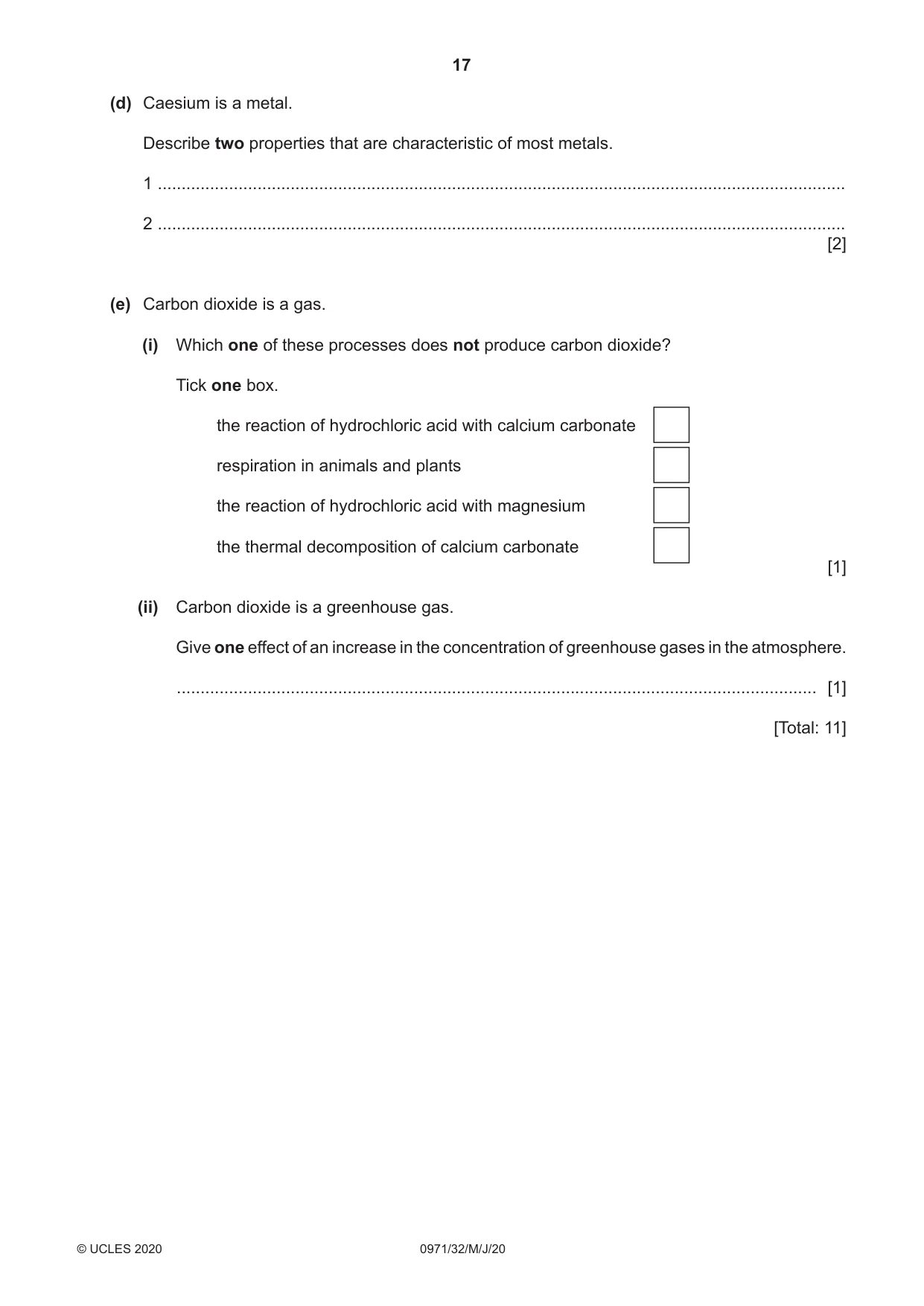
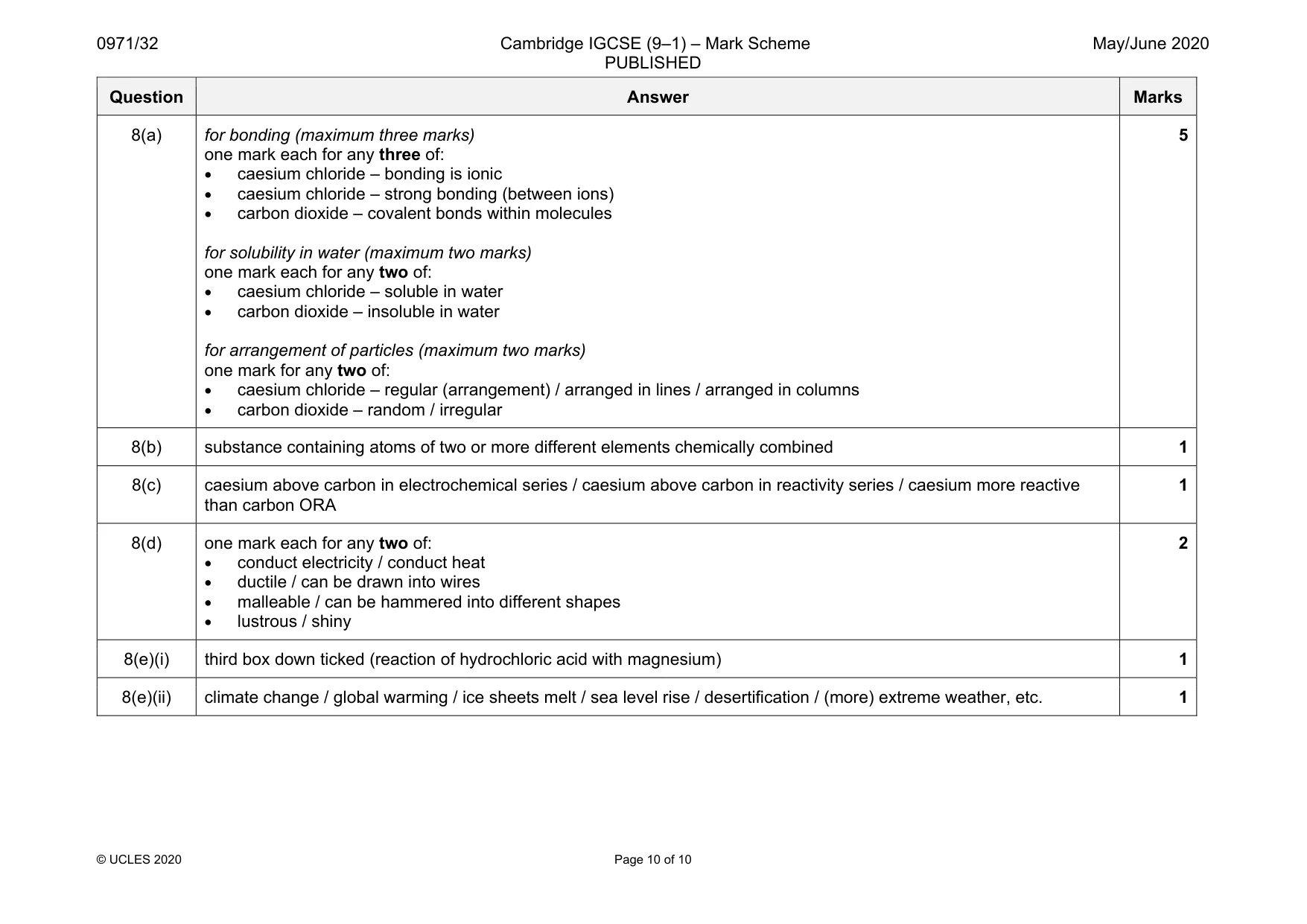
8 The diagram shows part of the structures of caesium chloride and carbon dioxide. caesium chloride carbon dioxide O O – – – C Cl Cl Cl C O Cs+ Cs+ Cs+ O O O – – – Cl Cl Cl C O C Cs+ Cs+ Cs+ O (a) Describe both caesium chloride and carbon dioxide in terms of: ●● bonding .................................................................................................................................................... .................................................................................................................................................... .................................................................................................................................................... .................................................................................................................................................... ●● solubility in water .................................................................................................................................................... .................................................................................................................................................... ●● arrangement of particles. .................................................................................................................................................... .................................................................................................................................................... [5] (b) Caesium oxide is a compound. What is meant by the term compound ? .................................................................................................................................................... .............................................................................................................................................. [1] (c) Explain why caesium is not extracted from caesium oxide by heating with carbon. .............................................................................................................................................. [1] (d) Caesium is a metal. Describe two properties that are characteristic of most metals. 1 ................................................................................................................................................. 2 ................................................................................................................................................. [2] (e) Carbon dioxide is a gas. (i) Which one of these processes does not produce carbon dioxide? Tick one box. the reaction of hydrochloric acid with calcium carbonate respiration in animals and plants the reaction of hydrochloric acid with magnesium the thermal decomposition of calcium carbonate [1] (ii) Carbon dioxide is a greenhouse gas. Give one effect of an increase in the concentration of greenhouse gases in the atmosphere. ....................................................................................................................................... [1] [Total: 11]
Mark scheme: 8(a) for bonding (maximum three marks) one mark each for any three of: • caesium chloride – bonding is ionic • caesium chloride – strong bonding (between ions) • carbon dioxide – covalent bonds within molecules for solubility in water (maximum two marks) one mark each for any two of: • caesium chloride – soluble in water • carbon dioxide – insoluble in water for arrangement of particles (maximum two marks) one mark for any two of: • caesium chloride – regular (arrangement) / arranged in lines / arranged in columns • carbon dioxide – random / irregular 5 8(b) substance containing atoms of two or more different elements chemically combined 1 8(c) caesium above carbon in electrochemical series / caesium above carbon in reactivity series / caesium more reactive than carbon ORA 1 8(d) one mark each for any two of: • conduct electricity / conduct heat • ductile / can be drawn into wires • malleable / can be hammered into different shapes • lustrous / shiny 2 8(e)(i) third box down ticked (reaction of hydrochloric acid with magnesium) 1 8(e)(ii) climate change / global warming / ice sheets melt / sea level rise / desertification / (more) extreme weather, etc. 1
What was in this paper
The subtopics covered by these 8 questions, and how many questions each got. Open one in a new tab to see every Cambridge question on it.