Cambridge IGCSE Chemistry (9-1) 0971 — 2018 Oct/Nov Paper 4 · Variant 2
0971/42/O/N/18 · 5 questions · 80 marks · ≈90 min
The question paper and its mark scheme, free to read here and free to download. This is Cambridge’s own paper, exactly as it was sat.
Question paper16 pages


Mark scheme9 pages
Answers below. Sit the paper first if you are practising.
Questions as text
Q1 · Element X can undergo the following physical changes
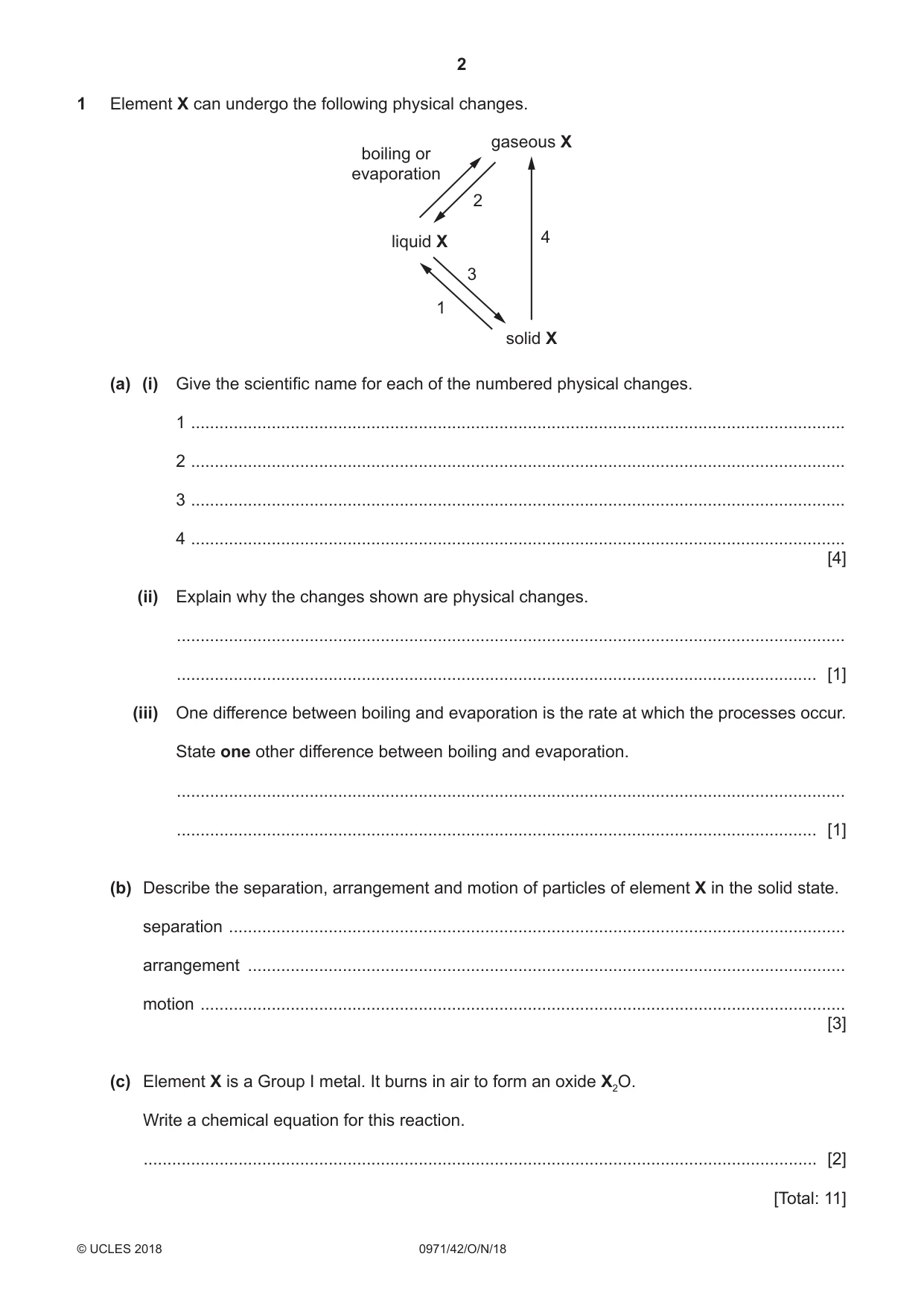
1 Element X can undergo the following physical changes. gaseous X boiling or evaporation 2 liquid X 4 3 1 solid X (a) (i) Give the scientific name for each of the numbered physical changes. 1 .......................................................................................................................................... 2 .......................................................................................................................................... 3 .......................................................................................................................................... 4 .......................................................................................................................................... [4] (ii) Explain why the changes shown are physical changes. ............................................................................................................................................. ....................................................................................................................................... [1] (iii) One difference between boiling and evaporation is the rate at which the processes occur. State one other difference between boiling and evaporation. ............................................................................................................................................. ....................................................................................................................................... [1] (b) Describe the separation, arrangement and motion of particles of element X in the solid state. separation .................................................................................................................................. arrangement ............................................................................................................................... motion ........................................................................................................................................ [3] (c) Element X is a Group I metal. It burns in air to form an oxide X2O. Write a chemical equation for this reaction. .............................................................................................................................................. [2] [Total: 11]
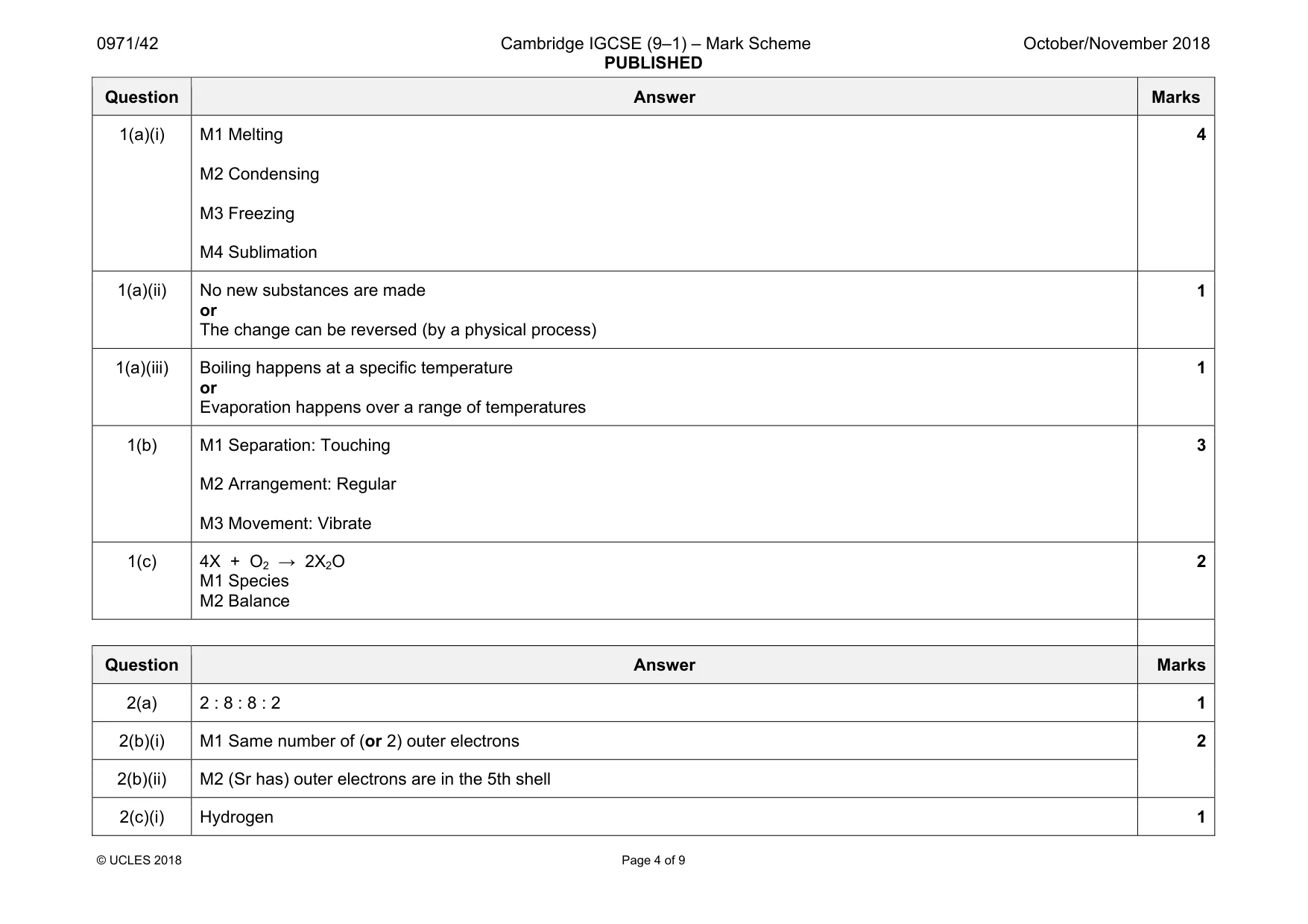
Mark scheme: 1(a)(i) M1 Melting M2 Condensing M3 Freezing M4 Sublimation 4 1(a)(ii) No new substances are made or The change can be reversed (by a physical process) 1 1(a)(iii) Boiling happens at a specific temperature or Evaporation happens over a range of temperatures 1 1(b) M1 Separation: Touching M2 Arrangement: Regular M3 Movement: Vibrate 3 1(c) 4X + O2 → 2X2O M1 Species M2 Balance 2
Q2 · Magnesium, calcium and strontium are Group II elements
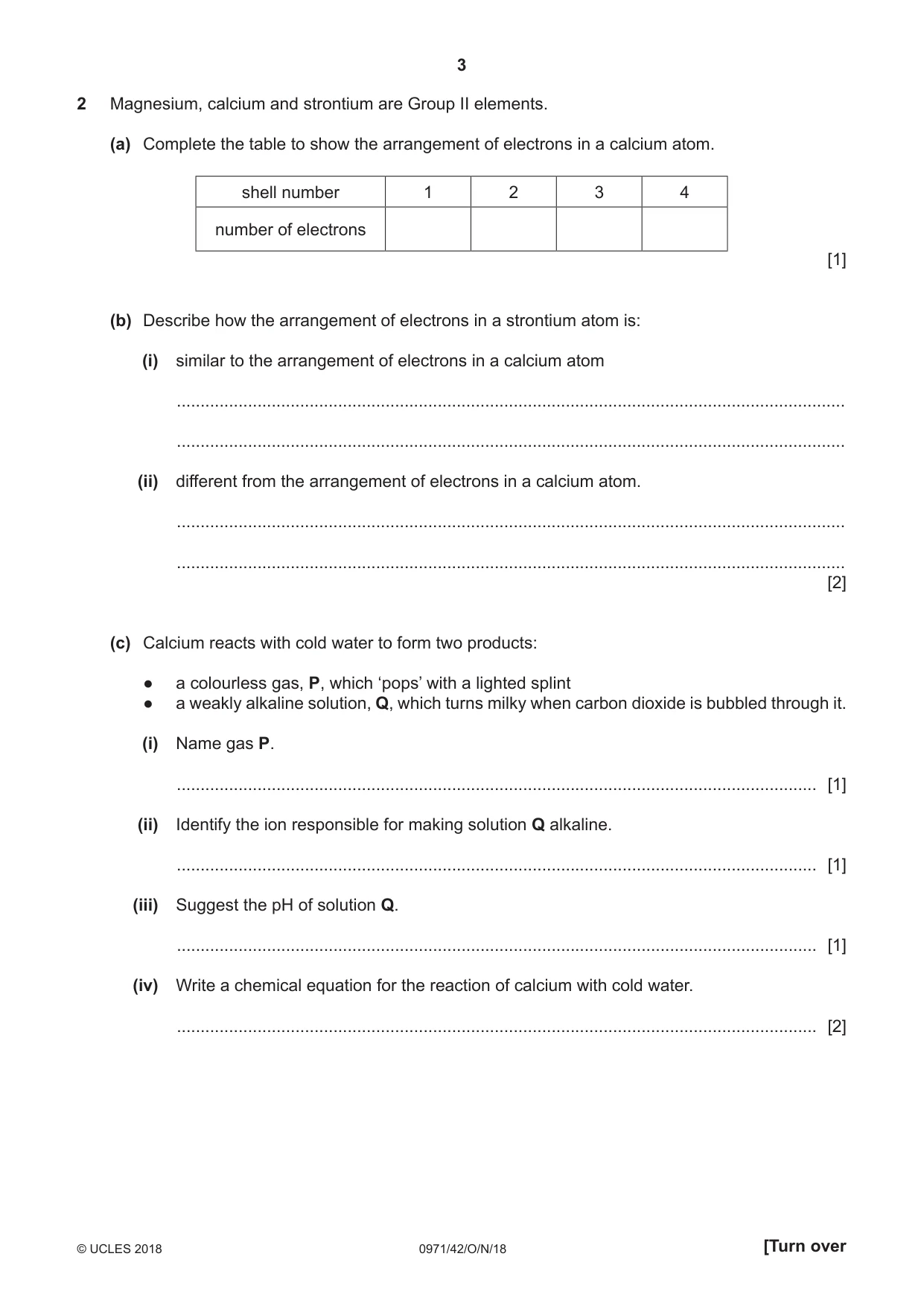
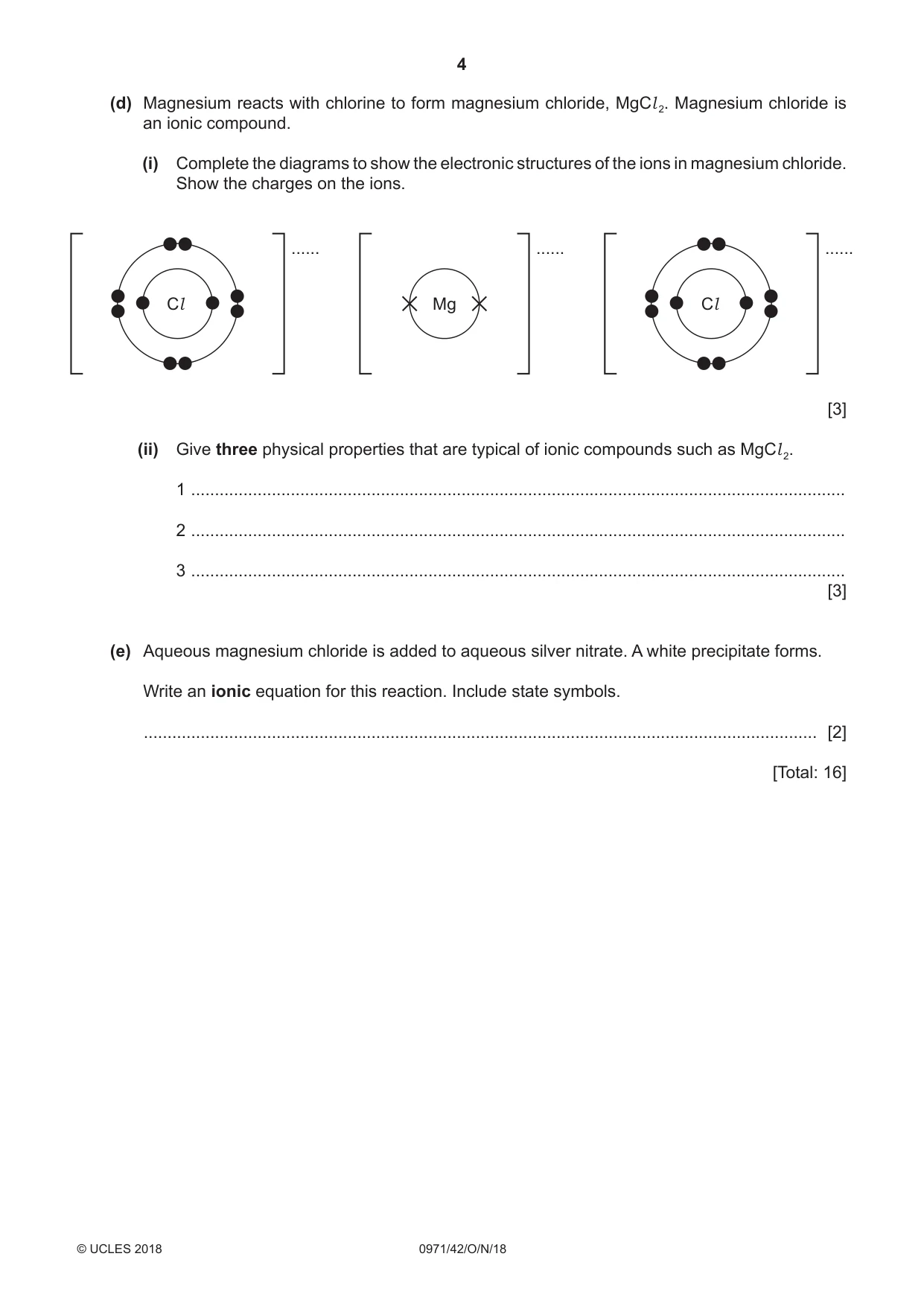
2 Magnesium, calcium and strontium are Group II elements. (a) Complete the table to show the arrangement of electrons in a calcium atom. shell number 1 2 3 4 number of electrons [1] (b) Describe how the arrangement of electrons in a strontium atom is: (i) similar to the arrangement of electrons in a calcium atom ............................................................................................................................................. ............................................................................................................................................. (ii) different from the arrangement of electrons in a calcium atom. ............................................................................................................................................. ............................................................................................................................................. [2] (c) Calcium reacts with cold water to form two products: ●● a colourless gas, P, which ‘pops’ with a lighted splint ●● a weakly alkaline solution, Q, which turns milky when carbon dioxide is bubbled through it. (i) Name gas P. ....................................................................................................................................... [1] (ii) Identify the ion responsible for making solution Q alkaline. ....................................................................................................................................... [1] (iii) Suggest the pH of solution Q. ....................................................................................................................................... [1] (iv) Write a chemical equation for the reaction of calcium with cold water. ....................................................................................................................................... [2] (d) Magnesium reacts with chlorine to form magnesium chloride, MgCl 2. Magnesium chloride is an ionic compound. (i) Complete the diagrams to show the electronic structures of the ions in magnesium chloride. Show the charges on the ions. ...... ...... ...... Cl Mg Cl [3] (ii) Give three physical properties that are typical of ionic compounds such as MgCl 2. 1 .......................................................................................................................................... 2 .......................................................................................................................................... 3 .......................................................................................................................................... [3] (e) Aqueous magnesium chloride is added to aqueous silver nitrate. A white precipitate forms. Write an ionic equation for this reaction. Include state symbols. .............................................................................................................................................. [2] [Total: 16]
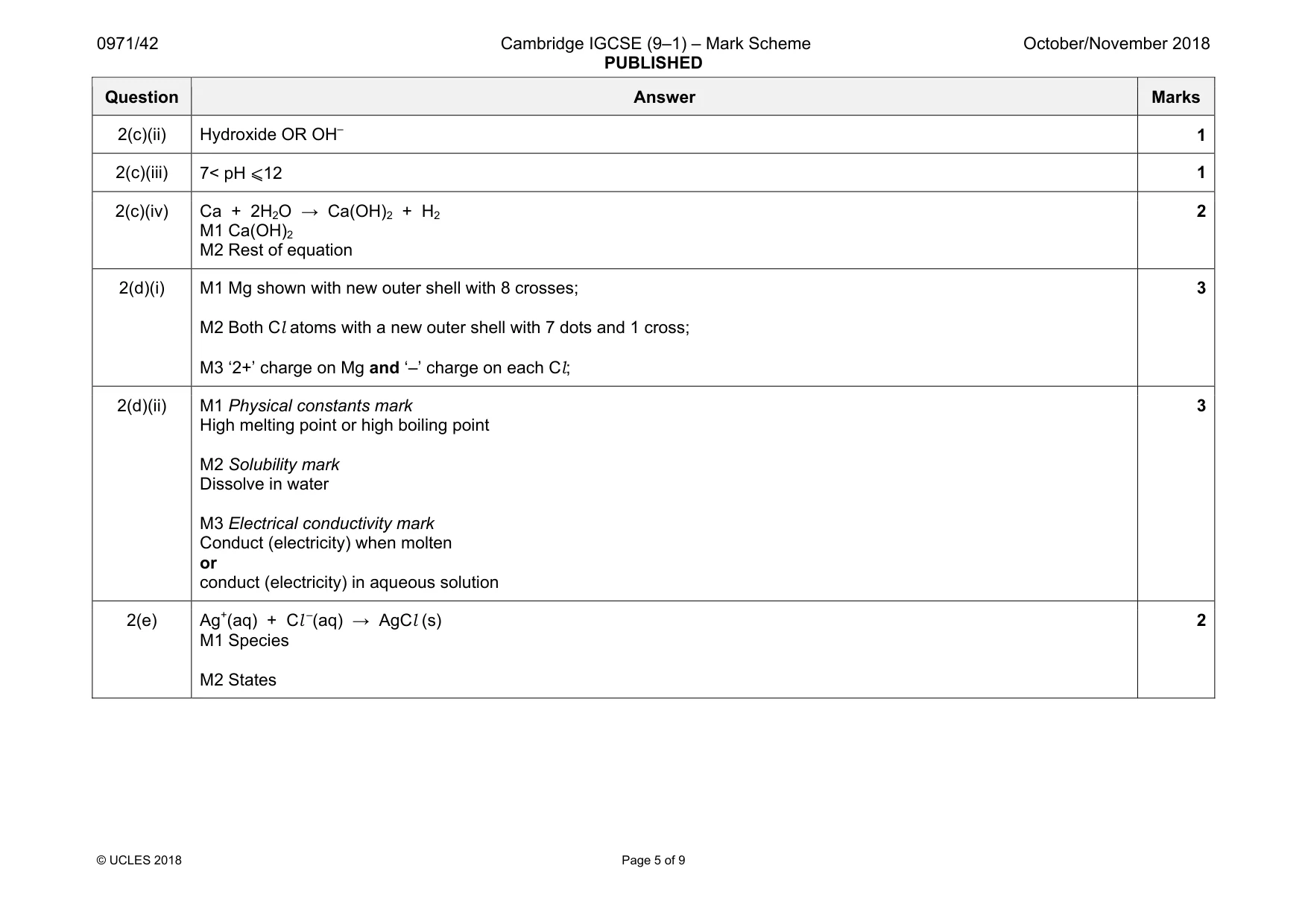
Mark scheme: 2(a) 2 : 8 : 8 : 2 1 2(b)(i) M1 Same number of (or 2) outer electrons 2 2(b)(ii) M2 (Sr has) outer electrons are in the 5th shell 2(c)(i) Hydrogen 1 Question Answer Marks 2(c)(ii) Hydroxide OR OH– 1 2(c)(iii) 7< pH ⩽12 1 2(c)(iv) Ca + 2H2O → Ca(OH)2 + H2 M1 Ca(OH)2 M2 Rest of equation 2 2(d)(i) M1 Mg shown with new outer shell with 8 crosses; M2 Both Cl atoms with a new outer shell with 7 dots and 1 cross; M3 ‘2+’ charge on Mg and ‘–’ charge on each Cl; 3 2(d)(ii) M1 Physical constants mark High melting point or high boiling point M2 Solubility mark Dissolve in water M3 Electrical conductivity mark Conduct (electricity) when molten or conduct (electricity) in aqueous solution 3 2(e) Ag+(aq) + Cl –(aq) → AgCl (s) M1 Species M2 States 2
Q3 · Sulfur is an important element
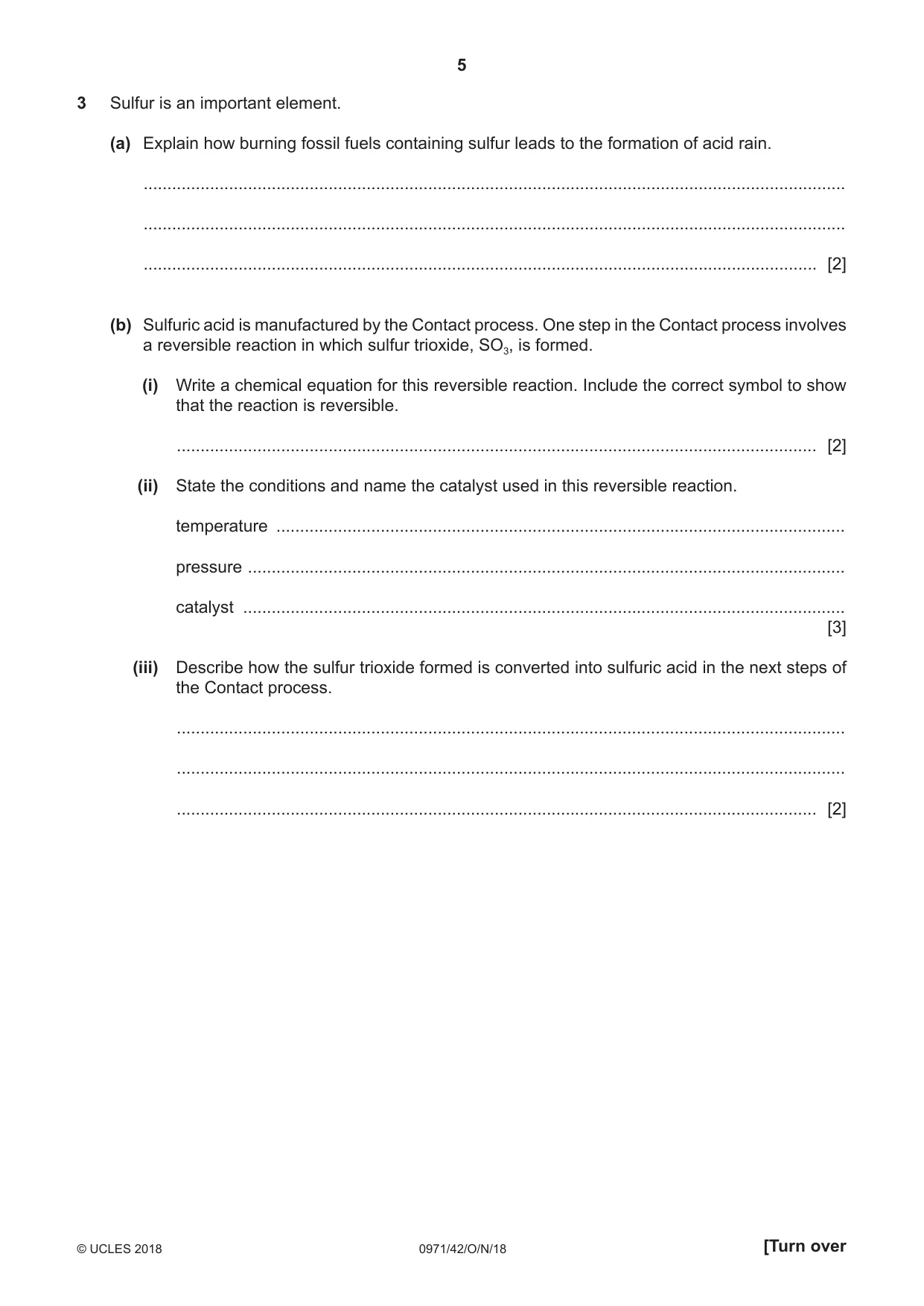
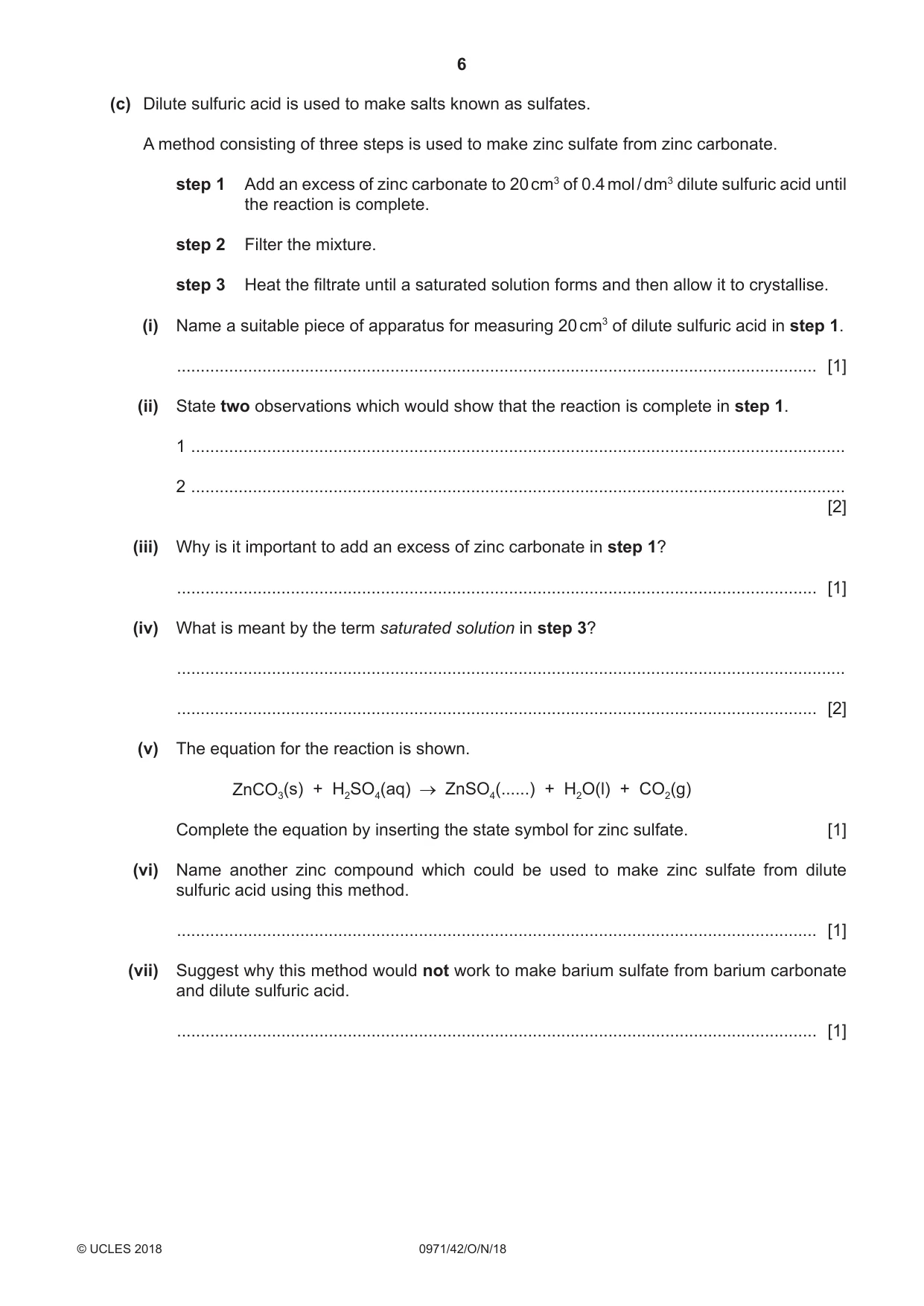
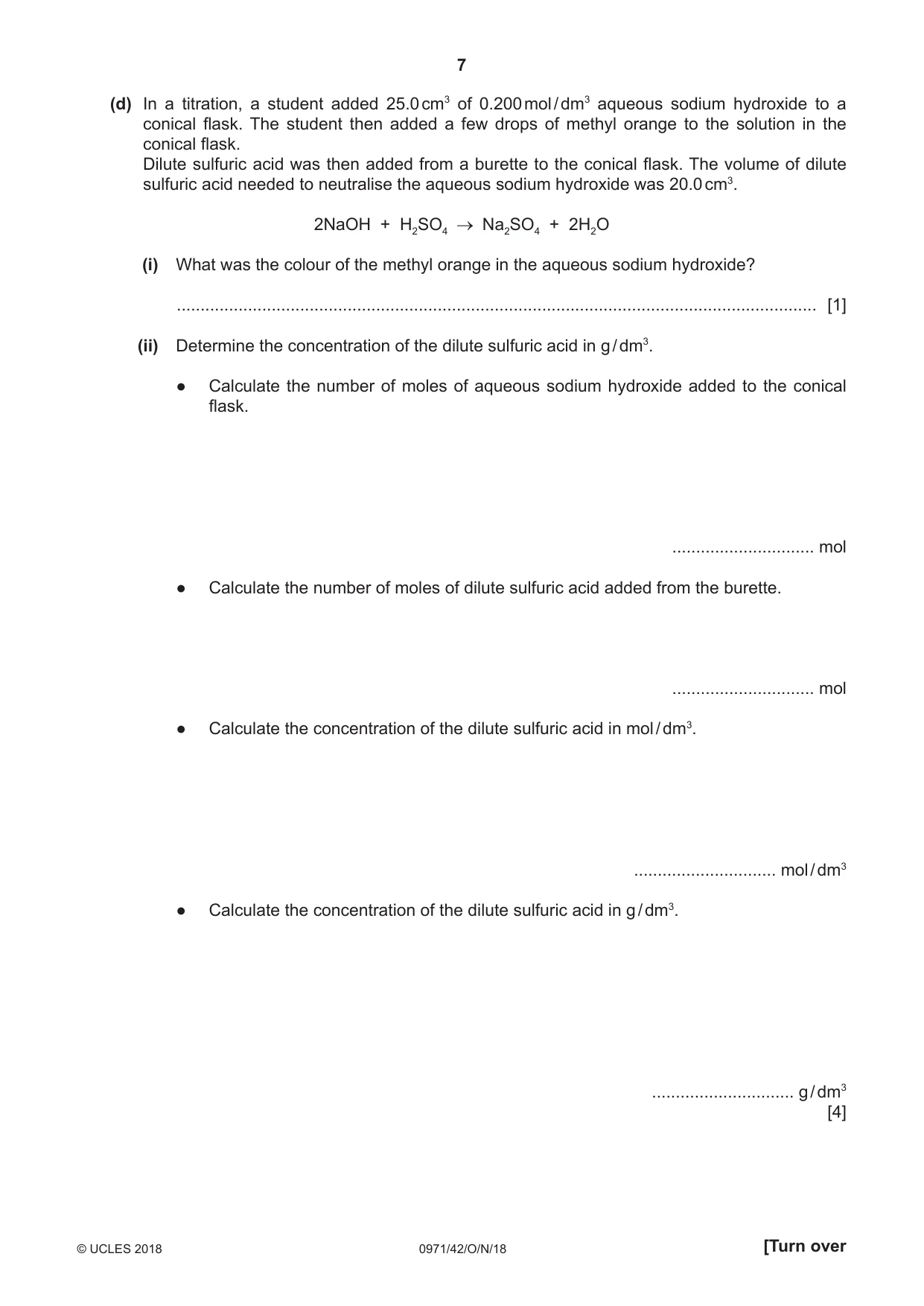
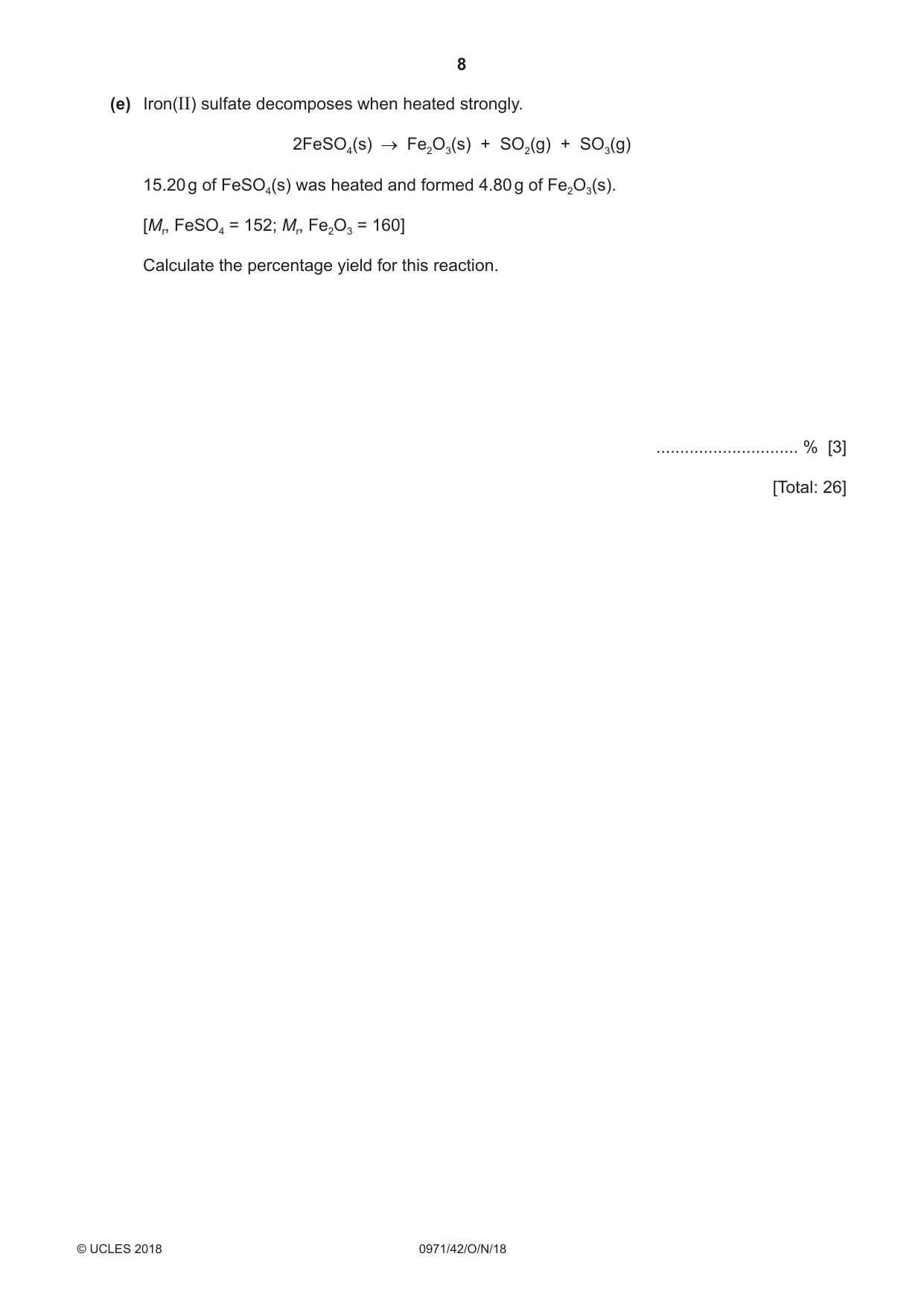
3 Sulfur is an important element. (a) Explain how burning fossil fuels containing sulfur leads to the formation of acid rain. .................................................................................................................................................... .................................................................................................................................................... .............................................................................................................................................. [2] (b) Sulfuric acid is manufactured by the Contact process. One step in the Contact process involves a reversible reaction in which sulfur trioxide, SO3, is formed. (i) Write a chemical equation for this reversible reaction. Include the correct symbol to show that the reaction is reversible. ....................................................................................................................................... [2] (ii) State the conditions and name the catalyst used in this reversible reaction. temperature ......................................................................................................................... pressure .............................................................................................................................. catalyst ................................................................................................................................ [3] (iii) Describe how the sulfur trioxide formed is converted into sulfuric acid in the next steps of the Contact process. ............................................................................................................................................. ............................................................................................................................................. ....................................................................................................................................... [2] (c) Dilute sulfuric acid is used to make salts known as sulfates. A method consisting of three steps is used to make zinc sulfate from zinc carbonate. step 1 Add an excess of zinc carbonate to 20 cm3 of 0.4 mol / dm3 dilute sulfuric acid until the reaction is complete. step 2 Filter the mixture. step 3 Heat the filtrate until a saturated solution forms and then allow it to crystallise. (i) Name a suitable piece of apparatus for measuring 20 cm3 of dilute sulfuric acid in step 1. ....................................................................................................................................... [1] (ii) State two observations which would show that the reaction is complete in step 1. 1 .......................................................................................................................................... 2 .......................................................................................................................................... [2] (iii) Why is it important to add an excess of zinc carbonate in step 1? ....................................................................................................................................... [1] (iv) What is meant by the term saturated solution in step 3? ............................................................................................................................................. ....................................................................................................................................... [2] (v) The equation for the reaction is shown. ZnCO3(s) + H2SO4(aq) ZnSO4(......) + H2O(l) + CO2(g) Complete the equation by inserting the state symbol for zinc sulfate. [1] (vi) Name another zinc compound which could be used to make zinc sulfate from dilute sulfuric acid using this method. ....................................................................................................................................... [1] (vii) Suggest why this method would not work to make barium sulfate from barium carbonate and dilute sulfuric acid. ....................................................................................................................................... [1] (d) In a titration, a student added 25.0 cm3 of 0.200 mol / dm3 aqueous sodium hydroxide to a conical flask. The student then added a few drops of methyl orange to the solution in the conical flask. Dilute sulfuric acid was then added from a burette to the conical flask. The volume of dilute sulfuric acid needed to neutralise the aqueous sodium hydroxide was 20.0 cm3. 2NaOH + H2SO4 Na2SO4 + 2H2O (i) What was the colour of the methyl orange in the aqueous sodium hydroxide? ....................................................................................................................................... [1] (ii) Determine the concentration of the dilute sulfuric acid in g / dm3. ● Calculate the number of moles of aqueous sodium hydroxide added to the conical flask. .............................. mol ● Calculate the number of moles of dilute sulfuric acid added from the burette. .............................. mol ● Calculate the concentration of the dilute sulfuric acid in mol / dm3. .............................. mol / dm3 ● Calculate the concentration of the dilute sulfuric acid in g / dm3. .............................. g / dm3 [4] (e) Iron(II) sulfate decomposes when heated strongly. 2FeSO4(s) Fe2O3(s) + SO2(g) + SO3(g) 15.20 g of FeSO4(s) was heated and formed 4.80 g of Fe2O3(s). [Mr, FeSO4 = 152; Mr, Fe2O3 = 160] Calculate the percentage yield for this reaction. .............................. % [3] [Total: 26]
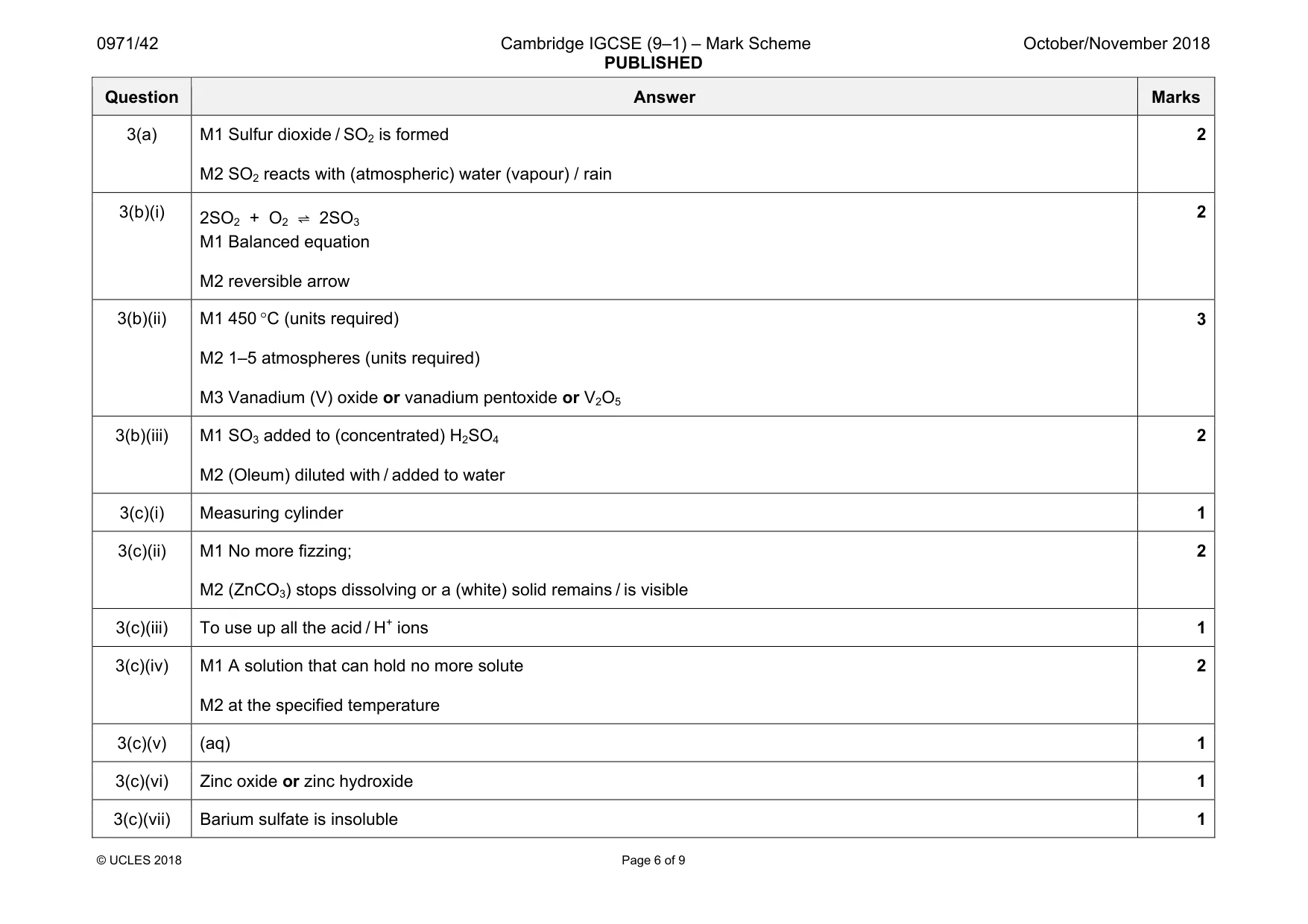
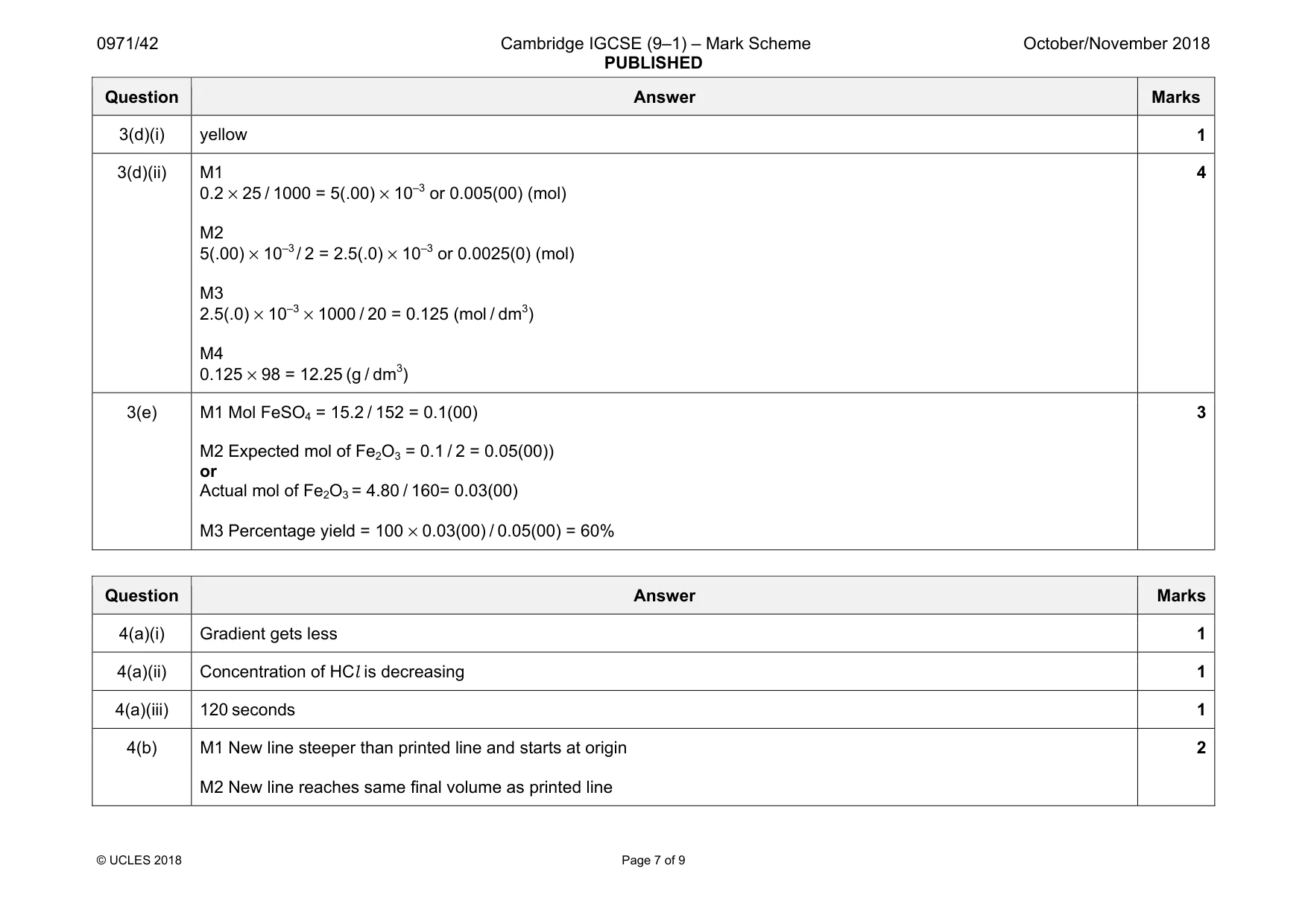
Mark scheme: 3(a) M1 Sulfur dioxide / SO2 is formed M2 SO2 reacts with (atmospheric) water (vapour) / rain 2 3(b)(i) 2SO2 + O2 ⇌ 2SO3 M1 Balanced equation M2 reversible arrow 2 3(b)(ii) M1 450 °C (units required) M2 1–5 atmospheres (units required) M3 Vanadium (V) oxide or vanadium pentoxide or V2O5 3 3(b)(iii) M1 SO3 added to (concentrated) H2SO4 M2 (Oleum) diluted with / added to water 2 3(c)(i) Measuring cylinder 1 3(c)(ii) M1 No more fizzing; M2 (ZnCO3) stops dissolving or a (white) solid remains / is visible 2 3(c)(iii) To use up all the acid / H+ ions 1 3(c)(iv) M1 A solution that can hold no more solute M2 at the specified temperature 2 3(c)(v) (aq) 1 3(c)(vi) Zinc oxide or zinc hydroxide 1 3(c)(vii) Barium sulfate is insoluble 1 Question Answer Marks 3(d)(i) yellow 1 3(d)(ii) M1 0.2 × 25 / 1000 = 5(.00) × 10–3 or 0.005(00) (mol) M2 5(.00) × 10–3 / 2 = 2.5(.0) × 10–3 or 0.0025(0) (mol) M3 2.5(.0) × 10–3 × 1000 / 20 = 0.125 (mol / dm3) M4 0.125 × 98 = 12.25 (g / dm3) 4 3(e) M1 Mol FeSO4 = 15.2 / 152 = 0.1(00) M2 Expected mol of Fe2O3 = 0.1 / 2 = 0.05(00)) or Actual mol of Fe2O3 = 4.80 / 160= 0.03(00) M3 Percentage yield = 100 × 0.03(00) / 0.05(00) = 60% 3
Q4 · A student investigated the progress of the reaction between dilute hydrochloric acid…
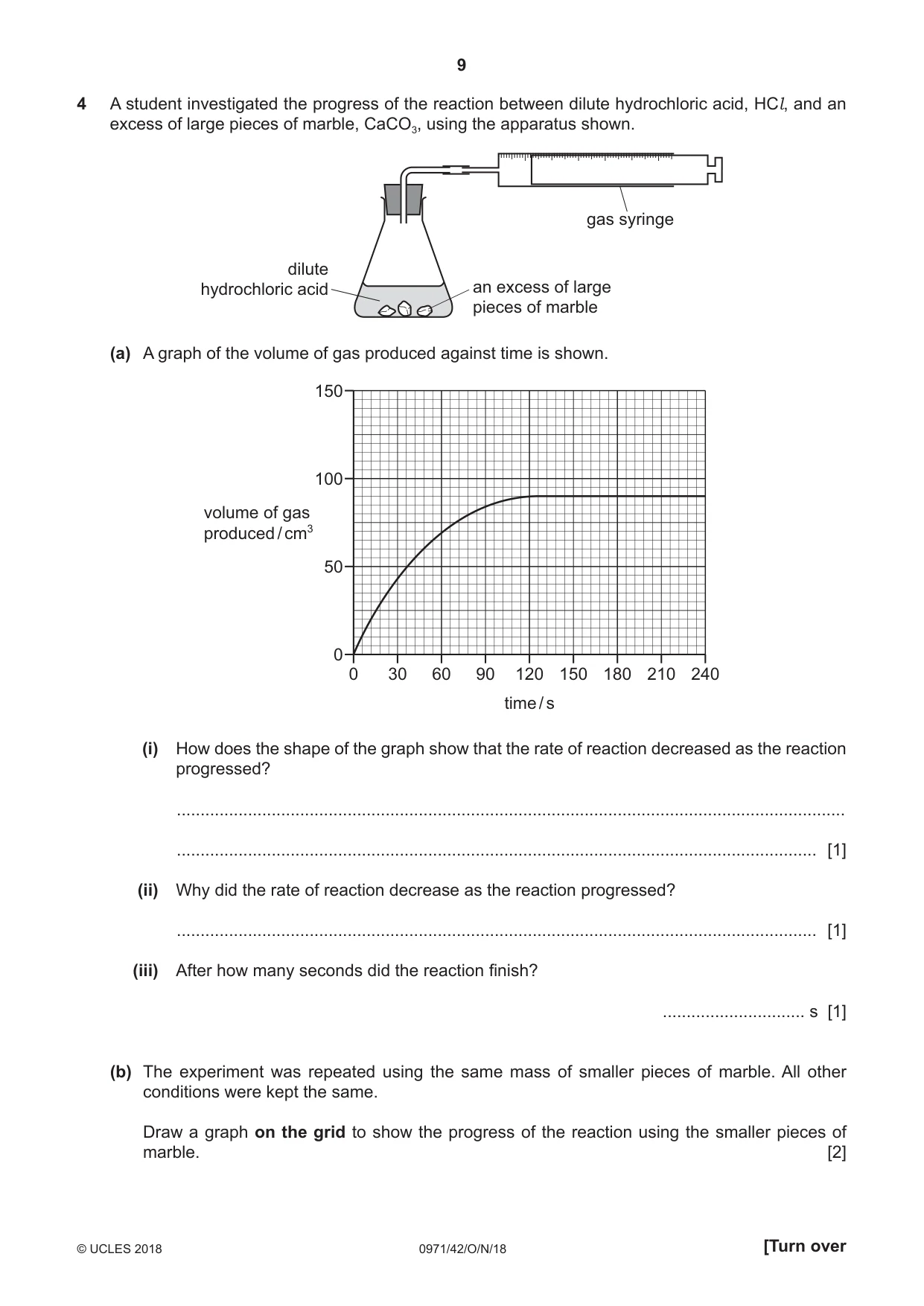
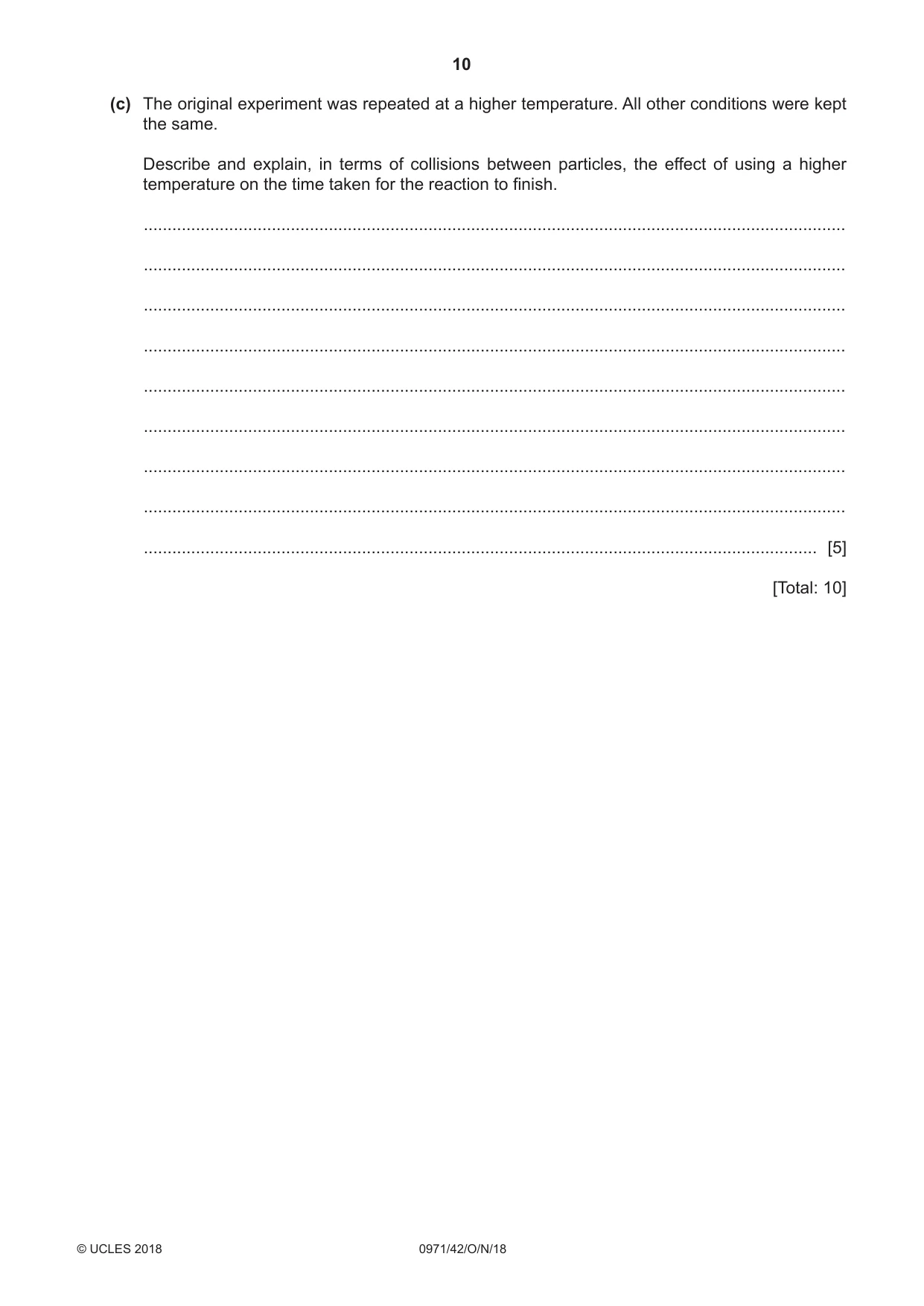
4 A student investigated the progress of the reaction between dilute hydrochloric acid, HCl, and an excess of large pieces of marble, CaCO3, using the apparatus shown. gas syringe dilute hydrochloric acid an excess of large pieces of marble (a) A graph of the volume of gas produced against time is shown. 150 100 volume of gas produced / cm3 50 0 0 30 60 90 120 150 180 210 240 time / s (i) How does the shape of the graph show that the rate of reaction decreased as the reaction progressed? ............................................................................................................................................. ....................................................................................................................................... [1] (ii) Why did the rate of reaction decrease as the reaction progressed? ....................................................................................................................................... [1] (iii) After how many seconds did the reaction finish? .............................. s [1] (b) The experiment was repeated using the same mass of smaller pieces of marble. All other conditions were kept the same. Draw a graph on the grid to show the progress of the reaction using the smaller pieces of marble. [2] (c) The original experiment was repeated at a higher temperature. All other conditions were kept the same. Describe and explain, in terms of collisions between particles, the effect of using a higher temperature on the time taken for the reaction to finish. .................................................................................................................................................... .................................................................................................................................................... .................................................................................................................................................... .................................................................................................................................................... .................................................................................................................................................... .................................................................................................................................................... .................................................................................................................................................... .................................................................................................................................................... .............................................................................................................................................. [5] [Total: 10]
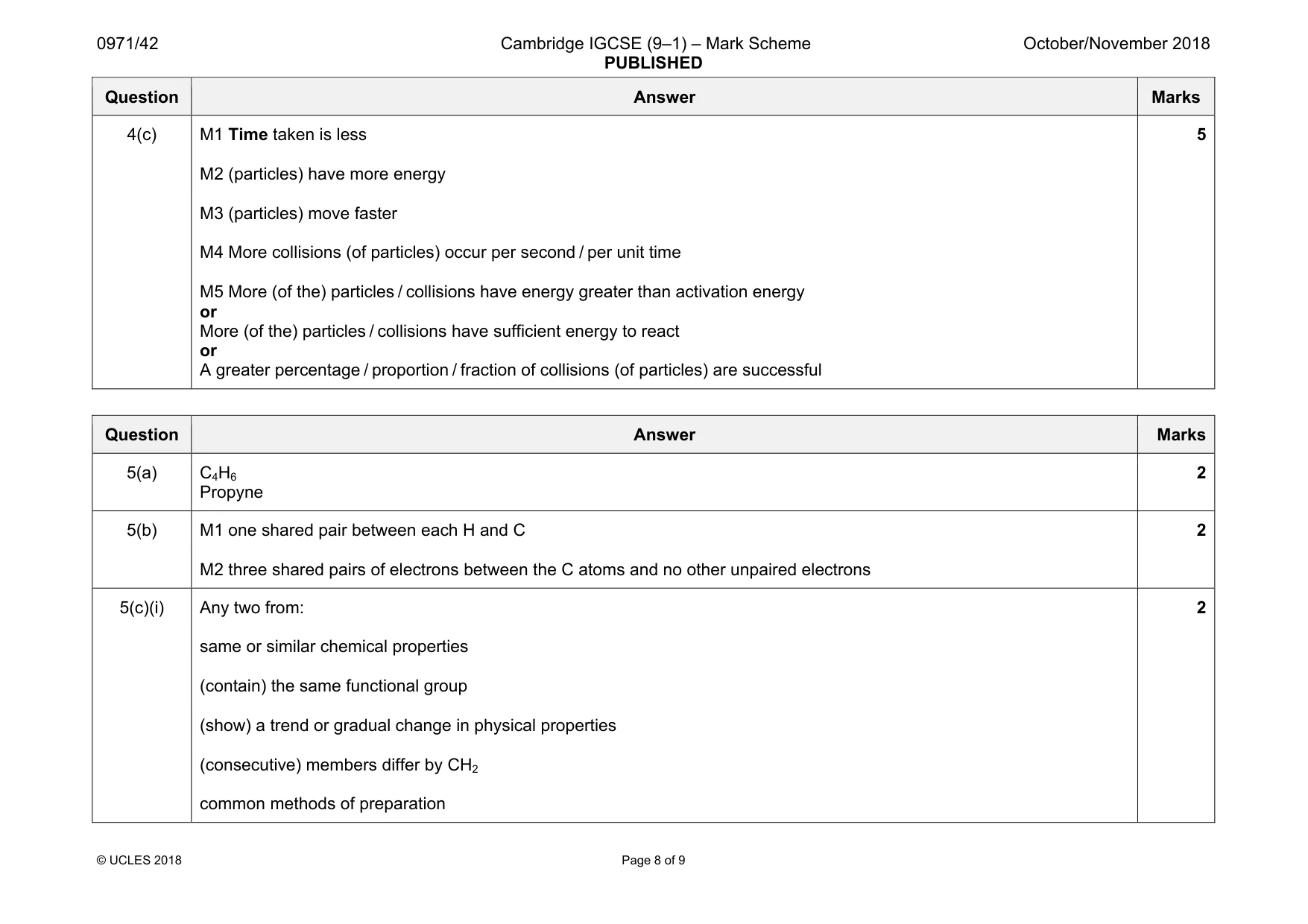
Mark scheme: 4(a)(i) Gradient gets less 1 4(a)(ii) Concentration of HCl is decreasing 1 4(a)(iii) 120 seconds 1 4(b) M1 New line steeper than printed line and starts at origin M2 New line reaches same final volume as printed line 2 Question Answer Marks 4(c) M1 Time taken is less M2 (particles) have more energy M3 (particles) move faster M4 More collisions (of particles) occur per second / per unit time M5 More (of the) particles / collisions have energy greater than activation energy or More (of the) particles / collisions have sufficient energy to react or A greater percentage / proportion / fraction of collisions (of particles) are successful 5
Q5 · Alkynes are a homologous series of unsaturated hydrocarbons
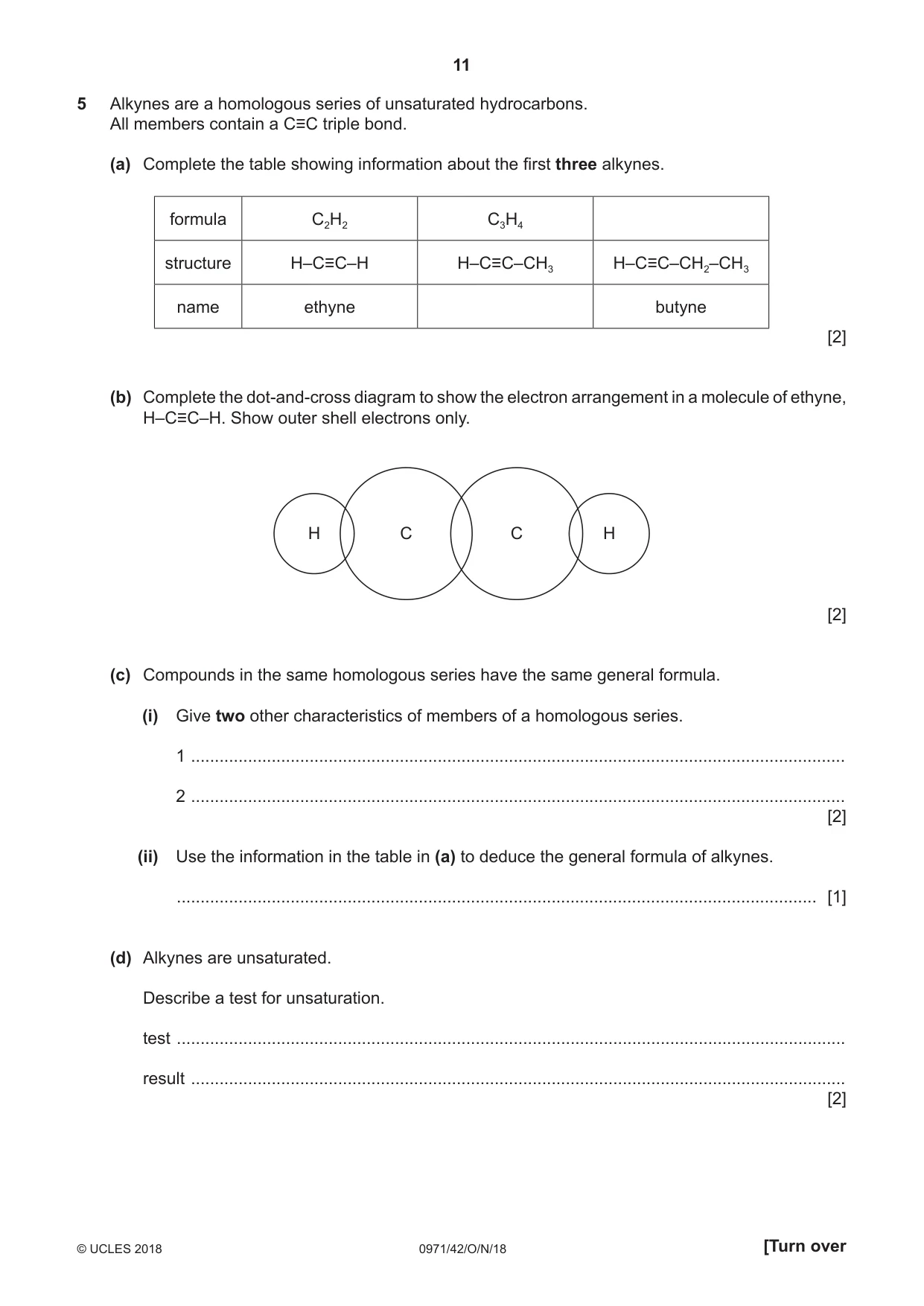
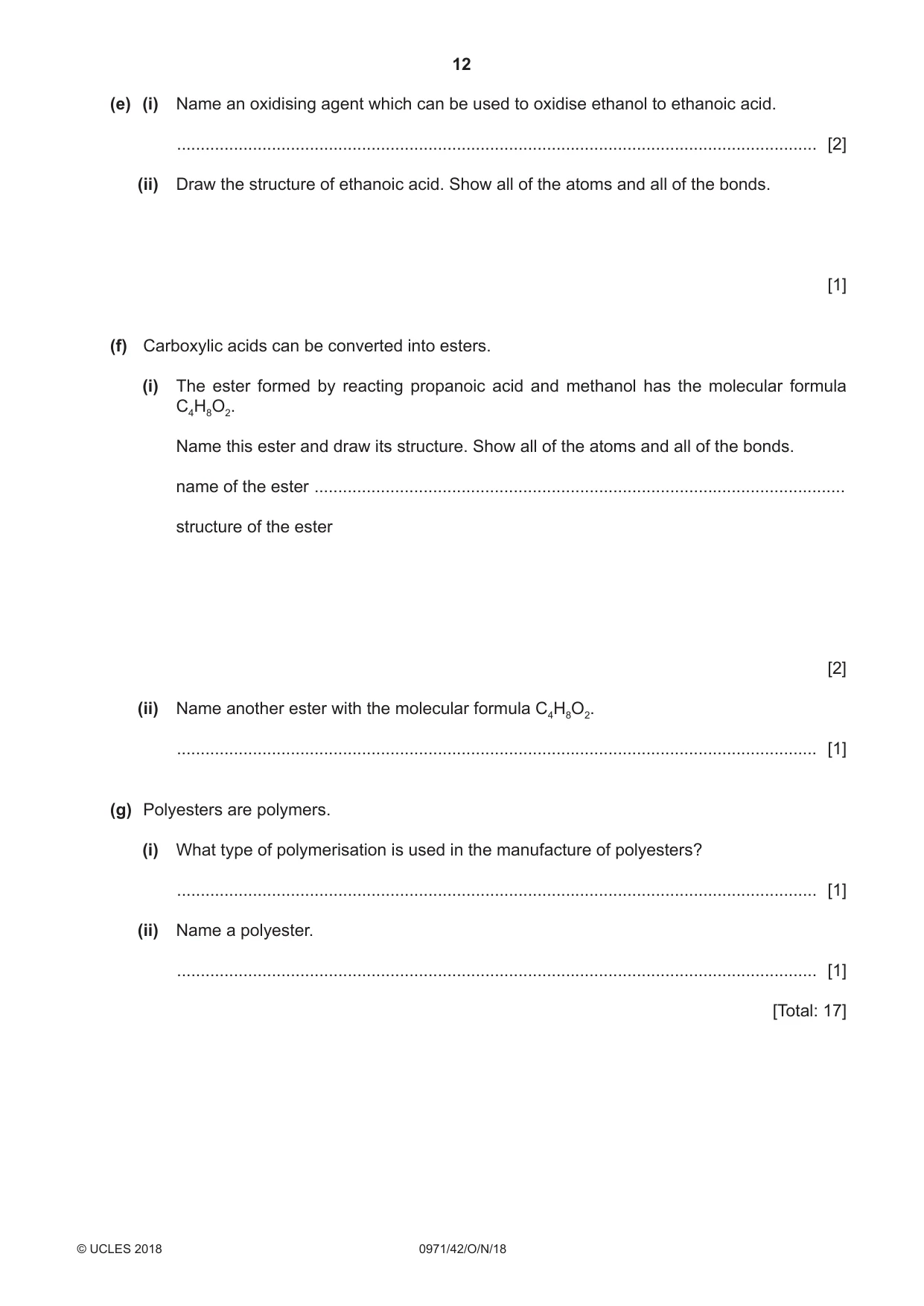
5 Alkynes are a homologous series of unsaturated hydrocarbons. All members contain a C≡C triple bond. (a) Complete the table showing information about the first three alkynes. formula C2H2 C3H4 structure H–C≡C–H H–C≡C–CH3 H–C≡C–CH2–CH3 name ethyne butyne [2] (b) Complete the dot-and-cross diagram to show the electron arrangement in a molecule of ethyne, H–C≡C–H. Show outer shell electrons only. H C C H [2] (c) Compounds in the same homologous series have the same general formula. (i) Give two other characteristics of members of a homologous series. 1 .......................................................................................................................................... 2 .......................................................................................................................................... [2] (ii) Use the information in the table in (a) to deduce the general formula of alkynes. ....................................................................................................................................... [1] (d) Alkynes are unsaturated. Describe a test for unsaturation. test ............................................................................................................................................. result .......................................................................................................................................... [2] (e) (i) Name an oxidising agent which can be used to oxidise ethanol to ethanoic acid. ....................................................................................................................................... [2] (ii) Draw the structure of ethanoic acid. Show all of the atoms and all of the bonds. [1] (f) Carboxylic acids can be converted into esters. (i) The ester formed by reacting propanoic acid and methanol has the molecular formula C4H8O2. Name this ester and draw its structure. Show all of the atoms and all of the bonds. name of the ester ................................................................................................................ structure of the ester [2] (ii) Name another ester with the molecular formula C4H8O2. ....................................................................................................................................... [1] (g) Polyesters are polymers. (i) What type of polymerisation is used in the manufacture of polyesters? ....................................................................................................................................... [1] (ii) Name a polyester. ....................................................................................................................................... [1] [Total: 17]
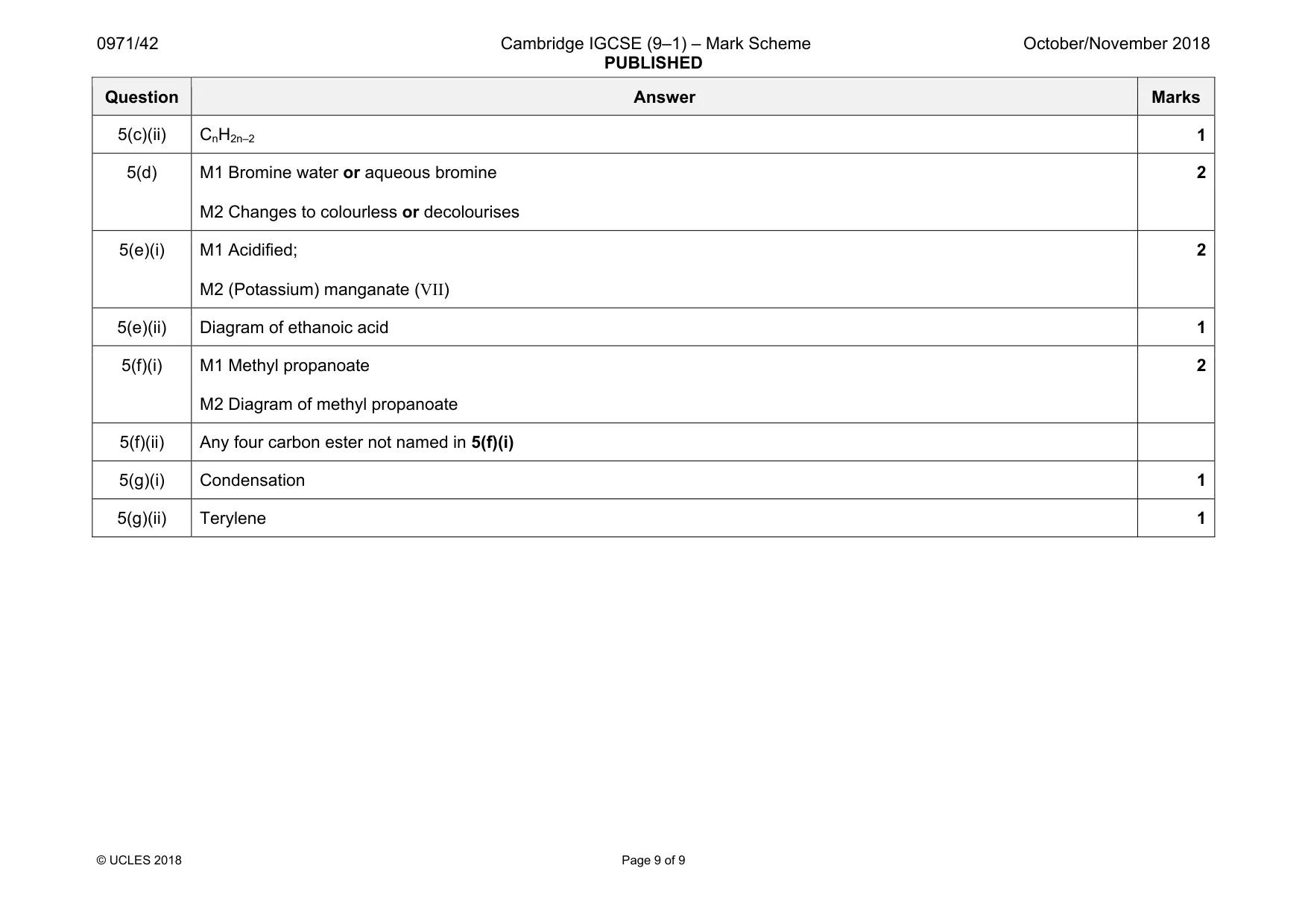
Mark scheme: 5(a) C4H6 Propyne 2 5(b) M1 one shared pair between each H and C M2 three shared pairs of electrons between the C atoms and no other unpaired electrons 2 5(c)(i) Any two from: same or similar chemical properties (contain) the same functional group (show) a trend or gradual change in physical properties (consecutive) members differ by CH2 common methods of preparation 2 Question Answer Marks 5(c)(ii) CnH2n–2 1 5(d) M1 Bromine water or aqueous bromine M2 Changes to colourless or decolourises 2 5(e)(i) M1 Acidified; M2 (Potassium) manganate (VII) 2 5(e)(ii) Diagram of ethanoic acid 1 5(f)(i) M1 Methyl propanoate M2 Diagram of methyl propanoate 2 5(f)(ii) Any four carbon ester not named in 5(f)(i) 5(g)(i) Condensation 1 5(g)(ii) Terylene 1
More questions on Formulae, functional groups and terminology
What was in this paper
The subtopics covered by these 5 questions, and how many questions each got. Open one in a new tab to see every Cambridge question on it.
What you needed in this session
Cambridge’s own grade thresholds for 2018 Oct/Nov, Paper 4 · Variant 2. A higher threshold means an easier paper — the bar moves with how the cohort did.