Cambridge IGCSE Biology (9-1) 0970 — 2023 May/June Paper 4 · Variant 1
0970/41/M/J/23 · 6 questions · 80 marks · ≈90 min
The question paper and its mark scheme, free to read here and free to download. This is Cambridge’s own paper, exactly as it was sat.
Question paper20 pages



Mark scheme10 pages
Answers below. Sit the paper first if you are practising.
Questions as text
Q1 · A diagram of the digestive system
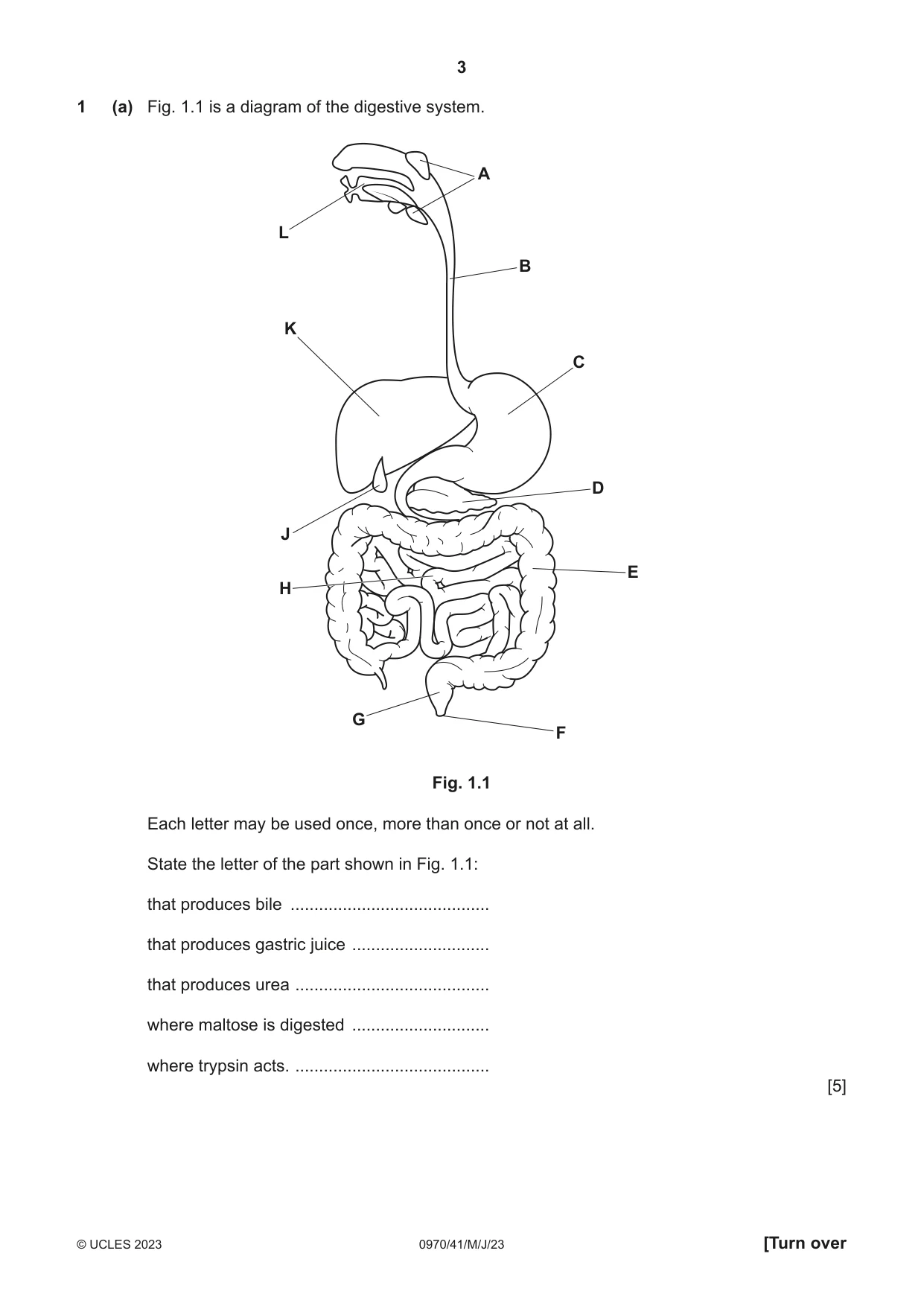
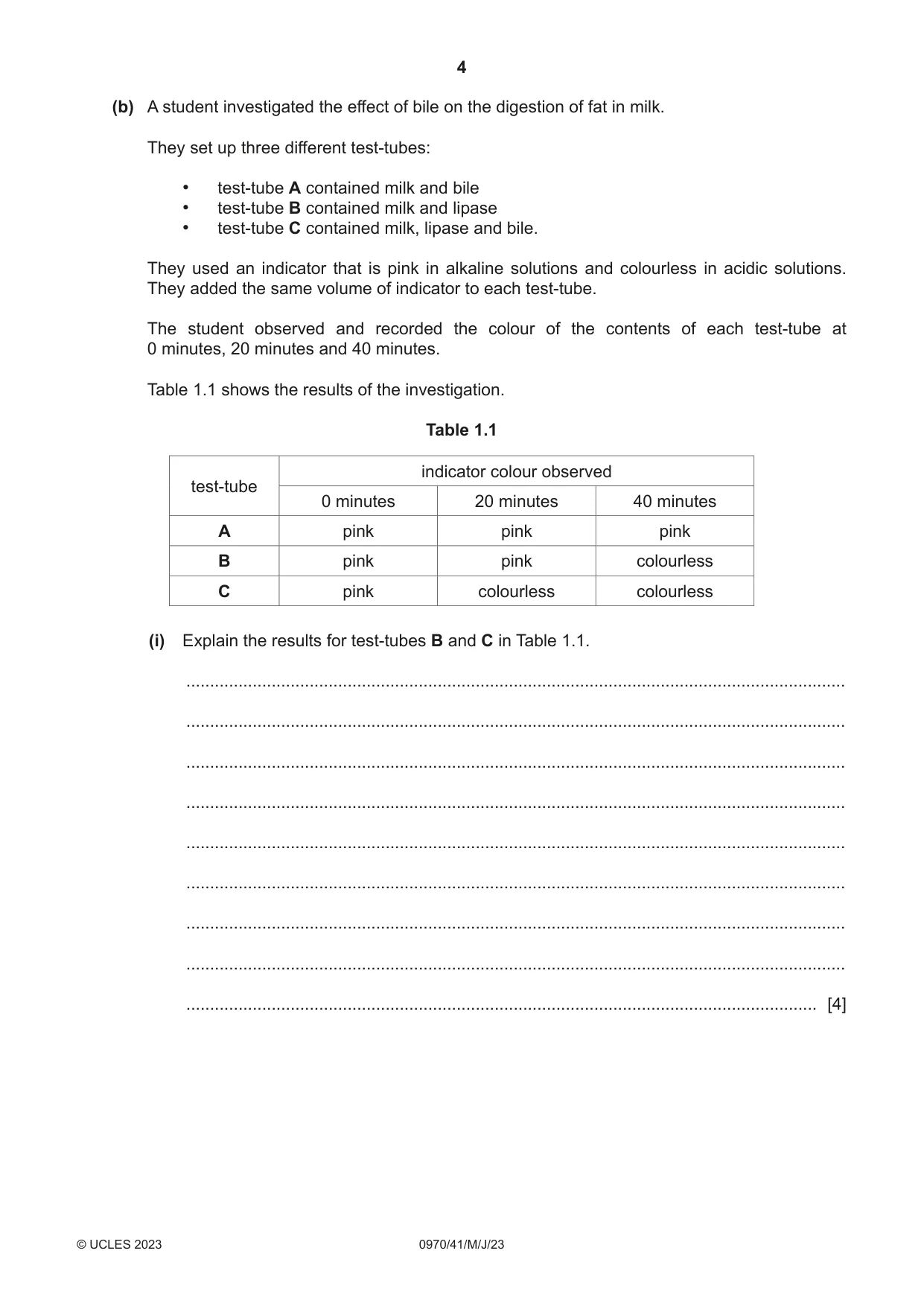
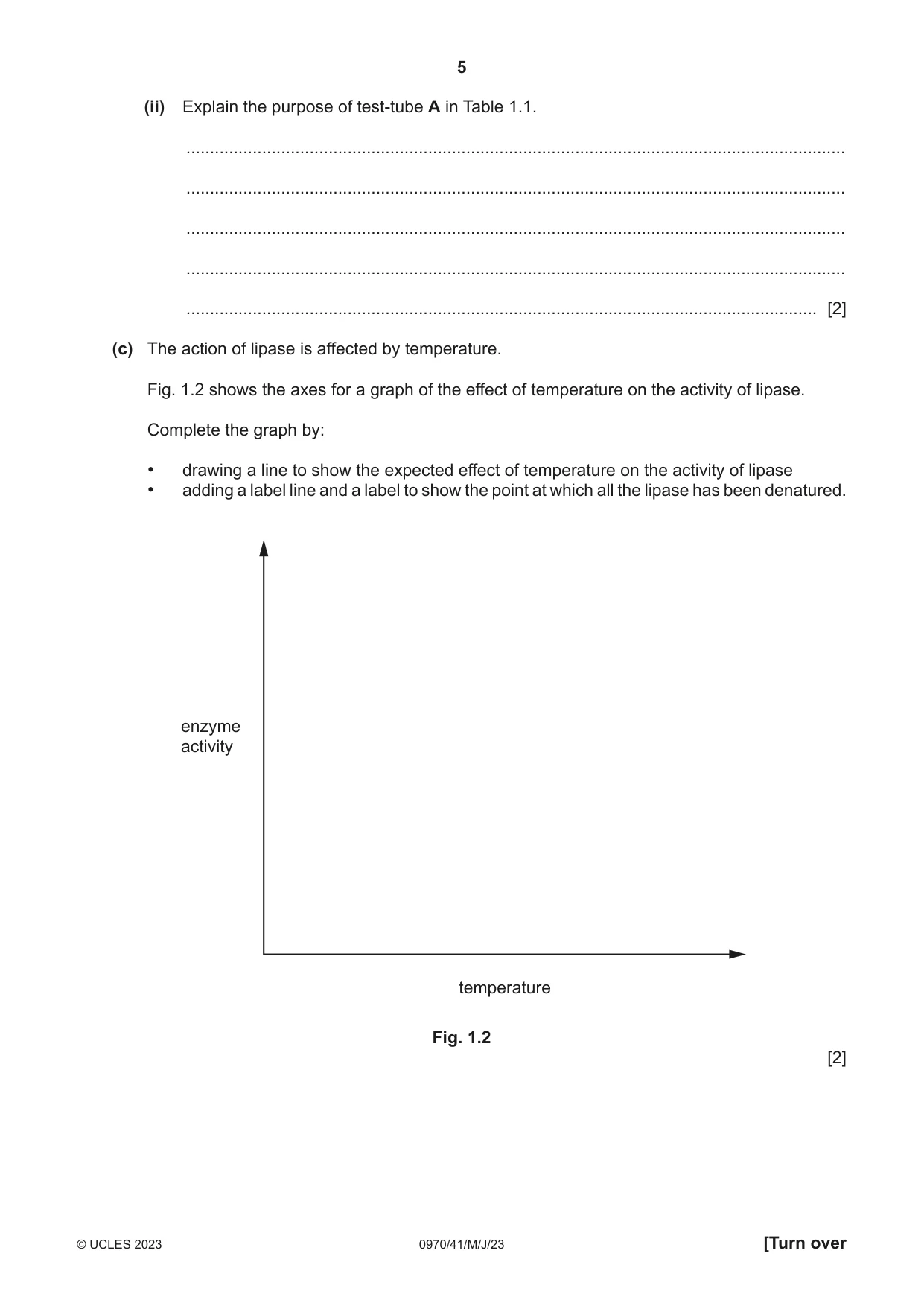
1 (a) Fig. 1.1 is a diagram of the digestive system. A L B K C D J E H G F Fig. 1.1 Each letter may be used once, more than once or not at all. State the letter of the part shown in Fig. 1.1: that produces bile .......................................... that produces gastric juice ............................. that produces urea ......................................... where maltose is digested ............................. where trypsin acts. ......................................... [5] (b) A student investigated the effect of bile on the digestion of fat in milk. They set up three different test-tubes: • test-tube A contained milk and bile • test-tube B contained milk and lipase • test-tube C contained milk, lipase and bile. They used an indicator that is pink in alkaline solutions and colourless in acidic solutions. They added the same volume of indicator to each test-tube. The student observed and recorded the colour of the contents of each test-tube at 0 minutes, 20 minutes and 40 minutes. Table 1.1 shows the results of the investigation. Table 1.1 indicator colour observed test-tube 0 minutes 20 minutes 40 minutes A pink pink pink B pink pink colourless C pink colourless colourless (i) Explain the results for test-tubes B and C in Table 1.1. ........................................................................................................................................... ........................................................................................................................................... ........................................................................................................................................... ........................................................................................................................................... ........................................................................................................................................... ........................................................................................................................................... ........................................................................................................................................... ........................................................................................................................................... ..................................................................................................................................... [4] (ii) Explain the purpose of test-tube A in Table 1.1. ........................................................................................................................................... ........................................................................................................................................... ........................................................................................................................................... ........................................................................................................................................... ..................................................................................................................................... [2] (c) The action of lipase is affected by temperature. Fig. 1.2 shows the axes for a graph of the effect of temperature on the activity of lipase. Complete the graph by: • drawing a line to show the expected effect of temperature on the activity of lipase • adding a label line and a label to show the point at which all the lipase has been denatured. enzyme activity temperature Fig. 1.2 [2] (d) Explain why lipase cannot be used to catalyse the breakdown of proteins. ................................................................................................................................................... ................................................................................................................................................... ................................................................................................................................................... ................................................................................................................................................... ................................................................................................................................................... ................................................................................................................................................... ............................................................................................................................................. [3] [Total: 16]
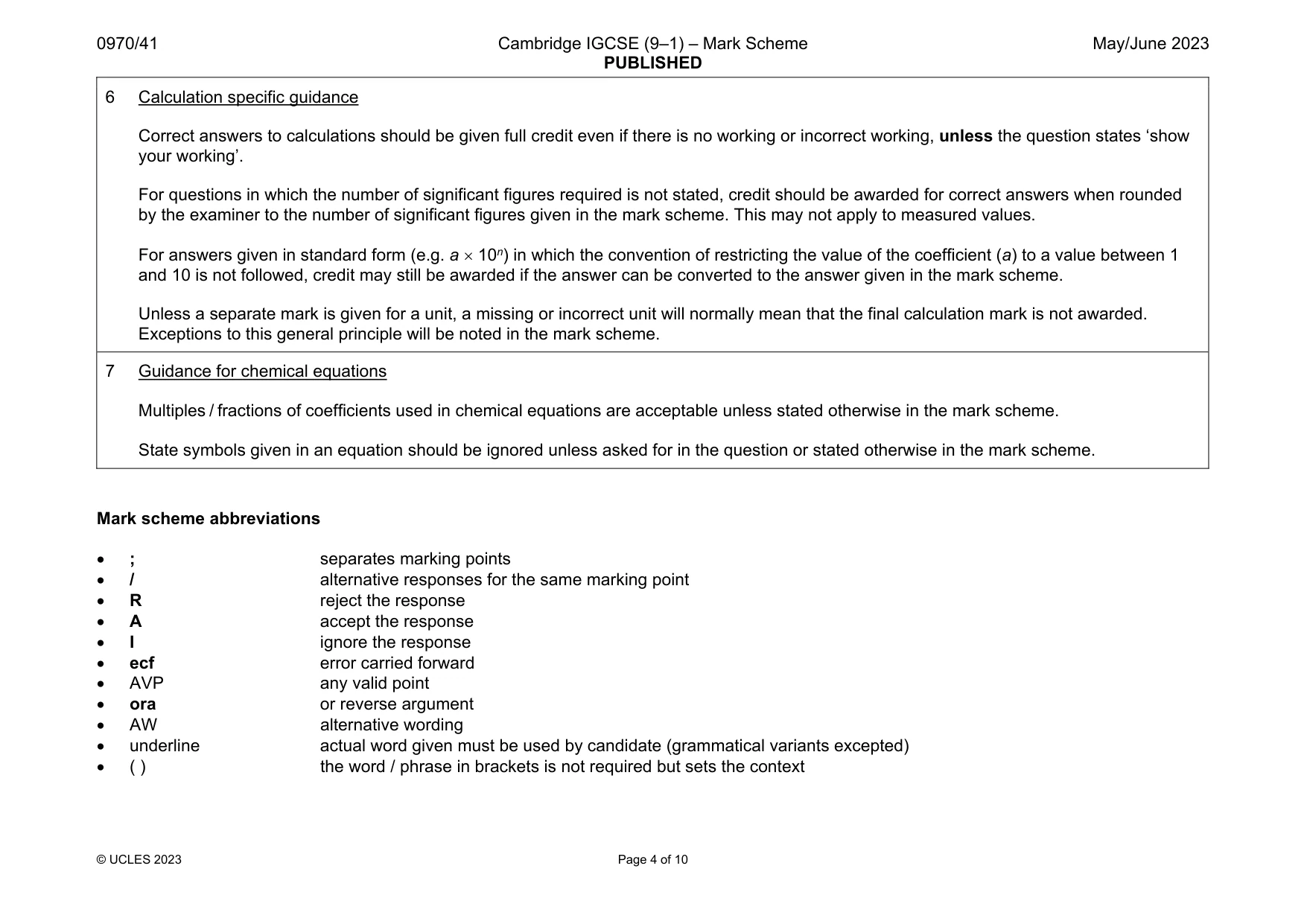
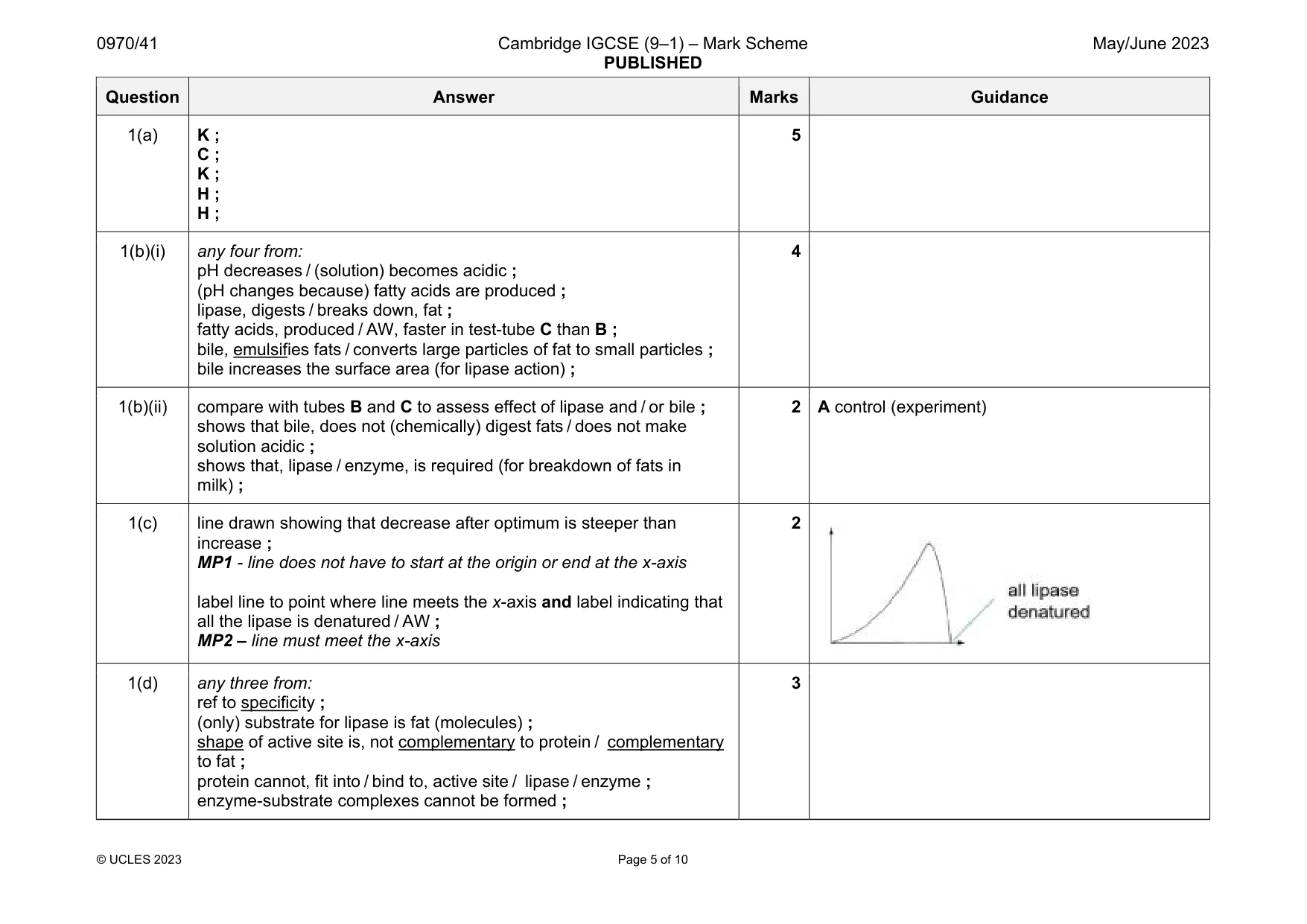
Mark scheme: 1(a) K ; C ; K ; H ; H ; 5 1(b)(i) any four from: pH decreases / (solution) becomes acidic ; (pH changes because) fatty acids are produced ; lipase, digests / breaks down, fat ; fatty acids, produced / AW, faster in test-tube C than B ; bile, emulsifies fats / converts large particles of fat to small particles ; bile increases the surface area (for lipase action) ; 4 1(b)(ii) compare with tubes B and C to assess effect of lipase and / or bile ; shows that bile, does not (chemically) digest fats / does not make solution acidic ; shows that, lipase / enzyme, is required (for breakdown of fats in milk) ; 2 A control (experiment) 1(c) line drawn showing that decrease after optimum is steeper than increase ; MP1 - line does not have to start at the origin or end at the x-axis label line to point where line meets the x-axis and label indicating that all the lipase is denatured / AW ; MP2 – line must meet the x-axis 2 1(d) any three from: ref to specificity ; (only) substrate for lipase is fat (molecules) ; shape of active site is, not complementary to protein / complementary to fat ; protein cannot, fit into / bind to, active site / lipase / enzyme ; enzyme-substrate complexes cannot be formed ; 3
Q2 · A student investigated osmosis in potato plant cells
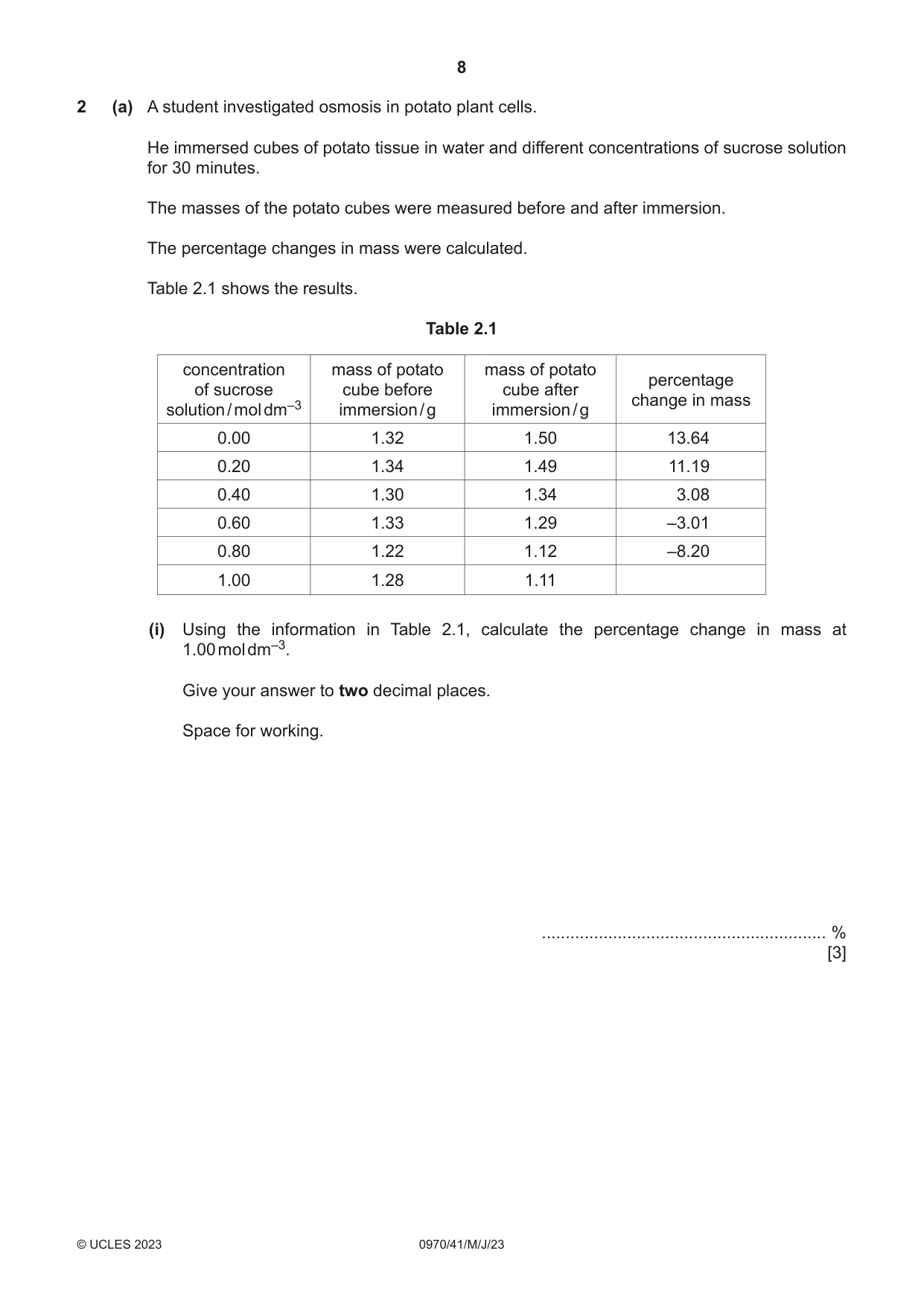
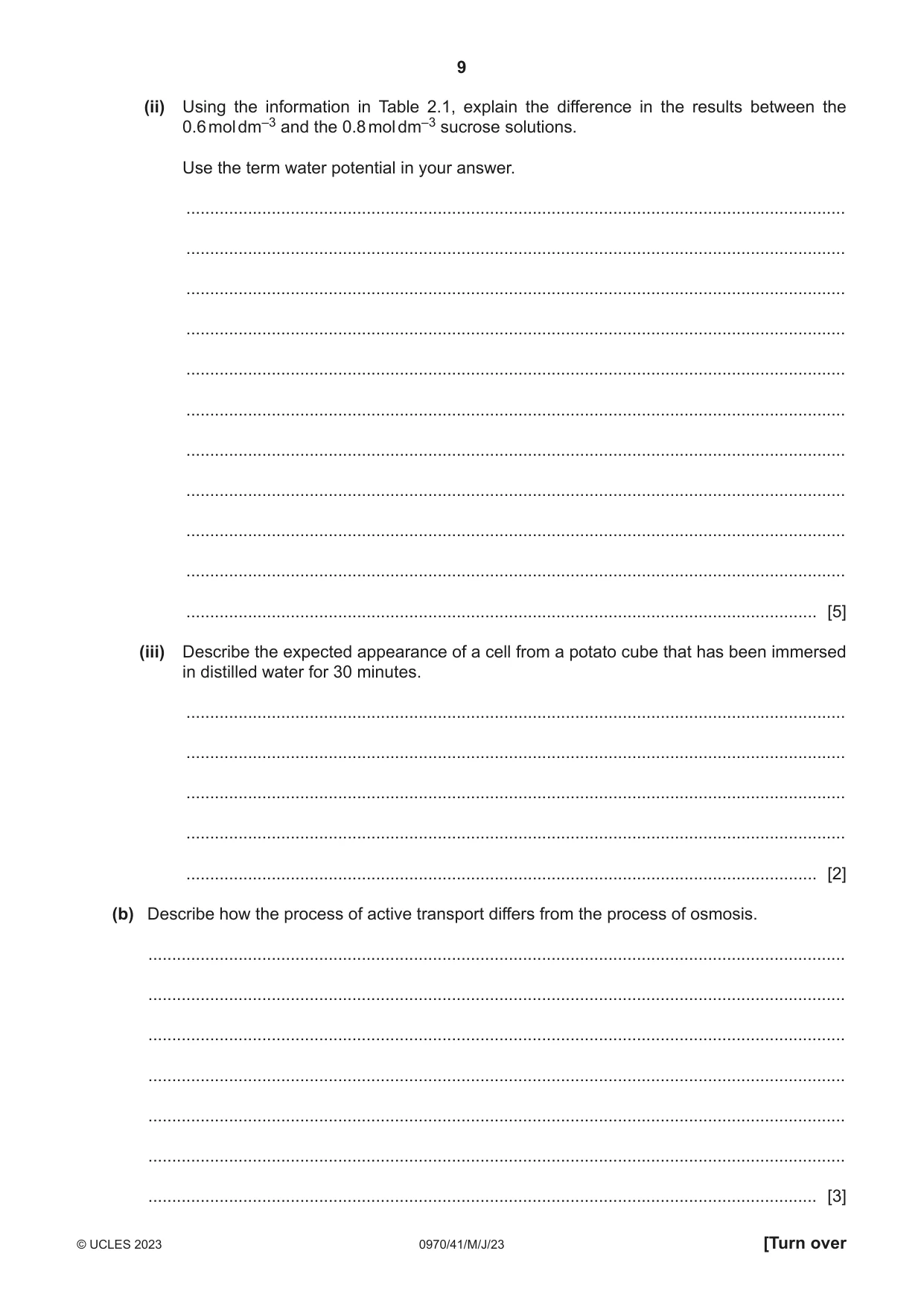
2 (a) A student investigated osmosis in potato plant cells. He immersed cubes of potato tissue in water and different concentrations of sucrose solution for 30 minutes. The masses of the potato cubes were measured before and after immersion. The percentage changes in mass were calculated. Table 2.1 shows the results. Table 2.1 concentration mass of potato mass of potato percentage of sucrose cube before cube after change in mass solution / mol dm–3 immersion / g immersion / g 0.00 1.32 1.50 13.64 0.20 1.34 1.49 11.19 0.40 1.30 1.34 3.08 0.60 1.33 1.29 –3.01 0.80 1.22 1.12 –8.20 1.00 1.28 1.11 (i) Using the information in Table 2.1, calculate the percentage change in mass at 1.00 mol dm–3. Give your answer to two decimal places. Space for working. ............................................................ % [3] (ii) Using the information in Table 2.1, explain the difference in the results between the 0.6 mol dm–3 and the 0.8 mol dm–3 sucrose solutions. Use the term water potential in your answer. ........................................................................................................................................... ........................................................................................................................................... ........................................................................................................................................... ........................................................................................................................................... ........................................................................................................................................... ........................................................................................................................................... ........................................................................................................................................... ........................................................................................................................................... ........................................................................................................................................... ........................................................................................................................................... ..................................................................................................................................... [5] (iii) Describe the expected appearance of a cell from a potato cube that has been immersed in distilled water for 30 minutes. ........................................................................................................................................... ........................................................................................................................................... ........................................................................................................................................... ........................................................................................................................................... ..................................................................................................................................... [2] (b) Describe how the process of active transport differs from the process of osmosis. ................................................................................................................................................... ................................................................................................................................................... ................................................................................................................................................... ................................................................................................................................................... ................................................................................................................................................... ................................................................................................................................................... ............................................................................................................................................. [3] (c) State the type of plant cells that use active transport to absorb mineral ions from the environment. ............................................................................................................................................. [1] (d) Explain the effect of a lack of magnesium ions on the colour of plant leaves. ................................................................................................................................................... ................................................................................................................................................... ................................................................................................................................................... ................................................................................................................................................... ............................................................................................................................................. [2] [Total: 16]
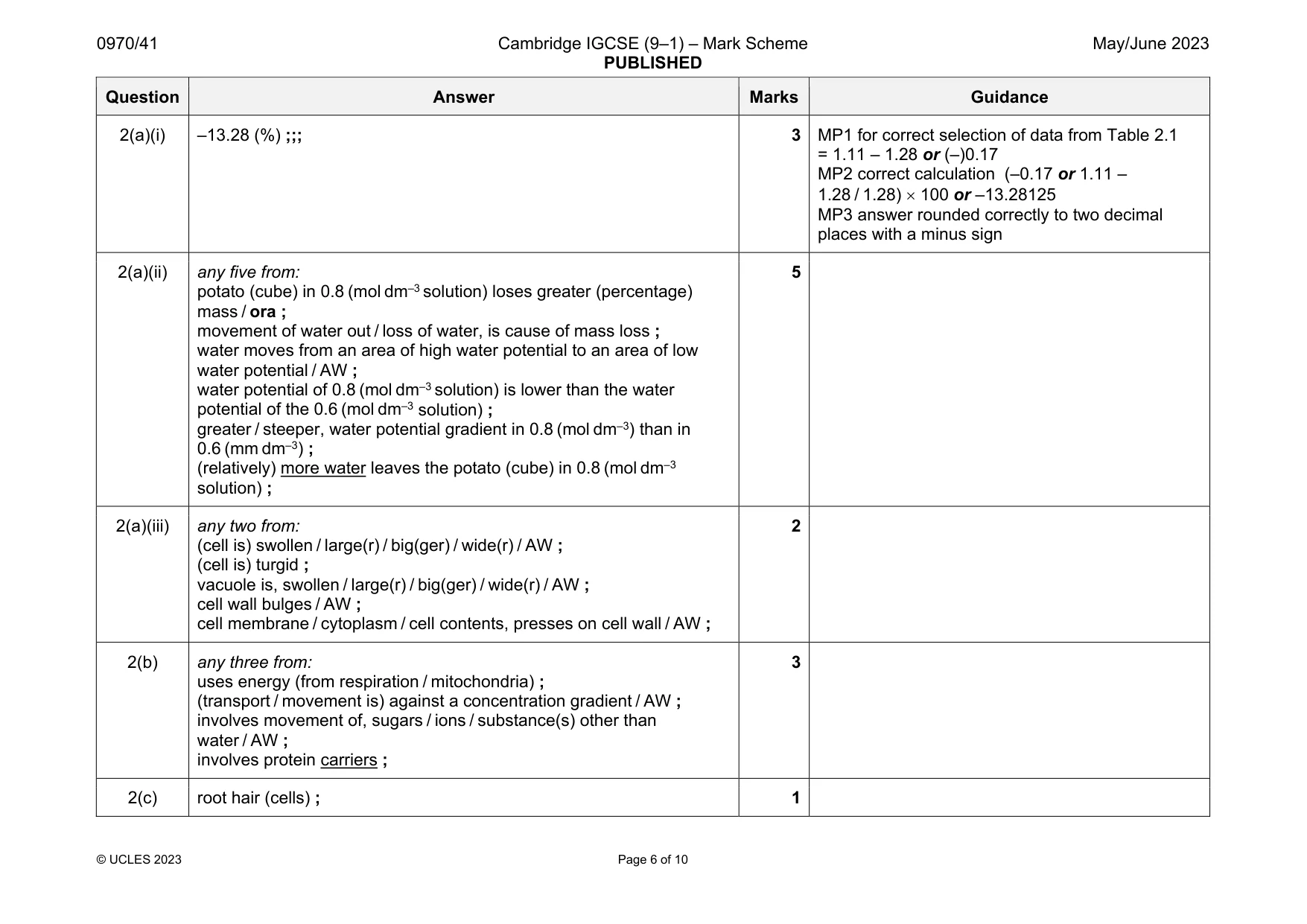
Mark scheme: 2(a)(i) –13.28 (%) ;;; 3 MP1 for correct selection of data from Table 2.1 = 1.11 – 1.28 or (–)0.17 MP2 correct calculation (–0.17 or 1.11 – 1.28 / 1.28) 100 or –13.28125 MP3 answer rounded correctly to two decimal places with a minus sign 2(a)(ii) any five from: potato (cube) in 0.8 (mol dm–3 solution) loses greater (percentage) mass / ora ; movement of water out / loss of water, is cause of mass loss ; water moves from an area of high water potential to an area of low water potential / AW ; water potential of 0.8 (mol dm–3 solution) is lower than the water potential of the 0.6 (mol dm–3 solution) ; greater / steeper, water potential gradient in 0.8 (mol dm–3) than in 0.6 (mm dm–3) ; (relatively) more water leaves the potato (cube) in 0.8 (mol dm–3 solution) ; 5 2(a)(iii) any two from: (cell is) swollen / large(r) / big(ger) / wide(r) / AW ; (cell is) turgid ; vacuole is, swollen / large(r) / big(ger) / wide(r) / AW ; cell wall bulges / AW ; cell membrane / cytoplasm / cell contents, presses on cell wall / AW ; 2 2(b) any three from: uses energy (from respiration / mitochondria) ; (transport / movement is) against a concentration gradient / AW ; involves movement of, sugars / ions / substance(s) other than water / AW ; involves protein carriers ; 3 2(c) root hair (cells) ; 1 Question Answer Marks Guidance 2(d) (leaves are) yellow / (leaves show) chlorosis ; magnesium required for making chlorophyll ; 2
Q3 · A photomicrograph of some cells lining the trachea
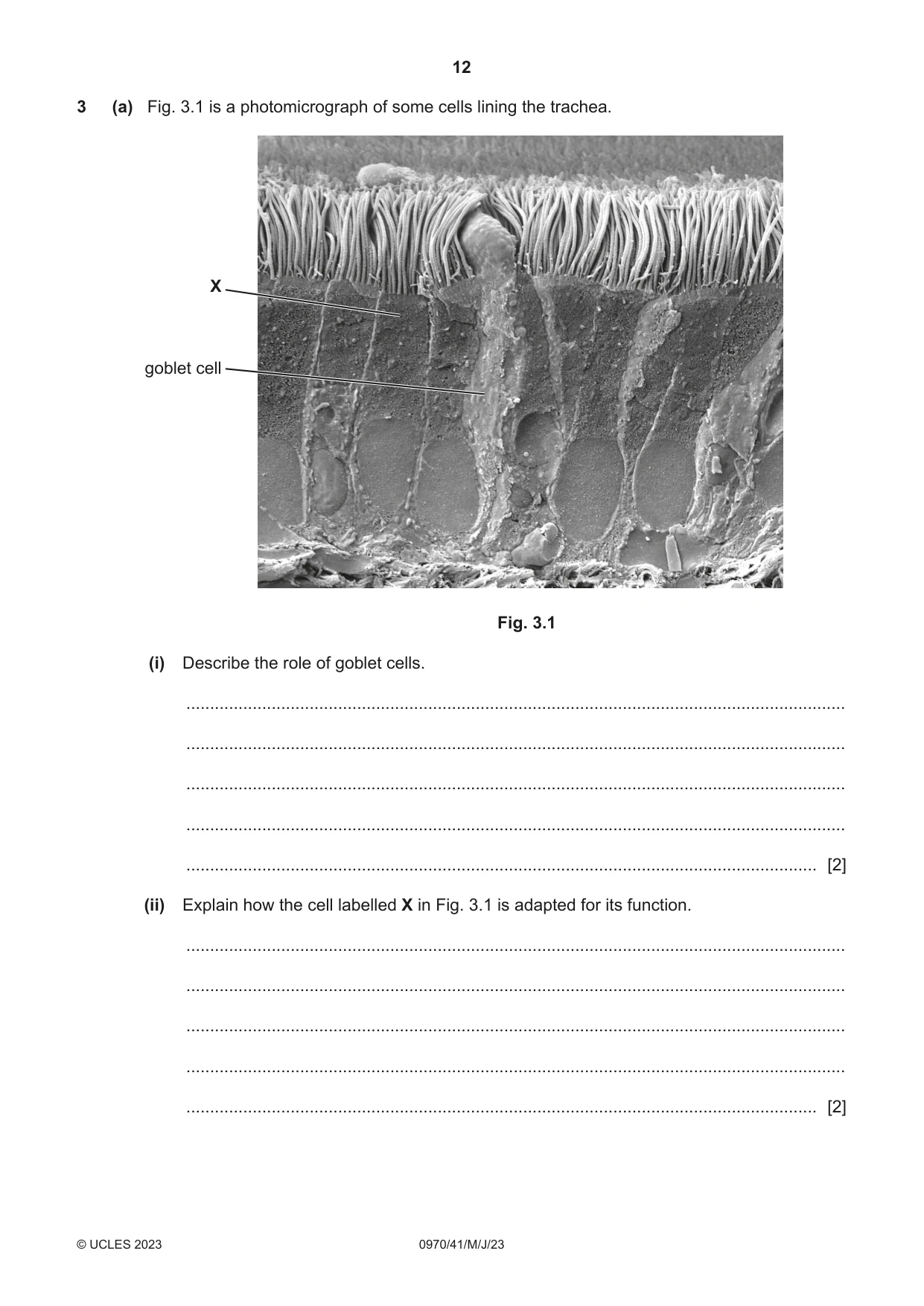
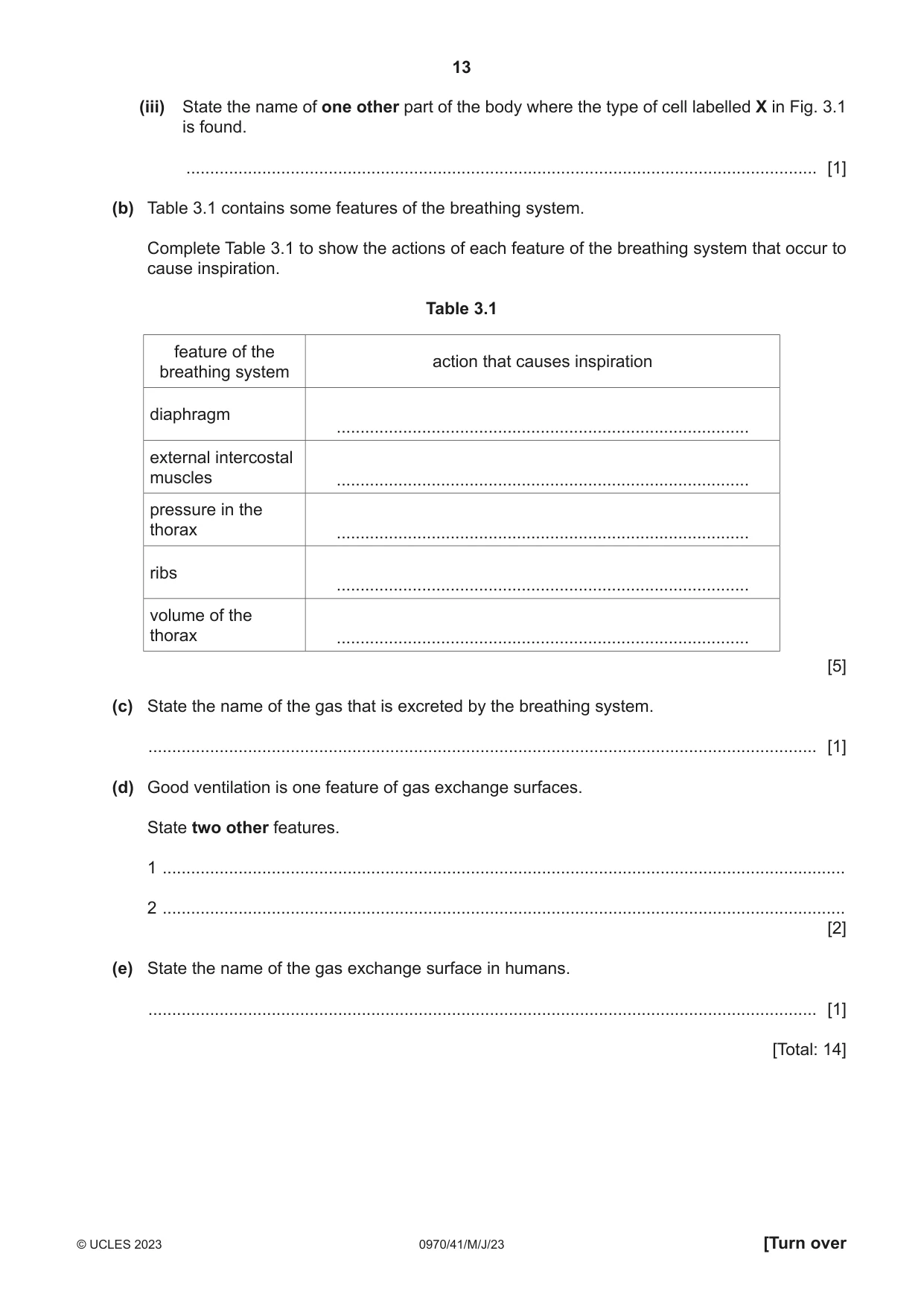
3 (a) Fig. 3.1 is a photomicrograph of some cells lining the trachea. X goblet cell Fig. 3.1 (i) Describe the role of goblet cells. ........................................................................................................................................... ........................................................................................................................................... ........................................................................................................................................... ........................................................................................................................................... ..................................................................................................................................... [2] (ii) Explain how the cell labelled X in Fig. 3.1 is adapted for its function. ........................................................................................................................................... ........................................................................................................................................... ........................................................................................................................................... ........................................................................................................................................... ..................................................................................................................................... [2] (iii) State the name of one other part of the body where the type of cell labelled X in Fig. 3.1 is found. ..................................................................................................................................... [1] (b) Table 3.1 contains some features of the breathing system. Complete Table 3.1 to show the actions of each feature of the breathing system that occur to cause inspiration. Table 3.1 feature of the action that causes inspiration breathing system diaphragm ....................................................................................... external intercostal muscles ....................................................................................... pressure in the thorax ....................................................................................... ribs ....................................................................................... volume of the thorax ....................................................................................... [5] (c) State the name of the gas that is excreted by the breathing system. ............................................................................................................................................. [1] (d) Good ventilation is one feature of gas exchange surfaces. State two other features. 1 ................................................................................................................................................ 2 ................................................................................................................................................ [2] (e) State the name of the gas exchange surface in humans. ............................................................................................................................................. [1] [Total: 14]
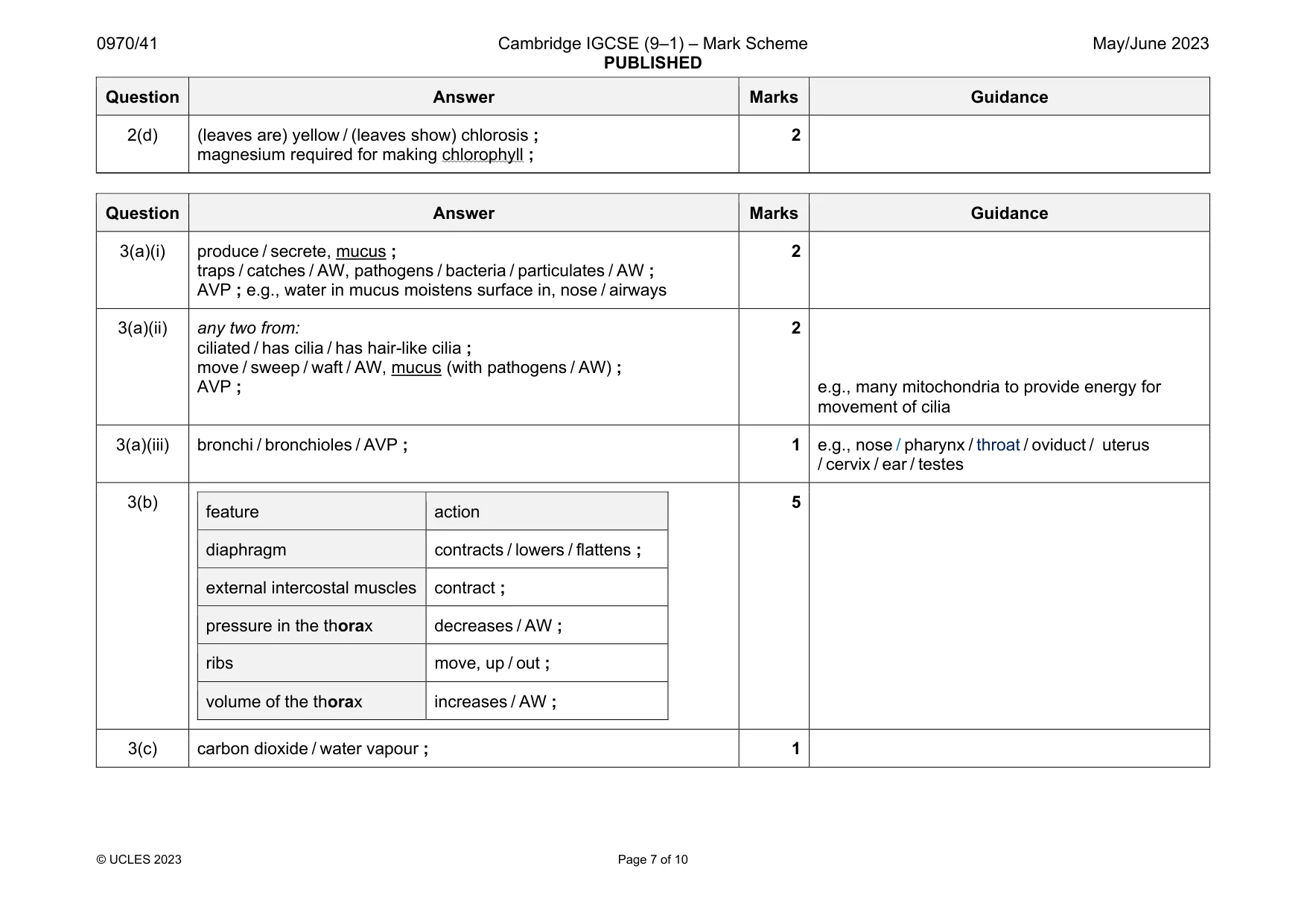
Mark scheme: 3(a)(i) produce / secrete, mucus ; traps / catches / AW, pathogens / bacteria / particulates / AW ; AVP ; e.g., water in mucus moistens surface in, nose / airways 2 3(a)(ii) any two from: ciliated / has cilia / has hair-like cilia ; move / sweep / waft / AW, mucus (with pathogens / AW) ; AVP ; 2 e.g., many mitochondria to provide energy for movement of cilia 3(a)(iii) bronchi / bronchioles / AVP ; 1 e.g., nose / pharynx / throat / oviduct / uterus / cervix / ear / testes 3(b) feature action diaphragm contracts / lowers / flattens ; external intercostal muscles contract ; pressure in the thorax decreases / AW ; ribs move, up / out ; volume of the thorax increases / AW ; 5 3(c) carbon dioxide / water vapour ; 1 Question Answer Marks Guidance 3(d) any two from: large (surface) area ; thin (surface) / one cell thick / short diffusion distance ; good blood supply / AW ; AVP ; 2 e.g., moist / ref. to surfactant 3(e) alveoli ; 1
Q4 · The effect of light intensity on the rate of photosynthesis at different temperatures and…
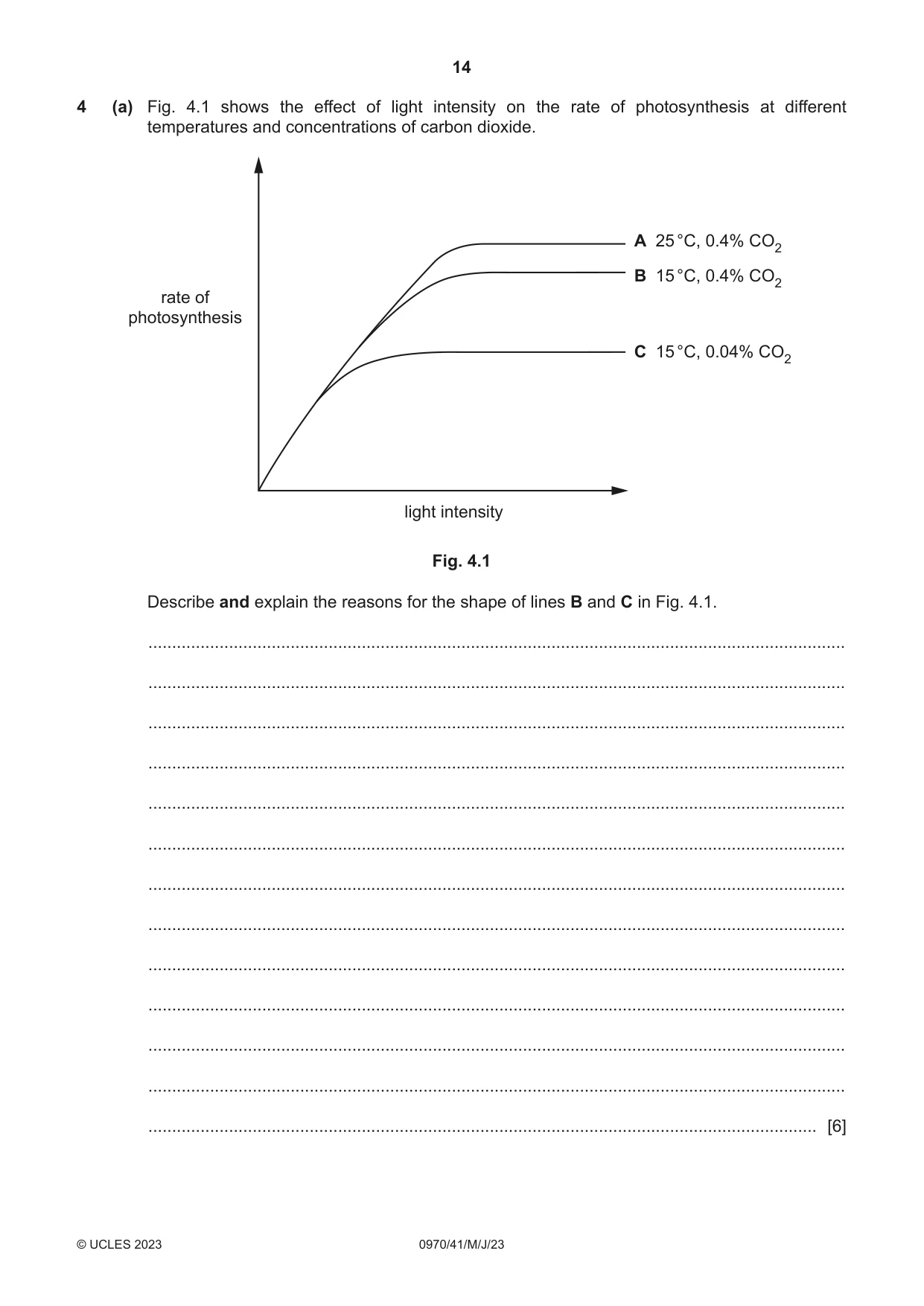
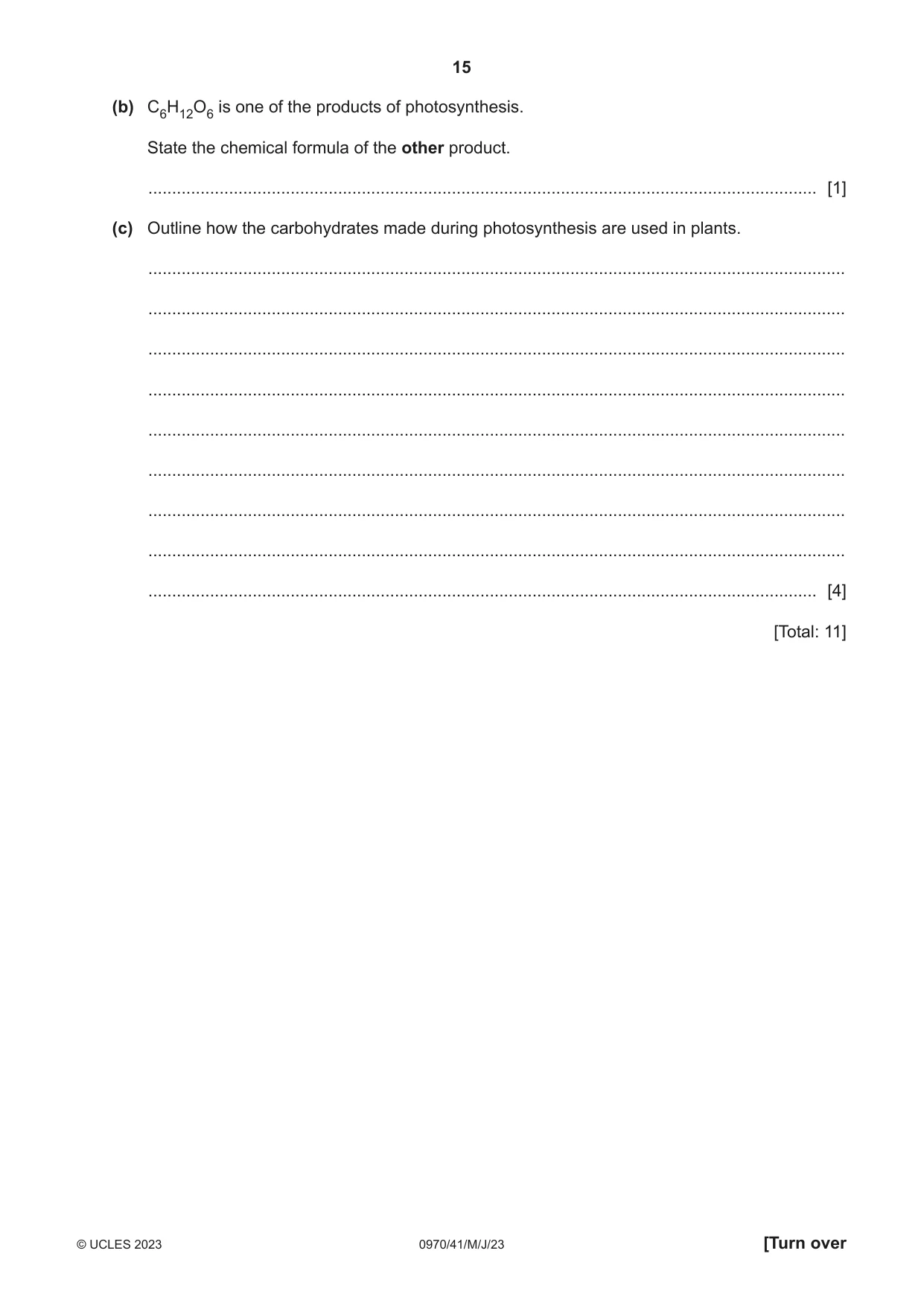
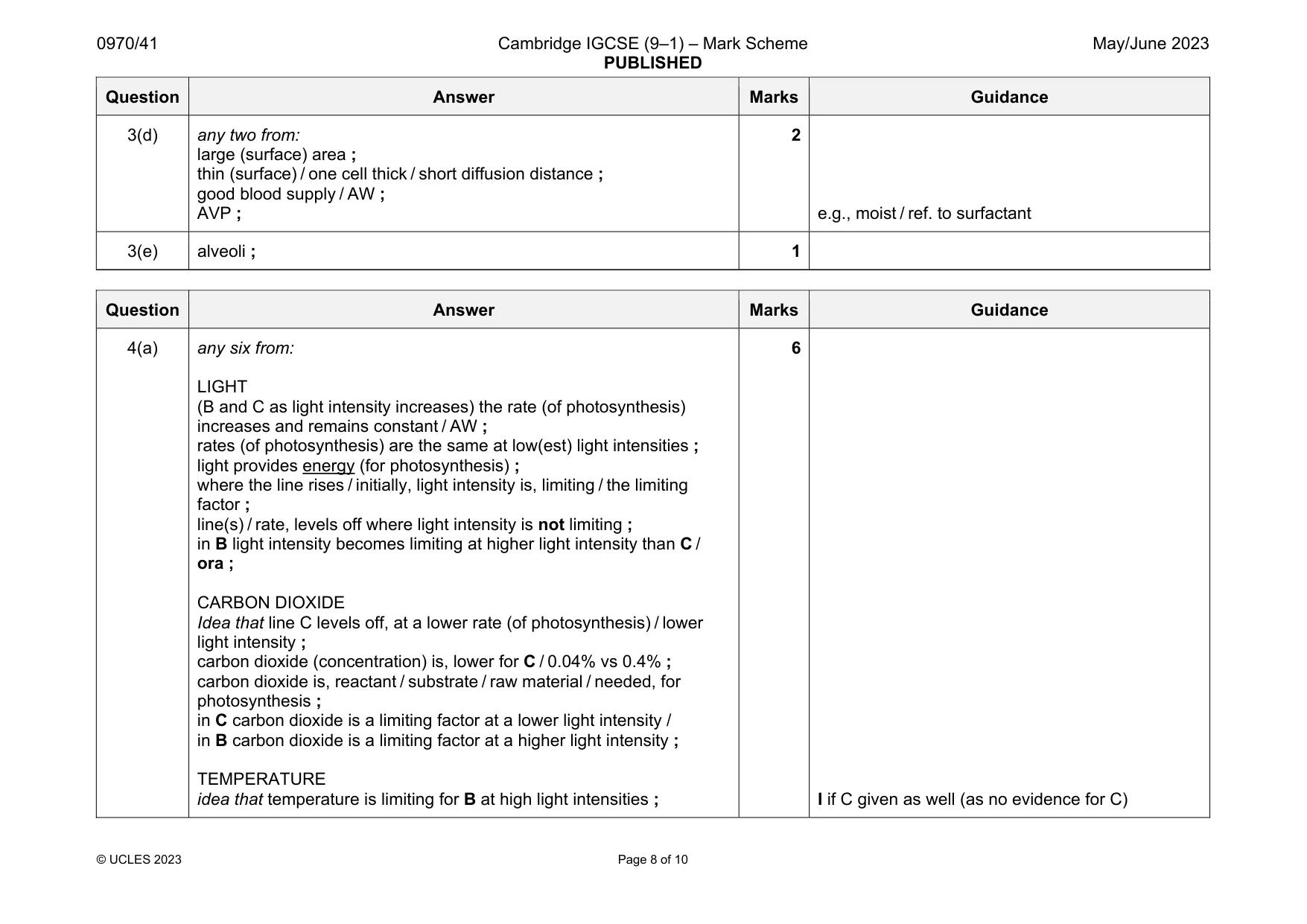
4 (a) Fig. 4.1 shows the effect of light intensity on the rate of photosynthesis at different temperatures and concentrations of carbon dioxide. A 25 °C, 0.4% CO2 B 15 °C, 0.4% CO2 rate of photosynthesis C 15 °C, 0.04% CO2 light intensity Fig. 4.1 Describe and explain the reasons for the shape of lines B and C in Fig. 4.1. ................................................................................................................................................... ................................................................................................................................................... ................................................................................................................................................... ................................................................................................................................................... ................................................................................................................................................... ................................................................................................................................................... ................................................................................................................................................... ................................................................................................................................................... ................................................................................................................................................... ................................................................................................................................................... ................................................................................................................................................... ................................................................................................................................................... ............................................................................................................................................. [6] (b) C6H12O6 is one of the products of photosynthesis. State the chemical formula of the other product. ............................................................................................................................................. [1] (c) Outline how the carbohydrates made during photosynthesis are used in plants. ................................................................................................................................................... ................................................................................................................................................... ................................................................................................................................................... ................................................................................................................................................... ................................................................................................................................................... ................................................................................................................................................... ................................................................................................................................................... ................................................................................................................................................... ............................................................................................................................................. [4] [Total: 11]
Mark scheme: 4(a) any six from: LIGHT (B and C as light intensity increases) the rate (of photosynthesis) increases and remains constant / AW ; rates (of photosynthesis) are the same at low(est) light intensities ; light provides energy (for photosynthesis) ; where the line rises / initially, light intensity is, limiting / the limiting factor ; line(s) / rate, levels off where light intensity is not limiting ; in B light intensity becomes limiting at higher light intensity than C / ora ; CARBON DIOXIDE Idea that line C levels off, at a lower rate (of photosynthesis) / lower light intensity ; carbon dioxide (concentration) is, lower for C / 0.04% vs 0.4% ; carbon dioxide is, reactant / substrate / raw material / needed, for photosynthesis ; in C carbon dioxide is a limiting factor at a lower light intensity / in B carbon dioxide is a limiting factor at a higher light intensity ; TEMPERATURE idea that temperature is limiting for B at high light intensities ; I if C given as well (as no evidence for C) Question Answer Marks Guidance 4(b) O2 ; 1 4(c) any four from: (glucose) used, in respiration / to provide energy / to release energy / as an energy store ; (glucose) converted to / stored as, starch ; (glucose) converted to sucrose ; sucrose for, translocation / transport (in the phloem) / sent to sink(s) ; (glucose / fructose / sucrose) in nectar ; (nectar) to attract, insects / pollinators ; (glucose / fructose / sucrose) in fruits (to attract animals) ; (glucose) converted to cellulose ; cellulose to build cell walls ; lignin for cell walls ; used to make, amino acids / fatty acids ; AVP ; 4 e.g., used to make chlorophyll / (DNA/RNA) bases
Q5 · The stages involved in protein synthesis
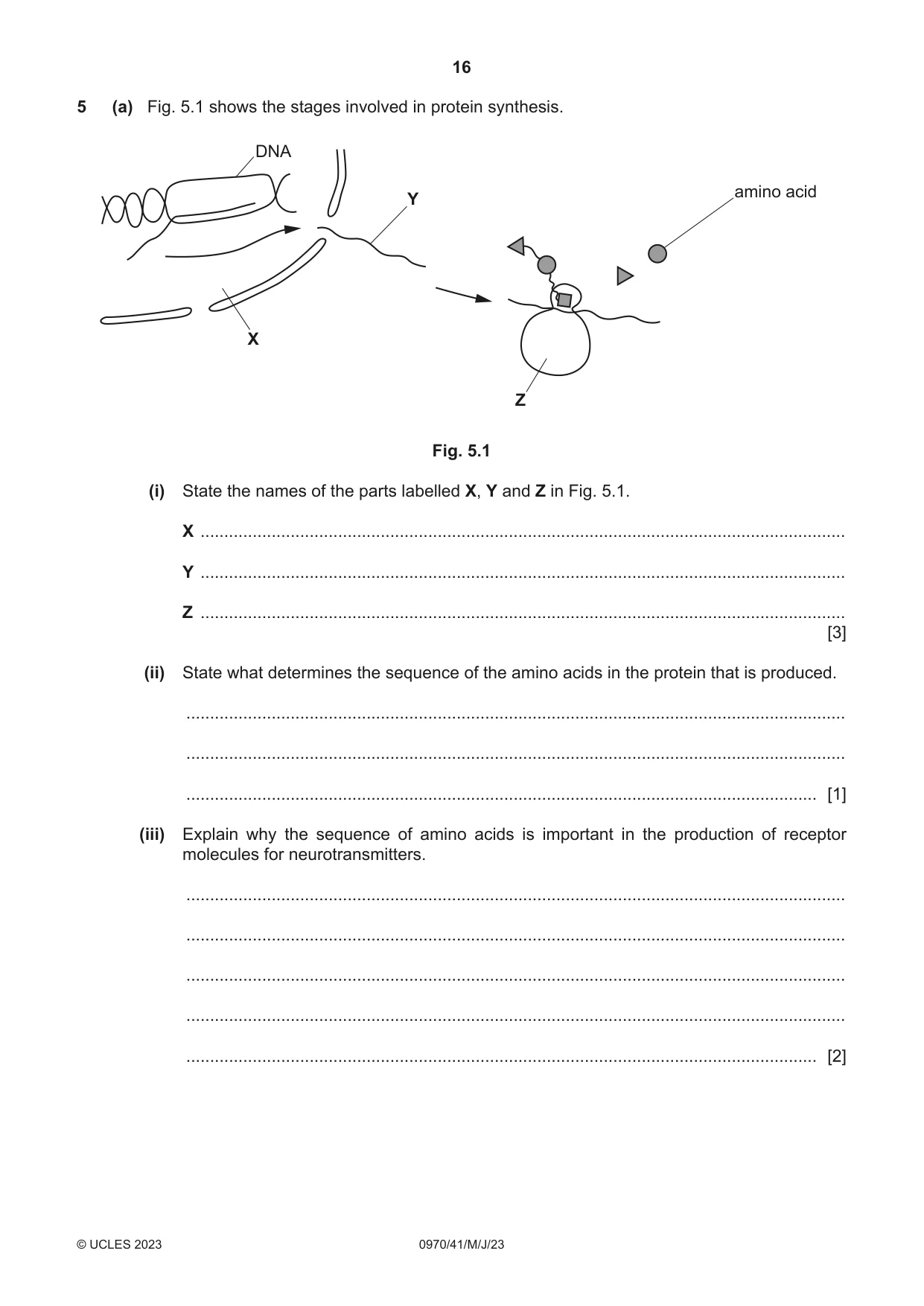
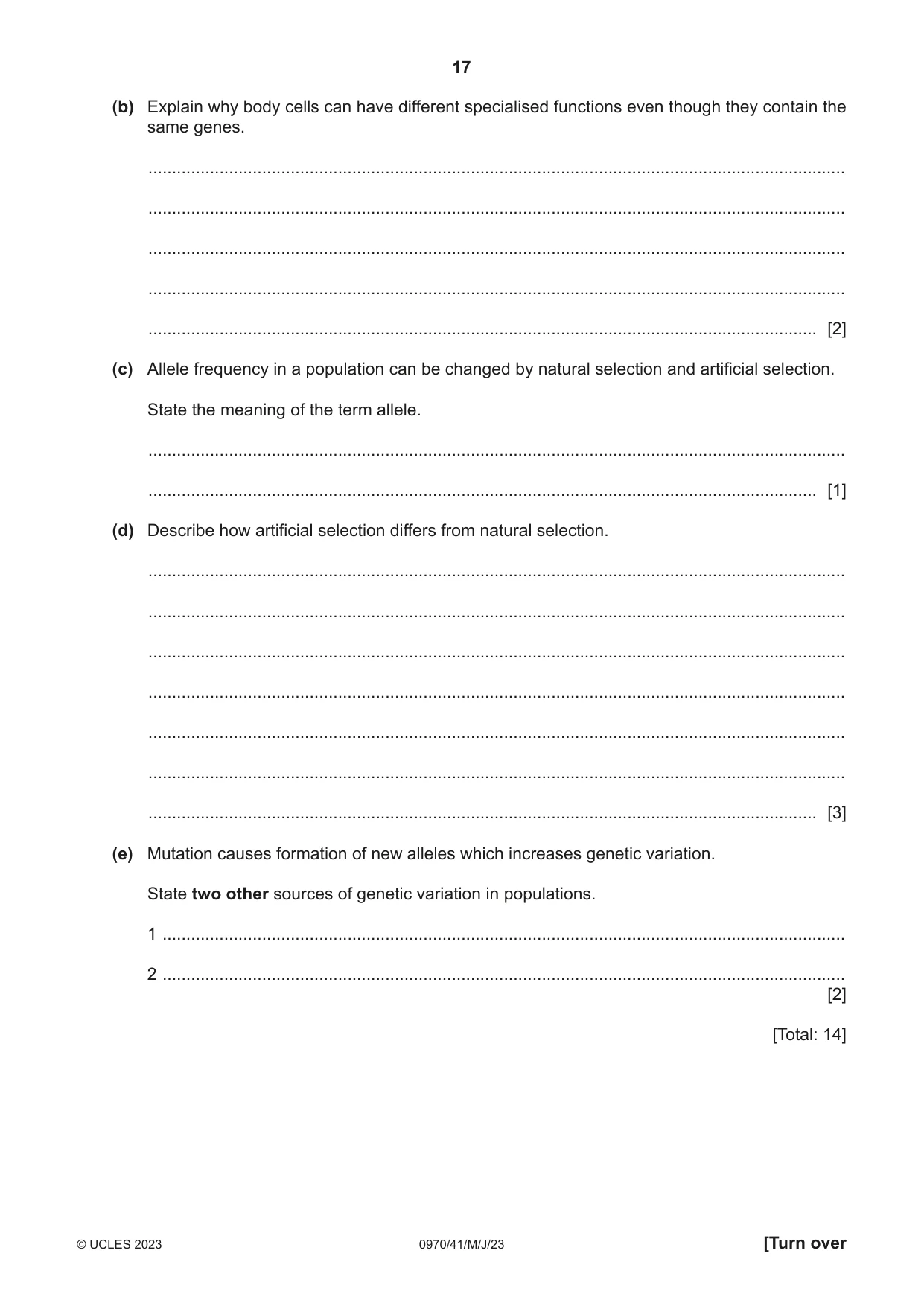
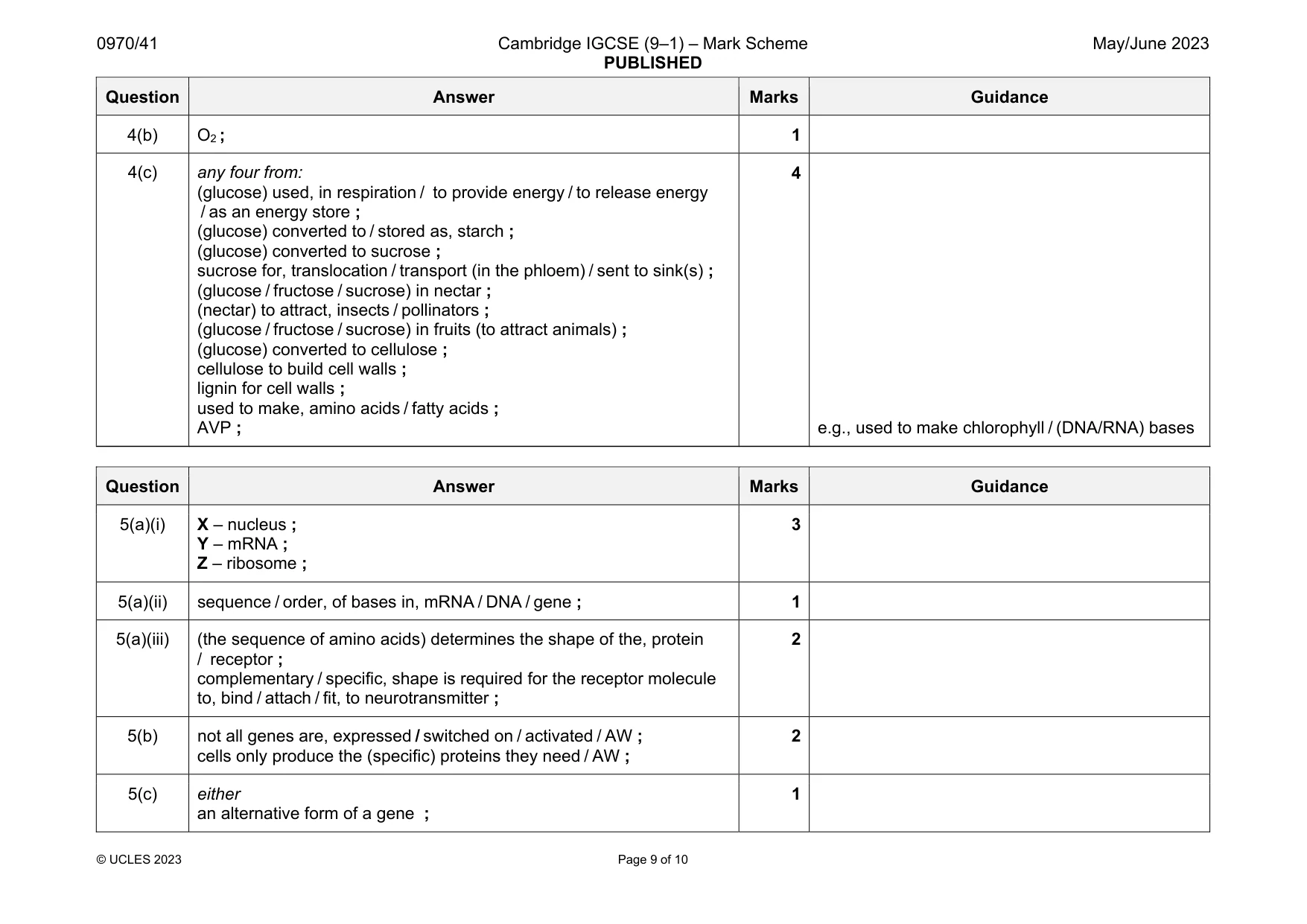
5 (a) Fig. 5.1 shows the stages involved in protein synthesis. DNA amino acid Y X Z Fig. 5.1 (i) State the names of the parts labelled X, Y and Z in Fig. 5.1. X ........................................................................................................................................ Y ........................................................................................................................................ Z ........................................................................................................................................ [3] (ii) State what determines the sequence of the amino acids in the protein that is produced. ........................................................................................................................................... ........................................................................................................................................... ..................................................................................................................................... [1] (iii) Explain why the sequence of amino acids is important in the production of receptor molecules for neurotransmitters. ........................................................................................................................................... ........................................................................................................................................... ........................................................................................................................................... ........................................................................................................................................... ..................................................................................................................................... [2] (b) Explain why body cells can have different specialised functions even though they contain the same genes. ................................................................................................................................................... ................................................................................................................................................... ................................................................................................................................................... ................................................................................................................................................... ............................................................................................................................................. [2] (c) Allele frequency in a population can be changed by natural selection and artificial selection. State the meaning of the term allele. ................................................................................................................................................... ............................................................................................................................................. [1] (d) Describe how artificial selection differs from natural selection. ................................................................................................................................................... ................................................................................................................................................... ................................................................................................................................................... ................................................................................................................................................... ................................................................................................................................................... ................................................................................................................................................... ............................................................................................................................................. [3] (e) Mutation causes formation of new alleles which increases genetic variation. State two other sources of genetic variation in populations. 1 ................................................................................................................................................ 2 ................................................................................................................................................ [2] [Total: 14]
Mark scheme: 5(a)(i) X – nucleus ; Y – mRNA ; Z – ribosome ; 3 5(a)(ii) sequence / order, of bases in, mRNA / DNA / gene ; 1 5(a)(iii) (the sequence of amino acids) determines the shape of the, protein / receptor ; complementary / specific, shape is required for the receptor molecule to, bind / attach / fit, to neurotransmitter ; 2 5(b) not all genes are, expressed / switched on / activated / AW ; cells only produce the (specific) proteins they need / AW ; 2 5(c) either an alternative form of a gene ; 1 Question Answer Marks Guidance 5(d) humans choose, specific feature(s) / desired features ; humans choose, individuals / offspring, to reproduce ; selection not influenced by environment / humans manipulate environment ; decreases (genetic) variation / decreases size of gene pool ; faster / shorter ; for economic / aesthetic, reasons ; no / less, evolution ; AVP ; 3 e.g. decrease in fitness 5(e) any two from: meiosis ; random mating / cross pollination / crossbreeding ; random fertilisation ; AVP ;; 2 e.g., immigration
Q6 · A scientist monitored the changes in the pH in muscles before, during and after two…
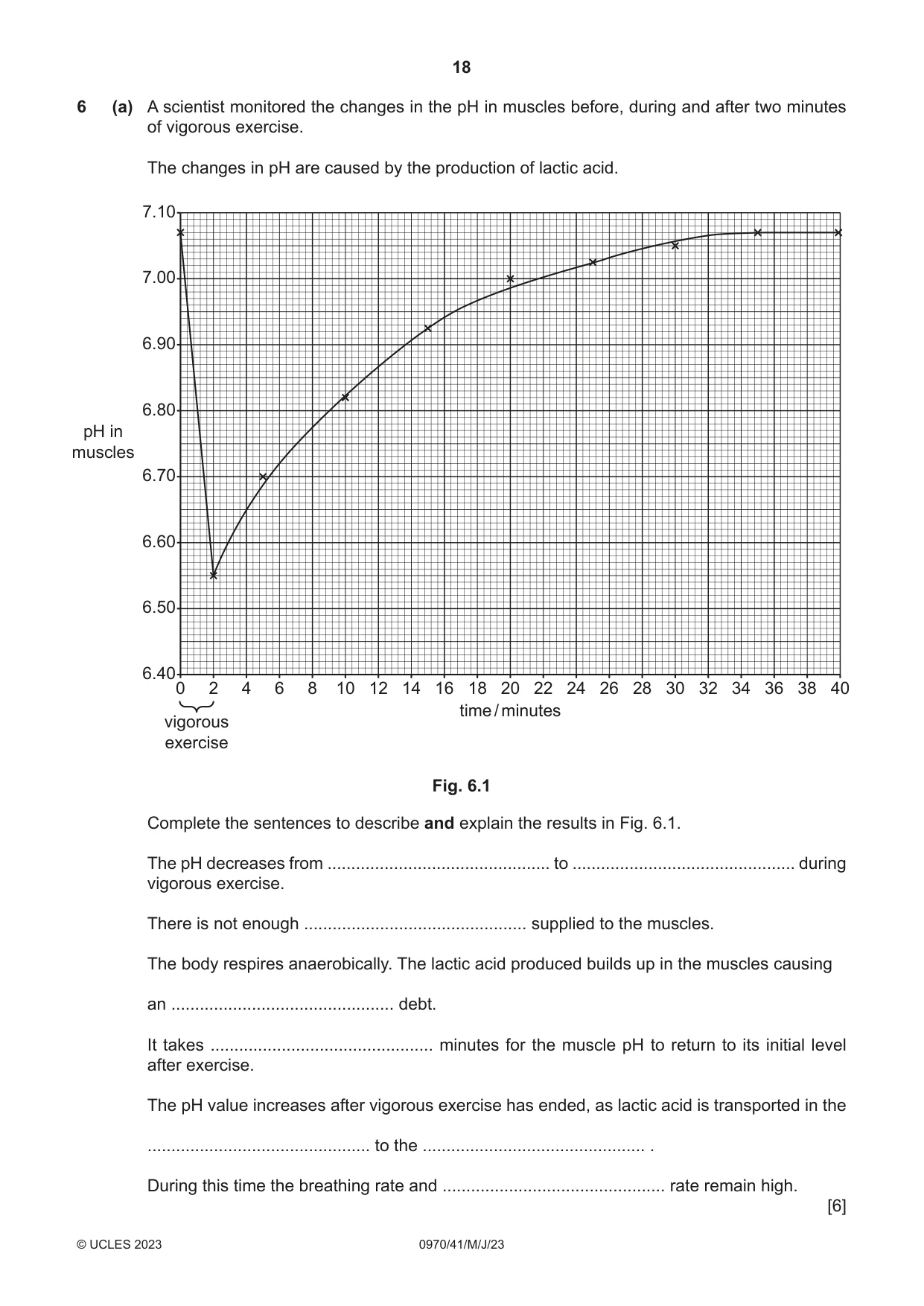
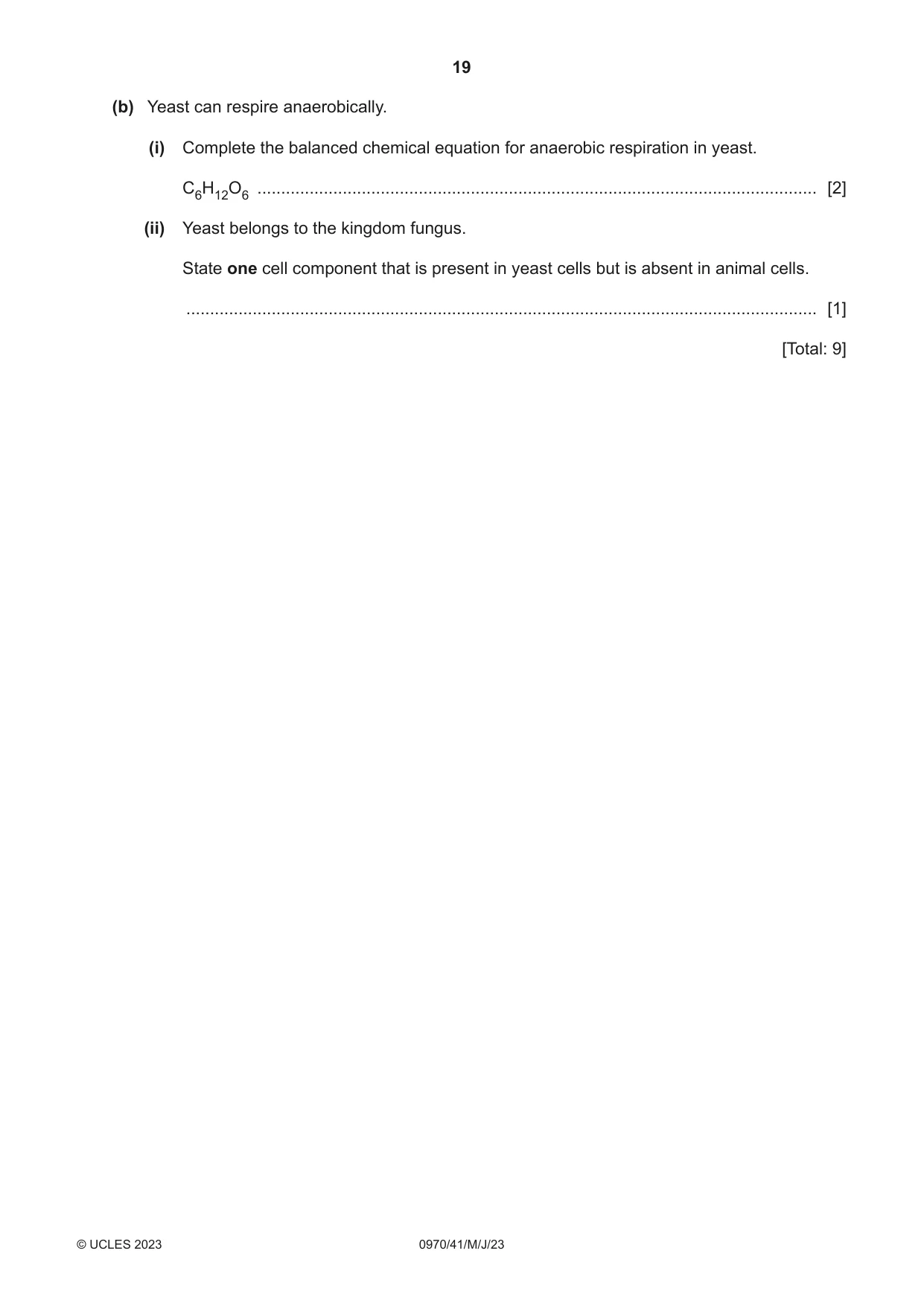
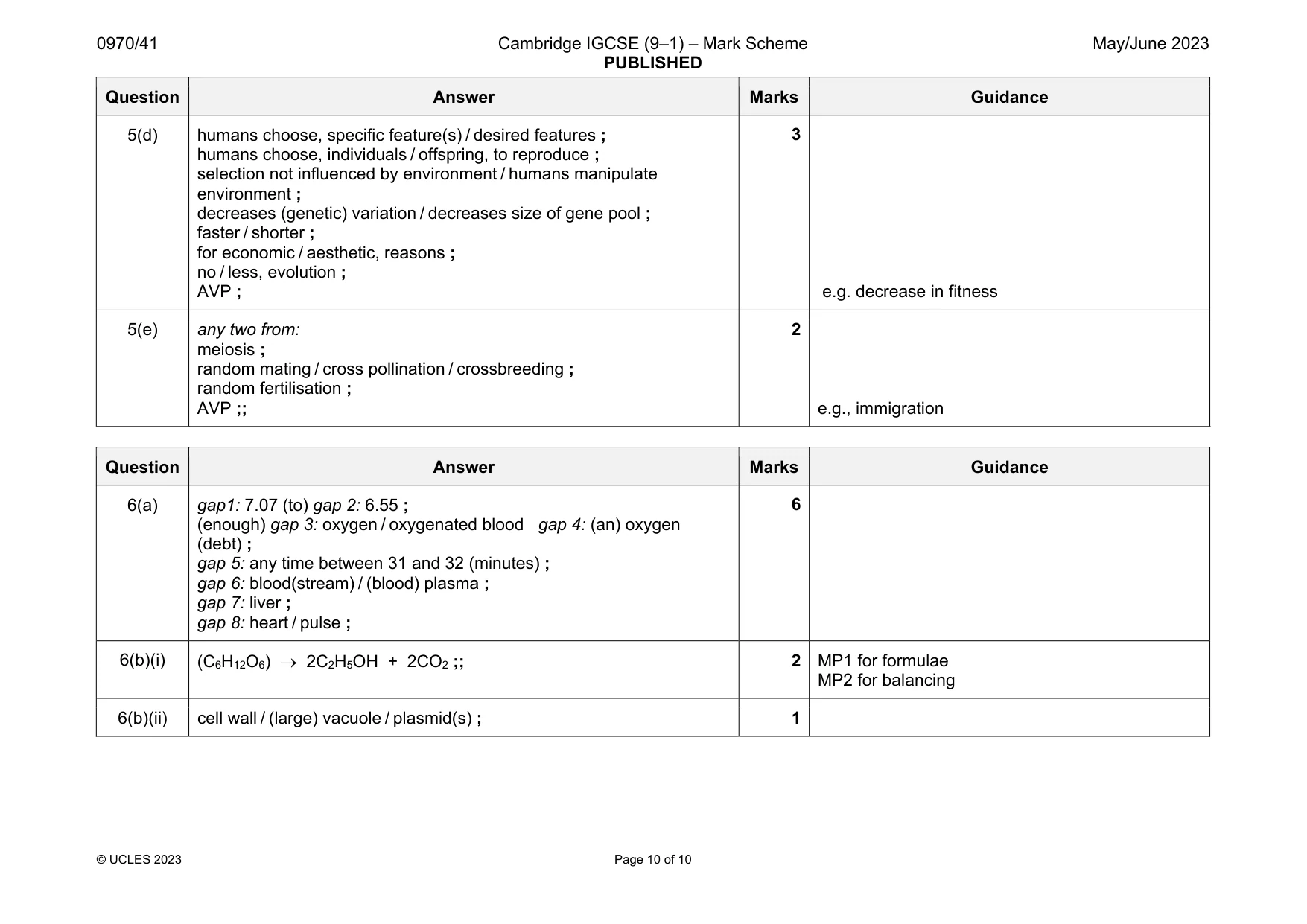
6 (a) A scientist monitored the changes in the pH in muscles before, during and after two minutes of vigorous exercise. The changes in pH are caused by the production of lactic acid. 7.10 7.00 6.90 6.80 pH in muscles 6.70 6.60 6.50 6.40 0 2 4 6 8 10 12 14 16 18 20 22 24 26 28 30 32 34 36 38 40 time / minutes vigorous exercise Fig. 6.1 Complete the sentences to describe and explain the results in Fig. 6.1. The pH decreases from ............................................... to ............................................... during vigorous exercise. There is not enough ............................................... supplied to the muscles. The body respires anaerobically. The lactic acid produced builds up in the muscles causing an ............................................... debt. It takes ............................................... minutes for the muscle pH to return to its initial level after exercise. The pH value increases after vigorous exercise has ended, as lactic acid is transported in the ............................................... to the ............................................... . During this time the breathing rate and ............................................... rate remain high. [6] (b) Yeast can respire anaerobically. (i) Complete the balanced chemical equation for anaerobic respiration in yeast. C6H12O6 ...................................................................................................................... [2] (ii) Yeast belongs to the kingdom fungus. State one cell component that is present in yeast cells but is absent in animal cells. ..................................................................................................................................... [1] [Total: 9]
Mark scheme: 6(a) gap1: 7.07 (to) gap 2: 6.55 ; (enough) gap 3: oxygen / oxygenated blood gap 4: (an) oxygen (debt) ; gap 5: any time between 31 and 32 (minutes) ; gap 6: blood(stream) / (blood) plasma ; gap 7: liver ; gap 8: heart / pulse ; 6(b)(i) (C6H12O6) 2C2H5OH + 2CO2 ;; 2 MP1 for formulae MP2 for balancing 6(b)(ii) cell wall / (large) vacuole / plasmid(s) ; 1
What was in this paper
The subtopics covered by these 6 questions, and how many questions each got. Open one in a new tab to see every Cambridge question on it.
What you needed in this session
Cambridge’s own grade thresholds for 2023 May/June, Paper 4 · Variant 1. A higher threshold means an easier paper — the bar moves with how the cohort did.