Cambridge IGCSE Biology (9-1) 0970 — 2025 May/June Paper 1 · Variant 2
0970/12/M/J/25 · 40 questions · 40 marks · ≈45 min
The question paper and its mark scheme, free to read here and free to download. This is Cambridge’s own paper, exactly as it was sat.
Question paper16 pages
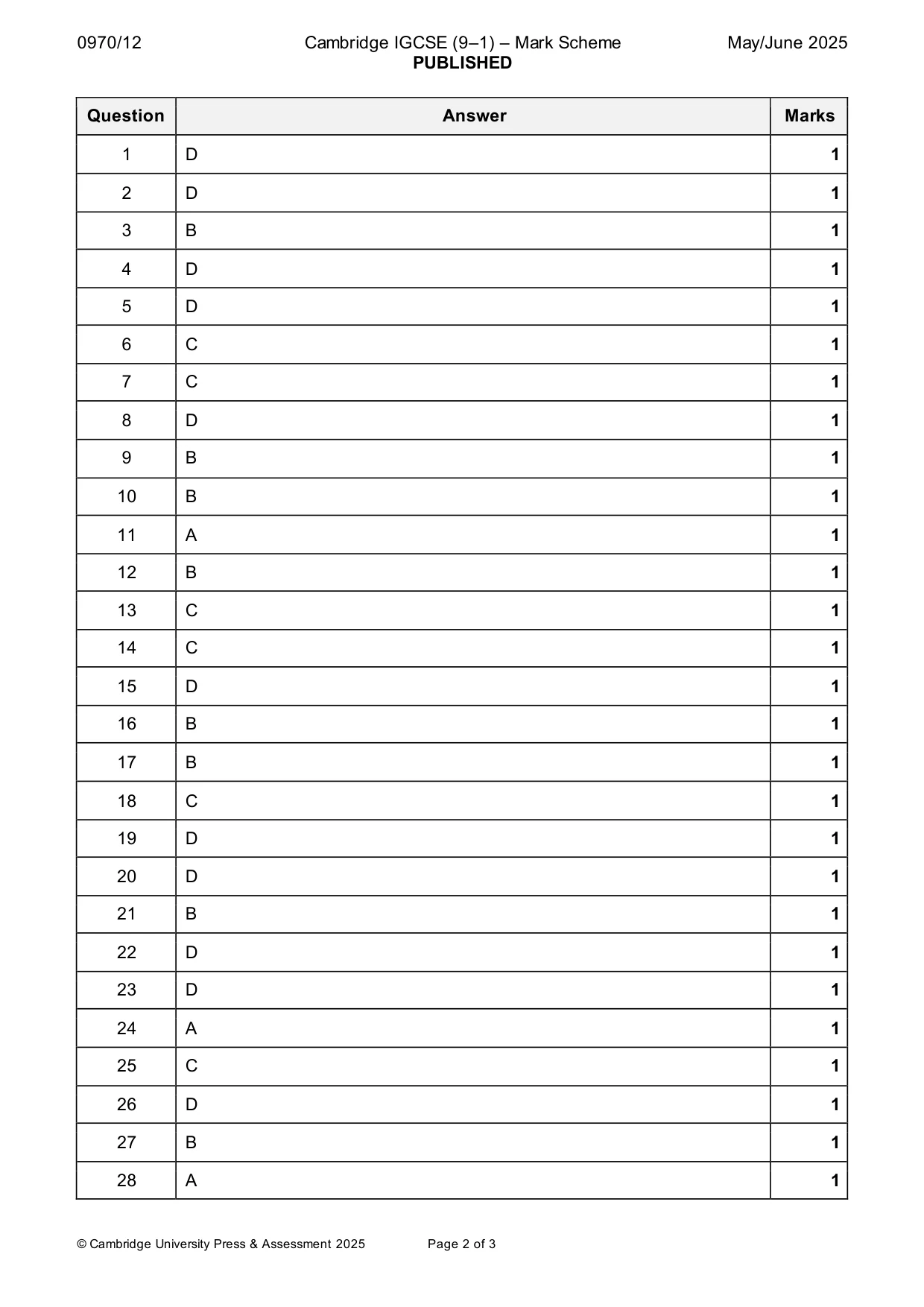
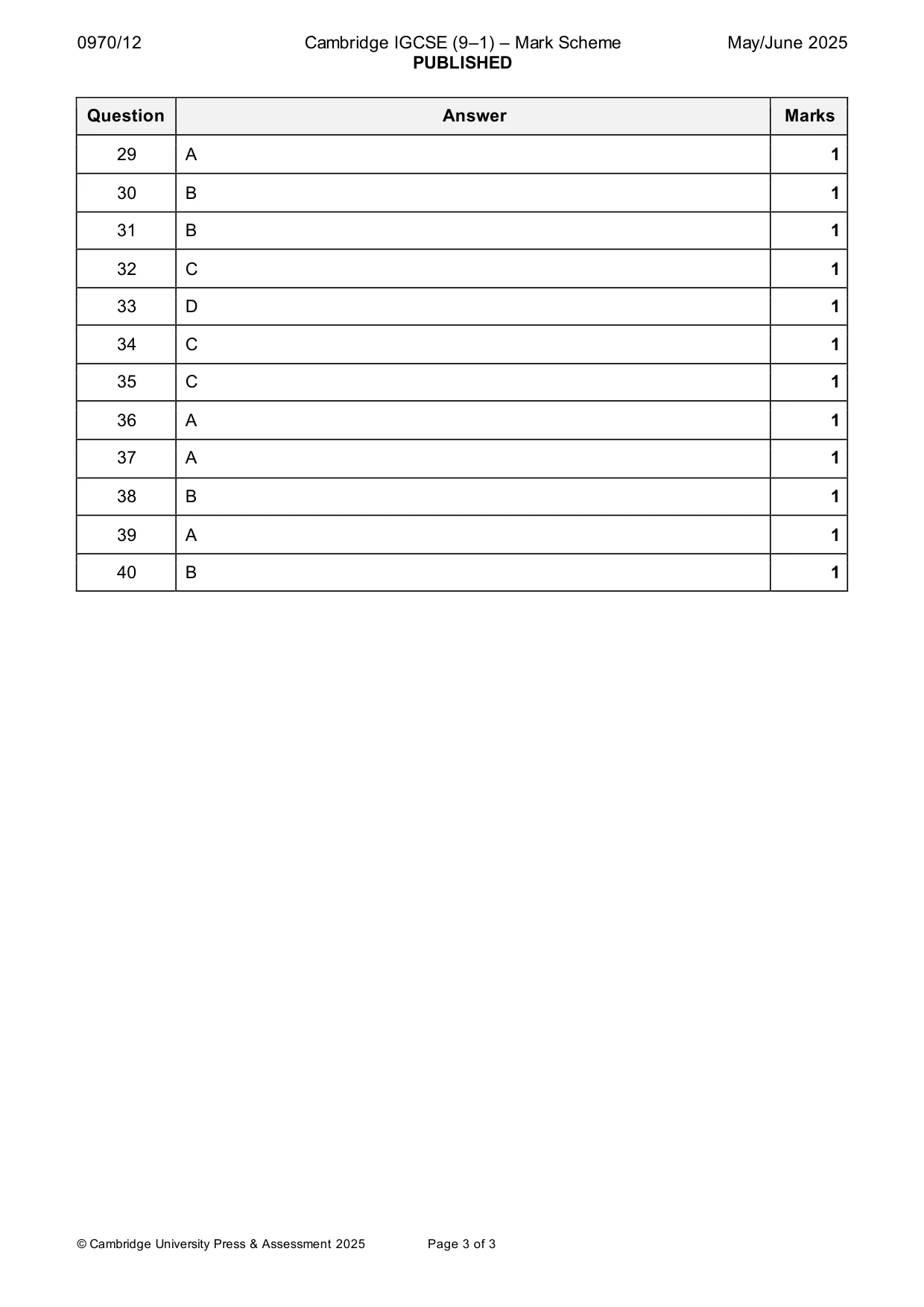
Mark scheme3 pages
Answers below. Sit the paper first if you are practising.
Questions as text
Q1 · When a herbivore sees a carnivore, which characteristic of living things is involved?
1 When a herbivore sees a carnivore, which characteristic of living things is involved? A excretion B growth C reproduction D sensitivity
Mark scheme: D
Q2 · Which organism has been named using the binomial system?
2 Which organism has been named using the binomial system? A Brown seaweed B Polar bear C Red fox D Vulpes vulpes
Mark scheme: D
More questions on Concept and uses of classification systems
Q3 · Which list contains only arthropods?
3 Which list contains only arthropods? A amphibians, insects, myriapods B arachnids, crustaceans, myriapods C crustaceans, insects, fish D insects, myriapods, reptiles
Mark scheme: B
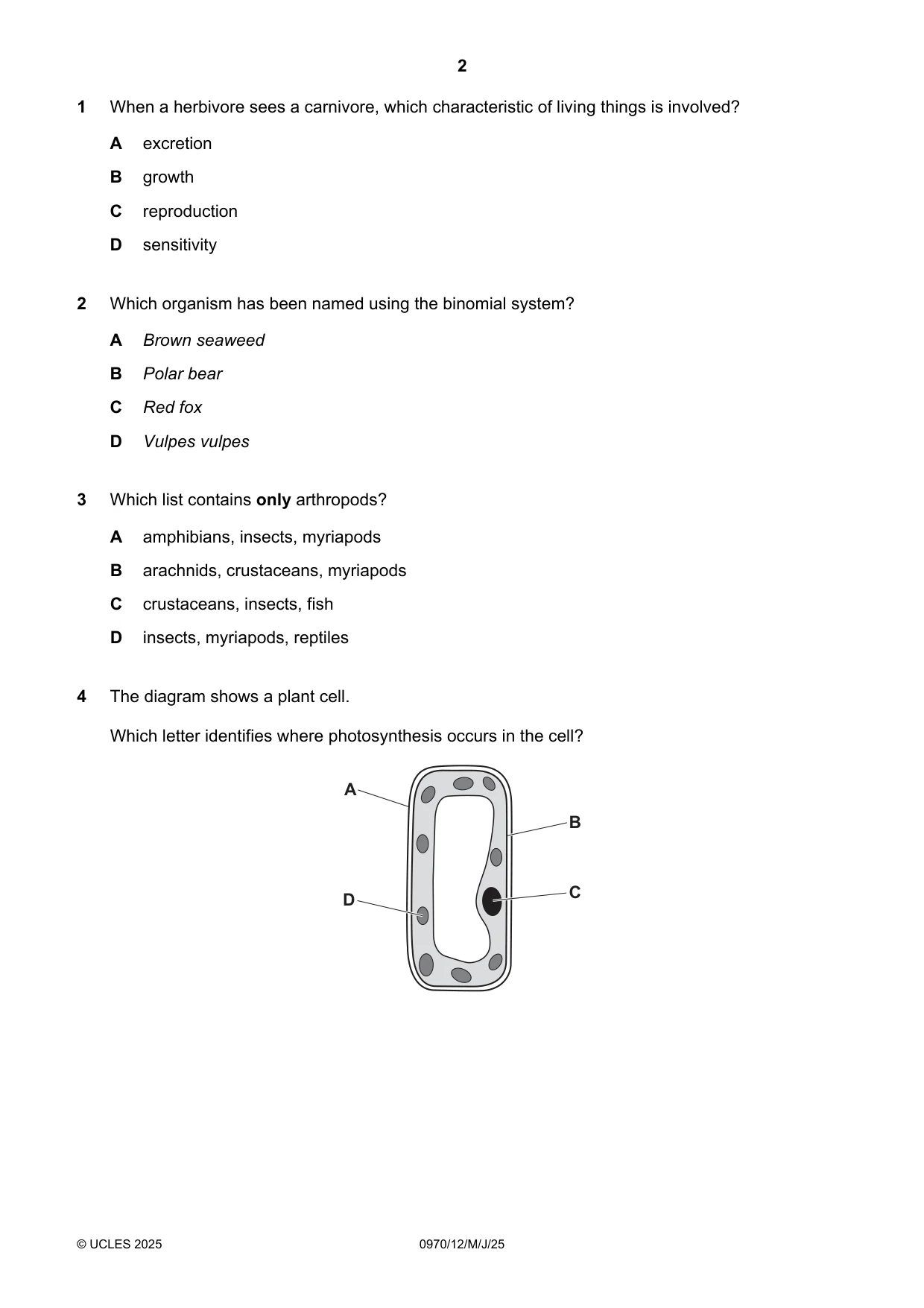
Q4 · The diagram shows a plant cell
4 The diagram shows a plant cell. Which letter identifies where photosynthesis occurs in the cell? A B D C
Mark scheme: D
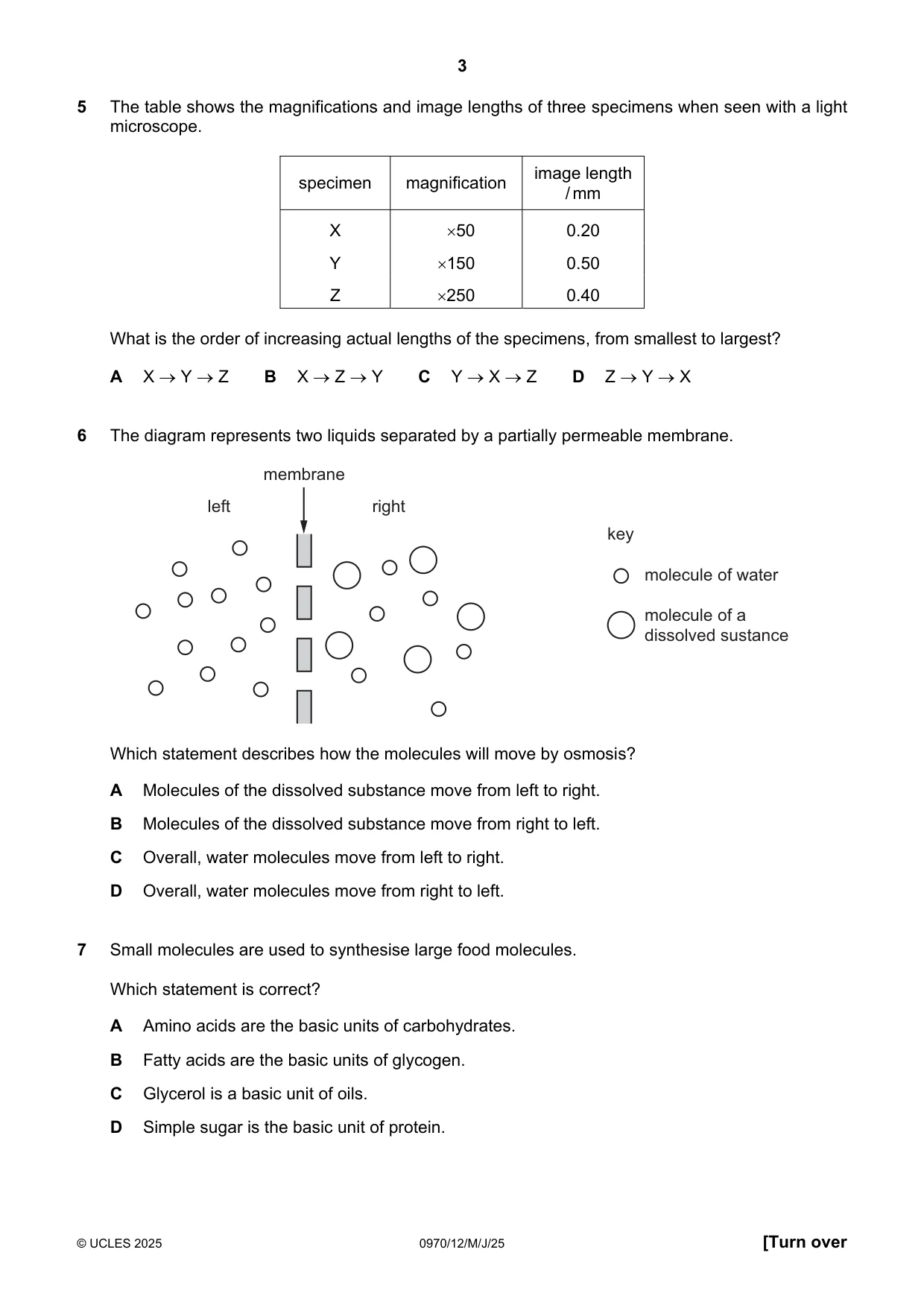
Q5 · The table shows the magnifications and image lengths of three specimens when seen with a…
5 The table shows the magnifications and image lengths of three specimens when seen with a light microscope. image length specimen magnification / mm X 50 0.20 Y 150 0.50 Z 250 0.40 What is the order of increasing actual lengths of the specimens, from smallest to largest? A X Y Z B X Z Y C Y X Z D Z Y X
Mark scheme: D
Q6 · The diagram represents two liquids separated by a partially permeable membrane
6 The diagram represents two liquids separated by a partially permeable membrane. membrane left right key molecule of water molecule of a dissolved sustance Which statement describes how the molecules will move by osmosis? A Molecules of the dissolved substance move from left to right. B Molecules of the dissolved substance move from right to left. C Overall, water molecules move from left to right. D Overall, water molecules move from right to left.
Mark scheme: C
Q7 · Small molecules are used to synthesise large food molecules
7 Small molecules are used to synthesise large food molecules. Which statement is correct? A Amino acids are the basic units of carbohydrates. B Fatty acids are the basic units of glycogen. C Glycerol is a basic unit of oils. D Simple sugar is the basic unit of protein.
Mark scheme: C
Q8 · A student used biuret reagent to test milk for the presence of protein
8 A student used biuret reagent to test milk for the presence of protein. The milk tested positive for protein. Which colour did the sample change to? A blue B blue-black C brick red D purple
Mark scheme: D
Q9 · Which substances are used for photosynthesis?
9 Which substances are used for photosynthesis? A carbon dioxide and glucose B carbon dioxide and water C glucose and oxygen D glucose and water
Mark scheme: B
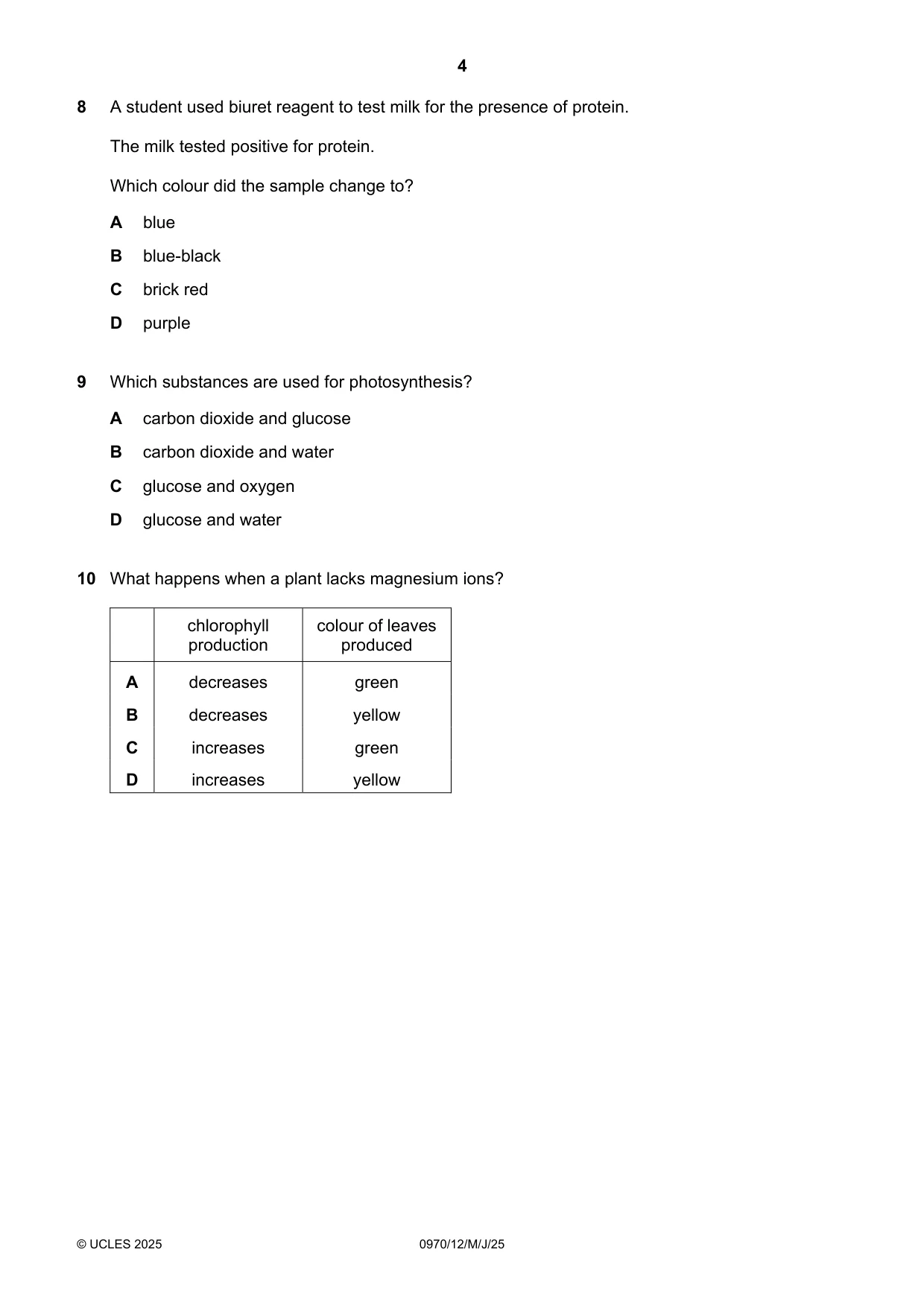
Q10 · What happens when a plant lacks magnesium ions?
10 What happens when a plant lacks magnesium ions? chlorophyll colour of leaves production produced A decreases green B decreases yellow C increases green D increases yellow
Mark scheme: B
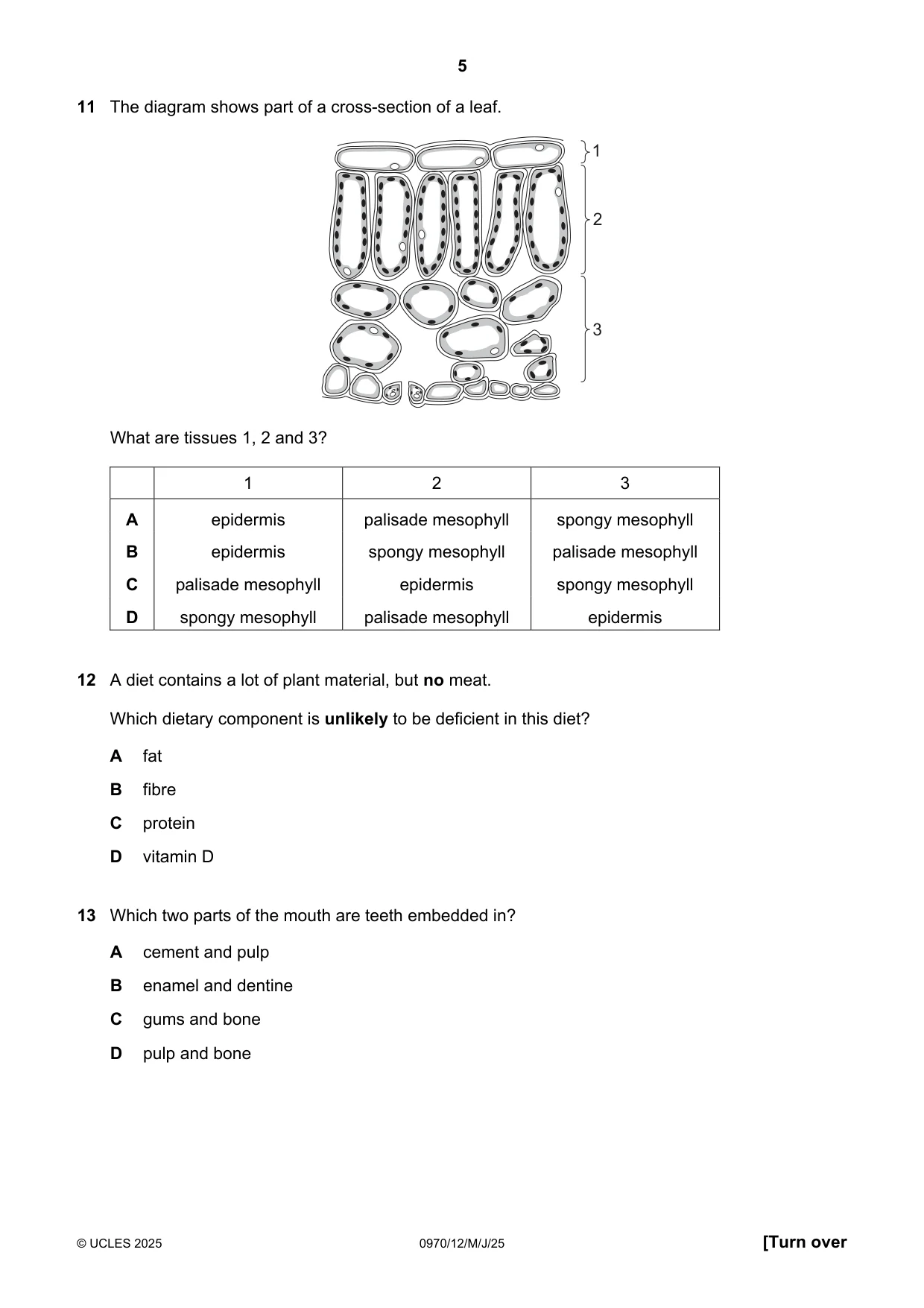
Q11 · The diagram shows part of a cross-section of a leaf
11 The diagram shows part of a cross-section of a leaf. 1 2 3 What are tissues 1, 2 and 3? 1 2 3 A epidermis palisade mesophyll spongy mesophyll B epidermis spongy mesophyll palisade mesophyll C palisade mesophyll epidermis spongy mesophyll D spongy mesophyll palisade mesophyll epidermis
Mark scheme: A
Q12 · A diet contains a lot of plant material, but no meat
12 A diet contains a lot of plant material, but no meat. Which dietary component is unlikely to be deficient in this diet? A fat B fibre C protein D vitamin D
Mark scheme: B
Q13 · Which two parts of the mouth are teeth embedded in?
13 Which two parts of the mouth are teeth embedded in? A cement and pulp B enamel and dentine C gums and bone D pulp and bone
Mark scheme: C
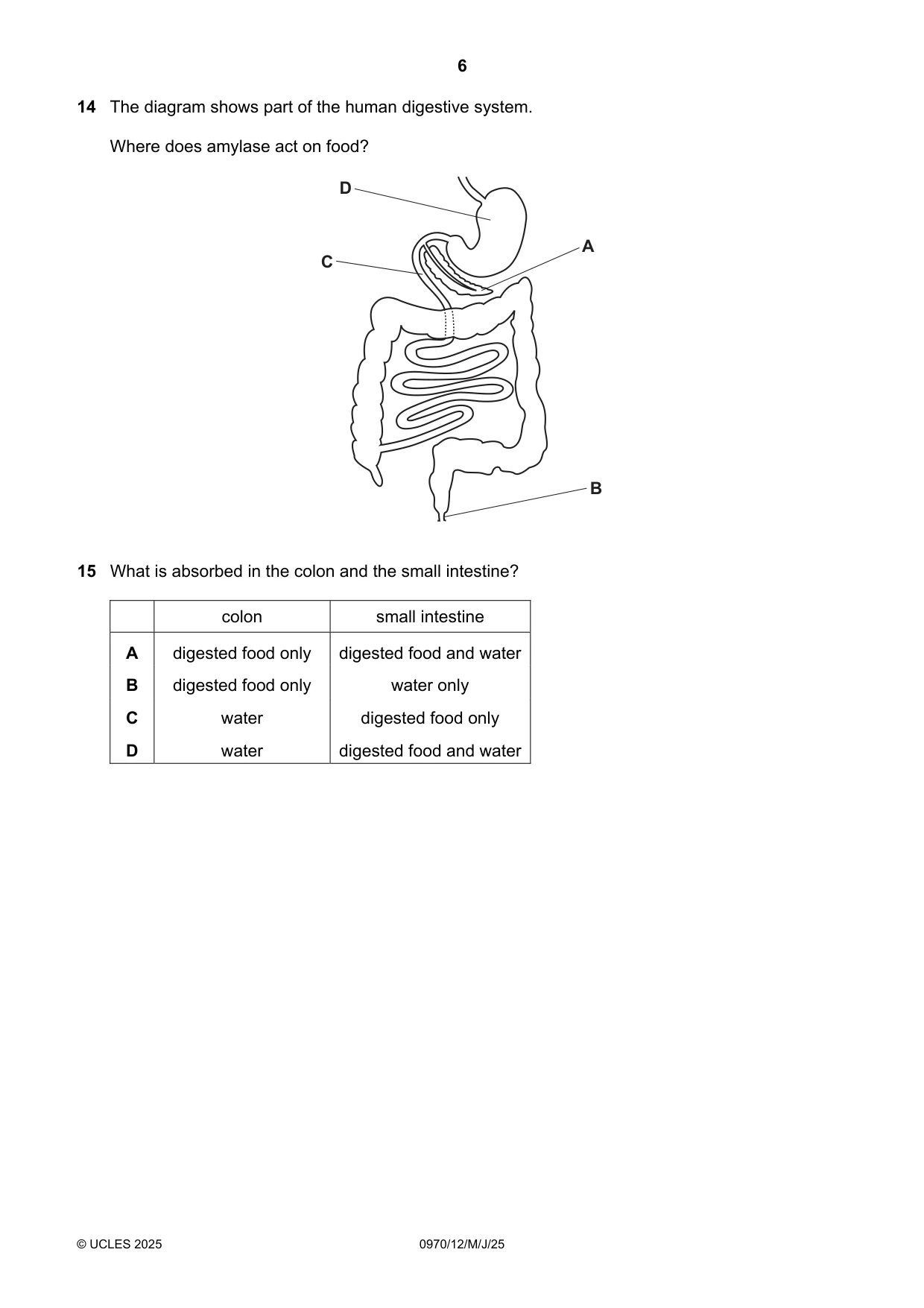
Q14 · The diagram shows part of the human digestive system
14 The diagram shows part of the human digestive system. Where does amylase act on food? D A C B
Mark scheme: C
Q15 · What is absorbed in the colon and the small intestine?
15 What is absorbed in the colon and the small intestine? colon small intestine A digested food only digested food and water B digested food only water only C water digested food only D water digested food and water
Mark scheme: D
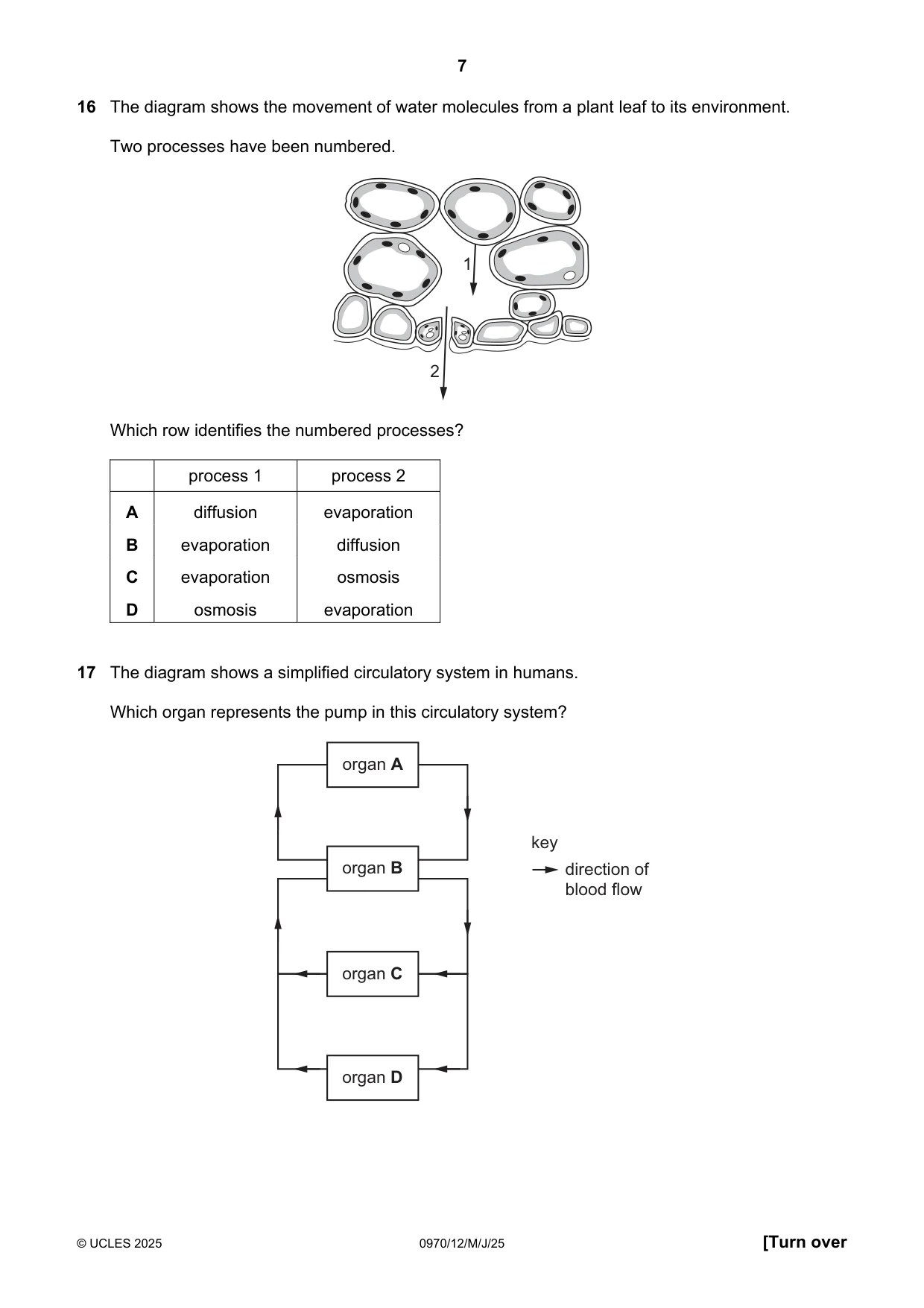
Q16 · The diagram shows the movement of water molecules from a plant leaf to its environment
16 The diagram shows the movement of water molecules from a plant leaf to its environment. Two processes have been numbered. 1 2 Which row identifies the numbered processes? process 1 process 2 A diffusion evaporation B evaporation diffusion C evaporation osmosis D osmosis evaporation
Mark scheme: B
Q17 · The diagram shows a simplified circulatory system in humans
17 The diagram shows a simplified circulatory system in humans. Which organ represents the pump in this circulatory system? organ A key organ B direction of blood flow organ C organ D
Mark scheme: B
Q18 · Which blood vessel transports blood from the lungs to the heart?
18 Which blood vessel transports blood from the lungs to the heart? A aorta B pulmonary artery C pulmonary vein D vena cava
Mark scheme: C
Q19 · How can the spread of disease be prevented?
19 How can the spread of disease be prevented? A leaving food uncovered B only washing hands after meals C using the same equipment to prepare raw and cooked food D washing hands before and after handling raw food
Mark scheme: D
Q20 · Which substance can be used to test for carbon dioxide?
20 Which substance can be used to test for carbon dioxide? A DCPIP B ethanol C iodine solution D limewater
Mark scheme: D
Q21 · Which statement is a correct comparison of aerobic respiration and anaerobic respiration…
21 Which statement is a correct comparison of aerobic respiration and anaerobic respiration in yeast? A Only aerobic respiration produces carbon dioxide. B Only anaerobic respiration produces alcohol. C They both produce water. D They both use the reactants glucose and oxygen.
Mark scheme: B
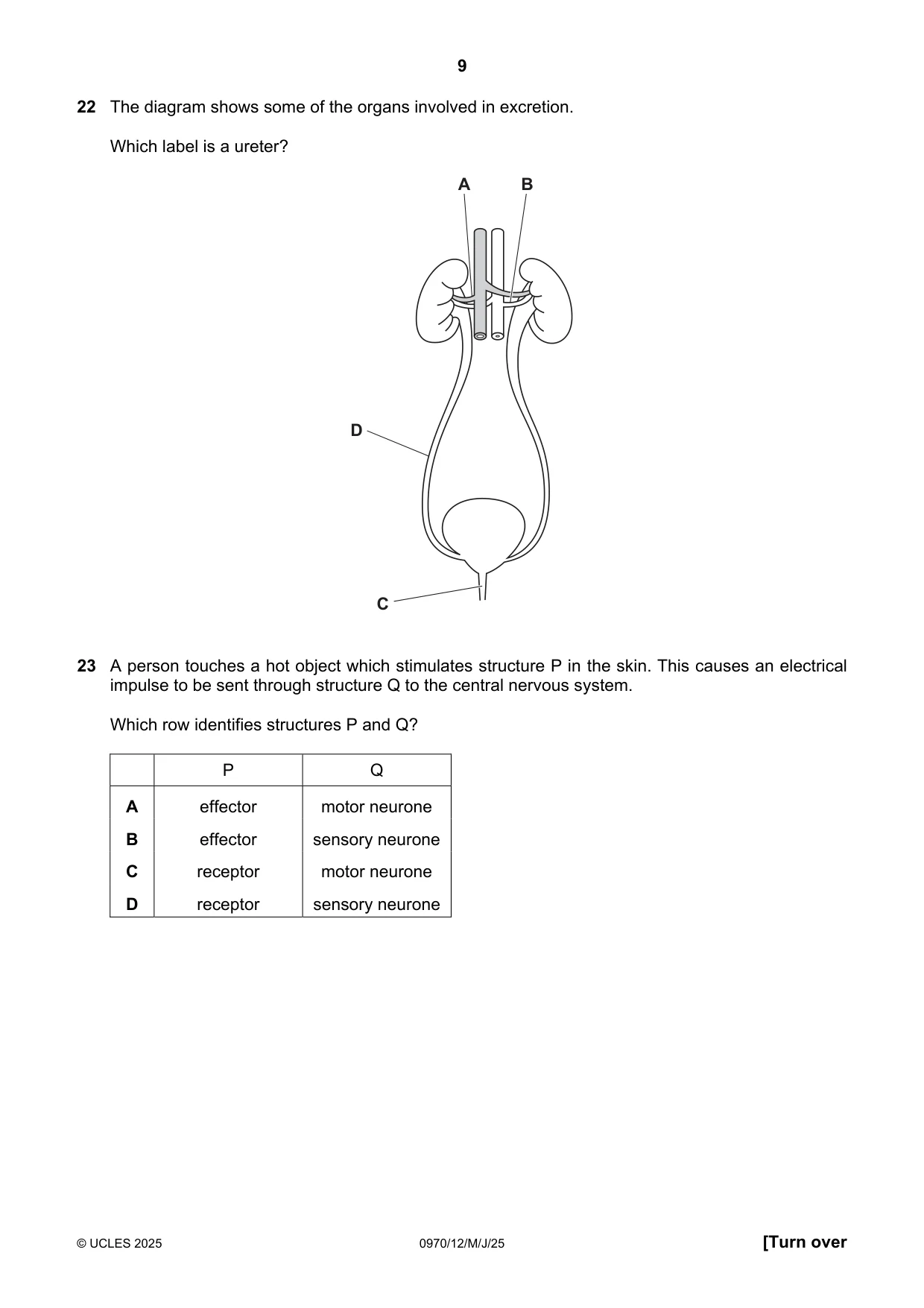
Q22 · The diagram shows some of the organs involved in excretion
22 The diagram shows some of the organs involved in excretion. Which label is a ureter? A B D C
Mark scheme: D
Q23 · A person touches a hot object which stimulates structure P in the skin
23 A person touches a hot object which stimulates structure P in the skin. This causes an electrical impulse to be sent through structure Q to the central nervous system. Which row identifies structures P and Q? P Q A effector motor neurone B effector sensory neurone C receptor motor neurone D receptor sensory neurone
Mark scheme: D
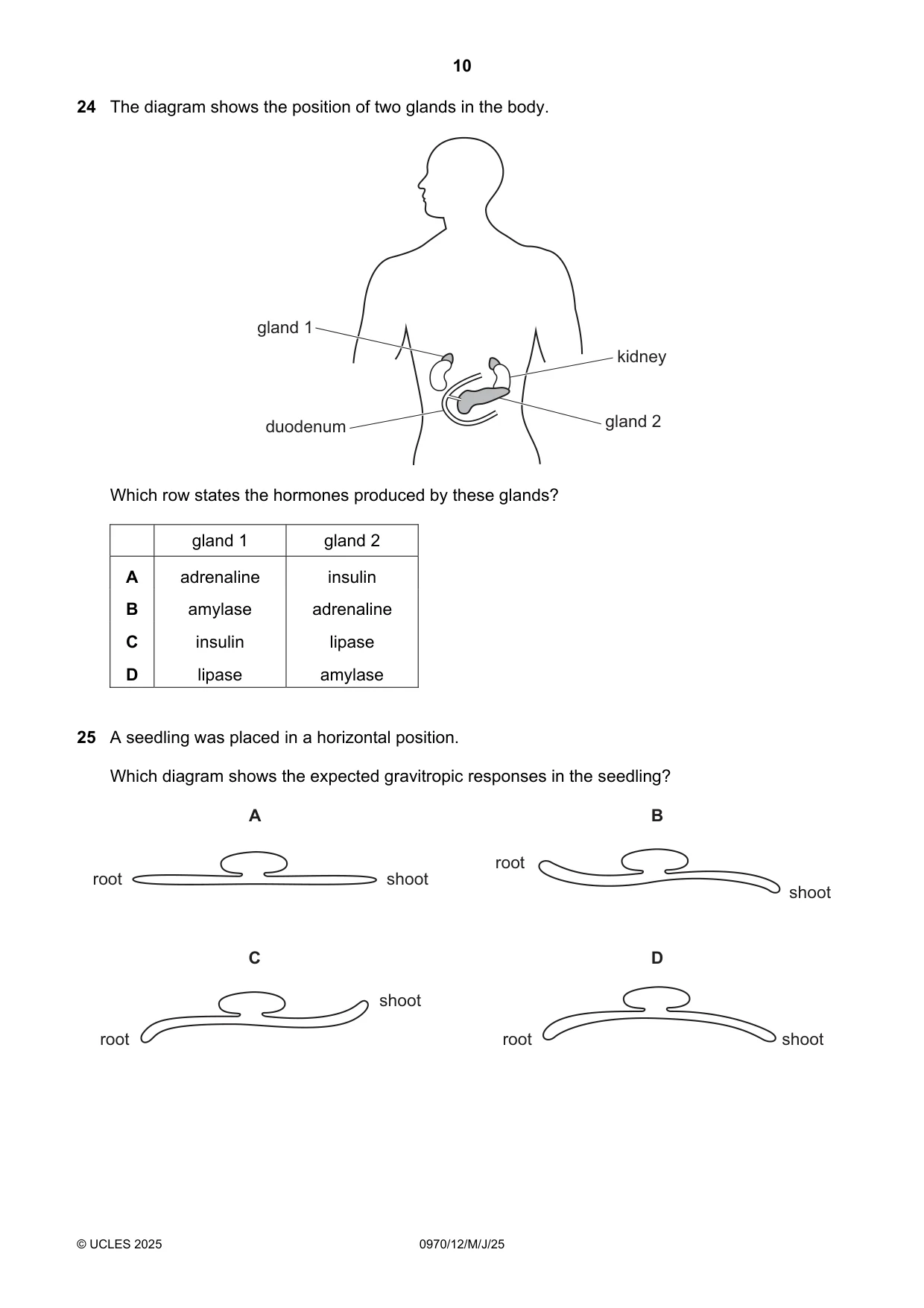
Q24 · The diagram shows the position of two glands in the body
24 The diagram shows the position of two glands in the body. gland 1 kidney duodenum gland 2 Which row states the hormones produced by these glands? gland 1 gland 2 A adrenaline insulin B amylase adrenaline C insulin lipase D lipase amylase
Mark scheme: A
Q25 · A seedling was placed in a horizontal position
25 A seedling was placed in a horizontal position. Which diagram shows the expected gravitropic responses in the seedling? A B root root shoot shoot C D shoot root root shoot
Mark scheme: C
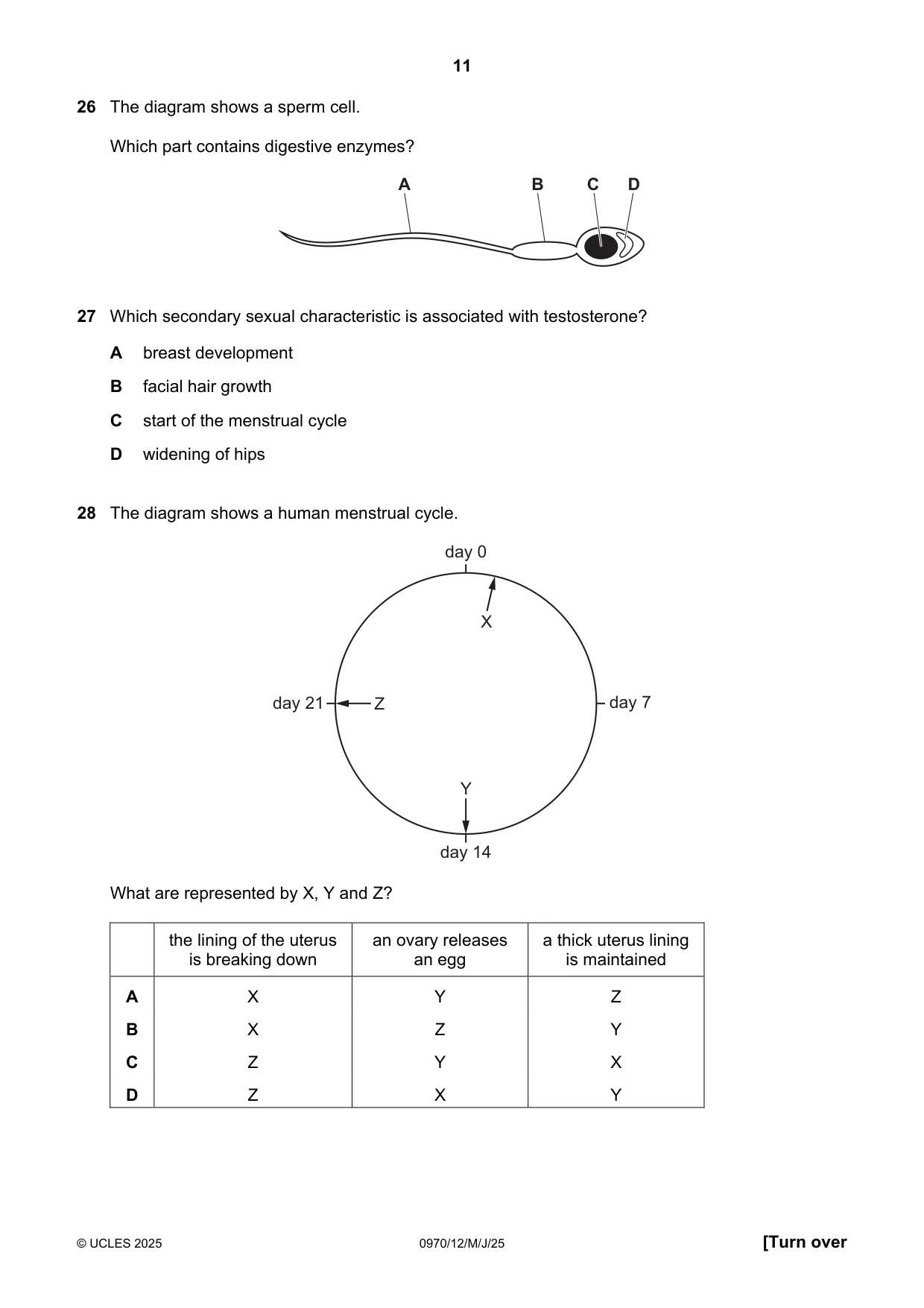
Q26 · The diagram shows a sperm cell
26 The diagram shows a sperm cell. Which part contains digestive enzymes? A B C D
Mark scheme: D
Q27 · Which secondary sexual characteristic is associated with testosterone?
27 Which secondary sexual characteristic is associated with testosterone? A breast development B facial hair growth C start of the menstrual cycle D widening of hips
Mark scheme: B
Q28 · The diagram shows a human menstrual cycle
28 The diagram shows a human menstrual cycle. day 0 X day 21 Z day 7 Y day 14 What are represented by X, Y and Z? the lining of the uterus an ovary releases a thick uterus lining is breaking down an egg is maintained A X Y Z B X Z Y C Z Y X D Z X Y
Mark scheme: A
Q29 · What is an alternative form of a gene called?
29 What is an alternative form of a gene called? A allele B chromosome C genotype D protein
Mark scheme: A
Q30 · Cystic fibrosis is an inherited condition that occurs when an individual is homozygous…
30 Cystic fibrosis is an inherited condition that occurs when an individual is homozygous for the recessive allele. If both parents are heterozygous for this characteristic, what is the probability that their first child will have cystic fibrosis? A 0% B 25% C 50% D 100%
Mark scheme: B
Q31 · Which characteristic is an example of continuous variation?
31 Which characteristic is an example of continuous variation? A ABO blood groups in humans B body mass in cats C seed colour in pea plants D seed shape in pea plants
Mark scheme: B
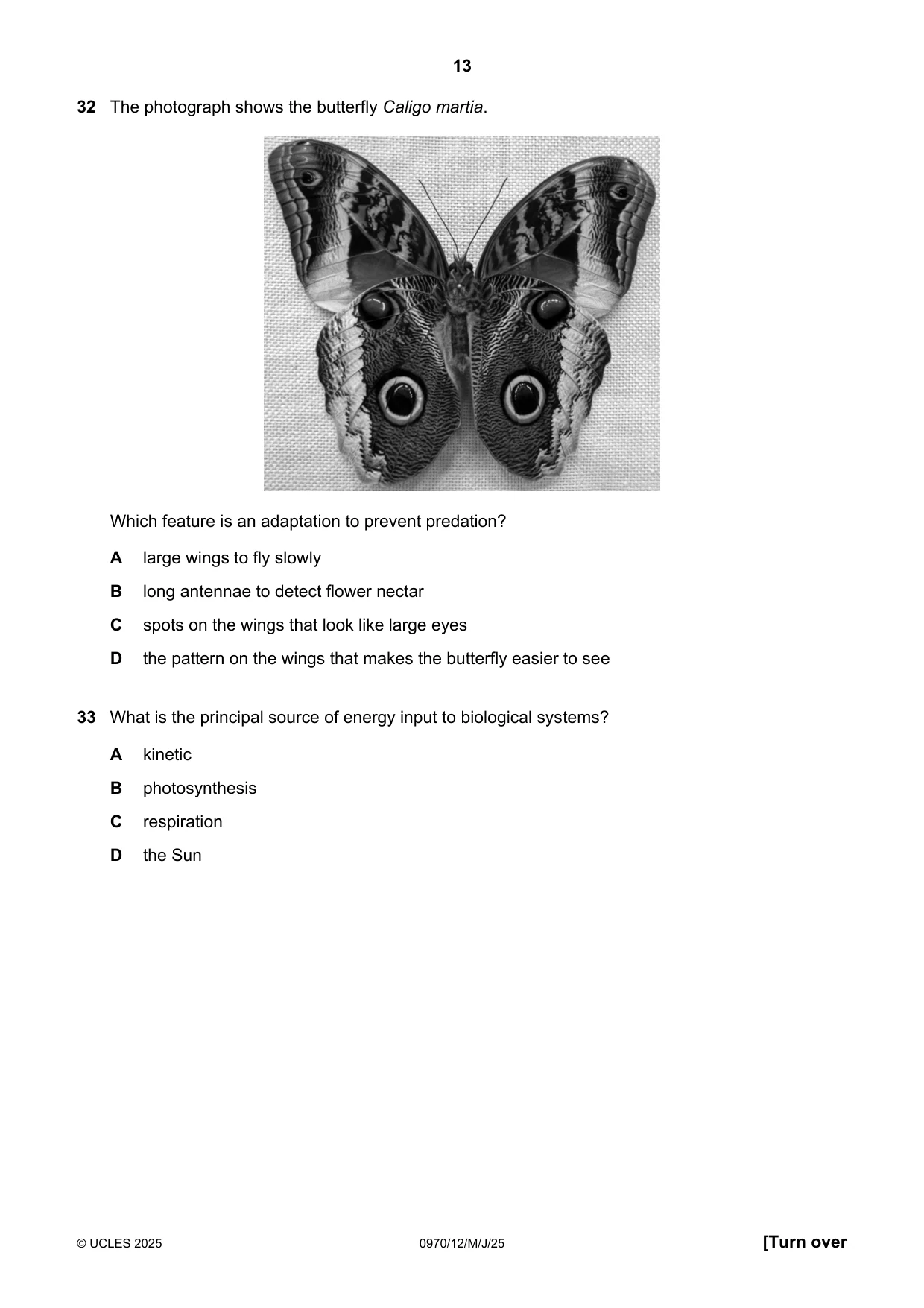
Q32 · The photograph shows the butterfly Caligo martia
32 The photograph shows the butterfly Caligo martia. Which feature is an adaptation to prevent predation? A large wings to fly slowly B long antennae to detect flower nectar C spots on the wings that look like large eyes D the pattern on the wings that makes the butterfly easier to see
Mark scheme: C
Q33 · What is the principal source of energy input to biological systems?
33 What is the principal source of energy input to biological systems? A kinetic B photosynthesis C respiration D the Sun
Mark scheme: D
Q34 · The diagram shows the flow of energy in a food chain
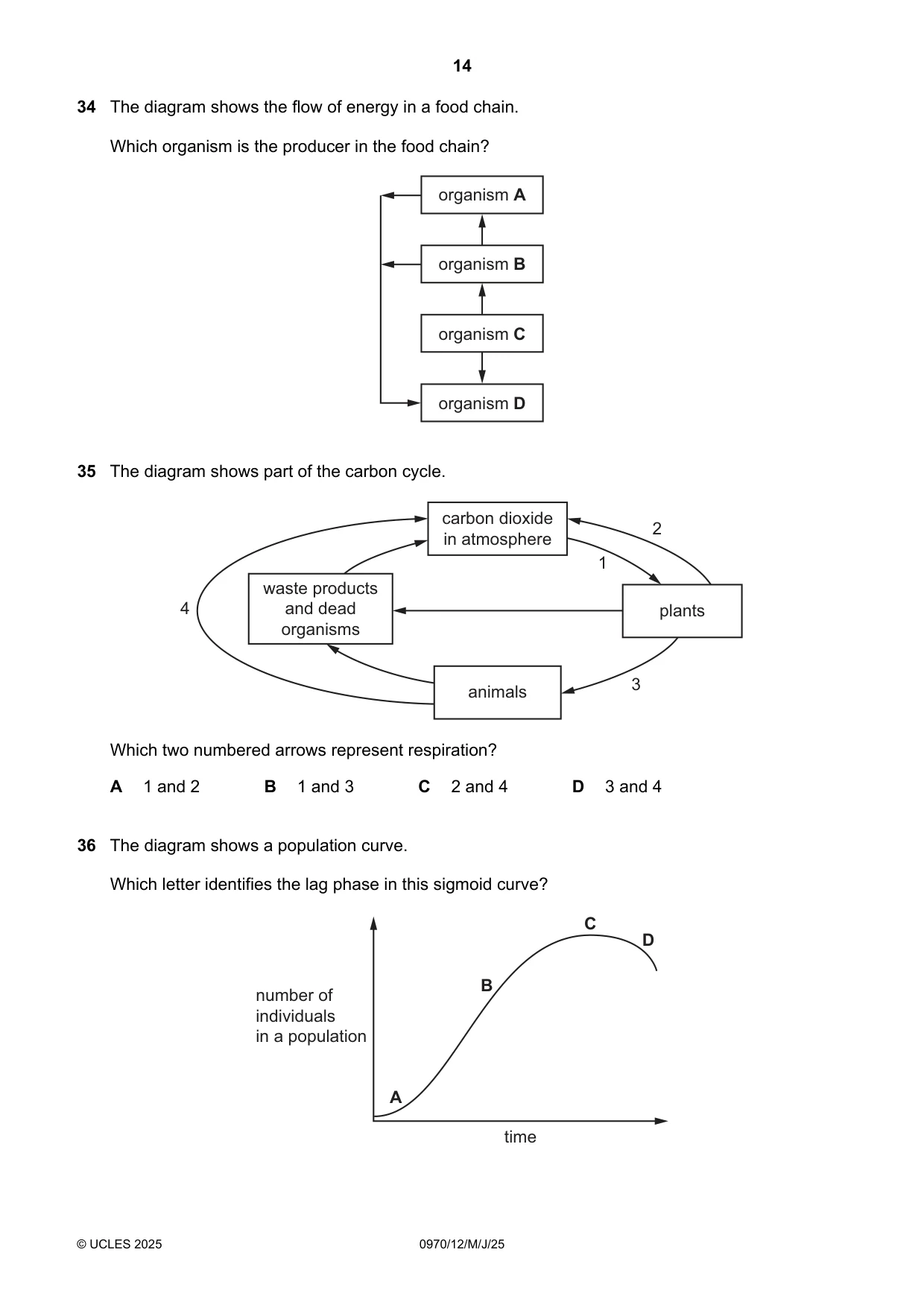
34 The diagram shows the flow of energy in a food chain. Which organism is the producer in the food chain? organism A organism B organism C organism D
Mark scheme: C
Q35 · The diagram shows part of the carbon cycle
35 The diagram shows part of the carbon cycle. carbon dioxide 2 in atmosphere 1 waste products 4 and dead plants organisms animals 3 Which two numbered arrows represent respiration? A 1 and 2 B 1 and 3 C 2 and 4 D 3 and 4
Mark scheme: C
Q36 · The diagram shows a population curve
36 The diagram shows a population curve. Which letter identifies the lag phase in this sigmoid curve? C D B number of individuals in a population A time
Mark scheme: A
Q37 · The graph shows the percentage of species lost, in three different animal groups, due to…
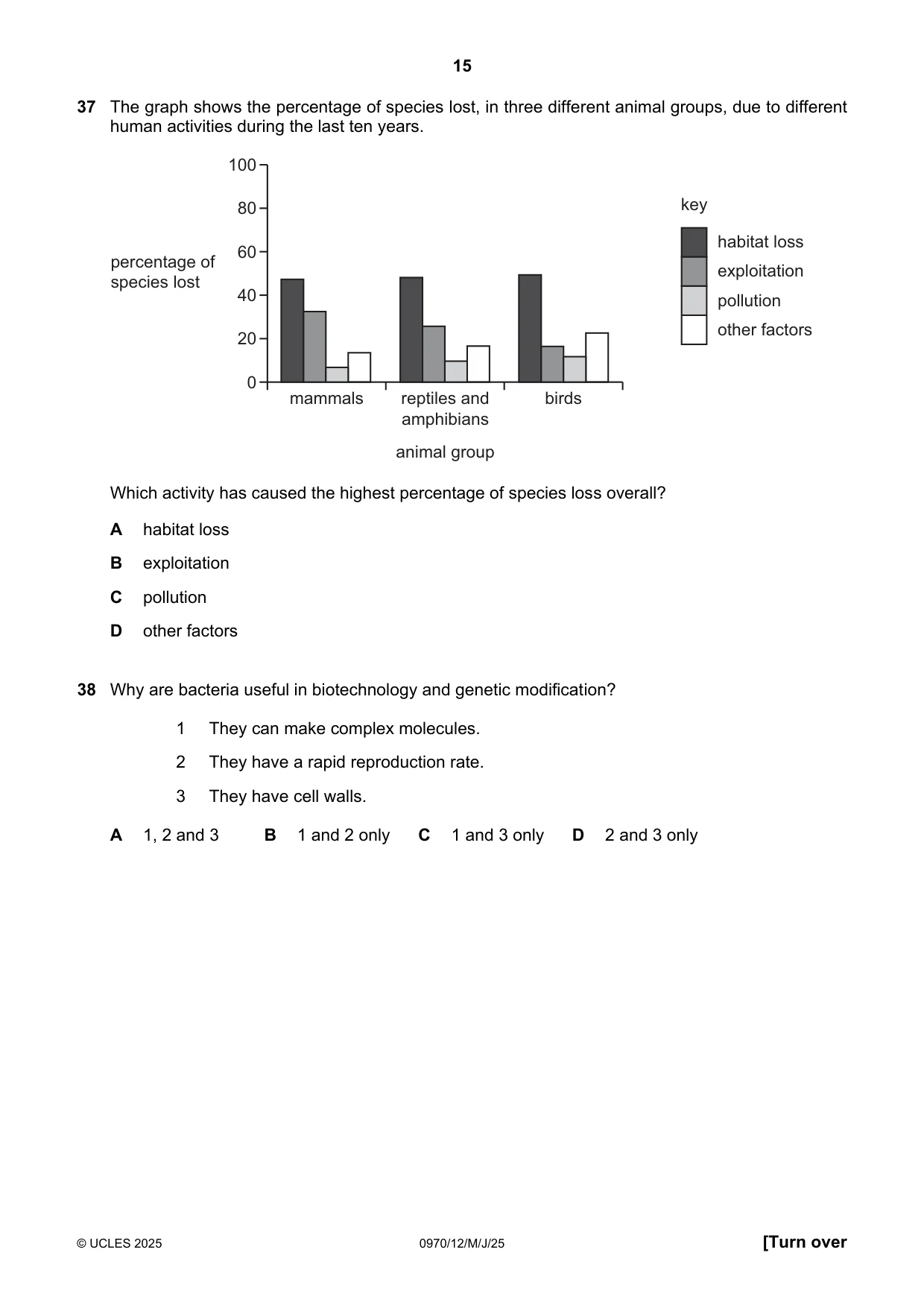
37 The graph shows the percentage of species lost, in three different animal groups, due to different human activities during the last ten years. 100 80 key habitat loss 60 percentage of exploitation species lost 40 pollution other factors 20 0 mammals reptiles and birds amphibians animal group Which activity has caused the highest percentage of species loss overall? A habitat loss B exploitation C pollution D other factors
Mark scheme: A
Q38 · Why are bacteria useful in biotechnology and genetic modification?
38 Why are bacteria useful in biotechnology and genetic modification? 1 They can make complex molecules. 2 They have a rapid reproduction rate. 3 They have cell walls. A 1, 2 and 3 B 1 and 2 only C 1 and 3 only D 2 and 3 only
Mark scheme: B
Q39 · The graph shows how changing the temperature affects the rate of stain removal from…
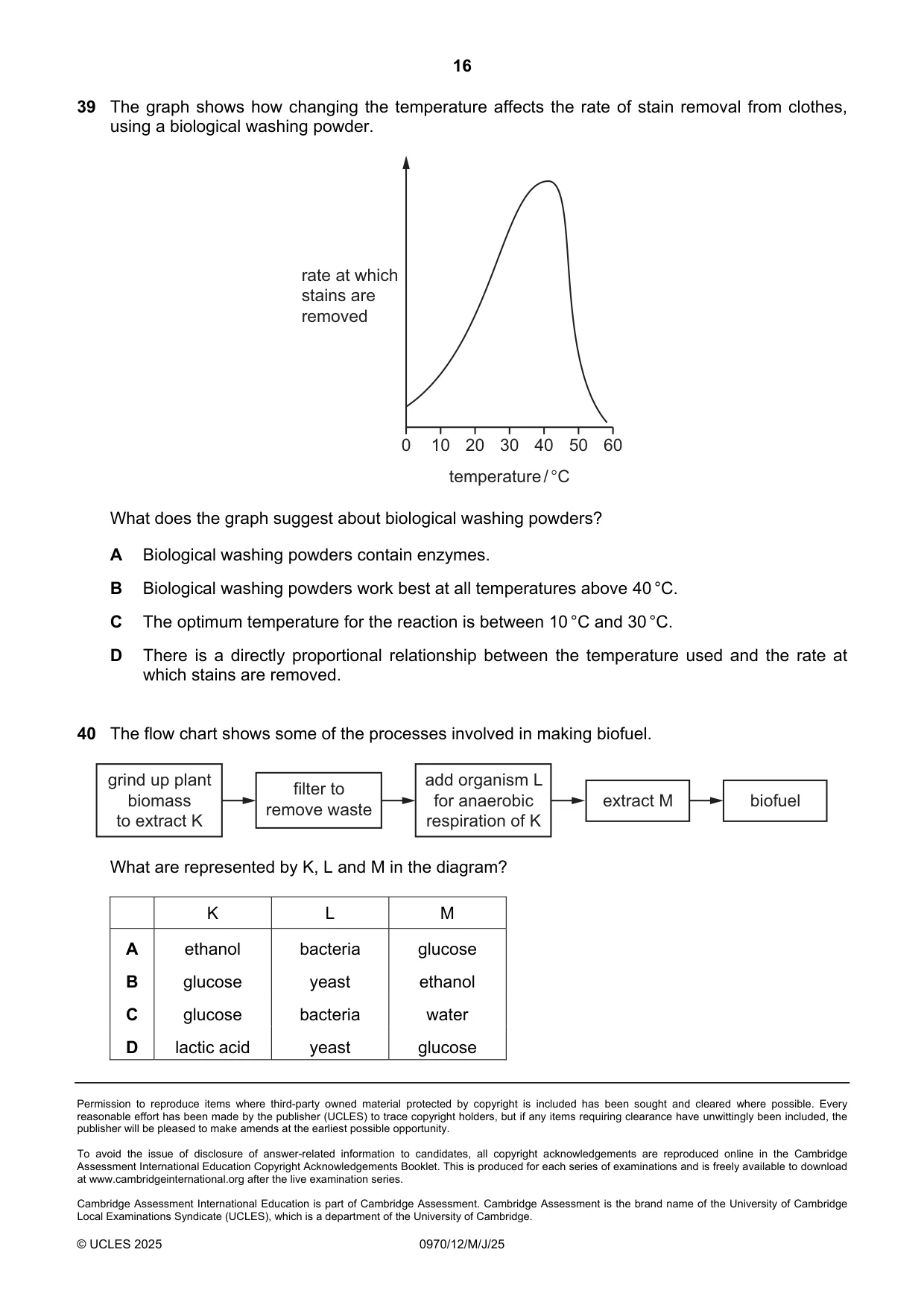
39 The graph shows how changing the temperature affects the rate of stain removal from clothes, using a biological washing powder. rate at which stains are removed 0 10 20 30 40 50 60 temperature / °C What does the graph suggest about biological washing powders? A Biological washing powders contain enzymes. B Biological washing powders work best at all temperatures above 40 °C. C The optimum temperature for the reaction is between 10 °C and 30 °C. D There is a directly proportional relationship between the temperature used and the rate at which stains are removed.
Mark scheme: A
Q40 · The flow chart shows some of the processes involved in making biofuel
40 The flow chart shows some of the processes involved in making biofuel. grind up plant add organism L filter to biomass for anaerobic extract M biofuel remove waste to extract K respiration of K What are represented by K, L and M in the diagram? K L M A ethanol bacteria glucose B glucose yeast ethanol C glucose bacteria water D lactic acid yeast glucose
Mark scheme: B
What was in this paper
The subtopics covered by these 40 questions, and how many questions each got. Open one in a new tab to see every Cambridge question on it.
2Photosynthesis2Sexual reproduction in humans2Absorption1Adaptive features1Anaerobic respiration1Biotechnology1Biotechnology and genetic modification1Cell structure1Characteristics of living organisms1Chemical digestion1Chromosomes, genes and proteins1Circulatory systems1Concept and uses of classification systems1Coordination and response1Diet1Digestive system1Diseases and immunity1Energy flow1Enzymes1Excretion in humans1Features of organisms1Food chains and food webs1Gas exchange in humans1Habitat destruction1Heart1Hormones1Leaf structure1Monohybrid inheritance1Nutrient cycles1Osmosis1Populations1Sex hormones in humans1Size of specimens1Transpiration1Tropic responses1Variation1What you needed in this session
Cambridge’s own grade thresholds for 2025 May/June, Paper 1 · Variant 2. A higher threshold means an easier paper — the bar moves with how the cohort did.