Cambridge IGCSE Biology (9-1) 0970 — 2024 Oct/Nov Paper 1 · Variant 2
0970/12/O/N/24 · 40 questions · 40 marks · ≈45 min
The question paper and its mark scheme, free to read here and free to download. This is Cambridge’s own paper, exactly as it was sat.
Question paper16 pages
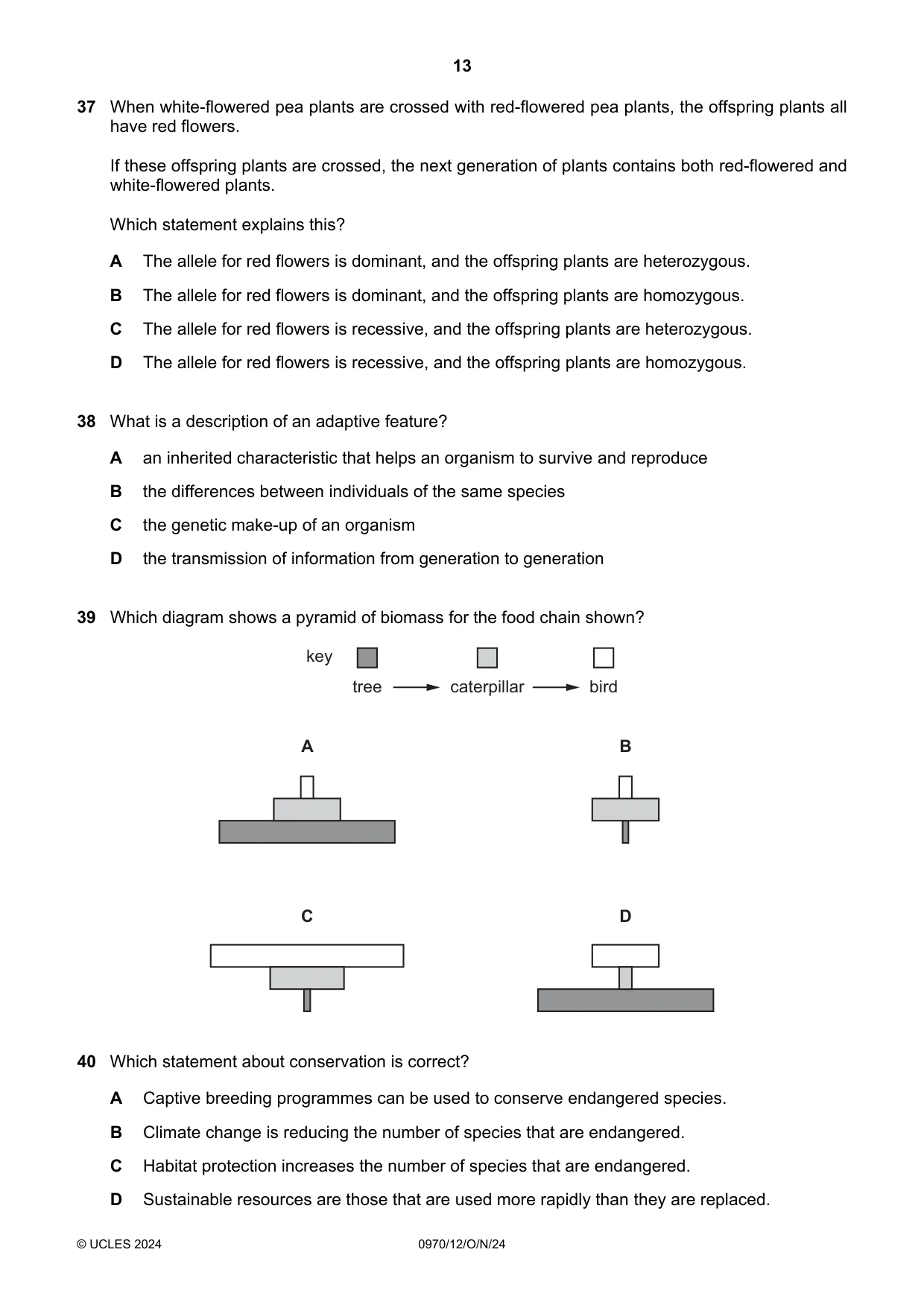


Mark scheme3 pages
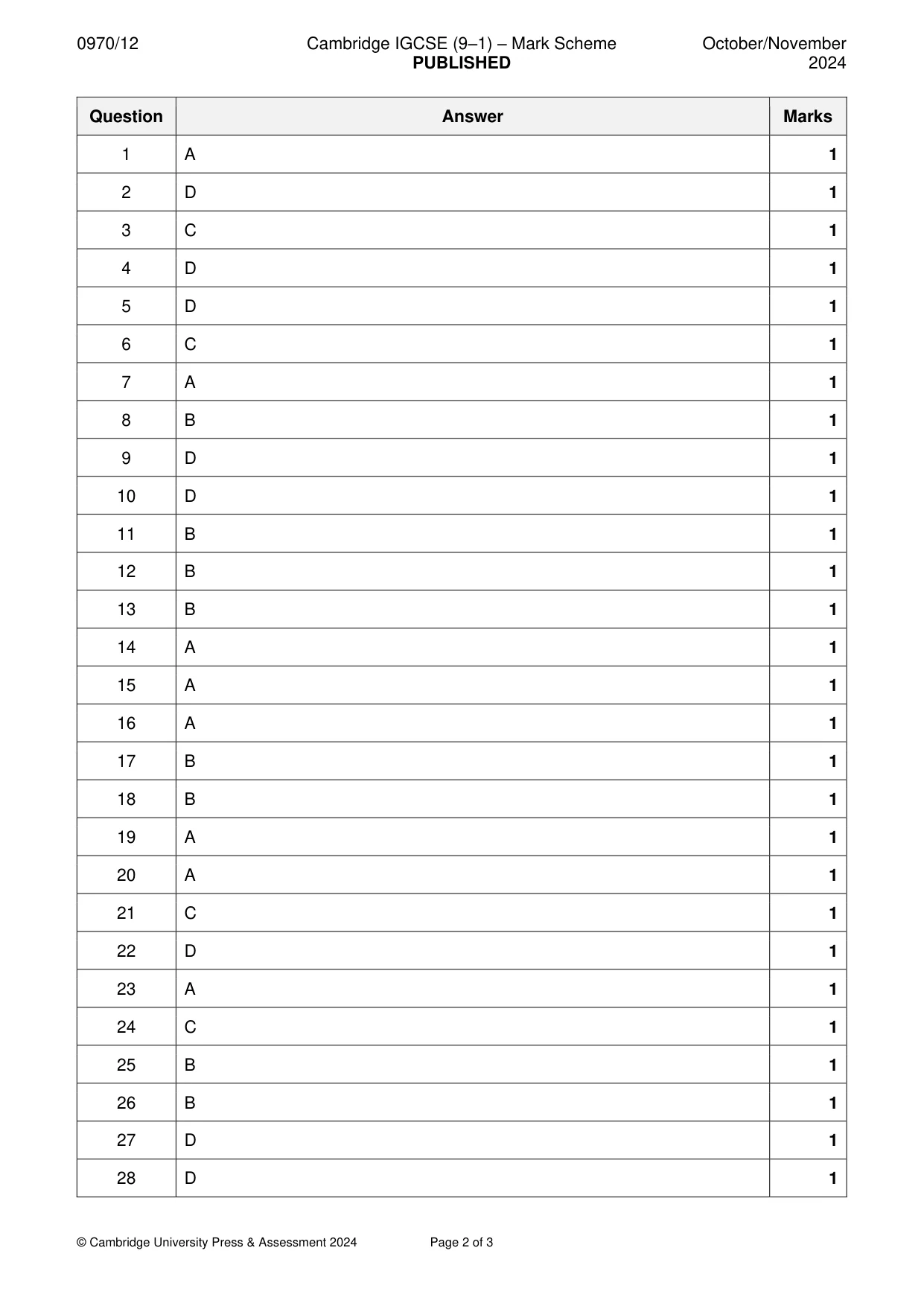
Answers below. Sit the paper first if you are practising.
Questions as text
Q1 · Which type of cell moves mucus?
1 Which type of cell moves mucus? A ciliated cell B egg cell C guard cell D root hair cell
Mark scheme: A
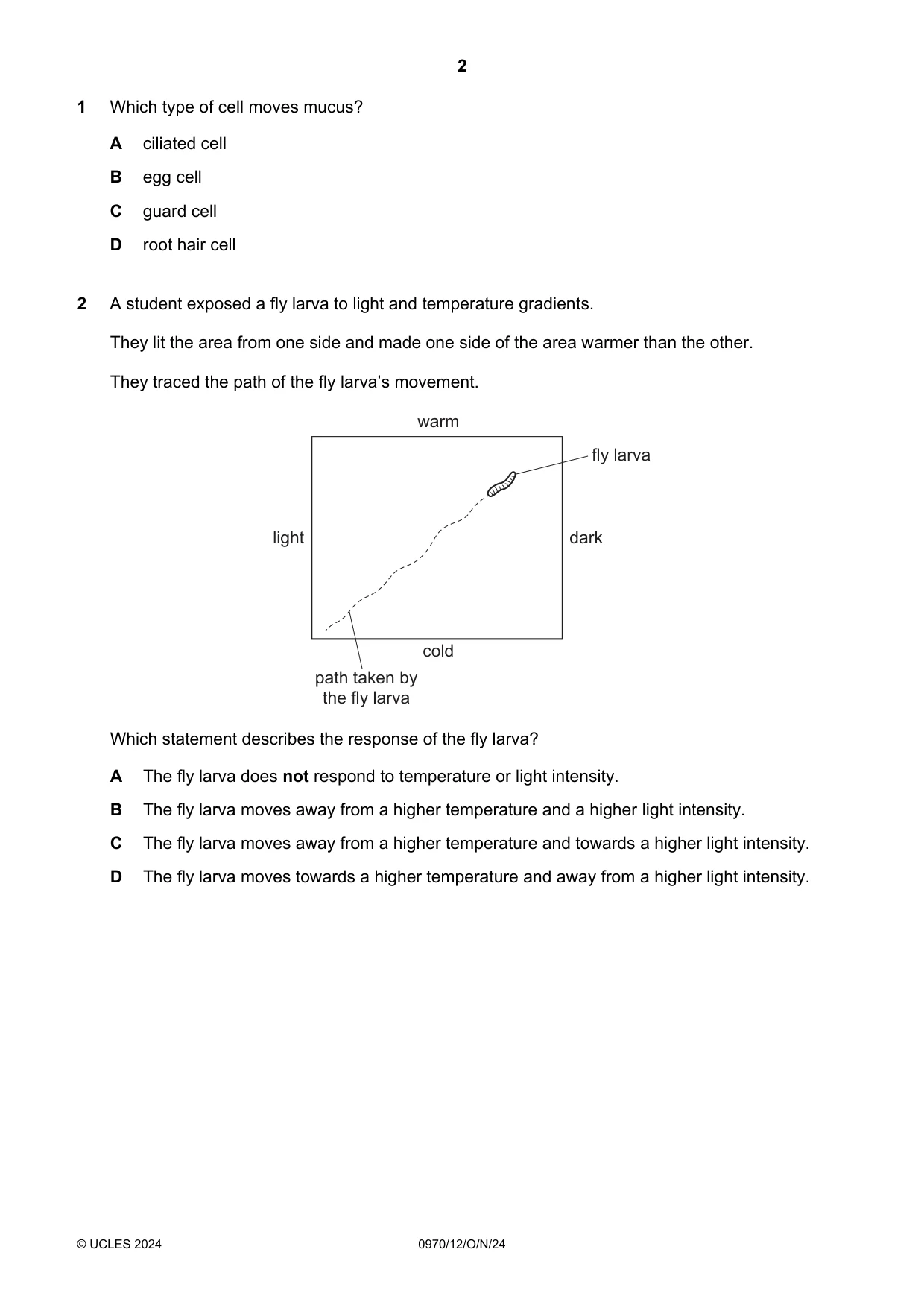
Q2 · A student exposed a fly larva to light and temperature gradients
2 A student exposed a fly larva to light and temperature gradients. They lit the area from one side and made one side of the area warmer than the other. They traced the path of the fly larva’s movement. warm fly larva light dark cold path taken by the fly larva Which statement describes the response of the fly larva? A The fly larva does not respond to temperature or light intensity. B The fly larva moves away from a higher temperature and a higher light intensity. C The fly larva moves away from a higher temperature and towards a higher light intensity. D The fly larva moves towards a higher temperature and away from a higher light intensity.
Mark scheme: D
Q3 · The table shows the scientific names and the common names of four plants
3 The table shows the scientific names and the common names of four plants. scientific name common name Althaea officinalis marsh mallow Hottonia palustris water violet Viola palustris marsh violet Viola tricolor wild pansy Which word is a genus name? A marsh B palustris C Viola D violet
Mark scheme: C
More questions on Concept and uses of classification systems
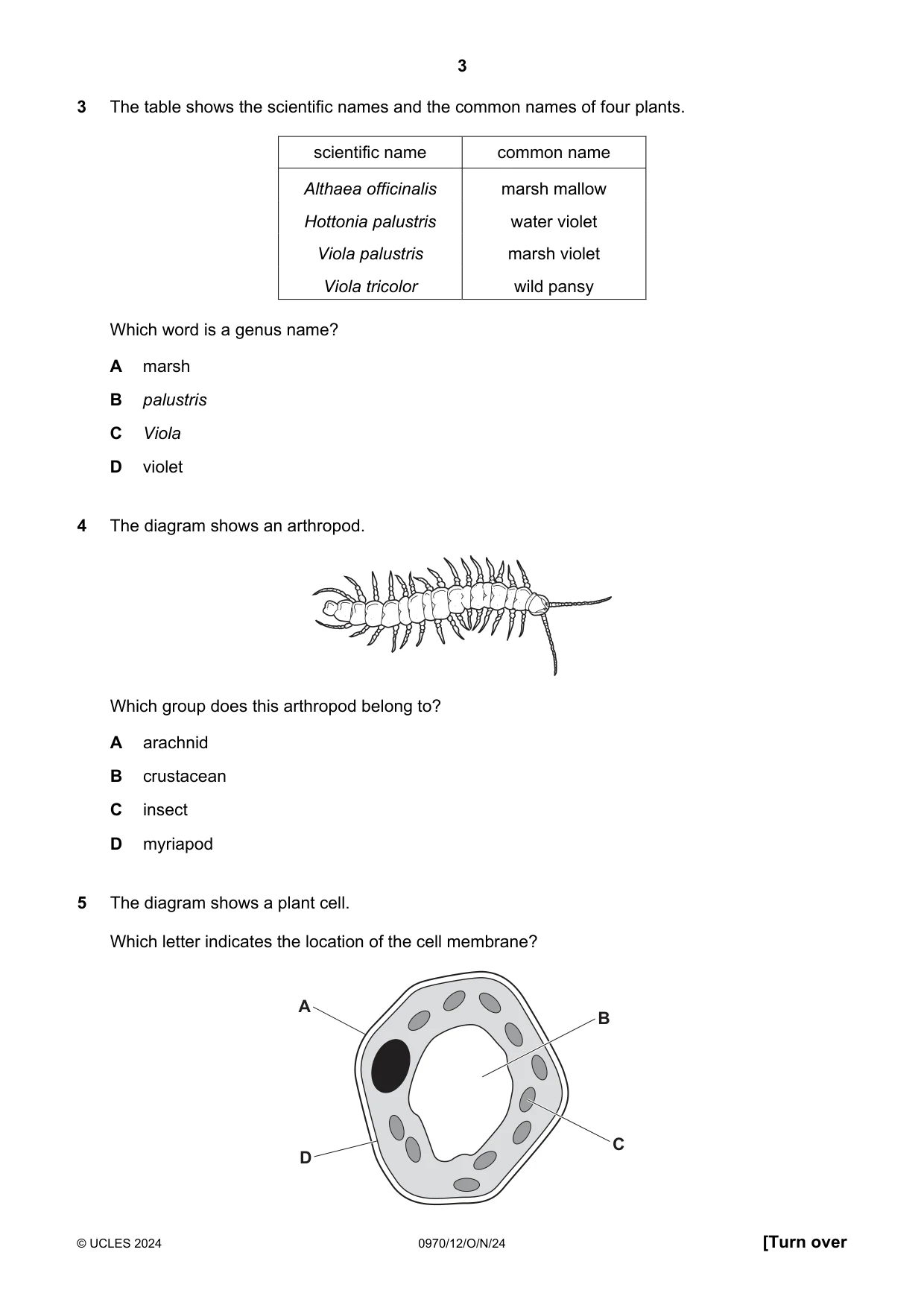
Q4 · The diagram shows an arthropod
4 The diagram shows an arthropod. Which group does this arthropod belong to? A arachnid B crustacean C insect D myriapod
Mark scheme: D
Q5 · The diagram shows a plant cell
5 The diagram shows a plant cell. Which letter indicates the location of the cell membrane? A B C D
Mark scheme: D
Q6 · Which magnification formula is correct?
6 Which magnification formula is correct? A magnification = actual size ÷ image size B magnification = actual size + image size C magnification = image size ÷ actual size D magnification = image size actual size
Mark scheme: C
Q7 · A frog is an animal
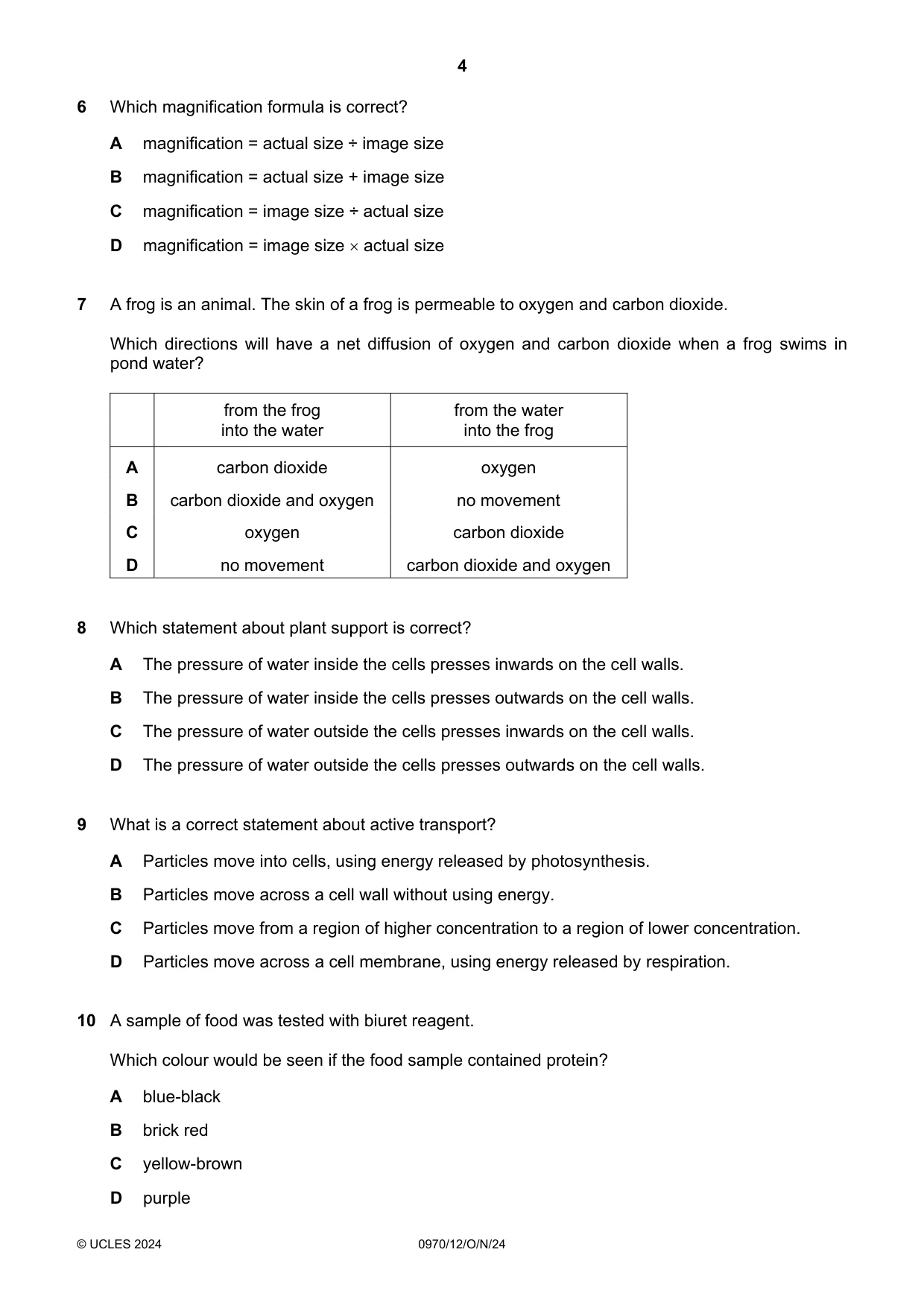
7 A frog is an animal. The skin of a frog is permeable to oxygen and carbon dioxide. Which directions will have a net diffusion of oxygen and carbon dioxide when a frog swims in pond water? from the frog from the water into the water into the frog A carbon dioxide oxygen B carbon dioxide and oxygen no movement C oxygen carbon dioxide D no movement carbon dioxide and oxygen
Mark scheme: A
Q8 · Which statement about plant support is correct?
8 Which statement about plant support is correct? A The pressure of water inside the cells presses inwards on the cell walls. B The pressure of water inside the cells presses outwards on the cell walls. C The pressure of water outside the cells presses inwards on the cell walls. D The pressure of water outside the cells presses outwards on the cell walls.
Mark scheme: B
Q9 · What is a correct statement about active transport?
9 What is a correct statement about active transport? A Particles move into cells, using energy released by photosynthesis. B Particles move across a cell wall without using energy. C Particles move from a region of higher concentration to a region of lower concentration. D Particles move across a cell membrane, using energy released by respiration.
Mark scheme: D
Q10 · A sample of food was tested with biuret reagent
10 A sample of food was tested with biuret reagent. Which colour would be seen if the food sample contained protein? A blue-black B brick red C yellow-brown D purple
Mark scheme: D
Q11 · Which elements are found in fats?
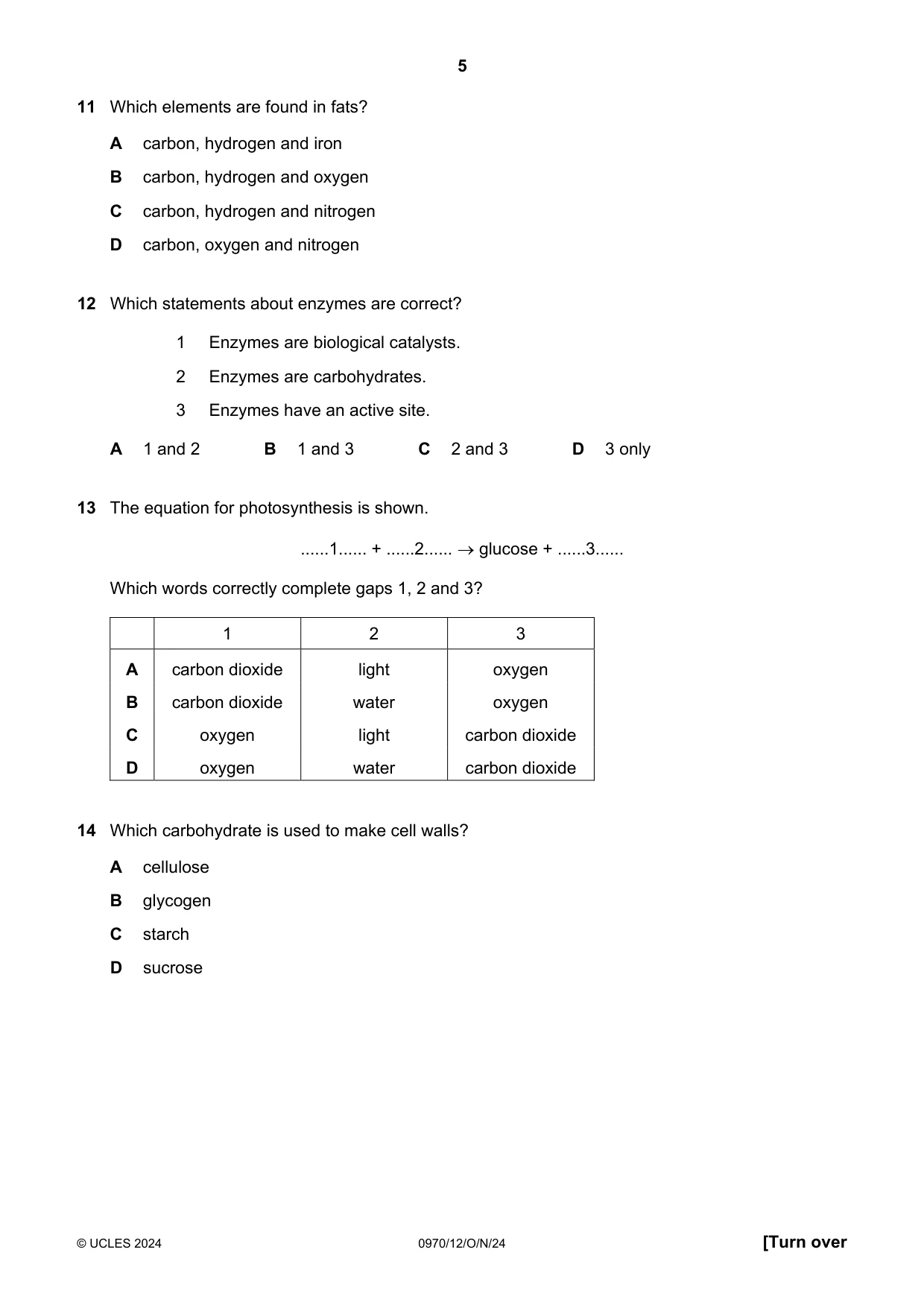
11 Which elements are found in fats? A carbon, hydrogen and iron B carbon, hydrogen and oxygen C carbon, hydrogen and nitrogen D carbon, oxygen and nitrogen
Mark scheme: B
Q12 · Which statements about enzymes are correct?
12 Which statements about enzymes are correct? 1 Enzymes are biological catalysts. 2 Enzymes are carbohydrates. 3 Enzymes have an active site. A 1 and 2 B 1 and 3 C 2 and 3 D 3 only
Mark scheme: B
Q13 · The equation for photosynthesis is shown
13 The equation for photosynthesis is shown. ......1...... + ......2...... glucose + ......3...... Which words correctly complete gaps 1, 2 and 3? 1 2 3 A carbon dioxide light oxygen B carbon dioxide water oxygen C oxygen light carbon dioxide D oxygen water carbon dioxide
Mark scheme: B
Q14 · Which carbohydrate is used to make cell walls?
14 Which carbohydrate is used to make cell walls? A cellulose B glycogen C starch D sucrose
Mark scheme: A
Q15 · The diagram shows a cross-section of a leaf
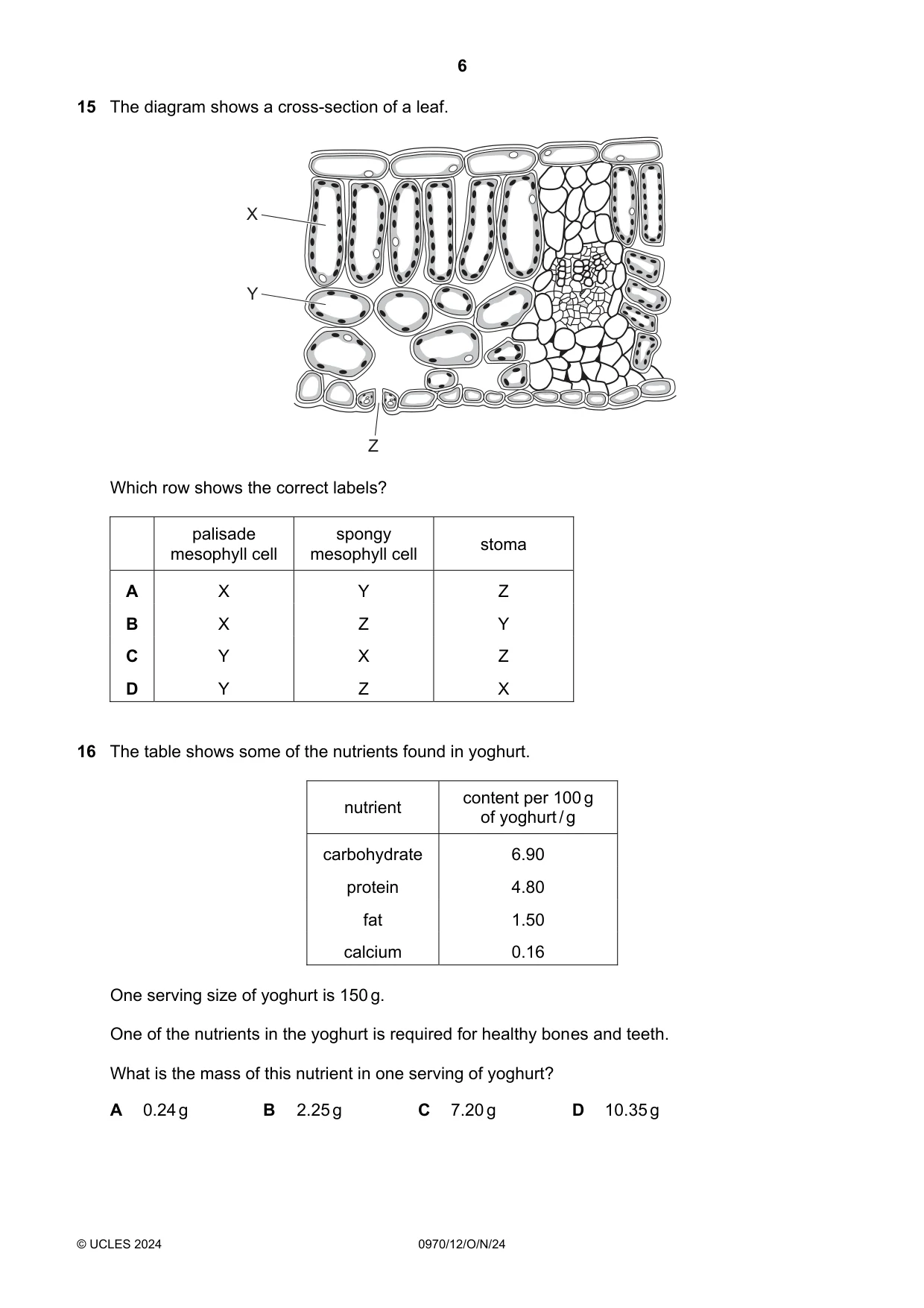
15 The diagram shows a cross-section of a leaf. X Y Z Which row shows the correct labels? palisade spongy stoma mesophyll cell mesophyll cell A X Y Z B X Z Y C Y X Z D Y Z X
Mark scheme: A
Q16 · The table shows some of the nutrients found in yoghurt
16 The table shows some of the nutrients found in yoghurt. content per 100 g nutrient of yoghurt / g carbohydrate 6.90 protein 4.80 fat 1.50 calcium 0.16 One serving size of yoghurt is 150 g. One of the nutrients in the yoghurt is required for healthy bones and teeth. What is the mass of this nutrient in one serving of yoghurt? A 0.24 g B 2.25 g C 7.20 g D 10.35 g
Mark scheme: A
Q17 · The diagram shows the alimentary canal and some of the associated organs in a cat
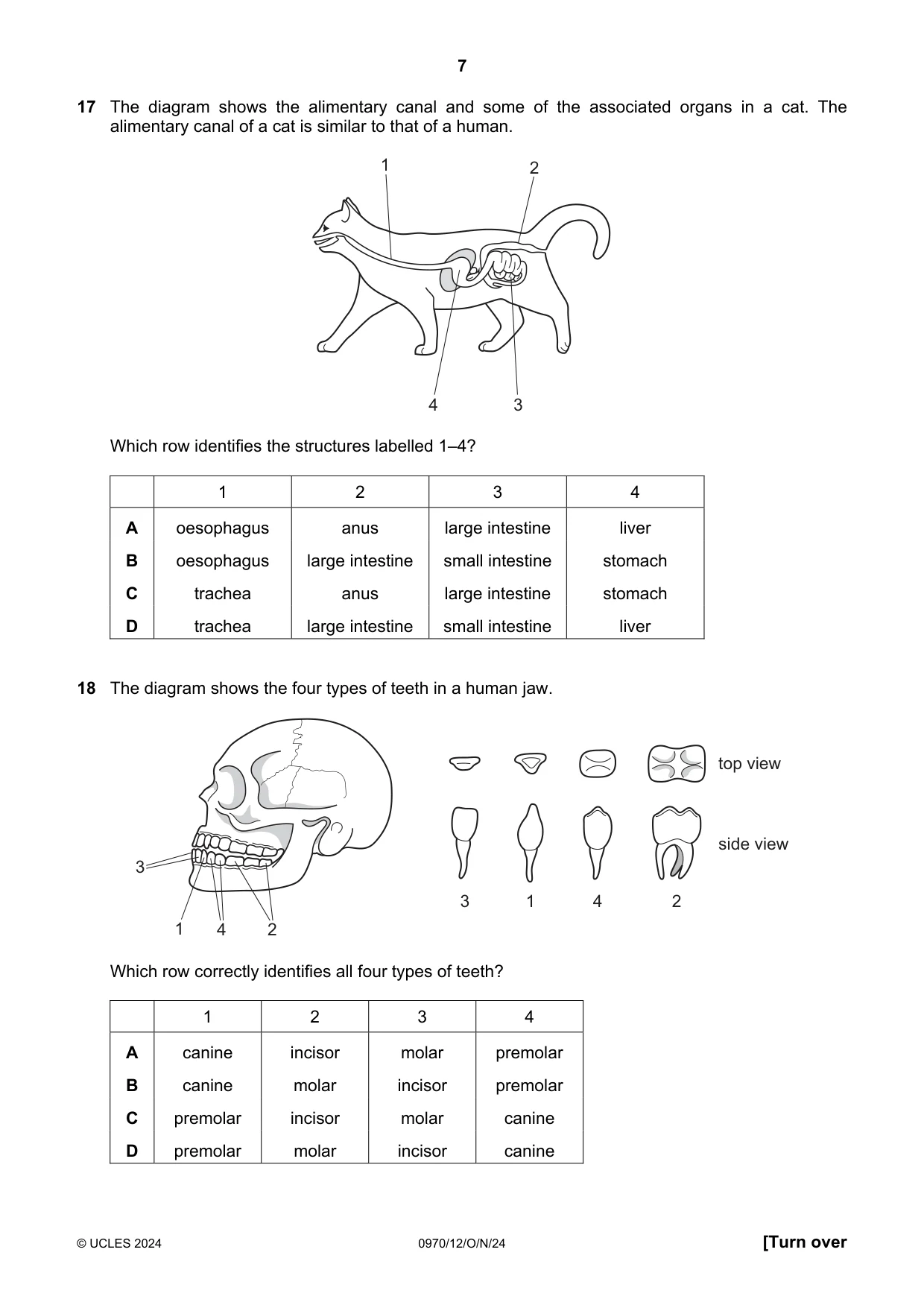
17 The diagram shows the alimentary canal and some of the associated organs in a cat. The alimentary canal of a cat is similar to that of a human. 1 2 4 3 Which row identifies the structures labelled 1–4? 1 2 3 4 A oesophagus anus large intestine liver B oesophagus large intestine small intestine stomach C trachea anus large intestine stomach D trachea large intestine small intestine liver
Mark scheme: B
Q18 · The diagram shows the four types of teeth in a human jaw
18 The diagram shows the four types of teeth in a human jaw. top view side view 3 3 1 4 2 1 4 2 Which row correctly identifies all four types of teeth? 1 2 3 4 A canine incisor molar premolar B canine molar incisor premolar C premolar incisor molar canine D premolar molar incisor canine
Mark scheme: B
Q19 · What are the products of protein digestion in the stomach?
19 What are the products of protein digestion in the stomach? A amino acids B fatty acids C glycerol D proteases
Mark scheme: A
Q20 · Where is water absorbed?
20 Where is water absorbed? A colon and small intestine B large intestine only C gall bladder and colon D small intestine only
Mark scheme: A
Q21 · The diagram shows a cross-section of a stem
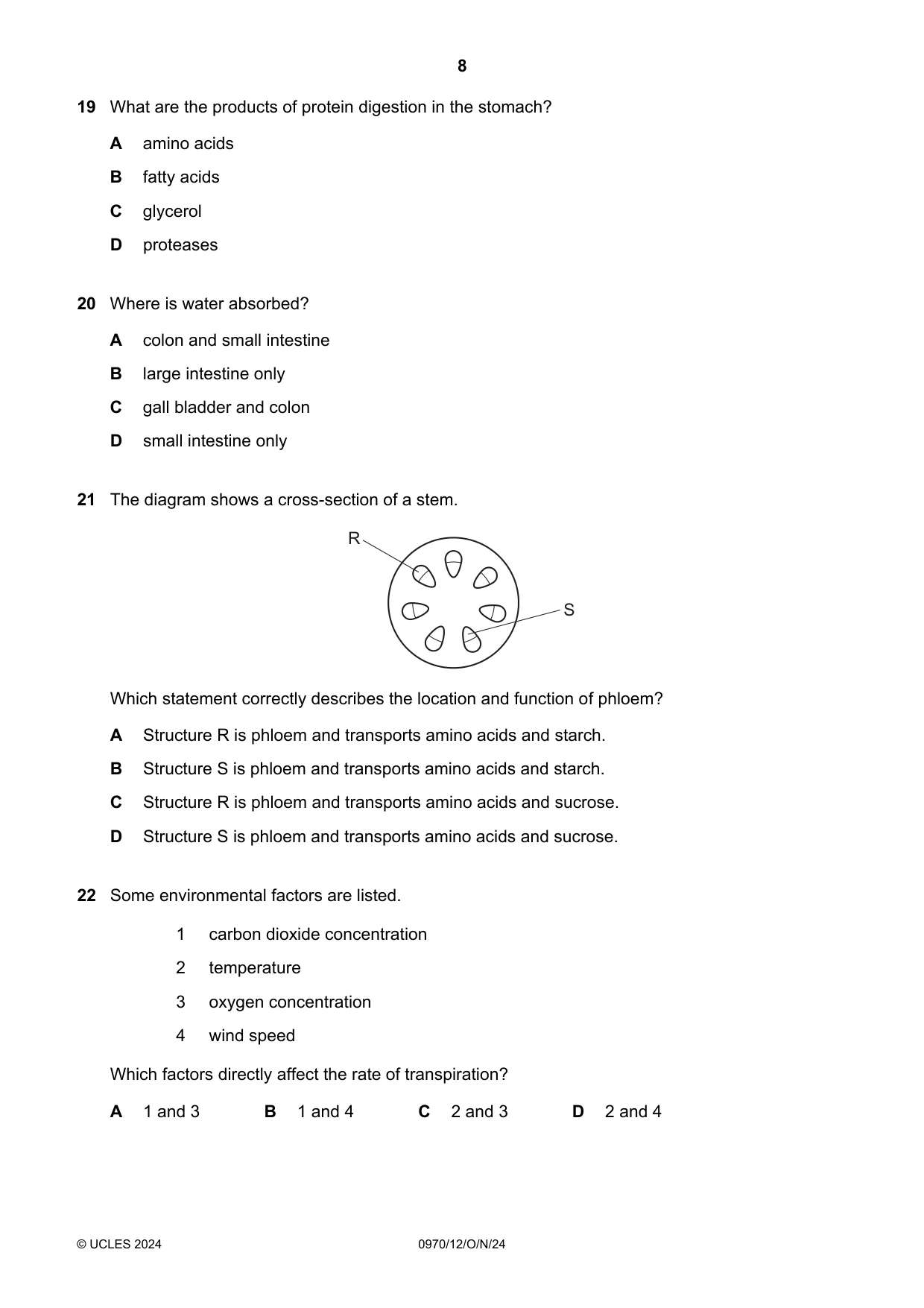
21 The diagram shows a cross-section of a stem. R S Which statement correctly describes the location and function of phloem? A Structure R is phloem and transports amino acids and starch. B Structure S is phloem and transports amino acids and starch. C Structure R is phloem and transports amino acids and sucrose. D Structure S is phloem and transports amino acids and sucrose.
Mark scheme: C
Q22 · Some environmental factors are listed
22 Some environmental factors are listed. 1 carbon dioxide concentration 2 temperature 3 oxygen concentration 4 wind speed Which factors directly affect the rate of transpiration? A 1 and 3 B 1 and 4 C 2 and 3 D 2 and 4
Mark scheme: D
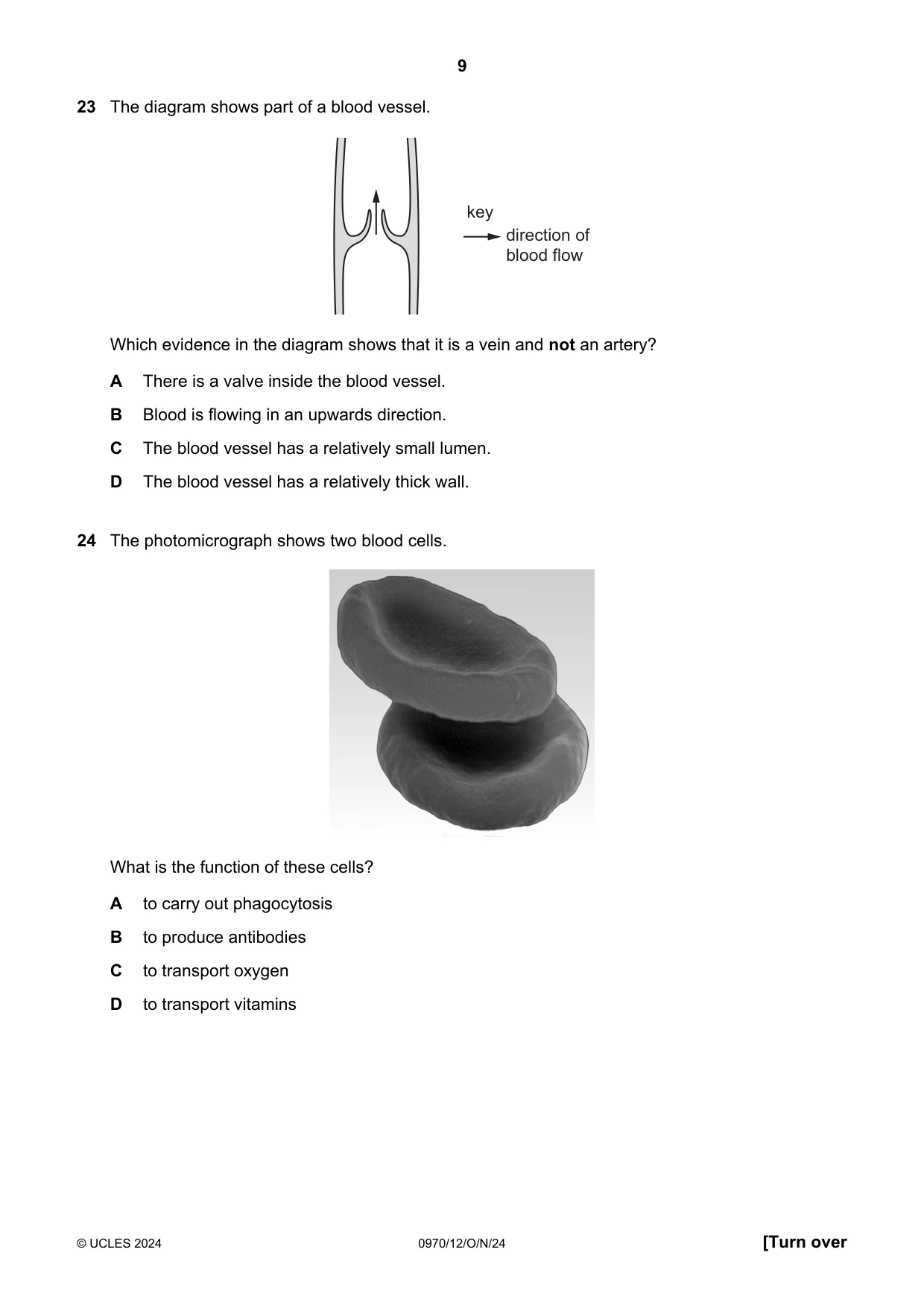
Q23 · The diagram shows part of a blood vessel
23 The diagram shows part of a blood vessel. key direction of blood flow Which evidence in the diagram shows that it is a vein and not an artery? A There is a valve inside the blood vessel. B Blood is flowing in an upwards direction. C The blood vessel has a relatively small lumen. D The blood vessel has a relatively thick wall.
Mark scheme: A
Q24 · The photomicrograph shows two blood cells
24 The photomicrograph shows two blood cells. What is the function of these cells? A to carry out phagocytosis B to produce antibodies C to transport oxygen D to transport vitamins
Mark scheme: C
Q25 · Which row matches a gas in expired air with a substance that can be used to test for the…
25 Which row matches a gas in expired air with a substance that can be used to test for the presence of that gas? gas present in test substance expired air A carbon dioxide DCPIP B carbon dioxide limewater C oxygen DCPIP D oxygen limewater
Mark scheme: B
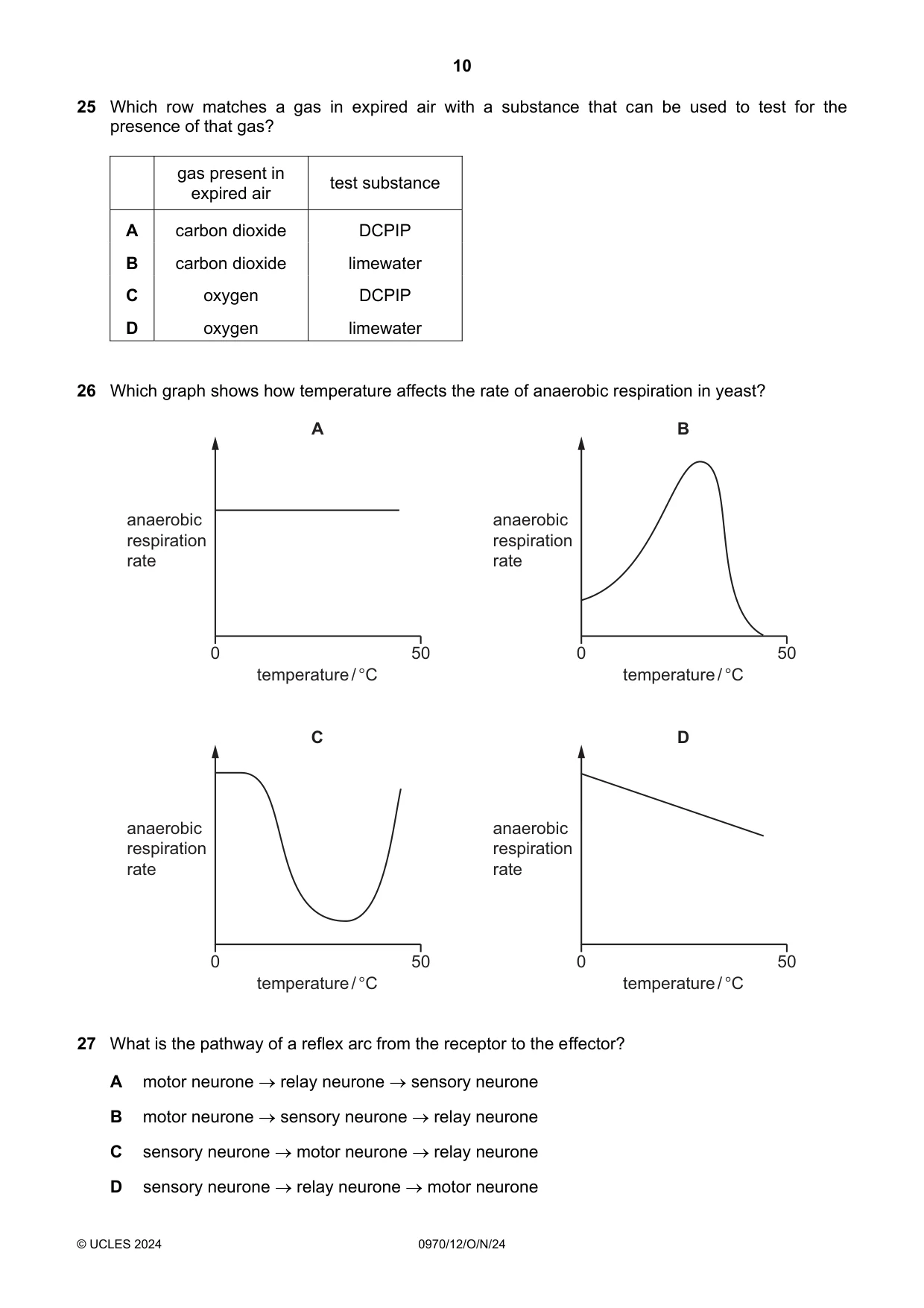
Q26 · Which graph shows how temperature affects the rate of anaerobic respiration in yeast?
26 Which graph shows how temperature affects the rate of anaerobic respiration in yeast? A B anaerobic anaerobic respiration respiration rate rate 0 50 0 50 temperature / °C temperature / °C C D anaerobic anaerobic respiration respiration rate rate 0 50 0 50 temperature / °C temperature / °C
Mark scheme: B
Q27 · What is the pathway of a reflex arc from the receptor to the effector?
27 What is the pathway of a reflex arc from the receptor to the effector? A motor neurone relay neurone sensory neurone B motor neurone sensory neurone relay neurone C sensory neurone motor neurone relay neurone D sensory neurone relay neurone motor neurone
Mark scheme: D
Q28 · What is an effect of adrenaline secretion?
28 What is an effect of adrenaline secretion? A decreased breathing rate B decreased pupil diameter C development of secondary sexual characteristics D increased heart rate
Mark scheme: D
Question 29
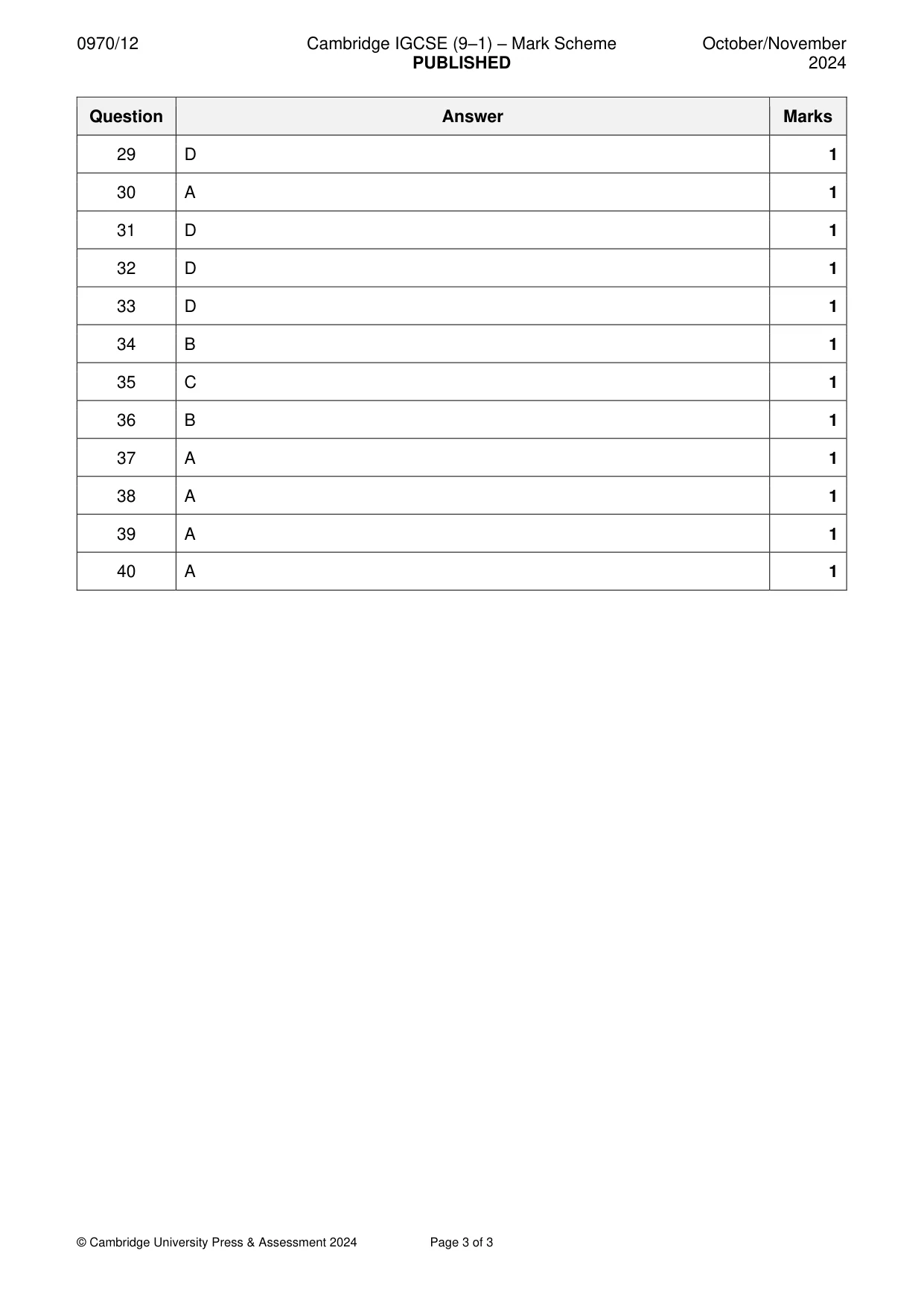
29 What is phototropism? A absorbing mineral ions B absorbing water C directional growth in response to gravity D directional growth in response to light
Mark scheme: D
Q30 · A gardener wants to grow some new plants that are identical to plants that she already has
30 A gardener wants to grow some new plants that are identical to plants that she already has. Which method of reproduction is used, and how many parents are needed for her to grow some new identical plants? method of number of reproduction parents needed A asexual one B asexual two C sexual one D sexual two
Mark scheme: A
Q31 · What must always be present for seeds to germinate?
31 What must always be present for seeds to germinate? A chlorophyll B light C soil D water
Mark scheme: D
Q32 · What is a flagellum?
32 What is a flagellum? A a ball of cells that implants into the lining of the uterus B a cell structure that releases energy C a cell that forms after the sperm cell fuses with the egg cell D an adaptive feature used for movement of sperm cells
Mark scheme: D
Q33 · Which word describes a fertilised cell?
33 Which word describes a fertilised cell? A acrosome B embryo C gamete D zygote
Mark scheme: D
Q34 · Which secondary sexual characteristic is caused by both testosterone and oestrogen?
34 Which secondary sexual characteristic is caused by both testosterone and oestrogen? A breast development B changes in body shape C growth of facial hair D sudden deepening of voice
Mark scheme: B
Q35 · Some ways that diseases can be transmitted are listed
35 Some ways that diseases can be transmitted are listed. 1 airborne droplets 2 blood and needles 3 food and drink 4 unprotected sex Which ways can transmit HIV? A 1 and 3 B 1 only C 2 and 4 D 4 only
Mark scheme: C
Q36 · What do genes code for?
36 What do genes code for? A fats B proteins C starch D sugars
Mark scheme: B
Q37 · When white-flowered pea plants are crossed with red-flowered pea plants, the offspring…
37 When white-flowered pea plants are crossed with red-flowered pea plants, the offspring plants all have red flowers. If these offspring plants are crossed, the next generation of plants contains both red-flowered and white-flowered plants. Which statement explains this? A The allele for red flowers is dominant, and the offspring plants are heterozygous. B The allele for red flowers is dominant, and the offspring plants are homozygous. C The allele for red flowers is recessive, and the offspring plants are heterozygous. D The allele for red flowers is recessive, and the offspring plants are homozygous.
Mark scheme: A
Q38 · What is a description of an adaptive feature?
38 What is a description of an adaptive feature? A an inherited characteristic that helps an organism to survive and reproduce B the differences between individuals of the same species C the genetic make-up of an organism D the transmission of information from generation to generation
Mark scheme: A
Q39 · Which diagram shows a pyramid of biomass for the food chain shown?
39 Which diagram shows a pyramid of biomass for the food chain shown? key tree caterpillar bird A B C D
Mark scheme: A
Q40 · Which statement about conservation is correct?
40 Which statement about conservation is correct? A Captive breeding programmes can be used to conserve endangered species. B Climate change is reducing the number of species that are endangered. C Habitat protection increases the number of species that are endangered. D Sustainable resources are those that are used more rapidly than they are replaced.
Mark scheme: A
What was in this paper
The subtopics covered by these 40 questions, and how many questions each got. Open one in a new tab to see every Cambridge question on it.
3Coordination and response2Features of organisms2Sexual reproduction in humans2Absorption1Active transport1Adaptive features1Anaerobic respiration1Asexual reproduction1Blood1Blood vessels1Cell structure1Chemical digestion1Chromosomes, genes and proteins1Concept and uses of classification systems1Conservation1Diet1Diffusion1Digestive system1Enzymes1Food chains and food webs1Gas exchange in humans1Hormones1Leaf structure1Monohybrid inheritance1Osmosis1Photosynthesis1Physical digestion1Sex hormones in humans1Sexual reproduction in plants1Sexually transmitted infections1Size of specimens1Transpiration1Tropic responses1Xylem and phloem1What you needed in this session
Cambridge’s own grade thresholds for 2024 Oct/Nov, Paper 1 · Variant 2. A higher threshold means an easier paper — the bar moves with how the cohort did.