Cambridge IGCSE Biology (9-1) 0970 — 2021 Oct/Nov Paper 4 · Variant 2
0970/42/O/N/21 · 6 questions · 80 marks · ≈90 min
The question paper and its mark scheme, free to read here and free to download. This is Cambridge’s own paper, exactly as it was sat.
Question paper20 pages


Mark scheme13 pages
Answers below. Sit the paper first if you are practising.
Questions as text
Q1 · Several villi from the ileum, which is part of the small intestine
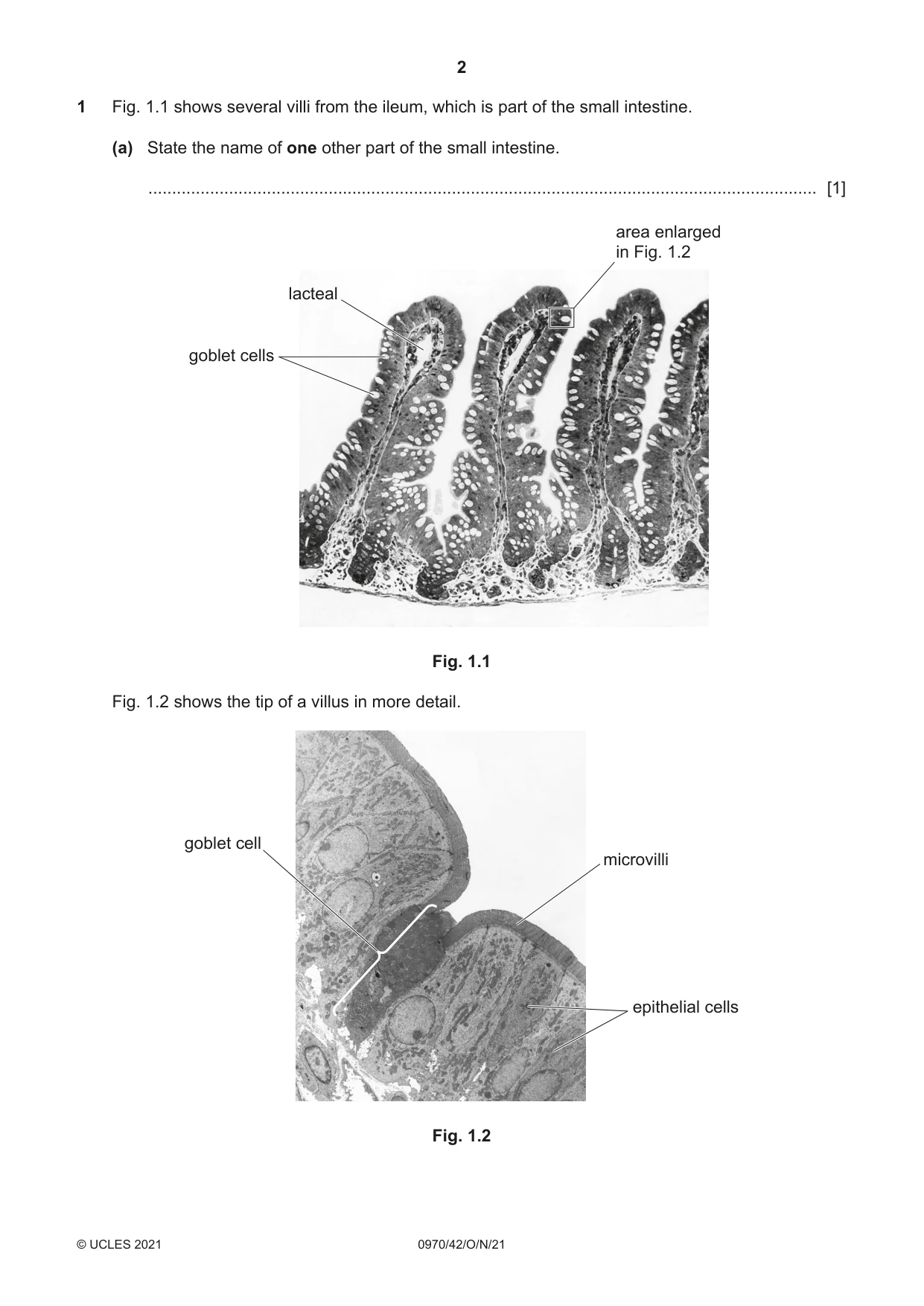
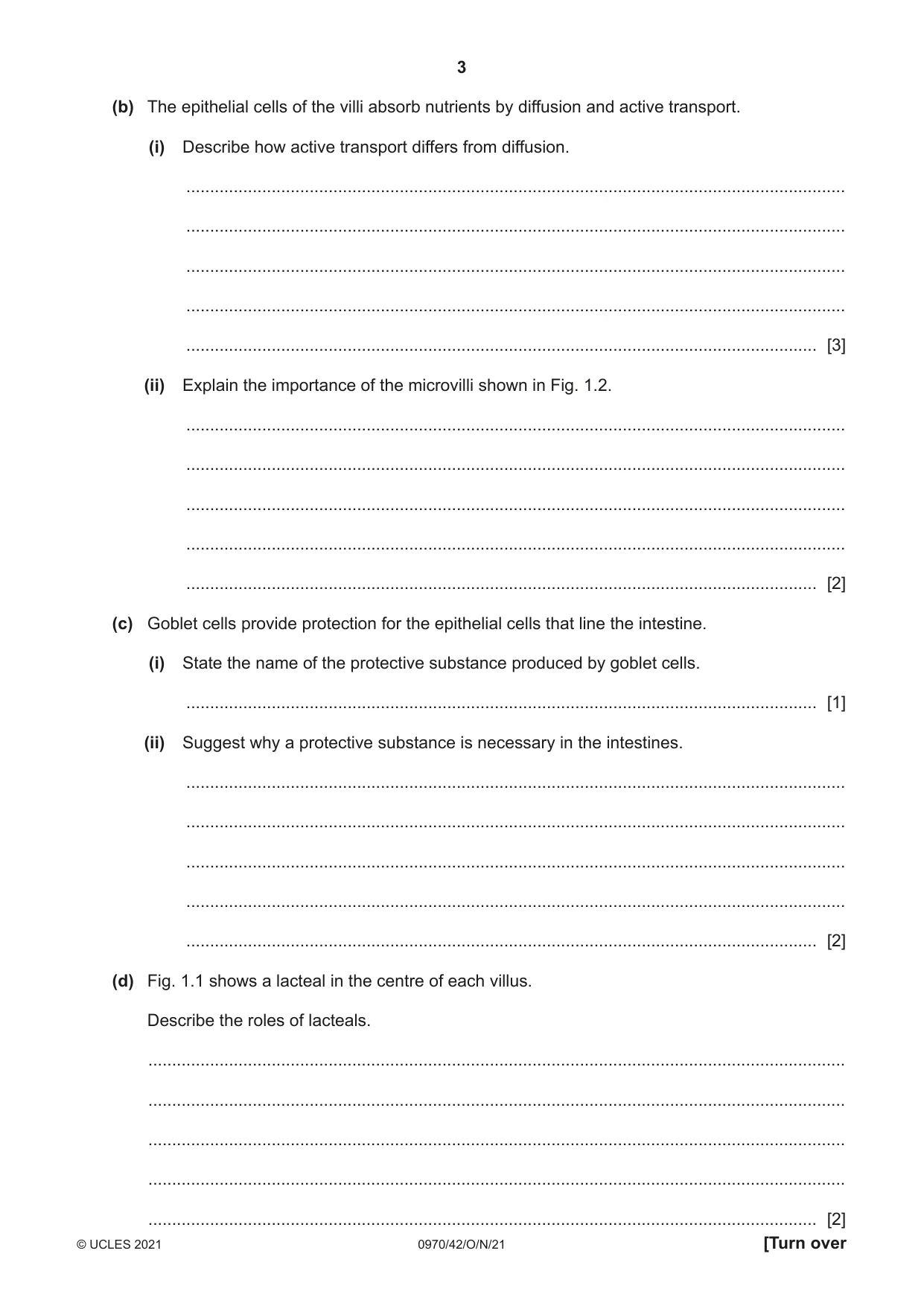
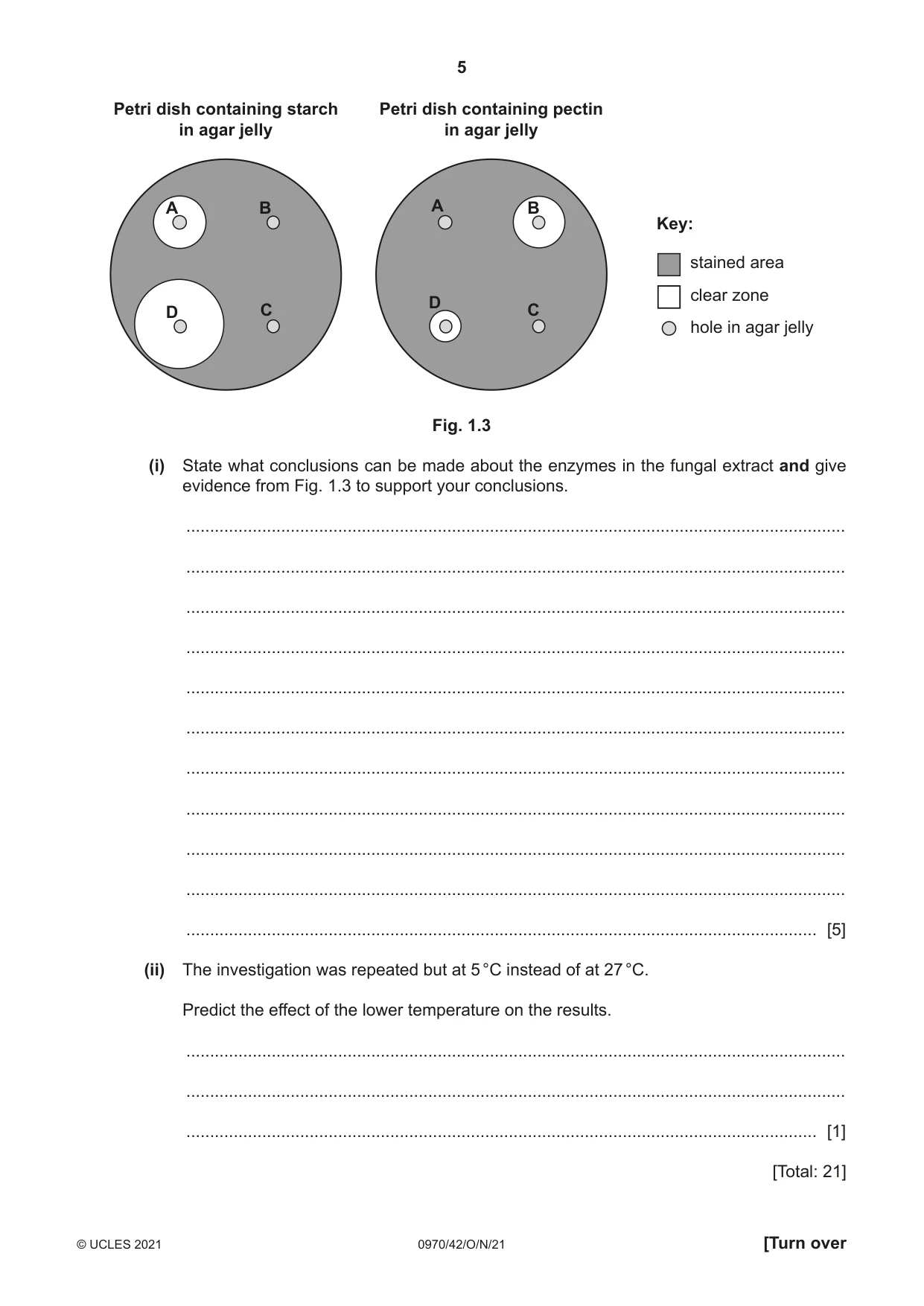
1 Fig. 1.1 shows several villi from the ileum, which is part of the small intestine. (a) State the name of one other part of the small intestine. ............................................................................................................................................. [1] area enlarged in Fig. 1.2 lacteal goblet cells Fig. 1.1 Fig. 1.2 shows the tip of a villus in more detail. goblet cell microvilli epithelial cells Fig. 1.2 (b) The epithelial cells of the villi absorb nutrients by diffusion and active transport. (i) Describe how active transport differs from diffusion. ........................................................................................................................................... ........................................................................................................................................... ........................................................................................................................................... ........................................................................................................................................... ..................................................................................................................................... [3] (ii) Explain the importance of the microvilli shown in Fig. 1.2. ........................................................................................................................................... ........................................................................................................................................... ........................................................................................................................................... ........................................................................................................................................... ..................................................................................................................................... [2] (c) Goblet cells provide protection for the epithelial cells that line the intestine. (i) State the name of the protective substance produced by goblet cells. ..................................................................................................................................... [1] (ii) Suggest why a protective substance is necessary in the intestines. ........................................................................................................................................... ........................................................................................................................................... ........................................................................................................................................... ........................................................................................................................................... ..................................................................................................................................... [2] (d) Fig. 1.1 shows a lacteal in the centre of each villus. Describe the roles of lacteals. ................................................................................................................................................... ................................................................................................................................................... ................................................................................................................................................... ................................................................................................................................................... ............................................................................................................................................. [2] (e) Complete Table 1.1 by identifying the level of organisation of each structure. Choose your answers from the list. Each word or phrase may be used once, more than once or not at all. cell cell structure organ organ system organism tissue Table 1.1 structure level of organisation gall bladder endoplasmic reticulum intestinal epithelium ileum [4] (f) Many fungi are decomposers that feed on dead plants. The fungi secrete enzymes to digest large molecules. Students made an extract from a species of fungus. The extract contained digestive enzymes. The students carried out an investigation to find out if amylase and pectinase were present in the fungal extract. They made agar plates by filling Petri dishes with agar jelly containing either starch or pectin. They cut four holes of the same size in the agar jelly in each Petri dish. The holes in each Petri dish contained the same volume of: A – 1% amylase solution B – 1% pectinase solution C – distilled water D – fungal extract. The Petri dishes were kept at 27 °C for four days. After this time a dye was poured into each dish to stain the areas where starch and pectin remained. Fig. 1.3 shows drawings of the stained agar in the Petri dishes. The clear zones indicate the areas where no starch or pectin remained. Petri dish containing starch Petri dish containing pectin in agar jelly in agar jelly A B A B Key: stained area clear zone D D C C hole in agar jelly Fig. 1.3 (i) State what conclusions can be made about the enzymes in the fungal extract and give evidence from Fig. 1.3 to support your conclusions. ........................................................................................................................................... ........................................................................................................................................... ........................................................................................................................................... ........................................................................................................................................... ........................................................................................................................................... ........................................................................................................................................... ........................................................................................................................................... ........................................................................................................................................... ........................................................................................................................................... ........................................................................................................................................... ..................................................................................................................................... [5] (ii) The investigation was repeated but at 5 °C instead of at 27 °C. Predict the effect of the lower temperature on the results. ........................................................................................................................................... ........................................................................................................................................... ..................................................................................................................................... [1] [Total: 21]
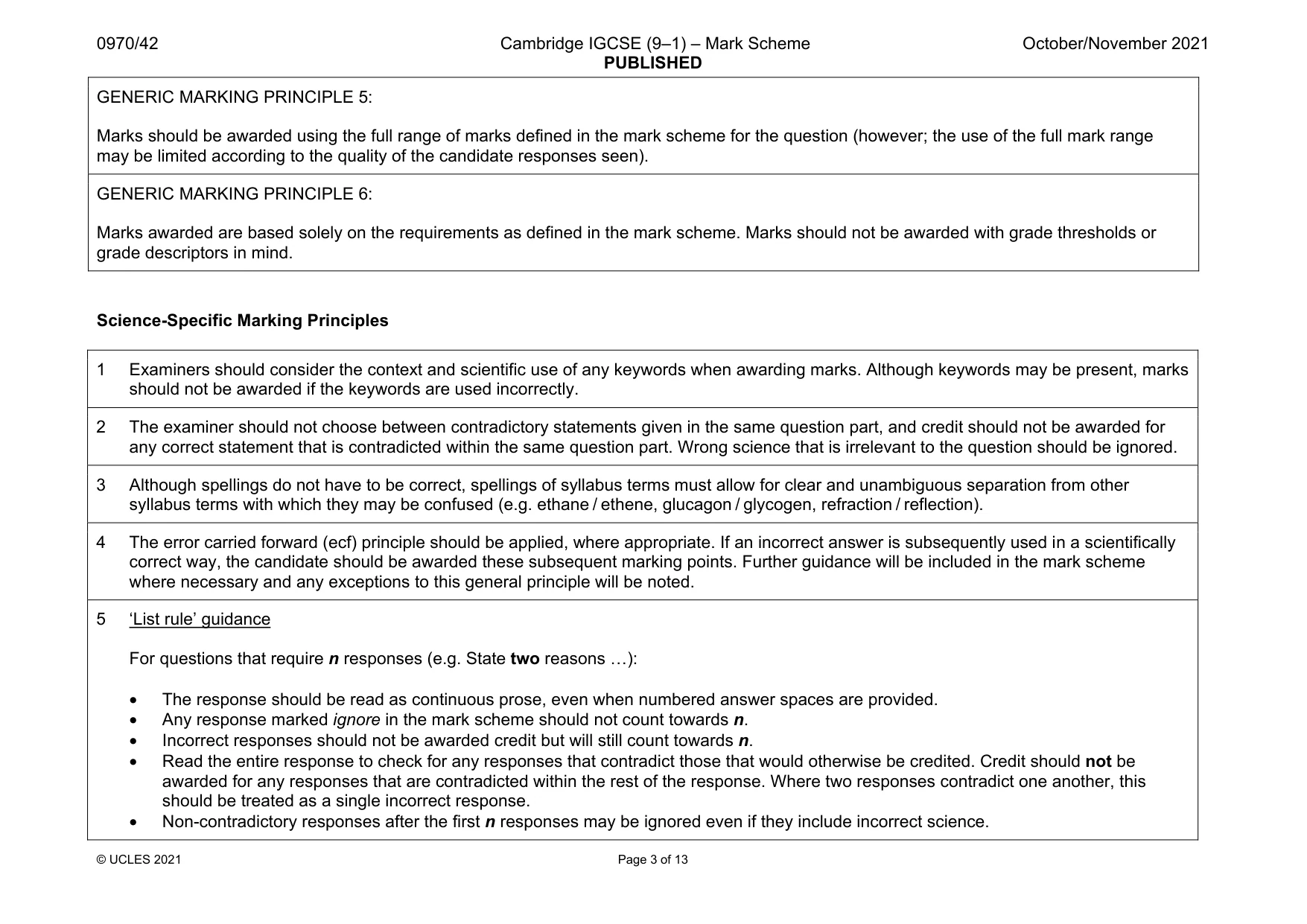
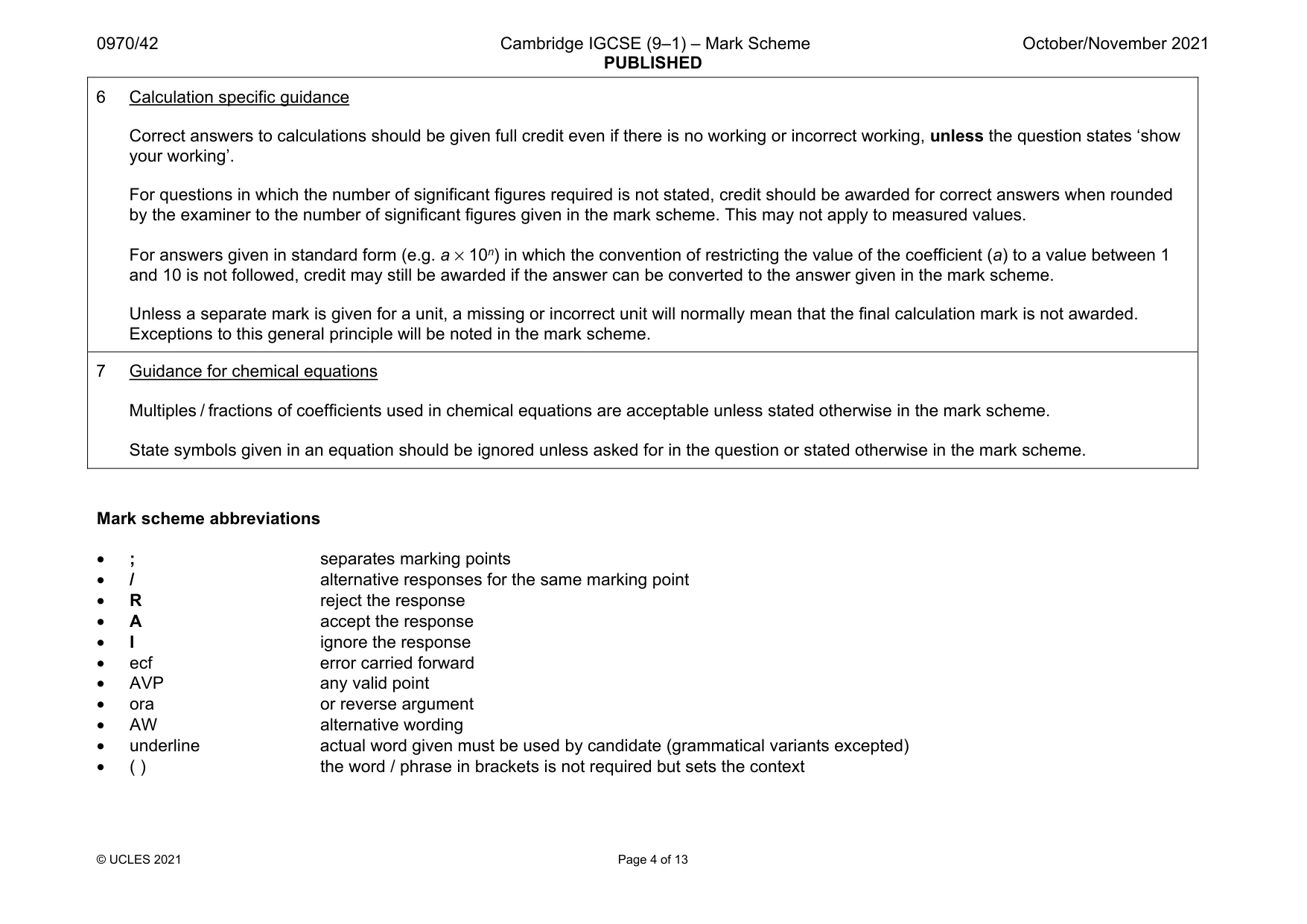
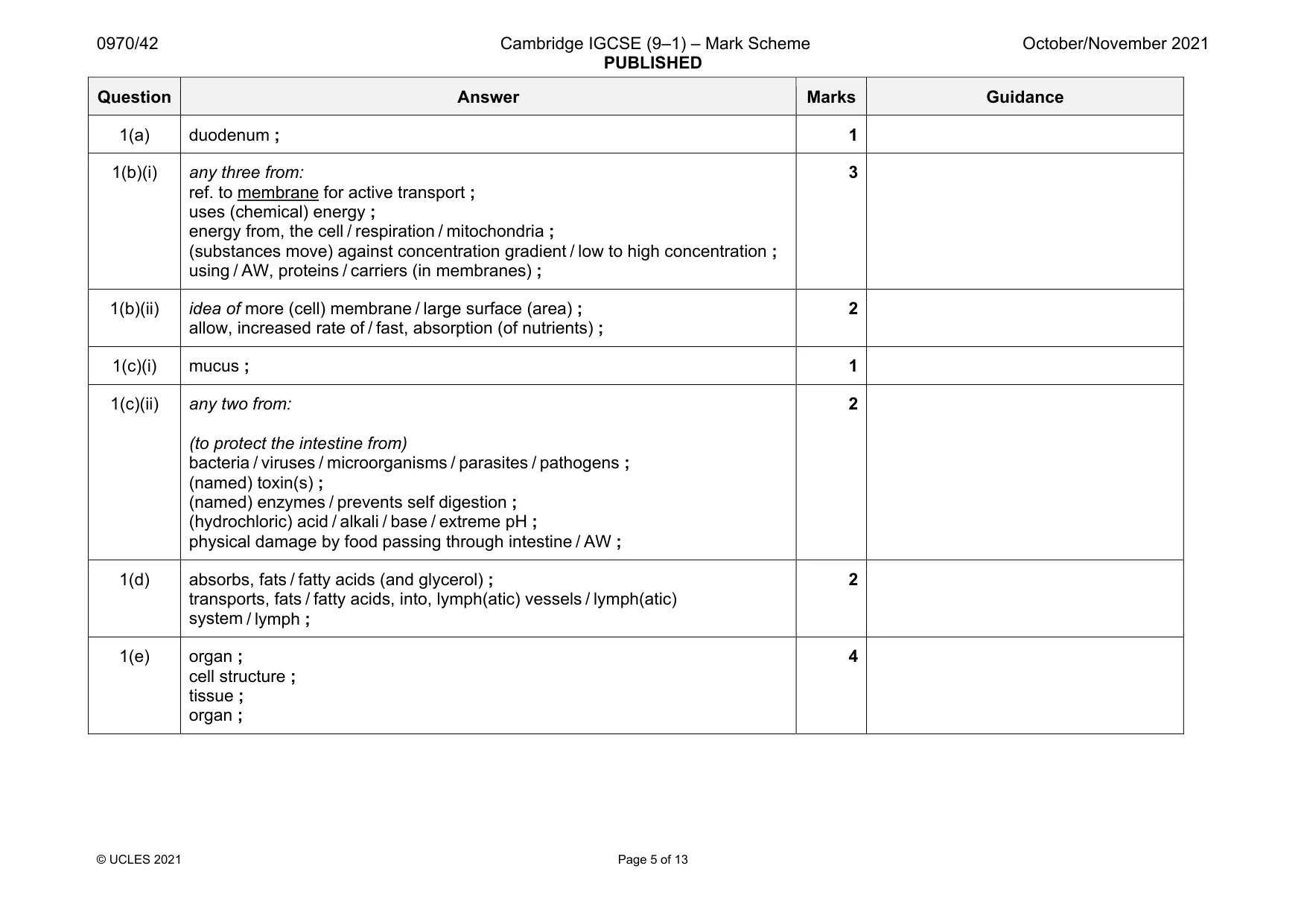
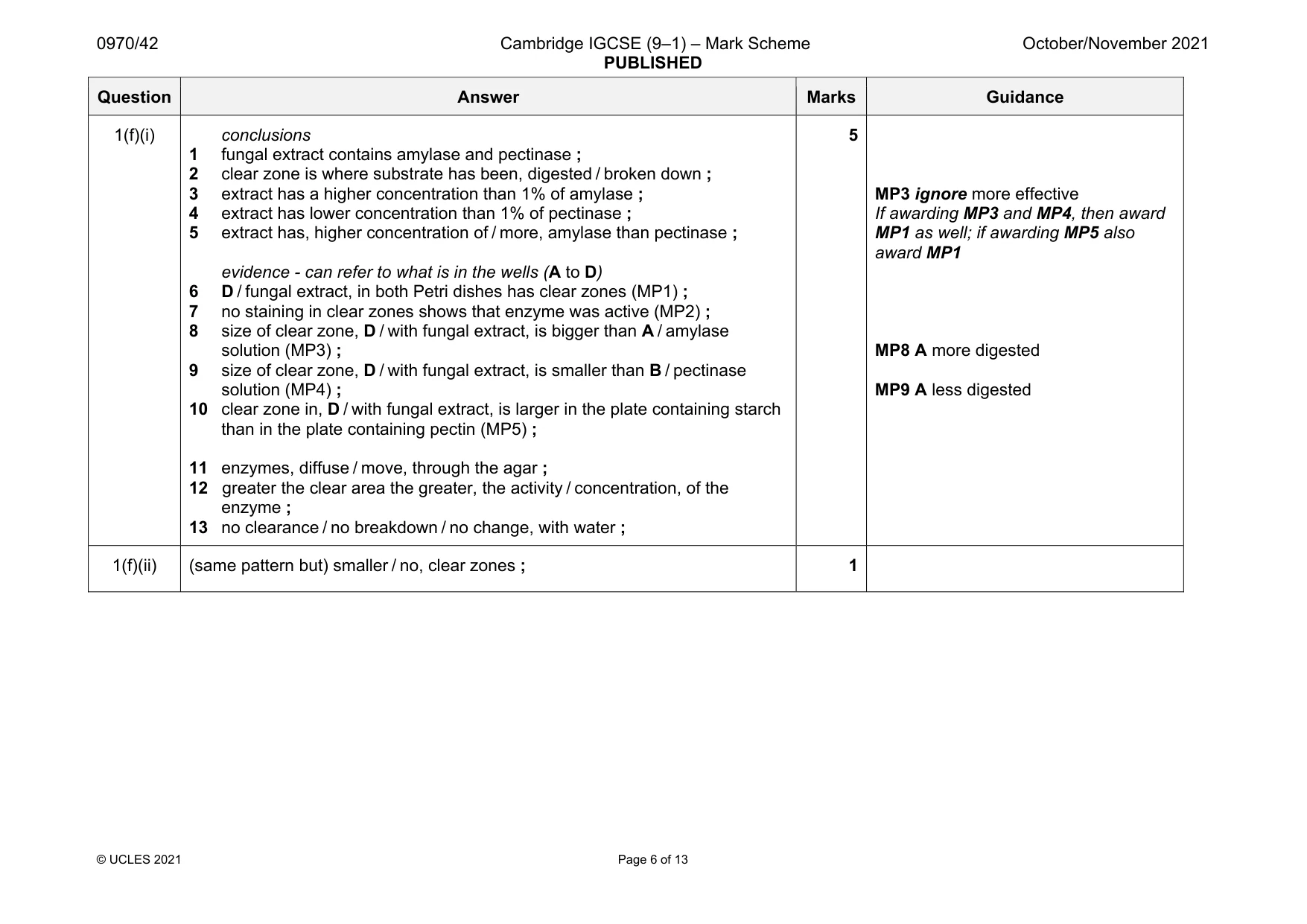
Mark scheme: 1(a) duodenum ; 1 1(b)(i) any three from: ref. to membrane for active transport ; uses (chemical) energy ; energy from, the cell / respiration / mitochondria ; (substances move) against concentration gradient / low to high concentration ; using / AW, proteins / carriers (in membranes) ; 3 1(b)(ii) idea of more (cell) membrane / large surface (area) ; allow, increased rate of / fast, absorption (of nutrients) ; 2 1(c)(i) mucus ; 1 1(c)(ii) any two from: (to protect the intestine from) bacteria / viruses / microorganisms / parasites / pathogens ; (named) toxin(s) ; (named) enzymes / prevents self digestion ; (hydrochloric) acid / alkali / base / extreme pH ; physical damage by food passing through intestine / AW ; 2 1(d) absorbs, fats / fatty acids (and glycerol) ; transports, fats / fatty acids, into, lymph(atic) vessels / lymph(atic) system / lymph ; 2 1(e) organ ; cell structure ; tissue ; organ ; 4 Question Answer Marks Guidance 1(f)(i) conclusions 1 fungal extract contains amylase and pectinase ; 2 clear zone is where substrate has been, digested / broken down ; 3 extract has a higher concentration than 1% of amylase ; 4 extract has lower concentration than 1% of pectinase ; 5 extract has, higher concentration of / more, amylase than pectinase ; evidence - can refer to what is in the wells (A to D) 6 D / fungal extract, in both Petri dishes has clear zones (MP1) ; 7 no staining in clear zones shows that enzyme was active (MP2) ; 8 size of clear zone, D / with fungal extract, is bigger than A / amylase solution (MP3) ; 9 size of clear zone, D / with fungal extract, is smaller than B / pectinase solution (MP4) ; 10 clear zone in, D / with fungal extract, is larger in the plate containing starch than in the plate containing pectin (MP5) ; 11 enzymes, diffuse / move, through the agar ; 12 greater the clear area the greater, the activity / concentration, of the enzyme ; 13 no clearance / no breakdown / no change, with water ; 5 MP3 ignore more effective If awarding MP3 and MP4, then award MP1 as well; if awarding MP5 also award MP1 MP8 A more digested MP9 A less digested 1(f)(ii) (same pattern but) smaller / no, clear zones ; 1
Q2 · A scientist investigated sexual reproduction in flowering plants
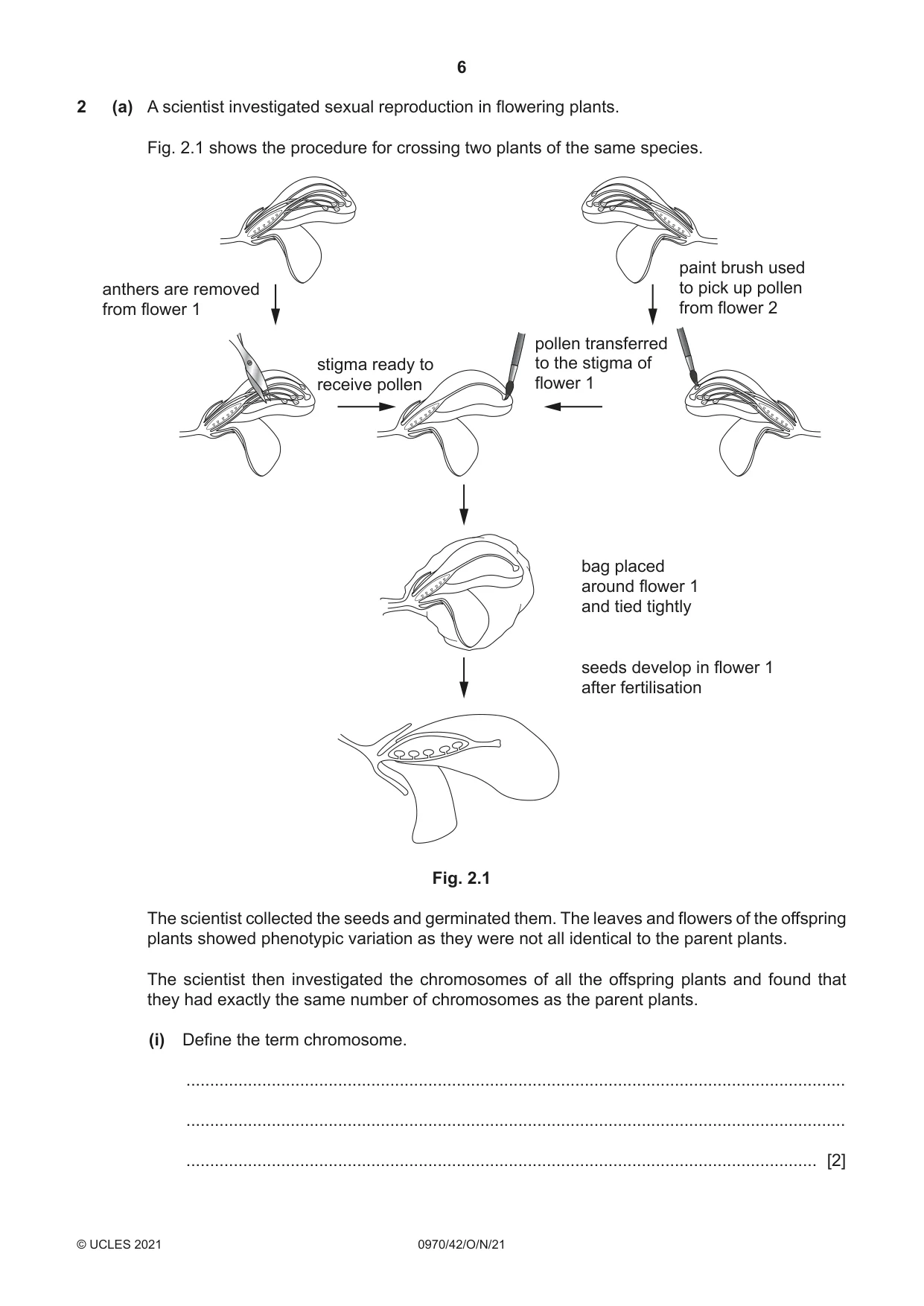
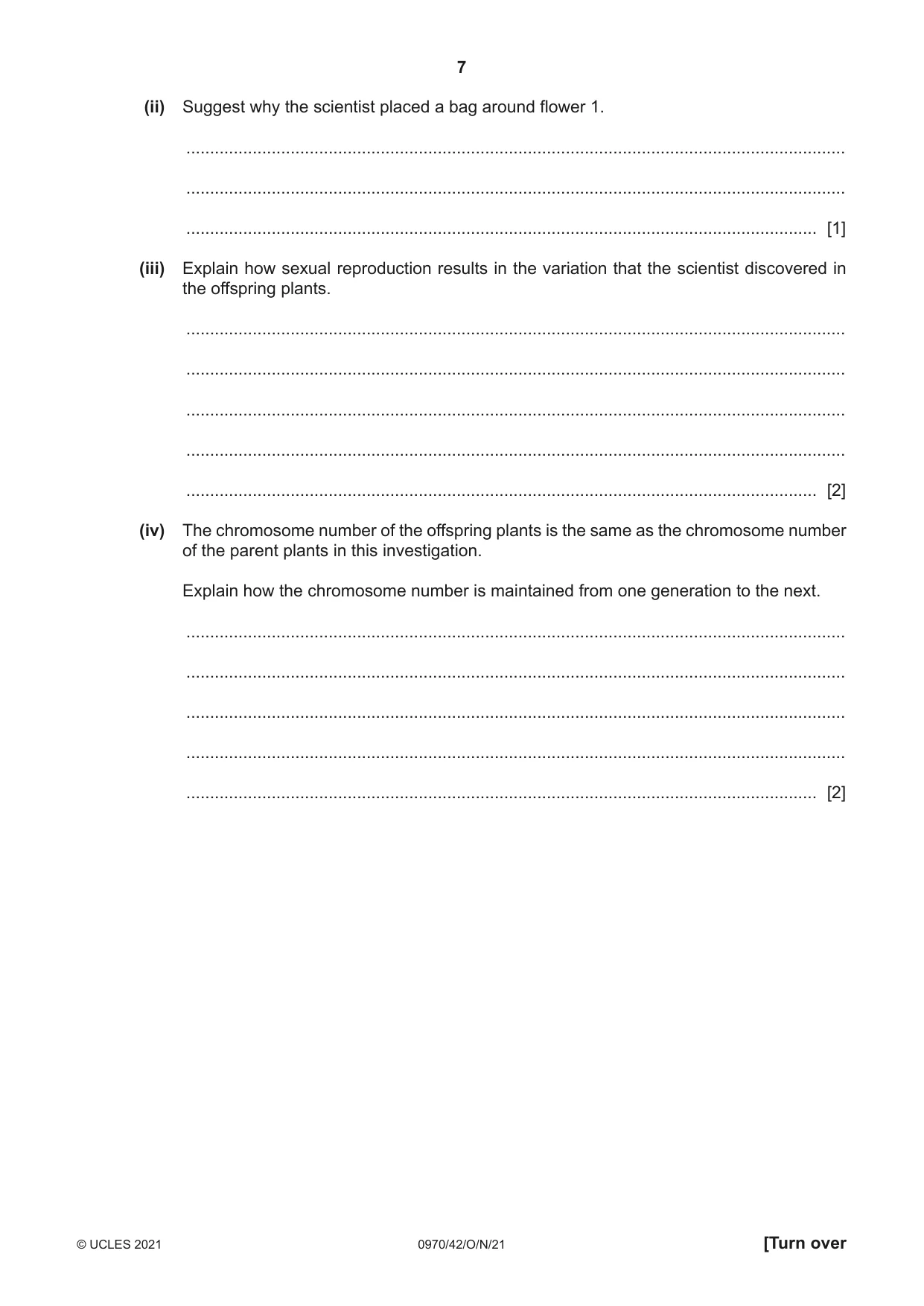
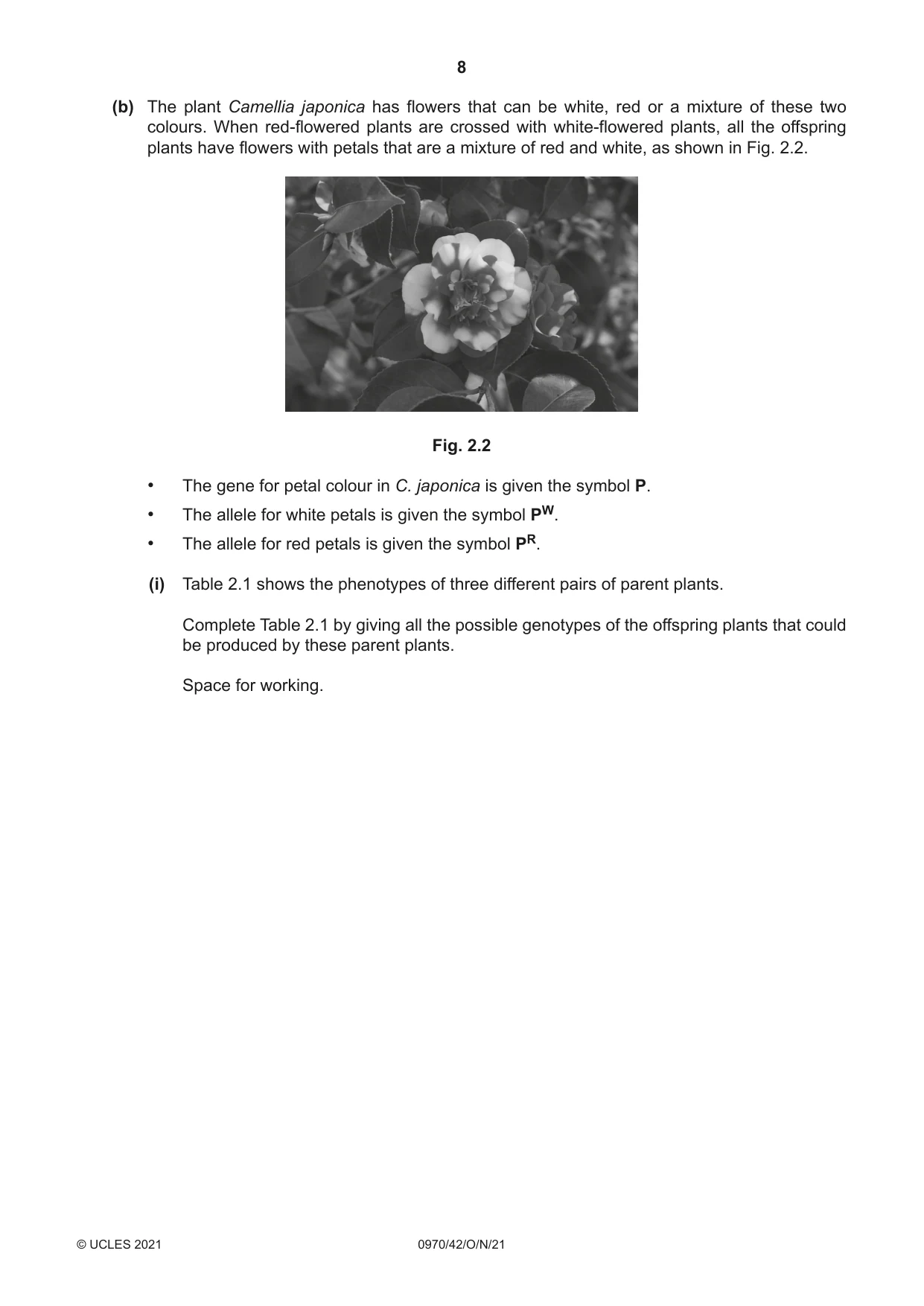
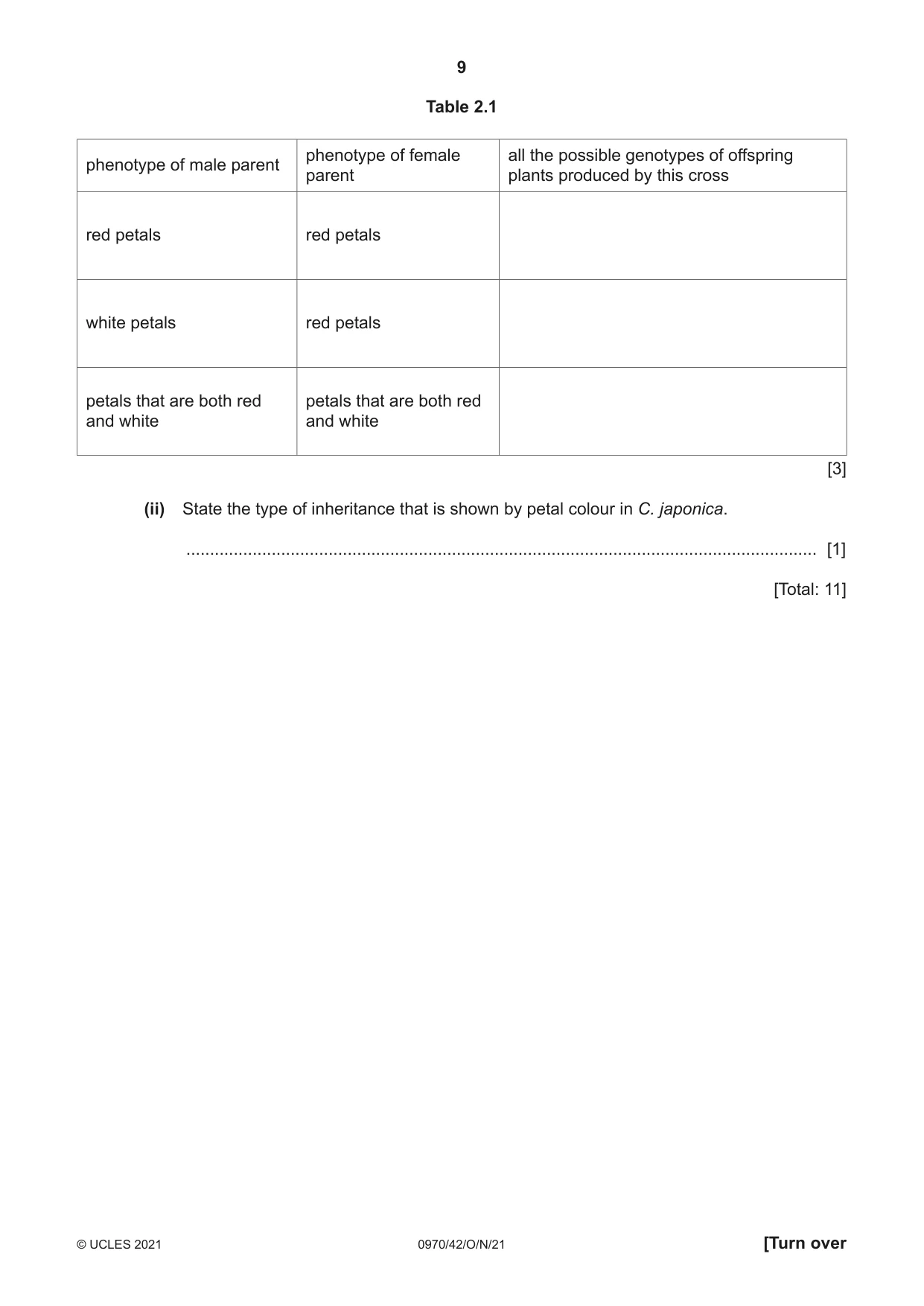
2 (a) A scientist investigated sexual reproduction in flowering plants. Fig. 2.1 shows the procedure for crossing two plants of the same species. paint brush used anthers are removed to pick up pollen from flower 1 from flower 2 pollen transferred stigma ready to to the stigma of receive pollen flower 1 bag placed around flower 1 and tied tightly seeds develop in flower 1 after fertilisation Fig. 2.1 The scientist collected the seeds and germinated them. The leaves and flowers of the offspring plants showed phenotypic variation as they were not all identical to the parent plants. The scientist then investigated the chromosomes of all the offspring plants and found that they had exactly the same number of chromosomes as the parent plants. (i) Define the term chromosome. ........................................................................................................................................... ........................................................................................................................................... ..................................................................................................................................... [2] (ii) Suggest why the scientist placed a bag around flower 1. ........................................................................................................................................... ........................................................................................................................................... ..................................................................................................................................... [1] (iii) Explain how sexual reproduction results in the variation that the scientist discovered in the offspring plants. ........................................................................................................................................... ........................................................................................................................................... ........................................................................................................................................... ........................................................................................................................................... ..................................................................................................................................... [2] (iv) The chromosome number of the offspring plants is the same as the chromosome number of the parent plants in this investigation. Explain how the chromosome number is maintained from one generation to the next. ........................................................................................................................................... ........................................................................................................................................... ........................................................................................................................................... ........................................................................................................................................... ..................................................................................................................................... [2] (b) The plant Camellia japonica has flowers that can be white, red or a mixture of these two colours. When red-flowered plants are crossed with white-flowered plants, all the offspring plants have flowers with petals that are a mixture of red and white, as shown in Fig. 2.2. Fig. 2.2 • The gene for petal colour in C. japonica is given the symbol P. • The allele for white petals is given the symbol PW. • The allele for red petals is given the symbol PR. (i) Table 2.1 shows the phenotypes of three different pairs of parent plants. Complete Table 2.1 by giving all the possible genotypes of the offspring plants that could be produced by these parent plants. Space for working. Table 2.1 phenotype of female all the possible genotypes of offspringphenotype of male parent parent plants produced by this cross red petals red petals white petals red petals petals that are both red petals that are both red and white and white [3] (ii) State the type of inheritance that is shown by petal colour in C. japonica. ..................................................................................................................................... [1] [Total: 11]
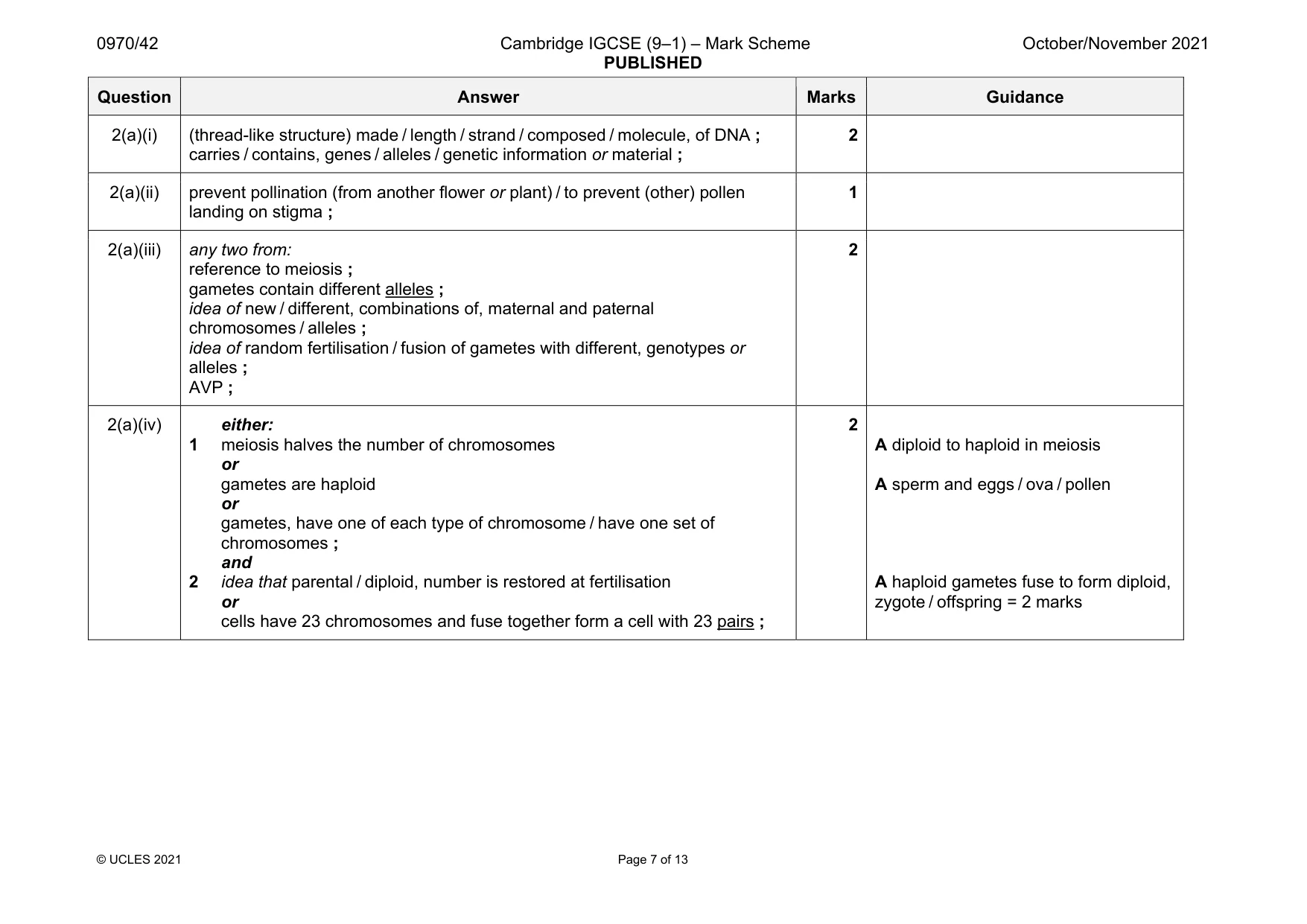
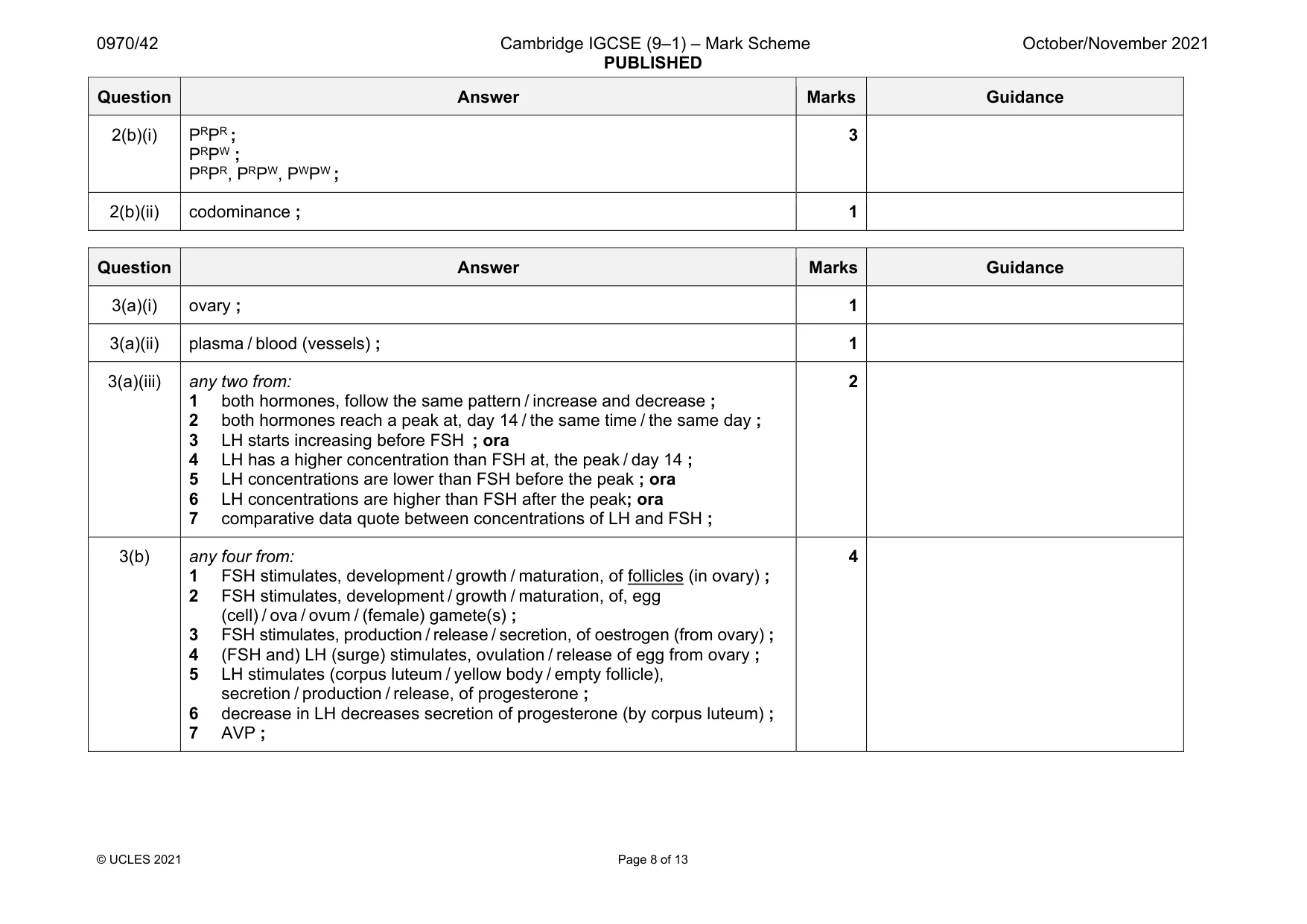
Mark scheme: 2(a)(i) (thread-like structure) made / length / strand / composed / molecule, of DNA ; carries / contains, genes / alleles / genetic information or material ; 2 2(a)(ii) prevent pollination (from another flower or plant) / to prevent (other) pollen landing on stigma ; 1 2(a)(iii) any two from: reference to meiosis ; gametes contain different alleles ; idea of new / different, combinations of, maternal and paternal chromosomes / alleles ; idea of random fertilisation / fusion of gametes with different, genotypes or alleles ; AVP ; 2 2(a)(iv) either: 1 meiosis halves the number of chromosomes or gametes are haploid or gametes, have one of each type of chromosome / have one set of chromosomes ; and 2 idea that parental / diploid, number is restored at fertilisation or cells have 23 chromosomes and fuse together form a cell with 23 pairs ; 2 A diploid to haploid in meiosis A sperm and eggs / ova / pollen A haploid gametes fuse to form diploid, zygote / offspring = 2 marks Question Answer Marks Guidance 2(b)(i) PRPR ; PRPW ; PRPR, PRPW, PWPW ; 3 2(b)(ii) codominance ; 1
Q3 · The changes in the concentrations of the hormones FSH and LH during a menstrual cycle
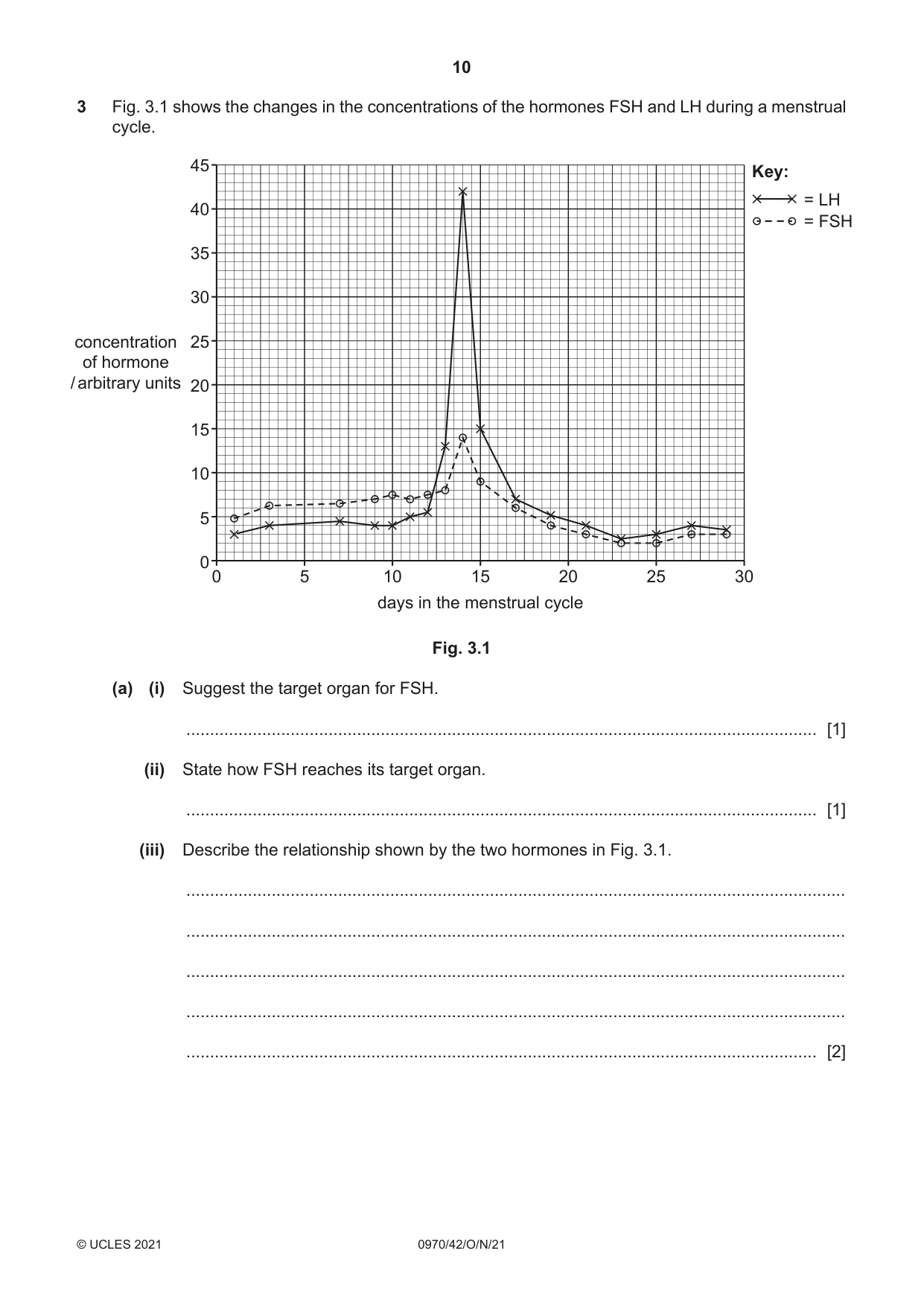
3 Fig. 3.1 shows the changes in the concentrations of the hormones FSH and LH during a menstrual cycle. 45 Key: = LH 40 = FSH 35 30 concentration 25 of hormone / arbitrary units 20 15 10 5 0 0 5 10 15 20 25 30 days in the menstrual cycle Fig. 3.1 (a) (i) Suggest the target organ for FSH. ..................................................................................................................................... [1] (ii) State how FSH reaches its target organ. ..................................................................................................................................... [1] (iii) Describe the relationship shown by the two hormones in Fig. 3.1. ........................................................................................................................................... ........................................................................................................................................... ........................................................................................................................................... ........................................................................................................................................... ..................................................................................................................................... [2] (b) Describe the roles of FSH and LH in the menstrual cycle. ................................................................................................................................................... ................................................................................................................................................... ................................................................................................................................................... ................................................................................................................................................... ................................................................................................................................................... ................................................................................................................................................... ................................................................................................................................................... ................................................................................................................................................... ............................................................................................................................................. [4] (c) Describe the changes that occur in the lining of the uterus during one menstrual cycle. ................................................................................................................................................... ................................................................................................................................................... ................................................................................................................................................... ................................................................................................................................................... ................................................................................................................................................... ................................................................................................................................................... ............................................................................................................................................. [3] (d) Oral contraceptives are a method of birth control taken by women. Outline how the hormones in contraceptives act as a method of birth control. ................................................................................................................................................... ................................................................................................................................................... ................................................................................................................................................... ................................................................................................................................................... ................................................................................................................................................... ................................................................................................................................................... ............................................................................................................................................. [3] [Total: 14]
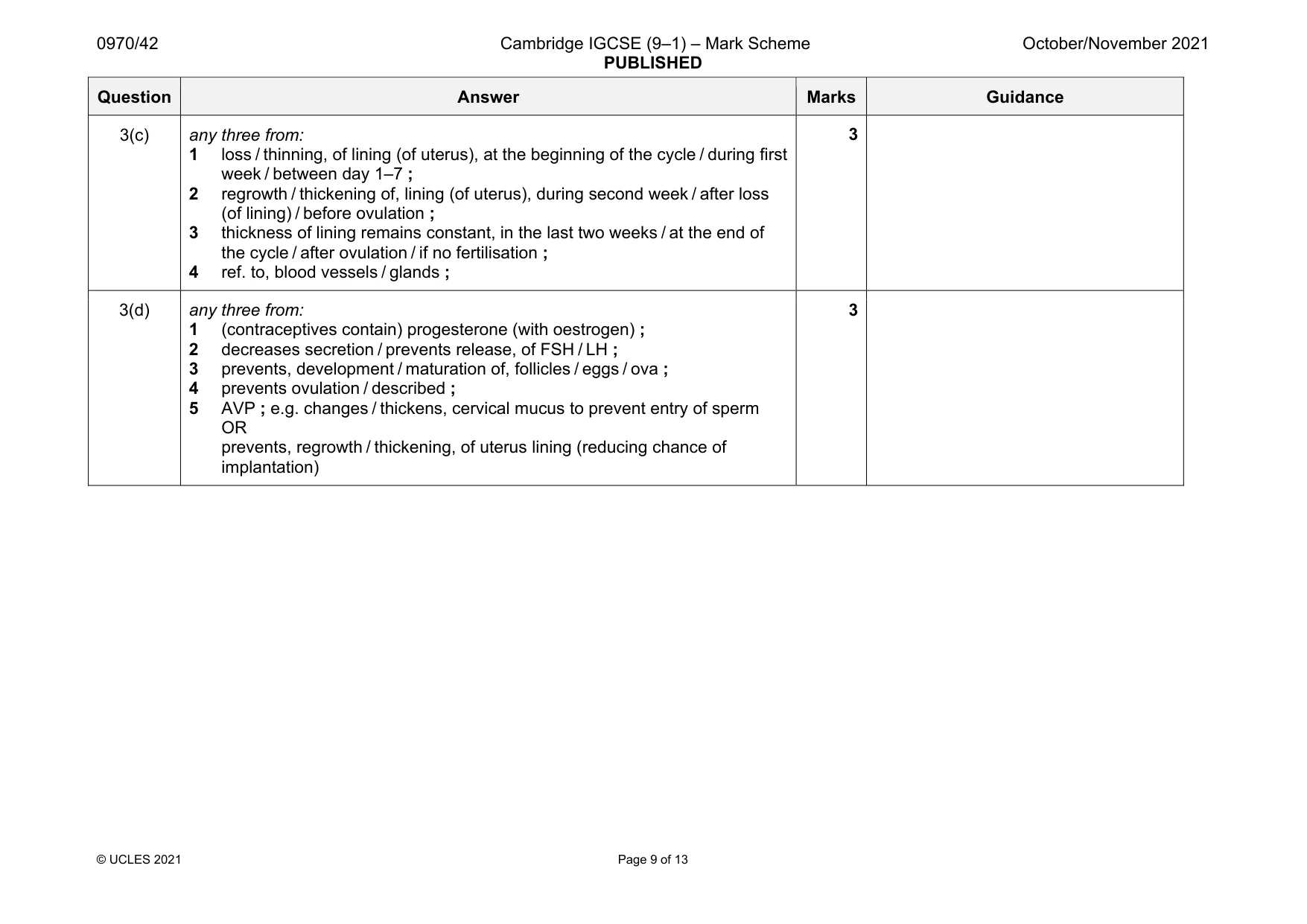
Mark scheme: 3(a)(i) ovary ; 1 3(a)(ii) plasma / blood (vessels) ; 1 3(a)(iii) any two from: 1 both hormones, follow the same pattern / increase and decrease ; 2 both hormones reach a peak at, day 14 / the same time / the same day ; 3 LH starts increasing before FSH ; ora 4 LH has a higher concentration than FSH at, the peak / day 14 ; 5 LH concentrations are lower than FSH before the peak ; ora 6 LH concentrations are higher than FSH after the peak; ora 7 comparative data quote between concentrations of LH and FSH ; 2 3(b) any four from: 1 FSH stimulates, development / growth / maturation, of follicles (in ovary) ; 2 FSH stimulates, development / growth / maturation, of, egg (cell) / ova / ovum / (female) gamete(s) ; 3 FSH stimulates, production / release / secretion, of oestrogen (from ovary) ; 4 (FSH and) LH (surge) stimulates, ovulation / release of egg from ovary ; 5 LH stimulates (corpus luteum / yellow body / empty follicle), secretion / production / release, of progesterone ; 6 decrease in LH decreases secretion of progesterone (by corpus luteum) ; 7 AVP ; 4 Question Answer Marks Guidance 3(c) any three from: 1 loss / thinning, of lining (of uterus), at the beginning of the cycle / during first week / between day 1–7 ; 2 regrowth / thickening of, lining (of uterus), during second week / after loss (of lining) / before ovulation ; 3 thickness of lining remains constant, in the last two weeks / at the end of the cycle / after ovulation / if no fertilisation ; 4 ref. to, blood vessels / glands ; 3 3(d) any three from: 1 (contraceptives contain) progesterone (with oestrogen) ; 2 decreases secretion / prevents release, of FSH / LH ; 3 prevents, development / maturation of, follicles / eggs / ova ; 4 prevents ovulation / described ; 5 AVP ; e.g. changes / thickens, cervical mucus to prevent entry of sperm OR prevents, regrowth / thickening, of uterus lining (reducing chance of implantation) 3
Q4 · Involuntary actions occur because nerve impulses travel along the components of reflex…
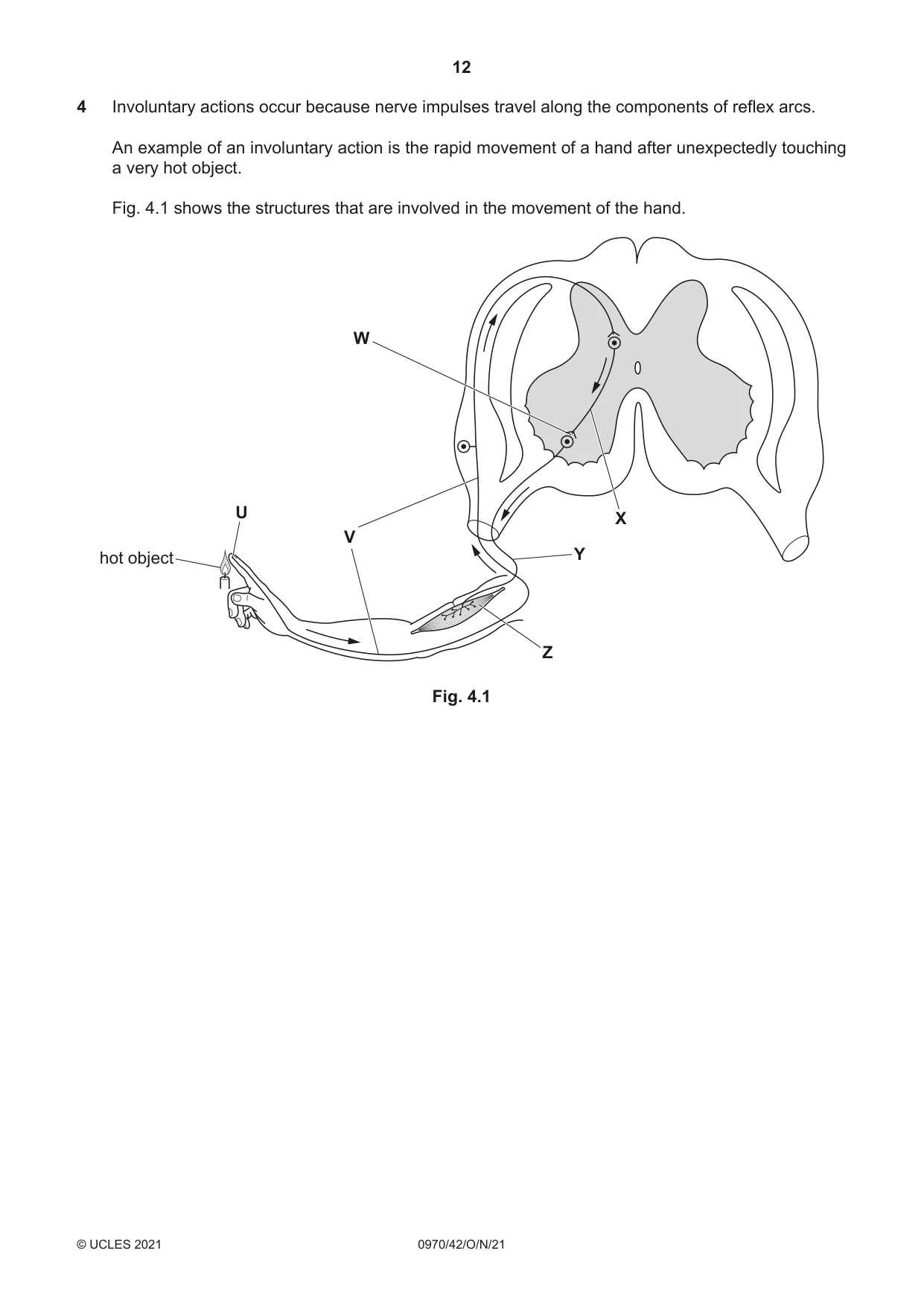
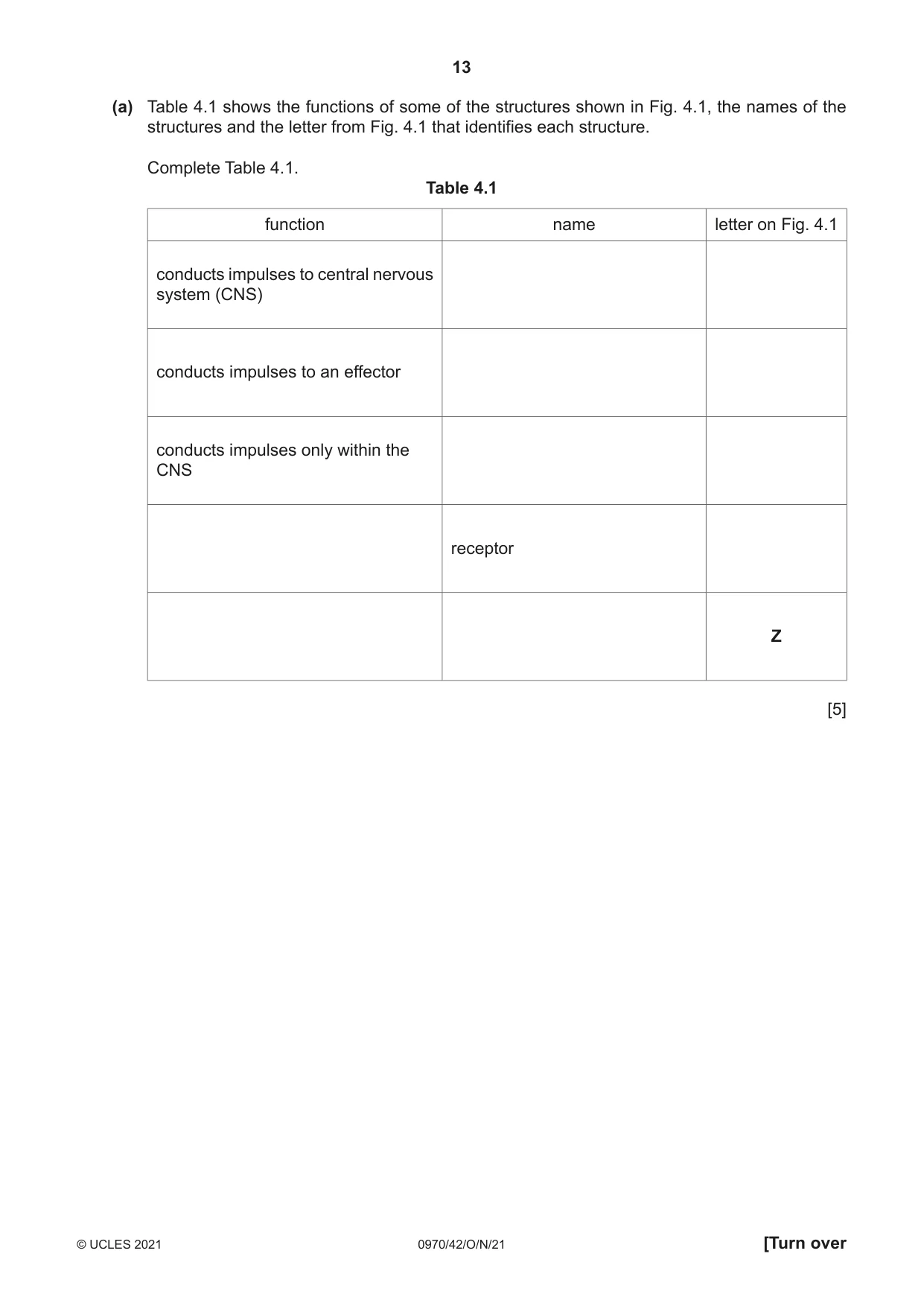
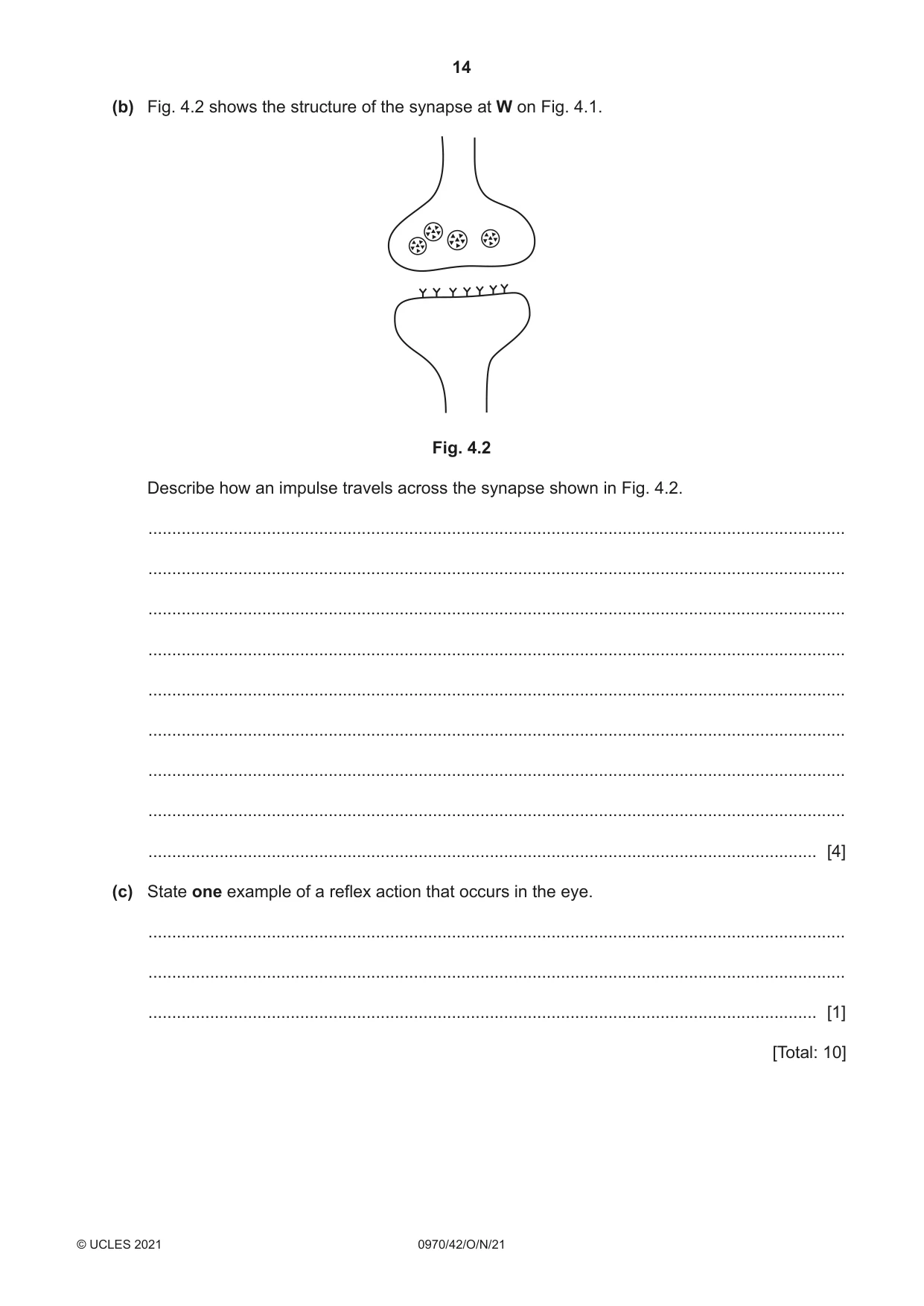
4 Involuntary actions occur because nerve impulses travel along the components of reflex arcs. An example of an involuntary action is the rapid movement of a hand after unexpectedly touching a very hot object. Fig. 4.1 shows the structures that are involved in the movement of the hand. W U X V hot object Y Z Fig. 4.1 (a) Table 4.1 shows the functions of some of the structures shown in Fig. 4.1, the names of the structures and the letter from Fig. 4.1 that identifies each structure. Complete Table 4.1. Table 4.1 function name letter on Fig. 4.1 conducts impulses to central nervous system (CNS) conducts impulses to an effector conducts impulses only within the CNS receptor Z [5] (b) Fig. 4.2 shows the structure of the synapse at W on Fig. 4.1. Fig. 4.2 Describe how an impulse travels across the synapse shown in Fig. 4.2. ................................................................................................................................................... ................................................................................................................................................... ................................................................................................................................................... ................................................................................................................................................... ................................................................................................................................................... ................................................................................................................................................... ................................................................................................................................................... ................................................................................................................................................... ............................................................................................................................................. [4] (c) State one example of a reflex action that occurs in the eye. ................................................................................................................................................... ................................................................................................................................................... ............................................................................................................................................. [1] [Total: 10]
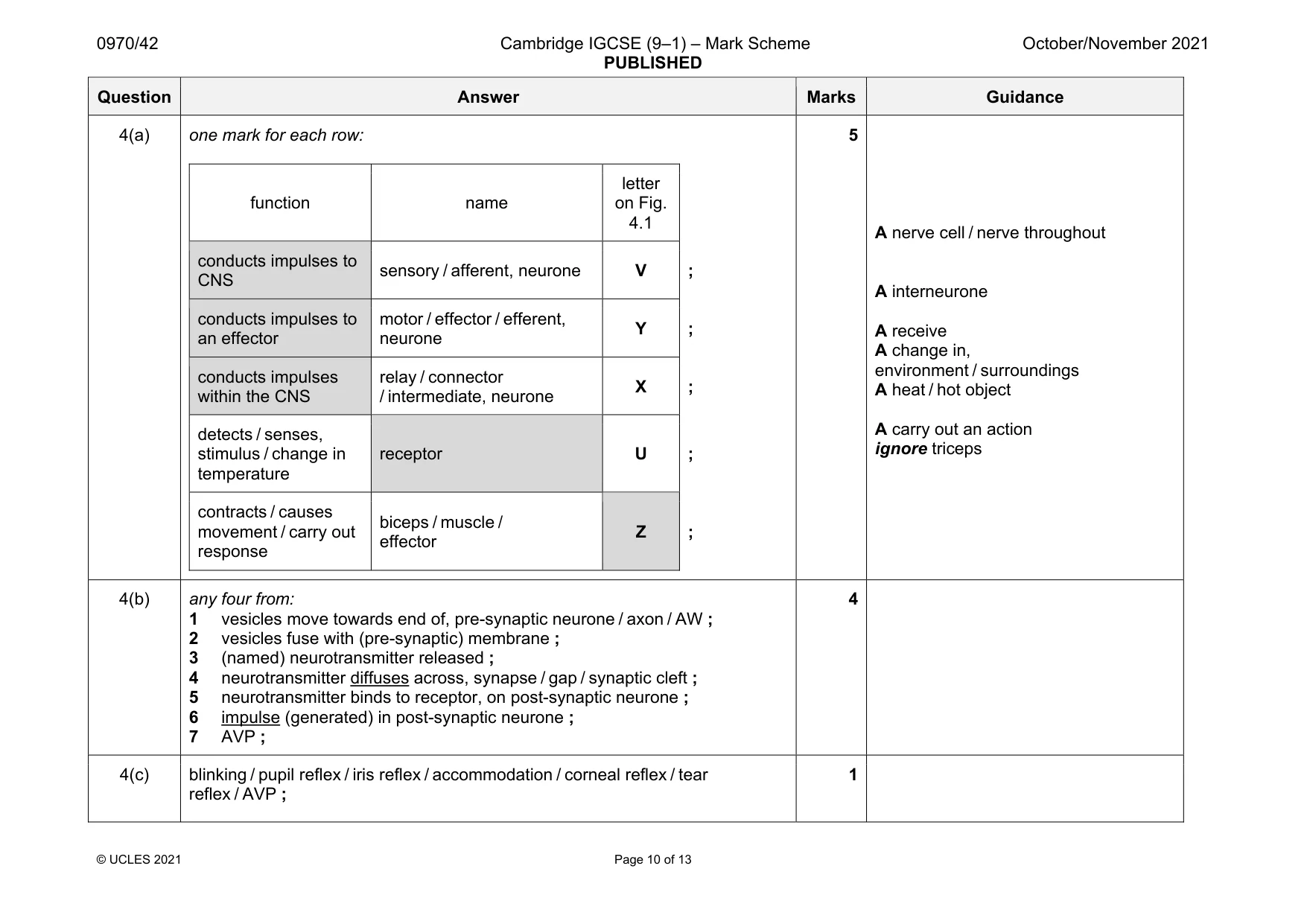
Mark scheme: 4(a) one mark for each row: function name letter on Fig. 4.1 conducts impulses to CNS sensory / afferent, neurone V ; conducts impulses to an effector motor / effector / efferent, neurone Y ; conducts impulses within the CNS relay / connector / intermediate, neurone X ; detects / senses, stimulus / change in temperature receptor U ; contracts / causes movement / carry out response biceps / muscle / effector Z ; 5 A nerve cell / nerve throughout A interneurone A receive A change in, environment / surroundings A heat / hot object A carry out an action ignore triceps 4(b) any four from: 1 vesicles move towards end of, pre-synaptic neurone / axon / AW ; 2 vesicles fuse with (pre-synaptic) membrane ; 3 (named) neurotransmitter released ; 4 neurotransmitter diffuses across, synapse / gap / synaptic cleft ; 5 neurotransmitter binds to receptor, on post-synaptic neurone ; 6 impulse (generated) in post-synaptic neurone ; 7 AVP ; 4 4(c) blinking / pupil reflex / iris reflex / accommodation / corneal reflex / tear reflex / AVP ; 1
Q5 · State two factors that affect the volume of urine produced in the human body
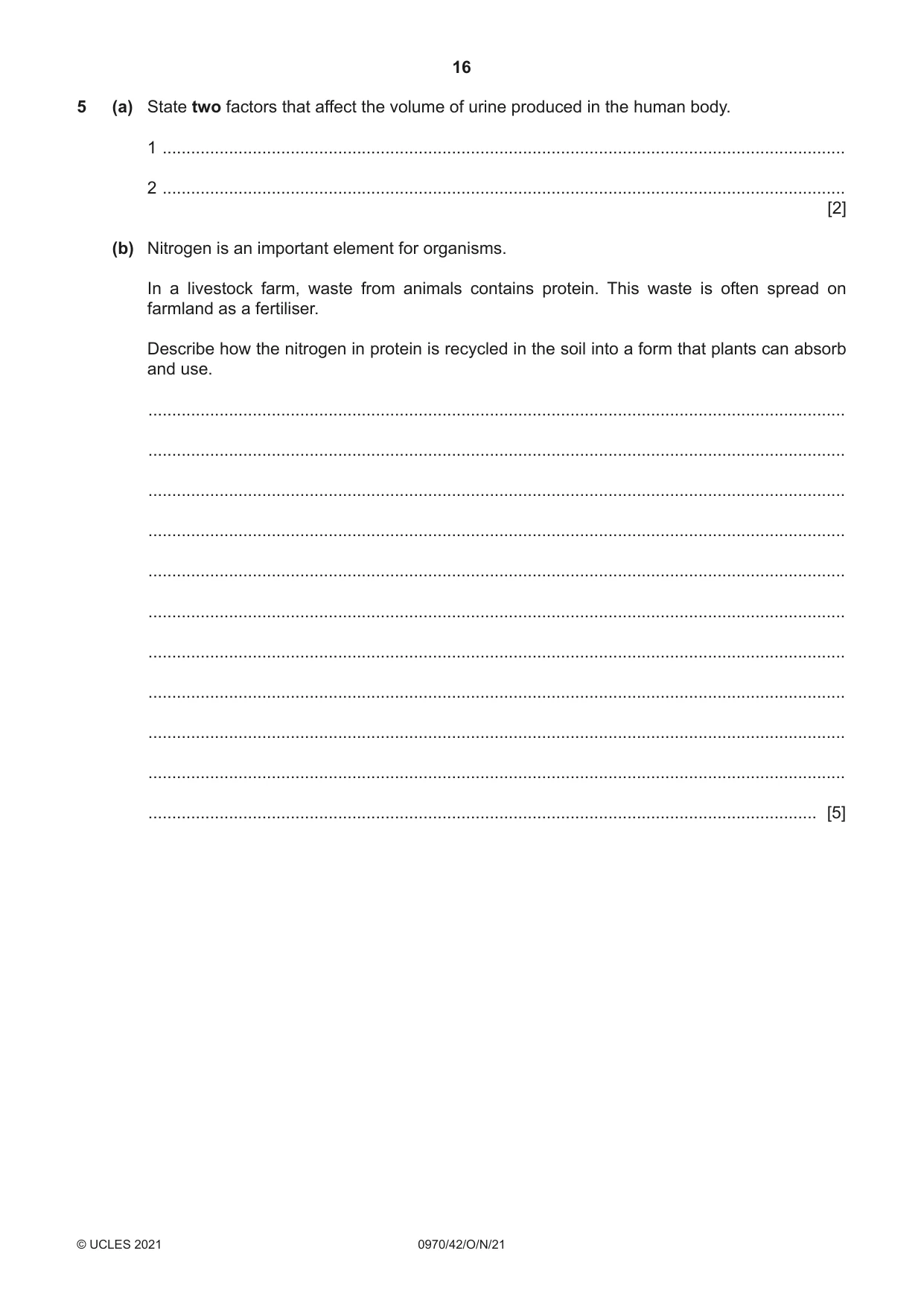
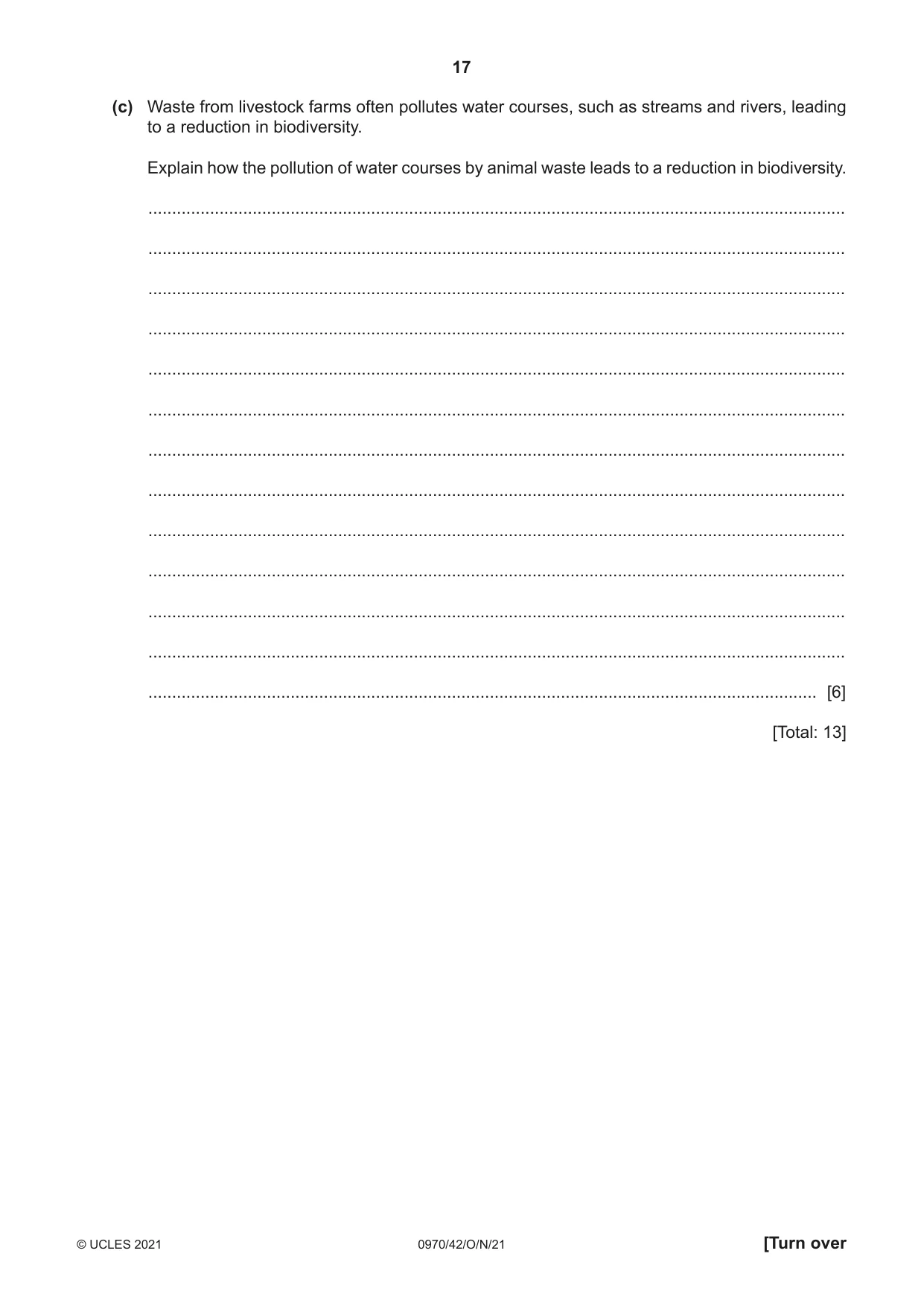
5 (a) State two factors that affect the volume of urine produced in the human body. 1 ................................................................................................................................................ 2 ................................................................................................................................................ [2] (b) Nitrogen is an important element for organisms. In a livestock farm, waste from animals contains protein. This waste is often spread on farmland as a fertiliser. Describe how the nitrogen in protein is recycled in the soil into a form that plants can absorb and use. ................................................................................................................................................... ................................................................................................................................................... ................................................................................................................................................... ................................................................................................................................................... ................................................................................................................................................... ................................................................................................................................................... ................................................................................................................................................... ................................................................................................................................................... ................................................................................................................................................... ................................................................................................................................................... ............................................................................................................................................. [5] (c) Waste from livestock farms often pollutes water courses, such as streams and rivers, leading to a reduction in biodiversity. Explain how the pollution of water courses by animal waste leads to a reduction in biodiversity. ................................................................................................................................................... ................................................................................................................................................... ................................................................................................................................................... ................................................................................................................................................... ................................................................................................................................................... ................................................................................................................................................... ................................................................................................................................................... ................................................................................................................................................... ................................................................................................................................................... ................................................................................................................................................... ................................................................................................................................................... ................................................................................................................................................... ............................................................................................................................................. [6] [Total: 13]
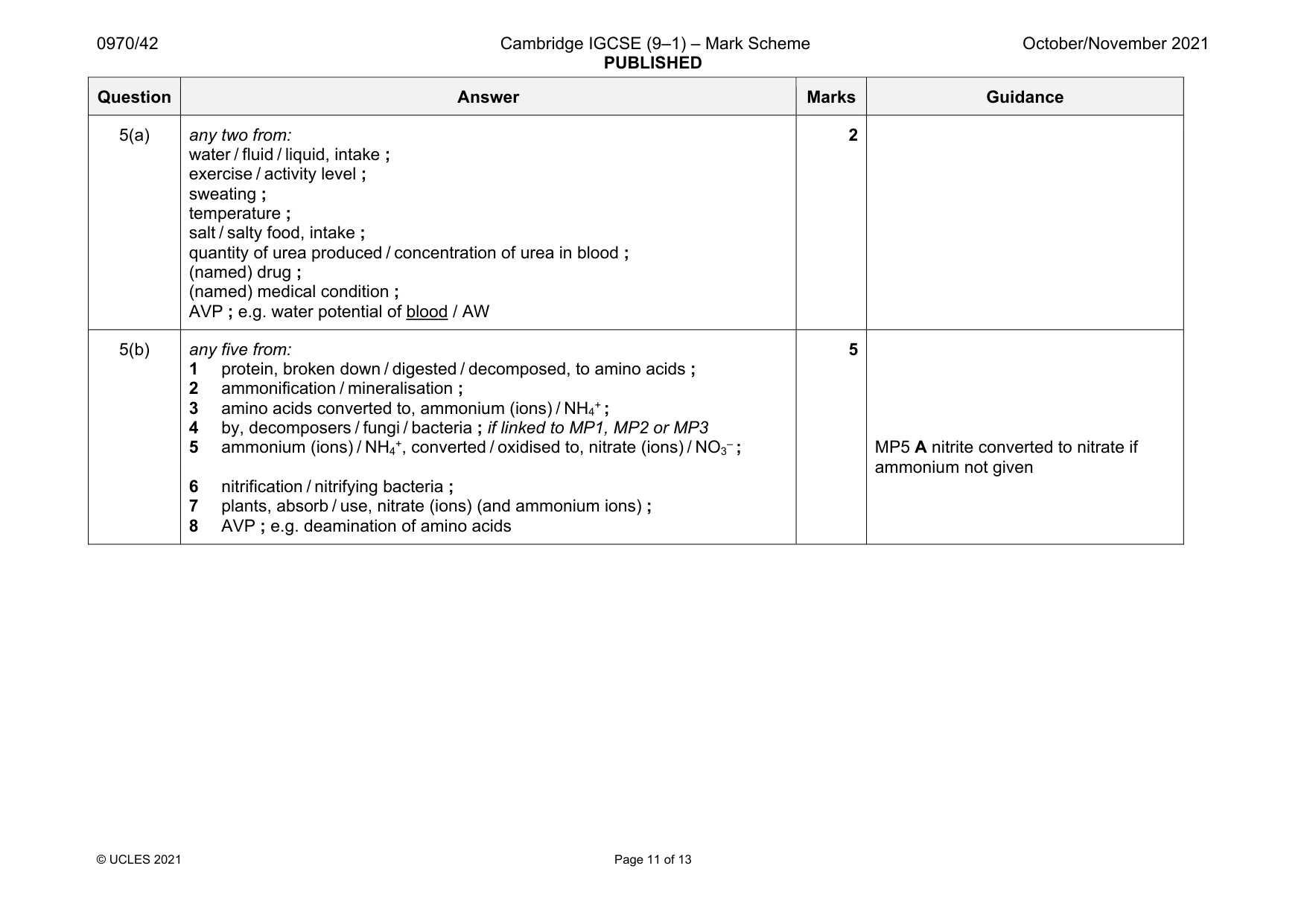
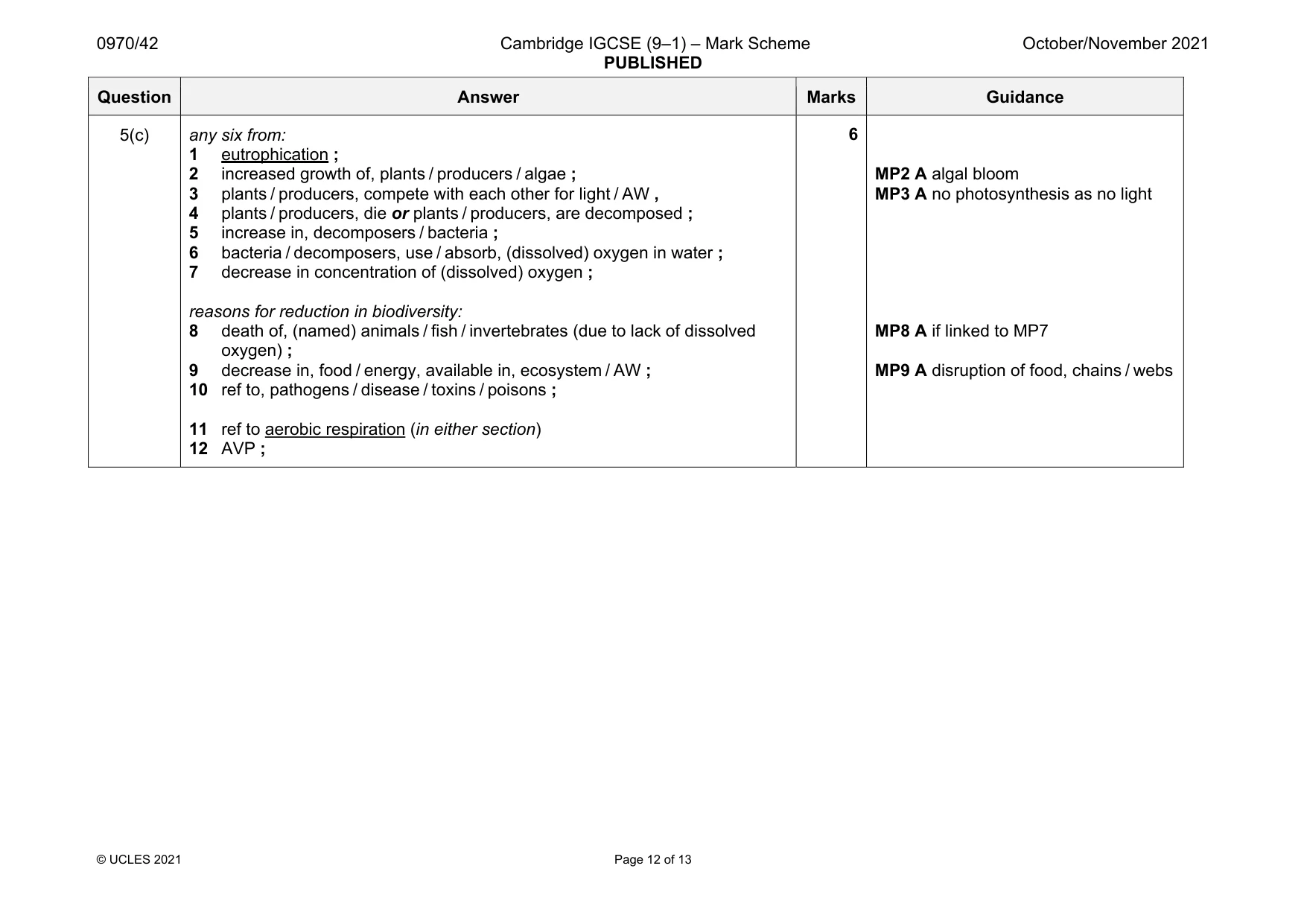
Mark scheme: 5(a) any two from: water / fluid / liquid, intake ; exercise / activity level ; sweating ; temperature ; salt / salty food, intake ; quantity of urea produced / concentration of urea in blood ; (named) drug ; (named) medical condition ; AVP ; e.g. water potential of blood / AW 2 5(b) any five from: 1 protein, broken down / digested / decomposed, to amino acids ; 2 ammonification / mineralisation ; 3 amino acids converted to, ammonium (ions) / NH4+ ; 4 by, decomposers / fungi / bacteria ; if linked to MP1, MP2 or MP3 5 ammonium (ions) / NH4+, converted / oxidised to, nitrate (ions) / NO3– ; 6 nitrification / nitrifying bacteria ; 7 plants, absorb / use, nitrate (ions) (and ammonium ions) ; 8 AVP ; e.g. deamination of amino acids 5 MP5 A nitrite converted to nitrate if ammonium not given Question Answer Marks Guidance 5(c) any six from: 1 eutrophication ; 2 increased growth of, plants / producers / algae ; 3 plants / producers, compete with each other for light / AW , 4 plants / producers, die or plants / producers, are decomposed ; 5 increase in, decomposers / bacteria ; 6 bacteria / decomposers, use / absorb, (dissolved) oxygen in water ; 7 decrease in concentration of (dissolved) oxygen ; reasons for reduction in biodiversity: 8 death of, (named) animals / fish / invertebrates (due to lack of dissolved oxygen) ; 9 decrease in, food / energy, available in, ecosystem / AW ; 10 ref to, pathogens / disease / toxins / poisons ; 11 ref to aerobic respiration (in either section) 12 AVP ; 6 MP2 A algal bloom MP3 A no photosynthesis as no light MP8 A if linked to MP7 MP9 A disruption of food, chains / webs
Question 6
6 Enzymes are catalysts. (a) Define the term catalyst. ................................................................................................................................................... ................................................................................................................................................... ............................................................................................................................................. [2] (b) Fig. 6.1 shows diagrams of three enzymes and eight different substrates. W 1 3 V P U Q 2 R T S Fig. 6.1 (i) State the letter of the substrate that will be broken down by enzyme 1. ..................................................................................................................................... [1] (ii) Explain, in terms of enzyme structure, the reason for your choice in 6(b)(i). ........................................................................................................................................... ........................................................................................................................................... ........................................................................................................................................... ........................................................................................................................................... ..................................................................................................................................... [2] (c) Table 6.1 lists some enzymes and the reactions that they catalyse. Complete Table 6.1. Table 6.1 enzyme reaction maltase breakdown of maltose to ............................... ............................... breakdown of proteins to amino acids lipase breakdown of fats to ............................... and ............................... ............................... breakdown of lactose to simpler sugars ............................... insertion of a short length of DNA into a plasmid restriction enzyme ....................................................................................................... [6] [Total: 11]
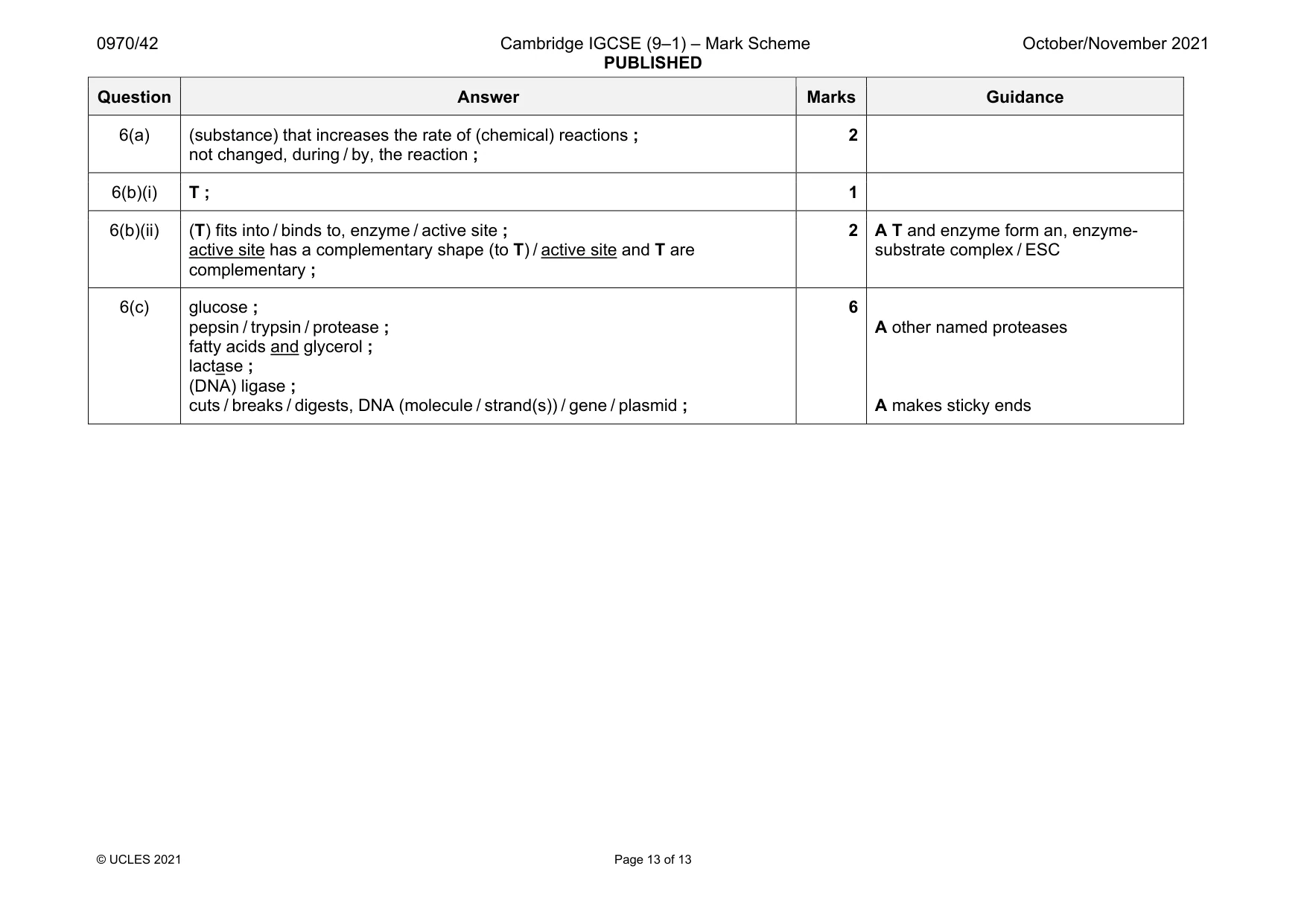
Mark scheme: 6(a) (substance) that increases the rate of (chemical) reactions ; not changed, during / by, the reaction ; 2 6(b)(i) T ; 1 6(b)(ii) (T) fits into / binds to, enzyme / active site ; active site has a complementary shape (to T) / active site and T are complementary ; 2 A T and enzyme form an, enzyme- substrate complex / ESC 6(c) glucose ; pepsin / trypsin / protease ; fatty acids and glycerol ; lactase ; (DNA) ligase ; cuts / breaks / digests, DNA (molecule / strand(s)) / gene / plasmid ; 6 A other named proteases A makes sticky ends
What was in this paper
The subtopics covered by these 6 questions, and how many questions each got. Open one in a new tab to see every Cambridge question on it.
What you needed in this session
Cambridge’s own grade thresholds for 2021 Oct/Nov, Paper 4 · Variant 2. A higher threshold means an easier paper — the bar moves with how the cohort did.