Cambridge IGCSE Biology (9-1) 0970 — 2019 Oct/Nov Paper 4 · Variant 2
0970/42/O/N/19 · 6 questions · 80 marks · ≈90 min
The question paper and its mark scheme, free to read here and free to download. This is Cambridge’s own paper, exactly as it was sat.
Question paper24 pages



Mark scheme12 pages
Answers below. Sit the paper first if you are practising.
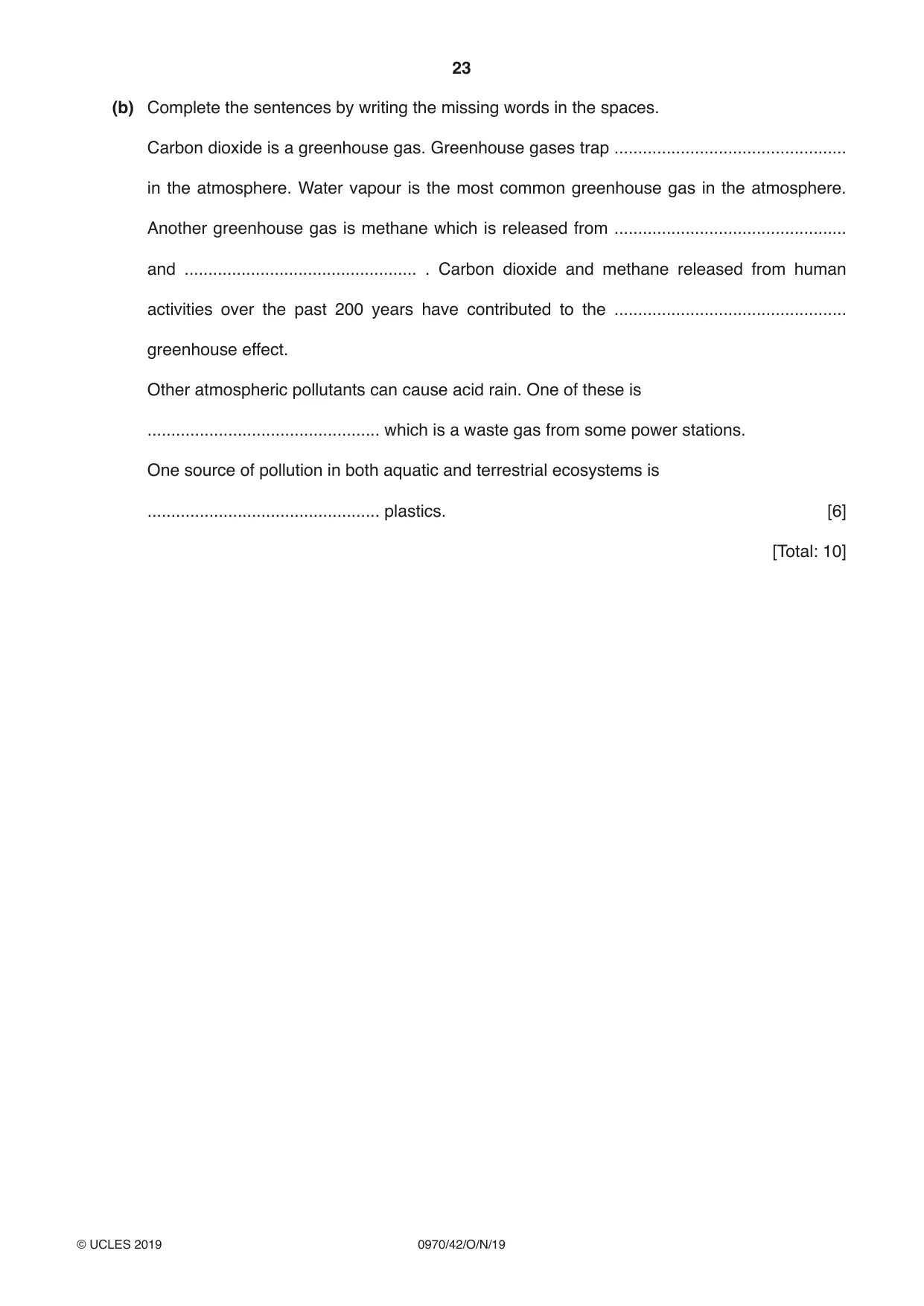
Questions as text
Question 1
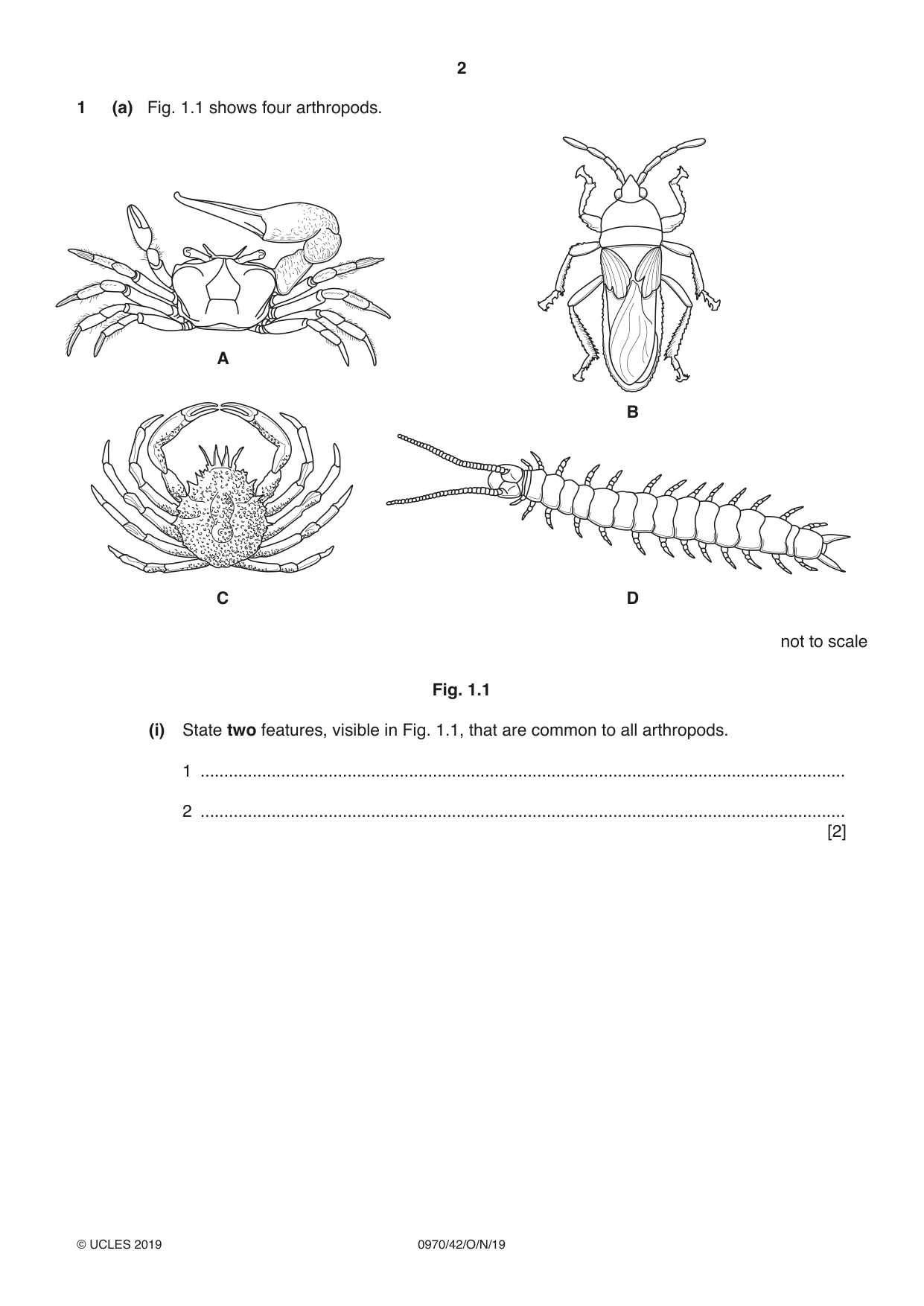
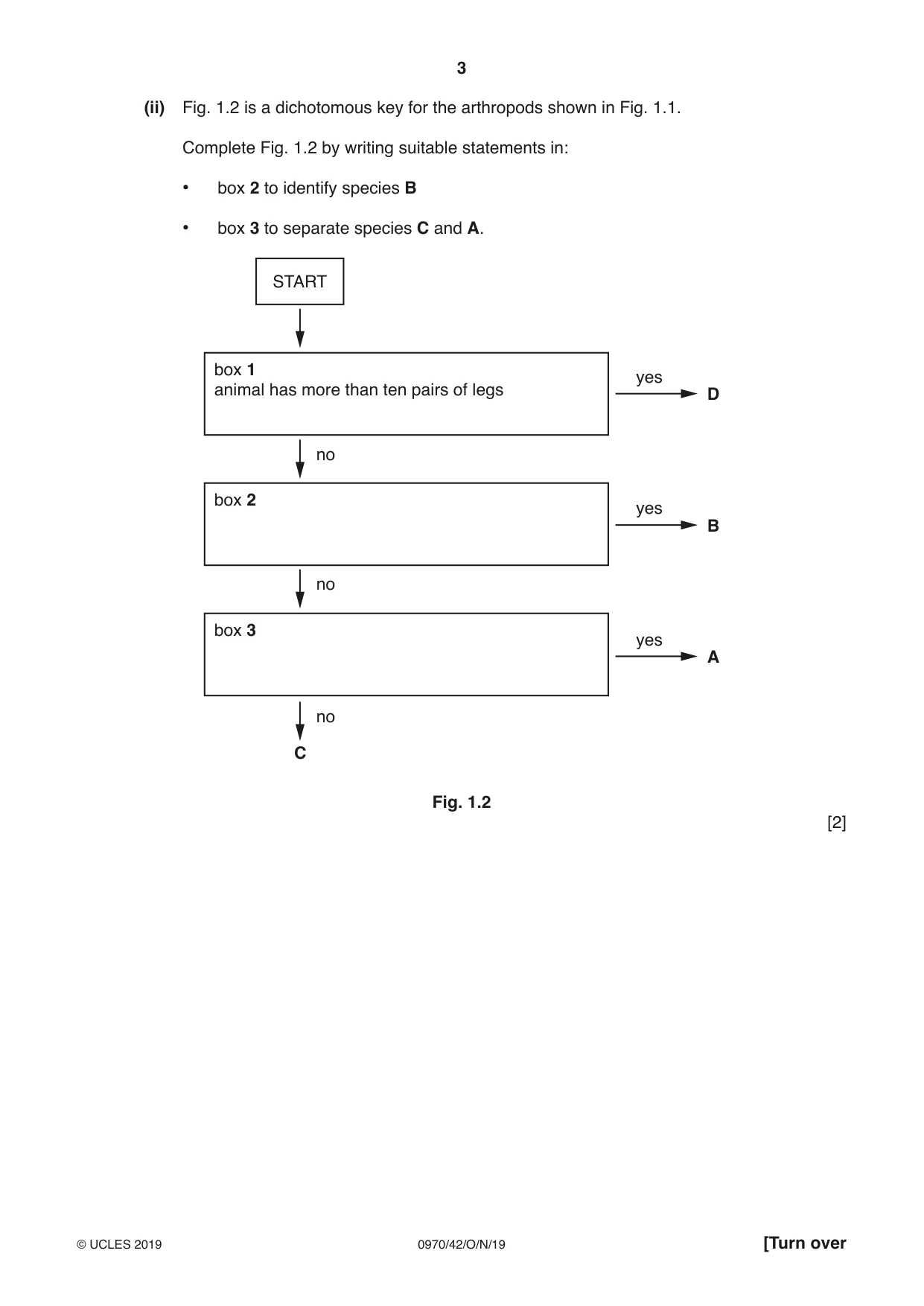
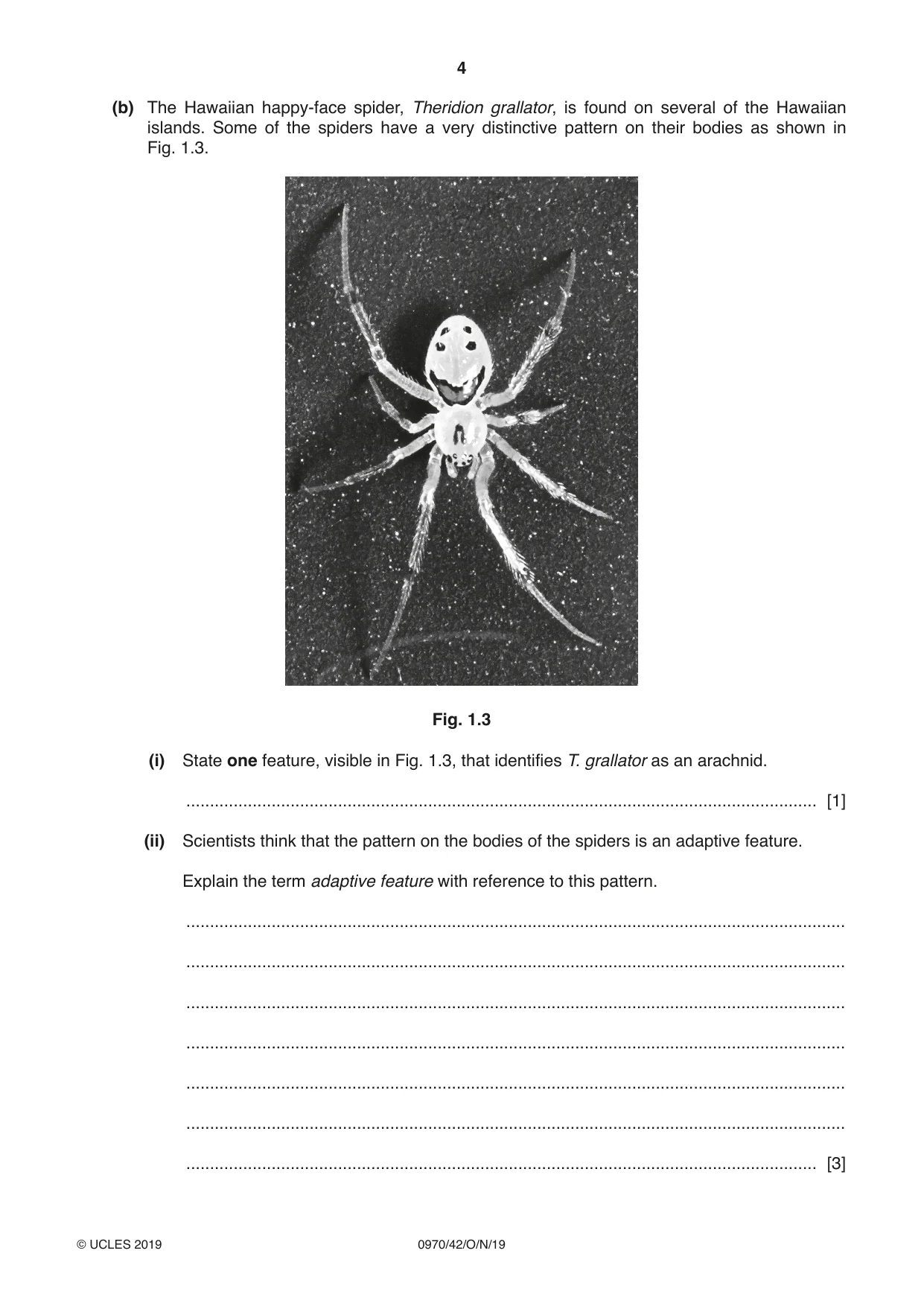
1 (a) Fig. 1.1 shows four arthropods. A B C D not to scale Fig. 1.1 (i) State two features, visible in Fig. 1.1, that are common to all arthropods. 1 ........................................................................................................................................ 2 ........................................................................................................................................ [2] (ii) Fig. 1.2 is a dichotomous key for the arthropods shown in Fig. 1.1. Complete Fig. 1.2 by writing suitable statements in: • box 2 to identify species B • box 3 to separate species C and A. START box 1 yes animal has more than ten pairs of legs D no box 2 yes B no box 3 yes A no C Fig. 1.2 [2] (b) The Hawaiian happy-face spider, Theridion grallator, is found on several of the Hawaiian islands. Some of the spiders have a very distinctive pattern on their bodies as shown in Fig. 1.3. Fig. 1.3 (i) State one feature, visible in Fig. 1.3, that identifies T. grallator as an arachnid. ..................................................................................................................................... [1] (ii) Scientists think that the pattern on the bodies of the spiders is an adaptive feature. Explain the term adaptive feature with reference to this pattern. ........................................................................................................................................... ........................................................................................................................................... ........................................................................................................................................... ........................................................................................................................................... ........................................................................................................................................... ........................................................................................................................................... ..................................................................................................................................... [3] (c) DNA can be extracted from the webs of spiders. This DNA can be used to identify the species of spider that made the web, and the species of prey caught in the web. Explain how DNA extracted from spider webs can be used to identify different species. ................................................................................................................................................... ................................................................................................................................................... ................................................................................................................................................... ................................................................................................................................................... ............................................................................................................................................. [2] (d) Many species of spider are thought to be endangered. State three reasons why animal species such as spiders become endangered. 1 ................................................................................................................................................ ................................................................................................................................................... 2 ................................................................................................................................................ ................................................................................................................................................... 3 ................................................................................................................................................ ................................................................................................................................................... [3] [Total: 13]
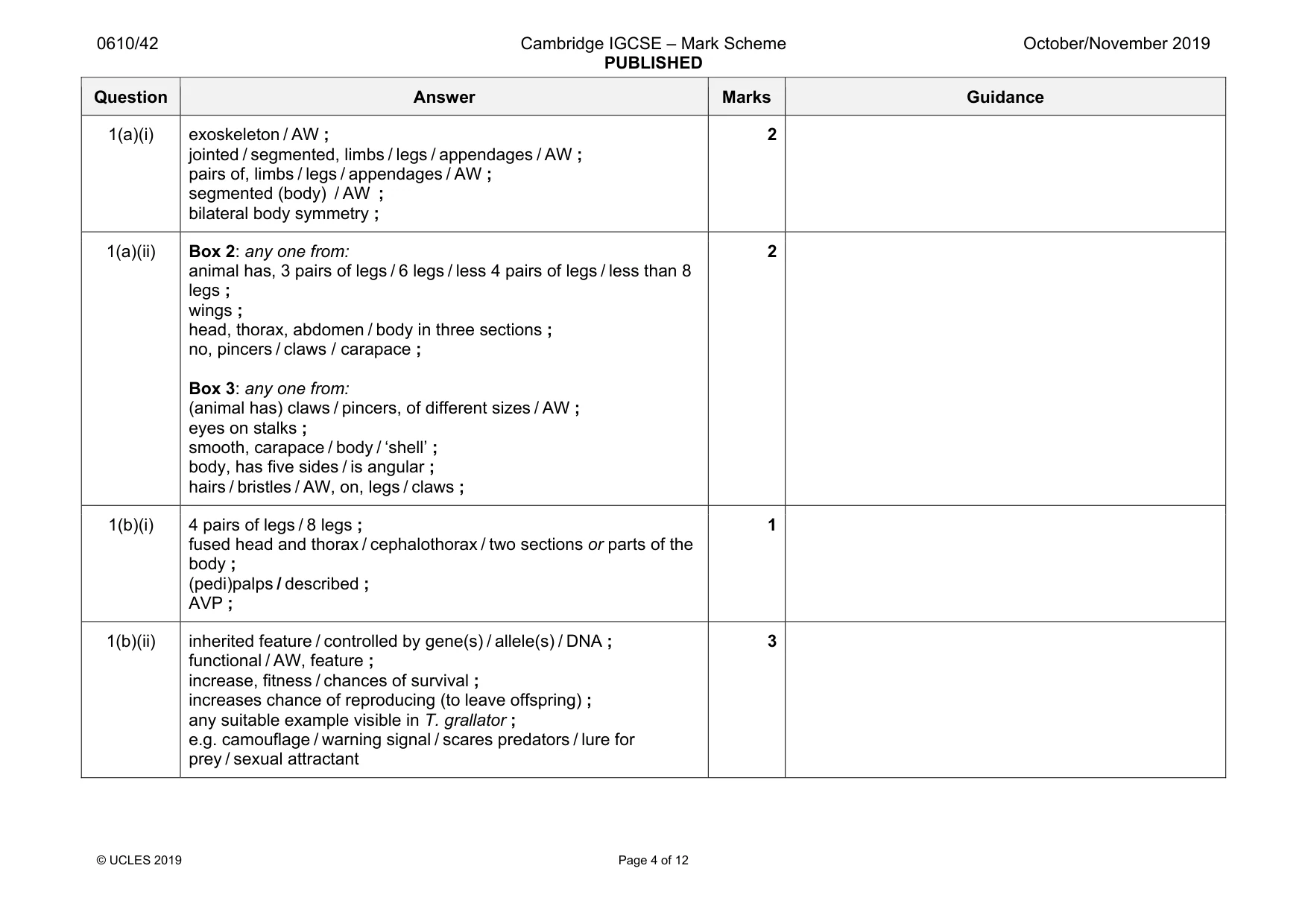
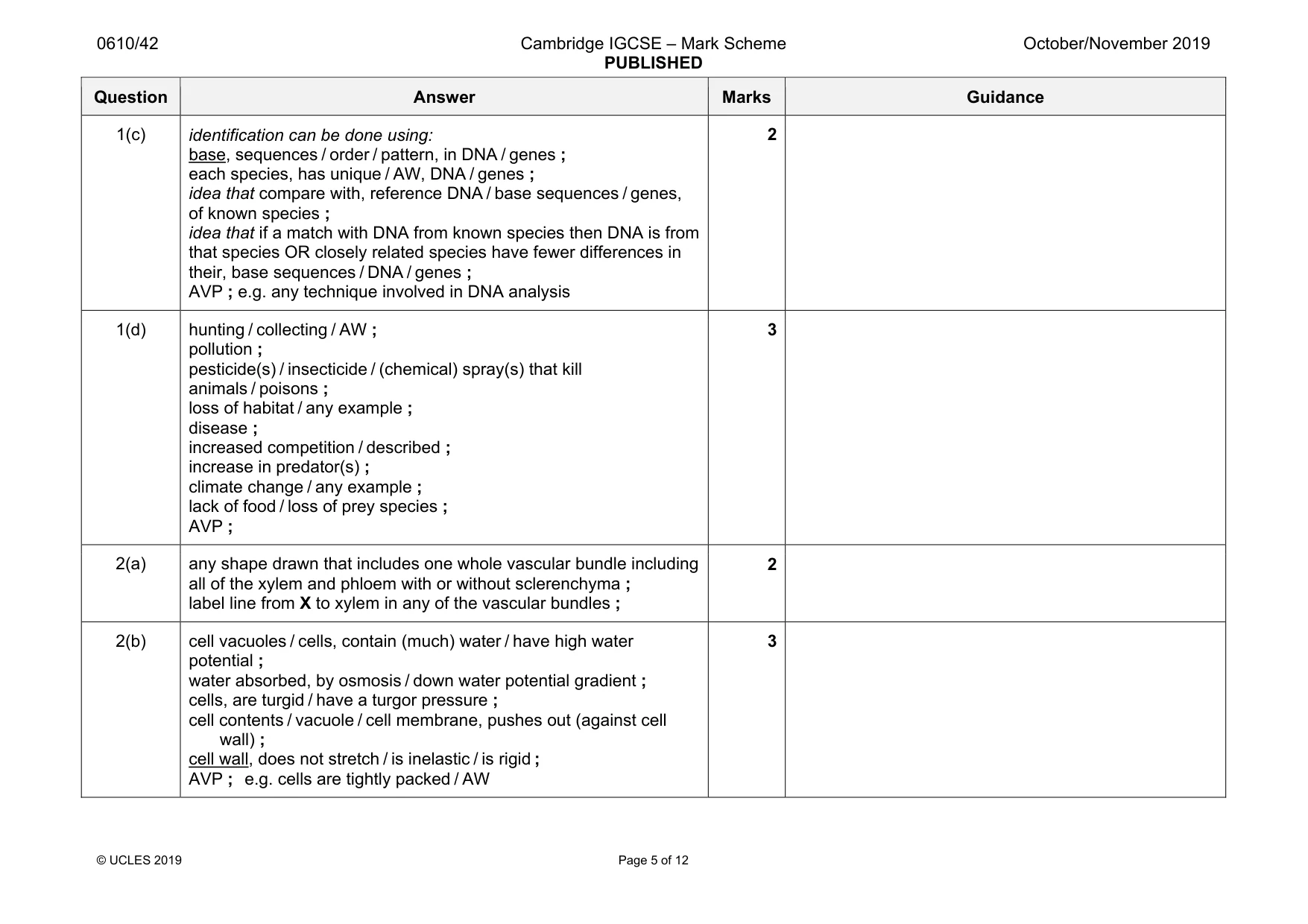
Mark scheme: 1(a)(i) exoskeleton / AW ; jointed / segmented, limbs / legs / appendages / AW ; pairs of, limbs / legs / appendages / AW ; segmented (body) / AW ; bilateral body symmetry ; 2 1(a)(ii) Box 2: any one from: animal has, 3 pairs of legs / 6 legs / less 4 pairs of legs / less than 8 legs ; wings ; head, thorax, abdomen / body in three sections ; no, pincers / claws / carapace ; Box 3: any one from: (animal has) claws / pincers, of different sizes / AW ; eyes on stalks ; smooth, carapace / body / ‘shell’ ; body, has five sides / is angular ; hairs / bristles / AW, on, legs / claws ; 2 1(b)(i) 4 pairs of legs / 8 legs ; fused head and thorax / cephalothorax / two sections or parts of the body ; (pedi)palps / described ; AVP ; 1 1(b)(ii) inherited feature / controlled by gene(s) / allele(s) / DNA ; functional / AW, feature ; increase, fitness / chances of survival ; increases chance of reproducing (to leave offspring) ; any suitable example visible in T. grallator ; e.g. camouflage / warning signal / scares predators / lure for prey / sexual attractant 3 Question Answer Marks Guidance 1(c) identification can be done using: base, sequences / order / pattern, in DNA / genes ; each species, has unique / AW, DNA / genes ; idea that compare with, reference DNA / base sequences / genes, of known species ; idea that if a match with DNA from known species then DNA is from that species OR closely related species have fewer differences in their, base sequences / DNA / genes ; AVP ; e.g. any technique involved in DNA analysis 2 1(d) hunting / collecting / AW ; pollution ; pesticide(s) / insecticide / (chemical) spray(s) that kill animals / poisons ; loss of habitat / any example ; disease ; increased competition / described ; increase in predator(s) ; climate change / any example ; lack of food / loss of prey species ; AVP ; 3
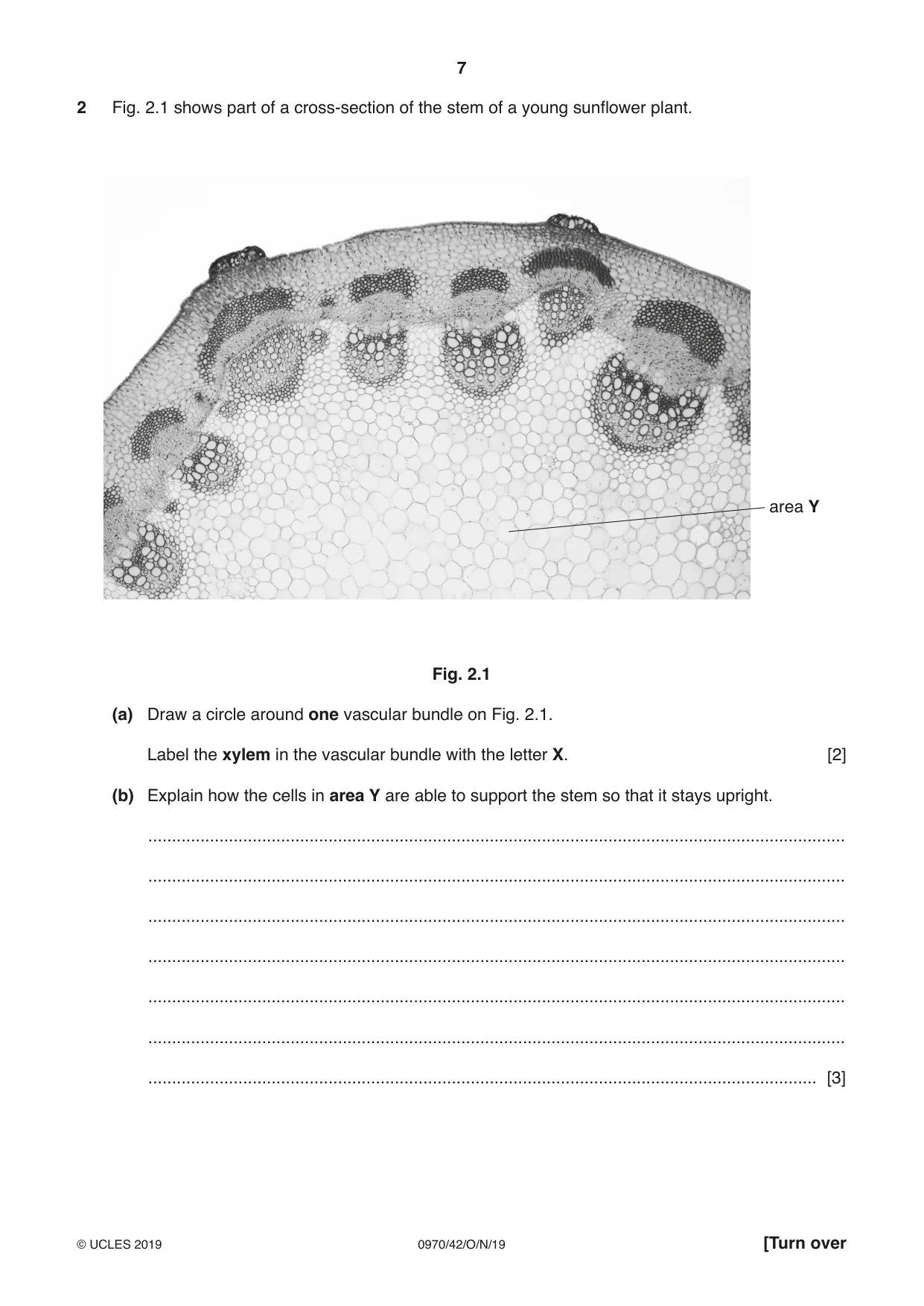
Q2 · Part of a cross-section of the stem of a young sunflower plant
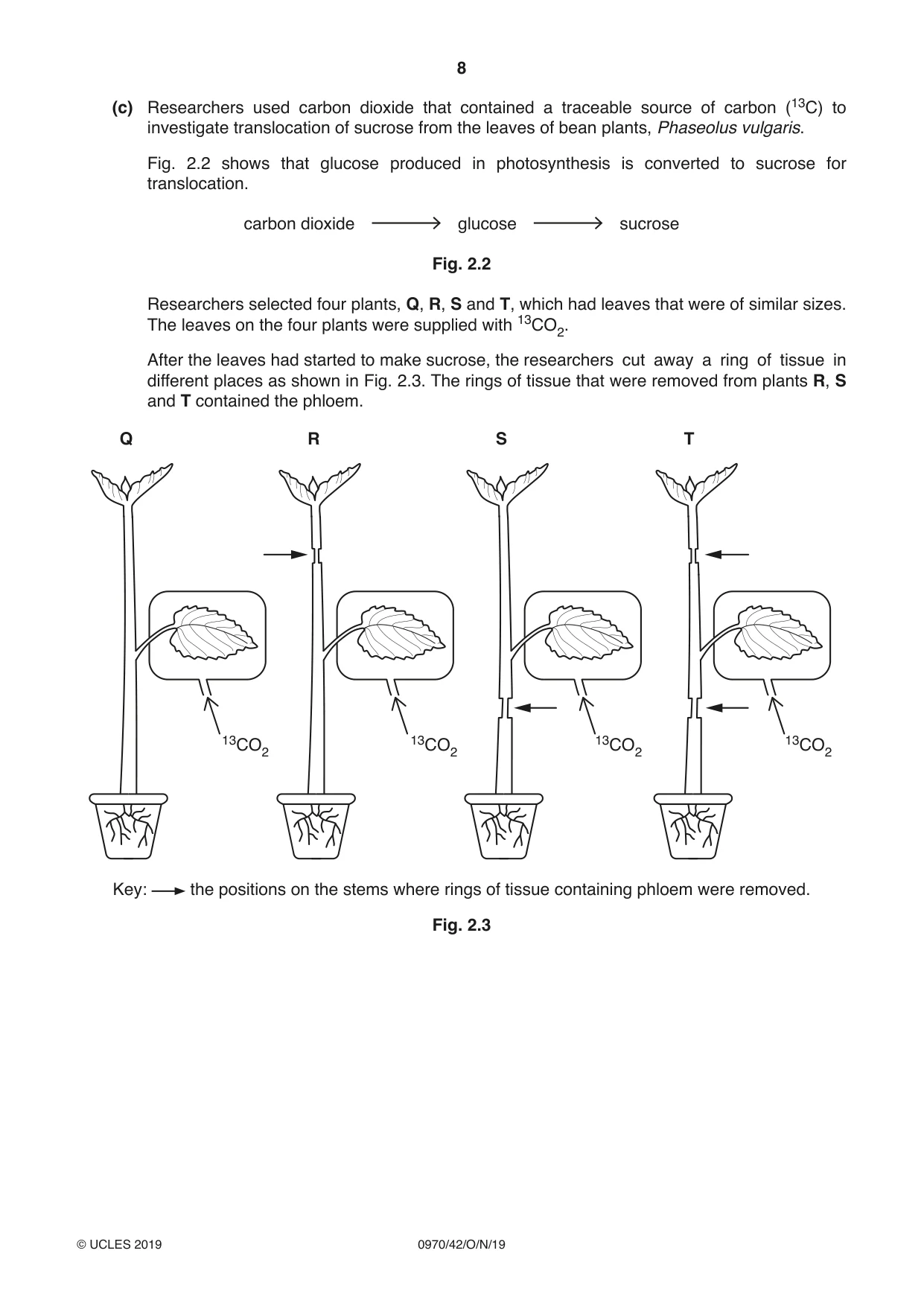
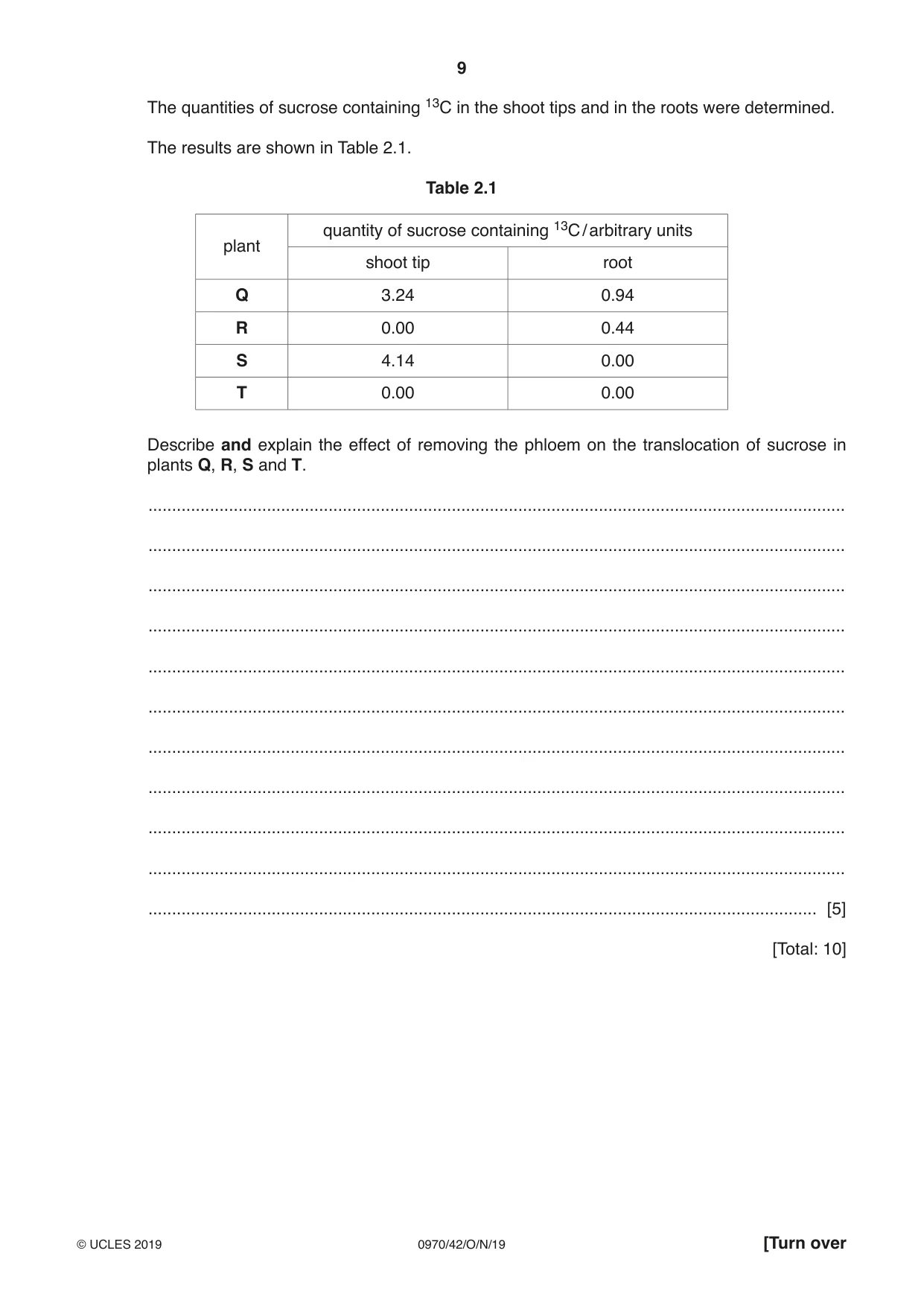
2 Fig. 2.1 shows part of a cross-section of the stem of a young sunflower plant. area Y Fig. 2.1 (a) Draw a circle around one vascular bundle on Fig. 2.1. Label the xylem in the vascular bundle with the letter X. [2] (b) Explain how the cells in area Y are able to support the stem so that it stays upright. ................................................................................................................................................... ................................................................................................................................................... ................................................................................................................................................... ................................................................................................................................................... ................................................................................................................................................... ................................................................................................................................................... ............................................................................................................................................. [3] (c) Researchers used carbon dioxide that contained a traceable source of carbon (13C) to investigate translocation of sucrose from the leaves of bean plants, Phaseolus vulgaris. Fig. 2.2 shows that glucose produced in photosynthesis is converted to sucrose for translocation. carbon dioxide glucose sucrose Fig. 2.2 Researchers selected four plants, Q, R, S and T, which had leaves that were of similar sizes. The leaves on the four plants were supplied with 13CO2. After the leaves had started to make sucrose, the researchers cut away a ring of tissue in different places as shown in Fig. 2.3. The rings of tissue that were removed from plants R, S and T contained the phloem. Q R S T 13CO2 13CO2 13CO2 13CO2 Key: the positions on the stems where rings of tissue containing phloem were removed. Fig. 2.3 The quantities of sucrose containing 13C in the shoot tips and in the roots were determined. The results are shown in Table 2.1. Table 2.1 quantity of sucrose containing 13C / arbitrary units plant shoot tip root Q 3.24 0.94 R 0.00 0.44 S 4.14 0.00 T 0.00 0.00 Describe and explain the effect of removing the phloem on the translocation of sucrose in plants Q, R, S and T. ................................................................................................................................................... ................................................................................................................................................... ................................................................................................................................................... ................................................................................................................................................... ................................................................................................................................................... ................................................................................................................................................... ................................................................................................................................................... ................................................................................................................................................... ................................................................................................................................................... ................................................................................................................................................... ............................................................................................................................................. [5] [Total: 10]
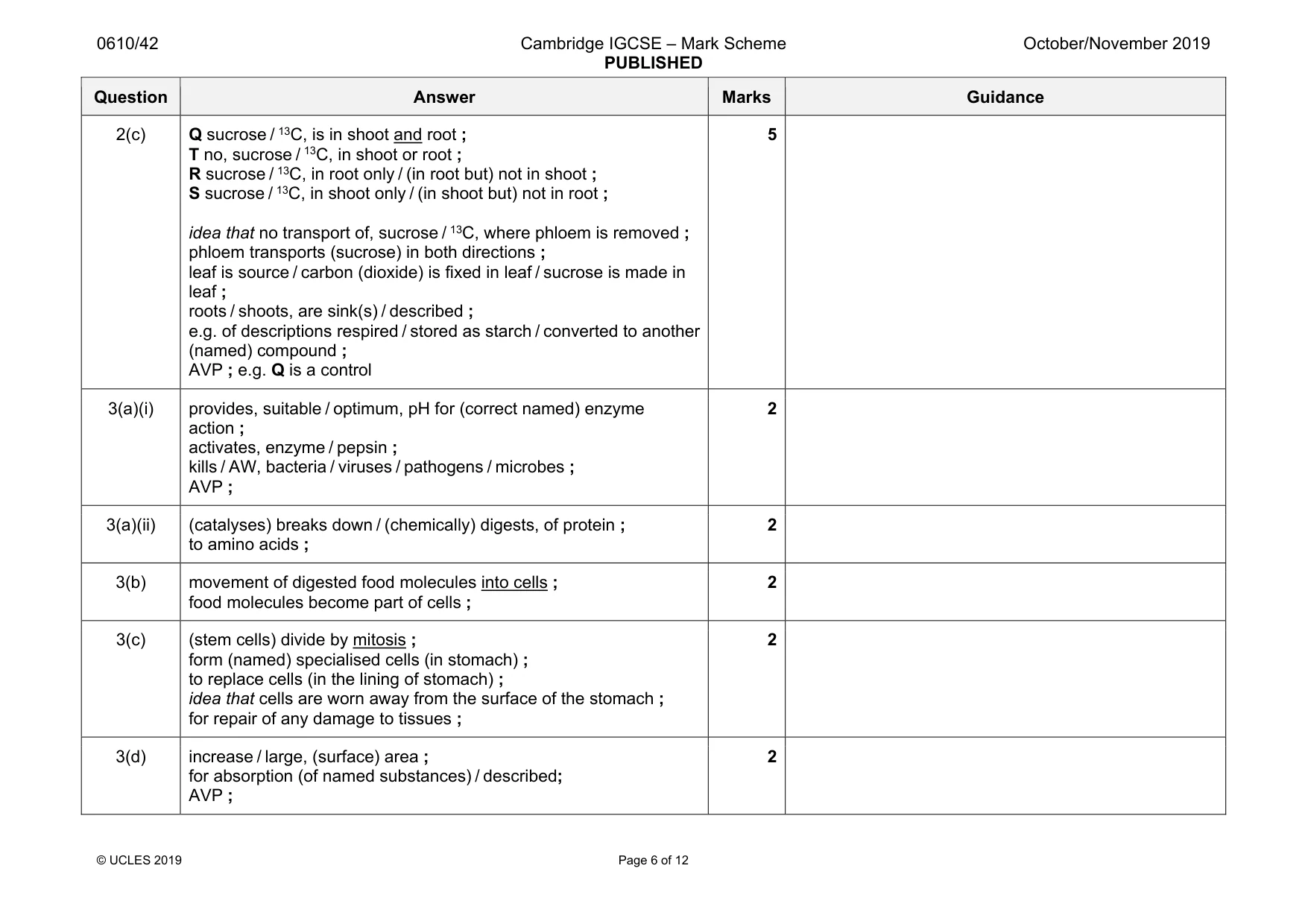
Mark scheme: 2(a) any shape drawn that includes one whole vascular bundle including all of the xylem and phloem with or without sclerenchyma ; label line from X to xylem in any of the vascular bundles ; 2 2(b) cell vacuoles / cells, contain (much) water / have high water potential ; water absorbed, by osmosis / down water potential gradient ; cells, are turgid / have a turgor pressure ; cell contents / vacuole / cell membrane, pushes out (against cell wall) ; cell wall, does not stretch / is inelastic / is rigid ; AVP ; e.g. cells are tightly packed / AW 3 Question Answer Marks Guidance 2(c) Q sucrose / 13C, is in shoot and root ; T no, sucrose / 13C, in shoot or root ; R sucrose / 13C, in root only / (in root but) not in shoot ; S sucrose / 13C, in shoot only / (in shoot but) not in root ; idea that no transport of, sucrose / 13C, where phloem is removed ; phloem transports (sucrose) in both directions ; leaf is source / carbon (dioxide) is fixed in leaf / sucrose is made in leaf ; roots / shoots, are sink(s) / described ; e.g. of descriptions respired / stored as starch / converted to another (named) compound ; AVP ; e.g. Q is a control 5
Q3 · Cells in the lining of the stomach secrete gastric juice, which contains hydrochloric…
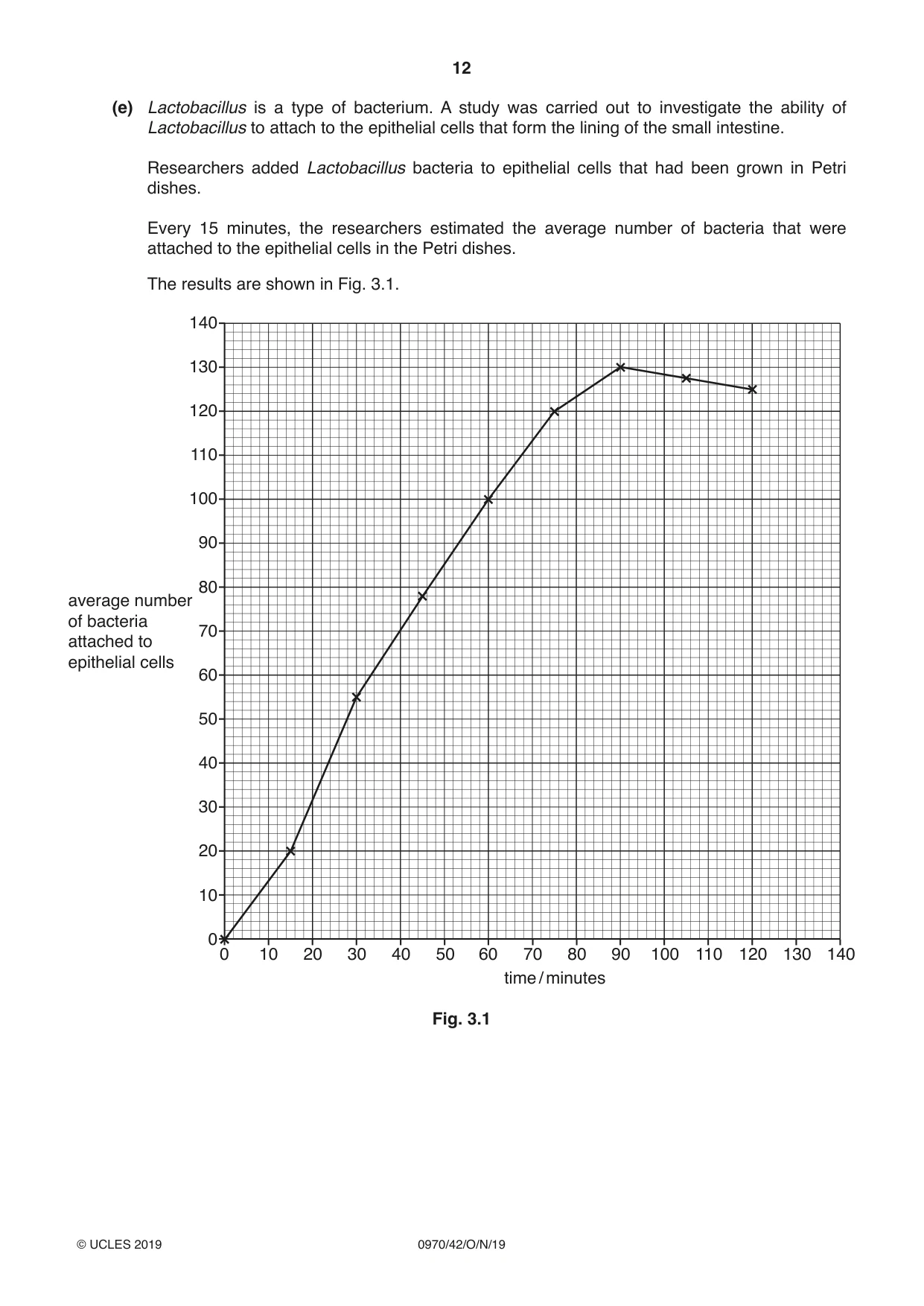
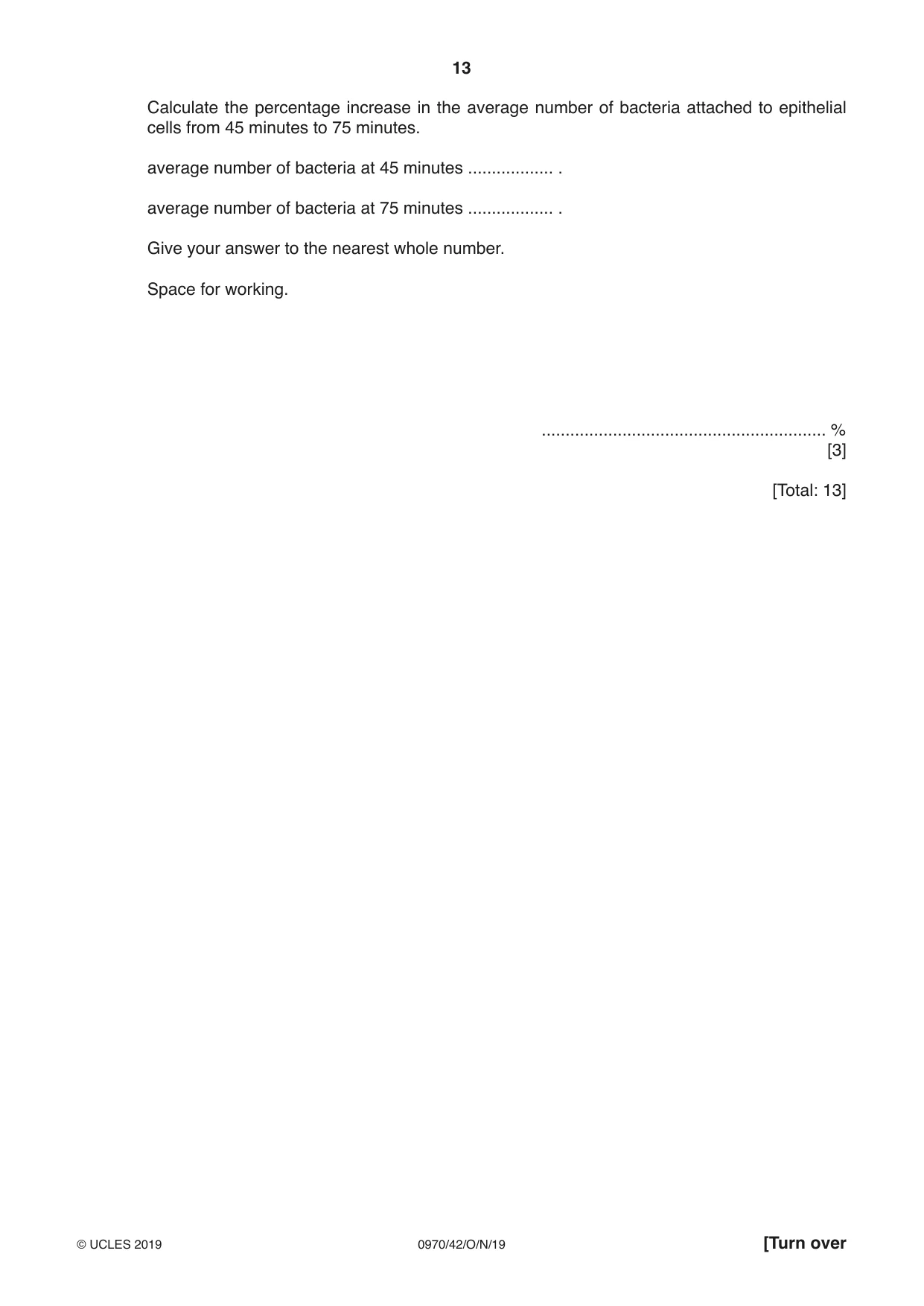
3 Cells in the lining of the stomach secrete gastric juice, which contains hydrochloric acid and pepsin. (a) (i) State two roles of hydrochloric acid in the stomach. 1 ........................................................................................................................................ 2 ........................................................................................................................................ [2] (ii) Describe the function of pepsin. ........................................................................................................................................... ........................................................................................................................................... ........................................................................................................................................... ..................................................................................................................................... [2] (b) Define the term assimilation. ................................................................................................................................................... ................................................................................................................................................... ................................................................................................................................................... ............................................................................................................................................. [2] (c) There are stem cells in the epithelial tissue that forms the lining of the stomach. Explain why these stem cells are necessary. ................................................................................................................................................... ................................................................................................................................................... ................................................................................................................................................... ................................................................................................................................................... ............................................................................................................................................. [2] (d) The epithelial cells of the small intestine have many microvilli. State the role of the microvilli. ................................................................................................................................................... ................................................................................................................................................... ................................................................................................................................................... ............................................................................................................................................. [2] (e) Lactobacillus is a type of bacterium. A study was carried out to investigate the ability of Lactobacillus to attach to the epithelial cells that form the lining of the small intestine. Researchers added Lactobacillus bacteria to epithelial cells that had been grown in Petri dishes. Every 15 minutes, the researchers estimated the average number of bacteria that were attached to the epithelial cells in the Petri dishes. The results are shown in Fig. 3.1. 140 130 120 110 100 90 80 average number of bacteria 70attached to epithelial cells 60 50 40 30 20 10 0 0 10 20 30 40 50 60 70 80 90 100 110 120 130 140 time / minutes Fig. 3.1 Calculate the percentage increase in the average number of bacteria attached to epithelial cells from 45 minutes to 75 minutes. average number of bacteria at 45 minutes .................. . average number of bacteria at 75 minutes .................. . Give your answer to the nearest whole number. Space for working. ............................................................ % [3] [Total: 13]
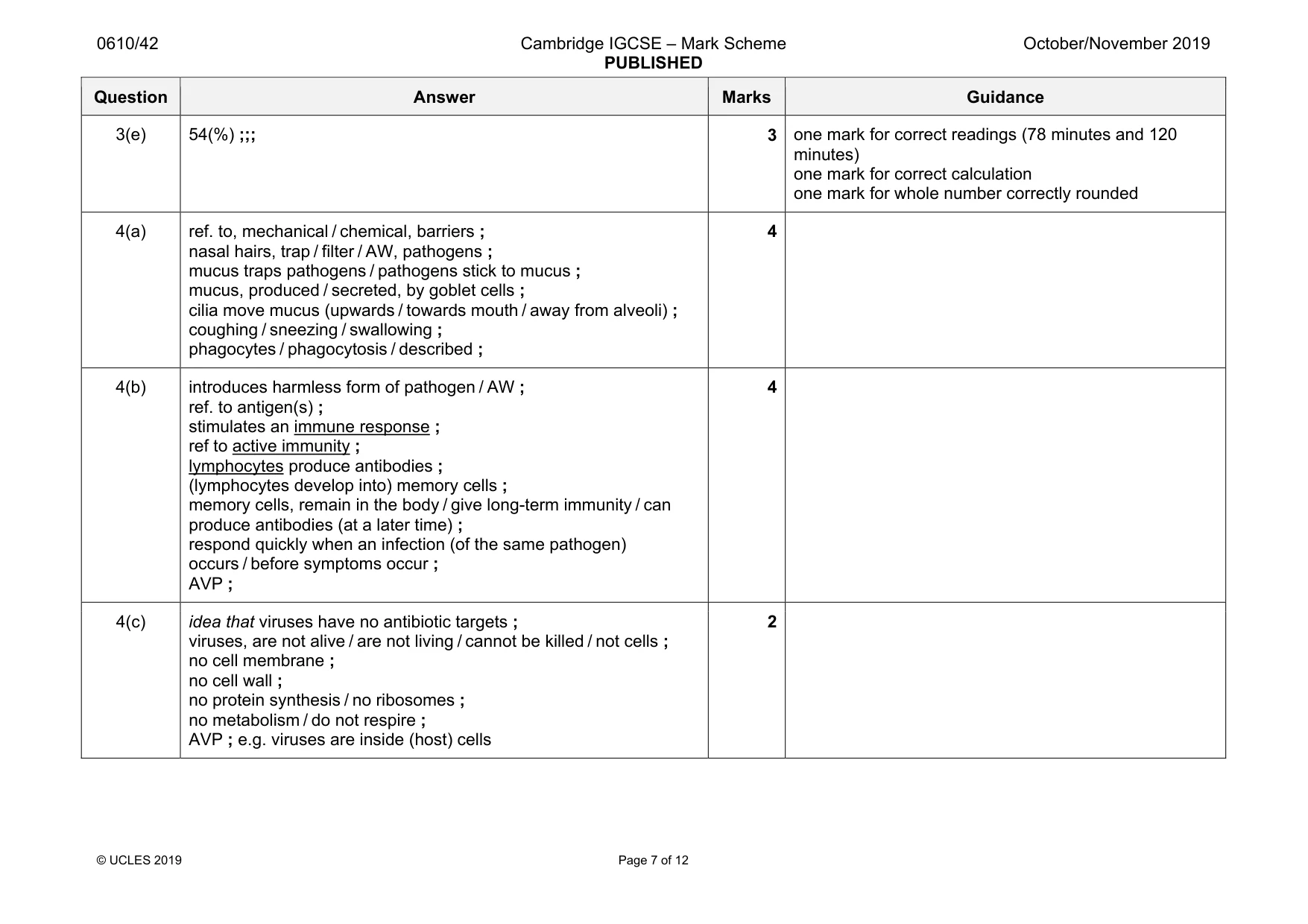
Mark scheme: 3(a)(i) provides, suitable / optimum, pH for (correct named) enzyme action ; activates, enzyme / pepsin ; kills / AW, bacteria / viruses / pathogens / microbes ; AVP ; 2 3(a)(ii) (catalyses) breaks down / (chemically) digests, of protein ; to amino acids ; 2 3(b) movement of digested food molecules into cells ; food molecules become part of cells ; 2 3(c) (stem cells) divide by mitosis ; form (named) specialised cells (in stomach) ; to replace cells (in the lining of stomach) ; idea that cells are worn away from the surface of the stomach ; for repair of any damage to tissues ; 2 3(d) increase / large, (surface) area ; for absorption (of named substances) / described; AVP ; 2 Question Answer Marks Guidance 3(e) 54(%) ;;; 3 one mark for correct readings (78 minutes and 120 minutes) one mark for correct calculation one mark for whole number correctly rounded
Q4 · Explain how the human gas exchange system is protected against pathogens
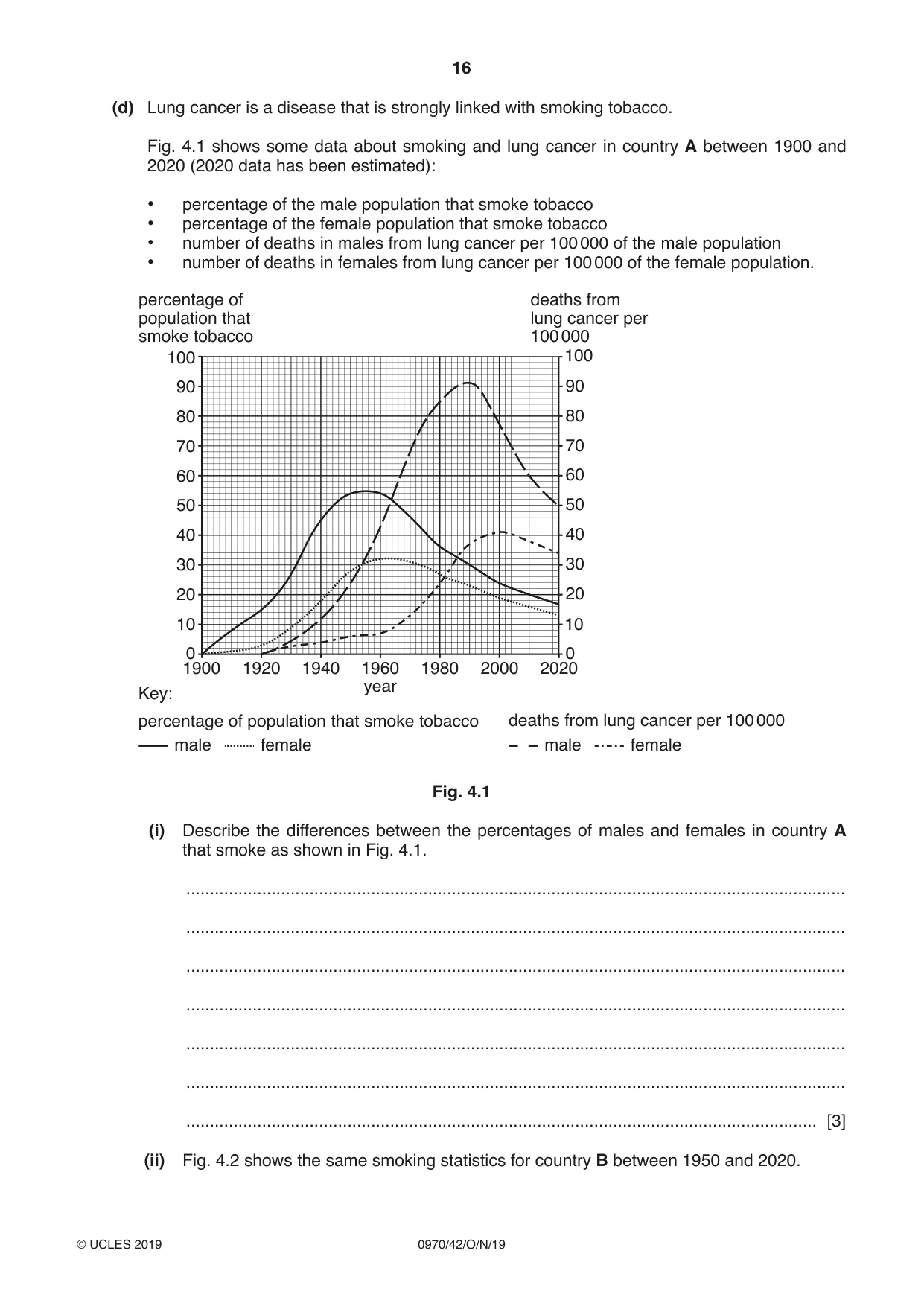
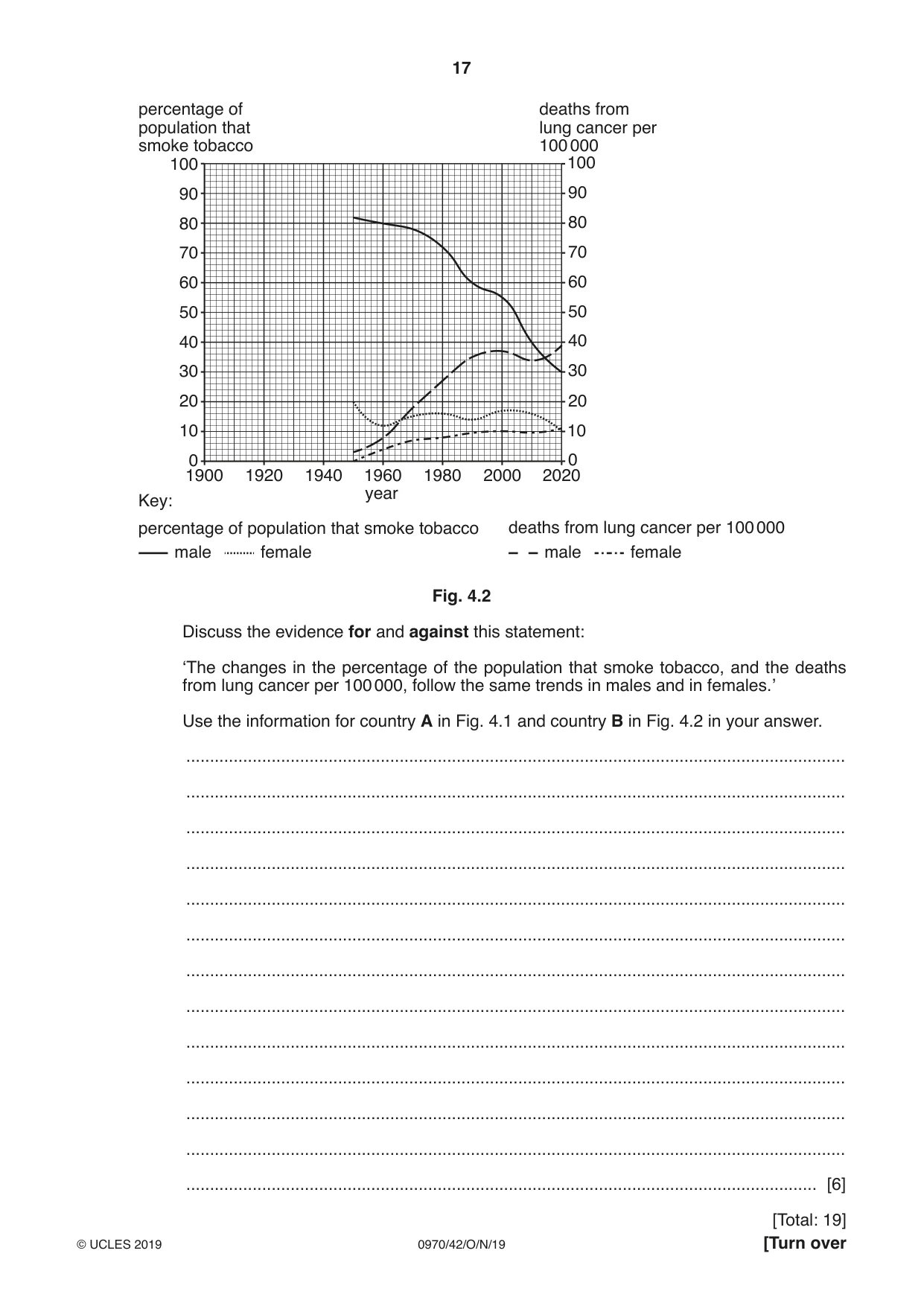
4 (a) Explain how the human gas exchange system is protected against pathogens. ................................................................................................................................................... ................................................................................................................................................... ................................................................................................................................................... ................................................................................................................................................... ................................................................................................................................................... ................................................................................................................................................... ................................................................................................................................................... ................................................................................................................................................... ............................................................................................................................................. [4] (b) Tuberculosis (TB) is a transmissible disease caused by a bacterial pathogen. The spread of this disease can be controlled by vaccination. Explain how vaccination provides a defence against transmissible diseases. ................................................................................................................................................... ................................................................................................................................................... ................................................................................................................................................... ................................................................................................................................................... ................................................................................................................................................... ................................................................................................................................................... ................................................................................................................................................... ................................................................................................................................................... ............................................................................................................................................. [4] (c) TB is a disease that can be treated with antibiotics. HIV infection cannot be treated with antibiotics. Explain why viral diseases cannot be treated with antibiotics. ................................................................................................................................................... ................................................................................................................................................... ................................................................................................................................................... ................................................................................................................................................... (d) Lung cancer is a disease that is strongly linked with smoking tobacco. Fig. 4.1 shows some data about smoking and lung cancer in country A between 1900 and 2020 (2020 data has been estimated): • percentage of the male population that smoke tobacco • percentage of the female population that smoke tobacco • number of deaths in males from lung cancer per 100 000 of the male population • number of deaths in females from lung cancer per 100 000 of the female population. percentage of deaths from population that lung cancer per smoke tobacco 100 000 100 100 90 90 80 80 70 70 60 60 50 50 40 40 30 30 20 20 10 10 0 0 1900 1920 1940 1960 1980 2000 2020 year Key: percentage of population that smoke tobacco deaths from lung cancer per 100 000 male female male female Fig. 4.1 (i) Describe the differences between the percentages of males and females in country A that smoke as shown in Fig. 4.1. ........................................................................................................................................... ........................................................................................................................................... ........................................................................................................................................... ........................................................................................................................................... ........................................................................................................................................... ........................................................................................................................................... ..................................................................................................................................... [3] (ii) Fig. 4.2 shows the same smoking statistics for country B between 1950 and 2020. percentage of deaths from population that lung cancer per smoke tobacco 100 000 100 100 90 90 80 80 70 70 60 60 50 50 40 40 30 30 20 20 10 10 0 0 1900 1920 1940 1960 1980 2000 2020 yearKey: percentage of population that smoke tobacco deaths from lung cancer per 100 000 male female male female Fig. 4.2 Discuss the evidence for and against this statement: ‘The changes in the percentage of the population that smoke tobacco, and the deaths from lung cancer per 100 000, follow the same trends in males and in females.’ Use the information for country A in Fig. 4.1 and country B in Fig. 4.2 in your answer. ........................................................................................................................................... ........................................................................................................................................... ........................................................................................................................................... ........................................................................................................................................... ........................................................................................................................................... ........................................................................................................................................... ........................................................................................................................................... ........................................................................................................................................... ........................................................................................................................................... ........................................................................................................................................... ........................................................................................................................................... ........................................................................................................................................... ..................................................................................................................................... [6]
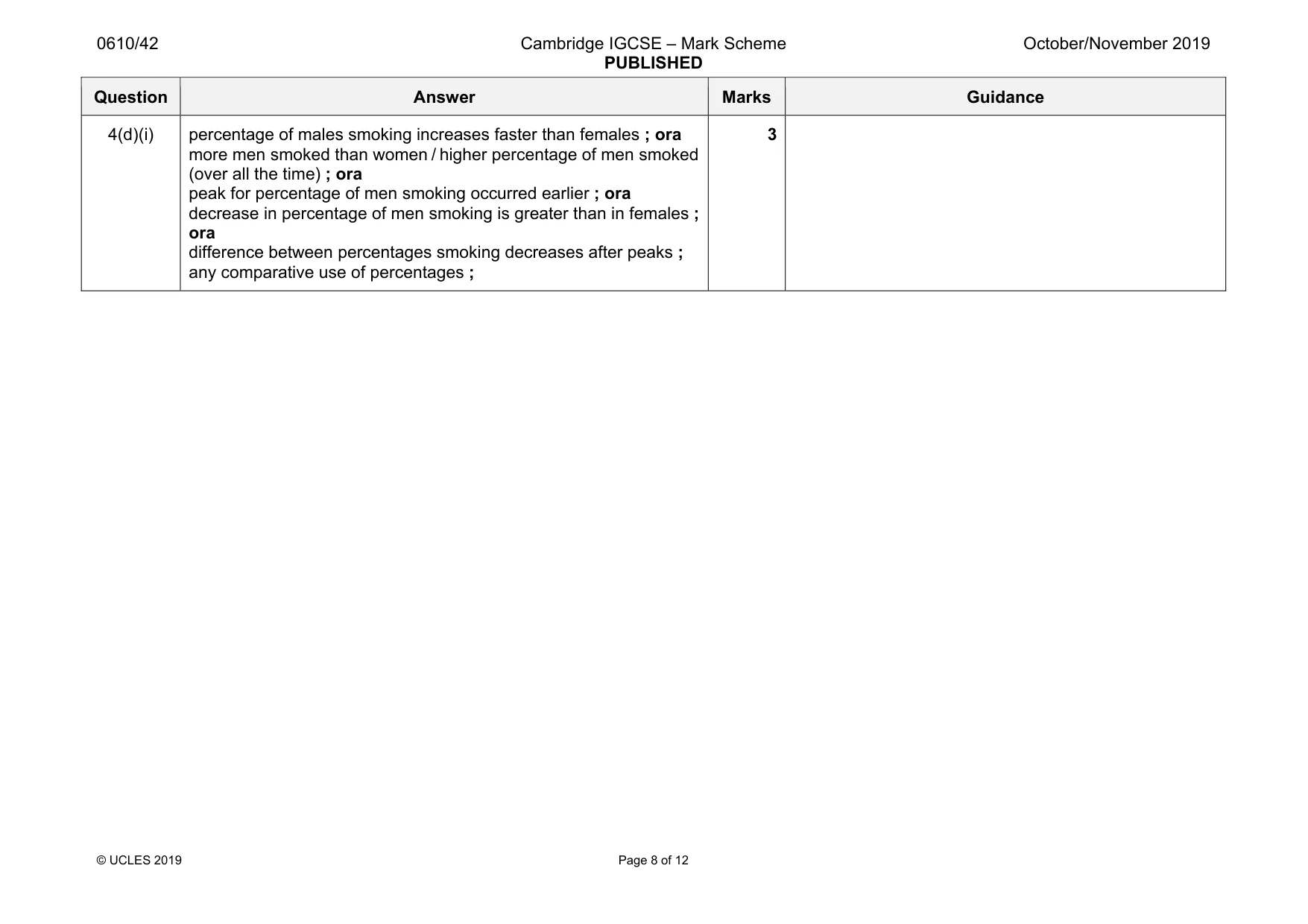
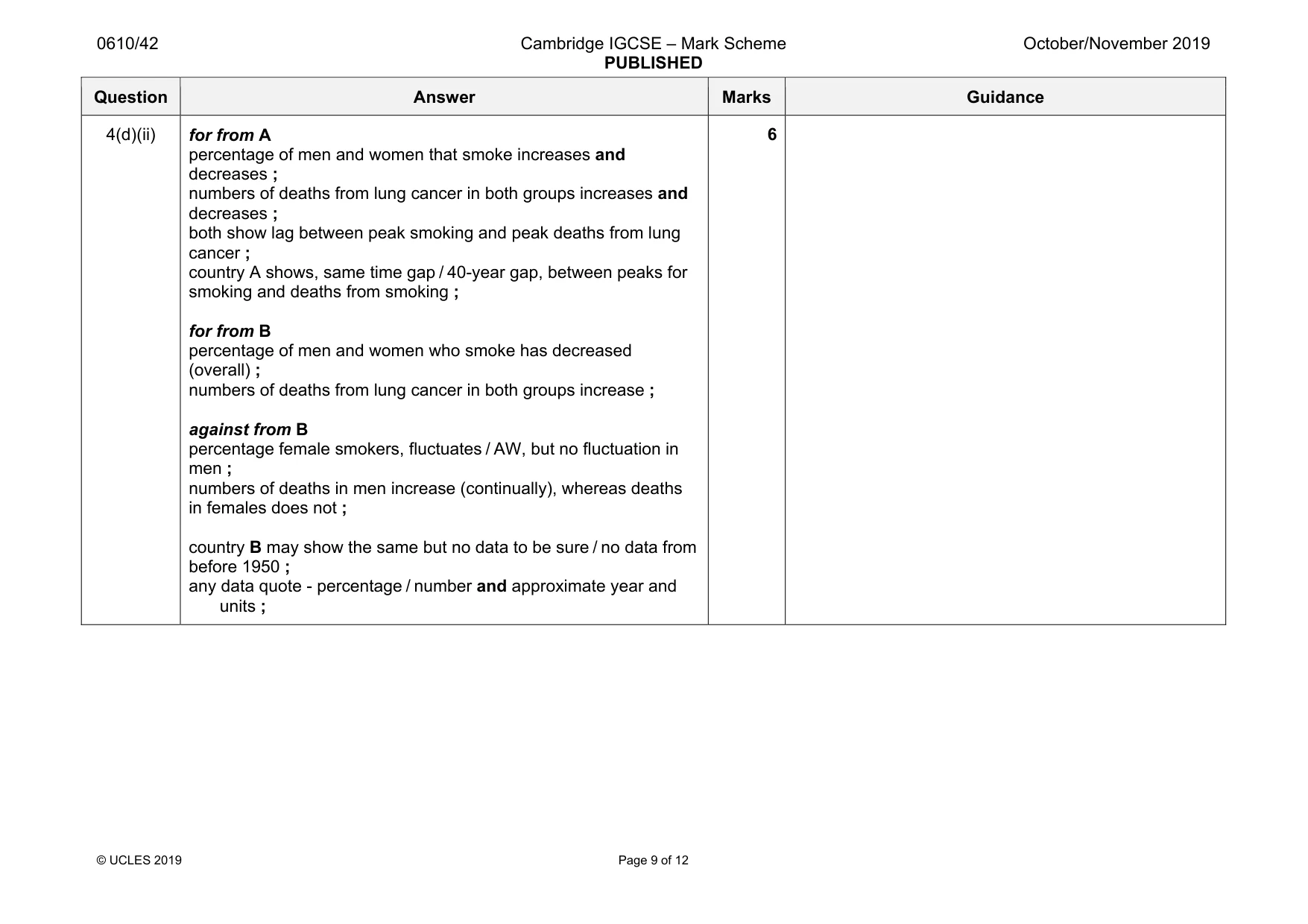
Mark scheme: 4(a) ref. to, mechanical / chemical, barriers ; nasal hairs, trap / filter / AW, pathogens ; mucus traps pathogens / pathogens stick to mucus ; mucus, produced / secreted, by goblet cells ; cilia move mucus (upwards / towards mouth / away from alveoli) ; coughing / sneezing / swallowing ; phagocytes / phagocytosis / described ; 4 4(b) introduces harmless form of pathogen / AW ; ref. to antigen(s) ; stimulates an immune response ; ref to active immunity ; lymphocytes produce antibodies ; (lymphocytes develop into) memory cells ; memory cells, remain in the body / give long-term immunity / can produce antibodies (at a later time) ; respond quickly when an infection (of the same pathogen) occurs / before symptoms occur ; AVP ; 4 4(c) idea that viruses have no antibiotic targets ; viruses, are not alive / are not living / cannot be killed / not cells ; no cell membrane ; no cell wall ; no protein synthesis / no ribosomes ; no metabolism / do not respire ; AVP ; e.g. viruses are inside (host) cells 2 Question Answer Marks Guidance 4(d)(i) percentage of males smoking increases faster than females ; ora more men smoked than women / higher percentage of men smoked (over all the time) ; ora peak for percentage of men smoking occurred earlier ; ora decrease in percentage of men smoking is greater than in females ; ora difference between percentages smoking decreases after peaks ; any comparative use of percentages ; 3 Question Answer Marks Guidance 4(d)(ii) for from A percentage of men and women that smoke increases and decreases ; numbers of deaths from lung cancer in both groups increases and decreases ; both show lag between peak smoking and peak deaths from lung cancer ; country A shows, same time gap / 40-year gap, between peaks for smoking and deaths from smoking ; for from B percentage of men and women who smoke has decreased (overall) ; numbers of deaths from lung cancer in both groups increase ; against from B percentage female smokers, fluctuates / AW, but no fluctuation in men ; numbers of deaths in men increase (continually), whereas deaths in females does not ; country B may show the same but no data to be sure / no data from before 1950 ; any data quote - percentage / number and approximate year and units ; 6
Q5 · Grass plants are wind-pollinated
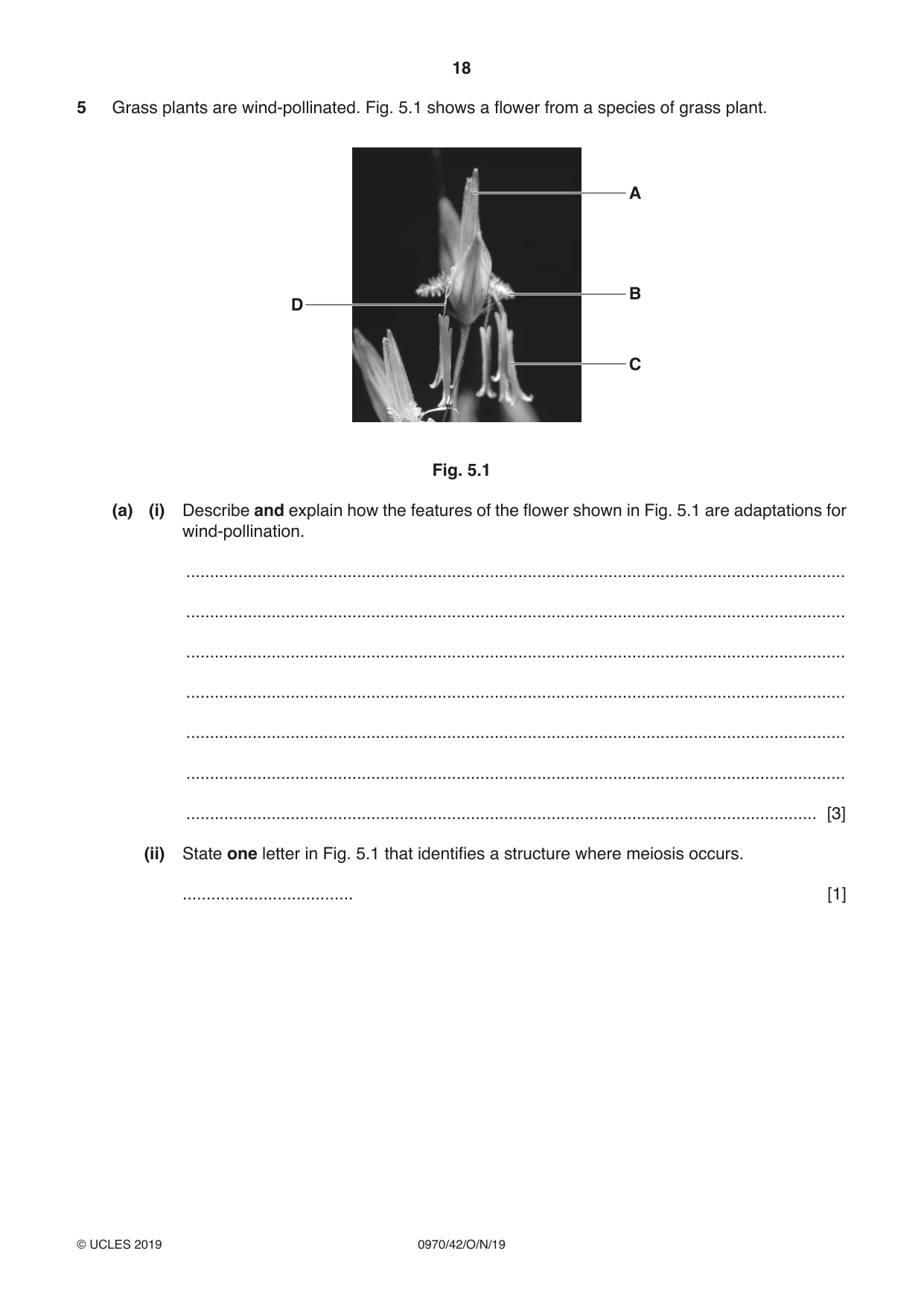
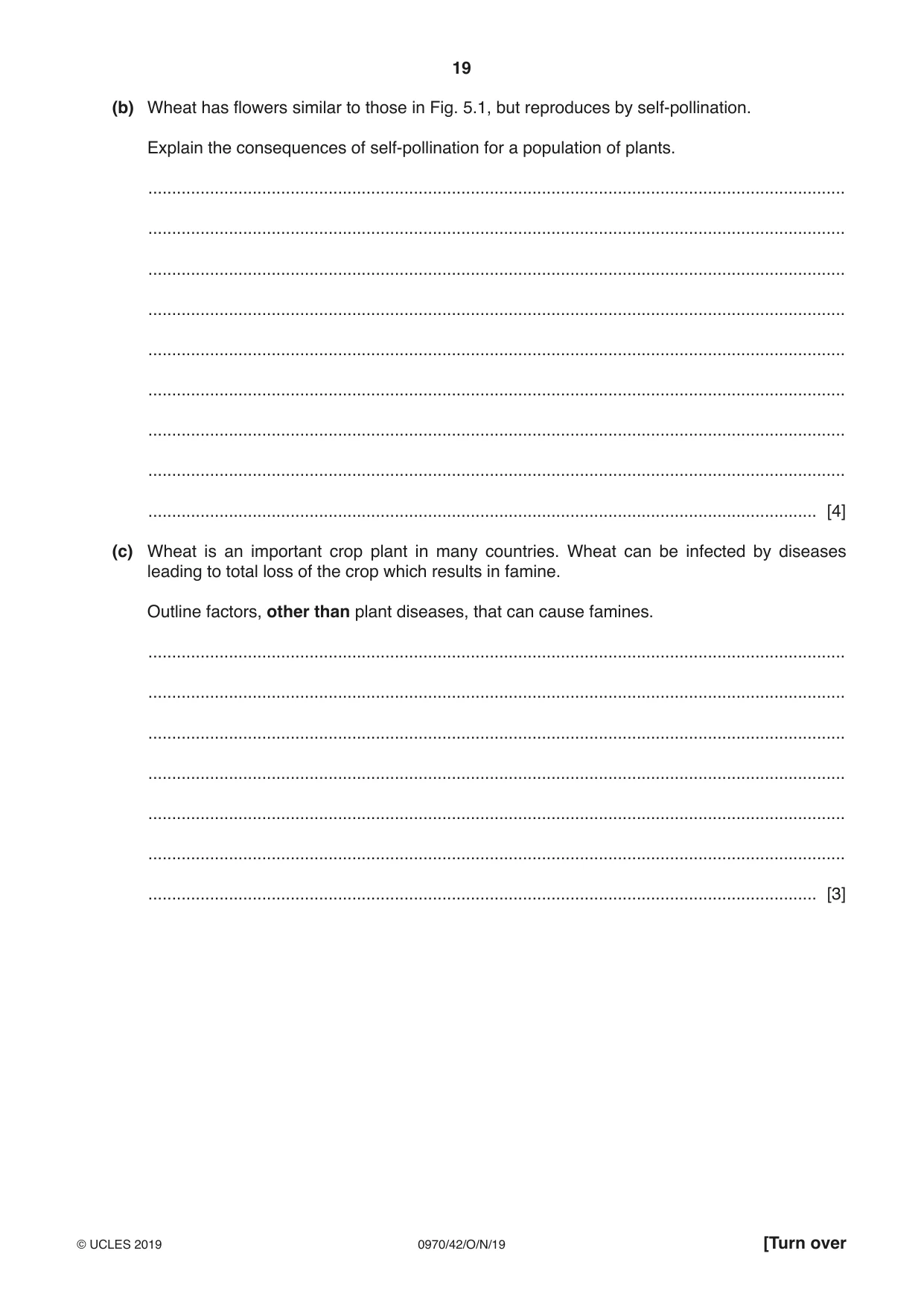
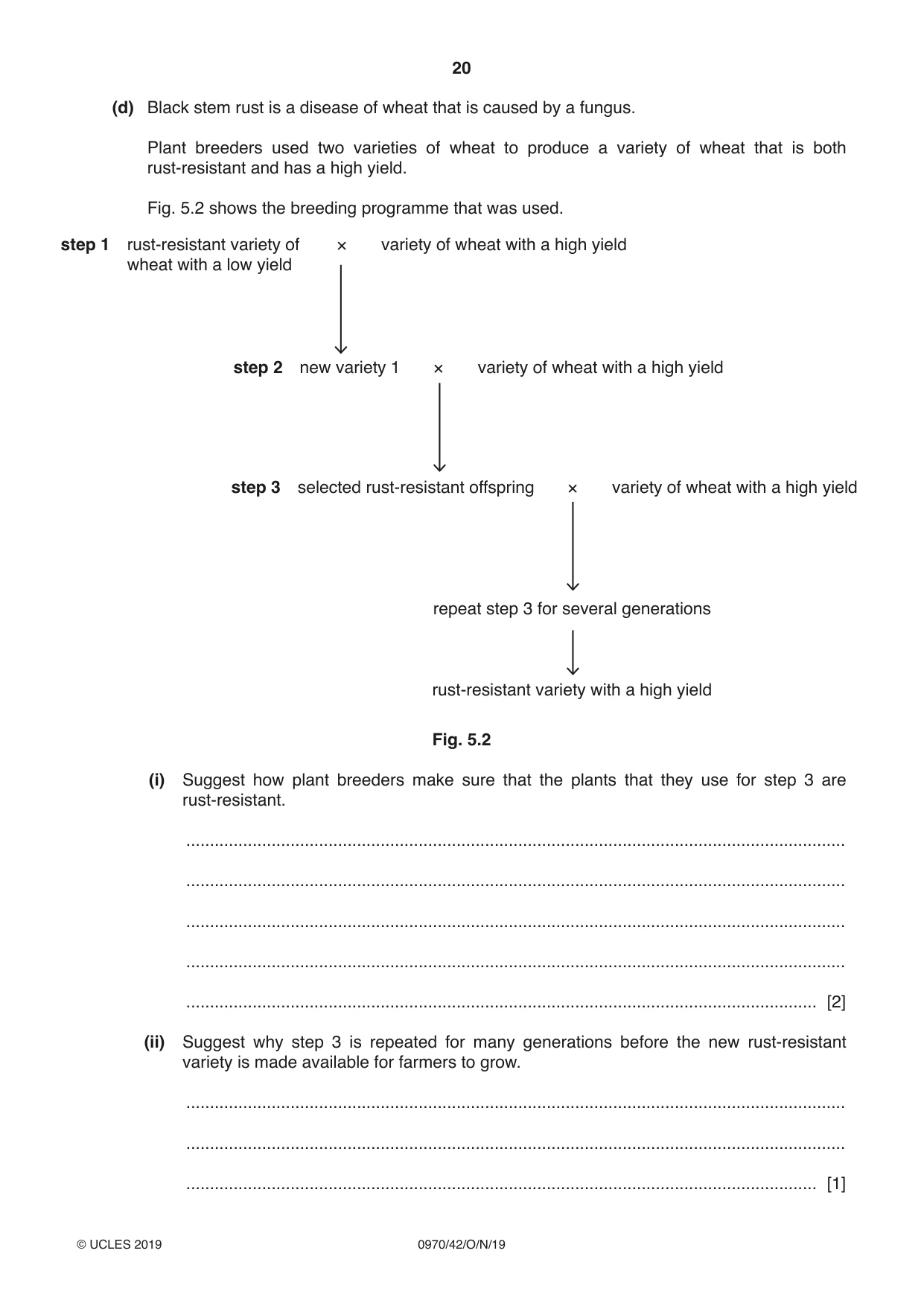
5 Grass plants are wind-pollinated. Fig. 5.1 shows a flower from a species of grass plant. A B D C Fig. 5.1 (a) (i) Describe and explain how the features of the flower shown in Fig. 5.1 are adaptations for wind-pollination. ........................................................................................................................................... ........................................................................................................................................... ........................................................................................................................................... ........................................................................................................................................... ........................................................................................................................................... ........................................................................................................................................... ..................................................................................................................................... [3] (ii) State one letter in Fig. 5.1 that identifies a structure where meiosis occurs. .................................... [1] (b) Wheat has flowers similar to those in Fig. 5.1, but reproduces by self-pollination. Explain the consequences of self-pollination for a population of plants. ................................................................................................................................................... ................................................................................................................................................... ................................................................................................................................................... ................................................................................................................................................... ................................................................................................................................................... ................................................................................................................................................... ................................................................................................................................................... ................................................................................................................................................... ............................................................................................................................................. [4] (c) Wheat is an important crop plant in many countries. Wheat can be infected by diseases leading to total loss of the crop which results in famine. Outline factors, other than plant diseases, that can cause famines. ................................................................................................................................................... ................................................................................................................................................... ................................................................................................................................................... ................................................................................................................................................... ................................................................................................................................................... ................................................................................................................................................... ............................................................................................................................................. [3] (d) Black stem rust is a disease of wheat that is caused by a fungus. Plant breeders used two varieties of wheat to produce a variety of wheat that is both rust-resistant and has a high yield. Fig. 5.2 shows the breeding programme that was used. step 1 rust-resistant variety of × variety of wheat with a high yield wheat with a low yield step 2 new variety 1 × variety of wheat with a high yield step 3 selected rust-resistant offspring × variety of wheat with a high yield repeat step 3 for several generations rust-resistant variety with a high yield Fig. 5.2 (i) Suggest how plant breeders make sure that the plants that they use for step 3 are rust-resistant. ........................................................................................................................................... ........................................................................................................................................... ........................................................................................................................................... ........................................................................................................................................... ..................................................................................................................................... [2] (ii) Suggest why step 3 is repeated for many generations before the new rust-resistant variety is made available for farmers to grow. ........................................................................................................................................... ........................................................................................................................................... ..................................................................................................................................... [1] (e) Wheat plants are monocotyledons. State one feature of monocotyledons that can be used to distinguish them from dicotyledons. ............................................................................................................................................. [1] [Total: 15]
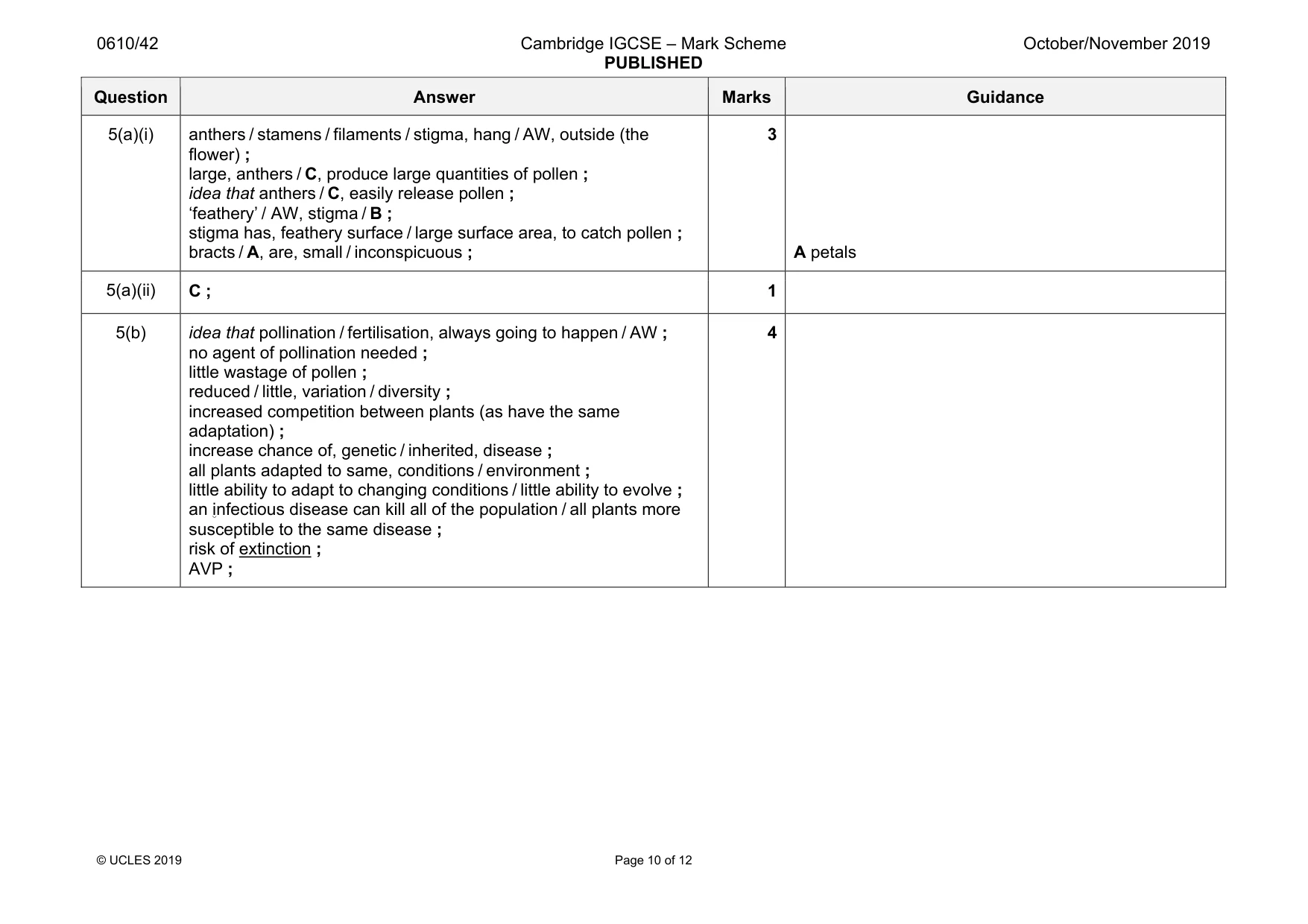
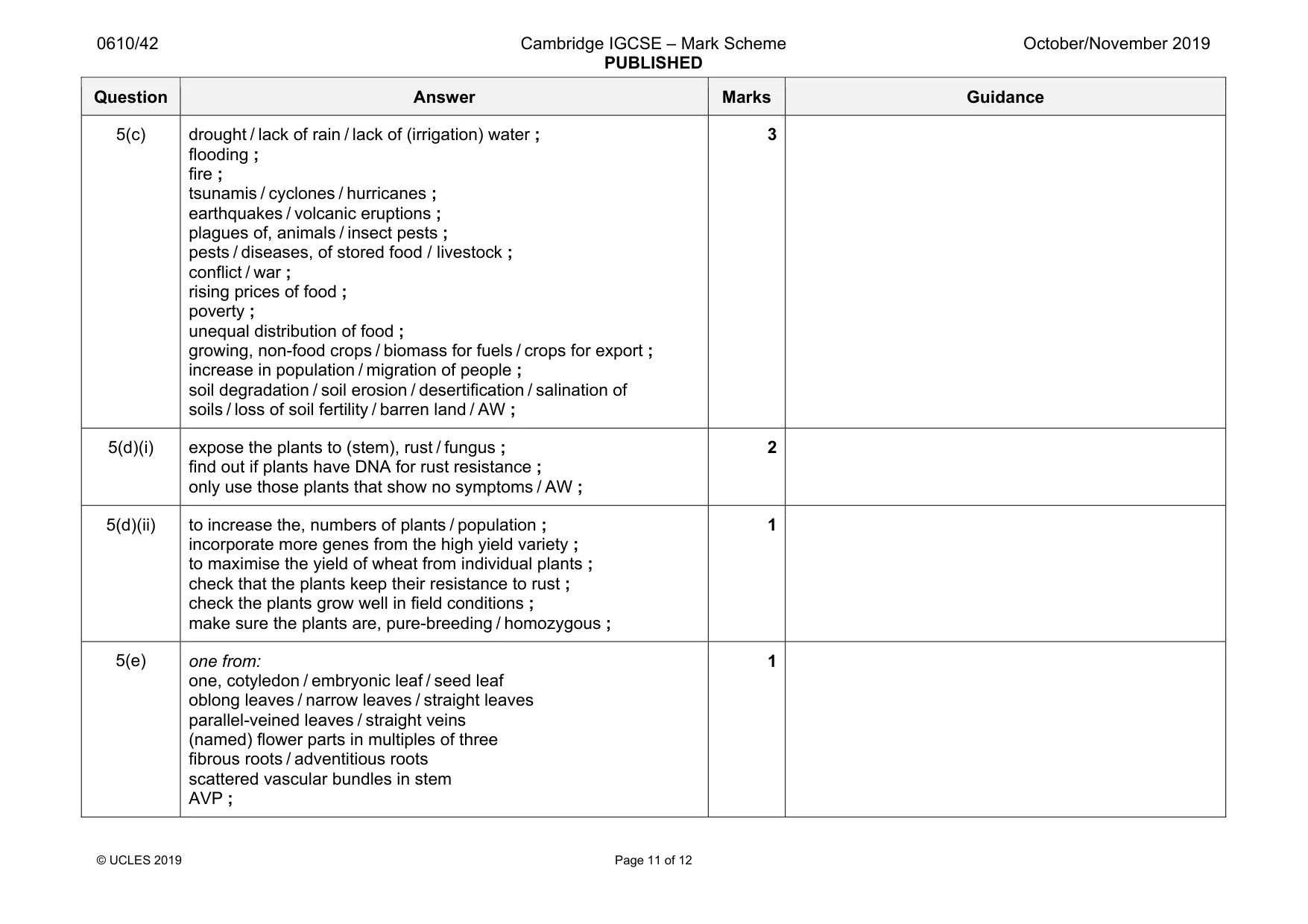
Mark scheme: 5(a)(i) anthers / stamens / filaments / stigma, hang / AW, outside (the flower) ; large, anthers / C, produce large quantities of pollen ; idea that anthers / C, easily release pollen ; ‘feathery’ / AW, stigma / B ; stigma has, feathery surface / large surface area, to catch pollen ; bracts / A, are, small / inconspicuous ; 3 A petals 5(a)(ii) C ; 1 5(b) idea that pollination / fertilisation, always going to happen / AW ; no agent of pollination needed ; little wastage of pollen ; reduced / little, variation / diversity ; increased competition between plants (as have the same adaptation) ; increase chance of, genetic / inherited, disease ; all plants adapted to same, conditions / environment ; little ability to adapt to changing conditions / little ability to evolve ; an infectious disease can kill all of the population / all plants more susceptible to the same disease ; risk of extinction ; AVP ; 4 Question Answer Marks Guidance 5(c) drought / lack of rain / lack of (irrigation) water ; flooding ; fire ; tsunamis / cyclones / hurricanes ; earthquakes / volcanic eruptions ; plagues of, animals / insect pests ; pests / diseases, of stored food / livestock ; conflict / war ; rising prices of food ; poverty ; unequal distribution of food ; growing, non-food crops / biomass for fuels / crops for export ; increase in population / migration of people ; soil degradation / soil erosion / desertification / salination of soils / loss of soil fertility / barren land / AW ; 3 5(d)(i) expose the plants to (stem), rust / fungus ; find out if plants have DNA for rust resistance ; only use those plants that show no symptoms / AW ; 2 5(d)(ii) to increase the, numbers of plants / population ; incorporate more genes from the high yield variety ; to maximise the yield of wheat from individual plants ; check that the plants keep their resistance to rust ; check the plants grow well in field conditions ; make sure the plants are, pure-breeding / homozygous ; 1 5(e) one from: one, cotyledon / embryonic leaf / seed leaf oblong leaves / narrow leaves / straight leaves parallel-veined leaves / straight veins (named) flower parts in multiples of three fibrous roots / adventitious roots scattered vascular bundles in stem AVP ; 1
Q6 · Carbon dioxide forms approximately 0.04% of the atmosphere
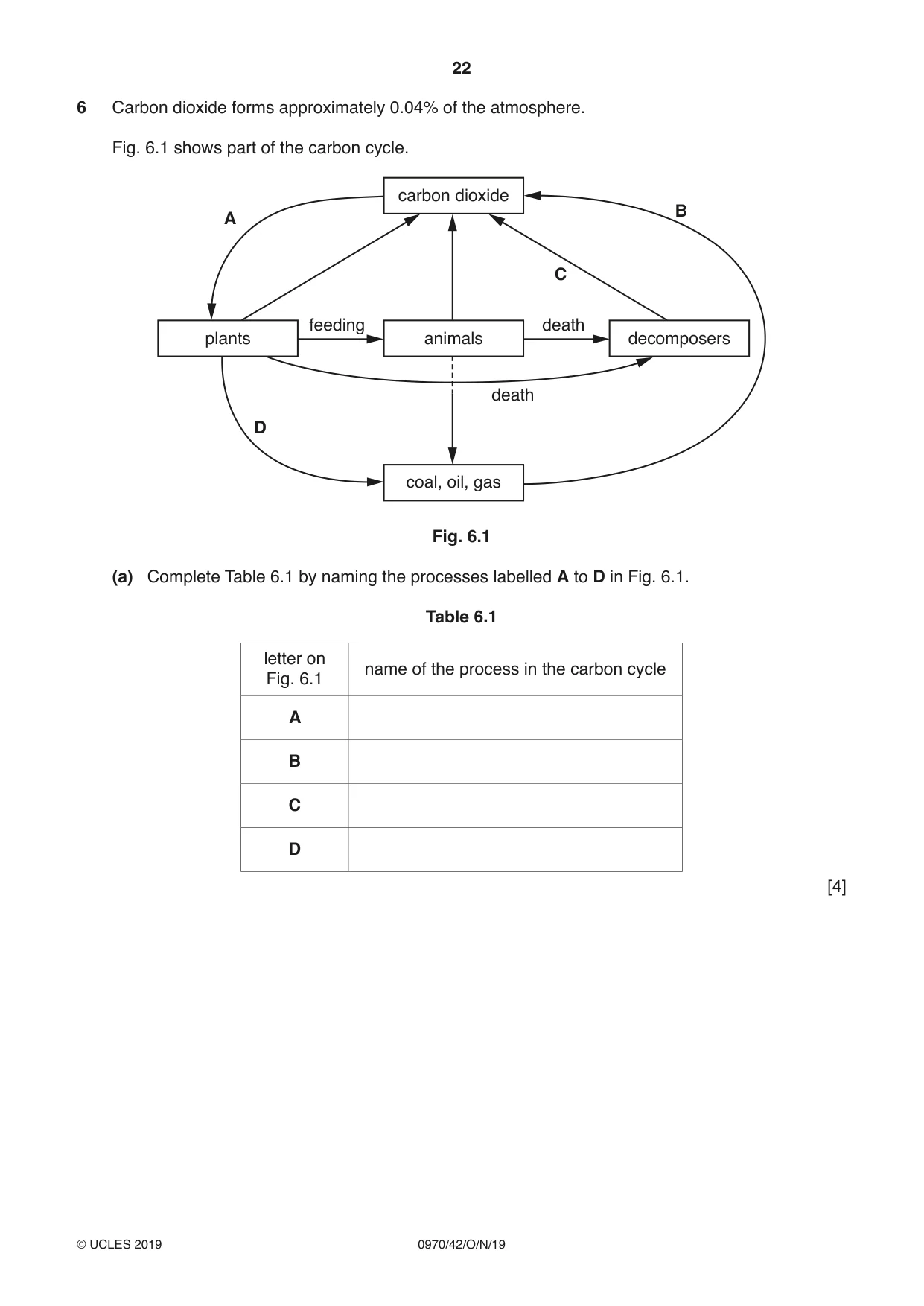
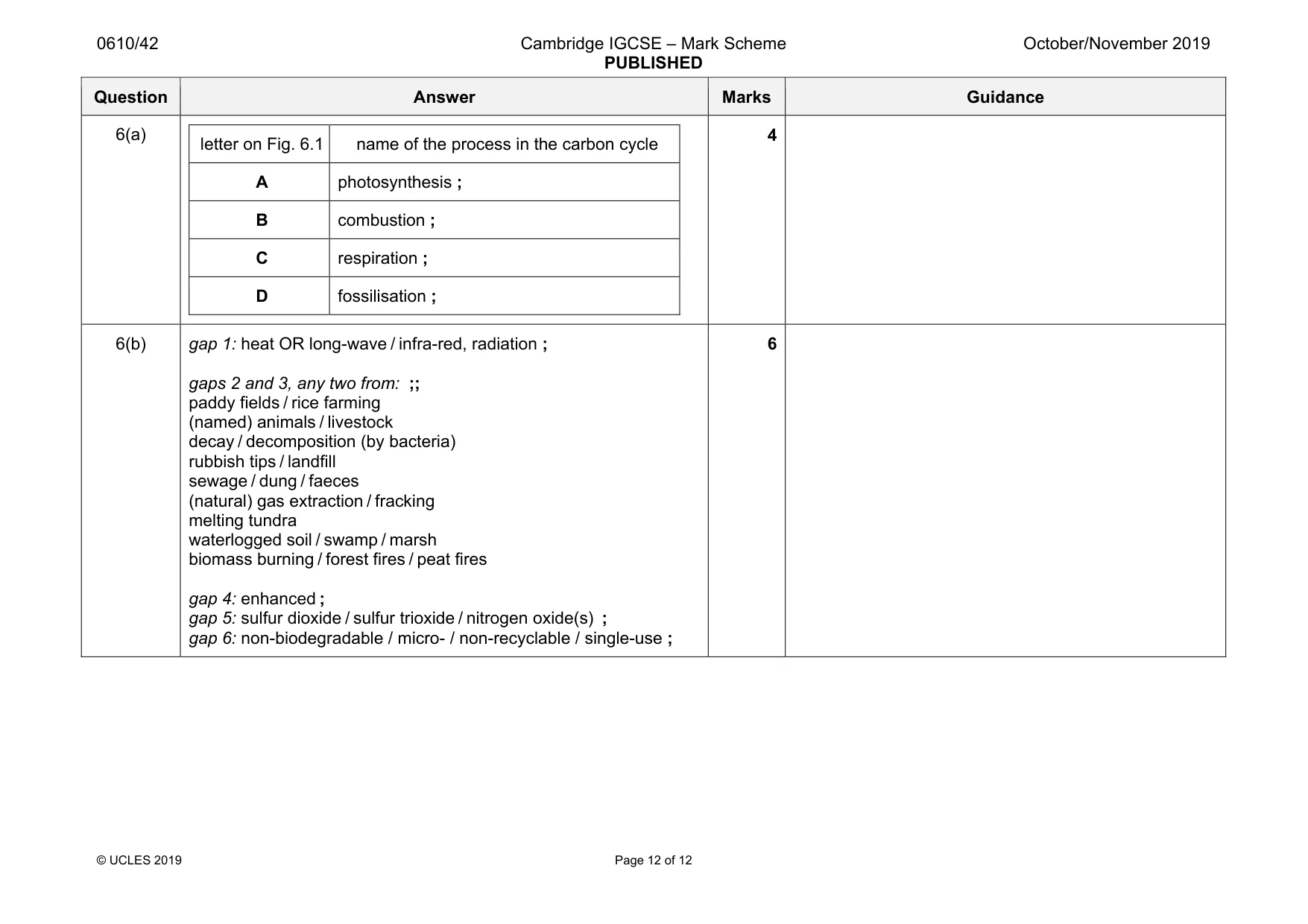
6 Carbon dioxide forms approximately 0.04% of the atmosphere. Fig. 6.1 shows part of the carbon cycle. carbon dioxide B A C feeding death plants animals decomposers death D coal, oil, gas Fig. 6.1 (a) Complete Table 6.1 by naming the processes labelled A to D in Fig. 6.1. Table 6.1 letter on name of the process in the carbon cycle Fig. 6.1 A B C D [4] (b) Complete the sentences by writing the missing words in the spaces. Carbon dioxide is a greenhouse gas. Greenhouse gases trap ................................................. in the atmosphere. Water vapour is the most common greenhouse gas in the atmosphere. Another greenhouse gas is methane which is released from ................................................. and ................................................. . Carbon dioxide and methane released from human activities over the past 200 years have contributed to the ................................................. greenhouse effect. Other atmospheric pollutants can cause acid rain. One of these is ................................................. which is a waste gas from some power stations. One source of pollution in both aquatic and terrestrial ecosystems is ................................................. plastics. [6] [Total: 10]
Mark scheme: 6(a) letter on Fig. 6.1 name of the process in the carbon cycle A photosynthesis ; B combustion ; C respiration ; D fossilisation ; 4 6(b) gap 1: heat OR long-wave / infra-red, radiation ; gaps 2 and 3, any two from: ;; paddy fields / rice farming (named) animals / livestock decay / decomposition (by bacteria) rubbish tips / landfill sewage / dung / faeces (natural) gas extraction / fracking melting tundra waterlogged soil / swamp / marsh biomass burning / forest fires / peat fires gap 4: enhanced ; gap 5: sulfur dioxide / sulfur trioxide / nitrogen oxide(s) ; gap 6: non-biodegradable / micro- / non-recyclable / single-use ; 6
What was in this paper
The subtopics covered by these 6 questions, and how many questions each got. Open one in a new tab to see every Cambridge question on it.
What you needed in this session
Cambridge’s own grade thresholds for 2019 Oct/Nov, Paper 4 · Variant 2. A higher threshold means an easier paper — the bar moves with how the cohort did.