Cambridge IGCSE Arabic - Foreign Language 0544 — 2019 May/June Paper 2 · Variant 2
0544/22/M/J/19 · 45 marks · ≈51 min
The question paper and its mark scheme, free to read here and free to download. This is Cambridge’s own paper, exactly as it was sat.
Question paper16 pages


Mark scheme11 pages
Answers below. Sit the paper first if you are practising.
Paper as text
Question paper, page 1
This document consists of 14 printed pages and 2 blank pages. NL (SW) 167613/3 © UCLES 2019 [Turn over Cambridge Assessment International Education Cambridge International General Certificate of Secondary Education ARABIC 0544/22 Paper 2 Reading May/June 2019 1 hour Candidates answer on the Question Paper. No Additional Materials are required. READ THESE INSTRUCTIONS FIRST Write your centre number, candidate number and name in the spaces at the top of this page. Write in dark blue or black pen. Do not use staples, paper clips, glue or correction fluid. DO NOT WRITE IN ANY BARCODES. Answer all questions. The number of marks is given in brackets [ ] at the end of each question or part question. * 0 9 8 9 9 4 0 8 7 3 *
Question paper, page 2
2 0544/22/M/J/19 © UCLES 2019 BLANK PAGE
Question paper, page 3
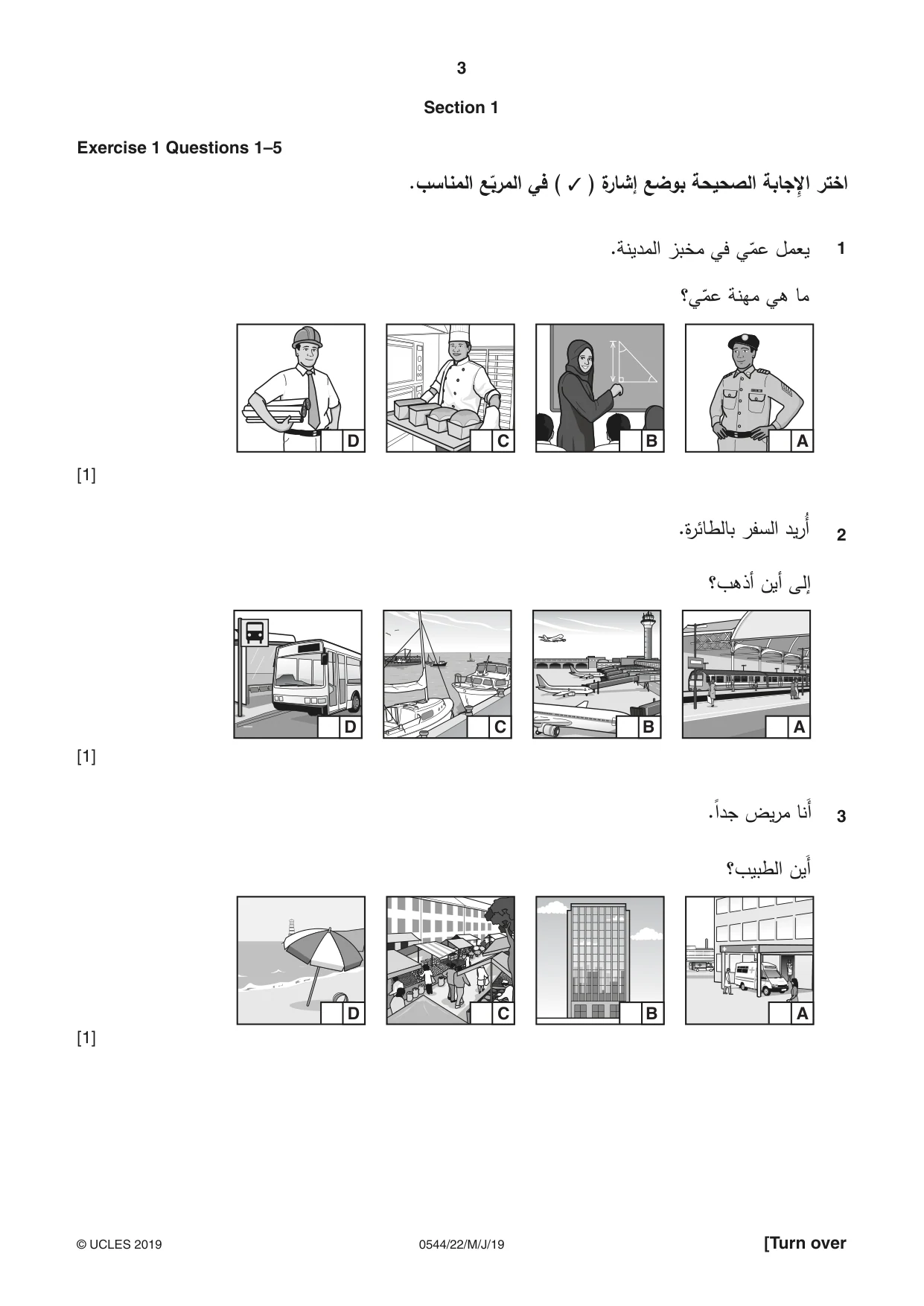
3 0544/22/M/J/19 © UCLES 2019 [Turn over Section 1 Exercise 1 Questions 1–5 1 D C B A [1] 2 D C B A [1] 3 D C B A [1] . ( في المربّع المناسب3 ( اختر اإلِجابة الصحيحة بوضع إشارة يعمل عمّي في مخبز المدينة. ما هي مهنة عمّي؟ أُريد السفر بالطائرة. إلى أين أذهب؟ أَنا مريض جداً. أَين الطبيب؟
Question paper, page 4
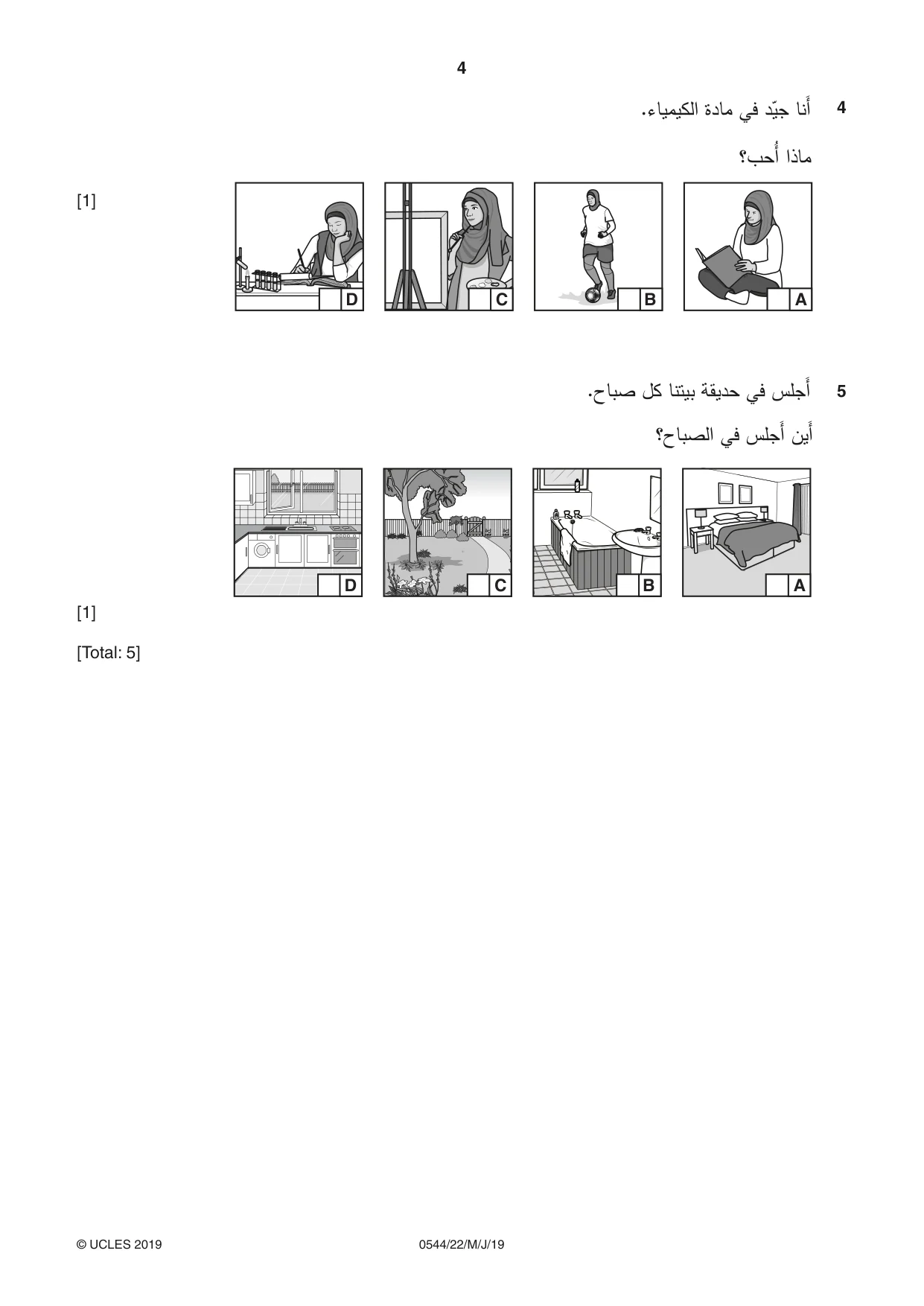
4 0544/22/M/J/19 © UCLES 2019 4 [1] 5 D C B A [1] [Total: 5] .أَنا جيّد في مادة الكيمياء ماذا أُحب؟ أَجلس في حديقة بيتنا كل صباح. أَين أَجلس في الصباح؟ D C B A
Question paper, page 5
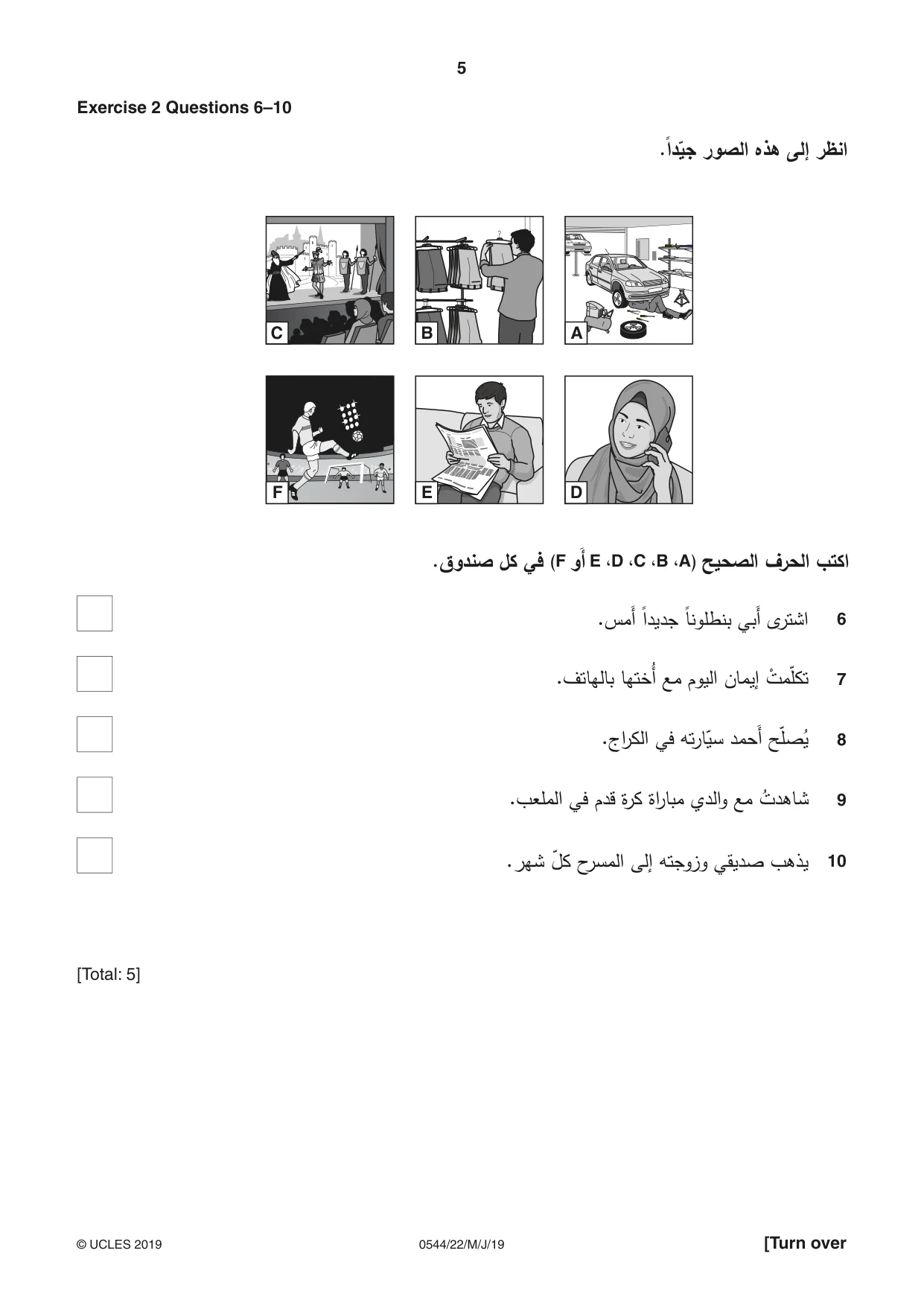
5 0544/22/M/J/19 © UCLES 2019 [Turn over Exercise 2 Questions 6–10 [Total: 5] 6 7 8 9 10 .ًانظر إلى هذه الصور جيّدا اكتب الحرف الصحيح أَو في كل صندوق. (F E ،D ،C ،B ،A) .اشترى أَبي بنطلوناً جديداً أَمس تكلّمتْ إيمان اليوم مع أُختها بالهاتف. يُصلّح أَحمد سيّارته في الكراج. شاهدتُ مع والدي مباراة كرة قدم في الملعب. يذهب صديقي وزوجته إلى المسرح كلّ شهر. C B A E D F
Question paper, page 6
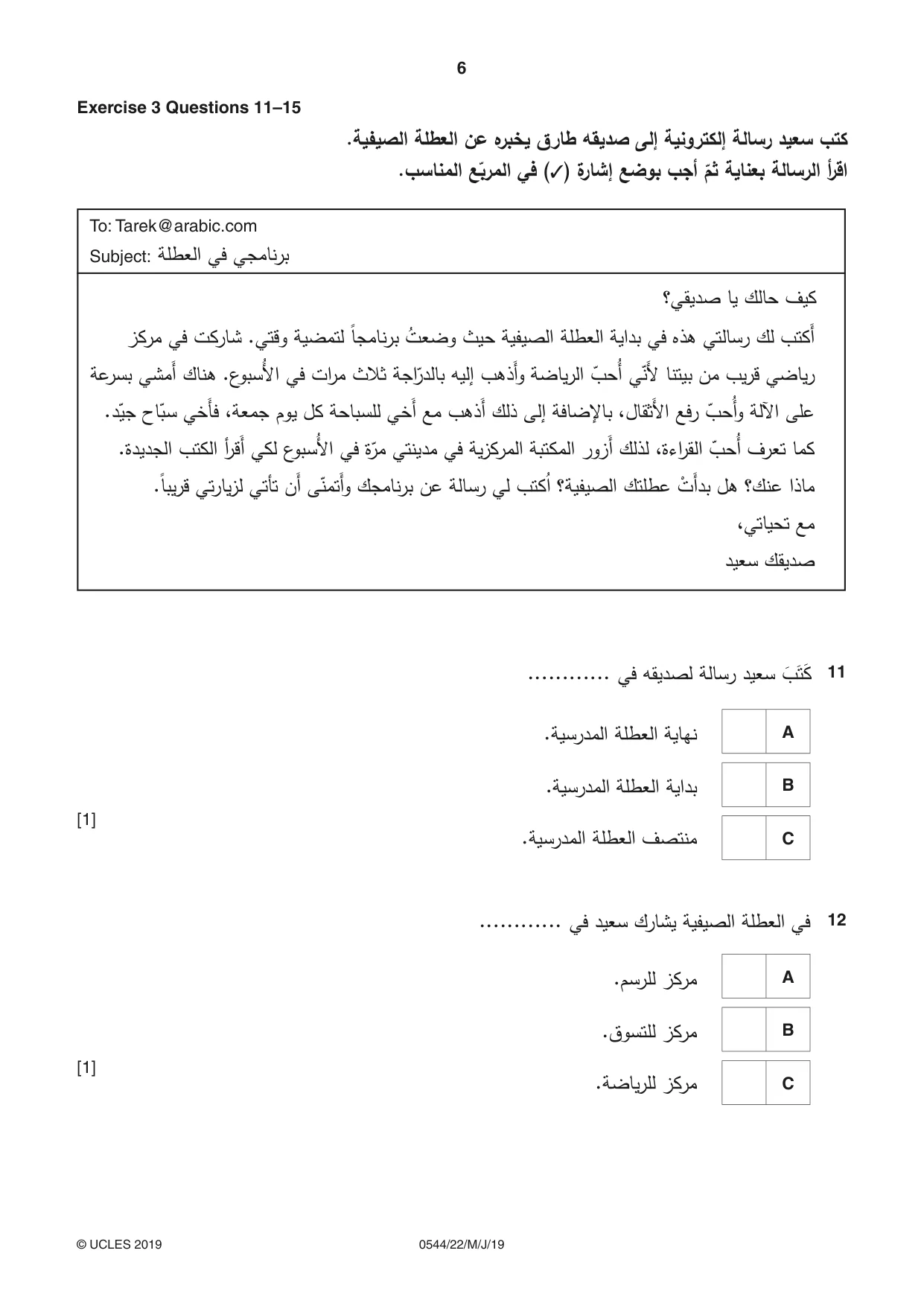
6 0544/22/M/J/19 © UCLES 2019 Exercise 3 Questions 11–15 11 [1] 12 [1] .كتب سعيد رسالة إلكترونية إلى صديقه طارق يخبره عن العطلة الصيفية ( في المربّع المناسب.3( اقرأ الرسالة بعناية ثمّ أجب بوضع إشارة To: Tarek@arabic.com Subject: أَكتب لك رسالتي هذه في بداية العطلة الصيفية حيث وضعتُ برنامجاً لتمضية وقتي. شاركت في مركز رياضي قريب من بيتنا ألَنّي أُحبّ الرياضة وأَذهب إليه بالدرّاجة ثالث مرات في األُسبوع. هناك أَمشي بسرعة على اآللة وأُحبّ رفع األَثقال، باإلضافة إلى ذلك أَذهب مع أَخي للسباحة كل يوم جمعة، فأَخي سبّاح جيّد. كما تعرف أُحبّ القراءة، لذلك أَزور المكتبة المركزية في مدينتي مرّة في األُسبوع لكي أَقرأ الكتب الجديدة. ماذا عنك؟ هل بدأَتْ عطلتك الصيفية؟ اُكتب لي رسالة عن برنامجك وأَتمنّى أَن تأتي لزيارتي قريباً. مع تحياتي، صديقك سعيد كيف حالك يا صديقي؟ A B C A B C … كَتَبَ سعيد رسالة لصديقه في نهاية العطلة المدرسية. بداية العطلة المدرسية. منتصف العطلة المدرسية. في العطلة الصيفية يشارك سعيد في … مركز للرسم. مركز للتسوق. مركز للرياضة. برنامجي في العطلة
Question paper, page 7
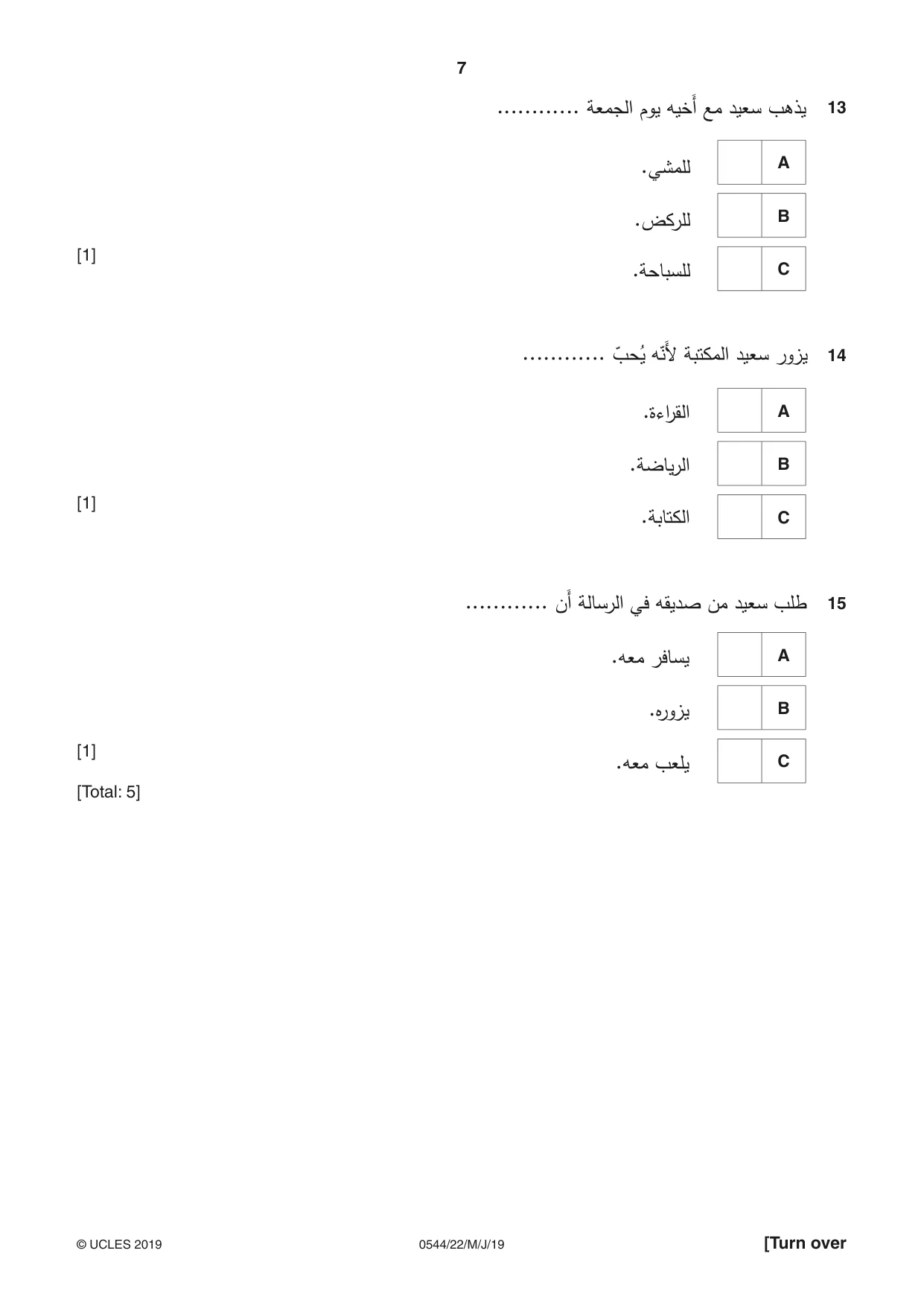
7 0544/22/M/J/19 © UCLES 2019 [Turn over 13 [1] 14 [1] 15 [1] [Total: 5] A B C A B C A B C … يذهب سعيد مع أَخيه يوم الجمعة للمشي. للركض. للسباحة. يزور سعيد المكتبة ألَنّه يُحبّ … القراءة. الرياضة. الكتابة. طلب سعيد من صديقه في الرسالة أَن … يسافر معه. يزوره. يلعب معه.
Question paper, page 8
8 0544/22/M/J/19 © UCLES 2019 2 اقلب الصفحة إلى الجزء
Question paper, page 9
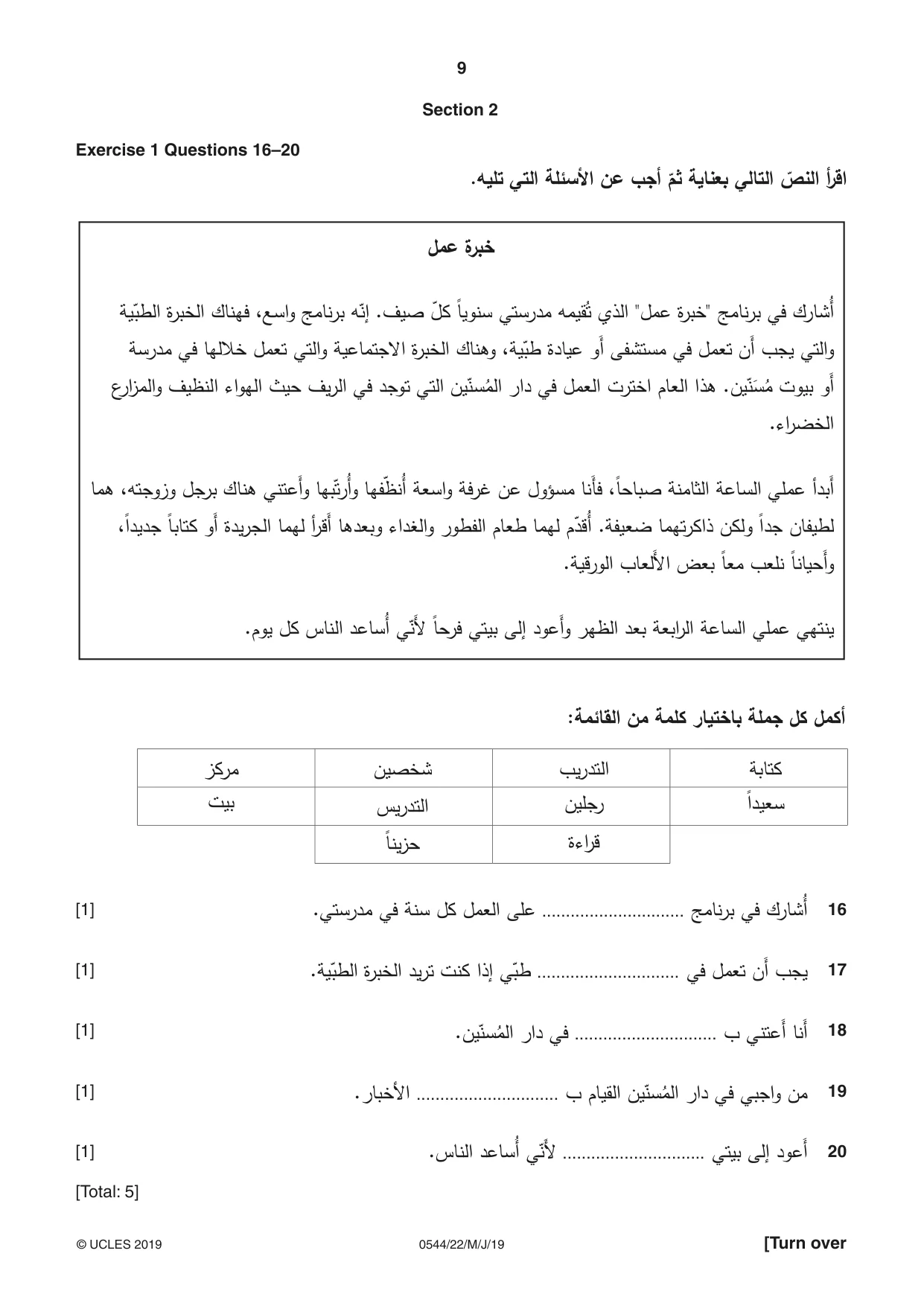
9 0544/22/M/J/19 © UCLES 2019 [Turn over Section 2 Exercise 1 Questions 16–20 خبرة عمل أُشارك في برنامج "خبرة عمل" الذي تُقيمه مدرستي سنوياً كلّ صيف. إنّه برنامج واسع، فهناك الخبرة الطبّية والتي يجب أَن تعمل في مستشفى أَو عيادة طبّية، وهناك الخبرة االجتماعية والتي تعمل خاللها في مدرسة أَو بيوت مُسَنّين. هذا العام اخترت العمل في دار المُسنّين التي توجد في الريف حيث الهواء النظيف والمزارع الخضراء. أَبدأ عملي الساعة الثامنة صباحاً، فأَنا مسؤول عن غرفة واسعة أُنظّفها وأُرتّبها وأَعتني هناك برجل وزوجته، هما لطيفان جداً ولكن ذاكرتهما ضعيفة. أُقدّم لهما طعام الفطور والغداء وبعدها أَقرأ لهما الجريدة أَو كتاباً جديداً، وأَحياناً نلعب معاً بعض األَلعاب الورقية. ينتهي عملي الساعة الرابعة بعد الظهر وأَعود إلى بيتي فرحاً ألَنّي أُساعد الناس كل يوم. اقرأ النصّ التالي بعناية ثمّ أجب عن األسئلة التي تليه. أكمل كل جملة باختيار كلمة من القائمة: مركز بيت شخصين التدريس حزيناً التدريب رجلين قراءة كتابة سعيداً [1] 16 [1] 17 [1] 18 [1] 19 [1] 20 [Total: 5] .أُشارك في برنامج … على العمل كل سنة في مدرستي يجب أَن تعمل في … طبّي إذا كنت تريد الخبرة الطبّية. أَنا أَعتني ب … في دار المُسنّين. من واجبي في دار المُسنّين القيام ب … األخبار. أَعود إلى بيتي … ألَنّي أُساعد الناس.
Question paper, page 10
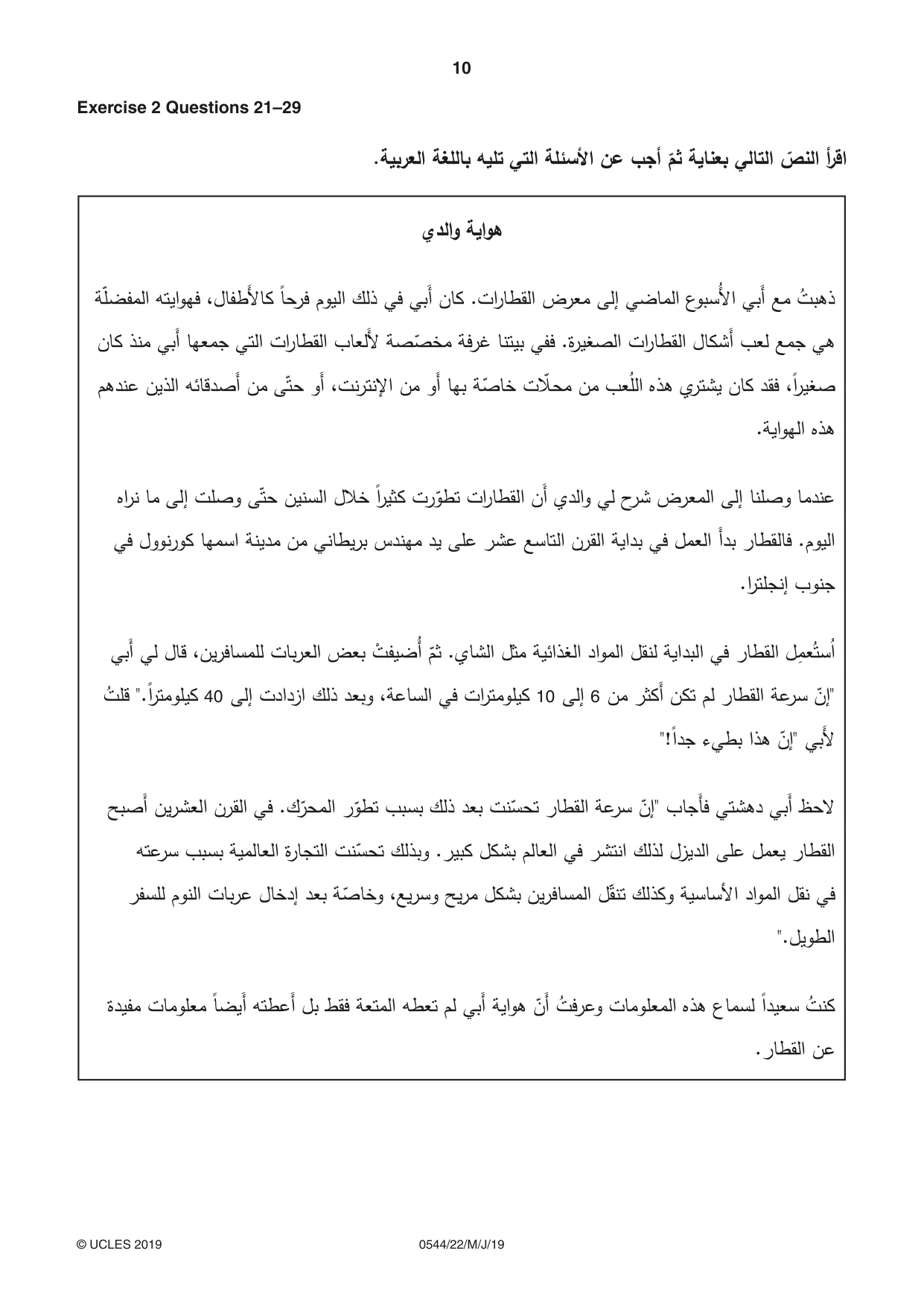
10 0544/22/M/J/19 © UCLES 2019 Exercise 2 Questions 21–29 .اقرأ النصّ التالي بعناية ثمّ أجب عن األسئلة التي تليه باللغة العربية هواية والدي ذهبتُ مع أَبي األُسبوع الماضي إلى معرض القطارات. كان أَبي في ذلك اليوم فرحاً كاألَطفال، فهوايته المفضلّة هي جمع لعب أَشكال القطارات الصغيرة. ففي بيتنا غرفة مخصّصة ألَلعاب القطارات التي جمعها أَبي منذ كان صغيراً، فقد كان يشتري هذه اللُعب من محالّ ت خاصّة بها أَو من اإلنترنت، أَو حتّى من أَصدقائه الذين عندهم هذه الهواية. عندما وصلنا إلى المعرض شرح لي والدي أَن القطارات تطوّرت كثيراً خالل السنين حتّى وصلت إلى ما نراه اليوم. فالقطار بدأَ العمل في بداية القرن التاسع عشر على يد مهندس بريطاني من مدينة اسمها كورنوول في جنوب إنجلترا. اُستُعمِل القطار في البداية لنقل المواد الغذائية مثل الشاي. ثمّ أُضيفتْ بعض العربات للمسافرين، قال لي أَبي كيلومتراً." قلتُ 40 كيلومترات في الساعة، وبعد ذلك ازدادت إلى10 إلى6 "إنّ سرعة القطار لم تكن أَكثر من ألَبي "إنّ هذا بطيء جداً!" الحظ أَبي دهشتي فأَجاب "إنّ سرعة القطار تحسّنت بعد ذلك بسبب تطوّر المحرّك. في القرن العشرين أَصبح القطار يعمل على الديزل لذلك انتشر في العالم بشكل كبير. وبذلك تحسّنت التجارة العالمية بسبب سرعته في نقل المواد األساسية وكذلك تنقّل المسافرين بشكل مريح وسريع، وخاصّة بعد إدخال عربات النوم للسفر الطويل." كنتُ سعيداً لسماع هذه المعلومات وعرفتُ أَنّ هواية أَبي لم تعطه المتعة فقط بل أَعطته أَيضاً معلومات مفيدة عن القطار.
Question paper, page 11
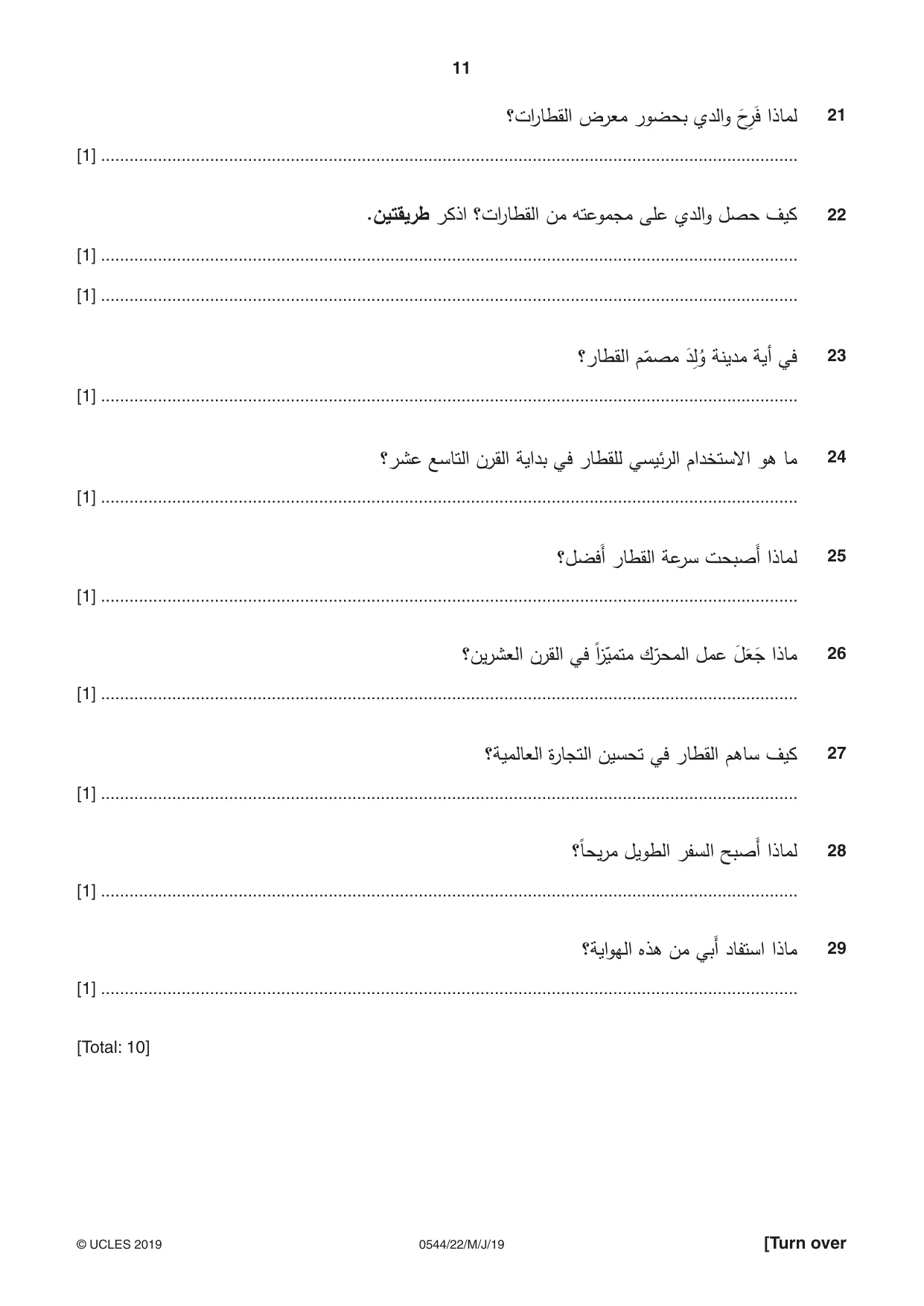
11 0544/22/M/J/19 © UCLES 2019 [Turn over 21 [1] … 22 [1] … [1] … 23 [1] … 24 [1] … 25 [1] … 26 [1] … 27 [1] … 28 [1] … 29 [1] … [Total: 10] لماذا فَرِحَ والدي بحضور معرض القطارات؟ كيف حصل والدي على مجموعته من القطارات؟ اذكر طريقتين. في أية مدينة وُلِدَ مصمّم القطار؟ ما هو االستخدام الرئيسي للقطار في بداية القرن التاسع عشر؟ لماذا أَصبحت سرعة القطار أَفضل؟ ماذا جَعَلَ عمل المحرّك متميّزاً في القرن العشرين؟ كيف ساهم القطار في تحسين التجارة العالمية؟ لماذا أَصبح السفر الطويل مريحاً؟ ماذا استفاد أَبي من هذه الهواية؟
Question paper, page 12
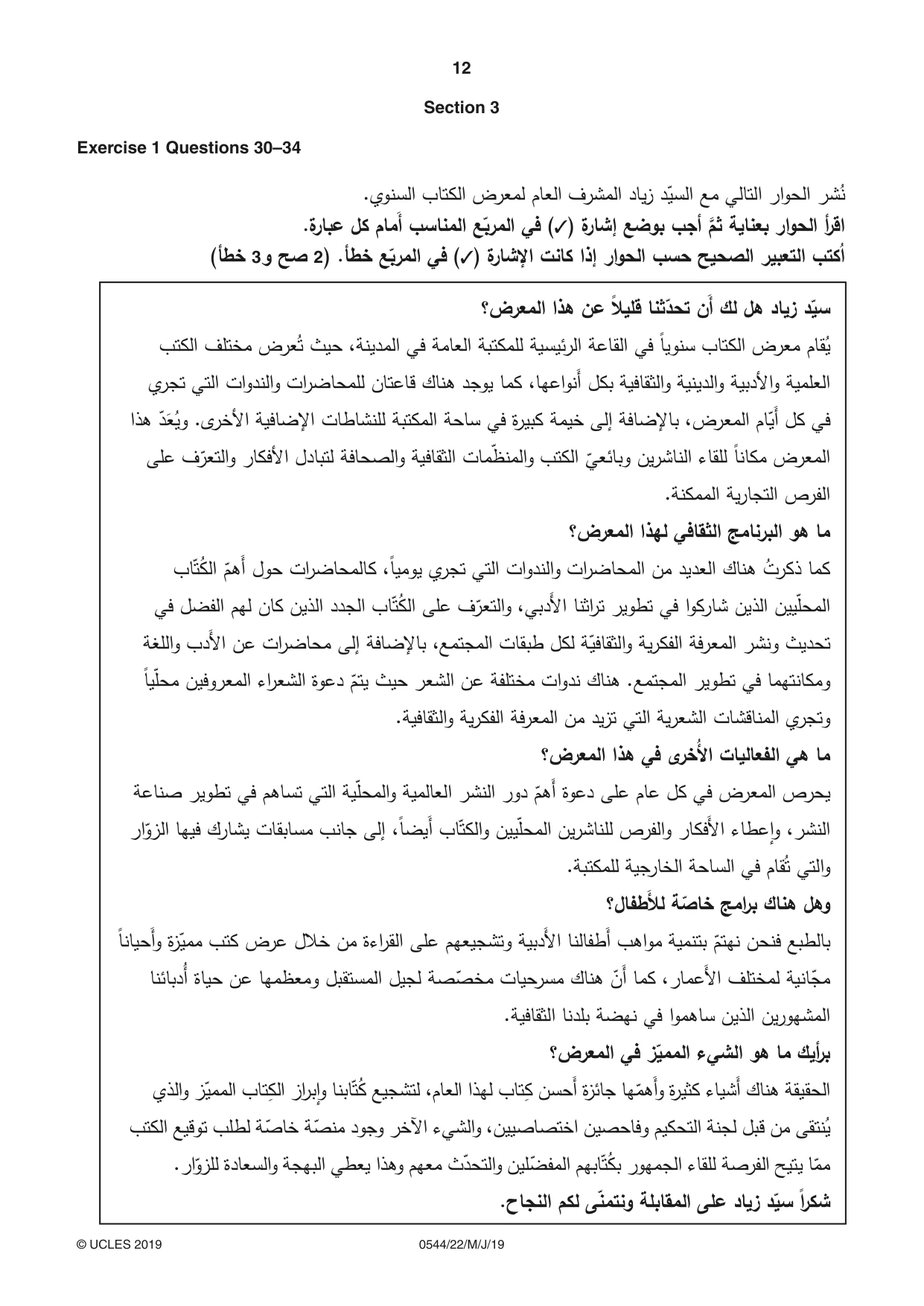
12 0544/22/M/J/19 © UCLES 2019 Section 3 Exercise 1 Questions 30–34 .نُشر الحوار التالي مع السيّد زياد المشرف العام لمعرض الكتاب السنوي ( في المربّع المناسب أَمام كل عبارة.3( اقرأ الحوار بعناية ثمَّ أجب بوضع إشارة خطأ(3 صح و2( .( في المربّع خطأ3( اُكتب التعبير الصحيح حسب الحوار إذا كانت اإلشارة سيّد زياد هل لك أَن تحدّثنا قليالً عن هذا المعرض؟ يُقام معرض الكتاب سنوياً في القاعة الرئيسية للمكتبة العامة في المدينة، حيث تُعرض مختلف الكتب العلمية واألدبية والدينية والثقافية بكل أَنواعها، كما يوجد هناك قاعتان للمحاضرات والندوات التي تجري في كل أَيّام المعرض، باإلضافة إلى خيمة كبيرة في ساحة المكتبة للنشاطات اإلضافية األخرى. ويُعَدّ هذا المعرض مكاناً للقاء الناشرين وبائعيّ الكتب والمنظّمات الثقافية والصحافة لتبادل األفكار والتعرّف على الفرص التجارية الممكنة. ما هو البرنامج الثقافي لهذا المعرض؟ كما ذكرتُ هناك العديد من المحاضرات والندوات التي تجري يومياً، كالمحاضرات حول أَهمّ الكُتّاب المحلّيين الذين شاركوا في تطوير تراثنا األَدبي، والتعرّف على الكُتّاب الجدد الذين كان لهم الفضل في تحديث ونشر المعرفة الفكرية والثقافيّة لكل طبقات المجتمع، باإلضافة إلى محاضرات عن األَدب واللغة ومكانتهما في تطوير المجتمع. هناك ندوات مختلفة عن الشعر حيث يتمّ دعوة الشعراء المعروفين محلّياً وتجري المناقشات الشعرية التي تزيد من المعرفة الفكرية والثقافية. ما هي الفعاليات األُخرى في هذا المعرض؟ يحرص المعرض في كل عام على دعوة أَهمّ دور النشر العالمية والمحلّية التي تساهم في تطوير صناعة النشر، واإعطاء األَفكار والفرص للناشرين المحلّيين والكتّاب أَيضاً، إلى جانب مسابقات يشارك فيها الزوّار والتي تُقام في الساحة الخارجية للمكتبة. وهل هناك برامج خاصّة لألَطفال؟ بالطبع فنحن نهتمّ بتنمية مواهب أَطفالنا األَدبية وتشجيعهم على القراءة من خالل عرض كتب مميّزة وأَحياناً مجّانية لمختلف األَعمار، كما أَنّ هناك مسرحيات مخصّصة لجيل المستقبل ومعظمها عن حياة أُدبائنا المشهورين الذين ساهموا في نهضة بلدنا الثقافية. برأيك ما هو الشيء المميّز في المعرض؟ الحقيقة هناك أَشياء كثيرة وأَهمّها جائزة أَحسن كِتاب لهذا العام، لتشجيع كُتّابنا واإبراز الكِتاب المميّز والذي يُنتقى من قبل لجنة التحكيم وفاحصين اختصاصيين، والشيء اآلخر وجود منصّة خاصّة لطلب توقيع الكتب ممّا يتيح الفرصة للقاء الجمهور بكُتّابهم المفضّلين والتحدّث معهم وهذا يعطي البهجة والسعادة للزوّار. شكراً سيّد زياد على المقابلة ونتمنّى لكم النجاح.
Question paper, page 13
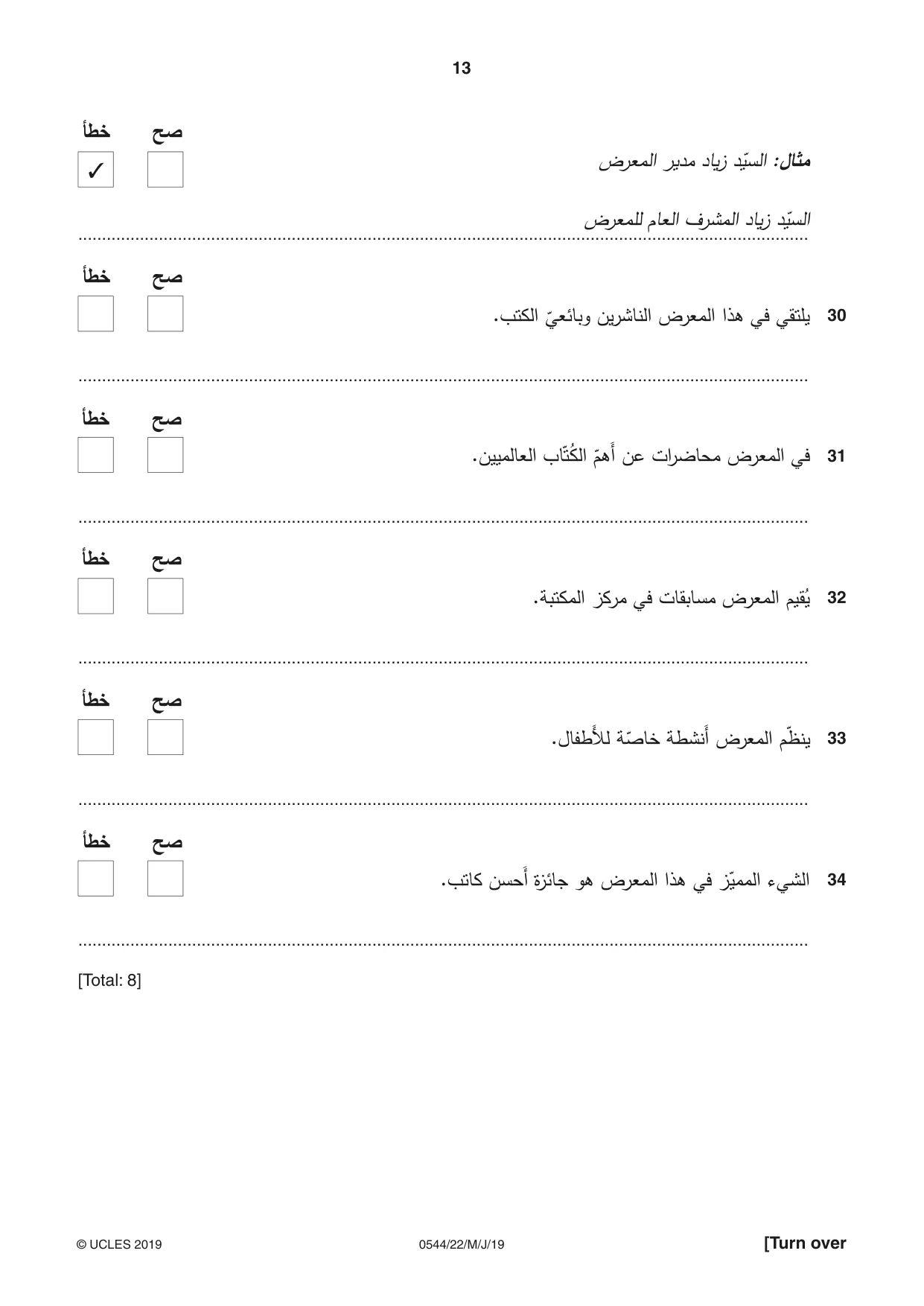
13 0544/22/M/J/19 © UCLES 2019 [Turn over 3 … 30 … 31 … 32 … 33 … 34 … [Total: 8] مثال: السيّد زياد مدير المعرض السيّد زياد المشرف العام للمعرض صح خطأ صح خطأ صح خطأ صح خطأ صح خطأ صح خطأ يلتقي في هذا المعرض الناشرين وبائعيّ الكتب. في المعرض محاضرات عن أَهمّ الكُتّاب العالميين. يُقيم المعرض مسابقات في مركز المكتبة. ينظّم المعرض أَنشطة خاصّة لألَطفال. الشيء المميّز في هذا المعرض هو جائزة أَحسن كاتب.
Question paper, page 14
14 0544/22/M/J/19 © UCLES 2019 Exercise 2 Questions 35–40 .اقرأ النصّ التالي بعناية ثمَّ أَجب عن األَسئلة التي تليه باللغة العربية سباق الهِجن سباق الهجن هو رياضة عربية أَصيلة وتقليد قديم عند البدو الذين كانوا ومازالوا ينظّمون هذه السباقات وتشارك فيها آالف الهجن وسط الصحراء. تشتهر هذه الرياضة بين العرب وخاصّة في منطقة الجزيرة العربية وكذلك في أفريقيا وأستراليا. والهجن نوع من الجِمال تُستخدم للرياضة والركوب، وتحرص الكثير من الدول على إقامة هذا السباق بانتظام وتنظيم المهرجانات واالحتفاالت الشعبية. رياضة الهجن هي رياضة توارثتها األَجيال على مرّ العصور واألَزمان ويصفها الكثيرون بأَنّها الرياضة القديمة الحديثة أَو رياضة األَجداد التي تُثير الحماس والتنافس بين الشباب في العصر الحديث. تختلف ميادين السباق من بلد إلى آخر من ناحية الشكل، فقد تكون على شكل مستقيم أَو بيضوي أَو دائري. وهناك منصّة للمشاهدين تمكّنهم من متابعة السباق في مراحله المختلفة. قبل السباق يُحضّر المدرِّبون جِمالهم لعدّة أَسابيع للتأَكّد من أَنّ جِمالهم في حالة جيّدة وقادرة على المشاركة في هذا السباق المهمّ. يحرص المدرِّبون كذلك على إعطاء الجِمال غذاءً متكامالً لبناء عضالتها ولكن قبل السباق بأَيّام قليلة ال يُعطي المدرِّبون جِمالهم الكثير من الطعام ألَنّ الجِمال تزيد سرعتها عندما تكون معدتها فارغة. كليومتراً 64 رياضة سباق الهجن تشبه رياضة سباق الخيل إلى حد كبير إالّ أَنّ سرعة الجمل ال تتعدّى كليومتراً في الساعة. أَمّا بالنسبة إلى مسافة سباق الخيل فهي 88 في الساعة بينما تصل سرعة الخيل إلى أَقصر مسافةً بشكل عام. إنّ الجِمال التي تشارك في سباق الهجن لها رقبة طويلة وأكتاف وأَرجُل قوية، وال يزيد وزن الواحدة منها عن كليوغرام، مّما يجعلها تتميّز بنحافة الجسم والرشاقة وخِفّة الحركة وسرعة الجري والقدرة على 600 إلى500 .التحمّل واالستجابة للتدريب يتمّ تدريب الهجن على أَربع مراحل وتهدف المراحل الثالث األُولى إلى ترويض الهجن وتعويدها للخضوع لألوامر. أَمّا في المرحلة الرابعة يتمّ تدريب الهجن على الجري السريع، ويحصل الفائزون على جوائز قيّمة منها السيارات والمبالغ النقدية. كما سبق الذكر، إنّ سباق الهجن هو رياضة مرغوبة لما فيها من التمرين على الفروسية والشجاعة مارسها األَجداد وأَحبّها األبناء وتحمّس لها األَحفاد.
Question paper, page 15
15 0544/22/M/J/19 © UCLES 2019 35 [1] … 36 [1] … 37 [1] … 38 [1] … 39 [1] … 40 … [2] … [Total: 7] مَن بَدَأَ بتنظيم سباق الهجن بين العرب؟ كيف تختلف ميادين سباق الهجن بين البلدان؟ كيف يحضّر المدرِّبون جِمالهم لزيادة سرعتها قبل السباق؟ ما هو الفرق بين سباق الهجن وسباق الخيل من حيث المسافة؟ لماذا تتميّز الجِمال المشاركة في السباق بنحافة الجسم والرشاقة؟ لماذا يُعدّ سباق الهجن رياضة مرغوب فيها؟ اُذكر نقطتين.
Question paper, page 16
16 0544/22/M/J/19 © UCLES 2019 BLANK PAGE Permission to reproduce items where third-party owned material protected by copyright is included has been sought and cleared where possible. Every reasonable effort has been made by the publisher (UCLES) to trace copyright holders, but if any items requiring clearance have unwittingly been included, the publisher will be pleased to make amends at the earliest possible opportunity. To avoid the issue of disclosure of answer-related information to candidates, all copyright acknowledgements are reproduced online in the Cambridge Assessment International Education Copyright Acknowledgements Booklet. This is produced for each series of examinations and is freely available to download at www.cambridgeinternational.org after the live examination series. Cambridge Assessment International Education is part of the Cambridge Assessment Group. Cambridge Assessment is the brand name of the University of Cambridge Local Examinations Syndicate (UCLES), which itself is a department of the University of Cambridge.
Mark scheme, page 1
This document consists of 11 printed pages. © UCLES 2019 [Turn over Cambridge Assessment International Education Cambridge International General Certificate of Secondary Education ARABIC 0544/22 Paper 2 Reading May/June 2019 MARK SCHEME Maximum Mark: 45 Published This mark scheme is published as an aid to teachers and candidates, to indicate the requirements of the examination. It shows the basis on which Examiners were instructed to award marks. It does not indicate the details of the discussions that took place at an Examiners’ meeting before marking began, which would have considered the acceptability of alternative answers. Mark schemes should be read in conjunction with the question paper and the Principal Examiner Report for Teachers. Cambridge International will not enter into discussions about these mark schemes. Cambridge International is publishing the mark schemes for the May/June 2019 series for most Cambridge IGCSE™, Cambridge International A and AS Level and Cambridge Pre-U components, and some Cambridge O Level components.
Mark scheme, page 2
0544/22 Cambridge IGCSE – Mark Scheme PUBLISHED May/June 2019 © UCLES 2019 Page 2 of 11 Generic Marking Principles These general marking principles must be applied by all examiners when marking candidate answers. They should be applied alongside the specific content of the mark scheme or generic level descriptors for a question. Each question paper and mark scheme will also comply with these marking principles. GENERIC MARKING PRINCIPLE 1: Marks must be awarded in line with: • the specific content of the mark scheme or the generic level descriptors for the question • the specific skills defined in the mark scheme or in the generic level descriptors for the question • the standard of response required by a candidate as exemplified by the standardisation scripts. GENERIC MARKING PRINCIPLE 2: Marks awarded are always whole marks (not half marks, or other fractions). GENERIC MARKING PRINCIPLE 3: Marks must be awarded positively: • marks are awarded for correct/valid answers, as defined in the mark scheme. However, credit is given for valid answers which go beyond the scope of the syllabus and mark scheme, referring to your Team Leader as appropriate • marks are awarded when candidates clearly demonstrate what they know and can do • marks are not deducted for errors • marks are not deducted for omissions • answers should only be judged on the quality of spelling, punctuation and grammar when these features are specifically assessed by the question as indicated by the mark scheme. The meaning, however, should be unambiguous. GENERIC MARKING PRINCIPLE 4: Rules must be applied consistently e.g. in situations where candidates have not followed instructions or in the application of generic level descriptors. GENERIC MARKING PRINCIPLE 5: Marks should be awarded using the full range of marks defined in the mark scheme for the question (however; the use of the full mark range may be limited according to the quality of the candidate responses seen). GENERIC MARKING PRINCIPLE 6: Marks awarded are based solely on the requirements as defined in the mark scheme. Marks should not be awarded with grade thresholds or grade descriptors in mind.
Mark scheme, page 3
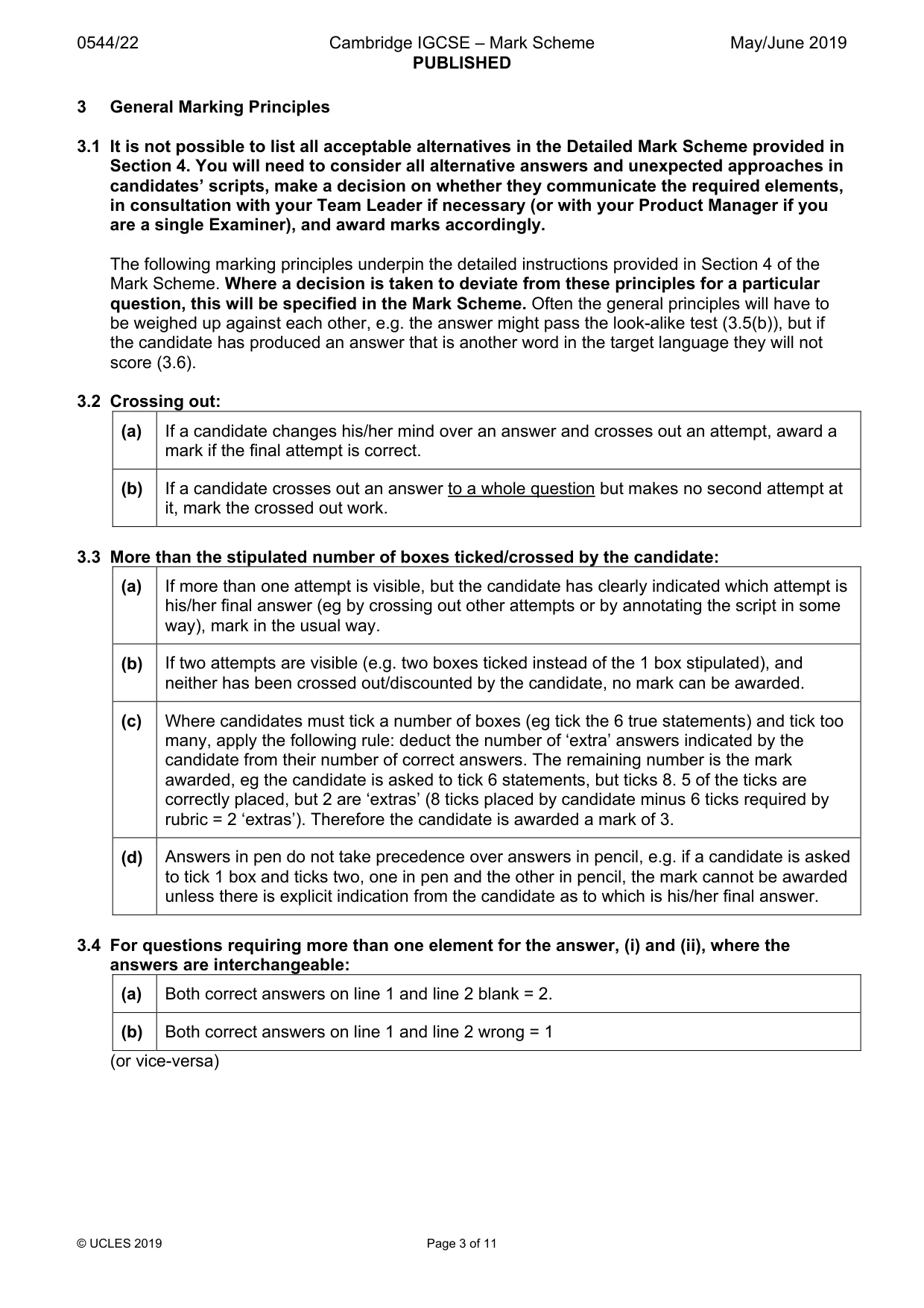
0544/22 Cambridge IGCSE – Mark Scheme PUBLISHED May/June 2019 © UCLES 2019 Page 3 of 11 3 General Marking Principles 3.1 It is not possible to list all acceptable alternatives in the Detailed Mark Scheme provided in Section 4. You will need to consider all alternative answers and unexpected approaches in candidates’ scripts, make a decision on whether they communicate the required elements, in consultation with your Team Leader if necessary (or with your Product Manager if you are a single Examiner), and award marks accordingly. The following marking principles underpin the detailed instructions provided in Section 4 of the Mark Scheme. Where a decision is taken to deviate from these principles for a particular question, this will be specified in the Mark Scheme. Often the general principles will have to be weighed up against each other, e.g. the answer might pass the look-alike test (3.5(b)), but if the candidate has produced an answer that is another word in the target language they will not score (3.6). 3.2 Crossing out: (a) If a candidate changes his/her mind over an answer and crosses out an attempt, award a mark if the final attempt is correct. (b) If a candidate crosses out an answer to a whole question but makes no second attempt at it, mark the crossed out work. 3.3 More than the stipulated number of boxes ticked/crossed by the candidate: (a) If more than one attempt is visible, but the candidate has clearly indicated which attempt is his/her final answer (eg by crossing out other attempts or by annotating the script in some way), mark in the usual way. (b) If two attempts are visible (e.g. two boxes ticked instead of the 1 box stipulated), and neither has been crossed out/discounted by the candidate, no mark can be awarded. (c) Where candidates must tick a number of boxes (eg tick the 6 true statements) and tick too many, apply the following rule: deduct the number of ‘extra’ answers indicated by the candidate from their number of correct answers. The remaining number is the mark awarded, eg the candidate is asked to tick 6 statements, but ticks 8. 5 of the ticks are correctly placed, but 2 are ‘extras’ (8 ticks placed by candidate minus 6 ticks required by rubric = 2 ‘extras’). Therefore the candidate is awarded a mark of 3. (d) Answers in pen do not take precedence over answers in pencil, e.g. if a candidate is asked to tick 1 box and ticks two, one in pen and the other in pencil, the mark cannot be awarded unless there is explicit indication from the candidate as to which is his/her final answer. 3.4 For questions requiring more than one element for the answer, (i) and (ii), where the answers are interchangeable: (a) Both correct answers on line 1 and line 2 blank = 2. (b) Both correct answers on line 1 and line 2 wrong = 1 (or vice-versa)
Mark scheme, page 4
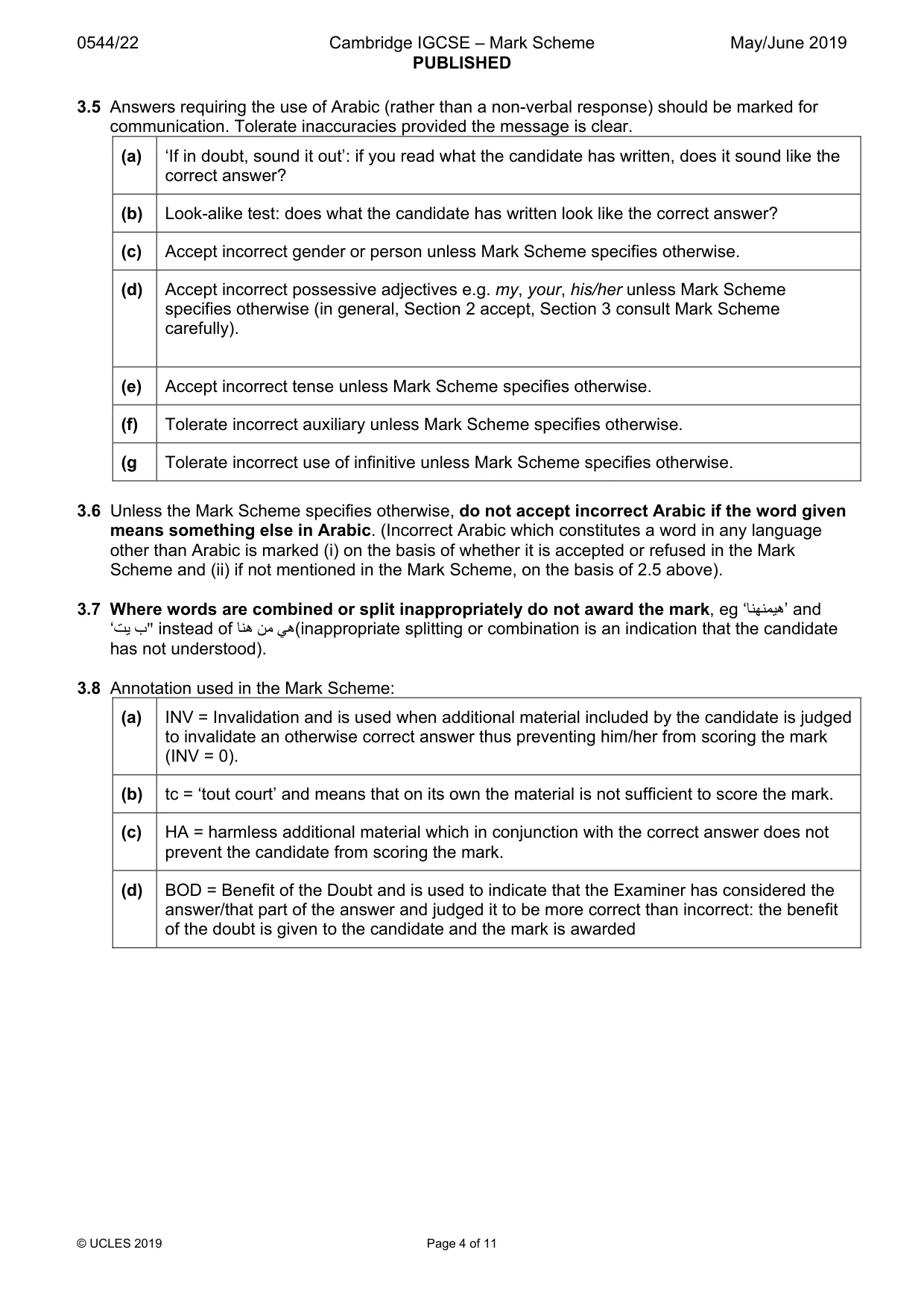
0544/22 Cambridge IGCSE – Mark Scheme PUBLISHED May/June 2019 © UCLES 2019 Page 4 of 11 3.5 Answers requiring the use of Arabic (rather than a non-verbal response) should be marked for communication. Tolerate inaccuracies provided the message is clear. (a) ‘If in doubt, sound it out’: if you read what the candidate has written, does it sound like the correct answer? (b) Look-alike test: does what the candidate has written look like the correct answer? (c) Accept incorrect gender or person unless Mark Scheme specifies otherwise. (d) Accept incorrect possessive adjectives e.g. my, your, his/her unless Mark Scheme specifies otherwise (in general, Section 2 accept, Section 3 consult Mark Scheme carefully). (e) Accept incorrect tense unless Mark Scheme specifies otherwise. (f) Tolerate incorrect auxiliary unless Mark Scheme specifies otherwise. (g Tolerate incorrect use of infinitive unless Mark Scheme specifies otherwise. 3.6 Unless the Mark Scheme specifies otherwise, do not accept incorrect Arabic if the word given means something else in Arabic. (Incorrect Arabic which constitutes a word in any language other than Arabic is marked (i) on the basis of whether it is accepted or refused in the Mark Scheme and (ii) if not mentioned in the Mark Scheme, on the basis of 2.5 above). 3.7 Where words are combined or split inappropriately do not award the mark, eg ‘ ’ھيمنھناand ‘ "ب يتinstead of (ھي من ھناinappropriate splitting or combination is an indication that the candidate has not understood). 3.8 Annotation used in the Mark Scheme: (a) INV = Invalidation and is used when additional material included by the candidate is judged to invalidate an otherwise correct answer thus preventing him/her from scoring the mark (INV = 0). (b) tc = ‘tout court’ and means that on its own the material is not sufficient to score the mark. (c) HA = harmless additional material which in conjunction with the correct answer does not prevent the candidate from scoring the mark. (d) BOD = Benefit of the Doubt and is used to indicate that the Examiner has considered the answer/that part of the answer and judged it to be more correct than incorrect: the benefit of the doubt is given to the candidate and the mark is awarded
Mark scheme, page 5
0544/22 Cambridge IGCSE – Mark Scheme PUBLISHED May/June 2019 © UCLES 2019 Page 5 of 11 3.9 No response and ‘0’ marks There is a NR (NO Response) option in scoris. Award NR (No Response): If there is nothing written at all in the answer space or If there is only a comment which does not in any way relate to the question being asked (e.g. ‘can’t do’ or ‘don’t know’) or If there is only a mark which isn’t an attempt at the question (e.g. a dash, a question mark). Award 0: If there is any attempt that earns no credit. This could, for example, include the candidate copying all or some of the question, or any working that does not earn any marks, whether crossed out or not.
Mark scheme, page 6
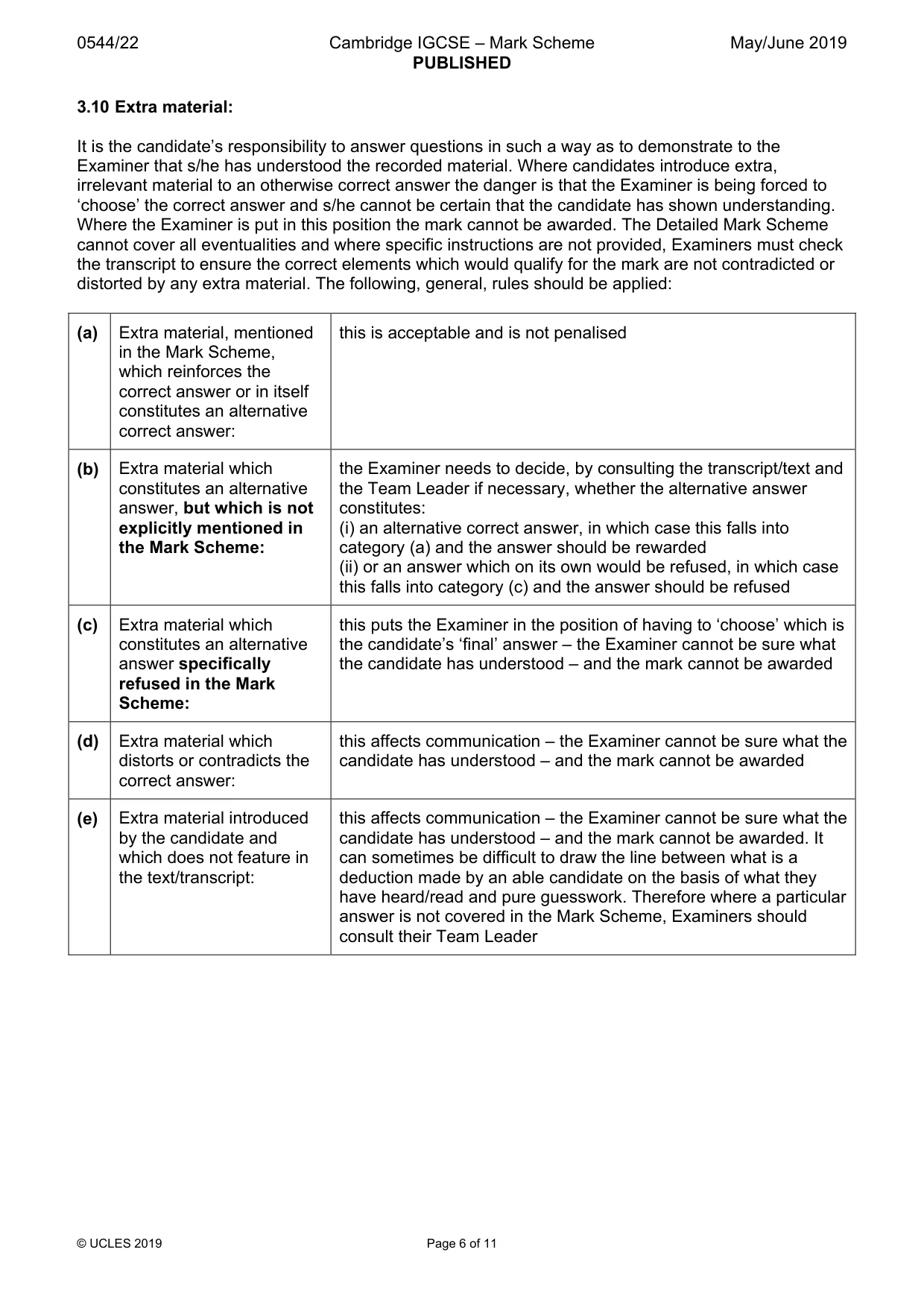
0544/22 Cambridge IGCSE – Mark Scheme PUBLISHED May/June 2019 © UCLES 2019 Page 6 of 11 3.10 Extra material: It is the candidate’s responsibility to answer questions in such a way as to demonstrate to the Examiner that s/he has understood the recorded material. Where candidates introduce extra, irrelevant material to an otherwise correct answer the danger is that the Examiner is being forced to ‘choose’ the correct answer and s/he cannot be certain that the candidate has shown understanding. Where the Examiner is put in this position the mark cannot be awarded. The Detailed Mark Scheme cannot cover all eventualities and where specific instructions are not provided, Examiners must check the transcript to ensure the correct elements which would qualify for the mark are not contradicted or distorted by any extra material. The following, general, rules should be applied: (a) Extra material, mentioned in the Mark Scheme, which reinforces the correct answer or in itself constitutes an alternative correct answer: this is acceptable and is not penalised (b) Extra material which constitutes an alternative answer, but which is not explicitly mentioned in the Mark Scheme: the Examiner needs to decide, by consulting the transcript/text and the Team Leader if necessary, whether the alternative answer constitutes: (i) an alternative correct answer, in which case this falls into category (a) and the answer should be rewarded (ii) or an answer which on its own would be refused, in which case this falls into category (c) and the answer should be refused (c) Extra material which constitutes an alternative answer specifically refused in the Mark Scheme: this puts the Examiner in the position of having to ‘choose’ which is the candidate’s ‘final’ answer – the Examiner cannot be sure what the candidate has understood – and the mark cannot be awarded (d) Extra material which distorts or contradicts the correct answer: this affects communication – the Examiner cannot be sure what the candidate has understood – and the mark cannot be awarded (e) Extra material introduced by the candidate and which does not feature in the text/transcript: this affects communication – the Examiner cannot be sure what the candidate has understood – and the mark cannot be awarded. It can sometimes be difficult to draw the line between what is a deduction made by an able candidate on the basis of what they have heard/read and pure guesswork. Therefore where a particular answer is not covered in the Mark Scheme, Examiners should consult their Team Leader
Mark scheme, page 7
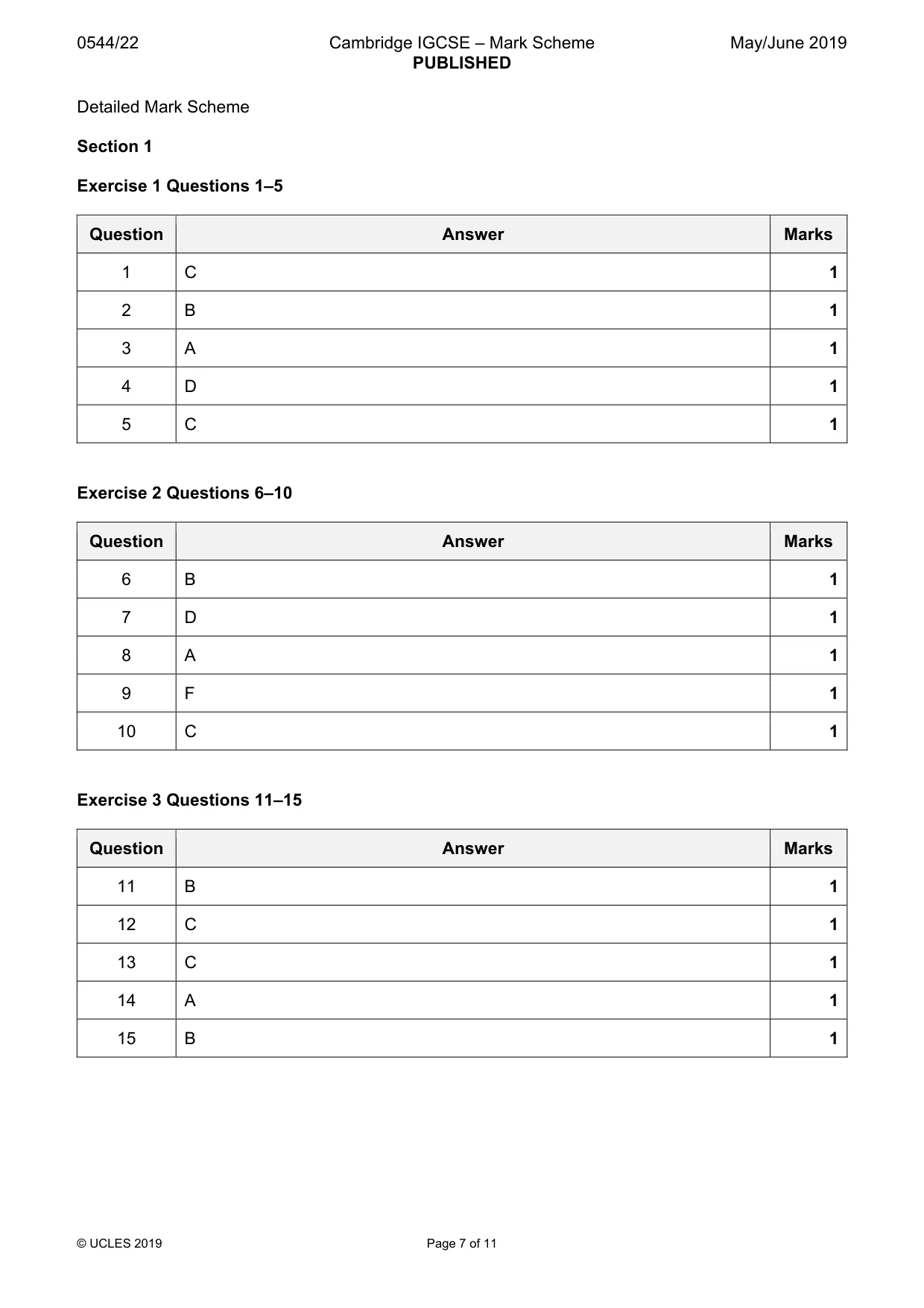
0544/22 Cambridge IGCSE – Mark Scheme PUBLISHED May/June 2019 © UCLES 2019 Page 7 of 11 Detailed Mark Scheme Section 1 Exercise 1 Questions 1–5 Question Answer Marks 1 C 1 2 B 1 3 A 1 4 D 1 5 C 1 Exercise 2 Questions 6–10 Question Answer Marks 6 B 1 7 D 1 8 A 1 9 F 1 10 C 1 Exercise 3 Questions 11–15 Question Answer Marks 11 B 1 12 C 1 13 C 1 14 A 1 15 B 1
Mark scheme, page 8
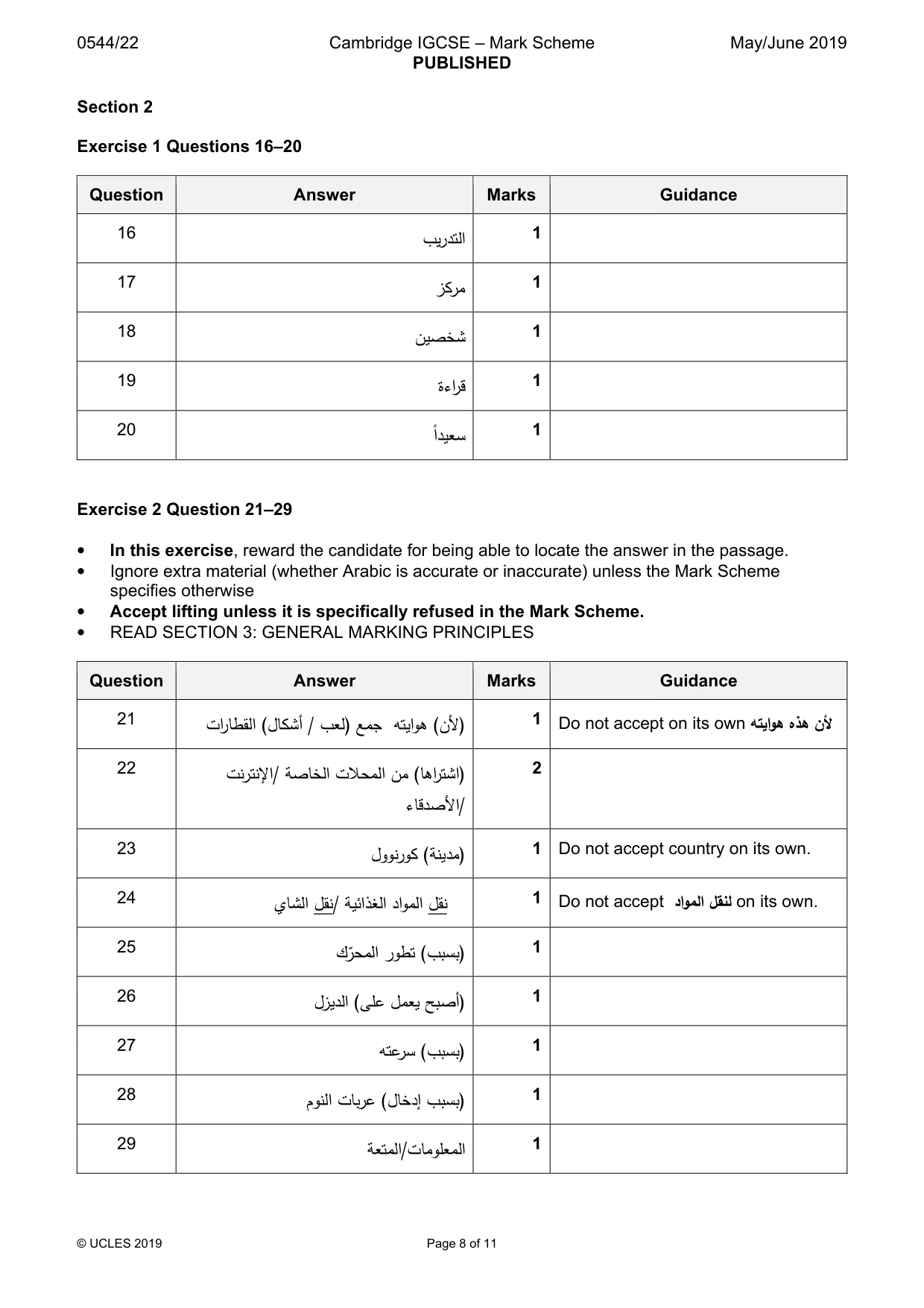
0544/22 Cambridge IGCSE – Mark Scheme PUBLISHED May/June 2019 © UCLES 2019 Page 8 of 11 Section 2 Exercise 1 Questions 16–20 Question Answer Marks Guidance 16 ¨Ɣ±¯śƅ§ 1 17 ²Ƅ±ƈ 1 18 ÁƔŰŦŮ 1 19 ©¡§±Ɓ 1 20 Ƨ¯ƔŸŬ 1 Exercise 2 Question 21–29 • In this exercise, reward the candidate for being able to locate the answer in the passage. • Ignore extra material (whether Arabic is accurate or inaccurate) unless the Mark Scheme specifies otherwise • Accept lifting unless it is specifically refused in the Mark Scheme. • READ SECTION 3: GENERAL MARKING PRINCIPLES Question Answer Marks Guidance 21 ª§±ŕ·Ƃƅ§ (¿ŕƄŮ£ / ¨Ÿƅ) ŶƈŠ ƌśƔ§Ãƍ (ÁƗ) 1 Do not accept on its own Ɗřƒ¦ÂƋ Ɖ¯Ƌ Àƕ 22 Áƈ (ŕƍ§±śŮ§) ªƜţƈƅ§ řŰŕŦƅ§ ªƊ±śƊƙ§/ / ¡ŕƁ¯ŰƗ§ 2 23 ¿ÃÃƊ±ÃƄ (řƊƔ¯ƈ) 1 Do not accept country on its own. 24 ÅŕŮƅ§ ¿ƂƊ/ řƔœ§°żƅ§ ¯§Ãƈƅ§ ¿ƂƊ 1 Do not accept ®¦ÂƆƃ¦ ¾ƀƈƃ on its own. 25 ¾Ì±ţƈƅ§ ±Ã·ś (¨ŗŬŗ) 1 26 ¿²Ɣ¯ƅ§ (ƑƆŷ ¿ƈŸƔ ŢŗŰ£) 1 27 ƌśŷ±Ŭ (¨ŗŬŗ) 1 28 ÀÃƊƅ§ ªŕŗ±ŷ (¿ŕŦ¯¥ ¨ŗŬŗ) 1 29 řŸśƈƅ§/ªŕƈÃƆŸƈƅ§ 1
Mark scheme, page 9
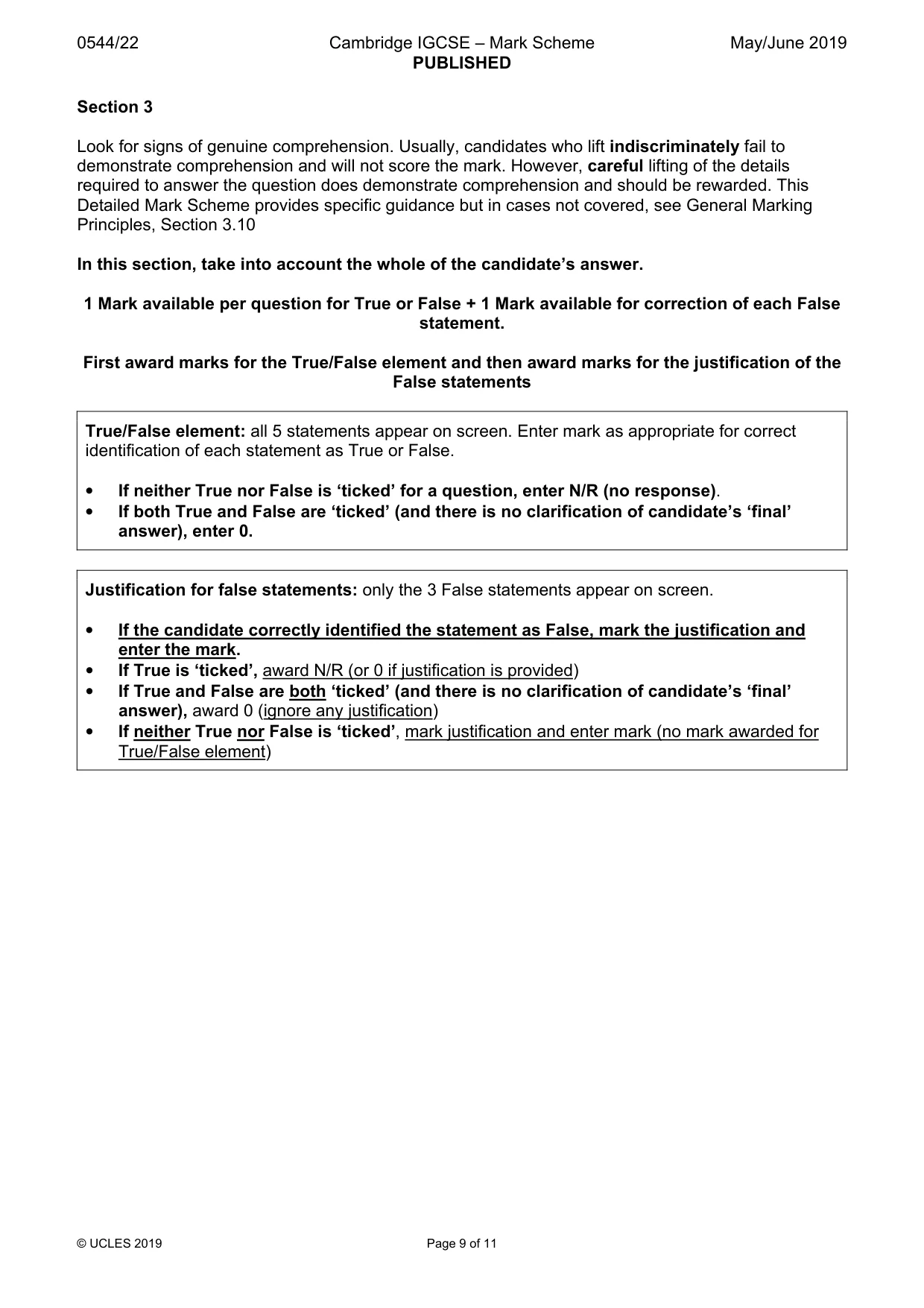
0544/22 Cambridge IGCSE – Mark Scheme PUBLISHED May/June 2019 © UCLES 2019 Page 9 of 11 Section 3 Look for signs of genuine comprehension. Usually, candidates who lift indiscriminately fail to demonstrate comprehension and will not score the mark. However, careful lifting of the details required to answer the question does demonstrate comprehension and should be rewarded. This Detailed Mark Scheme provides specific guidance but in cases not covered, see General Marking Principles, Section 3.10 In this section, take into account the whole of the candidate’s answer. 1 Mark available per question for True or False + 1 Mark available for correction of each False statement. First award marks for the True/False element and then award marks for the justification of the False statements True/False element: all 5 statements appear on screen. Enter mark as appropriate for correct identification of each statement as True or False. • If neither True nor False is ‘ticked’ for a question, enter N/R (no response). • If both True and False are ‘ticked’ (and there is no clarification of candidate’s ‘final’ answer), enter 0. Justification for false statements: only the 3 False statements appear on screen. • If the candidate correctly identified the statement as False, mark the justification and enter the mark. • If True is ‘ticked’, award N/R (or 0 if justification is provided) • If True and False are both ‘ticked’ (and there is no clarification of candidate’s ‘final’ answer), award 0 (ignore any justification) • If neither True nor False is ‘ticked’, mark justification and enter mark (no mark awarded for True/False element)
Mark scheme, page 10
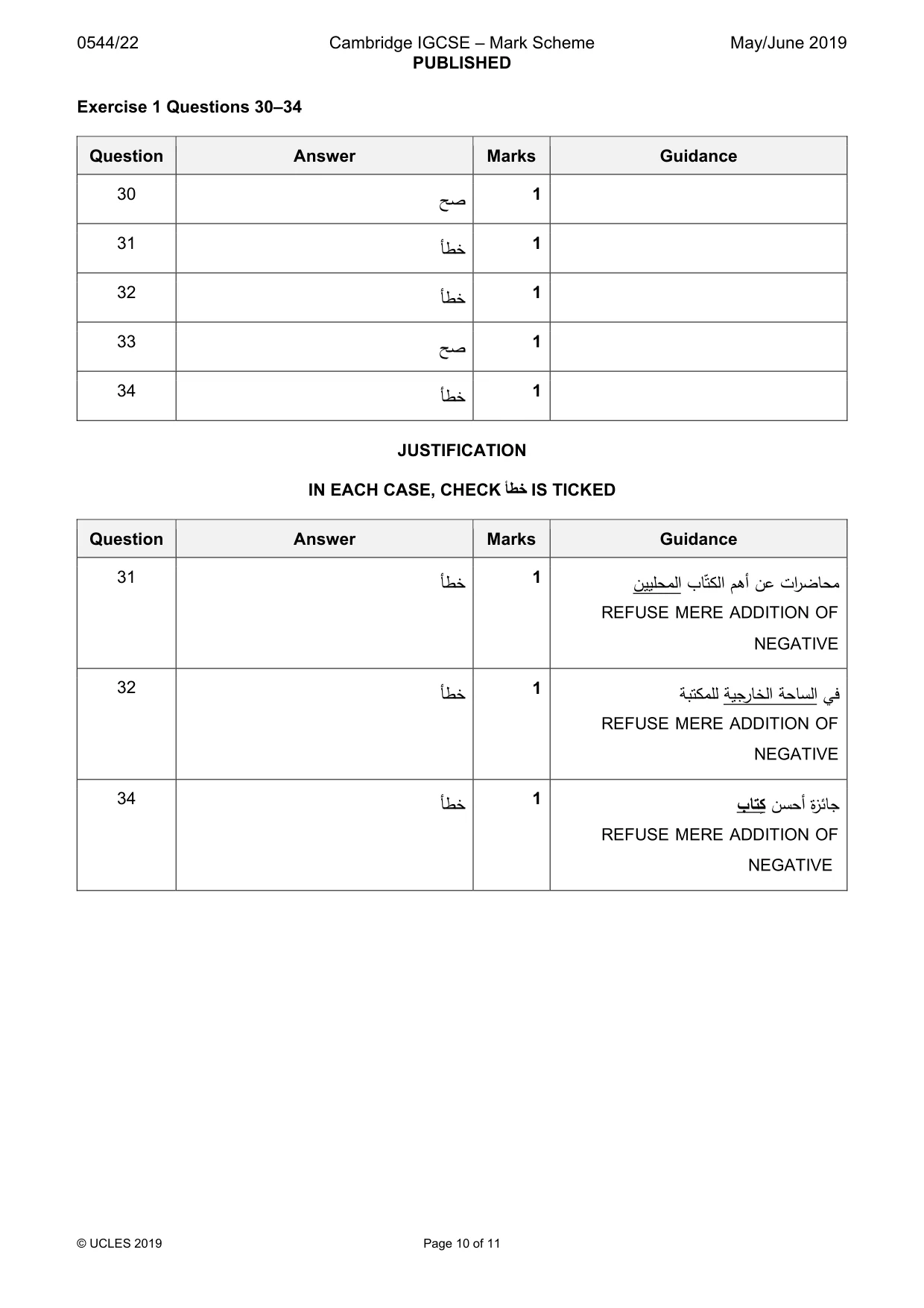
0544/22 Cambridge IGCSE – Mark Scheme PUBLISHED May/June 2019 © UCLES 2019 Page 10 of 11 Exercise 1 Questions 30–34 Question Answer Marks Guidance 30 ŢŰ 1 31 ō·Ŧ 1 32 ō·Ŧ 1 33 ŢŰ 1 34 ō·Ŧ 1 JUSTIFICATION IN EACH CASE, CHECK خطأIS TICKED Question Answer Marks Guidance 31 ō·Ŧ 1 ÁƔƔƆţƈƅ§ ¨ŕÌśƄƅ§ Àƍ£ Áŷ ª§±Ųŕţƈ REFUSE MERE ADDITION OF NEGATIVE 32 ō·Ŧ 1 řŗśƄƈƆƅ řƔŠ±ŕŦƅ§ řţŕŬƅ§ Ɠž REFUSE MERE ADDITION OF NEGATIVE 34 ō·Ŧ 1 §œřÊƂ ÁŬţ£ ©²œŕŠ REFUSE MERE ADDITION OF NEGATIVE
Mark scheme, page 11
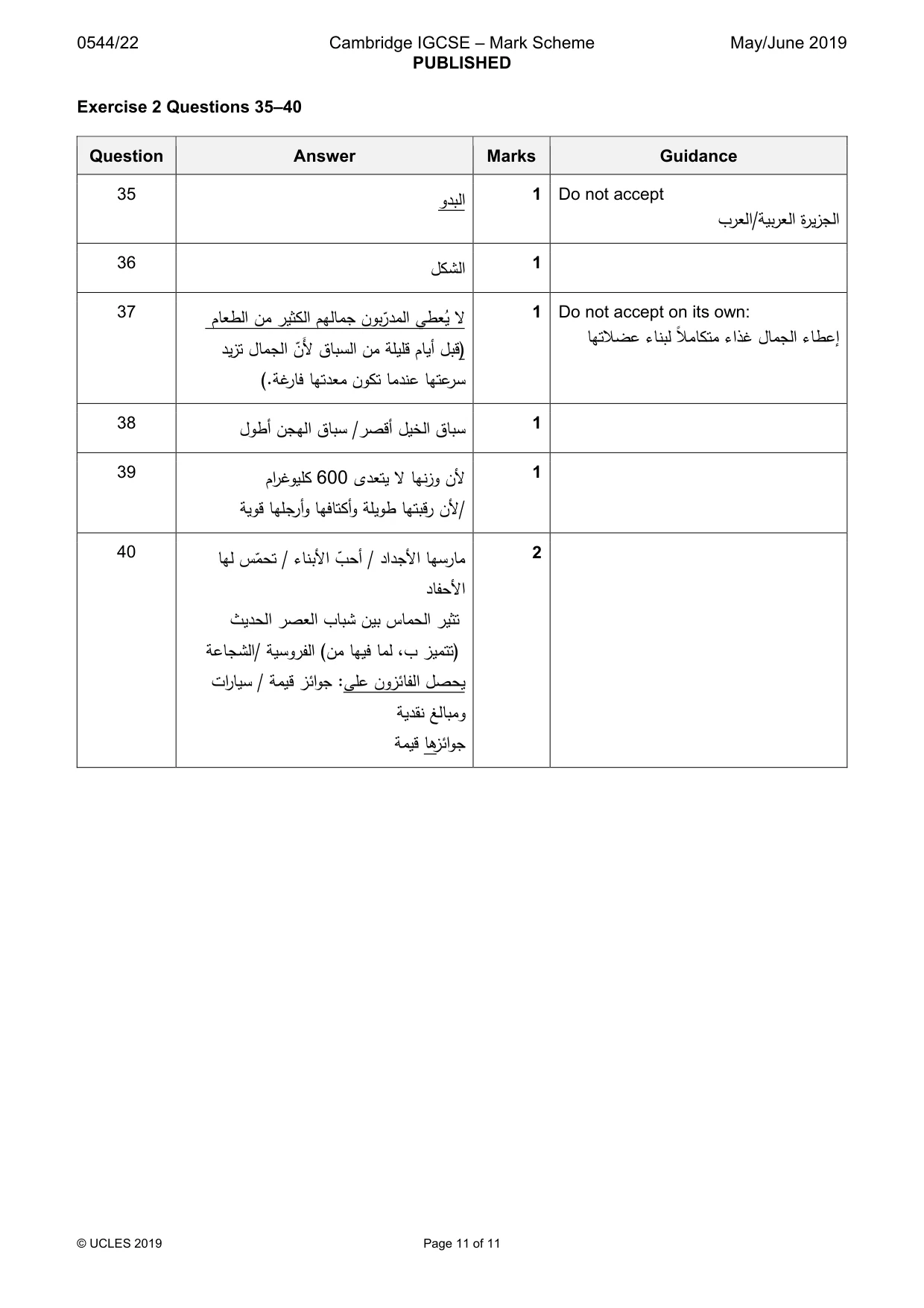
0544/22 Cambridge IGCSE – Mark Scheme PUBLISHED May/June 2019 © UCLES 2019 Page 11 of 11 Exercise 2 Questions 35–40 Question Answer Marks Guidance 35 ïŗƅ§ 1 Do not accept ¨±Ÿƅ§/řƔŗ±Ÿƅ§ ©±Ɣ²Šƅ§ 36 ¿ƄŮƅ§ 1 37 ÀŕŸ·ƅ§ Áƈ ±ƔŝƄƅ§ ÀƎƅŕƈŠ ÁÃŗ̱¯ƈƅ§ Ɠ·ŸÊƔ ƛ ¯Ɣ²ś ¿ŕƈŠƅ§ ÌÁÉƗ ½ŕŗŬƅ§ Áƈ řƆƔƆƁ ÀŕƔ£ ¿ŗƁ) (.řŻ±ŕž ŕƎś¯Ÿƈ ÁÃƄś ŕƈ¯Ɗŷ ŕƎśŷ±Ŭ 1 Do not accept on its own: ŕƎśƜŲŷ ¡ŕƊŗƅ ÆƜƈŕƄśƈ ¡§°Ż ¿ŕƈŠƅ§ ¡ŕ·ŷ¥ 38 ¿Ã·£ ÁŠƎƅ§ ½ŕŗŬ /±ŰƁ£ ¿ƔŦƅ§ ½ŕŗŬ 1 39 įŸśƔ ƛ ŕƎƊ²Ã ÁƗ 600 À§±ŻÃƔƆƄ / ŕƎśŗƁ± ÁƗ řƔÃƁ ŕƎƆŠ±£Ã ŕƎžŕśƄ£Ã řƆƔ÷ 1 40 ŕƎƅ ³Ìƈţś / ¡ŕƊŗƗ§ ̨ţ£ / ¯§¯ŠƗ§ ŕƎŬ±ŕƈ ¯ŕſţƗ§ «Ɣ¯ţƅ§ ±ŰŸƅ§ ¨ŕŗŮ ÁƔŗ ³ŕƈţƅ§ ±Ɣŝś ¨ ²Ɣƈśś) (Áƈ ŕƎƔž ŕƈƅ řŷŕŠŮƅ§/ řƔŬñſƅ§ ª§±ŕƔŬ / řƈƔƁ ²œ§ÃŠ :ƑƆŷ Áòœŕſƅ§ ¿ŰţƔ řƔ¯ƂƊ źƅŕŗƈà řƈƔƁ ŕƍ ²œ§ÃŠ 2
What you needed in this session
Cambridge’s own grade thresholds for 2019 May/June, Paper 2 · Variant 2. A higher threshold means an easier paper — the bar moves with how the cohort did.