Cambridge IGCSE Arabic - Foreign Language 0544 — 2019 May/June Paper 2 · Variant 3
0544/23/M/J/19 · 45 marks · ≈51 min
The question paper and its mark scheme, free to read here and free to download. This is Cambridge’s own paper, exactly as it was sat.
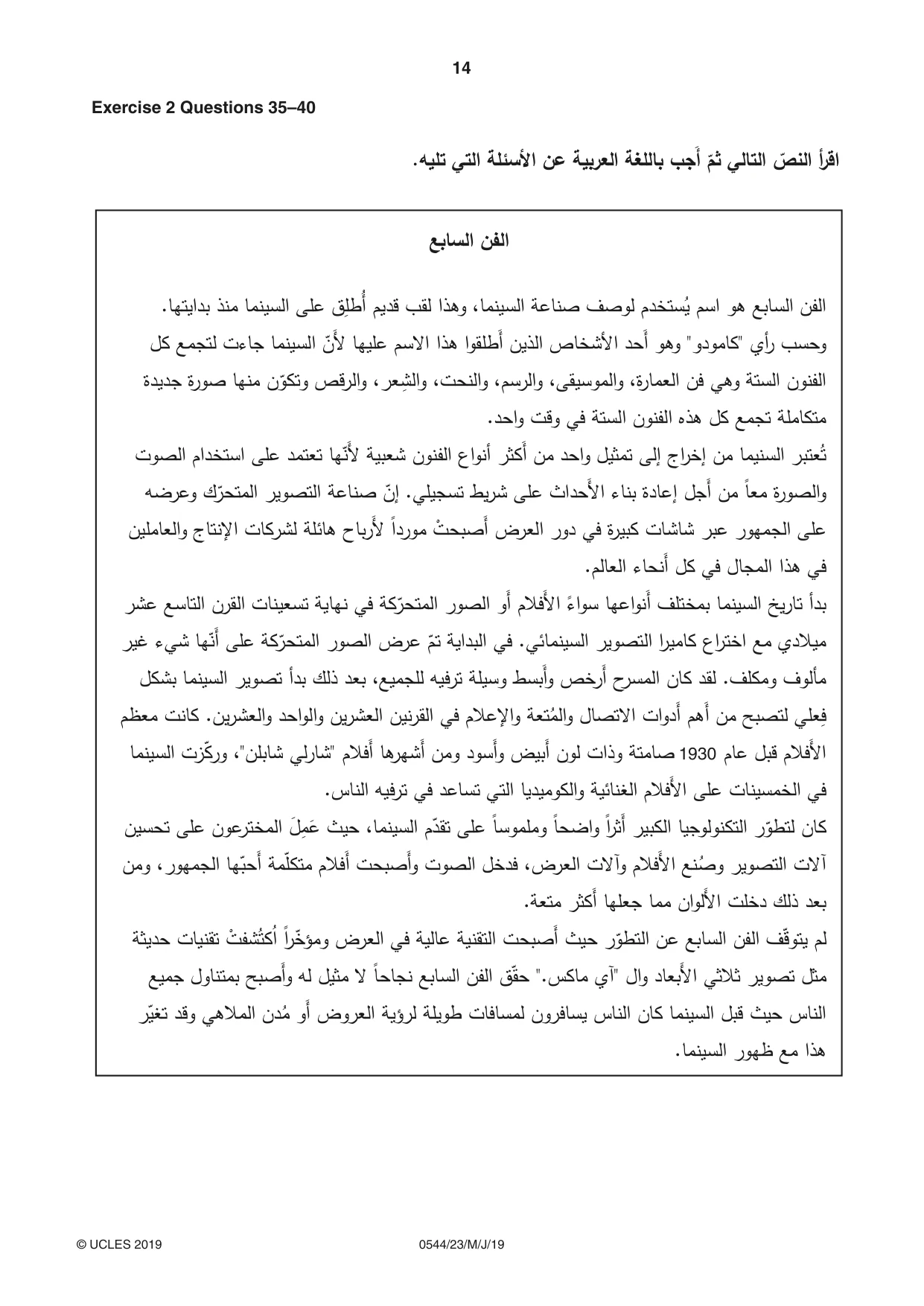
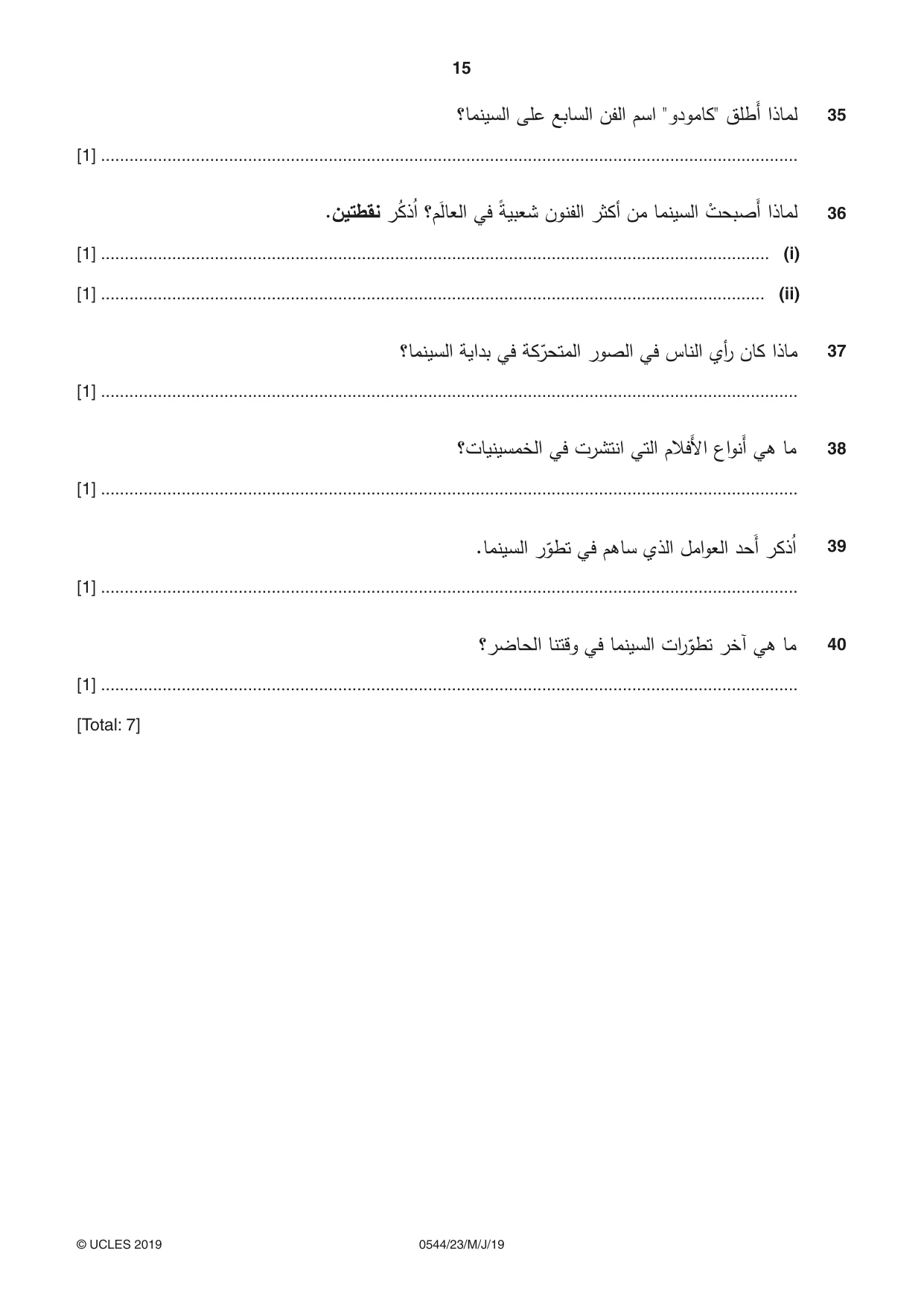
Question paper16 pages

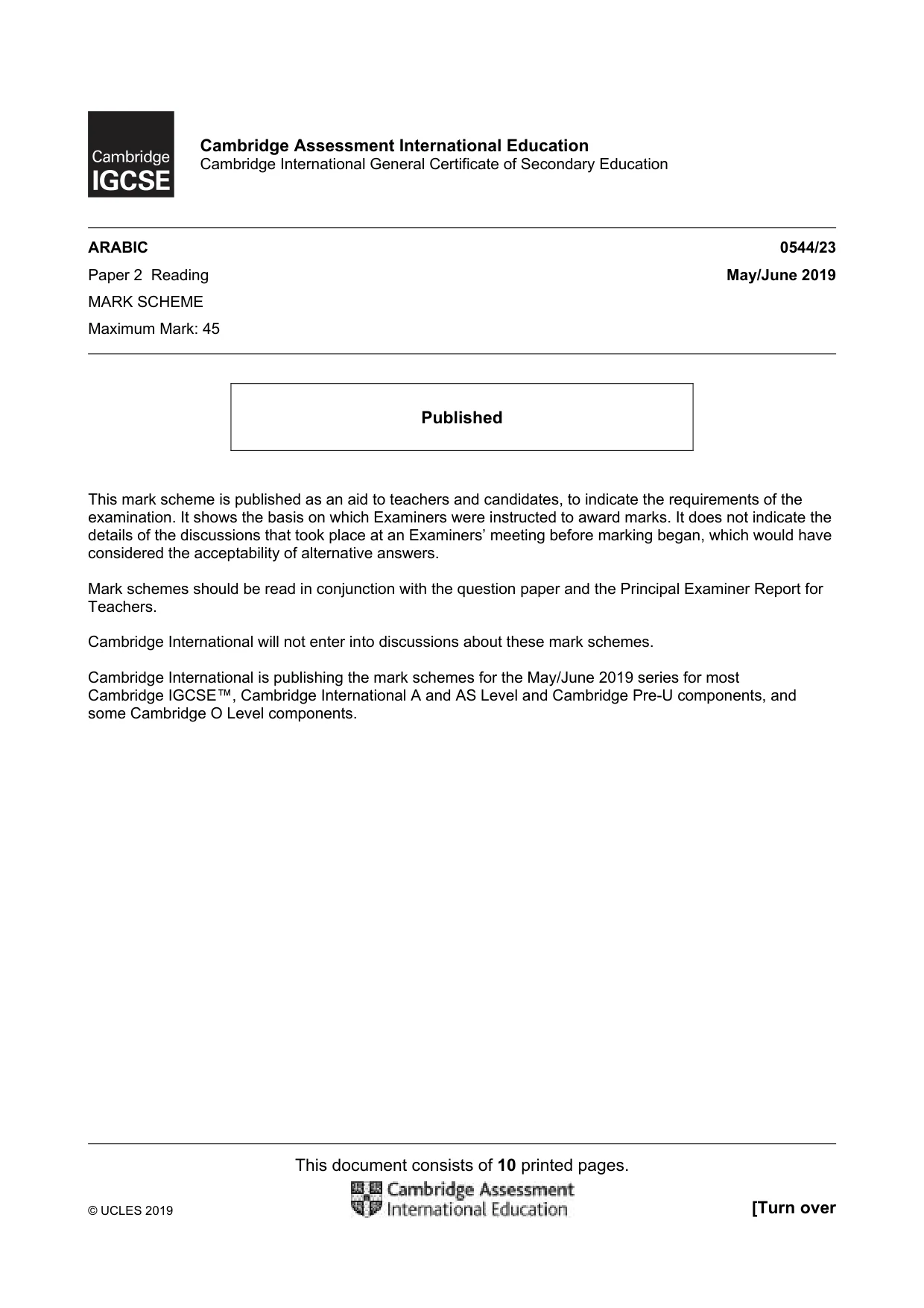
Mark scheme10 pages
Answers below. Sit the paper first if you are practising.
Paper as text
Question paper, page 1
This document consists of 14 printed pages and 2 blank pages. NL (TP) 166503/2 © UCLES 2019 [Turn over Cambridge Assessment International Education Cambridge International General Certificate of Secondary Education ARABIC 0544/23 Paper 2 Reading May/June 2019 1 hour Candidates answer on the Question Paper. No Additional Materials are required. READ THESE INSTRUCTIONS FIRST Write your centre number, candidate number and name on all the work you hand in. Write in dark blue or black pen. Do not use staples, paper clips, glue or correction fluid. DO NOT WRITE IN ANY BARCODES. Answer all questions. The number of marks is given in brackets [ ] at the end of each question or part question. * 5 0 6 3 0 1 9 9 0 2 *
Question paper, page 2
2 0544/23/M/J/19 © UCLES 2019 BLANK PAGE
Question paper, page 3
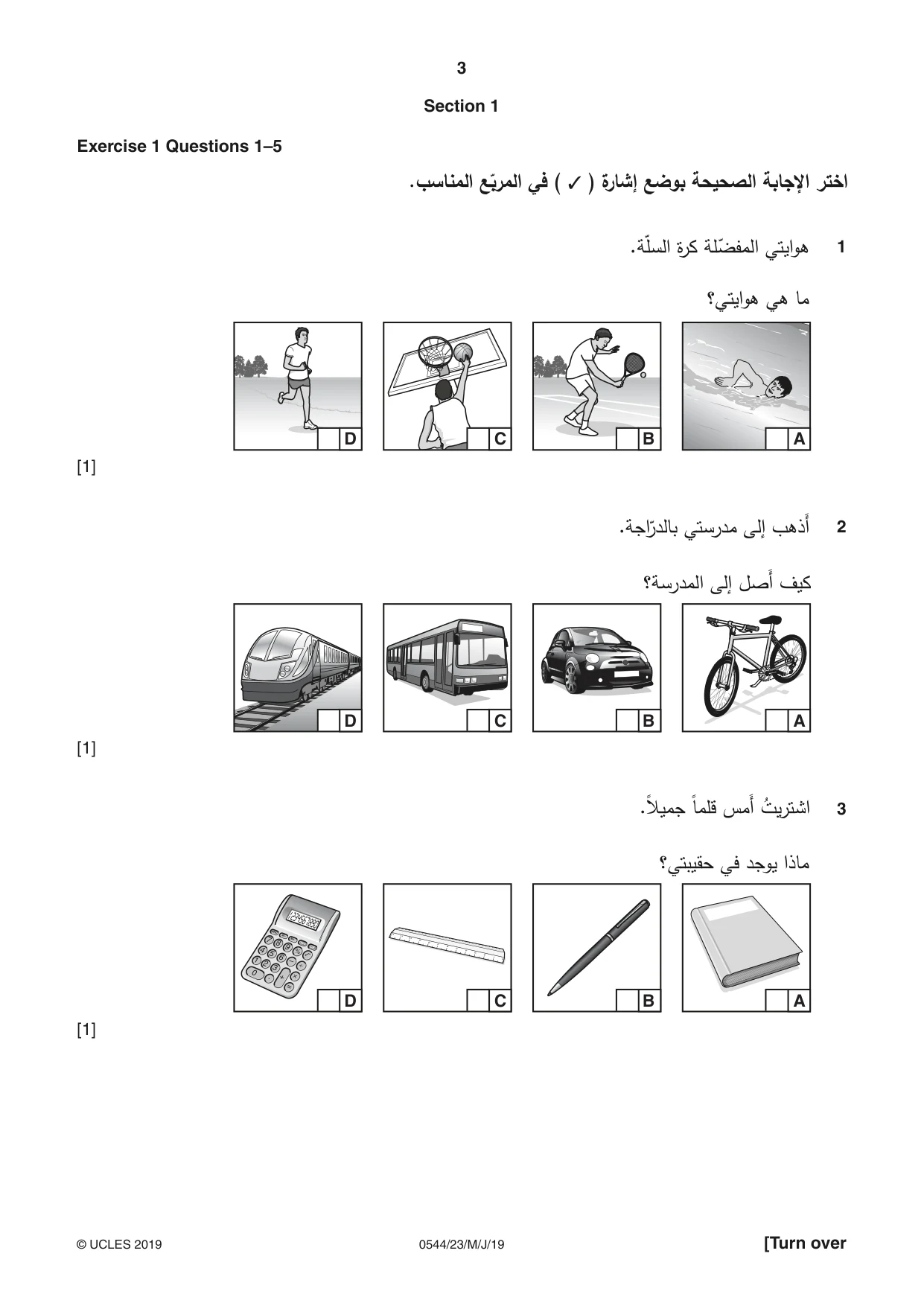
3 0544/23/M/J/19 © UCLES 2019 [Turn over Section 1 Exercise 1 Questions 1–5 1 D C B A [1] 2 D C B A [1] 3 D C B A [1] . ( في المربّع المناسب3 ) اختر اإلجابة الصحيحة بوضع إشارة هوايتي المفضّلة كرة السلّة. ما هي هوايتي؟ أَذهب إلى مدرستي بالدرّاجة. كيف أَصل إلى المدرسة؟ اشتريتُ أَمس قلماً جميالً. ماذا يوجد في حقيبتي؟
Question paper, page 4
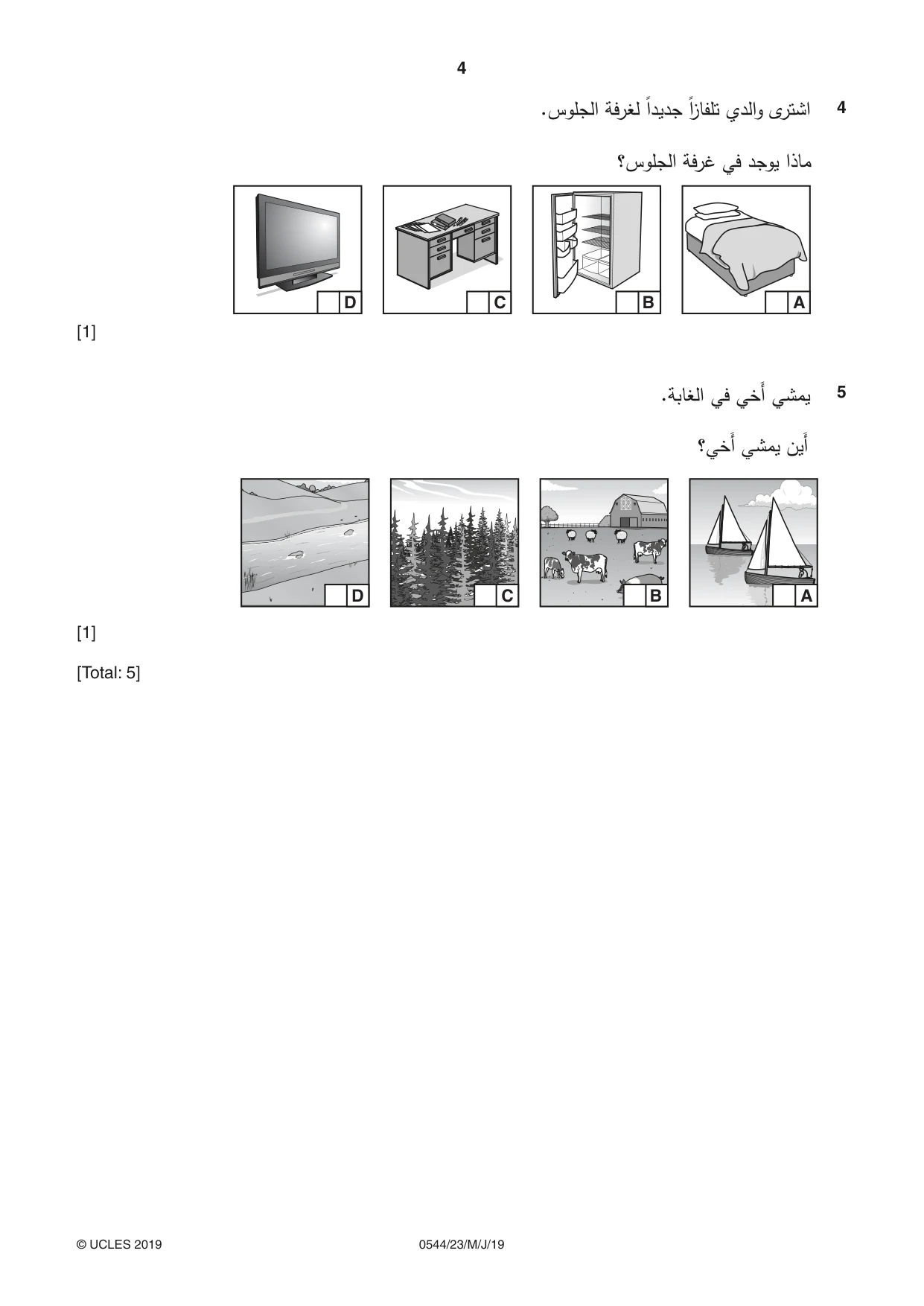
4 0544/23/M/J/19 © UCLES 2019 4 D C B A [1] 5 [1] [Total: 5] .اشترى والدي تلفازاً جديداً لغرفة الجلوس ماذا يوجد في غرفة الجلوس؟ يمشي أَخي في الغابة. أَين يمشي أَخي؟ D C B A
Question paper, page 5
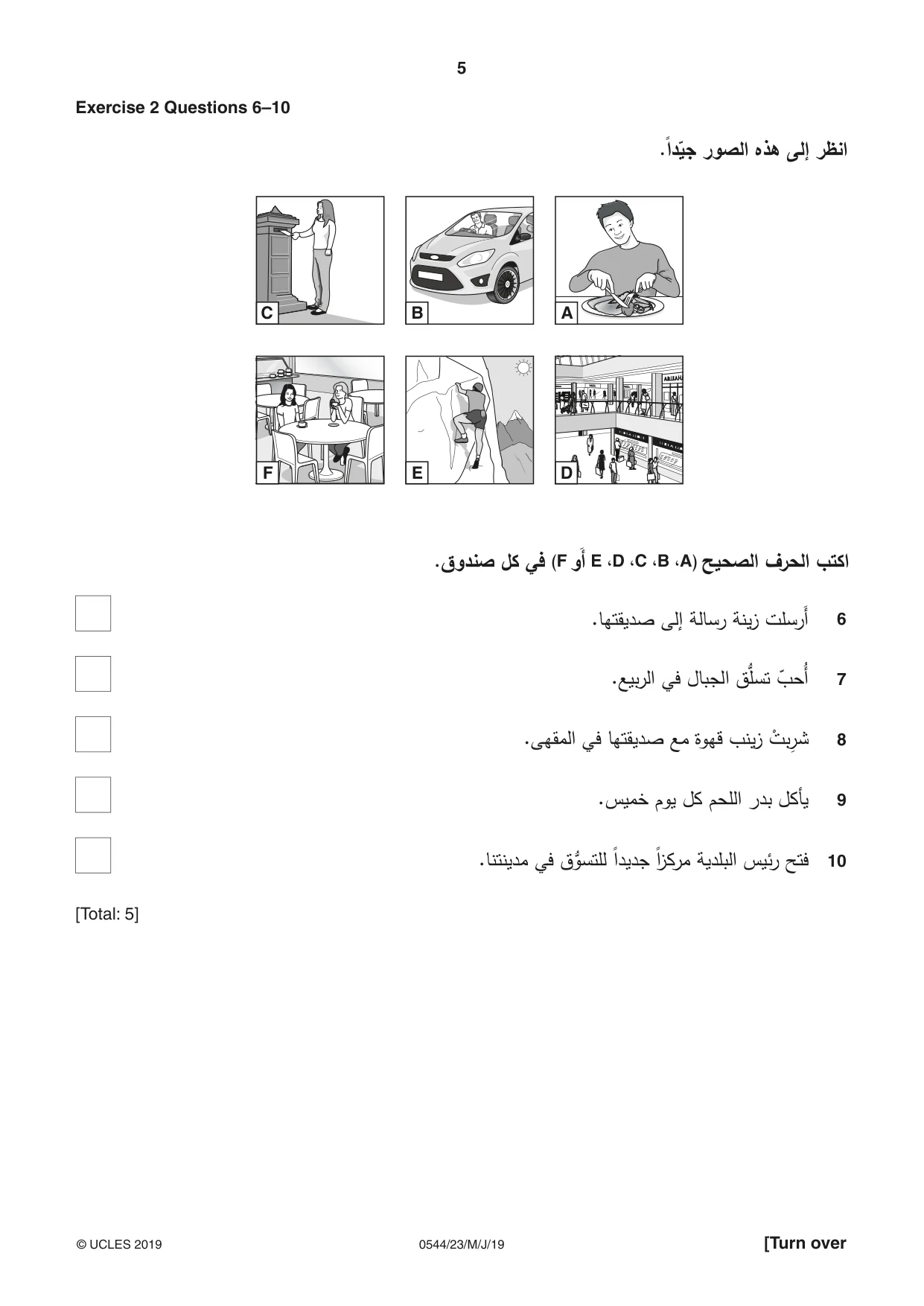
5 0544/23/M/J/19 © UCLES 2019 [Turn over Exercise 2 Questions 6–10 [Total: 5] C B A E D F 6 7 8 9 10 .ًانظر إلى هذﻩ الصور جيّدا اكتب الحرف الصحيح أَو في كل صندوق. (F E ،D ،C ،B ،A) .أَرسلت زينة رسالة إلى صديقتها أُحبّ تسلﱡق الجبال في الربيع. شرِبتْ زينب قهوة مع صديقتها في المقهى. يأكل بدر اللحم كل يوم خميس. فتح رئيس البلدية مركزاً جديداً للتسوﱡق في مدينتنا.
Question paper, page 6
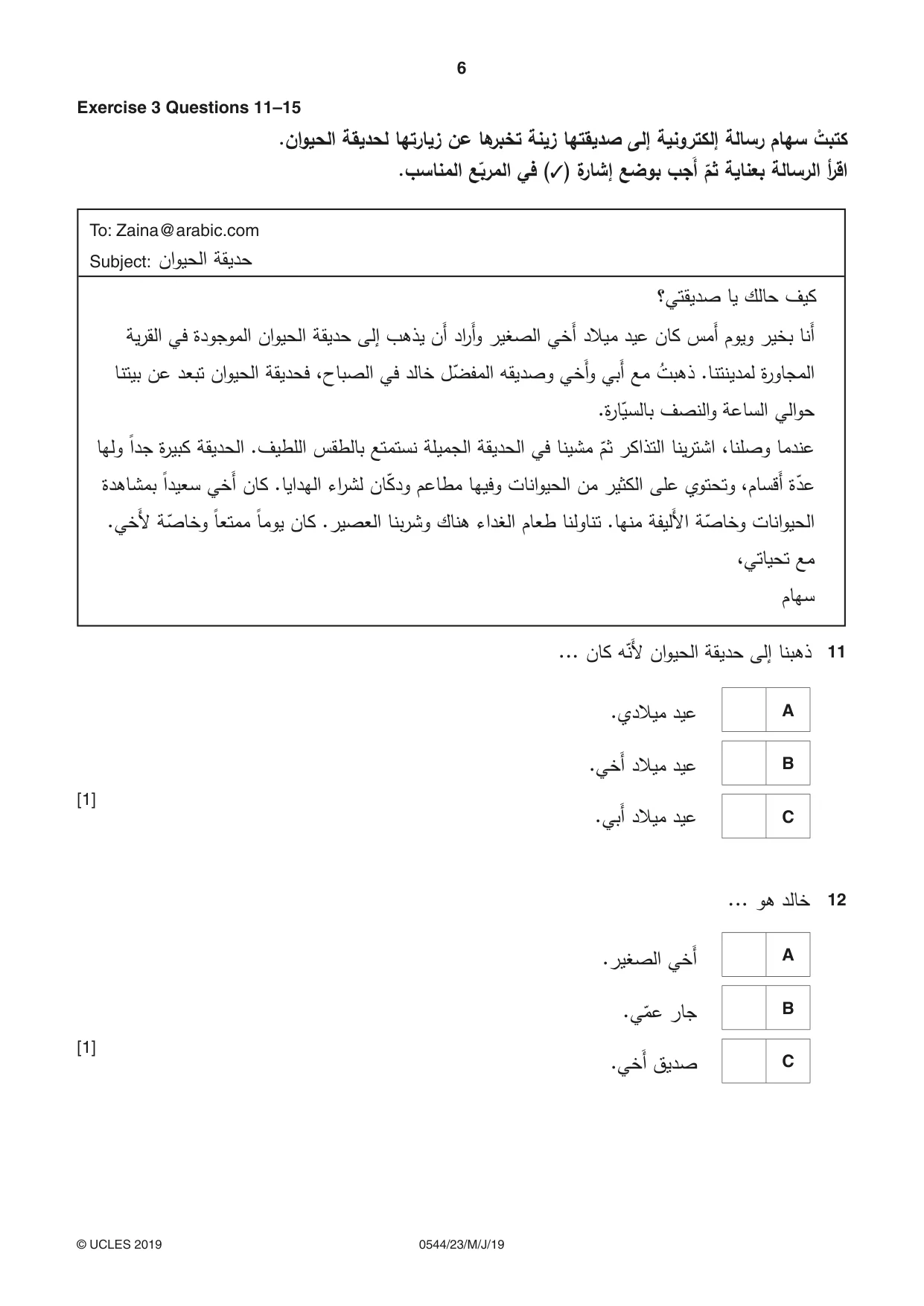
6 0544/23/M/J/19 © UCLES 2019 Exercise 3 Questions 11–15 11 [1] 12 [1] .كتبتْ سهام رسالة إلكترونية إلى صديقتها زينة تخبرها عن زيارتها لحديقة الحيوان ) في المربّع المناسب.3( اقرأ الرسالة بعناية ثمّ أَجب بوضع إشارة حديقة الحيوان أَنا بخير ويوم أَمس كان عيد ميالد أَخي الصغير وأَراد أَن يذهب إلى حديقة الحيوان الموجودة في القرية المجاورة لمدينتنا. ذهبتُ مع أَبي وأَخي وصديقه المفضّل خالد في الصباح، فحديقة الحيوان تبعد عن بيتنا حوالي الساعة والنصف بالسيّارة. عندما وصلنا، اشترينا التذاكر ثمّ مشينا في الحديقة الجميلة نستمتع بالطقس اللطيف. الحديقة كبيرة جداً ولها عدّة أَقسام، وتحتوي على الكثير من الحيوانات وفيها مطاعم ودكّان لشراء الهدايا. كان أَخي سعيداً بمشاهدة الحيوانات وخاصّة األَليفة منها. تناولنا طعام الغداء هناك وشربنا العصير. كان يوماً ممتعاً وخاصّة ألَخي. مع تحياتي، سهام كيف حالك يا صديقتي؟ A B C A B C ... ذهبنا إلى حديقة الحيوان ألَنّه كان عيد ميالدي. عيد ميالد أَخي. عيد ميالد أَبي. خالد هو ... أَخي الصغير. جار عمّي. صديق أَخي. To: Zaina@arabic.com Subject:
Question paper, page 7
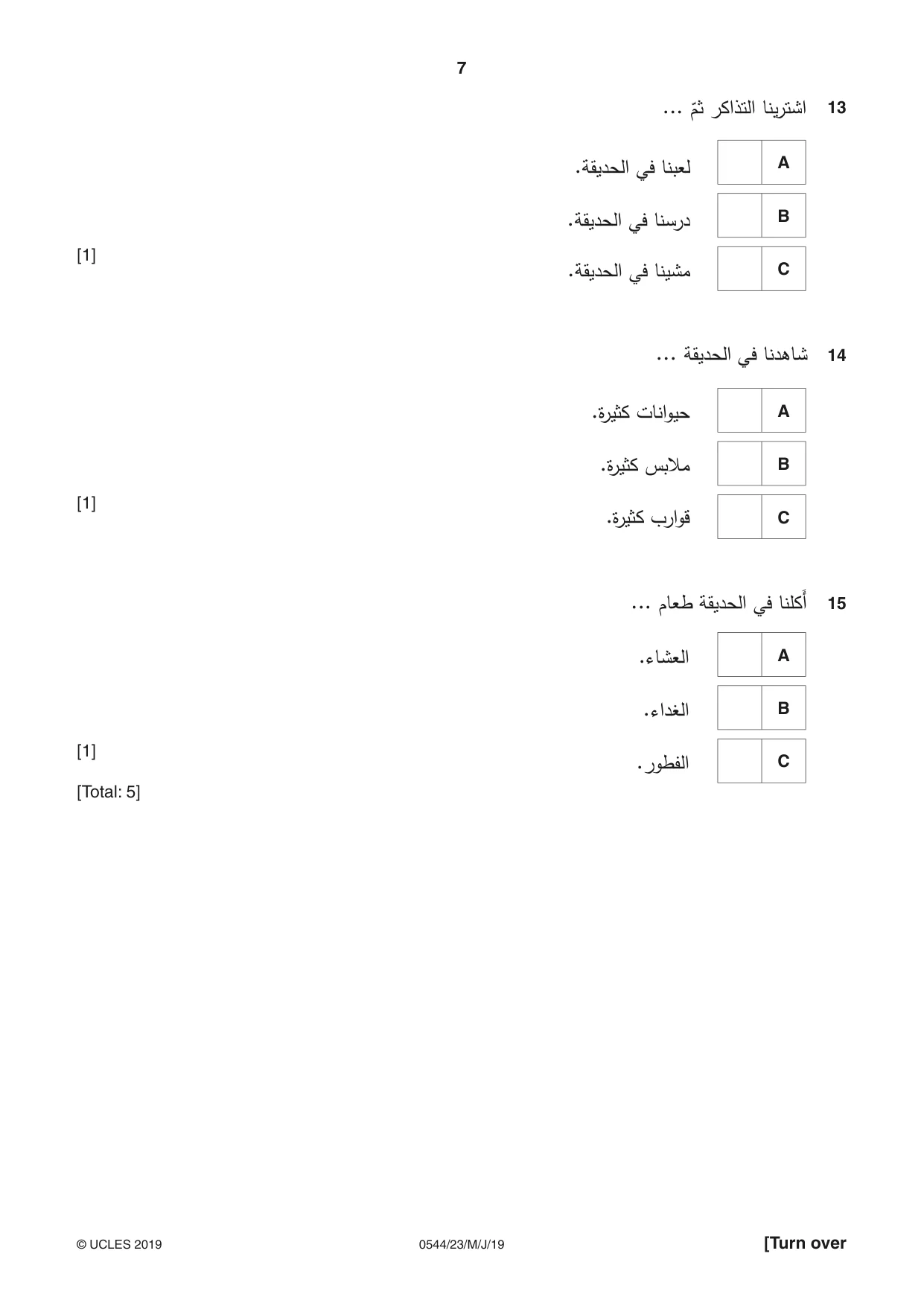
7 0544/23/M/J/19 © UCLES 2019 [Turn over 13 [1] 14 [1] 15 [1] [Total: 5] A B C A B C A B C ... ّاشترينا التذاكر ثم لعبنا في الحديقة. درسنا في الحديقة. مشينا في الحديقة. شاهدنا في الحديقة ... حيوانات كثيرة. مالبس كثيرة. قوارب كثيرة. أَكلنا في الحديقة طعام ... العشاء. الغداء. الفطور.
Question paper, page 8
8 0544/23/M/J/19 © UCLES 2019 2 اقلب الصفحة إلى الجزء
Question paper, page 9
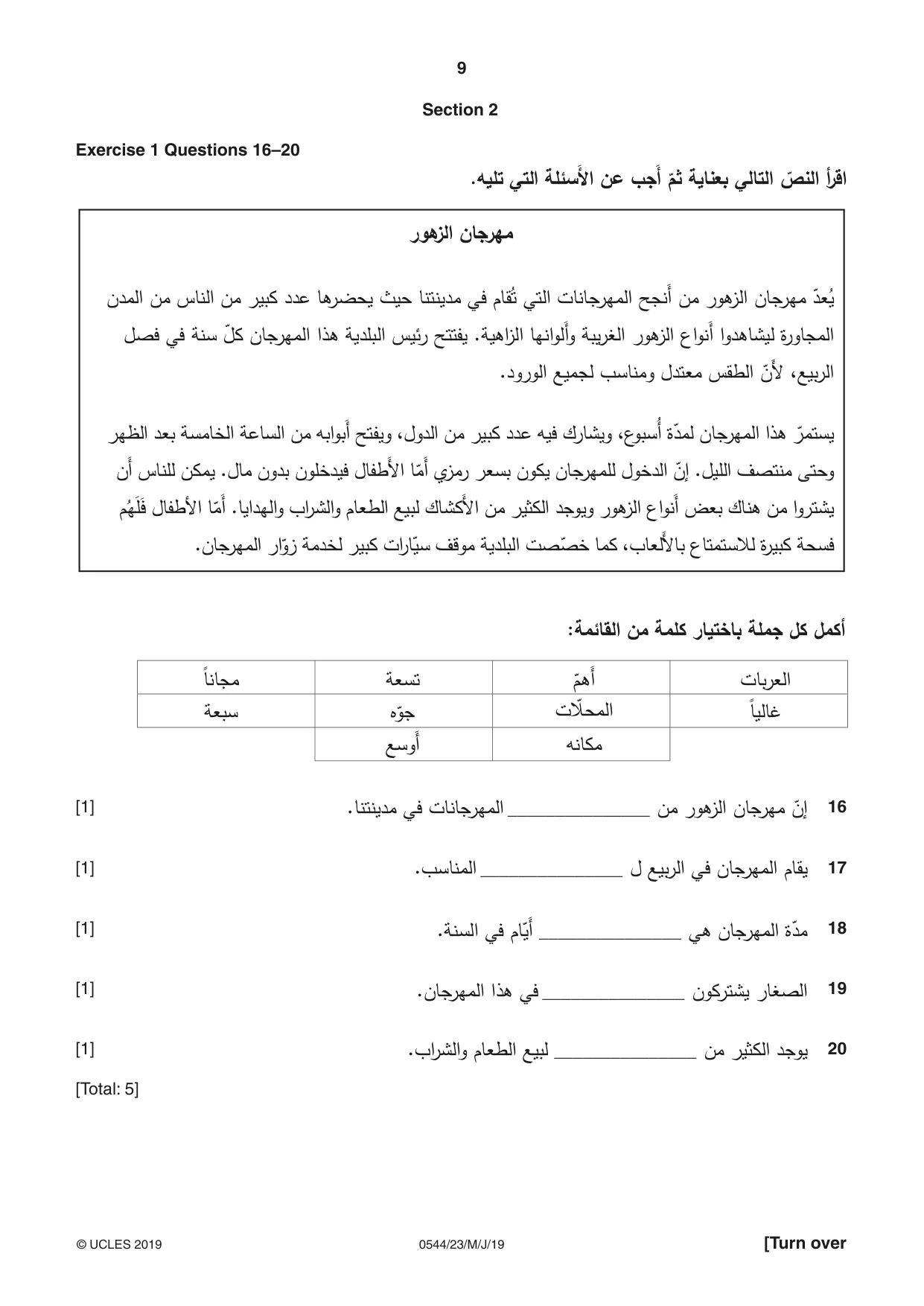
9 0544/23/M/J/19 © UCLES 2019 [Turn over Section 2 Exercise 1 Questions 16–20 مهرجان الزهور يُعدّ مهرجان الزهور من أَنجح المهرجانات التي تُقام في مدينتنا حيث يحضرها عدد كبير من الناس من المدن المجاورة ليشاهدوا أَنواع الزهور الغريبة وأَلوانها الزاهية. يفتتح رئيس البلدية هذا المهرجان كلّ سنة في فصل الربيع، ألَنّ الطقس معتدل ومناسب لجميع الورود. يستمرّ هذا المهرجان لمدّة أُسبوع، ويشارك فيه عدد كبير من الدول، ويفتح أَبوابه من الساعة الخامسة بعد الظهر وحتى منتصف الليل. إنّ الدخول للمهرجان يكون بسعر رمزي أَمّا األَطفال فيدخلون بدون مال. يمكن للناس أَن يشتروا من هناك بعض أَنواع الزهور ويوجد الكثير من األَكشاك لبيع الطعام والشراب والهدايا. أَمّا األطفال فَلَهُم فسحة كبيرة لالستمتاع باألَلعاب، كما خصّصت البلدية موقف سيّارات كبير لخدمة زوّار المهرجان. اقرأ النصّ التالي بعناية ثمّ أَجب عن األَسئلة التي تليه. أكمل كل جملة باختيار كلمة من القائمة: ًمجانا سبعة تسعة جوّه أَوسع أَهمّ المحالّ ت مكانه العربات غالياً [1] 16 [1] 17 [1] 18 [1] 19 [1] 20 [Total: 5] .إنّ مهرجان الزهور من _______________ المهرجانات في مدينتنا يقام المهرجان في الربيع ل _______________ المناسب. مدّة المهرجان هي _______________ أَيّام في السنة. الصغار يشتركون _______________ في هذا المهرجان. يوجد الكثير من _______________ لبيع الطعام والشراب.
Question paper, page 10
10 0544/23/M/J/19 © UCLES 2019 Exercise 2 Questions 21–29 .اقرأ النصّ التالي بعناية وأَجب عن األَسئلة التي تليه باللغة العربية سباق القوارب في مدينتي نهر طويل ومشهور، حيث يذهب السكّان هناك ليستمتعوا مع عائالتهم، ويوجد على جانبيه بعض المقاهي التي يزورها الناس للتمتّع بمنظر هذا النهر والطبيعة الجميلة حوله. زارتني صديقتي هذا األُسبوع لتشاهد سباق القوارب وهو الحدث المميّز الذي يحصل سنوياً هنا في فصل الربيع، وهو ما يجعل النهر مركز لالنتباه واالهتمام سواءً في مدينتنا أَو في المدن المجاورة. يجري هذا السباق التقليدي في فصل الربيع بين جامعات المدن القريبة، حيث ترى صوراً ممتعة من صور الرياضة البدنية منتشرة على جانِبَي النهر، كما نجد الزوّار جالسين على طول النهر لتشجيع فريقهم الخاصّ أَو أَحد أَفراد العائلة المشاركين في السباق. إنّه سباق جيّد التنظيم في كل مراحله، وله جدول زمني محدّد. يبدأ من الصباح حتّى المساء، ويكون عادةً في عطلة نهاية األُسبوع ليحضره أَكبر عدد من السكّان. وشرحتُ لصديقتي أَنّ هذه القوارب ذات الشكل الخاصّ الضيّق والطويل تتقدّم بشكل سريع وذلك بطريقة التجذيف بواسطة المجذاف وهو عبارة عن قطعة خشب طويلة وليست عريضة يحرّكها المتسابقون الجالسين في القارب بسرعة كبيرة من الجانبين، ويكون عددهم عشرة في القارب الواحد يلبسون األَلوان الخاصّة بفريقهم باإلضافة إلى رئيسهم الذي يعطيهم التعليمات ويشجّعهم بواسطة مكبّر الصوت الذي يمسكه ليسمعوه جيّداً. تُسمع أَصوات هتافات المشجعين كلّما اِقترب قارب من أَمامهم مما ينشُر أَجواء الفرح والسعادة لكلّ من المتسابقين والمشاهدين.
Question paper, page 11
11 0544/23/M/J/19 © UCLES 2019 [Turn over 21 [1] … 22 [1] … 23 [1] … 24 [1] … (i) [1] … (ii) 25 [1] … 26 [1] … 27 [1] … 28 [1] … 29 [1] … [Total: 10] لماذا يذهب الناس إلى النهر في مدينتي؟ ما الذي يجعل هذا النهر مميّزاً في فصل الربيع؟ مَن يُشارك في هذا الحدث؟ لماذا يحضر الزوّار هذا السباق السنوي؟ اذكر نقطتين. ما هي مدّة السباق؟ ما هو شكل القارب في هذا السباق؟ ماذا يستعمل رئيس الفريق ليعطي التعليمات؟ ماذا يفعل المشجّعون عند مرور القارب أَمامهم؟ كيف يشعر المتسابقون والمشاهدون أثناء السباق؟
Question paper, page 12
12 0544/23/M/J/19 © UCLES 2019 Section 3 Exercise 1 Questions 30–34 .) في المربّع المناسب أَمام كل عبارة3( اقرأ الحوار ثمّ أَجب بوضع إشارة صح خطأ)3 صح و2( .اكتب التعبير الصحيح حسب الحوار إذا كانت اإلشارة في المربّع الخطأ رافقتُ جدّي لمركز التسوق فوقف أَمام بائع العسل ليشتري منه ودار بيننا الحوار التالي. من أَين يأتي العسل يا جدّي؟ إنّ العسل مادّة سميكة وحلوة الطعم يصنعه النحل من األَزهار، وهو بنفس الوقت غذاء النحل ويصنعه في الربيع ويأكله في الشتاء، والنحل يعمل باجتهاد كبير فَلِكي تصنع النحلة كيلوغراماً واحداً فإنها تنتقل بين الزهور مساحة تُعادِل أَحد عشر مرّة محيط األَرض حول خط االستواء. وتختلف أَنواع العسل باختالف مصدر الرحيق. ولكن يا جدّي، أَرى الكثير من أَلوان العسل فكيف يتمّ ذلك؟ هناك عوامل كثيرة تؤثّر على صفات العسل ولونه كَنوع التربة، والعوامل الجويّة وأَيضاً اختالف أَنواع الزهور وأَلوانها التي تأخذ النحلة منها الرحيق. وينتج اللون األَساسي للعسل من مكوّنات ذائبة فيه ويتأَثّر لونه بدرجة الحرارة في موسم الرحيق كما في العسل الجبلي، والعسل الطبيعي يتجمّد عند انخفاض درجة الحرارة من الحدّ األَدنى لدرجة خليّة النحل وهي عشرون درجة مئوية، ودرجة التجمّد تختلف حسب مصدر الرحيق. وكيف نتأَكّد من أنّ العسل طبيعي أَم ال؟ في هذه األَيّام أصبحت صناعة العسل مهمّة ولكن ليس الجميع يحافظ على بقاء العسل طبيعياً، لذلك يجب شراء العسل من األَماكن الموثوق بها، وهناك عدّة طرق لكشف العسل الطبيعي من المغشوش، فأَنا مثالً أضع ملعقة عسل في الماء مع التحريك فإن بقي دون أَن يذوب فهو عسل طبيعي. وما هي فوائد العسل؟ يُعتبر العسل مادّة عالجيّة ووقائية وغذائية عالية القيمة فهو مفيد لألَطفال والكبار، وهو مصدر فعّال للطاقة والفيتامينات ويحافظ على الوزن خاصّة للرياضيين ألَنّه سريع الهضم. يساعد العسل على تقوية الجسم، والقلب كما يفيد في عالج االلتهابات واألَمراض الجلدية والعصبية ومرض الروماتيزم. وما هي أَنواع العسل؟ لكلّ نوع ميزة فهناك العسل األَسود الذي يأتي من القصب السكّري وهو غني بالمعادن المفيدة للصحة كالكالسيوم، والعسل األَبيض الذي يحوي سكّر الفواكه فقط وهو أَيضاً غذاء ملكة النحل، وهناك العسل ذو اللون الذهبي وهو أَكثرهم انتشاراً ويفيد في أَمراض فقر الدم والسعال والصدر. شكرتُ جدّي على هذه المعلومات القيّمة وتابعنا التسوّق.
Question paper, page 13
13 0544/23/M/J/19 © UCLES 2019 [Turn over 3 … 30 … 31 … 32 … 33 … 34 … [Total: 8] .مثال: رافقتُ والدي إلى مركز التسوق رافقتُ جدّي صح خطأ صح خطأ صح خطأ صح خطأ صح خطأ صح خطأ العسل هو غذاء النحل. يتجمّد العسل الطبيعي عند ارتفاع درجة الحرارة في الخليّة. يجب شراء العسل من مركز موثوق به. يسبّب العسل زيادة الوزن عند الرياضيين. العسل األَسود مفيد وهو غذاء ملكة النحل.
Question paper, page 14
14 0544/23/M/J/19 © UCLES 2019 Exercise 2 Questions 35–40 .اقرأ النصّ التالي ثمّ أَجب باللغة العربية عن األسئلة التي تليه الفن السابع الفن السابع هو اسم يُستخدم لوصف صناعة السينما، وهذا لقب قديم أُطلِق على السينما منذ بدايتها. وحسب رأي "كامودو" وهو أَحد األشخاص الذين أَطلقوا هذا االسم عليها ألَنّ السينما جاءت لتجمع كل الفنون الستة وهي فن العمارة، والموسيقى، والرسم، والنحت، والشِ عر، والرقص وتكوّن منها صورة جديدة متكاملة تجمع كل هذه الفنون الستة في وقت واحد. تُعتبر السنيما من إخراج إلى تمثيل واحد من أَكثر أنواع الفنون شعبية ألَنّها تعتمد على استخدام الصوت والصورة معاً من أَجل إعادة بناء األَحداث على شريط تسجيلي. إنّ صناعة التصوير المتحرّك وعرضه على الجمهور عبر شاشات كبيرة في دور العرض أَصبحتْ مورداً ألَرباح هائلة لشركات اإلنتاج والعاملين في هذا المجال في كل أَنحاء العالم. بدأ تاريخ السينما بمختلف أَنواعها سواءً األَفالم أَو الصور المتحرّكة في نهاية تسعينات القرن التاسع عشر ميالدي مع اختراع كاميرا التصوير السينمائي. في البداية تمّ عرض الصور المتحرّكة على أَنّها شيء غير مألوف ومكلف. لقد كان المسرح أَرخص وأَبسط وسيلة ترفيه للجميع، بعد ذلك بدأ تصوير السينما بشكل فِعلي لتصبح من أَهم أَدوات االتصال والمُتعة واإلعالم في القرنين العشرين والواحد والعشرين. كانت معظم صامتة وذات لون أَبيض وأَسود ومن أَشهرها أَفالم "شارلي شابلن"، وركّزت السينما 1930 األَفالم قبل عام في الخمسينات على األَفالم الغنائية والكوميديا التي تساعد في ترفيه الناس. كان لتطوّر التكنولوجيا الكبير أَثراً واضحاً وملموساً على تقدّم السينما، حيث عَمِلَ المخترعون على تحسين آالت التصوير وصُنع األَفالم وآالت العرض، فدخل الصوت وأَصبحت أَفالم متكلّمة أَحبّها الجمهور، ومن بعد ذلك دخلت األَلوان مما جعلها أَكثر متعة. لم يتوقّف الفن السابع عن التطوّر حيث أَصبحت التقنية عالية في العرض ومؤخّراً اُكتُشفتْ تقنيات حديثة مثل تصوير ثالثي األَبعاد وال "آي ماكس." حقّق الفن السابع نجاحاً ال مثيل له وأَصبح بمتناول جميع الناس حيث قبل السينما كان الناس يسافرون لمسافات طويلة لرؤية العروض أَو مُدن المالهي وقد تغيّر هذا مع ظهور السينما.
Question paper, page 15
15 0544/23/M/J/19 © UCLES 2019 35 [1] … 36 [1] … (i) [1] … (ii) 37 [1] … 38 [1] … 39 [1] … 40 [1] … [Total: 7] لماذا أَطلق "كامودو" اسم الفن السابع على السينما؟ لماذا أَصبحتْ السينما من أكثر الفنون شعبيةً في العالَم؟ اُذكُر نقطتين. ماذا كان رأي الناس في الصور المتحرّكة في بداية السينما؟ ما هي أَنواع األَفالم التي انتشرت في الخمسينيات؟ اُذكر أَحد العوامل الذي ساهم في تطوّر السينما. ما هي آخر تطوّرات السينما في وقتنا الحاضر؟
Question paper, page 16
16 0544/23/M/J/19 © UCLES 2019 BLANK PAGE Permission to reproduce items where third-party owned material protected by copyright is included has been sought and cleared where possible. Every reasonable effort has been made by the publisher (UCLES) to trace copyright holders, but if any items requiring clearance have unwittingly been included, the publisher will be pleased to make amends at the earliest possible opportunity. To avoid the issue of disclosure of answer-related information to candidates, all copyright acknowledgements are reproduced online in the Cambridge Assessment International Education Copyright Acknowledgements Booklet. This is produced for each series of examinations and is freely available to download at www.cambridgeinternational.org after the live examination series. Cambridge Assessment International Education is part of the Cambridge Assessment Group. Cambridge Assessment is the brand name of the University of Cambridge Local Examinations Syndicate (UCLES), which itself is a department of the University of Cambridge.
Mark scheme, page 1
This document consists of 10 printed pages. © UCLES 2019 [Turn over Cambridge Assessment International Education Cambridge International General Certificate of Secondary Education ARABIC 0544/23 Paper 2 Reading May/June 2019 MARK SCHEME Maximum Mark: 45 Published This mark scheme is published as an aid to teachers and candidates, to indicate the requirements of the examination. It shows the basis on which Examiners were instructed to award marks. It does not indicate the details of the discussions that took place at an Examiners’ meeting before marking began, which would have considered the acceptability of alternative answers. Mark schemes should be read in conjunction with the question paper and the Principal Examiner Report for Teachers. Cambridge International will not enter into discussions about these mark schemes. Cambridge International is publishing the mark schemes for the May/June 2019 series for most Cambridge IGCSE™, Cambridge International A and AS Level and Cambridge Pre-U components, and some Cambridge O Level components.
Mark scheme, page 2
0544/23 Cambridge IGCSE – Mark Scheme PUBLISHED May/June 2019 © UCLES 2019 Page 2 of 10 Generic Marking Principles These general marking principles must be applied by all examiners when marking candidate answers. They should be applied alongside the specific content of the mark scheme or generic level descriptors for a question. Each question paper and mark scheme will also comply with these marking principles. GENERIC MARKING PRINCIPLE 1: Marks must be awarded in line with: • the specific content of the mark scheme or the generic level descriptors for the question • the specific skills defined in the mark scheme or in the generic level descriptors for the question • the standard of response required by a candidate as exemplified by the standardisation scripts. GENERIC MARKING PRINCIPLE 2: Marks awarded are always whole marks (not half marks, or other fractions). GENERIC MARKING PRINCIPLE 3: Marks must be awarded positively: • marks are awarded for correct/valid answers, as defined in the mark scheme. However, credit is given for valid answers which go beyond the scope of the syllabus and mark scheme, referring to your Team Leader as appropriate • marks are awarded when candidates clearly demonstrate what they know and can do • marks are not deducted for errors • marks are not deducted for omissions • answers should only be judged on the quality of spelling, punctuation and grammar when these features are specifically assessed by the question as indicated by the mark scheme. The meaning, however, should be unambiguous. GENERIC MARKING PRINCIPLE 4: Rules must be applied consistently e.g. in situations where candidates have not followed instructions or in the application of generic level descriptors. GENERIC MARKING PRINCIPLE 5: Marks should be awarded using the full range of marks defined in the mark scheme for the question (however; the use of the full mark range may be limited according to the quality of the candidate responses seen). GENERIC MARKING PRINCIPLE 6: Marks awarded are based solely on the requirements as defined in the mark scheme. Marks should not be awarded with grade thresholds or grade descriptors in mind.
Mark scheme, page 3
0544/23 Cambridge IGCSE – Mark Scheme PUBLISHED May/June 2019 © UCLES 2019 Page 3 of 10 3 General Marking Principles 3.1 It is not possible to list all acceptable alternatives in the Detailed Mark Scheme provided in Section 4. You will need to consider all alternative answers and unexpected approaches in candidates’ scripts, make a decision on whether they communicate the required elements, in consultation with your Team Leader if necessary (or with your Product Manager if you are a single Examiner), and award marks accordingly. The following marking principles underpin the detailed instructions provided in Section 4 of the Mark Scheme. Where a decision is taken to deviate from these principles for a particular question, this will be specified in the Mark Scheme. Often the general principles will have to be weighed up against each other, e.g. the answer might pass the look-alike test (3.5(b)), but if the candidate has produced an answer that is another word in the target language they will not score (3.6). 3.2 Crossing out: (a) If a candidate changes his/her mind over an answer and crosses out an attempt, award a mark if the final attempt is correct. (b) If a candidate crosses out an answer to a whole question but makes no second attempt at it, mark the crossed out work. 3.3 More than the stipulated number of boxes ticked/crossed by the candidate: (a) If more than one attempt is visible, but the candidate has clearly indicated which attempt is his/her final answer (e.g. by crossing out other attempts or by annotating the script in some way), mark in the usual way. (b) If two attempts are visible (e.g. two boxes ticked instead of the 1 box stipulated), and neither has been crossed out/discounted by the candidate, no mark can be awarded. (c) Where candidates must tick a number of boxes (e.g. tick the 6 true statements) and tick too many, apply the following rule: deduct the number of ‘extra’ answers indicated by the candidate from their number of correct answers. The remaining number is the mark awarded, e.g. the candidate is asked to tick 6 statements, but ticks 8. 5 of the ticks are correctly placed, but 2 are ‘extras’ (8 ticks placed by candidate minus 6 ticks required by rubric = 2 ‘extras’). Therefore the candidate is awarded a mark of 3. (d) Answers in pen do not take precedence over answers in pencil, e.g. if a candidate is asked to tick 1 box and ticks two, one in pen and the other in pencil, the mark cannot be awarded unless there is explicit indication from the candidate as to which is his/her final answer. 3.4 For questions requiring more than one element for the answer, (i) and (ii), where the answers are interchangeable: (a) Both correct answers on line 1 and line 2 blank = 2. (b) Both correct answers on line 1 and line 2 wrong = 1 (or vice-versa)
Mark scheme, page 4
0544/23 Cambridge IGCSE – Mark Scheme PUBLISHED May/June 2019 © UCLES 2019 Page 4 of 10 3.5 Answers requiring the use of Arabic (rather than a non-verbal response) should be marked for communication. Tolerate inaccuracies provided the message is clear. (a) ‘If in doubt, sound it out’: if you read what the candidate has written, does it sound like the correct answer? (b) Look-alike test: does what the candidate has written look like the correct answer? (c) Accept incorrect gender or person unless Mark Scheme specifies otherwise. (d) Accept incorrect possessive adjectives e.g. my, your, his/her unless Mark Scheme specifies otherwise (in general, Section 2 accept, Section 3 consult Mark Scheme carefully). (e) Accept incorrect tense unless Mark Scheme specifies otherwise. (f) Tolerate incorrect auxiliary unless Mark Scheme specifies otherwise. (g Tolerate incorrect use of infinitive unless Mark Scheme specifies otherwise. 3.6 Unless the Mark Scheme specifies otherwise, do not accept incorrect Arabic if the word given means something else in Arabic. (Incorrect Arabic which constitutes a word in any language other than Arabic is marked (i) on the basis of whether it is accepted or refused in the Mark Scheme and (ii) if not mentioned in the Mark Scheme, on the basis of 2.5 above). 3.7 Where words are combined or split inappropriately do not award the mark, e.g. ‘ŕƊƎƊƈƔƍ’ and ‘ªƔ ¨" instead of Ɠƍ Áƈ ŕƊƍ (inappropriate splitting or combination is an indication that the candidate has not understood). 3.8 Annotation used in the Mark Scheme: (a) INV = Invalidation and is used when additional material included by the candidate is judged to invalidate an otherwise correct answer thus preventing him/her from scoring the mark (INV = 0). (b) tc = ‘tout court’ and means that on its own the material is not sufficient to score the mark. (c) HA = harmless additional material which in conjunction with the correct answer does not prevent the candidate from scoring the mark. (d) BOD = Benefit of the Doubt and is used to indicate that the Examiner has considered the answer/that part of the answer and judged it to be more correct than incorrect: the benefit of the doubt is given to the candidate and the mark is awarded
Mark scheme, page 5
0544/23 Cambridge IGCSE – Mark Scheme PUBLISHED May/June 2019 © UCLES 2019 Page 5 of 10 3.9 No response and ‘0’ marks There is a NR (NO Response) option in scoris. Award NR (No Response): If there is nothing written at all in the answer space or If there is only a comment which does not in any way relate to the question being asked (e.g. ‘can’t do’ or ‘don’t know’) or If there is only a mark which isn’t an attempt at the question (e.g. a dash, a question mark). Award 0: If there is any attempt that earns no credit. This could, for example, include the candidate copying all or some of the question, or any working that does not earn any marks, whether crossed out or not.
Mark scheme, page 6
0544/23 Cambridge IGCSE – Mark Scheme PUBLISHED May/June 2019 © UCLES 2019 Page 6 of 10 3.10 Extra material: It is the candidate’s responsibility to answer questions in such a way as to demonstrate to the Examiner that s/he has understood the recorded material. Where candidates introduce extra, irrelevant material to an otherwise correct answer the danger is that the Examiner is being forced to ‘choose’ the correct answer and s/he cannot be certain that the candidate has shown understanding. Where the Examiner is put in this position the mark cannot be awarded. The Detailed Mark Scheme cannot cover all eventualities and where specific instructions are not provided, Examiners must check the transcript to ensure the correct elements which would qualify for the mark are not contradicted or distorted by any extra material. The following, general, rules should be applied: (a) Extra material, mentioned in the Mark Scheme, which reinforces the correct answer or in itself constitutes an alternative correct answer: this is acceptable and is not penalised (b) Extra material which constitutes an alternative answer, but which is not explicitly mentioned in the Mark Scheme: the Examiner needs to decide, by consulting the transcript/text and the Team Leader if necessary, whether the alternative answer constitutes: (i) an alternative correct answer, in which case this falls into cate.g.ory (a) and the answer should be rewarded (ii) or an answer which on its own would be refused, in which case this falls into cate.g.ory (c) and the answer should be refused (c) Extra material which constitutes an alternative answer specifically refused in the Mark Scheme: this puts the Examiner in the position of having to ‘choose’ which is the candidate’s ‘final’ answer – the Examiner cannot be sure what the candidate has understood – and the mark cannot be awarded (d) Extra material which distorts or contradicts the correct answer: this affects communication – the Examiner cannot be sure what the candidate has understood – and the mark cannot be awarded (e) Extra material introduced by the candidate and which does not feature in the text/transcript: this affects communication – the Examiner cannot be sure what the candidate has understood – and the mark cannot be awarded. It can sometimes be difficult to draw the line between what is a deduction made by an able candidate on the basis of what they have heard/read and pure guesswork. Therefore where a particular answer is not covered in the Mark Scheme, Examiners should consult their Team Leader
Mark scheme, page 7
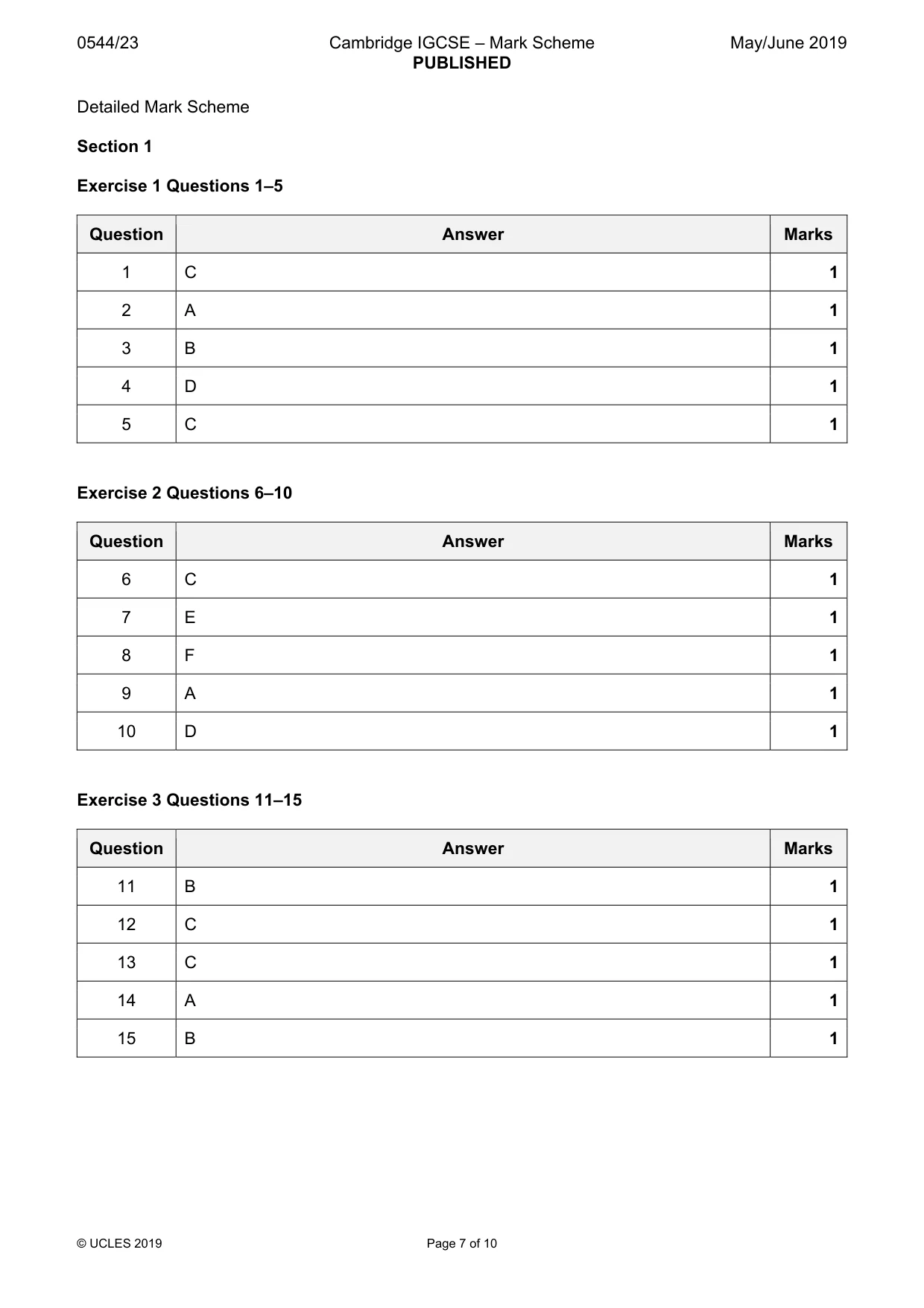
0544/23 Cambridge IGCSE – Mark Scheme PUBLISHED May/June 2019 © UCLES 2019 Page 7 of 10 Detailed Mark Scheme Section 1 Exercise 1 Questions 1–5 Question Answer Marks 1 C 1 2 A 1 3 B 1 4 D 1 5 C 1 Exercise 2 Questions 6–10 Question Answer Marks 6 C 1 7 E 1 8 F 1 9 A 1 10 D 1 Exercise 3 Questions 11–15 Question Answer Marks 11 B 1 12 C 1 13 C 1 14 A 1 15 B 1
Mark scheme, page 8
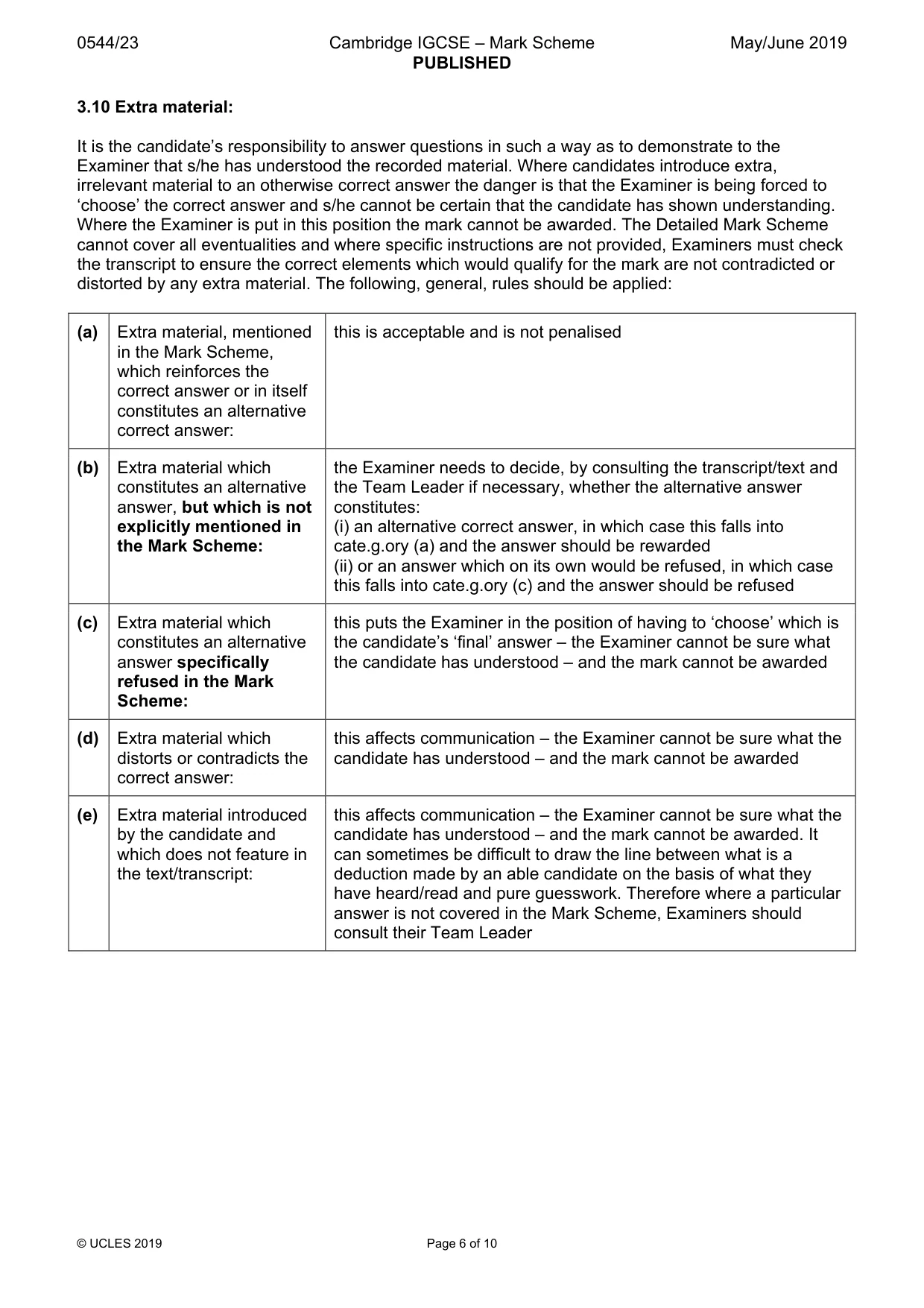
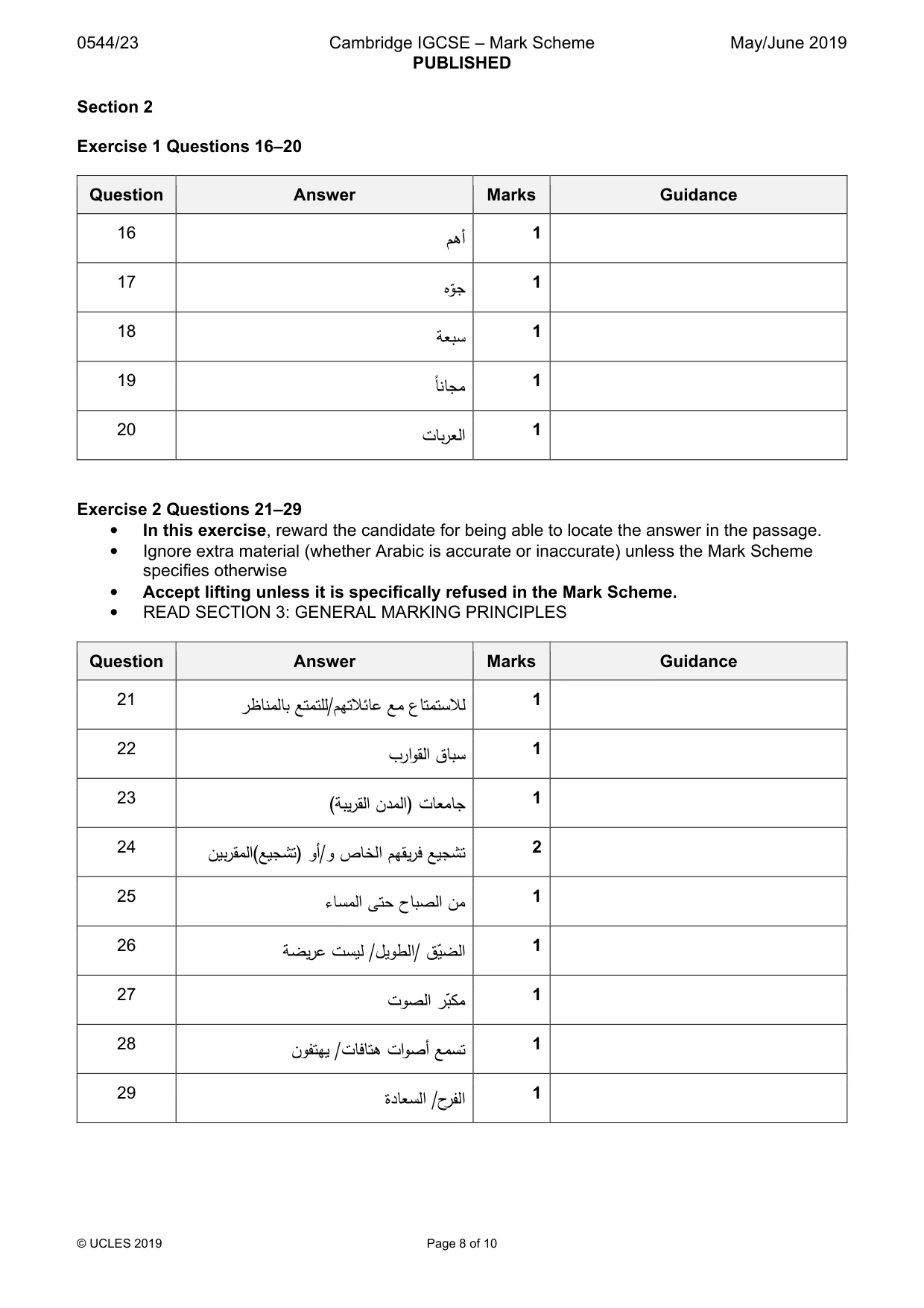
0544/23 Cambridge IGCSE – Mark Scheme PUBLISHED May/June 2019 © UCLES 2019 Page 8 of 10 Section 2 Exercise 1 Questions 16–20 Question Answer Marks Guidance 16 Àƍ£ 1 17 ƋÌÊ 1 18 řŸŗŬ 1 19 ÆŕƊŕŠƈ 1 20 ªŕŗ±Ÿƅ§ 1 Exercise 2 Questions 21–29 • In this exercise, reward the candidate for being able to locate the answer in the passage. • Ignore extra material (whether Arabic is accurate or inaccurate) unless the Mark Scheme specifies otherwise • Accept lifting unless it is specifically refused in the Mark Scheme. • READ SECTION 3: GENERAL MARKING PRINCIPLES Question Answer Marks Guidance 21 ±¸ŕƊƈƅŕŗ ŶśƈśƆƅ/ÀƎśƜœŕŷ Ŷƈ ¹ŕśƈśŬƜƅ 1 22 ¨±§ÃƂƅ§ ½ŕŗŬ 1 23 (řŗƔ±Ƃƅ§ Á¯ƈƅ§) ªŕŸƈ੠1 24 ÁƔŗ±Ƃƈƅ§(ŶƔŠŮś) ã/à µŕŦƅ§ ÀƎƂƔ±ž ŶƔŠŮś 2 25 ¡ŕŬƈƅ§ Ƒśţ ŕŗŰƅ§ Áƈ 1 26 ¿Ɣ÷ƅ§/ ½ÌƔŲƅ§ / řŲƔ±ŷ ªŬƔƅ 1 27 ªÃŰƅ§ ±ÌŗƄƈ 1 28 ÁÃſśƎƔ /ªŕžŕśƍ ª§ÃŰ£ ŶƈŬś 1 29 ©¯ŕŸŬƅ§ /±ſƅ§ 1
Mark scheme, page 9
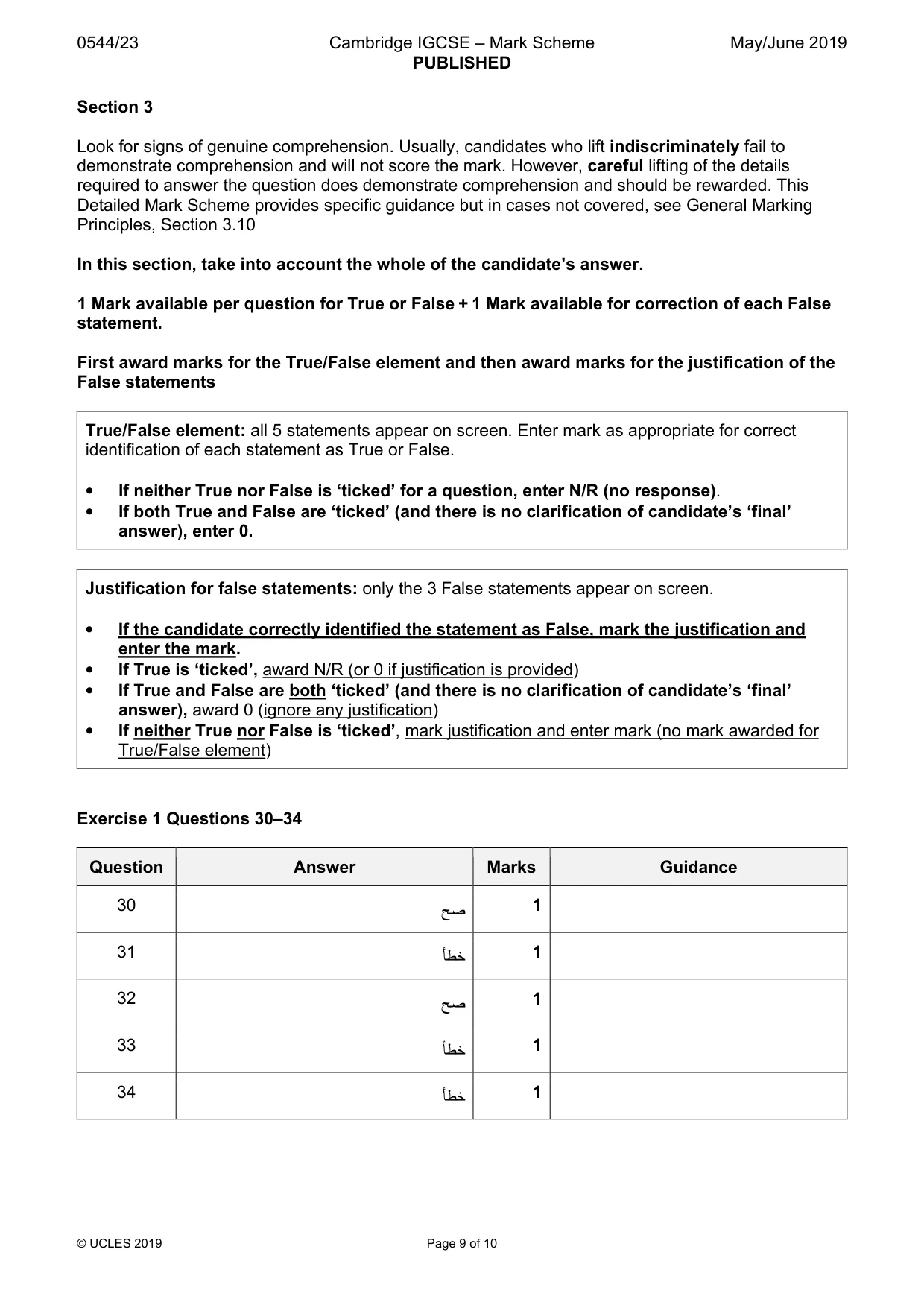
0544/23 Cambridge IGCSE – Mark Scheme PUBLISHED May/June 2019 © UCLES 2019 Page 9 of 10 Section 3 Look for signs of genuine comprehension. Usually, candidates who lift indiscriminately fail to demonstrate comprehension and will not score the mark. However, careful lifting of the details required to answer the question does demonstrate comprehension and should be rewarded. This Detailed Mark Scheme provides specific guidance but in cases not covered, see General Marking Principles, Section 3.10 In this section, take into account the whole of the candidate’s answer. 1 Mark available per question for True or False + 1 Mark available for correction of each False statement. First award marks for the True/False element and then award marks for the justification of the False statements True/False element: all 5 statements appear on screen. Enter mark as appropriate for correct identification of each statement as True or False. • If neither True nor False is ‘ticked’ for a question, enter N/R (no response). • If both True and False are ‘ticked’ (and there is no clarification of candidate’s ‘final’ answer), enter 0. Justification for false statements: only the 3 False statements appear on screen. • If the candidate correctly identified the statement as False, mark the justification and enter the mark. • If True is ‘ticked’, award N/R (or 0 if justification is provided) • If True and False are both ‘ticked’ (and there is no clarification of candidate’s ‘final’ answer), award 0 (ignore any justification) • If neither True nor False is ‘ticked’, mark justification and enter mark (no mark awarded for True/False element) Exercise 1 Questions 30–34 Question Answer Marks Guidance 30 ŢŰ 1 31 ō·Ŧ 1 32 ŢŰ 1 33 ō·Ŧ 1 34 ō·Ŧ 1
Mark scheme, page 10
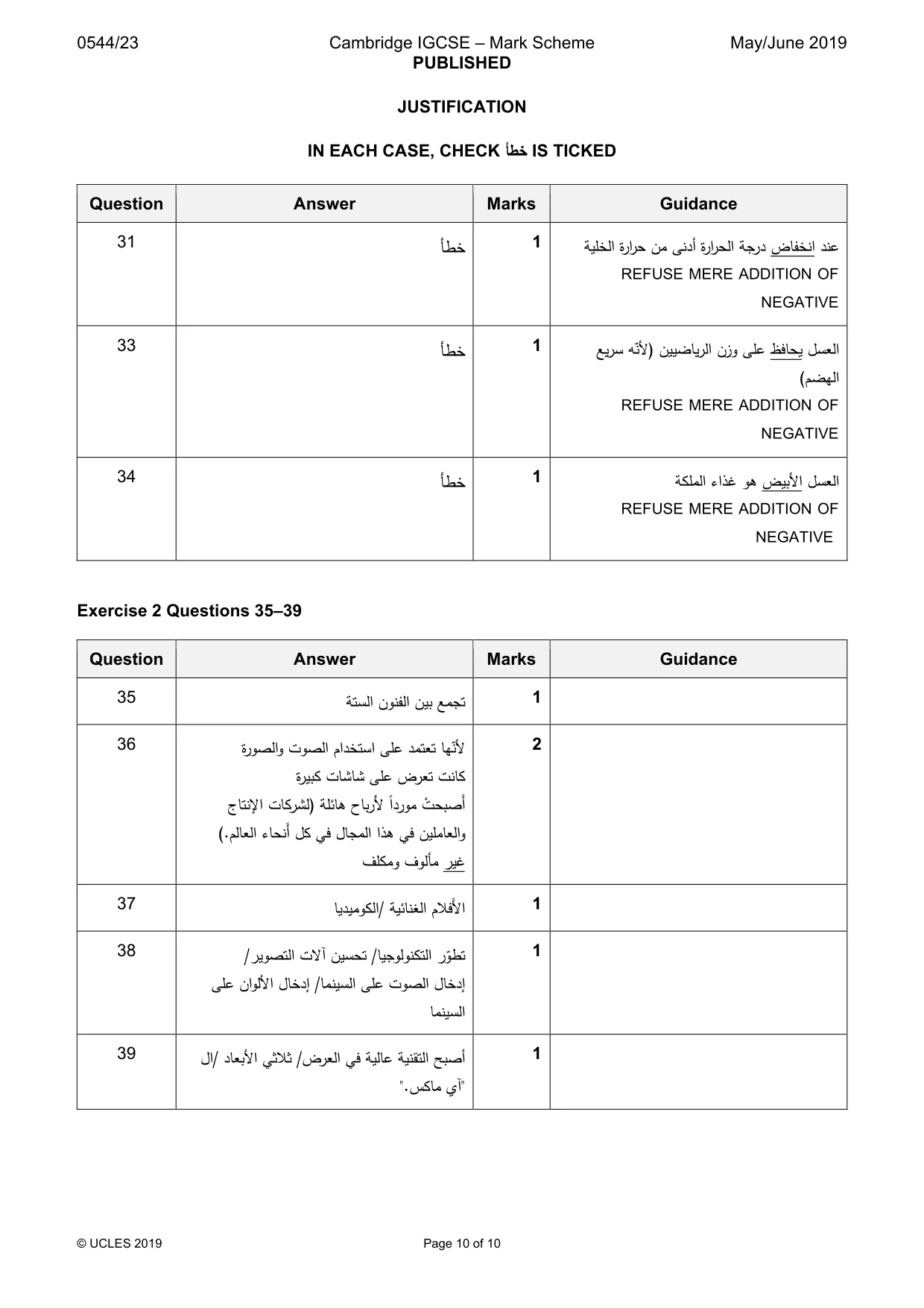
0544/23 Cambridge IGCSE – Mark Scheme PUBLISHED May/June 2019 © UCLES 2019 Page 10 of 10 JUSTIFICATION IN EACH CASE, CHECK ŋ¶Ť IS TICKED Question Answer Marks Guidance 31 ō·Ŧ 1 řƔƆŦƅ§ ©±§±ţ Áƈ ƑƊ¯£ ©±§±ţƅ§ řŠ±¯ ¶ŕſŦƊ§ ¯Ɗŷ REFUSE MERE ADDITION OF NEGATIVE 33 ō·Ŧ 1 ŶƔ±Ŭ ƌÌƊƗ) ÁƔƔŲŕƔ±ƅ§ Á²Ã ƑƆŷ ¸žŕţƔ ¿ŬŸƅ§ ÀŲƎƅ§ ( REFUSE MERE ADDITION OF NEGATIVE 34 ō·Ŧ 1 řƄƆƈƅ§ ¡§°Ż Ãƍ ¶ƔŗƗ§ ¿ŬŸƅ§ REFUSE MERE ADDITION OF NEGATIVE Exercise 2 Questions 35–39 Question Answer Marks Guidance 35 řśŬƅ§ ÁÃƊſƅ§ ÁƔŗ ŶƈŠś 1 36 ©±ÃŰƅ§Ã ªÃŰƅ§ À§¯ŦśŬ§ ƑƆŷ ¯ƈśŸś ŕƎÌƊƗ ©±ƔŗƄ ªŕŮŕŮ ƑƆŷ ¶±Ÿś ªƊŕƄ ¬ŕśƊƙ§ ªŕƄ±Ůƅ) řƆœŕƍ ŕŗ±ÉƗ Ƨ¯±Ãƈ ͪţŗŰÉ£ (.ÀƅŕŸƅ§ ¡ŕţƊÉ£ ¿Ƅ Ɠž ¿ŕŠƈƅ§ §°ƍ Ɠž ÁƔƆƈŕŸƅ§Ã ¼ƆƄƈà ¼Ãƅōƈ ±ƔŻ 2 37 ŕƔ¯ƔƈÃƄƅ§/ řƔœŕƊżƅ§ ÀƜžÉƗ§ 1 38 /±ƔÃŰśƅ§ ªƛ¢ ÁƔŬţś /ŕƔŠÃƅÃƊƄśƅ§ ±Ì÷ś ƑƆŷ Á§ÃƅƗ§ ¿ŕŦ¯¥ /ŕƈƊƔŬƅ§ ƑƆŷ ªÃŰƅ§ ¿ŕŦ¯¥ ŕƈƊƔŬƅ§ 1 39 ¿§/ ¯ŕŸŗƗ§ ƓŝƜŝ /¶±Ÿƅ§ Ɠž řƔƅŕŷ řƔƊƂśƅ§ ŢŗŰ£ Å¢" ".³Ƅŕƈ 1
What you needed in this session
Cambridge’s own grade thresholds for 2019 May/June, Paper 2 · Variant 3. A higher threshold means an easier paper — the bar moves with how the cohort did.