Cambridge IGCSE Accounting 0452 — 2009 Oct/Nov Paper 3 · Variant 1
0452/31/O/N/09 · 5 questions · 100 marks · ≈113 min
The question paper and its mark scheme, free to read here and free to download. This is Cambridge’s own paper, exactly as it was sat.
Question paper20 pages
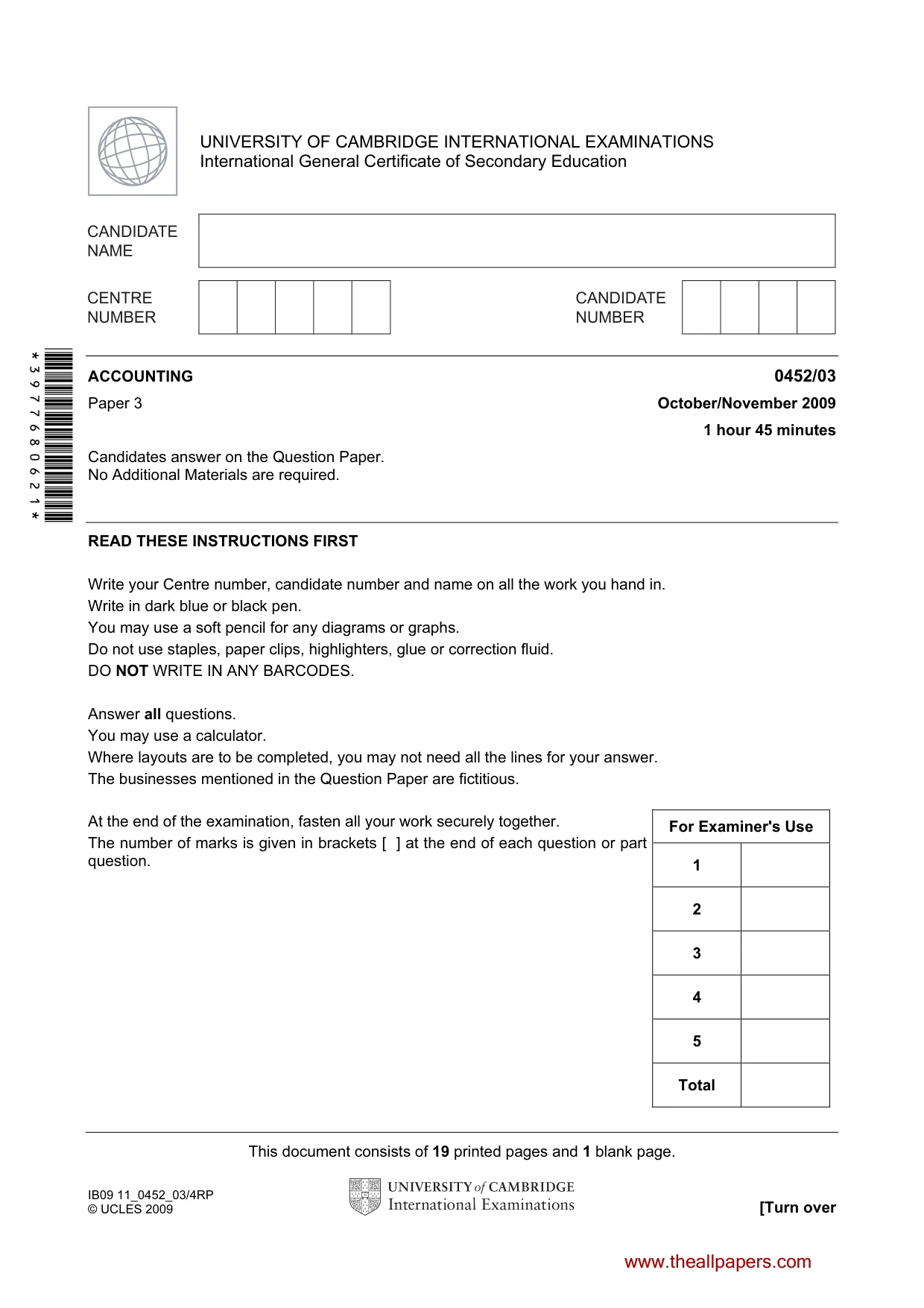

Mark scheme9 pages
Answers below. Sit the paper first if you are practising.
Questions as text
Q1 · Abdul Anwar is a sole trader who keeps a full set of double entry records including a…
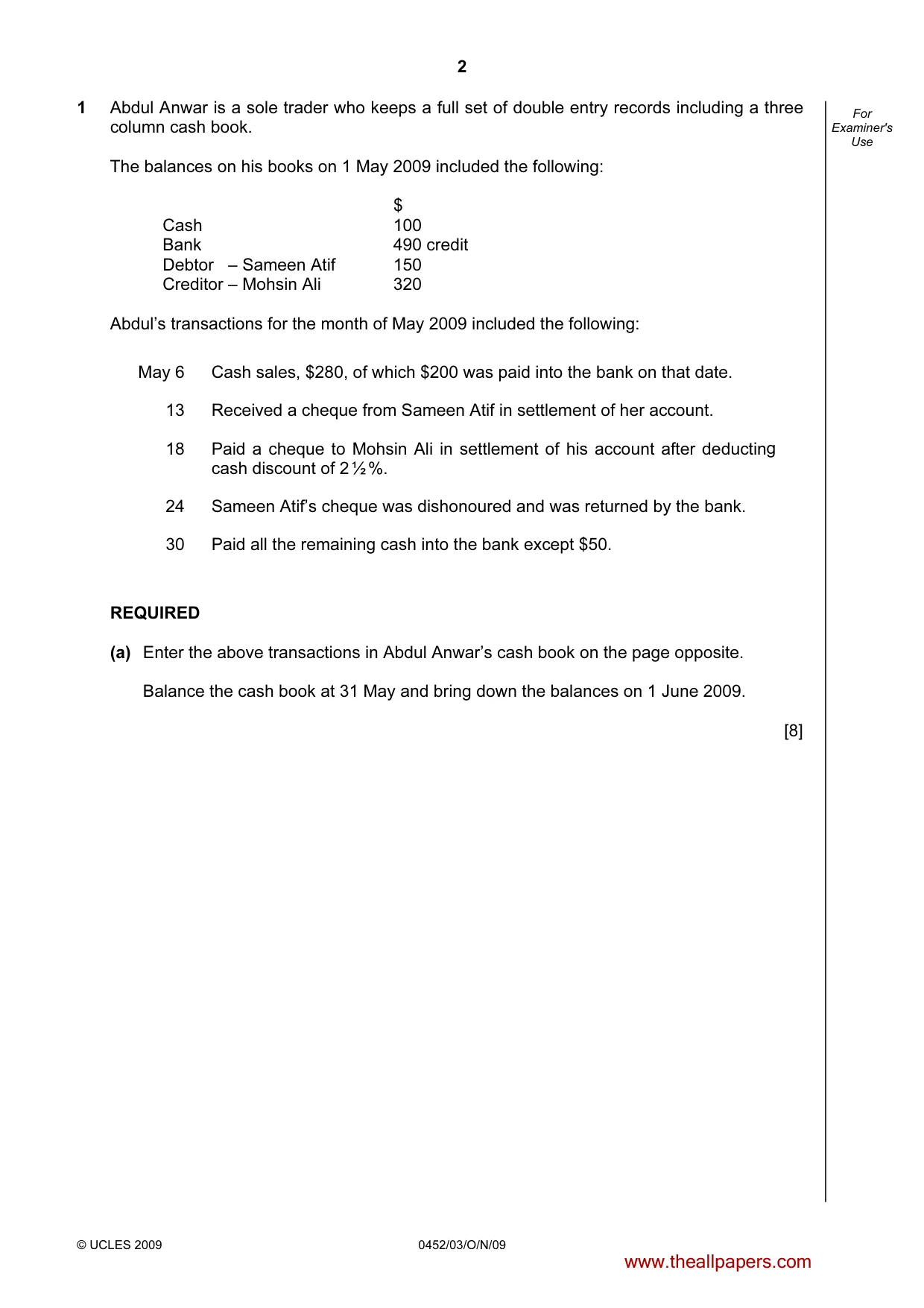
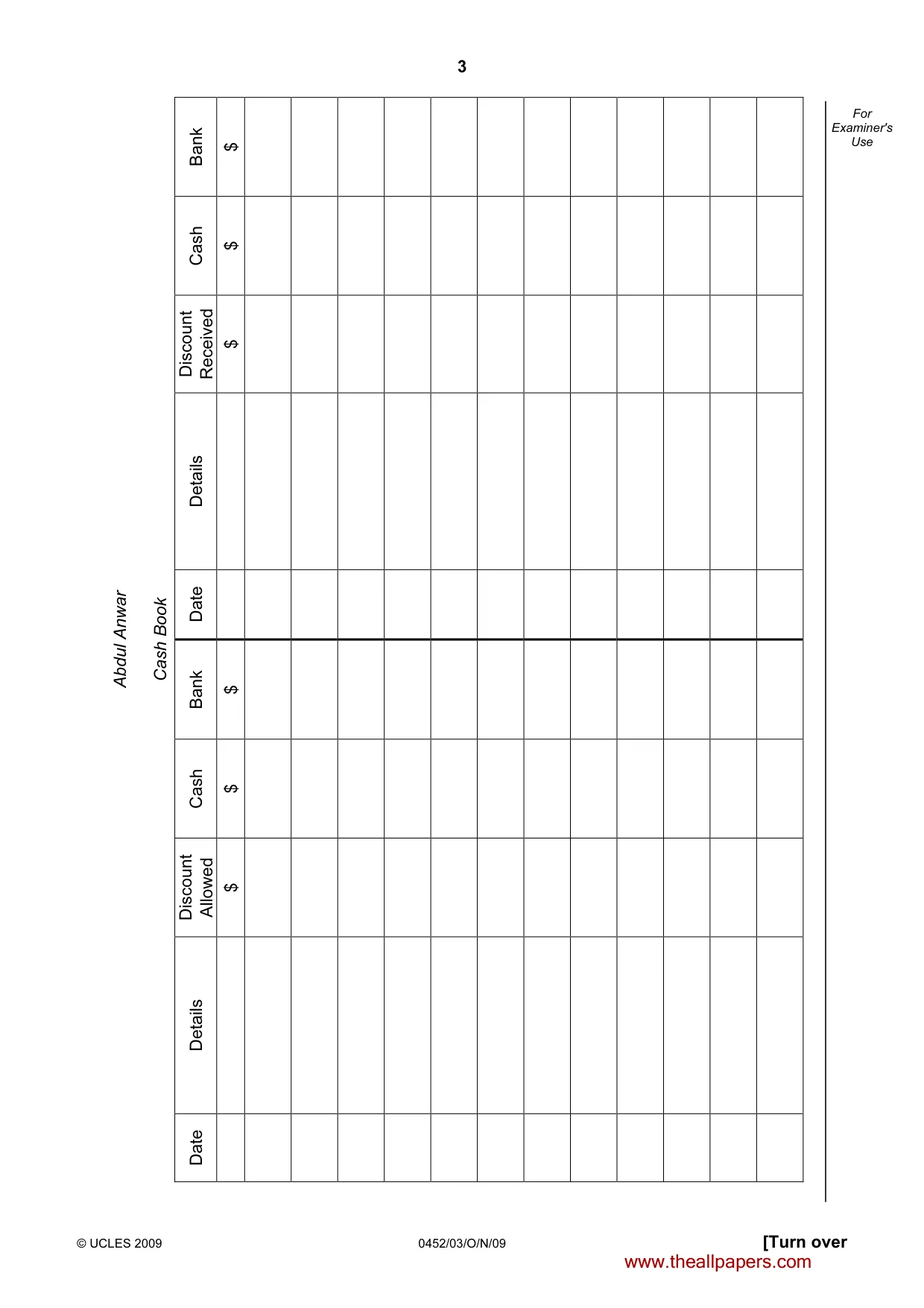
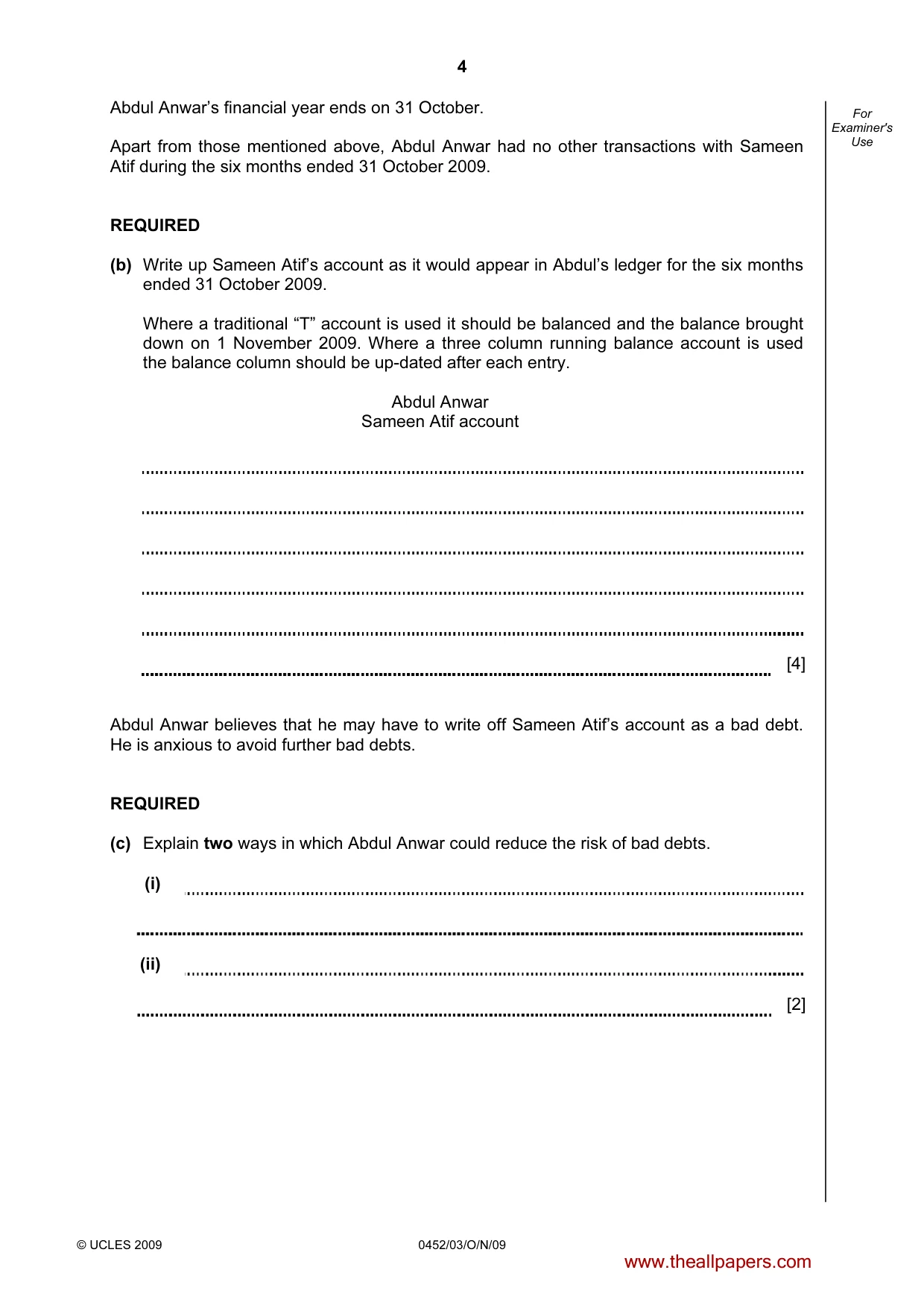
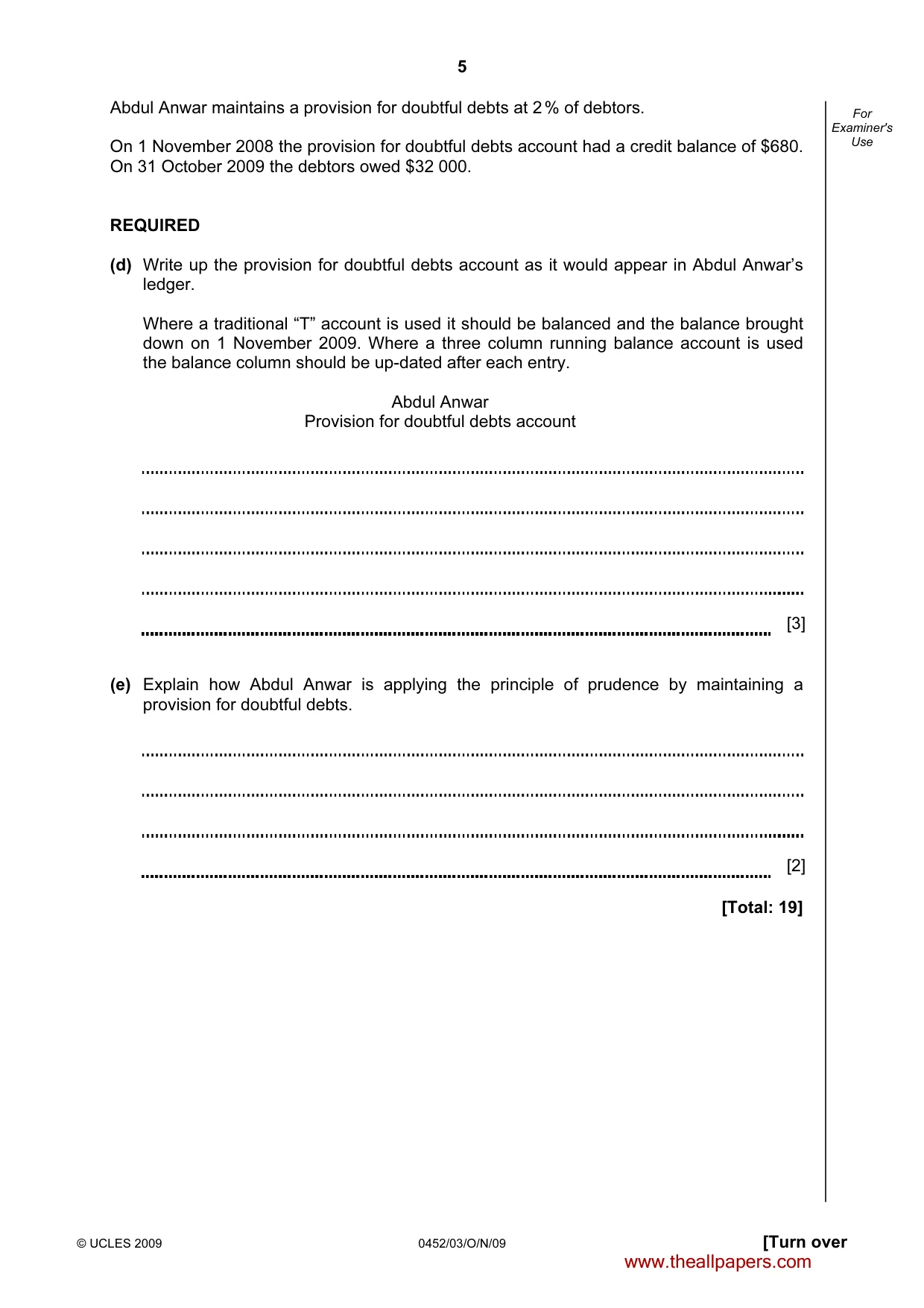
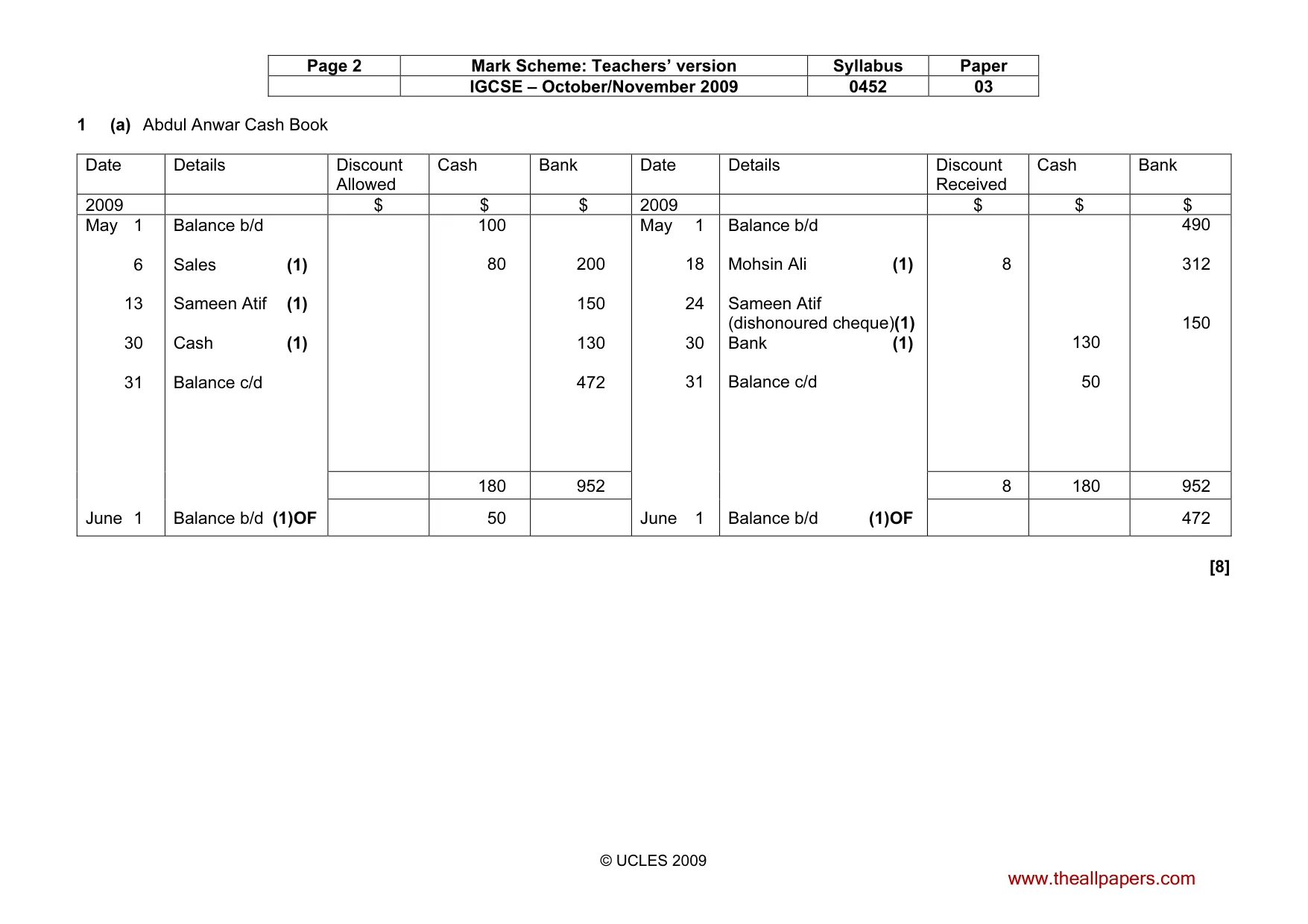
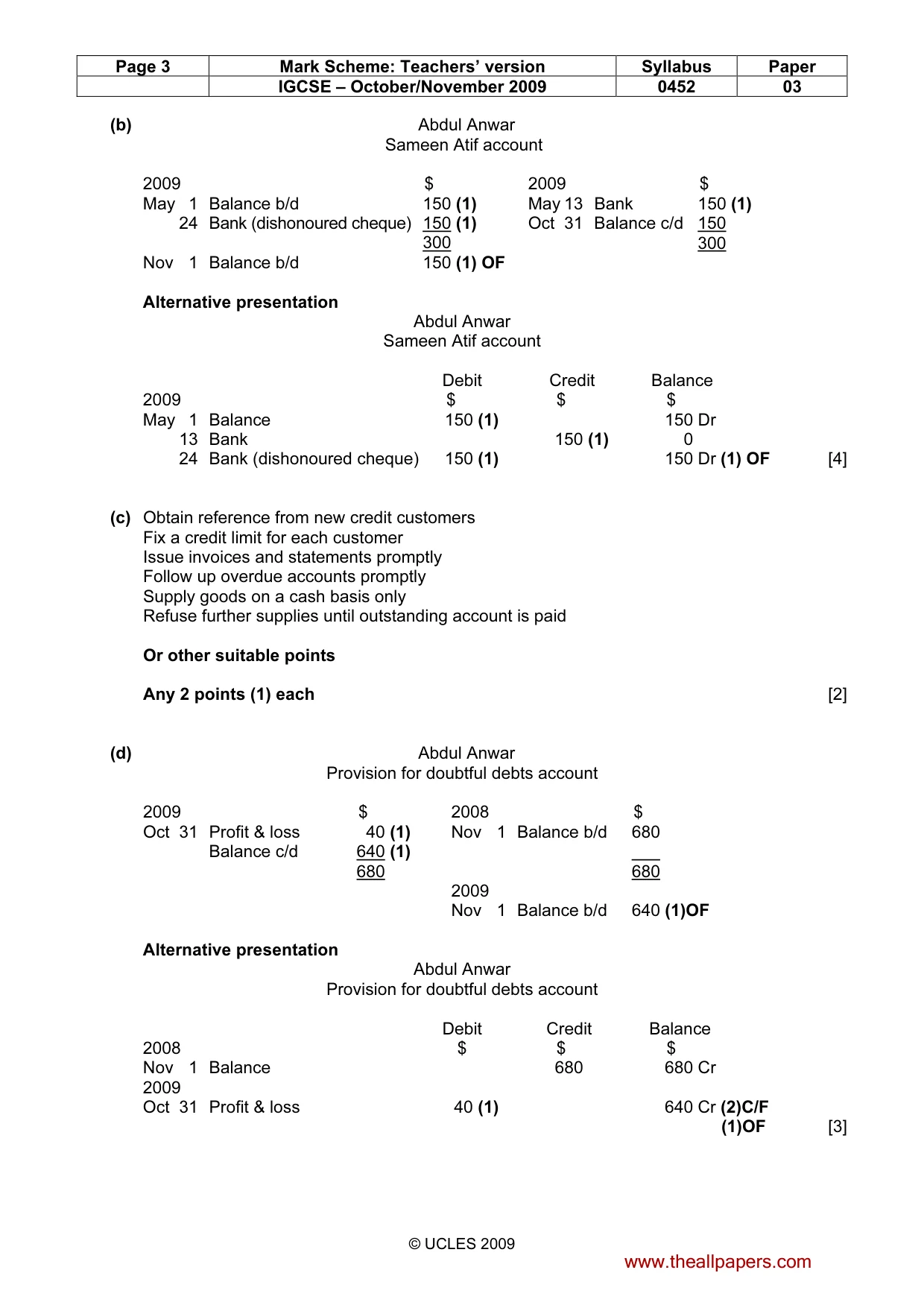
1 Abdul Anwar is a sole trader who keeps a full set of double entry records including a three column cash book. The balances on his books on 1 May 2009 included the following: $ Cash 100 Bank 490 credit Debtor – Sameen Atif 150 Creditor – Mohsin Ali 320 Abdul’s transactions for the month of May 2009 included the following: May 6 Cash sales, $280, of which $200 was paid into the bank on that date. 13 Received a cheque from Sameen Atif in settlement of her account. 18 Paid a cheque to Mohsin Ali in settlement of his account after deducting cash discount of 2 ½ %. 24 Sameen Atif’s cheque was dishonoured and was returned by the bank. 30 Paid all the remaining cash into the bank except $50. REQUIRED (a) Enter the above transactions in Abdul Anwar’s cash book on the page opposite. Balance the cash book at 31 May and bring down the balances on 1 June 2009. [8] Abdul Anwar’s financial year ends on 31 October. Apart from those mentioned above, Abdul Anwar had no other transactions with Sameen Atif during the six months ended 31 October 2009. REQUIRED (b) Write up Sameen Atif’s account as it would appear in Abdul’s ledger for the six months ended 31 October 2009. Where a traditional “T” account is used it should be balanced and the balance brought down on 1 November 2009. Where a three column running balance account is used the balance column should be up-dated after each entry. Abdul Anwar Sameen Atif account [4] Abdul Anwar believes that he may have to write off Sameen Atif’s account as a bad debt. He is anxious to avoid further bad debts. REQUIRED (c) Explain two ways in which Abdul Anwar could reduce the risk of bad debts. (i) (ii) [2] Abdul Anwar maintains a provision for doubtful debts at 2 % of debtors. On 1 November 2008 the provision for doubtful debts account had a credit balance of $680. On 31 October 2009 the debtors owed $32 000. REQUIRED (d) Write up the provision for doubtful debts account as it would appear in Abdul Anwar’s ledger. Where a traditional “T” account is used it should be balanced and the balance brought down on 1 November 2009. Where a three column running balance account is used the balance column should be up-dated after each entry. Abdul Anwar Provision for doubtful debts account [3] (e) Explain how Abdul Anwar is applying the principle of prudence by maintaining a provision for doubtful debts. [2] [Total: 19]
Q2 · Jane Nowka is a hairdresser
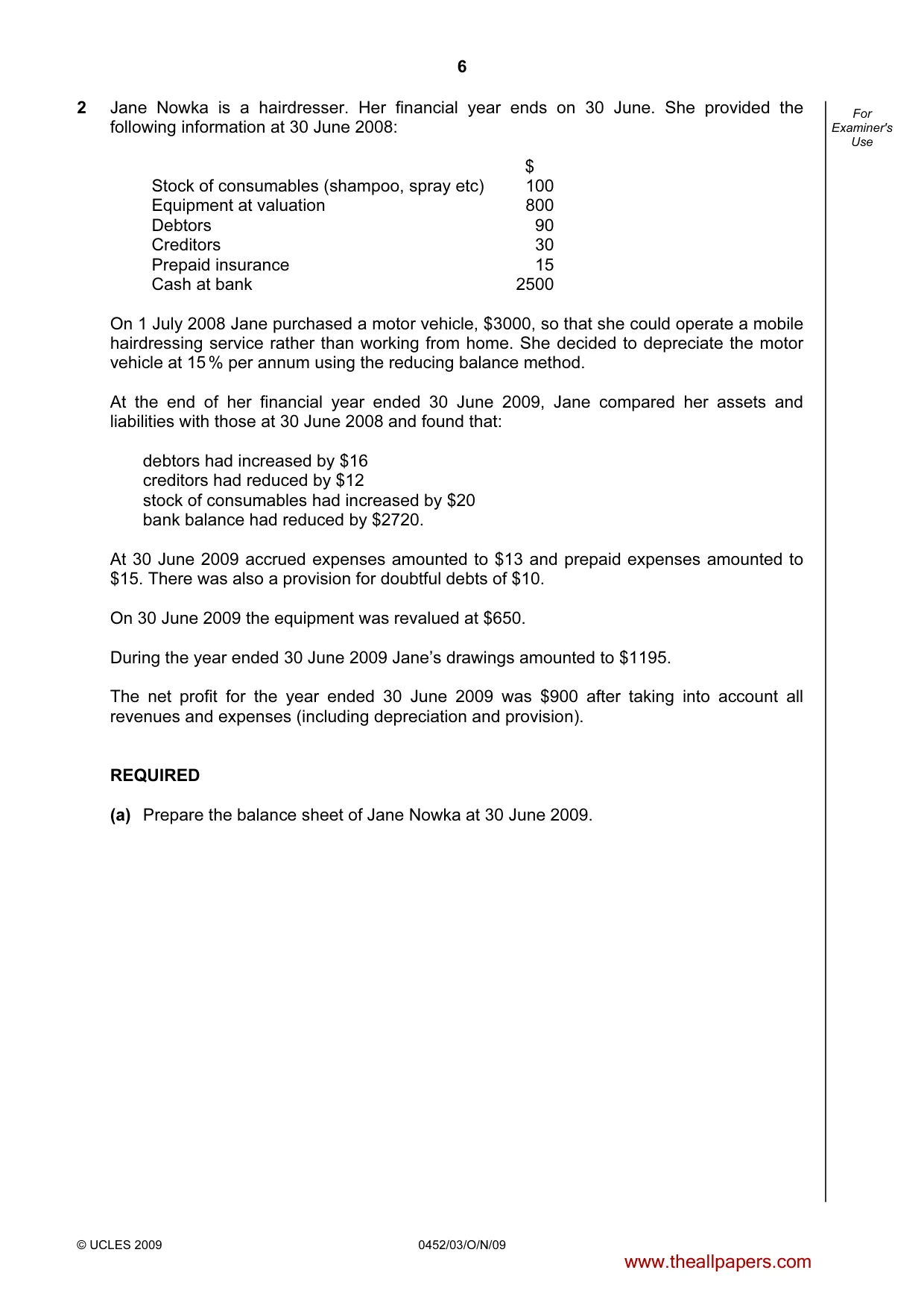
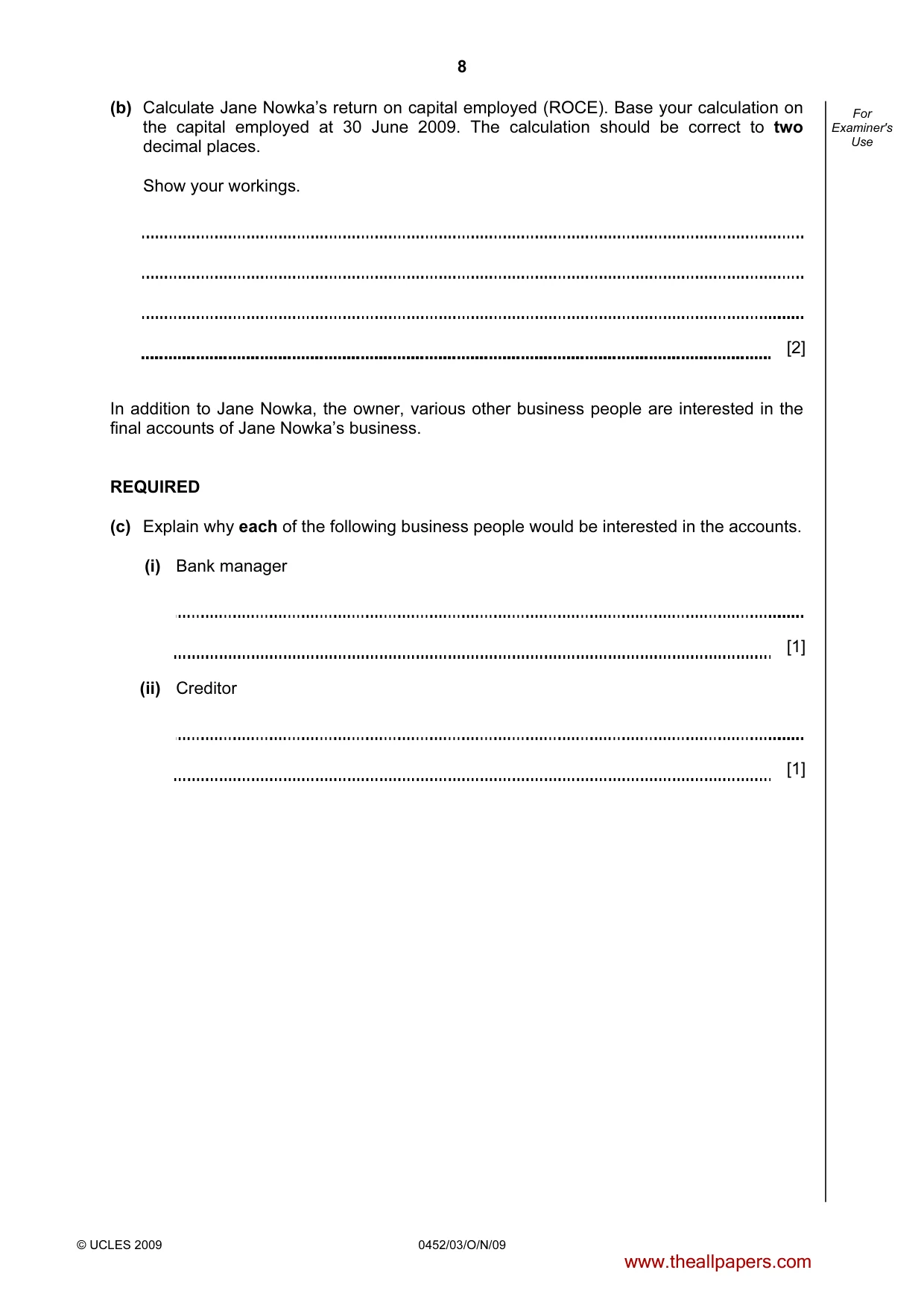
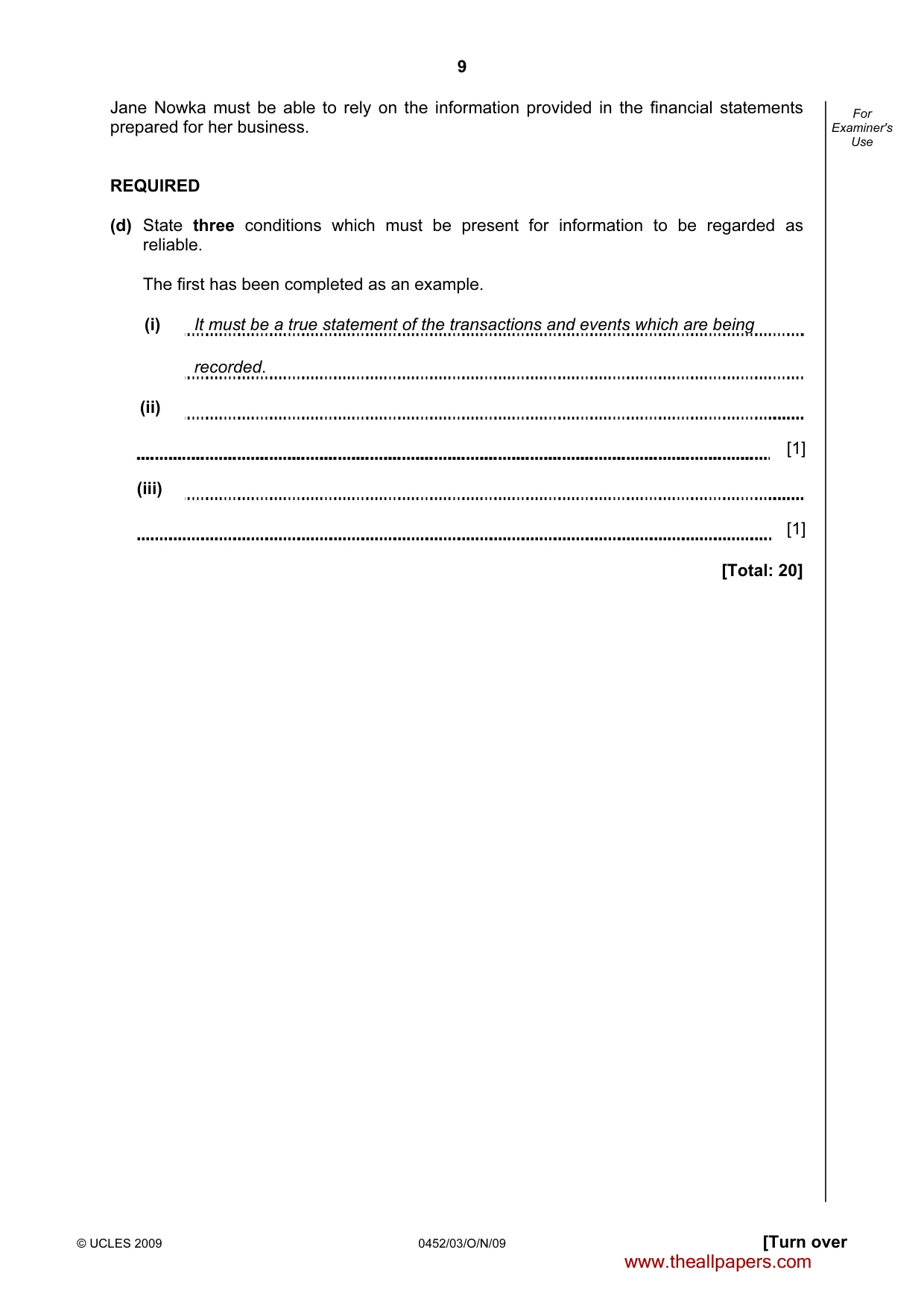
2 Jane Nowka is a hairdresser. Her financial year ends on 30 June. She provided the following information at 30 June 2008: $ Stock of consumables (shampoo, spray etc) 100 Equipment at valuation 800 Debtors 90 Creditors 30 Prepaid insurance 15 Cash at bank 2500 On 1 July 2008 Jane purchased a motor vehicle, $3000, so that she could operate a mobile hairdressing service rather than working from home. She decided to depreciate the motor vehicle at 15 % per annum using the reducing balance method. At the end of her financial year ended 30 June 2009, Jane compared her assets and liabilities with those at 30 June 2008 and found that: debtors had increased by $16 creditors had reduced by $12 stock of consumables had increased by $20 bank balance had reduced by $2720. At 30 June 2009 accrued expenses amounted to $13 and prepaid expenses amounted to $15. There was also a provision for doubtful debts of $10. On 30 June 2009 the equipment was revalued at $650. During the year ended 30 June 2009 Jane’s drawings amounted to $1195. The net profit for the year ended 30 June 2009 was $900 after taking into account all revenues and expenses (including depreciation and provision). REQUIRED (a) Prepare the balance sheet of Jane Nowka at 30 June 2009. Jane Nowka Balance Sheet at 30 June 2009 [14] (b) Calculate Jane Nowka’s return on capital employed (ROCE). Base your calculation on the capital employed at 30 June 2009. The calculation should be correct to two decimal places. Show your workings. [2] In addition to Jane Nowka, the owner, various other business people are interested in the final accounts of Jane Nowka’s business. REQUIRED (c) Explain why each of the following business people would be interested in the accounts. (i) Bank manager [1] (ii) Creditor [1] Jane Nowka must be able to rely on the information provided in the financial statements prepared for her business. REQUIRED (d) State three conditions which must be present for information to be regarded as reliable. The first has been completed as an example. (i) It must be a true statement of the transactions and events which are being recorded. (ii) [1] (iii) [1] [Total: 20]
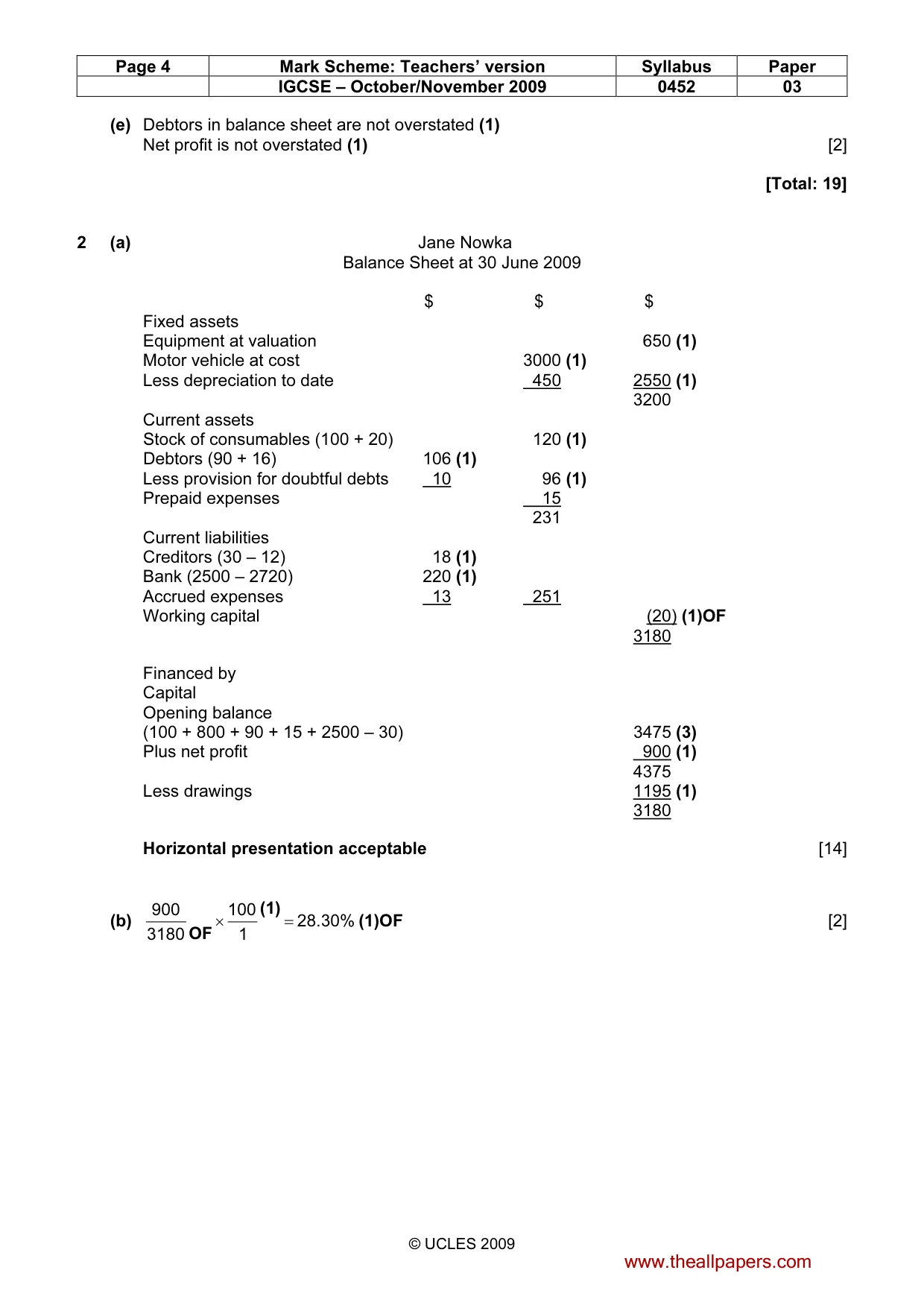
Mark scheme: 2 (a) Jane Nowka Balance Sheet at 30 June 2009 $ $ $ Fixed assets Equipment at valuation 650 (1) Motor vehicle at cost 3000 (1) Less depreciation to date 450 2550 (1) 3200 Current assets Stock of consumables (100 + 20) 120 (1) Debtors (90 + 16) 106 (1) Less provision for doubtful debts 10 96 (1) Prepaid expenses 15 231 Current liabilities Creditors (30 – 12) 18 (1) Bank (2500 – 2720) 220 (1) Accrued expenses 13 251 Working capital (20) (1)OF 3180 Financed by Capital Opening balance (100 + 800 + 90 + 15 + 2500 – 30) 3475 (3) Plus net profit 900 (1) 4375 Less drawings 1195 (1) 3180 Horizontal presentation acceptable [14] 900 100 (1) (b) × = 28.30% (1)OF [2] 3180 OF 1 IGCSE – October/November 2009 0452 03 (c) (i) Bank manager To assess prospects of bank overdraft being repaid when due To assess prospects of any interest on overdraft being paid when due To assess the prospects of any requested loan being repaid when due To assess the security available to cover any loan/overdraft Any 1 point (1) mark (ii) Creditor To assess the liquidity position To identify how long the business takes to pay creditors To identify what credit limit is reasonable To identify future prospects of the business Any 1 point (1) mark [2] (d) Must be capable of being independently verified Must be free from bias Must be free from significant errors Must be prepared with suitable caution being applied to any judgements and estimates Any 2 points (1) each [2] [Total: 20]
Q3 · Ruth Tembe is a trader
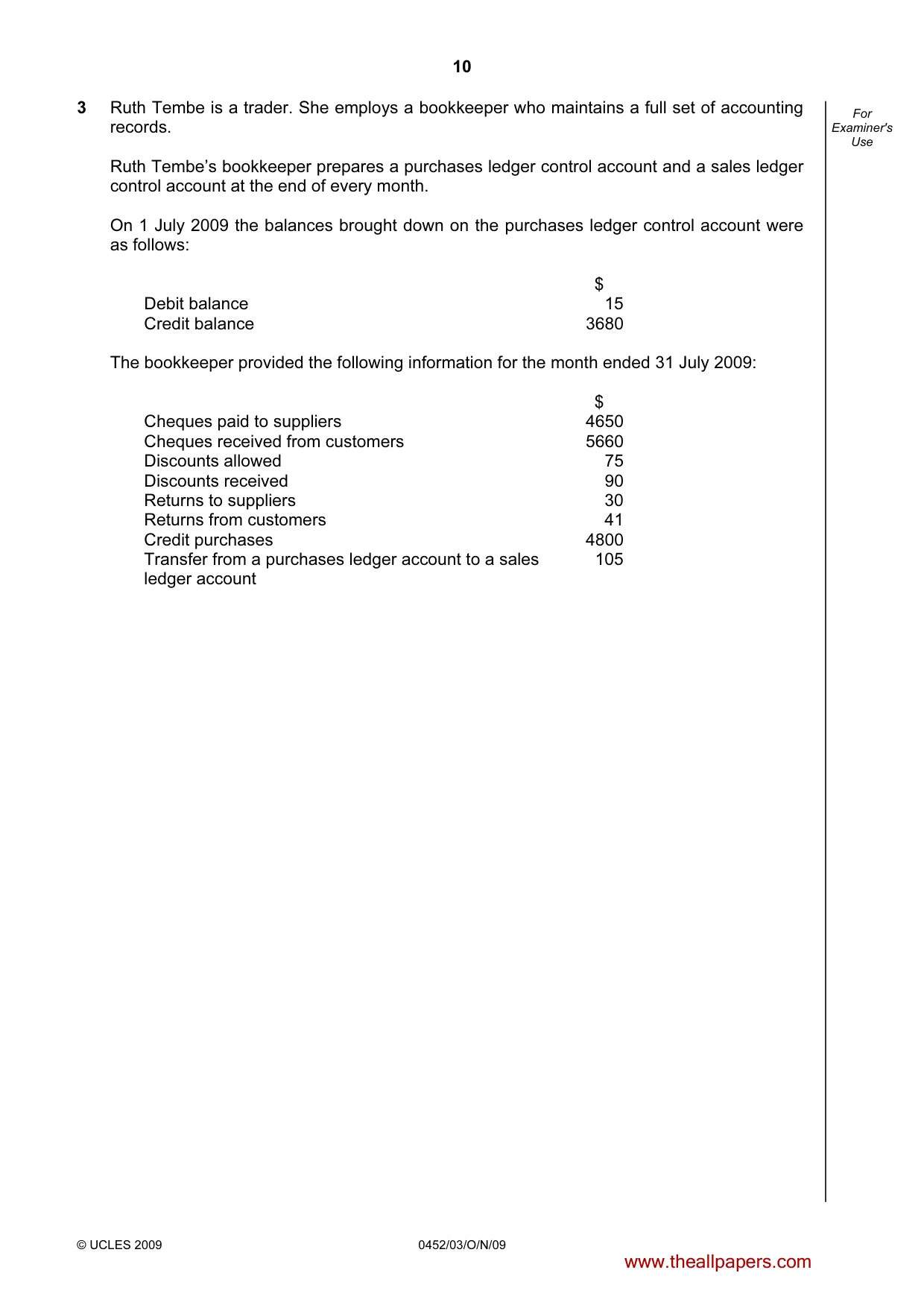
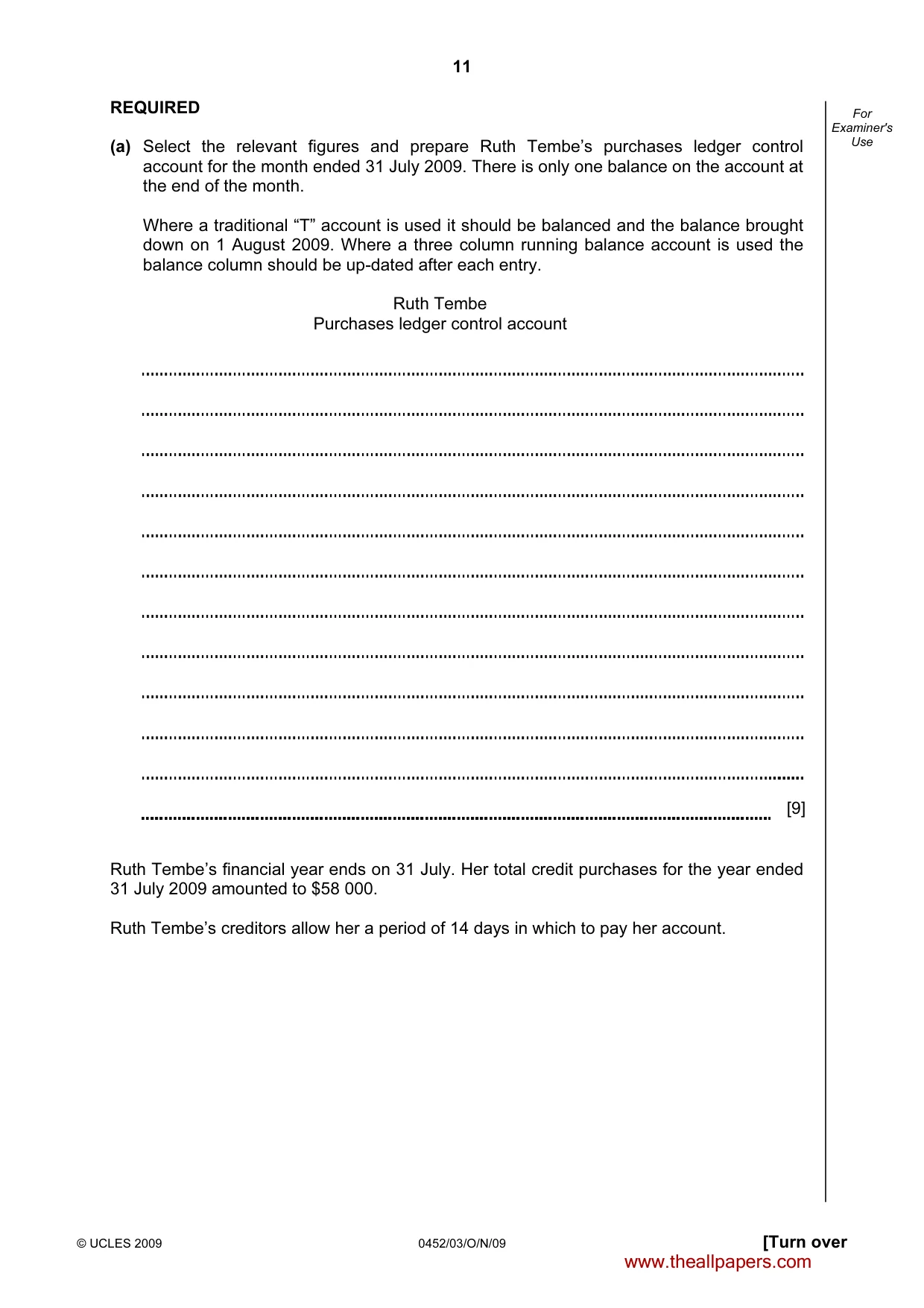
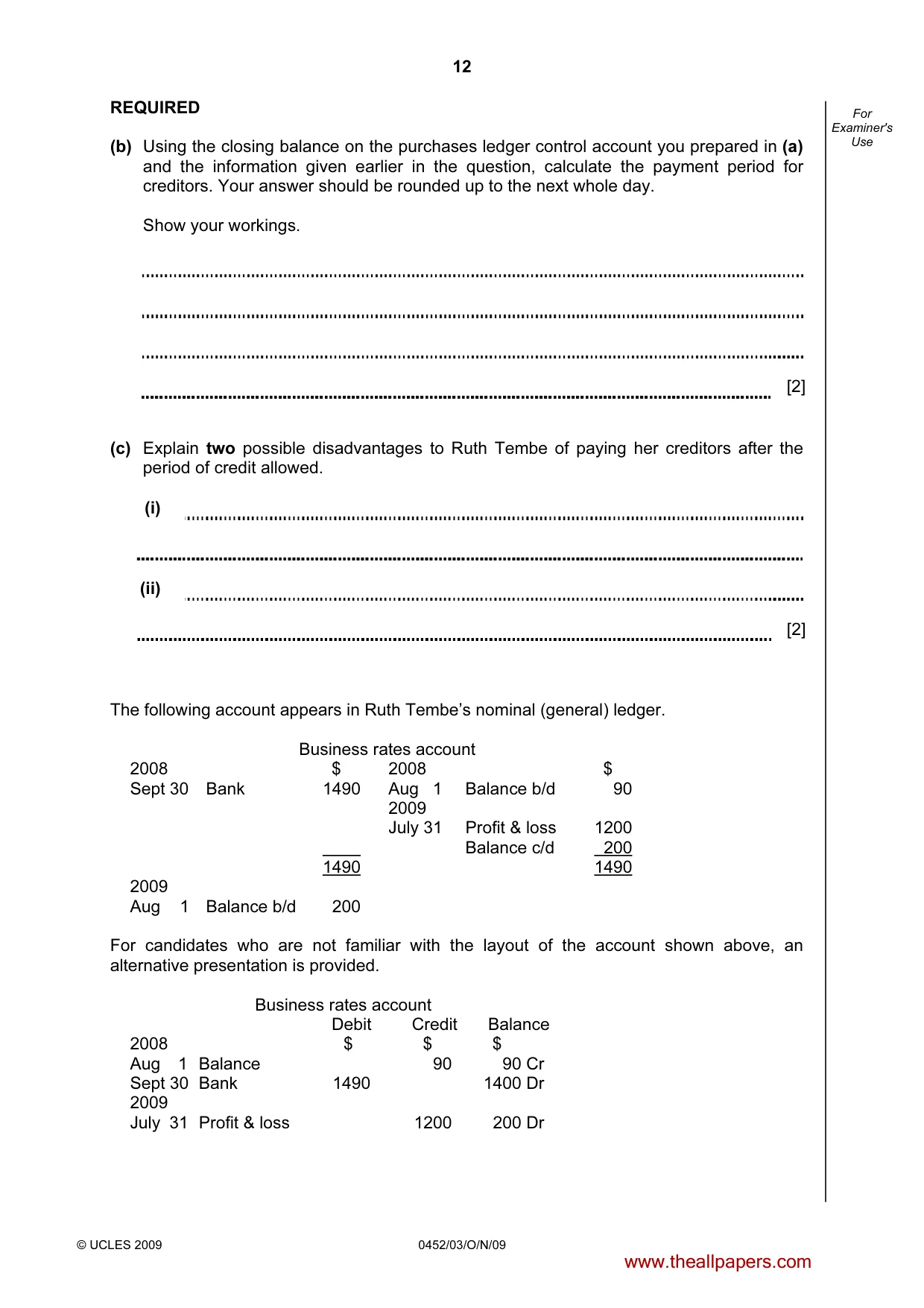
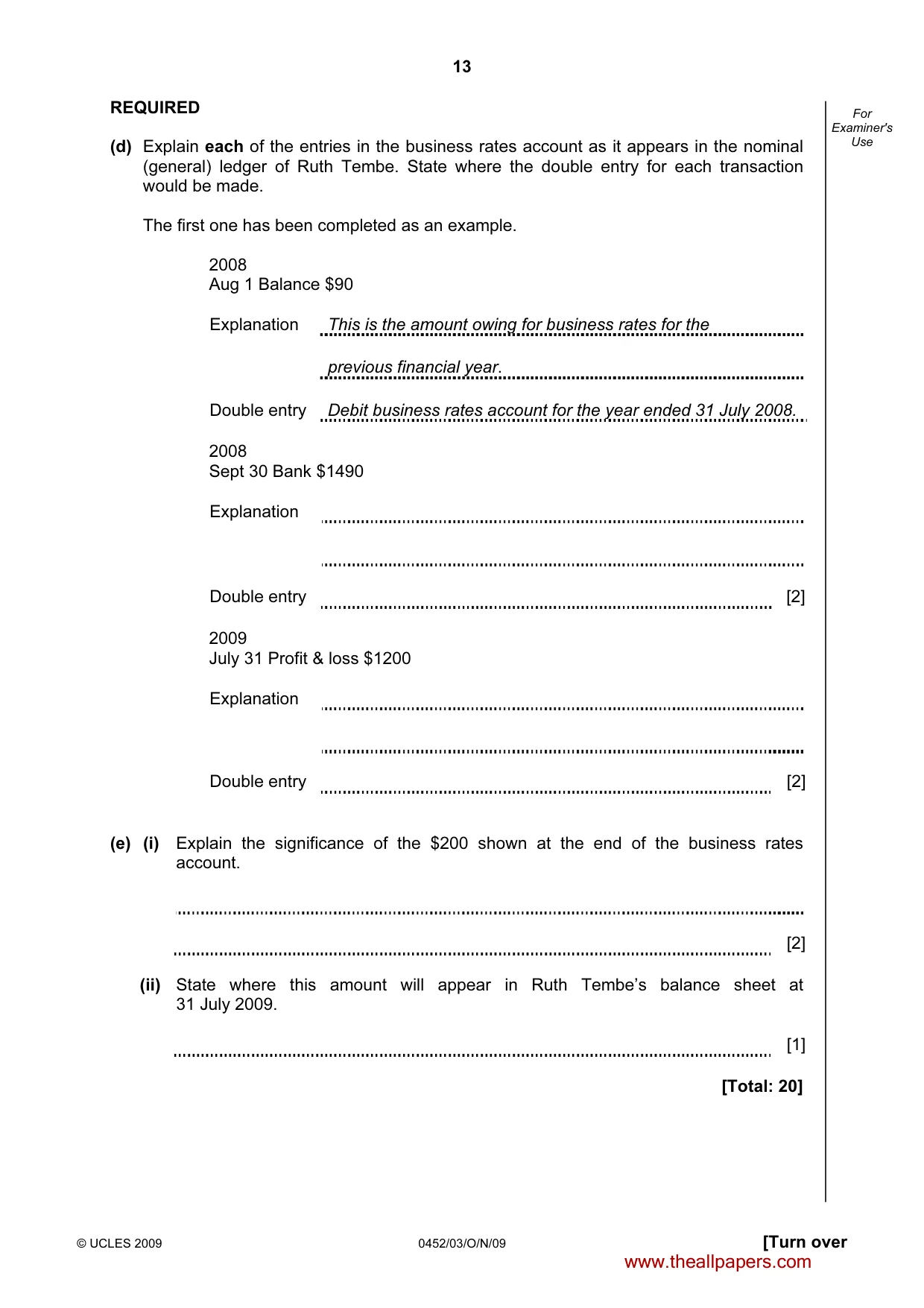
3 Ruth Tembe is a trader. She employs a bookkeeper who maintains a full set of accounting records. Ruth Tembe’s bookkeeper prepares a purchases ledger control account and a sales ledger control account at the end of every month. On 1 July 2009 the balances brought down on the purchases ledger control account were as follows: $ Debit balance 15 Credit balance 3680 The bookkeeper provided the following information for the month ended 31 July 2009: $ Cheques paid to suppliers 4650 Cheques received from customers 5660 Discounts allowed 75 Discounts received 90 Returns to suppliers 30 Returns from customers 41 Credit purchases 4800 Transfer from a purchases ledger account to a sales 105 ledger account REQUIRED (a) Select the relevant figures and prepare Ruth Tembe’s purchases ledger control account for the month ended 31 July 2009. There is only one balance on the account at the end of the month. Where a traditional “T” account is used it should be balanced and the balance brought down on 1 August 2009. Where a three column running balance account is used the balance column should be up-dated after each entry. Ruth Tembe Purchases ledger control account [9] Ruth Tembe’s financial year ends on 31 July. Her total credit purchases for the year ended 31 July 2009 amounted to $58 000. Ruth Tembe’s creditors allow her a period of 14 days in which to pay her account. REQUIRED (b) Using the closing balance on the purchases ledger control account you prepared in (a) and the information given earlier in the question, calculate the payment period for creditors. Your answer should be rounded up to the next whole day. Show your workings. [2] (c) Explain two possible disadvantages to Ruth Tembe of paying her creditors after the period of credit allowed. (i) (ii) [2] The following account appears in Ruth Tembe’s nominal (general) ledger. Business rates account 2008 $ 2008 $ Sept 30 Bank 1490 Aug 1 Balance b/d 90 2009 July 31 Profit & loss 1200 Balance c/d 200 1490 1490 2009 Aug 1 Balance b/d 200 For candidates who are not familiar with the layout of the account shown above, an alternative presentation is provided. Business rates account Debit Credit Balance 2008 $ $ $ Aug 1 Balance 90 90 Cr Sept 30 Bank 1490 1400 Dr 2009 July 31 Profit & loss 1200 200 Dr REQUIRED (d) Explain each of the entries in the business rates account as it appears in the nominal (general) ledger of Ruth Tembe. State where the double entry for each transaction would be made. The first one has been completed as an example. 2008 Aug 1 Balance $90 Explanation This is the amount owing for business rates for the previous financial year. Double entry Debit business rates account for the year ended 31 July 2008. 2008 Sept 30 Bank $1490 Explanation Double entry [2] 2009 July 31 Profit & loss $1200 Explanation Double entry [2] (e) (i) Explain the significance of the $200 shown at the end of the business rates account. [2] (ii) State where this amount will appear in Ruth Tembe’s balance sheet at 31 July 2009. [1] [Total: 20]
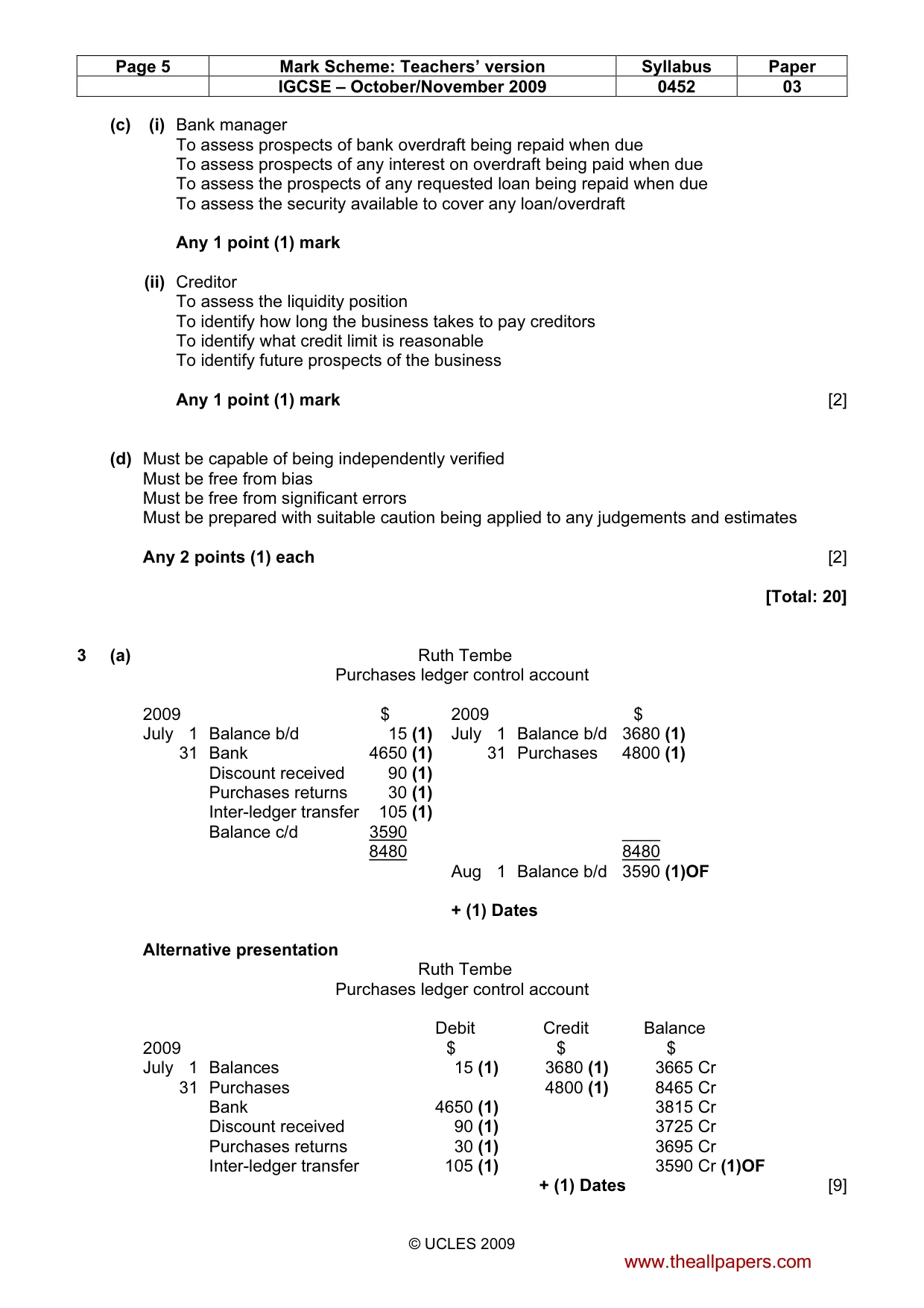
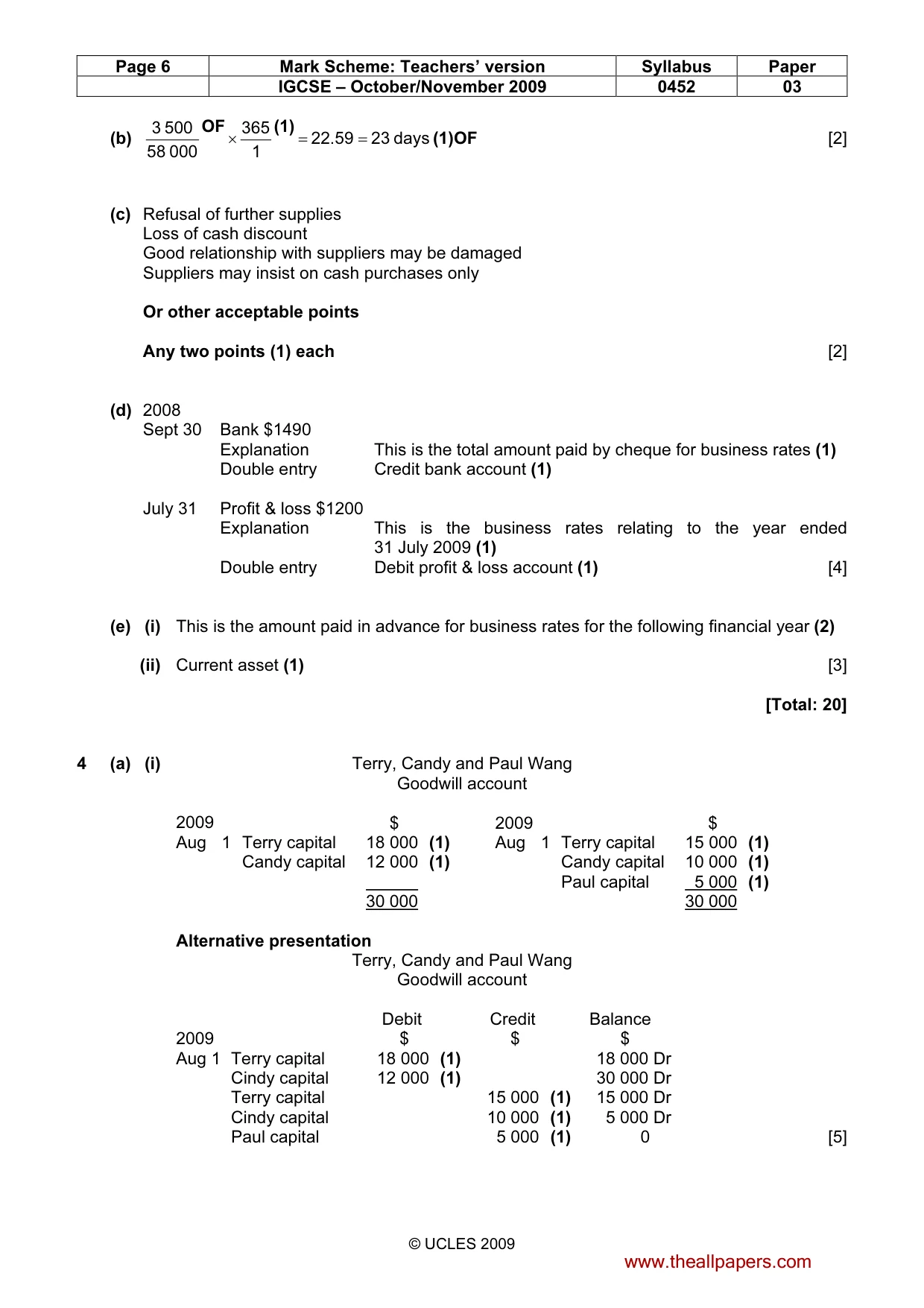
Mark scheme: 3 (a) Ruth Tembe Purchases ledger control account 2009 $ 2009 $ July 1 Balance b/d 15 (1) July 1 Balance b/d 3680 (1) 31 Bank 4650 (1) 31 Purchases 4800 (1) Discount received 90 (1) Purchases returns 30 (1) Inter-ledger transfer 105 (1) Balance c/d 3590 ____ 8480 8480 Aug 1 Balance b/d 3590 (1)OF + (1) Dates Alternative presentation Ruth Tembe Purchases ledger control account Debit Credit Balance 2009 $ $ $ July 1 Balances 15 (1) 3680 (1) 3665 Cr 31 Purchases 4800 (1) 8465 Cr Bank 4650 (1) 3815 Cr Discount received 90 (1) 3725 Cr Purchases returns 30 (1) 3695 Cr Inter-ledger transfer 105 (1) 3590 Cr (1)OF + (1) Dates [9] IGCSE – October/November 2009 0452 03 3 500 OF 365 (1) (b) × = 22.59 = 23 days (1)OF [2] 58 000 1 (c) Refusal of further supplies Loss of cash discount Good relationship with suppliers may be damaged Suppliers may insist on cash purchases only Or other acceptable points Any two points (1) each [2] (d) 2008 Sept 30 Bank $1490 Explanation This is the total amount paid by cheque for business rates (1) Double entry Credit bank account (1) July 31 Profit & loss $1200 Explanation This is the business rates relating to the year ended 31 July 2009 (1) Double entry Debit profit & loss account (1) [4] (e) (i) This is the amount paid in advance for business rates for the following financial year (2) (ii) Current asset (1) [3] [Total: 20]
Q4 · Terry and Candy Wang are in partnership
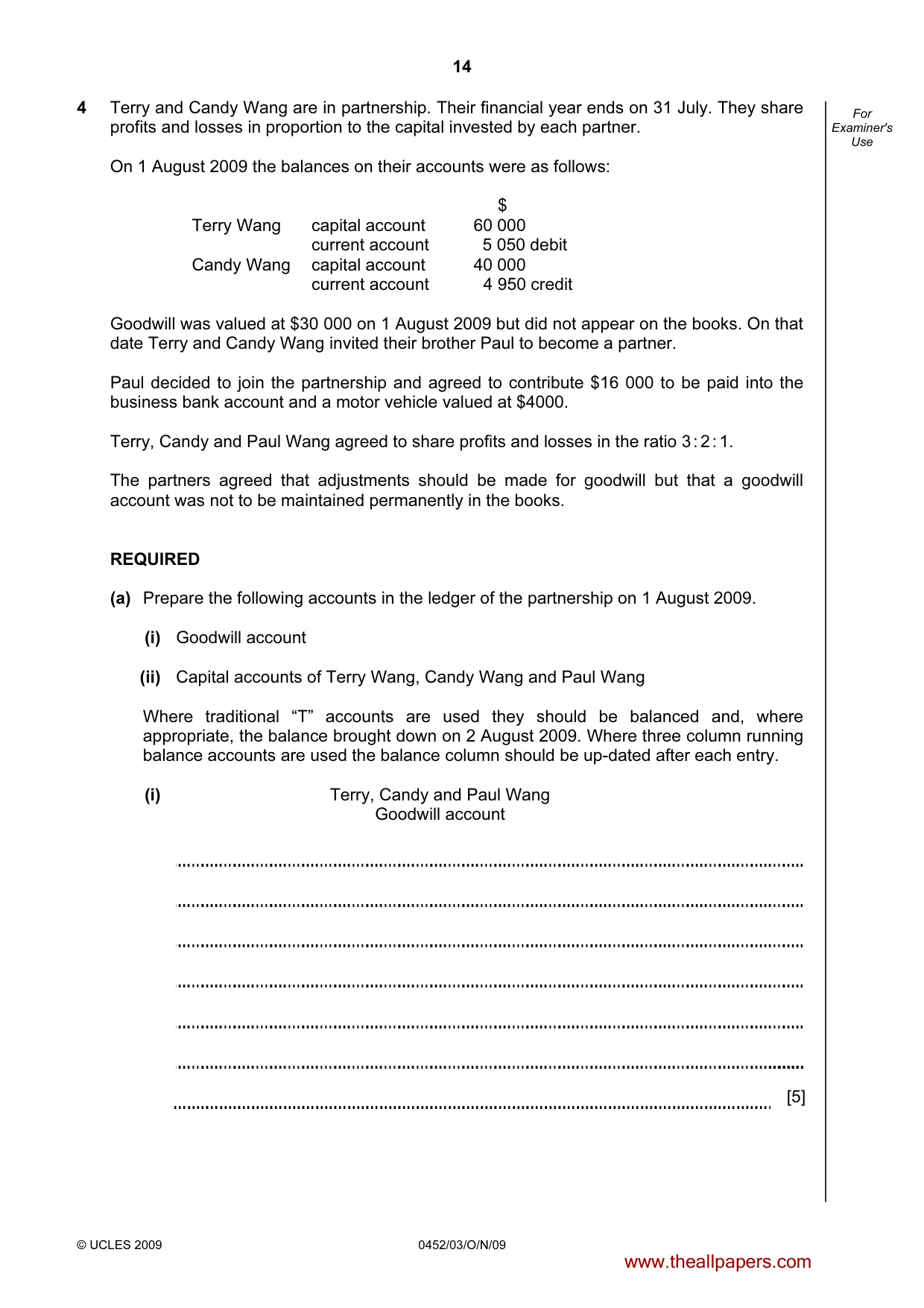
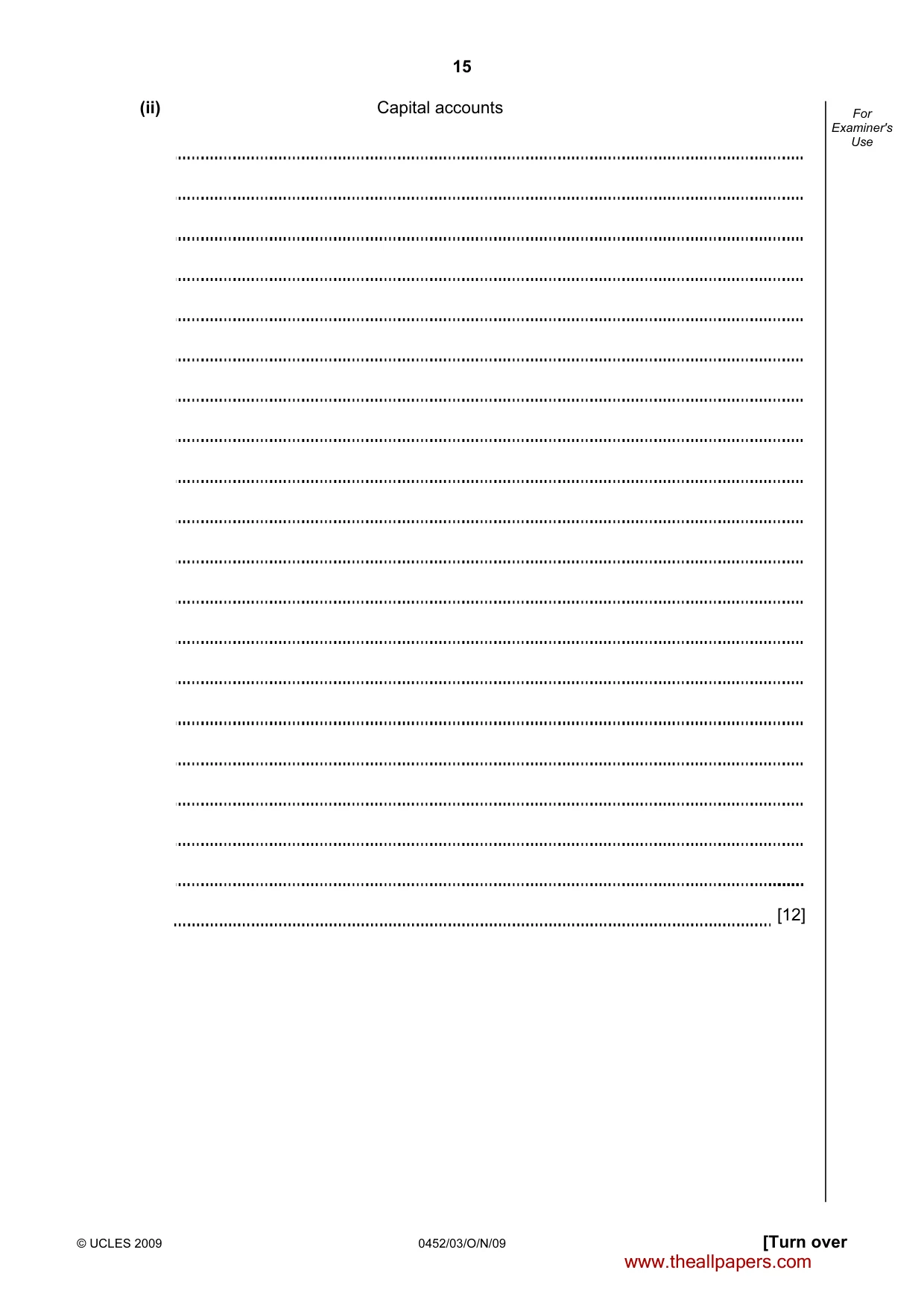
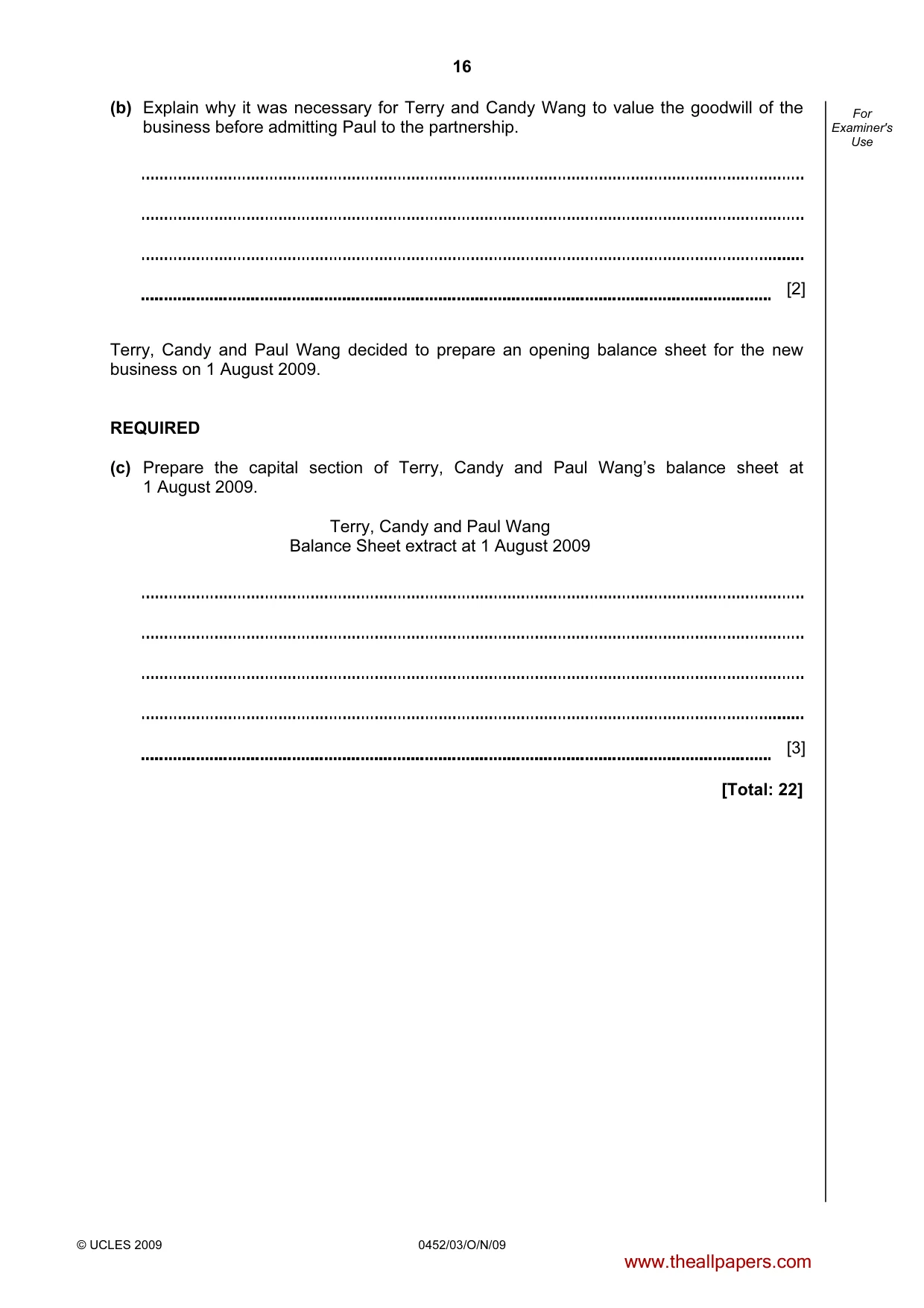
4 Terry and Candy Wang are in partnership. Their financial year ends on 31 July. They share profits and losses in proportion to the capital invested by each partner. On 1 August 2009 the balances on their accounts were as follows: $ Terry Wang capital account 60 000 current account 5 050 debit Candy Wang capital account 40 000 current account 4 950 credit Goodwill was valued at $30 000 on 1 August 2009 but did not appear on the books. On that date Terry and Candy Wang invited their brother Paul to become a partner. Paul decided to join the partnership and agreed to contribute $16 000 to be paid into the business bank account and a motor vehicle valued at $4000. Terry, Candy and Paul Wang agreed to share profits and losses in the ratio 3 : 2 : 1. The partners agreed that adjustments should be made for goodwill but that a goodwill account was not to be maintained permanently in the books. REQUIRED (a) Prepare the following accounts in the ledger of the partnership on 1 August 2009. (i) Goodwill account (ii) Capital accounts of Terry Wang, Candy Wang and Paul Wang Where traditional “T” accounts are used they should be balanced and, where appropriate, the balance brought down on 2 August 2009. Where three column running balance accounts are used the balance column should be up-dated after each entry. (i) Terry, Candy and Paul Wang Goodwill account [5] (ii) Capital accounts [12] (b) Explain why it was necessary for Terry and Candy Wang to value the goodwill of the business before admitting Paul to the partnership. [2] Terry, Candy and Paul Wang decided to prepare an opening balance sheet for the new business on 1 August 2009. REQUIRED (c) Prepare the capital section of Terry, Candy and Paul Wang’s balance sheet at 1 August 2009. Terry, Candy and Paul Wang Balance Sheet extract at 1 August 2009 [3] [Total: 22]
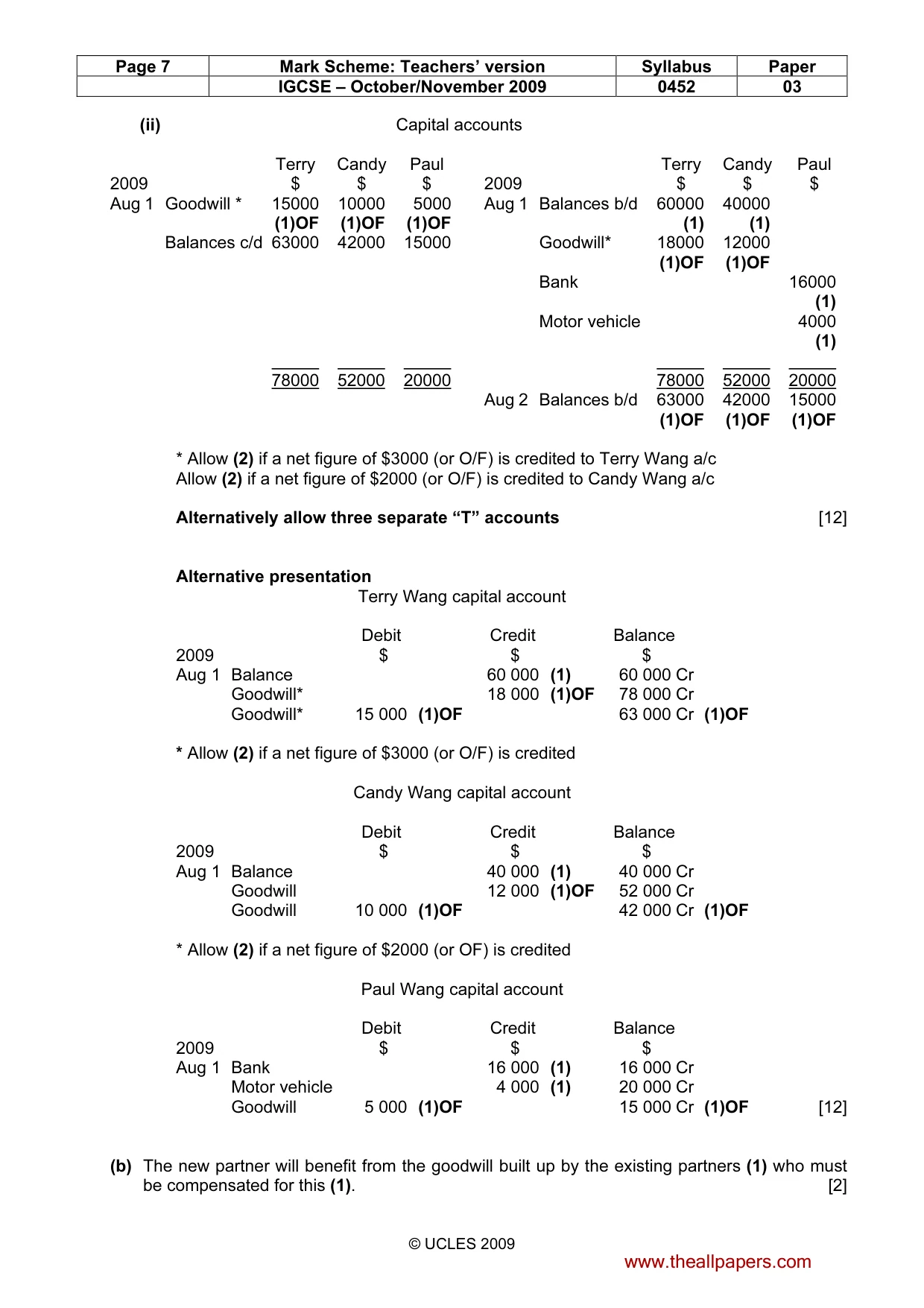
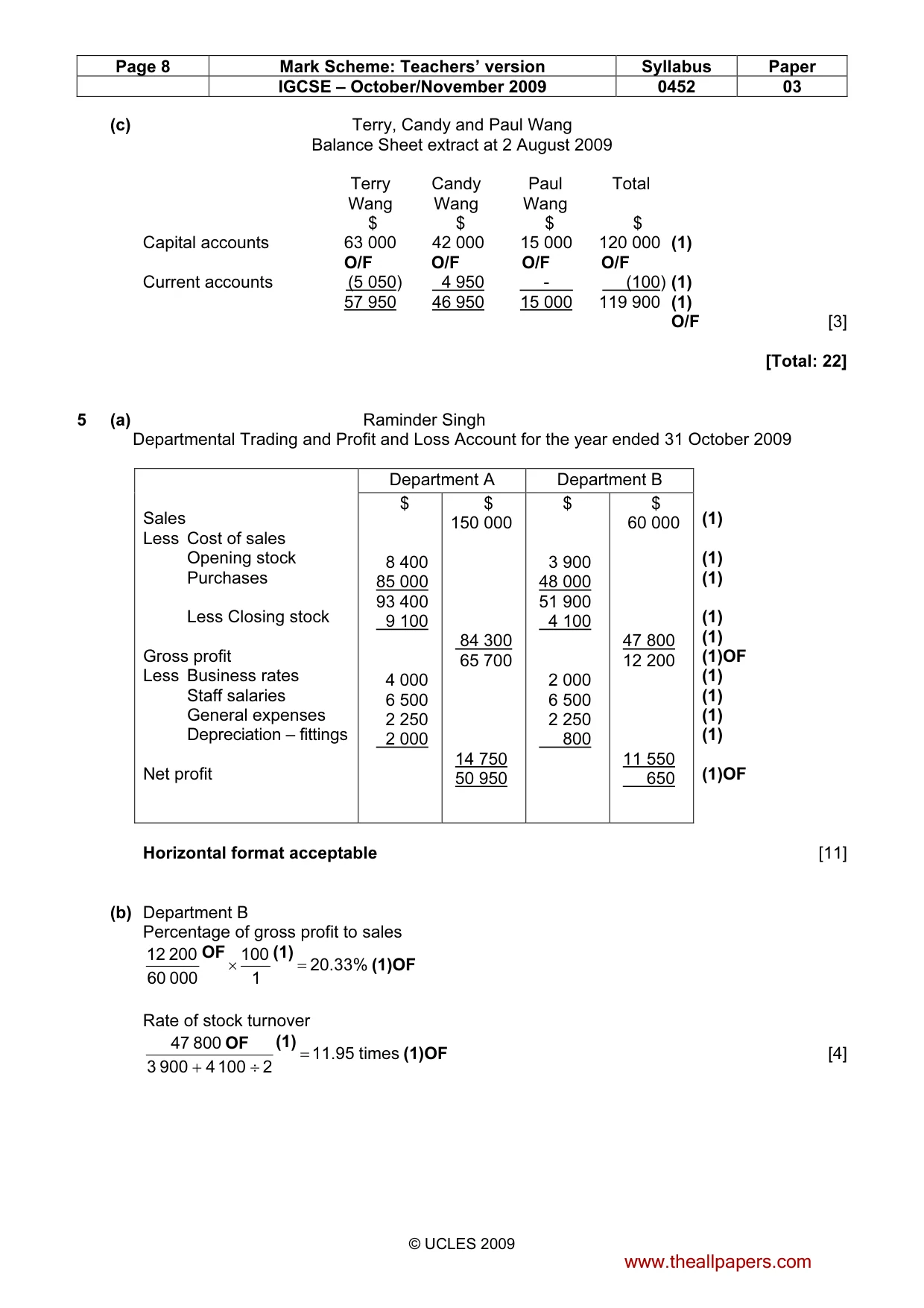
Mark scheme: 4 (a) (i) Terry, Candy and Paul Wang Goodwill account 2009 $ 2009 $ Aug 1 Terry capital 18 000 (1) Aug 1 Terry capital 15 000 (1) Candy capital 12 000 (1) Candy capital 10 000 (1) Paul capital 5 000 (1) 30 000 30 000 Alternative presentation Terry, Candy and Paul Wang Goodwill account Debit Credit Balance 2009 $ $ $ Aug 1 Terry capital 18 000 (1) 18 000 Dr Cindy capital 12 000 (1) 30 000 Dr Terry capital 15 000 (1) 15 000 Dr Cindy capital 10 000 (1) 5 000 Dr Paul capital 5 000 (1) 0 [5] IGCSE – October/November 2009 0452 03 (ii) Capital accounts Terry Candy Paul Terry Candy Paul 2009 $ $ $ 2009 $ $ $ Aug 1 Goodwill * 15000 10000 5000 Aug 1 Balances b/d 60000 40000 (1)OF (1)OF (1)OF (1) (1) Balances c/d 63000 42000 15000 Goodwill* 18000 12000 (1)OF (1)OF Bank 16000 (1) Motor vehicle 4000 (1) 78000 52000 20000 78000 52000 20000 Aug 2 Balances b/d 63000 42000 15000 (1)OF (1)OF (1)OF * Allow (2) if a net figure of $3000 (or O/F) is credited to Terry Wang a/c Allow (2) if a net figure of $2000 (or O/F) is credited to Candy Wang a/c Alternatively allow three separate “T” accounts [12] Alternative presentation Terry Wang capital account Debit Credit Balance 2009 $ $ $ Aug 1 Balance 60 000 (1) 60 000 Cr Goodwill* 18 000 (1)OF 78 000 Cr Goodwill* 15 000 (1)OF 63 000 Cr (1)OF * Allow (2) if a net figure of $3000 (or O/F) is credited Candy Wang capital account Debit Credit Balance 2009 $ $ $ Aug 1 Balance 40 000 (1) 40 000 Cr Goodwill 12 000 (1)OF 52 000 Cr Goodwill 10 000 (1)OF 42 000 Cr (1)OF * Allow (2) if a net figure of $2000 (or OF) is credited Paul Wang capital account Debit Credit Balance 2009 $ $ $ Aug 1 Bank 16 000 (1) 16 000 Cr Motor vehicle 4 000 (1) 20 000 Cr Goodwill 5 000 (1)OF 15 000 Cr (1)OF [12] (b) The new partner will benefit from the goodwill built up by the existing partners (1) who must be compensated for this (1). [2] IGCSE – October/November 2009 0452 03 (c) Terry, Candy and Paul Wang Balance Sheet extract at 2 August 2009 Terry Candy Paul Total Wang Wang Wang $ $ $ $ Capital accounts 63 000 42 000 15 000 120 000 (1) O/F O/F O/F O/F Current accounts (5 050) 4 950 - (100) (1) 57 950 46 950 15 000 119 900 (1) O/F [3] [Total: 22]
Q5 · Raminder Singh is a retailer
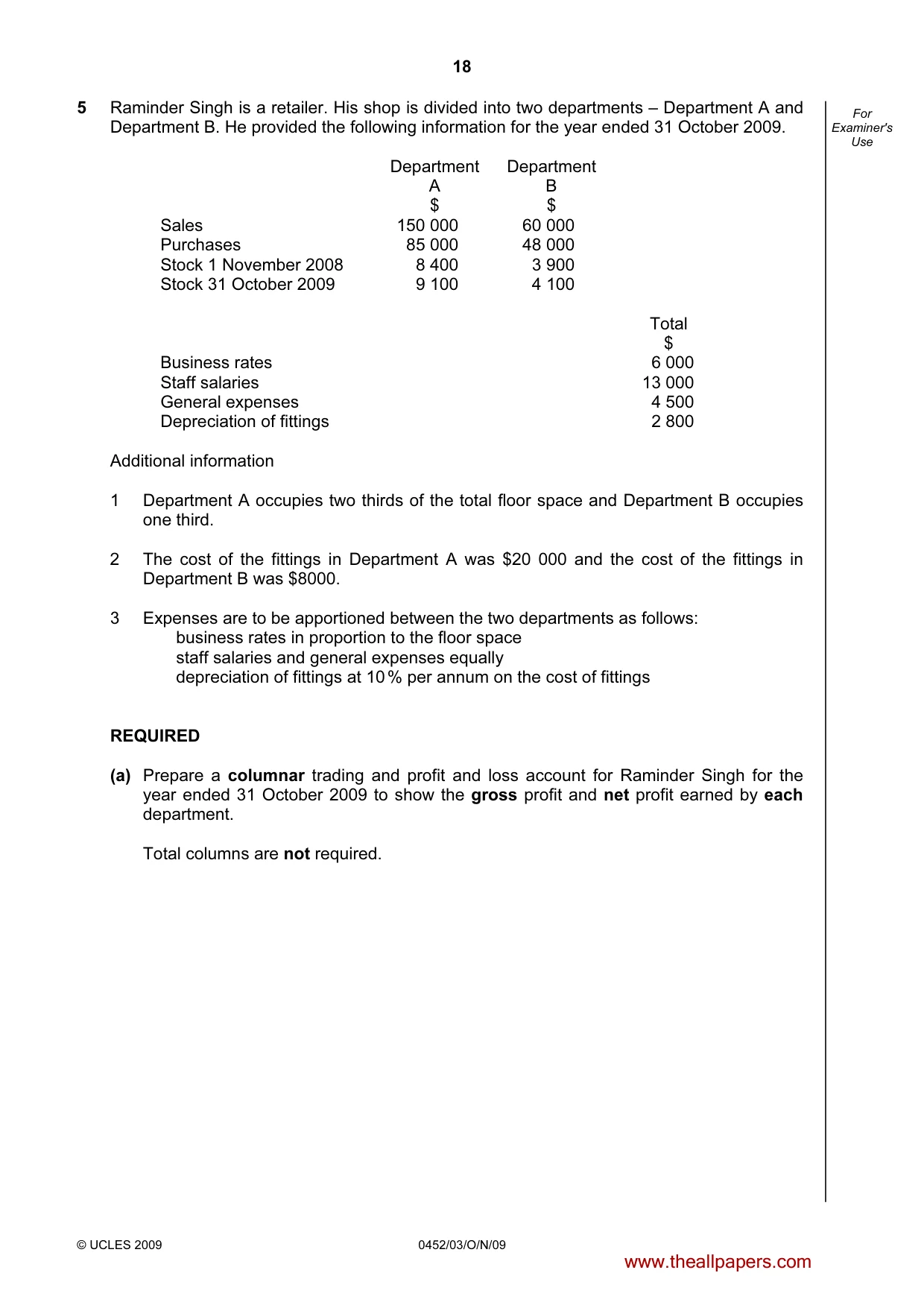
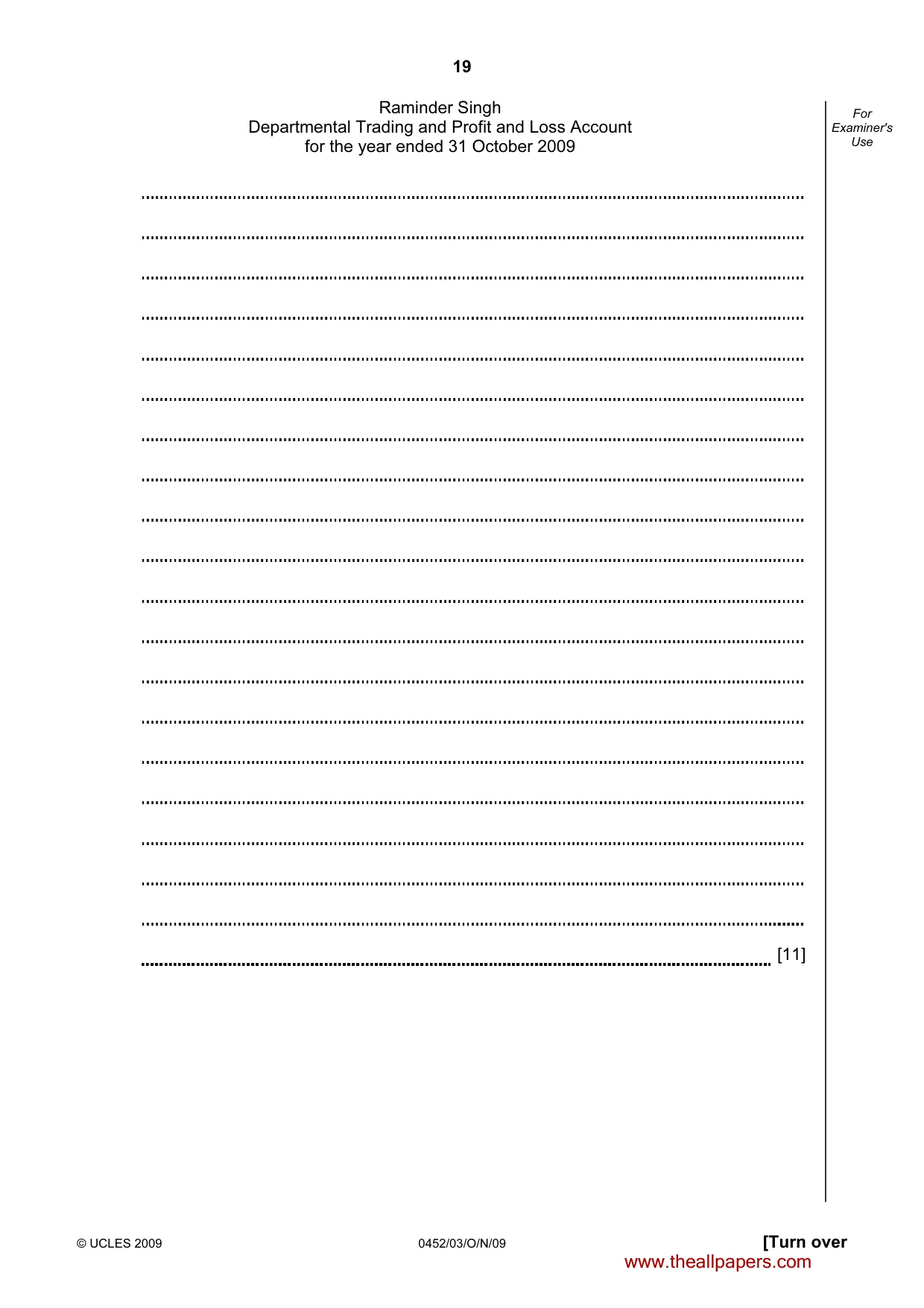
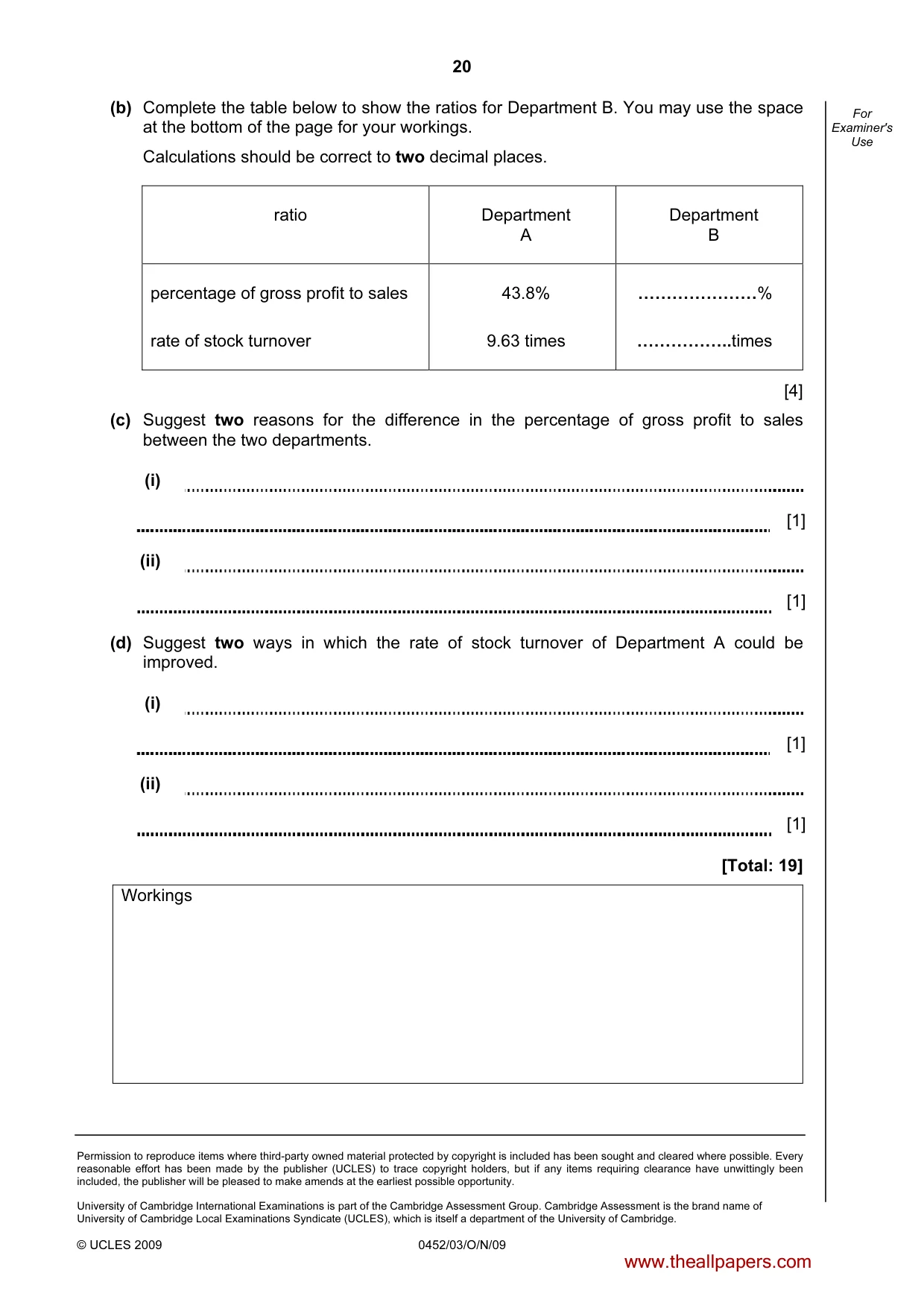
5 Raminder Singh is a retailer. His shop is divided into two departments – Department A and Department B. He provided the following information for the year ended 31 October 2009. Department Department A B $ $ Sales 150 000 60 000 Purchases 85 000 48 000 Stock 1 November 2008 8 400 3 900 Stock 31 October 2009 9 100 4 100 Total $ Business rates 6 000 Staff salaries 13 000 General expenses 4 500 Depreciation of fittings 2 800 Additional information 1 Department A occupies two thirds of the total floor space and Department B occupies one third. 2 The cost of the fittings in Department A was $20 000 and the cost of the fittings in Department B was $8000. 3 Expenses are to be apportioned between the two departments as follows: business rates in proportion to the floor space staff salaries and general expenses equally depreciation of fittings at 10 % per annum on the cost of fittings REQUIRED (a) Prepare a columnar trading and profit and loss account for Raminder Singh for the year ended 31 October 2009 to show the gross profit and net profit earned by each department. Total columns are not required. Raminder Singh Departmental Trading and Profit and Loss Account for the year ended 31 October 2009 [11] (b) Complete the table below to show the ratios for Department B. You may use the space at the bottom of the page for your workings. Calculations should be correct to two decimal places. ratio Department Department A B percentage of gross profit to sales 43.8% rate of stock turnover 9.63 times ……………..times [4] (c) Suggest two reasons for the difference in the percentage of gross profit to sales between the two departments. (i) [1] (ii) [1] (d) Suggest two ways in which the rate of stock turnover of Department A could be improved. (i) [1] (ii) [1] [Total: 19] Workings
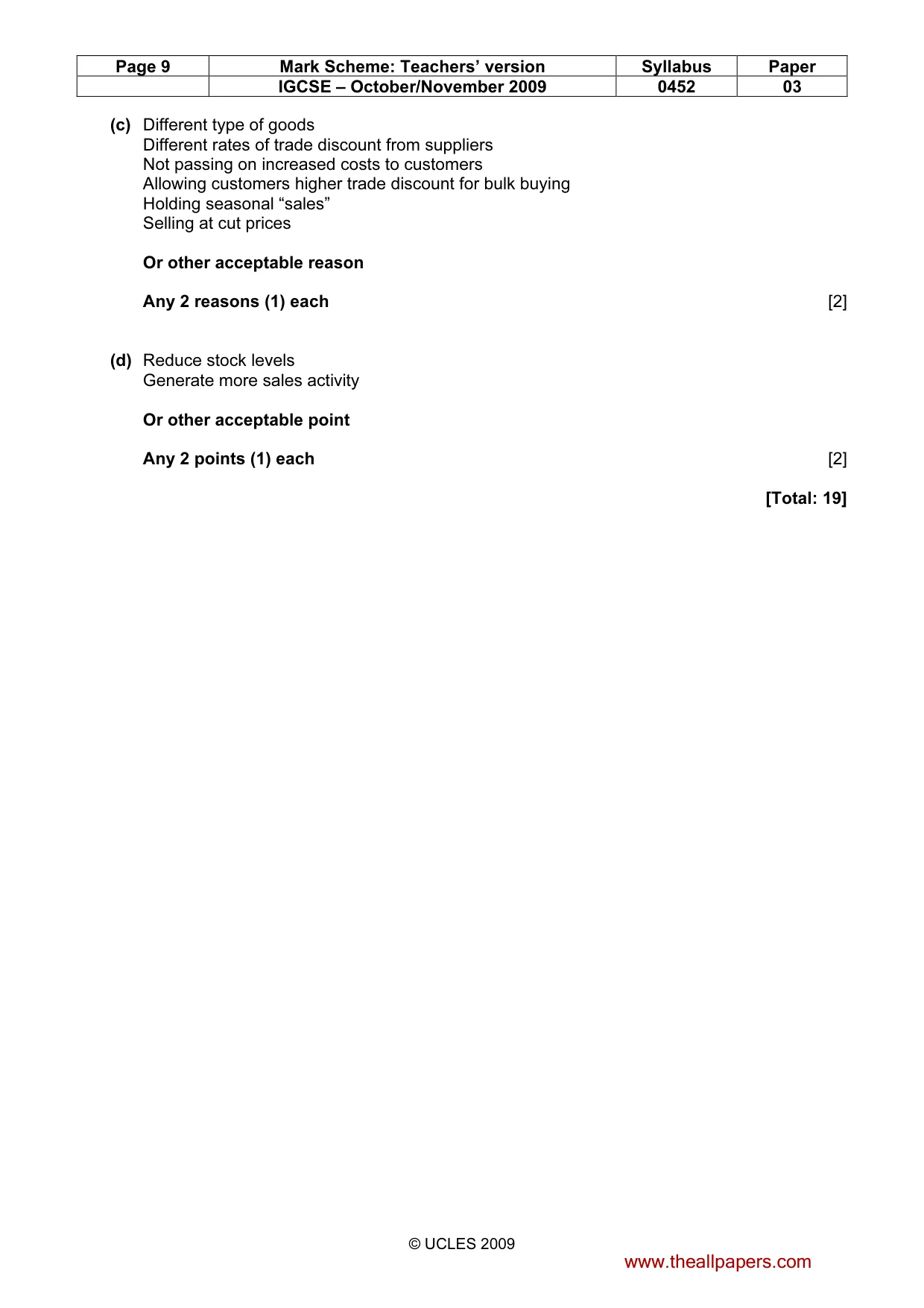
Mark scheme: 5 (a) Raminder Singh Departmental Trading and Profit and Loss Account for the year ended 31 October 2009 Department A Department B $ $ $ $ Sales 150 000 60 000 (1) Less Cost of sales Opening stock 8 400 3 900 (1) Purchases 85 000 48 000 (1) 93 400 51 900 Less Closing stock 9 100 4 100 (1) 84 300 47 800 (1) Gross profit 65 700 12 200 (1)OF Less Business rates 4 000 2 000 (1) Staff salaries 6 500 6 500 (1) General expenses 2 250 2 250 (1) Depreciation – fittings 2 000 800 (1) 14 750 11 550 Net profit 50 950 650 (1)OF Horizontal format acceptable [11] (b) Department B Percentage of gross profit to sales 12 200 OF 100 (1) × = 20.33% (1)OF 60 000 1 Rate of stock turnover 47 800 OF (1) = 11.95 times (1)OF [4] 3 900 + 4 100 ÷ 2 IGCSE – October/November 2009 0452 03 (c) Different type of goods Different rates of trade discount from suppliers Not passing on increased costs to customers Allowing customers higher trade discount for bulk buying Holding seasonal “sales” Selling at cut prices Or other acceptable reason Any 2 reasons (1) each [2] (d) Reduce stock levels Generate more sales activity Or other acceptable point Any 2 points (1) each [2] [Total: 19]
What was in this paper
The subtopics covered by these 5 questions, and how many questions each got. Open one in a new tab to see every Cambridge question on it.
What you needed in this session
Cambridge’s own grade thresholds for 2009 Oct/Nov, Paper 3 · Variant 1. A higher threshold means an easier paper — the bar moves with how the cohort did.