Cambridge IGCSE Accounting 0452 — 2008 Oct/Nov Paper 3 · Variant 1
0452/31/O/N/08 · 5 questions · 100 marks · ≈113 min
The question paper and its mark scheme, free to read here and free to download. This is Cambridge’s own paper, exactly as it was sat.
Question paper20 pages

Mark scheme9 pages
Answers below. Sit the paper first if you are practising.
Questions as text
Q1 · Paul Russell is a trader who maintains a full set of accounting records
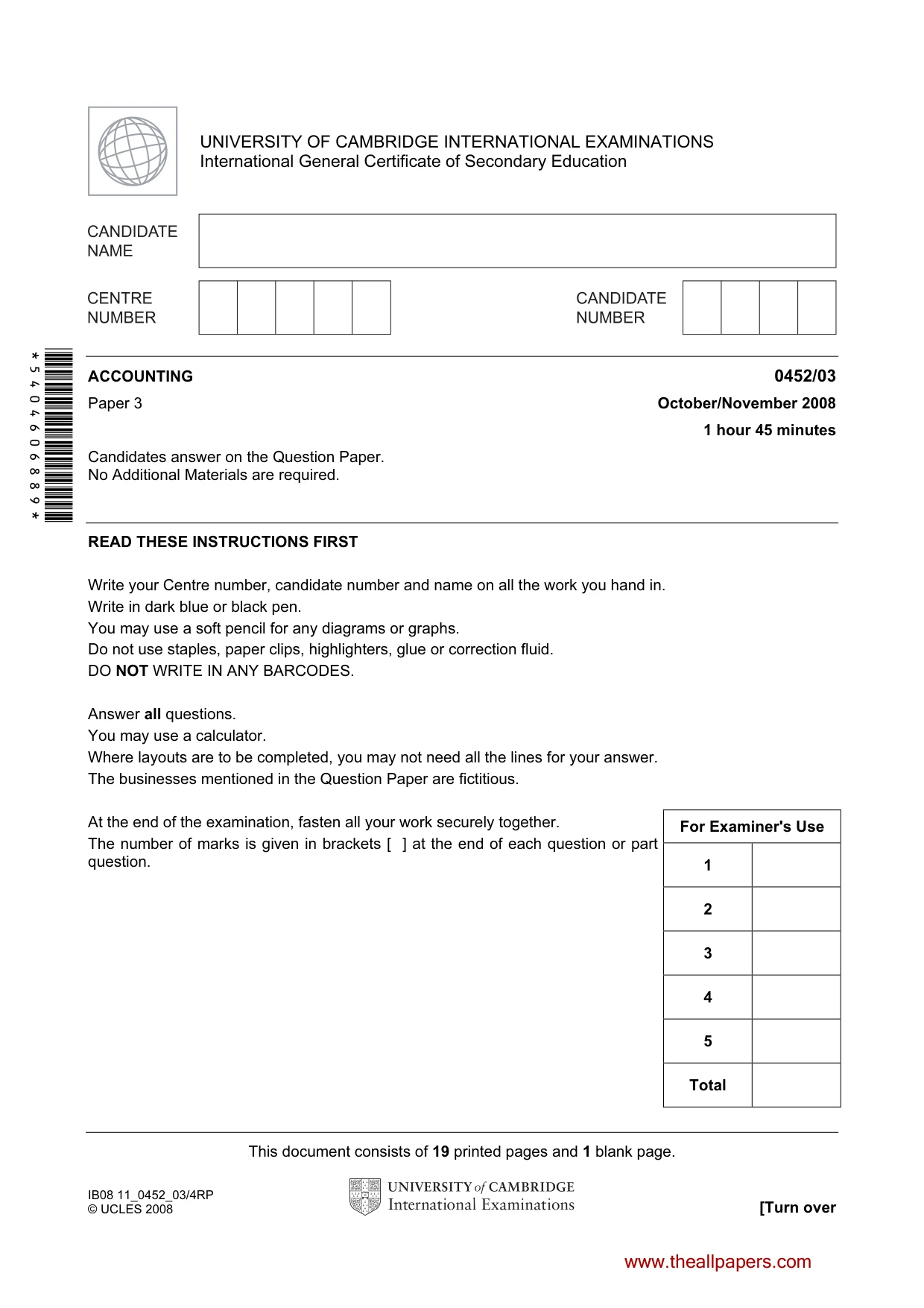
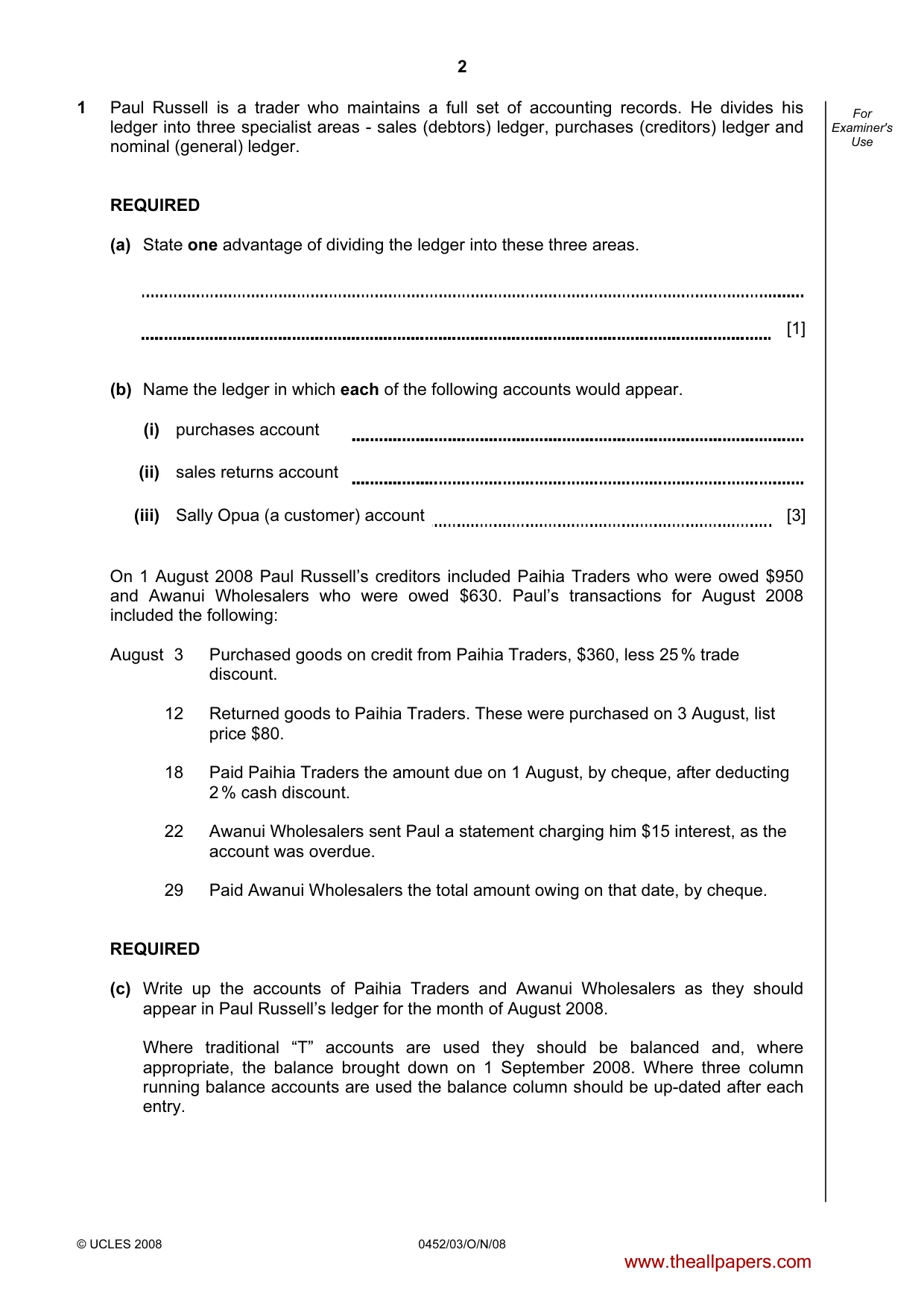
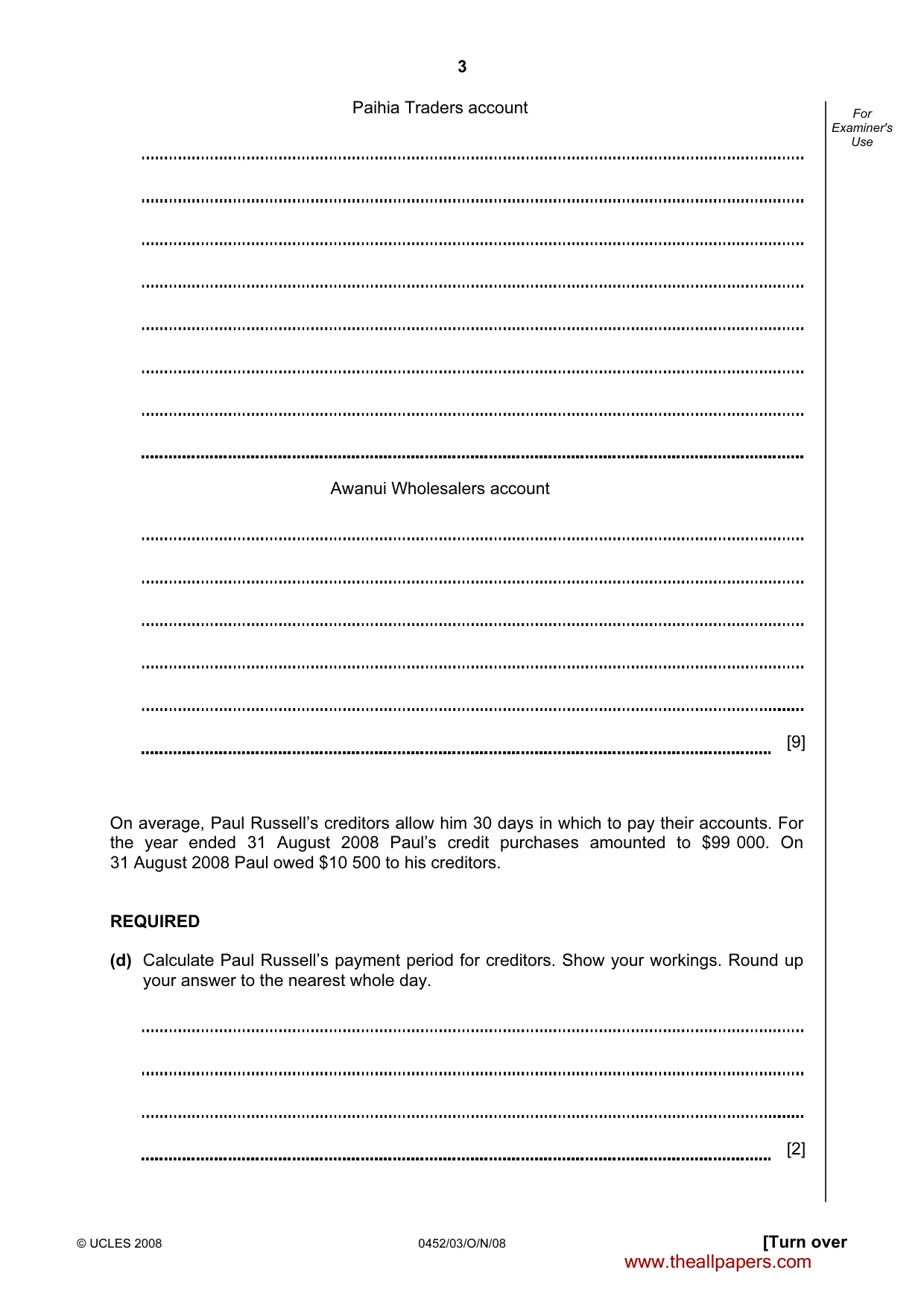
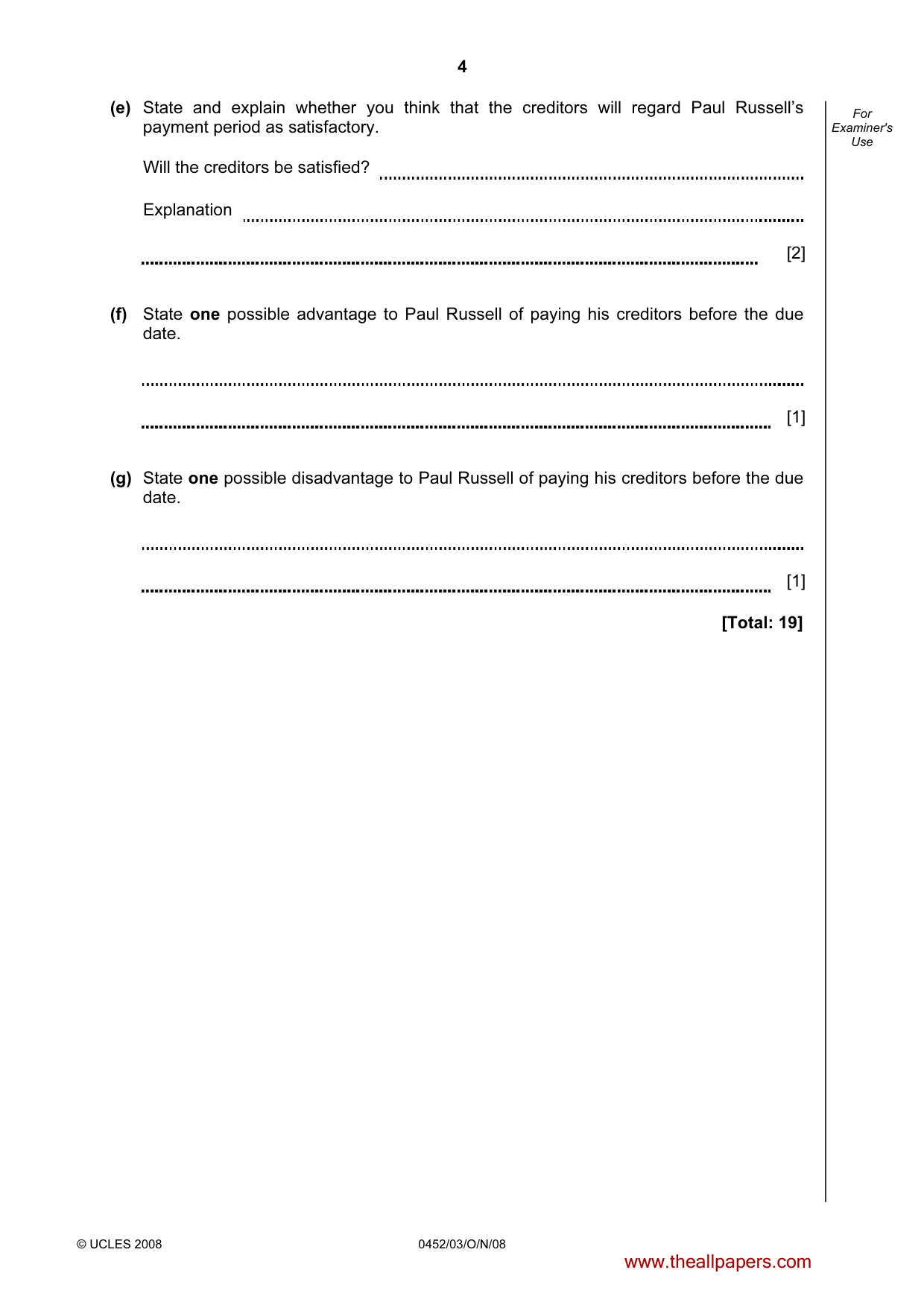
1 Paul Russell is a trader who maintains a full set of accounting records. He divides his ledger into three specialist areas - sales (debtors) ledger, purchases (creditors) ledger and nominal (general) ledger. REQUIRED (a) State one advantage of dividing the ledger into these three areas. [1] (b) Name the ledger in which each of the following accounts would appear. (i) purchases account (ii) sales returns account (iii) Sally Opua (a customer) account [3] On 1 August 2008 Paul Russell’s creditors included Paihia Traders who were owed $950 and Awanui Wholesalers who were owed $630. Paul’s transactions for August 2008 included the following: August 3 Purchased goods on credit from Paihia Traders, $360, less 25 % trade discount. 12 Returned goods to Paihia Traders. These were purchased on 3 August, list price $80. 18 Paid Paihia Traders the amount due on 1 August, by cheque, after deducting 2 % cash discount. 22 Awanui Wholesalers sent Paul a statement charging him $15 interest, as the account was overdue. 29 Paid Awanui Wholesalers the total amount owing on that date, by cheque. REQUIRED (c) Write up the accounts of Paihia Traders and Awanui Wholesalers as they should appear in Paul Russell’s ledger for the month of August 2008. Where traditional “T” accounts are used they should be balanced and, where appropriate, the balance brought down on 1 September 2008. Where three column running balance accounts are used the balance column should be up-dated after each entry. Paihia Traders account Awanui Wholesalers account [9] On average, Paul Russell’s creditors allow him 30 days in which to pay their accounts. For the year ended 31 August 2008 Paul’s credit purchases amounted to $99 000. On 31 August 2008 Paul owed $10 500 to his creditors. REQUIRED (d) Calculate Paul Russell’s payment period for creditors. Show your workings. Round up your answer to the nearest whole day. [2] (e) State and explain whether you think that the creditors will regard Paul Russell’s payment period as satisfactory. Will the creditors be satisfied? Explanation [2] (f) State one possible advantage to Paul Russell of paying his creditors before the due date. [1] (g) State one possible disadvantage to Paul Russell of paying his creditors before the due date. [1] [Total: 19]
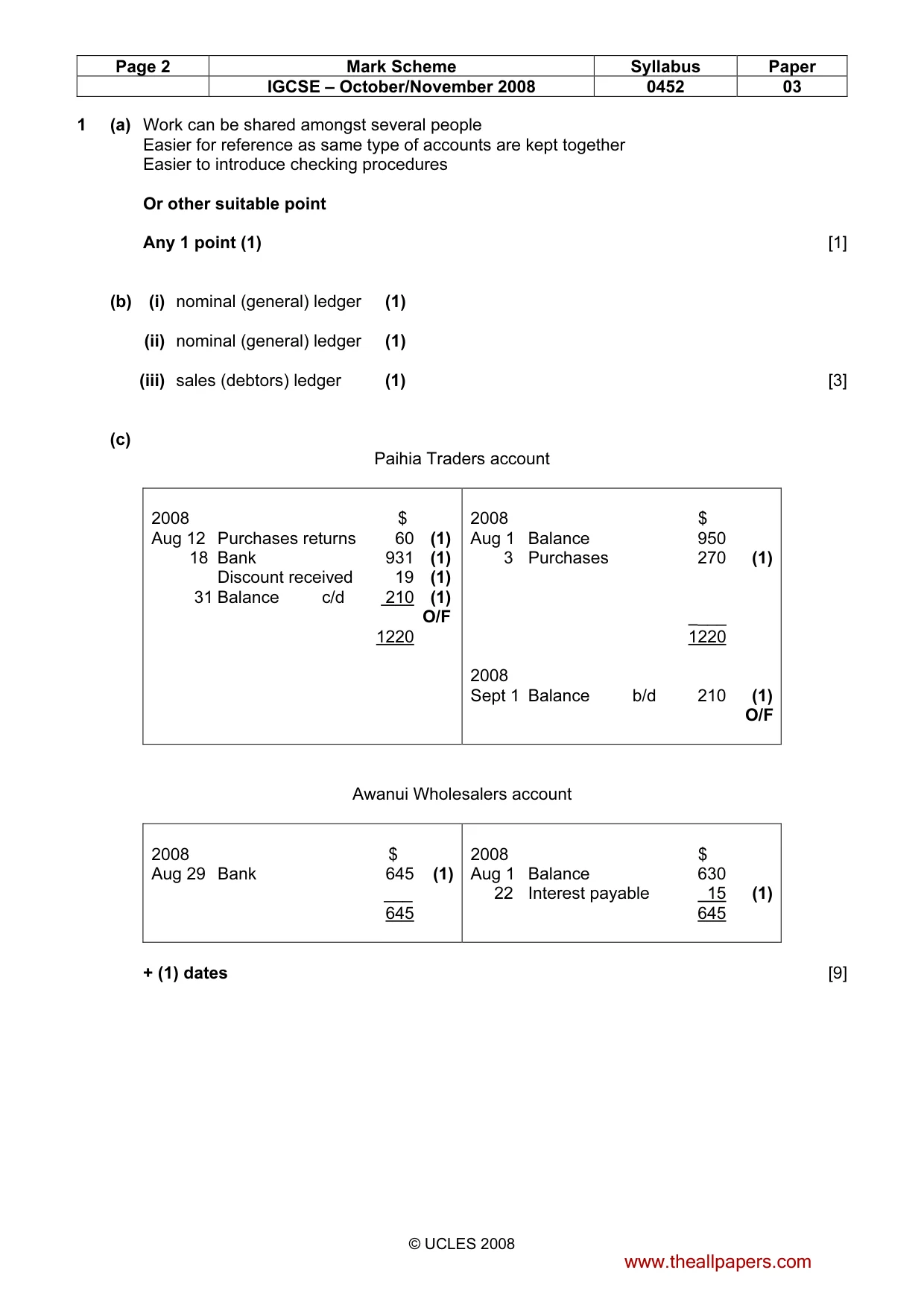
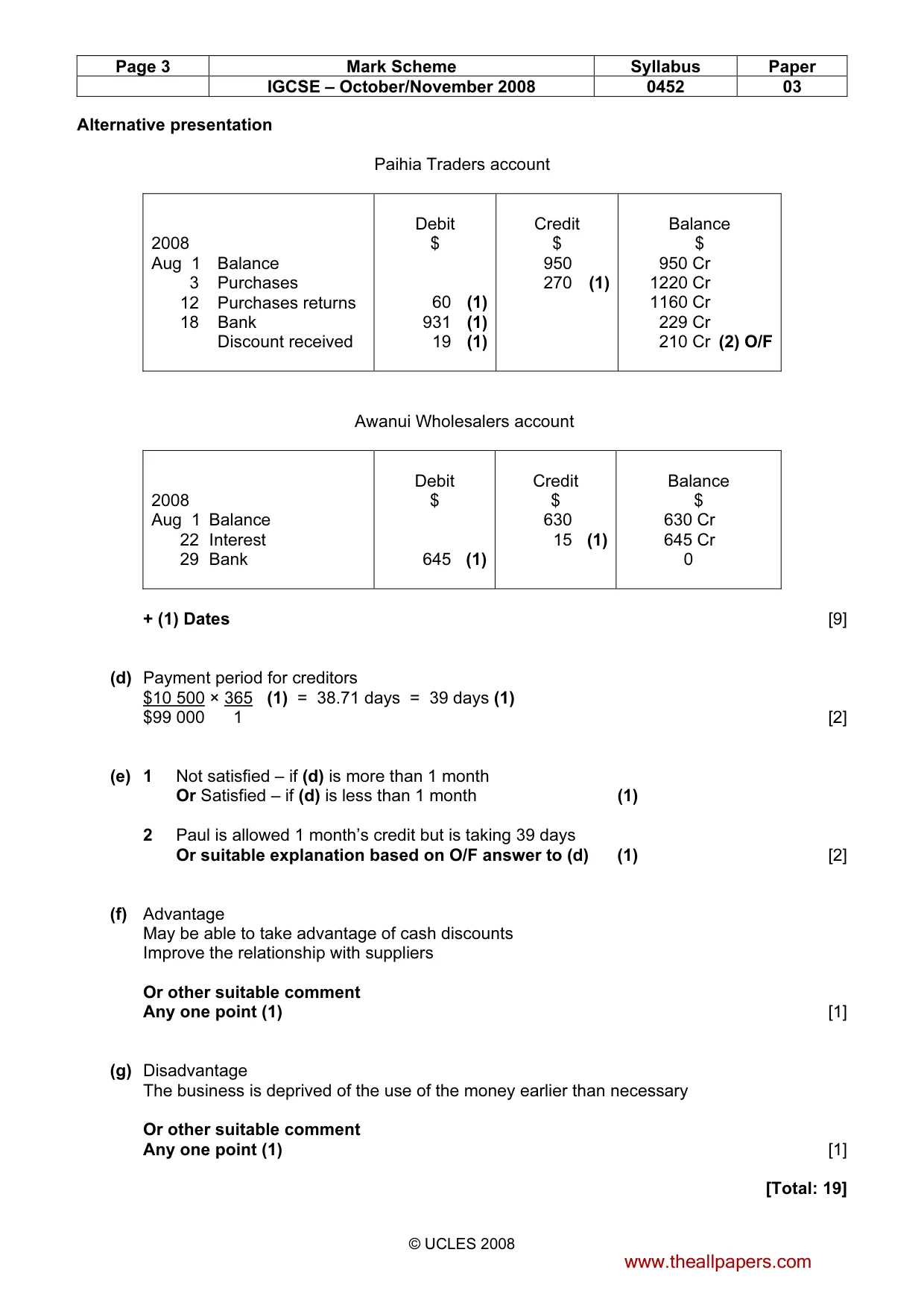
Mark scheme: 1 (a) Work can be shared amongst several people Easier for reference as same type of accounts are kept together Easier to introduce checking procedures Or other suitable point Any 1 point (1) [1] (b) (i) nominal (general) ledger (1) (ii) nominal (general) ledger (1) (iii) sales (debtors) ledger (1) [3] (c) Paihia Traders account 2008 $ 2008 $ Aug 12 Purchases returns 60 (1) Aug 1 Balance 950 18 Bank 931 (1) 3 Purchases 270 (1) Discount received 19 (1) 31 Balance c/d 210 (1) O/F ___ 1220 1220 2008 Sept 1 Balance b/d 210 (1) O/F Awanui Wholesalers account 2008 $ 2008 $ Aug 29 Bank 645 (1) Aug 1 Balance 630 ___ 22 Interest payable 15 (1) 645 645 + (1) dates [9] IGCSE – October/November 2008 0452 03 Alternative presentation Paihia Traders account Debit Credit Balance 2008 $ $ $ Aug 1 Balance 950 950 Cr 3 Purchases 270 (1) 1220 Cr 12 Purchases returns 60 (1) 1160 Cr 18 Bank 931 (1) 229 Cr Discount received 19 (1) 210 Cr (2) O/F Awanui Wholesalers account Debit Credit Balance 2008 $ $ $ Aug 1 Balance 630 630 Cr 22 Interest 15 (1) 645 Cr 29 Bank 645 (1) 0 + (1) Dates [9] (d) Payment period for creditors $10 500 × 365 (1) = 38.71 days = 39 days (1) $99 000 1 [2] (e) 1 Not satisfied – if (d) is more than 1 month Or Satisfied – if (d) is less than 1 month (1) 2 Paul is allowed 1 month’s credit but is taking 39 days Or suitable explanation based on O/F answer to (d) (1) [2] (f) Advantage May be able to take advantage of cash discounts Improve the relationship with suppliers Or other suitable comment Any one point (1) [1] (g) Disadvantage The business is deprived of the use of the money earlier than necessary Or other suitable comment Any one point (1) [1] [Total: 19] IGCSE – October/November 2008 0452 03
Q2 · Michael Ong started a business on 1 July 2007
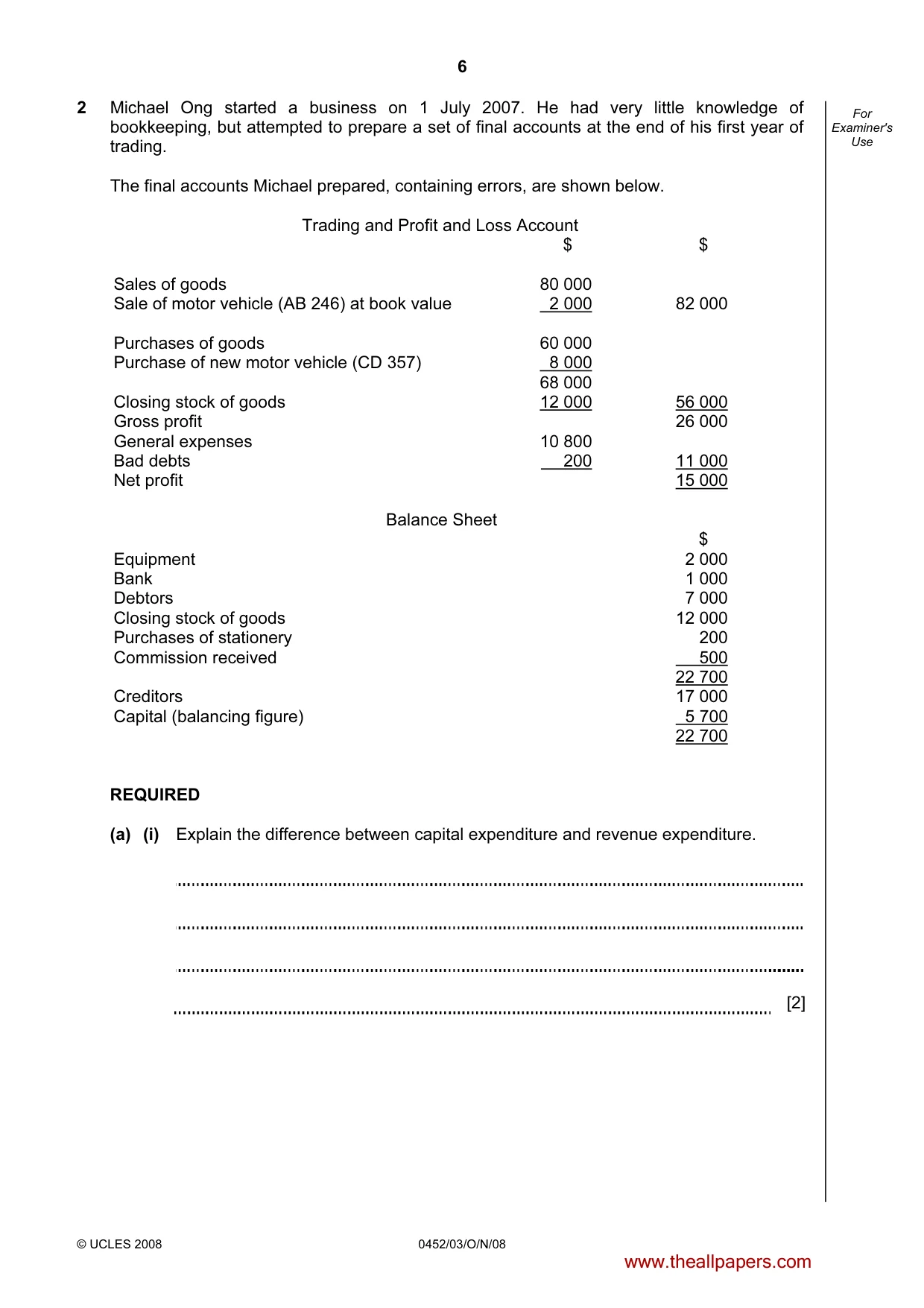
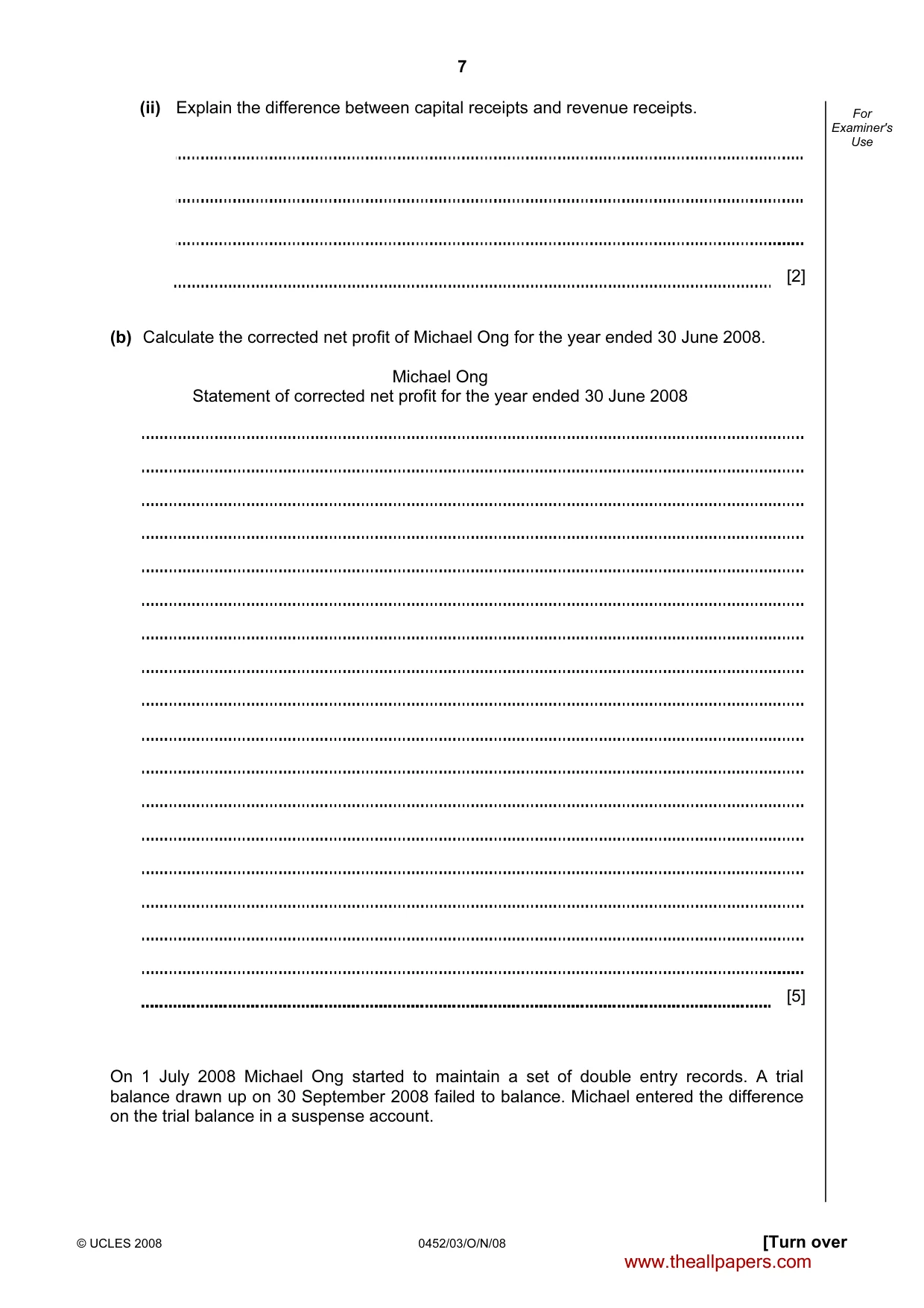
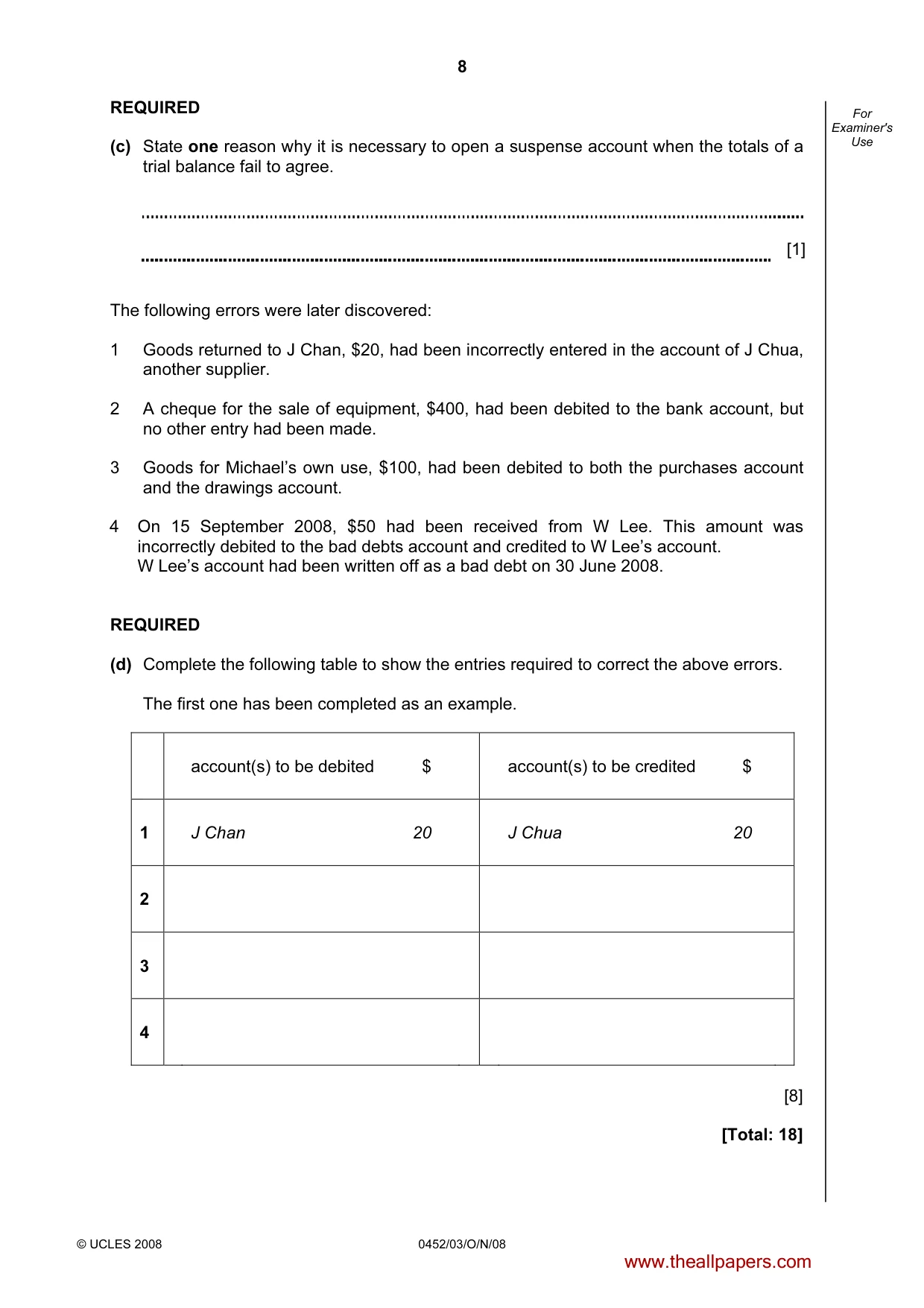
2 Michael Ong started a business on 1 July 2007. He had very little knowledge of bookkeeping, but attempted to prepare a set of final accounts at the end of his first year of trading. The final accounts Michael prepared, containing errors, are shown below. Trading and Profit and Loss Account $ $ Sales of goods 80 000 Sale of motor vehicle (AB 246) at book value 2 000 82 000 Purchases of goods 60 000 Purchase of new motor vehicle (CD 357) 8 000 68 000 Closing stock of goods 12 000 56 000 Gross profit 26 000 General expenses 10 800 Bad debts 200 11 000 Net profit 15 000 Balance Sheet $ Equipment 2 000 Bank 1 000 Debtors 7 000 Closing stock of goods 12 000 Purchases of stationery 200 Commission received 500 22 700 Creditors 17 000 Capital (balancing figure) 5 700 22 700 REQUIRED (a) (i) Explain the difference between capital expenditure and revenue expenditure. [2] (ii) Explain the difference between capital receipts and revenue receipts. [2] (b) Calculate the corrected net profit of Michael Ong for the year ended 30 June 2008. Michael Ong Statement of corrected net profit for the year ended 30 June 2008 [5] On 1 July 2008 Michael Ong started to maintain a set of double entry records. A trial balance drawn up on 30 September 2008 failed to balance. Michael entered the difference on the trial balance in a suspense account. REQUIRED (c) State one reason why it is necessary to open a suspense account when the totals of a trial balance fail to agree. [1] The following errors were later discovered: 1 Goods returned to J Chan, $20, had been incorrectly entered in the account of J Chua, another supplier. 2 A cheque for the sale of equipment, $400, had been debited to the bank account, but no other entry had been made.
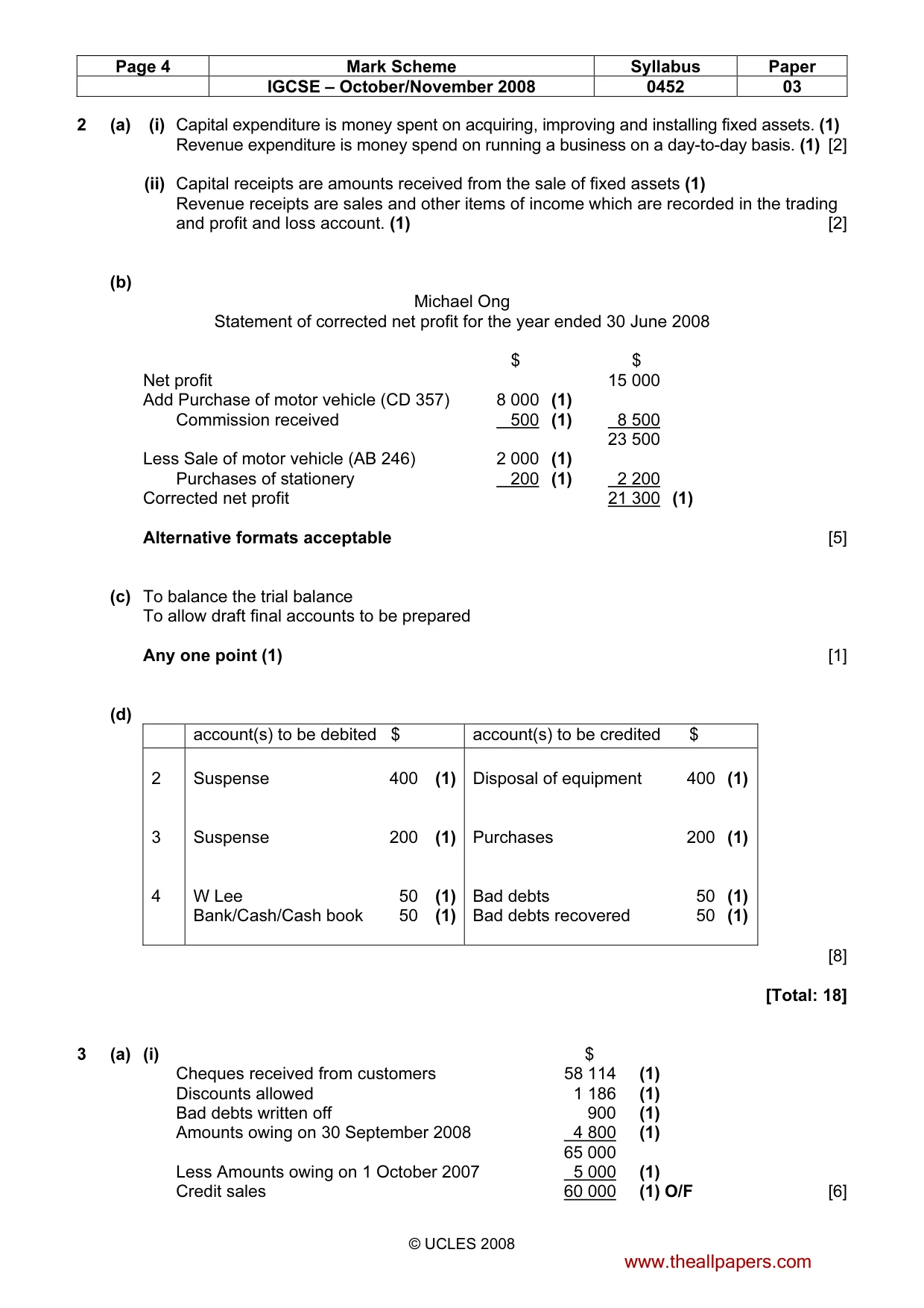
Mark scheme: 2 (a) (i) Capital expenditure is money spent on acquiring, improving and installing fixed assets. (1) Revenue expenditure is money spend on running a business on a day-to-day basis. (1) [2] (ii) Capital receipts are amounts received from the sale of fixed assets (1) Revenue receipts are sales and other items of income which are recorded in the trading and profit and loss account. (1) [2] (b) Michael Ong Statement of corrected net profit for the year ended 30 June 2008 $ $ Net profit 15 000 Add Purchase of motor vehicle (CD 357) 8 000 (1) Commission received 500 (1) 8 500 23 500 Less Sale of motor vehicle (AB 246) 2 000 (1) Purchases of stationery 200 (1) 2 200 Corrected net profit 21 300 (1) Alternative formats acceptable [5] (c) To balance the trial balance To allow draft final accounts to be prepared Any one point (1) [1] (d) account(s) to be debited $ account(s) to be credited $ 2 Suspense 400 (1) Disposal of equipment 400 (1) 3 Suspense 200 (1) Purchases 200 (1) 4 W Lee 50 (1) Bad debts 50 (1) Bank/Cash/Cash book 50 (1) Bad debts recovered 50 (1) [8] [Total: 18] $
More questions on Capital and revenue expenditure and receipts
Q3 · Goods for Michael’s own use, $100, had been debited to both the purchases account and the…
3 Goods for Michael’s own use, $100, had been debited to both the purchases account and the drawings account.
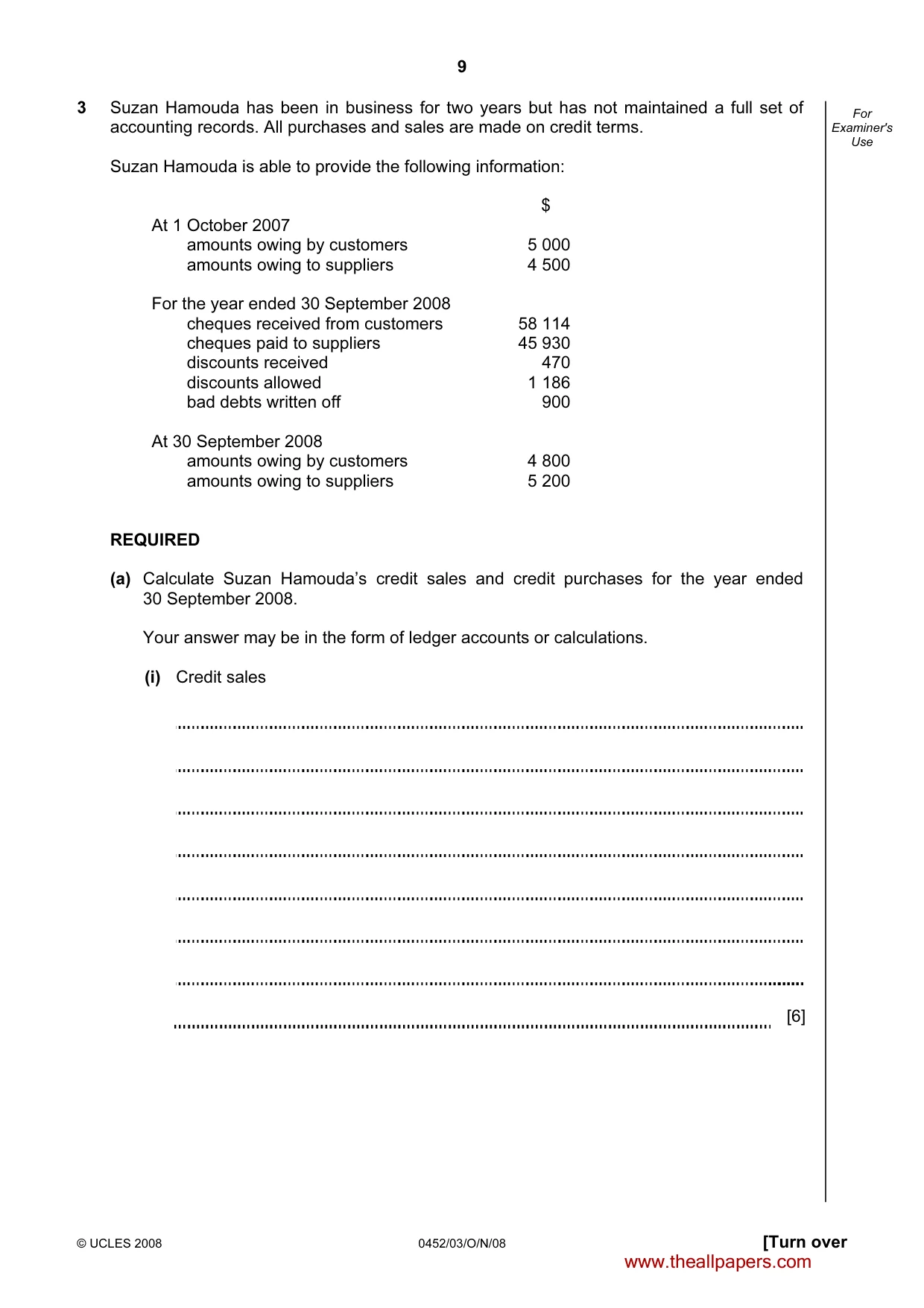
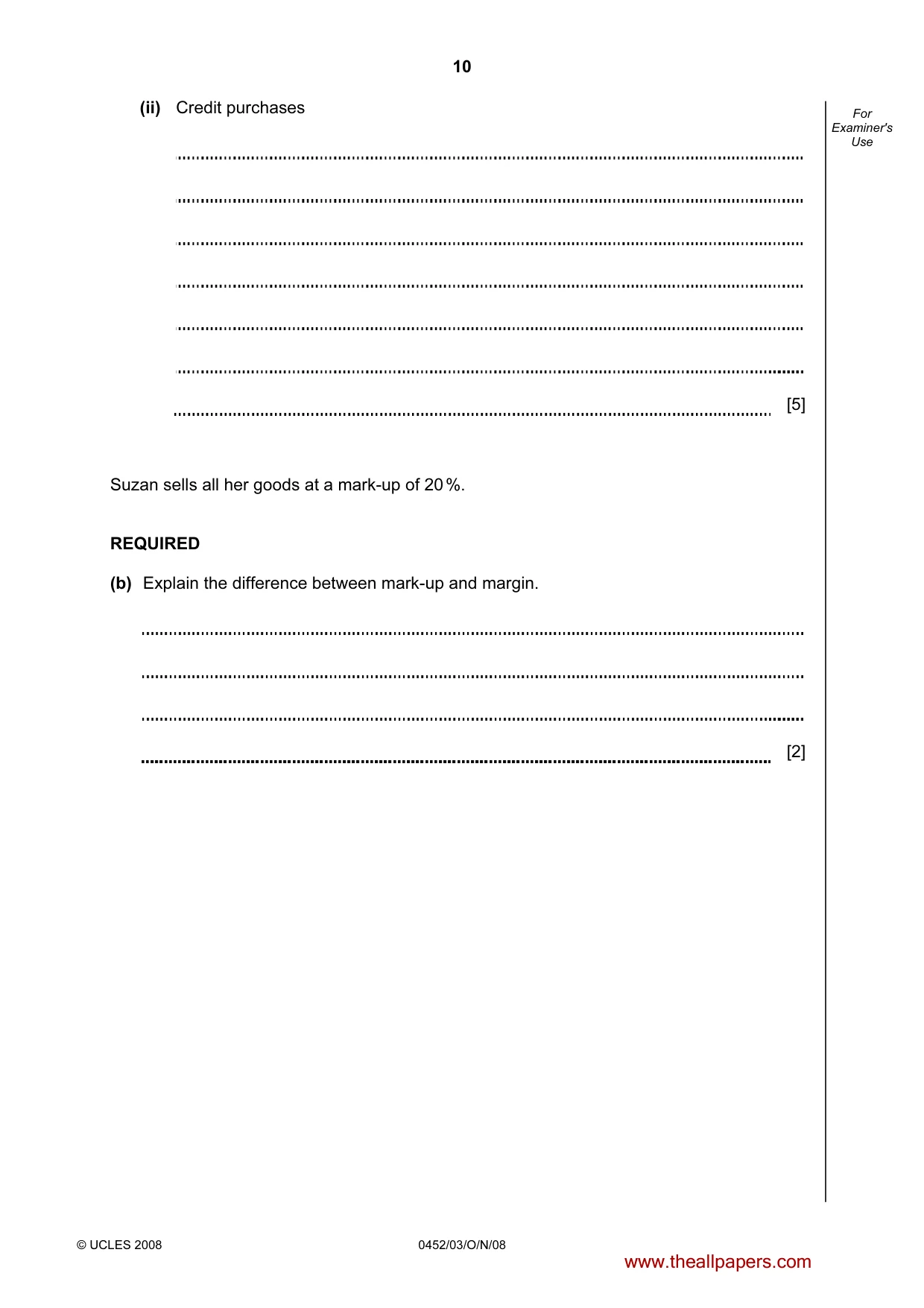
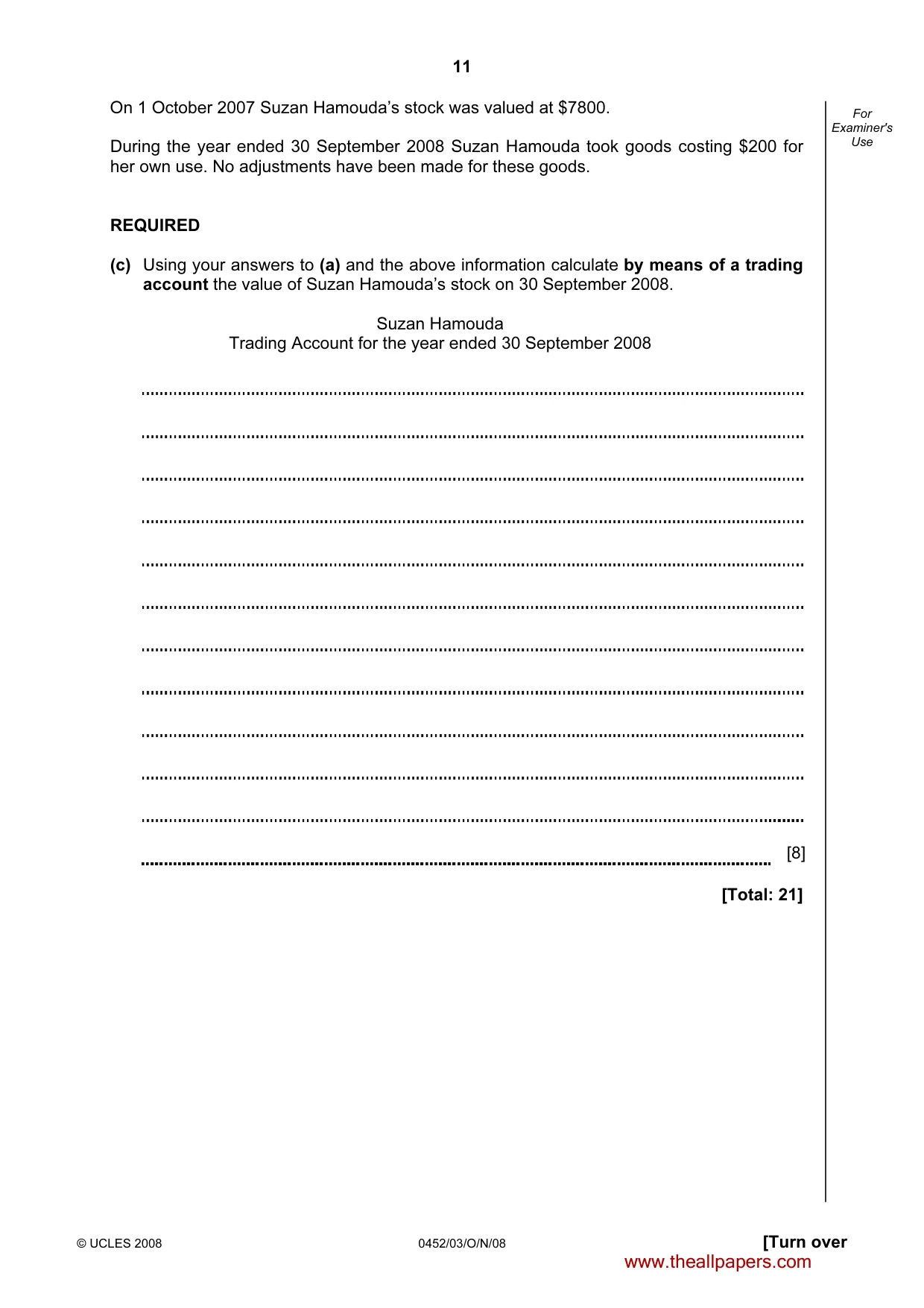
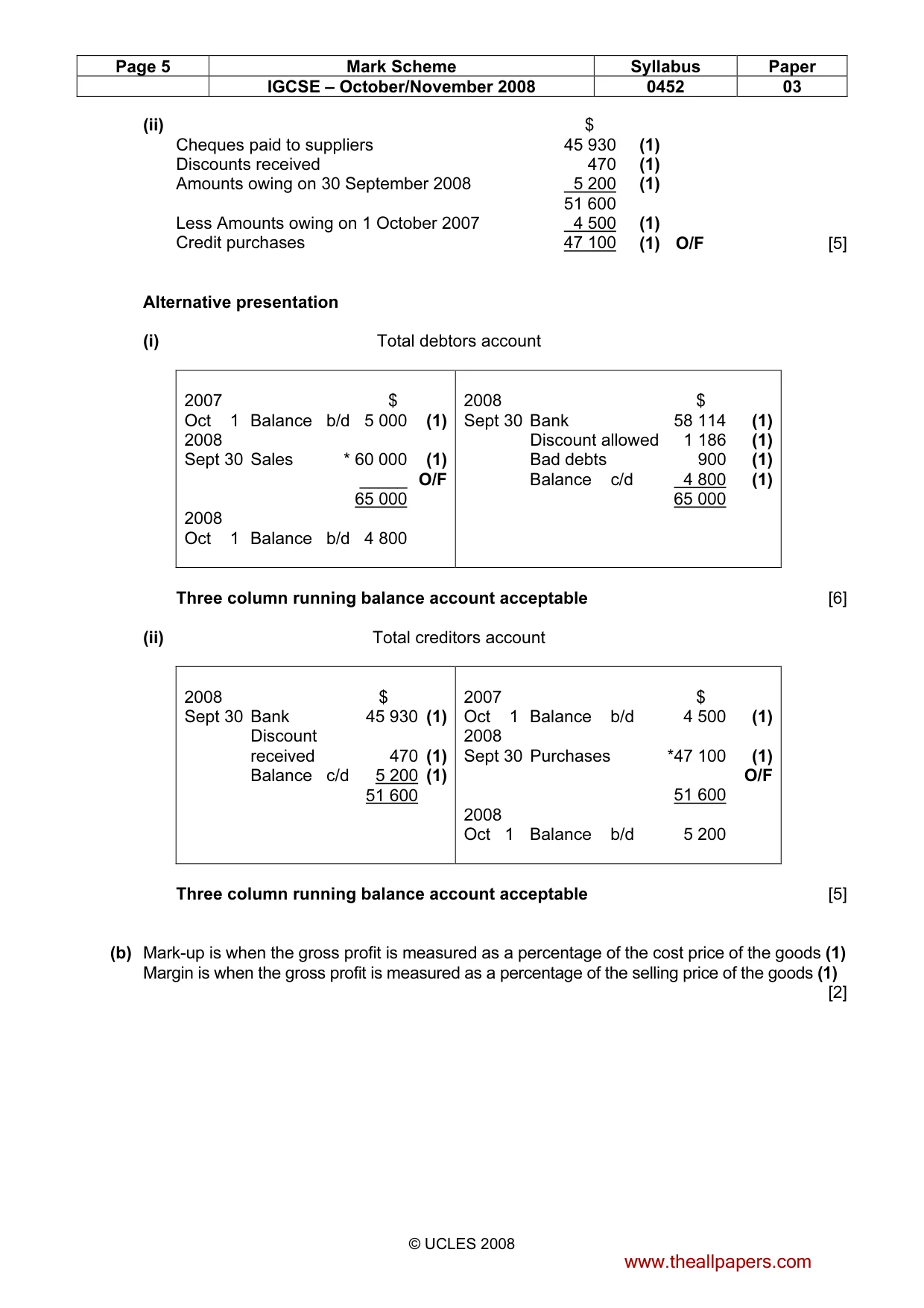
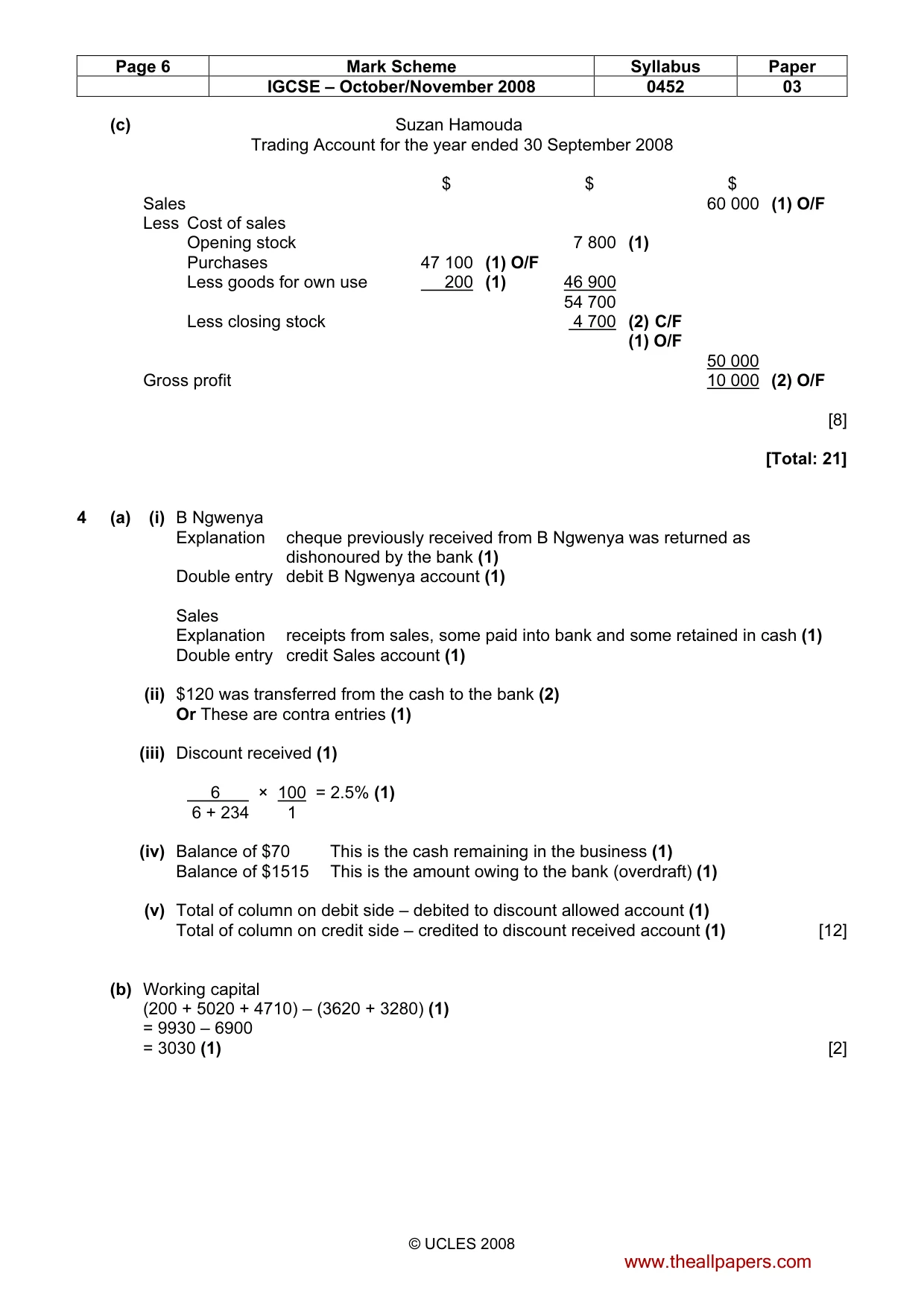
Mark scheme: 3 (a) (i) $ Cheques received from customers 58 114 (1) Discounts allowed 1 186 (1) Bad debts written off 900 (1) Amounts owing on 30 September 2008 4 800 (1) 65 000 Less Amounts owing on 1 October 2007 5 000 (1) Credit sales 60 000 (1) O/F [6] IGCSE – October/November 2008 0452 03 (ii) $ Cheques paid to suppliers 45 930 (1) Discounts received 470 (1) Amounts owing on 30 September 2008 5 200 (1) 51 600 Less Amounts owing on 1 October 2007 4 500 (1) Credit purchases 47 100 (1) O/F [5] Alternative presentation (i) Total debtors account 2007 $ 2008 $ Oct 1 Balance b/d 5 000 (1) Sept 30 Bank 58 114 (1) 2008 Discount allowed 1 186 (1) Sept 30 Sales * 60 000 (1) Bad debts 900 (1) _____ O/F Balance c/d 4 800 (1) 65 000 65 000 2008 Oct 1 Balance b/d 4 800 Three column running balance account acceptable [6] (ii) Total creditors account 2008 $ 2007 $ Sept 30 Bank 45 930 (1) Oct 1 Balance b/d 4 500 (1) Discount 2008 received 470 (1) Sept 30 Purchases *47 100 (1) Balance c/d 5 200 (1) O/F 51 600 51 600 2008 Oct 1 Balance b/d 5 200 Three column running balance account acceptable [5] (b) Mark-up is when the gross profit is measured as a percentage of the cost price of the goods (1) Margin is when the gross profit is measured as a percentage of the selling price of the goods (1) [2] IGCSE – October/November 2008 0452 03 (c) Suzan Hamouda Trading Account for the year ended 30 September 2008 $ $ $ Sales 60 000 (1) O/F Less Cost of sales Opening stock 7 800 (1) Purchases 47 100 (1) O/F Less goods for own use 200 (1) 46 900 54 700 Less closing stock 4 700 (2) C/F (1) O/F 50 000 Gross profit 10 000 (2) O/F [8] [Total: 21]
Q4 · On 15 September 2008, $50 had been received from W Lee
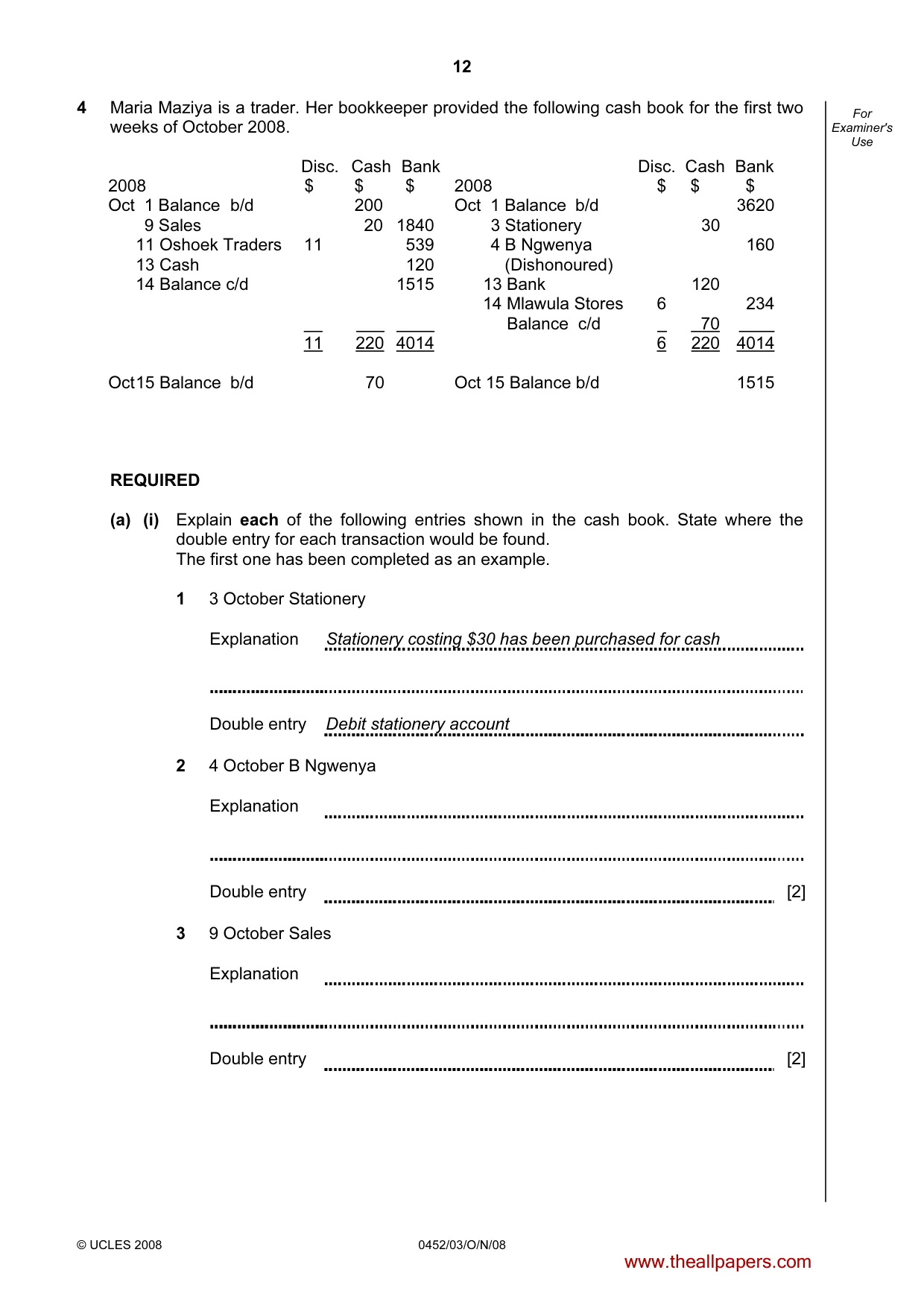
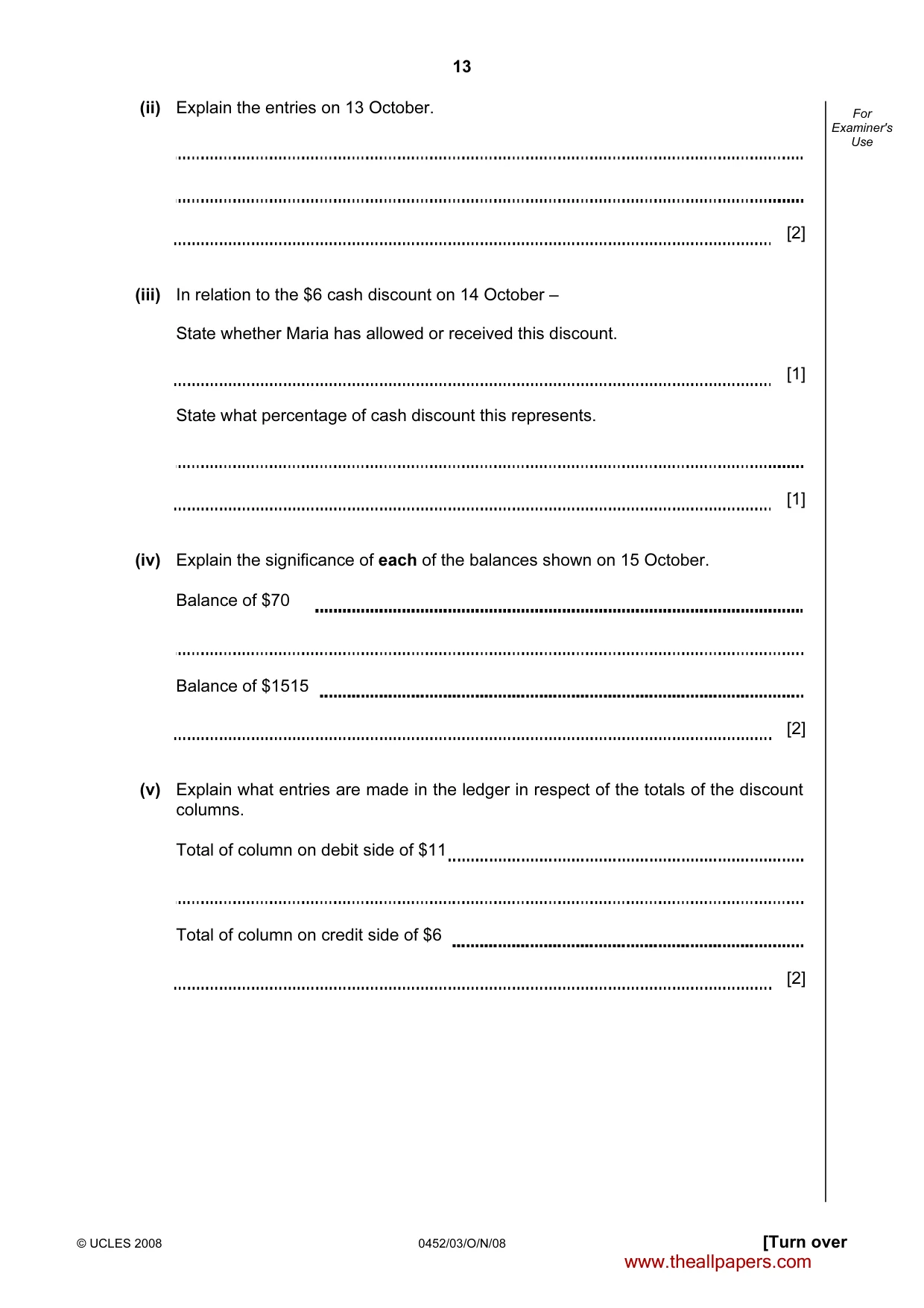
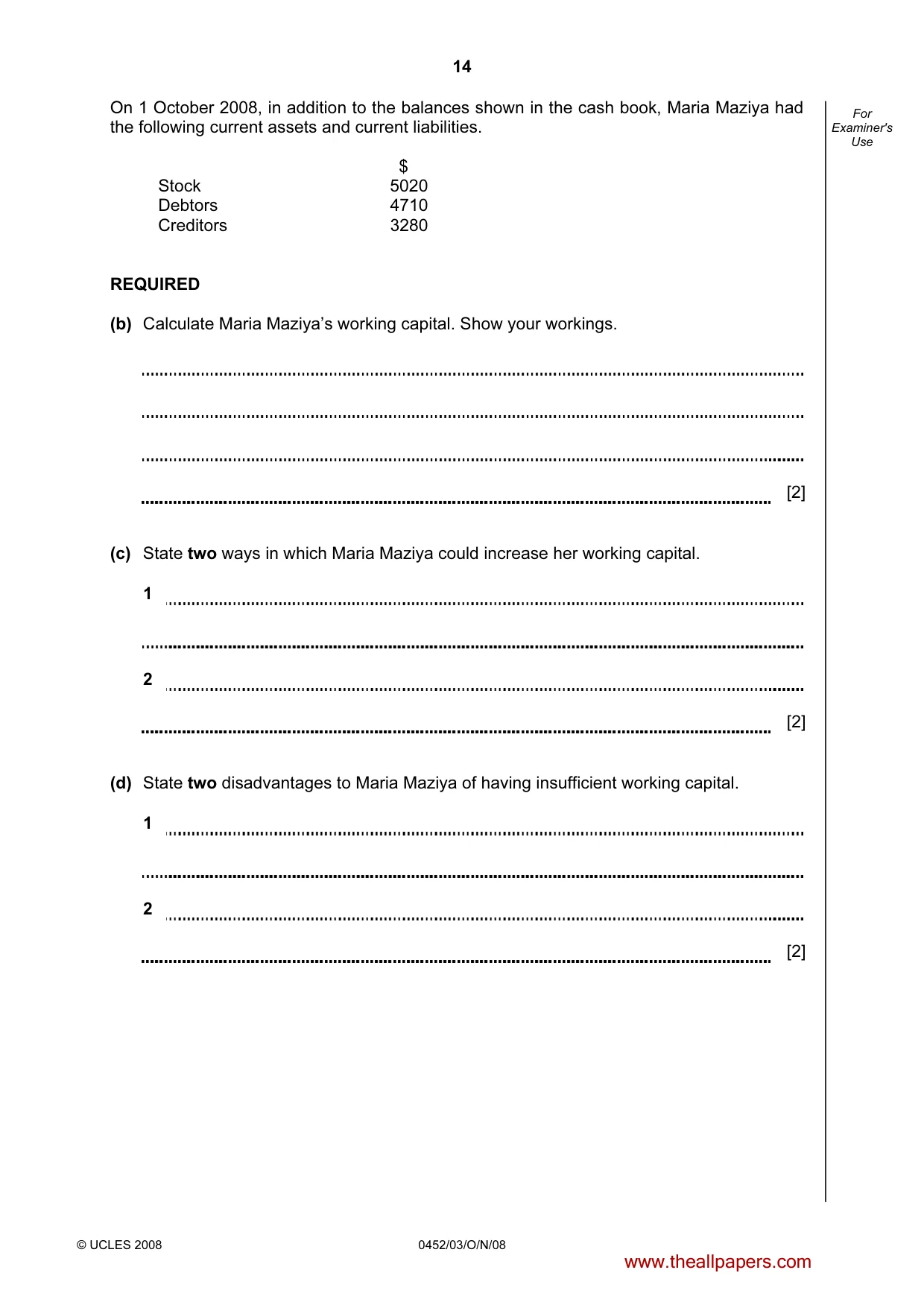
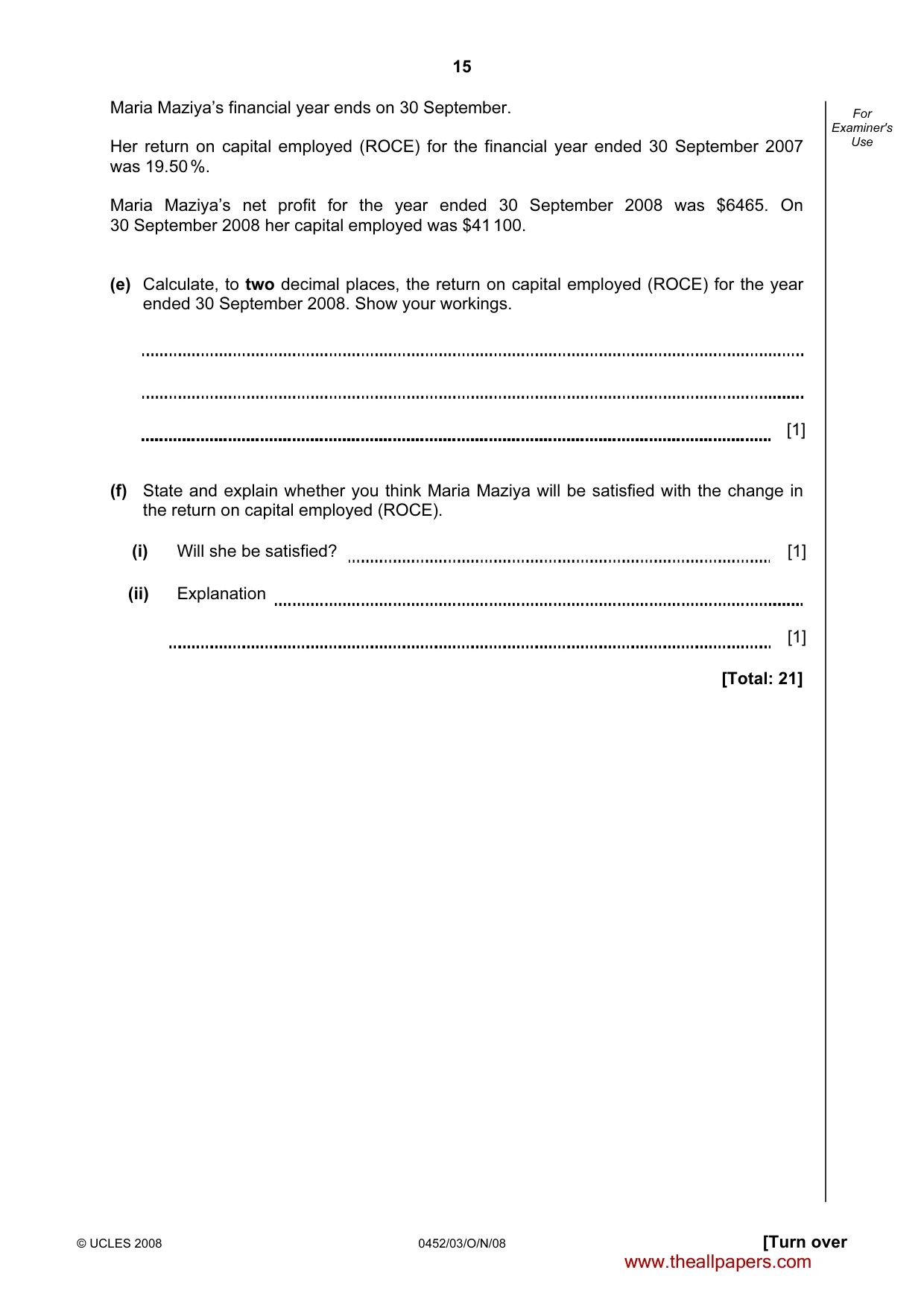
4 On 15 September 2008, $50 had been received from W Lee. This amount was incorrectly debited to the bad debts account and credited to W Lee’s account. W Lee’s account had been written off as a bad debt on 30 June 2008. REQUIRED (d) Complete the following table to show the entries required to correct the above errors. The first one has been completed as an example. account(s) to be debited $ account(s) to be credited $ 1 J Chan 20 J Chua 20 2 3 4 [8] [Total: 18] 3 Suzan Hamouda has been in business for two years but has not maintained a full set of accounting records. All purchases and sales are made on credit terms. Suzan Hamouda is able to provide the following information: $ At 1 October 2007 amounts owing by customers 5 000 amounts owing to suppliers 4 500 For the year ended 30 September 2008 cheques received from customers 58 114 cheques paid to suppliers 45 930 discounts received 470 discounts allowed 1 186 bad debts written off 900 At 30 September 2008 amounts owing by customers 4 800 amounts owing to suppliers 5 200 REQUIRED (a) Calculate Suzan Hamouda’s credit sales and credit purchases for the year ended 30 September 2008. Your answer may be in the form of ledger accounts or calculations. (i) Credit sales [6] (ii) Credit purchases [5] Suzan sells all her goods at a mark-up of 20 %. REQUIRED (b) Explain the difference between mark-up and margin. [2] On 1 October 2007 Suzan Hamouda’s stock was valued at $7800. During the year ended 30 September 2008 Suzan Hamouda took goods costing $200 for her own use. No adjustments have been made for these goods. REQUIRED (c) Using your answers to (a) and the above information calculate by means of a trading account the value of Suzan Hamouda’s stock on 30 September 2008. Suzan Hamouda Trading Account for the year ended 30 September 2008 [8] [Total: 21] 4 Maria Maziya is a trader. Her bookkeeper provided the following cash book for the first two weeks of October 2008. Disc. Cash Bank Disc. Cash Bank 2008 $ $ $ 2008 $ $ $ Oct 1 Balance b/d 200 Oct 1 Balance b/d 3620 9 Sales 20 1840 3 Stationery 30 11 Oshoek Traders 11 539 4 B Ngwenya 160 13 Cash 120 (Dishonoured) 14 Balance c/d 1515 13 Bank 120 14 Mlawula Stores 6 234 Balance c/d 70 11 220 4014 6 220 4014 Oct 15 Balance b/d 70 Oct 15 Balance b/d 1515 REQUIRED (a) (i) Explain each of the following entries shown in the cash book. State where the double entry for each transaction would be found. The first one has been completed as an example. 1 3 October Stationery Explanation Stationery costing $30 has been purchased for cash Double entry Debit stationery account 2 4 October B Ngwenya Explanation Double entry [2] 3 9 October Sales Explanation Double entry [2] (ii) Explain the entries on 13 October. [2] (iii) In relation to the $6 cash discount on 14 October – State whether Maria has allowed or received this discount. [1] State what percentage of cash discount this represents. [1] (iv) Explain the significance of each of the balances shown on 15 October. Balance of $70 Balance of $1515 [2] (v) Explain what entries are made in the ledger in respect of the totals of the discount columns. Total of column on debit side of $11 Total of column on credit side of $6 [2] On 1 October 2008, in addition to the balances shown in the cash book, Maria Maziya had the following current assets and current liabilities. $ Stock 5020 Debtors 4710 Creditors 3280 REQUIRED (b) Calculate Maria Maziya’s working capital. Show your workings. [2] (c) State two ways in which Maria Maziya could increase her working capital. 1 2 [2] (d) State two disadvantages to Maria Maziya of having insufficient working capital. 1 2 [2] Maria Maziya’s financial year ends on 30 September. Her return on capital employed (ROCE) for the financial year ended 30 September 2007 was 19.50 %. Maria Maziya’s net profit for the year ended 30 September 2008 was $6465. On 30 September 2008 her capital employed was $41 100. (e) Calculate, to two decimal places, the return on capital employed (ROCE) for the year ended 30 September 2008. Show your workings. [1] (f) State and explain whether you think Maria Maziya will be satisfied with the change in the return on capital employed (ROCE). (i) Will she be satisfied? [1] (ii) Explanation [1] [Total: 21]
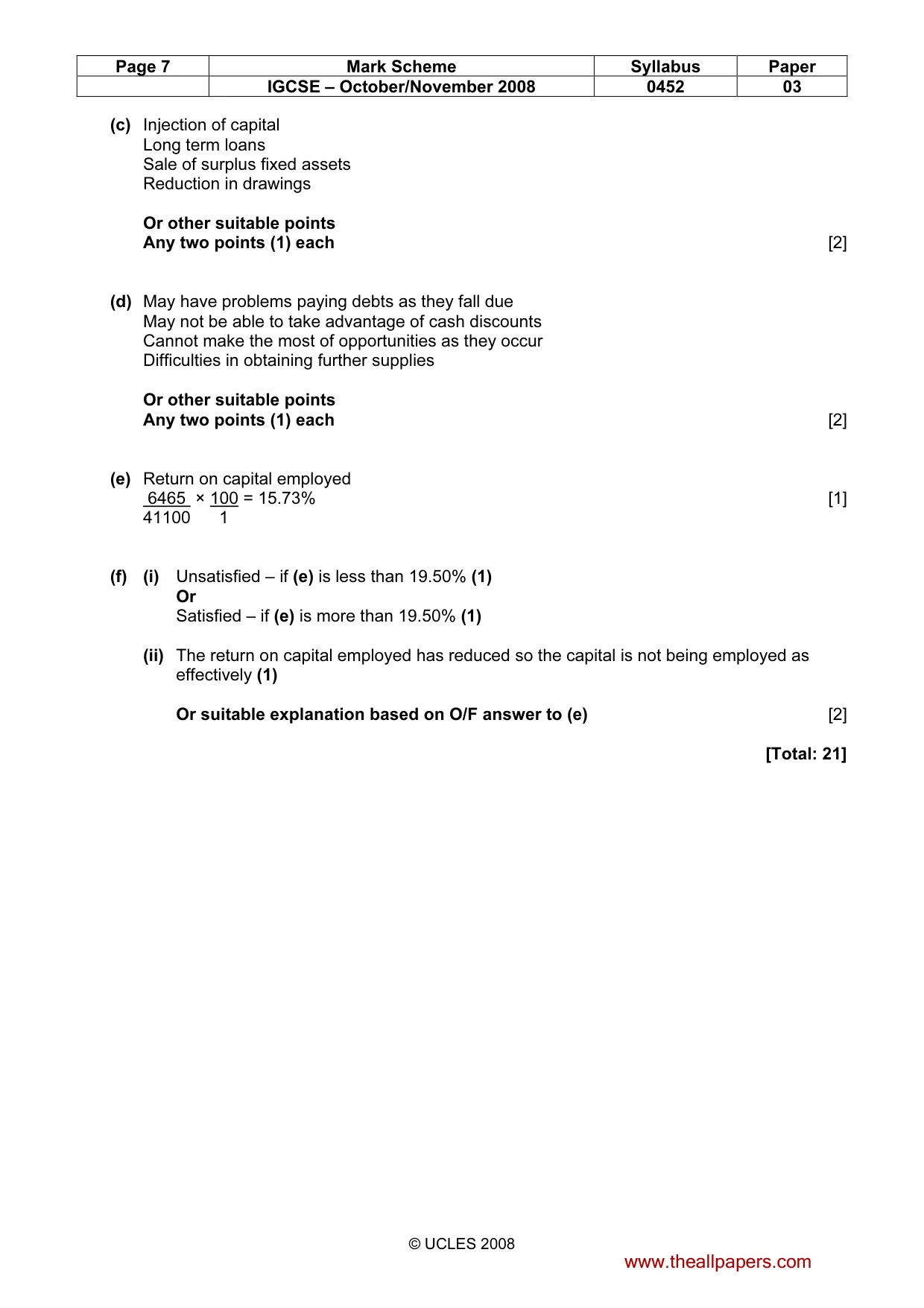
Mark scheme: 4 (a) (i) B Ngwenya Explanation cheque previously received from B Ngwenya was returned as dishonoured by the bank (1) Double entry debit B Ngwenya account (1) Sales Explanation receipts from sales, some paid into bank and some retained in cash (1) Double entry credit Sales account (1) (ii) $120 was transferred from the cash to the bank (2) Or These are contra entries (1) (iii) Discount received (1) 6 × 100 = 2.5% (1) 6 + 234 1 (iv) Balance of $70 This is the cash remaining in the business (1) Balance of $1515 This is the amount owing to the bank (overdraft) (1) (v) Total of column on debit side – debited to discount allowed account (1) Total of column on credit side – credited to discount received account (1) [12] (b) Working capital (200 + 5020 + 4710) – (3620 + 3280) (1) = 9930 – 6900 = 3030 (1) [2] IGCSE – October/November 2008 0452 03 (c) Injection of capital Long term loans Sale of surplus fixed assets Reduction in drawings Or other suitable points Any two points (1) each [2] (d) May have problems paying debts as they fall due May not be able to take advantage of cash discounts Cannot make the most of opportunities as they occur Difficulties in obtaining further supplies Or other suitable points Any two points (1) each [2] (e) Return on capital employed 6465 × 100 = 15.73% [1] 41100 1 (f) (i) Unsatisfied – if (e) is less than 19.50% (1) Or Satisfied – if (e) is more than 19.50% (1) (ii) The return on capital employed has reduced so the capital is not being employed as effectively (1) Or suitable explanation based on O/F answer to (e) [2] [Total: 21] IGCSE – October/November 2008 0452 03
Q5 · Salim and Rita Jaffer are in partnership
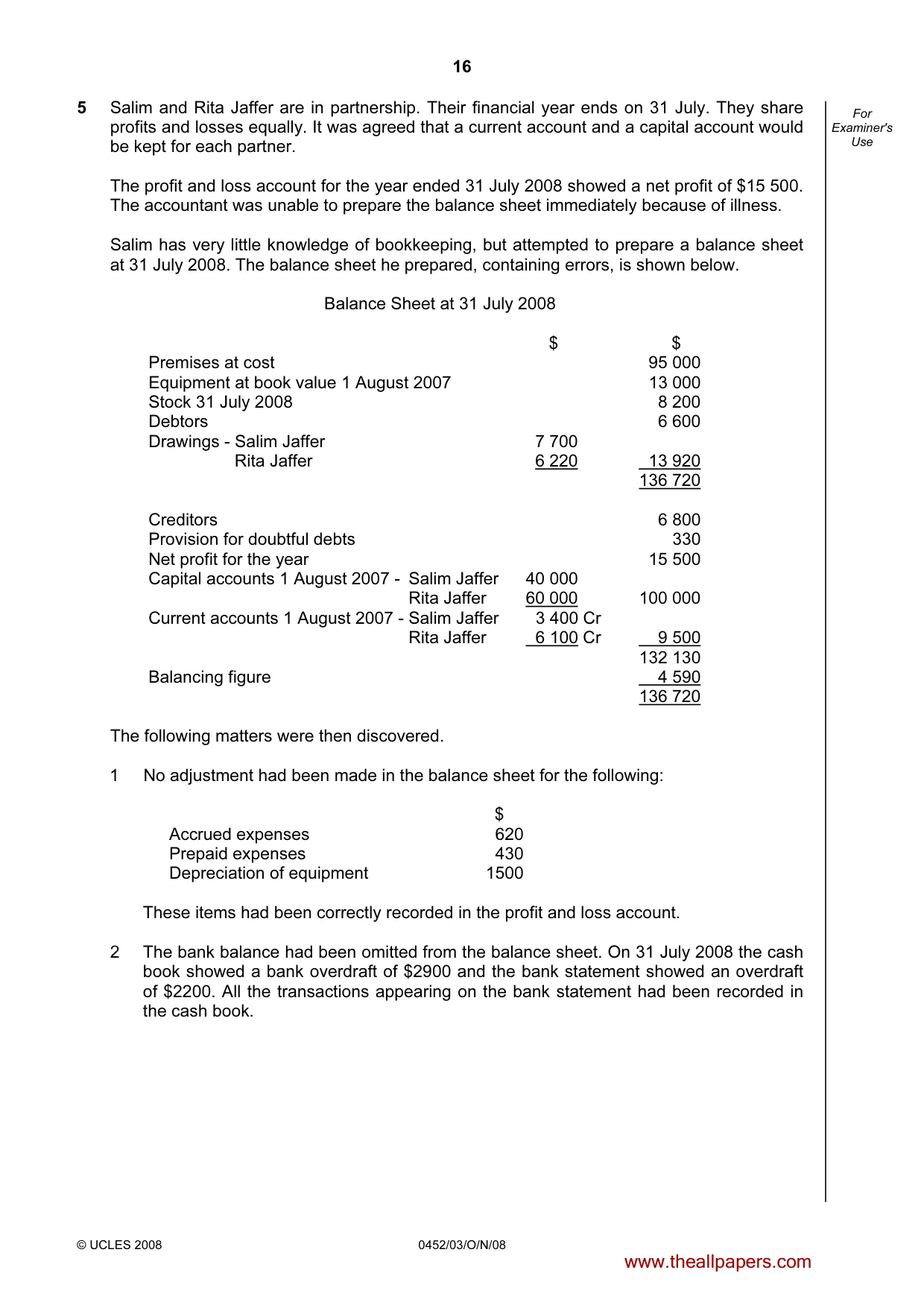
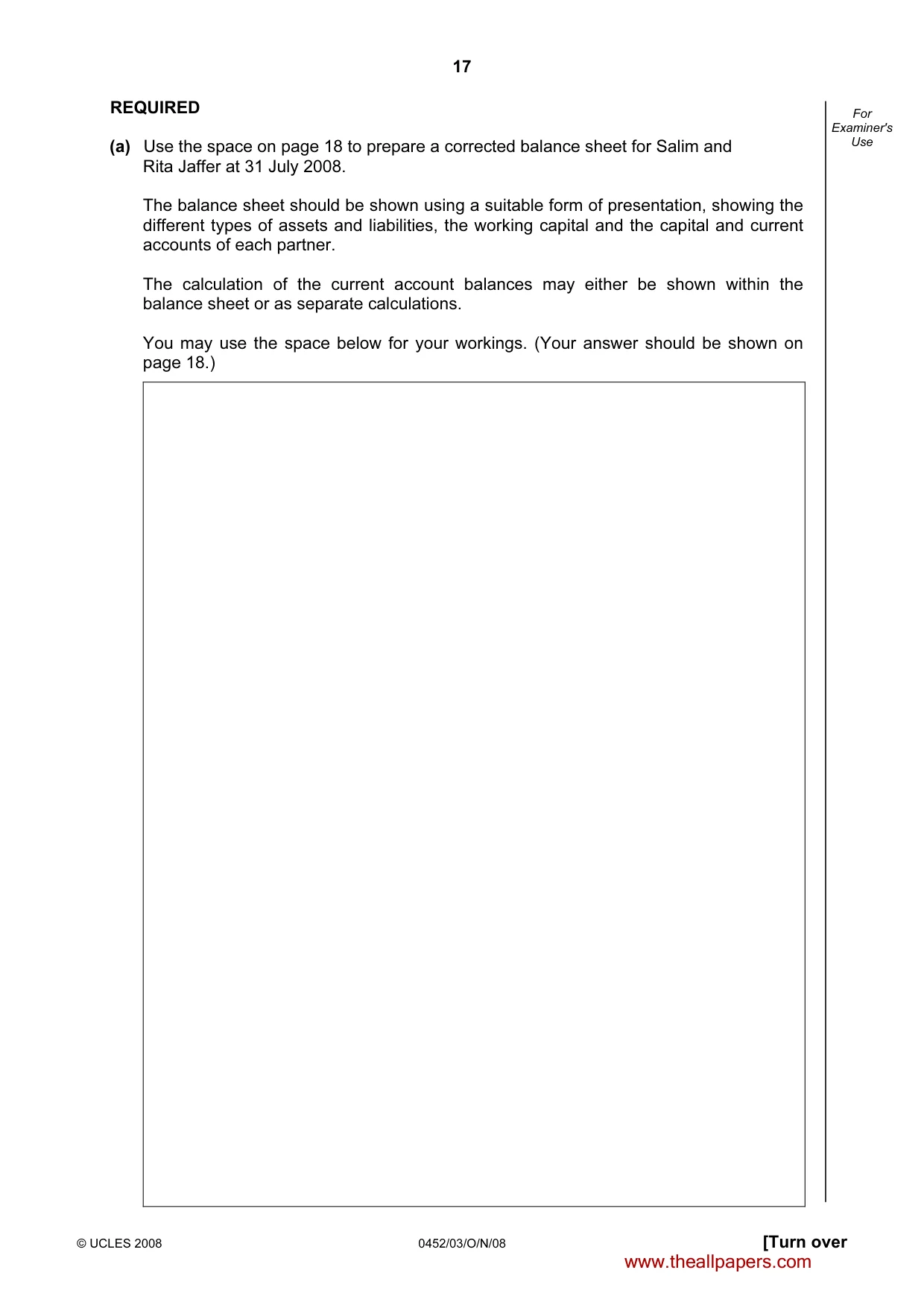
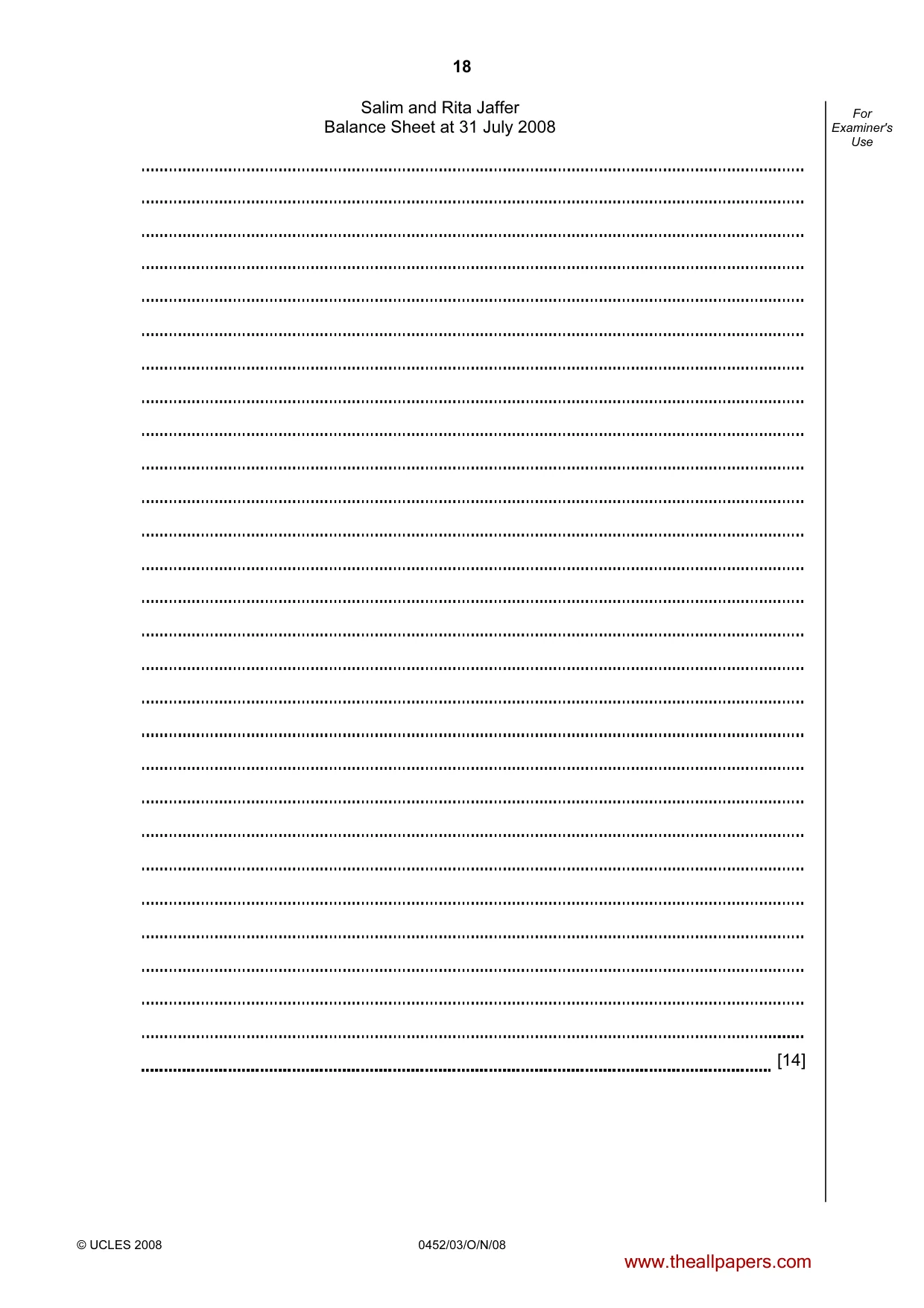
5 Salim and Rita Jaffer are in partnership. Their financial year ends on 31 July. They share profits and losses equally. It was agreed that a current account and a capital account would be kept for each partner. The profit and loss account for the year ended 31 July 2008 showed a net profit of $15 500. The accountant was unable to prepare the balance sheet immediately because of illness. Salim has very little knowledge of bookkeeping, but attempted to prepare a balance sheet at 31 July 2008. The balance sheet he prepared, containing errors, is shown below. Balance Sheet at 31 July 2008 $ $ Premises at cost 95 000 Equipment at book value 1 August 2007 13 000 Stock 31 July 2008 8 200 Debtors 6 600 Drawings - Salim Jaffer 7 700 Rita Jaffer 6 220 13 920 136 720 Creditors 6 800 Provision for doubtful debts 330 Net profit for the year 15 500 Capital accounts 1 August 2007 - Salim Jaffer 40 000 Rita Jaffer 60 000 100 000 Current accounts 1 August 2007 - Salim Jaffer 3 400 Cr Rita Jaffer 6 100 Cr 9 500 132 130 Balancing figure 4 590 136 720 The following matters were then discovered. 1 No adjustment had been made in the balance sheet for the following: $ Accrued expenses 620 Prepaid expenses 430 Depreciation of equipment 1500 These items had been correctly recorded in the profit and loss account. 2 The bank balance had been omitted from the balance sheet. On 31 July 2008 the cash book showed a bank overdraft of $2900 and the bank statement showed an overdraft of $2200. All the transactions appearing on the bank statement had been recorded in the cash book. UIRED se the space on page 18 to prepare a corrected balance sheet for Salim and ita Jaffer at 31 July 2008. he balance sheet should be shown using a suitable form of presentation, showing th ifferent types of assets and liabilities, the working capital and the capital and curren ccounts of each partner. he calculation of the current account balances may either be shown within th alance sheet or as separate calculations. ou may use the space below for your workings. (Your answer should be shown o age 18.) Salim and Rita Jaffer Balance Sheet at 31 July 2008 [14]
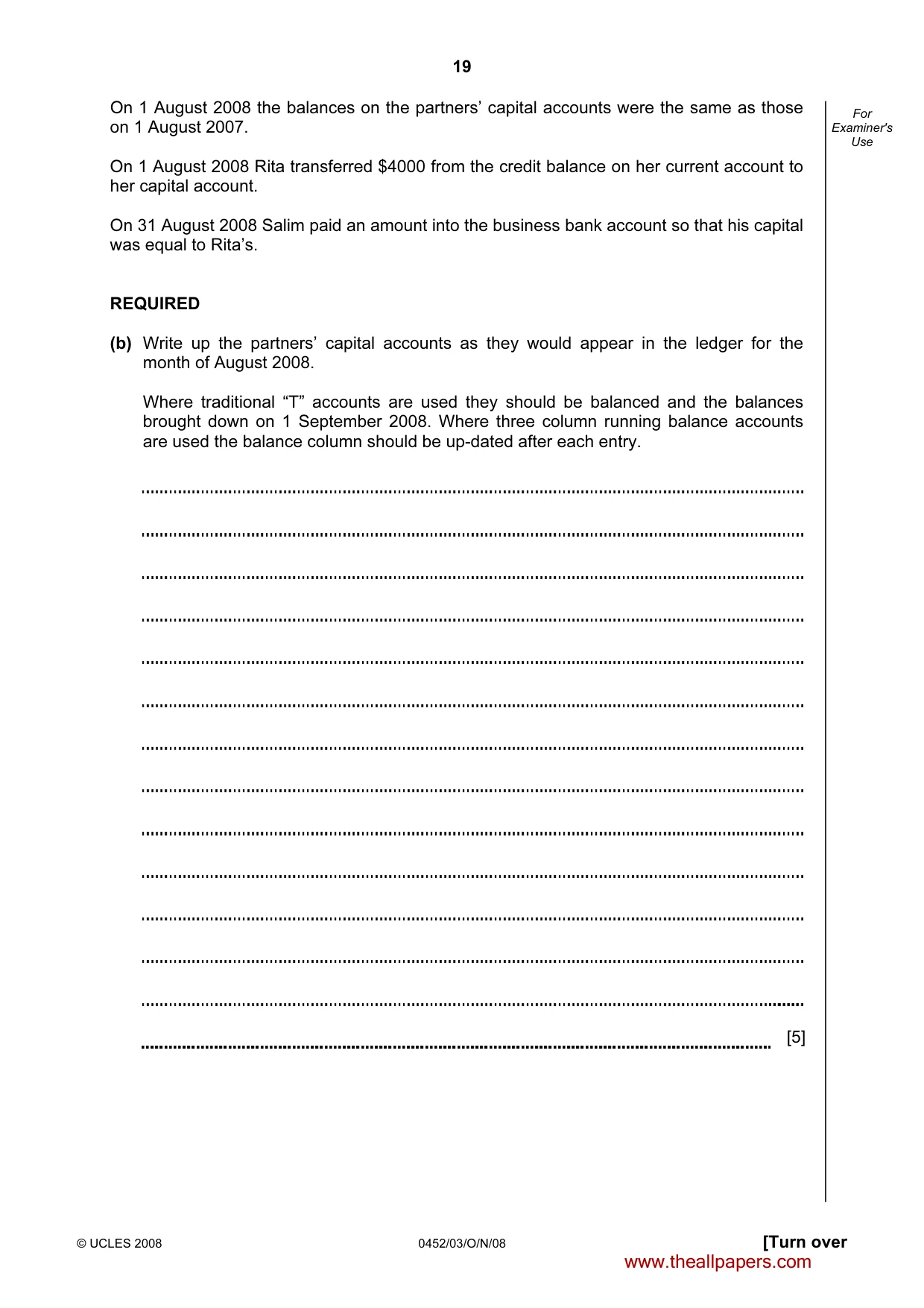
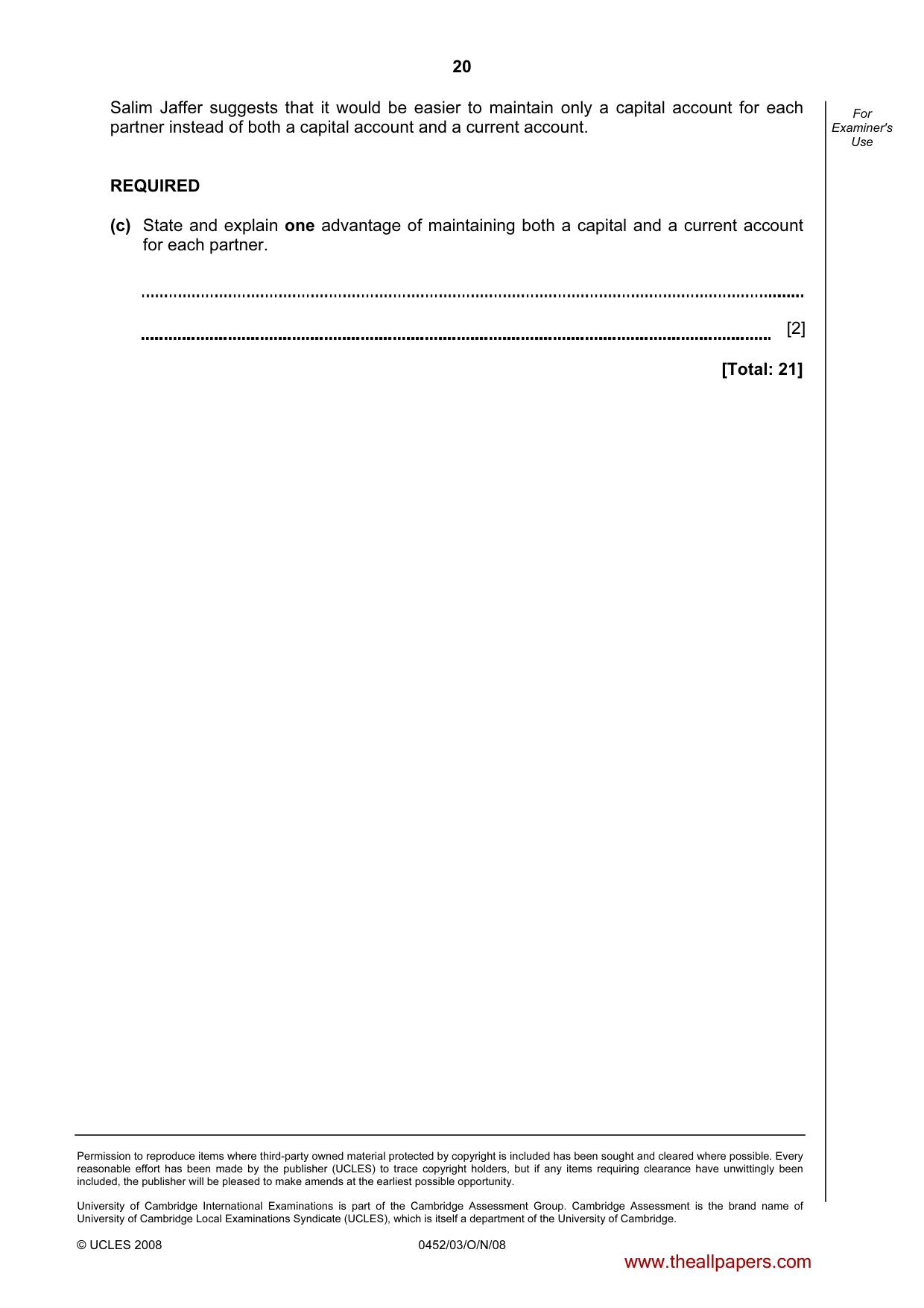
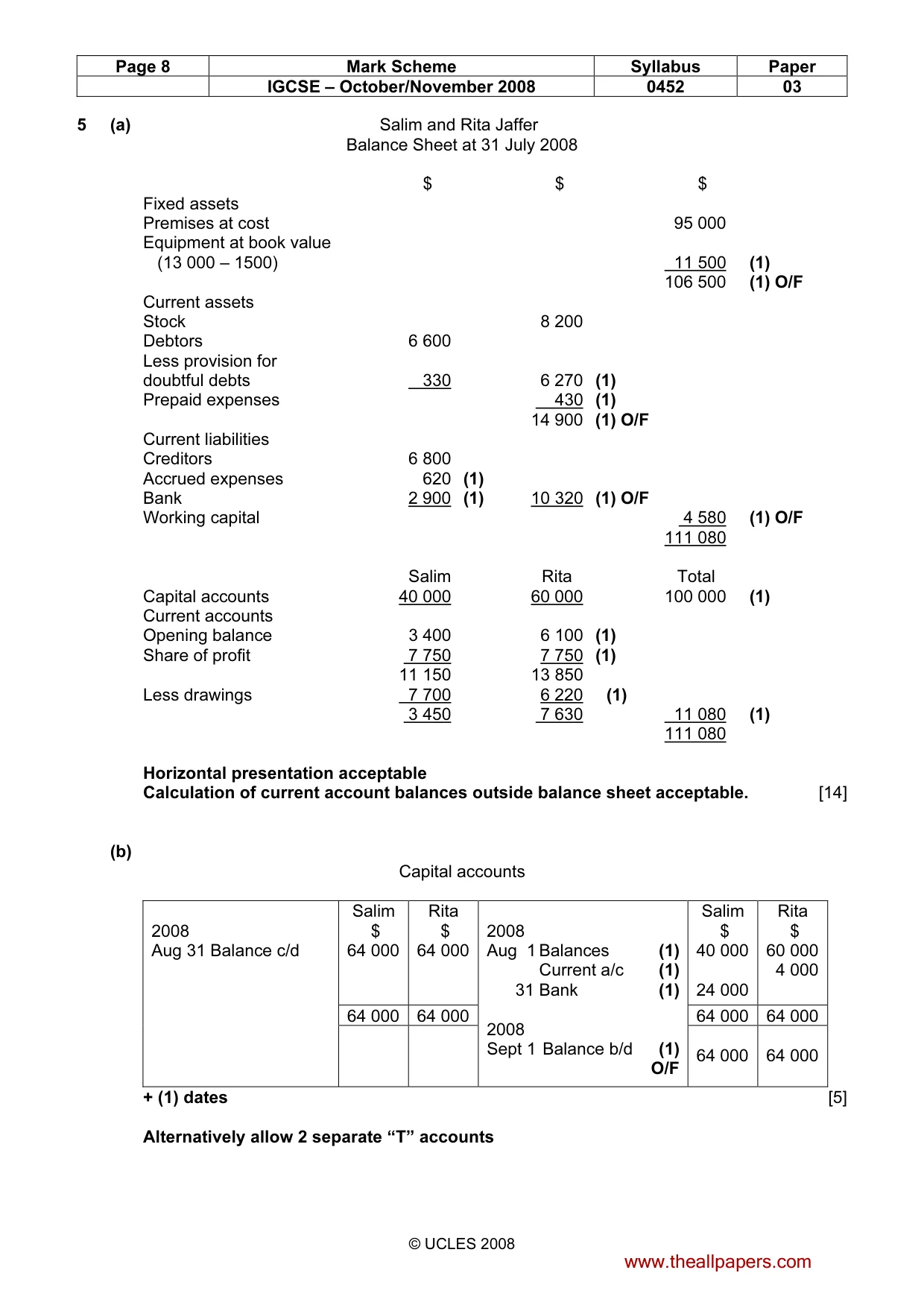
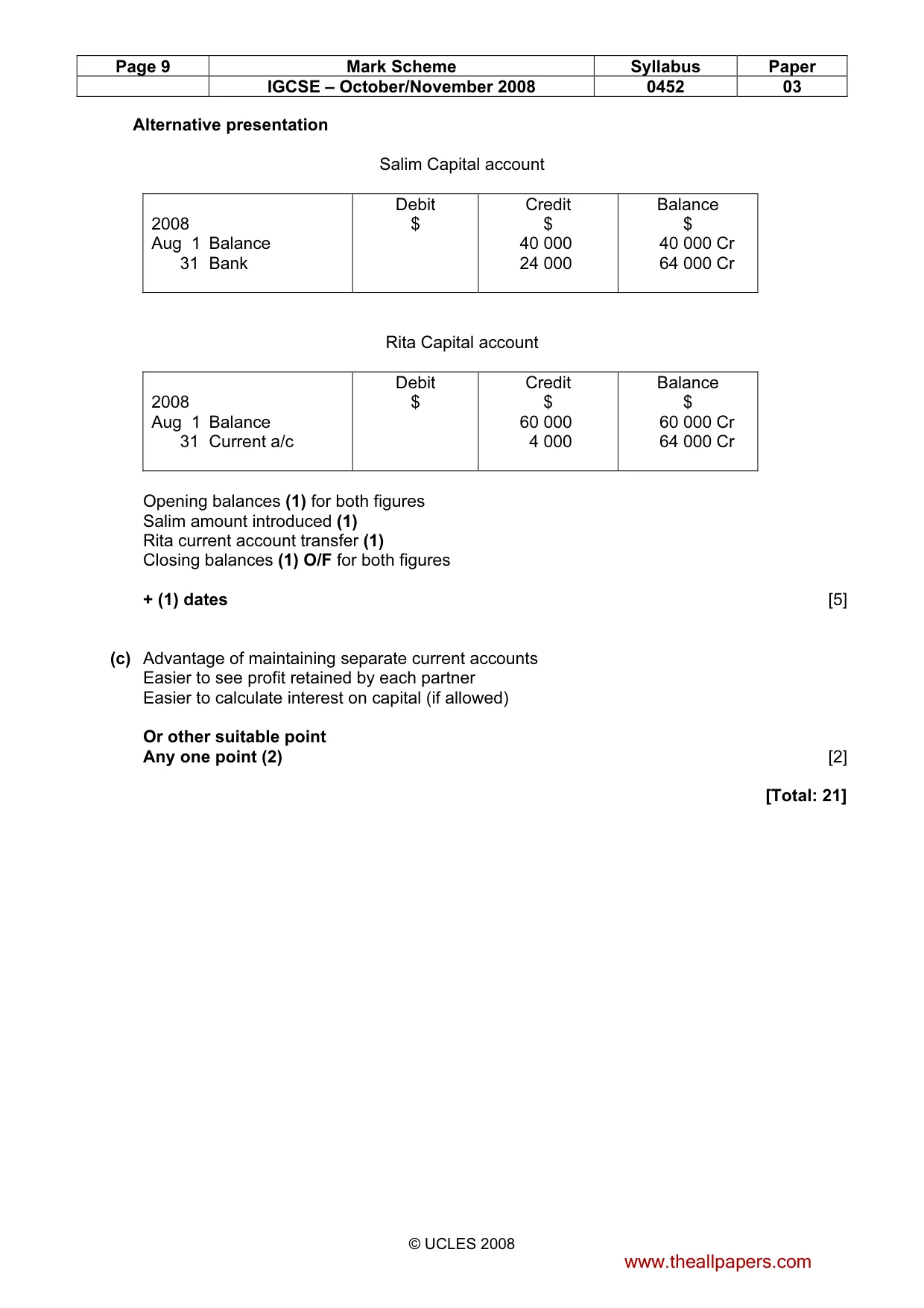
Mark scheme: 5 (a) Salim and Rita Jaffer Balance Sheet at 31 July 2008 $ $ $ Fixed assets Premises at cost 95 000 Equipment at book value (13 000 – 1500) 11 500 (1) 106 500 (1) O/F Current assets Stock 8 200 Debtors 6 600 Less provision for doubtful debts 330 6 270 (1) Prepaid expenses 430 (1) 14 900 (1) O/F Current liabilities Creditors 6 800 Accrued expenses 620 (1) Bank 2 900 (1) 10 320 (1) O/F Working capital 4 580 (1) O/F 111 080 Salim Rita Total Capital accounts 40 000 60 000 100 000 (1) Current accounts Opening balance 3 400 6 100 (1) Share of profit 7 750 7 750 (1) 11 150 13 850 Less drawings 7 700 6 220 (1) 3 450 7 630 11 080 (1) 111 080 Horizontal presentation acceptable Calculation of current account balances outside balance sheet acceptable. [14] (b) Capital accounts Salim Rita Salim Rita 2008 $ $ 2008 $ $ Aug 31 Balance c/d 64 000 64 000 Aug 1 Balances (1) 40 000 60 000 Current a/c (1) 4 000 31 Bank (1) 24 000 64 000 64 000 64 000 64 000 2008 Sept 1 Balance b/d (1) 64 000 64 000 O/F + (1) dates [5] Alternatively allow 2 separate “T” accounts IGCSE – October/November 2008 0452 03 Alternative presentation Salim Capital account Debit Credit Balance 2008 $ $ $ Aug 1 Balance 40 000 40 000 Cr 31 Bank 24 000 64 000 Cr Rita Capital account Debit Credit Balance 2008 $ $ $ Aug 1 Balance 60 000 60 000 Cr 31 Current a/c 4 000 64 000 Cr Opening balances (1) for both figures Salim amount introduced (1) Rita current account transfer (1) Closing balances (1) O/F for both figures + (1) dates [5] (c) Advantage of maintaining separate current accounts Easier to see profit retained by each partner Easier to calculate interest on capital (if allowed) Or other suitable point Any one point (2) [2] [Total: 21]
What was in this paper
The subtopics covered by these 5 questions, and how many questions each got. Open one in a new tab to see every Cambridge question on it.
What you needed in this session
Cambridge’s own grade thresholds for 2008 Oct/Nov, Paper 3 · Variant 1. A higher threshold means an easier paper — the bar moves with how the cohort did.