Cambridge IGCSE Accounting 0452 — 2009 May/June Paper 3 · Variant 1
0452/31/M/J/09 · 5 questions · 100 marks · ≈113 min
The question paper and its mark scheme, free to read here and free to download. This is Cambridge’s own paper, exactly as it was sat.
Question paper24 pages




Mark scheme10 pages
Answers below. Sit the paper first if you are practising.
Questions as text
Q1 · Tony and Alice Mundondo started a business on 1 March 2007 supplying and repairing…
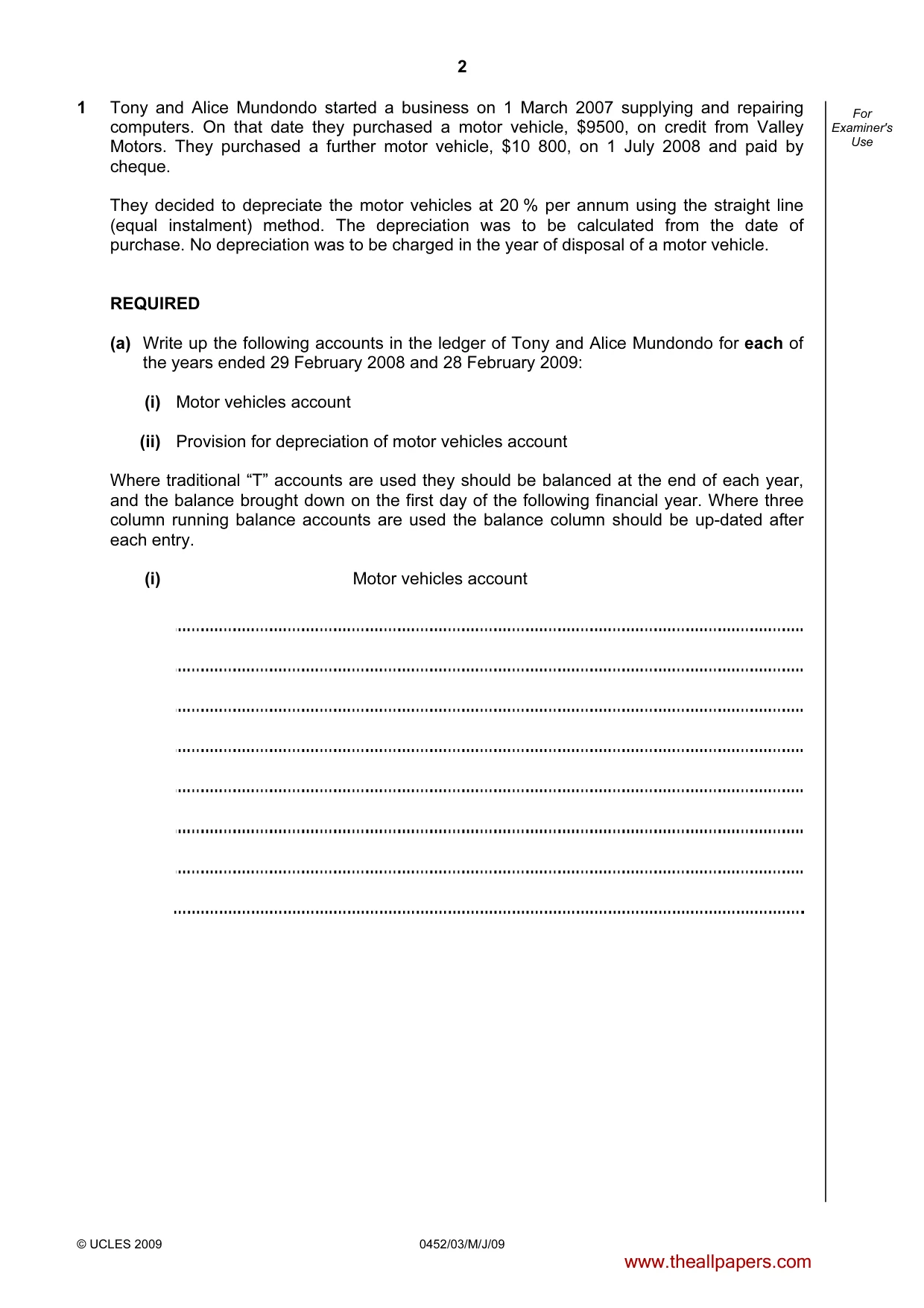
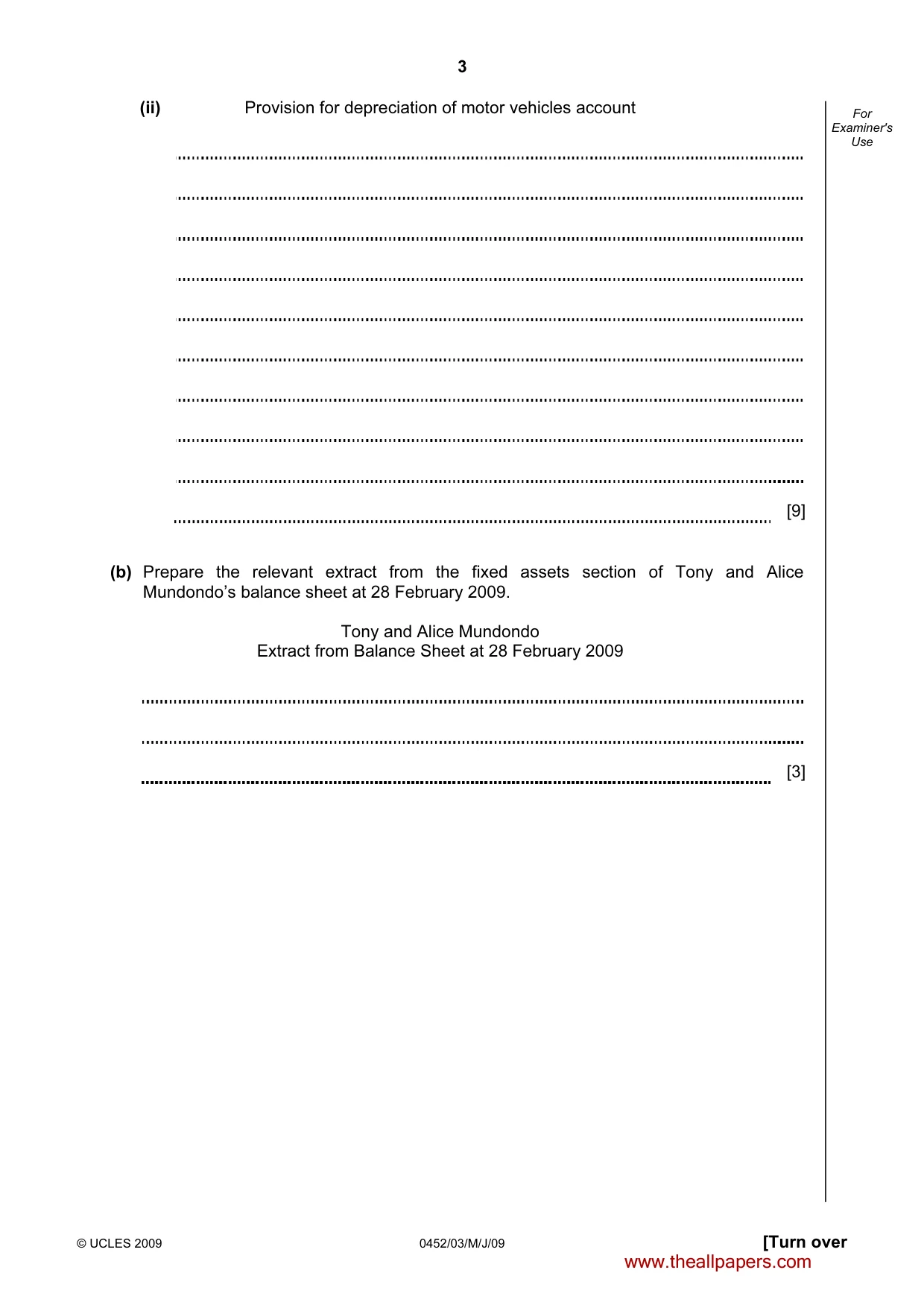
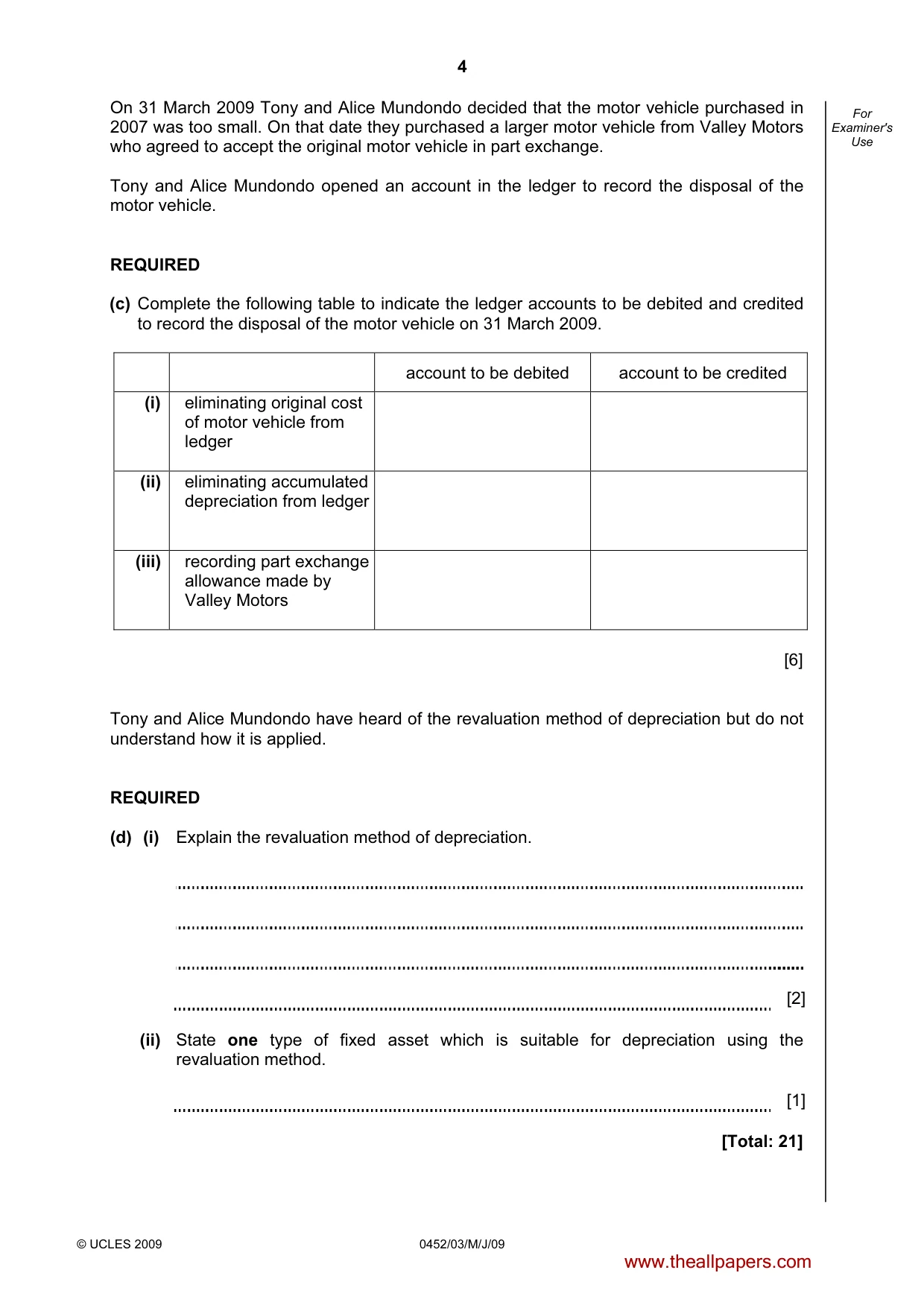
1 Tony and Alice Mundondo started a business on 1 March 2007 supplying and repairing computers. On that date they purchased a motor vehicle, $9500, on credit from Valley Motors. They purchased a further motor vehicle, $10 800, on 1 July 2008 and paid by cheque. They decided to depreciate the motor vehicles at 20 % per annum using the straight line (equal instalment) method. The depreciation was to be calculated from the date of purchase. No depreciation was to be charged in the year of disposal of a motor vehicle. REQUIRED (a) Write up the following accounts in the ledger of Tony and Alice Mundondo for each of the years ended 29 February 2008 and 28 February 2009: (i) Motor vehicles account (ii) Provision for depreciation of motor vehicles account Where traditional “T” accounts are used they should be balanced at the end of each year, and the balance brought down on the first day of the following financial year. Where three column running balance accounts are used the balance column should be up-dated after each entry. (i) Motor vehicles account (ii) Provision for depreciation of motor vehicles account [9] (b) Prepare the relevant extract from the fixed assets section of Tony and Alice Mundondo’s balance sheet at 28 February 2009. Tony and Alice Mundondo Extract from Balance Sheet at 28 February 2009 [3] On 31 March 2009 Tony and Alice Mundondo decided that the motor vehicle purchased in 2007 was too small. On that date they purchased a larger motor vehicle from Valley Motors who agreed to accept the original motor vehicle in part exchange. Tony and Alice Mundondo opened an account in the ledger to record the disposal of the motor vehicle. REQUIRED (c) Complete the following table to indicate the ledger accounts to be debited and credited to record the disposal of the motor vehicle on 31 March 2009. account to be debited account to be credited (i) eliminating original cost of motor vehicle from ledger (ii) eliminating accumulated depreciation from ledger (iii) recording part exchange allowance made by Valley Motors [6] Tony and Alice Mundondo have heard of the revaluation method of depreciation but do not understand how it is applied. REQUIRED (d) (i) Explain the revaluation method of depreciation. [2] (ii) State one type of fixed asset which is suitable for depreciation using the revaluation method. [1] [Total: 21]
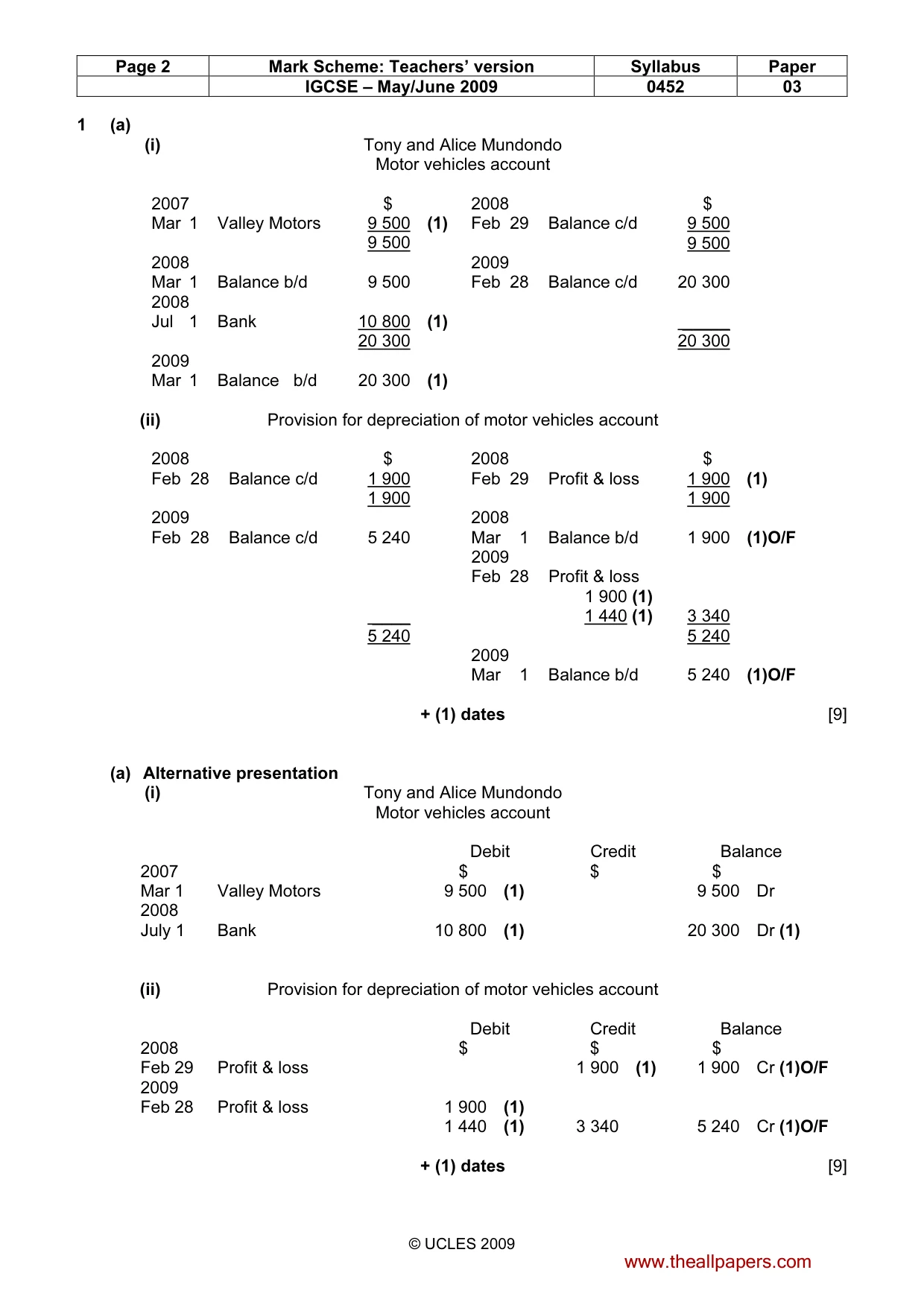
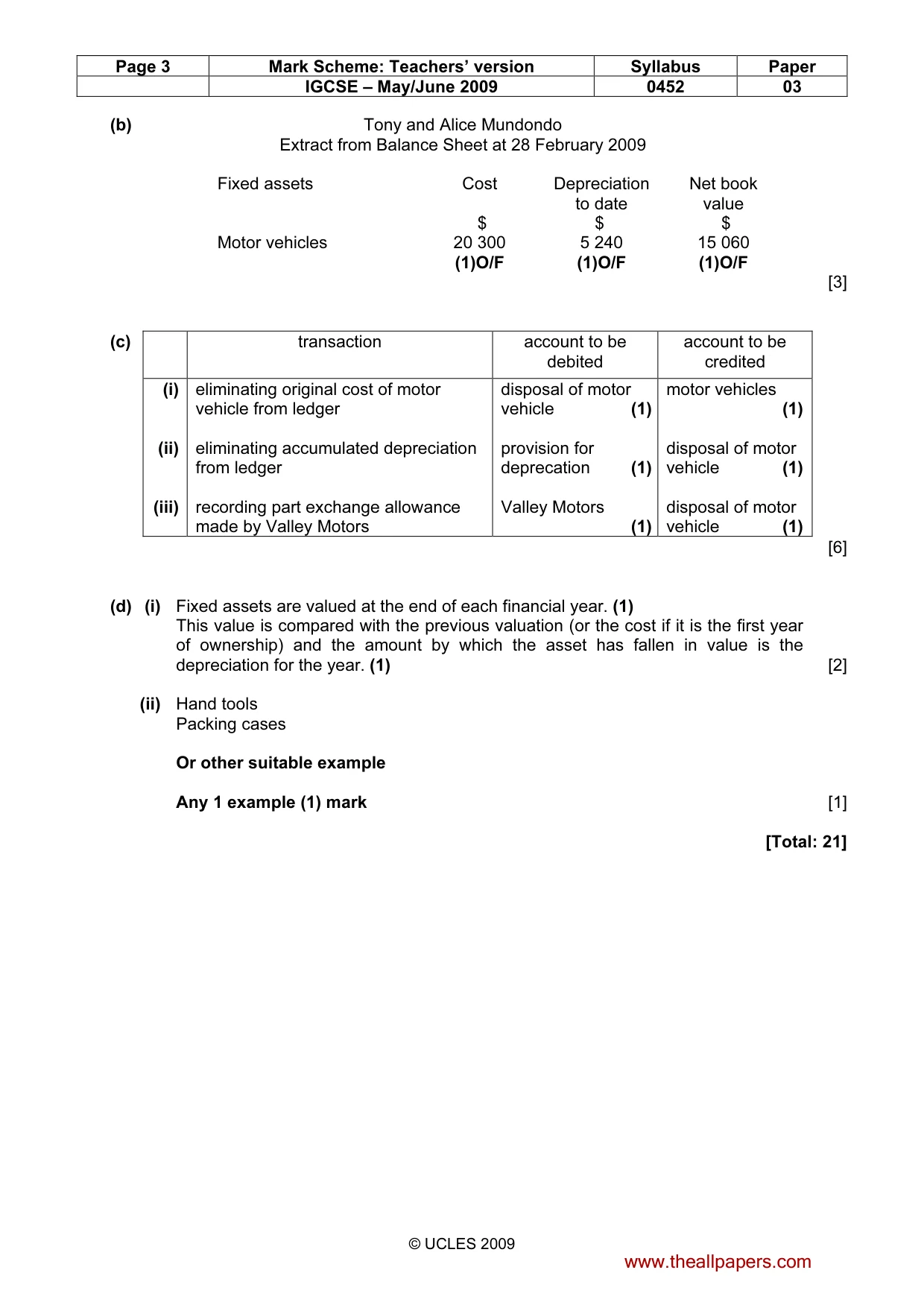
Mark scheme: 1 (a) (i) Tony and Alice Mundondo Motor vehicles account 2007 $ 2008 $ Mar 1 Valley Motors 9 500 (1) Feb 29 Balance c/d 9 500 9 500 9 500 2008 2009 Mar 1 Balance b/d 9 500 Feb 28 Balance c/d 20 300 2008 Jul 1 Bank 10 800 (1) _____ 20 300 20 300 2009 Mar 1 Balance b/d 20 300 (1) (ii) Provision for depreciation of motor vehicles account 2008 $ 2008 $ Feb 28 Balance c/d 1 900 Feb 29 Profit & loss 1 900 (1) 1 900 1 900 2009 2008 Feb 28 Balance c/d 5 240 Mar 1 Balance b/d 1 900 (1)O/F 2009 Feb 28 Profit & loss 1 900 (1) ____ 1 440 (1) 3 340 5 240 5 240 2009 Mar 1 Balance b/d 5 240 (1)O/F + (1) dates [9] (a) Alternative presentation (i) Tony and Alice Mundondo Motor vehicles account Debit Credit Balance 2007 $ $ $ Mar 1 Valley Motors 9 500 (1) 9 500 Dr 2008 July 1 Bank 10 800 (1) 20 300 Dr (1) (ii) Provision for depreciation of motor vehicles account Debit Credit Balance 2008 $ $ $ Feb 29 Profit & loss 1 900 (1) 1 900 Cr (1)O/F 2009 Feb 28 Profit & loss 1 900 (1) 1 440 (1) 3 340 5 240 Cr (1)O/F + (1) dates [9] IGCSE – May/June 2009 0452 03 (b) Tony and Alice Mundondo Extract from Balance Sheet at 28 February 2009 Fixed assets Cost Depreciation Net book to date value $ $ $ Motor vehicles 20 300 5 240 15 060 (1)O/F (1)O/F (1)O/F [3] (c) transaction account to be account to be debited credited (i) eliminating original cost of motor disposal of motor motor vehicles vehicle from ledger vehicle (1) (1) (ii) eliminating accumulated depreciation provision for disposal of motor from ledger deprecation (1) vehicle (1) (iii) recording part exchange allowance Valley Motors disposal of motor made by Valley Motors (1) vehicle (1) [6] (d) (i) Fixed assets are valued at the end of each financial year. (1) This value is compared with the previous valuation (or the cost if it is the first year of ownership) and the amount by which the asset has fallen in value is the depreciation for the year. (1) [2] (ii) Hand tools Packing cases Or other suitable example Any 1 example (1) mark [1] [Total: 21] IGCSE – May/June 2009 0452 03
More questions on Accounting for depreciation and disposal of non-current assets
Q2 · Morag MacDonald provides a range of business services for small retail organisations
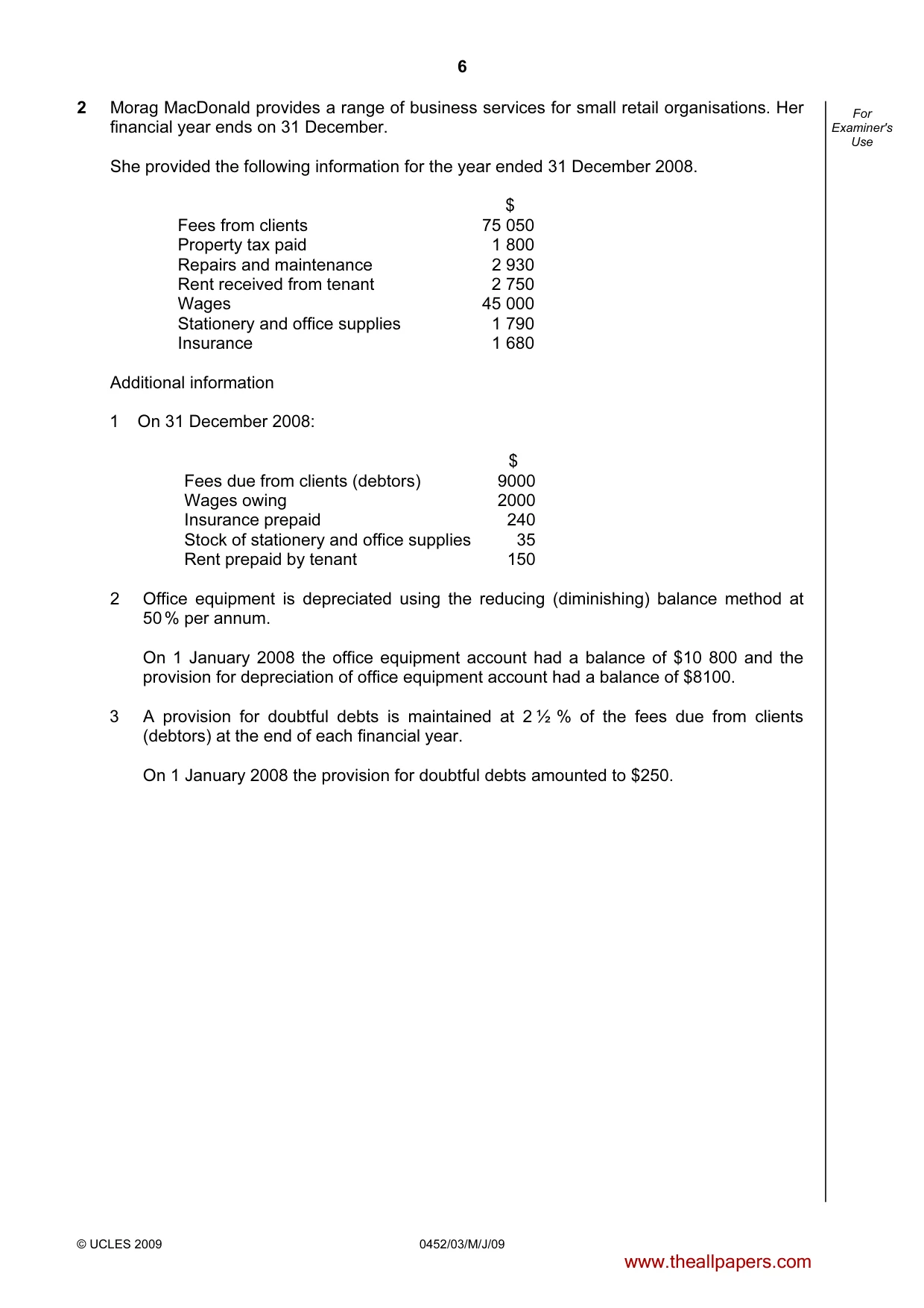
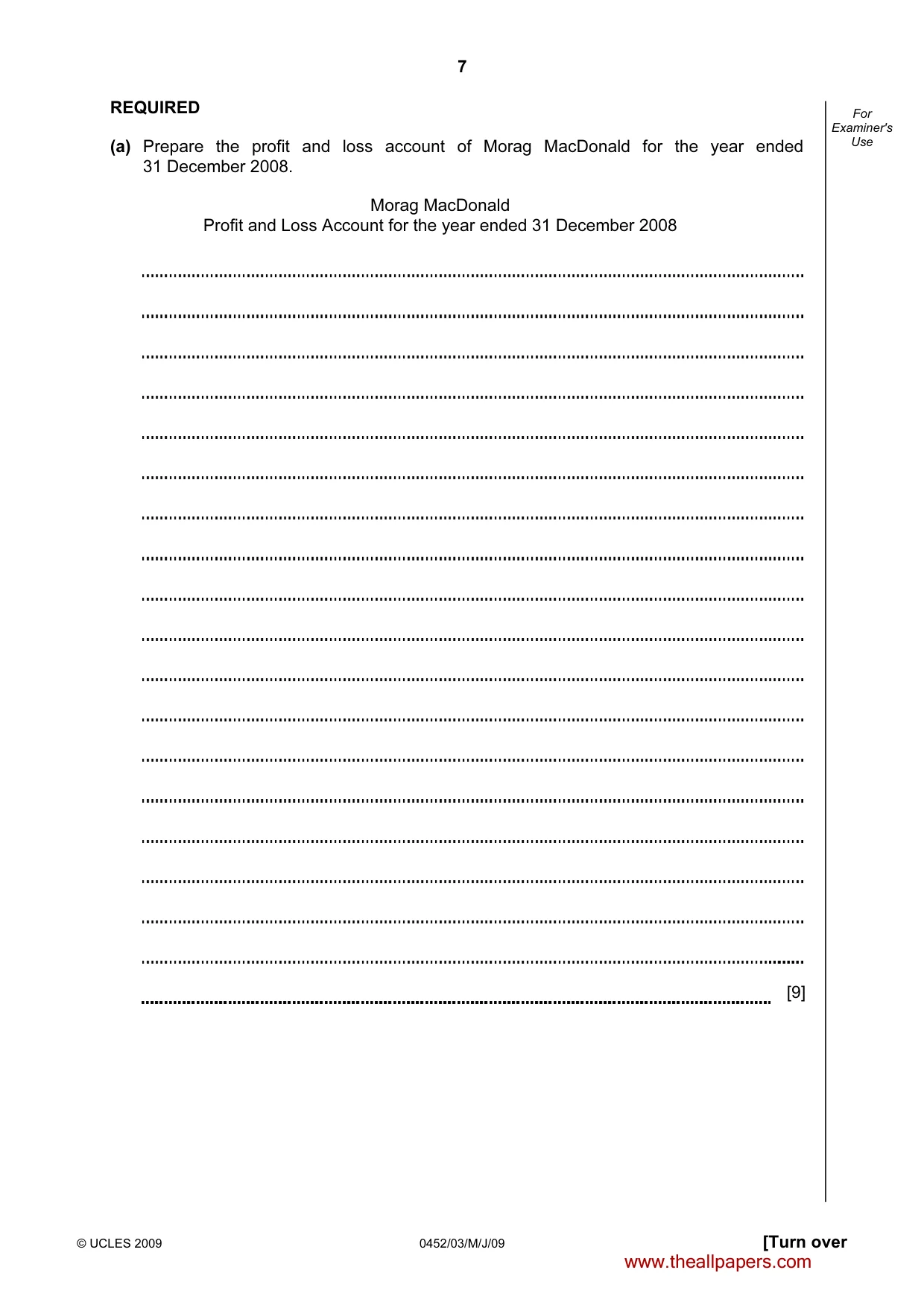
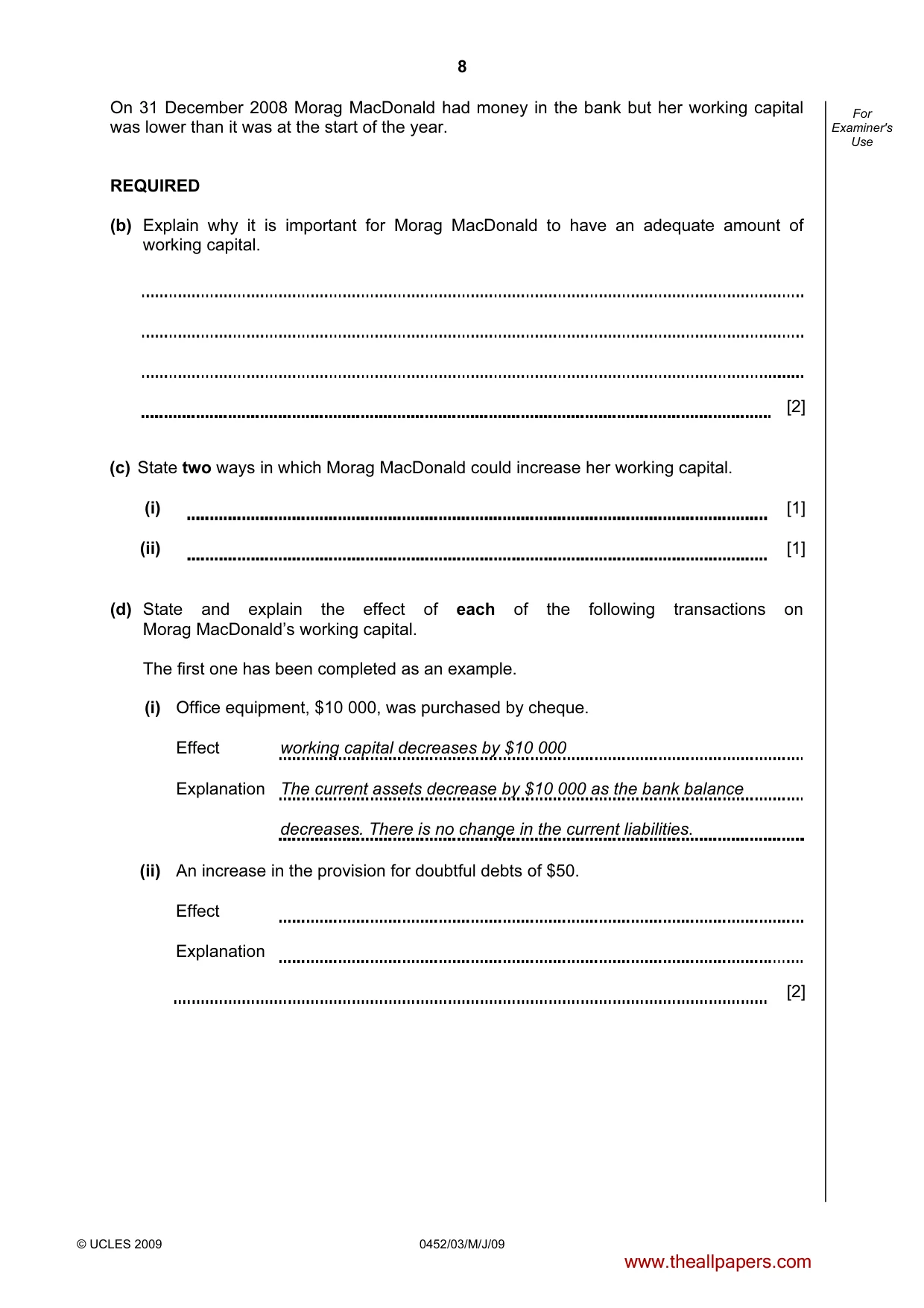
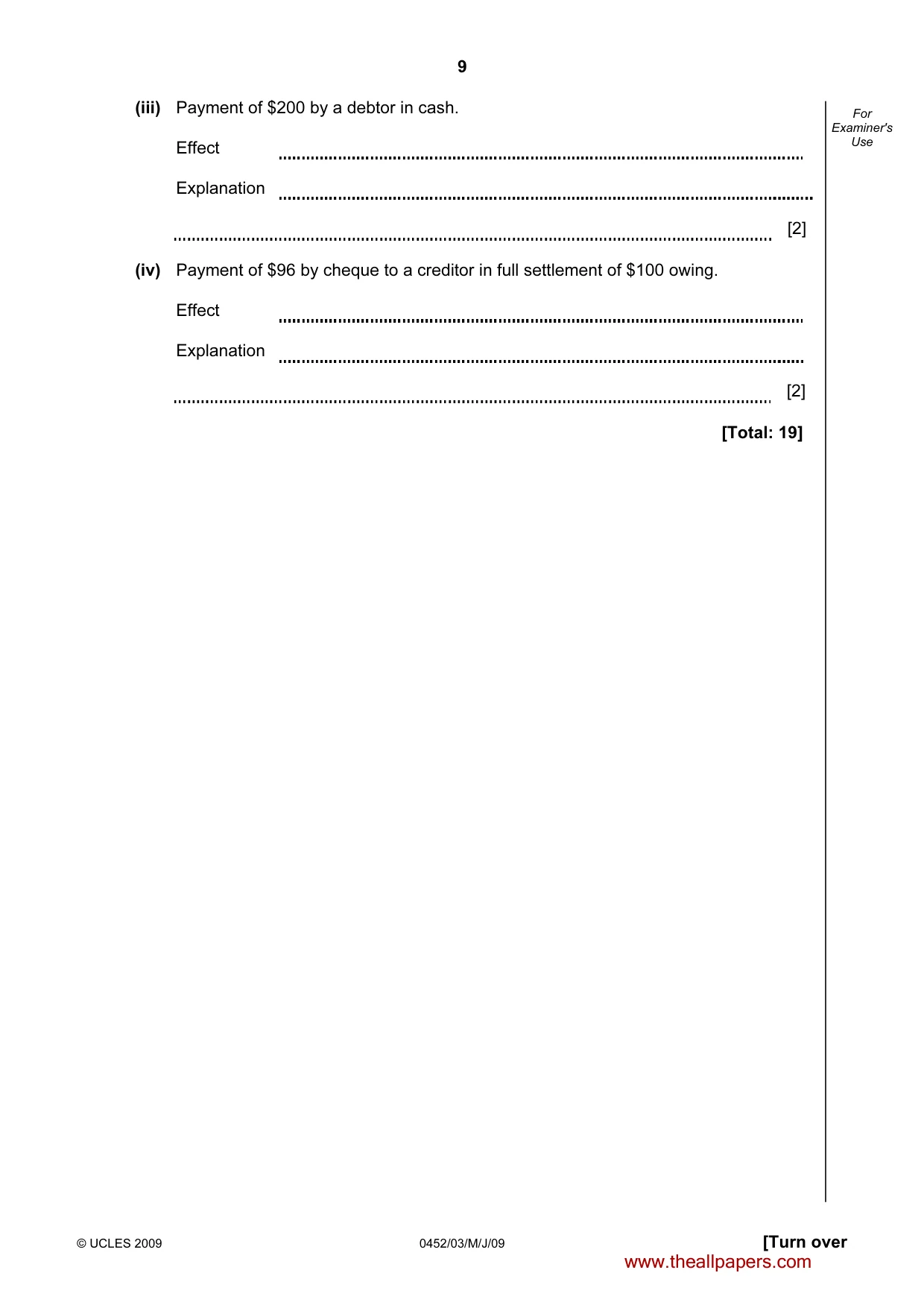
2 Morag MacDonald provides a range of business services for small retail organisations. Her financial year ends on 31 December. She provided the following information for the year ended 31 December 2008. $ Fees from clients 75 050 Property tax paid 1 800 Repairs and maintenance 2 930 Rent received from tenant 2 750 Wages 45 000 Stationery and office supplies 1 790 Insurance 1 680 Additional information 1 On 31 December 2008: $ Fees due from clients (debtors) 9000 Wages owing 2000 Insurance prepaid 240 Stock of stationery and office supplies 35 Rent prepaid by tenant 150 2 Office equipment is depreciated using the reducing (diminishing) balance method at 50 % per annum. On 1 January 2008 the office equipment account had a balance of $10 800 and the provision for depreciation of office equipment account had a balance of $8100. 3 A provision for doubtful debts is maintained at 2 ½ % of the fees due from clients (debtors) at the end of each financial year. On 1 January 2008 the provision for doubtful debts amounted to $250. REQUIRED (a) Prepare the profit and loss account of Morag MacDonald for the year ended 31 December 2008. Morag MacDonald Profit and Loss Account for the year ended 31 December 2008 [9] On 31 December 2008 Morag MacDonald had money in the bank but her working capital was lower than it was at the start of the year. REQUIRED (b) Explain why it is important for Morag MacDonald to have an adequate amount of working capital. [2] (c) State two ways in which Morag MacDonald could increase her working capital. (i) [1] (ii) [1] (d) State and explain the effect of each of the following transactions on Morag MacDonald’s working capital. The first one has been completed as an example. (i) Office equipment, $10 000, was purchased by cheque. Effect working capital decreases by $10 000 Explanation The current assets decrease by $10 000 as the bank balance decreases. There is no change in the current liabilities. (ii) An increase in the provision for doubtful debts of $50. Effect Explanation [2] (iii) Payment of $200 by a debtor in cash. Effect Explanation [2] (iv) Payment of $96 by cheque to a creditor in full settlement of $100 owing. Effect Explanation [2] [Total: 19]
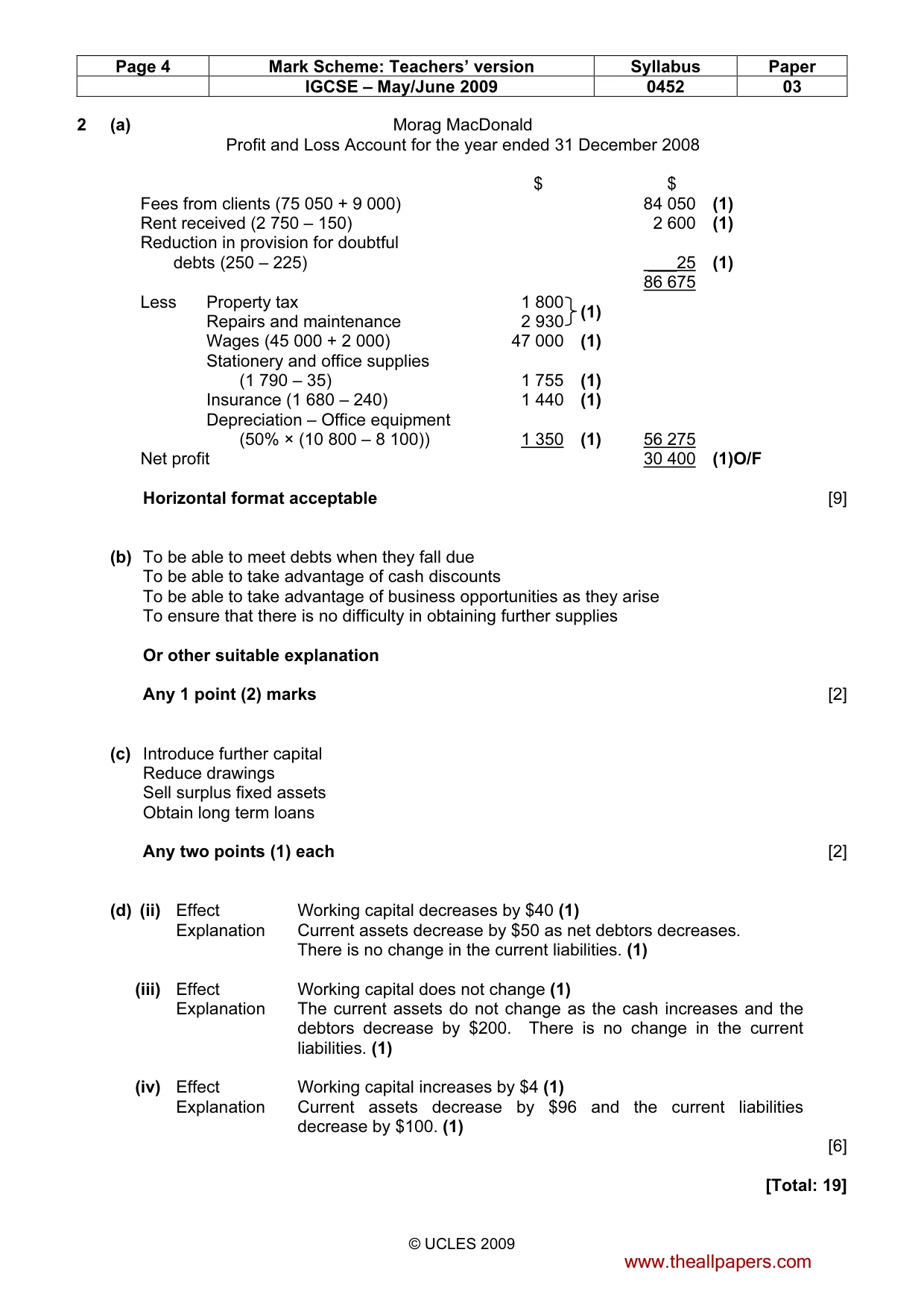
Mark scheme: 2 (a) Morag MacDonald Profit and Loss Account for the year ended 31 December 2008 $ $ Fees from clients (75 050 + 9 000) 84 050 (1) Rent received (2 750 – 150) 2 600 (1) Reduction in provision for doubtful debts (250 – 225) ___25 (1) 86 675 Less Property tax 1 800 (1) Repairs and maintenance 2 930 Wages (45 000 + 2 000) 47 000 (1) Stationery and office supplies (1 790 – 35) 1 755 (1) Insurance (1 680 – 240) 1 440 (1) Depreciation – Office equipment (50% × (10 800 – 8 100)) 1 350 (1) 56 275 Net profit 30 400 (1)O/F Horizontal format acceptable [9] (b) To be able to meet debts when they fall due To be able to take advantage of cash discounts To be able to take advantage of business opportunities as they arise To ensure that there is no difficulty in obtaining further supplies Or other suitable explanation Any 1 point (2) marks [2] (c) Introduce further capital Reduce drawings Sell surplus fixed assets Obtain long term loans Any two points (1) each [2] (d) (ii) Effect Working capital decreases by $40 (1) Explanation Current assets decrease by $50 as net debtors decreases. There is no change in the current liabilities. (1) (iii) Effect Working capital does not change (1) Explanation The current assets do not change as the cash increases and the debtors decrease by $200. There is no change in the current liabilities. (1) (iv) Effect Working capital increases by $4 (1) Explanation Current assets decrease by $96 and the current liabilities decrease by $100. (1) [6] [Total: 19] IGCSE – May/June 2009 0452 03
More questions on Calculation and understanding of accounting ratios
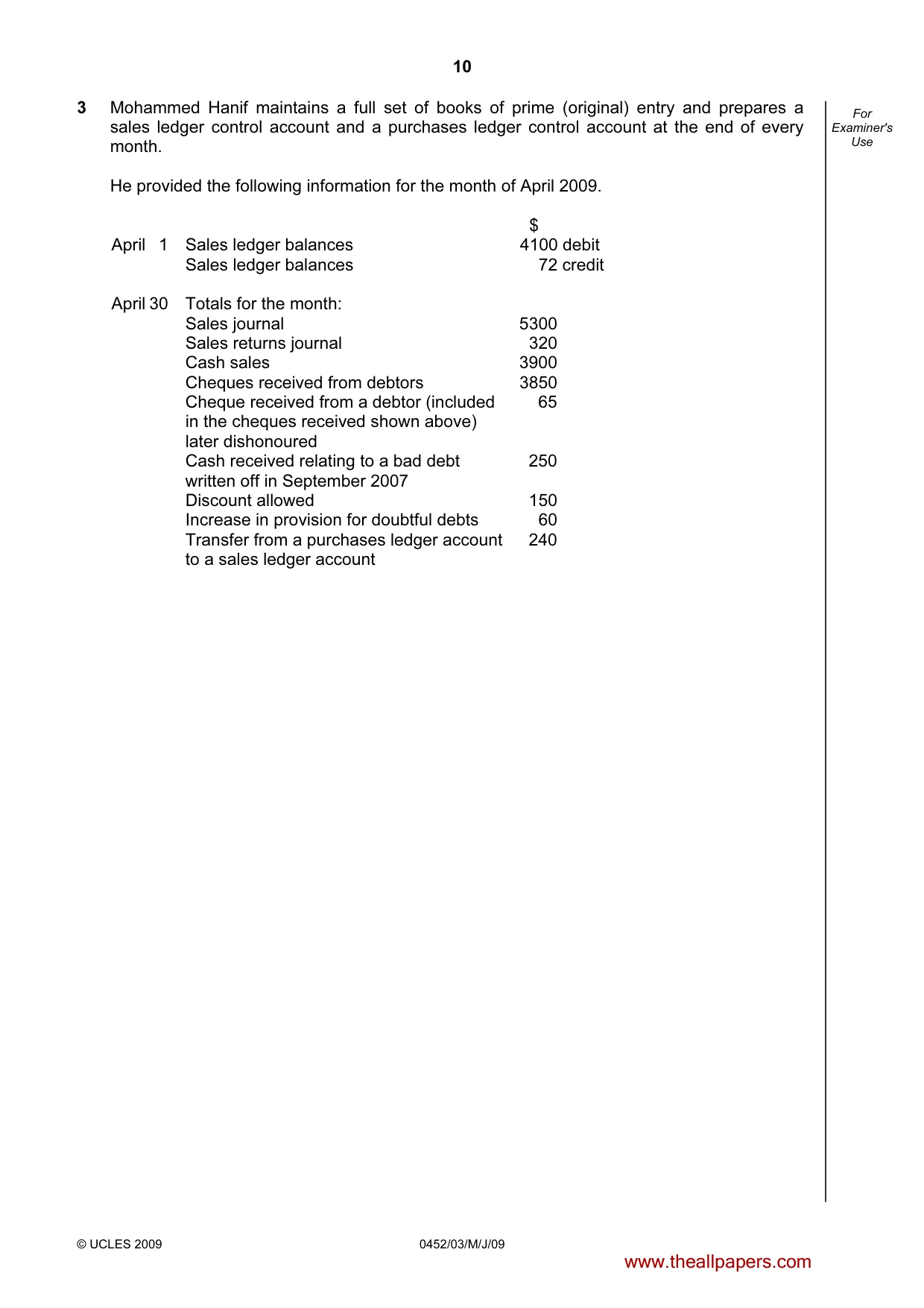
Q3 · Mohammed Hanif maintains a full set of books of prime (original) entry and prepares a…
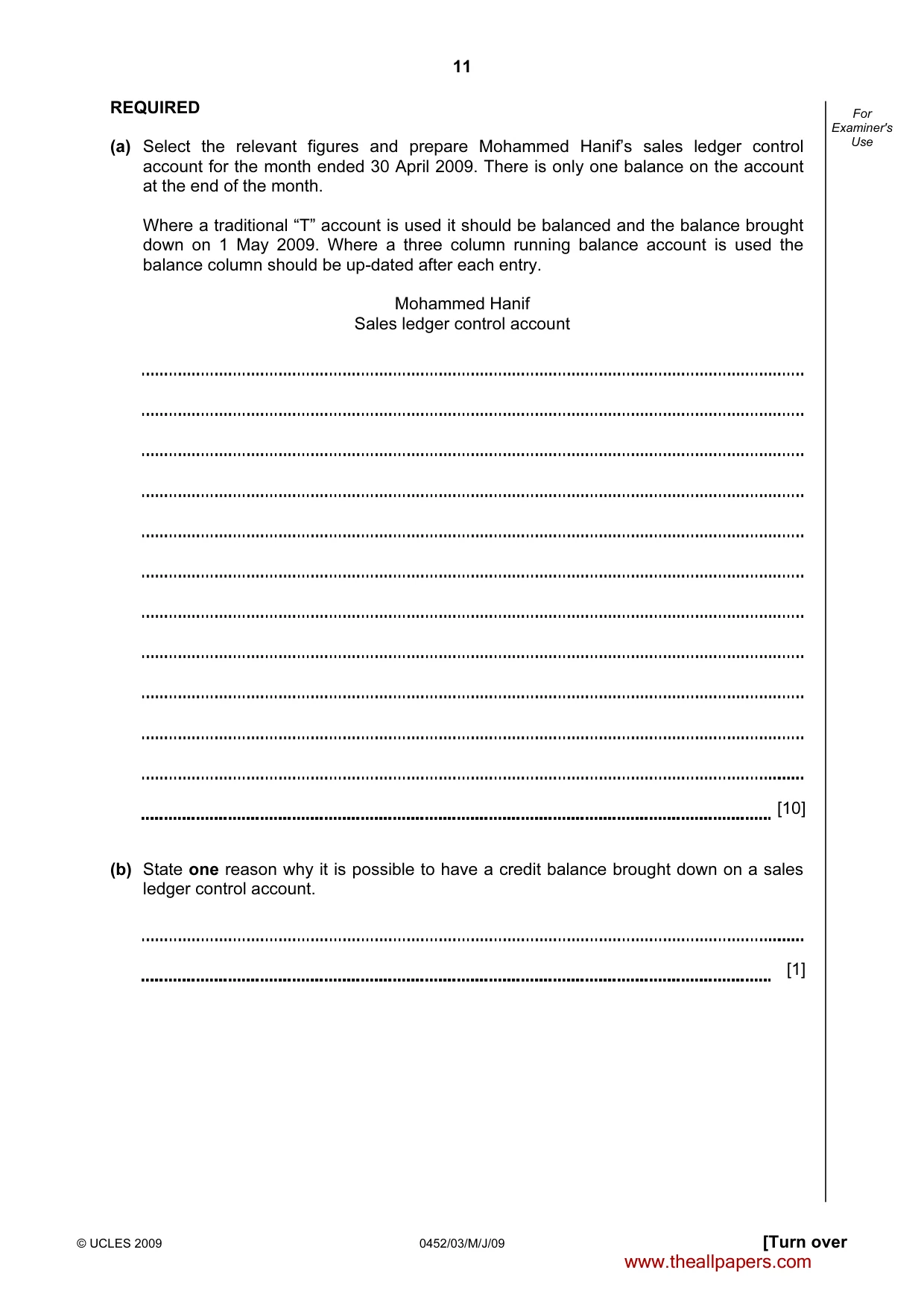
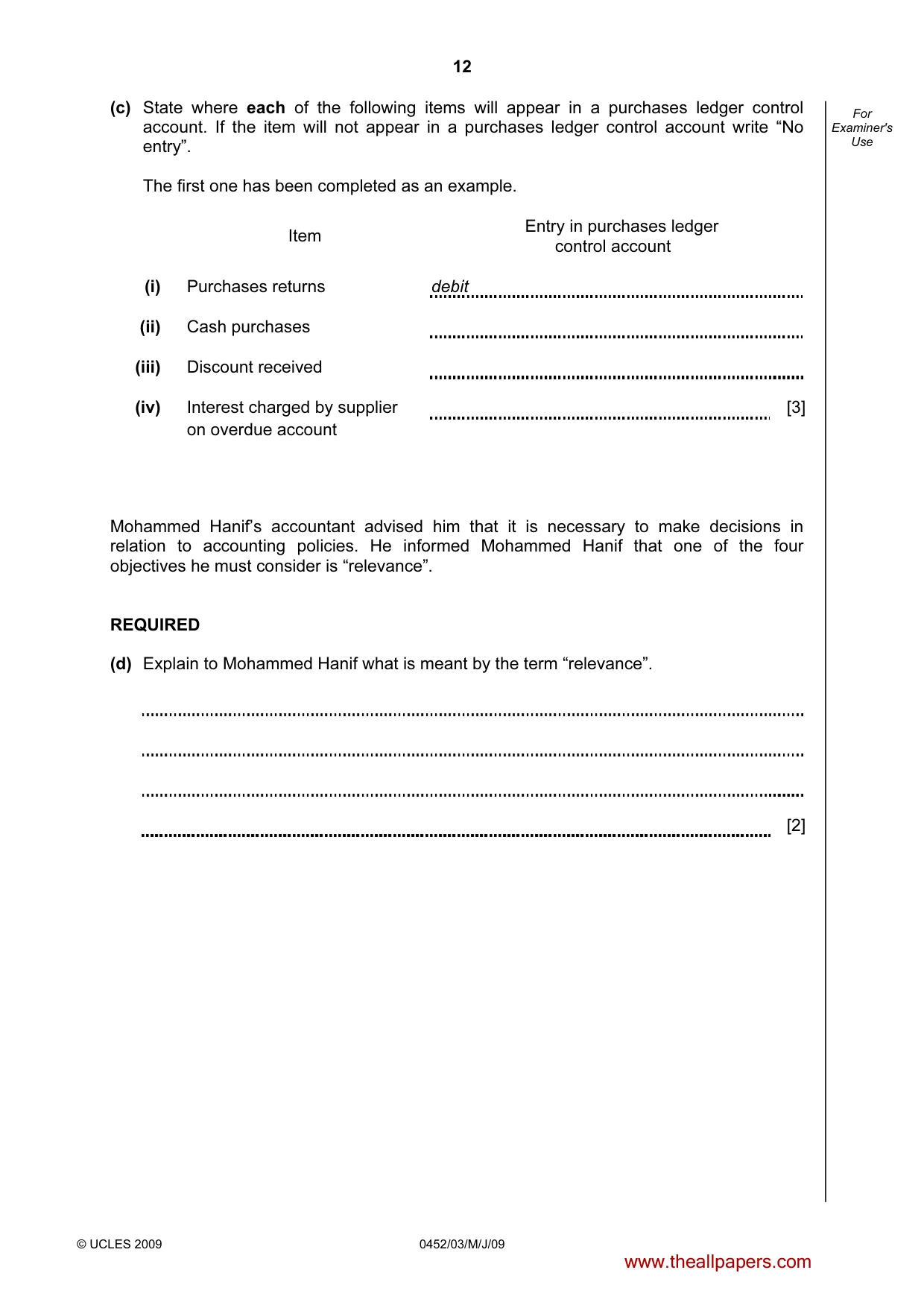
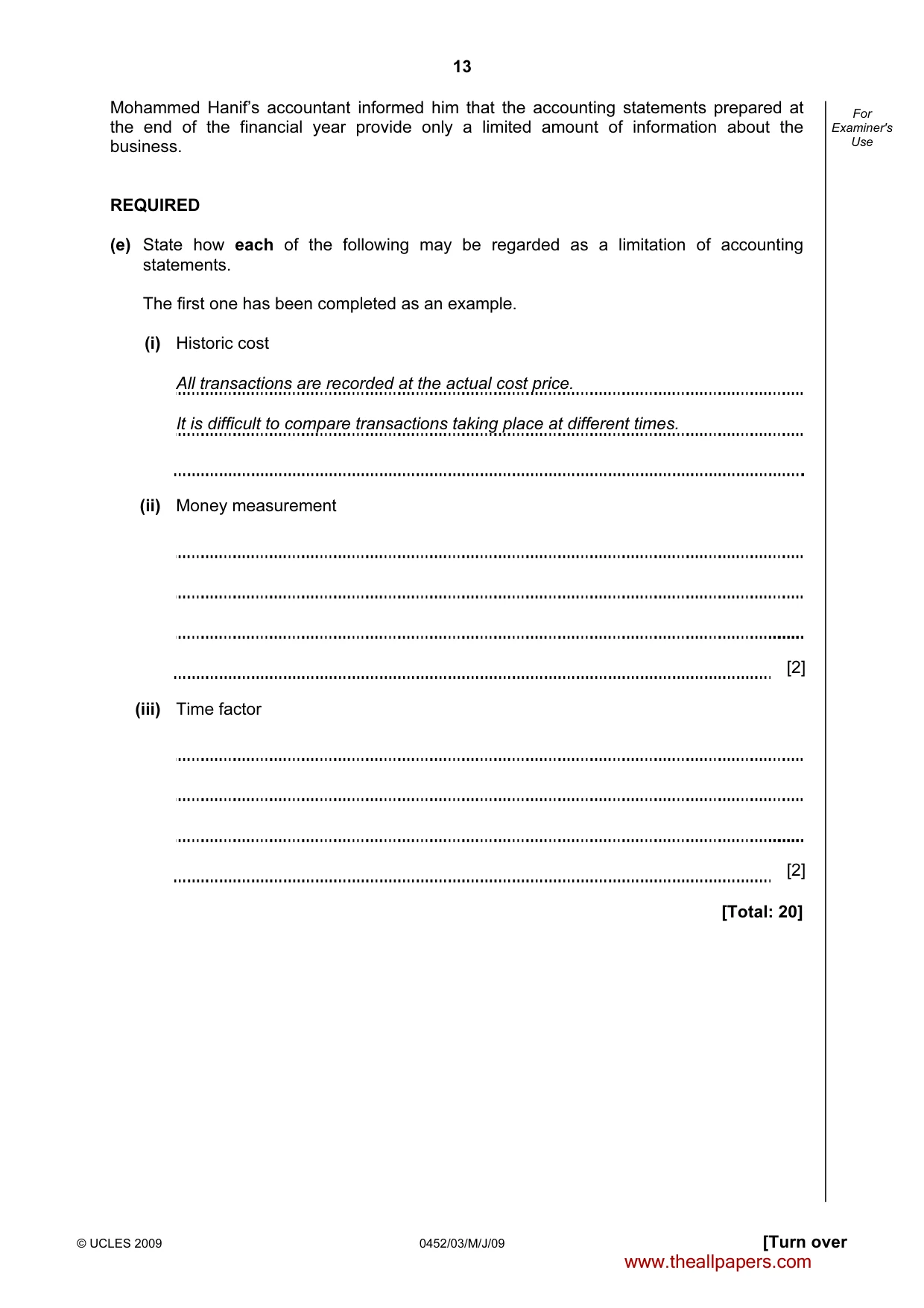
3 Mohammed Hanif maintains a full set of books of prime (original) entry and prepares a sales ledger control account and a purchases ledger control account at the end of every month. He provided the following information for the month of April 2009. $ April 1 Sales ledger balances 4100 debit Sales ledger balances 72 credit April 30 Totals for the month: Sales journal 5300 Sales returns journal 320 Cash sales 3900 Cheques received from debtors 3850 Cheque received from a debtor (included 65 in the cheques received shown above) later dishonoured Cash received relating to a bad debt 250 written off in September 2007 Discount allowed 150 Increase in provision for doubtful debts 60 Transfer from a purchases ledger account 240 to a sales ledger account REQUIRED (a) Select the relevant figures and prepare Mohammed Hanif’s sales ledger control account for the month ended 30 April 2009. There is only one balance on the account at the end of the month. Where a traditional “T” account is used it should be balanced and the balance brought down on 1 May 2009. Where a three column running balance account is used the balance column should be up-dated after each entry. Mohammed Hanif Sales ledger control account [10] (b) State one reason why it is possible to have a credit balance brought down on a sales ledger control account. [1] (c) State where each of the following items will appear in a purchases ledger control account. If the item will not appear in a purchases ledger control account write “No entry”. The first one has been completed as an example. Entry in purchases ledger Item control account (i) Purchases returns debit (ii) Cash purchases (iii) Discount received (iv) Interest charged by supplier [3] on overdue account Mohammed Hanif’s accountant advised him that it is necessary to make decisions in relation to accounting policies. He informed Mohammed Hanif that one of the four objectives he must consider is “relevance”. REQUIRED (d) Explain to Mohammed Hanif what is meant by the term “relevance”. [2] Mohammed Hanif’s accountant informed him that the accounting statements prepared at the end of the financial year provide only a limited amount of information about the business. REQUIRED (e) State how each of the following may be regarded as a limitation of accounting statements. The first one has been completed as an example. (i) Historic cost All transactions are recorded at the actual cost price. It is difficult to compare transactions taking place at different times. (ii) Money measurement [2] (iii) Time factor [2] [Total: 20]
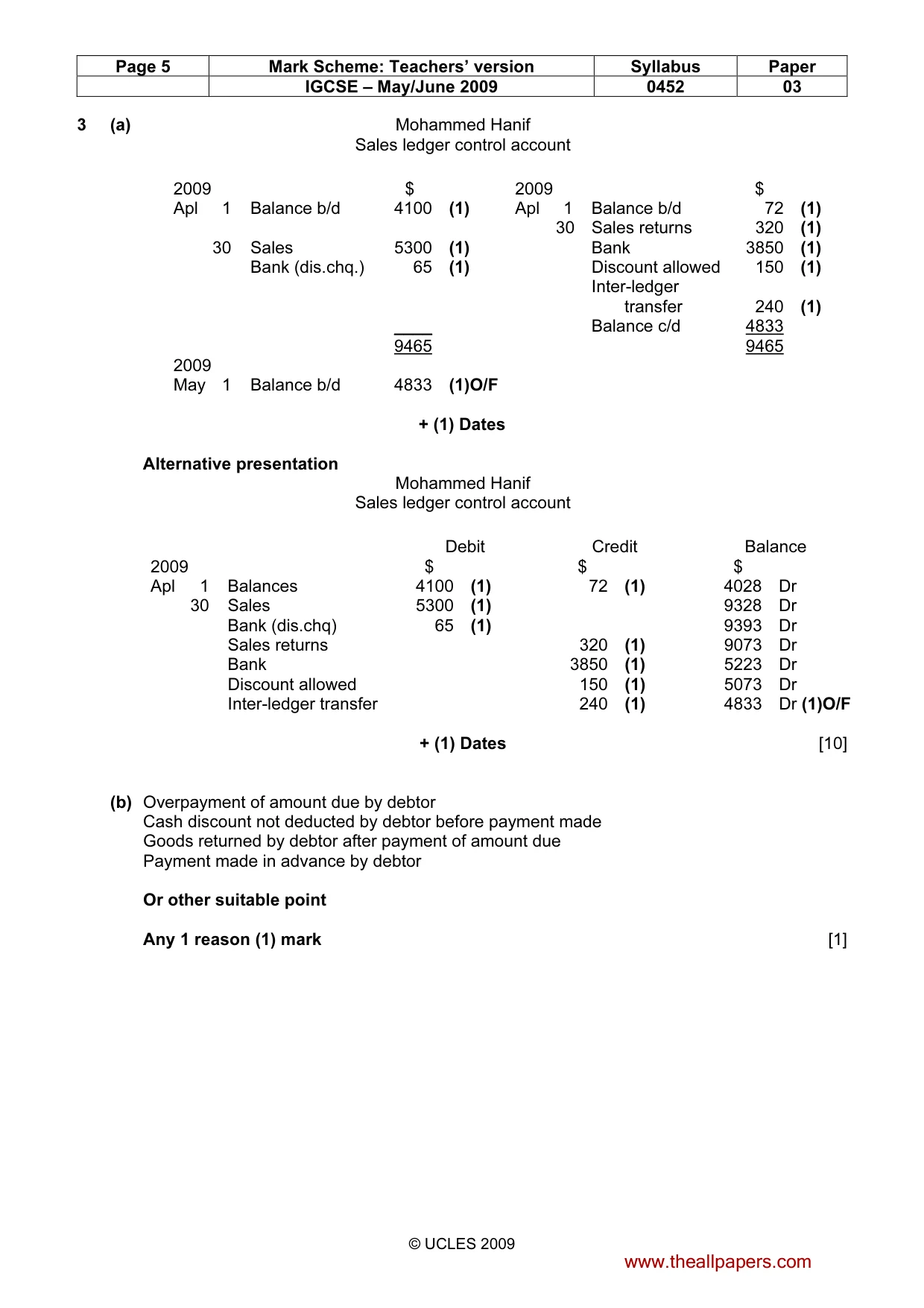
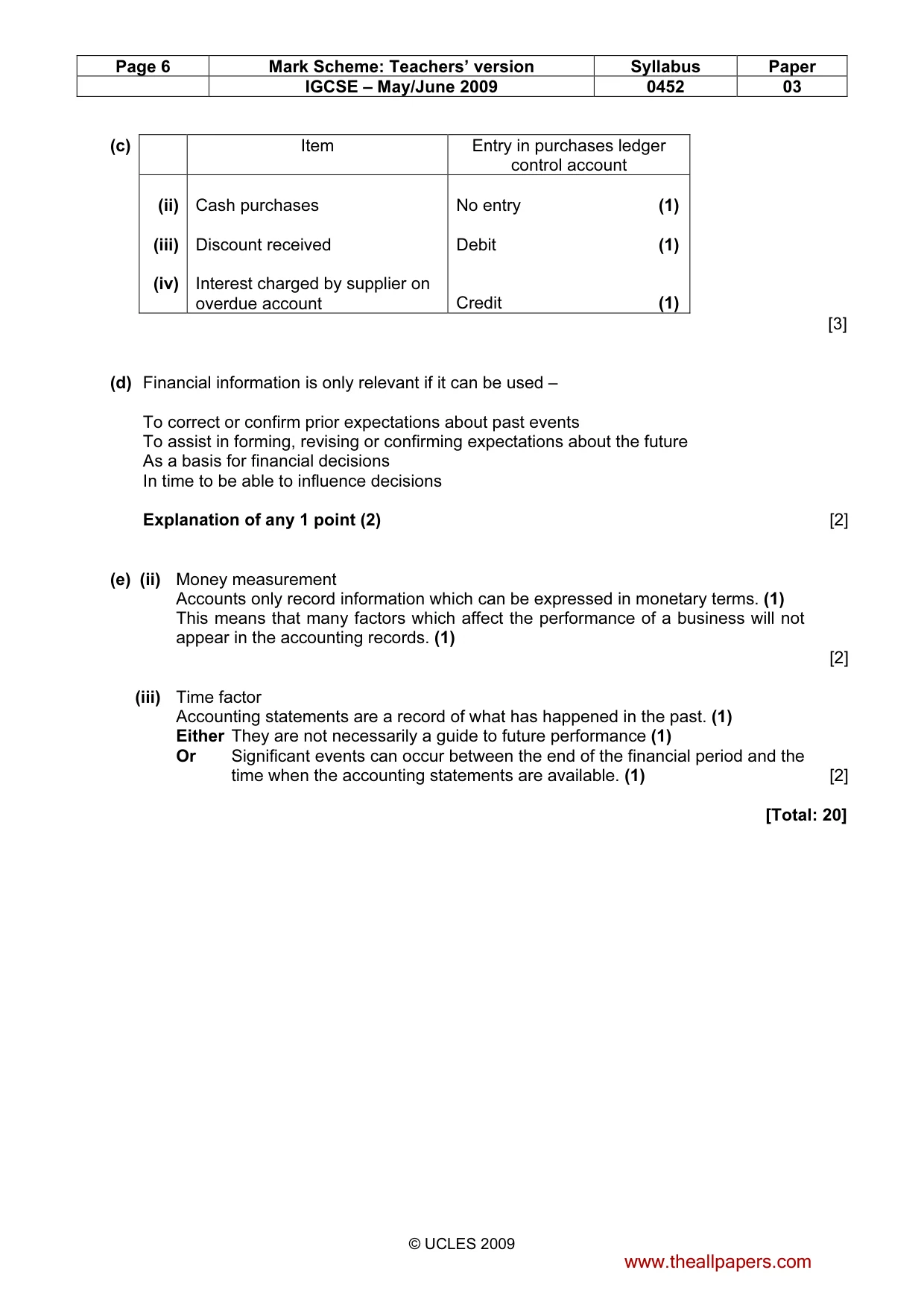
Mark scheme: 3 (a) Mohammed Hanif Sales ledger control account 2009 $ 2009 $ Apl 1 Balance b/d 4100 (1) Apl 1 Balance b/d 72 (1) 30 Sales returns 320 (1) 30 Sales 5300 (1) Bank 3850 (1) Bank (dis.chq.) 65 (1) Discount allowed 150 (1) Inter-ledger transfer 240 (1) ____ Balance c/d 4833 9465 9465 2009 May 1 Balance b/d 4833 (1)O/F + (1) Dates Alternative presentation Mohammed Hanif Sales ledger control account Debit Credit Balance 2009 $ $ $ Apl 1 Balances 4100 (1) 72 (1) 4028 Dr 30 Sales 5300 (1) 9328 Dr Bank (dis.chq) 65 (1) 9393 Dr Sales returns 320 (1) 9073 Dr Bank 3850 (1) 5223 Dr Discount allowed 150 (1) 5073 Dr Inter-ledger transfer 240 (1) 4833 Dr (1)O/F + (1) Dates [10] (b) Overpayment of amount due by debtor Cash discount not deducted by debtor before payment made Goods returned by debtor after payment of amount due Payment made in advance by debtor Or other suitable point Any 1 reason (1) mark [1] IGCSE – May/June 2009 0452 03 (c) Item Entry in purchases ledger control account (ii) Cash purchases No entry (1) (iii) Discount received Debit (1) (iv) Interest charged by supplier on overdue account Credit (1) [3] (d) Financial information is only relevant if it can be used – To correct or confirm prior expectations about past events To assist in forming, revising or confirming expectations about the future As a basis for financial decisions In time to be able to influence decisions Explanation of any 1 point (2) [2] (e) (ii) Money measurement Accounts only record information which can be expressed in monetary terms. (1) This means that many factors which affect the performance of a business will not appear in the accounting records. (1) [2] (iii) Time factor Accounting statements are a record of what has happened in the past. (1) Either They are not necessarily a guide to future performance (1) Or Significant events can occur between the end of the financial period and the time when the accounting statements are available. (1) [2] [Total: 20] IGCSE – May/June 2009 0452 03
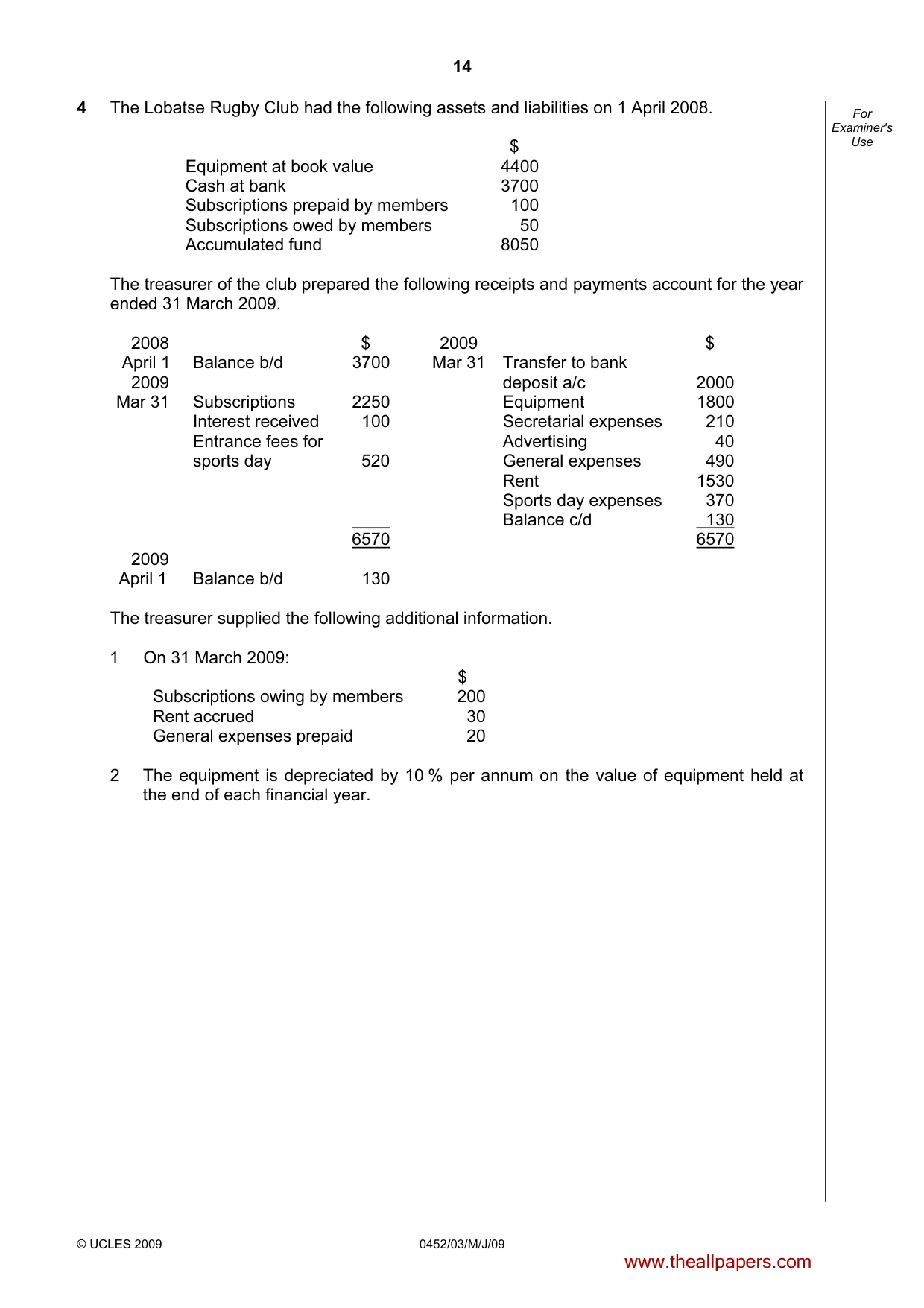
Q4 · The Lobatse Rugby Club had the following assets and liabilities on 1 April 2008
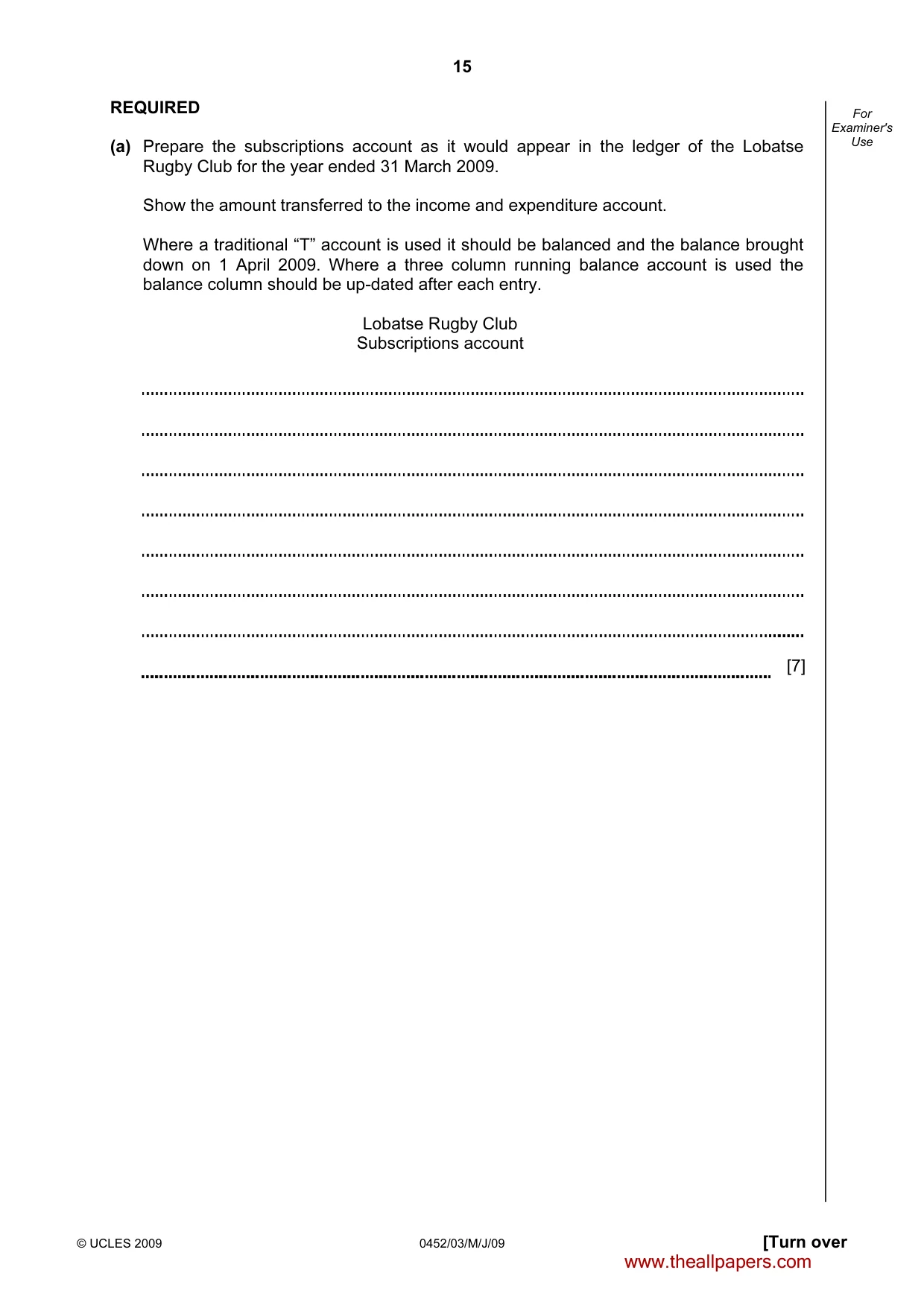
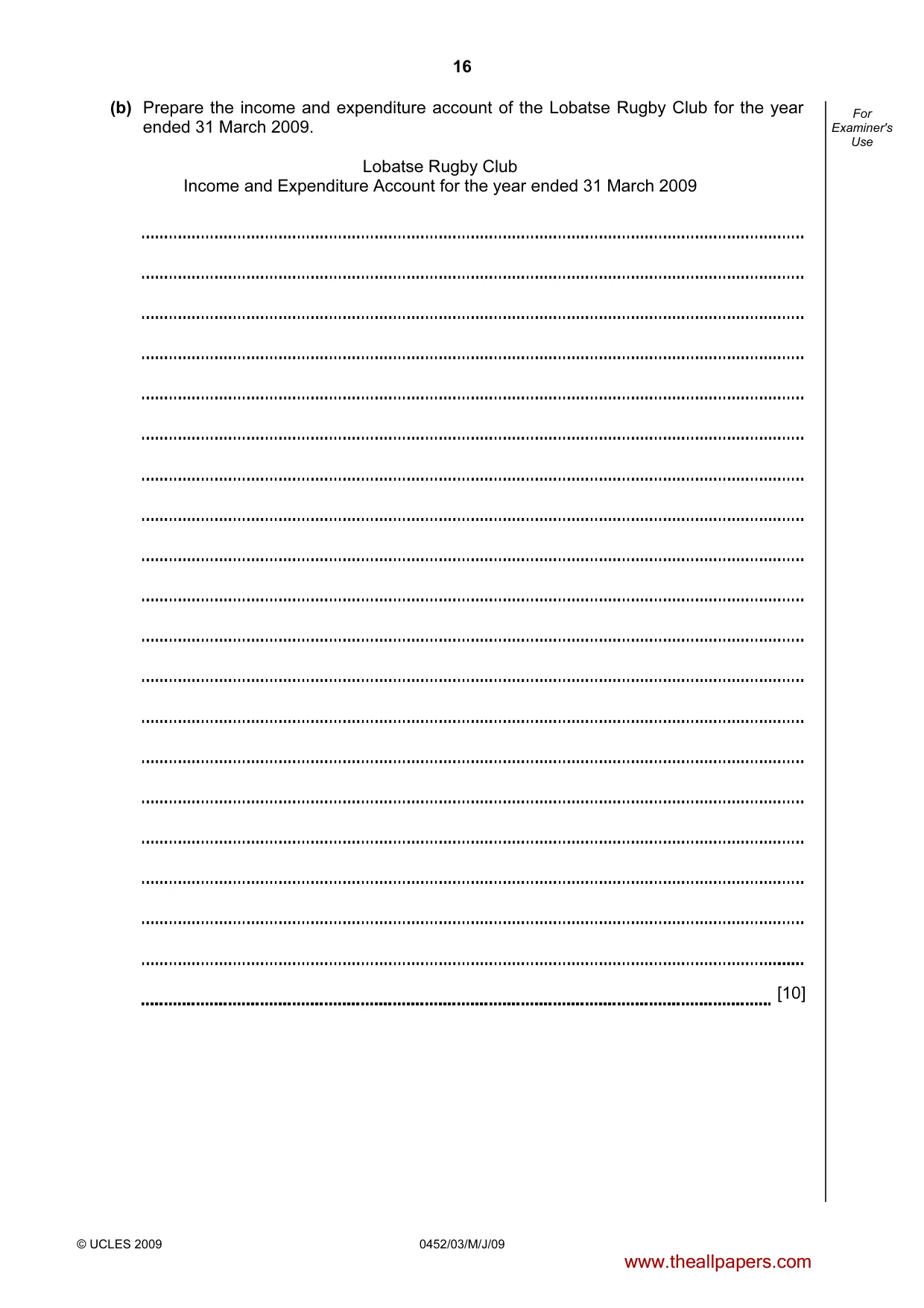
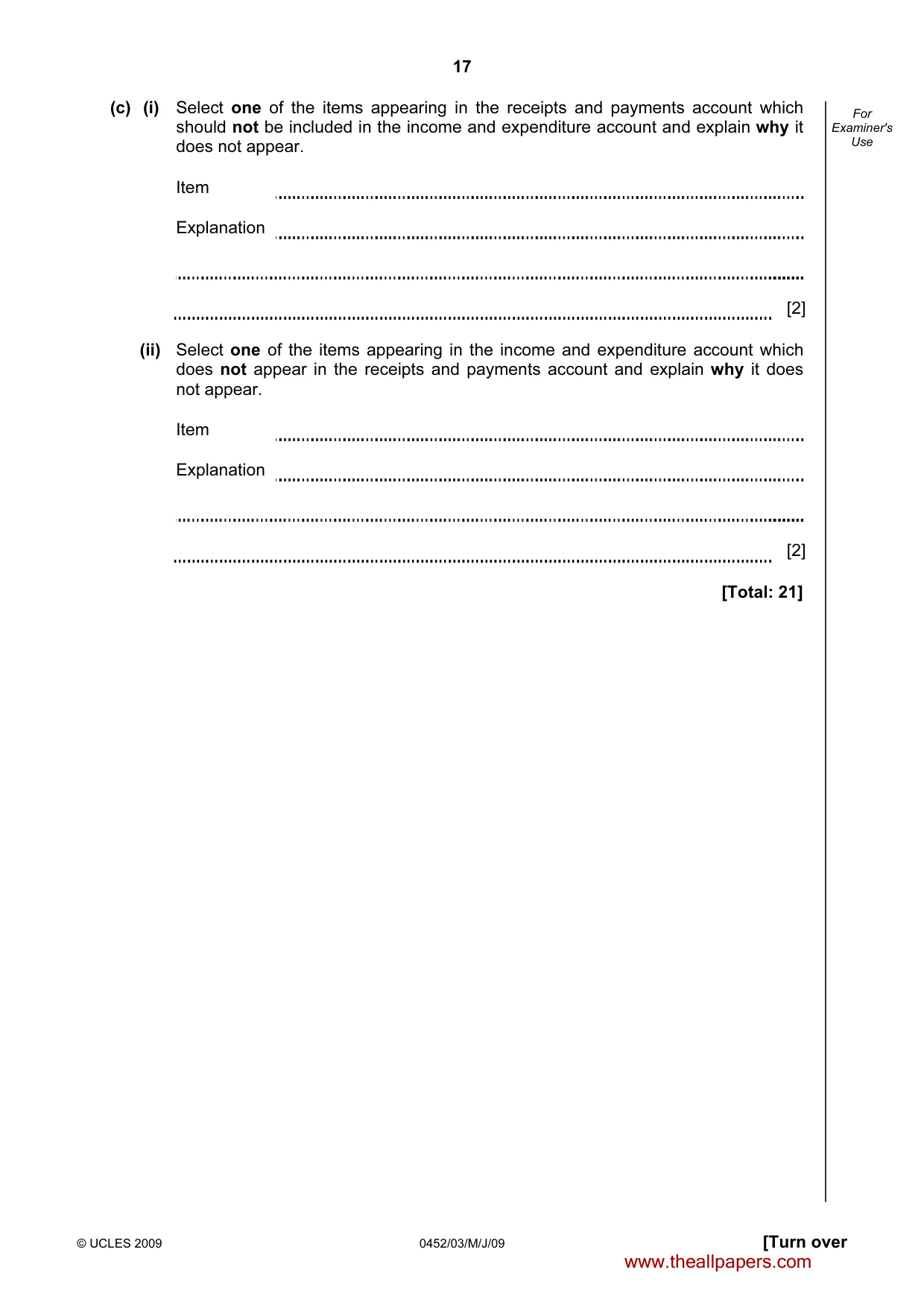
4 The Lobatse Rugby Club had the following assets and liabilities on 1 April 2008. $ Equipment at book value 4400 Cash at bank 3700 Subscriptions prepaid by members 100 Subscriptions owed by members 50 Accumulated fund 8050 The treasurer of the club prepared the following receipts and payments account for the year ended 31 March 2009. 2008 $ 2009 $ April 1 Balance b/d 3700 Mar 31 Transfer to bank 2009 deposit a/c 2000 Mar 31 Subscriptions 2250 Equipment 1800 Interest received 100 Secretarial expenses 210 Entrance fees for Advertising 40 sports day 520 General expenses 490 Rent 1530 Sports day expenses 370 Balance c/d 130 6570 6570 2009 April 1 Balance b/d 130 The treasurer supplied the following additional information. 1 On 31 March 2009: $ Subscriptions owing by members 200 Rent accrued 30 General expenses prepaid 20 2 The equipment is depreciated by 10 % per annum on the value of equipment held at the end of each financial year. REQUIRED (a) Prepare the subscriptions account as it would appear in the ledger of the Lobatse Rugby Club for the year ended 31 March 2009. Show the amount transferred to the income and expenditure account. Where a traditional “T” account is used it should be balanced and the balance brought down on 1 April 2009. Where a three column running balance account is used the balance column should be up-dated after each entry. Lobatse Rugby Club Subscriptions account [7] (b) Prepare the income and expenditure account of the Lobatse Rugby Club for the year ended 31 March 2009. Lobatse Rugby Club Income and Expenditure Account for the year ended 31 March 2009 [10] (c) (i) Select one of the items appearing in the receipts and payments account which should not be included in the income and expenditure account and explain why it does not appear. Item Explanation [2] (ii) Select one of the items appearing in the income and expenditure account which does not appear in the receipts and payments account and explain why it does not appear. Item Explanation [2] [Total: 21]
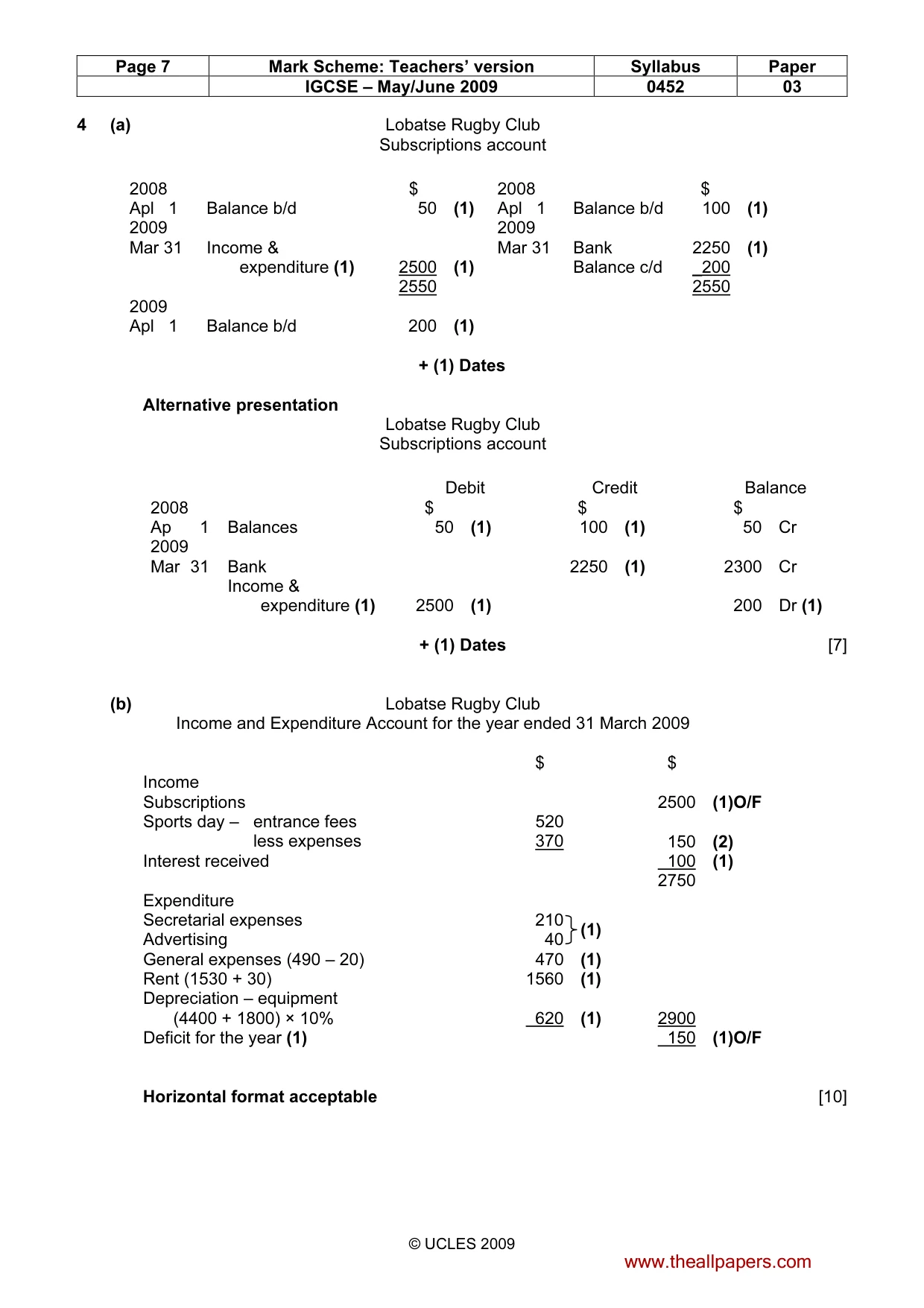
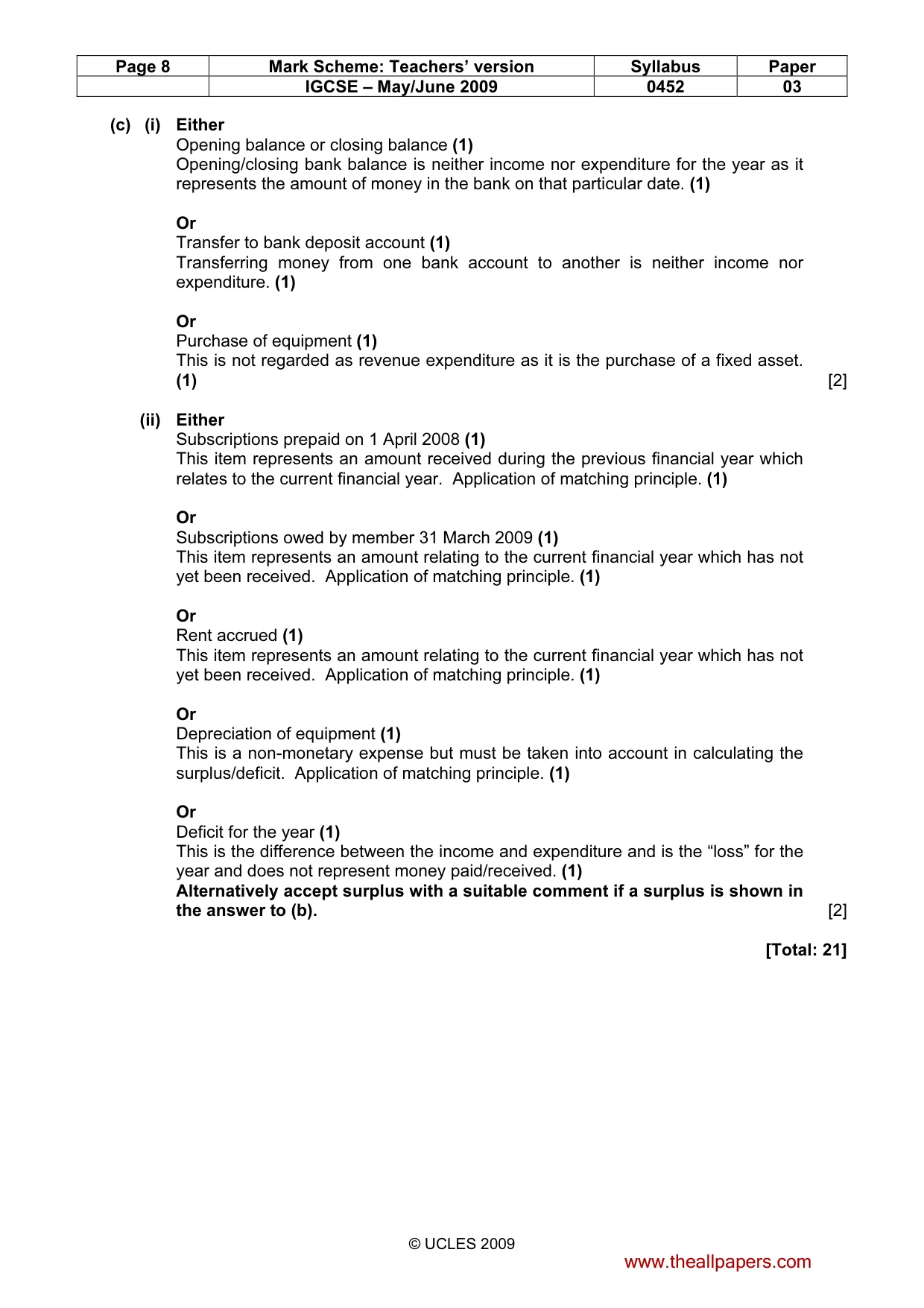
Mark scheme: 4 (a) Lobatse Rugby Club Subscriptions account 2008 $ 2008 $ Apl 1 Balance b/d 50 (1) Apl 1 Balance b/d 100 (1) 2009 2009 Mar 31 Income & Mar 31 Bank 2250 (1) expenditure (1) 2500 (1) Balance c/d _200 2550 2550 2009 Apl 1 Balance b/d 200 (1) + (1) Dates Alternative presentation Lobatse Rugby Club Subscriptions account Debit Credit Balance 2008 $ $ $ Ap 1 Balances 50 (1) 100 (1) 50 Cr 2009 Mar 31 Bank 2250 (1) 2300 Cr Income & expenditure (1) 2500 (1) 200 Dr (1) + (1) Dates [7] (b) Lobatse Rugby Club Income and Expenditure Account for the year ended 31 March 2009 $ $ Income Subscriptions 2500 (1)O/F Sports day – entrance fees 520 less expenses 370 150 (2) Interest received 100 (1) 2750 Expenditure Secretarial expenses 210 (1) Advertising 40 General expenses (490 – 20) 470 (1) Rent (1530 + 30) 1560 (1) Depreciation – equipment (4400 + 1800) × 10% 620 (1) 2900 Deficit for the year (1) 150 (1)O/F Horizontal format acceptable [10] IGCSE – May/June 2009 0452 03 (c) (i) Either Opening balance or closing balance (1) Opening/closing bank balance is neither income nor expenditure for the year as it represents the amount of money in the bank on that particular date. (1) Or Transfer to bank deposit account (1) Transferring money from one bank account to another is neither income nor expenditure. (1) Or Purchase of equipment (1) This is not regarded as revenue expenditure as it is the purchase of a fixed asset. (1) [2] (ii) Either Subscriptions prepaid on 1 April 2008 (1) This item represents an amount received during the previous financial year which relates to the current financial year. Application of matching principle. (1) Or Subscriptions owed by member 31 March 2009 (1) This item represents an amount relating to the current financial year which has not yet been received. Application of matching principle. (1) Or Rent accrued (1) This item represents an amount relating to the current financial year which has not yet been received. Application of matching principle. (1) Or Depreciation of equipment (1) This is a non-monetary expense but must be taken into account in calculating the surplus/deficit. Application of matching principle. (1) Or Deficit for the year (1) This is the difference between the income and expenditure and is the “loss” for the year and does not represent money paid/received. (1) Alternatively accept surplus with a suitable comment if a surplus is shown in the answer to (b). [2] [Total: 21] IGCSE – May/June 2009 0452 03
Q5 · Kalpna Khan started a business on 1 April 2007
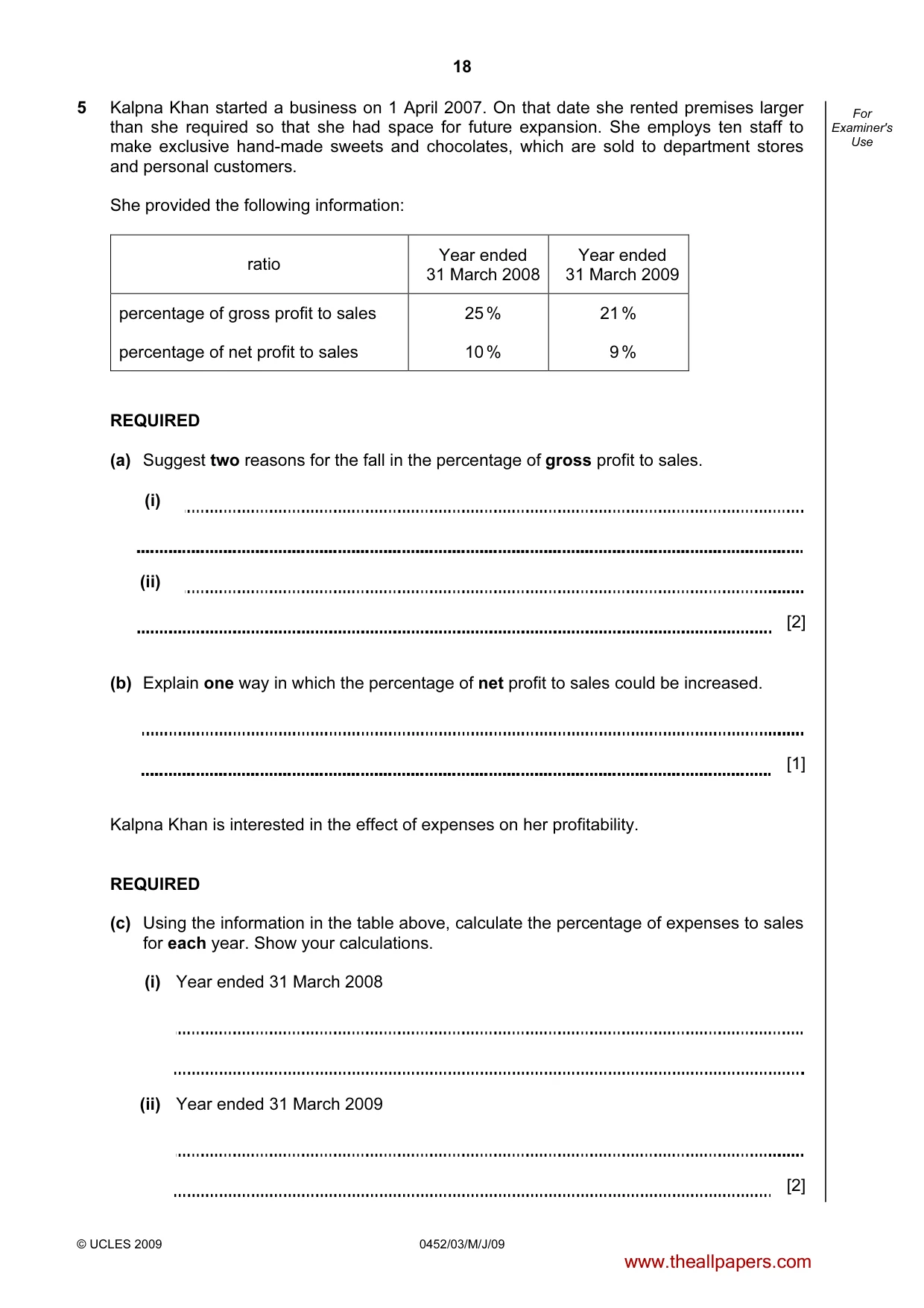
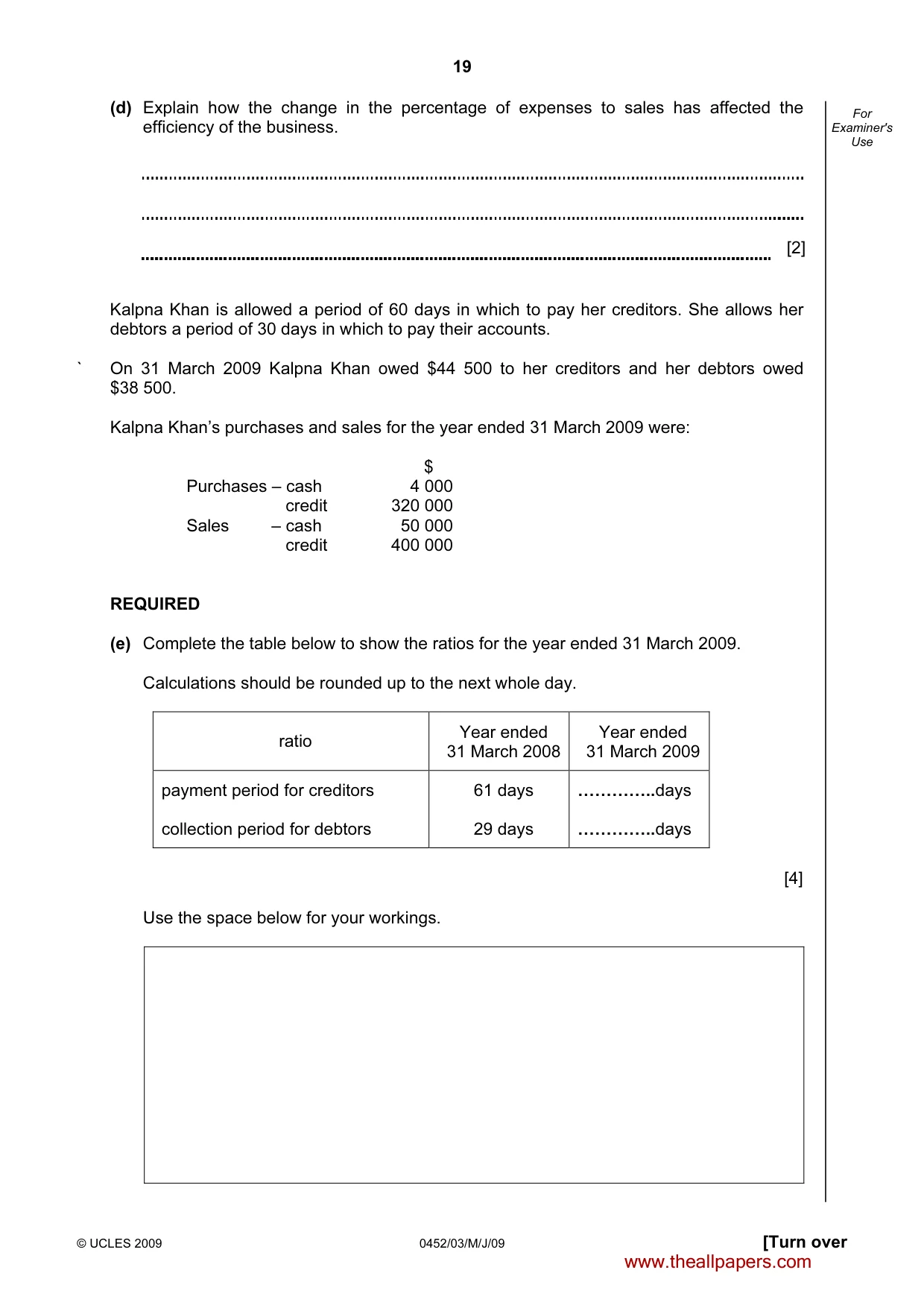
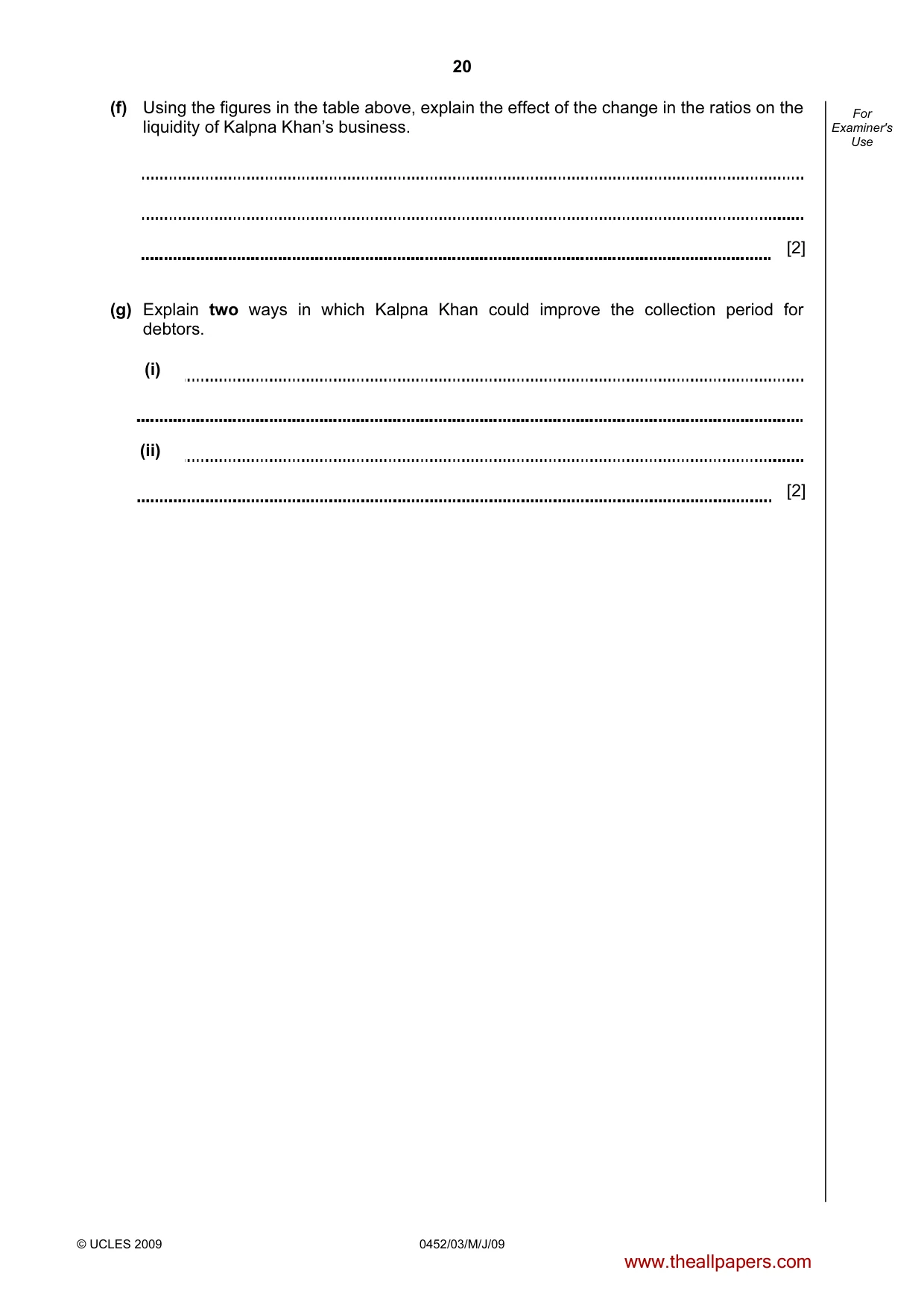
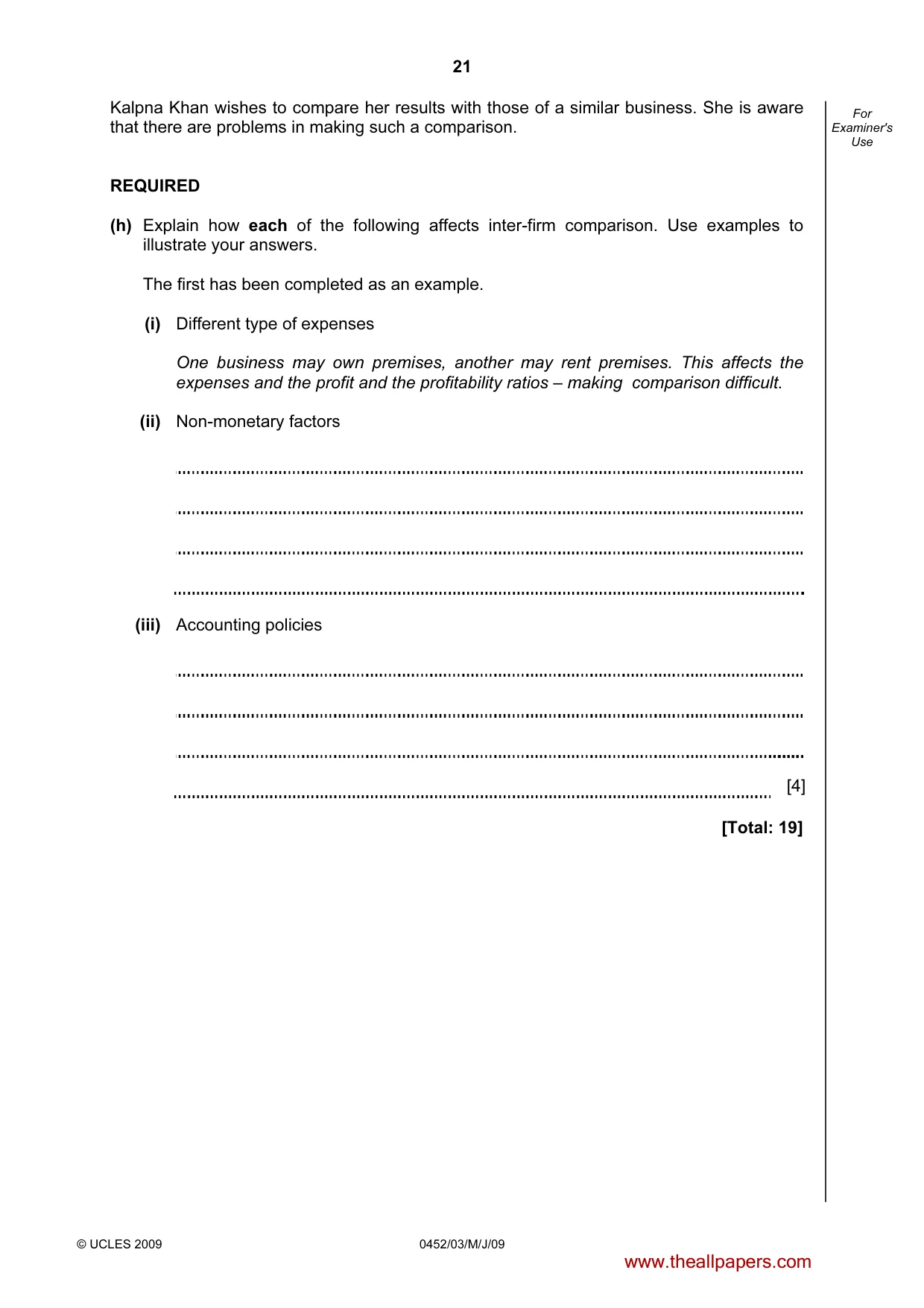
5 Kalpna Khan started a business on 1 April 2007. On that date she rented premises larger than she required so that she had space for future expansion. She employs ten staff to make exclusive hand-made sweets and chocolates, which are sold to department stores and personal customers. She provided the following information: Year ended Year ended ratio 31 March 2008 31 March 2009 percentage of gross profit to sales 25 % 21 % percentage of net profit to sales 10 % 9 % REQUIRED (a) Suggest two reasons for the fall in the percentage of gross profit to sales. (i) (ii) [2] (b) Explain one way in which the percentage of net profit to sales could be increased. [1] Kalpna Khan is interested in the effect of expenses on her profitability. REQUIRED (c) Using the information in the table above, calculate the percentage of expenses to sales for each year. Show your calculations. (i) Year ended 31 March 2008 (ii) Year ended 31 March 2009 [2] (d) Explain how the change in the percentage of expenses to sales has affected the efficiency of the business. [2] Kalpna Khan is allowed a period of 60 days in which to pay her creditors. She allows her debtors a period of 30 days in which to pay their accounts. ` On 31 March 2009 Kalpna Khan owed $44 500 to her creditors and her debtors owed $38 500. Kalpna Khan’s purchases and sales for the year ended 31 March 2009 were: $ Purchases – cash 4 000 credit 320 000 Sales – cash 50 000 credit 400 000 REQUIRED (e) Complete the table below to show the ratios for the year ended 31 March 2009. Calculations should be rounded up to the next whole day. Year ended Year ended ratio 31 March 2008 31 March 2009 payment period for creditors 61 days …………..days collection period for debtors 29 days …………..days [4] Use the space below for your workings. (f) Using the figures in the table above, explain the effect of the change in the ratios on the liquidity of Kalpna Khan’s business. [2] (g) Explain two ways in which Kalpna Khan could improve the collection period for debtors. (i) (ii) [2]
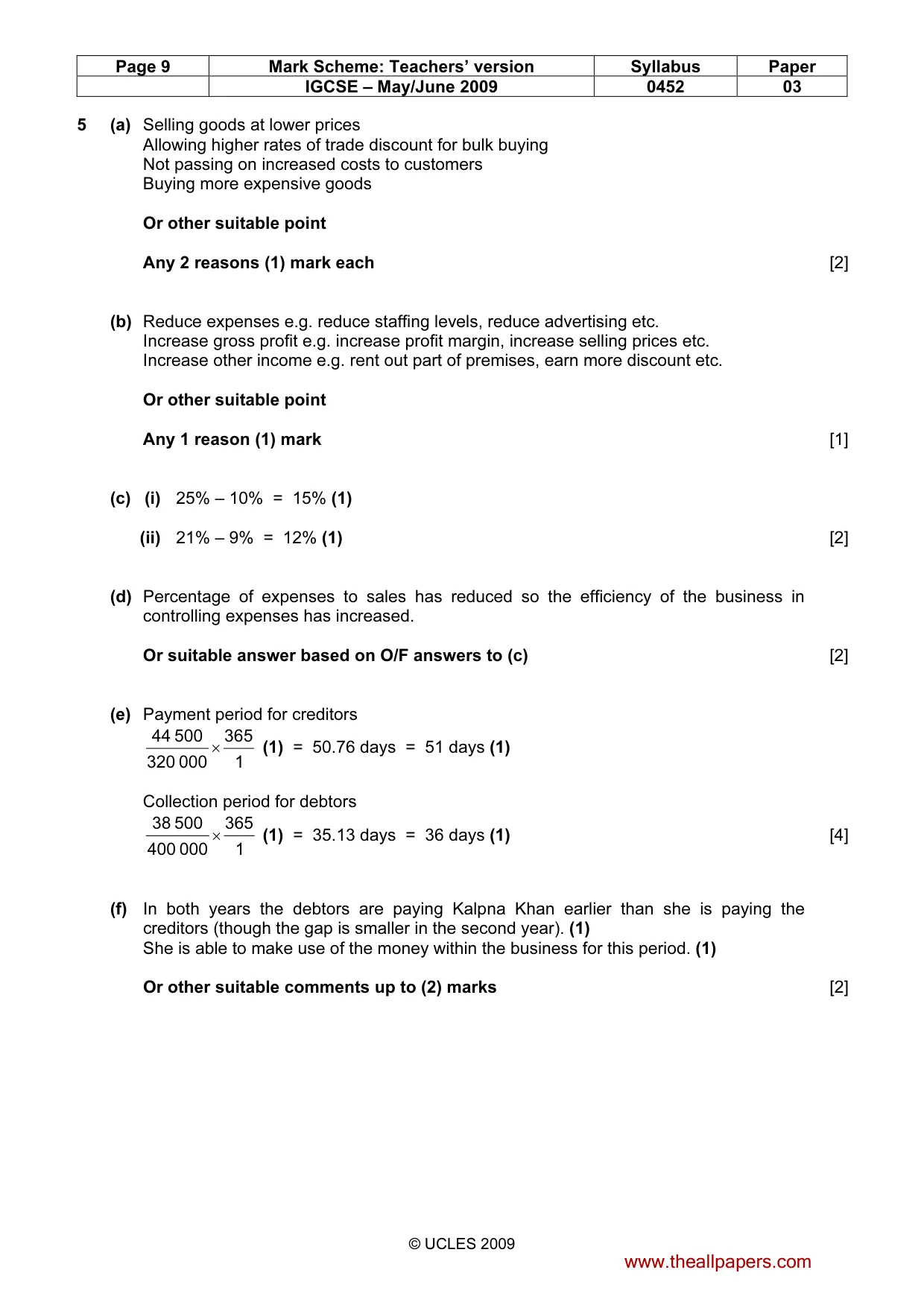
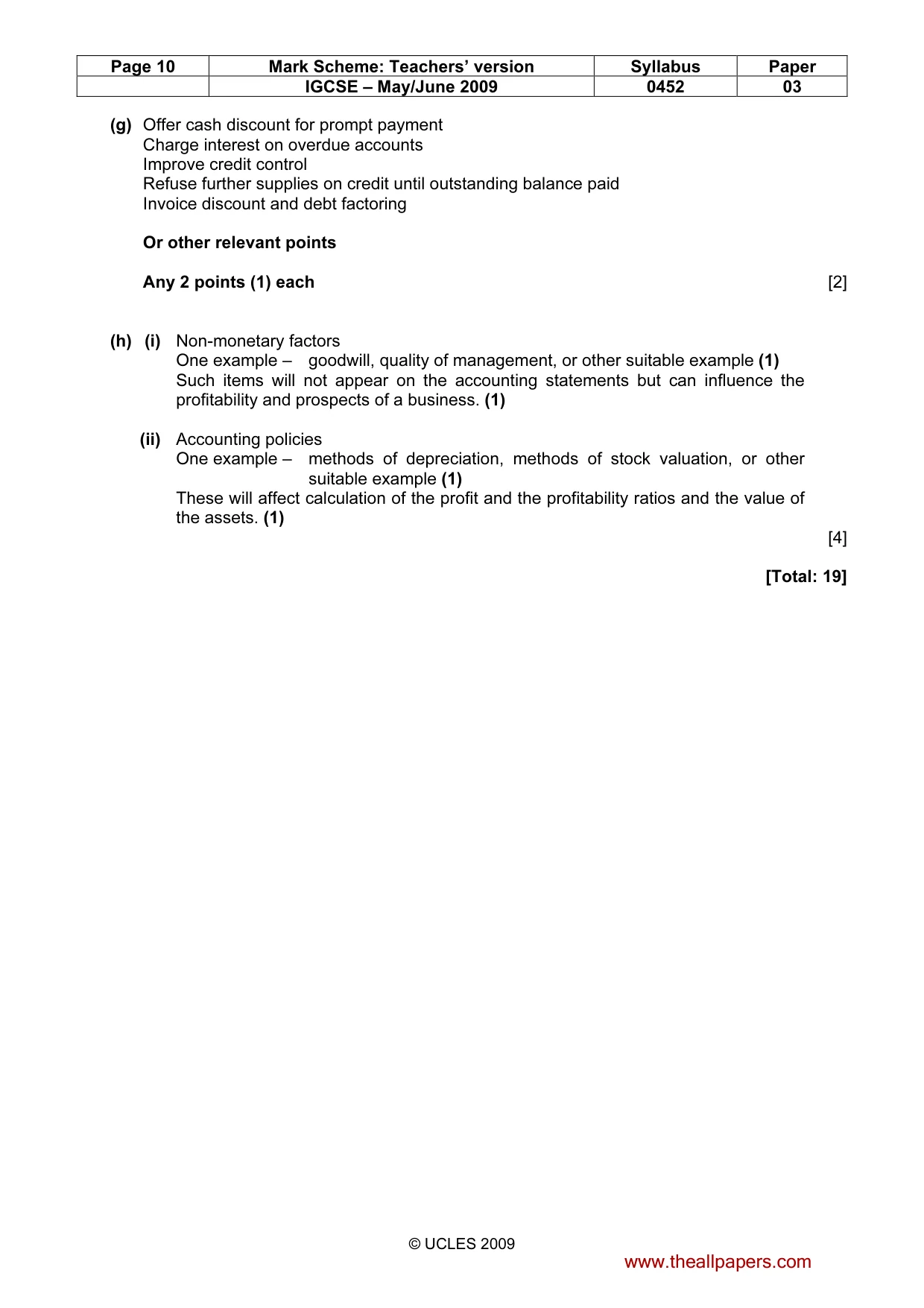
Mark scheme: 5 (a) Selling goods at lower prices Allowing higher rates of trade discount for bulk buying Not passing on increased costs to customers Buying more expensive goods Or other suitable point Any 2 reasons (1) mark each [2] (b) Reduce expenses e.g. reduce staffing levels, reduce advertising etc. Increase gross profit e.g. increase profit margin, increase selling prices etc. Increase other income e.g. rent out part of premises, earn more discount etc. Or other suitable point Any 1 reason (1) mark [1] (c) (i) 25% – 10% = 15% (1) (ii) 21% – 9% = 12% (1) [2] (d) Percentage of expenses to sales has reduced so the efficiency of the business in controlling expenses has increased. Or suitable answer based on O/F answers to (c) [2] (e) Payment period for creditors 44 500 365 × (1) = 50.76 days = 51 days (1) 320 000 1 Collection period for debtors 38 500 365 × (1) = 35.13 days = 36 days (1) [4] 400 000 1 (f) In both years the debtors are paying Kalpna Khan earlier than she is paying the creditors (though the gap is smaller in the second year). (1) She is able to make use of the money within the business for this period. (1) Or other suitable comments up to (2) marks [2] IGCSE – May/June 2009 0452 03 (g) Offer cash discount for prompt payment Charge interest on overdue accounts Improve credit control Refuse further supplies on credit until outstanding balance paid Invoice discount and debt factoring Or other relevant points Any 2 points (1) each [2] (h) (i) Non-monetary factors One example – goodwill, quality of management, or other suitable example (1) Such items will not appear on the accounting statements but can influence the profitability and prospects of a business. (1) (ii) Accounting policies One example – methods of depreciation, methods of stock valuation, or other suitable example (1) These will affect calculation of the profit and the profitability ratios and the value of the assets. (1) [4] [Total: 19]
What was in this paper
The subtopics covered by these 5 questions, and how many questions each got. Open one in a new tab to see every Cambridge question on it.
What you needed in this session
Cambridge’s own grade thresholds for 2009 May/June, Paper 3 · Variant 1. A higher threshold means an easier paper — the bar moves with how the cohort did.