Cambridge IGCSE Accounting 0452 — 2006 May/June Paper 3 · Variant 1
0452/31/M/J/06 · 5 questions · 100 marks · ≈113 min
The question paper and its mark scheme, free to read here and free to download. This is Cambridge’s own paper, exactly as it was sat.
Question paper24 pages





Mark scheme9 pages
Answers below. Sit the paper first if you are practising.
Questions as text
Q1 · Tarek Wahid is a sole trader who keeps full double entry records including a three column…
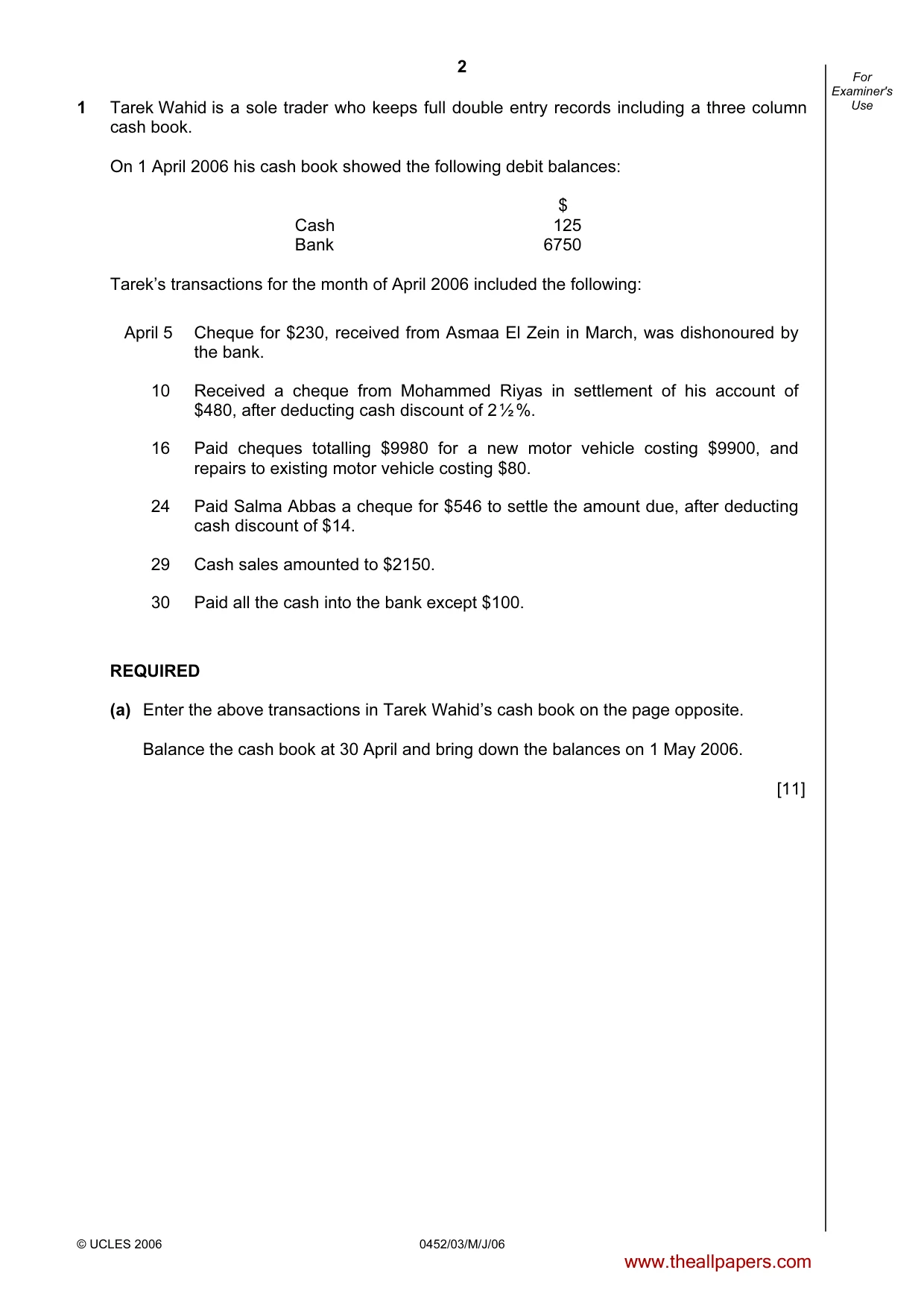
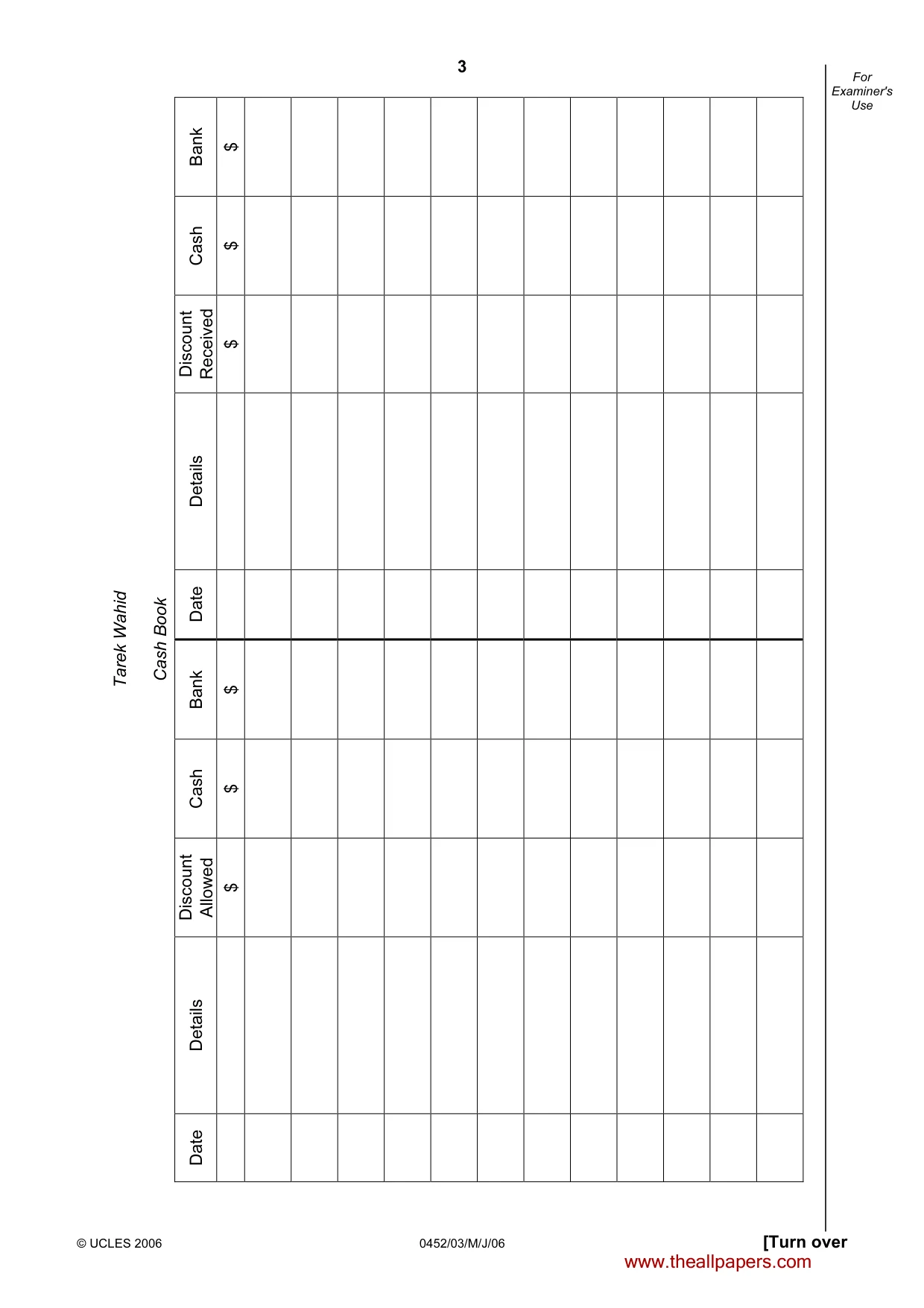
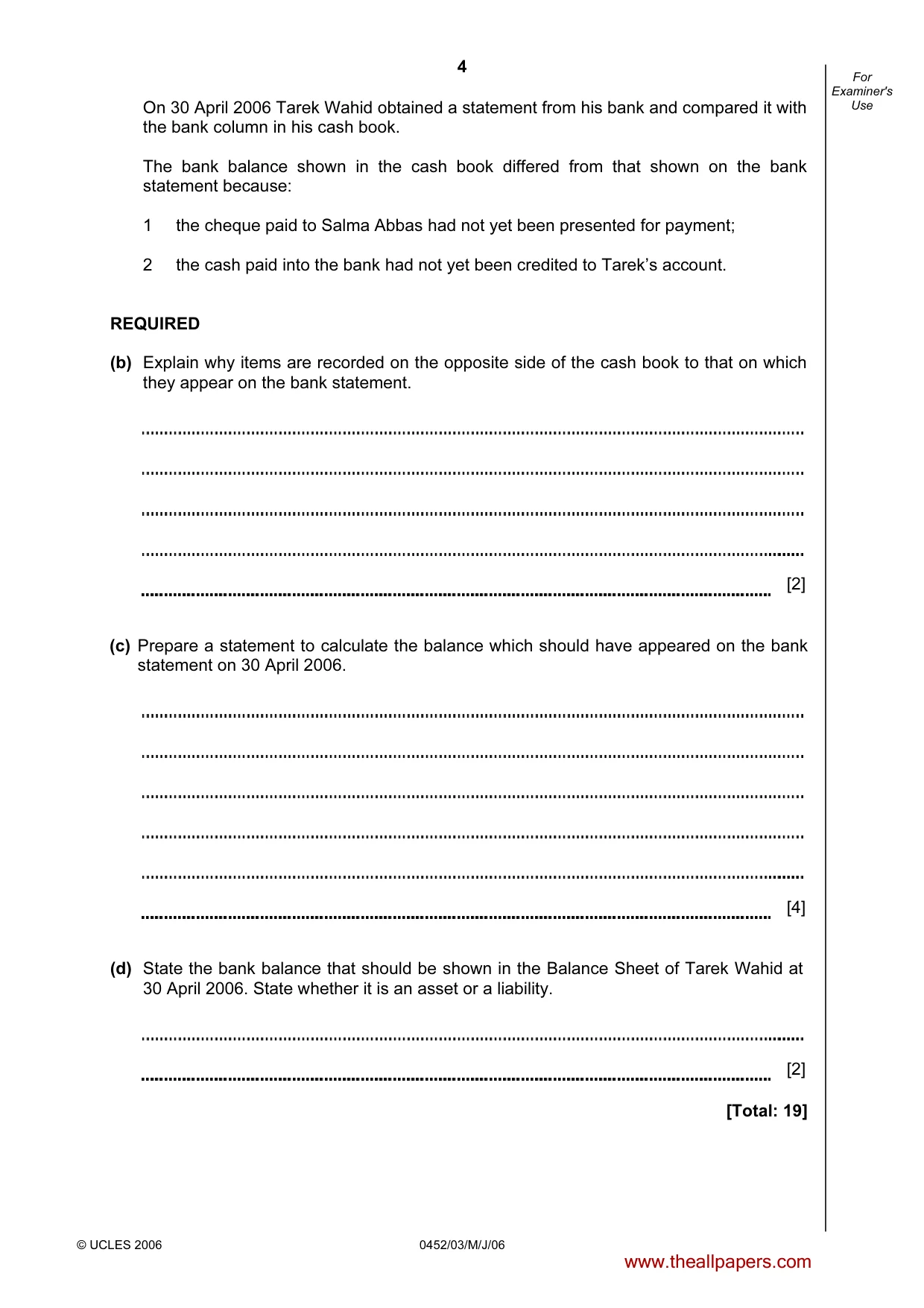
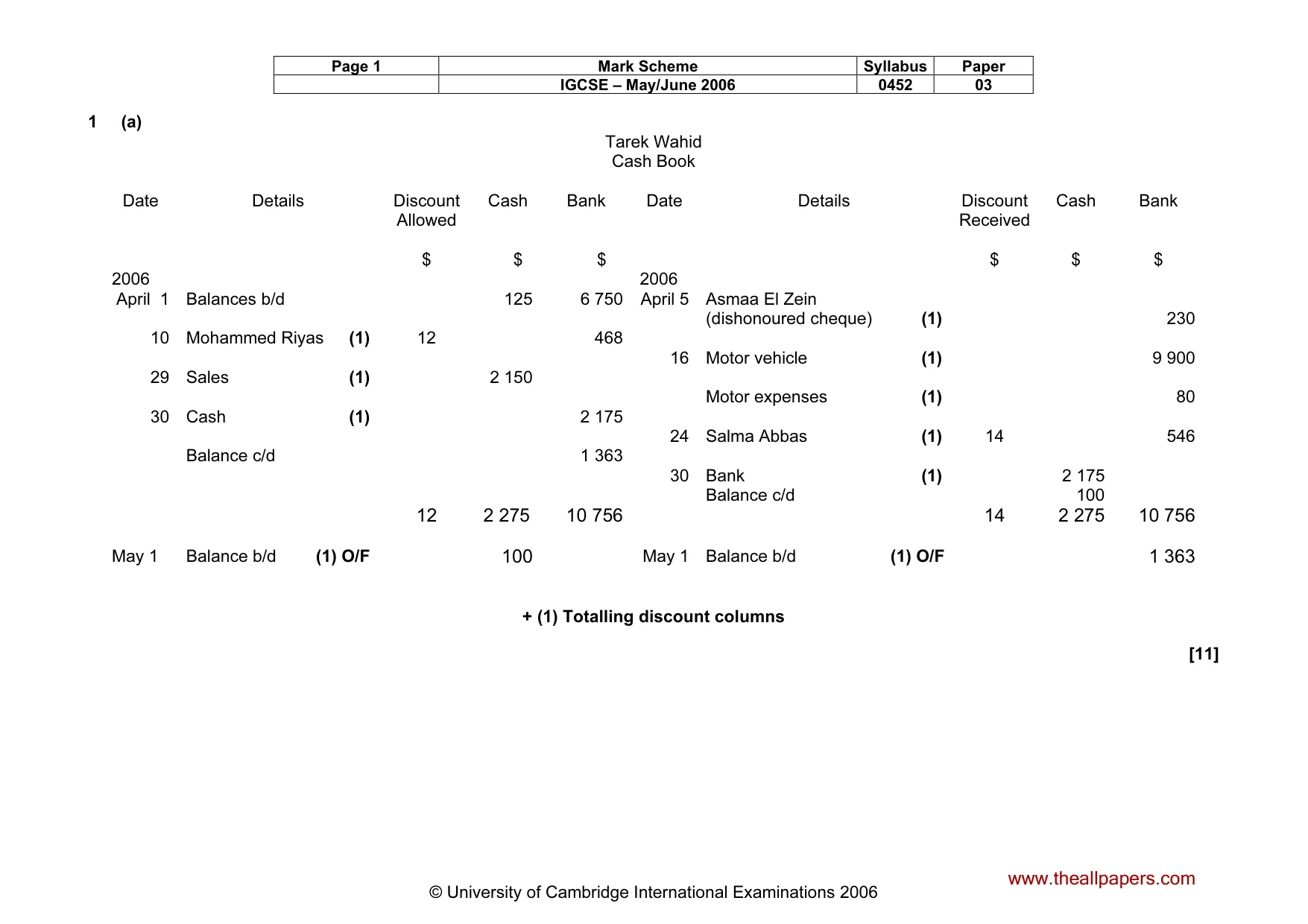
1 Tarek Wahid is a sole trader who keeps full double entry records including a three column cash book. On 1 April 2006 his cash book showed the following debit balances: $ Cash 125 Bank 6750 Tarek’s transactions for the month of April 2006 included the following: April 5 Cheque for $230, received from Asmaa El Zein in March, was dishonoured by the bank. 10 Received a cheque from Mohammed Riyas in settlement of his account of $480, after deducting cash discount of 2 ½ %. 16 Paid cheques totalling $9980 for a new motor vehicle costing $9900, and repairs to existing motor vehicle costing $80. 24 Paid Salma Abbas a cheque for $546 to settle the amount due, after deducting cash discount of $14. 29 Cash sales amounted to $2150. 30 Paid all the cash into the bank except $100. REQUIRED (a) Enter the above transactions in Tarek Wahid’s cash book on the page opposite. Balance the cash book at 30 April and bring down the balances on 1 May 2006. [11] On 30 April 2006 Tarek Wahid obtained a statement from his bank and compared it with the bank column in his cash book. The bank balance shown in the cash book differed from that shown on the bank statement because: 1 the cheque paid to Salma Abbas had not yet been presented for payment; 2 the cash paid into the bank had not yet been credited to Tarek’s account. REQUIRED (b) Explain why items are recorded on the opposite side of the cash book to that on which they appear on the bank statement. [2] (c) Prepare a statement to calculate the balance which should have appeared on the bank statement on 30 April 2006. [4] (d) State the bank balance that should be shown in the Balance Sheet of Tarek Wahid at 30 April 2006. State whether it is an asset or a liability. [2] [Total: 19]
Q2 · Susan Sawka maintains a full set of books of prime (original) entry and writes up a…
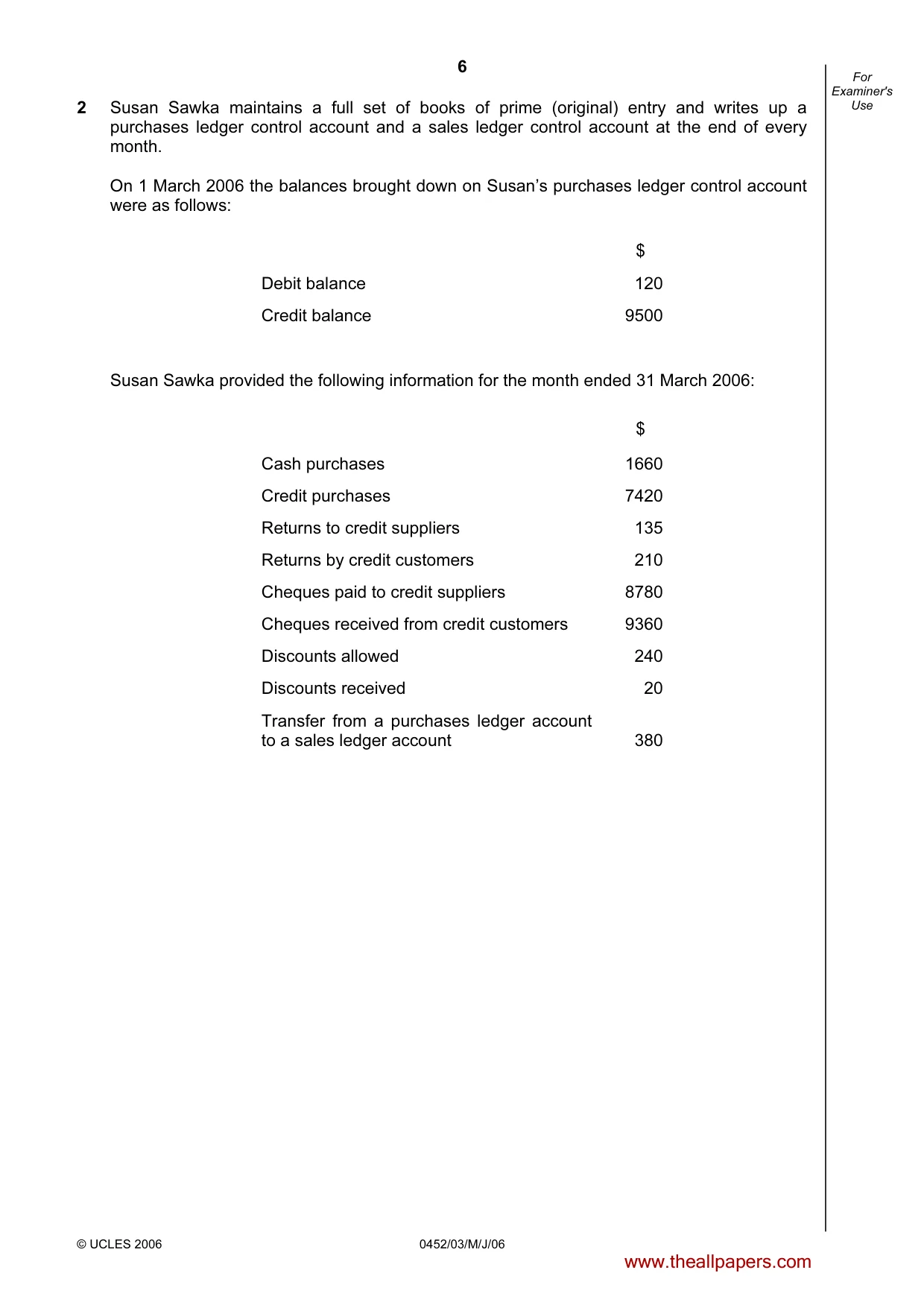
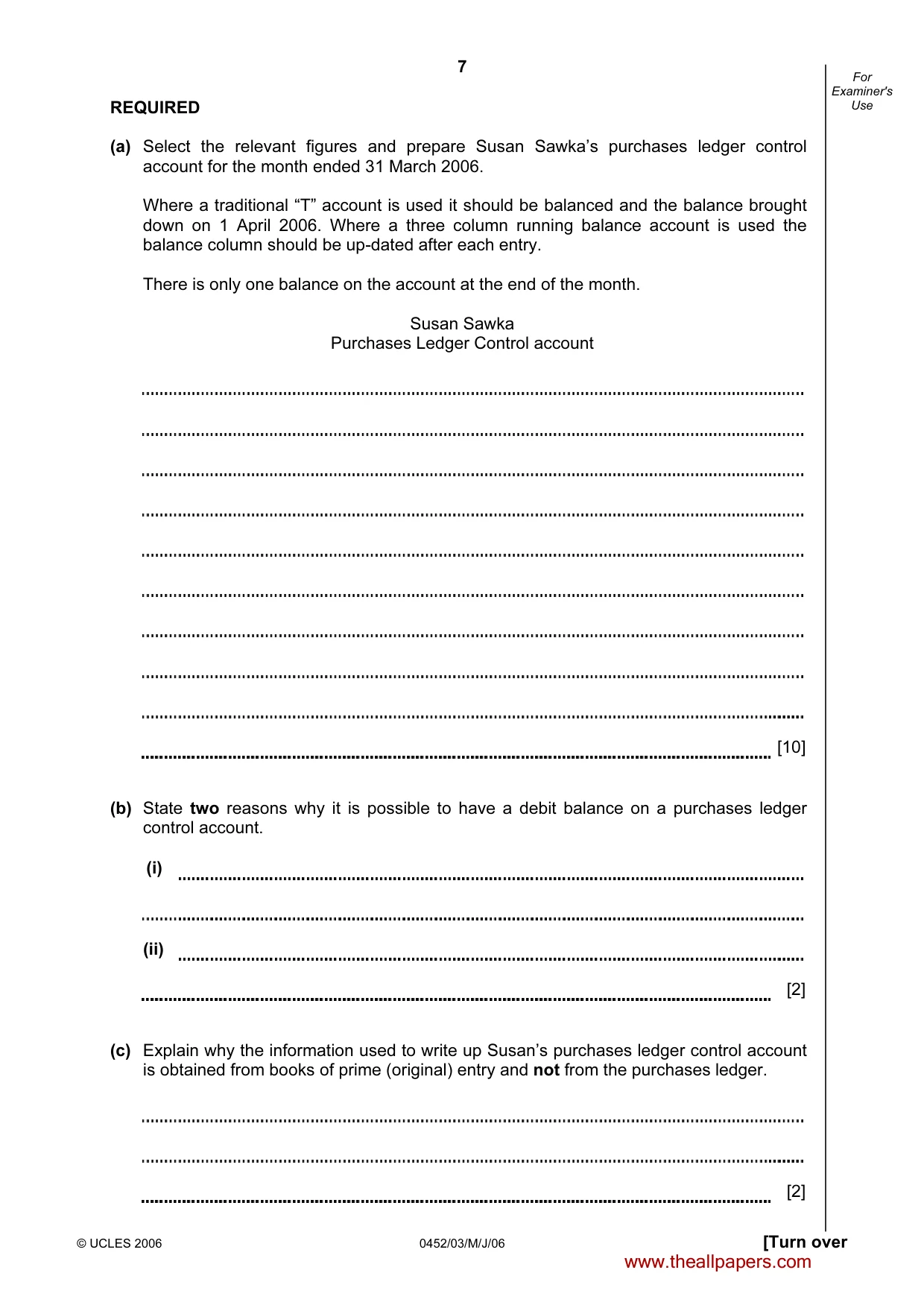
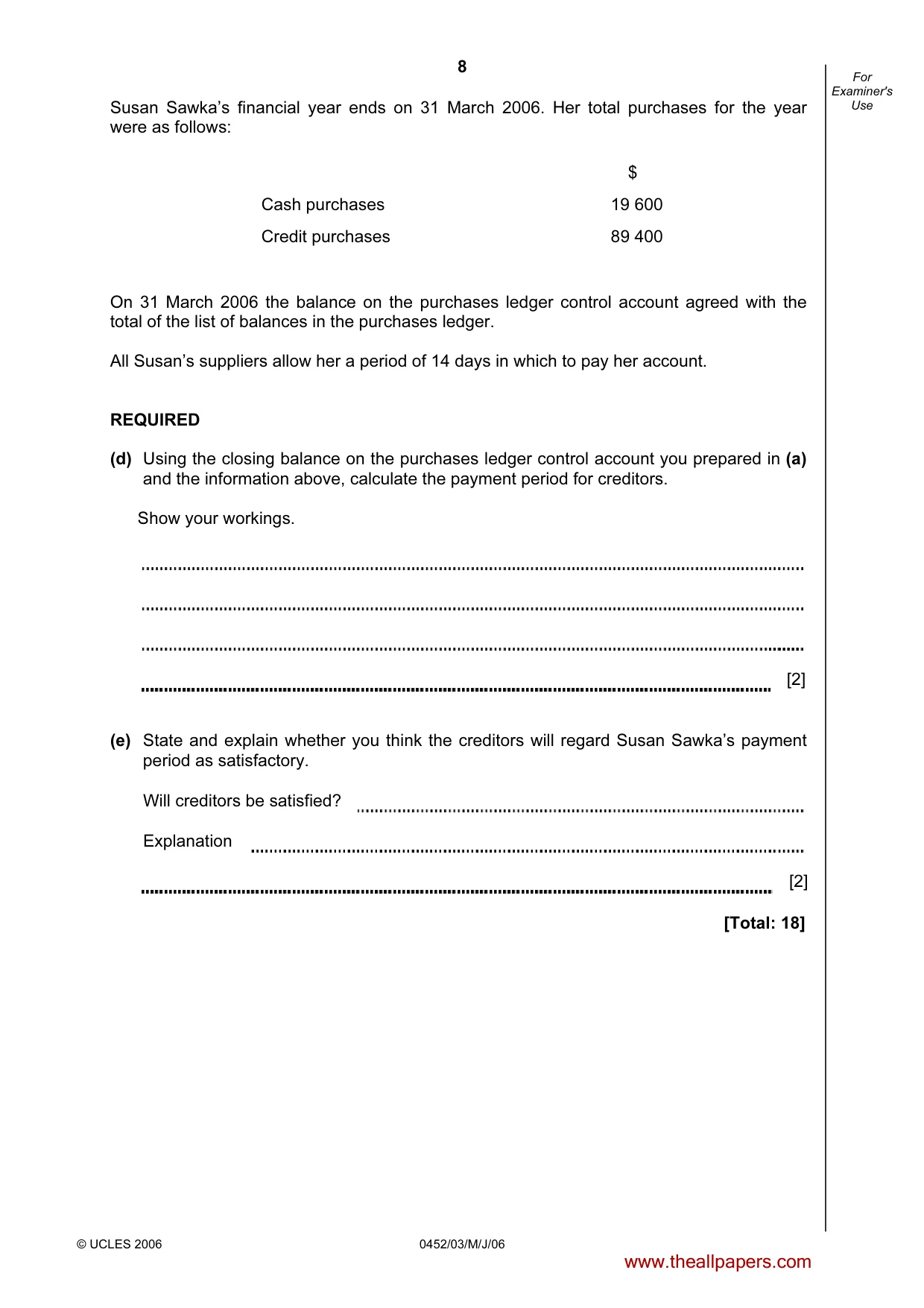
2 Susan Sawka maintains a full set of books of prime (original) entry and writes up a purchases ledger control account and a sales ledger control account at the end of every month. On 1 March 2006 the balances brought down on Susan’s purchases ledger control account were as follows: $ Debit balance 120 Credit balance 9500 Susan Sawka provided the following information for the month ended 31 March 2006: $ Cash purchases 1660 Credit purchases 7420 Returns to credit suppliers 135 Returns by credit customers 210 Cheques paid to credit suppliers 8780 Cheques received from credit customers 9360 Discounts allowed 240 Discounts received 20 Transfer from a purchases ledger account to a sales ledger account 380 REQUIRED (a) Select the relevant figures and prepare Susan Sawka’s purchases ledger control account for the month ended 31 March 2006. Where a traditional “T” account is used it should be balanced and the balance brought down on 1 April 2006. Where a three column running balance account is used the balance column should be up-dated after each entry. There is only one balance on the account at the end of the month. Susan Sawka Purchases Ledger Control account [10] (b) State two reasons why it is possible to have a debit balance on a purchases ledger control account. (i) (ii) [2] (c) Explain why the information used to write up Susan’s purchases ledger control account is obtained from books of prime (original) entry and not from the purchases ledger. [2] Susan Sawka’s financial year ends on 31 March 2006. Her total purchases for the year were as follows: $ Cash purchases 19 600 Credit purchases 89 400 On 31 March 2006 the balance on the purchases ledger control account agreed with the total of the list of balances in the purchases ledger. All Susan’s suppliers allow her a period of 14 days in which to pay her account. REQUIRED (d) Using the closing balance on the purchases ledger control account you prepared in (a) and the information above, calculate the payment period for creditors. Show your workings. [2] (e) State and explain whether you think the creditors will regard Susan Sawka’s payment period as satisfactory. Will creditors be satisfied? Explanation [2] [Total: 18]
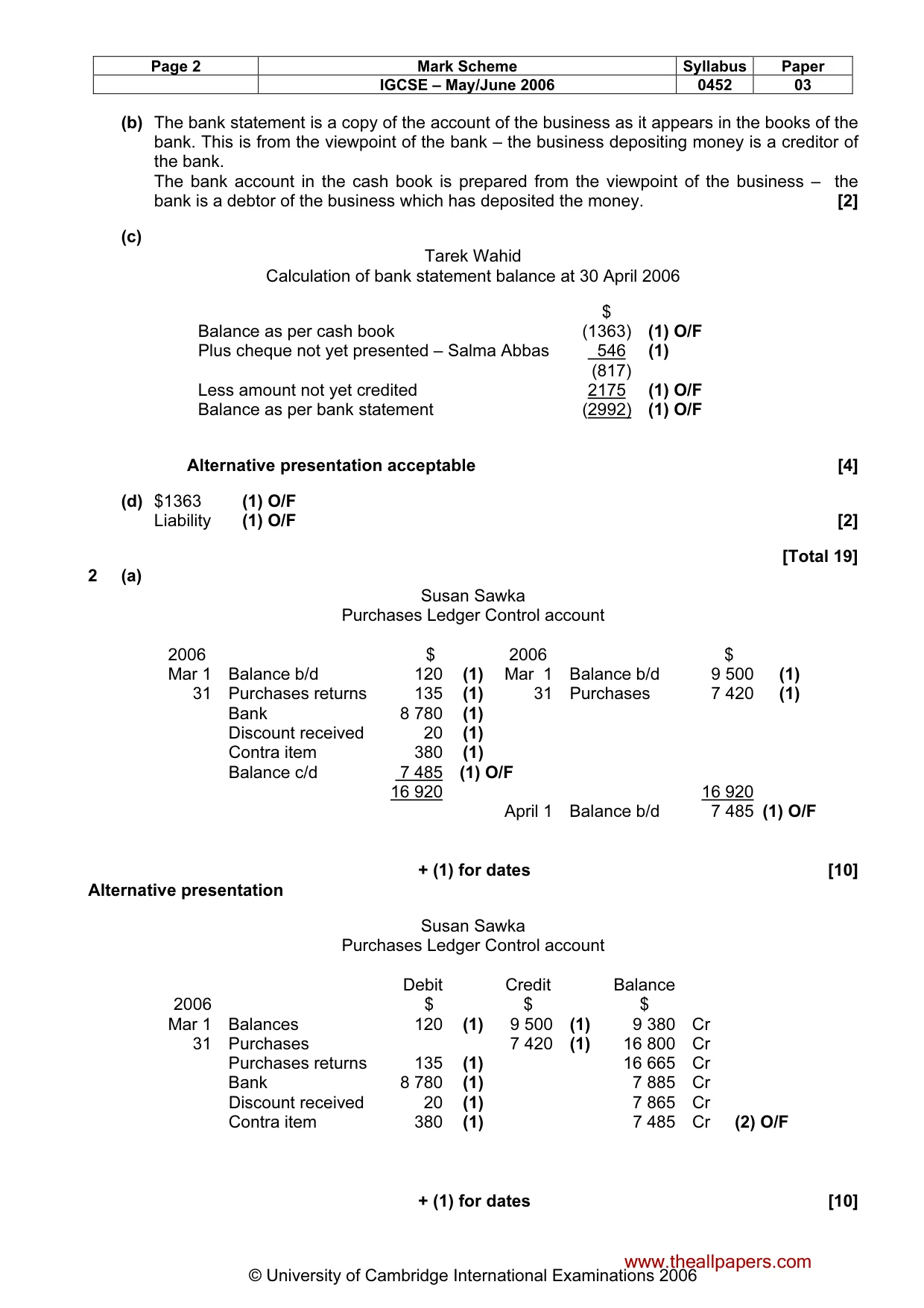
Mark scheme: 2 (a) Susan Sawka Purchases Ledger Control account 2006 $ 2006 $ Mar 1 Balance b/d 120 (1) Mar 1 Balance b/d 9 500 (1) 31 Purchases returns 135 (1) 31 Purchases 7 420 (1) Bank 8 780 (1) Discount received 20 (1) Contra item 380 (1) Balance c/d 7 485 (1) O/F 16 920 16 920 April 1 Balance b/d 7 485 (1) O/F + (1) for dates [10] Alternative presentation Susan Sawka Purchases Ledger Control account Debit Credit Balance 2006 $ $ $ Mar 1 Balances 120 (1) 9 500 (1) 9 380 Cr 31 Purchases 7 420 (1) 16 800 Cr Purchases returns 135 (1) 16 665 Cr Bank 8 780 (1) 7 885 Cr Discount received 20 (1) 7 865 Cr Contra item 380 (1) 7 485 Cr (2) O/F + (1) for dates [10] IGCSE – May/June 2006 www theallpapers0452 com03 (b) Reasons for a debit balance Overpayment of amount due Cash discount not deducted before payment made Returned goods after payment of amount due Payment made to creditor in advance Or other suitable point Any 2 points (1) each [2] (c) A purchases ledger control account acts as a check on the purchases ledger. If there is an error in the purchases ledger it will not be revealed by a control account prepared from the individual accounts in that ledger. [2] (d) Payment period for creditors 7 485 O/F from (a) x 365 = 30.56 days = 31 days (1) O/F 89 400 (1) 1 [2] (e) 1 Not satisfied – if (d) is more than 14 days (1) Or – satisfied – if (d) is less than 14 days 2 Susan is allowed 14 days credit but is taking an average of 31 days (1) Or suitable explanation based on O/F answer to (d) [2] [Total 18]
Q3 · The assets and liabilities of the Safat Judo Club on 1 February 2005 were as follows: $…
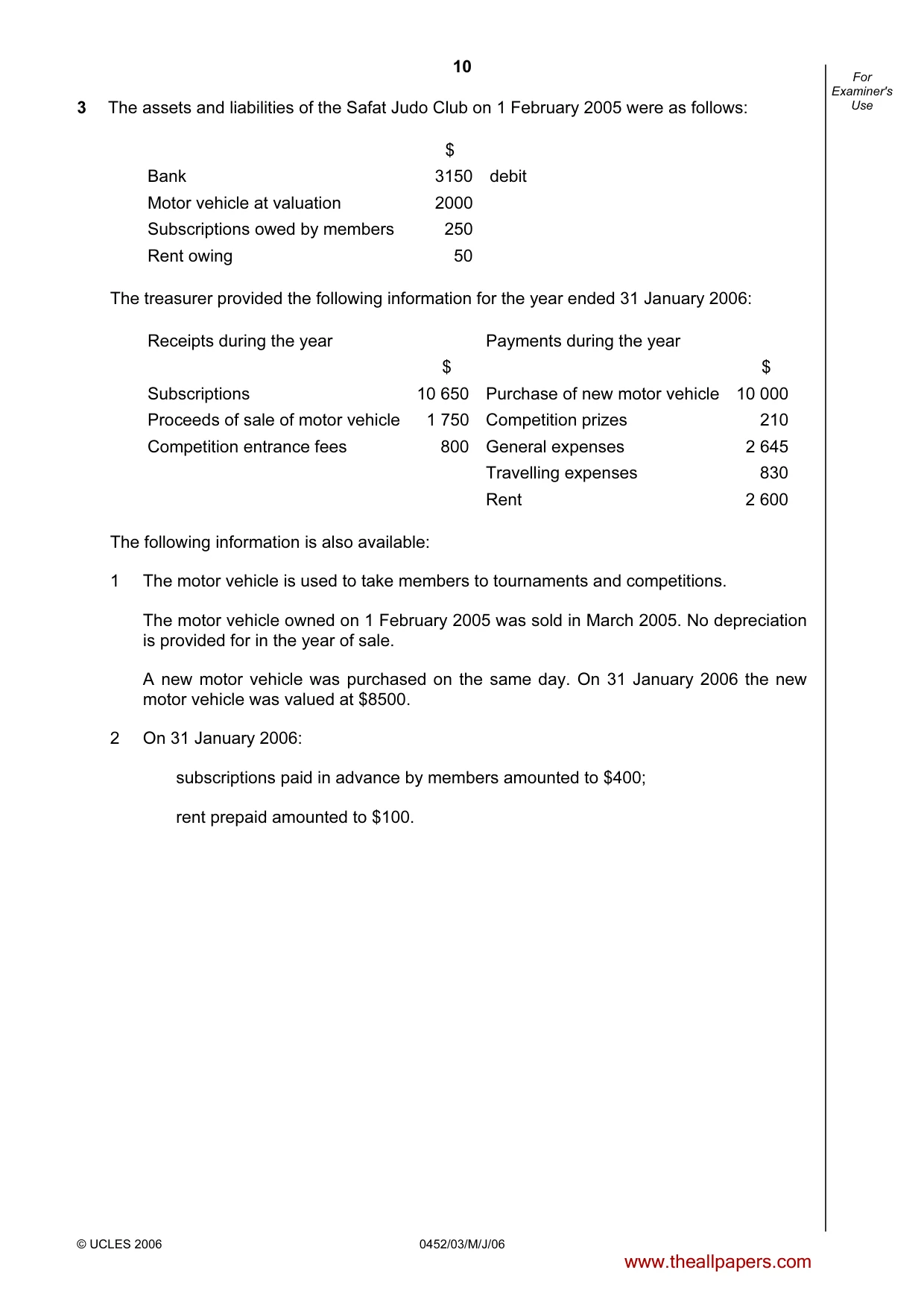
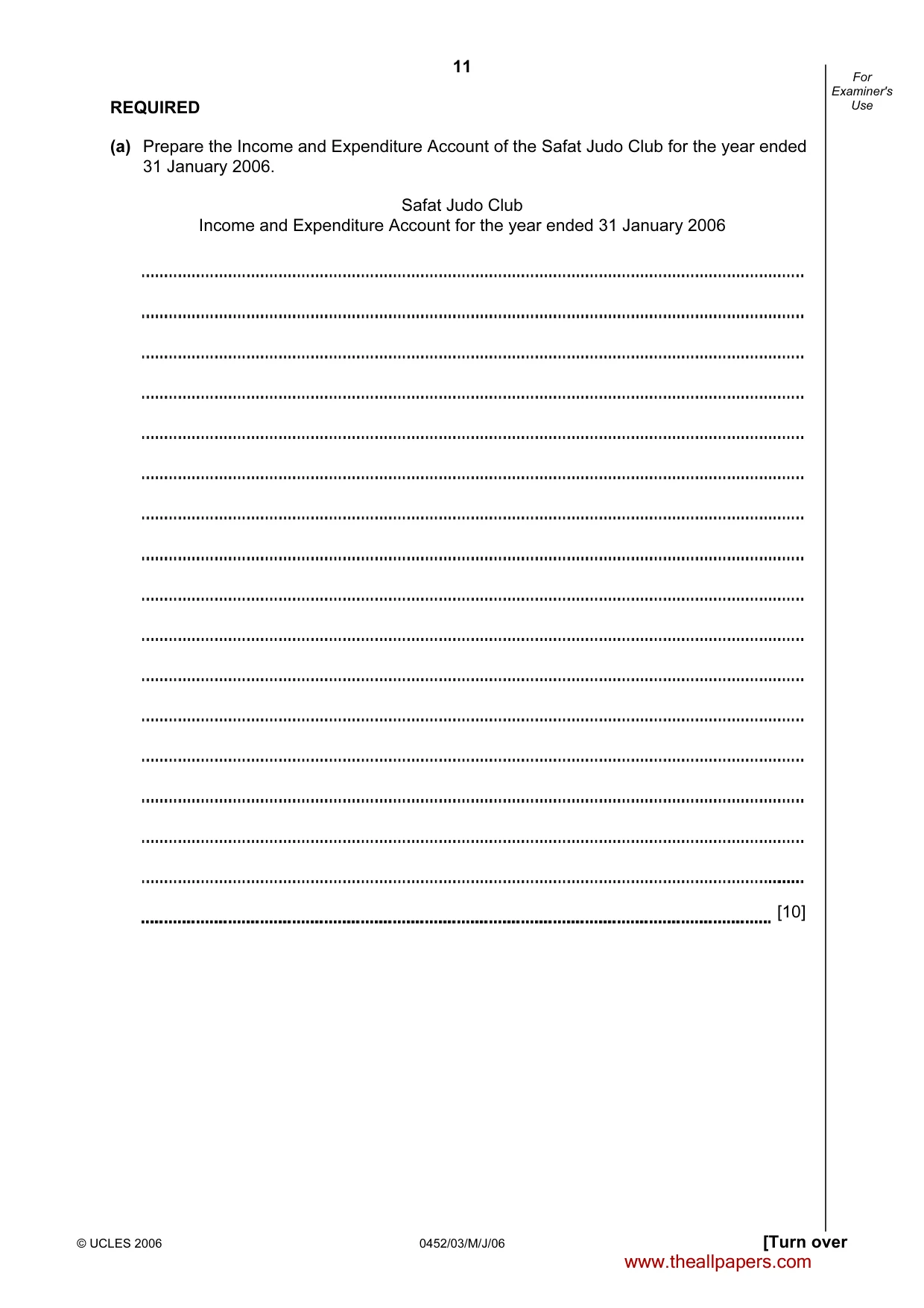
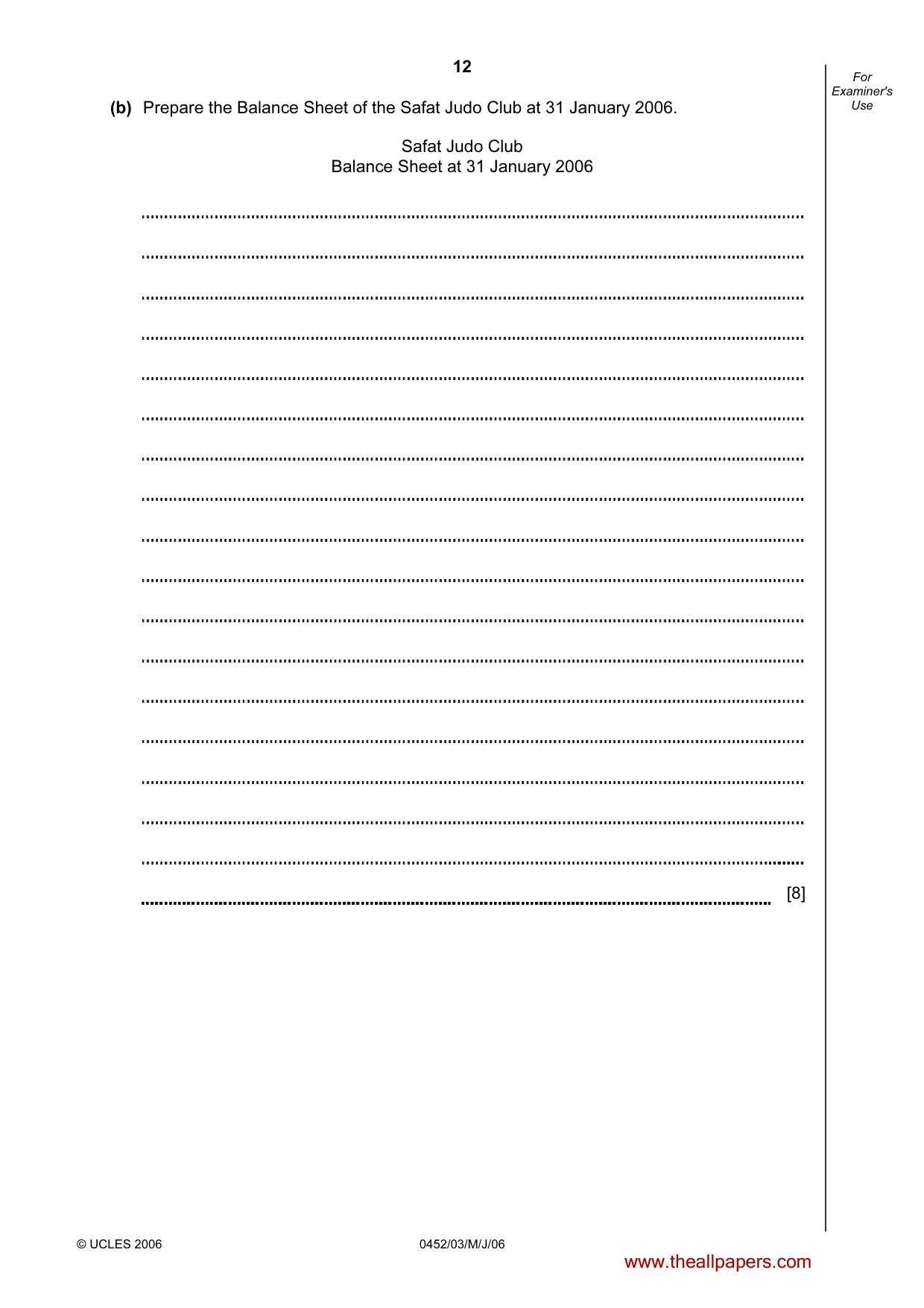
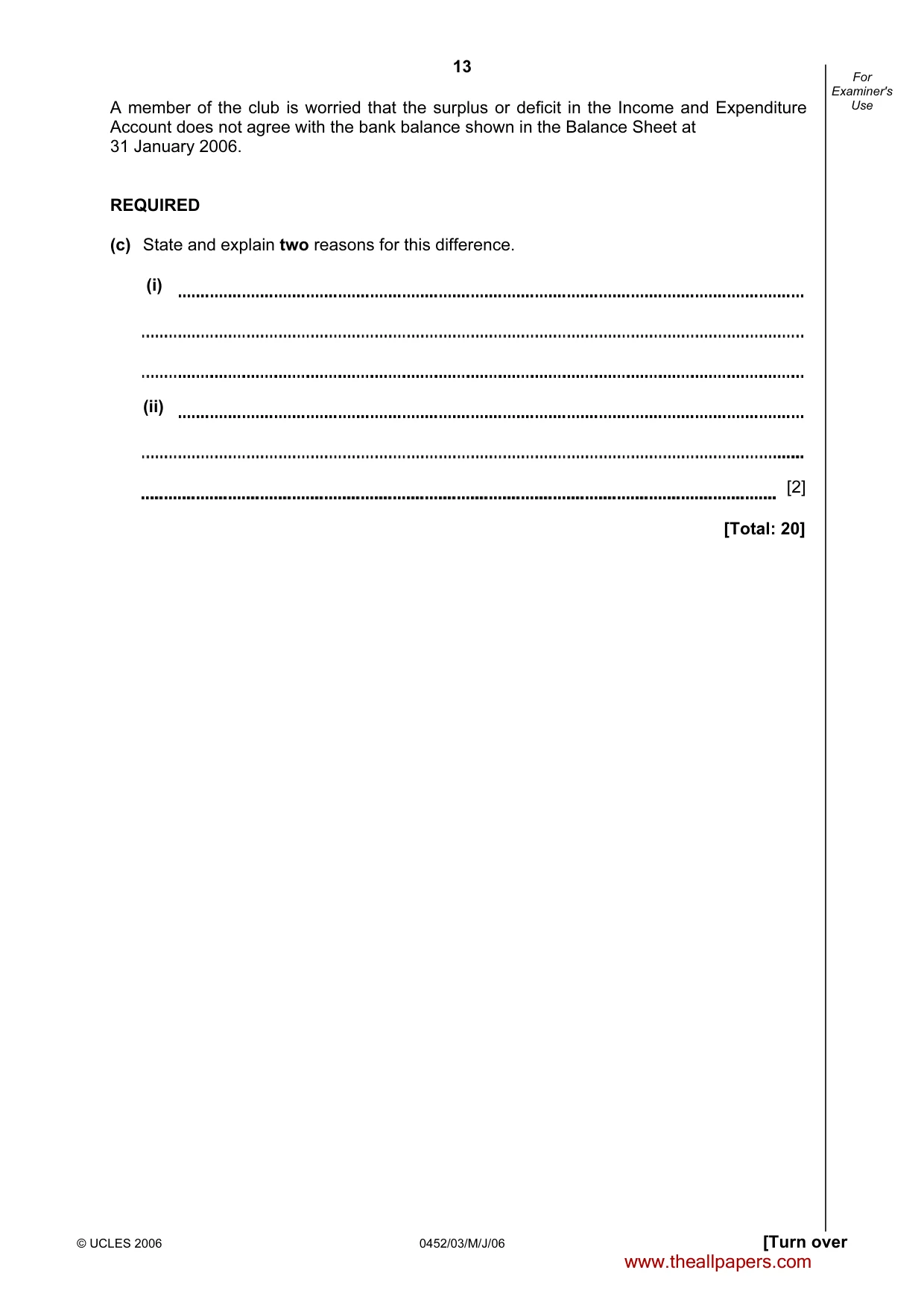
3 The assets and liabilities of the Safat Judo Club on 1 February 2005 were as follows: $ Bank 3150 debit Motor vehicle at valuation 2000 Subscriptions owed by members 250 Rent owing 50 The treasurer provided the following information for the year ended 31 January 2006: Receipts during the year Payments during the year $ $ Subscriptions 10 650 Purchase of new motor vehicle 10 000 Proceeds of sale of motor vehicle 1 750 Competition prizes 210 Competition entrance fees 800 General expenses 2 645 Travelling expenses 830 Rent 2 600 The following information is also available: 1 The motor vehicle is used to take members to tournaments and competitions. The motor vehicle owned on 1 February 2005 was sold in March 2005. No depreciation is provided for in the year of sale. A new motor vehicle was purchased on the same day. On 31 January 2006 the new motor vehicle was valued at $8500. 2 On 31 January 2006: subscriptions paid in advance by members amounted to $400; rent prepaid amounted to $100. REQUIRED (a) Prepare the Income and Expenditure Account of the Safat Judo Club for the year ended 31 January 2006. Safat Judo Club Income and Expenditure Account for the year ended 31 January 2006 [10] (b) Prepare the Balance Sheet of the Safat Judo Club at 31 January 2006. Safat Judo Club Balance Sheet at 31 January 2006 [8] A member of the club is worried that the surplus or deficit in the Income and Expenditure Account does not agree with the bank balance shown in the Balance Sheet at 31 January 2006. REQUIRED (c) State and explain two reasons for this difference. (i) (ii) [2] [Total: 20]
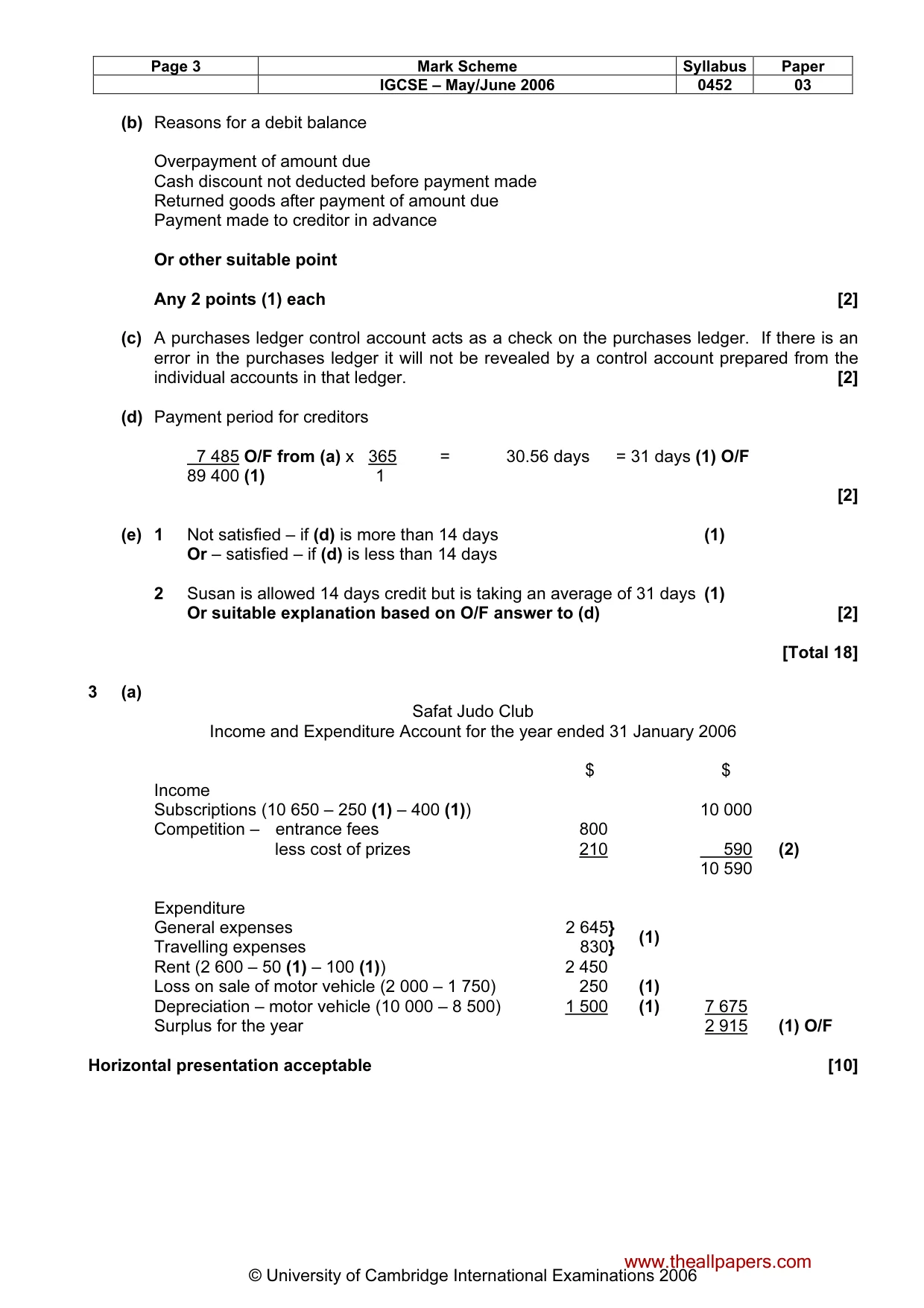
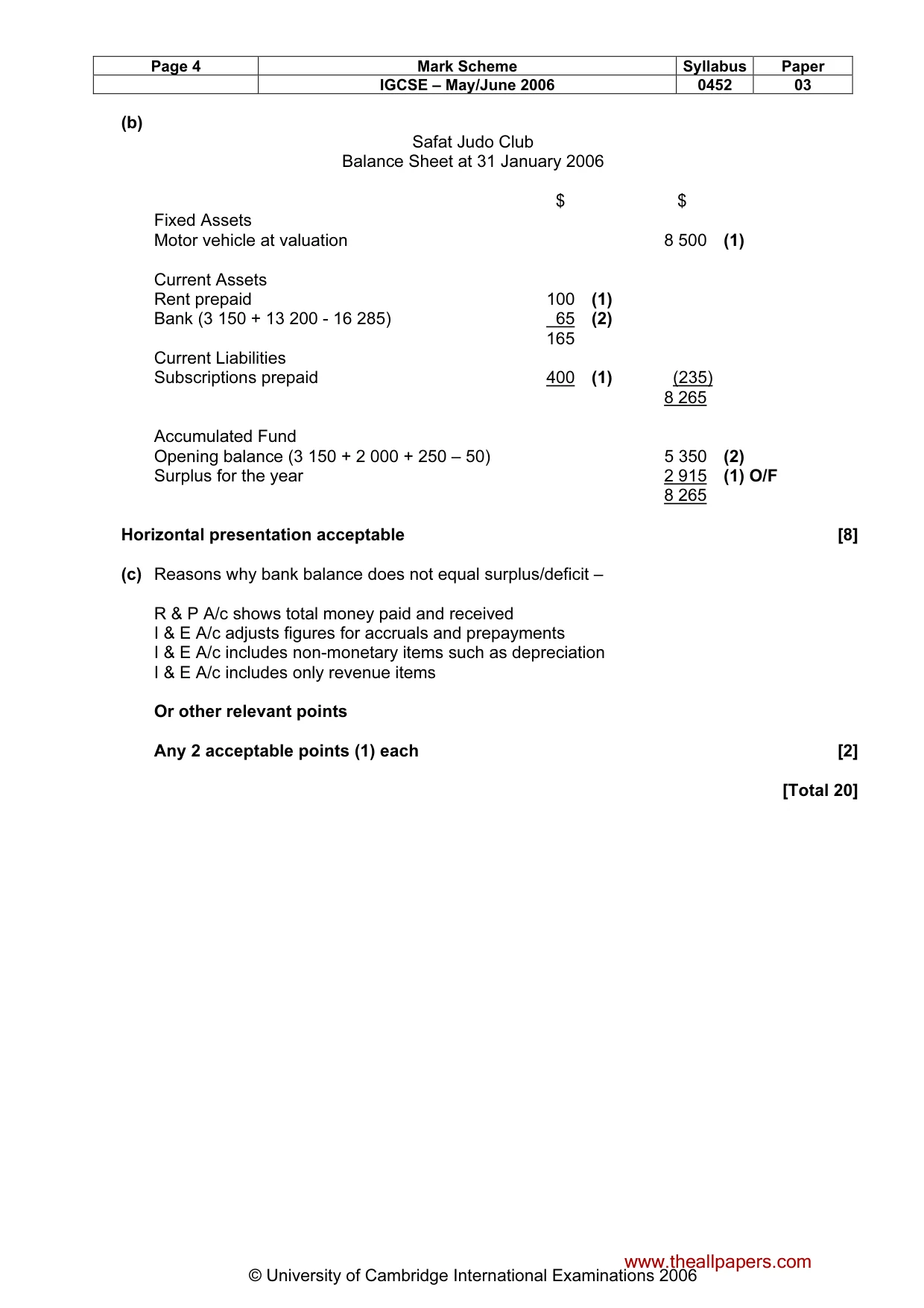
Mark scheme: 3 (a) Safat Judo Club Income and Expenditure Account for the year ended 31 January 2006 $ $ Income Subscriptions (10 650 – 250 (1) – 400 (1)) 10 000 Competition – entrance fees 800 less cost of prizes 210 590 (2) 10 590 Expenditure General expenses 2 645} (1) Travelling expenses 830} Rent (2 600 – 50 (1) – 100 (1)) 2 450 Loss on sale of motor vehicle (2 000 – 1 750) 250 (1) Depreciation – motor vehicle (10 000 – 8 500) 1 500 (1) 7 675 Surplus for the year 2 915 (1) O/F Horizontal presentation acceptable [10] IGCSE – May/June 2006 www theallpapers0452 com03 (b) Safat Judo Club Balance Sheet at 31 January 2006 $ $ Fixed Assets Motor vehicle at valuation 8 500 (1) Current Assets Rent prepaid 100 (1) Bank (3 150 + 13 200 - 16 285) 65 (2) 165 Current Liabilities Subscriptions prepaid 400 (1) (235) 8 265 Accumulated Fund Opening balance (3 150 + 2 000 + 250 – 50) 5 350 (2) Surplus for the year 2 915 (1) O/F 8 265 Horizontal presentation acceptable [8] (c) Reasons why bank balance does not equal surplus/deficit – R & P A/c shows total money paid and received I & E A/c adjusts figures for accruals and prepayments I & E A/c includes non-monetary items such as depreciation I & E A/c includes only revenue items Or other relevant points Any 2 acceptable points (1) each [2] [Total 20] IGCSE – May/June 2006 www theallpapers0452 com03
Q4 · John Chan is a trader
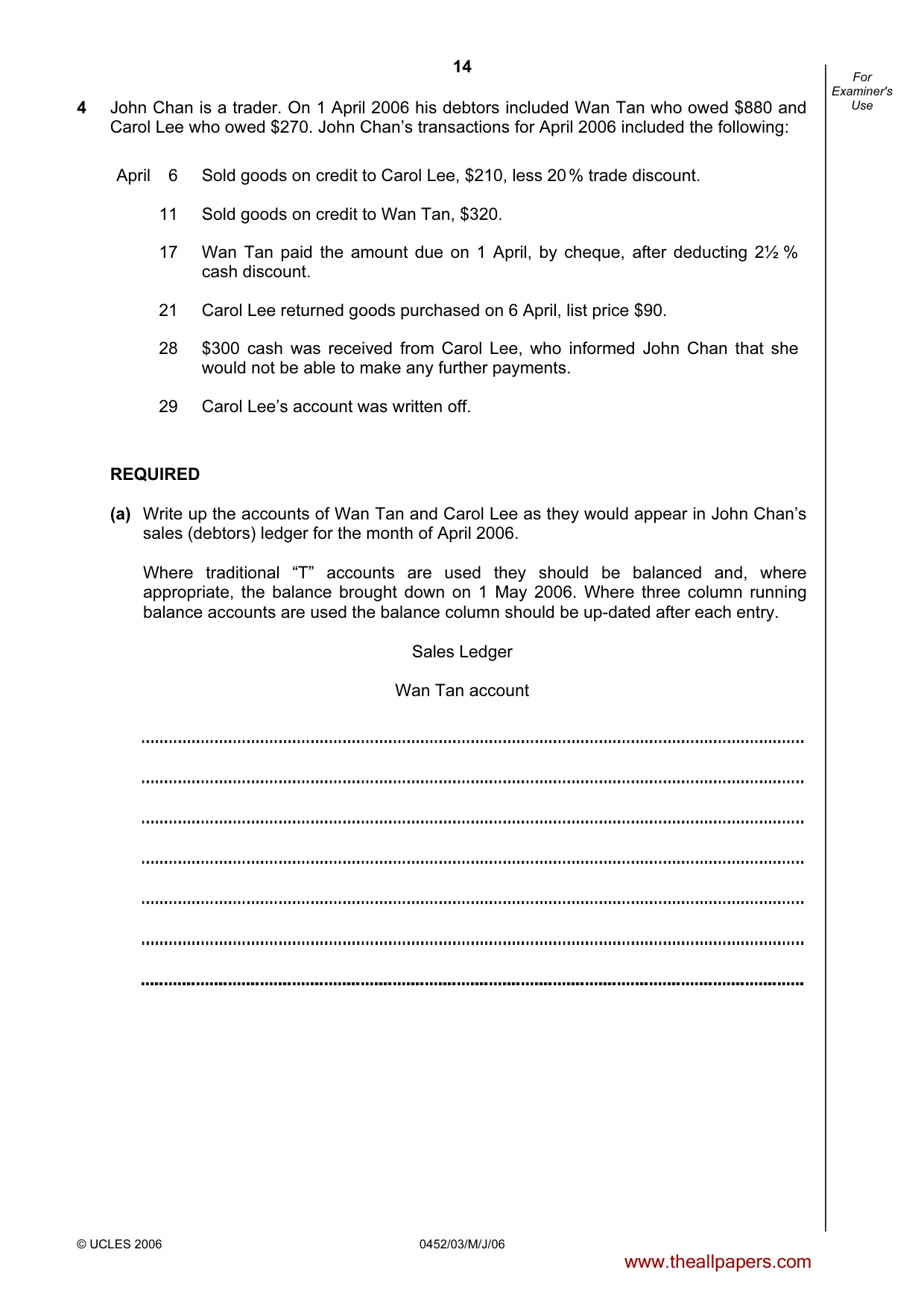
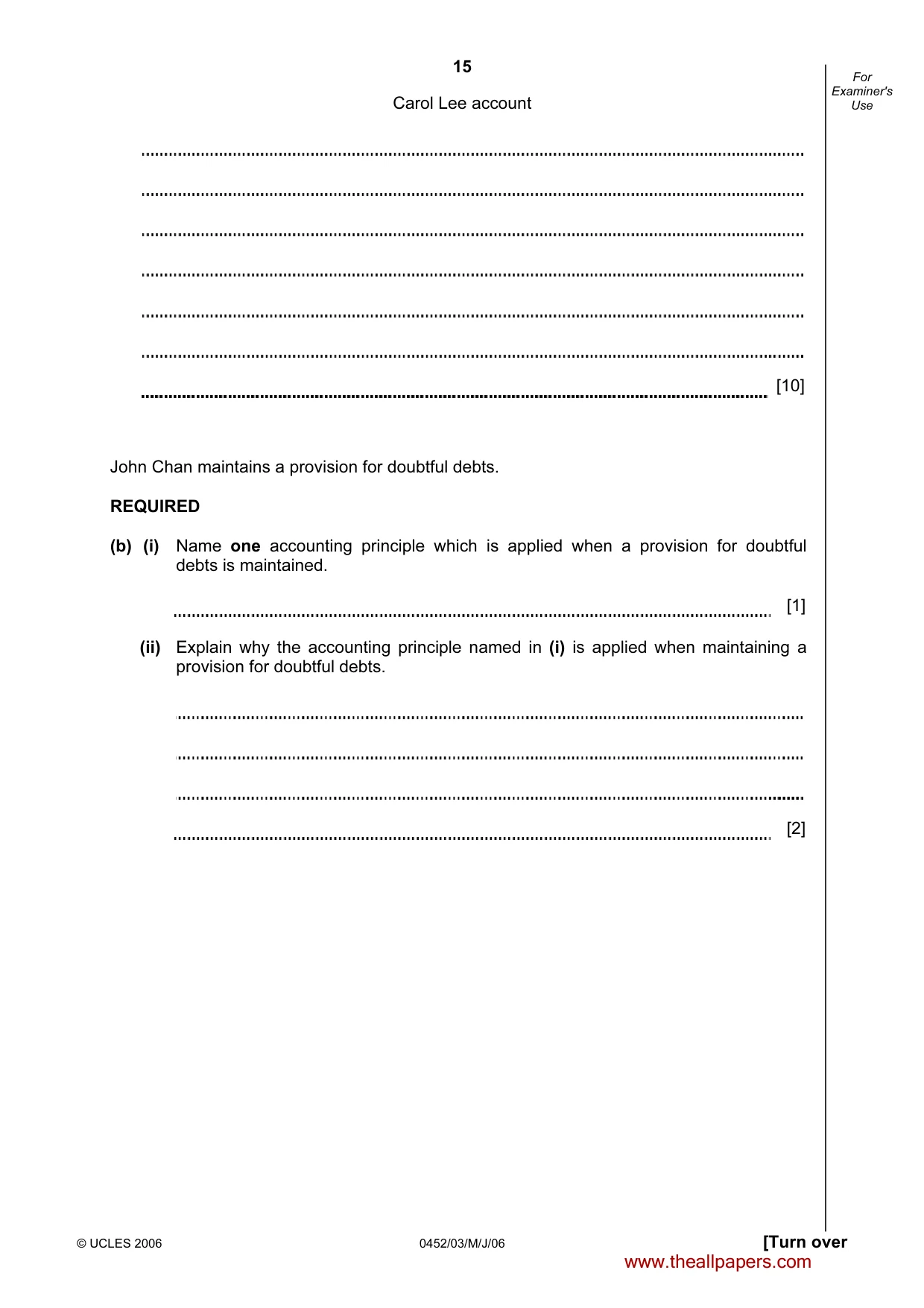
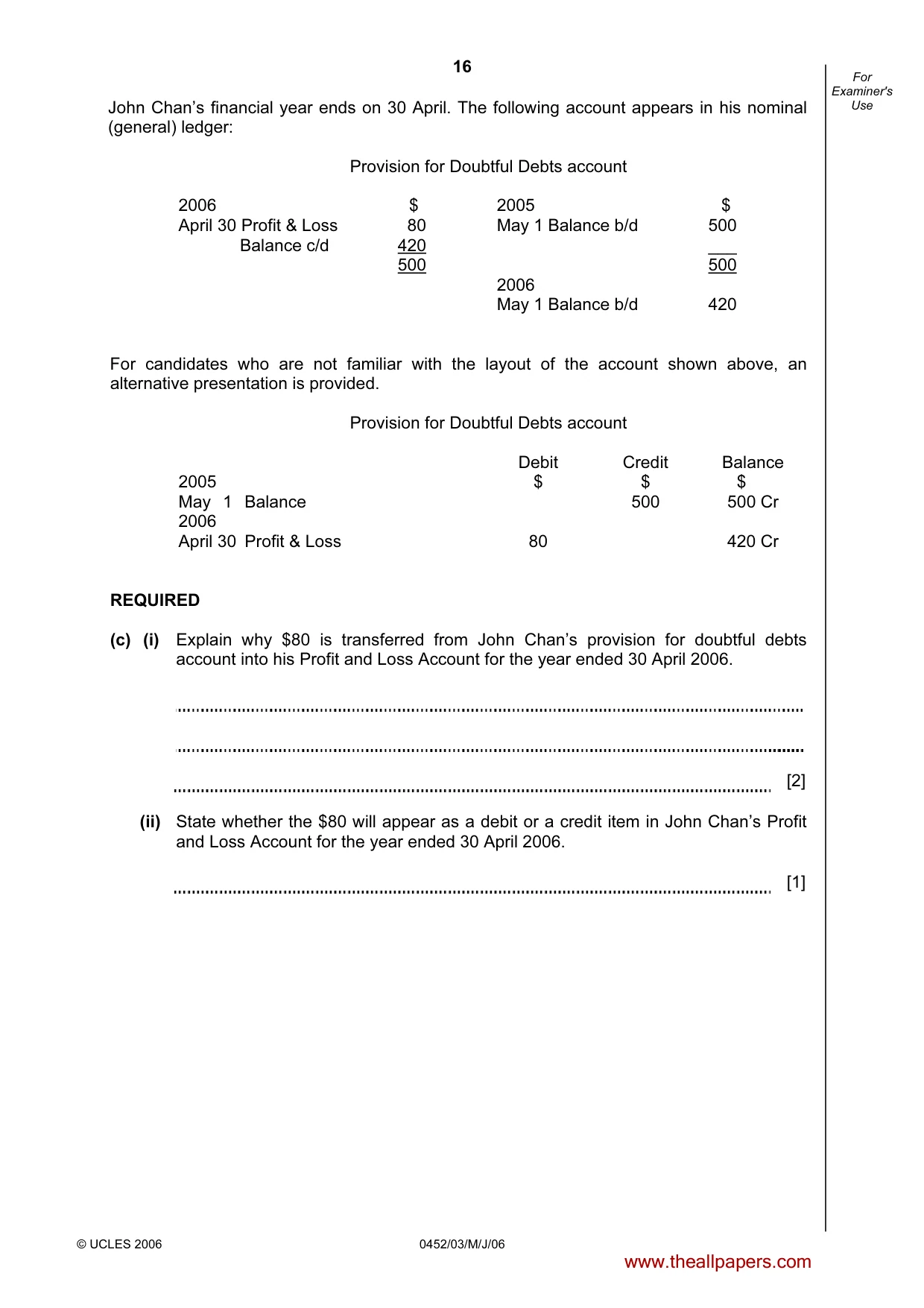
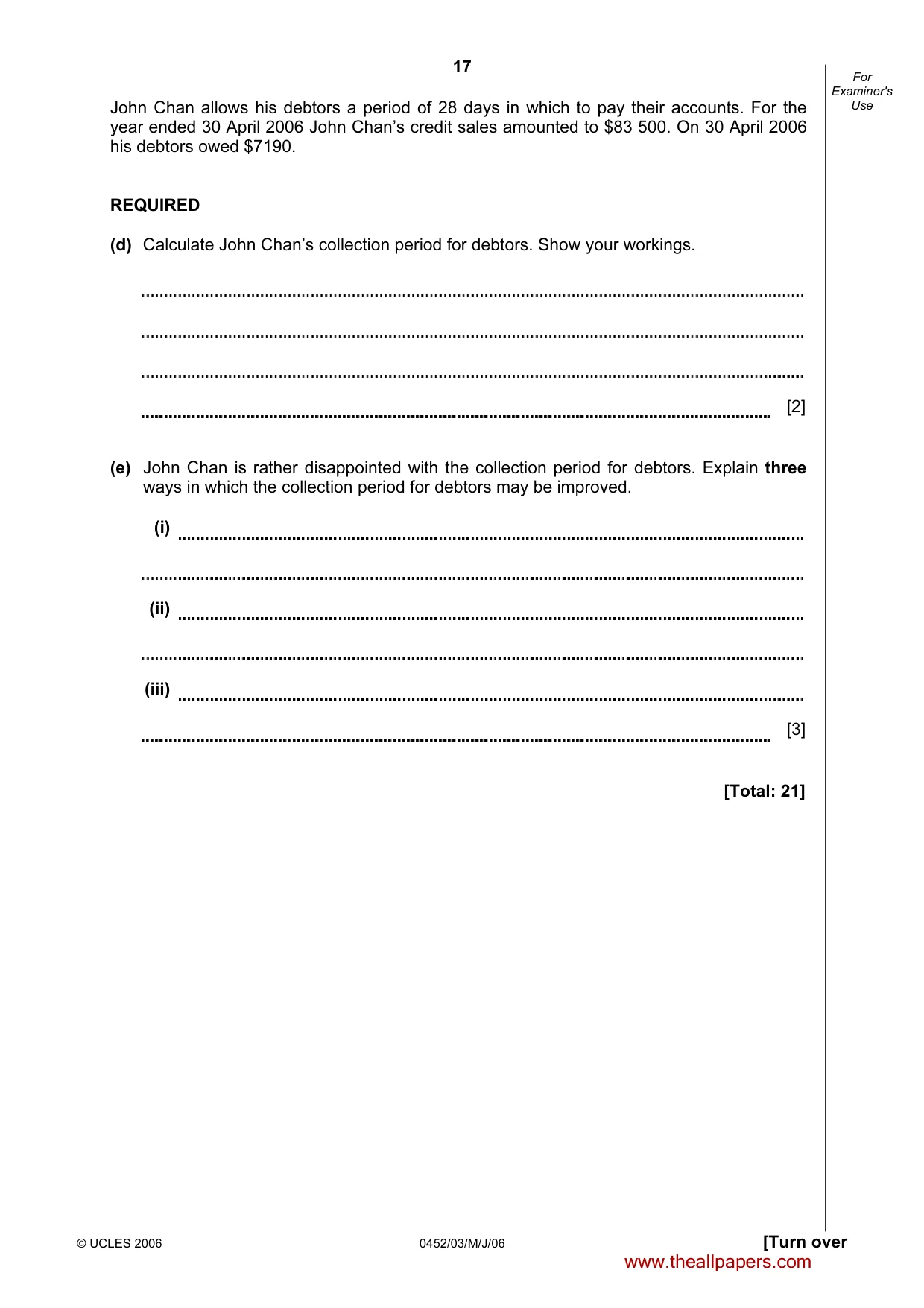
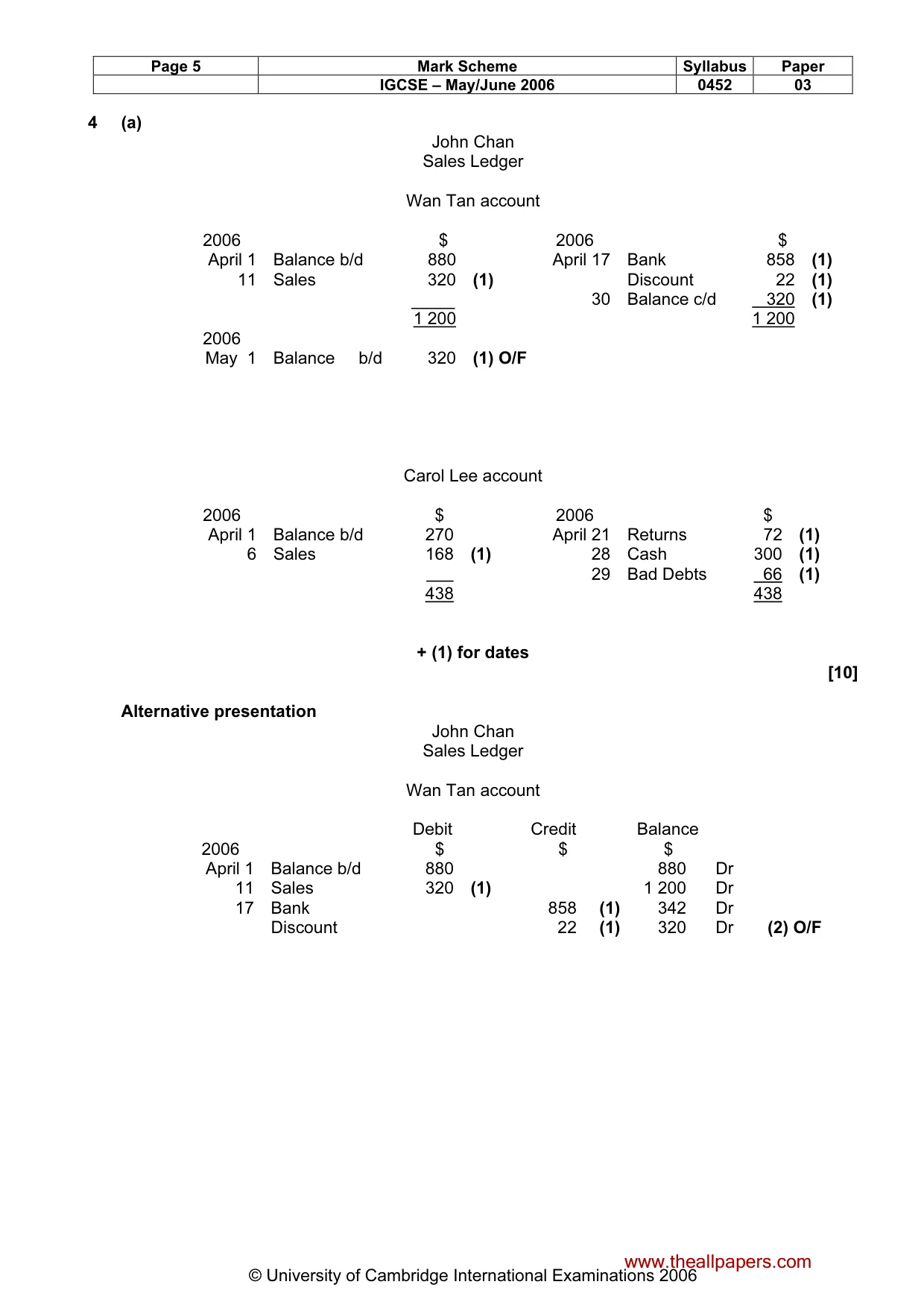
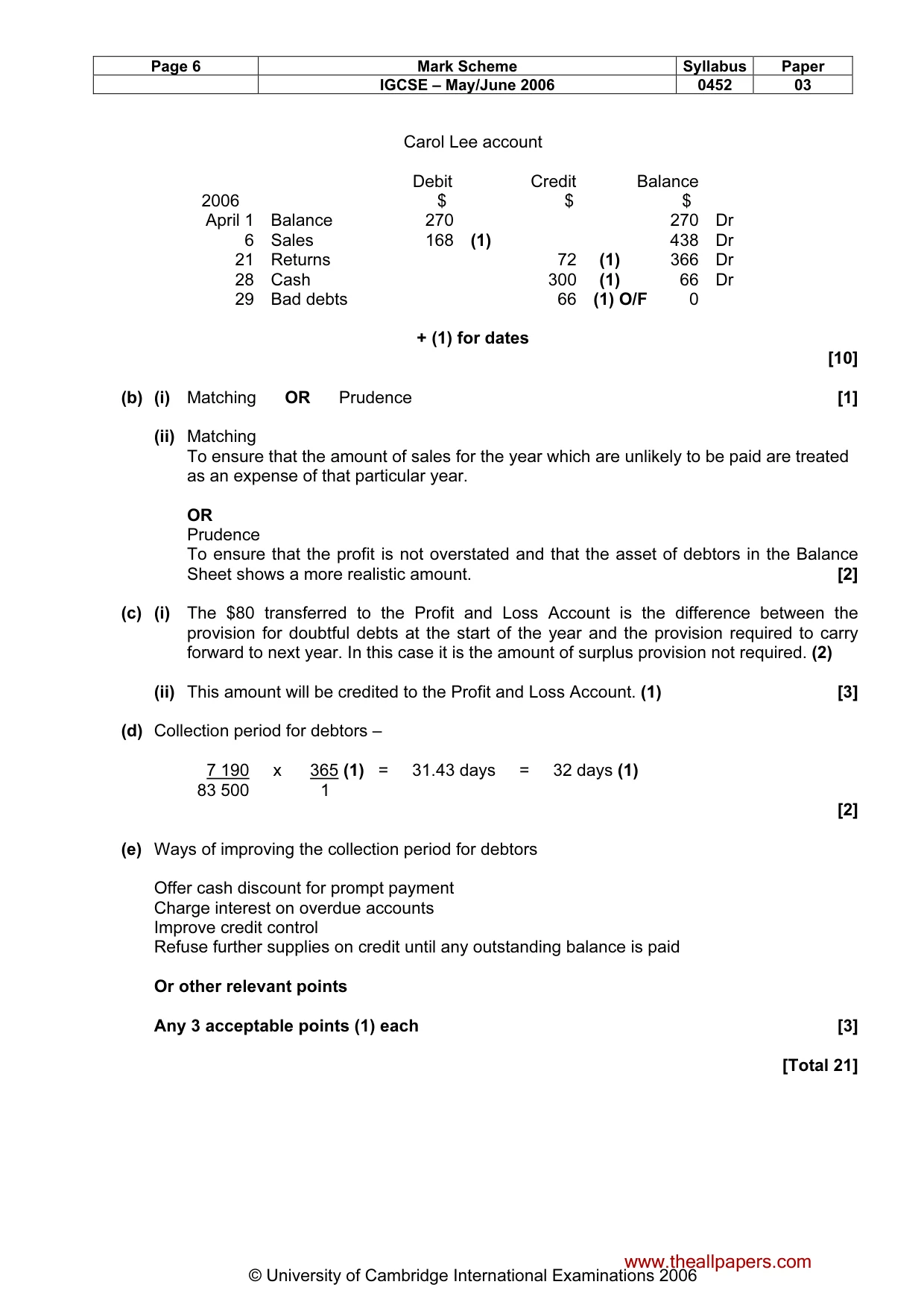
4 John Chan is a trader. On 1 April 2006 his debtors included Wan Tan who owed $880 and Carol Lee who owed $270. John Chan’s transactions for April 2006 included the following: April 6 Sold goods on credit to Carol Lee, $210, less 20 % trade discount. 11 Sold goods on credit to Wan Tan, $320. 17 Wan Tan paid the amount due on 1 April, by cheque, after deducting 2½ % cash discount. 21 Carol Lee returned goods purchased on 6 April, list price $90. 28 $300 cash was received from Carol Lee, who informed John Chan that she would not be able to make any further payments. 29 Carol Lee’s account was written off. REQUIRED (a) Write up the accounts of Wan Tan and Carol Lee as they would appear in John Chan’s sales (debtors) ledger for the month of April 2006. Where traditional “T” accounts are used they should be balanced and, where appropriate, the balance brought down on 1 May 2006. Where three column running balance accounts are used the balance column should be up-dated after each entry. Sales Ledger Wan Tan account Carol Lee account [10] John Chan maintains a provision for doubtful debts. REQUIRED (b) (i) Name one accounting principle which is applied when a provision for doubtful debts is maintained. [1] (ii) Explain why the accounting principle named in (i) is applied when maintaining a provision for doubtful debts. [2] John Chan’s financial year ends on 30 April. The following account appears in his nominal (general) ledger: Provision for Doubtful Debts account 2006 $ 2005 $ April 30 Profit & Loss 80 May 1 Balance b/d 500 Balance c/d 420 ___ 500 500 2006 May 1 Balance b/d 420 For candidates who are not familiar with the layout of the account shown above, an alternative presentation is provided. Provision for Doubtful Debts account Debit Credit Balance 2005 $ $ $ May 1 Balance 500 500 Cr 2006 April 30 Profit & Loss 80 420 Cr REQUIRED (c) (i) Explain why $80 is transferred from John Chan’s provision for doubtful debts account into his Profit and Loss Account for the year ended 30 April 2006. [2] (ii) State whether the $80 will appear as a debit or a credit item in John Chan’s Profit and Loss Account for the year ended 30 April 2006. [1] John Chan allows his debtors a period of 28 days in which to pay their accounts. For the year ended 30 April 2006 John Chan’s credit sales amounted to $83 500. On 30 April 2006 his debtors owed $7190. REQUIRED (d) Calculate John Chan’s collection period for debtors. Show your workings. [2] (e) John Chan is rather disappointed with the collection period for debtors. Explain three ways in which the collection period for debtors may be improved. (i) (ii) (iii) [3] [Total: 21]
Mark scheme: 4 (a) John Chan Sales Ledger Wan Tan account 2006 $ 2006 $ April 1 Balance b/d 880 April 17 Bank 858 (1) 11 Sales 320 (1) Discount 22 (1) 30 Balance c/d 320 (1) 1 200 1 200 2006 May 1 Balance b/d 320 (1) O/F Carol Lee account 2006 $ 2006 $ April 1 Balance b/d 270 April 21 Returns 72 (1) 6 Sales 168 (1) 28 Cash 300 (1) 29 Bad Debts 66 (1) 438 438 + (1) for dates [10] Alternative presentation John Chan Sales Ledger Wan Tan account Debit Credit Balance 2006 $ $ $ April 1 Balance b/d 880 880 Dr 11 Sales 320 (1) 1 200 Dr 17 Bank 858 (1) 342 Dr Discount 22 (1) 320 Dr (2) O/F IGCSE – May/June 2006 www theallpapers0452 com03 Carol Lee account Debit Credit Balance 2006 $ $ $ April 1 Balance 270 270 Dr 6 Sales 168 (1) 438 Dr 21 Returns 72 (1) 366 Dr 28 Cash 300 (1) 66 Dr 29 Bad debts 66 (1) O/F 0 + (1) for dates [10] (b) (i) Matching OR Prudence [1] (ii) Matching To ensure that the amount of sales for the year which are unlikely to be paid are treated as an expense of that particular year. OR Prudence To ensure that the profit is not overstated and that the asset of debtors in the Balance Sheet shows a more realistic amount. [2] (c) (i) The $80 transferred to the Profit and Loss Account is the difference between the provision for doubtful debts at the start of the year and the provision required to carry forward to next year. In this case it is the amount of surplus provision not required. (2) (ii) This amount will be credited to the Profit and Loss Account. (1) [3] (d) Collection period for debtors –
Q5 · David and Janet Szabo are in partnership
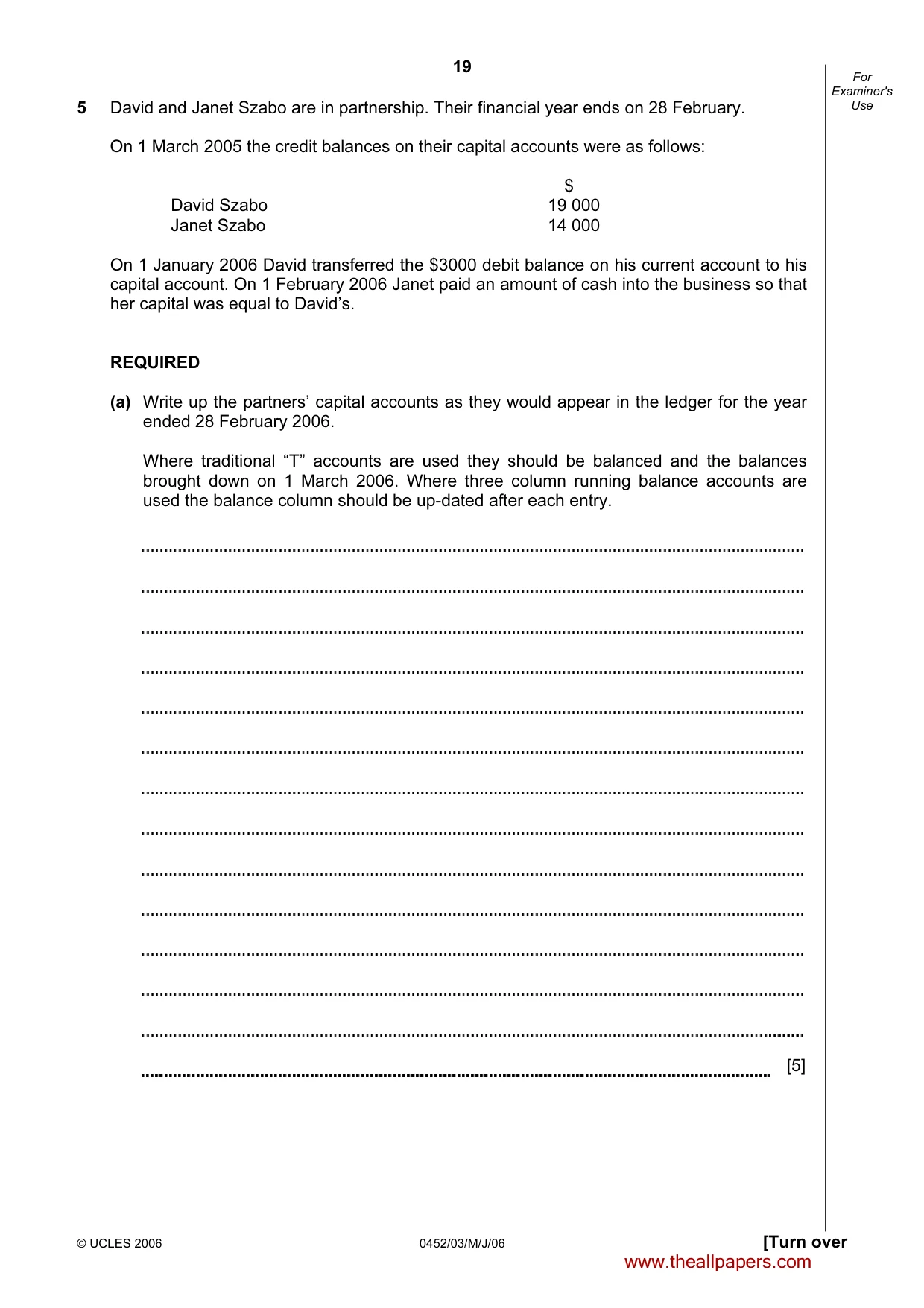
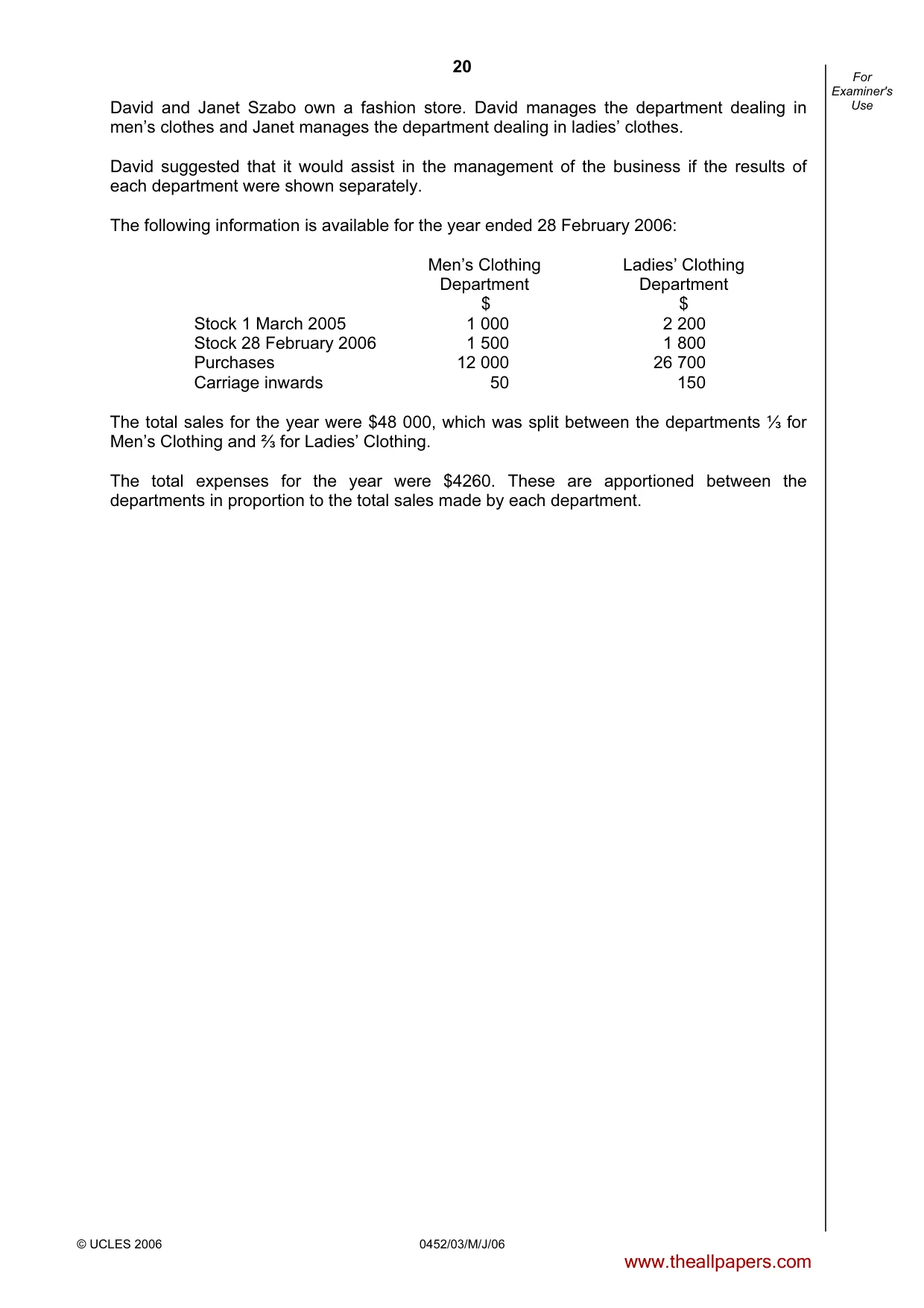
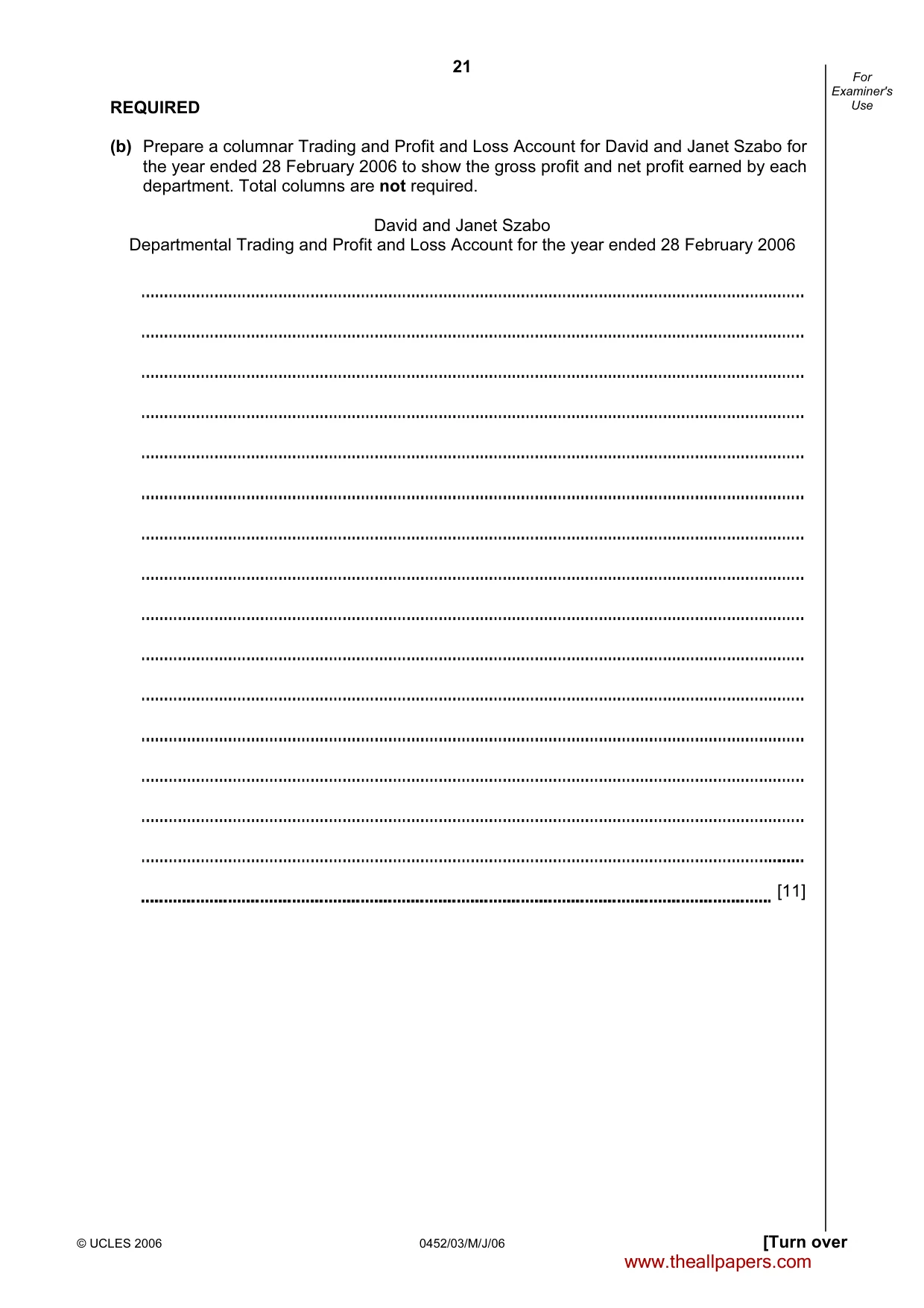
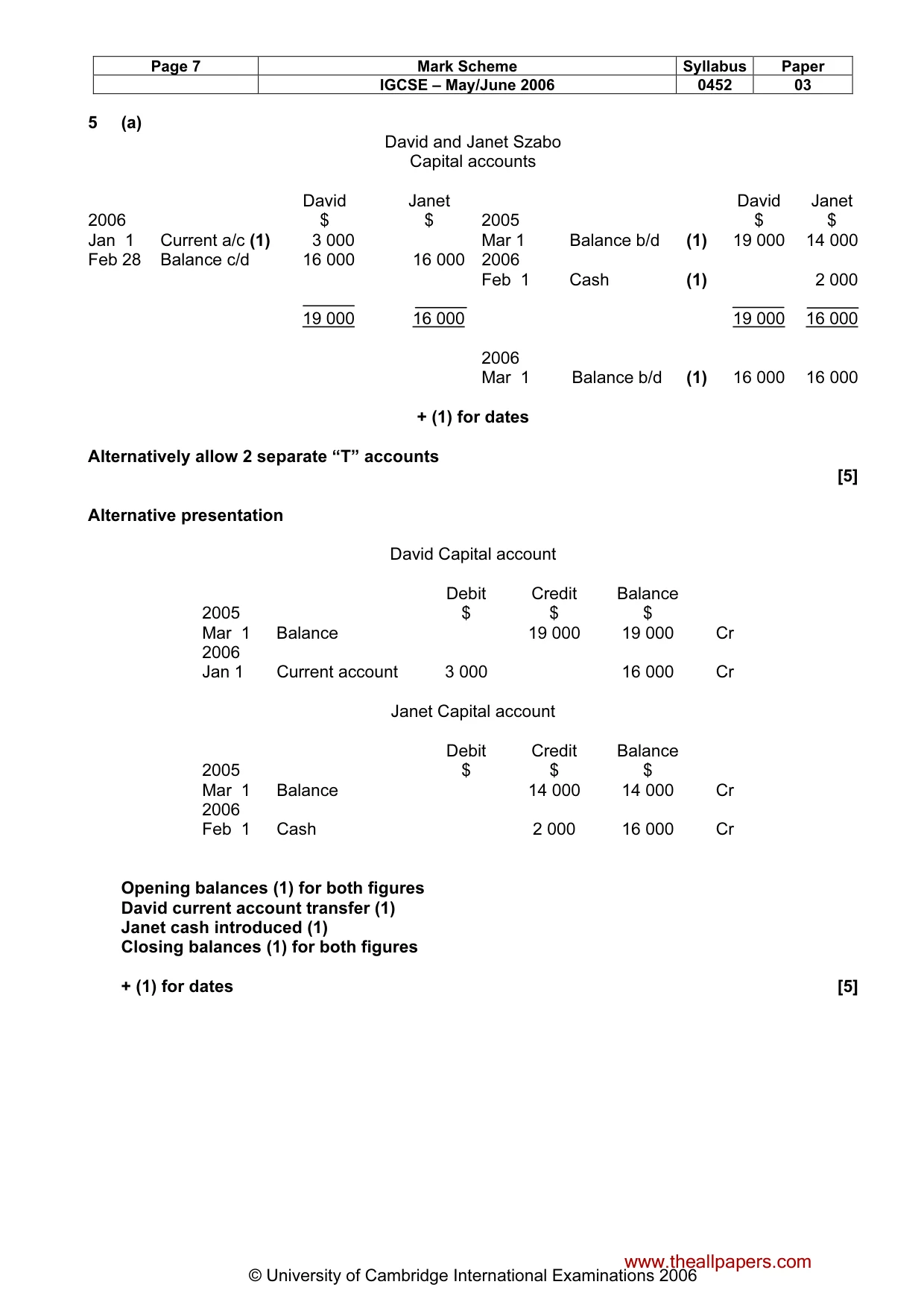
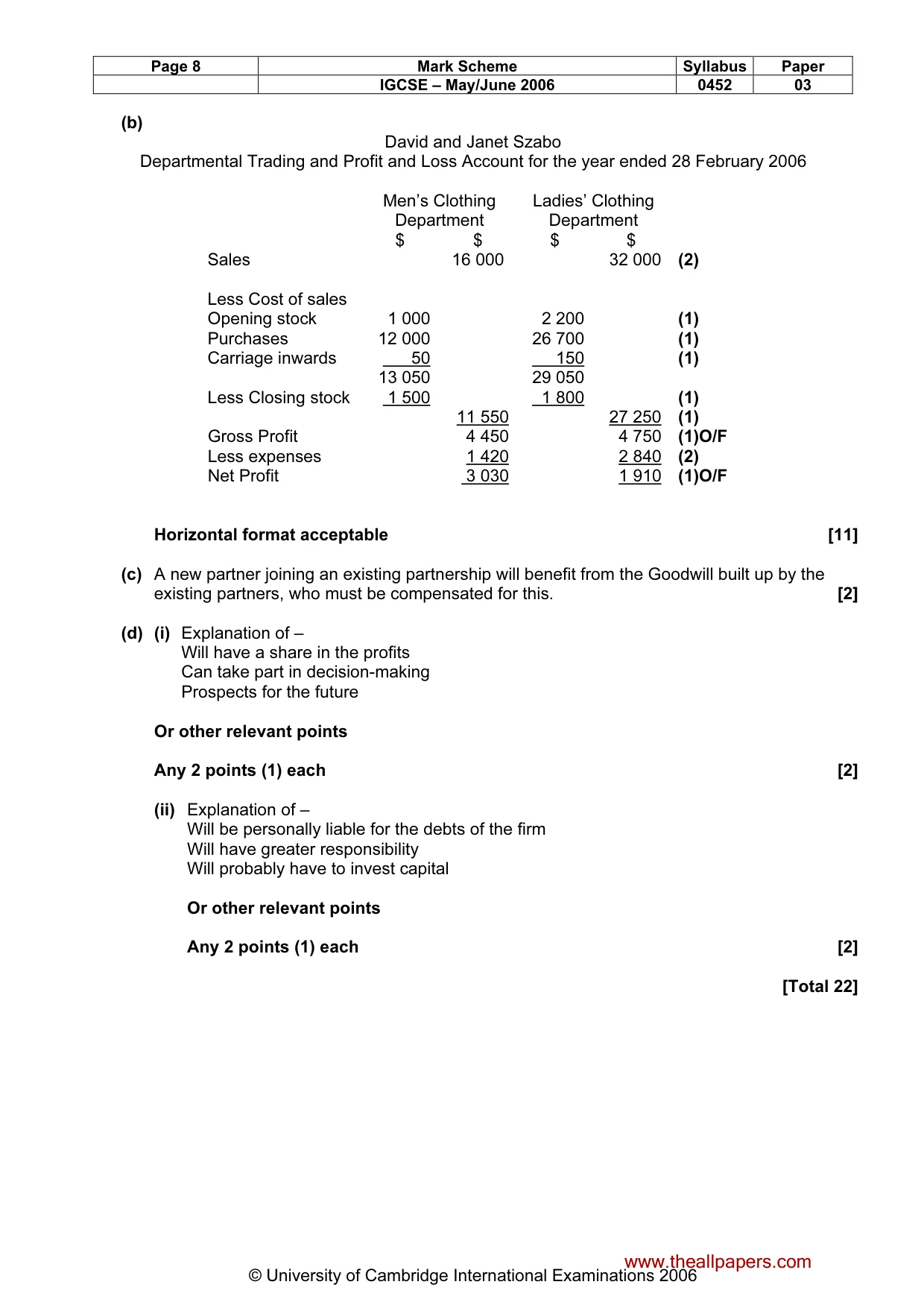
5 David and Janet Szabo are in partnership. Their financial year ends on 28 February. On 1 March 2005 the credit balances on their capital accounts were as follows: $ David Szabo 19 000 Janet Szabo 14 000 On 1 January 2006 David transferred the $3000 debit balance on his current account to his capital account. On 1 February 2006 Janet paid an amount of cash into the business so that her capital was equal to David’s. REQUIRED (a) Write up the partners’ capital accounts as they would appear in the ledger for the year ended 28 February 2006. Where traditional “T” accounts are used they should be balanced and the balances brought down on 1 March 2006. Where three column running balance accounts are used the balance column should be up-dated after each entry. [5] David and Janet Szabo own a fashion store. David manages the department dealing in men’s clothes and Janet manages the department dealing in ladies’ clothes. David suggested that it would assist in the management of the business if the results of each department were shown separately. The following information is available for the year ended 28 February 2006: Men’s Clothing Ladies’ Clothing Department Department $ $ Stock 1 March 2005 1 000 2 200 Stock 28 February 2006 1 500 1 800 Purchases 12 000 26 700 Carriage inwards 50 150 The total sales for the year were $48 000, which was split between the departments ⅓ for Men’s Clothing and ⅔ for Ladies’ Clothing. The total expenses for the year were $4260. These are apportioned between the departments in proportion to the total sales made by each department. REQUIRED (b) Prepare a columnar Trading and Profit and Loss Account for David and Janet Szabo for the year ended 28 February 2006 to show the gross profit and net profit earned by each department. Total columns are not required. David and Janet Szabo Departmental Trading and Profit and Loss Account for the year ended 28 February 2006 [11]
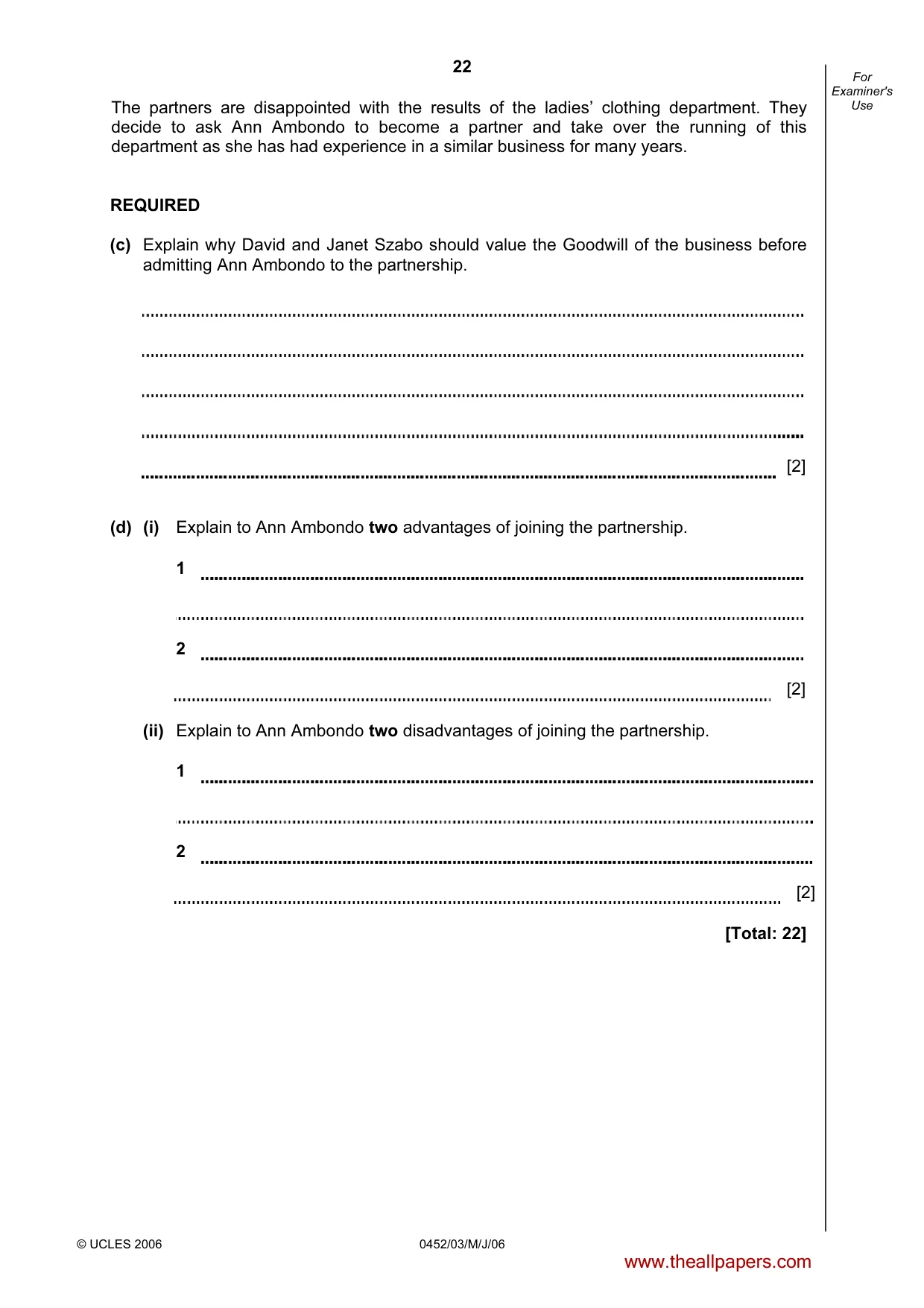
Mark scheme: 5 (a) David and Janet Szabo Capital accounts David Janet David Janet 2006 $ $ 2005 $ $ Jan 1 Current a/c (1) 3 000 Mar 1 Balance b/d (1) 19 000 14 000 Feb 28 Balance c/d 16 000 16 000 2006 Feb 1 Cash (1) 2 000 19 000 16 000 19 000 16 000 2006 Mar 1 Balance b/d (1) 16 000 16 000 + (1) for dates Alternatively allow 2 separate “T” accounts [5] Alternative presentation David Capital account Debit Credit Balance 2005 $ $ $ Mar 1 Balance 19 000 19 000 Cr 2006 Jan 1 Current account 3 000 16 000 Cr Janet Capital account Debit Credit Balance 2005 $ $ $ Mar 1 Balance 14 000 14 000 Cr 2006 Feb 1 Cash 2 000 16 000 Cr Opening balances (1) for both figures David current account transfer (1) Janet cash introduced (1) Closing balances (1) for both figures + (1) for dates [5] IGCSE – May/June 2006 www theallpapers0452 com03 (b) David and Janet Szabo Departmental Trading and Profit and Loss Account for the year ended 28 February 2006 Men’s Clothing Ladies’ Clothing Department Department $ $ $ $ Sales 16 000 32 000 (2) Less Cost of sales Opening stock 1 000 2 200 (1) Purchases 12 000 26 700 (1) Carriage inwards 50 150 (1) 13 050 29 050 Less Closing stock 1 500 1 800 (1) 11 550 27 250 (1) Gross Profit 4 450 4 750 (1)O/F Less expenses 1 420 2 840 (2) Net Profit 3 030 1 910 (1)O/F Horizontal format acceptable [11] (c) A new partner joining an existing partnership will benefit from the Goodwill built up by the existing partners, who must be compensated for this. [2] (d) (i) Explanation of – Will have a share in the profits Can take part in decision-making Prospects for the future Or other relevant points Any 2 points (1) each [2] (ii) Explanation of – Will be personally liable for the debts of the firm Will have greater responsibility Will probably have to invest capital Or other relevant points Any 2 points (1) each [2] [Total 22] www theallpapers com
What was in this paper
The subtopics covered by these 5 questions, and how many questions each got. Open one in a new tab to see every Cambridge question on it.
What you needed in this session
Cambridge’s own grade thresholds for 2006 May/June, Paper 3 · Variant 1. A higher threshold means an easier paper — the bar moves with how the cohort did.