Cambridge IGCSE Accounting 0452 — 2007 May/June Paper 3 · Variant 1
0452/31/M/J/07 · 5 questions · 100 marks · ≈113 min
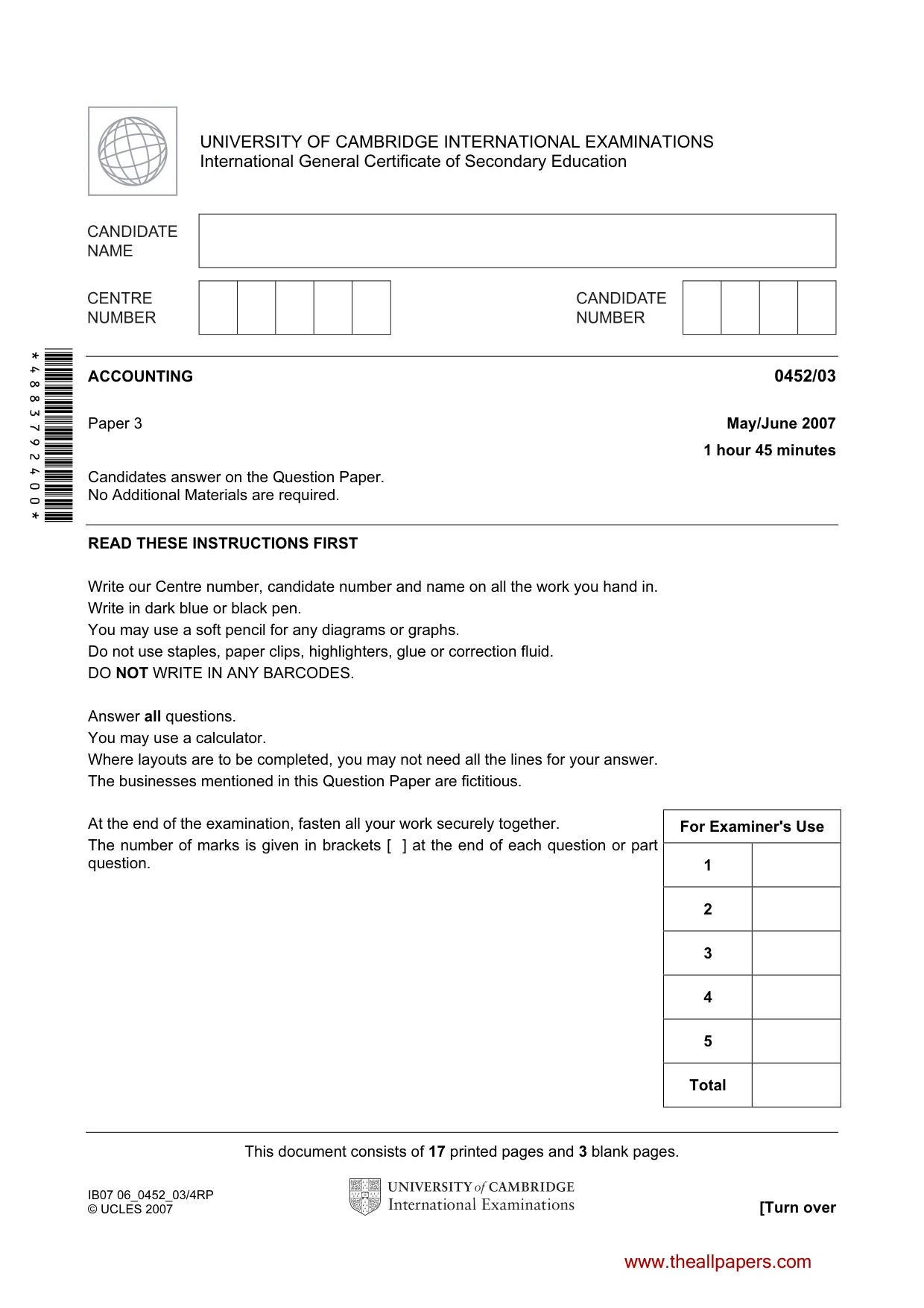
The question paper and its mark scheme, free to read here and free to download. This is Cambridge’s own paper, exactly as it was sat.
Question paper20 pages




Mark scheme10 pages
Answers below. Sit the paper first if you are practising.
Questions as text
Q1 · Shilpa Bassra is a trader who keeps a full set of accounting records
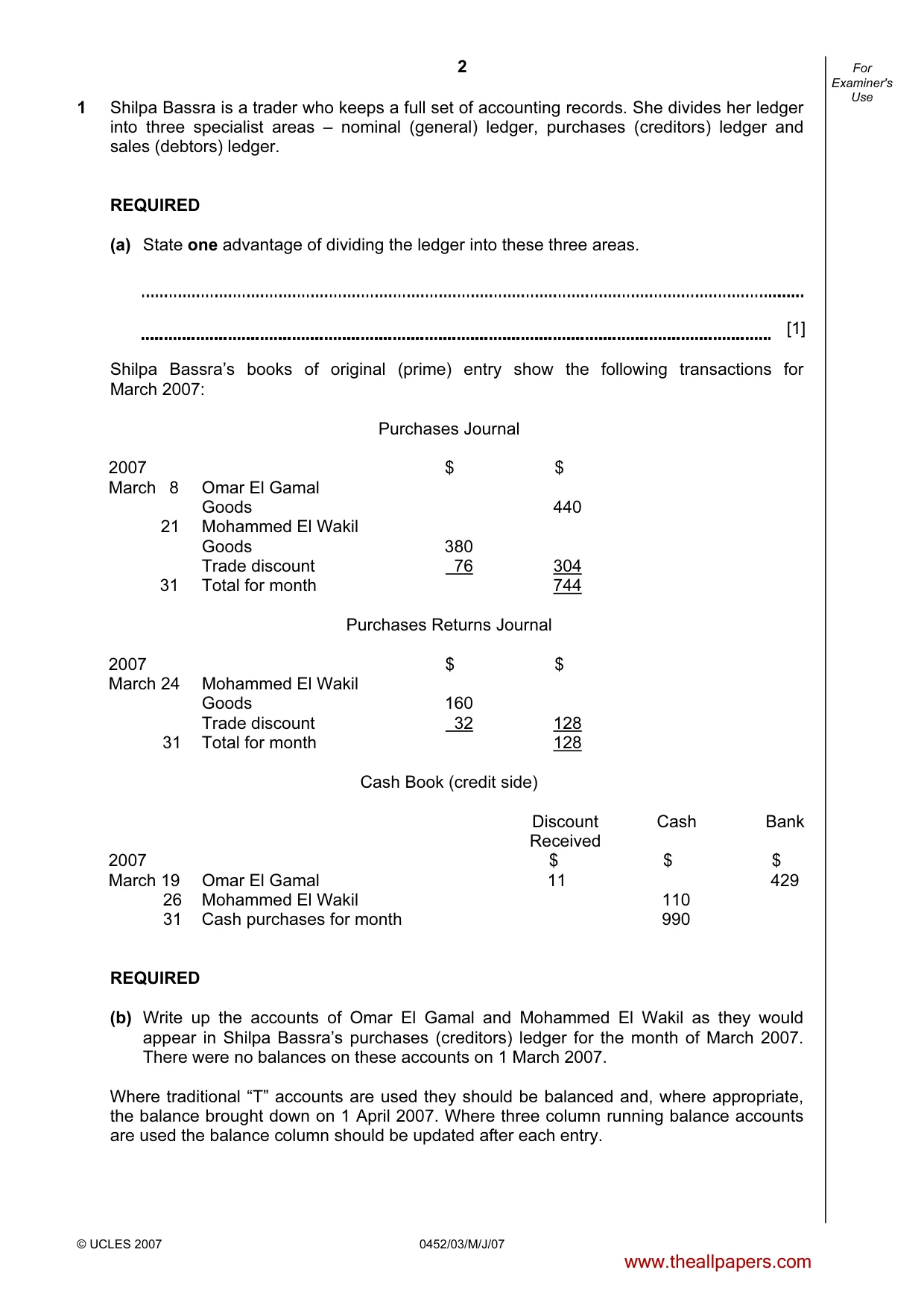
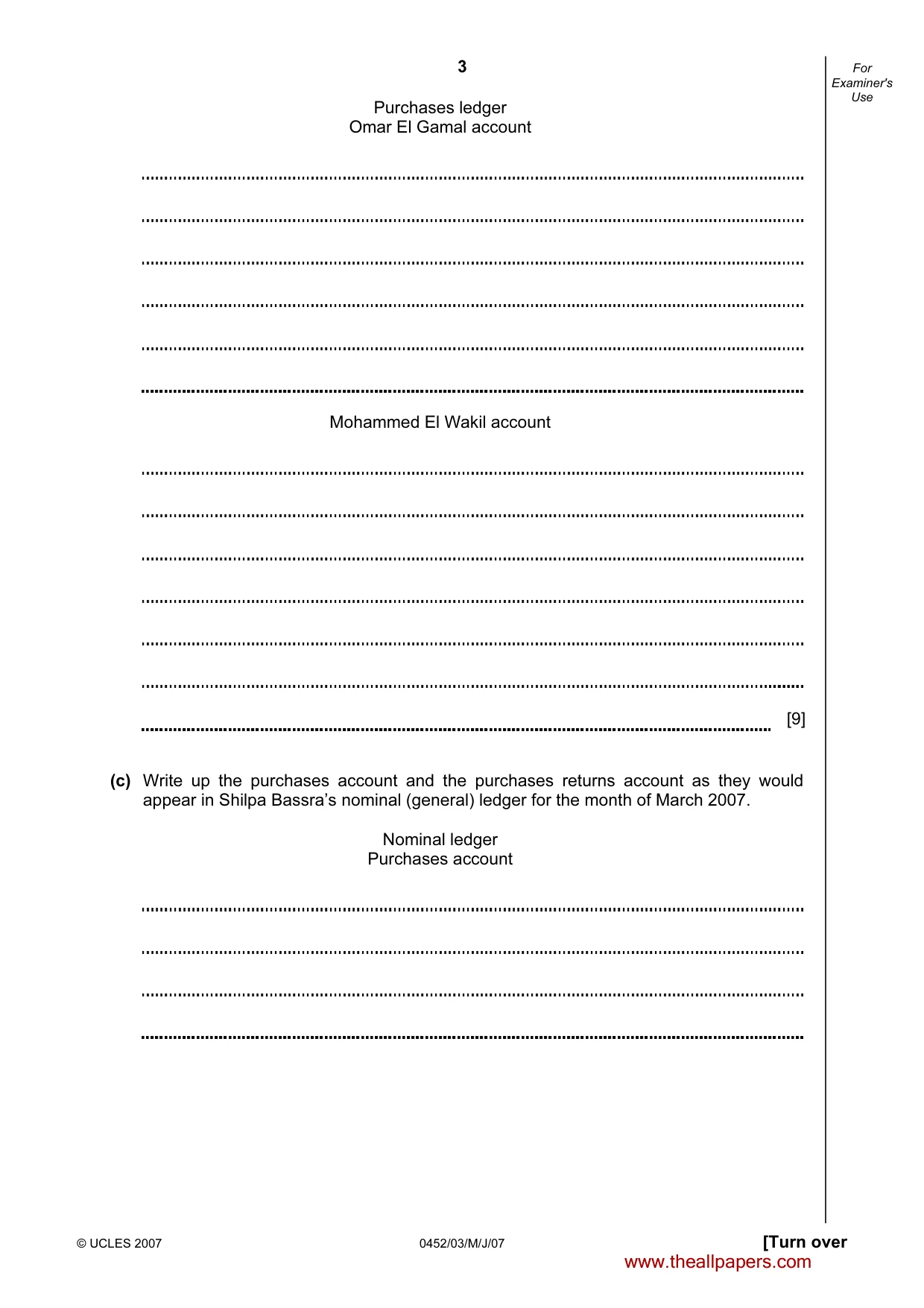
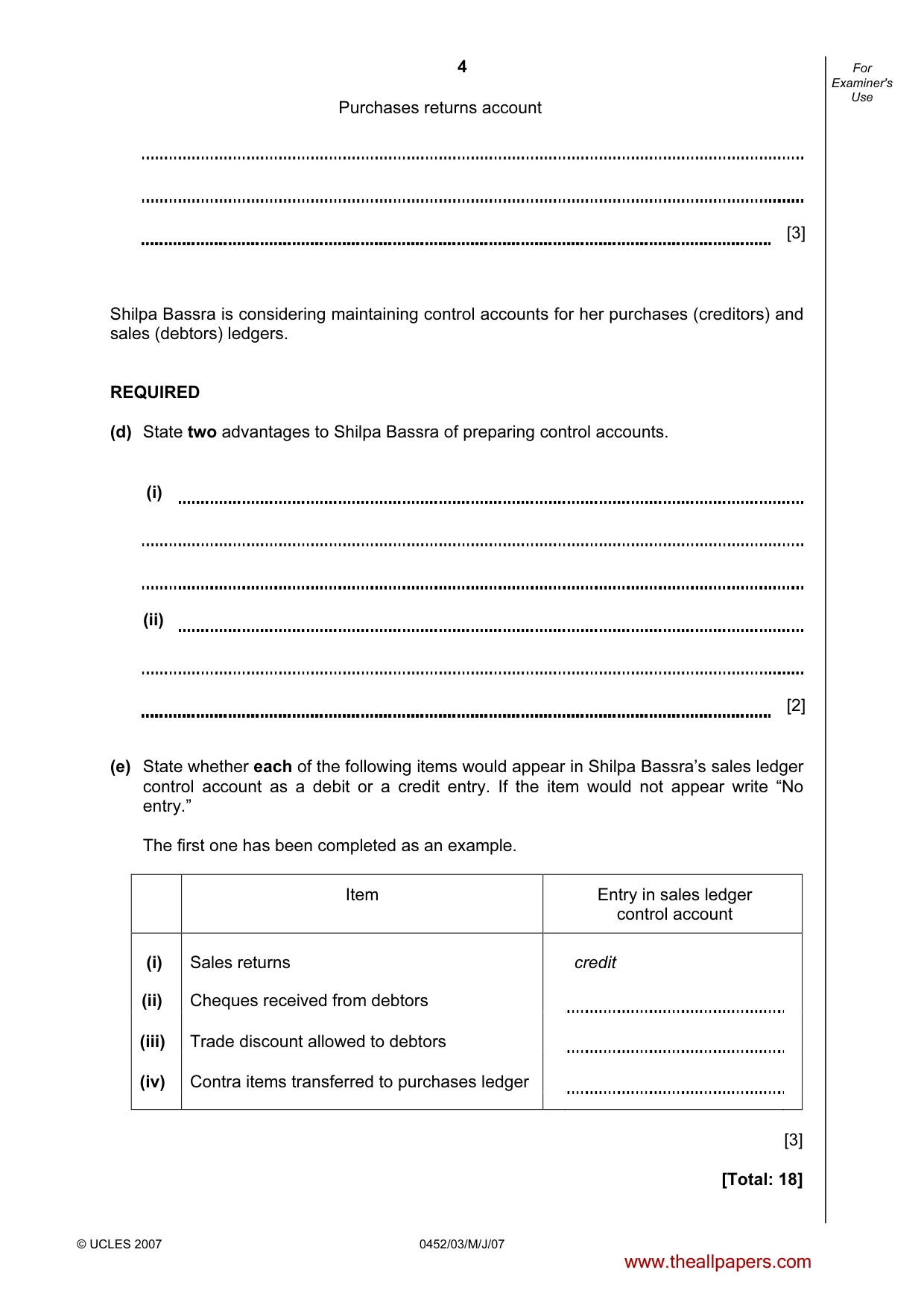
1 Shilpa Bassra is a trader who keeps a full set of accounting records. She divides her ledger into three specialist areas – nominal (general) ledger, purchases (creditors) ledger and sales (debtors) ledger. REQUIRED (a) State one advantage of dividing the ledger into these three areas. [1] Shilpa Bassra’s books of original (prime) entry show the following transactions for March 2007: Purchases Journal 2007 $ $ March 8 Omar El Gamal Goods 440 21 Mohammed El Wakil Goods 380 Trade discount 76 304 31 Total for month 744 Purchases Returns Journal 2007 $ $ March 24 Mohammed El Wakil Goods 160 Trade discount 32 128 31 Total for month 128 Cash Book (credit side) Discount Cash Bank Received 2007 $ $ $ March 19 Omar El Gamal 11 429 26 Mohammed El Wakil 110 31 Cash purchases for month 990 REQUIRED (b) Write up the accounts of Omar El Gamal and Mohammed El Wakil as they would appear in Shilpa Bassra’s purchases (creditors) ledger for the month of March 2007. There were no balances on these accounts on 1 March 2007. Where traditional “T” accounts are used they should be balanced and, where appropriate, the balance brought down on 1 April 2007. Where three column running balance accounts are used the balance column should be updated after each entry. Purchases ledger Omar El Gamal account Mohammed El Wakil account [9] (c) Write up the purchases account and the purchases returns account as they would appear in Shilpa Bassra’s nominal (general) ledger for the month of March 2007. Nominal ledger Purchases account Purchases returns account [3] Shilpa Bassra is considering maintaining control accounts for her purchases (creditors) and sales (debtors) ledgers. REQUIRED (d) State two advantages to Shilpa Bassra of preparing control accounts. (i) (ii) [2] (e) State whether each of the following items would appear in Shilpa Bassra’s sales ledger control account as a debit or a credit entry. If the item would not appear write “No entry.” The first one has been completed as an example. Item Entry in sales ledger control account (i) Sales returns credit (ii) Cheques received from debtors (iii) Trade discount allowed to debtors (iv) Contra items transferred to purchases ledger [3] [Total: 18]
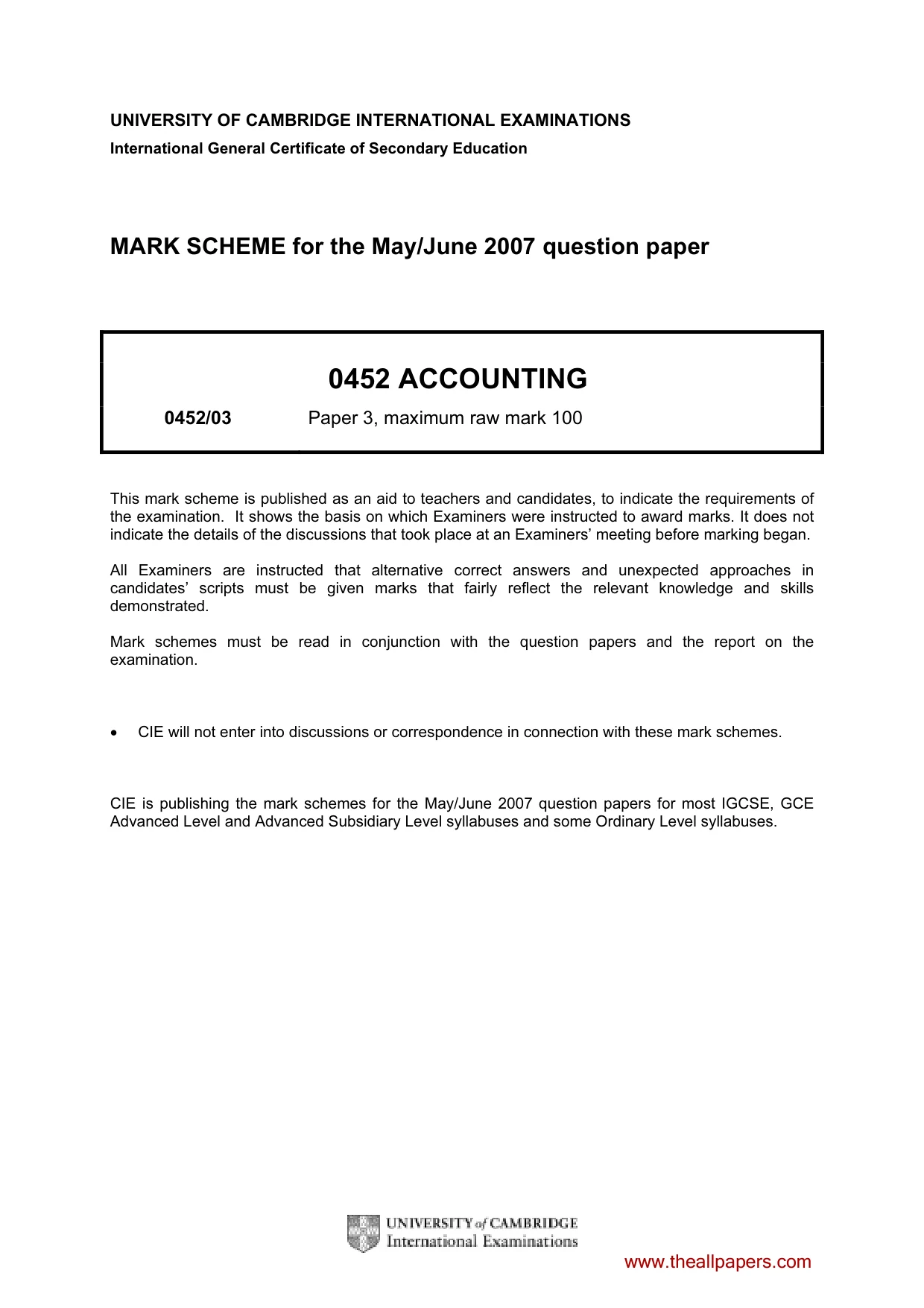
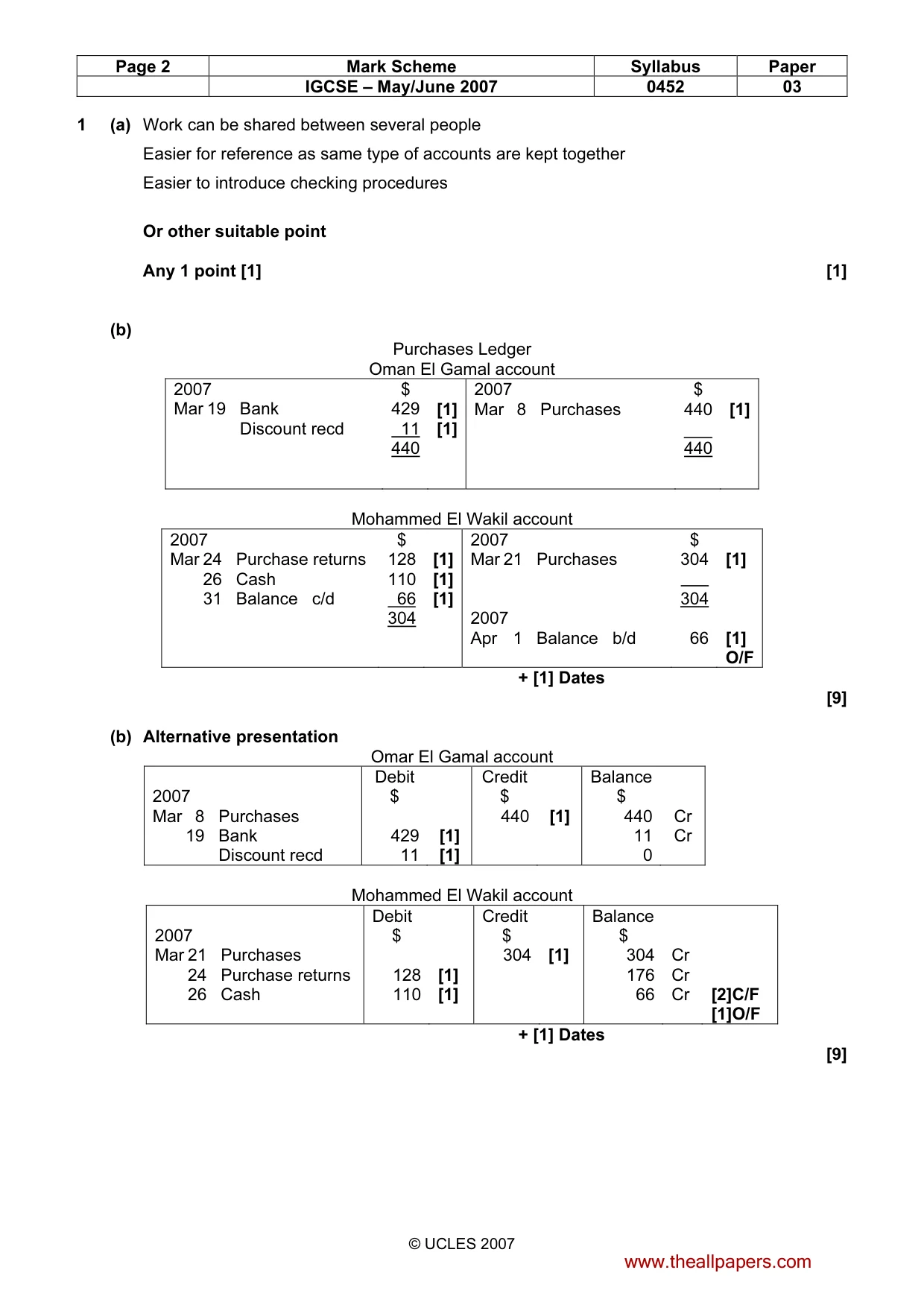
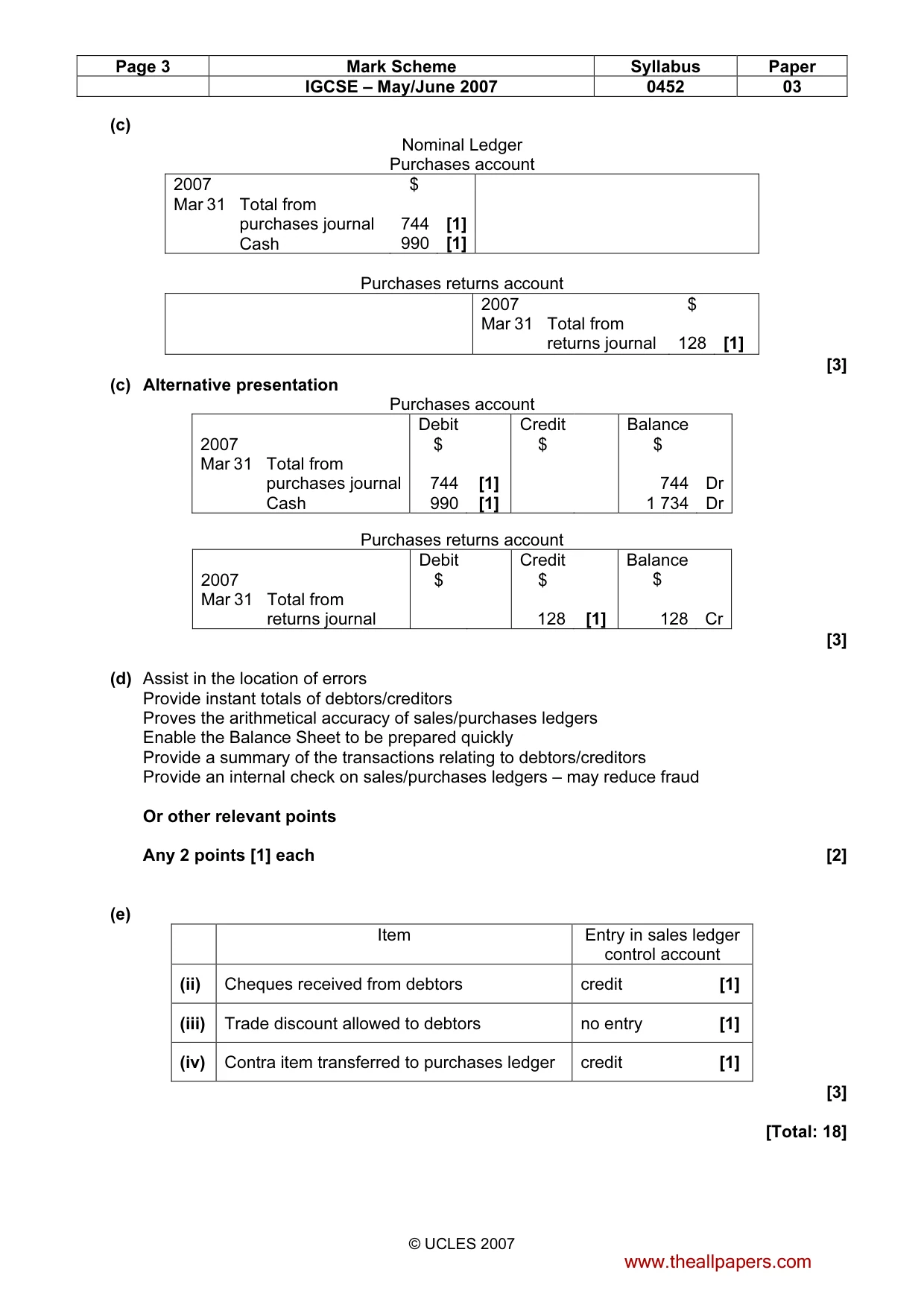
Mark scheme: 1 (a) Work can be shared between several people Easier for reference as same type of accounts are kept together Easier to introduce checking procedures Or other suitable point Any 1 point [1] [1] (b) Purchases Ledger Oman El Gamal account 2007 $ 2007 $ Mar 19 Bank 429 [1] Mar 8 Purchases 440 [1] Discount recd 11 [1] 440 440 Mohammed El Wakil account 2007 $ 2007 $ Mar 24 Purchase returns 128 [1] Mar 21 Purchases 304 [1] 26 Cash 110 [1] 31 Balance c/d 66 [1] 304 304 2007 Apr 1 Balance b/d 66 [1] O/F + [1] Dates [9] (b) Alternative presentation Omar El Gamal account Debit Credit Balance 2007 $ $ $ Mar 8 Purchases 440 [1] 440 Cr 19 Bank 429 [1] 11 Cr Discount recd 11 [1] 0 Mohammed El Wakil account Debit Credit Balance 2007 $ $ $ Mar 21 Purchases 304 [1] 304 Cr 24 Purchase returns 128 [1] 176 Cr 26 Cash 110 [1] 66 Cr [2]C/F [1]O/F + [1] Dates [9] IGCSE – May/June 2007 0452 03 (c) Nominal Ledger Purchases account 2007 $ Mar 31 Total from purchases journal 744 [1] Cash 990 [1] Purchases returns account 2007 $ Mar 31 Total from returns journal 128 [1] [3] (c) Alternative presentation Purchases account Debit Credit Balance 2007 $ $ $ Mar 31 Total from purchases journal 744 [1] 744 Dr Cash 990 [1] 1 734 Dr Purchases returns account Debit Credit Balance 2007 $ $ $ Mar 31 Total from returns journal 128 [1] 128 Cr [3] (d) Assist in the location of errors Provide instant totals of debtors/creditors Proves the arithmetical accuracy of sales/purchases ledgers Enable the Balance Sheet to be prepared quickly Provide a summary of the transactions relating to debtors/creditors Provide an internal check on sales/purchases ledgers – may reduce fraud Or other relevant points Any 2 points [1] each [2] (e) Item Entry in sales ledger control account (ii) Cheques received from debtors credit [1] (iii) Trade discount allowed to debtors no entry [1] (iv) Contra item transferred to purchases ledger credit [1] [3] [Total: 18] IGCSE – May/June 2007 0452 03
Q2 · James Kanu is a trader who sells goods on credit
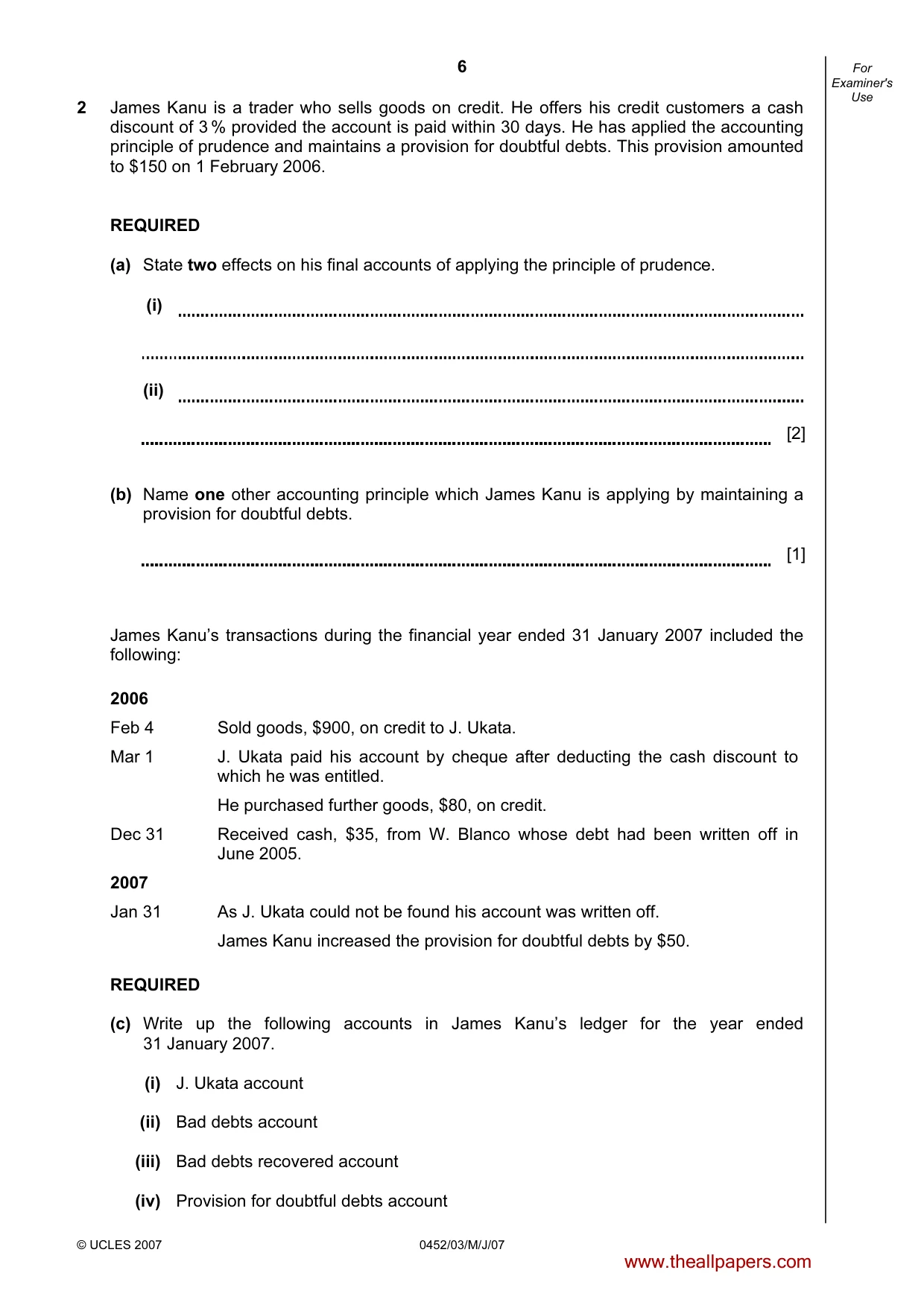
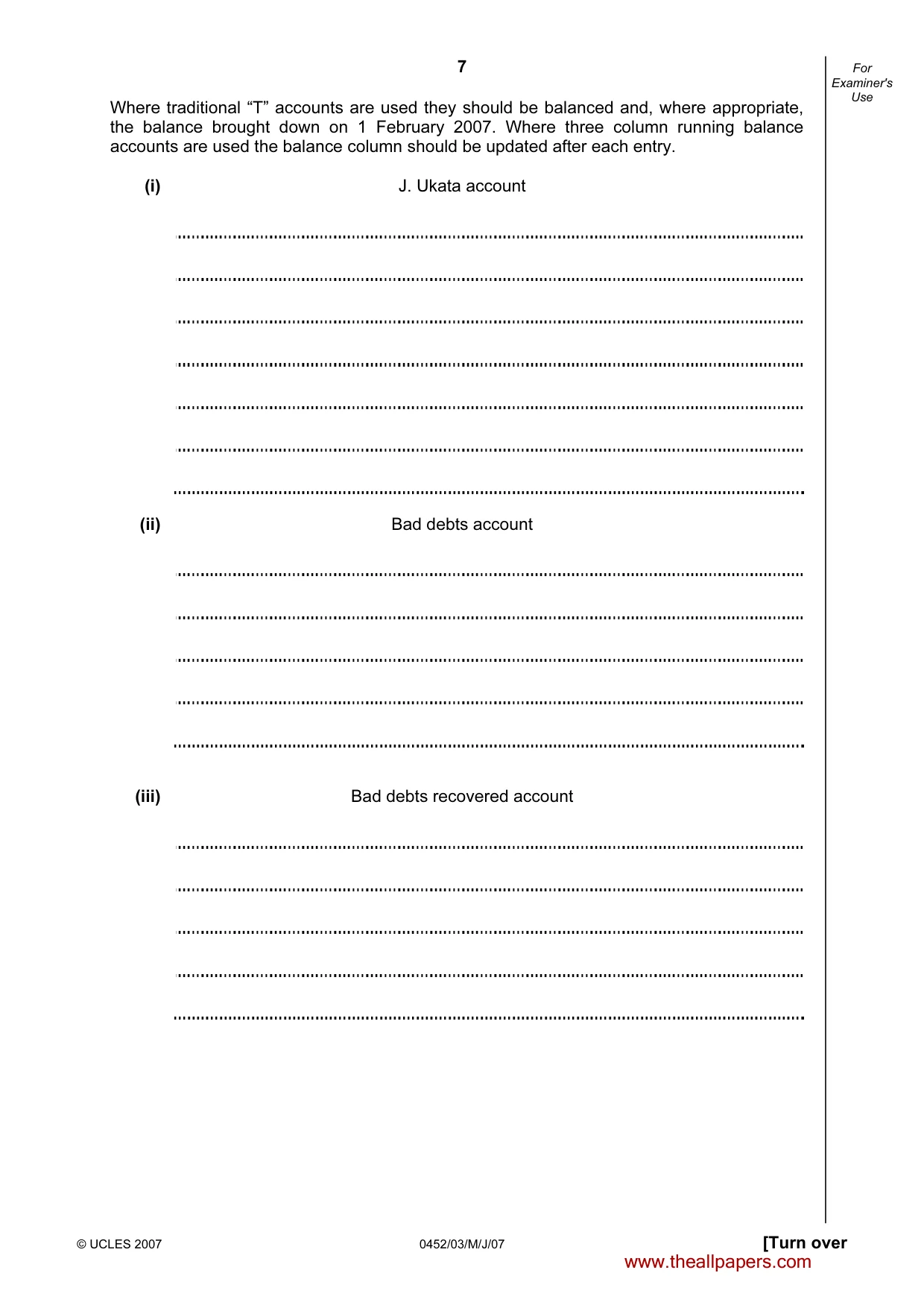
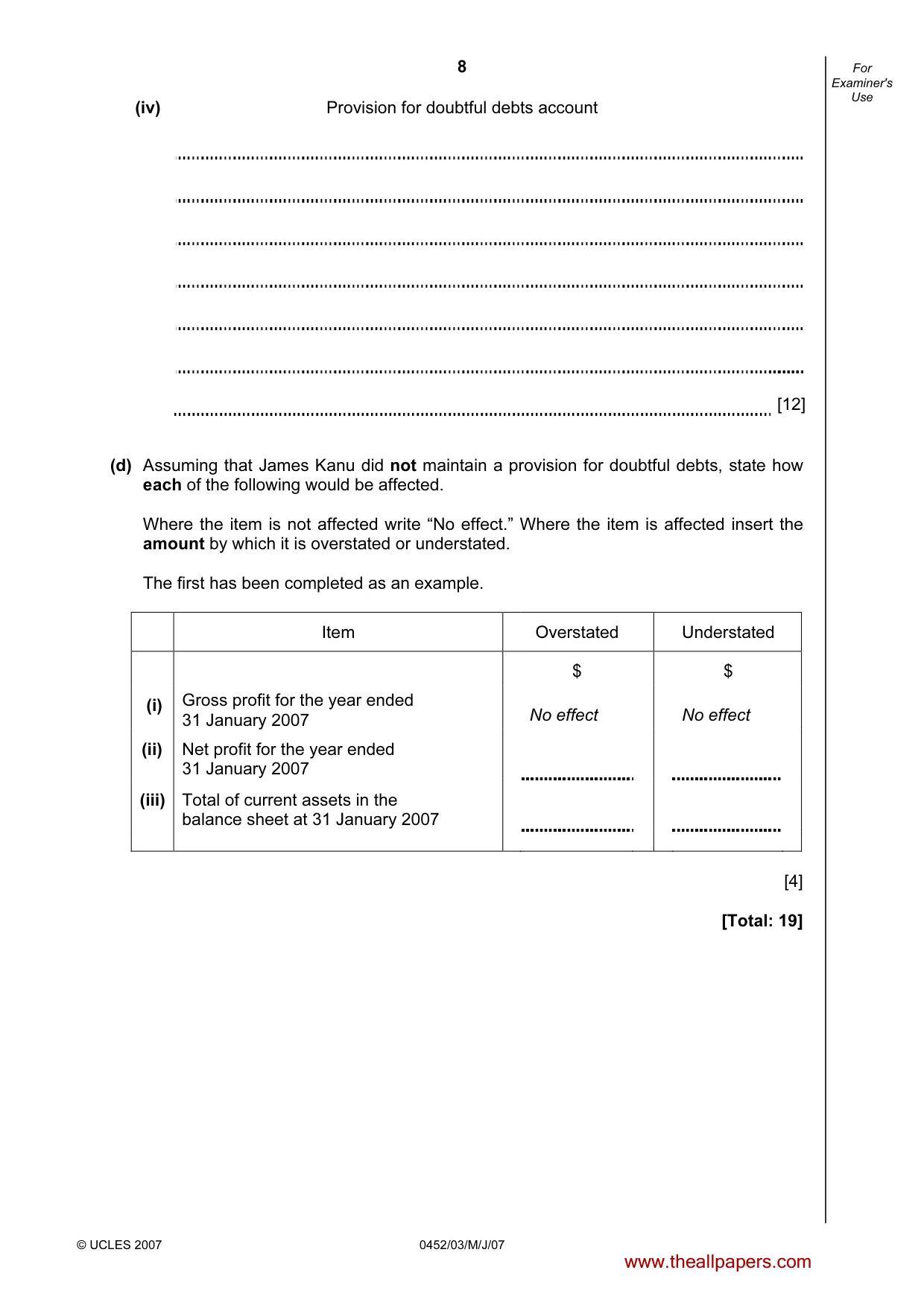
2 James Kanu is a trader who sells goods on credit. He offers his credit customers a cash discount of 3 % provided the account is paid within 30 days. He has applied the accounting principle of prudence and maintains a provision for doubtful debts. This provision amounted to $150 on 1 February 2006. REQUIRED (a) State two effects on his final accounts of applying the principle of prudence. (i) (ii) [2] (b) Name one other accounting principle which James Kanu is applying by maintaining a provision for doubtful debts. [1] James Kanu’s transactions during the financial year ended 31 January 2007 included the following: 2006 Feb 4 Sold goods, $900, on credit to J. Ukata. Mar 1 J. Ukata paid his account by cheque after deducting the cash discount to which he was entitled. He purchased further goods, $80, on credit. Dec 31 Received cash, $35, from W. Blanco whose debt had been written off in June 2005. 2007 Jan 31 As J. Ukata could not be found his account was written off. James Kanu increased the provision for doubtful debts by $50. REQUIRED (c) Write up the following accounts in James Kanu’s ledger for the year ended 31 January 2007. (i) J. Ukata account (ii) Bad debts account (iii) Bad debts recovered account (iv) Provision for doubtful debts account Where traditional “T” accounts are used they should be balanced and, where appropriate, the balance brought down on 1 February 2007. Where three column running balance accounts are used the balance column should be updated after each entry. (i) J. Ukata account (ii) Bad debts account (iii) Bad debts recovered account (iv) Provision for doubtful debts account [12] (d) Assuming that James Kanu did not maintain a provision for doubtful debts, state how each of the following would be affected. Where the item is not affected write “No effect.” Where the item is affected insert the amount by which it is overstated or understated. The first has been completed as an example. Item Overstated Understated $ $ (i) Gross profit for the year ended No effect No effect 31 January 2007 (ii) Net profit for the year ended 31 January 2007 (iii) Total of current assets in the balance sheet at 31 January 2007 [4] [Total: 19]
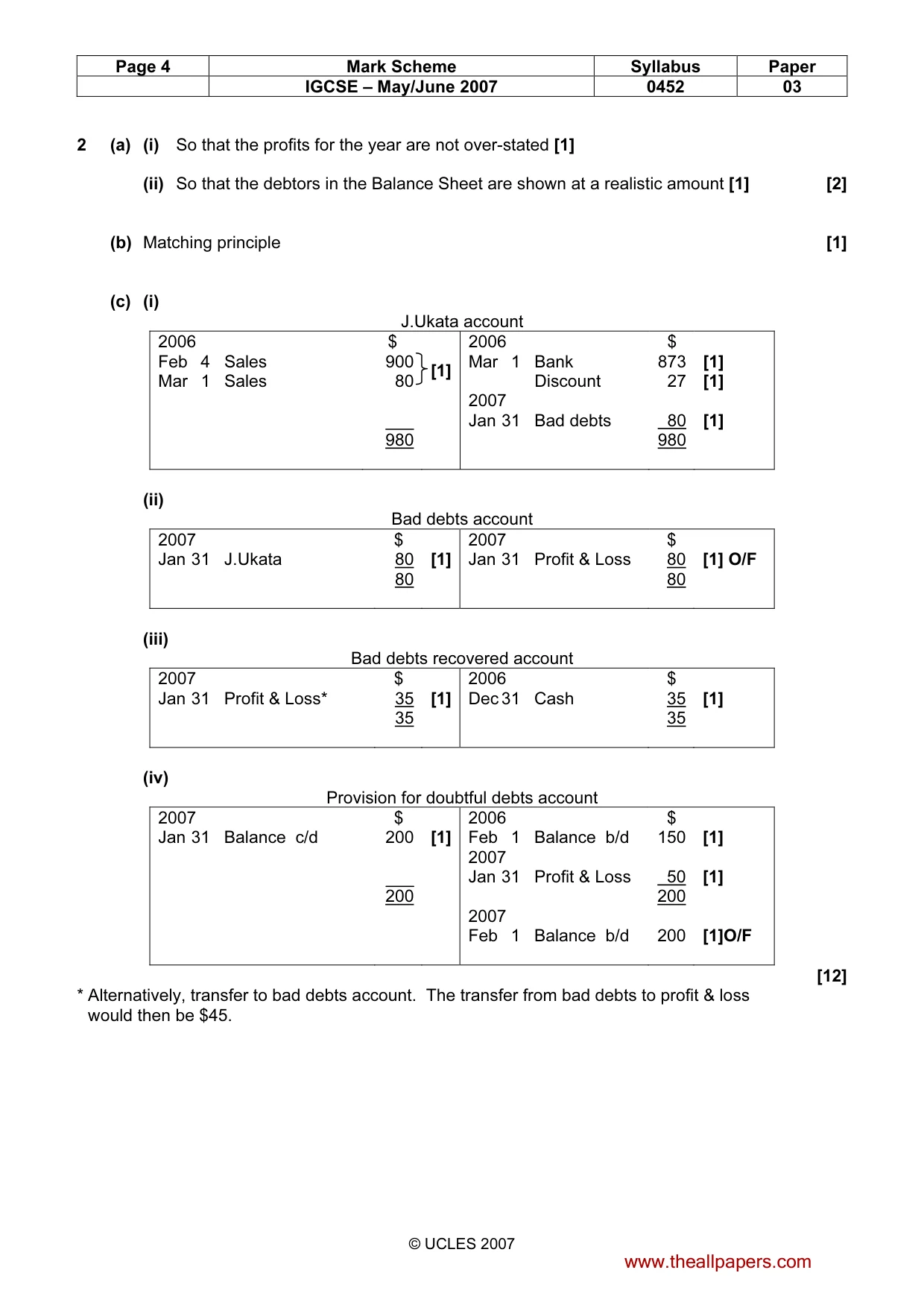
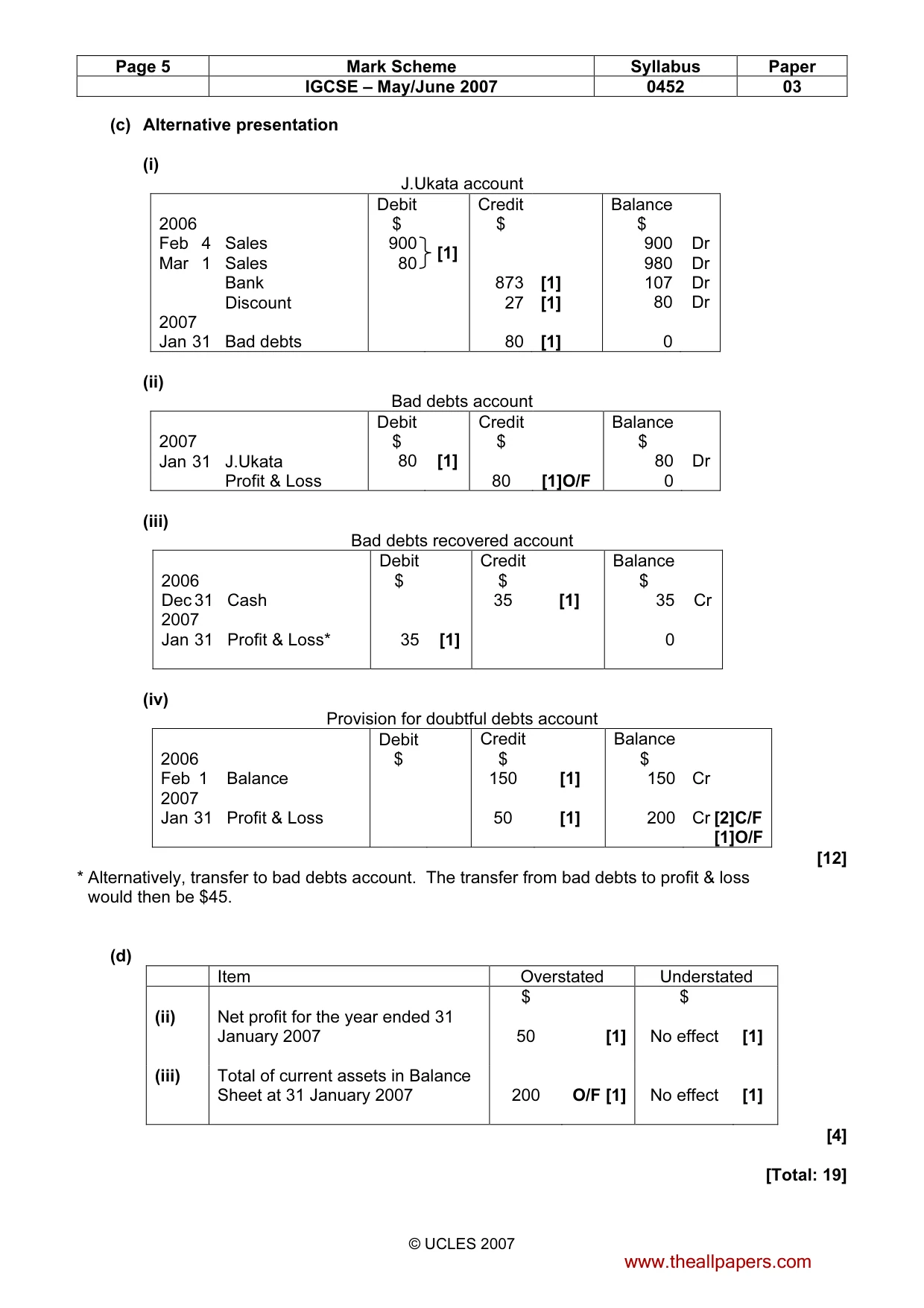
Mark scheme: 2 (a) (i) So that the profits for the year are not over-stated [1] (ii) So that the debtors in the Balance Sheet are shown at a realistic amount [1] [2] (b) Matching principle [1] (c) (i) J.Ukata account 2006 $ 2006 $ Feb 4 Sales 900 Mar 1 Bank 873 [1] [1] Mar 1 Sales 80 Discount 27 [1] 2007 Jan 31 Bad debts 80 [1] 980 980 (ii) Bad debts account 2007 $ 2007 $ Jan 31 J.Ukata 80 [1] Jan 31 Profit & Loss 80 [1] O/F 80 80 (iii) Bad debts recovered account 2007 $ 2006 $ Jan 31 Profit & Loss* 35 [1] Dec 31 Cash 35 [1] 35 35 (iv) Provision for doubtful debts account 2007 $ 2006 $ Jan 31 Balance c/d 200 [1] Feb 1 Balance b/d 150 [1] 2007 Jan 31 Profit & Loss 50 [1] 200 200 2007 Feb 1 Balance b/d 200 [1]O/F [12] * Alternatively, transfer to bad debts account. The transfer from bad debts to profit & loss would then be $45. IGCSE – May/June 2007 0452 03 (c) Alternative presentation (i) J.Ukata account Debit Credit Balance 2006 $ $ $ Feb 4 Sales 900 900 Dr [1] Mar 1 Sales 80 980 Dr Bank 873 [1] 107 Dr Discount 27 [1] 80 Dr 2007 Jan 31 Bad debts 80 [1] 0 (ii) Bad debts account Debit Credit Balance 2007 $ $ $ Jan 31 J.Ukata 80 [1] 80 Dr Profit & Loss 80 [1]O/F 0 (iii) Bad debts recovered account Debit Credit Balance 2006 $ $ $ Dec 31 Cash 35 [1] 35 Cr 2007 Jan 31 Profit & Loss* 35 [1] 0 (iv) Provision for doubtful debts account Debit Credit Balance 2006 $ $ $ Feb 1 Balance 150 [1] 150 Cr 2007 Jan 31 Profit & Loss 50 [1] 200 Cr [2]C/F [1]O/F [12] * Alternatively, transfer to bad debts account. The transfer from bad debts to profit & loss would then be $45. (d) Item Overstated Understated $ $ (ii) Net profit for the year ended 31 January 2007 50 [1] No effect [1] (iii) Total of current assets in Balance Sheet at 31 January 2007 200 O/F [1] No effect [1] [4] [Total: 19] IGCSE – May/June 2007 0452 03
More questions on Irrecoverable debts and allowance for irrecoverable debts
Q3 · Jamil and Sara Suliman are in partnership
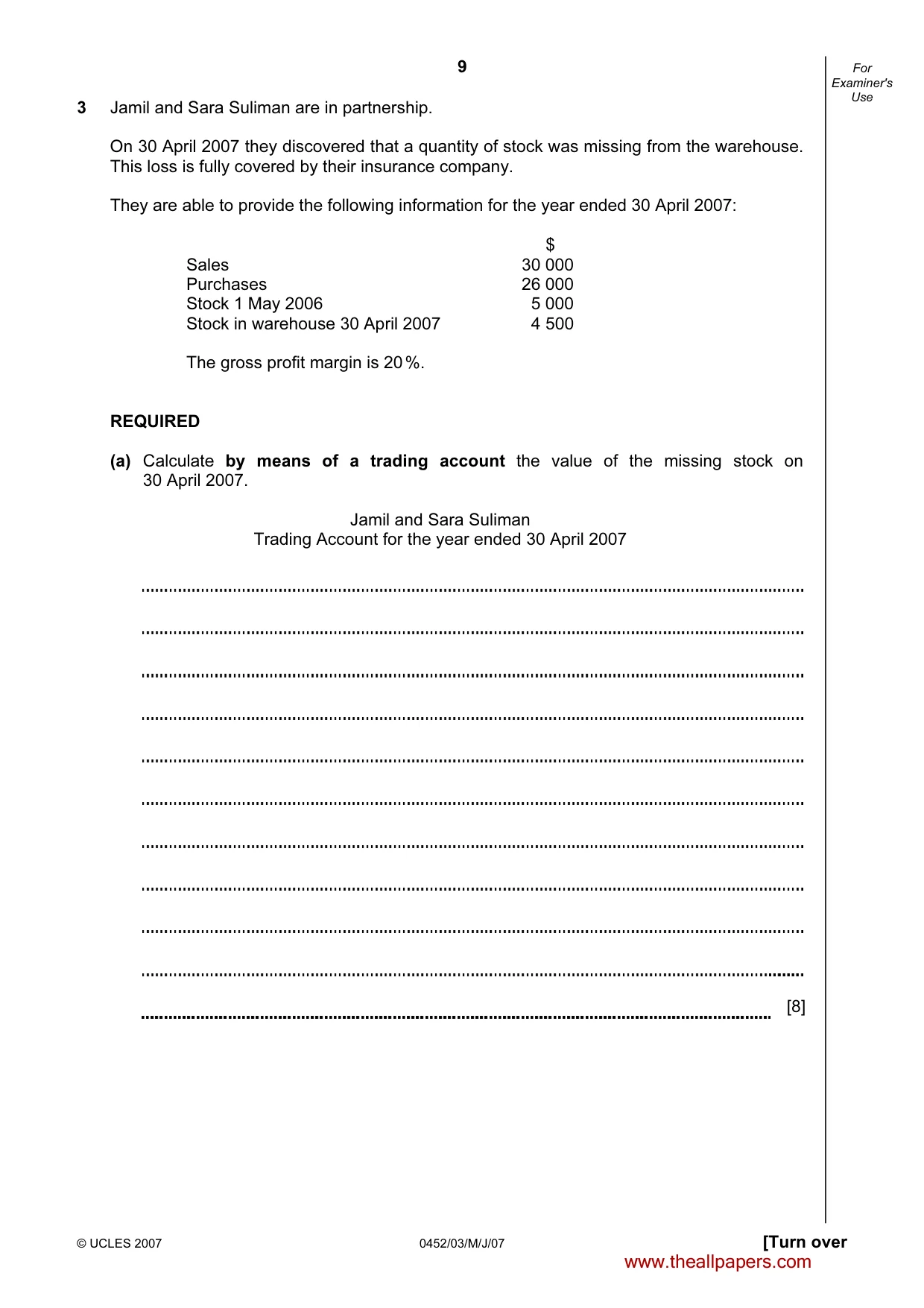
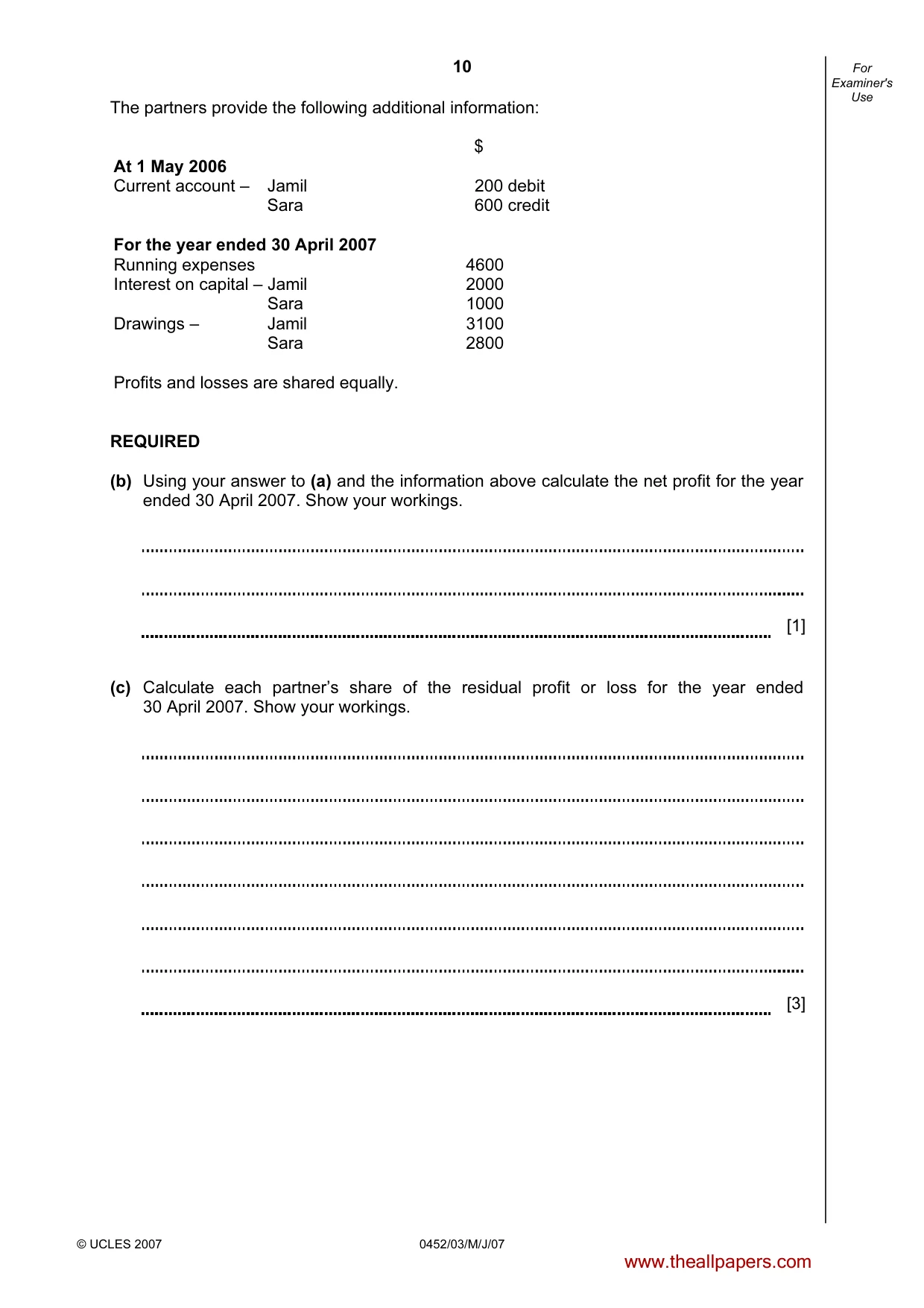
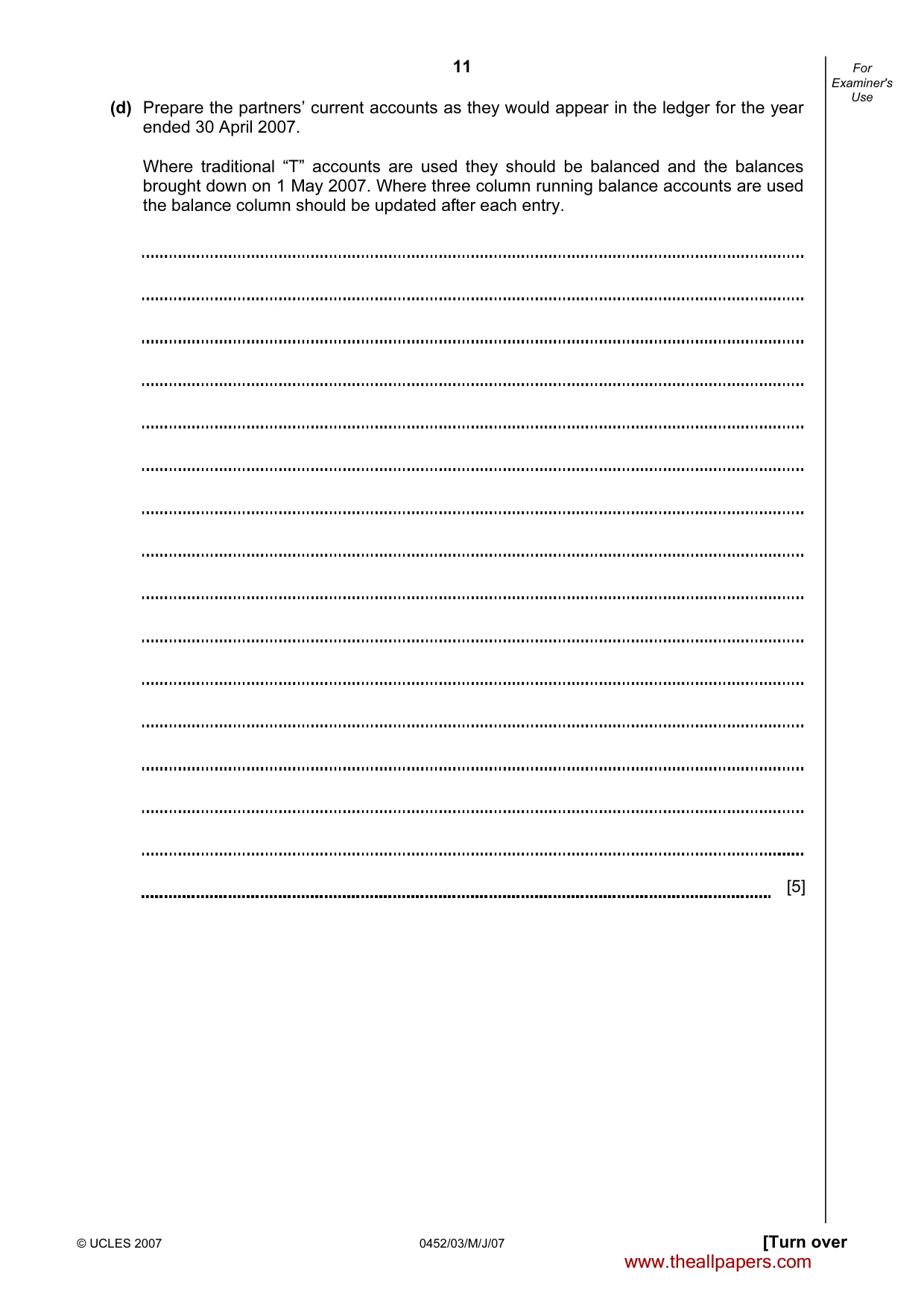
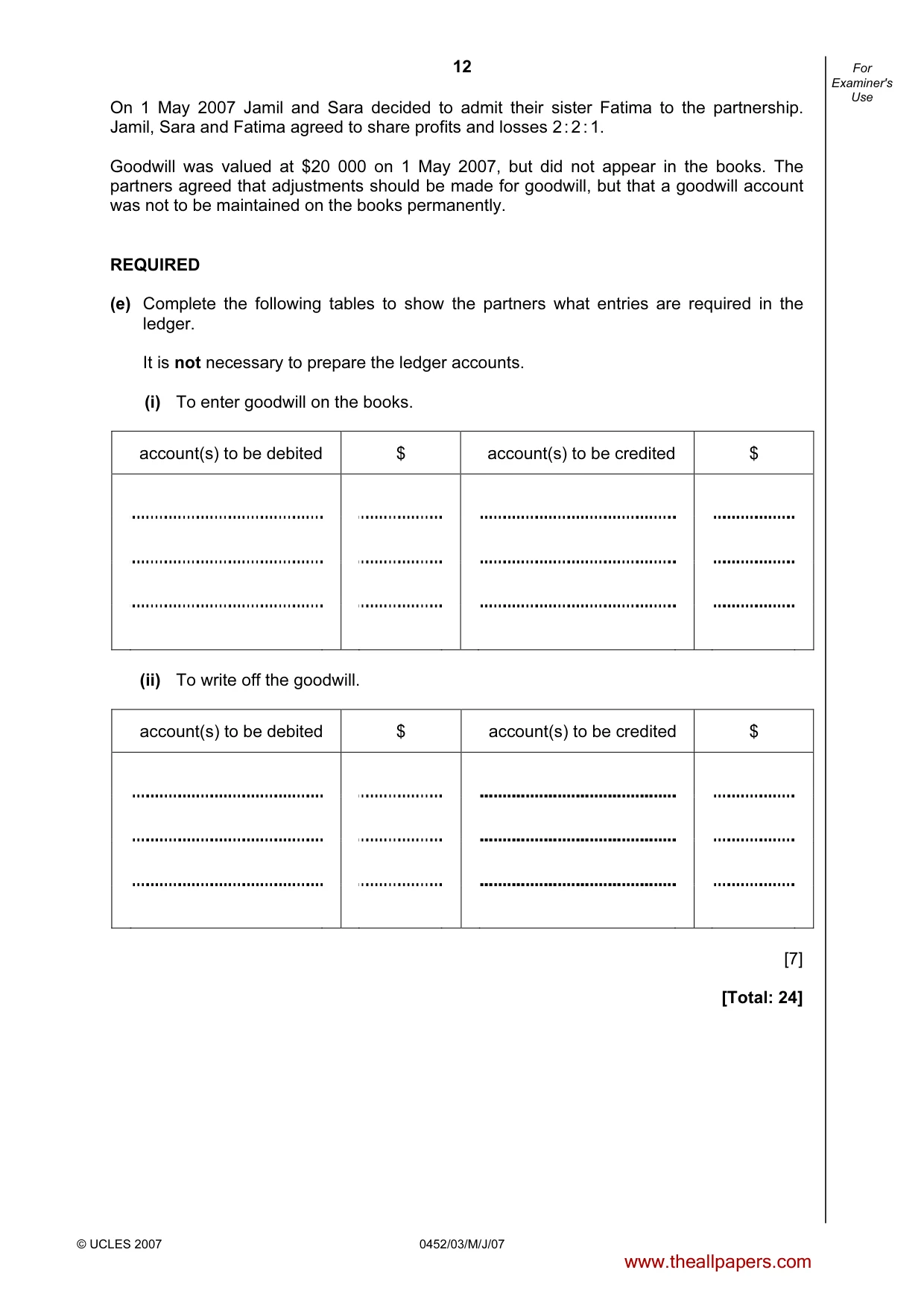
3 Jamil and Sara Suliman are in partnership. On 30 April 2007 they discovered that a quantity of stock was missing from the warehouse. This loss is fully covered by their insurance company. They are able to provide the following information for the year ended 30 April 2007: $ Sales 30 000 Purchases 26 000 Stock 1 May 2006 5 000 Stock in warehouse 30 April 2007 4 500 The gross profit margin is 20 %. REQUIRED (a) Calculate by means of a trading account the value of the missing stock on 30 April 2007. Jamil and Sara Suliman Trading Account for the year ended 30 April 2007 [8] The partners provide the following additional information: $ At 1 May 2006 Current account – Jamil 200 debit Sara 600 credit For the year ended 30 April 2007 Running expenses 4600 Interest on capital – Jamil 2000 Sara 1000 Drawings – Jamil 3100 Sara 2800 Profits and losses are shared equally. REQUIRED (b) Using your answer to (a) and the information above calculate the net profit for the year ended 30 April 2007. Show your workings. [1] (c) Calculate each partner’s share of the residual profit or loss for the year ended 30 April 2007. Show your workings. [3] (d) Prepare the partners’ current accounts as they would appear in the ledger for the year ended 30 April 2007. Where traditional “T” accounts are used they should be balanced and the balances brought down on 1 May 2007. Where three column running balance accounts are used the balance column should be updated after each entry. [5] On 1 May 2007 Jamil and Sara decided to admit their sister Fatima to the partnership. Jamil, Sara and Fatima agreed to share profits and losses 2 : 2 : 1. Goodwill was valued at $20 000 on 1 May 2007, but did not appear in the books. The partners agreed that adjustments should be made for goodwill, but that a goodwill account was not to be maintained on the books permanently. REQUIRED (e) Complete the following tables to show the partners what entries are required in the ledger. It is not necessary to prepare the ledger accounts. (i) To enter goodwill on the books. account(s) to be debited $ account(s) to be credited $ (ii) To write off the goodwill. account(s) to be debited $ account(s) to be credited $ [7] [Total: 24]
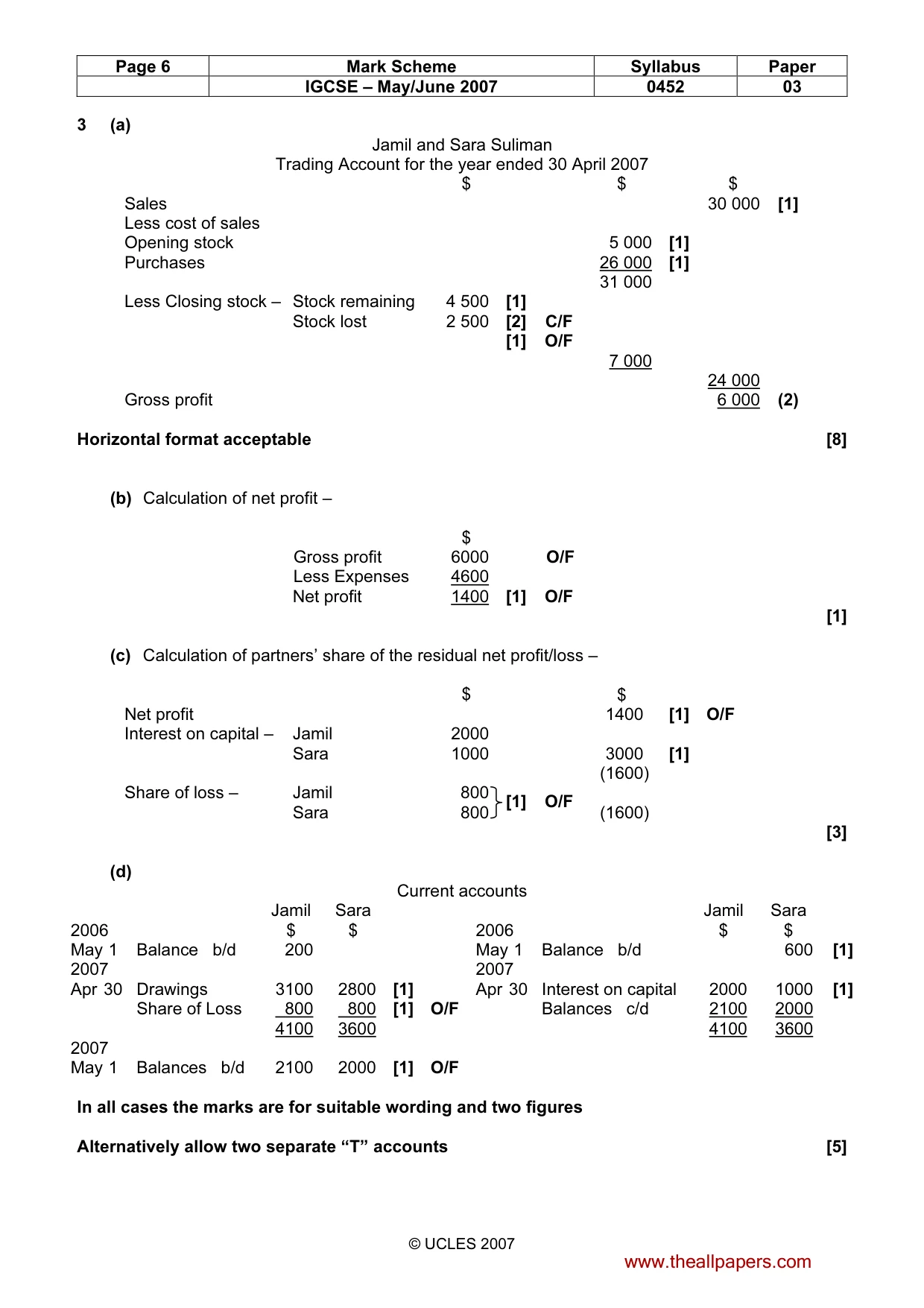
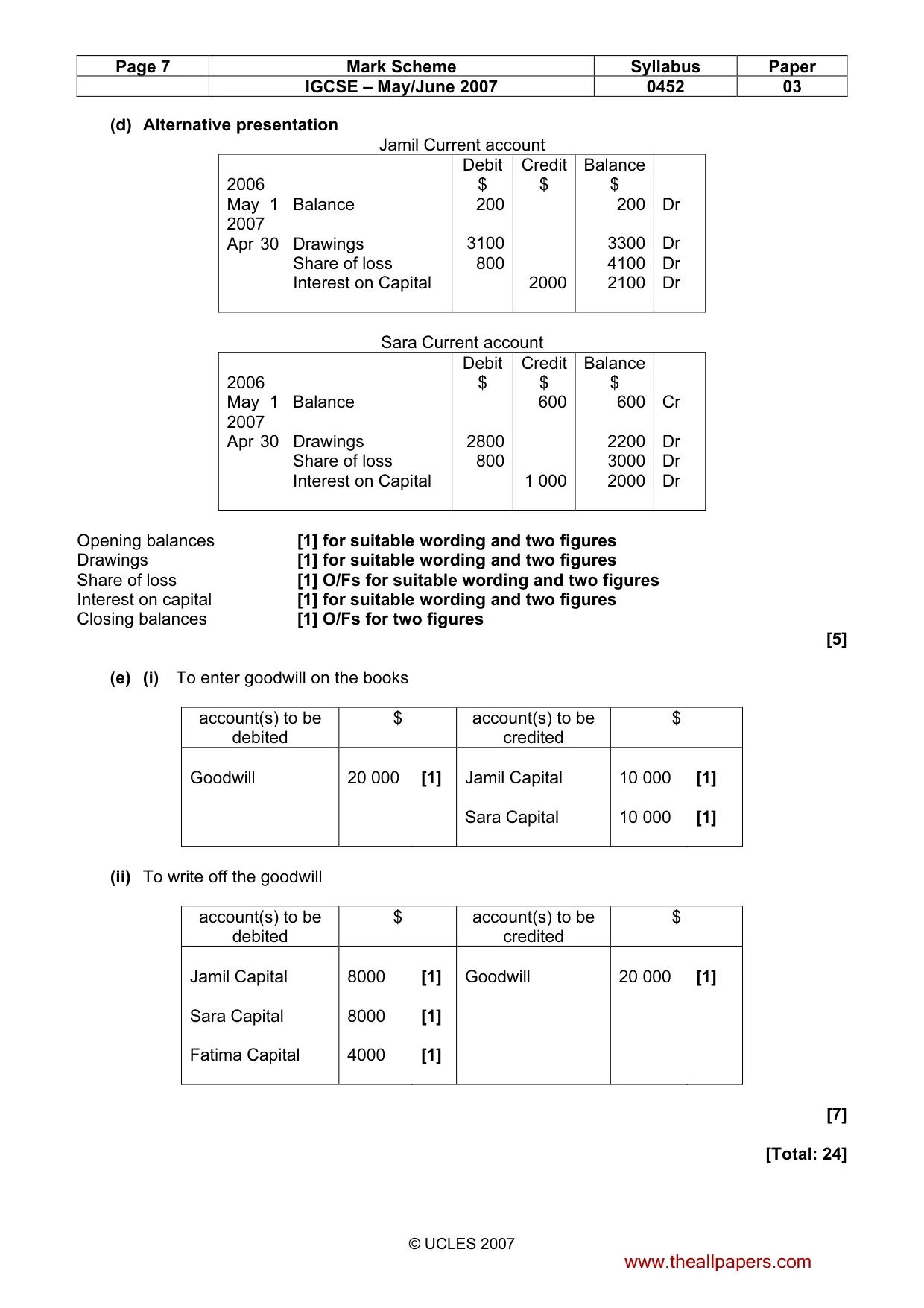
Mark scheme: 3 (a) Jamil and Sara Suliman Trading Account for the year ended 30 April 2007 $ $ $ Sales 30 000 [1] Less cost of sales Opening stock 5 000 [1] Purchases 26 000 [1] 31 000 Less Closing stock – Stock remaining 4 500 [1] Stock lost 2 500 [2] C/F [1] O/F 7 000 24 000 Gross profit 6 000 (2) Horizontal format acceptable [8] (b) Calculation of net profit – $ Gross profit 6000 O/F Less Expenses 4600 Net profit 1400 [1] O/F [1] (c) Calculation of partners’ share of the residual net profit/loss – $ $ Net profit 1400 [1] O/F Interest on capital – Jamil 2000 Sara 1000 3000 [1] (1600) Share of loss – Jamil 800 [1] O/F Sara 800 (1600) [3] (d) Current accounts Jamil Sara Jamil Sara 2006 $ $ 2006 $ $ May 1 Balance b/d 200 May 1 Balance b/d 600 [1] 2007 2007 Apr 30 Drawings 3100 2800 [1] Apr 30 Interest on capital 2000 1000 [1] Share of Loss 800 800 [1] O/F Balances c/d 2100 2000 4100 3600 4100 3600 2007 May 1 Balances b/d 2100 2000 [1] O/F In all cases the marks are for suitable wording and two figures Alternatively allow two separate “T” accounts [5] IGCSE – May/June 2007 0452 03 (d) Alternative presentation Jamil Current account Debit Credit Balance 2006 $ $ $ May 1 Balance 200 200 Dr 2007 Apr 30 Drawings 3100 3300 Dr Share of loss 800 4100 Dr Interest on Capital 2000 2100 Dr Sara Current account Debit Credit Balance 2006 $ $ $ May 1 Balance 600 600 Cr 2007 Apr 30 Drawings 2800 2200 Dr Share of loss 800 3000 Dr Interest on Capital 1 000 2000 Dr Opening balances [1] for suitable wording and two figures Drawings [1] for suitable wording and two figures Share of loss [1] O/Fs for suitable wording and two figures Interest on capital [1] for suitable wording and two figures Closing balances [1] O/Fs for two figures [5] (e) (i) To enter goodwill on the books account(s) to be $ account(s) to be $ debited credited Goodwill 20 000 [1] Jamil Capital 10 000 [1] Sara Capital 10 000 [1] (ii) To write off the goodwill account(s) to be $ account(s) to be $ debited credited Jamil Capital 8000 [1] Goodwill 20 000 [1] Sara Capital 8000 [1] Fatima Capital 4000 [1] [7] [Total: 24] IGCSE – May/June 2007 0452 03
Q4 · Peter Mpho started business on 1 February 2006
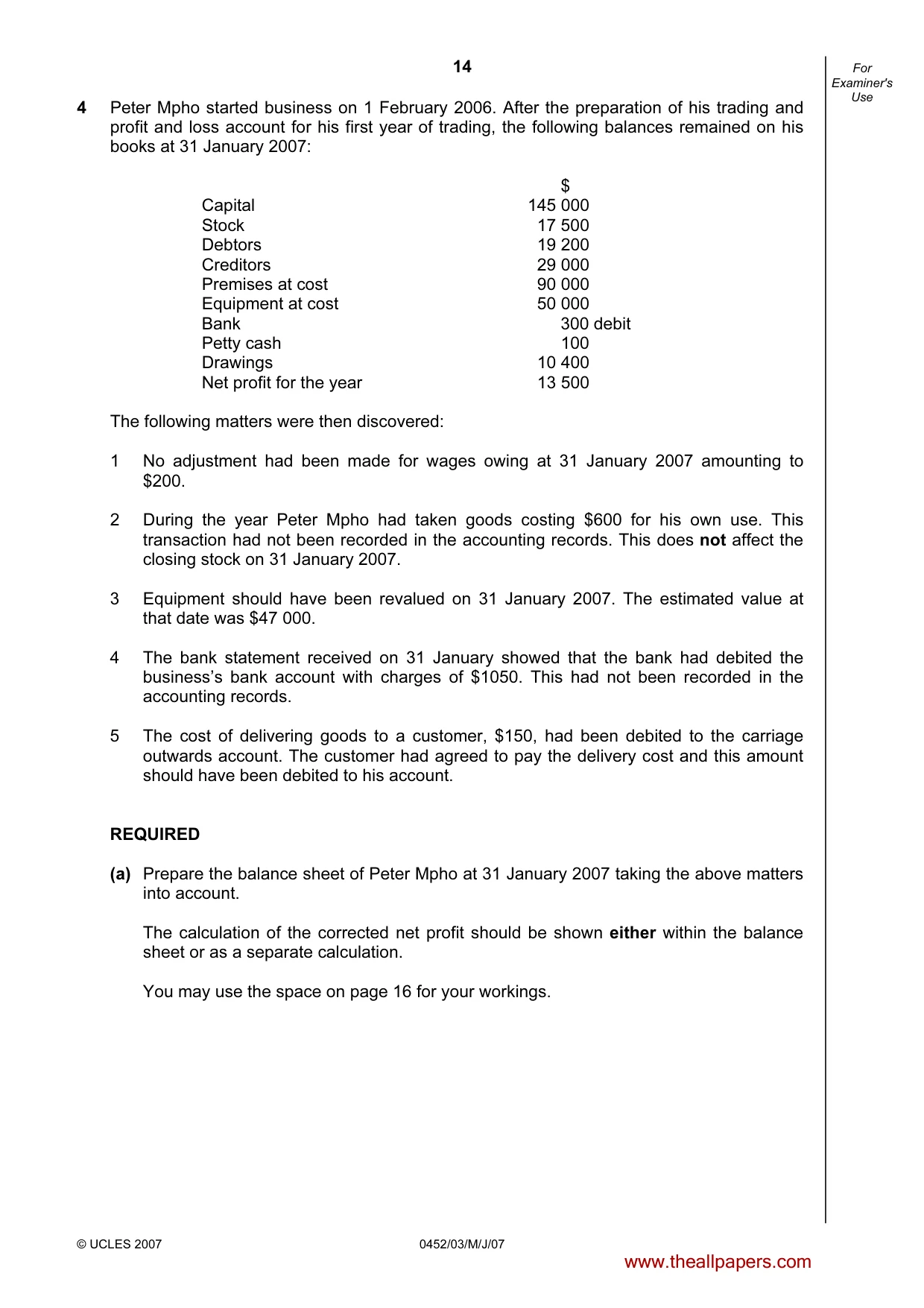
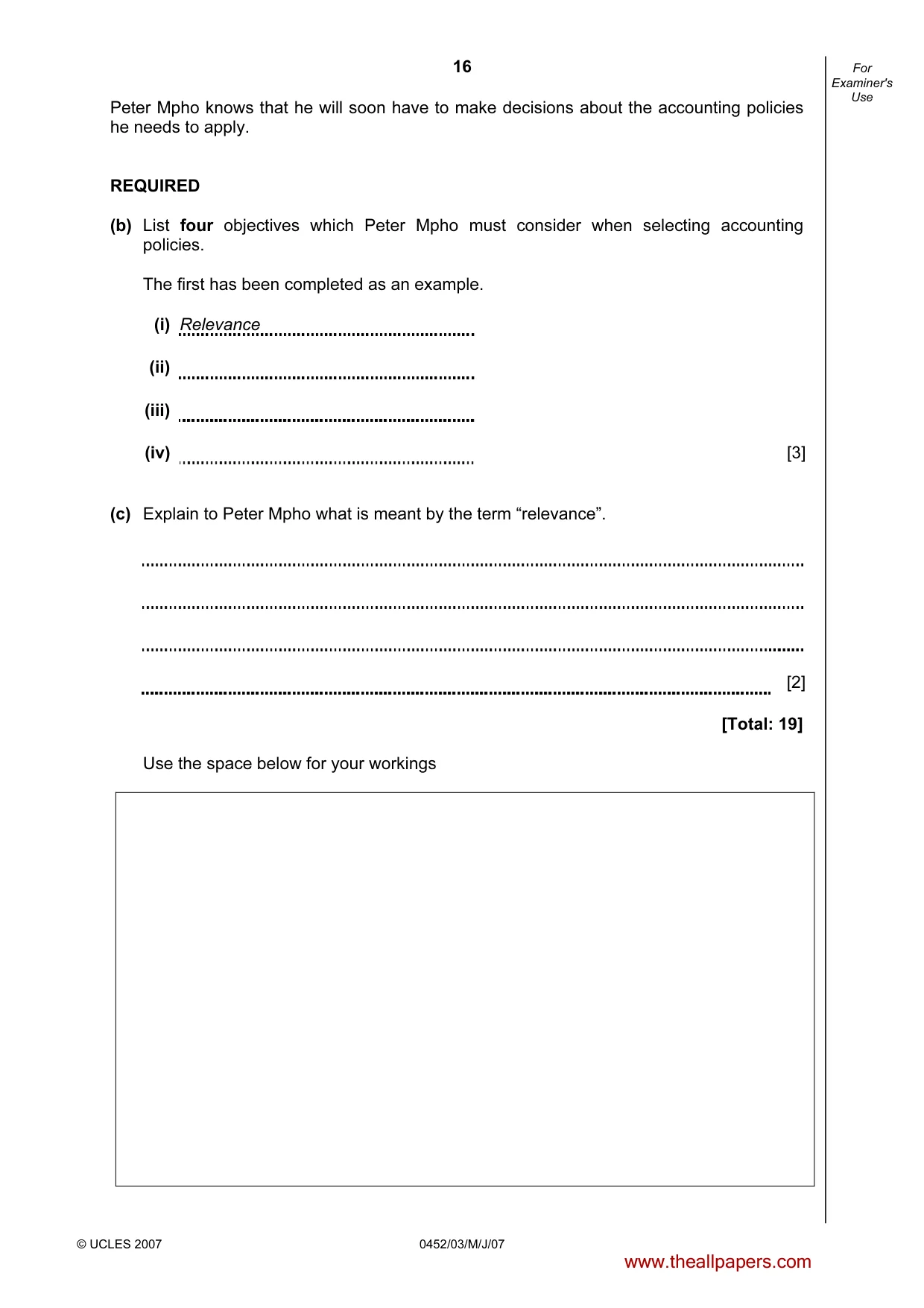
4 Peter Mpho started business on 1 February 2006. After the preparation of his trading and profit and loss account for his first year of trading, the following balances remained on his books at 31 January 2007: $ Capital 145 000 Stock 17 500 Debtors 19 200 Creditors 29 000 Premises at cost 90 000 Equipment at cost 50 000 Bank 300 debit Petty cash 100 Drawings 10 400 Net profit for the year 13 500 The following matters were then discovered: 1 No adjustment had been made for wages owing at 31 January 2007 amounting to $200. 2 During the year Peter Mpho had taken goods costing $600 for his own use. This transaction had not been recorded in the accounting records. This does not affect the closing stock on 31 January 2007. 3 Equipment should have been revalued on 31 January 2007. The estimated value at that date was $47 000. 4 The bank statement received on 31 January showed that the bank had debited the business’s bank account with charges of $1050. This had not been recorded in the accounting records. 5 The cost of delivering goods to a customer, $150, had been debited to the carriage outwards account. The customer had agreed to pay the delivery cost and this amount should have been debited to his account. REQUIRED (a) Prepare the balance sheet of Peter Mpho at 31 January 2007 taking the above matters into account. The calculation of the corrected net profit should be shown either within the balance sheet or as a separate calculation. You may use the space on page 16 for your workings. Peter Mpho Balance Sheet at 31 January 2007 [14] Peter Mpho knows that he will soon have to make decisions about the accounting policies he needs to apply. REQUIRED (b) List four objectives which Peter Mpho must consider when selecting accounting policies. The first has been completed as an example. (i) Relevance (ii) (iii) (iv) [3] (c) Explain to Peter Mpho what is meant by the term “relevance”. [2] [Total: 19] Use the space below for your workings
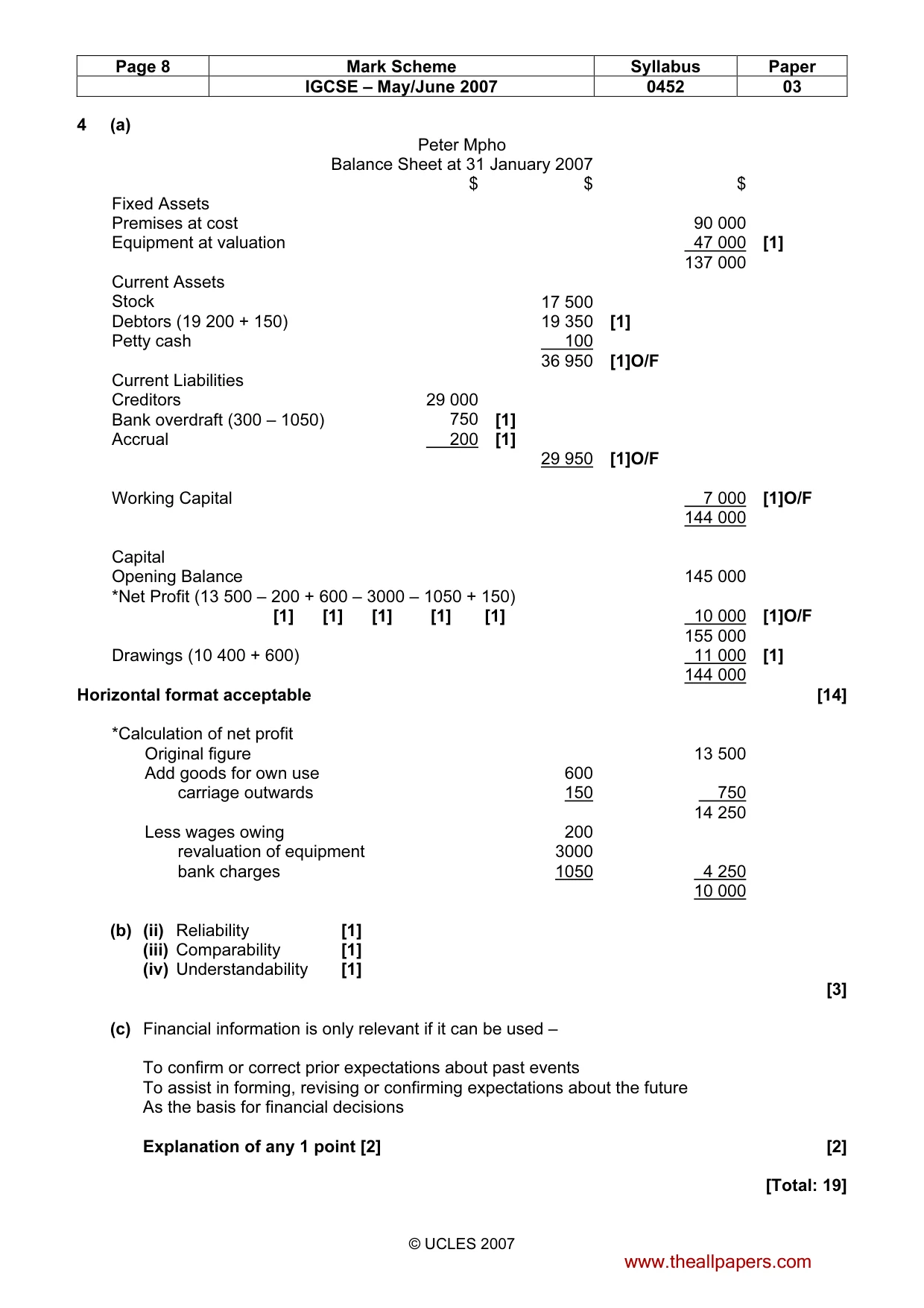
Mark scheme: 4 (a) Peter Mpho Balance Sheet at 31 January 2007 $ $ $ Fixed Assets Premises at cost 90 000 Equipment at valuation 47 000 [1] 137 000 Current Assets Stock 17 500 Debtors (19 200 + 150) 19 350 [1] Petty cash 100 36 950 [1]O/F Current Liabilities Creditors 29 000 Bank overdraft (300 – 1050) 750 [1] Accrual 200 [1] 29 950 [1]O/F Working Capital 7 000 [1]O/F 144 000 Capital Opening Balance 145 000 *Net Profit (13 500 – 200 + 600 – 3000 – 1050 + 150) [1] [1] [1] [1] [1] 10 000 [1]O/F 155 000 Drawings (10 400 + 600) 11 000 [1] 144 000 Horizontal format acceptable [14] *Calculation of net profit Original figure 13 500 Add goods for own use 600 carriage outwards 150 750 14 250 Less wages owing 200 revaluation of equipment 3000 bank charges 1050 4 250 10 000 (b) (ii) Reliability [1] (iii) Comparability [1] (iv) Understandability [1] [3] (c) Financial information is only relevant if it can be used – To confirm or correct prior expectations about past events To assist in forming, revising or confirming expectations about the future As the basis for financial decisions Explanation of any 1 point [2] [2] [Total: 19] IGCSE – May/June 2007 0452 03
Q5 · Mona El Tawil is a sole trader
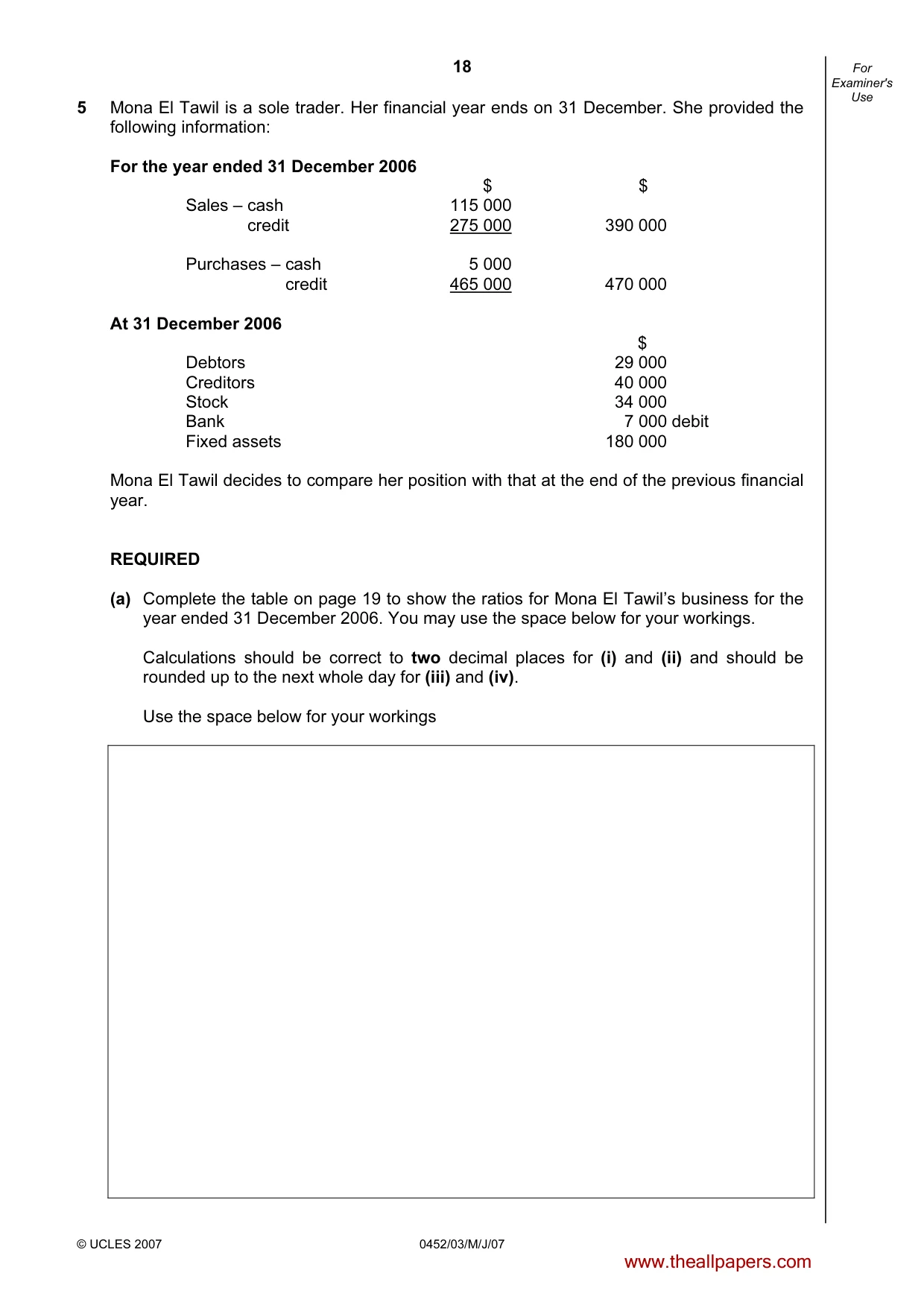
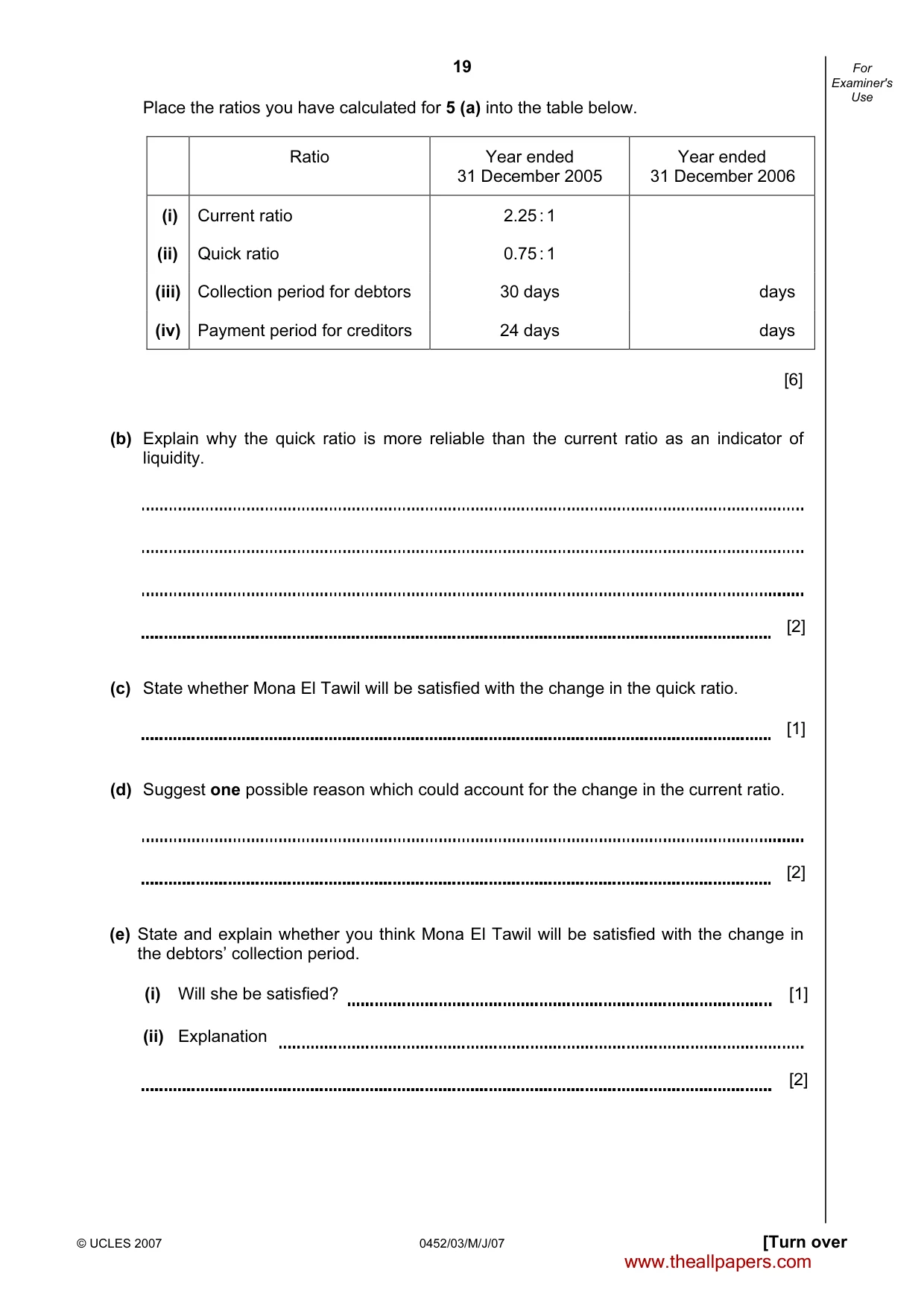
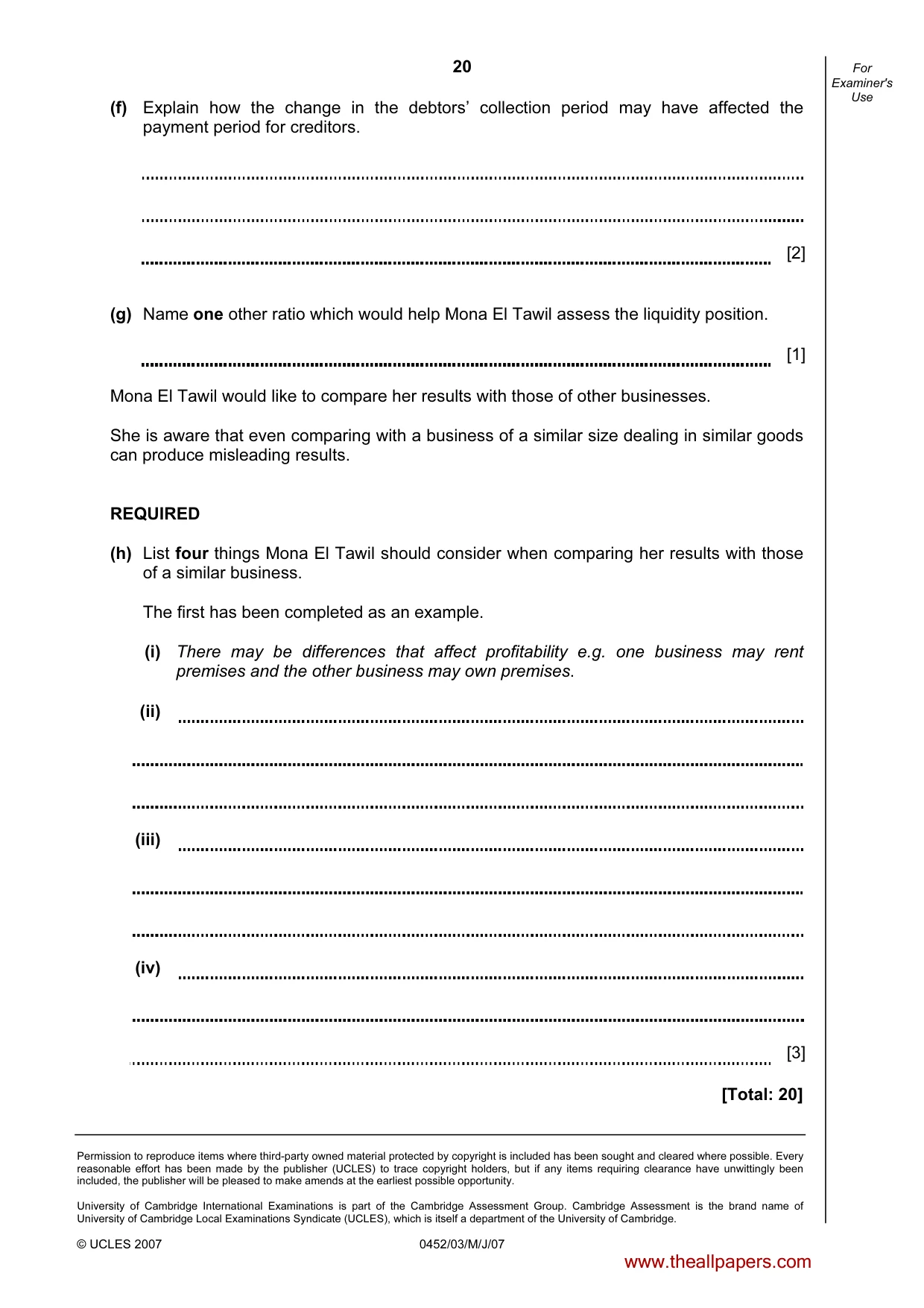
5 Mona El Tawil is a sole trader. Her financial year ends on 31 December. She provided the following information: For the year ended 31 December 2006 $ $ Sales – cash 115 000 credit 275 000 390 000 Purchases – cash 5 000 credit 465 000 470 000 At 31 December 2006 $ Debtors 29 000 Creditors 40 000 Stock 34 000 Bank 7 000 debit Fixed assets 180 000 Mona El Tawil decides to compare her position with that at the end of the previous financial year. REQUIRED (a) Complete the table on page 19 to show the ratios for Mona El Tawil’s business for the year ended 31 December 2006. You may use the space below for your workings. Calculations should be correct to two decimal places for (i) and (ii) and should be rounded up to the next whole day for (iii) and (iv). Use the space below for your workings Place the ratios you have calculated for 5 (a) into the table below. Ratio Year ended Year ended 31 December 2005 31 December 2006 (i) Current ratio 2.25 : 1 (ii) Quick ratio 0.75 : 1 (iii) Collection period for debtors 30 days days (iv) Payment period for creditors 24 days days [6] (b) Explain why the quick ratio is more reliable than the current ratio as an indicator of liquidity. [2] (c) State whether Mona El Tawil will be satisfied with the change in the quick ratio. [1] (d) Suggest one possible reason which could account for the change in the current ratio. [2] (e) State and explain whether you think Mona El Tawil will be satisfied with the change in the debtors’ collection period. (i) Will she be satisfied? [1] (ii) Explanation [2] (f) Explain how the change in the debtors’ collection period may have affected the payment period for creditors. [2] (g) Name one other ratio which would help Mona El Tawil assess the liquidity position. [1] Mona El Tawil would like to compare her results with those of other businesses. She is aware that even comparing with a business of a similar size dealing in similar goods can produce misleading results. REQUIRED (h) List four things Mona El Tawil should consider when comparing her results with those of a similar business. The first has been completed as an example. (i) There may be differences that affect profitability e.g. one business may rent premises and the other business may own premises. (ii) (iii) (iv) [3] [Total: 20]
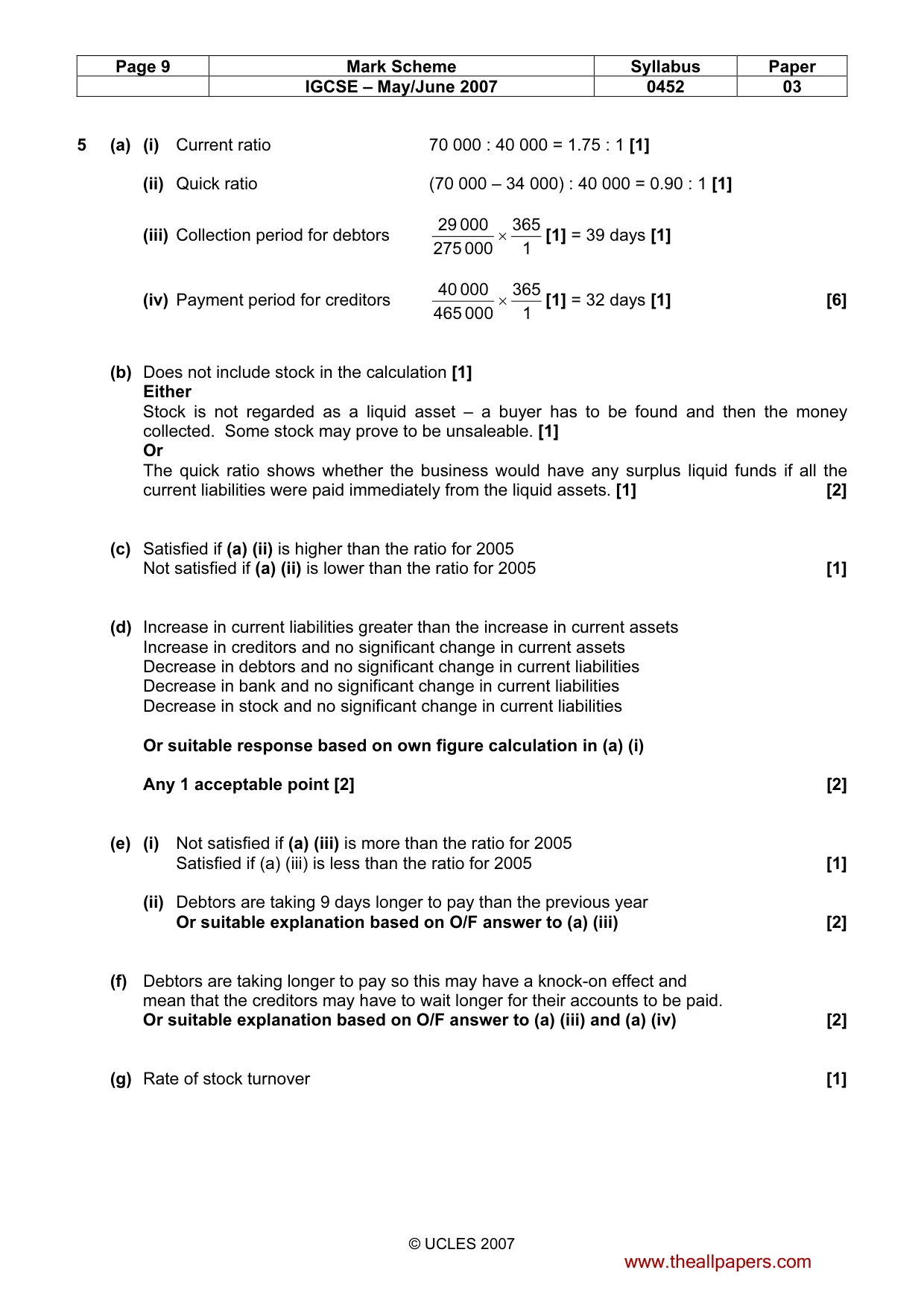
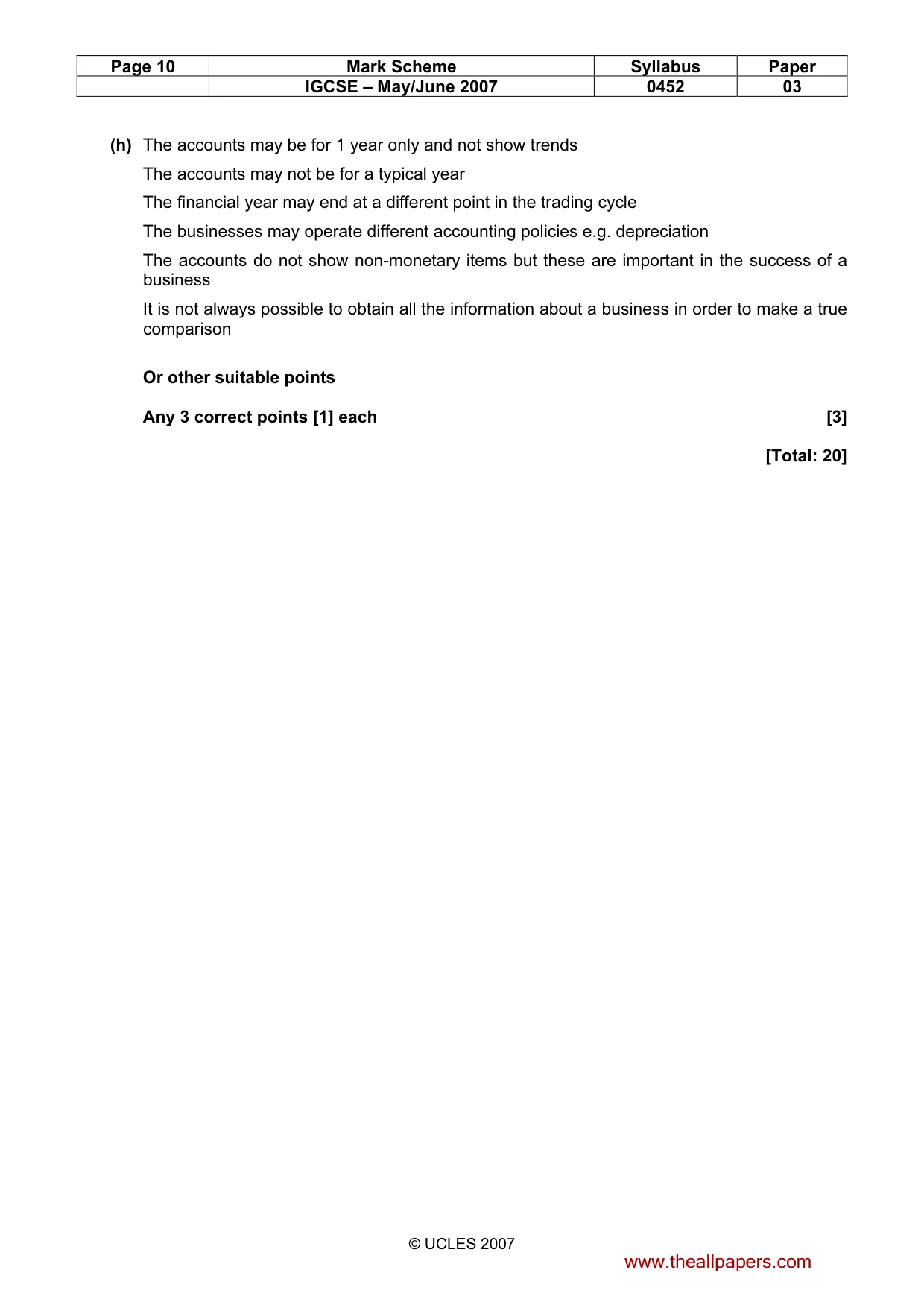
Mark scheme: 5 (a) (i) Current ratio 70 000 : 40 000 = 1.75 : 1 [1] (ii) Quick ratio (70 000 – 34 000) : 40 000 = 0.90 : 1 [1] 29 000 365 (iii) Collection period for debtors × [1] = 39 days [1] 275 000 1 40 000 365 (iv) Payment period for creditors × [1] = 32 days [1] [6] 465 000 1 (b) Does not include stock in the calculation [1] Either Stock is not regarded as a liquid asset – a buyer has to be found and then the money collected. Some stock may prove to be unsaleable. [1] Or The quick ratio shows whether the business would have any surplus liquid funds if all the current liabilities were paid immediately from the liquid assets. [1] [2] (c) Satisfied if (a) (ii) is higher than the ratio for 2005 Not satisfied if (a) (ii) is lower than the ratio for 2005 [1] (d) Increase in current liabilities greater than the increase in current assets Increase in creditors and no significant change in current assets Decrease in debtors and no significant change in current liabilities Decrease in bank and no significant change in current liabilities Decrease in stock and no significant change in current liabilities Or suitable response based on own figure calculation in (a) (i) Any 1 acceptable point [2] [2] (e) (i) Not satisfied if (a) (iii) is more than the ratio for 2005 Satisfied if (a) (iii) is less than the ratio for 2005 [1] (ii) Debtors are taking 9 days longer to pay than the previous year Or suitable explanation based on O/F answer to (a) (iii) [2] (f) Debtors are taking longer to pay so this may have a knock-on effect and mean that the creditors may have to wait longer for their accounts to be paid. Or suitable explanation based on O/F answer to (a) (iii) and (a) (iv) [2] (g) Rate of stock turnover [1] IGCSE – May/June 2007 0452 03 (h) The accounts may be for 1 year only and not show trends The accounts may not be for a typical year The financial year may end at a different point in the trading cycle The businesses may operate different accounting policies e.g. depreciation The accounts do not show non-monetary items but these are important in the success of a business It is not always possible to obtain all the information about a business in order to make a true comparison Or other suitable points Any 3 correct points [1] each [3] [Total: 20]
What was in this paper
The subtopics covered by these 5 questions, and how many questions each got. Open one in a new tab to see every Cambridge question on it.
What you needed in this session
Cambridge’s own grade thresholds for 2007 May/June, Paper 3 · Variant 1. A higher threshold means an easier paper — the bar moves with how the cohort did.