Cambridge IGCSE Accounting 0452 — 2008 May/June Paper 3 · Variant 1
0452/31/M/J/08 · 5 questions · 100 marks · ≈113 min
The question paper and its mark scheme, free to read here and free to download. This is Cambridge’s own paper, exactly as it was sat.
Question paper20 pages
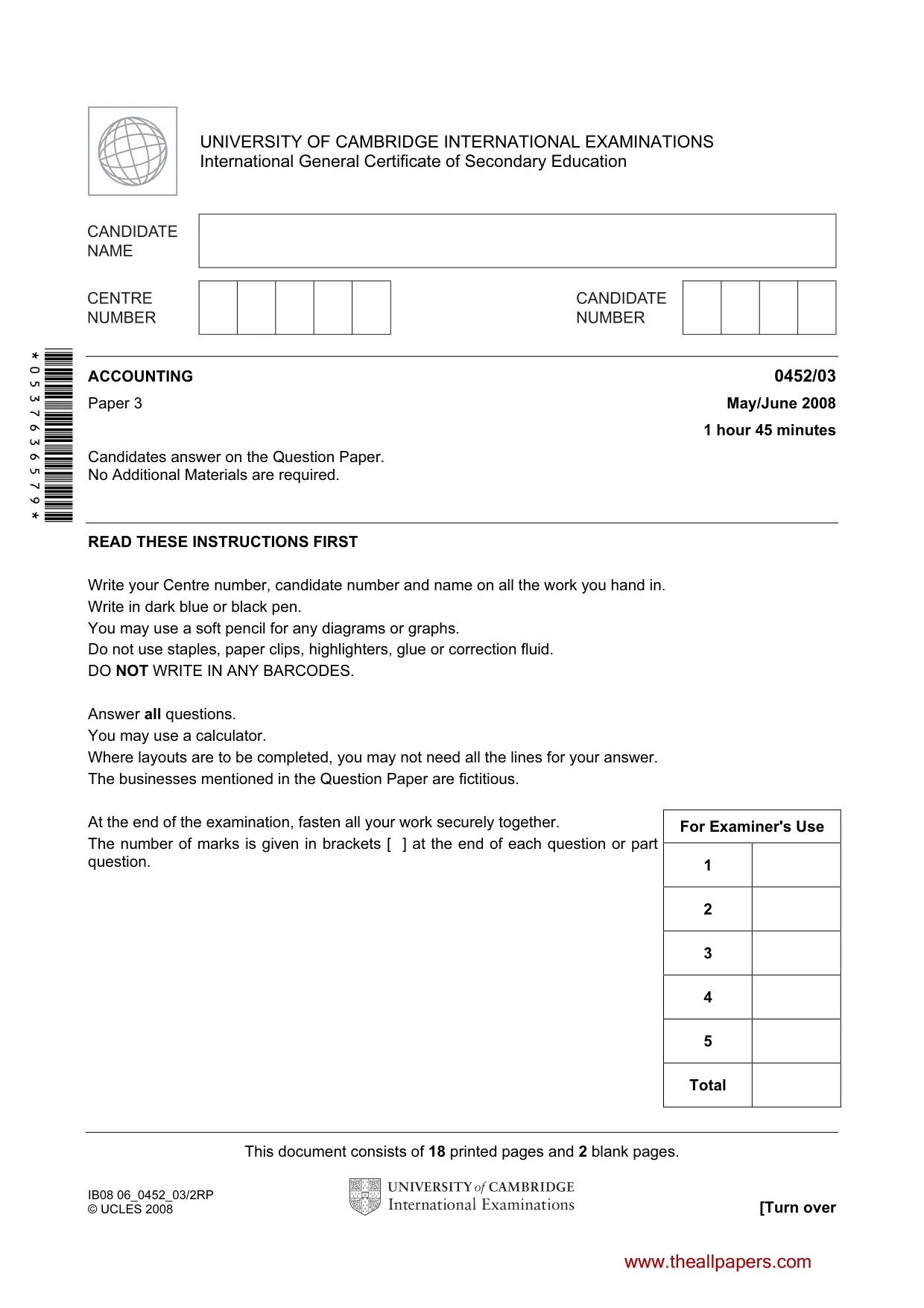


Mark scheme9 pages
Answers below. Sit the paper first if you are practising.
Questions as text
Q1 · Jane Sharma is a trader
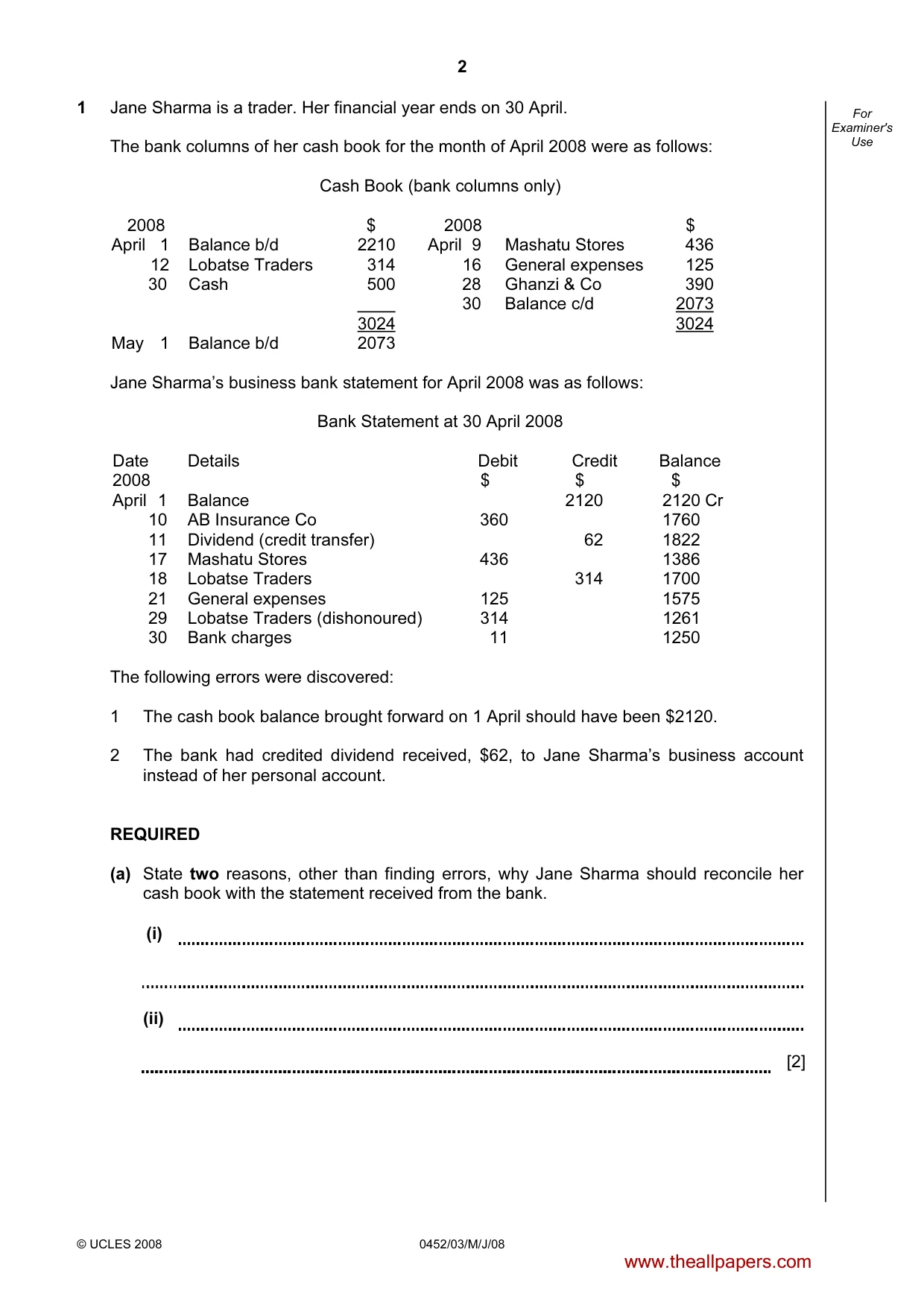
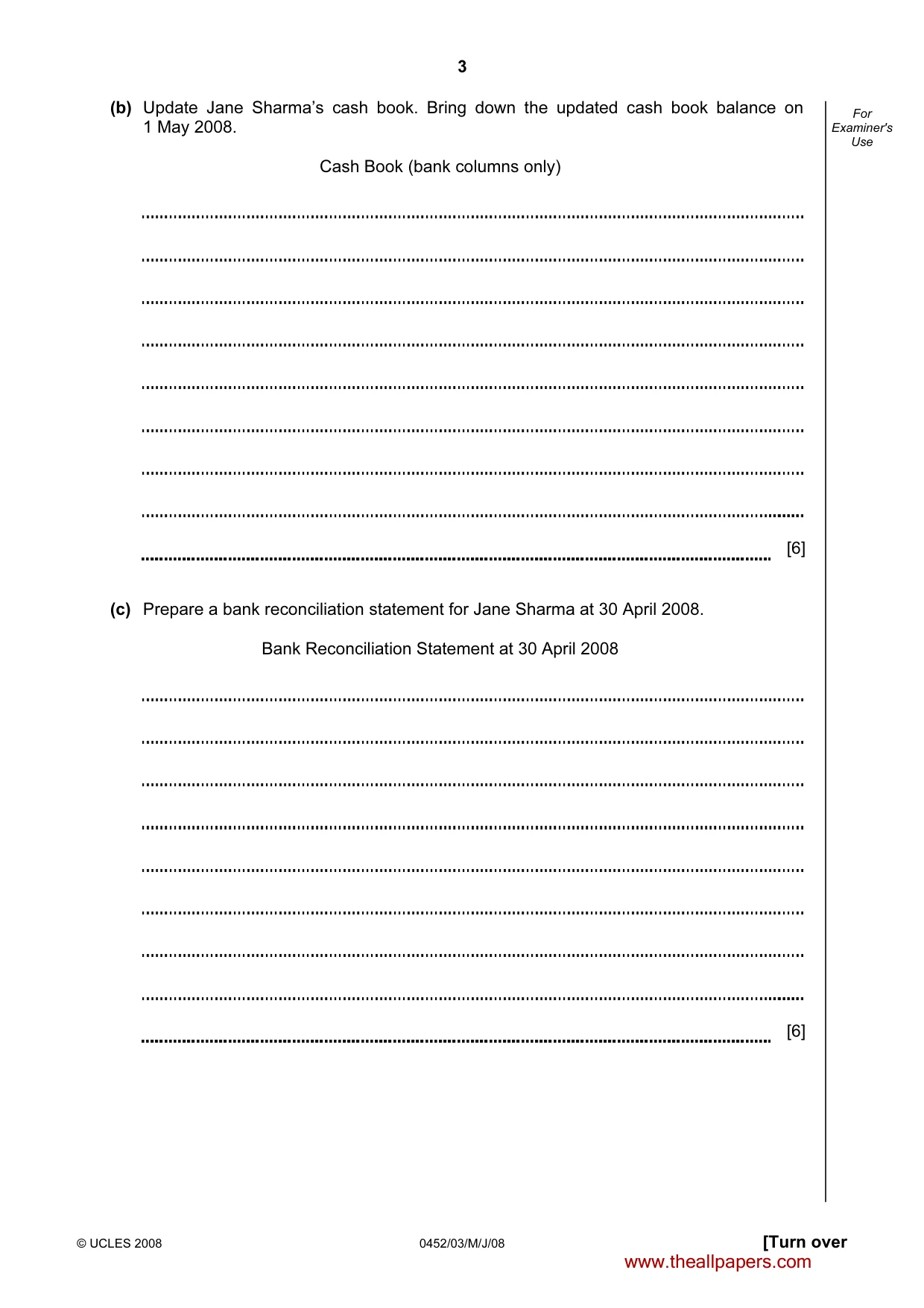
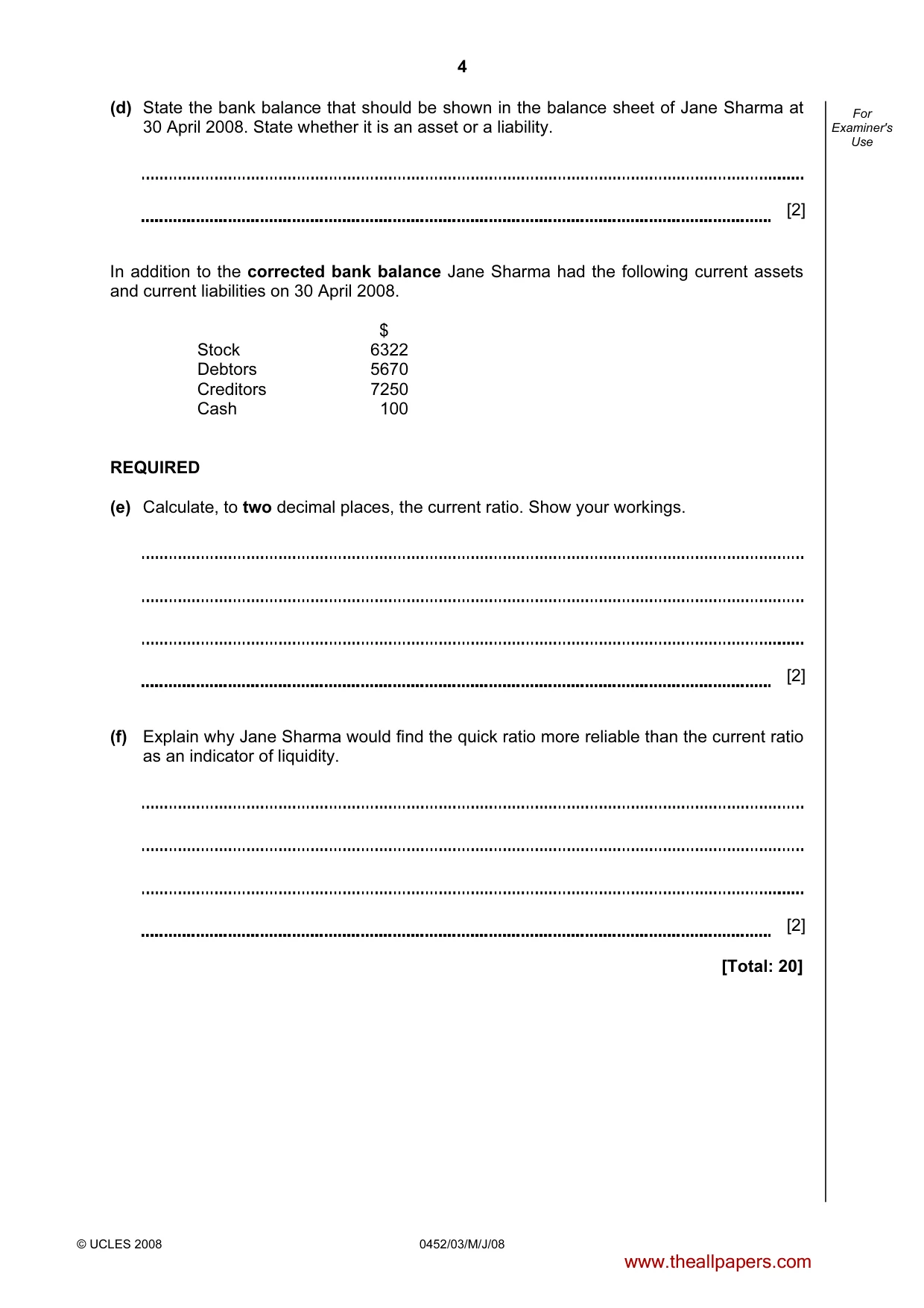
1 Jane Sharma is a trader. Her financial year ends on 30 April. The bank columns of her cash book for the month of April 2008 were as follows: Cash Book (bank columns only) 2008 $ 2008 $ April 1 Balance b/d 2210 April 9 Mashatu Stores 436 12 Lobatse Traders 314 16 General expenses 125 30 Cash 500 28 Ghanzi & Co 390 30 Balance c/d 2073 3024 3024 May 1 Balance b/d 2073 Jane Sharma’s business bank statement for April 2008 was as follows: Bank Statement at 30 April 2008 Date Details Debit Credit Balance 2008 $ $ $ April 1 Balance 2120 2120 Cr 10 AB Insurance Co 360 1760 11 Dividend (credit transfer) 62 1822 17 Mashatu Stores 436 1386 18 Lobatse Traders 314 1700 21 General expenses 125 1575 29 Lobatse Traders (dishonoured) 314 1261 30 Bank charges 11 1250 The following errors were discovered: 1 The cash book balance brought forward on 1 April should have been $2120. 2 The bank had credited dividend received, $62, to Jane Sharma’s business account instead of her personal account. REQUIRED (a) State two reasons, other than finding errors, why Jane Sharma should reconcile her cash book with the statement received from the bank. (i) (ii) [2] (b) Update Jane Sharma’s cash book. Bring down the updated cash book balance on 1 May 2008. Cash Book (bank columns only) [6] (c) Prepare a bank reconciliation statement for Jane Sharma at 30 April 2008. Bank Reconciliation Statement at 30 April 2008 [6] (d) State the bank balance that should be shown in the balance sheet of Jane Sharma at 30 April 2008. State whether it is an asset or a liability. [2] In addition to the corrected bank balance Jane Sharma had the following current assets and current liabilities on 30 April 2008. $ Stock 6322 Debtors 5670 Creditors 7250 Cash 100 REQUIRED (e) Calculate, to two decimal places, the current ratio. Show your workings. [2] (f) Explain why Jane Sharma would find the quick ratio more reliable than the current ratio as an indicator of liquidity. [2] [Total: 20]
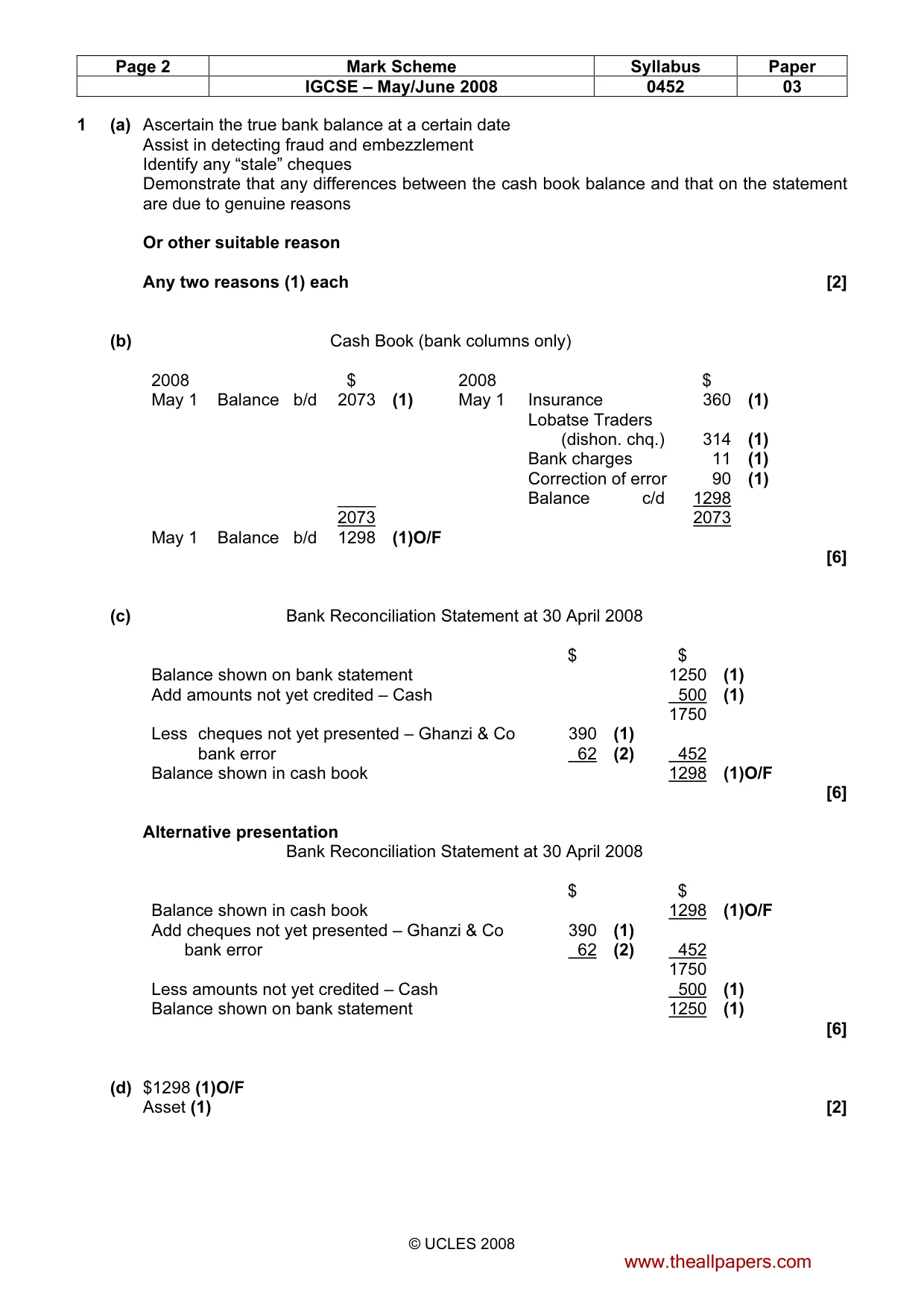
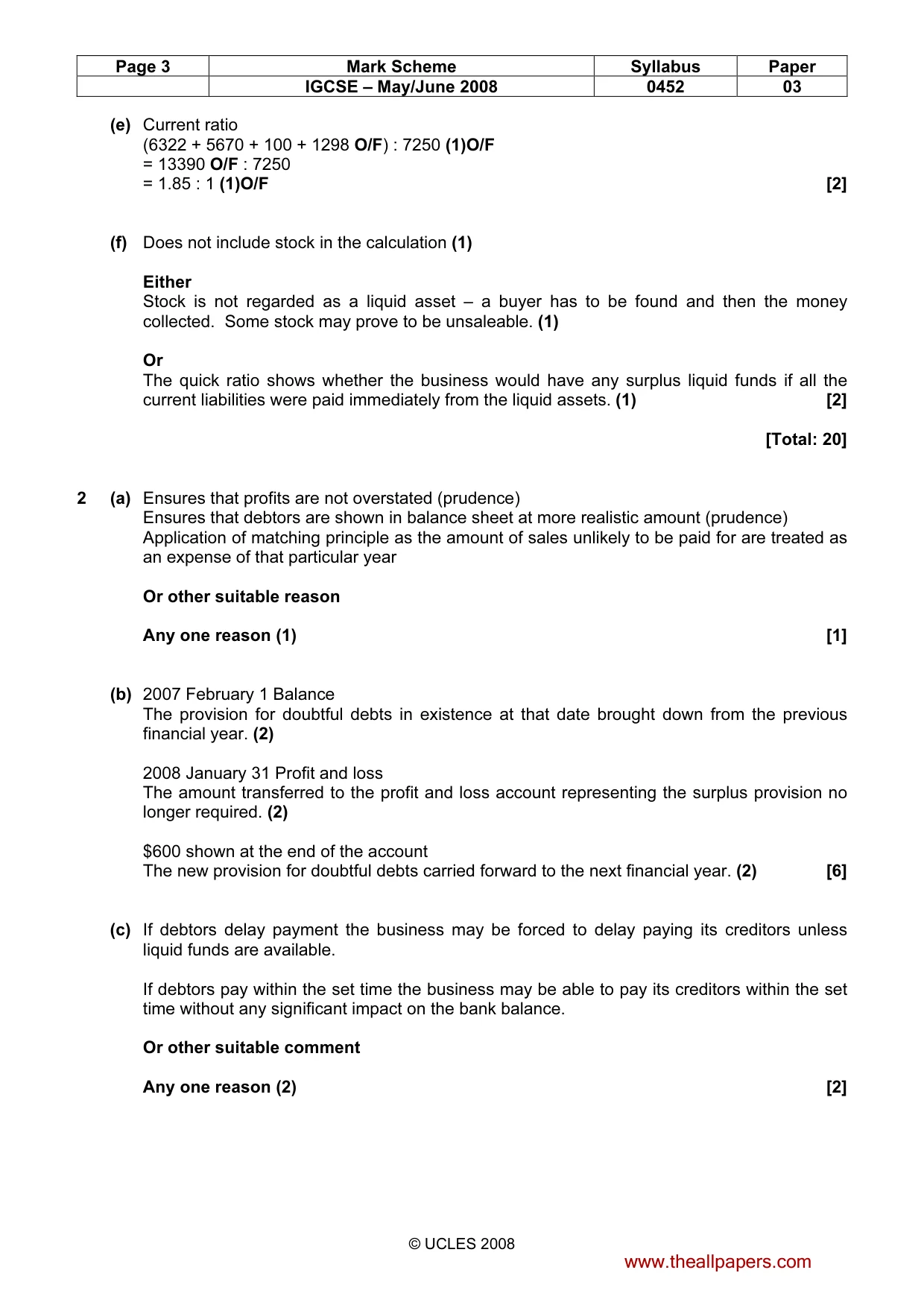
Mark scheme: 1 (a) Ascertain the true bank balance at a certain date Assist in detecting fraud and embezzlement Identify any “stale” cheques Demonstrate that any differences between the cash book balance and that on the statement are due to genuine reasons Or other suitable reason Any two reasons (1) each [2] (b) Cash Book (bank columns only) 2008 $ 2008 $ May 1 Balance b/d 2073 (1) May 1 Insurance 360 (1) Lobatse Traders (dishon. chq.) 314 (1) Bank charges 11 (1) Correction of error 90 (1) ____ Balance c/d 1298 2073 2073 May 1 Balance b/d 1298 (1)O/F [6] (c) Bank Reconciliation Statement at 30 April 2008 $ $ Balance shown on bank statement 1250 (1) Add amounts not yet credited – Cash 500 (1) 1750 Less cheques not yet presented – Ghanzi & Co 390 (1) bank error 62 (2) 452 Balance shown in cash book 1298 (1)O/F [6] Alternative presentation Bank Reconciliation Statement at 30 April 2008 $ $ Balance shown in cash book 1298 (1)O/F Add cheques not yet presented – Ghanzi & Co 390 (1) bank error 62 (2) 452 1750 Less amounts not yet credited – Cash 500 (1) Balance shown on bank statement 1250 (1) [6] (d) $1298 (1)O/F Asset (1) [2] IGCSE – May/June 2008 0452 03 (e) Current ratio (6322 + 5670 + 100 + 1298 O/F) : 7250 (1)O/F = 13390 O/F : 7250 = 1.85 : 1 (1)O/F [2] (f) Does not include stock in the calculation (1) Either Stock is not regarded as a liquid asset – a buyer has to be found and then the money collected. Some stock may prove to be unsaleable. (1) Or The quick ratio shows whether the business would have any surplus liquid funds if all the current liabilities were paid immediately from the liquid assets. (1) [2] [Total: 20]
Q2 · Miriam Rajah is a trader
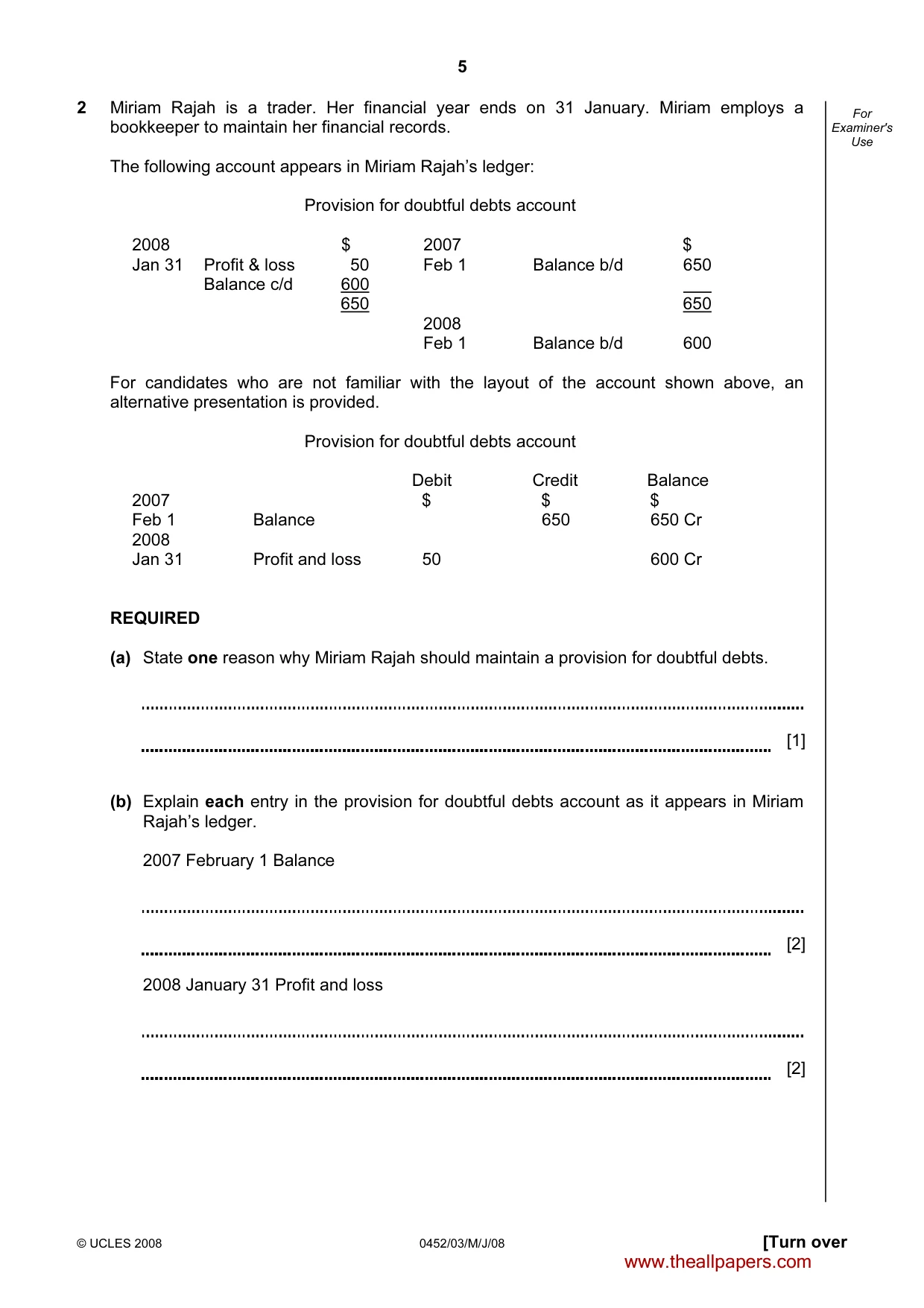
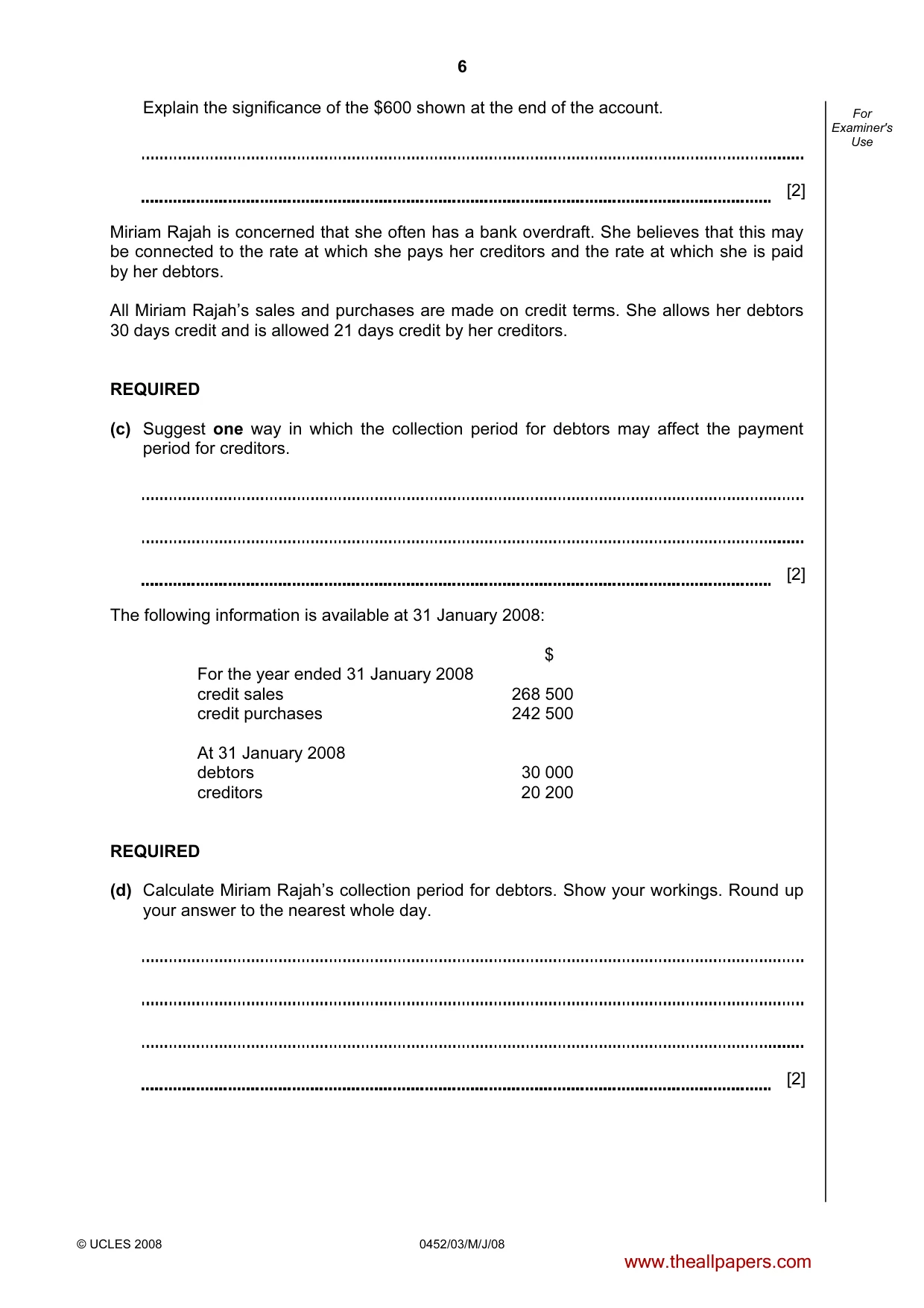
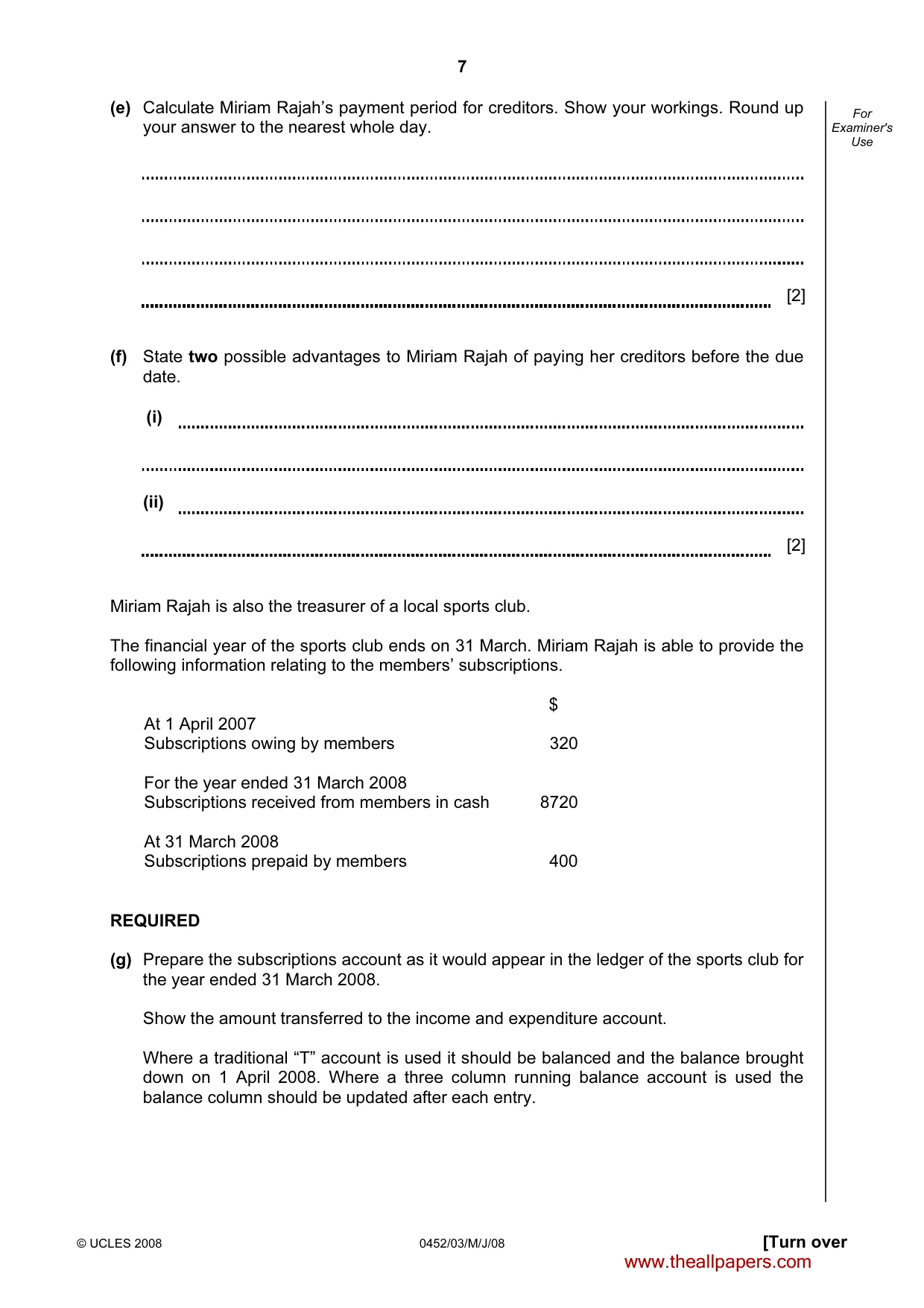
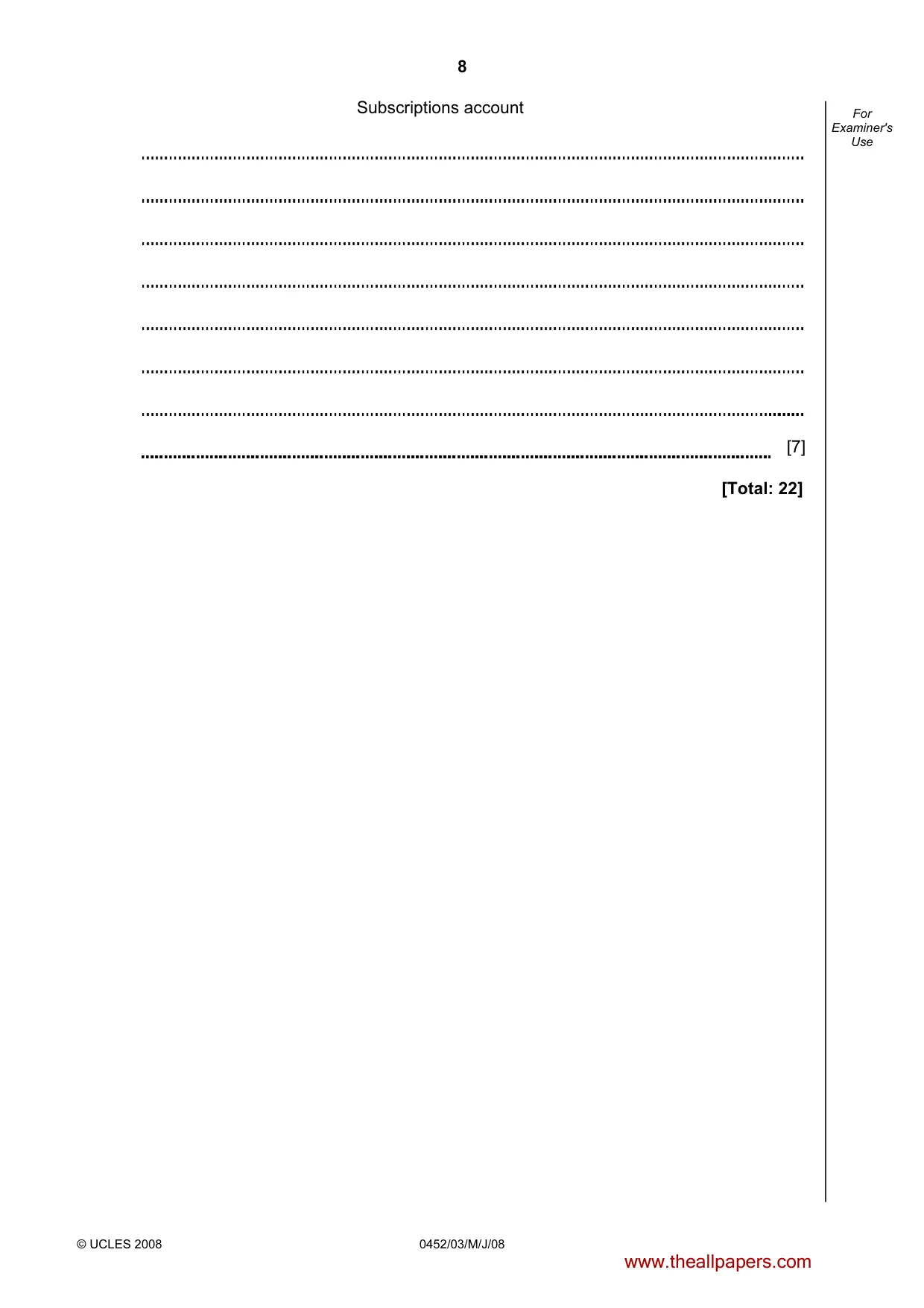
2 Miriam Rajah is a trader. Her financial year ends on 31 January. Miriam employs a bookkeeper to maintain her financial records. The following account appears in Miriam Rajah’s ledger: Provision for doubtful debts account 2008 $ 2007 $ Jan 31 Profit & loss 50 Feb 1 Balance b/d 650 Balance c/d 600 650 650 2008 Feb 1 Balance b/d 600 For candidates who are not familiar with the layout of the account shown above, an alternative presentation is provided. Provision for doubtful debts account Debit Credit Balance 2007 $ $ $ Feb 1 Balance 650 650 Cr 2008 Jan 31 Profit and loss 50 600 Cr REQUIRED (a) State one reason why Miriam Rajah should maintain a provision for doubtful debts. [1] (b) Explain each entry in the provision for doubtful debts account as it appears in Miriam Rajah’s ledger. 2007 February 1 Balance [2] 2008 January 31 Profit and loss [2] Explain the significance of the $600 shown at the end of the account. [2] Miriam Rajah is concerned that she often has a bank overdraft. She believes that this may be connected to the rate at which she pays her creditors and the rate at which she is paid by her debtors. All Miriam Rajah’s sales and purchases are made on credit terms. She allows her debtors 30 days credit and is allowed 21 days credit by her creditors. REQUIRED (c) Suggest one way in which the collection period for debtors may affect the payment period for creditors. [2] The following information is available at 31 January 2008: $ For the year ended 31 January 2008 credit sales 268 500 credit purchases 242 500 At 31 January 2008 debtors 30 000 creditors 20 200 REQUIRED (d) Calculate Miriam Rajah’s collection period for debtors. Show your workings. Round up your answer to the nearest whole day. [2] (e) Calculate Miriam Rajah’s payment period for creditors. Show your workings. Round up your answer to the nearest whole day. [2] (f) State two possible advantages to Miriam Rajah of paying her creditors before the due date. (i) (ii) [2] Miriam Rajah is also the treasurer of a local sports club. The financial year of the sports club ends on 31 March. Miriam Rajah is able to provide the following information relating to the members’ subscriptions. $ At 1 April 2007 Subscriptions owing by members 320 For the year ended 31 March 2008 Subscriptions received from members in cash 8720 At 31 March 2008 Subscriptions prepaid by members 400 REQUIRED (g) Prepare the subscriptions account as it would appear in the ledger of the sports club for the year ended 31 March 2008. Show the amount transferred to the income and expenditure account. Where a traditional “T” account is used it should be balanced and the balance brought down on 1 April 2008. Where a three column running balance account is used the balance column should be updated after each entry. Subscriptions account [7] [Total: 22]
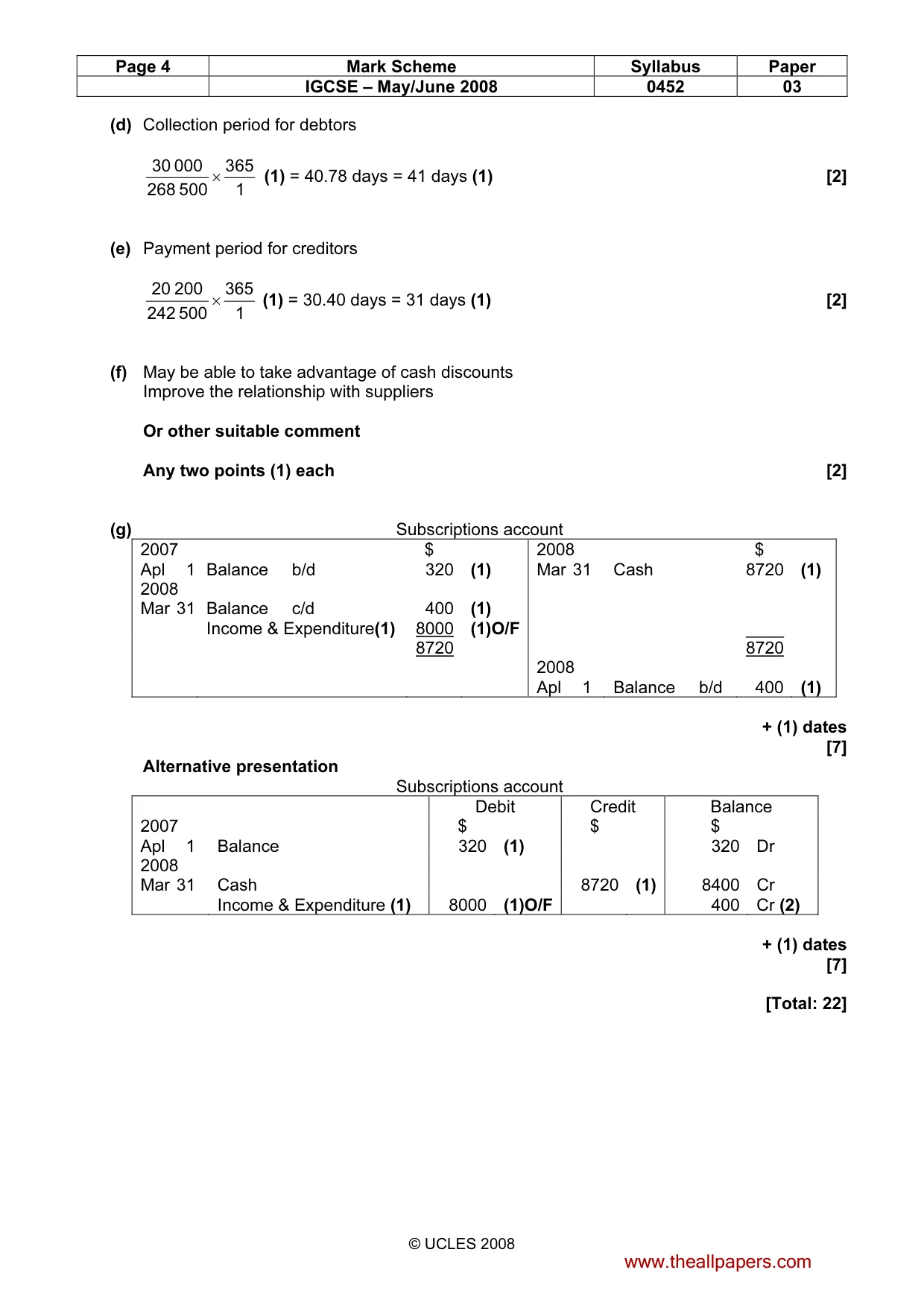
Mark scheme: 2 (a) Ensures that profits are not overstated (prudence) Ensures that debtors are shown in balance sheet at more realistic amount (prudence) Application of matching principle as the amount of sales unlikely to be paid for are treated as an expense of that particular year Or other suitable reason Any one reason (1) [1] (b) 2007 February 1 Balance The provision for doubtful debts in existence at that date brought down from the previous financial year. (2) 2008 January 31 Profit and loss The amount transferred to the profit and loss account representing the surplus provision no longer required. (2) $600 shown at the end of the account The new provision for doubtful debts carried forward to the next financial year. (2) [6] (c) If debtors delay payment the business may be forced to delay paying its creditors unless liquid funds are available. If debtors pay within the set time the business may be able to pay its creditors within the set time without any significant impact on the bank balance. Or other suitable comment Any one reason (2) [2] IGCSE – May/June 2008 0452 03 (d) Collection period for debtors 30 000 365 × (1) = 40.78 days = 41 days (1) [2] 268 500 1 (e) Payment period for creditors 20 200 365 × (1) = 30.40 days = 31 days (1) [2] 242 500 1 (f) May be able to take advantage of cash discounts Improve the relationship with suppliers Or other suitable comment Any two points (1) each [2] (g) Subscriptions account 2007 $ 2008 $ Apl 1 Balance b/d 320 (1) Mar 31 Cash 8720 (1) 2008 Mar 31 Balance c/d 400 (1) Income & Expenditure(1) 8000 (1)O/F ____ 8720 8720 2008 Apl 1 Balance b/d 400 (1) + (1) dates [7] Alternative presentation Subscriptions account Debit Credit Balance 2007 $ $ $ Apl 1 Balance 320 (1) 320 Dr 2008 Mar 31 Cash 8720 (1) 8400 Cr Income & Expenditure (1) 8000 (1)O/F 400 Cr (2) + (1) dates [7] [Total: 22] IGCSE – May/June 2008 0452 03
More questions on Irrecoverable debts and allowance for irrecoverable debts
Q3 · Abdul and Amina Mahmoud are in partnership
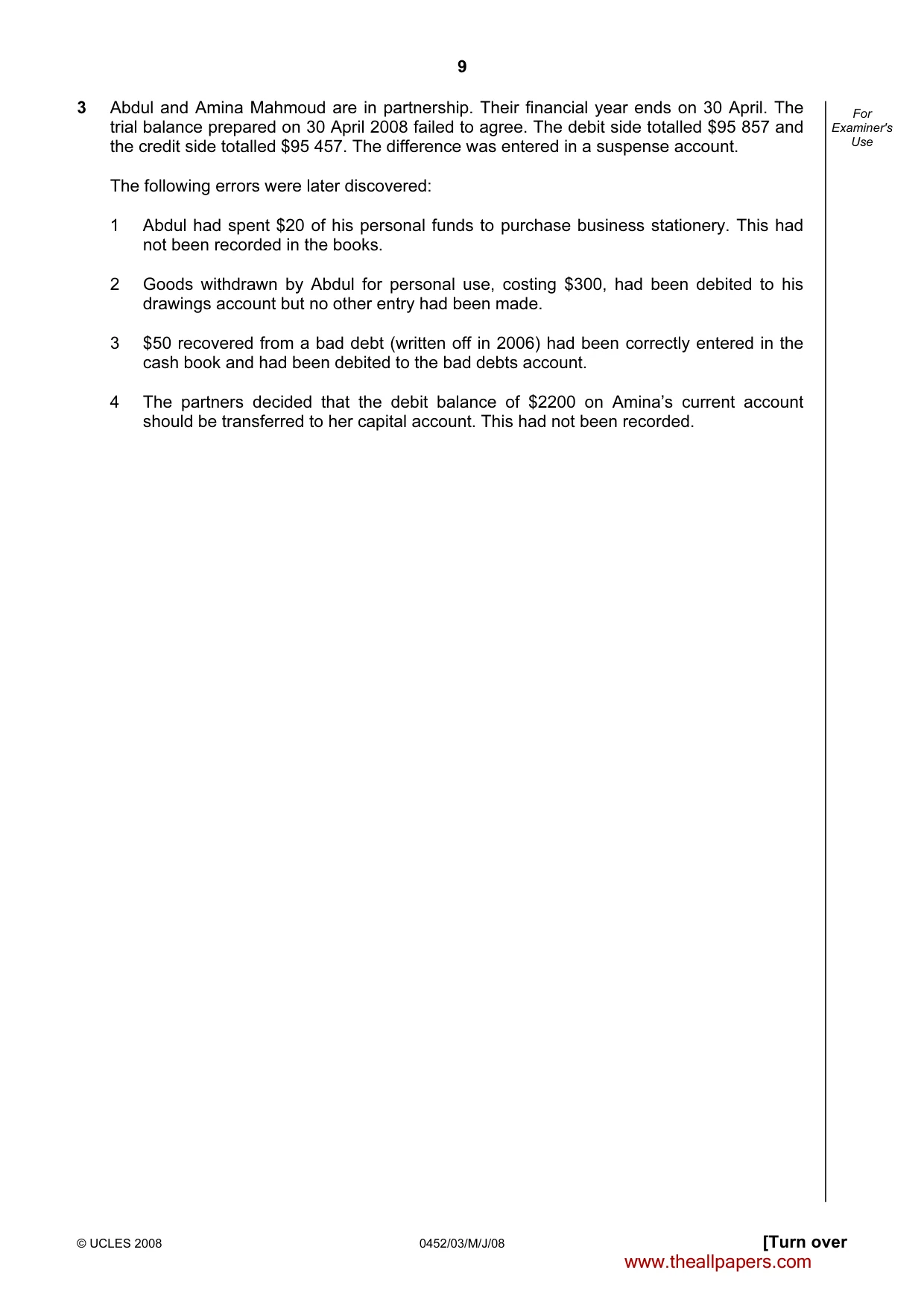
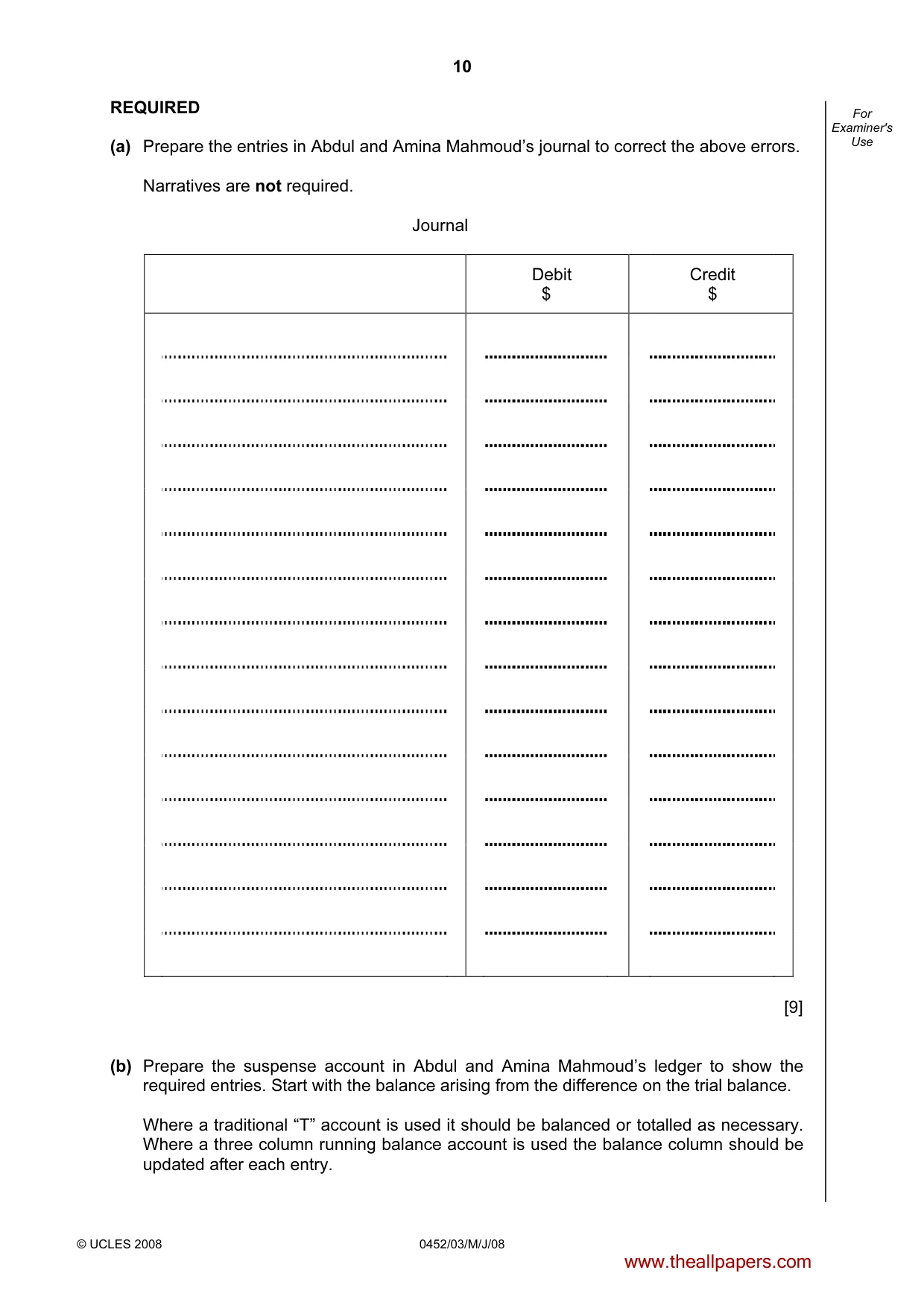
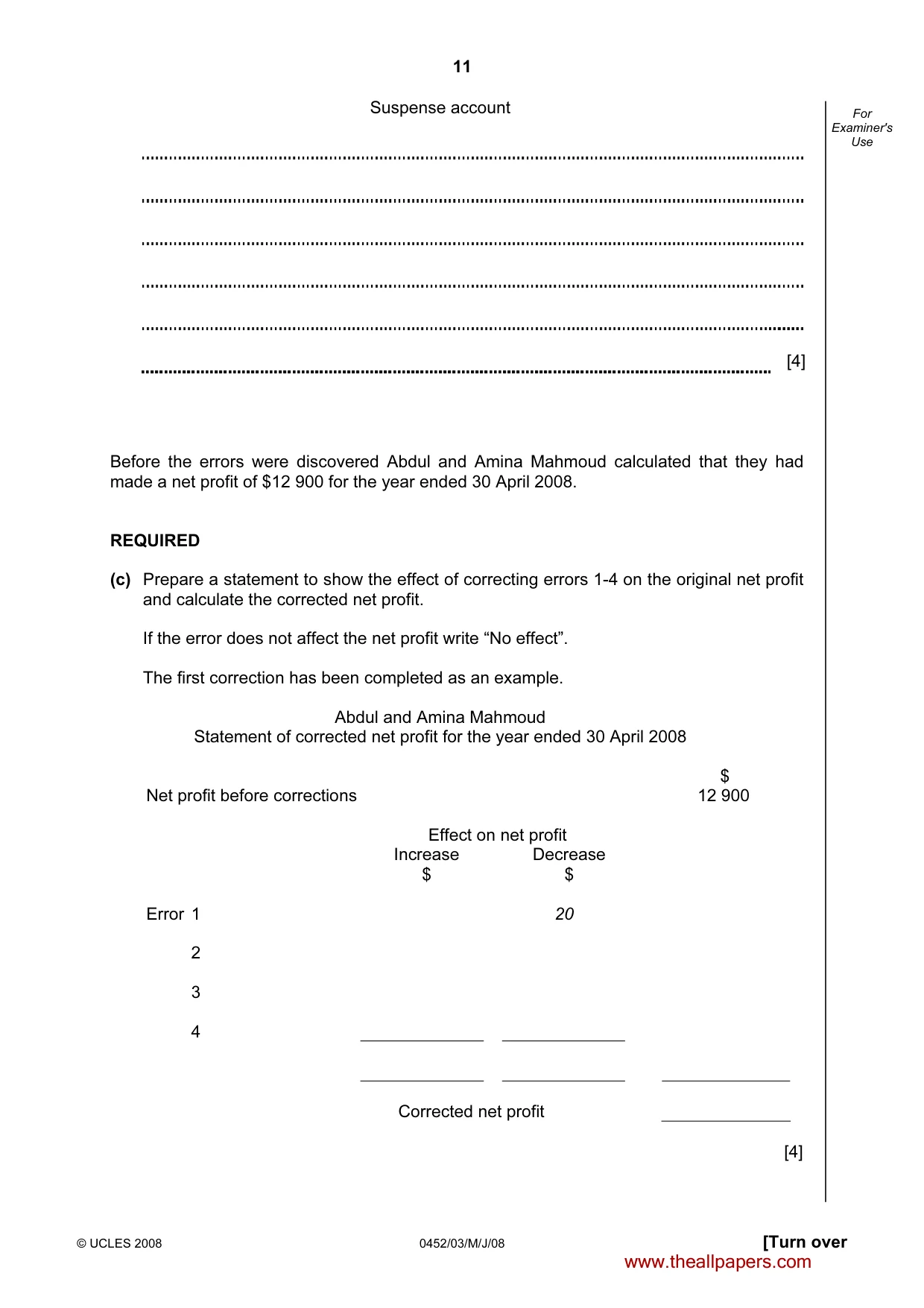
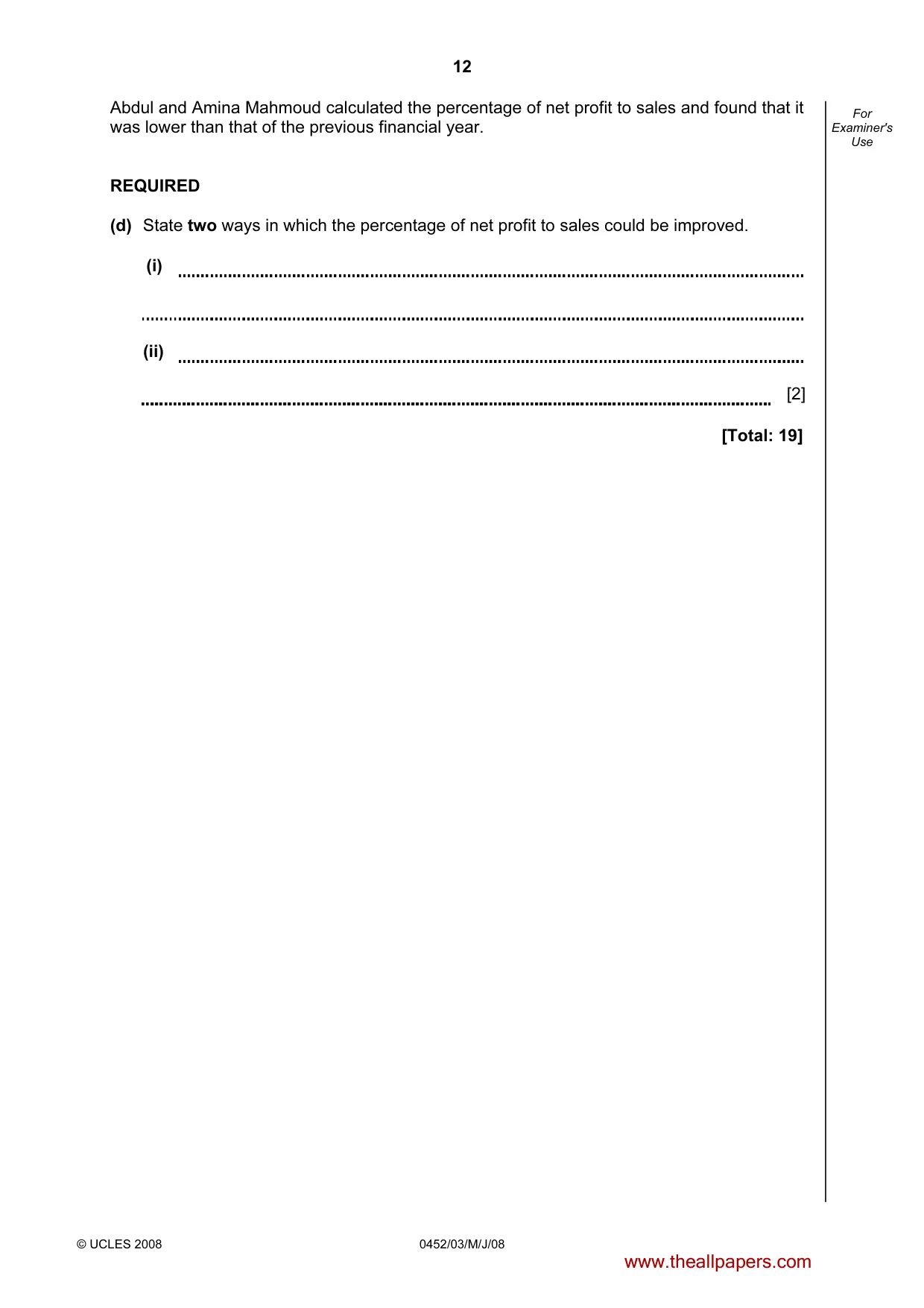
3 Abdul and Amina Mahmoud are in partnership. Their financial year ends on 30 April. The trial balance prepared on 30 April 2008 failed to agree. The debit side totalled $95 857 and the credit side totalled $95 457. The difference was entered in a suspense account. The following errors were later discovered: 1 Abdul had spent $20 of his personal funds to purchase business stationery. This had not been recorded in the books. 2 Goods withdrawn by Abdul for personal use, costing $300, had been debited to his drawings account but no other entry had been made. 3 $50 recovered from a bad debt (written off in 2006) had been correctly entered in the cash book and had been debited to the bad debts account. 4 The partners decided that the debit balance of $2200 on Amina’s current account should be transferred to her capital account. This had not been recorded. REQUIRED (a) Prepare the entries in Abdul and Amina Mahmoud’s journal to correct the above errors. Narratives are not required. Journal Debit Credit $ $ [9] (b) Prepare the suspense account in Abdul and Amina Mahmoud’s ledger to show the required entries. Start with the balance arising from the difference on the trial balance. Where a traditional “T” account is used it should be balanced or totalled as necessary. Where a three column running balance account is used the balance column should be updated after each entry. Suspense account [4] Before the errors were discovered Abdul and Amina Mahmoud calculated that they had made a net profit of $12 900 for the year ended 30 April 2008. REQUIRED (c) Prepare a statement to show the effect of correcting errors 1-4 on the original net profit and calculate the corrected net profit. If the error does not affect the net profit write “No effect”. The first correction has been completed as an example. Abdul and Amina Mahmoud Statement of corrected net profit for the year ended 30 April 2008 $ Net profit before corrections 12 900 Effect on net profit Increase Decrease $ $ Error 1 20 2 3 4 Corrected net profit [4] Abdul and Amina Mahmoud calculated the percentage of net profit to sales and found that it was lower than that of the previous financial year. REQUIRED (d) State two ways in which the percentage of net profit to sales could be improved. (i) (ii) [2] [Total: 19]
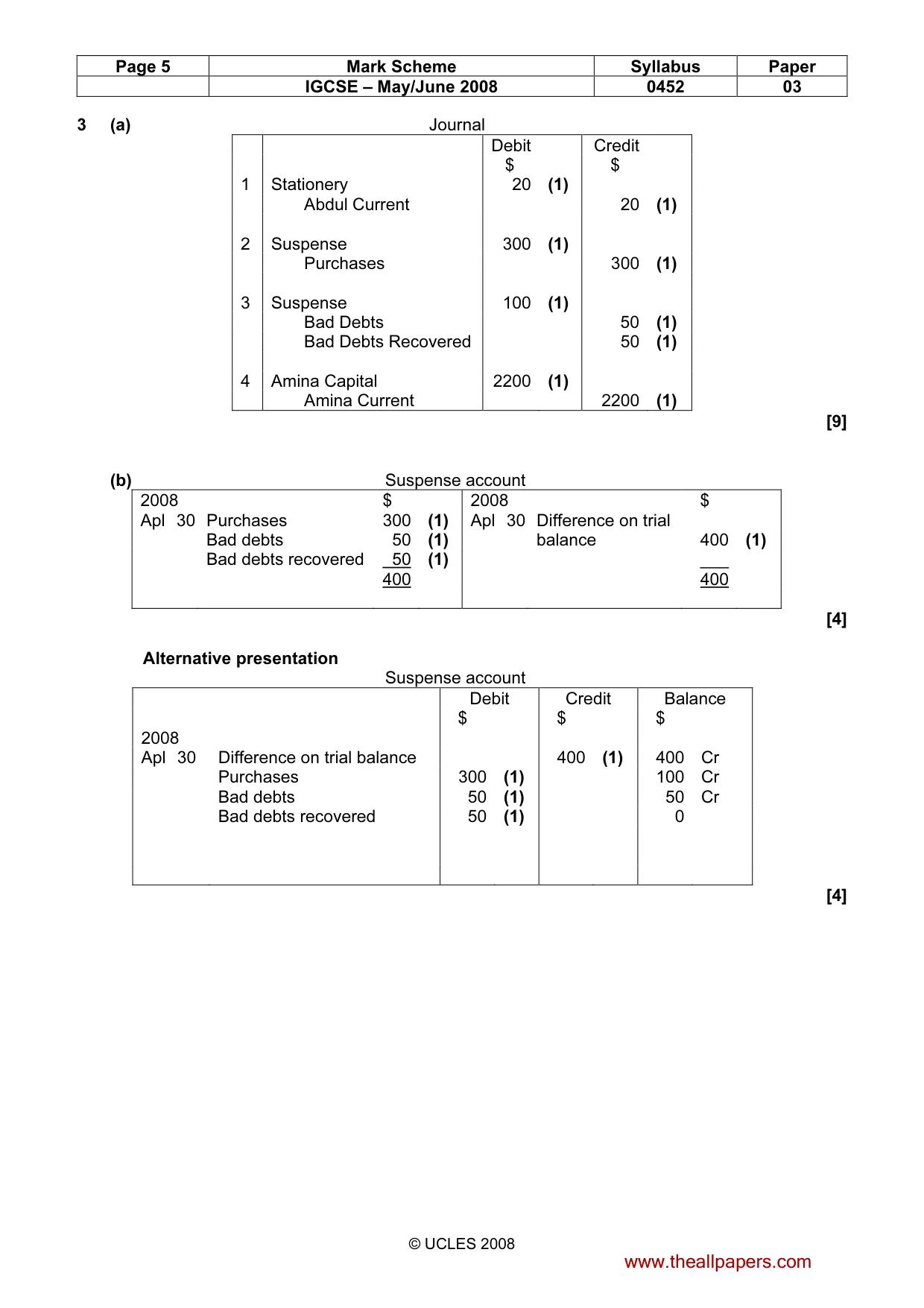
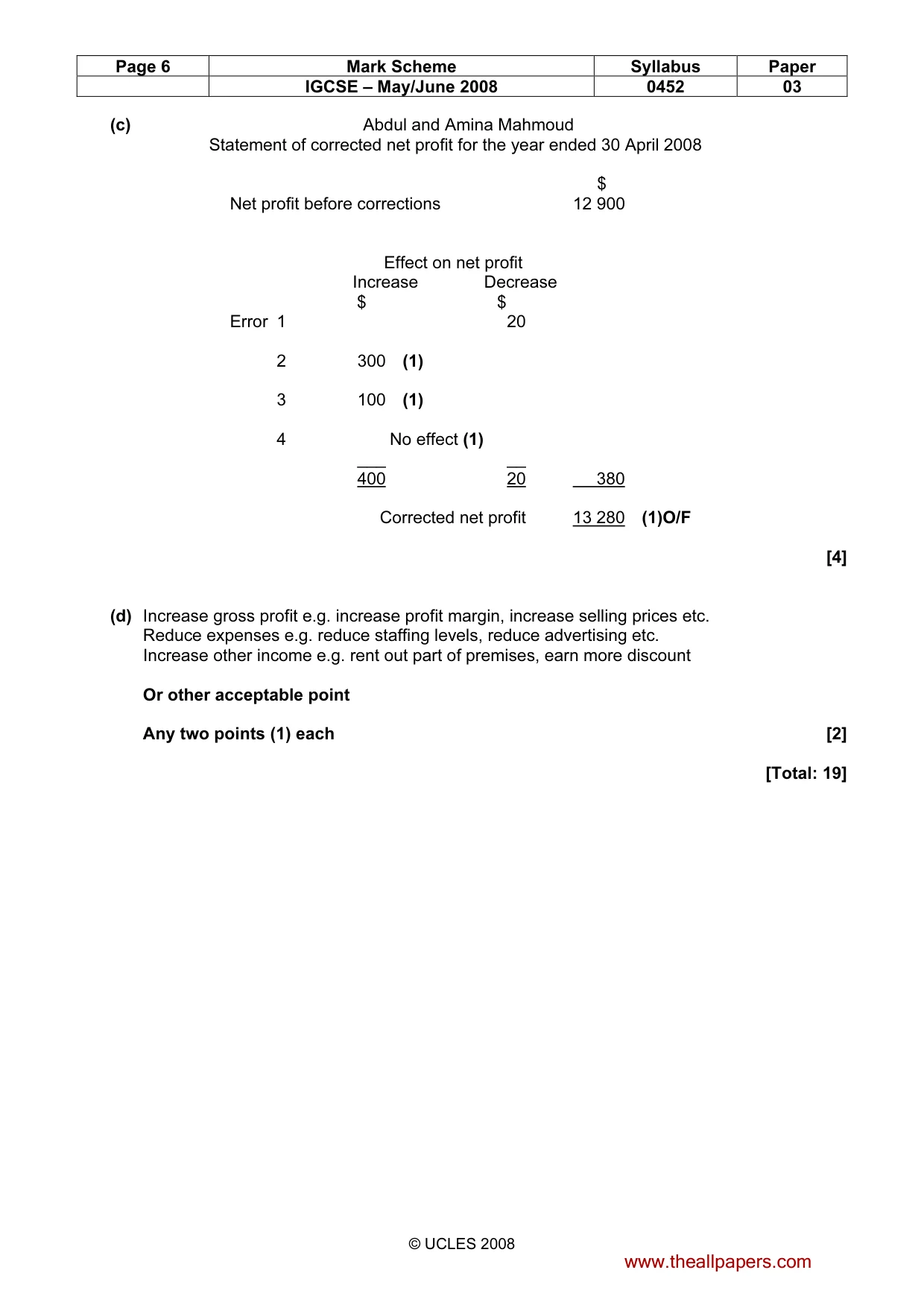
Mark scheme: 3 (a) Journal Debit Credit $ $ 1 Stationery 20 (1) Abdul Current 20 (1) 2 Suspense 300 (1) Purchases 300 (1) 3 Suspense 100 (1) Bad Debts 50 (1) Bad Debts Recovered 50 (1) 4 Amina Capital 2200 (1) Amina Current 2200 (1) [9] (b) Suspense account 2008 $ 2008 $ Apl 30 Purchases 300 (1) Apl 30 Difference on trial Bad debts 50 (1) balance 400 (1) Bad debts recovered 50 (1) ___ 400 400 [4] Alternative presentation Suspense account Debit Credit Balance $ $ $ 2008 Apl 30 Difference on trial balance 400 (1) 400 Cr Purchases 300 (1) 100 Cr Bad debts 50 (1) 50 Cr Bad debts recovered 50 (1) 0 [4] IGCSE – May/June 2008 0452 03 (c) Abdul and Amina Mahmoud Statement of corrected net profit for the year ended 30 April 2008 $ Net profit before corrections 12 900 Effect on net profit Increase Decrease $ $ Error 1 20 2 300 (1) 3 100 (1) 4 No effect (1) ___ __ 400 20 380 Corrected net profit 13 280 (1)O/F [4] (d) Increase gross profit e.g. increase profit margin, increase selling prices etc. Reduce expenses e.g. reduce staffing levels, reduce advertising etc. Increase other income e.g. rent out part of premises, earn more discount Or other acceptable point Any two points (1) each [2] [Total: 19] IGCSE – May/June 2008 0452 03
Q4 · Gideon Yeboah is a manufacturer
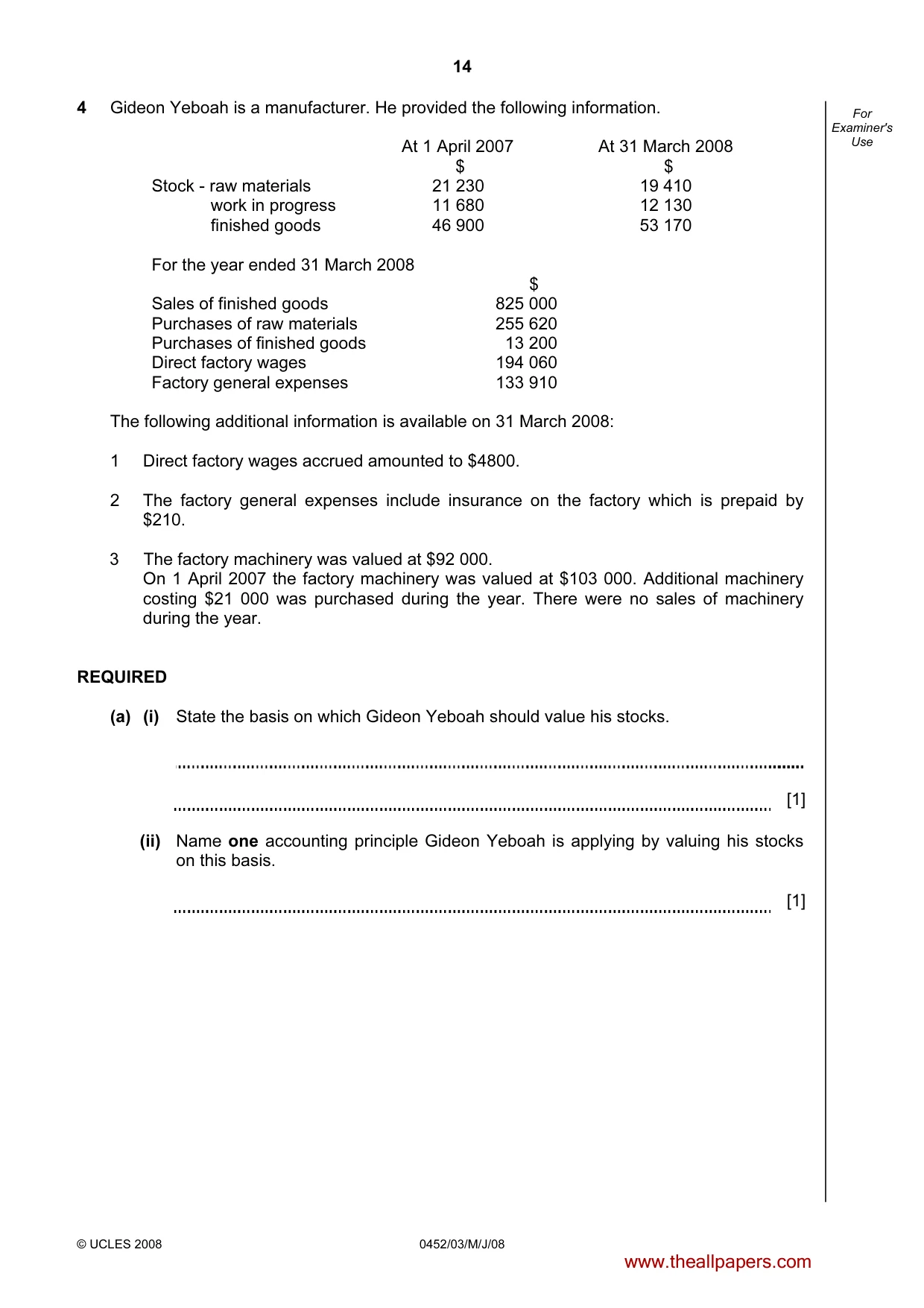
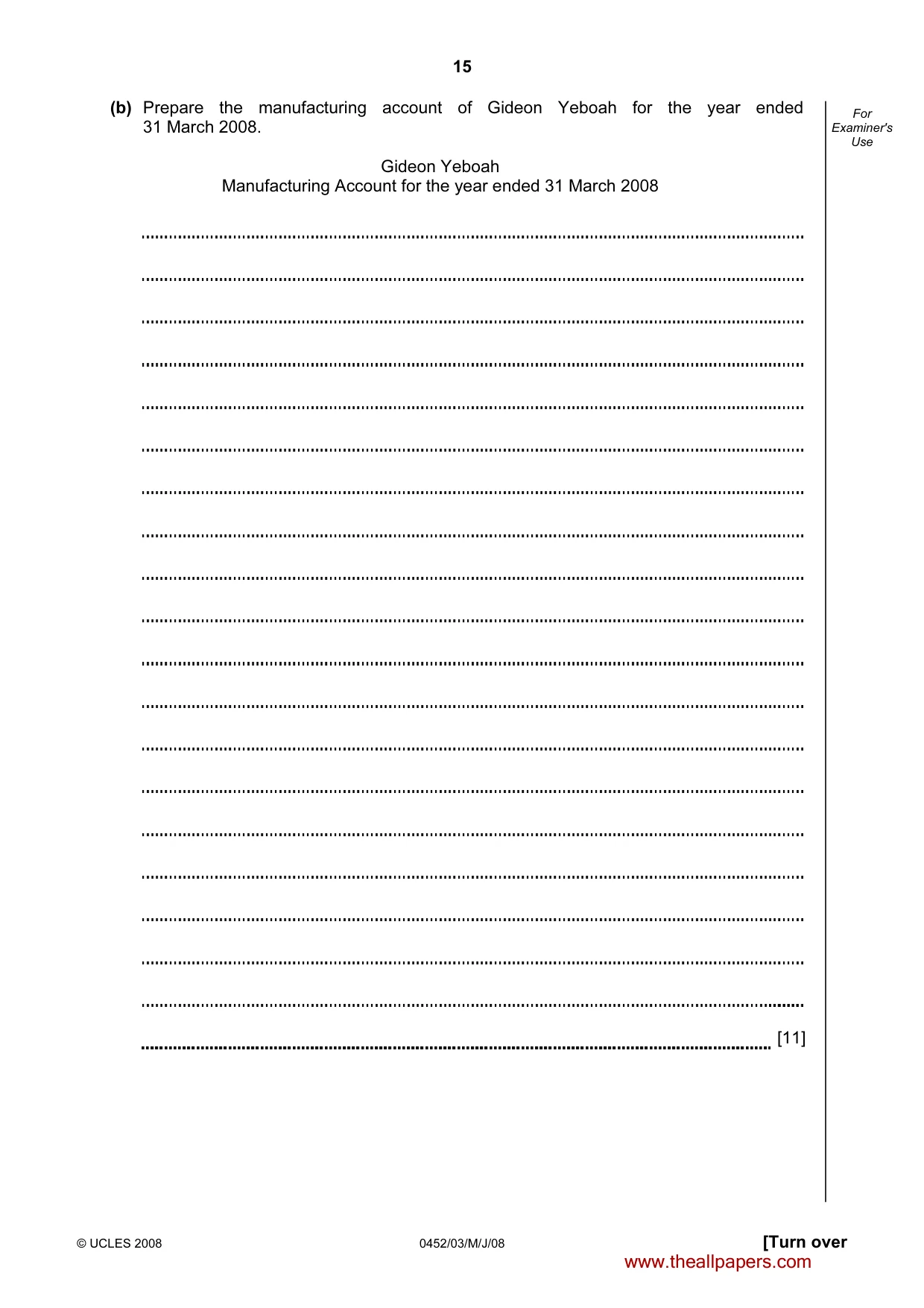
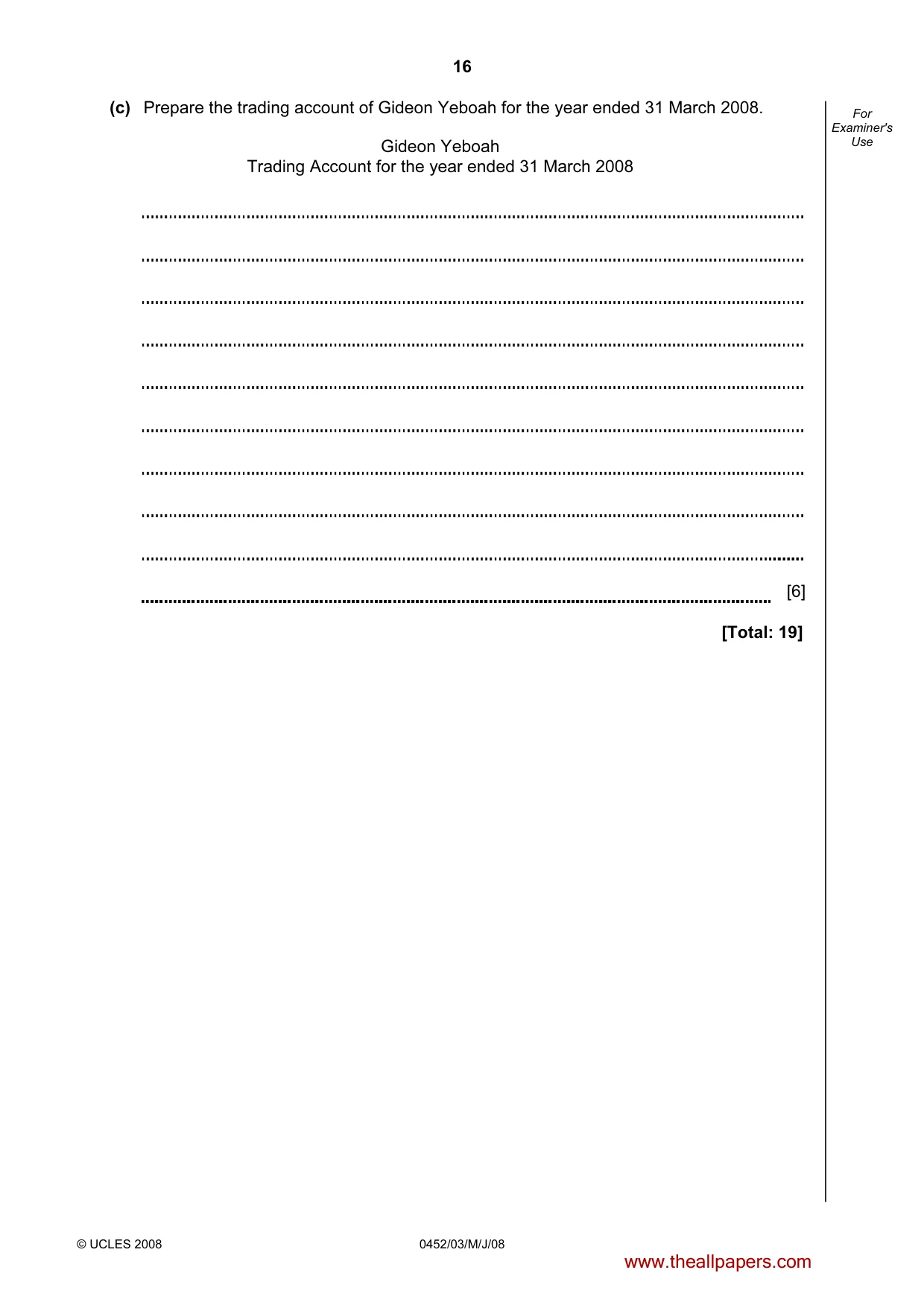
4 Gideon Yeboah is a manufacturer. He provided the following information. At 1 April 2007 At 31 March 2008 $ $ Stock - raw materials 21 230 19 410 work in progress 11 680 12 130 finished goods 46 900 53 170 For the year ended 31 March 2008 $ Sales of finished goods 825 000 Purchases of raw materials 255 620 Purchases of finished goods 13 200 Direct factory wages 194 060 Factory general expenses 133 910 The following additional information is available on 31 March 2008: 1 Direct factory wages accrued amounted to $4800. 2 The factory general expenses include insurance on the factory which is prepaid by $210. 3 The factory machinery was valued at $92 000. On 1 April 2007 the factory machinery was valued at $103 000. Additional machinery costing $21 000 was purchased during the year. There were no sales of machinery during the year. REQUIRED (a) (i) State the basis on which Gideon Yeboah should value his stocks. [1] (ii) Name one accounting principle Gideon Yeboah is applying by valuing his stocks on this basis. [1] (b) Prepare the manufacturing account of Gideon Yeboah for the year ended 31 March 2008. Gideon Yeboah Manufacturing Account for the year ended 31 March 2008 [11] (c) Prepare the trading account of Gideon Yeboah for the year ended 31 March 2008. Gideon Yeboah Trading Account for the year ended 31 March 2008 [6] [Total: 19]
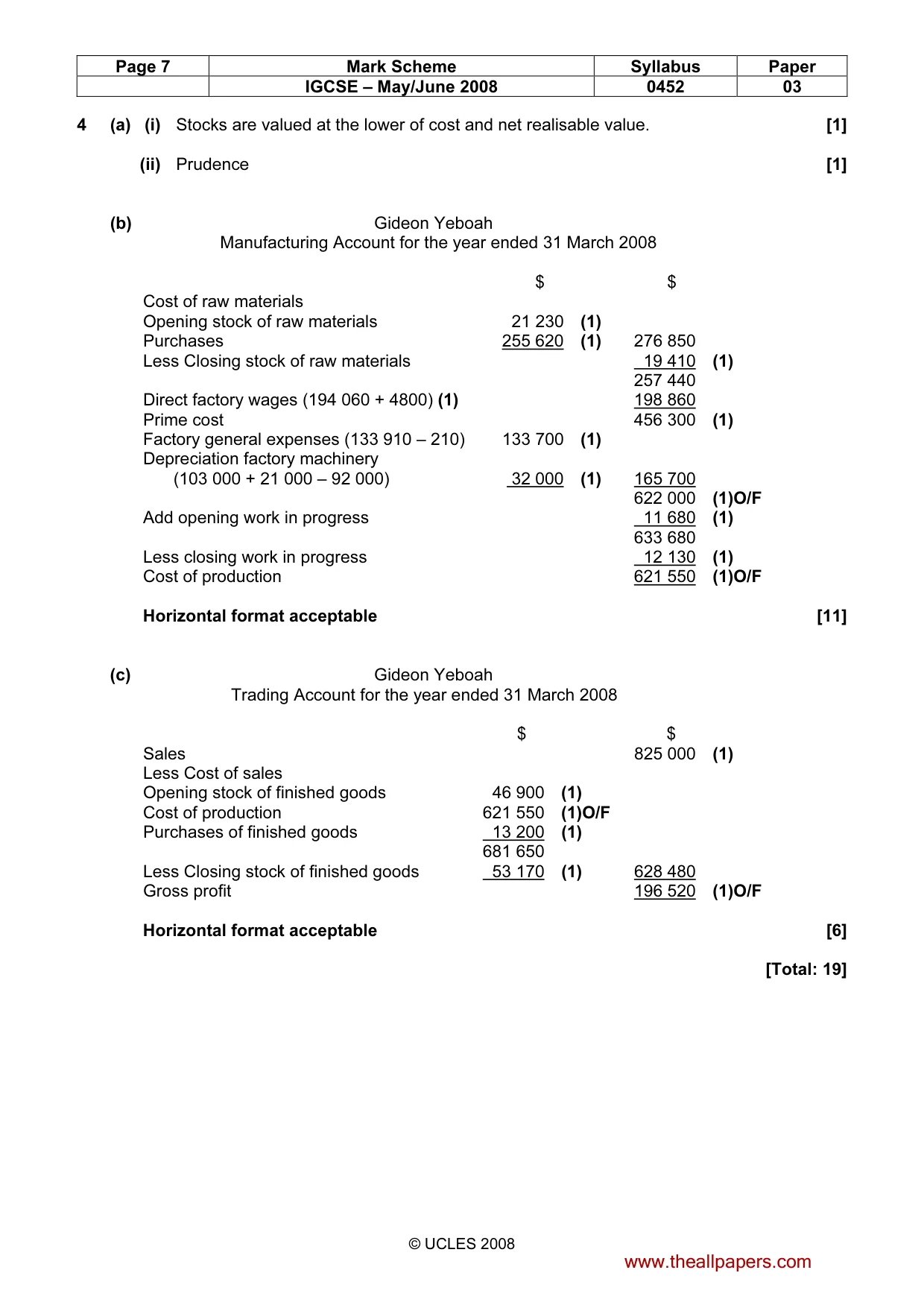
Mark scheme: 4 (a) (i) Stocks are valued at the lower of cost and net realisable value. [1] (ii) Prudence [1] (b) Gideon Yeboah Manufacturing Account for the year ended 31 March 2008 $ $ Cost of raw materials Opening stock of raw materials 21 230 (1) Purchases 255 620 (1) 276 850 Less Closing stock of raw materials 19 410 (1) 257 440 Direct factory wages (194 060 + 4800) (1) 198 860 Prime cost 456 300 (1) Factory general expenses (133 910 – 210) 133 700 (1) Depreciation factory machinery (103 000 + 21 000 – 92 000) 32 000 (1) 165 700 622 000 (1)O/F Add opening work in progress 11 680 (1) 633 680 Less closing work in progress 12 130 (1) Cost of production 621 550 (1)O/F Horizontal format acceptable [11] (c) Gideon Yeboah Trading Account for the year ended 31 March 2008 $ $ Sales 825 000 (1) Less Cost of sales Opening stock of finished goods 46 900 (1) Cost of production 621 550 (1)O/F Purchases of finished goods 13 200 (1) 681 650 Less Closing stock of finished goods 53 170 (1) 628 480 Gross profit 196 520 (1)O/F Horizontal format acceptable [6] [Total: 19] IGCSE – May/June 2008 0452 03
Q5 · Tahir Ali supplies building materials
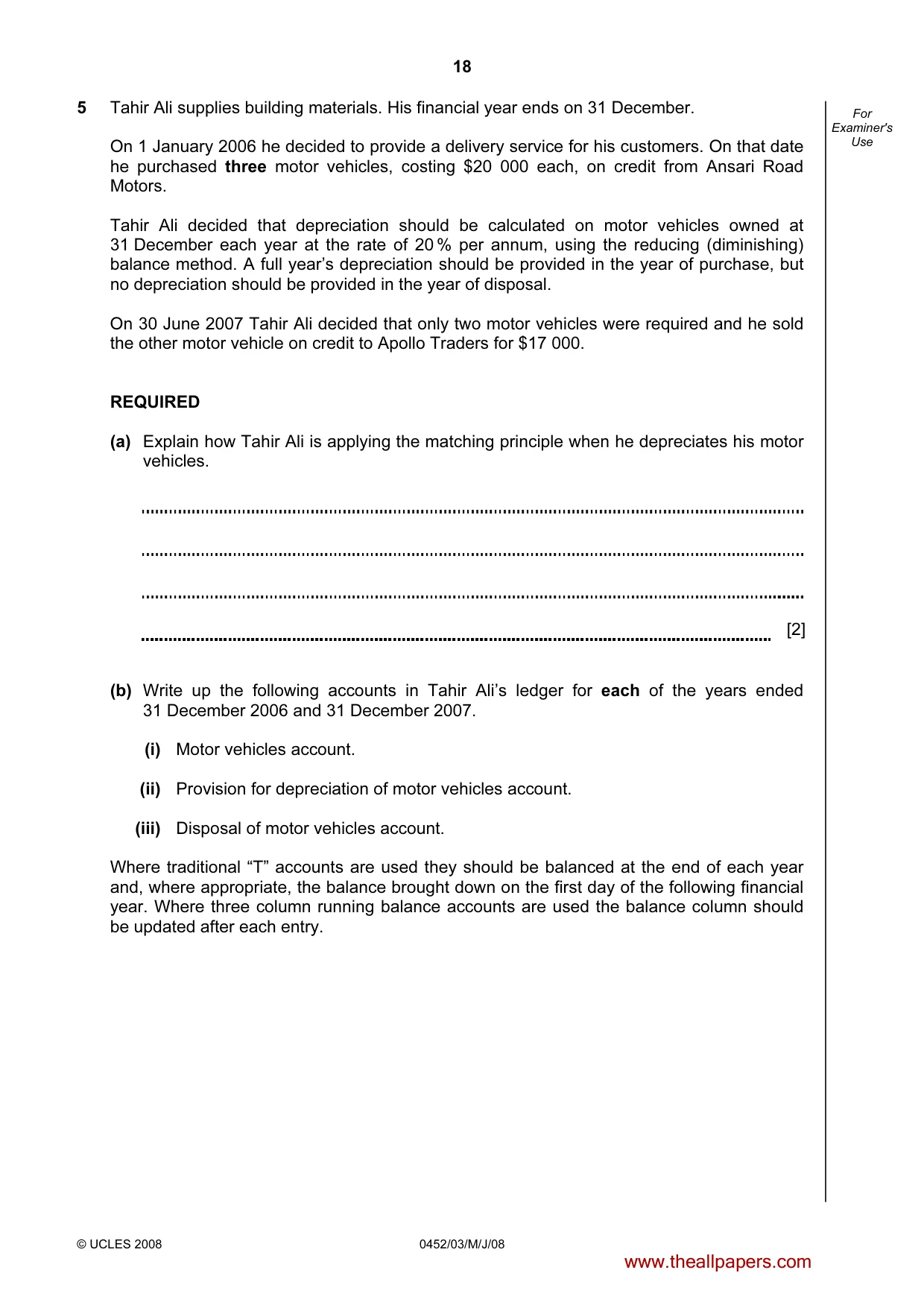
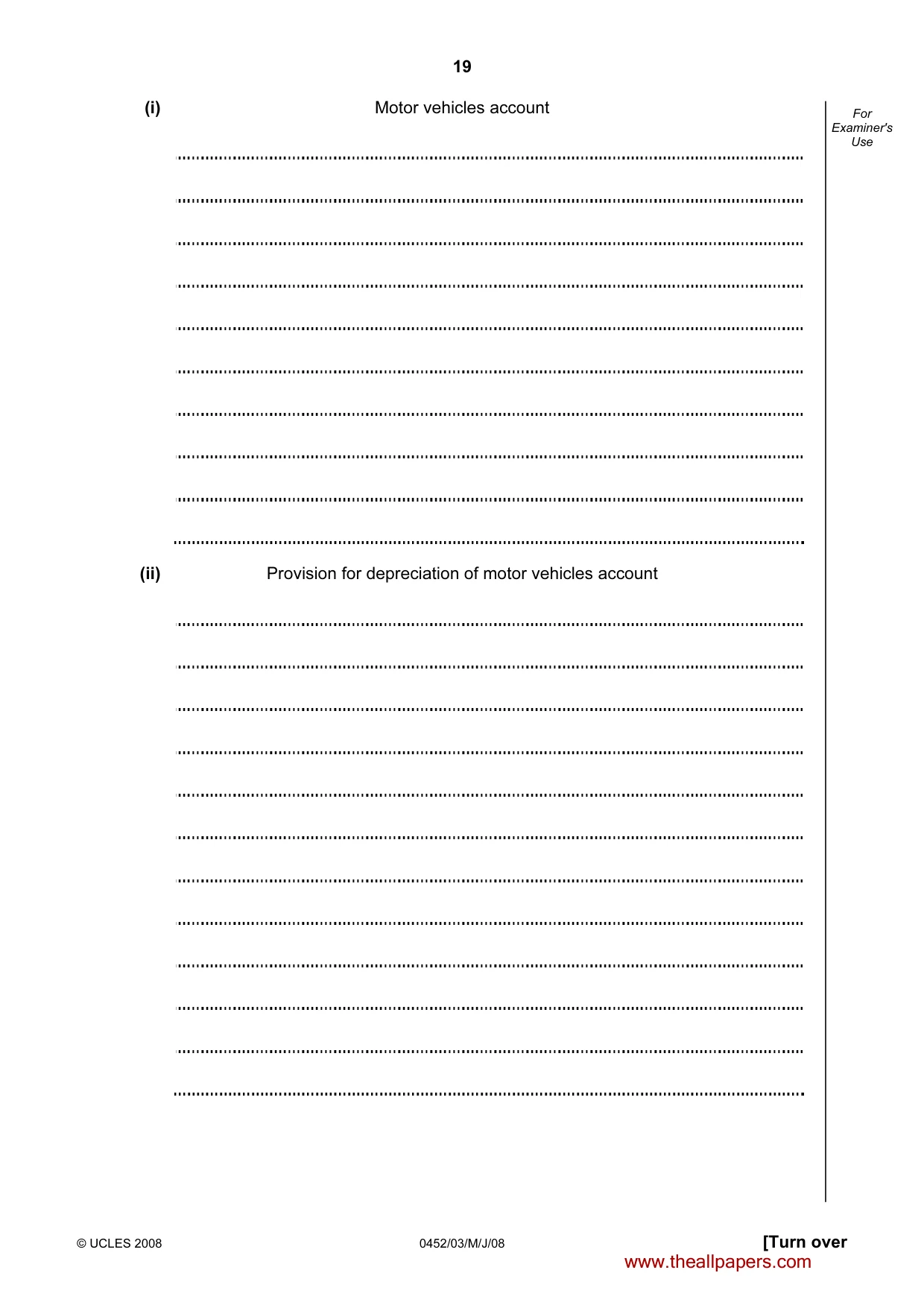
5 Tahir Ali supplies building materials. His financial year ends on 31 December. On 1 January 2006 he decided to provide a delivery service for his customers. On that date he purchased three motor vehicles, costing $20 000 each, on credit from Ansari Road Motors. Tahir Ali decided that depreciation should be calculated on motor vehicles owned at 31 December each year at the rate of 20 % per annum, using the reducing (diminishing) balance method. A full year’s depreciation should be provided in the year of purchase, but no depreciation should be provided in the year of disposal. On 30 June 2007 Tahir Ali decided that only two motor vehicles were required and he sold the other motor vehicle on credit to Apollo Traders for $17 000. REQUIRED (a) Explain how Tahir Ali is applying the matching principle when he depreciates his motor vehicles. [2] (b) Write up the following accounts in Tahir Ali’s ledger for each of the years ended 31 December 2006 and 31 December 2007. (i) Motor vehicles account. (ii) Provision for depreciation of motor vehicles account. (iii) Disposal of motor vehicles account. Where traditional “T” accounts are used they should be balanced at the end of each year and, where appropriate, the balance brought down on the first day of the following financial year. Where three column running balance accounts are used the balance column should be updated after each entry. (i) Motor vehicles account (ii) Provision for depreciation of motor vehicles account (iii) Disposal of motor vehicles account [18] [Total: 20]
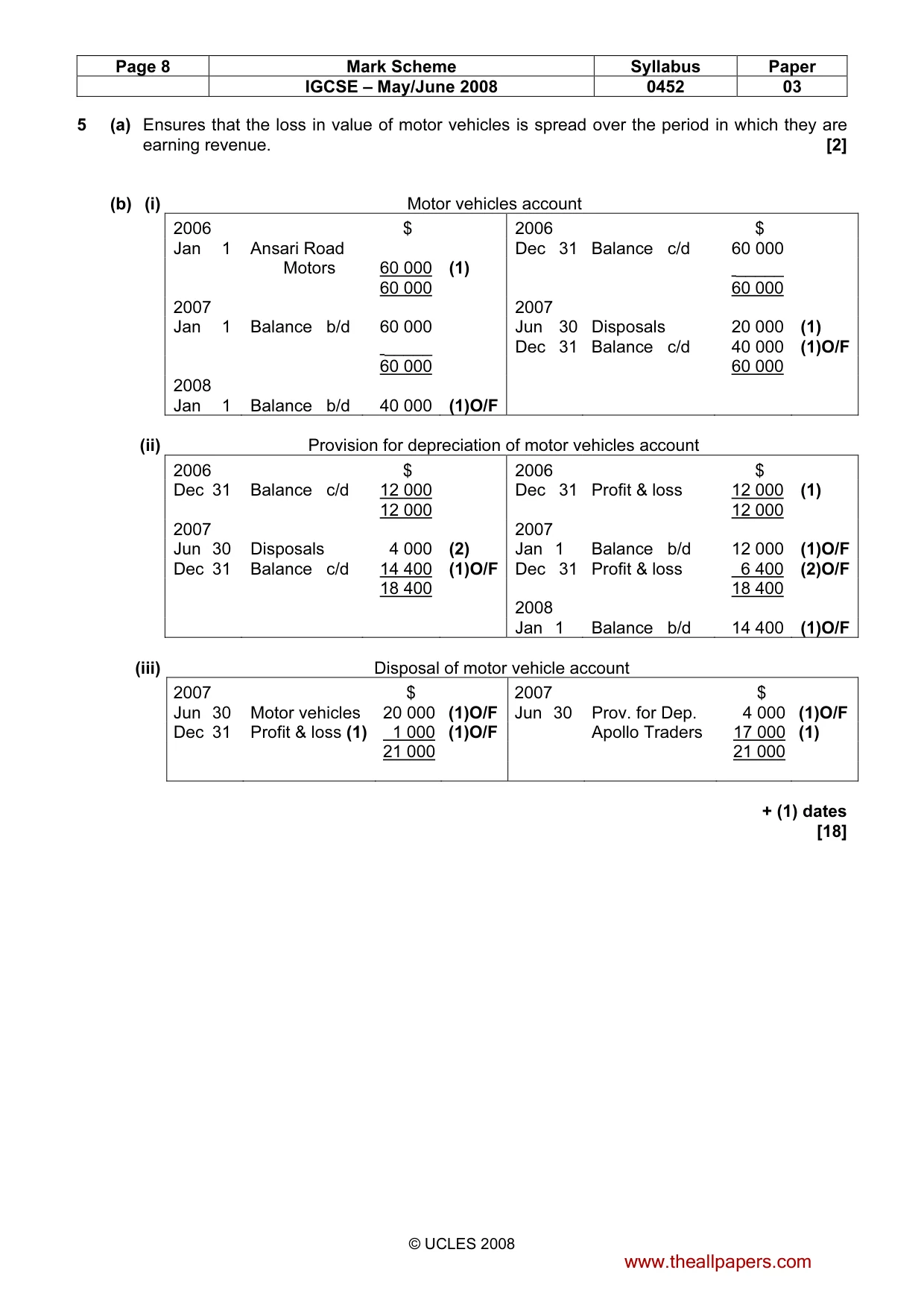
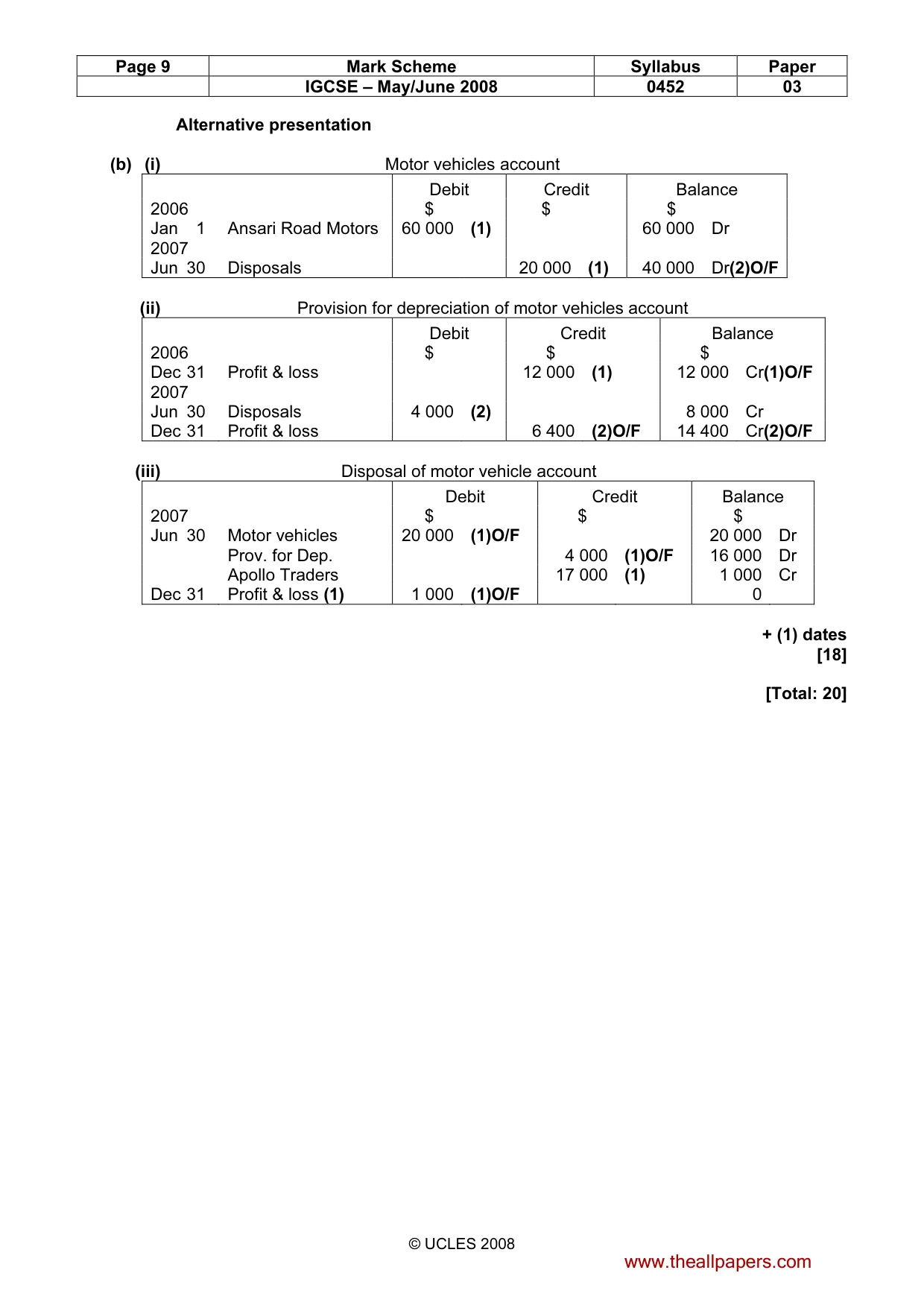
Mark scheme: 5 (a) Ensures that the loss in value of motor vehicles is spread over the period in which they are earning revenue. [2] (b) (i) Motor vehicles account 2006 $ 2006 $ Jan 1 Ansari Road Dec 31 Balance c/d 60 000 Motors 60 000 (1) _____ 60 000 60 000 2007 2007 Jan 1 Balance b/d 60 000 Jun 30 Disposals 20 000 (1) _____ Dec 31 Balance c/d 40 000 (1)O/F 60 000 60 000 2008 Jan 1 Balance b/d 40 000 (1)O/F (ii) Provision for depreciation of motor vehicles account 2006 $ 2006 $ Dec 31 Balance c/d 12 000 Dec 31 Profit & loss 12 000 (1) 12 000 12 000 2007 2007 Jun 30 Disposals 4 000 (2) Jan 1 Balance b/d 12 000 (1)O/F Dec 31 Balance c/d 14 400 (1)O/F Dec 31 Profit & loss 6 400 (2)O/F 18 400 18 400 2008 Jan 1 Balance b/d 14 400 (1)O/F (iii) Disposal of motor vehicle account 2007 $ 2007 $ Jun 30 Motor vehicles 20 000 (1)O/F Jun 30 Prov. for Dep. 4 000 (1)O/F Dec 31 Profit & loss (1) 1 000 (1)O/F Apollo Traders 17 000 (1) 21 000 21 000 + (1) dates [18] IGCSE – May/June 2008 0452 03 Alternative presentation (b) (i) Motor vehicles account Debit Credit Balance 2006 $ $ $ Jan 1 Ansari Road Motors 60 000 (1) 60 000 Dr 2007 Jun 30 Disposals 20 000 (1) 40 000 Dr(2)O/F (ii) Provision for depreciation of motor vehicles account Debit Credit Balance 2006 $ $ $ Dec 31 Profit & loss 12 000 (1) 12 000 Cr(1)O/F 2007 Jun 30 Disposals 4 000 (2) 8 000 Cr Dec 31 Profit & loss 6 400 (2)O/F 14 400 Cr(2)O/F (iii) Disposal of motor vehicle account Debit Credit Balance 2007 $ $ $ Jun 30 Motor vehicles 20 000 (1)O/F 20 000 Dr Prov. for Dep. 4 000 (1)O/F 16 000 Dr Apollo Traders 17 000 (1) 1 000 Cr Dec 31 Profit & loss (1) 1 000 (1)O/F 0 + (1) dates [18] [Total: 20]
More questions on Accounting for depreciation and disposal of non-current assets
What was in this paper
The subtopics covered by these 5 questions, and how many questions each got. Open one in a new tab to see every Cambridge question on it.
What you needed in this session
Cambridge’s own grade thresholds for 2008 May/June, Paper 3 · Variant 1. A higher threshold means an easier paper — the bar moves with how the cohort did.