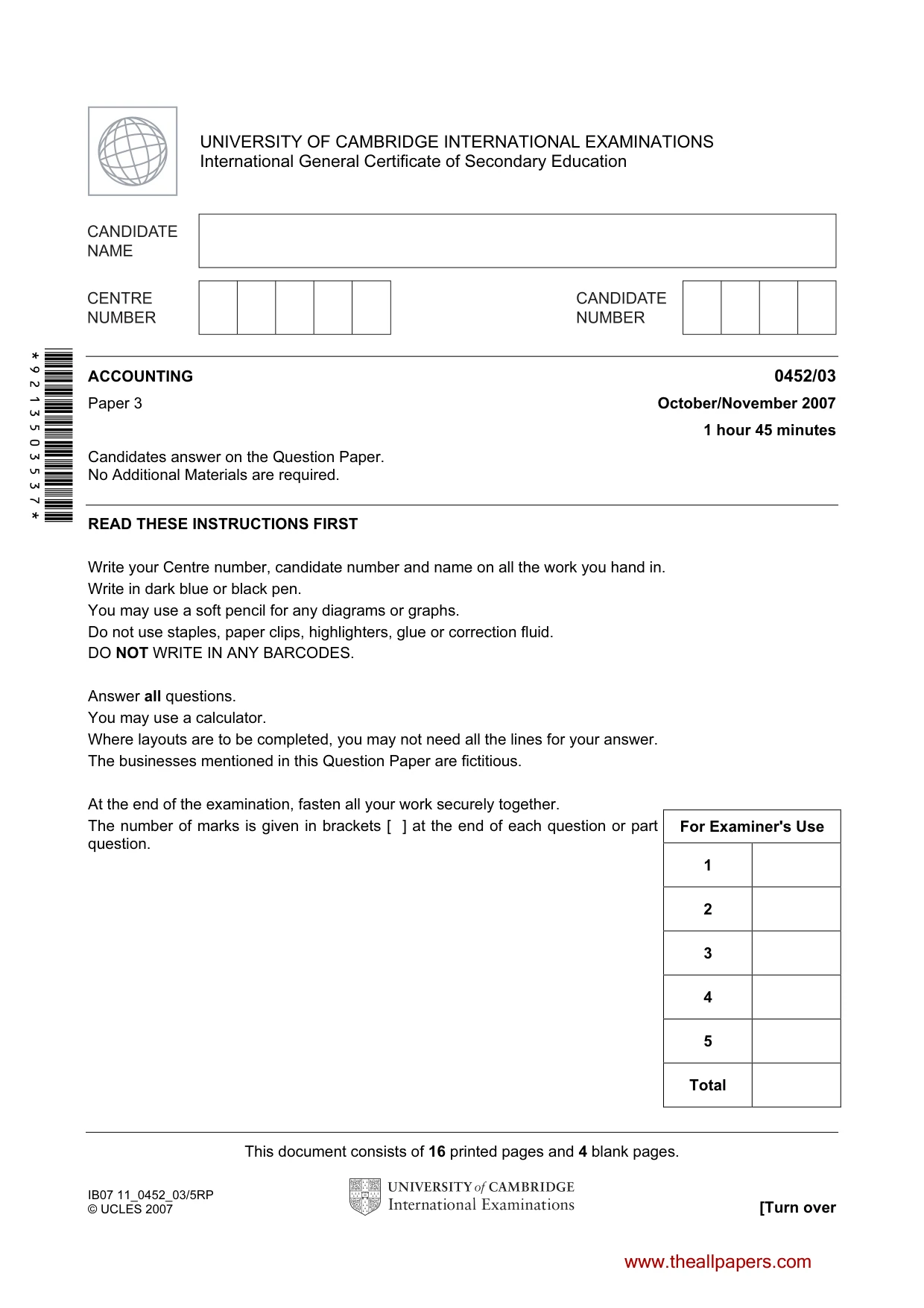
Cambridge IGCSE Accounting 0452 — 2007 Oct/Nov Paper 3 · Variant 1
0452/31/O/N/07 · 5 questions · 100 marks · ≈113 min
The question paper and its mark scheme, free to read here and free to download. This is Cambridge’s own paper, exactly as it was sat.
Question paper20 pages




Mark scheme9 pages
Answers below. Sit the paper first if you are practising.
Questions as text
Q1 · John Paihia, a trader, maintains a petty cash book using the imprest system
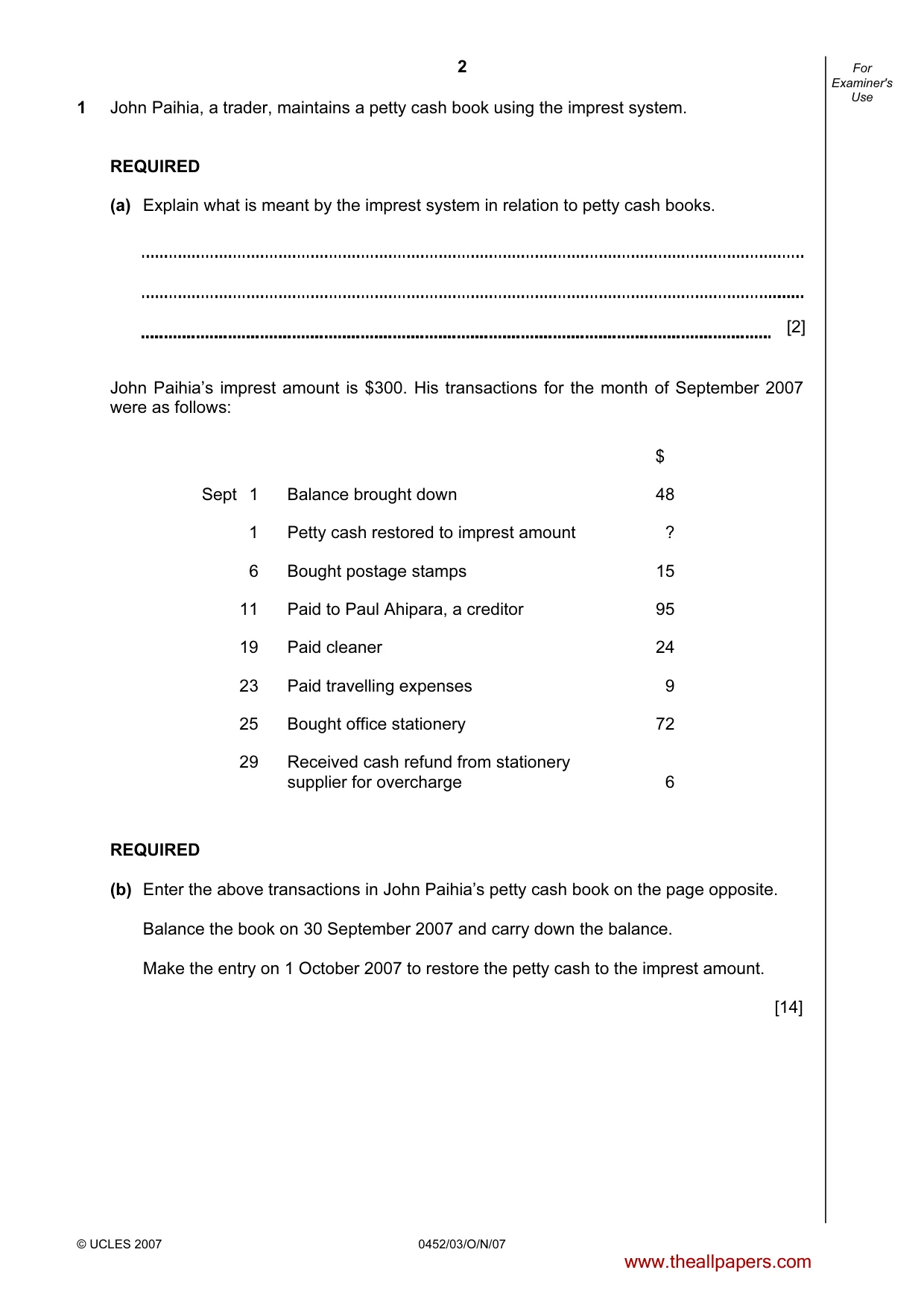
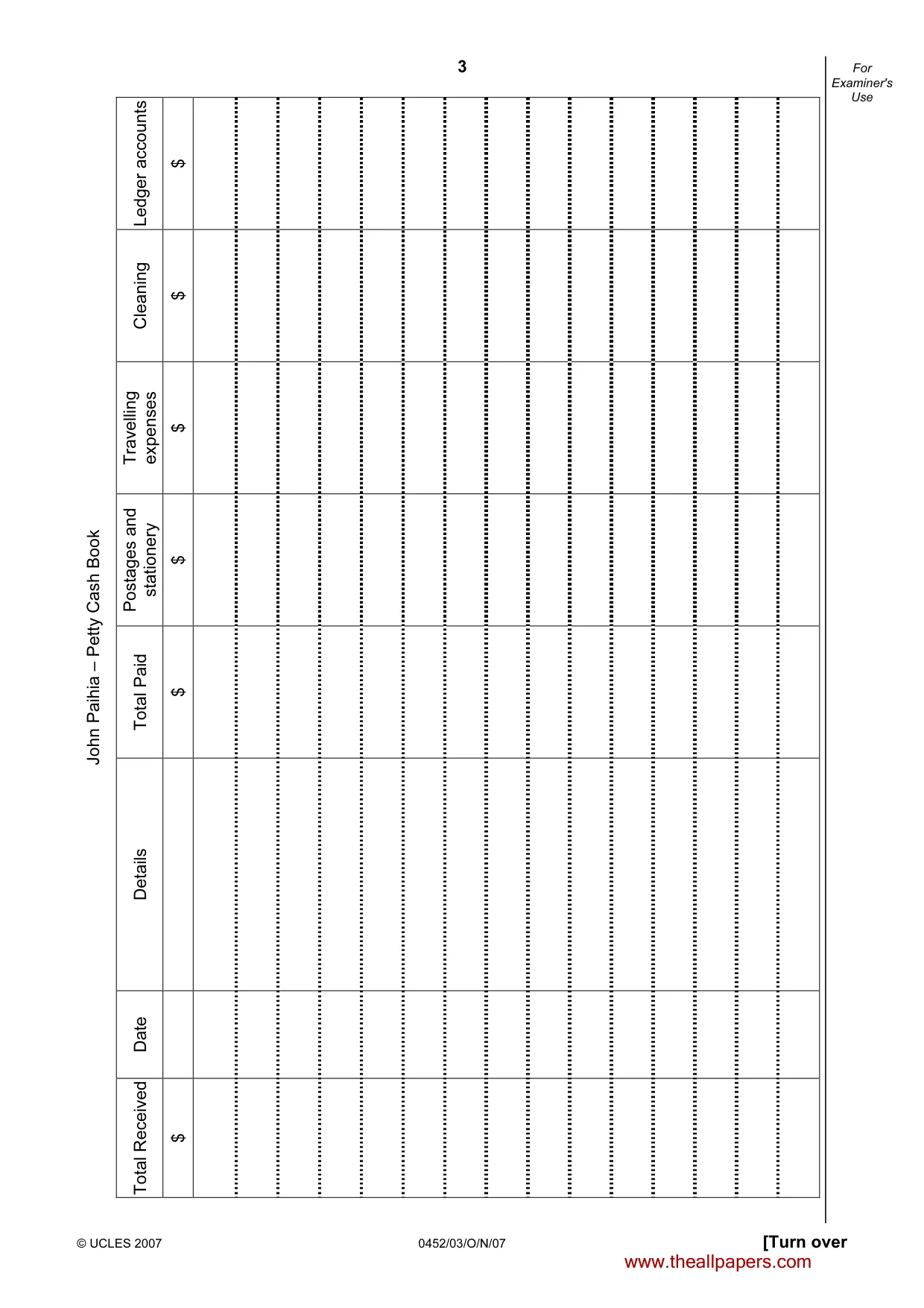
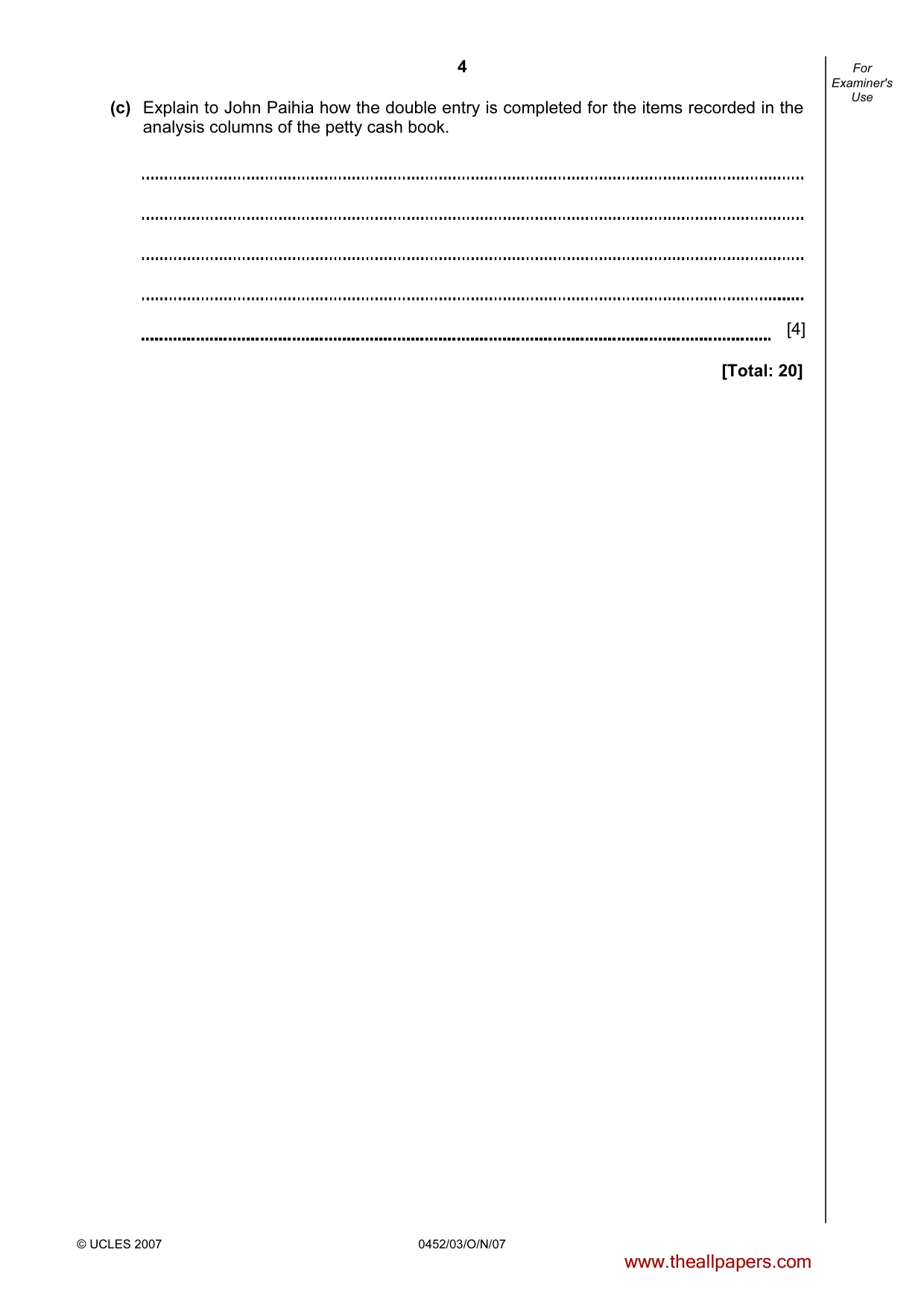
1 John Paihia, a trader, maintains a petty cash book using the imprest system. REQUIRED (a) Explain what is meant by the imprest system in relation to petty cash books. [2] John Paihia’s imprest amount is $300. His transactions for the month of September 2007 were as follows: $ Sept 1 Balance brought down 48 1 Petty cash restored to imprest amount ? 6 Bought postage stamps 15 11 Paid to Paul Ahipara, a creditor 95 19 Paid cleaner 24 23 Paid travelling expenses 9 25 Bought office stationery 72 29 Received cash refund from stationery supplier for overcharge 6 REQUIRED (b) Enter the above transactions in John Paihia’s petty cash book on the page opposite. Balance the book on 30 September 2007 and carry down the balance. Make the entry on 1 October 2007 to restore the petty cash to the imprest amount. [14] (c) Explain to John Paihia how the double entry is completed for the items recorded in the analysis columns of the petty cash book. [4] [Total: 20]
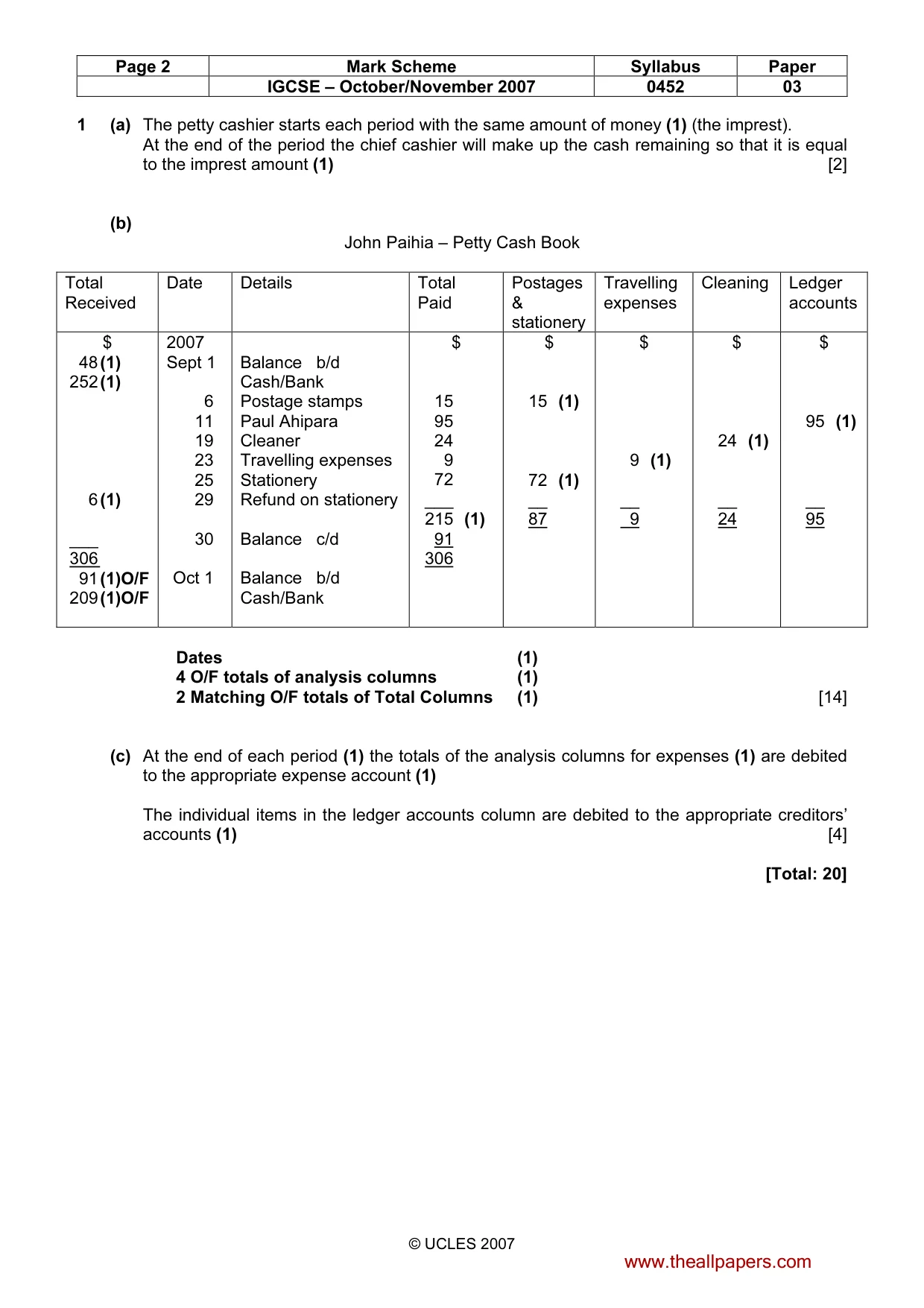
Mark scheme: 1 (a) The petty cashier starts each period with the same amount of money (1) (the imprest). At the end of the period the chief cashier will make up the cash remaining so that it is equal to the imprest amount (1) [2] (b) John Paihia – Petty Cash Book Total Date Details Total Postages Travelling Cleaning Ledger Received Paid & expenses accounts stationery $ 2007 $ $ $ $ $
Q2 · Mark Sekota started trading as Red Barn Manufacturing on 1 September 2004
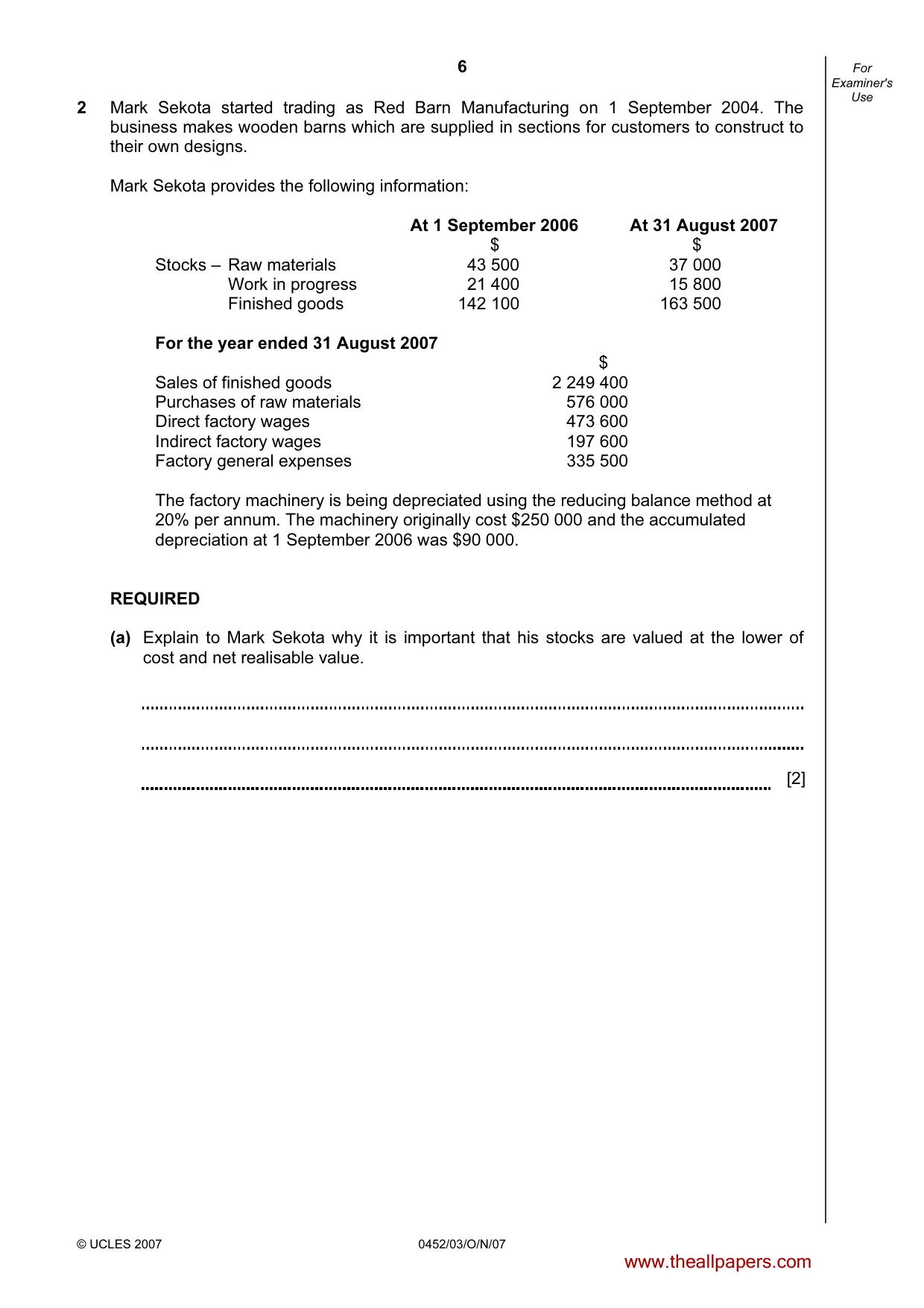
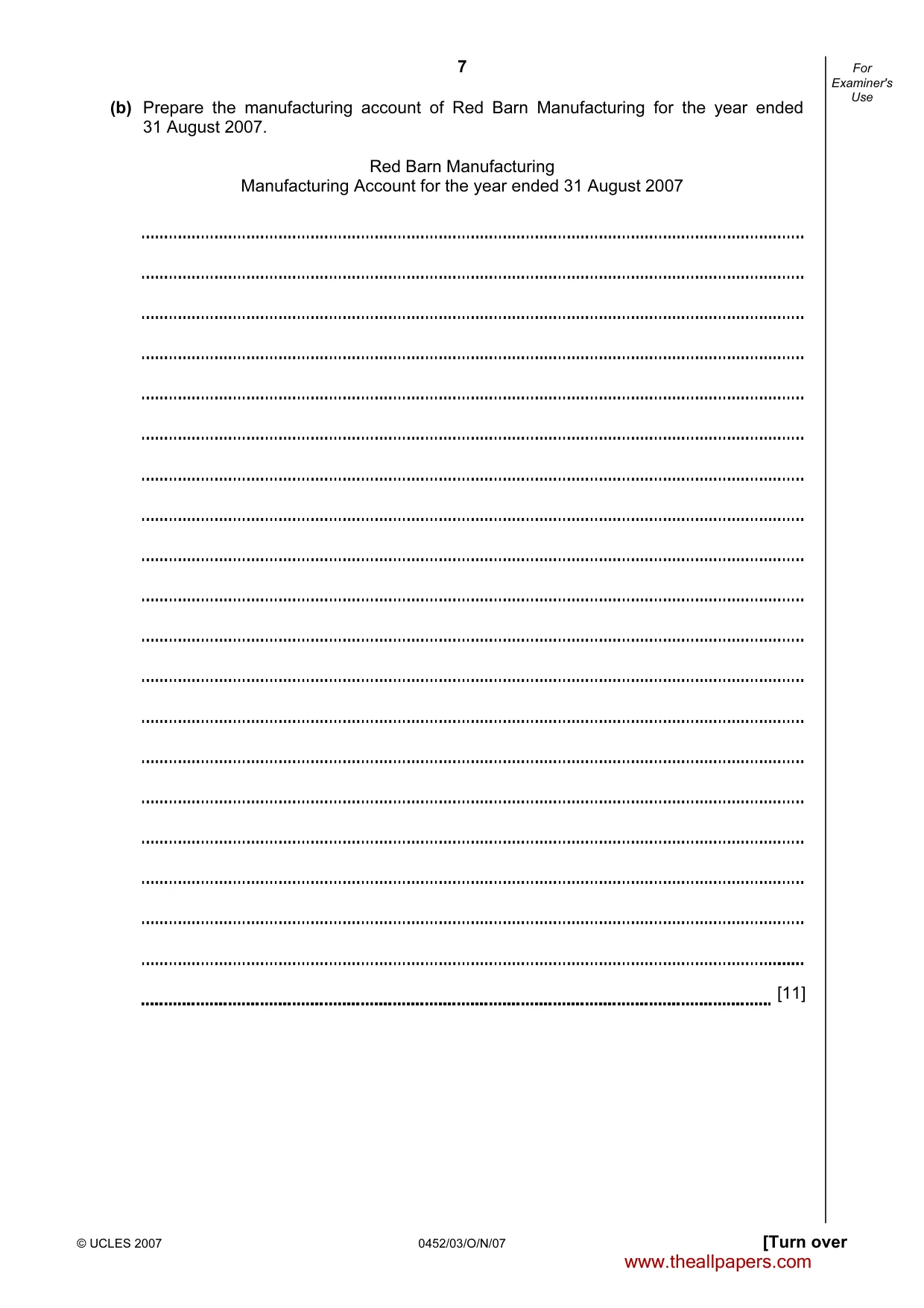
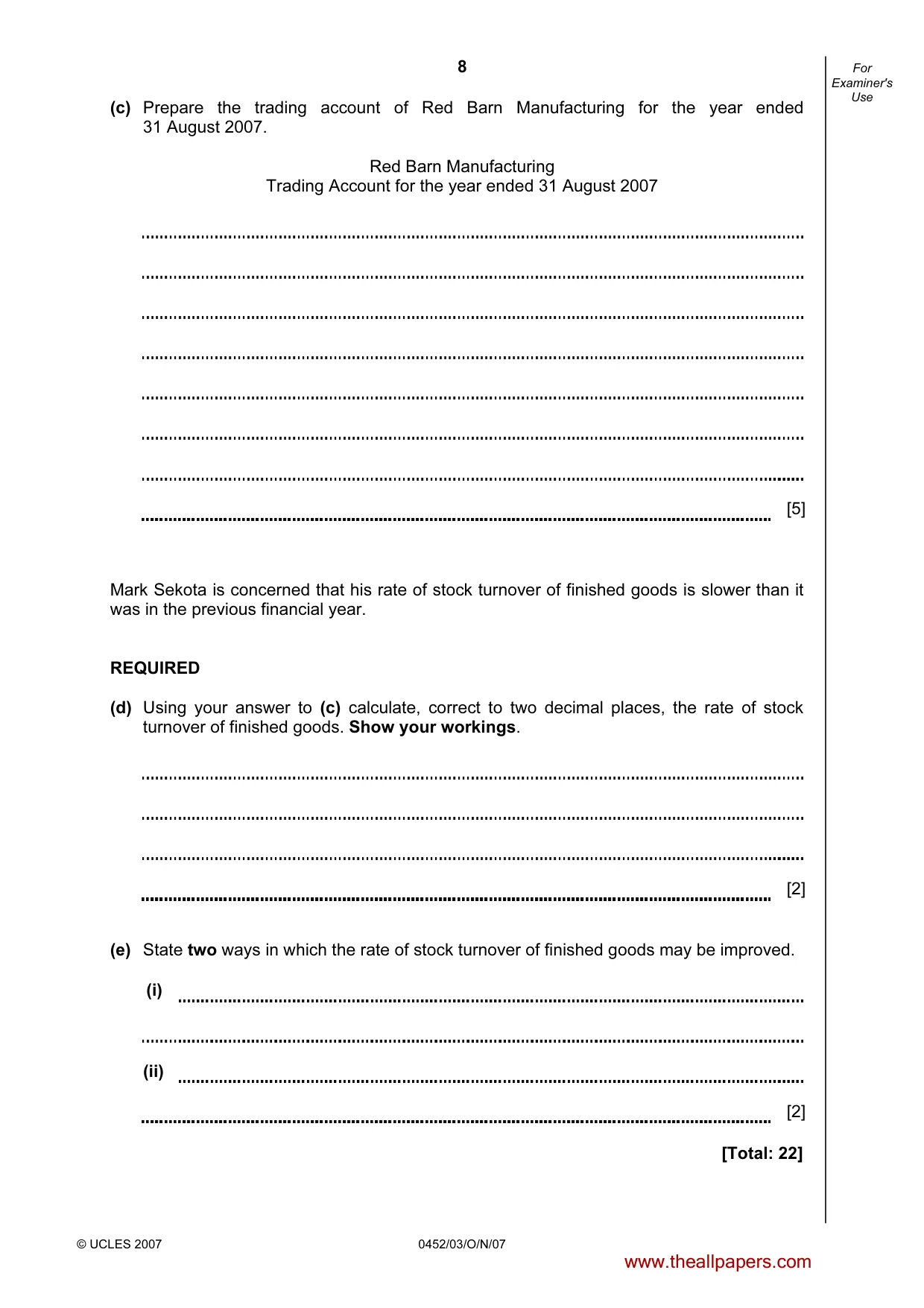
2 Mark Sekota started trading as Red Barn Manufacturing on 1 September 2004. The business makes wooden barns which are supplied in sections for customers to construct to their own designs. Mark Sekota provides the following information: At 1 September 2006 At 31 August 2007 $ $ Stocks – Raw materials 43 500 37 000 Work in progress 21 400 15 800 Finished goods 142 100 163 500 For the year ended 31 August 2007 $ Sales of finished goods 2 249 400 Purchases of raw materials 576 000 Direct factory wages 473 600 Indirect factory wages 197 600 Factory general expenses 335 500 The factory machinery is being depreciated using the reducing balance method at 20% per annum. The machinery originally cost $250 000 and the accumulated depreciation at 1 September 2006 was $90 000. REQUIRED (a) Explain to Mark Sekota why it is important that his stocks are valued at the lower of cost and net realisable value. [2] (b) Prepare the manufacturing account of Red Barn Manufacturing for the year ended 31 August 2007. Red Barn Manufacturing Manufacturing Account for the year ended 31 August 2007 [11] (c) Prepare the trading account of Red Barn Manufacturing for the year ended 31 August 2007. Red Barn Manufacturing Trading Account for the year ended 31 August 2007 [5] Mark Sekota is concerned that his rate of stock turnover of finished goods is slower than it was in the previous financial year. REQUIRED (d) Using your answer to (c) calculate, correct to two decimal places, the rate of stock turnover of finished goods. Show your workings. [2] (e) State two ways in which the rate of stock turnover of finished goods may be improved. (i) (ii) [2] [Total: 22]
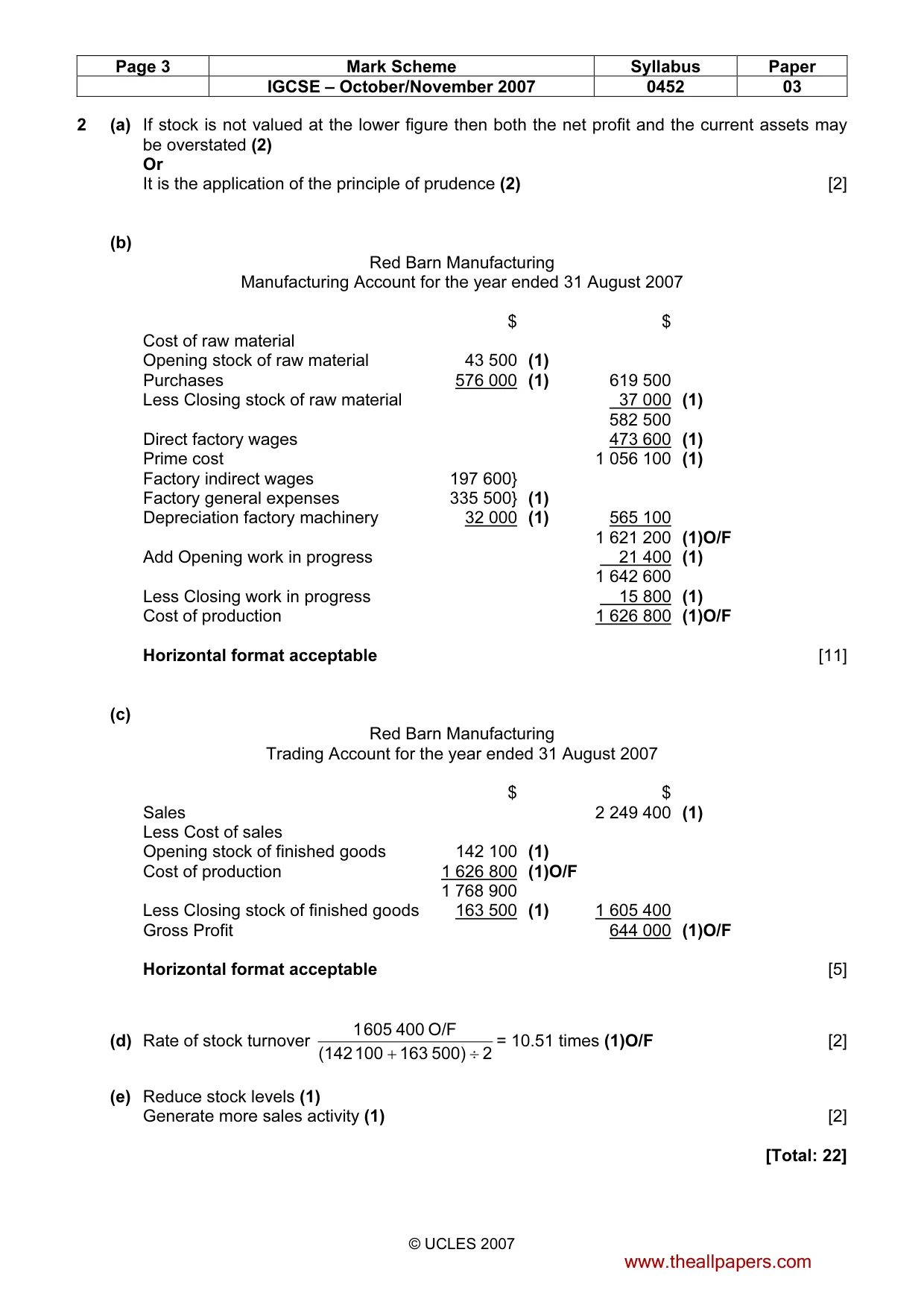
Mark scheme: 2 (a) If stock is not valued at the lower figure then both the net profit and the current assets may be overstated (2) Or It is the application of the principle of prudence (2) [2] (b) Red Barn Manufacturing Manufacturing Account for the year ended 31 August 2007 $ $ Cost of raw material Opening stock of raw material 43 500 (1) Purchases 576 000 (1) 619 500 Less Closing stock of raw material 37 000 (1) 582 500 Direct factory wages 473 600 (1) Prime cost 1 056 100 (1) Factory indirect wages 197 600} Factory general expenses 335 500} (1) Depreciation factory machinery 32 000 (1) 565 100 1 621 200 (1)O/F Add Opening work in progress 21 400 (1) 1 642 600 Less Closing work in progress 15 800 (1) Cost of production 1 626 800 (1)O/F Horizontal format acceptable [11] (c) Red Barn Manufacturing Trading Account for the year ended 31 August 2007 $ $ Sales 2 249 400 (1) Less Cost of sales Opening stock of finished goods 142 100 (1) Cost of production 1 626 800 (1)O/F 1 768 900 Less Closing stock of finished goods 163 500 (1) 1 605 400 Gross Profit 644 000 (1)O/F Horizontal format acceptable [5] 1 605 400 O/F (d) Rate of stock turnover = 10.51 times (1)O/F [2] (142 100 + 163 500) ÷ 2 (e) Reduce stock levels (1) Generate more sales activity (1) [2] [Total: 22] IGCSE – October/November 2007 0452 03
Q3 · The treasurer of Al Shuhada Music Club provided the following list of balances appearing…
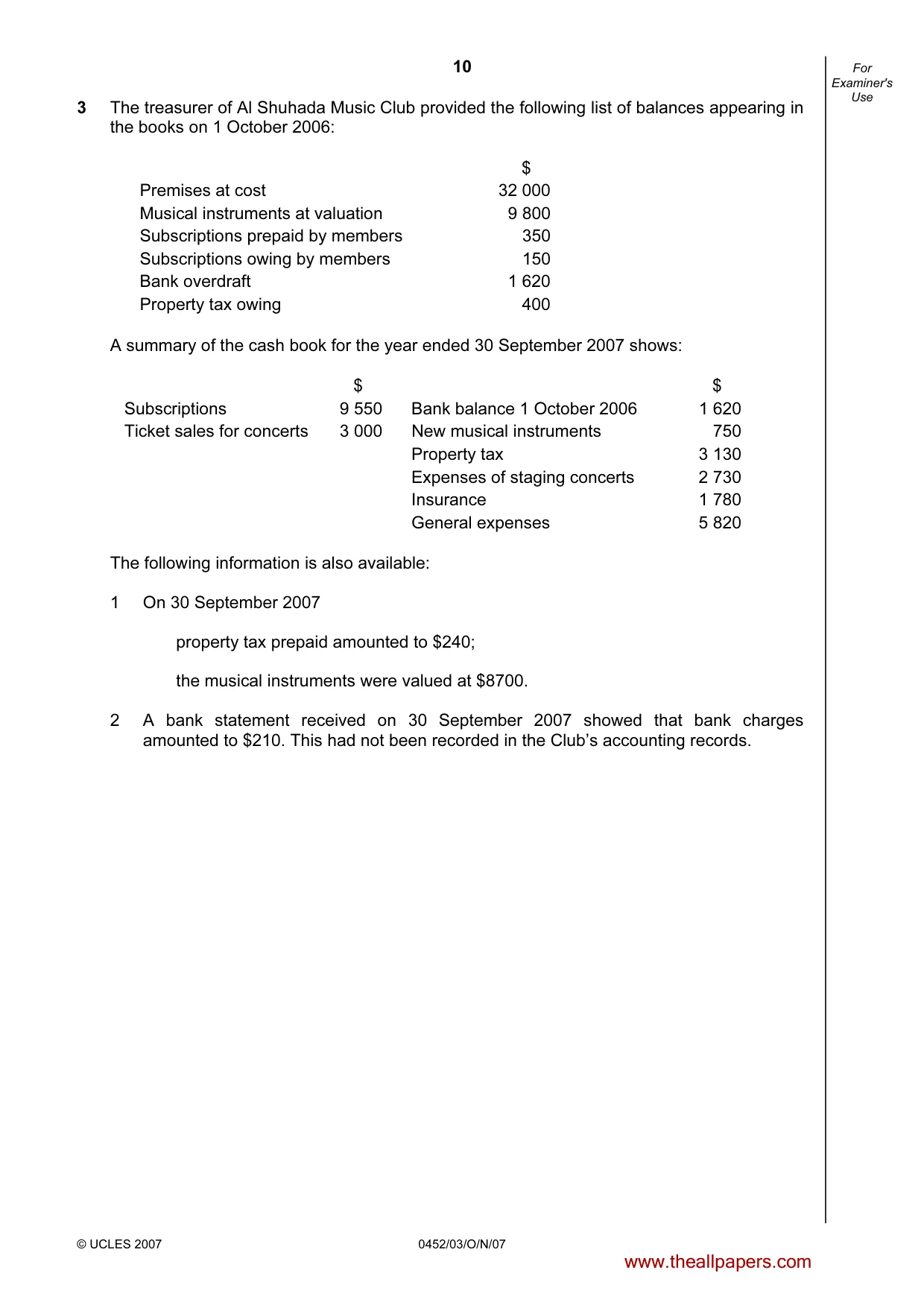
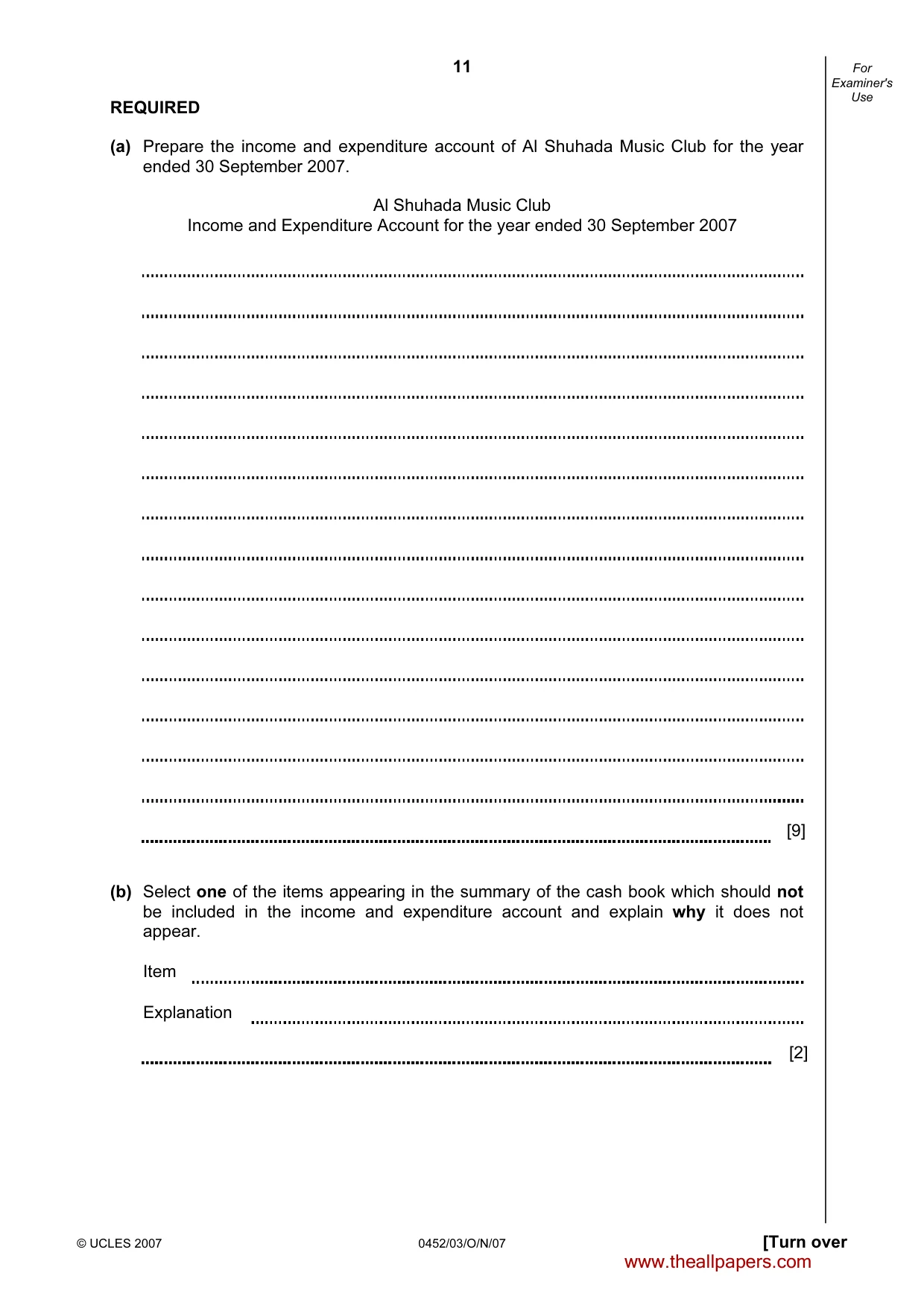
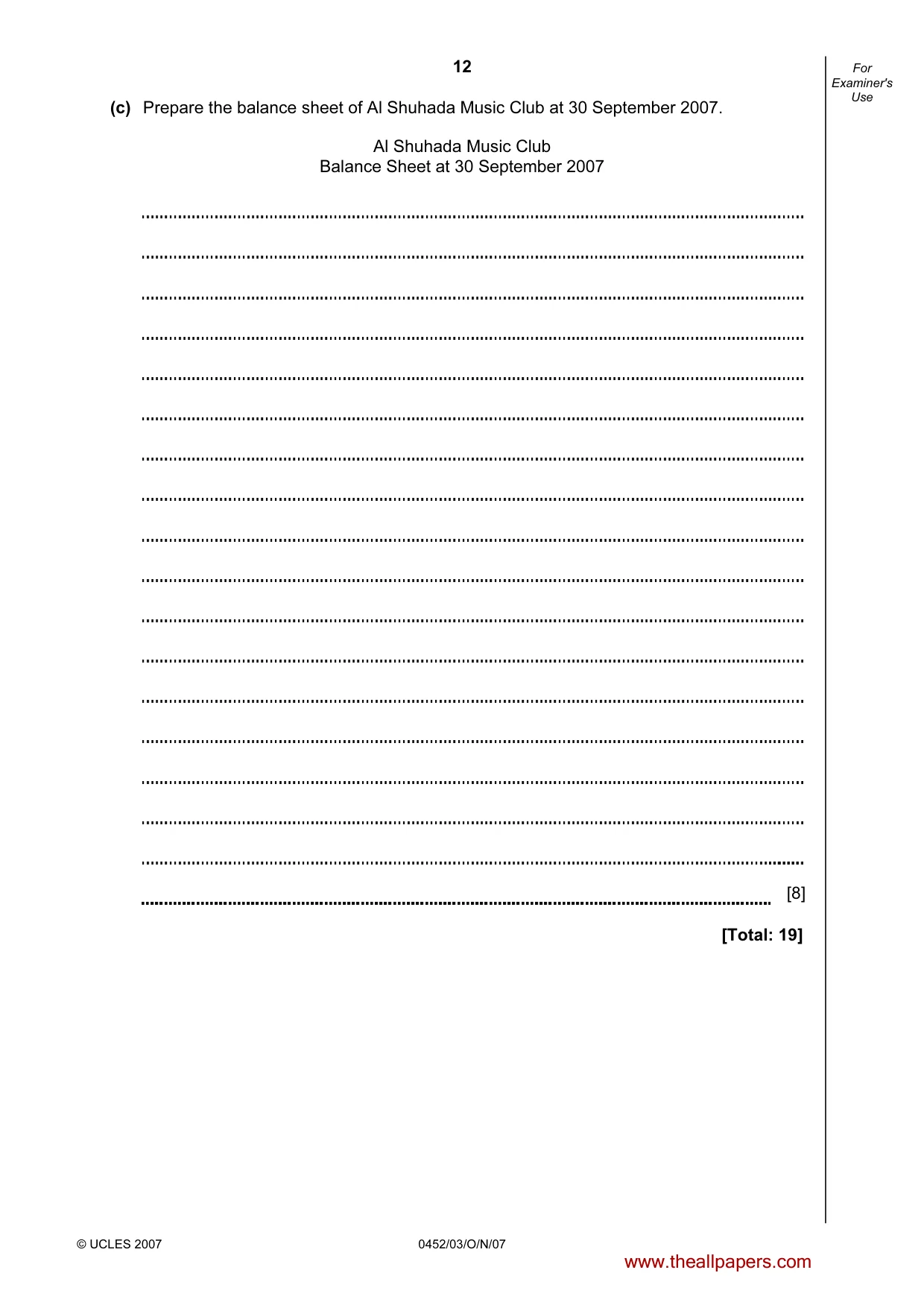
3 The treasurer of Al Shuhada Music Club provided the following list of balances appearing in the books on 1 October 2006: $ Premises at cost 32 000 Musical instruments at valuation 9 800 Subscriptions prepaid by members 350 Subscriptions owing by members 150 Bank overdraft 1 620 Property tax owing 400 A summary of the cash book for the year ended 30 September 2007 shows: $ $ Subscriptions 9 550 Bank balance 1 October 2006 1 620 Ticket sales for concerts 3 000 New musical instruments 750 Property tax 3 130 Expenses of staging concerts 2 730 Insurance 1 780 General expenses 5 820 The following information is also available: 1 On 30 September 2007 property tax prepaid amounted to $240; the musical instruments were valued at $8700. 2 A bank statement received on 30 September 2007 showed that bank charges amounted to $210. This had not been recorded in the Club’s accounting records. REQUIRED (a) Prepare the income and expenditure account of Al Shuhada Music Club for the year ended 30 September 2007. Al Shuhada Music Club Income and Expenditure Account for the year ended 30 September 2007 [9] (b) Select one of the items appearing in the summary of the cash book which should not be included in the income and expenditure account and explain why it does not appear. Item Explanation [2] (c) Prepare the balance sheet of Al Shuhada Music Club at 30 September 2007. Al Shuhada Music Club Balance Sheet at 30 September 2007 [8] [Total: 19]
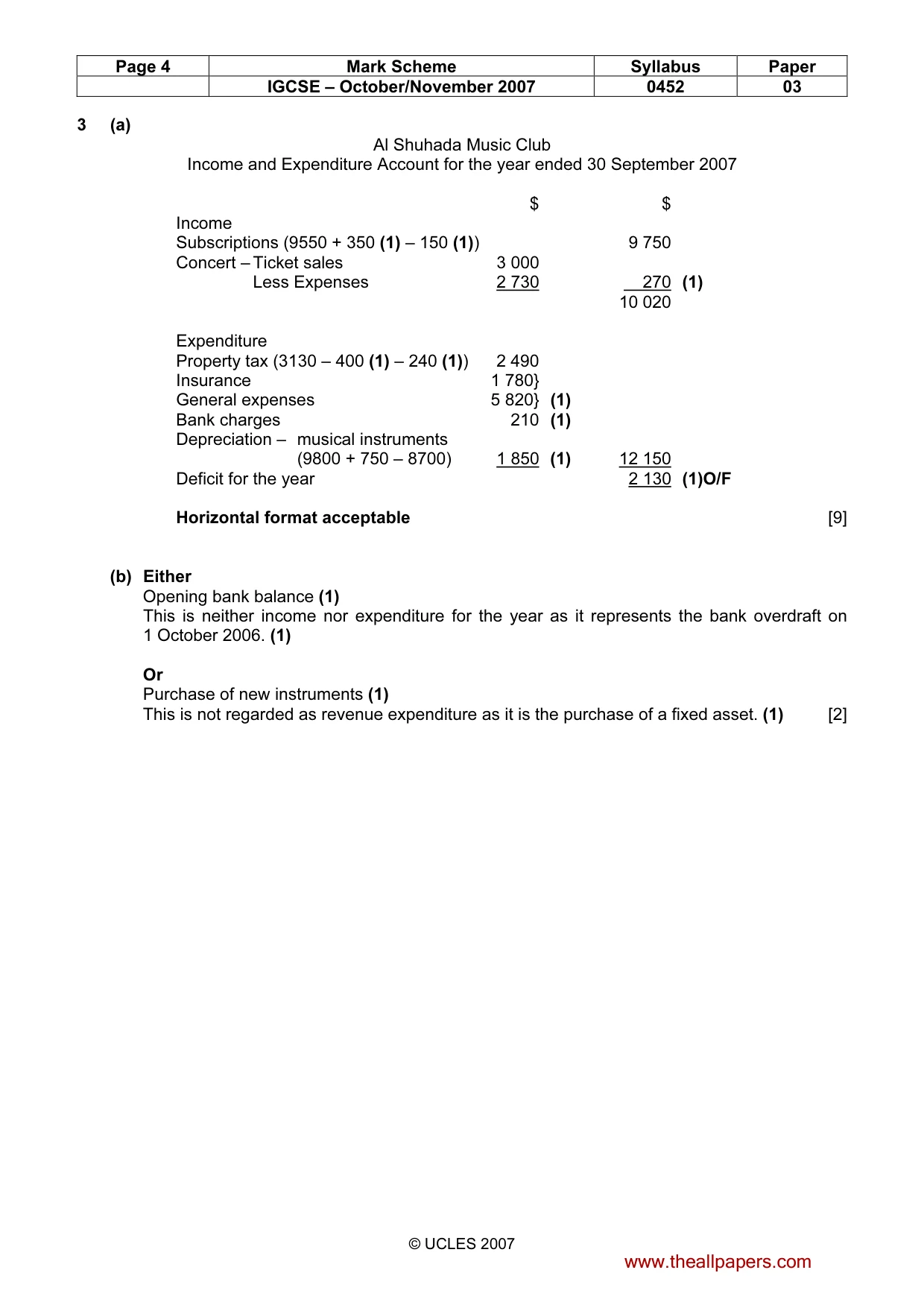
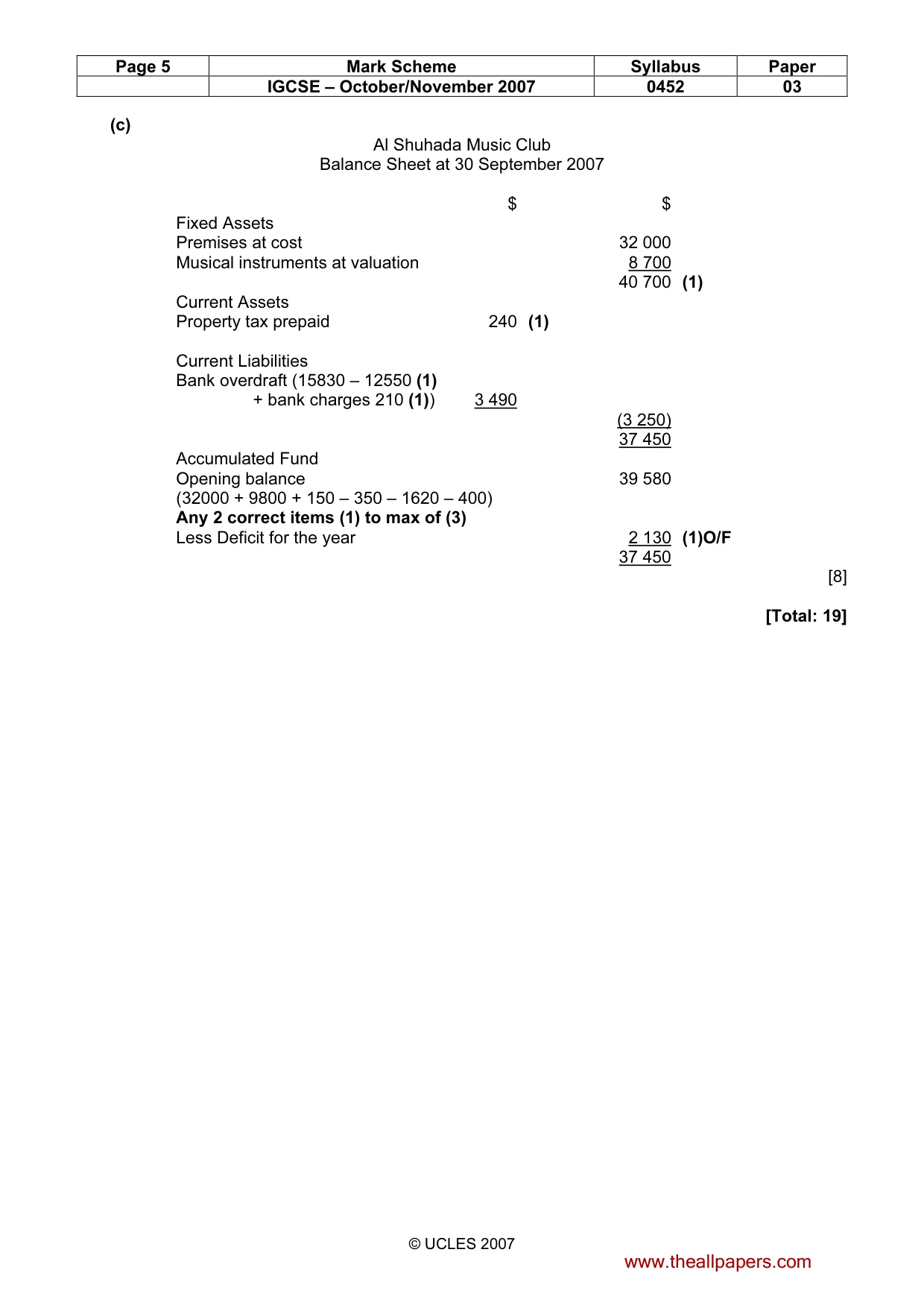
Mark scheme: 3 (a) Al Shuhada Music Club Income and Expenditure Account for the year ended 30 September 2007 $ $ Income Subscriptions (9550 + 350 (1) – 150 (1)) 9 750 Concert – Ticket sales 3 000 Less Expenses 2 730 270 (1) 10 020 Expenditure Property tax (3130 – 400 (1) – 240 (1)) 2 490 Insurance 1 780} General expenses 5 820} (1) Bank charges 210 (1) Depreciation – musical instruments (9800 + 750 – 8700) 1 850 (1) 12 150 Deficit for the year 2 130 (1)O/F Horizontal format acceptable [9] (b) Either Opening bank balance (1) This is neither income nor expenditure for the year as it represents the bank overdraft on 1 October 2006. (1) Or Purchase of new instruments (1) This is not regarded as revenue expenditure as it is the purchase of a fixed asset. (1) [2] IGCSE – October/November 2007 0452 03 (c) Al Shuhada Music Club Balance Sheet at 30 September 2007 $ $ Fixed Assets Premises at cost 32 000 Musical instruments at valuation 8 700 40 700 (1) Current Assets Property tax prepaid 240 (1) Current Liabilities Bank overdraft (15830 – 12550 (1) + bank charges 210 (1)) 3 490 (3 250) 37 450 Accumulated Fund Opening balance 39 580 (32000 + 9800 + 150 – 350 – 1620 – 400) Any 2 correct items (1) to max of (3) Less Deficit for the year 2 130 (1)O/F 37 450 [8] [Total: 19] IGCSE – October/November 2007 0452 03
Q4 · Ann and Fay are in partnership
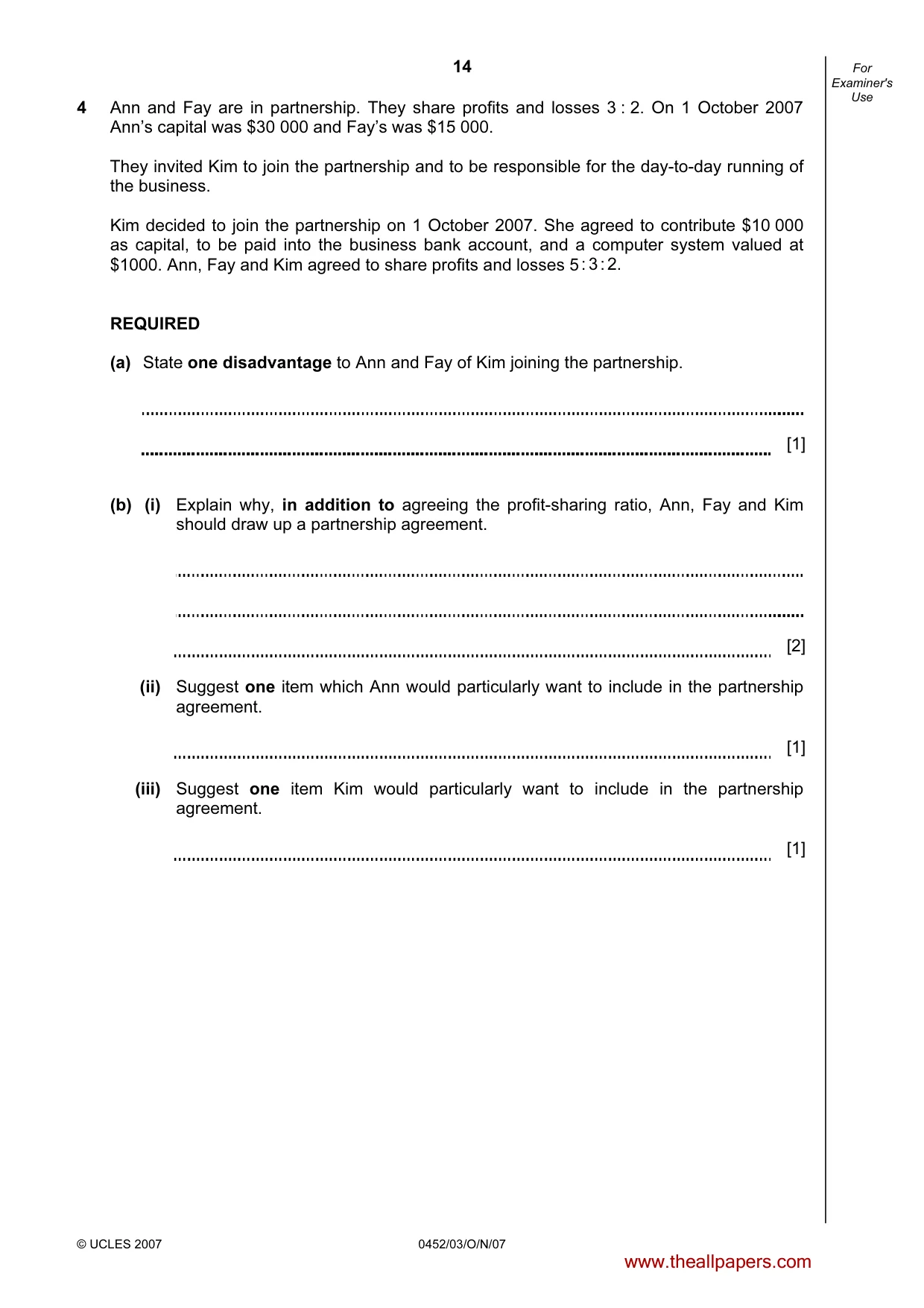
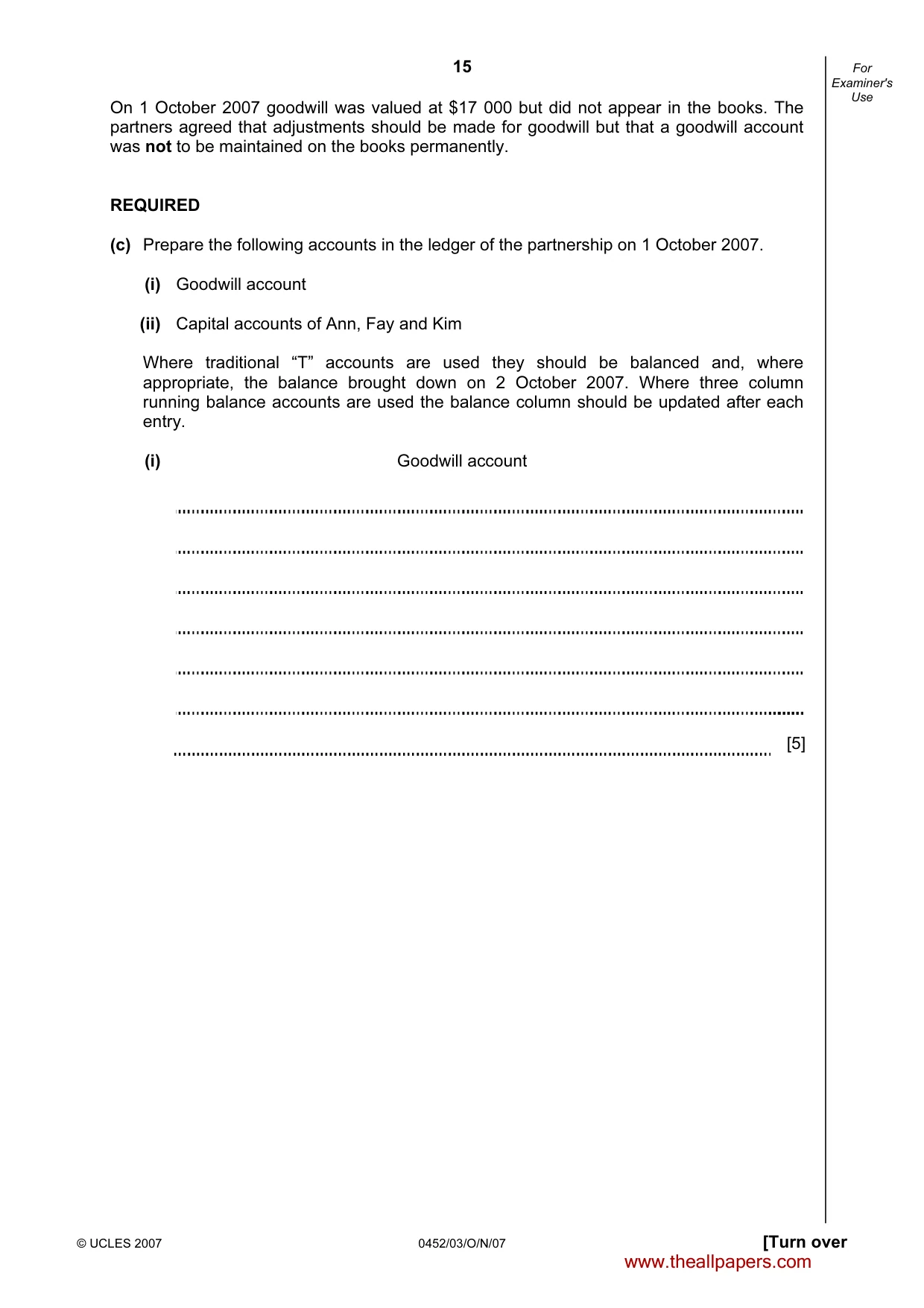
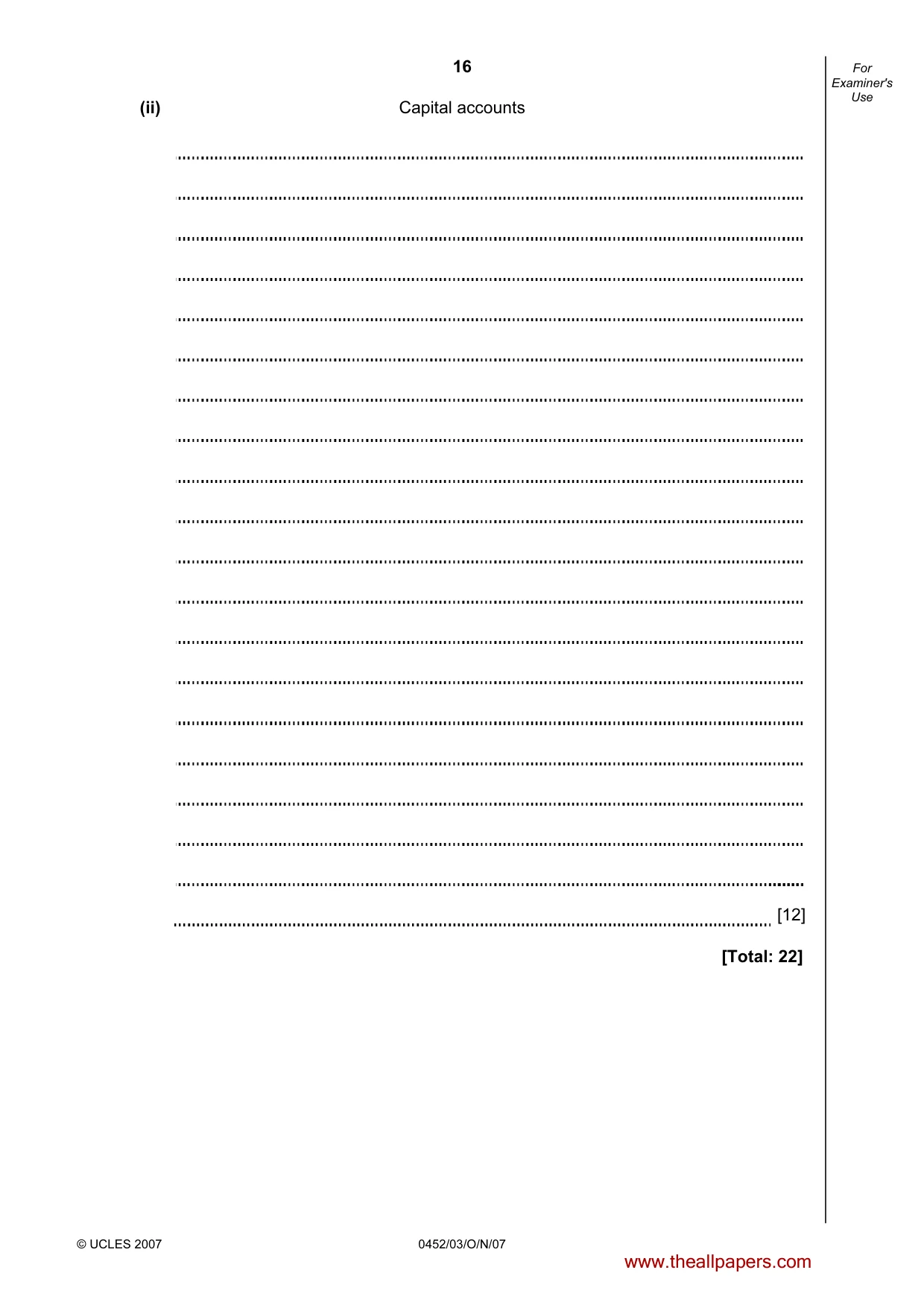
4 Ann and Fay are in partnership. They share profits and losses 3 : 2. On 1 October 2007 Ann’s capital was $30 000 and Fay’s was $15 000. They invited Kim to join the partnership and to be responsible for the day-to-day running of the business. Kim decided to join the partnership on 1 October 2007. She agreed to contribute $10 000 as capital, to be paid into the business bank account, and a computer system valued at $1000. Ann, Fay and Kim agreed to share profits and losses 5 : 3 : 2. REQUIRED (a) State one disadvantage to Ann and Fay of Kim joining the partnership. [1] (b) (i) Explain why, in addition to agreeing the profit-sharing ratio, Ann, Fay and Kim should draw up a partnership agreement. [2] (ii) Suggest one item which Ann would particularly want to include in the partnership agreement. [1] (iii) Suggest one item Kim would particularly want to include in the partnership agreement. [1] On 1 October 2007 goodwill was valued at $17 000 but did not appear in the books. The partners agreed that adjustments should be made for goodwill but that a goodwill account was not to be maintained on the books permanently. REQUIRED (c) Prepare the following accounts in the ledger of the partnership on 1 October 2007. (i) Goodwill account (ii) Capital accounts of Ann, Fay and Kim Where traditional “T” accounts are used they should be balanced and, where appropriate, the balance brought down on 2 October 2007. Where three column running balance accounts are used the balance column should be updated after each entry. (i) Goodwill account [5] (ii) Capital accounts [12] [Total: 22]
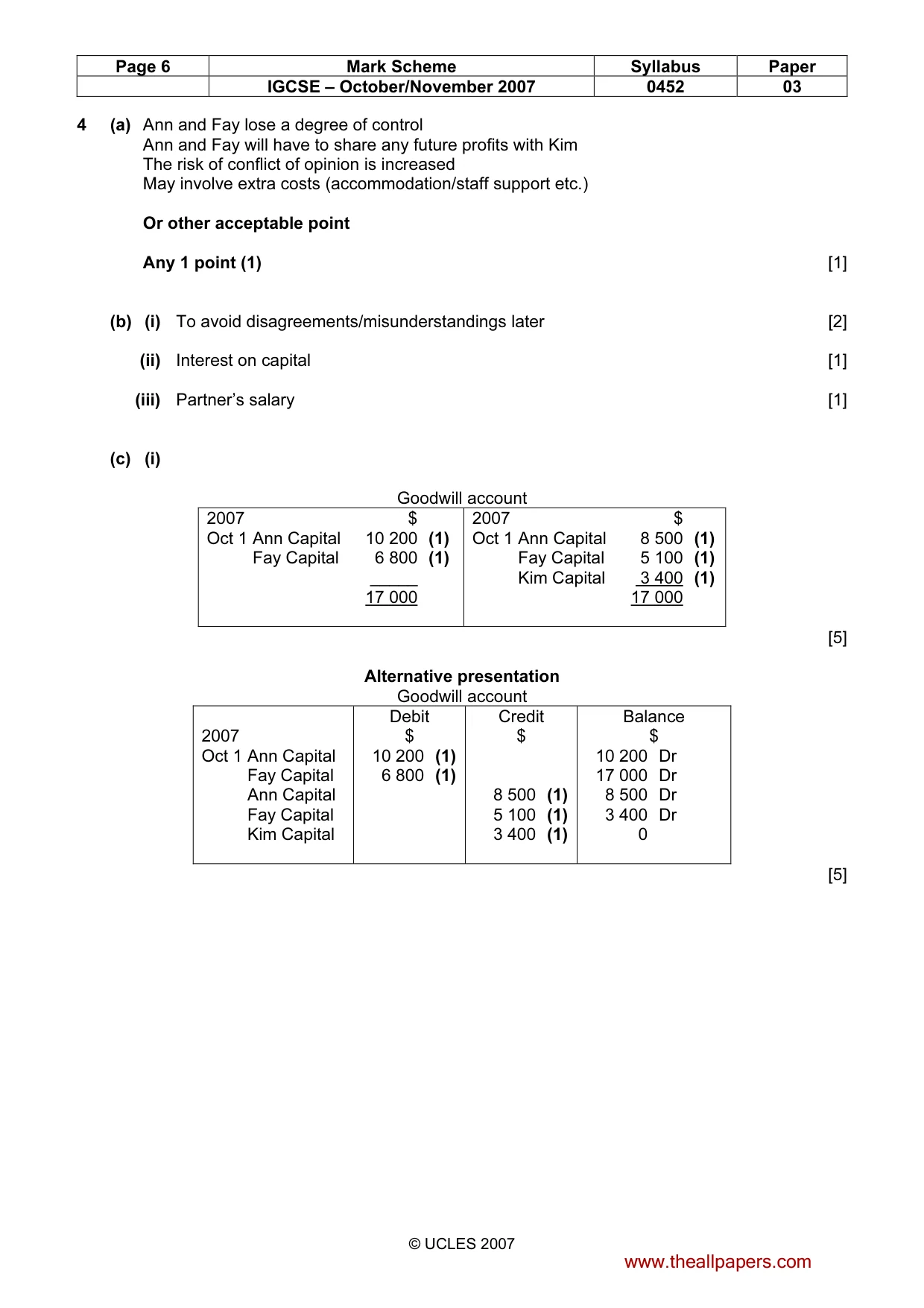
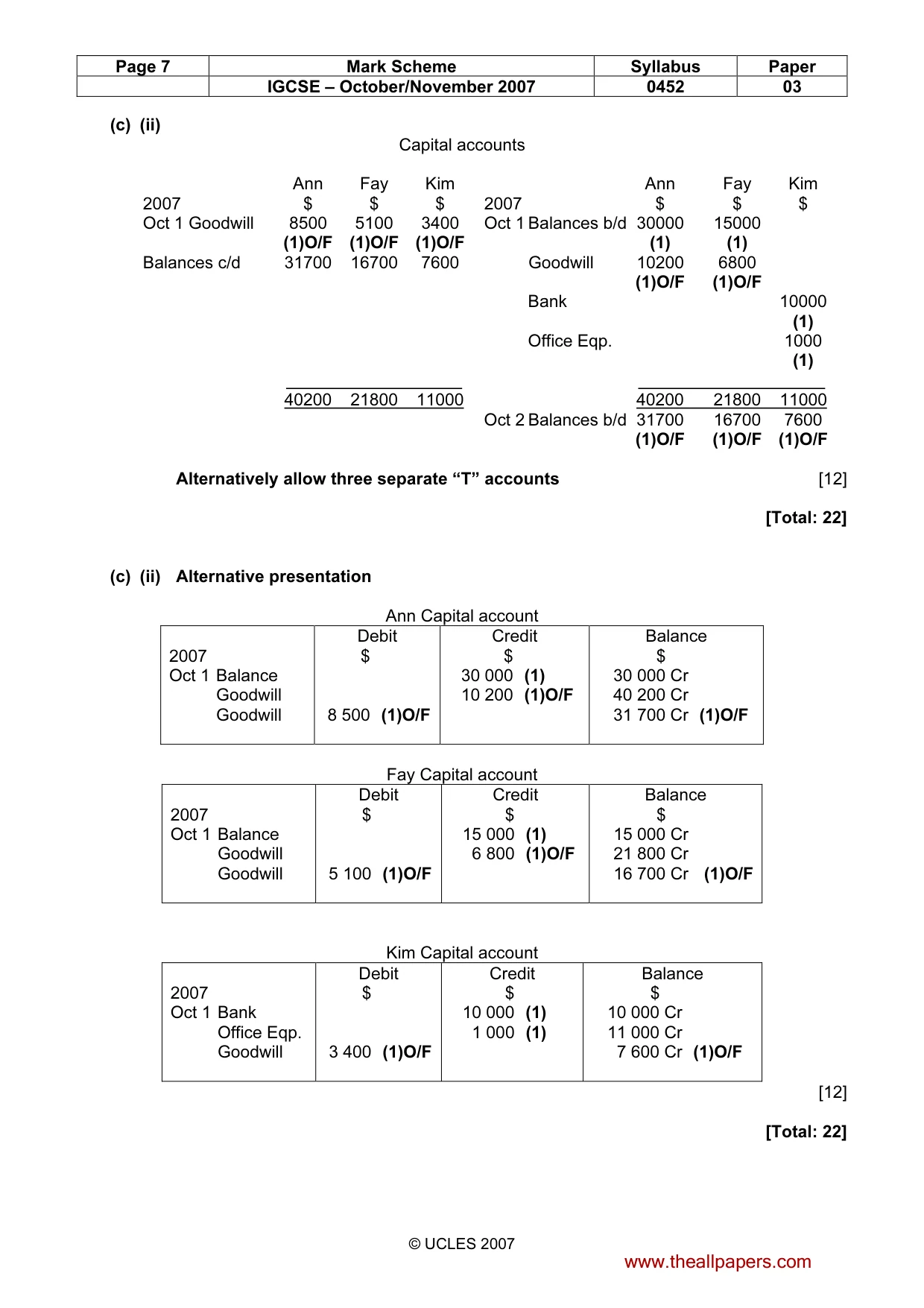
Mark scheme: 4 (a) Ann and Fay lose a degree of control Ann and Fay will have to share any future profits with Kim The risk of conflict of opinion is increased May involve extra costs (accommodation/staff support etc.) Or other acceptable point Any 1 point (1) [1] (b) (i) To avoid disagreements/misunderstandings later [2] (ii) Interest on capital [1] (iii) Partner’s salary [1] (c) (i) Goodwill account 2007 $ 2007 $ Oct 1 Ann Capital 10 200 (1) Oct 1 Ann Capital 8 500 (1) Fay Capital 6 800 (1) Fay Capital 5 100 (1) _____ Kim Capital 3 400 (1) 17 000 17 000 [5] Alternative presentation Goodwill account Debit Credit Balance 2007 $ $ $ Oct 1 Ann Capital 10 200 (1) 10 200 Dr Fay Capital 6 800 (1) 17 000 Dr Ann Capital 8 500 (1) 8 500 Dr Fay Capital 5 100 (1) 3 400 Dr Kim Capital 3 400 (1) 0 [5] IGCSE – October/November 2007 0452 03 (c) (ii) Capital accounts Ann Fay Kim Ann Fay Kim 2007 $ $ $ 2007 $ $ $ Oct 1 Goodwill 8500 5100 3400 Oct 1 Balances b/d 30000 15000 (1)O/F (1)O/F (1)O/F (1) (1) Balances c/d 31700 16700 7600 Goodwill 10200 6800 (1)O/F (1)O/F Bank 10000 (1) Office Eqp. 1000 (1) 40200 21800 11000 40200 21800 11000 Oct 2 Balances b/d 31700 16700 7600 (1)O/F (1)O/F (1)O/F Alternatively allow three separate “T” accounts [12] [Total: 22] (c) (ii) Alternative presentation Ann Capital account Debit Credit Balance 2007 $ $ $ Oct 1 Balance 30 000 (1) 30 000 Cr Goodwill 10 200 (1)O/F 40 200 Cr Goodwill 8 500 (1)O/F 31 700 Cr (1)O/F Fay Capital account Debit Credit Balance 2007 $ $ $ Oct 1 Balance 15 000 (1) 15 000 Cr Goodwill 6 800 (1)O/F 21 800 Cr Goodwill 5 100 (1)O/F 16 700 Cr (1)O/F Kim Capital account Debit Credit Balance 2007 $ $ $ Oct 1 Bank 10 000 (1) 10 000 Cr Office Eqp. 1 000 (1) 11 000 Cr Goodwill 3 400 (1)O/F 7 600 Cr (1)O/F [12] [Total: 22] IGCSE – October/November 2007 0452 03
Q5 · Jones Shilango is a trader
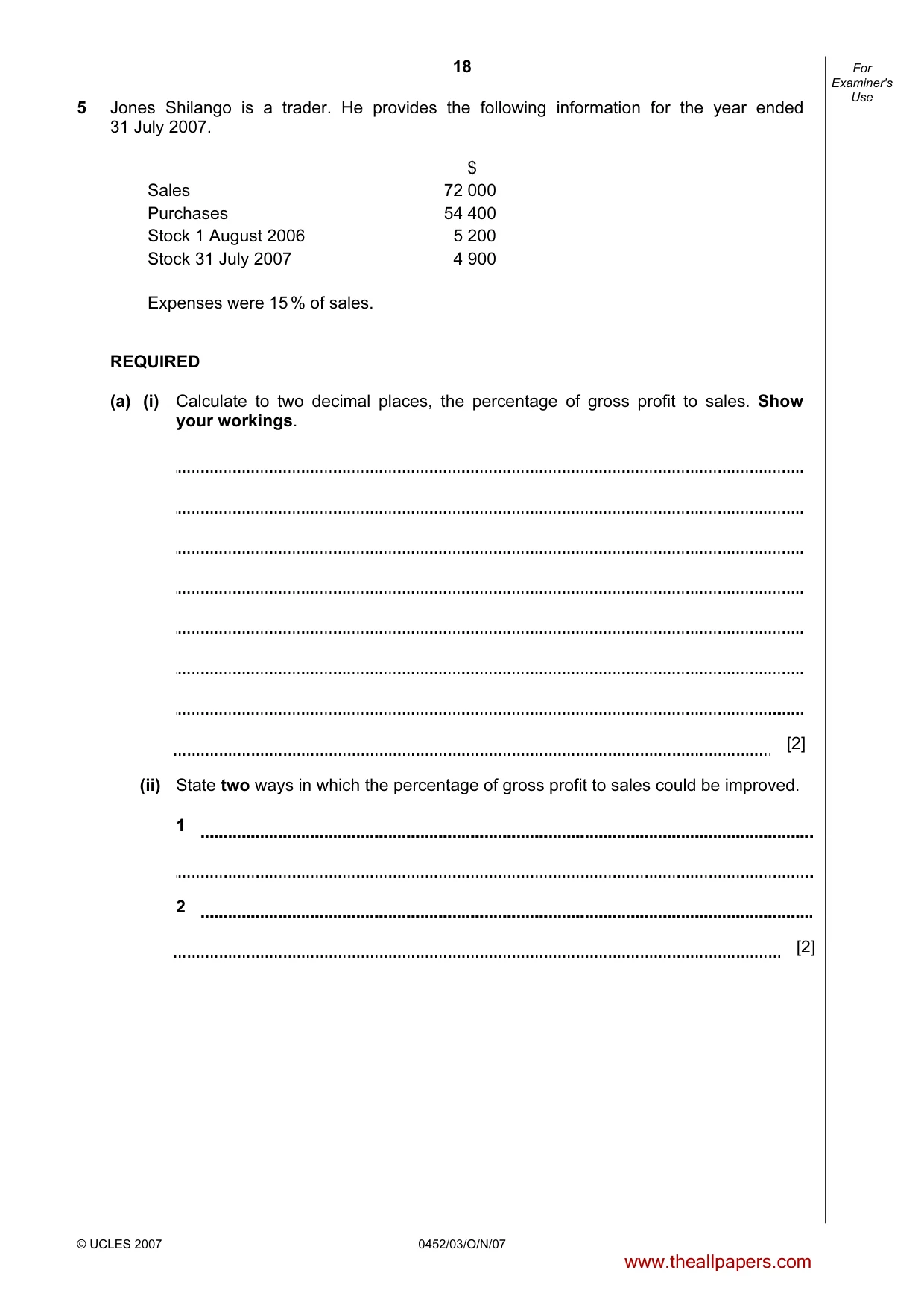
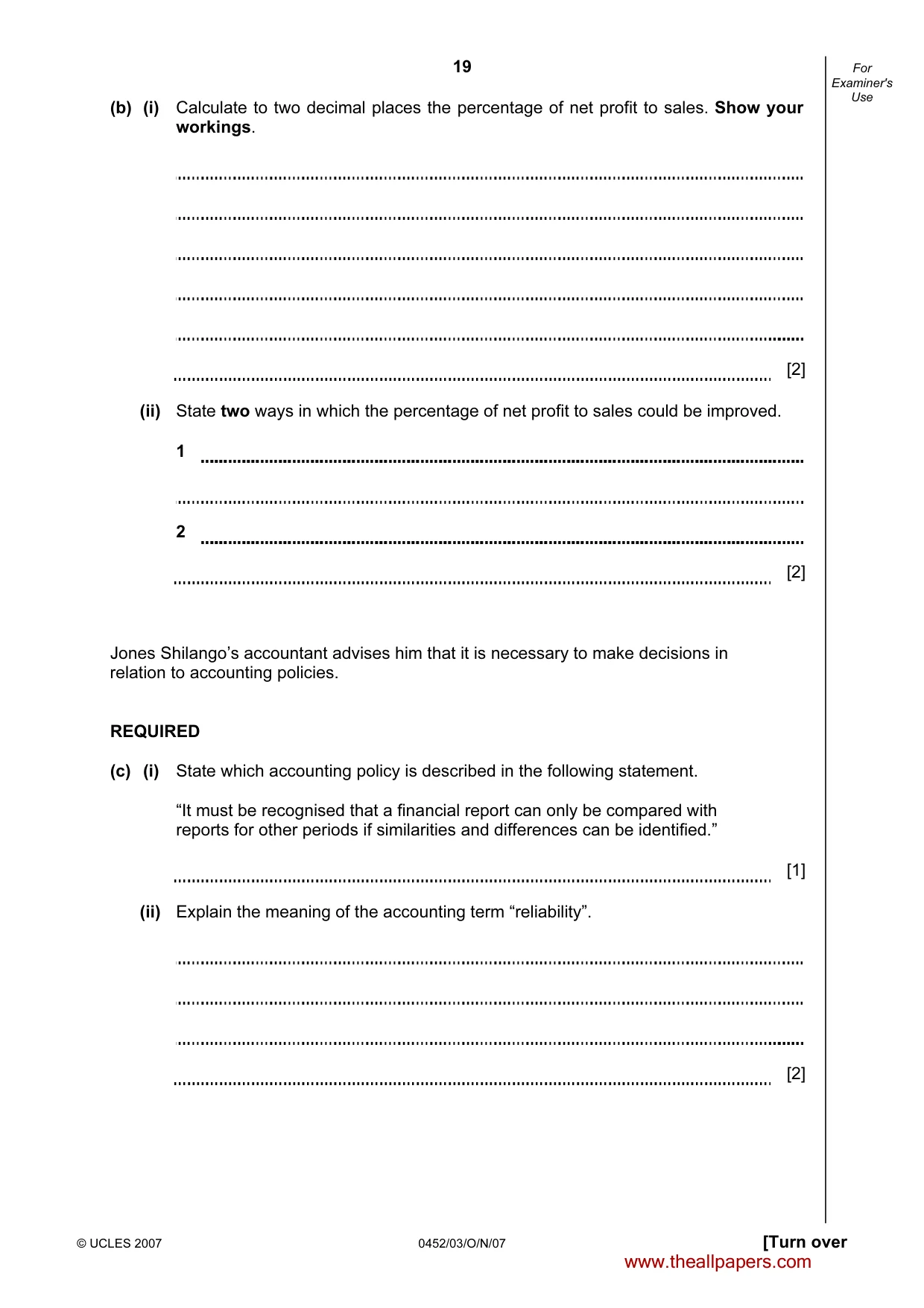
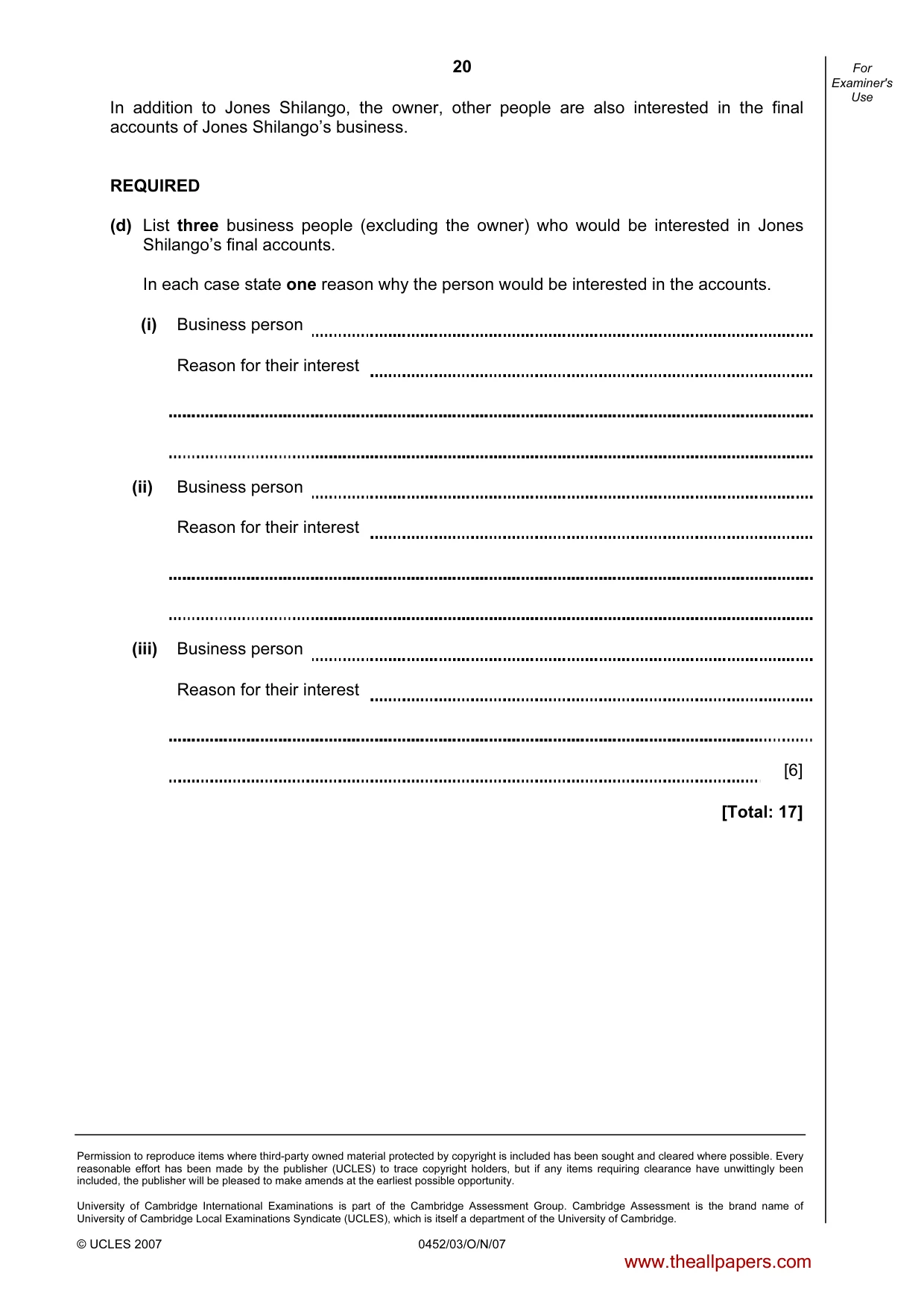
5 Jones Shilango is a trader. He provides the following information for the year ended 31 July 2007. $ Sales 72 000 Purchases 54 400 Stock 1 August 2006 5 200 Stock 31 July 2007 4 900 Expenses were 15 % of sales. REQUIRED (a) (i) Calculate to two decimal places, the percentage of gross profit to sales. Show your workings. [2] (ii) State two ways in which the percentage of gross profit to sales could be improved. 1 2 [2] (b) (i) Calculate to two decimal places the percentage of net profit to sales. Show your workings. [2] (ii) State two ways in which the percentage of net profit to sales could be improved. 1 2 [2] Jones Shilango’s accountant advises him that it is necessary to make decisions in relation to accounting policies. REQUIRED (c) (i) State which accounting policy is described in the following statement. “It must be recognised that a financial report can only be compared with reports for other periods if similarities and differences can be identified.” [1] (ii) Explain the meaning of the accounting term “reliability”. [2] In addition to Jones Shilango, the owner, other people are also interested in the final accounts of Jones Shilango’s business. REQUIRED (d) List three business people (excluding the owner) who would be interested in Jones Shilango’s final accounts. In each case state one reason why the person would be interested in the accounts. (i) Business person Reason for their interest (ii) Business person Reason for their interest (iii) Business person Reason for their interest [6] [Total: 17]
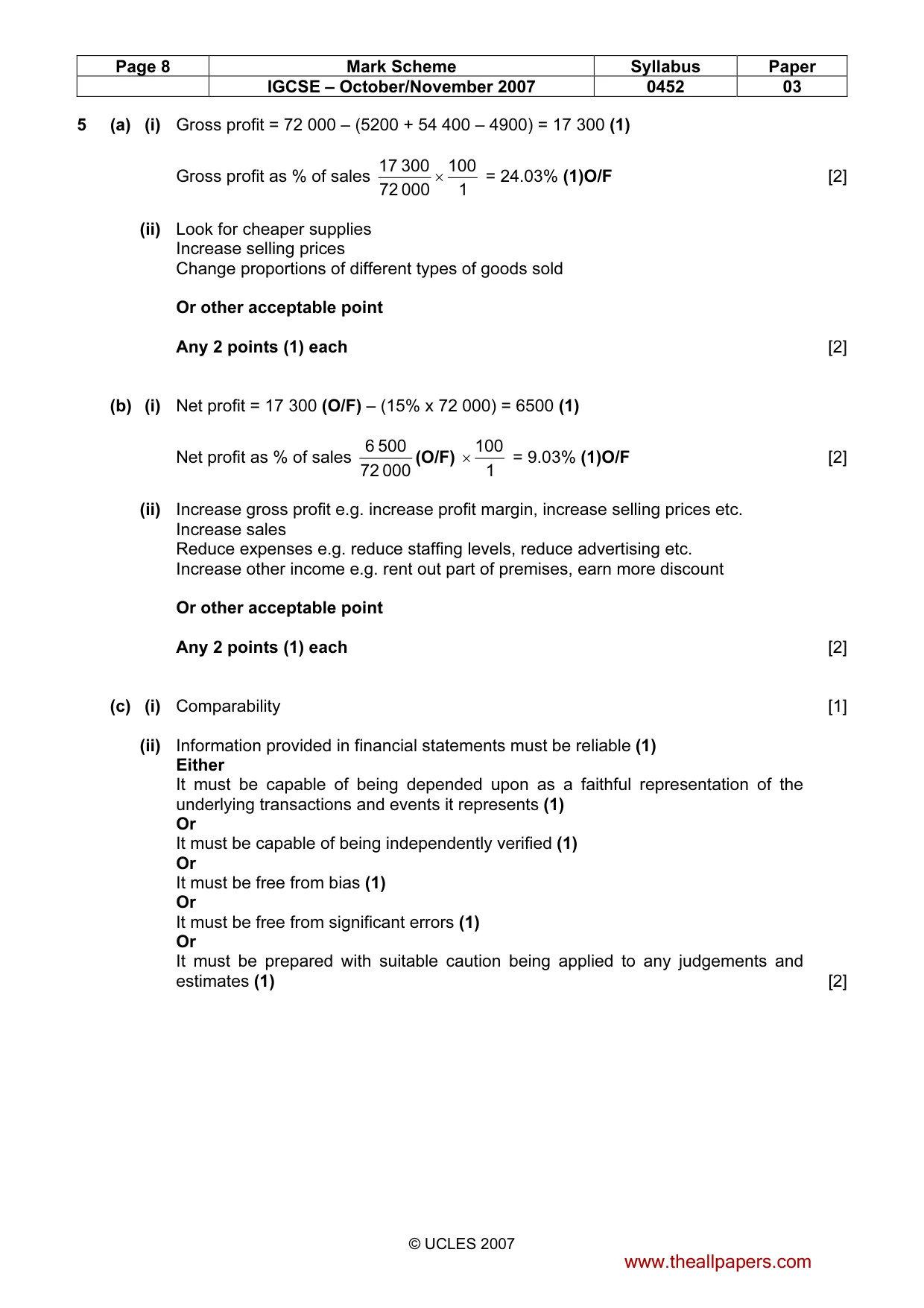
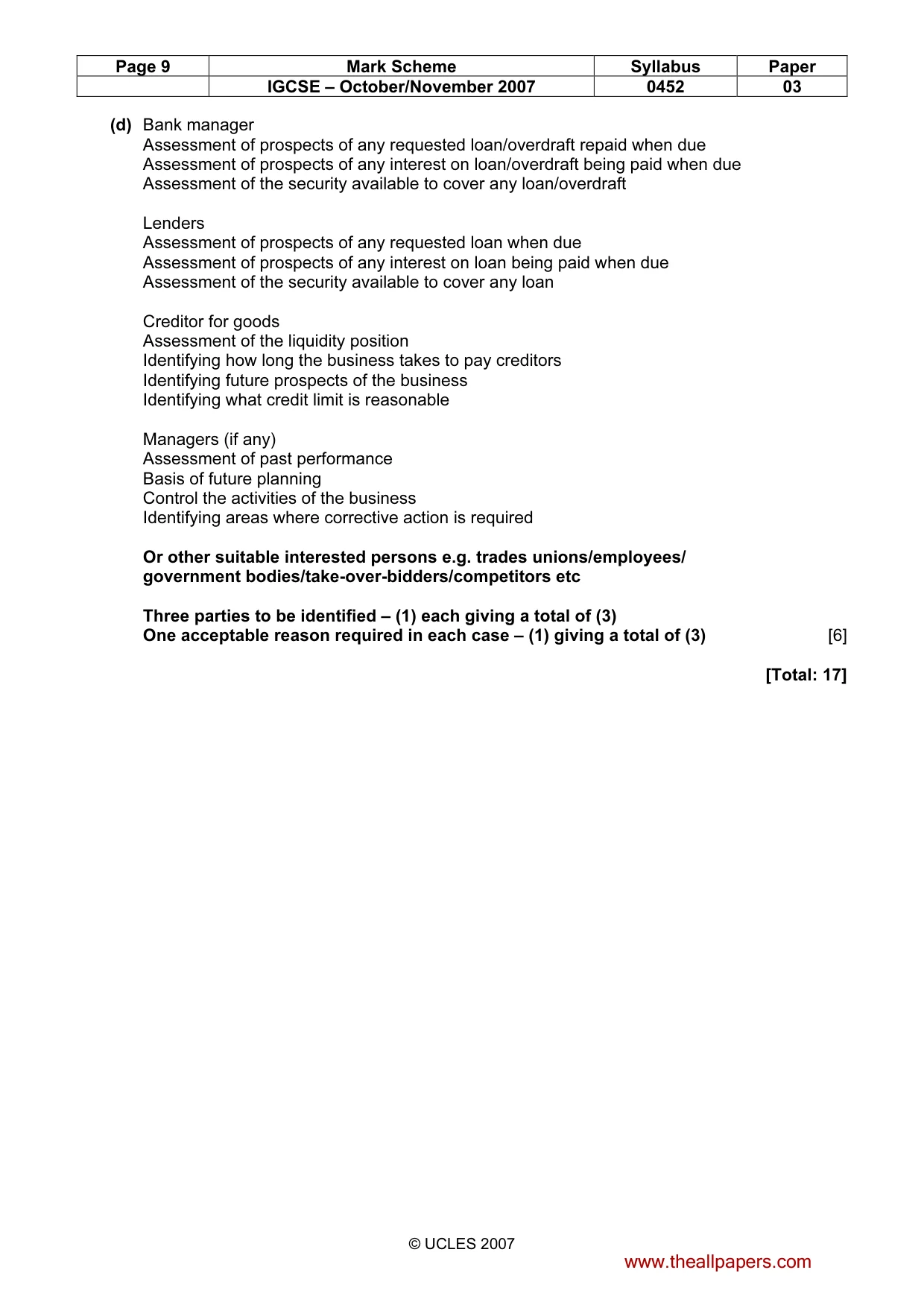
Mark scheme: 5 (a) (i) Gross profit = 72 000 – (5200 + 54 400 – 4900) = 17 300 (1) 17 300 100 Gross profit as % of sales × = 24.03% (1)O/F [2] 72 000 1 (ii) Look for cheaper supplies Increase selling prices Change proportions of different types of goods sold Or other acceptable point Any 2 points (1) each [2] (b) (i) Net profit = 17 300 (O/F) – (15% x 72 000) = 6500 (1) 6 500 100 Net profit as % of sales (O/F) × = 9.03% (1)O/F [2] 72 000 1 (ii) Increase gross profit e.g. increase profit margin, increase selling prices etc. Increase sales Reduce expenses e.g. reduce staffing levels, reduce advertising etc. Increase other income e.g. rent out part of premises, earn more discount Or other acceptable point Any 2 points (1) each [2] (c) (i) Comparability [1] (ii) Information provided in financial statements must be reliable (1) Either It must be capable of being depended upon as a faithful representation of the underlying transactions and events it represents (1) Or It must be capable of being independently verified (1) Or It must be free from bias (1) Or It must be free from significant errors (1) Or It must be prepared with suitable caution being applied to any judgements and estimates (1) [2] IGCSE – October/November 2007 0452 03 (d) Bank manager Assessment of prospects of any requested loan/overdraft repaid when due Assessment of prospects of any interest on loan/overdraft being paid when due Assessment of the security available to cover any loan/overdraft Lenders Assessment of prospects of any requested loan when due Assessment of prospects of any interest on loan being paid when due Assessment of the security available to cover any loan Creditor for goods Assessment of the liquidity position Identifying how long the business takes to pay creditors Identifying future prospects of the business Identifying what credit limit is reasonable Managers (if any) Assessment of past performance Basis of future planning Control the activities of the business Identifying areas where corrective action is required Or other suitable interested persons e.g. trades unions/employees/ government bodies/take-over-bidders/competitors etc Three parties to be identified – (1) each giving a total of (3) One acceptable reason required in each case – (1) giving a total of (3) [6] [Total: 17]
What was in this paper
The subtopics covered by these 5 questions, and how many questions each got. Open one in a new tab to see every Cambridge question on it.
What you needed in this session
Cambridge’s own grade thresholds for 2007 Oct/Nov, Paper 3 · Variant 1. A higher threshold means an easier paper — the bar moves with how the cohort did.