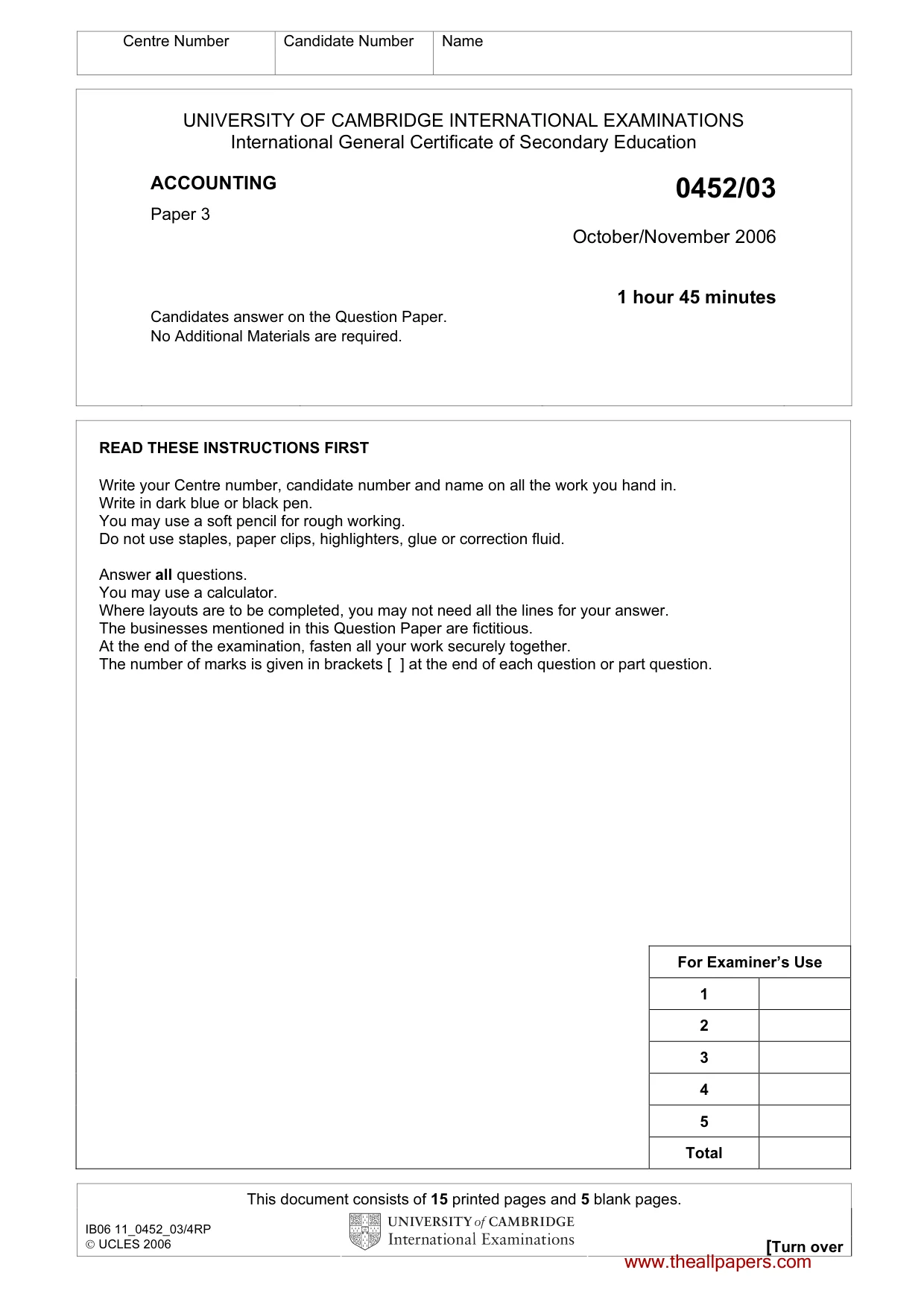
Cambridge IGCSE Accounting 0452 — 2006 Oct/Nov Paper 3 · Variant 1
0452/31/O/N/06 · 5 questions · 100 marks · ≈113 min
The question paper and its mark scheme, free to read here and free to download. This is Cambridge’s own paper, exactly as it was sat.
Question paper20 pages




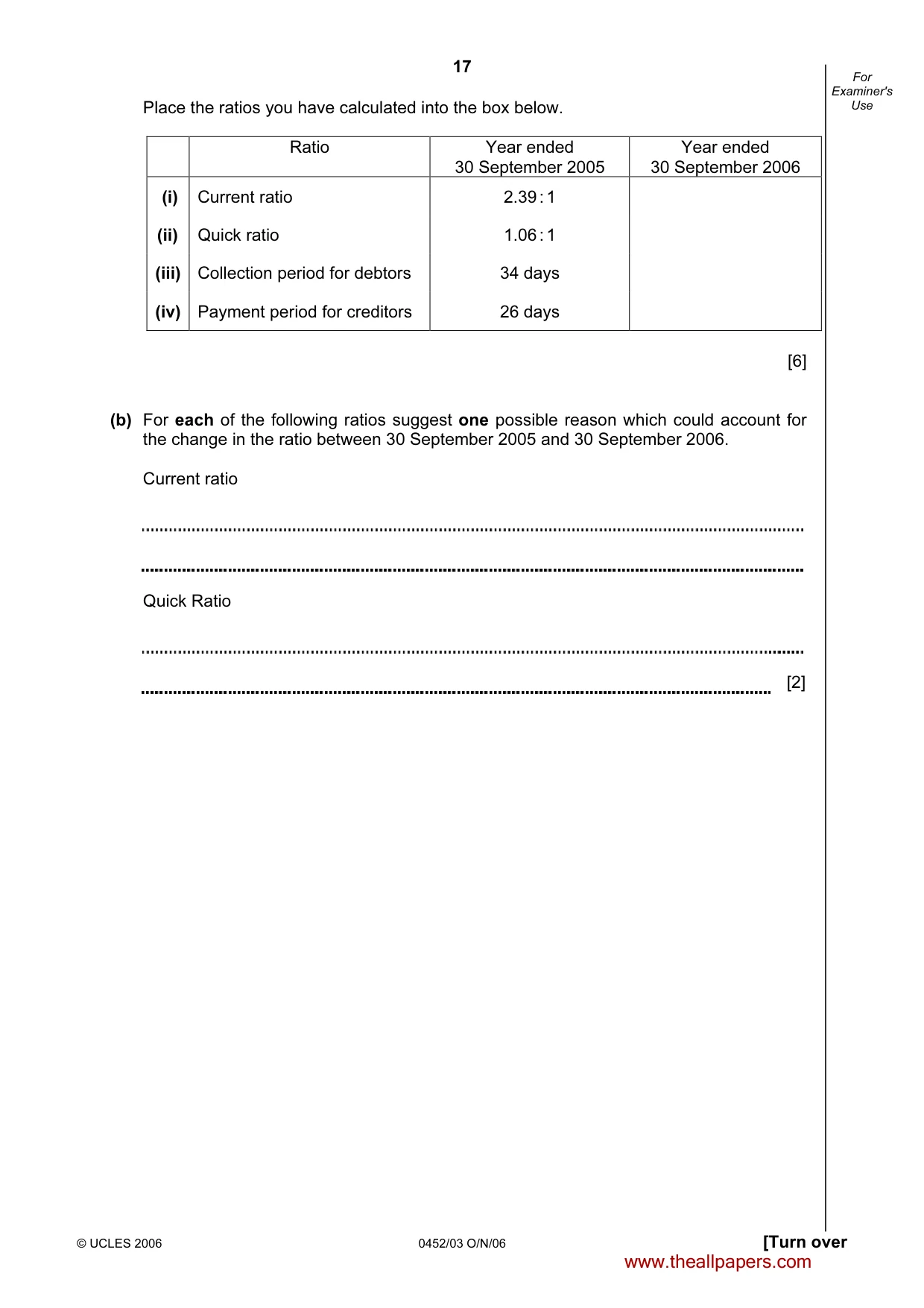
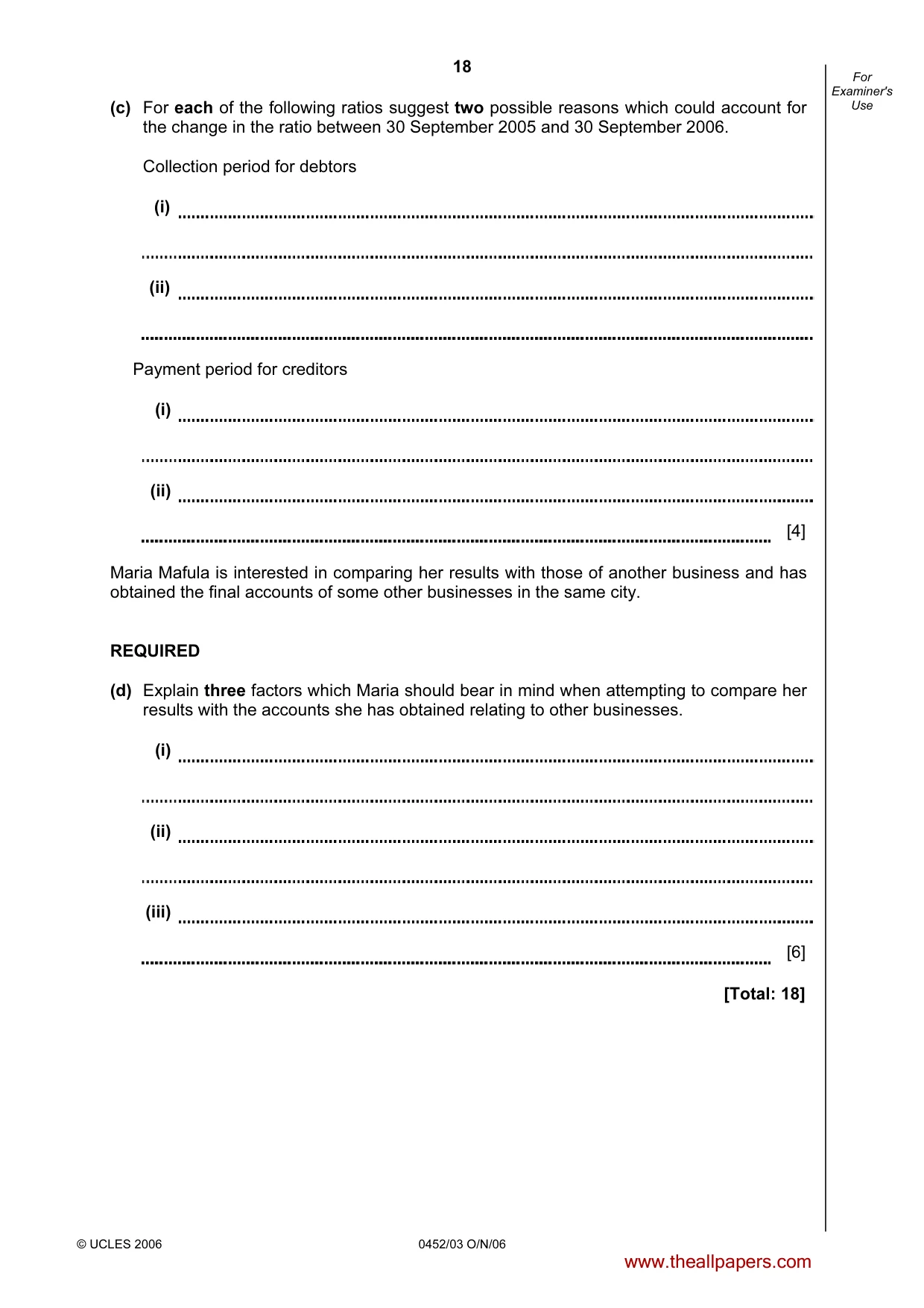


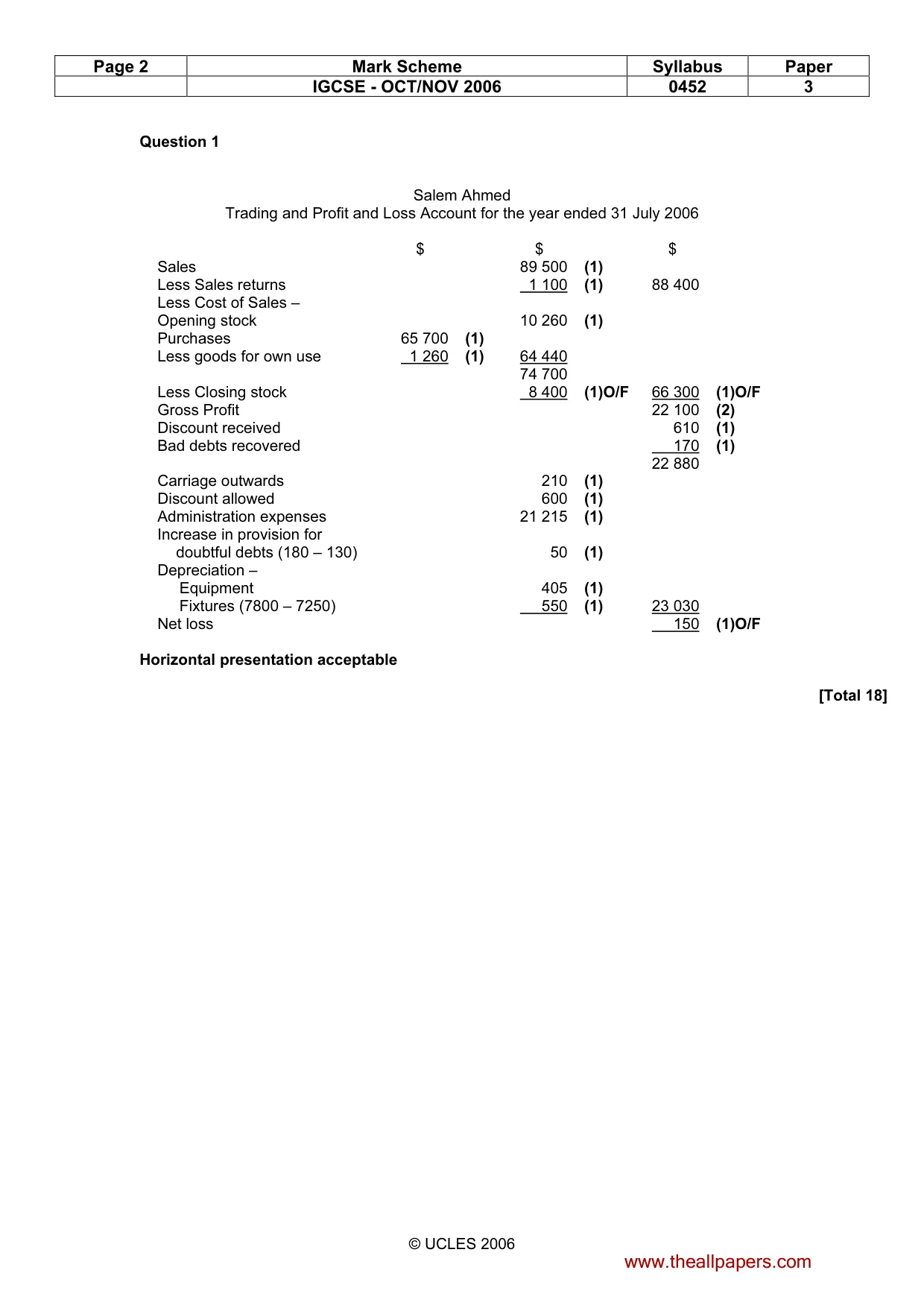
Mark scheme12 pages
Answers below. Sit the paper first if you are practising.
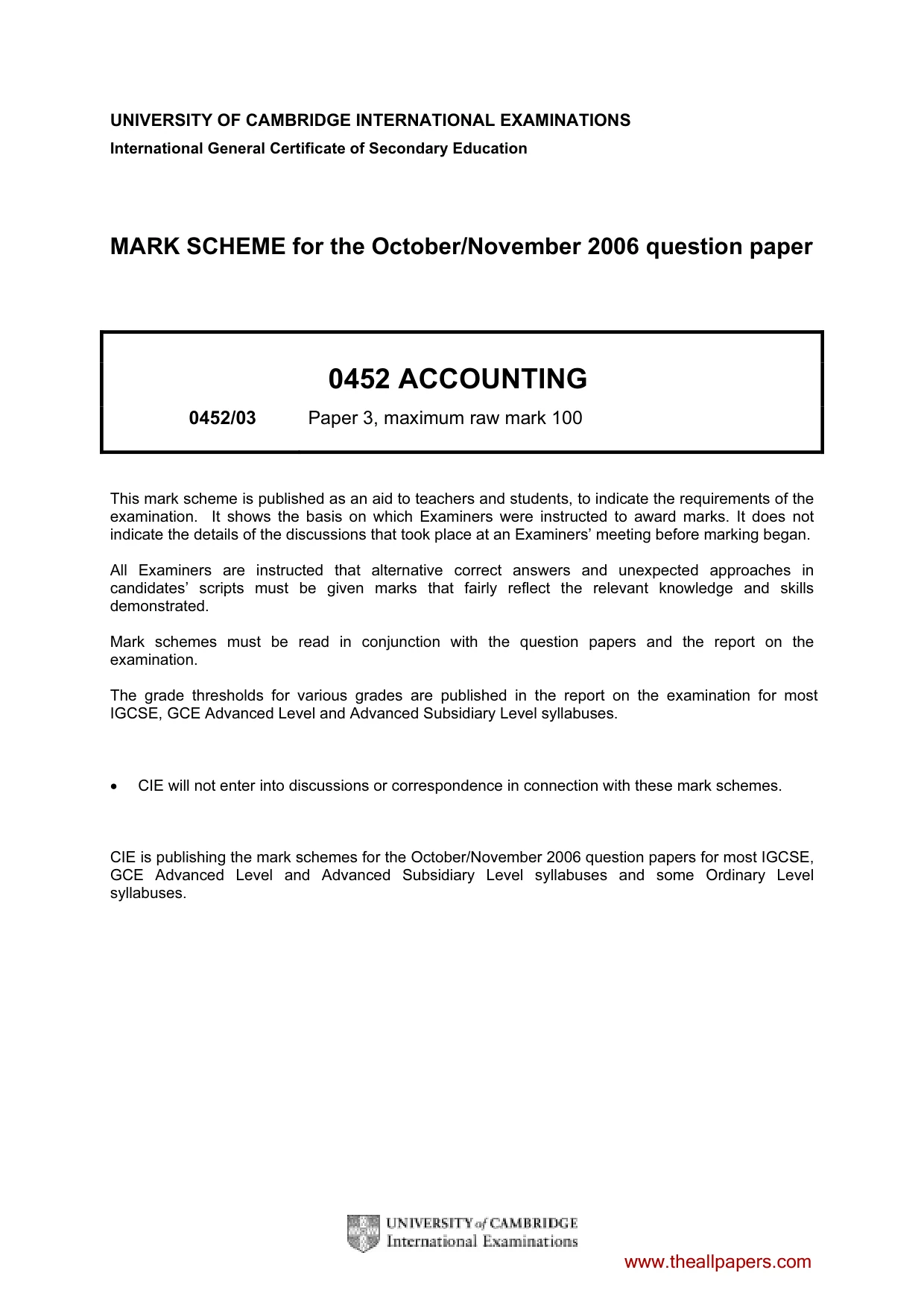
Questions as text
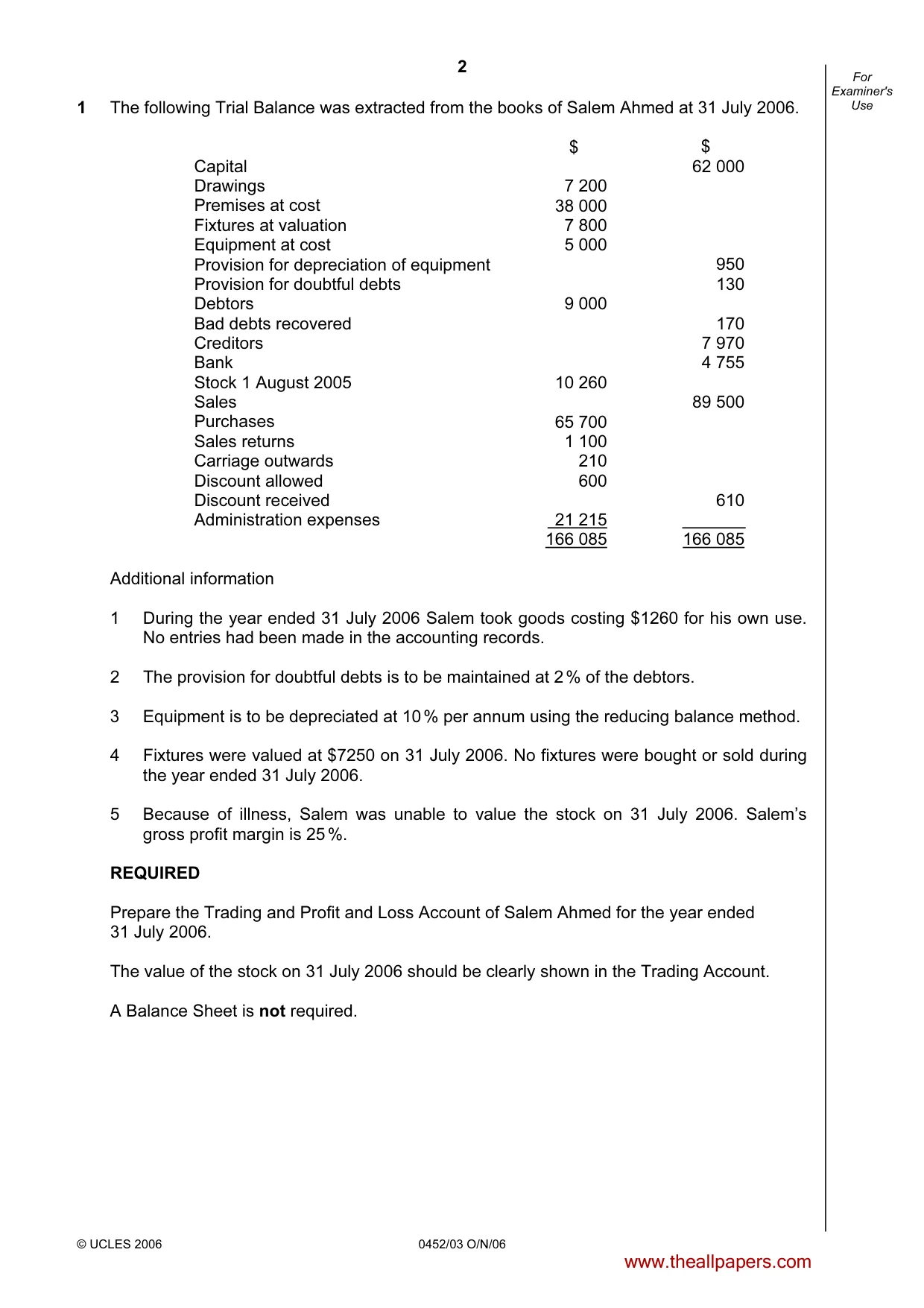
Q1 · The following Trial Balance was extracted from the books of Salem Ahmed at 31 July 2006
1 The following Trial Balance was extracted from the books of Salem Ahmed at 31 July 2006. $ $ Capital 62 000 Drawings 7 200 Premises at cost 38 000 Fixtures at valuation 7 800 Equipment at cost 5 000 Provision for depreciation of equipment 950 Provision for doubtful debts 130 Debtors 9 000 Bad debts recovered 170 Creditors 7 970 Bank 4 755 Stock 1 August 2005 10 260 Sales 89 500 Purchases 65 700 Sales returns 1 100 Carriage outwards 210 Discount allowed 600 Discount received 610 Administration expenses 21 215 166 085 166 085 Additional information 1 During the year ended 31 July 2006 Salem took goods costing $1260 for his own use. No entries had been made in the accounting records. 2 The provision for doubtful debts is to be maintained at 2 % of the debtors. 3 Equipment is to be depreciated at 10 % per annum using the reducing balance method. 4 Fixtures were valued at $7250 on 31 July 2006. No fixtures were bought or sold during the year ended 31 July 2006. 5 Because of illness, Salem was unable to value the stock on 31 July 2006. Salem’s gross profit margin is 25 %. REQUIRED Prepare the Trading and Profit and Loss Account of Salem Ahmed for the year ended 31 July 2006. The value of the stock on 31 July 2006 should be clearly shown in the Trading Account. A Balance Sheet is not required. Salem Ahmed Trading and Profit and Loss Account for the year ended 31 July 2006 [18] [Total: 18]
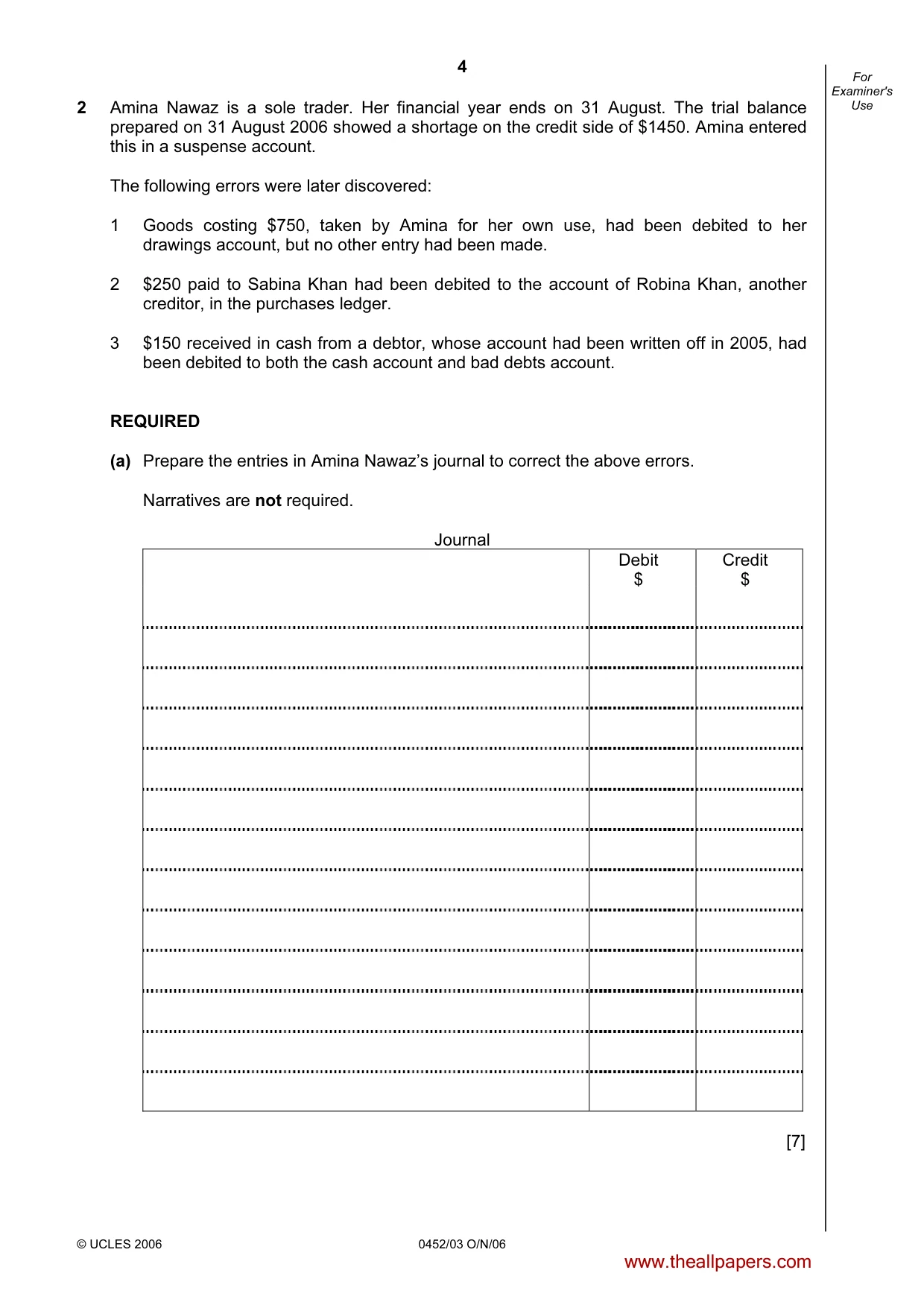
Q2 · Amina Nawaz is a sole trader
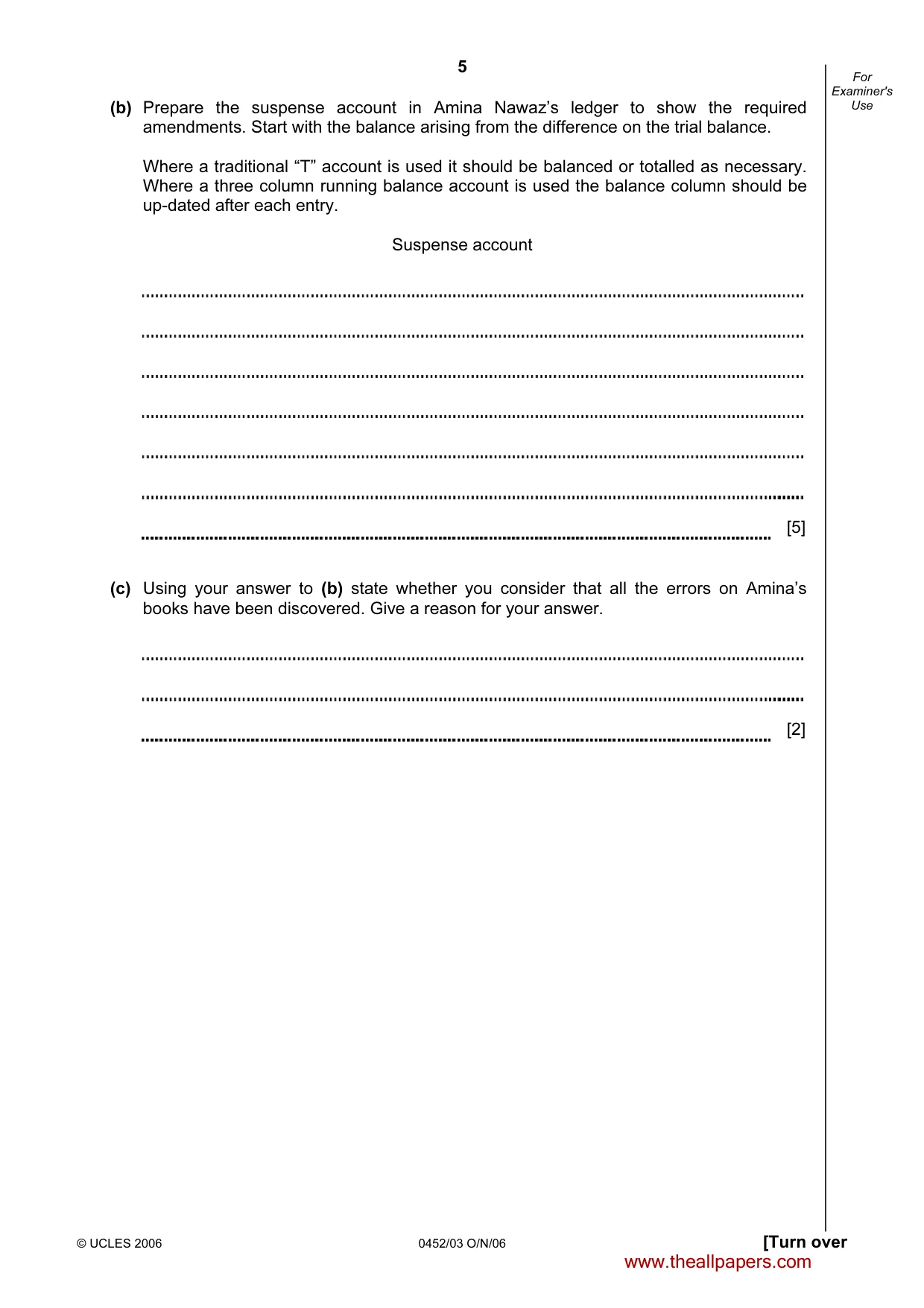
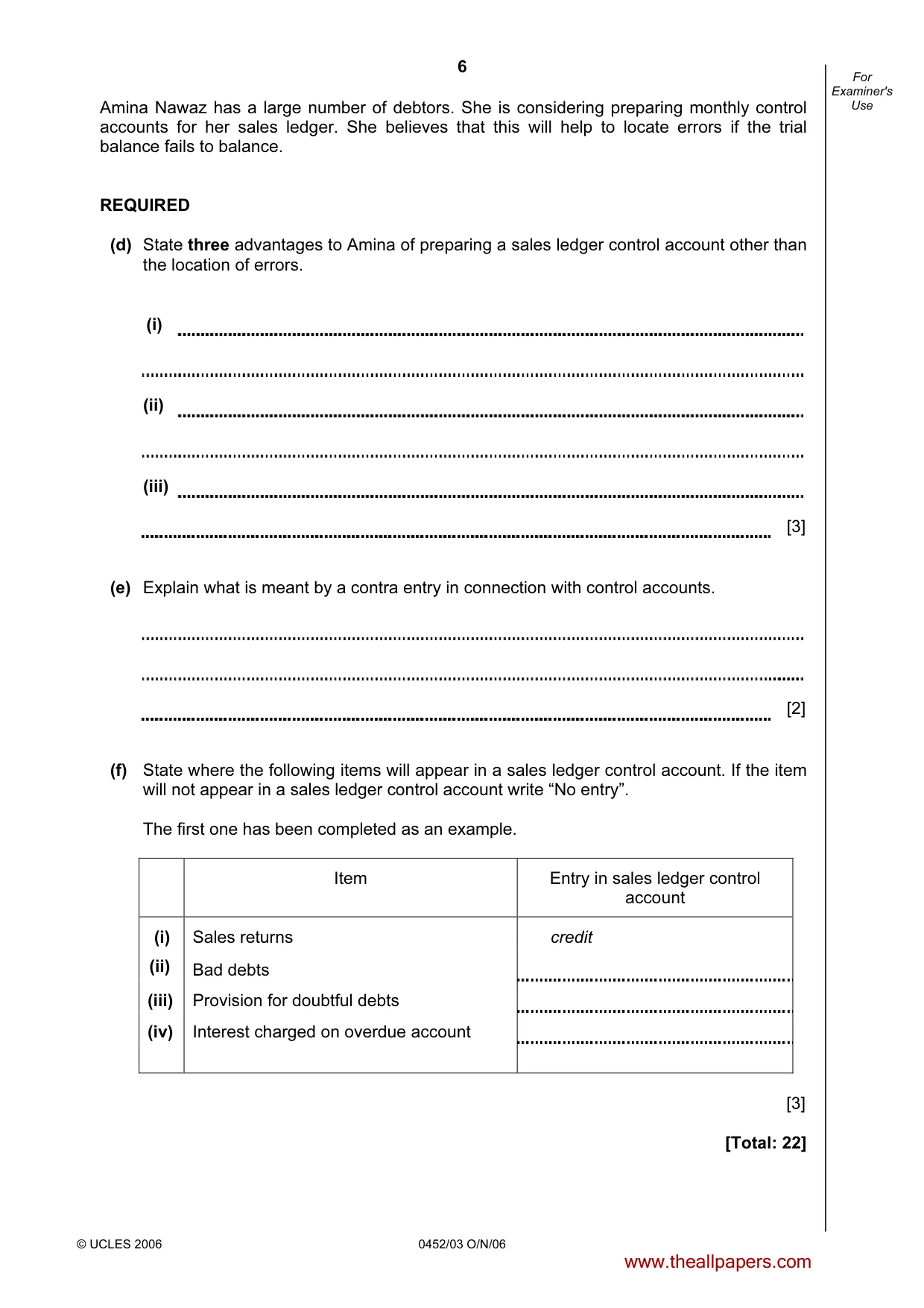
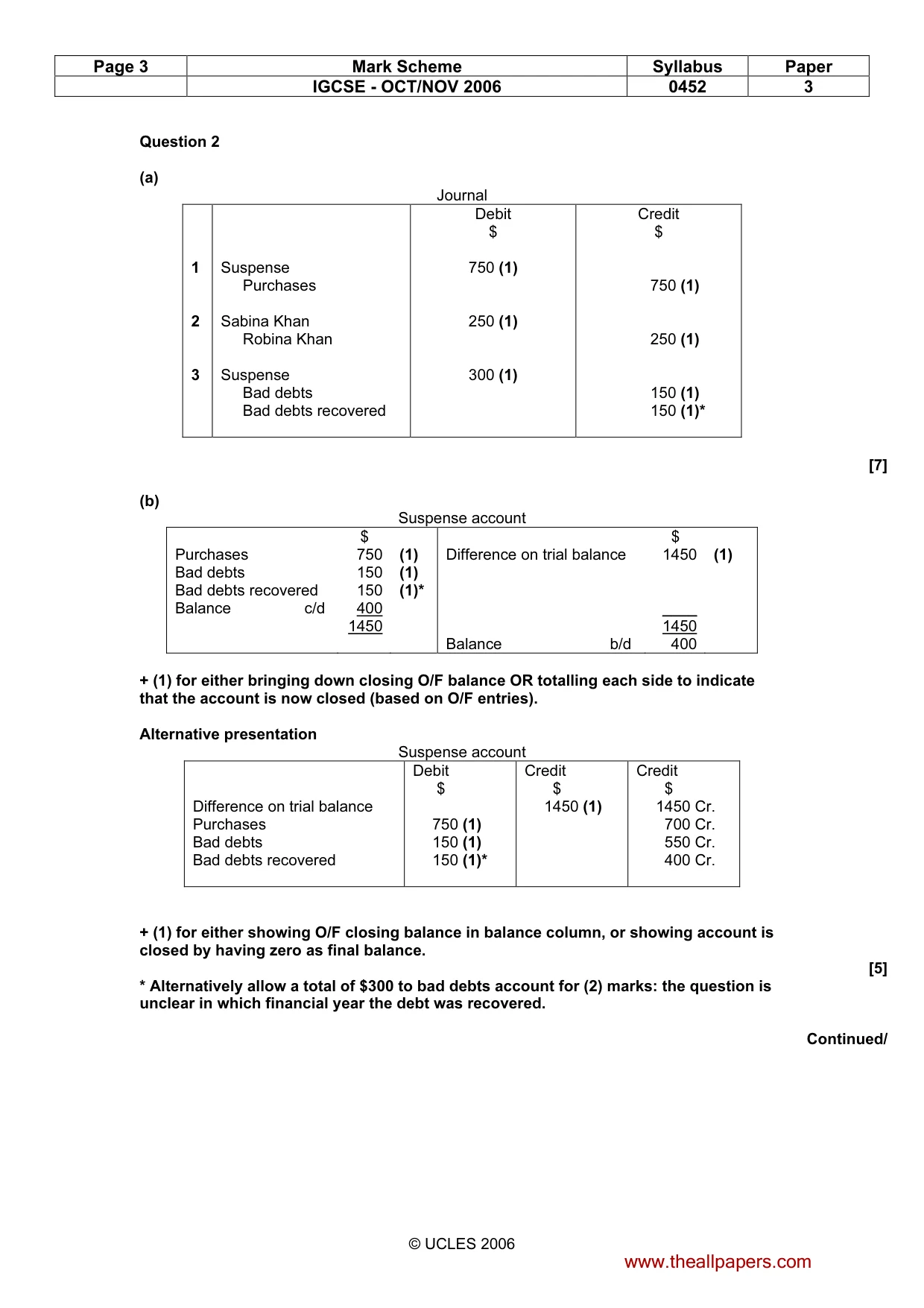
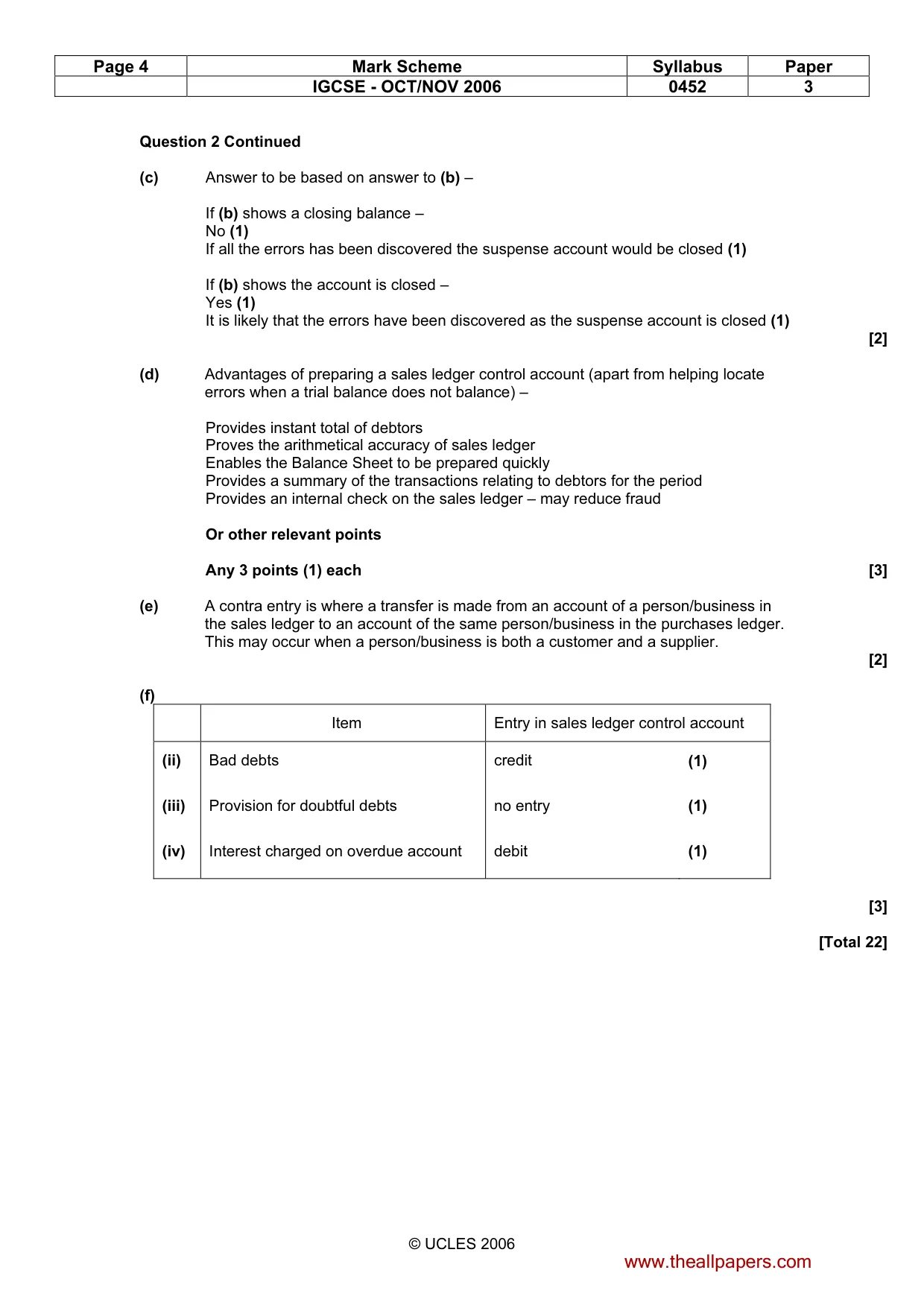
2 Amina Nawaz is a sole trader. Her financial year ends on 31 August. The trial balance prepared on 31 August 2006 showed a shortage on the credit side of $1450. Amina entered this in a suspense account. The following errors were later discovered: 1 Goods costing $750, taken by Amina for her own use, had been debited to her drawings account, but no other entry had been made. 2 $250 paid to Sabina Khan had been debited to the account of Robina Khan, another creditor, in the purchases ledger. 3 $150 received in cash from a debtor, whose account had been written off in 2005, had been debited to both the cash account and bad debts account. REQUIRED (a) Prepare the entries in Amina Nawaz’s journal to correct the above errors. Narratives are not required. Journal Debit Credit $ $ [7] (b) Prepare the suspense account in Amina Nawaz’s ledger to show the required amendments. Start with the balance arising from the difference on the trial balance. Where a traditional “T” account is used it should be balanced or totalled as necessary. Where a three column running balance account is used the balance column should be up-dated after each entry. Suspense account [5] (c) Using your answer to (b) state whether you consider that all the errors on Amina’s books have been discovered. Give a reason for your answer. [2] Amina Nawaz has a large number of debtors. She is considering preparing monthly control accounts for her sales ledger. She believes that this will help to locate errors if the trial balance fails to balance. REQUIRED (d) State three advantages to Amina of preparing a sales ledger control account other than the location of errors. (i) (ii) (iii) [3] (e) Explain what is meant by a contra entry in connection with control accounts. [2] (f) State where the following items will appear in a sales ledger control account. If the item will not appear in a sales ledger control account write “No entry”. The first one has been completed as an example. Item Entry in sales ledger control account (i) Sales returns credit (ii) Bad debts (iii) Provision for doubtful debts (iv) Interest charged on overdue account [3] [Total: 22]
Q3 · The accounts maintained by non-trading organisations such as clubs and societies often…
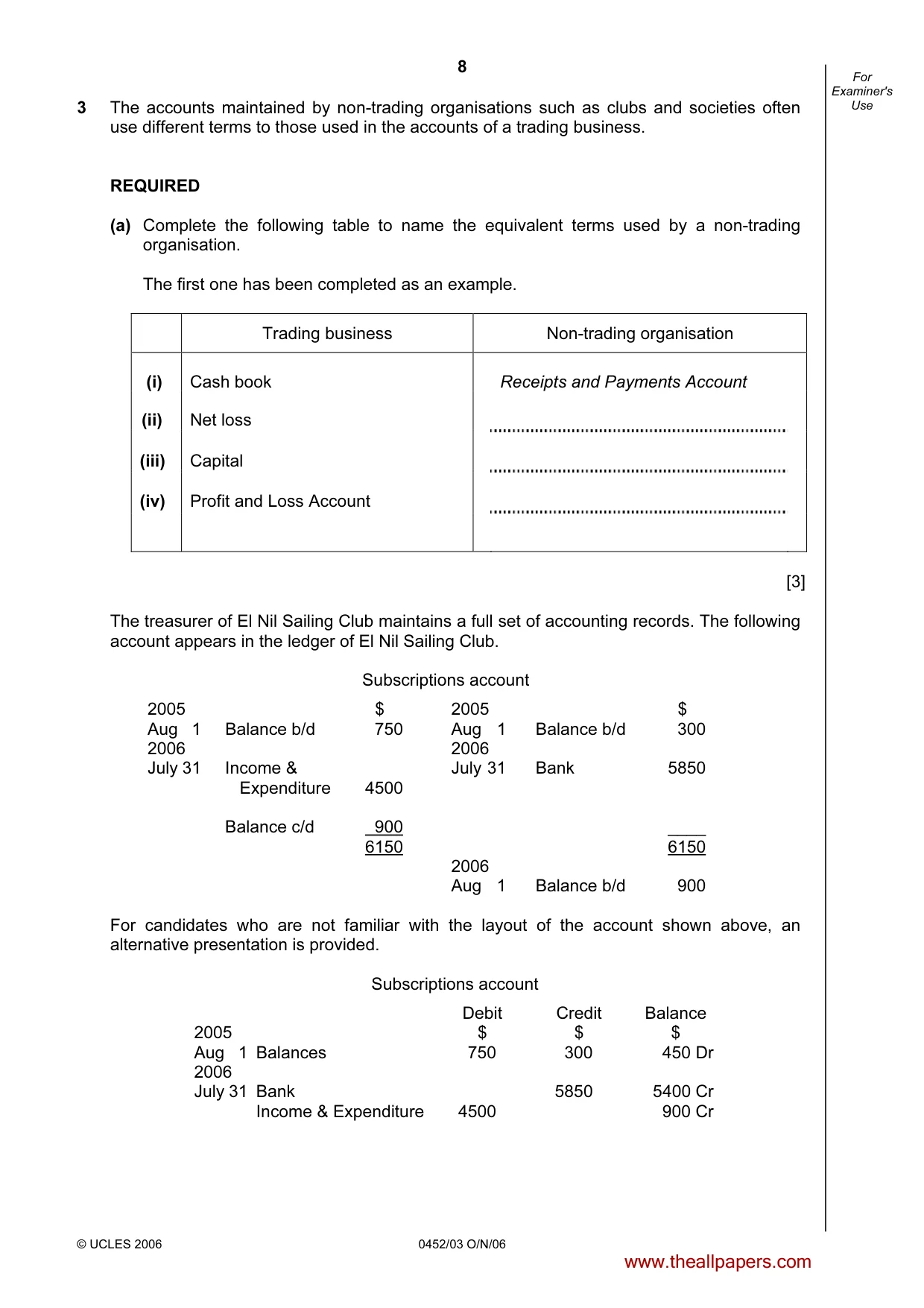
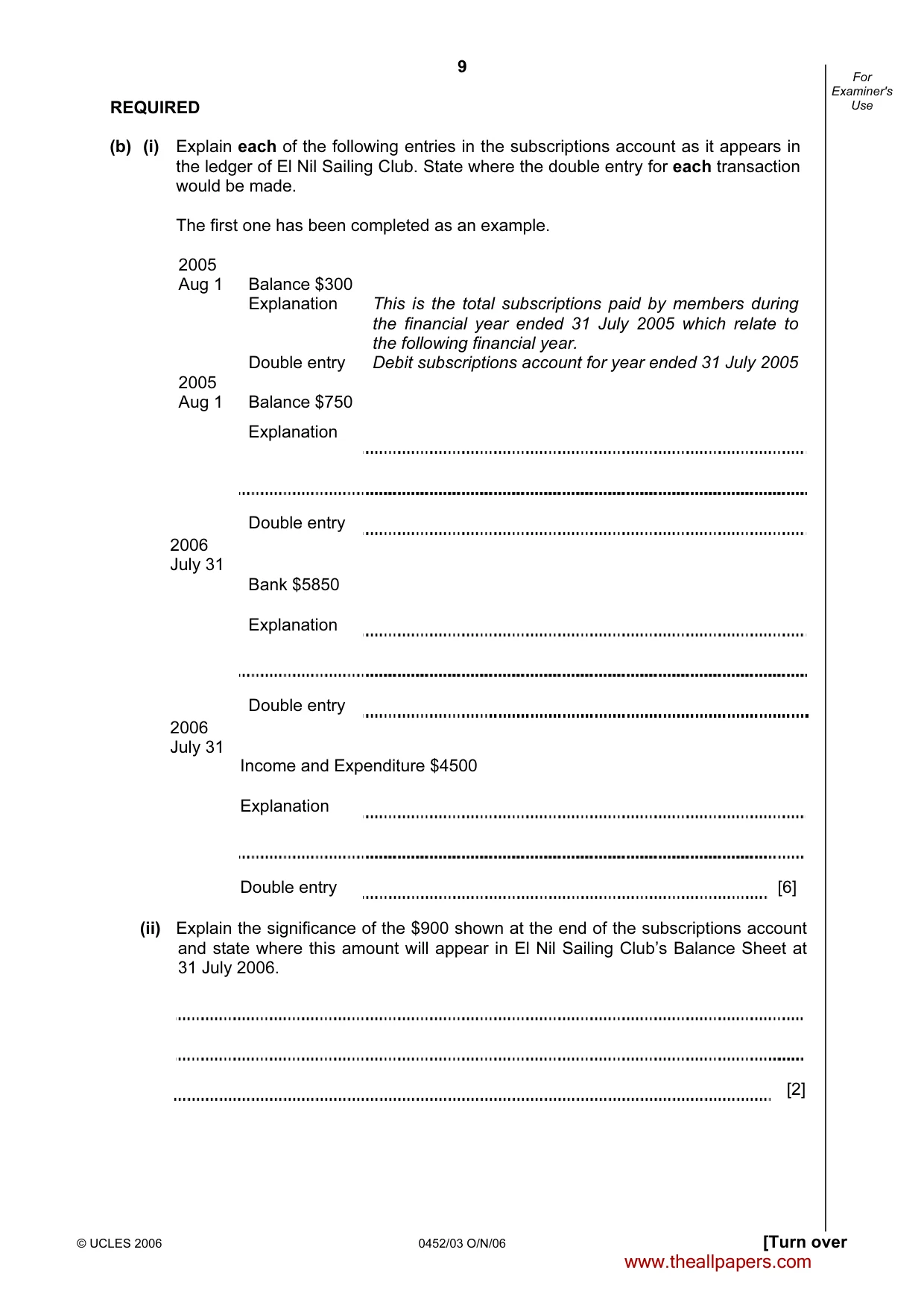
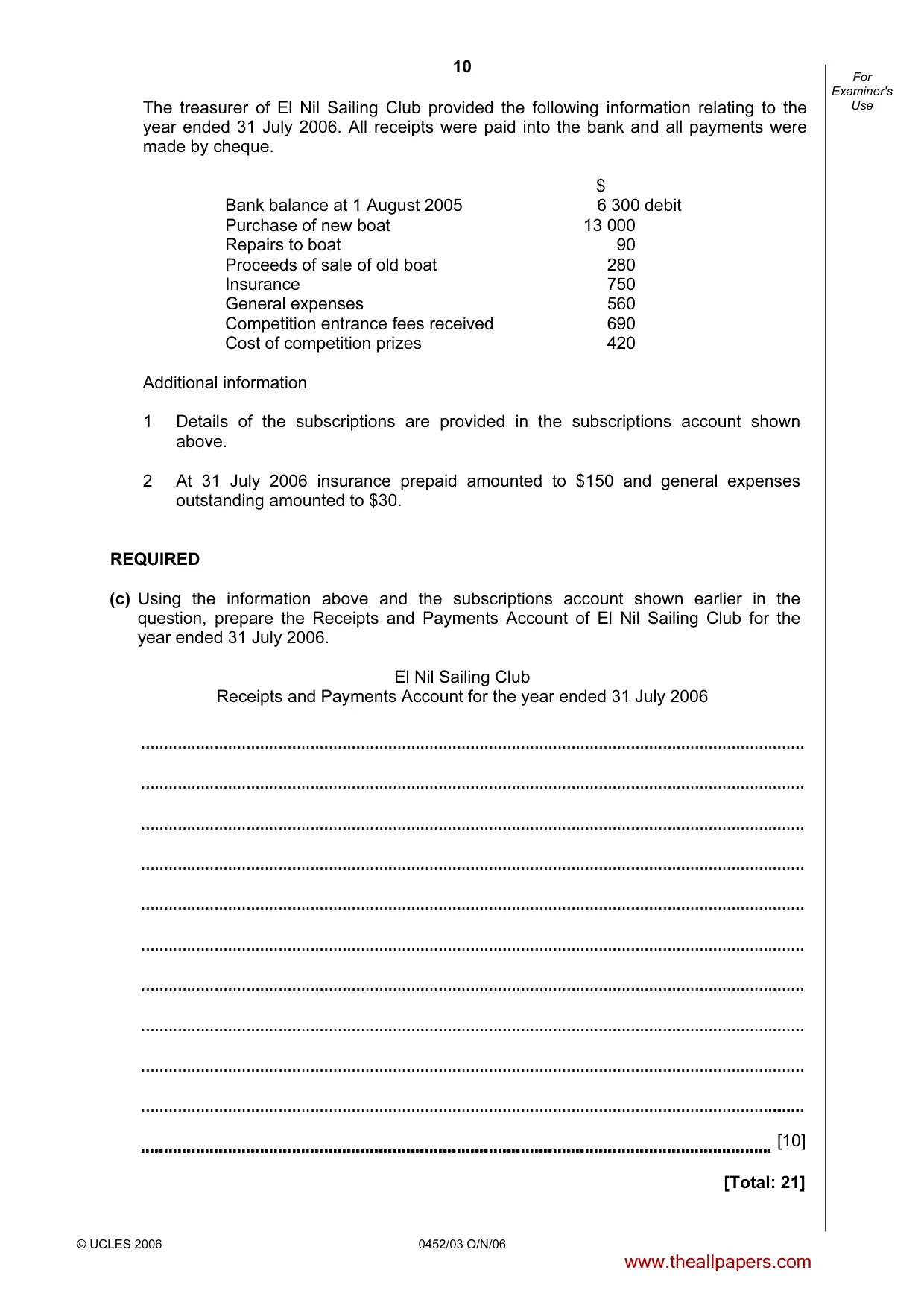
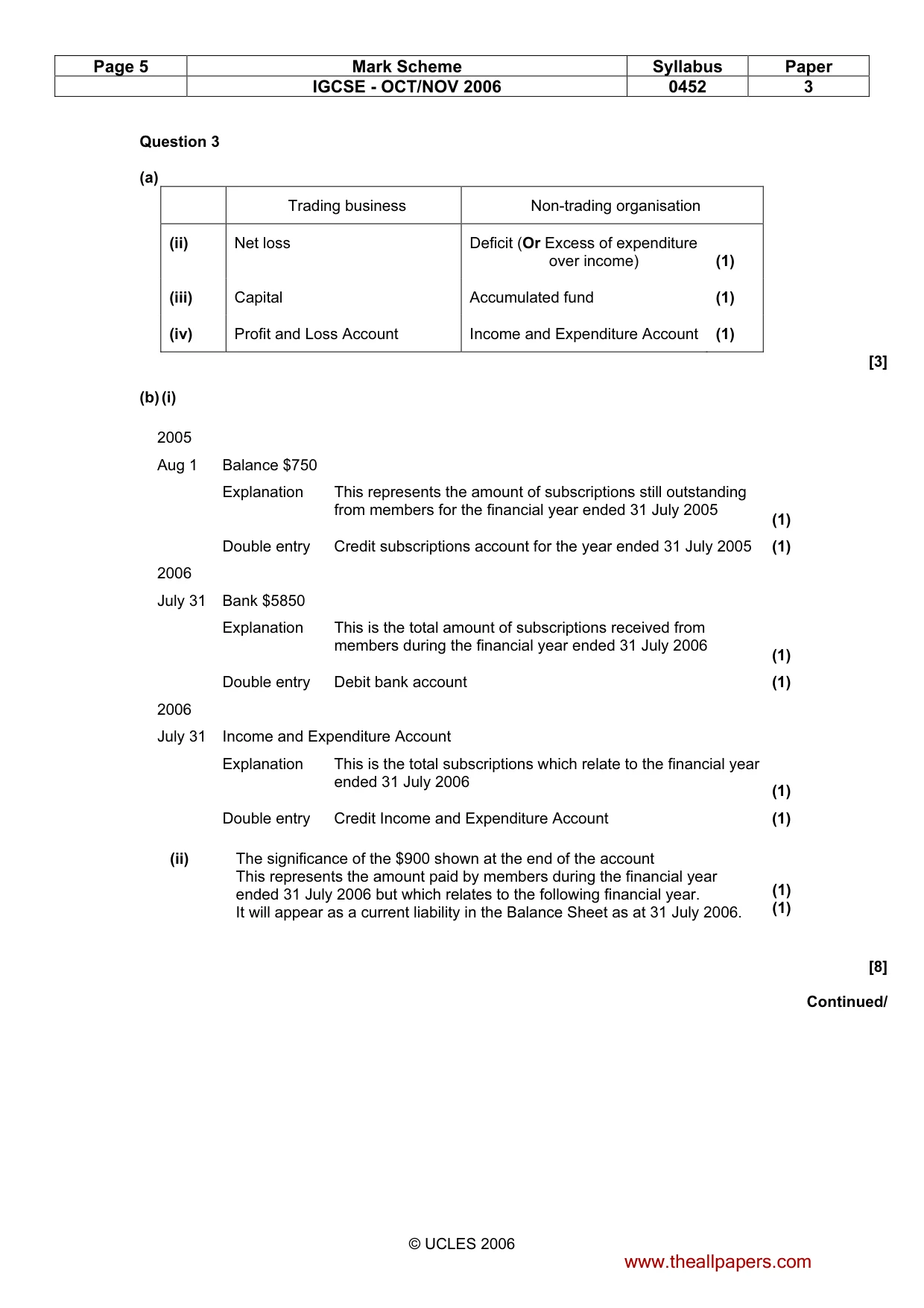
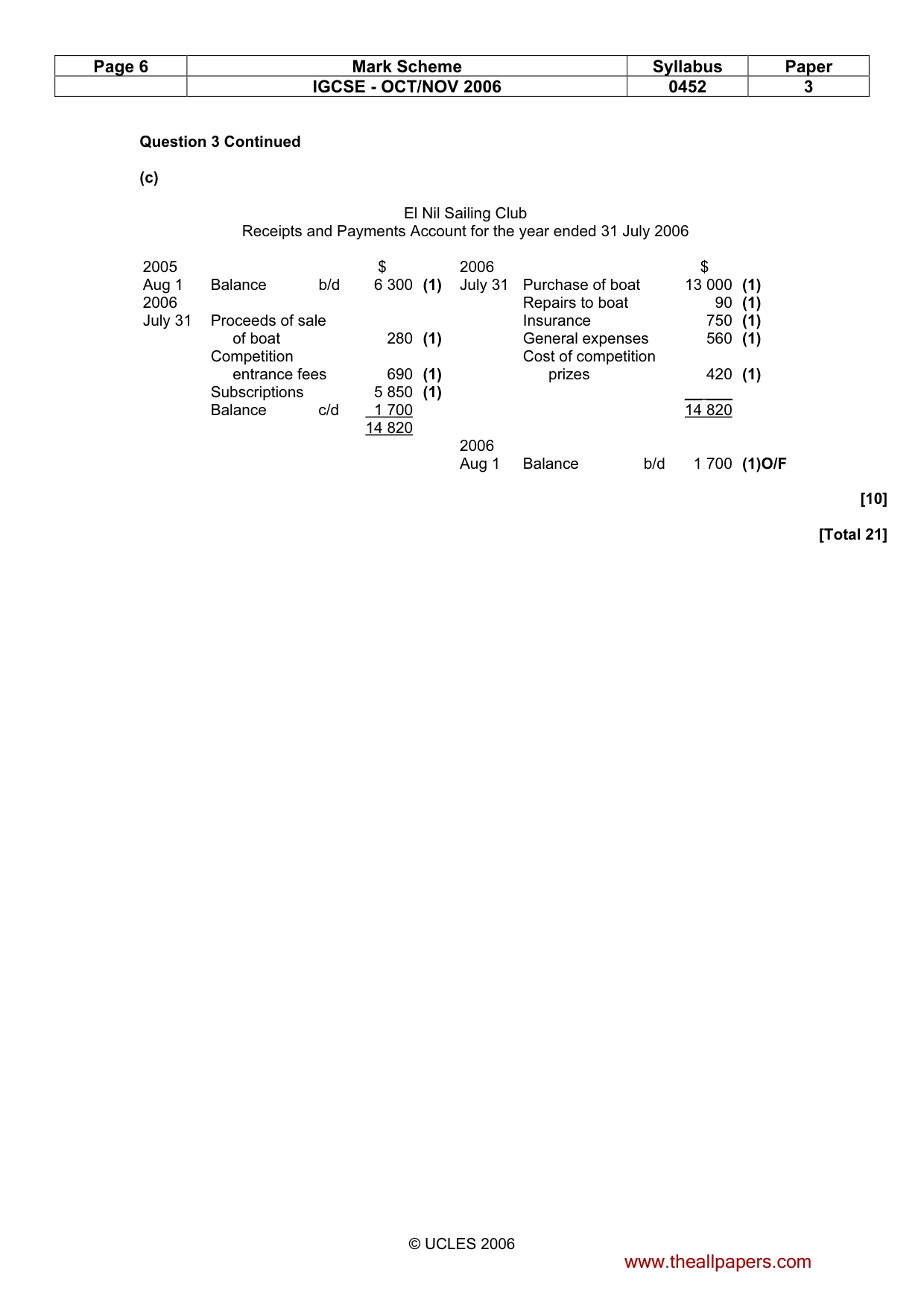
3 The accounts maintained by non-trading organisations such as clubs and societies often use different terms to those used in the accounts of a trading business. REQUIRED (a) Complete the following table to name the equivalent terms used by a non-trading organisation. The first one has been completed as an example. Trading business Non-trading organisation (i) Cash book Receipts and Payments Account (ii) Net loss (iii) Capital (iv) Profit and Loss Account [3] The treasurer of El Nil Sailing Club maintains a full set of accounting records. The following account appears in the ledger of El Nil Sailing Club. Subscriptions account 2005 $ 2005 $ Aug 1 Balance b/d 750 Aug 1 Balance b/d 300 2006 2006 July 31 Income & July 31 Bank 5850 Expenditure 4500 Balance c/d 900 ____ 6150 6150 2006 Aug 1 Balance b/d 900 For candidates who are not familiar with the layout of the account shown above, an alternative presentation is provided. Subscriptions account Debit Credit Balance 2005 $ $ $ Aug 1 Balances 750 300 450 Dr 2006 July 31 Bank 5850 5400 Cr Income & Expenditure 4500 900 Cr REQUIRED (b) (i) Explain each of the following entries in the subscriptions account as it appears in the ledger of El Nil Sailing Club. State where the double entry for each transaction would be made. The first one has been completed as an example. 2005 Aug 1 Balance $300 Explanation This is the total subscriptions paid by members during the financial year ended 31 July 2005 which relate to the following financial year. Double entry Debit subscriptions account for year ended 31 July 2005 2005 Aug 1 Balance $750 Explanation Double entry 2006 July 31 Bank $5850 Explanation Double entry 2006 July 31 Income and Expenditure $4500 Explanation Double entry [6] (ii) Explain the significance of the $900 shown at the end of the subscriptions account and state where this amount will appear in El Nil Sailing Club’s Balance Sheet at 31 July 2006. [2] The treasurer of El Nil Sailing Club provided the following information relating to the year ended 31 July 2006. All receipts were paid into the bank and all payments were made by cheque. $ Bank balance at 1 August 2005 6 300 debit Purchase of new boat 13 000 Repairs to boat 90 Proceeds of sale of old boat 280 Insurance 750 General expenses 560 Competition entrance fees received 690 Cost of competition prizes 420 Additional information 1 Details of the subscriptions are provided in the subscriptions account shown above. 2 At 31 July 2006 insurance prepaid amounted to $150 and general expenses outstanding amounted to $30. REQUIRED (c) Using the information above and the subscriptions account shown earlier in the question, prepare the Receipts and Payments Account of El Nil Sailing Club for the year ended 31 July 2006. El Nil Sailing Club Receipts and Payments Account for the year ended 31 July 2006 [10] [Total: 21]
Q4 · David Parnell is a trader
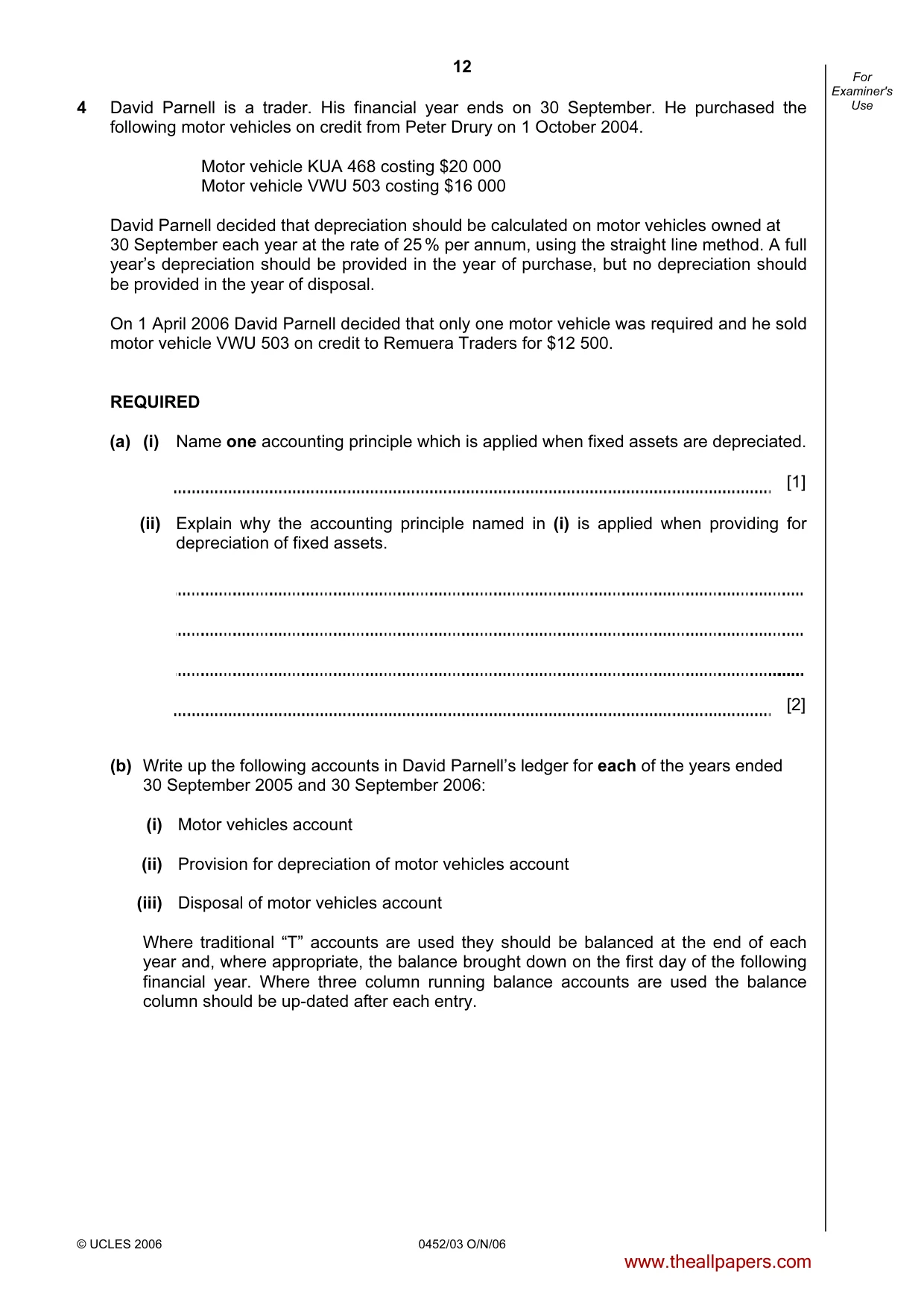
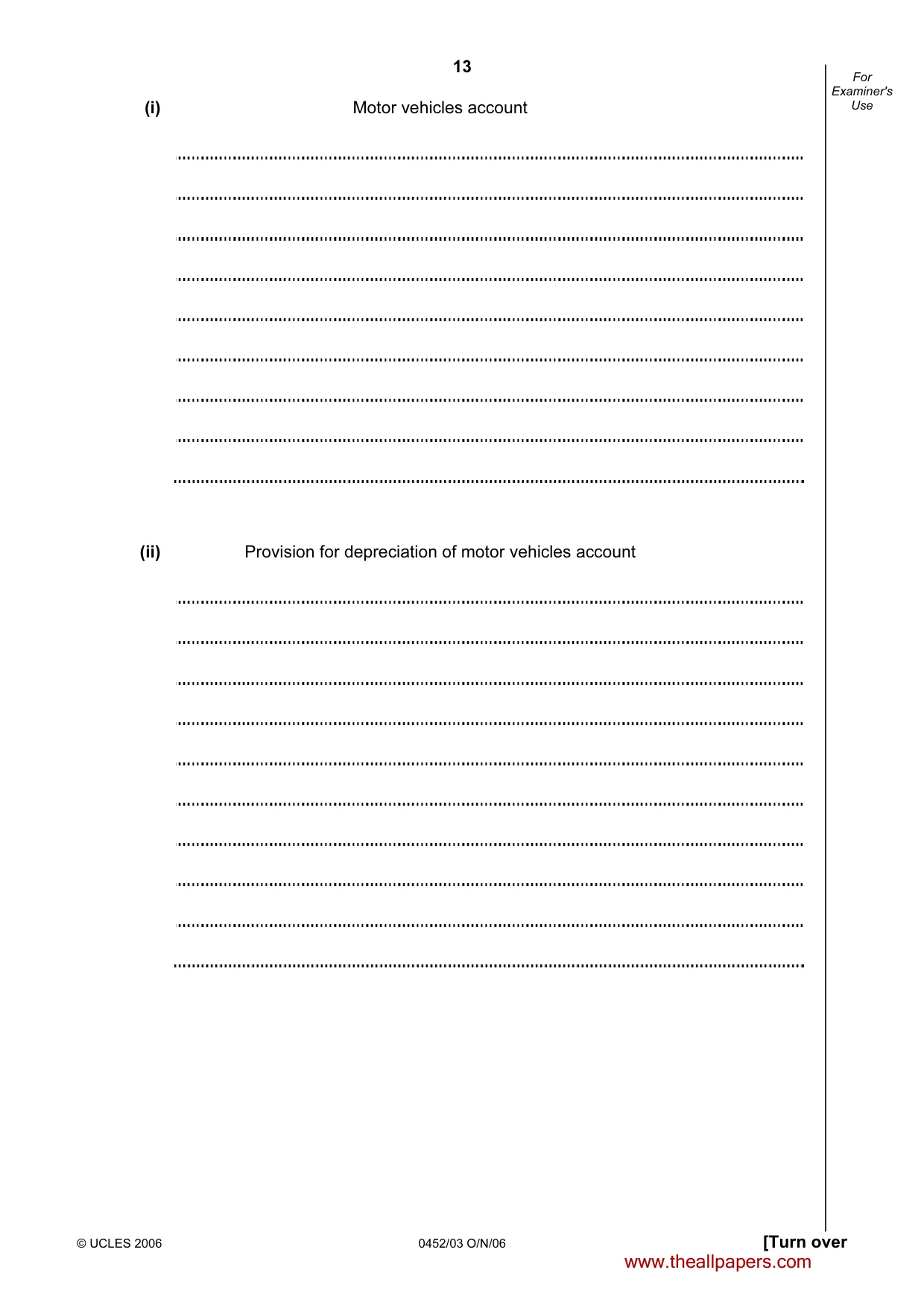
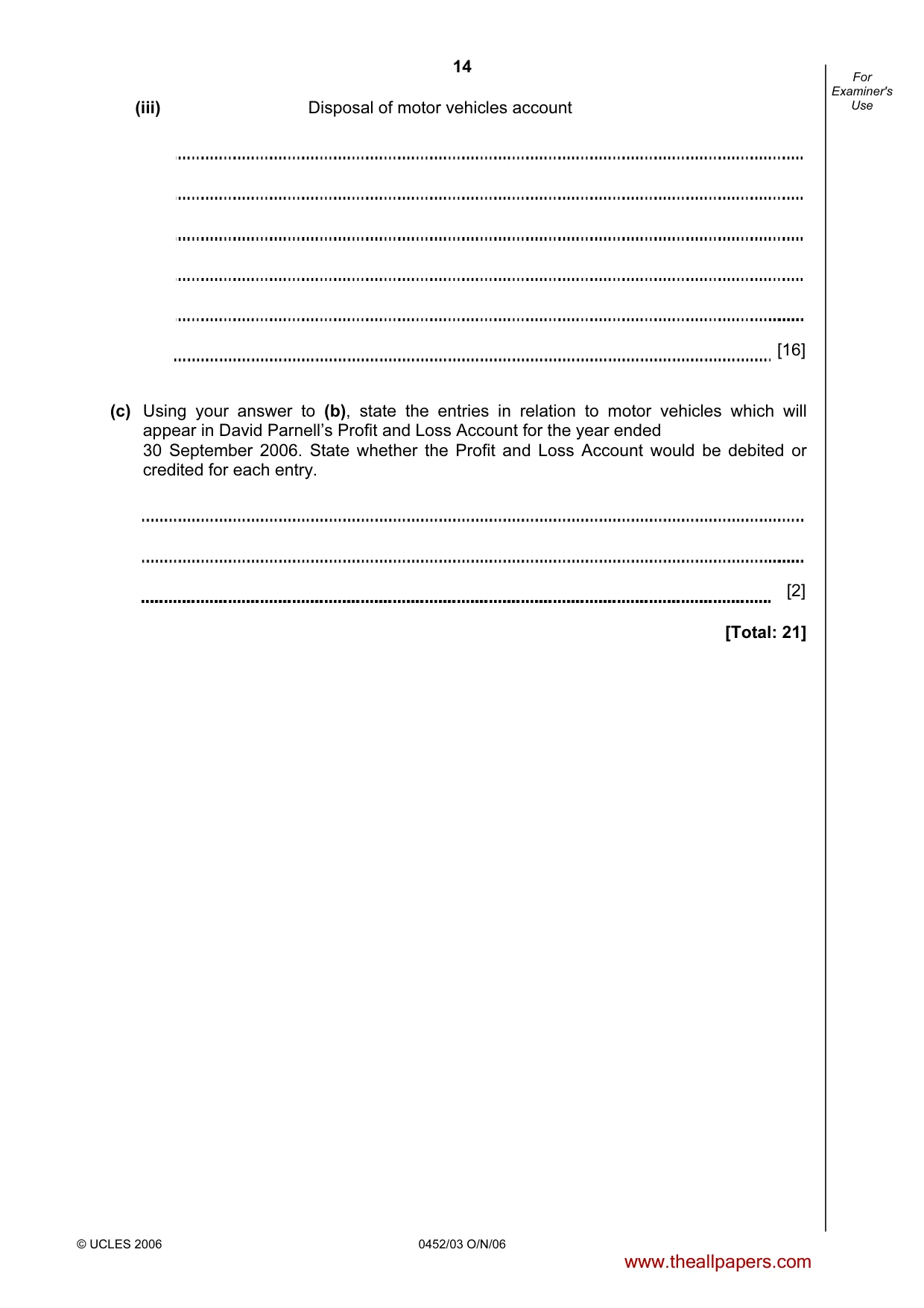
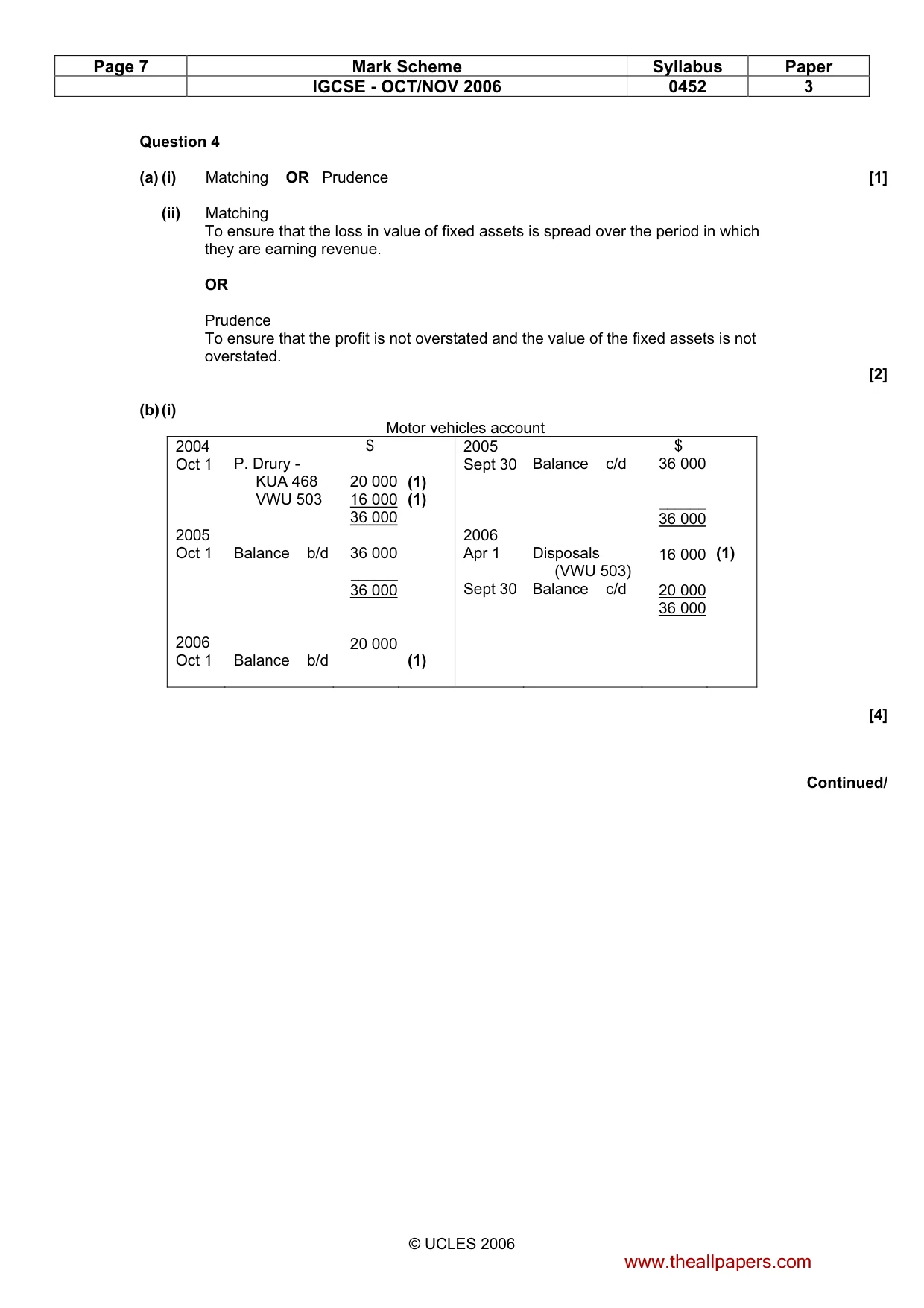
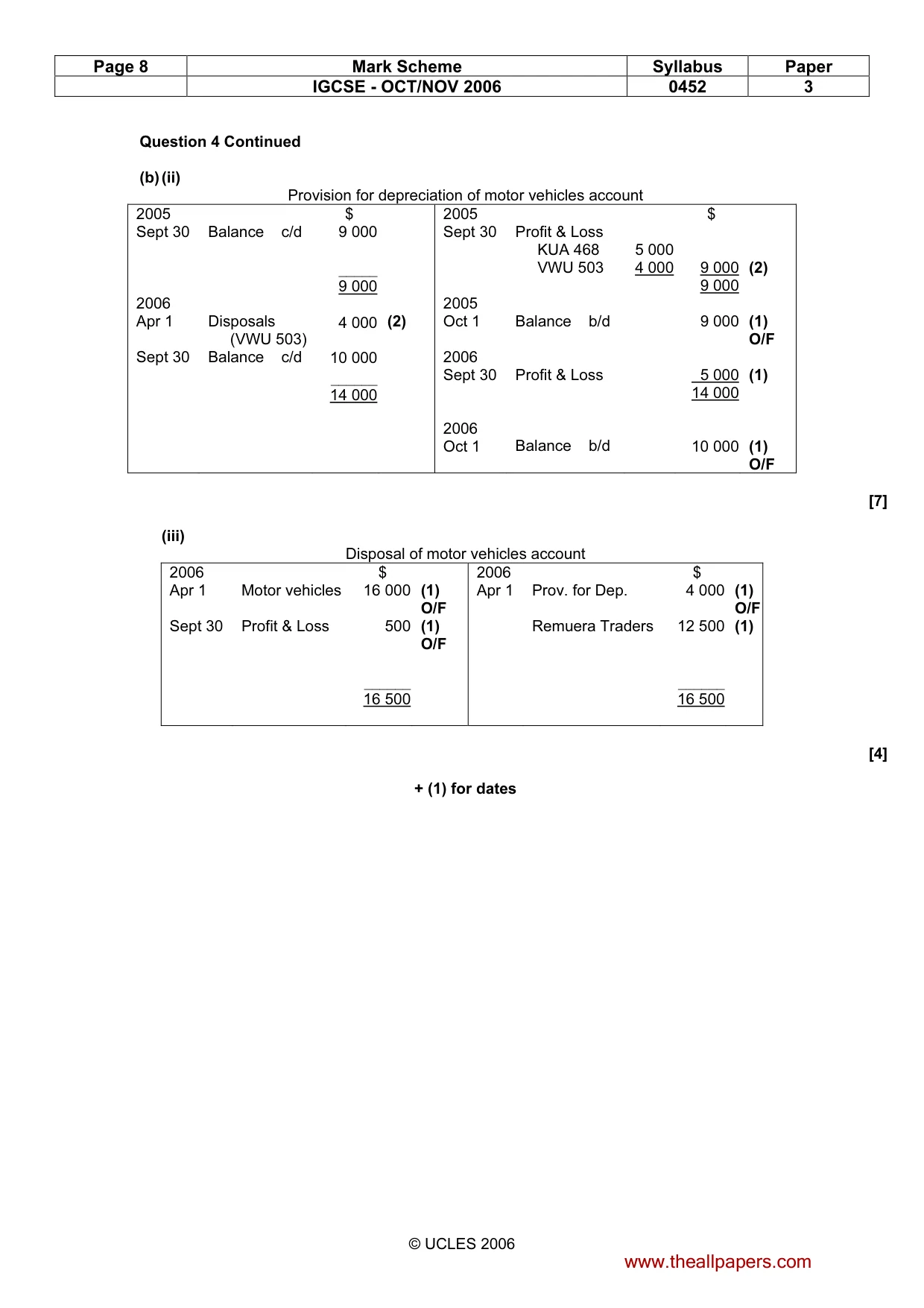
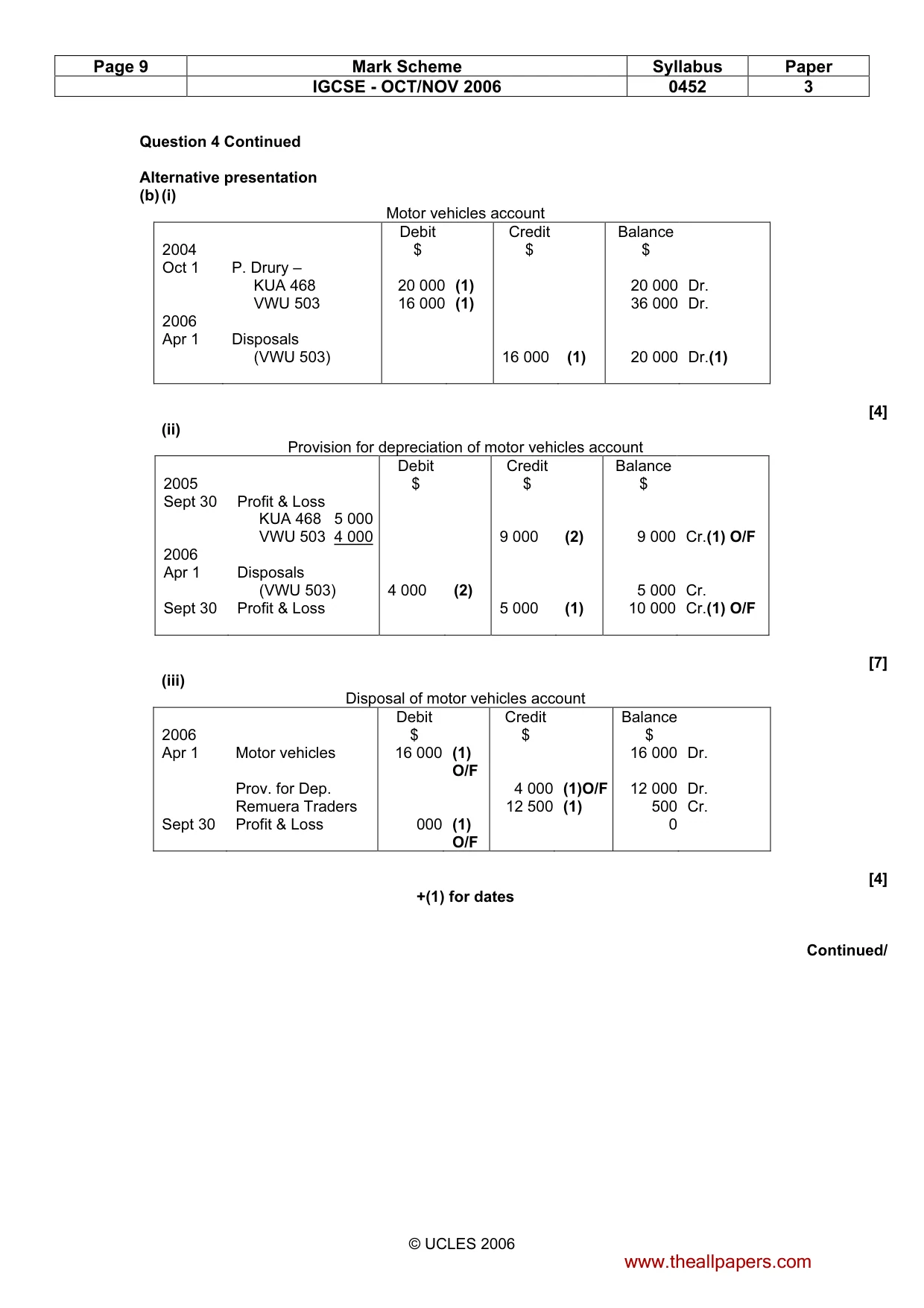
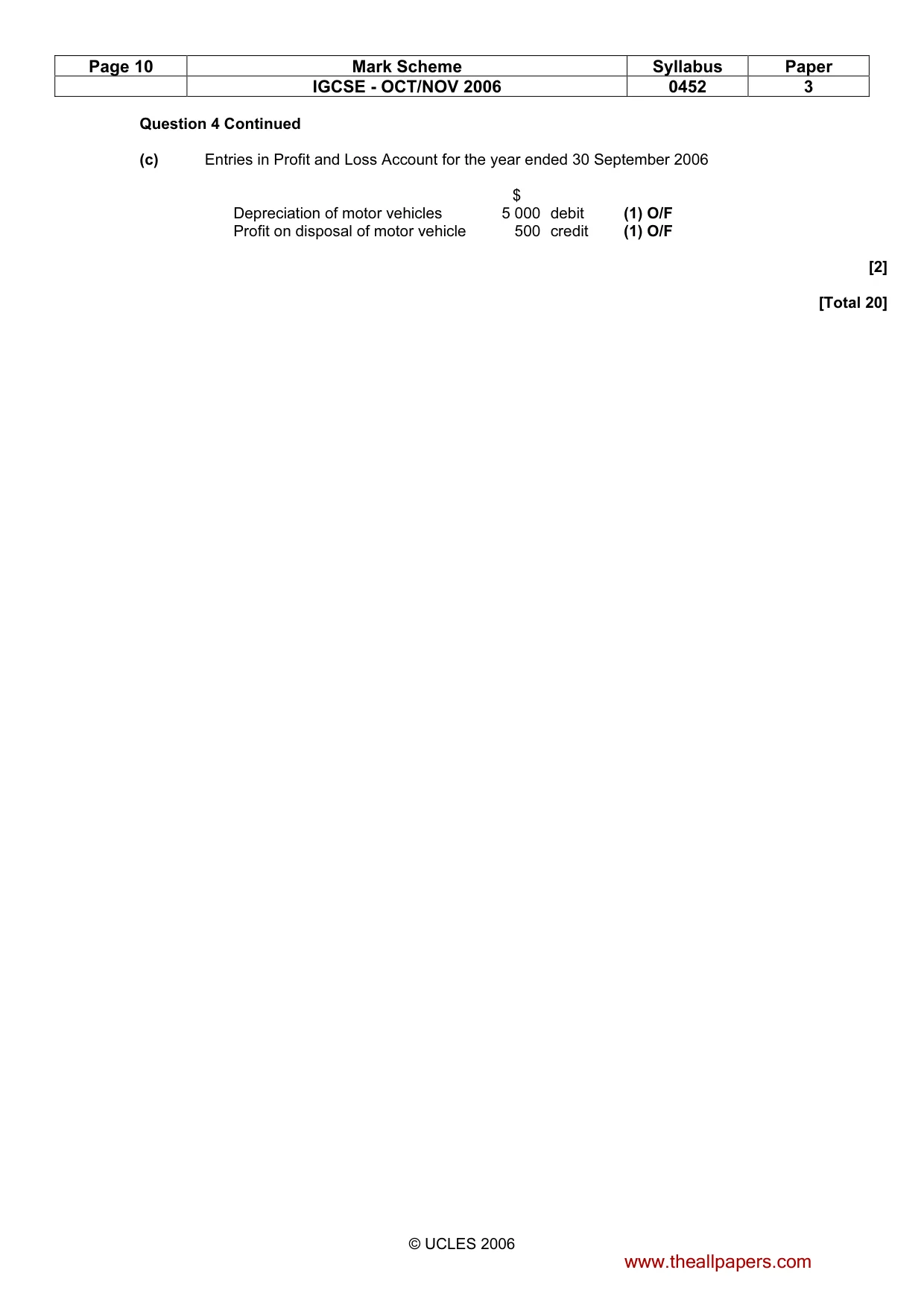
4 David Parnell is a trader. His financial year ends on 30 September. He purchased the following motor vehicles on credit from Peter Drury on 1 October 2004. Motor vehicle KUA 468 costing $20 000 Motor vehicle VWU 503 costing $16 000 David Parnell decided that depreciation should be calculated on motor vehicles owned at 30 September each year at the rate of 25 % per annum, using the straight line method. A full year’s depreciation should be provided in the year of purchase, but no depreciation should be provided in the year of disposal. On 1 April 2006 David Parnell decided that only one motor vehicle was required and he sold motor vehicle VWU 503 on credit to Remuera Traders for $12 500. REQUIRED (a) (i) Name one accounting principle which is applied when fixed assets are depreciated. [1] (ii) Explain why the accounting principle named in (i) is applied when providing for depreciation of fixed assets. [2] (b) Write up the following accounts in David Parnell’s ledger for each of the years ended 30 September 2005 and 30 September 2006: (i) Motor vehicles account (ii) Provision for depreciation of motor vehicles account (iii) Disposal of motor vehicles account Where traditional “T” accounts are used they should be balanced at the end of each year and, where appropriate, the balance brought down on the first day of the following financial year. Where three column running balance accounts are used the balance column should be up-dated after each entry. (i) Motor vehicles account (ii) Provision for depreciation of motor vehicles account (iii) Disposal of motor vehicles account [16] (c) Using your answer to (b), state the entries in relation to motor vehicles which will appear in David Parnell’s Profit and Loss Account for the year ended 30 September 2006. State whether the Profit and Loss Account would be debited or credited for each entry. [2] [Total: 21]
More questions on Accounting for depreciation and disposal of non-current assets
Q5 · Maria Mafule is a sole trader
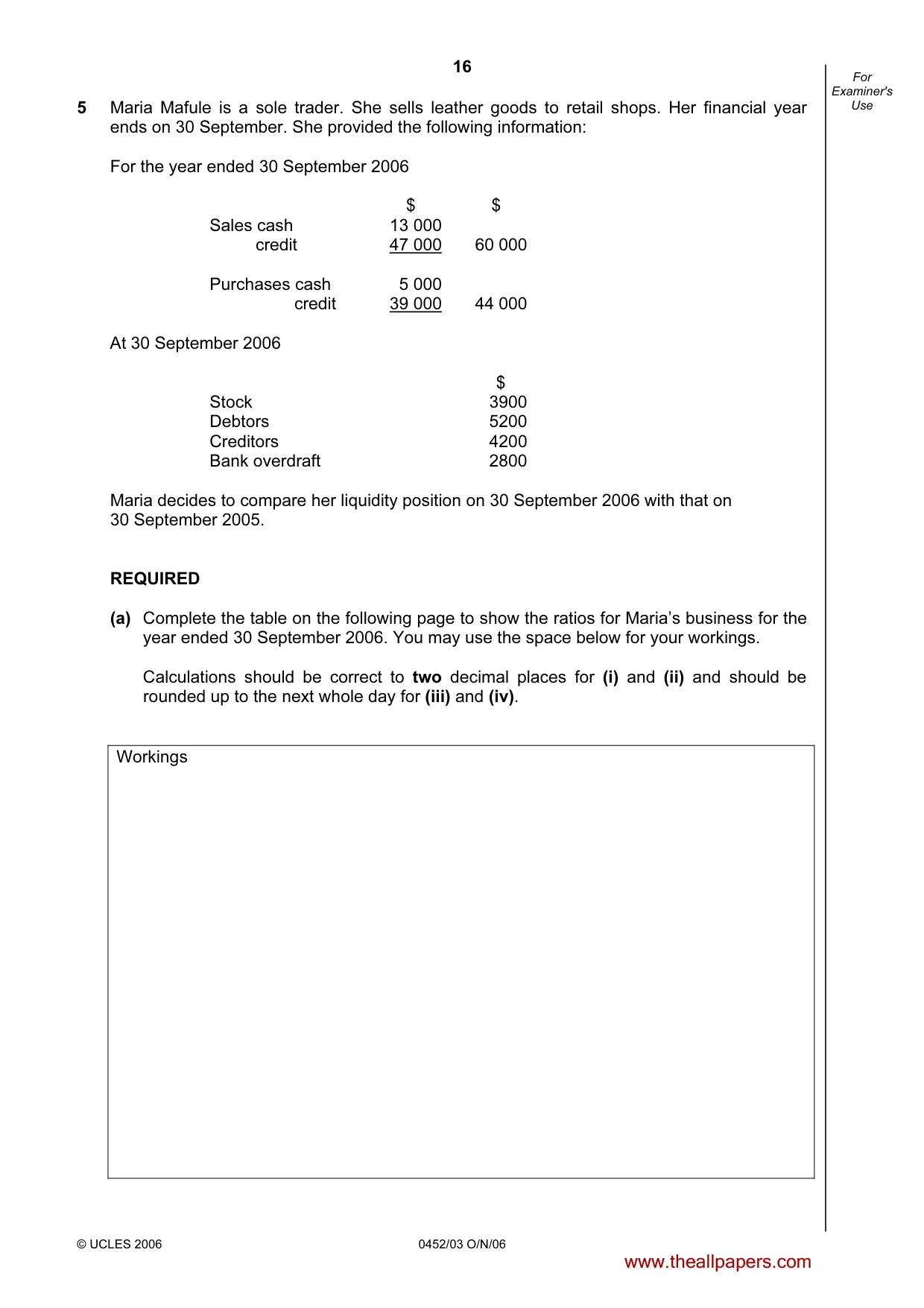
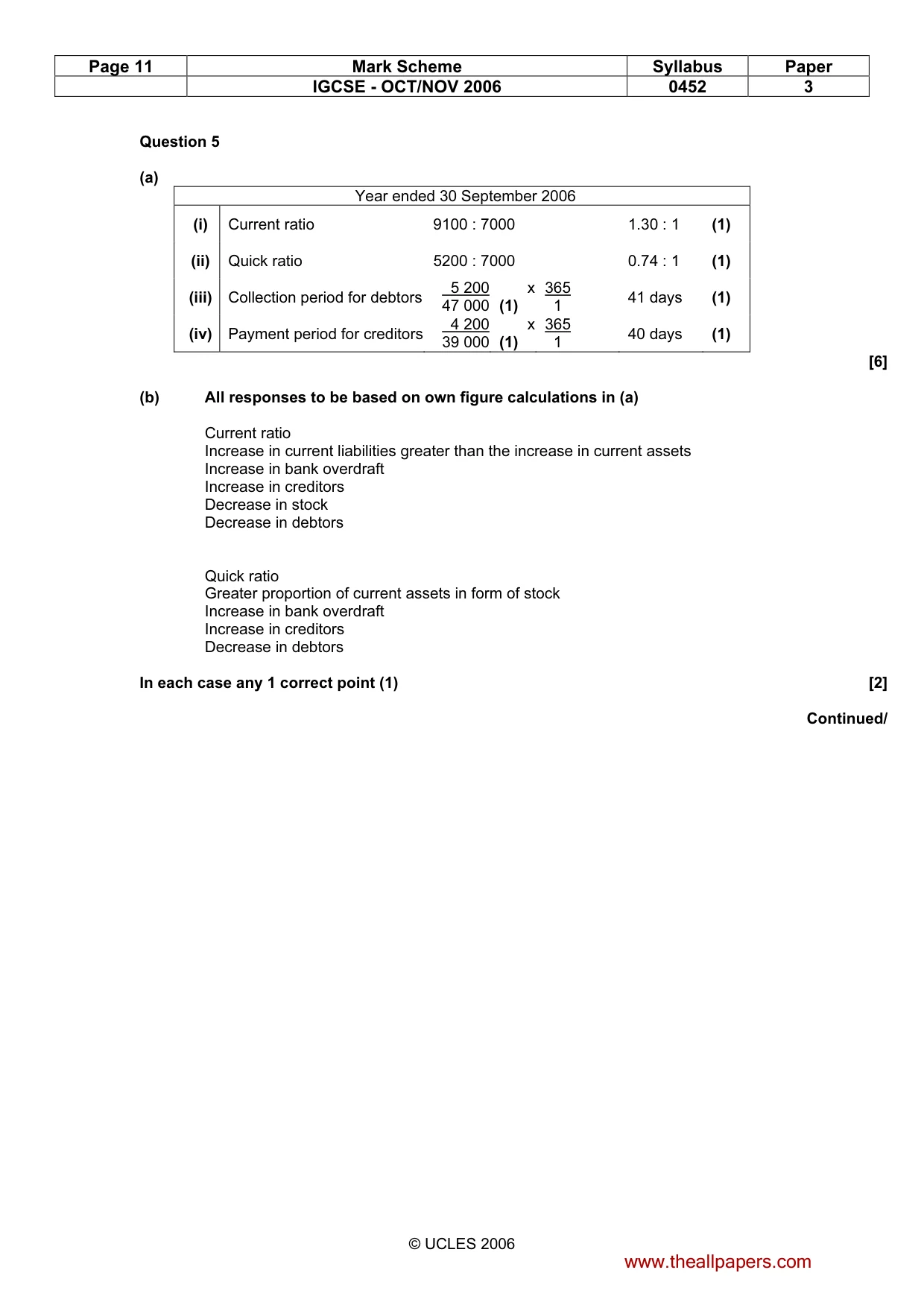
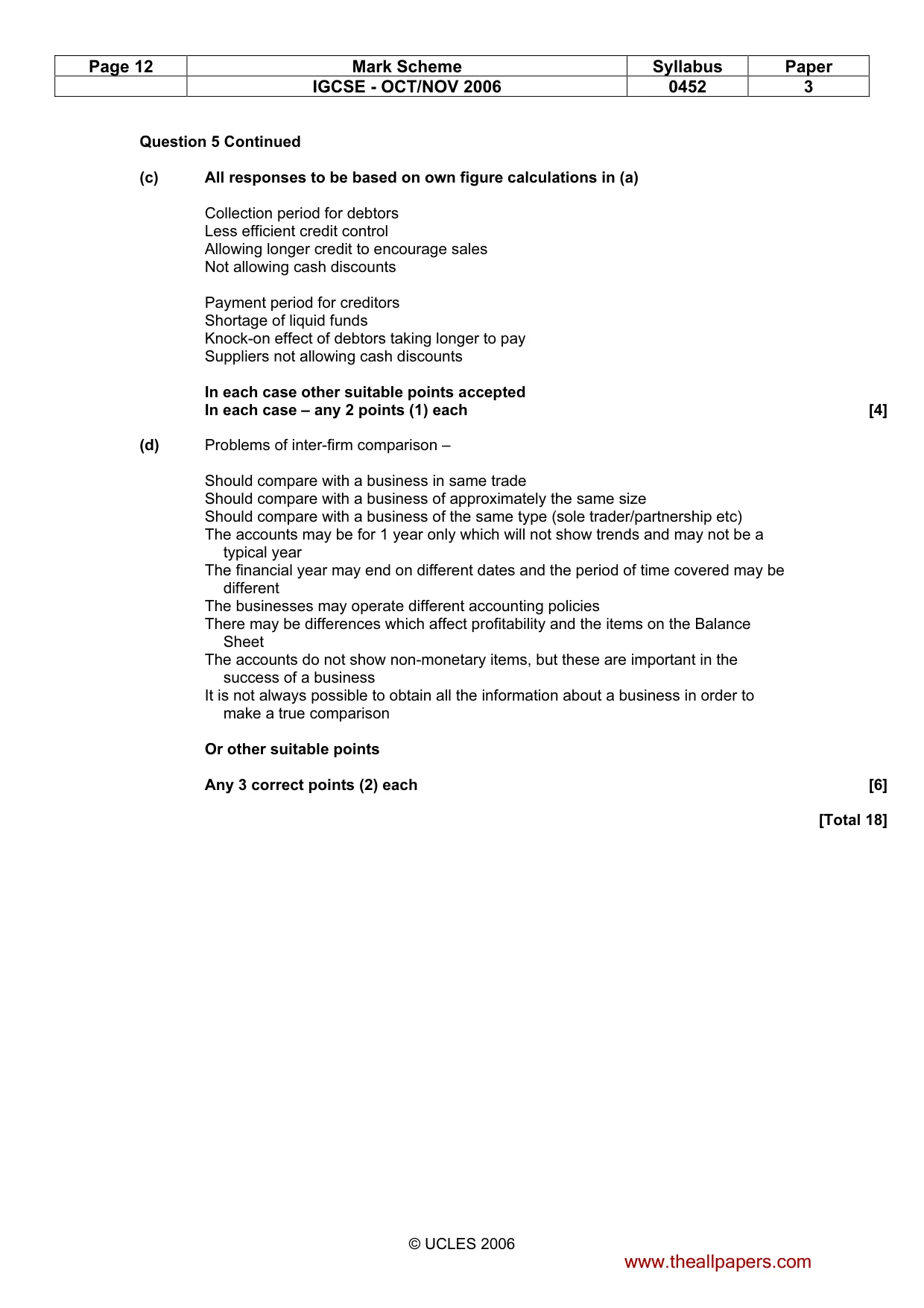
5 Maria Mafule is a sole trader. She sells leather goods to retail shops. Her financial year ends on 30 September. She provided the following information: For the year ended 30 September 2006 $ $ Sales cash 13 000 credit 47 000 60 000 Purchases cash 5 000 credit 39 000 44 000 At 30 September 2006 $ Stock 3900 Debtors 5200 Creditors 4200 Bank overdraft 2800 Maria decides to compare her liquidity position on 30 September 2006 with that on 30 September 2005. REQUIRED (a) Complete the table on the following page to show the ratios for Maria’s business for the year ended 30 September 2006. You may use the space below for your workings. Calculations should be correct to two decimal places for (i) and (ii) and should be rounded up to the next whole day for (iii) and (iv). Workings Place the ratios you have calculated into the box below. Ratio Year ended Year ended 30 September 2005 30 September 2006 (i) Current ratio 2.39 : 1 (ii) Quick ratio 1.06 : 1 (iii) Collection period for debtors 34 days (iv) Payment period for creditors 26 days [6] (b) For each of the following ratios suggest one possible reason which could account for the change in the ratio between 30 September 2005 and 30 September 2006. Current ratio Quick Ratio [2] (c) For each of the following ratios suggest two possible reasons which could account for the change in the ratio between 30 September 2005 and 30 September 2006. Collection period for debtors (i) (ii) Payment period for creditors (i) (ii) [4] Maria Mafula is interested in comparing her results with those of another business and has obtained the final accounts of some other businesses in the same city. REQUIRED (d) Explain three factors which Maria should bear in mind when attempting to compare her results with the accounts she has obtained relating to other businesses. (i) (ii) (iii) [6] [Total: 18]
More questions on Calculation and understanding of accounting ratios
What was in this paper
The subtopics covered by these 5 questions, and how many questions each got. Open one in a new tab to see every Cambridge question on it.
What you needed in this session
Cambridge’s own grade thresholds for 2006 Oct/Nov, Paper 3 · Variant 1. A higher threshold means an easier paper — the bar moves with how the cohort did.