Cambridge IGCSE Accounting 0452 — 2002 Oct/Nov Paper 3 · Variant 1
0452/31/O/N/02
The question paper and its mark scheme, free to read here and free to download. This is Cambridge’s own paper, exactly as it was sat.
Question paper12 pages
Mark scheme12 pages
Answers below. Sit the paper first if you are practising.
Paper as text
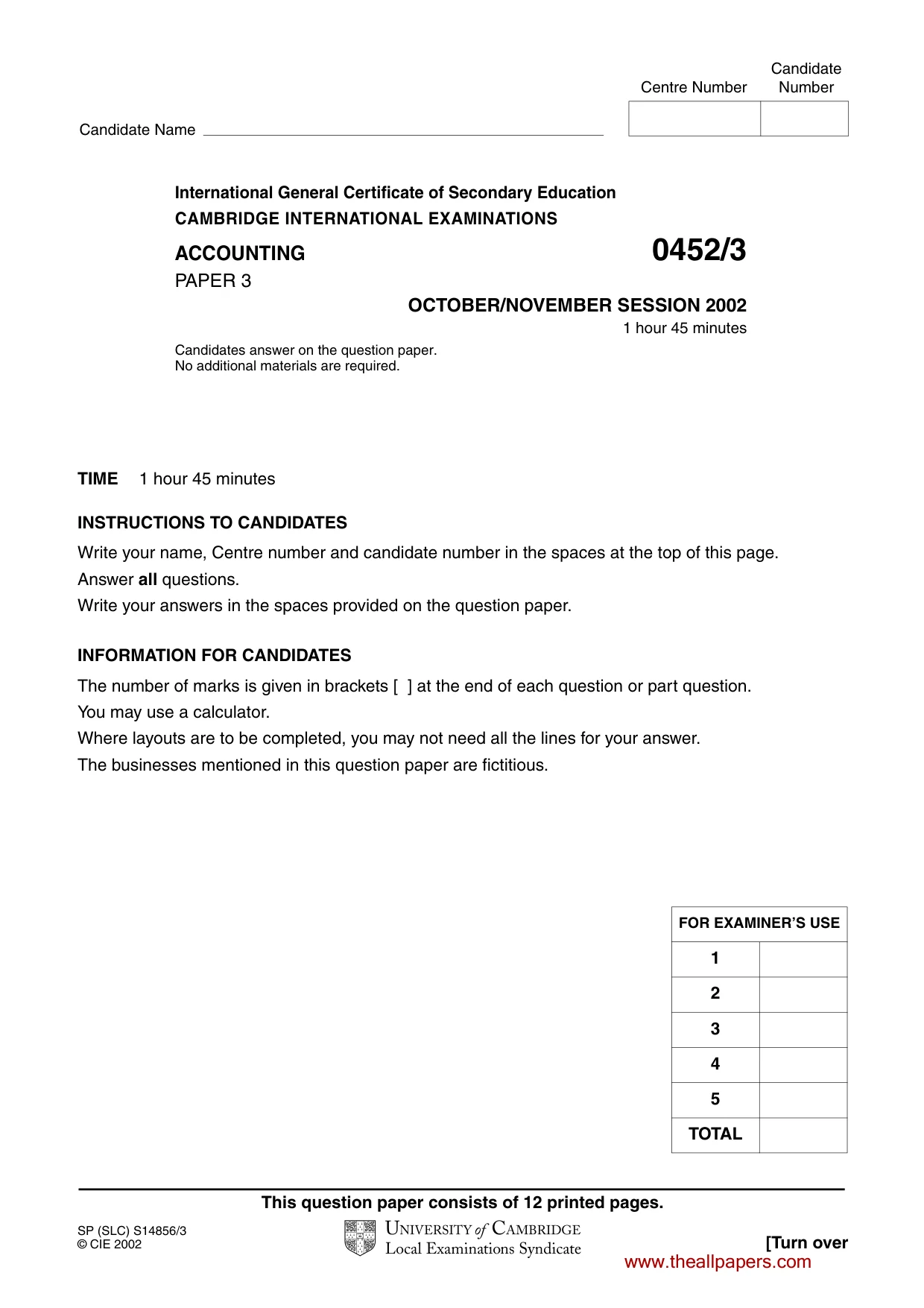
Question paper, page 1
This question paper consists of 12 printed pages. SP (SLC) S14856/3 © CIE 2002 [Turn over International General Certificate of Secondary Education CAMBRIDGE INTERNATIONAL EXAMINATIONS ACCOUNTING 0452/3 PAPER 3 OCTOBER/NOVEMBER SESSION 2002 1 hour 45 minutes Candidates answer on the question paper. No additional materials are required. TIME 1 hour 45 minutes INSTRUCTIONS TO CANDIDATES Write your name, Centre number and candidate number in the spaces at the top of this page. Answer all questions. Write your answers in the spaces provided on the question paper. INFORMATION FOR CANDIDATES The number of marks is given in brackets [ ] at the end of each question or part question. You may use a calculator. Where layouts are to be completed, you may not need all the lines for your answer. The businesses mentioned in this question paper are fictitious. Candidate Centre Number Number Candidate Name FOR EXAMINER’S USE 3 2 1 4 TOTAL 5 www.theallpapers.com
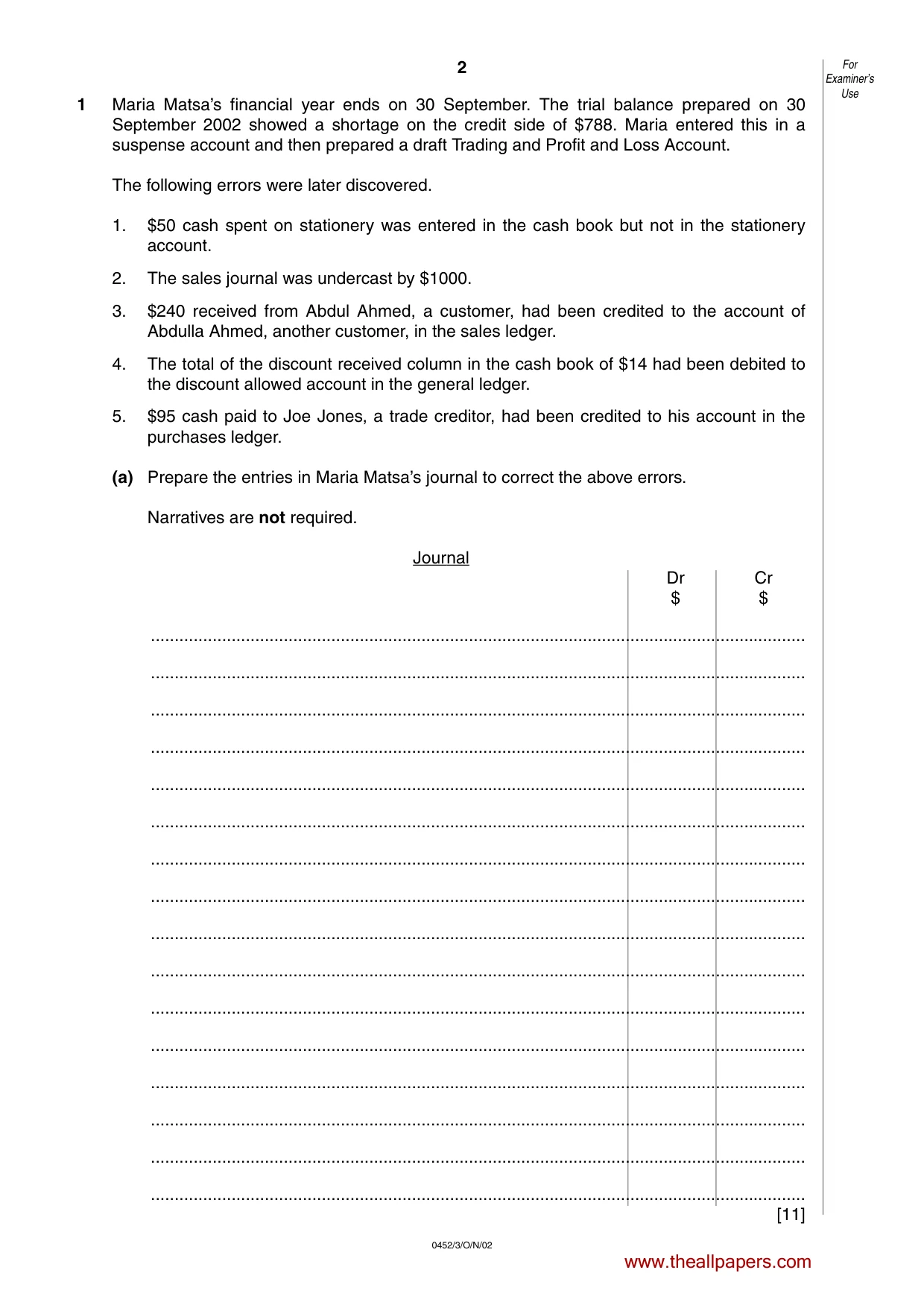
Question paper, page 2
2 0452/3/O/N/02 1 Maria Matsa’s financial year ends on 30 September. The trial balance prepared on 30 September 2002 showed a shortage on the credit side of $788. Maria entered this in a suspense account and then prepared a draft Trading and Profit and Loss Account. The following errors were later discovered. 1. $50 cash spent on stationery was entered in the cash book but not in the stationery account. 2. The sales journal was undercast by $1000. 3. $240 received from Abdul Ahmed, a customer, had been credited to the account of Abdulla Ahmed, another customer, in the sales ledger. 4. The total of the discount received column in the cash book of $14 had been debited to the discount allowed account in the general ledger. 5. $95 cash paid to Joe Jones, a trade creditor, had been credited to his account in the purchases ledger. (a) Prepare the entries in Maria Matsa’s journal to correct the above errors. Narratives are not required. Journal Dr Cr $ $ … … … … … … … … … … … … … … … … [11] For Examiner’s Use www.theallpapers.com
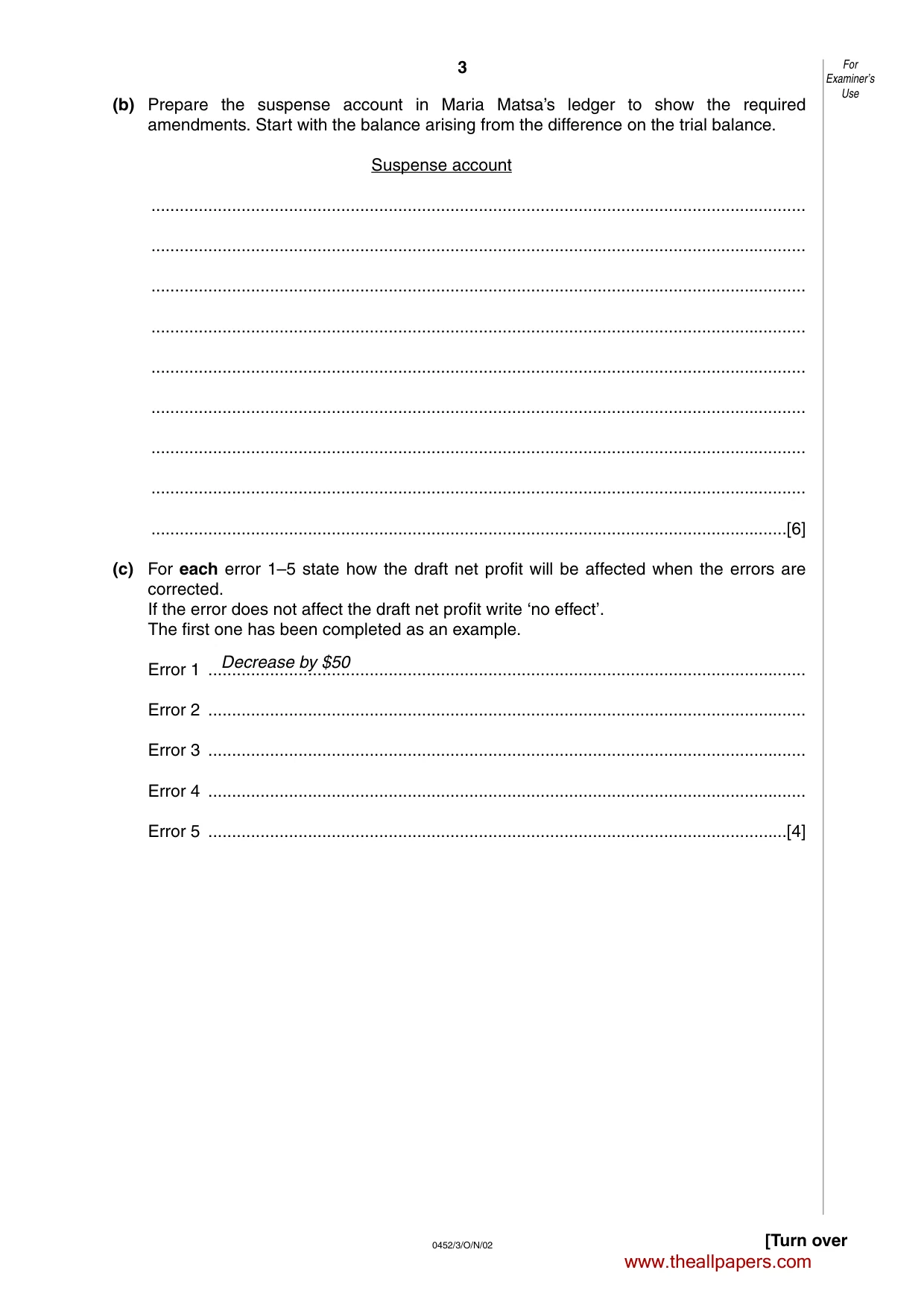
Question paper, page 3
3 0452/3/O/N/02 [Turn over (b) Prepare the suspense account in Maria Matsa’s ledger to show the required amendments. Start with the balance arising from the difference on the trial balance. Suspense account … … … … … … … … …[6] (c) For each error 1–5 state how the draft net profit will be affected when the errors are corrected. If the error does not affect the draft net profit write ‘no effect’. The first one has been completed as an example. Decrease by $50 Error 1 … Error 2 … Error 3 … Error 4 … Error 5 …[4] For Examiner’s Use www.theallpapers.com
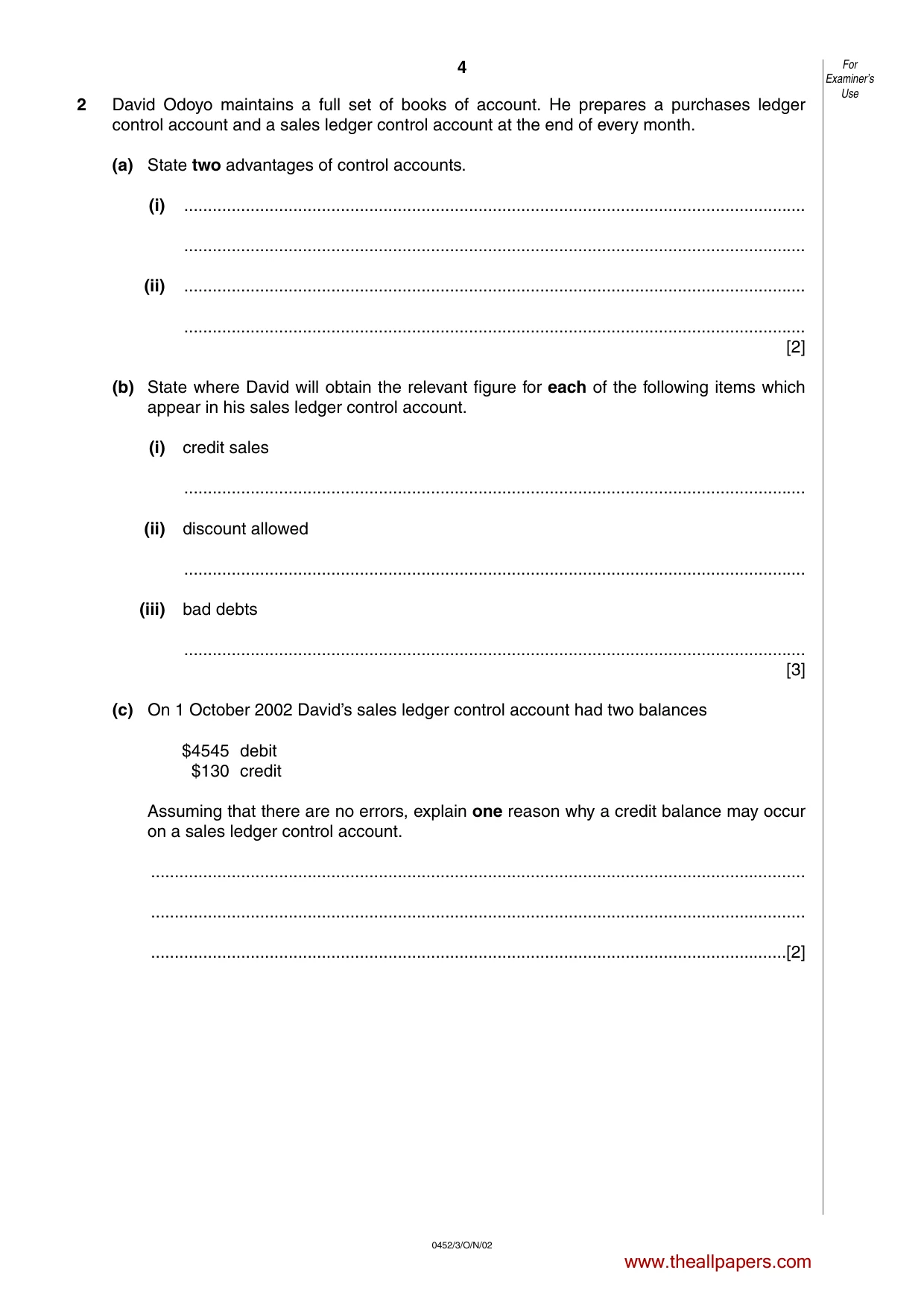
Question paper, page 4
4 0452/3/O/N/02 2 David Odoyo maintains a full set of books of account. He prepares a purchases ledger control account and a sales ledger control account at the end of every month. (a) State two advantages of control accounts. (i) … … (ii) … … [2] (b) State where David will obtain the relevant figure for each of the following items which appear in his sales ledger control account. (i) credit sales … (ii) discount allowed … (iii) bad debts … [3] (c) On 1 October 2002 David’s sales ledger control account had two balances $4545 debit $130 credit Assuming that there are no errors, explain one reason why a credit balance may occur on a sales ledger control account. … … …[2] For Examiner’s Use www.theallpapers.com
Question paper, page 5
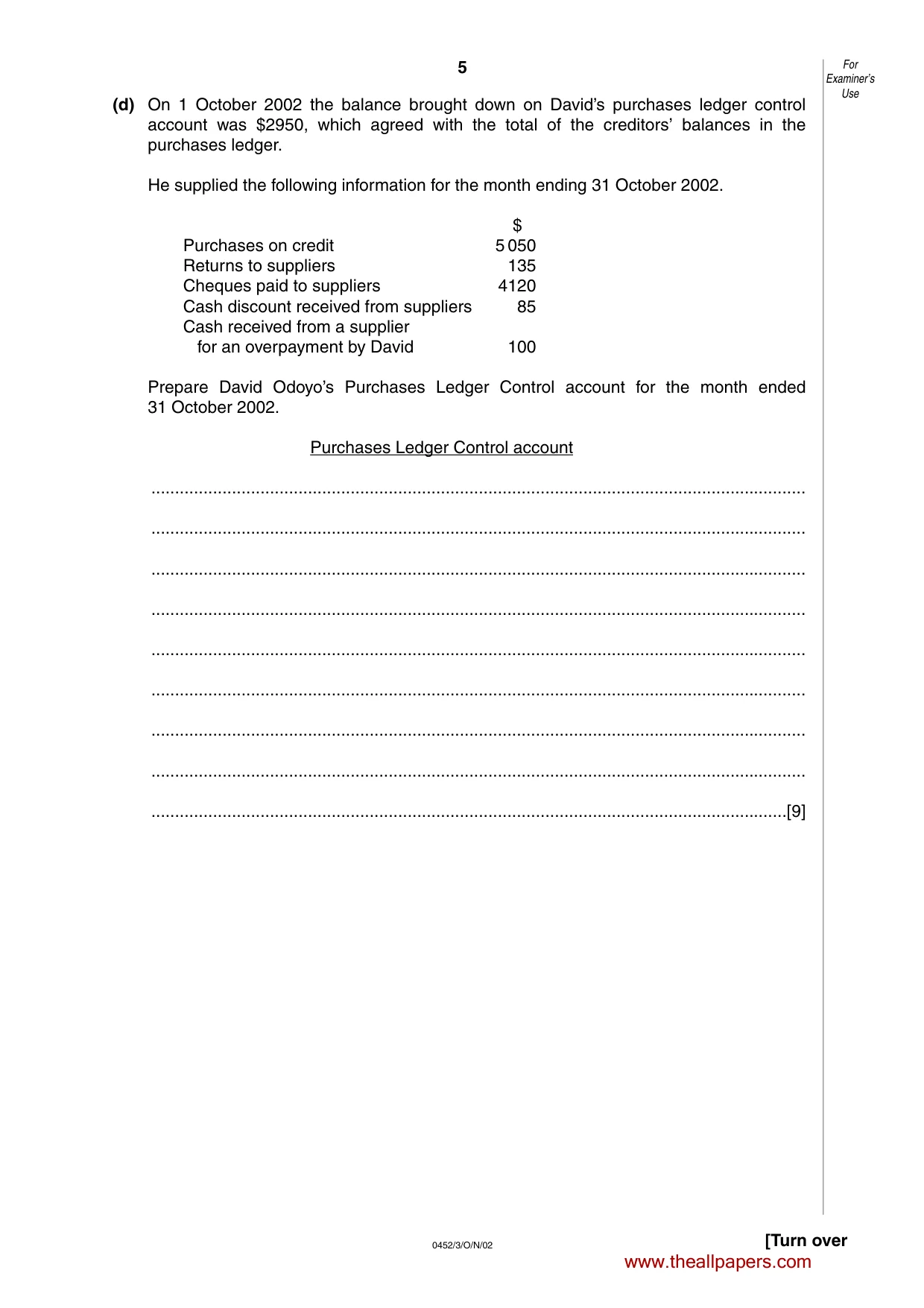
5 0452/3/O/N/02 [Turn over (d) On 1 October 2002 the balance brought down on David’s purchases ledger control account was $2950, which agreed with the total of the creditors’ balances in the purchases ledger. He supplied the following information for the month ending 31 October 2002. $ Purchases on credit 5 050 Returns to suppliers 135 Cheques paid to suppliers 4120 Cash discount received from suppliers 85 Cash received from a supplier for an overpayment by David 100 Prepare David Odoyo’s Purchases Ledger Control account for the month ended 31 October 2002. Purchases Ledger Control account … … … … … … … … …[9] For Examiner’s Use www.theallpapers.com
Question paper, page 6
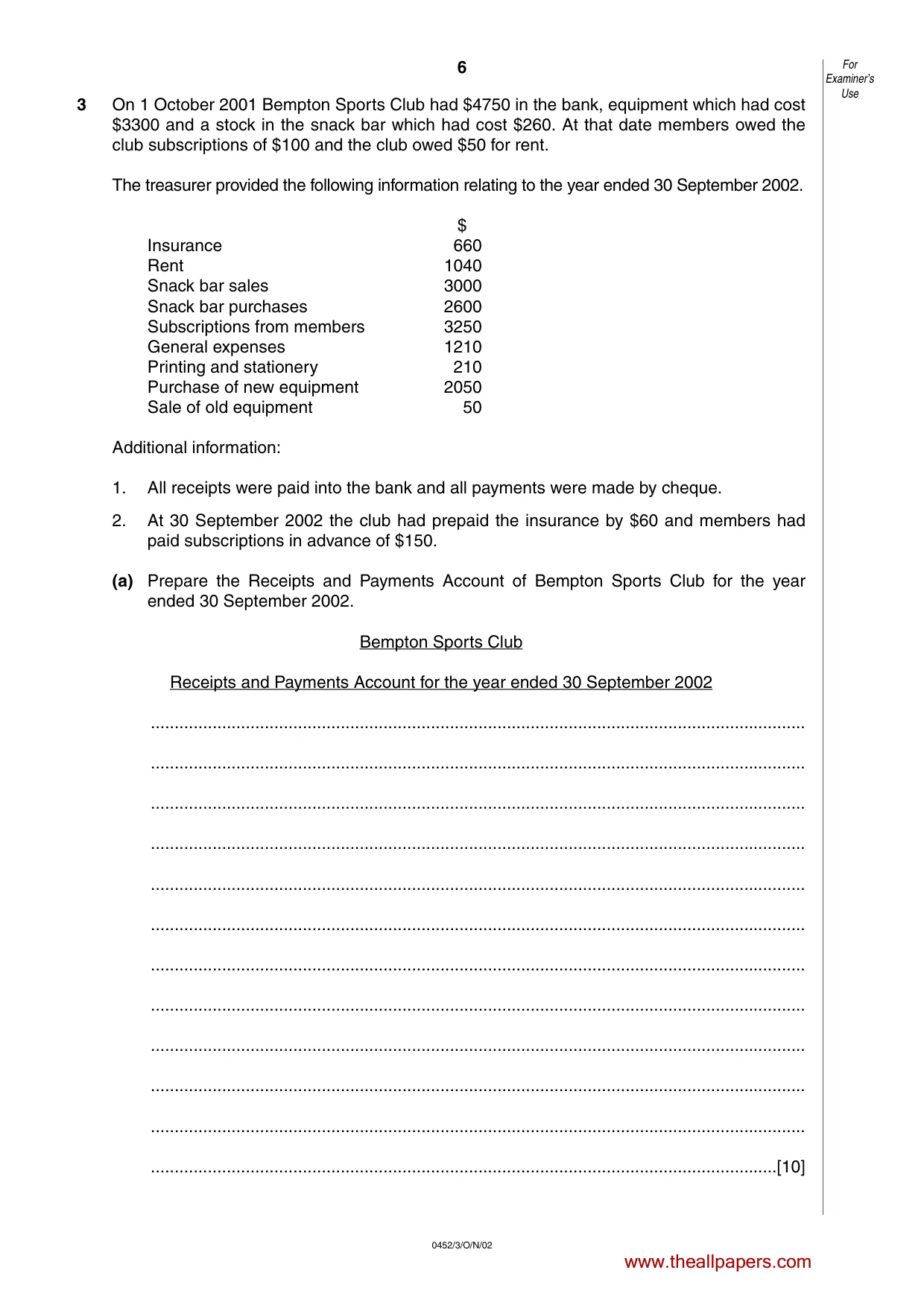
6 0452/3/O/N/02 3 On 1 October 2001 Bempton Sports Club had $4750 in the bank, equipment which had cost $3300 and a stock in the snack bar which had cost $260. At that date members owed the club subscriptions of $100 and the club owed $50 for rent. The treasurer provided the following information relating to the year ended 30 September 2002. $ Insurance 660 Rent 1040 Snack bar sales 3000 Snack bar purchases 2600 Subscriptions from members 3250 General expenses 1210 Printing and stationery 210 Purchase of new equipment 2050 Sale of old equipment 50 Additional information: 1. All receipts were paid into the bank and all payments were made by cheque. 2. At 30 September 2002 the club had prepaid the insurance by $60 and members had paid subscriptions in advance of $150. (a) Prepare the Receipts and Payments Account of Bempton Sports Club for the year ended 30 September 2002. Bempton Sports Club Receipts and Payments Account for the year ended 30 September 2002 … … … … … … … … … … … …[10] For Examiner’s Use www.theallpapers.com
Question paper, page 7
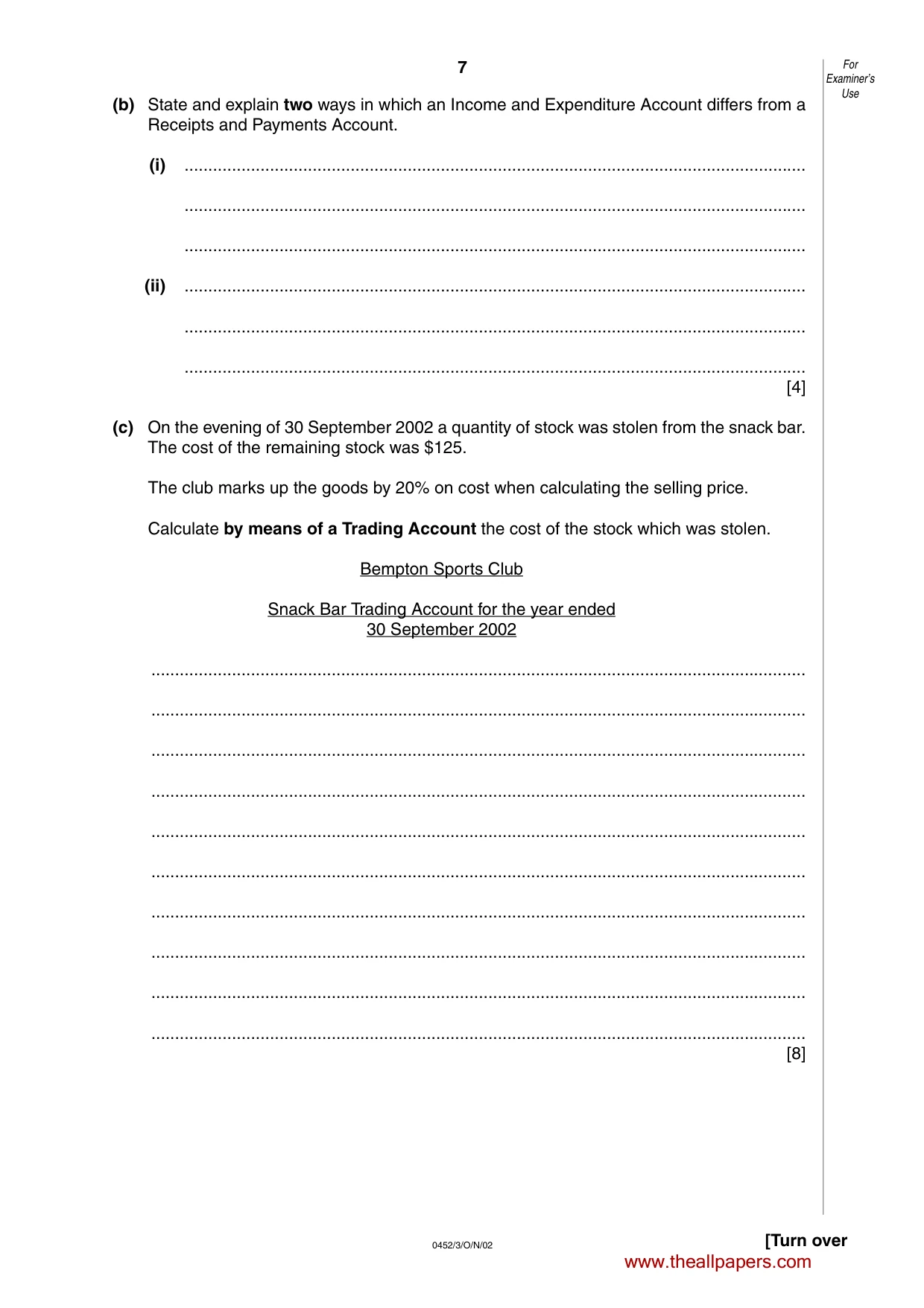
7 0452/3/O/N/02 [Turn over (b) State and explain two ways in which an Income and Expenditure Account differs from a Receipts and Payments Account. (i) … … … (ii) … … … [4] (c) On the evening of 30 September 2002 a quantity of stock was stolen from the snack bar. The cost of the remaining stock was $125. The club marks up the goods by 20% on cost when calculating the selling price. Calculate by means of a Trading Account the cost of the stock which was stolen. Bempton Sports Club Snack Bar Trading Account for the year ended 30 September 2002 … … … … … … … … … … [8] For Examiner’s Use www.theallpapers.com
Question paper, page 8
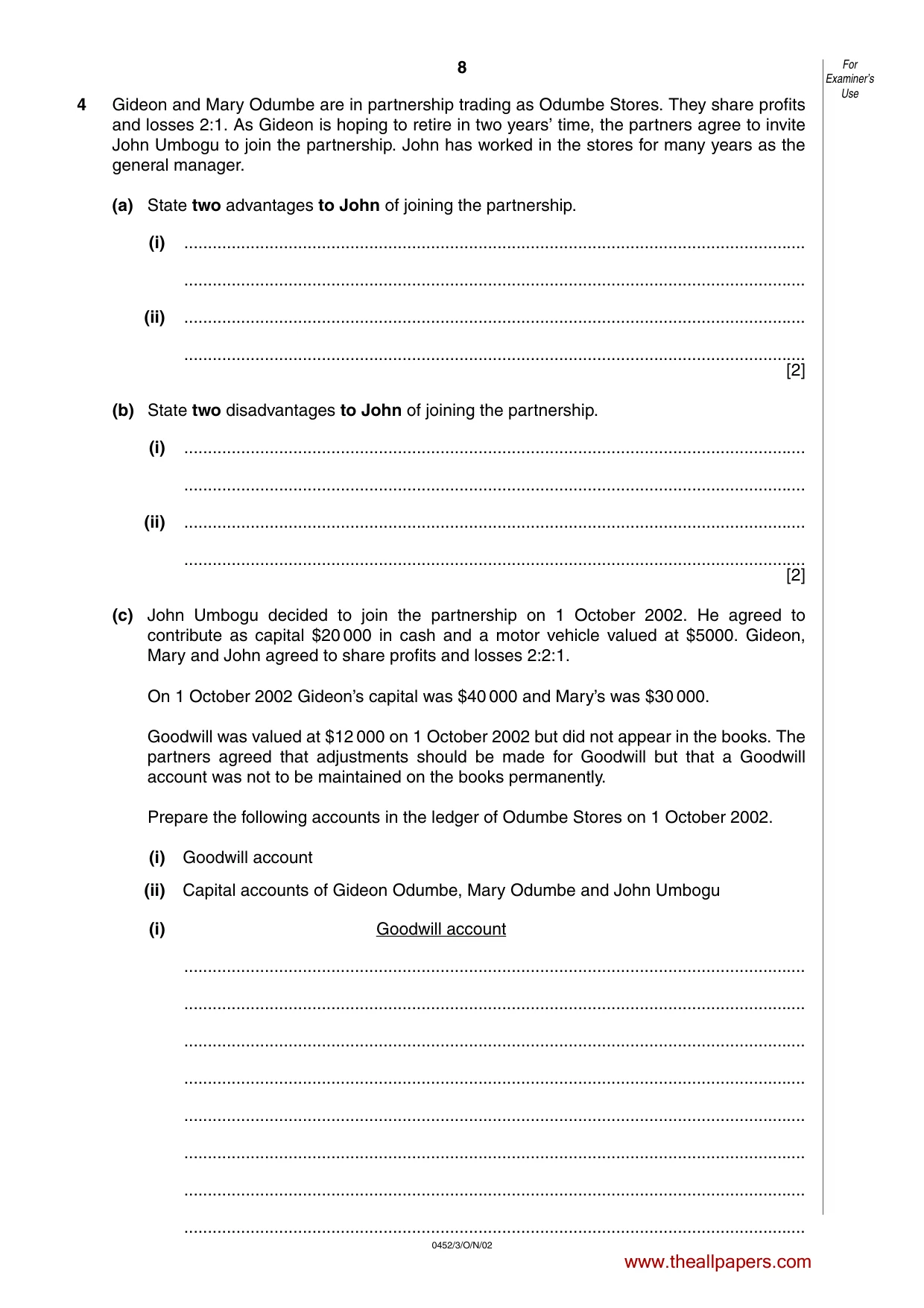
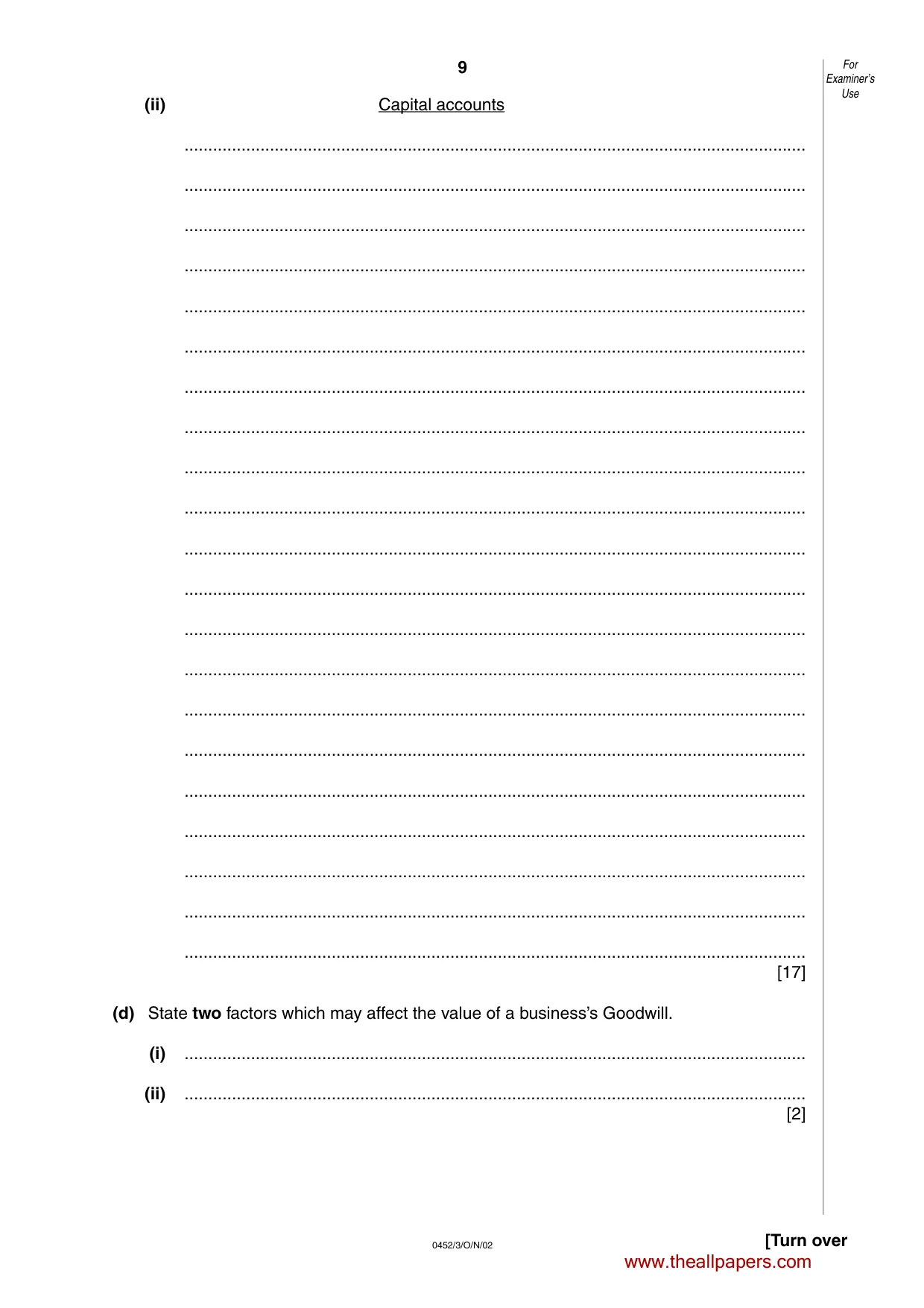
8 0452/3/O/N/02 4 Gideon and Mary Odumbe are in partnership trading as Odumbe Stores. They share profits and losses 2:1. As Gideon is hoping to retire in two years’ time, the partners agree to invite John Umbogu to join the partnership. John has worked in the stores for many years as the general manager. (a) State two advantages to John of joining the partnership. (i) … … (ii) … … [2] (b) State two disadvantages to John of joining the partnership. (i) … … (ii) … … [2] (c) John Umbogu decided to join the partnership on 1 October 2002. He agreed to contribute as capital $20 000 in cash and a motor vehicle valued at $5000. Gideon, Mary and John agreed to share profits and losses 2:2:1. On 1 October 2002 Gideon’s capital was $40 000 and Mary’s was $30 000. Goodwill was valued at $12 000 on 1 October 2002 but did not appear in the books. The partners agreed that adjustments should be made for Goodwill but that a Goodwill account was not to be maintained on the books permanently. Prepare the following accounts in the ledger of Odumbe Stores on 1 October 2002. (i) Goodwill account (ii) Capital accounts of Gideon Odumbe, Mary Odumbe and John Umbogu (i) Goodwill account … … … … … … … … For Examiner’s Use www.theallpapers.com
Question paper, page 9
9 0452/3/O/N/02 [Turn over (ii) Capital accounts … … … … … … … … … … … … … … … … … … … … … [17] (d) State two factors which may affect the value of a business’s Goodwill. (i) … (ii) … [2] For Examiner’s Use www.theallpapers.com
Question paper, page 10
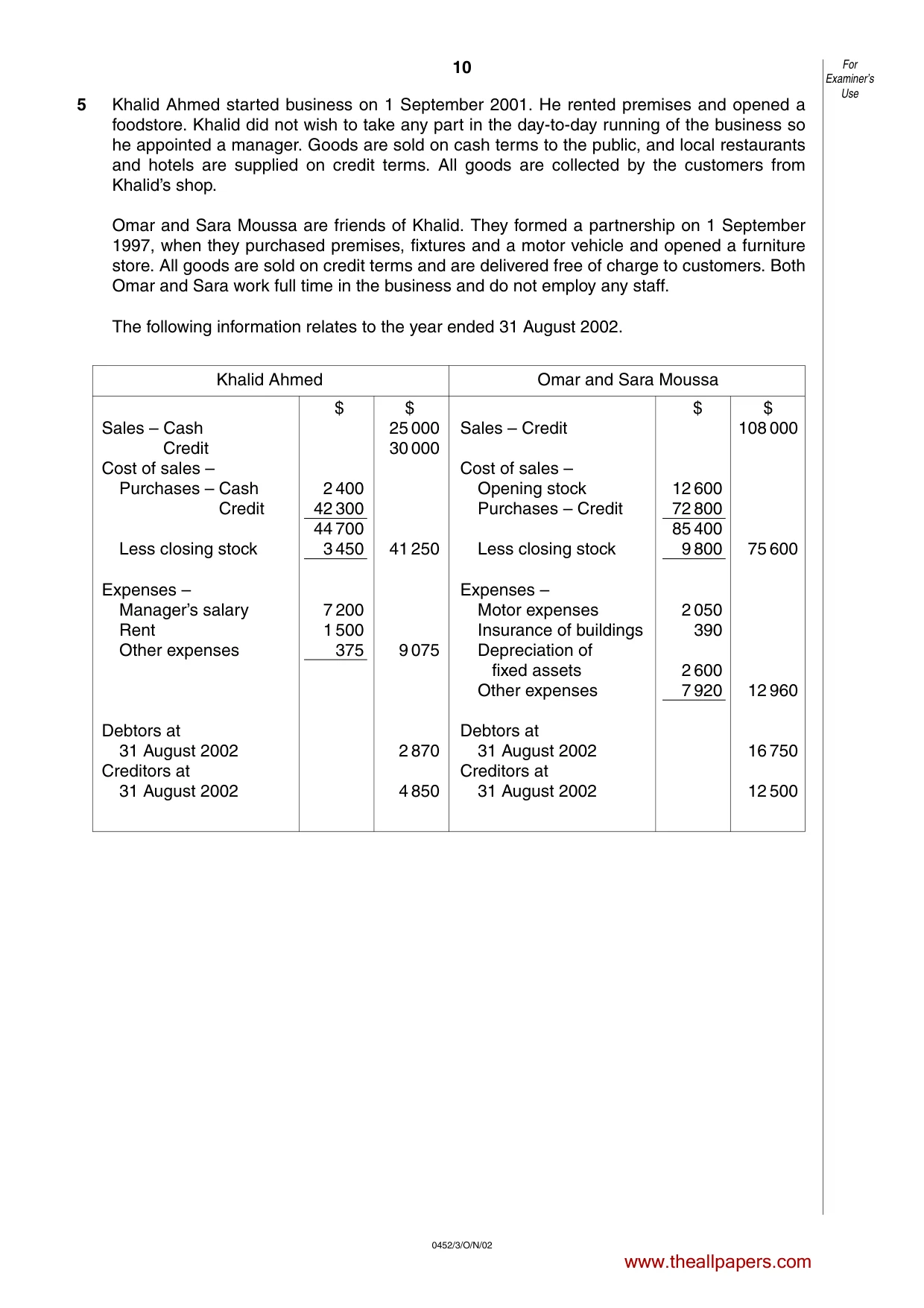
10 0452/3/O/N/02 5 Khalid Ahmed started business on 1 September 2001. He rented premises and opened a foodstore. Khalid did not wish to take any part in the day-to-day running of the business so he appointed a manager. Goods are sold on cash terms to the public, and local restaurants and hotels are supplied on credit terms. All goods are collected by the customers from Khalid’s shop. Omar and Sara Moussa are friends of Khalid. They formed a partnership on 1 September 1997, when they purchased premises, fixtures and a motor vehicle and opened a furniture store. All goods are sold on credit terms and are delivered free of charge to customers. Both Omar and Sara work full time in the business and do not employ any staff. The following information relates to the year ended 31 August 2002. For Examiner’s Use Khalid Ahmed $ $ Sales – Cash 25 000 Credit 30 000 Cost of sales – Purchases – Cash 2 400 Credit 42 300 44 700 Less closing stock 3 450 41 250 Expenses – Manager’s salary 7 200 Rent 1 500 Other expenses 375 9 075 Debtors at 31 August 2002 2 870 Creditors at 31 August 2002 4 850 Omar and Sara Moussa $ $ Sales – Credit 108 000 Cost of sales – Opening stock 12 600 Purchases – Credit 72 800 85 400 Less closing stock 9 800 75 600 Expenses – Motor expenses 2 050 Insurance of buildings 390 Depreciation of fixed assets 2 600 Other expenses 7 920 12 960 Debtors at 31 August 2002 16 750 Creditors at 31 August 2002 12 500 www.theallpapers.com
Question paper, page 11
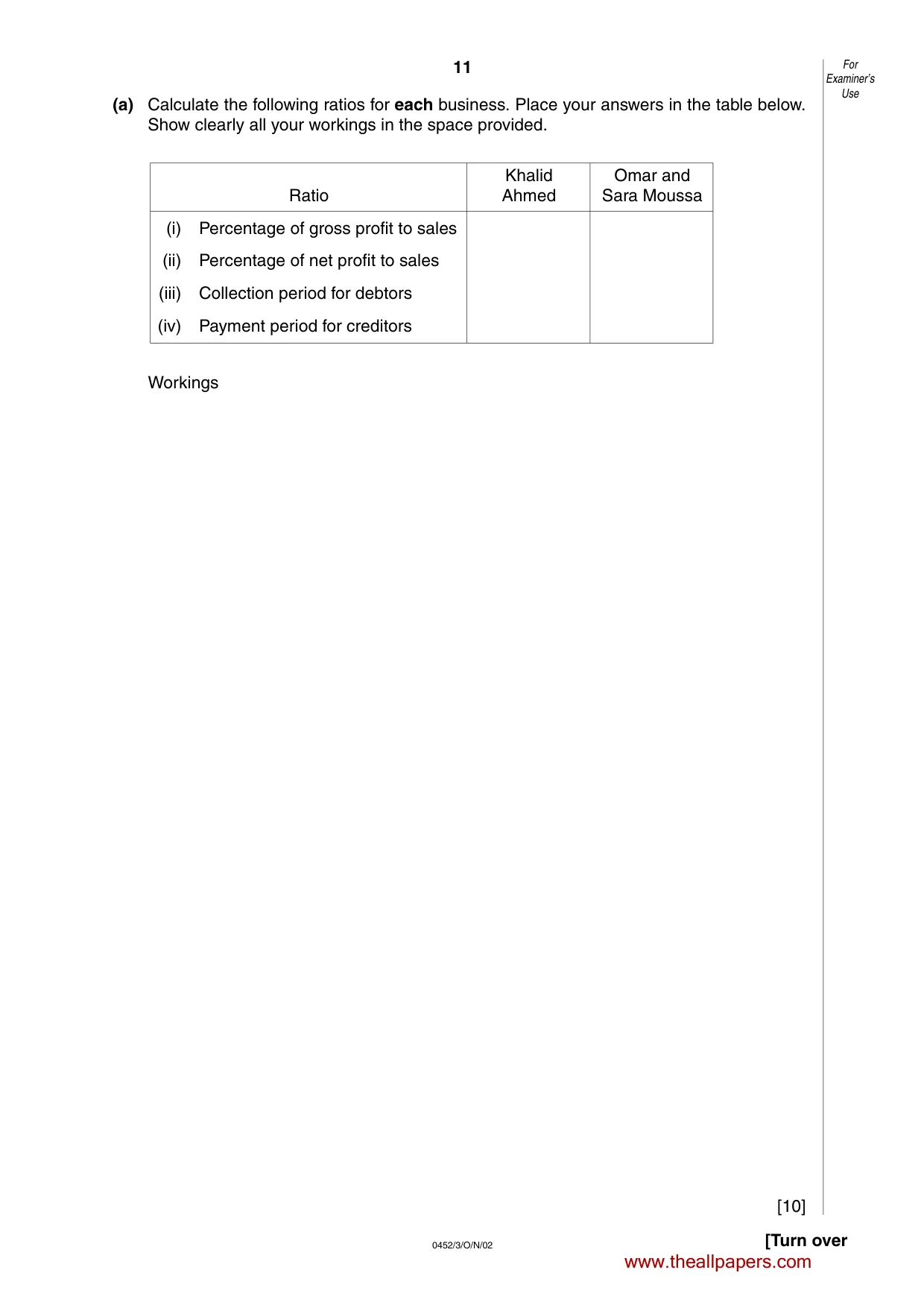
11 0452/3/O/N/02 [Turn over (a) Calculate the following ratios for each business. Place your answers in the table below. Show clearly all your workings in the space provided. Workings [10] For Examiner’s Use Khalid Omar and Ratio Ahmed Sara Moussa (i) Percentage of gross profit to sales (ii) Percentage of net profit to sales (iii) Collection period for debtors (iv) Payment period for creditors www.theallpapers.com
Question paper, page 12
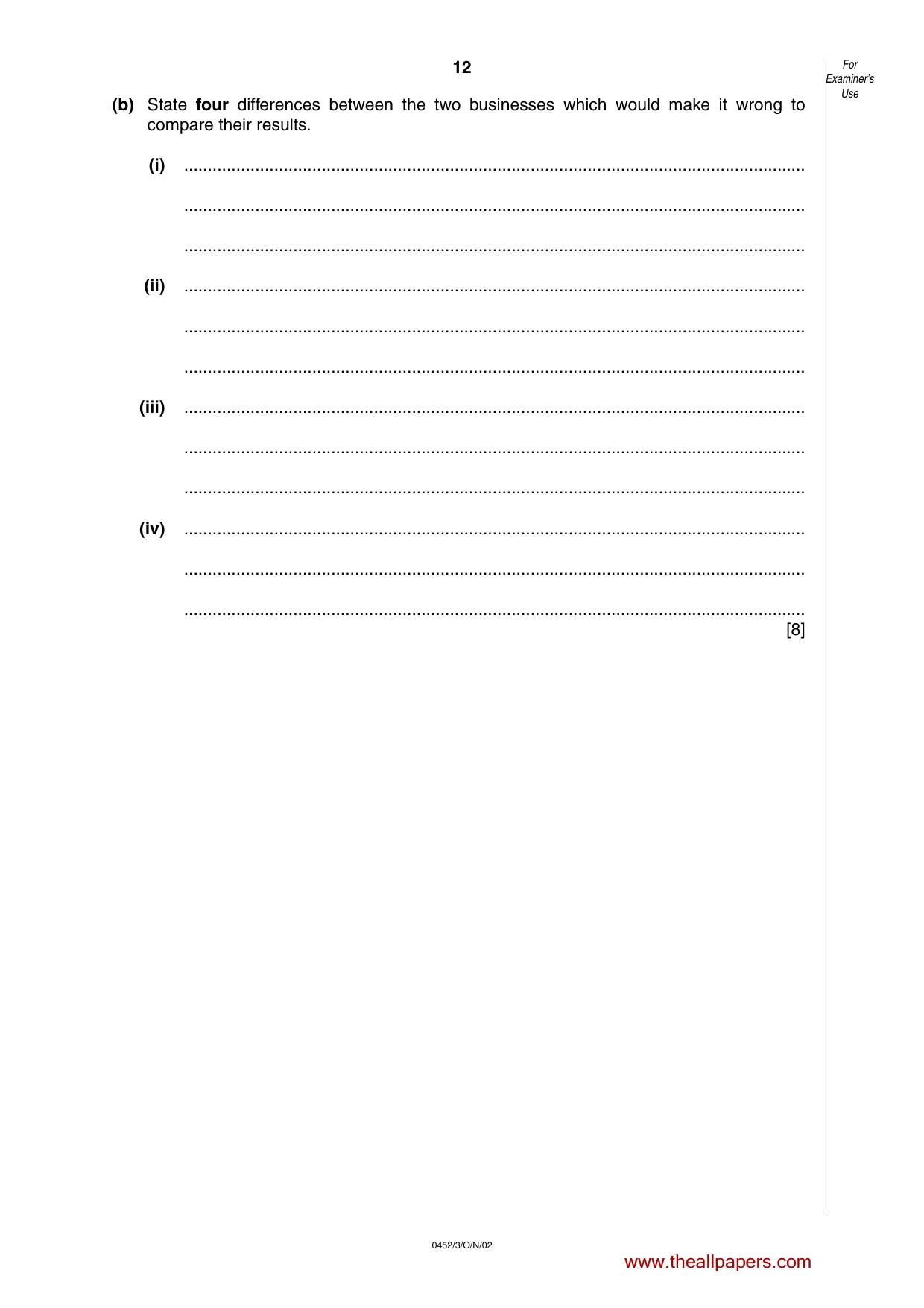
12 0452/3/O/N/02 (b) State four differences between the two businesses which would make it wrong to compare their results. (i) … … … (ii) … … … (iii) … … … (iv) … … … [8] For Examiner’s Use www.theallpapers.com
Mark scheme, page 1
CAMBRIDGE INTERNATIONAL EXAMINATIONS NOVEMBER 2002 INTERNATIONAL GCSE _ SYLLABUS/COMPONENT : 04 ACCOUNTING UNIVERSITY of CAMBRIDGE Local Examinations Syndicate www.theallpapers.com
Mark scheme, page 2
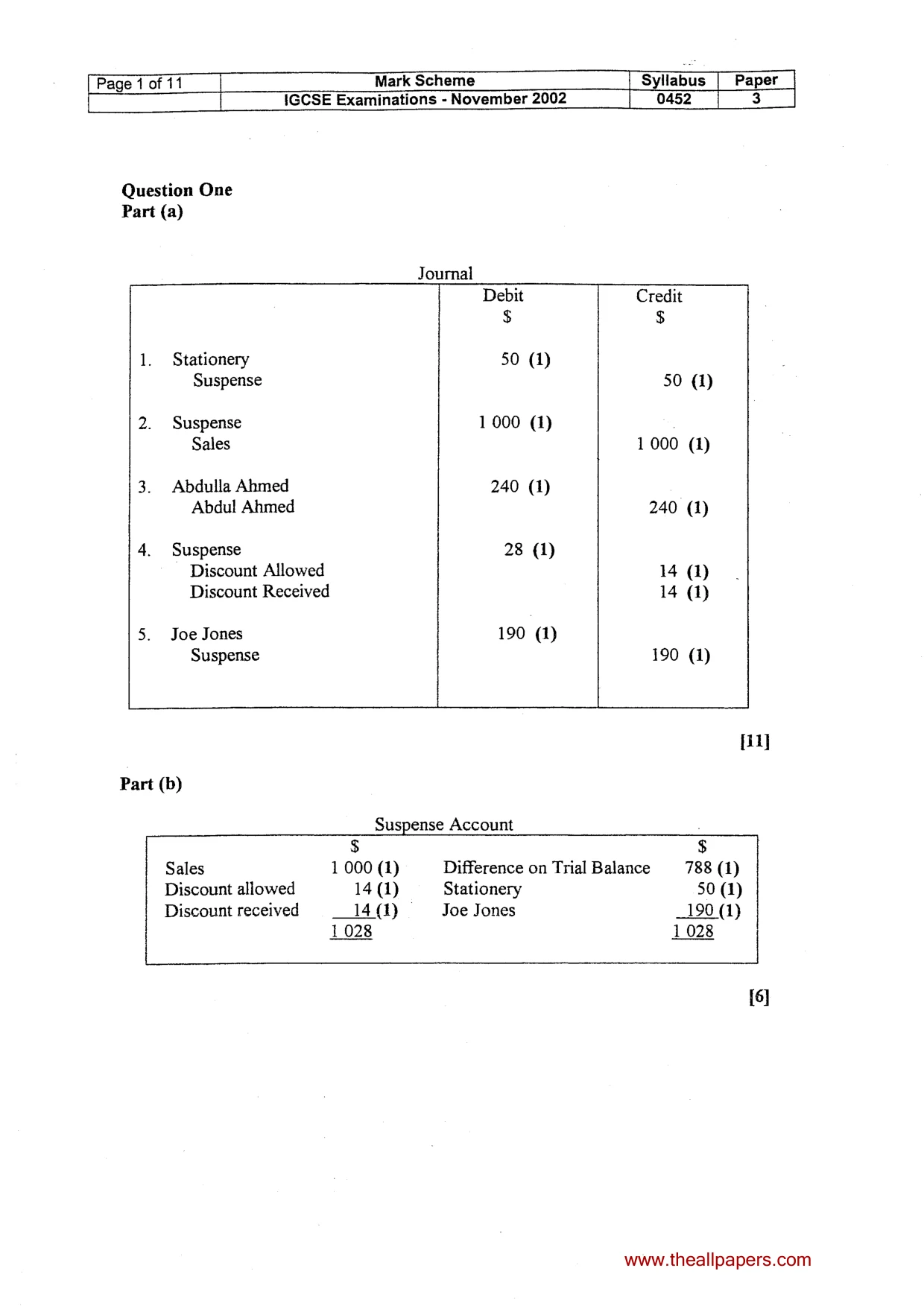
Page 1 of 11 Mark Scheme Syllabus | Paper IGCSE Examinations - November 2002 0452 3 Question One Part (a) Journal Debit Credit $ $ 1. Stationery 50 (1) Suspense 50 (1) 2. Suspense 1000 (1) Sales 1000 (1) 3. Abdulla Ahmed 240 (1) Abdul Ahmed 240 (1) 4. Suspense 28 (1) Discount Allowed 14 (1) Discount Received 14 (1) 5. Joe Jones 190 (1) Suspense 190 (1) [il] Part (b) Suspense Account $ $ Sales 1 000 (1) Difference on Trial Balance 788 (1) Discount allowed 14 (1) Stationery 50 (1) Discount received 14 (1) Joe Jones 190 (1) 1028 1 028 {6] www.theallpapers.com
Mark scheme, page 3
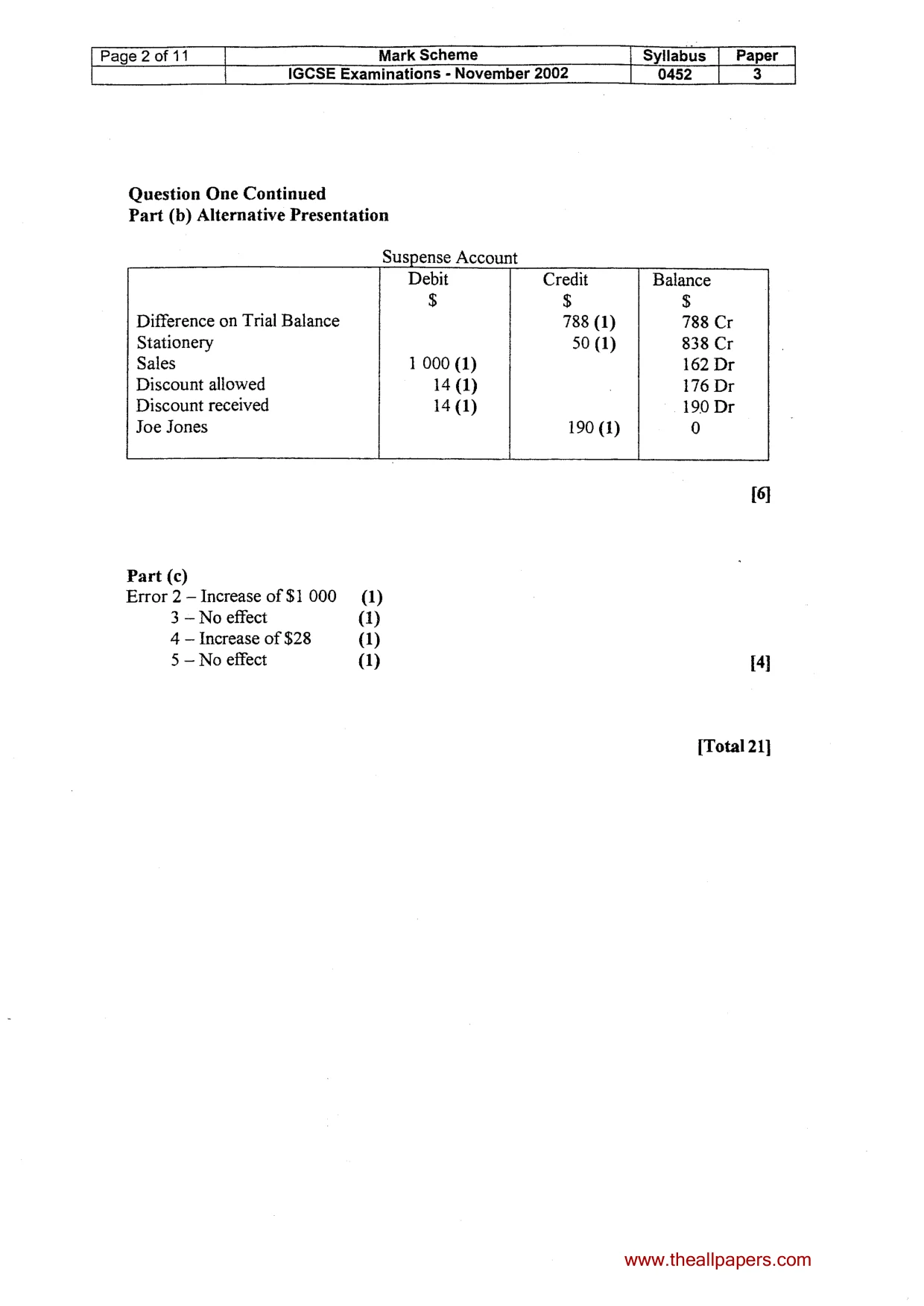
Page 2 of 11 Mark Scheme Syllabus | Paper : IGCSE Examinations - November 2002 0452 3 Question One Continued Part (b) Alternative Presentation Suspense Account Debit Credit Balance $ $ $ Difference on Trial Balance 788 (1) 788 Cr Stationery 50 (1) 838 Cr Sales 1 000 (1) 162 Dr Discount allowed 14 (1) 176 Dr Discount received 14(1) 190 Dr Joe Jones 190 (4) 9 [6] Part (c) Error 2 — Increase of $1000 (1) 3 —No effect ( 4 — Increase of $28 qd) 5 — No effect (1) [4] [Total 21] www.theallpapers.com
Mark scheme, page 4
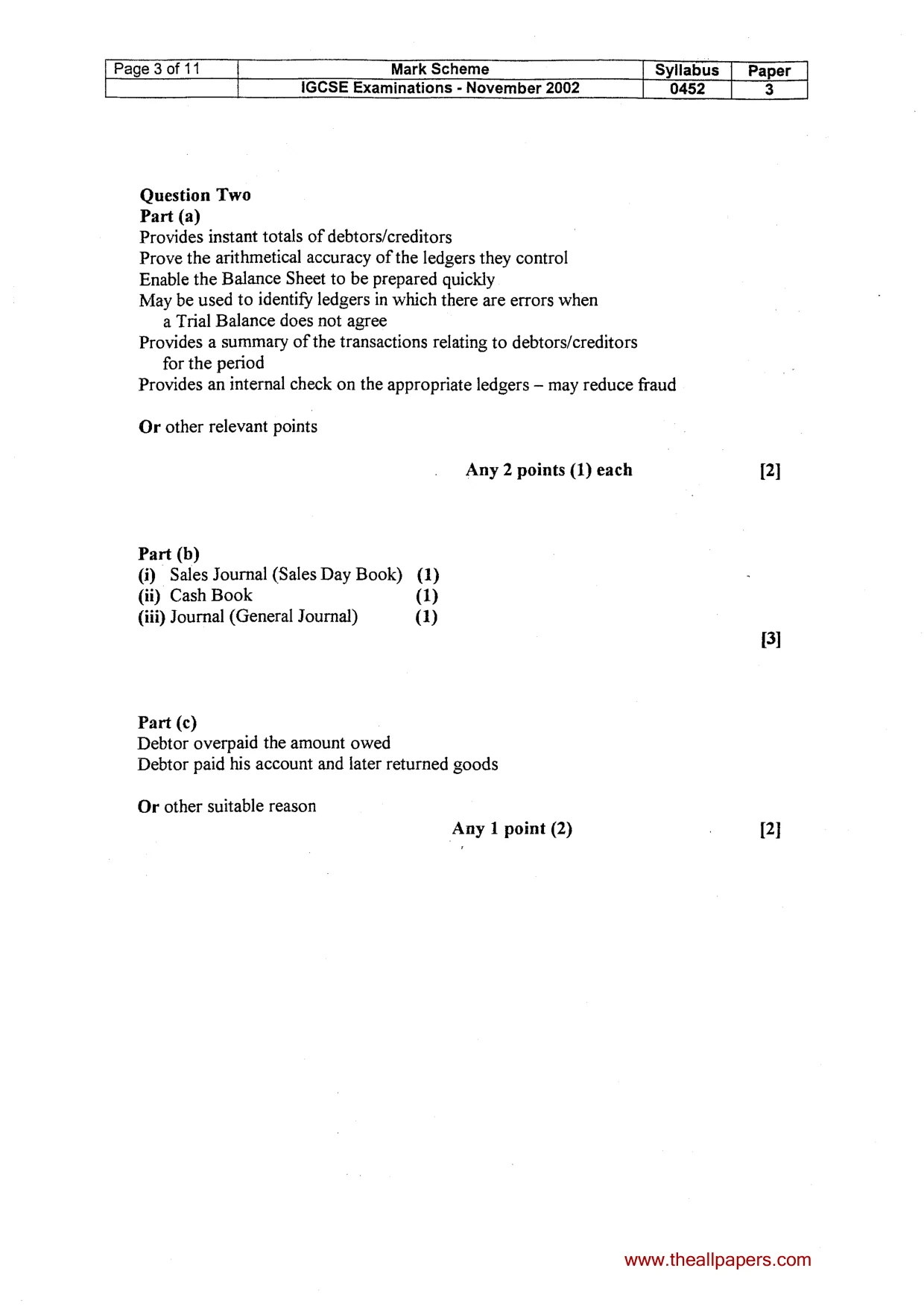
Page 3 of 11 [ Mark Scheme Syllabus | Paper I IGCSE Examinations - November 2002 0452 3 Question Two Part (a) Provides instant totals of debtors/creditors Prove the arithmetical accuracy of the ledgers they control Enable the Balance Sheet to be prepared quickly May be used to identify ledgers in which there are errors when a Trial Balance does not agree Provides a summary of the transactions relating to debtors/creditors for the period Provides an internal check on the appropriate ledgers — may reduce fraud Or other relevant points Any 2 points (1) each [2] Part (b) (i) Sales Journal (Sales Day Book) (1) (ii) Cash Book (1) (iii) Journal (General Journal) @) 13] Part (c) Debtor overpaid the amount owed Debtor paid his account and later returned goods Or other suitable reason Any 1 point (2) [2] www.theallpapers.com
Mark scheme, page 5
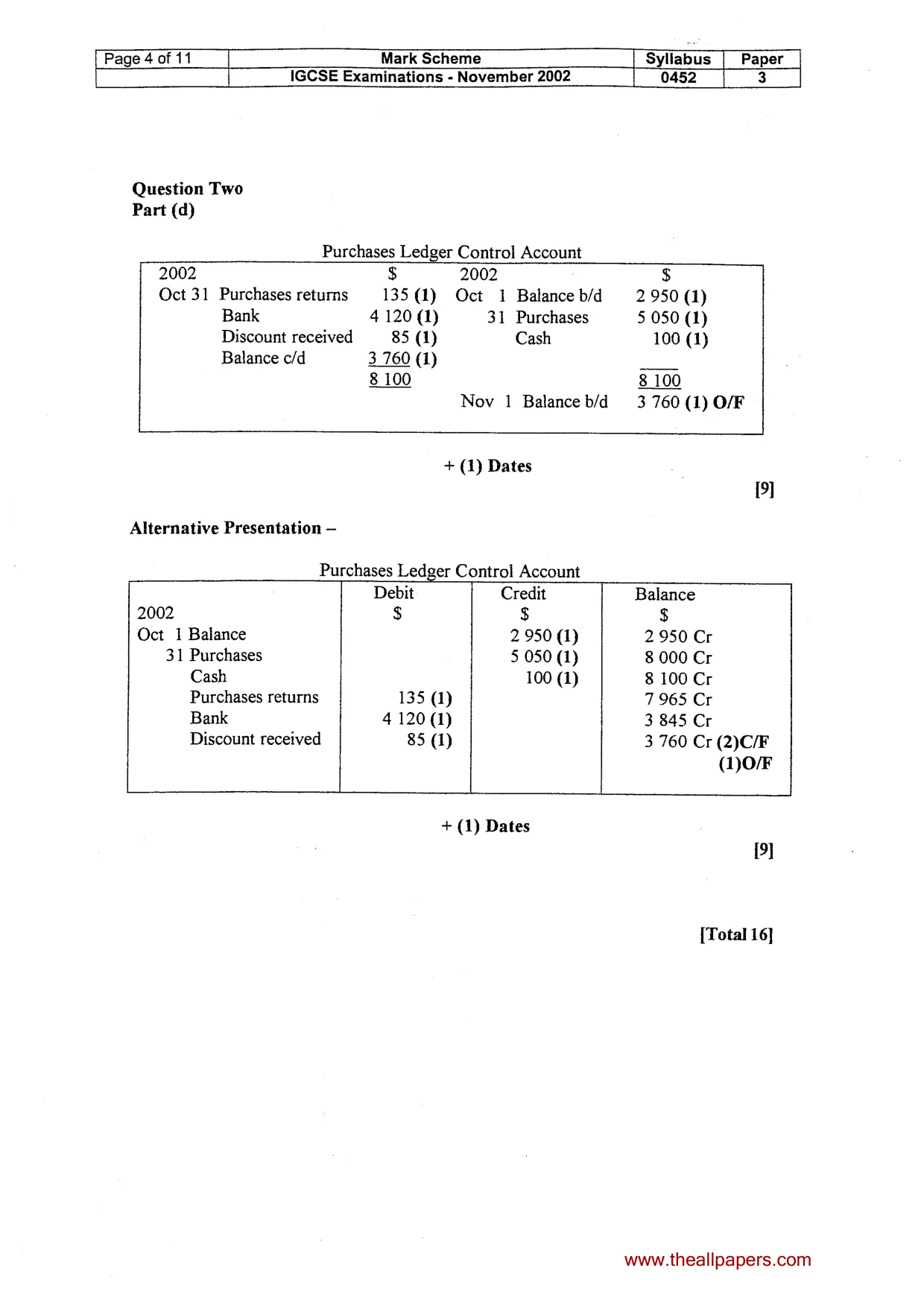
Page 4 of 11 Mark Scheme Syliabus | Paper IGCSE Examinations - November 2002 0452 3 Question Two Part (d) Purchases Ledger Control Account 2002 $ 2002 $ Oct 31 Purchases returns 135(1) Oct 1 Balance b/d 2 950 (1) Bank 4 120 (1) 31 Purchases 5 050 (1) Discount received 85 (1) Cash 100 (1) Balance c/d 3 760 (1) 8 100 8 100 Nov 1 Balance b/d 3 760 (1) O/F + (1) Dates 1] Alternative Presentation — Purchases Ledger Control Account Debit Credit Balance 2002 $ $ $ Oct 1 Balance 2 950 (1) 2950 Cr 31 Purchases 5 050 (1) 8 000 Cr Cash 100 (1) 8 100 Cr Purchases returns 135 (1) 7965 Cr Bank 4 120 (1) 3 845 Cr Discount received 85 (1) 3 760 Cr (2)C/F (DOF + (1) Dates 1] [Total 16] www.theallpapers.com
Mark scheme, page 6
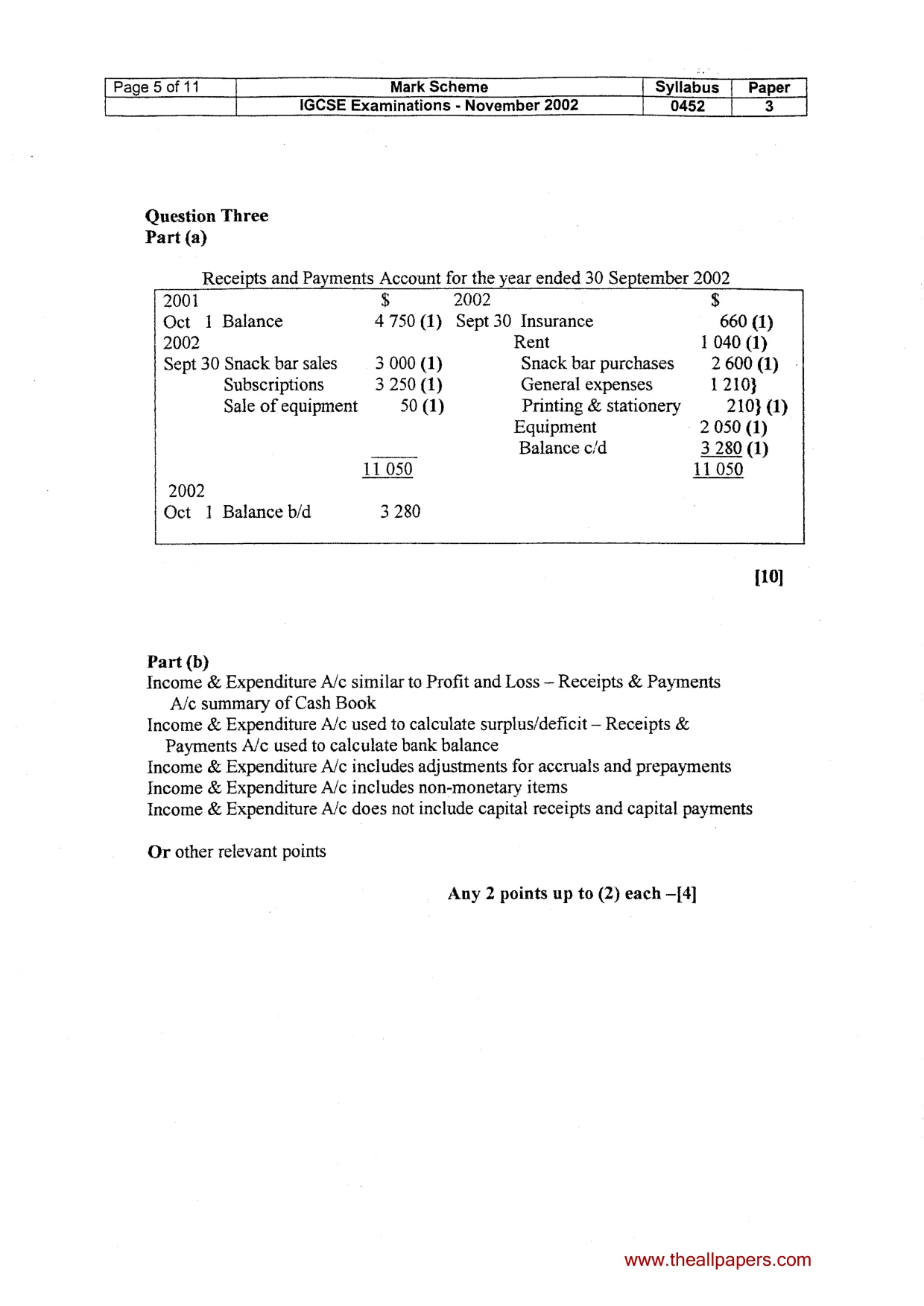
Page 5 of 11 Mark Scheme Syllabus [ Paper IGCSE Examinations - November 2002 0452 3 Question Three Part (a) Receipts and Payments Account for the year ended 30 September 2002 2001 $ 2002 $ Oct 1 Balance 4750 (1) Sept 30 Insurance 660 (1) 2002 Rent 1040 (1) Sept 30 Snack bar sales 3.000 (1) Snack bar purchases 2 600 (1) Subscriptions 3 250 (1) General expenses 1210} Sale of equipment 50 (1) Printing & stationery 210} (1) Equipment 2 050 (1) Balance c/d 3 280 (1) 11.050 11.050 2002 Oct 1 Balance b/d 3 280 [10] Part (b) Income & Expenditure A/c similar to Profit and Loss — Receipts & Payments A/e summary of Cash Book Income & Expenditure A/c used to calculate surplus/deficit — Receipts & Payments A/c used to calculate bank balance Income & Expenditure A/c includes adjustments for accruals and prepayments Income & Expenditure A/c includes non-monetary items Income & Expenditure A/c does not include capital receipts and capital payments Or other relevant points Any 2 points up to (2) each -[4] www.theallpapers.com
Mark scheme, page 7
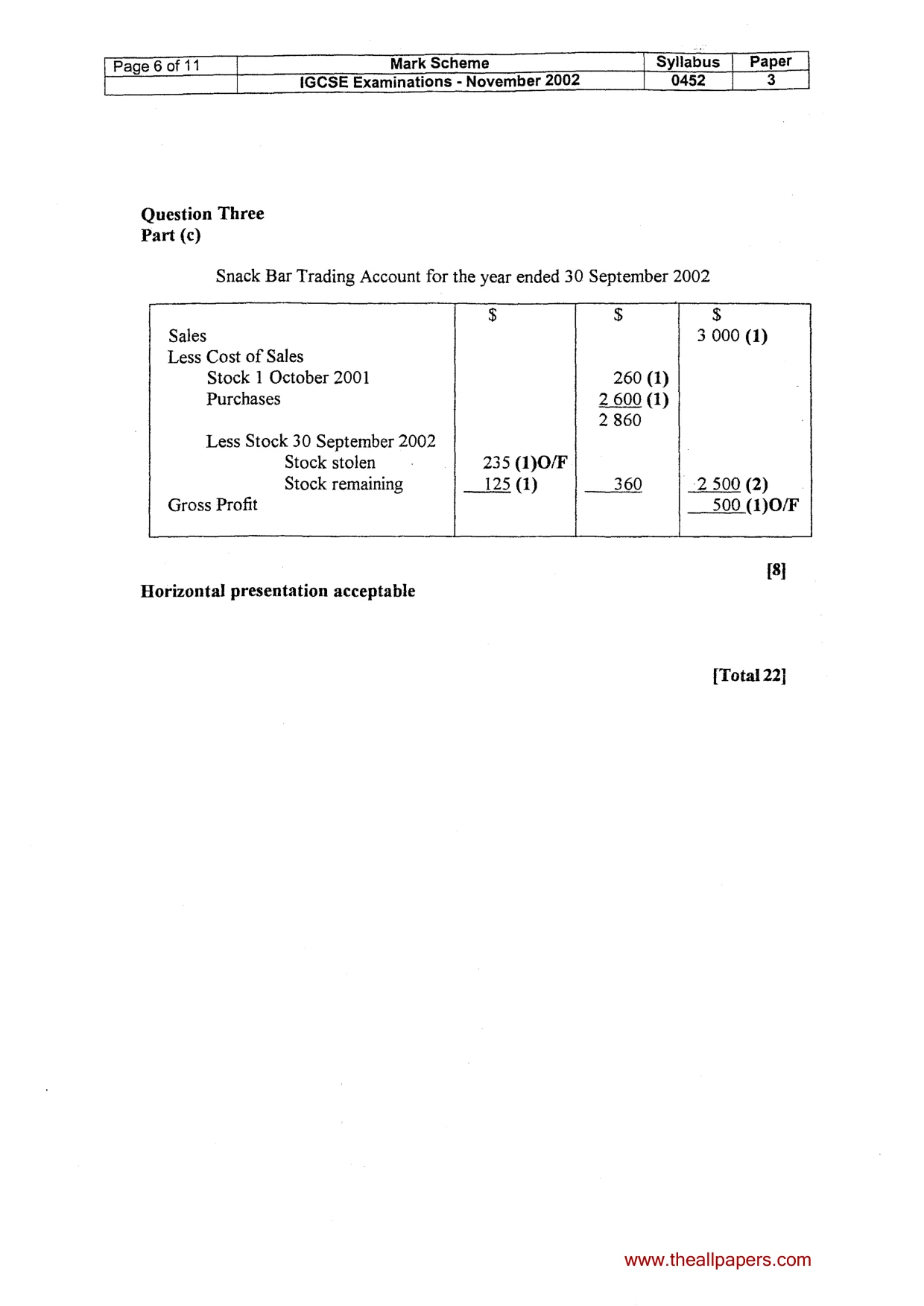
Page 6 of 11 Mark Scheme Syllabus Paper IGCSE Examinations - November 2002 0452 3 Question Three Part (c) Snack Bar Trading Account for the year ended 30 September 2002 $ $ $ Sales 3 000 (1) Less Cost of Sales Stock 1 October 2001 260 (1) Purchases 2 600 (1) 2 860 Less Stock 30 September 2002 Stock stolen 235 (1)O/F Stock remaining 125 (1) 360 2.500 (2) Gross Profit 500 (1)O/F [3] Horizontal presentation acceptable [Total 22} www.theallpapers.com
Mark scheme, page 8
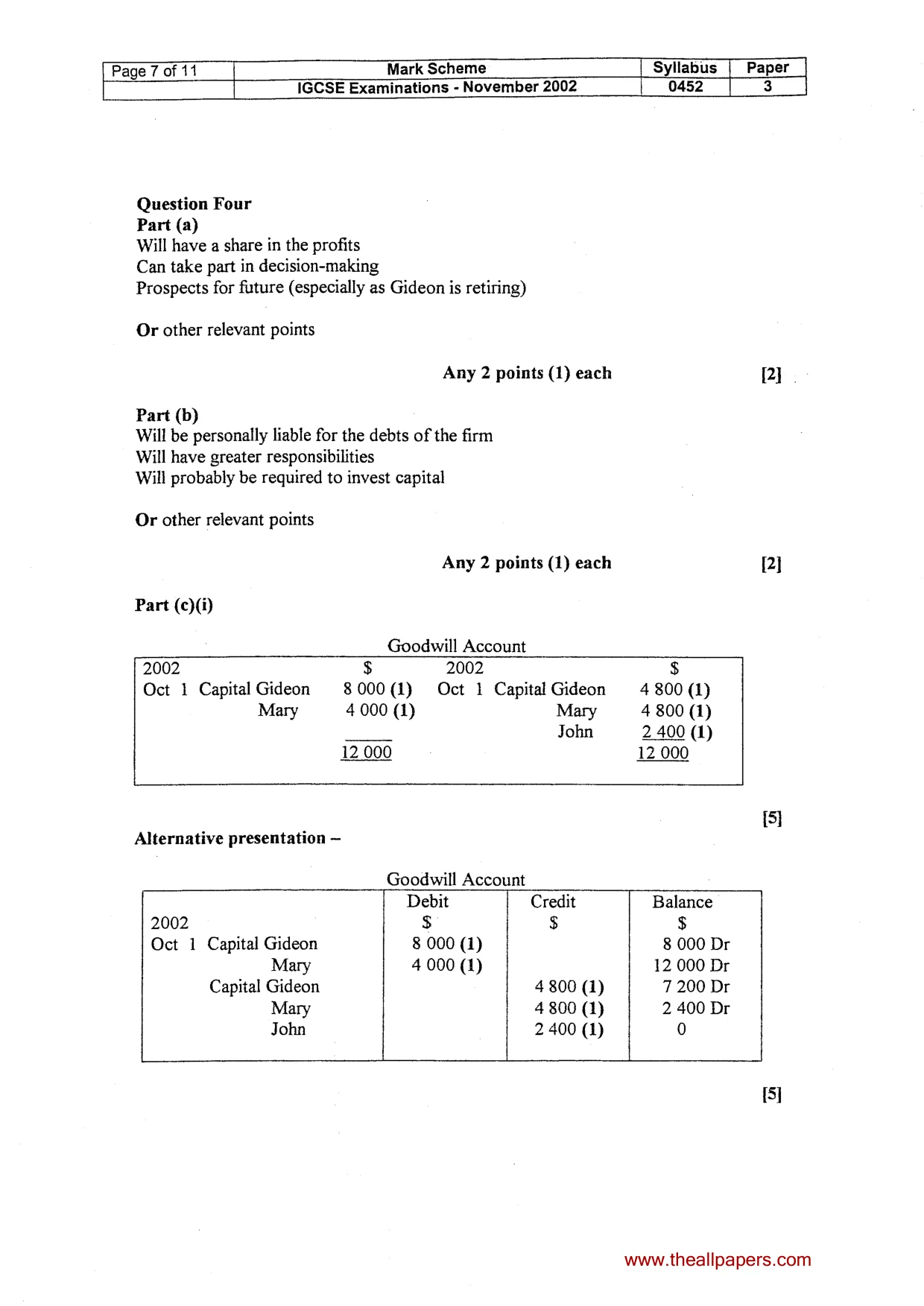
Page 7 of 11 Mark Scheme Syllabus | Paper | IGCSE Examinations - November 2002 0452, | 3 Question Four Part (a) Will have a share in the profits Can take part in decision-making Prospects for future (especially as Gideon is retiring) Or other relevant points Any 2 points (1) each [2] Part (b) Will be personally liable for the debts of the firm Will have greater responsibilities Will probably be required to invest capital Or other relevant points Any 2 points (1) each [2] Part (c)(i) Goodwill Account 2002 $ 2002 $ Oct 1 Capital Gideon 8000 (1) Oct 1 Capital Gideon 4800 (1) Mary 4 000 (1) Mary 4 800 (1) — John —-2.400 (1) 12 000 12.000 I Alternative presentation — Goodwill Account Debit Credit Balance 2002 $ $ $ Oct 1 Capital Gideon 8 000 (1) 8 000 Dr Mary 4 000 (1) 12 000 Dr Capital Gideon 4800 (1) 7 200 Dr Mary 4800 (1) 2 400 Dr John 2 400 (1) 0 13] www.theallpapers.com
Mark scheme, page 9
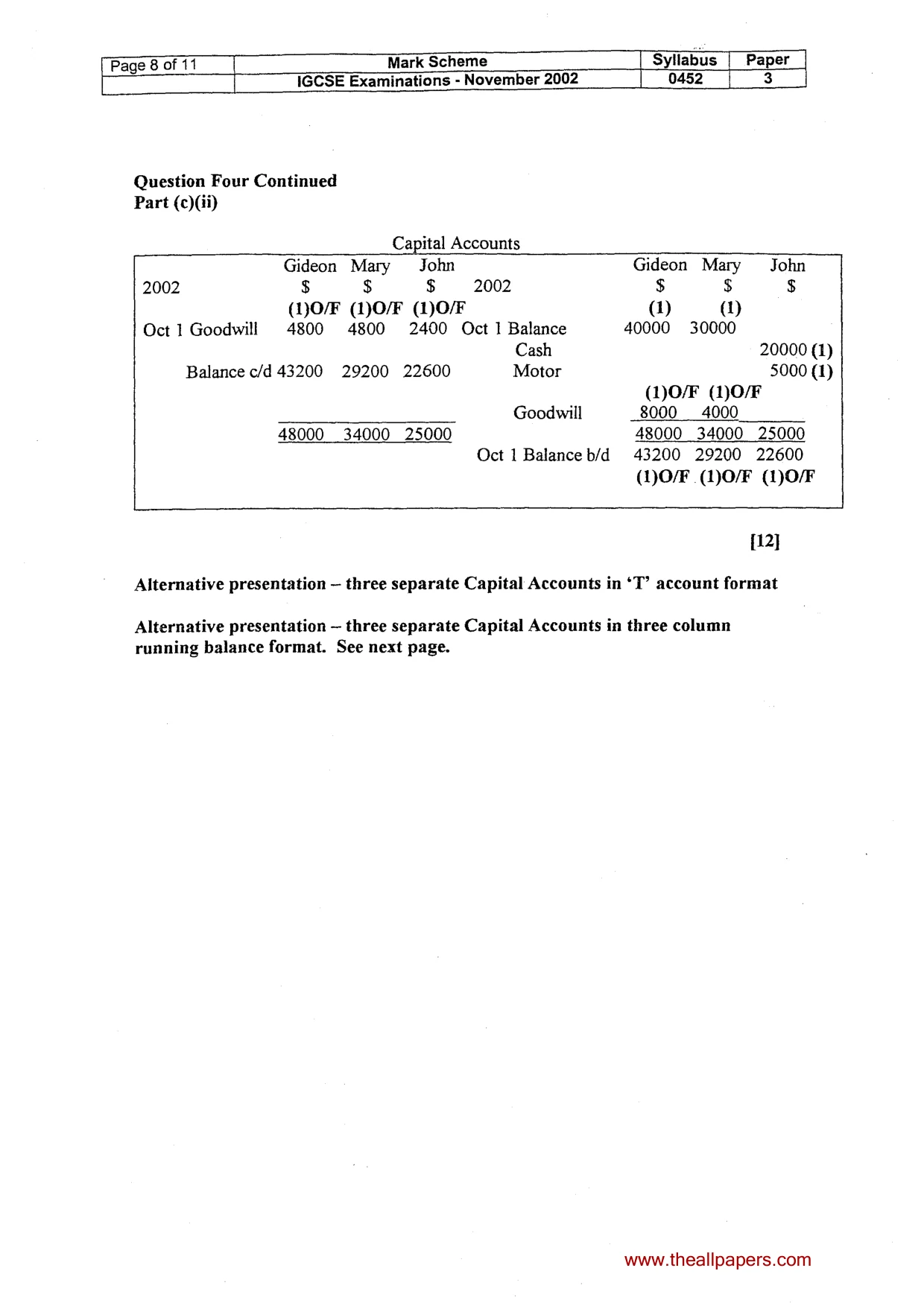
Page 8 of 11 Mark Scheme Syllabus | Paper IGCSE Examinations - November 2002 0452 3 Question Four Continued Part (c)(ii) Capital Accounts Gideon Mary John Gideon Mary John 2002 $ $ $ 2002 $ $ $ (O/F (1)O/F (1)0/F (i) () Oct 1 Goodwill 4800 4800 2400 Oct 1 Balance 40000 30000 Cash 20000 (1) Balance c/d 43200 29200 22600 Motor 5000 (1) (1)O/F (1)O/F Goodwill 8000 4000 48000__34000_25000 48000 34000 25000 Oct 1 Balance b/d 43200 29200 22600 (LO/F (1)O/F (1)O/F [12] Alternative presentation — three separate Capital Accounts in ‘T’ account format Alternative presentation — three separate Capital Accounts in three column running balance format. See next page. www.theallpapers.com
Mark scheme, page 10
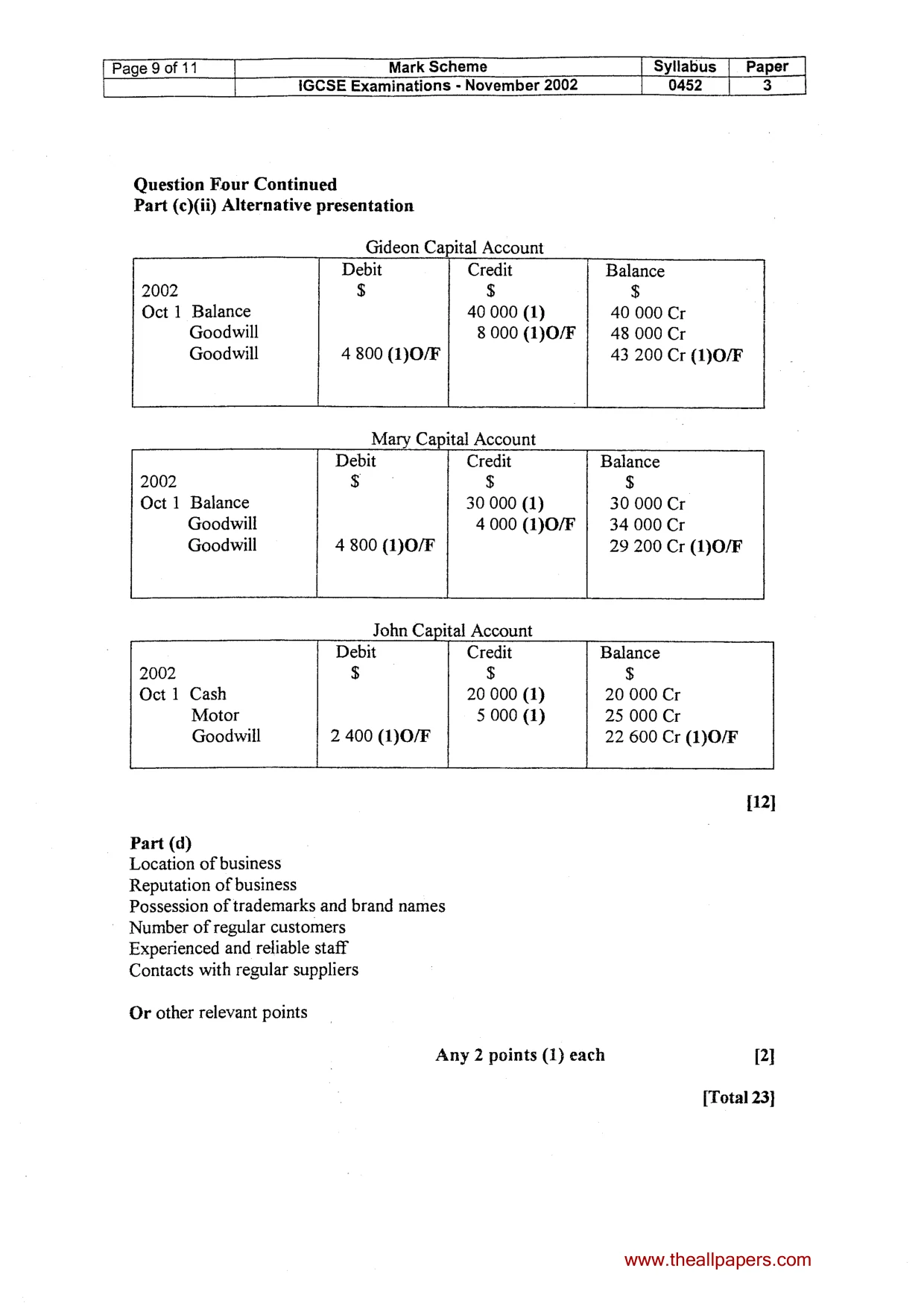
Page 9 of 11 Mark Scheme Syllabus Paper IGCSE Examinations - November 2002 0452 3 Question Four Continued Part (c)(ii) Alternative presentation Gideon Capital Account Debit Credit Balance 2002 $ $ $ Oct 1 Balance 40 000 (1) 40 000 Cr Goodwill 8000 (1)O/F | 48 000 Cr Goodwill 4 800 (1)O/F 43 200 Cr (1)O/F Mary Capital Account Debit Credit Balance 2002 $ $ $ Oct 1 Balance 30 000 (1) 30 000 Cr Goodwill 4000 (1)O/F | 34000Cr Goodwill 4.800 (1)O/F 29 200 Cr (1)O/F John Capital Account Debit Credit Balance 2002 $ $ $ Oct 1 Cash 20 000 (1) 20 000 Cr Motor 5 000 (1) 25 000 Cr Goodwill 2 400 (1)O/F 22 600 Cr (1)O/F {12] Part (d) Location of business Reputation of business Possession of trademarks and brand names Number of regular customers Experienced and reliable staff Contacts with regular suppliers Or other relevant points Any 2 points (1) each [2] [Total 23} www.theallpapers.com
Mark scheme, page 11
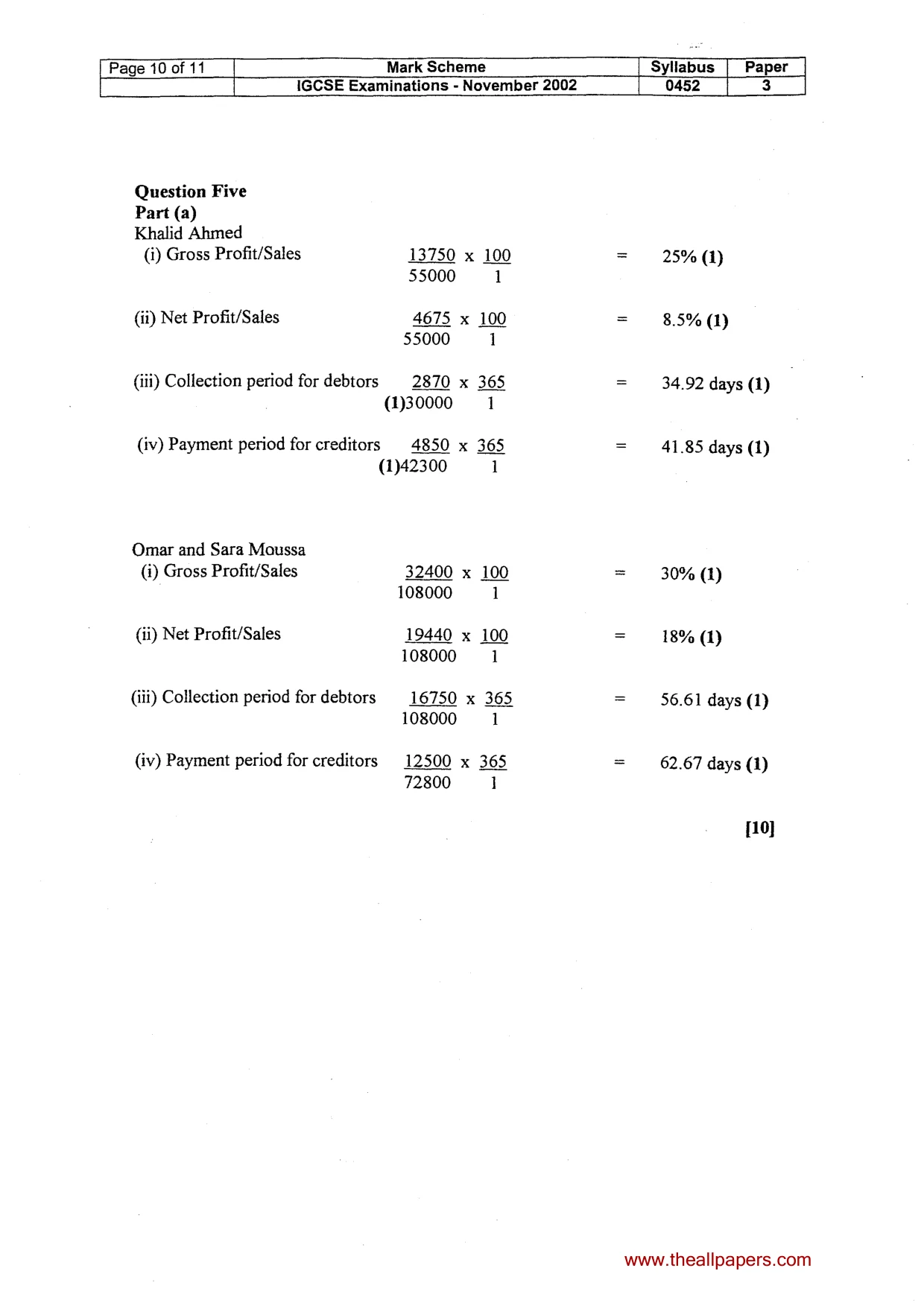
Syllabus Paper (iii) Collection period for debtors 16750 x 365 (iv) Payment period for creditors 12500 x 365 Page 10 of 11 Mark Scheme IGCSE Examinations - November 2002 0452 3 Question Five Part (a) Khalid Ahmed (i) Gross Profit/Sales 13750 x 100 25% (1) 55000 1 (ii) Net Profit/Sales 4675 x 100 8.5% (1) 55000 1 (iii) Collection period for debtors 2870 x 365 34.92 days (1) (1300001 (iv) Payment period for creditors 4850 x 365 41.85 days (1) (1)42300 1 Omar and Sara Moussa (i) Gross Profit/Sales 32400 x 100 30% (1) 108000 1 (ii) Net Profit/Sales 19440 x 100 18% (1) 108000 1 56.61 days (1) 62.67 days (1) 10} www.theallpapers.com
Mark scheme, page 12
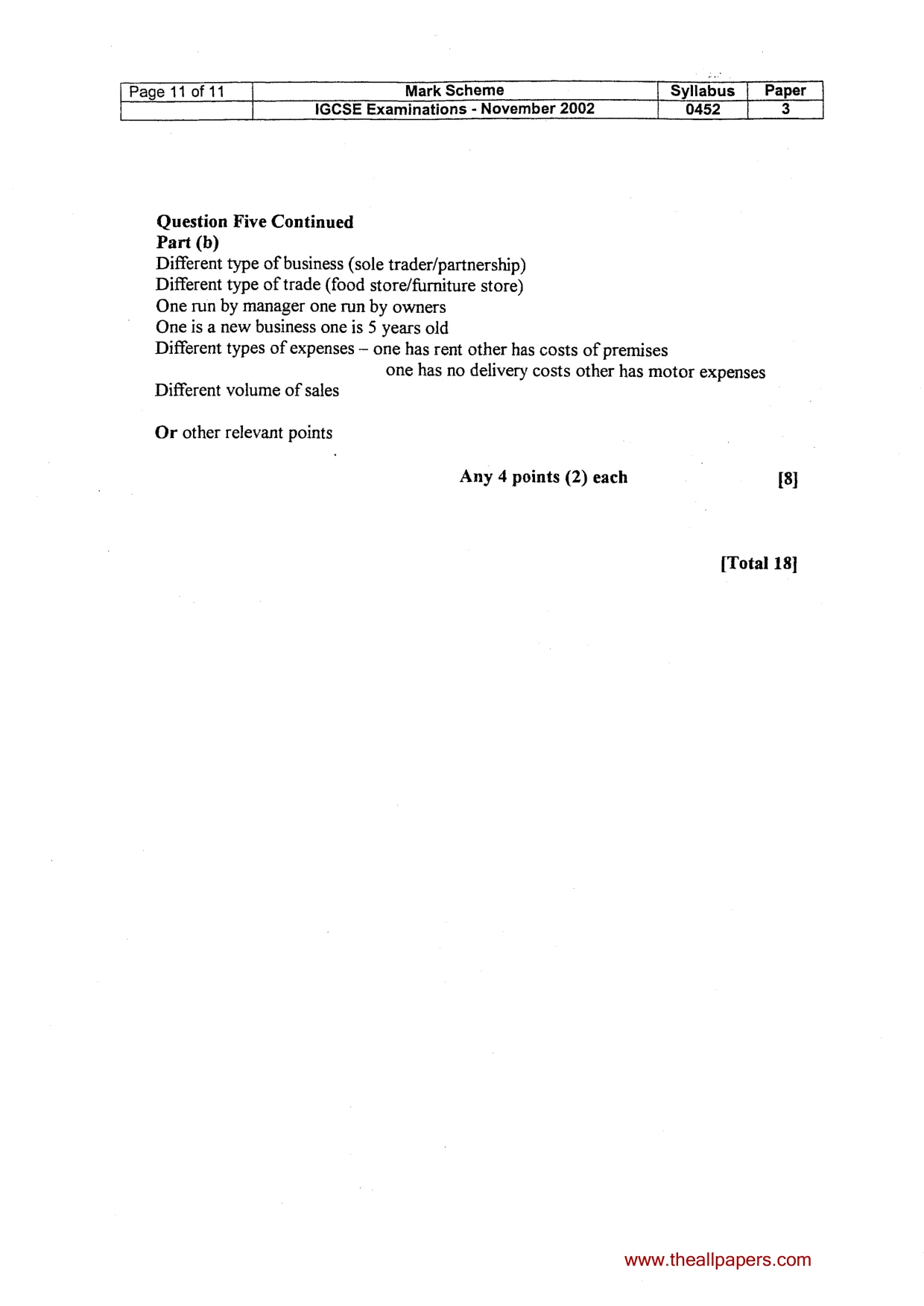
Page 11 of 11 Mark Scheme Syllabus Paper IGCSE Examinations - November 2002 0452 3 Question Five Continued Part (b) Different type of business (sole trader/partnership) Different type of trade (food store/furniture store) One run by manager one run by owners One is a new business one is 5 years old Different types of expenses — one has rent other has costs of premises one has no delivery costs other has motor expenses Different volume of sales Or other relevant points Any 4 points (2) each [3] [Total 18] www.theallpapers.com