Cambridge IGCSE Accounting 0452 — 2002 May/June Paper 3 · Variant 1
0452/31/M/J/02
The question paper and its mark scheme, free to read here and free to download. This is Cambridge’s own paper, exactly as it was sat.
Question paper12 pages
Mark scheme18 pages
Answers below. Sit the paper first if you are practising.
Paper as text
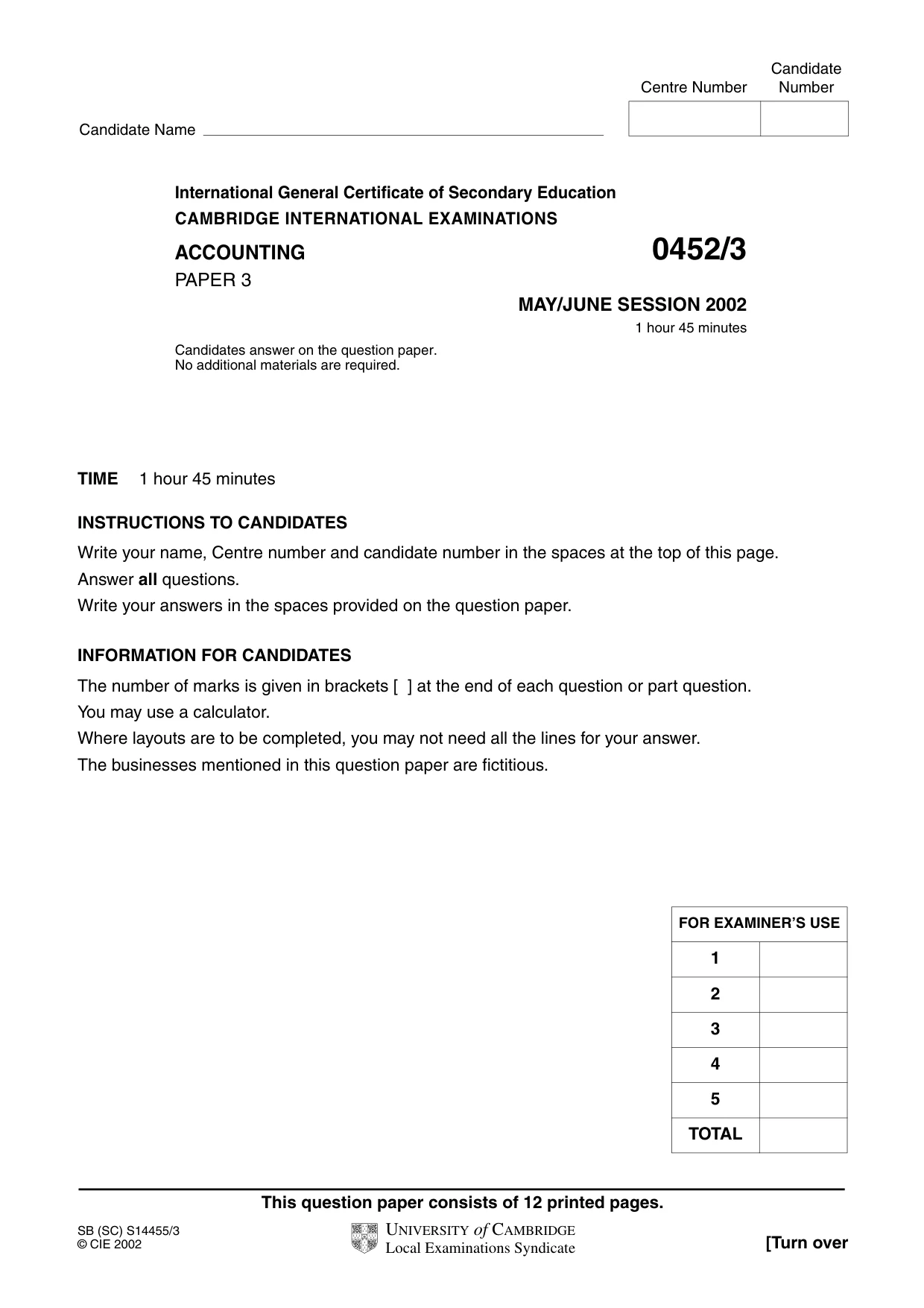
Question paper, page 1
This question paper consists of 12 printed pages. SB (SC) S14455/3 © CIE 2002 [Turn over International General Certificate of Secondary Education CAMBRIDGE INTERNATIONAL EXAMINATIONS ACCOUNTING 0452/3 PAPER 3 MAY/JUNE SESSION 2002 1 hour 45 minutes Candidates answer on the question paper. No additional materials are required. TIME 1 hour 45 minutes INSTRUCTIONS TO CANDIDATES Write your name, Centre number and candidate number in the spaces at the top of this page. Answer all questions. Write your answers in the spaces provided on the question paper. INFORMATION FOR CANDIDATES The number of marks is given in brackets [ ] at the end of each question or part question. You may use a calculator. Where layouts are to be completed, you may not need all the lines for your answer. The businesses mentioned in this question paper are fictitious. Candidate Centre Number Number Candidate Name FOR EXAMINER’S USE 3 2 1 4 TOTAL 5 UNIVERSITY of CAMBRIDGE Local Examinations Syndicate
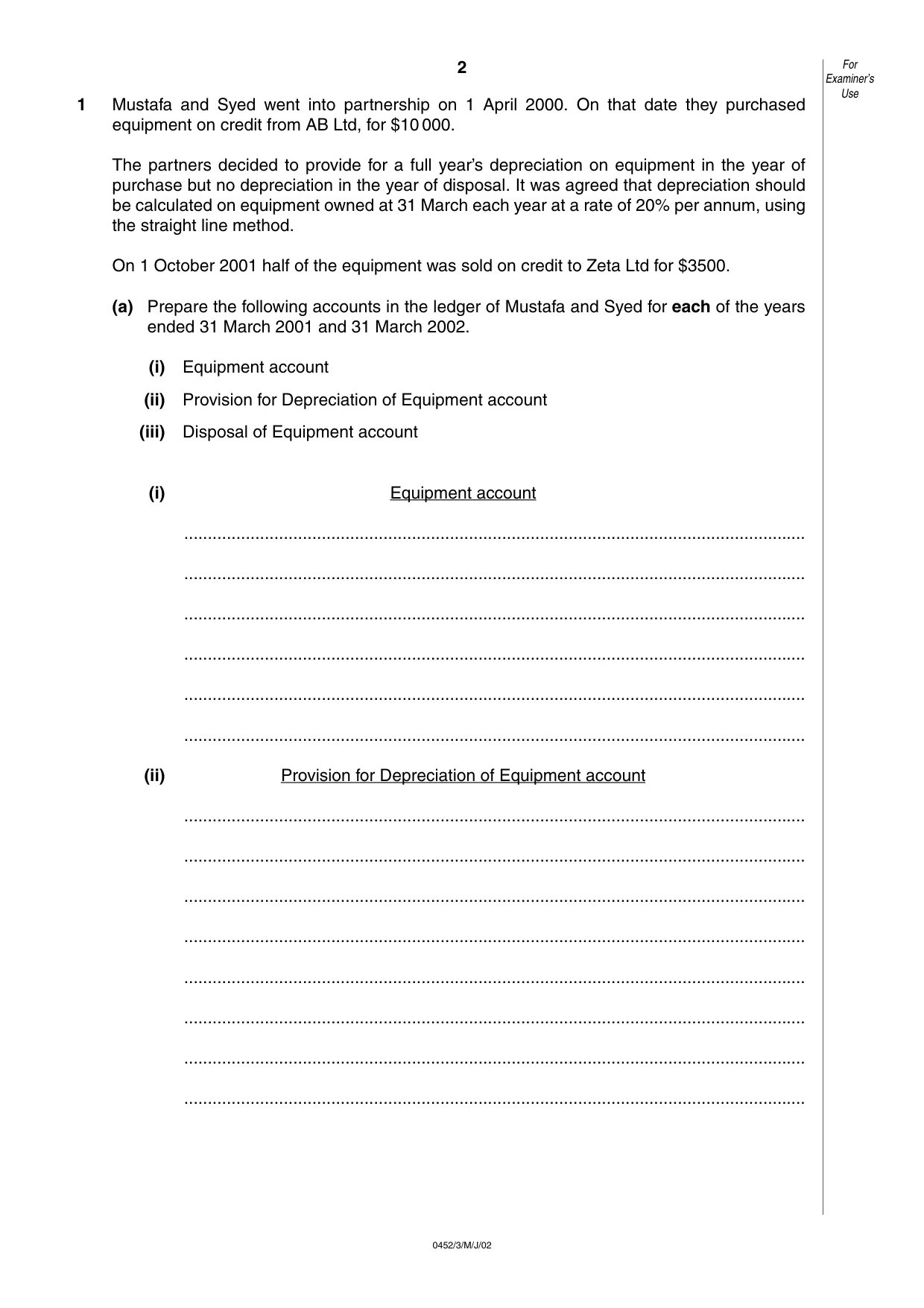
Question paper, page 2
2 0452/3/M/J/02 1 Mustafa and Syed went into partnership on 1 April 2000. On that date they purchased equipment on credit from AB Ltd, for $10 000. The partners decided to provide for a full year’s depreciation on equipment in the year of purchase but no depreciation in the year of disposal. It was agreed that depreciation should be calculated on equipment owned at 31 March each year at a rate of 20% per annum, using the straight line method. On 1 October 2001 half of the equipment was sold on credit to Zeta Ltd for $3500. (a) Prepare the following accounts in the ledger of Mustafa and Syed for each of the years ended 31 March 2001 and 31 March 2002. (i) Equipment account (ii) Provision for Depreciation of Equipment account (iii) Disposal of Equipment account (i) Equipment account … … … … … … (ii) Provision for Depreciation of Equipment account … … … … … … … … For Examiner’s Use
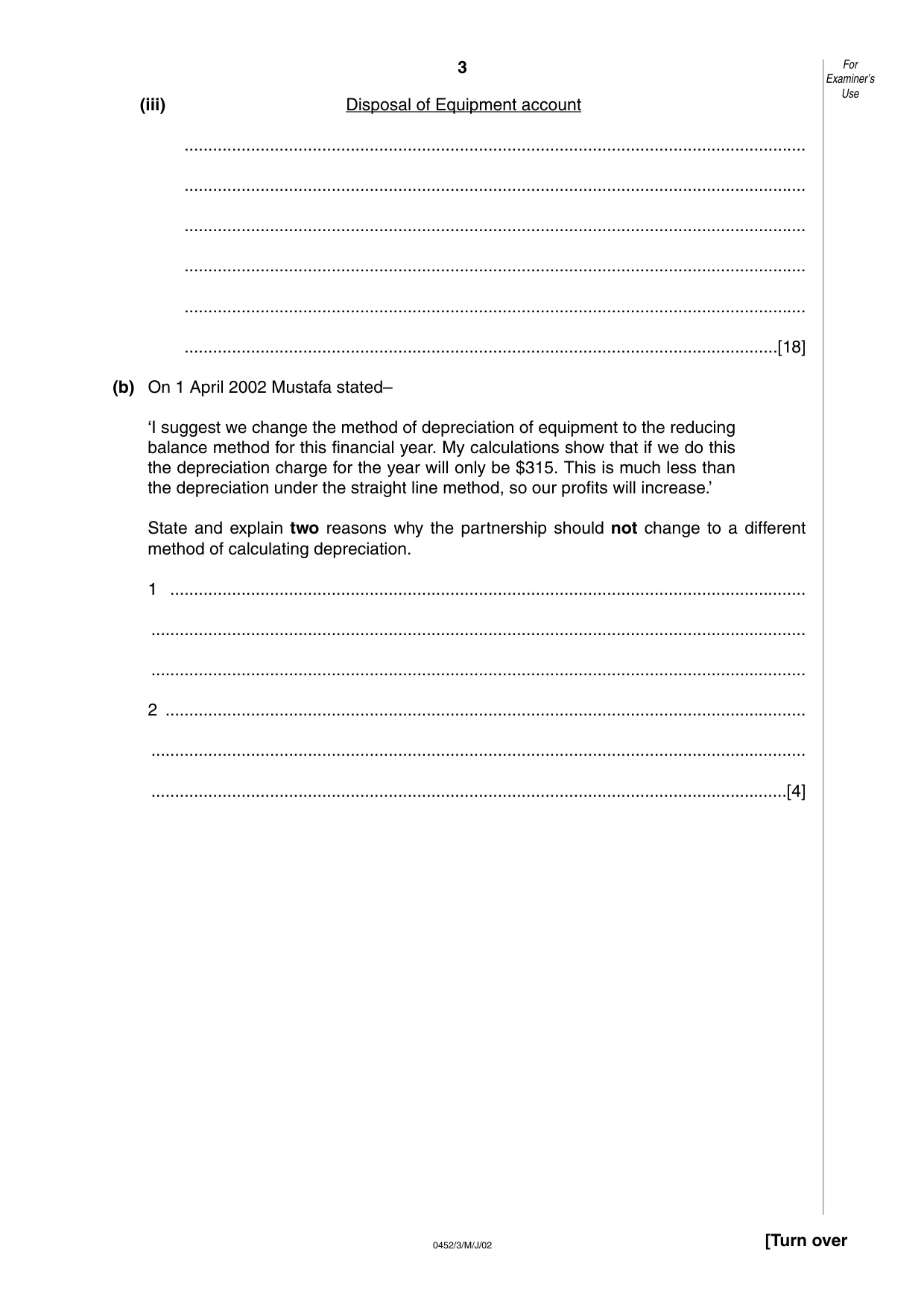
Question paper, page 3
3 0452/3/M/J/02 [Turn over (iii) Disposal of Equipment account … … … … … …[18] (b) On 1 April 2002 Mustafa stated– ‘I suggest we change the method of depreciation of equipment to the reducing balance method for this financial year. My calculations show that if we do this the depreciation charge for the year will only be $315. This is much less than the depreciation under the straight line method, so our profits will increase.’ State and explain two reasons why the partnership should not change to a different method of calculating depreciation. 1 … … … 2 … … …[4] For Examiner’s Use
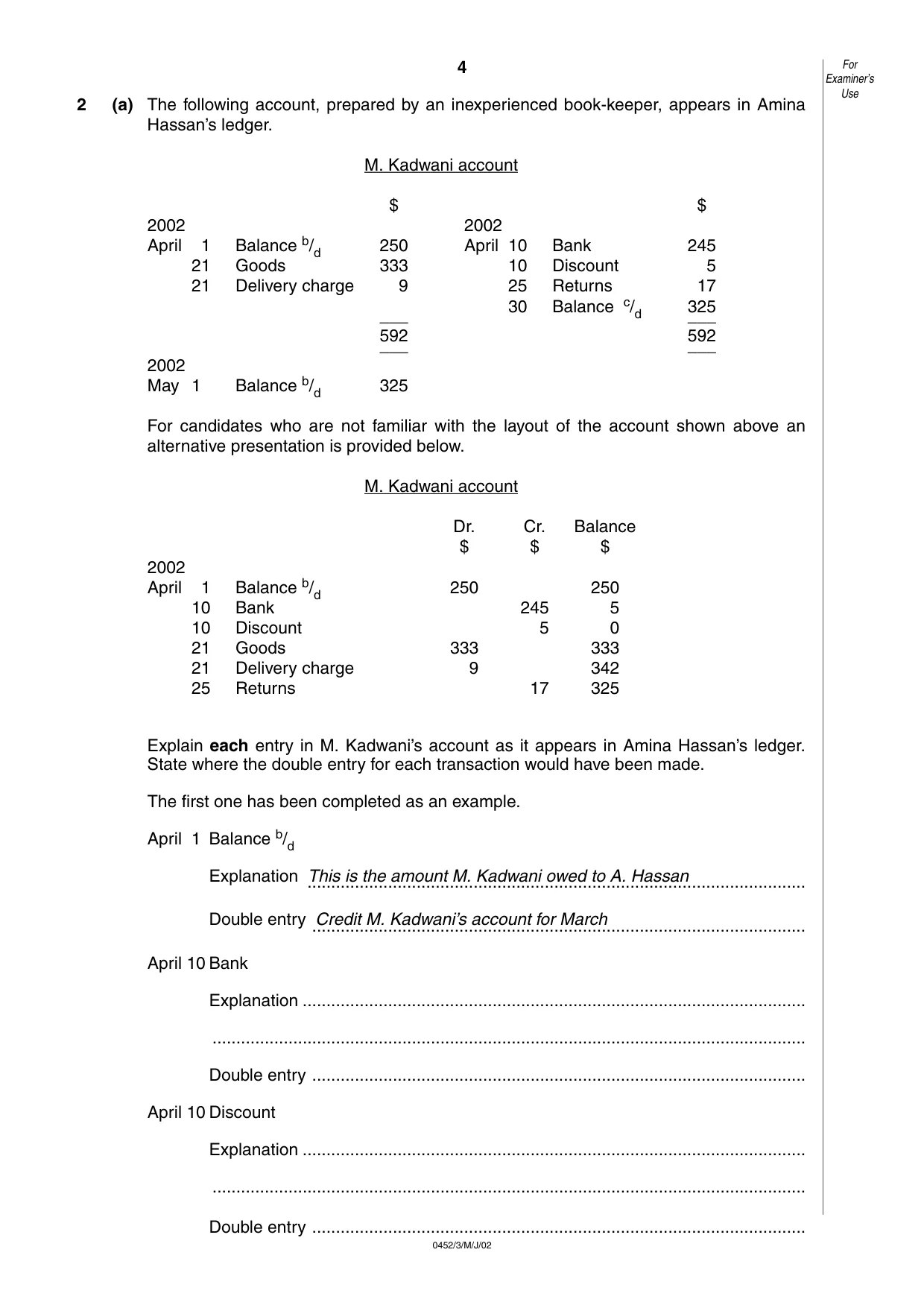
Question paper, page 4
4 0452/3/M/J/02 2 (a) The following account, prepared by an inexperienced book-keeper, appears in Amina Hassan’s ledger. M. Kadwani account $ $ 2002 2002 April 1 Balance b/d 250 April 10 Bank 245 21 Goods 333 10 Discount 5 21 Delivery charge 9 25 Returns 17 30 Balance c/d 325 ___ ___ 592 592 ___ ___ 2002 May 1 Balance b/d 325 For candidates who are not familiar with the layout of the account shown above an alternative presentation is provided below. M. Kadwani account Dr. Cr. Balance $ $ $ 2002 April 1 Balance b/d 250 250 10 Bank 245 5 10 Discount 5 0 21 Goods 333 333 21 Delivery charge 9 342 25 Returns 17 325 Explain each entry in M. Kadwani’s account as it appears in Amina Hassan’s ledger. State where the double entry for each transaction would have been made. The first one has been completed as an example. April 1 Balance b/d Explanation This is the amount M. Kadwani owed to A. Hassan … Double entry Credit M. Kadwani’s account for March … April 10 Bank Explanation … … Double entry … April 10 Discount Explanation … … Double entry … For Examiner’s Use
Question paper, page 5
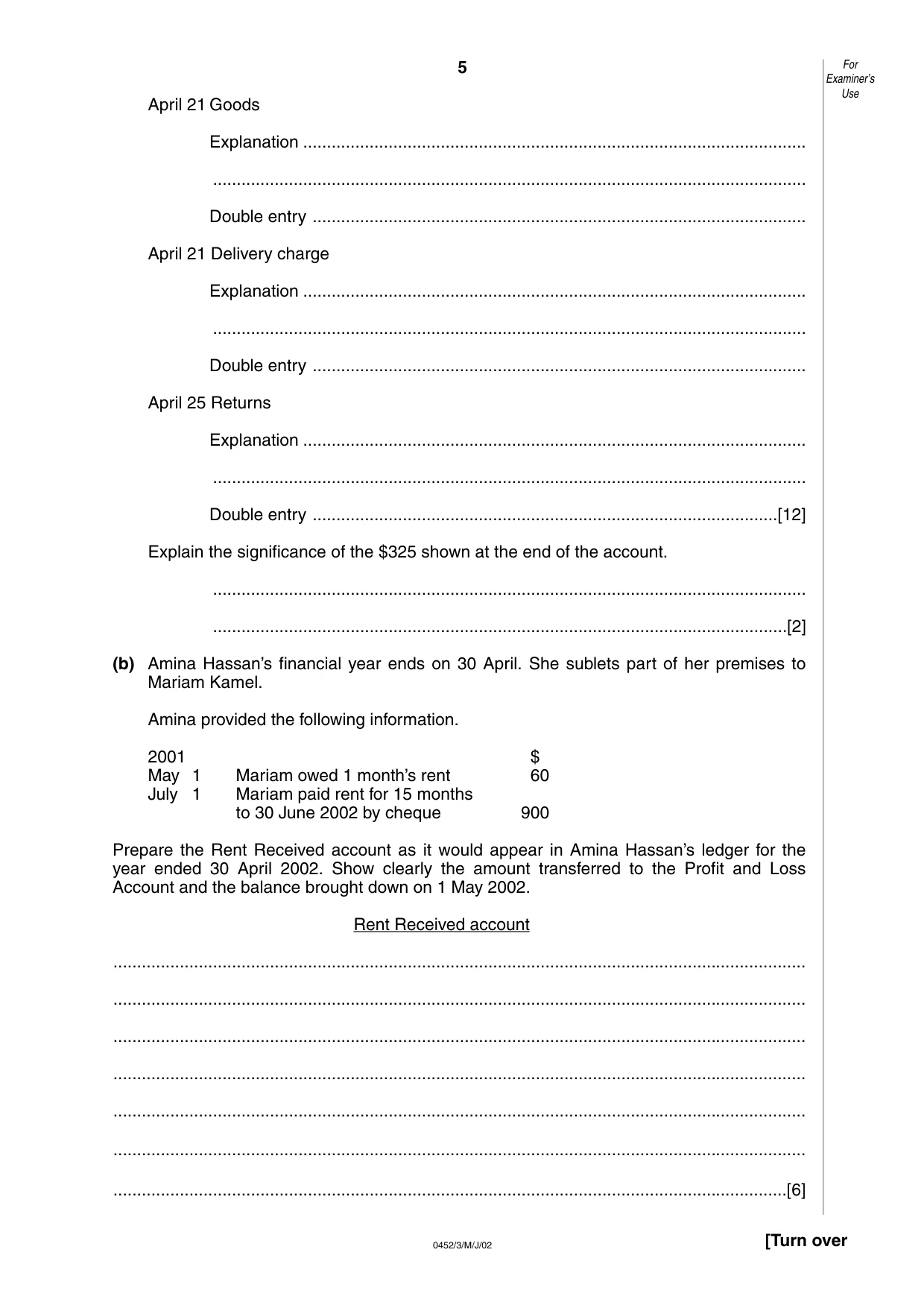
5 0452/3/M/J/02 [Turn over April 21 Goods Explanation … … Double entry … April 21 Delivery charge Explanation … … Double entry … April 25 Returns Explanation … … Double entry …[12] Explain the significance of the $325 shown at the end of the account. … …[2] (b) Amina Hassan’s financial year ends on 30 April. She sublets part of her premises to Mariam Kamel. Amina provided the following information. 2001 $ May 1 Mariam owed 1 month’s rent 60 July 1 Mariam paid rent for 15 months to 30 June 2002 by cheque 900 Prepare the Rent Received account as it would appear in Amina Hassan’s ledger for the year ended 30 April 2002. Show clearly the amount transferred to the Profit and Loss Account and the balance brought down on 1 May 2002. Rent Received account … … … … … … …[6] For Examiner’s Use
Question paper, page 6
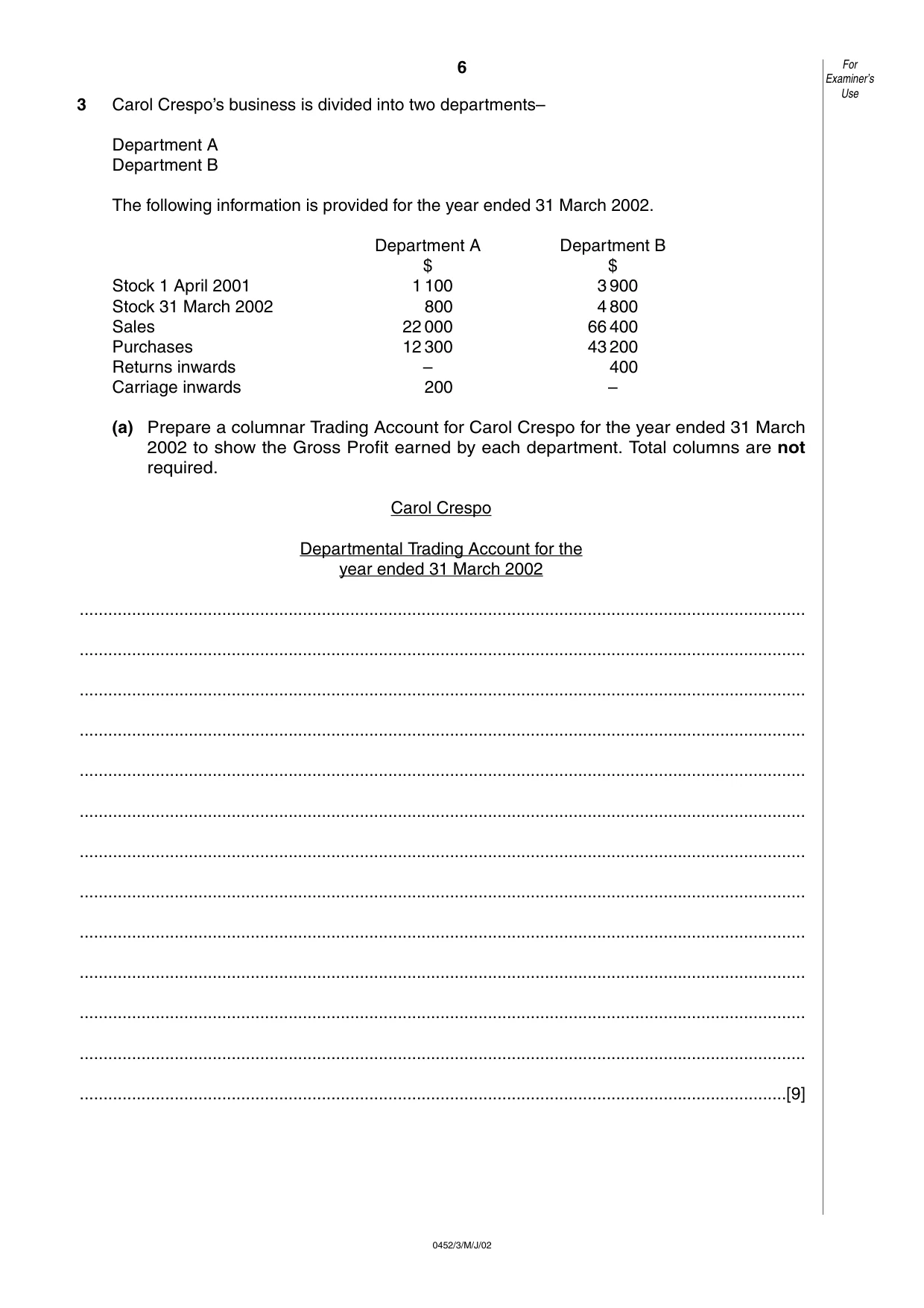
6 0452/3/M/J/02 3 Carol Crespo’s business is divided into two departments– Department A Department B The following information is provided for the year ended 31 March 2002. Department A Department B $ $ Stock 1 April 2001 1 100 3 900 Stock 31 March 2002 800 4 800 Sales 22 000 66 400 Purchases 12 300 43 200 Returns inwards – 400 Carriage inwards 200 – (a) Prepare a columnar Trading Account for Carol Crespo for the year ended 31 March 2002 to show the Gross Profit earned by each department. Total columns are not required. Carol Crespo Departmental Trading Account for the year ended 31 March 2002 … … … … … … … … … … … … …[9] For Examiner’s Use
Question paper, page 7
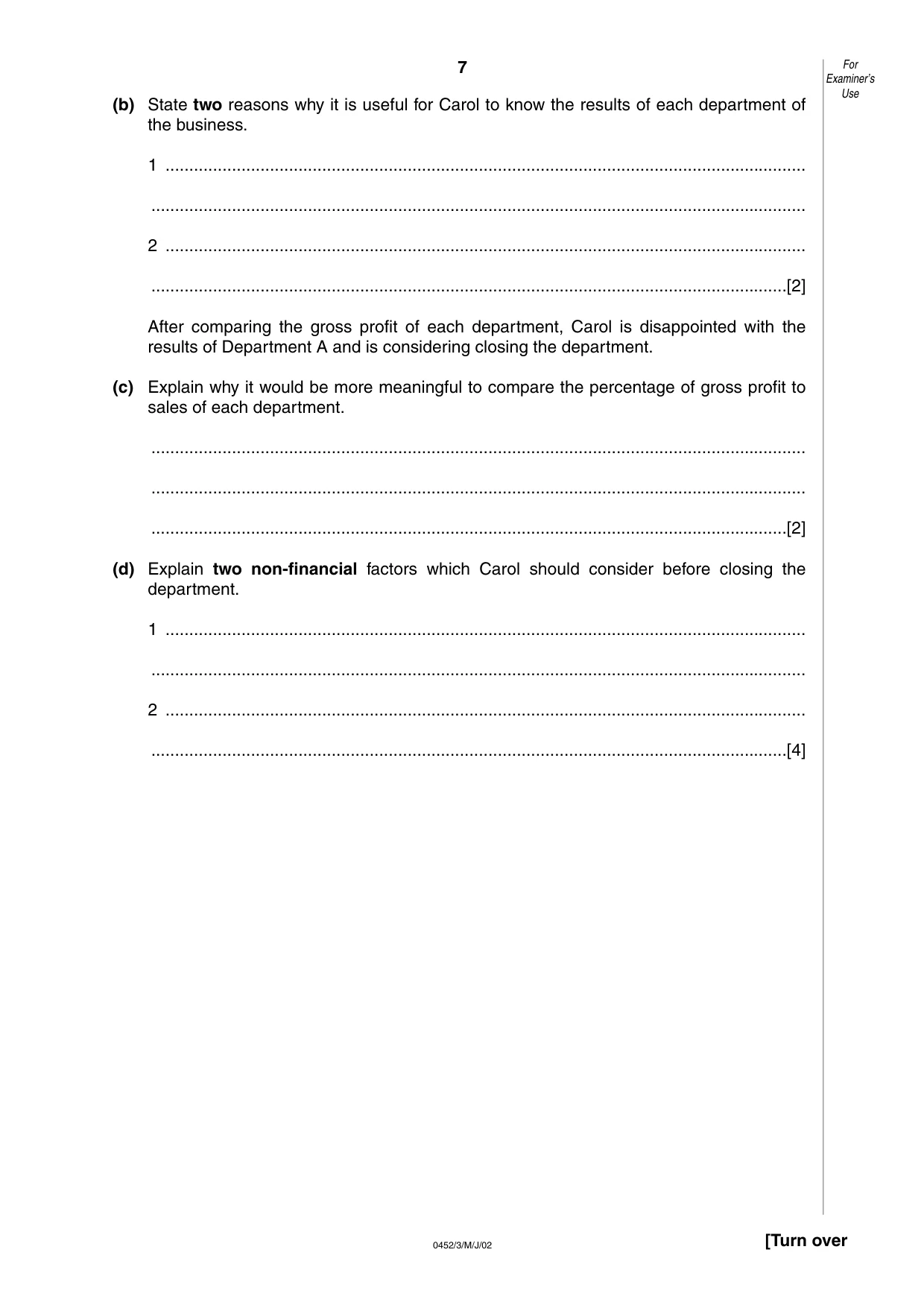
7 0452/3/M/J/02 [Turn over (b) State two reasons why it is useful for Carol to know the results of each department of the business. 1 … … 2 … …[2] After comparing the gross profit of each department, Carol is disappointed with the results of Department A and is considering closing the department. (c) Explain why it would be more meaningful to compare the percentage of gross profit to sales of each department. … … …[2] (d) Explain two non-financial factors which Carol should consider before closing the department. 1 … … 2 … …[4] For Examiner’s Use
Question paper, page 8
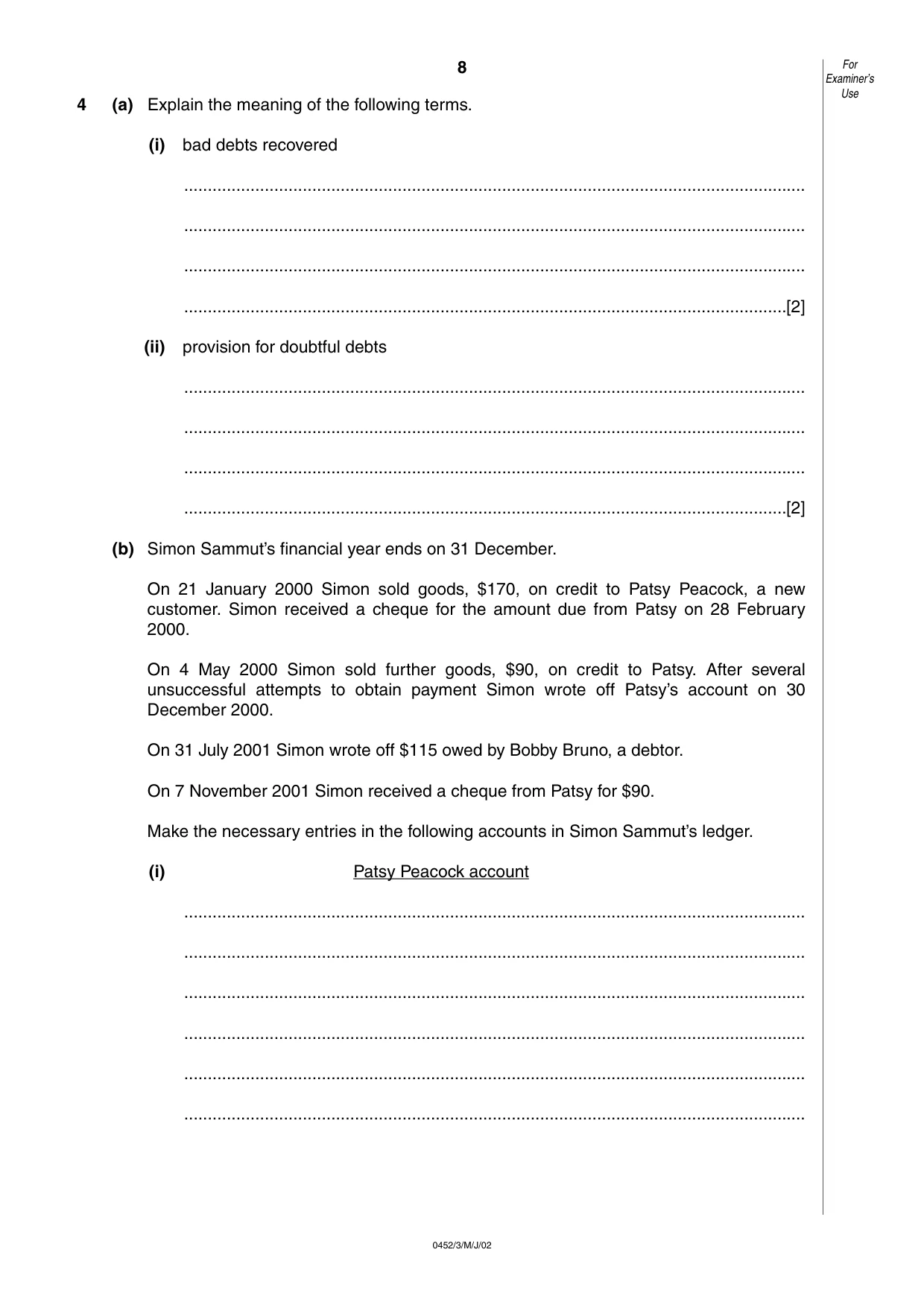
8 0452/3/M/J/02 4 (a) Explain the meaning of the following terms. (i) bad debts recovered … … … …[2] (ii) provision for doubtful debts … … … …[2] (b) Simon Sammut’s financial year ends on 31 December. On 21 January 2000 Simon sold goods, $170, on credit to Patsy Peacock, a new customer. Simon received a cheque for the amount due from Patsy on 28 February 2000. On 4 May 2000 Simon sold further goods, $90, on credit to Patsy. After several unsuccessful attempts to obtain payment Simon wrote off Patsy’s account on 30 December 2000. On 31 July 2001 Simon wrote off $115 owed by Bobby Bruno, a debtor. On 7 November 2001 Simon received a cheque from Patsy for $90. Make the necessary entries in the following accounts in Simon Sammut’s ledger. (i) Patsy Peacock account … … … … … … For Examiner’s Use
Question paper, page 9
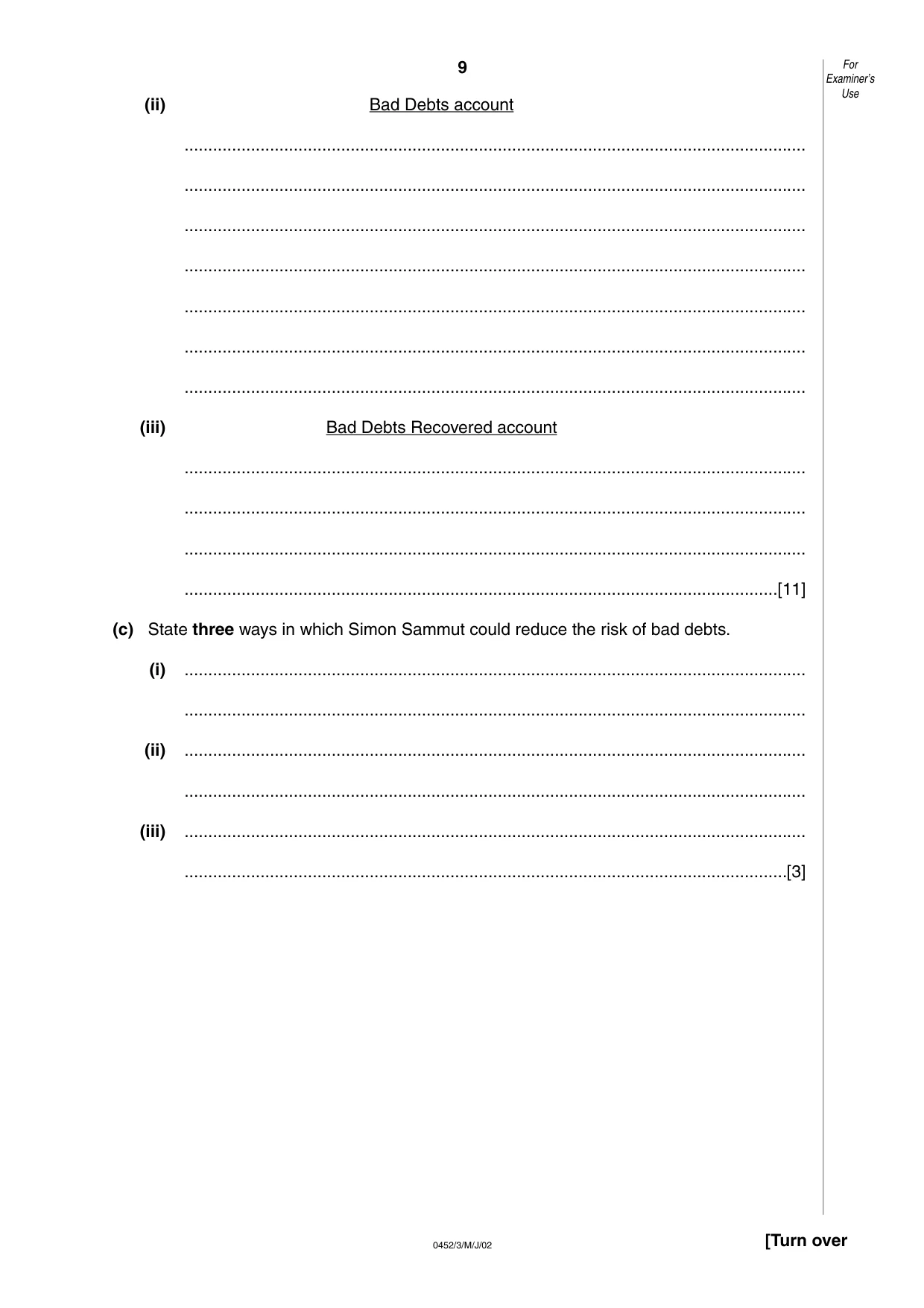
9 0452/3/M/J/02 [Turn over (ii) Bad Debts account … … … … … … … (iii) Bad Debts Recovered account … … … …[11] (c) State three ways in which Simon Sammut could reduce the risk of bad debts. (i) … … (ii) … … (iii) … …[3] For Examiner’s Use
Question paper, page 10
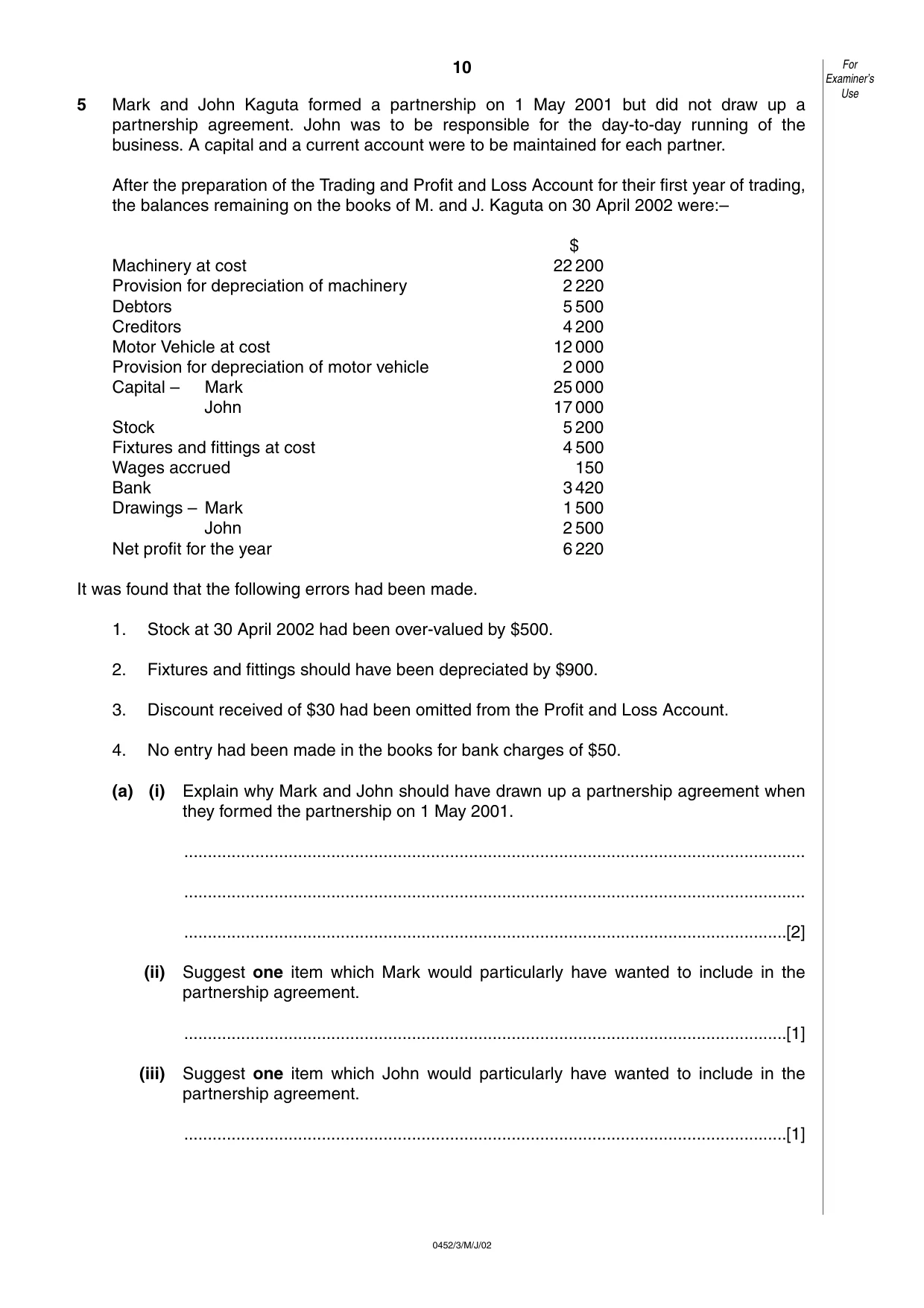
10 0452/3/M/J/02 5 Mark and John Kaguta formed a partnership on 1 May 2001 but did not draw up a partnership agreement. John was to be responsible for the day-to-day running of the business. A capital and a current account were to be maintained for each partner. After the preparation of the Trading and Profit and Loss Account for their first year of trading, the balances remaining on the books of M. and J. Kaguta on 30 April 2002 were:– $ Machinery at cost 22 200 Provision for depreciation of machinery 2 220 Debtors 5 500 Creditors 4 200 Motor Vehicle at cost 12 000 Provision for depreciation of motor vehicle 2 000 Capital – Mark 25 000 John 17 000 Stock 5 200 Fixtures and fittings at cost 4 500 Wages accrued 150 Bank 3 420 Drawings – Mark 1 500 John 2 500 Net profit for the year 6 220 It was found that the following errors had been made. 1. Stock at 30 April 2002 had been over-valued by $500. 2. Fixtures and fittings should have been depreciated by $900. 3. Discount received of $30 had been omitted from the Profit and Loss Account. 4. No entry had been made in the books for bank charges of $50. (a) (i) Explain why Mark and John should have drawn up a partnership agreement when they formed the partnership on 1 May 2001. … … …[2] (ii) Suggest one item which Mark would particularly have wanted to include in the partnership agreement. …[1] (iii) Suggest one item which John would particularly have wanted to include in the partnership agreement. …[1] For Examiner’s Use
Question paper, page 11
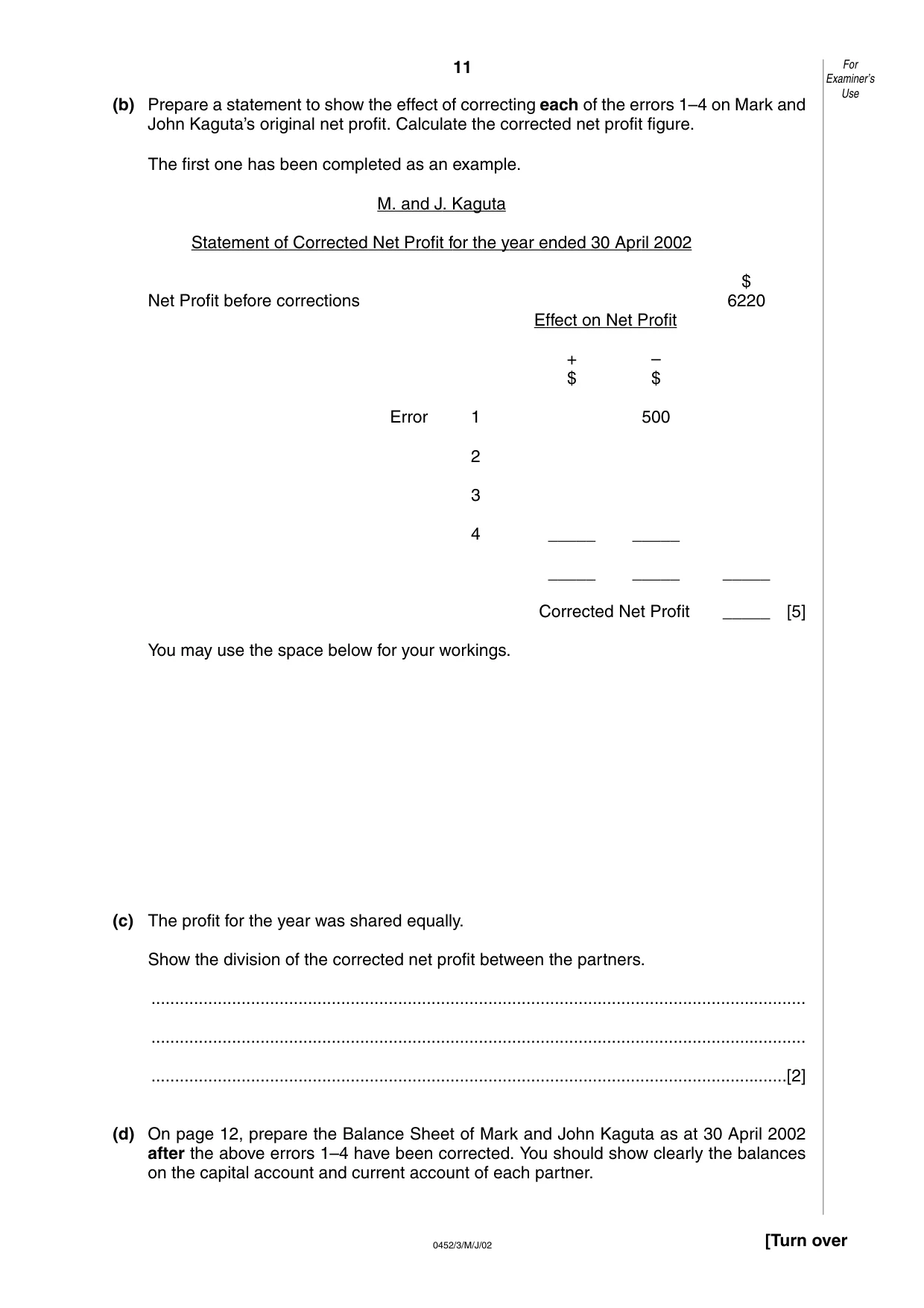
11 0452/3/M/J/02 [Turn over (b) Prepare a statement to show the effect of correcting each of the errors 1–4 on Mark and John Kaguta’s original net profit. Calculate the corrected net profit figure. The first one has been completed as an example. M. and J. Kaguta Statement of Corrected Net Profit for the year ended 30 April 2002 $ Net Profit before corrections 6220 Effect on Net Profit + – $ $ Error 1 500 2 3 4 _____ _____ _____ _____ _____ Corrected Net Profit _____ [5] You may use the space below for your workings. (c) The profit for the year was shared equally. Show the division of the corrected net profit between the partners. … … …[2] (d) On page 12, prepare the Balance Sheet of Mark and John Kaguta as at 30 April 2002 after the above errors 1–4 have been corrected. You should show clearly the balances on the capital account and current account of each partner. For Examiner’s Use
Question paper, page 12
12 0452/3/M/J/02 M. and J. Kaguta Balance Sheet as at 30 April 2002 … … … … … … … … … … … … … … … … … … … … … … … … … … … …[12] For Examiner’s Use
Mark scheme, page 1
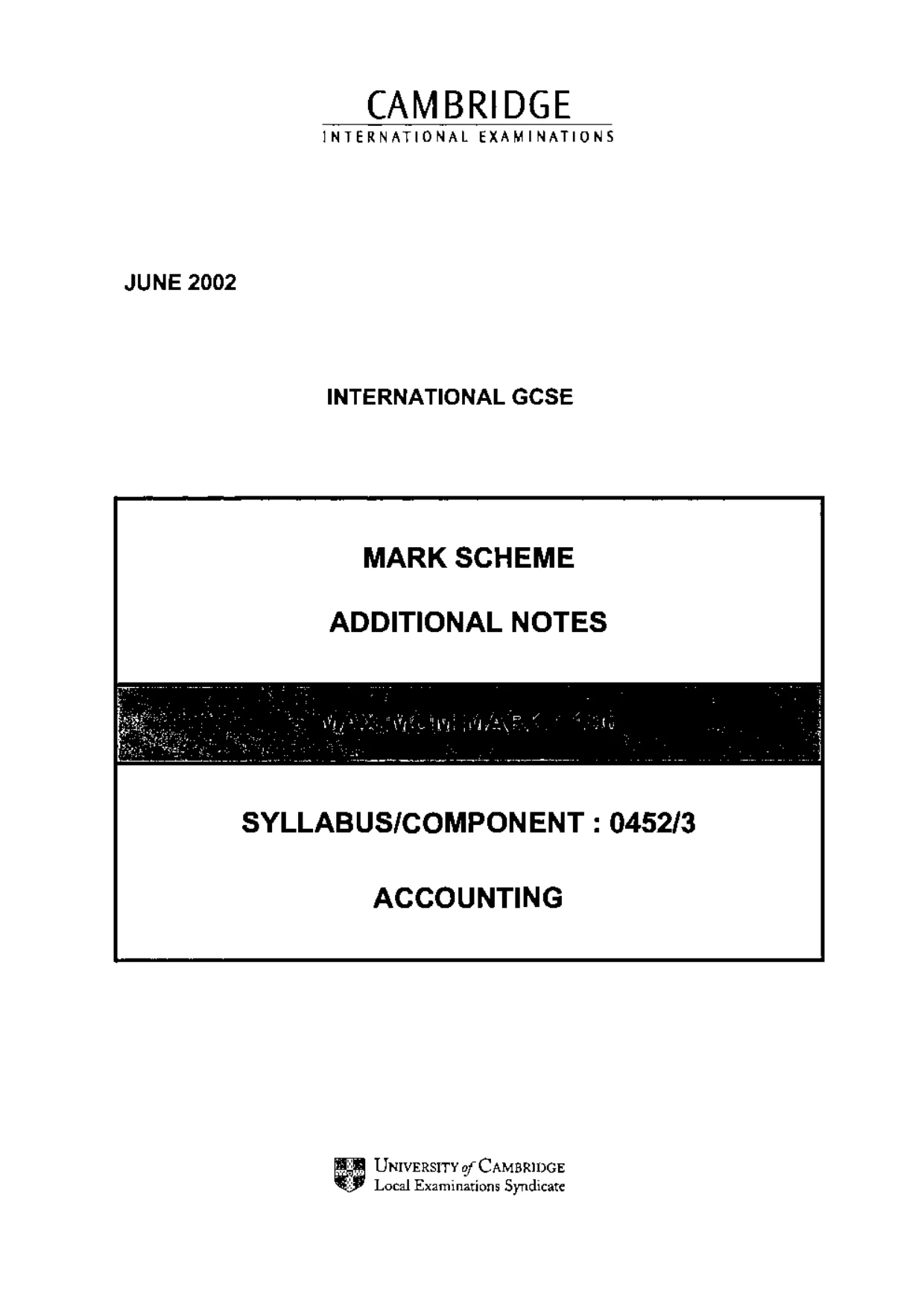
CAMBRIDGE INTERNATIONAL EXAMINATIONS JUNE 2002 INTERNATIONAL GCSE SYLLABUS/COMPONENT : 0452/3 ACCOUNTING (WS UNIvERsITY of CAMBRIDGE B® Local Examinations Syndicate
Mark scheme, page 2
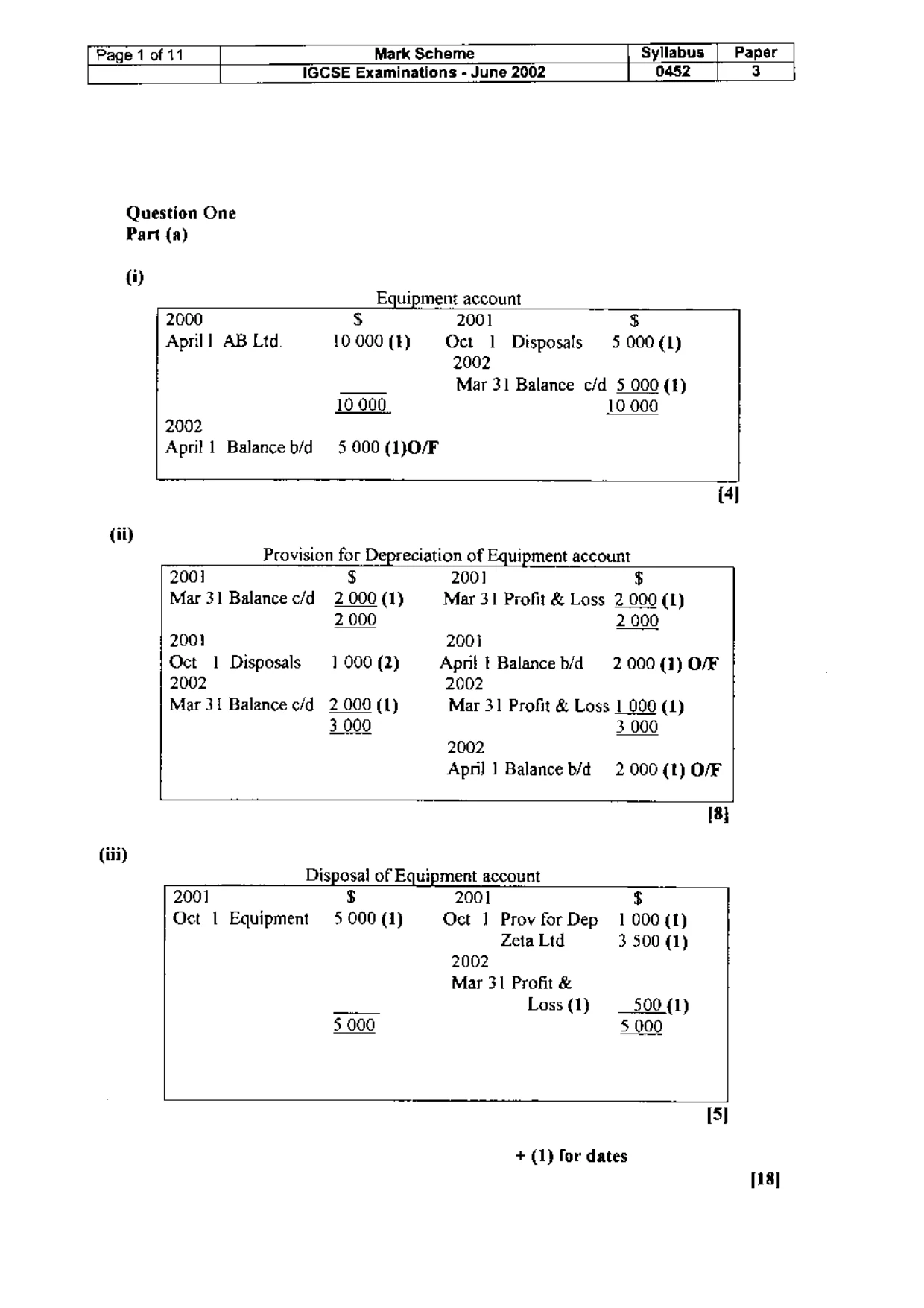
[Page 1 of 11 Mark Scheme Syllabus | Paper { IGCSE Examinations - June 2002 0452, | 3 Question One Part (a) w Equipment account 2000 $ 2001 $ April! AB Ltd 10 000 (fk) Oct 1 Disposals 5 000 (1) 2002 Mar 31 Balance c/d 5 000 (£) 10 000 10 000 2002 April 1 Balance b/d 5 000 (1)O/F {4] {ii) Provision for Depreciation of Equipment account 2001 2001 Mar 31 Balance c/d 2 000 (1) Mar 31 Profit & Loss 2.000 (1) 2.000 2.000 2001 2001 Oct 1 Disposals 1 000 (2) Aprit t Balance b/d = 2: 000 (1) O/F 2002 2002 Mar 31 Balance c/d 2.000 (1) Mar 31 Profit & Loss 1 000 (1) 3.900 3.000 2002 April 1 Balance b/d = 2 000 (t) O/F 18} (iii) Disposal of Equipment account 2001 2001 $ Oct | Equipment 5 000 (1) Oct 1 Prov for Dep 1 000 (1) Zeta Ltd 3 500 (1) 2002 Mar 31 Profit & Loss (1} 500 (1) 5.000 5.000 [5] + (1) for dates [18]
Mark scheme, page 3
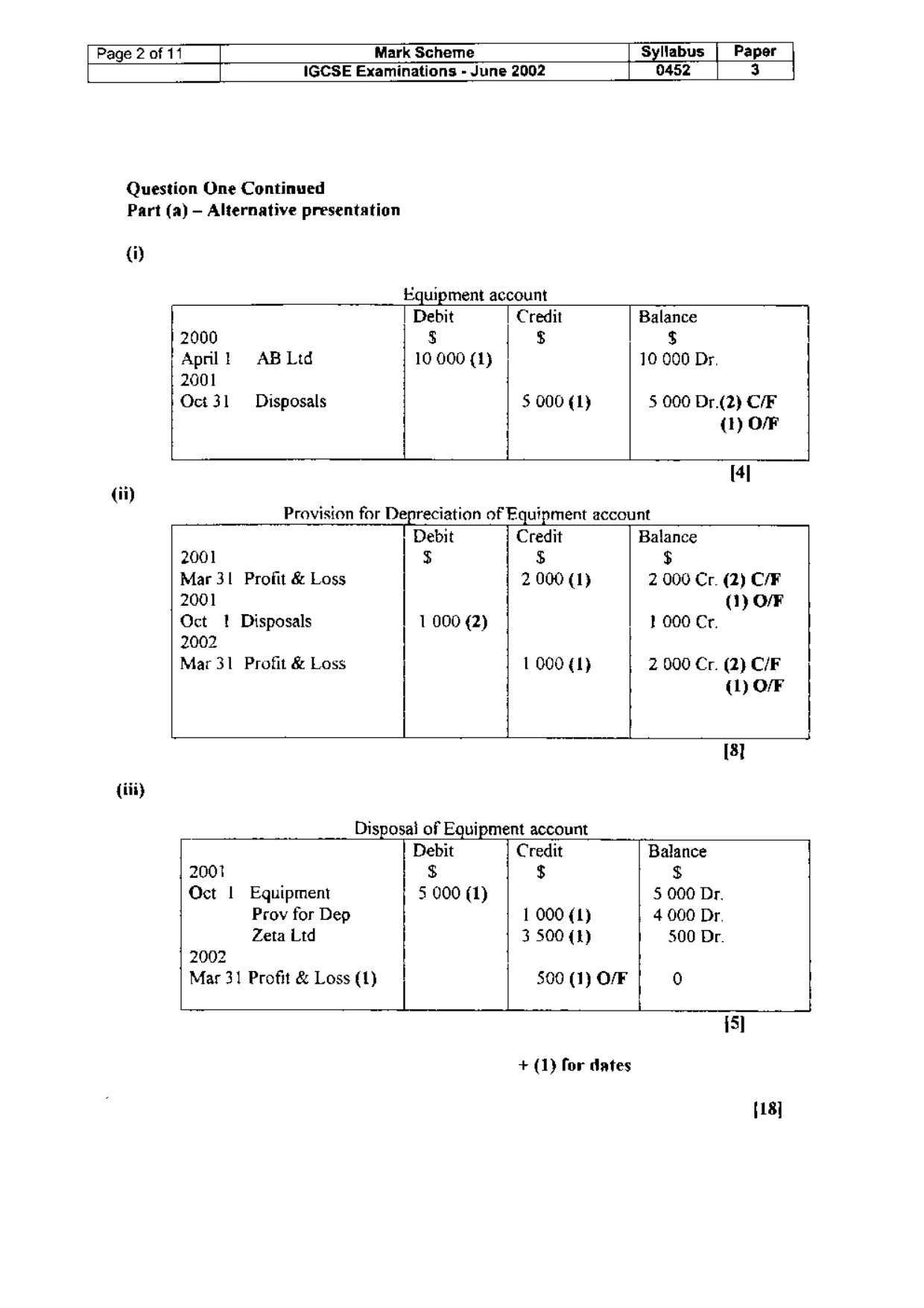
Page 2 of 11 | Mark Scheme | Syiepee Paper | IGCSE Examinations - June 2002 0452 3 Question One Continued Part (a) — Alternative presentation (i) Equipment account | Debit | Credit Balance | 2000 8 8 $ | April! AB Lid 10 000 (1) 10 000 Dr 2001 Oct 31 Disposals 5 000 (1) § 000 Dr.(2) C/F | (1) O/F (41 (ii) Provision for Depreciation of Equipment account Debit Credit Balance 2001 3 $ $ Mar 31 Profit & Loss 2 000 (1) 2 000 Cr. (2) C/F 2001 (1) OF Oct ! Disposals 1 000 (2) 1 000 Cr. 2002 Mar 31 Profit & Loss 1 000 (1) 2 000 Cr. (2) C/F (1) O/F 5 [3] (iii) Disposal of Equipment account Debit Credit Balance 2001 $ $ $ Oct | Equipment 5 000 (1) 5 000 Dr. Prov for Dep 1 000 (1) 4000 Dr. Zeta Ltd 3 500 {k) 500 Dr. 2002 Mar 31 Profit & Loss (1) $00 (1) O/F 0 b — + (1) for dates 15] [18]
Mark scheme, page 4
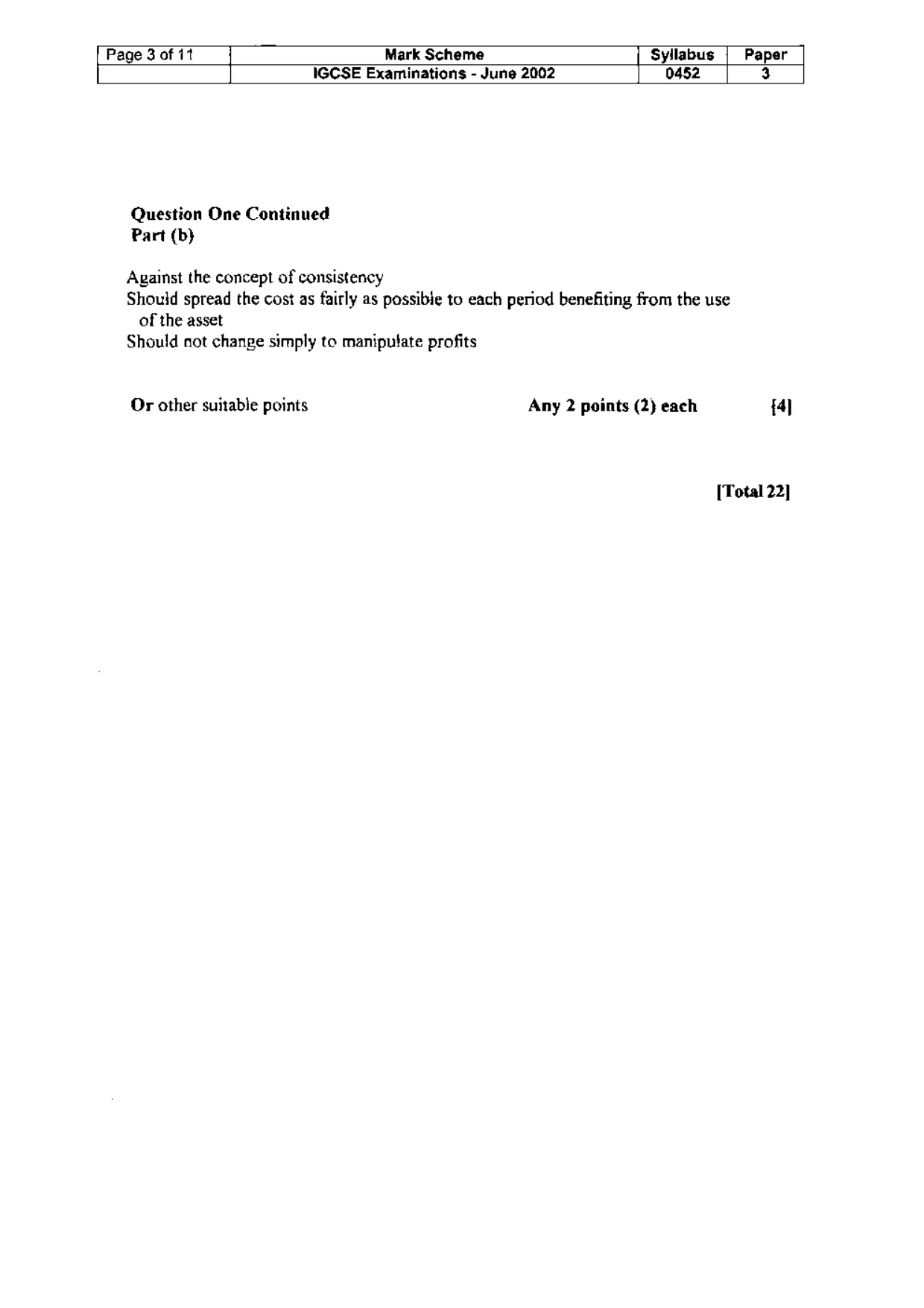
Syllabus | Paper 0452 3 Mark Scheme IGCSE Examinations - June 2002 Page 3 of i1 Question One Continued Part (b} Against the concept of consistency Should spread the cost as fairly as possible to each period benefiting from the use of the asset Should not change simply to maniputate profits Or other suitable points Any 2 points (2) each {4] [Total 22]
Mark scheme, page 5
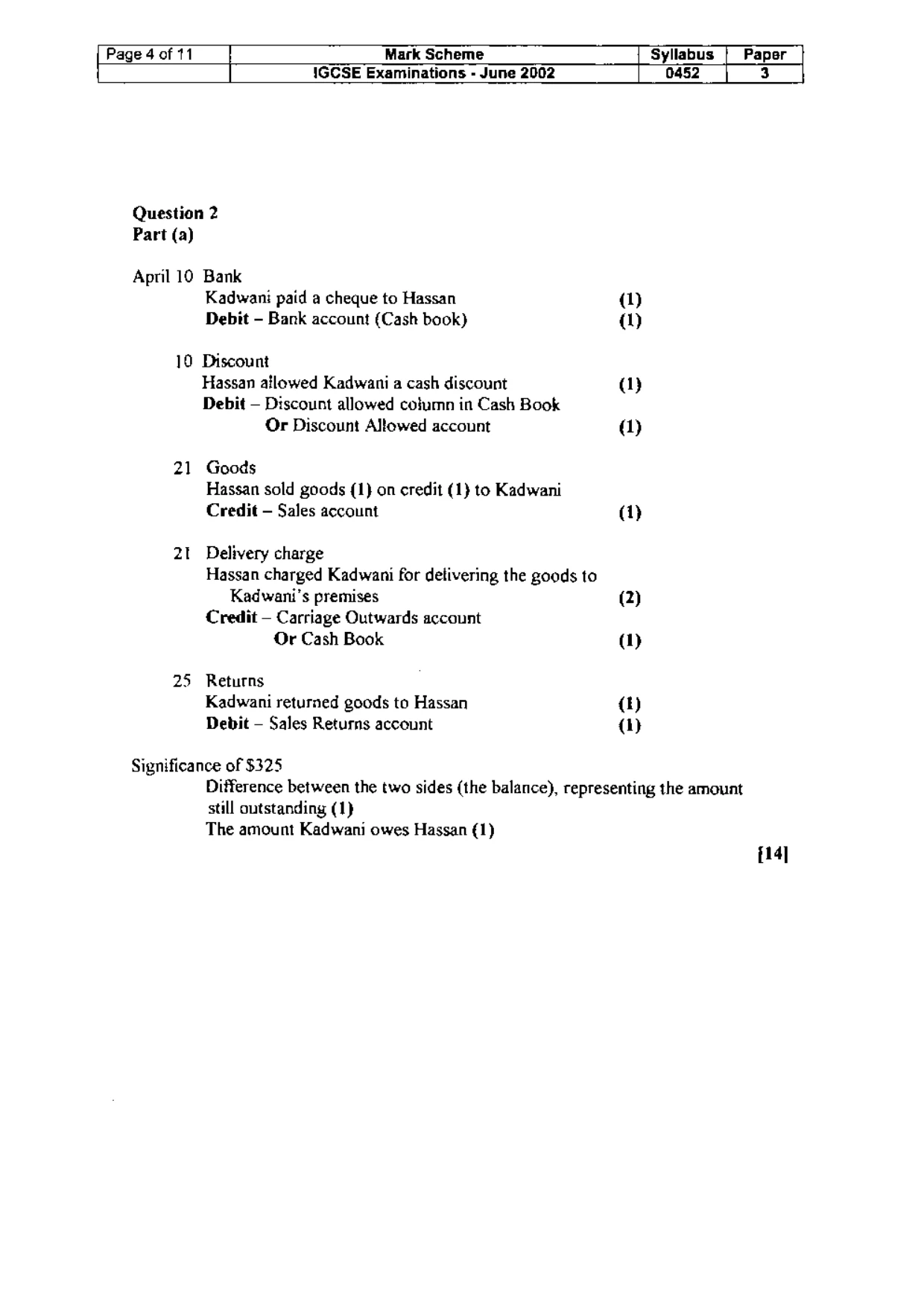
Page 4 of 11 Mark Scheme IGCSE Examinations - June 2002 Question 2 Part (a) April 10 Bank Kadwani paid a cheque to Hassan Debit - Bark account (Cash book) 10 Discount Hassan allowed Kadwani a cash discount Debit — Discount allowed column in Cash Book Or Discount Allowed account 21 Goods Hassan sold goods (1) on credit (1} to Kadwani Credit — Sales account 21 Delivery charge Hassan charged Kadwani for detivering the goods to Kadwani’s premises Credit — Carriage Outwards account Or Cash Book 25 Returns Kadwani returned goods to Hassan Debit — Sales Returns account Significance of $325 0452 [Syllabus [3 | a) ) a) a) (i) (2) (i) (t) (i) Difference between the two sides (the balance), representing the amount still outstanding (1) The amount Kadwani owes Hassan (1) {14]
Mark scheme, page 6
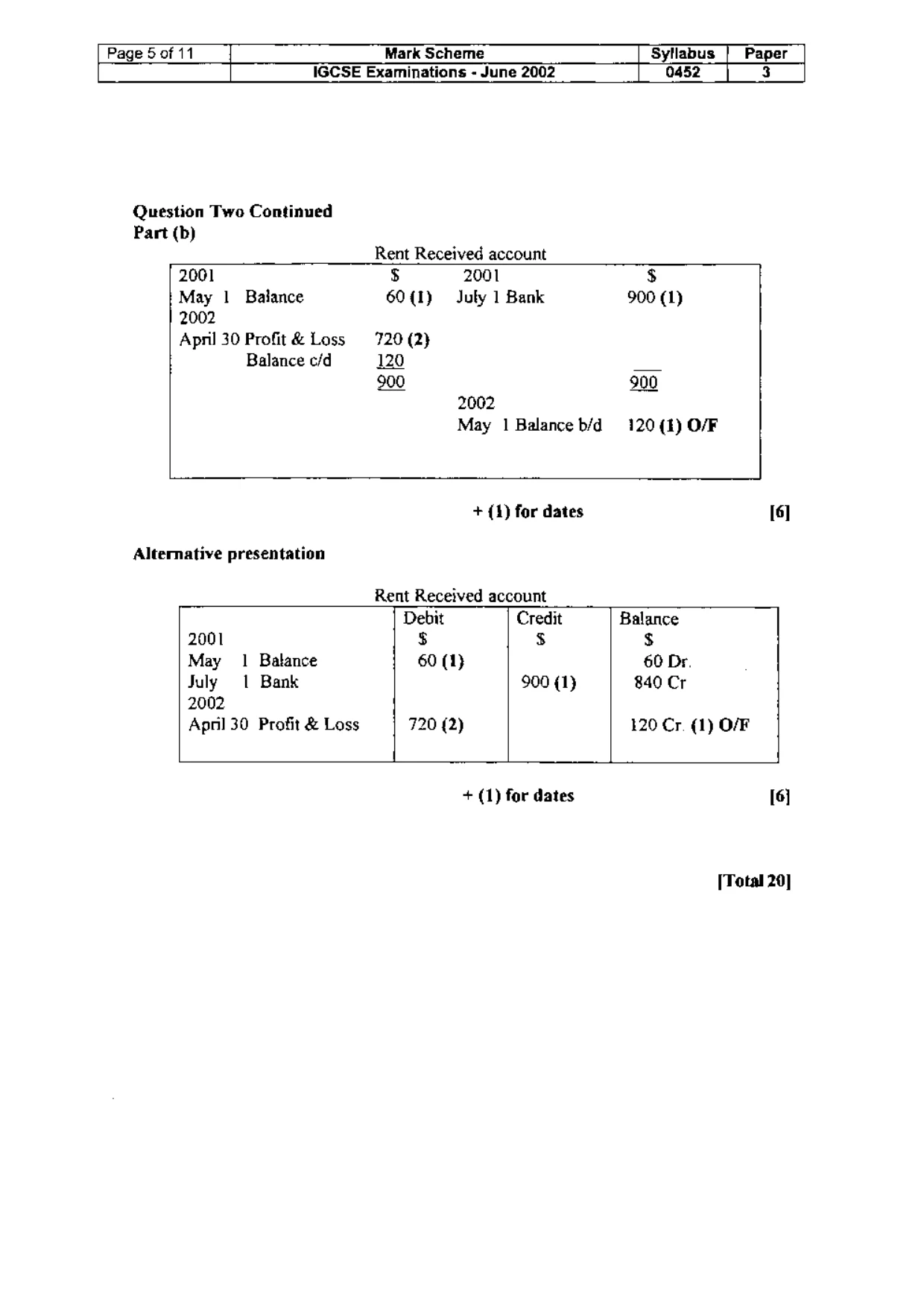
Mark Scheme Syllabus | Paper Page 5 of 11 | IGCSE Examinations - June 2002 0452 | 3 Question Two Continued Part (b) Rent Received account 2001 $ 2001 $ May | Balance 60(1) July 1 Bank 900 (1) 2002 April 30 Profit & Loss 720 (2) Balance c/d 120 __ 900 900 2002 May 1 Balance b/d 120 (1) O/F + (1) for dates [6] Alternative presentation Rent Received account Debit Credit Balance 2001 $ $ $ May 1 Balance 60 (1) 60 Dr. July 1 Bank 900 (1) 840 Cr 2002 April 30 Profit & Loss 720 (2) 120 Cr. (1) O/F + (1) for dates [6] [Total 20]
Mark scheme, page 7
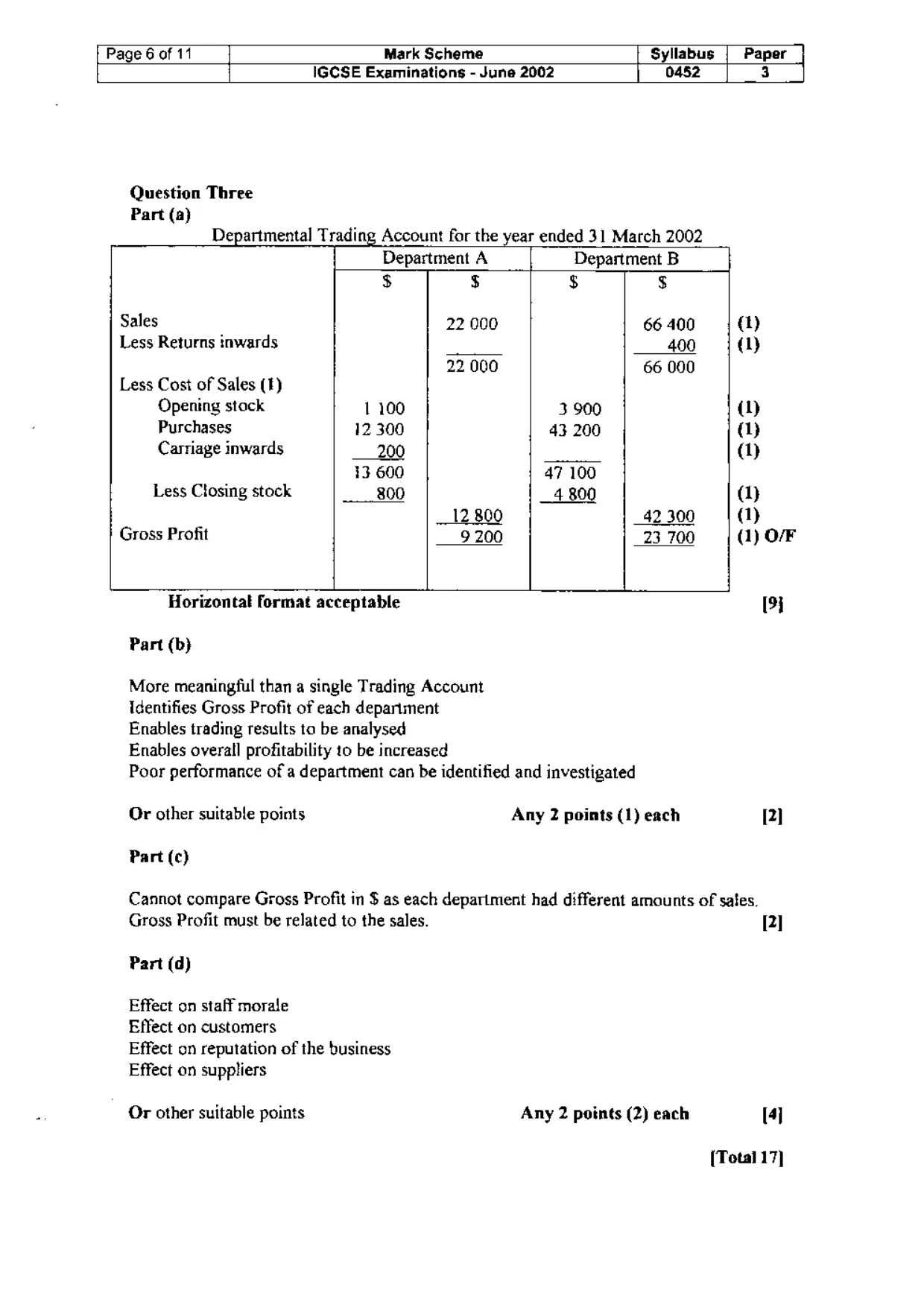
Page 6 of 11 Mark Scheme Syllabus Paper IGCSE Examinations - June 2002 0452 3 Question Three Part (a) Departmental Trading Account for the year ended 31 March 2002 Department A Department B $ $ $ $ Sales 22 000 66 400 (1) Less Returns inwards 400 ay 22 000 66 000 Less Cost of Sales (f) Opening stock 1 100 3 900 (1) Purchases 12 300 43 200 a Carriage inwards 200 qd) 13 600 47 100 Less Closing stock 800 4 800 qd) 12. 800 42300 | (1) Gross Profit 9200 23.700 (1) O/F Horizontat format acceptable (9j Part (b) More meaningful than a single Trading Account Identifies Gross Profit of each department Enables trading results ta be analysed Enables overall profitability to be increased Poor performance of a department can be identified and investigated Or other suitable points Any 2 points (1) each [2] Part (c) Cannot compare Gross Profit in $ as each depariment had different amaunts of sates. Gross Profit must be related to the sales. [2] Part (d) Effect on staff morale Effect on customers Effect on reputation of the business Effect on suppliers Or other suitable points Any 2 points (2) each [4] (Total 17]
Mark scheme, page 8
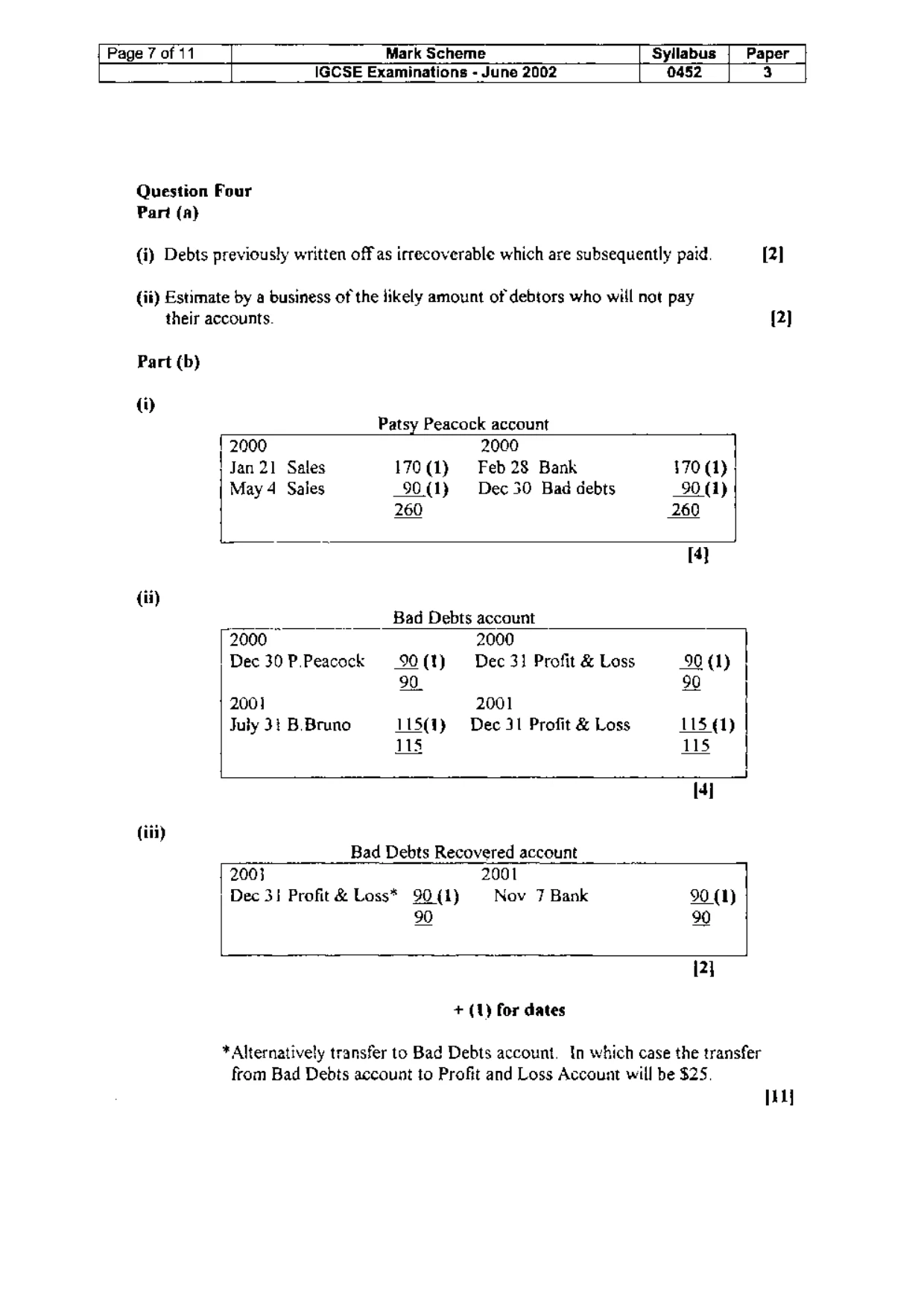
Page 7 of 11 Mark Scheme Syllabus | Paper IGCSE Examinations - June 2002 0452 3 Question Four Part (a} (i) Debts previously written off as irrecoverable which are subsequently paid. [2] (ii) Estimate by a business of the likely amount of debtors who will not pay their accounts. Part (b) ) {ii) (iii) Patsy Peacock account (2) + (1) for dates {2000 2000 | | Jan 21 Sales 170(1) Feb 28 Bank 170 (1) May 4 Sales _90(1) Dec 30 Bad debts 90.1) 260 260 - [4 7 . __ Bad Debts account 2000 2000 Dec 30P.Peacock _90(t) Dec 3} Profit & Loss 90 (1) | 90. 90 2001 2001 July 3 B.Bruno 115(4) Dec 31 Profit & Loss 115 (1) ds is — [4] Bad Debts Recovered account 2003 2001 Dec 3} Profit & Loss* 90 (1) Nov 7 Bank 90 (1) 90 99 12} * Alternatively transfer to Bad Debts account. In which case the transfer from Bad Debts account to Profit and Loss Account will be $25. py
Mark scheme, page 9
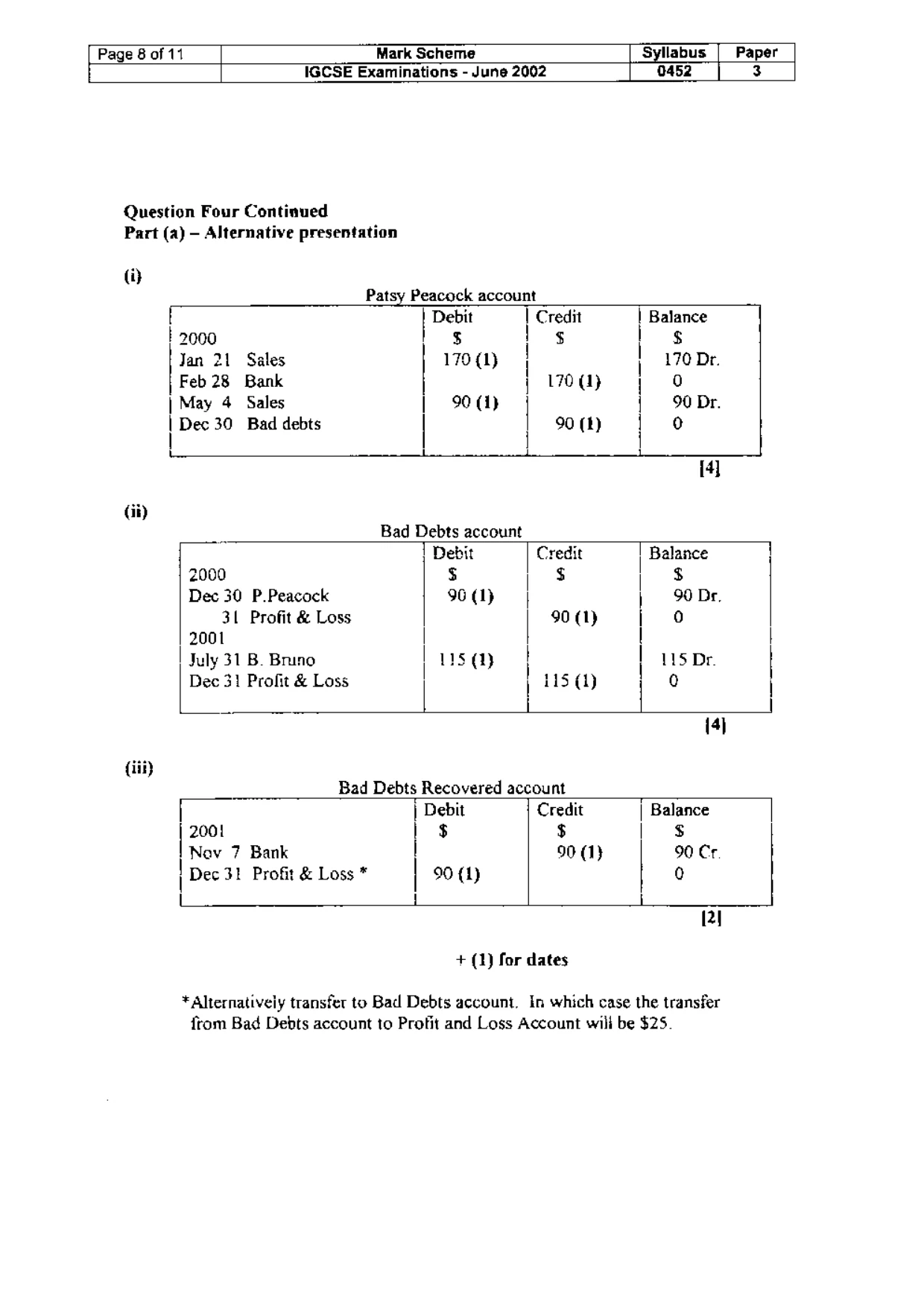
Page 8 of 11 Mark Scheme Syllabus Paper IGCSE Examinations - June 2002 0452 3 Question Four Continued Part (a) — Alternative presentation @ Patsy Peacock account f Debit | Credit | Balance 2000 $ los los Jan 21 Sales 1791) | 170 Dr. Feb 28 Bank ; Gp 4 0 | May 4 Sales | 90 (1) { 90Dr. | Dec 30 Bad debts | 90(t) =| 0 i ee a nNeNND mat | [4] Gi) Bad Debts account T Debit Credit | Balance | 2000 $ $ $ Dec 30 P.Peacock 96 (1) 90 Dr. 31 Profit & Loss 90 (1) 0 2001 | | | July 31 B. Bruno | visqy 115 Dr. Dec 31! Profit & Loss | \ 115 @) 0G | _. | | (4) {iii} Bad Debts Recovered account j Debit Credit | Balance 2001 1 $ $ $ Nov 7 Bank | 90 (1) 90 Cr | Dec 31 Profit & Loss * 90 (1) 0 l 1 L [2] + (1) for dates * Alternatively transfer to Bad Debts account. In which case the transfer from Bad Debts account to Profit and Loss Account will be $25.
Mark scheme, page 10
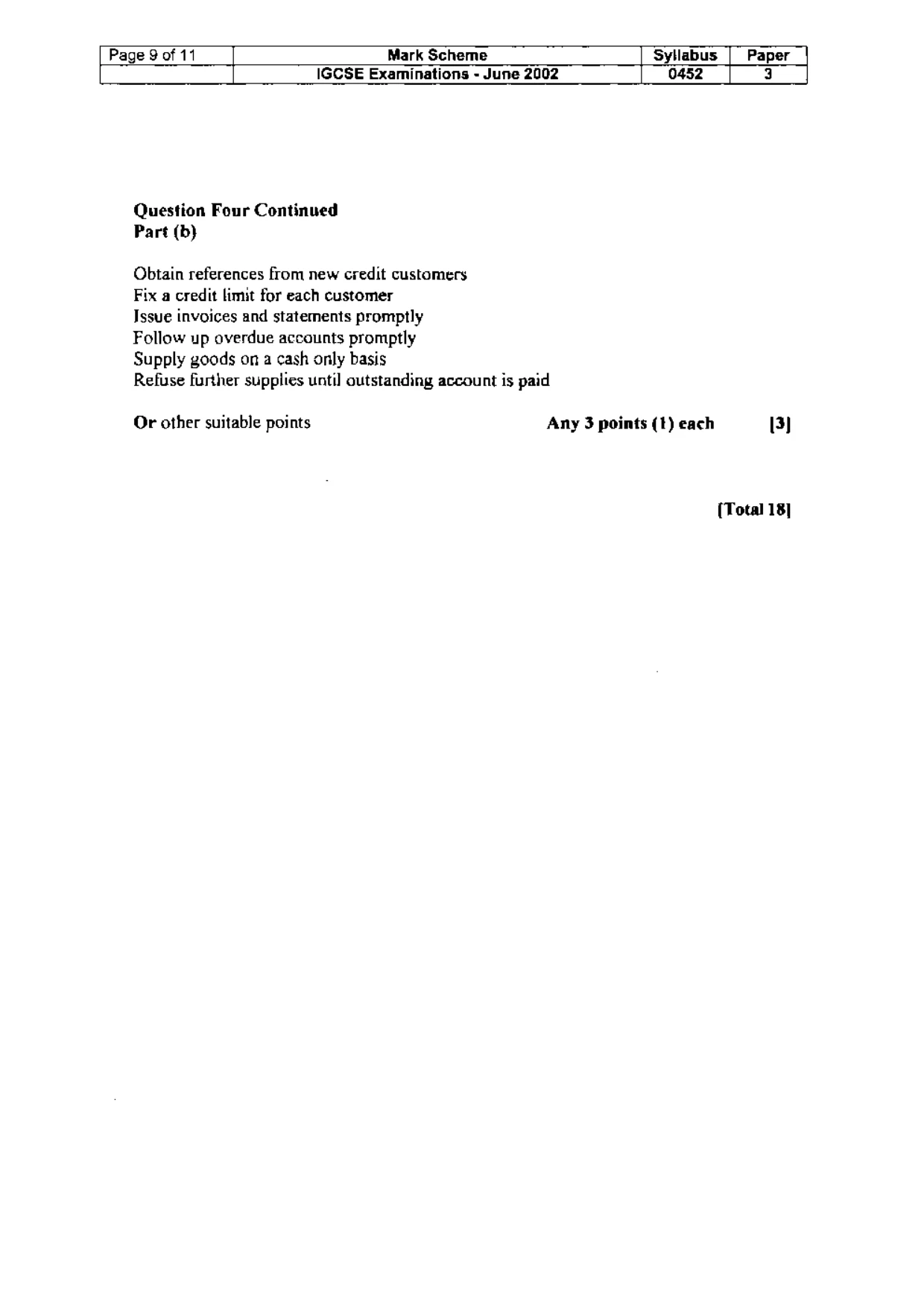
Page 9 of 11 | Mark Scheme | Syllabus | Paper IGCSE Examinations - June 2002 0452 Question Four Continued Part (b) Obtain references from new credit customers Fix a credit limit for each customer Issue invoices and statements promptly Follow up overdue accounts promptly Supply goods on a cash only basis Refuse further supplies unti] outstanding account is paid Or other suitable points Any 3 points (t) each (3) (Total 18]
Mark scheme, page 11
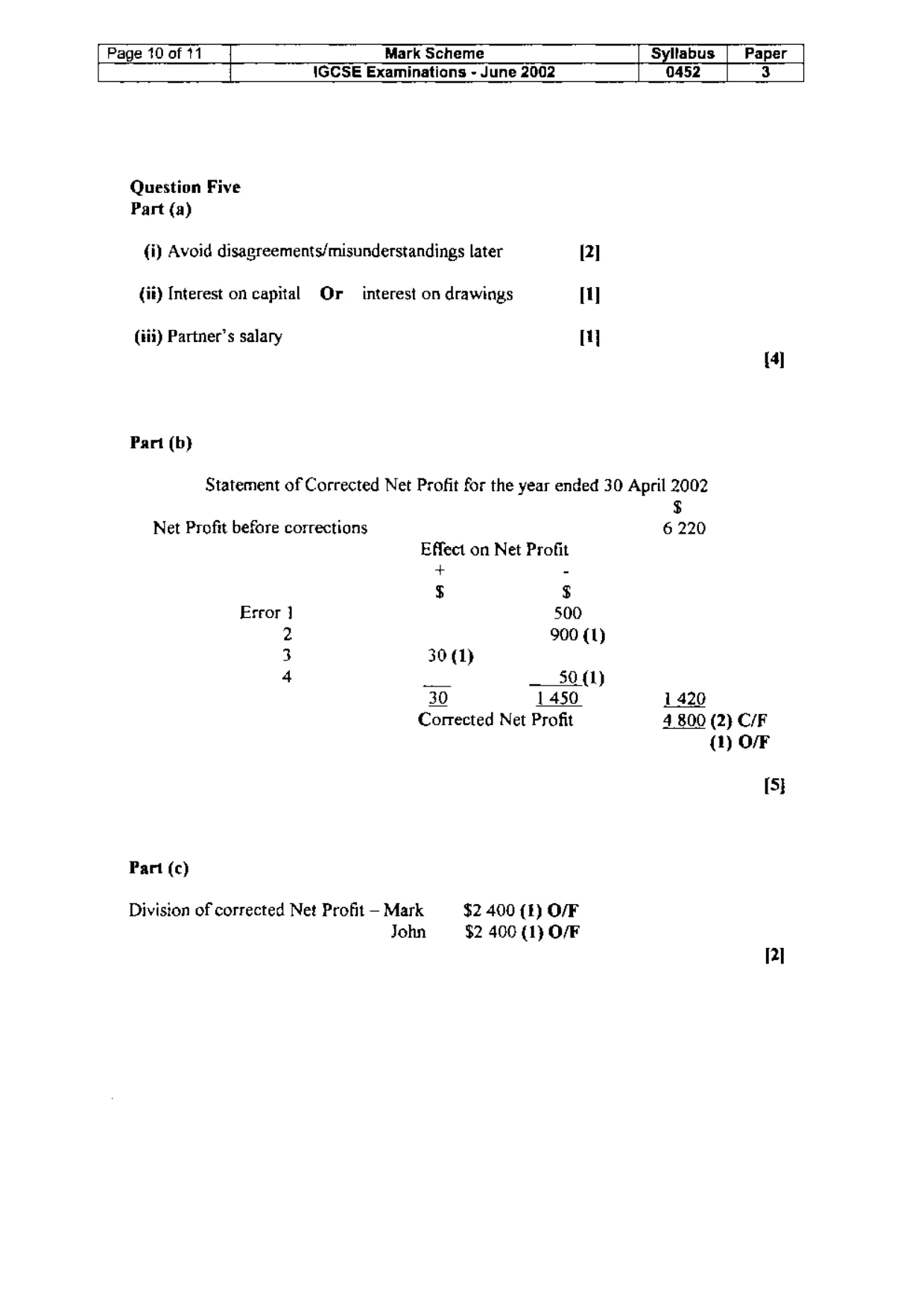
Page 100711 | Mark Scheme Syllabus | Paper { IGCSE Examinations - June 2002 0452 3 Question Five Part (a) (i) Avoid disagreements/misunderstandings later [2] (ii) Interest on capital Or interest on drawings [] (iii) Partner’s salary fy 4] Part (b} Statement of Corrected Net Profit for the year ended 30 April 2002 $ Net Profit before corrections 6 220 Effect on Net Profit + - $ $ Error } 500 2 900 (1) 3 30 (1) 4 __ 50 (1) 30 1450 1420 Corrected Net Profit 4 800 (2) C/F (1) O/F [5} Part (c) Division of corrected Net Profit — Mark $2 400 (£) O/F John ‘$2. 400 (1) O/F [I
Mark scheme, page 12
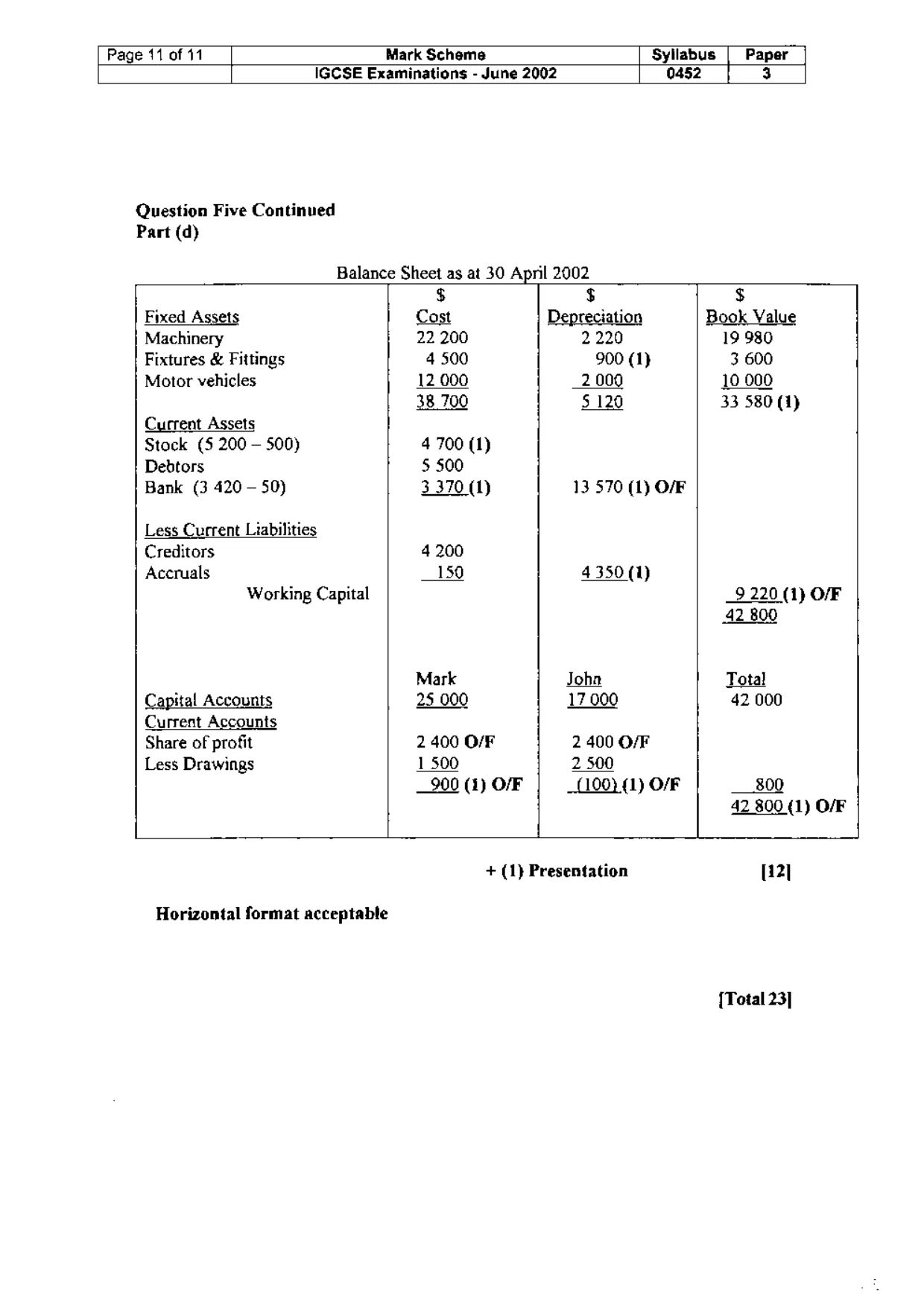
Page {1 o0fi1_ | Mark Scheme Syllabus | Paper | [ IGCSE Examinations - June 2002 0452 3 | Question Five Continued Part (d) Balance Sheet as at 30 April 2002 $ $ $ Fixed Assets Cost Depreciation Book Value Machinery 22 200 2220 19 980 Fixtures & Fittings 4 500 900 (1} 3 600 Motor vehicles 12 000 2.000 10 000 38 700 5120 33 580 (1) Current Assets Stock (5 200 - 500) 4 700 (1) Debtors 5 $00 Bank (3 420 — 50) 3.370 (1) 13 570 (1) O/F Less Current Liabilities Creditors 4 200 Accruals 150 4350 (1) Working Capital 9 220 (1) O/F 42 800 Mark Joha Total Capital Accounts 25 000 17.000 42 000 Current Accounts Share of profit 2 400 O/F 2 400 O/F Less Drawings 1500 2 500 900 (1) O/F (100) (1) O/F 800 42 800 (1) O/F + (1) Presentation [12] Horizontal format acceptable {Total 23]
Mark scheme, page 13
CAMBRIDGE INTERNATIONAL EXAMINATIONS JUNE 2002 INTERNATIONAL GCSE MARK SCHEME ADDITIONAL NOTES SYLLABUS/COMPONENT : 0452/3 ACCOUNTING aon UnIversity of CAMBRIDGE Local Examinations Syndicate
Mark scheme, page 14
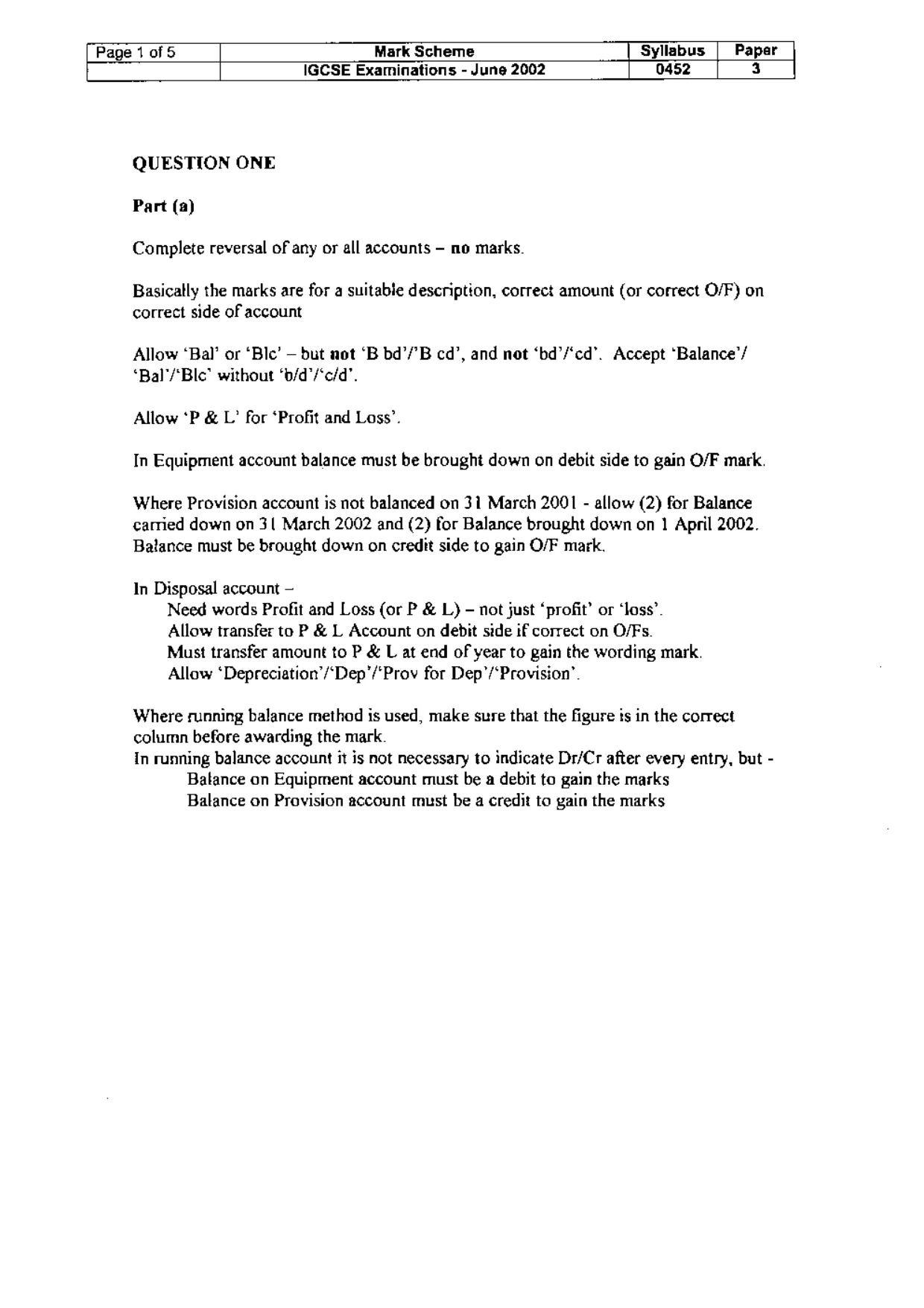
[Page 1 of 5 Mark Scheme ‘Syllabus | Paper t IGCSE Examinations - June 2002 0452 3 QUESTION ONE Part (a) Complete reversal of any or all accounts - no marks. Basicatly the marks are for a suitable description, correct amount (or correct O/F) on correct side of account Allow ‘Bal’ or ‘Ble’ — but aot ‘B bd’/’B cd’, and not ‘bd’/‘cd’. Accept ‘Balance’/ ‘Bal’/‘Ble’ without ‘b/d’/‘c/d’. Allow ‘P & L’ for ‘Profit and Loss’. In Equipment account balance must be brought down on debit side to gain O/F mark. Where Provision account is not balanced on 31 March 2001 - allow (2) for Balance carried down on 3 March 2002 and (2) for Balance brought down on 1 April 2002. Balance must be brought down on credit side to gain O/F mark. In Disposal account — Need words Profit and Loss (or P & L) — not just ‘profit’ or ‘loss’. Allow transfer to P & L Account on debit side if correct on O/Fs. Must transfer amount to P & L at end of year to gain the wording mark. Allow ‘Depreciation’/‘Dep’/‘Prov for Dep’/‘Provision’. Where running balance method is used, make sure that the figure is in the correct column before awarding the mark In running balance account it is not necessary to indicate Dr/Cr after every entry, but - Batance on Equipment account must be a debit to gain the marks Balance on Provision account must be a credit to gain the marks
Mark scheme, page 15
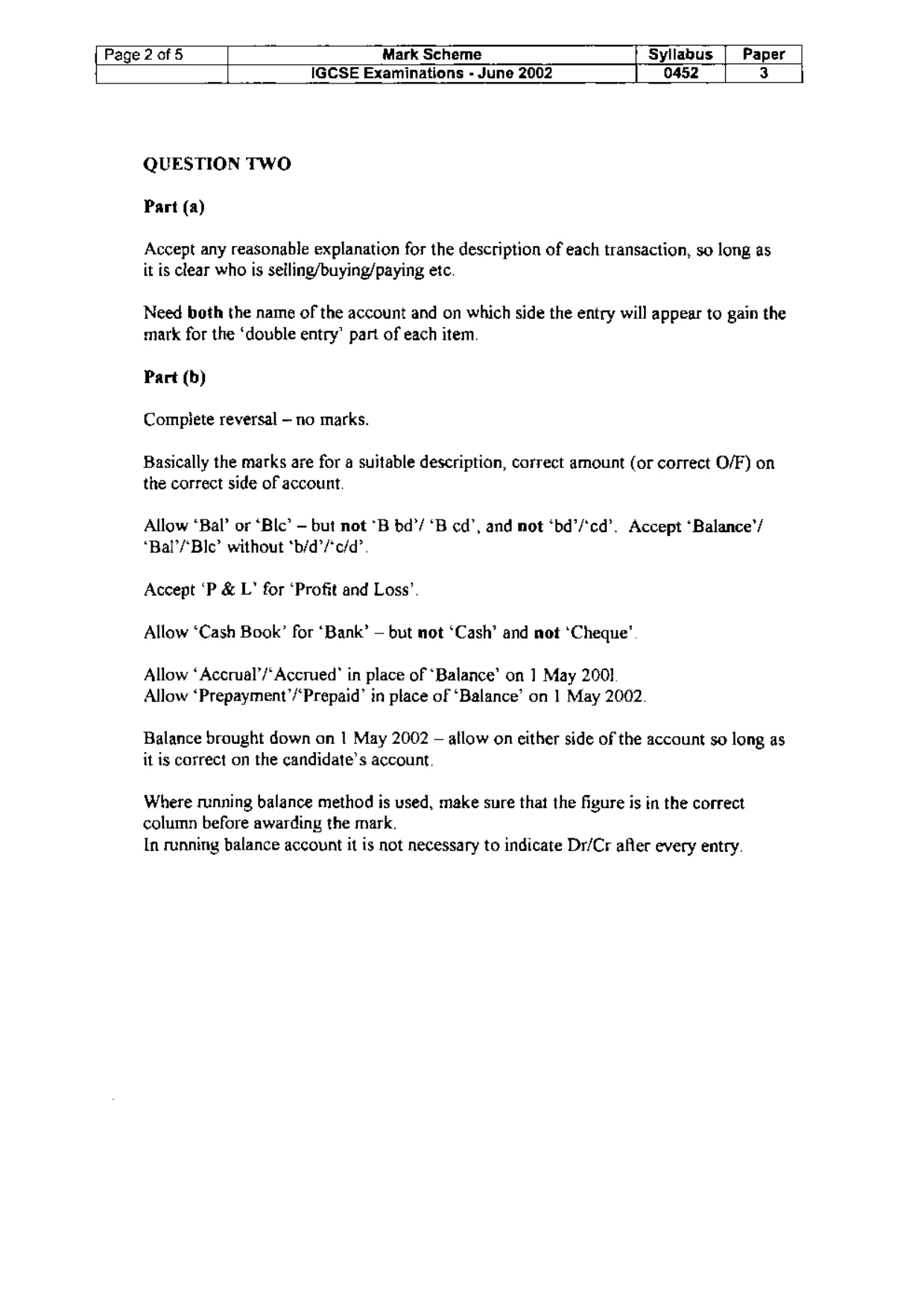
Page 2 of & Mark Scheme Syllabus Paper IGCSE Examinations - June 2002 [0452 | 3 QUESTION TWO Part (a) Accept any reasonable explanation for the description of each transaction, so long as it is clear who is selling/buying/paying etc. Need both the name of the account and on which side the entry will appear to gain the mark for the ‘double entry’ part of each item Part (b) Complete reversal — no marks. Basically the marks are for a suitable description, correct amount (or correct O/F) on the correct side of account. Allow ‘Bal’ or “Blc’ — but not “B bd’/ ‘B cd’, and not ‘bd’/‘cd’. Accept ‘Balance’/ “Bal’/‘Bic’ without ‘b/d’/‘c/d’. Accept ‘P & L’ for ‘Profit and Loss’ Allow ‘Cash Book’ for ‘Bank’ — but not ‘Cash’ and not ‘Cheque’ Allow ‘Accrual’/*Accrued’ in place of ‘Balance’ on 1 May 2001 Allow ‘Prepayment’/‘Prepaid’ in place of ‘Balance’ on 1 May 2002. Balance brought down on | May 2002 — allow on either side of the account so long as it is correct on the candidate’s account. Where mnning balance method is used, make sure that the figure is in the correct column before awarding the mark. In running balance account it is not necessary to indicate Dr/Cr afer every entry.
Mark scheme, page 16
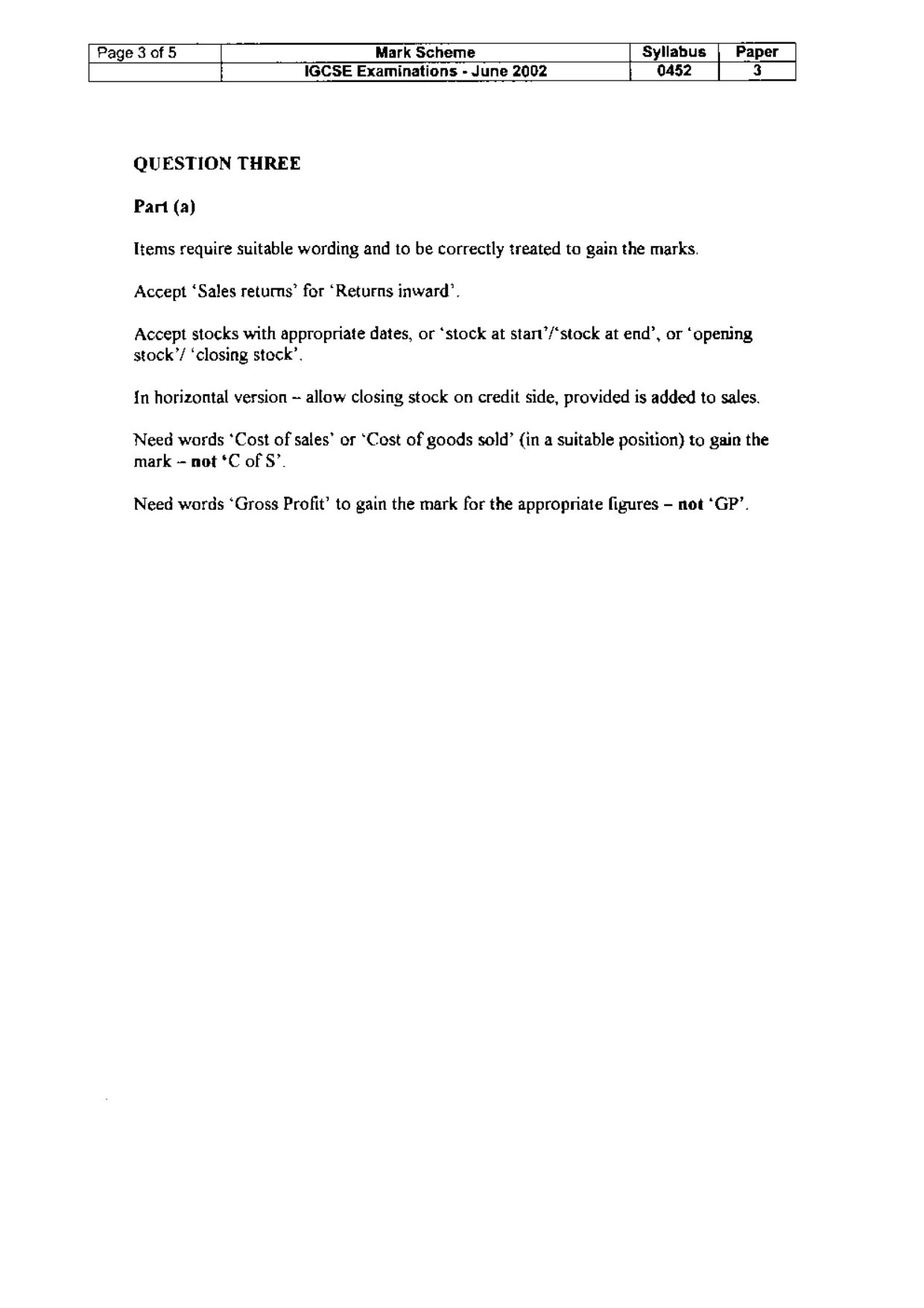
Syllabus Paper_| Page 3 of 5 Mark Scheme IGCSE Examinations - June 2002 0452 QUESTION THREE Part (a) Items require suitable wording and to be correctly treated to gain the marks. Accept ‘Sales returns’ for ‘Returns inward’. Accept stocks with appropriate dates, or ‘stock at start’/‘stock at end’, or ‘opening, stock’/ ‘closing stock’. in horizontal version ~ allow closing stock on credit side, provided is added to sales. Need words ‘Cost of sales’ or ‘Cost of goods sold’ (in a suitable position) to gain the mark — not °C of S’. Need words ‘Gross Profit’ to gain the mark for the appropriate figures - not ‘GP’.
Mark scheme, page 17
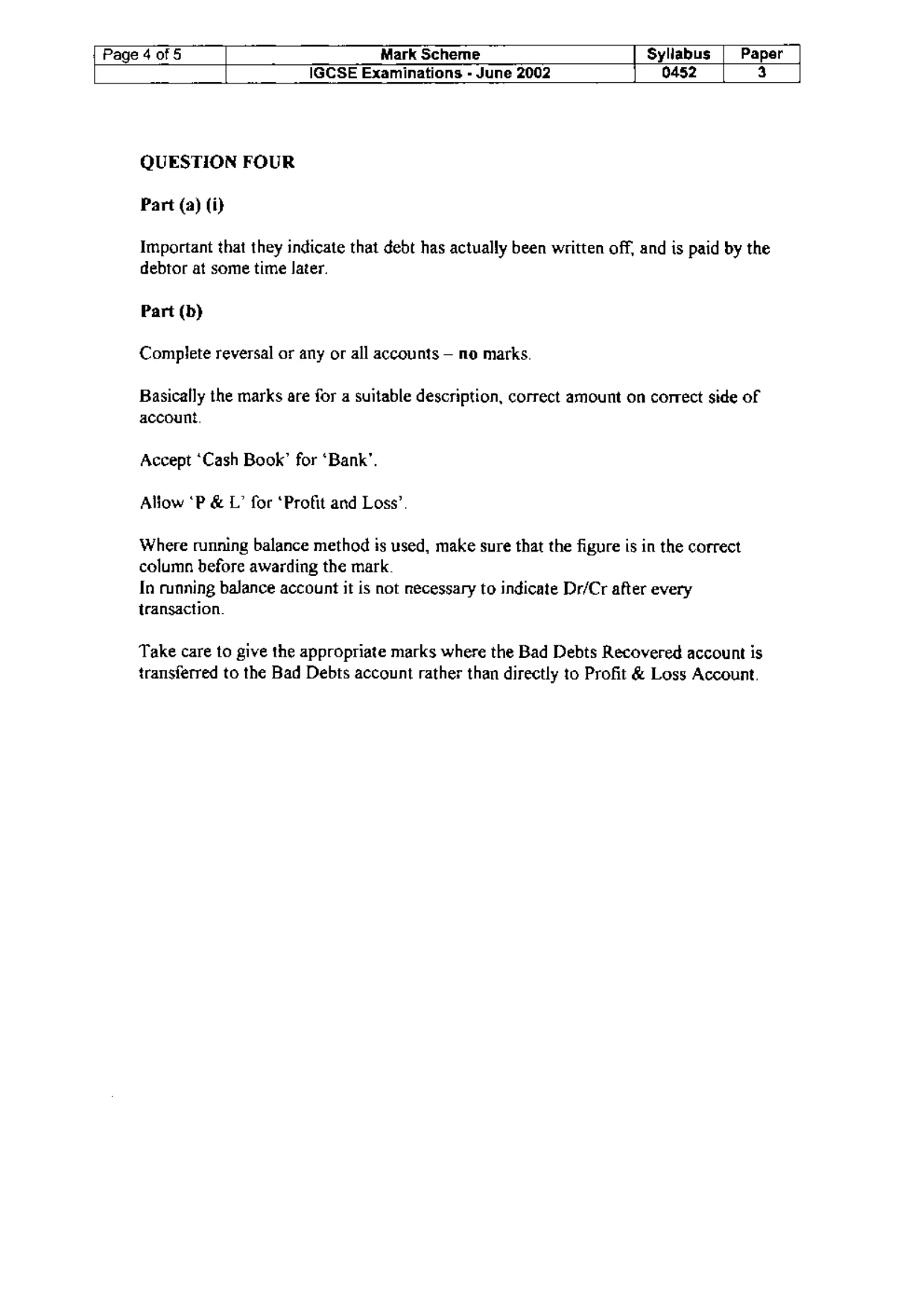
Page 4 of 5 Mark Scheme Syllabus | Paper IGCSE Examinations - June 2002 0452 3 QUESTION FOUR Part (a) (i) Important that they indicate that debt has actually been written off, and is paid by the debtor at some time later. Part (b) Complete reversal or any or all accounts — no marks. Basically the marks are for a suitable description, correct amount on correct side of account. Accept ‘Cash Book’ for ‘Bank’. Aliow ‘P & L’ for ‘Profit and Loss’. Where running balance method is used, make sure that the figure is in the correct column before awarding the mark In cunning balance account it is not necessary to indicate Dr/Cr after every transaction. Take care to give the appropriate marks where the Bad Debts Recovered account is transferred to the Bad Debts account rather than directly to Profit & Loss Account.
Mark scheme, page 18
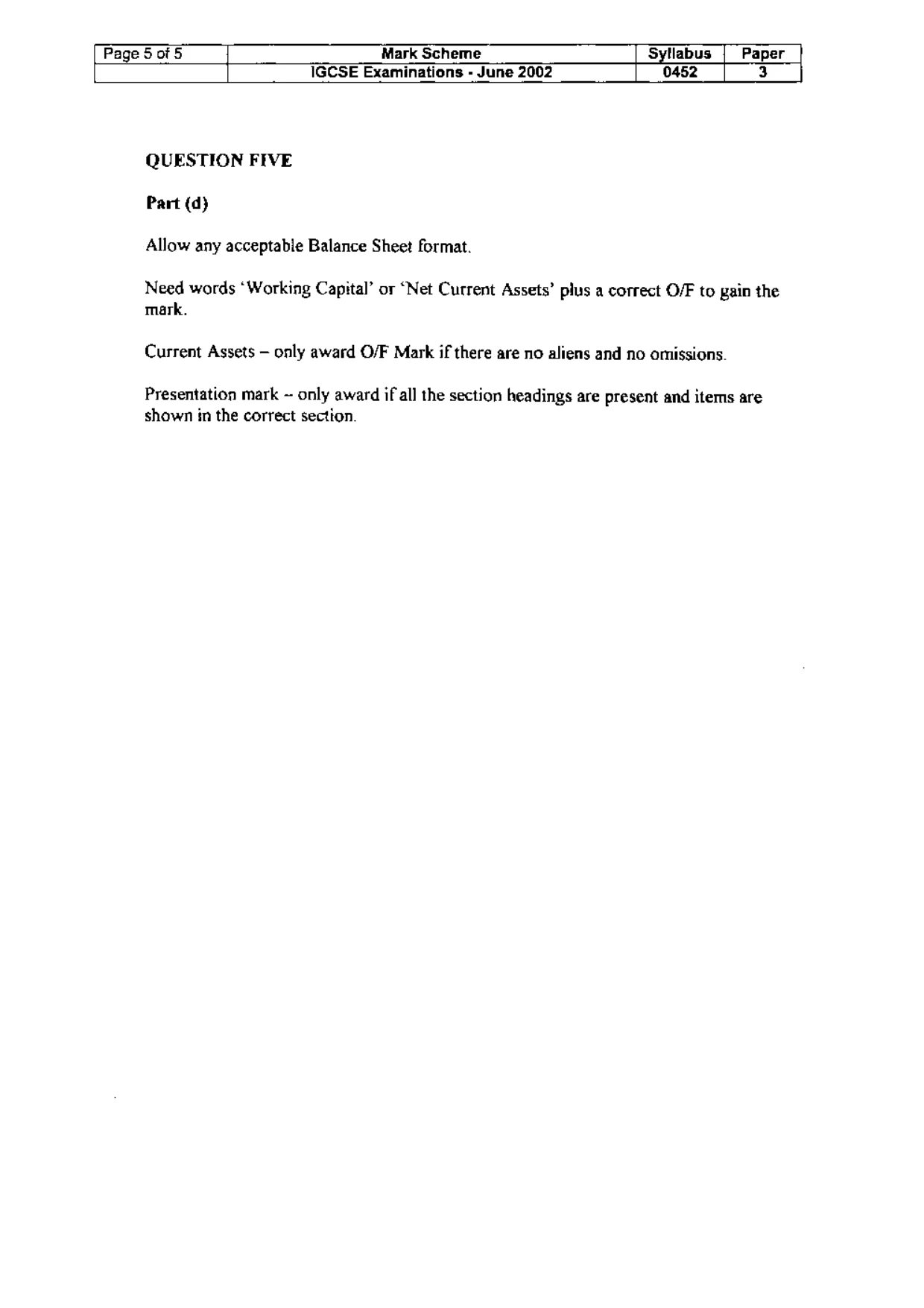
Page 5 of 5 Mark Scheme | Sytiabus [Paper } IGCSE Examinations - June 2002 [0452 3 QUESTION FIVE Part (d) Allow any acceptable Balance Sheet format. Need words ‘Working Capital’ or “Net Current Assets’ plus a correct O/F to gain the mark. Current Assets — only award O/F Mark if there are no aliens and no omissions. Presentation mark - only award if all the section headings are present and items are shown in the correct section.