Cambridge A Level Thinking Skills 9694 — 2025 May/June Paper 3 · Variant 1
9694/31/M/J/25 · 4 questions · 50 marks · ≈56 min
The question paper and its mark scheme, free to read here and free to download. This is Cambridge’s own paper, exactly as it was sat.
Question paper8 pages


Mark scheme10 pages
Answers below. Sit the paper first if you are practising.
Questions as text
Q1 · All the episodes of four recent television dramas are available to rent in boxsets
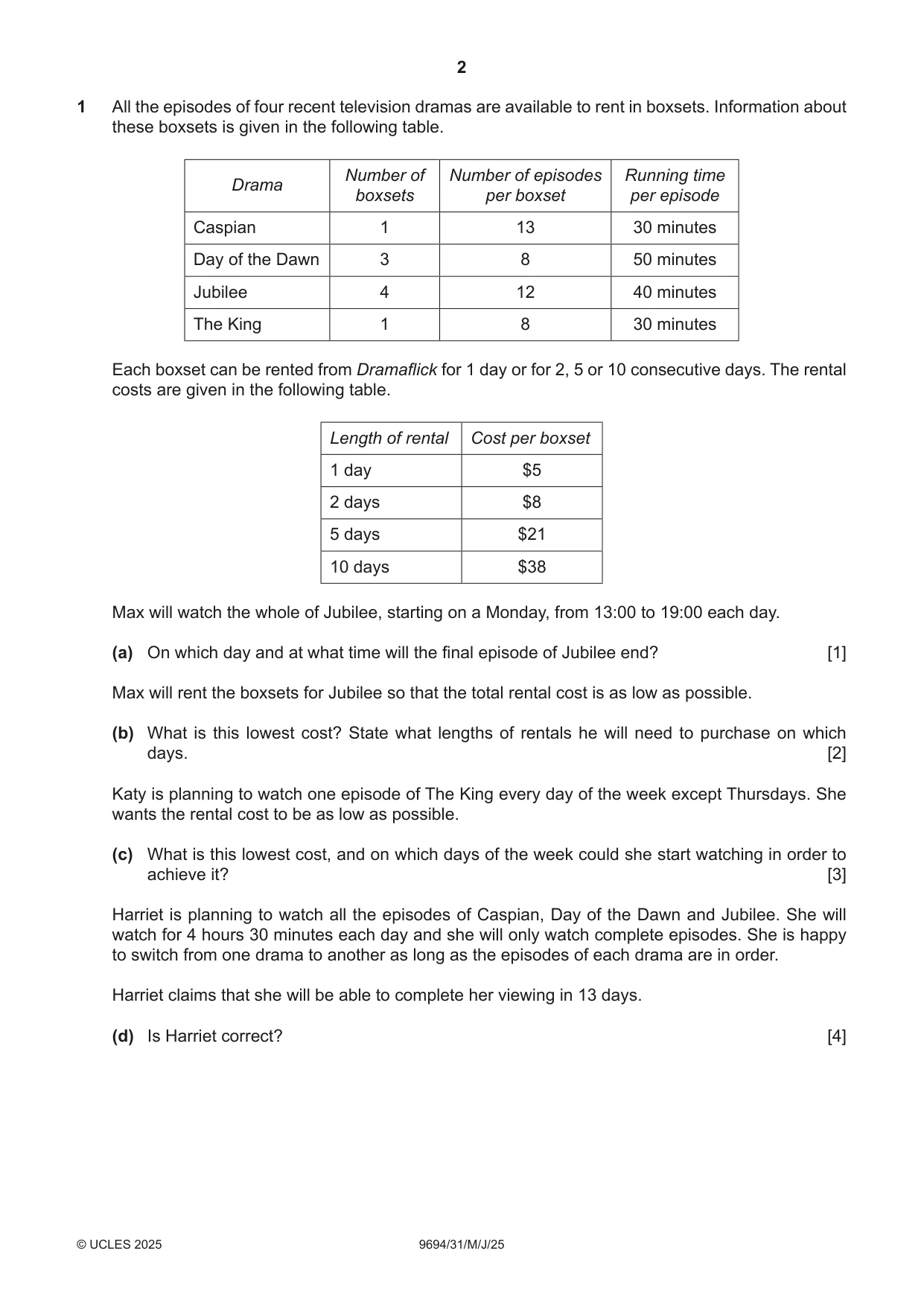
1 All the episodes of four recent television dramas are available to rent in boxsets. Information about these boxsets is given in the following table. Number of Number of episodes Running time Drama boxsets per boxset per episode Caspian 1 13 30 minutes Day of the Dawn 3 8 50 minutes Jubilee 4 12 40 minutes The King 1 8 30 minutes Each boxset can be rented from Dramaflick for 1 day or for 2, 5 or 10 consecutive days. The rental costs are given in the following table. Length of rental Cost per boxset 1 day $5 2 days $8 5 days $21 10 days $38 Max will watch the whole of Jubilee, starting on a Monday, from 13:00 to 19:00 each day. (a) On which day and at what time will the final episode of Jubilee end? [1] Max will rent the boxsets for Jubilee so that the total rental cost is as low as possible. (b) What is this lowest cost? State what lengths of rentals he will need to purchase on which days. [2] Katy is planning to watch one episode of The King every day of the week except Thursdays. She wants the rental cost to be as low as possible. (c) What is this lowest cost, and on which days of the week could she start watching in order to achieve it? [3] Harriet is planning to watch all the episodes of Caspian, Day of the Dawn and Jubilee. She will watch for 4 hours 30 minutes each day and she will only watch complete episodes. She is happy to switch from one drama to another as long as the episodes of each drama are in order. Harriet claims that she will be able to complete her viewing in 13 days. (d) Is Harriet correct? [4] [Turn over for Question 2]
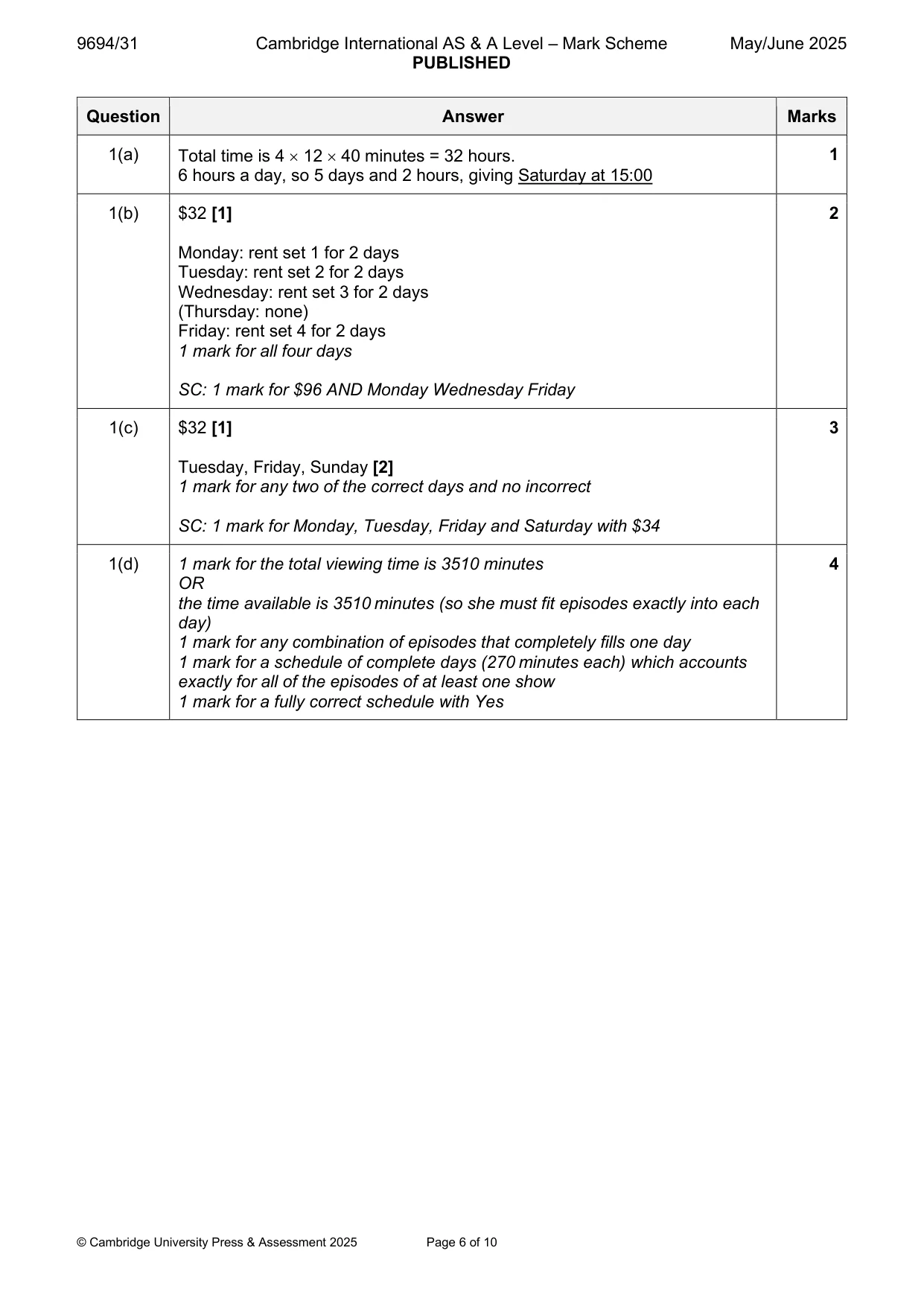
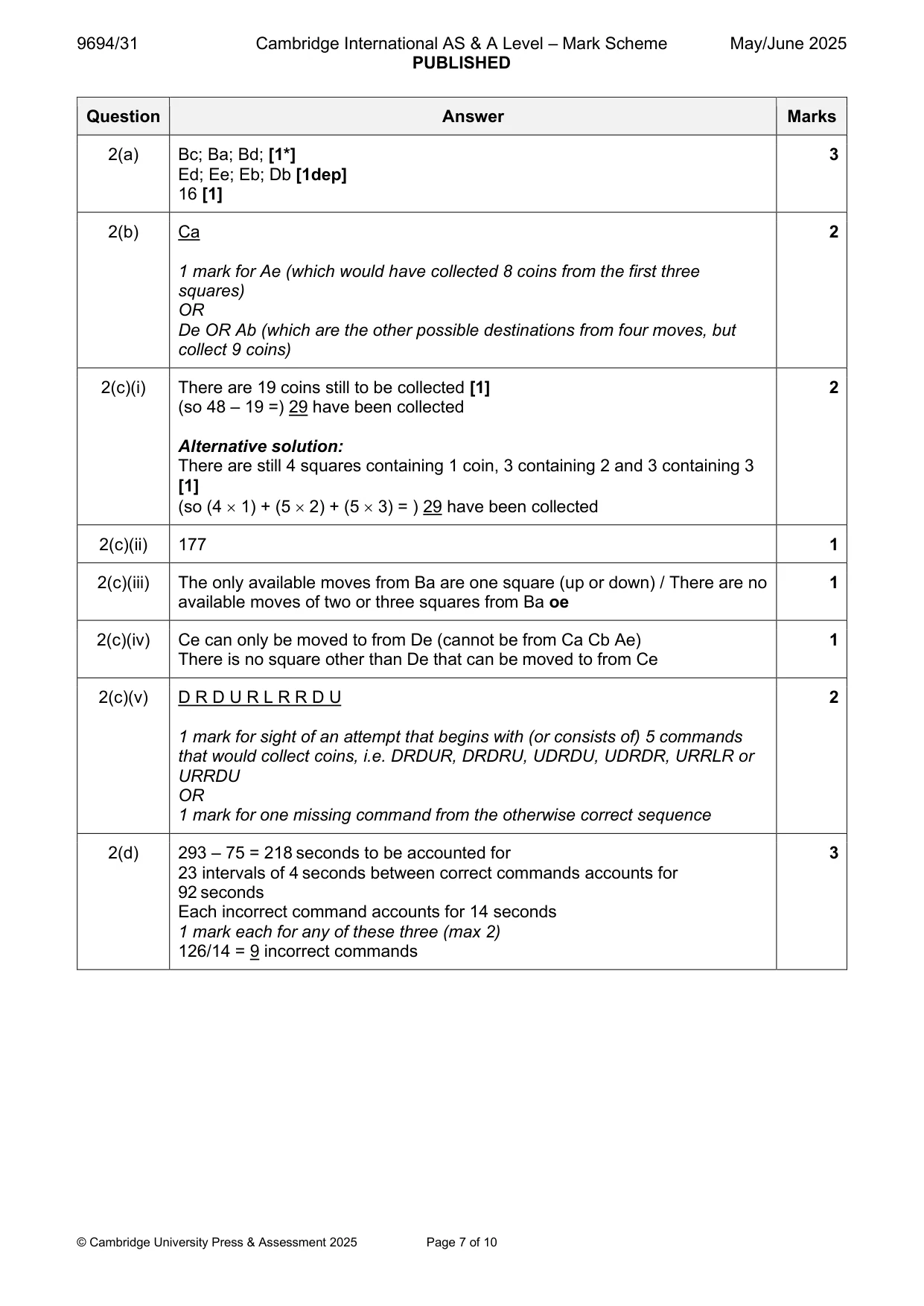
Mark scheme: Question Answer Marks 1(a) Total time is 4 12 40 minutes = 32 hours. 1 6 hours a day, so 5 days and 2 hours, giving Saturday at 15:00 1(b) $32 [1] 2 Monday: rent set 1 for 2 days Tuesday: rent set 2 for 2 days Wednesday: rent set 3 for 2 days (Thursday: none) Friday: rent set 4 for 2 days 1 mark for all four days SC: 1 mark for $96 AND Monday Wednesday Friday 1(c) $32 [1] 3 Tuesday, Friday, Sunday [2] 1 mark for any two of the correct days and no incorrect SC: 1 mark for Monday, Tuesday, Friday and Saturday with $34 1(d) 1 mark for the total viewing time is 3510 minutes 4 OR the time available is 3510 minutes (so she must fit episodes exactly into each day) 1 mark for any combination of episodes that completely fills one day 1 mark for a schedule of complete days (270 minutes each) which accounts exactly for all of the episodes of at least one show 1 mark for a fully correct schedule with Yes
More questions on Identify cases that satisfy given criteria
Q2 · Gold Grab is a computer game for one player, in which gold coins are collected in a…
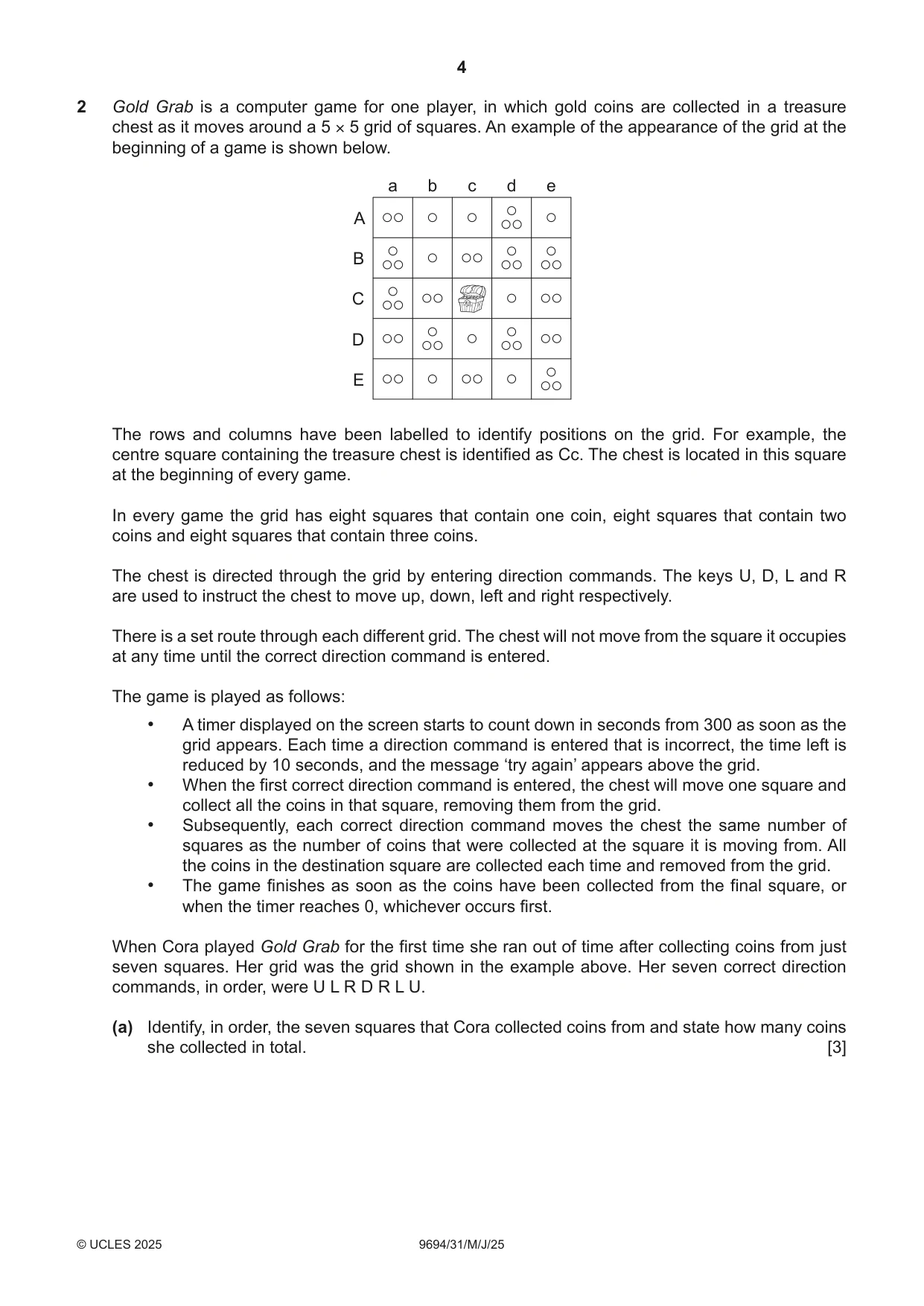
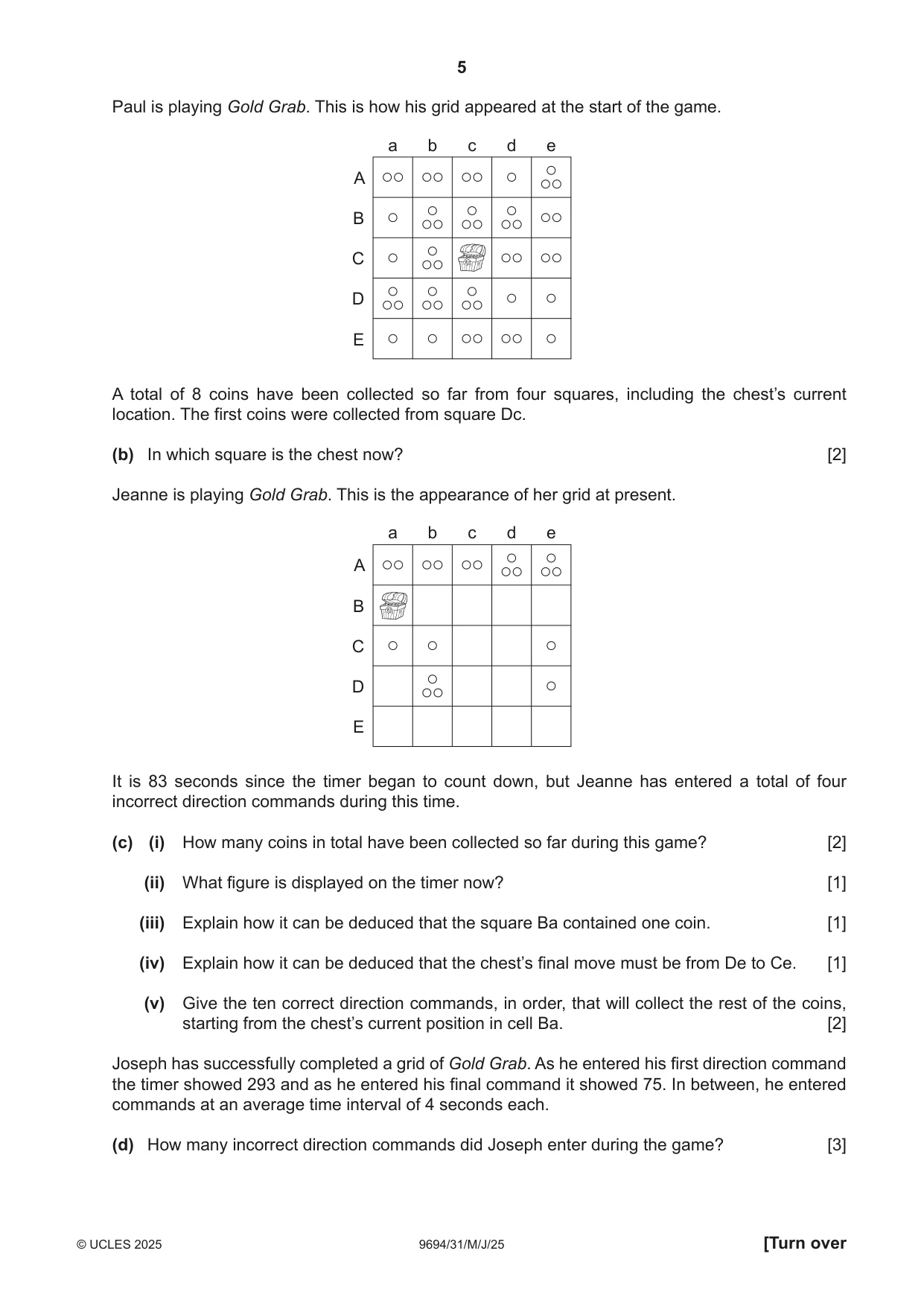
2 Gold Grab is a computer game for one player, in which gold coins are collected in a treasure chest as it moves around a 5 × 5 grid of squares. An example of the appearance of the grid at the beginning of a game is shown below. a b c d e A B C D E The rows and columns have been labelled to identify positions on the grid. For example, the centre square containing the treasure chest is identified as Cc. The chest is located in this square at the beginning of every game. In every game the grid has eight squares that contain one coin, eight squares that contain two coins and eight squares that contain three coins. The chest is directed through the grid by entering direction commands. The keys U, D, L and R are used to instruct the chest to move up, down, left and right respectively. There is a set route through each different grid. The chest will not move from the square it occupies at any time until the correct direction command is entered. The game is played as follows: • A timer displayed on the screen starts to count down in seconds from 300 as soon as the grid appears. Each time a direction command is entered that is incorrect, the time left is reduced by 10 seconds, and the message ‘try again’ appears above the grid. • When the first correct direction command is entered, the chest will move one square and collect all the coins in that square, removing them from the grid. • Subsequently, each correct direction command moves the chest the same number of squares as the number of coins that were collected at the square it is moving from. All the coins in the destination square are collected each time and removed from the grid. • The game finishes as soon as the coins have been collected from the final square, or when the timer reaches 0, whichever occurs first. When Cora played Gold Grab for the first time she ran out of time after collecting coins from just seven squares. Her grid was the grid shown in the example above. Her seven correct direction commands, in order, were U L R D R L U. (a) Identify, in order, the seven squares that Cora collected coins from and state how many coins she collected in total. [3] Paul is playing Gold Grab. This is how his grid appeared at the start of the game. a b c d e A B C D E A total of 8 coins have been collected so far from four squares, including the chest’s current location. The first coins were collected from square Dc. (b) In which square is the chest now? [2] Jeanne is playing Gold Grab. This is the appearance of her grid at present. a b c d e A B C D E It is 83 seconds since the timer began to count down, but Jeanne has entered a total of four incorrect direction commands during this time. (c) (i) How many coins in total have been collected so far during this game? [2] (ii) What figure is displayed on the timer now? [1] (iii) Explain how it can be deduced that the square Ba contained one coin. [1] (iv) Explain how it can be deduced that the chest’s final move must be from De to Ce. [1] (v) Give the ten correct direction commands, in order, that will collect the rest of the coins, starting from the chest’s current position in cell Ba. [2] Joseph has successfully completed a grid of Gold Grab. As he entered his first direction command the timer showed 293 and as he entered his final command it showed 75. In between, he entered commands at an average time interval of 4 seconds each. (d) How many incorrect direction commands did Joseph enter during the game? [3]
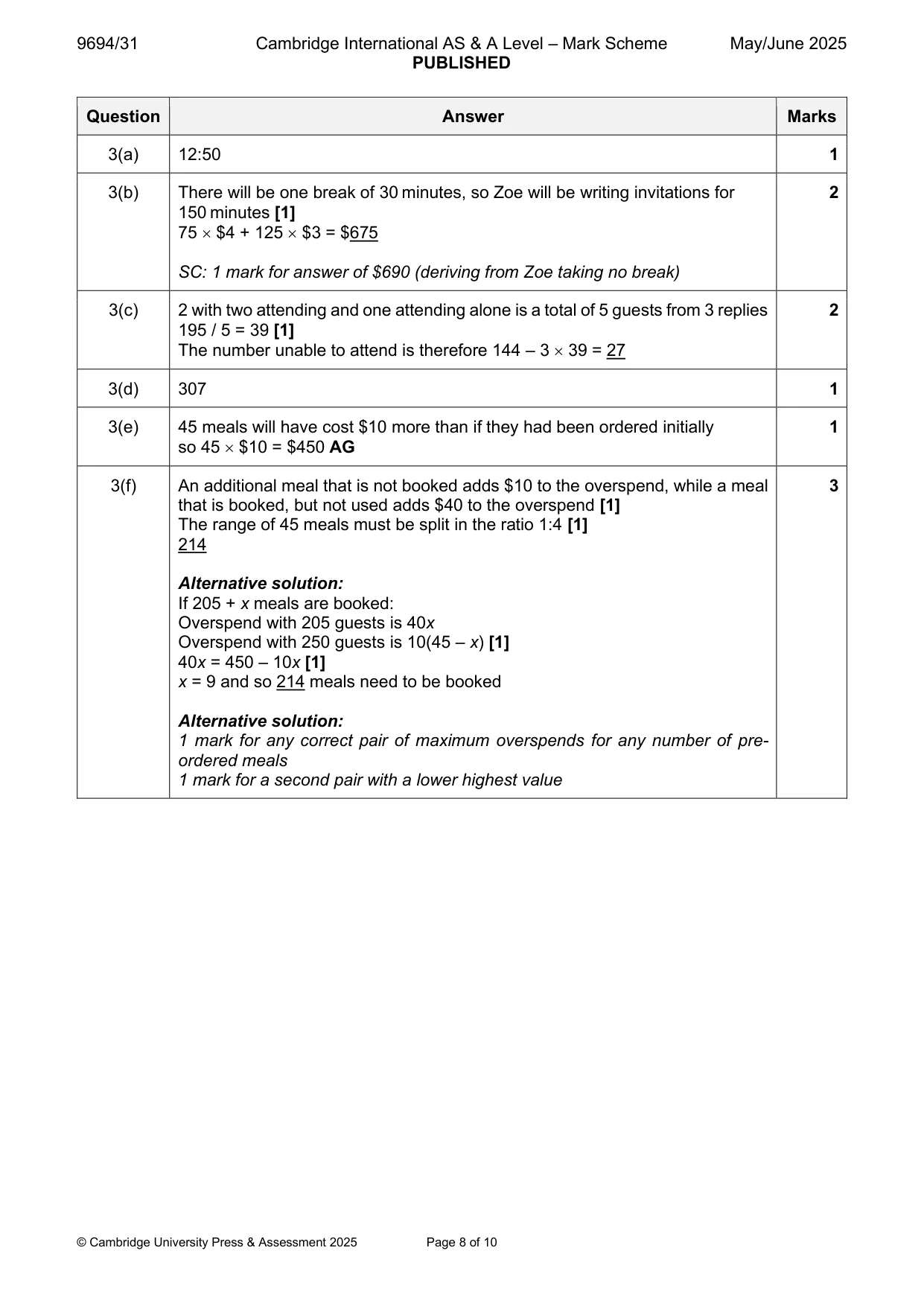
Mark scheme: 2(a) Bc; Ba; Bd; [1*] 3 Ed; Ee; Eb; Db [1dep] 16 [1] 2(b) Ca 2 1 mark for Ae (which would have collected 8 coins from the first three squares) OR De OR Ab (which are the other possible destinations from four moves, but collect 9 coins) 2(c)(i) There are 19 coins still to be collected [1] 2 (so 48 – 19 =) 29 have been collected Alternative solution: There are still 4 squares containing 1 coin, 3 containing 2 and 3 containing 3 [1] (so (4 1) + (5 2) + (5 3) = ) 29 have been collected 2(c)(ii) 177 1 2(c)(iii) The only available moves from Ba are one square (up or down) / There are no 1 available moves of two or three squares from Ba oe 2(c)(iv) Ce can only be moved to from De (cannot be from Ca Cb Ae) 1 There is no square other than De that can be moved to from Ce 2(c)(v) D R D U R L R R D U 2 1 mark for sight of an attempt that begins with (or consists of) 5 commands that would collect coins, i.e. DRDUR, DRDRU, UDRDU, UDRDR, URRLR or URRDU OR 1 mark for one missing command from the otherwise correct sequence 2(d) 293 – 75 = 218 seconds to be accounted for 3 23 intervals of 4 seconds between correct commands accounts for 92 seconds Each incorrect command accounts for 14 seconds 1 mark each for any of these three (max 2) 126/14 = 9 incorrect commands
More questions on Perform appropriate operations with information
Q3 · Alfred and Zoe are planning their wedding and need to send invitations to the guests
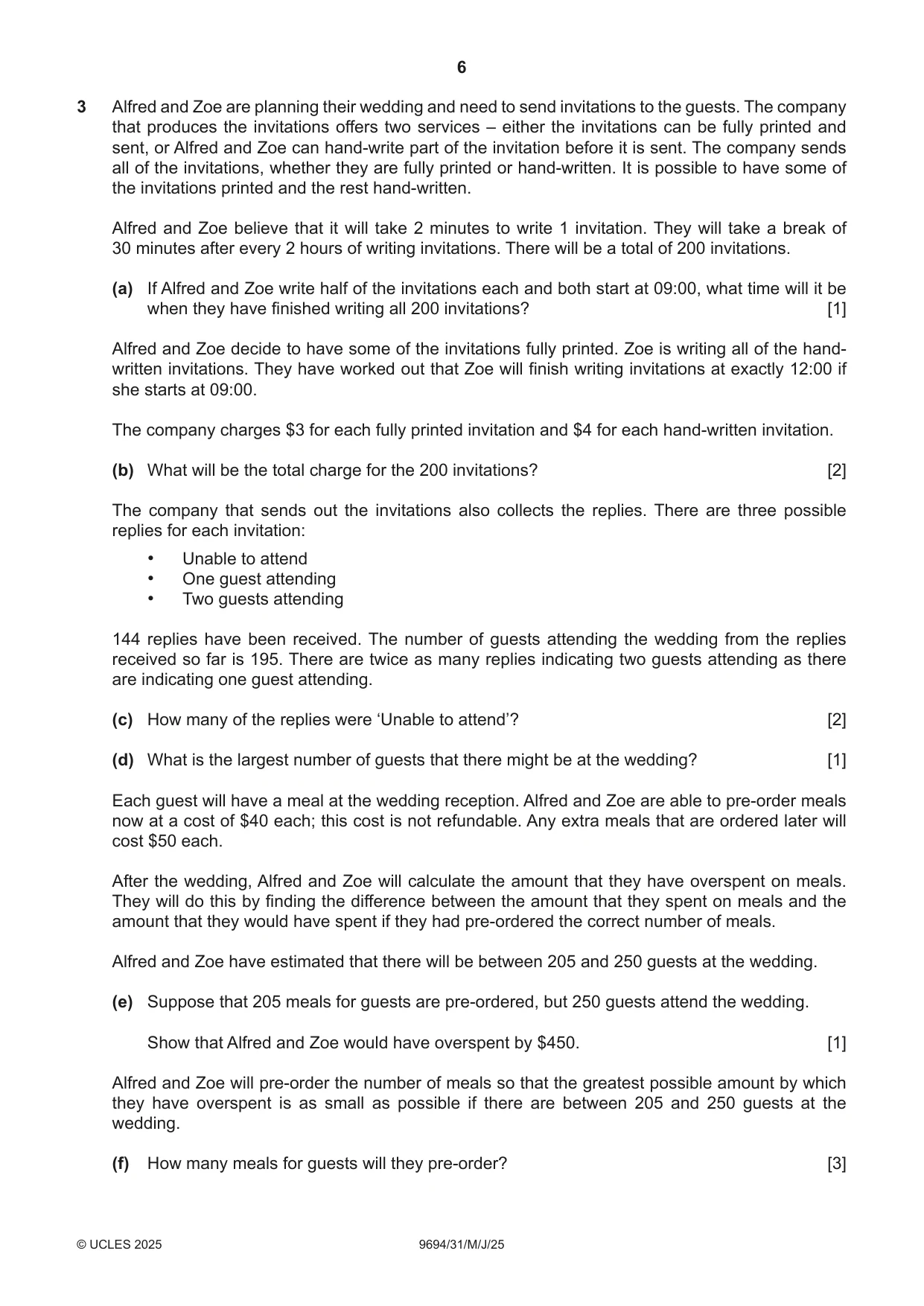
3 Alfred and Zoe are planning their wedding and need to send invitations to the guests. The company that produces the invitations offers two services – either the invitations can be fully printed and sent, or Alfred and Zoe can hand-write part of the invitation before it is sent. The company sends all of the invitations, whether they are fully printed or hand-written. It is possible to have some of the invitations printed and the rest hand-written. Alfred and Zoe believe that it will take 2 minutes to write 1 invitation. They will take a break of 30 minutes after every 2 hours of writing invitations. There will be a total of 200 invitations. (a) If Alfred and Zoe write half of the invitations each and both start at 09:00, what time will it be when they have finished writing all 200 invitations? [1] Alfred and Zoe decide to have some of the invitations fully printed. Zoe is writing all of the hand- written invitations. They have worked out that Zoe will finish writing invitations at exactly 12:00 if she starts at 09:00. The company charges $3 for each fully printed invitation and $4 for each hand-written invitation. (b) What will be the total charge for the 200 invitations? [2] The company that sends out the invitations also collects the replies. There are three possible replies for each invitation: • Unable to attend • One guest attending • Two guests attending 144 replies have been received. The number of guests attending the wedding from the replies received so far is 195. There are twice as many replies indicating two guests attending as there are indicating one guest attending. (c) How many of the replies were ‘Unable to attend’? [2] (d) What is the largest number of guests that there might be at the wedding? [1] Each guest will have a meal at the wedding reception. Alfred and Zoe are able to pre-order meals now at a cost of $40 each; this cost is not refundable. Any extra meals that are ordered later will cost $50 each. After the wedding, Alfred and Zoe will calculate the amount that they have overspent on meals. They will do this by finding the difference between the amount that they spent on meals and the amount that they would have spent if they had pre-ordered the correct number of meals. Alfred and Zoe have estimated that there will be between 205 and 250 guests at the wedding. (e) Suppose that 205 meals for guests are pre-ordered, but 250 guests attend the wedding. Show that Alfred and Zoe would have overspent by $450. [1] Alfred and Zoe will pre-order the number of meals so that the greatest possible amount by which they have overspent is as small as possible if there are between 205 and 250 guests at the wedding. (f) How many meals for guests will they pre-order? [3]
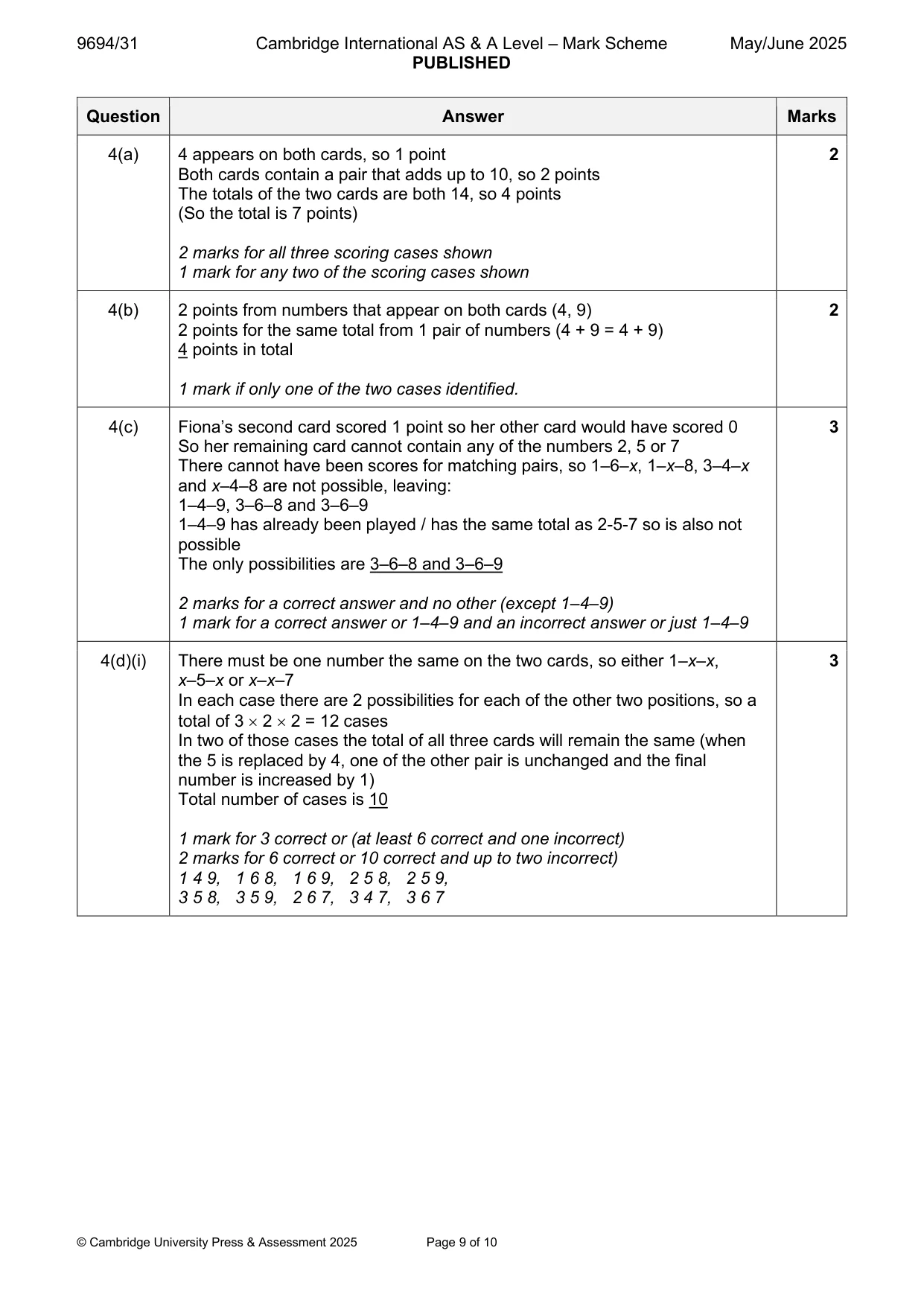
Mark scheme: 3(a) 12:50 1 3(b) There will be one break of 30 minutes, so Zoe will be writing invitations for 2 150 minutes [1] 75 $4 + 125 $3 = $675 SC: 1 mark for answer of $690 (deriving from Zoe taking no break) 3(c) 2 with two attending and one attending alone is a total of 5 guests from 3 replies 2 195 / 5 = 39 [1] The number unable to attend is therefore 144 – 3 39 = 27 3(d) 307 1 3(e) 45 meals will have cost $10 more than if they had been ordered initially 1 so 45 $10 = $450 AG 3(f) An additional meal that is not booked adds $10 to the overspend, while a meal 3 that is booked, but not used adds $40 to the overspend [1] The range of 45 meals must be split in the ratio 1:4 [1] 214 Alternative solution: If 205 + x meals are booked: Overspend with 205 guests is 40x Overspend with 250 guests is 10(45 – x) [1] 40x = 450 – 10x [1] x = 9 and so 214 meals need to be booked Alternative solution: 1 mark for any correct pair of maximum overspends for any number of pre- ordered meals 1 mark for a second pair with a lower highest value
More questions on Perform appropriate operations with information
Q4 · A game for two players is played with a set of cards
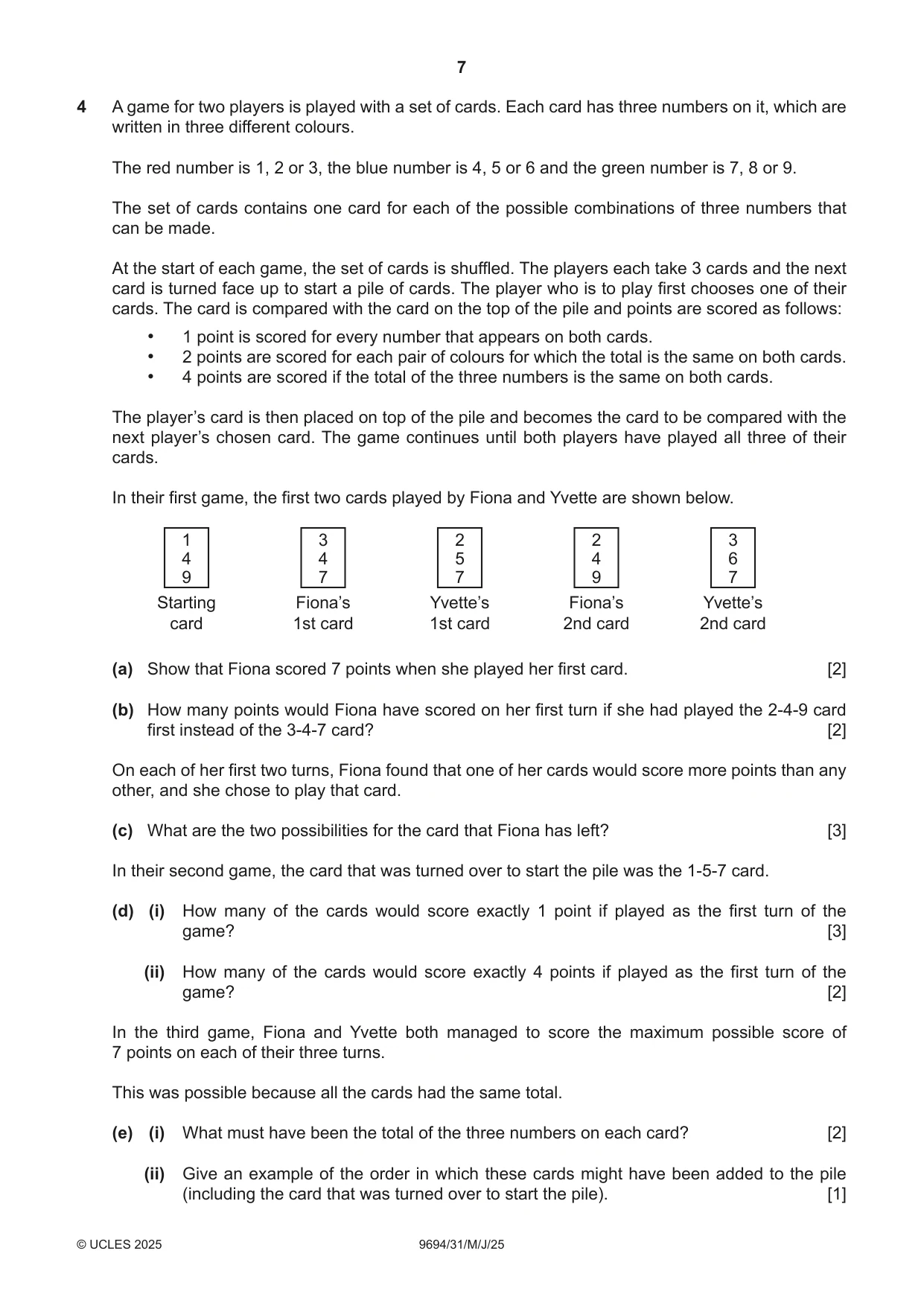
4 A game for two players is played with a set of cards. Each card has three numbers on it, which are written in three different colours. The red number is 1, 2 or 3, the blue number is 4, 5 or 6 and the green number is 7, 8 or 9. The set of cards contains one card for each of the possible combinations of three numbers that can be made. At the start of each game, the set of cards is shuffled. The players each take 3 cards and the next card is turned face up to start a pile of cards. The player who is to play first chooses one of their cards. The card is compared with the card on the top of the pile and points are scored as follows: • 1 point is scored for every number that appears on both cards. • 2 points are scored for each pair of colours for which the total is the same on both cards. • 4 points are scored if the total of the three numbers is the same on both cards. The player’s card is then placed on top of the pile and becomes the card to be compared with the next player’s chosen card. The game continues until both players have played all three of their cards. In their first game, the first two cards played by Fiona and Yvette are shown below. 1 3 2 2 3 4 4 5 4 6 9 7 7 9 7 Starting Fiona’s Yvette’s Fiona’s Yvette’s card 1st card 1st card 2nd card 2nd card (a) Show that Fiona scored 7 points when she played her first card. [2] (b) How many points would Fiona have scored on her first turn if she had played the 2-4-9 card first instead of the 3-4-7 card? [2] On each of her first two turns, Fiona found that one of her cards would score more points than any other, and she chose to play that card. (c) What are the two possibilities for the card that Fiona has left? [3] In their second game, the card that was turned over to start the pile was the 1-5-7 card. (d) (i) How many of the cards would score exactly 1 point if played as the first turn of the game? [3] (ii) How many of the cards would score exactly 4 points if played as the first turn of the game? [2] In the third game, Fiona and Yvette both managed to score the maximum possible score of 7 points on each of their three turns. This was possible because all the cards had the same total. (e) (i) What must have been the total of the three numbers on each card? [2] (ii) Give an example of the order in which these cards might have been added to the pile (including the card that was turned over to start the pile). [1]
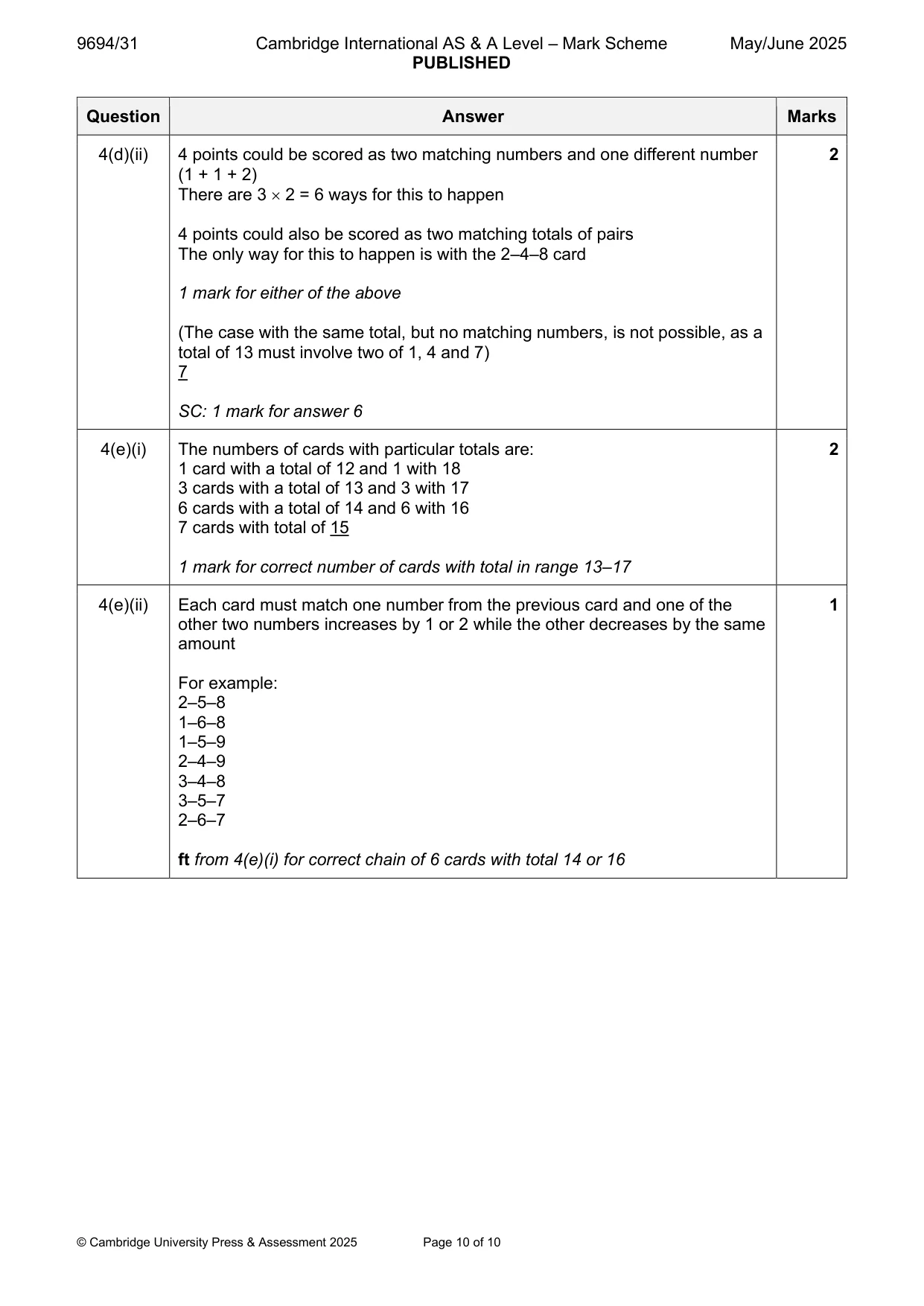
Mark scheme: 4(a) 4 appears on both cards, so 1 point 2 Both cards contain a pair that adds up to 10, so 2 points The totals of the two cards are both 14, so 4 points (So the total is 7 points) 2 marks for all three scoring cases shown 1 mark for any two of the scoring cases shown 4(b) 2 points from numbers that appear on both cards (4, 9) 2 2 points for the same total from 1 pair of numbers (4 + 9 = 4 + 9) 4 points in total 1 mark if only one of the two cases identified. 4(c) Fiona’s second card scored 1 point so her other card would have scored 0 3 So her remaining card cannot contain any of the numbers 2, 5 or 7 There cannot have been scores for matching pairs, so 1–6–x, 1–x–8, 3–4–x and x–4–8 are not possible, leaving: 1–4–9, 3–6–8 and 3–6–9 1–4–9 has already been played / has the same total as 2-5-7 so is also not possible The only possibilities are 3–6–8 and 3–6–9 2 marks for a correct answer and no other (except 1–4–9) 1 mark for a correct answer or 1–4–9 and an incorrect answer or just 1–4–9 4(d)(i) There must be one number the same on the two cards, so either 1–x–x, 3 x–5–x or x–x–7 In each case there are 2 possibilities for each of the other two positions, so a total of 3 2 2 = 12 cases In two of those cases the total of all three cards will remain the same (when the 5 is replaced by 4, one of the other pair is unchanged and the final number is increased by 1) Total number of cases is 10 1 mark for 3 correct or (at least 6 correct and one incorrect) 2 marks for 6 correct or 10 correct and up to two incorrect) 1 4 9, 1 6 8, 1 6 9, 2 5 8, 2 5 9, 3 5 8, 3 5 9, 2 6 7, 3 4 7, 3 6 7 4(d)(ii) 4 points could be scored as two matching numbers and one different number 2 (1 + 1 + 2) There are 3 2 = 6 ways for this to happen 4 points could also be scored as two matching totals of pairs The only way for this to happen is with the 2–4–8 card 1 mark for either of the above (The case with the same total, but no matching numbers, is not possible, as a total of 13 must involve two of 1, 4 and 7) 7 SC: 1 mark for answer 6 4(e)(i) The numbers of cards with particular totals are: 2 1 card with a total of 12 and 1 with 18 3 cards with a total of 13 and 3 with 17 6 cards with a total of 14 and 6 with 16 7 cards with total of 15 1 mark for correct number of cards with total in range 13–17 4(e)(ii) Each card must match one number from the previous card and one of the 1 other two numbers increases by 1 or 2 while the other decreases by the same amount For example: 2–5–8 1–6–8 1–5–9 2–4–9 3–4–8 3–5–7 2–6–7 ft from 4(e)(i) for correct chain of 6 cards with total 14 or 16
More questions on Identify cases that satisfy given criteria
What was in this paper
The subtopics covered by these 4 questions, and how many questions each got. Open one in a new tab to see every Cambridge question on it.
What you needed in this session
Cambridge’s own grade thresholds for 2025 May/June, Paper 3 · Variant 1. A higher threshold means an easier paper — the bar moves with how the cohort did.