Cambridge A Level Thinking Skills 9694 — 2023 Oct/Nov Paper 3 · Variant 1
9694/31/O/N/23 · 4 questions · 50 marks · ≈56 min
The question paper and its mark scheme, free to read here and free to download. This is Cambridge’s own paper, exactly as it was sat.
Question paper8 pages
Mark scheme9 pages
Answers below. Sit the paper first if you are practising.
Questions as text
Q1 · Visits to sites in Antarctica by tourists are strictly controlled
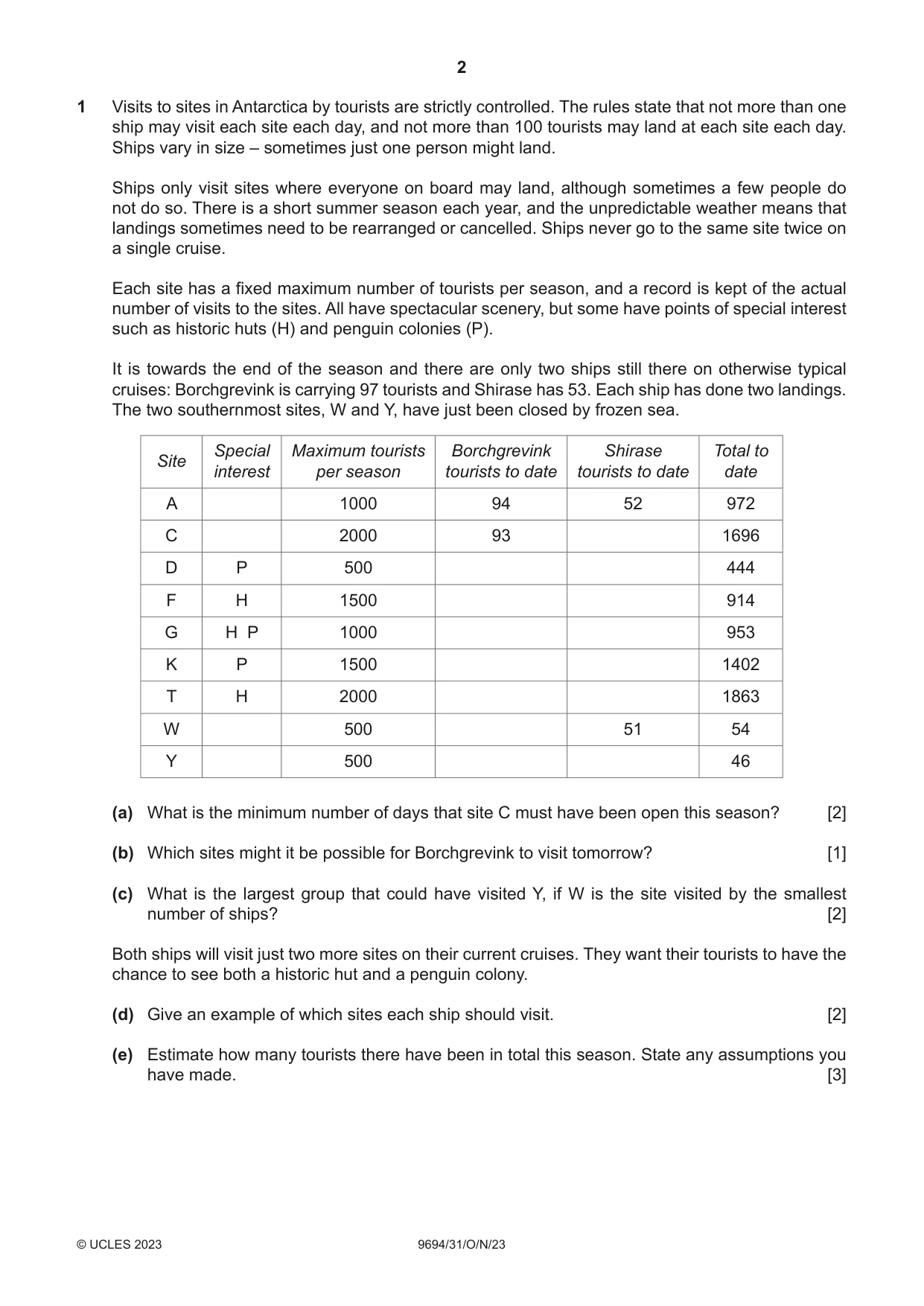
1 Visits to sites in Antarctica by tourists are strictly controlled. The rules state that not more than one ship may visit each site each day, and not more than 100 tourists may land at each site each day. Ships vary in size – sometimes just one person might land. Ships only visit sites where everyone on board may land, although sometimes a few people do not do so. There is a short summer season each year, and the unpredictable weather means that landings sometimes need to be rearranged or cancelled. Ships never go to the same site twice on a single cruise. Each site has a fixed maximum number of tourists per season, and a record is kept of the actual number of visits to the sites. All have spectacular scenery, but some have points of special interest such as historic huts (H) and penguin colonies (P). It is towards the end of the season and there are only two ships still there on otherwise typical cruises: Borchgrevink is carrying 97 tourists and Shirase has 53. Each ship has done two landings. The two southernmost sites, W and Y, have just been closed by frozen sea. Special Maximum tourists Borchgrevink Shirase Total to Site interest per season tourists to date tourists to date date A 1000 94 52 972 C 2000 93 1696 D P 500 444 F H 1500 914 G H P 1000 953 K P 1500 1402 T H 2000 1863 W 500 51 54 Y 500 46 (a) What is the minimum number of days that site C must have been open this season? [2] (b) Which sites might it be possible for Borchgrevink to visit tomorrow? [1] (c) What is the largest group that could have visited Y, if W is the site visited by the smallest number of ships? [2] Both ships will visit just two more sites on their current cruises. They want their tourists to have the chance to see both a historic hut and a penguin colony. (d) Give an example of which sites each ship should visit. [2] (e) Estimate how many tourists there have been in total this season. State any assumptions you have made. [3] [Turn over for Question 2]
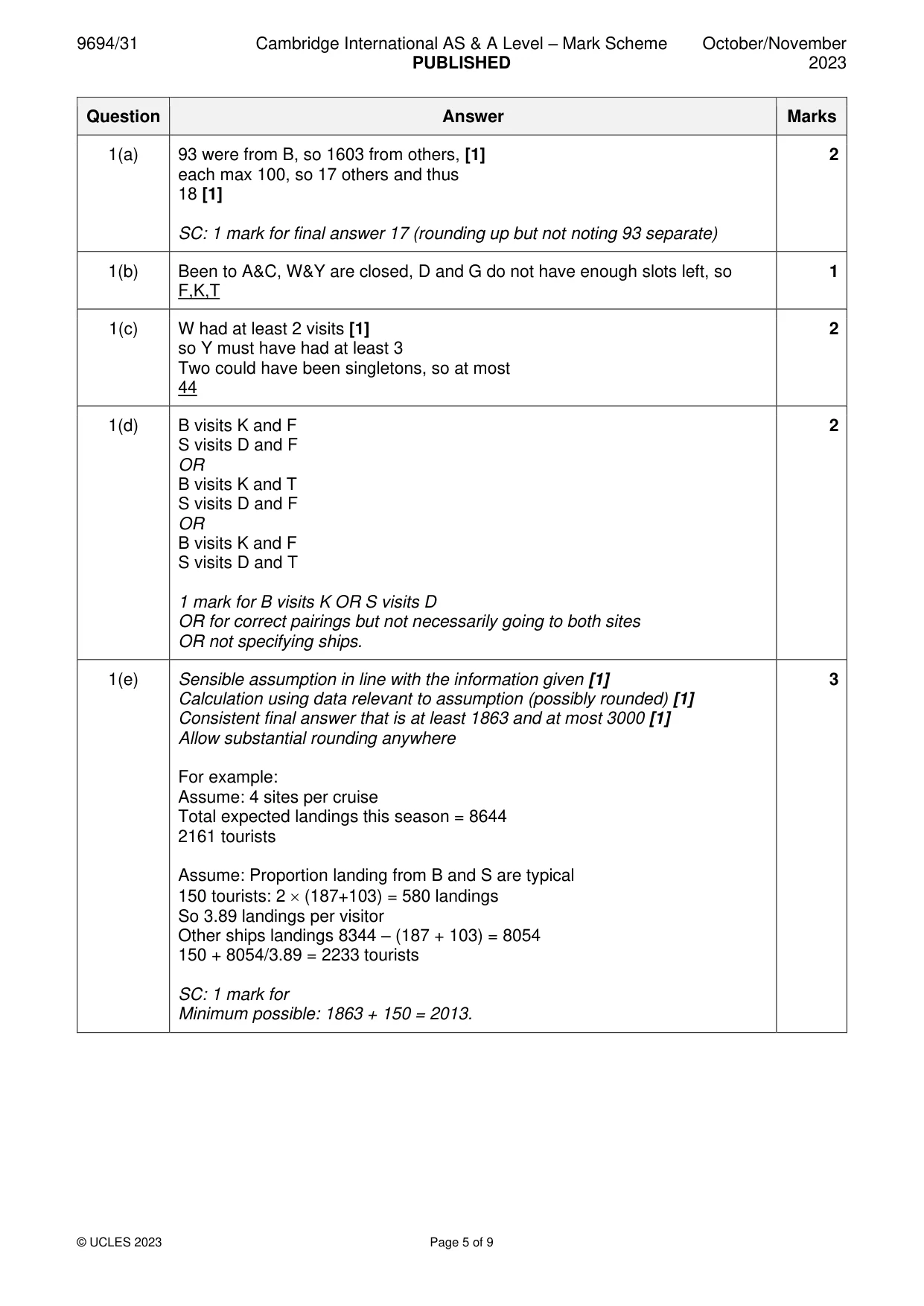
Mark scheme: Question Answer Marks 1(a) 93 were from B, so 1603 from others, [1] 2 each max 100, so 17 others and thus 18 [1] SC: 1 mark for final answer 17 (rounding up but not noting 93 separate) 1(b) Been to A&C, W&Y are closed, D and G do not have enough slots left, so 1 F,K,T 1(c) W had at least 2 visits [1] 2 so Y must have had at least 3 Two could have been singletons, so at most 44 1(d) B visits K and F 2 S visits D and F OR B visits K and T S visits D and F OR B visits K and F S visits D and T 1 mark for B visits K OR S visits D OR for correct pairings but not necessarily going to both sites OR not specifying ships. 1(e) Sensible assumption in line with the information given [1] 3 Calculation using data relevant to assumption (possibly rounded) [1] Consistent final answer that is at least 1863 and at most 3000 [1] Allow substantial rounding anywhere For example: Assume: 4 sites per cruise Total expected landings this season = 8644 2161 tourists Assume: Proportion landing from B and S are typical 150 tourists: 2 (187+103) = 580 landings So 3.89 landings per visitor Other ships landings 8344 – (187 + 103) = 8054 150 + 8054/3.89 = 2233 tourists SC: 1 mark for Minimum possible: 1863 + 150 = 2013.
More questions on Identify cases that satisfy given criteria
Q2 · A new form of long jump competition is being trialled
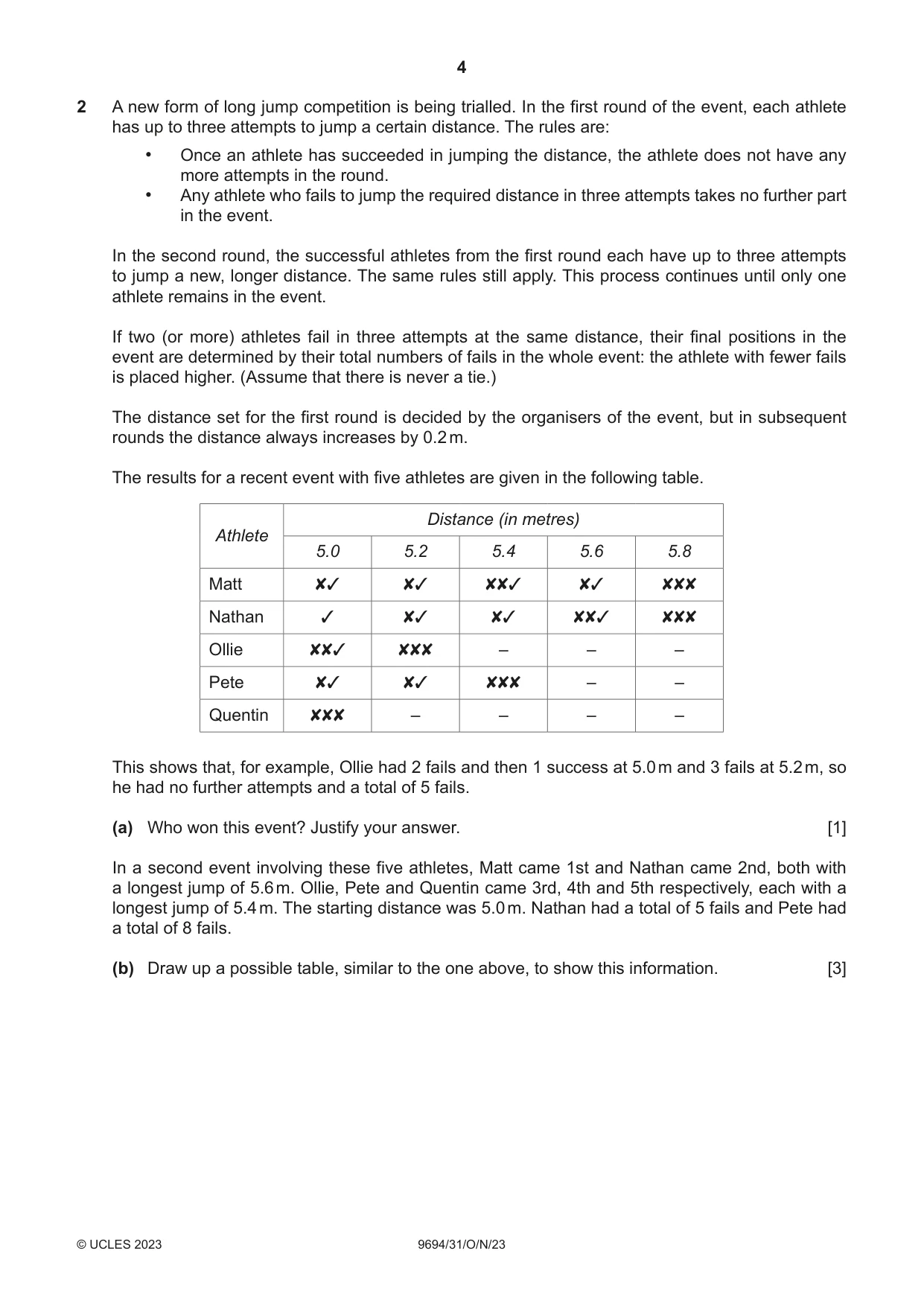
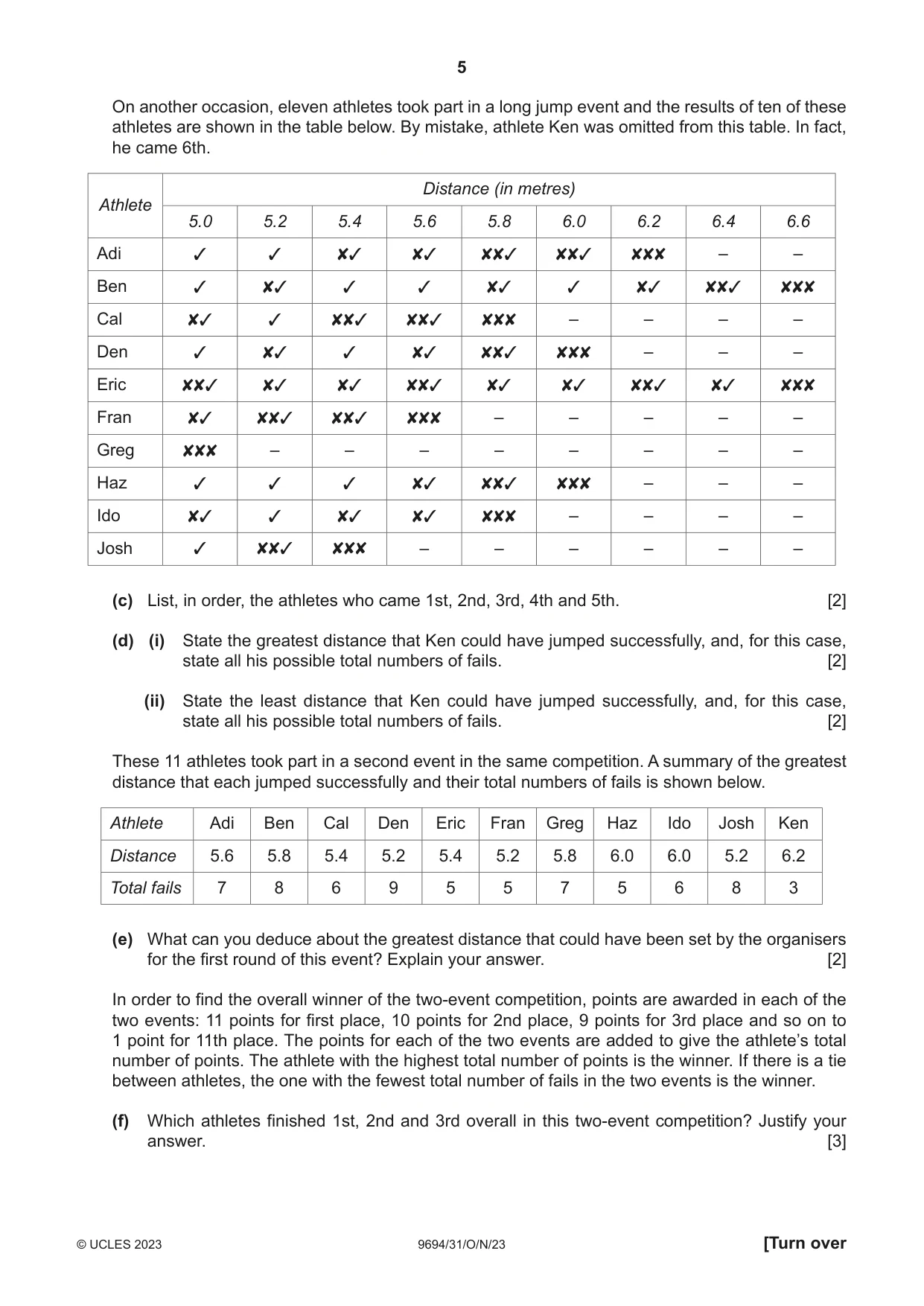
2 A new form of long jump competition is being trialled. In the first round of the event, each athlete has up to three attempts to jump a certain distance. The rules are: • Once an athlete has succeeded in jumping the distance, the athlete does not have any more attempts in the round. • Any athlete who fails to jump the required distance in three attempts takes no further part in the event. In the second round, the successful athletes from the first round each have up to three attempts to jump a new, longer distance. The same rules still apply. This process continues until only one athlete remains in the event. If two (or more) athletes fail in three attempts at the same distance, their final positions in the event are determined by their total numbers of fails in the whole event: the athlete with fewer fails is placed higher. (Assume that there is never a tie.) The distance set for the first round is decided by the organisers of the event, but in subsequent rounds the distance always increases by 0.2 m. The results for a recent event with five athletes are given in the following table. Distance (in metres) Athlete 5.0 5.2 5.4 5.6 5.8 Matt ✘✓ ✘✓ ✘✘✓ ✘✓ ✘✘✘ Nathan ✓ ✘✓ ✘✓ ✘✘✓ ✘✘✘ Ollie ✘✘✓ ✘✘✘ – – – Pete ✘✓ ✘✓ ✘✘✘ – – Quentin ✘✘✘ – – – – This shows that, for example, Ollie had 2 fails and then 1 success at 5.0 m and 3 fails at 5.2 m, so he had no further attempts and a total of 5 fails. (a) Who won this event? Justify your answer. [1] In a second event involving these five athletes, Matt came 1st and Nathan came 2nd, both with a longest jump of 5.6 m. Ollie, Pete and Quentin came 3rd, 4th and 5th respectively, each with a longest jump of 5.4 m. The starting distance was 5.0 m. Nathan had a total of 5 fails and Pete had a total of 8 fails. (b) Draw up a possible table, similar to the one above, to show this information. [3] On another occasion, eleven athletes took part in a long jump event and the results of ten of these athletes are shown in the table below. By mistake, athlete Ken was omitted from this table. In fact, he came 6th. Distance (in metres) Athlete 5.0 5.2 5.4 5.6 5.8 6.0 6.2 6.4 6.6 Adi ✓ ✓ ✘✓ ✘✓ ✘✘✓ ✘✘✓ ✘✘✘ – – Ben ✓ ✘✓ ✓ ✓ ✘✓ ✓ ✘✓ ✘✘✓ ✘✘✘ Cal ✘✓ ✓ ✘✘✓ ✘✘✓ ✘✘✘ – – – – Den ✓ ✘✓ ✓ ✘✓ ✘✘✓ ✘✘✘ – – – Eric ✘✘✓ ✘✓ ✘✓ ✘✘✓ ✘✓ ✘✓ ✘✘✓ ✘✓ ✘✘✘ Fran ✘✓ ✘✘✓ ✘✘✓ ✘✘✘ – – – – – Greg ✘✘✘ – – – – – – – – Haz ✓ ✓ ✓ ✘✓ ✘✘✓ ✘✘✘ – – – Ido ✘✓ ✓ ✘✓ ✘✓ ✘✘✘ – – – – Josh ✓ ✘✘✓ ✘✘✘ – – – – – – (c) List, in order, the athletes who came 1st, 2nd, 3rd, 4th and 5th. [2] (d) (i) State the greatest distance that Ken could have jumped successfully, and, for this case, state all his possible total numbers of fails. [2] (ii) State the least distance that Ken could have jumped successfully, and, for this case, state all his possible total numbers of fails. [2] These 11 athletes took part in a second event in the same competition. A summary of the greatest distance that each jumped successfully and their total numbers of fails is shown below. Athlete Adi Ben Cal Den Eric Fran Greg Haz Ido Josh Ken Distance 5.6 5.8 5.4 5.2 5.4 5.2 5.8 6.0 6.0 5.2 6.2 Total fails 7 8 6 9 5 5 7 5 6 8 3 (e) What can you deduce about the greatest distance that could have been set by the organisers for the first round of this event? Explain your answer. [2] In order to find the overall winner of the two-event competition, points are awarded in each of the two events: 11 points for first place, 10 points for 2nd place, 9 points for 3rd place and so on to 1 point for 11th place. The points for each of the two events are added to give the athlete’s total number of points. The athlete with the highest total number of points is the winner. If there is a tie between athletes, the one with the fewest total number of fails in the two events is the winner. (f) Which athletes finished 1st, 2nd and 3rd overall in this two-event competition? Justify your answer. [3]
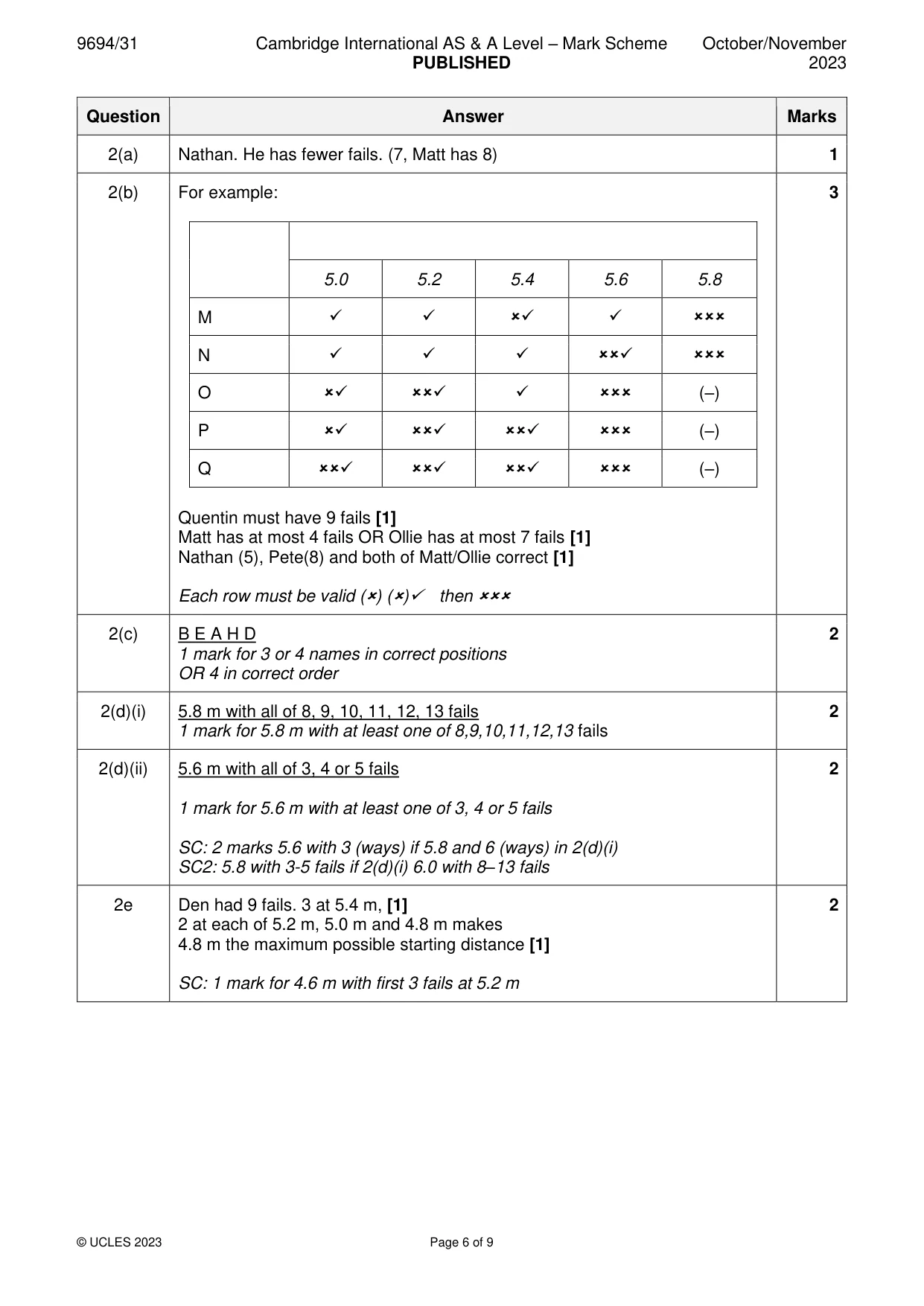
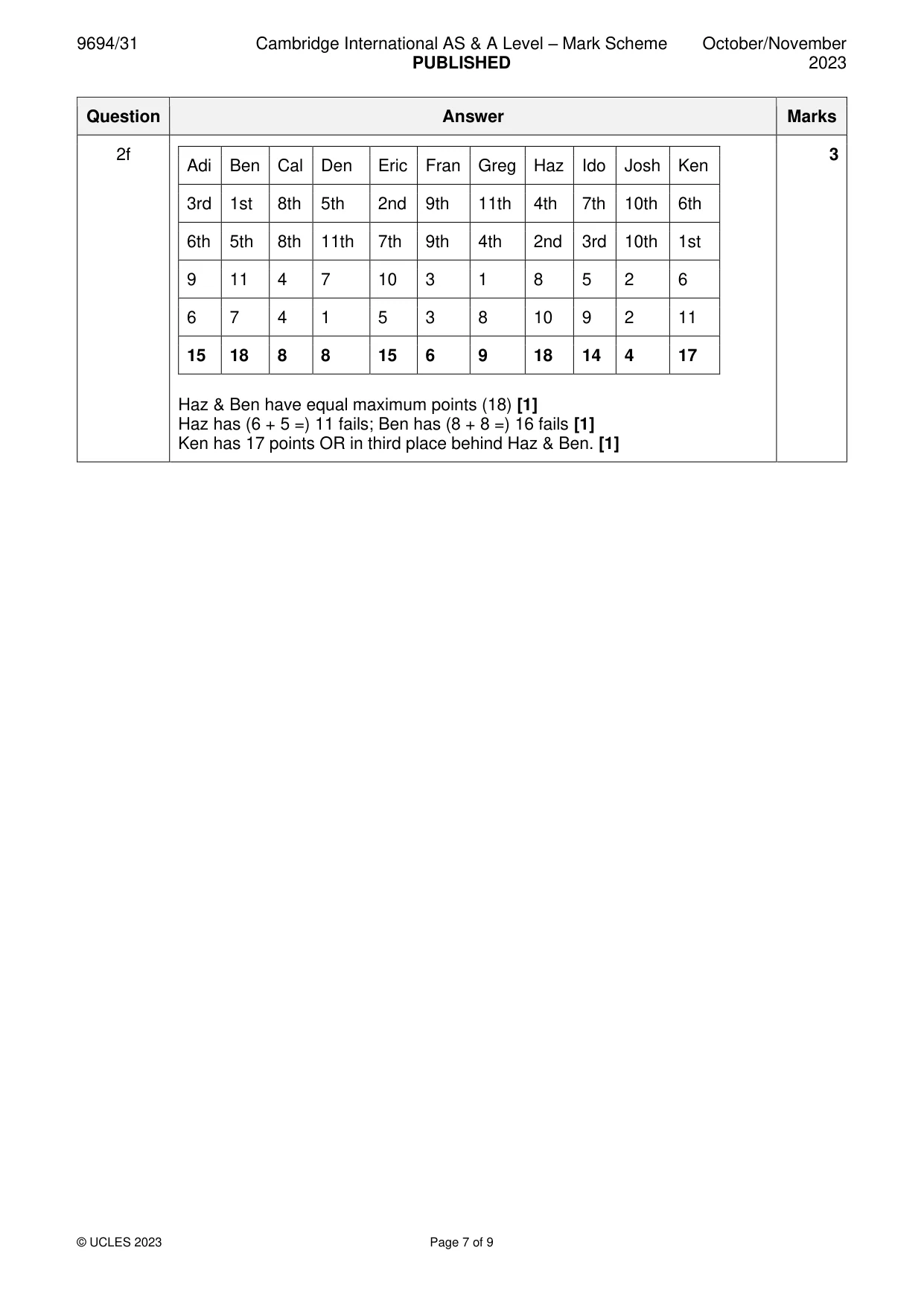
Mark scheme: 2(a) Nathan. He has fewer fails. (7, Matt has 8) 1 2(b) For example: 3 5.0 5.2 5.4 5.6 5.8 M ✓ ✓ ✓ ✓ N ✓ ✓ ✓ ✓ O ✓ ✓ ✓ (–) P ✓ ✓ ✓ (–) Q ✓ ✓ ✓ (–) Quentin must have 9 fails [1] Matt has at most 4 fails OR Ollie has at most 7 fails [1] Nathan (5), Pete(8) and both of Matt/Ollie correct [1] Each row must be valid () ()✓ then 2(c) B E A H D 2 1 mark for 3 or 4 names in correct positions OR 4 in correct order 2(d)(i) 5.8 m with all of 8, 9, 10, 11, 12, 13 fails 2 1 mark for 5.8 m with at least one of 8,9,10,11,12,13 fails 2(d)(ii) 5.6 m with all of 3, 4 or 5 fails 2 1 mark for 5.6 m with at least one of 3, 4 or 5 fails SC: 2 marks 5.6 with 3 (ways) if 5.8 and 6 (ways) in 2(d)(i) SC2: 5.8 with 3-5 fails if 2(d)(i) 6.0 with 8–13 fails 2e Den had 9 fails. 3 at 5.4 m, [1] 2 2 at each of 5.2 m, 5.0 m and 4.8 m makes 4.8 m the maximum possible starting distance [1] SC: 1 mark for 4.6 m with first 3 fails at 5.2 m 2f 3 Adi Ben Cal Den Eric Fran Greg Haz Ido Josh Ken 3rd 1st 8th 5th 2nd 9th 11th 4th 7th 10th 6th 6th 5th 8th 11th 7th 9th 4th 2nd 3rd 10th 1st 9 11 4 7 10 3 1 8 5 2 6 6 7 4 1 5 3 8 10 9 2 11 15 18 8 8 15 6 9 18 14 4 17 Haz & Ben have equal maximum points (18) [1] Haz has (6 + 5 =) 11 fails; Ben has (8 + 8 =) 16 fails [1] Ken has 17 points OR in third place behind Haz & Ben. [1]
Q3 · Every year, on the island of Apodidia, the Birds In Real Danger Service (BIRDS) attempts…
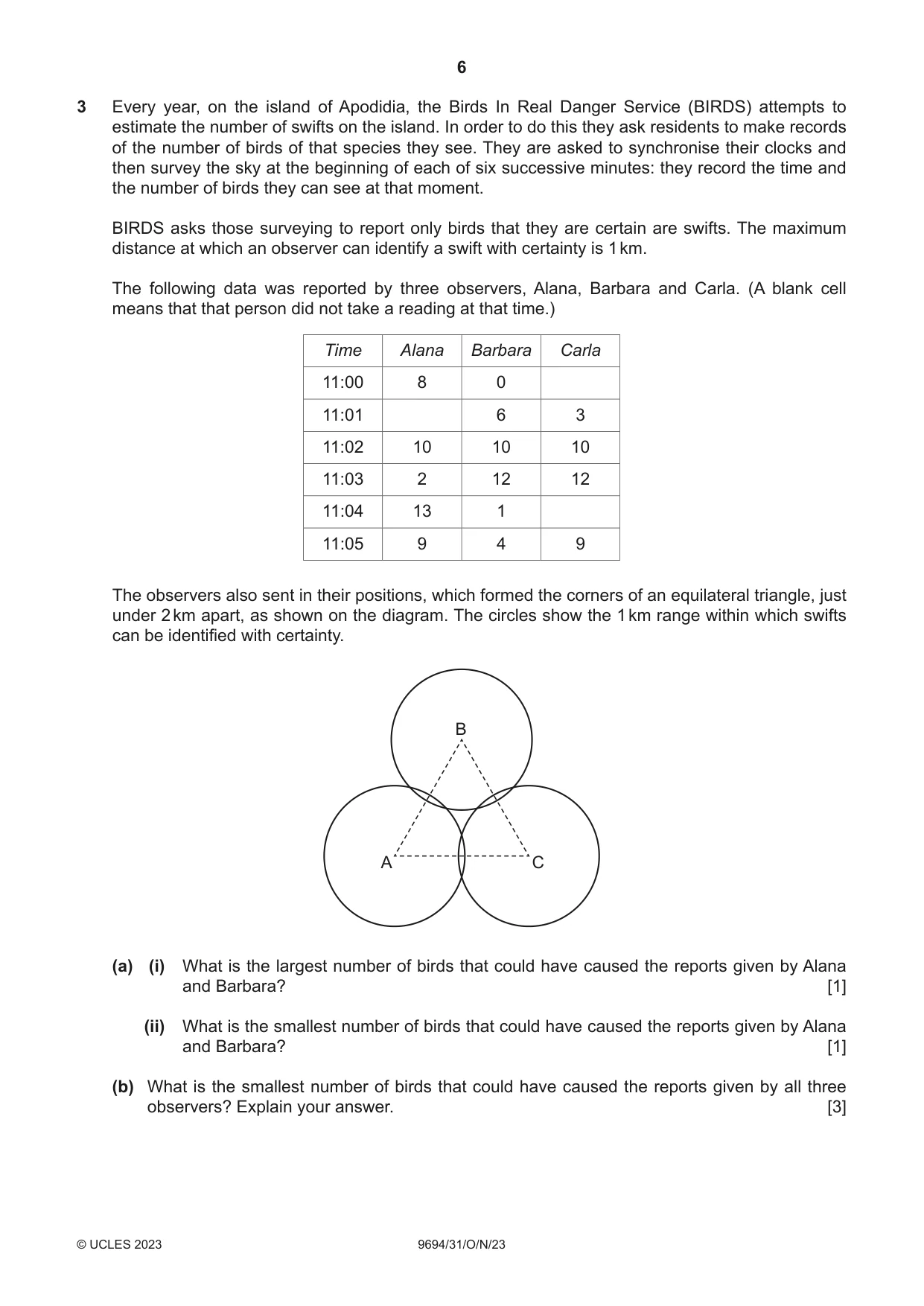
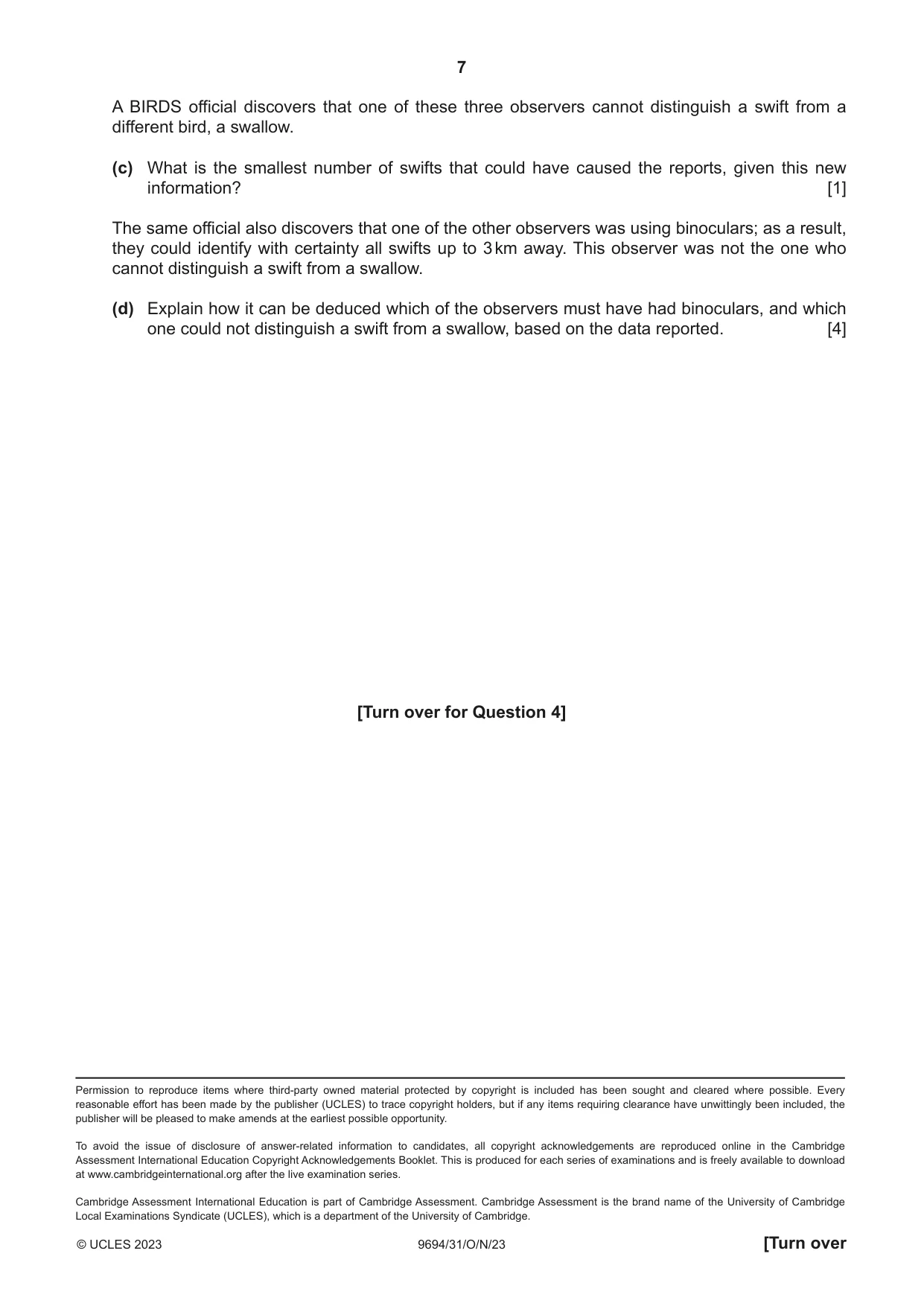
3 Every year, on the island of Apodidia, the Birds In Real Danger Service (BIRDS) attempts to estimate the number of swifts on the island. In order to do this they ask residents to make records of the number of birds of that species they see. They are asked to synchronise their clocks and then survey the sky at the beginning of each of six successive minutes: they record the time and the number of birds they can see at that moment. BIRDS asks those surveying to report only birds that they are certain are swifts. The maximum distance at which an observer can identify a swift with certainty is 1 km. The following data was reported by three observers, Alana, Barbara and Carla. (A blank cell means that that person did not take a reading at that time.) Time Alana Barbara Carla 11:00 8 0 11:01 6 3 11:02 10 10 10 11:03 2 12 12 11:04 13 1 11:05 9 4 9 The observers also sent in their positions, which formed the corners of an equilateral triangle, just under 2 km apart, as shown on the diagram. The circles show the 1 km range within which swifts can be identified with certainty. B A C (a) (i) What is the largest number of birds that could have caused the reports given by Alana and Barbara? [1] (ii) What is the smallest number of birds that could have caused the reports given by Alana and Barbara? [1] (b) What is the smallest number of birds that could have caused the reports given by all three observers? Explain your answer. [3] A BIRDS official discovers that one of these three observers cannot distinguish a swift from a different bird, a swallow. (c) What is the smallest number of swifts that could have caused the reports, given this new information? [1] The same official also discovers that one of the other observers was using binoculars; as a result, they could identify with certainty all swifts up to 3 km away. This observer was not the one who cannot distinguish a swift from a swallow. (d) Explain how it can be deduced which of the observers must have had binoculars, and which one could not distinguish a swift from a swallow, based on the data reported. [4] [Turn over for Question 4]
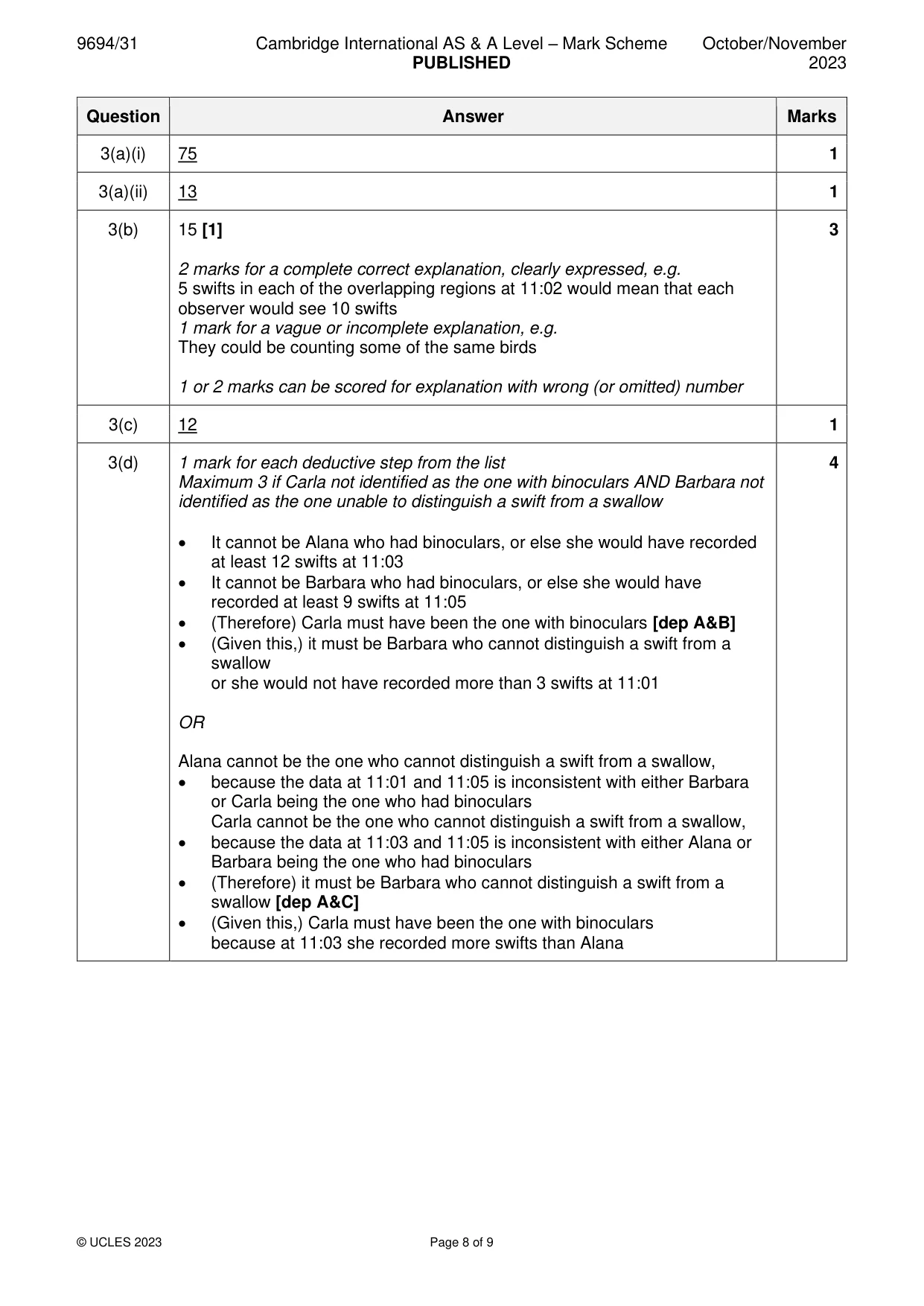
Mark scheme: 3(a)(i) 75 1 3(a)(ii) 13 1 3(b) 15 [1] 3 2 marks for a complete correct explanation, clearly expressed, e.g. 5 swifts in each of the overlapping regions at 11:02 would mean that each observer would see 10 swifts 1 mark for a vague or incomplete explanation, e.g. They could be counting some of the same birds 1 or 2 marks can be scored for explanation with wrong (or omitted) number 3(c) 12 1 3(d) 1 mark for each deductive step from the list 4 Maximum 3 if Carla not identified as the one with binoculars AND Barbara not identified as the one unable to distinguish a swift from a swallow • It cannot be Alana who had binoculars, or else she would have recorded at least 12 swifts at 11:03 • It cannot be Barbara who had binoculars, or else she would have recorded at least 9 swifts at 11:05 • (Therefore) Carla must have been the one with binoculars [dep A&B] • (Given this,) it must be Barbara who cannot distinguish a swift from a swallow or she would not have recorded more than 3 swifts at 11:01 OR Alana cannot be the one who cannot distinguish a swift from a swallow, • because the data at 11:01 and 11:05 is inconsistent with either Barbara or Carla being the one who had binoculars Carla cannot be the one who cannot distinguish a swift from a swallow, • because the data at 11:03 and 11:05 is inconsistent with either Alana or Barbara being the one who had binoculars • (Therefore) it must be Barbara who cannot distinguish a swift from a swallow [dep A&C] • (Given this,) Carla must have been the one with binoculars because at 11:03 she recorded more swifts than Alana
Q4 · Jessica runs a small business which makes wooden puzzles
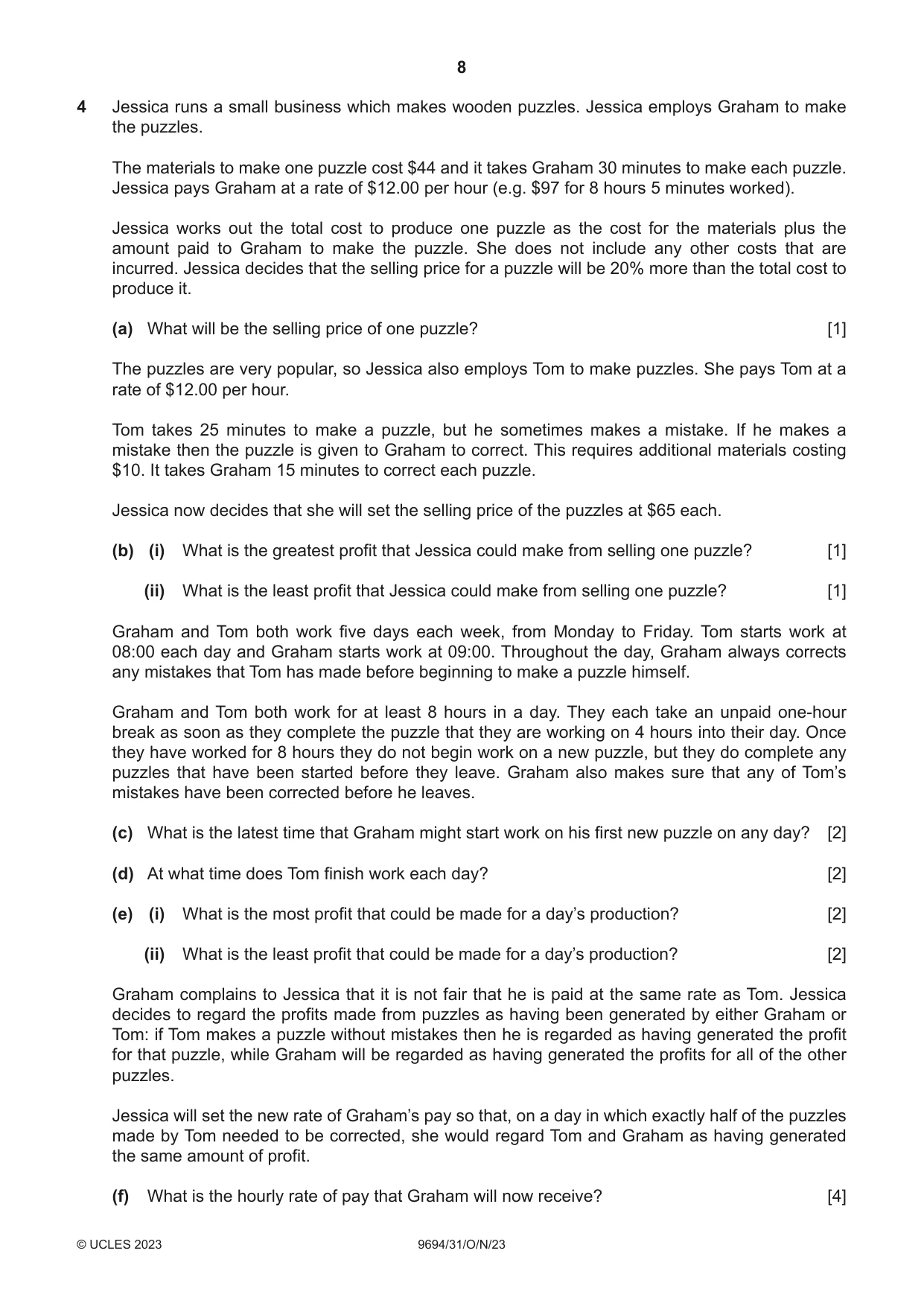
4 Jessica runs a small business which makes wooden puzzles. Jessica employs Graham to make the puzzles. The materials to make one puzzle cost $44 and it takes Graham 30 minutes to make each puzzle. Jessica pays Graham at a rate of $12.00 per hour (e.g. $97 for 8 hours 5 minutes worked). Jessica works out the total cost to produce one puzzle as the cost for the materials plus the amount paid to Graham to make the puzzle. She does not include any other costs that are incurred. Jessica decides that the selling price for a puzzle will be 20% more than the total cost to produce it. (a) What will be the selling price of one puzzle? [1] The puzzles are very popular, so Jessica also employs Tom to make puzzles. She pays Tom at a rate of $12.00 per hour. Tom takes 25 minutes to make a puzzle, but he sometimes makes a mistake. If he makes a mistake then the puzzle is given to Graham to correct. This requires additional materials costing $10. It takes Graham 15 minutes to correct each puzzle. Jessica now decides that she will set the selling price of the puzzles at $65 each. (b) (i) What is the greatest profit that Jessica could make from selling one puzzle? [1] (ii) What is the least profit that Jessica could make from selling one puzzle? [1] Graham and Tom both work five days each week, from Monday to Friday. Tom starts work at 08:00 each day and Graham starts work at 09:00. Throughout the day, Graham always corrects any mistakes that Tom has made before beginning to make a puzzle himself. Graham and Tom both work for at least 8 hours in a day. They each take an unpaid one-hour break as soon as they complete the puzzle that they are working on 4 hours into their day. Once they have worked for 8 hours they do not begin work on a new puzzle, but they do complete any puzzles that have been started before they leave. Graham also makes sure that any of Tom’s mistakes have been corrected before he leaves. (c) What is the latest time that Graham might start work on his first new puzzle on any day? [2] (d) At what time does Tom finish work each day? [2] (e) (i) What is the most profit that could be made for a day’s production? [2] (ii) What is the least profit that could be made for a day’s production? [2] Graham complains to Jessica that it is not fair that he is paid at the same rate as Tom. Jessica decides to regard the profits made from puzzles as having been generated by either Graham or Tom: if Tom makes a puzzle without mistakes then he is regarded as having generated the profit for that puzzle, while Graham will be regarded as having generated the profits for all of the other puzzles. Jessica will set the new rate of Graham’s pay so that, on a day in which exactly half of the puzzles made by Tom needed to be corrected, she would regard Tom and Graham as having generated the same amount of profit. (f) What is the hourly rate of pay that Graham will now receive? [4]
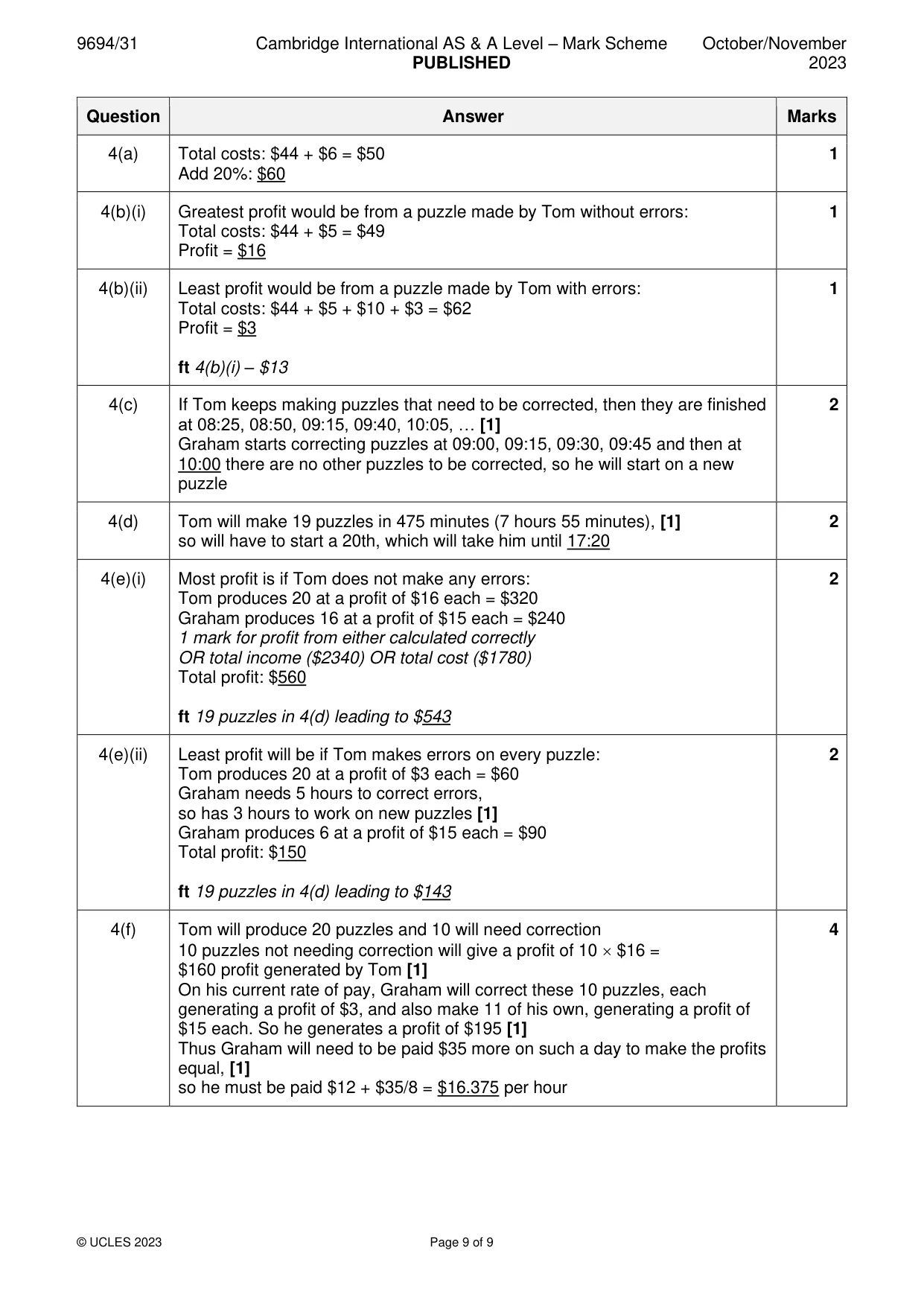
Mark scheme: 4(a) Total costs: $44 + $6 = $50 1 Add 20%: $60 4(b)(i) Greatest profit would be from a puzzle made by Tom without errors: 1 Total costs: $44 + $5 = $49 Profit = $16 4(b)(ii) Least profit would be from a puzzle made by Tom with errors: 1 Total costs: $44 + $5 + $10 + $3 = $62 Profit = $3 ft 4(b)(i) – $13 4(c) If Tom keeps making puzzles that need to be corrected, then they are finished 2 at 08:25, 08:50, 09:15, 09:40, 10:05, … [1] Graham starts correcting puzzles at 09:00, 09:15, 09:30, 09:45 and then at 10:00 there are no other puzzles to be corrected, so he will start on a new puzzle 4(d) Tom will make 19 puzzles in 475 minutes (7 hours 55 minutes), [1] 2 so will have to start a 20th, which will take him until 17:20 4(e)(i) Most profit is if Tom does not make any errors: 2 Tom produces 20 at a profit of $16 each = $320 Graham produces 16 at a profit of $15 each = $240 1 mark for profit from either calculated correctly OR total income ($2340) OR total cost ($1780) Total profit: $560 ft 19 puzzles in 4(d) leading to $543 4(e)(ii) Least profit will be if Tom makes errors on every puzzle: 2 Tom produces 20 at a profit of $3 each = $60 Graham needs 5 hours to correct errors, so has 3 hours to work on new puzzles [1] Graham produces 6 at a profit of $15 each = $90 Total profit: $150 ft 19 puzzles in 4(d) leading to $143 4(f) Tom will produce 20 puzzles and 10 will need correction 4 10 puzzles not needing correction will give a profit of 10 $16 = $160 profit generated by Tom [1] On his current rate of pay, Graham will correct these 10 puzzles, each generating a profit of $3, and also make 11 of his own, generating a profit of $15 each. So he generates a profit of $195 [1] Thus Graham will need to be paid $35 more on such a day to make the profits equal, [1] so he must be paid $12 + $35/8 = $16.375 per hour
More questions on Identify cases that satisfy given criteria
What was in this paper
The subtopics covered by these 4 questions, and how many questions each got. Open one in a new tab to see every Cambridge question on it.
What you needed in this session
Cambridge’s own grade thresholds for 2023 Oct/Nov, Paper 3 · Variant 1. A higher threshold means an easier paper — the bar moves with how the cohort did.