Cambridge A Level Thinking Skills 9694 — 2025 May/June Paper 3 · Variant 3
9694/33/M/J/25 · 4 questions · 50 marks · ≈56 min
The question paper and its mark scheme, free to read here and free to download. This is Cambridge’s own paper, exactly as it was sat.
Question paper12 pages





Mark scheme9 pages
Answers below. Sit the paper first if you are practising.
Questions as text
Q1 · Your Choice is a TV general knowledge quiz
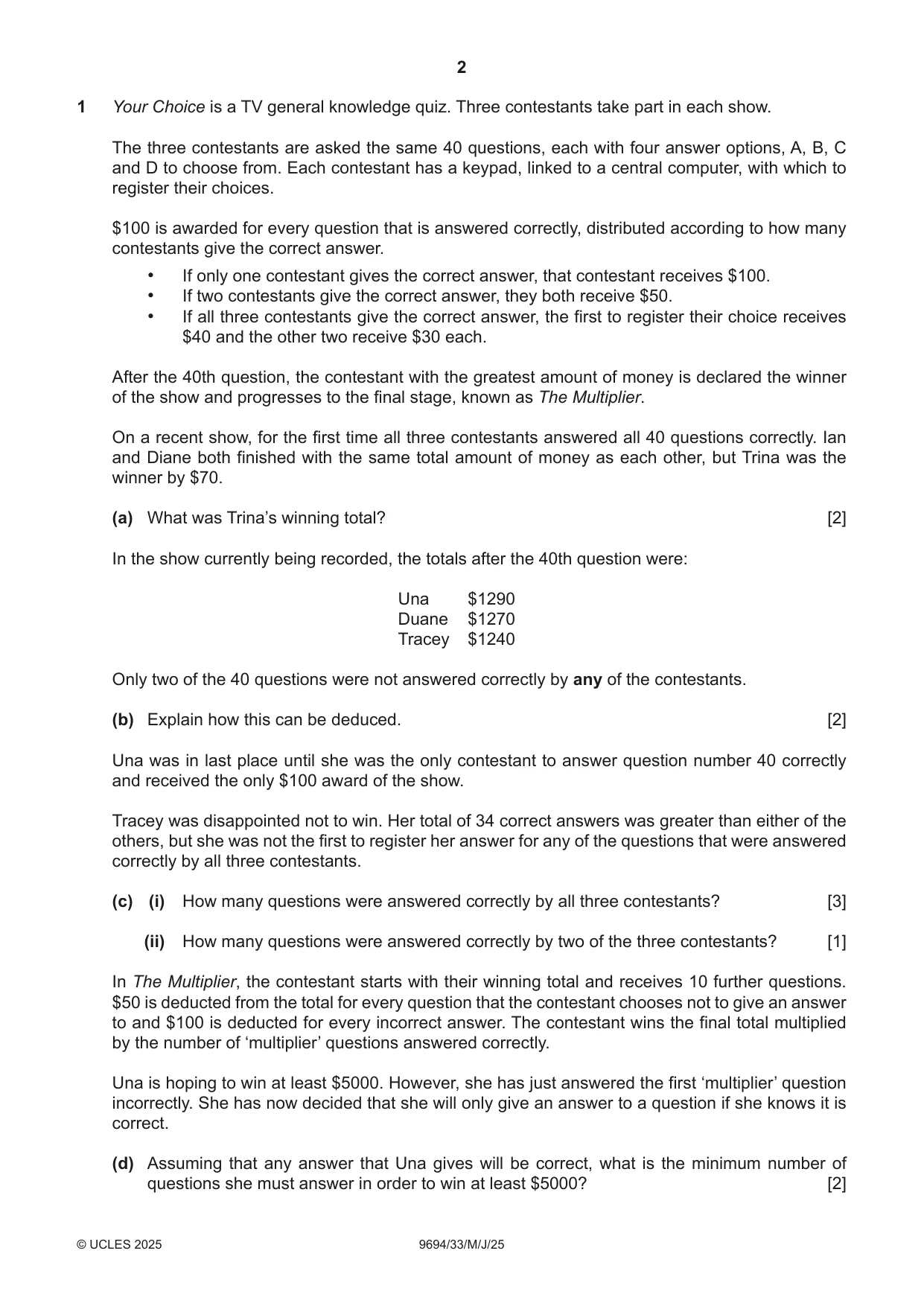
1 Your Choice is a TV general knowledge quiz. Three contestants take part in each show. The three contestants are asked the same 40 questions, each with four answer options, A, B, C and D to choose from. Each contestant has a keypad, linked to a central computer, with which to register their choices. $100 is awarded for every question that is answered correctly, distributed according to how many contestants give the correct answer. • If only one contestant gives the correct answer, that contestant receives $100. • If two contestants give the correct answer, they both receive $50. • If all three contestants give the correct answer, the first to register their choice receives $40 and the other two receive $30 each. After the 40th question, the contestant with the greatest amount of money is declared the winner of the show and progresses to the final stage, known as The Multiplier. On a recent show, for the first time all three contestants answered all 40 questions correctly. Ian and Diane both finished with the same total amount of money as each other, but Trina was the winner by $70. (a) What was Trina’s winning total? [2] In the show currently being recorded, the totals after the 40th question were: Una $1290 Duane $1270 Tracey $1240 Only two of the 40 questions were not answered correctly by any of the contestants. (b) Explain how this can be deduced. [2] Una was in last place until she was the only contestant to answer question number 40 correctly and received the only $100 award of the show. Tracey was disappointed not to win. Her total of 34 correct answers was greater than either of the others, but she was not the first to register her answer for any of the questions that were answered correctly by all three contestants. (c) (i) How many questions were answered correctly by all three contestants? [3] (ii) How many questions were answered correctly by two of the three contestants? [1] In The Multiplier, the contestant starts with their winning total and receives 10 further questions. $50 is deducted from the total for every question that the contestant chooses not to give an answer to and $100 is deducted for every incorrect answer. The contestant wins the final total multiplied by the number of ‘multiplier’ questions answered correctly. Una is hoping to win at least $5000. However, she has just answered the first ‘multiplier’ question incorrectly. She has now decided that she will only give an answer to a question if she knows it is correct. (d) Assuming that any answer that Una gives will be correct, what is the minimum number of questions she must answer in order to win at least $5000? [2] [Turn over for Question 2]
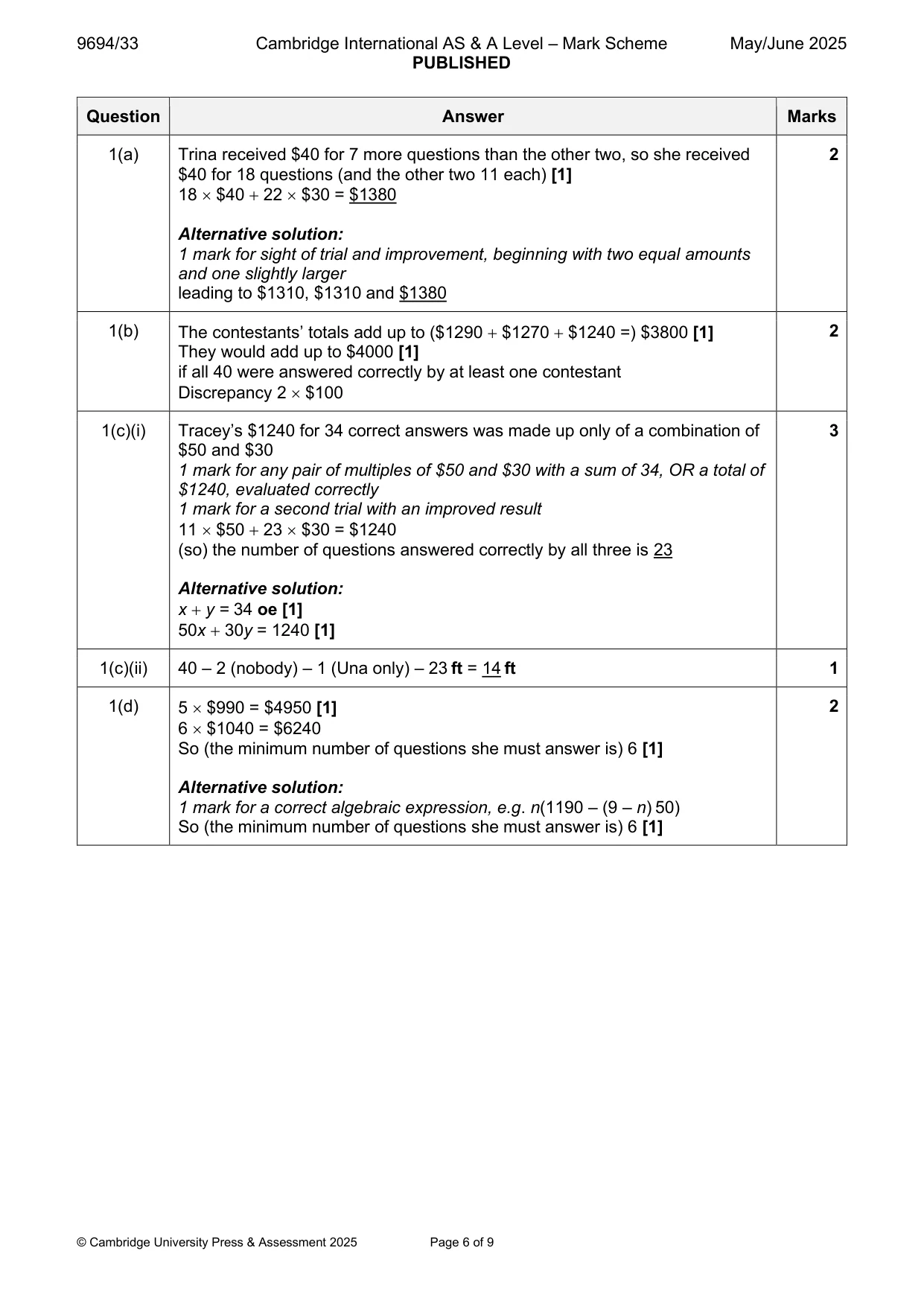
Mark scheme: Question Answer Marks 1(a) Trina received $40 for 7 more questions than the other two, so she received 2 $40 for 18 questions (and the other two 11 each) [1] 18 $40 + 22 $30 = $1380 Alternative solution: 1 mark for sight of trial and improvement, beginning with two equal amounts and one slightly larger leading to $1310, $1310 and $1380 1(b) The contestants’ totals add up to ($1290 + $1270 + $1240 =) $3800 [1] 2 They would add up to $4000 [1] if all 40 were answered correctly by at least one contestant Discrepancy 2 $100 1(c)(i) Tracey’s $1240 for 34 correct answers was made up only of a combination of 3 $50 and $30 1 mark for any pair of multiples of $50 and $30 with a sum of 34, OR a total of $1240, evaluated correctly 1 mark for a second trial with an improved result 11 $50 + 23 $30 = $1240 (so) the number of questions answered correctly by all three is 23 Alternative solution: x + y = 34 oe [1] 50x + 30y = 1240 [1] 1(c)(ii) 40 – 2 (nobody) – 1 (Una only) – 23 ft = 14 ft 1 1(d) 5 $990 = $4950 [1] 2 6 $1040 = $6240 So (the minimum number of questions she must answer is) 6 [1] Alternative solution: 1 mark for a correct algebraic expression, e.g. n(1190 – (9 – n) 50) So (the minimum number of questions she must answer is) 6 [1]
Q2 · Grace is a children’s entertainer who can be booked for parties
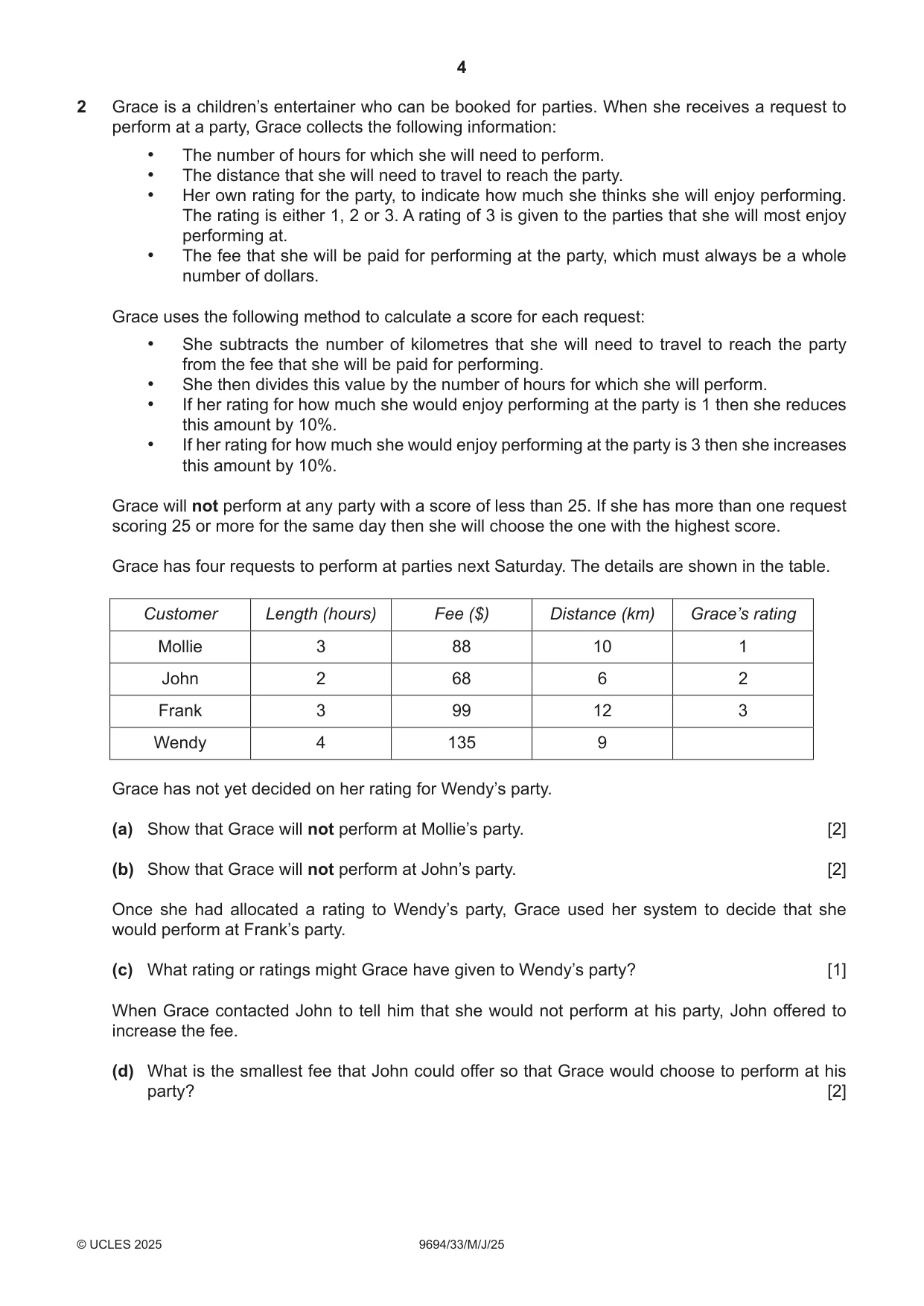
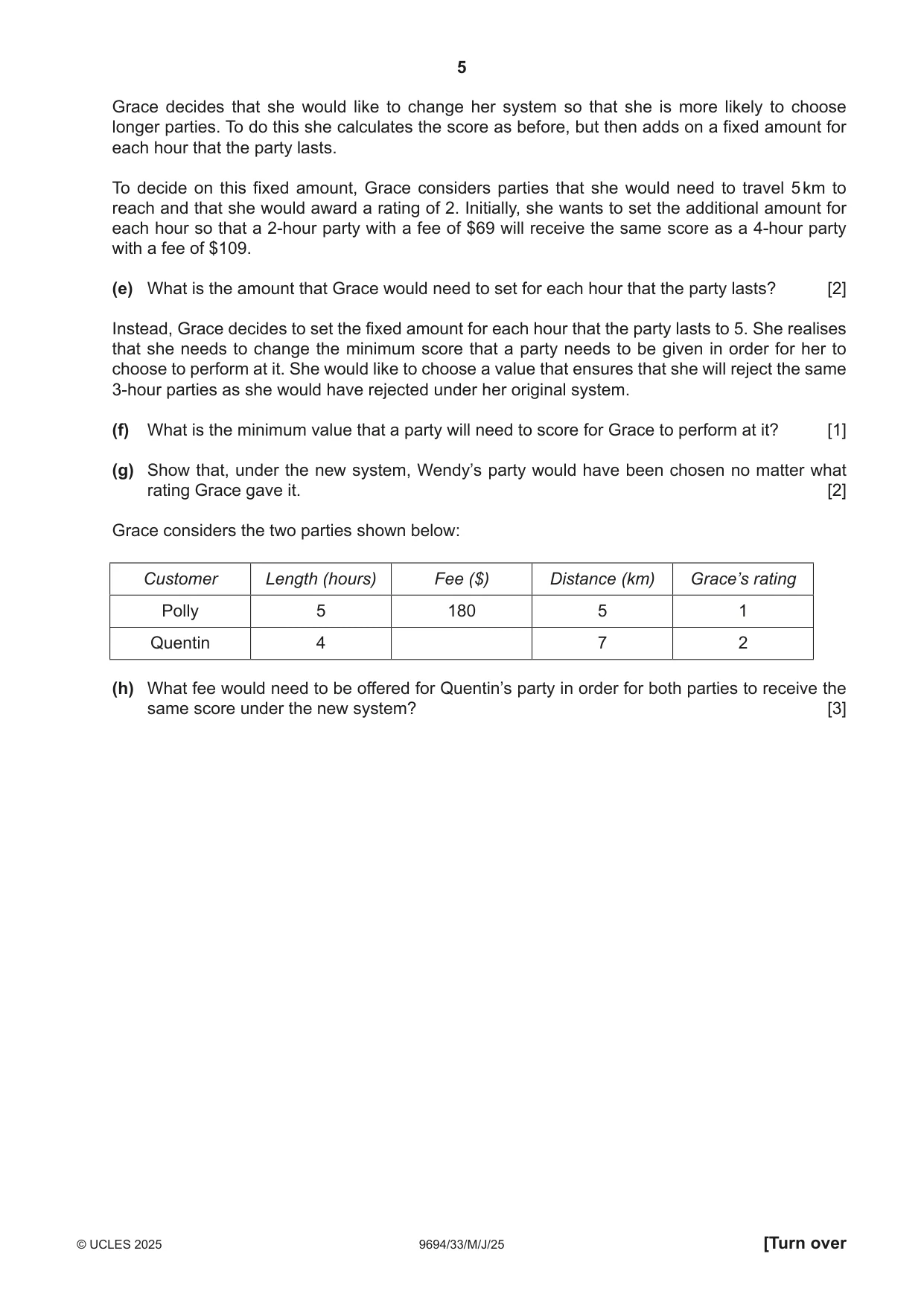
2 Grace is a children’s entertainer who can be booked for parties. When she receives a request to perform at a party, Grace collects the following information: • The number of hours for which she will need to perform. • The distance that she will need to travel to reach the party. • Her own rating for the party, to indicate how much she thinks she will enjoy performing. The rating is either 1, 2 or 3. A rating of 3 is given to the parties that she will most enjoy performing at. • The fee that she will be paid for performing at the party, which must always be a whole number of dollars. Grace uses the following method to calculate a score for each request: • She subtracts the number of kilometres that she will need to travel to reach the party from the fee that she will be paid for performing. • She then divides this value by the number of hours for which she will perform. • If her rating for how much she would enjoy performing at the party is 1 then she reduces this amount by 10%. • If her rating for how much she would enjoy performing at the party is 3 then she increases this amount by 10%. Grace will not perform at any party with a score of less than 25. If she has more than one request scoring 25 or more for the same day then she will choose the one with the highest score. Grace has four requests to perform at parties next Saturday. The details are shown in the table. Customer Length (hours) Fee ($) Distance (km) Grace’s rating Mollie 3 88 10 1 John 2 68 6 2 Frank 3 99 12 3 Wendy 4 135 9 Grace has not yet decided on her rating for Wendy’s party. (a) Show that Grace will not perform at Mollie’s party. [2] (b) Show that Grace will not perform at John’s party. [2] Once she had allocated a rating to Wendy’s party, Grace used her system to decide that she would perform at Frank’s party. (c) What rating or ratings might Grace have given to Wendy’s party? [1] When Grace contacted John to tell him that she would not perform at his party, John offered to increase the fee. (d) What is the smallest fee that John could offer so that Grace would choose to perform at his party? [2] Grace decides that she would like to change her system so that she is more likely to choose longer parties. To do this she calculates the score as before, but then adds on a fixed amount for each hour that the party lasts. To decide on this fixed amount, Grace considers parties that she would need to travel 5 km to reach and that she would award a rating of 2. Initially, she wants to set the additional amount for each hour so that a 2-hour party with a fee of $69 will receive the same score as a 4-hour party with a fee of $109. (e) What is the amount that Grace would need to set for each hour that the party lasts? [2] Instead, Grace decides to set the fixed amount for each hour that the party lasts to 5. She realises that she needs to change the minimum score that a party needs to be given in order for her to choose to perform at it. She would like to choose a value that ensures that she will reject the same 3-hour parties as she would have rejected under her original system. (f) What is the minimum value that a party will need to score for Grace to perform at it? [1] (g) Show that, under the new system, Wendy’s party would have been chosen no matter what rating Grace gave it. [2] Grace considers the two parties shown below: Customer Length (hours) Fee ($) Distance (km) Grace’s rating Polly 5 180 5 1 Quentin 4 7 2 (h) What fee would need to be offered for Quentin’s party in order for both parties to receive the same score under the new system? [3]
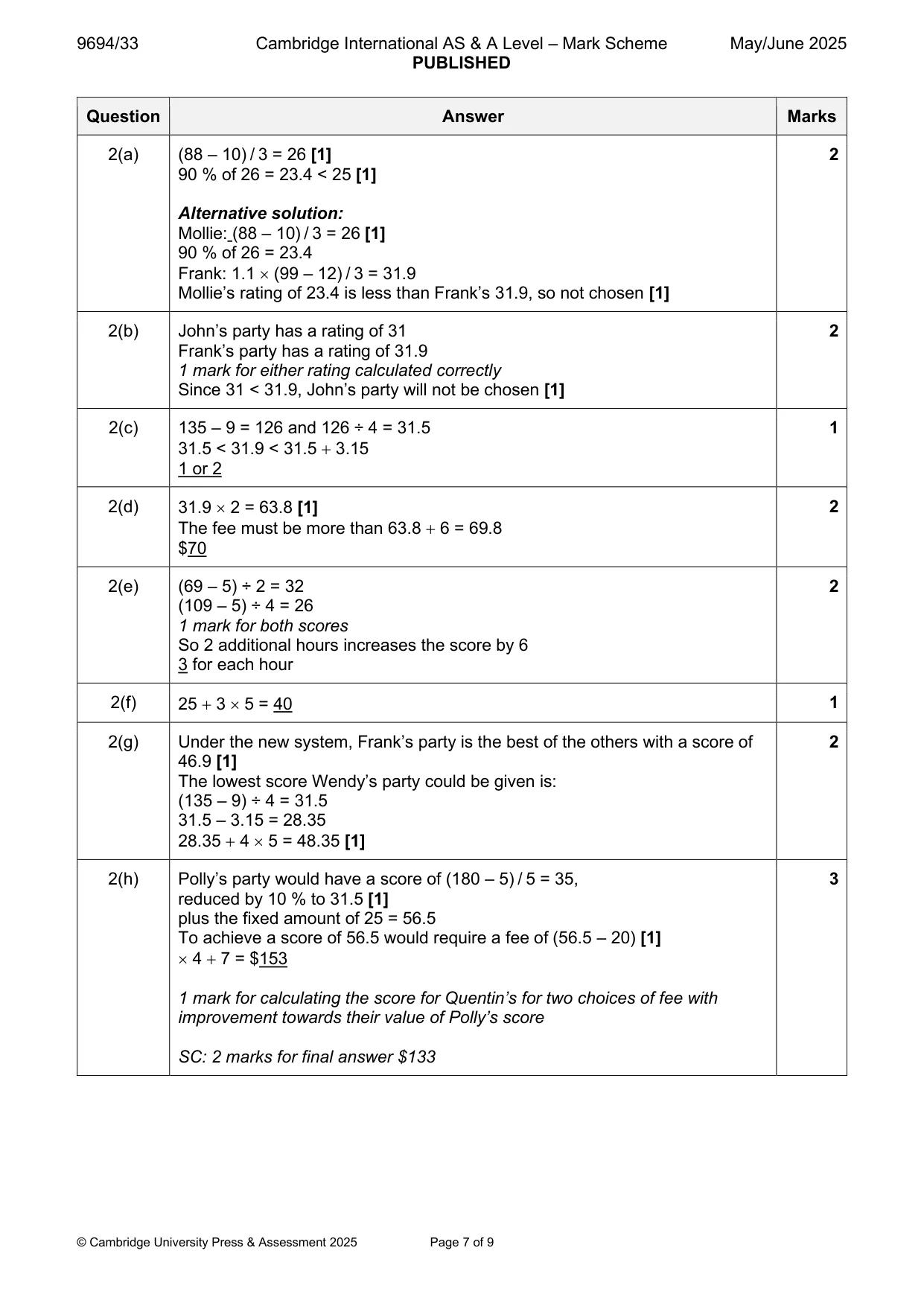
Mark scheme: 2(a) (88 – 10) / 3 = 26 [1] 2 90 % of 26 = 23.4 < 25 [1] Alternative solution: Mollie: (88 – 10) / 3 = 26 [1] 90 % of 26 = 23.4 Frank: 1.1 (99 – 12) / 3 = 31.9 Mollie’s rating of 23.4 is less than Frank’s 31.9, so not chosen [1] 2(b) John’s party has a rating of 31 2 Frank’s party has a rating of 31.9 1 mark for either rating calculated correctly Since 31 < 31.9, John’s party will not be chosen [1] 2(c) 135 – 9 = 126 and 126 ÷ 4 = 31.5 1 31.5 < 31.9 < 31.5 + 3.15 1 or 2 2(d) 31.9 2 = 63.8 [1] 2 The fee must be more than 63.8 + 6 = 69.8 $70 2(e) (69 – 5) ÷ 2 = 32 2 (109 – 5) ÷ 4 = 26 1 mark for both scores So 2 additional hours increases the score by 6 3 for each hour 2(f) 25 + 3 5 = 40 1 2(g) Under the new system, Frank’s party is the best of the others with a score of 2 46.9 [1] The lowest score Wendy’s party could be given is: (135 – 9) ÷ 4 = 31.5 31.5 – 3.15 = 28.35 28.35 + 4 5 = 48.35 [1] 2(h) Polly’s party would have a score of (180 – 5) / 5 = 35, 3 reduced by 10 % to 31.5 [1] plus the fixed amount of 25 = 56.5 To achieve a score of 56.5 would require a fee of (56.5 – 20) [1] 4 + 7 = $153 1 mark for calculating the score for Quentin’s for two choices of fee with improvement towards their value of Polly’s score SC: 2 marks for final answer $133
Q3 · Roadworks have blocked the main road, and all drivers are following the instructions of…
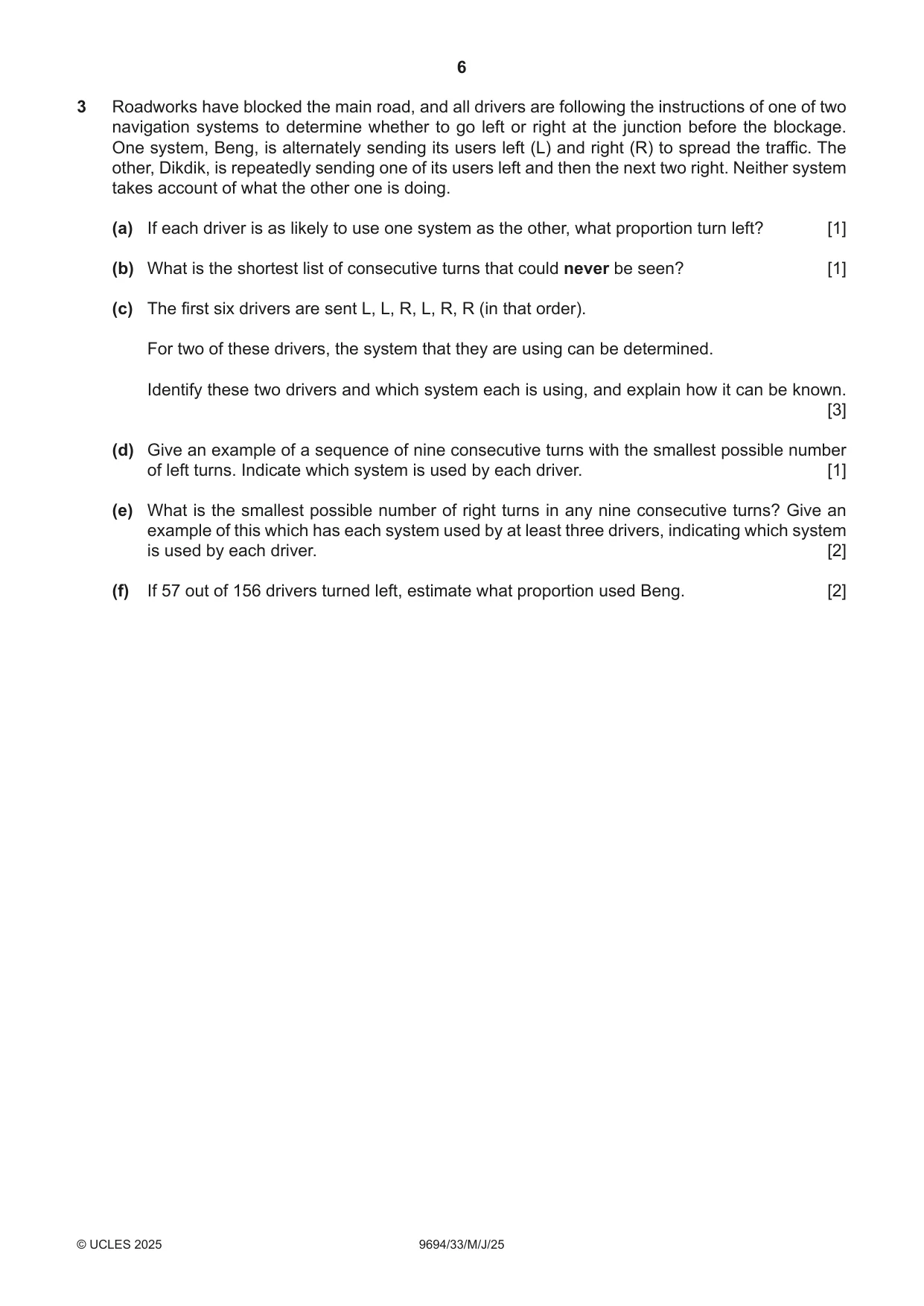
3 Roadworks have blocked the main road, and all drivers are following the instructions of one of two navigation systems to determine whether to go left or right at the junction before the blockage. One system, Beng, is alternately sending its users left (L) and right (R) to spread the traffic. The other, Dikdik, is repeatedly sending one of its users left and then the next two right. Neither system takes account of what the other one is doing. (a) If each driver is as likely to use one system as the other, what proportion turn left? [1] (b) What is the shortest list of consecutive turns that could never be seen? [1] (c) The first six drivers are sent L, L, R, L, R, R (in that order). For two of these drivers, the system that they are using can be determined. Identify these two drivers and which system each is using, and explain how it can be known. [3] (d) Give an example of a sequence of nine consecutive turns with the smallest possible number of left turns. Indicate which system is used by each driver. [1] (e) What is the smallest possible number of right turns in any nine consecutive turns? Give an example of this which has each system used by at least three drivers, indicating which system is used by each driver. [2] (f) If 57 out of 156 drivers turned left, estimate what proportion used Beng. [2] [Turn over for Question 4]
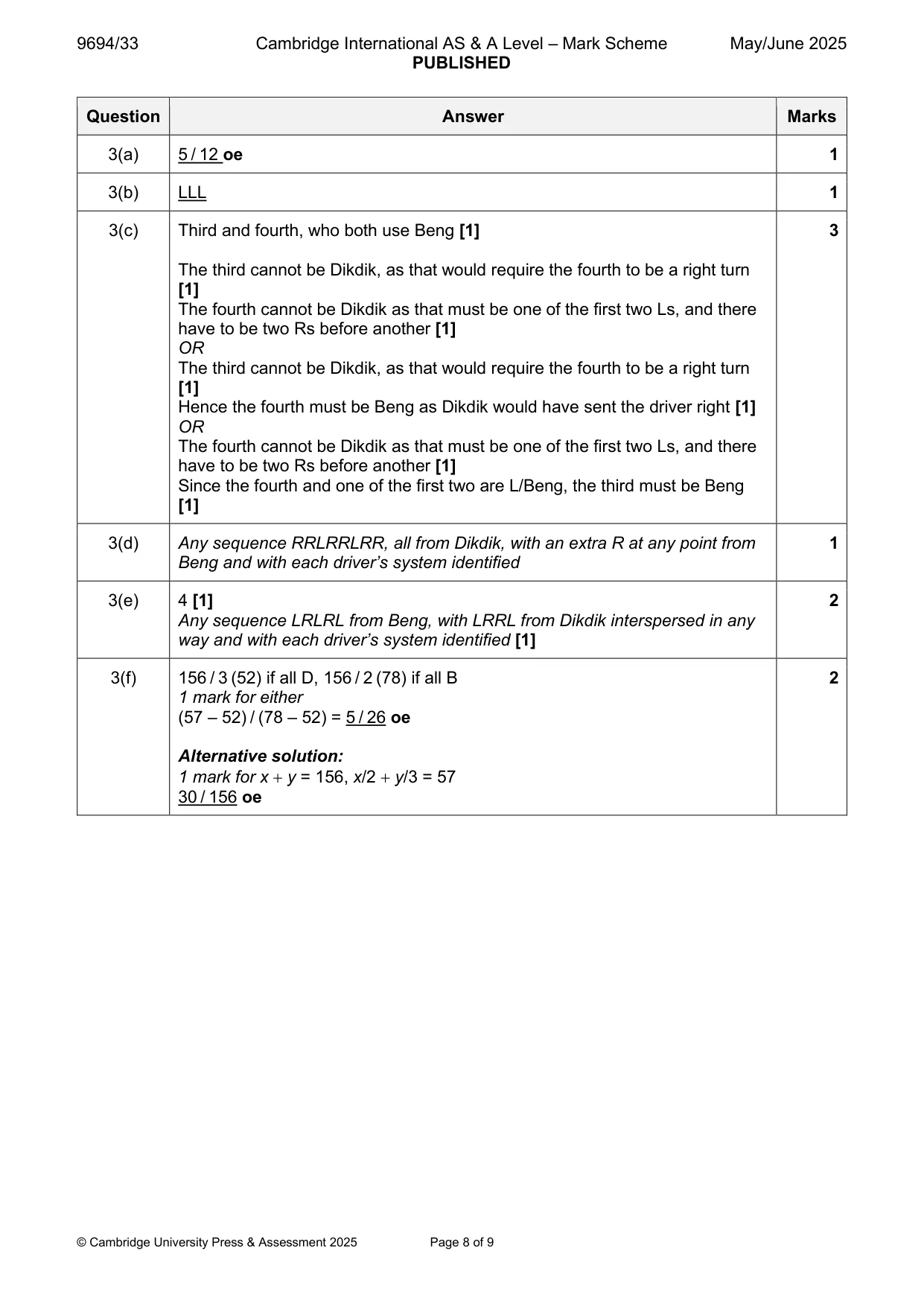
Mark scheme: 3(a) 5 / 12 oe 1 3(b) LLL 1 3(c) Third and fourth, who both use Beng [1] 3 The third cannot be Dikdik, as that would require the fourth to be a right turn [1] The fourth cannot be Dikdik as that must be one of the first two Ls, and there have to be two Rs before another [1] OR The third cannot be Dikdik, as that would require the fourth to be a right turn [1] Hence the fourth must be Beng as Dikdik would have sent the driver right [1] OR The fourth cannot be Dikdik as that must be one of the first two Ls, and there have to be two Rs before another [1] Since the fourth and one of the first two are L/Beng, the third must be Beng [1] 3(d) Any sequence RRLRRLRR, all from Dikdik, with an extra R at any point from 1 Beng and with each driver’s system identified 3(e) 4 [1] 2 Any sequence LRLRL from Beng, with LRRL from Dikdik interspersed in any way and with each driver’s system identified [1] 3(f) 156 / 3 (52) if all D, 156 / 2 (78) if all B 2 1 mark for either (57 – 52) / (78 – 52) = 5 / 26 oe Alternative solution: 1 mark for x + y = 156, x/2 + y/3 = 57 30 / 156 oe
Q4 · A company offers a service to help workers in the local city to travel
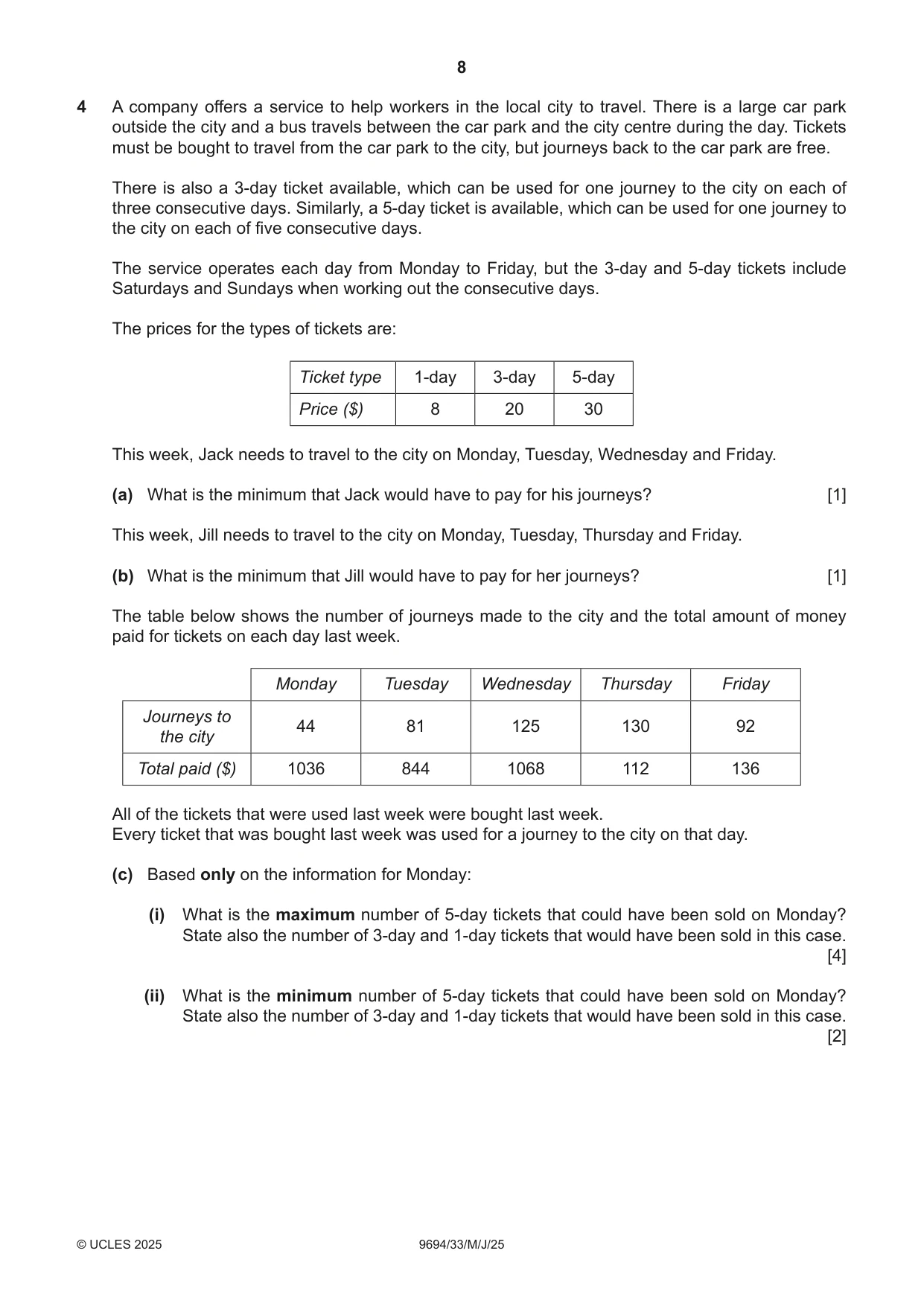
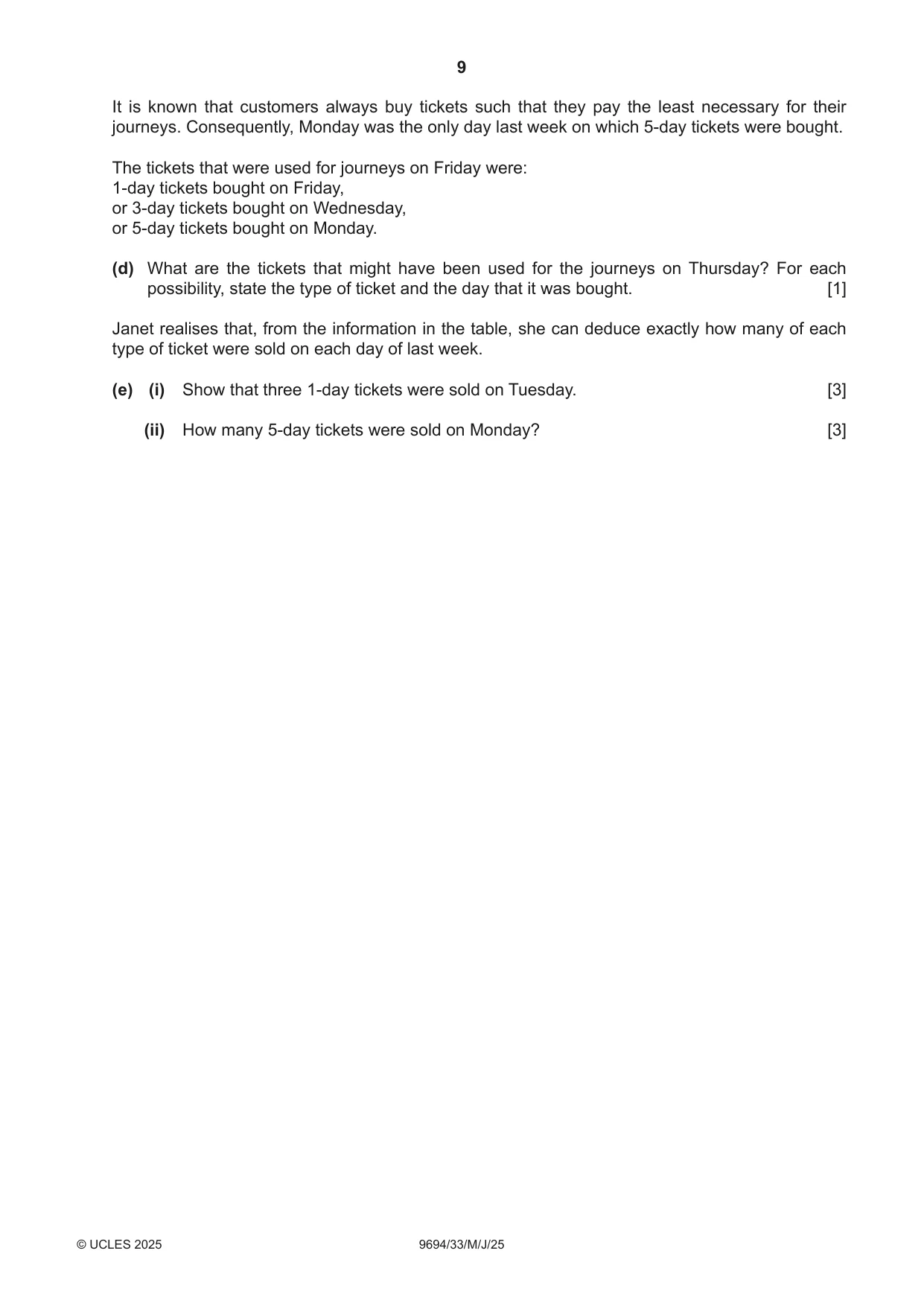
4 A company offers a service to help workers in the local city to travel. There is a large car park outside the city and a bus travels between the car park and the city centre during the day. Tickets must be bought to travel from the car park to the city, but journeys back to the car park are free. There is also a 3-day ticket available, which can be used for one journey to the city on each of three consecutive days. Similarly, a 5-day ticket is available, which can be used for one journey to the city on each of five consecutive days. The service operates each day from Monday to Friday, but the 3-day and 5-day tickets include Saturdays and Sundays when working out the consecutive days. The prices for the types of tickets are: Ticket type 1-day 3-day 5-day Price ($) 8 20 30 This week, Jack needs to travel to the city on Monday, Tuesday, Wednesday and Friday. (a) What is the minimum that Jack would have to pay for his journeys? [1] This week, Jill needs to travel to the city on Monday, Tuesday, Thursday and Friday. (b) What is the minimum that Jill would have to pay for her journeys? [1] The table below shows the number of journeys made to the city and the total amount of money paid for tickets on each day last week. Monday Tuesday Wednesday Thursday Friday Journeys to 44 81 125 130 92 the city Total paid ($) 1036 844 1068 112 136 All of the tickets that were used last week were bought last week. Every ticket that was bought last week was used for a journey to the city on that day. (c) Based only on the information for Monday: (i) What is the maximum number of 5-day tickets that could have been sold on Monday? State also the number of 3-day and 1-day tickets that would have been sold in this case. [4] (ii) What is the minimum number of 5-day tickets that could have been sold on Monday? State also the number of 3-day and 1-day tickets that would have been sold in this case. [2] It is known that customers always buy tickets such that they pay the least necessary for their journeys. Consequently, Monday was the only day last week on which 5-day tickets were bought. The tickets that were used for journeys on Friday were: 1-day tickets bought on Friday, or 3-day tickets bought on Wednesday, or 5-day tickets bought on Monday. (d) What are the tickets that might have been used for the journeys on Thursday? For each possibility, state the type of ticket and the day that it was bought. [1] Janet realises that, from the information in the table, she can deduce exactly how many of each type of ticket were sold on each day of last week. (e) (i) Show that three 1-day tickets were sold on Tuesday. [3] (ii) How many 5-day tickets were sold on Monday? [3]
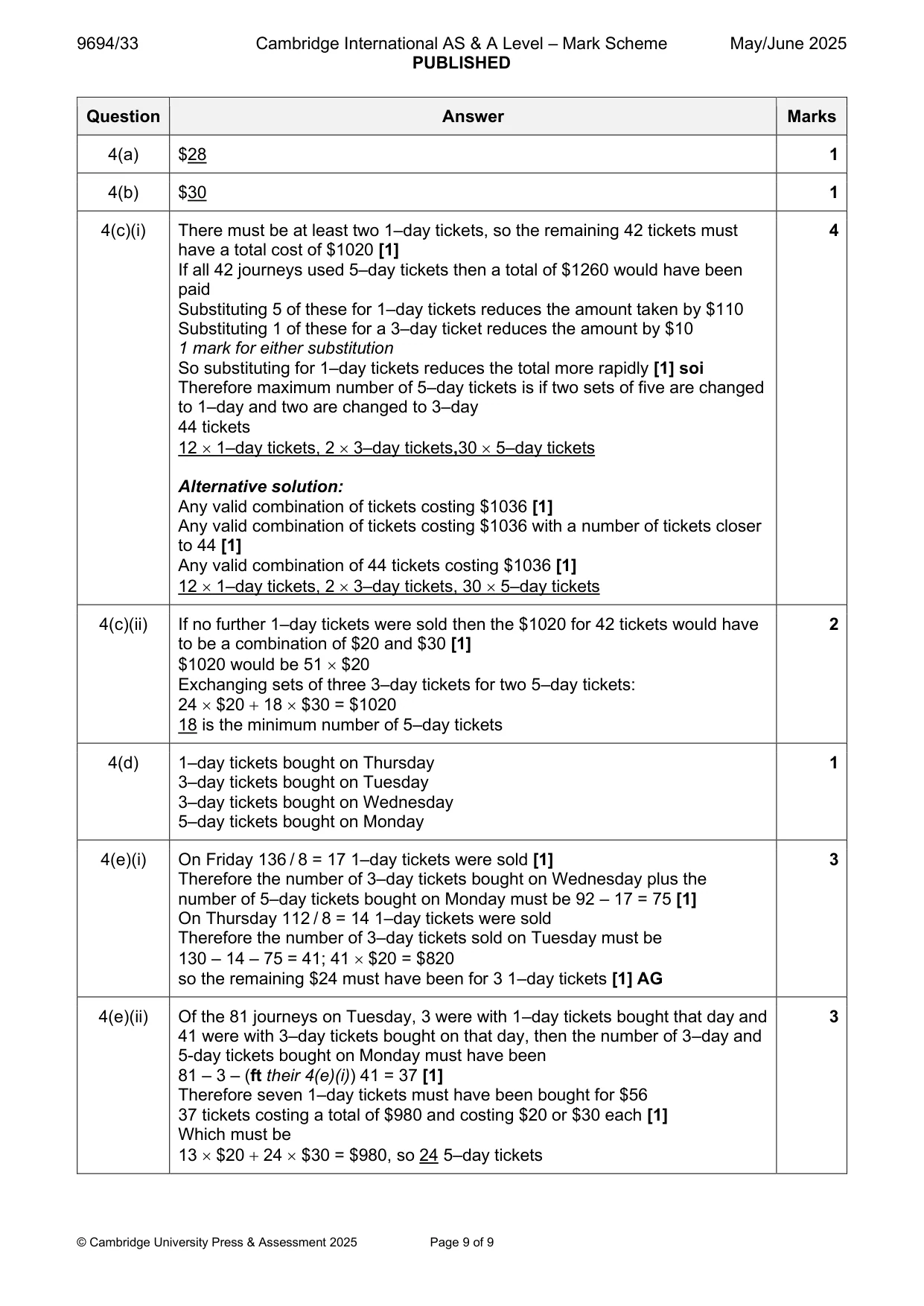
Mark scheme: 4(a) $28 1 4(b) $30 1 4(c)(i) There must be at least two 1–day tickets, so the remaining 42 tickets must 4 have a total cost of $1020 [1] If all 42 journeys used 5–day tickets then a total of $1260 would have been paid Substituting 5 of these for 1–day tickets reduces the amount taken by $110 Substituting 1 of these for a 3–day ticket reduces the amount by $10 1 mark for either substitution So substituting for 1–day tickets reduces the total more rapidly [1] soi Therefore maximum number of 5–day tickets is if two sets of five are changed to 1–day and two are changed to 3–day 44 tickets 12 1–day tickets, 2 3–day tickets,30 5–day tickets Alternative solution: Any valid combination of tickets costing $1036 [1] Any valid combination of tickets costing $1036 with a number of tickets closer to 44 [1] Any valid combination of 44 tickets costing $1036 [1] 12 1–day tickets, 2 3–day tickets, 30 5–day tickets 4(c)(ii) If no further 1–day tickets were sold then the $1020 for 42 tickets would have 2 to be a combination of $20 and $30 [1] $1020 would be 51 $20 Exchanging sets of three 3–day tickets for two 5–day tickets: 24 $20 + 18 $30 = $1020 18 is the minimum number of 5–day tickets 4(d) 1–day tickets bought on Thursday 1 3–day tickets bought on Tuesday 3–day tickets bought on Wednesday 5–day tickets bought on Monday 4(e)(i) On Friday 136 / 8 = 17 1–day tickets were sold [1] 3 Therefore the number of 3–day tickets bought on Wednesday plus the number of 5–day tickets bought on Monday must be 92 – 17 = 75 [1] On Thursday 112 / 8 = 14 1–day tickets were sold Therefore the number of 3–day tickets sold on Tuesday must be 130 – 14 – 75 = 41; 41 $20 = $820 so the remaining $24 must have been for 3 1–day tickets [1] AG 4(e)(ii) Of the 81 journeys on Tuesday, 3 were with 1–day tickets bought that day and 3 41 were with 3–day tickets bought on that day, then the number of 3–day and 5-day tickets bought on Monday must have been 81 – 3 – (ft their 4(e)(i)) 41 = 37 [1] Therefore seven 1–day tickets must have been bought for $56 37 tickets costing a total of $980 and costing $20 or $30 each [1] Which must be 13 $20 + 24 $30 = $980, so 24 5–day tickets
What was in this paper
The subtopics covered by these 4 questions, and how many questions each got. Open one in a new tab to see every Cambridge question on it.
What you needed in this session
Cambridge’s own grade thresholds for 2025 May/June, Paper 3 · Variant 3. A higher threshold means an easier paper — the bar moves with how the cohort did.