Cambridge A Level Thinking Skills 9694 — 2024 May/June Paper 3 · Variant 2
9694/32/M/J/24 · 4 questions · 50 marks · ≈56 min
The question paper and its mark scheme, free to read here and free to download. This is Cambridge’s own paper, exactly as it was sat.
Question paper12 pages





Mark scheme8 pages
Answers below. Sit the paper first if you are practising.
Questions as text
Q1 · A small car park is open all day
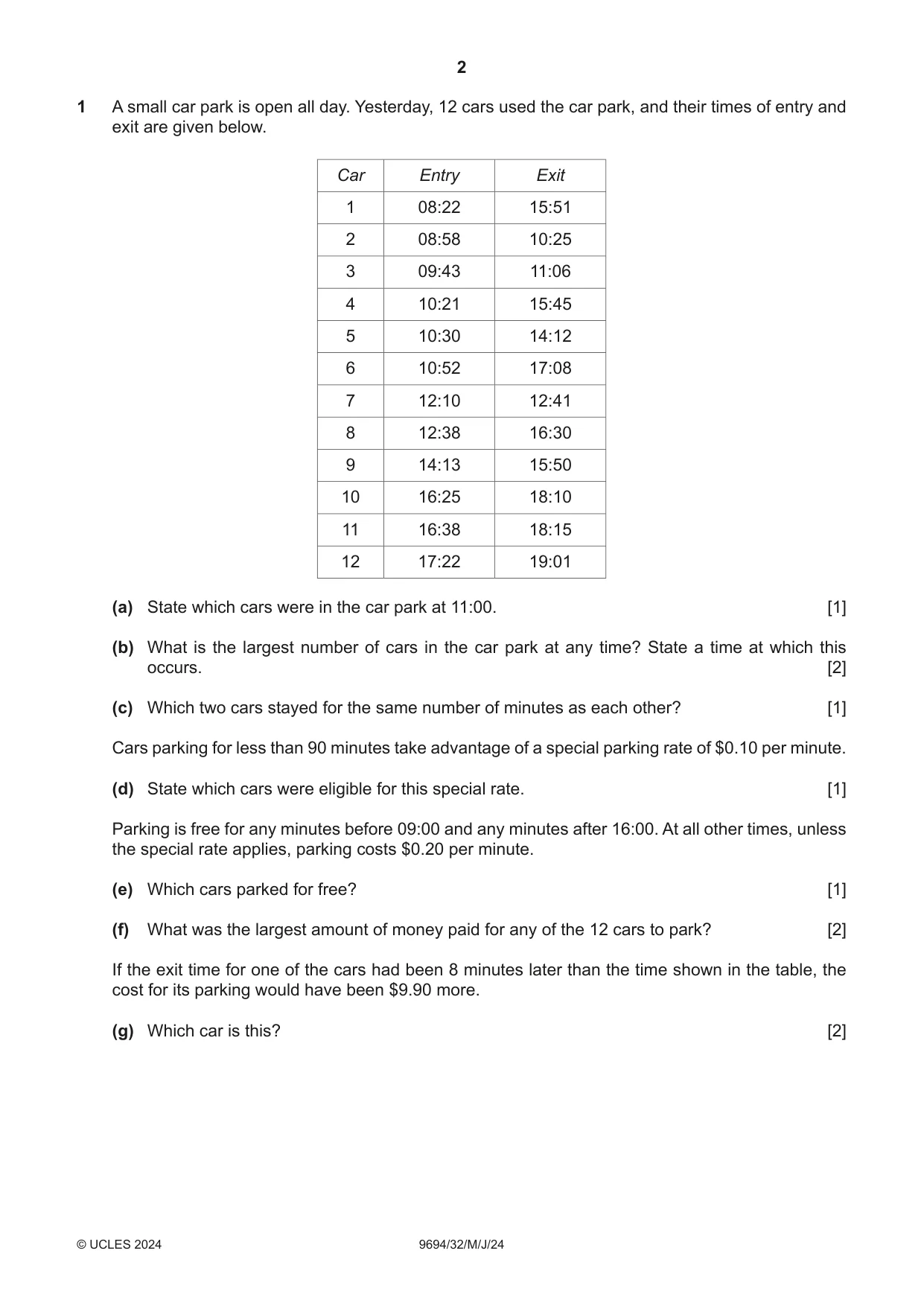
1 A small car park is open all day. Yesterday, 12 cars used the car park, and their times of entry and exit are given below. Car Entry Exit 1 08:22 15:51 2 08:58 10:25 3 09:43 11:06 4 10:21 15:45 5 10:30 14:12 6 10:52 17:08 7 12:10 12:41 8 12:38 16:30 9 14:13 15:50 10 16:25 18:10 11 16:38 18:15 12 17:22 19:01 (a) State which cars were in the car park at 11:00. [1] (b) What is the largest number of cars in the car park at any time? State a time at which this occurs. [2] (c) Which two cars stayed for the same number of minutes as each other? [1] Cars parking for less than 90 minutes take advantage of a special parking rate of $0.10 per minute. (d) State which cars were eligible for this special rate. [1] Parking is free for any minutes before 09:00 and any minutes after 16:00. At all other times, unless the special rate applies, parking costs $0.20 per minute. (e) Which cars parked for free? [1] (f) What was the largest amount of money paid for any of the 12 cars to park? [2] If the exit time for one of the cars had been 8 minutes later than the time shown in the table, the cost for its parking would have been $9.90 more. (g) Which car is this? [2] [Turn over for Question 2]
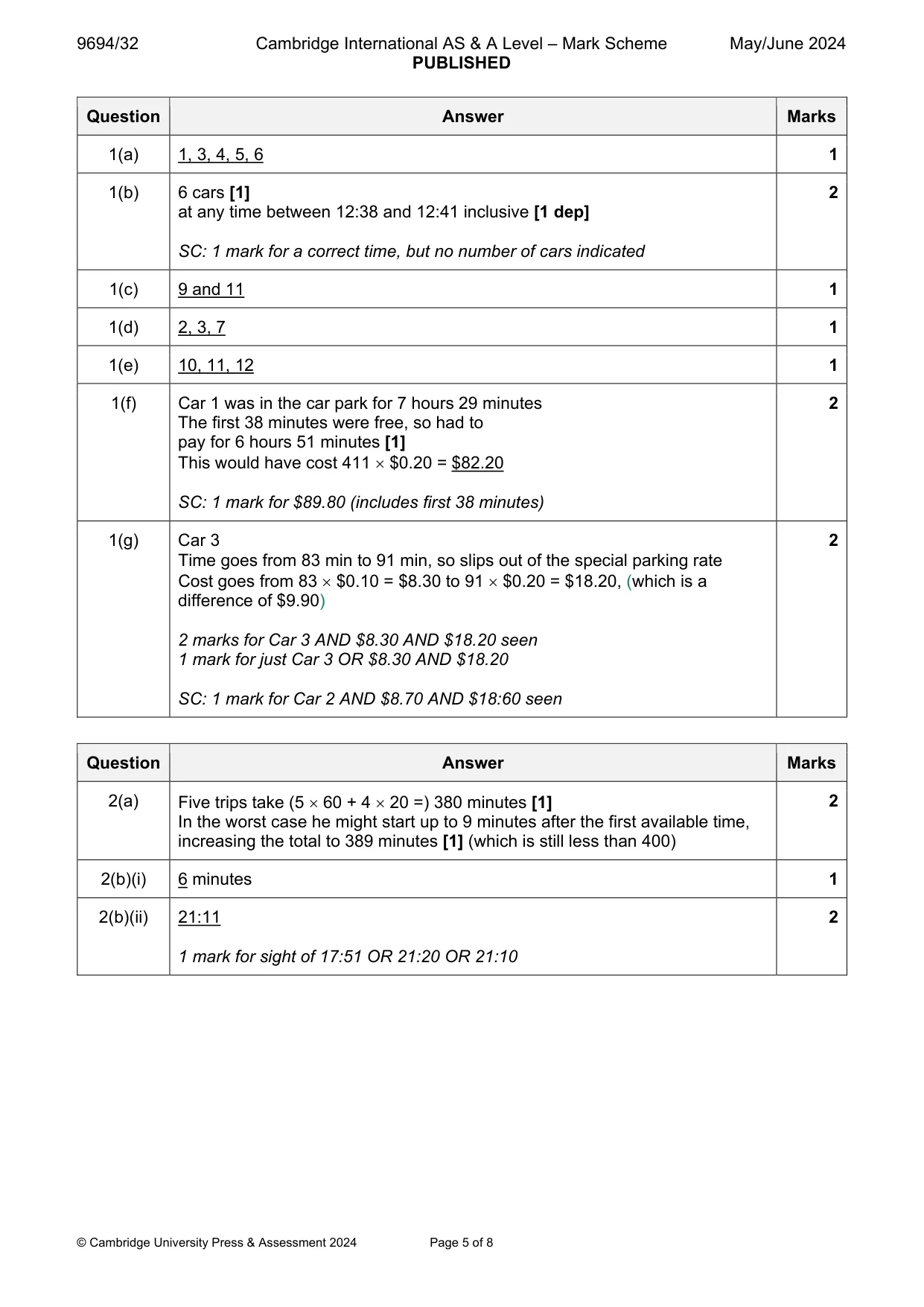
Mark scheme: Question Answer Marks 1(a) 1, 3, 4, 5, 6 1 1(b) 6 cars [1] 2 at any time between 12:38 and 12:41 inclusive [1 dep] SC: 1 mark for a correct time, but no number of cars indicated 1(c) 9 and 11 1 1(d) 2, 3, 7 1 1(e) 10, 11, 12 1 1(f) Car 1 was in the car park for 7 hours 29 minutes 2 The first 38 minutes were free, so had to pay for 6 hours 51 minutes [1] This would have cost 411 $0.20 = $82.20 SC: 1 mark for $89.80 (includes first 38 minutes) 1(g) Car 3 2 Time goes from 83 min to 91 min, so slips out of the special parking rate Cost goes from 83 $0.10 = $8.30 to 91 $0.20 = $18.20, (which is a difference of $9.90) 2 marks for Car 3 AND $8.30 AND $18.20 seen 1 mark for just Car 3 OR $8.30 AND $18.20 SC: 1 mark for Car 2 AND $8.70 AND $18:60 seen
More questions on Identify cases that satisfy given criteria
Q2 · Every summer, from May to September, Ashley operates sightseeing boat trips in his vessel…
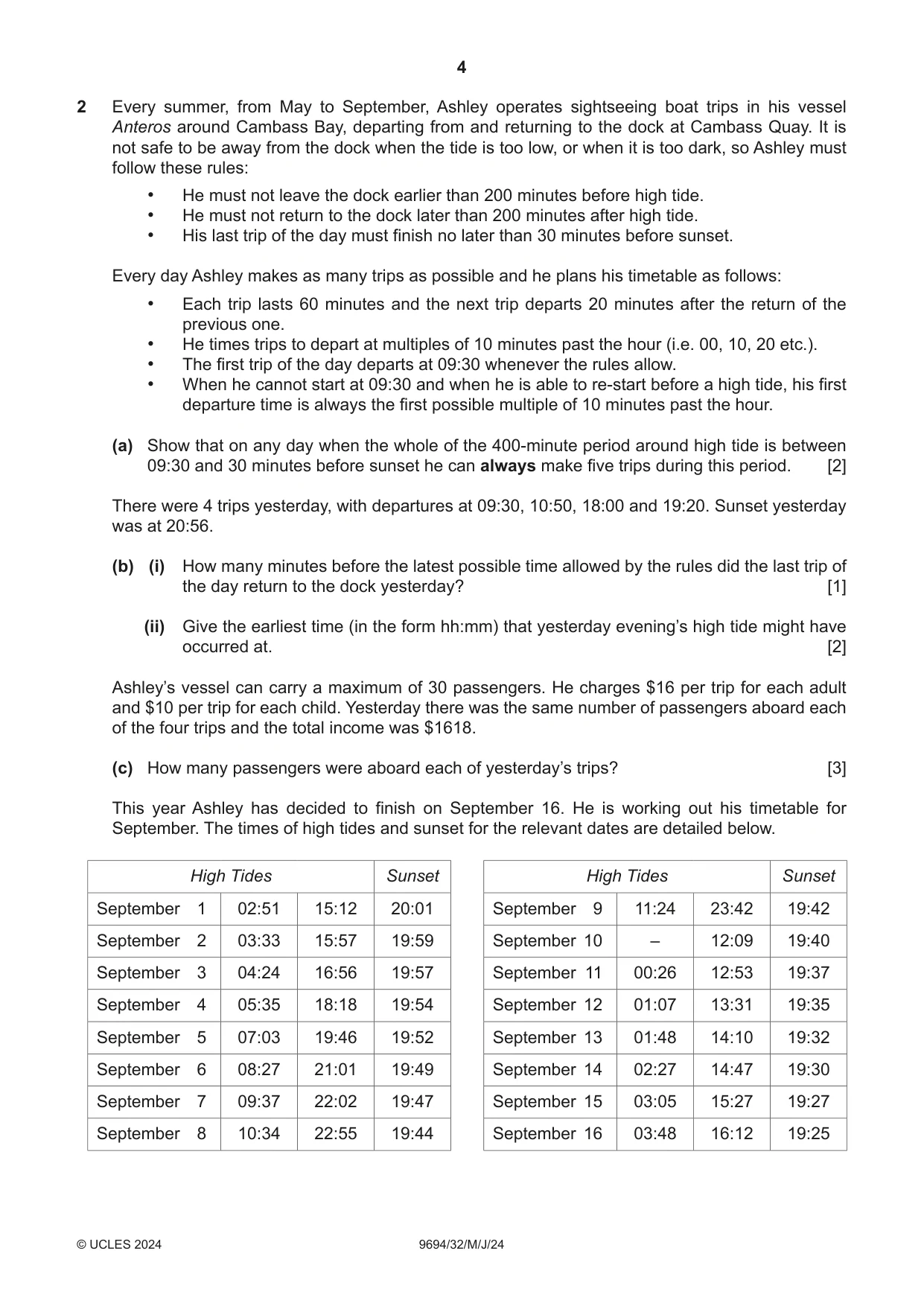
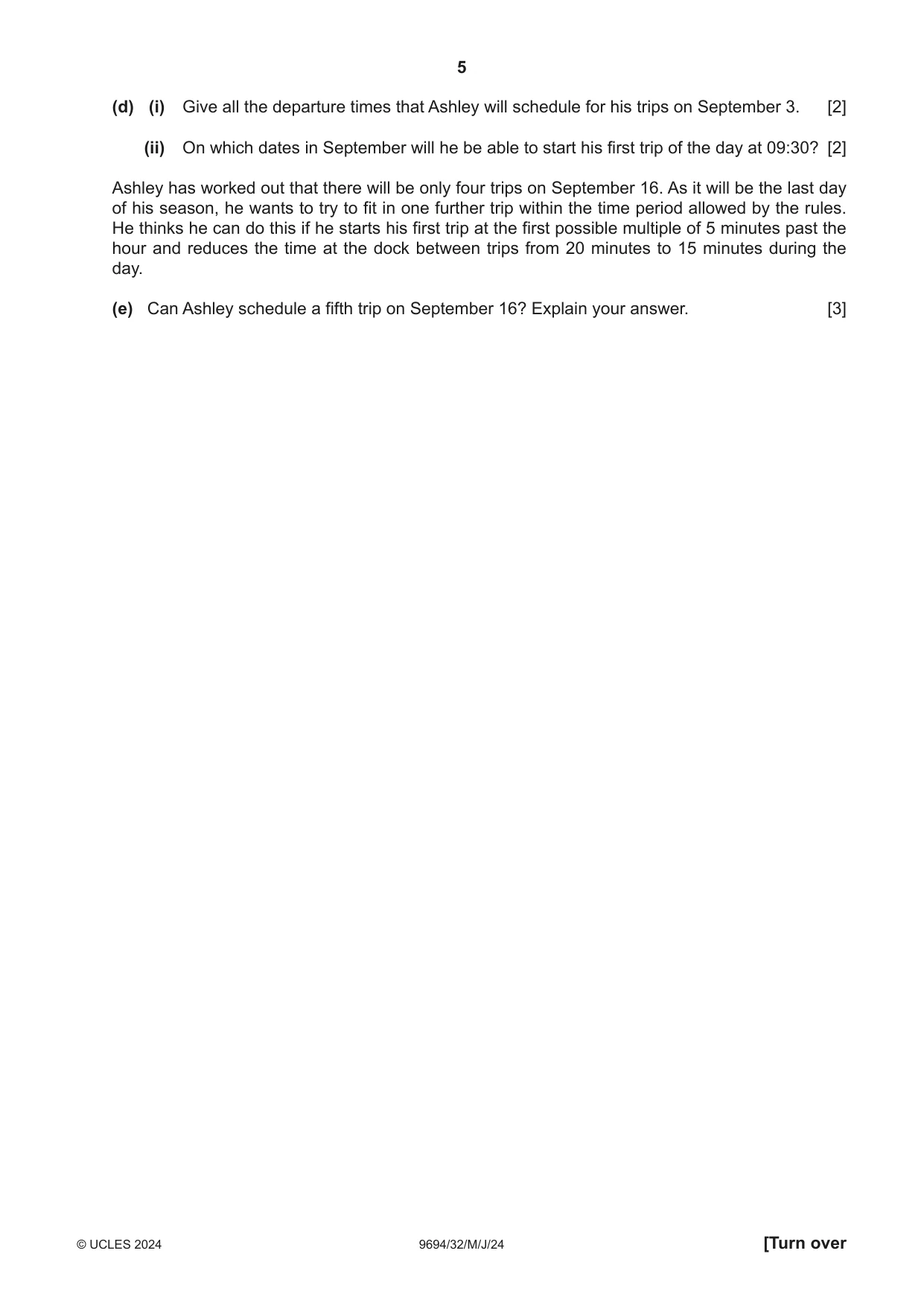
2 Every summer, from May to September, Ashley operates sightseeing boat trips in his vessel Anteros around Cambass Bay, departing from and returning to the dock at Cambass Quay. It is not safe to be away from the dock when the tide is too low, or when it is too dark, so Ashley must follow these rules: • He must not leave the dock earlier than 200 minutes before high tide. • He must not return to the dock later than 200 minutes after high tide. • His last trip of the day must finish no later than 30 minutes before sunset. Every day Ashley makes as many trips as possible and he plans his timetable as follows: • Each trip lasts 60 minutes and the next trip departs 20 minutes after the return of the previous one. • He times trips to depart at multiples of 10 minutes past the hour (i.e. 00, 10, 20 etc.). • The first trip of the day departs at 09:30 whenever the rules allow. • When he cannot start at 09:30 and when he is able to re-start before a high tide, his first departure time is always the first possible multiple of 10 minutes past the hour. (a) Show that on any day when the whole of the 400-minute period around high tide is between 09:30 and 30 minutes before sunset he can always make five trips during this period. [2] There were 4 trips yesterday, with departures at 09:30, 10:50, 18:00 and 19:20. Sunset yesterday was at 20:56. (b) (i) How many minutes before the latest possible time allowed by the rules did the last trip of the day return to the dock yesterday? [1] (ii) Give the earliest time (in the form hh:mm) that yesterday evening’s high tide might have occurred at. [2] Ashley’s vessel can carry a maximum of 30 passengers. He charges $16 per trip for each adult and $10 per trip for each child. Yesterday there was the same number of passengers aboard each of the four trips and the total income was $1618. (c) How many passengers were aboard each of yesterday’s trips? [3] This year Ashley has decided to finish on September 16. He is working out his timetable for September. The times of high tides and sunset for the relevant dates are detailed below. High Tides Sunset High Tides Sunset September 1 02:51 15:12 20:01 September 9 11:24 23:42 19:42 September 2 03:33 15:57 19:59 September 10 – 12:09 19:40 September 3 04:24 16:56 19:57 September 11 00:26 12:53 19:37 September 4 05:35 18:18 19:54 September 12 01:07 13:31 19:35 September 5 07:03 19:46 19:52 September 13 01:48 14:10 19:32 September 6 08:27 21:01 19:49 September 14 02:27 14:47 19:30 September 7 09:37 22:02 19:47 September 15 03:05 15:27 19:27 September 8 10:34 22:55 19:44 September 16 03:48 16:12 19:25 (d) (i) Give all the departure times that Ashley will schedule for his trips on September 3. [2] (ii) On which dates in September will he be able to start his first trip of the day at 09:30? [2] Ashley has worked out that there will be only four trips on September 16. As it will be the last day of his season, he wants to try to fit in one further trip within the time period allowed by the rules. He thinks he can do this if he starts his first trip at the first possible multiple of 5 minutes past the hour and reduces the time at the dock between trips from 20 minutes to 15 minutes during the day. (e) Can Ashley schedule a fifth trip on September 16? Explain your answer. [3]
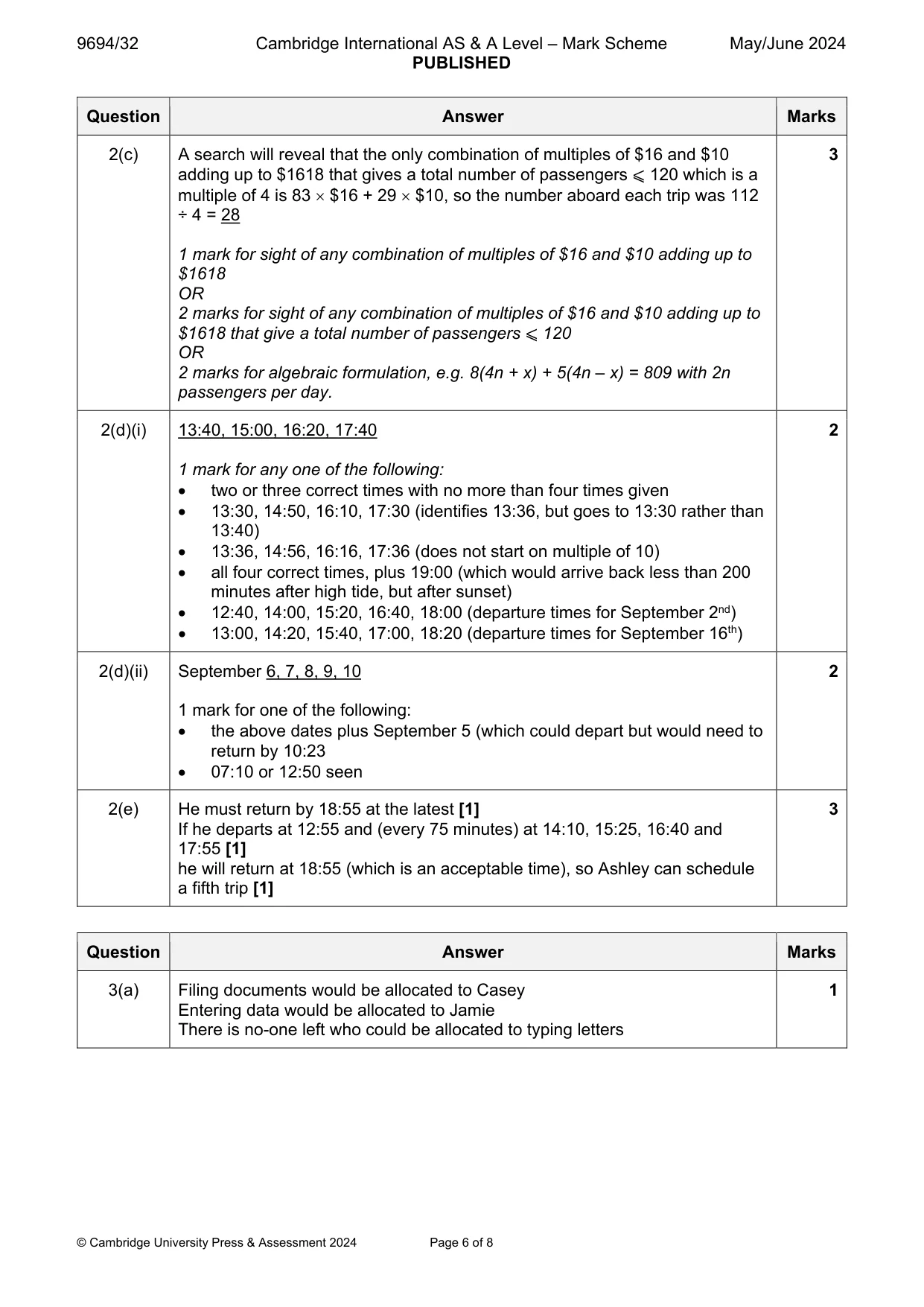
Mark scheme: 2(a) Five trips take (5 60 + 4 20 =) 380 minutes [1] 2 In the worst case he might start up to 9 minutes after the first available time, increasing the total to 389 minutes [1] (which is still less than 400) 2(b)(i) 6 minutes 1 2(b)(ii) 21:11 2 1 mark for sight of 17:51 OR 21:20 OR 21:10 2(c) A search will reveal that the only combination of multiples of $16 and $10 3 adding up to $1618 that gives a total number of passengers ⩽ 120 which is a multiple of 4 is 83 $16 + 29 $10, so the number aboard each trip was 112 ÷ 4 = 28 1 mark for sight of any combination of multiples of $16 and $10 adding up to $1618 OR 2 marks for sight of any combination of multiples of $16 and $10 adding up to $1618 that give a total number of passengers ⩽ 120 OR 2 marks for algebraic formulation, e.g. 8(4n + x) + 5(4n – x) = 809 with 2n passengers per day. 2(d)(i) 13:40, 15:00, 16:20, 17:40 2 1 mark for any one of the following: two or three correct times with no more than four times given 13:30, 14:50, 16:10, 17:30 (identifies 13:36, but goes to 13:30 rather than 13:40) 13:36, 14:56, 16:16, 17:36 (does not start on multiple of 10) all four correct times, plus 19:00 (which would arrive back less than 200 minutes after high tide, but after sunset) 12:40, 14:00, 15:20, 16:40, 18:00 (departure times for September 2nd) 13:00, 14:20, 15:40, 17:00, 18:20 (departure times for September 16th) 2(d)(ii) September 6, 7, 8, 9, 10 2 1 mark for one of the following: the above dates plus September 5 (which could depart but would need to return by 10:23 07:10 or 12:50 seen 2(e) He must return by 18:55 at the latest [1] 3 If he departs at 12:55 and (every 75 minutes) at 14:10, 15:25, 16:40 and 17:55 [1] he will return at 18:55 (which is an acceptable time), so Ashley can schedule a fifth trip [1]
More questions on Perform appropriate operations with information
Q3 · Felix manages a company that provides temporary workers to businesses
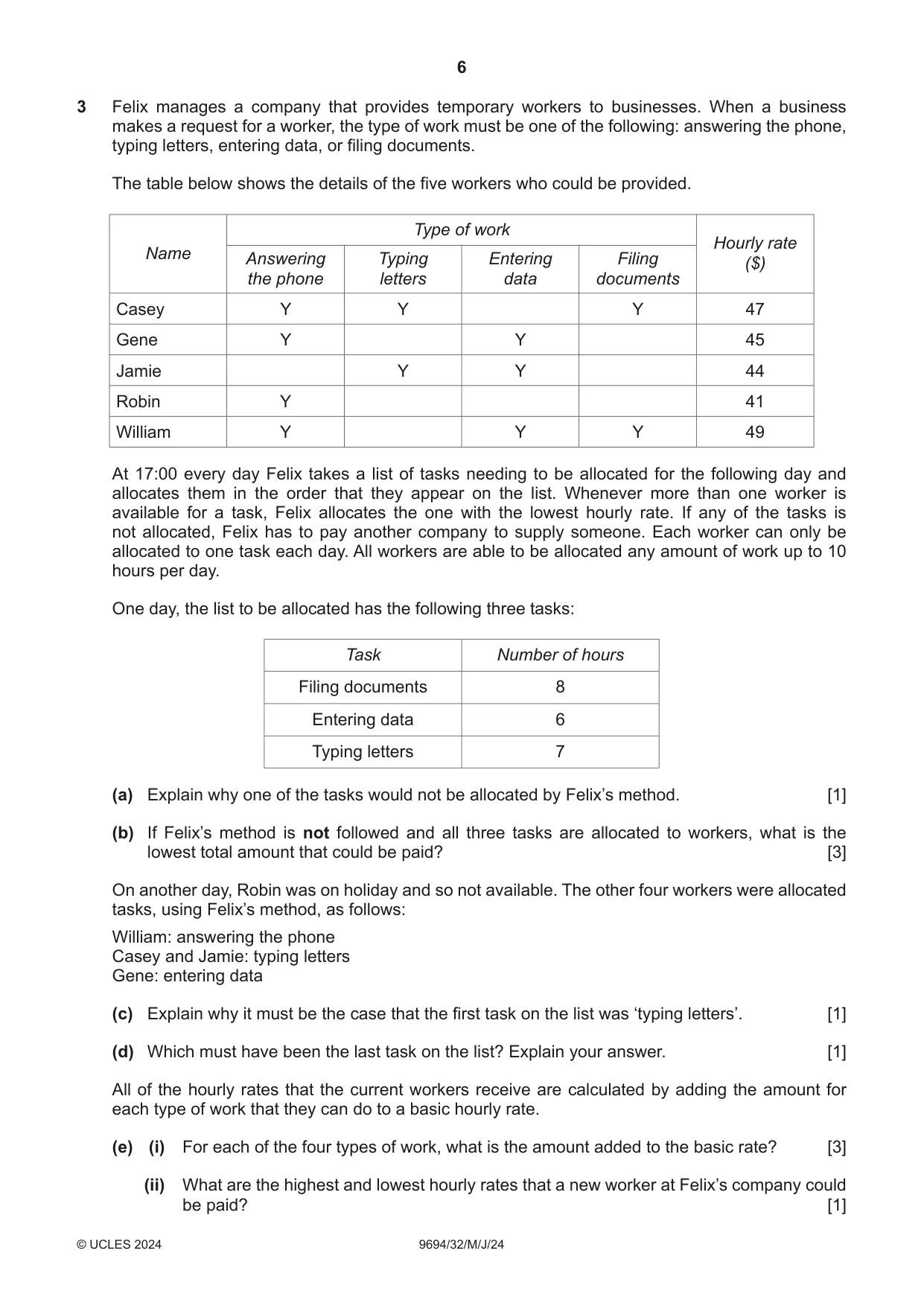
3 Felix manages a company that provides temporary workers to businesses. When a business makes a request for a worker, the type of work must be one of the following: answering the phone, typing letters, entering data, or filing documents. The table below shows the details of the five workers who could be provided. Type of work Hourly rate Name Answering Typing Entering Filing ($) the phone letters data documents Casey Y Y Y 47 Gene Y Y 45 Jamie Y Y 44 Robin Y 41 William Y Y Y 49 At 17:00 every day Felix takes a list of tasks needing to be allocated for the following day and allocates them in the order that they appear on the list. Whenever more than one worker is available for a task, Felix allocates the one with the lowest hourly rate. If any of the tasks is not allocated, Felix has to pay another company to supply someone. Each worker can only be allocated to one task each day. All workers are able to be allocated any amount of work up to 10 hours per day. One day, the list to be allocated has the following three tasks: Task Number of hours Filing documents 8 Entering data 6 Typing letters 7 (a) Explain why one of the tasks would not be allocated by Felix’s method. [1] (b) If Felix’s method is not followed and all three tasks are allocated to workers, what is the lowest total amount that could be paid? [3] On another day, Robin was on holiday and so not available. The other four workers were allocated tasks, using Felix’s method, as follows: William: answering the phone Casey and Jamie: typing letters Gene: entering data (c) Explain why it must be the case that the first task on the list was ‘typing letters’. [1] (d) Which must have been the last task on the list? Explain your answer. [1] All of the hourly rates that the current workers receive are calculated by adding the amount for each type of work that they can do to a basic hourly rate. (e) (i) For each of the four types of work, what is the amount added to the basic rate? [3] (ii) What are the highest and lowest hourly rates that a new worker at Felix’s company could be paid? [1] [Turn over for Question 4]
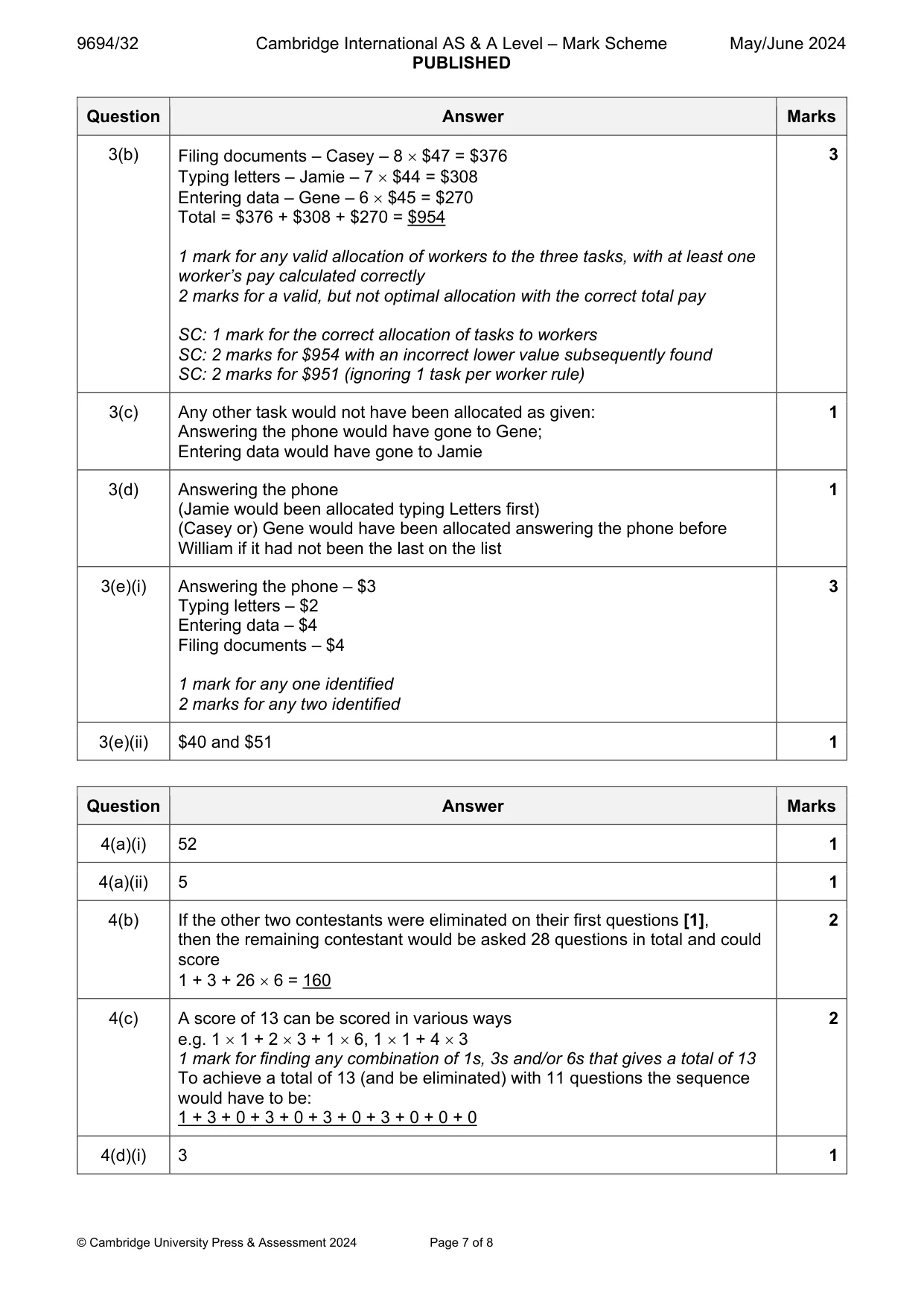
Mark scheme: 3(a) Filing documents would be allocated to Casey 1 Entering data would be allocated to Jamie There is no-one left who could be allocated to typing letters 3(b) Filing documents – Casey – 8 $47 = $376 3 Typing letters – Jamie – 7 $44 = $308 Entering data – Gene – 6 $45 = $270 Total = $376 + $308 + $270 = $954 1 mark for any valid allocation of workers to the three tasks, with at least one worker’s pay calculated correctly 2 marks for a valid, but not optimal allocation with the correct total pay SC: 1 mark for the correct allocation of tasks to workers SC: 2 marks for $954 with an incorrect lower value subsequently found SC: 2 marks for $951 (ignoring 1 task per worker rule) 3(c) Any other task would not have been allocated as given: 1 Answering the phone would have gone to Gene; Entering data would have gone to Jamie 3(d) Answering the phone 1 (Jamie would been allocated typing Letters first) (Casey or) Gene would have been allocated answering the phone before William if it had not been the last on the list 3(e)(i) Answering the phone – $3 3 Typing letters – $2 Entering data – $4 Filing documents – $4 1 mark for any one identified 2 marks for any two identified 3(e)(ii) $40 and $51 1
Q4 · The competition 7-Quiz is held each year between 7 contestants
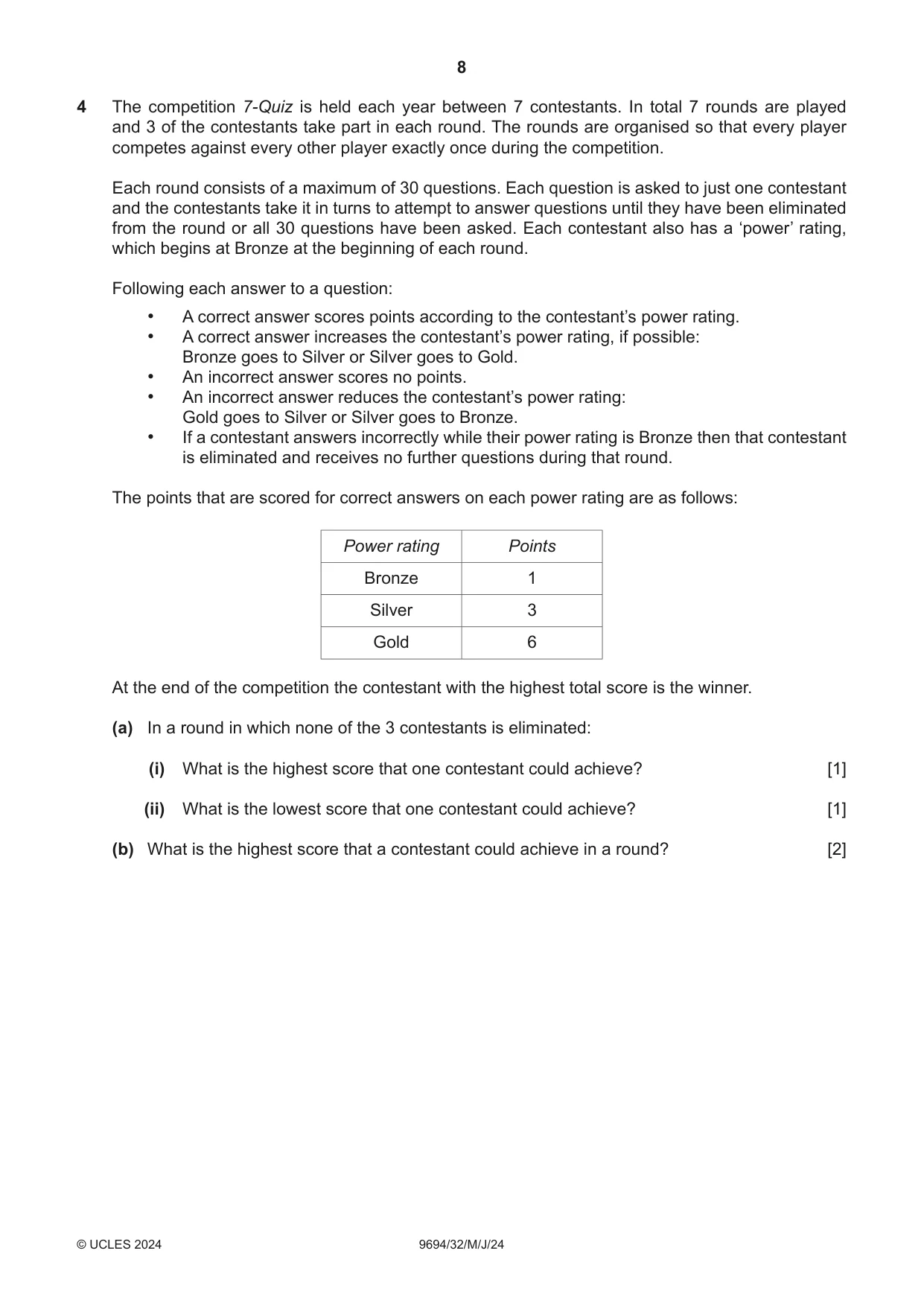
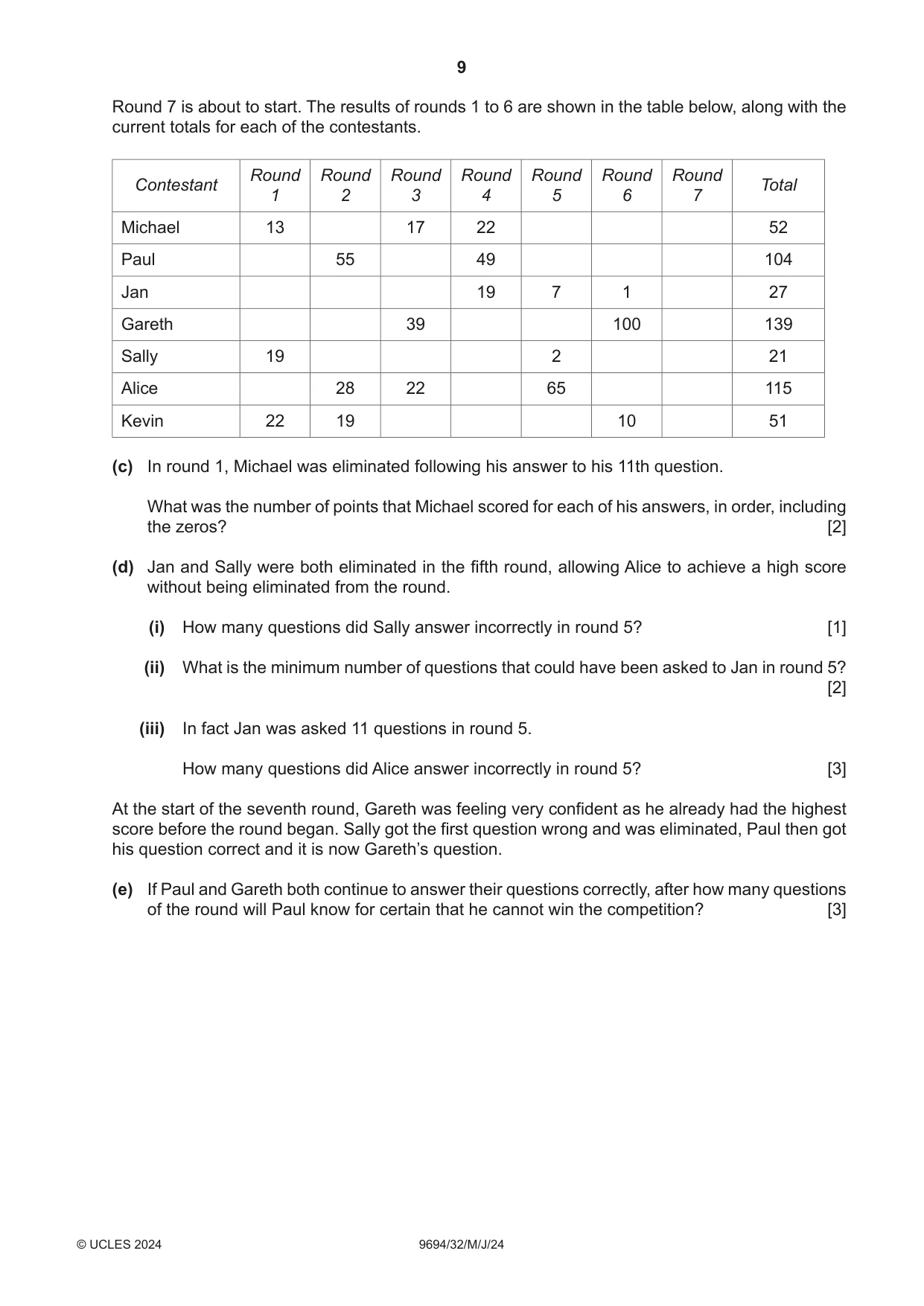
4 The competition 7-Quiz is held each year between 7 contestants. In total 7 rounds are played and 3 of the contestants take part in each round. The rounds are organised so that every player competes against every other player exactly once during the competition. Each round consists of a maximum of 30 questions. Each question is asked to just one contestant and the contestants take it in turns to attempt to answer questions until they have been eliminated from the round or all 30 questions have been asked. Each contestant also has a ‘power’ rating, which begins at Bronze at the beginning of each round. Following each answer to a question: • A correct answer scores points according to the contestant’s power rating. • A correct answer increases the contestant’s power rating, if possible: Bronze goes to Silver or Silver goes to Gold. • An incorrect answer scores no points. • An incorrect answer reduces the contestant’s power rating: Gold goes to Silver or Silver goes to Bronze. • If a contestant answers incorrectly while their power rating is Bronze then that contestant is eliminated and receives no further questions during that round. The points that are scored for correct answers on each power rating are as follows: Power rating Points Bronze 1 Silver 3 Gold 6 At the end of the competition the contestant with the highest total score is the winner. (a) In a round in which none of the 3 contestants is eliminated: (i) What is the highest score that one contestant could achieve? [1] (ii) What is the lowest score that one contestant could achieve? [1] (b) What is the highest score that a contestant could achieve in a round? [2] Round 7 is about to start. The results of rounds 1 to 6 are shown in the table below, along with the current totals for each of the contestants. Round Round Round Round Round Round Round Contestant Total 1 2 3 4 5 6 7 Michael 13 17 22 52 Paul 55 49 104 Jan 19 7 1 27 Gareth 39 100 139 Sally 19 2 21 Alice 28 22 65 115 Kevin 22 19 10 51 (c) In round 1, Michael was eliminated following his answer to his 11th question. What was the number of points that Michael scored for each of his answers, in order, including the zeros? [2] (d) Jan and Sally were both eliminated in the fifth round, allowing Alice to achieve a high score without being eliminated from the round. (i) How many questions did Sally answer incorrectly in round 5? [1] (ii) What is the minimum number of questions that could have been asked to Jan in round 5? [2] (iii) In fact Jan was asked 11 questions in round 5. How many questions did Alice answer incorrectly in round 5? [3] At the start of the seventh round, Gareth was feeling very confident as he already had the highest score before the round began. Sally got the first question wrong and was eliminated, Paul then got his question correct and it is now Gareth’s question. (e) If Paul and Gareth both continue to answer their questions correctly, after how many questions of the round will Paul know for certain that he cannot win the competition? [3]
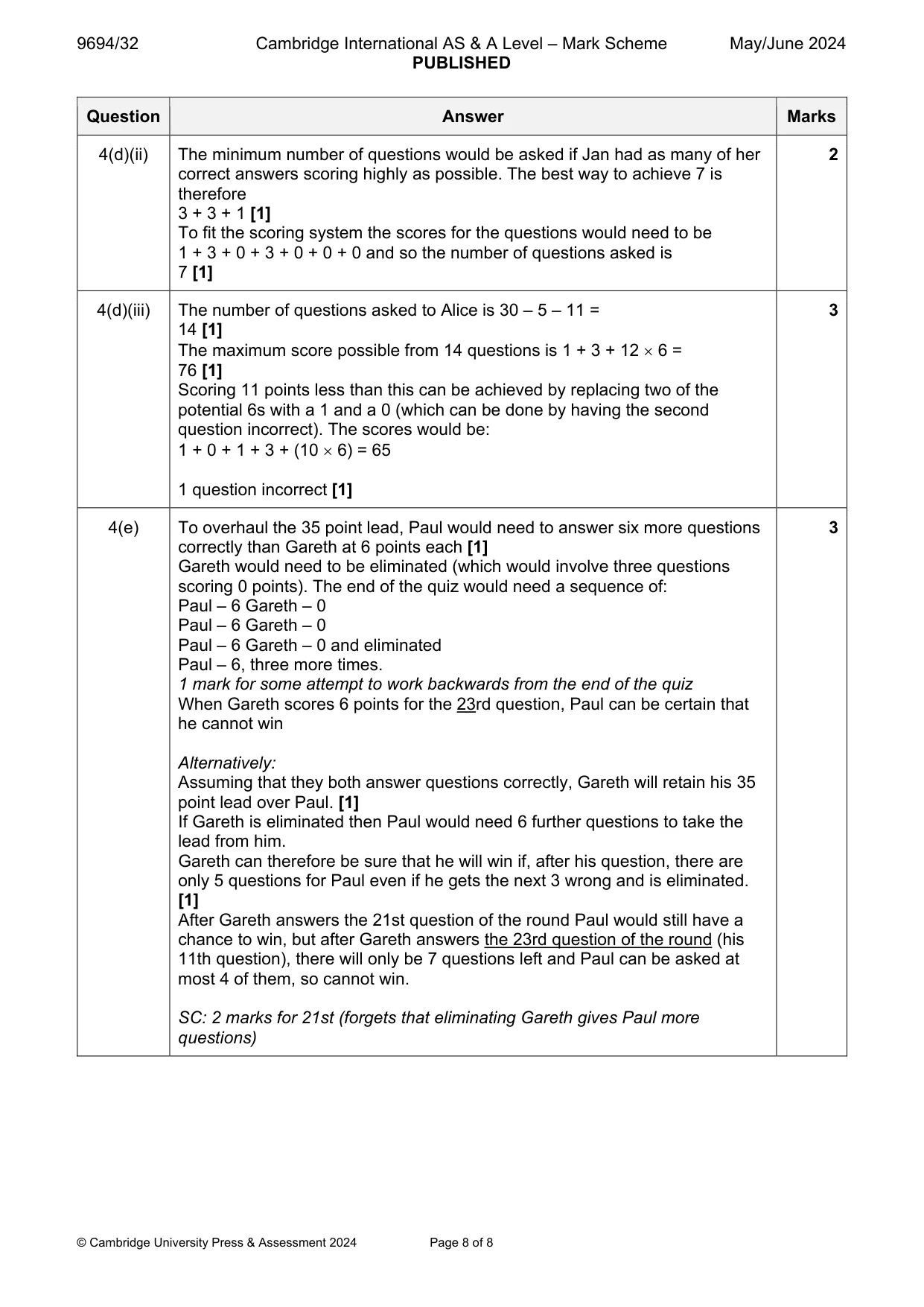
Mark scheme: 4(a)(i) 52 1 4(a)(ii) 5 1 4(b) If the other two contestants were eliminated on their first questions [1], 2 then the remaining contestant would be asked 28 questions in total and could score 1 + 3 + 26 6 = 160 4(c) A score of 13 can be scored in various ways 2 e.g. 1 1 + 2 3 + 1 6, 1 1 + 4 3 1 mark for finding any combination of 1s, 3s and/or 6s that gives a total of 13 To achieve a total of 13 (and be eliminated) with 11 questions the sequence would have to be: 1 + 3 + 0 + 3 + 0 + 3 + 0 + 3 + 0 + 0 + 0 4(d)(i) 3 1 4(d)(ii) The minimum number of questions would be asked if Jan had as many of her 2 correct answers scoring highly as possible. The best way to achieve 7 is therefore 3 + 3 + 1 [1] To fit the scoring system the scores for the questions would need to be 1 + 3 + 0 + 3 + 0 + 0 + 0 and so the number of questions asked is 7 [1] 4(d)(iii) The number of questions asked to Alice is 30 – 5 – 11 = 3 14 [1] The maximum score possible from 14 questions is 1 + 3 + 12 6 = 76 [1] Scoring 11 points less than this can be achieved by replacing two of the potential 6s with a 1 and a 0 (which can be done by having the second question incorrect). The scores would be: 1 + 0 + 1 + 3 + (10 6) = 65 1 question incorrect [1] 4(e) To overhaul the 35 point lead, Paul would need to answer six more questions 3 correctly than Gareth at 6 points each [1] Gareth would need to be eliminated (which would involve three questions scoring 0 points). The end of the quiz would need a sequence of: Paul – 6 Gareth – 0 Paul – 6 Gareth – 0 Paul – 6 Gareth – 0 and eliminated Paul – 6, three more times. 1 mark for some attempt to work backwards from the end of the quiz When Gareth scores 6 points for the 23rd question, Paul can be certain that he cannot win Alternatively: Assuming that they both answer questions correctly, Gareth will retain his 35 point lead over Paul. [1] If Gareth is eliminated then Paul would need 6 further questions to take the lead from him. Gareth can therefore be sure that he will win if, after his question, there are only 5 questions for Paul even if he gets the next 3 wrong and is eliminated. [1] After Gareth answers the 21st question of the round Paul would still have a chance to win, but after Gareth answers the 23rd question of the round (his 11th question), there will only be 7 questions left and Paul can be asked at most 4 of them, so cannot win. SC: 2 marks for 21st (forgets that eliminating Gareth gives Paul more questions)
What was in this paper
The subtopics covered by these 4 questions, and how many questions each got. Open one in a new tab to see every Cambridge question on it.
What you needed in this session
Cambridge’s own grade thresholds for 2024 May/June, Paper 3 · Variant 2. A higher threshold means an easier paper — the bar moves with how the cohort did.