Cambridge A Level Thinking Skills 9694 — 2023 May/June Paper 3 · Variant 2
9694/32/M/J/23 · 4 questions · 50 marks · ≈56 min
The question paper and its mark scheme, free to read here and free to download. This is Cambridge’s own paper, exactly as it was sat.
Question paper8 pages
Mark scheme7 pages
Answers below. Sit the paper first if you are practising.
Questions as text
Q1 · The scarves of the Rainbows baseball team consist of alternating black and ‘rainbow’…
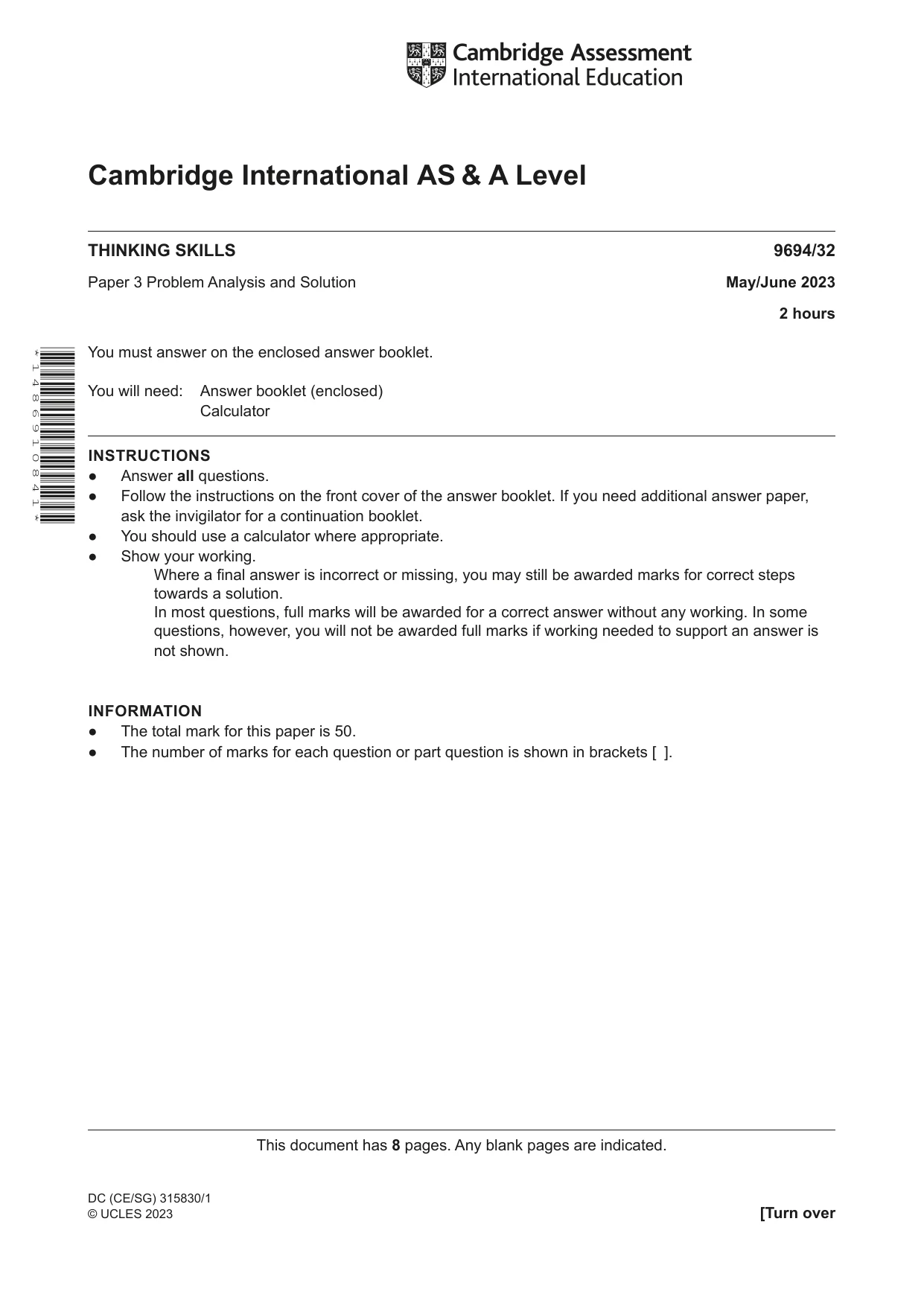
1 The scarves of the Rainbows baseball team consist of alternating black and ‘rainbow’ stripes along the whole length of the scarf. Each scarf is 1.6 metres long and has 6 black stripes and 5 rainbow stripes. All of the black stripes are the same length as each other. A rainbow stripe consists of 7 narrow stripes, one in each colour of the rainbow. Each narrow stripe is 2 cm long, so a rainbow stripe is 14 cm long. (a) Show that each black stripe is 15 cm long. [1] The scarves are knitted with wool that comes in balls containing 20 metres of wool. Whenever two pieces of wool need to be joined, this is achieved without wasting any wool. Each 1 cm length of scarf requires 20 cm of wool. (b) How many balls of red wool are needed to knit 24 scarves? Justify your answer. [2] The team has bought 8 balls of wool in each rainbow colour and 75 balls of black wool. (c) (i) Show that there is sufficient green wool to knit 80 Rainbow scarves. [1] (ii) Is there sufficient black wool to complete these scarves? Justify your answer. [2] The wool that the team has bought will be used to make as many scarves as possible. The cost of the wool was $6 a ball or $20 for 4 balls of the same colour. The scarves will be sold for a whole number of dollars each. (d) What is the least amount for which a scarf could be sold so that the team covers the cost of buying the wool? [4] [Turn over for Question 2]
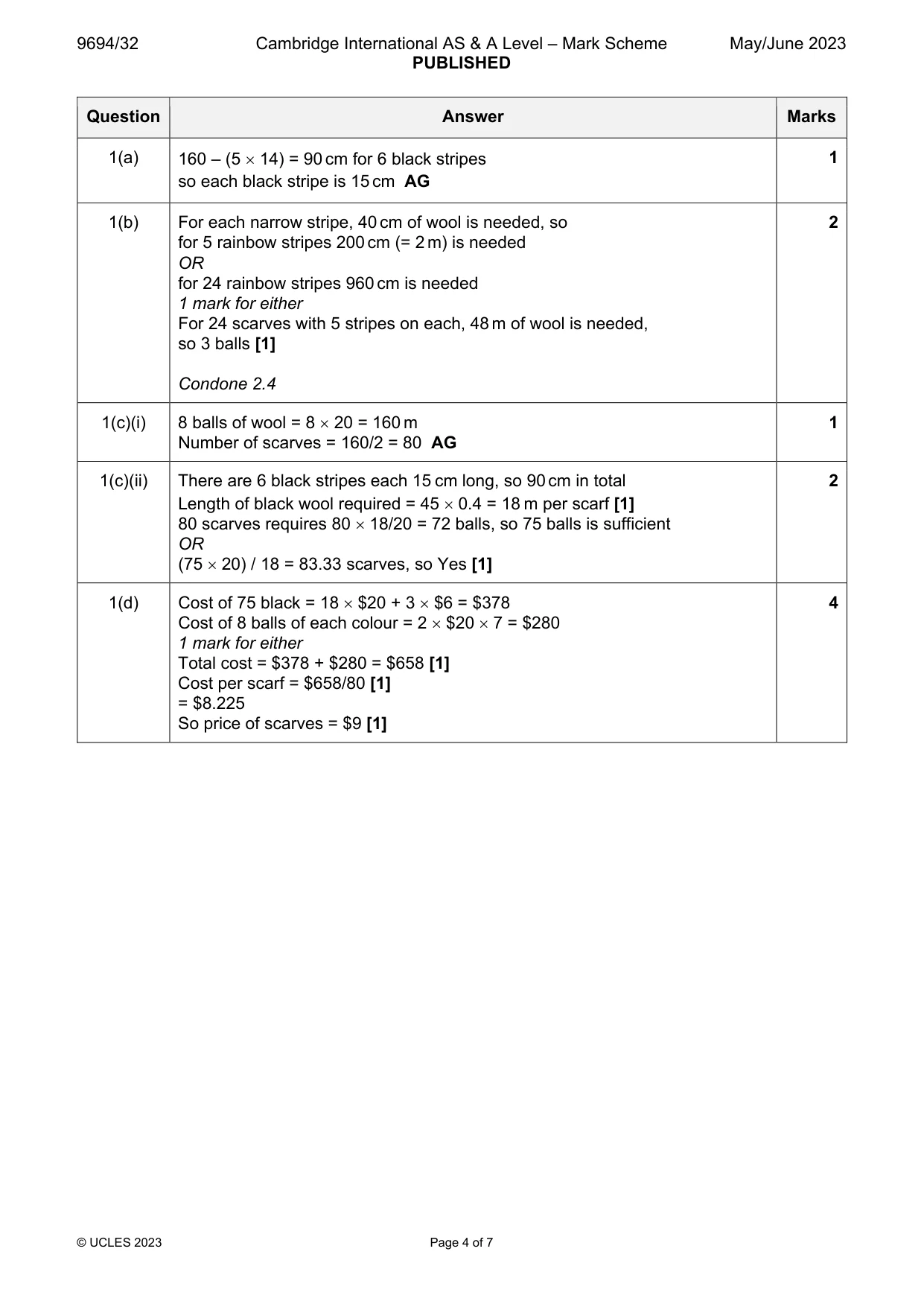
Mark scheme: Question Answer Marks 1(a) 160 – (5 14) = 90 cm for 6 black stripes 1 so each black stripe is 15 cm AG 1(b) For each narrow stripe, 40 cm of wool is needed, so 2 for 5 rainbow stripes 200 cm (= 2 m) is needed OR for 24 rainbow stripes 960 cm is needed 1 mark for either For 24 scarves with 5 stripes on each, 48 m of wool is needed, so 3 balls [1] Condone 2.4 1(c)(i) 8 balls of wool = 8 20 = 160 m 1 Number of scarves = 160/2 = 80 AG 1(c)(ii) There are 6 black stripes each 15 cm long, so 90 cm in total 2 Length of black wool required = 45 0.4 = 18 m per scarf [1] 80 scarves requires 80 18/20 = 72 balls, so 75 balls is sufficient OR (75 20) / 18 = 83.33 scarves, so Yes [1] 1(d) Cost of 75 black = 18 $20 + 3 $6 = $378 4 Cost of 8 balls of each colour = 2 $20 7 = $280 1 mark for either Total cost = $378 + $280 = $658 [1] Cost per scarf = $658/80 [1] = $8.225 So price of scarves = $9 [1]
More questions on Perform appropriate operations with information
Q2 · Julie sells sweets in her shop
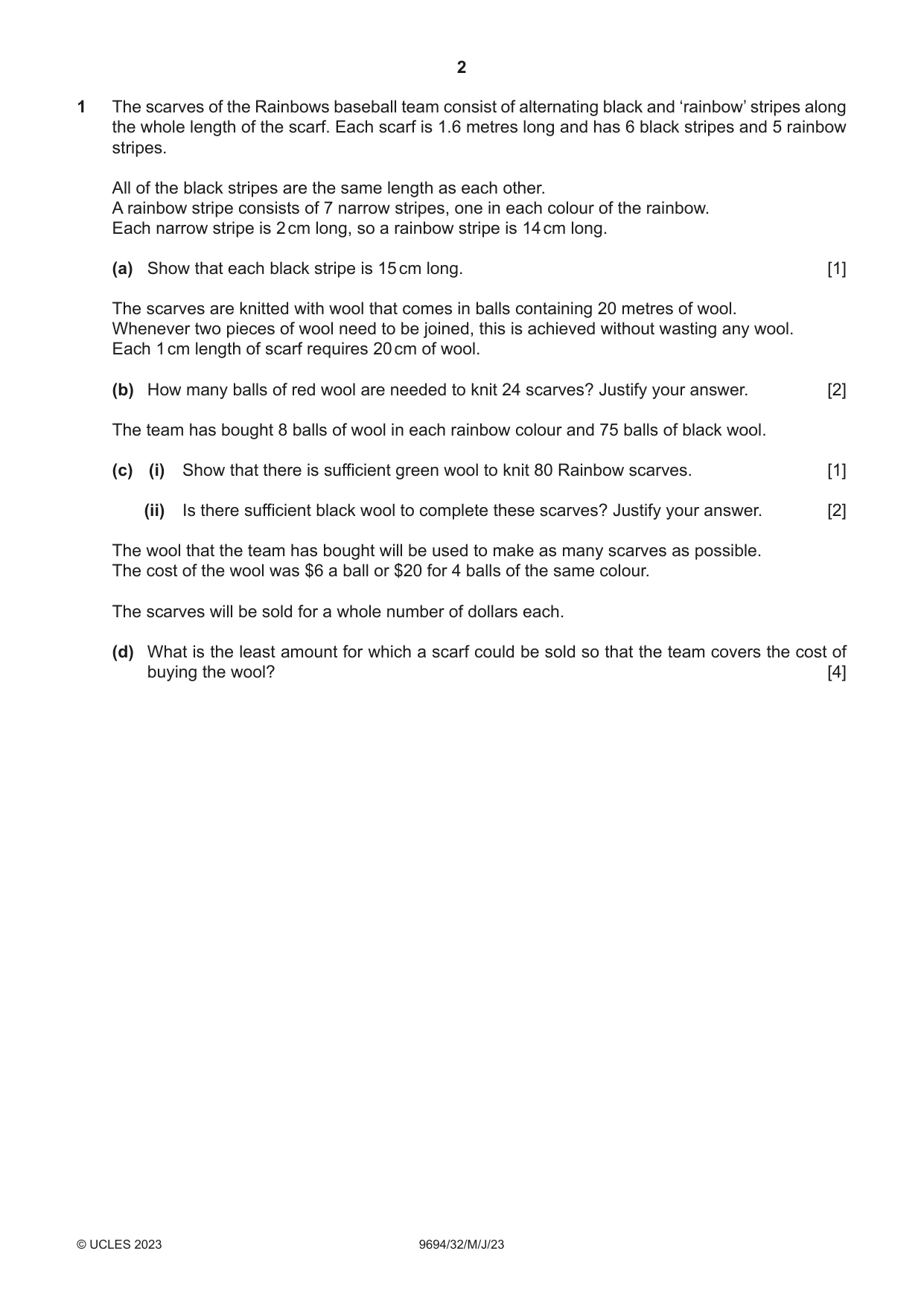
2 Julie sells sweets in her shop. There are five different types of sweet available, each of which is a different colour. All sweets weigh a small whole number of grams. Sweets of the same colour do not necessarily weigh the same amount. Customers put the sweets that they wish to buy in one or more bags. The price for a bag of sweets is $1.00 for the bag, plus an amount for every complete 100 g of sweets, which is determined by the most expensive type of sweet in the bag. The amounts per 100 g are shown in the table. Sweet colour Red Yellow Green Blue Purple Price per 100 g $0.30 $0.50 $0.70 $0.80 $1.00 Julie’s first customer today buys 482 g of red sweets, 507 g of yellow sweets and 442 g of green sweets. (a) Show that it costs $10.80 to buy these sweets if they are all placed in one bag. [2] (b) How much would it cost to buy the sweets if they were bought in three bags with just one colour of sweet in each bag? [2] The customer in fact puts the sweets into bags in such a way that she pays the least possible total cost for the sweets. (c) What is this least possible total cost? [3] Julie’s second customer today wants to buy some yellow sweets and purple sweets and has $14.00 to spend. (d) What is the maximum possible total weight of the sweets bought if the customer buys as many sweets as possible with (i) equal weights of yellow and purple sweets? [2] (ii) exactly twice the weight of purple sweets as yellow sweets? [3] Julie has decided to change the way in which the price of a bag of sweets is calculated. There will no longer be a charge for the bag, but at least 500 g of sweets must be placed in any bag bought. The price for blue sweets will now be $0.95 for every complete 100 g. (e) What is the least weight of blue sweets that will be more expensive with this new system compared with the old one? [2] The price of purple sweets will be set so that bags of purple sweets are always more expensive with this new system compared to the old one. (f) What is the lowest value that could be set for the price for every complete 100 g of purple sweets? [1]
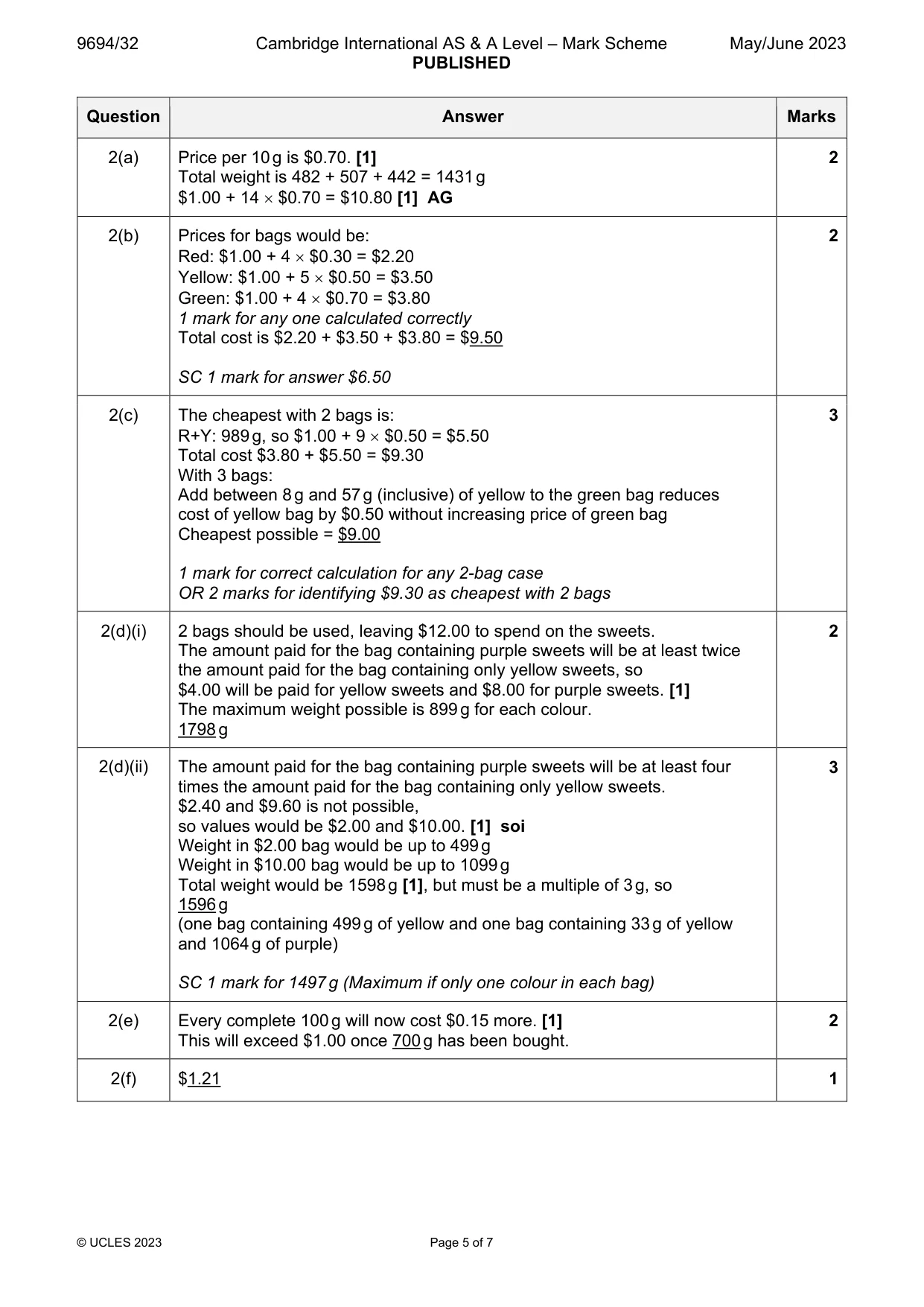
Mark scheme: 2(a) Price per 10 g is $0.70. [1] 2 Total weight is 482 + 507 + 442 = 1431 g $1.00 + 14 $0.70 = $10.80 [1] AG 2(b) Prices for bags would be: 2 Red: $1.00 + 4 $0.30 = $2.20 Yellow: $1.00 + 5 $0.50 = $3.50 Green: $1.00 + 4 $0.70 = $3.80 1 mark for any one calculated correctly Total cost is $2.20 + $3.50 + $3.80 = $9.50 SC 1 mark for answer $6.50 2(c) The cheapest with 2 bags is: 3 R+Y: 989 g, so $1.00 + 9 $0.50 = $5.50 Total cost $3.80 + $5.50 = $9.30 With 3 bags: Add between 8 g and 57 g (inclusive) of yellow to the green bag reduces cost of yellow bag by $0.50 without increasing price of green bag Cheapest possible = $9.00 1 mark for correct calculation for any 2-bag case OR 2 marks for identifying $9.30 as cheapest with 2 bags 2(d)(i) 2 bags should be used, leaving $12.00 to spend on the sweets. 2 The amount paid for the bag containing purple sweets will be at least twice the amount paid for the bag containing only yellow sweets, so $4.00 will be paid for yellow sweets and $8.00 for purple sweets. [1] The maximum weight possible is 899 g for each colour. 1798 g 2(d)(ii) The amount paid for the bag containing purple sweets will be at least four 3 times the amount paid for the bag containing only yellow sweets. $2.40 and $9.60 is not possible, so values would be $2.00 and $10.00. [1] soi Weight in $2.00 bag would be up to 499 g Weight in $10.00 bag would be up to 1099 g Total weight would be 1598 g [1], but must be a multiple of 3 g, so 1596 g (one bag containing 499 g of yellow and one bag containing 33 g of yellow and 1064 g of purple) SC 1 mark for 1497 g (Maximum if only one colour in each bag) 2(e) Every complete 100 g will now cost $0.15 more. [1] 2 This will exceed $1.00 once 700 g has been bought. 2(f) $1.21 1
More questions on Perform appropriate operations with information
Q3 · Multi-Facto is a game in which two players take turns in taking numbers from a list, with…
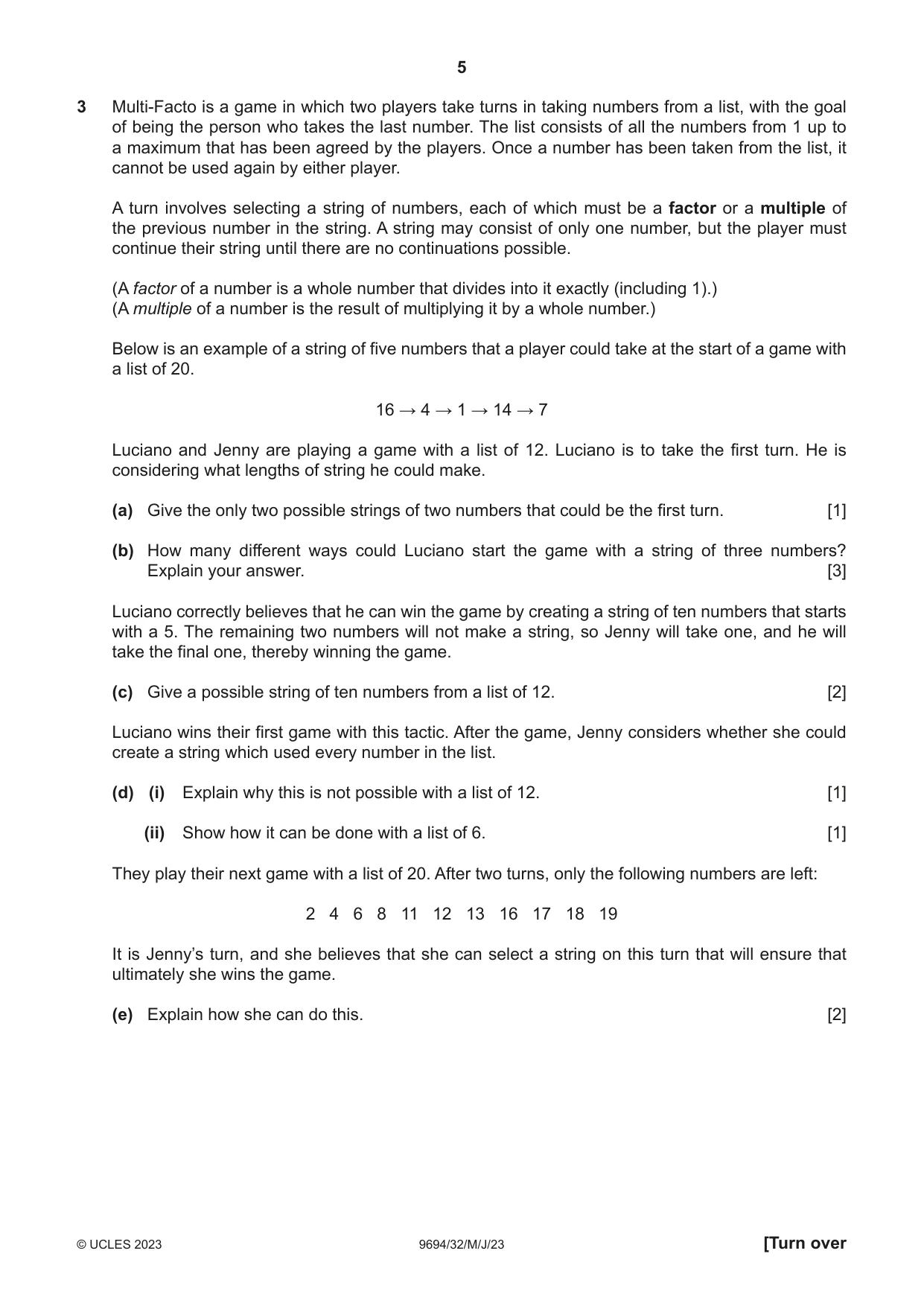
3 Multi-Facto is a game in which two players take turns in taking numbers from a list, with the goal of being the person who takes the last number. The list consists of all the numbers from 1 up to a maximum that has been agreed by the players. Once a number has been taken from the list, it cannot be used again by either player. A turn involves selecting a string of numbers, each of which must be a factor or a multiple of the previous number in the string. A string may consist of only one number, but the player must continue their string until there are no continuations possible. (A factor of a number is a whole number that divides into it exactly (including 1).) (A multiple of a number is the result of multiplying it by a whole number.) Below is an example of a string of five numbers that a player could take at the start of a game with a list of 20. 16 → 4 → 1 → 14 → 7 Luciano and Jenny are playing a game with a list of 12. Luciano is to take the first turn. He is considering what lengths of string he could make. (a) Give the only two possible strings of two numbers that could be the first turn. [1] (b) How many different ways could Luciano start the game with a string of three numbers? Explain your answer. [3] Luciano correctly believes that he can win the game by creating a string of ten numbers that starts with a 5. The remaining two numbers will not make a string, so Jenny will take one, and he will take the final one, thereby winning the game. (c) Give a possible string of ten numbers from a list of 12. [2] Luciano wins their first game with this tactic. After the game, Jenny considers whether she could create a string which used every number in the list. (d) (i) Explain why this is not possible with a list of 12. [1] (ii) Show how it can be done with a list of 6. [1] They play their next game with a list of 20. After two turns, only the following numbers are left: 2 4 6 8 11 12 13 16 17 18 19 It is Jenny’s turn, and she believes that she can select a string on this turn that will ensure that ultimately she wins the game. (e) Explain how she can do this. [2]
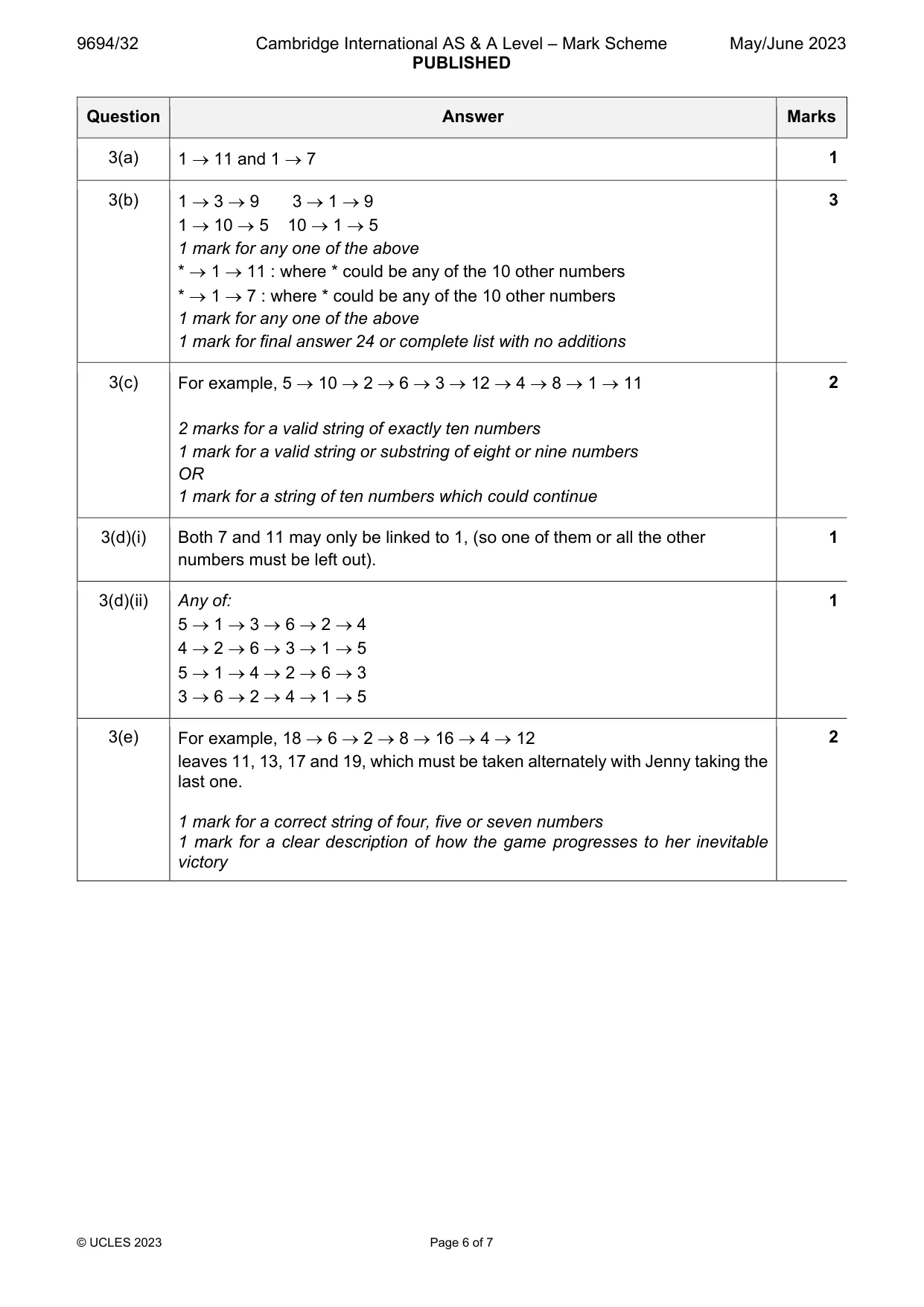
Mark scheme: 3(a) 1 11 and 1 7 1 3(b) 1 3 9 3 1 9 3 1 10 5 10 1 5 1 mark for any one of the above * 1 11 : where * could be any of the 10 other numbers * 1 7 : where * could be any of the 10 other numbers 1 mark for any one of the above 1 mark for final answer 24 or complete list with no additions 3(c) For example, 5 10 2 6 3 12 4 8 1 11 2 2 marks for a valid string of exactly ten numbers 1 mark for a valid string or substring of eight or nine numbers OR 1 mark for a string of ten numbers which could continue 3(d)(i) Both 7 and 11 may only be linked to 1, (so one of them or all the other 1 numbers must be left out). 3(d)(ii) Any of: 1 5 1 3 6 2 4 4 2 6 3 1 5 5 1 4 2 6 3 3 6 2 4 1 5 3(e) For example, 18 6 2 8 16 4 12 2 leaves 11, 13, 17 and 19, which must be taken alternately with Jenny taking the last one. 1 mark for a correct string of four, five or seven numbers 1 mark for a clear description of how the game progresses to her inevitable victory
Q4 · The Bolandian Environment Agency is planning to plant trees on plots of land formerly…
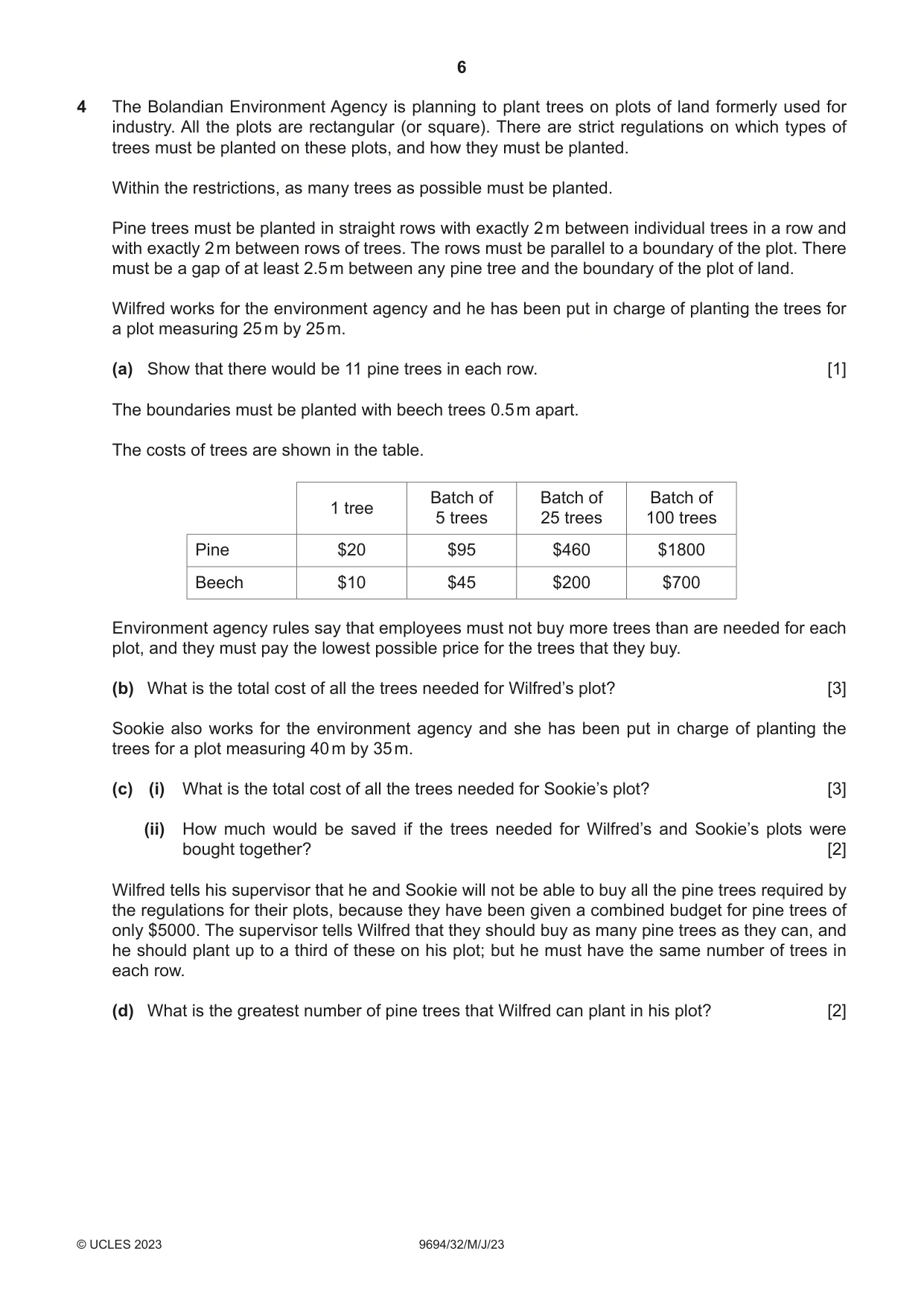
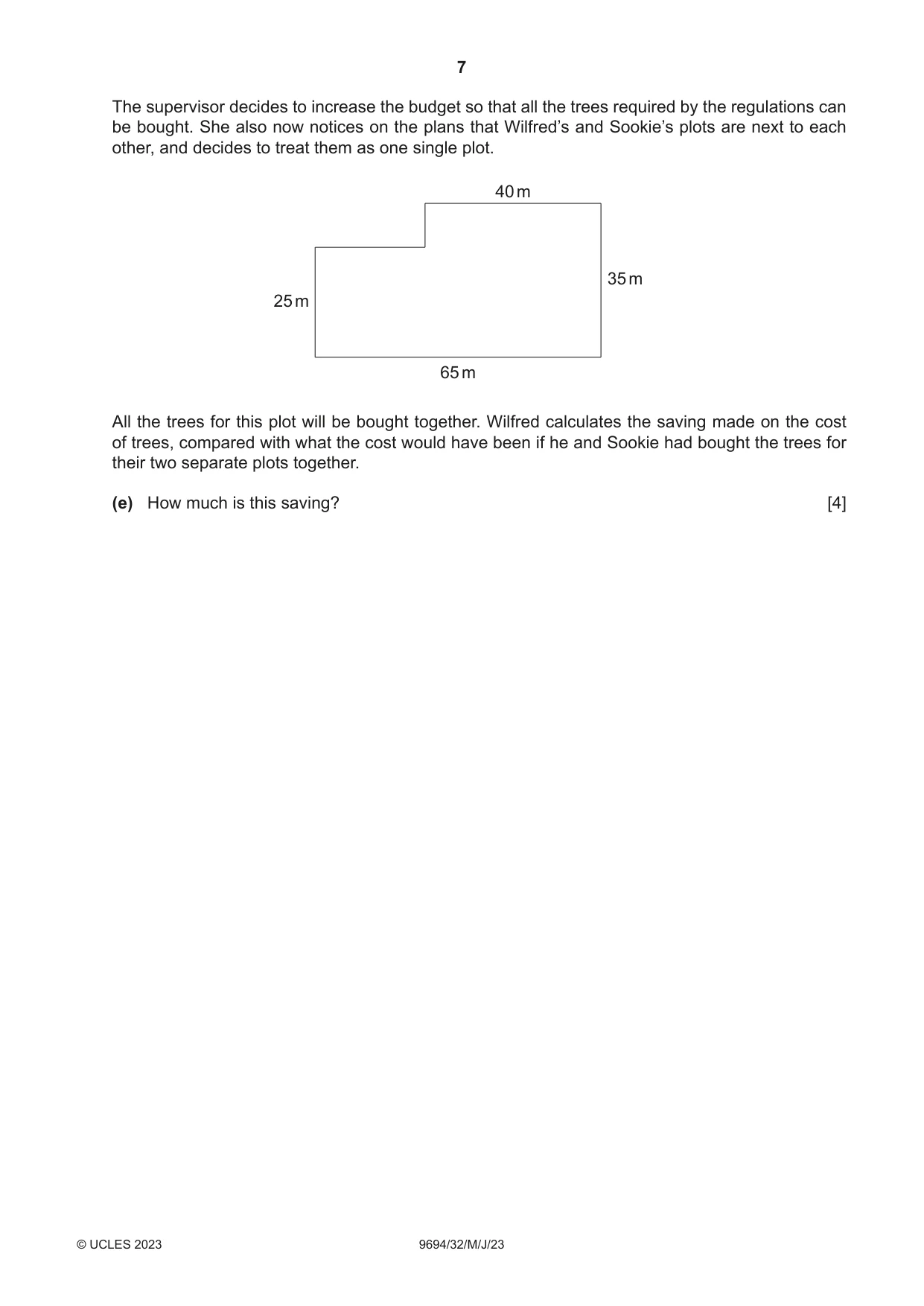
4 The Bolandian Environment Agency is planning to plant trees on plots of land formerly used for industry. All the plots are rectangular (or square). There are strict regulations on which types of trees must be planted on these plots, and how they must be planted. Within the restrictions, as many trees as possible must be planted. Pine trees must be planted in straight rows with exactly 2 m between individual trees in a row and with exactly 2 m between rows of trees. The rows must be parallel to a boundary of the plot. There must be a gap of at least 2.5 m between any pine tree and the boundary of the plot of land. Wilfred works for the environment agency and he has been put in charge of planting the trees for a plot measuring 25 m by 25 m. (a) Show that there would be 11 pine trees in each row. [1] The boundaries must be planted with beech trees 0.5 m apart. The costs of trees are shown in the table. Batch of Batch of Batch of 1 tree 5 trees 25 trees 100 trees Pine $20 $95 $460 $1800 Beech $10 $45 $200 $700 Environment agency rules say that employees must not buy more trees than are needed for each plot, and they must pay the lowest possible price for the trees that they buy. (b) What is the total cost of all the trees needed for Wilfred’s plot? [3] Sookie also works for the environment agency and she has been put in charge of planting the trees for a plot measuring 40 m by 35 m. (c) (i) What is the total cost of all the trees needed for Sookie’s plot? [3] (ii) How much would be saved if the trees needed for Wilfred’s and Sookie’s plots were bought together? [2] Wilfred tells his supervisor that he and Sookie will not be able to buy all the pine trees required by the regulations for their plots, because they have been given a combined budget for pine trees of only $5000. The supervisor tells Wilfred that they should buy as many pine trees as they can, and he should plant up to a third of these on his plot; but he must have the same number of trees in each row. (d) What is the greatest number of pine trees that Wilfred can plant in his plot? [2] The supervisor decides to increase the budget so that all the trees required by the regulations can be bought. She also now notices on the plans that Wilfred’s and Sookie’s plots are next to each other, and decides to treat them as one single plot. 40 m 35 m 25 m 65 m All the trees for this plot will be bought together. Wilfred calculates the saving made on the cost of trees, compared with what the cost would have been if he and Sookie had bought the trees for their two separate plots together. (e) How much is this saving? [4]
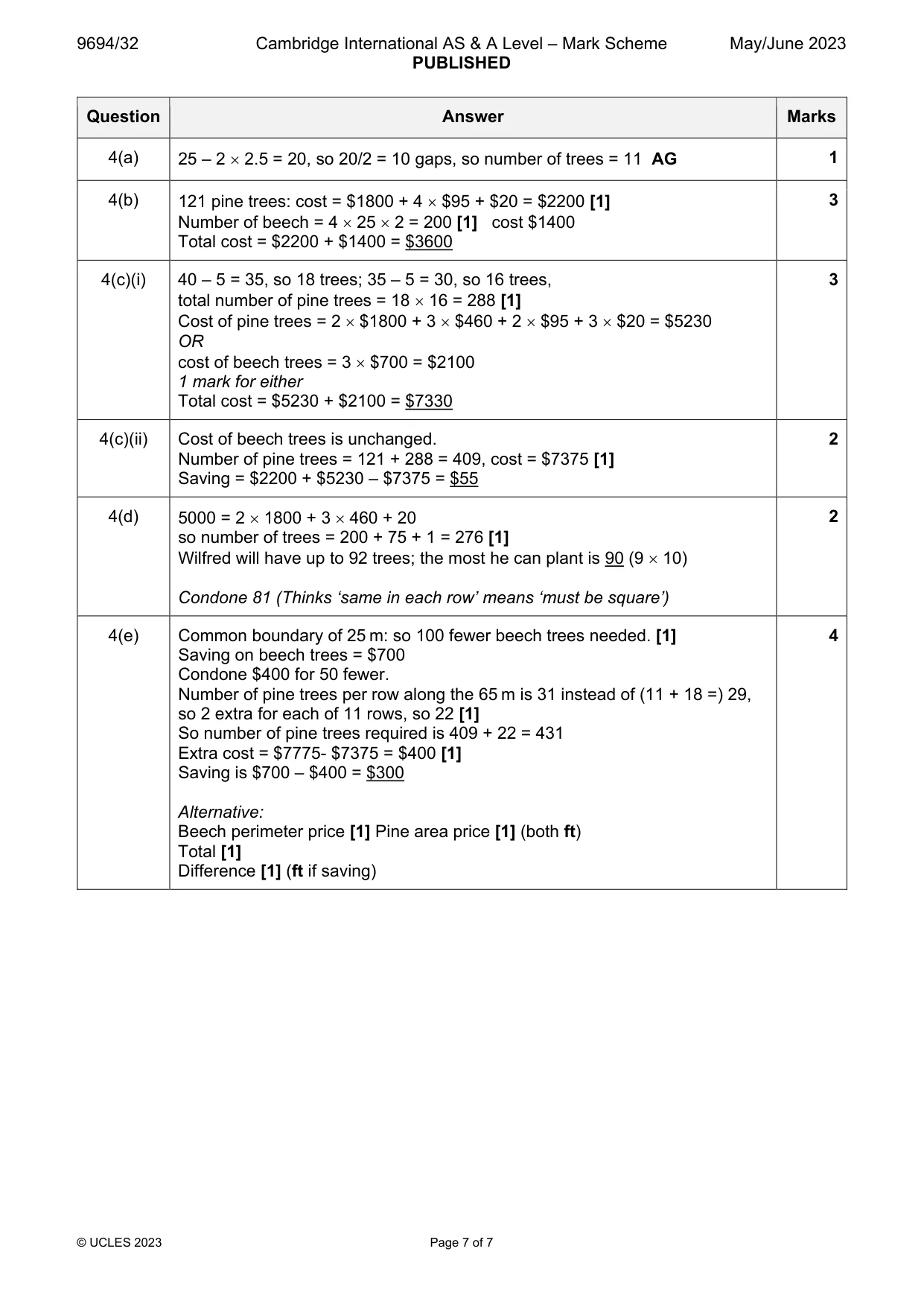
Mark scheme: 4(a) 25 – 2 2.5 = 20, so 20/2 = 10 gaps, so number of trees = 11 AG 1 4(b) 121 pine trees: cost = $1800 + 4 $95 + $20 = $2200 [1] 3 Number of beech = 4 25 2 = 200 [1] cost $1400 Total cost = $2200 + $1400 = $3600 4(c)(i) 40 – 5 = 35, so 18 trees; 35 – 5 = 30, so 16 trees, 3 total number of pine trees = 18 16 = 288 [1] Cost of pine trees = 2 $1800 + 3 $460 + 2 $95 + 3 $20 = $5230 OR cost of beech trees = 3 $700 = $2100 1 mark for either Total cost = $5230 + $2100 = $7330 4(c)(ii) Cost of beech trees is unchanged. 2 Number of pine trees = 121 + 288 = 409, cost = $7375 [1] Saving = $2200 + $5230 – $7375 = $55 4(d) 5000 = 2 1800 + 3 460 + 20 2 so number of trees = 200 + 75 + 1 = 276 [1] Wilfred will have up to 92 trees; the most he can plant is 90 (9 10) Condone 81 (Thinks ‘same in each row’ means ‘must be square’) 4(e) Common boundary of 25 m: so 100 fewer beech trees needed. [1] 4 Saving on beech trees = $700 Condone $400 for 50 fewer. Number of pine trees per row along the 65 m is 31 instead of (11 + 18 =) 29, so 2 extra for each of 11 rows, so 22 [1] So number of pine trees required is 409 + 22 = 431 Extra cost = $7775- $7375 = $400 [1] Saving is $700 – $400 = $300 Alternative: Beech perimeter price [1] Pine area price [1] (both ft) Total [1] Difference [1] (ft if saving)
More questions on Perform appropriate operations with information
What was in this paper
The subtopics covered by these 4 questions, and how many questions each got. Open one in a new tab to see every Cambridge question on it.
What you needed in this session
Cambridge’s own grade thresholds for 2023 May/June, Paper 3 · Variant 2. A higher threshold means an easier paper — the bar moves with how the cohort did.