Cambridge A Level Thinking Skills 9694 — 2022 May/June Paper 3 · Variant 2
9694/32/M/J/22 · 4 questions · 50 marks · ≈56 min
The question paper and its mark scheme, free to read here and free to download. This is Cambridge’s own paper, exactly as it was sat.
Question paper12 pages




Mark scheme8 pages
Answers below. Sit the paper first if you are practising.
Questions as text
Q1 · There is a train service between Arba and Boab
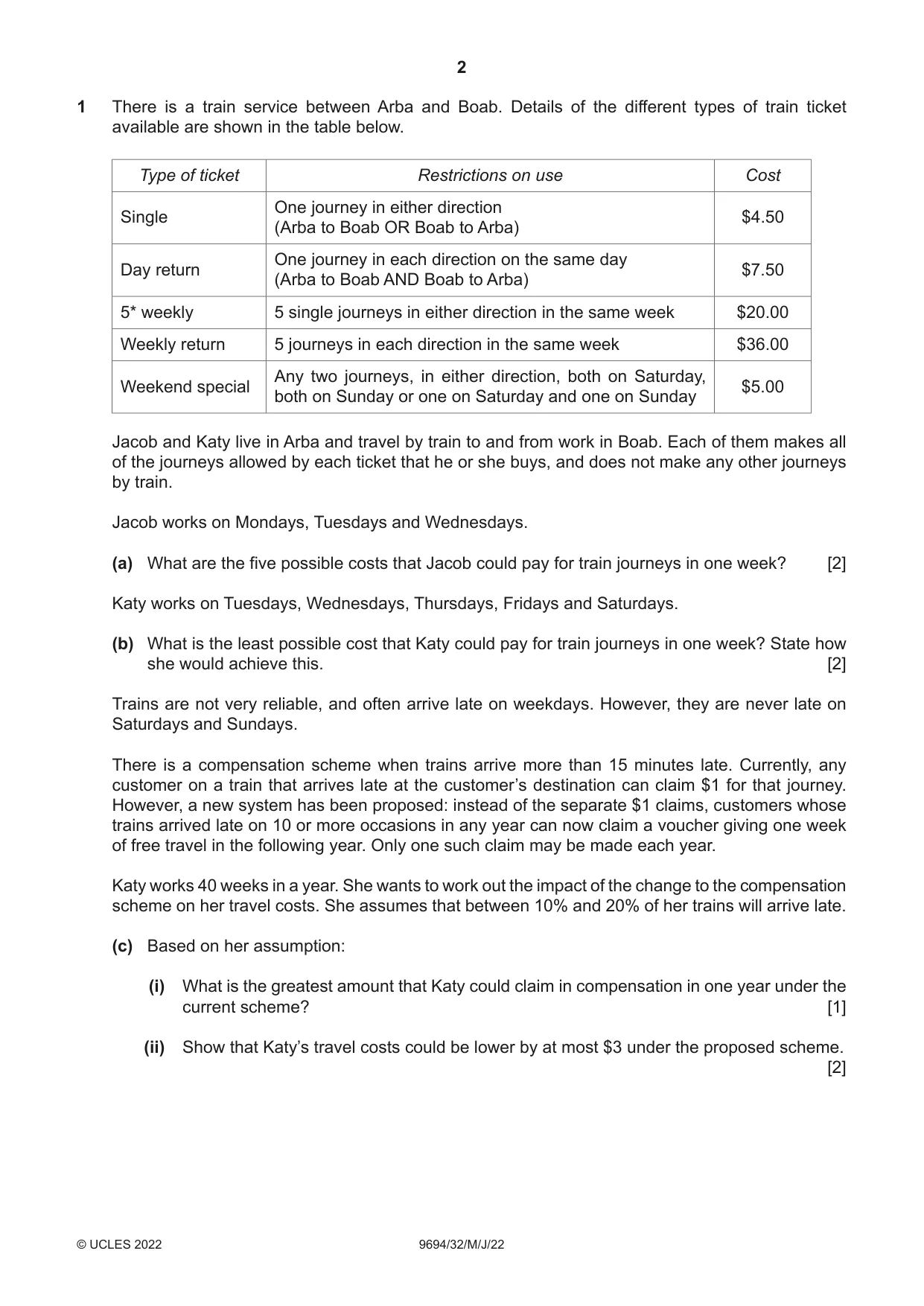
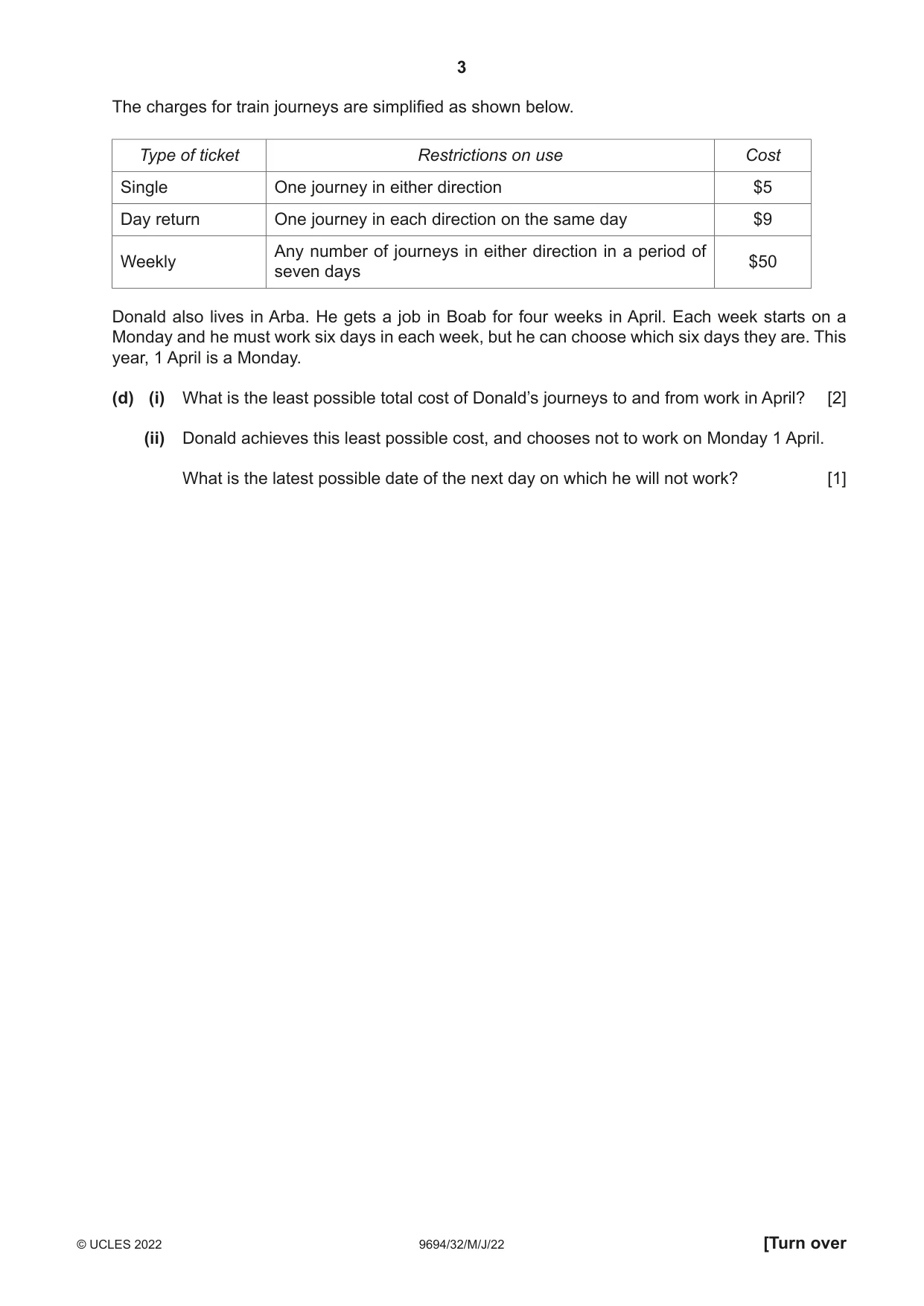
1 There is a train service between Arba and Boab. Details of the different types of train ticket available are shown in the table below. Type of ticket Restrictions on use Cost One journey in either direction Single $4.50 (Arba to Boab OR Boab to Arba) One journey in each direction on the same day Day return $7.50 (Arba to Boab AND Boab to Arba) 5* weekly 5 single journeys in either direction in the same week $20.00 Weekly return 5 journeys in each direction in the same week $36.00 Any two journeys, in either direction, both on Saturday, Weekend special $5.00 both on Sunday or one on Saturday and one on Sunday Jacob and Katy live in Arba and travel by train to and from work in Boab. Each of them makes all of the journeys allowed by each ticket that he or she buys, and does not make any other journeys by train. Jacob works on Mondays, Tuesdays and Wednesdays. (a) What are the five possible costs that Jacob could pay for train journeys in one week? [2] Katy works on Tuesdays, Wednesdays, Thursdays, Fridays and Saturdays. (b) What is the least possible cost that Katy could pay for train journeys in one week? State how she would achieve this. [2] Trains are not very reliable, and often arrive late on weekdays. However, they are never late on Saturdays and Sundays. There is a compensation scheme when trains arrive more than 15 minutes late. Currently, any customer on a train that arrives late at the customer’s destination can claim $1 for that journey. However, a new system has been proposed: instead of the separate $1 claims, customers whose trains arrived late on 10 or more occasions in any year can now claim a voucher giving one week of free travel in the following year. Only one such claim may be made each year. Katy works 40 weeks in a year. She wants to work out the impact of the change to the compensation scheme on her travel costs. She assumes that between 10% and 20% of her trains will arrive late. (c) Based on her assumption: (i) What is the greatest amount that Katy could claim in compensation in one year under the current scheme? [1] (ii) Show that Katy’s travel costs could be lower by at most $3 under the proposed scheme. [2] The charges for train journeys are simplified as shown below. Type of ticket Restrictions on use Cost Single One journey in either direction $5 Day return One journey in each direction on the same day $9 Any number of journeys in either direction in a period of Weekly $50 seven days Donald also lives in Arba. He gets a job in Boab for four weeks in April. Each week starts on a Monday and he must work six days in each week, but he can choose which six days they are. This year, 1 April is a Monday. (d) (i) What is the least possible total cost of Donald’s journeys to and from work in April? [2] (ii) Donald achieves this least possible cost, and chooses not to work on Monday 1 April. What is the latest possible date of the next day on which he will not work? [1]
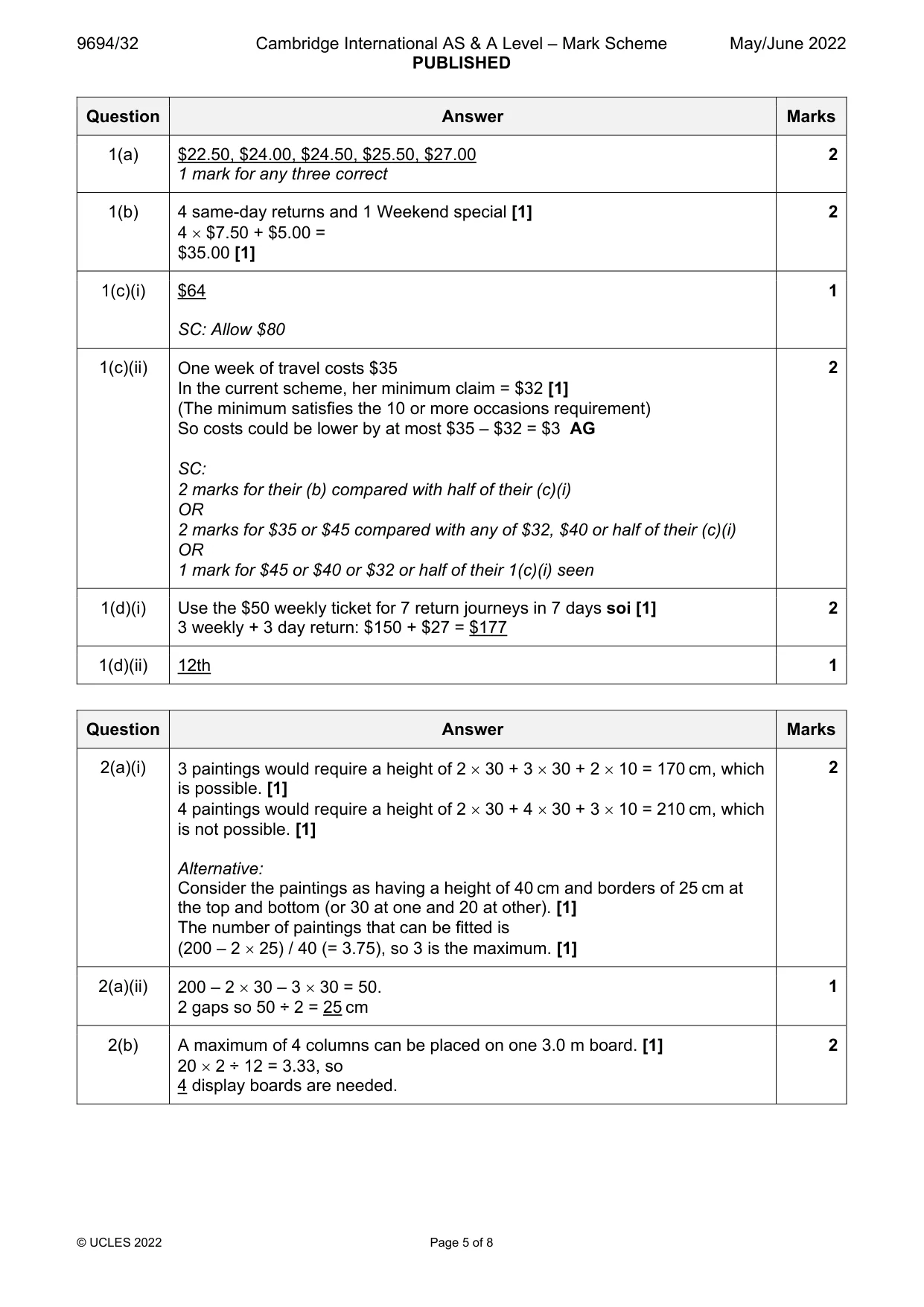
Mark scheme: Question Answer Marks 1(a) $22.50, $24.00, $24.50, $25.50, $27.00 2 1 mark for any three correct 1(b) 4 same-day returns and 1 Weekend special [1] 2 4 $7.50 + $5.00 = $35.00 [1] 1(c)(i) $64 1 SC: Allow $80 1(c)(ii) One week of travel costs $35 2 In the current scheme, her minimum claim = $32 [1] (The minimum satisfies the 10 or more occasions requirement) So costs could be lower by at most $35 – $32 = $3 AG SC: 2 marks for their (b) compared with half of their (c)(i) OR 2 marks for $35 or $45 compared with any of $32, $40 or half of their (c)(i) OR 1 mark for $45 or $40 or $32 or half of their 1(c)(i) seen 1(d)(i) Use the $50 weekly ticket for 7 return journeys in 7 days soi [1] 2 3 weekly + 3 day return: $150 + $27 = $177 1(d)(ii) 12th 1
Q2 · Penelope is organising an exhibition to show the paintings of her class of art students
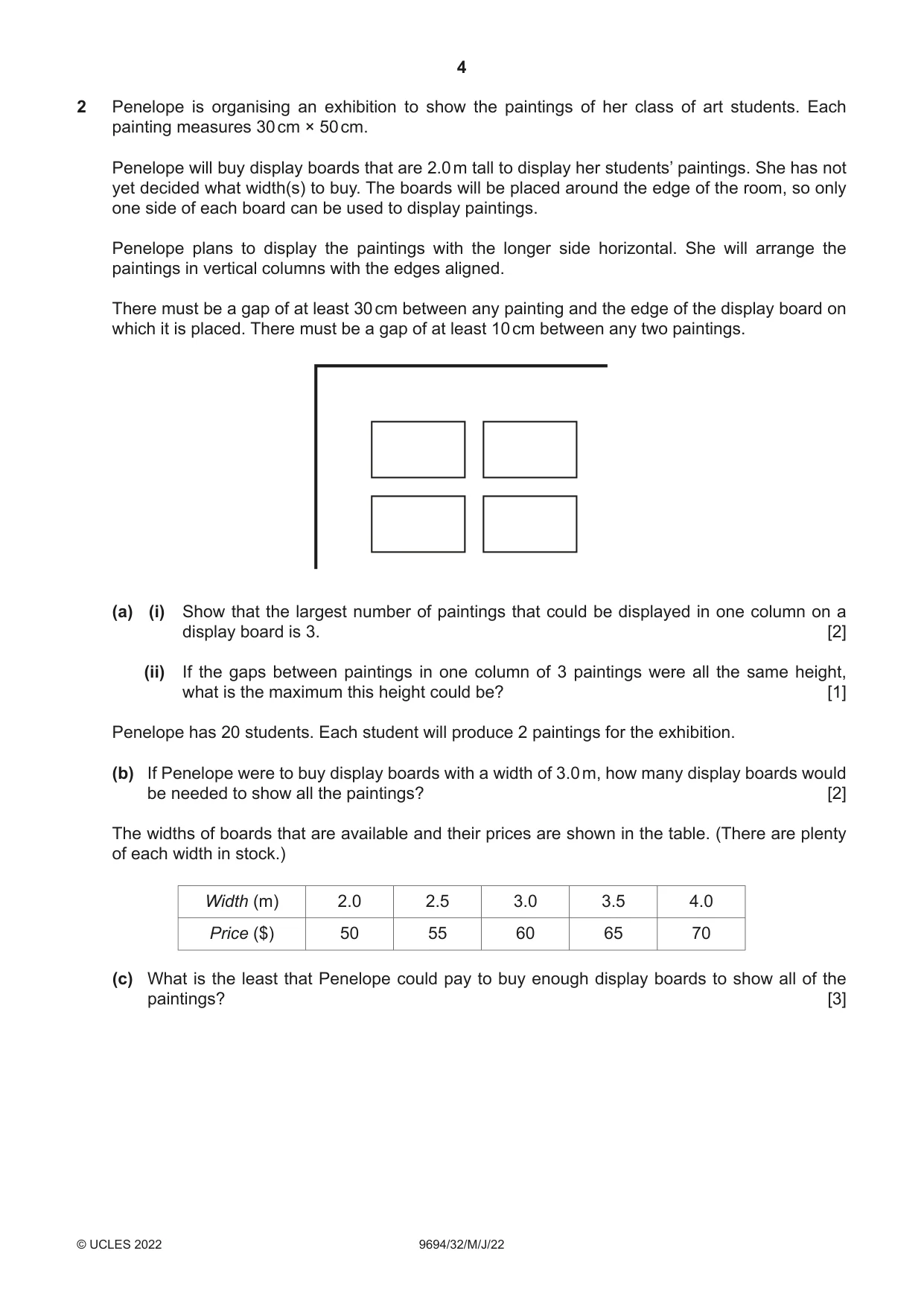
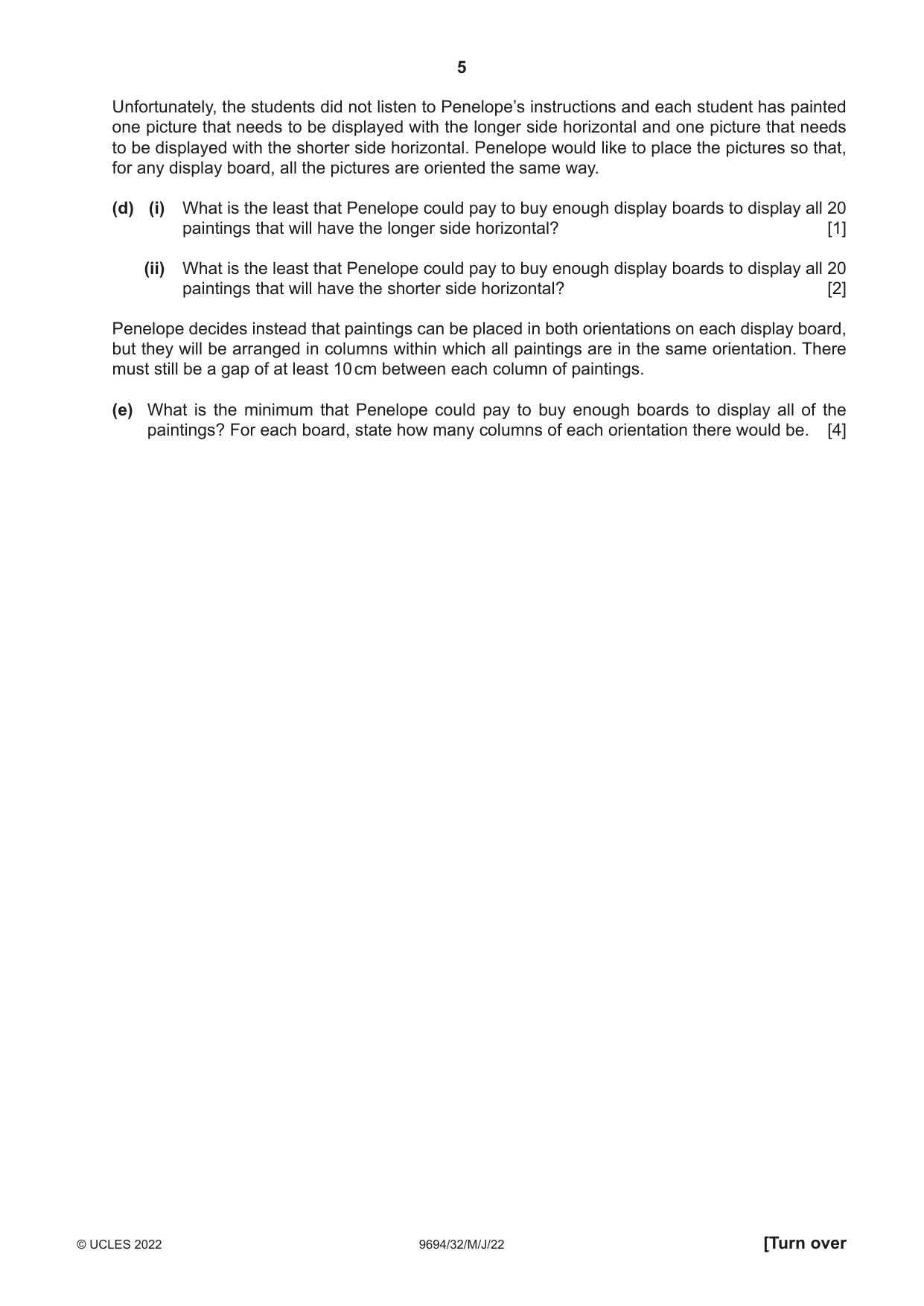
2 Penelope is organising an exhibition to show the paintings of her class of art students. Each painting measures 30 cm × 50 cm. Penelope will buy display boards that are 2.0 m tall to display her students’ paintings. She has not yet decided what width(s) to buy. The boards will be placed around the edge of the room, so only one side of each board can be used to display paintings. Penelope plans to display the paintings with the longer side horizontal. She will arrange the paintings in vertical columns with the edges aligned. There must be a gap of at least 30 cm between any painting and the edge of the display board on which it is placed. There must be a gap of at least 10 cm between any two paintings. (a) (i) Show that the largest number of paintings that could be displayed in one column on a display board is 3. [2] (ii) If the gaps between paintings in one column of 3 paintings were all the same height, what is the maximum this height could be? [1] Penelope has 20 students. Each student will produce 2 paintings for the exhibition. (b) If Penelope were to buy display boards with a width of 3.0 m, how many display boards would be needed to show all the paintings? [2] The widths of boards that are available and their prices are shown in the table. (There are plenty of each width in stock.) Width (m) 2.0 2.5 3.0 3.5 4.0 Price ($) 50 55 60 65 70 (c) What is the least that Penelope could pay to buy enough display boards to show all of the paintings? [3] Unfortunately, the students did not listen to Penelope’s instructions and each student has painted one picture that needs to be displayed with the longer side horizontal and one picture that needs to be displayed with the shorter side horizontal. Penelope would like to place the pictures so that, for any display board, all the pictures are oriented the same way. (d) (i) What is the least that Penelope could pay to buy enough display boards to display all 20 paintings that will have the longer side horizontal? [1] (ii) What is the least that Penelope could pay to buy enough display boards to display all 20 paintings that will have the shorter side horizontal? [2] Penelope decides instead that paintings can be placed in both orientations on each display board, but they will be arranged in columns within which all paintings are in the same orientation. There must still be a gap of at least 10 cm between each column of paintings. (e) What is the minimum that Penelope could pay to buy enough boards to display all of the paintings? For each board, state how many columns of each orientation there would be. [4]
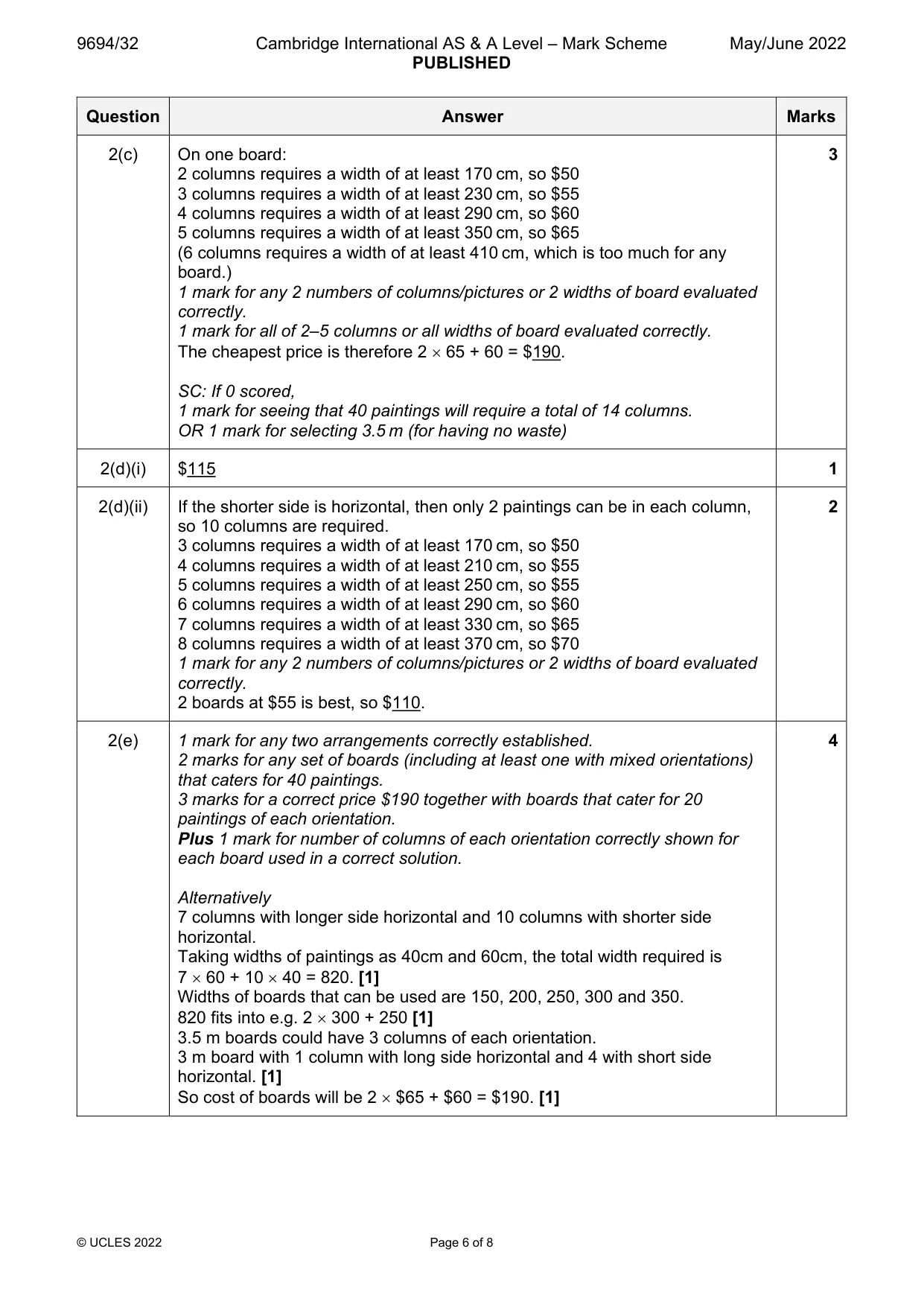
Mark scheme: 2(a)(i) 3 paintings would require a height of 2 30 + 3 30 + 2 10 = 170 cm, which 2 is possible. [1] 4 paintings would require a height of 2 30 + 4 30 + 3 10 = 210 cm, which is not possible. [1] Alternative: Consider the paintings as having a height of 40 cm and borders of 25 cm at the top and bottom (or 30 at one and 20 at other). [1] The number of paintings that can be fitted is (200 – 2 25) / 40 (= 3.75), so 3 is the maximum. [1] 2(a)(ii) 200 – 2 30 – 3 30 = 50. 1 2 gaps so 50 ÷ 2 = 25 cm 2(b) A maximum of 4 columns can be placed on one 3.0 m board. [1] 2 20 2 ÷ 12 = 3.33, so 4 display boards are needed. 2(c) On one board: 3 2 columns requires a width of at least 170 cm, so $50 3 columns requires a width of at least 230 cm, so $55 4 columns requires a width of at least 290 cm, so $60 5 columns requires a width of at least 350 cm, so $65 (6 columns requires a width of at least 410 cm, which is too much for any board.) 1 mark for any 2 numbers of columns/pictures or 2 widths of board evaluated correctly. 1 mark for all of 2–5 columns or all widths of board evaluated correctly. The cheapest price is therefore 2 65 + 60 = $190. SC: If 0 scored, 1 mark for seeing that 40 paintings will require a total of 14 columns. OR 1 mark for selecting 3.5 m (for having no waste) 2(d)(i) $115 1 2(d)(ii) If the shorter side is horizontal, then only 2 paintings can be in each column, 2 so 10 columns are required. 3 columns requires a width of at least 170 cm, so $50 4 columns requires a width of at least 210 cm, so $55 5 columns requires a width of at least 250 cm, so $55 6 columns requires a width of at least 290 cm, so $60 7 columns requires a width of at least 330 cm, so $65 8 columns requires a width of at least 370 cm, so $70 1 mark for any 2 numbers of columns/pictures or 2 widths of board evaluated correctly. 2 boards at $55 is best, so $110. 2(e) 1 mark for any two arrangements correctly established. 4 2 marks for any set of boards (including at least one with mixed orientations) that caters for 40 paintings. 3 marks for a correct price $190 together with boards that cater for 20 paintings of each orientation. Plus 1 mark for number of columns of each orientation correctly shown for each board used in a correct solution. Alternatively 7 columns with longer side horizontal and 10 columns with shorter side horizontal. Taking widths of paintings as 40cm and 60cm, the total width required is 7 60 + 10 40 = 820. [1] Widths of boards that can be used are 150, 200, 250, 300 and 350. 820 fits into e.g. 2 300 + 250 [1] 3.5 m boards could have 3 columns of each orientation. 3 m board with 1 column with long side horizontal and 4 with short side horizontal. [1] So cost of boards will be 2 $65 + $60 = $190. [1]
More questions on Perform appropriate operations with information
Q3 · Moses is researching his family history and is particularly interested in five siblings…
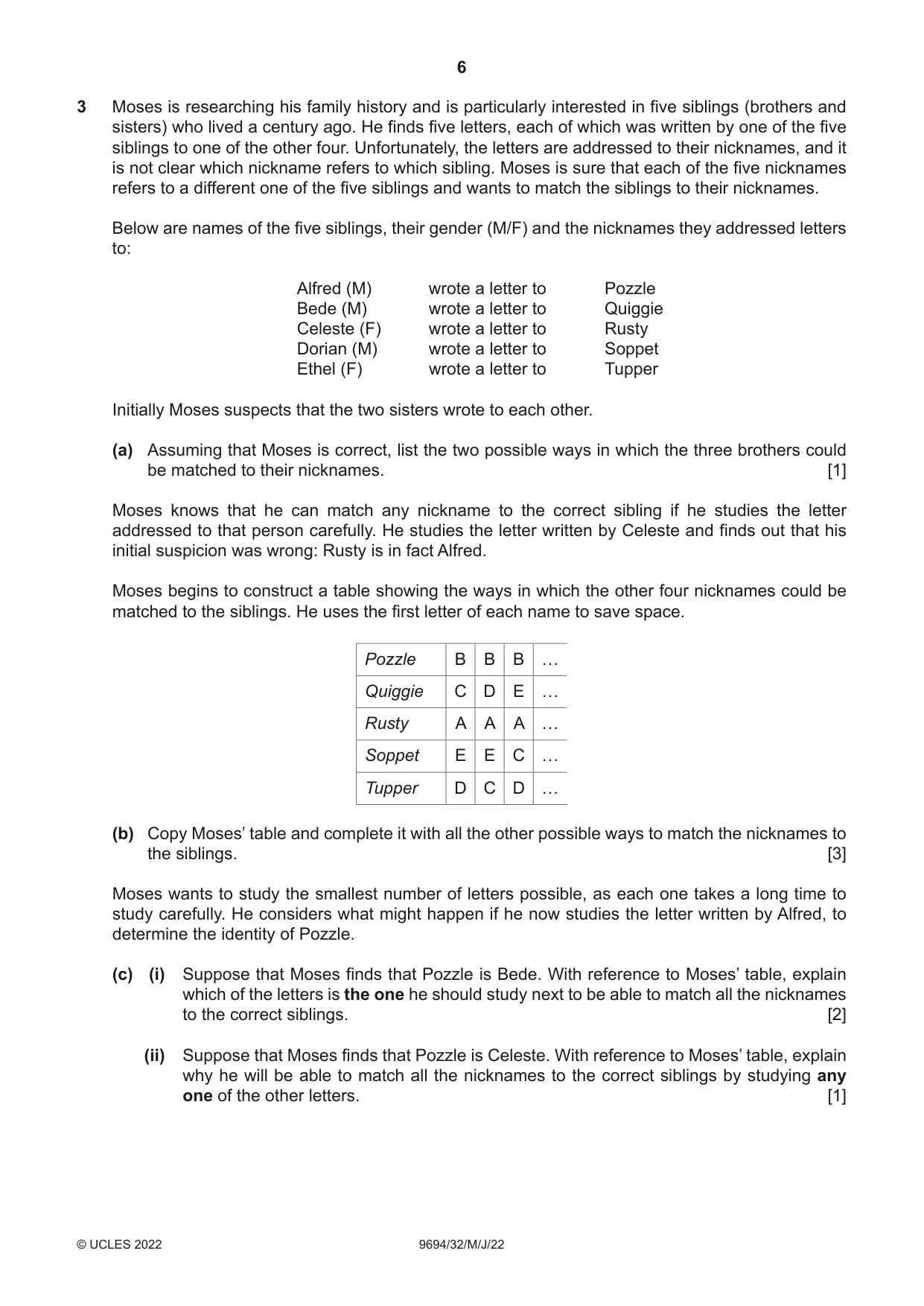
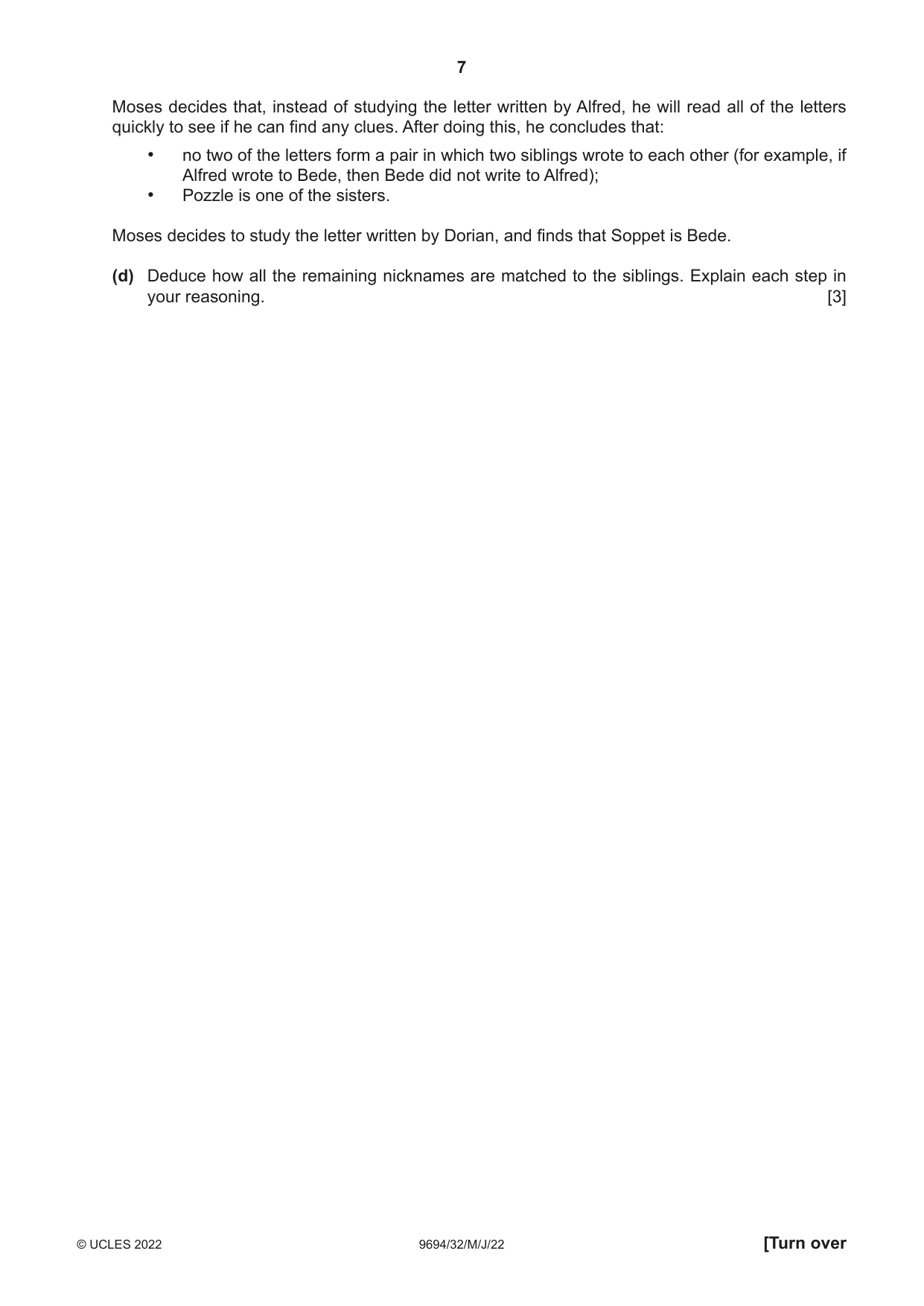
3 Moses is researching his family history and is particularly interested in five siblings (brothers and sisters) who lived a century ago. He finds five letters, each of which was written by one of the five siblings to one of the other four. Unfortunately, the letters are addressed to their nicknames, and it is not clear which nickname refers to which sibling. Moses is sure that each of the five nicknames refers to a different one of the five siblings and wants to match the siblings to their nicknames. Below are names of the five siblings, their gender (M/F) and the nicknames they addressed letters to: Alfred (M) wrote a letter to Pozzle Bede (M) wrote a letter to Quiggie Celeste (F) wrote a letter to Rusty Dorian (M) wrote a letter to Soppet Ethel (F) wrote a letter to Tupper Initially Moses suspects that the two sisters wrote to each other. (a) Assuming that Moses is correct, list the two possible ways in which the three brothers could be matched to their nicknames. [1] Moses knows that he can match any nickname to the correct sibling if he studies the letter addressed to that person carefully. He studies the letter written by Celeste and finds out that his initial suspicion was wrong: Rusty is in fact Alfred. Moses begins to construct a table showing the ways in which the other four nicknames could be matched to the siblings. He uses the first letter of each name to save space. Pozzle B B B … Quiggie C D E … Rusty A A A … Soppet E E C … Tupper D C D … (b) Copy Moses’ table and complete it with all the other possible ways to match the nicknames to the siblings. [3] Moses wants to study the smallest number of letters possible, as each one takes a long time to study carefully. He considers what might happen if he now studies the letter written by Alfred, to determine the identity of Pozzle. (c) (i) Suppose that Moses finds that Pozzle is Bede. With reference to Moses’ table, explain which of the letters is the one he should study next to be able to match all the nicknames to the correct siblings. [2] (ii) Suppose that Moses finds that Pozzle is Celeste. With reference to Moses’ table, explain why he will be able to match all the nicknames to the correct siblings by studying any one of the other letters. [1] Moses decides that, instead of studying the letter written by Alfred, he will read all of the letters quickly to see if he can find any clues. After doing this, he concludes that: • no two of the letters form a pair in which two siblings wrote to each other (for example, if Alfred wrote to Bede, then Bede did not write to Alfred); • Pozzle is one of the sisters. Moses decides to study the letter written by Dorian, and finds that Soppet is Bede. (d) Deduce how all the remaining nicknames are matched to the siblings. Explain each step in your reasoning. [3]
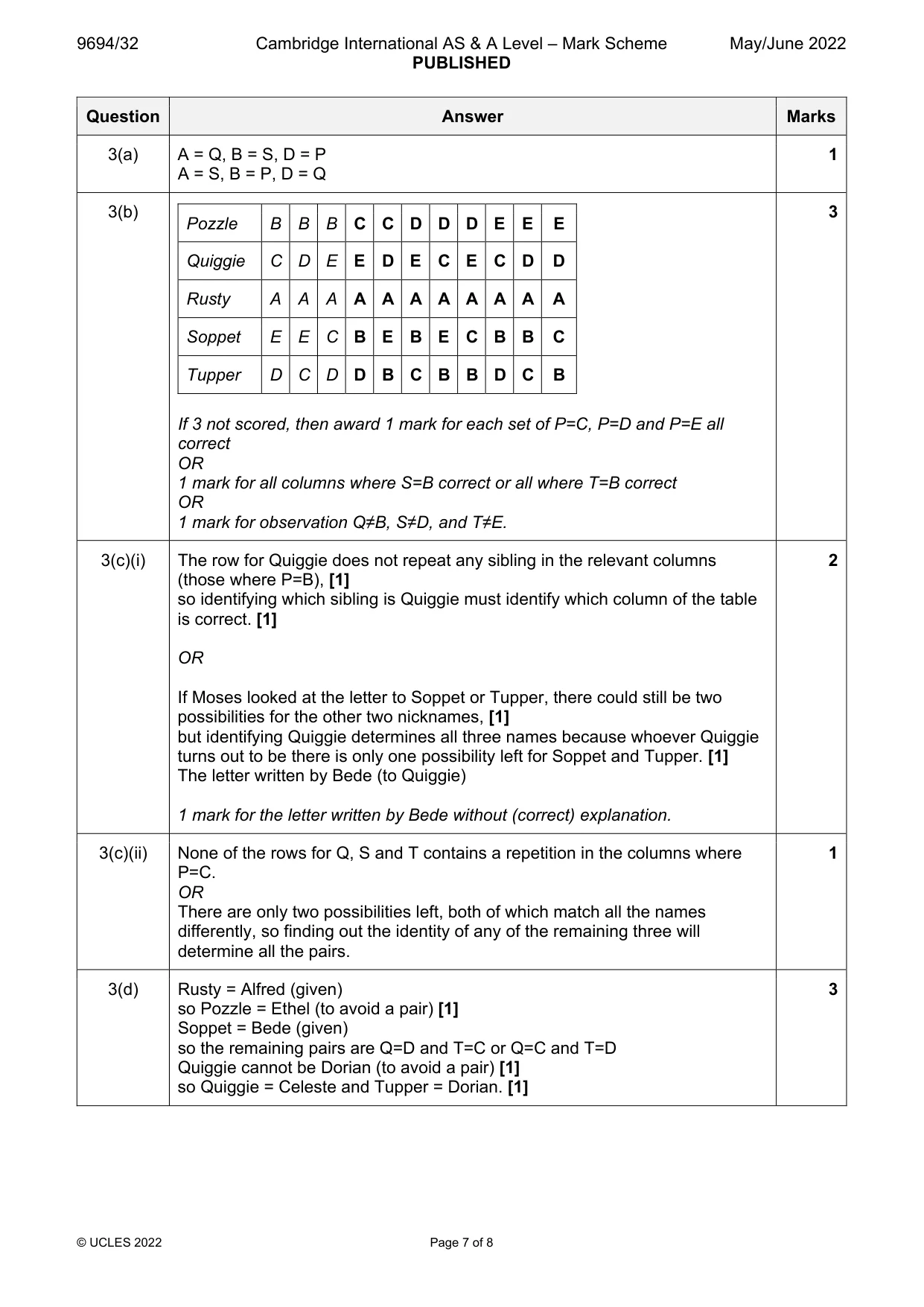
Mark scheme: 3(a) A = Q, B = S, D = P 1 A = S, B = P, D = Q 3(b) 3 Pozzle B B B C C D D D E E E Quiggie C D E E D E C E C D D Rusty A A A A A A A A A A A Soppet E E C B E B E C B B C Tupper D C D D B C B B D C B If 3 not scored, then award 1 mark for each set of P=C, P=D and P=E all correct OR 1 mark for all columns where S=B correct or all where T=B correct OR 1 mark for observation Q≠B, S≠D, and T≠E. 3(c)(i) The row for Quiggie does not repeat any sibling in the relevant columns 2 (those where P=B), [1] so identifying which sibling is Quiggie must identify which column of the table is correct. [1] OR If Moses looked at the letter to Soppet or Tupper, there could still be two possibilities for the other two nicknames, [1] but identifying Quiggie determines all three names because whoever Quiggie turns out to be there is only one possibility left for Soppet and Tupper. [1] The letter written by Bede (to Quiggie) 1 mark for the letter written by Bede without (correct) explanation. 3(c)(ii) None of the rows for Q, S and T contains a repetition in the columns where 1 P=C. OR There are only two possibilities left, both of which match all the names differently, so finding out the identity of any of the remaining three will determine all the pairs. 3(d) Rusty = Alfred (given) 3 so Pozzle = Ethel (to avoid a pair) [1] Soppet = Bede (given) so the remaining pairs are Q=D and T=C or Q=C and T=D Quiggie cannot be Dorian (to avoid a pair) [1] so Quiggie = Celeste and Tupper = Dorian. [1]
Q4 · George has his own window cleaning business
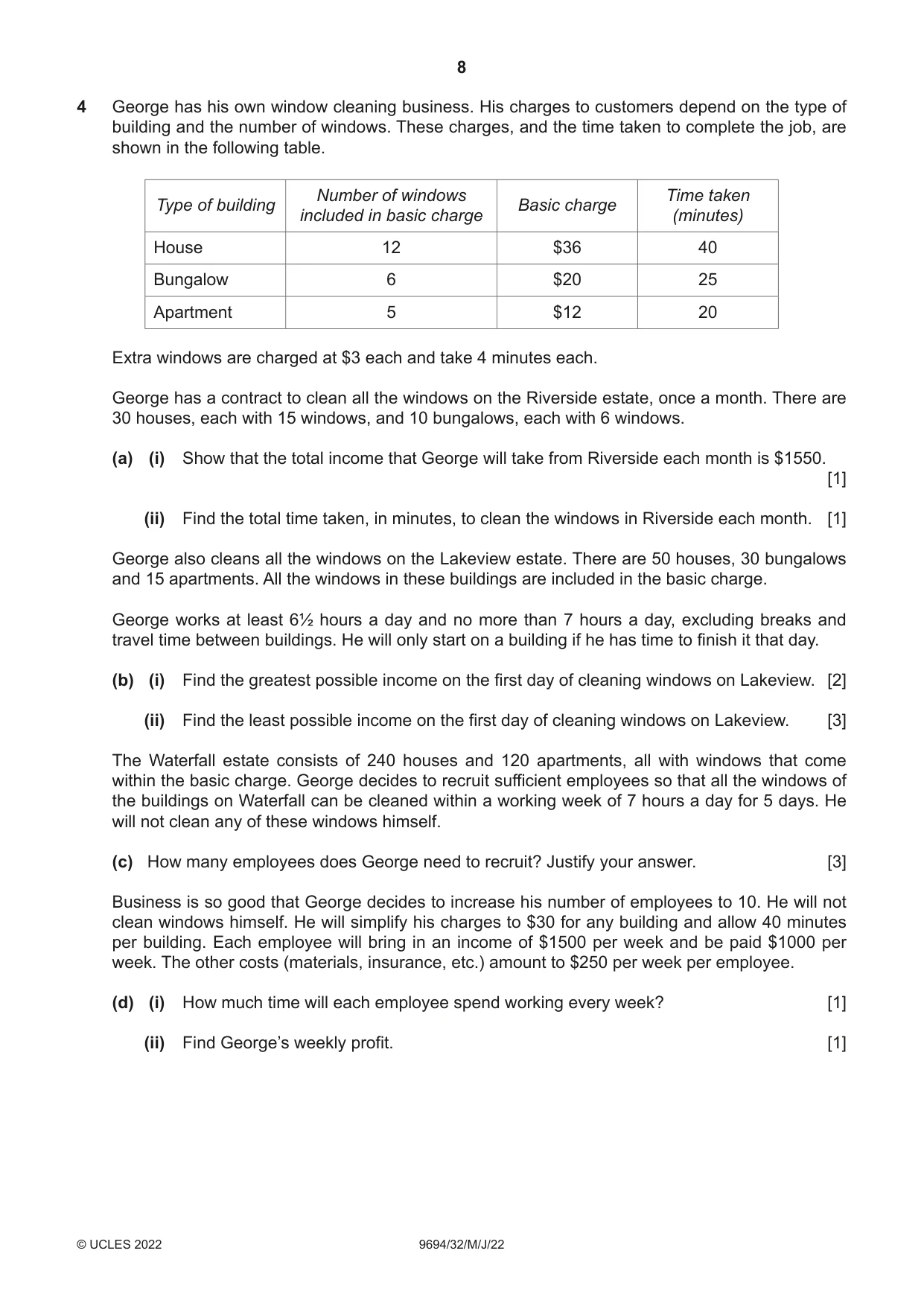
4 George has his own window cleaning business. His charges to customers depend on the type of building and the number of windows. These charges, and the time taken to complete the job, are shown in the following table. Number of windows Time taken Type of building Basic charge included in basic charge (minutes) House 12 $36 40 Bungalow 6 $20 25 Apartment 5 $12 20 Extra windows are charged at $3 each and take 4 minutes each. George has a contract to clean all the windows on the Riverside estate, once a month. There are 30 houses, each with 15 windows, and 10 bungalows, each with 6 windows. (a) (i) Show that the total income that George will take from Riverside each month is $1550. [1] (ii) Find the total time taken, in minutes, to clean the windows in Riverside each month. [1] George also cleans all the windows on the Lakeview estate. There are 50 houses, 30 bungalows and 15 apartments. All the windows in these buildings are included in the basic charge. George works at least 6½ hours a day and no more than 7 hours a day, excluding breaks and travel time between buildings. He will only start on a building if he has time to finish it that day. (b) (i) Find the greatest possible income on the first day of cleaning windows on Lakeview. [2] (ii) Find the least possible income on the first day of cleaning windows on Lakeview. [3] The Waterfall estate consists of 240 houses and 120 apartments, all with windows that come within the basic charge. George decides to recruit sufficient employees so that all the windows of the buildings on Waterfall can be cleaned within a working week of 7 hours a day for 5 days. He will not clean any of these windows himself. (c) How many employees does George need to recruit? Justify your answer. [3] Business is so good that George decides to increase his number of employees to 10. He will not clean windows himself. He will simplify his charges to $30 for any building and allow 40 minutes per building. Each employee will bring in an income of $1500 per week and be paid $1000 per week. The other costs (materials, insurance, etc.) amount to $250 per week per employee. (d) (i) How much time will each employee spend working every week? [1] (ii) Find George’s weekly profit. [1] George decides to invest in a new method of cleaning windows, the ‘water-fed pole’, which means that all windows can be cleaned from ground level. He estimates that this will result in a 25% reduction in the time taken to clean each building. He will also increase his charges by 10%. George will pay each employee $1000 per week, for all 52 weeks of the year. Each employee will work for 45 weeks in the year, the remaining time being holiday. The other costs will be $500 per week per employee, whether or not the employee is working or on holiday. When working, each employee will clean windows for 6 hours each day, 5 days a week. (e) George wants his profit to be at least $80 000 per year. Find the smallest number of employees that he will need to employ. Justify your answer. [3]
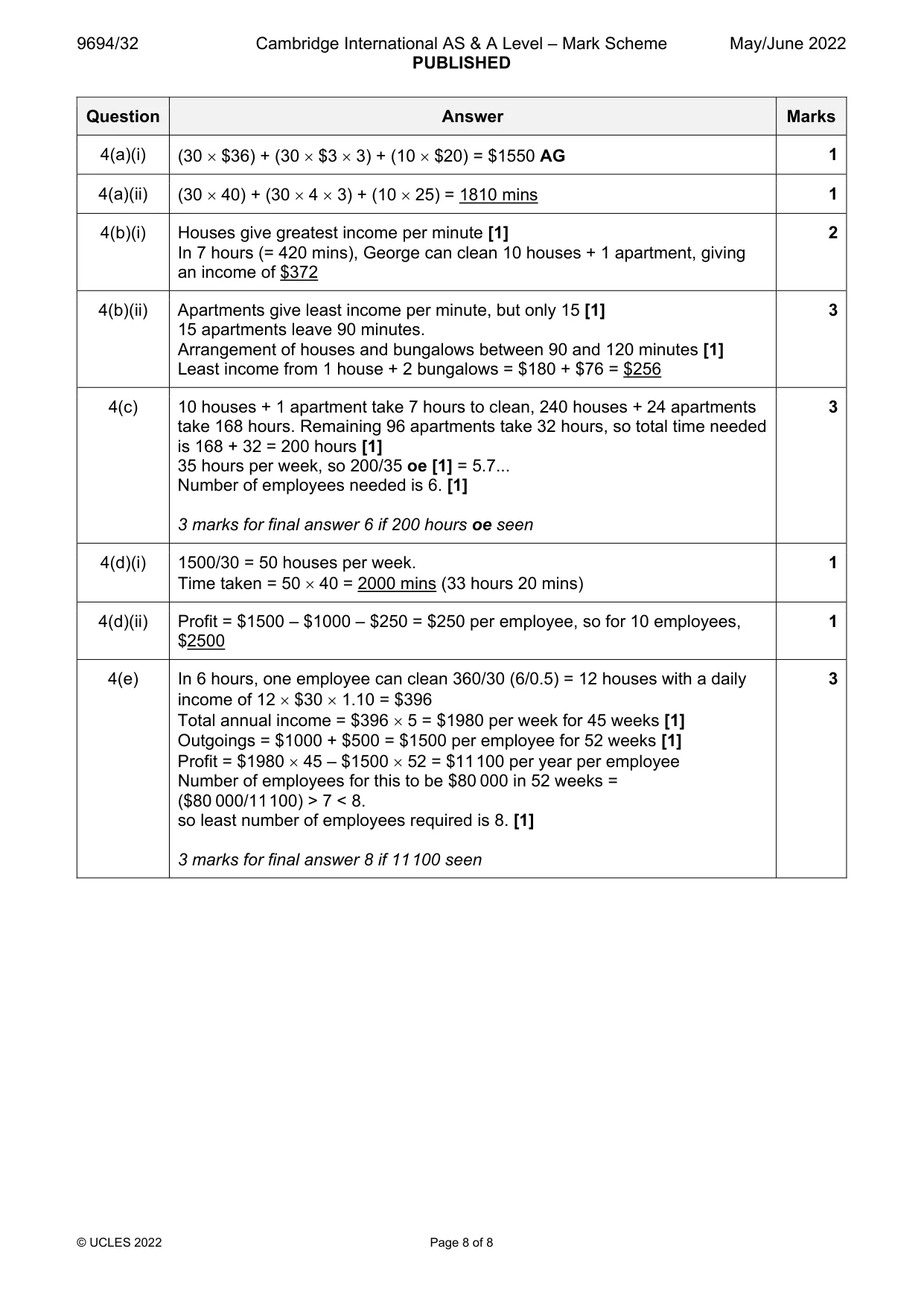
Mark scheme: 4(a)(i) (30 $36) + (30 $3 3) + (10 $20) = $1550 AG 1 4(a)(ii) (30 40) + (30 4 3) + (10 25) = 1810 mins 1 4(b)(i) Houses give greatest income per minute [1] 2 In 7 hours (= 420 mins), George can clean 10 houses + 1 apartment, giving an income of $372 4(b)(ii) Apartments give least income per minute, but only 15 [1] 3 15 apartments leave 90 minutes. Arrangement of houses and bungalows between 90 and 120 minutes [1] Least income from 1 house + 2 bungalows = $180 + $76 = $256 4(c) 10 houses + 1 apartment take 7 hours to clean, 240 houses + 24 apartments 3 take 168 hours. Remaining 96 apartments take 32 hours, so total time needed is 168 + 32 = 200 hours [1] 35 hours per week, so 200/35 oe [1] = 5.7... Number of employees needed is 6. [1] 3 marks for final answer 6 if 200 hours oe seen 4(d)(i) 1500/30 = 50 houses per week. 1 Time taken = 50 40 = 2000 mins (33 hours 20 mins) 4(d)(ii) Profit = $1500 – $1000 – $250 = $250 per employee, so for 10 employees, 1 $2500 4(e) In 6 hours, one employee can clean 360/30 (6/0.5) = 12 houses with a daily 3 income of 12 $30 1.10 = $396 Total annual income = $396 5 = $1980 per week for 45 weeks [1] Outgoings = $1000 + $500 = $1500 per employee for 52 weeks [1] Profit = $1980 45 – $1500 52 = $11 100 per year per employee Number of employees for this to be $80 000 in 52 weeks = ($80 000/11 100) > 7 < 8. so least number of employees required is 8. [1] 3 marks for final answer 8 if 11 100 seen
More questions on Perform appropriate operations with information
What was in this paper
The subtopics covered by these 4 questions, and how many questions each got. Open one in a new tab to see every Cambridge question on it.
What you needed in this session
Cambridge’s own grade thresholds for 2022 May/June, Paper 3 · Variant 2. A higher threshold means an easier paper — the bar moves with how the cohort did.