Cambridge A Level Thinking Skills 9694 — 2021 May/June Paper 3 · Variant 1
9694/31/M/J/21 · 4 questions · 50 marks · ≈56 min
The question paper and its mark scheme, free to read here and free to download. This is Cambridge’s own paper, exactly as it was sat.
Question paper8 pages

Mark scheme8 pages
Answers below. Sit the paper first if you are practising.
Questions as text
Q1 · There is a long-distance cycle route between Princeville and Queda, of total length 1560…
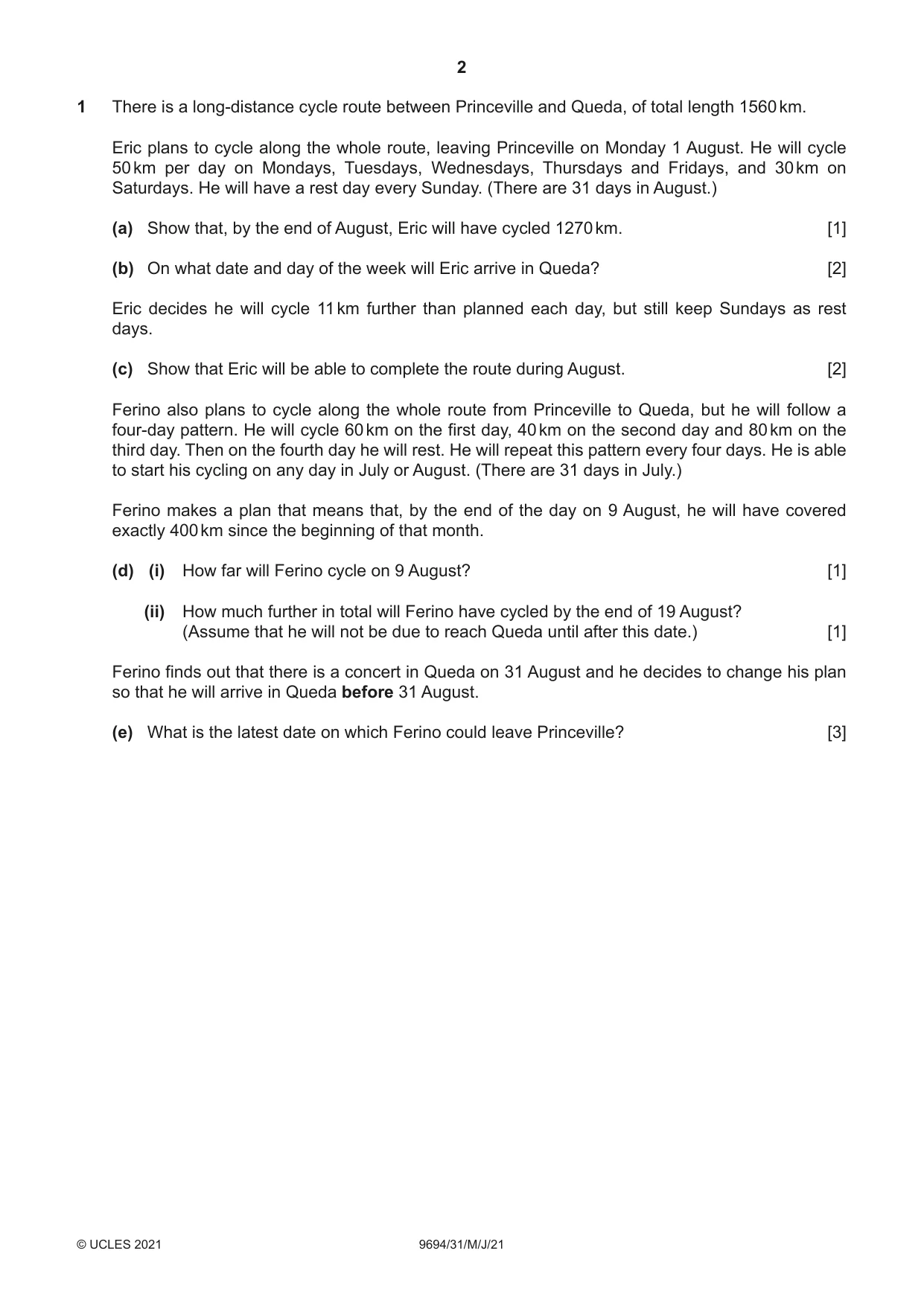
1 There is a long-distance cycle route between Princeville and Queda, of total length 1560 km. Eric plans to cycle along the whole route, leaving Princeville on Monday 1 August. He will cycle 50 km per day on Mondays, Tuesdays, Wednesdays, Thursdays and Fridays, and 30 km on Saturdays. He will have a rest day every Sunday. (There are 31 days in August.) (a) Show that, by the end of August, Eric will have cycled 1270 km. [1] (b) On what date and day of the week will Eric arrive in Queda? [2] Eric decides he will cycle 11 km further than planned each day, but still keep Sundays as rest days. (c) Show that Eric will be able to complete the route during August. [2] Ferino also plans to cycle along the whole route from Princeville to Queda, but he will follow a four-day pattern. He will cycle 60 km on the first day, 40 km on the second day and 80 km on the third day. Then on the fourth day he will rest. He will repeat this pattern every four days. He is able to start his cycling on any day in July or August. (There are 31 days in July.) Ferino makes a plan that means that, by the end of the day on 9 August, he will have covered exactly 400 km since the beginning of that month. (d) (i) How far will Ferino cycle on 9 August? [1] (ii) How much further in total will Ferino have cycled by the end of 19 August? (Assume that he will not be due to reach Queda until after this date.) [1] Ferino finds out that there is a concert in Queda on 31 August and he decides to change his plan so that he will arrive in Queda before 31 August. (e) What is the latest date on which Ferino could leave Princeville? [3]
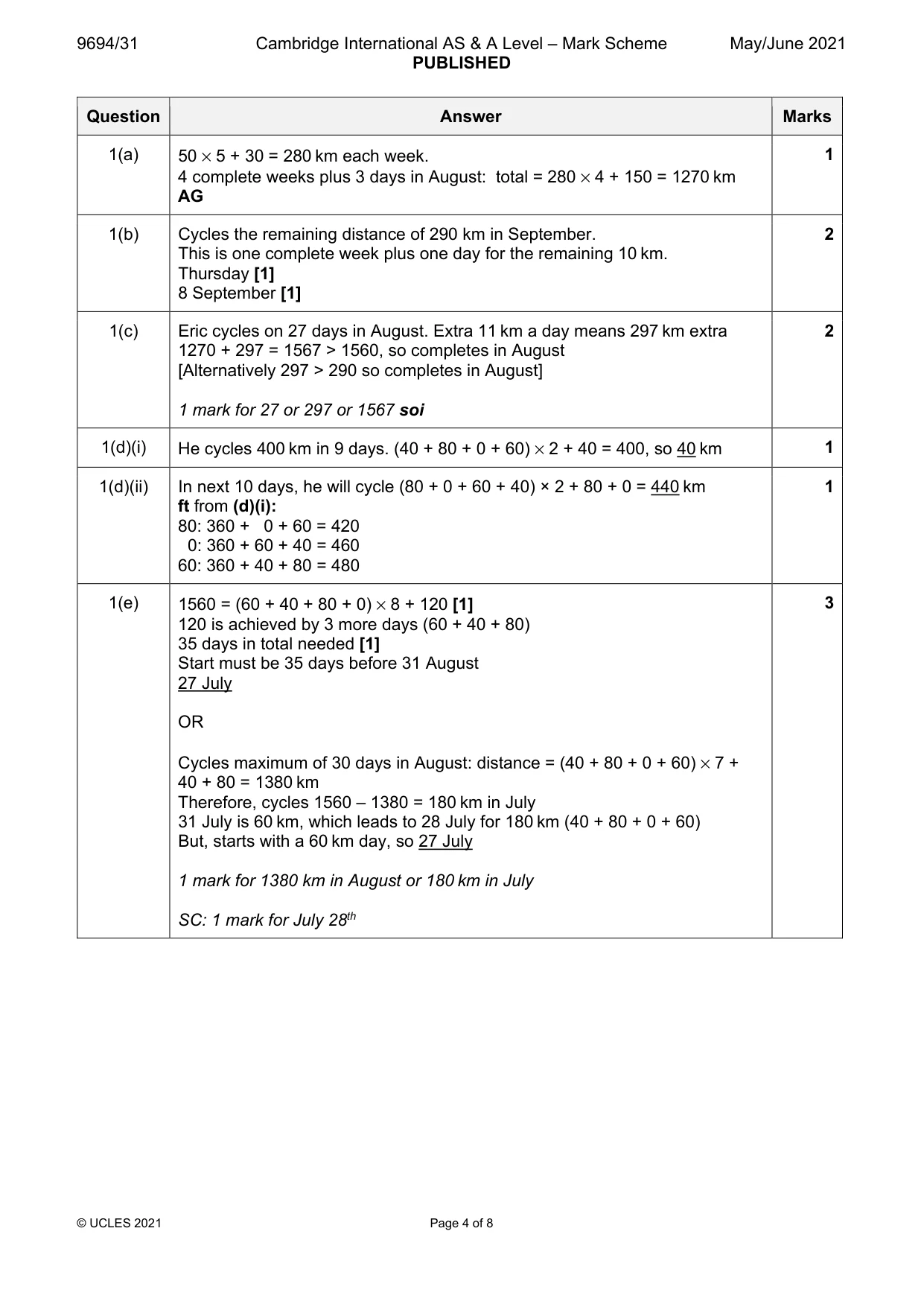
Mark scheme: Question Answer Marks 1(a) 50 × 5 + 30 = 280 km each week. 1 4 complete weeks plus 3 days in August: total = 280 × 4 + 150 = 1270 km AG 1(b) Cycles the remaining distance of 290 km in September. 2 This is one complete week plus one day for the remaining 10 km. Thursday [1] 8 September [1] 1(c) Eric cycles on 27 days in August. Extra 11 km a day means 297 km extra 2 1270 + 297 = 1567 > 1560, so completes in August [Alternatively 297 > 290 so completes in August] 1 mark for 27 or 297 or 1567 soi 1(d)(i) He cycles 400 km in 9 days. (40 + 80 + 0 + 60) × 2 + 40 = 400, so 40 km 1 1(d)(ii) In next 10 days, he will cycle (80 + 0 + 60 + 40) × 2 + 80 + 0 = 440 km 1 ft from (d)(i): 80: 360 + 0 + 60 = 420 0: 360 + 60 + 40 = 460 60: 360 + 40 + 80 = 480 1(e) 1560 = (60 + 40 + 80 + 0) × 8 + 120 [1] 3 120 is achieved by 3 more days (60 + 40 + 80) 35 days in total needed [1] Start must be 35 days before 31 August 27 July OR Cycles maximum of 30 days in August: distance = (40 + 80 + 0 + 60) × 7 + 40 + 80 = 1380 km Therefore, cycles 1560 – 1380 = 180 km in July 31 July is 60 km, which leads to 28 July for 180 km (40 + 80 + 0 + 60) But, starts with a 60 km day, so 27 July 1 mark for 1380 km in August or 180 km in July SC: 1 mark for July 28th
More questions on Perform appropriate operations with information
Q2 · The Culean Coast Railway operates along the north coast of Culea, between Trotwood and…
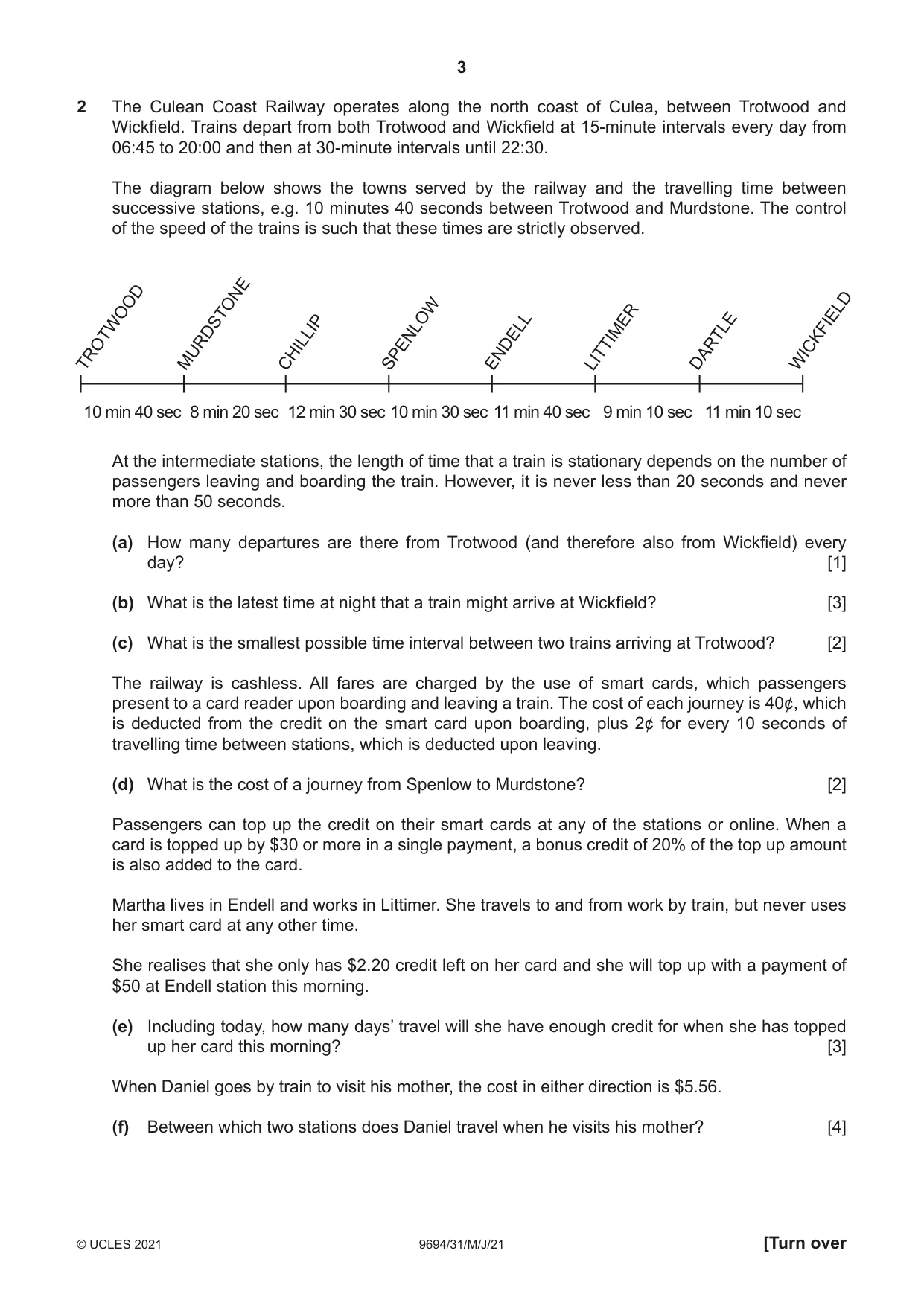
2 The Culean Coast Railway operates along the north coast of Culea, between Trotwood and Wickfield. Trains depart from both Trotwood and Wickfield at 15-minute intervals every day from 06:45 to 20:00 and then at 30-minute intervals until 22:30. The diagram below shows the towns served by the railway and the travelling time between successive stations, e.g. 10 minutes 40 seconds between Trotwood and Murdstone. The control of the speed of the trains is such that these times are strictly observed. TROTWOOD MURDSTONE CHILLIP SPENLOW ENDELL LITTIMER DARTLE WICKFIELD 10 min 40 sec 8 min 20 sec 12 min 30 sec 10 min 30 sec 11 min 40 sec 9 min 10 sec 11 min 10 sec At the intermediate stations, the length of time that a train is stationary depends on the number of passengers leaving and boarding the train. However, it is never less than 20 seconds and never more than 50 seconds. (a) How many departures are there from Trotwood (and therefore also from Wickfield) every day? [1] (b) What is the latest time at night that a train might arrive at Wickfield? [3] (c) What is the smallest possible time interval between two trains arriving at Trotwood? [2] The railway is cashless. All fares are charged by the use of smart cards, which passengers present to a card reader upon boarding and leaving a train. The cost of each journey is 40¢, which is deducted from the credit on the smart card upon boarding, plus 2¢ for every 10 seconds of travelling time between stations, which is deducted upon leaving. (d) What is the cost of a journey from Spenlow to Murdstone? [2] Passengers can top up the credit on their smart cards at any of the stations or online. When a card is topped up by $30 or more in a single payment, a bonus credit of 20% of the top up amount is also added to the card. Martha lives in Endell and works in Littimer. She travels to and from work by train, but never uses her smart card at any other time. She realises that she only has $2.20 credit left on her card and she will top up with a payment of $50 at Endell station this morning. (e) Including today, how many days’ travel will she have enough credit for when she has topped up her card this morning? [3] When Daniel goes by train to visit his mother, the cost in either direction is $5.56. (f) Between which two stations does Daniel travel when he visits his mother? [4]
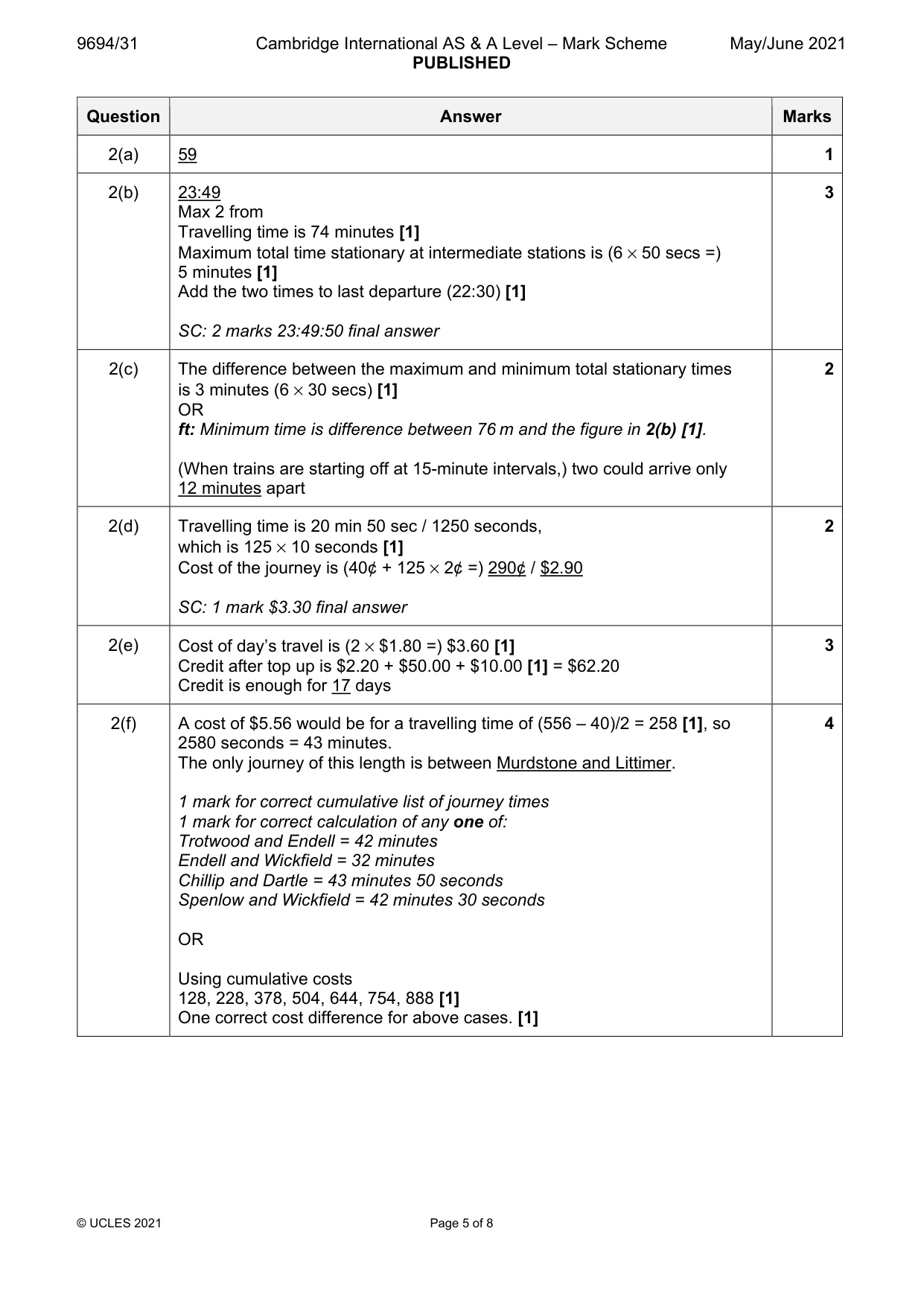
Mark scheme: 2(a) 59 1 2(b) 23:49 3 Max 2 from Travelling time is 74 minutes [1] Maximum total time stationary at intermediate stations is (6 × 50 secs =) 5 minutes [1] Add the two times to last departure (22:30) [1] SC: 2 marks 23:49:50 final answer 2(c) The difference between the maximum and minimum total stationary times 2 is 3 minutes (6 × 30 secs) [1] OR ft: Minimum time is difference between 76 m and the figure in 2(b) [1]. (When trains are starting off at 15-minute intervals,) two could arrive only 12 minutes apart 2(d) Travelling time is 20 min 50 sec / 1250 seconds, 2 which is 125 × 10 seconds [1] Cost of the journey is (40¢ + 125 × 2¢ =) 290¢ / $2.90 SC: 1 mark $3.30 final answer 2(e) Cost of day’s travel is (2 × $1.80 =) $3.60 [1] 3 Credit after top up is $2.20 + $50.00 + $10.00 [1] = $62.20 Credit is enough for 17 days 2(f) A cost of $5.56 would be for a travelling time of (556 – 40)/2 = 258 [1], so 4 2580 seconds = 43 minutes. The only journey of this length is between Murdstone and Littimer. 1 mark for correct cumulative list of journey times 1 mark for correct calculation of any one of: Trotwood and Endell = 42 minutes Endell and Wickfield = 32 minutes Chillip and Dartle = 43 minutes 50 seconds Spenlow and Wickfield = 42 minutes 30 seconds OR Using cumulative costs 128, 228, 378, 504, 644, 754, 888 [1] One correct cost difference for above cases. [1]
Q3 · John is looking for a hotel near a conference hall
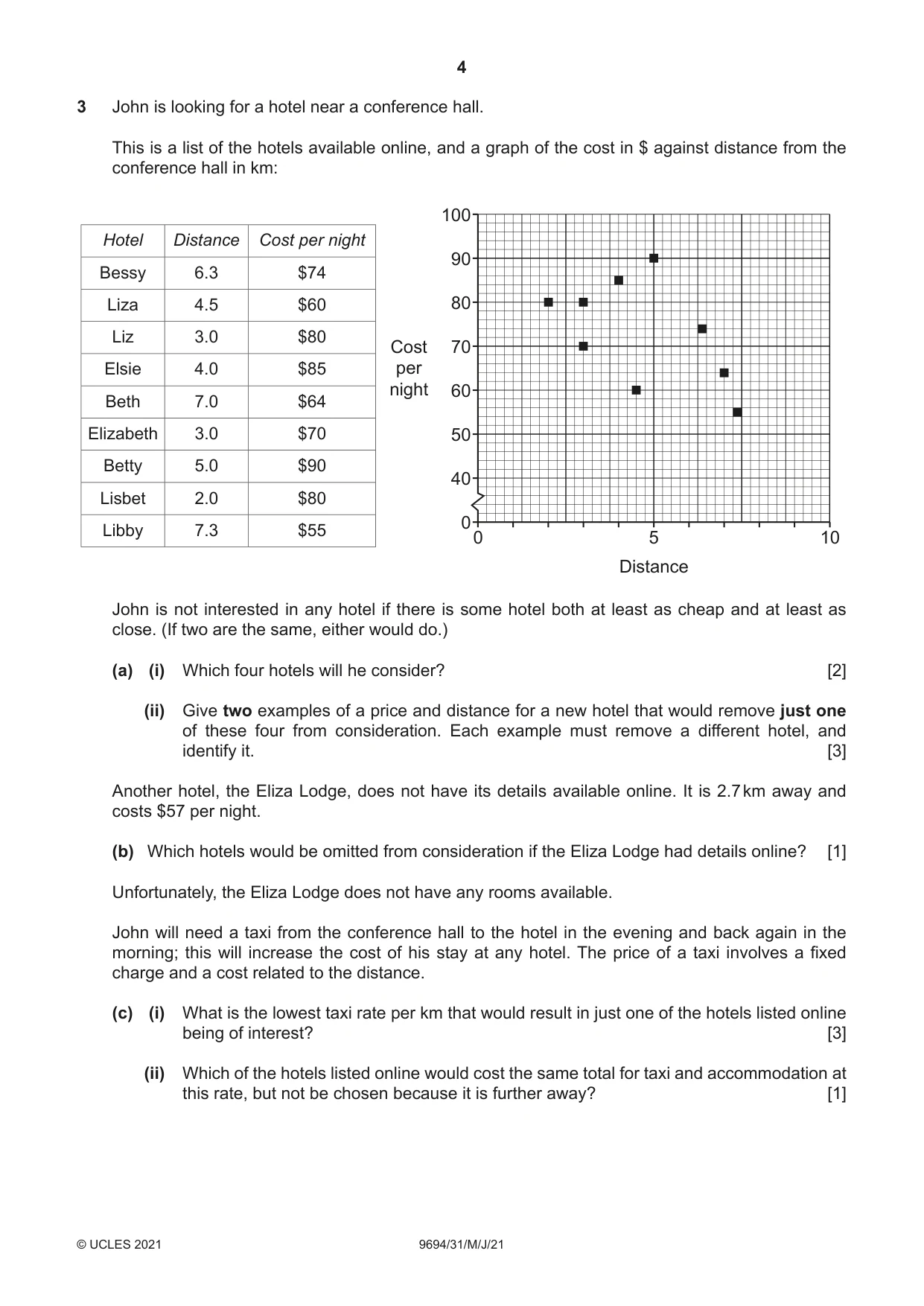
3 John is looking for a hotel near a conference hall. This is a list of the hotels available online, and a graph of the cost in $ against distance from the conference hall in km: 100 Hotel Distance Cost per night 90 Bessy 6.3 $74 Liza 4.5 $60 80 Liz 3.0 $80 Cost 70 Elsie 4.0 $85 per night 60 Beth 7.0 $64 Elizabeth 3.0 $70 50 Betty 5.0 $90 40 Lisbet 2.0 $80 0 Libby 7.3 $55 0 5 10 Distance John is not interested in any hotel if there is some hotel both at least as cheap and at least as close. (If two are the same, either would do.) (a) (i) Which four hotels will he consider? [2] (ii) Give two examples of a price and distance for a new hotel that would remove just one of these four from consideration. Each example must remove a different hotel, and identify it. [3] Another hotel, the Eliza Lodge, does not have its details available online. It is 2.7 km away and costs $57 per night. (b) Which hotels would be omitted from consideration if the Eliza Lodge had details online? [1] Unfortunately, the Eliza Lodge does not have any rooms available. John will need a taxi from the conference hall to the hotel in the evening and back again in the morning; this will increase the cost of his stay at any hotel. The price of a taxi involves a fixed charge and a cost related to the distance. (c) (i) What is the lowest taxi rate per km that would result in just one of the hotels listed online being of interest? [3] (ii) Which of the hotels listed online would cost the same total for taxi and accommodation at this rate, but not be chosen because it is further away? [1] [Question 4 begins on the next page]
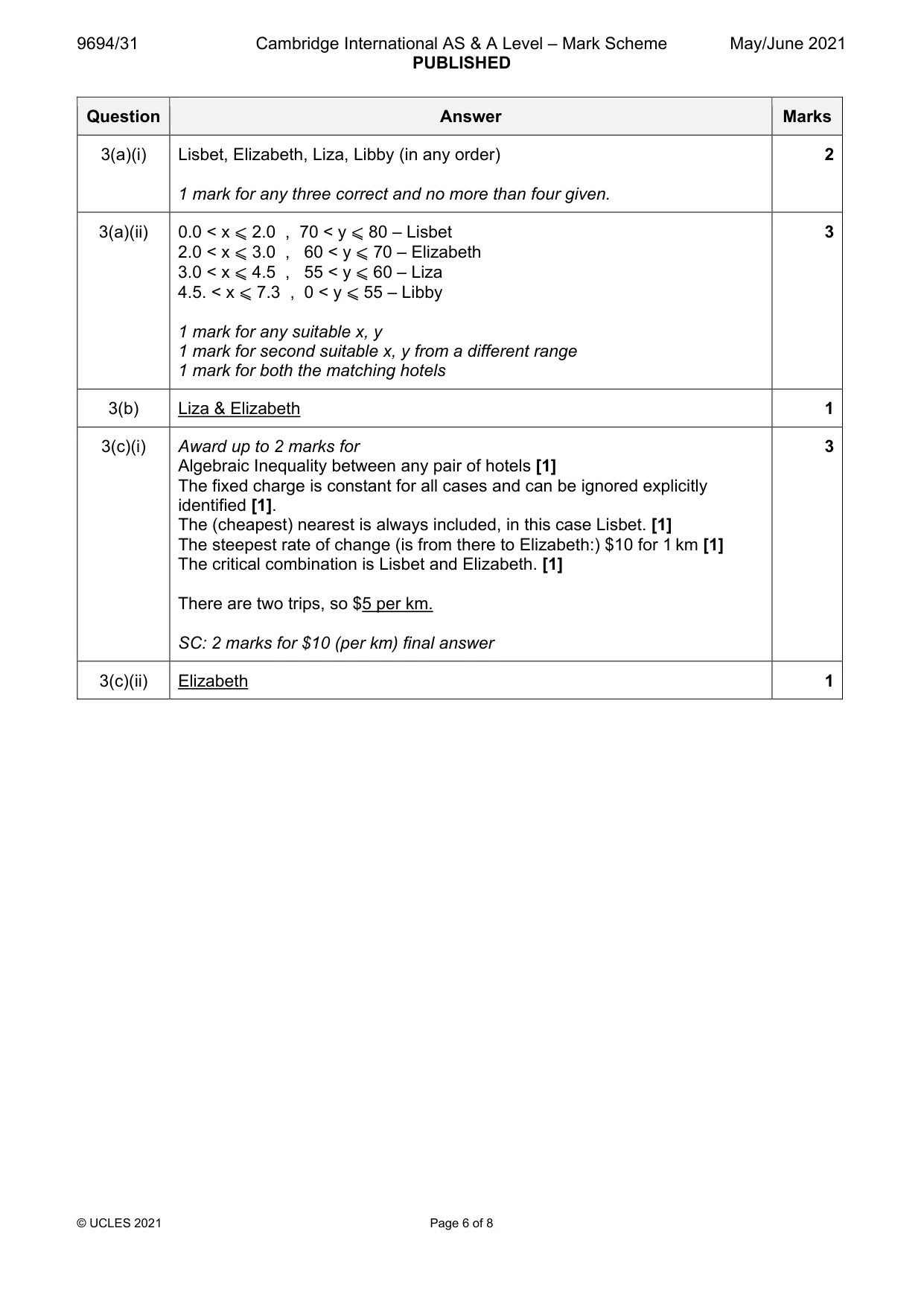
Mark scheme: 3(a)(i) Lisbet, Elizabeth, Liza, Libby (in any order) 2 1 mark for any three correct and no more than four given. 3(a)(ii) 0.0 < x ⩽ 2.0 , 70 < y ⩽ 80 – Lisbet 3 2.0 < x ⩽ 3.0 , 60 < y ⩽ 70 – Elizabeth 3.0 < x ⩽ 4.5 , 55 < y ⩽ 60 – Liza 4.5. < x ⩽ 7.3 , 0 < y ⩽ 55 – Libby 1 mark for any suitable x, y 1 mark for second suitable x, y from a different range 1 mark for both the matching hotels 3(b) Liza & Elizabeth 1 3(c)(i) Award up to 2 marks for 3 Algebraic Inequality between any pair of hotels [1] The fixed charge is constant for all cases and can be ignored explicitly identified [1]. The (cheapest) nearest is always included, in this case Lisbet. [1] The steepest rate of change (is from there to Elizabeth:) $10 for 1 km [1] The critical combination is Lisbet and Elizabeth. [1] There are two trips, so $5 per km. SC: 2 marks for $10 (per km) final answer 3(c)(ii) Elizabeth 1
More questions on Identify cases that satisfy given criteria
Q4 · EXeL is a game for two players, played over at least two rounds on the electronic device…
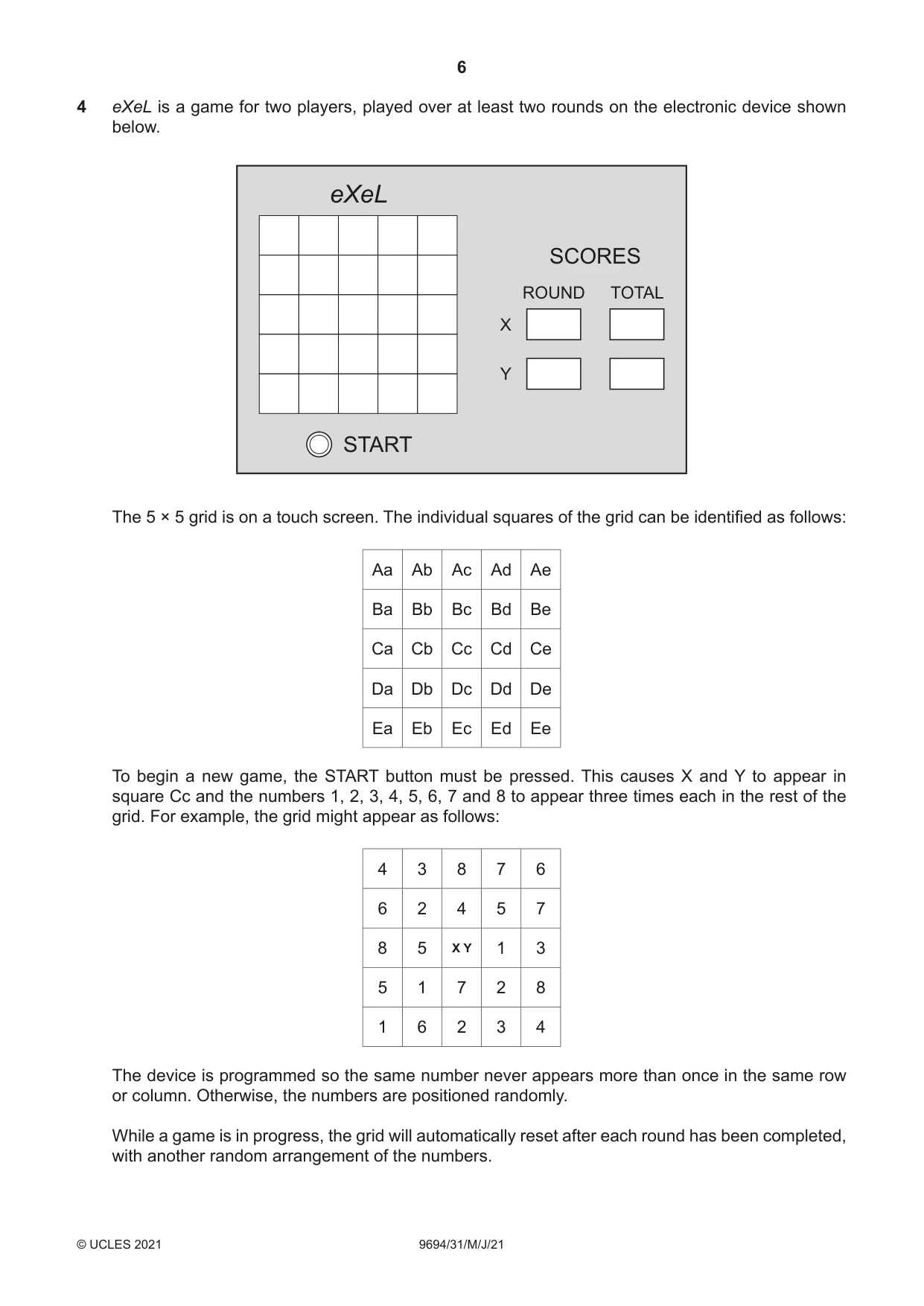
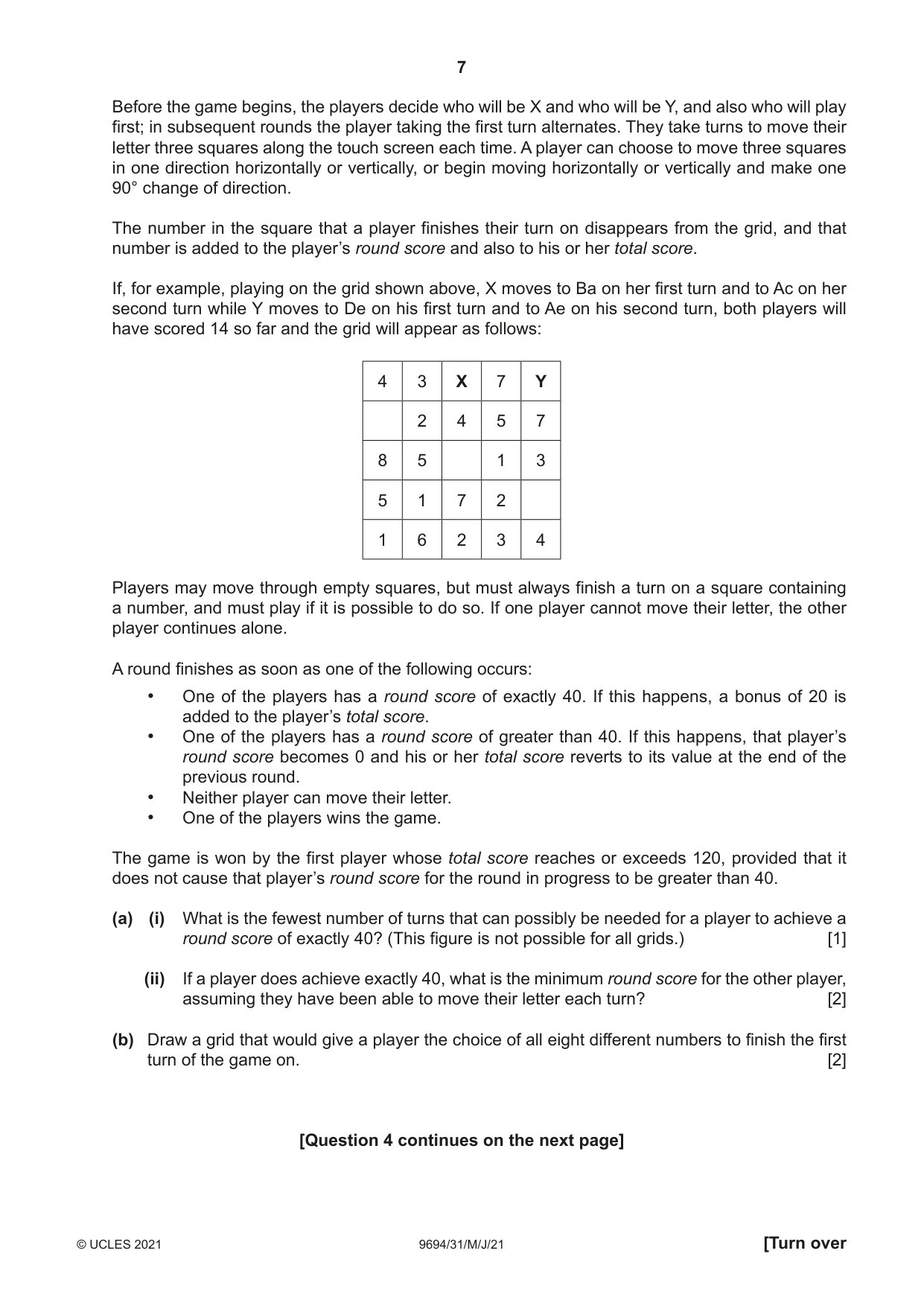
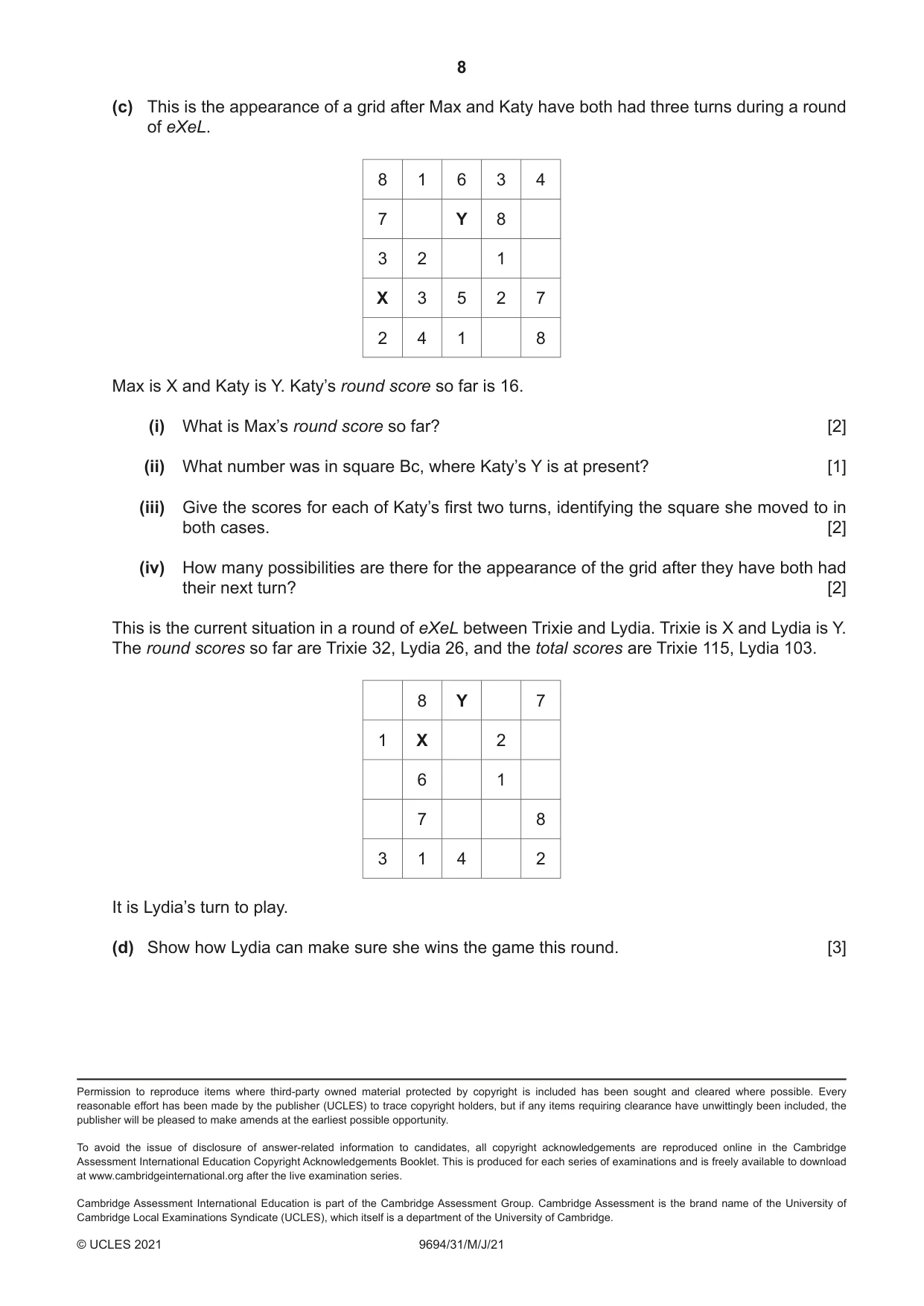
4 eXeL is a game for two players, played over at least two rounds on the electronic device shown below. eXeL SCORES ROUND TOTAL X Y START The 5 × 5 grid is on a touch screen. The individual squares of the grid can be identified as follows: Aa Ab Ac Ad Ae Ba Bb Bc Bd Be Ca Cb Cc Cd Ce Da Db Dc Dd De Ea Eb Ec Ed Ee To begin a new game, the START button must be pressed. This causes X and Y to appear in square Cc and the numbers 1, 2, 3, 4, 5, 6, 7 and 8 to appear three times each in the rest of the grid. For example, the grid might appear as follows: 4 3 8 7 6 6 2 4 5 7 8 5 X Y 1 3 5 1 7 2 8 1 6 2 3 4 The device is programmed so the same number never appears more than once in the same row or column. Otherwise, the numbers are positioned randomly. While a game is in progress, the grid will automatically reset after each round has been completed, with another random arrangement of the numbers. Before the game begins, the players decide who will be X and who will be Y, and also who will play first; in subsequent rounds the player taking the first turn alternates. They take turns to move their letter three squares along the touch screen each time. A player can choose to move three squares in one direction horizontally or vertically, or begin moving horizontally or vertically and make one 90° change of direction. The number in the square that a player finishes their turn on disappears from the grid, and that number is added to the player’s round score and also to his or her total score. If, for example, playing on the grid shown above, X moves to Ba on her first turn and to Ac on her second turn while Y moves to De on his first turn and to Ae on his second turn, both players will have scored 14 so far and the grid will appear as follows: 4 3 X 7 Y 2 4 5 7 8 5 1 3 5 1 7 2 1 6 2 3 4 Players may move through empty squares, but must always finish a turn on a square containing a number, and must play if it is possible to do so. If one player cannot move their letter, the other player continues alone. A round finishes as soon as one of the following occurs: • One of the players has a round score of exactly 40. If this happens, a bonus of 20 is added to the player’s total score. • One of the players has a round score of greater than 40. If this happens, that player’s round score becomes 0 and his or her total score reverts to its value at the end of the previous round. • Neither player can move their letter. • One of the players wins the game. The game is won by the first player whose total score reaches or exceeds 120, provided that it does not cause that player’s round score for the round in progress to be greater than 40. (a) (i) What is the fewest number of turns that can possibly be needed for a player to achieve a round score of exactly 40? (This figure is not possible for all grids.) [1] (ii) If a player does achieve exactly 40, what is the minimum round score for the other player, assuming they have been able to move their letter each turn? [2] (b) Draw a grid that would give a player the choice of all eight different numbers to finish the first turn of the game on. [2] [Question 4 continues on the next page] (c) This is the appearance of a grid after Max and Katy have both had three turns during a round of eXeL. 8 1 6 3 4 7 Y 8 3 2 1 X 3 5 2 7 2 4 1 8 Max is X and Katy is Y. Katy’s round score so far is 16. (i) What is Max’s round score so far? [2] (ii) What number was in square Bc, where Katy’s Y is at present? [1] (iii) Give the scores for each of Katy’s first two turns, identifying the square she moved to in both cases. [2] (iv) How many possibilities are there for the appearance of the grid after they have both had their next turn? [2] This is the current situation in a round of eXeL between Trixie and Lydia. Trixie is X and Lydia is Y. The round scores so far are Trixie 32, Lydia 26, and the total scores are Trixie 115, Lydia 103. 8 Y 7 1 X 2 6 1 7 8 3 1 4 2 It is Lydia’s turn to play. (d) Show how Lydia can make sure she wins the game this round. [3]
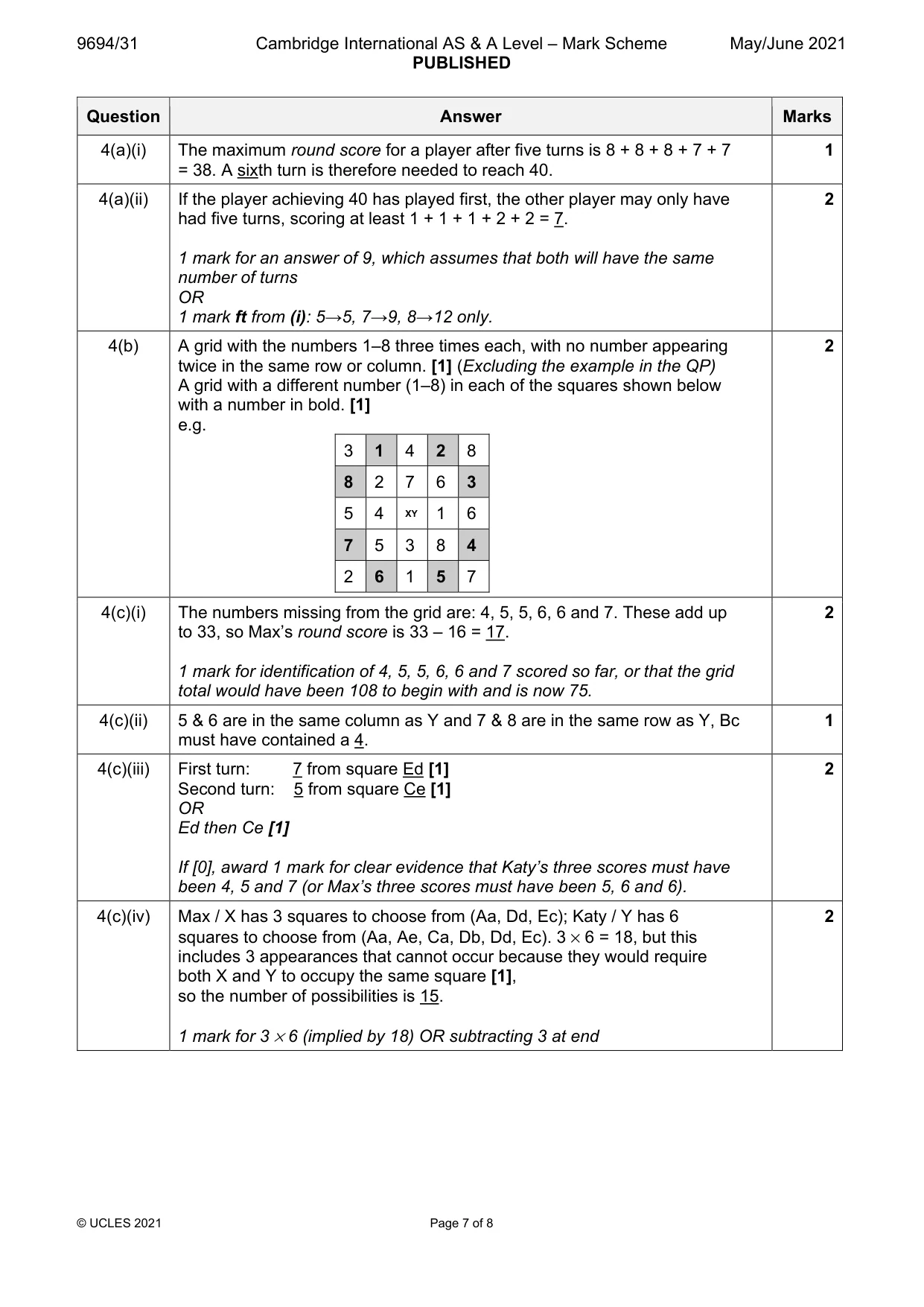
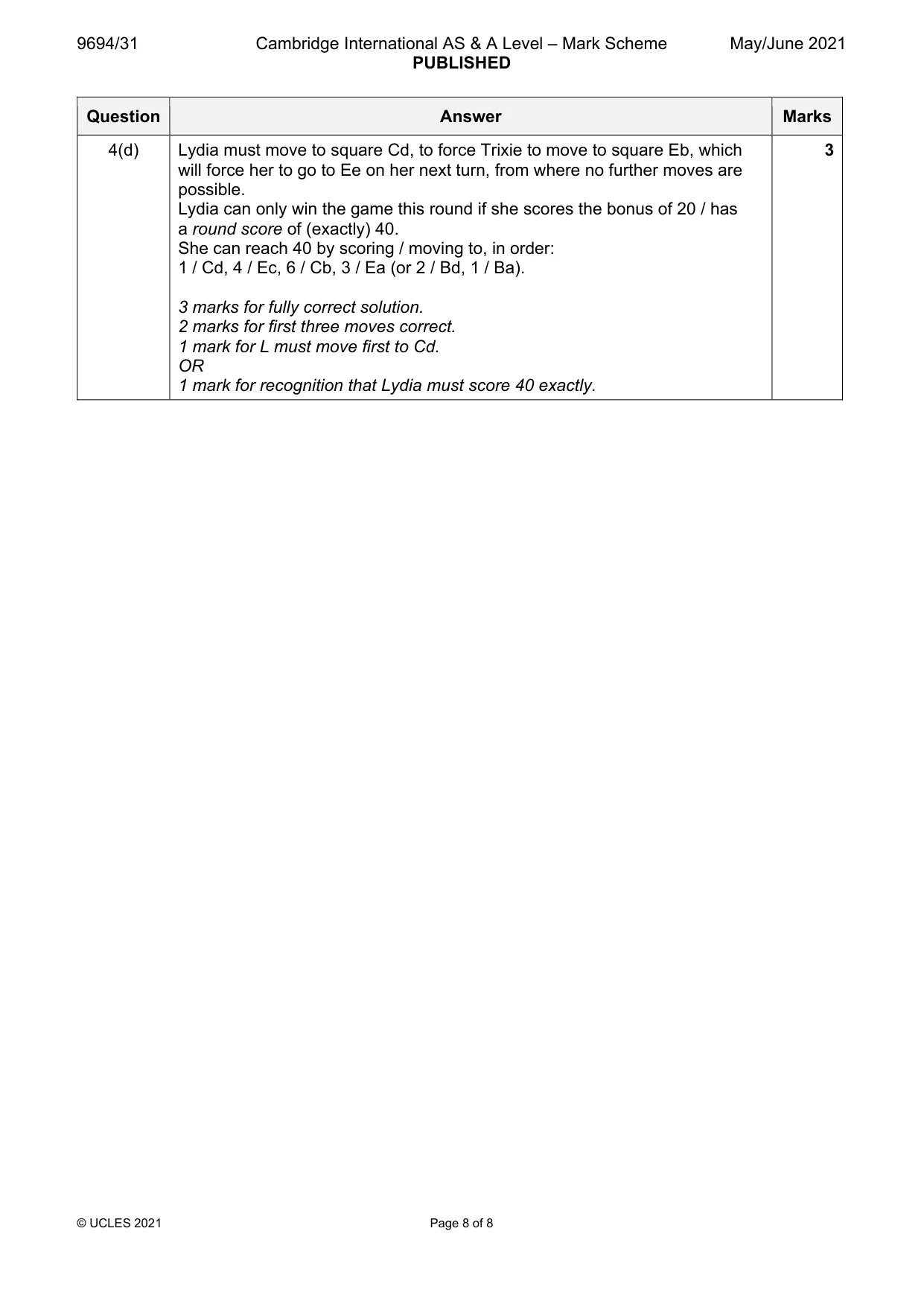
Mark scheme: 4(a)(i) The maximum round score for a player after five turns is 8 + 8 + 8 + 7 + 7 1 = 38. A sixth turn is therefore needed to reach 40. 4(a)(ii) If the player achieving 40 has played first, the other player may only have 2 had five turns, scoring at least 1 + 1 + 1 + 2 + 2 = 7. 1 mark for an answer of 9, which assumes that both will have the same number of turns OR 1 mark ft from (i): 5→5, 7→9, 8→12 only. 4(b) A grid with the numbers 1–8 three times each, with no number appearing 2 twice in the same row or column. [1] (Excluding the example in the QP) A grid with a different number (1–8) in each of the squares shown below with a number in bold. [1] e.g. 3 1 4 2 8 8 2 7 6 3 5 4 XY 1 6 7 5 3 8 4 2 6 1 5 7 4(c)(i) The numbers missing from the grid are: 4, 5, 5, 6, 6 and 7. These add up 2 to 33, so Max’s round score is 33 – 16 = 17. 1 mark for identification of 4, 5, 5, 6, 6 and 7 scored so far, or that the grid total would have been 108 to begin with and is now 75. 4(c)(ii) 5 & 6 are in the same column as Y and 7 & 8 are in the same row as Y, Bc 1 must have contained a 4. 4(c)(iii) First turn: 7 from square Ed [1] 2 Second turn: 5 from square Ce [1] OR Ed then Ce [1] If [0], award 1 mark for clear evidence that Katy’s three scores must have been 4, 5 and 7 (or Max’s three scores must have been 5, 6 and 6). 4(c)(iv) Max / X has 3 squares to choose from (Aa, Dd, Ec); Katy / Y has 6 2 squares to choose from (Aa, Ae, Ca, Db, Dd, Ec). 3 × 6 = 18, but this includes 3 appearances that cannot occur because they would require both X and Y to occupy the same square [1], so the number of possibilities is 15. 1 mark for 3 × 6 (implied by 18) OR subtracting 3 at end 4(d) Lydia must move to square Cd, to force Trixie to move to square Eb, which 3 will force her to go to Ee on her next turn, from where no further moves are possible. Lydia can only win the game this round if she scores the bonus of 20 / has a round score of (exactly) 40. She can reach 40 by scoring / moving to, in order: 1 / Cd, 4 / Ec, 6 / Cb, 3 / Ea (or 2 / Bd, 1 / Ba). 3 marks for fully correct solution. 2 marks for first three moves correct. 1 mark for L must move first to Cd. OR 1 mark for recognition that Lydia must score 40 exactly.
What was in this paper
The subtopics covered by these 4 questions, and how many questions each got. Open one in a new tab to see every Cambridge question on it.
What you needed in this session
Cambridge’s own grade thresholds for 2021 May/June, Paper 3 · Variant 1. A higher threshold means an easier paper — the bar moves with how the cohort did.