Cambridge A Level Thinking Skills 9694 — 2021 May/June Paper 3 · Variant 2
9694/32/M/J/21 · 4 questions · 50 marks · ≈56 min
The question paper and its mark scheme, free to read here and free to download. This is Cambridge’s own paper, exactly as it was sat.
Question paper8 pages


Mark scheme8 pages
Answers below. Sit the paper first if you are practising.
Questions as text
Q1 · A ‘tidal river’ is the lower section of a river near the coast, where the water flows…
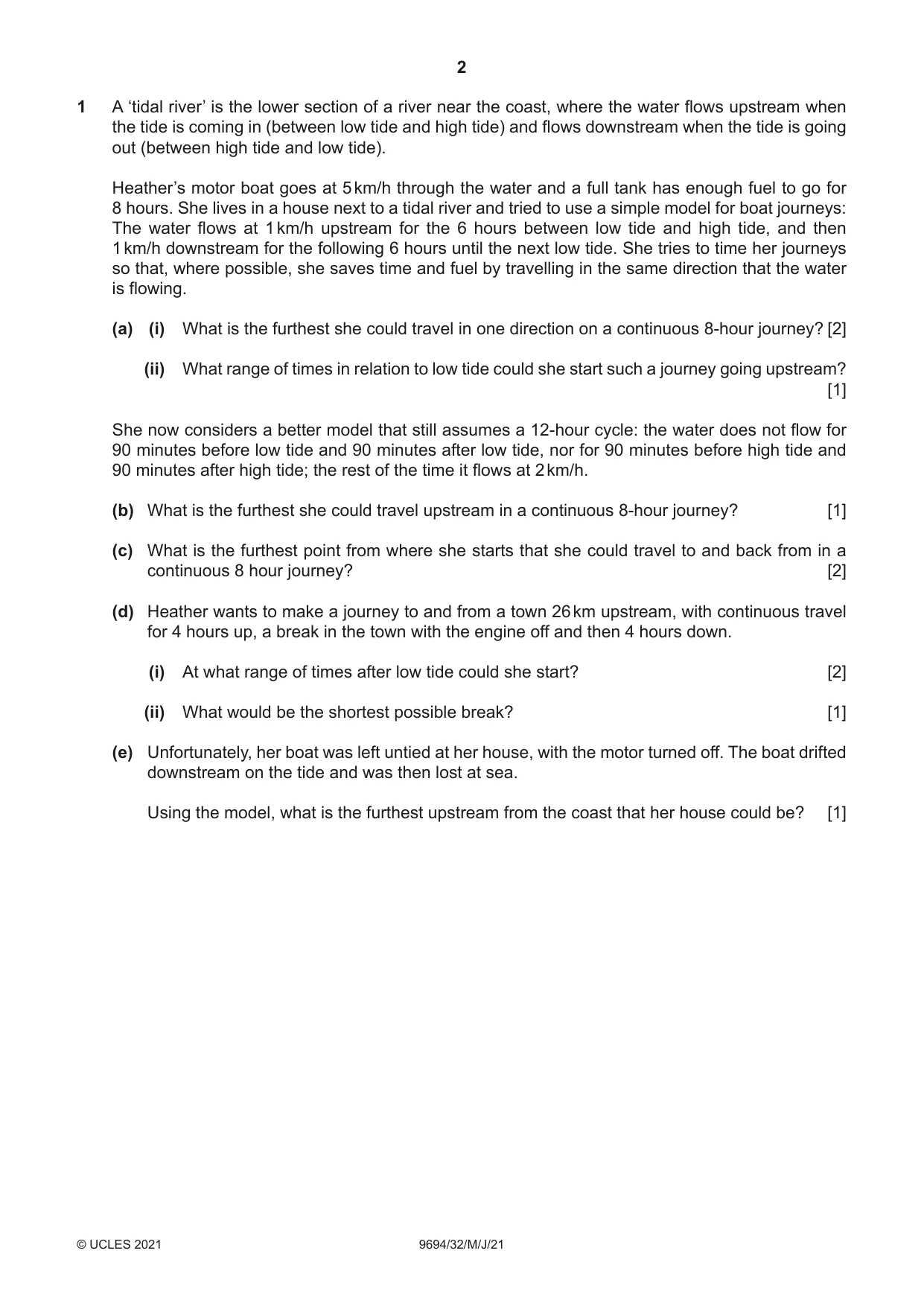
1 A ‘tidal river’ is the lower section of a river near the coast, where the water flows upstream when the tide is coming in (between low tide and high tide) and flows downstream when the tide is going out (between high tide and low tide). Heather’s motor boat goes at 5 km/h through the water and a full tank has enough fuel to go for 8 hours. She lives in a house next to a tidal river and tried to use a simple model for boat journeys: The water flows at 1 km/h upstream for the 6 hours between low tide and high tide, and then 1 km/h downstream for the following 6 hours until the next low tide. She tries to time her journeys so that, where possible, she saves time and fuel by travelling in the same direction that the water is flowing. (a) (i) What is the furthest she could travel in one direction on a continuous 8-hour journey? [2] (ii) What range of times in relation to low tide could she start such a journey going upstream? [1] She now considers a better model that still assumes a 12-hour cycle: the water does not flow for 90 minutes before low tide and 90 minutes after low tide, nor for 90 minutes before high tide and 90 minutes after high tide; the rest of the time it flows at 2 km/h. (b) What is the furthest she could travel upstream in a continuous 8-hour journey? [1] (c) What is the furthest point from where she starts that she could travel to and back from in a continuous 8 hour journey? [2] (d) Heather wants to make a journey to and from a town 26 km upstream, with continuous travel for 4 hours up, a break in the town with the engine off and then 4 hours down. (i) At what range of times after low tide could she start? [2] (ii) What would be the shortest possible break? [1] (e) Unfortunately, her boat was left untied at her house, with the motor turned off. The boat drifted downstream on the tide and was then lost at sea. Using the model, what is the furthest upstream from the coast that her house could be? [1]
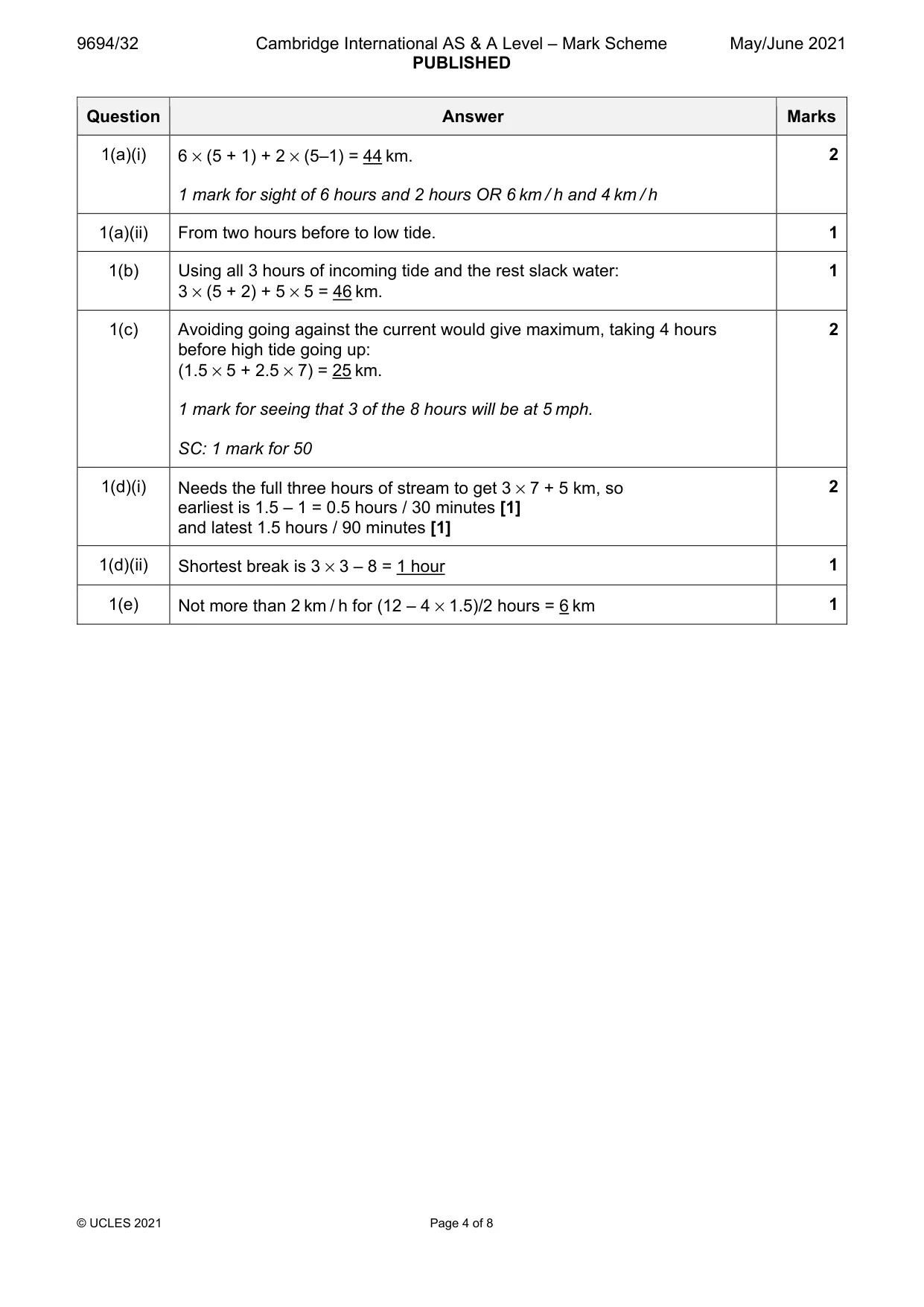
Mark scheme: Question Answer Marks 1(a)(i) 6 × (5 + 1) + 2 × (5–1) = 44 km. 2 1 mark for sight of 6 hours and 2 hours OR 6 km / h and 4 km / h 1(a)(ii) From two hours before to low tide. 1 1(b) Using all 3 hours of incoming tide and the rest slack water: 1 3 × (5 + 2) + 5 × 5 = 46 km. 1(c) Avoiding going against the current would give maximum, taking 4 hours 2 before high tide going up: (1.5 × 5 + 2.5 × 7) = 25 km. 1 mark for seeing that 3 of the 8 hours will be at 5 mph. SC: 1 mark for 50 1(d)(i) Needs the full three hours of stream to get 3 × 7 + 5 km, so 2 earliest is 1.5 – 1 = 0.5 hours / 30 minutes [1] and latest 1.5 hours / 90 minutes [1] 1(d)(ii) Shortest break is 3 × 3 – 8 = 1 hour 1 1(e) Not more than 2 km / h for (12 – 4 × 1.5)/2 hours = 6 km 1
More questions on Perform appropriate operations with information
Q2 · Meghan runs a candle shop, making and selling decorated candles in three different sizes
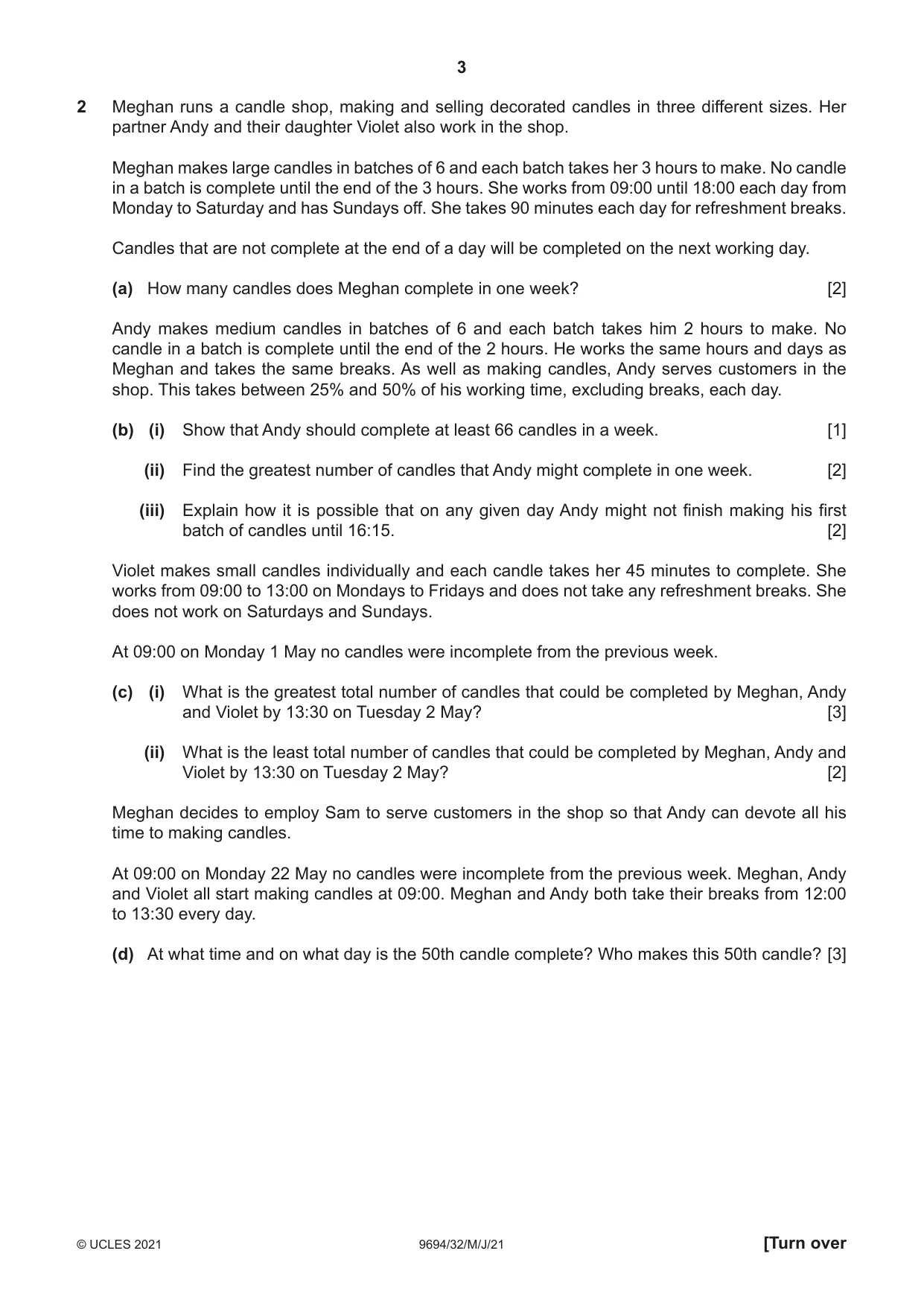
2 Meghan runs a candle shop, making and selling decorated candles in three different sizes. Her partner Andy and their daughter Violet also work in the shop. Meghan makes large candles in batches of 6 and each batch takes her 3 hours to make. No candle in a batch is complete until the end of the 3 hours. She works from 09:00 until 18:00 each day from Monday to Saturday and has Sundays off. She takes 90 minutes each day for refreshment breaks. Candles that are not complete at the end of a day will be completed on the next working day. (a) How many candles does Meghan complete in one week? [2] Andy makes medium candles in batches of 6 and each batch takes him 2 hours to make. No candle in a batch is complete until the end of the 2 hours. He works the same hours and days as Meghan and takes the same breaks. As well as making candles, Andy serves customers in the shop. This takes between 25% and 50% of his working time, excluding breaks, each day. (b) (i) Show that Andy should complete at least 66 candles in a week. [1] (ii) Find the greatest number of candles that Andy might complete in one week. [2] (iii) Explain how it is possible that on any given day Andy might not finish making his first batch of candles until 16:15. [2] Violet makes small candles individually and each candle takes her 45 minutes to complete. She works from 09:00 to 13:00 on Mondays to Fridays and does not take any refreshment breaks. She does not work on Saturdays and Sundays. At 09:00 on Monday 1 May no candles were incomplete from the previous week. (c) (i) What is the greatest total number of candles that could be completed by Meghan, Andy and Violet by 13:30 on Tuesday 2 May? [3] (ii) What is the least total number of candles that could be completed by Meghan, Andy and Violet by 13:30 on Tuesday 2 May? [2] Meghan decides to employ Sam to serve customers in the shop so that Andy can devote all his time to making candles. At 09:00 on Monday 22 May no candles were incomplete from the previous week. Meghan, Andy and Violet all start making candles at 09:00. Meghan and Andy both take their breaks from 12:00 to 13:30 every day. (d) At what time and on what day is the 50th candle complete? Who makes this 50th candle? [3]
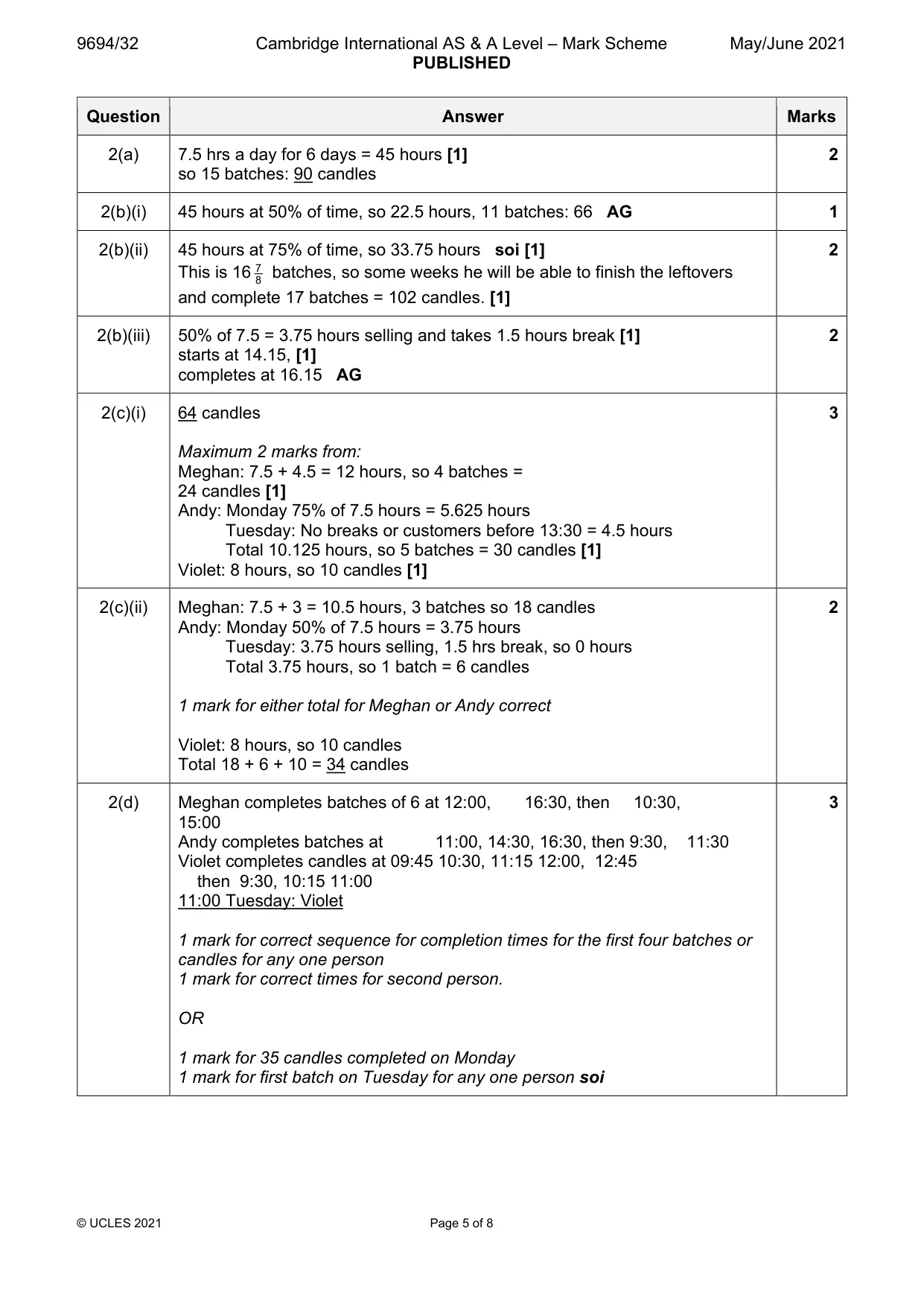
Mark scheme: 2(a) 7.5 hrs a day for 6 days = 45 hours [1] 2 so 15 batches: 90 candles 2(b)(i) 45 hours at 50% of time, so 22.5 hours, 11 batches: 66 AG 1 2(b)(ii) 45 hours at 75% of time, so 33.75 hours soi [1] 2 This is 16 78 batches, so some weeks he will be able to finish the leftovers and complete 17 batches = 102 candles. [1] 2(b)(iii) 50% of 7.5 = 3.75 hours selling and takes 1.5 hours break [1] 2 starts at 14.15, [1] completes at 16.15 AG 2(c)(i) 64 candles 3 Maximum 2 marks from: Meghan: 7.5 + 4.5 = 12 hours, so 4 batches = 24 candles [1] Andy: Monday 75% of 7.5 hours = 5.625 hours Tuesday: No breaks or customers before 13:30 = 4.5 hours Total 10.125 hours, so 5 batches = 30 candles [1] Violet: 8 hours, so 10 candles [1] 2(c)(ii) Meghan: 7.5 + 3 = 10.5 hours, 3 batches so 18 candles 2 Andy: Monday 50% of 7.5 hours = 3.75 hours Tuesday: 3.75 hours selling, 1.5 hrs break, so 0 hours Total 3.75 hours, so 1 batch = 6 candles 1 mark for either total for Meghan or Andy correct Violet: 8 hours, so 10 candles Total 18 + 6 + 10 = 34 candles 2(d) Meghan completes batches of 6 at 12:00, 16:30, then 10:30, 3 15:00 Andy completes batches at 11:00, 14:30, 16:30, then 9:30, 11:30 Violet completes candles at 09:45 10:30, 11:15 12:00, 12:45 then 9:30, 10:15 11:00 11:00 Tuesday: Violet 1 mark for correct sequence for completion times for the first four batches or candles for any one person 1 mark for correct times for second person. OR 1 mark for 35 candles completed on Monday 1 mark for first batch on Tuesday for any one person soi
Q3 · Helena and Daisy are thinking about how they can select 6 cards from a box of 100 cards
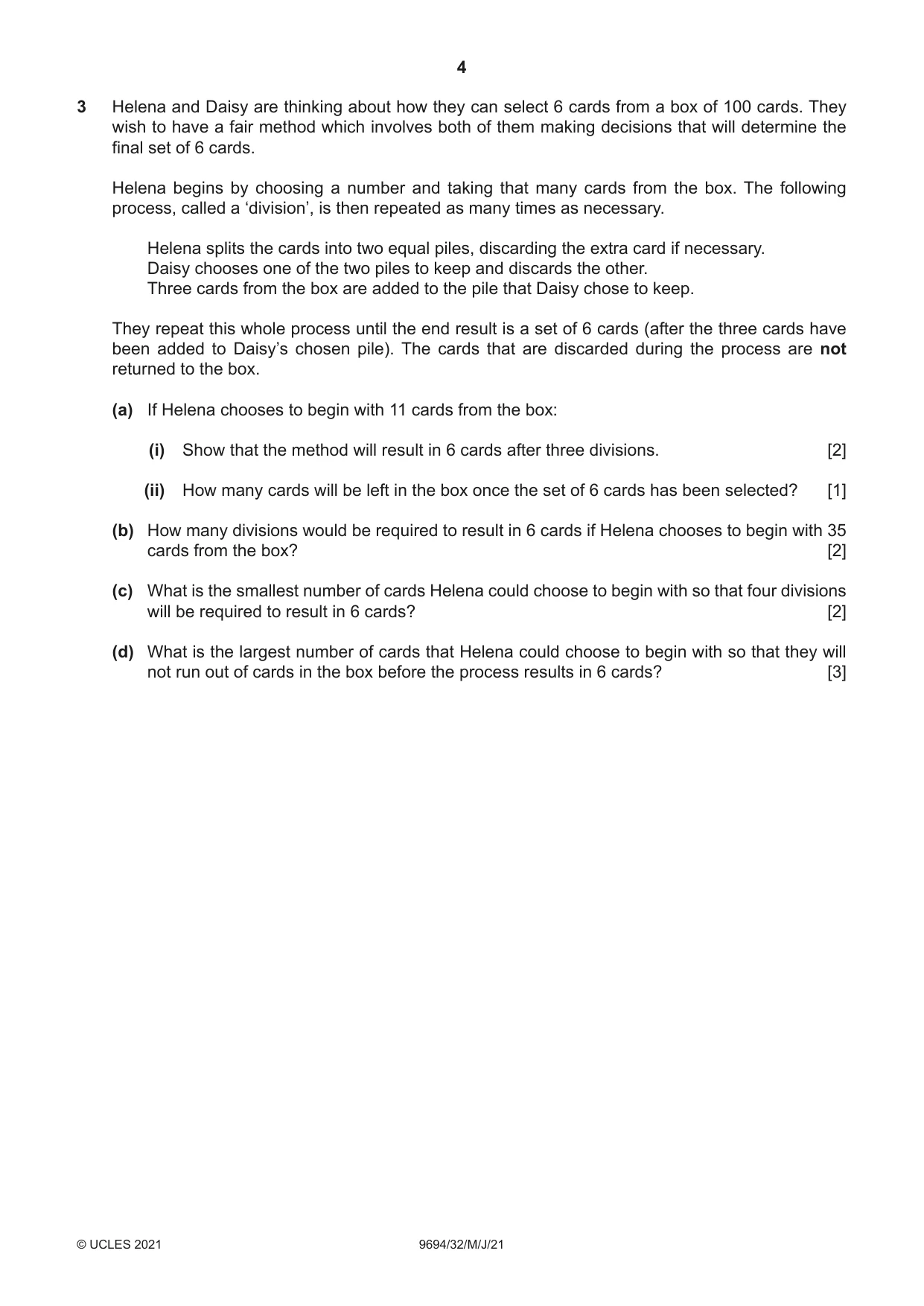
3 Helena and Daisy are thinking about how they can select 6 cards from a box of 100 cards. They wish to have a fair method which involves both of them making decisions that will determine the final set of 6 cards. Helena begins by choosing a number and taking that many cards from the box. The following process, called a ‘division’, is then repeated as many times as necessary. Helena splits the cards into two equal piles, discarding the extra card if necessary. Daisy chooses one of the two piles to keep and discards the other. Three cards from the box are added to the pile that Daisy chose to keep. They repeat this whole process until the end result is a set of 6 cards (after the three cards have been added to Daisy’s chosen pile). The cards that are discarded during the process are not returned to the box. (a) If Helena chooses to begin with 11 cards from the box: (i) Show that the method will result in 6 cards after three divisions. [2] (ii) How many cards will be left in the box once the set of 6 cards has been selected? [1] (b) How many divisions would be required to result in 6 cards if Helena chooses to begin with 35 cards from the box? [2] (c) What is the smallest number of cards Helena could choose to begin with so that four divisions will be required to result in 6 cards? [2] (d) What is the largest number of cards that Helena could choose to begin with so that they will not run out of cards in the box before the process results in 6 cards? [3] [Question 4 begins on the next page]
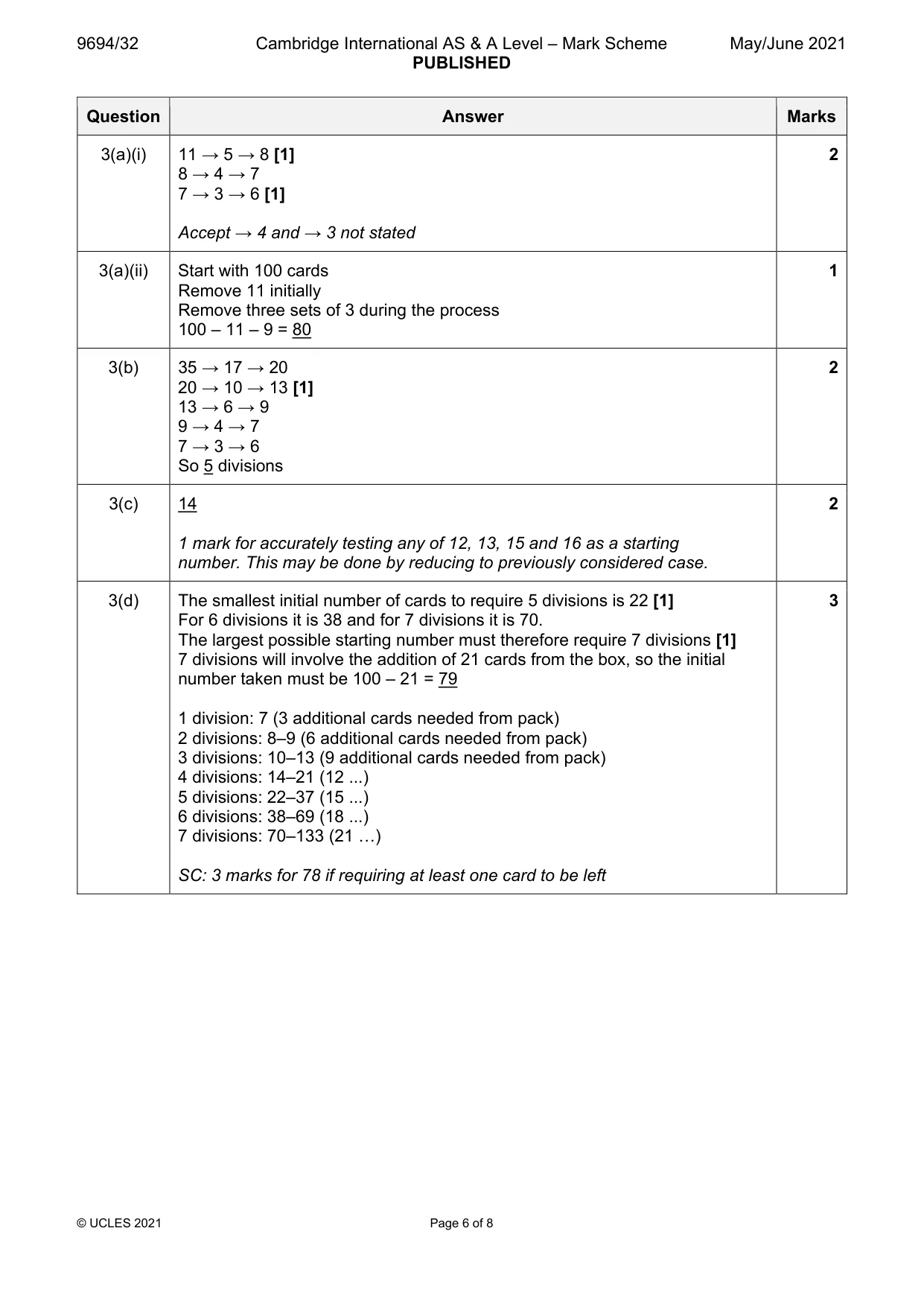
Mark scheme: 3(a)(i) 11 → 5 → 8 [1] 2 8 → 4 → 7 7 → 3 → 6 [1] Accept → 4 and → 3 not stated 3(a)(ii) Start with 100 cards 1 Remove 11 initially Remove three sets of 3 during the process 100 – 11 – 9 = 80 3(b) 35 → 17 → 20 2 20 → 10 → 13 [1] 13 → 6 → 9 9 → 4 → 7 7 → 3 → 6 So 5 divisions 3(c) 14 2 1 mark for accurately testing any of 12, 13, 15 and 16 as a starting number. This may be done by reducing to previously considered case. 3(d) The smallest initial number of cards to require 5 divisions is 22 [1] 3 For 6 divisions it is 38 and for 7 divisions it is 70. The largest possible starting number must therefore require 7 divisions [1] 7 divisions will involve the addition of 21 cards from the box, so the initial number taken must be 100 – 21 = 79 1 division: 7 (3 additional cards needed from pack) 2 divisions: 8–9 (6 additional cards needed from pack) 3 divisions: 10–13 (9 additional cards needed from pack) 4 divisions: 14–21 (12 ...) 5 divisions: 22–37 (15 ...) 6 divisions: 38–69 (18 ...) 7 divisions: 70–133 (21 …) SC: 3 marks for 78 if requiring at least one card to be left
Q4 · A quiz is held on the second Friday of every month at the local village hall
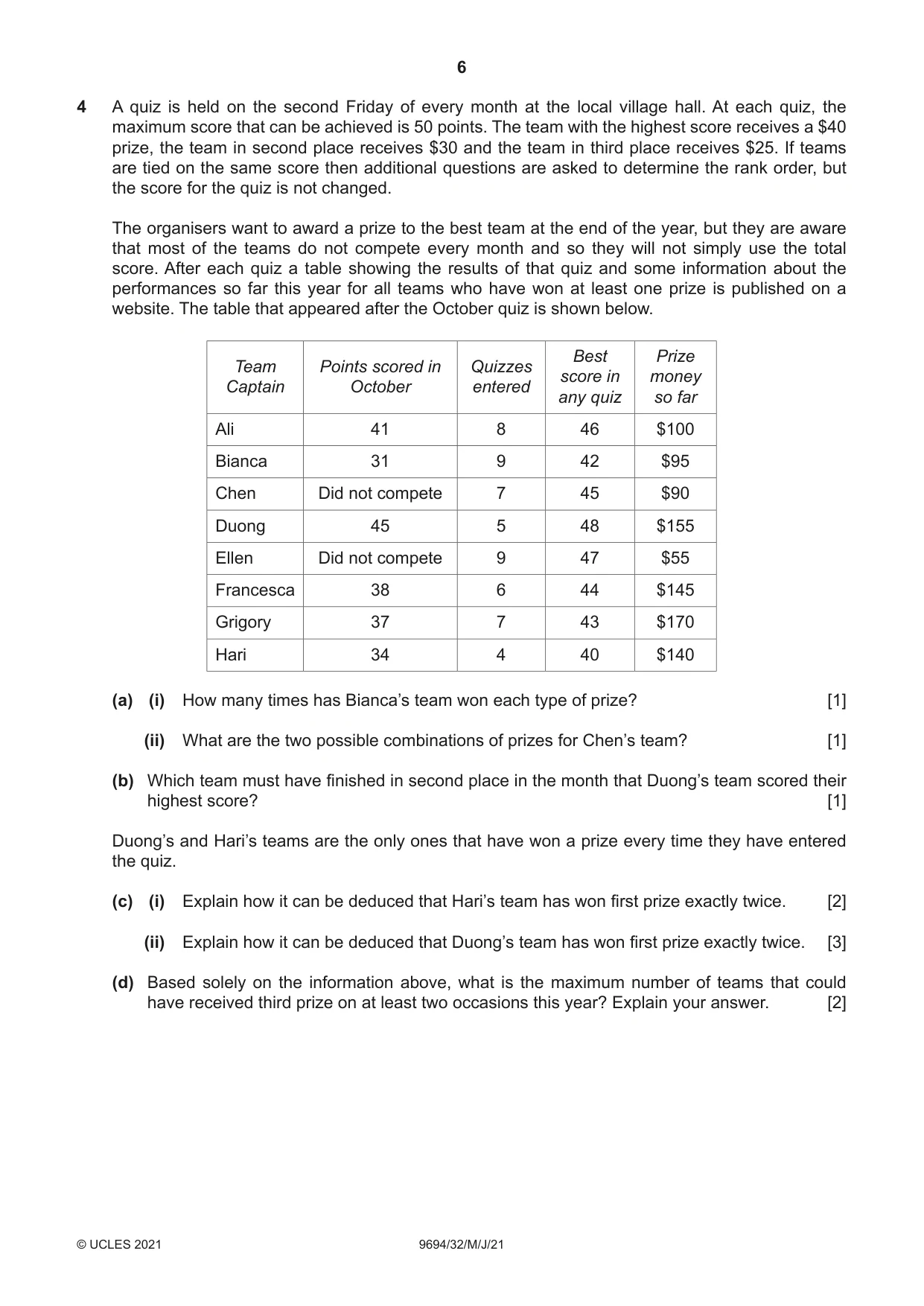
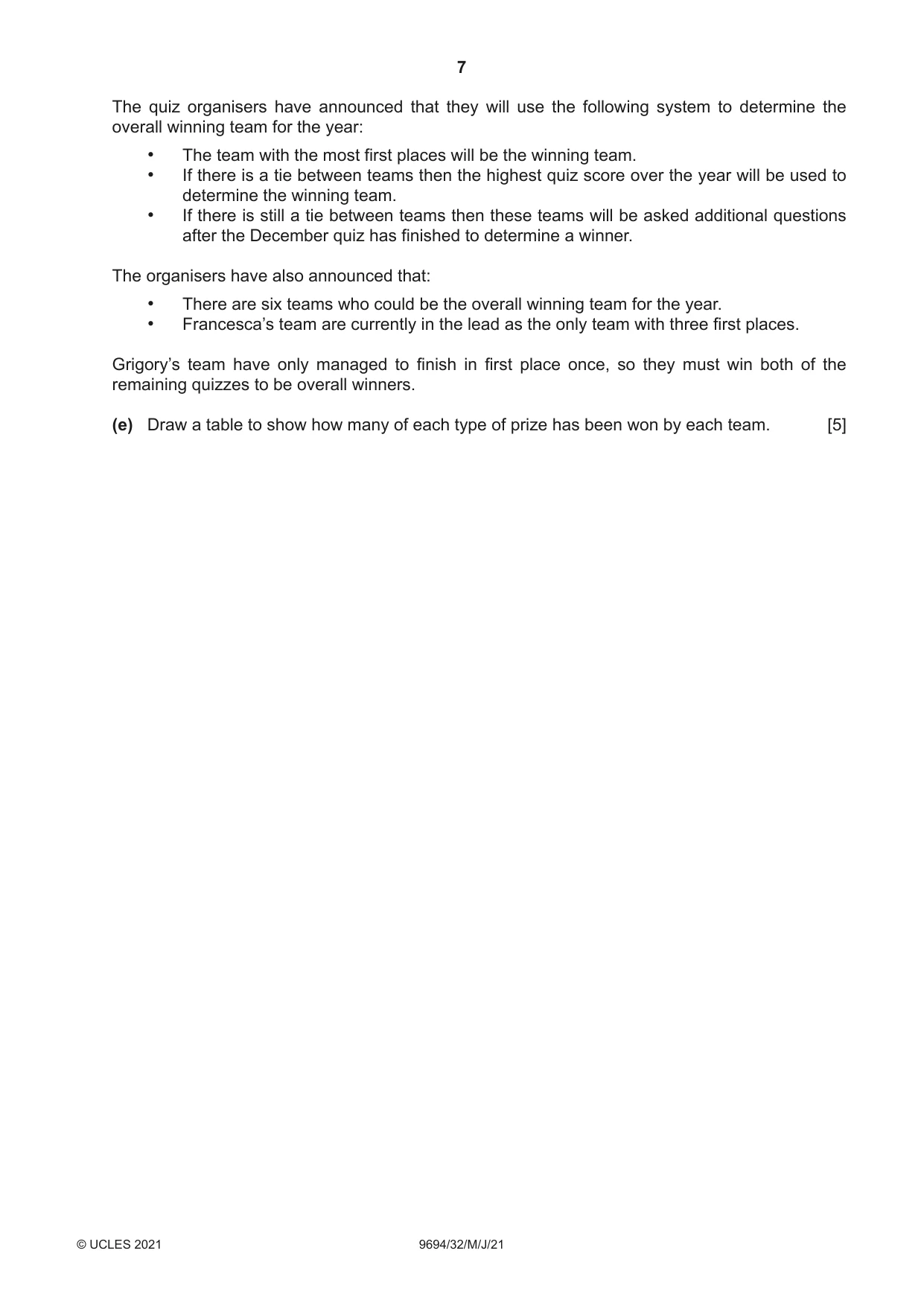
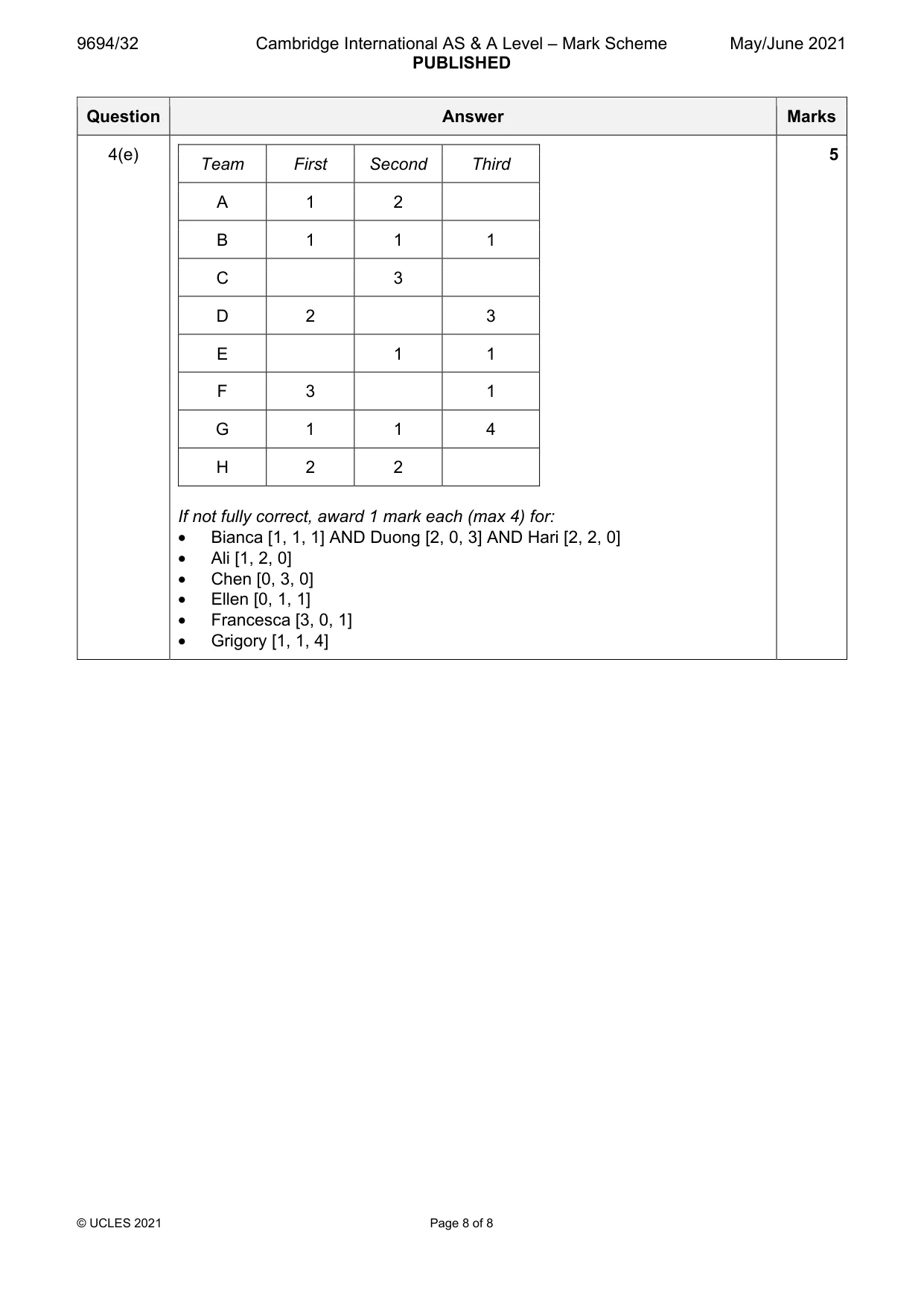
4 A quiz is held on the second Friday of every month at the local village hall. At each quiz, the maximum score that can be achieved is 50 points. The team with the highest score receives a $40 prize, the team in second place receives $30 and the team in third place receives $25. If teams are tied on the same score then additional questions are asked to determine the rank order, but the score for the quiz is not changed. The organisers want to award a prize to the best team at the end of the year, but they are aware that most of the teams do not compete every month and so they will not simply use the total score. After each quiz a table showing the results of that quiz and some information about the performances so far this year for all teams who have won at least one prize is published on a website. The table that appeared after the October quiz is shown below. Best Prize Team Points scored in Quizzes score in money Captain October entered any quiz so far Ali 41 8 46 $100 Bianca 31 9 42 $95 Chen Did not compete 7 45 $90 Duong 45 5 48 $155 Ellen Did not compete 9 47 $55 Francesca 38 6 44 $145 Grigory 37 7 43 $170 Hari 34 4 40 $140 (a) (i) How many times has Bianca’s team won each type of prize? [1] (ii) What are the two possible combinations of prizes for Chen’s team? [1] (b) Which team must have finished in second place in the month that Duong’s team scored their highest score? [1] Duong’s and Hari’s teams are the only ones that have won a prize every time they have entered the quiz. (c) (i) Explain how it can be deduced that Hari’s team has won first prize exactly twice. [2] (ii) Explain how it can be deduced that Duong’s team has won first prize exactly twice. [3] (d) Based solely on the information above, what is the maximum number of teams that could have received third prize on at least two occasions this year? Explain your answer. [2] The quiz organisers have announced that they will use the following system to determine the overall winning team for the year: • The team with the most first places will be the winning team. • If there is a tie between teams then the highest quiz score over the year will be used to determine the winning team. • If there is still a tie between teams then these teams will be asked additional questions after the December quiz has finished to determine a winner. The organisers have also announced that: • There are six teams who could be the overall winning team for the year. • Francesca’s team are currently in the lead as the only team with three first places. Grigory’s team have only managed to finish in first place once, so they must win both of the remaining quizzes to be overall winners. (e) Draw a table to show how many of each type of prize has been won by each team. [5]
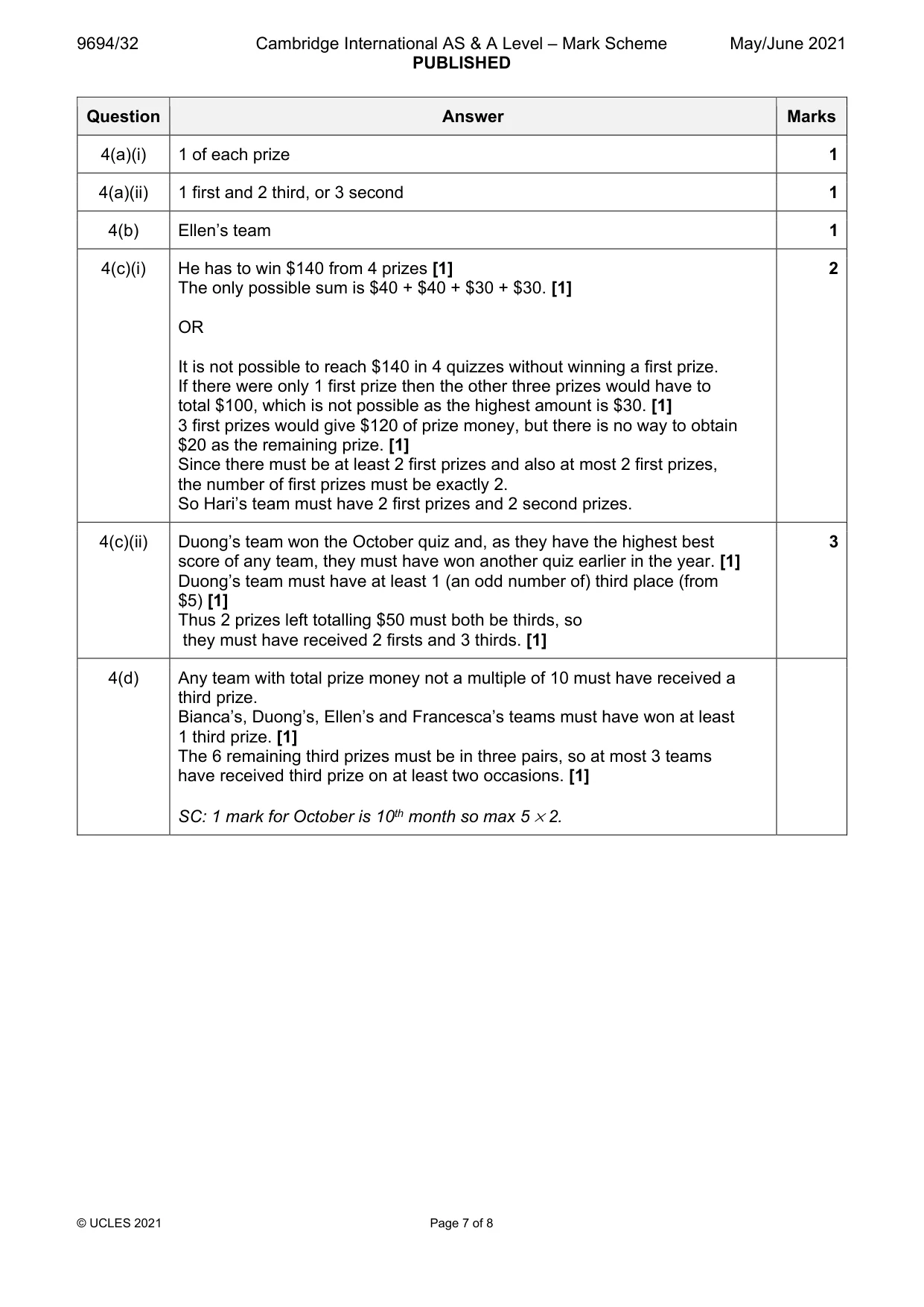
Mark scheme: 4(a)(i) 1 of each prize 1 4(a)(ii) 1 first and 2 third, or 3 second 1 4(b) Ellen’s team 1 4(c)(i) He has to win $140 from 4 prizes [1] 2 The only possible sum is $40 + $40 + $30 + $30. [1] OR It is not possible to reach $140 in 4 quizzes without winning a first prize. If there were only 1 first prize then the other three prizes would have to total $100, which is not possible as the highest amount is $30. [1] 3 first prizes would give $120 of prize money, but there is no way to obtain $20 as the remaining prize. [1] Since there must be at least 2 first prizes and also at most 2 first prizes, the number of first prizes must be exactly 2. So Hari’s team must have 2 first prizes and 2 second prizes. 4(c)(ii) Duong’s team won the October quiz and, as they have the highest best 3 score of any team, they must have won another quiz earlier in the year. [1] Duong’s team must have at least 1 (an odd number of) third place (from $5) [1] Thus 2 prizes left totalling $50 must both be thirds, so they must have received 2 firsts and 3 thirds. [1] 4(d) Any team with total prize money not a multiple of 10 must have received a third prize. Bianca’s, Duong’s, Ellen’s and Francesca’s teams must have won at least 1 third prize. [1] The 6 remaining third prizes must be in three pairs, so at most 3 teams have received third prize on at least two occasions. [1] SC: 1 mark for October is 10th month so max 5 × 2. 4(e) 5 Team First Second Third A 1 2 B 1 1 1 C 3 D 2 3 E 1 1 F 3 1 G 1 1 4 H 2 2 If not fully correct, award 1 mark each (max 4) for: • Bianca [1, 1, 1] AND Duong [2, 0, 3] AND Hari [2, 2, 0] • Ali [1, 2, 0] • Chen [0, 3, 0] • Ellen [0, 1, 1] • Francesca [3, 0, 1] • Grigory [1, 1, 4]
What was in this paper
The subtopics covered by these 4 questions, and how many questions each got. Open one in a new tab to see every Cambridge question on it.
What you needed in this session
Cambridge’s own grade thresholds for 2021 May/June, Paper 3 · Variant 2. A higher threshold means an easier paper — the bar moves with how the cohort did.