Cambridge A Level Thinking Skills 9694 — 2020 May/June Paper 3 · Variant 1
9694/31/M/J/20 · 4 questions · 50 marks · ≈56 min
The question paper and its mark scheme, free to read here and free to download. This is Cambridge’s own paper, exactly as it was sat.
Question paper8 pages


Mark scheme7 pages
Answers below. Sit the paper first if you are practising.


Questions as text
Q1 · In The Bolandian Patisserie, the pastries have the following names and prices
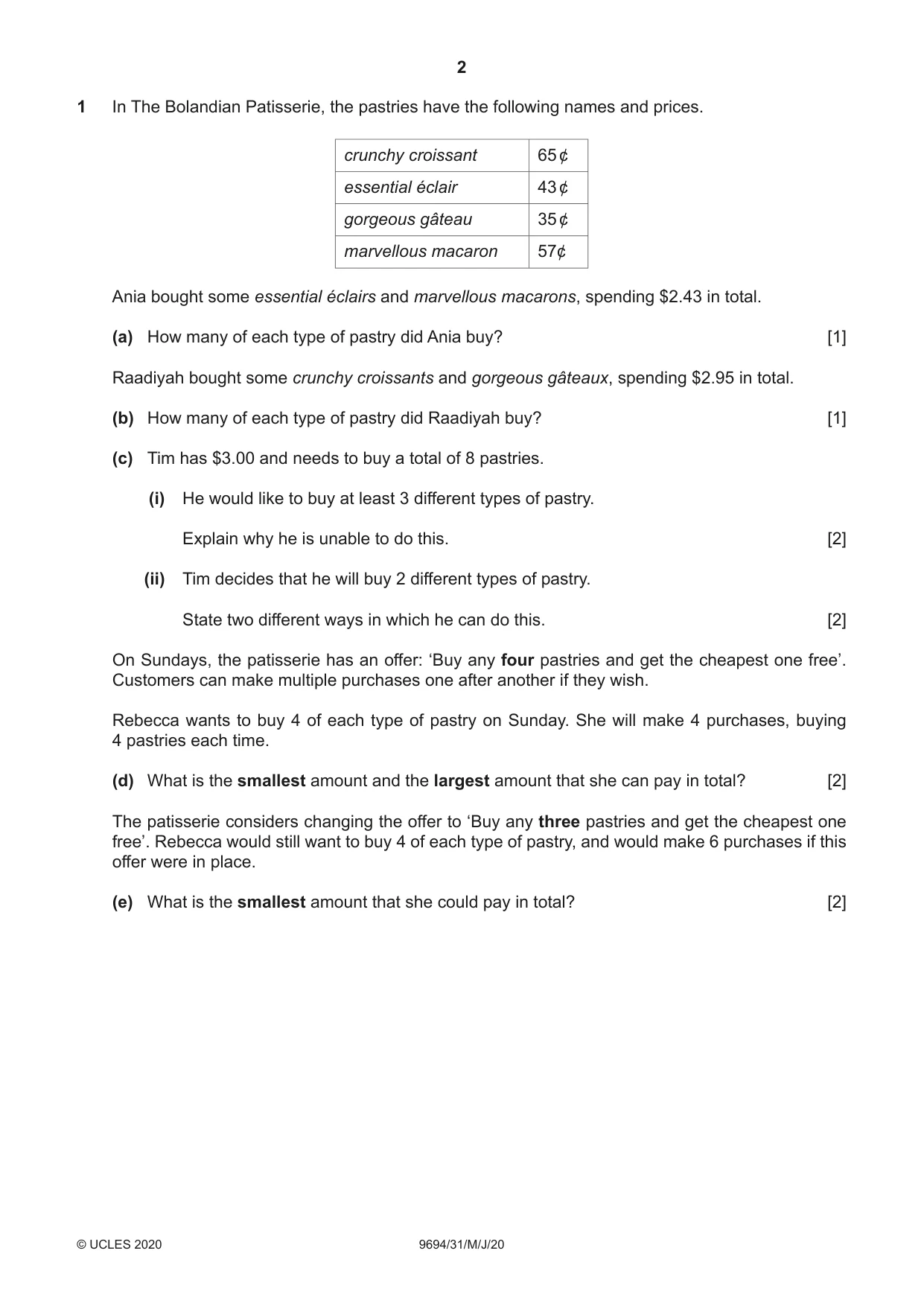
1 In The Bolandian Patisserie, the pastries have the following names and prices. crunchy croissant 65 ¢ essential éclair 43 ¢ gorgeous gâteau 35 ¢ marvellous macaron 57¢ Ania bought some essential éclairs and marvellous macarons, spending $2.43 in total. (a) How many of each type of pastry did Ania buy? [1] Raadiyah bought some crunchy croissants and gorgeous gâteaux, spending $2.95 in total. (b) How many of each type of pastry did Raadiyah buy? [1] (c) Tim has $3.00 and needs to buy a total of 8 pastries. (i) He would like to buy at least 3 different types of pastry. Explain why he is unable to do this. [2] (ii) Tim decides that he will buy 2 different types of pastry. State two different ways in which he can do this. [2] On Sundays, the patisserie has an offer: ‘Buy any four pastries and get the cheapest one free’. Customers can make multiple purchases one after another if they wish. Rebecca wants to buy 4 of each type of pastry on Sunday. She will make 4 purchases, buying 4 pastries each time. (d) What is the smallest amount and the largest amount that she can pay in total? [2] The patisserie considers changing the offer to ‘Buy any three pastries and get the cheapest one free’. Rebecca would still want to buy 4 of each type of pastry, and would make 6 purchases if this offer were in place. (e) What is the smallest amount that she could pay in total? [2] [Question 2 begins on the next page]
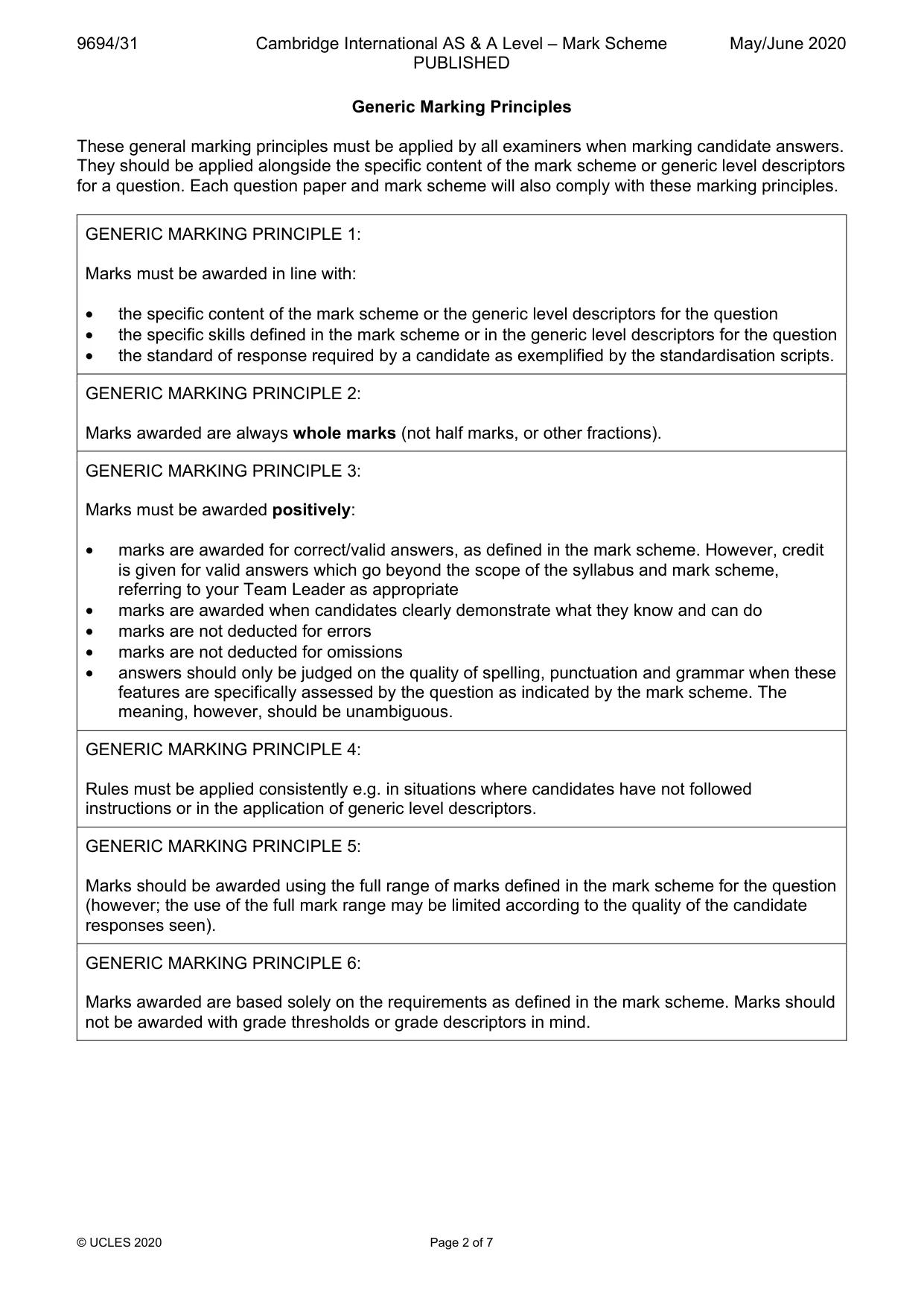
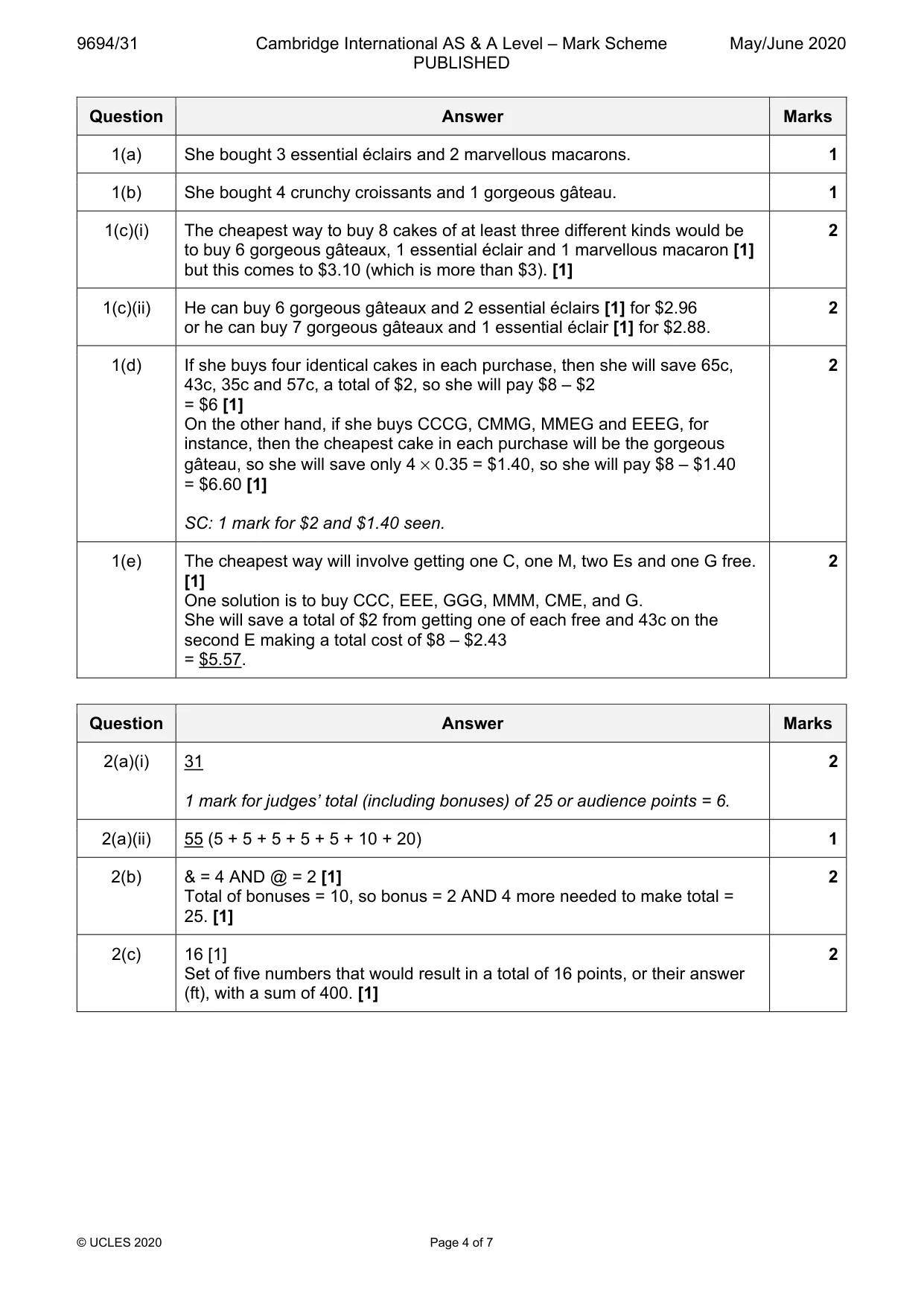
Mark scheme: Question Answer Marks 1(a) She bought 3 essential éclairs and 2 marvellous macarons. 1 1(b) She bought 4 crunchy croissants and 1 gorgeous gâteau. 1 1(c)(i) The cheapest way to buy 8 cakes of at least three different kinds would be 2 to buy 6 gorgeous gâteaux, 1 essential éclair and 1 marvellous macaron [1] but this comes to $3.10 (which is more than $3). [1] 1(c)(ii) He can buy 6 gorgeous gâteaux and 2 essential éclairs [1] for $2.96 2 or he can buy 7 gorgeous gâteaux and 1 essential éclair [1] for $2.88. 1(d) If she buys four identical cakes in each purchase, then she will save 65c, 2 43c, 35c and 57c, a total of $2, so she will pay $8 – $2 = $6 [1] On the other hand, if she buys CCCG, CMMG, MMEG and EEEG, for instance, then the cheapest cake in each purchase will be the gorgeous gâteau, so she will save only 4 × 0.35 = $1.40, so she will pay $8 – $1.40 = $6.60 [1] SC: 1 mark for $2 and $1.40 seen. 1(e) The cheapest way will involve getting one C, one M, two Es and one G free. 2 [1] One solution is to buy CCC, EEE, GGG, MMM, CME, and G. She will save a total of $2 from getting one of each free and 43c on the second E making a total cost of $8 – $2.43 = $5.57.
Q2 · Allegro is a TV talent show for solo singers, broadcast annually
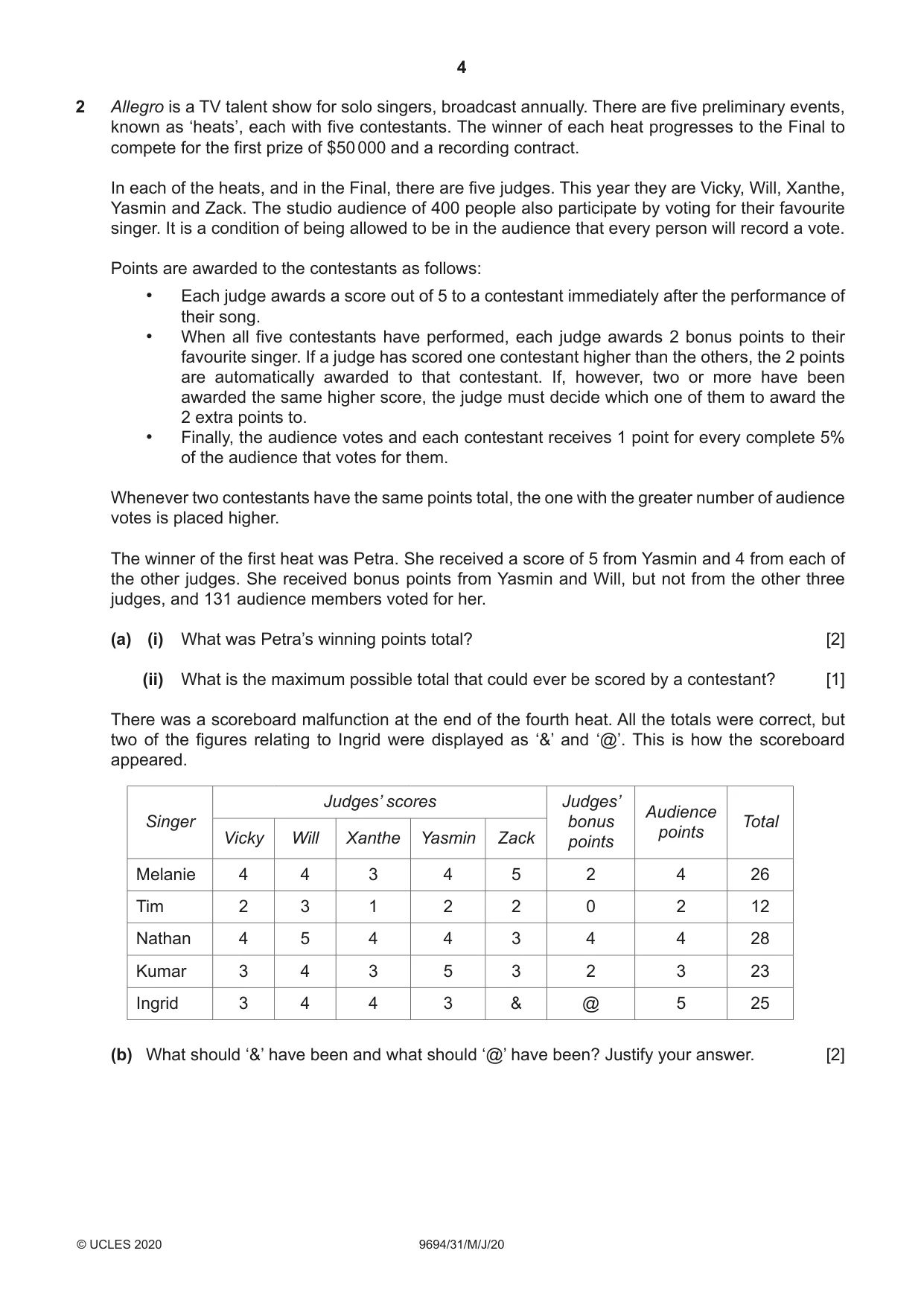
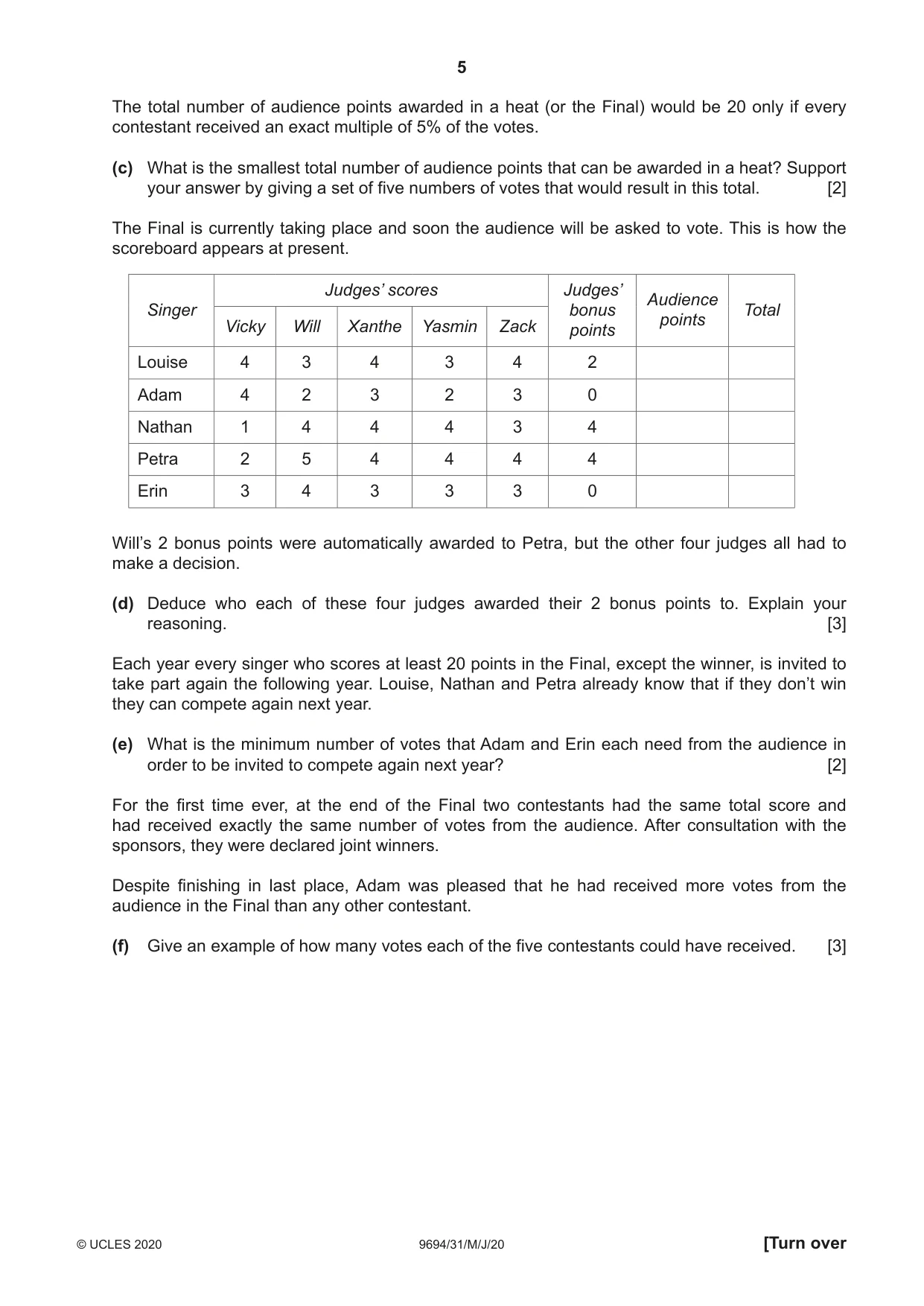
2 Allegro is a TV talent show for solo singers, broadcast annually. There are five preliminary events, known as ‘heats’, each with five contestants. The winner of each heat progresses to the Final to compete for the first prize of $50 000 and a recording contract. In each of the heats, and in the Final, there are five judges. This year they are Vicky, Will, Xanthe, Yasmin and Zack. The studio audience of 400 people also participate by voting for their favourite singer. It is a condition of being allowed to be in the audience that every person will record a vote. Points are awarded to the contestants as follows: • Each judge awards a score out of 5 to a contestant immediately after the performance of their song. • When all five contestants have performed, each judge awards 2 bonus points to their favourite singer. If a judge has scored one contestant higher than the others, the 2 points are automatically awarded to that contestant. If, however, two or more have been awarded the same higher score, the judge must decide which one of them to award the 2 extra points to. • Finally, the audience votes and each contestant receives 1 point for every complete 5% of the audience that votes for them. Whenever two contestants have the same points total, the one with the greater number of audience votes is placed higher. The winner of the first heat was Petra. She received a score of 5 from Yasmin and 4 from each of the other judges. She received bonus points from Yasmin and Will, but not from the other three judges, and 131 audience members voted for her. (a) (i) What was Petra’s winning points total? [2] (ii) What is the maximum possible total that could ever be scored by a contestant? [1] There was a scoreboard malfunction at the end of the fourth heat. All the totals were correct, but two of the figures relating to Ingrid were displayed as ‘&’ and ‘@’. This is how the scoreboard appeared. Judges’ scores Judges’ Audience Singer bonus Total points Vicky Will Xanthe Yasmin Zack points Melanie 4 4 3 4 5 2 4 26 Tim 2 3 1 2 2 0 2 12 Nathan 4 5 4 4 3 4 4 28 Kumar 3 4 3 5 3 2 3 23 Ingrid 3 4 4 3 & @ 5 25 (b) What should ‘&’ have been and what should ‘@’ have been? Justify your answer. [2] The total number of audience points awarded in a heat (or the Final) would be 20 only if every contestant received an exact multiple of 5% of the votes. (c) What is the smallest total number of audience points that can be awarded in a heat? Support your answer by giving a set of five numbers of votes that would result in this total. [2] The Final is currently taking place and soon the audience will be asked to vote. This is how the scoreboard appears at present. Judges’ scores Judges’ Audience Singer bonus Total points Vicky Will Xanthe Yasmin Zack points Louise 4 3 4 3 4 2 Adam 4 2 3 2 3 0 Nathan 1 4 4 4 3 4 Petra 2 5 4 4 4 4 Erin 3 4 3 3 3 0 Will’s 2 bonus points were automatically awarded to Petra, but the other four judges all had to make a decision. (d) Deduce who each of these four judges awarded their 2 bonus points to. Explain your reasoning. [3] Each year every singer who scores at least 20 points in the Final, except the winner, is invited to take part again the following year. Louise, Nathan and Petra already know that if they don’t win they can compete again next year. (e) What is the minimum number of votes that Adam and Erin each need from the audience in order to be invited to compete again next year? [2] For the first time ever, at the end of the Final two contestants had the same total score and had received exactly the same number of votes from the audience. After consultation with the sponsors, they were declared joint winners. Despite finishing in last place, Adam was pleased that he had received more votes from the audience in the Final than any other contestant. (f) Give an example of how many votes each of the five contestants could have received. [3]
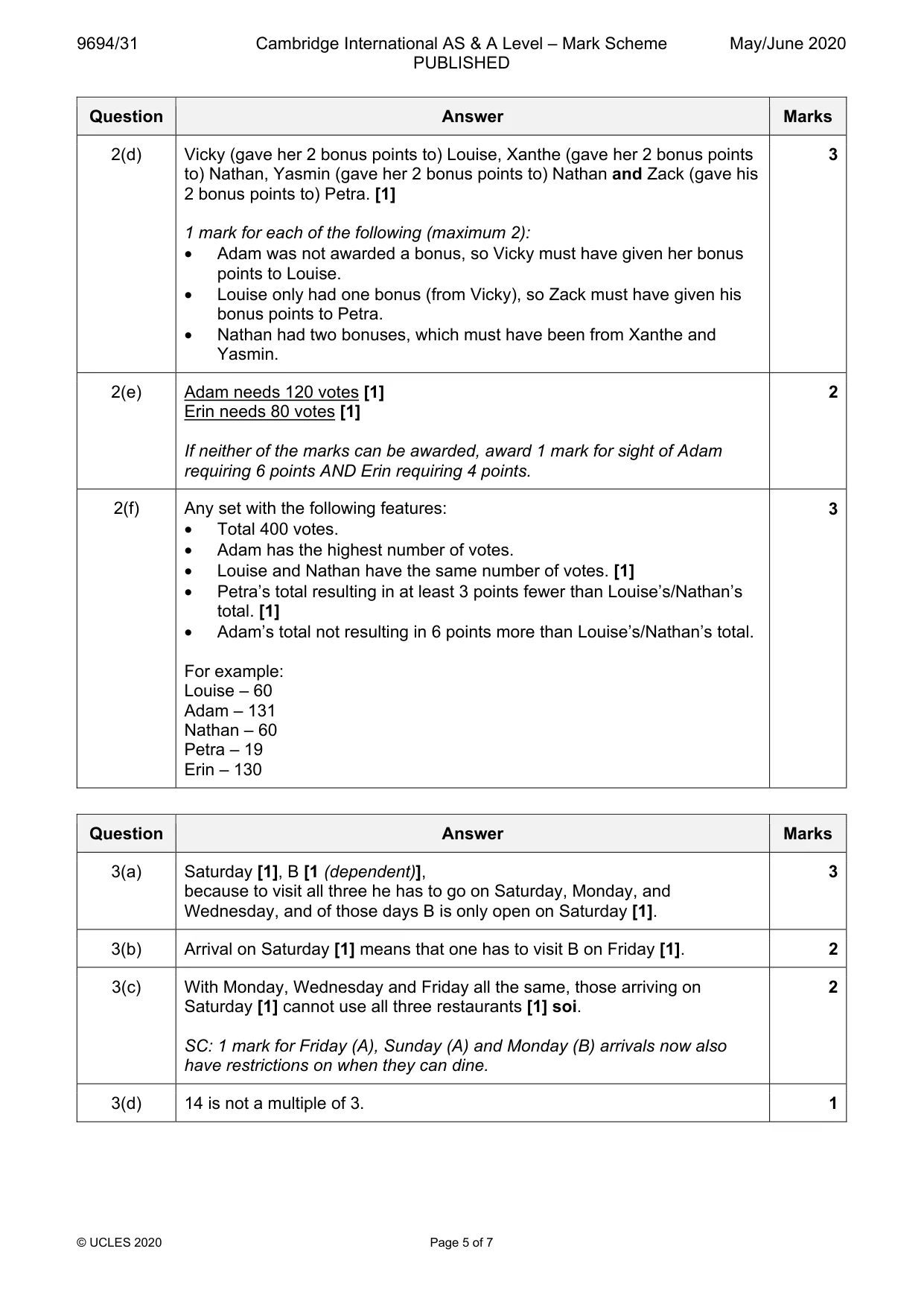
Mark scheme: 2(a)(i) 31 2 1 mark for judges’ total (including bonuses) of 25 or audience points = 6. 2(a)(ii) 55 (5 + 5 + 5 + 5 + 5 + 10 + 20) 1 2(b) & = 4 AND @ = 2 [1] 2 Total of bonuses = 10, so bonus = 2 AND 4 more needed to make total = 25. [1] 2(c) 16 [1] 2 Set of five numbers that would result in a total of 16 points, or their answer (ft), with a sum of 400. [1] 2(d) Vicky (gave her 2 bonus points to) Louise, Xanthe (gave her 2 bonus points 3 to) Nathan, Yasmin (gave her 2 bonus points to) Nathan and Zack (gave his 2 bonus points to) Petra. [1] 1 mark for each of the following (maximum 2): • Adam was not awarded a bonus, so Vicky must have given her bonus points to Louise. • Louise only had one bonus (from Vicky), so Zack must have given his bonus points to Petra. • Nathan had two bonuses, which must have been from Xanthe and Yasmin. 2(e) Adam needs 120 votes [1] 2 Erin needs 80 votes [1] If neither of the marks can be awarded, award 1 mark for sight of Adam requiring 6 points AND Erin requiring 4 points. 2(f) Any set with the following features: 3 • Total 400 votes. • Adam has the highest number of votes. • Louise and Nathan have the same number of votes. [1] • Petra’s total resulting in at least 3 points fewer than Louise’s/Nathan’s total. [1] • Adam’s total not resulting in 6 points more than Louise’s/Nathan’s total. For example: Louise – 60 Adam – 131 Nathan – 60 Petra – 19 Erin – 130
More questions on Perform appropriate operations with information
Q3 · The all-inclusive holiday resort at Cofete provides buffet meals every day, but guests…
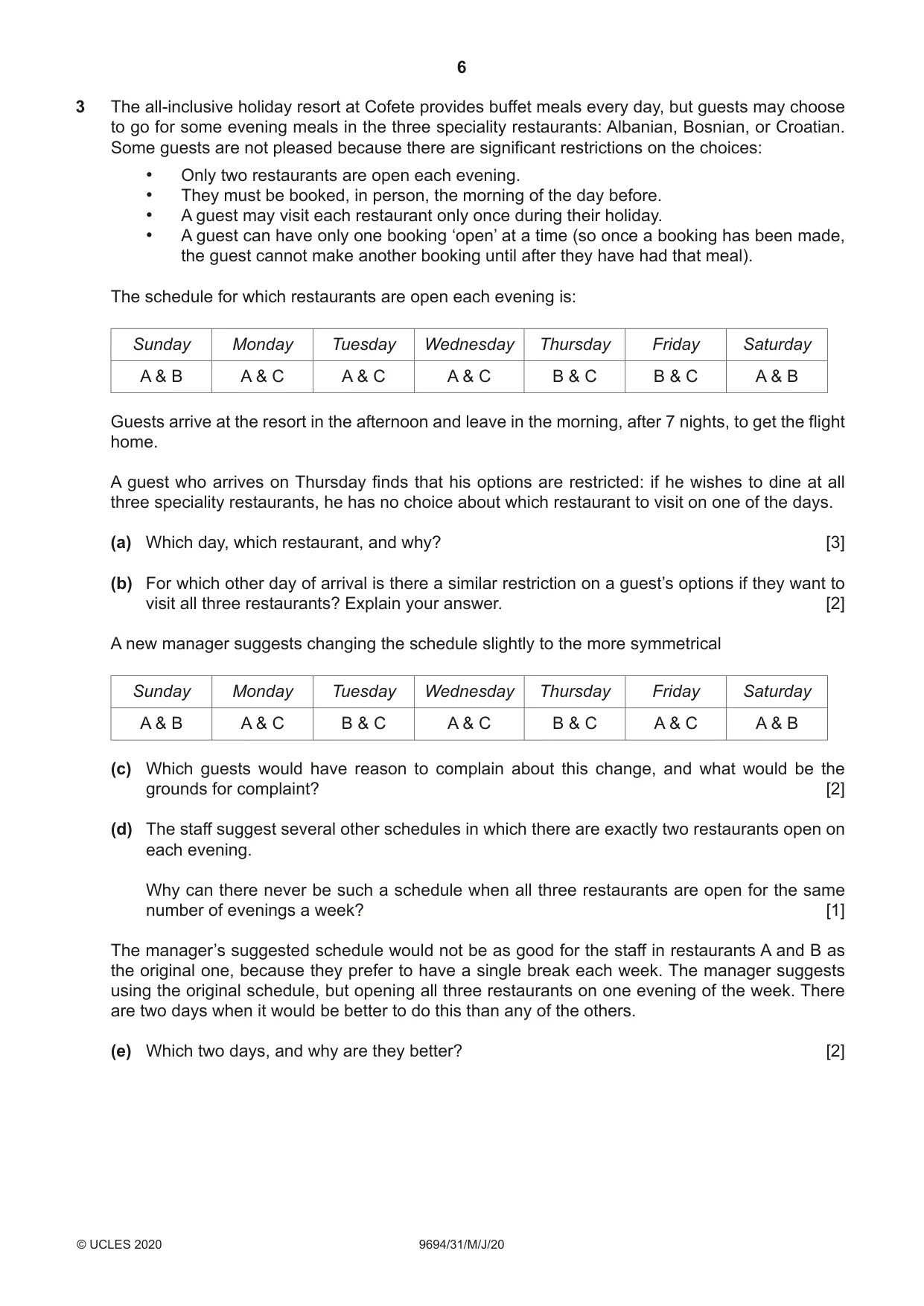
3 The all-inclusive holiday resort at Cofete provides buffet meals every day, but guests may choose to go for some evening meals in the three speciality restaurants: Albanian, Bosnian, or Croatian. Some guests are not pleased because there are significant restrictions on the choices: • Only two restaurants are open each evening. • They must be booked, in person, the morning of the day before. • A guest may visit each restaurant only once during their holiday. • A guest can have only one booking ‘open’ at a time (so once a booking has been made, the guest cannot make another booking until after they have had that meal). The schedule for which restaurants are open each evening is: Sunday Monday Tuesday Wednesday Thursday Friday Saturday A & B A & C A & C A & C B & C B & C A & B Guests arrive at the resort in the afternoon and leave in the morning, after 7 nights, to get the flight home. A guest who arrives on Thursday finds that his options are restricted: if he wishes to dine at all three speciality restaurants, he has no choice about which restaurant to visit on one of the days. (a) Which day, which restaurant, and why? [3] (b) For which other day of arrival is there a similar restriction on a guest’s options if they want to visit all three restaurants? Explain your answer. [2] A new manager suggests changing the schedule slightly to the more symmetrical Sunday Monday Tuesday Wednesday Thursday Friday Saturday A & B A & C B & C A & C B & C A & C A & B (c) Which guests would have reason to complain about this change, and what would be the grounds for complaint? [2] (d) The staff suggest several other schedules in which there are exactly two restaurants open on each evening. Why can there never be such a schedule when all three restaurants are open for the same number of evenings a week? [1] The manager’s suggested schedule would not be as good for the staff in restaurants A and B as the original one, because they prefer to have a single break each week. The manager suggests using the original schedule, but opening all three restaurants on one evening of the week. There are two days when it would be better to do this than any of the others. (e) Which two days, and why are they better? [2]
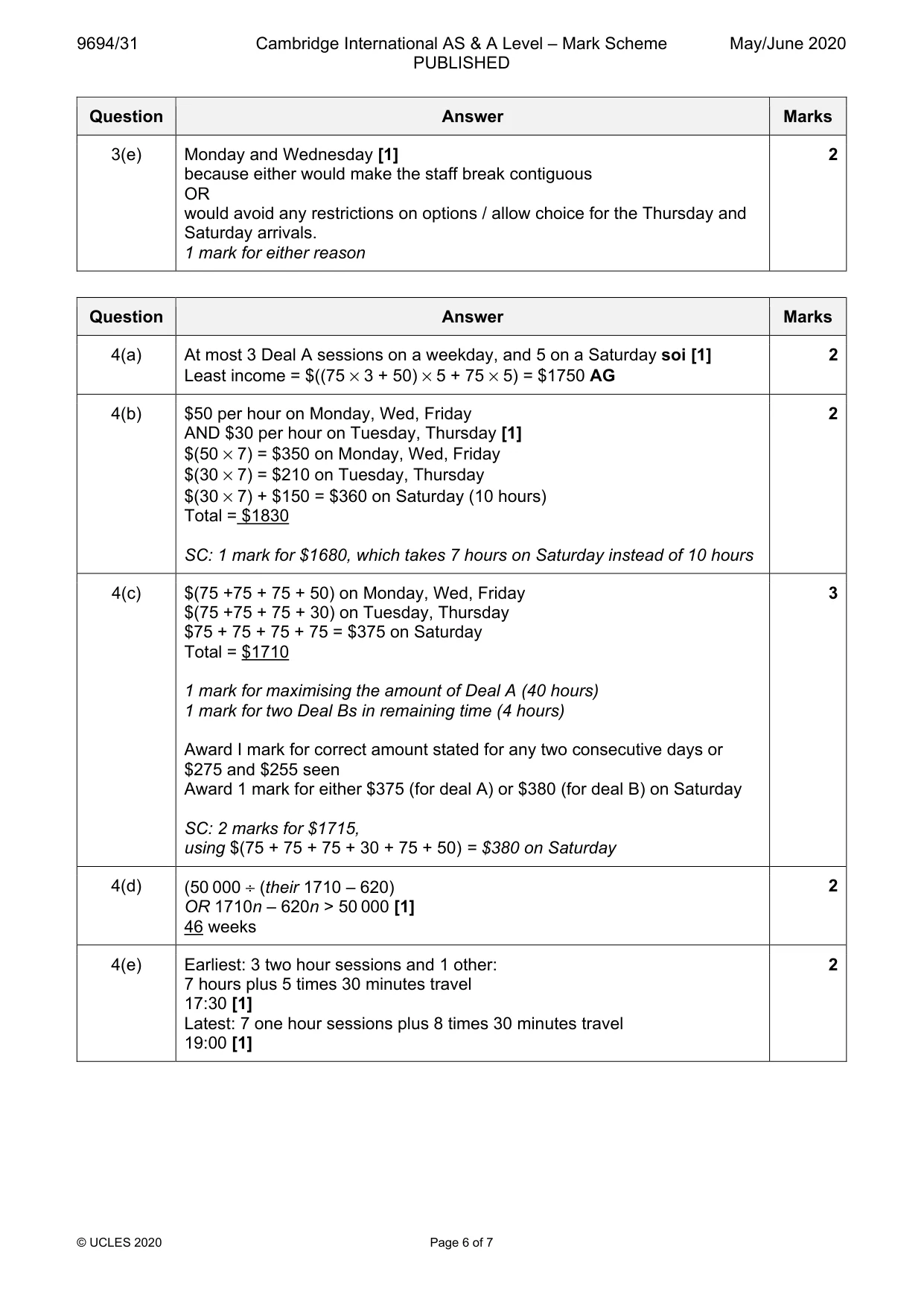
Mark scheme: 3(a) Saturday [1], B [1 (dependent)], 3 because to visit all three he has to go on Saturday, Monday, and Wednesday, and of those days B is only open on Saturday [1]. 3(b) Arrival on Saturday [1] means that one has to visit B on Friday [1]. 2 3(c) With Monday, Wednesday and Friday all the same, those arriving on 2 Saturday [1] cannot use all three restaurants [1] soi. SC: 1 mark for Friday (A), Sunday (A) and Monday (B) arrivals now also have restrictions on when they can dine. 3(d) 14 is not a multiple of 3. 1 3(e) Monday and Wednesday [1] 2 because either would make the staff break contiguous OR would avoid any restrictions on options / allow choice for the Thursday and Saturday arrivals. 1 mark for either reason
Q4 · Elliot has resigned from his job in finance
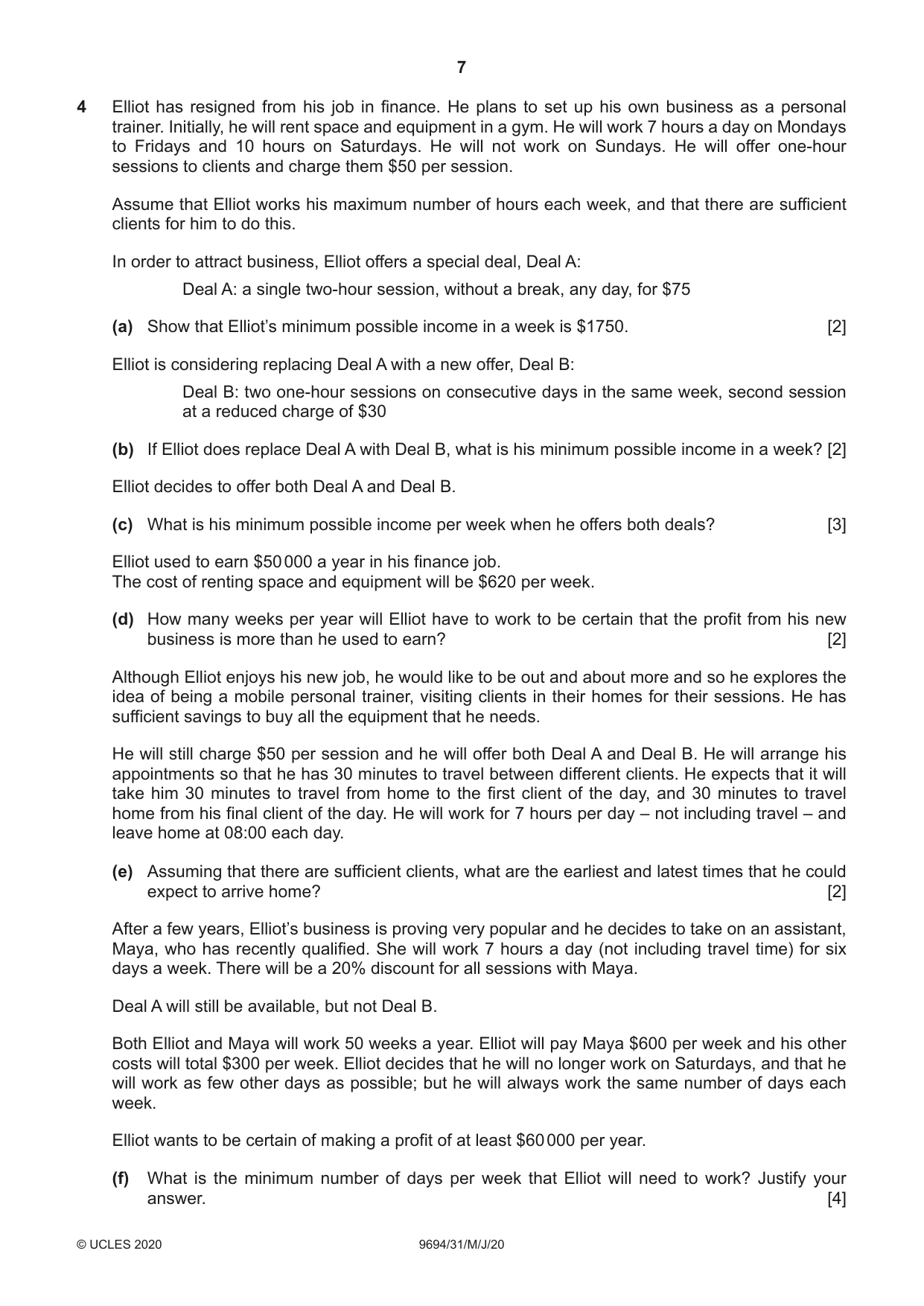
4 Elliot has resigned from his job in finance. He plans to set up his own business as a personal trainer. Initially, he will rent space and equipment in a gym. He will work 7 hours a day on Mondays to Fridays and 10 hours on Saturdays. He will not work on Sundays. He will offer one-hour sessions to clients and charge them $50 per session. Assume that Elliot works his maximum number of hours each week, and that there are sufficient clients for him to do this. In order to attract business, Elliot offers a special deal, Deal A: Deal A: a single two-hour session, without a break, any day, for $75 (a) Show that Elliot’s minimum possible income in a week is $1750. [2] Elliot is considering replacing Deal A with a new offer, Deal B: Deal B: two one-hour sessions on consecutive days in the same week, second session at a reduced charge of $30 (b) If Elliot does replace Deal A with Deal B, what is his minimum possible income in a week? [2] Elliot decides to offer both Deal A and Deal B. (c) What is his minimum possible income per week when he offers both deals? [3] Elliot used to earn $50 000 a year in his finance job. The cost of renting space and equipment will be $620 per week. (d) How many weeks per year will Elliot have to work to be certain that the profit from his new business is more than he used to earn? [2] Although Elliot enjoys his new job, he would like to be out and about more and so he explores the idea of being a mobile personal trainer, visiting clients in their homes for their sessions. He has sufficient savings to buy all the equipment that he needs. He will still charge $50 per session and he will offer both Deal A and Deal B. He will arrange his appointments so that he has 30 minutes to travel between different clients. He expects that it will take him 30 minutes to travel from home to the first client of the day, and 30 minutes to travel home from his final client of the day. He will work for 7 hours per day – not including travel – and leave home at 08:00 each day. (e) Assuming that there are sufficient clients, what are the earliest and latest times that he could expect to arrive home? [2] After a few years, Elliot’s business is proving very popular and he decides to take on an assistant, Maya, who has recently qualified. She will work 7 hours a day (not including travel time) for six days a week. There will be a 20% discount for all sessions with Maya. Deal A will still be available, but not Deal B. Both Elliot and Maya will work 50 weeks a year. Elliot will pay Maya $600 per week and his other costs will total $300 per week. Elliot decides that he will no longer work on Saturdays, and that he will work as few other days as possible; but he will always work the same number of days each week. Elliot wants to be certain of making a profit of at least $60 000 per year. (f) What is the minimum number of days per week that Elliot will need to work? Justify your answer. [4]
Mark scheme: 4(a) At most 3 Deal A sessions on a weekday, and 5 on a Saturday soi [1] 2 Least income = $((75 × 3 + 50) × 5 + 75 × 5) = $1750 AG 4(b) $50 per hour on Monday, Wed, Friday 2 AND $30 per hour on Tuesday, Thursday [1] $(50 × 7) = $350 on Monday, Wed, Friday $(30 × 7) = $210 on Tuesday, Thursday $(30 × 7) + $150 = $360 on Saturday (10 hours) Total = $1830 SC: 1 mark for $1680, which takes 7 hours on Saturday instead of 10 hours 4(c) $(75 +75 + 75 + 50) on Monday, Wed, Friday 3 $(75 +75 + 75 + 30) on Tuesday, Thursday $75 + 75 + 75 + 75 = $375 on Saturday Total = $1710 1 mark for maximising the amount of Deal A (40 hours) 1 mark for two Deal Bs in remaining time (4 hours) Award I mark for correct amount stated for any two consecutive days or $275 and $255 seen Award 1 mark for either $375 (for deal A) or $380 (for deal B) on Saturday SC: 2 marks for $1715, using $(75 + 75 + 75 + 30 + 75 + 50) = $380 on Saturday 4(d) (50 000 ÷ (their 1710 – 620) 2 OR 1710n – 620n > 50 000 [1] 46 weeks 4(e) Earliest: 3 two hour sessions and 1 other: 2 7 hours plus 5 times 30 minutes travel 17:30 [1] Latest: 7 one hour sessions plus 8 times 30 minutes travel 19:00 [1] 4(f) Minimum income from Maya = $((75 × 3) + 50) × 6 × 80% 4 = $1320 [1] Net income = $(1320 – 600 – 300) = $420 [1] 60000/50 = $1200 60 000 1320 − 900 + 275N > oe or 2.83 [1] 50 So he will need to work 3 days every week. [1]
More questions on Perform appropriate operations with information
What was in this paper
The subtopics covered by these 4 questions, and how many questions each got. Open one in a new tab to see every Cambridge question on it.