Cambridge A Level Thinking Skills 9694 — 2019 May/June Paper 3 · Variant 1
9694/31/M/J/19 · 4 questions · 50 marks · ≈56 min
The question paper and its mark scheme, free to read here and free to download. This is Cambridge’s own paper, exactly as it was sat.
Question paper8 pages
Mark scheme8 pages
Answers below. Sit the paper first if you are practising.
Questions as text
Q1 · Barry needs to send some documents to Marcia
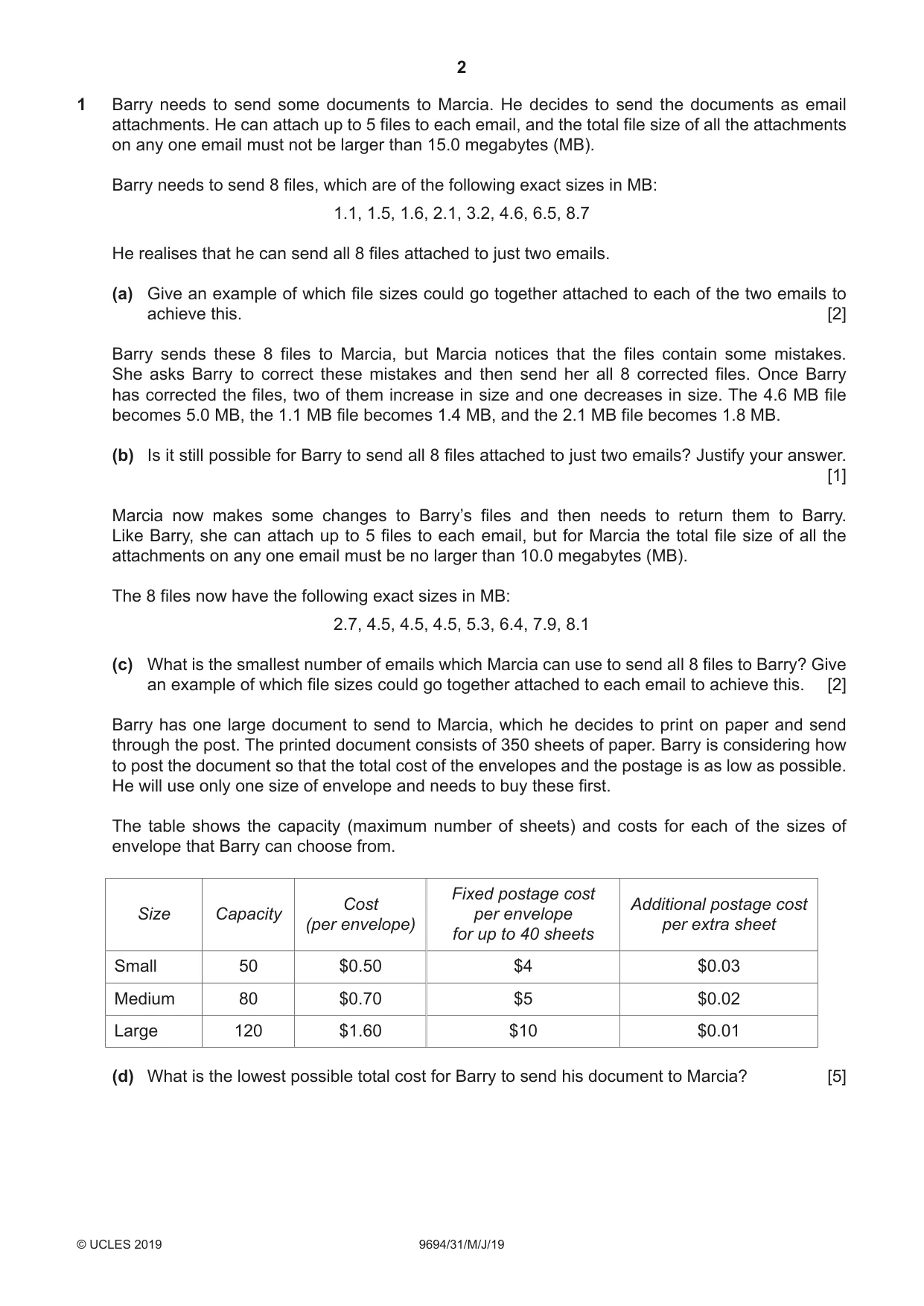
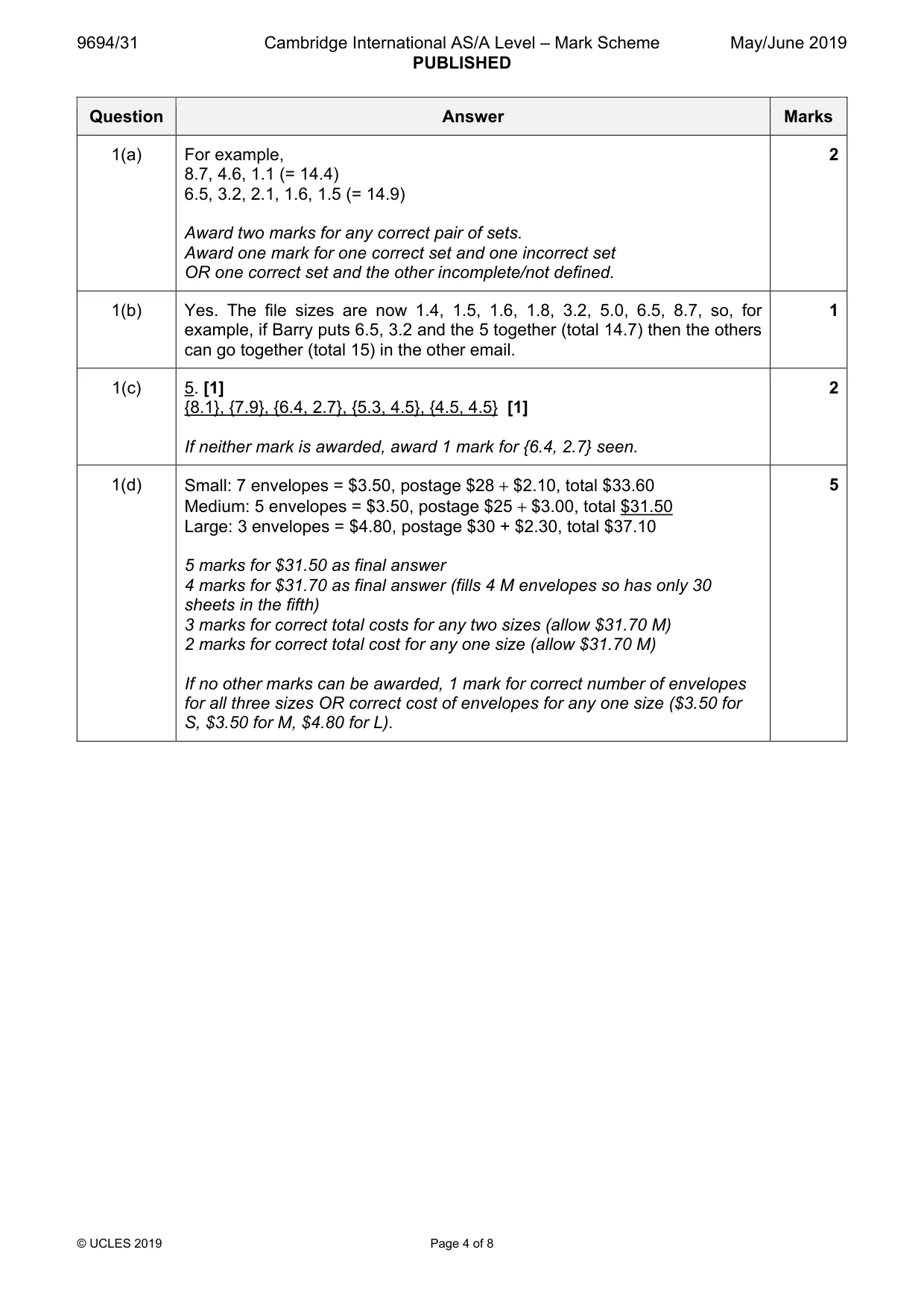
1 Barry needs to send some documents to Marcia. He decides to send the documents as email attachments. He can attach up to 5 files to each email, and the total file size of all the attachments on any one email must not be larger than 15.0 megabytes (MB). Barry needs to send 8 files, which are of the following exact sizes in MB: 1.1, 1.5, 1.6, 2.1, 3.2, 4.6, 6.5, 8.7 He realises that he can send all 8 files attached to just two emails. (a) Give an example of which file sizes could go together attached to each of the two emails to achieve this. [2] Barry sends these 8 files to Marcia, but Marcia notices that the files contain some mistakes. She asks Barry to correct these mistakes and then send her all 8 corrected files. Once Barry has corrected the files, two of them increase in size and one decreases in size. The 4.6 MB file becomes 5.0 MB, the 1.1 MB file becomes 1.4 MB, and the 2.1 MB file becomes 1.8 MB. (b) Is it still possible for Barry to send all 8 files attached to just two emails? Justify your answer. [1] Marcia now makes some changes to Barry’s files and then needs to return them to Barry. Like Barry, she can attach up to 5 files to each email, but for Marcia the total file size of all the attachments on any one email must be no larger than 10.0 megabytes (MB). The 8 files now have the following exact sizes in MB: 2.7, 4.5, 4.5, 4.5, 5.3, 6.4, 7.9, 8.1 (c) What is the smallest number of emails which Marcia can use to send all 8 files to Barry? Give an example of which file sizes could go together attached to each email to achieve this. [2] Barry has one large document to send to Marcia, which he decides to print on paper and send through the post. The printed document consists of 350 sheets of paper. Barry is considering how to post the document so that the total cost of the envelopes and the postage is as low as possible. He will use only one size of envelope and needs to buy these first. The table shows the capacity (maximum number of sheets) and costs for each of the sizes of envelope that Barry can choose from. Fixed postage cost Cost Additional postage cost Size Capacity per envelope (per envelope) per extra sheet for up to 40 sheets Small 50 $0.50 $4 $0.03 Medium 80 $0.70 $5 $0.02 Large 120 $1.60 $10 $0.01 (d) What is the lowest possible total cost for Barry to send his document to Marcia? [5]
Mark scheme: Question Answer Marks 1(a) For example, 2 8.7, 4.6, 1.1 (= 14.4) 6.5, 3.2, 2.1, 1.6, 1.5 (= 14.9) Award two marks for any correct pair of sets. Award one mark for one correct set and one incorrect set OR one correct set and the other incomplete/not defined. 1(b) Yes. The file sizes are now 1.4, 1.5, 1.6, 1.8, 3.2, 5.0, 6.5, 8.7, so, for 1 example, if Barry puts 6.5, 3.2 and the 5 together (total 14.7) then the others can go together (total 15) in the other email. 1(c) 5. [1] 2 {8.1}, {7.9}, {6.4, 2.7}, {5.3, 4.5}, {4.5, 4.5} [1] If neither mark is awarded, award 1 mark for {6.4, 2.7} seen. 1(d) Small: 7 envelopes = $3.50, postage $28 + $2.10, total $33.60 5 Medium: 5 envelopes = $3.50, postage $25 + $3.00, total $31.50 Large: 3 envelopes = $4.80, postage $30 + $2.30, total $37.10 5 marks for $31.50 as final answer 4 marks for $31.70 as final answer (fills 4 M envelopes so has only 30 sheets in the fifth) 3 marks for correct total costs for any two sizes (allow $31.70 M) 2 marks for correct total cost for any one size (allow $31.70 M) If no other marks can be awarded, 1 mark for correct number of envelopes for all three sizes OR correct cost of envelopes for any one size ($3.50 for S, $3.50 for M, $4.80 for L).
More questions on Perform appropriate operations with information
Q2 · Joshua is a taxi driver who is considering working only on Fridays, doing a 12-hour shift…
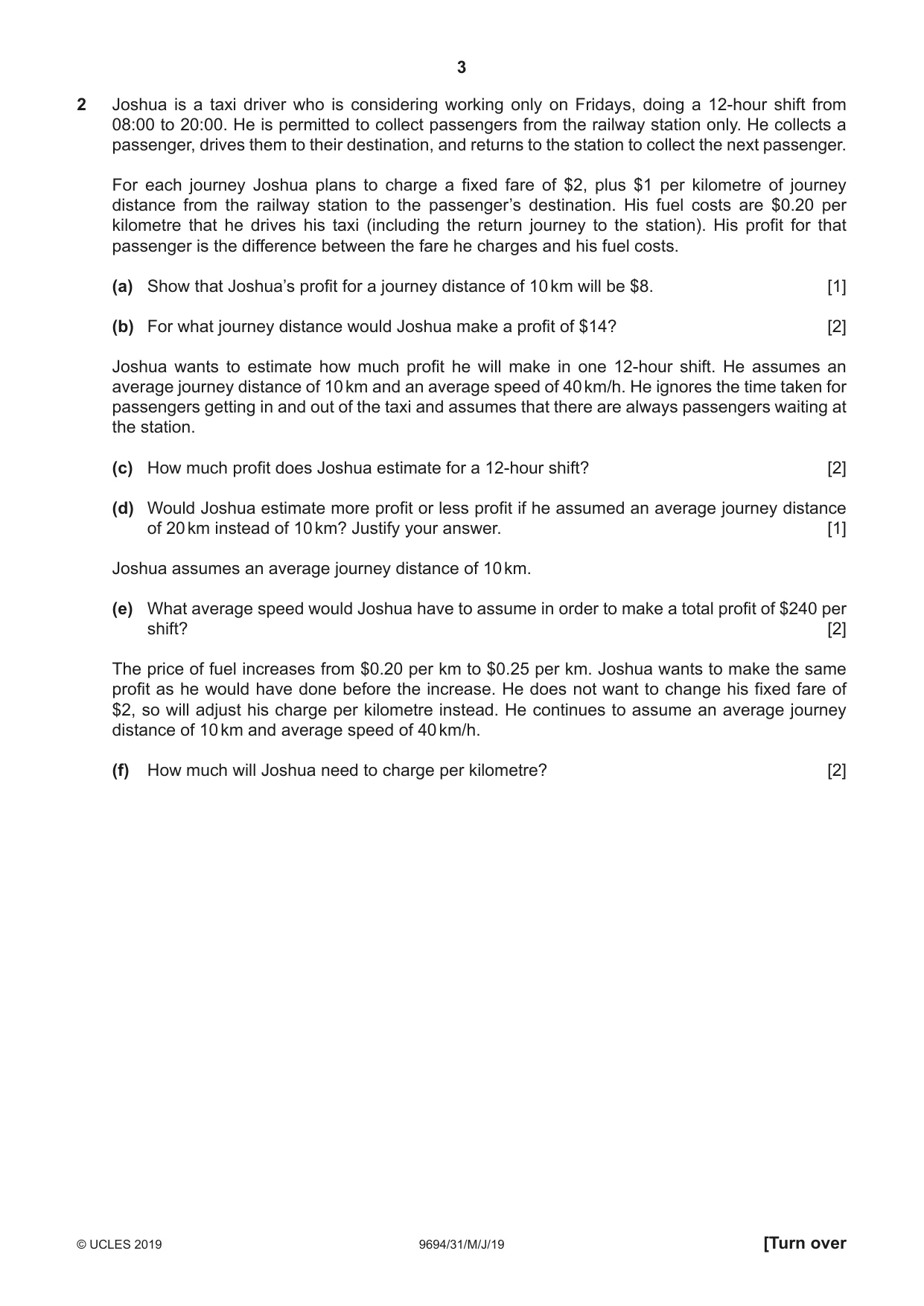
2 Joshua is a taxi driver who is considering working only on Fridays, doing a 12-hour shift from 08:00 to 20:00. He is permitted to collect passengers from the railway station only. He collects a passenger, drives them to their destination, and returns to the station to collect the next passenger. For each journey Joshua plans to charge a fixed fare of $2, plus $1 per kilometre of journey distance from the railway station to the passenger’s destination. His fuel costs are $0.20 per kilometre that he drives his taxi (including the return journey to the station). His profit for that passenger is the difference between the fare he charges and his fuel costs. (a) Show that Joshua’s profit for a journey distance of 10 km will be $8. [1] (b) For what journey distance would Joshua make a profit of $14? [2] Joshua wants to estimate how much profit he will make in one 12-hour shift. He assumes an average journey distance of 10 km and an average speed of 40 km/h. He ignores the time taken for passengers getting in and out of the taxi and assumes that there are always passengers waiting at the station. (c) How much profit does Joshua estimate for a 12-hour shift? [2] (d) Would Joshua estimate more profit or less profit if he assumed an average journey distance of 20 km instead of 10 km? Justify your answer. [1] Joshua assumes an average journey distance of 10 km. (e) What average speed would Joshua have to assume in order to make a total profit of $240 per shift? [2] The price of fuel increases from $0.20 per km to $0.25 per km. Joshua wants to make the same profit as he would have done before the increase. He does not want to change his fixed fare of $2, so will adjust his charge per kilometre instead. He continues to assume an average journey distance of 10 km and average speed of 40 km/h. (f) How much will Joshua need to charge per kilometre? [2]
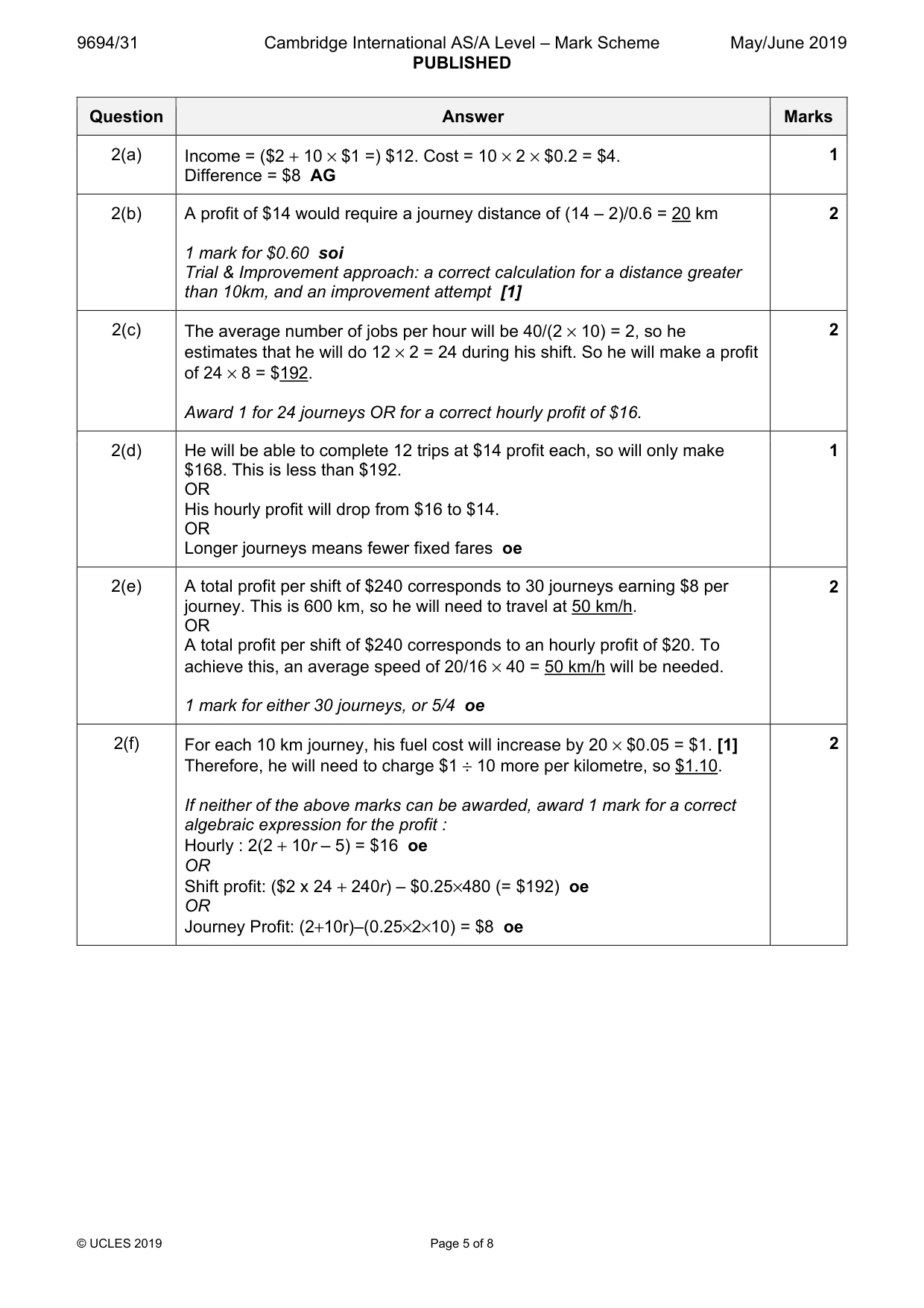
Mark scheme: 2(a) Income = ($2 + 10 × $1 =) $12. Cost = 10 × 2 × $0.2 = $4. 1 Difference = $8 AG 2(b) A profit of $14 would require a journey distance of (14 – 2)/0.6 = 20 km 2 1 mark for $0.60 soi Trial & Improvement approach: a correct calculation for a distance greater than 10km, and an improvement attempt [1] 2(c) The average number of jobs per hour will be 40/(2 × 10) = 2, so he 2 estimates that he will do 12 × 2 = 24 during his shift. So he will make a profit of 24 × 8 = $192. Award 1 for 24 journeys OR for a correct hourly profit of $16. 2(d) He will be able to complete 12 trips at $14 profit each, so will only make 1 $168. This is less than $192. OR His hourly profit will drop from $16 to $14. OR Longer journeys means fewer fixed fares oe 2(e) A total profit per shift of $240 corresponds to 30 journeys earning $8 per 2 journey. This is 600 km, so he will need to travel at 50 km/h. OR A total profit per shift of $240 corresponds to an hourly profit of $20. To achieve this, an average speed of 20/16 × 40 = 50 km/h will be needed. 1 mark for either 30 journeys, or 5/4 oe 2(f) For each 10 km journey, his fuel cost will increase by 20 × $0.05 = $1. [1] 2 Therefore, he will need to charge $1 ÷ 10 more per kilometre, so $1.10. If neither of the above marks can be awarded, award 1 mark for a correct algebraic expression for the profit : Hourly : 2(2 + 10r – 5) = $16 oe OR Shift profit: ($2 x 24 + 240r) – $0.25×480 (= $192) oe OR Journey Profit: (2+10r)–(0.25×2×10) = $8 oe
Q3 · A substitution cipher is a method of encoding messages in which uncoded letters of the…
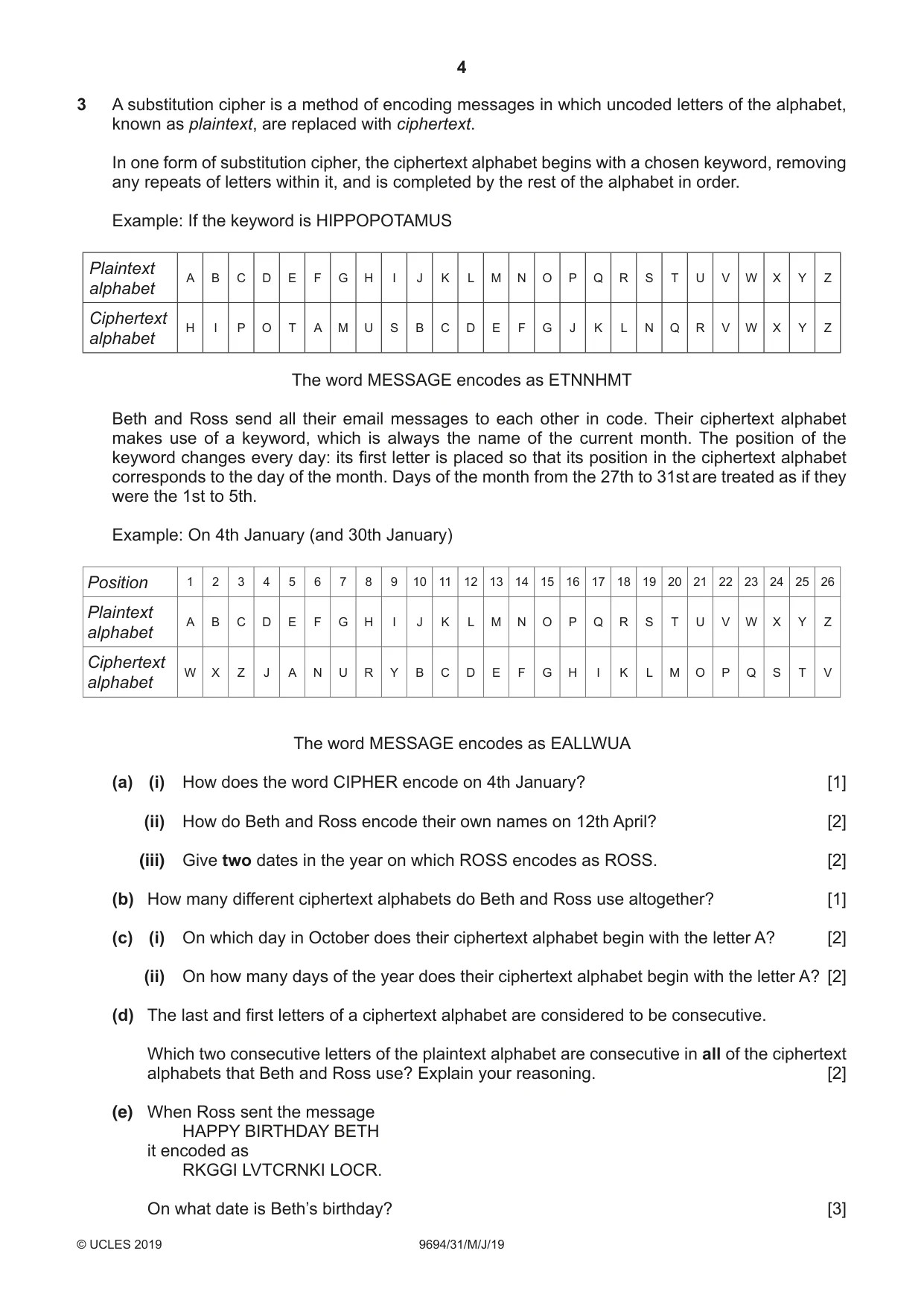
3 A substitution cipher is a method of encoding messages in which uncoded letters of the alphabet, known as plaintext, are replaced with ciphertext. In one form of substitution cipher, the ciphertext alphabet begins with a chosen keyword, removing any repeats of letters within it, and is completed by the rest of the alphabet in order. Example: If the keyword is HIPPOPOTAMUS Plaintext A B C D E F G H I J K L M N O P Q R S T U V W X Y Z alphabet Ciphertext H I P O T A M U S B C D E F G J K L N Q R V W X Y Z alphabet The word MESSAGE encodes as ETNNHMT Beth and Ross send all their email messages to each other in code. Their ciphertext alphabet makes use of a keyword, which is always the name of the current month. The position of the keyword changes every day: its first letter is placed so that its position in the ciphertext alphabet corresponds to the day of the month. Days of the month from the 27th to 31st are treated as if they were the 1st to 5th. Example: On 4th January (and 30th January) Position 1 2 3 4 5 6 7 8 9 10 11 12 13 14 15 16 17 18 19 20 21 22 23 24 25 26 Plaintext A B C D E F G H I J K L M N O P Q R S T U V W X Y Z alphabet Ciphertext W X Z J A N U R Y B C D E F G H I K L M O P Q S T V alphabet The word MESSAGE encodes as EALLWUA (a) (i) How does the word CIPHER encode on 4th January? [1] (ii) How do Beth and Ross encode their own names on 12th April? [2] (iii) Give two dates in the year on which ROSS encodes as ROSS. [2] (b) How many different ciphertext alphabets do Beth and Ross use altogether? [1] (c) (i) On which day in October does their ciphertext alphabet begin with the letter A? [2] (ii) On how many days of the year does their ciphertext alphabet begin with the letter A? [2] (d) The last and first letters of a ciphertext alphabet are considered to be consecutive. Which two consecutive letters of the plaintext alphabet are consecutive in all of the ciphertext alphabets that Beth and Ross use? Explain your reasoning. [2] (e) When Ross sent the message HAPPY BIRTHDAY BETH it encoded as RKGGI LVTCRNKI LOCR. On what date is Beth’s birthday? [3] [Question 4 begins on the next page]
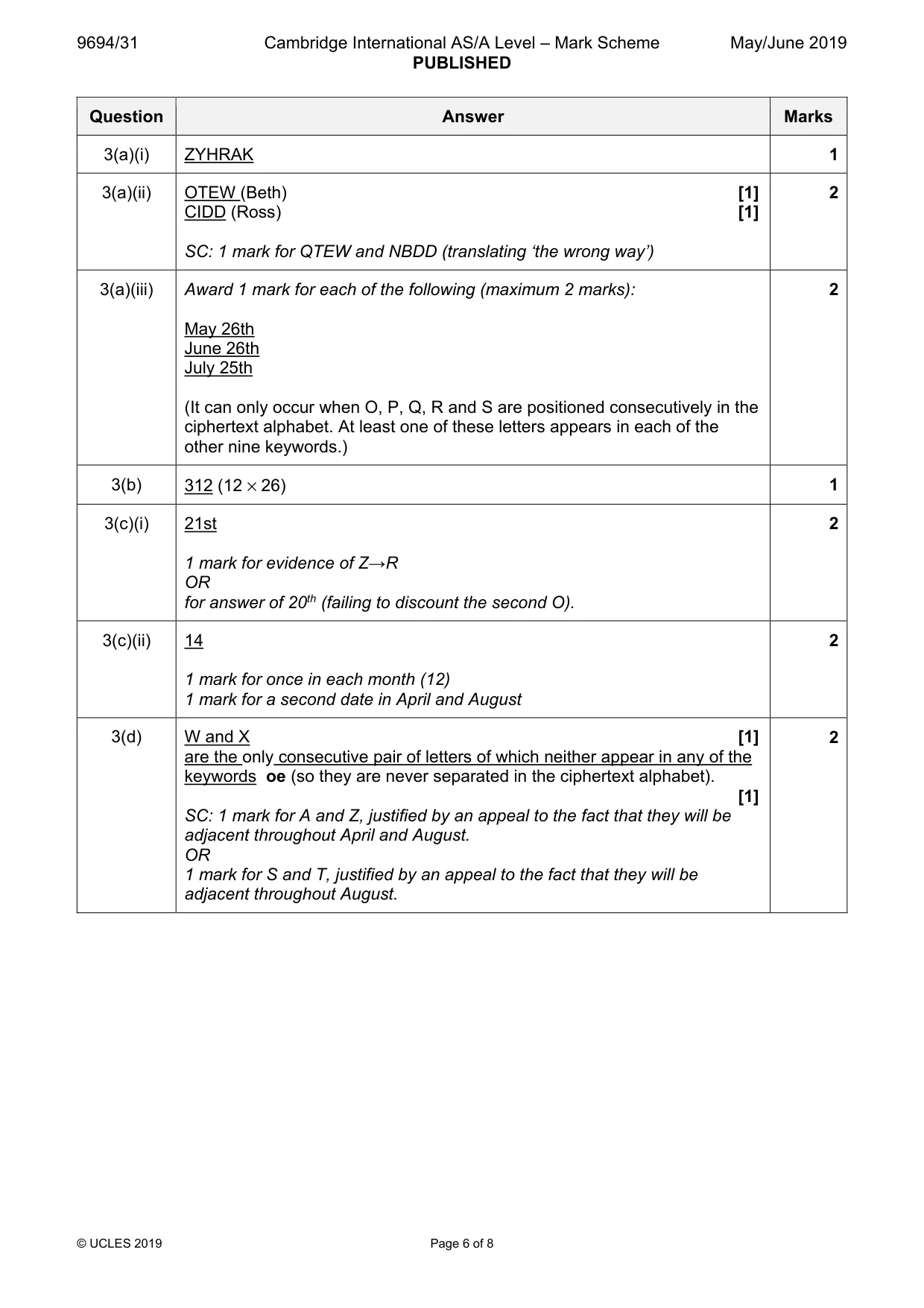
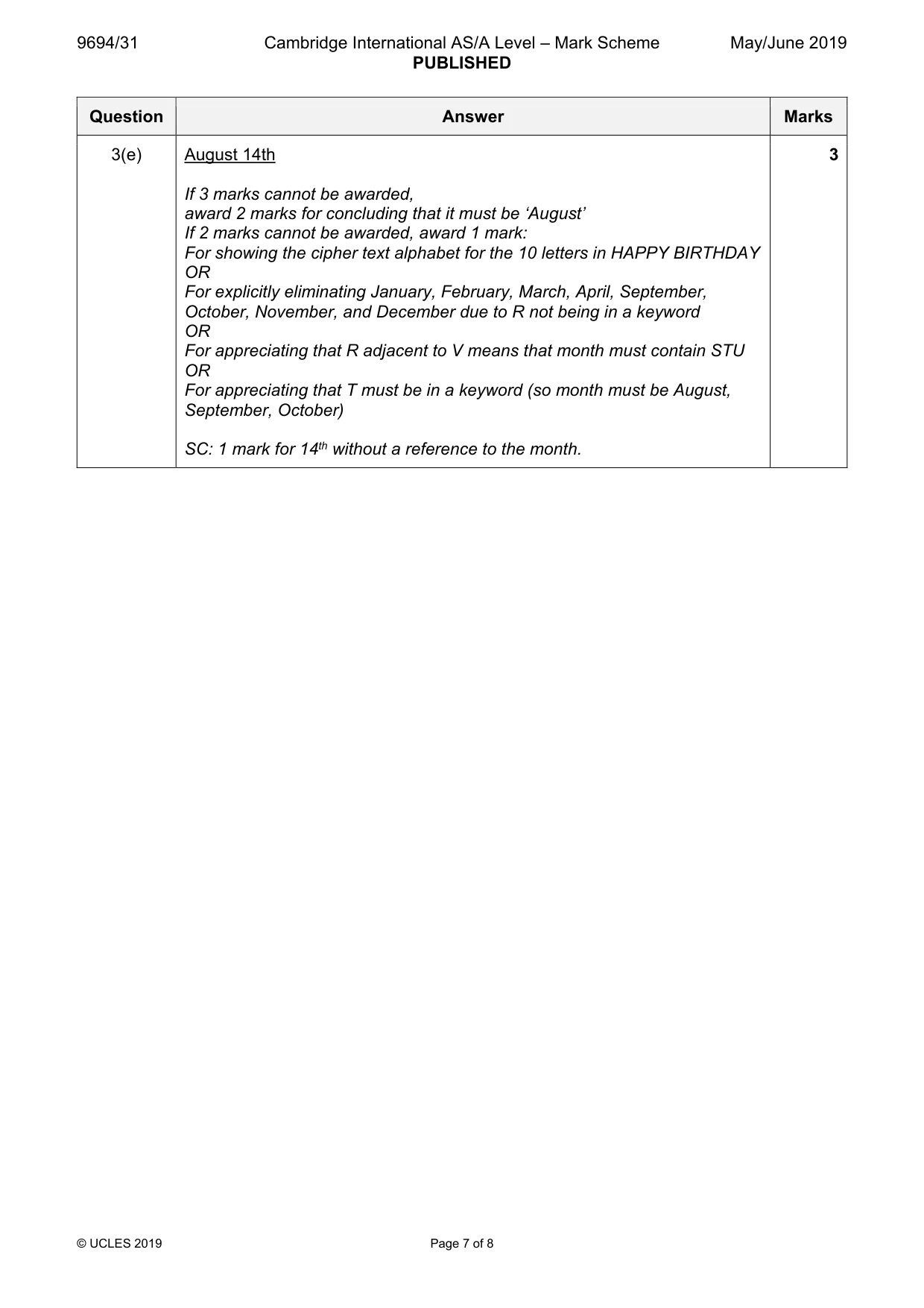
Mark scheme: 3(a)(i) ZYHRAK 1 3(a)(ii) OTEW (Beth) [1] 2 CIDD (Ross) [1] SC: 1 mark for QTEW and NBDD (translating ‘the wrong way’) 3(a)(iii) Award 1 mark for each of the following (maximum 2 marks): 2 May 26th June 26th July 25th (It can only occur when O, P, Q, R and S are positioned consecutively in the ciphertext alphabet. At least one of these letters appears in each of the other nine keywords.) 3(b) 312 (12 × 26) 1 3(c)(i) 21st 2 1 mark for evidence of Z→R OR for answer of 20th (failing to discount the second O). 3(c)(ii) 14 2 1 mark for once in each month (12) 1 mark for a second date in April and August 3(d) W and X [1] 2 are the only consecutive pair of letters of which neither appear in any of the keywords oe (so they are never separated in the ciphertext alphabet). [1] SC: 1 mark for A and Z, justified by an appeal to the fact that they will be adjacent throughout April and August. OR 1 mark for S and T, justified by an appeal to the fact that they will be adjacent throughout August. 3(e) August 14th 3 If 3 marks cannot be awarded, award 2 marks for concluding that it must be ‘August’ If 2 marks cannot be awarded, award 1 mark: For showing the cipher text alphabet for the 10 letters in HAPPY BIRTHDAY OR For explicitly eliminating January, February, March, April, September, October, November, and December due to R not being in a keyword OR For appreciating that R adjacent to V means that month must contain STU OR For appreciating that T must be in a keyword (so month must be August, September, October) SC: 1 mark for 14th without a reference to the month.
More questions on Perform appropriate operations with information
Q4 · Spelanskor is a game for two players, played over a number of rounds
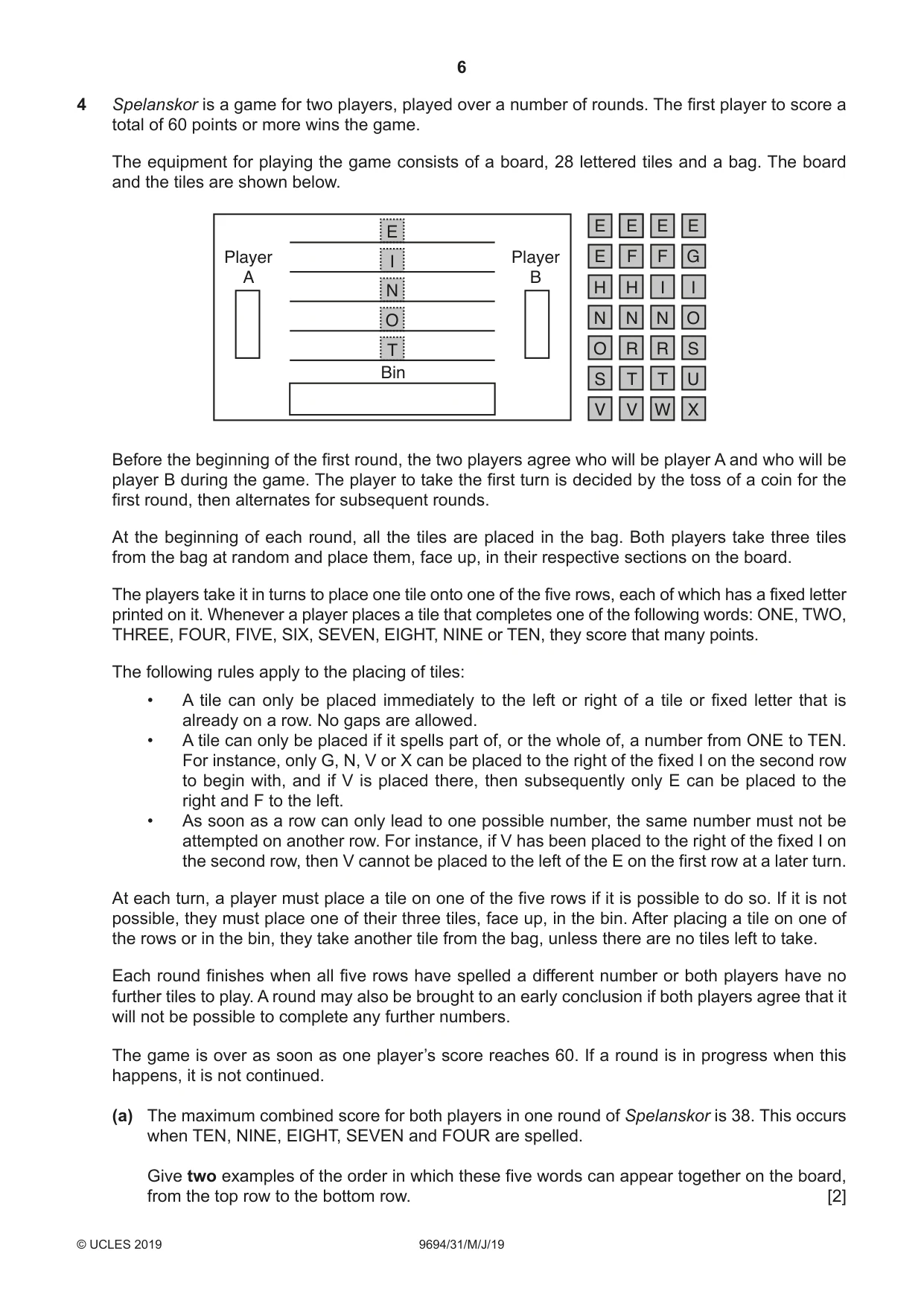
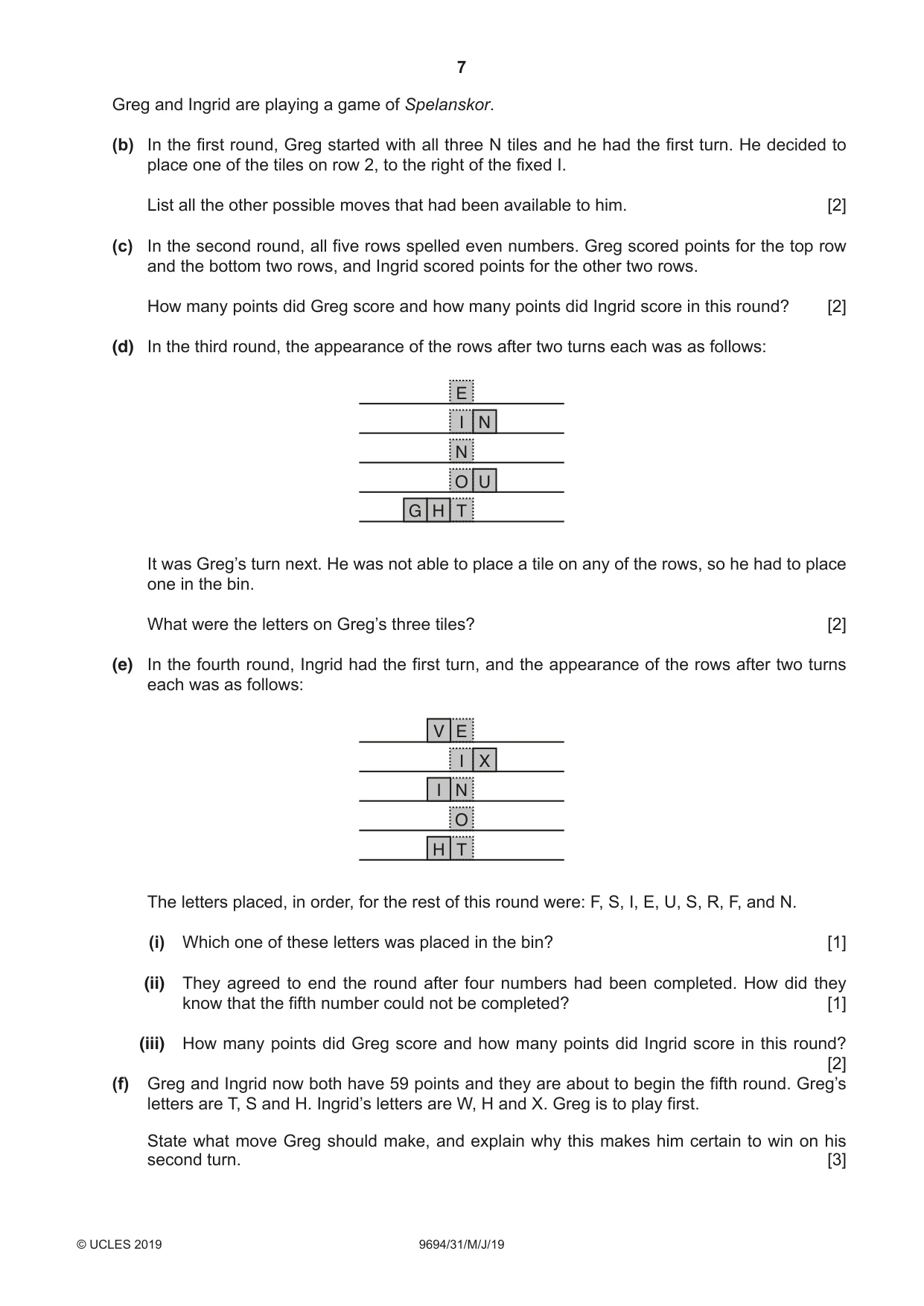
4 Spelanskor is a game for two players, played over a number of rounds. The first player to score a total of 60 points or more wins the game. The equipment for playing the game consists of a board, 28 lettered tiles and a bag. The board and the tiles are shown below. E E E E E Player I Player E F F G A B N H H I I O N N N O T O R R S Bin S T T U V V W X Before the beginning of the first round, the two players agree who will be player A and who will be player B during the game. The player to take the first turn is decided by the toss of a coin for the first round, then alternates for subsequent rounds. At the beginning of each round, all the tiles are placed in the bag. Both players take three tiles from the bag at random and place them, face up, in their respective sections on the board. The players take it in turns to place one tile onto one of the five rows, each of which has a fixed letter printed on it. Whenever a player places a tile that completes one of the following words: ONE, TWO, THREE, FOUR, FIVE, SIX, SEVEN, EIGHT, NINE or TEN, they score that many points. The following rules apply to the placing of tiles: • A tile can only be placed immediately to the left or right of a tile or fixed letter that is already on a row. No gaps are allowed. • A tile can only be placed if it spells part of, or the whole of, a number from ONE to TEN. For instance, only G, N, V or X can be placed to the right of the fixed I on the second row to begin with, and if V is placed there, then subsequently only E can be placed to the right and F to the left. • As soon as a row can only lead to one possible number, the same number must not be attempted on another row. For instance, if V has been placed to the right of the fixed I on the second row, then V cannot be placed to the left of the E on the first row at a later turn. At each turn, a player must place a tile on one of the five rows if it is possible to do so. If it is not possible, they must place one of their three tiles, face up, in the bin. After placing a tile on one of the rows or in the bin, they take another tile from the bag, unless there are no tiles left to take. Each round finishes when all five rows have spelled a different number or both players have no further tiles to play. A round may also be brought to an early conclusion if both players agree that it will not be possible to complete any further numbers. The game is over as soon as one player’s score reaches 60. If a round is in progress when this happens, it is not continued. (a) The maximum combined score for both players in one round of Spelanskor is 38. This occurs when TEN, NINE, EIGHT, SEVEN and FOUR are spelled. Give two examples of the order in which these five words can appear together on the board, from the top row to the bottom row. [2] Greg and Ingrid are playing a game of Spelanskor. (b) In the first round, Greg started with all three N tiles and he had the first turn. He decided to place one of the tiles on row 2, to the right of the fixed I. List all the other possible moves that had been available to him. [2] (c) In the second round, all five rows spelled even numbers. Greg scored points for the top row and the bottom two rows, and Ingrid scored points for the other two rows. How many points did Greg score and how many points did Ingrid score in this round? [2] (d) In the third round, the appearance of the rows after two turns each was as follows: E I N N O U G H T It was Greg’s turn next. He was not able to place a tile on any of the rows, so he had to place one in the bin. What were the letters on Greg’s three tiles? [2] (e) In the fourth round, Ingrid had the first turn, and the appearance of the rows after two turns each was as follows: V E I X I N O H T The letters placed, in order, for the rest of this round were: F, S, I, E, U, S, R, F, and N. (i) Which one of these letters was placed in the bin? [1] (ii) They agreed to end the round after four numbers had been completed. How did they know that the fifth number could not be completed? [1] (iii) How many points did Greg score and how many points did Ingrid score in this round? [2] (f) Greg and Ingrid now both have 59 points and they are about to begin the fifth round. Greg’s letters are T, S and H. Ingrid’s letters are W, H and X. Greg is to play first. State what move Greg should make, and explain why this makes him certain to win on his second turn. [3]
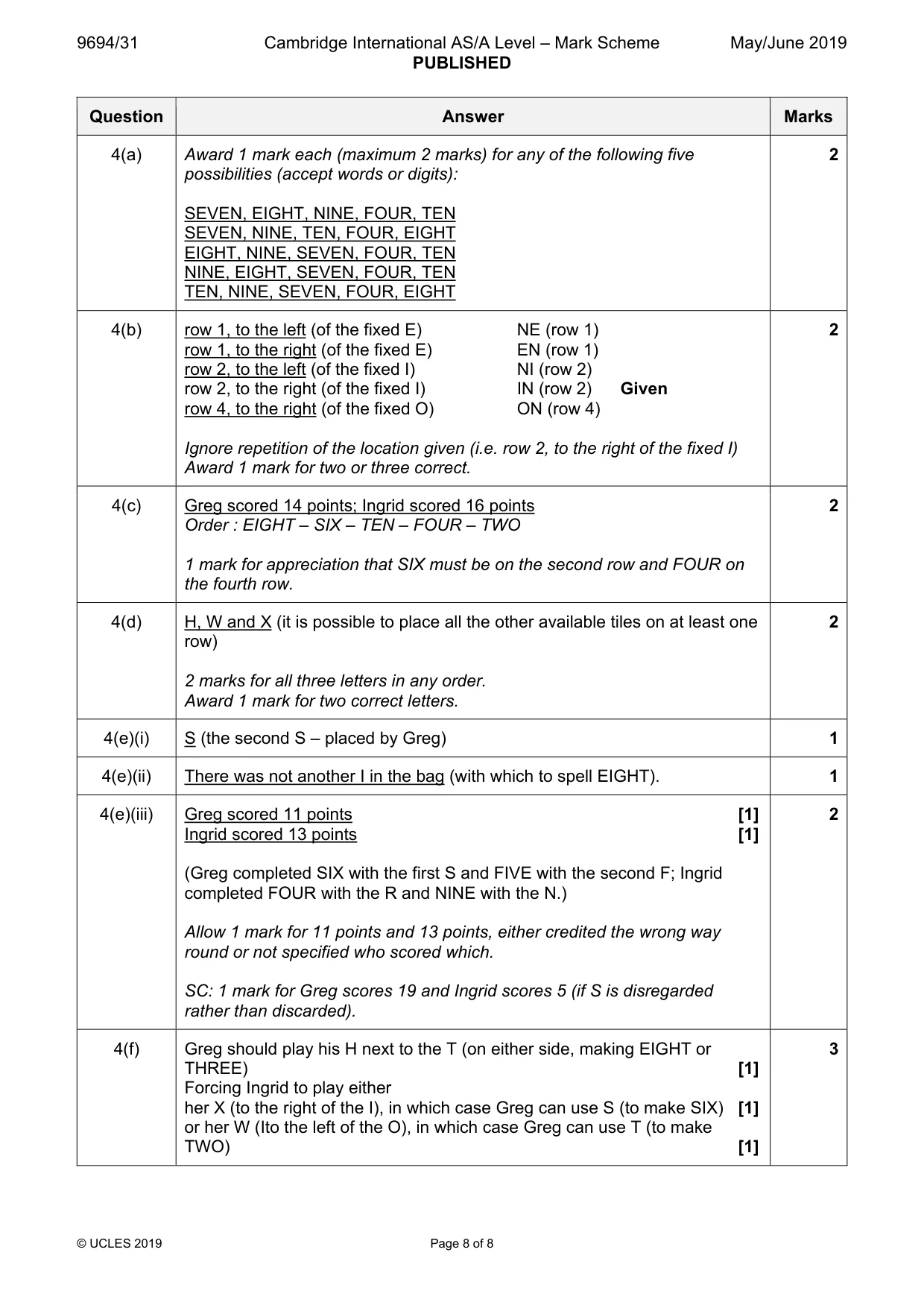
Mark scheme: 4(a) Award 1 mark each (maximum 2 marks) for any of the following five 2 possibilities (accept words or digits): SEVEN, EIGHT, NINE, FOUR, TEN SEVEN, NINE, TEN, FOUR, EIGHT EIGHT, NINE, SEVEN, FOUR, TEN NINE, EIGHT, SEVEN, FOUR, TEN TEN, NINE, SEVEN, FOUR, EIGHT 4(b) row 1, to the left (of the fixed E) NE (row 1) 2 row 1, to the right (of the fixed E) EN (row 1) row 2, to the left (of the fixed I) NI (row 2) row 2, to the right (of the fixed I) IN (row 2) Given row 4, to the right (of the fixed O) ON (row 4) Ignore repetition of the location given (i.e. row 2, to the right of the fixed I) Award 1 mark for two or three correct. 4(c) Greg scored 14 points; Ingrid scored 16 points 2 Order : EIGHT – SIX – TEN – FOUR – TWO 1 mark for appreciation that SIX must be on the second row and FOUR on the fourth row. 4(d) H, W and X (it is possible to place all the other available tiles on at least one 2 row) 2 marks for all three letters in any order. Award 1 mark for two correct letters. 4(e)(i) S (the second S – placed by Greg) 1 4(e)(ii) There was not another I in the bag (with which to spell EIGHT). 1 4(e)(iii) Greg scored 11 points [1] 2 Ingrid scored 13 points [1] (Greg completed SIX with the first S and FIVE with the second F; Ingrid completed FOUR with the R and NINE with the N.) Allow 1 mark for 11 points and 13 points, either credited the wrong way round or not specified who scored which. SC: 1 mark for Greg scores 19 and Ingrid scores 5 (if S is disregarded rather than discarded). 4(f) Greg should play his H next to the T (on either side, making EIGHT or 3 THREE) [1] Forcing Ingrid to play either her X (to the right of the I), in which case Greg can use S (to make SIX) [1] or her W (Ito the left of the O), in which case Greg can use T (to make TWO) [1]
More questions on Identify cases that satisfy given criteria
What was in this paper
The subtopics covered by these 4 questions, and how many questions each got. Open one in a new tab to see every Cambridge question on it.
What you needed in this session
Cambridge’s own grade thresholds for 2019 May/June, Paper 3 · Variant 1. A higher threshold means an easier paper — the bar moves with how the cohort did.